Entrepreneurial Strategy and Competitive Dynamics
Chapter Eight
McGraw-Hill/Irwin
Copyright © 2012 by The McGraw-Hill Companies, Inc. All
rights reserved.
Learning Objectives
After reading this chapter, you should have a good
understanding of:
LO8.1 The role of new ventures and small businesses in the
U.S. economy.
LO8.2 The role of opportunities, resources, and
entrepreneurs in successfully pursuing new ventures.
LO8.3 Three types of entry strategies—pioneering,
initiative, and adaptive—commonly used to launch a
new venture.
8-*
Learning Objectives (cont.)
LO8.4 How the generic strategies of overall cost leadership,
differentiation, and focus are used by new ventures and small
businesses.
LO8.5 How competitive actions, such as the entry of new
competitors into a marketplace, may launch a cycle of
actions and reactions among close competitors.
LO8.6 The components of competitive dynamics analysis—
new competitive action, threat analysis, motivation
and capability to respond, types of competitive actions,
and likelihood of competitive reaction.
8-*
Recognizing Entrepreneurial Opportunities
Entrepreneurship
the creation of new value by an existing organization or new
venture that involves the assumption of risk.
8-*
Recognizing Entrepreneurial Opportunities
New value can be created in:
Start-up ventures
Major corporations
Family-owned businesses
Non-profit organizations
Established institutions
8-*
Entrepreneurial Opportunities
Start-ups
Current or past work experiences
Hobbies that grow into businesses or lead to inventions
Suggestions by friends or family
Chance events
Change
8-*
Entrepreneurial Opportunities
Established firms
Needs of existing customers
Suggestions by suppliers
Technological developments that lead to new advances
Change
8-*
U.S. Small Companies by Industry
8-*
Exhibit 8.1
Entrepreneurial Opportunities
Opportunity recognition
the process of discovering and evaluating changes in the
business environment, such as a new technology, socio-cultural
trends, or shifts in consumer demand, that can be exploited.
8-*
Opportunity Analysis Framework
8-*
Exhibit 8.3
QUESTION
The majority of entrepreneurial start-ups are financed with
Bank financing
Public financing
Venture capital financing
Personal savings and the contributions of family and friends
8-*
Answer: D. Personal savings and the contributions of family and
friends
Entrepreneurial Opportunities
Discovery phase
the process of becoming aware of a new business concept.
May be spontaneous and unexpected
May occur as the result of deliberate search for new venture
projects or creative solutions to business problems
8-*
Opportunity Recognition Process
Opportunity evaluation phase
involves analyzing an opportunity to determine whether it is
viable and strong enough to be developed into a full-fledged
new venture.
Talk to potential target customers
Discuss it with production or logistics managers
Conduct feasibility analysis
8-*
Characteristics of Good Opportunities
8-*
• Attractive. The opportunity must be attractive in the
marketplace; that is, there must
be market demand for the new product or service.
• Achievable. The opportunity must be practical and physically
possible.
• Durable. The opportunity must be attractive long enough for
the development and
deployment to be successful; that is, the window of opportunity
must be open long
enough for it to be worthwhile.
• Value creating. The opportunity must be potentially
profitable; that is, the benefits
must surpass the cost of development by a significant margin.
Sources of Capital for
Start-Up Firms
8-*
Exhibit 8.5
Entrepreneurial Resources
Human capital
Social capital
Government resources
Small Business Administration
Government contracting
State and local governments
8-*
Entrepreneurial Leadership
Launching a new venture requires a special kind of leadership
Courage
Belief in one’s convictions
Energy to work hard
8-*
Entrepreneurial Leadership
Three characteristics
Vision
Dedication and drive
Commitment to excellence
8-*
Entrepreneurial Leadership
Vision may be entrepreneur’s most important asset
Ability to envision realities that do not yet exist
Exercise a kind of transformational leadership
Able to share with others
8-*
Entrepreneurial Leadership
Dedication and drive are reflected in hard work
Patience
Stamina
Willingness to work long hours
Internal motivation
Intellectual commitment to the enterprise
Strong enthusiasm for work and life
8-*
Entrepreneurial Leadership
To achieve excellence, entrepreneurs must
Know the customer
Provide quality products and services
Pay attention to details
Continuously learn
Surround themselves with good people
8-*
Example: 10 Management Lessons
It’s all about perseverance
Understand the value of mentorship and teamwork
Stick to your niche
Stay on top of news that affects your clients
Communication is key
Capitalization is crucial
Communicate unwavering honesty and integrity
Stay on top of the curve
Take ownership in your clients’ success
Never stop marketing
8-*
Source: Pierce, Sarah. “10 Management Lessons From a Young
Entrepreneur,” www.entrepreneur.com. December 17, 2003.
*
Entrepreneurial Strategy
Best strategy for the enterprise will be determined to some
extent by
A viable opportunity, sufficient resources, and skilled and
dedicated entrepreneurial team
Other conditions in the business environment
8-*
Entry Strategies
Pioneering new entry
a firm’s entry into an industry with a radical new product or
highly innovative service that changes the way business is
conducted.
8-*
Entry Strategies
Imitative new entry
a firm’s entry into an industry with products or services that
capitalize on proven market successes and that usually has a
strong marketing orientation.
8-*
Entry Strategies
Adaptive new entry
a firm’s entry into an industry by offering a product or service
that is somewhat new and sufficiently different to create value
for customers by capitalizing on current market trends.
8-*
Examples of Adaptive New Entrants
8-*
Exhibit 8.6
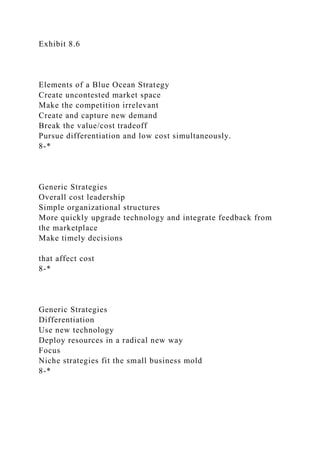
Elements of a Blue Ocean Strategy
Create uncontested market space
Make the competition irrelevant
Create and capture new demand
Break the value/cost tradeoff
Pursue differentiation and low cost simultaneously.
8-*
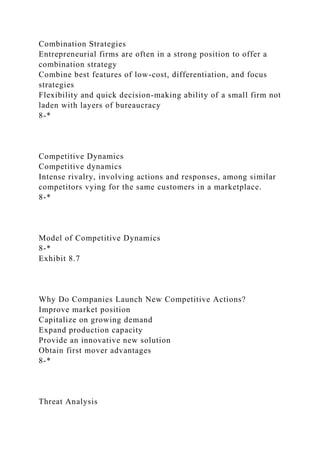
Generic Strategies
Overall cost leadership
Simple organizational structures
More quickly upgrade technology and integrate feedback from
the marketplace
Make timely decisions
that affect cost
8-*
Generic Strategies
Differentiation
Use new technology
Deploy resources in a radical new way
Focus
Niche strategies fit the small business mold
8-*
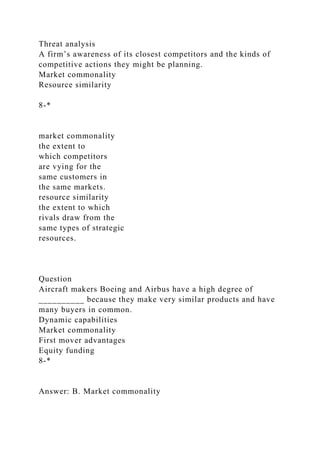
Combination Strategies
Entrepreneurial firms are often in a strong position to offer a
combination strategy
Combine best features of low-cost, differentiation, and focus
strategies
Flexibility and quick decision-making ability of a small firm not
laden with layers of bureaucracy
8-*
Competitive Dynamics
Competitive dynamics
Intense rivalry, involving actions and responses, among similar
competitors vying for the same customers in a marketplace.
8-*
Model of Competitive Dynamics
8-*
Exhibit 8.7
Why Do Companies Launch New Competitive Actions?
Improve market position
Capitalize on growing demand
Expand production capacity
Provide an innovative new solution
Obtain first mover advantages
8-*
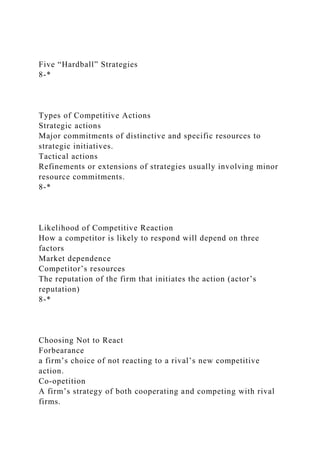
Threat Analysis
Threat analysis
A firm’s awareness of its closest competitors and the kinds of
competitive actions they might be planning.
Market commonality
Resource similarity
8-*
market commonality
the extent to
which competitors
are vying for the
same customers in
the same markets.
resource similarity
the extent to which
rivals draw from the
same types of strategic
resources.
Question
Aircraft makers Boeing and Airbus have a high degree of
__________ because they make very similar products and have
many buyers in common.
Dynamic capabilities
Market commonality
First mover advantages
Equity funding
8-*
Answer: B. Market commonality
Five “Hardball” Strategies
8-*
Types of Competitive Actions
Strategic actions
Major commitments of distinctive and specific resources to
strategic initiatives.
Tactical actions
Refinements or extensions of strategies usually involving minor
resource commitments.
8-*
Likelihood of Competitive Reaction
How a competitor is likely to respond will depend on three
factors
Market dependence
Competitor’s resources
The reputation of the firm that initiates the action (actor’s
reputation)
8-*
Choosing Not to React
Forbearance
a firm’s choice of not reacting to a rival’s new competitive
action.
Co-opetition
A firm’s strategy of both cooperating and competing with rival
firms.
8-*
Fishing in Global Waters Can be a Chilling Experience
1
For two years, DataClear has had the data analysis market to
itself. But now a British upstart is nipping at its heels. Should
DataClear continue to focus on its strong domestic prospects or
expand overseas to head off the nascent international threat?
"WHY AREN'T THEY BITING?” wondered Greg McNally as he
laid down another perfectly executed cast. He was fly-fishing in
the most beautiful spot he had ever seen, on the Alta in Norway-
reputedly the home of Scandinavia's worthiest salmon. And he
had plenty of opportunity to admire the view. No fish were
getting in the way.
What a difference from the luck he'd had a couple of weeks
earlier trout fishing at Nelson's Spring Creek in Montana. It
seemed like so much more time had passed since the two-day
off-site he had called there, designed to be part celebration of
the past, part planning for the future.
Some celebration had definitely been in order. The company,
DataClear, was really taking off, fueled by the success of its
first software product, ClearCloud. In 1999, its first full year of
operation, DataClear's sales reached $2.2 million. Now, the
following September, it was looking like 2000 sales could
easily reach $5.3 million. At the all-staff meeting on the Friday
before the off-site, Greg had announced the company's success
in recruiting two more great executives, bringing the staff to 38.
"I'm more confident than ever that we'll hit our goals: $20
million in 2001 and then $60 million in 2002!"
Clouds on the Horizon
A New Jersey native, Greg held an MSc from Rutgers and then
went west to get his PhD in computer science from UC
Berkeley. He spent the next 15 years at Borland and Oracle,
first as a software developer and then as a senior product
manager. He started DataClear in Palo Alto, California, in the
spring of 1998.
At that time, Greg realized that companies were collecting
information faster than they could analyze it and that data
analysis was an underexploited segment of the software
business. It was at a seminar at Northwestern University that he
saw his opportunity. Two researchers had developed a set of
algorithms that enabled analysts to sift through large amounts of
raw data in powerful ways without programmers' help. Greg
cashed in his Oracle options and, in partnership with the two
researchers, created DataClear to develop applications based on
the algorithms.
His partners took responsibility for product development and an
initial stake of 20% each; Greg provided $500,000 in financing
in return for 60% of the shares and the job of CEO. A year later,
Greg offered David Lester, founder of DL Ventures and a
former Oracle executive, 30% of the company in return for $5
million in additional funding.
In his previous positions, Greg had shown a knack for leading
"fizzy" technical teams, and under his leadership, the two
researchers came up with a state-of-the-art data analysis
package they dubbed ClearCloud (from the clarity the software
brought to large data clouds). Two versions, one for the
telecommunications industry and the other for financial services
providers, were officially launched in September 1998.
ClearCloud had a number of immediate and profitable
applications. For instance, it could be used to help credit card
companies detect fraud patterns more quickly in the millions of
transactions that occurred every day. Greg conservatively
estimated the annual demand from the U.S. telecommunications
and financial services sectors to be around $600 million. The
challenge was to make potential users aware of the product.
ClearCloud was an instant hit, and within just a month of its
launch, Greg had needed to recruit a dozen sales and service
staffers. One of the first was Susan Moskowski, a former sales
rep at Banking Data Systems, who had worked successfully with
Greg on several major joint pitches to financial institutions. She
had spent two years at BDS's Singapore subsidiary, where she
had laid the groundwork for a number of important contracts.
She had left BDS to do an MBA at Stanford and joined
DataClear immediately on graduating as the new company's
head of sales. She was an immediate success, landing
DataClear's first major contract, with a large West Coast
banking group.
Greg realized that ClearCloud had huge potential outside the
telecommunications and financial services industries. In fact,
with relatively little product development, Greg and his partners
believed, ClearCloud could be adapted for the chemical,
petrochemical, and pharmaceutical industries. Annual demand
from customers in those sectors could reach as high as $900
million.
But accessing and serving clients in those fields would involve
building specialized sales and service infrastructures. Just two
months ago, to spearhead that initiative, Greg recruited a new
business-development manager who had 20 years' experience in
the chemical industry. A former senior R&D manager at
DuPont, Tom Birmingham was excited by ClearCloud's
blockbuster potential in the U.S. market. "The databases can
only get bigger," he told Greg and Susan. Greg had asked Tom
to put together a presentation for the off-site in Montana on the
prospects for expanding into these new sectors.
Just two weeks before the outing, however, Susan burst into
Greg's office and handed him an article from one of the leading
trade journals. It highlighted a British start-up, VisiDat, which
was beta testing a data analysis package that was only weeks
away from launch. "We're not going to have the market to
ourselves much longer," she told Greg. "We need to agree on a
strategy for dealing with this kind of competition. If they start
out as a global player, and we stay hunkered down in the U.S.,
they'll kill us. I've seen this before"
The news did not take Greg altogether by surprise. "I agree
we've got to put together a strategy," he said. "Why don't we
table the domestic-expansion discussion and talk about this at
our offsite meeting, where we can get everyone's ideas? Unlike
the rest of us, you've had some experience overseas, so perhaps
you should lead the discussion. I'll square things with Tom."
Go Fish
In Montana, Susan kicked off the first session with the story of
GulfSoft, a thinly disguised case study of her former employer.
The company had developed a software package for the oil and
gas exploration business, which it had introduced only in the
United States. But at almost the same time, a French company
had launched a comparable product, which it marketed
aggressively on a global basis. A year later, the competitor had
a much larger installed base worldwide than GulfSoft and was
making inroads into GulfSoft's U.S. sales. When she reached the
end of the story, Susan paused, adding ominously, "Today, we
have only 20 installations of ClearCloud outside the U.S.--15 in
the UK and five in Japan -- and those are only U.S. customers
purchasing for their overseas subsidiaries."
At Susan's signal, the room went dark. Much of what followed,
in a blizzard of overhead projections, was market research
showing a lot of latent demand for ClearCloud outside the
United States. The foreign markets in telecommunications and
financial services were shown to be about as large as those in
the U.S.-- that is, another $600 million. The potential in
pharmaceuticals, petrochemicals, and chemicals looked to be
about $660 million. Taken together, that meant a potential
market of $1.5 billion domestically and $1.26 billion abroad.
In ending, Susan drew the obvious moral. "It seems pretty clear
to me that the only defense for this kind of threat is to attack.
We don't have any international sales strategy. We're here
because we need one--and fast."
She glanced at Greg for any hint of objection, didn't see it, and
plunged ahead: "We know we can sell a lot of software in the
U.S., but if we want DataClear to succeed in the long run, we
need to preempt the competition and go worldwide. We need a
large installed base ASAP.
"I propose that for the afternoon we split into two groups and
focus on our two options for going forward. Group A can
consider building our own organization to serve Europe. Group
B can think about forming alliances with players already
established there. Based on what you come back with tomorrow,
we'll make the call."
As the lights came back on, Greg blinked. He was dazzled. But
he sensed that he needed to do some thinking, and he did his
best thinking knee-deep in the river. After lunch, as the two
groups got to work, Greg waded into Nelson's Spring Creek.
The fish seemed to leap to his hook, but his thoughts were more
elusive and ambivalent.
Money, Money, Money
Greg decided he needed a reality check, and that night he called
David Lester to review the day's discussion. Not too
surprisingly, Lester didn't have a lot of advice to give on the
spot. In fact, he had questions of his own. "Instead of focusing
on foreign markets in our core industries, what if we focus on
developing ClearCloud for the domestic pharmaceutical,
chemical, and petrochemical industries and capitalize on that
$900 million U.S. market?" he asked. "How much would that
cost?" Greg offered a best guess of $2 million for the additional
software-development costs but hadn't yet come up with a
number for marketing and sales; the industries were so different
from the ones DataClear currently focused on. "Whatever the
cost turns out to be, we're going to need another round of
financing," Greg allowed. "Right now we're on track to generate
a positive cash flow without raising any additional capital, but
it won't be enough to fund a move beyond our core industries"
"That's not where I was headed" Lester replied. "What if we
went out and raised a lot more money and expanded the product
offering and our geographic reach at the same time?"
Greg swallowed hard; he was usually game for a challenge, but
a double expansion was daunting. He couldn't help thinking of
the sticky note he'd posted on the frame of his computer screen
a few days after he started DataClear. It clung there still, and it
had just one word on it: "Focus."
Lester sensed Greg's hesitation: "Look. We're not going to
decide this tonight. And really, at the end of the day it's up to
you, Greg. You've done the right things so far. Keep doing
them" Hanging up, Greg was reminded of how pleased he was
with Lester's hands-off approach. For the first time, he
wondered what things would be like if he had a more hands-on
venture capitalist as an investor--maybe one with some
experience in international expansion.
Greg was also reminded of his own lack of international
management experience. Eight years earlier, he had politely
turned down an opportunity to lead a team of 50 Oracle
development engineers in Japan, primarily because he had been
unwilling to relocate to Tokyo for two years. His boss at the
time had told him: "Greg, software is a global business, and
what you don't learn early about cross-border management will
come back to haunt you later."
Options on the Table
At ten o'clock the next morning, Group A took the floor and
made their recommendation right off the bat: DataClear should
immediately establish an office in the UK and staff it with four
to six salespeople. Britain would be a beachhead into all of
Europe, but eventually there would also be a sales office
somewhere on the Continent, maybe in Brussels. They had even
drafted a job description for a head of European sales.
Greg was impressed, if a little overwhelmed. "Any idea how
much this would cost us in terms of salaries and expenses over
the first year?" he asked.
"Conservatively, about $500,000 a year; probably more" the
group leader replied. "But cost is not so much the point here. If
we don't make this move, we'll get killed by VisiDat -- or some
other competitor we don't even know about yet. Imagine if SAP
introduced a similar product. With their marketing machine,
they would just crush us"
Tom Birmingham started to object. "Where are we going to find
local staff to install and support the product?" he wanted to
know. "I mean, this is not just about setting up an office to sell:
ClearCloud is a complex product, and it needs a service
infrastructure. We'd have to translate the interface software, or
at least the manuals, into local languages. We'd need additional
resources in business development and product support to
manage all this. Selling ClearCloud in Europe is going to cost a
lot more than $500,000 a year--"
Susan was quick to jump in. "Good point, Tom, and that isn't all
we'll need. We also have to have somebody in Asia. Either
Singapore or Tokyo would be an ideal base. Probably Tokyo
works better because more potential clients are headquartered
there than in the rest of Asia. We need at least four people in
Asia, for the time being" Tom frowned but, feeling that Susan
had the momentum, decided to hold his fire.
After lunch, it was Group B's turn. They suggested using
autonomous software distributors in each country. That would
help DataClear keep a tight grip on expenses. Greg spoke up
then. "What about teaming up with some local firm in Europe
that offers a complementary product? Couldn't we get what we
need through a joint venture?"
"Funny you should mention that, Greg," said the presenter from
Group B. "We came up with the idea of Benro but didn't have
time to pursue it. They might be willing to talk about reciprocal
distribution" Benro was a small software shop in Norway. Greg
knew it had made about $5 million in sales last year from its
data-mining package for financial services companies. Benro
was very familiar with European customers in the financial
services sector but had no experience with other industries.
"Working with Benro might be cheaper than doing this all on
our own, at least for now," the presenter said.
Susan chose that moment to speak up again. "I have to admit
I'm skeptical about joint ventures. I think it will probably take
too long to negotiate and sign the contracts, which won't even
cover all the eventualities. At some point we will have to learn
how to succeed in each region on our own"
That's when Greg noticed Tom studying Susan, his eyes
narrowing. So he wasn't surprised--in fact he was a little
relieved--when Tom put the brakes on: "I guess I don't see how
we can make that decision until we gather a little more input,
Susan" Tom said. "At the very least, we need to have a
conversation with Benro and any other potential partners. And I
know I'd want to meet some candidates to lead a foreign sales
office before I'd be comfortable going that route. But my real
concern is more fundamental. Are we up to doing all this at the
same time we're building our market presence in the U.S.?
Remember, we don't yet have the capability to serve the
chemical and pharmaceutical industries here. There are still
only 38 of us, and I estimate that building the support
infrastructure we need just for domestic expansion could cost as
much $2 million -- on top of product development."
Before Susan could object, Greg struck the compromise. "Tell
you what. Let's commit to making this decision in no more than
three weeks. I'll clear my calendar and connect with Benro
myself. At the same time, Susan, you can flush out some good
candidates for a foreign sales office and schedule them to meet
with Tom and me."
Casting About
And that's how Greg McNally found himself up a creek in
Norway that Sunday morning. Benro's CEO had been interested;
Greg was confident that the meeting with him on Monday would
yield some attractive options. And once the trip was booked, it
didn't take Greg long to realize that he'd be near some fabled
fishing spots.
He also realized it would be a great chance to pick the brain of
his old Berkeley classmate, Sarah Pappas. A hardware engineer,
Sarah had started her own company, Desix, in Mountain View,
California, in 1993. The company designed specialty chips for
the mobile communications industry. Within seven years, Desix
had grown into one of the most successful specialized design
shops around the world, with about 400 employees. Like Greg,
Sarah had received funding from a venture capitalist. Since a lot
of demand for Desix's services was in Scandinavia and to a
lesser degree in Japan as well, Sarah had opened subsidiaries in
both places and even decided to split her time between
Mountain View and Oslo.
Greg arrived in Oslo on Thursday morning and met Sarah that
evening at a waterfront restaurant. They spent the first half-hour
swapping news about mutual friends. Sarah hadn't changed
much, thought Greg. But when the conversation turned to
potential geographic expansion and he asked about her
experience, Greg saw her smile grow a little tense. "Ah, well,"
she began. "How much time do you have?"
"That bad?"
"Actually, to be honest, some things were easier than we
thought" she allowed. "Recruiting, for example. We never
expected to get any great engineers to leave Nokia or Hitachi to
join us, but we ended up hiring our Oslo and Tokyo core teams
without much trouble. Still, some things turned out to be so
hard -- like coordinating the three sites across borders. There
were so many misunderstandings between Oslo and Mountain
View that at first our productivity went down by 40%."
The story got worse. Sarah explained how, in 1998, her venture
capitalist sought to exit its investment. Since an IPO seemed
inadvisable for various reasons, the parties agreed to sell the
company to Pelmer, a large equipment manufacturer. Sarah
agreed to stay on for three years but couldn't do much to keep
the engineers in her Oslo and Tokyo subsidiaries from leaving.
No one had fully anticipated the clash between Pelmer's strong
U.S. culture and Desix's local cultures in Oslo and Tokyo. By
this point, Sarah felt, the merger had destroyed much that had
gone into making Desix a small multinational company.
"I can tell I've been a real buzz killer," she laughed
apologetically, as Greg picked up the check. "But if I were you,
given what I've been through, I'd stay focused on the U.S. for as
long as possible. You might not build the next Oracle or Siebel
that way, but you'll live a happier life."
"So you think you made the wrong choice in expanding
internationally?"
"Well, no," said Sarah, "because I don't think we had a choice.
You, on the other hand, can sell much more product in the U.S.
than we could have."
Up to His Waist
The next day brought its own worries, as Greg met with Pierre
Lambert, a candidate for head of European sales, whom Susan
had identified through a headhunter. Lambert had graduated
from the Ecole des Mines in Paris and then worked for four
years at Alcatel and five years at Lucent. As they talked, it
occurred to Greg that he had no experience in reading résumés
from outside the States. Was Ecole des Mines a good school?
He noted that Lambert had worked only in France and the U.S.
How successful would he be in the UK or Germany? As he
wrapped up the interview, Greg figured he would need to see at
least five candidates to form an opinion about the European
labor market. And Asia would be even harder.
That evening, he compared notes with Tom, who had
interviewed Lambert by phone the previous day. Tom expressed
some doubts: he suspected that Lambert wasn't mature enough
to deal with the level of executives -- CIOs and chief scientists
-- that DataClear would be targeting. That call only just ended
when the cell phone rang again, with Susan on the line. "Greg --
I thought you would want to know. VisiDat just made its first
significant sale -- to Shell. The deal is worth at least $500,000.
This is huge for them"
And now, two days later, here he stood in the glorious,
frustrating Alta. He could see the salmon hanging just under the
surface. He cast his line again, an elegant, silvery arc across the
river and maneuvered the fly deftly through the water. Nothing.
Greg slogged back to shore and peered into the box housing his
extensive collection of hand-tied salmon flies. Was it just that
he was so preoccupied? Or were the conditions really so
different here that none of his flies would work? One thing was
for sure: it was a lot chillier than he'd expected. Despite the
liner socks, his feet were getting cold.

Entrepreneurial Strategy and Competitive DynamicsChapter.docx

  • 1.
    Entrepreneurial Strategy andCompetitive Dynamics Chapter Eight McGraw-Hill/Irwin Copyright © 2012 by The McGraw-Hill Companies, Inc. All rights reserved. Learning Objectives After reading this chapter, you should have a good understanding of: LO8.1 The role of new ventures and small businesses in the U.S. economy. LO8.2 The role of opportunities, resources, and entrepreneurs in successfully pursuing new ventures. LO8.3 Three types of entry strategies—pioneering, initiative, and adaptive—commonly used to launch a new venture. 8-* Learning Objectives (cont.) LO8.4 How the generic strategies of overall cost leadership, differentiation, and focus are used by new ventures and small businesses. LO8.5 How competitive actions, such as the entry of new competitors into a marketplace, may launch a cycle of actions and reactions among close competitors. LO8.6 The components of competitive dynamics analysis—
  • 2.
    new competitive action,threat analysis, motivation and capability to respond, types of competitive actions, and likelihood of competitive reaction. 8-* Recognizing Entrepreneurial Opportunities Entrepreneurship the creation of new value by an existing organization or new venture that involves the assumption of risk. 8-* Recognizing Entrepreneurial Opportunities New value can be created in: Start-up ventures Major corporations Family-owned businesses Non-profit organizations Established institutions 8-* Entrepreneurial Opportunities Start-ups Current or past work experiences Hobbies that grow into businesses or lead to inventions Suggestions by friends or family Chance events Change 8-*
  • 3.
    Entrepreneurial Opportunities Established firms Needsof existing customers Suggestions by suppliers Technological developments that lead to new advances Change 8-* U.S. Small Companies by Industry 8-* Exhibit 8.1 Entrepreneurial Opportunities Opportunity recognition the process of discovering and evaluating changes in the business environment, such as a new technology, socio-cultural trends, or shifts in consumer demand, that can be exploited. 8-* Opportunity Analysis Framework 8-* Exhibit 8.3 QUESTION The majority of entrepreneurial start-ups are financed with Bank financing Public financing
  • 4.
    Venture capital financing Personalsavings and the contributions of family and friends 8-* Answer: D. Personal savings and the contributions of family and friends Entrepreneurial Opportunities Discovery phase the process of becoming aware of a new business concept. May be spontaneous and unexpected May occur as the result of deliberate search for new venture projects or creative solutions to business problems 8-* Opportunity Recognition Process Opportunity evaluation phase involves analyzing an opportunity to determine whether it is viable and strong enough to be developed into a full-fledged new venture. Talk to potential target customers Discuss it with production or logistics managers Conduct feasibility analysis 8-* Characteristics of Good Opportunities 8-*
  • 5.
    • Attractive. Theopportunity must be attractive in the marketplace; that is, there must be market demand for the new product or service. • Achievable. The opportunity must be practical and physically possible. • Durable. The opportunity must be attractive long enough for the development and deployment to be successful; that is, the window of opportunity must be open long enough for it to be worthwhile. • Value creating. The opportunity must be potentially profitable; that is, the benefits must surpass the cost of development by a significant margin. Sources of Capital for Start-Up Firms 8-* Exhibit 8.5 Entrepreneurial Resources Human capital Social capital Government resources Small Business Administration Government contracting State and local governments 8-* Entrepreneurial Leadership
  • 6.
    Launching a newventure requires a special kind of leadership Courage Belief in one’s convictions Energy to work hard 8-* Entrepreneurial Leadership Three characteristics Vision Dedication and drive Commitment to excellence 8-* Entrepreneurial Leadership Vision may be entrepreneur’s most important asset Ability to envision realities that do not yet exist Exercise a kind of transformational leadership Able to share with others 8-* Entrepreneurial Leadership Dedication and drive are reflected in hard work Patience Stamina Willingness to work long hours Internal motivation Intellectual commitment to the enterprise Strong enthusiasm for work and life 8-*
  • 7.
    Entrepreneurial Leadership To achieveexcellence, entrepreneurs must Know the customer Provide quality products and services Pay attention to details Continuously learn Surround themselves with good people 8-* Example: 10 Management Lessons It’s all about perseverance Understand the value of mentorship and teamwork Stick to your niche Stay on top of news that affects your clients Communication is key Capitalization is crucial Communicate unwavering honesty and integrity Stay on top of the curve Take ownership in your clients’ success Never stop marketing 8-* Source: Pierce, Sarah. “10 Management Lessons From a Young Entrepreneur,” www.entrepreneur.com. December 17, 2003. * Entrepreneurial Strategy Best strategy for the enterprise will be determined to some extent by
  • 8.
    A viable opportunity,sufficient resources, and skilled and dedicated entrepreneurial team Other conditions in the business environment 8-* Entry Strategies Pioneering new entry a firm’s entry into an industry with a radical new product or highly innovative service that changes the way business is conducted. 8-* Entry Strategies Imitative new entry a firm’s entry into an industry with products or services that capitalize on proven market successes and that usually has a strong marketing orientation. 8-* Entry Strategies Adaptive new entry a firm’s entry into an industry by offering a product or service that is somewhat new and sufficiently different to create value for customers by capitalizing on current market trends. 8-* Examples of Adaptive New Entrants 8-*
  • 9.
    Exhibit 8.6 Elements ofa Blue Ocean Strategy Create uncontested market space Make the competition irrelevant Create and capture new demand Break the value/cost tradeoff Pursue differentiation and low cost simultaneously. 8-* Generic Strategies Overall cost leadership Simple organizational structures More quickly upgrade technology and integrate feedback from the marketplace Make timely decisions that affect cost 8-* Generic Strategies Differentiation Use new technology Deploy resources in a radical new way Focus Niche strategies fit the small business mold 8-*
  • 10.
    Combination Strategies Entrepreneurial firmsare often in a strong position to offer a combination strategy Combine best features of low-cost, differentiation, and focus strategies Flexibility and quick decision-making ability of a small firm not laden with layers of bureaucracy 8-* Competitive Dynamics Competitive dynamics Intense rivalry, involving actions and responses, among similar competitors vying for the same customers in a marketplace. 8-* Model of Competitive Dynamics 8-* Exhibit 8.7 Why Do Companies Launch New Competitive Actions? Improve market position Capitalize on growing demand Expand production capacity Provide an innovative new solution Obtain first mover advantages 8-* Threat Analysis
  • 11.
    Threat analysis A firm’sawareness of its closest competitors and the kinds of competitive actions they might be planning. Market commonality Resource similarity 8-* market commonality the extent to which competitors are vying for the same customers in the same markets. resource similarity the extent to which rivals draw from the same types of strategic resources. Question Aircraft makers Boeing and Airbus have a high degree of __________ because they make very similar products and have many buyers in common. Dynamic capabilities Market commonality First mover advantages Equity funding 8-* Answer: B. Market commonality
  • 12.
    Five “Hardball” Strategies 8-* Typesof Competitive Actions Strategic actions Major commitments of distinctive and specific resources to strategic initiatives. Tactical actions Refinements or extensions of strategies usually involving minor resource commitments. 8-* Likelihood of Competitive Reaction How a competitor is likely to respond will depend on three factors Market dependence Competitor’s resources The reputation of the firm that initiates the action (actor’s reputation) 8-* Choosing Not to React Forbearance a firm’s choice of not reacting to a rival’s new competitive action. Co-opetition A firm’s strategy of both cooperating and competing with rival firms.
  • 13.
    8-* Fishing in GlobalWaters Can be a Chilling Experience 1 For two years, DataClear has had the data analysis market to itself. But now a British upstart is nipping at its heels. Should DataClear continue to focus on its strong domestic prospects or expand overseas to head off the nascent international threat? "WHY AREN'T THEY BITING?” wondered Greg McNally as he laid down another perfectly executed cast. He was fly-fishing in the most beautiful spot he had ever seen, on the Alta in Norway- reputedly the home of Scandinavia's worthiest salmon. And he had plenty of opportunity to admire the view. No fish were getting in the way. What a difference from the luck he'd had a couple of weeks earlier trout fishing at Nelson's Spring Creek in Montana. It seemed like so much more time had passed since the two-day off-site he had called there, designed to be part celebration of the past, part planning for the future. Some celebration had definitely been in order. The company, DataClear, was really taking off, fueled by the success of its first software product, ClearCloud. In 1999, its first full year of operation, DataClear's sales reached $2.2 million. Now, the following September, it was looking like 2000 sales could easily reach $5.3 million. At the all-staff meeting on the Friday before the off-site, Greg had announced the company's success in recruiting two more great executives, bringing the staff to 38. "I'm more confident than ever that we'll hit our goals: $20 million in 2001 and then $60 million in 2002!" Clouds on the Horizon A New Jersey native, Greg held an MSc from Rutgers and then went west to get his PhD in computer science from UC
  • 14.
    Berkeley. He spentthe next 15 years at Borland and Oracle, first as a software developer and then as a senior product manager. He started DataClear in Palo Alto, California, in the spring of 1998. At that time, Greg realized that companies were collecting information faster than they could analyze it and that data analysis was an underexploited segment of the software business. It was at a seminar at Northwestern University that he saw his opportunity. Two researchers had developed a set of algorithms that enabled analysts to sift through large amounts of raw data in powerful ways without programmers' help. Greg cashed in his Oracle options and, in partnership with the two researchers, created DataClear to develop applications based on the algorithms. His partners took responsibility for product development and an initial stake of 20% each; Greg provided $500,000 in financing in return for 60% of the shares and the job of CEO. A year later, Greg offered David Lester, founder of DL Ventures and a former Oracle executive, 30% of the company in return for $5 million in additional funding. In his previous positions, Greg had shown a knack for leading "fizzy" technical teams, and under his leadership, the two researchers came up with a state-of-the-art data analysis package they dubbed ClearCloud (from the clarity the software brought to large data clouds). Two versions, one for the telecommunications industry and the other for financial services providers, were officially launched in September 1998. ClearCloud had a number of immediate and profitable applications. For instance, it could be used to help credit card companies detect fraud patterns more quickly in the millions of transactions that occurred every day. Greg conservatively estimated the annual demand from the U.S. telecommunications and financial services sectors to be around $600 million. The challenge was to make potential users aware of the product. ClearCloud was an instant hit, and within just a month of its launch, Greg had needed to recruit a dozen sales and service
  • 15.
    staffers. One ofthe first was Susan Moskowski, a former sales rep at Banking Data Systems, who had worked successfully with Greg on several major joint pitches to financial institutions. She had spent two years at BDS's Singapore subsidiary, where she had laid the groundwork for a number of important contracts. She had left BDS to do an MBA at Stanford and joined DataClear immediately on graduating as the new company's head of sales. She was an immediate success, landing DataClear's first major contract, with a large West Coast banking group. Greg realized that ClearCloud had huge potential outside the telecommunications and financial services industries. In fact, with relatively little product development, Greg and his partners believed, ClearCloud could be adapted for the chemical, petrochemical, and pharmaceutical industries. Annual demand from customers in those sectors could reach as high as $900 million. But accessing and serving clients in those fields would involve building specialized sales and service infrastructures. Just two months ago, to spearhead that initiative, Greg recruited a new business-development manager who had 20 years' experience in the chemical industry. A former senior R&D manager at DuPont, Tom Birmingham was excited by ClearCloud's blockbuster potential in the U.S. market. "The databases can only get bigger," he told Greg and Susan. Greg had asked Tom to put together a presentation for the off-site in Montana on the prospects for expanding into these new sectors. Just two weeks before the outing, however, Susan burst into Greg's office and handed him an article from one of the leading trade journals. It highlighted a British start-up, VisiDat, which was beta testing a data analysis package that was only weeks away from launch. "We're not going to have the market to ourselves much longer," she told Greg. "We need to agree on a strategy for dealing with this kind of competition. If they start out as a global player, and we stay hunkered down in the U.S., they'll kill us. I've seen this before"
  • 16.
    The news didnot take Greg altogether by surprise. "I agree we've got to put together a strategy," he said. "Why don't we table the domestic-expansion discussion and talk about this at our offsite meeting, where we can get everyone's ideas? Unlike the rest of us, you've had some experience overseas, so perhaps you should lead the discussion. I'll square things with Tom." Go Fish In Montana, Susan kicked off the first session with the story of GulfSoft, a thinly disguised case study of her former employer. The company had developed a software package for the oil and gas exploration business, which it had introduced only in the United States. But at almost the same time, a French company had launched a comparable product, which it marketed aggressively on a global basis. A year later, the competitor had a much larger installed base worldwide than GulfSoft and was making inroads into GulfSoft's U.S. sales. When she reached the end of the story, Susan paused, adding ominously, "Today, we have only 20 installations of ClearCloud outside the U.S.--15 in the UK and five in Japan -- and those are only U.S. customers purchasing for their overseas subsidiaries." At Susan's signal, the room went dark. Much of what followed, in a blizzard of overhead projections, was market research showing a lot of latent demand for ClearCloud outside the United States. The foreign markets in telecommunications and financial services were shown to be about as large as those in the U.S.-- that is, another $600 million. The potential in pharmaceuticals, petrochemicals, and chemicals looked to be about $660 million. Taken together, that meant a potential market of $1.5 billion domestically and $1.26 billion abroad. In ending, Susan drew the obvious moral. "It seems pretty clear to me that the only defense for this kind of threat is to attack. We don't have any international sales strategy. We're here because we need one--and fast." She glanced at Greg for any hint of objection, didn't see it, and plunged ahead: "We know we can sell a lot of software in the U.S., but if we want DataClear to succeed in the long run, we
  • 17.
    need to preemptthe competition and go worldwide. We need a large installed base ASAP. "I propose that for the afternoon we split into two groups and focus on our two options for going forward. Group A can consider building our own organization to serve Europe. Group B can think about forming alliances with players already established there. Based on what you come back with tomorrow, we'll make the call." As the lights came back on, Greg blinked. He was dazzled. But he sensed that he needed to do some thinking, and he did his best thinking knee-deep in the river. After lunch, as the two groups got to work, Greg waded into Nelson's Spring Creek. The fish seemed to leap to his hook, but his thoughts were more elusive and ambivalent. Money, Money, Money Greg decided he needed a reality check, and that night he called David Lester to review the day's discussion. Not too surprisingly, Lester didn't have a lot of advice to give on the spot. In fact, he had questions of his own. "Instead of focusing on foreign markets in our core industries, what if we focus on developing ClearCloud for the domestic pharmaceutical, chemical, and petrochemical industries and capitalize on that $900 million U.S. market?" he asked. "How much would that cost?" Greg offered a best guess of $2 million for the additional software-development costs but hadn't yet come up with a number for marketing and sales; the industries were so different from the ones DataClear currently focused on. "Whatever the cost turns out to be, we're going to need another round of financing," Greg allowed. "Right now we're on track to generate a positive cash flow without raising any additional capital, but it won't be enough to fund a move beyond our core industries" "That's not where I was headed" Lester replied. "What if we went out and raised a lot more money and expanded the product offering and our geographic reach at the same time?" Greg swallowed hard; he was usually game for a challenge, but a double expansion was daunting. He couldn't help thinking of
  • 18.
    the sticky notehe'd posted on the frame of his computer screen a few days after he started DataClear. It clung there still, and it had just one word on it: "Focus." Lester sensed Greg's hesitation: "Look. We're not going to decide this tonight. And really, at the end of the day it's up to you, Greg. You've done the right things so far. Keep doing them" Hanging up, Greg was reminded of how pleased he was with Lester's hands-off approach. For the first time, he wondered what things would be like if he had a more hands-on venture capitalist as an investor--maybe one with some experience in international expansion. Greg was also reminded of his own lack of international management experience. Eight years earlier, he had politely turned down an opportunity to lead a team of 50 Oracle development engineers in Japan, primarily because he had been unwilling to relocate to Tokyo for two years. His boss at the time had told him: "Greg, software is a global business, and what you don't learn early about cross-border management will come back to haunt you later." Options on the Table At ten o'clock the next morning, Group A took the floor and made their recommendation right off the bat: DataClear should immediately establish an office in the UK and staff it with four to six salespeople. Britain would be a beachhead into all of Europe, but eventually there would also be a sales office somewhere on the Continent, maybe in Brussels. They had even drafted a job description for a head of European sales. Greg was impressed, if a little overwhelmed. "Any idea how much this would cost us in terms of salaries and expenses over the first year?" he asked. "Conservatively, about $500,000 a year; probably more" the group leader replied. "But cost is not so much the point here. If we don't make this move, we'll get killed by VisiDat -- or some other competitor we don't even know about yet. Imagine if SAP introduced a similar product. With their marketing machine, they would just crush us"
  • 19.
    Tom Birmingham startedto object. "Where are we going to find local staff to install and support the product?" he wanted to know. "I mean, this is not just about setting up an office to sell: ClearCloud is a complex product, and it needs a service infrastructure. We'd have to translate the interface software, or at least the manuals, into local languages. We'd need additional resources in business development and product support to manage all this. Selling ClearCloud in Europe is going to cost a lot more than $500,000 a year--" Susan was quick to jump in. "Good point, Tom, and that isn't all we'll need. We also have to have somebody in Asia. Either Singapore or Tokyo would be an ideal base. Probably Tokyo works better because more potential clients are headquartered there than in the rest of Asia. We need at least four people in Asia, for the time being" Tom frowned but, feeling that Susan had the momentum, decided to hold his fire. After lunch, it was Group B's turn. They suggested using autonomous software distributors in each country. That would help DataClear keep a tight grip on expenses. Greg spoke up then. "What about teaming up with some local firm in Europe that offers a complementary product? Couldn't we get what we need through a joint venture?" "Funny you should mention that, Greg," said the presenter from Group B. "We came up with the idea of Benro but didn't have time to pursue it. They might be willing to talk about reciprocal distribution" Benro was a small software shop in Norway. Greg knew it had made about $5 million in sales last year from its data-mining package for financial services companies. Benro was very familiar with European customers in the financial services sector but had no experience with other industries. "Working with Benro might be cheaper than doing this all on our own, at least for now," the presenter said. Susan chose that moment to speak up again. "I have to admit I'm skeptical about joint ventures. I think it will probably take too long to negotiate and sign the contracts, which won't even cover all the eventualities. At some point we will have to learn
  • 20.
    how to succeedin each region on our own" That's when Greg noticed Tom studying Susan, his eyes narrowing. So he wasn't surprised--in fact he was a little relieved--when Tom put the brakes on: "I guess I don't see how we can make that decision until we gather a little more input, Susan" Tom said. "At the very least, we need to have a conversation with Benro and any other potential partners. And I know I'd want to meet some candidates to lead a foreign sales office before I'd be comfortable going that route. But my real concern is more fundamental. Are we up to doing all this at the same time we're building our market presence in the U.S.? Remember, we don't yet have the capability to serve the chemical and pharmaceutical industries here. There are still only 38 of us, and I estimate that building the support infrastructure we need just for domestic expansion could cost as much $2 million -- on top of product development." Before Susan could object, Greg struck the compromise. "Tell you what. Let's commit to making this decision in no more than three weeks. I'll clear my calendar and connect with Benro myself. At the same time, Susan, you can flush out some good candidates for a foreign sales office and schedule them to meet with Tom and me." Casting About And that's how Greg McNally found himself up a creek in Norway that Sunday morning. Benro's CEO had been interested; Greg was confident that the meeting with him on Monday would yield some attractive options. And once the trip was booked, it didn't take Greg long to realize that he'd be near some fabled fishing spots. He also realized it would be a great chance to pick the brain of his old Berkeley classmate, Sarah Pappas. A hardware engineer, Sarah had started her own company, Desix, in Mountain View, California, in 1993. The company designed specialty chips for the mobile communications industry. Within seven years, Desix had grown into one of the most successful specialized design shops around the world, with about 400 employees. Like Greg,
  • 21.
    Sarah had receivedfunding from a venture capitalist. Since a lot of demand for Desix's services was in Scandinavia and to a lesser degree in Japan as well, Sarah had opened subsidiaries in both places and even decided to split her time between Mountain View and Oslo. Greg arrived in Oslo on Thursday morning and met Sarah that evening at a waterfront restaurant. They spent the first half-hour swapping news about mutual friends. Sarah hadn't changed much, thought Greg. But when the conversation turned to potential geographic expansion and he asked about her experience, Greg saw her smile grow a little tense. "Ah, well," she began. "How much time do you have?" "That bad?" "Actually, to be honest, some things were easier than we thought" she allowed. "Recruiting, for example. We never expected to get any great engineers to leave Nokia or Hitachi to join us, but we ended up hiring our Oslo and Tokyo core teams without much trouble. Still, some things turned out to be so hard -- like coordinating the three sites across borders. There were so many misunderstandings between Oslo and Mountain View that at first our productivity went down by 40%." The story got worse. Sarah explained how, in 1998, her venture capitalist sought to exit its investment. Since an IPO seemed inadvisable for various reasons, the parties agreed to sell the company to Pelmer, a large equipment manufacturer. Sarah agreed to stay on for three years but couldn't do much to keep the engineers in her Oslo and Tokyo subsidiaries from leaving. No one had fully anticipated the clash between Pelmer's strong U.S. culture and Desix's local cultures in Oslo and Tokyo. By this point, Sarah felt, the merger had destroyed much that had gone into making Desix a small multinational company. "I can tell I've been a real buzz killer," she laughed apologetically, as Greg picked up the check. "But if I were you, given what I've been through, I'd stay focused on the U.S. for as long as possible. You might not build the next Oracle or Siebel that way, but you'll live a happier life."
  • 22.
    "So you thinkyou made the wrong choice in expanding internationally?" "Well, no," said Sarah, "because I don't think we had a choice. You, on the other hand, can sell much more product in the U.S. than we could have." Up to His Waist The next day brought its own worries, as Greg met with Pierre Lambert, a candidate for head of European sales, whom Susan had identified through a headhunter. Lambert had graduated from the Ecole des Mines in Paris and then worked for four years at Alcatel and five years at Lucent. As they talked, it occurred to Greg that he had no experience in reading résumés from outside the States. Was Ecole des Mines a good school? He noted that Lambert had worked only in France and the U.S. How successful would he be in the UK or Germany? As he wrapped up the interview, Greg figured he would need to see at least five candidates to form an opinion about the European labor market. And Asia would be even harder. That evening, he compared notes with Tom, who had interviewed Lambert by phone the previous day. Tom expressed some doubts: he suspected that Lambert wasn't mature enough to deal with the level of executives -- CIOs and chief scientists -- that DataClear would be targeting. That call only just ended when the cell phone rang again, with Susan on the line. "Greg -- I thought you would want to know. VisiDat just made its first significant sale -- to Shell. The deal is worth at least $500,000. This is huge for them" And now, two days later, here he stood in the glorious, frustrating Alta. He could see the salmon hanging just under the surface. He cast his line again, an elegant, silvery arc across the river and maneuvered the fly deftly through the water. Nothing. Greg slogged back to shore and peered into the box housing his extensive collection of hand-tied salmon flies. Was it just that he was so preoccupied? Or were the conditions really so different here that none of his flies would work? One thing was for sure: it was a lot chillier than he'd expected. Despite the
  • 23.
    liner socks, hisfeet were getting cold.