Entrepreneurship
Quarter 2 — Module10
Bookkeeping
CO_Q2_Entrepreneurship SHS
Module 10
Development Team of the Module
Illustrator & Layout Artist: PSSg Edzel M. Dominguez, Ivy O. Niñeza
Management Team: Arturo B. Bayocot, PhD, CESO III, Regional Director
Victor G. De Gracia Jr., PhD, CESO V, ARD
Mala Epra B. Magnaong, Chief CLMD
Bienvenido U. Tagolimot, Jr., PhD, Reg EPS ADM
Elson C. Jamero, EPS-Designate-TLE
Marie Emerald A. Cabigas, PhD, Reg EPS, LRMS
Erlinda G. Dael, CESE, PhD, CID Chief
Celieto B. Magsayo, Div LR Supervisor
Andrian S. Tecson, Div ADM Coordinator
Entrepreneurship – Grade 12
Alternative Delivery Mode
Quarter 2 - Module 10
Second Edition, 2021
Republic Act 8293, section 176 states that: “No copyright shall subsist in any work
of the Government of the Philippines. However, prior approval of the government
agency or office wherein the work is created shall be necessary for exploitation of such
work for profit. Such agency or office may, among other things, impose as a condition,
payment of royalty.”
Borrowed materials included in this module are owned by the respective copyright
holders. Efforts has been exerted to locate and seek permission to use these materials from
the respective copyright owners. The publisher and author do not represent nor claim
ownership over them.
Writers: Joel Y. Yacas Janice B. Dominguez
Naneth M. Valdehuesa Ronee D. Quicho
Mary Cris A. Maquilan Marylinda T. Puzon
Charity E. Parel Denver E. Neri
Lorena Fe S. Anub Ethel Lalaine B. Morales
Evaluators: Cherryl F. Descallar Jessie Cris N. Abrogueña
Eddy Lou T. Hamak Milger A. Baang
Sherriemae V. Reazol
Printed in the Philippines by: Department of Education – Regional Office 10 Office
Address: Zone 1, Upper Balulang Cagayan de Oro City 9000
Telefax: (088) 880-7071, (088) 880-7072
E-mail Address: region10@deped.gov.ph
3 CO_Q2_Entrepreneurship SHS
Module 10
Entrepreneurship
Quarter2–Module10
Bookkeeping
4 CO_Q2_Entrepreneurship SHS
Module 10
Introductory Message
For the Learner
Have you ever dreamed of becoming the next multi-millionaire? If you’re thinking that winning
the lottery is the only way to become one, well, think again. It is not chance that gives you
millions, instead being a millionaire is a result of hard work and determination. Starting your
own business is a good beginning towards fulfilling your dreams. Entrepreneurship is the way!
You may often hear the word entrepreneur and entrepreneurship. But what do these terms
mean? You may refer to an entrepreneur as the person managing the business and
entrepreneurship as the business venture. Some may say there is no difference.
So, what does this module provide you towards reaching your dreams?
1. It outlines the concepts and basic principles, and processes of developing a business plan.
2. It helps you understand the environment and market in your locality as a factor in developing
a business concept.
3. It allows you to experience starting and operating your own business.
Substantial knowledge of entrepreneurial principles and processes is important as this
increases the chances of making your business successful.
In this module, you are guided with a set of learning parts that will help you understand the
underlying principles of entrepreneurship.
1. What I Need to Do – the part used to introduce the learning objectives in this module.
2. What I Know – this is an assessment as to your level of knowledge to the subject matter at
hand, meant specifically to gauge previous knowledge.
3. What’s In – the part used to connect your previous learning with the new lesson.
4. What’s New – the part used to introduce new lesson through a story, an activity, a poem,
song, situation or activity.
5. What is It – the part that will help you discover and understand entrepreneurial concepts.
6. What’s More – the part that will help enrich your learnings of entrepreneurial concepts.
7. What I Have Learned – the part that will help you process what you have learned In the
lesson.
8. What I Can Do – the part that allows you to apply what you have learned into real life
situations.
9. Assessment – the part that evaluates your level of mastery in achieving the
learning objectives.
10. Additional Activities – the part that enhances your learning and improves your
mastery of the lesson
1 CO_Q2_Entrepreneurship SHS
Module 10
What I Need to Know
Welcome to this module. In this module you will learn how to record business
transactions, prepare journal entries, post them to the general ledger, make some
adjustments if necessary and prepare trial balance report. This is your tool to keep
track of the operations of your business.
This module is divided into two lessons:
Lesson 1 – Performing Key Bookkeeping Tasks
Lesson 2 – Identifying where there is profit or loss for a business
After reading this module, you should be able to:
1. Understand the basic concepts of bookkeeping;
2. Apply the skills by performing key bookkeeping tasks; and
3. Identify whether the business is profitable or not.
To achieve the above objectives, it is suggested that you have to do the following:
 Read and understand the texts carefully.
 Follow the directions and/or instructions in the activities and exercises
diligently.
 Answer all the given test and activities.
2 CO_Q2_Entrepreneurship SHS
Module 10
What I Know
Before starting with this module, let us evaluate what you already know about
bookkeeping by answering the pre-assessment questions below.
PRETEST – Multiple Choice: Identify the correct answer among the given choices.
In your answer sheet, write the letter only.
1. A source document evidencing those orders have been placed by the customer
waiting to be served by the supplier.
A. Purchase request C. Purchase order
B. Purchase invoice D. Purchase check
2. A source document evidencing those goods have been delivered by the supplier
to the customer.
A. Supplier’s sales invoice C. Customer’s sales invoice
B. Vale slip D. Customer’s delivery receipt
3. A source document issued by the supplier acknowledging that full payment has
been received from the customer.
A. Official receipt C. Delivery receipt
B. Purchase receipt D. Receiving report
4. All of the following are examples of source documents, except
A. Check B. Invoices C. Contract D. Journal
5. A source document which shows that the customer has already made partial
payment to the supplier through issuance of.
A. Check B. Voucher C. Official receipt D. Sales invoice
6. An example of asset that can be used in the business for a long period of time,
usually more than a year.
A. Inventories B. Computer C. Receivables D. Cash
7. A type of business that is purely engaged in providing all types of service activities
such as medical or legal services.
A. Service business C. Manufacturing business
B. Merchandising business D. Trading business
8. A type of business that is engaged in buying and selling of food products such
as grocery/convenient stores.
A. Service business C. Manufacturing business
B. Merchandising business D. Forex Trading business
9. Referred to as the book of original entry
A. Ledger C. Accounts Receivable Ledger
B. Journal D. Purchase Journal
10. Referred to as the book of final entry
A. General Ledger C. Accounts Receivable Ledger
B. General Journal D. Purchase Journal
3 CO_Q2_Entrepreneurship SHS
Module 10
Lesson
1
Performing Key Bookkeeping
Tasks
What’s In
In the previous lessons, you learned how to prepare a business plan, operate
the business, sell the product, and understood the importance of keeping business
records. Also, you were able to define, understand and compare the organization’s
various departments such as Operation and Administration, Marketing, Production and
Logistics, Finance, etc.
In the succeeding lessons, you will be able to explore by learning the tasks of
a bookkeeper in recording and keeping financial records updated.
What’s New
Activity 1: Getting to know your community’s businesses
A. List down at least 3 businesses that are present in your community.
(ex. sari-sari store).
B. Interview a business or store owner listed in Item A using the
following guide questions:
1. When do you record your sales and expenses?
2. Where do you record your sales and expenses?
3. How do you record your sales and expenses?
4. When do you compute your income?
5. How do you compute your income?
6. Did you employ the services of a bookkeeper? Why not?
7. What are your bases when making business decision?
(decisions like buying more goods to sell and the likes).
4 CO_Q2_Entrepreneurship SHS
Module 10
What Is It
Definition of Terms
TERM MEANING
Bookkeeping
The process of recording business transactions in a
systematic and chronological manner. It is systematic
because it follows procedures and principles. It is
chronological because the transactions are recorded in order
of the date of occurrence.
Bookkeeper
The person who is in-charge to record, maintain and update
business records from all sorts of financial transactions using
account title. The bookkeeper uses the Book of Accounts to
record the business transactions.
Book of Accounts
The book of accounts is composed of the Journal and
Ledger.
Journal Referred to as the book of original entry
Ledger Referred to as the book of final entry.
General Journal
is the most basic journal which provides columns for date,
account titles and explanations, folio or references and a
separate column for debit and credit entries.
General Ledger
is a group of all accounts that can be found in the chart of
accounts. These accounts will be reflected in the trial balance
as a summary of all financial activities that have taken place as
recorded in the general journal and subsidiary ledgers.
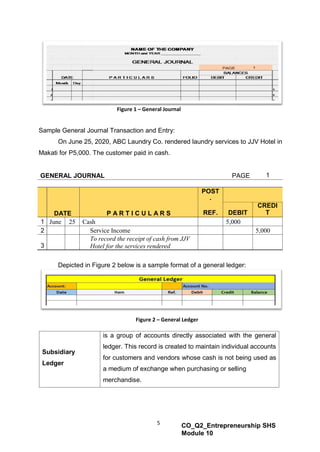
Depicted in Figure 1 below is a sample format of a general journal:
5 CO_Q2_Entrepreneurship SHS
Module 10
Sample General Journal Transaction and Entry:
On June 25, 2020, ABC Laundry Co. rendered laundry services to JJV Hotel in
Makati for P5,000. The customer paid in cash.
GENERAL JOURNAL PAGE 1
DATE P A R T I C U L A R S
POST
.
REF. DEBIT
CREDI
T
1 June 25 Cash 5,000
2 Service Income 5,000
3
To record the receipt of cash from JJV
Hotel for the services rendered
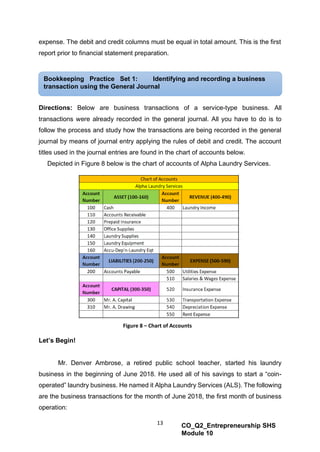
Depicted in Figure 2 below is a sample format of a general ledger:
Figure 2 – General Ledger
Subsidiary
Ledger
is a group of accounts directly associated with the general
ledger. This record is created to maintain individual accounts
for customers and vendors whose cash is not being used as
a medium of exchange when purchasing or selling
merchandise.
Figure 1 – General Journal
6 CO_Q2_Entrepreneurship SHS
Module 10
Depicted in Figures 3 and 4 below are sample formats of a subsidiary ledger
showing Accounts Receivable and Accounts Payable respectively:
Figure 3 – Accounts Receivable Ledger
Figure 4 – Accounts Payable Ledger
Account
Receivable
Ledger
The accounts receivable ledger is a sub-ledger which records
all credit sales made by a business. It is useful for
segregating into one location a record of all amounts
invoiced to customers. A typical transaction entered into the
accounts receivable ledger which records all account
receivables, followed at a later date by a payment
transaction from a customer that eliminates the accounts
receivable. More importantly, it is a subsidiary ledger which
records a customer’s accounts in the business.
Account Payable
Ledger
An accounts payable ledger contains the detail for all invoices
received from suppliers. This ledger is used as a subsidiary
ledger, from which summary-level information is periodically
posted to the general ledger. Having a separate accounts
payable ledger keeps a large amount of detailed
payables transactions from cluttering up the general ledger.
Debit
The left-hand side entry also known in accounting as “Value
Received.” When cash or non-cash items are received, the
said cash or non-cash items must be recorded in the debit
column. This means that the debit balance has increased.
Credit
The right-hand side entry also known in accounting as “Value
Parted With.” When cash or non-cash items are given, the said
cash or non-cash items must be recorded in the credit column.
This means that the credit balance has increased.
Buyer/Customer: Veggies Trading 11
Accounts Receivable
7 CO_Q2_Entrepreneurship SHS
Module 10
The Rules of Debit and Credit
In the process of journalizing business transactions, the rules of Debit and Credit
are essential to ensure accurate recording and sound decision making. Debit is
abbreviated as DR while CR for Credit. Further, it is deemed a requirement that the
bookkeeper should be able to master the normal balance of each account title being
used in the process of recording.
The following steps will be undertaken in determining account balances for every
account title such as cash, account receivable, etc.:
1. Add all the debit side to generate total debit
2. Add all the credit side to generate total credit.
3. Subtract total debit to the total credit.
4. Determine the balance of each account.
T- Account
The most convenient and fastest way of
posting journal entries to the ledger is by
way of using “T” Account. A T- Account
is divided into two sides. The left-hand
side is called the debit side and the
right-hand side is called the credit side.
The left-hand or debit side shows the
value received while the right-hand side
shows the value parted with. This is
called T Account because it resembles
the capital letter “T.” An account title is
written above the T- account.
Depicted in figure 5 below is a T-account and its description:
is for is for
VALUE
PARTED WITH
VALUE
RECEIVED
or Credit Side
or Debit Side
Right-Hand Side
Left-Hand Side
ACCOUNT TITLE
8 CO_Q2_Entrepreneurship SHS
Module 10
Figure 5: T - Account
Sample of General Journal entry and T- Account:
GENERAL JOURNAL PAGE 1
DATE P A R T I C U L A R S
POST.
REF. DEBIT CREDIT
1 Dec. 1 Cash 200,000
2 Service Income 200,000
3
To record the receipt of cash for the
services rendered
Posting the journal entry to the T – Account:
To strengthen your understanding about posting of journal entries to the general
ledger, it is suggested to create T– Account and label them with the account title and
group them according to Assets, Liabilities, Owner’s Equity, Revenue and Expense.
Asset
It is the first account of the five major accounts which refers to
resources with economic value that an individual, corporation,
or country owns or controls with the expectation that it will
provide a future benefit. An asset represents an economic
resource for a company or represents access that other
individuals or firms do not have. An economic resource is
something that is scarce and has the ability to produce
economic benefit by generating cash inflows or decreasing
cash outflows.
9 CO_Q2_Entrepreneurship SHS
Module 10
Liability
It is the second account of the five major accounts which refers
to something a person or company owes, usually a sum of
money. Liabilities are settled over time through the transfer of
economic benefits including money, goods, or services.
Liabilities include loans, accounts payable, mortgages,
deferred revenues, and accrued expenses. In general, a
liability is an obligation between one party and another not yet
completed or paid for.
Owner’s Equity
It is the third account of the five major accounts which refers to
as shareholders' equity (or owner’s equity for privately held
companies). Owner’s equity is a degree of residual ownership
in a firm or asset after subtracting all liabilities associated with
that asset.
Depicted in Figure 6 below is a matrix of normal debit and credit balances
of the Five Major Accounts:
ACCOUNT TYPE DEBIT CREDIT
Assets
Liabilities
Owner’s Equity
Revenue
Expenses
Figure 6 - Matrix of Normal Debit and Credit Balances
of Five Major Accounts
Revenue
It is the fourth account of the five major accounts which refers
to money brought into a company by its business activities.
Revenue is commonly known as service income or fees,
sales, and sales discount.
Expense
It is the fifth and last account of the five major accounts which
refers to the cost of operations that a company incurs to
generate revenue. Common expenses include payments to
suppliers, employee wages, factory leases, and equipment
depreciation.
10 CO_Q2_Entrepreneurship SHS
Module 10
In order to fully understand the concept of debit and credit balances, depicted
in Figure 7 below is a matrix of normal debit and credit balances under each of the five
major accounts:
Figure 7 - Matrix of Normal Debit and Credit Balances
of Sub-Accounts
Now, let us go through the concept of bookkeeping by recording and posting
financial transactions using the books of accounts and T Accounts, respectively.
11 CO_Q2_Entrepreneurship SHS
Module 10
Illustration on Rules of Debit and Credit
Acquiring Equipment or Supply:
XYZ Company purchased ten (10) latest models of Samsung cellular phones
for the company’s staff to be given as Christmas giveaways, for a total amount of P
350,000.00.
Entry: Accounttitle Amount
Debit (Value Received) Samsung Cellphone P350,000.00
Credit (Value Parted With) Cash P350,000.00
Analysis: The debit side represents the item (Samsung Cellphone) with the amount
of P350,000.00 received in exchange of the item given up. The credit side represents
the item (Cash) with amount (P350,000.00) given up.
In the books of XYZ Company, the nature of acquisition of cellphones is for
Christmas giveaways. The entry debited to Christmas Giveaways must be charged to
an expense account. Thus, it will increase the Expense-Christmas Giveaways balance
because the latter’s normal balance is debit. Meanwhile, the Asset-cash will decrease
because in this transaction, Cash was credited.
Investing Capital in the Business:
Ms. Izabelle Neri, a new graduate in business management started a
merchandising business with trade name “The IN Store”. She put up a total cash
amounting to P500,000.00 to construct an office and acquire necessary equipment
and supplies.
Entry: Account Title Amount
Debit (Value Received) Cash P500,000.00
Credit (Value Parted With) Ms. Neri, Capital P500,000.00
Analysis: The debit side represents the item (Cash) with amount (P500,000.00)
received in exchange of the item given up. The credit side represents the purpose
(Capital) of the transaction with the amount (P500,000.00) given up.
In the books of XYZ Company, the entry debit to cash will increase the cash
balance because the cash itself has a normal debit balance. Consequently, the entry
credit to Capital Account – Neri, Capital will increase the capital balance because
the latter’s normal balance is credit.
12 CO_Q2_Entrepreneurship SHS
Module 10
Sales/ Service Income Transactions:
Goblin Computer Shop, rendered computer repair services to DN University
amounting to P10,000 for cash.
Entry: Account Title Amount
Debit (Value Received) Cash P10,000.00
Credit (Value Parted With) Service Income P10,000.00
Analysis: The debit side represents the item (Cash) with amount (P10,000.00)
received in exchange of the item given up. The credit side represents the purpose
(Sales/Service) of the transaction with amount (P10,000.00) given up.
In the books of Goblin Computer Shop, the entry debit to cash will increase
the cash balance because the cash itself has a normal debit balance. Consequently,
the entry credit to Revenue - Service Income will increase the revenue balance
because the latter’s normal balance is credit.
Purchase on Account Transaction:
Goblin Computer Shop purchased office supplies amounting to P5,000 from ABC
Corp. on account. The account will be paid next month.
Entry: Account Title Amount
Debit (Value Received) Office Supplies P5,000
Credit (Value Parted With) Accounts Payable 5,000
Analysis: The debit side represents the item (OS) with amount (P5,000) received in
exchange of the promise to pay. The credit side represents the nature (credit) of the
transaction given up.
In the books of Goblin Computer Shop, the entry debit to Office Supplies will
increase the Asset-Office Supplies balance because the office supplies itself has a
normal debit balance. Consequently, the entry credit to Liability-Accounts Payable
will increase the liability balance because the latter’s normal balance is credit.
Trial Balance
Trial balance is a list of all ledger accounts with closed or final balances on a
certain period arranged according to the assets, liabilities, capital, revenue and
13 CO_Q2_Entrepreneurship SHS
Module 10
expense. The debit and credit columns must be equal in total amount. This is the first
report prior to financial statement preparation.
Directions: Below are business transactions of a service-type business. All
transactions were already recorded in the general journal. All you have to do is to
follow the process and study how the transactions are being recorded in the general
journal by means of journal entry applying the rules of debit and credit. The account
titles used in the journal entries are found in the chart of accounts below.
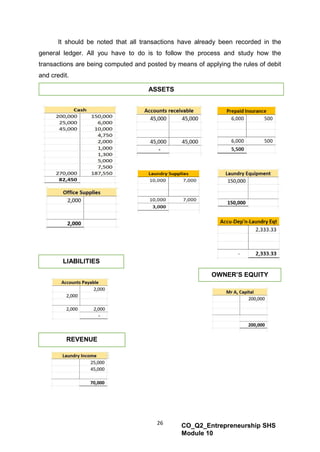
Depicted in Figure 8 below is the chart of accounts of Alpha Laundry Services.
Figure 8 – Chart of Accounts
Let’s Begin!
Mr. Denver Ambrose, a retired public school teacher, started his laundry
business in the beginning of June 2018. He used all of his savings to start a “coin-
operated” laundry business. He named it Alpha Laundry Services (ALS). The following
are the business transactions for the month of June 2018, the first month of business
operation:
Bookkeeping Practice Set 1: Identifying and recording a business
transaction using the General Journal
14 CO_Q2_Entrepreneurship SHS
Module 10
1. June 1, 2018 - Mr. Ambrose invested P 200,000.00 cash in his newly opened Alpha
Laundry System business.
Journal Entry:
GENERAL JOURNAL PAGE 1
DATE P A R T I C U L A R S
POST.
REF. DEBIT CREDIT
1 June 1 Cash 200,000.00
2 Mr. A Capital 200,000.00
3
To record the initial Capital
investment of Mr. A.
2. June 2, 2018 - Mr. A hired his former classmate, Doree Dy, to be the Laundry
Operator of ALS for a fixed monthly salary of P10,000.00. The operator will be paid
every quencina.
EXPLANATION: No entry will be made in this transaction because there was neither
inflow or outflow of cash or an exchange of assets that have monetary value.
3. On June 5, 2018 – Alpha Laundry Systems purchased laundry equipment for cash,
P150,000.00
Journal Entry:
GENERAL JOURNAL PAGE 1
DATE P A R T I C U L A R S
POST.
REF. DEBIT CREDIT
4 June 5 Laundry equipment 150,000.00
5 Cash 150,000.00
6
To record the acquisition of
Laundry equipment
4. On June 6, 2018 – Alpha Laundry Systems paid cash in advance for the 1-year
insurance coverage of laundry equipment amounting to P6,000.00. Monthly
insurance expense will be recognized for each month’s end report.
15 CO_Q2_Entrepreneurship SHS
Module 10
Journal Entry:
GENERAL JOURNAL PAGE 1
DATE P A R T I C U L A R S
POST.
REF. DEBIT CREDIT
7 June 6 Prepaid Insurance 6,000.00
8 Cash 6,000.00
9
To record the prepaid Insurance for the
Laundry equipment
5. On June7, 2018–Alpha Laundry Systems bought supplies for laundry amounting
to P10,000.00. The supplies bought are laundry consumables such as detergent
powder, soap bar and fabric softener. Monthly inventory will be conducted to
determine unused supplies and will be recognized for each month end report.
Journal Entry:
GENERAL JOURNAL PAGE 1
DATE P A R T I C U L A R S
POST.
REF. DEBIT CREDIT
10 June 7 Laundry supplies 10,000.00
11 Cash 10,000.00
12
To record the acquisition of
laundry consumables
6. On June 15, 2018 – Alpha Laundry Systems paid P4,750 cash for salary of laundry
operator.
Journal Entry:
GENERAL JOURNAL PAGE 1
DATE P A R T I C U L A R S
POST.
REF. DEBIT CREDIT
13 June 15 Salaries and wages 4,750
14 Cash 4,750
15
To record the payment of Laundry
operator’s salary
7. On June 16, 2018 – Alpha Laundry Systems received P25,000.00 cash for laundry
services rendered to MZ Hotel.
16 CO_Q2_Entrepreneurship SHS
Module 10
Journal Entry:
GENERAL JOURNAL PAGE 1
DATE P A R T I C U L A R S
POST.
REF. DEBIT CREDIT
16 June 16 Cash 25,000.00
17 Laundry Income 25,000.00
18
To record the payment received from
MZ Hotel.
8. On June 17, 2018 – Alpha Laundry Systems rendered service to Argon Hotel
amounting to P45,000.00. Argon promised to pay on June 20 of the same year.
Journal Entry:
GENERAL JOURNAL PAGE 1
DATE P A R T I C U L A R S
POST.
REF. DEBIT CREDIT
19 June 17 Accounts Receivable 45,000.00
20 Laundry Income 45,000.00
21
To record the service rendered to Argon
Hotel
9. On June 18, 2018, Alpha Laundry Systems purchased office supplies from Ku
Enterprises amounting to P2,000.00 on account. ALS will pay it on June 25 of the
same year.
Journal Entry:
GENERAL JOURNAL PAGE 1
DATE P A R T I C U L A R S
POST.
REF. DEBIT CREDIT
22 June 18 Office supplies 2,000.00
23 Accounts Payable 2,000.00
24
To record the acquisition of Office
Supplies on account from Ku
Enterprises
10. On June 20, 2018, Alpha Laundry Systems collected payment from Argon Hotel.
Journal Entry:
17 CO_Q2_Entrepreneurship SHS
Module 10
GENERAL JOURNAL PAGE 1
DATE P A R T I C U L A R S
POST.
REF. DEBIT CREDIT
25 June 20 Cash 45,000.00
26 Accounts Receivable 45,000.00
27
To record the full payment from Argon
Hotel
11. On June 25, 2018, Alpha Laundry Systems paid in full the amount owed to Ku
Enterprises.
Journal Entry:
GENERALJOURNAL PAGE 1
DATE P A R T I C U L A R S
POST.
REF. DEBIT CREDIT
28 June 25 Accounts Payable 2,000.00
29 Cash 2,000.00
30
To record the full payment of account to
Ku Enterprises
12. On June 27, 2018, Alpha Laundry Systems paid electric bill for the month
amounting to P1,000.00 in cash. The payment is charged to Utility expense
account.
Journal Entry:
GENERAL JOURNAL PAGE 1
DATE P A R T I C U L A R S
POST.
REF. DEBIT CREDIT
31 June 27 Utilities expense 1,000.00
32 Cash 1,000.00
33
To record the payment Electricity for the
month
13. On June 30, 2018, Alpha Laundry Systems paid a month’s transportation expense
amounting to P1,300.00.
18 CO_Q2_Entrepreneurship SHS
Module 10
Journal Entry:
GENERAL JOURNAL PAGE 1
DATE P A R T I C U L A R S
POST.
REF. DEBIT CREDIT
34 June 30 Transportation expense 1,300.00
35 Cash 1,300.00
36
To record the payment of transportation
for the month.
14. On June 30, 2018, Alpha Laundry Systems paid P5,000 cash for salary of laundry
operator.
Journal Entry:
GENERAL JOURNAL PAGE 1
DATE P A R T I C U L A R S
POST.
REF. DEBIT CREDIT
37 June 30 Salaries and Wages 5,000.00
38 Cash 5,000.00
39
To record the payment Laundry
operator’s salary.
15. On June 30, 2018, Alpha Laundry Systems paid P7,500 cash for the month’s rent
for laundry space.
Journal Entry:
GENERAL JOURNAL PAGE 1
DATE P A R T I C U L A R S
POST.
REF. DEBIT CREDIT
40 June 30 Rent expense 7,500.00
41 Cash 7,500.00
42
To record the payment of rent for
Laundry space.
The total debit and credit columns of the general journal should always be
equal. Otherwise, the general journal balances will affect overall accuracy of the entire
financial report. The error should be properly corrected before the next step in the
recording process takes place.
19 CO_Q2_Entrepreneurship SHS
Module 10
Directions: In this activity, you are supposed to do the posting of general journal
entries to the general ledger using the T-Accounts technique. The
following are suggested activities before posting journal entries to T-
Accounts:
1. Group account titles according to the Five Major Accounts.
2. Determine the normal balance of each account title by referring to the
normal balance matrix.
3. Record transactions in sequential order or apply the “First-entry, First-
record” system.
4. After all journal entries are recorded, compute the debit and credit
totals of all accounts. Compute for the running balance.
Example: 1) Cash account (normal balance is debit):
Total Cash-Debit P270,000.00
Less: Total Cash-Credit 187,550.00
Outstanding Cash Balance P 82,450.00
=========
2) Laundry Income/revenue (normal balance is credit):
Total Accounts Payable-Credit P 2,000 .00
Less: total Accounts Payable-Debit 2,000.00
Outstanding Accounts Payable Balance P 0
=========
After performing the T-Accounts, outstanding balances of each account under
Assets, Liabilities, Capital, Revenue/Income and Expenses can now be determined.
Given below are T–Accounts for all ledger accounts group according to the five major
accounts.
Bookkeeping Practice Set 2: Posting journal entries to the General Ledger using
T - accounts.
ASSETS
20 CO_Q2_Entrepreneurship SHS
Module 10
Directions: In this activity, you are tasked to prepare a trial balance for ALS. The
period covered is June 2018. Use the T–Account presented in Bookkeeping Practice
Set 2.
The following are suggested activities in preparing trial balance report:
1. Pick up all account balances of cash, accounts receivable up to the last
account.
2. Copy them in the designated account title in the trial balance report (un-
adjusted trial balance) following its account normal balances.
3. Compute for the total debit and credit balances. The debit amount should
be equal to the credit.
LIABILITIES OWNER’S EQUITY
REVENUE EXPENSE
Bookkeeping Practice Set 3: Preparing Trial Balance
21 CO_Q2_Entrepreneurship SHS
Module 10
It should be noted that all transactions have already been recorded in the
general journal and general ledger. All you have to do is to follow the process and
study how the transactions are being recorded in the working paper to prepare the
Trial Balance report by applying the rules of debit and credit.
Depicted below is a trial balance report of Alpha Laundry Services for the period
ended, June 30, 2018.
Figure 7 – Trial Balance of ALS
As you can observe, the accounts reflected in Figure 7 above are arranged
according to the proper placement of the five major accounts. The Assets, Liabilities,
Owner’s Equity, Revenue and Expense accounts.
22 CO_Q2_Entrepreneurship SHS
Module 10
What’s More
Having completed the Trial Balance report is not yet the end of a
bookkeeper’s responsibility. The bookkeeper’s responsibility will only end when the
business has closed its books of accounts. The books of accounts of a business will
be closed at the end of the business’s calendar or fiscal year. The calendar year
always begins in January 1 and ends on December 31 of the same year. While the
fiscal year begins at any month of the year and ends on the 12th month of the following
year. All business activities (financial in nature) should be recorded in the books of
accounts even when the financial reports have already been prepared. Business
activities or transactions that were not included in the financial reports will be recorded
to reflect necessary adjustments.
What is an Adjusting Entry?
Adjusting entry is an entry made to update the financial data already recorded.
Making an adjusting entry helps the bookkeeper capture all financial events that
happened over a period of time with in the accounting cycle. It is essential in keeping
the financial record updated. The bookkeeper is going to look or examine accounts
that needs to be updated. Outlined below are the five basic sources of adjusting
entries:
1. Depreciation expense
2. Deferred expenses of prepaid expenses
3. Deferred income of unearned income
4. Accrued expenses of accrued liabilities
5. Accrued income or accrued assets
1. Depreciation
This is a method of allocating the cost of an asset to an expense over the
accounting periods that make up the asset’s useful life. Examples of assets subject to
depreciation are: Store, Office, Building, and Transportation Equipment. These types
of assets lose their ability to provide useful service as time passes. Depreciation can
also be referred to as the decrease in the usefulness of these types of assets. Take
note that Land is not subject to depreciation because the value of land mostly
increases as time passes.
There are several methods or formulas to compute the amount of depreciation.
23 CO_Q2_Entrepreneurship SHS
Module 10
The simplest is the straight-line method.
The formula:
Annual Depreciation = Acquisition Cost – Salvage or Residual Value
Useful Life
Where:
 Acquisition Cost – the actual cost of the asset acquired.
 Salvage Value – the selling price of the asset upon reaching the
useful life.
 Useful Life – is the economic or productive life of the asset written
in months or years.
2. Deferred expenses or prepaid expenses. These are items that have been
initially recorded as assets but are expected to become expenses over time
or through the operations of the business. In order to recognize the correct
amount of expenses, prepayments shall be amortized weekly, semi-monthly
or monthly, depending on its nature and purpose.
3. Deferred income or unearned income. These are items that have been
initially recorded as liabilities but are expected to become income over time or
through the operations of the business.
4. Accrued expenses or accrued liabilities. These are items of expenses that
have been incurred but have not been recorded and paid.
5. Accrued income or accrued assets. These are income items that have been
earned but have not been recorded and paid by the customer. In short, these
are receivables of the business.
Directions: Let’s take a look at Alpha Laundry Services’ transaction that transpired
after the Trial Balance have been prepared. In this activity, you are tasked to do the
following:
1. Identify accounts that need to be adjusted.
2. Prepare adjusting journal entries in the General Journal.
Bookkeeping Practice Set 4: Record adjusting journal entries in the
General Journal.
24 CO_Q2_Entrepreneurship SHS
Module 10
It should be noted that all transactions have already been recorded in the
general journal. All you have to do is to analyze and follow the process on how the
transactions are being recorded and forwarded using the T-Accounts applying the
rules of debit and credit.
1. Depreciation of Equipment
The laundry equipment, which was purchased by ALS on June 5, 2018 at
P150,000.00 has an estimated useful life of 5 years with a salvage value of
P10,000.00. Compute for the monthly depreciation to be charged as depreciation
expense and will be deducted against the cost to get the net book value of the
laundry equipment.
Required: Compute for the monthly depreciation using straight-line method.
Adjusting Entry:
GENERAL JOURNAL PAGE 1
DATE P A R T I C U L A R S
POST.
REF. DEBIT CREDIT
43 June 30 Depreciation Expense 2,333.33
44 Accumulated Dep’n-Laundry Eqt. 2,333.33
45
To recognize the depreciation expense
for the month of June.
Formula: P150,000 –10,000 = 2,333.33
5 Years
2. Prepaid Insurance
The insurance paid for Laundry equipment is P6,000.00. An expired portion of the
insurance in the amount of P500.00 is determined by dividing the prepayments over
12 months (P6,000.00 / 12 months). The expired portion will be charged to expense.
This will reduce the value of prepaid insurance balance.
Required: Compute for the expired portion of the insurance.
To compute for the expired portion of the insurance:
Formula: Insurance Cost P6,000 = P 500
Term of Coverage = 12 months =====
(No. of Months)
Prepaid Insurance P 6,000
Less: Expired Portion (June) 500
Un-expired Portion P 5,500
25 CO_Q2_Entrepreneurship SHS
Module 10
Note: The expired portion is charged to expense (insurance expense). The un-
expired portion will be reported in the balance sheet as the new prepaid
insurance account balance for the next month.
Adjusting Entry:
GENERAL JOURNAL PAGE 1
DATE P A R T I C U L A R S
POST.
REF. DEBIT CREDIT
46 June 30 Insurance Expense 500.00
47 Prepaid Insurance 500.00
48
To recognize the expired portion of the
prepaid insurance.
3. Deferred expenses for supplies inventory. At the end of the month, unused
supplies were recorded to be P3,000.
Note: The used supplies are charged to expense (supplies expense). The unused
portion will be reported as the new supplies inventory balance for the next month.
Adjusting Entry:
GENERAL JOURNAL PAGE 1
DATE P A R T I C U L A R S
POST.
REF. DEBIT CREDIT
49 June 30 Laundry Supplies Expense 7,000.00
50 Laundry Supplies 7,000.00
51
To recognize the used portion of the
Laundry supplies consumables
Formula to compute for the used supplies:
Supplies at Cost P10,000.00
Less: Unused Supplies 3,000.00
Used Supplies P 7,000.00
Directions: In this activity, you are tasked to do the following:
1. Using the completed adjusting journal entries in the general journal, update
the General Ledger records by adding or subtracting the affected accounts.
Bookkeeping Practice Set 5: Posting the adjusting entries in the General
Ledger by using T – Account.
26 CO_Q2_Entrepreneurship SHS
Module 10
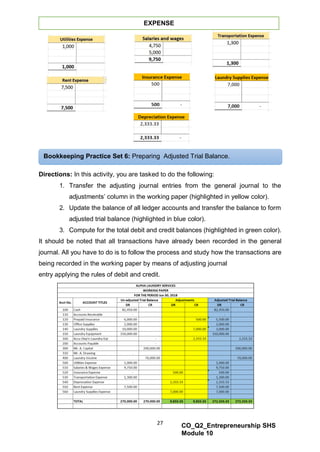
It should be noted that all transactions have already been recorded in the
general ledger. All you have to do is to follow the process and study how the
transactions are being computed and posted by means of applying the rules of debit
and credit.
ASSETS
REVENUE
OWNER’S EQUITY
LIABILITIES
27 CO_Q2_Entrepreneurship SHS
Module 10
Directions: In this activity, you are tasked to do the following:
1. Transfer the adjusting journal entries from the general journal to the
adjustments’ column in the working paper (highlighted in yellow color).
2. Update the balance of all ledger accounts and transfer the balance to form
adjusted trial balance (highlighted in blue color).
3. Compute for the total debit and credit balances (highlighted in green color).
It should be noted that all transactions have already been recorded in the general
journal. All you have to do is to follow the process and study how the transactions are
being recorded in the working paper by means of adjusting journal
entry applying the rules of debit and credit.
EXPENSE
Bookkeeping Practice Set 6: Preparing Adjusted Trial Balance.
28 CO_Q2_Entrepreneurship SHS
Module 10
What I Have Learned
Fill in blanks to complete the following statements:
1. __________ is an employee of the company in charge to maintain bookkeeping
records of the business.
2. __________ is considered the book of original entry.
3. __________ is considered the book of final entry.
4. __________ is the most convenient and fastest way of posting journal entries
to the ledger. This account is divided into two sides.
5. __________ contains the detail for all invoices received from suppliers.
6. __________ is a group of accounts directly associated from the general ledger.
7. __________is the left-hand side entry also known in accounting as “Value
Received.”
8. __________ is the right-hand side entry also known in accounting as “Value
Parted With.”
9. __________ is a list of all ledger accounts with closed or final balances on a
certain period arranged according to the assets, liabilities, capital, revenue and
expense.
10.__________ is the first account of the five major accounts which refers to
resources with economic value that an individual, corporation, or country owns
or controls with the expectation that it will provide a future benefit.
What I Can Do
Directions: Write your answer on a separate worksheet.
1. Prepare journalized entries on the following transactions.
2. Compute the total debit and credit balances of the general journal.
3. Use the JCN Computer Repair Services chart of accounts below.
Materials Needed:
1. 2-column worksheet (or bond paper) – 1pc
a. If using bond paper, copy the format of a general journal using pencil and
ruler.
2. Calculator and ruler
3. Ball pen / pencil with eraser
Activity 1: Journalizing Business Transactions
29 CO_Q2_Entrepreneurship SHS
Module 10
Ms. Julianah Chloe Neri opened her computer repair business in Cagayan de
Oro City on July 14, 2020. The following transactions occurred during the month of
July 2020:
DATE TRANSACTIONS
July 14 Invested PHP500,000.00 to her business. The trade name of the
Business is JCN Internet Café.
July 15
Julianah purchased one computer unit from XY Computer Store to be
used for her business. She issued check number 001 amounting to
PHP25,000.00.
July 16 Julianah hired Alele Valix, a BSIT graduate.
July 17 Repaired the computers of Albertos Co. and collected P10,000.00
July 18 Repaired the computers of Marko; however, Marko will pay
P15,000.00 only on August 2020.
July 19
Julianah purchased office supplies from IZA Merchandise amounting
to P 5,000.00 on account. Jualianah will pay on August 30, 2020.
July 18 Paid the salary of Alele amounting to P 4,000.00.
Directions: Write your answer on a separate worksheet.
1. Prepare T-Accounts from the journal entries that you have created in Activity 1.
2. Post journal entries to the T-Accounts.
3. Compute the total debit or credit balances for each T-Account.
Materials Needed:
1. 2-column worksheet (or bond paper) – 1pc.
2. Calculator
Activity 2: Posting Journal Entries to the Ledger Using T- Accounts
30 CO_Q2_Entrepreneurship SHS
Module 10
3. Ball pen / pencil with eraser
4. Ruler
Directions: Write your answer on a separate worksheet.
1. Prepare Trial balance report from the T–Accounts you have prepared in Activity
2. (Tips: Cash account normal balance is Debit; the running total must also be
at the Debit side. Also, Trial balance entry will also be in the Debit column,)
2. Compute the total debit and credit balances.
Materials Needed:
1. 2-column worksheet (or bond paper) – 1pc.
a. If using bond paper, copy the trial balance format using a pencil and a
ruler
2. Calculator
3. Ball pen / pencil with eraser
4. Ruler
Activity 4.1 – Compute for Depreciation
Directions: Compute the depreciation of the company asset using the following
information:
1. Use straight-line method in computing depreciation.
2. Make adjusting journal entries reflecting the amount of depreciation expense.
The following are financial data of the ABM Corp. for the year ended December 31,
2019:
a. The cost of the office equipment is PHP25,000.00.
b. It was estimated to have a useful life of 5 years.
c. It was estimated that after 5 years, the office equipment can be sold at a scrap
value of PHP1,000.00.
Activity 4: Computation for Accrued and Deferred Accounts and
Adjusting Journal Entry Preparation
Activity 3: Trial Balance Preparation
31 CO_Q2_Entrepreneurship SHS
Module 10
Activity 4.2 – Deferred Expenses or Prepaid Expenses.
Directions:
1. Compute for the expense portion of the office supplies.
2. Make adjusting journal entries reflecting the amount computed as supplies
expense.
The following are financial data of ABM Corporation for the year ended
December 31, 2019:
a. Purchased P15,000 worth of office supplies on account.
b. By the end of the month, PHP5,000 worth of these supplies are still unused.
Activity 4.3 – Deferred Income of Unearned Income
Directions:
1. Compute for the portion of unearned service revenue to be debited.
2. Make adjusting journal entries reflecting the amount computed as supplies
expense.
On February 15, 2016 Matapang entered into a contract with Makisig to
maintain the computers of Makisig for two months starting on February 15, 2016 up to
April 15, 2016. On the same date, Makisig paid the total contract amount of
PHP40,000.00 in full.
The entries to record and adjust the books are: In the February 29, 2016 entry
above, as of end of February 2016, Matapang has already earned the service revenue
for the first 15 days, thus an adjusting entry is recorded.
Activity 4.4 – Accrued Income or Accrued Assets
Direction:
1. Prepare adjusting journal entries for the following transaction:
On February 28, 2016, Juan repaired the computer of Pedro for PHP15,000.
Pedro was on an out-of-town trip so he could not pay Juan. He told Juan that he will
pay for their services on March 1, 2016. Juan has already earned the PHP15,000 but
was not paid as of the end of February 2016. Therefore, an income should be properly
recognized in February 2016 for this transaction.
32 CO_Q2_Entrepreneurship SHS
Module 10
Matching type: Match the description in column A to the term found in column B.
Direction: Use a separate answer sheet. Write the letter only.
COLUMN A COLUMN B
1. First account of the five major accounts which
refers to resources with economic value that it will
provide a future benefit
A. Bookkeeper
2. List all ledger accounts with closed or final
balances arranged according to the assets,
liabilities, capital, revenue and expense
B. General Journal
3. Also known in accounting as “Value Parted With” C. General Ledger
4. Also known in accounting as “Value
Received” D. T - Account
5. Group of accounts directly associated from the
general ledger
E. Accounts Payable
Ledger
6. Contains the detail for all invoices
received from suppliers
F. Subsidiary Ledger
7. The most convenient and fastest way of posting
journal entries to the ledger.
G. Debit
8. Book of final entry H. Credit
9. Book of original entry I. Trial Balance
10. Employee of the company in charge to maintain
bookkeeping records of the business
J. Asset
Assessment
33 CO_Q2_Entrepreneurship SHS
Module 10
Lesson
2
Identifying Where There Is A
Profit Or Loss For A Business
What’s In
Profitability has always been the bottom line of a business. In reporting accurate
financial information, the bookkeeper and the bookkeeping systems take the
significant roles. Accurate financial reports will enable sound decision making.
In identifying the profit or loss of a business, the bookkeeper must record all
transactions that have monetary value. These records will then be converted into key
financial reports. Key financial reports are composed of statement of financial position
(balance sheet), statement of comprehensive income (income statement), statement of
cashflows, and statement of changes inequity. These reports are discussed in the ABM
specialized subject, Fundamentals of Accountancy, Business and Management 2.
What’s New
In computing for the Net Income or net earnings, a bookkeeper must consider
the type of business that his/her company is engaged. Below is a matrix of the type of
business organizations and the different types of revenues, cost and expenses to be
considered.
Types of Business Revenue Type Cost / Expenses Type
Service-Concerned
-Service Income
-Service Fee
-Membership Fee
- General & Administrative
Expense
Merchandising-Concerned Sales
- Sales Returns and Allowances
- Cost of Sales
- General & Administrative
Expense
Manufacturing Sales
- Sales Returns and Allowances
- Cost of Good Manufactured
- Fixed or Variable Costs
- General & Administrative
Expense
34 CO_Q2_Entrepreneurship SHS
Module 10
For simplicity purposes, this module will tackle the service-concerned business in
illustrating the process of computing net income.
Below is the basic equation for computing net income of a service-concerned
business:
Directions: Apply the basic equation of income statement written above and answer
the questions bellow.
GIN Janitorial and General Services, Inc. is a company engaged in providing
janitorial services to different business establishments in the city. The following financial
data reveals the income and expenses records during the last quarter of 2018:
Revenue / Service Income:
Service rendered – on account (Deluxe Hotel) P 95,000.00
Service rendered – Cash (Maxandria Hotel) 145,000.00
Service rendered – on account (Pearlmont Inn) 25,000.00
Service rendered – Cash (Mallberry Suites) 105,000.00
Service rendered – Cash (VIP Hotel) 65,000.00
Service rendered – on account (Dynasty Court Hotel) 75,000.00
Service rendered – on account (Grand City Hotel) 60,000.00
TOTAL P570,000.00
Salaries and Wages of Employees:
Janitor’s Salary– Total P 95,000.00
Management Staff Salary – Total 45,000.00
General Manager’s salary– Total 70,000.00
TOTAL P210,000.00
Operating and Administrative Expenses:
Utilities Expenses P 15,000.00
Rent Expense 15,000.00
Repairs and Maintenance 7,500.00
Transportation and Communications 4,500.00
TOTAL P 42,000.00
Net Income/Loss = Service Income - Total Expenses
Activity 1 – Computing Net Income or Net Loss, Collectibles and Expenses
35 CO_Q2_Entrepreneurship SHS
Module 10
The owner of the business wants to know the operations of the business. You
are tasked to compute for the following:
1. Total service income collected in cash
2. Total service income still collectible
3. Total expenses
4. Net income of GIN Janitorial and General Services, Inc.
5.
What is It
Discussion of Activity 1
A wise businessman always monitors the operations of his business in order to
render timely and sound decisions. One of the many ways to track down the operations
of the business is to check the status of its income generating activities on a periodic
basis. A trend must be established so that when the profitability path deviates, a timely
decision would be made.
In Activity 1, the financial information reported is enough for a bookkeeper to
compute the net income, total expenses and the collectible amount. Cash and non-
cash service income should be split in order to have a proper recording of the cash on
hand and the collectibles. In applying the basic equation of income statement, the
following re-grouping is suggested:
Service Income (Cash)
Less: Operating and Administrative Expense xxx
P xxx
Add: Salaries and Wages
Net Income / Loss
xxx xxx
P xxx
======
36 CO_Q2_Entrepreneurship SHS
Module 10
What’s More
Directions:
 Write your monthly allowance (computed by daily allowance x number
of days in a month). Compute the total.
 Write the amount you spend on food, transportation, phone load, etc.
(make it monthly to match your allowance). Compute the total.
 Deduct the total amount you spend from the total amount of your
allowance.
 Associate allowance with revenue and spending with expense with the
net amount as net income.
Materials Needed:
 Pen
 1 whole sheet of paper (a long-sized bond paper is ok)
 Calculator
What I Have Learned
Essay: Answer the following questions in a separate sheet of paper or a long- sized
bond paper.
1. If you are engaged in business, illustrate how revenue or income are made.
2. If you are engaged in business, illustrate how an expense is made.
3. If you are the owner of the business, is payment of employee salaries an
expense? Why?
4. Compare revenue to income. Illustrate an example If necessary.
5. Explain the process of computing the Net Income or net loss.
Rubrics for Grading the Answers:
5- If the paragraph consists of 5 or more sentences with correct and complete Information.
4- If the paragraph consists of 3 to 4 sentences with correct information.
3- If the paragraph consists of 2 to 3 sentences with correct information.
2- If the paragraph consists of 2 sentences with correct information.
1- if the paragraph consists of only one sentence with correct in formation.
ACTIVITY 2: Preparing Personal Income Statement
37 CO_Q2_Entrepreneurship SHS
Module 10
Directions:
1. Use 1 separate sheet or bond paper in writing your answer.
2. Compute for the following:
a) Total Revenue
b) Total Expense
c) Net Income/Net Loss
d) Briefly explain your answer
Mr. Izatsuki Hamida, the bookkeeper of Honda Massage and Spa Services
reported the following financial records for the months of January to March 2018:
Water expenses ---------------------- P 4,000.00
Soap expense ---------------------- 7,500.00
Massage oil expenses ---------------------- 15,000.00
Light & power expenses ---------------------- 12,000.00
Rent of the Massage parlor---------------------- 24,000.00
Salary of staff (4 massage workers)-------- 72,000.00
Income received from massage service-------- 115,700.00
Income not yet received from customer-------- 55,000.00
Telephone expenses ------------------------ 7,500.00
ACTIVITY 3: Computing Revenue, Expenses and Net Income/Loss
What I Can Do
38 CO_Q2_Entrepreneurship SHS
Module 10
Assessment
1. The following are financial records of ABC Company
 Revenues – P 20,000.00  Salaries expense – P4,000.00
 Rent expense – P3,000.00  Utilities expense – P2,000.00
How much is the total expenses?
a. P9,000.00 b. P10,000.00 c. P18,000.00 d. P1,000.00
2. How much is the net income?
a. P9,000.00 b. P10,000.00 c. P 18,000.00 d. P11,000.00
3. One of the account titles below is used in making an adjusting entry. Which is one
is it?
a. liability b. prepaid insurance c. asset d. capital
4. This is also known as the book of original entry.
a. income statement c. general journal
b. balance sheet d. general ledger
5. This is also known as the book of final entry.
a. income statement c. general journal
b. balance sheet d. general ledger
c.
6. Mang Ariel sells bottled water in a nearby public bus terminal, every day he can
sell 70 pieces of bottled water at P20.00 pesos each. How much is his daily
revenue?
a. P1,400.00 b. P1,700.00 c. P1,800.00 d. P1,450.00
The following are financial records of Lex Luther Corp.
 Service Income, Customer 1 –P50,000.00  Salaries Paid to Clerk – P5,000.00
 Rent Expense – P3,000.00  Utilities Expense – P2,000.00
 Service Income, Customer 2
(not yet received) – P 25,000.00
 Salaries Paid to Manager –
P9,000.00
7. How much is the total expenses?
a. P19,000.00 b. P10,000.00 c. P18,000.00 d. P9,000.00
8. How much is the net income?
a. P59,000.00 b. P50,000.00 c. P 31,000.00 d. P56,000.00
9. How much is the total revenue?
a. P59,000.00 b. P50,000.00 c. P31,000.00 d. P75,000.00
10. How much is the amount still collectible?
a. P25,000.00 b. P50,000.00 c. P31,000.00 d. P75,000.00
39 CO_Q2_Entrepreneurship SHS
Module 10
Answer Key
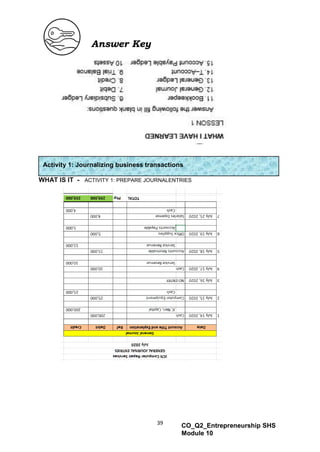
WHAT IS IT - ACTIVITY 1: PREPARE JOURNALENTRIES
Activity 1: Journalizing business transactions
40 CO_Q2_Entrepreneurship SHS
Module 10
Activity 2: Posting journal entries to the ledger using T- accounts
41 CO_Q2_Entrepreneurship SHS
Module 10
WHAT’S MORE
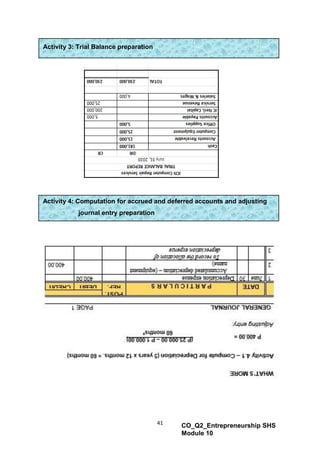
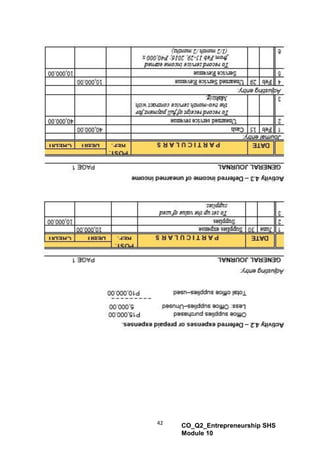
Activity 4.1 – Compute for Depreciation (5 years x 12 months. = 60 months)
P 400.00 =
Adjusting entry:
(P 25,000.00 – P 1,000.00)
60 months*
GENERAL JOURNAL PAGE 1
DATE P A R T I C U L A R S
POST.
REF. DEBIT CREDIT
1 June 30 Depreciation expense 400.00
2
Accumulated depreciation – (equipment
name) 400.00
3
To record the allocation of
depreciation expense
Activity 3: Trial Balance preparation
Activity 4: Computation for accrued and deferred accounts and adjusting
journal entry preparation
42 CO_Q2_Entrepreneurship SHS
Module 10
Activity 4.2 – Deferred expenses or prepaid expenses.
Office supplies purchased P15,000.00
Less: Office supplies–Unused 5,000.00
Total office supplies–used P10,000.00
Adjusting entry:
GENERAL JOURNAL PAGE 1
DATE P A R T I C U L A R S
POST.
REF. DEBIT CREDIT
1 June 30 Supplies expense 10,000.00
2 Supplies 10,000.00
3 To set up the value of used
supplies.
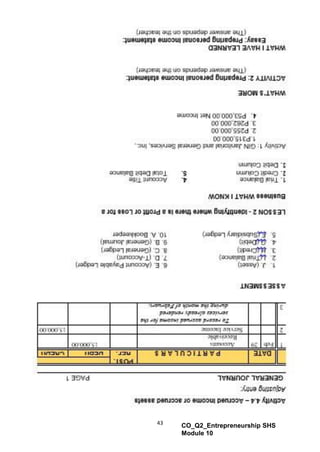
Activity 4.3 – Deferred income of unearned income
GENERAL JOURNAL PAGE 1
DATE P A R T I C U L A R S
POST.
REF. DEBIT CREDIT
Journal entry:
1 Feb 15 Cash 40,000.00
2 Unearned service revenue 40,000.00
3
To record receipt of full payment for
the two-month service contract with
Makisig.
Adjusting entry:
4 Feb 29 Unearned Service Revenue 10,000.00
5 Service Revenue 10,000.00
6
To record service income earned
from Feb 15-29, 2016; P40,000 x
(1/2 month /2 months)
43 CO_Q2_Entrepreneurship SHS
Module 10
Activity 4.4 – Accrued income or accrued assets
Adjusting entry:
GENERAL JOURNAL PAGE 1
DATE P A R T I C U L A R S
POST.
REF. DEBIT CREDIT
1 Feb 29 Accounts
Receivable
15,000.00
2 Service Income 15,000.00
3
To record accrued income for the
services already rendered
during the month of February.
ASSESSMENT
1. J. (Asset) 6. E. (Account Payable Ledger)
2. I.(Trial Balance) 7. D. (T-Account)
3. H.(Credit) 8. C. (General Ledger)
4. G.(Debit) 9. B. (General Journal)
5. F.(Subsidiary Ledger) 10. A. Bookkeeper
LESSON 2 - Identifying where there is a Profit or Loss for a
Business WHAT I KNOW
1. Trial Balance 4. Account Title
2. Credit Column 5. Total Debit Balance
3. Debit Column
Activity 1: GIN Janitorial and General Services, Inc.,
1.P315,000.00
2. P255,000.00
3. P262,000.00
4. P53,000.00 Net Income
WHAT’S MORE
ACTIVITY 2: Preparing personal income statement:
(The answer depends on the teacher)
WHAT I HAVE LEARNED
Essay: Preparing personal income statement:
(The answer depends on the teacher)
44 CO_Q2_Entrepreneurship SHS
Module 10
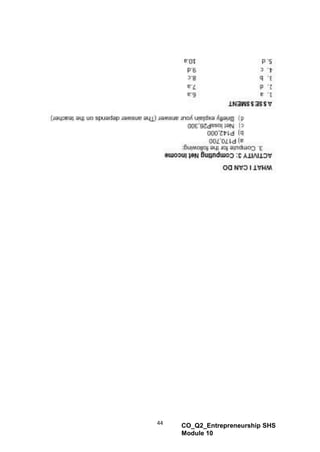
WHAT I CAN DO
ACTIVITY 3: Computing Net Income
3. Compute for the following:
a) P170,700
b) P142,000
c) Net lossP26,300
d) Briefly explain your answer (The answer depends on the teacher)
ASSESSMENT
1. a 6.a
2. d 7.a
3. b 8.c
4. c 9.d
5. d 10.a
45 CO_Q2_Entrepreneurship SHS
Module 10
Book References
Aduana, Nick L. (2017). Entrepreneurship in Philippine Setting for Senior High School,
C&E publishing, Inc.,p.46-51
Aduana, Nick L. (2016). In Entrepreneurship In Philippine Setting For Senior High School.
"Chapter 5/Lesson 3 The Marketing Mix." p184-199. Quezon City, Philippines: C&E
Publishing.
Aduana, Nick L. (2016). Entrepreneurship in the Philippine Setting for Senior High
School. Quezon City. C & E Publishing, Inc.
Aduana, Nick L. (2015). Financial statements; Preparation, presentation, analysis and
interpretation, presentation. Quezon City, Philippines: C & E Publishing, Inc.
Batisan, Ronaldo S. (2016). Entrepreneurship Module, Diwa Senior Highschool Series,
Diwa Learning System Inc. Legaspi Village, Makati City Philippines, copyright 2016.
Batisan, Ronaldo S. (n.d.). Entrepreneurship: Diwa Senior High School Series, Diwa
Learning Systems Inc., p.16-20.
De Guzman, Angeles A. (2018) Entrepreneurship (For Senior High School, Applied subject,
ABM Strand. Lorimar Publishing, Inc., p.1-5, 25 – 26.
Edralin, Divina M. (2016). Entrepreneurship. Quezon City: Vibal Group, Inc., p.80 – 83.
Fundamentals of Accountancy, Business, & Management 1. (2016). Teaching Guide for
Senior High School. CHED in collaboration with Philippine Normal University. Published by
CHED. Licensed under a Creative Commons Attribution. Non-Commercial-Share Alike 4.0
International License.
Fundamentals of Accountancy, Business, & Management 2. (2016). Teaching Guide for Senior
High School. CHED in collaboration with Philippine Normal University. Published by CHED.
Licensed under a Creative Commons Attribution. Non-Commercial-Share Alike 4.0
International License.
Business Finance (2016). Teaching Guide for Senior High School. (2016). Teaching Guide for
Senior High School. CHED in collaboration with Philippine Normal University. Published by
CHED. Licensed under a Creative Commons Attribution. Non-Commercial-Share Alike 4.0
International License.
Habaradas, Raymund B. and Tereso S. Tullao, Jr., (2016). Pathways to Entrepreneurship
Phoenix Publishing House. p.17-28.Banastao, C. and S. Frias. (2008) Entrepreneurship.
Quezon City Philippines: C & E Publishing, Inc.
Leedy, P. and J. Ormrod. (2001). Practical Research: Planning and Design. 7th
Edition.
Merrill Prentice Hall and SAGE Publications.
REFERENCES
46 CO_Q2_Entrepreneurship SHS
Module 10
Lopez, Rafael Jr. (2015). Basic Accounting for Non-Accountants.
Lopez, Rafael Jr. (2016). Fundamentals of Accounting.
Lopez, Jr. Rafael M. (2015). Fundamentals of Accounting, 2014-2015 Edition.
Morato, Eduardo A. (2016). Entrepreneurship. Manila. Rex Bookstore, Inc.
Morato, Eduardo A. Jr. (2016). Entrepreneurship, 1st
ed., Manila, Philippines: REX Books
Store, p.13.
Rabo, Tugas, and H.E. Salendrez. (2016). Fundamentals of Accountancy, Business and
Management. Vibal Group Inc.
ELECTRONIC RESOURCES
"5 Basic Functions of Packaging in Marketing a Product." (January 03, 2014). Your Article Library.
Accessed January 15, 2019. http://www.yourarticlelibrary.com/marketing/5-basic-functions-of-
packaging-in-marketing-a-product/22204.
Amanda Jesnoewski. (November 20, 2018). Four ways to identify more business opportunities.
retrieve from: https://www.smartcompanyng.com.au/startupsmart/advice/business-
planning/four-ways-to-identify-more-business-opportunities/.
"Branding Explained.".(n.d.) Luminosity Branding Agency. Accessed January 04, 2019.
https://www.luminosity.com.au/what-we-do/brand/branding-explained/.
“Forecasting”. (n.d.). Business dictionary, Accessed December 10, 2018,
http://www.businessdictionary.com/definition/forecasting.html
“How to Make Revenue Forecasts”. (n.d.). Smarta, Accessed December 10, 2018,
http://www.smarta.com/advice/business-planning/business-plans/how-to-make-revenue-
forecasts/
Jensen, Katie. (n.d.). “Factors Considered in Financial Forecasting.” Chron. Hearst Newspapers.
Accessed December 10, 2018. https://smallbusiness.chron.com/factors-considered-financial-
forecasting-80716.html
"Marketing: Distribution Channels (GCSE) | Tutor2u Business.". (n.d.).Tutor2u. Accessed January
04, 2019. https://www.tutor2u.net/business/reference/marketing-distribution-channels.
"Marketing Mix Definition - 4Ps & 7Ps of the Marketing Mix.". (n.d.). The Marketing Mix. Accessed
January 04, 2019. https://marketingmix.co.uk/.
47 CO_Q2_Entrepreneurship SHS
Module 10
"Market Positioning - Creating an Effective Positioning Strategy.". (n.d.). Corporate Finance
Institute. Accessed January 15, 2019.
https://corporatefinanceinstitute.com/resources/knowledge/strategy/market-positioning/.
Santos, ELi. (February 06, 2012). "Marketing Mix the 7 Ps of Marketing." LinkedIn SlideShare.
Accessed January 04, 2019. https://www.slideshare.net/elisantos11/marketing-mix-the-7-ps-
of-marketing.
Stec, Carly.(n.d.). "Brand Strategy 101: 7 Essentials for Strong Company Branding." HubSpot
Blog. Accessed January 21, 2019. https://blog.hubspot.com/blog/tabid/6307/bid/31739/7-
components-that-comprise-a-comprehensive-brand-strategy.aspx.
Tracy, Brian. (May 17, 2004) "The 7 Ps of Marketing." Entrepreneur. Accessed January 04, 2019.
https://www.entrepreneur.com/article/70824.
Wayne, J. (2013). Follow. "Branding Ppt." LinkedIn SlideShare. January 16, 2013. Accessed
January 18, 2019. https://www.slideshare.net/jwayne2013/branding-ppt-16015717.
"What Is a Price? - Definition of Price.".(July 13, 2015). Marketing-Insider. Accessed January 04,
2019. https://marketing-insider.eu/what-is-a-price/.
48 CO_Q2_Entrepreneurship SHS
Module 10
OTHER ON-LINE LINKS:
https://articles.bplans.com
https://smartasset.com
https://www.scirp.org/(S(351jmbntvnsjt1aadkposzje))/reference/ReferencesPapers.aspx?Referenc
eID=2026950
https://www.google.com.ph/search?q=what+is+a+supplier+in+business&oq=what+is+a
+supplier&aqs=chrome.0.69i59j69i57j0l4.6134j0j7&sourceid=chrome&ie=UTF-8
https://www.google.com.ph/search?q=value+chain&oq=value&aqs=chrome.1.69i57j69i59j0l4.3827j
0j9&sourceid=chrome&ie=UTF-8
https://www.google.com.ph/search?ei=IDdFXIaUMtrrwQPKrrqgCA&q=supply+chain&oq=supp&gs_l
=psy-ab.1.0.0i67l8j0l2.337222.338710..340558...1.0..0.512.1404.0j1j3j5-1......0....1..gws-
wiz.0i71j0i131.pwF4FAungm0
https://www.google.com/search?sxsrf=ACYBGNS4jjQJj3vRJDboe06xVydYg9Segg%3A158044312
0499&source=hp&ei=8KUzXqGRHNP7wAO29K2YDg&q=what+is+prototype+product&oq=what+is
+prototype&gs_l=psy- ab.1.1.0i131j0l9.1525.6742..9589...2.0..0.146.2012.1j16......0 1..gws-
wiz.....10..35i362i39j35i39j0i67j0i20i263.Eo6MP-6t984
https://en.wikipedia.org/wiki/Business_model
https://www.google.com/search?sxsrf=ACYBGNSPBhu3TIpORq6cUraQO0W4-
kVv9A%3A1580443131001&ei=-
qUzXo_kPJvZhwPSgpaYDw&q=business+plan&oq=business&gs_l=psy-
ab.1.1.0i131i273l2j0i67l2j0i131i67l2j0i67j0i131l2j0.45360.47333..48595 .............0.3..0.139.92
0.1j7......0....1..gws-wiz. ................ 0i71j35i39j0i273j0i20i263.X5Tyn8npzGw
https://www.tutorialspoint.com/entrepreneurship_development/entrepreneurship_development_pro
cess.htm
https://www.tutorialspoint.com/entrepreneurship_development/entrepreneurship_development
Business Dictionary. http://www.businessdictionary.com/defination/market-size.html
https://www.slcbookkeeping.com/blog/bid/207078/Bookkeeping-Tasks-for-Every-Part-of-the-year
https://www.thebalancesmb.com/steps-to-increase-small-business-profits-1200720
https://www.wikihow.com/Calculate-Profit
49 CO_Q2_Entrepreneurship SHS
Module 10
For inquiries or feedback, please write or call:
Department of Education - Bureau of Learning Resources (DepEd-BLR)
Ground Floor, Bonifacio Bldg., DepEd Complex
Meralco Avenue, Pasig City, Philippines 1600
Telefax: (632) 8634-1072; 8634-1054; 8631-4985
Email Address: blr.lrqad@deped.gov.ph * blr.lrpd@deped.gov.ph

ENTREP12_QUARTER2_MODULE10_BOOKKEEPING.pdf

  • 1.
    Entrepreneurship Quarter 2 —Module10 Bookkeeping CO_Q2_Entrepreneurship SHS Module 10
  • 2.
    Development Team ofthe Module Illustrator & Layout Artist: PSSg Edzel M. Dominguez, Ivy O. Niñeza Management Team: Arturo B. Bayocot, PhD, CESO III, Regional Director Victor G. De Gracia Jr., PhD, CESO V, ARD Mala Epra B. Magnaong, Chief CLMD Bienvenido U. Tagolimot, Jr., PhD, Reg EPS ADM Elson C. Jamero, EPS-Designate-TLE Marie Emerald A. Cabigas, PhD, Reg EPS, LRMS Erlinda G. Dael, CESE, PhD, CID Chief Celieto B. Magsayo, Div LR Supervisor Andrian S. Tecson, Div ADM Coordinator Entrepreneurship – Grade 12 Alternative Delivery Mode Quarter 2 - Module 10 Second Edition, 2021 Republic Act 8293, section 176 states that: “No copyright shall subsist in any work of the Government of the Philippines. However, prior approval of the government agency or office wherein the work is created shall be necessary for exploitation of such work for profit. Such agency or office may, among other things, impose as a condition, payment of royalty.” Borrowed materials included in this module are owned by the respective copyright holders. Efforts has been exerted to locate and seek permission to use these materials from the respective copyright owners. The publisher and author do not represent nor claim ownership over them. Writers: Joel Y. Yacas Janice B. Dominguez Naneth M. Valdehuesa Ronee D. Quicho Mary Cris A. Maquilan Marylinda T. Puzon Charity E. Parel Denver E. Neri Lorena Fe S. Anub Ethel Lalaine B. Morales Evaluators: Cherryl F. Descallar Jessie Cris N. Abrogueña Eddy Lou T. Hamak Milger A. Baang Sherriemae V. Reazol Printed in the Philippines by: Department of Education – Regional Office 10 Office Address: Zone 1, Upper Balulang Cagayan de Oro City 9000 Telefax: (088) 880-7071, (088) 880-7072 E-mail Address: region10@deped.gov.ph
  • 3.
    3 CO_Q2_Entrepreneurship SHS Module10 Entrepreneurship Quarter2–Module10 Bookkeeping
  • 4.
    4 CO_Q2_Entrepreneurship SHS Module10 Introductory Message For the Learner Have you ever dreamed of becoming the next multi-millionaire? If you’re thinking that winning the lottery is the only way to become one, well, think again. It is not chance that gives you millions, instead being a millionaire is a result of hard work and determination. Starting your own business is a good beginning towards fulfilling your dreams. Entrepreneurship is the way! You may often hear the word entrepreneur and entrepreneurship. But what do these terms mean? You may refer to an entrepreneur as the person managing the business and entrepreneurship as the business venture. Some may say there is no difference. So, what does this module provide you towards reaching your dreams? 1. It outlines the concepts and basic principles, and processes of developing a business plan. 2. It helps you understand the environment and market in your locality as a factor in developing a business concept. 3. It allows you to experience starting and operating your own business. Substantial knowledge of entrepreneurial principles and processes is important as this increases the chances of making your business successful. In this module, you are guided with a set of learning parts that will help you understand the underlying principles of entrepreneurship. 1. What I Need to Do – the part used to introduce the learning objectives in this module. 2. What I Know – this is an assessment as to your level of knowledge to the subject matter at hand, meant specifically to gauge previous knowledge. 3. What’s In – the part used to connect your previous learning with the new lesson. 4. What’s New – the part used to introduce new lesson through a story, an activity, a poem, song, situation or activity. 5. What is It – the part that will help you discover and understand entrepreneurial concepts. 6. What’s More – the part that will help enrich your learnings of entrepreneurial concepts. 7. What I Have Learned – the part that will help you process what you have learned In the lesson. 8. What I Can Do – the part that allows you to apply what you have learned into real life situations. 9. Assessment – the part that evaluates your level of mastery in achieving the learning objectives. 10. Additional Activities – the part that enhances your learning and improves your mastery of the lesson
  • 5.
    1 CO_Q2_Entrepreneurship SHS Module10 What I Need to Know Welcome to this module. In this module you will learn how to record business transactions, prepare journal entries, post them to the general ledger, make some adjustments if necessary and prepare trial balance report. This is your tool to keep track of the operations of your business. This module is divided into two lessons: Lesson 1 – Performing Key Bookkeeping Tasks Lesson 2 – Identifying where there is profit or loss for a business After reading this module, you should be able to: 1. Understand the basic concepts of bookkeeping; 2. Apply the skills by performing key bookkeeping tasks; and 3. Identify whether the business is profitable or not. To achieve the above objectives, it is suggested that you have to do the following:  Read and understand the texts carefully.  Follow the directions and/or instructions in the activities and exercises diligently.  Answer all the given test and activities.
  • 6.
    2 CO_Q2_Entrepreneurship SHS Module10 What I Know Before starting with this module, let us evaluate what you already know about bookkeeping by answering the pre-assessment questions below. PRETEST – Multiple Choice: Identify the correct answer among the given choices. In your answer sheet, write the letter only. 1. A source document evidencing those orders have been placed by the customer waiting to be served by the supplier. A. Purchase request C. Purchase order B. Purchase invoice D. Purchase check 2. A source document evidencing those goods have been delivered by the supplier to the customer. A. Supplier’s sales invoice C. Customer’s sales invoice B. Vale slip D. Customer’s delivery receipt 3. A source document issued by the supplier acknowledging that full payment has been received from the customer. A. Official receipt C. Delivery receipt B. Purchase receipt D. Receiving report 4. All of the following are examples of source documents, except A. Check B. Invoices C. Contract D. Journal 5. A source document which shows that the customer has already made partial payment to the supplier through issuance of. A. Check B. Voucher C. Official receipt D. Sales invoice 6. An example of asset that can be used in the business for a long period of time, usually more than a year. A. Inventories B. Computer C. Receivables D. Cash 7. A type of business that is purely engaged in providing all types of service activities such as medical or legal services. A. Service business C. Manufacturing business B. Merchandising business D. Trading business 8. A type of business that is engaged in buying and selling of food products such as grocery/convenient stores. A. Service business C. Manufacturing business B. Merchandising business D. Forex Trading business 9. Referred to as the book of original entry A. Ledger C. Accounts Receivable Ledger B. Journal D. Purchase Journal 10. Referred to as the book of final entry A. General Ledger C. Accounts Receivable Ledger B. General Journal D. Purchase Journal
  • 7.
    3 CO_Q2_Entrepreneurship SHS Module10 Lesson 1 Performing Key Bookkeeping Tasks What’s In In the previous lessons, you learned how to prepare a business plan, operate the business, sell the product, and understood the importance of keeping business records. Also, you were able to define, understand and compare the organization’s various departments such as Operation and Administration, Marketing, Production and Logistics, Finance, etc. In the succeeding lessons, you will be able to explore by learning the tasks of a bookkeeper in recording and keeping financial records updated. What’s New Activity 1: Getting to know your community’s businesses A. List down at least 3 businesses that are present in your community. (ex. sari-sari store). B. Interview a business or store owner listed in Item A using the following guide questions: 1. When do you record your sales and expenses? 2. Where do you record your sales and expenses? 3. How do you record your sales and expenses? 4. When do you compute your income? 5. How do you compute your income? 6. Did you employ the services of a bookkeeper? Why not? 7. What are your bases when making business decision? (decisions like buying more goods to sell and the likes).
  • 8.
    4 CO_Q2_Entrepreneurship SHS Module10 What Is It Definition of Terms TERM MEANING Bookkeeping The process of recording business transactions in a systematic and chronological manner. It is systematic because it follows procedures and principles. It is chronological because the transactions are recorded in order of the date of occurrence. Bookkeeper The person who is in-charge to record, maintain and update business records from all sorts of financial transactions using account title. The bookkeeper uses the Book of Accounts to record the business transactions. Book of Accounts The book of accounts is composed of the Journal and Ledger. Journal Referred to as the book of original entry Ledger Referred to as the book of final entry. General Journal is the most basic journal which provides columns for date, account titles and explanations, folio or references and a separate column for debit and credit entries. General Ledger is a group of all accounts that can be found in the chart of accounts. These accounts will be reflected in the trial balance as a summary of all financial activities that have taken place as recorded in the general journal and subsidiary ledgers. Depicted in Figure 1 below is a sample format of a general journal:
  • 9.
    5 CO_Q2_Entrepreneurship SHS Module10 Sample General Journal Transaction and Entry: On June 25, 2020, ABC Laundry Co. rendered laundry services to JJV Hotel in Makati for P5,000. The customer paid in cash. GENERAL JOURNAL PAGE 1 DATE P A R T I C U L A R S POST . REF. DEBIT CREDI T 1 June 25 Cash 5,000 2 Service Income 5,000 3 To record the receipt of cash from JJV Hotel for the services rendered Depicted in Figure 2 below is a sample format of a general ledger: Figure 2 – General Ledger Subsidiary Ledger is a group of accounts directly associated with the general ledger. This record is created to maintain individual accounts for customers and vendors whose cash is not being used as a medium of exchange when purchasing or selling merchandise. Figure 1 – General Journal
  • 10.
    6 CO_Q2_Entrepreneurship SHS Module10 Depicted in Figures 3 and 4 below are sample formats of a subsidiary ledger showing Accounts Receivable and Accounts Payable respectively: Figure 3 – Accounts Receivable Ledger Figure 4 – Accounts Payable Ledger Account Receivable Ledger The accounts receivable ledger is a sub-ledger which records all credit sales made by a business. It is useful for segregating into one location a record of all amounts invoiced to customers. A typical transaction entered into the accounts receivable ledger which records all account receivables, followed at a later date by a payment transaction from a customer that eliminates the accounts receivable. More importantly, it is a subsidiary ledger which records a customer’s accounts in the business. Account Payable Ledger An accounts payable ledger contains the detail for all invoices received from suppliers. This ledger is used as a subsidiary ledger, from which summary-level information is periodically posted to the general ledger. Having a separate accounts payable ledger keeps a large amount of detailed payables transactions from cluttering up the general ledger. Debit The left-hand side entry also known in accounting as “Value Received.” When cash or non-cash items are received, the said cash or non-cash items must be recorded in the debit column. This means that the debit balance has increased. Credit The right-hand side entry also known in accounting as “Value Parted With.” When cash or non-cash items are given, the said cash or non-cash items must be recorded in the credit column. This means that the credit balance has increased. Buyer/Customer: Veggies Trading 11 Accounts Receivable
  • 11.
    7 CO_Q2_Entrepreneurship SHS Module10 The Rules of Debit and Credit In the process of journalizing business transactions, the rules of Debit and Credit are essential to ensure accurate recording and sound decision making. Debit is abbreviated as DR while CR for Credit. Further, it is deemed a requirement that the bookkeeper should be able to master the normal balance of each account title being used in the process of recording. The following steps will be undertaken in determining account balances for every account title such as cash, account receivable, etc.: 1. Add all the debit side to generate total debit 2. Add all the credit side to generate total credit. 3. Subtract total debit to the total credit. 4. Determine the balance of each account. T- Account The most convenient and fastest way of posting journal entries to the ledger is by way of using “T” Account. A T- Account is divided into two sides. The left-hand side is called the debit side and the right-hand side is called the credit side. The left-hand or debit side shows the value received while the right-hand side shows the value parted with. This is called T Account because it resembles the capital letter “T.” An account title is written above the T- account. Depicted in figure 5 below is a T-account and its description: is for is for VALUE PARTED WITH VALUE RECEIVED or Credit Side or Debit Side Right-Hand Side Left-Hand Side ACCOUNT TITLE
  • 12.
    8 CO_Q2_Entrepreneurship SHS Module10 Figure 5: T - Account Sample of General Journal entry and T- Account: GENERAL JOURNAL PAGE 1 DATE P A R T I C U L A R S POST. REF. DEBIT CREDIT 1 Dec. 1 Cash 200,000 2 Service Income 200,000 3 To record the receipt of cash for the services rendered Posting the journal entry to the T – Account: To strengthen your understanding about posting of journal entries to the general ledger, it is suggested to create T– Account and label them with the account title and group them according to Assets, Liabilities, Owner’s Equity, Revenue and Expense. Asset It is the first account of the five major accounts which refers to resources with economic value that an individual, corporation, or country owns or controls with the expectation that it will provide a future benefit. An asset represents an economic resource for a company or represents access that other individuals or firms do not have. An economic resource is something that is scarce and has the ability to produce economic benefit by generating cash inflows or decreasing cash outflows.
  • 13.
    9 CO_Q2_Entrepreneurship SHS Module10 Liability It is the second account of the five major accounts which refers to something a person or company owes, usually a sum of money. Liabilities are settled over time through the transfer of economic benefits including money, goods, or services. Liabilities include loans, accounts payable, mortgages, deferred revenues, and accrued expenses. In general, a liability is an obligation between one party and another not yet completed or paid for. Owner’s Equity It is the third account of the five major accounts which refers to as shareholders' equity (or owner’s equity for privately held companies). Owner’s equity is a degree of residual ownership in a firm or asset after subtracting all liabilities associated with that asset. Depicted in Figure 6 below is a matrix of normal debit and credit balances of the Five Major Accounts: ACCOUNT TYPE DEBIT CREDIT Assets Liabilities Owner’s Equity Revenue Expenses Figure 6 - Matrix of Normal Debit and Credit Balances of Five Major Accounts Revenue It is the fourth account of the five major accounts which refers to money brought into a company by its business activities. Revenue is commonly known as service income or fees, sales, and sales discount. Expense It is the fifth and last account of the five major accounts which refers to the cost of operations that a company incurs to generate revenue. Common expenses include payments to suppliers, employee wages, factory leases, and equipment depreciation.
  • 14.
    10 CO_Q2_Entrepreneurship SHS Module10 In order to fully understand the concept of debit and credit balances, depicted in Figure 7 below is a matrix of normal debit and credit balances under each of the five major accounts: Figure 7 - Matrix of Normal Debit and Credit Balances of Sub-Accounts Now, let us go through the concept of bookkeeping by recording and posting financial transactions using the books of accounts and T Accounts, respectively.
  • 15.
    11 CO_Q2_Entrepreneurship SHS Module10 Illustration on Rules of Debit and Credit Acquiring Equipment or Supply: XYZ Company purchased ten (10) latest models of Samsung cellular phones for the company’s staff to be given as Christmas giveaways, for a total amount of P 350,000.00. Entry: Accounttitle Amount Debit (Value Received) Samsung Cellphone P350,000.00 Credit (Value Parted With) Cash P350,000.00 Analysis: The debit side represents the item (Samsung Cellphone) with the amount of P350,000.00 received in exchange of the item given up. The credit side represents the item (Cash) with amount (P350,000.00) given up. In the books of XYZ Company, the nature of acquisition of cellphones is for Christmas giveaways. The entry debited to Christmas Giveaways must be charged to an expense account. Thus, it will increase the Expense-Christmas Giveaways balance because the latter’s normal balance is debit. Meanwhile, the Asset-cash will decrease because in this transaction, Cash was credited. Investing Capital in the Business: Ms. Izabelle Neri, a new graduate in business management started a merchandising business with trade name “The IN Store”. She put up a total cash amounting to P500,000.00 to construct an office and acquire necessary equipment and supplies. Entry: Account Title Amount Debit (Value Received) Cash P500,000.00 Credit (Value Parted With) Ms. Neri, Capital P500,000.00 Analysis: The debit side represents the item (Cash) with amount (P500,000.00) received in exchange of the item given up. The credit side represents the purpose (Capital) of the transaction with the amount (P500,000.00) given up. In the books of XYZ Company, the entry debit to cash will increase the cash balance because the cash itself has a normal debit balance. Consequently, the entry credit to Capital Account – Neri, Capital will increase the capital balance because the latter’s normal balance is credit.
  • 16.
    12 CO_Q2_Entrepreneurship SHS Module10 Sales/ Service Income Transactions: Goblin Computer Shop, rendered computer repair services to DN University amounting to P10,000 for cash. Entry: Account Title Amount Debit (Value Received) Cash P10,000.00 Credit (Value Parted With) Service Income P10,000.00 Analysis: The debit side represents the item (Cash) with amount (P10,000.00) received in exchange of the item given up. The credit side represents the purpose (Sales/Service) of the transaction with amount (P10,000.00) given up. In the books of Goblin Computer Shop, the entry debit to cash will increase the cash balance because the cash itself has a normal debit balance. Consequently, the entry credit to Revenue - Service Income will increase the revenue balance because the latter’s normal balance is credit. Purchase on Account Transaction: Goblin Computer Shop purchased office supplies amounting to P5,000 from ABC Corp. on account. The account will be paid next month. Entry: Account Title Amount Debit (Value Received) Office Supplies P5,000 Credit (Value Parted With) Accounts Payable 5,000 Analysis: The debit side represents the item (OS) with amount (P5,000) received in exchange of the promise to pay. The credit side represents the nature (credit) of the transaction given up. In the books of Goblin Computer Shop, the entry debit to Office Supplies will increase the Asset-Office Supplies balance because the office supplies itself has a normal debit balance. Consequently, the entry credit to Liability-Accounts Payable will increase the liability balance because the latter’s normal balance is credit. Trial Balance Trial balance is a list of all ledger accounts with closed or final balances on a certain period arranged according to the assets, liabilities, capital, revenue and
  • 17.
    13 CO_Q2_Entrepreneurship SHS Module10 expense. The debit and credit columns must be equal in total amount. This is the first report prior to financial statement preparation. Directions: Below are business transactions of a service-type business. All transactions were already recorded in the general journal. All you have to do is to follow the process and study how the transactions are being recorded in the general journal by means of journal entry applying the rules of debit and credit. The account titles used in the journal entries are found in the chart of accounts below. Depicted in Figure 8 below is the chart of accounts of Alpha Laundry Services. Figure 8 – Chart of Accounts Let’s Begin! Mr. Denver Ambrose, a retired public school teacher, started his laundry business in the beginning of June 2018. He used all of his savings to start a “coin- operated” laundry business. He named it Alpha Laundry Services (ALS). The following are the business transactions for the month of June 2018, the first month of business operation: Bookkeeping Practice Set 1: Identifying and recording a business transaction using the General Journal
  • 18.
    14 CO_Q2_Entrepreneurship SHS Module10 1. June 1, 2018 - Mr. Ambrose invested P 200,000.00 cash in his newly opened Alpha Laundry System business. Journal Entry: GENERAL JOURNAL PAGE 1 DATE P A R T I C U L A R S POST. REF. DEBIT CREDIT 1 June 1 Cash 200,000.00 2 Mr. A Capital 200,000.00 3 To record the initial Capital investment of Mr. A. 2. June 2, 2018 - Mr. A hired his former classmate, Doree Dy, to be the Laundry Operator of ALS for a fixed monthly salary of P10,000.00. The operator will be paid every quencina. EXPLANATION: No entry will be made in this transaction because there was neither inflow or outflow of cash or an exchange of assets that have monetary value. 3. On June 5, 2018 – Alpha Laundry Systems purchased laundry equipment for cash, P150,000.00 Journal Entry: GENERAL JOURNAL PAGE 1 DATE P A R T I C U L A R S POST. REF. DEBIT CREDIT 4 June 5 Laundry equipment 150,000.00 5 Cash 150,000.00 6 To record the acquisition of Laundry equipment 4. On June 6, 2018 – Alpha Laundry Systems paid cash in advance for the 1-year insurance coverage of laundry equipment amounting to P6,000.00. Monthly insurance expense will be recognized for each month’s end report.
  • 19.
    15 CO_Q2_Entrepreneurship SHS Module10 Journal Entry: GENERAL JOURNAL PAGE 1 DATE P A R T I C U L A R S POST. REF. DEBIT CREDIT 7 June 6 Prepaid Insurance 6,000.00 8 Cash 6,000.00 9 To record the prepaid Insurance for the Laundry equipment 5. On June7, 2018–Alpha Laundry Systems bought supplies for laundry amounting to P10,000.00. The supplies bought are laundry consumables such as detergent powder, soap bar and fabric softener. Monthly inventory will be conducted to determine unused supplies and will be recognized for each month end report. Journal Entry: GENERAL JOURNAL PAGE 1 DATE P A R T I C U L A R S POST. REF. DEBIT CREDIT 10 June 7 Laundry supplies 10,000.00 11 Cash 10,000.00 12 To record the acquisition of laundry consumables 6. On June 15, 2018 – Alpha Laundry Systems paid P4,750 cash for salary of laundry operator. Journal Entry: GENERAL JOURNAL PAGE 1 DATE P A R T I C U L A R S POST. REF. DEBIT CREDIT 13 June 15 Salaries and wages 4,750 14 Cash 4,750 15 To record the payment of Laundry operator’s salary 7. On June 16, 2018 – Alpha Laundry Systems received P25,000.00 cash for laundry services rendered to MZ Hotel.
  • 20.
    16 CO_Q2_Entrepreneurship SHS Module10 Journal Entry: GENERAL JOURNAL PAGE 1 DATE P A R T I C U L A R S POST. REF. DEBIT CREDIT 16 June 16 Cash 25,000.00 17 Laundry Income 25,000.00 18 To record the payment received from MZ Hotel. 8. On June 17, 2018 – Alpha Laundry Systems rendered service to Argon Hotel amounting to P45,000.00. Argon promised to pay on June 20 of the same year. Journal Entry: GENERAL JOURNAL PAGE 1 DATE P A R T I C U L A R S POST. REF. DEBIT CREDIT 19 June 17 Accounts Receivable 45,000.00 20 Laundry Income 45,000.00 21 To record the service rendered to Argon Hotel 9. On June 18, 2018, Alpha Laundry Systems purchased office supplies from Ku Enterprises amounting to P2,000.00 on account. ALS will pay it on June 25 of the same year. Journal Entry: GENERAL JOURNAL PAGE 1 DATE P A R T I C U L A R S POST. REF. DEBIT CREDIT 22 June 18 Office supplies 2,000.00 23 Accounts Payable 2,000.00 24 To record the acquisition of Office Supplies on account from Ku Enterprises 10. On June 20, 2018, Alpha Laundry Systems collected payment from Argon Hotel. Journal Entry:
  • 21.
    17 CO_Q2_Entrepreneurship SHS Module10 GENERAL JOURNAL PAGE 1 DATE P A R T I C U L A R S POST. REF. DEBIT CREDIT 25 June 20 Cash 45,000.00 26 Accounts Receivable 45,000.00 27 To record the full payment from Argon Hotel 11. On June 25, 2018, Alpha Laundry Systems paid in full the amount owed to Ku Enterprises. Journal Entry: GENERALJOURNAL PAGE 1 DATE P A R T I C U L A R S POST. REF. DEBIT CREDIT 28 June 25 Accounts Payable 2,000.00 29 Cash 2,000.00 30 To record the full payment of account to Ku Enterprises 12. On June 27, 2018, Alpha Laundry Systems paid electric bill for the month amounting to P1,000.00 in cash. The payment is charged to Utility expense account. Journal Entry: GENERAL JOURNAL PAGE 1 DATE P A R T I C U L A R S POST. REF. DEBIT CREDIT 31 June 27 Utilities expense 1,000.00 32 Cash 1,000.00 33 To record the payment Electricity for the month 13. On June 30, 2018, Alpha Laundry Systems paid a month’s transportation expense amounting to P1,300.00.
  • 22.
    18 CO_Q2_Entrepreneurship SHS Module10 Journal Entry: GENERAL JOURNAL PAGE 1 DATE P A R T I C U L A R S POST. REF. DEBIT CREDIT 34 June 30 Transportation expense 1,300.00 35 Cash 1,300.00 36 To record the payment of transportation for the month. 14. On June 30, 2018, Alpha Laundry Systems paid P5,000 cash for salary of laundry operator. Journal Entry: GENERAL JOURNAL PAGE 1 DATE P A R T I C U L A R S POST. REF. DEBIT CREDIT 37 June 30 Salaries and Wages 5,000.00 38 Cash 5,000.00 39 To record the payment Laundry operator’s salary. 15. On June 30, 2018, Alpha Laundry Systems paid P7,500 cash for the month’s rent for laundry space. Journal Entry: GENERAL JOURNAL PAGE 1 DATE P A R T I C U L A R S POST. REF. DEBIT CREDIT 40 June 30 Rent expense 7,500.00 41 Cash 7,500.00 42 To record the payment of rent for Laundry space. The total debit and credit columns of the general journal should always be equal. Otherwise, the general journal balances will affect overall accuracy of the entire financial report. The error should be properly corrected before the next step in the recording process takes place.
  • 23.
    19 CO_Q2_Entrepreneurship SHS Module10 Directions: In this activity, you are supposed to do the posting of general journal entries to the general ledger using the T-Accounts technique. The following are suggested activities before posting journal entries to T- Accounts: 1. Group account titles according to the Five Major Accounts. 2. Determine the normal balance of each account title by referring to the normal balance matrix. 3. Record transactions in sequential order or apply the “First-entry, First- record” system. 4. After all journal entries are recorded, compute the debit and credit totals of all accounts. Compute for the running balance. Example: 1) Cash account (normal balance is debit): Total Cash-Debit P270,000.00 Less: Total Cash-Credit 187,550.00 Outstanding Cash Balance P 82,450.00 ========= 2) Laundry Income/revenue (normal balance is credit): Total Accounts Payable-Credit P 2,000 .00 Less: total Accounts Payable-Debit 2,000.00 Outstanding Accounts Payable Balance P 0 ========= After performing the T-Accounts, outstanding balances of each account under Assets, Liabilities, Capital, Revenue/Income and Expenses can now be determined. Given below are T–Accounts for all ledger accounts group according to the five major accounts. Bookkeeping Practice Set 2: Posting journal entries to the General Ledger using T - accounts. ASSETS
  • 24.
    20 CO_Q2_Entrepreneurship SHS Module10 Directions: In this activity, you are tasked to prepare a trial balance for ALS. The period covered is June 2018. Use the T–Account presented in Bookkeeping Practice Set 2. The following are suggested activities in preparing trial balance report: 1. Pick up all account balances of cash, accounts receivable up to the last account. 2. Copy them in the designated account title in the trial balance report (un- adjusted trial balance) following its account normal balances. 3. Compute for the total debit and credit balances. The debit amount should be equal to the credit. LIABILITIES OWNER’S EQUITY REVENUE EXPENSE Bookkeeping Practice Set 3: Preparing Trial Balance
  • 25.
    21 CO_Q2_Entrepreneurship SHS Module10 It should be noted that all transactions have already been recorded in the general journal and general ledger. All you have to do is to follow the process and study how the transactions are being recorded in the working paper to prepare the Trial Balance report by applying the rules of debit and credit. Depicted below is a trial balance report of Alpha Laundry Services for the period ended, June 30, 2018. Figure 7 – Trial Balance of ALS As you can observe, the accounts reflected in Figure 7 above are arranged according to the proper placement of the five major accounts. The Assets, Liabilities, Owner’s Equity, Revenue and Expense accounts.
  • 26.
    22 CO_Q2_Entrepreneurship SHS Module10 What’s More Having completed the Trial Balance report is not yet the end of a bookkeeper’s responsibility. The bookkeeper’s responsibility will only end when the business has closed its books of accounts. The books of accounts of a business will be closed at the end of the business’s calendar or fiscal year. The calendar year always begins in January 1 and ends on December 31 of the same year. While the fiscal year begins at any month of the year and ends on the 12th month of the following year. All business activities (financial in nature) should be recorded in the books of accounts even when the financial reports have already been prepared. Business activities or transactions that were not included in the financial reports will be recorded to reflect necessary adjustments. What is an Adjusting Entry? Adjusting entry is an entry made to update the financial data already recorded. Making an adjusting entry helps the bookkeeper capture all financial events that happened over a period of time with in the accounting cycle. It is essential in keeping the financial record updated. The bookkeeper is going to look or examine accounts that needs to be updated. Outlined below are the five basic sources of adjusting entries: 1. Depreciation expense 2. Deferred expenses of prepaid expenses 3. Deferred income of unearned income 4. Accrued expenses of accrued liabilities 5. Accrued income or accrued assets 1. Depreciation This is a method of allocating the cost of an asset to an expense over the accounting periods that make up the asset’s useful life. Examples of assets subject to depreciation are: Store, Office, Building, and Transportation Equipment. These types of assets lose their ability to provide useful service as time passes. Depreciation can also be referred to as the decrease in the usefulness of these types of assets. Take note that Land is not subject to depreciation because the value of land mostly increases as time passes. There are several methods or formulas to compute the amount of depreciation.
  • 27.
    23 CO_Q2_Entrepreneurship SHS Module10 The simplest is the straight-line method. The formula: Annual Depreciation = Acquisition Cost – Salvage or Residual Value Useful Life Where:  Acquisition Cost – the actual cost of the asset acquired.  Salvage Value – the selling price of the asset upon reaching the useful life.  Useful Life – is the economic or productive life of the asset written in months or years. 2. Deferred expenses or prepaid expenses. These are items that have been initially recorded as assets but are expected to become expenses over time or through the operations of the business. In order to recognize the correct amount of expenses, prepayments shall be amortized weekly, semi-monthly or monthly, depending on its nature and purpose. 3. Deferred income or unearned income. These are items that have been initially recorded as liabilities but are expected to become income over time or through the operations of the business. 4. Accrued expenses or accrued liabilities. These are items of expenses that have been incurred but have not been recorded and paid. 5. Accrued income or accrued assets. These are income items that have been earned but have not been recorded and paid by the customer. In short, these are receivables of the business. Directions: Let’s take a look at Alpha Laundry Services’ transaction that transpired after the Trial Balance have been prepared. In this activity, you are tasked to do the following: 1. Identify accounts that need to be adjusted. 2. Prepare adjusting journal entries in the General Journal. Bookkeeping Practice Set 4: Record adjusting journal entries in the General Journal.
  • 28.
    24 CO_Q2_Entrepreneurship SHS Module10 It should be noted that all transactions have already been recorded in the general journal. All you have to do is to analyze and follow the process on how the transactions are being recorded and forwarded using the T-Accounts applying the rules of debit and credit. 1. Depreciation of Equipment The laundry equipment, which was purchased by ALS on June 5, 2018 at P150,000.00 has an estimated useful life of 5 years with a salvage value of P10,000.00. Compute for the monthly depreciation to be charged as depreciation expense and will be deducted against the cost to get the net book value of the laundry equipment. Required: Compute for the monthly depreciation using straight-line method. Adjusting Entry: GENERAL JOURNAL PAGE 1 DATE P A R T I C U L A R S POST. REF. DEBIT CREDIT 43 June 30 Depreciation Expense 2,333.33 44 Accumulated Dep’n-Laundry Eqt. 2,333.33 45 To recognize the depreciation expense for the month of June. Formula: P150,000 –10,000 = 2,333.33 5 Years 2. Prepaid Insurance The insurance paid for Laundry equipment is P6,000.00. An expired portion of the insurance in the amount of P500.00 is determined by dividing the prepayments over 12 months (P6,000.00 / 12 months). The expired portion will be charged to expense. This will reduce the value of prepaid insurance balance. Required: Compute for the expired portion of the insurance. To compute for the expired portion of the insurance: Formula: Insurance Cost P6,000 = P 500 Term of Coverage = 12 months ===== (No. of Months) Prepaid Insurance P 6,000 Less: Expired Portion (June) 500 Un-expired Portion P 5,500
  • 29.
    25 CO_Q2_Entrepreneurship SHS Module10 Note: The expired portion is charged to expense (insurance expense). The un- expired portion will be reported in the balance sheet as the new prepaid insurance account balance for the next month. Adjusting Entry: GENERAL JOURNAL PAGE 1 DATE P A R T I C U L A R S POST. REF. DEBIT CREDIT 46 June 30 Insurance Expense 500.00 47 Prepaid Insurance 500.00 48 To recognize the expired portion of the prepaid insurance. 3. Deferred expenses for supplies inventory. At the end of the month, unused supplies were recorded to be P3,000. Note: The used supplies are charged to expense (supplies expense). The unused portion will be reported as the new supplies inventory balance for the next month. Adjusting Entry: GENERAL JOURNAL PAGE 1 DATE P A R T I C U L A R S POST. REF. DEBIT CREDIT 49 June 30 Laundry Supplies Expense 7,000.00 50 Laundry Supplies 7,000.00 51 To recognize the used portion of the Laundry supplies consumables Formula to compute for the used supplies: Supplies at Cost P10,000.00 Less: Unused Supplies 3,000.00 Used Supplies P 7,000.00 Directions: In this activity, you are tasked to do the following: 1. Using the completed adjusting journal entries in the general journal, update the General Ledger records by adding or subtracting the affected accounts. Bookkeeping Practice Set 5: Posting the adjusting entries in the General Ledger by using T – Account.
  • 30.
    26 CO_Q2_Entrepreneurship SHS Module10 It should be noted that all transactions have already been recorded in the general ledger. All you have to do is to follow the process and study how the transactions are being computed and posted by means of applying the rules of debit and credit. ASSETS REVENUE OWNER’S EQUITY LIABILITIES
  • 31.
    27 CO_Q2_Entrepreneurship SHS Module10 Directions: In this activity, you are tasked to do the following: 1. Transfer the adjusting journal entries from the general journal to the adjustments’ column in the working paper (highlighted in yellow color). 2. Update the balance of all ledger accounts and transfer the balance to form adjusted trial balance (highlighted in blue color). 3. Compute for the total debit and credit balances (highlighted in green color). It should be noted that all transactions have already been recorded in the general journal. All you have to do is to follow the process and study how the transactions are being recorded in the working paper by means of adjusting journal entry applying the rules of debit and credit. EXPENSE Bookkeeping Practice Set 6: Preparing Adjusted Trial Balance.
  • 32.
    28 CO_Q2_Entrepreneurship SHS Module10 What I Have Learned Fill in blanks to complete the following statements: 1. __________ is an employee of the company in charge to maintain bookkeeping records of the business. 2. __________ is considered the book of original entry. 3. __________ is considered the book of final entry. 4. __________ is the most convenient and fastest way of posting journal entries to the ledger. This account is divided into two sides. 5. __________ contains the detail for all invoices received from suppliers. 6. __________ is a group of accounts directly associated from the general ledger. 7. __________is the left-hand side entry also known in accounting as “Value Received.” 8. __________ is the right-hand side entry also known in accounting as “Value Parted With.” 9. __________ is a list of all ledger accounts with closed or final balances on a certain period arranged according to the assets, liabilities, capital, revenue and expense. 10.__________ is the first account of the five major accounts which refers to resources with economic value that an individual, corporation, or country owns or controls with the expectation that it will provide a future benefit. What I Can Do Directions: Write your answer on a separate worksheet. 1. Prepare journalized entries on the following transactions. 2. Compute the total debit and credit balances of the general journal. 3. Use the JCN Computer Repair Services chart of accounts below. Materials Needed: 1. 2-column worksheet (or bond paper) – 1pc a. If using bond paper, copy the format of a general journal using pencil and ruler. 2. Calculator and ruler 3. Ball pen / pencil with eraser Activity 1: Journalizing Business Transactions
  • 33.
    29 CO_Q2_Entrepreneurship SHS Module10 Ms. Julianah Chloe Neri opened her computer repair business in Cagayan de Oro City on July 14, 2020. The following transactions occurred during the month of July 2020: DATE TRANSACTIONS July 14 Invested PHP500,000.00 to her business. The trade name of the Business is JCN Internet Café. July 15 Julianah purchased one computer unit from XY Computer Store to be used for her business. She issued check number 001 amounting to PHP25,000.00. July 16 Julianah hired Alele Valix, a BSIT graduate. July 17 Repaired the computers of Albertos Co. and collected P10,000.00 July 18 Repaired the computers of Marko; however, Marko will pay P15,000.00 only on August 2020. July 19 Julianah purchased office supplies from IZA Merchandise amounting to P 5,000.00 on account. Jualianah will pay on August 30, 2020. July 18 Paid the salary of Alele amounting to P 4,000.00. Directions: Write your answer on a separate worksheet. 1. Prepare T-Accounts from the journal entries that you have created in Activity 1. 2. Post journal entries to the T-Accounts. 3. Compute the total debit or credit balances for each T-Account. Materials Needed: 1. 2-column worksheet (or bond paper) – 1pc. 2. Calculator Activity 2: Posting Journal Entries to the Ledger Using T- Accounts
  • 34.
    30 CO_Q2_Entrepreneurship SHS Module10 3. Ball pen / pencil with eraser 4. Ruler Directions: Write your answer on a separate worksheet. 1. Prepare Trial balance report from the T–Accounts you have prepared in Activity 2. (Tips: Cash account normal balance is Debit; the running total must also be at the Debit side. Also, Trial balance entry will also be in the Debit column,) 2. Compute the total debit and credit balances. Materials Needed: 1. 2-column worksheet (or bond paper) – 1pc. a. If using bond paper, copy the trial balance format using a pencil and a ruler 2. Calculator 3. Ball pen / pencil with eraser 4. Ruler Activity 4.1 – Compute for Depreciation Directions: Compute the depreciation of the company asset using the following information: 1. Use straight-line method in computing depreciation. 2. Make adjusting journal entries reflecting the amount of depreciation expense. The following are financial data of the ABM Corp. for the year ended December 31, 2019: a. The cost of the office equipment is PHP25,000.00. b. It was estimated to have a useful life of 5 years. c. It was estimated that after 5 years, the office equipment can be sold at a scrap value of PHP1,000.00. Activity 4: Computation for Accrued and Deferred Accounts and Adjusting Journal Entry Preparation Activity 3: Trial Balance Preparation
  • 35.
    31 CO_Q2_Entrepreneurship SHS Module10 Activity 4.2 – Deferred Expenses or Prepaid Expenses. Directions: 1. Compute for the expense portion of the office supplies. 2. Make adjusting journal entries reflecting the amount computed as supplies expense. The following are financial data of ABM Corporation for the year ended December 31, 2019: a. Purchased P15,000 worth of office supplies on account. b. By the end of the month, PHP5,000 worth of these supplies are still unused. Activity 4.3 – Deferred Income of Unearned Income Directions: 1. Compute for the portion of unearned service revenue to be debited. 2. Make adjusting journal entries reflecting the amount computed as supplies expense. On February 15, 2016 Matapang entered into a contract with Makisig to maintain the computers of Makisig for two months starting on February 15, 2016 up to April 15, 2016. On the same date, Makisig paid the total contract amount of PHP40,000.00 in full. The entries to record and adjust the books are: In the February 29, 2016 entry above, as of end of February 2016, Matapang has already earned the service revenue for the first 15 days, thus an adjusting entry is recorded. Activity 4.4 – Accrued Income or Accrued Assets Direction: 1. Prepare adjusting journal entries for the following transaction: On February 28, 2016, Juan repaired the computer of Pedro for PHP15,000. Pedro was on an out-of-town trip so he could not pay Juan. He told Juan that he will pay for their services on March 1, 2016. Juan has already earned the PHP15,000 but was not paid as of the end of February 2016. Therefore, an income should be properly recognized in February 2016 for this transaction.
  • 36.
    32 CO_Q2_Entrepreneurship SHS Module10 Matching type: Match the description in column A to the term found in column B. Direction: Use a separate answer sheet. Write the letter only. COLUMN A COLUMN B 1. First account of the five major accounts which refers to resources with economic value that it will provide a future benefit A. Bookkeeper 2. List all ledger accounts with closed or final balances arranged according to the assets, liabilities, capital, revenue and expense B. General Journal 3. Also known in accounting as “Value Parted With” C. General Ledger 4. Also known in accounting as “Value Received” D. T - Account 5. Group of accounts directly associated from the general ledger E. Accounts Payable Ledger 6. Contains the detail for all invoices received from suppliers F. Subsidiary Ledger 7. The most convenient and fastest way of posting journal entries to the ledger. G. Debit 8. Book of final entry H. Credit 9. Book of original entry I. Trial Balance 10. Employee of the company in charge to maintain bookkeeping records of the business J. Asset Assessment
  • 37.
    33 CO_Q2_Entrepreneurship SHS Module10 Lesson 2 Identifying Where There Is A Profit Or Loss For A Business What’s In Profitability has always been the bottom line of a business. In reporting accurate financial information, the bookkeeper and the bookkeeping systems take the significant roles. Accurate financial reports will enable sound decision making. In identifying the profit or loss of a business, the bookkeeper must record all transactions that have monetary value. These records will then be converted into key financial reports. Key financial reports are composed of statement of financial position (balance sheet), statement of comprehensive income (income statement), statement of cashflows, and statement of changes inequity. These reports are discussed in the ABM specialized subject, Fundamentals of Accountancy, Business and Management 2. What’s New In computing for the Net Income or net earnings, a bookkeeper must consider the type of business that his/her company is engaged. Below is a matrix of the type of business organizations and the different types of revenues, cost and expenses to be considered. Types of Business Revenue Type Cost / Expenses Type Service-Concerned -Service Income -Service Fee -Membership Fee - General & Administrative Expense Merchandising-Concerned Sales - Sales Returns and Allowances - Cost of Sales - General & Administrative Expense Manufacturing Sales - Sales Returns and Allowances - Cost of Good Manufactured - Fixed or Variable Costs - General & Administrative Expense
  • 38.
    34 CO_Q2_Entrepreneurship SHS Module10 For simplicity purposes, this module will tackle the service-concerned business in illustrating the process of computing net income. Below is the basic equation for computing net income of a service-concerned business: Directions: Apply the basic equation of income statement written above and answer the questions bellow. GIN Janitorial and General Services, Inc. is a company engaged in providing janitorial services to different business establishments in the city. The following financial data reveals the income and expenses records during the last quarter of 2018: Revenue / Service Income: Service rendered – on account (Deluxe Hotel) P 95,000.00 Service rendered – Cash (Maxandria Hotel) 145,000.00 Service rendered – on account (Pearlmont Inn) 25,000.00 Service rendered – Cash (Mallberry Suites) 105,000.00 Service rendered – Cash (VIP Hotel) 65,000.00 Service rendered – on account (Dynasty Court Hotel) 75,000.00 Service rendered – on account (Grand City Hotel) 60,000.00 TOTAL P570,000.00 Salaries and Wages of Employees: Janitor’s Salary– Total P 95,000.00 Management Staff Salary – Total 45,000.00 General Manager’s salary– Total 70,000.00 TOTAL P210,000.00 Operating and Administrative Expenses: Utilities Expenses P 15,000.00 Rent Expense 15,000.00 Repairs and Maintenance 7,500.00 Transportation and Communications 4,500.00 TOTAL P 42,000.00 Net Income/Loss = Service Income - Total Expenses Activity 1 – Computing Net Income or Net Loss, Collectibles and Expenses
  • 39.
    35 CO_Q2_Entrepreneurship SHS Module10 The owner of the business wants to know the operations of the business. You are tasked to compute for the following: 1. Total service income collected in cash 2. Total service income still collectible 3. Total expenses 4. Net income of GIN Janitorial and General Services, Inc. 5. What is It Discussion of Activity 1 A wise businessman always monitors the operations of his business in order to render timely and sound decisions. One of the many ways to track down the operations of the business is to check the status of its income generating activities on a periodic basis. A trend must be established so that when the profitability path deviates, a timely decision would be made. In Activity 1, the financial information reported is enough for a bookkeeper to compute the net income, total expenses and the collectible amount. Cash and non- cash service income should be split in order to have a proper recording of the cash on hand and the collectibles. In applying the basic equation of income statement, the following re-grouping is suggested: Service Income (Cash) Less: Operating and Administrative Expense xxx P xxx Add: Salaries and Wages Net Income / Loss xxx xxx P xxx ======
  • 40.
    36 CO_Q2_Entrepreneurship SHS Module10 What’s More Directions:  Write your monthly allowance (computed by daily allowance x number of days in a month). Compute the total.  Write the amount you spend on food, transportation, phone load, etc. (make it monthly to match your allowance). Compute the total.  Deduct the total amount you spend from the total amount of your allowance.  Associate allowance with revenue and spending with expense with the net amount as net income. Materials Needed:  Pen  1 whole sheet of paper (a long-sized bond paper is ok)  Calculator What I Have Learned Essay: Answer the following questions in a separate sheet of paper or a long- sized bond paper. 1. If you are engaged in business, illustrate how revenue or income are made. 2. If you are engaged in business, illustrate how an expense is made. 3. If you are the owner of the business, is payment of employee salaries an expense? Why? 4. Compare revenue to income. Illustrate an example If necessary. 5. Explain the process of computing the Net Income or net loss. Rubrics for Grading the Answers: 5- If the paragraph consists of 5 or more sentences with correct and complete Information. 4- If the paragraph consists of 3 to 4 sentences with correct information. 3- If the paragraph consists of 2 to 3 sentences with correct information. 2- If the paragraph consists of 2 sentences with correct information. 1- if the paragraph consists of only one sentence with correct in formation. ACTIVITY 2: Preparing Personal Income Statement
  • 41.
    37 CO_Q2_Entrepreneurship SHS Module10 Directions: 1. Use 1 separate sheet or bond paper in writing your answer. 2. Compute for the following: a) Total Revenue b) Total Expense c) Net Income/Net Loss d) Briefly explain your answer Mr. Izatsuki Hamida, the bookkeeper of Honda Massage and Spa Services reported the following financial records for the months of January to March 2018: Water expenses ---------------------- P 4,000.00 Soap expense ---------------------- 7,500.00 Massage oil expenses ---------------------- 15,000.00 Light & power expenses ---------------------- 12,000.00 Rent of the Massage parlor---------------------- 24,000.00 Salary of staff (4 massage workers)-------- 72,000.00 Income received from massage service-------- 115,700.00 Income not yet received from customer-------- 55,000.00 Telephone expenses ------------------------ 7,500.00 ACTIVITY 3: Computing Revenue, Expenses and Net Income/Loss What I Can Do
  • 42.
    38 CO_Q2_Entrepreneurship SHS Module10 Assessment 1. The following are financial records of ABC Company  Revenues – P 20,000.00  Salaries expense – P4,000.00  Rent expense – P3,000.00  Utilities expense – P2,000.00 How much is the total expenses? a. P9,000.00 b. P10,000.00 c. P18,000.00 d. P1,000.00 2. How much is the net income? a. P9,000.00 b. P10,000.00 c. P 18,000.00 d. P11,000.00 3. One of the account titles below is used in making an adjusting entry. Which is one is it? a. liability b. prepaid insurance c. asset d. capital 4. This is also known as the book of original entry. a. income statement c. general journal b. balance sheet d. general ledger 5. This is also known as the book of final entry. a. income statement c. general journal b. balance sheet d. general ledger c. 6. Mang Ariel sells bottled water in a nearby public bus terminal, every day he can sell 70 pieces of bottled water at P20.00 pesos each. How much is his daily revenue? a. P1,400.00 b. P1,700.00 c. P1,800.00 d. P1,450.00 The following are financial records of Lex Luther Corp.  Service Income, Customer 1 –P50,000.00  Salaries Paid to Clerk – P5,000.00  Rent Expense – P3,000.00  Utilities Expense – P2,000.00  Service Income, Customer 2 (not yet received) – P 25,000.00  Salaries Paid to Manager – P9,000.00 7. How much is the total expenses? a. P19,000.00 b. P10,000.00 c. P18,000.00 d. P9,000.00 8. How much is the net income? a. P59,000.00 b. P50,000.00 c. P 31,000.00 d. P56,000.00 9. How much is the total revenue? a. P59,000.00 b. P50,000.00 c. P31,000.00 d. P75,000.00 10. How much is the amount still collectible? a. P25,000.00 b. P50,000.00 c. P31,000.00 d. P75,000.00
  • 43.
    39 CO_Q2_Entrepreneurship SHS Module10 Answer Key WHAT IS IT - ACTIVITY 1: PREPARE JOURNALENTRIES Activity 1: Journalizing business transactions
  • 44.
    40 CO_Q2_Entrepreneurship SHS Module10 Activity 2: Posting journal entries to the ledger using T- accounts
  • 45.
    41 CO_Q2_Entrepreneurship SHS Module10 WHAT’S MORE Activity 4.1 – Compute for Depreciation (5 years x 12 months. = 60 months) P 400.00 = Adjusting entry: (P 25,000.00 – P 1,000.00) 60 months* GENERAL JOURNAL PAGE 1 DATE P A R T I C U L A R S POST. REF. DEBIT CREDIT 1 June 30 Depreciation expense 400.00 2 Accumulated depreciation – (equipment name) 400.00 3 To record the allocation of depreciation expense Activity 3: Trial Balance preparation Activity 4: Computation for accrued and deferred accounts and adjusting journal entry preparation
  • 46.
    42 CO_Q2_Entrepreneurship SHS Module10 Activity 4.2 – Deferred expenses or prepaid expenses. Office supplies purchased P15,000.00 Less: Office supplies–Unused 5,000.00 Total office supplies–used P10,000.00 Adjusting entry: GENERAL JOURNAL PAGE 1 DATE P A R T I C U L A R S POST. REF. DEBIT CREDIT 1 June 30 Supplies expense 10,000.00 2 Supplies 10,000.00 3 To set up the value of used supplies. Activity 4.3 – Deferred income of unearned income GENERAL JOURNAL PAGE 1 DATE P A R T I C U L A R S POST. REF. DEBIT CREDIT Journal entry: 1 Feb 15 Cash 40,000.00 2 Unearned service revenue 40,000.00 3 To record receipt of full payment for the two-month service contract with Makisig. Adjusting entry: 4 Feb 29 Unearned Service Revenue 10,000.00 5 Service Revenue 10,000.00 6 To record service income earned from Feb 15-29, 2016; P40,000 x (1/2 month /2 months)
  • 47.
    43 CO_Q2_Entrepreneurship SHS Module10 Activity 4.4 – Accrued income or accrued assets Adjusting entry: GENERAL JOURNAL PAGE 1 DATE P A R T I C U L A R S POST. REF. DEBIT CREDIT 1 Feb 29 Accounts Receivable 15,000.00 2 Service Income 15,000.00 3 To record accrued income for the services already rendered during the month of February. ASSESSMENT 1. J. (Asset) 6. E. (Account Payable Ledger) 2. I.(Trial Balance) 7. D. (T-Account) 3. H.(Credit) 8. C. (General Ledger) 4. G.(Debit) 9. B. (General Journal) 5. F.(Subsidiary Ledger) 10. A. Bookkeeper LESSON 2 - Identifying where there is a Profit or Loss for a Business WHAT I KNOW 1. Trial Balance 4. Account Title 2. Credit Column 5. Total Debit Balance 3. Debit Column Activity 1: GIN Janitorial and General Services, Inc., 1.P315,000.00 2. P255,000.00 3. P262,000.00 4. P53,000.00 Net Income WHAT’S MORE ACTIVITY 2: Preparing personal income statement: (The answer depends on the teacher) WHAT I HAVE LEARNED Essay: Preparing personal income statement: (The answer depends on the teacher)
  • 48.
    44 CO_Q2_Entrepreneurship SHS Module10 WHAT I CAN DO ACTIVITY 3: Computing Net Income 3. Compute for the following: a) P170,700 b) P142,000 c) Net lossP26,300 d) Briefly explain your answer (The answer depends on the teacher) ASSESSMENT 1. a 6.a 2. d 7.a 3. b 8.c 4. c 9.d 5. d 10.a
  • 49.
    45 CO_Q2_Entrepreneurship SHS Module10 Book References Aduana, Nick L. (2017). Entrepreneurship in Philippine Setting for Senior High School, C&E publishing, Inc.,p.46-51 Aduana, Nick L. (2016). In Entrepreneurship In Philippine Setting For Senior High School. "Chapter 5/Lesson 3 The Marketing Mix." p184-199. Quezon City, Philippines: C&E Publishing. Aduana, Nick L. (2016). Entrepreneurship in the Philippine Setting for Senior High School. Quezon City. C & E Publishing, Inc. Aduana, Nick L. (2015). Financial statements; Preparation, presentation, analysis and interpretation, presentation. Quezon City, Philippines: C & E Publishing, Inc. Batisan, Ronaldo S. (2016). Entrepreneurship Module, Diwa Senior Highschool Series, Diwa Learning System Inc. Legaspi Village, Makati City Philippines, copyright 2016. Batisan, Ronaldo S. (n.d.). Entrepreneurship: Diwa Senior High School Series, Diwa Learning Systems Inc., p.16-20. De Guzman, Angeles A. (2018) Entrepreneurship (For Senior High School, Applied subject, ABM Strand. Lorimar Publishing, Inc., p.1-5, 25 – 26. Edralin, Divina M. (2016). Entrepreneurship. Quezon City: Vibal Group, Inc., p.80 – 83. Fundamentals of Accountancy, Business, & Management 1. (2016). Teaching Guide for Senior High School. CHED in collaboration with Philippine Normal University. Published by CHED. Licensed under a Creative Commons Attribution. Non-Commercial-Share Alike 4.0 International License. Fundamentals of Accountancy, Business, & Management 2. (2016). Teaching Guide for Senior High School. CHED in collaboration with Philippine Normal University. Published by CHED. Licensed under a Creative Commons Attribution. Non-Commercial-Share Alike 4.0 International License. Business Finance (2016). Teaching Guide for Senior High School. (2016). Teaching Guide for Senior High School. CHED in collaboration with Philippine Normal University. Published by CHED. Licensed under a Creative Commons Attribution. Non-Commercial-Share Alike 4.0 International License. Habaradas, Raymund B. and Tereso S. Tullao, Jr., (2016). Pathways to Entrepreneurship Phoenix Publishing House. p.17-28.Banastao, C. and S. Frias. (2008) Entrepreneurship. Quezon City Philippines: C & E Publishing, Inc. Leedy, P. and J. Ormrod. (2001). Practical Research: Planning and Design. 7th Edition. Merrill Prentice Hall and SAGE Publications. REFERENCES
  • 50.
    46 CO_Q2_Entrepreneurship SHS Module10 Lopez, Rafael Jr. (2015). Basic Accounting for Non-Accountants. Lopez, Rafael Jr. (2016). Fundamentals of Accounting. Lopez, Jr. Rafael M. (2015). Fundamentals of Accounting, 2014-2015 Edition. Morato, Eduardo A. (2016). Entrepreneurship. Manila. Rex Bookstore, Inc. Morato, Eduardo A. Jr. (2016). Entrepreneurship, 1st ed., Manila, Philippines: REX Books Store, p.13. Rabo, Tugas, and H.E. Salendrez. (2016). Fundamentals of Accountancy, Business and Management. Vibal Group Inc. ELECTRONIC RESOURCES "5 Basic Functions of Packaging in Marketing a Product." (January 03, 2014). Your Article Library. Accessed January 15, 2019. http://www.yourarticlelibrary.com/marketing/5-basic-functions-of- packaging-in-marketing-a-product/22204. Amanda Jesnoewski. (November 20, 2018). Four ways to identify more business opportunities. retrieve from: https://www.smartcompanyng.com.au/startupsmart/advice/business- planning/four-ways-to-identify-more-business-opportunities/. "Branding Explained.".(n.d.) Luminosity Branding Agency. Accessed January 04, 2019. https://www.luminosity.com.au/what-we-do/brand/branding-explained/. “Forecasting”. (n.d.). Business dictionary, Accessed December 10, 2018, http://www.businessdictionary.com/definition/forecasting.html “How to Make Revenue Forecasts”. (n.d.). Smarta, Accessed December 10, 2018, http://www.smarta.com/advice/business-planning/business-plans/how-to-make-revenue- forecasts/ Jensen, Katie. (n.d.). “Factors Considered in Financial Forecasting.” Chron. Hearst Newspapers. Accessed December 10, 2018. https://smallbusiness.chron.com/factors-considered-financial- forecasting-80716.html "Marketing: Distribution Channels (GCSE) | Tutor2u Business.". (n.d.).Tutor2u. Accessed January 04, 2019. https://www.tutor2u.net/business/reference/marketing-distribution-channels. "Marketing Mix Definition - 4Ps & 7Ps of the Marketing Mix.". (n.d.). The Marketing Mix. Accessed January 04, 2019. https://marketingmix.co.uk/.
  • 51.
    47 CO_Q2_Entrepreneurship SHS Module10 "Market Positioning - Creating an Effective Positioning Strategy.". (n.d.). Corporate Finance Institute. Accessed January 15, 2019. https://corporatefinanceinstitute.com/resources/knowledge/strategy/market-positioning/. Santos, ELi. (February 06, 2012). "Marketing Mix the 7 Ps of Marketing." LinkedIn SlideShare. Accessed January 04, 2019. https://www.slideshare.net/elisantos11/marketing-mix-the-7-ps- of-marketing. Stec, Carly.(n.d.). "Brand Strategy 101: 7 Essentials for Strong Company Branding." HubSpot Blog. Accessed January 21, 2019. https://blog.hubspot.com/blog/tabid/6307/bid/31739/7- components-that-comprise-a-comprehensive-brand-strategy.aspx. Tracy, Brian. (May 17, 2004) "The 7 Ps of Marketing." Entrepreneur. Accessed January 04, 2019. https://www.entrepreneur.com/article/70824. Wayne, J. (2013). Follow. "Branding Ppt." LinkedIn SlideShare. January 16, 2013. Accessed January 18, 2019. https://www.slideshare.net/jwayne2013/branding-ppt-16015717. "What Is a Price? - Definition of Price.".(July 13, 2015). Marketing-Insider. Accessed January 04, 2019. https://marketing-insider.eu/what-is-a-price/.
  • 52.
    48 CO_Q2_Entrepreneurship SHS Module10 OTHER ON-LINE LINKS: https://articles.bplans.com https://smartasset.com https://www.scirp.org/(S(351jmbntvnsjt1aadkposzje))/reference/ReferencesPapers.aspx?Referenc eID=2026950 https://www.google.com.ph/search?q=what+is+a+supplier+in+business&oq=what+is+a +supplier&aqs=chrome.0.69i59j69i57j0l4.6134j0j7&sourceid=chrome&ie=UTF-8 https://www.google.com.ph/search?q=value+chain&oq=value&aqs=chrome.1.69i57j69i59j0l4.3827j 0j9&sourceid=chrome&ie=UTF-8 https://www.google.com.ph/search?ei=IDdFXIaUMtrrwQPKrrqgCA&q=supply+chain&oq=supp&gs_l =psy-ab.1.0.0i67l8j0l2.337222.338710..340558...1.0..0.512.1404.0j1j3j5-1......0....1..gws- wiz.0i71j0i131.pwF4FAungm0 https://www.google.com/search?sxsrf=ACYBGNS4jjQJj3vRJDboe06xVydYg9Segg%3A158044312 0499&source=hp&ei=8KUzXqGRHNP7wAO29K2YDg&q=what+is+prototype+product&oq=what+is +prototype&gs_l=psy- ab.1.1.0i131j0l9.1525.6742..9589...2.0..0.146.2012.1j16......0 1..gws- wiz.....10..35i362i39j35i39j0i67j0i20i263.Eo6MP-6t984 https://en.wikipedia.org/wiki/Business_model https://www.google.com/search?sxsrf=ACYBGNSPBhu3TIpORq6cUraQO0W4- kVv9A%3A1580443131001&ei=- qUzXo_kPJvZhwPSgpaYDw&q=business+plan&oq=business&gs_l=psy- ab.1.1.0i131i273l2j0i67l2j0i131i67l2j0i67j0i131l2j0.45360.47333..48595 .............0.3..0.139.92 0.1j7......0....1..gws-wiz. ................ 0i71j35i39j0i273j0i20i263.X5Tyn8npzGw https://www.tutorialspoint.com/entrepreneurship_development/entrepreneurship_development_pro cess.htm https://www.tutorialspoint.com/entrepreneurship_development/entrepreneurship_development Business Dictionary. http://www.businessdictionary.com/defination/market-size.html https://www.slcbookkeeping.com/blog/bid/207078/Bookkeeping-Tasks-for-Every-Part-of-the-year https://www.thebalancesmb.com/steps-to-increase-small-business-profits-1200720 https://www.wikihow.com/Calculate-Profit
  • 53.
    49 CO_Q2_Entrepreneurship SHS Module10 For inquiries or feedback, please write or call: Department of Education - Bureau of Learning Resources (DepEd-BLR) Ground Floor, Bonifacio Bldg., DepEd Complex Meralco Avenue, Pasig City, Philippines 1600 Telefax: (632) 8634-1072; 8634-1054; 8631-4985 Email Address: blr.lrqad@deped.gov.ph * blr.lrpd@deped.gov.ph