Entity Framework 4.0
Tamer El-shahat
Expert People Establishment
An Introduction
Agenda
 What is Entity Framework?
 Entity Framework Sample.
 Why Entity Framework?
 Can we use Entity Framework to build n-Tier Application?
 Summary.
What isEntityFramework?
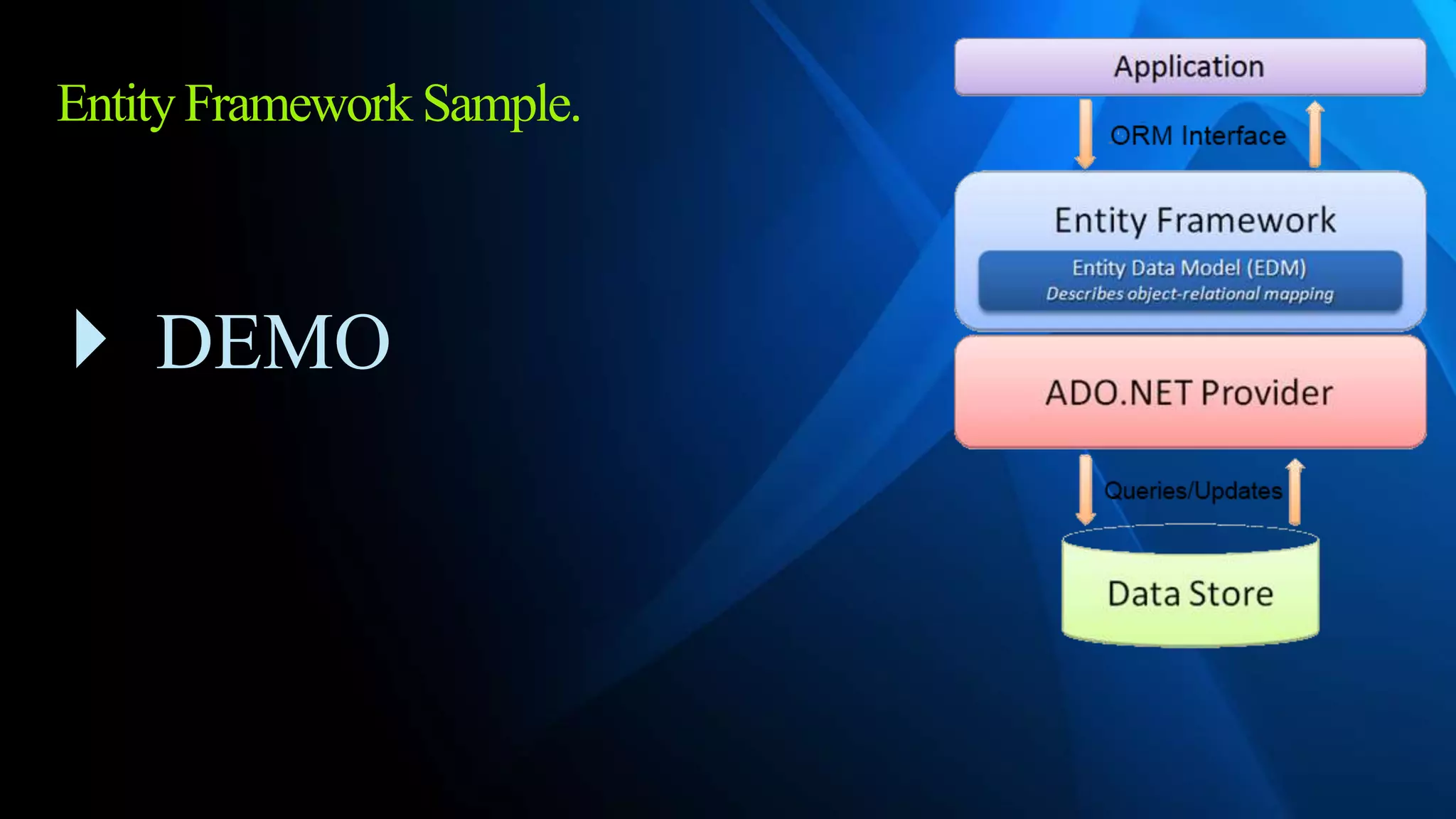
 The Microsoft® ADO.NET Entity Framework is an Object/Relational
Mapping (ORM) framework that enables developers to work with
relational data as domain-specific objects.
 Eliminating the need for most of the data access plumbing code that
developers usually need to write.
What isEntityFramework?
 The Entity Framework’s ORM implementation provides services like
change tracking, identity resolution, lazy loading, and query translation
so that developers can focus on their application-specific business logic
rather than the data access fundamentals.
 Entity Framework vs. traditional ADO.Net
Entity Framework vs. LINQ to SQL
Entity Framework vs. nHibernate
Agenda
 What is Entity Framework?
 Entity Framework Sample.
 Why Entity Framework?
 Can we use Entity Framework to build n-Tier Application?
 Summary.
EntityFrameworkSample.
 DEMO
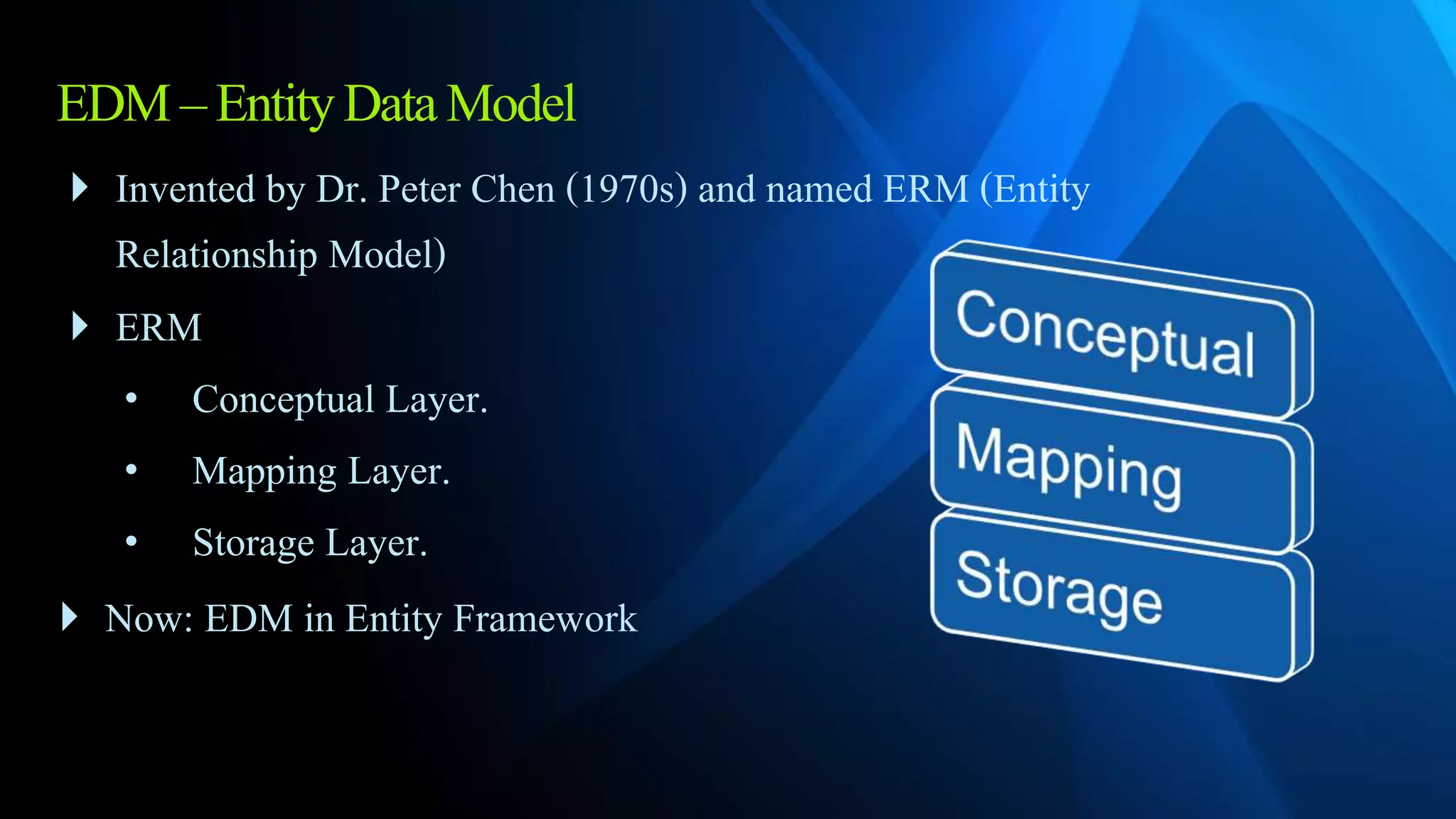
EDM–EntityDataModel
 Invented by Dr. Peter Chen (1970s) and named ERM (Entity
Relationship Model)
 ERM
• Conceptual Layer.
• Mapping Layer.
• Storage Layer.
 Now: EDM in Entity Framework
Agenda
 What is Entity Framework?
 Entity Framework Sample.
 Why Entity Framework?
 Can we use Entity Framework to build n-Tier Application?
 Summary.
WhyEntityFramework?
 Works with a variety of database servers (including Microsoft SQL Server,
Oracle, and DB2).
 Includes a rich mapping engine that can handle real-world database schemas and
works well with stored procedures.
 Provides integrated Visual Studio tools to visually create entity models and to
auto-generate models from an existing database. New databases can be deployed
from a model, which can also be hand-edited for full control.
 Provides a Code First experience to create entity models using code. Code First
can map to an existing database or generate a database from the model.
WhyEntityFramework?
 Integrates well into all the .NET application programming models including
ASP.NET, Windows Presentation Foundation (WPF), Windows Communication
Foundation (WCF), and WCF Data Services (formerly ADO.NET Data
Services).
 Reduced development time: the framework provides the core data access
capabilities so developers can concentrate on application logic.
 Language-Integrated Query support (called LINQ to Entities) provides
IntelliSense and compile-time syntax validation for writing queries against a
conceptual model.
WhyEntityFramework?
 Developers can work in terms of a more application-centric object model,
including types with inheritance, complex members, and relationships. In .NET
Framework 4, the Entity Framework also supports Persistence Ignorance
through Plain Old CLR Objects (POCO) entities.
 Applications are freed from hard-coded dependencies on a particular data
engine or storage schema by supporting a conceptual model that is independent
of the physical/storage model.
 Mappings between the object model and the storage-specific schema can change
without changing the application code.
Agenda
 What is Entity Framework?
 Entity Framework Sample.
 Why Entity Framework?
 Can we use Entity Framework to build n-Tier Application?
 Q & A.
CanweuseEntityFrameworktobuildn-TierApplication?
 Yes, Using POCO entities and proxies.
 In Our 3-Tier, POCO entities could be placed in Global Project [DATA
LAYER], Entity Data Model (.EDM) could be placed in DataAccess Project
[DAL LAYER].
Summary
Q & A
Thank You
Refrences
 http://blogs.msdn.com/b/dsimmons/archive/2008/05/17/why-use-the-
entity-framework.aspx
 http://msdn.microsoft.com/en-us/magazine/cc700340.aspx
 http://blogs.msdn.com/b/adonet/archive/2009/06/16/using-repository-
and-unit-of-work-patterns-with-entity-framework-4-0.aspx
 http://blogs.msdn.com/b/adonet/archive/2010/01/25/walkthrough-poco-
template-for-the-entity-framework.aspx

Entity framework

  • 1.
    Entity Framework 4.0 TamerEl-shahat Expert People Establishment An Introduction
  • 2.
    Agenda  What isEntity Framework?  Entity Framework Sample.  Why Entity Framework?  Can we use Entity Framework to build n-Tier Application?  Summary.
  • 3.
    What isEntityFramework?  TheMicrosoft® ADO.NET Entity Framework is an Object/Relational Mapping (ORM) framework that enables developers to work with relational data as domain-specific objects.  Eliminating the need for most of the data access plumbing code that developers usually need to write.
  • 4.
    What isEntityFramework?  TheEntity Framework’s ORM implementation provides services like change tracking, identity resolution, lazy loading, and query translation so that developers can focus on their application-specific business logic rather than the data access fundamentals.  Entity Framework vs. traditional ADO.Net Entity Framework vs. LINQ to SQL Entity Framework vs. nHibernate
  • 5.
    Agenda  What isEntity Framework?  Entity Framework Sample.  Why Entity Framework?  Can we use Entity Framework to build n-Tier Application?  Summary.
  • 6.
  • 7.
    EDM–EntityDataModel  Invented byDr. Peter Chen (1970s) and named ERM (Entity Relationship Model)  ERM • Conceptual Layer. • Mapping Layer. • Storage Layer.  Now: EDM in Entity Framework
  • 8.
    Agenda  What isEntity Framework?  Entity Framework Sample.  Why Entity Framework?  Can we use Entity Framework to build n-Tier Application?  Summary.
  • 9.
    WhyEntityFramework?  Works witha variety of database servers (including Microsoft SQL Server, Oracle, and DB2).  Includes a rich mapping engine that can handle real-world database schemas and works well with stored procedures.  Provides integrated Visual Studio tools to visually create entity models and to auto-generate models from an existing database. New databases can be deployed from a model, which can also be hand-edited for full control.  Provides a Code First experience to create entity models using code. Code First can map to an existing database or generate a database from the model.
  • 10.
    WhyEntityFramework?  Integrates wellinto all the .NET application programming models including ASP.NET, Windows Presentation Foundation (WPF), Windows Communication Foundation (WCF), and WCF Data Services (formerly ADO.NET Data Services).  Reduced development time: the framework provides the core data access capabilities so developers can concentrate on application logic.  Language-Integrated Query support (called LINQ to Entities) provides IntelliSense and compile-time syntax validation for writing queries against a conceptual model.
  • 11.
    WhyEntityFramework?  Developers canwork in terms of a more application-centric object model, including types with inheritance, complex members, and relationships. In .NET Framework 4, the Entity Framework also supports Persistence Ignorance through Plain Old CLR Objects (POCO) entities.  Applications are freed from hard-coded dependencies on a particular data engine or storage schema by supporting a conceptual model that is independent of the physical/storage model.  Mappings between the object model and the storage-specific schema can change without changing the application code.
  • 12.
    Agenda  What isEntity Framework?  Entity Framework Sample.  Why Entity Framework?  Can we use Entity Framework to build n-Tier Application?  Q & A.
  • 13.
    CanweuseEntityFrameworktobuildn-TierApplication?  Yes, UsingPOCO entities and proxies.  In Our 3-Tier, POCO entities could be placed in Global Project [DATA LAYER], Entity Data Model (.EDM) could be placed in DataAccess Project [DAL LAYER].
  • 14.
  • 15.
  • 16.
  • 17.
    Refrences  http://blogs.msdn.com/b/dsimmons/archive/2008/05/17/why-use-the- entity-framework.aspx  http://msdn.microsoft.com/en-us/magazine/cc700340.aspx http://blogs.msdn.com/b/adonet/archive/2009/06/16/using-repository- and-unit-of-work-patterns-with-entity-framework-4-0.aspx  http://blogs.msdn.com/b/adonet/archive/2010/01/25/walkthrough-poco- template-for-the-entity-framework.aspx

Editor's Notes

  • #5 L2s 1 - one to one relation but EF support many relation (table to more classes , more table to one class) 2- only sql but EF support Oracle, DB2, Informix, MySQL, Postgres, and more EF vs. nhibernate - the Entity Data Model (EDM) -The EF was specifically structured to separate the process of mapping queries/shaping results from building objects and tracking changes. - easier to create a conceptual model which can be Used in other Microsoft products: WCF Data services, Azure Table Storage, Sharepoint 2010, SQL Server Reporting Services and PowerPivot for Excel, … it's that the EF is not just an ORM--it's the first step in a much larger vision of an entity-aware data platform. -http://blogs.msdn.com/b/dsimmons/archive/2008/05/17/why-use-the-entity-framework.aspx - Database and ORM (!!!) vendors supporting it (IBM, OpenLink, DevForce, LLBLGen …)
  • #7 - Create EDM File , explain some properties , add item and display it Explain mapping - change schema – edit generated classes – edit by .edm T4 templates Change tracker of objects.