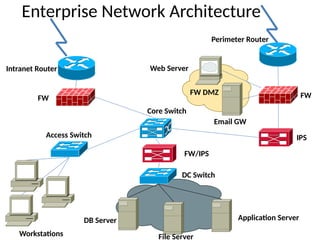
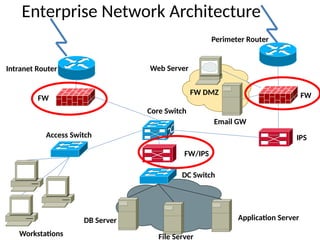
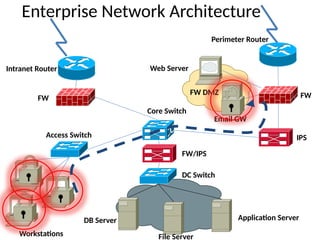
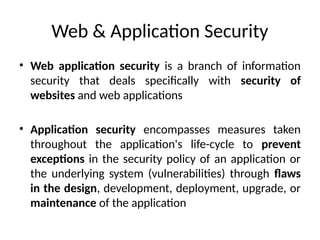
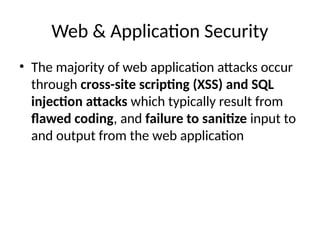
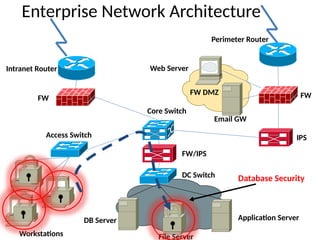
Enterprise Network Architecture
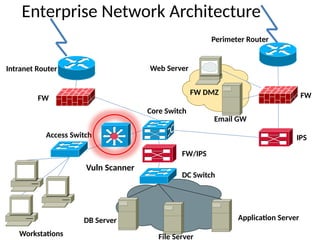
PerimeterRouter
FW
IPS
Core Switch
FW DMZ
FW/IPS
DC Switch
Access Switch
FW
Intranet Router
Application Server
DB Server
Workstations
Web Server
Email GW
File Server
3.
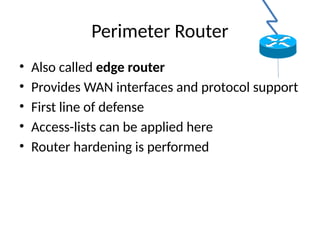
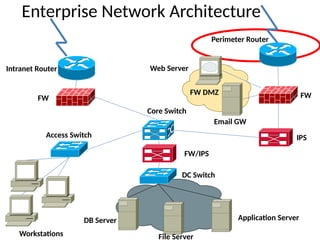
Perimeter Router
• Alsocalled edge router
• Provides WAN interfaces and protocol support
• First line of defense
• Access-lists can be applied here
• Router hardening is performed
4.
Enterprise Network Architecture
PerimeterRouter
FW
IPS
Core Switch
FW DMZ
FW/IPS
DC Switch
Access Switch
FW
Intranet Router
Application Server
DB Server
Workstations
Web Server
Email GW
File Server
5.
Enterprise Network Architecture
PerimeterRouter
FW
IPS
Core Switch
FW DMZ
FW/IPS
DC Switch
Access Switch
FW
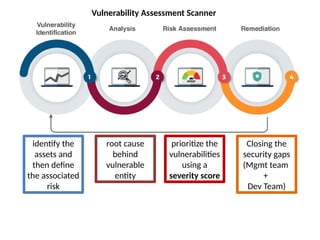
Intranet Router
Application Server
DB Server
Workstations
Web Server
Email GW
File Server
6.
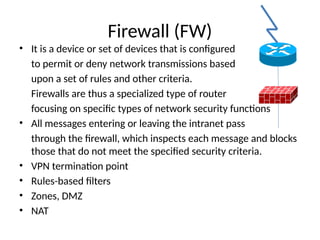
Firewall (FW)
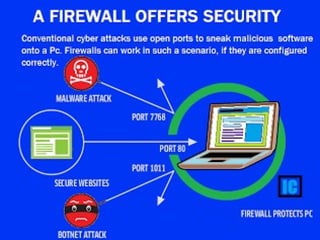
• Itis a device or set of devices that is configured
to permit or deny network transmissions based
upon a set of rules and other criteria.
Firewalls are thus a specialized type of router
focusing on specific types of network security functions
• All messages entering or leaving the intranet pass
through the firewall, which inspects each message and blocks
those that do not meet the specified security criteria.
• VPN termination point
• Rules-based filters
• Zones, DMZ
• NAT
8.
Enterprise Network Architecture
PerimeterRouter
FW
IPS
Core Switch
FW DMZ
FW/IPS
DC Switch
Access Switch
FW
Intranet Router
Application Server
DB Server
Workstations
Web Server
Email GW
File Server
9.
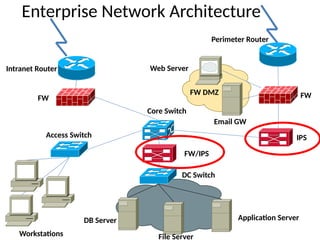
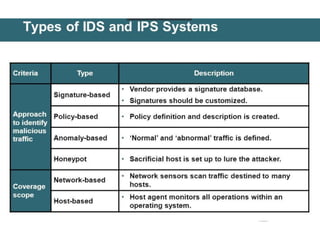
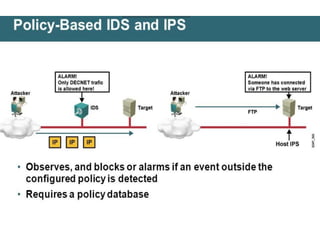
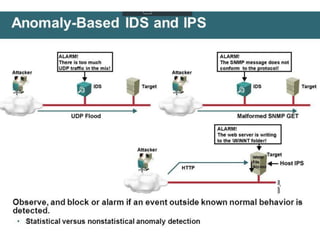
Intrusion Prevention System(IPS)
• Transparent device that inspects traffic (deep packet inspection)
• The main functions of intrusion prevention systems are to identify
malicious activity, log information about said activity, attempt to
block/stop activity, and report activity.
• More specifically, IPS can take such actions as sending an alarm,
dropping the malicious packets, resetting the connection and/or blocking
the traffic from the offending IP address.
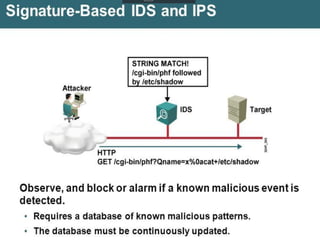
• Signature-based Detection: This method of detection utilizes signatures,
which are attack patterns that are preconfigured and predetermined. A
signature-based intrusion prevention system monitors the network
traffic for matches to these signatures.
10.
IDS vs IPS
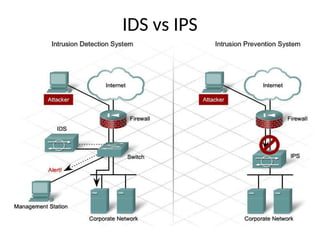
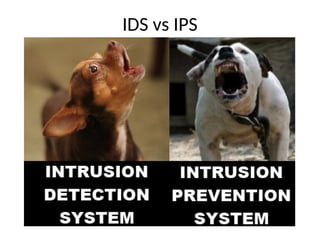
•The Intrusion Detection System (IDS) provides the
network with a level of preventive security against any
suspicious activity. The IDS achieves this objective
through early warnings aimed at systems administrators.
However, unlike IPS, it is not designed to block attacks.
• An Intrusion Prevention System (IPS) is a device that
controls access to IT networks in order to protect systems
from attack and abuse. It is designed to inspect attack
data and take the corresponding action, blocking it as it is
developing and before it succeeds, creating a series of
rules in the corporate firewall, for example.
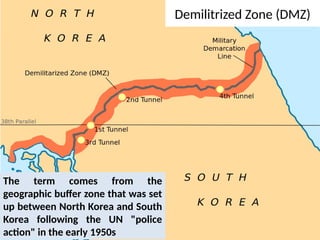
The term comesfrom the
geographic buffer zone that was set
up between North Korea and South
Korea following the UN "police
action" in the early 1950s
Demilitrized Zone (DMZ)
19.
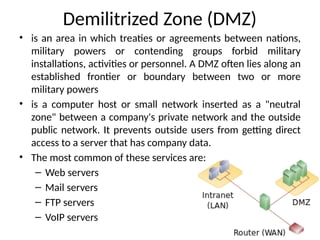
Demilitrized Zone (DMZ)
•is an area in which treaties or agreements between nations,
military powers or contending groups forbid military
installations, activities or personnel. A DMZ often lies along an
established frontier or boundary between two or more
military powers
• is a computer host or small network inserted as a "neutral
zone" between a company's private network and the outside
public network. It prevents outside users from getting direct
access to a server that has company data.
• The most common of these services are:
– Web servers
– Mail servers
– FTP servers
– VoIP servers
20.
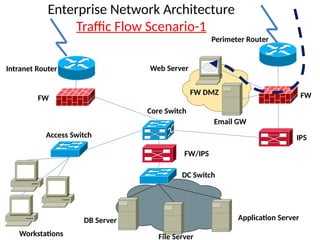
Enterprise Network Architecture
TrafficFlow Scenario-1
Perimeter Router
FW
IPS
Core Switch
FW DMZ
FW/IPS
DC Switch
Access Switch
FW
Intranet Router
Application Server
DB Server
Workstations
Web Server
Email GW
File Server
21.
Enterprise Network Architecture
PerimeterRouter
FW
IPS
Core Switch
FW DMZ
FW/IPS
DC Switch
Access Switch
FW
Intranet Router
Application Server
DB Server
Workstations
Web Server
Email GW
File Server
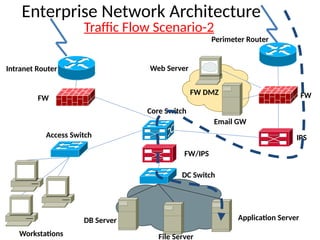
Traffic Flow Scenario-2
22.
Enterprise Network Architecture
PerimeterRouter
FW
IPS
Core Switch
FW DMZ
FW/IPS
DC Switch
Access Switch
FW
Intranet Router
Application Server
DB Server
Workstations
Web Server
Email GW
File Server
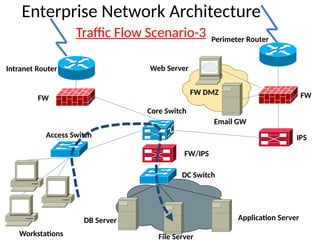
Traffic Flow Scenario-3
23.
Enterprise Network Architecture
PerimeterRouter
FW
IPS
Core Switch
FW DMZ
FW/IPS
DC Switch
Access Switch
FW
Intranet Router
Application Server
DB Server
Workstations
Web Server
Email GW
File Server
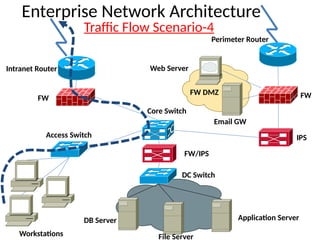
Traffic Flow Scenario-4
24.
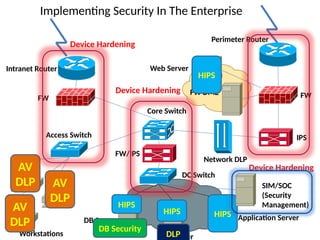
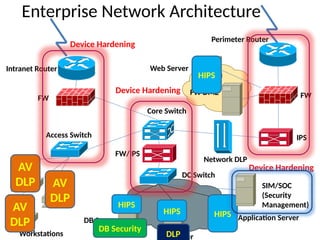
Implementing Security InThe Enterprise
Perimeter Router
FW
IPS
Core Switch
FW DMZ
FW/IPS
DC Switch
Access Switch
FW
Intranet Router
Application Server
DB Server
Workstations
Web Server
File Server
HIPS
HIPS
HIPS
HIPS
AV
DLP
DB Security
AV
DLP
DLP
AV
DLP
Network DLP
Device Hardening
Device Hardening
Device Hardening
SIM/SOC
(Security
Management)
25.
• What Isa Host?
– Anything with an IP address is a host (because it
can be attacked)
– Servers
– Clients (including mobile telephones)
– Routers (including home access routers) and
sometimes switches
– Firewalls
25
Hosts
26.
• The Problem
–Some attacks inevitably reach host computers
– So servers and other hosts must be hardened— a
complex process that requires a diverse set of
protections to be implemented on each host
26
Threats to Hosts
27.
B ac k u p & . . .
B a c k u p & . . .
B a c k u p
Restrict physical access to hosts
Install the operating system with secure
configuration options
• Change all default passwords, etc.
27
4.5.1 Elements of Host Hardening
Copyright Pearson Prentice-Hall2010
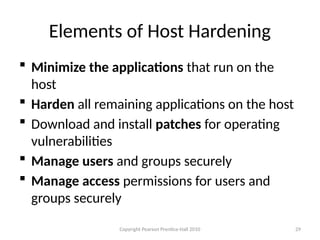
Minimize the applications that run on the
host
Harden all remaining applications on the host
Download and install patches for operating
vulnerabilities
Manage users and groups securely
Manage access permissions for users and
groups securely
29
Elements of Host Hardening
30.
30
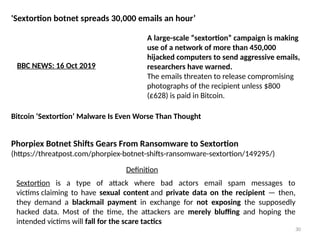
'Sextortion botnet spreads30,000 emails an hour’
A large-scale “sextortion” campaign is making
use of a network of more than 450,000
hijacked computers to send aggressive emails,
researchers have warned.
The emails threaten to release compromising
photographs of the recipient unless $800
(£628) is paid in Bitcoin.
BBC NEWS: 16 Oct 2019
Bitcoin ‘Sextortion’ Malware Is Even Worse Than Thought
Phorpiex Botnet Shifts Gears From Ransomware to Sextortion
(https://threatpost.com/phorpiex-botnet-shifts-ransomware-sextortion/149295/)
Sextortion is a type of attack where bad actors email spam messages to
victims claiming to have sexual content and private data on the recipient — then,
they demand a blackmail payment in exchange for not exposing the supposedly
hacked data. Most of the time, the attackers are merely bluffing and hoping the
intended victims will fall for the scare tactics
Definition
32.
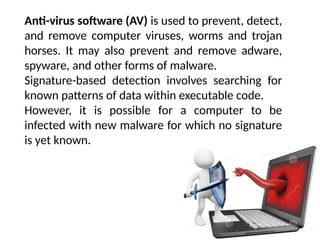
Anti-virus software (AV)is used to prevent, detect,
and remove computer viruses, worms and trojan
horses. It may also prevent and remove adware,
spyware, and other forms of malware.
Signature-based detection involves searching for
known patterns of data within executable code.
However, it is possible for a computer to be
infected with new malware for which no signature
is yet known.
33.
Antivirus (AV)
• Tocounter such so-called zero-day threats, heuristics
(experience-based techniques for problem solving, learning,
and discovery that find a solution ) can be used. One type of
heuristic approach, generic signatures, can identify new
viruses or variants of existing viruses by looking for known
malicious code, or slight variations of such code, in files.
• Some antivirus softwares can also predict what a file will do
by running it in a sandbox and analyzing what it does to see
if it performs any malicious actions.
• a sandbox is a security mechanism for separating running
programs. It is often used to execute untested code, or
untrusted programs from unverified third parties, suppliers,
untrusted users and untrusted websites
34.
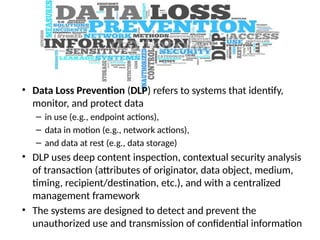
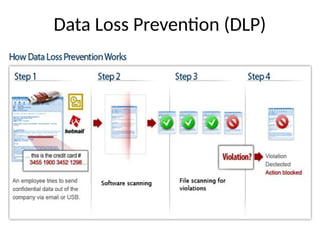
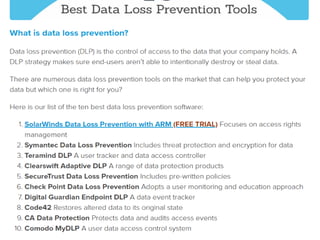
• Data LossPrevention (DLP) refers to systems that identify,
monitor, and protect data
– in use (e.g., endpoint actions),
– data in motion (e.g., network actions),
– and data at rest (e.g., data storage)
• DLP uses deep content inspection, contextual security analysis
of transaction (attributes of originator, data object, medium,
timing, recipient/destination, etc.), and with a centralized
management framework
• The systems are designed to detect and prevent the
unauthorized use and transmission of confidential information
Data Loss Prevention(DLP)
• Can be agent based or network based
• Documents in an organization are classified
• Users in an organization are given rights for the
documents (tags)
• Agent-based DLP:
– Can restrict printing, print-screen, copying onto USB, attaching
to email, attaching to web mail, transferring via instant
messaging
• Network-based DLP:
– Detects which documents are going out of the network and
blocks if this is unauthorized
40.
Host-based Intrusion Prevention(HIPS)
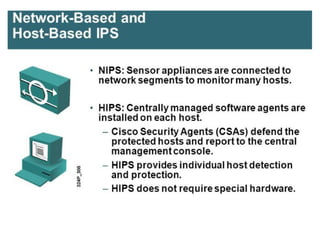
• The main functions of ‘intrusion prevention systems’ are
to identify malicious activity, log information about
said activity, attempt to block/stop activity, and report
activity
• A host-based IPS monitors all or parts of the dynamic
behavior and the state of a computer system.
• Much as a NIPS will dynamically inspect network
packets, a HIPS might detect which program accesses
what resources and discover that, for example, a word-
processor has suddenly and inexplicably started
modifying the system password database.
41.
Host-based Intrusion Prevention(HIPS)
• Similarly a HIPS might look at the state of a system,
its stored information, whether in RAM, in the file
system, log files or elsewhere; and check that the
contents of these appear as expected
• One can think of a HIPS as an agent that monitors
whether anything or anyone, whether internal or
external, has circumvented the system's security
policy.
42.
Host-based Intrusion Prevention(HIPS)
• Provides security features to protect servers
• Secure areas on HDD (integrity)
• Audit trail
• Permitted applications
• IPS functionality
• Is separate from AV, although the lines
become blurred
43.
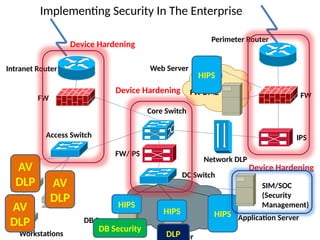
Implementing Security InThe Enterprise
Perimeter Router
FW
IPS
Core Switch
FW DMZ
FW/IPS
DC Switch
Access Switch
FW
Intranet Router
Application Server
DB Server
Workstations
Web Server
File Server
HIPS
HIPS
HIPS
HIPS
AV
DLP
DB Security
AV
DLP
DLP
AV
DLP
Network DLP
Device Hardening
Device Hardening
Device Hardening
SIM/SOC
(Security
Management)
44.
Enterprise Network Architecture
PerimeterRouter
FW
IPS
Core Switch
FW DMZ
FW/IPS
DC Switch
Access Switch
FW
Intranet Router
Application Server
DB Server
Workstations
Web Server
File Server
Email GW
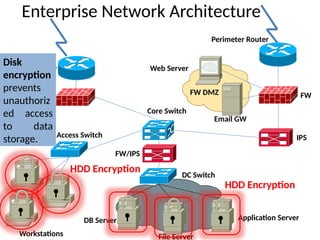
HDD Encryption
HDD Encryption
Disk
encryption
prevents
unauthoriz
ed access
to data
storage.
45.
Device Hardening
• Hardeningis the process of securing a system by
reducing its surface of vulnerability
• In principle a single-function system is more secure
than a multipurpose one.
• Reducing available vectors of attack typically includes
the removal of unnecessary software, unnecessary
usernames or logins and the disabling or removal of
unnecessary services.
• This may involve, applying a patch to the kernel;
closing open network ports; and setting up intrusion-
detection systems, firewalls and intrusion-prevention
systems.
46.
Enterprise Network Architecture
PerimeterRouter
FW
IPS
Core Switch
FW DMZ
FW/IPS
DC Switch
Access Switch
FW
Intranet Router
Application Server
DB Server
Workstations
Web Server
File Server
Email GW
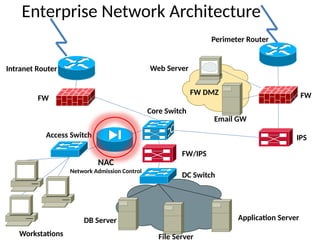
NAC
Network Admission Control
47.
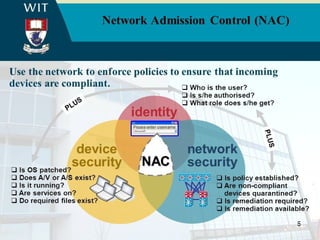
Network Admission Control(NAC)
• NAC restricts access to the network based on identity or
security posture
• When a network device is configured for NAC, it can force user
or machine authentication prior to granting access to the
network.
• In addition, guest access can be granted to a quarantine area for
remediation of any problems that may have caused
authentication failure
• Network admission control systems allow noncompliant devices
to be denied access, placed in a quarantined area, or given
restricted access to computing resources, thus keeping insecure
nodes from infecting the network
50.
Enterprise Network Architecture
PerimeterRouter
FW
IPS
Core Switch
FW DMZ
FW/IPS
DC Switch
Access Switch
FW
Intranet Router
Application Server
DB Server
Workstations
Web Server
File Server
Email GW
Vuln Scanner
51.
Vulnerability Assessment Scanner
•A vulnerability scanner is a computer program
designed to assess computers, computer systems,
networks or applications for weaknesses.
• While functionality varies between different types
of vulnerability scanners, they share a common,
core purpose of enumerating the vulnerabilities
present in one or more targets.
• Vulnerability scanners are a core technology
component of vulnerability management.
52.
Vulnerability Assessment Scanner
•A vulnerability scanner can be used to conduct network
reconnaissance, which is typically carried out by a remote
attacker attempting to gain information or access to a
network on which it is not authorized or allowed.
• Network reconnaissance is increasingly used to exploit
network standards and automated communication methods.
• The aim is to determine what types of computers are present,
along with additional information about those computers—
such as the type and version of the operating system
• This information can be analyzed for known or recently
discovered vulnerabilities that can be exploited to gain access
to secure networks and computers.
53.
identify the
assets and
thendefine
the associated
risk
root cause
behind
vulnerable
entity
prioritize the
vulnerabilities
using a
severity score
Closing the
security gaps
(Mgmt team
+
Dev Team)
Vulnerability Assessment Scanner
54.
Enterprise Network Architecture
PerimeterRouter
FW
IPS
Core Switch
FW DMZ
FW/IPS
DC Switch
Access Switch
FW
Intranet Router
Application Server
DB Server
Workstations
Web Server
File Server
Email GW
55.
Web & ApplicationSecurity
• Web application security is a branch of information
security that deals specifically with security of
websites and web applications
• Application security encompasses measures taken
throughout the application's life-cycle to prevent
exceptions in the security policy of an application or
the underlying system (vulnerabilities) through flaws
in the design, development, deployment, upgrade, or
maintenance of the application
56.
Web & ApplicationSecurity
• The majority of web application attacks occur
through cross-site scripting (XSS) and SQL
injection attacks which typically result from
flawed coding, and failure to sanitize input to
and output from the web application
57.
Enterprise Network Architecture
PerimeterRouter
FW
IPS
Core Switch
FW DMZ
FW/IPS
DC Switch
Access Switch
FW
Intranet Router
Application Server
DB Server
Workstations
Web Server
File Server
Email GW
Database Security
58.
Database Security
• Databasesecurity is the system, processes, and procedures
that protect a database from unintended activity
• Unintended activity can be categorized as authentication
misuse, malicious attacks or inadvertent mistakes made by
authorized individuals or processes
• Databases provide many layers and types of information
security:
– Access control
– Auditing
– Authentication
– Encryption
– Integrity controls
Security Operations Center(SOC)
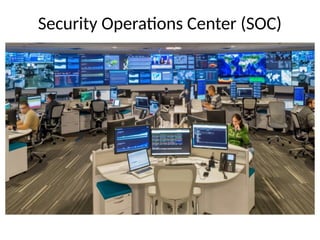
• A security operations center (SOC) is an Information Security
function within the company or of separate organization that
delivers IT security services
• It attempts to detect unauthorized access in any form to prevent
and manage security related incidents using processes and
procedures
• The mission is risk management through centralized analysis
using the combined resources consisting of personnel, dedicated
hardware and specialized software
• Typically, these systems operate constantly. These resources
offer continuous events monitoring and risk analysis to detect
intrusion to guarantee protection against it
61.
Security Operations Center(SOC)
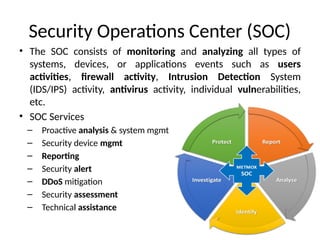
• The SOC consists of monitoring and analyzing all types of
systems, devices, or applications events such as users
activities, firewall activity, Intrusion Detection System
(IDS/IPS) activity, antivirus activity, individual vulnerabilities,
etc.
• SOC Services
– Proactive analysis & system mgmt
– Security device mgmt
– Reporting
– Security alert
– DDoS mitigation
– Security assessment
– Technical assistance
Enterprise Network Architecture
PerimeterRouter
FW
IPS
Core Switch
FW DMZ
FW/IPS
DC Switch
Access Switch
FW
Intranet Router
Application Server
DB Server
Workstations
Web Server
File Server
HIPS
HIPS
HIPS
HIPS
AV
DLP
DB Security
AV
DLP
DLP
AV
DLP
Network DLP
Device Hardening
Device Hardening
Device Hardening
SIM/SOC
(Security
Management)
67.
Secure Remote Access& VPNs
• Employees may want to access the corporate
network from a remote location
– Email
– Fileserver
– Other corporate network resources
• VPN connections terminate into a firewall or secure
remote access server solution
• Virtual Private Networks (VPNs) may be established
to connect to remote sites (site-to-site VPNs) within
the intranet
68.
Secure Remote Access& VPNs
• Employees may want to access the corporate
network from a remote location
– Email
– Fileserver
– Other corporate network resources
• VPN connections terminate into a firewall or secure
remote access server solution
• Virtual Private Networks (VPNs) may be established
to connect to remote sites (site-to-site VPNs) within
the intranet
69.
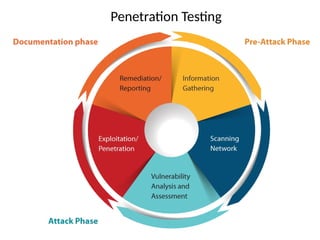
Penetration Testing
• Apenetration test, occasionally pentest, is a method
of evaluating the security of a computer system or
network by simulating an attack from a malicious
source, known as a Black Hat Hacker, or Cracker.
• The process involves an active analysis of the
system for any potential vulnerabilities that could
result from poor or improper system configuration,
both known and unknown hardware or software
flaws, or operational weaknesses in process or
technical countermeasures.
70.
Penetration Testing
• Thisanalysis is carried out from the position of a potential
attacker and can involve active exploitation of security
vulnerabilities
• Any security issues that are found will be presented to the
system owner, together with an assessment of their
impact, and often with a proposal for mitigation or a
technical solution.
• The intent of a penetration test is to determine the
feasibility of an attack and the amount of business impact
of a successful exploit, if discovered.
• It is a component of a full security audit
Network Forensics
• Networkforensics is a sub-branch of digital
forensics relating to the monitoring and analysis of
computer network traffic for the purposes of
information gathering, legal evidence or intrusion
detection
• Unlike other areas of digital forensics, network
investigations deal with volatile and dynamic
information. Network traffic is transmitted and then
lost, so network forensics is often a pro-active
investigation.
73.
Network Forensics
Network forensicsgenerally has two uses.
• The first, relating to security, involves monitoring a
network for anomalous traffic and identifying
intrusions
– An attacker might be able to erase all log files on a
compromised host; network-based evidence might therefore
be the only evidence available for forensic analysis
• The second form of Network forensics relates to law
enforcement
– In this case analysis of captured network traffic can include
tasks such as reassembling transferred files, searching for
keywords and parsing human communication such as emails
or chat sessions