Download to read offline

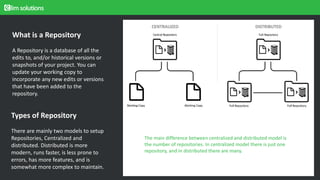
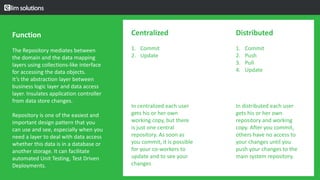
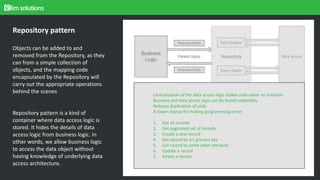
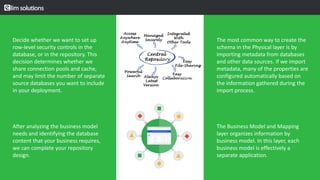
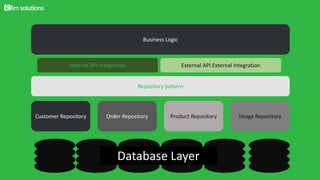
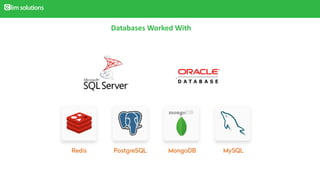
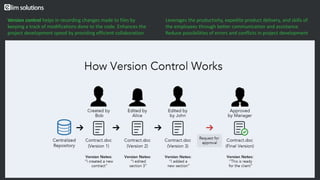

The Clim Solutions deck presents a focused, technically grounded overview of repository architecture, version control, data access patterns, and enterprise‑level database expertise. It positions the Senior Solutions Developer as someone who understands both the theory and practical implementation of scalable backend systems, while also demonstrating experience across multiple database technologies and operational environments. The deck begins by defining the repository as the core system for tracking edits, historical versions, and snapshots of a project. It explains how developers synchronize their working copies with the repository and highlights the importance of maintaining a reliable version history. This leads into a comparison of centralized vs. distributed repositories, noting that centralized systems rely on a single repository, while distributed systems provide each user with a full local repository. Distributed models are described as faster, more modern, and more resilient, though slightly more complex to maintain. A major portion of the deck focuses on the Repository Pattern, emphasizing its role as an abstraction layer between business logic and data access. The repository mediates between domain objects and data mapping layers, insulating the application from underlying storage changes. This pattern simplifies maintenance, reduces code duplication, and enables cleaner automated testing. The deck outlines common repository operations such as retrieving all records, paginated queries, creating and updating records, and deleting entries. It also highlights architectural considerations like row‑level security, connection pooling, caching, and metadata import during schema creation. The deck then expands into API integration, showing how repositories interact with internal APIs, external APIs, and the database layer. Examples include Customer, Order, Product, and Image repositories — illustrating a modular, domain‑driven approach to backend design. A comprehensive list of databases worked with demonstrates broad experience across relational and non‑relational systems: Microsoft SQL Server, Oracle, PostgreSQL, MySQL, MongoDB, and Redis. This reinforces the candidate’s ability to operate in diverse enterprise environments and support complex data architectures. The section on version control explains how tracking changes improves collaboration, reduces errors, and accelerates development. A visual workflow illustrates how documents evolve through edits and approvals. Tools listed include GitHub, GitLab, Bitbucket, CVS, SVN, Mercurial, and Bazaar showing familiarity with both modern and legacy systems.


![Project Management (Practical Qustion Paper) [CBSGS - 75:25 Pattern] {2013-20...](https://cdn.slidesharecdn.com/ss_thumbnails/pm-cbsgs-2013-2014-manual-pq-190610125503-thumbnail.jpg?width=640&height=640&fit=bounds)


