See discussions, stats,and author profiles for this publication at: https://www.researchgate.net/publication/342874547
The Evolution of Software Configuration Management
Article in International Journal of Advanced Trends in Computer Science and Engineering · June 2020
DOI: 10.30534/ijatcse/2020/0891.32020
CITATIONS
2
READS
2,323
1 author:
Syahrul Fahmy
TATI University College
81 PUBLICATIONS 321 CITATIONS
SEE PROFILE
All content following this page was uploaded by Syahrul Fahmy on 15 December 2020.
The user has requested enhancement of the downloaded file.
2.
Syahrul Fahmy etal., International Journal of Advanced Trends in Computer Science and Engineering, 9(1.3), 2020, 50 - 63
50
ABSTRACT
Software Configuration Management (SCM) is a discipline in
software engineering for managing changes to software
products using standard processes and tools. This article
presents the evolution of SCM since its inception,
highlighting the components, application to other areas,
change management and software quality. Research and
development in SCM are highly motivated by the problems at
hand in software development. SCM process and activities are
sound, guided by international standards and industry best
practice. Commercial and proprietary tools are aplenty, and
the underlying techniques are no longer confined to SCM.
SCM has been applied to other areas since the turn of the
century and change management has become a tool-oriented
process, rather than a management-oriented process. The role
of human in SCM has yet to be studied extensively compared
to other areas in software engineering. Software quality is
associated with defects and quality factors are measured
differently based on projects and metrics.
Key words: Software Configuration Management, Software
Engineering, Software Testing, Software Quality.
1. INTRODUCTION
Software Configuration Management (SCM) can be loosely
defined as “the ability of control and manage changes in a
software project”. It is part of a larger field of Configuration
Management (CM), and primarily used to control the
evolution of software systems [1]. Formal definitions from
IEEE, the Software Engineering Institute and ISO are:
“a supporting-software life cycle process that benefits
project management, development and maintenance
activities, quality assurance activities, as well as the
customers and users of the end product” [2].
“discipline applying technical and administrative direction
and surveillance to identify and document the functional
and physical characteristics of a configuration item, control
changes to those characteristics, record and report change
processing and implementation status, and verify compliance
with specified requirements” [3].
“a management activity that applies technical and
administrative direction over the life cycle of a product, its
configuration items, and related product configuration
information. It provides identification and traceability, the
status of achievement, and access to accurate information in
all phases of the life cycle” [4].
This paper presents the evolution of SCM, discussing its
components, application to other areas, change management
and software quality.
2. EVOLUTION
SCM can be traced back to the aerospace industry in the
1950s. Poorly documented engineering changes posed a
problem to spacecraft production, and configuration
management was applied to address it. When software
managers faced similar problems of managing change, similar
approach was adapted in the software development process
[5].
2.1 1960s
Only a handful of SCM-related works were carried out and
they were heavily funded by the government. Several SCM
concepts was introduced including management concept for
software systems [6]; concepts for documentation and
procedures in SCM [7]; configuration as a control mechanism
in software development [8]; and concepts for program
specifications [9]. It is worth mentioning that knowledge
regarding early SCM research and systems has disappeared as
dedicated platform such as software engineering scientific
conferences did not exist [5]. In addition, SCM was largely
integrated in the operating systems and documentation
describing early SCM systems is difficult to find.
2.2 1970s
The Software Crisis amplified software manager’s problems
of project cost and schedule overrun. Problems in software
development were recognized and in 1973, software
engineering was accepted as the solution to software
manager’s problem.
The Evolution of Software Configuration Management
Syahrul Fahmy1
, Aziz Deraman2
, Jamaiah Yahaya3
, Akhyari Nasir1
, Nooraida Shamsudin1
1
University CollegeTATI, Malaysia, fahmy@tatiuc.edu.my
2
Universiti Malaysia Terengganu, Malaysia
3
Universiti Kebangsaan Malaysia, Malaysia
ISSN 2278-3091
Volume 9, No.1.3, 2020
International Journal of Advanced Trends in Computer Science and Engineering
Available Online at http://www.warse.org/IJATCSE/static/pdf/file/ijatcse0891.32020.pdf
https://doi.org/10.30534/ijatcse/2020/0891.32020
3.
Syahrul Fahmy etal., International Journal of Advanced Trends in Computer Science and Engineering, 9(1.3), 2020, 50 - 63
51
The discipline of SCM was presented by Bersoff in 1978,
outlining its components and role in the management process
of the system life-cycle [10] and SCM was formally discussed
in the International Conference of Software Engineering in
1979 [11].
Majority of research focused on the concepts and tools for
SCM. These include approach for adapting CM in the
software development life-cycle [12]; the Source Code
Control System (SCCS) to control changes to source code
[13]; Software Upgrade for systems generation and CM [14];
and Make, a program for maintaining up-to-date versions of
programs [15]. Variants of SCCS and Make are still in use
today.
2.3 1980s
Software development started embarking on programming
large and complex software systems
(Programming-in-Large). Early SCM systems focused on file
control, emphasizing on versioning, building and
composition. Works in SCM concepts continued with CM
concepts in software life-cycle [16]; configuration control in
software life-cycle [17]; configuration control in software
process [18]; and system design documentation for CM and
software control [19].
Interest in SCM modelling started to grow for example model
for version and configuration control [20]; model for change
request [21]; model of a CM environment [22]; framework for
an active SCM system [23]; and framework for integrating
CM and process management [24].
Development of tools thrived during the 1980s with with RCS
[25]; LIFESPAN [26]; Adele [27-28]; Source Control System
[29]; Portable Configuration Management [30]; configuration
management toolkit [31]; and Configuration Management
Assistant [32].
2.4 1990s
As non-textual objects become common, new algorithms for
storing and retrieving objects were needed. SCM started
utilizing relational database and many of the SCM systems as
we know it today came into the limelight.
Concepts of programming large software systems continued
such as CM to manage large design projects [33]; procedures
and tools for modifying large software systems [34]; and
Programming-in-the-Large concepts including SCM [35].
General SCM concepts include user concepts of existing CM
systems [36]; concepts of version control and CM in Ada [37];
effects of software development models on SCM [38]; and
configuration approach to manage software development
[39].
Conceptual SCM works has also attracted a lot of technical
interest for example version control in hypertext systems [40];
distributed versioning on the Web [41]; lazy architecture for
controlling change [42]; hierarchical and heuristics change
detection [43-44]; event and lock mechanisms [45]; software
merges using program slicing [46]; operation-based merging
[47]; and integration algorithm [48].
Works in modelling too, has shifted to a more technical nature
for example formal model for CM activities [49];
object-oriented semantic model of SCM [50];
process-oriented version and configuration control model
[51]; model to support reuse [52]; model for configuration and
version management [53]; model for managing changes to
items of various types [54]; model for identifying and
manipulating shared components in a software configuration
[55]; framework for programming environments that handles
versions and configurations [56]; and framework for process
and version modelling [57].
Works in tools continued with HMS to support revision
control and CM [58]; VMCM, a PCTE-based version and CM
system [59]; change request management system [60];
Perforce SCM system [61]; automation of SCM in a project
management system [62]; SRM to support software release
management [63]; Distributed Version Control System to
support software version control in distributed environment
[64]; EPOS extensions for SCM [65]; APPL/A, to support
change management [66]; structure-oriented merge tool for
software documents [67]; and AVCS, an APL-oriented
version control system [68].
2.5 2000s
Software development moved to a more distributed and
heterogeneous environment where web services and Global
Software Development transformed traditional software
development landscape into a more decentralized platform.
Conceptual works continued focusing on technical aspects of
SCM for example the use of aggregates as first-order entities
to manage fine-grained artefacts [69]; scheme for revision
identification of released components [70]; algorithm for
detecting and visualizing structural changes [71]; application
of aspect oriented programming to SCM to improve change
control [72]; integration of collaboration into IDEs [73];
functional programming language for building software
systems [74]; concern separation in the Stellation SCM
system [75]; architecture evolution environment that
integrates CM and architectural concepts [76]; impact of
change to software product quality [77]; and change
management process in the production system [78].
Works in modelling continued focusing on technical aspects
of SCM for example semantic conflict detection for modelling
language independent version control system [79]; model to
support fine-grained version control [80]; formal merge
4.
Syahrul Fahmy etal., International Journal of Advanced Trends in Computer Science and Engineering, 9(1.3), 2020, 50 - 63
52
semantics [81]; language-specific operations for integration
[82]; approaches for constructing version management tools
[83]; technique for expressing fine-grained change [84];
mechanism for history-based change [85]; structure for
uniform version management in component-based systems
[86]; approach for conflict detection and resolution on models
[87]; SCM approach for unified models [88];
component-based SCM model [89]; approach to modelling
builds and class of build optimizations [90]; versioned
hypermedia framework built on top of a SCM system [91];
return on investment model for in SCM [92]; and model and
process for self-adaptation in change management [93].
Works in tools include TRICA, an integration tool coupled
with SCM and issue tracking [94]; Palantir, a workspace
awareness tool for SCM systems [95-96]; SCA, to detect
semantic interference between parallel changes [97]; PARCS,
to provide feedback to developers as to how a change affects
the behaviour and performance of the overall application [98];
Odyssey-VCS, a version control system for fine-grained
UML model elements [99]; Clever, a clone-aware SCM
system [100]; Molhado, a hypertext versioning and SCM
system [101-102]; Coven, an integrated programming
environment and SCM system [103]; and MolhadoRef, a
semantics-based SCM system [104].
2.6 2010s
SCM challenges in the 2010s include component-based
development, dynamically bound and reconfigured systems,
and web-based systems. Conceptual works in SCM include
evolutionary software development and software change
[105]; vision of software evolution based on a
feature-oriented perspectives [106]; strategy that leverages
common SCM patterns for software development [107];
management of software release [108]; obstacles to CM
success in the aerospace and defence industries [109]; CM
concepts and principles in distributed development teams
[110]; CM and the process of maintaining system integrity
[111]; integration decisions by release managers [112]; and
hidden costs in merging changes [113].
Works in modelling continued on the technical path with a
lightweight solution to version incompatibility [114];
controlled delegation and authorization scheme for version
control systems [115]; change tracking algorithm for
measuring changes to single lines of code [116]; real-time
integration with automatic conflict detection [117]; automatic
technique for constructing fine-grained version control
system from an existing SCM repository [118];
operation-based conflict detection [119]; versioning support
for mashup environments [120]; framework to detect changes
between distinct versions of source code [121]; empirical
study of build maintenance [122]; methodology to compute
effort and evaluate the quality of merge algorithms [123];
framework to scope a change impact analysis technique [124];
approach to automatically identify minimal number of code
modifications [125]; and approach to improve
multi-stakeholder configuration process [126].
Works in tools include Pluto, a build system with incremental
building [127]; Gitless, an open-source distributed version
control system [128]; FSTMERGE for semi-structured merge
operations [129]; EMFStore, an operation-based Version
Control System for models [130]; Storyteller, a version
control system to support software developers learning
activities in collaborative development environment [131];
VERCAST, a version control system for managing
application states [132]; Cored, a collaborative development
environment [133]; NEEDFEED, a system that models code
relevance to personalize a developer’s change notification
feed [134]; and CASI, a tool that informs the developers of
changes that are taking place and the source code influenced
by them [135].
Summarizing the evolution of SCM, research and
development in this field are highly motivated by the
problems at hand in software development. This is evident
through R&D in programming large software systems in the
1980s; object-oriented systems in the 1990s; web services in
the 2000s; and late binding systems in the 2010s (Table 1).
5.
Syahrul Fahmy etal., International Journal of Advanced Trends in Computer Science and Engineering, 9(1.3), 2020, 50 - 63
53
Table
1:
Evolution
of
Software
Configuration
Management
2010s
Software
as
a
Service
Application
of
SCM
process
and
tools
into
other
areas
and
disciplines
in
software
engineering
SCM
in
dedicated
development
environments
and
granularity
of
artifacts
828-2012
IEEE
Standard
for
Configuration
Management
ISO
10007:2017
Quality
Management
Systems
-
Guidelines
for
Configuration
Management
Distributed
collaboration
capability
in
SCM
systems
2000s
Remote
code
management
828-2005
-
IEEE
Standard
for
Software
Configuration
Management
Plans
ISO
10007:2003
Quality
Management
Systems
-
Guidelines
for
Configuration
Management
Process
support
in
SCM
systems
1990s
Object-oriented
programming
828-1990
-
IEEE
Standard
for
Software
Configuration
Management
Plans
ISO
10007:1995
Quality
Management
-
Guidelines
for
Configuration
Management
Workspace
support
in
SCM
systems
1980s
Large
and
complex
software
solutions
Adaptation
of
SCM
into
software
development
process
SCM
in
software
development
life-cycle
and
SCM
components
modelling
828-1983
-
IEEE
Standard
for
Software
Configuration
Management
Plans
First
integrated
SCM
systems
1970s
Software
projects
running
over-time
and
over-budget
SCM
acknowledged
as
a
field
in
Software
Engineering
First
SCM
tools
1960s
Managing
changes
in
software
development
Configuration
Management
theories
and
practices
adopted
into
software
development
SCM
concepts
1950s
Documentation
of
engineering
changes
ISSUES
SOLUTION
R&D
FOCUS
STANDARDS
TOOLS
6.
Syahrul Fahmy etal., International Journal of Advanced Trends in Computer Science and Engineering, 9(1.3), 2020, 50 - 63
54
3. COMPONENTS
There are three major aspects or components in SCM namely
Process and Documentation, Tools, and People.
3.1 Process and Documentation
The concepts of SCM started as early as the 1960s with the
ideas of configuration as a control mechanism in software
development [8]; and concepts for program specifications [9].
The process underwent formalization throughout the 1970s
with the recognition of software engineering as a new field in
computing.
In 1983 IEEE published the first standard for SCM, the IEEE
828 Standard for Software Configuration Management Plans,
which was revised in 1990, 1998, and 2005. The latest version
was released in 2012 [136]. IEEE 828 establishes the
minimum requirements for configuration management
processes in systems and software engineering. ISO
published a quality-related standard for SCM in 1995, the ISO
10007 Quality Management - Guidelines for Configuration
Management, which was revised in 2003. The latest version
was released in 2017 [137]. ISO 10007 provides guidance on
the use of configuration management within the organization.
In addition to SCM-specific standards, there are also general
standards related to SCM including IEEE 15939 [138];
ISO/IEC 15939 [139]; ISO/IEC/IEEE 24765 [140]; ISO/IEC
12207 [141]; and ISO/IEC 15288 [142].
Based on these standards, the generic process for SCM
involves Management and Planning; Software Configuration
Identification; Software Configuration Control; Software
Configuration Status Accounting; Software Configuration
Auditing; and Software Release Management and Delivery.
3.2 Tools
The corpus of research in SCM has been in the modelling and
development of tools to address the issues at hand. This has
translated into a plethora of tools and systems for SCM. As
such, SCM implementation has been highly dependent on
tools as reported by [143-146].
The first SCM tools emerged in the 1970s and targeted
specific functionality for example SCSS [13] and Make [15].
First integrated SCM systems appeared in the 1980s,
developed in-house and focussed mainly on file control.
Examples include DSEE [147]; Adele [27]; and
Aide-De-Camp [148]. Workspace and process supports were
integrated into SCM systems throughout the 1990s and 2000s
for example SourceSafe [149]; Sun/Forte [150]; Subversion
[151]; CM/Synergy [152]; and ClearCase [153]. By 2010s,
SCM systems have incorporated distributed collaboration
capabilities for example Palantir [154]; Gitless [128]; and
EMFStore [130].
To date, basic SCM tools are pervasive and the underlying
techniques are no longer confined to SCM, but also in other
areas including web protocol, services, and programming
environments. Three types of tools that are common in SCM
are versioning tools such as VERCAST [132], software build
tools such as Pluto [127], and software release tools [155].
3.3 People
Works regarding people or human in SCM has focused on the
process and outcome of SCM implementation for example:
To analyse collaboration activities such as conflict
history data [156]; revision history [157]; and the
impact of a change made by one developer to other
developers[124].
To report the result of SCM tools and approaches in
the classroom for example the use of version control
system in student development projects [158];
implementation of a distributed revision control
system as part of the undergraduate and graduate
curriculums [159]; and the integration of configuration
management into the IT curriculum [160].
To identify the correlation between a commit’s social
characteristics and bugs [161]; the organization of bug
reports into sets for effective management by
developers [162]; and the relationship between
developers' communication frequency and number of
bugs [163] in debugging activities.
However, the responsibilities and activities that should be
carried out by people are mentioned in SCM standards for
example a generic skill set for SCM is outlined in the IEEE
Software Engineering Competency Model [164].
4. APPLICATION TO OTHER AREAS IN SOFTWARE
ENGINEERING
For the last 10 years, there have been much interest in the
application of SCM to other areas in software engineering.
This include Crosscutting Frameworks [165]; Scientific
Workflow Management Systems [166]; embedded software
systems [167]; and Product Line Engineering [168-169].
There are also interest in the integration of SCM and other
systems for example integration of version control, security
analysis and patching support [170]; integration of
architectural and configuration management system [171];
integration of branch and merge functionalities to LibreOffice
[172]; modification of BitKeeper, a distributed version
control system to handle product line requirements [173];
change-aware process environment for system and software
engineering [174]; integration of programming language
technology and version control [175]; and the integration of
SCM techniques and reference modelling to manage model
variants [176].
7.
Syahrul Fahmy etal., International Journal of Advanced Trends in Computer Science and Engineering, 9(1.3), 2020, 50 - 63
55
There are also interest in the area of Data Mining where
SCM’s repository data is used to predict pre-release defects
[177]; guide programmers regarding change [178]; measure
the extent of delay [179]; understanding problems in parallel
development [180]; and to investigate collaboration efforts in
open source projects [181].
The trend of applying SCM processes and tools to other areas
and systems are expected to continue in the future especially
in the fields of Big Data, Internet of Things and
Crowdsourcing.
5. CHANGE MANAGEMENT
The initial concept of change management in SCM seems to
have disintegrated throughout the years. The management of
change is now focused at a finer level such as source codes
[116]; Java entities [118]; models [130]; product variants
[182]; and documents [172]. Change management has also
been delegated to SCM systems and tools such as Eclipse
[183] and Git [128]. These factors has made change
management to be a tool-oriented process, rather than a
management-oriented process.
6. SOFTWARE QUALITY
Interest in software quality for SCM started as early as the
1980s with studies of change control procedures in a Software
Quality Control program [184]; a Software Quality
Assurance program outlining the role of SCM in the
implementation and maintenance phase [185]; and
configuration management for attaining quality assurance
[186].
To date, quality in SCM is mainly associated with source
code defects and efforts are directed at reducing or
eliminating them. Examples include real-time quality control
through the analysis of code change [187]; consecutive
changes and software defects [188]; tool for estimating
defects and changes in software systems [189]; defect
prediction with heterogeneous metric sets [190]; mechanism
for presenting software defect metrics to aid analysis [191];
impact of product development strategy on defects [192]; and
a decision support system to predict defects and enhance
release management [177,193].
7. CONCLUSION
This paper has presented the evolution of Software
Configuration Management, highlighting the components,
application to other areas, change management, and software
quality. In a nutshell, research and development in SCM are
highly motivated by the problems at hand in software
development. This is evident through efforts focusing on
programming large software systems in the 1980s,
object-oriented paradigm in the 1990s, web services in the
2000s, and late binding systems in the 2010s.
The process and activities in SCM is mature with the
publications of international standards since the 1980s and
revised periodically. Most of the research in SCM are
technical in nature involving SCM concepts, models and
tools.Commercial and proprietary tools are aplenty, and the
underlying techniques are no longer confined to SCM, but in
other areas as well such as web services.
SCM concepts and tools have been extensively applied to
other areas since early 2000s and the trend is expected to
continue. Change management has become a tool-oriented
process, rather than a management-oriented process, drifting
away from the initial purpose of SCM. The role of human in
SCM has yet to be studied extensively compared to other
areas in software engineering. Software quality in SCM is
mainly associated with defects and quality factors are
subjective and measured differently based on projects and
metrics.
REFERENCES
1. Babich, W.A. (1986). Software Configuration
Management, Coordination for Team Productivity. 1st
ed. Boston: Addison-Wesley.
2. SWEBOK. (2014). Guide to the Software Engineering
Body of Knowledge. IEEE Computer Society Press, Los
Alamitos, CA, USA.
3. CMMI. (2010). CMMI for Development Version 1.3.
Software Engineering Institute.
4. ISO 10007. (2017). Quality Management Systems -
Guidelines for Configuration Management. International
Organization for Standardization. (10 pages).
5. Estublier, J., Leblang, D., van der Hoek, A., Conradi, R.,
Clemm, G., Tichy, W., and Wiborg-Weber, D. (2005).
Impact of Software Engineering Research on the Practice
of Software Configuration Management. ACM
Transactions on Software Engineering Methodology.
14(4): 383-430.
https://doi.org/10.1145/1101815.1101817
6. Ratynski, M.V. (1967). The Air Force Computer
Program Acquisition Concept. In Proceedings of the
April 18-20, 1967, Spring Joint Computer Conference.
NY, USA, 33-44.
https://doi.org/10.1145/1465482.1465488
7. Searle, L.V., and Neil, G. (1967). Configuration
Management of Computer Programs by the Air Force:
Principles and Documentation. In Proceedings of the
April 18-20, 1967, Spring Joint Computer Conf. NY,
USA, 45-49.
https://doi.org/10.1145/1465482.1465489
8. Oettinger, A.G. (1964). A Bull's Eye View of
Management and Engineering Information Systems. In
Proceedings of the 1964 19th ACM National Conference.
NY, USA, 21.1-21.14.
9. Liebowitz, B.H. (1967). The Technical Specification:
Key to Management Control of Computer Programming.
In Proceedings of the April 18-20, 1967, Spring Joint
Computer Conference, Atlantic City, USA, 51-59.
8.
Syahrul Fahmy etal., International Journal of Advanced Trends in Computer Science and Engineering, 9(1.3), 2020, 50 - 63
56
10. Bersoff, E.H., Henderson, V.D., and Siegel, S.G. (1978).
Software Configuration Management. SIGSOFT
Software Engineering Notes 3(5): 9-17.
https://doi.org/10.1145/953579.811093
11. Sullivan, J.T., Correll, C.H., Pouzin, L., Lanzarone, G.,
Elliott, I.R., and Duby, J. (1979). Is Software
Development Manageable? In Proceedings of the 4th
International Conference on Software Engineering,
Munich, Germany.
12. Caudill, R. (1977). Understanding the Developmental
Life Cycle. In Proceedings of the June 13-16, 1977,
National Computer Conference. New York, USA,
269-275.
https://doi.org/10.1145/1499402.1499449
13. Rochkind, M.J. (1975). The Source Code Control
System. IEEE Transaction on Software Engineering,
1(4): 364–370.
14. Pedersen, J.T., and Buckle, J.K. (1978). Kongsberg's
Road to an Industrial Software Methodology. In
Proceedings of the 3rd International Conference on
Software Engineering, Atlanta, Georgia, USA, 85-93.
https://doi.org/10.1109/TSE.1978.231510
15. Feldman, S.I. (1979). Make - A Program for Maintaining
Computer Programs. Software: Practice and Experience,
9(3): 255–265.
https://doi.org/10.1002/spe.4380090402
16. Bell, T.E. (1981). Structured Life-Cycle Assumptions. In
Proceedings of the 1981 ACM Workshop/ Symposium
on Measurement and Evaluation of Software Quality,
Harold J. Highland (Ed.). ACM, New York, USA, 1-3.
17. Bryan, W., Siegel, S., and Whiteleather, G. (1981). An
Approach to Software Configuration Control. In
Proceedings of the 1981 ACM Workshop/ Symposium
on Measurement and Evaluation of Software Quality,
Harold J. Highland (Ed.). ACM, New York, USA, 33-47.
18. Berlack, H.R. (1981). Implementing Software
Configuration Control in the Structured Programming
Environment. In Proceedings of the 1981 ACM
Workshop/Symposium on Measurement and Evaluation
of Software Quality, Harold J. Highland (Ed.). ACM,
New York, USA, 57-77.
https://doi.org/10.1145/800003.807909
19. Burlakoff, M. (1984). An Approach to Software Design
Documentation. In Proceedings of the 1984 Annual
Conference of the ACM on the Fifth Generation
Challenge, Richard L. Muller and James J. Pottmyer
(Eds.). ACM, New York, USA, 116-120.
20. Walpole, J., Blair, G.S., Malik, J., and Nicol, J.R. (1988).
A Unifying Model for Consistent Distributed SW
Development Environments. SIGPLAN Notices, 24(2):
183-190.
21. Lacroix, M. and Lavency, P. (1989). The Change
Request Process. The 2nd International Workshop on
Software Configuration Management, Princeton, USA,
122-125.
https://doi.org/10.1145/72910.73357
22. Miller, D.B., Stockton, R.G., and Krueger, C.W. (1989).
An Inverted Approach to Configuration Management. In
Proceedings of the 2nd International Workshop on
Software Configuration Management, Princeton, USA,
1-4.
23. Sibley, E.H., Scallan, P.G., and Clemons, E.K. (1981).
The Software Configuration Management Database. In
Proceedings of the May 4-7, 1981, National Computer
Conference, Chicago, USA, 249-255.
24. Bernard, Y. and Lavency, P. (1989) A Process-Oriented
Approach to Configuration Management. In Proceedings
of the 11th International Conference on Software
Engineering, Pittsburgh, USA, 320-330.
https://doi.org/10.1145/74587.74630
25. Tichy, W.F. (1982). Design, Implementation, and
Evaluation of a Revision Control System. The 6th
International Conference on Software Engineering,
Tokyo, Japan, 58-67.
26. Pirie, I.W. (1986). The LIFESPAN System. SIGSOFT
Software Engineering Notes 11(2): 27-28.
27. Estublier, J., Ghoul, S., and Krakowiak, S. (1984).
Preliminary Experience with a Configuration Control
System for Modular Programs. In Proceedings of the first
ACM SIGSOFT/SIGPLAN SW Engineering
Symposium on Practical Software Development
Environments. NY, USA, 149-156.
28. Belkatir, N., and Estublier, J. (1987). Experience with a
Data Base of Programs. In Proceedings of the Second
ACM SIGSOFT/SIGPLAN SW Engineering
Symposium on Practical Software Development
Environments, Palo Alto, USA, 84-91.
https://doi.org/10.1145/24208.24219
29. Murray, J. (1988). Source Control using VM/SP and
CMS. SIGSOFT Software Engineering Notes, 13(2):
51-54.
30. Gordon, M. (1989). Combining Version Control with
Automatic Program Building. SIGSOFT Software
Engineering Notes, 14(6): 25-31.
31. Mahler, A., and Lampen, A. (1988). An Integrated
Toolset for Engineering Software Configurations. In
Proceedings of the Third ACM SIGSOFT/SIGPLAN
Software Engineering Symposium on Practical Software
Development Environments, Boston, USA, 191-200.
https://doi.org/10.1145/64135.64142
32. Ploedereder, E. and Fergany, A. (1989). The Data Model
of the Configuration Management Assistant (CMA). In
Proceedings of the 2nd International Workshop on
Software Configuration Management, Princeton, USA,
5-14.
33. Banks, S., Bunting, C., Edwards, R., Fleming. L., and
Hackett, P. (1991). A Configuration Management
System in a Data Management Framework. The 28th
ACM/IEEE Design Automation Conference, San
Francisco, USA, 699-703.
34. Lockman, A., and Salasin, J. (1990). A Procedure and
Tools for Transition Engineering. In Proceedings of the
fourth ACM SIGSOFT Symposium on Software
Development Environments, Irvine, USA, 157-172.
35. Tichy, W.F. (1992). Programming-in-the-Large: Past,
Present, and Future. The 14th International Conference
on Software Engineering, Melbourne, Australia,
362-367.
https://doi.org/10.1145/143062.143153
9.
Syahrul Fahmy etal., International Journal of Advanced Trends in Computer Science and Engineering, 9(1.3), 2020, 50 - 63
57
36. Dart, S. (1991). Concepts in Configuration Management
Systems. The 3rd International Workshop on Software
Configuration Management, Trondheim, Norway, 1-18.
37. Micallef, J., Kaiser, G.E., and Perry, D.E. (1991). SETA1
Working Group on Ada Libraries, Configuration
Management, and Version Control. In Proceedings of the
First International Symposium on Environments and
Tools for Ada, Redondo Beach, USA, 29-31.
38. Davis, A.M., and Bersoff, E.H. (1991). Impacts of Life
Cycle Models on Software Configuration Management.
Communications of the ACM, 34(8): 104-118.
39. Grinter, R.E. (1995). Using a Configuration Management
Tool to Coordinate Software Development. In
Proceedings of Conference on Organizational
Computing Systems, Milpitas, USA, 168-177.
https://doi.org/10.1145/224019.224036
40. Osterbye, K. (1993). Structural and Cognitive Problems
in Providing Version Control for Hypertext. In
Proceedings of the ACM Conference on Hypertext,
Milan, Italy, 33-42.
41. Slein, J.A., Vitali, F., Whitehead, E.J.Jr., and Durand,
D.G. (1997). Requirements for Distributed Authoring &
Versioning on the World Wide Web. StandardView,
5(1): 17-24.
https://doi.org/10.1145/253452.253474
42. Narayanaswamy, K., and Goldman, N. (1992). “Lazy”
Consistency: A Basis for Cooperative Software
Development. The 1992 ACM Conference on
Computer-Supported Cooperative Work, Toronto,
Canada, 257-264.
43. Chawathe, S.S., and Garcia-Molina, H. (1997).
Meaningful Change Detection in Structured Data. In
Proceedings of the 1997 ACM SIGMOD International
Conference on Management of Data, Tucson, USA,
26-37.
44. Chawathe, S.S., Rajaraman, A., Garcia-Molina, H., and
Widom, J. (1996). Change Detection in Hierarchically
Structured Information. SIGMOD Record, 25(2):
493-504.
45. Wiil, U.K. (1993). Experiences with HyperBase: A
Hypertext Database Supporting Collaborative Work.
SIGMOD Record, 22(4): 19-25.
https://doi.org/10.1145/166635.166646
46. Gallagher, K. (1991). Conditions to Assure Semantically
Consistent Software Merges in Linear Time. In
Proceedings of the 3rd International Workshop on
Software Configuration Management, Trondheim,
Norway, 80-83.
47. Lippe, E., and van Oosterom, N. (1992).
Operation-Based Merging. SIGSOFT Software
Engineering Notes, 17(5): 78-87.
48. Yang, W., Horwitz, S., and Reps, T. (1992). A Program
Integration Algorithm that Accommodates
Semantics-Preserving Transformations. ACM
Transactions on Software Engineering Methodology,
1(3): 310-354.
49. Heidenreich, G., Minas, M., and Kips, D. (1996). A New
Approach to Consistency Control in Software
Engineering. In Proceedings of the 18th International
Conference on Software Engineering, Berlin, Germany,
289-297.
https://doi.org/10.1109/ICSE.1996.493424
50. Render, H., and Campbell, R. (1991). An
Object-Oriented Model of Software Configuration
Management. In Proceedings of the 3rd International
Workshop on Software Configuration Management,
Trondheim, Norway, 127-139.
51. Ochuodho, S.J., and Brown, A.W. (1991). A
Process-Oriented Version and Configuration
Management Model for Communications Software. In
Proceedings of the 3rd International Workshop on
Software Configuration Management, Trondheim,
Norway, 109-120.
52. Aquilino, D., Asirelli, P., Inverardi, P., and Malara, P.
(1991). Supporting Reuse and Configuration: A Port
Based SCM Model. The 3rd International Workshop on
Software Configuration Management, Trondheim,
Norway, 62-67.
https://doi.org/10.1145/111062.111070
53. Wein, M., Cowan, W., and Gentleman, W.M. (1992).
Visual Support for Version Management. The 1992
ACM/SIGAPP Symposium on Applied Computing:
Technological Challenges of the 1990's, Kansas City,
USA, 1217-1223.
54. Madhavji, N.H. (1991). The Prism Model of Changes. In
Proceedings of the 13th International Conference on
Software Engineering, Austin, USA, 166-177.
55. Nicklin, P.J. (1991). Managing Multi-Variant Software
Configuration. In Proceedings of the 3rd International
Workshop on Software Configuration Management,
Trondheim, Norway, 53-57.
https://doi.org/10.1145/111062.111068
56. Lin, Y-J., and Reiss, S.P. (1996). Configuration
Management with Logical Structures. The 18th
International Conference on Software Engineering,
Berlin, Germany, 298-307.
57. Joeris, G. (1997). Change Management Needs Integrated
Process and Configuration Management. SIGSOFT
Software Engineering Notes, 22(6): 125-141.
58. Kramer, S.A. (1991). History Management System. In
Proceedings of the 3rd International Workshop on
Software Configuration Management, Trondheim,
Norway, 140-143.
59. Berrada, K., Lopez, F., and Minot, R. (1991). VMCM, a
PCTE Based Version and Configuration Management
System. In Proceedings of the 3rd International
Workshop on Software Configuration Management,
Trondheim, Norway, 43-52.
https://doi.org/10.1145/111062.111067
60. Okamura, K. (1993). Combining Local Negotiation and
Global Planning in Cooperative Software Development
Projects. In Proceedings of the Conference on
Organizational Computing Systems, Milpitas, USA,
239-249.
61. Bjorkholm, T. (1997). Product Review: Perforce
Software Configuration Management System. Linux J.
1997, 44es, Article 13 (December 1997).
62. Rosenblum, D.S., and Krishnamurthy, B. (1991). An
Event-Based Model of Software Configuration
10.
Syahrul Fahmy etal., International Journal of Advanced Trends in Computer Science and Engineering, 9(1.3), 2020, 50 - 63
58
Management. In Proceedings of the 3rd International
Workshop on Software Configuration Management,
Trondheim, Norway, 94-97.
https://doi.org/10.1145/111062.111074
63. van der Hoek, A., Hall, R.S., Heimbigner, D., and Wolf,
A.L. (1997). Software Release Management. SIGSOFT
Software Engineering Notes, 22(6): 159-175.
64. Korel, B., Wedde, H., Magaraj, S., Nawaz, K., and
Dayana, V. (1991). Version Management in Distributed
Network Environment. The 3rd International Workshop
on Software Configuration Management, Trondheim,
Norway, 161-166.
https://doi.org/10.1145/111062.111083
65. Conradi, R., and Malm, C.C. (1991). Cooperating
Transactions Against the EPOS Database. In
Proceedings of the 3rd International Workshop on
Software Configuration Management, Trondheim,
Norway, 98-101.
66. Sutton, S.M.Jr., Heimbigner, D., and Osterweil, L.J.
(1990). Language Constructs for Managing Change in
Process-Centered Environments. In Proceedings of the
fourth ACM SIGSOFT Symposium on Software
Development Environments, Irvine, USA, 206-217.
https://doi.org/10.1145/99277.99296
67. Westfechtel, B. (1991). Structure-Oriented Merging of
Revisions of Software Documents. In Proceedings of the
3rd International Workshop on Software Configuration
Management, Trondheim, Norway, 68-79.
68. Puntikov, N.I., Volodin, M.A., and Kolesnikov, A.A.
(1995). AVCS: The APL Version Control System. In
Proceedings of the International Conference on Applied
Programming Languages, San Antonio, USA 154-161.
https://doi.org/10.1145/206913.206995
69. Chu-Carroll, M.C., Wright, J., and Shields, D. (2002).
Supporting Aggregation in Fine-Grained Software
Configuration Management. SIGSOFT Software
Engineering Notes 27(6): 99-108.
70. Brada, P. 2001. Component Revision Identification
Based on IDL/ADL Component Specification. The 8th
European Software Engineering Conference held jointly
with 9th ACM SIGSOFT International Symposium on
Foundations of Software Engineering, Vienna, Austria,
297-298.
71. Ohst, D., Welle, M., and Kelter, U. (2003). Differences
between Versions of UML Diagrams. The 9th European
Software Engineering Conference held jointly with 11th
ACM SIGSOFT International Symposium on
Foundations of Software Engineering, Helsinki, Finland,
227-236.
https://doi.org/10.1145/940071.940102
72. Dolog, P., Vranic, V., and Bielikova, M. (2001).
Representing Change by Aspect. SIGPLAN Not. 36(12):
77-83.
73. Cheng, L-T., de Souza, C.R.B., Hupfer, S., Patterson, J.,
and Ross, S. (2003). Building Collaboration into IDEs.
Queue 1, 9 (December 2003), 40-50.
74. Heydon, A., Levin, R., and Yu, Y. (2000). Caching
Function Calls Using Precise Dependencies. ACM
SIGPLAN Notices, 35(5): 311-320.
75. Chu-Carroll, M.C., Wright, J., and Ying, A.T.T. (2003).
Visual Separation of Concerns Through
Multidimensional Program Storage. The 2nd
International Conference on Aspect-Oriented Software
Development, Boston, USA, 188-197.
https://doi.org/10.1145/643603.643623
76. van der Hoek, A., Mikic-Rakic, M., Roshandel, R., and
Medvidovic, N. (2001). Taming Architectural Evolution.
The 8th European Software Engineering Conference held
jointly with 9th ACM SIGSOFT International
Symposium on Foundations of Software Engineering,
Vienna, Austria, 1-10.
77. Brudaru, I.I., and Zeller, A. (2008). What is the
Long-Term Impact of Changes? In Proceedings of the
2008 International Workshop on Recommendation
Systems for Software Engineering, Atlanta, USA, 30-32.
78. Dietel, K. (2004). Mastering IT Change Management
Step Two: Moving From Ignorant Anarchy to Informed
Anarchy. In Proceedings of the 32nd Annual ACM
SIGUCCS Conference on User Services, Baltimore,
USA, 188-190.
https://doi.org/10.1145/1027802.1027846
79. Altmanninger, K., and Kotsis, G. (2009). Towards
Accurate Conflict Detection in a VCS for Model
Artifacts: A Comparison of Two Semantically Enhanced
Approaches. The Sixth Asia-Pacific Conference on
Conceptual Modelling, Volume 96, Darlinghurst,
Australia, 139-146.
80. Junqueira, D.C., Bittar, T.J., and Fortes, R.P.M. (2008).
A Fine-Grained and Flexible Version Control for
Software Artifacts. The 26th Annual ACM International
Conference on Design of Communication, Lisbon,
Portugal, 185-192.
81. Bartelt, C. (2008). Consistence Preserving Model Merge
in Collaborative Development Processes. In Proceedings
of the 2008 International Workshop on Comparison and
Versioning of Software Models, Leipzig, Germany,
13-18.
https://doi.org/10.1145/1370152.1370157
82. Brosch, P., Langer, P., Seidl, M., and Wimmer, M.
(2009). Towards End-User Adaptable Model Versioning:
The By-Example Operation Recorder. In Proceedings of
the 2009 ICSE Workshop on Comparison and
Versioning of Software Models. IEEE Computer
Society, Washington, USA, 55-60.
83. Schmidt, M., and Gloetzner, T. (2008). Constructing
Difference Tools for Models Using the SiDiff
Framework. In Companion of the 30th International
Conference on Software Engineering, Leipzig, Germany,
947-948.
84. Parnin, C., and Gorg, C. (2008). Improving Change
Descriptions with Change Contexts. In Proceedings of
the 2008 International Working Conference on Mining
Software Repositories, Leipzig, Germany, 51-60.
https://doi.org/10.1145/1370750.1370765
85. Omori, T., and Maruyama, K. (2008). A Change-Aware
Development Environment by Recording Editing
Operations of Source Code. In Proceedings of the 2008
International Working Conference on Mining Software
Repositories, Leipzig, Germany, 31-34.
11.
Syahrul Fahmy etal., International Journal of Advanced Trends in Computer Science and Engineering, 9(1.3), 2020, 50 - 63
59
86. Kaur, P., and Singh, H. (2009). A Layered Structure for
Uniform Version Management in Component Based
Systems. SIGSOFT Softw. Eng. Notes 34(6): 1-7.
https://doi.org/10.1145/1640162.1640167
87. Koegel, M., Helming, J., and Seyboth, S. (2009).
Operation-Based Conflict Detection and Resolution. The
2009 ICSE Workshop on Comparison and Versioning of
Software Models. IEEE Computer Society, Washington,
USA, 43-48.
88. Kogel, M. (2008). Towards Software Configuration
Management for Unified Models. In Proceedings of the
2008 International Workshop on Comparison and
Versioning of Software Models, Leipzig, Germany, 9-24.
https://doi.org/10.1145/1370152.1370158
89. Mei, H., Zhang, L., and Yang, F. (2001). A Software
Configuration Management Model for Supporting
Component-Based Software Development. SIGSOFT
Softw. Eng. Notes 26(2): 53-58.
90. Gunter, C.A. (2000). Abstracting Dependencies between
Software Configuration Items. ACM Transactions on
Software Engineering and Methodology, 9(1): 94-131.
https://doi.org/10.1145/332740.332743
91. Nguyen, T.N., Munson, E.V., and Boyland, J.T. (2003).
Configuration Management in a Hypermedia-Based
Software Development Environment. In Proceedings of
the Fourteenth ACM Conference on Hypertext and
Hypermedia, Nottingham, UK, 194-195.
92. Bendix, L., and Borracci, L. (2005). Towards A Suite of
Software Configuration Management Metrics. In
Proceedings of the 12th International Workshop on
Software Configuration Management. Lisbon, Portugal,
75-82.
93. Gacek, C., Giese, H., and Hadar, E. (2008). Friends or
Foes?: A Conceptual Analysis of Self-Adaptation and IT
Change Management. In Proceedings of the 2008
International Workshop on Software Engineering for
Adaptive and Self-Managing Systems, Leipzig,
Germany, 121-128.
94. Ki, Y., and Song, M. (2009). An Open Source-Based
Approach to Software Development Infrastructures. In
Proceedings of the 2009 IEEE/ACM International
Conference on Automated Software Engineering. IEEE
Computer Society, Washington, USA, 525-529.
https://doi.org/10.1109/ASE.2009.73
95. Sarma, A., Noroozi, Z., and van der Hoek, A. (2003).
Palantír: Raising Awareness Among Configuration
Management Workspaces. The 25th International
Conference on Software Engineering, Portland, USA,
444-454.
96. Sarma, A., Redmiles, D., and van der Hoek, A. (2008).
Empirical Evidence of the Benefits of Workspace
Awareness in Software Configuration Management. In
Proceedings of the 16th ACM SIGSOFT International
Symposium on Foundations of Software Engineering,
Atlanta, USA, 113-123.
https://doi.org/10.1145/1453101.1453118
97. Shao, D., Khurshid, S., and Perry, D.E. (2009). SCA: A
Semantic Conflict Analyzer for Parallel Changes. In
Proceedings of the 7th Joint Meeting of the European
Software Engineering Conference and the ACM
SIGSOFT Symposium on The Foundations of Software
Engineering, Amsterdam, The Netherlands, 291-292.
98. Mostafa, N., and Krintz, C. (2009). Tracking
Performance Across Software Revisions. In Proceedings
of the 7th International Conference on Principles and
Practice of Programming in Java, Calgary, Canada
162-171.
https://doi.org/10.1145/1596655.1596682
99. Murta, L., Correa, C., Prudencio, J.G., and Werner, C.
(2008). Towards Odyssey-VCS 2: Improvements over a
UML-Based Version Control System. In Proceedings of
the 2008 international workshop on Comparison and
Versioning of Software Models, Leipzig, Germany,
25-30.
100.Nguyen, T.T., Nguyen, H.A., Pham, N.H., Al-Kofahi,
J.M.,and Nguyen, T.N. (2009). Clone-Aware
Configuration Management. The 2009 IEEE/ACM
International Conference on Automated Software
Engineering. IEEE Computer Society, Washington,
USA, 123-134.
https://doi.org/10.1109/ASE.2009.90
101.Nguyen, T.N., Munson, E.V., and Boyland, J.T. (2004a).
Object-Oriented, Structural Software Configuration
Management. The 19th annual ACM SIGPLAN
Conference on Object-Oriented Programming Systems,
Languages, and Applications, Vancouver, Canada,
35-36.
102.Nguyen, T.N., Munson, E.V., and Boyland, J.T. (2004b).
The Molhado Hypertext Versioning System. In
Proceedings of the fifteenth ACM conference on
Hypertext and hypermedia, Santa Cruz, USA, 185-194.
https://doi.org/10.1145/1012807.1012859
103.Chu-Carroll, M.C. and Sprenkle, S. (2000). Coven:
Brewing Better Collaboration Through Software
Configuration Management. SIGSOFT Software
Engineering Notes, 25(6): 88-97.
104.Dig, D., Nguyen, T.N., Manzoor, K., and Johnson, R.
(2006). MolhadoRef: A Refactoring-Aware Software
Configuration Management Tool. The 21st ACM
SIGPLAN Symposium on Object-Oriented
Programming Systems, Languages, and Applications,
Portland, USA, 732-733.
https://doi.org/10.1145/1176617.1176698
105.Rajlich, V. (2014). Software Evolution and Maintenance.
In Proceedings of the on Future of Software Engineering,
Hyderabad, India, 133-144.
106.Passos, L., Czarnecki, K., Apel, S., Wasowski, A.,
Kastner, C., and Guo, J. (2013). Feature-Oriented
Software Evolution. In Proceedings of the Seventh
International Workshop on Variability Modelling of
Software-intensive Systems, Pisa, Italy, Article 17, 8
pages.
107.Er, N.P., and Erbas, C. (2010). Aligning Software
Configuration Management with Governance Structures.
In Proceedings of the 2010 ICSE Workshop on Software
Development Governance, Cape Town, South Africa,
1-8.
108.Marquardt, K. (2010). Patterns for Software Release
Versioning. In Proceedings of the 15th European
12.
Syahrul Fahmy etal., International Journal of Advanced Trends in Computer Science and Engineering, 9(1.3), 2020, 50 - 63
60
Conference on Pattern Languages of Programs, Irsee,
Germany, Article 17, 13 pages.
https://doi.org/10.1145/2328909.2328931
109.Ali, U., and Kidd, C. (2013). Barriers to Effective
Configuration Management Application in a Project
Context: An Empirical Investigation. International
Journal of Project Management, 32(3): 508-518.
110.Bendix, L., and Pendleton, C. (2013). The Role of
Configuration Management in Outsourcing and
Distributed Development. In Proceedings of the 9th
Central & Eastern European Software Engineering
Conference in Russia, Moscow, Russia, Article 8, 10
pages.
111.Lindkvist, C., Stasis, A., and Whyte, J. (2011).
Configuration Management in Complex Engineering
Projects. Procedia CIRP 11 (2013), 173 – 176.
112.Phillips, S., Ruhe, R., and Sillito, J. (2012). Information
Needs for Integration Decisions in the Release Process of
Large-Scale Parallel Development. In Proceedings of the
ACM 2012 Conference on Computer Supported
Cooperative Work, Seattle, Washington, USA,
1371-1380.
https://doi.org/10.1145/2145204.2145408
113.Premraj, R., Tang, A., Linssen, N., Geraats, H., and van
Vliet, H. (2011). To Branch or Not to Branch?. In
Proceedings of the 2011 International Conference on
Software and Systems Process, Waikiki, USA, 81-90.
114.Almalki, J., and Shen, H. (2015). A Lightweight Solution
to Version Incompatibility in Service-Oriented Revision
Control Systems. The 24th Australasian Software
Engineering Conference, Volume II, Adelaide, Australia,
59-63.
115.Chamarty, S., Patel, H.D., and Tripunitara, M.V. (2011).
An Authorization Scheme for Version Control Systems.
The 16th ACM Symposium on Access Control Models
and Technologies, Shanghai, China, 123-132.
116.Fontana, F.A., and Zanoni, M. (2014). Tracking Line
Changes in Source Code Repositories. In Proceedings of
the 8th ACM/IEEE International Symposium on
Empirical Software Engineering and Measurement. New
York, NY, USA, Article 68, 1 page.
117.Guimaraes, M.L., and Rito-Silva, A. (2010). Towards
Real-Time Integration. In Proceedings of the 2010 ICSE
Workshop on Cooperative and Human Aspects of
Software Engineering, Cape Town, South Africa, 56-63.
https://doi.org/10.1145/1833310.1833320
118.Hata, H., Mizuno, O., and Kikuno, T. (2011). Historage:
Fine-Grained Version Control System for Java. In
Proceedings of the 12th International Workshop on
Principles of Software Evolution and the 7th Annual
ERCIM Workshop on Software Evolution, Szeged,
Hungary, 96-100.
119.Koegel, M., Herrmannsdoerfer, M., von Wesendonk, O.,
and Helming, J. (2010). Operation-Based Conflict
Detection. In Proceedings of the 1st International
Workshop on Model Comparison in Practice, Malaga,
Spain, 21-30.
120.Kuttal, S.K., Sarma, S., and Rothermel, G. (2014). On the
Benefits of Providing Versioning Support for End Users:
An Empirical Study. ACM Trans. Comput.-Hum.
Interact. 21(2), Article 9, 43 pages.
https://doi.org/10.1145/2560016
121.Li, Y., Wang, L., Li, X., and Cai, Y. (2012). Detecting
Source Code Changes to Maintain the Consistence of
Behavioral Model. The Fourth Asia-Pacific Symposium
on Internetware. ACM, New York, NY, USA, Article 7,
6 pages.
122.McIntosh, S. (2011). Build System Maintenance. In
Proceedings of the 33rd International Conference on
Software Engineering Waikiki, USA, 1167-1169.
123.Mehdi, A-N., Urso, P., and Charoy, F. (2014). Evaluating
Software Merge Quality. The 18th International
Conference on Evaluation and Assessment in Software
Engineering (EASE '14). ACM, New York, NY, USA,
Article 9, 10 pages.
124.Sarma, S., Branchaud, J., Dwyer, M.B., Person, S., and
Rungta, N. (2014). Development Context Driven Change
Awareness and Analysis Framework. In Companion
Proceedings of the 36th International Conference on
Software Engineering, Hyderabad, India, 404-407.
125.Servant, F., and Jones, J.A. (2012). History Slicing:
Assisting Code-Evolution Tasks. In Proceedings of the
ACM SIGSOFT 20th International Symposium on the
Foundations of Software Engineering, Cary, USA,
Article 43, 11 pages.
https://doi.org/10.1145/2393596.2393646
126.Stein, J., Nunes, I., and Cirilo, E. (2014).
Preference-Based Feature Model Configuration with
Multiple Stakeholders. In Proceedings of the 18th
International Software Product Line Conference,
Florence, Italy, Volume 1, 132-141.
127.Erdweg, S., Lichter, M., and Weiel, M. (2015). A Sound
and Optimal Incremental Build System with Dynamic
Dependencies. SIGPLAN Not. 50(10): 89-106.
https://doi.org/10.1145/2858965.2814316
128.de Rosso, S.P., and Jackson, D. (2013). What's Wrong
with Git?: A Conceptual Design Analysis. In
Proceedings of the 2013 ACM International Symposium
on New Ideas, New Paradigms, and Reflections on
Programming & Software, Tucson, USA, 37-52.
129.Apel, S., Liebig, J., Brandl, B., Lengauer, C., and
Kastner, C. (2011). Semistructured Merge: Rethinking
Merge in Revision Control Systems. The 19th ACM
SIGSOFT Symposium and the 13th European
Conference on Foundations of Software Engineering,
Szeged, Hungary, 190-200.
130.Koegel, M., and Helming, J. (2010). EMFStore: A Model
Repository for EMF Models. In Proceedings of the 32nd
ACM/IEEE International Conference on Software
Engineering - Volume 2, Cape Town, South Africa,
307-308.
131.Mahoney, M. (2012). The Storyteller Version Control
System: Tackling Version Control, Code Comments, and
Team Learning. In Proceedings of the 3rd Annual
Conference on Systems, Programming, and
Applications: Software for Humanity, Tucson, Arizona,
USA, 17-18.
132.Lorenz, D.H., and Rosenan, B. (2014). Versionable,
Branchable, and Mergeable Application State. In
13.
Syahrul Fahmy etal., International Journal of Advanced Trends in Computer Science and Engineering, 9(1.3), 2020, 50 - 63
61
Proceedings of the 2014 ACM International Symposium
on New Ideas, New Paradigms, and Reflections on
Programming & Software, Portland, USA 29-42.
https://doi.org/10.1145/2661136.2661151
133.Mikkonen T., and Nieminen, A. (2012). Elements for a
Cloud-Based Development Environment: Online
Collaboration, Revision Control, and Continuous
Integration. In Proceedings of the WICSA/ECSA 2012
Companion Volume, Helsinki, Finland, 14-20.
134.Padhye, R., Mani, S., and Sinha, V.S. (2014). NeedFeed:
Taming Change Notifications by Modeling Code
Relevance. In Proceedings of the 29th ACM/IEEE
International Conference on Automated Software
Engineering, Vasteras, Sweden, 665-676.
135.Servant, F., Jones, J.A., and van der Hoek, A. (2010).
CASI: Preventing Indirect Conflicts Through A Live
Visualization. In Proceedings of the 2010 ICSE
Workshop on Cooperative and Human Aspects of
Software Engineering, Cape Town, South Africa, 39-46.
https://doi.org/10.1145/1833310.1833317
136.IEEE 828. (2012). IEEE Standard for Configuration
Management in Systems and Software Engineering. The
Institute of Electrical and Electronics Engineers. (71
pages).
137.ISO 10007. (2017). Quality Management Systems -
Guidelines for Configuration Management. International
Organization for Standardization. (10 pages).
138.IEEE 15939. (2008). IEEE Standard Adoption of
ISO/IEC 15939:2007 - Systems and Software
Engineering - Measurement Process. The Institute of
Electrical and Electronics Engineers. (40 pages).
139.ISO/IEC 15939. (2007). Systems and Software
Engineering - Measurement Process. International
Organization for Standardization. (38 pages).
140.ISO/IEC/IEEE 24765. (2010). Systems and Software
Engineering - Vocabulary. International Organization for
Standardization. (410 pages).
141.ISO/IEC 12207. (2008). Standard for Systems and
Software Engineering - Software Life Cycle Processes.
International Organization for Standardization. (123
pages).
142.ISO/IEC 15288. (2008). Systems and Software
Engineering - System Life Cycle Processes. International
Organization for Standardization. (70 pages).
143.Young, J.C. (1988). SofTool Users Group. SIGSOFT
Software Engineering Notes 13(1): 68-70.
144.Martinis, J. (1990). Softool Change/Configuration
Management. SIGSOFT SW Engineering Notes, 15(3):
51-.
145.Sheedy, C. (1991). Sorceress: A Database Approach to
Software Configuration Management. In Proceedings of
the 3rd International Workshop on Software
Configuration Management (SCM '91), Peter H. Feiler
(Ed.). ACM, New York, NY, USA, 121-126.
146.Titze, F. (2000). Improvement of a Configuration
Management System. The 22nd International Conference
on Software Engineering. ACM, New York, NY, USA,
618-625.
147.Leblang, D.B. and Chase, R.P.Jr. (1984).
Computer-Aided Software Engineering in a Distributed
Workstation Environment. The first ACM
SIGSOFT/SIGPLAN Software Engineering Symposium
on Practical Software Development Environments. New
York, USA, 104-112.
https://doi.org/10.1145/800020.808255
148.Aide-De-Camp. (1989). Aide-De-Camp Software
Management System: Product Overview. Software
Maintenance and Development Systems, Inc.
149.Microsoft. (2000). Sourcesafe Product Documentation,
Microsoft, Inc., Seattle, USA.
150.Sun/Forte. (2000). Teamware Product Documentation.
Sun MicroSystems Inc, Mountain View, USA.
151.Pilato, M. (2004), Version Control with Subversion.
O'Reilly & Associates, Inc., Sebastopol, CA, USA.
152.Wright, A. (1990). Requirements for a Modern CM
System. CaseWare, Inc.
153.Flemming, T., Christensen, Abbott, J., &Pflaum, G.
(2003). Rational ClearCase UCM Migration: A Case
Study. Rational Report.
154.Sarma, A., Redmiles, D., and van der Hoek, A. (2012).
Palantir: Early detection of Development Conflicts
Arising from Parallel Code Changes. IEEE Transactions
on Software Engineering, 38(4).
155.Klepper, S., Krusche, S., and Bruegge, B. (2016).
Semi-Automatic Generation of Audience-Specific
Release Notes. In Proceedings of the International
Workshop on Continuous SW Evolution and Delivery,
Austin, USA, 19-22.
156.North, K.J., Bolan, S., Sarma, A., and Cohen, M.B.
(2015). GitSonifier: Using Sound to Portray Developer
Conflict History. In Proceedings of the 2015 10th Joint
Meeting on Foundations of SW Engineering, Bergamo,
Italy, 886-889.
https://doi.org/10.1145/2786805.2803199
157.Huang, S-K., and Liu, K-M. (2005). Mining Version
Histories to Verify the Learning Process of Legitimate
Peripheral Participants. THE 2005 International
Workshop on Mining Software Repositories, Saint
Louis, USA, 1-5.
158.Makiaho, P., Poranen, T., and Seppi, A. (2014). Version
Control Usage in Students' Software Development
Projects. The 15th International Conference on
Computer Systems and Technologies, Ruse, Bulgaria,
452-459.
159.Gowtham, S. (2014). Revision Control System (RCS) in
Computational Sciences and Engineering Curriculum. In
Proceedings of the 2014 Annual Conference on Extreme
Science and Engineering Discovery Environment, New
York, USA, Article 76, 3 pages.
160.Jiang, K., and Kamali, R. (2008). Integration of
Configuration Management into the IT Curriculum. In
Proceedings of the 9th ACM SIGITE conference on IT
Education, Cincinnati, USA,183-186.
161.Eyolfson, J., Tan, L., and Lam. P. (2011). Do Time of
Day and Developer Experience Affect Commit
Bugginess?. In Proceedings of the 8th Working
Conference on Mining Software Repositories, Waikiki,
USA, 153-162.
162.Bortis, G., and van der Hoek, A. (2013). PorchLight: A
Tag-Based Approach to Bug Triaging. In Proceedings of
14.
Syahrul Fahmy etal., International Journal of Advanced Trends in Computer Science and Engineering, 9(1.3), 2020, 50 - 63
62
the 2013 International Conference on Software
Engineering. IEEE Press, Piscataway, USA, 342-351.
https://doi.org/10.1109/ICSE.2013.6606580
163.Abreu, R., and Premraj, R. (2009). How Developer
Communication Frequency Relates to Bug Introducing
Changes. In Proceedings of the Joint ERCIM Workshop
on Software Evolution and International Workshop on
Principles of Software Evolution, Szeged, Hungary,
153-157.
164.IEEE Software Engineering Competency Model
(SWECOM). IEEE Computer Society Press,
https://www.computer.org/web/peb/swecom-download,
retrieved Sept 2018.
165.Arimoto, M.M., Cagnin, M.I., and de Camargo, V.V.
(2008). Version Control in Crosscutting
Framework-Based Development. In Proceedings of the
2008 ACM Symposium on Applied Computing,
Fortaleza, Brazil, 753-758.
166.Ogasawara, E., Rangel, P., Murta, L., Werner, C., and
Mattoso, M. (2009). Comparison and Versioning of
Scientific Workflows. In Proceedings of the 2009 ICSE
Workshop on Comparison and Versioning of Software
Models. IEEE Computer Society, Washington, USA,
25-30.
167.Mohan, K., Xu, P., Cao, L., and Ramesh, B. (2008).
Improving Change Management in Software
Development: Integrating Traceability and Software
Configuration Management. Decision Support Syst.
45(4): 922-936.
https://doi.org/10.1016/j.dss.2008.03.003
168.Anastasopoulos, M. (2009). Increasing Efficiency and
Effectiveness of Software Product Line Evolution: An
Infrastructure on top of Configuration Management. In
Proceedings of the Joint ERCIM Workshop on Software
Evolution and International Workshop on Principles of
Software Evolution, Szeged, Hungary, 47-56.
169.Buchmann, T., Dotor, A., and Westfechtel, B. (2013).
MOD2-SCM: A Model-Driven Product Line for
Software Configuration Management Systems.
Information and Software Technology 55(3): 630-650.
170.Braun, B. (2008). SAVE: Static Analysis on Versioning
Entities. In Proceedings of the fourth international
workshop on Software Engineering for Secure Systems,
Leipzig, Germany, 25-32.
171.Roshandel, R., van Der Hoek, A., Mikic-Rakic, M., and
Medvidovic, N. (2004). Mae - A System Model and
Environment for Managing Architectural Evolution.
ACM Trans. Softw. Eng. Methodol. 13(2): 240-276.
https://doi.org/10.1145/1018210.1018213
172.Pandey, M., and Munson, E.V. (2013). Version Aware
LibreOffice Documents. The 2013 ACM Symposium on
Document Engineering, Florence, Italy, 57-60.
173.McVoy, L. (2015). Preliminary Product Line Support in
BitKeeper. In Proceedings of the 19th International
Conference on Software Product Line, Nashville, USA,
245-252.
174.Hajmoosaei, M., Tran, H-N., Percebois, C., Front, A.,
and Roncancio, C. (2015). Towards A Change-Aware
Process Environment for System and Software Process.
In Proceedings of the 2015 International Conference on
Software and System Process, Tallinn, Estonia, 32-41.
175.Swierstra, W., and Loh, A. (2014). The Semantics of
Version Control. In Proceedings of the 2014 ACM
International Symposium on New Ideas, New Paradigms,
and Reflections on Programming & Software, Portland,
USA, 43-54.
176.Pichler, C. (2010). A Framework for Handling Variants
of Software Models. In Proceedings of the 32nd
ACM/IEEE International Conference on Software
Engineering - Volume 2, Cape Town, South Africa,
345-346.
https://doi.org/10.1145/1810295.1810385
177.Tosun, A., Turhan, B., and Bener, A. (2009). Practical
Considerations in Deploying AI for Defect Prediction: A
Case Study within the Turkish Telecommunication
Industry. The 5th International Conference on Predictor
Models in SW Engineering, Vancouver, Canada, Article
11, 9 pages.
178.Zimmermann, T., Weisgerber, P., Diehl, S., and Zeller,
A. (2004). Mining Version Histories to Guide Software
Changes. In Proceedings of the 26th International
Conference on Software Engineering, Edinburgh, United
Kingdom, 563-572.
179.Herbsleb, J.D., Mockus, A., Finholt, T.A., and Grinter,
R.E. (2000). Distance, Dependencies, and Delay in a
Global Collaboration. In Proceedings of the 2000 ACM
Conference on Computer Supported Cooperative Work,
Philadelphia, USA, 319-328.
180.Perry, D.E., Siy, H.P., and Votta, L.G. (2001). Parallel
Changes in Large-Scale Software Development: An
Observational Case Study. ACM Trans. SW. Eng.
Methodol. 10(3): 308-337.
https://doi.org/10.1145/383876.383878
181.Yamauchi, Y., Yokozawa, M., Shinohara, T., and Ishida,
T. (2000). Collaboration with Lean Media: How
Open-Source Software Succeeds. In Proceedings of the
2000 ACM Conference on Computer Supported
Cooperative Work, Philadelphia, USA, 329-338.
182.Schwagerl, F., and Westfechtel, B. (2017). Perspectives
on Combining Model-Driven Engineering, Software
Product Line Engineering, and Version Control. The
Eleventh International Workshop on Variability
Modelling of Software-intensive Systems, Maurice H.
terBeek, Norbert Siegmund, and Ina Schaefer (Eds.).
New York, USA, 76-83.
183.Matsuda, J., Hayashi, S., and Saeki, M. (2015).
Hierarchical Categorization of Edit Operations for
Separately Committing Large Refactoring Results. In
Proceedings of the 14th International Workshop on
Principles of Software Evolution (IWPSE 2015). ACM,
New York, NY, USA, 19-27.
184.Cox, P.R. (1982). Elements of a Software Quality
Control Program. The ACM '82 Conference. New York,
USA, 2-4.
185.Gustafson, G.G. and Kerr, R.J. (1982). Some Practical
Experience with a Software Quality Assurance Program.
Communications of the ACM 25(1): 4-12.
186.Zychlinski, B.Z., and Palomar, M.A. (1984). A Software
Quality Assurance Program Through Reusable Code. In
15.
Syahrul Fahmy etal., International Journal of Advanced Trends in Computer Science and Engineering, 9(1.3), 2020, 50 - 63
63
Proceedings of the 3rd Annual International Conference
on Systems Documentation, Mexico City, Mexico,
107-113.
187.Heinemann, L., Hummel, B., and Steidl, D. (2014).
Teamscale: Software Quality Control in Real-Time. In
Proceedings of the 36th International Conference on
Software Engineering, Hyderabad, India, 592-595.
188.Dai, M., Shen, B., Zhang, T., and Zhao, M. (2014).
Impact of Consecutive Changes on Later File Versions.
In Proceedings of the 3rd International Workshop on
Evidential Assessment of Software Technologies,
Nanjing, China, 17-24.
https://doi.org/10.1145/2627508.2627512
189.Malhotra, R., and Agrawal, A. (2014). CMS Tool:
Calculating Defect and Change Data from Software
Project Repositories. SIGSOFT Softw. Eng. Notes 39(1):
1-5.
190.Nam, J., and Kim, S. (2015). Heterogeneous Defect
Prediction. In Proceedings of the 2015 10th Joint
Meeting on Foundations of SW Engineering, Bergamo,
Italy, 508-519.
191.Henderson, C. (2008). Managing Software Defects:
Defect Analysis and Traceability. SIGSOFT Softw. Eng.
Notes 33, 4, Article 2, 3 pages.
192.Ramler, R. (2008). The Impact of Product Development
on the Lifecycle of Defects. In Proceedings of the 2008
Workshop on Defects in Large Software Systems,
Seattle, USA, 21-25.
https://doi.org/10.1145/1390817.1390823
193.Rohini B. Jadhav, Shashank D. Joshi , Umesh G. Thorat,
Aditi S. Joshi. A Software Defect Learning and Analysis
Utilizing Regression Method for Quality Software
Development. International Journal of Advanced Trends
in Computer Science and Engineering. Volume 8, No.4,
July – August 2019
https://doi.org/10.30534/ijatcse/2019/38842019
View publication stats

![Syahrul Fahmy et al., International Journal of Advanced Trends in Computer Science and Engineering, 9(1.3), 2020, 50 - 63
50
ABSTRACT
Software Configuration Management (SCM) is a discipline in
software engineering for managing changes to software
products using standard processes and tools. This article
presents the evolution of SCM since its inception,
highlighting the components, application to other areas,
change management and software quality. Research and
development in SCM are highly motivated by the problems at
hand in software development. SCM process and activities are
sound, guided by international standards and industry best
practice. Commercial and proprietary tools are aplenty, and
the underlying techniques are no longer confined to SCM.
SCM has been applied to other areas since the turn of the
century and change management has become a tool-oriented
process, rather than a management-oriented process. The role
of human in SCM has yet to be studied extensively compared
to other areas in software engineering. Software quality is
associated with defects and quality factors are measured
differently based on projects and metrics.
Key words: Software Configuration Management, Software
Engineering, Software Testing, Software Quality.
1. INTRODUCTION
Software Configuration Management (SCM) can be loosely
defined as “the ability of control and manage changes in a
software project”. It is part of a larger field of Configuration
Management (CM), and primarily used to control the
evolution of software systems [1]. Formal definitions from
IEEE, the Software Engineering Institute and ISO are:
“a supporting-software life cycle process that benefits
project management, development and maintenance
activities, quality assurance activities, as well as the
customers and users of the end product” [2].
“discipline applying technical and administrative direction
and surveillance to identify and document the functional
and physical characteristics of a configuration item, control
changes to those characteristics, record and report change
processing and implementation status, and verify compliance
with specified requirements” [3].
“a management activity that applies technical and
administrative direction over the life cycle of a product, its
configuration items, and related product configuration
information. It provides identification and traceability, the
status of achievement, and access to accurate information in
all phases of the life cycle” [4].
This paper presents the evolution of SCM, discussing its
components, application to other areas, change management
and software quality.
2. EVOLUTION
SCM can be traced back to the aerospace industry in the
1950s. Poorly documented engineering changes posed a
problem to spacecraft production, and configuration
management was applied to address it. When software
managers faced similar problems of managing change, similar
approach was adapted in the software development process
[5].
2.1 1960s
Only a handful of SCM-related works were carried out and
they were heavily funded by the government. Several SCM
concepts was introduced including management concept for
software systems [6]; concepts for documentation and
procedures in SCM [7]; configuration as a control mechanism
in software development [8]; and concepts for program
specifications [9]. It is worth mentioning that knowledge
regarding early SCM research and systems has disappeared as
dedicated platform such as software engineering scientific
conferences did not exist [5]. In addition, SCM was largely
integrated in the operating systems and documentation
describing early SCM systems is difficult to find.
2.2 1970s
The Software Crisis amplified software manager’s problems
of project cost and schedule overrun. Problems in software
development were recognized and in 1973, software
engineering was accepted as the solution to software
manager’s problem.
The Evolution of Software Configuration Management
Syahrul Fahmy1
, Aziz Deraman2
, Jamaiah Yahaya3
, Akhyari Nasir1
, Nooraida Shamsudin1
1
University CollegeTATI, Malaysia, fahmy@tatiuc.edu.my
2
Universiti Malaysia Terengganu, Malaysia
3
Universiti Kebangsaan Malaysia, Malaysia
ISSN 2278-3091
Volume 9, No.1.3, 2020
International Journal of Advanced Trends in Computer Science and Engineering
Available Online at http://www.warse.org/IJATCSE/static/pdf/file/ijatcse0891.32020.pdf
https://doi.org/10.30534/ijatcse/2020/0891.32020](https://image.slidesharecdn.com/theevolutionofsoftwareconfigurationmanagement-250423075400-cec529c6/85/The_Evolution_of_Software_Configuration_Management-pdf-2-320.jpg)
![Syahrul Fahmy et al., International Journal of Advanced Trends in Computer Science and Engineering, 9(1.3), 2020, 50 - 63
51
The discipline of SCM was presented by Bersoff in 1978,
outlining its components and role in the management process
of the system life-cycle [10] and SCM was formally discussed
in the International Conference of Software Engineering in
1979 [11].
Majority of research focused on the concepts and tools for
SCM. These include approach for adapting CM in the
software development life-cycle [12]; the Source Code
Control System (SCCS) to control changes to source code
[13]; Software Upgrade for systems generation and CM [14];
and Make, a program for maintaining up-to-date versions of
programs [15]. Variants of SCCS and Make are still in use
today.
2.3 1980s
Software development started embarking on programming
large and complex software systems
(Programming-in-Large). Early SCM systems focused on file
control, emphasizing on versioning, building and
composition. Works in SCM concepts continued with CM
concepts in software life-cycle [16]; configuration control in
software life-cycle [17]; configuration control in software
process [18]; and system design documentation for CM and
software control [19].
Interest in SCM modelling started to grow for example model
for version and configuration control [20]; model for change
request [21]; model of a CM environment [22]; framework for
an active SCM system [23]; and framework for integrating
CM and process management [24].
Development of tools thrived during the 1980s with with RCS
[25]; LIFESPAN [26]; Adele [27-28]; Source Control System
[29]; Portable Configuration Management [30]; configuration
management toolkit [31]; and Configuration Management
Assistant [32].
2.4 1990s
As non-textual objects become common, new algorithms for
storing and retrieving objects were needed. SCM started
utilizing relational database and many of the SCM systems as
we know it today came into the limelight.
Concepts of programming large software systems continued
such as CM to manage large design projects [33]; procedures
and tools for modifying large software systems [34]; and
Programming-in-the-Large concepts including SCM [35].
General SCM concepts include user concepts of existing CM
systems [36]; concepts of version control and CM in Ada [37];
effects of software development models on SCM [38]; and
configuration approach to manage software development
[39].
Conceptual SCM works has also attracted a lot of technical
interest for example version control in hypertext systems [40];
distributed versioning on the Web [41]; lazy architecture for
controlling change [42]; hierarchical and heuristics change
detection [43-44]; event and lock mechanisms [45]; software
merges using program slicing [46]; operation-based merging
[47]; and integration algorithm [48].
Works in modelling too, has shifted to a more technical nature
for example formal model for CM activities [49];
object-oriented semantic model of SCM [50];
process-oriented version and configuration control model
[51]; model to support reuse [52]; model for configuration and
version management [53]; model for managing changes to
items of various types [54]; model for identifying and
manipulating shared components in a software configuration
[55]; framework for programming environments that handles
versions and configurations [56]; and framework for process
and version modelling [57].
Works in tools continued with HMS to support revision
control and CM [58]; VMCM, a PCTE-based version and CM
system [59]; change request management system [60];
Perforce SCM system [61]; automation of SCM in a project
management system [62]; SRM to support software release
management [63]; Distributed Version Control System to
support software version control in distributed environment
[64]; EPOS extensions for SCM [65]; APPL/A, to support
change management [66]; structure-oriented merge tool for
software documents [67]; and AVCS, an APL-oriented
version control system [68].
2.5 2000s
Software development moved to a more distributed and
heterogeneous environment where web services and Global
Software Development transformed traditional software
development landscape into a more decentralized platform.
Conceptual works continued focusing on technical aspects of
SCM for example the use of aggregates as first-order entities
to manage fine-grained artefacts [69]; scheme for revision
identification of released components [70]; algorithm for
detecting and visualizing structural changes [71]; application
of aspect oriented programming to SCM to improve change
control [72]; integration of collaboration into IDEs [73];
functional programming language for building software
systems [74]; concern separation in the Stellation SCM
system [75]; architecture evolution environment that
integrates CM and architectural concepts [76]; impact of
change to software product quality [77]; and change
management process in the production system [78].
Works in modelling continued focusing on technical aspects
of SCM for example semantic conflict detection for modelling
language independent version control system [79]; model to
support fine-grained version control [80]; formal merge](https://image.slidesharecdn.com/theevolutionofsoftwareconfigurationmanagement-250423075400-cec529c6/85/The_Evolution_of_Software_Configuration_Management-pdf-3-320.jpg)
![Syahrul Fahmy et al., International Journal of Advanced Trends in Computer Science and Engineering, 9(1.3), 2020, 50 - 63
52
semantics [81]; language-specific operations for integration
[82]; approaches for constructing version management tools
[83]; technique for expressing fine-grained change [84];
mechanism for history-based change [85]; structure for
uniform version management in component-based systems
[86]; approach for conflict detection and resolution on models
[87]; SCM approach for unified models [88];
component-based SCM model [89]; approach to modelling
builds and class of build optimizations [90]; versioned
hypermedia framework built on top of a SCM system [91];
return on investment model for in SCM [92]; and model and
process for self-adaptation in change management [93].
Works in tools include TRICA, an integration tool coupled
with SCM and issue tracking [94]; Palantir, a workspace
awareness tool for SCM systems [95-96]; SCA, to detect
semantic interference between parallel changes [97]; PARCS,
to provide feedback to developers as to how a change affects
the behaviour and performance of the overall application [98];
Odyssey-VCS, a version control system for fine-grained
UML model elements [99]; Clever, a clone-aware SCM
system [100]; Molhado, a hypertext versioning and SCM
system [101-102]; Coven, an integrated programming
environment and SCM system [103]; and MolhadoRef, a
semantics-based SCM system [104].
2.6 2010s
SCM challenges in the 2010s include component-based
development, dynamically bound and reconfigured systems,
and web-based systems. Conceptual works in SCM include
evolutionary software development and software change
[105]; vision of software evolution based on a
feature-oriented perspectives [106]; strategy that leverages
common SCM patterns for software development [107];
management of software release [108]; obstacles to CM
success in the aerospace and defence industries [109]; CM
concepts and principles in distributed development teams
[110]; CM and the process of maintaining system integrity
[111]; integration decisions by release managers [112]; and
hidden costs in merging changes [113].
Works in modelling continued on the technical path with a
lightweight solution to version incompatibility [114];
controlled delegation and authorization scheme for version
control systems [115]; change tracking algorithm for
measuring changes to single lines of code [116]; real-time
integration with automatic conflict detection [117]; automatic
technique for constructing fine-grained version control
system from an existing SCM repository [118];
operation-based conflict detection [119]; versioning support
for mashup environments [120]; framework to detect changes
between distinct versions of source code [121]; empirical
study of build maintenance [122]; methodology to compute
effort and evaluate the quality of merge algorithms [123];
framework to scope a change impact analysis technique [124];
approach to automatically identify minimal number of code
modifications [125]; and approach to improve
multi-stakeholder configuration process [126].
Works in tools include Pluto, a build system with incremental
building [127]; Gitless, an open-source distributed version
control system [128]; FSTMERGE for semi-structured merge
operations [129]; EMFStore, an operation-based Version
Control System for models [130]; Storyteller, a version
control system to support software developers learning
activities in collaborative development environment [131];
VERCAST, a version control system for managing
application states [132]; Cored, a collaborative development
environment [133]; NEEDFEED, a system that models code
relevance to personalize a developer’s change notification
feed [134]; and CASI, a tool that informs the developers of
changes that are taking place and the source code influenced
by them [135].
Summarizing the evolution of SCM, research and
development in this field are highly motivated by the
problems at hand in software development. This is evident
through R&D in programming large software systems in the
1980s; object-oriented systems in the 1990s; web services in
the 2000s; and late binding systems in the 2010s (Table 1).](https://image.slidesharecdn.com/theevolutionofsoftwareconfigurationmanagement-250423075400-cec529c6/85/The_Evolution_of_Software_Configuration_Management-pdf-4-320.jpg)
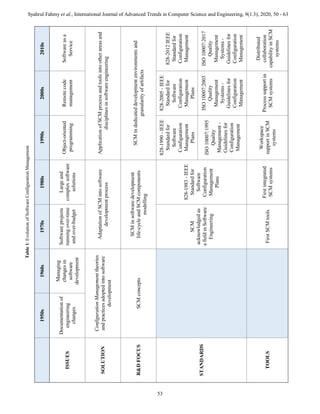
![Syahrul Fahmy et al., International Journal of Advanced Trends in Computer Science and Engineering, 9(1.3), 2020, 50 - 63
54
3. COMPONENTS
There are three major aspects or components in SCM namely
Process and Documentation, Tools, and People.
3.1 Process and Documentation
The concepts of SCM started as early as the 1960s with the
ideas of configuration as a control mechanism in software
development [8]; and concepts for program specifications [9].
The process underwent formalization throughout the 1970s
with the recognition of software engineering as a new field in
computing.
In 1983 IEEE published the first standard for SCM, the IEEE
828 Standard for Software Configuration Management Plans,
which was revised in 1990, 1998, and 2005. The latest version
was released in 2012 [136]. IEEE 828 establishes the
minimum requirements for configuration management
processes in systems and software engineering. ISO
published a quality-related standard for SCM in 1995, the ISO
10007 Quality Management - Guidelines for Configuration
Management, which was revised in 2003. The latest version
was released in 2017 [137]. ISO 10007 provides guidance on
the use of configuration management within the organization.
In addition to SCM-specific standards, there are also general
standards related to SCM including IEEE 15939 [138];
ISO/IEC 15939 [139]; ISO/IEC/IEEE 24765 [140]; ISO/IEC
12207 [141]; and ISO/IEC 15288 [142].
Based on these standards, the generic process for SCM
involves Management and Planning; Software Configuration
Identification; Software Configuration Control; Software
Configuration Status Accounting; Software Configuration
Auditing; and Software Release Management and Delivery.
3.2 Tools
The corpus of research in SCM has been in the modelling and
development of tools to address the issues at hand. This has
translated into a plethora of tools and systems for SCM. As
such, SCM implementation has been highly dependent on
tools as reported by [143-146].
The first SCM tools emerged in the 1970s and targeted
specific functionality for example SCSS [13] and Make [15].
First integrated SCM systems appeared in the 1980s,
developed in-house and focussed mainly on file control.
Examples include DSEE [147]; Adele [27]; and
Aide-De-Camp [148]. Workspace and process supports were
integrated into SCM systems throughout the 1990s and 2000s
for example SourceSafe [149]; Sun/Forte [150]; Subversion
[151]; CM/Synergy [152]; and ClearCase [153]. By 2010s,
SCM systems have incorporated distributed collaboration
capabilities for example Palantir [154]; Gitless [128]; and
EMFStore [130].
To date, basic SCM tools are pervasive and the underlying
techniques are no longer confined to SCM, but also in other
areas including web protocol, services, and programming
environments. Three types of tools that are common in SCM
are versioning tools such as VERCAST [132], software build
tools such as Pluto [127], and software release tools [155].
3.3 People
Works regarding people or human in SCM has focused on the
process and outcome of SCM implementation for example:
To analyse collaboration activities such as conflict
history data [156]; revision history [157]; and the
impact of a change made by one developer to other
developers[124].
To report the result of SCM tools and approaches in
the classroom for example the use of version control
system in student development projects [158];
implementation of a distributed revision control
system as part of the undergraduate and graduate
curriculums [159]; and the integration of configuration
management into the IT curriculum [160].
To identify the correlation between a commit’s social
characteristics and bugs [161]; the organization of bug
reports into sets for effective management by
developers [162]; and the relationship between
developers' communication frequency and number of
bugs [163] in debugging activities.
However, the responsibilities and activities that should be
carried out by people are mentioned in SCM standards for
example a generic skill set for SCM is outlined in the IEEE
Software Engineering Competency Model [164].
4. APPLICATION TO OTHER AREAS IN SOFTWARE
ENGINEERING
For the last 10 years, there have been much interest in the
application of SCM to other areas in software engineering.
This include Crosscutting Frameworks [165]; Scientific
Workflow Management Systems [166]; embedded software
systems [167]; and Product Line Engineering [168-169].
There are also interest in the integration of SCM and other
systems for example integration of version control, security
analysis and patching support [170]; integration of
architectural and configuration management system [171];
integration of branch and merge functionalities to LibreOffice
[172]; modification of BitKeeper, a distributed version
control system to handle product line requirements [173];
change-aware process environment for system and software
engineering [174]; integration of programming language
technology and version control [175]; and the integration of
SCM techniques and reference modelling to manage model
variants [176].](https://image.slidesharecdn.com/theevolutionofsoftwareconfigurationmanagement-250423075400-cec529c6/85/The_Evolution_of_Software_Configuration_Management-pdf-6-320.jpg)
![Syahrul Fahmy et al., International Journal of Advanced Trends in Computer Science and Engineering, 9(1.3), 2020, 50 - 63
55
There are also interest in the area of Data Mining where
SCM’s repository data is used to predict pre-release defects
[177]; guide programmers regarding change [178]; measure
the extent of delay [179]; understanding problems in parallel
development [180]; and to investigate collaboration efforts in
open source projects [181].
The trend of applying SCM processes and tools to other areas
and systems are expected to continue in the future especially
in the fields of Big Data, Internet of Things and
Crowdsourcing.
5. CHANGE MANAGEMENT
The initial concept of change management in SCM seems to
have disintegrated throughout the years. The management of
change is now focused at a finer level such as source codes
[116]; Java entities [118]; models [130]; product variants
[182]; and documents [172]. Change management has also
been delegated to SCM systems and tools such as Eclipse
[183] and Git [128]. These factors has made change
management to be a tool-oriented process, rather than a
management-oriented process.
6. SOFTWARE QUALITY
Interest in software quality for SCM started as early as the
1980s with studies of change control procedures in a Software
Quality Control program [184]; a Software Quality
Assurance program outlining the role of SCM in the
implementation and maintenance phase [185]; and
configuration management for attaining quality assurance
[186].
To date, quality in SCM is mainly associated with source
code defects and efforts are directed at reducing or
eliminating them. Examples include real-time quality control
through the analysis of code change [187]; consecutive
changes and software defects [188]; tool for estimating
defects and changes in software systems [189]; defect
prediction with heterogeneous metric sets [190]; mechanism
for presenting software defect metrics to aid analysis [191];
impact of product development strategy on defects [192]; and
a decision support system to predict defects and enhance
release management [177,193].
7. CONCLUSION
This paper has presented the evolution of Software
Configuration Management, highlighting the components,
application to other areas, change management, and software
quality. In a nutshell, research and development in SCM are
highly motivated by the problems at hand in software
development. This is evident through efforts focusing on
programming large software systems in the 1980s,
object-oriented paradigm in the 1990s, web services in the
2000s, and late binding systems in the 2010s.
The process and activities in SCM is mature with the
publications of international standards since the 1980s and
revised periodically. Most of the research in SCM are
technical in nature involving SCM concepts, models and
tools.Commercial and proprietary tools are aplenty, and the
underlying techniques are no longer confined to SCM, but in
other areas as well such as web services.
SCM concepts and tools have been extensively applied to
other areas since early 2000s and the trend is expected to
continue. Change management has become a tool-oriented
process, rather than a management-oriented process, drifting
away from the initial purpose of SCM. The role of human in
SCM has yet to be studied extensively compared to other
areas in software engineering. Software quality in SCM is
mainly associated with defects and quality factors are
subjective and measured differently based on projects and
metrics.
REFERENCES
1. Babich, W.A. (1986). Software Configuration
Management, Coordination for Team Productivity. 1st
ed. Boston: Addison-Wesley.
2. SWEBOK. (2014). Guide to the Software Engineering
Body of Knowledge. IEEE Computer Society Press, Los
Alamitos, CA, USA.
3. CMMI. (2010). CMMI for Development Version 1.3.
Software Engineering Institute.
4. ISO 10007. (2017). Quality Management Systems -
Guidelines for Configuration Management. International
Organization for Standardization. (10 pages).
5. Estublier, J., Leblang, D., van der Hoek, A., Conradi, R.,
Clemm, G., Tichy, W., and Wiborg-Weber, D. (2005).
Impact of Software Engineering Research on the Practice
of Software Configuration Management. ACM
Transactions on Software Engineering Methodology.
14(4): 383-430.
https://doi.org/10.1145/1101815.1101817
6. Ratynski, M.V. (1967). The Air Force Computer
Program Acquisition Concept. In Proceedings of the
April 18-20, 1967, Spring Joint Computer Conference.
NY, USA, 33-44.
https://doi.org/10.1145/1465482.1465488
7. Searle, L.V., and Neil, G. (1967). Configuration
Management of Computer Programs by the Air Force:
Principles and Documentation. In Proceedings of the
April 18-20, 1967, Spring Joint Computer Conf. NY,
USA, 45-49.
https://doi.org/10.1145/1465482.1465489
8. Oettinger, A.G. (1964). A Bull's Eye View of
Management and Engineering Information Systems. In
Proceedings of the 1964 19th ACM National Conference.
NY, USA, 21.1-21.14.
9. Liebowitz, B.H. (1967). The Technical Specification:
Key to Management Control of Computer Programming.
In Proceedings of the April 18-20, 1967, Spring Joint
Computer Conference, Atlantic City, USA, 51-59.](https://image.slidesharecdn.com/theevolutionofsoftwareconfigurationmanagement-250423075400-cec529c6/85/The_Evolution_of_Software_Configuration_Management-pdf-7-320.jpg)