EnISSA
Enhanced In Situ Soil Analysis
info@enissa.com
www.enissa.com
EnISSA
1. Introduction
2. EnISSA MIP
3. Soil characteristics
4. Case studies
www.enissa.com
1. Introduction
Chlorinated Solvents and DNAPL
www.enissa.com
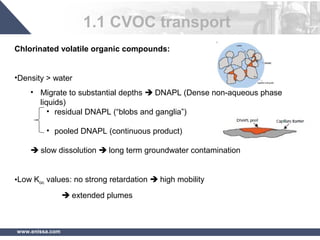
Chlorinated volatile organic compounds:
•Density > water
• Migrate to substantial depths  DNAPL (Dense non-aqueous phase
liquids)
• residual DNAPL (“blobs and ganglia”)
• pooled DNAPL (continuous product)
 slow dissolution  long term groundwater contamination
•Low Koc values: no strong retardation  high mobility
 extended plumes
1.1 CVOC transport
www.enissa.com
CVOC transport
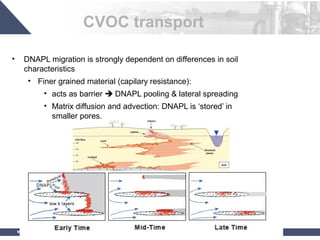
• DNAPL migration is strongly dependent on differences in soil
characteristics
• Finer grained material (capilary resistance):
• acts as barrier  DNAPL pooling & lateral spreading
• Matrix diffusion and advection: DNAPL is ‘stored’ in
smaller pores.
www.enissa.com
1.2 CVOC Characteristation
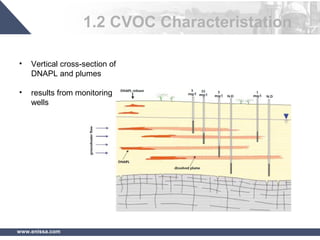
• Vertical cross-section of
DNAPL and plumes
• results from monitoring
wells
www.enissa.com
1.2 CVOC Characteristation
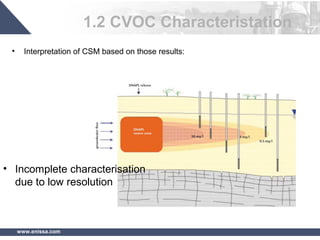
• Interpretation of CSM based on those results:
• Incomplete characterisation
due to low resolution
www.enissa.com
1.2 CVOC Characteristation
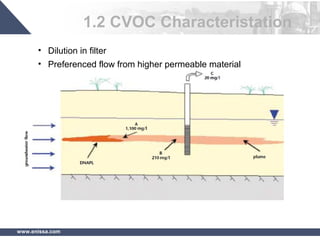
• Dilution in filter
• Preferenced flow from higher permeable material
www.enissa.com
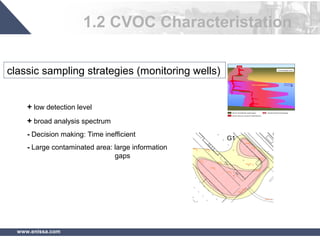
classic sampling strategies (monitoring wells)
+ low detection level
+ broad analysis spectrum
- Decision making: Time inefficient
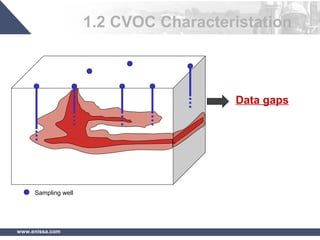
- Large contaminated area: large information
gaps
1.2 CVOC Characteristation
www.enissa.com
1.2 CVOC Characteristation
Data gaps
Sampling well
www.enissa.com
1.2 CVOC Characteristation
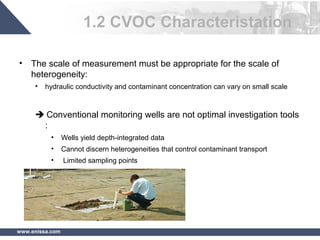
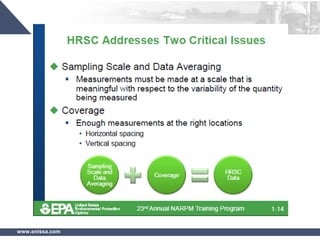
• The scale of measurement must be appropriate for the scale of
heterogeneity:
• hydraulic conductivity and contaminant concentration can vary on small scale
 Conventional monitoring wells are not optimal investigation tools
:
• Wells yield depth-integrated data
• Cannot discern heterogeneities that control contaminant transport
• Limited sampling points
www.enissa.com
• HRSC strategies and techniques use scale-
appropriate measurement and data density to define
contaminant distributions in environmental media with
greater certainty, supporting faster and more effective
site cleanup
www.enissa.com
www.enissa.com
1.2 CVOC Characteristation
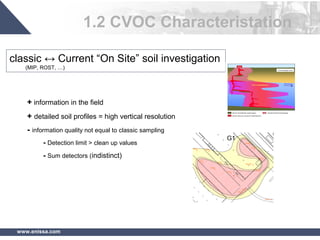
classic ↔ Current “On Site” soil investigation
(MIP, ROST, …)
+ information in the field
+ detailed soil profiles = high vertical resolution
- information quality not equal to classic sampling
- Detection limit > clean up values
- Sum detectors (indistinct)
www.enissa.com
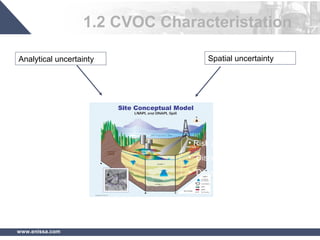
Analytical uncertainty Spatial uncertainty
• Risk assessment uncertainty
• “Discoveries” during monitoring
• “Discoveries” during remediation
1.2 CVOC Characteristation
www.enissa.com
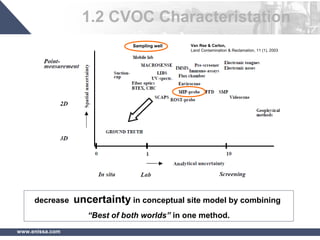
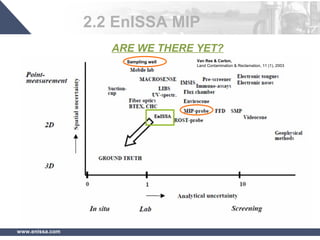
Sampling well Van Ree & Carlon,
Land Contamination & Reclamation, 11 (1), 2003
decrease uncertainty in conceptual site model by combining
“Best of both worlds” in one method.
1.2 CVOC Characteristation
www.enissa.com
Development of a fast in situ technology with
detection limits and selectivity comparable to
classis sampling methods.
Combining best of both worlds
+ low detection level
+ broad analysis spectrum
+ information in the field
+ detailed soil profiles
1.2 CVOC Characteristation
EnISSA project:
www.enissa.com
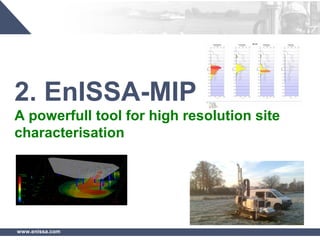
2. EnISSA-MIP
A powerfull tool for high resolution site
characterisation
www.enissa.com
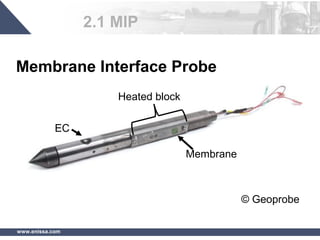
Membrane Interface Probe
EC
Heated block
Membrane
© Geoprobe
2.1 MIP
www.enissa.com
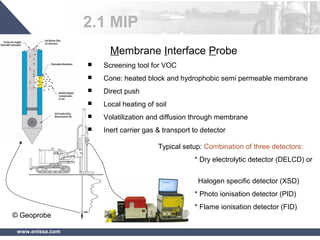
Typical setup: Combination of three detectors:
* Dry electrolytic detector (DELCD) or
Halogen specific detector (XSD)
* Photo ionisation detector (PID)
* Flame ionisation detector (FID)
Membrane Interface Probe
 Screening tool for VOC
 Cone: heated block and hydrophobic semi permeable membrane
 Direct push
 Local heating of soil
 Volatilization and diffusion through membrane
 Inert carrier gas & transport to detector
© Geoprobe
2.1 MIP
www.enissa.com
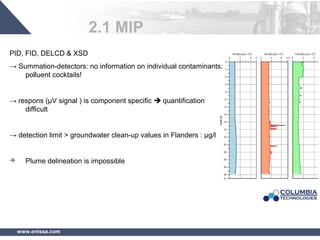
PID, FID, DELCD & XSD
→ Summation-detectors: no information on individual contaminants:
polluent cocktails!
→ respons (µV signal ) is component specific  quantification
difficult
→ detection limit > groundwater clean-up values in Flanders : μg/l
 Plume delineation is impossible
2.1 MIP
www.enissa.com
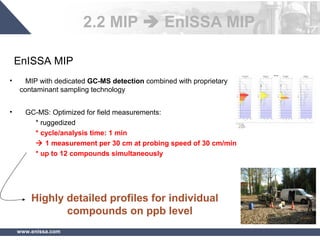
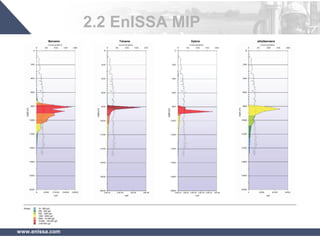
EnISSA MIP
• MIP with dedicated GC-MS detection combined with proprietary
contaminant sampling technology
• GC-MS: Optimized for field measurements:
* ruggedized
* cycle/analysis time: 1 min
 1 measurement per 30 cm at probing speed of 30 cm/min
* up to 12 compounds simultaneously
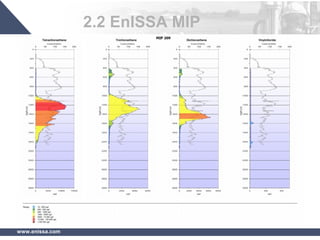
Highly detailed profiles for individual
compounds on ppb level
2.2 MIP  EnISSA MIP
www.enissa.com
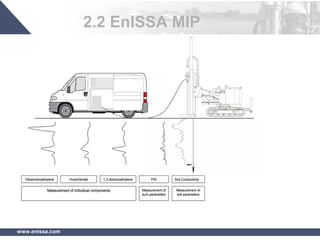
Soil Conductivity
Measurement of individual components
Tetrachloroethylene Vinylchloride 1,2 dichloroethylene
Measurement of
soil parameters
PID
Measurement of
sum parameters
Soil Conductivity
Measurement of individual components
Tetrachloroethylene Vinylchloride 1,2 dichloroethylene
Measurement of
soil parameters
PID
Measurement of
sum parameters
2.2 EnISSA MIP
www.enissa.com
2.2 EnISSA MIP
www.enissa.com
2.2 EnISSA MIP
www.enissa.com
ARE WE THERE YET?
2.2 EnISSA MIP
Sampling well Van Ree & Carlon,
Land Contamination & Reclamation, 11 (1), 2003
www.enissa.com
entire delineation of contamination: source + plume
EnISSA MIP measures on ppb level
→ source and plume
(Conventional MIP measures on sub-ppm level)
- Order of magnitude = groundwater sample  high quality screening tool -
“On site” information on pollution cocktails:
EnISSA MIP measures individual compounds in contrast to the sum-detectors used
in conventional MIP
- Each 30 cm up to 12 compounds can be distinguished -
strategic sampling well locations:
The entire delineation of source and plume obtained by EnISSA MIP makes it possible
to place sampling wells at strategic locations reducing sampling costs and time.
High resolution data is essential to characterize chlorinated solvents
2.2 EnISSA MIP
www.enissa.com
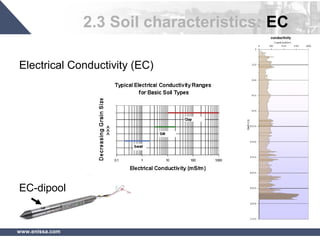
2.3 Soil characteristics: EC
Electrical Conductivity (EC)
EC-dipool
www.enissa.com
2.3 Soil characteristics: CPT
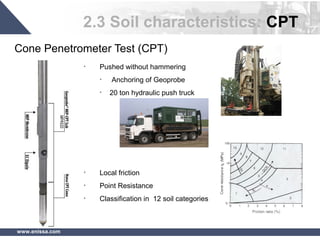
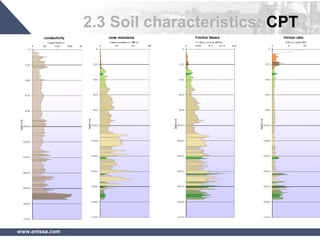
Cone Penetrometer Test (CPT)
• Pushed without hammering
• Anchoring of Geoprobe
• 20 ton hydraulic push truck
• Local friction
• Point Resistance
• Classification in 12 soil categories
www.enissa.com
2.3 Soil characteristics: CPT
www.enissa.com
2.3 Soil characteristics: HPT
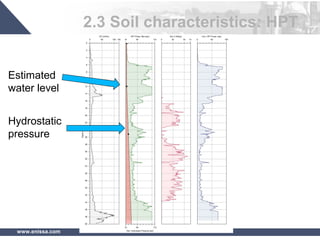
Hydraulic Profiling Tool (HPT)
• MiHPT = MIP + HPT
• Injection of continuous water flow
• injection pressure is an indication of the local permeability of the
soil.
• A real-time detailed pressure and flow log is generated for each
probing location giving more insight in hydrogeology.
• Combined with dissipation tests or groundwater level data, an
Estimated conductivity (K [m/day]) can be calculated based on an
empirical model.
www.enissa.com
2.3 Soil characteristics: HPT
Hydrostatic
pressure
Estimated
water level
www.enissa.com
Case studies
1. Weaving mill Kortrijk OVAM (Citychlor demo)
2. Wool production Mol
3. Gas station, MTBE plume
www.enissa.com
3. Case studies
Kortrijk – Weaving Mill
Antwerp region - Wool Factory
Antwerp region- Service station
Waregem – Metalurgy site
www.enissa.com
Case Study 1
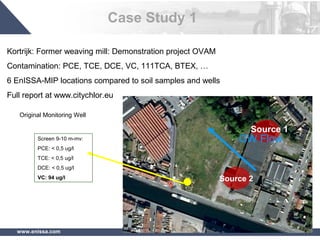
Kortrijk: Former weaving mill: Demonstration project OVAM
Contamination: PCE, TCE, DCE, VC, 111TCA, BTEX, …
6 EnISSA-MIP locations compared to soil samples and wells
Full report at www.citychlor.eu
Source 1
Source 2
GW Flow
Original Monitoring Well
Screen 9-10 m-mv:
PCE: < 0,5 ug/l
TCE: < 0,5 ug/l
DCE: < 0,5 ug/l
VC: 94 ug/l
www.enissa.com
Case Study 1
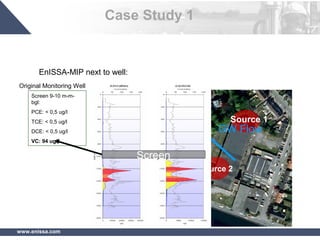
EnISSA-MIP next to well:
Source 1
Source 2
GW Flow
Original Monitoring Well
Screen 9-10 m-m-
bgl:
PCE: < 0,5 ug/l
TCE: < 0,5 ug/l
DCE: < 0,5 ug/l
VC: 94 ug/l
Screen
www.enissa.com
Case Study 1
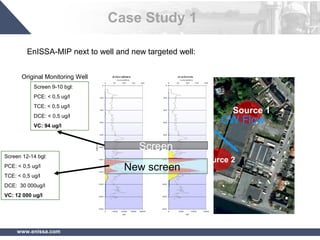
EnISSA-MIP next to well and new targeted well:
Source 1
Source 2
GW Flow
Original Monitoring Well
Screen 9-10 bgl:
PCE: < 0,5 ug/l
TCE: < 0,5 ug/l
DCE: < 0,5 ug/l
VC: 94 ug/l
Screen
Screen 12-14 bgl:
PCE: < 0,5 ug/l
TCE: < 0,5 ug/l
DCE: 30 000ug/l
VC: 12 000 ug/l
New screen
www.enissa.com
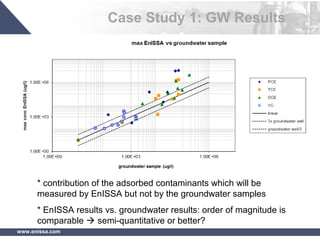
* contribution of the adsorbed contaminants which will be
measured by EnISSA but not by the groundwater samples
* EnISSA results vs. groundwater results: order of magnitude is
comparable  semi-quantitative or better?
Case Study 1: GW Results
www.enissa.com
0
2000
4000
6000
8000
10000
12000
14000
16000
18000
20000
EnISSAMIP
groundwater
wells
sampling
groundwater
wells
soil/GW
analysis
report
totalproject
cost
Cost(€)
0
5000
10000
15000
20000
25000
Cost($)
EnISSA campaign
traditional campaign
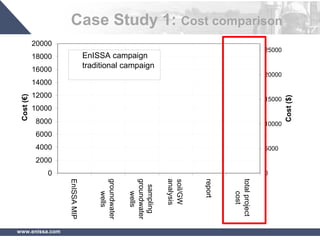
Case Study 1: Cost comparison
www.enissa.com
totalproject
cost
0
5000
10000
15000
20000
25000
Cost($)
Case Study 1: Cost comparison
www.enissa.com
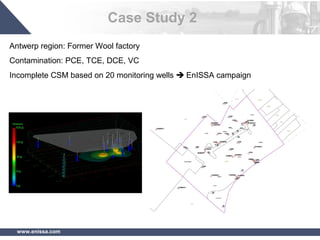
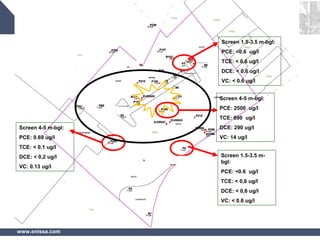
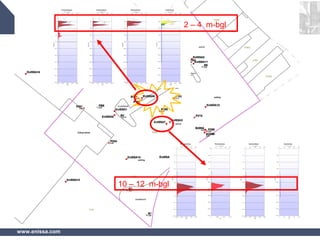
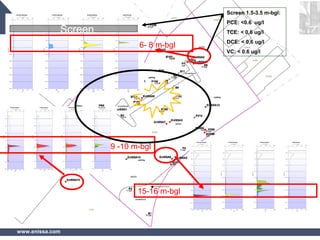
Case Study 2
Antwerp region: Former Wool factory
Contamination: PCE, TCE, DCE, VC
Incomplete CSM based on 20 monitoring wells  EnISSA campaign
www.enissa.com
Screen 4-5 m-bgl:
PCE: 0.69 ug/l
TCE: < 0,1 ug/l
DCE: < 0,2 ug/l
VC: 0.13 ug/l
Screen 1.5-3.5 m-
bgl:
PCE: <0.6 ug/l
TCE: < 0,6 ug/l
DCE: < 0,6 ug/l
VC: < 0.6 ug/l
Screen 1.5-3.5 m-bgl:
PCE: <0.6 ug/l
TCE: < 0,6 ug/l
DCE: < 0,6 ug/l
VC: < 0.6 ug/l
Screen 4-5 m-bgl:
PCE: 2500 ug/l
TCE: 690 ug/l
DCE: 290 ug/l
VC: 14 ug/l
www.enissa.com
10 – 12 m-bgl
2 – 4 m-bgl
www.enissa.com
Screen 1.5-3.5 m-bgl:
PCE: <0.6 ug/l
TCE: < 0,6 ug/l
DCE: < 0,6 ug/l
VC: < 0.6 ug/l
Screen
6- 8 m-bgl
9 -10 m-bgl
15-16 m-bgl
www.enissa.com
Case Study 2
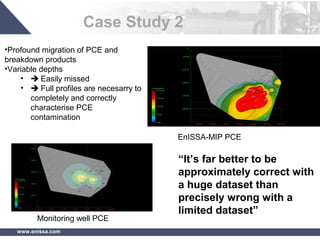
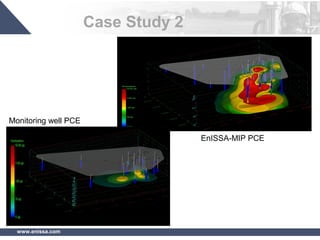
•Profound migration of PCE and
breakdown products
•Variable depths
•  Easily missed
•  Full profiles are necesarry to
completely and correctly
characterise PCE
contamination
EnISSA-MIP PCE
Monitoring well PCE
“It’s far better to be
approximately correct with
a huge dataset than
precisely wrong with a
limited dataset”
www.enissa.com
Case Study 2
EnISSA-MIP PCE
Monitoring well PCE
www.enissa.com
Case Study 3
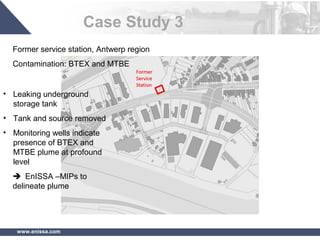
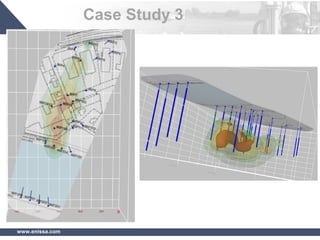
Former service station, Antwerp region
Contamination: BTEX and MTBE
• Leaking underground
storage tank
• Tank and source removed
• Monitoring wells indicate
presence of BTEX and
MTBE plume at profound
level
 EnISSA –MIPs to
delineate plume
www.enissa.com
Case Study 3
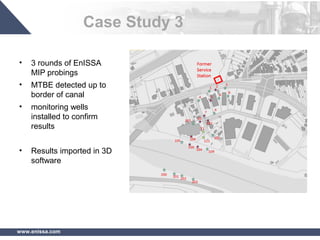
• 3 rounds of EnISSA
MIP probings
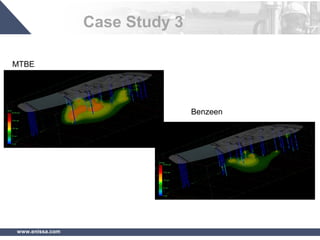
• MTBE detected up to
border of canal
• monitoring wells
installed to confirm
results
• Results imported in 3D
software
www.enissa.com
Case Study 3
MTBE
Benzeen
www.enissa.com
Case Study 3
www.enissa.com
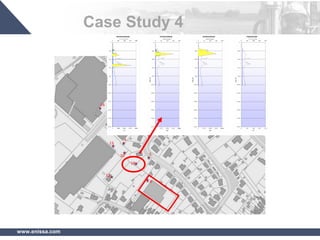
Case Study 4
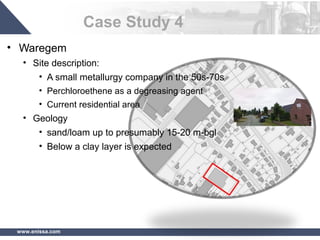
• Waregem
• Site description:
• A small metallurgy company in the 50s-70s
• Perchloroethene as a degreasing agent
• Current residential area
• Geology
• sand/loam up to presumably 15-20 m-bgl
• Below a clay layer is expected
www.enissa.com
Case Study 4
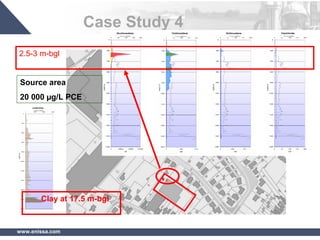
2.5-3 m-bgl
Source area
20 000 µg/L PCE
Clay at 17.5 m-bgl
www.enissa.com
Case Study 4
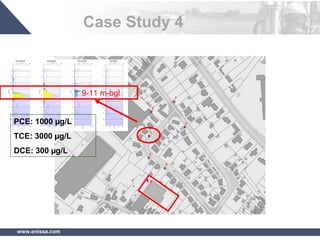
9-11 m-bgl
PCE: 1000 µg/L
TCE: 3000 µg/L
DCE: 300 µg/L
www.enissa.com
Case Study 4
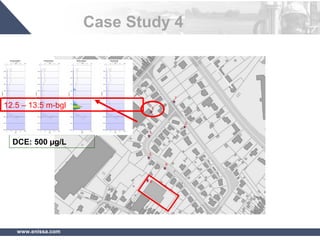
DCE: 500 µg/L
12.5 – 13.5 m-bgl
www.enissa.com
Case Study 4
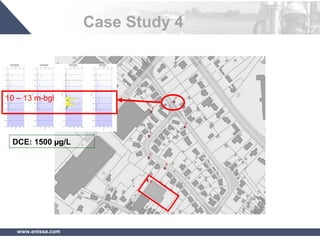
DCE: 1500 µg/L
10 – 13 m-bgl
www.enissa.com
Case Study 4
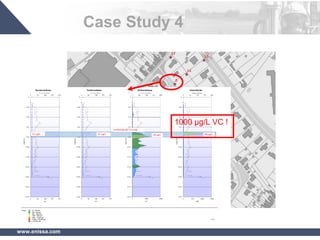
1000 µg/L VC !
www.enissa.com
Case Study 4
www.enissa.com
Case Study 4
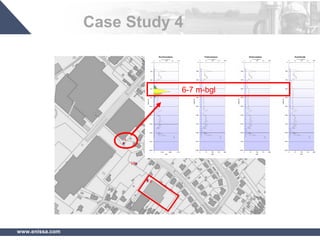
6-7 m-bgl
www.enissa.com
Case Study 4
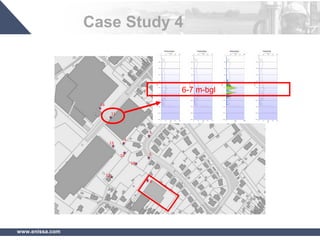
6-7 m-bgl
www.enissa.com
Case Study 4
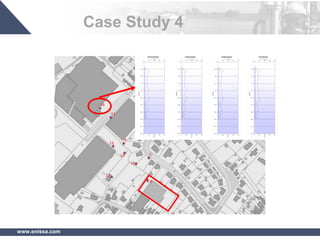
www.enissa.com
Case Study 4
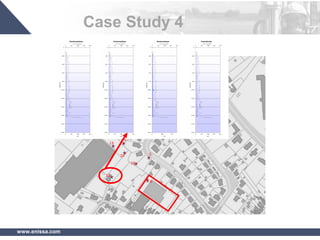
www.enissa.com
Case Study 4
www.enissa.com
entire delineation of contamination: source + plume
EnISSA MIP measures on ppb level
→ source and plume
(Conventional MIP measures on sub-ppm level)
- Order of magnitude = groundwater sample  high quality screening tool -
“On site” information on pollution cocktails:
EnISSA MIP measures individual compounds in contrast to the sum-detectors used
in conventional MIP
- Each 30 cm up to 12 compounds can be distinguished -
strategic sampling well locations:
The entire delineation of source and plume obtained by EnISSA MIP makes it possible
to place sampling wells at strategic locations reducing sampling costs and time.
High resolution data is essential to characterize chlorinated solvents
EnISSA MIP
www.enissa.com
• An illustrated handbook of DNAPL transport and fate
in the subsurface
http://www.cluin.org/conf/itrc/dnaplpa/dnapl_handbook_final.pdf
• High resolution site characterisation
http://clu-in.org/characterization/technologies/hrsc/hrscintro.cfm
https://clu-in.org/characterization/technologies/hrsc/pdfs/HRSC-
Participant-Manual-NARPM-2014.pdf
www.enissa.com
More information:
www.EnISSA.com
info@EnISSA.com

EnISSA