Enhancing Workforce
Performance Through
 Succession Planning
Healthcare Leadership Crisis
• Every day for the next 19 years over 10,000
  Baby Boomers will reach age 65

• Projections are that 50% of healthcare
  management could be lost over the next 5
  years
Healthcare Leadership Crisis

• 56% of executives polled said that they did not know who
  would assume leadership should they have a vacant key
  executive role
• 59% of executives say they do not feel that their hospital
  has a succession plan in place
• 64% say that their hospital is not adequately prepared
  should their CEO resign suddenly
• 68% of executives polled said that the departure of their
  key executive
Definition of Succession Plan

• The process of identifying, developing, evaluating and
  reinforcing and a group of talented employees to assume
  key management roles

• The principles of succession management are simple and
  flexible. They can be used for every management and
  leadership position (CEOs, VPs, Directors, and Managers),
  and they can be used to help identify potential board
  members.
Develop a Succession Plan


The overall objective of the succession plan
will be to “plan and initiate a program to
ensure leadership continuity for key positions
that will help to guarantee the survival of the
group/community served.”
Rationale for Succession Plans


•   Cost Savings
•   Continuity
•   Loyalty/Morale
•   Less Risk
•   Contingency Plan “Hit by a Bus” Scenario
•   Successful Companies Have Succession Plans
Succession Plan Foundation

•   Make the business case
•   Define High Potential Leaders
•   Evaluate current staff and identify High Potential leaders
•   Develop High Potential Leaders
•   Evaluate and Reinforce High Potential Leaders
Objectives of a Succession Plan

• Define the Relationship Between the Succession Plan and
  your Organization’s Mission
• Establish Key Positions that Should Fall within the Scope
  of the Succession Plan
• Identify Which Individuals Can Step into the Key
  Positions and What Development Plan Should be Utilized
• Prepare a Curriculum for the Development of Leadership
  Talent
• Document the Succession Plan Together with an
  Implementation Schedule
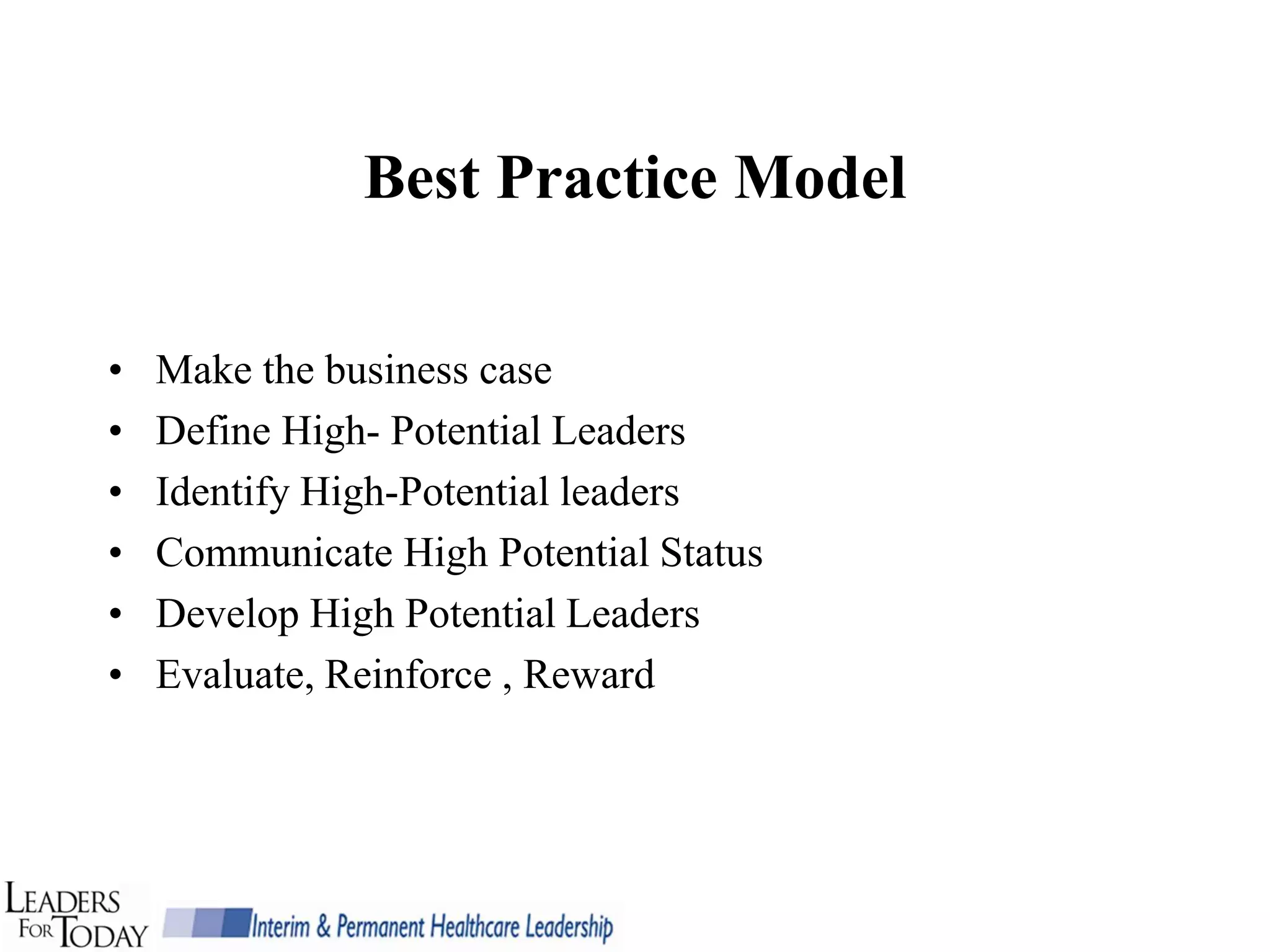
Best Practice Model

•   Make the business case
•   Define High- Potential Leaders
•   Identify High-Potential leaders
•   Communicate High Potential Status
•   Develop High Potential Leaders
•   Evaluate, Reinforce , Reward
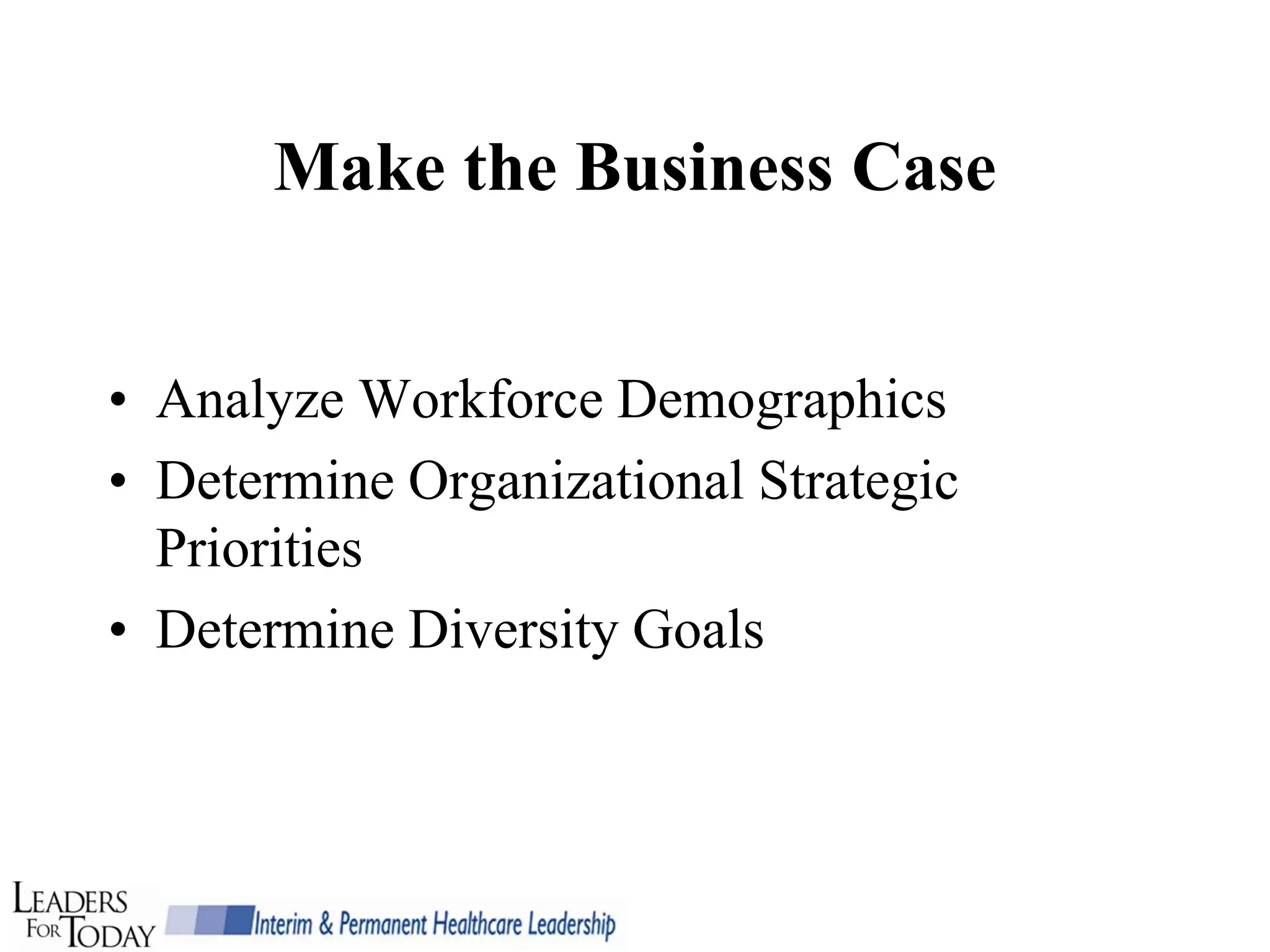
Make the Business Case


• Analyze Workforce Demographics
• Determine Organizational Strategic
  Priorities
• Determine Diversity Goals
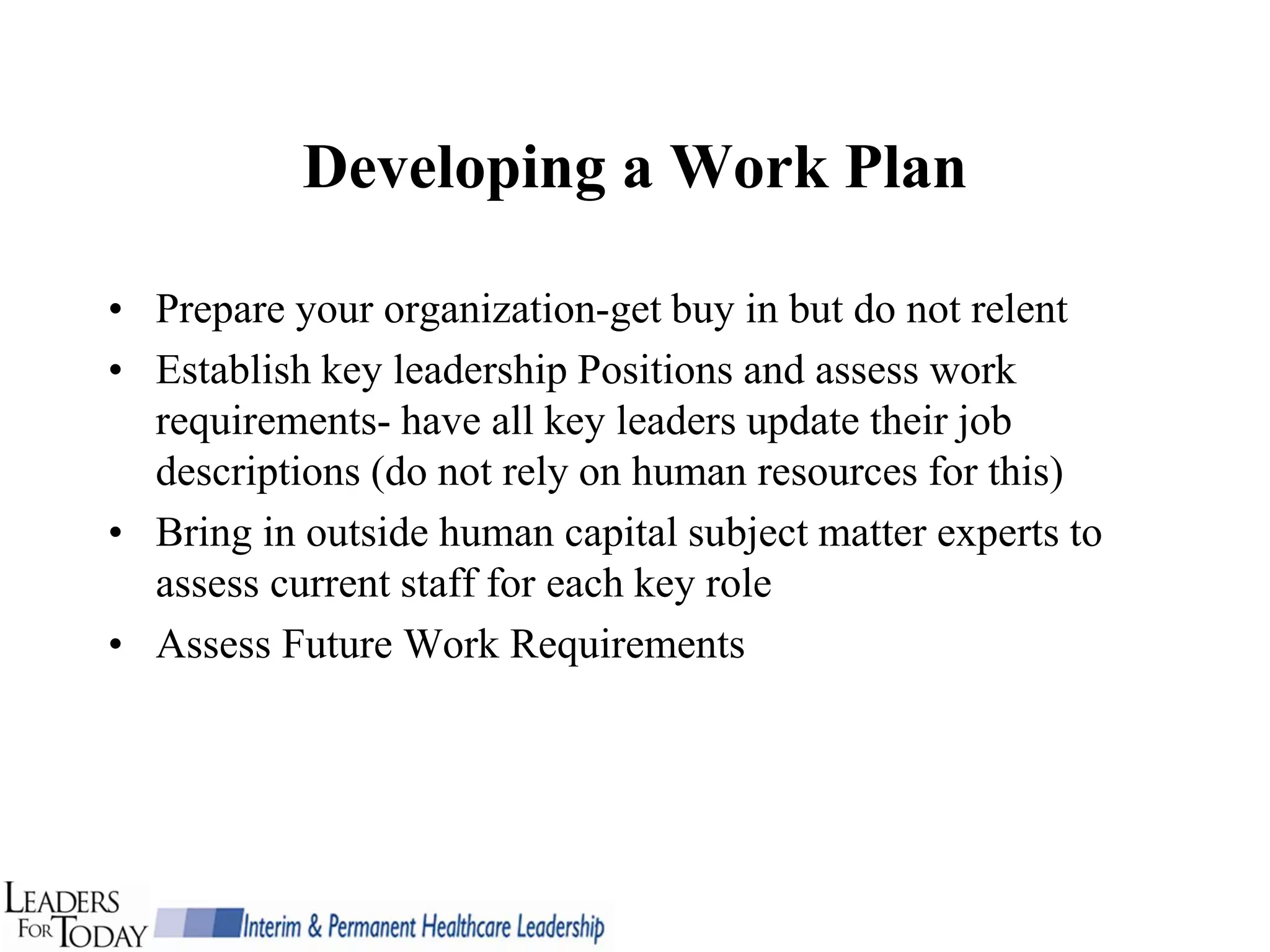
Developing a Work Plan

• Prepare your organization-get buy in but do not relent
• Establish key leadership Positions and assess work
  requirements- have all key leaders update their job
  descriptions (do not rely on human resources for this)
• Bring in outside human capital subject matter experts to
  assess current staff for each key role
• Assess Future Work Requirements
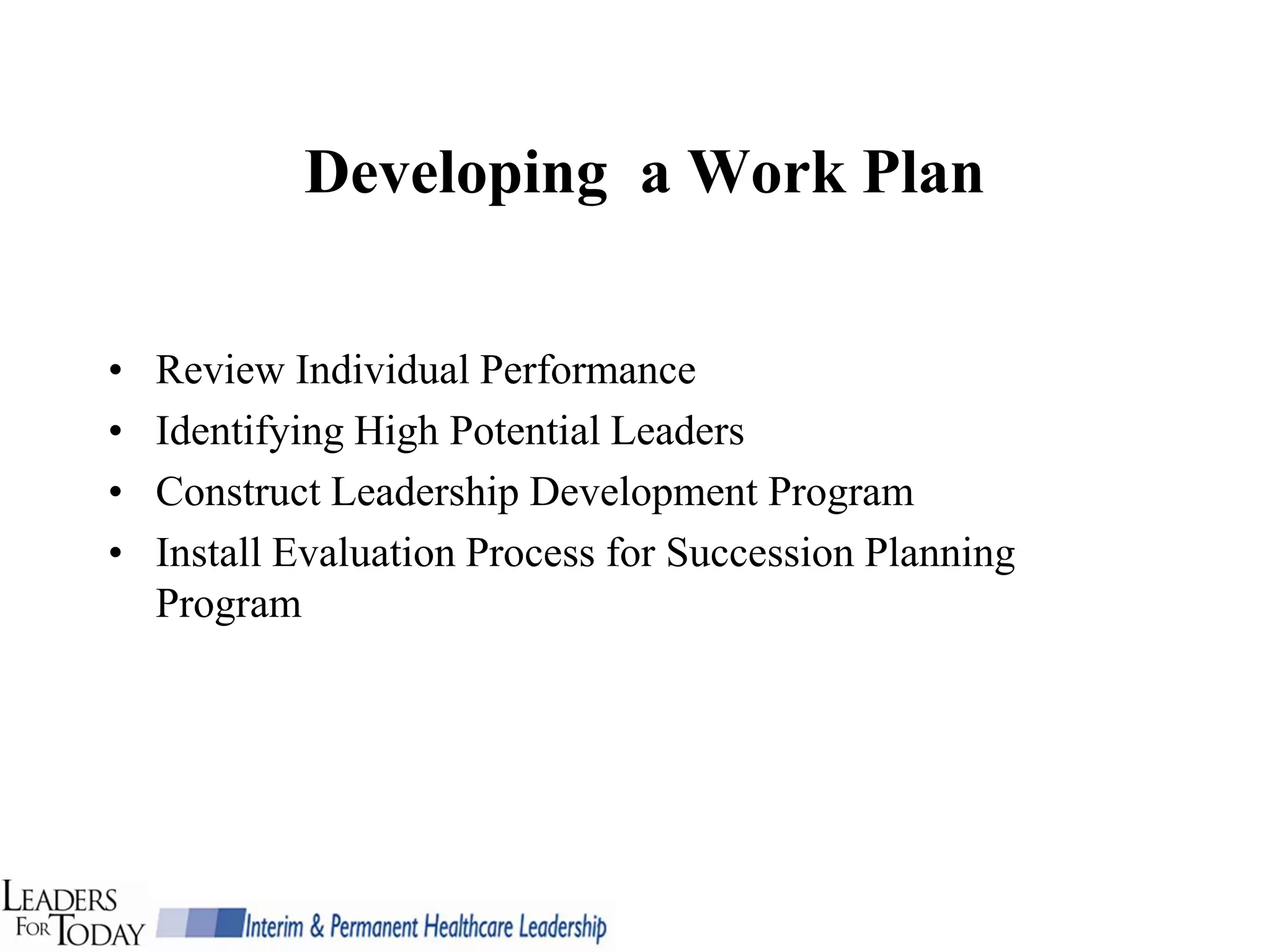
Developing a Work Plan


•   Review Individual Performance
•   Identifying High Potential Leaders
•   Construct Leadership Development Program
•   Install Evaluation Process for Succession Planning
    Program
Fundamentals of Work Plan

• Key leadership roles should have updated job description
• Action to bring individual performance in line with
  requirements
• Requirements for implementing leadership development
  program
• Timeline, stakeholders and ownership of results
Identify High Potential Leaders


•   Review Performance Score
•   Identify Key Success Factors for Advancement
•   360 Degree Review Process
•   Solicit Leaders Interest in Advancement
Key Attributes of High Potential
               Leaders
• Should know the company and mission knowledge and
  lives it
• Demonstrated passion thru measurable career
  accomplishments,
• Has exceeded expectations in current role
• Track record of overcoming adversity with clear concise
  results
• History of “getting things done through others” , good
  relationship building skills
• Community service mix- “it is not all about me”
High Potential Leader
              Development

•   Experiential Learning- Stretch Assignments
•   Cross Functional Teams
•   Leadership Academies
•   Shedding Silos
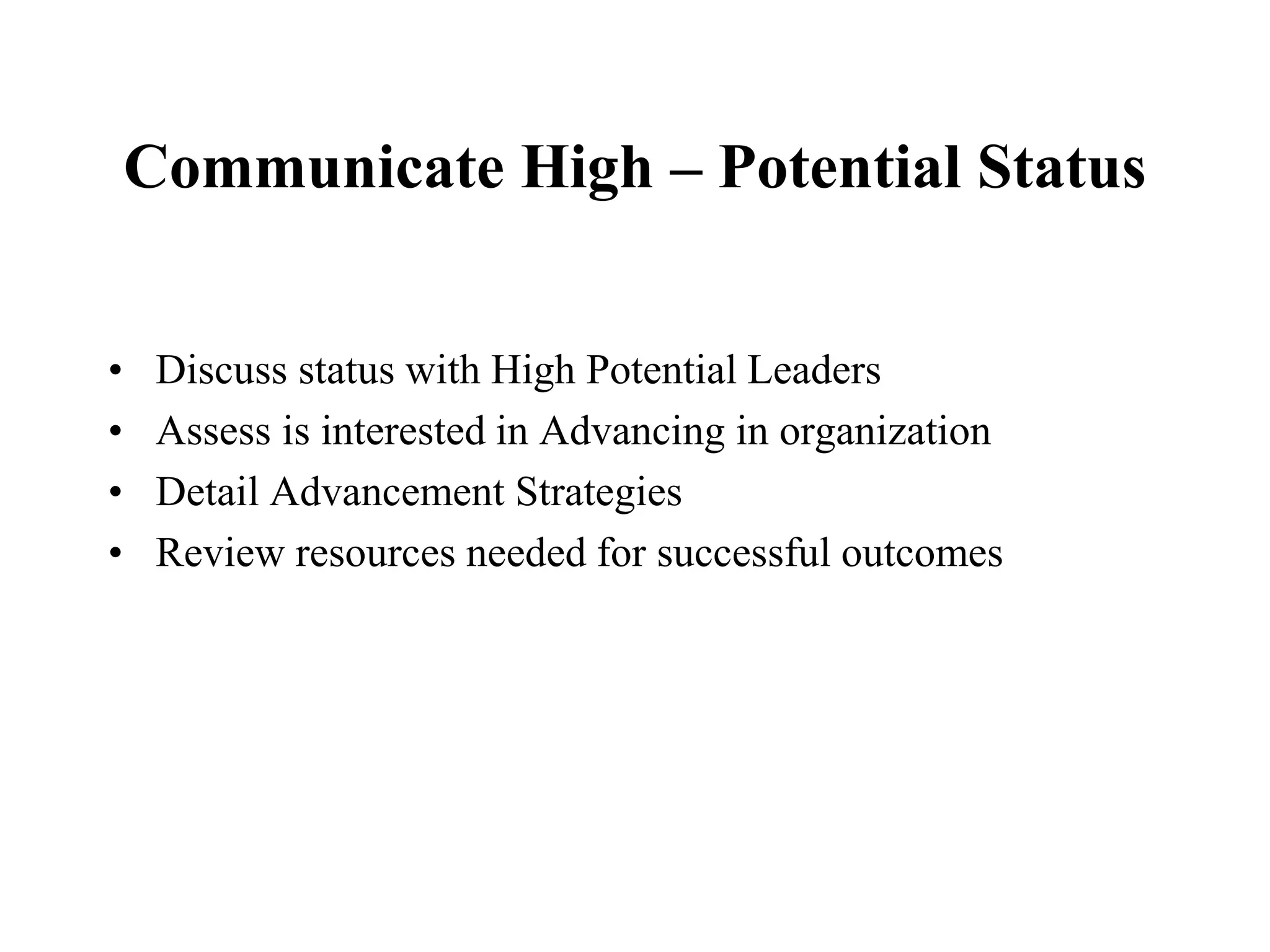
Communicate High – Potential Status


•    Discuss status with High Potential Leaders
•    Assess is interested in Advancing in organization
•    Detail Advancement Strategies
•    Review resources needed for successful outcomes
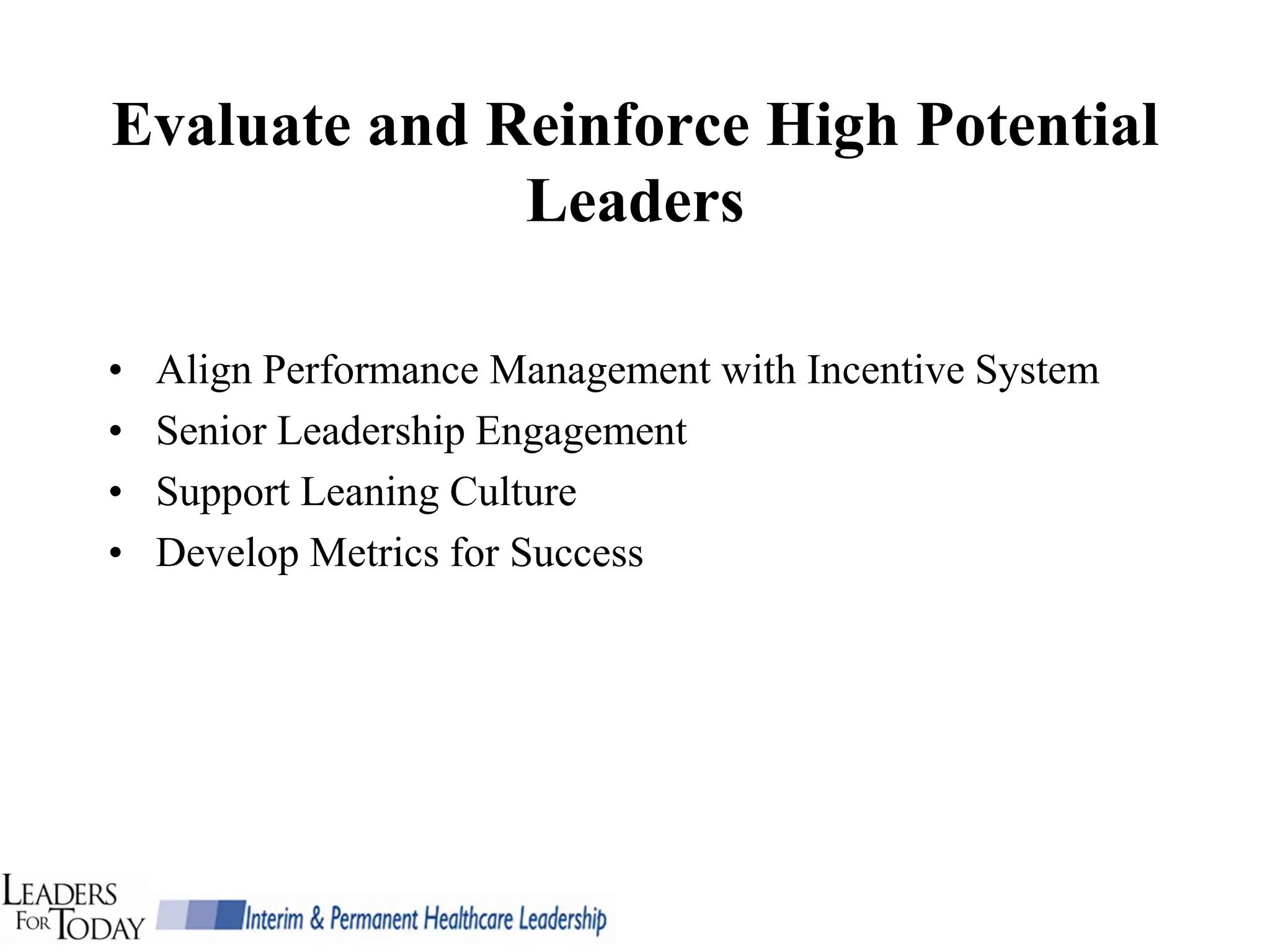
Evaluate and Reinforce High Potential
              Leaders

•   Align Performance Management with Incentive System
•   Senior Leadership Engagement
•   Support Leaning Culture
•   Develop Metrics for Success
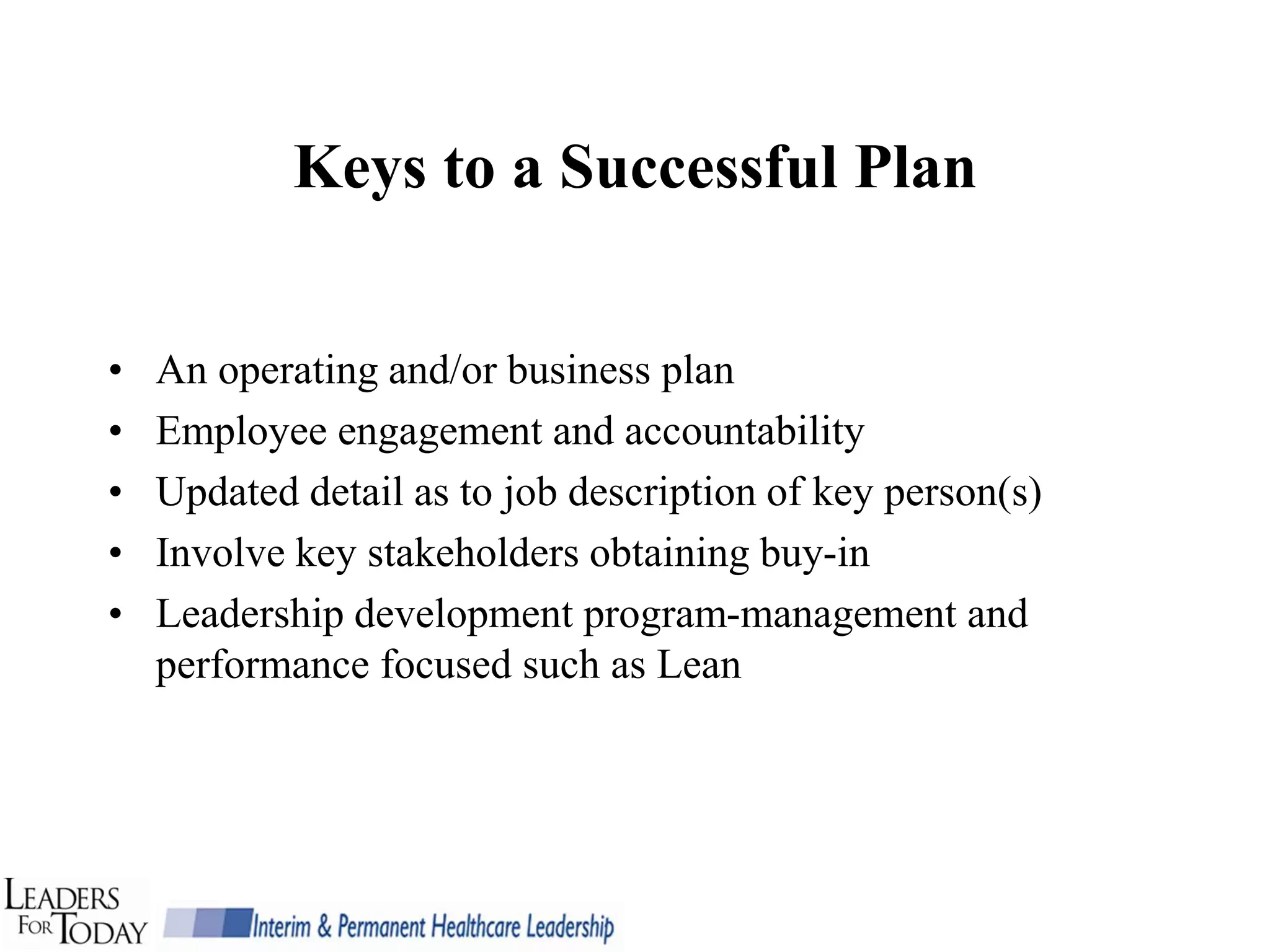
Keys to a Successful Plan


•   An operating and/or business plan
•   Employee engagement and accountability
•   Updated detail as to job description of key person(s)
•   Involve key stakeholders obtaining buy-in
•   Leadership development program-management and
    performance focused such as Lean
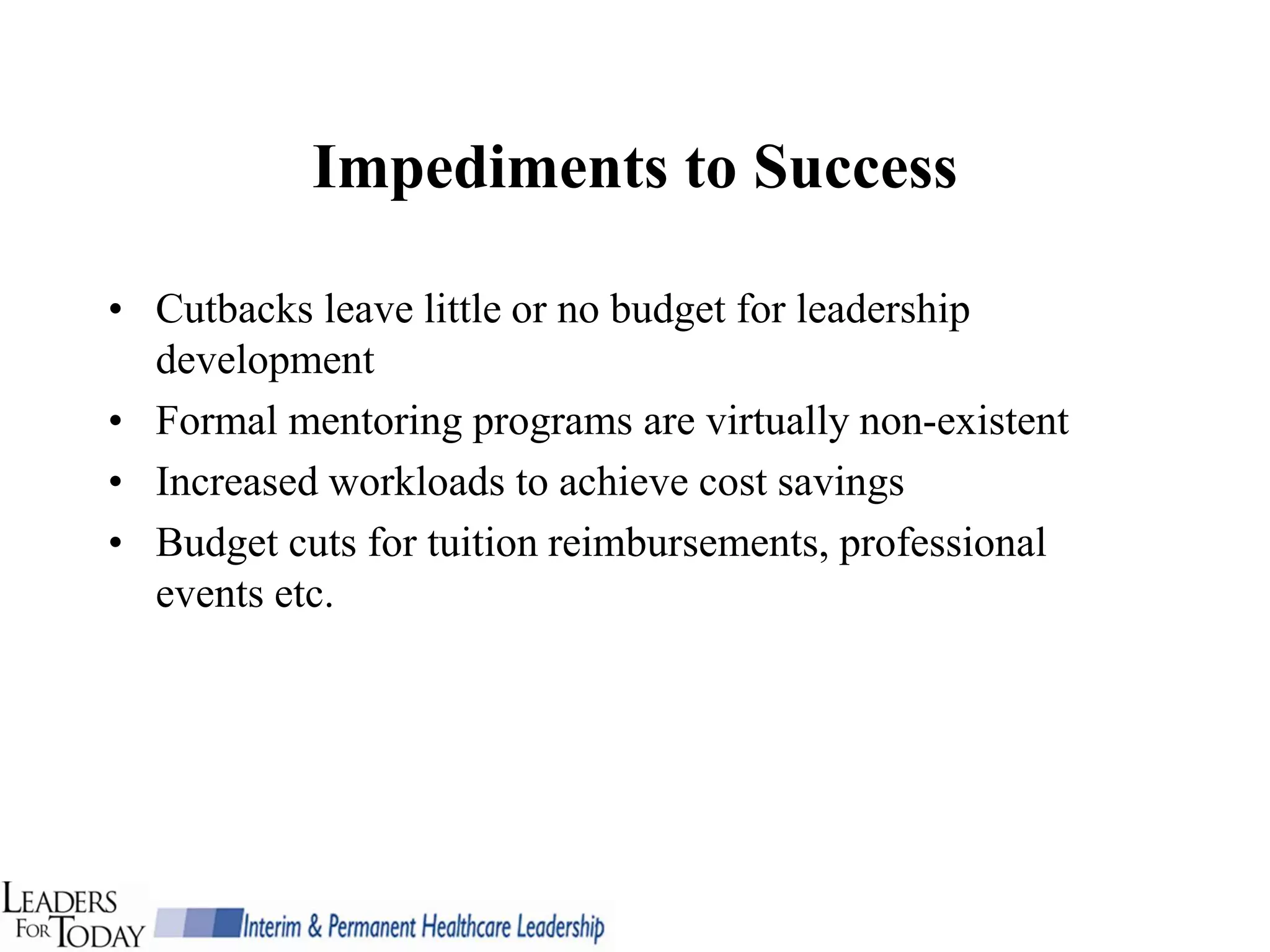
Impediments to Success

• Cutbacks leave little or no budget for leadership
  development
• Formal mentoring programs are virtually non-existent
• Increased workloads to achieve cost savings
• Budget cuts for tuition reimbursements, professional
  events etc.
Impediments to Success

• High turnover among top level staff, “leaders firing their
  boss”
• Tight talent market-finite number of leaders, highest/best
  bidder
• Focus on processes, systems and away from people
• Promotion without training
• Loss in patient continuity-quality and satisfaction suffer
• Strong competition for patients/dollars
Impediments to Success


•   Time/procrastination
•   Fear of going outside the culture/fishbowl
•   Cost-how expensive is it to lose continuity
•   Perceived absence of talent-only we/I can do it
•   Internal rivalry/ego/politics
•   Lack of mentors
Factors to Avoid

• Choice of convenience-someone who you know who
  might be able to rise to the occasion
• Choice via internal political pressure for internal candidate
• Choice via pressure from one or more advisors against best
  judgment
• Work on weaknesses in a non-fit candidate-don’t talk
  yourself into a substandard fit
• No immediate worst case scenario-e.g. death of a key
  member/senior leader
The great French Marshall Lyautey once
 asked his gardener to plant a tree. The
 gardener objected that the tree was slow
 growing and would not reach maturity for
 100 years. The Marshall replied, 'In that
 case, there is no time to lose; plant it this
 afternoon!'
John F. Kennedy
 35th president of US

Enhancing Workforce Performance Through Succession Planning

  • 1.
  • 2.
    Healthcare Leadership Crisis •Every day for the next 19 years over 10,000 Baby Boomers will reach age 65 • Projections are that 50% of healthcare management could be lost over the next 5 years
  • 3.
    Healthcare Leadership Crisis •56% of executives polled said that they did not know who would assume leadership should they have a vacant key executive role • 59% of executives say they do not feel that their hospital has a succession plan in place • 64% say that their hospital is not adequately prepared should their CEO resign suddenly • 68% of executives polled said that the departure of their key executive
  • 4.
    Definition of SuccessionPlan • The process of identifying, developing, evaluating and reinforcing and a group of talented employees to assume key management roles • The principles of succession management are simple and flexible. They can be used for every management and leadership position (CEOs, VPs, Directors, and Managers), and they can be used to help identify potential board members.
  • 5.
    Develop a SuccessionPlan The overall objective of the succession plan will be to “plan and initiate a program to ensure leadership continuity for key positions that will help to guarantee the survival of the group/community served.”
  • 6.
    Rationale for SuccessionPlans • Cost Savings • Continuity • Loyalty/Morale • Less Risk • Contingency Plan “Hit by a Bus” Scenario • Successful Companies Have Succession Plans
  • 7.
    Succession Plan Foundation • Make the business case • Define High Potential Leaders • Evaluate current staff and identify High Potential leaders • Develop High Potential Leaders • Evaluate and Reinforce High Potential Leaders
  • 8.
    Objectives of aSuccession Plan • Define the Relationship Between the Succession Plan and your Organization’s Mission • Establish Key Positions that Should Fall within the Scope of the Succession Plan • Identify Which Individuals Can Step into the Key Positions and What Development Plan Should be Utilized • Prepare a Curriculum for the Development of Leadership Talent • Document the Succession Plan Together with an Implementation Schedule
  • 9.
    Best Practice Model • Make the business case • Define High- Potential Leaders • Identify High-Potential leaders • Communicate High Potential Status • Develop High Potential Leaders • Evaluate, Reinforce , Reward
  • 10.
    Make the BusinessCase • Analyze Workforce Demographics • Determine Organizational Strategic Priorities • Determine Diversity Goals
  • 11.
    Developing a WorkPlan • Prepare your organization-get buy in but do not relent • Establish key leadership Positions and assess work requirements- have all key leaders update their job descriptions (do not rely on human resources for this) • Bring in outside human capital subject matter experts to assess current staff for each key role • Assess Future Work Requirements
  • 12.
    Developing a WorkPlan • Review Individual Performance • Identifying High Potential Leaders • Construct Leadership Development Program • Install Evaluation Process for Succession Planning Program
  • 13.
    Fundamentals of WorkPlan • Key leadership roles should have updated job description • Action to bring individual performance in line with requirements • Requirements for implementing leadership development program • Timeline, stakeholders and ownership of results
  • 14.
    Identify High PotentialLeaders • Review Performance Score • Identify Key Success Factors for Advancement • 360 Degree Review Process • Solicit Leaders Interest in Advancement
  • 15.
    Key Attributes ofHigh Potential Leaders • Should know the company and mission knowledge and lives it • Demonstrated passion thru measurable career accomplishments, • Has exceeded expectations in current role • Track record of overcoming adversity with clear concise results • History of “getting things done through others” , good relationship building skills • Community service mix- “it is not all about me”
  • 16.
    High Potential Leader Development • Experiential Learning- Stretch Assignments • Cross Functional Teams • Leadership Academies • Shedding Silos
  • 17.
    Communicate High –Potential Status • Discuss status with High Potential Leaders • Assess is interested in Advancing in organization • Detail Advancement Strategies • Review resources needed for successful outcomes
  • 18.
    Evaluate and ReinforceHigh Potential Leaders • Align Performance Management with Incentive System • Senior Leadership Engagement • Support Leaning Culture • Develop Metrics for Success
  • 19.
    Keys to aSuccessful Plan • An operating and/or business plan • Employee engagement and accountability • Updated detail as to job description of key person(s) • Involve key stakeholders obtaining buy-in • Leadership development program-management and performance focused such as Lean
  • 20.
    Impediments to Success •Cutbacks leave little or no budget for leadership development • Formal mentoring programs are virtually non-existent • Increased workloads to achieve cost savings • Budget cuts for tuition reimbursements, professional events etc.
  • 21.
    Impediments to Success •High turnover among top level staff, “leaders firing their boss” • Tight talent market-finite number of leaders, highest/best bidder • Focus on processes, systems and away from people • Promotion without training • Loss in patient continuity-quality and satisfaction suffer • Strong competition for patients/dollars
  • 22.
    Impediments to Success • Time/procrastination • Fear of going outside the culture/fishbowl • Cost-how expensive is it to lose continuity • Perceived absence of talent-only we/I can do it • Internal rivalry/ego/politics • Lack of mentors
  • 23.
    Factors to Avoid •Choice of convenience-someone who you know who might be able to rise to the occasion • Choice via internal political pressure for internal candidate • Choice via pressure from one or more advisors against best judgment • Work on weaknesses in a non-fit candidate-don’t talk yourself into a substandard fit • No immediate worst case scenario-e.g. death of a key member/senior leader
  • 24.
    The great FrenchMarshall Lyautey once asked his gardener to plant a tree. The gardener objected that the tree was slow growing and would not reach maturity for 100 years. The Marshall replied, 'In that case, there is no time to lose; plant it this afternoon!' John F. Kennedy 35th president of US