Sub-Header Text
Welcome
1
About ICS
Established in 1987, Integrated
Computer Solutions, Inc. (ICS)
delivers innovative software
solutions with a full suite of
services to accelerate development
of successful next-gen products.
ICS is headquartered outside
Boston in Waltham, Mass. with
offices in California, Canada and
Europe. Currently 160+ people.
www.ics.com
Delivering a Full Suite of
Medtech Services
● IEC 62366-UX/UI Design
● Custom Frontend & Backend Software Development
● Development with IEC 62304-Compliant Platform
● Low-code Tools that Convert UX Prototype to
Product
● Medical Device Cybersecurity
● AWS and Azure Cloud Services and Analytics
● ISO 14971-Compliant Hazard Analysis
● Software Verification Testing
● Digital Twins for Training and Simulation
● Complimentary Software Technology Assessments
Quality and Test in Medical Devices
1. Part 1 - Recap
2. Part 2 - Test Methods, Pros, Cons
3. The complete picture Quality and Test
Page #
Part 1 Recap
1. Usability to systematically reduce Use Errors through product design - impacts quality
2. Architecture for quality - maintainable, testable, extensible, reliable, available
a. Tiered layers - visibility / access
b. Error injection - difficult to test sub-systems
c. Dependency inversion - simulators and visibility
3. Code analyzers
a. A quality tool, with tradeoffs
b. Necessary but not sufficient (for complex projects)
Usability and Architecture for Quality
5
Part 2
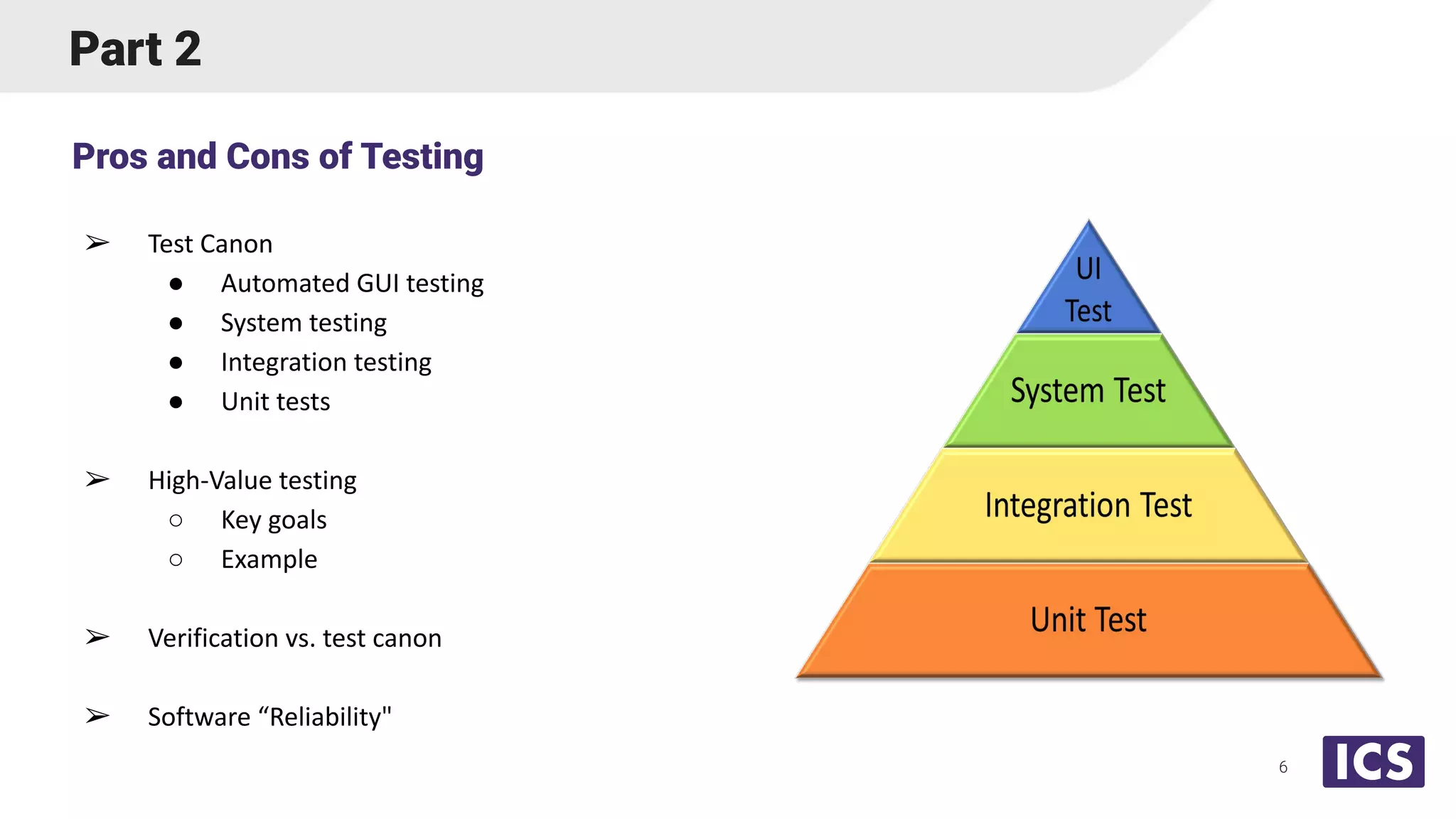
➢ Test Canon
● Automated GUI testing
● System testing
● Integration testing
● Unit tests
➢ High-Value testing
○ Key goals
○ Example
➢ Verification vs. test canon
➢ Software “Reliability"
Pros and Cons of Testing
6
Automated UI
Testing
Page #
Using a 3rd party application to automate mouse clicks on a GUI (Graphical User Interface)
Test tools manage scripts and collections and support automation
Good for:
- Stable User Interfaces (not undergoing changes)
- Enduring value - runs ‘for free’
- Functional/system/black-box testing
Automated Graphical
User Interface Testing
8
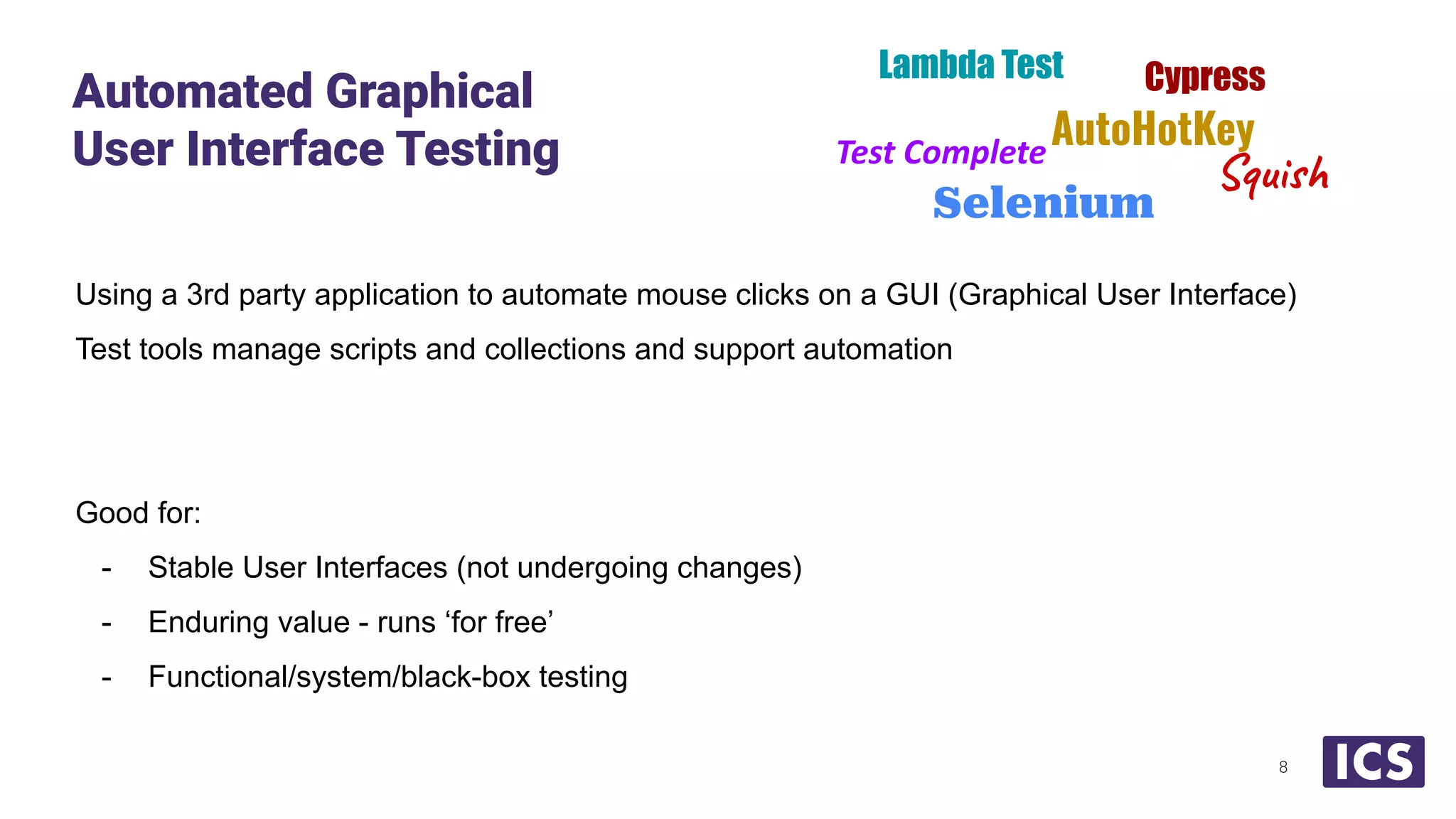
Lambda Test
Selenium
AutoHotKey
Squish
Test Complete
Cypress
Challenges
- Brittle - Superficial changes to UI can cause tests to fail
- Test strategy - create modular/reusable tests that can be daisy-chained
- No variability - tests the same thing over and over
- Mostly tells you something changed
- Changes system - additional process running on system with threading considerations
- i.e. a graphic bug example (triangles)
Automated User Interface Testing
9
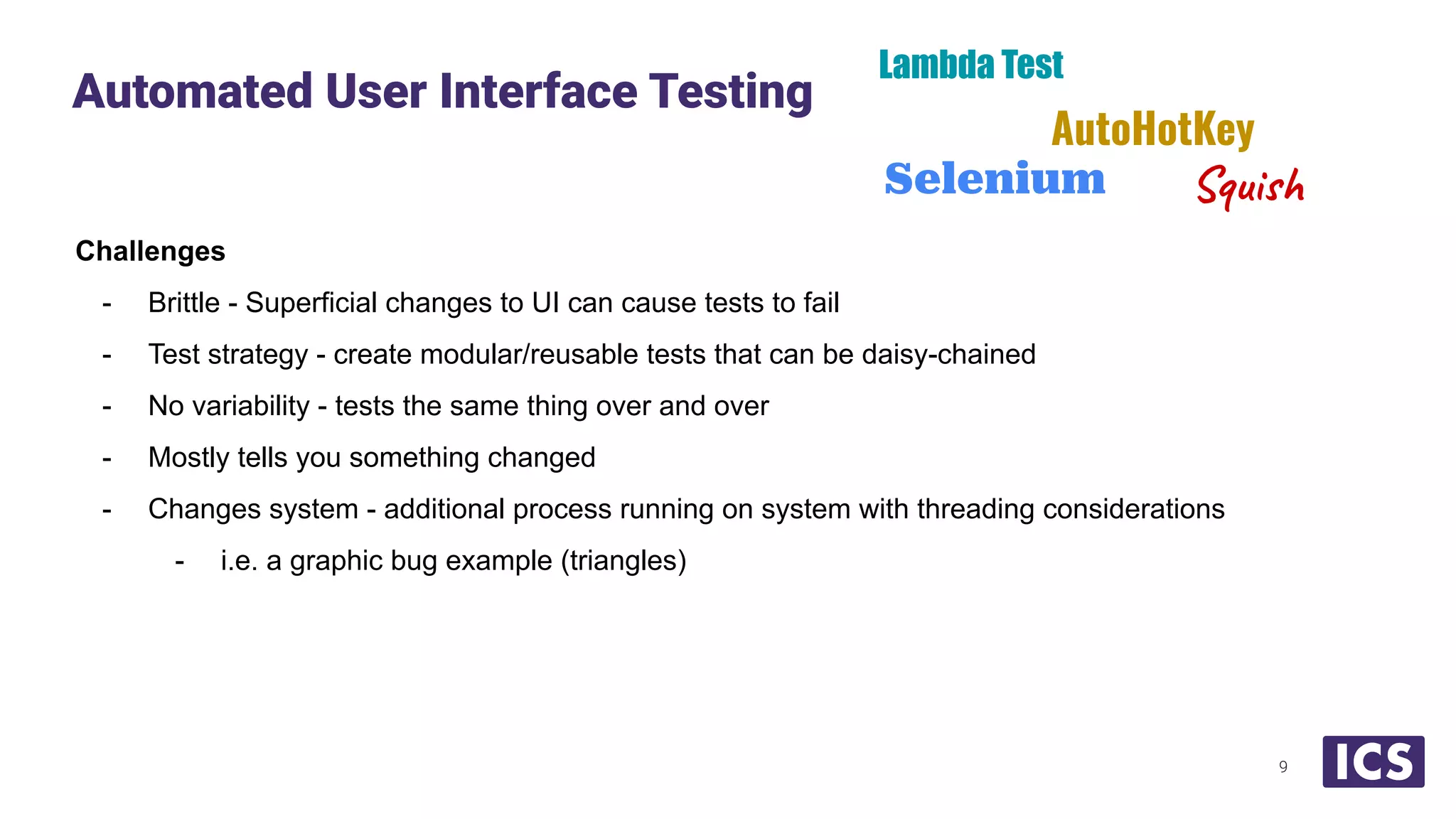
Lambda Test
Selenium
AutoHotKey
Squish
System Testing
Page #
UI vs. System testing → same?
● Depends on architecture and functionality of the UI
● Are all system behaviors available from the UI?
System Testing
● May require additional test software/framework (i.e. LIS, Cloud services)
● Focuses on positive and negative test cases
● Can be harder to automate
Both
Are tested vs. product requirements
System Testing
11
Integration Testing
Page #
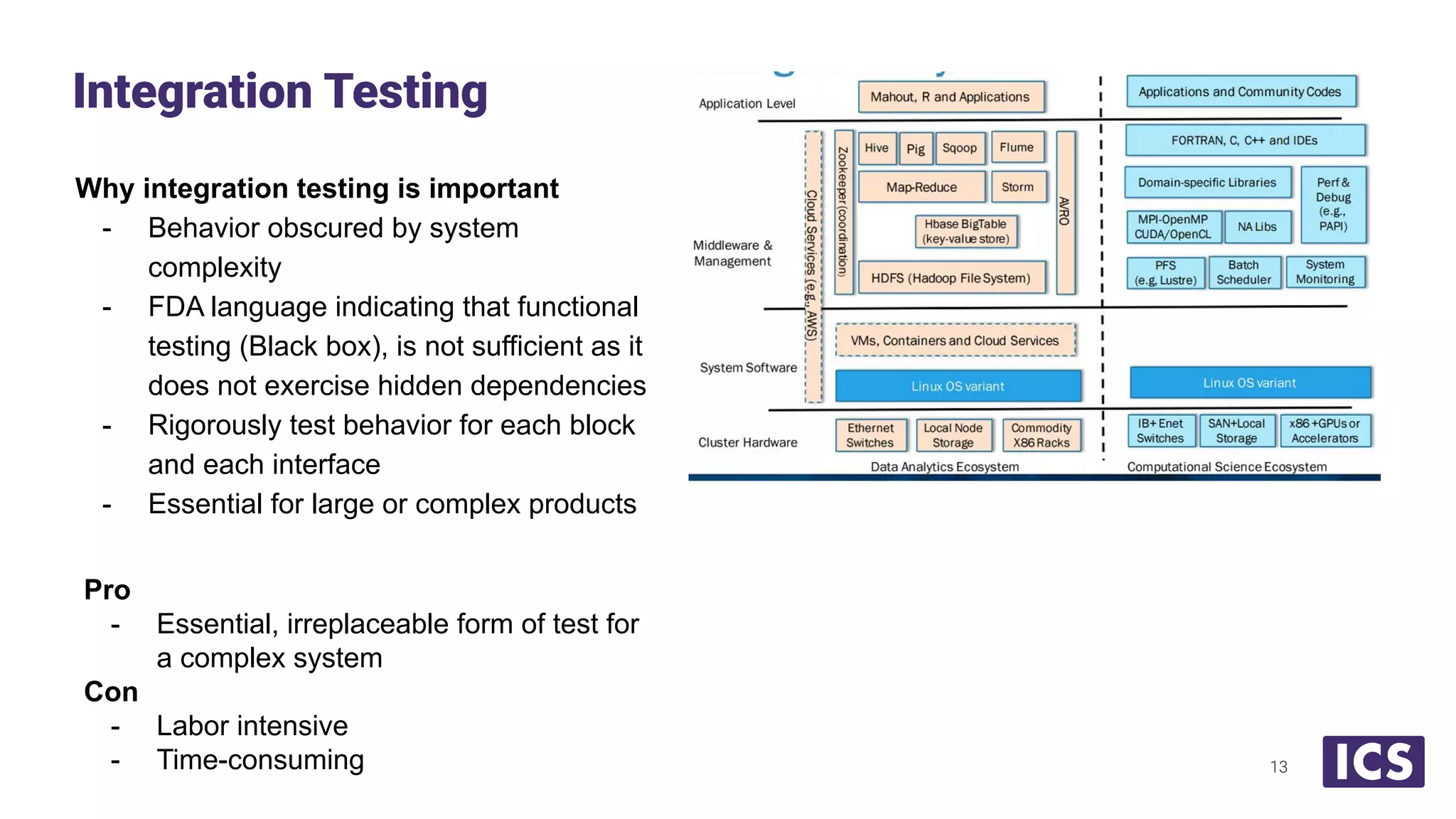
Why integration testing is important
- Behavior obscured by system
complexity
- FDA language indicating that functional
testing (Black box), is not sufficient as it
does not exercise hidden dependencies
- Rigorously test behavior for each block
and each interface
- Essential for large or complex products
Integration Testing
13
Pro
- Essential, irreplaceable form of test for
a complex system
Con
- Labor intensive
- Time-consuming
Unit Tests
Page #
Unit Tests
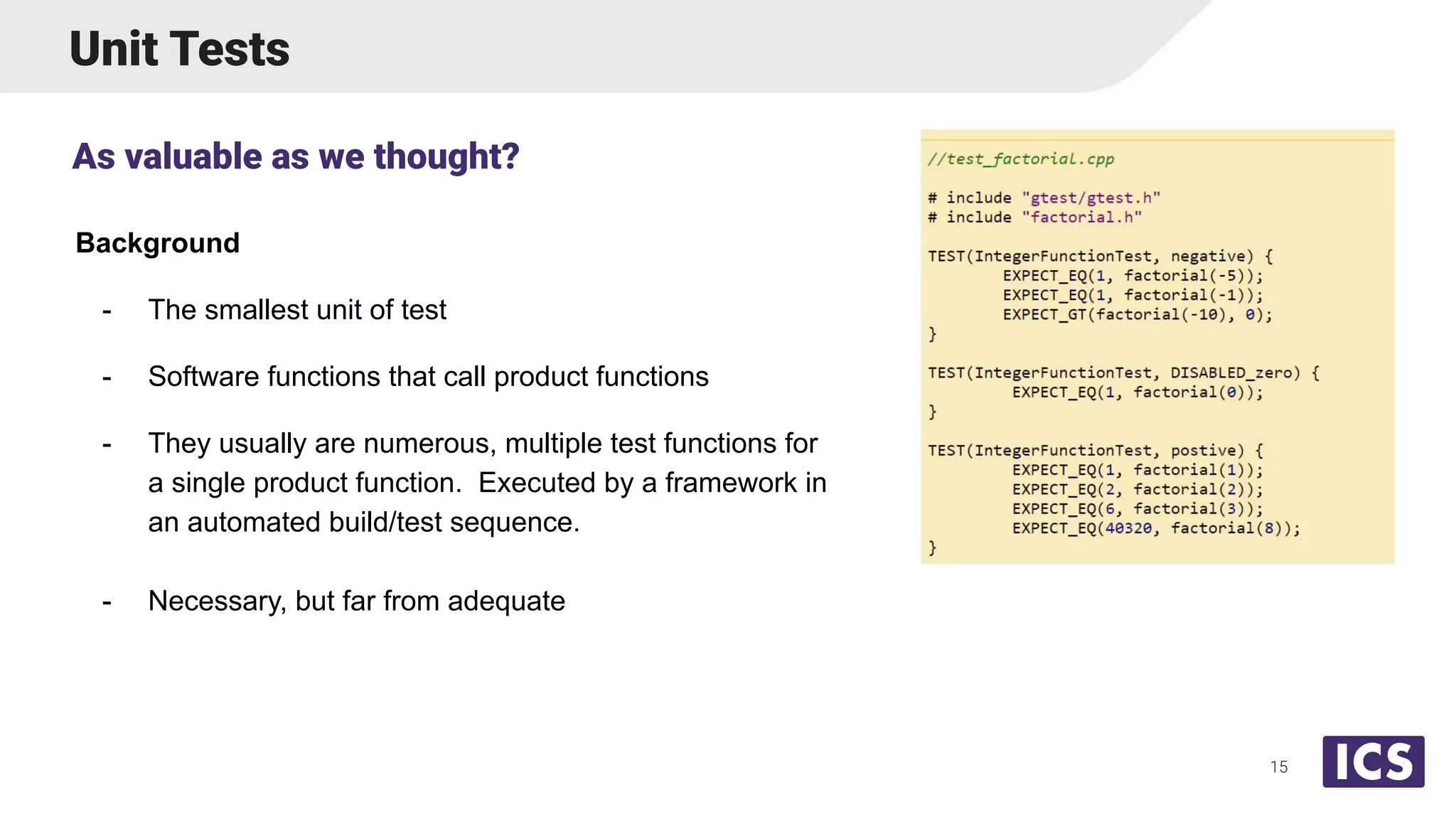
Background
- The smallest unit of test
- Software functions that call product functions
- They usually are numerous, multiple test functions for
a single product function. Executed by a framework in
an automated build/test sequence.
- Necessary, but far from adequate
As valuable as we thought?
15
Unit Tests
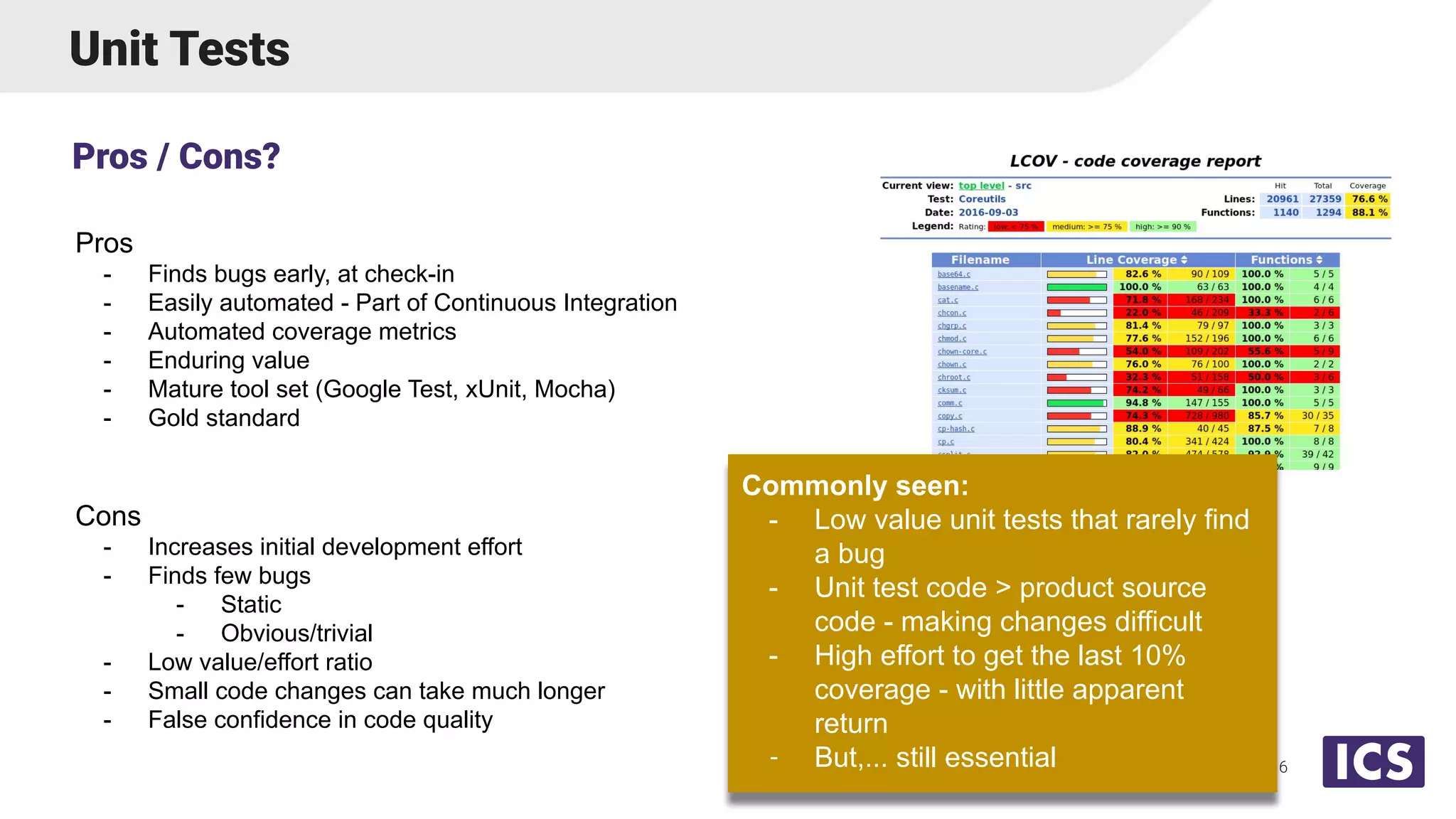
Pros
- Finds bugs early, at check-in
- Easily automated - Part of Continuous Integration
- Automated coverage metrics
- Enduring value
- Mature tool set (Google Test, xUnit, Mocha)
- Gold standard
Cons
- Increases initial development effort
- Finds few bugs
- Static
- Obvious/trivial
- Low value/effort ratio
- Small code changes can take much longer
- False confidence in code quality
Pros / Cons?
16
Commonly seen:
- Low value unit tests that rarely find
a bug
- Unit test code > product source
code - making changes difficult
- High effort to get the last 10%
coverage - with little apparent
return
- But,... still essential
Unit Tests
Keep it light
Don’t try for 100% everywhere
Differentiate highly critical vs. non-critical
Pin down the corners vs. exhaustive testing
Don’t:
Add high levels of test if product in flux
Add trivial testing to improve code coverage metrics
Best applied to
Stable products
When losing experienced staff
Sophisticated/complex designs
Automation: Continuous Integration, automated emails
Best practices
Page #
Best practice
Non-trivial tests written for stable
products with low staffing levels in an
automated environment
Worst practice
Simple tests written for 100% code
coverage on products undergoing change
TL;DR
High Value Testing
Page #
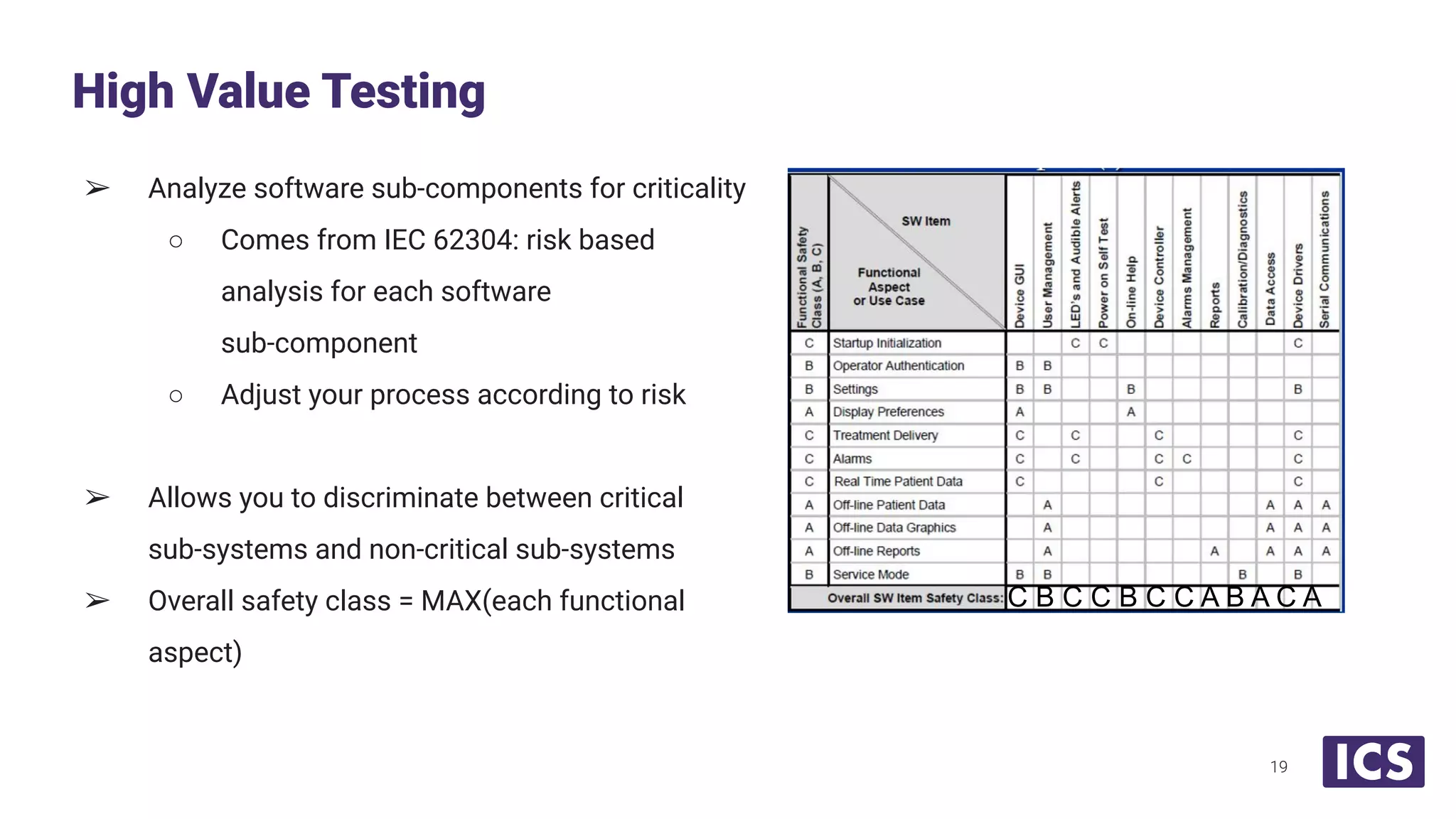
➢ Analyze software sub-components for criticality
○ Comes from IEC 62304: risk based
analysis for each software
sub-component
○ Adjust your process according to risk
➢ Allows you to discriminate between critical
sub-systems and non-critical sub-systems
➢ Overall safety class = MAX(each functional
aspect)
High Value Testing
19
C B C C B C C A B A C A
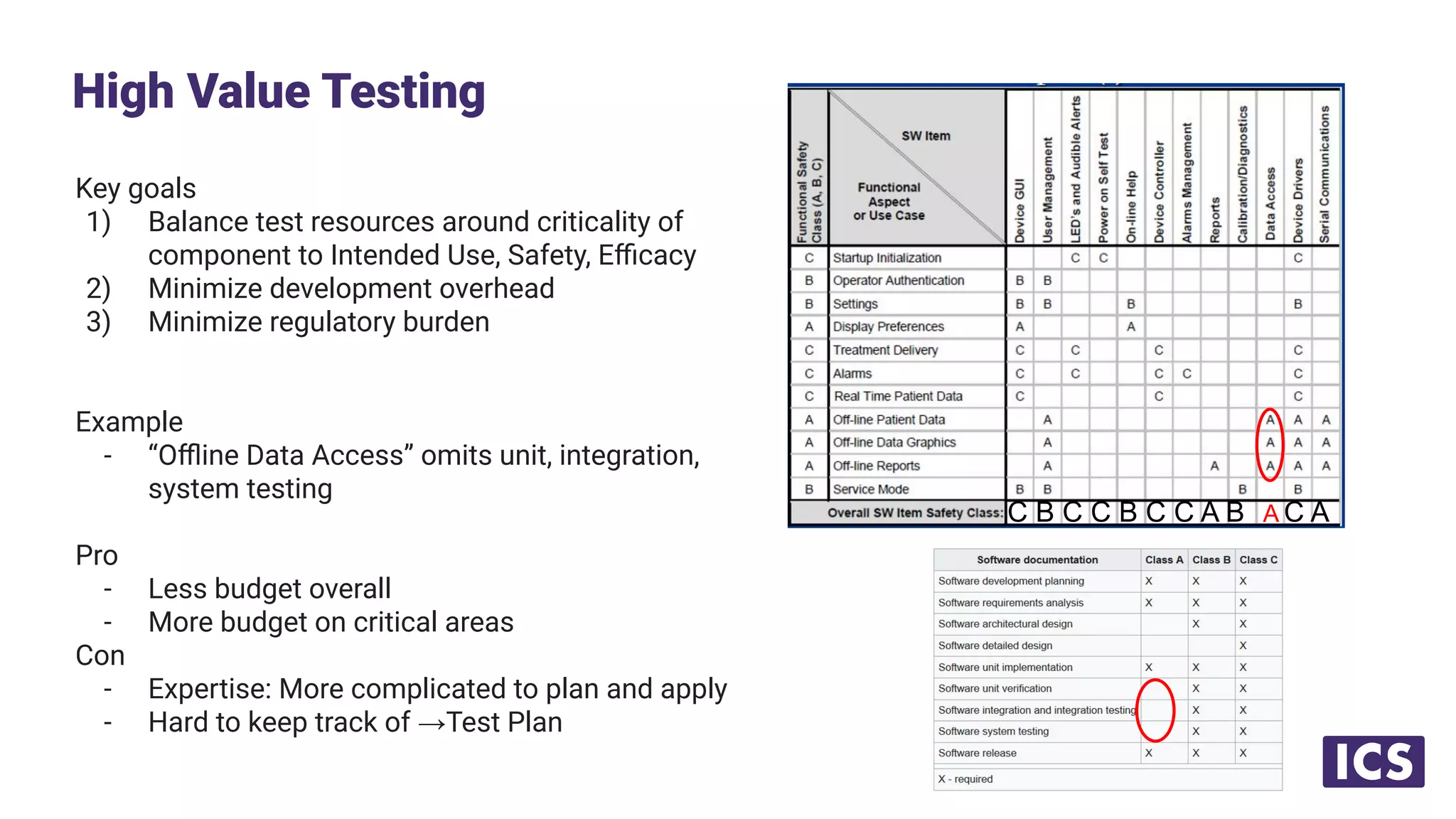
Key goals
1) Balance test resources around criticality of
component to Intended Use, Safety, Efficacy
2) Minimize development overhead
3) Minimize regulatory burden
Example
- “Offline Data Access” omits unit, integration,
system testing
Pro
- Less budget overall
- More budget on critical areas
Con
- Expertise: More complicated to plan and apply
- Hard to keep track of →Test Plan
High Value Testing
20
A
C B C C B C C A B C A
➢ Test vs. Verification
➢ Reliability
Page #
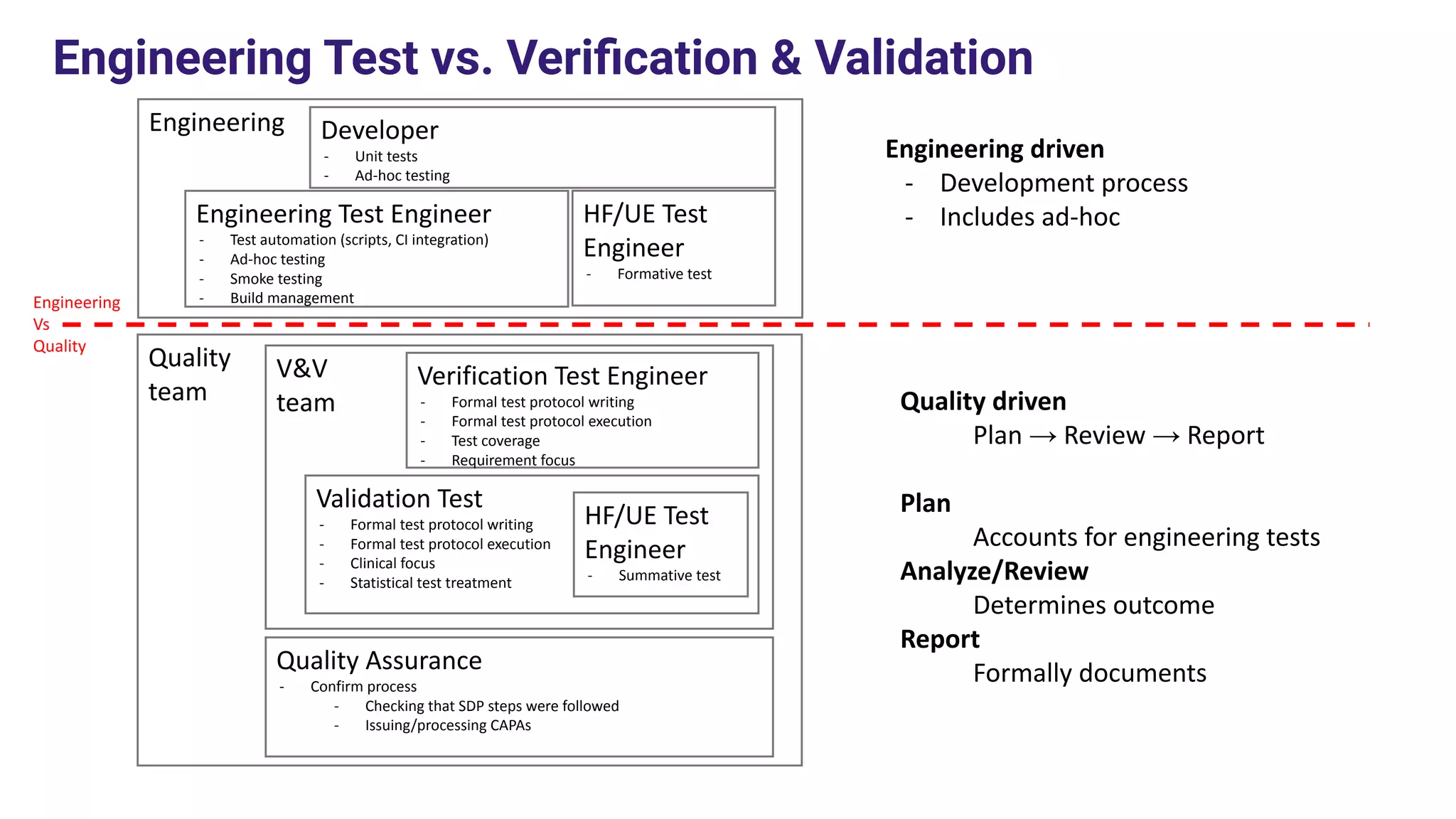
Quality
team
V&V
team
Engineering
Quality Assurance
- Confirm process
- Checking that SDP steps were followed
- Issuing/processing CAPAs
Engineering Test Engineer
- Test automation (scripts, CI integration)
- Ad-hoc testing
- Smoke testing
- Build management
Verification Test Engineer
- Formal test protocol writing
- Formal test protocol execution
- Test coverage
- Requirement focus
Validation Test
- Formal test protocol writing
- Formal test protocol execution
- Clinical focus
- Statistical test treatment
HF/UE Test
Engineer
- Summative test
HF/UE Test
Engineer
- Formative test
Engineering
Vs
Quality
Developer
- Unit tests
- Ad-hoc testing
Quality driven
Plan → Review → Report
Plan
Accounts for engineering tests
Analyze/Review
Determines outcome
Report
Formally documents
Engineering driven
- Development process
- Includes ad-hoc
Engineering Test vs. Verification & Validation
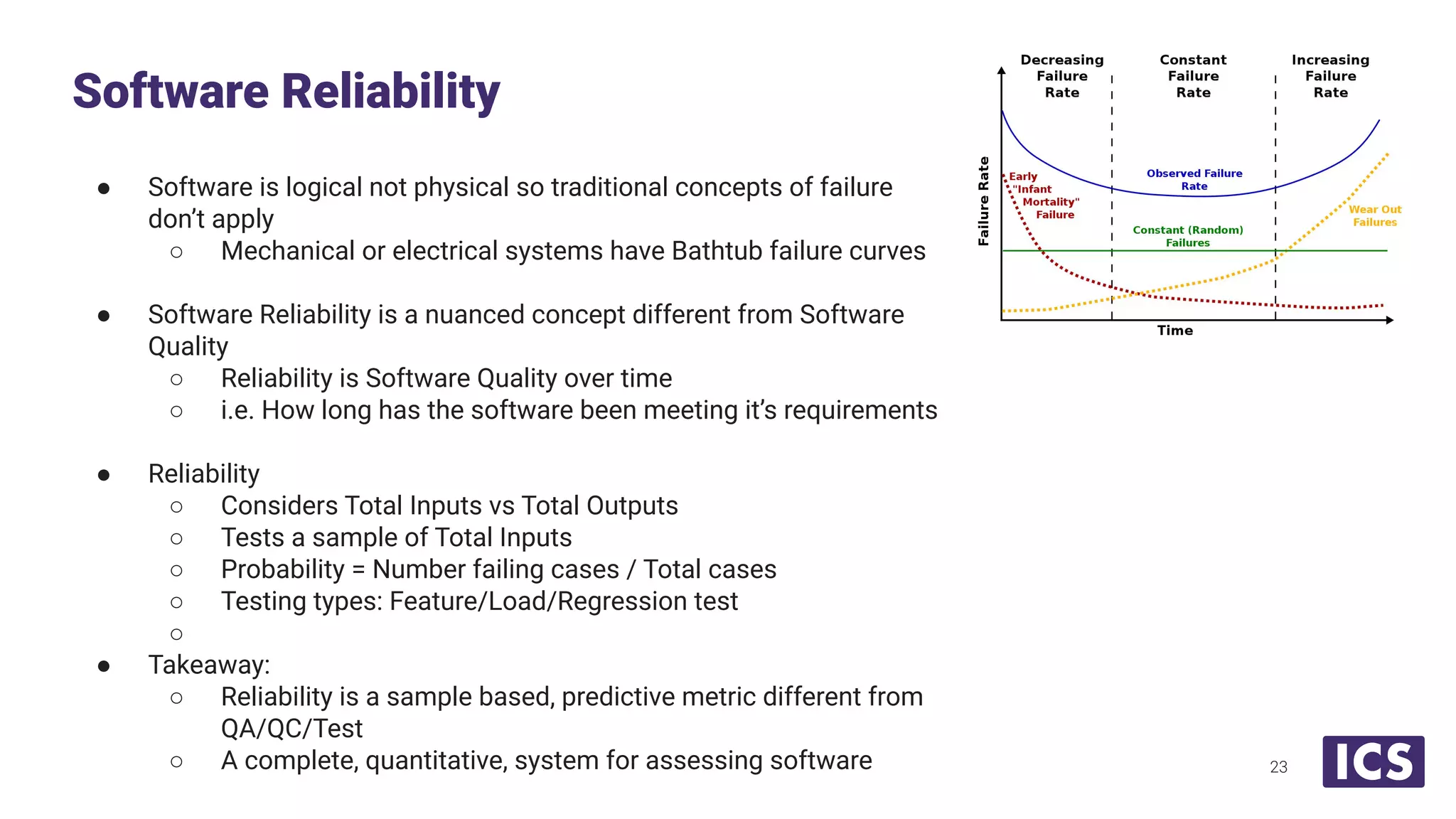
● Software is logical not physical so traditional concepts of failure
don’t apply
○ Mechanical or electrical systems have Bathtub failure curves
● Software Reliability is a nuanced concept different from Software
Quality
○ Reliability is Software Quality over time
○ i.e. How long has the software been meeting it’s requirements
● Reliability
○ Considers Total Inputs vs Total Outputs
○ Tests a sample of Total Inputs
○ Probability = Number failing cases / Total cases
○ Testing types: Feature/Load/Regression test
○
● Takeaway:
○ Reliability is a sample based, predictive metric different from
QA/QC/Test
○ A complete, quantitative, system for assessing software
Software Reliability
23
Tying it together:
Part 1 & 2
Quality vs. Test
Page #
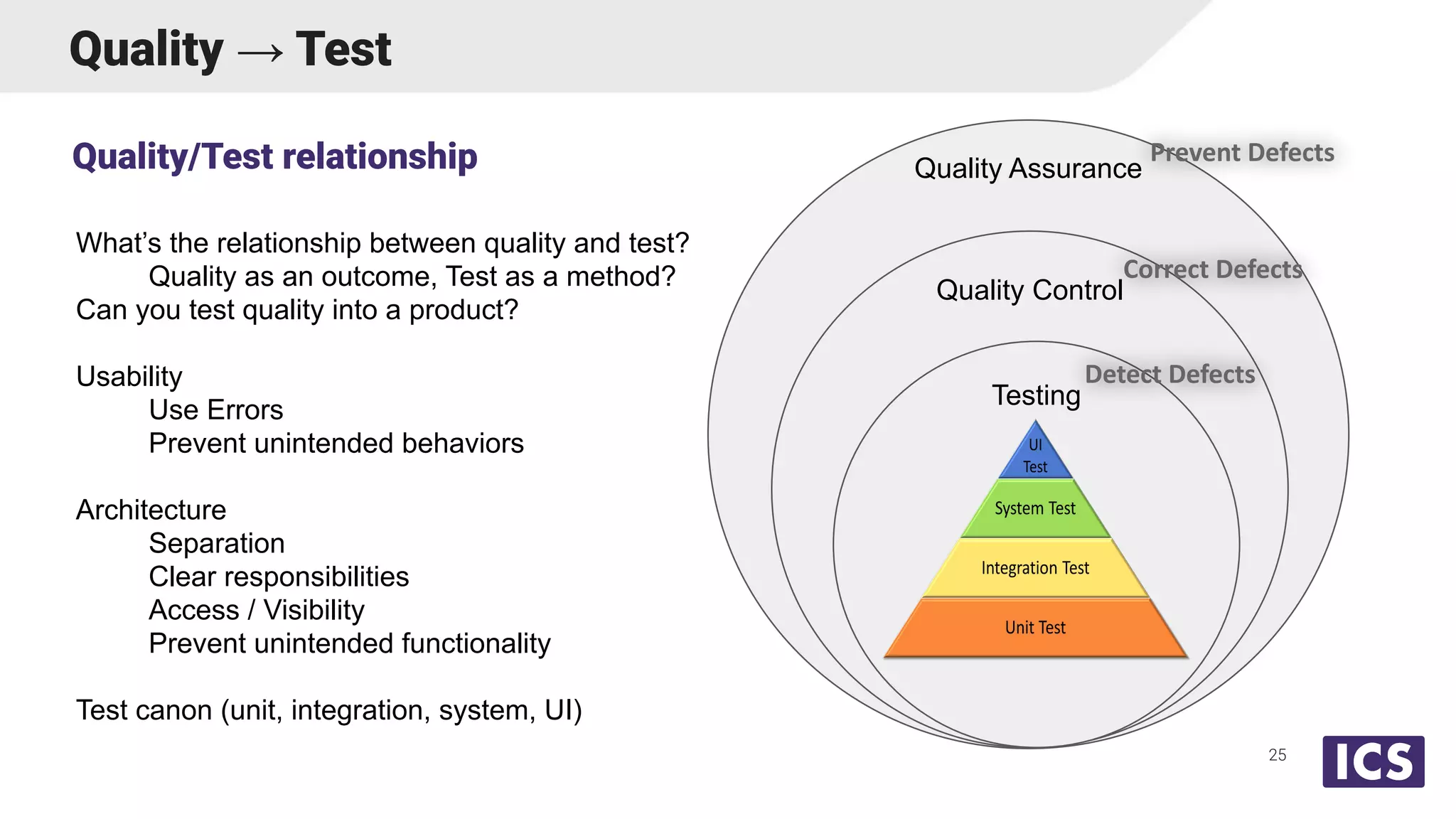
Quality → Test
What’s the relationship between quality and test?
Quality as an outcome, Test as a method?
Can you test quality into a product?
Usability
Use Errors
Prevent unintended behaviors
Architecture
Separation
Clear responsibilities
Access / Visibility
Prevent unintended functionality
Test canon (unit, integration, system, UI)
Quality/Test relationship
25
Quality Assurance
Quality Control
Testing
Prevent Defects
Correct Defects
Detect Defects
Thank You
Page #

Enhancing Quality and Test in Medical Device Design - Part 2.pdf

  • 1.
  • 2.
    About ICS Established in1987, Integrated Computer Solutions, Inc. (ICS) delivers innovative software solutions with a full suite of services to accelerate development of successful next-gen products. ICS is headquartered outside Boston in Waltham, Mass. with offices in California, Canada and Europe. Currently 160+ people.
  • 3.
    www.ics.com Delivering a FullSuite of Medtech Services ● IEC 62366-UX/UI Design ● Custom Frontend & Backend Software Development ● Development with IEC 62304-Compliant Platform ● Low-code Tools that Convert UX Prototype to Product ● Medical Device Cybersecurity ● AWS and Azure Cloud Services and Analytics ● ISO 14971-Compliant Hazard Analysis ● Software Verification Testing ● Digital Twins for Training and Simulation ● Complimentary Software Technology Assessments
  • 4.
    Quality and Testin Medical Devices 1. Part 1 - Recap 2. Part 2 - Test Methods, Pros, Cons 3. The complete picture Quality and Test Page #
  • 5.
    Part 1 Recap 1.Usability to systematically reduce Use Errors through product design - impacts quality 2. Architecture for quality - maintainable, testable, extensible, reliable, available a. Tiered layers - visibility / access b. Error injection - difficult to test sub-systems c. Dependency inversion - simulators and visibility 3. Code analyzers a. A quality tool, with tradeoffs b. Necessary but not sufficient (for complex projects) Usability and Architecture for Quality 5
  • 6.
    Part 2 ➢ TestCanon ● Automated GUI testing ● System testing ● Integration testing ● Unit tests ➢ High-Value testing ○ Key goals ○ Example ➢ Verification vs. test canon ➢ Software “Reliability" Pros and Cons of Testing 6
  • 7.
  • 8.
    Using a 3rdparty application to automate mouse clicks on a GUI (Graphical User Interface) Test tools manage scripts and collections and support automation Good for: - Stable User Interfaces (not undergoing changes) - Enduring value - runs ‘for free’ - Functional/system/black-box testing Automated Graphical User Interface Testing 8 Lambda Test Selenium AutoHotKey Squish Test Complete Cypress
  • 9.
    Challenges - Brittle -Superficial changes to UI can cause tests to fail - Test strategy - create modular/reusable tests that can be daisy-chained - No variability - tests the same thing over and over - Mostly tells you something changed - Changes system - additional process running on system with threading considerations - i.e. a graphic bug example (triangles) Automated User Interface Testing 9 Lambda Test Selenium AutoHotKey Squish
  • 10.
  • 11.
    UI vs. Systemtesting → same? ● Depends on architecture and functionality of the UI ● Are all system behaviors available from the UI? System Testing ● May require additional test software/framework (i.e. LIS, Cloud services) ● Focuses on positive and negative test cases ● Can be harder to automate Both Are tested vs. product requirements System Testing 11
  • 12.
  • 13.
    Why integration testingis important - Behavior obscured by system complexity - FDA language indicating that functional testing (Black box), is not sufficient as it does not exercise hidden dependencies - Rigorously test behavior for each block and each interface - Essential for large or complex products Integration Testing 13 Pro - Essential, irreplaceable form of test for a complex system Con - Labor intensive - Time-consuming
  • 14.
  • 15.
    Unit Tests Background - Thesmallest unit of test - Software functions that call product functions - They usually are numerous, multiple test functions for a single product function. Executed by a framework in an automated build/test sequence. - Necessary, but far from adequate As valuable as we thought? 15
  • 16.
    Unit Tests Pros - Findsbugs early, at check-in - Easily automated - Part of Continuous Integration - Automated coverage metrics - Enduring value - Mature tool set (Google Test, xUnit, Mocha) - Gold standard Cons - Increases initial development effort - Finds few bugs - Static - Obvious/trivial - Low value/effort ratio - Small code changes can take much longer - False confidence in code quality Pros / Cons? 16 Commonly seen: - Low value unit tests that rarely find a bug - Unit test code > product source code - making changes difficult - High effort to get the last 10% coverage - with little apparent return - But,... still essential
  • 17.
    Unit Tests Keep itlight Don’t try for 100% everywhere Differentiate highly critical vs. non-critical Pin down the corners vs. exhaustive testing Don’t: Add high levels of test if product in flux Add trivial testing to improve code coverage metrics Best applied to Stable products When losing experienced staff Sophisticated/complex designs Automation: Continuous Integration, automated emails Best practices Page # Best practice Non-trivial tests written for stable products with low staffing levels in an automated environment Worst practice Simple tests written for 100% code coverage on products undergoing change TL;DR
  • 18.
  • 19.
    ➢ Analyze softwaresub-components for criticality ○ Comes from IEC 62304: risk based analysis for each software sub-component ○ Adjust your process according to risk ➢ Allows you to discriminate between critical sub-systems and non-critical sub-systems ➢ Overall safety class = MAX(each functional aspect) High Value Testing 19 C B C C B C C A B A C A
  • 20.
    Key goals 1) Balancetest resources around criticality of component to Intended Use, Safety, Efficacy 2) Minimize development overhead 3) Minimize regulatory burden Example - “Offline Data Access” omits unit, integration, system testing Pro - Less budget overall - More budget on critical areas Con - Expertise: More complicated to plan and apply - Hard to keep track of →Test Plan High Value Testing 20 A C B C C B C C A B C A
  • 21.
    ➢ Test vs.Verification ➢ Reliability Page #
  • 22.
    Quality team V&V team Engineering Quality Assurance - Confirmprocess - Checking that SDP steps were followed - Issuing/processing CAPAs Engineering Test Engineer - Test automation (scripts, CI integration) - Ad-hoc testing - Smoke testing - Build management Verification Test Engineer - Formal test protocol writing - Formal test protocol execution - Test coverage - Requirement focus Validation Test - Formal test protocol writing - Formal test protocol execution - Clinical focus - Statistical test treatment HF/UE Test Engineer - Summative test HF/UE Test Engineer - Formative test Engineering Vs Quality Developer - Unit tests - Ad-hoc testing Quality driven Plan → Review → Report Plan Accounts for engineering tests Analyze/Review Determines outcome Report Formally documents Engineering driven - Development process - Includes ad-hoc Engineering Test vs. Verification & Validation
  • 23.
    ● Software islogical not physical so traditional concepts of failure don’t apply ○ Mechanical or electrical systems have Bathtub failure curves ● Software Reliability is a nuanced concept different from Software Quality ○ Reliability is Software Quality over time ○ i.e. How long has the software been meeting it’s requirements ● Reliability ○ Considers Total Inputs vs Total Outputs ○ Tests a sample of Total Inputs ○ Probability = Number failing cases / Total cases ○ Testing types: Feature/Load/Regression test ○ ● Takeaway: ○ Reliability is a sample based, predictive metric different from QA/QC/Test ○ A complete, quantitative, system for assessing software Software Reliability 23
  • 24.
    Tying it together: Part1 & 2 Quality vs. Test Page #
  • 25.
    Quality → Test What’sthe relationship between quality and test? Quality as an outcome, Test as a method? Can you test quality into a product? Usability Use Errors Prevent unintended behaviors Architecture Separation Clear responsibilities Access / Visibility Prevent unintended functionality Test canon (unit, integration, system, UI) Quality/Test relationship 25 Quality Assurance Quality Control Testing Prevent Defects Correct Defects Detect Defects
  • 26.