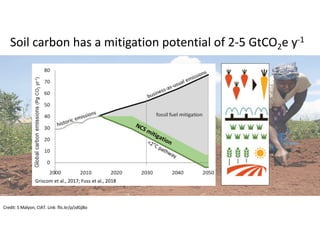
Griscom et al., 2017; Fuss et al., 2018
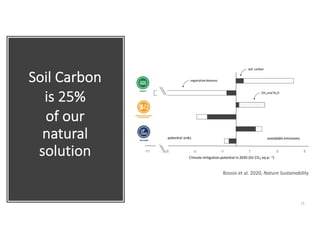
Soil carbon has a mitigation potential of 2-5 GtCO2e y-1
Credit: S Malyon, CIAT. Link: flic.kr/p/zdGjBo
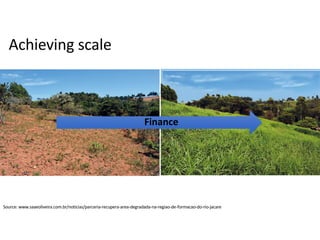
Achieving scale
Source: www.saaeoliveira.com.br/noticias/parceria-recupera-area-degradada-na-regiao-de-formacao-do-rio-jacare
Finance
How can soil carbon accounting be improved to
support investment-oriented actions promoting
soil carbon storage?
Subtitles
(captions)
available
Go to this URL in your
web browser:
http://bit.ly/soilcaptions
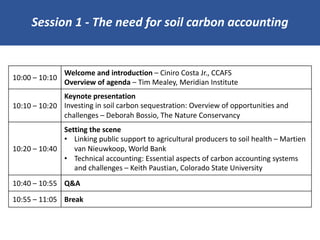
Session 1 - The need for soil carbon accounting
10:00 – 10:10
Welcome and introduction – Ciniro Costa Jr., CCAFS
Overview of agenda – Tim Mealey, Meridian Institute
10:10 – 10:20
Keynote presentation
Investing in soil carbon sequestration: Overview of opportunities and
challenges – Deborah Bossio, The Nature Conservancy
10:20 – 10:40
Setting the scene
• Linking public support to agricultural producers to soil health – Martien
van Nieuwkoop, World Bank
• Technical accounting: Essential aspects of carbon accounting systems
and challenges – Keith Paustian, Colorado State University
10:40 – 10:55 Q&A
10:55 – 11:05 Break
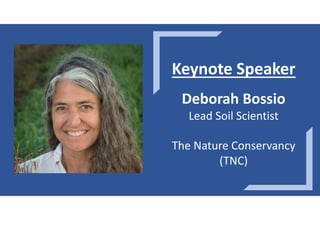
Keynote Speaker
Deborah Bossio
Lead Soil Scientist
The Nature Conservancy
(TNC)
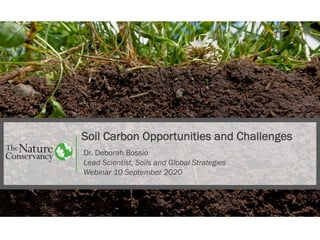
Soil Carbon Opportunities and Challenges
Dr. Deborah Bossio
Lead Scientist, Soils and Global Strategies
Webinar 10 September 2020
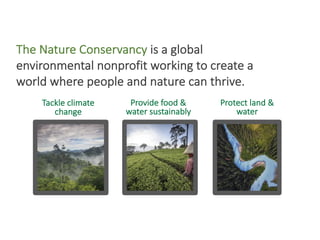
Tackle climate
change
Protect land &
water
The Nature Conservancy is a global
environmental nonprofit working to create a
world where people and nature can thrive.
Provide food &
water sustainably
© Erich Schlegel© NASA © Nick Hall
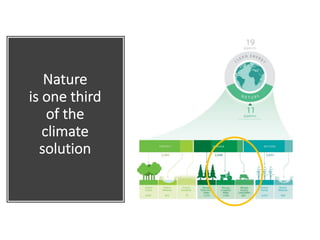
Nature
is one third
of the
climate
solution
Soil Carbon
is 25%
of our
natural
solution
11
Bossio et al. 2020, Nature Sustainability
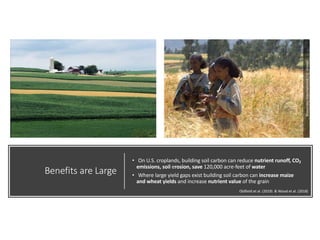
Benefits are Large
• On U.S. croplands, building soil carbon can reduce nutrient runoff, CO2
emissions, soil erosion, save 120,000 acre-feet of water
• Where large yield gaps exist building soil carbon can increase maize
and wheat yields and increase nutrient value of the grain
BioversityInternationalJ.V.Grevel
Oldfield et al. (2019) & Wood et al. (2018)
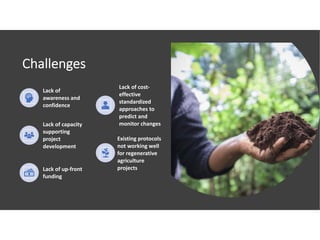
Challenges
Lack of
awareness and
confidence
Lack of cost-
effective
standardized
approaches to
predict and
monitor changesLack of capacity
supporting
project
development
Existing protocols
not working well
for regenerative
agriculture
projectsLack of up-front
funding
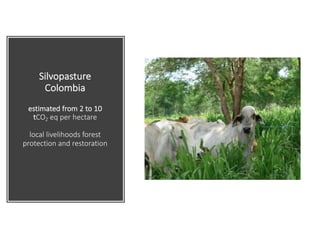
Silvopasture
Colombia
estimated from 2 to 10
tCO2 eq per hectare
local livelihoods forest
protection and restoration
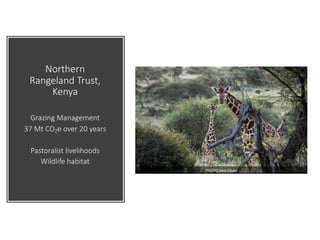
Northern
Rangeland Trust,
Kenya
Grazing Management
37 Mt CO2e over 20 years
Pastoralist livelihoods
Wildlife habitat
PHOTO Ami Vitale
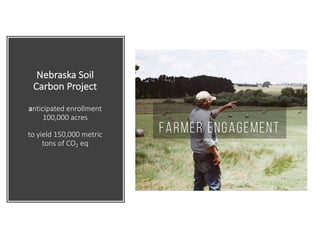
Nebraska Soil
Carbon Project
anticipated enrollment
100,000 acres
to yield 150,000 metric
tons of CO2 eq
18
Thank You
Deborah Bossio
Lead Scientist, Soils and Global Strategies
deborah.bossio@tnc.org
Martien van
Nieuwkoop
Global Director Agriculture
and Food
World Bank Group
Martien van Nieuwkoop
Global Director Agriculture & Food
The World Bank
Martien van Nieuwkoop
Global Director
Agriculture & Food
The World Bank
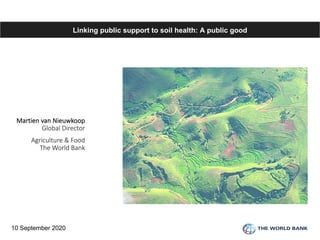
Linking public support to soil health: A public good
10 September 2020
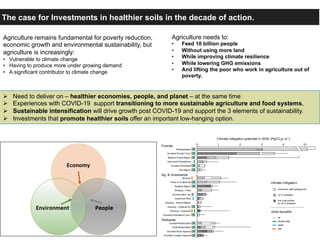
The case for Investments in healthier soils in the decade of action.
Agriculture remains fundamental for poverty reduction,
economic growth and environmental sustainability, but
agriculture is increasingly:
• Vulnerable to climate change
• Having to produce more under growing demand
• A significant contributor to climate change
Agriculture needs to:
• Feed 10 billion people
• Without using more land
• While improving climate resilience
• While lowering GHG emissions
• And lifting the poor who work in agriculture out of
poverty.
Ø Need to deliver on – healthier economies, people, and planet – at the same time
Ø Experiences with COVID-19 support transitioning to more sustainable agriculture and food systems,
Ø Sustainable intensification will drive growth post COVID-19 and support the 3 elements of sustainability.
Ø Investments that promote healthier soils offer an important low-hanging option.
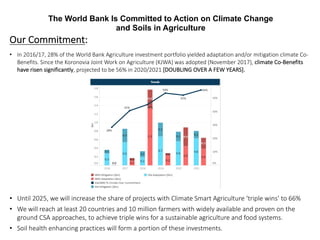
• In 2016/17, 28% of the World Bank Agriculture investment portfolio yielded adaptation and/or mitigation climate Co-
Benefits. Since the Koronovia Joint Work on Agriculture (KJWA) was adopted (November 2017), climate Co-Benefits
have risen significantly, projected to be 56% in 2020/2021 [DOUBLING OVER A FEW YEARS].
• Until 2025, we will increase the share of projects with Climate Smart Agriculture ‘triple wins’ to 66%
• We will reach at least 20 countries and 10 million farmers with widely available and proven on the
ground CSA approaches, to achieve triple wins for a sustainable agriculture and food systems.
• Soil health enhancing practices will form a portion of these investments.
Our Commitment:
The World Bank Is Committed to Action on Climate Change
and Soils in Agriculture
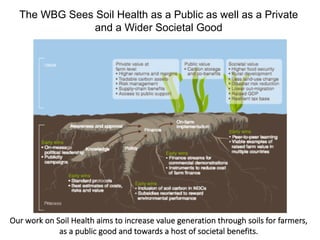
Our work on Soil Health aims to increase value generation through soils for farmers,
as a public good and towards a host of societal benefits.
The WBG Sees Soil Health as a Public as well as a Private
and a Wider Societal Good
• The WBG is rapidly scaling up financing and action via Climate Smart Investment Plans (CSAIPs)
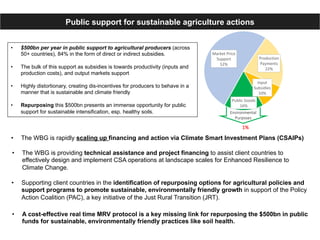
• $500bn per year in public support to agricultural producers (across
50+ countries), 84% in the form of direct or indirect subsidies.
• The bulk of this support as subsidies is towards productivity (inputs and
production costs), and output markets support
• Highly distortionary, creating dis-incentives for producers to behave in a
manner that is sustainable and climate friendly
• Repurposing this $500bn presents an immense opportunity for public
support for sustainable intensification, esp. healthy soils.
• The WBG is providing technical assistance and project financing to assist client countries to
effectively design and implement CSA operations at landscape scales for Enhanced Resilience to
Climate Change.
• Supporting client countries in the identification of repurposing options for agricultural policies and
support programs to promote sustainable, environmentally friendly growth in support of the Policy
Action Coalition (PAC), a key initiative of the Just Rural Transition (JRT).
Public support for sustainable agriculture actions
• A cost-effective real time MRV protocol is a key missing link for repurposing the $500bn in public
funds for sustainable, environmentally friendly practices like soil health.
Production
Payments
22%
Input
Subsidies
10%
Public Goods
16%
Market Price
Support
52%
Environmental
Purposes
1%
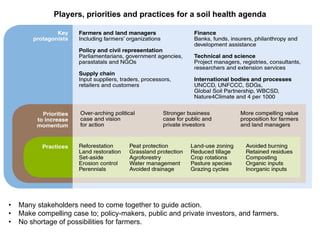
Players, priorities and practices for a soil health agenda
• Many stakeholders need to come together to guide action.
• Make compelling case to; policy-makers, public and private investors, and farmers.
• No shortage of possibilities for farmers.
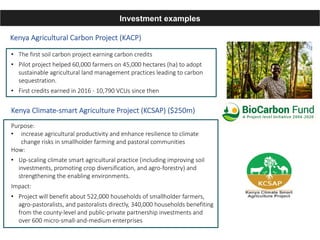
Kenya Agricultural Carbon Project (KACP)
• The first soil carbon project earning carbon credits
• Pilot project helped 60,000 farmers on 45,000 hectares (ha) to adopt
sustainable agricultural land management practices leading to carbon
sequestration.
• First credits earned in 2016 - 10,790 VCUs since then
Investment examples
Purpose:
• increase agricultural productivity and enhance resilience to climate
change risks in smallholder farming and pastoral communities
How:
• Up-scaling climate smart agricultural practice (including improving soil
investments, promoting crop diversification, and agro-forestry) and
strengthening the enabling environments.
Impact:
• Project will benefit about 522,000 households of smallholder farmers,
agro-pastoralists, and pastoralists directly, 340,000 households benefiting
from the county-level and public-private partnership investments and
over 600 micro-small-and-medium enterprises
Kenya Climate-smart Agriculture Project (KCSAP) ($250m)
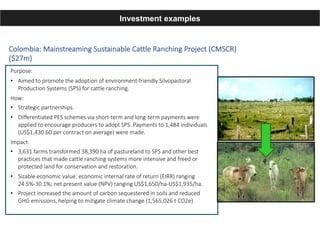
Colombia: Mainstreaming Sustainable Cattle Ranching Project (CMSCR)
($27m)
Purpose:
• Aimed to promote the adoption of environment-friendly Silvopastoral
Production Systems (SPS) for cattle ranching.
How:
• Strategic partnerships.
• Differentiated PES schemes via short-term and long-term payments were
applied to encourage producers to adopt SPS. Payments to 1,484 individuals
(US$1,430.60 per contract on average) were made.
Impact:
• 3,631 farms transformed 38,390 ha of pastureland to SPS and other best
practices that made cattle ranching systems more intensive and freed or
protected land for conservation and restoration.
• Sizable economic value: economic internal rate of return (EIRR) ranging
24.5%-30.1%; net present value (NPV) ranging US$1,650/ha-US$1,935/ha.
• Project increased the amount of carbon sequestered in soils and reduced
GHG emissions, helping to mitigate climate change (1,565,026 t CO2e)
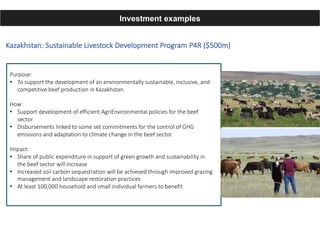
Investment examples
Kazakhstan: Sustainable Livestock Development Program P4R ($500m)
Purpose:
• To support the development of an environmentally sustainable, inclusive, and
competitive beef production in Kazakhstan.
How:
• Support development of efficient AgriEnvironmental policies for the beef
sector
• Disbursements linked to some set commitments for the control of GHG
emissions and adaptation to climate change in the beef sector.
Impact:
• Share of public expenditure in support of green growth and sustainability in
the beef sector will increase
• Increased soil carbon sequestration will be achieved through improved grazing
management and landscape restoration practices
• At least 100,000 household and small individual farmers to benefit
Investment examples
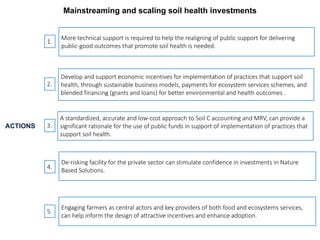
ACTIONS
1
More technical support is required to help the realigning of public support for delivering
public-good outcomes that promote soil health is needed.
De-risking facility for the private sector can stimulate confidence in investments in Nature
Based Solutions.
Develop and support economic incentives for implementation of practices that support soil
health, through sustainable business models, payments for ecosystem services schemes, and
blended financing (grants and loans) for better environmental and health outcomes .
Engaging farmers as central actors and key providers of both food and ecosystems services,
can help inform the design of attractive incentives and enhance adoption.
A standardized, accurate and low-cost approach to Soil C accounting and MRV, can provide a
significant rationale for the use of public funds in support of implementation of practices that
support soil health.
Mainstreaming and scaling soil health investments
1.
2.
3.
4.
5.
Keith Paustian
University Distinguished
Professor
Colorado State
University
Keith Paustian
Dept. Soil and Crop Sciences and Natural Resource Ecology Lab
Colorado State University
Fort Collins, CO
Soil carbon and GHG accounting
systems: Needs, challenges and
emerging opportunities
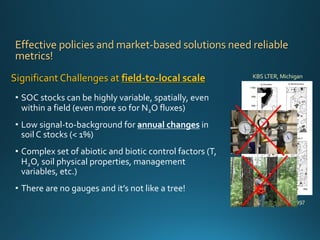
Effective policies and market-based solutions need reliable
metrics!
• SOC stocks can be highly variable, spatially, even
within a field (even more so for N2O fluxes)
• Low signal-to-background for annual changes in
soil C stocks (< 1%)
• Complex set of abiotic and biotic control factors (T,
H2O, soil physical properties, management
variables, etc.)
• There are no gauges and it’s not like a tree!
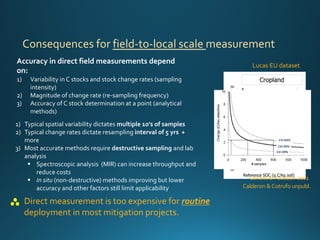
Significant Challenges at field-to-local scale KBS LTER, Michigan
Robertson et al. 1997
Lucas EU dataset
Calderon &Cotrufo unpubl.
Consequences for field-to-local scale measurement
Accuracy in direct field measurements depend
on:
1) Variability in C stocks and stock change rates (sampling
intensity)
2) Magnitude of change rate (re-sampling frequency)
3) Accuracy of C stock determination at a point (analytical
methods)
1) Typical spatial variability dictates multiple 10’s of samples
2) Typical change rates dictate resampling interval of 5 yrs +
more
3) Most accurate methods require destructive sampling and lab
analysis
§ Spectroscopic analysis (MIR) can increase throughput and
reduce costs
§ In situ (non-destructive) methods improving but lower
accuracy and other factors still limit applicability
Conant & Paustian 2002
Direct measurement is too expensive for routine
deployment in most mitigation projects.
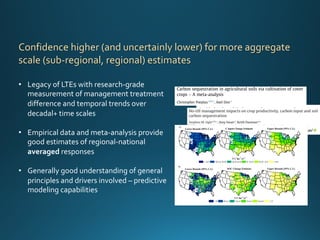
Confidence higher (and uncertainly lower) for more aggregate
scale (sub-regional, regional) estimates
• Legacy of LTEs with research-grade
measurement of management treatment
difference and temporal trends over
decadal+ time scales
• Empirical data and meta-analysis provide
good estimates of regional-national
averaged responses
• Generally good understanding of general
principles and drivers involved – predictive
modeling capabilities
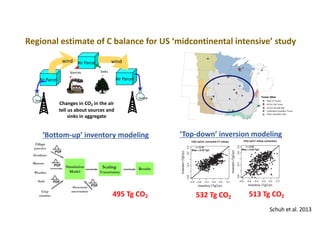
Air Parcel Air Parcel
Air Parcel
Sources Sinks
Sample
Sample
Changes in CO2 in the air
tell us about sources and
sinks in aggregate
wind wind
Schuh et al. 2013
513 Tg CO2532 Tg CO2495 Tg CO2
Regional estimate of C balance for US ‘midcontinental intensive’ study
‘Bottom-up’ inventory modeling ‘Top-down’ inversion modeling
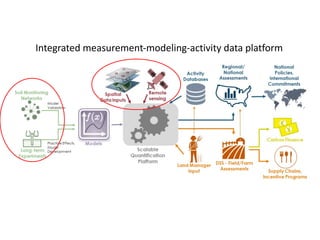
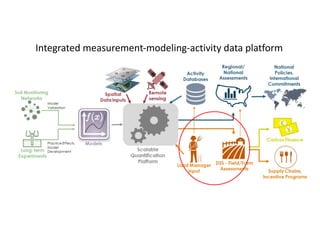
Goal : Low-cost estimates with low bias and ‘moderate’
uncertainty at ‘project’ scale
• Focus on high quality direct measurements
• Reduced uncertainty of local-scaled predictive models
• Capability to easily incorporate farm-level activity data
Integrated measurement-modeling-activity data platform
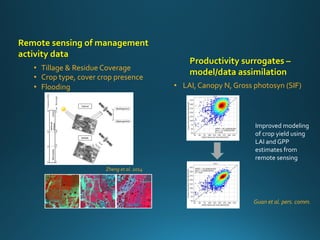
Remote sensing of management
activity data
• Tillage & Residue Coverage
• Crop type, cover crop presence
• Flooding
Guan et al. pers. comm.
Zheng et al. 2014
Productivity surrogates –
model/data assimilation
• LAI, Canopy N, Gross photosyn (SIF)
Improved modeling
of crop yield using
LAI and GPP
estimates from
remote sensing
Integrated measurement-modeling-activity data platform
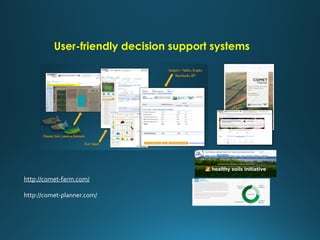
User-friendly decision support systems
http://comet-farm.com/
http://comet-planner.com/
Enhancing investment in soil health and
carbon storage: Frontiers for linking finance
and carbon accounting
10 September
2020
10am – 1:15pm
EDT
Question & Answer
10:40 – 10:55 EDT
15 minutes
Please use the Q&A
function to ask questions.
Break
10:55 – 11:05 EDT
10 minutes
Enhancing investment in soil health and
carbon storage: Frontiers for linking finance
and carbon accounting
10 September
2020
10am – 1:15pm
EDT
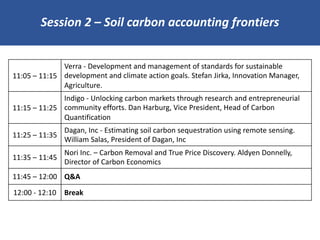
Session 2 – Soil carbon accounting frontiers
11:05 – 11:15
Verra - Development and management of standards for sustainable
development and climate action goals. Stefan Jirka, Innovation Manager,
Agriculture.
11:15 – 11:25
Indigo - Unlocking carbon markets through research and entrepreneurial
community efforts. Dan Harburg, Vice President, Head of Carbon
Quantification
11:25 – 11:35
Dagan, Inc - Estimating soil carbon sequestration using remote sensing.
William Salas, President of Dagan, Inc
11:35 – 11:45
Nori Inc. – Carbon Removal and True Price Discovery. Aldyen Donnelly,
Director of Carbon Economics
11:45 – 12:00 Q&A
12:00 - 12:10 Break
Stefan Jirka
Innovation Manager,
Agriculture
Verra
Verra
10 September 2020
Development and management of standards for
sustainable agriculture and climate action goals
Stefan Jirka, Innovation Manager, Agriculture
Verra catalyzes measurable climate action and sustainable
development outcomes by driving large-scale investment to activities
that reduce emissions, improve livelihoods, and protect nature.
11 September 2020
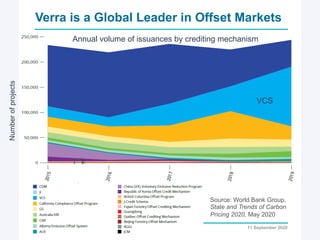
Verra is a Global Leader in Offset Markets
Source: World Bank Group,
State and Trends of Carbon
Pricing 2020, May 2020
Annual volume of issuances by crediting mechanism
Numberofprojects
VCS
11 September 2020
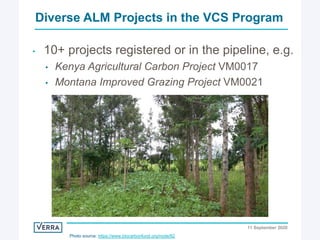
• 10+ projects registered or in the pipeline, e.g.
• Kenya Agricultural Carbon Project VM0017
• Montana Improved Grazing Project VM0021
Diverse ALM Projects in the VCS Program
11 September 2020
Photo source: https://www.biocarbonfund.org/node/82
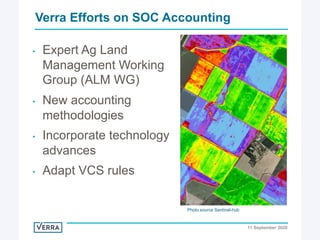
Verra Efforts on SOC Accounting
11 September 2020
• Expert Ag Land
Management Working
Group (ALM WG)
• New accounting
methodologies
• Incorporate technology
advances
• Adapt VCS rules
Photo source Sentinel-hub
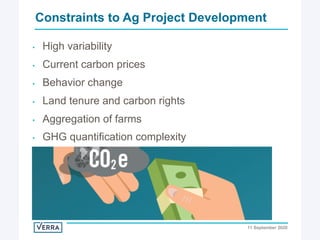
Constraints to Ag Project Development
11 September 2020
• High variability
• Current carbon prices
• Behavior change
• Land tenure and carbon rights
• Aggregation of farms
• GHG quantification complexity
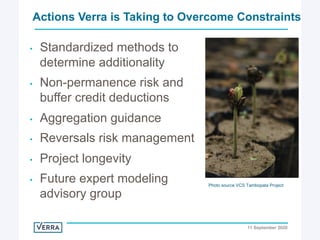
Actions Verra is Taking to Overcome Constraints
11 September 2020
• Standardized methods to
determine additionality
• Non-permanence risk and
buffer credit deductions
• Aggregation guidance
• Reversals risk management
• Project longevity
• Future expert modeling
advisory group
Photo source VCS Tambopata Project
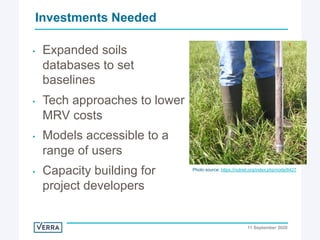
• Expanded soils
databases to set
baselines
• Tech approaches to lower
MRV costs
• Models accessible to a
range of users
• Capacity building for
project developers
Investments Needed
11 September 2020
Photo source: https://nutnet.org/index.php/node/6427
Soil Health Benefits Beyond Carbon
11 September 2020
+ SDGs
Verra
1 Thomas Circle, NW
Suite 1050
Washington, DC 20005
www.verra.org
Thank You!
Questions?
sjirka@verra.org
Dan Harburg
Vice President, Head of
Carbon Quantification
Indigo
Unlocking carbon markets through
research and entrepreneurial
community efforts
Dan Harburg, Ph.D.
Vice President, Head of Carbon Quantification
S E P T 1 0 , 2 0 2 0
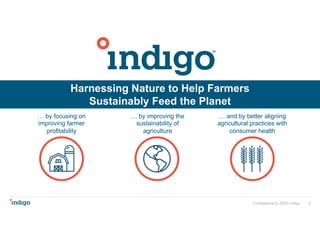
2Confidential © 2020 Indigo
… by focusing on
improving farmer
profitability
… by improving the
sustainability of
agriculture
… and by better aligning
agricultural practices with
consumer health
Harnessing Nature to Help Farmers
Sustainably Feed the Planet
3Confidential © 2020 Indigo
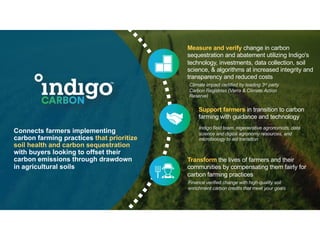
Connects farmers implementing
carbon farming practices that prioritize
soil health and carbon sequestration
with buyers looking to offset their
carbon emissions through drawdown
in agricultural soils
Measure and verify change in carbon
sequestration and abatement utilizing Indigo's
technology, investments, data collection, soil
science, & algorithms at increased integrity and
transparency and reduced costs
Support farmers in transition to carbon
farming with guidance and technology
Transform the lives of farmers and their
communities by compensating them fairly for
carbon farming practices
Indigo field team, regenerative agronomists, data
science and digital agronomy resources, and
microbiology to aid transition
Climate impact certified by leading 3rd party
Carbon Registries (Verra & Climate Action
Reserve)
Finance verified change with high-quality soil
enrichment carbon credits that meet your goals
4Confidential © 2020 Indigo
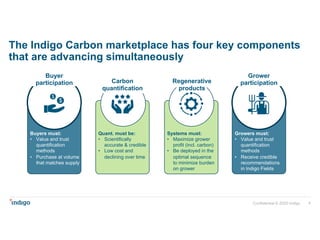
The Indigo Carbon marketplace has four key components
that are advancing simultaneously
Quant. must be:
• Scientifically
accurate & credible
• Low cost and
declining over time
Carbon
quantification
Growers must:
• Value and trust
quantification
methods
• Receive credible
recommendations
in Indigo Fields
Grower
participation
Buyers must:
• Value and trust
quantification
methods
• Purchase at volume
that matches supply
Buyer
participation
Systems must:
• Maximize grower
profit (incl. carbon)
• Be deployed in the
optimal sequence
to minimize burden
on grower
Regenerative
products
5Confidential © 2020 Indigo
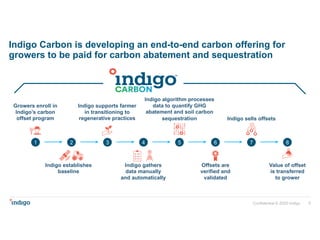
Growers enroll in
Indigo’s carbon
offset program
Indigo establishes
baseline
1
Indigo supports farmer
in transitioning to
regenerative practices
Indigo gathers
data manually
and automatically
Indigo algorithm processes
data to quantify GHG
abatement and soil carbon
sequestration
Offsets are
verified and
validated
Value of offset
is transferred
to grower
Indigo sells offsets
3 5 6 7 842
.
Indigo Carbon is developing an end-to-end carbon offering for
growers to be paid for carbon abatement and sequestration
6Confidential © 2020 Indigo
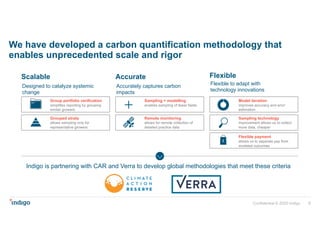
We have developed a carbon quantification methodology that
enables unprecedented scale and rigor
Scalable
Designed to catalyze systemic
change
Accurate
Accurately captures carbon
impacts
Flexible
Flexible to adapt with
technology innovations
Sampling + modelling
enables sampling of fewer fields
Model iteration
improves accuracy and error
estimation
Group portfolio verification
simplifies reporting by grouping
similar growers
Grouped strata
allows sampling only for
representative growers
Flexible payment
allows us to separate pay from
modeled outcomes
Remote monitoring
allows for remote collection of
detailed practice data
Sampling technology
improvement allows us to collect
more data, cheaper
Indigo is partnering with CAR and Verra to develop global methodologies that meet these criteria
7Confidential © 2020 Indigo
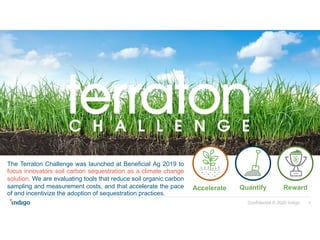
The Terraton Challenge was launched at Beneficial Ag 2019 to
focus innovators soil carbon sequestration as a climate change
solution. We are evaluating tools that reduce soil organic carbon
sampling and measurement costs, and that accelerate the pace
of and incentivize the adoption of sequestration practices.
Accelerate RewardQuantify
Confidential © 2020 Indigo
8Confidential © 2020 Indigo
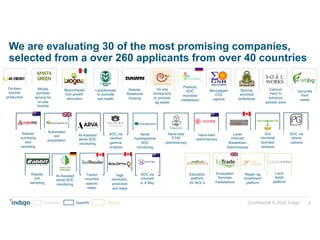
We are evaluating 30 of the most promising companies,
selected from a over 260 applicants from over 40 countries
Robotic
Rotational
Grazing
Biochar
enriched
biofertilizer
Mycorrhizael
root growth
stimulator
Microalgael
CO2
capture
On-site
bioreactors
to process
ag waste
On-farm
biochar
production
Prebiotic
SOC
microbial
metabolizer
AMATA
GREEN
Mobile
pyrolizer
service for
on-site
biochar
Calcium
input to
enhance
aerobic zone
SOC via
volumetr
ic X-Ray
SOC via
neutron
gamma
analysis
SOC via
phone
camera
Hand-held
spectroscopy
Robotic
soil
sampling
Land
lease
platform
Education
platform
for NOL’s
Regen ag
investment
platform
Ecosystem
Services
marketplace
Tractor
mounted
spectro
meter
High
resolution,
predictive
soil maps
Laser
Induced
Breakdown
Spectroscopy
Soil
microbial
biomass
analysis
AI-Assisted
aerial SOC
monitoring
Aerial
hyperspectral
SOC
monitoring
Robotic
surveying
and
sampling
Hand-held
FTIR
spectroscopy
AI-Assisted
aerial SOC
monitoring
Upcycled
food
waste
Lactobionate
to promote
soil health
Accelerate Quantify Reward
Automated
soil
preparation
Confidential © 2020 Indigo
9Confidential © 2020 Indigo
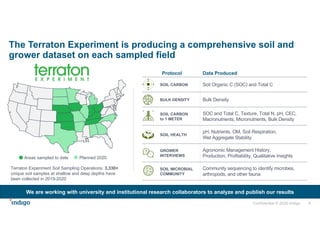
The Terraton Experiment is producing a comprehensive soil and
grower dataset on each sampled field
Protocol Data Produced
SOIL CARBON Soil Organic C (SOC) and Total C
BULK DENSITY Bulk Density
SOIL CARBON
to 1 METER
SOC and Total C, Texture, Total N, pH, CEC,
Macronutrients, Micronutrients, Bulk Density
SOIL HEALTH
pH, Nutrients, OM, Soil Respiration,
Wet Aggregate Stability
GROWER
INTERVIEWS
Agronomic Management History,
Production, Profitability, Qualitative Insights
SOIL MICROBIAL
COMMUNITY
Community sequencing to identify microbes,
arthropods, and other fauna
Areas sampled to date Planned 2020
Terraton Experiment Soil Sampling Operations: 3,330+
unique soil samples at shallow and deep depths have
been collected in 2019-2020
We are working with university and institutional research collaborators to analyze and publish our results
10Confidential © 2020 Indigo
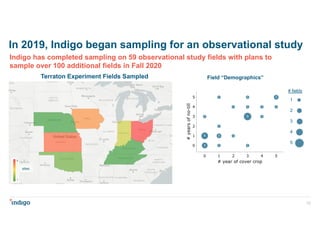
In 2019, Indigo began sampling for an observational study
Indigo has completed sampling on 59 observational study fields with plans to
sample over 100 additional fields in Fall 2020
Terraton Experiment Fields Sampled Field “Demographics”
1
2
3
4
5
# fields
sites
11Confidential © 2020 Indigo
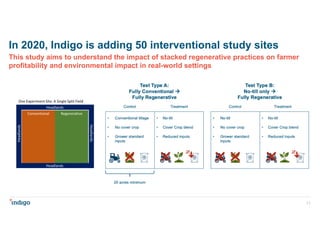
In 2020, Indigo is adding 50 interventional study sites
This study aims to understand the impact of stacked regenerative practices on farmer
profitability and environmental impact in real-world settings
William Salas
President
Dagan, Inc
Linking Remote Sensing and
Modeling to Build the Business
Case for Soil Health
William Salas, Dagan Inc
Session 2 - Soil carbon accounting frontiers
Learning from emerging experiences linking
investment and soil carbon accounting
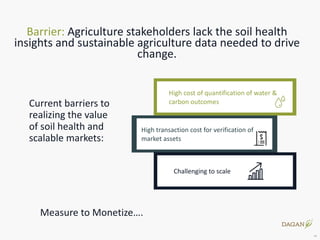
High transaction cost for verification of
market assets
Barrier: Agriculture stakeholders lack the soil health
insights and sustainable agriculture data needed to drive
change.
Current barriers to
realizing the value
of soil health and
scalable markets:
High cost of quantification of water &
carbon outcomes
Challenging to scale
69
Measure to Monetize….
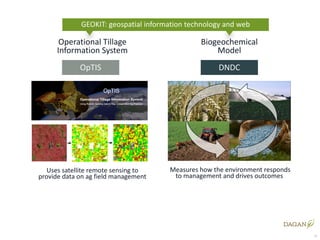
OpTIS DNDC
Operational Tillage
Information System
Biogeochemical
Model
Measures how the environment responds
to management and drives outcomes
Uses satellite remote sensing to
provide data on ag field management
70
GEOKIT: geospatial information technology and web
applications
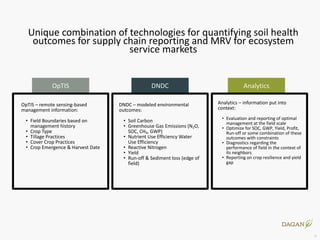
Unique combination of technologies for quantifying soil health
outcomes for supply chain reporting and MRV for ecosystem
service markets
OpTIS DNDC Analytics
OpTIS – remote sensing-based
management information:
• Field Boundaries based on
management history
• Crop Type
• Tillage Practices
• Cover Crop Practices
• Crop Emergence & Harvest Date
DNDC – modeled environmental
outcomes:
• Soil Carbon
• Greenhouse Gas Emissions (N2O,
SOC, CH4, GWP)
• Nutrient Use Efficiency Water
Use Efficiency
• Reactive Nitrogen
• Yield
• Run-off & Sediment loss (edge of
field)
Analytics – information put into
context:
• Evaluation and reporting of optimal
management at the field scale
• Optimize for SOC, GWP, Yield, Profit,
Run-off or some combination of these
outcomes with constraints
• Diagnostics regarding the
performance of field in the context of
its neighbors
• Reporting on crop resilience and yield
gap
71
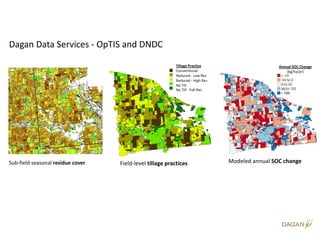
Dagan Data Services - OpTIS and DNDC
Sub-field seasonal residue cover Field-level tillage practices Modeled annual SOC change
Tillage Practice
Conventional
Reduced - Low Res
Reduced - High Res
No Till
No Till - Full Res
Annual SOC Change
(kg/ha/yr)
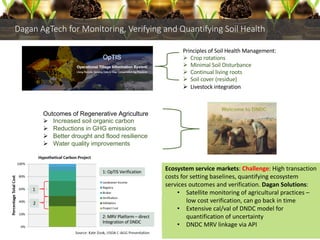
Dagan AgTech for Monitoring, Verifying and Quantifying Soil Health
Principles of Soil Health Management:
Ø Crop rotations
Ø Minimal Soil Disturbance
Ø Continual living roots
Ø Soil cover (residue)
Ø Livestock integration
1: OpTIS Verification
2: MRV Platform – direct
Integration of DNDC
1
2
Ecosystem service markets: Challenge: High transaction
costs for setting baselines, quantifying ecosystem
services outcomes and verification. Dagan Solutions:
• Satellite monitoring of agricultural practices –
low cost verification, can go back in time
• Extensive cal/val of DNDC model for
quantification of uncertainty
• DNDC MRV linkage via API
Outcomes of Regenerative Agriculture
Ø Increased soil organic carbon
Ø Reductions in GHG emissions
Ø Better drought and flood resilience
Ø Water quality improvements
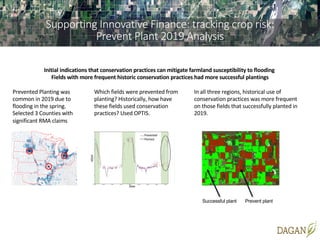
Supporting Innovative Finance: tracking crop risk:
Prevent Plant 2019 Analysis
Initial indications that conservation practices can mitigate farmland susceptibility to flooding
Fields with more frequent historic conservation practices had more successful plantings
Prevented Planting was
common in 2019 due to
flooding in the spring.
Selected 3 Counties with
significant RMA claims
Which fields were prevented from
planting? Historically, how have
these fields used conservation
practices? Used OPTIS.
In all three regions, historical use of
conservation practices was more frequent
on those fields that successfully planted in
2019.
Successful plant Prevent plant
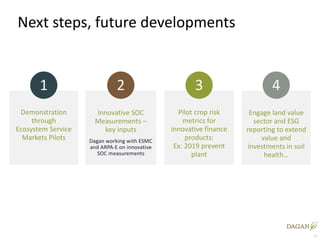
Dagan working with ESMC
and ARPA-E on innovative
SOC measurements
Demonstration
through
Ecosystem Service
Markets Pilots
Innovative SOC
Measurements –
key inputs
Pilot crop risk
metrics for
innovative finance
products:
Ex: 2019 prevent
plant
Engage land value
sector and ESG
reporting to extend
value and
investments in soil
health…
1 2 3 4
75
Next steps, future developments
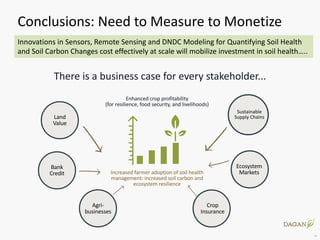
Increased farmer adoption of soil health
management: increased soil carbon and
ecosystem resilience
Enhanced crop profitability
(for resilience, food security, and livelihoods)
Land
Value
Bank
Credit
Agri-
businesses
Crop
Insurance
Ecosystem
Markets
Sustainable
Supply Chains
There is a business case for every stakeholder...
76
Conclusions: Need to Measure to Monetize
Innovations in Sensors, Remote Sensing and DNDC Modeling for Quantifying Soil Health
and Soil Carbon Changes cost effectively at scale will mobilize investment in soil health…..
Aldyen Donnelly
Co-founder and Director
of Carbon Economics
Nori Inc.
Carbon Removal and True
Price Discovery
Aldyen Donnelly, co-Founder and
Director of Carbon Economics, Nori Inc.,
https://nori.com/
Session 2 - Soil carbon accounting frontiers
Learning from emerging experiences linking
investment and soil carbon accounting
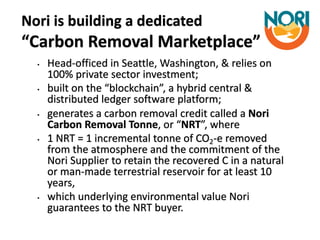
Nori is building a dedicated
“Carbon Removal Marketplace”
• Head-officed in Seattle, Washington, & relies on
100% private sector investment;
• built on the “blockchain”, a hybrid central &
distributed ledger software platform;
• generates a carbon removal credit called a Nori
Carbon Removal Tonne, or “NRT”, where
• 1 NRT = 1 incremental tonne of CO2-e removed
from the atmosphere and the commitment of the
Nori Supplier to retain the recovered C in a natural
or man-made terrestrial reservoir for at least 10
years,
• which underlying environmental value Nori
guarantees to the NRT buyer.
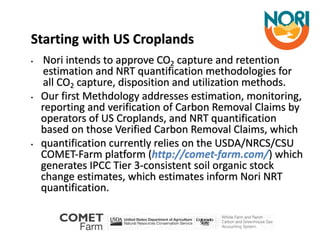
Starting with US Croplands
• Nori intends to approve CO2 capture and retention
estimation and NRT quantification methodologies for
all CO2 capture, disposition and utilization methods.
• Our first Methdology addresses estimation, monitoring,
reporting and verification of Carbon Removal Claims by
operators of US Croplands, and NRT quantification
based on those Verified Carbon Removal Claims, which
• quantification currently relies on the USDA/NRCS/CSU
COMET-Farm platform (http://comet-farm.com/) which
generates IPCC Tier 3-consistent soil organic stock
change estimates, which estimates inform Nori NRT
quantification.
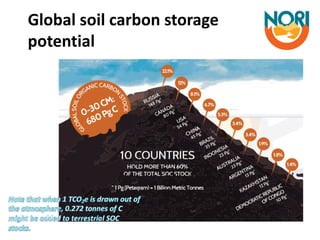
Global soil carbon storage
potential
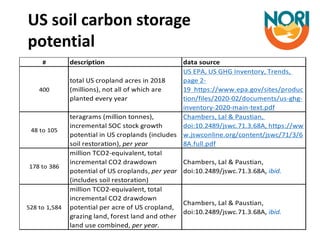
US soil carbon storage
potential
# description data source
400
total US cropland acres in 2018
(millions), not all of which are
planted every year
US EPA, US GHG Inventory, Trends,
page 2-
19 https://www.epa.gov/sites/produc
tion/files/2020-02/documents/us-ghg-
inventory-2020-main-text.pdf
48 to 105
teragrams (million tonnes),
incremental SOC stock growth
potential in US croplands (includes
soil restoration), per year
Chambers, Lal & Paustian,
doi:10.2489/jswc.71.3.68A, https://ww
w.jswconline.org/content/jswc/71/3/6
8A.full.pdf
178 to 386
million TCO2-equivalent, total
incremental CO2 drawdown
potential of US croplands, per year
(includes soil restoration)
Chambers, Lal & Paustian,
doi:10.2489/jswc.71.3.68A, ibid.
528 to 1,584
million TCO2-equivalent, total
incremental CO2 drawdown
potential per acre of US cropland,
grazing land, forest land and other
land use combined, per year.
Chambers, Lal & Paustian,
doi:10.2489/jswc.71.3.68A, ibid.
Nori is the first carbon market to...
• Support both retail and wholesale carbon credit sales. (Small
credit buyers can directly purchase without going through brokers. Brokers are
welcome, but not the only conduits to supply for small volume, or “retail”
buyers.)
• Support true carbon price discovery. (NRT suppliers set, confidentially,
minimum NRT sales prices, and can change those prices any time at their sol
discretion. Nori markets the NRTs with the goal of attracting best price.)
• Minimize project validation/verification costs without
compromosing verification quality. (Automatic generation of a Draft
Verification Report in response to receipt of Postive Verification Report.)
• Limit credit quantification reliance on ex-ante crediting.
• Use a dynamic--adjusted for weather/climate impacts-- carbon
flux baseline. (Making the market attractive to late adopters of best
practices.)
• Eliminate up-front project registration and recurring annual
registration maintenance fees. (Nori revenues are tied to successfull
NRT sales.)
Contribution of this method
• Direct access to small (“retail”) NRTs purchasers and
reduced verification costs means suppliers net a
much larger % of price paid by offset credit buyers
• First carbon market to eliminate risk of double
counting, double crediting.
• First carbon market to adopt a performance
benchmark that does not favor early adopters over
late adopters of regenerative/sustainable practices.
• First carbon market to take a practical approach to
the question of “permanence”. (controversial)
Nori market performance, to date
• Started on-line retail NRT sales in fall of 2019.
• ~16,000 NRTs sold, to date @ US$17.25/NRT, of
which $15/NRT has been delivered to
farmer/suppliers
• NRT demand exceeds NRT supply, at this time
• 250k to 400k of pre-qualifed NRT supply in Nori's
enrollment pipeline, at this time.
• Goal to hold Nori's first NRT Forward Contract
Auction in late Q1 or early Q2, 2021
Conclusions
Check us out!
https://nori.com/
Enhancing investment in soil health and
carbon storage: Frontiers for linking finance
and carbon accounting
10 September
2020
10am – 1:15pm
EDT
Question & Answer
11:45 – 12:00 EDT
15 minutes
Please use the Q&A
function to ask questions.
Break
12:00 – 12:10 EDT
10 minutes
Enhancing investment in soil health and
carbon storage: Frontiers for linking finance
and carbon accounting
10 September
2020
10am – 1:15pm
EDT
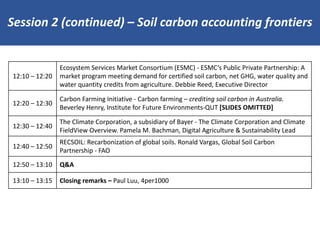
Session 2 (continued) – Soil carbon accounting frontiers
12:10 – 12:20
Ecosystem Services Market Consortium (ESMC) - ESMC’s Public Private Partnership: A
market program meeting demand for certified soil carbon, net GHG, water quality and
water quantity credits from agriculture. Debbie Reed, Executive Director
12:20 – 12:30
Carbon Farming Initiative - Carbon farming – crediting soil carbon in Australia.
Beverley Henry, Institute for Future Environments-QUT [SLIDES OMITTED]
12:30 – 12:40
The Climate Corporation, a subsidiary of Bayer - The Climate Corporation and Climate
FieldView Overview. Pamela M. Bachman, Digital Agriculture & Sustainability Lead
12:40 – 12:50
RECSOIL: Recarbonization of global soils. Ronald Vargas, Global Soil Carbon
Partnership - FAO
12:50 – 13:10 Q&A
13:10 – 13:15 Closing remarks – Paul Luu, 4per1000
Debbie Reed
Executive Director
Ecosystem Services Market
Consortium (ESMC)
ESMC’s Public Private Partnership:
A Market Meeting Demand for Certified Soil C, Net
GHG, Water Quality & Water Quantity Credits from
Agriculture
Enhancing Investment in Soil Health and Carbon Storage:
Frontiers for Linking Finance & Carbon Accounting
September 10, 2020
Debbie Reed, ESMC Executive Director
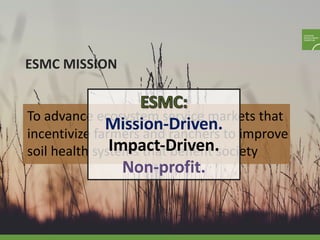
To advance ecosystem service markets that
incentivize farmers and ranchers to improve
soil health systems that benefit society
ESMC MISSION
92
Mission-Driven.
Impact-Driven.
Non-profit.
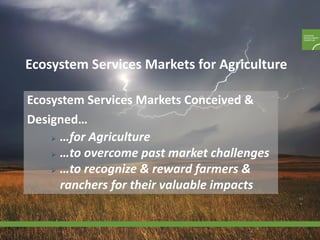
Ecosystem Services Markets for Agriculture
93
Ecosystem Services Markets Conceived &
Designed…
Ø …for Agriculture
Ø …to overcome past market challenges
Ø …to recognize & reward farmers &
ranchers for their valuable impacts
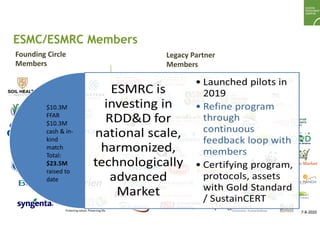
ESMC/ESMRC Members
Founding Circle
Members
Legacy Partner
Members
94
7-8-2020
$10.3M
FFAR
$10.3M
cash & in-
kind
match
Total:
$23.5M
raised to
date
95
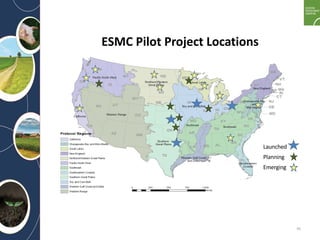
ESMC Pilot Project Locations
Launched
Planning
Emerging
Soil Organic Carbon MRV for Finance
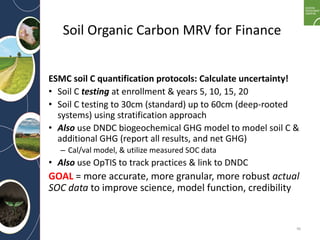
ESMC soil C quantification protocols: Calculate uncertainty!
• Soil C testing at enrollment & years 5, 10, 15, 20
• Soil C testing to 30cm (standard) up to 60cm (deep-rooted
systems) using stratification approach
• Also use DNDC biogeochemical GHG model to model soil C &
additional GHG (report all results, and net GHG)
– Cal/val model, & utilize measured SOC data
• Also use OpTIS to track practices & link to DNDC
GOAL = more accurate, more granular, more robust actual
SOC data to improve science, model function, credibility
96
Soil Organic Carbon MRV for Finance
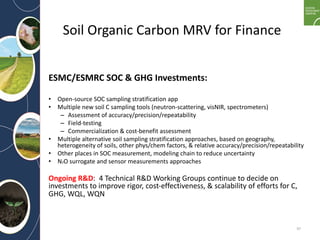
ESMC/ESMRC SOC & GHG Investments:
• Open-source SOC sampling stratification app
• Multiple new soil C sampling tools (neutron-scattering, visNIR, spectrometers)
– Assessment of accuracy/precision/repeatability
– Field-testing
– Commercialization & cost-benefit assessment
• Multiple alternative soil sampling stratification approaches, based on geography,
heterogeneity of soils, other phys/chem factors, & relative accuracy/precision/repeatability
• Other places in SOC measurement, modeling chain to reduce uncertainty
• N2O surrogate and sensor measurements approaches
Ongoing R&D: 4 Technical R&D Working Groups continue to decide on
investments to improve rigor, cost-effectiveness, & scalability of efforts for C,
GHG, WQL, WQN
97
Soil Organic Carbon MRV for Finance
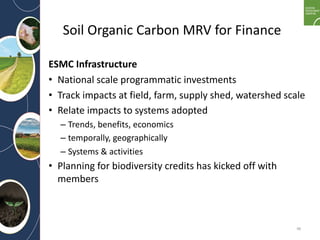
ESMC Infrastructure
• National scale programmatic investments
• Track impacts at field, farm, supply shed, watershed scale
• Relate impacts to systems adopted
– Trends, benefits, economics
– temporally, geographically
– Systems & activities
• Planning for biodiversity credits has kicked off with
members
98
THANK YOU
99
CONTACT US:
dreed@ecosystemservicesmarket.org
https://ecosystemservicesmarket.org
Beverley Henry
Adjunct Associate
Professor
Queensland University of
Technology;
4p1000 Scientific and
Technical Committee
SLIDES OMMITED FOR PRIVACY