Enhancing Classroom Comfort: An IoT-Driven Smart Air Conditioning System for Optimized Learning Environments.pdf
1.
1
Enhancing Classroom Comfort:An IoT-Driven Smart
Air Conditioning System for Optimized Learning
Environments
Hyandri Maharjan
Faculty of Computing Engineering and Built Environment
Birmingham City University
hyandri.maharjan@mail.bcu.ac.uk
Abstract
Abstract—With increasing population and demand for convenience, Air conditioners consume 10% of energy globally and is
expected to rise exponentially. The rising need for energy-efficient and user-friendly cooling solutions has led to smart air
conditioners becoming revolutionary advancements in climate control technology. This paper looks at the design, functionality,
and benefits of smart air conditioners, which integrate Internet of Things technologies to enhance cooling management.
Tinkercad software was used to design the prototype and simulate the system. This system integrates different sensors such as
motion sensor, temperature sensor, and humidity sensor. Arduino Uno R3 was used as the microcontroller to control logic
decisions, take inputs from sensors and give required outputs. Four live simulations of the system were done, and snippets are
presented in the paper. One of the caveats of this project is that it is limited to beginner friendly IoT prototype. If industry
ready IoT prototypes were used the results could have been far better. However, the significance of this paper is to make
reader understand importance of Sustainable development goals and its execution by 2030.
Keywords: IoT, smart AC, sensors, tinkercad, innovation
I. Introduction
With the rapid growth of technology, the demand for air conditioners in households and workspaces for convenience and comfort is
seen increasing. A news article in 2018 shows 10% global energy consumption through air conditioner and demand for Global energy
for it is expected to triple by 2050 (IEA, 2018) .This trend shows growing concern for global energy consumption and climate effects.
Air conditioners used on manual settings usually lead to unnecessary consumption of energy. Hence, integrating air conditioners with
Internet of Things using different sensors and devices such that it operates automatically, switching itself on or off, and controlling
heat intensities through room temperature provides an innovative solution. This article aims to explore the design and implementation
of IoT-based smart air conditioners, highlighting the benefits, working principles, and potential impact on energy efficiency.
II. Literature Review
A. Traditional Air Conditioner
The traditional air conditioners are designed to produce a large quantity of cool air, which gets distributed via home’s duct system.
They are typically engineered to cool the entire house at once. They operate all the time even when its unoccupied or not using them.
This conventional technology poses a threat to over-energy consumption and high bills which directly affect the climate.
B. The Tech Tsunami: Computing Trends That Are Reshaping Our World
Computing technology can be considered integral to the research and development side of smart IoT air
conditioners. Nowadays, the integration of Internet of Things(IoT), processing of real data in real-time, and artificial intelligence-
driven automations are restructuring the working mechanism of an air conditioner to provide more energy-friendly and user-accessible
service output (Kannan, Roy and Pathuri, 2020). Technologies in cloud computing, edge computing, and
voice assistants further extend that functionality and usability. Computer system developments over the last six decades have
maximized the performance of the hardware that is currently accessible (Rimal, Choi and Lumb, 2009).
Meanwhile, 5G connectivity, advanced AI, and quantum computing are some of the future trends that will make smart air conditioners
even smarter by enabling predictive analytics, seamless integration into smart homes, and maybe even self-healing. Through Industry
2.
2
4.0, also knownas the Fourth Industrial Revolution, the way of production, improvement and distribution of products is changing.
Manufacturing facilities and procedures are embracing emerging technologies including the Internet of Things, cloud computing,
analytics, and AI/ML (Aceto, Persico and Pescapé, 2019). Moreover, increasing interest in sustainability and global harmony will also
ensure that such devices are not only efficient but also environmentally friendly and widely compatible.
C. Internet Of Things
IOT is defined a worldwide network and service architecture with self-configuring capabilities based on common and compatible
protocols and formats, with varying connection and density, made up of diverse objects with identities, physical characteristics, and
virtual attributes that are safely and smoothly incorporated into the Internet (Lynn et al., 2020). IoT consists of combination of key
components including different sensors which collect data, microcontrollers which process the data, wireless communication modules
for connectivity, and cloud platforms for data storage and analysis (AlOtaibi, Tawalbeh and Jararweh, 2016). This whole
interconnected system provides ground for smart air conditioner. The integration of sensors, Arduino, and smart coding converts an
ordinary air conditioner to an intelligent system for self-adjustment in view of fluctuating environmental conditions and optimizing
energy consumption. While air conditioners do the task, this IoT-based smart ACs raise performance, energy efficiency, and user
experience to another level.
D. Internet of Things as an Enabler of Digitizing the Physical World
By digitizing physical assets and providing them as services, the Internet of Things is generating new digital economies and increasing
resource efficiency. Energy optimization and predictive maintenance are two examples of effective industrial process management
made possible by IoT. In agriculture more food can be produced thanks to IoT-based automation systems that can monitor and respond
to environmental factors without human intervention (Jat et al., 1AD). By connecting sensors, devices, and cloud computing, IoT
enables seamless data exchange, transforming how industries operate. Not only for agricultural feasibility these days, IOT is used in
almost every industry, similarly used in this Air conditioner. This smart home appliance reduces overall energy costs by optimizing
energy consumption by adjusting to usage trends and environmental factors. In today’s world IoT systems can improve user
experiences, automate processes, and anticipate equipment breakdowns by utilizing AI and Big Data analytics (Raja et al., 2022).
E. Consideration of Modern Networking and System Security Approaches
A Cloud based IoT infrastructure which analyze data generated by all ACs and integration of Deep learning architecture to predict
hourly Energy Consumption is discussed in the paper of (Kannan, Roy and Pathuri, 2020).The IoT have drastically changed industry
and academics in recent years in an effort to better serve customer; Numerous issues and challenges with safeguarding the privacy and
security of the data stored on these devices accompany this significant paradigm change (Gill et al., 2024). Today IoT is integrated
with AI, Cloud Computing, Edge Computing, Fog computing, etc to overcome technology restrictions and create new opportunities.
Utilizing protocols such as Wi-Fi, 3G, UMTS, Infrared, WiMAX, Satellite, Bluetooth, and ZigBee connections among network
devices, smart entities, and various networks is established (Kuchuk and Malokhvii, 2024).
Today, it is easier than ever for cybercriminals to acquire access to sensitive information as the number of IoT devices that are linked
to the internet continues to increase (Hassija et al., no date). The Internet of Things has security vulnerability in the sensing, network,
middleware, gateway, and application layers, The network layer being most vulnerable to attacks like data transit and common
network-based attacks, while other layers may be subject to DDOS, flooding, malware, reprogram, and node capture attacks (Hassija
et al., no date). (Strba, 2018) suggest methods such as touch sensors near the circuit boards, using hash functions, cryptographic
techniques for data encryption, authentication, and intrusion detection to counter potential attacks from hackers.
III. Methodology
Buildings use 40% of the energy produced worldwide and account for 30% of all CO2 emissions. Twenty percent of the energy
consumed globally is consumed by residential structures (Kannan, Roy and Pathuri, 2020). Moreover, air conditioning alone generates
approximately 4% of global greenhouse gas emissions, which is double the emissions from the aviation industry(MacEachern, 2023).
In (IEA, 2018) Dr Birol commented that One of the simplest things governments can do to lessen the demand for new power plants
while also lowering emissions and expenses is to set better efficiency standards for cooling.
The rising global temperatures will sustain increased demand for cooling products in the future. Meeting this demand from a
sustainable perspective remains an unresolved issue which requires innovative technological and urban planning strategies to develop
environmentally friendly cooling solutions for future generations. This highlights the importance of a solution to this
3.
3
problem, which ledto the development of an IoT-integrated Smart Air Conditioner that not only conserves energy but
also makes the user more efficient.
This paper offers a comprehensive strategy for creating a dynamic power optimized smart air conditioning system. The web-based
simulation software Tinkercad was used for system design and prototyping because of its versatility huge library of components and
Beginner-friendly features.
A. Proposed System
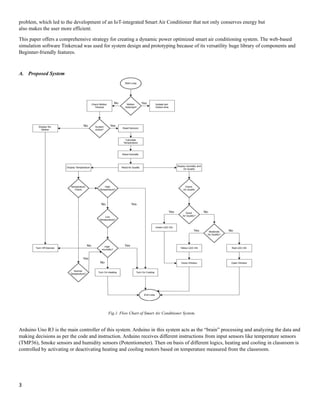
Arduino Uno R3 is the main controller of this system. Arduino in this system acts as the “brain” processing and analyzing the data and
making decisions as per the code and instruction. Arduino receives different instructions from input sensors like temperature sensors
(TMP36), Smoke sensors and humidity sensors (Potentiometer). Then on basis of different logics, heating and cooling in classroom is
controlled by activating or deactivating heating and cooling motors based on temperature measured from the classroom.
Fig.1. Flow Chart of Smart Air Conditioner System.
4.
4
B. Truth Tableand Logic Gate Circuit
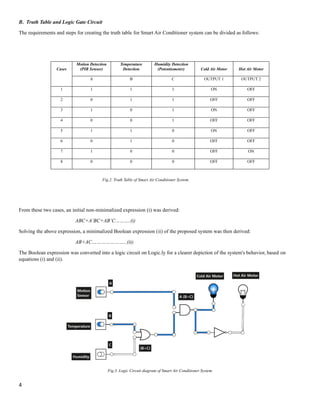
The requirements and steps for creating the truth table for Smart Air Conditioner system can be divided as follows:
From these two cases, an initial non-minimalized expression (i) was derived:
ABC+A’BC+AB’C……….(i)
Solving the above expression, a minimalized Boolean expression (ii) of the proposed system was then derived:
AB+AC…………………..(ii)
The Boolean expression was converted into a logic circuit on Logic.ly for a clearer depiction of the system's behavior, based on
equations (i) and (ii).
Cases
Motion Detection
(PIR Sensor)
Temperature
Detection
Humidity Detection
(Potentiometer) Cold Air Motor Hot Air Motor
A B C OUTPUT 1 OUTPUT 2
1 1 1 1 ON OFF
2 0 1 1 OFF OFF
3 1 0 1 ON OFF
4 0 0 1 OFF OFF
5 1 1 0 ON OFF
6 0 1 0 OFF OFF
7 1 0 0 OFF ON
8 0 0 0 OFF OFF
Fig.2. Truth Table of Smart Air Conditioner System.
Fig.3. Logic Circuit diagram of Smart Air Conditioner System.
5.
5
C. System Developmentin Tinkercad
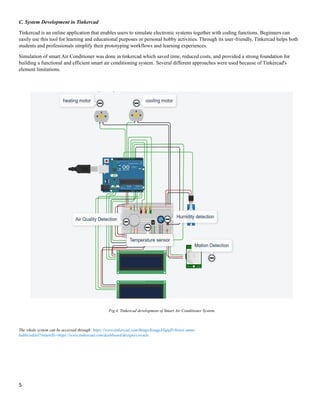
Tinkercad is an online application that enables users to simulate electronic systems together with coding functions. Beginners can
easily use this tool for learning and educational purposes or personal hobby activities. Through its user-friendly, Tinkercad helps both
students and professionals simplify their prototyping workflows and learning experiences.
Simulation of smart Air Conditioner was done in tinkercad which saved time, reduced costs, and provided a strong foundation for
building a functional and efficient smart air conditioning system. Several different approaches were used because of Tinkercad's
element limitations.
The whole system can be accessed through: https://www.tinkercad.com/things/kzuqgAXqnjD-brave-amur-
habbi/editel?returnTo=https://www.tinkercad.com/dashboard/designs/circuits
Fig.4. Tinkercad development of Smart Air Conditioner System.
6.
6
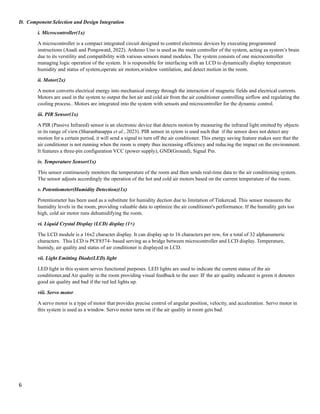
D. Component Selectionand Design Integration
i. Microcontroller(1x)
A microcontroller is a compact integrated circuit designed to control electronic devices by executing programmed
instructions (Asadi and Pongswatd, 2022). Arduino Uno is used as the main controller of the system, acting as system’s brain
due to its verstility and compatibility with various sensors mand modules. The system consists of one microcontroller
managing logic operation of the system. It is responsible for interfacing with an LCD to dynamically display temperature
humidity and status of system,operate air motors,window ventilation, and detect motion in the room.
ii. Motor(2x)
A motor converts electrical energy into mechanical energy through the interaction of magnetic fields and electrical currents.
Motors are used in the system to output the hot air and cold air from the air conditioner controlling airflow and regulating the
cooling process.. Motors are integrated into the system with sensots and microcontroller for the dynamic control.
iii. PIR Sensor(1x)
A PIR (Passive Infrared) sensor is an electronic device that detects motion by measuring the infrared light emitted by objects
in its range of view.(Sharanbasappa et al., 2023). PIR sensor in sytem is used such that if the sensor does not detect any
motion for a certain period, it will send a signal to turn off the air conditioner. This energy saving feature makes sure that the
air conditioner is not running when the room is empty thus increasing efficiency and reducing the impact on the environment.
It features a three-pin configuration VCC (power supply), GND(Ground), Signal Pin.
iv. Temperature Sensor(1x)
This sensor continuously monitors the temperature of the room and then sends real-time data to the air conditioning system.
The sensor adjusts accordingly the operation of the hot and cold air motors based on the current temperature of the room.
v. Potentiometer(Humidity Detection)(1x)
Potentiometer has been used as a substitute for humidity dection due to limitation of Tinkercad. This sensor measures the
humidity levels in the room, providing valuable data to optimize the air conditioner's performance. If the humidity gets too
high, cold air motor runs dehumidifying the room.
vi. Liquid Crystal Display (LCD) display (1×)
The LCD module is a 16x2 character display. It can display up to 16 characters per row, for a total of 32 alphanumeric
characters. This LCD is PCF8574- based serving as a bridge between microcontroller and LCD display. Temperature,
humidy, air quality and status of air conditioner is displayed in LCD.
vii. Light Emitting Diode(LED) light
LED light in this system serves functional purposes. LED lights are used to indicate the current status of the air
conditioner,and Air quality in the room providing visual feedback to the user. IF the air quality indicator is green it denotes
good air quality and bad if the red led lights up.
viii. Servo motor
A servo motor is a type of motor that provides precise control of angular position, velocity, and acceleration. Servo motor in
this system is used as a window. Servo motor turns on if the air quality in room gets bad.
7.
7
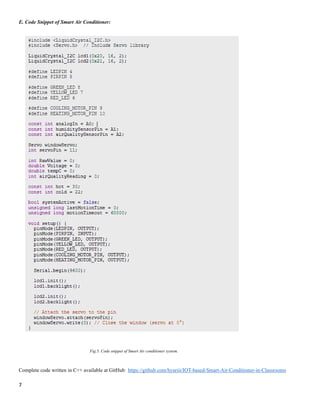
E. Code Snippetof Smart Air Conditioner:
Complete code written in C++ available at GitHub: https://github.com/hyariii/IOT-based-Smart-Air-Conditioner-in-Classrooms
Fig.5. Code snippet of Smart Air conditioner system.
8.
8
V. RESULT
The smartair conditioner system was successfully tested and its performance was assessed in terms of motion detection, temperature
control, humidity control and energy efficiency. Arduino was able to accurately receive the inputs signals from the Tempeprature
sensor and humidity sensor,motion sensor and simultaneously adjusted the heating and cooling motors. These features were displayed
through LCD module. The smart air conditioning system’s usability and efficienct were greatly improved by addition of LCD, which
allowed for user involvement and decision making during testing.
To evaluate the functionality of the developed smart air conditioner system, it was simulated in Tinkercad to determine how it
functioned with regards to motion detection, temperature and humidity control and energy efficiency. Different tests were performed
to assess sensor precision, system response time and automation effectiveness.
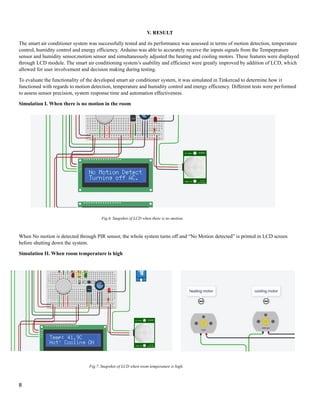
Simulation I. When there is no motion in the room
When No motion is detected through PIR sensor, the whole system turns off and “No Motion detected” is printed in LCD screen
before shutting down the system.
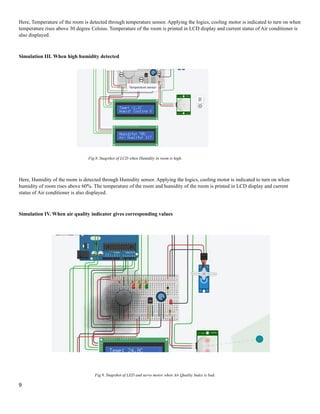
Simulation II. When room temperature is high
Fig.6. Snapshot of LCD when there is no motion.
Fig.7. Snapshot of LCD when room temperature is high.
9.
9
Here, Temperature ofthe room is detected through temperature sensor. Applying the logics, cooling motor is indicated to turn on when
temperature rises above 30 degree Celsius. Temperature of the room is printed in LCD display and current status of Air conditioner is
also displayed.
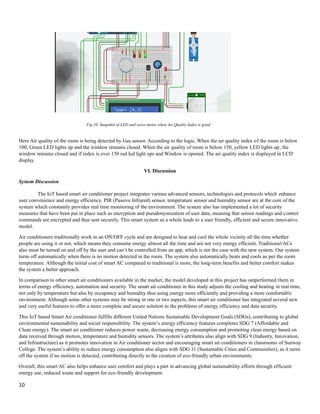
Simulation III. When high humidity detected
Here, Humidity of the room is detected through Humidity sensor. Applying the logics, cooling motor is indicated to turn on when
humidity of room rises above 60%. The temperature of the room and humidity of the room is printed in LCD display and current
status of Air conditioner is also displayed.
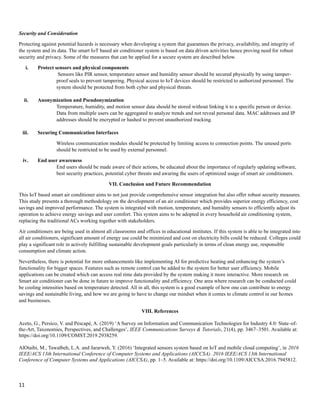
Simulation IV. When air quality indicator gives corresponding values
Fig.8. Snapshot of LCD when Humidity in room is high.
Fig.9. Snapshot of LED and servo motor when Air Quality Index is bad.
10.
10
Here Air qualityof the room is being detected by Gas sensor. According to the logic, When the air quality index of the room is below
100, Green LED lights up and the window remains closed. When the air quality of room is below 150, yellow LED lights up, the
window remains closed and if index is over 150 red led light ups and Window is opened. The air quality index is displayed in LCD
display.
VI. Discussion
System Discussion
The IoT based smart air conditioner project integrates various advanced sensors, technologies and protocols which enhance
user convenience and energy efficiency. PIR (Passive Infrared) sensor, temperature sensor and humidity sensor are at the core of the
system which constantly provides real time monitoring of the environment. The system also has implemented a lot of security
measures that have been put in place such as encryption and pseudonymization of user data, meaning that sensor readings and control
commands are encrypted and thus sent securely. This smart system as a whole leads to a user friendly, efficient and secure innovative
model.
Air conditioners traditionally work in an ON/OFF cycle and are designed to heat and cool the whole vicinity all the time whether
people are using it or not, which means they consume energy almost all the time and are not very energy efficient. Traditional ACs
also must be turned on and off by the user and can’t be controlled from an app, which is not the case with the new system. Our system
turns off automatically when there is no motion detected in the room. The system also automatically heats and cools as per the room
temperature. Although the initial cost of smart AC compared to traditional is more, the long-term benefits and better comfort makes
the system a better approach.
In comparison to other smart air conditioners available in the market, the model developed in this project has outperformed them in
terms of energy efficiency, automation and security. The smart air conditioner in this study adjusts the cooling and heating in real time,
not only by temperature but also by occupancy and humidity thus using energy more efficiently and providing a more comfortable
environment. Although some other systems may be strong in one or two aspects, this smart air conditioner has integrated several new
and very useful features to offer a more complete and secure solution to the problems of energy efficiency and data security.
This IoT based Smart Air conditioner fulfills different United Nations Sustainable Development Goals (SDGs), contributing to global
environmental sustainability and social responsibility. The system’s energy efficiency features completes SDG 7 (Affordable and
Clean energy). The smart air conditioner reduces power waste, decreasing energy consumption and promoting clean energy based on
data received through motion, temperature and humidity sensors. The system’s attributes also align with SDG 9 (Industry, Innovation,
and Infrastructure) as it promotes innovation in Air conditioner sector and encouraging smart air conditioners in classrooms of Sunway
College. The system’s ability to reduce energy consumption also aligns with SDG 11 (Sustainable Cities and Communities), as it turns
off the system if no motion is detected, contributing directly to the creation of eco-friendly urban environments.
Overall, this smart AC also helps enhance user comfort and plays a part in advancing global sustainability efforts through efficient
energy use, reduced waste and support for eco-friendly development.
Fig.10. Snapshot of LED and servo motor when Air Quality Index is good.
11.
11
Security and Consideration
Protectingagainst potential hazards is necessary when developing a system that guarantees the privacy, availability, and integrity of
the system and its data. The smart IoT based air conditioner system is based on data driven activities hence proving need for robust
security and privacy. Some of the measures that can be applied for a secure system are described below.
i. Protect sensors and physical components
Sensors like PIR sensor, temperature sensor and humidity sensor should be secured physically by using tamper-
proof seals to prevent tampering. Physical access to IoT devices should be restricted to authorized personnel. The
system should be protected from both cyber and physical threats.
ii. Anonymization and Pseudonymization
Temperature, humidity, and motion sensor data should be stored without linking it to a specific person or device.
Data from multiple users can be aggregated to analyze trends and not reveal personal data. MAC addresses and IP
addresses should be encrypted or hashed to prevent unauthorized tracking.
iii. Securing Communication Interfaces
Wireless communication modules should be protected by limiting access to connection points. The unused ports
should be restricted to be used by external personnel.
iv. End user awareness
End users should be made aware of their actions, be educated about the importance of regularly updating software,
best security practices, potential cyber threats and awaring the users of optimized usage of smart air conditioners.
VII. Conclusion and Future Recommendation
This IoT based smart air conditioner aims to not just provide comprehensive sensor integration but also offer robust security measures.
This study presents a thorough methodology on the development of an air conditioner which provides superior energy efficiency, cost
savings and improved performance. The system is integrated with motion, temperature, and humidity sensors to efficiently adjust its
operation to achieve energy savings and user comfort. This system aims to be adopted in every household air conditioning system,
replacing the traditional ACs working together with stakeholders.
Air conditioners are being used in almost all classrooms and offices in educational institutes. If this system is able to be integrated into
all air conditioners, significant amount of energy use could be minimized and cost on electricity bills could be reduced. Colleges could
play a significant role in actively fulfilling sustainable development goals particularly in terms of clean energy use, responsible
consumption and climate action.
Nevertheless, there is potential for more enhancements like implementing AI for predictive heating and enhancing the system’s
functionality for bigger spaces. Features such as remote control can be added to the system for better user efficiency. Mobile
applications can be created which can access real time data provided by the system making it more interactive. More research on
Smart air conditioner can be done in future to improve functionality and efficiency. One area where research can be conducted could
be cooling intensities based on temperature detected. All in all, this system is a good example of how one can contribute to energy
savings and sustainable living, and how we are going to have to change our mindset when it comes to climate control in our homes
and businesses.
VIII. References
Aceto, G., Persico, V. and Pescapé, A. (2019) ‘A Survey on Information and Communication Technologies for Industry 4.0: State-of-
the-Art, Taxonomies, Perspectives, and Challenges’, IEEE Communications Surveys & Tutorials, 21(4), pp. 3467–3501. Available at:
https://doi.org/10.1109/COMST.2019.2938259.
AlOtaibi, M., Tawalbeh, L.A. and Jararweh, Y. (2016) ‘Integrated sensors system based on IoT and mobile cloud computing’, in 2016
IEEE/ACS 13th International Conference of Computer Systems and Applications (AICCSA). 2016 IEEE/ACS 13th International
Conference of Computer Systems and Applications (AICCSA), pp. 1–5. Available at: https://doi.org/10.1109/AICCSA.2016.7945812.
12.
12
Asadi, F. andPongswatd, S. (2022) ‘Programming the ARM® Cortex®-M4-based STM32F4 Microcontrollers with Simulink®’, in.
Cham: Springer International Publishing (Synthesis Lectures on Digital Circuits & Systems). Available at:
https://doi.org/10.1007/978-3-031-79927-3.
Gill, S.S. et al. (2024) ‘Modern computing: Vision and challenges’, Telematics and Informatics Reports, 13, p. 100116. Available at:
https://doi.org/10.1016/j.teler.2024.100116.
Hassija, V. et al. (no date) ‘A Survey on IoT Security: Application Areas, Security Threats, and Solution Architectures’.
IEA, news (2018) Air conditioning use emerges as one of the key drivers of global electricity-demand growth - News, IEA. Available
at: https://www.iea.org/news/air-conditioning-use-emerges-as-one-of-the-key-drivers-of-global-electricity-demand-growth (Accessed:
29 January 2025).
Jat, D.S. et al. (1AD) Internet of Things for Automation in Smart Agriculture: A Technical Review, https://services.igi-
global.com/resolvedoi/resolve.aspx?doi=10.4018/978-1-5225-5909-2.ch005. IGI Global Scientific Publishing. Available at:
https://doi.org/10.4018/978-1-5225-5909-2.ch005.
Kannan, R., Roy, M.S. and Pathuri, S.H. (2020) ‘Artificial Intelligence Based Air Conditioner Energy Saving Using a Novel
Preference Map’, IEEE Access, 8, pp. 206622–206637. Available at: https://doi.org/10.1109/ACCESS.2020.3037970.
Kuchuk, H. and Malokhvii, E. (2024) ‘INTEGRATION OF IOT WITH CLOUD, FOG, AND EDGE COMPUTING: A REVIEW’,
Advanced Information Systems, 8(2), pp. 65–78. Available at: https://doi.org/10.20998/2522-9052.2024.2.08.
Lynn, T. et al. (2020) ‘The Internet of Things: Definitions, Key Concepts, and Reference Architectures’, in T. Lynn et al. (eds) The
Cloud-to-Thing Continuum: Opportunities and Challenges in Cloud, Fog and Edge Computing. Cham: Springer International
Publishing, pp. 1–22. Available at: https://doi.org/10.1007/978-3-030-41110-7_1.
MacEachern, D. (2023) AC: Use Your Air Conditioner Less, Save Money, Reduce Pollution, Moms Clean Air Force. Available at:
https://www.momscleanairforce.org/use-less-ac/ (Accessed: 15 February 2025).
Raja, P. et al. (2022) ‘Integrating IOT and AI: Enhancing System Efficiency and User Experience’, International Journal of
Information Technology & Computer Engineering, 2(06), pp. 39–50. Available at: https://doi.org/10.55529/ijitc.26.39.50.
Rimal, B.P., Choi, E. and Lumb, I. (2009) ‘A Taxonomy and Survey of Cloud Computing Systems’, in 2009 Fifth International Joint
Conference on INC, IMS and IDC. 2009 Fifth International Joint Conference on INC, IMS and IDC, pp. 44–51. Available at:
https://doi.org/10.1109/NCM.2009.218.
Sharanbasappa, A. et al. (2023) ‘Automatic Control of LED Lamp Using PIR Motion Sensor’, International Journal for Research in
Applied Science and Engineering Technology, 11(5), pp. 3428–3430. Available at: https://doi.org/10.22214/ijraset.2023.51379.
Strba, S. (2018) Internet of Things Security: Ongoing Threats and Proposed Solutions. Portland State University. Available at:
https://doi.org/10.15760/honors.579.