What is it?
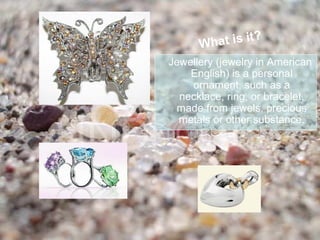
Jewellery (jewelry in American
    English) is a personal
    ornament, such as a
  necklace, ring, or bracelet,
 made from jewels, precious
  metals or other substance.
Materials and methods

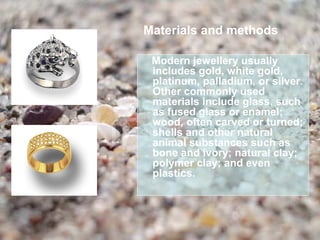
 Modern jewellery usually
 includes gold, white gold,
 platinum, palladium, or silver.
 Other commonly used
 materials include glass, such
 as fused glass or enamel;
 wood, often carved or turned;
 shells and other natural
 animal substances such as
 bone and ivory; natural clay;
 polymer clay; and even
 plastics.
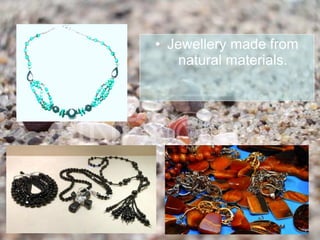
• Jewellery made from
   natural materials.
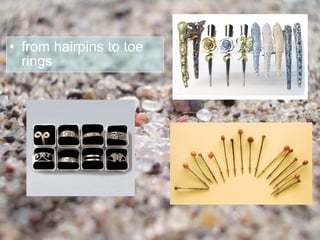
• from hairpins to toe
  rings
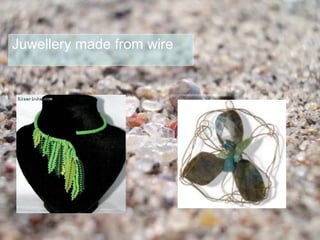
Juwellery made from wire
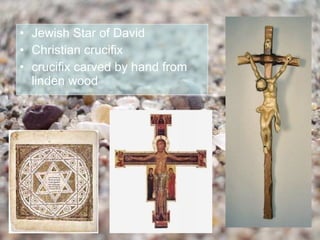
• Jewish Star of David
• Christian crucifix
• crucifix carved by hand from
  linden wood
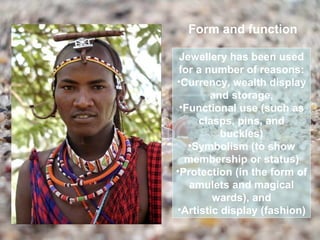
Form and function

 Jewellery has been used
 for a number of reasons:
•Currency, wealth display
        and storage,
 •Functional use (such as
     clasps, pins, and
          buckles)
   •Symbolism (to show
  membership or status)
•Protection (in the form of
   amulets and magical
        wards), and
•Artistic display (fashion)
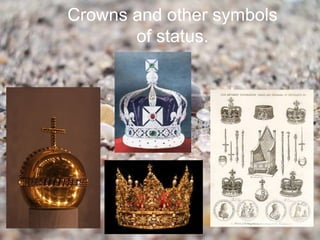
Crowns and other symbols
       of status.
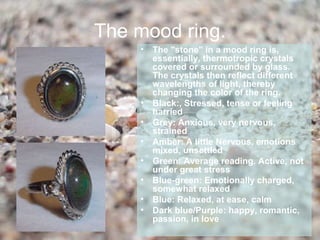
The mood ring.
    •   The "stone" in a mood ring is,
        essentially, thermotropic crystals
        covered or surrounded by glass.
        The crystals then reflect different
        wavelengths of light, thereby
        changing the color of the ring.
    •   Black:, Stressed, tense or feeling
        harried
    •   Grey: Anxious, very nervous,
        strained
    •   Amber: A little Nervous, emotions
        mixed, unsettled
    •   Green: Average reading. Active, not
        under great stress
    •   Blue-green: Emotionally charged,
        somewhat relaxed
    •   Blue: Relaxed, at ease, calm
    •   Dark blue/Purple: happy, romantic,
        passion, in love
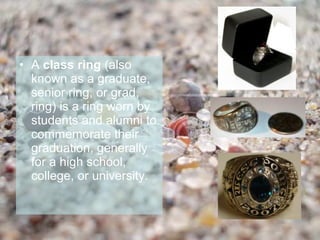
• A class ring (also
  known as a graduate,
  senior ring, or grad,
  ring) is a ring worn by
  students and alumni to
  commemorate their
  graduation, generally
  for a high school,
  college, or university.
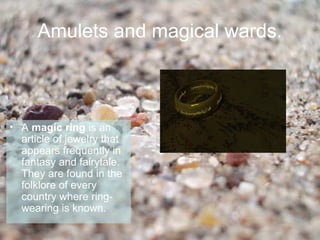
Amulets and magical wards.


• A magic ring is an
  article of jewelry that
  appears frequently in
  fantasy and fairytale.
  They are found in the
  folklore of every
  country where ring-
  wearing is known.
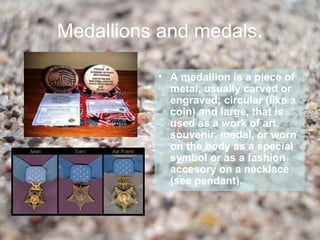
Medallions and medals.
          • A medallion is a piece of
            metal, usually carved or
            engraved; circular (like a
            coin) and large, that is
            used as a work of art,
            souvenir, medal, or worn
            on the body as a special
            symbol or as a fashion
            accesory on a necklace
            (see pendant).
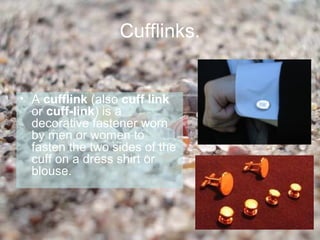
Cufflinks.


• A cufflink (also cuff link
  or cuff-link) is a
  decorative fastener worn
  by men or women to
  fasten the two sides of the
  cuff on a dress shirt or
  blouse.
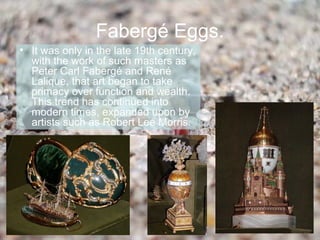
Fabergé Eggs.
• It was only in the late 19th century,
  with the work of such masters as
  Peter Carl Fabergé and René
  Lalique, that art began to take
  primacy over function and wealth.
  This trend has continued into
  modern times, expanded upon by
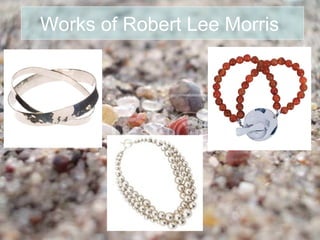
  artists such as Robert Lee Morris.
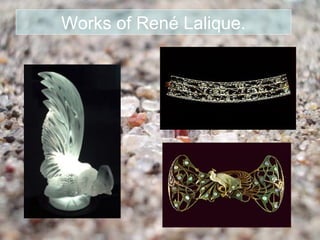
Works of René Lalique.
Works of Robert Lee Morris
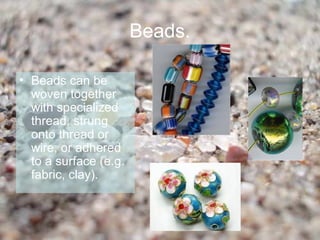
Beads.

• Beads can be
  woven together
  with specialized
  thread, strung
  onto thread or
  wire, or adhered
  to a surface (e.g.
  fabric, clay).
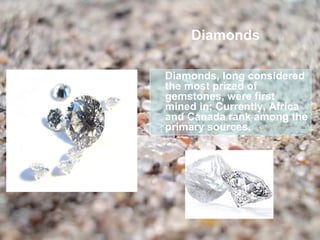
Diamonds

Diamonds, long considered
the most prized of
gemstones, were first
mined in; Currently, Africa
and Canada rank among the
primary sources.
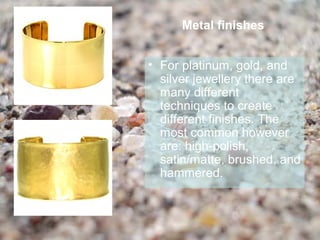
Metal finishes


• For platinum, gold, and
  silver jewellery there are
  many different
  techniques to create
  different finishes. The
  most common however
  are: high-polish,
  satin/matte, brushed, and
  hammered.
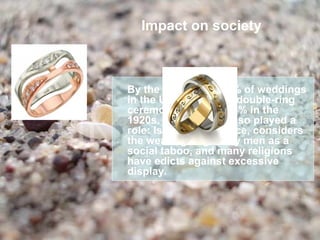
Impact on society


By the mid 1940s, 85% of weddings
in the U.S. featured a double-ring
ceremony, up from 15% in the
1920s. Religion has also played a
role: Islam, for instance, considers
the wearing of gold by men as a
social taboo, and many religions
have edicts against excessive
display.
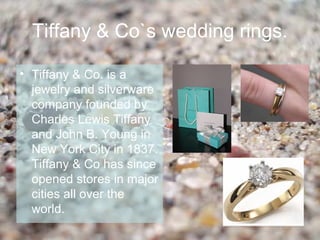
Tiffany & Co`s wedding rings.

• Tiffany & Co. is a
  jewelry and silverware
  company founded by
  Charles Lewis Tiffany
  and John B. Young in
  New York City in 1837.
  Tiffany & Co has since
  opened stores in major
  cities all over the
  world.
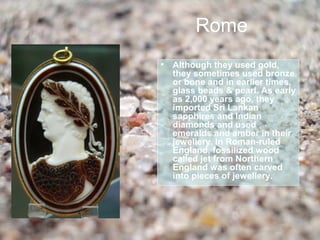
Rome
• Although they used gold,
  they sometimes used bronze
  or bone and in earlier times,
  glass beads & pearl. As early
  as 2,000 years ago, they
  imported Sri Lankan
  sapphires and Indian
  diamonds and used
  emeralds and amber in their
  jewellery. In Roman-ruled
  England, fossilized wood
  called jet from Northern
  England was often carved
  into pieces of jewellery.
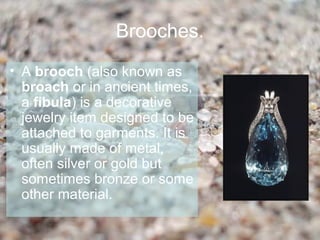
Brooches.
• A brooch (also known as
  broach or in ancient times,
  a fibula) is a decorative
  jewelry item designed to be
  attached to garments. It is
  usually made of metal,
  often silver or gold but
  sometimes bronze or some
  other material.
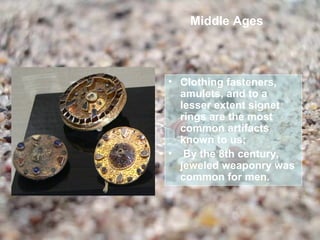
Middle Ages


• Clothing fasteners,
  amulets, and to a
  lesser extent signet
  rings are the most
  common artifacts
  known to us;
• By the 8th century,
  jeweled weaponry was
  common for men.
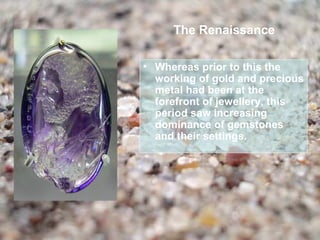
The Renaissance

• Whereas prior to this the
  working of gold and precious
  metal had been at the
  forefront of jewellery, this
  period saw increasing
  dominance of gemstones
  and their settings.
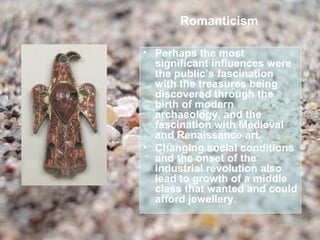
Romanticism

• Perhaps the most
  significant influences were
  the public’s fascination
  with the treasures being
  discovered through the
  birth of modern
  archaeology, and the
  fascination with Medieval
  and Renaissance art.
• Changing social conditions
  and the onset of the
  industrial revolution also
  lead to growth of a middle
  class that wanted and could
  afford jewellery.
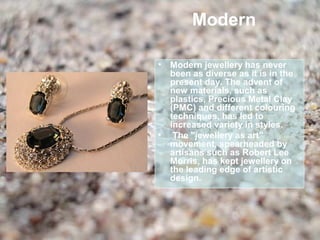
Modern

•   Modern jewellery has never
    been as diverse as it is in the
    present day. The advent of
    new materials, such as
    plastics, Precious Metal Clay
    (PMC) and different colouring
    techniques, has led to
    increased variety in styles.
•    The "jewellery as art"
    movement, spearheaded by
    artisans such as Robert Lee
    Morris, has kept jewellery on
    the leading edge of artistic
    design.
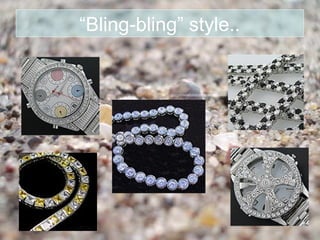
“Bling-bling” style..
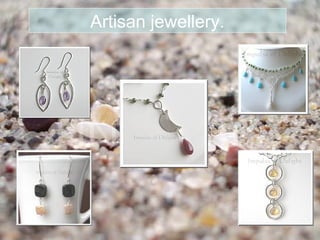
Artisan jewellery.
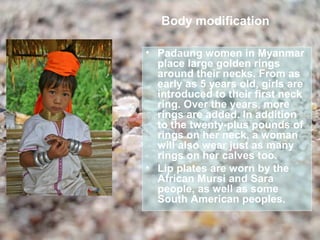
Body modification

• Padaung women in Myanmar
  place large golden rings
  around their necks. From as
  early as 5 years old, girls are
  introduced to their first neck
  ring. Over the years, more
  rings are added. In addition
  to the twenty-plus pounds of
  rings on her neck, a woman
  will also wear just as many
  rings on her calves too.
• Lip plates are worn by the
  African Mursi and Sara
  people, as well as some
  South American peoples.
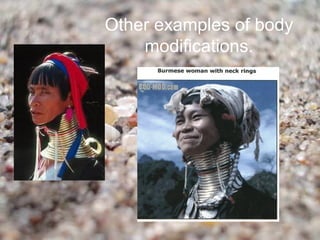
Other examples of body
    modifications.
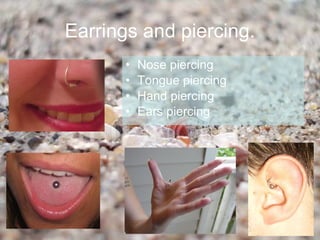
Earrings and piercing.
       •   Nose piercing
       •   Tongue piercing
       •   Hand piercing
       •   Ears piercing
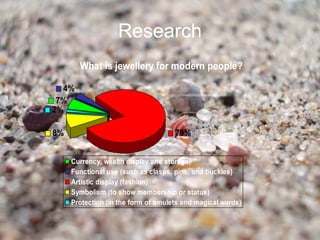
Research
       What is jewellery for modern people?

  4%
 7%
2%

8%                                   79%


     Currency, wealth display and storage,
     Functional use (such as clasps, pins, and buckles)
     Artistic display (fashion)
     Symbolism (to show membership or status)
     Protection (in the form of amulets and magical wards)
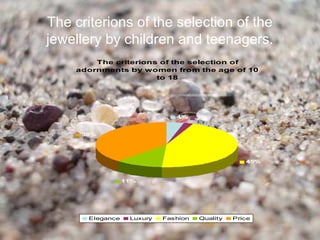
The criterions of the selection of the
jewellery by children and teenagers.
        The criterions of the selection of
    adornments by women from the age of 10
                      to 18


                               4%     2%


     38%


                                                   45%


                  11%


       Elegance    Luxury   Fashion   Quality   Price
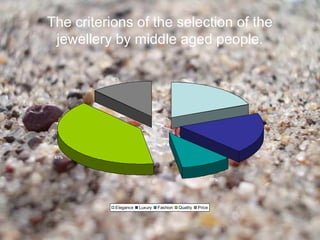
The criterions of the selection of the
 jewellery by middle aged people.

          12%
                                                                 19%


                                                                       19%

 41%


                                                           10%


           Elegance   Luxury   Fashion   Quality   Price
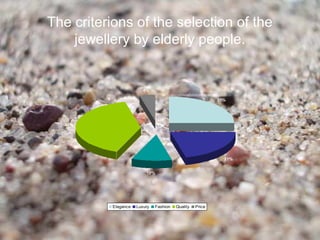
The criterions of the selection of the
    jewellery by elderly people.


                         4%

                                                           25%


  40%


                                                             21%


                          10%


           Elegance   Luxury   Fashion   Quality   Price
The end.

English3

  • 2.
    What is it? Jewellery(jewelry in American English) is a personal ornament, such as a necklace, ring, or bracelet, made from jewels, precious metals or other substance.
  • 3.
    Materials and methods Modern jewellery usually includes gold, white gold, platinum, palladium, or silver. Other commonly used materials include glass, such as fused glass or enamel; wood, often carved or turned; shells and other natural animal substances such as bone and ivory; natural clay; polymer clay; and even plastics.
  • 4.
    • Jewellery madefrom natural materials.
  • 5.
    • from hairpinsto toe rings
  • 6.
  • 7.
    • Jewish Starof David • Christian crucifix • crucifix carved by hand from linden wood
  • 8.
    Form and function Jewellery has been used for a number of reasons: •Currency, wealth display and storage, •Functional use (such as clasps, pins, and buckles) •Symbolism (to show membership or status) •Protection (in the form of amulets and magical wards), and •Artistic display (fashion)
  • 9.
    Crowns and othersymbols of status.
  • 10.
    The mood ring. • The "stone" in a mood ring is, essentially, thermotropic crystals covered or surrounded by glass. The crystals then reflect different wavelengths of light, thereby changing the color of the ring. • Black:, Stressed, tense or feeling harried • Grey: Anxious, very nervous, strained • Amber: A little Nervous, emotions mixed, unsettled • Green: Average reading. Active, not under great stress • Blue-green: Emotionally charged, somewhat relaxed • Blue: Relaxed, at ease, calm • Dark blue/Purple: happy, romantic, passion, in love
  • 11.
    • A classring (also known as a graduate, senior ring, or grad, ring) is a ring worn by students and alumni to commemorate their graduation, generally for a high school, college, or university.
  • 12.
    Amulets and magicalwards. • A magic ring is an article of jewelry that appears frequently in fantasy and fairytale. They are found in the folklore of every country where ring- wearing is known.
  • 13.
    Medallions and medals. • A medallion is a piece of metal, usually carved or engraved; circular (like a coin) and large, that is used as a work of art, souvenir, medal, or worn on the body as a special symbol or as a fashion accesory on a necklace (see pendant).
  • 14.
    Cufflinks. • A cufflink(also cuff link or cuff-link) is a decorative fastener worn by men or women to fasten the two sides of the cuff on a dress shirt or blouse.
  • 15.
    Fabergé Eggs. • Itwas only in the late 19th century, with the work of such masters as Peter Carl Fabergé and René Lalique, that art began to take primacy over function and wealth. This trend has continued into modern times, expanded upon by artists such as Robert Lee Morris.
  • 16.
  • 17.
    Works of RobertLee Morris
  • 18.
    Beads. • Beads canbe woven together with specialized thread, strung onto thread or wire, or adhered to a surface (e.g. fabric, clay).
  • 19.
    Diamonds Diamonds, long considered themost prized of gemstones, were first mined in; Currently, Africa and Canada rank among the primary sources.
  • 20.
    Metal finishes • Forplatinum, gold, and silver jewellery there are many different techniques to create different finishes. The most common however are: high-polish, satin/matte, brushed, and hammered.
  • 21.
    Impact on society Bythe mid 1940s, 85% of weddings in the U.S. featured a double-ring ceremony, up from 15% in the 1920s. Religion has also played a role: Islam, for instance, considers the wearing of gold by men as a social taboo, and many religions have edicts against excessive display.
  • 22.
    Tiffany & Co`swedding rings. • Tiffany & Co. is a jewelry and silverware company founded by Charles Lewis Tiffany and John B. Young in New York City in 1837. Tiffany & Co has since opened stores in major cities all over the world.
  • 23.
    Rome • Although theyused gold, they sometimes used bronze or bone and in earlier times, glass beads & pearl. As early as 2,000 years ago, they imported Sri Lankan sapphires and Indian diamonds and used emeralds and amber in their jewellery. In Roman-ruled England, fossilized wood called jet from Northern England was often carved into pieces of jewellery.
  • 24.
    Brooches. • A brooch(also known as broach or in ancient times, a fibula) is a decorative jewelry item designed to be attached to garments. It is usually made of metal, often silver or gold but sometimes bronze or some other material.
  • 25.
    Middle Ages • Clothingfasteners, amulets, and to a lesser extent signet rings are the most common artifacts known to us; • By the 8th century, jeweled weaponry was common for men.
  • 26.
    The Renaissance • Whereasprior to this the working of gold and precious metal had been at the forefront of jewellery, this period saw increasing dominance of gemstones and their settings.
  • 27.
    Romanticism • Perhaps themost significant influences were the public’s fascination with the treasures being discovered through the birth of modern archaeology, and the fascination with Medieval and Renaissance art. • Changing social conditions and the onset of the industrial revolution also lead to growth of a middle class that wanted and could afford jewellery.
  • 28.
    Modern • Modern jewellery has never been as diverse as it is in the present day. The advent of new materials, such as plastics, Precious Metal Clay (PMC) and different colouring techniques, has led to increased variety in styles. • The "jewellery as art" movement, spearheaded by artisans such as Robert Lee Morris, has kept jewellery on the leading edge of artistic design.
  • 29.
  • 30.
  • 31.
    Body modification • Padaungwomen in Myanmar place large golden rings around their necks. From as early as 5 years old, girls are introduced to their first neck ring. Over the years, more rings are added. In addition to the twenty-plus pounds of rings on her neck, a woman will also wear just as many rings on her calves too. • Lip plates are worn by the African Mursi and Sara people, as well as some South American peoples.
  • 32.
    Other examples ofbody modifications.
  • 33.
    Earrings and piercing. • Nose piercing • Tongue piercing • Hand piercing • Ears piercing
  • 34.
    Research What is jewellery for modern people? 4% 7% 2% 8% 79% Currency, wealth display and storage, Functional use (such as clasps, pins, and buckles) Artistic display (fashion) Symbolism (to show membership or status) Protection (in the form of amulets and magical wards)
  • 35.
    The criterions ofthe selection of the jewellery by children and teenagers. The criterions of the selection of adornments by women from the age of 10 to 18 4% 2% 38% 45% 11% Elegance Luxury Fashion Quality Price
  • 36.
    The criterions ofthe selection of the jewellery by middle aged people. 12% 19% 19% 41% 10% Elegance Luxury Fashion Quality Price
  • 37.
    The criterions ofthe selection of the jewellery by elderly people. 4% 25% 40% 21% 10% Elegance Luxury Fashion Quality Price
  • 38.