Learning Objectives
By theend of this lesson, you are able to:
•define persuasive text
•identify techniques of persuasive text
•persuade readers on how to resolve different
social issues and environmental issues
(Core Values: Environmental Awareness and
Authentic Citizenship)
What I observed…
Basedon your observation, how
does commercial make people
purchase a certain product or
avail certain services?
6.
What is aPersuasive Text?
Persuasive text is a kind of writing
that intends to influence readers
to accept an opinion, buy a product,
adopt an idea, or take a particular
action.
7.
Persuasive Text
In persuasivetext, the word that can be
derived is to persuade. Persuasion is the act
of convincing others to believe in ideas,
actions, or behaviors which you think are
right or desirable.
Remember the key word “convince”.
1. Use ofPowerful Verbs
• Powerful verbs give a vivid picture or an action or what
someone is doing.
• Example: Instead of eat, a speaker may use the words
munch, chew, bite, devour, or nibble to stimulate a
mental image of specific action in the minds of audience.
These powerful verbs are used to give clearer picture for
the audience.
10.
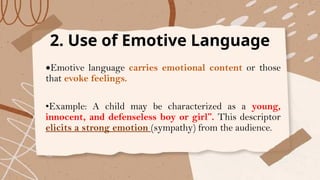
2. Use ofEmotive Language
•Emotive language carries emotional content or those
that evoke feelings.
•Example: A child may be characterized as a young,
innocent, and defenseless boy or girl”. This descriptor
elicits a strong emotion (sympathy) from the audience.
11.
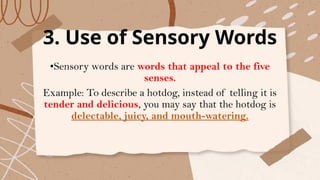
3. Use ofSensory Words
•Sensory words are words that appeal to the five
senses.
Example: To describe a hotdog, instead of telling it is
tender and delicious, you may say that the hotdog is
delectable, juicy, and mouth-watering.
12.
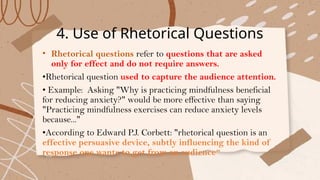
4. Use ofRhetorical Questions
• Rhetorical questions refer to questions that are asked
only for effect and do not require answers.
•Rhetorical question used to capture the audience attention.
• Example: Asking "Why is practicing mindfulness beneficial
for reducing anxiety?" would be more effective than saying
"Practicing mindfulness exercises can reduce anxiety levels
because..."
•According to Edward P.J. Corbett: "rhetorical question is an
effective persuasive device, subtly influencing the kind of
response one wants to get from an audience"
13.
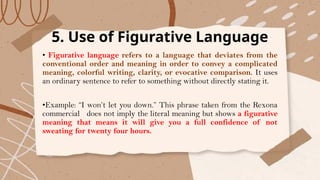
5. Use ofFigurative Language
• Figurative language refers to a language that deviates from the
conventional order and meaning in order to convey a complicated
meaning, colorful writing, clarity, or evocative comparison. It uses
an ordinary sentence to refer to something without directly stating it.
•Example: “I won’t let you down.” This phrase taken from the Rexona
commercial does not imply the literal meaning but shows a figurative
meaning that means it will give you a full confidence of not
sweating for twenty four hours.
14.
6. Exaggeration
•Exaggeration isa statement that makes something worse, or
better, than it really is. In literature and oral communication, writers
and speakers use exaggeration as a literary technique, to give extra
stress and drama in a work or speech.
Example:
Candida
by Voltaire
“I have wanted to kill myself a hundred times, but somehow, I am
still in love with life.
To kill myself a hundred times uses exaggeration because we know
that we only die once.
15.
7. Use ofFacts
•Facts are a powerful means of convincing. Facts can come from your reading,
observation, or personal experience.
•Facts are used to add weight to or back up the claim of a product or a
speaker.
Example:
A car manufacturer quotes the amount of time it takes their car to get from 0 to
100 k.p.h.
•For their advertisement, the car manufacturer uses factual information
about the speed of the car they are selling
16.
Seatwork No. 2
Thinkof two different household products that you use
regularly that you would like to recommend to others. Using
the persuasive techniques that you have learned, write two to
three sentence-tagline for the advertisement of each product.
Write your answer in your English notebook and take photo
then submit via Teams.