GOOD MORNING!
MR. DON ZAI FRANK LADRERA
CLEANLINESS
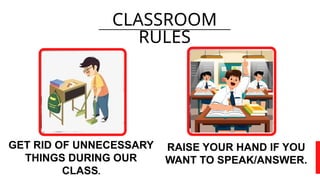
CLASSROOM
RULES
GET RID OF UNNECESSARY
THINGS DURING OUR
CLASS.
RAISE YOUR HAND IF YOU
WANT TO SPEAK/ANSWER.
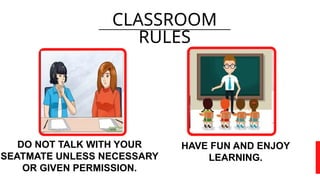
CLASSROOM
RULES
DO NOT TALK WITH YOUR
SEATMATE UNLESS NECESSARY
OR GIVEN PERMISSION.
HAVE FUN AND ENJOY
LEARNING.
MOTIVATIONAL
ACTIVITY
OBJECTIVES:
At the end of the lesson, the student should be able to:
PASS THE MESSAGE
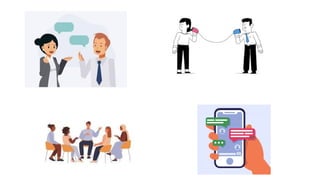
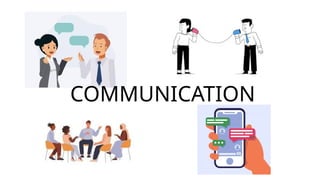
COMMUNICATION
NATURE AND
ELEMENTS OF
COMMUNICATION
:
QUESTION
1. What is communication?
2. What is the nature of communication?
3. What are its element?
4. How does the process of communication
happen?
Communication is from the Latin term
“Communicare” which means “to share” or
“to make common” to (Weekley, E. 1967)
This suggest that communication is an act that
brings people together, or an experience shared
by individuals who subsequently establish
relationships and communities.
Communication is a two-way process of connecting to
both living and nonliving things.
It is also a means of sharing and exchanging messages,
information, ideas, and feelings for mutual
understanding (gregoriom, J.C., 2015).
NATURE OF COMMUNICATION
1. Communication is the process. – it maybe as a flow of
information, this simply means that communication among
people is active and cyclical it begins from one step to
another step
2. Communication occurs between two or more people. – in
here the sender and the speaker take an active part this
emphasizes social contact among humans, in other words
communication is interactive
3. Communication can be expressed through written or spoken
words actions (nonverbal), or both spoken words and
nonverbal actions at the same time. – this means that
communication is symbolic
ELEMENTS OF COMMUNICATION
1. Sender or Speaker – this represent the source of information or
message, delivers message to the receiver.
2. Message – this refers the information, ideas or thoughts
conveyed by the speaker in words or actions.
3. Encoding – this is the process of converting the message into
words, actions or other forms that the speaker understands.
4. Channel – This serves as the vehicle used in transmitting
message or ideas. It can be personal or non personal, written,
verbal (words) or nonverbal (actions, gestures, facial
expression), in which the encoded message is conveyed.
ELEMENTS OF COMMUNICATION
5. Decoding – The process of interpreting the encoded message this is done
by the receiver
6. Receiver – Is the recipient of the message or someone who decodes the
message.
7. Feedback – it refers the reactions, responses or information provided by
the receiver
8. Context – the environment where communication takes place it can be a
- face to face interaction
- A phone conversation
- A group discussion
- A meeting or interview
- A letter
- A class recitation
ELEMENTS OF COMMUNICATION
9. Barrier – this is the factor that affects the flow of communication
Ex. Noise
- It will affect the sending and the receiving of the message
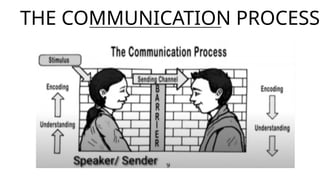
THE COMMUNICATION PROCESS
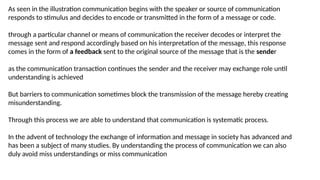
As seen in the illustration communication begins with the speaker or source of communication
responds to stimulus and decides to encode or transmitted in the form of a message or code.
through a particular channel or means of communication the receiver decodes or interpret the
message sent and respond accordingly based on his interpretation of the message, this response
comes in the form of a feedback sent to the original source of the message that is the sender
as the communication transaction continues the sender and the receiver may exchange role until
understanding is achieved
But barriers to communication sometimes block the transmission of the message hereby creating
misunderstanding.
Through this process we are able to understand that communication is systematic process.
In the advent of technology the exchange of information and message in society has advanced and
has been a subject of many studies. By understanding the process of communication we can also
duly avoid miss understandings or miss communication
ASSIGNMEN
T
Lorem ipsum dolor sit amet, consectetur adipiscing
elit, sed do eiusmod tempor incididunt ut labore et
dolore
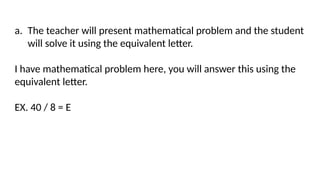
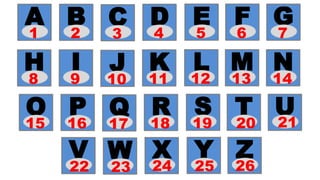
a. The teacher will present mathematical problem and the student
will solve it using the equivalent letter.
I have mathematical problem here, you will answer this using the
equivalent letter.
EX. 40 / 8 = E
A
1
B
2
C
3
D
4
E
5
F
6
G
7
H
8
I
9
J
10
K
11
L
12
M
13
N
14
O
15
P
16
Q
17
R
18
S
19
T
20
U
21
V
22
W
23
X
24
Y
25
Z
26
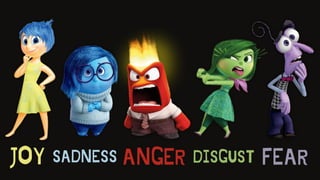
Now let us check first, your emotion for today. I have different kinds of emotion here, as you can
see we have JOY, SADNESS, ANGER, DISGUST and FEAR.
Okay! Who feel fear today? Very good Nothing! How about DISGUST?
I think 90% have a positive emotion.
Okay class it is vey important to know your emotion because your emotion have a big impact to
our lesson or discussion for today, why? Because if you feel negative emotion your not be able to
focus, missed important information and distracted. While if you have a positive emotion you
will have opportunities to gain more knowledge, creative, concentrate, think wisely and
opportunities to perform well.
So, before we start to our lessons, I have one a favor for you class.
I would like to give you some important things, this is not a material gift BTW or any foods, this is
more than that, this is a priceless thing that you will receive for today! PLEASE JUST REMOVE
YOUR NEGATIVE EMOTION, and put an smile! PWEDE? TINGIN NGA NG NGITI? NGITI SA KATABI
KAHIT BUNGI? Hahaha!

English Teaching Communcation cycle for Best teaching

  • 2.
    GOOD MORNING! MR. DONZAI FRANK LADRERA
  • 5.
  • 7.
    CLASSROOM RULES GET RID OFUNNECESSARY THINGS DURING OUR CLASS. RAISE YOUR HAND IF YOU WANT TO SPEAK/ANSWER.
  • 8.
    CLASSROOM RULES DO NOT TALKWITH YOUR SEATMATE UNLESS NECESSARY OR GIVEN PERMISSION. HAVE FUN AND ENJOY LEARNING.
  • 9.
  • 11.
    OBJECTIVES: At the endof the lesson, the student should be able to: At the end of the lesson, the student should be able to:
  • 13.
  • 15.
  • 16.
  • 17.
    QUESTION 1. What iscommunication? 2. What is the nature of communication? 3. What are its element? 4. How does the process of communication happen?
  • 18.
    Communication is fromthe Latin term “Communicare” which means “to share” or “to make common” to (Weekley, E. 1967)
  • 19.
    This suggest thatcommunication is an act that brings people together, or an experience shared by individuals who subsequently establish relationships and communities.
  • 20.
    Communication is atwo-way process of connecting to both living and nonliving things. It is also a means of sharing and exchanging messages, information, ideas, and feelings for mutual understanding (gregoriom, J.C., 2015).
  • 22.
    NATURE OF COMMUNICATION 1.Communication is the process. – it maybe as a flow of information, this simply means that communication among people is active and cyclical it begins from one step to another step 2. Communication occurs between two or more people. – in here the sender and the speaker take an active part this emphasizes social contact among humans, in other words communication is interactive 3. Communication can be expressed through written or spoken words actions (nonverbal), or both spoken words and nonverbal actions at the same time. – this means that communication is symbolic
  • 23.
    ELEMENTS OF COMMUNICATION 1.Sender or Speaker – this represent the source of information or message, delivers message to the receiver. 2. Message – this refers the information, ideas or thoughts conveyed by the speaker in words or actions. 3. Encoding – this is the process of converting the message into words, actions or other forms that the speaker understands. 4. Channel – This serves as the vehicle used in transmitting message or ideas. It can be personal or non personal, written, verbal (words) or nonverbal (actions, gestures, facial expression), in which the encoded message is conveyed.
  • 24.
    ELEMENTS OF COMMUNICATION 5.Decoding – The process of interpreting the encoded message this is done by the receiver 6. Receiver – Is the recipient of the message or someone who decodes the message. 7. Feedback – it refers the reactions, responses or information provided by the receiver 8. Context – the environment where communication takes place it can be a - face to face interaction - A phone conversation - A group discussion - A meeting or interview - A letter - A class recitation
  • 25.
    ELEMENTS OF COMMUNICATION 9.Barrier – this is the factor that affects the flow of communication Ex. Noise - It will affect the sending and the receiving of the message
  • 26.
  • 27.
    As seen inthe illustration communication begins with the speaker or source of communication responds to stimulus and decides to encode or transmitted in the form of a message or code. through a particular channel or means of communication the receiver decodes or interpret the message sent and respond accordingly based on his interpretation of the message, this response comes in the form of a feedback sent to the original source of the message that is the sender as the communication transaction continues the sender and the receiver may exchange role until understanding is achieved But barriers to communication sometimes block the transmission of the message hereby creating misunderstanding. Through this process we are able to understand that communication is systematic process. In the advent of technology the exchange of information and message in society has advanced and has been a subject of many studies. By understanding the process of communication we can also duly avoid miss understandings or miss communication
  • 30.
    ASSIGNMEN T Lorem ipsum dolorsit amet, consectetur adipiscing elit, sed do eiusmod tempor incididunt ut labore et dolore
  • 32.
    a. The teacherwill present mathematical problem and the student will solve it using the equivalent letter. I have mathematical problem here, you will answer this using the equivalent letter. EX. 40 / 8 = E
  • 33.
  • 34.
    Now let uscheck first, your emotion for today. I have different kinds of emotion here, as you can see we have JOY, SADNESS, ANGER, DISGUST and FEAR. Okay! Who feel fear today? Very good Nothing! How about DISGUST? I think 90% have a positive emotion. Okay class it is vey important to know your emotion because your emotion have a big impact to our lesson or discussion for today, why? Because if you feel negative emotion your not be able to focus, missed important information and distracted. While if you have a positive emotion you will have opportunities to gain more knowledge, creative, concentrate, think wisely and opportunities to perform well. So, before we start to our lessons, I have one a favor for you class. I would like to give you some important things, this is not a material gift BTW or any foods, this is more than that, this is a priceless thing that you will receive for today! PLEASE JUST REMOVE YOUR NEGATIVE EMOTION, and put an smile! PWEDE? TINGIN NGA NG NGITI? NGITI SA KATABI KAHIT BUNGI? Hahaha!


Editor's Notes

  • #10 Now let us check first, your emotion for today. I have different kinds of emotion here, as you can see we have JOY, SADNESS, ANGER, DISGUST and FEAR. Okay! Who feel fear today? Very good Nothing! How about DISGUST? I think 90% have a positive emotion. Okay class it is vey important to know your emotion because your emotion have a big impact to our lesson or discussion for today, why? Because if you feel negative emotion your not be able to focus, missed important information and distracted. While if you have a positive emotion you will have opportunities to gain more knowledge, creative, concentrate, think wisely and opportunities to perform well. So, before we start to our lessons, I have one a favor for you class. I would like to give you some important things, this is not a material gift BTW or any foods, this is more than that, this is a priceless thing that you will receive for today! PLEASE JUST REMOVE YOUR NEGATIVE EMOTION, and put an smile! PWEDE? TINGIN NGA NG NGITI? NGITI SA KATABI KAHIT BUNGI? Hahaha!