21st LITERATURE
1.0 DEFINITION OF LITERATURE
1.1 Literature as defined by various scholars
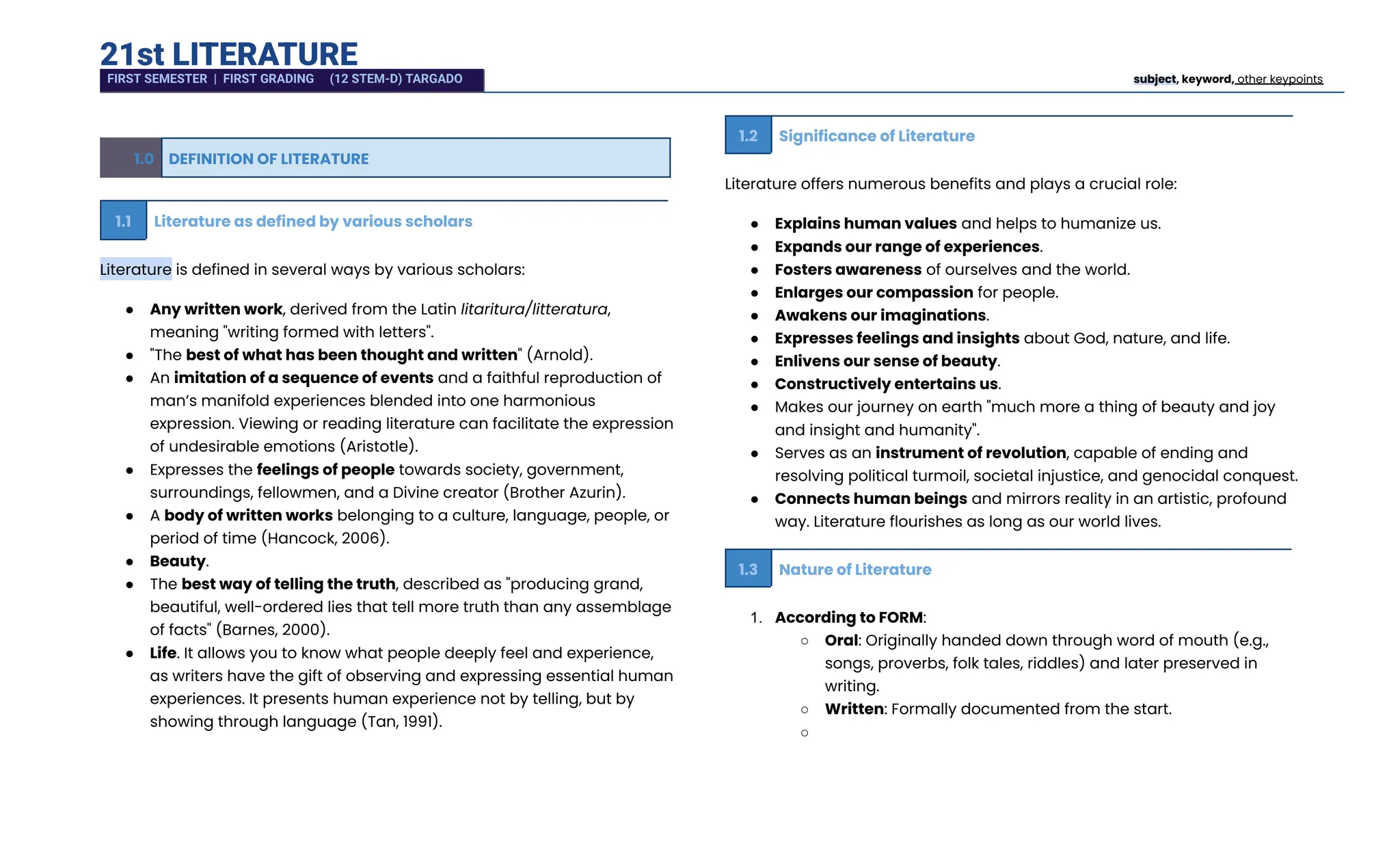
Literature is defined in several ways by various scholars:
●​ Any written work, derived from the Latin litaritura/litteratura,
meaning "writing formed with letters".
●​ "The best of what has been thought and written" (Arnold).
●​ An imitation of a sequence of events and a faithful reproduction of
man’s manifold experiences blended into one harmonious
expression. Viewing or reading literature can facilitate the expression
of undesirable emotions (Aristotle).
●​ Expresses the feelings of people towards society, government,
surroundings, fellowmen, and a Divine creator (Brother Azurin).
●​ A body of written works belonging to a culture, language, people, or
period of time (Hancock, 2006).
●​ Beauty.
●​ The best way of telling the truth, described as "producing grand,
beautiful, well-ordered lies that tell more truth than any assemblage
of facts" (Barnes, 2000).
●​ Life. It allows you to know what people deeply feel and experience,
as writers have the gift of observing and expressing essential human
experiences. It presents human experience not by telling, but by
showing through language (Tan, 1991).
1.2 Significance of Literature
Literature offers numerous benefits and plays a crucial role:
●​ Explains human values and helps to humanize us.
●​ Expands our range of experiences.
●​ Fosters awareness of ourselves and the world.
●​ Enlarges our compassion for people.
●​ Awakens our imaginations.
●​ Expresses feelings and insights about God, nature, and life.
●​ Enlivens our sense of beauty.
●​ Constructively entertains us.
●​ Makes our journey on earth "much more a thing of beauty and joy
and insight and humanity".
●​ Serves as an instrument of revolution, capable of ending and
resolving political turmoil, societal injustice, and genocidal conquest.
●​ Connects human beings and mirrors reality in an artistic, profound
way. Literature flourishes as long as our world lives.
1.3 Nature of Literature
1.​ According to FORM:
○​ Oral: Originally handed down through word of mouth (e.g.,
songs, proverbs, folk tales, riddles) and later preserved in
writing.
○​ Written: Formally documented from the start.
○​
FIRST SEMESTER | FIRST GRADING (12 STEM-D) TARGADO subject, keyword, other keypoints
21st LITERATURE
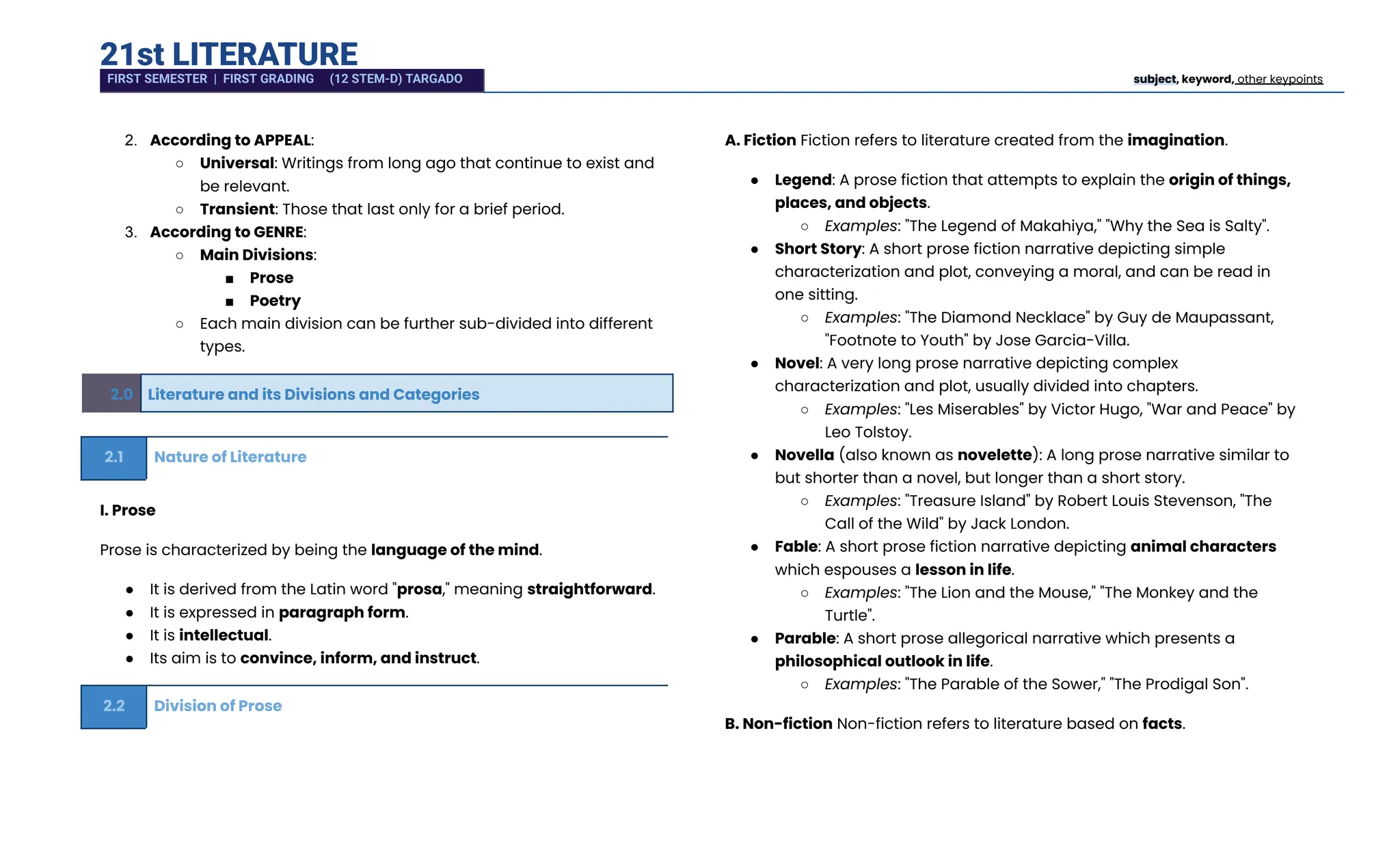
2.​ According to APPEAL:
○​ Universal: Writings from long ago that continue to exist and
be relevant.
○​ Transient: Those that last only for a brief period.
3.​ According to GENRE:
○​ Main Divisions:
■​ Prose
■​ Poetry
○​ Each main division can be further sub-divided into different
types.
2.0 Literature and its Divisions and Categories
2.1 Nature of Literature
I. Prose
Prose is characterized by being the language of the mind.
●​ It is derived from the Latin word "prosa," meaning straightforward.
●​ It is expressed in paragraph form.
●​ It is intellectual.
●​ Its aim is to convince, inform, and instruct.
2.2 Division of Prose
A. Fiction Fiction refers to literature created from the imagination.
●​ Legend: A prose fiction that attempts to explain the origin of things,
places, and objects.
○​ Examples: "The Legend of Makahiya," "Why the Sea is Salty".
●​ Short Story: A short prose fiction narrative depicting simple
characterization and plot, conveying a moral, and can be read in
one sitting.
○​ Examples: "The Diamond Necklace" by Guy de Maupassant,
"Footnote to Youth" by Jose Garcia-Villa.
●​ Novel: A very long prose narrative depicting complex
characterization and plot, usually divided into chapters.
○​ Examples: "Les Miserables" by Victor Hugo, "War and Peace" by
Leo Tolstoy.
●​ Novella (also known as novelette): A long prose narrative similar to
but shorter than a novel, but longer than a short story.
○​ Examples: "Treasure Island" by Robert Louis Stevenson, "The
Call of the Wild" by Jack London.
●​ Fable: A short prose fiction narrative depicting animal characters
which espouses a lesson in life.
○​ Examples: "The Lion and the Mouse," "The Monkey and the
Turtle".
●​ Parable: A short prose allegorical narrative which presents a
philosophical outlook in life.
○​ Examples: "The Parable of the Sower," "The Prodigal Son".
B. Non-fiction Non-fiction refers to literature based on facts.
FIRST SEMESTER | FIRST GRADING (12 STEM-D) TARGADO subject, keyword, other keypoints
21st LITERATURE
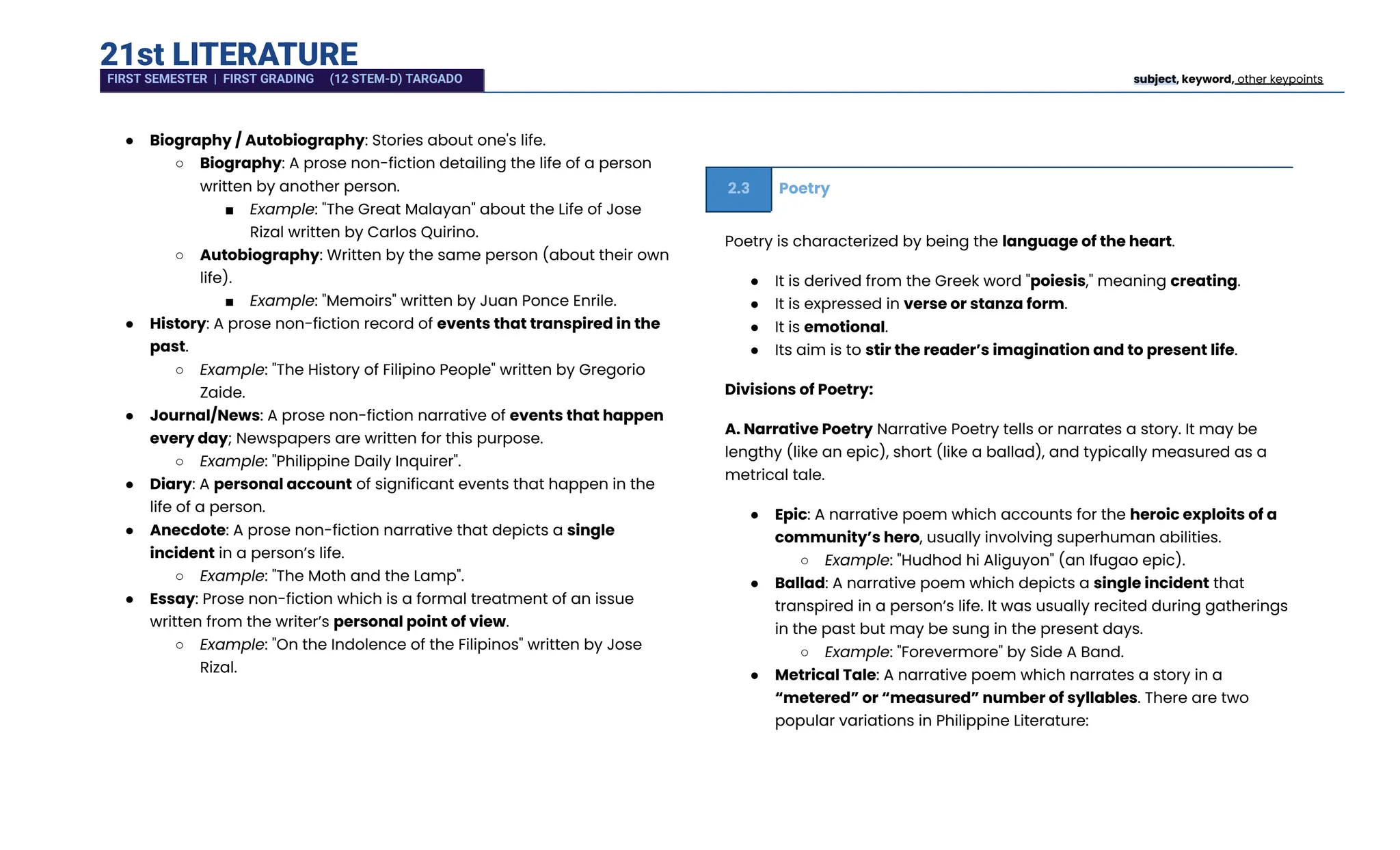
●​ Biography / Autobiography: Stories about one's life.
○​ Biography: A prose non-fiction detailing the life of a person
written by another person.
■​ Example: "The Great Malayan" about the Life of Jose
Rizal written by Carlos Quirino.
○​ Autobiography: Written by the same person (about their own
life).
■​ Example: "Memoirs" written by Juan Ponce Enrile.
●​ History: A prose non-fiction record of events that transpired in the
past.
○​ Example: "The History of Filipino People" written by Gregorio
Zaide.
●​ Journal/News: A prose non-fiction narrative of events that happen
every day; Newspapers are written for this purpose.
○​ Example: "Philippine Daily Inquirer".
●​ Diary: A personal account of significant events that happen in the
life of a person.
●​ Anecdote: A prose non-fiction narrative that depicts a single
incident in a person’s life.
○​ Example: "The Moth and the Lamp".
●​ Essay: Prose non-fiction which is a formal treatment of an issue
written from the writer’s personal point of view.
○​ Example: "On the Indolence of the Filipinos" written by Jose
Rizal.
2.3 Poetry
Poetry is characterized by being the language of the heart.
●​ It is derived from the Greek word "poiesis," meaning creating.
●​ It is expressed in verse or stanza form.
●​ It is emotional.
●​ Its aim is to stir the reader’s imagination and to present life.
Divisions of Poetry:
A. Narrative Poetry Narrative Poetry tells or narrates a story. It may be
lengthy (like an epic), short (like a ballad), and typically measured as a
metrical tale.
●​ Epic: A narrative poem which accounts for the heroic exploits of a
community’s hero, usually involving superhuman abilities.
○​ Example: "Hudhod hi Aliguyon" (an Ifugao epic).
●​ Ballad: A narrative poem which depicts a single incident that
transpired in a person’s life. It was usually recited during gatherings
in the past but may be sung in the present days.
○​ Example: "Forevermore" by Side A Band.
●​ Metrical Tale: A narrative poem which narrates a story in a
“metered” or “measured” number of syllables. There are two
popular variations in Philippine Literature:
FIRST SEMESTER | FIRST GRADING (12 STEM-D) TARGADO subject, keyword, other keypoints
21st LITERATURE
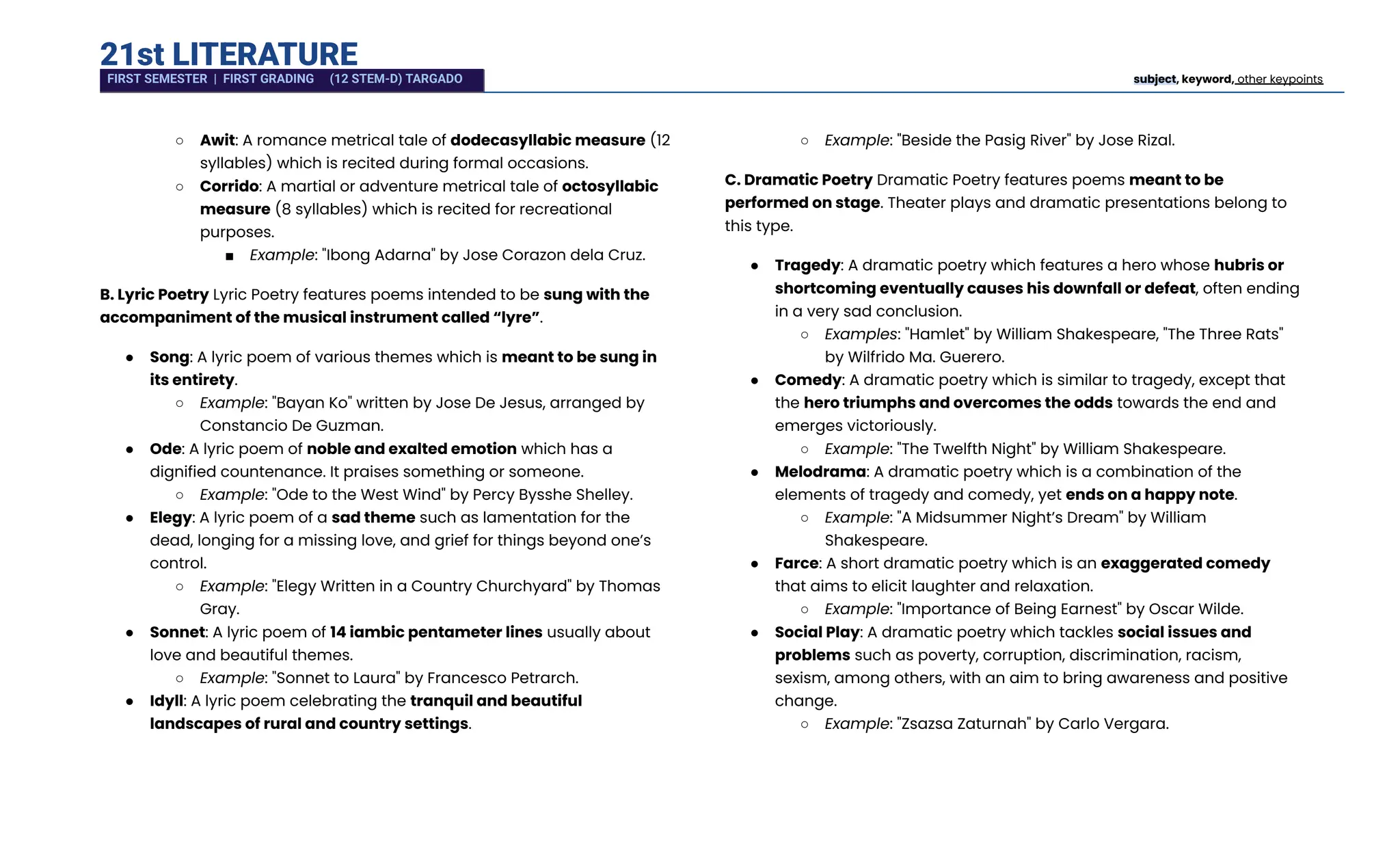
○​ Awit: A romance metrical tale of dodecasyllabic measure (12
syllables) which is recited during formal occasions.
○​ Corrido: A martial or adventure metrical tale of octosyllabic
measure (8 syllables) which is recited for recreational
purposes.
■​ Example: "Ibong Adarna" by Jose Corazon dela Cruz.
B. Lyric Poetry Lyric Poetry features poems intended to be sung with the
accompaniment of the musical instrument called “lyre”.
●​ Song: A lyric poem of various themes which is meant to be sung in
its entirety.
○​ Example: "Bayan Ko" written by Jose De Jesus, arranged by
Constancio De Guzman.
●​ Ode: A lyric poem of noble and exalted emotion which has a
dignified countenance. It praises something or someone.
○​ Example: "Ode to the West Wind" by Percy Bysshe Shelley.
●​ Elegy: A lyric poem of a sad theme such as lamentation for the
dead, longing for a missing love, and grief for things beyond one’s
control.
○​ Example: "Elegy Written in a Country Churchyard" by Thomas
Gray.
●​ Sonnet: A lyric poem of 14 iambic pentameter lines usually about
love and beautiful themes.
○​ Example: "Sonnet to Laura" by Francesco Petrarch.
●​ Idyll: A lyric poem celebrating the tranquil and beautiful
landscapes of rural and country settings.
○​ Example: "Beside the Pasig River" by Jose Rizal.
C. Dramatic Poetry Dramatic Poetry features poems meant to be
performed on stage. Theater plays and dramatic presentations belong to
this type.
●​ Tragedy: A dramatic poetry which features a hero whose hubris or
shortcoming eventually causes his downfall or defeat, often ending
in a very sad conclusion.
○​ Examples: "Hamlet" by William Shakespeare, "The Three Rats"
by Wilfrido Ma. Guerero.
●​ Comedy: A dramatic poetry which is similar to tragedy, except that
the hero triumphs and overcomes the odds towards the end and
emerges victoriously.
○​ Example: "The Twelfth Night" by William Shakespeare.
●​ Melodrama: A dramatic poetry which is a combination of the
elements of tragedy and comedy, yet ends on a happy note.
○​ Example: "A Midsummer Night’s Dream" by William
Shakespeare.
●​ Farce: A short dramatic poetry which is an exaggerated comedy
that aims to elicit laughter and relaxation.
○​ Example: "Importance of Being Earnest" by Oscar Wilde.
●​ Social Play: A dramatic poetry which tackles social issues and
problems such as poverty, corruption, discrimination, racism,
sexism, among others, with an aim to bring awareness and positive
change.
○​ Example: "Zsazsa Zaturnah" by Carlo Vergara.
FIRST SEMESTER | FIRST GRADING (12 STEM-D) TARGADO subject, keyword, other keypoints
21st LITERATURE
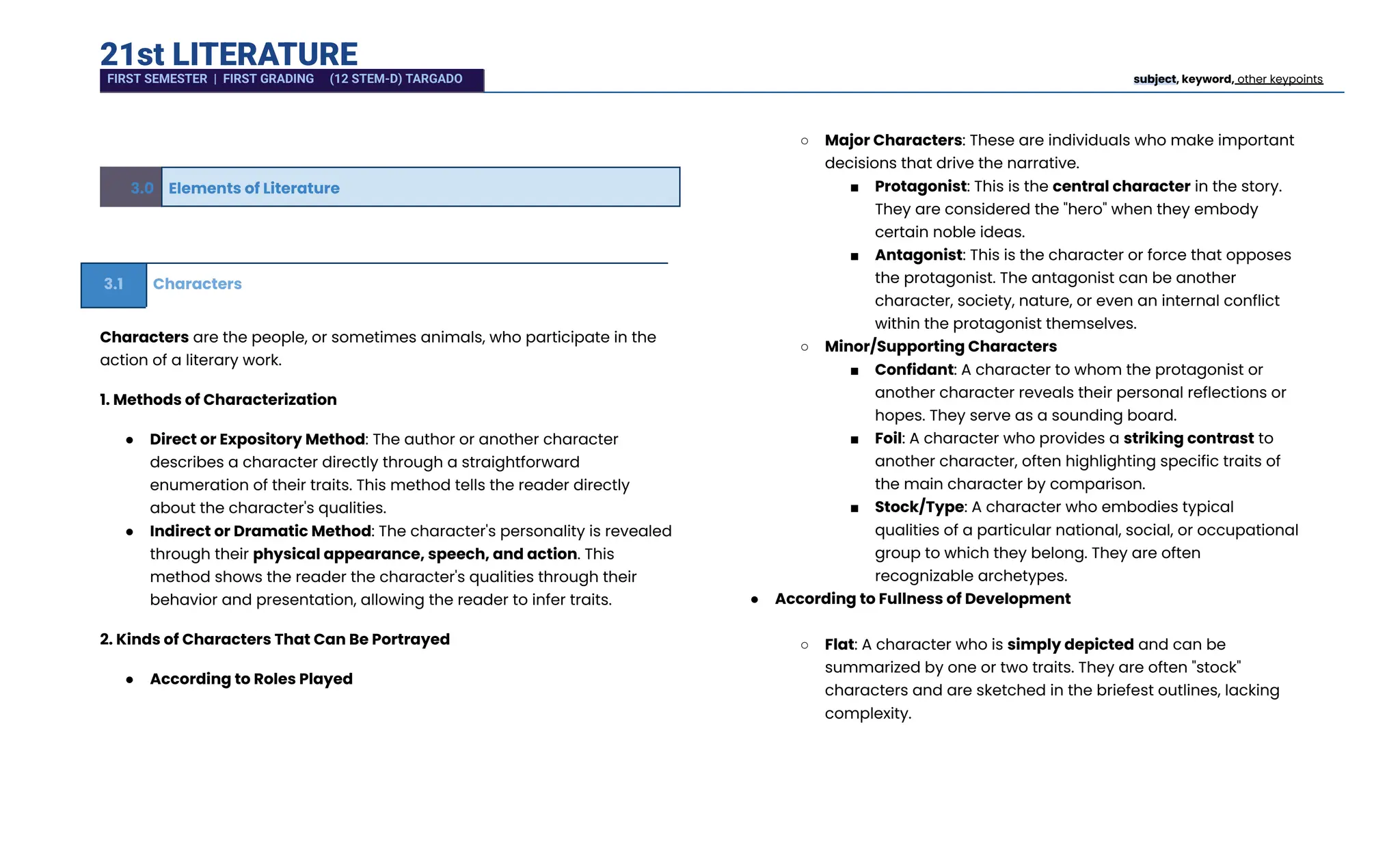
3.0 Elements of Literature
3.1 Characters
Characters are the people, or sometimes animals, who participate in the
action of a literary work.
1. Methods of Characterization
●​ Direct or Expository Method: The author or another character
describes a character directly through a straightforward
enumeration of their traits. This method tells the reader directly
about the character's qualities.
●​ Indirect or Dramatic Method: The character's personality is revealed
through their physical appearance, speech, and action. This
method shows the reader the character's qualities through their
behavior and presentation, allowing the reader to infer traits.
2. Kinds of Characters That Can Be Portrayed
●​ According to Roles Played​
○​ Major Characters: These are individuals who make important
decisions that drive the narrative.
■​ Protagonist: This is the central character in the story.
They are considered the "hero" when they embody
certain noble ideas.
■​ Antagonist: This is the character or force that opposes
the protagonist. The antagonist can be another
character, society, nature, or even an internal conflict
within the protagonist themselves.
○​ Minor/Supporting Characters
■​ Confidant: A character to whom the protagonist or
another character reveals their personal reflections or
hopes. They serve as a sounding board.
■​ Foil: A character who provides a striking contrast to
another character, often highlighting specific traits of
the main character by comparison.
■​ Stock/Type: A character who embodies typical
qualities of a particular national, social, or occupational
group to which they belong. They are often
recognizable archetypes.
●​ According to Fullness of Development​
○​ Flat: A character who is simply depicted and can be
summarized by one or two traits. They are often "stock"
characters and are sketched in the briefest outlines, lacking
complexity.
FIRST SEMESTER | FIRST GRADING (12 STEM-D) TARGADO subject, keyword, other keypoints
21st LITERATURE
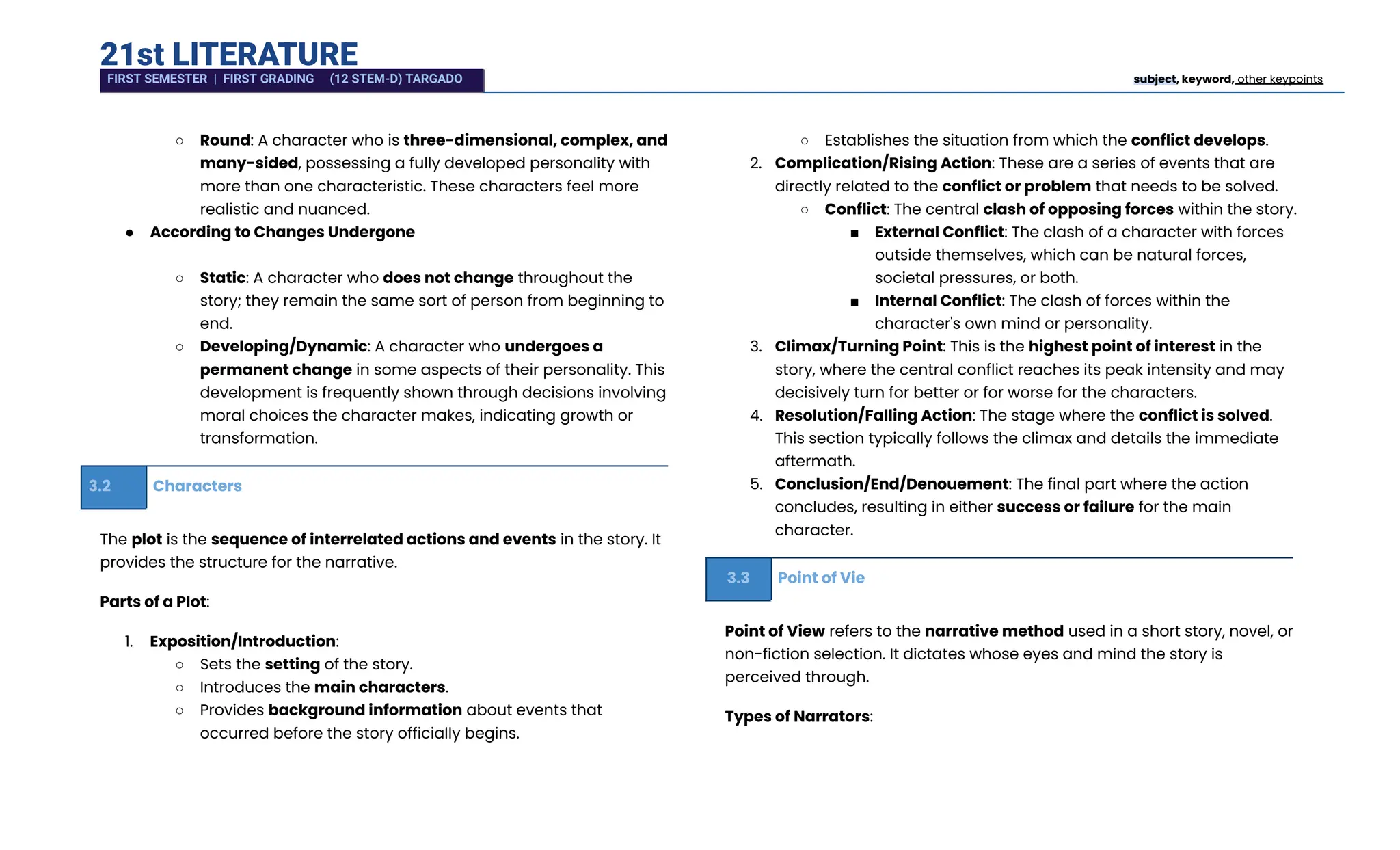
○​ Round: A character who is three-dimensional, complex, and
many-sided, possessing a fully developed personality with
more than one characteristic. These characters feel more
realistic and nuanced.
●​ According to Changes Undergone​
○​ Static: A character who does not change throughout the
story; they remain the same sort of person from beginning to
end.
○​ Developing/Dynamic: A character who undergoes a
permanent change in some aspects of their personality. This
development is frequently shown through decisions involving
moral choices the character makes, indicating growth or
transformation.
3.2 Characters
The plot is the sequence of interrelated actions and events in the story. It
provides the structure for the narrative.
Parts of a Plot:
1.​ Exposition/Introduction:
○​ Sets the setting of the story.
○​ Introduces the main characters.
○​ Provides background information about events that
occurred before the story officially begins.
○​ Establishes the situation from which the conflict develops.
2.​ Complication/Rising Action: These are a series of events that are
directly related to the conflict or problem that needs to be solved.
○​ Conflict: The central clash of opposing forces within the story.
■​ External Conflict: The clash of a character with forces
outside themselves, which can be natural forces,
societal pressures, or both.
■​ Internal Conflict: The clash of forces within the
character's own mind or personality.
3.​ Climax/Turning Point: This is the highest point of interest in the
story, where the central conflict reaches its peak intensity and may
decisively turn for better or for worse for the characters.
4.​ Resolution/Falling Action: The stage where the conflict is solved.
This section typically follows the climax and details the immediate
aftermath.
5.​ Conclusion/End/Denouement: The final part where the action
concludes, resulting in either success or failure for the main
character.
3.3 Point of Vie
Point of View refers to the narrative method used in a short story, novel, or
non-fiction selection. It dictates whose eyes and mind the story is
perceived through.
Types of Narrators:
FIRST SEMESTER | FIRST GRADING (12 STEM-D) TARGADO subject, keyword, other keypoints
21st LITERATURE
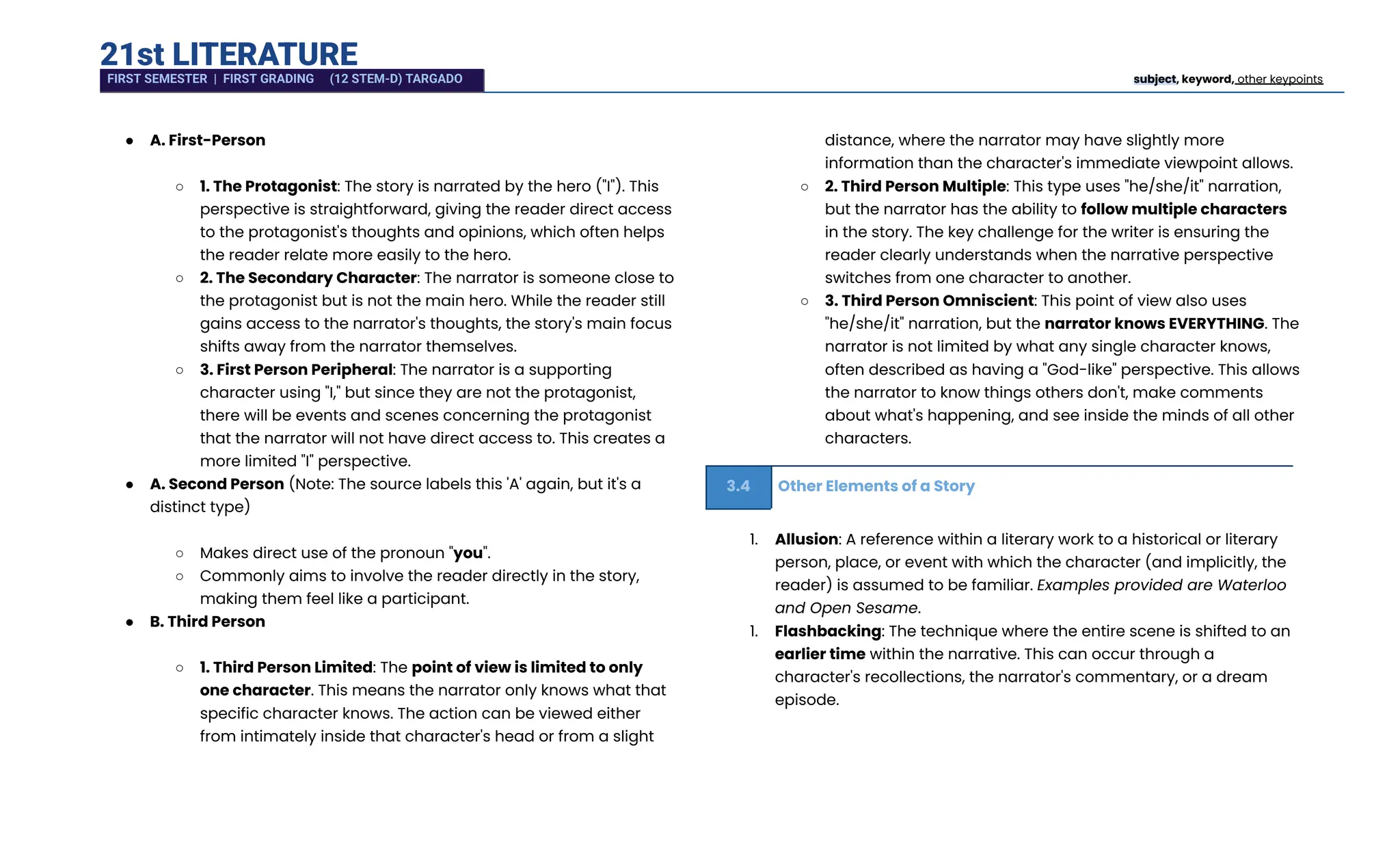
●​ A. First-Person​
○​ 1. The Protagonist: The story is narrated by the hero ("I"). This
perspective is straightforward, giving the reader direct access
to the protagonist's thoughts and opinions, which often helps
the reader relate more easily to the hero.
○​ 2. The Secondary Character: The narrator is someone close to
the protagonist but is not the main hero. While the reader still
gains access to the narrator's thoughts, the story's main focus
shifts away from the narrator themselves.
○​ 3. First Person Peripheral: The narrator is a supporting
character using "I," but since they are not the protagonist,
there will be events and scenes concerning the protagonist
that the narrator will not have direct access to. This creates a
more limited "I" perspective.
●​ A. Second Person (Note: The source labels this 'A' again, but it's a
distinct type)​
○​ Makes direct use of the pronoun "you".
○​ Commonly aims to involve the reader directly in the story,
making them feel like a participant.
●​ B. Third Person​
○​ 1. Third Person Limited: The point of view is limited to only
one character. This means the narrator only knows what that
specific character knows. The action can be viewed either
from intimately inside that character's head or from a slight
distance, where the narrator may have slightly more
information than the character's immediate viewpoint allows.
○​ 2. Third Person Multiple: This type uses "he/she/it" narration,
but the narrator has the ability to follow multiple characters
in the story. The key challenge for the writer is ensuring the
reader clearly understands when the narrative perspective
switches from one character to another.
○​ 3. Third Person Omniscient: This point of view also uses
"he/she/it" narration, but the narrator knows EVERYTHING. The
narrator is not limited by what any single character knows,
often described as having a "God-like" perspective. This allows
the narrator to know things others don't, make comments
about what's happening, and see inside the minds of all other
characters.
3.4 Other Elements of a Story
1.​ Allusion: A reference within a literary work to a historical or literary
person, place, or event with which the character (and implicitly, the
reader) is assumed to be familiar. Examples provided are Waterloo
and Open Sesame.
1.​ Flashbacking: The technique where the entire scene is shifted to an
earlier time within the narrative. This can occur through a
character's recollections, the narrator's commentary, or a dream
episode.
FIRST SEMESTER | FIRST GRADING (12 STEM-D) TARGADO subject, keyword, other keypoints
21st LITERATURE
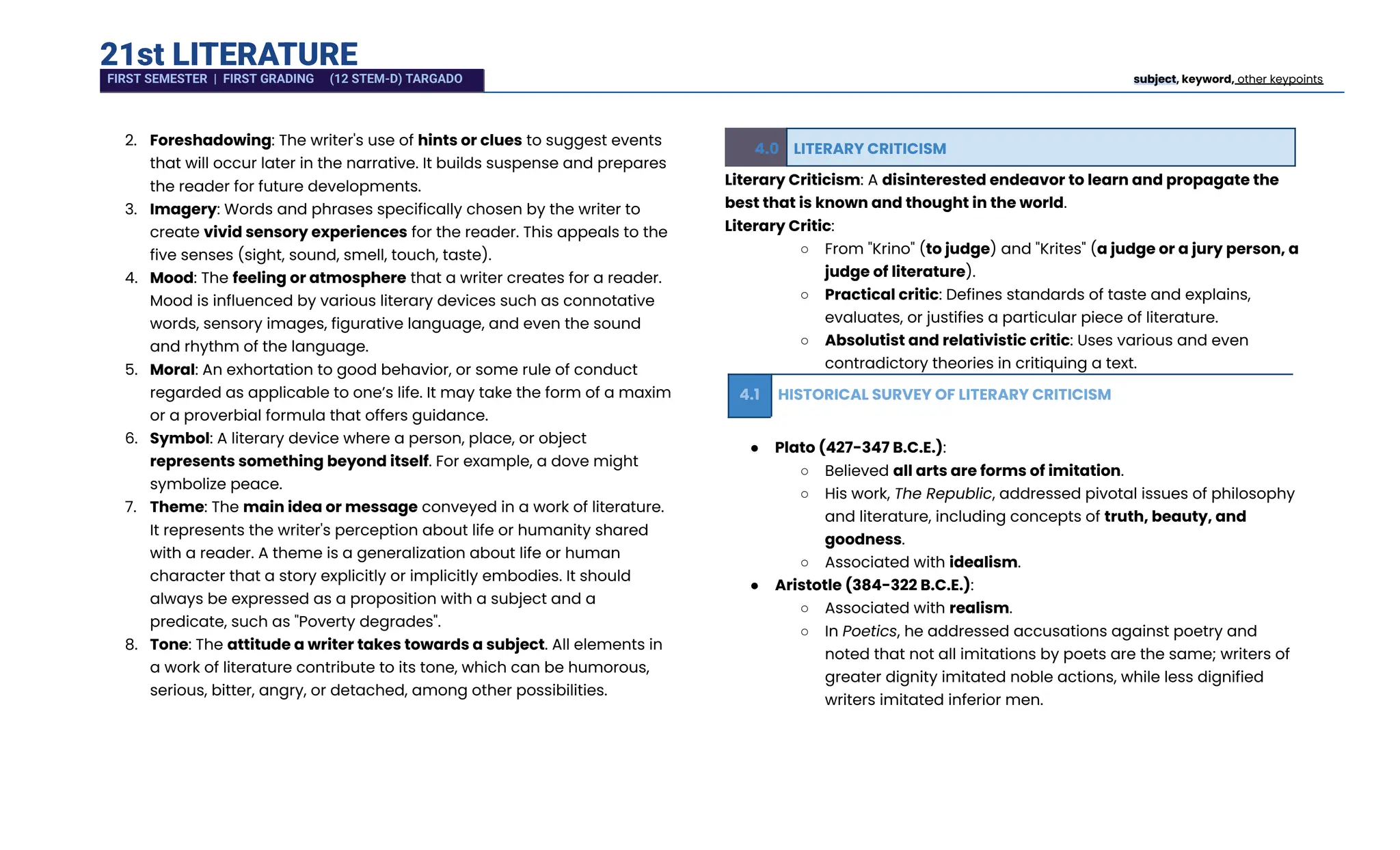
2.​ Foreshadowing: The writer's use of hints or clues to suggest events
that will occur later in the narrative. It builds suspense and prepares
the reader for future developments.
3.​ Imagery: Words and phrases specifically chosen by the writer to
create vivid sensory experiences for the reader. This appeals to the
five senses (sight, sound, smell, touch, taste).
4.​ Mood: The feeling or atmosphere that a writer creates for a reader.
Mood is influenced by various literary devices such as connotative
words, sensory images, figurative language, and even the sound
and rhythm of the language.
5.​ Moral: An exhortation to good behavior, or some rule of conduct
regarded as applicable to one’s life. It may take the form of a maxim
or a proverbial formula that offers guidance.
6.​ Symbol: A literary device where a person, place, or object
represents something beyond itself. For example, a dove might
symbolize peace.
7.​ Theme: The main idea or message conveyed in a work of literature.
It represents the writer's perception about life or humanity shared
with a reader. A theme is a generalization about life or human
character that a story explicitly or implicitly embodies. It should
always be expressed as a proposition with a subject and a
predicate, such as "Poverty degrades".
8.​ Tone: The attitude a writer takes towards a subject. All elements in
a work of literature contribute to its tone, which can be humorous,
serious, bitter, angry, or detached, among other possibilities.
4.0 LITERARY CRITICISM
Literary Criticism: A disinterested endeavor to learn and propagate the
best that is known and thought in the world.
Literary Critic:
○​ From "Krino" (to judge) and "Krites" (a judge or a jury person, a
judge of literature).
○​ Practical critic: Defines standards of taste and explains,
evaluates, or justifies a particular piece of literature.
○​ Absolutist and relativistic critic: Uses various and even
contradictory theories in critiquing a text.
4.1 HISTORICAL SURVEY OF LITERARY CRITICISM
●​ Plato (427-347 B.C.E.):
○​ Believed all arts are forms of imitation.
○​ His work, The Republic, addressed pivotal issues of philosophy
and literature, including concepts of truth, beauty, and
goodness.
○​ Associated with idealism.
●​ Aristotle (384-322 B.C.E.):
○​ Associated with realism.
○​ In Poetics, he addressed accusations against poetry and
noted that not all imitations by poets are the same; writers of
greater dignity imitated noble actions, while less dignified
writers imitated inferior men.
FIRST SEMESTER | FIRST GRADING (12 STEM-D) TARGADO subject, keyword, other keypoints
21st LITERATURE
●​ Horace (65-8 B.C.E.):
○​ In Ars Poetica (The Art of Poetry), stated that art should be
sweet and useful.
○​ Advocated that poets must imitate other poets, particularly
those of the past and especially the Greeks.
○​ Believed one should write about a traditional subject in a
unique way.
●​ Longinus (1st century C.E.):
○​ Stated that one cannot accurately judge a literary work
unless one is exceedingly well read.
○​ Introduced the concept of the sublime in On the Sublime,
occurring when intellect, emotions, and will harmoniously
respond to a given work of art.
●​ Plotinus (204-270 C.E.):
○​ In The Enneads, emphasized that the unity of the one is the
goal of humanity.
●​ Dante Alighieri (1265-1321):
○​ Emphasized the proper language for poetry, asserting that
the vernacular is an excellent vehicle for works of literature.
○​ The Divine Comedy addressed the contemporary world and
the concept of the Christian God.
●​ Giovanni Boccaccio (1313-1375):
○​ Defended poetry and classical myth, arguing that the
purpose of poetry is to improve life by revealing both truth
and God.
○​ Believed poetry comes "from the bosom of God".
●​ Sir Philip Sidney (1554-1586):
○​ Proclaimed that poetry excels all other works because it is
the noblest of all works of humankind.
○​ In An Apology for Poetry, stated that poetry is akin to religion
because both guide and accomplish their purpose by stirring
the emotions of the reader.
●​ John Dryden (1631-1700):
○​ Contributed to the completion of meter, refinement of
language, and correctness of sentiments.
●​ Alexander Pope (1688-1744):
○​ Asserted that the chief requirement of a good poet is natural
genius, coupled with knowledge of the classics and an
understanding of the rules of poetry.
●​ William Wordsworth (1779-1859):
○​ Advocated choosing incidents and situations from common
life and describing them in a language really used by the
people in those situations.
○​ His poetry featured common men and women rather than
kings, queens, and aristocrats.
FIRST SEMESTER | FIRST GRADING (12 STEM-D) TARGADO subject, keyword, other keypoints
21st LITERATURE
4.2 MODERN LITERARY CRITICISM/ NEW CRITICISM
●​ Biographical:
○​ Sees works as a reflection of an author's life and times (or of
the characters' life and times).
○​ Meaning is derived from the interaction of author/poet + text.
●​ Formalism/New Criticism:
○​ Posits that all information essential to the interpretation of a
work must be found within the work itself.
○​ External information about history, politics, society, or the
author's life is not needed.
○​ Terms used in Formalism:
■​ Tension: The integral unity of the work, often involving
irony or paradox.
■​ Intentional Fallacy: The belief that the meaning of a
work may be determined by the author's intention.
■​ Affective Fallacy: The belief that the meaning or value
of a work may be determined by its effect on the
reader.
■​ External Form: The outer structure of a work, such as
rhyme scheme, meter, and stanza form in a poem.
■​ Objective Correlative (T.S. Eliot): A collection of
objects, situations, or events that immediately evoke a
specific emotion.
●​ Historical:
○​ Old Historicism: History serves as a background to literature
to shed light on the text, viewed as an accurate account of
what occurred.
○​ New Historicism: Highlights the interrelatedness of all human
activities and declares that all history is subjective, written
by people whose personal biases affect their interpretation of
the past.
●​ Marxism:
○​ Believes that society shapes consciousness, and social and
economic conditions directly influence beliefs and values.
○​ Aims for a classless society where wealth, opportunity, and
education are accessible to everyone, free from bigotry,
hatred, and conflict due to class struggle.
●​ Reader-Oriented/Reader-Response:
○​ Emphasizes that readers bring their individual personalities,
memories, concerns, and physical conditions to the reading
of a text, influencing its meaning.
●​ Structuralism:
○​ Finds meaning in the relationship among the various
components of a system.
○​ Looks for specific codes (signs) within a text that allow
meaning to occur, as these are part of a larger system
enabling meaning in society, including literature.
FIRST SEMESTER | FIRST GRADING (12 STEM-D) TARGADO subject, keyword, other keypoints
21st LITERATURE
●​ Deconstruction:
○​ Recognizes the existence and operation of binary oppositions
(e.g., truth/falsehood, reason/insanity, good/bad) in thinking.
○​ Meaning derives from differences between signs (e.g.,
"house" differs from "shed," "mansion," "hotel," "building").
●​ Archetypal:
○​ Assumes a collection of universal symbols, images,
characters, and motifs (archetypes) that evoke basically
the same response in all people.
○​ Examples of Archetypes:
■​ Archetypal women: The good mother, the terrible
mother, the soulmate (e.g., Virgin Mary).
■​ Water: Creation, birth-death-resurrection, purification,
redemption, fertility, growth.
■​ Garden: Paradise (Eden), innocence, fertility.
■​ Desert: Spiritual emptiness, death, hopelessness.
■​ Colors: Red (blood, sacrifice, passion, disorder), Green
(growth, fertility), Black (chaos, death, evil).
■​ Serpent: Evil, sensuality, mystery, wisdom, destruction.
■​ Seven: Perfection.
■​ Hero archetype: Involved in a quest, experiences
initiation (separation, transformation, return), and
serves as a scapegoat (dies to atone).
4.2 OTHER TYPES
●​ Mimetic Theory:
○​ Judges a literary work in terms of imitation.
○​ Asks how well the work of literature accords with the real
world (accuracy, correctness, "truth to life," verisimilitude).
○​ Can include some forms of moral/philosophical criticism,
psychological criticism, and feminist criticism.
●​ Philosophical Criticism:
○​ Believes that the larger purpose of literature is to teach
morality and to probe philosophical issues.
○​ Recognizes that literature can affect readers and that the
message of a work is important.
●​ Psychological/Psychoanalytic Criticism:
○​ Freudian: Focuses on the influences of a character's id
(instinctual, pleasure-seeking), superego (represses id's
impulses), and ego (controls but releases id's impulses
healthily).
○​ Jungian: Labels parts of the self: shadow (darker,
unconscious self, often the villain), persona (man's social
personality, often the hero), and anima (man's "soul image,"
often the heroine).
○​ Views a literary work as the external expression of the
author’s unconscious mind, applying psychoanalytic
techniques to uncover hidden motivations, repressed desires,
and wishes.
FIRST SEMESTER | FIRST GRADING (12 STEM-D) TARGADO subject, keyword, other keypoints
21st LITERATURE
●​ Feminism:
○​ Amazon Feminism: Emphasizes female physical equality and
images, highlighting physiques of female athletes.
○​ Ecofeminism: Focuses on a matriarchal society protecting the
environment, natural resources, animal life, and especially
caring for women and children.
○​ Material Feminism: Aims to improve the material condition of
women by unburdening them of traditional domestic tasks
(e.g., housework, cooking, ironing).
○​ Separatist Feminism: Advocates for women separating
themselves from men, at least temporarily, to discover their
individual identity.
●​ Queer Theory:
○​ Focuses on "mismatches" between sex, gender, and desire.
○​ Most prominently associated with bisexual, lesbian, and gay
subjects.
●​ Postcolonialism:
○​ Consists of theories and approaches concerned with
literature written in English in countries that were or are still
colonies of other countries.
○​ Examines intercultural dynamics and how colonized people
view themselves.
FIRST SEMESTER | FIRST GRADING (12 STEM-D) TARGADO subject, keyword, other keypoints
21ST_LITERATURE_NOTES-2 grafe 12 topics 1

  • 1.
    21st LITERATURE 1.0 DEFINITIONOF LITERATURE 1.1 Literature as defined by various scholars Literature is defined in several ways by various scholars: ●​ Any written work, derived from the Latin litaritura/litteratura, meaning "writing formed with letters". ●​ "The best of what has been thought and written" (Arnold). ●​ An imitation of a sequence of events and a faithful reproduction of man’s manifold experiences blended into one harmonious expression. Viewing or reading literature can facilitate the expression of undesirable emotions (Aristotle). ●​ Expresses the feelings of people towards society, government, surroundings, fellowmen, and a Divine creator (Brother Azurin). ●​ A body of written works belonging to a culture, language, people, or period of time (Hancock, 2006). ●​ Beauty. ●​ The best way of telling the truth, described as "producing grand, beautiful, well-ordered lies that tell more truth than any assemblage of facts" (Barnes, 2000). ●​ Life. It allows you to know what people deeply feel and experience, as writers have the gift of observing and expressing essential human experiences. It presents human experience not by telling, but by showing through language (Tan, 1991). 1.2 Significance of Literature Literature offers numerous benefits and plays a crucial role: ●​ Explains human values and helps to humanize us. ●​ Expands our range of experiences. ●​ Fosters awareness of ourselves and the world. ●​ Enlarges our compassion for people. ●​ Awakens our imaginations. ●​ Expresses feelings and insights about God, nature, and life. ●​ Enlivens our sense of beauty. ●​ Constructively entertains us. ●​ Makes our journey on earth "much more a thing of beauty and joy and insight and humanity". ●​ Serves as an instrument of revolution, capable of ending and resolving political turmoil, societal injustice, and genocidal conquest. ●​ Connects human beings and mirrors reality in an artistic, profound way. Literature flourishes as long as our world lives. 1.3 Nature of Literature 1.​ According to FORM: ○​ Oral: Originally handed down through word of mouth (e.g., songs, proverbs, folk tales, riddles) and later preserved in writing. ○​ Written: Formally documented from the start. ○​ FIRST SEMESTER | FIRST GRADING (12 STEM-D) TARGADO subject, keyword, other keypoints
  • 2.
    21st LITERATURE 2.​ Accordingto APPEAL: ○​ Universal: Writings from long ago that continue to exist and be relevant. ○​ Transient: Those that last only for a brief period. 3.​ According to GENRE: ○​ Main Divisions: ■​ Prose ■​ Poetry ○​ Each main division can be further sub-divided into different types. 2.0 Literature and its Divisions and Categories 2.1 Nature of Literature I. Prose Prose is characterized by being the language of the mind. ●​ It is derived from the Latin word "prosa," meaning straightforward. ●​ It is expressed in paragraph form. ●​ It is intellectual. ●​ Its aim is to convince, inform, and instruct. 2.2 Division of Prose A. Fiction Fiction refers to literature created from the imagination. ●​ Legend: A prose fiction that attempts to explain the origin of things, places, and objects. ○​ Examples: "The Legend of Makahiya," "Why the Sea is Salty". ●​ Short Story: A short prose fiction narrative depicting simple characterization and plot, conveying a moral, and can be read in one sitting. ○​ Examples: "The Diamond Necklace" by Guy de Maupassant, "Footnote to Youth" by Jose Garcia-Villa. ●​ Novel: A very long prose narrative depicting complex characterization and plot, usually divided into chapters. ○​ Examples: "Les Miserables" by Victor Hugo, "War and Peace" by Leo Tolstoy. ●​ Novella (also known as novelette): A long prose narrative similar to but shorter than a novel, but longer than a short story. ○​ Examples: "Treasure Island" by Robert Louis Stevenson, "The Call of the Wild" by Jack London. ●​ Fable: A short prose fiction narrative depicting animal characters which espouses a lesson in life. ○​ Examples: "The Lion and the Mouse," "The Monkey and the Turtle". ●​ Parable: A short prose allegorical narrative which presents a philosophical outlook in life. ○​ Examples: "The Parable of the Sower," "The Prodigal Son". B. Non-fiction Non-fiction refers to literature based on facts. FIRST SEMESTER | FIRST GRADING (12 STEM-D) TARGADO subject, keyword, other keypoints
  • 3.
    21st LITERATURE ●​ Biography/ Autobiography: Stories about one's life. ○​ Biography: A prose non-fiction detailing the life of a person written by another person. ■​ Example: "The Great Malayan" about the Life of Jose Rizal written by Carlos Quirino. ○​ Autobiography: Written by the same person (about their own life). ■​ Example: "Memoirs" written by Juan Ponce Enrile. ●​ History: A prose non-fiction record of events that transpired in the past. ○​ Example: "The History of Filipino People" written by Gregorio Zaide. ●​ Journal/News: A prose non-fiction narrative of events that happen every day; Newspapers are written for this purpose. ○​ Example: "Philippine Daily Inquirer". ●​ Diary: A personal account of significant events that happen in the life of a person. ●​ Anecdote: A prose non-fiction narrative that depicts a single incident in a person’s life. ○​ Example: "The Moth and the Lamp". ●​ Essay: Prose non-fiction which is a formal treatment of an issue written from the writer’s personal point of view. ○​ Example: "On the Indolence of the Filipinos" written by Jose Rizal. 2.3 Poetry Poetry is characterized by being the language of the heart. ●​ It is derived from the Greek word "poiesis," meaning creating. ●​ It is expressed in verse or stanza form. ●​ It is emotional. ●​ Its aim is to stir the reader’s imagination and to present life. Divisions of Poetry: A. Narrative Poetry Narrative Poetry tells or narrates a story. It may be lengthy (like an epic), short (like a ballad), and typically measured as a metrical tale. ●​ Epic: A narrative poem which accounts for the heroic exploits of a community’s hero, usually involving superhuman abilities. ○​ Example: "Hudhod hi Aliguyon" (an Ifugao epic). ●​ Ballad: A narrative poem which depicts a single incident that transpired in a person’s life. It was usually recited during gatherings in the past but may be sung in the present days. ○​ Example: "Forevermore" by Side A Band. ●​ Metrical Tale: A narrative poem which narrates a story in a “metered” or “measured” number of syllables. There are two popular variations in Philippine Literature: FIRST SEMESTER | FIRST GRADING (12 STEM-D) TARGADO subject, keyword, other keypoints
  • 4.
    21st LITERATURE ○​ Awit:A romance metrical tale of dodecasyllabic measure (12 syllables) which is recited during formal occasions. ○​ Corrido: A martial or adventure metrical tale of octosyllabic measure (8 syllables) which is recited for recreational purposes. ■​ Example: "Ibong Adarna" by Jose Corazon dela Cruz. B. Lyric Poetry Lyric Poetry features poems intended to be sung with the accompaniment of the musical instrument called “lyre”. ●​ Song: A lyric poem of various themes which is meant to be sung in its entirety. ○​ Example: "Bayan Ko" written by Jose De Jesus, arranged by Constancio De Guzman. ●​ Ode: A lyric poem of noble and exalted emotion which has a dignified countenance. It praises something or someone. ○​ Example: "Ode to the West Wind" by Percy Bysshe Shelley. ●​ Elegy: A lyric poem of a sad theme such as lamentation for the dead, longing for a missing love, and grief for things beyond one’s control. ○​ Example: "Elegy Written in a Country Churchyard" by Thomas Gray. ●​ Sonnet: A lyric poem of 14 iambic pentameter lines usually about love and beautiful themes. ○​ Example: "Sonnet to Laura" by Francesco Petrarch. ●​ Idyll: A lyric poem celebrating the tranquil and beautiful landscapes of rural and country settings. ○​ Example: "Beside the Pasig River" by Jose Rizal. C. Dramatic Poetry Dramatic Poetry features poems meant to be performed on stage. Theater plays and dramatic presentations belong to this type. ●​ Tragedy: A dramatic poetry which features a hero whose hubris or shortcoming eventually causes his downfall or defeat, often ending in a very sad conclusion. ○​ Examples: "Hamlet" by William Shakespeare, "The Three Rats" by Wilfrido Ma. Guerero. ●​ Comedy: A dramatic poetry which is similar to tragedy, except that the hero triumphs and overcomes the odds towards the end and emerges victoriously. ○​ Example: "The Twelfth Night" by William Shakespeare. ●​ Melodrama: A dramatic poetry which is a combination of the elements of tragedy and comedy, yet ends on a happy note. ○​ Example: "A Midsummer Night’s Dream" by William Shakespeare. ●​ Farce: A short dramatic poetry which is an exaggerated comedy that aims to elicit laughter and relaxation. ○​ Example: "Importance of Being Earnest" by Oscar Wilde. ●​ Social Play: A dramatic poetry which tackles social issues and problems such as poverty, corruption, discrimination, racism, sexism, among others, with an aim to bring awareness and positive change. ○​ Example: "Zsazsa Zaturnah" by Carlo Vergara. FIRST SEMESTER | FIRST GRADING (12 STEM-D) TARGADO subject, keyword, other keypoints
  • 5.
    21st LITERATURE 3.0 Elementsof Literature 3.1 Characters Characters are the people, or sometimes animals, who participate in the action of a literary work. 1. Methods of Characterization ●​ Direct or Expository Method: The author or another character describes a character directly through a straightforward enumeration of their traits. This method tells the reader directly about the character's qualities. ●​ Indirect or Dramatic Method: The character's personality is revealed through their physical appearance, speech, and action. This method shows the reader the character's qualities through their behavior and presentation, allowing the reader to infer traits. 2. Kinds of Characters That Can Be Portrayed ●​ According to Roles Played​ ○​ Major Characters: These are individuals who make important decisions that drive the narrative. ■​ Protagonist: This is the central character in the story. They are considered the "hero" when they embody certain noble ideas. ■​ Antagonist: This is the character or force that opposes the protagonist. The antagonist can be another character, society, nature, or even an internal conflict within the protagonist themselves. ○​ Minor/Supporting Characters ■​ Confidant: A character to whom the protagonist or another character reveals their personal reflections or hopes. They serve as a sounding board. ■​ Foil: A character who provides a striking contrast to another character, often highlighting specific traits of the main character by comparison. ■​ Stock/Type: A character who embodies typical qualities of a particular national, social, or occupational group to which they belong. They are often recognizable archetypes. ●​ According to Fullness of Development​ ○​ Flat: A character who is simply depicted and can be summarized by one or two traits. They are often "stock" characters and are sketched in the briefest outlines, lacking complexity. FIRST SEMESTER | FIRST GRADING (12 STEM-D) TARGADO subject, keyword, other keypoints
  • 6.
    21st LITERATURE ○​ Round:A character who is three-dimensional, complex, and many-sided, possessing a fully developed personality with more than one characteristic. These characters feel more realistic and nuanced. ●​ According to Changes Undergone​ ○​ Static: A character who does not change throughout the story; they remain the same sort of person from beginning to end. ○​ Developing/Dynamic: A character who undergoes a permanent change in some aspects of their personality. This development is frequently shown through decisions involving moral choices the character makes, indicating growth or transformation. 3.2 Characters The plot is the sequence of interrelated actions and events in the story. It provides the structure for the narrative. Parts of a Plot: 1.​ Exposition/Introduction: ○​ Sets the setting of the story. ○​ Introduces the main characters. ○​ Provides background information about events that occurred before the story officially begins. ○​ Establishes the situation from which the conflict develops. 2.​ Complication/Rising Action: These are a series of events that are directly related to the conflict or problem that needs to be solved. ○​ Conflict: The central clash of opposing forces within the story. ■​ External Conflict: The clash of a character with forces outside themselves, which can be natural forces, societal pressures, or both. ■​ Internal Conflict: The clash of forces within the character's own mind or personality. 3.​ Climax/Turning Point: This is the highest point of interest in the story, where the central conflict reaches its peak intensity and may decisively turn for better or for worse for the characters. 4.​ Resolution/Falling Action: The stage where the conflict is solved. This section typically follows the climax and details the immediate aftermath. 5.​ Conclusion/End/Denouement: The final part where the action concludes, resulting in either success or failure for the main character. 3.3 Point of Vie Point of View refers to the narrative method used in a short story, novel, or non-fiction selection. It dictates whose eyes and mind the story is perceived through. Types of Narrators: FIRST SEMESTER | FIRST GRADING (12 STEM-D) TARGADO subject, keyword, other keypoints
  • 7.
    21st LITERATURE ●​ A.First-Person​ ○​ 1. The Protagonist: The story is narrated by the hero ("I"). This perspective is straightforward, giving the reader direct access to the protagonist's thoughts and opinions, which often helps the reader relate more easily to the hero. ○​ 2. The Secondary Character: The narrator is someone close to the protagonist but is not the main hero. While the reader still gains access to the narrator's thoughts, the story's main focus shifts away from the narrator themselves. ○​ 3. First Person Peripheral: The narrator is a supporting character using "I," but since they are not the protagonist, there will be events and scenes concerning the protagonist that the narrator will not have direct access to. This creates a more limited "I" perspective. ●​ A. Second Person (Note: The source labels this 'A' again, but it's a distinct type)​ ○​ Makes direct use of the pronoun "you". ○​ Commonly aims to involve the reader directly in the story, making them feel like a participant. ●​ B. Third Person​ ○​ 1. Third Person Limited: The point of view is limited to only one character. This means the narrator only knows what that specific character knows. The action can be viewed either from intimately inside that character's head or from a slight distance, where the narrator may have slightly more information than the character's immediate viewpoint allows. ○​ 2. Third Person Multiple: This type uses "he/she/it" narration, but the narrator has the ability to follow multiple characters in the story. The key challenge for the writer is ensuring the reader clearly understands when the narrative perspective switches from one character to another. ○​ 3. Third Person Omniscient: This point of view also uses "he/she/it" narration, but the narrator knows EVERYTHING. The narrator is not limited by what any single character knows, often described as having a "God-like" perspective. This allows the narrator to know things others don't, make comments about what's happening, and see inside the minds of all other characters. 3.4 Other Elements of a Story 1.​ Allusion: A reference within a literary work to a historical or literary person, place, or event with which the character (and implicitly, the reader) is assumed to be familiar. Examples provided are Waterloo and Open Sesame. 1.​ Flashbacking: The technique where the entire scene is shifted to an earlier time within the narrative. This can occur through a character's recollections, the narrator's commentary, or a dream episode. FIRST SEMESTER | FIRST GRADING (12 STEM-D) TARGADO subject, keyword, other keypoints
  • 8.
    21st LITERATURE 2.​ Foreshadowing:The writer's use of hints or clues to suggest events that will occur later in the narrative. It builds suspense and prepares the reader for future developments. 3.​ Imagery: Words and phrases specifically chosen by the writer to create vivid sensory experiences for the reader. This appeals to the five senses (sight, sound, smell, touch, taste). 4.​ Mood: The feeling or atmosphere that a writer creates for a reader. Mood is influenced by various literary devices such as connotative words, sensory images, figurative language, and even the sound and rhythm of the language. 5.​ Moral: An exhortation to good behavior, or some rule of conduct regarded as applicable to one’s life. It may take the form of a maxim or a proverbial formula that offers guidance. 6.​ Symbol: A literary device where a person, place, or object represents something beyond itself. For example, a dove might symbolize peace. 7.​ Theme: The main idea or message conveyed in a work of literature. It represents the writer's perception about life or humanity shared with a reader. A theme is a generalization about life or human character that a story explicitly or implicitly embodies. It should always be expressed as a proposition with a subject and a predicate, such as "Poverty degrades". 8.​ Tone: The attitude a writer takes towards a subject. All elements in a work of literature contribute to its tone, which can be humorous, serious, bitter, angry, or detached, among other possibilities. 4.0 LITERARY CRITICISM Literary Criticism: A disinterested endeavor to learn and propagate the best that is known and thought in the world. Literary Critic: ○​ From "Krino" (to judge) and "Krites" (a judge or a jury person, a judge of literature). ○​ Practical critic: Defines standards of taste and explains, evaluates, or justifies a particular piece of literature. ○​ Absolutist and relativistic critic: Uses various and even contradictory theories in critiquing a text. 4.1 HISTORICAL SURVEY OF LITERARY CRITICISM ●​ Plato (427-347 B.C.E.): ○​ Believed all arts are forms of imitation. ○​ His work, The Republic, addressed pivotal issues of philosophy and literature, including concepts of truth, beauty, and goodness. ○​ Associated with idealism. ●​ Aristotle (384-322 B.C.E.): ○​ Associated with realism. ○​ In Poetics, he addressed accusations against poetry and noted that not all imitations by poets are the same; writers of greater dignity imitated noble actions, while less dignified writers imitated inferior men. FIRST SEMESTER | FIRST GRADING (12 STEM-D) TARGADO subject, keyword, other keypoints
  • 9.
    21st LITERATURE ●​ Horace(65-8 B.C.E.): ○​ In Ars Poetica (The Art of Poetry), stated that art should be sweet and useful. ○​ Advocated that poets must imitate other poets, particularly those of the past and especially the Greeks. ○​ Believed one should write about a traditional subject in a unique way. ●​ Longinus (1st century C.E.): ○​ Stated that one cannot accurately judge a literary work unless one is exceedingly well read. ○​ Introduced the concept of the sublime in On the Sublime, occurring when intellect, emotions, and will harmoniously respond to a given work of art. ●​ Plotinus (204-270 C.E.): ○​ In The Enneads, emphasized that the unity of the one is the goal of humanity. ●​ Dante Alighieri (1265-1321): ○​ Emphasized the proper language for poetry, asserting that the vernacular is an excellent vehicle for works of literature. ○​ The Divine Comedy addressed the contemporary world and the concept of the Christian God. ●​ Giovanni Boccaccio (1313-1375): ○​ Defended poetry and classical myth, arguing that the purpose of poetry is to improve life by revealing both truth and God. ○​ Believed poetry comes "from the bosom of God". ●​ Sir Philip Sidney (1554-1586): ○​ Proclaimed that poetry excels all other works because it is the noblest of all works of humankind. ○​ In An Apology for Poetry, stated that poetry is akin to religion because both guide and accomplish their purpose by stirring the emotions of the reader. ●​ John Dryden (1631-1700): ○​ Contributed to the completion of meter, refinement of language, and correctness of sentiments. ●​ Alexander Pope (1688-1744): ○​ Asserted that the chief requirement of a good poet is natural genius, coupled with knowledge of the classics and an understanding of the rules of poetry. ●​ William Wordsworth (1779-1859): ○​ Advocated choosing incidents and situations from common life and describing them in a language really used by the people in those situations. ○​ His poetry featured common men and women rather than kings, queens, and aristocrats. FIRST SEMESTER | FIRST GRADING (12 STEM-D) TARGADO subject, keyword, other keypoints
  • 10.
    21st LITERATURE 4.2 MODERNLITERARY CRITICISM/ NEW CRITICISM ●​ Biographical: ○​ Sees works as a reflection of an author's life and times (or of the characters' life and times). ○​ Meaning is derived from the interaction of author/poet + text. ●​ Formalism/New Criticism: ○​ Posits that all information essential to the interpretation of a work must be found within the work itself. ○​ External information about history, politics, society, or the author's life is not needed. ○​ Terms used in Formalism: ■​ Tension: The integral unity of the work, often involving irony or paradox. ■​ Intentional Fallacy: The belief that the meaning of a work may be determined by the author's intention. ■​ Affective Fallacy: The belief that the meaning or value of a work may be determined by its effect on the reader. ■​ External Form: The outer structure of a work, such as rhyme scheme, meter, and stanza form in a poem. ■​ Objective Correlative (T.S. Eliot): A collection of objects, situations, or events that immediately evoke a specific emotion. ●​ Historical: ○​ Old Historicism: History serves as a background to literature to shed light on the text, viewed as an accurate account of what occurred. ○​ New Historicism: Highlights the interrelatedness of all human activities and declares that all history is subjective, written by people whose personal biases affect their interpretation of the past. ●​ Marxism: ○​ Believes that society shapes consciousness, and social and economic conditions directly influence beliefs and values. ○​ Aims for a classless society where wealth, opportunity, and education are accessible to everyone, free from bigotry, hatred, and conflict due to class struggle. ●​ Reader-Oriented/Reader-Response: ○​ Emphasizes that readers bring their individual personalities, memories, concerns, and physical conditions to the reading of a text, influencing its meaning. ●​ Structuralism: ○​ Finds meaning in the relationship among the various components of a system. ○​ Looks for specific codes (signs) within a text that allow meaning to occur, as these are part of a larger system enabling meaning in society, including literature. FIRST SEMESTER | FIRST GRADING (12 STEM-D) TARGADO subject, keyword, other keypoints
  • 11.
    21st LITERATURE ●​ Deconstruction: ○​Recognizes the existence and operation of binary oppositions (e.g., truth/falsehood, reason/insanity, good/bad) in thinking. ○​ Meaning derives from differences between signs (e.g., "house" differs from "shed," "mansion," "hotel," "building"). ●​ Archetypal: ○​ Assumes a collection of universal symbols, images, characters, and motifs (archetypes) that evoke basically the same response in all people. ○​ Examples of Archetypes: ■​ Archetypal women: The good mother, the terrible mother, the soulmate (e.g., Virgin Mary). ■​ Water: Creation, birth-death-resurrection, purification, redemption, fertility, growth. ■​ Garden: Paradise (Eden), innocence, fertility. ■​ Desert: Spiritual emptiness, death, hopelessness. ■​ Colors: Red (blood, sacrifice, passion, disorder), Green (growth, fertility), Black (chaos, death, evil). ■​ Serpent: Evil, sensuality, mystery, wisdom, destruction. ■​ Seven: Perfection. ■​ Hero archetype: Involved in a quest, experiences initiation (separation, transformation, return), and serves as a scapegoat (dies to atone). 4.2 OTHER TYPES ●​ Mimetic Theory: ○​ Judges a literary work in terms of imitation. ○​ Asks how well the work of literature accords with the real world (accuracy, correctness, "truth to life," verisimilitude). ○​ Can include some forms of moral/philosophical criticism, psychological criticism, and feminist criticism. ●​ Philosophical Criticism: ○​ Believes that the larger purpose of literature is to teach morality and to probe philosophical issues. ○​ Recognizes that literature can affect readers and that the message of a work is important. ●​ Psychological/Psychoanalytic Criticism: ○​ Freudian: Focuses on the influences of a character's id (instinctual, pleasure-seeking), superego (represses id's impulses), and ego (controls but releases id's impulses healthily). ○​ Jungian: Labels parts of the self: shadow (darker, unconscious self, often the villain), persona (man's social personality, often the hero), and anima (man's "soul image," often the heroine). ○​ Views a literary work as the external expression of the author’s unconscious mind, applying psychoanalytic techniques to uncover hidden motivations, repressed desires, and wishes. FIRST SEMESTER | FIRST GRADING (12 STEM-D) TARGADO subject, keyword, other keypoints
  • 12.
    21st LITERATURE ●​ Feminism: ○​Amazon Feminism: Emphasizes female physical equality and images, highlighting physiques of female athletes. ○​ Ecofeminism: Focuses on a matriarchal society protecting the environment, natural resources, animal life, and especially caring for women and children. ○​ Material Feminism: Aims to improve the material condition of women by unburdening them of traditional domestic tasks (e.g., housework, cooking, ironing). ○​ Separatist Feminism: Advocates for women separating themselves from men, at least temporarily, to discover their individual identity. ●​ Queer Theory: ○​ Focuses on "mismatches" between sex, gender, and desire. ○​ Most prominently associated with bisexual, lesbian, and gay subjects. ●​ Postcolonialism: ○​ Consists of theories and approaches concerned with literature written in English in countries that were or are still colonies of other countries. ○​ Examines intercultural dynamics and how colonized people view themselves. FIRST SEMESTER | FIRST GRADING (12 STEM-D) TARGADO subject, keyword, other keypoints