Englishpowerpointpresentation
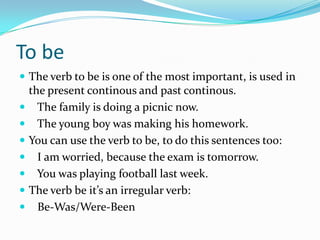
To beThe verb to be is one of the most important, is used in the present continous and past continous.    The family is doing a picnic now.   The young boy wasmakinghishomework.Youcanusethe verb to be, to do thissentencestoo:   I am worried, becausetheexam is tomorrow.Youwasplayingfootballlastweek.The verb be it’san irregular verb:Be-Was/Were-Been
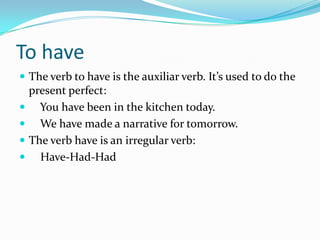
To haveThe verb to have is the auxiliar verb. It’sused to do the present perfect:Youhavebeen in thekitchentoday.Wehavemade a narrative for tomorrow.The verb have is an irregular verb:Have-Had-Had
To doThe verb to do is used for do theinterrogative and thenegativeform of the present simple:  I don’t play tennis on Sundays.Does he doinghiswork?The verb do, it’san irregular verb:Do-Did-Done
Regular verbsAll the regular verbs finishwith –ed, butthereare verbs thatchangethe –y- for –ed.Cry-CriedButnot all the verbs finishedby –y, therearesome verbs thatfinishwith –y buttheydon’tchangefor –ed.Play-Played
Irregular verbs The irregular verbs aredifferentfromthe regular verbs becausethe regular verbs all finishwith –ed, butthe irregular  verbs don’tfinishwith –ed. The base formcan be thesamewiththeothersconjugations, or past simple be thesame at the past participle.
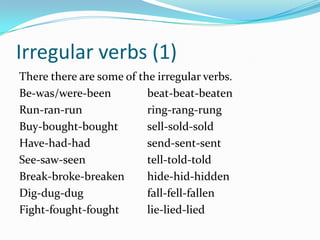
Irregular verbs (1)Theretherearesome of the irregular verbs.Be-was/were-beenbeat-beat-beatenRun-ran-runring-rang-rungBuy-bought-boughtsell-sold-soldHave-had-hadsend-sent-sentSee-saw-seentell-told-toldBreak-broke-breakenhide-hid-hiddenDig-dug-dugfall-fell-fallenFight-fought-foughtlie-lied-lied

English power point presentation

  • 1.
  • 2.
    To beThe verbto be is one of the most important, is used in the present continous and past continous. The family is doing a picnic now. The young boy wasmakinghishomework.Youcanusethe verb to be, to do thissentencestoo: I am worried, becausetheexam is tomorrow.Youwasplayingfootballlastweek.The verb be it’san irregular verb:Be-Was/Were-Been
  • 3.
    To haveThe verbto have is the auxiliar verb. It’sused to do the present perfect:Youhavebeen in thekitchentoday.Wehavemade a narrative for tomorrow.The verb have is an irregular verb:Have-Had-Had
  • 4.
    To doThe verbto do is used for do theinterrogative and thenegativeform of the present simple: I don’t play tennis on Sundays.Does he doinghiswork?The verb do, it’san irregular verb:Do-Did-Done
  • 5.
    Regular verbsAll theregular verbs finishwith –ed, butthereare verbs thatchangethe –y- for –ed.Cry-CriedButnot all the verbs finishedby –y, therearesome verbs thatfinishwith –y buttheydon’tchangefor –ed.Play-Played
  • 6.
    Irregular verbs Theirregular verbs aredifferentfromthe regular verbs becausethe regular verbs all finishwith –ed, butthe irregular verbs don’tfinishwith –ed. The base formcan be thesamewiththeothersconjugations, or past simple be thesame at the past participle.
  • 7.
    Irregular verbs (1)Theretherearesomeof the irregular verbs.Be-was/were-beenbeat-beat-beatenRun-ran-runring-rang-rungBuy-bought-boughtsell-sold-soldHave-had-hadsend-sent-sentSee-saw-seentell-told-toldBreak-broke-breakenhide-hid-hiddenDig-dug-dugfall-fell-fallenFight-fought-foughtlie-lied-lied