English 399
Research in the Library
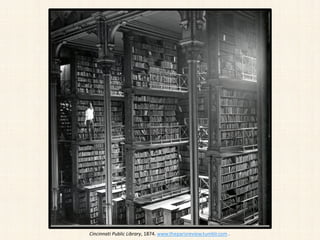
Cincinnati Public Library, 1874. www.theparisreview.tumblr.com .
Navigating the Twenty-First-Century Library
Walk into a university library today and you might wonder, “Where are the books?”
(Answer: they are still there, though many have been moved to off-site storage.) The
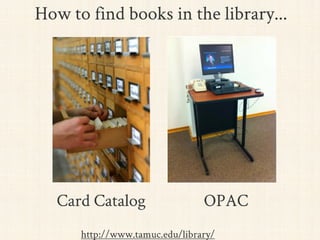
card catalog has long since been replaced by electronic search engines, and print
materials—books, journals, photographs, films, video and audio recordings—are
increasingly being digitized. Today you don’t even need to enter the library to use
many of its resources. But whether you visit in person or through a website, the
library is an indispensable tool for research.
Given the volume of data available on the Internet, you might think that libraries are
no longer necessary—except, perhaps, for highly specialized research. We believe
the opposite is true. Because so much information is now at our fingertips, libraries
are more essential than ever when conducting research. Libraries not only let us
access information but also ensure that our sources are reliable. Even if your public
or academic library is comparatively small, it can serve as a portal to a much broader
range of resources—research guides, reference works, and online databases—that
extends the library’s reach. Of course, to benefit from these resources, you much
learn to navigate the twenty-first century library.
Booth, Wayne C., et al. The Craft Of Research. Chicago UP, 2016. 65-66.
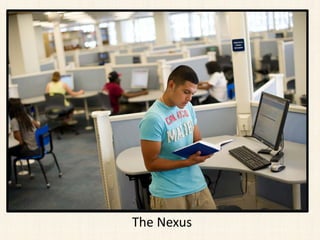
The Nexus
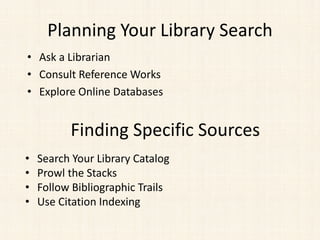
Planning Your Library Search
• Search Your Library Catalog
• Prowl the Stacks
• Follow Bibliographic Trails
• Use Citation Indexing
Finding Specific Sources
• Ask a Librarian
• Consult Reference Works
• Explore Online Databases
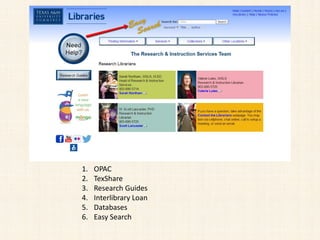
1. OPAC
2. TexShare
3. Research Guides
4. Interlibrary Loan
5. Databases
6. Easy Search
Google “OWL MLA” or “OWL APA” for
the OWL websites from Purdue
https://owl.english.purdue.edu/owl/resource/747/01/https://owl.english.purdue.edu/owl/resource/560/01/
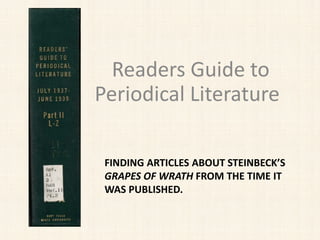
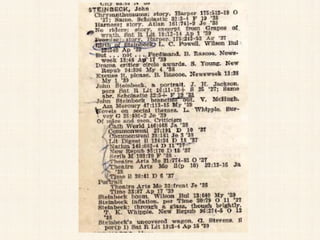
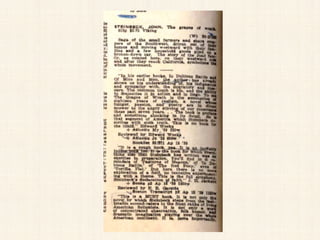
FINDING ARTICLES ABOUT STEINBECK’S
GRAPES OF WRATH FROM THE TIME IT
WAS PUBLISHED.
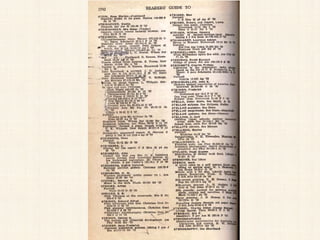
Readers Guide to
Periodical Literature
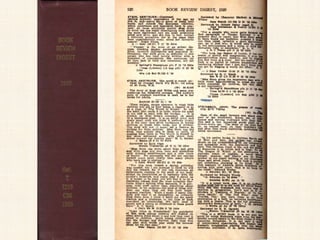
FINDING REVIEWS OF STEINBECK’S GRAPES OF
WRATH FROM THE TIME IT WAS PUBLISHED.
Book Review Digest
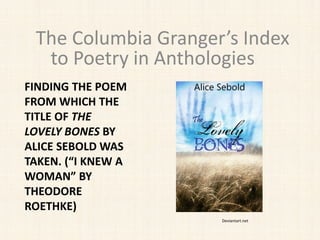
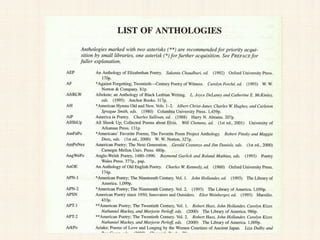
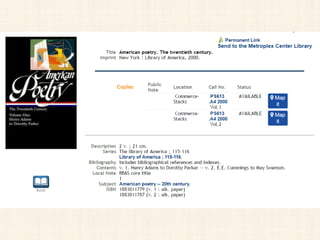
FINDING THE POEM
FROM WHICH THE
TITLE OF THE
LOVELY BONES BY
ALICE SEBOLD WAS
TAKEN. (“I KNEW A
WOMAN” BY
THEODORE
ROETHKE)
The Columbia Granger’s Index
to Poetry in Anthologies
Deviantart.net
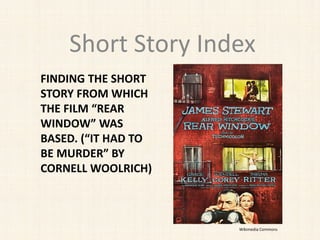
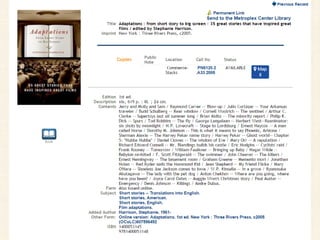
FINDING THE SHORT
STORY FROM WHICH
THE FILM “REAR
WINDOW” WAS
BASED. (“IT HAD TO
BE MURDER” BY
CORNELL WOOLRICH)
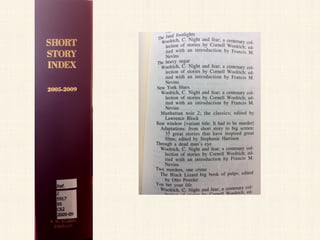
Short Story Index
Wikimedia Commons
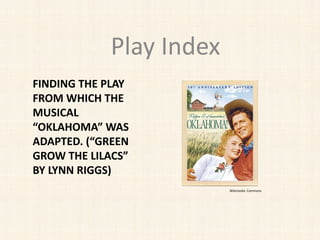
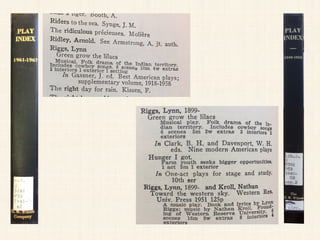
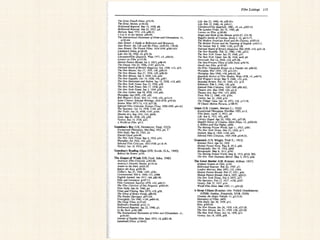
Play Index
FINDING THE PLAY
FROM WHICH THE
MUSICAL
“OKLAHOMA” WAS
ADAPTED. (“GREEN
GROW THE LILACS”
BY LYNN RIGGS)
Wikimedia Commons
FINDING REVIEWS OF THE FILM
“GRAPES OF WRATH”
Film Review Index
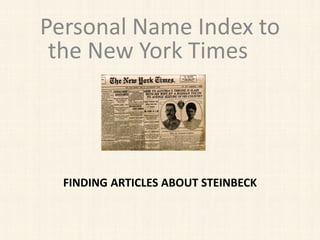
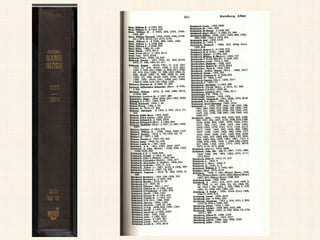
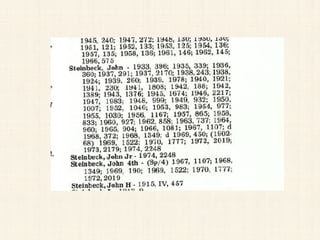
FINDING ARTICLES ABOUT STEINBECK
Personal Name Index to
the New York Times
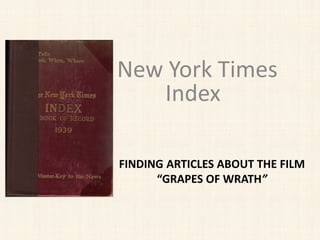
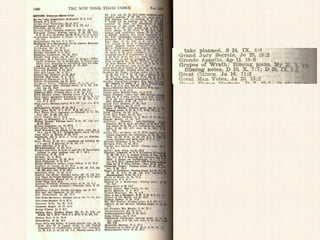
FINDING ARTICLES ABOUT THE FILM
“GRAPES OF WRATH”
New York Times
Index
Locating Sources on the Internet
Here are some ways in which we use the Internet in our own
research:
1. To get our bearings with respect to a new topic—regarding
everything we learn at this stage as provisional
2. To explore potential keywords to use in a more systematic
search
3. To remind ourselves of dates or facts—again remembering to
check these against more reliable sources
4. To locate the authors of sources whom we might wish to
contact: profiles of many scholars and researchers are
available on college and university websites
5. To get a “ballpark” sense of what we are likely to find through
a search of specialized databases by a quick search using
Google Scholar
Booth, Wayne C., et al. The Craft Of Research. Chicago UP, 2016. 75.
Evaluating Sources for Reliability
1. Is the source published or posted online by a reputable
press?
2. Was the book or article peer reviewed?
3. Is the author a reputable scholar?
4. If the source is available only online, is it sponsored by a
reputable organization?
5. Is the source current?
6. If the source is a book, does it have notes and a bibliography?
7. If the source is a website, does it include bibliographical
data?
8. If the source is a website, does it approach its topic
judiciously?
9. If the source is a book, has it been well reviewed?
10. Has the source been frequently cited by others?
Booth, Wayne C., et al. The Craft Of Research. Chicago UP, 2016. 78-79.
Online Sources
1. 1828 dictionary: http://webstersdictionary1828.com/
2. Nathaniel Hawthorne Collection of Papers:
https://digitalcollections.nypl.org/collections/nathanie
l-hawthorne-collection-of-papers-1694-1931-bulk-
1817-1864#/?tab=navigation
3. Digital Emerson:
http://digitalemerson.wsulibs.wsu.edu/exhibits/show/
context/parlor/nathaniel-hawthorne
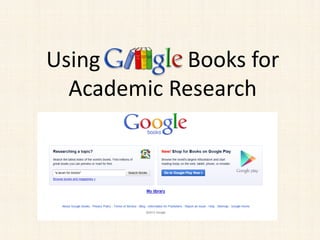
Using Books for
Academic Research
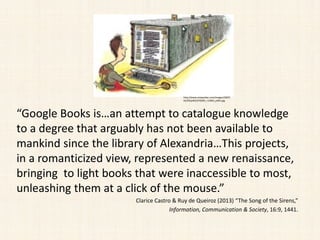
“Google Books is…an attempt to catalogue knowledge
to a degree that arguably has not been available to
mankind since the library of Alexandria…This projects,
in a romanticized view, represented a new renaissance,
bringing to light books that were inaccessible to most,
unleashing them at a click of the mouse.”
Clarice Castro & Ruy de Queiroz (2013) “The Song of the Sirens,”
Information, Communication & Society, 16:9, 1441.
http://www.newyorker.com/images/2007/
02/05/p465/070205_r15903_p465.jpg
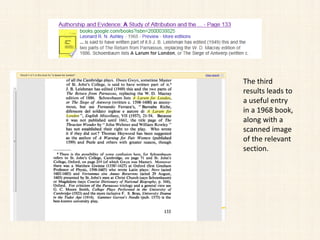
The third
results leads to
a useful entry
in a 1968 book,
along with a
scanned image
of the relevant
section.
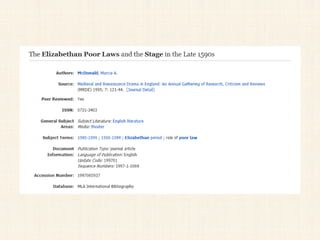
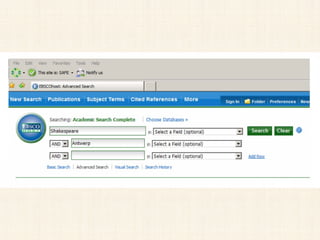
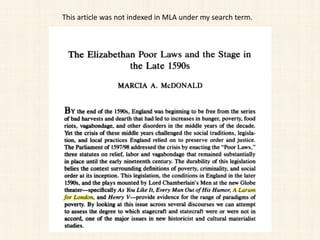
This article was not indexed in MLA under my search term.
Advanced Search
Limit to “Full view only” to get full text of out of copyright works.
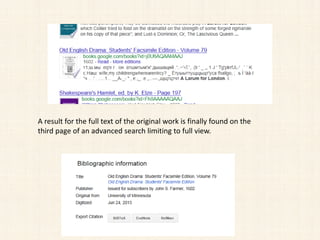
A result for the full text of the original work is finally found on the
third page of an advanced search limiting to full view.
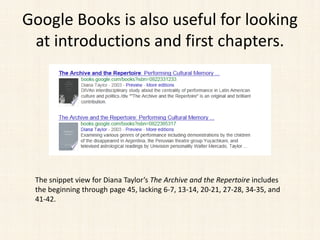
Google Books is also useful for looking
at introductions and first chapters.
The snippet view for Diana Taylor’s The Archive and the Repertoire includes
the beginning through page 45, lacking 6-7, 13-14, 20-21, 27-28, 34-35, and
41-42.
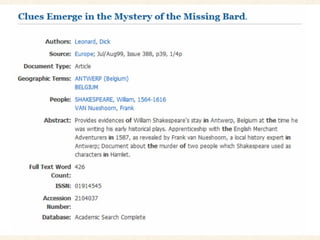
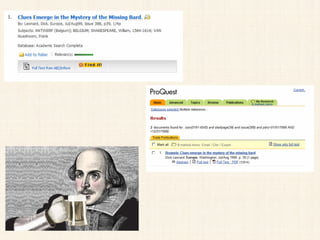
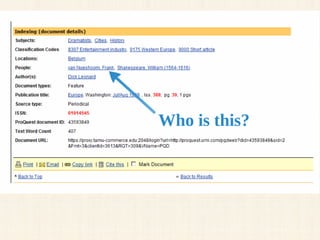
Fact Check Everything
Databases do occasionally
make mistakes.
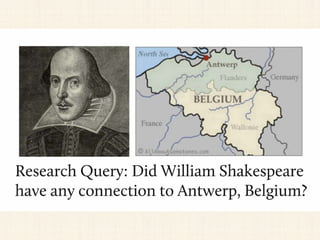
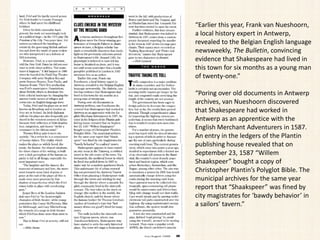
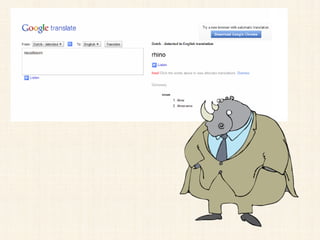
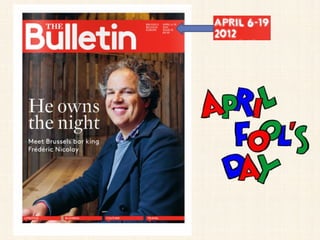
“Earlier this year, Frank van Nueshoorn,
a local history expert in Antwerp,
revealed to the Belgian English language
newsweekly, The Bulletin, convincing
evidence that Shakespeare had lived in
this town for six months as a young man
of twenty-one.”
“Poring over old documents in Antwerp
archives, van Nueshoorn discovered
that Shakespeare had worked in
Antwerp as an apprentice with the
English Merchant Adventurers in 1587.
An entry in the ledgers of the Plantin
publishing house revealed that on
September 23, 1587 “Willem
Shaakspeer” bought a copy of
Christopher Plantin’s Polyglot Bible. The
municipal archives for the same year
report that “Shaakspeer” was fined by
city magistrates for ‘bawdy behavior’ in
a sailors’ tavern.”
What is plagiarism?
http://hsc.usf.edu/publichealth/email/images/plagiarism.gif
http://www.princeton.edu/pr/pub/integrity/pages/plagiarism/
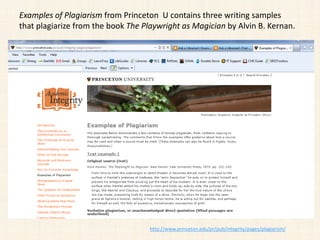
Examples of Plagiarism from Princeton U contains three writing samples
that plagiarize from the book The Playwright as Magician by Alvin B. Kernan.
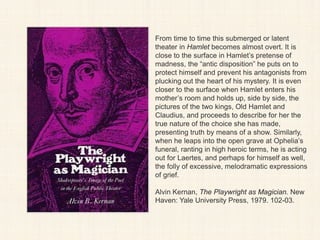
From time to time this submerged or latent
theater in Hamlet becomes almost overt. It is
close to the surface in Hamlet’s pretense of
madness, the “antic disposition” he puts on to
protect himself and prevent his antagonists from
plucking out the heart of his mystery. It is even
closer to the surface when Hamlet enters his
mother’s room and holds up, side by side, the
pictures of the two kings, Old Hamlet and
Claudius, and proceeds to describe for her the
true nature of the choice she has made,
presenting truth by means of a show. Similarly,
when he leaps into the open grave at Ophelia’s
funeral, ranting in high heroic terms, he is acting
out for Laertes, and perhaps for himself as well,
the folly of excessive, melodramatic expressions
of grief.
Alvin Kernan, The Playwright as Magician. New
Haven: Yale University Press, 1979. 102-03.
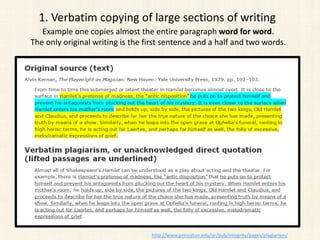
Example one copies almost the entire paragraph word for word.
The only original writing is the first sentence and a half and two words.
http://www.princeton.edu/pr/pub/integrity/pages/plagiarism/
1. Verbatim copying of large sections of writing
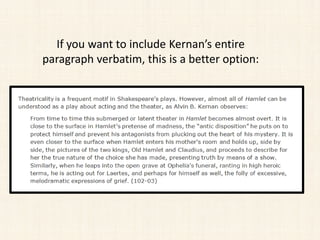
If you want to include Kernan’s entire
paragraph verbatim, this is a better option:
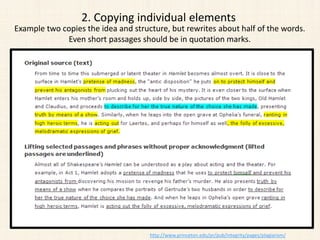
Example two copies the idea and structure, but rewrites about half of the words.
Even short passages should be in quotation marks.
http://www.princeton.edu/pr/pub/integrity/pages/plagiarism/
2. Copying individual elements
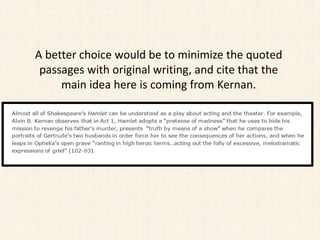
A better choice would be to minimize the quoted
passages with original writing, and cite that the
main idea here is coming from Kernan.
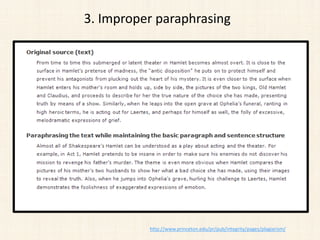
http://www.princeton.edu/pr/pub/integrity/pages/plagiarism/
3. Improper paraphrasing
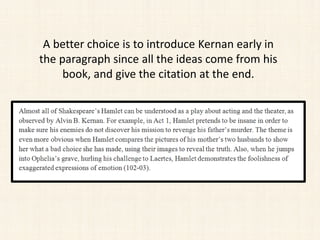
A better choice is to introduce Kernan early in
the paragraph since all the ideas come from his
book, and give the citation at the end.

English 399

  • 1.
  • 2.
    Cincinnati Public Library,1874. www.theparisreview.tumblr.com .
  • 3.
    Navigating the Twenty-First-CenturyLibrary Walk into a university library today and you might wonder, “Where are the books?” (Answer: they are still there, though many have been moved to off-site storage.) The card catalog has long since been replaced by electronic search engines, and print materials—books, journals, photographs, films, video and audio recordings—are increasingly being digitized. Today you don’t even need to enter the library to use many of its resources. But whether you visit in person or through a website, the library is an indispensable tool for research. Given the volume of data available on the Internet, you might think that libraries are no longer necessary—except, perhaps, for highly specialized research. We believe the opposite is true. Because so much information is now at our fingertips, libraries are more essential than ever when conducting research. Libraries not only let us access information but also ensure that our sources are reliable. Even if your public or academic library is comparatively small, it can serve as a portal to a much broader range of resources—research guides, reference works, and online databases—that extends the library’s reach. Of course, to benefit from these resources, you much learn to navigate the twenty-first century library. Booth, Wayne C., et al. The Craft Of Research. Chicago UP, 2016. 65-66.
  • 4.
  • 5.
    Planning Your LibrarySearch • Search Your Library Catalog • Prowl the Stacks • Follow Bibliographic Trails • Use Citation Indexing Finding Specific Sources • Ask a Librarian • Consult Reference Works • Explore Online Databases
  • 6.
    1. OPAC 2. TexShare 3.Research Guides 4. Interlibrary Loan 5. Databases 6. Easy Search
  • 8.
    Google “OWL MLA”or “OWL APA” for the OWL websites from Purdue https://owl.english.purdue.edu/owl/resource/747/01/https://owl.english.purdue.edu/owl/resource/560/01/
  • 9.
    FINDING ARTICLES ABOUTSTEINBECK’S GRAPES OF WRATH FROM THE TIME IT WAS PUBLISHED. Readers Guide to Periodical Literature
  • 12.
    FINDING REVIEWS OFSTEINBECK’S GRAPES OF WRATH FROM THE TIME IT WAS PUBLISHED. Book Review Digest
  • 15.
    FINDING THE POEM FROMWHICH THE TITLE OF THE LOVELY BONES BY ALICE SEBOLD WAS TAKEN. (“I KNEW A WOMAN” BY THEODORE ROETHKE) The Columbia Granger’s Index to Poetry in Anthologies Deviantart.net
  • 19.
    FINDING THE SHORT STORYFROM WHICH THE FILM “REAR WINDOW” WAS BASED. (“IT HAD TO BE MURDER” BY CORNELL WOOLRICH) Short Story Index Wikimedia Commons
  • 22.
    Play Index FINDING THEPLAY FROM WHICH THE MUSICAL “OKLAHOMA” WAS ADAPTED. (“GREEN GROW THE LILACS” BY LYNN RIGGS) Wikimedia Commons
  • 24.
    FINDING REVIEWS OFTHE FILM “GRAPES OF WRATH” Film Review Index
  • 26.
    FINDING ARTICLES ABOUTSTEINBECK Personal Name Index to the New York Times
  • 29.
    FINDING ARTICLES ABOUTTHE FILM “GRAPES OF WRATH” New York Times Index
  • 31.
    Locating Sources onthe Internet Here are some ways in which we use the Internet in our own research: 1. To get our bearings with respect to a new topic—regarding everything we learn at this stage as provisional 2. To explore potential keywords to use in a more systematic search 3. To remind ourselves of dates or facts—again remembering to check these against more reliable sources 4. To locate the authors of sources whom we might wish to contact: profiles of many scholars and researchers are available on college and university websites 5. To get a “ballpark” sense of what we are likely to find through a search of specialized databases by a quick search using Google Scholar Booth, Wayne C., et al. The Craft Of Research. Chicago UP, 2016. 75.
  • 32.
    Evaluating Sources forReliability 1. Is the source published or posted online by a reputable press? 2. Was the book or article peer reviewed? 3. Is the author a reputable scholar? 4. If the source is available only online, is it sponsored by a reputable organization? 5. Is the source current? 6. If the source is a book, does it have notes and a bibliography? 7. If the source is a website, does it include bibliographical data? 8. If the source is a website, does it approach its topic judiciously? 9. If the source is a book, has it been well reviewed? 10. Has the source been frequently cited by others? Booth, Wayne C., et al. The Craft Of Research. Chicago UP, 2016. 78-79.
  • 33.
    Online Sources 1. 1828dictionary: http://webstersdictionary1828.com/ 2. Nathaniel Hawthorne Collection of Papers: https://digitalcollections.nypl.org/collections/nathanie l-hawthorne-collection-of-papers-1694-1931-bulk- 1817-1864#/?tab=navigation 3. Digital Emerson: http://digitalemerson.wsulibs.wsu.edu/exhibits/show/ context/parlor/nathaniel-hawthorne
  • 34.
  • 35.
    “Google Books is…anattempt to catalogue knowledge to a degree that arguably has not been available to mankind since the library of Alexandria…This projects, in a romanticized view, represented a new renaissance, bringing to light books that were inaccessible to most, unleashing them at a click of the mouse.” Clarice Castro & Ruy de Queiroz (2013) “The Song of the Sirens,” Information, Communication & Society, 16:9, 1441. http://www.newyorker.com/images/2007/ 02/05/p465/070205_r15903_p465.jpg
  • 37.
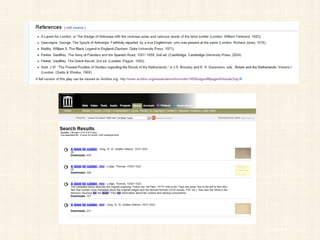
    The third results leadsto a useful entry in a 1968 book, along with a scanned image of the relevant section.
  • 39.
    This article wasnot indexed in MLA under my search term.
  • 41.
    Advanced Search Limit to“Full view only” to get full text of out of copyright works.
  • 42.
    A result forthe full text of the original work is finally found on the third page of an advanced search limiting to full view.
  • 44.
    Google Books isalso useful for looking at introductions and first chapters. The snippet view for Diana Taylor’s The Archive and the Repertoire includes the beginning through page 45, lacking 6-7, 13-14, 20-21, 27-28, 34-35, and 41-42.
  • 45.
    Fact Check Everything Databasesdo occasionally make mistakes.
  • 50.
    “Earlier this year,Frank van Nueshoorn, a local history expert in Antwerp, revealed to the Belgian English language newsweekly, The Bulletin, convincing evidence that Shakespeare had lived in this town for six months as a young man of twenty-one.” “Poring over old documents in Antwerp archives, van Nueshoorn discovered that Shakespeare had worked in Antwerp as an apprentice with the English Merchant Adventurers in 1587. An entry in the ledgers of the Plantin publishing house revealed that on September 23, 1587 “Willem Shaakspeer” bought a copy of Christopher Plantin’s Polyglot Bible. The municipal archives for the same year report that “Shaakspeer” was fined by city magistrates for ‘bawdy behavior’ in a sailors’ tavern.”
  • 54.
  • 55.
    http://www.princeton.edu/pr/pub/integrity/pages/plagiarism/ Examples of Plagiarismfrom Princeton U contains three writing samples that plagiarize from the book The Playwright as Magician by Alvin B. Kernan.
  • 56.
    From time totime this submerged or latent theater in Hamlet becomes almost overt. It is close to the surface in Hamlet’s pretense of madness, the “antic disposition” he puts on to protect himself and prevent his antagonists from plucking out the heart of his mystery. It is even closer to the surface when Hamlet enters his mother’s room and holds up, side by side, the pictures of the two kings, Old Hamlet and Claudius, and proceeds to describe for her the true nature of the choice she has made, presenting truth by means of a show. Similarly, when he leaps into the open grave at Ophelia’s funeral, ranting in high heroic terms, he is acting out for Laertes, and perhaps for himself as well, the folly of excessive, melodramatic expressions of grief. Alvin Kernan, The Playwright as Magician. New Haven: Yale University Press, 1979. 102-03.
  • 57.
    Example one copiesalmost the entire paragraph word for word. The only original writing is the first sentence and a half and two words. http://www.princeton.edu/pr/pub/integrity/pages/plagiarism/ 1. Verbatim copying of large sections of writing
  • 58.
    If you wantto include Kernan’s entire paragraph verbatim, this is a better option:
  • 59.
    Example two copiesthe idea and structure, but rewrites about half of the words. Even short passages should be in quotation marks. http://www.princeton.edu/pr/pub/integrity/pages/plagiarism/ 2. Copying individual elements
  • 60.
    A better choicewould be to minimize the quoted passages with original writing, and cite that the main idea here is coming from Kernan.
  • 61.
  • 62.
    A better choiceis to introduce Kernan early in the paragraph since all the ideas come from his book, and give the citation at the end.