PESTEL Analysis
Prof. Dr. Tauha Hussain Ali
Professor, Department of
Civil Engineering,
MUET, Jamshoro.
PESTEL Analysis
• PESTEL analysis is one
important tool that
executives can rely on
to organize factors
within the general
environment and to
identify how these
factors influence
industries and the firms
within them.
PESTEL Analysis
• PESTEL is an anagram,
meaning it is a word that
created by using parts of
other words. In particular,
PESTEL reflects the names
of the six segments of the
general environment: (1)
political, (2) economic, (3)
social, (4) technological,
(5) environmental, and (6)
legal.
PESTEL Analysis
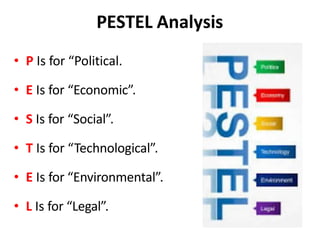
• P Is for “Political.
• E Is for “Economic”.
• S Is for “Social”.
• T Is for “Technological”.
• E Is for “Environmental”.
• L Is for “Legal”.
P Is for “Political”
• The political segment
centers on the role of
governments in shaping
business. This segment
includes elements such
as tax policies, changes
in trade restrictions and
tariffs, and the stability
of governments.
E Is for “Economic”
economic
The
centers
segment
on the economic
within which
conditions
organizations
includes elements such
operate. It
as
interest rates, inflation rates,
gross domestic product,
unemployment rates, levels
of disposable income, and the
general growth or decline of
the economy.
S Is for “Social”
– Social
trends
factors include
in demographics
such as population size,
age, and ethnic mix, as
well as cultural trends such
as attitudes toward obesity
and consumer activism.
T Is for “Technological”
The technological segment
centers on improvements in
products and services that are
provided by science. Relevant
factors include, for example,
changes in the rate of new
product development, increases
and
service
in automation,
advancements in
industry delivery.
E Is for “Environmental”
environmental
involves
conditions
the
within
The
segment
physical
which organizations
operate. It includes factors
such as natural disasters,
pollution levels, and
weather patterns.
L Is for “Legal”
– The
centers
legal segment
on how the
courts influence business
activity.
important
include
Examples of
legal factors
employment
laws, health and safety
regulations,
discriminationlaws,and
antitrust laws.
Tata Motors: Case Study
•Tata motors is a part of Tata group and was
established in 1945.
•It entered the segment in 1954.
•TML started business in a collaboration with
Daimler Benz, this partnership has made TML
India’s largest automobile company.
•Till date 8 million Tata vehicles are plying on the
road.
PESTEL
• PESTEL analysis means
Political, Economical, Social, Technological, Environm
ental and Legal analysis.
• It is a standard way of analyzing macro-economical
forces which impact a company or a corporation.
• Every organization is started with a pre-determined
objective, commonly known as the ‘mission’.
• PESTEL analysis helps to infer whether a particular
factor is helping the organization to achieve its goals
or is acting as an impediment in its road to success.
Politico Legal
The Singur Controversy
•TML acquired a land of 997 acres for manufacturing Nano
Cars by state government support.
•But this acquisition required the displacement of farmers.
•It attracted heavy criticisms, “Save Farmland” movement
was started by opposition leader Mamata Bannerjee.
•On 3rd October, 2008, TML closed its plant from Singur.
•It was later established in Sanand, Gujarat.
Economical
• TML’s economic scenario is quite promising with GDP
growth rate around 7%.
• However, high interest rates and low freight availability
impacted its financial infrastructure in first quarter of 2013.
• During the same time, price pressure from competitors also
marred its financial position.
• The commercial vehicle segment of TML gave it an edge
over others at this time and the big and mid sized vehicles
helped TML to regain its ground.
Social
• Where ever TML goes, may it be domestic or international
markets, it hires mostly the local population generating
employment.
• Due to its age long history and its welfare activities, Tata
enjoys full public support.
• TML is also involved in philanthropy and supports around
600 NGOs.
• Tata also works towards provided high standards of
education to students.
• Some of the institutes opened and managed by Tata are
Indian Institute of Science, Tata Memorial Centre, Tata
Institute Social Sciences, etc.
Technological
• In order to adapt with the latest technology TML owns Tata
Technologies Limited.
• TTL helps TML in the upgradation of designs and
technology.
• Tata faced a technological hurdle when two units of its
revolutionary Nano cars caught fire in the year 2009.
• After forensic investigation TML released the word that the
two incidents werent related in 2010.
• It assured the customers that Nano is perfectly safe.
Environmental
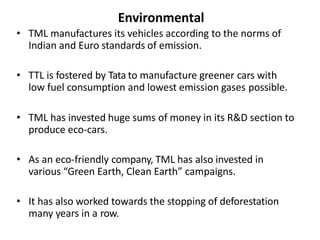
• TML manufactures its vehicles according to the norms of
Indian and Euro standards of emission.
• TTL is fostered by Tata to manufacture greener cars with
low fuel consumption and lowest emission gases possible.
• TML has invested huge sums of money in its R&D section to
produce eco-cars.
• As an eco-friendly company, TML has also invested in
various “Green Earth, Clean Earth” campaigns.
• It has also worked towards the stopping of deforestation
many years in a row.
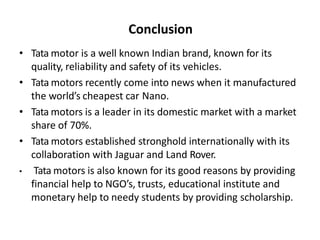
Conclusion
• Tata motor is a well known Indian brand, known for its
quality, reliability and safety of its vehicles.
• Tata motors recently come into news when it manufactured
the world’s cheapest car Nano.
• Tata motors is a leader in its domestic market with a market
share of 70%.
• Tata motors established stronghold internationally with its
collaboration with Jaguar and Land Rover.
• Tata motors is also known for its good reasons by providing
financial help to NGO’s, trusts, educational institute and
monetary help to needy students by providing scholarship.
Engineering management ,notes PPT slides

Engineering management ,notes PPT slides

  • 1.
    PESTEL Analysis Prof. Dr.Tauha Hussain Ali Professor, Department of Civil Engineering, MUET, Jamshoro.
  • 2.
    PESTEL Analysis • PESTELanalysis is one important tool that executives can rely on to organize factors within the general environment and to identify how these factors influence industries and the firms within them.
  • 3.
    PESTEL Analysis • PESTELis an anagram, meaning it is a word that created by using parts of other words. In particular, PESTEL reflects the names of the six segments of the general environment: (1) political, (2) economic, (3) social, (4) technological, (5) environmental, and (6) legal.
  • 4.
    PESTEL Analysis • PIs for “Political. • E Is for “Economic”. • S Is for “Social”. • T Is for “Technological”. • E Is for “Environmental”. • L Is for “Legal”.
  • 5.
    P Is for“Political” • The political segment centers on the role of governments in shaping business. This segment includes elements such as tax policies, changes in trade restrictions and tariffs, and the stability of governments.
  • 6.
    E Is for“Economic” economic The centers segment on the economic within which conditions organizations includes elements such operate. It as interest rates, inflation rates, gross domestic product, unemployment rates, levels of disposable income, and the general growth or decline of the economy.
  • 7.
    S Is for“Social” – Social trends factors include in demographics such as population size, age, and ethnic mix, as well as cultural trends such as attitudes toward obesity and consumer activism.
  • 8.
    T Is for“Technological” The technological segment centers on improvements in products and services that are provided by science. Relevant factors include, for example, changes in the rate of new product development, increases and service in automation, advancements in industry delivery.
  • 9.
    E Is for“Environmental” environmental involves conditions the within The segment physical which organizations operate. It includes factors such as natural disasters, pollution levels, and weather patterns.
  • 10.
    L Is for“Legal” – The centers legal segment on how the courts influence business activity. important include Examples of legal factors employment laws, health and safety regulations, discriminationlaws,and antitrust laws.
  • 11.
    Tata Motors: CaseStudy •Tata motors is a part of Tata group and was established in 1945. •It entered the segment in 1954. •TML started business in a collaboration with Daimler Benz, this partnership has made TML India’s largest automobile company. •Till date 8 million Tata vehicles are plying on the road.
  • 12.
    PESTEL • PESTEL analysismeans Political, Economical, Social, Technological, Environm ental and Legal analysis. • It is a standard way of analyzing macro-economical forces which impact a company or a corporation. • Every organization is started with a pre-determined objective, commonly known as the ‘mission’. • PESTEL analysis helps to infer whether a particular factor is helping the organization to achieve its goals or is acting as an impediment in its road to success.
  • 13.
    Politico Legal The SingurControversy •TML acquired a land of 997 acres for manufacturing Nano Cars by state government support. •But this acquisition required the displacement of farmers. •It attracted heavy criticisms, “Save Farmland” movement was started by opposition leader Mamata Bannerjee. •On 3rd October, 2008, TML closed its plant from Singur. •It was later established in Sanand, Gujarat.
  • 14.
    Economical • TML’s economicscenario is quite promising with GDP growth rate around 7%. • However, high interest rates and low freight availability impacted its financial infrastructure in first quarter of 2013. • During the same time, price pressure from competitors also marred its financial position. • The commercial vehicle segment of TML gave it an edge over others at this time and the big and mid sized vehicles helped TML to regain its ground.
  • 15.
    Social • Where everTML goes, may it be domestic or international markets, it hires mostly the local population generating employment. • Due to its age long history and its welfare activities, Tata enjoys full public support. • TML is also involved in philanthropy and supports around 600 NGOs. • Tata also works towards provided high standards of education to students. • Some of the institutes opened and managed by Tata are Indian Institute of Science, Tata Memorial Centre, Tata Institute Social Sciences, etc.
  • 16.
    Technological • In orderto adapt with the latest technology TML owns Tata Technologies Limited. • TTL helps TML in the upgradation of designs and technology. • Tata faced a technological hurdle when two units of its revolutionary Nano cars caught fire in the year 2009. • After forensic investigation TML released the word that the two incidents werent related in 2010. • It assured the customers that Nano is perfectly safe.
  • 17.
    Environmental • TML manufacturesits vehicles according to the norms of Indian and Euro standards of emission. • TTL is fostered by Tata to manufacture greener cars with low fuel consumption and lowest emission gases possible. • TML has invested huge sums of money in its R&D section to produce eco-cars. • As an eco-friendly company, TML has also invested in various “Green Earth, Clean Earth” campaigns. • It has also worked towards the stopping of deforestation many years in a row.
  • 18.
    Conclusion • Tata motoris a well known Indian brand, known for its quality, reliability and safety of its vehicles. • Tata motors recently come into news when it manufactured the world’s cheapest car Nano. • Tata motors is a leader in its domestic market with a market share of 70%. • Tata motors established stronghold internationally with its collaboration with Jaguar and Land Rover. • Tata motors is also known for its good reasons by providing financial help to NGO’s, trusts, educational institute and monetary help to needy students by providing scholarship.