Engaging media
Bernard Cools, Véronique Couvreur, Geert Van Boxem and Jan Drijvers
Admap
March 2014
 
 
Engaging media
Bernard Cools
Space
Véronique Couvreur, Geert Van Boxem
Sanoma
Jan Drijvers
TNS
A study by European publisher, Sanoma, has found that the best media engagement can be achieved from titles
with the clearest and most consistent editorial position, and which often appeal to specialist audiences
In an era in which more and more advertising campaigns are being conceived across different media types and touchpoints,
media planners are still forced – by the lack of credible benchmarks – to add the opportunities to see of the various media
together as if they were one currency. Therefore, it is time to reflect critically on what a contact in each medium is worth as
stated in many research papers: would it be possible to weigh the reach of a particular media touchpoint by qualitative
measures? And isn't it impossible to measure the quality of a contact without judging the relationship a consumer has with the
medium?
Surveys about the relationship between a media brand and its consumers, about the 'intensity', the 'experience' or the 'quality'
of this interaction are often classified under the vague umbrella of 'engagement' research – a domain which is often subject to
fierce criticism (see Engagement: are we there yet? by Rebecca Rangeley and Anne Mollen, Admap, May 2012). Our article
reports on a wide-ranging study on the engagement of media users to media touchpoints and brands in Belgium and on how
we proved the effect of engagement on advertising impact. Engagement is not only about media audience description or
analysis: it increases ad effectiveness.
Too often, studies define 'engagement' in a limited or one-dimensional way. Rarely are engagement surveys conceived across
different media channels and hardly ever is the critical question raised of whether the advertiser also benefits from the 'love'
between a media brand and its users. The objective of the European publisher Sanoma's study was to develop a common and
uniform measuring tool for all media, based on a clear concept of engagement which can be easily reproduced – engagement
being conceptualised in a way that could guarantee to advertisers that the parameters used to measure media engagement
are also indicators of advertising impact, regardless of the medium.
In line with the pragmatic approach to defining engagement (in relation to advertising impact), it was decided not to work with a
   Title: Engaging media
   Author(s): Bernard Cools, Véronique Couvreur, Geert Van Boxem and Jan Drijvers
   Source: Admap
   Issue: March 2014
 
Downloaded from warc.com
 
 
2
global, abstract measurement of engagement at medium level, but at the down-to-earth level of media titles on the one hand
and real advertising campaigns on the other. The media category level as such has been constructed afterwards as the
'average' of all individual titles in that medium. Television, radio, newspapers, magazines and media websites were included in
the study.
The measurement of media engagement has been based on three dimensions. The first – behavioural – dimension is about
the intensity of the physical contact (frequency, duration, attention). The second – relationship – builds on the perception a
consumer has about his/her relationship with a media brand. The third – experience – focuses on the concrete experiences
people have had with a medium – rational and emotional experiences that nurture and build the relationship between them:
shared moments of joy, wonder, inspiration, security, belonging, sadness, rage… The measurement of advertising
engagement was done by a classic set of aspects referring to how advertising in a particular medium is perceived (e.g.
convincing, credible, disturbing).
The dependent variable in the study is advertising impact. As mentioned, metrics will be used to validate whether the
dimensions of engagement tested are sufficient to ensure a positive impact. It was decided to use direct and concrete
measures of advertising impact here to avoid potential confusion between advertising engagement measures and advertising
impact measures. For each of the tested ads, five different KPIs have been used to measure the advertising impact:
awareness, likeability, ability to initiate information search or word of mouth about the advertised brand, and, finally, purchase
intention.
A first online survey (achieved with computer assisted web interviewing (CAWI) was conducted via the TNS Online Access
Panel among 3,032 respondents representative of the Belgian population aged 15 years and older (9.012 million individuals).
The fieldwork for the basic study took place in February and March 2012 over six consecutive weeks. Each week, a
comparable sample of 500 people were interviewed. In order to measure the relationship between engagement and
advertising impact, a range of recent advertisements which were published/ broadcast in the media titles selected, were post-
tested in each weekly sub-sample. In total, advertisements from not less than 84 different categories were used, across a wide
range of brands (404 brands). Advertising budget by brand or product varied from low to high budget in order to avoid bias.
Advertising impact was not measured for websites because of the logistical complexity: it proved impossible to have a neutral
source for new online ads with identification of brand and category as available for the other surveyed media. At the end of
these six weeks, more than 3,000 respondents described 13,228 recent media experiences on 142 different media titles
across five media, as well as over 11,000 ad post-tests for 519 different ads appearing in the same media (excluding the
internet). In April-May 2013, a second wave was conducted, more focused (the questions that proved ineffective in the first
wave were removed), with more respondents (> 8,000 interviews), and many more websites: 180 instead of 38 during the first
wave, with a broader view. So covering not only media websites but also 'non-media' ones, as well as social networking
domains, for instance, Facebook. This second engagement survey conclusively confirmed the findings of the first one,
including websites, in spite of the broadened view.
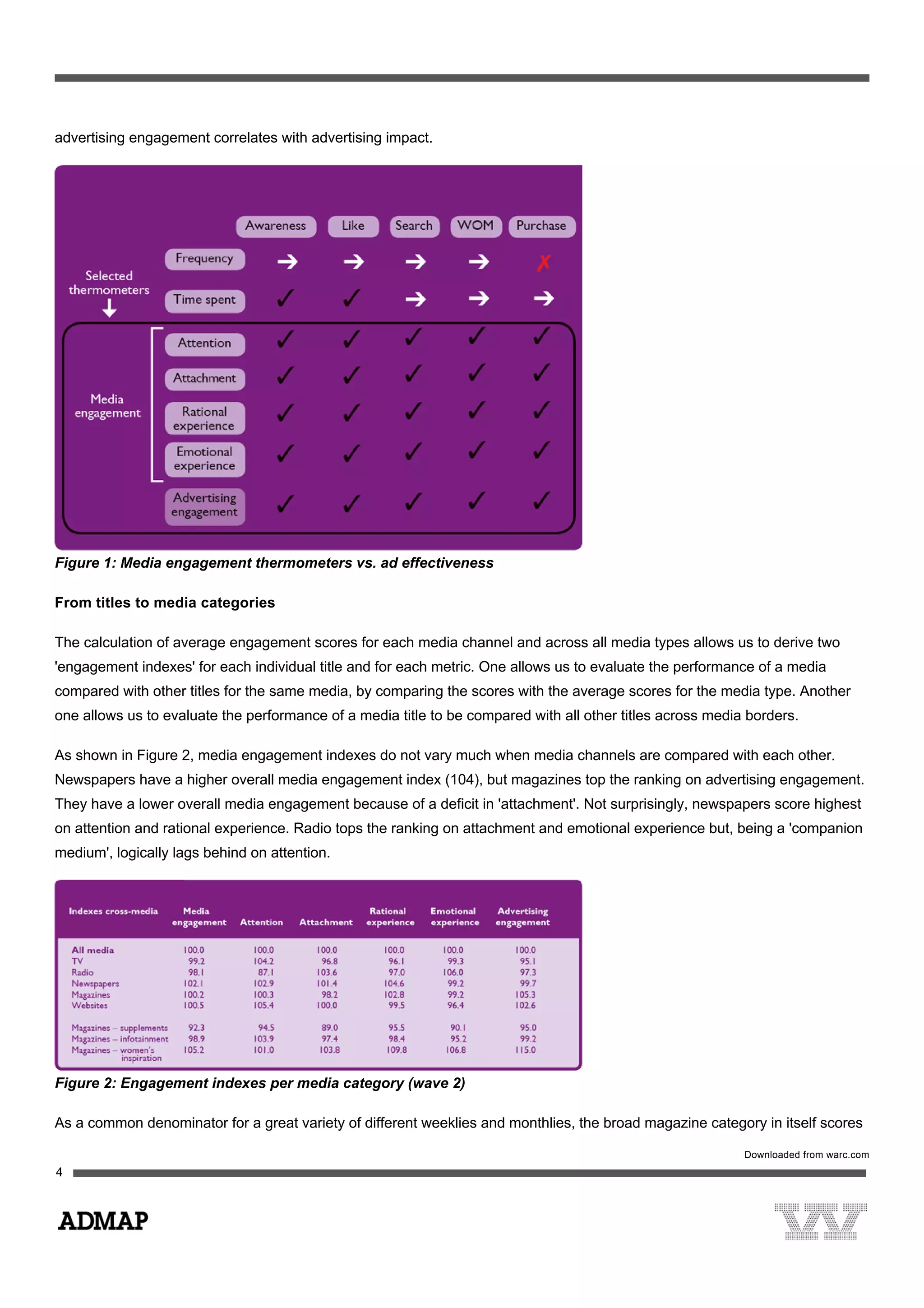
The starting point on effective media engagement is to focus on parameters that correlate positively with each of the five KPIs
defined for measuring advertising. Figure 1 illustrates the conclusions for each of the parameters vs. the advertising impact
parameters. It finds the behavioural dimension doesn't relate to all impact KPIs for all media (this is consistent with the
comment, from the Admap story from 2012: 'Behavioural measures are inefficient and flawed proxies for engagement'). The
other dimensions (attention, attachment and both types of experience) correlate significantly. As could be expected,
 
Downloaded from warc.com
 
 
3
advertising engagement correlates with advertising impact.
Figure 1: Media engagement thermometers vs. ad effectiveness
From titles to media categories
The calculation of average engagement scores for each media channel and across all media types allows us to derive two
'engagement indexes' for each individual title and for each metric. One allows us to evaluate the performance of a media
compared with other titles for the same media, by comparing the scores with the average scores for the media type. Another
one allows us to evaluate the performance of a media title to be compared with all other titles across media borders.
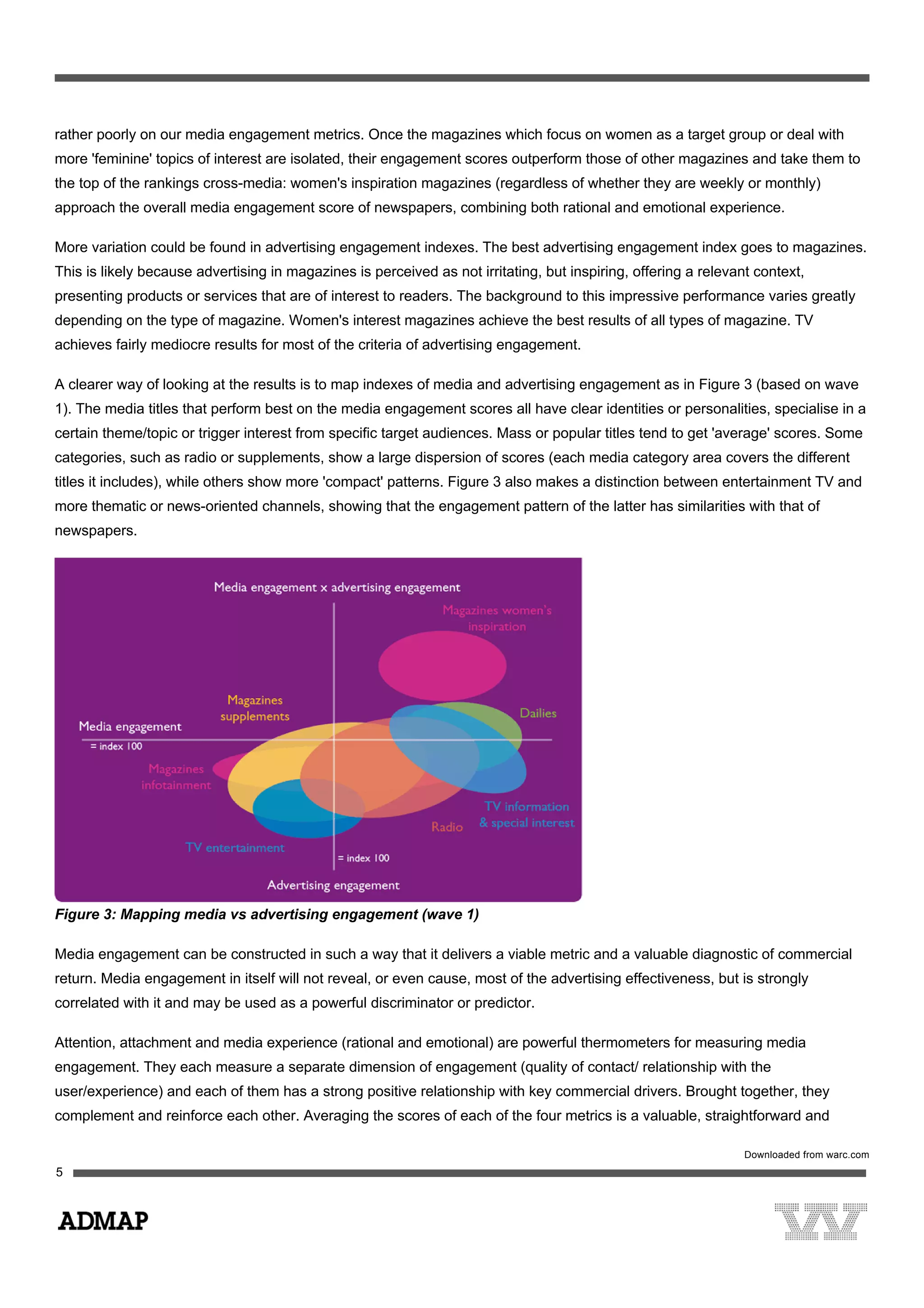
As shown in Figure 2, media engagement indexes do not vary much when media channels are compared with each other.
Newspapers have a higher overall media engagement index (104), but magazines top the ranking on advertising engagement.
They have a lower overall media engagement because of a deficit in 'attachment'. Not surprisingly, newspapers score highest
on attention and rational experience. Radio tops the ranking on attachment and emotional experience but, being a 'companion
medium', logically lags behind on attention.
Figure 2: Engagement indexes per media category (wave 2)
As a common denominator for a great variety of different weeklies and monthlies, the broad magazine category in itself scores
 
Downloaded from warc.com
 
 
4
rather poorly on our media engagement metrics. Once the magazines which focus on women as a target group or deal with
more 'feminine' topics of interest are isolated, their engagement scores outperform those of other magazines and take them to
the top of the rankings cross-media: women's inspiration magazines (regardless of whether they are weekly or monthly)
approach the overall media engagement score of newspapers, combining both rational and emotional experience.
More variation could be found in advertising engagement indexes. The best advertising engagement index goes to magazines.
This is likely because advertising in magazines is perceived as not irritating, but inspiring, offering a relevant context,
presenting products or services that are of interest to readers. The background to this impressive performance varies greatly
depending on the type of magazine. Women's interest magazines achieve the best results of all types of magazine. TV
achieves fairly mediocre results for most of the criteria of advertising engagement.
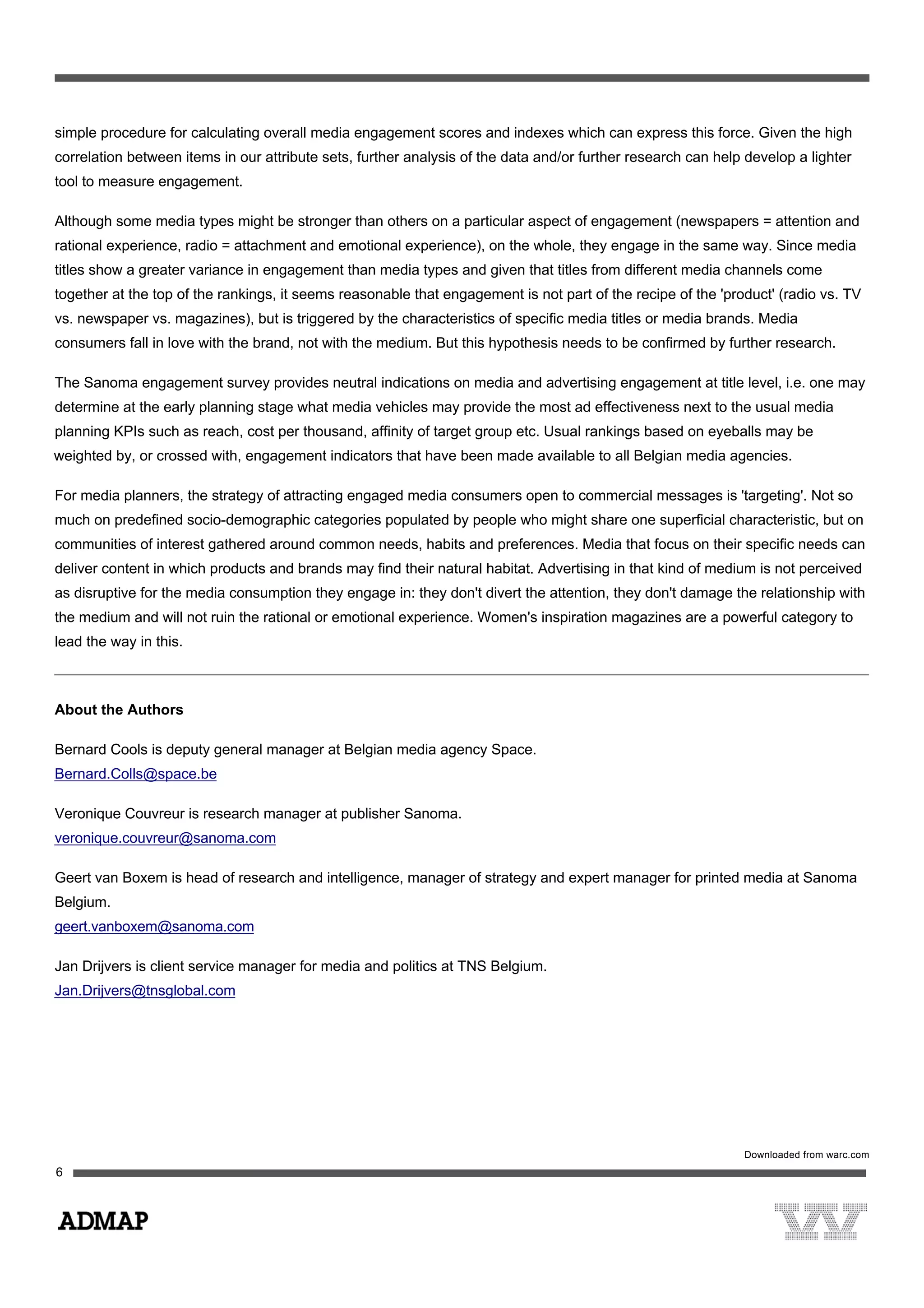
A clearer way of looking at the results is to map indexes of media and advertising engagement as in Figure 3 (based on wave
1). The media titles that perform best on the media engagement scores all have clear identities or personalities, specialise in a
certain theme/topic or trigger interest from specific target audiences. Mass or popular titles tend to get 'average' scores. Some
categories, such as radio or supplements, show a large dispersion of scores (each media category area covers the different
titles it includes), while others show more 'compact' patterns. Figure 3 also makes a distinction between entertainment TV and
more thematic or news-oriented channels, showing that the engagement pattern of the latter has similarities with that of
newspapers.
Figure 3: Mapping media vs advertising engagement (wave 1)
Media engagement can be constructed in such a way that it delivers a viable metric and a valuable diagnostic of commercial
return. Media engagement in itself will not reveal, or even cause, most of the advertising effectiveness, but is strongly
correlated with it and may be used as a powerful discriminator or predictor.
Attention, attachment and media experience (rational and emotional) are powerful thermometers for measuring media
engagement. They each measure a separate dimension of engagement (quality of contact/ relationship with the
user/experience) and each of them has a strong positive relationship with key commercial drivers. Brought together, they
complement and reinforce each other. Averaging the scores of each of the four metrics is a valuable, straightforward and
 
Downloaded from warc.com
 
 
5
simple procedure for calculating overall media engagement scores and indexes which can express this force. Given the high
correlation between items in our attribute sets, further analysis of the data and/or further research can help develop a lighter
tool to measure engagement.
Although some media types might be stronger than others on a particular aspect of engagement (newspapers = attention and
rational experience, radio = attachment and emotional experience), on the whole, they engage in the same way. Since media
titles show a greater variance in engagement than media types and given that titles from different media channels come
together at the top of the rankings, it seems reasonable that engagement is not part of the recipe of the 'product' (radio vs. TV
vs. newspaper vs. magazines), but is triggered by the characteristics of specific media titles or media brands. Media
consumers fall in love with the brand, not with the medium. But this hypothesis needs to be confirmed by further research.
The Sanoma engagement survey provides neutral indications on media and advertising engagement at title level, i.e. one may
determine at the early planning stage what media vehicles may provide the most ad effectiveness next to the usual media
planning KPIs such as reach, cost per thousand, affinity of target group etc. Usual rankings based on eyeballs may be
weighted by, or crossed with, engagement indicators that have been made available to all Belgian media agencies.
For media planners, the strategy of attracting engaged media consumers open to commercial messages is 'targeting'. Not so
much on predefined socio-demographic categories populated by people who might share one superficial characteristic, but on
communities of interest gathered around common needs, habits and preferences. Media that focus on their specific needs can
deliver content in which products and brands may find their natural habitat. Advertising in that kind of medium is not perceived
as disruptive for the media consumption they engage in: they don't divert the attention, they don't damage the relationship with
the medium and will not ruin the rational or emotional experience. Women's inspiration magazines are a powerful category to
lead the way in this.
About the Authors
Bernard Cools is deputy general manager at Belgian media agency Space.
Bernard.Colls@space.be
Veronique Couvreur is research manager at publisher Sanoma.
veronique.couvreur@sanoma.com
Geert van Boxem is head of research and intelligence, manager of strategy and expert manager for printed media at Sanoma
Belgium.
geert.vanboxem@sanoma.com
Jan Drijvers is client service manager for media and politics at TNS Belgium.
Jan.Drijvers@tnsglobal.com
 
Downloaded from warc.com
 
 
6
© Copyright Warc 2014
Warc Ltd.
85 Newman Street, London, United Kingdom, W1T 3EU
Tel: +44 (0)20 7467 8100, Fax: +(0)20 7467 8101
www.warc.com
All rights reserved including database rights. This electronic file is for the personal use of authorised users based at the subscribing company's office location. It may not be reproduced, posted on intranets, extranets
or the internet, e-mailed, archived or shared electronically either within the purchaser’s organisation or externally without express written permission from Warc.
 
Downloaded from warc.com
 
 
7

Engaging media

  • 1.
  • 2.
      Engaging media Bernard Cools Space Véronique Couvreur, Geert Van Boxem Sanoma JanDrijvers TNS A study by European publisher, Sanoma, has found that the best media engagement can be achieved from titles with the clearest and most consistent editorial position, and which often appeal to specialist audiences In an era in which more and more advertising campaigns are being conceived across different media types and touchpoints, media planners are still forced – by the lack of credible benchmarks – to add the opportunities to see of the various media together as if they were one currency. Therefore, it is time to reflect critically on what a contact in each medium is worth as stated in many research papers: would it be possible to weigh the reach of a particular media touchpoint by qualitative measures? And isn't it impossible to measure the quality of a contact without judging the relationship a consumer has with the medium? Surveys about the relationship between a media brand and its consumers, about the 'intensity', the 'experience' or the 'quality' of this interaction are often classified under the vague umbrella of 'engagement' research – a domain which is often subject to fierce criticism (see Engagement: are we there yet? by Rebecca Rangeley and Anne Mollen, Admap, May 2012). Our article reports on a wide-ranging study on the engagement of media users to media touchpoints and brands in Belgium and on how we proved the effect of engagement on advertising impact. Engagement is not only about media audience description or analysis: it increases ad effectiveness. Too often, studies define 'engagement' in a limited or one-dimensional way. Rarely are engagement surveys conceived across different media channels and hardly ever is the critical question raised of whether the advertiser also benefits from the 'love' between a media brand and its users. The objective of the European publisher Sanoma's study was to develop a common and uniform measuring tool for all media, based on a clear concept of engagement which can be easily reproduced – engagement being conceptualised in a way that could guarantee to advertisers that the parameters used to measure media engagement are also indicators of advertising impact, regardless of the medium. In line with the pragmatic approach to defining engagement (in relation to advertising impact), it was decided not to work with a    Title: Engaging media    Author(s): Bernard Cools, Véronique Couvreur, Geert Van Boxem and Jan Drijvers    Source: Admap    Issue: March 2014   Downloaded from warc.com     2
  • 3.
    global, abstract measurementof engagement at medium level, but at the down-to-earth level of media titles on the one hand and real advertising campaigns on the other. The media category level as such has been constructed afterwards as the 'average' of all individual titles in that medium. Television, radio, newspapers, magazines and media websites were included in the study. The measurement of media engagement has been based on three dimensions. The first – behavioural – dimension is about the intensity of the physical contact (frequency, duration, attention). The second – relationship – builds on the perception a consumer has about his/her relationship with a media brand. The third – experience – focuses on the concrete experiences people have had with a medium – rational and emotional experiences that nurture and build the relationship between them: shared moments of joy, wonder, inspiration, security, belonging, sadness, rage… The measurement of advertising engagement was done by a classic set of aspects referring to how advertising in a particular medium is perceived (e.g. convincing, credible, disturbing). The dependent variable in the study is advertising impact. As mentioned, metrics will be used to validate whether the dimensions of engagement tested are sufficient to ensure a positive impact. It was decided to use direct and concrete measures of advertising impact here to avoid potential confusion between advertising engagement measures and advertising impact measures. For each of the tested ads, five different KPIs have been used to measure the advertising impact: awareness, likeability, ability to initiate information search or word of mouth about the advertised brand, and, finally, purchase intention. A first online survey (achieved with computer assisted web interviewing (CAWI) was conducted via the TNS Online Access Panel among 3,032 respondents representative of the Belgian population aged 15 years and older (9.012 million individuals). The fieldwork for the basic study took place in February and March 2012 over six consecutive weeks. Each week, a comparable sample of 500 people were interviewed. In order to measure the relationship between engagement and advertising impact, a range of recent advertisements which were published/ broadcast in the media titles selected, were post- tested in each weekly sub-sample. In total, advertisements from not less than 84 different categories were used, across a wide range of brands (404 brands). Advertising budget by brand or product varied from low to high budget in order to avoid bias. Advertising impact was not measured for websites because of the logistical complexity: it proved impossible to have a neutral source for new online ads with identification of brand and category as available for the other surveyed media. At the end of these six weeks, more than 3,000 respondents described 13,228 recent media experiences on 142 different media titles across five media, as well as over 11,000 ad post-tests for 519 different ads appearing in the same media (excluding the internet). In April-May 2013, a second wave was conducted, more focused (the questions that proved ineffective in the first wave were removed), with more respondents (> 8,000 interviews), and many more websites: 180 instead of 38 during the first wave, with a broader view. So covering not only media websites but also 'non-media' ones, as well as social networking domains, for instance, Facebook. This second engagement survey conclusively confirmed the findings of the first one, including websites, in spite of the broadened view. The starting point on effective media engagement is to focus on parameters that correlate positively with each of the five KPIs defined for measuring advertising. Figure 1 illustrates the conclusions for each of the parameters vs. the advertising impact parameters. It finds the behavioural dimension doesn't relate to all impact KPIs for all media (this is consistent with the comment, from the Admap story from 2012: 'Behavioural measures are inefficient and flawed proxies for engagement'). The other dimensions (attention, attachment and both types of experience) correlate significantly. As could be expected,   Downloaded from warc.com     3
  • 4.
    advertising engagement correlateswith advertising impact. Figure 1: Media engagement thermometers vs. ad effectiveness From titles to media categories The calculation of average engagement scores for each media channel and across all media types allows us to derive two 'engagement indexes' for each individual title and for each metric. One allows us to evaluate the performance of a media compared with other titles for the same media, by comparing the scores with the average scores for the media type. Another one allows us to evaluate the performance of a media title to be compared with all other titles across media borders. As shown in Figure 2, media engagement indexes do not vary much when media channels are compared with each other. Newspapers have a higher overall media engagement index (104), but magazines top the ranking on advertising engagement. They have a lower overall media engagement because of a deficit in 'attachment'. Not surprisingly, newspapers score highest on attention and rational experience. Radio tops the ranking on attachment and emotional experience but, being a 'companion medium', logically lags behind on attention. Figure 2: Engagement indexes per media category (wave 2) As a common denominator for a great variety of different weeklies and monthlies, the broad magazine category in itself scores   Downloaded from warc.com     4
  • 5.
    rather poorly onour media engagement metrics. Once the magazines which focus on women as a target group or deal with more 'feminine' topics of interest are isolated, their engagement scores outperform those of other magazines and take them to the top of the rankings cross-media: women's inspiration magazines (regardless of whether they are weekly or monthly) approach the overall media engagement score of newspapers, combining both rational and emotional experience. More variation could be found in advertising engagement indexes. The best advertising engagement index goes to magazines. This is likely because advertising in magazines is perceived as not irritating, but inspiring, offering a relevant context, presenting products or services that are of interest to readers. The background to this impressive performance varies greatly depending on the type of magazine. Women's interest magazines achieve the best results of all types of magazine. TV achieves fairly mediocre results for most of the criteria of advertising engagement. A clearer way of looking at the results is to map indexes of media and advertising engagement as in Figure 3 (based on wave 1). The media titles that perform best on the media engagement scores all have clear identities or personalities, specialise in a certain theme/topic or trigger interest from specific target audiences. Mass or popular titles tend to get 'average' scores. Some categories, such as radio or supplements, show a large dispersion of scores (each media category area covers the different titles it includes), while others show more 'compact' patterns. Figure 3 also makes a distinction between entertainment TV and more thematic or news-oriented channels, showing that the engagement pattern of the latter has similarities with that of newspapers. Figure 3: Mapping media vs advertising engagement (wave 1) Media engagement can be constructed in such a way that it delivers a viable metric and a valuable diagnostic of commercial return. Media engagement in itself will not reveal, or even cause, most of the advertising effectiveness, but is strongly correlated with it and may be used as a powerful discriminator or predictor. Attention, attachment and media experience (rational and emotional) are powerful thermometers for measuring media engagement. They each measure a separate dimension of engagement (quality of contact/ relationship with the user/experience) and each of them has a strong positive relationship with key commercial drivers. Brought together, they complement and reinforce each other. Averaging the scores of each of the four metrics is a valuable, straightforward and   Downloaded from warc.com     5
  • 6.
    simple procedure forcalculating overall media engagement scores and indexes which can express this force. Given the high correlation between items in our attribute sets, further analysis of the data and/or further research can help develop a lighter tool to measure engagement. Although some media types might be stronger than others on a particular aspect of engagement (newspapers = attention and rational experience, radio = attachment and emotional experience), on the whole, they engage in the same way. Since media titles show a greater variance in engagement than media types and given that titles from different media channels come together at the top of the rankings, it seems reasonable that engagement is not part of the recipe of the 'product' (radio vs. TV vs. newspaper vs. magazines), but is triggered by the characteristics of specific media titles or media brands. Media consumers fall in love with the brand, not with the medium. But this hypothesis needs to be confirmed by further research. The Sanoma engagement survey provides neutral indications on media and advertising engagement at title level, i.e. one may determine at the early planning stage what media vehicles may provide the most ad effectiveness next to the usual media planning KPIs such as reach, cost per thousand, affinity of target group etc. Usual rankings based on eyeballs may be weighted by, or crossed with, engagement indicators that have been made available to all Belgian media agencies. For media planners, the strategy of attracting engaged media consumers open to commercial messages is 'targeting'. Not so much on predefined socio-demographic categories populated by people who might share one superficial characteristic, but on communities of interest gathered around common needs, habits and preferences. Media that focus on their specific needs can deliver content in which products and brands may find their natural habitat. Advertising in that kind of medium is not perceived as disruptive for the media consumption they engage in: they don't divert the attention, they don't damage the relationship with the medium and will not ruin the rational or emotional experience. Women's inspiration magazines are a powerful category to lead the way in this. About the Authors Bernard Cools is deputy general manager at Belgian media agency Space. Bernard.Colls@space.be Veronique Couvreur is research manager at publisher Sanoma. veronique.couvreur@sanoma.com Geert van Boxem is head of research and intelligence, manager of strategy and expert manager for printed media at Sanoma Belgium. geert.vanboxem@sanoma.com Jan Drijvers is client service manager for media and politics at TNS Belgium. Jan.Drijvers@tnsglobal.com   Downloaded from warc.com     6
  • 7.
    © Copyright Warc 2014 WarcLtd. 85 Newman Street, London, United Kingdom, W1T 3EU Tel: +44 (0)20 7467 8100, Fax: +(0)20 7467 8101 www.warc.com All rights reserved including database rights. This electronic file is for the personal use of authorised users based at the subscribing company's office location. It may not be reproduced, posted on intranets, extranets or the internet, e-mailed, archived or shared electronically either within the purchaser’s organisation or externally without express written permission from Warc.   Downloaded from warc.com     7