February 8, 2011      “ Today, comics is one of the very few forms of mass communication in which individual voices still have a chance to be heard.” -Scott McCloud ENG 112
Today’s Agenda Quick introduction to Inquiry 2 Persepolis  group work Persepolis  whole-class discussion Peer response feedback--if time permits
Inquiry #2: Brief Overview Inquiry 2 is a “Cultural/Historical Interrogation.” Essentially, you will be exploring how various cultural and historical contexts affect your understanding of texts, using  Persepolis  as a starting point. You will create your own “inquiry question”--whatever it is that you are going to be researching, investigating, and reporting on. It is split into two parts, much like Inquiry 1. Part 1 is a series of blogs in which you develop your inquiry question and present & analyze your research; it is worth 10% of your grade overall. Part 2 is a paper based on your inquiry question and on the research done in Part 1; it is worth 20% of your grade.
So... What  is  “History”? What  is  “Culture”? History  is “the bodies of knowledge about the past  produced   by   historians , together with everything that is involved in the production, communication of, and teaching about that knowledge.” Culture  is “the cumulative deposits of knowledge, experience, beliefs, values, attitudes, meanings, hierarchies, religions, notions of time, gender roles, spatial relations, scientific ideas and assumptions, and material objects and possessions  acquired by a group of people in the course of generations through individual and group striving .”
Why  Interrogate History and Culture? Texts are not composed--or read--within a vacuum.  To fully understand any text, you should get into the habit of interrogating the circumstances in which it was written, published, and received. Understanding the complex “background” of texts--their cultural and/or historical contexts--will not only help you to better appreciate them, but also to better communicate yourself.
Using Your Inquiry 1 Skills For Inquiry 1, we discussed what it means to be a “critical reader,” and you went on to develop your critical reading skills as you closely analyzed a text and connected it to issues of language and identity. For Inquiry 2, those critical reading skills will be necessary again--perhaps even more so because we’re dealing with the graphic novel, a medium unfamiliar to most of you. Remember to critically, actively read  Persepolis  as you would any other text: take notes, ask questions, mark off passages, etc.
Beginnings of Cultural/Historical Context The best place to begin with cultural/historical interrogation is often the introduction to whatever text you’re reading. In the introduction to  Persepolis , Satrapi reveals the broader historical and cultural context of her memoir, as well as her purpose in writing this text. What are those contexts and her purpose?
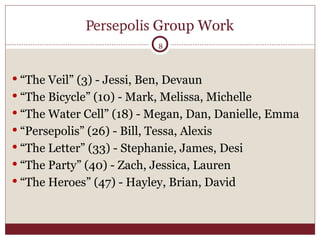
Persepolis  Group Work “The Veil” (3) - Jessi, Ben, Devaun “The Bicycle” (10) - Mark, Melissa, Michelle “The Water Cell” (18) - Megan, Dan, Danielle, Emma “Persepolis” (26) - Bill, Tessa, Alexis “The Letter” (33) - Stephanie, James, Desi “The Party” (40) - Zach, Jessica, Lauren “The Heroes” (47) - Hayley, Brian, David
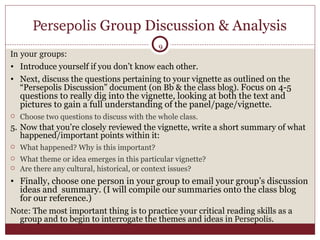
Persepolis  Group Discussion & Analysis In your groups: Introduce yourself if you don’t know each other. Next, discuss the questions pertaining to your vignette as outlined on the “Persepolis Discussion” document (on Bb & the class blog).  Focus on 4-5 questions to really dig into the vignette, looking at both the text and pictures to gain a full understanding of the panel/page/vignette. Choose two questions to discuss with the whole class. Now that you’re closely reviewed the vignette, write a short summary of what happened/important points within it:  What happened? Why is this important?  What theme or idea emerges in this particular vignette? Are there any cultural, historical, or context issues? Finally, choose one person in your group to email your group’s discussion ideas and  summary. (I will compile our summaries onto the class blog for our reference.)  Note:  The most important thing is to practice your critical reading skills as a group and to begin to interrogate the themes and ideas in  Persepolis .
Class Discussion Tell us what’s going on in your vignette/the questions you’ve prepared for discussion!  
Peer Review Feedback: Get Your Voice Heard! On the index card provided, please provide me some feedback on our class peer review session. (You can write this anonymously or include your name if you like--up to you!) Some ideas: What worked well?  What didn’t work? Do you want to change anything? If so, what?  Was your peer review partner’s helpful? Why or why not? Some of you choose to answer the Peer Review Worksheet questions in a document, and some of your chose to include comment bubbles. What method do you think would work best?  Any other comments or questions about peer review.  We’ll pick up with this on Thursday, and (if necessary) discuss what to keep and what to change!
Assignments Critically  read:  Persepolis  – pages 53- 103 Satrapi, “How Can One Be Persian?” (PDF) Inquiry 2 Assignment Prompt

Eng112.Feb8

  • 1.
    February 8, 2011     “ Today, comics is one of the very few forms of mass communication in which individual voices still have a chance to be heard.” -Scott McCloud ENG 112
  • 2.
    Today’s Agenda Quickintroduction to Inquiry 2 Persepolis group work Persepolis whole-class discussion Peer response feedback--if time permits
  • 3.
    Inquiry #2: BriefOverview Inquiry 2 is a “Cultural/Historical Interrogation.” Essentially, you will be exploring how various cultural and historical contexts affect your understanding of texts, using Persepolis as a starting point. You will create your own “inquiry question”--whatever it is that you are going to be researching, investigating, and reporting on. It is split into two parts, much like Inquiry 1. Part 1 is a series of blogs in which you develop your inquiry question and present & analyze your research; it is worth 10% of your grade overall. Part 2 is a paper based on your inquiry question and on the research done in Part 1; it is worth 20% of your grade.
  • 4.
    So... What is “History”? What is “Culture”? History is “the bodies of knowledge about the past produced by historians , together with everything that is involved in the production, communication of, and teaching about that knowledge.” Culture is “the cumulative deposits of knowledge, experience, beliefs, values, attitudes, meanings, hierarchies, religions, notions of time, gender roles, spatial relations, scientific ideas and assumptions, and material objects and possessions acquired by a group of people in the course of generations through individual and group striving .”
  • 5.
    Why InterrogateHistory and Culture? Texts are not composed--or read--within a vacuum. To fully understand any text, you should get into the habit of interrogating the circumstances in which it was written, published, and received. Understanding the complex “background” of texts--their cultural and/or historical contexts--will not only help you to better appreciate them, but also to better communicate yourself.
  • 6.
    Using Your Inquiry1 Skills For Inquiry 1, we discussed what it means to be a “critical reader,” and you went on to develop your critical reading skills as you closely analyzed a text and connected it to issues of language and identity. For Inquiry 2, those critical reading skills will be necessary again--perhaps even more so because we’re dealing with the graphic novel, a medium unfamiliar to most of you. Remember to critically, actively read Persepolis as you would any other text: take notes, ask questions, mark off passages, etc.
  • 7.
    Beginnings of Cultural/HistoricalContext The best place to begin with cultural/historical interrogation is often the introduction to whatever text you’re reading. In the introduction to Persepolis , Satrapi reveals the broader historical and cultural context of her memoir, as well as her purpose in writing this text. What are those contexts and her purpose?
  • 8.
    Persepolis GroupWork “The Veil” (3) - Jessi, Ben, Devaun “The Bicycle” (10) - Mark, Melissa, Michelle “The Water Cell” (18) - Megan, Dan, Danielle, Emma “Persepolis” (26) - Bill, Tessa, Alexis “The Letter” (33) - Stephanie, James, Desi “The Party” (40) - Zach, Jessica, Lauren “The Heroes” (47) - Hayley, Brian, David
  • 9.
    Persepolis GroupDiscussion & Analysis In your groups: Introduce yourself if you don’t know each other. Next, discuss the questions pertaining to your vignette as outlined on the “Persepolis Discussion” document (on Bb & the class blog). Focus on 4-5 questions to really dig into the vignette, looking at both the text and pictures to gain a full understanding of the panel/page/vignette. Choose two questions to discuss with the whole class. Now that you’re closely reviewed the vignette, write a short summary of what happened/important points within it: What happened? Why is this important? What theme or idea emerges in this particular vignette? Are there any cultural, historical, or context issues? Finally, choose one person in your group to email your group’s discussion ideas and  summary. (I will compile our summaries onto the class blog for our reference.) Note: The most important thing is to practice your critical reading skills as a group and to begin to interrogate the themes and ideas in Persepolis .
  • 10.
    Class Discussion Tellus what’s going on in your vignette/the questions you’ve prepared for discussion! 
  • 11.
    Peer Review Feedback:Get Your Voice Heard! On the index card provided, please provide me some feedback on our class peer review session. (You can write this anonymously or include your name if you like--up to you!) Some ideas: What worked well? What didn’t work? Do you want to change anything? If so, what? Was your peer review partner’s helpful? Why or why not? Some of you choose to answer the Peer Review Worksheet questions in a document, and some of your chose to include comment bubbles. What method do you think would work best? Any other comments or questions about peer review. We’ll pick up with this on Thursday, and (if necessary) discuss what to keep and what to change!
  • 12.
    Assignments Critically read: Persepolis – pages 53- 103 Satrapi, “How Can One Be Persian?” (PDF) Inquiry 2 Assignment Prompt