CLASS 3   EWRT 1b
AGENDA

PRESENTATION: TERMS
THE QHQ
REVIEW: IN-CLASS ESSAY ONE
IN-CLASS ESSAY EXAM ONE
TERMS

11. Power: The ability or official capacity to exercise control, authority, and to define key
values and concepts that define the “center”—what is accepted and considered
“normal.”

12. Prejudice: An adverse judgment or opinion formed beforehand or without
knowledge or examination of the facts.

13. Privilege: An unearned advantage, immunity, permission, right, or benefit granted to
or enjoyed by an individual because they are members of a category of people that is
accorded higher societal status.

14. Racism: Discrimination or prejudice based on race; the belief that race accounts for
differences on human character or ability and that a particular race is superior to
others.

15. White Privilege: Benefiting from being a member of the dominant culture, from lack
of continuous surveillance, from the status accorded “whiteness” in the larger society.
16. Ambiguity: a doubtfulness or uncertainty about the intention or
meaning of something. It usually refers to a statement that is
subject to more than one interpretation. The term is used for
words that suggest two or more appropriate meanings or that
convey both a basic meaning and complex overtones of that
meaning. Sometimes, authors make deliberate choices of words
that simultaneously cause several different streams of thought in
the reader’s mind. Ambiguity is also used to mean confusion
between the denotation and connotation of a literary work. A
simple kind of ambiguity is the use of homophones to promote a
multiplicity of possible meanings. In Sonnet 135, Shakespeare
puns on the word “Will,” invoking its sense as one’s wish, as well
as its sense as a nickname for “William”: “whoever hath her
wish, thou hast thy Will” (line 1).
17. Antagonist: the character who strives against another main
character. This character opposes the hero or protagonist in
drama. The term is also used to describe one who contends
with or opposes another in a fight, conflict, or battle of wills. In
literature, this is the principal opponent or foil of the main
character and is considered the villain unless the protagonist is
a villain; in that case, the antagonist is the hero.

18. Character: an combination of traits and features that form
the nature of some person or animal. It also refers to moral
qualities and ethical standards and principles. In
literature, character refers to a person represented in a
story, novel, or play.
Thinking
THE QHQ   about
          writing
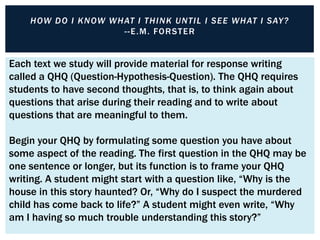
H OW D O I K NOW WH AT I TH INK UNTIL I SE E WH AT I SAY ?
                        - - E .M . FORST E R


Each text we study will provide material for response writing
called a QHQ (Question-Hypothesis-Question). The QHQ requires
students to have second thoughts, that is, to think again about
questions that arise during their reading and to write about
questions that are meaningful to them.

Begin your QHQ by formulating some question you have about
some aspect of the reading. The first question in the QHQ may be
one sentence or longer, but its function is to frame your QHQ
writing. A student might start with a question like, “Why is the
house in this story haunted? Or, “Why do I suspect the murdered
child has come back to life?” A student might even write, “Why
am I having so much trouble understanding this story?”
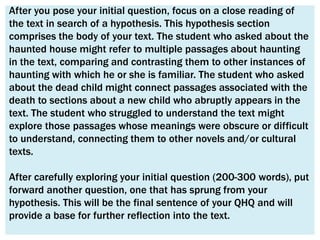
After you pose your initial question, focus on a close reading of
the text in search of a hypothesis. This hypothesis section
comprises the body of your text. The student who asked about the
haunted house might refer to multiple passages about haunting
in the text, comparing and contrasting them to other instances of
haunting with which he or she is familiar. The student who asked
about the dead child might connect passages associated with the
death to sections about a new child who abruptly appears in the
text. The student who struggled to understand the text might
explore those passages whose meanings were obscure or difficult
to understand, connecting them to other novels and/or cultural
texts.

After carefully exploring your initial question (200-300 words), put
forward another question, one that has sprung from your
hypothesis. This will be the final sentence of your QHQ and will
provide a base for further reflection into the text.
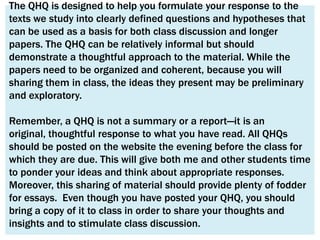
The QHQ is designed to help you formulate your response to the
texts we study into clearly defined questions and hypotheses that
can be used as a basis for both class discussion and longer
papers. The QHQ can be relatively informal but should
demonstrate a thoughtful approach to the material. While the
papers need to be organized and coherent, because you will
sharing them in class, the ideas they present may be preliminary
and exploratory.

Remember, a QHQ is not a summary or a report—it is an
original, thoughtful response to what you have read. All QHQs
should be posted on the website the evening before the class for
which they are due. This will give both me and other students time
to ponder your ideas and think about appropriate responses.
Moreover, this sharing of material should provide plenty of fodder
for essays. Even though you have posted your QHQ, you should
bring a copy of it to class in order to share your thoughts and
insights and to stimulate class discussion.
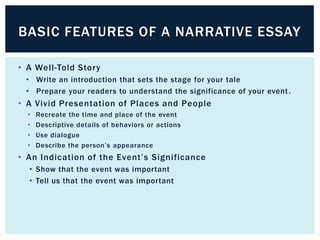
BASIC FEATURES OF A NARRATIVE ESSAY

• A Well-Told Story
 • Write an introduction that sets the stage for your tale
 • Prepare your readers to understand the significance of your event .
• A Vivid Presentation of Places and People
  •   Recreate the time and place of the event
  •   Descriptive details of behaviors or actions
  •   Use dialogue
  •   Describe the person’s appearance
• An Indication of the Event’s Significance
  • Show that the event was important
  • Tell us that the event was important
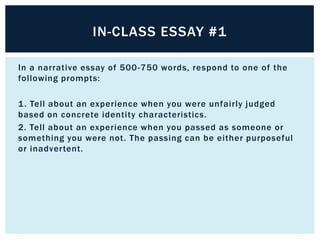
IN-CLASS ESSAY #1

In a narrative essay of 500 -750 words, respond to one of the
following prompts:

1 . Tell about an experience when you were unfairly judged
based on concrete identity characteristics. 

2. Tell about an experience when you passed as someone or
something you were not. The passing can be either purposeful
or inadvertent.
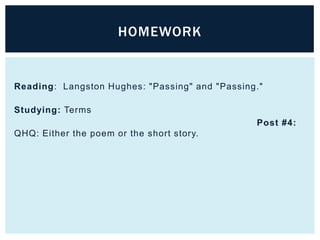
HOMEWORK


Reading: Langston Hughes: "Passing" and "Passing."

Studying: Terms
                                                Post #4:
QHQ: Either the poem or the short story.

Summer 1b class 3

  • 1.
    CLASS 3 EWRT 1b
  • 2.
    AGENDA PRESENTATION: TERMS THE QHQ REVIEW:IN-CLASS ESSAY ONE IN-CLASS ESSAY EXAM ONE
  • 3.
    TERMS 11. Power: Theability or official capacity to exercise control, authority, and to define key values and concepts that define the “center”—what is accepted and considered “normal.” 12. Prejudice: An adverse judgment or opinion formed beforehand or without knowledge or examination of the facts. 13. Privilege: An unearned advantage, immunity, permission, right, or benefit granted to or enjoyed by an individual because they are members of a category of people that is accorded higher societal status. 14. Racism: Discrimination or prejudice based on race; the belief that race accounts for differences on human character or ability and that a particular race is superior to others. 15. White Privilege: Benefiting from being a member of the dominant culture, from lack of continuous surveillance, from the status accorded “whiteness” in the larger society.
  • 4.
    16. Ambiguity: adoubtfulness or uncertainty about the intention or meaning of something. It usually refers to a statement that is subject to more than one interpretation. The term is used for words that suggest two or more appropriate meanings or that convey both a basic meaning and complex overtones of that meaning. Sometimes, authors make deliberate choices of words that simultaneously cause several different streams of thought in the reader’s mind. Ambiguity is also used to mean confusion between the denotation and connotation of a literary work. A simple kind of ambiguity is the use of homophones to promote a multiplicity of possible meanings. In Sonnet 135, Shakespeare puns on the word “Will,” invoking its sense as one’s wish, as well as its sense as a nickname for “William”: “whoever hath her wish, thou hast thy Will” (line 1).
  • 5.
    17. Antagonist: thecharacter who strives against another main character. This character opposes the hero or protagonist in drama. The term is also used to describe one who contends with or opposes another in a fight, conflict, or battle of wills. In literature, this is the principal opponent or foil of the main character and is considered the villain unless the protagonist is a villain; in that case, the antagonist is the hero. 18. Character: an combination of traits and features that form the nature of some person or animal. It also refers to moral qualities and ethical standards and principles. In literature, character refers to a person represented in a story, novel, or play.
  • 6.
    Thinking THE QHQ about writing
  • 7.
    H OW DO I K NOW WH AT I TH INK UNTIL I SE E WH AT I SAY ? - - E .M . FORST E R Each text we study will provide material for response writing called a QHQ (Question-Hypothesis-Question). The QHQ requires students to have second thoughts, that is, to think again about questions that arise during their reading and to write about questions that are meaningful to them. Begin your QHQ by formulating some question you have about some aspect of the reading. The first question in the QHQ may be one sentence or longer, but its function is to frame your QHQ writing. A student might start with a question like, “Why is the house in this story haunted? Or, “Why do I suspect the murdered child has come back to life?” A student might even write, “Why am I having so much trouble understanding this story?”
  • 8.
    After you poseyour initial question, focus on a close reading of the text in search of a hypothesis. This hypothesis section comprises the body of your text. The student who asked about the haunted house might refer to multiple passages about haunting in the text, comparing and contrasting them to other instances of haunting with which he or she is familiar. The student who asked about the dead child might connect passages associated with the death to sections about a new child who abruptly appears in the text. The student who struggled to understand the text might explore those passages whose meanings were obscure or difficult to understand, connecting them to other novels and/or cultural texts. After carefully exploring your initial question (200-300 words), put forward another question, one that has sprung from your hypothesis. This will be the final sentence of your QHQ and will provide a base for further reflection into the text.
  • 9.
    The QHQ isdesigned to help you formulate your response to the texts we study into clearly defined questions and hypotheses that can be used as a basis for both class discussion and longer papers. The QHQ can be relatively informal but should demonstrate a thoughtful approach to the material. While the papers need to be organized and coherent, because you will sharing them in class, the ideas they present may be preliminary and exploratory. Remember, a QHQ is not a summary or a report—it is an original, thoughtful response to what you have read. All QHQs should be posted on the website the evening before the class for which they are due. This will give both me and other students time to ponder your ideas and think about appropriate responses. Moreover, this sharing of material should provide plenty of fodder for essays. Even though you have posted your QHQ, you should bring a copy of it to class in order to share your thoughts and insights and to stimulate class discussion.
  • 10.
    BASIC FEATURES OFA NARRATIVE ESSAY • A Well-Told Story • Write an introduction that sets the stage for your tale • Prepare your readers to understand the significance of your event . • A Vivid Presentation of Places and People • Recreate the time and place of the event • Descriptive details of behaviors or actions • Use dialogue • Describe the person’s appearance • An Indication of the Event’s Significance • Show that the event was important • Tell us that the event was important
  • 11.
    IN-CLASS ESSAY #1 Ina narrative essay of 500 -750 words, respond to one of the following prompts: 1 . Tell about an experience when you were unfairly judged based on concrete identity characteristics. 
 2. Tell about an experience when you passed as someone or something you were not. The passing can be either purposeful or inadvertent.
  • 12.
    HOMEWORK Reading: Langston Hughes:"Passing" and "Passing." Studying: Terms Post #4: QHQ: Either the poem or the short story.