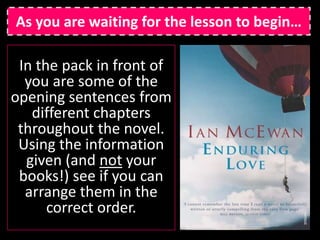
As you are waiting for the lesson to begin...LGANSITNONTINUCIGFSUREFPMERANNETERPSITSTEABSLLASTINGCONTINUINGSUFFERPERMANENTPERSISTSTABLEUnscramble the anagrams above. What do the words have in common, and why might they be important?
Learning Objectives To consider the significance of the title.
 To gain an insight into McEwan’s basis for the novel
 To consider the themes of the novel.What’s in a name?McEwan often uses titles that are significant and give an insight into the novel.  Consider the title Enduring Love, what insight does it give the reader before the novel even begins?
Read through the interview with Ian McEwan and answer the following questions:For what reason is it necessary for the reader to be aware of the narrator’s scientific mind from the outset?What is ‘de Clerambault’s syndrome’? What factor does McEwan feel sparks it off?At what point did McEwan decide on his gripping opening to the novel? Why did McEwan establish Clarissa as a character so different to Joe?In what ways does McEwan view his novel as different to other types of ‘Western literature’?
Look at the following images.  What do they suggest about the characters and themes in the novel?From your reading of Enduring Love, what evidence do you have for this so far?
As you are waiting for the lesson to begin…Summarise the events of chapter one in no more than 10 bullet points
Learning ObjectivesTo gain an understanding of chapter oneTo consider how McEwan builds drama and tension from the outset
Re-read the opening paragraph of chapter one, considering as you read how McEwan draws the reader into the story that is about to unfold.How does McEwan hook the reader in from the start? What facts are we given / what can we be sure of?What questions does this paragraph leave the reader with?
Answering the following questions, making notes in your text as you go.Pages 3 - 8. What do you learn about the relationship between Clarissa and Joe?What does Joe do whilst waiting for Clarissa at the airport? What conclusions about his character can be drawn from this?What is the effect of the line ‘I see us from three hundred feet up, through the eyes of the buzzard’.  Why does the narrator give us this perspective?What are your impressions of Joe from this chapter? How does the language used help to create this impression?
HomeworkEnsure you are all enrolled on the VLE ‘desire’ course. Complete an entry to the forum ‘Sympathy’.Enrolment key – desire.This is NOT an optional course.  This is an ongoing homework activity and will help you consider and challenge different opinions, analyse quotes etc.
Group TaskRead pages 8-16.  This section focuses on the balloon accident.  McEwan clearly establishes the importance of the event  as a turning point in the narrator’s life.  Read through this section in your groups and make detailed notes  on the following:The gradual build up to the event - the focus on the picnicThe reader's prior knowledge of the outcomeJoe's perspective on the event - his analysis of it from memory and his varied emotions.The way that the event is described and that tension is created by the use of varied sentence structureBe prepared to feedback to the class.
To end the lesson …How does McEwan’s writing in this chapter help build up drama and tension for the reader?
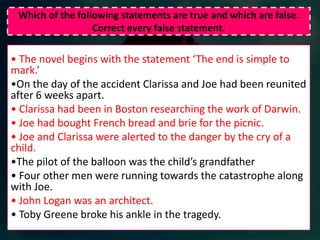
Which of the following statements are true and which are false. Correct every false statement. The novel begins with the statement ‘The end is simple to mark.’
On the day of the accident Clarissa and Joe had been reunited after 6 weeks apart.
 Clarissa had been in Boston researching the work of Darwin.
 Joe had bought French bread and brie for the picnic.
 Joe and Clarissa were alerted to the danger by the cry of a child.
The pilot of the balloon was the child’s grandfather
 Four other men were running towards the catastrophe along with Joe.
 John Logan was an architect.
 Toby Greene broke his ankle in the tragedy.Which of the following statements are true and which are false. Correct every false statement. The novel begins with the statement ‘The end is simple to mark.’
On the day of the accident Clarissa and Joe had been reunited after 6 weeks apart.
 Clarissa had been in Boston researching the work of Darwin.
 Joe had bought French bread and brie for the picnic.
 Joe and Clarissa were alerted to the danger by the cry of a child.
The pilot of the balloon was the child’s grandfather
 Four other men were running towards the catastrophe along with Joe.
 John Logan was an architect.
 Toby Greene broke his ankle in the tragedy.Learning ObjectivesConsider the narrative point of view.Analyse the characters of Joe and Clarissa in detail.
Narrative point of viewThis chapter is looking back on past events, allowing the narrator the opportunity to examine exactly what happened and who might be to blame.  Consider the way the narrator analyses the situation, making notes on how he views individual social responsibility.  Highlight phrases that show his scientific mind at work.
We discussed in the first lesson the differences between Joe and Clarissa.  Look back over chapter one and find evidence for the following:
To end the lesson…Think about the characters of Joe and Clarissa and everything we have discussed so far.What word would you use to describe  them and what evidence do you have for your choice?Be prepared to feedback you responses.
As you are waiting for the lesson to begin…Think back to  what you have learned about the character of Joe in Chapter one. Which of the words above would you choose to describe him. What evidence have you from Chapter one to support your opinion?
Our learning objectives for the lesson…To explore the initial presentation of Jed Parry
To explore the first meeting between Joe and Jed
To explore the birth of Jed’s obsessive desire for Joe.From the clues that McEwan gives us in the first chapter, we are aware that Jed Parry is going to be a significant character. His main introduction continues to present him as a disjointed and unnerving character…‘ He stood with his hands resting on his hips staring not at Logan but at me. Even then, he was more interested in me. He had come to tell me something. He was tall and lean, all bone and sinew, and he looked fit. He wore jeans and box-fresh trainers tied with red laces. His bones fairly burst out of him the way the hadn’t with Logan. His knuckles brushing against his leather belt were big and tight-knobbed under the skin which was white and stretched tight. The cheek bones were also tight and high-ridged and together with the pony-tail gave him the appearance of a pale Indian brave. His appearance was striking, even slightly threatening, but the voice gave it all away. It was feebly hesitant, neutral as to region, but carrying a trace, or acknowledgement, of Cockney- a discarded past or an affectation. Parry had his generation’s habit of making a statement on the rising inflection of a question…too hesitant or apologetic to say how things were in the world.’What impression is created of Jed Parry in this introduction to his character? In what way is he presented as different to the protagonist?
Re-read the initial conversation between Joe and Jed Parry and discuss the following questions. Be prepared to feedback your discussion points and support your ideas with evidence from the text. ‘Of course, I didn’t think any of this at the time…’ (p.24) to ‘…the most joyous of smiles was spreading slowly across his face.’ (p.26)In what way is Parry presented as pathetic and weak? In what was is he presented as dangerous and sinister?
What does the introduction of religion and belief add to the character of Parry?
How is the character of Clarissa used in their conversation? Why does McEwan do this?
What are our initial impressions of Jed Parry as a result of Chapter two?And to finish the lesson…‘Had I known what this glance meant to him at the time, and how he was to construe it later and build around it a mental life, I would not have been so warm.’ (Chapter two – p.20)‘Obsession – the domination of one's thoughts or feelings by a persistent idea, image or desire.’ Dictionary.comLook back again at Chapter two. Does Joe do anything to spark the dangerous obsession that begins at this point in the novel?
As you are waiting for the lesson to begin…What is the purpose of our partner in life? Rank the ideas above in order of importance, based on what you think is the most important aspect of a relationship. Which of these do we see in the relationship between Joe and Clarissa?
Our learning objectives for the lesson…To explore the relationship and love between Joe and Clarissa
To identify the ways in which McEwan introduces danger and tension into the early parts of the novelAs we move into the novel, the relationship between Joe and Clarissa deepens and we begin to gain insight into what they mean to one another. ‘ “I’ll tell you one thing, dummkopf. We’ve seen something terrible together. It won’t go away, and we have to help each other. And that means we have to love each other harder.”Of course. Why didn’t I think of this? Why didn’t I think like this? We needed love. I had been trying to deny myself the touch of her hand, assuming that affection was inappropriate, an indulgence, an irreverence in the face of death. Something we would come back to later when all the talking and the comforting was done. Clarissa had effected a shift to the essential…She knew I was a fool for this encirclement. It made me feel like I belonged, that I was rooted and blessed…That precious time before love-making is ill served by the pseudo clinical term ‘foreplay.’ The world would narrow and deepen, our voices would sink into the warmth of our bodies, the conversation became associative and unpredictable. Everything was touch and breath…When we fell silent, we would lie so close that we were mouth to mouth, delaying the union which bound us all the more because of this prelude.So, there we were, this again, and it was deliverance. This darkness beyond the gloom of the bedroom was infinite and cold as death. We were at a point of warmth in our vastness. The events of the afternoon filled us, but we banished them from conversation.’ (p.33 – 34)What insight do we get into the relationship between Joe and Clarissa from this extract? What do they provide one another? In comparison to the other relationships we have seen in previous texts, how true is their love?
In a previous lesson, we discussed the differences between the scientific and religious mind. It is this difference in viewpoint and belief that ultimately breaks the bond between Joe and Clarissa. Whilst Joe focuses on what is concrete and can be proved, Clarissa is more romantic and fluid in her outlook. Where do we see examples of the two different outlooks – the scientific and the religious – in the presentation of Joe and Clarissa in this chapter? How does this add to our impression of these two characters at this early part of the novel?
McEwan chooses a chapter which soothes and grounds Joe  to introduce the element of danger and suspicion…‘The light had been out five minutes when the phone rang and snatched me from the beginnings if sleep.I have no doubt that I remember his words correctly. He said, ‘Is that Joe?’ I didn’t reply. I had already recognised the voice. He said, ‘I just wanted you to know, I understand what you’re feeling. I feel it too. I love you.’I hung up.Clarissa murmured into the pillow, ‘Who was that?’It may have been exhaustion, or perhaps my concealment was protective of her, but I know I made my first mistake when I turned on my side and said to her, ‘It was nothing. Wrong number. Go to sleep.’ ( p.37 )How does McEwan introduce Jed Parry to the safe world of Joe and Clarissa? How does Joe react? How does McEwan hint at what is to come? What is the general tone and feeling of the end of Chapter twenty three?
And to finish the lesson…‘As we reach the end of Chapter three, we recognise that Joe is a more likeable character that Clarissa.’To what extent do you agree with this statement? What have you learned in this – and previous – lessons to help you reach an informed opinion?
As you are waiting for the lesson to begin…‘If the first person had not let go, the surely the rest of us would have stayed in place. And who was this first person? Not me. Not me. I even said the words out loud … Was is panic or rational calculation? Had we killed him really, or simply refused to die with him?’ ( Chapter 6 – p.55 - 56 )Can Joe be held accountable for what happened to John Logan – was it his fault? Why do you think McEwan includes this reflection at this point in the novel? What would you have in a similar situation?
Our learning objectives for the lesson…To explore the relationship and love between Joe and Clarissa further
To highlight why Chapter six is signifcant.
To recall what we have learned about the novel – and the key characters - so farTo start the lesson…Watch the following trailer for the film version of Enduring Love carefully.  As you are watching, think of a list of ten words which you would use to describe the nature and tone of the film. Be prepared to feedback your answers. Enduring Love - TrailerHomework – for next lesson. Although the film version is very different to the novel, the key ideas remain the same. Using the words you have come up with from watching the trailer, find quotations to support your choices. You should focus on the first six chapters of the novel.
Why is Chapter Six an important point in the novel?The chapter opens with an idyllic image of Joe and Clarissa’s life together. This serves as an effective starting point to the unravelling of their ‘enduring love.’
The fact that Joe still considers the accident – and his role in the accident – suggests that he is still at odds with the part he played. The frenzy of the situation only serves to frustrate him even further.
Joe chooses to confide in Clarissa for the first time in this chapter, despite the fact that various episodes have taken place with Jed Parry already. Her frivolous and carefree attitude towards Parry’s protestations of live soothe him although there are suggestions of anxiety in their conversation.
McEwan chooses to introduce Jed Parry again in this chapter, thus violating the loving and confidential world that Joe and Clarissa have created for themselves.
The chapter ends on a cliffhanger, where Joe decides to meet Jed for the first time after the accident. Although Joe appears to have the upper hand, throughout their dialogue there are suggestions that all will not be well. Read through the section beginning ‘I was so lost in this…’ ( p.56 ) until ‘We kissed again, deeply.’ ( p.58 )How does Joe feel about telling Clarissa about the phone call with Jed Parry? How does McEwan reveal Joe’s feelings?
How does McEwan create tension when Joe tells Clarissa that Jed has confessed his love for him? How is this tension subverted?
At what point during this conversation does the tone change? How does the tone change and what does this suggest?
Throughout the novel, Joe has found solace and comfort in Clarissa. How does this continue at the end of this extract? What does this suggest about their relationship?And to finish the lesson…‘Solemn. More like panicky. I calculated: perhaps I should see him, let him see me and let him understand that I was distinct from the creature of his fantasy world. Let him speak. The alternative was more of this…’ ( p.60 )Why does Joe go to meet Jed Parry at the end of Chapter six? What have we learned about his character in this – and previous  - lessons which might help us to explain his actions.
As you are waiting for the lesson to begin…As we have seen in a previous lesson, much of Enduring Love focuses on the difference in perspective between Science and Religion. Think about what you have learned about the character of Jed Parry in previous lessons. In your opinion, is all encompassing and passionate faith shown to be powerful or destructive? Should we be threatened by the force of Parry’s faith?
Our learning objectives for the lesson…To explore the relationship between Joe and Clarissa, Joe and Jed.
To gain insight as to how McEwan creates tension and suspense throughout Chapters seven and eight
To critically analyse key extracts from Chapters seven and eight.The destructive nature of desire…As Joe meets Jed in an attempt to stunt his amorous advances, McEwan plays with the impressions and focus of the scene.‘As I came closer Parry retreated further under his tree, leaned back against the trunk and teied to look nonchalant by hooking a thumb into his trouser pocket. In fact he looked abject. He appeared smaller, all knobs and bones, no longer the sleek Indian brave, despite the pony tail. He wouldn’t meet my eye as I came up, or rather his eyes made a nervous pass across my face, and then turned down. As I put my hand out I was feeling quite relieved. Clarissa was right, he was a harmless fellow with a strange notion, a nuisance at most, hardly the threat I made him out to be.’ ( Chapter seven – p.61 )In what way does this extract suggest a meeting of two lovers? How is the character of Jed Parry presented here?
Why is Chapter Seven an important point in the novel?Although Joe and Jed have spoken before – and Jed has confessed his love for Joe already – the entire chapter is dedicated to the ‘blossoming’ relationship between Joe and Jed Parry.
McEwan creates tension throughout the chapter by raising the menace in Jed Parry. By the end of this chapter, it is clear that Parry is a force to be reckoned with.
We begin to see a little more about Jed Parry’s character in this chapter. Most noticeably, we begin to see the changing emotions and in Jed. This makes us feel even more uncomfortable as the chapter progresses.
The question of religious intent is once again introduced. Parry’s intentions for Joe seem to be two fold – to save him and to love him.
We are given insight into Joe’s thought process throughout the chapter. As the chapter progresses, we are privy to his changing fears and feelings. Although the extract we have just studied suggests and end to Jed’s obsession with Joe, Chapter seven sees the tension rise and the danger become even more apparent. Below are eight words which chart the development of the tone of the chapter. Your aim is to order these words, deciding how McEwan manipulates the situation to emphasise the menace that Parry provides.
Now that you have decided how the chapter develops and have the vocabulary to articulate how McEwan manipulates the reader, find evidence to support your opinion.For each word, choose a quotation which supports your opinion. Be prepared to feedback your ideas and explain what the quotation tells us about McEwan’s writing.
Remind yourself of our discussion about Science and Religion from the beginning of the lesson…‘She was perturbed when I read Wilson’s passage to her. Everything was being stripped down, she said, and in the process some larger meaning was lost…The truth of that smile was in the eye and heart of the parent, and in the unfolding love which only had meaning through time…I told her I thought she had spent too much time in the company of John Keats. A genius no doubt, but an obscurantist too who thought science was robbing the world of wonder, when the opposite was the case. If we value a baby’s smile, why not contemplate the cause?...Clarissa said that I had not understood her. There was nothing wrong in analysing the bits, but it was easy to lose sight of the whole. I agreed. The work of synthesis was crucial. Clarissa said I still did not understand her, she was talking about love. I said I was too, and how babies who could not yet speak got more of it for themselves. She said no, I still did not understand. Then we had left it. No hard feelings. We had had this conversation in different forms on many occasions. What we were really talking about this time was the absence of babies from our lives.’ ( Chapter 8, p.71 )How does McEwan emphasise the fundamental differences between Clarissa and Joe in the language and syntax in this extract?
Chapter Eight fuses the increasingly disturbing vision of Jed Parry with Joe’s frustration with his intellectual life…How does Jed Parry react when Joe eventually returns home? What does this suggest about his character?
How does McEwan suggest that Joe is pathetic and vulnerable during his conversation with the police? What does this suggest about his complaint with Jed Parry?
Read again the paragraph beginning, ‘I made a flask of coffee…’ on p.75. How does Joe suggest dissatisfaction with his working life?
At the end of this chapter, Jed Parry remains outside the home of Joe and Clarissa. What does this suggest about his character and intent?
How does McEwan choose to end this varied chapter? Why do you think he ends it in this way?And to finish the lesson…What one thing do we not fully understand about Jed Parry? How are we going to find out more?What two things have we learned about Jed Parry from this lesson?What three things did we know  already know about the character of Jed Parry?At a third of the way through the novel. McEwan has introduced us to many of the key themes he intends to explore throughout the novel.
Chapter Nine
Our learning objectives for the lesson…To develop our understanding of Clarissa and Joe’s relationship.To examine the style of narration and how this influences our interpretations.
CLARISSADiscuss:What is the significance of her name?What is the importance of her role and her passion for Keats in the novel?How does the reader respond to her as a character?
Why does McEwan associate Clarissa with Keats?Keats is particularly famous for his views on ‘Negative Capability’. Basically, this is a state of mind in which someone is ‘capable of being in uncertainties, mysteries, doubts, without any irritable reaching after fact and reason.’  Keats, therefore, promoted a view that it was desirable to accept that some things were not meant to be understood.Where have we seen Clarissa’s sympathy to this in the novel so far?
Chapter NineWhat are the significant events of chapter nine?
Clarissa’sPoint of View (Pgs 83 – 88)‘The police? You phoned the police? Thirty-three messages on the machine?’ But she saw it as she came in, the indicator said zero. He wiped them, he insists, at which Clarissa sits up in the water and takes another look at him and returns her stare full on. When she was twelve her father died of Alzheimer’s, and it’s always been a fear that she’ll live with someone who’ll go crazy. That’s why she chose rational Joe...‘Do you think it’s possible you’re making too much of this man Parry. That he’s really not much of a problem. I mean, ask him in for a cup of tea and he’ll probably never bother you again. He’s not the cause of your agitation, he’s a symptom.’ Perhaps Parry, or the Parry as described by Joe, does not exist. She shivers, ands lowers herself back into the water, keeping her gaze on him...‘You were so intense about him as soon as you met him. It’s like you invented him... You ought to be asking yourself which way this fixation runs.’Who does the reader sympathise with during this argument? Why?What is McEwan trying to lead the reader to believe? How does this link to the destructive nature of desire?
To end the lesson…Using your previous understanding of the novel and what we have learned today, consider:What does this chapter help us to understand further about the different viewpoints of Joe and Clarissa?
How is Parry managing to come between them?Chapter Eleven
As you are waiting for the lesson to begin:Discuss: When and why do people write letters?In the novel, Clarissa is researching the Romantic poet John Keats.  She is searching for a last letter to Keats’ mistress Fanny Brawne because she is certain that “love that did not find its expression in a letter was not perfect.”
Our learning objectives for the lesson…To analyse Jed’s first letter to Joe. To compare the destruction of love in Othello, The Great Gatsby and Enduring Love.
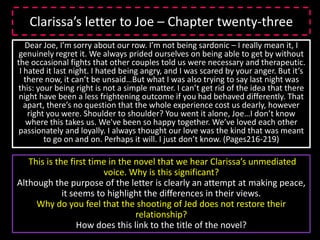
Dear Joe, I feel happiness running through me like an electrical current. I close my eyes and see you as you were last night in the rain, across the road from me, with the unspoken love between us as strong as steel cable. I close my eyes and thank God out loud for letting you exist, for letting me exist in the same time and place as you, and for letting this strange adventure between us begin. I thank Him for every little thing about us. This morning I woke and on the wall beside my bed was a perfect disc of sunlight and I thanked Him for that same sunlight falling on you! Just as last night the rain that drenched you drenched me too and bound us. I praise God that He has sent me to you. I know these is difficulty and pain ahead of us, but the path that He sets us on is hard for a purpose. His purpose! It tests us and strengthens us, and in the long run it will bring us to even greater joy.Chapter 11 reveals a new level to Jed’s obsession  when he begins to write letters to Joe. How does the reader respond to this communication? Even though there is no physical interaction, how has McEwan presented Jed as more of a menacing threat in this chapter?
Dear Joe, I feel happiness running through me like an electrical current. I close my eyes and see you as you were last night in the rain, across the road from me, with the unspoken love between us as strong as steel cable. I close my eyes and thank God out loud for letting you exist, for letting me exist in the same time and place as you, and for letting this strange adventure between us begin. I thank Him for every little thing about us. This morning I woke and on the wall beside my bed was a perfect disc of sunlight and I thanked Him for that same sunlight falling on you! Just as last night the rain that drenched you drenched me too and bound us. I praise God that He has sent me to you. I know these is difficulty and pain ahead of us, but the path that He sets us on is hard for a purpose. His purpose! It tests us and strengthens us, and in the long run it will bring us to even greater joy.Despite the fact we do not see Joe or Clarissa’s reaction to this letter – what type of impact is Parry’s persistent intrusions having on their relationship? How do we know this?
Which character has the most destructive effect on love / relationships?You will be assigned into groups and you must present a persuasive argument to the rest of the class about why your allocated character has the  biggest negative impact on relationships in their text. In your response you must consider:What destruction do they cause? How do they change things?
Is this long term or short term destruction? Do the relationships overcome their interference?
What do they desire? What spurs them on to destroy things? Is this justified?
Do you think the relationships in the text would have been doomed anyway? Why?Gatsby – ‘The Great Gatsby’Jed – ‘Enduring Love’Othello – ‘Othello’Iago – ‘Othello’Joe – ‘Enduring Love’Tom – ‘The Great Gatsby’
Discuss: Which character has the most destructive effect on love / relationships?Gatsby – ‘The Great Gatsby’Jed – ‘Enduring Love’Othello – ‘Othello’Iago – ‘Othello’Joe – ‘Enduring Love’Tom – ‘The Great Gatsby’
Homework: Enduring Love Questions on Chapter 12 and 13 How does Clarissa react to reading Jed’s letter?How does Joe betray Clarissa’s trust in this chapter?How does McEwan describe Jean Logan’s house? How is it a perfect setting for sorrow?What does their conversation tell Joe about Mrs Logan and about himself?Explain Mrs Logan’s suspicions about the circumstances of her husband’s death.
Chapter Fourteen
As you are waiting for the lesson to begin:Complete the wordsearch you have been given.Extension: Look at each of the words – which character would you use the language choices to describe and why?
Our learning objectives for the lesson…To analyse chapter fourteen.To consider the impact of the introduction of De Clerambault syndrome on the text.
It was with a touch of sadness that Clarissa sometimes told me that I would have made a wonderful father. She would tell me that I had a good way with children, that I levelled with them easily and without condescension. I’ve never looked after a child for any length of time, so I’ve never been tested in the true fires of parental self-denial, but I think I’m good enough at the listening and talking, I know all seven of her godchildren well. We’ve had them for weekends, we’ve taken some on holiday abroad, and we’ve devotedly cared for two little girls for a week – Felicity and Grace who both wet the bed – while their parents tore each other in a divorce hearing. I was of some use to Clarissa’s eldest godchild, an inwardly stormy fifteen year old befuddled by pop culture and the oatfish codes of street credibility. I took him drinking with me, and talked him out of leaving school. Four years later he was reading medicine at Edinburgh, and doing well. (Pg 118)Why does McEwan open chapter fourteen with information about the past? What do we learn about Joe and how do we respond to him? Why has McEwan shared this information with us?
De Clerambault's SyndromeIn chapter 8, Joe believes he has found a diagnosis for Jed’s obsession: De Clerambault's Syndrome. Read through the information sheet and find evidence to suggest that Jed is suffering from the different symptoms of this condition.
De Clerambault's SyndromeIn chapter 8, Joe believes he has found a diagnosis for Jed’s obsession: De Clerambault's Syndrome. Read through the information sheet and find evidence from the text to suggest that Jed is suffering from the different symptoms of this condition.Jed does not fulfil all of the symptoms of the illness. What about Jed’s character does not conform and why do you think McEwan has made these changes?
De Clerambault’s syndrome. The name was like a fanfare, a clear trumpet sound recalling me to my own obsessions. There was research to follow through now and I knew exactly where to start. A syndrome was a framework of prediction and it offered a kind of comfort. I was almost happy ass she opened the front door for me and the four of us crowded out onto the brick path to say our goodbyes. It was as if I had at last been offered that research post with my old professor. (pg 124)How does McEwan create a shift in tone at the end of chapter 8?How does the revelation at the end of chapter 8 connect to the information we were told at the beginning of the chapter?
To end the lesson…Do you think the words from the wordsearch and from the syndrome information sheet could be used to describe Jed AND Joe?VictimBeliefIsolatedDeludedInaccessibleThreateningAffectionateViolentHarassedResistant
Chapter Fifteen
Chapter FifteenAs you are waiting for the lesson to begin bullet point the five key events of chapter fifteen.
Our learning objectives for the lesson…To revise the assessment objectives for our coursework.To analyse chapter fifteen in groups.
RECAP: What are the four assessment objectives for A Level literature?

Enduring love pri

  • 1.
    As you arewaiting for the lesson to begin...LGANSITNONTINUCIGFSUREFPMERANNETERPSITSTEABSLLASTINGCONTINUINGSUFFERPERMANENTPERSISTSTABLEUnscramble the anagrams above. What do the words have in common, and why might they be important?
  • 2.
    Learning Objectives Toconsider the significance of the title.
  • 3.
    To gainan insight into McEwan’s basis for the novel
  • 4.
    To considerthe themes of the novel.What’s in a name?McEwan often uses titles that are significant and give an insight into the novel. Consider the title Enduring Love, what insight does it give the reader before the novel even begins?
  • 5.
    Read through theinterview with Ian McEwan and answer the following questions:For what reason is it necessary for the reader to be aware of the narrator’s scientific mind from the outset?What is ‘de Clerambault’s syndrome’? What factor does McEwan feel sparks it off?At what point did McEwan decide on his gripping opening to the novel? Why did McEwan establish Clarissa as a character so different to Joe?In what ways does McEwan view his novel as different to other types of ‘Western literature’?
  • 6.
    Look at thefollowing images. What do they suggest about the characters and themes in the novel?From your reading of Enduring Love, what evidence do you have for this so far?
  • 8.
    As you arewaiting for the lesson to begin…Summarise the events of chapter one in no more than 10 bullet points
  • 9.
    Learning ObjectivesTo gainan understanding of chapter oneTo consider how McEwan builds drama and tension from the outset
  • 10.
    Re-read the openingparagraph of chapter one, considering as you read how McEwan draws the reader into the story that is about to unfold.How does McEwan hook the reader in from the start? What facts are we given / what can we be sure of?What questions does this paragraph leave the reader with?
  • 11.
    Answering the followingquestions, making notes in your text as you go.Pages 3 - 8. What do you learn about the relationship between Clarissa and Joe?What does Joe do whilst waiting for Clarissa at the airport? What conclusions about his character can be drawn from this?What is the effect of the line ‘I see us from three hundred feet up, through the eyes of the buzzard’. Why does the narrator give us this perspective?What are your impressions of Joe from this chapter? How does the language used help to create this impression?
  • 12.
    HomeworkEnsure you areall enrolled on the VLE ‘desire’ course. Complete an entry to the forum ‘Sympathy’.Enrolment key – desire.This is NOT an optional course. This is an ongoing homework activity and will help you consider and challenge different opinions, analyse quotes etc.
  • 13.
    Group TaskRead pages8-16. This section focuses on the balloon accident. McEwan clearly establishes the importance of the event as a turning point in the narrator’s life. Read through this section in your groups and make detailed notes on the following:The gradual build up to the event - the focus on the picnicThe reader's prior knowledge of the outcomeJoe's perspective on the event - his analysis of it from memory and his varied emotions.The way that the event is described and that tension is created by the use of varied sentence structureBe prepared to feedback to the class.
  • 14.
    To end thelesson …How does McEwan’s writing in this chapter help build up drama and tension for the reader?
  • 15.
    Which of thefollowing statements are true and which are false. Correct every false statement. The novel begins with the statement ‘The end is simple to mark.’
  • 16.
    On the dayof the accident Clarissa and Joe had been reunited after 6 weeks apart.
  • 17.
    Clarissa hadbeen in Boston researching the work of Darwin.
  • 18.
    Joe hadbought French bread and brie for the picnic.
  • 19.
    Joe andClarissa were alerted to the danger by the cry of a child.
  • 20.
    The pilot ofthe balloon was the child’s grandfather
  • 21.
    Four othermen were running towards the catastrophe along with Joe.
  • 22.
    John Loganwas an architect.
  • 23.
    Toby Greenebroke his ankle in the tragedy.Which of the following statements are true and which are false. Correct every false statement. The novel begins with the statement ‘The end is simple to mark.’
  • 24.
    On the dayof the accident Clarissa and Joe had been reunited after 6 weeks apart.
  • 25.
    Clarissa hadbeen in Boston researching the work of Darwin.
  • 26.
    Joe hadbought French bread and brie for the picnic.
  • 27.
    Joe andClarissa were alerted to the danger by the cry of a child.
  • 28.
    The pilot ofthe balloon was the child’s grandfather
  • 29.
    Four othermen were running towards the catastrophe along with Joe.
  • 30.
    John Loganwas an architect.
  • 31.
    Toby Greenebroke his ankle in the tragedy.Learning ObjectivesConsider the narrative point of view.Analyse the characters of Joe and Clarissa in detail.
  • 32.
    Narrative point ofviewThis chapter is looking back on past events, allowing the narrator the opportunity to examine exactly what happened and who might be to blame. Consider the way the narrator analyses the situation, making notes on how he views individual social responsibility. Highlight phrases that show his scientific mind at work.
  • 33.
    We discussed inthe first lesson the differences between Joe and Clarissa. Look back over chapter one and find evidence for the following:
  • 34.
    To end thelesson…Think about the characters of Joe and Clarissa and everything we have discussed so far.What word would you use to describe them and what evidence do you have for your choice?Be prepared to feedback you responses.
  • 35.
    As you arewaiting for the lesson to begin…Think back to what you have learned about the character of Joe in Chapter one. Which of the words above would you choose to describe him. What evidence have you from Chapter one to support your opinion?
  • 36.
    Our learning objectivesfor the lesson…To explore the initial presentation of Jed Parry
  • 37.
    To explore thefirst meeting between Joe and Jed
  • 38.
    To explore thebirth of Jed’s obsessive desire for Joe.From the clues that McEwan gives us in the first chapter, we are aware that Jed Parry is going to be a significant character. His main introduction continues to present him as a disjointed and unnerving character…‘ He stood with his hands resting on his hips staring not at Logan but at me. Even then, he was more interested in me. He had come to tell me something. He was tall and lean, all bone and sinew, and he looked fit. He wore jeans and box-fresh trainers tied with red laces. His bones fairly burst out of him the way the hadn’t with Logan. His knuckles brushing against his leather belt were big and tight-knobbed under the skin which was white and stretched tight. The cheek bones were also tight and high-ridged and together with the pony-tail gave him the appearance of a pale Indian brave. His appearance was striking, even slightly threatening, but the voice gave it all away. It was feebly hesitant, neutral as to region, but carrying a trace, or acknowledgement, of Cockney- a discarded past or an affectation. Parry had his generation’s habit of making a statement on the rising inflection of a question…too hesitant or apologetic to say how things were in the world.’What impression is created of Jed Parry in this introduction to his character? In what way is he presented as different to the protagonist?
  • 39.
    Re-read the initialconversation between Joe and Jed Parry and discuss the following questions. Be prepared to feedback your discussion points and support your ideas with evidence from the text. ‘Of course, I didn’t think any of this at the time…’ (p.24) to ‘…the most joyous of smiles was spreading slowly across his face.’ (p.26)In what way is Parry presented as pathetic and weak? In what was is he presented as dangerous and sinister?
  • 40.
    What does theintroduction of religion and belief add to the character of Parry?
  • 41.
    How is thecharacter of Clarissa used in their conversation? Why does McEwan do this?
  • 42.
    What are ourinitial impressions of Jed Parry as a result of Chapter two?And to finish the lesson…‘Had I known what this glance meant to him at the time, and how he was to construe it later and build around it a mental life, I would not have been so warm.’ (Chapter two – p.20)‘Obsession – the domination of one's thoughts or feelings by a persistent idea, image or desire.’ Dictionary.comLook back again at Chapter two. Does Joe do anything to spark the dangerous obsession that begins at this point in the novel?
  • 44.
    As you arewaiting for the lesson to begin…What is the purpose of our partner in life? Rank the ideas above in order of importance, based on what you think is the most important aspect of a relationship. Which of these do we see in the relationship between Joe and Clarissa?
  • 45.
    Our learning objectivesfor the lesson…To explore the relationship and love between Joe and Clarissa
  • 46.
    To identify theways in which McEwan introduces danger and tension into the early parts of the novelAs we move into the novel, the relationship between Joe and Clarissa deepens and we begin to gain insight into what they mean to one another. ‘ “I’ll tell you one thing, dummkopf. We’ve seen something terrible together. It won’t go away, and we have to help each other. And that means we have to love each other harder.”Of course. Why didn’t I think of this? Why didn’t I think like this? We needed love. I had been trying to deny myself the touch of her hand, assuming that affection was inappropriate, an indulgence, an irreverence in the face of death. Something we would come back to later when all the talking and the comforting was done. Clarissa had effected a shift to the essential…She knew I was a fool for this encirclement. It made me feel like I belonged, that I was rooted and blessed…That precious time before love-making is ill served by the pseudo clinical term ‘foreplay.’ The world would narrow and deepen, our voices would sink into the warmth of our bodies, the conversation became associative and unpredictable. Everything was touch and breath…When we fell silent, we would lie so close that we were mouth to mouth, delaying the union which bound us all the more because of this prelude.So, there we were, this again, and it was deliverance. This darkness beyond the gloom of the bedroom was infinite and cold as death. We were at a point of warmth in our vastness. The events of the afternoon filled us, but we banished them from conversation.’ (p.33 – 34)What insight do we get into the relationship between Joe and Clarissa from this extract? What do they provide one another? In comparison to the other relationships we have seen in previous texts, how true is their love?
  • 47.
    In a previouslesson, we discussed the differences between the scientific and religious mind. It is this difference in viewpoint and belief that ultimately breaks the bond between Joe and Clarissa. Whilst Joe focuses on what is concrete and can be proved, Clarissa is more romantic and fluid in her outlook. Where do we see examples of the two different outlooks – the scientific and the religious – in the presentation of Joe and Clarissa in this chapter? How does this add to our impression of these two characters at this early part of the novel?
  • 48.
    McEwan chooses achapter which soothes and grounds Joe to introduce the element of danger and suspicion…‘The light had been out five minutes when the phone rang and snatched me from the beginnings if sleep.I have no doubt that I remember his words correctly. He said, ‘Is that Joe?’ I didn’t reply. I had already recognised the voice. He said, ‘I just wanted you to know, I understand what you’re feeling. I feel it too. I love you.’I hung up.Clarissa murmured into the pillow, ‘Who was that?’It may have been exhaustion, or perhaps my concealment was protective of her, but I know I made my first mistake when I turned on my side and said to her, ‘It was nothing. Wrong number. Go to sleep.’ ( p.37 )How does McEwan introduce Jed Parry to the safe world of Joe and Clarissa? How does Joe react? How does McEwan hint at what is to come? What is the general tone and feeling of the end of Chapter twenty three?
  • 49.
    And to finishthe lesson…‘As we reach the end of Chapter three, we recognise that Joe is a more likeable character that Clarissa.’To what extent do you agree with this statement? What have you learned in this – and previous – lessons to help you reach an informed opinion?
  • 51.
    As you arewaiting for the lesson to begin…‘If the first person had not let go, the surely the rest of us would have stayed in place. And who was this first person? Not me. Not me. I even said the words out loud … Was is panic or rational calculation? Had we killed him really, or simply refused to die with him?’ ( Chapter 6 – p.55 - 56 )Can Joe be held accountable for what happened to John Logan – was it his fault? Why do you think McEwan includes this reflection at this point in the novel? What would you have in a similar situation?
  • 52.
    Our learning objectivesfor the lesson…To explore the relationship and love between Joe and Clarissa further
  • 53.
    To highlight whyChapter six is signifcant.
  • 54.
    To recall whatwe have learned about the novel – and the key characters - so farTo start the lesson…Watch the following trailer for the film version of Enduring Love carefully. As you are watching, think of a list of ten words which you would use to describe the nature and tone of the film. Be prepared to feedback your answers. Enduring Love - TrailerHomework – for next lesson. Although the film version is very different to the novel, the key ideas remain the same. Using the words you have come up with from watching the trailer, find quotations to support your choices. You should focus on the first six chapters of the novel.
  • 55.
    Why is ChapterSix an important point in the novel?The chapter opens with an idyllic image of Joe and Clarissa’s life together. This serves as an effective starting point to the unravelling of their ‘enduring love.’
  • 56.
    The fact thatJoe still considers the accident – and his role in the accident – suggests that he is still at odds with the part he played. The frenzy of the situation only serves to frustrate him even further.
  • 57.
    Joe chooses toconfide in Clarissa for the first time in this chapter, despite the fact that various episodes have taken place with Jed Parry already. Her frivolous and carefree attitude towards Parry’s protestations of live soothe him although there are suggestions of anxiety in their conversation.
  • 58.
    McEwan chooses tointroduce Jed Parry again in this chapter, thus violating the loving and confidential world that Joe and Clarissa have created for themselves.
  • 59.
    The chapter endson a cliffhanger, where Joe decides to meet Jed for the first time after the accident. Although Joe appears to have the upper hand, throughout their dialogue there are suggestions that all will not be well. Read through the section beginning ‘I was so lost in this…’ ( p.56 ) until ‘We kissed again, deeply.’ ( p.58 )How does Joe feel about telling Clarissa about the phone call with Jed Parry? How does McEwan reveal Joe’s feelings?
  • 60.
    How does McEwancreate tension when Joe tells Clarissa that Jed has confessed his love for him? How is this tension subverted?
  • 61.
    At what pointduring this conversation does the tone change? How does the tone change and what does this suggest?
  • 62.
    Throughout the novel,Joe has found solace and comfort in Clarissa. How does this continue at the end of this extract? What does this suggest about their relationship?And to finish the lesson…‘Solemn. More like panicky. I calculated: perhaps I should see him, let him see me and let him understand that I was distinct from the creature of his fantasy world. Let him speak. The alternative was more of this…’ ( p.60 )Why does Joe go to meet Jed Parry at the end of Chapter six? What have we learned about his character in this – and previous - lessons which might help us to explain his actions.
  • 64.
    As you arewaiting for the lesson to begin…As we have seen in a previous lesson, much of Enduring Love focuses on the difference in perspective between Science and Religion. Think about what you have learned about the character of Jed Parry in previous lessons. In your opinion, is all encompassing and passionate faith shown to be powerful or destructive? Should we be threatened by the force of Parry’s faith?
  • 65.
    Our learning objectivesfor the lesson…To explore the relationship between Joe and Clarissa, Joe and Jed.
  • 66.
    To gain insightas to how McEwan creates tension and suspense throughout Chapters seven and eight
  • 67.
    To critically analysekey extracts from Chapters seven and eight.The destructive nature of desire…As Joe meets Jed in an attempt to stunt his amorous advances, McEwan plays with the impressions and focus of the scene.‘As I came closer Parry retreated further under his tree, leaned back against the trunk and teied to look nonchalant by hooking a thumb into his trouser pocket. In fact he looked abject. He appeared smaller, all knobs and bones, no longer the sleek Indian brave, despite the pony tail. He wouldn’t meet my eye as I came up, or rather his eyes made a nervous pass across my face, and then turned down. As I put my hand out I was feeling quite relieved. Clarissa was right, he was a harmless fellow with a strange notion, a nuisance at most, hardly the threat I made him out to be.’ ( Chapter seven – p.61 )In what way does this extract suggest a meeting of two lovers? How is the character of Jed Parry presented here?
  • 68.
    Why is ChapterSeven an important point in the novel?Although Joe and Jed have spoken before – and Jed has confessed his love for Joe already – the entire chapter is dedicated to the ‘blossoming’ relationship between Joe and Jed Parry.
  • 69.
    McEwan creates tensionthroughout the chapter by raising the menace in Jed Parry. By the end of this chapter, it is clear that Parry is a force to be reckoned with.
  • 70.
    We begin tosee a little more about Jed Parry’s character in this chapter. Most noticeably, we begin to see the changing emotions and in Jed. This makes us feel even more uncomfortable as the chapter progresses.
  • 71.
    The question ofreligious intent is once again introduced. Parry’s intentions for Joe seem to be two fold – to save him and to love him.
  • 72.
    We are giveninsight into Joe’s thought process throughout the chapter. As the chapter progresses, we are privy to his changing fears and feelings. Although the extract we have just studied suggests and end to Jed’s obsession with Joe, Chapter seven sees the tension rise and the danger become even more apparent. Below are eight words which chart the development of the tone of the chapter. Your aim is to order these words, deciding how McEwan manipulates the situation to emphasise the menace that Parry provides.
  • 73.
    Now that youhave decided how the chapter develops and have the vocabulary to articulate how McEwan manipulates the reader, find evidence to support your opinion.For each word, choose a quotation which supports your opinion. Be prepared to feedback your ideas and explain what the quotation tells us about McEwan’s writing.
  • 74.
    Remind yourself ofour discussion about Science and Religion from the beginning of the lesson…‘She was perturbed when I read Wilson’s passage to her. Everything was being stripped down, she said, and in the process some larger meaning was lost…The truth of that smile was in the eye and heart of the parent, and in the unfolding love which only had meaning through time…I told her I thought she had spent too much time in the company of John Keats. A genius no doubt, but an obscurantist too who thought science was robbing the world of wonder, when the opposite was the case. If we value a baby’s smile, why not contemplate the cause?...Clarissa said that I had not understood her. There was nothing wrong in analysing the bits, but it was easy to lose sight of the whole. I agreed. The work of synthesis was crucial. Clarissa said I still did not understand her, she was talking about love. I said I was too, and how babies who could not yet speak got more of it for themselves. She said no, I still did not understand. Then we had left it. No hard feelings. We had had this conversation in different forms on many occasions. What we were really talking about this time was the absence of babies from our lives.’ ( Chapter 8, p.71 )How does McEwan emphasise the fundamental differences between Clarissa and Joe in the language and syntax in this extract?
  • 75.
    Chapter Eight fusesthe increasingly disturbing vision of Jed Parry with Joe’s frustration with his intellectual life…How does Jed Parry react when Joe eventually returns home? What does this suggest about his character?
  • 76.
    How does McEwansuggest that Joe is pathetic and vulnerable during his conversation with the police? What does this suggest about his complaint with Jed Parry?
  • 77.
    Read again theparagraph beginning, ‘I made a flask of coffee…’ on p.75. How does Joe suggest dissatisfaction with his working life?
  • 78.
    At the endof this chapter, Jed Parry remains outside the home of Joe and Clarissa. What does this suggest about his character and intent?
  • 79.
    How does McEwanchoose to end this varied chapter? Why do you think he ends it in this way?And to finish the lesson…What one thing do we not fully understand about Jed Parry? How are we going to find out more?What two things have we learned about Jed Parry from this lesson?What three things did we know already know about the character of Jed Parry?At a third of the way through the novel. McEwan has introduced us to many of the key themes he intends to explore throughout the novel.
  • 80.
  • 81.
    Our learning objectivesfor the lesson…To develop our understanding of Clarissa and Joe’s relationship.To examine the style of narration and how this influences our interpretations.
  • 82.
    CLARISSADiscuss:What is thesignificance of her name?What is the importance of her role and her passion for Keats in the novel?How does the reader respond to her as a character?
  • 83.
    Why does McEwanassociate Clarissa with Keats?Keats is particularly famous for his views on ‘Negative Capability’. Basically, this is a state of mind in which someone is ‘capable of being in uncertainties, mysteries, doubts, without any irritable reaching after fact and reason.’ Keats, therefore, promoted a view that it was desirable to accept that some things were not meant to be understood.Where have we seen Clarissa’s sympathy to this in the novel so far?
  • 84.
    Chapter NineWhat arethe significant events of chapter nine?
  • 85.
    Clarissa’sPoint of View(Pgs 83 – 88)‘The police? You phoned the police? Thirty-three messages on the machine?’ But she saw it as she came in, the indicator said zero. He wiped them, he insists, at which Clarissa sits up in the water and takes another look at him and returns her stare full on. When she was twelve her father died of Alzheimer’s, and it’s always been a fear that she’ll live with someone who’ll go crazy. That’s why she chose rational Joe...‘Do you think it’s possible you’re making too much of this man Parry. That he’s really not much of a problem. I mean, ask him in for a cup of tea and he’ll probably never bother you again. He’s not the cause of your agitation, he’s a symptom.’ Perhaps Parry, or the Parry as described by Joe, does not exist. She shivers, ands lowers herself back into the water, keeping her gaze on him...‘You were so intense about him as soon as you met him. It’s like you invented him... You ought to be asking yourself which way this fixation runs.’Who does the reader sympathise with during this argument? Why?What is McEwan trying to lead the reader to believe? How does this link to the destructive nature of desire?
  • 86.
    To end thelesson…Using your previous understanding of the novel and what we have learned today, consider:What does this chapter help us to understand further about the different viewpoints of Joe and Clarissa?
  • 87.
    How is Parrymanaging to come between them?Chapter Eleven
  • 88.
    As you arewaiting for the lesson to begin:Discuss: When and why do people write letters?In the novel, Clarissa is researching the Romantic poet John Keats. She is searching for a last letter to Keats’ mistress Fanny Brawne because she is certain that “love that did not find its expression in a letter was not perfect.”
  • 89.
    Our learning objectivesfor the lesson…To analyse Jed’s first letter to Joe. To compare the destruction of love in Othello, The Great Gatsby and Enduring Love.
  • 90.
    Dear Joe, Ifeel happiness running through me like an electrical current. I close my eyes and see you as you were last night in the rain, across the road from me, with the unspoken love between us as strong as steel cable. I close my eyes and thank God out loud for letting you exist, for letting me exist in the same time and place as you, and for letting this strange adventure between us begin. I thank Him for every little thing about us. This morning I woke and on the wall beside my bed was a perfect disc of sunlight and I thanked Him for that same sunlight falling on you! Just as last night the rain that drenched you drenched me too and bound us. I praise God that He has sent me to you. I know these is difficulty and pain ahead of us, but the path that He sets us on is hard for a purpose. His purpose! It tests us and strengthens us, and in the long run it will bring us to even greater joy.Chapter 11 reveals a new level to Jed’s obsession when he begins to write letters to Joe. How does the reader respond to this communication? Even though there is no physical interaction, how has McEwan presented Jed as more of a menacing threat in this chapter?
  • 91.
    Dear Joe, Ifeel happiness running through me like an electrical current. I close my eyes and see you as you were last night in the rain, across the road from me, with the unspoken love between us as strong as steel cable. I close my eyes and thank God out loud for letting you exist, for letting me exist in the same time and place as you, and for letting this strange adventure between us begin. I thank Him for every little thing about us. This morning I woke and on the wall beside my bed was a perfect disc of sunlight and I thanked Him for that same sunlight falling on you! Just as last night the rain that drenched you drenched me too and bound us. I praise God that He has sent me to you. I know these is difficulty and pain ahead of us, but the path that He sets us on is hard for a purpose. His purpose! It tests us and strengthens us, and in the long run it will bring us to even greater joy.Despite the fact we do not see Joe or Clarissa’s reaction to this letter – what type of impact is Parry’s persistent intrusions having on their relationship? How do we know this?
  • 92.
    Which character hasthe most destructive effect on love / relationships?You will be assigned into groups and you must present a persuasive argument to the rest of the class about why your allocated character has the biggest negative impact on relationships in their text. In your response you must consider:What destruction do they cause? How do they change things?
  • 93.
    Is this longterm or short term destruction? Do the relationships overcome their interference?
  • 94.
    What do theydesire? What spurs them on to destroy things? Is this justified?
  • 95.
    Do you thinkthe relationships in the text would have been doomed anyway? Why?Gatsby – ‘The Great Gatsby’Jed – ‘Enduring Love’Othello – ‘Othello’Iago – ‘Othello’Joe – ‘Enduring Love’Tom – ‘The Great Gatsby’
  • 96.
    Discuss: Which characterhas the most destructive effect on love / relationships?Gatsby – ‘The Great Gatsby’Jed – ‘Enduring Love’Othello – ‘Othello’Iago – ‘Othello’Joe – ‘Enduring Love’Tom – ‘The Great Gatsby’
  • 97.
    Homework: Enduring LoveQuestions on Chapter 12 and 13 How does Clarissa react to reading Jed’s letter?How does Joe betray Clarissa’s trust in this chapter?How does McEwan describe Jean Logan’s house? How is it a perfect setting for sorrow?What does their conversation tell Joe about Mrs Logan and about himself?Explain Mrs Logan’s suspicions about the circumstances of her husband’s death.
  • 98.
  • 99.
    As you arewaiting for the lesson to begin:Complete the wordsearch you have been given.Extension: Look at each of the words – which character would you use the language choices to describe and why?
  • 100.
    Our learning objectivesfor the lesson…To analyse chapter fourteen.To consider the impact of the introduction of De Clerambault syndrome on the text.
  • 101.
    It was witha touch of sadness that Clarissa sometimes told me that I would have made a wonderful father. She would tell me that I had a good way with children, that I levelled with them easily and without condescension. I’ve never looked after a child for any length of time, so I’ve never been tested in the true fires of parental self-denial, but I think I’m good enough at the listening and talking, I know all seven of her godchildren well. We’ve had them for weekends, we’ve taken some on holiday abroad, and we’ve devotedly cared for two little girls for a week – Felicity and Grace who both wet the bed – while their parents tore each other in a divorce hearing. I was of some use to Clarissa’s eldest godchild, an inwardly stormy fifteen year old befuddled by pop culture and the oatfish codes of street credibility. I took him drinking with me, and talked him out of leaving school. Four years later he was reading medicine at Edinburgh, and doing well. (Pg 118)Why does McEwan open chapter fourteen with information about the past? What do we learn about Joe and how do we respond to him? Why has McEwan shared this information with us?
  • 102.
    De Clerambault's SyndromeInchapter 8, Joe believes he has found a diagnosis for Jed’s obsession: De Clerambault's Syndrome. Read through the information sheet and find evidence to suggest that Jed is suffering from the different symptoms of this condition.
  • 103.
    De Clerambault's SyndromeInchapter 8, Joe believes he has found a diagnosis for Jed’s obsession: De Clerambault's Syndrome. Read through the information sheet and find evidence from the text to suggest that Jed is suffering from the different symptoms of this condition.Jed does not fulfil all of the symptoms of the illness. What about Jed’s character does not conform and why do you think McEwan has made these changes?
  • 104.
    De Clerambault’s syndrome.The name was like a fanfare, a clear trumpet sound recalling me to my own obsessions. There was research to follow through now and I knew exactly where to start. A syndrome was a framework of prediction and it offered a kind of comfort. I was almost happy ass she opened the front door for me and the four of us crowded out onto the brick path to say our goodbyes. It was as if I had at last been offered that research post with my old professor. (pg 124)How does McEwan create a shift in tone at the end of chapter 8?How does the revelation at the end of chapter 8 connect to the information we were told at the beginning of the chapter?
  • 105.
    To end thelesson…Do you think the words from the wordsearch and from the syndrome information sheet could be used to describe Jed AND Joe?VictimBeliefIsolatedDeludedInaccessibleThreateningAffectionateViolentHarassedResistant
  • 106.
  • 107.
    Chapter FifteenAs youare waiting for the lesson to begin bullet point the five key events of chapter fifteen.
  • 108.
    Our learning objectivesfor the lesson…To revise the assessment objectives for our coursework.To analyse chapter fifteen in groups.
  • 109.
    RECAP: What arethe four assessment objectives for A Level literature?