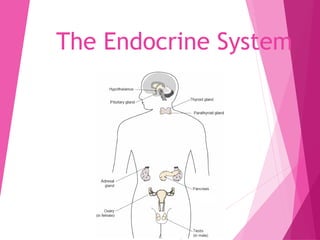
The Endocrine System
In this lesson:
 You will learn about the endocrine system and
how it works
 You will have a chance to make your own model
of the endocrine system
How the system communicates
 The organs of the endocrine system communicate with
each other and the rest of the body using hormones.
 Hormones are made and stored in their originating
organ. The place they are sent is called the target.
 Targets can be anything from all the bones in the body
to another endocrine organ.
 When the hormones reach their target, they trigger
events in that location.
Hypothalamus and Pituitary
Hypothalamus
Located in the brain, the
hypothalamus releases hormones
which stimulate or suppress the
production of other hormones
throughout the body.
Pituitary
The pituitary is a small body
that hangs in the central area
of the brain. It produces
hormones which help control
the body’s water and
electrolyte levels, help with
childbirth, trigger the
production of sex hormones,
and promote body growth.
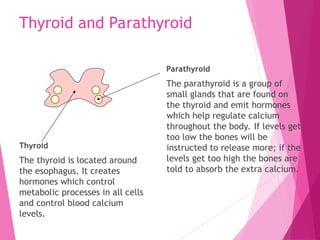
Thyroid and Parathyroid
Thyroid
The thyroid is located around
the esophagus. It creates
hormones which control
metabolic processes in all cells
and control blood calcium
levels.
Parathyroid
The parathyroid is a group of
small glands that are found on
the thyroid and emit hormones
which help regulate calcium
throughout the body. If levels get
too low the bones will be
instructed to release more; if the
levels get too high the bones are
told to absorb the extra calcium.
Adrenal Gland
The adrenal gland is really two
glands, which are situated on top
of either kidney. The adrenal gland
makes hormones which regulate
the body’s water and electrolyte
levels as well as hormones which
control the metabolism of proteins,
lipids, and carbohydrates. The most
noticeable thing it does is protect
the body from…
Kidneys
Pancreas
The pancreas is located between
the two kidneys. Produces
hormones which adjust
carbohydrate metabolism. When
blood sugar levels rise (after you
eat) insulin lowers the levels;
when blood sugar levels are low
(if you haven’t eaten all day)
glucagons raises the blood levels.
Ovaries and Testes
Ovaries
Ovaries are found in the
abdomen of women. They
produce hormones which assist
with the development of the
female reproductive organs and
prepare the uterus for
pregnancy.
Testes
Testes are found in the scrotum
of males. They generate
hormones which facilitate the
development of male
reproductive organs and produce
sperm.
Let’s Build A Model
 By building a model of the endocrine system, you can
show how the hormones travel through the body and
different areas are affected.
Supplies
 One piece of butcher paper, longer than you are tall
 Markers, pencils, or pens
 Play-Doh or modeling clay
 String
Procedure
 Working in partners, have one student lie down on the
butcher paper. Outline their body with markers, pens or
crayons.
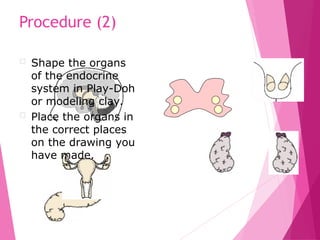
Procedure (2)
 Shape the organs
of the endocrine
system in Play-Doh
or modeling clay.
 Place the organs in
the correct places
on the drawing you
have made.
Procedure (3)
 Use pieces of string to draw paths showing
where the hormones travel from their
originating organ to their target. Draw target
areas on the drawing if it will help show where
the hormones are acting.
Procedure (4)
 Select an organ of the endocrine system
to present to the class. Each group should
explain one organ’s function.
 Write a short description of the organ’s
location and function.
 Show the rest of the class your model of
the endocrine system and discuss your
chosen organ.

Endocrine-System-PPT Endocrine-System-PP

  • 1.
  • 2.
    In this lesson: You will learn about the endocrine system and how it works  You will have a chance to make your own model of the endocrine system
  • 3.
    How the systemcommunicates  The organs of the endocrine system communicate with each other and the rest of the body using hormones.  Hormones are made and stored in their originating organ. The place they are sent is called the target.  Targets can be anything from all the bones in the body to another endocrine organ.  When the hormones reach their target, they trigger events in that location.
  • 4.
    Hypothalamus and Pituitary Hypothalamus Locatedin the brain, the hypothalamus releases hormones which stimulate or suppress the production of other hormones throughout the body. Pituitary The pituitary is a small body that hangs in the central area of the brain. It produces hormones which help control the body’s water and electrolyte levels, help with childbirth, trigger the production of sex hormones, and promote body growth.
  • 5.
    Thyroid and Parathyroid Thyroid Thethyroid is located around the esophagus. It creates hormones which control metabolic processes in all cells and control blood calcium levels. Parathyroid The parathyroid is a group of small glands that are found on the thyroid and emit hormones which help regulate calcium throughout the body. If levels get too low the bones will be instructed to release more; if the levels get too high the bones are told to absorb the extra calcium.
  • 6.
    Adrenal Gland The adrenalgland is really two glands, which are situated on top of either kidney. The adrenal gland makes hormones which regulate the body’s water and electrolyte levels as well as hormones which control the metabolism of proteins, lipids, and carbohydrates. The most noticeable thing it does is protect the body from… Kidneys
  • 7.
    Pancreas The pancreas islocated between the two kidneys. Produces hormones which adjust carbohydrate metabolism. When blood sugar levels rise (after you eat) insulin lowers the levels; when blood sugar levels are low (if you haven’t eaten all day) glucagons raises the blood levels.
  • 8.
    Ovaries and Testes Ovaries Ovariesare found in the abdomen of women. They produce hormones which assist with the development of the female reproductive organs and prepare the uterus for pregnancy. Testes Testes are found in the scrotum of males. They generate hormones which facilitate the development of male reproductive organs and produce sperm.
  • 9.
    Let’s Build AModel  By building a model of the endocrine system, you can show how the hormones travel through the body and different areas are affected.
  • 10.
    Supplies  One pieceof butcher paper, longer than you are tall  Markers, pencils, or pens  Play-Doh or modeling clay  String
  • 11.
    Procedure  Working inpartners, have one student lie down on the butcher paper. Outline their body with markers, pens or crayons.
  • 12.
    Procedure (2)  Shapethe organs of the endocrine system in Play-Doh or modeling clay.  Place the organs in the correct places on the drawing you have made.
  • 13.
    Procedure (3)  Usepieces of string to draw paths showing where the hormones travel from their originating organ to their target. Draw target areas on the drawing if it will help show where the hormones are acting.
  • 14.
    Procedure (4)  Selectan organ of the endocrine system to present to the class. Each group should explain one organ’s function.  Write a short description of the organ’s location and function.  Show the rest of the class your model of the endocrine system and discuss your chosen organ.

Editor's Notes

  • #1 Some web sites that are useful are: http://arbl.cvmbs.colostate.edu/hbooks/pathphys/endocrine/basics/overview.html http://www.cancer.gov/cancertopics/wyntk/thyroid/allpages/print#daefe0a2-b802-4e77-ad08-0aee5c92731b http://www.niaaa.nih.gov/publications/arh22-3/153.pdf http://yucky.kids.discovery.com/body/ http://www.quia.com/jg/16077.html Science TEKS 7.2 (D) Communicate valid conclusions 7.3 (A) Analyze, review, and critique explanations 7.3 (B) Draw inferences based on data related to promotional material 7.9 (A) Identify the systems and functions of the human organism 7.9 (B) Describe how organisms maintain stable internal conditions
  • #8 Can Be Considered Sex Education!