End Behaviour of Functions An introduction to limits
What do we mean by  “end behaviour”? Generally speaking, we are talking about the y-values as x takes on very large positive or negative values A convenient way to write this is with “limit notation” “ the limit as x gets close to infinity” or lim x ->  ∞
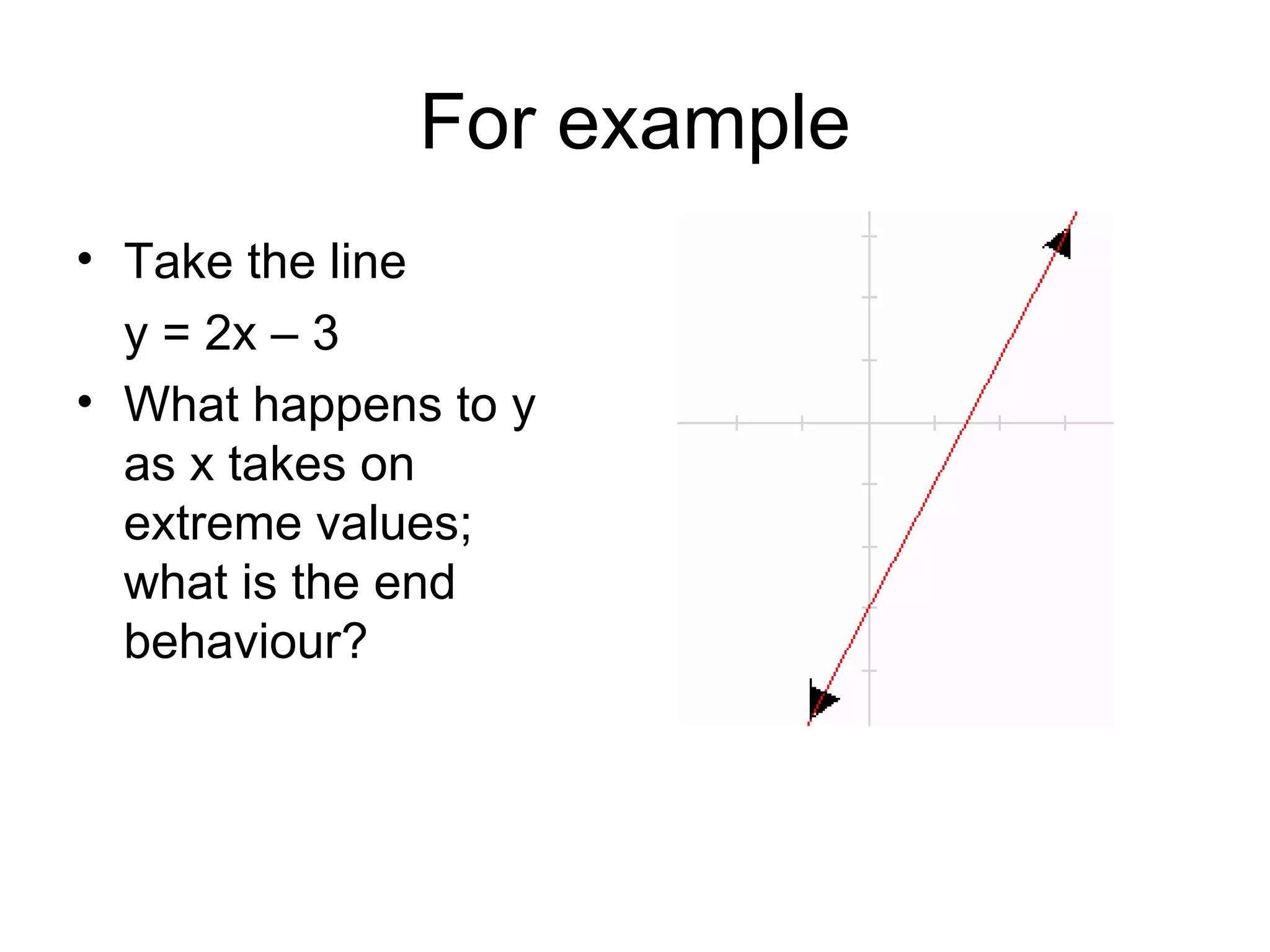
For example Take the line  y = 2x – 3 What happens to y as x takes on extreme values; what is the end behaviour?
lim x ->  ∞ =  lim x -> - ∞ =  What about other functions we have reviewed so far?  What can we say about their end behaviour?  What are the limits as  x ->  ∞  and as  x -> - ∞ ?
Origin moved from (0,0) to (4,-3)  y =  lim x-> ∞ = lim x-> -∞ =
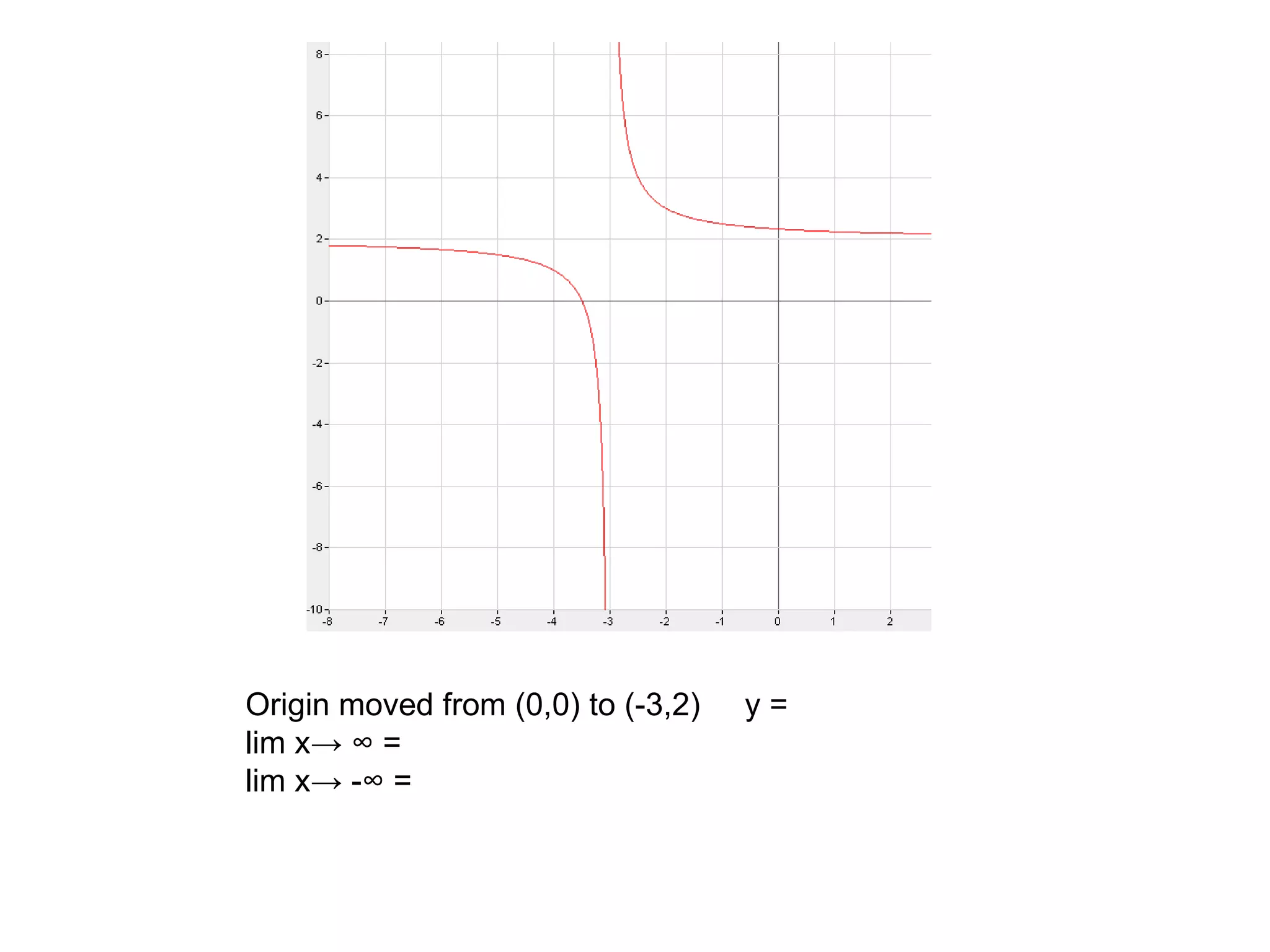
Origin moved from (0,0) to (-3,2)  y =  lim x-> ∞ = lim x-> -∞ =
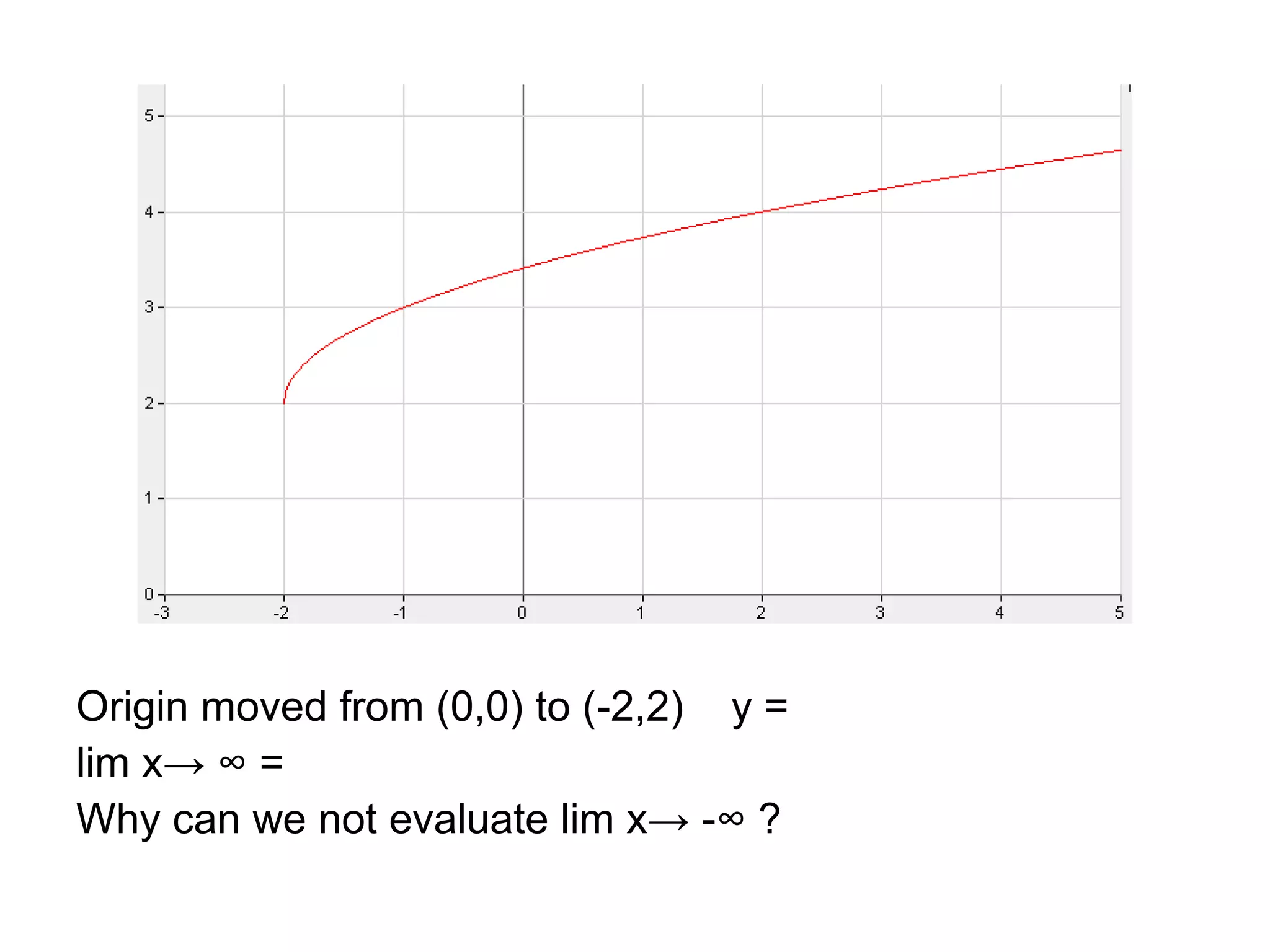
Origin moved from (0,0) to (-2,2)  y =  lim x-> ∞ = Why can we not evaluate lim x-> -∞ ?
This is a transformation of y = 2 x  , 3 units left and 2 units down Y =  lim x-> ∞ = lim x-> -∞ =

End Behaviour Of Functions

  • 1.
    End Behaviour ofFunctions An introduction to limits
  • 2.
    What do wemean by “end behaviour”? Generally speaking, we are talking about the y-values as x takes on very large positive or negative values A convenient way to write this is with “limit notation” “ the limit as x gets close to infinity” or lim x -> ∞
  • 3.
    For example Takethe line y = 2x – 3 What happens to y as x takes on extreme values; what is the end behaviour?
  • 4.
    lim x -> ∞ = lim x -> - ∞ = What about other functions we have reviewed so far? What can we say about their end behaviour? What are the limits as x -> ∞ and as x -> - ∞ ?
  • 5.
    Origin moved from(0,0) to (4,-3) y = lim x-> ∞ = lim x-> -∞ =
  • 6.
    Origin moved from(0,0) to (-3,2) y = lim x-> ∞ = lim x-> -∞ =
  • 7.
    Origin moved from(0,0) to (-2,2) y = lim x-> ∞ = Why can we not evaluate lim x-> -∞ ?
  • 8.
    This is atransformation of y = 2 x , 3 units left and 2 units down Y = lim x-> ∞ = lim x-> -∞ =