1
Lesson plan.
School: Zimisele Secondary School
Subject: Economic Management Science (EMS).
Phase: Senior Phase
Grade: 10
Duration: Second period ( 09:00 to 10:00 )
Date: 08 May 2018
Main Topic (CAPS Document): Entrepreneurship
Sub Topic (CAPS Document): Sectors of the economy
Six Questions:
2
Who? :
This lesson will be presented and co-taught by two Economic management science teachers namely Ms. Lakaje and Ms.
Tolo. The two educators graduated from the University of Johannesburg two years ago and have all been teaching at Zimisele
Secondary for a year.
The learner:
The class consists of 45, grade 10 learners with the majority being girls (26) and boys (19), this is a Unisexual school. There
is one leaner who uses a wheel chair hence the lesson needs to be held in a classroom in the first floor, there are also 3
learners who are visually impaired and one learner who uses a hearing aid, these learner are required to sit in the front of the
classroom and provision has to be made for them, if by any chance they are not able to keep up there will be extra help
available to them. The learners in this community come from middle class families. Most of the learners in this classroom are
well off and do not really lack anything and majority of the learner’s parents are employed. However there is one learner who
has lost both parents and is currently living with extended family. There is one known learner with ADHD (Attention-
deficit/hyperactivity disorder) and we have made provision for him as well by seating him closer to the door but not in a
manner that will seem as if he is excluded from the classroom. We are also trying to ensure that or lesson has as many
opportunities to accommodate and keep this learners focused. Most of the learners in the school are English speaker
although it may not be their native language, the school is situated in the East of Johannesburg in a residential area, as the
medium of exchange is English in the school as well thus there is no actual cause or need for code-switching however if there
is a learners who is in need of assistance in this but we recognised other religions as well. Alike we acknowledge and strive to
develop and respect each and every culture that is within our school and embrace it. Does not provide a problem in
administering a lesson. Majority of our learner are Christians regard to can be provided. The classroom is a mixture of races
3
with majority being black students.
Where? :.
The lesson will take place at Zimisele Secondary school, the school is situated in a build- up area. It is a middle class area
where there is a limited number of available employment opportunity although the socio-economic status is good due to nit
being more of a residential area. The lesson will be conducted in room 105 on the first floor so that it is accessible to every
learner. Room 105 is a fully furnished classroom complete with 45 desks and chairs (rechecked prior to the lesson), a white
board and markers. The school in its self is equip with library with 10 available computers for use by leaners to aid them in
school activities. Classrooms are well equipped although they do not have the latest technology The school however does
have a 5 projectors if necessary.
When? :
During the second period on a Tuesday at 09:40- 10:25 on the 20 February 2018 (45 minutes). The lesson will be conducted
in room 105 on the first floor so that it is accessible to every learner. Room 105 is a fully furnished classroom complete with
45 desks and chairs.
4
What? :.
Entrepreneurship
The sectors of economy:
Meaning of sector :
A sector is an area of the economy in which the business share same or related products.
Three economic sectors:
➢ Primary sector: it a sector that includes all economic activities that deals with the extraction of raw material from the
natural resources. For example mining, agriculture, farming, fishing and forestry.
➢ Secondary sector: the economic industries that deal with the processing of raw material into product. For it includes big
factories and most of its activities depend on the machinery.
➢ Tertiary sector: deals with provision of intangible service to the end customer. For it includes transport, tourism,
information technology, banks and insurance.
Knowledge
❖ The learners will acquire knowledge on what are economic sectors and be able to define the term.
❖ They will know the three economic sectors and what each sector does.
❖ They will know the relationship between the three economic sectors.
Skills:
❖ The learners will learn listening skills as they are suppose to listen while I'm explaining. They will also learn critical
5
thinking skill as I will be asking questions that will require them to think critically.
Values:
❖ It instil respect in learners and ensure collaborative working amongst learners in the classroom.
❖ It transform learners to become the agent of transformation.
What for?:
Specific
aims
d critically showing responsibility towards the environment and the health of others
After the lesson learners should be able to:
• equipping learners, irrespective of their socio-economic background, race, gender, physical ability or intellectual ability, with
the knowledge, skills and values necessary for self-fulfilment, and meaningful participation in society as citizens of a free
country
• providing access to higher education
• facilitating the transition of learners from education institutions to the workplace
6
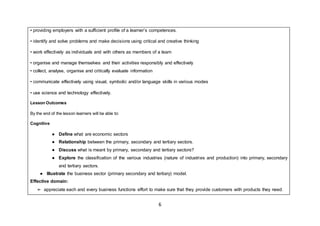
• providing employers with a sufficient profile of a learner’s competences.
• identify and solve problems and make decisions using critical and creative thinking
• work effectively as individuals and with others as members of a team
• organise and manage themselves and their activities responsibly and effectively
• collect, analyse, organise and critically evaluate information
• communicate effectively using visual, symbolic and/or language skills in various modes
• use science and technology effectively.
Lesson Outcomes
By the end of the lesson learners will be able to:
Cognitive
● Define what are economic sectors
● Relationship between the primary, secondary and tertiary sectors.
● Discuss what is meant by primary, secondary and tertiary sectors?
● Explore the classification of the various industries (nature of industries and production) into primary, secondary
and tertiary sectors.
● Illustrate the business sector (primary secondary and tertiary) model.
Effective domain:
➢ appreciate each and every business functions effort to make sure that they provide customers with products they need.
7
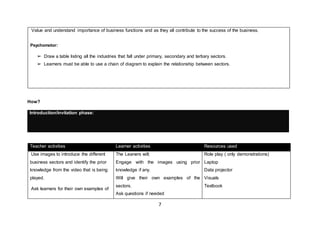
Value and understand importance of business functions and as they all contribute to the success of the business.
Psychomotor:
➢ Draw a table listing all the industries that fall under primary, secondary and tertiary sectors.
➢ Learners must be able to use a chain of diagram to explain the relationship between sectors.
How?
Introduction/invitation phase:
Teacher activities Learner activities Resources used
Use images to introduce the different
business sectors and identify the prior
knowledge from the video that is being
played.
Ask learners for their own examples of
The Leaners will;
Engage with the images using prior
knowledge if any.
Will give their own examples of the
sectors.
Ask questions if needed
Role play ( only demonstrations)
Laptop
Data projector
Visuals
Textbook
8
business sectors three business sectors
(primary secondary and tertiary
Teacher activities Learner activities Resources used
The teacher will;
Name the difference between the
primary, secondary and tertiary sectors.
Explore the classification of the various
industries (nature of industries and
production) into primary, secondary and
tertiary sectors using a discussion.
Distinguish between formal and informal
sectors.
The learner will;
Learner about the difference between the
primary, secondary and tertiary sectors.
Engage with the classification of the
various industries (nature of industries
and production) into primary, secondary
and tertiary sectors through discussion.
Discuss between formal and informal
sectors and public and private sectors.
Slides
Laptop
Newspaper article
Data projector
Teacher activities Learner activities Resources used
The teacher will give out the printed
papers of the three sectors and ask
learners to play a game of matching the
Learners will play the game given by the
teacher according to the rules mentioned
by the teacher.
Slides
Textbook
Visuals
9
sectors in groups the fasted group to be
in the correct in matching the factors will
win but there will be limited time given
Homework:
The teacher will handout the class activity which consist of 3 multiple choice question and will written in class.
Expanded opportunities , learners with barriers to learning as well as assessments:
Make instructions simple by explaining and giving instructions in simple English to address the language barrier. Colored chalks will be used
so that learners see clearly and the font will be enlarged.
10
Assessment methods:
Assessment tools/ forms – attach if used..
T
e
a
c
h
e
r
-
r
e
f
l
e
11
c
t
i
o
n
:
W
h
a
t
w
e
n
t
w
e
l
l
W
h
a
t
d
i
12
d
n
’
t
g
o
w
e
l
l
H
o
w
t
o
i
m
p
r
o
v
e
13
ATTACH ALL AIDSUSED ANDADDITIONALRESOURCES

Ems lesson plan tuesday

  • 1.
    1 Lesson plan. School: ZimiseleSecondary School Subject: Economic Management Science (EMS). Phase: Senior Phase Grade: 10 Duration: Second period ( 09:00 to 10:00 ) Date: 08 May 2018 Main Topic (CAPS Document): Entrepreneurship Sub Topic (CAPS Document): Sectors of the economy Six Questions:
  • 2.
    2 Who? : This lessonwill be presented and co-taught by two Economic management science teachers namely Ms. Lakaje and Ms. Tolo. The two educators graduated from the University of Johannesburg two years ago and have all been teaching at Zimisele Secondary for a year. The learner: The class consists of 45, grade 10 learners with the majority being girls (26) and boys (19), this is a Unisexual school. There is one leaner who uses a wheel chair hence the lesson needs to be held in a classroom in the first floor, there are also 3 learners who are visually impaired and one learner who uses a hearing aid, these learner are required to sit in the front of the classroom and provision has to be made for them, if by any chance they are not able to keep up there will be extra help available to them. The learners in this community come from middle class families. Most of the learners in this classroom are well off and do not really lack anything and majority of the learner’s parents are employed. However there is one learner who has lost both parents and is currently living with extended family. There is one known learner with ADHD (Attention- deficit/hyperactivity disorder) and we have made provision for him as well by seating him closer to the door but not in a manner that will seem as if he is excluded from the classroom. We are also trying to ensure that or lesson has as many opportunities to accommodate and keep this learners focused. Most of the learners in the school are English speaker although it may not be their native language, the school is situated in the East of Johannesburg in a residential area, as the medium of exchange is English in the school as well thus there is no actual cause or need for code-switching however if there is a learners who is in need of assistance in this but we recognised other religions as well. Alike we acknowledge and strive to develop and respect each and every culture that is within our school and embrace it. Does not provide a problem in administering a lesson. Majority of our learner are Christians regard to can be provided. The classroom is a mixture of races
  • 3.
    3 with majority beingblack students. Where? :. The lesson will take place at Zimisele Secondary school, the school is situated in a build- up area. It is a middle class area where there is a limited number of available employment opportunity although the socio-economic status is good due to nit being more of a residential area. The lesson will be conducted in room 105 on the first floor so that it is accessible to every learner. Room 105 is a fully furnished classroom complete with 45 desks and chairs (rechecked prior to the lesson), a white board and markers. The school in its self is equip with library with 10 available computers for use by leaners to aid them in school activities. Classrooms are well equipped although they do not have the latest technology The school however does have a 5 projectors if necessary. When? : During the second period on a Tuesday at 09:40- 10:25 on the 20 February 2018 (45 minutes). The lesson will be conducted in room 105 on the first floor so that it is accessible to every learner. Room 105 is a fully furnished classroom complete with 45 desks and chairs.
  • 4.
    4 What? :. Entrepreneurship The sectorsof economy: Meaning of sector : A sector is an area of the economy in which the business share same or related products. Three economic sectors: ➢ Primary sector: it a sector that includes all economic activities that deals with the extraction of raw material from the natural resources. For example mining, agriculture, farming, fishing and forestry. ➢ Secondary sector: the economic industries that deal with the processing of raw material into product. For it includes big factories and most of its activities depend on the machinery. ➢ Tertiary sector: deals with provision of intangible service to the end customer. For it includes transport, tourism, information technology, banks and insurance. Knowledge ❖ The learners will acquire knowledge on what are economic sectors and be able to define the term. ❖ They will know the three economic sectors and what each sector does. ❖ They will know the relationship between the three economic sectors. Skills: ❖ The learners will learn listening skills as they are suppose to listen while I'm explaining. They will also learn critical
  • 5.
    5 thinking skill asI will be asking questions that will require them to think critically. Values: ❖ It instil respect in learners and ensure collaborative working amongst learners in the classroom. ❖ It transform learners to become the agent of transformation. What for?: Specific aims d critically showing responsibility towards the environment and the health of others After the lesson learners should be able to: • equipping learners, irrespective of their socio-economic background, race, gender, physical ability or intellectual ability, with the knowledge, skills and values necessary for self-fulfilment, and meaningful participation in society as citizens of a free country • providing access to higher education • facilitating the transition of learners from education institutions to the workplace
  • 6.
    6 • providing employerswith a sufficient profile of a learner’s competences. • identify and solve problems and make decisions using critical and creative thinking • work effectively as individuals and with others as members of a team • organise and manage themselves and their activities responsibly and effectively • collect, analyse, organise and critically evaluate information • communicate effectively using visual, symbolic and/or language skills in various modes • use science and technology effectively. Lesson Outcomes By the end of the lesson learners will be able to: Cognitive ● Define what are economic sectors ● Relationship between the primary, secondary and tertiary sectors. ● Discuss what is meant by primary, secondary and tertiary sectors? ● Explore the classification of the various industries (nature of industries and production) into primary, secondary and tertiary sectors. ● Illustrate the business sector (primary secondary and tertiary) model. Effective domain: ➢ appreciate each and every business functions effort to make sure that they provide customers with products they need.
  • 7.
    7 Value and understandimportance of business functions and as they all contribute to the success of the business. Psychomotor: ➢ Draw a table listing all the industries that fall under primary, secondary and tertiary sectors. ➢ Learners must be able to use a chain of diagram to explain the relationship between sectors. How? Introduction/invitation phase: Teacher activities Learner activities Resources used Use images to introduce the different business sectors and identify the prior knowledge from the video that is being played. Ask learners for their own examples of The Leaners will; Engage with the images using prior knowledge if any. Will give their own examples of the sectors. Ask questions if needed Role play ( only demonstrations) Laptop Data projector Visuals Textbook
  • 8.
    8 business sectors threebusiness sectors (primary secondary and tertiary Teacher activities Learner activities Resources used The teacher will; Name the difference between the primary, secondary and tertiary sectors. Explore the classification of the various industries (nature of industries and production) into primary, secondary and tertiary sectors using a discussion. Distinguish between formal and informal sectors. The learner will; Learner about the difference between the primary, secondary and tertiary sectors. Engage with the classification of the various industries (nature of industries and production) into primary, secondary and tertiary sectors through discussion. Discuss between formal and informal sectors and public and private sectors. Slides Laptop Newspaper article Data projector Teacher activities Learner activities Resources used The teacher will give out the printed papers of the three sectors and ask learners to play a game of matching the Learners will play the game given by the teacher according to the rules mentioned by the teacher. Slides Textbook Visuals
  • 9.
    9 sectors in groupsthe fasted group to be in the correct in matching the factors will win but there will be limited time given Homework: The teacher will handout the class activity which consist of 3 multiple choice question and will written in class. Expanded opportunities , learners with barriers to learning as well as assessments: Make instructions simple by explaining and giving instructions in simple English to address the language barrier. Colored chalks will be used so that learners see clearly and the font will be enlarged.
  • 10.
    10 Assessment methods: Assessment tools/forms – attach if used.. T e a c h e r - r e f l e
  • 11.
  • 12.
  • 13.
    13 ATTACH ALL AIDSUSEDANDADDITIONALRESOURCES