Tim Foster
with Ruth Gairns, Stuart Redman, Wayne Rimmer
A2
ELEMENTARY
TEACHER’S BOOK
ELEMENTARY
TEACHER’S BOOK
Tim Foster
with Ruth Gairns, Stuart Redman, Wayne Rimmer,
Lynda Edwards and Julian Oakley
A2
Class Audio
CDs
Class DVD Presentation
Plus
Welcome to Cambridge English Empower
Teacher’s Book contents
Introduction
Teaching notes
Photocopiable activities
Page 2
Page 4
Page 7
Page 9
Page 16
Page 20
Page 24
Page 36
Page 49
Page 61
Page 74
Page 85
Page 98
Page 111
Page 123
Page 136
Page 148
Page 160
Page 172
Page 174
Page 178
Page 204
Page 228
Page 252
Page 264
Welcome
Course methodology
Learning Oriented Assessment
Unit overview
Syllabus
Welcome unit
Unit 1
Unit 2
Unit 3
Unit 4
Unit 5
Unit 6
Unit 7
Unit 8
Unit 9
Unit 10
Unit 11
Unit 12
Teaching plus
Overview
Teacher’s notes
Grammar
Vocabulary
Wordpower
Pronunciation
A unique mix of learning and assessment
Cambridge English Empower is a new general
English adult course that combines course content
from Cambridge University Press with validated
assessment from Cambridge English Language
Assessment.
This unique mix of engaging classroom material
and reliable assessment, with personalised online
practice, enables learners to make consistent and
measurable progress.
What could your students achieve with
Cambridge English Empower?
For Students
Online Assessment
Online Practice
Online Workbook
Teacher’s Book
with photocopiable
activities and
online access
Student’s Book
with online access
Also available
• Student’s Book (or eBook)
without online access
• Print Workbook (with
and without answers), with
downloadable audio and video
Student’s Book also available as
Interactive eBook
For Students
For Teachers
2
Introduction
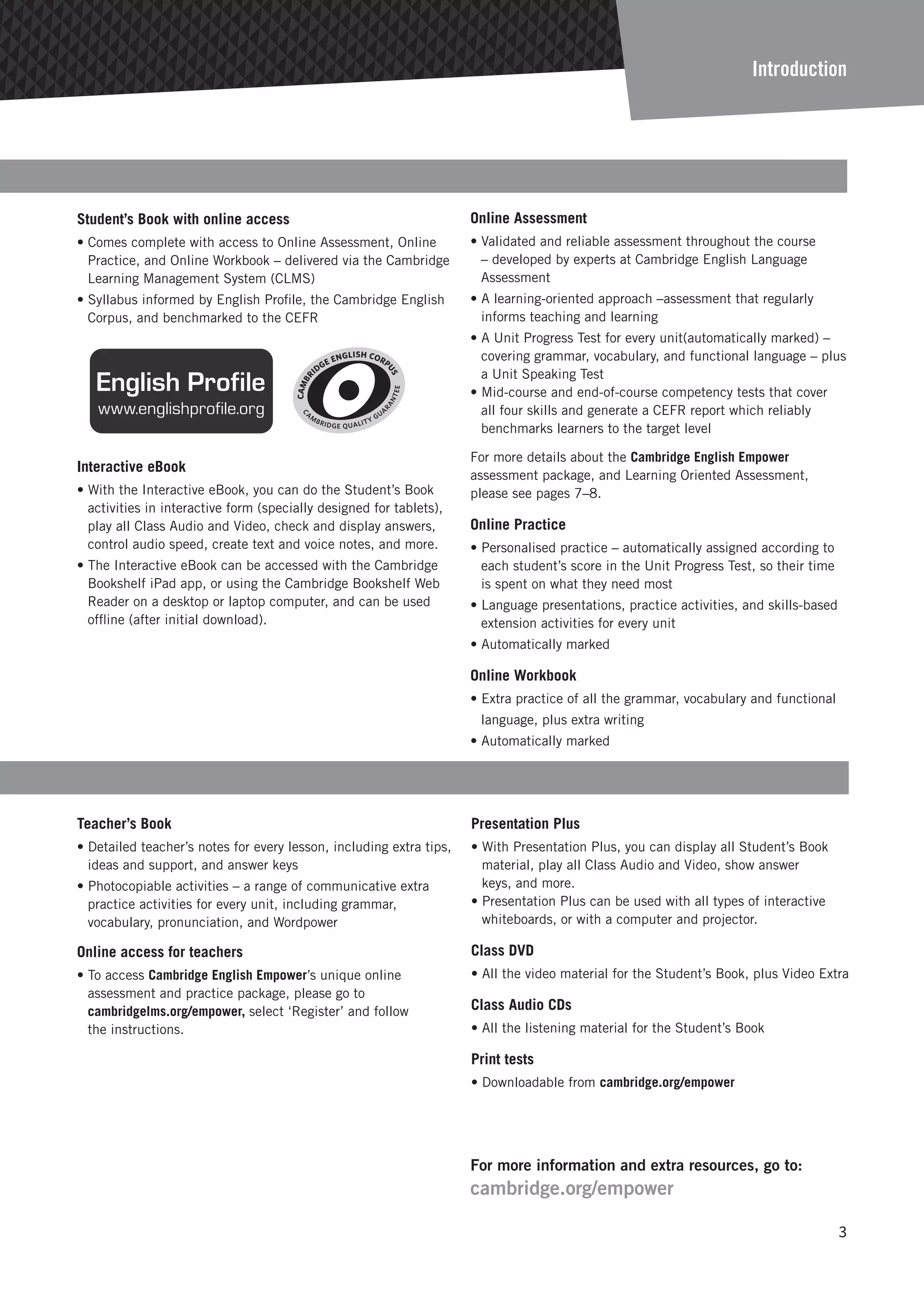
Student’s Book with online access
• Comes complete with access to Online Assessment, Online
Practice, and Online Workbook – delivered via the Cambridge
Learning Management System (CLMS)
• Syllabus informed by English Profile, the Cambridge English
Corpus, and benchmarked to the CEFR
Interactive eBook
• With the Interactive eBook, you can do the Student’s Book
activities in interactive form (specially designed for tablets),
play all Class Audio and Video, check and display answers,
control audio speed, create text and voice notes, and more.
• The Interactive eBook can be accessed with the Cambridge
Bookshelf iPad app, or using the Cambridge Bookshelf Web
Reader on a desktop or laptop computer, and can be used
offline (after initial download).
Online Assessment
• Validated and reliable assessment throughout the course
– developed by experts at Cambridge English Language
Assessment
• A learning-oriented approach –assessment that regularly
informs teaching and learning
• A Unit Progress Test for every unit(automatically marked) –
covering grammar, vocabulary, and functional language – plus
a Unit Speaking Test
• Mid-course and end-of-course competency tests that cover
all four skills and generate a CEFR report which reliably
benchmarks learners to the target level
For more details about the Cambridge English Empower
assessment package, and Learning Oriented Assessment,
please see pages 7–8.
Online Practice
• Personalised practice – automatically assigned according to
each student’s score in the Unit Progress Test, so their time
is spent on what they need most
• Language presentations, practice activities, and skills-based
extension activities for every unit
• Automatically marked
Online Workbook
• Extra practice of all the grammar, vocabulary and functional
language, plus extra writing
• Automatically marked
For more information and extra resources, go to:
cambridge.org/empower
Teacher’s Book
• Detailed teacher’s notes for every lesson, including extra tips,
ideas and support, and answer keys
• Photocopiable activities – a range of communicative extra
practice activities for every unit, including grammar,
vocabulary, pronunciation, and Wordpower
Online access for teachers
• To access Cambridge English Empower’s unique online
assessment and practice package, please go to
cambridgelms.org/empower, select ‘Register’ and follow
the instructions.
Presentation Plus
• With Presentation Plus, you can display all Student’s Book
material, play all Class Audio and Video, show answer
keys, and more.
• Presentation Plus can be used with all types of interactive
whiteboards, or with a computer and projector.
Class DVD
• All the video material for the Student’s Book, plus Video Extra
Class Audio CDs
• All the listening material for the Student’s Book
Print tests
• Downloadable from cambridge.org/empower
3
Course methodology
A learner-centred approach
Cambridge English Empower, with its unique
mix of learning and assessment, places the
learner at the centre of the learning process.
This learner-centred approach also applies to the
course methodology – the Student’s Book and
additional resources provide a range of classroom
materials that motivate learners, address their
language needs, and facilitate the development
of their skills.
Supporting the teacher
Cambridge English Empower also supports the
teacher through classroom methodology that
is familiar and easy to use, and at the same
time is flexible and creative. A number of key
methodological principles underpin the course,
enhancing the interface between learners
and their learning, and between learners and
teachers. Cambridge English Empower:
1 encourages learner engagement
2 delivers manageable learning
3 is rich in practice
4 provides a comprehensive approach to
productive skills
Measurable progress
This leads to motivated learners, successful
lessons, and measurable progress. This progress
is then measured by a uniquely reliable
assessment package, developed by test experts
at Cambridge English Language Assessment.
Key methodological principles
1 Learner engagement
Getting Started
Each unit begins with a ‘Getting Started’ page, designed to
engage learners from the very start of the unit – leading to
greater motivation and more successful learning. It does this in
three ways:
• Clear learning goals – ‘can do’ statements immediately focus
learners on their objectives.
• Striking images that take an unusual perspective on the unit
theme – this raises curiosity, prompts ideas and questions
in the mind of the learner, and stimulates them to want to
communicate.
• Short speaking activities that prompt a personal response
– leading to longer-lasting learning and a sense of ownership
from the start. These activities also offer a diagnostic
opportunity to the teacher.
Remarkable texts and images
Throughout the course, learners encounter texts and images
that inform, amuse, surprise, entertain, raise questions,
arouse curiosity and empathy, provoke an emotional response,
and prompt new insights and perspectives – this means that
learners are consistently motivated to engage, read, listen, and
communicate.
The texts have been carefully selected to appeal to a wide
range of learners from a variety of cultural backgrounds. They
have an international focus and flavour, and each text has a
story to tell or a point of view to offer that will be of interest
to learners. All texts are accompanied by receptive tasks that
support the development of reading and listening skills.
Frequent opportunities for personal response
There are frequent opportunities to practise speaking
throughout every lesson. These include personalisation tasks
which make the target language in every unit meaningful to
the individual learner. But not only that – there are also regular
activities that encourage learners to respond personally to the
content of texts and images. These personal response activities
foster successful learning because they:
• make learning more memorable – so it lasts longer
• are inclusive – there is no ‘correct’ answer, so all learners can
participate successfully
• promote spontaneous spoken interaction – this further
enhances the learner’s sense of freedom and ownership,
enhances motivation, and makes learning more relevant
and enjoyable
4
Introduction
2 Manageable learning
A second core principle that informs Cambridge English
Empower is recognition of the importance of manageable
learning. This offers learners (and their teachers) reassurance
that they will not be overwhelmed at any point in their learning
journey, leading to more successful learning outcomes
and sustained motivation. The Cambridge English Empower
classroom material reflects the concept of manageable learning
in three main ways:
• Syllabus planning and the selection of language
• Lesson flow
• Task design
Syllabus planning and the selection of language
A key element in making learning material manageable
concerns the selection of target language. In Cambridge English
Empower, two powerful Cambridge English resources – the
Cambridge Corpus and English Profile – have been used to
inform the development of the course syllabus and the writing
of the material. These resources provide reliable information
as to which language items learners are likely to be able
to learn successfully at each level of the CEFR (Common
European Framework of Reference). This means learners using
Cambridge English Empower are presented with target language
that they are able to incorporate and use at that point in their
learning journey, and they won’t encounter too much above-
level language in reading and listening texts. It also means
that learners are not overwhelmed with unrealistic amounts
of language because the Cambridge Corpus and English
Profile are also able to give an indication of what constitutes a
manageable quantity of language at each level.
Lesson flow
Learning is also made more manageable through the careful
staging and sequencing of activities. Every lesson starts with a
clear ‘Learn to …’ objective and ends with a substantial output
task. Each lesson is comprised of several manageable sections,
each with a clear focus on language and/or skills. Each section
builds towards the next, and activities within sections do
likewise. The final activity of each spread involves a productive
learning outcome that brings together the language and the
topic of the lesson, allowing learners to put what they have
learnt into immediate use.
Task and activity design
Tasks and activities have been designed to give learners an
appropriate balance between freedom and support. Grammar
and vocabulary presentations take a straightforward approach
to dealing with the meaning and form of new language, and
practice is carefully staged, with additional support in the
‘Grammar Focus’ and ‘Vocabulary Focus’ sections at the back
of the book. Reading and listening activities allow learners
to process information in texts in a gradual, supportive way.
Speaking and writing activities are made manageable by
means of clear models, appropriate scaffolding, and a focus
on relevant sub-skills associated with a specific spoken or
written outcome.
As an overall principle, the methodology throughout Cambridge
English Empower anticipates and mitigates potential problems
that learners might encounter with language and tasks. While
this clearly supports learners, it also supports teachers because
there are likely to be fewer unexpected challenges during the
course of a lesson – this also means that necessary preparation
time is reduced to a minimum.
3 Rich in practice
It is essential that learners are offered frequent and
manageable opportunities to practise the language they have
been focusing on – they need to activate the language they
have studied in a meaningful way in order to gain confidence
in using it, and of course meaningful practice also makes new
language more memorable.
Cambridge English Empower is rich in practice activities and
provides learners and teachers with a wide variety of tasks that
help learners to become confident users of new language.
Student’s Book
Throughout each Cambridge English Empower Student’s Book,
learners are offered a wide variety of practice activities,
appropriate to the stage of the lesson or unit:
• Ample opportunities are provided for controlled
practice of target language.
• Many of the practice activities provide learners with an
opportunity to personalise language.
• There are frequent opportunities for communicative
spoken practice. Communicative practice activities are
clearly contextualised and carefully staged and scaffolded, in
line with the principle of manageable learning.
• Further spoken practice is provided in the final speaking
activity in each of the A, B, and C lessons, providing the
principal communicative learning outcome in each of these
lessons.
• In the ‘Grammar Focus’ and ‘Vocabulary Focus’ pages at
the back the Student’s Book, there are more opportunities
for practice of grammar and vocabulary, helping to
consolidate learning.
5
• In the ‘Review and Extension’ page at the end of each unit,
there are more opportunities for both written and spoken
practice of target language.
Teacher’s Book
• Many learners find practice activities that involve an element
of fun to be particularly motivating. Many such activities – six
per unit – are provided in the photocopiable activities in
the Teacher’s Book, providing fun, communicative practice of
grammar, vocabulary and pronunciation.
• The main teacher’s notes also provide ideas for extra
activities at various stages of the lesson.
Other components
Through the Cambridge LMS, Cambridge English Empower
provides an extensive range of practice activities that learners
can use to review and consolidate their learning outside the
classroom:
• The Online Practice component offers interactive language
presentations followed by practice and extension activities.
Learners are automatically directed to the appropriate point
in this practice cycle, according to their score in the Unit
Progress Test (at the end of Student’s Book lesson C).
• The Workbook (Online or Print) provides practice of the target
language after each A, B, and C lesson.
4 A comprehensive approach to productive skills
Most learners study English because they want to use the
language in some way. This means that speaking and writing
– the productive skills – are more often than not a priority
for learners. Cambridge English Empower is systematic and
comprehensive in its approach to developing both speaking
and writing skills.
Speaking
The C lesson in each unit – ‘Everyday English’ – takes a
comprehensive approach to speaking skills, and particularly in
helping learners to become effective users of high-frequency
functional/situational language. The target language is clearly
contextualised by means of engaging video (also available
as audio-only via the Class CDs), filmed in the real world in
contexts that will be relevant and familiar to adult learners.
These ‘Everyday English’ lessons focus on three key elements
of spoken language:
• Useful language – focusing on the functional and situational
language that is most relevant to learners’ needs, and
manageable within the target level
• Pronunciation – focusing on intelligibility and covering many
aspects of phonology and the characteristics of natural
speech, from individual sounds to extended utterances
• Conversation skills – speaking strategies and sub-skills,
the ‘polish’ that helps learners to become more effective
communicators
The final speaking task in each ‘Everyday English’ lesson
provides learners with an opportunity to activate all three of
these elements. This comprehensive approach ensures that
speaking skills are actively developed, not just practised.
Writing
Across each level of Cambridge English Empower, learners
receive guidance and practice in writing a wide range of text
types. The D lesson in each unit – ‘Skills for Writing’ – builds
to a learning outcome in which learners produce a written text
that is relevant to their real-life needs, appropriate to the level,
and related to the topic of the unit. However, these are not
‘heads-down’ writing lessons – instead, and in keeping with
the overall course methodology, they are highly communicative
mixed-skills lessons, with a special focus on writing. This
means that writing is fully integrated with listening, reading
and speaking – as it is in real life – and is not practised in
isolation. Each ‘Skills for Writing’ lesson follows a tried and
tested formula:
1 Learners engage with the topic through activities
that focus on speaking and listening skills.
2 They read a text which also provides a model for the
later writing output task.
3 They then do a series of activities which develop
aspects of a specific writing sub-skill that has been
encountered in the model text.
4 They then go on to write their own text, in collaboration
with other learners.
5 Process writing skills are embedded in the
instructions for writing activities and encourage
learners to self-correct and seek peer feedback.
Also, while the A and B lessons provide the main input and
practice of the core language syllabus, they also provide
frequent opportunities for learners to develop their receptive
and productive skills.
In line with other elements of Cambridge English Empower,
the texts used for skills development engage learners and
provide them with opportunities to personalise language.
Likewise, the tasks are designed in such a way as to make the
learning manageable.
The extension activities in the Online Practice component (via
the Cambridge LMS) also offer further practice in reading and
listening skills.
6
Introduction
Learning Oriented Assessment
What is Learning Oriented Assessment (LOA)?
As a teacher, you’ll naturally be interested in your learners’
progress. Every time they step into your classroom, you’ll note
if a learner is struggling with a language concept, is unable to
read at a natural rate, or can understand a new grammar point
but still can’t produce it in a practice activity. This is often an
intuitive and spontaneous process. By the end of a course or a
cycle of learning, you’ll know far more about a learner’s ability
than an end-of-course test alone can show.
An LOA approach to teaching and learning brings together this
ongoing informal evaluation with more formal or structured
assessment such as end-of-unit or end-of-course tests. Ideally
supported by a learner management system (LMS), LOA is an
approach that allows you to pull together all this information
and knowledge in order to understand learners’ achievements
and progress and to identify and address their needs in a
targeted and informed way. A range of insights into learners
and their progress feeds into total assessment of the learner. It
also allows you to use all of this information not just to produce
a report on a learner’s level of competence but also to plan and
inform future learning.
For more information about LOA, go to
cambridgeenglish.org/loa
How does Cambridge English Empower support LOA?
Cambridge English Empower supports LOA both informally and
formally, and both inside and outside the classroom:
1 Assessment that informs teaching and learning
• Reliable tests for both formative and summative
assessment (Unit Progress Tests, Unit Speaking Tests, and
skills-based Competency Tests)
• Targeted extra practice online via the Cambridge Learning
Management System (CLMS) to address areas in which the
tests show that learners need more support
• Opportunities to do the test again and improve performance
• Clear record of learner performance through the CLMS
2 LOA classroom support
• Clear learning objectives – and activities that clearly build
towards those objectives
• Activities that offer opportunities for learner reflection
and peer feedback
• A range of tips for teachers on how to incorporate LOA
techniques, including informal assessment, into your
lessons as part of normal classroom practice
1 Assessment that informs teaching and learning
Cambridge English Empower offers three types of tests written
and developed by teams of Cambridge English exam writers.
All tests in the course have been trialled on thousands of
candidates to ensure that test items are appropriate to the
level.
Cambridge English tests are underpinned by research and
evaluation and by continuous monitoring and statistical
analysis of performance of test questions.
Cambridge English Empower tests are designed around the
following essential principles:
Validity – tests are authentic tests of real-life English and test
the language covered in the coursebook
Reliability – tasks selected are consistent and fair
Impact – tests have a positive effect on teaching and learning
in and outside the classroom
Practicality – tests are user-friendly and practical for teachers
and students
Unit Progress Tests
The course provides an online Unit Progress Test at the end
of every unit, testing the target grammar, vocabulary and
functional language from the unit. The teacher and learner
are provided with a score for each language area that has
been tested, identifying the areas where the learner has either
encountered difficulties and needs more support, or has
mastered well. According to their score in each section of the
test, the learner is directed either to extension activities or
to a sequence of practice activities appropriate to their level,
focusing on the language points where they need most support.
This means that learners can focus their time and effort on
activities that will really benefit them. They then have the
opportunity to retake the Unit Progress Test – questions they
got right first time will still be filled in, meaning that they can
focus on those with which they had difficulty first-time round.
Unit Speaking Tests
Cambridge English Empower provides a comprehensive approach
to speaking skills. For every unit, there is an online Unit
Speaking Test which offers learners the opportunity to test and
practise a range of aspects of pronunciation and fluency. These
tests use innovative voice-recognition software and allow the
learner to listen to model utterances, record themselves, and
re-record if they wish before submitting.
Competency Tests
Cambridge English Empower offers mid-course and end-of-
course Competency Tests. These skills-based tests cover
Reading, Writing, Listening and Speaking, and are calibrated
to the Common European Framework of Reference (CEFR).
They provide teachers and learners with a reliable indication
of level, as well as a record of their progress – a CEFR report is
7
generated for each learner, showing their performance within
the relevant CEFR level (both overall and for each of the skills).
The Cambridge Learning Management System (CLMS) provides
teachers and learners with a clear and comprehensive record
of each learner’s progress during the course, including all test
results and also their scores relating to the online practice
activities that follow the tests – helping teachers and learners
to recognise achievement and identify further learning needs.
Within the CLMS, a number of different web tools, including
message boards, forums and e-portfolios, provide opportunities
for teachers and learners to communicate outside of class,
and for learners to do additional practice. These tools can also
be used by teachers to give more specific feedback based on
the teacher’s informal evaluation during lessons. The CLMS
helps teachers to systematically collect and record evidence
of learning and performance and in doing so demonstrates to
teachers and learners how much progress has been made over
time.
2 LOA classroom support
Clear objectives
An LOA approach encourages learners to reflect and self-
assess. In order to do this, learning objectives must be clear.
In Cambridge English Empower, each unit begins with a clear
set of ‘can do’ objectives so that learners feel an immediate
sense of purpose. Each lesson starts with a clear ‘Learn to …’
goal, and the activities all contribute towards this goal, leading
to a significant practical outcome at the end of the lesson. At
the end of each unit, there is a ‘Review your progress’ feature
that encourages learners to reflect on their success, relative
to the ‘can do’ objectives at the start of the unit. Within the
lessons, there are also opportunities for reflection, collaborative
learning, and peer feedback.
Teaching techniques
monitoring eliciting concept checking drilling providing feedback
Core
aims
• checking learners
are on task
• checking learners’
progress
• making yourself
available to learners
who are having
problems
• checking what
learners know about
a topic in order to
generate interest
• checking that learners
understand the use and
meaning of new language
• providing highly
controlled practice
of new language
• finding out what ideas
learners generated when
working on a task
• praising learners’
performance of a task
• indicating where
improvement can be
made
LOA
aims
• listening to learners’
oral language, and
checking learners’
written language, in
order to:
» diagnose potential
needs
» check if they can
use new language
correctly in context
• finding out if learners
already know a
vocabulary or
grammar item
• adapting the lesson
to take into account
students’ individual
starting points and
interests
• checking what could be a
potential problem with
the use and meaning
of new language for your
learners
• anticipating and preparing
for challenges in
understanding new
language, both for the
whole class and for
individuals
• checking that learners
have consolidated the
form of new language
• checking
intelligible
pronunciation of new
language
• asking learners how well
they feel they performed
a task
• giving feedback to
learners on specific
language strengths and
needs
• fostering ‘learning how to
learn’ skills
LOA classroom tips for teachers
In a typical lesson you’re likely to use some or perhaps all of the
following teaching techniques:
• monitor learners during learner-centred stages of the lesson
• elicit information and language
• concept check new language
• drill new vocabulary or grammar
• provide feedback after learners have worked on a task
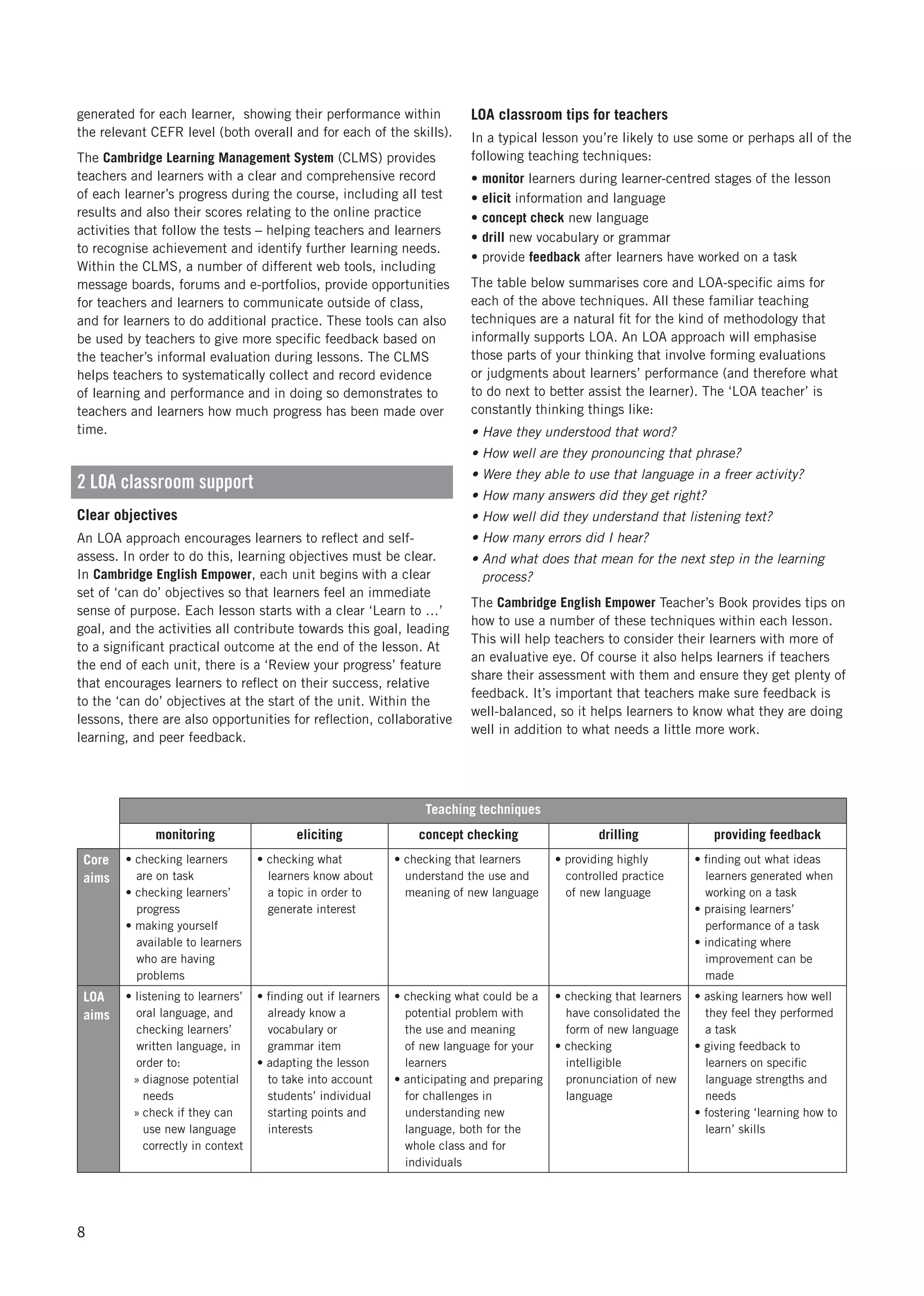
The table below summarises core and LOA-specific aims for
each of the above techniques. All these familiar teaching
techniques are a natural fit for the kind of methodology that
informally supports LOA. An LOA approach will emphasise
those parts of your thinking that involve forming evaluations
or judgments about learners’ performance (and therefore what
to do next to better assist the learner). The ‘LOA teacher’ is
constantly thinking things like:
• Have they understood that word?
• How well are they pronouncing that phrase?
• Were they able to use that language in a freer activity?
• How many answers did they get right?
• How well did they understand that listening text?
• How many errors did I hear?
• And what does that mean for the next step in the learning
process?
The Cambridge English Empower Teacher’s Book provides tips on
how to use a number of these techniques within each lesson.
This will help teachers to consider their learners with more of
an evaluative eye. Of course it also helps learners if teachers
share their assessment with them and ensure they get plenty of
feedback. It’s important that teachers make sure feedback is
well-balanced, so it helps learners to know what they are doing
well in addition to what needs a little more work.
8
Unit overview
Journeys
UNIT 7
GETTING STARTED
a Look at the picture and answer the questions.
1 This man is on a journey. What country do you think he’s in? Why?
2 What do you think the man and women talk about?
• directions • the weather • personal information
• shopping • their families • something else
3 Think of their questions and answers.
b In pairs, ask and answer the questions.
1 Where would you like to travel to?
2 Would you like to travel by …?
• car • boat • plane • something else
3 What would you like to see and do there?
■ Talk about past journeys
■ Talk about what you like and dislike
about transport
■ Say excuse me and sorry
■ Write an email about yourself
69
CAN DO OBJECTIVES
Next morning, Richard
a
got another email from the
woman called Blanca. It said, b
Get $3,000 from your
bank, put it in a black bag, and then c
get the bus to
Morton Street. When you d
get there walk towards
the church and leave the bag on the steps. Do as I
say or things could e
get very bad for you.’ Richard
knew this wasn’t a joke – in fact, it was very serious.
1 GRAMMAR
a Complete the text with the past simple positive or
negative form of the verbs in brackets.
Paul 1
(call) a taxi, but it 2
(come) so he
3
(take) a bus to the airport. The plane 4
(be)
late, so he 5
(wait) for three hours at the airport. The
weather 6
(be) bad so the plane 7
(land) in a
different city. He 8
(arrive) at his hotel at 10 pm. The
receptionist 9
(ask) him, ‘Good journey?’ ‘No, I
10
(have) a good journey. It was terrible.’
b Write questions about a trip to Mumbai to match the
answers.
1 When? I went there last November.
When did you go there?
2 How? I travelled by Air India from London.
3 a good time? Yes, I had a very nice time.
4 Where? I stayed in a hotel by the sea.
5 How long? I only stayed a week. Then I went to Delhi.
6 hot? Yes, it was about 35°.
c Work in pairs. Choose a place you’ve visited
and ask and answer the questions in 1b. Ask more
questions.
d Write sentences about what Clare likes doing. Use the
words in the box and a verb + -ing.
loves likes doesn’t mind doesn’t like hates
1 ‘Chinese food is fantastic!’
Clare loves eating Chinese food.
2 ‘I never listen to Mozart.’
3 ‘I sometimes take the metro. It’s OK but it’s not great.’
4 ‘I don’t want to watch the football – it’s boring.’
5 ‘I speak good French – it’s a nice language.’
2 VOCABULARY
a Complete the transport words.
1 t r a m
2 tr i
3 sh
4 h i ter
5 c ch
6 sc ter
b Change the adjectives into their opposites so that the
sentences are correct.
1 The tram was almost full. There were only three people
on it. empty
2 I don’t like the metro because the stations are so clean.
3 I couldn’t sleep on the train. It was so comfortable.
4 The new train to the airport is very slow – only 15 minutes.
5 He’s a very safe driver. He never looks in the mirror.
6 $100 for a ten-minute journey! That’s very cheap!
1 What do you think happened next?
2 Match the word get in the story (a–e) to meanings 1–5 in 3b.
d Match the phrases in the box with a similar phrase in
1–5 below.
get a phone call get a taxi get an email
get old get better get to the airport
get a glass of water get the train get to school
1 get angry
2 get a letter
3 get the bus
4 get to work
5 get your coat
e Write four sentences about your life. Use phrases
from 3d.
I never get a taxi to the airport.
f Tell a partner your sentences in 3e. How similar
are you?
Review and extension a Match questions 1–5 with answers a–e.
1 Is Bella still single?
2 What’s the best way to go
to the city centre?
3 Have a good journey.
4 Do you want milk in
your coffee?
5 How’s Susie?
a Thanks. I’ll phone you
when I get home.
b Yes, please. Could you
get some from the fridge?
c She’s fine. I got an email
from her last night.
d No. She got married
last year.
e You can get the bus.
b Match the word get in a–e in 3a with meanings 1–5
below.
1 become
2 receive
3 travel on
4 arrive
5 take or bring
c Read the story and answer the questions.
3 WORDPOWER get
UNIT 7
I CAN …
Talk about past travel journeys
Talk about what you like and dislike about transport
Say excuse me and sorry
Write an email about yourself.
How well did you do in this unit? Write 3, 2, or 1
for each objective.
3 = very well 2 = well 1 = not so well
REVIEW YOUR PROGRESS
Getting Started page
• clear learning objectives to
give an immediate sense
of purpose
• striking and unusual images
to arouse curiosity
• activities that promote
emotional engagement and
a personal response
Lesson C
• functional language in
common everyday situations
• language is presented through
video filmed in the real world
For extra input and practice,
every unit includes illustrated
Grammar Focus and
Vocabulary Focus sections at
the back of the book.
Introduction
Review and Extension
• extra practice of grammar and
vocabulary
• Wordpower vocabulary
extension
• ‘Review your progress’ to
reflect on success
Lesson A and Lesson B
• input and practice of core
grammar and vocabulary,
plus a mix of skills
Lesson D
• highly communicative
integrated skills lesson
• special focus on writing skills
• recycling of core language from
the A, B and C lessons
Unit Progress Test
• covering grammar, vocabulary
and functional language
Also available:
• Speaking Test for every unit
• mid-course and end-of-course
competency tests
9
THE SILK ROAD
More than 2,000 years ago, China began looking for new places in Europe
to sell products such as silk. Different routes opened and these routes were
called the‘Silk Road’. It was a difficult journey and could take six months on
foot. Today, companies such as Hewlett Packard use the‘New Silk Road’to
transport laptops between China and Germany by train – and it only takes 13
days! The Old Silk Road is also very popular now with tourists – more than 50
million tourists visit Xi’an, the city at the start of the Old Silk Road, every year.
b
bike
motorbike
Asia
From China to
Europe
1
Africa
From South
Africa to Egypt
2 South America
From Ecuador
to Chile
3
HOME FORUMS LINKSPHOTOS VIDEOS
TRAVEL
BLOG
It really was a great trip and I can remember
so many amazing things that we did. For
example, when we were in Kyrgyzstan, we
saw some very exciting competitions with
horses. We didn’t understand them, but it
was a lot of fun! We didn’t normally travel
much more than 300 kilometres a day – and
sometimes less – but one day we travelled
500! I slept well that night! We stayed in
hotels, but we didn’t use luxury hotels
because they were too expensive. There
was only one thing we didn’t like – going
from one country to another. The border
police checked everything again and again
and it took a long time – six hours one day!
MY BEST TRIP EVER!! MURAT AKAN
Learn to talk about past journeys
G Past simple: negative and questions
V Transport
We didn’t plan
our trip7A
1 READING
a Look at maps 1–3. Which
journey would you like to go on? Why?
b Read The Silk Road and answer the
questions.
1 Which journey in 1a does it describe?
2 Was it always a tourist route?
c Read Travelblog and match the texts
with pictures a and b.
d Read the blogs again. Who do you
think said each sentence after their
trip, Murat (M) or Ingrid (I)?
1 I saw some unusual sports on my trip.
2 We made sure our bags were light.
3 Sometimes we didn’t want to get on
our bikes.
4 The places we stayed in were usually
two-star.
5 I needed to show my passport a lot.
6 We loved seeing where people lived.
e Whose trip do you think was
better? Why?
70
a
Lessons A and B
Grammar and Vocabulary and a mix of skills
Clear goals
Each lesson starts with a clear,
practical and achievable learning
goal, creating an immediate sense
of purpose.
Learner engagement
Engaging images
and texts
motivate learners to
respond personally.
This makes
learning more
memorable and
gives learners
ownership of the
language.
Regular speaking
activities
Frequent
speaking stages
to get students
talking throughout
the lesson.
10
UNIT 7
6 7 8
4 5
1 32
This was my dream holiday!! It wasn’t a fast way to
travel, but there was a lot to see and a lot of time to
think! Before we left, we packed our bags very carefully
because we didn’t want to take anything that we didn’t
need (too heavy!). Some days we travelled about 80
kilometres, but other days – when we were tired – we
didn’t go very far at all. And sometimes, when we were
very tired, we didn’t want to cycle and we got lifts on
trucks. We didn’t plan our trip very carefully, and we
often changed our plans. We slept in tents next to the
road and watched the stars for hours. The best thing
about travelling this way is that you can meet the people
who live there. They were interested in us and wanted to
find out about our trip. We even saw inside a traditional
home – a yurt – and had dinner with the family!
MY DREAM JOURNEY ON
THE SILK ROAD INGRID LEIDENROTH
71
4 LISTENING
a You can also travel along the Silk Road by bus or
train. Which would you prefer to do?
b 2.73 Klara talks to her friend Hans about the Silk
Road. How did Hans travel?
c 2.73 Listen again and underline the correct answers.
1 Country started in: Turkey / Russia / China
2 Cities visited: Samarkand / Tashkent / Kabul / Almaty
3 Change trains: yes / no
4 Price: $2,500 / $25,000
d 2.73 Listen again. Are the sentences true or false?
1 Hans thinks the train is the best way to travel on the
Silk Road.
2 He liked visiting the cities in Central Asia.
3 He didn’t like the train very much.
4 He didn’t think the trip was too expensive.
5 GRAMMAR Past simple: questions
a 2.74 Complete these questions from Klara and
Hans’ conversation. Listen and check.
1 How you travel?
2 Where you catch the train from?
3 you go through Central Asia?
b Look at the questions in 5a and complete the rule.
To make questions in the past simple, we use:
+ subject + infinitive
c 2.74 Pronunciation Listen to the questions in 5a
again. Notice the pronunciation of did you in each
question. Can you hear both words clearly?
d Now go to Grammar Focus 7A on p.148
e 2.76 Klara went on the Silk Road and told another
friend about her journey. Complete their conversation
using the verbs in brackets. Then listen and check.
PAUL How 1
(be) your journey along the Silk Road?
KLARA It 2
(be) amazing – incredible!
PAUL How 3
you (travel)?
KLARA We 4
(cycle), but sometimes we 5
(take) trains or 6
(travel) by coach.
PAUL How many countries 7
you (visit)?
KLARA Most countries in Central Asia, but we 8
(not go) to Tajikistan.
PAUL What 9
you (enjoy) most?
KLARA Meeting the people – they 10
(be)
so friendly.
6 SPEAKING
a Communication 7A Student A go to p.130.
Student B go to p.134.
b Would you still like to go on the journey you
chose in 1a? Why / Why not?
2 VOCABULARY Transport
a Match the words in the box with pictures 1–8.
aeroplane (plane) scooter tram ship
helicopter coach ferry train
b Which kinds of transport:
• do people often use to go on holiday?
• do people normally use to get to work or school?
• are unusual for people to use in your country?
• do you normally use?
c Now go to Vocabulary Focus 7A on p.166
3 GRAMMAR Past simple: negative
a Complete the sentences from Ingrid’s blog.
1 We go very far at all.
2 We didn’t to take anything that we didn’t .
b Look at the sentences in 3a and complete the rule.
To make the past simple negative, we use:
+ the infinitive
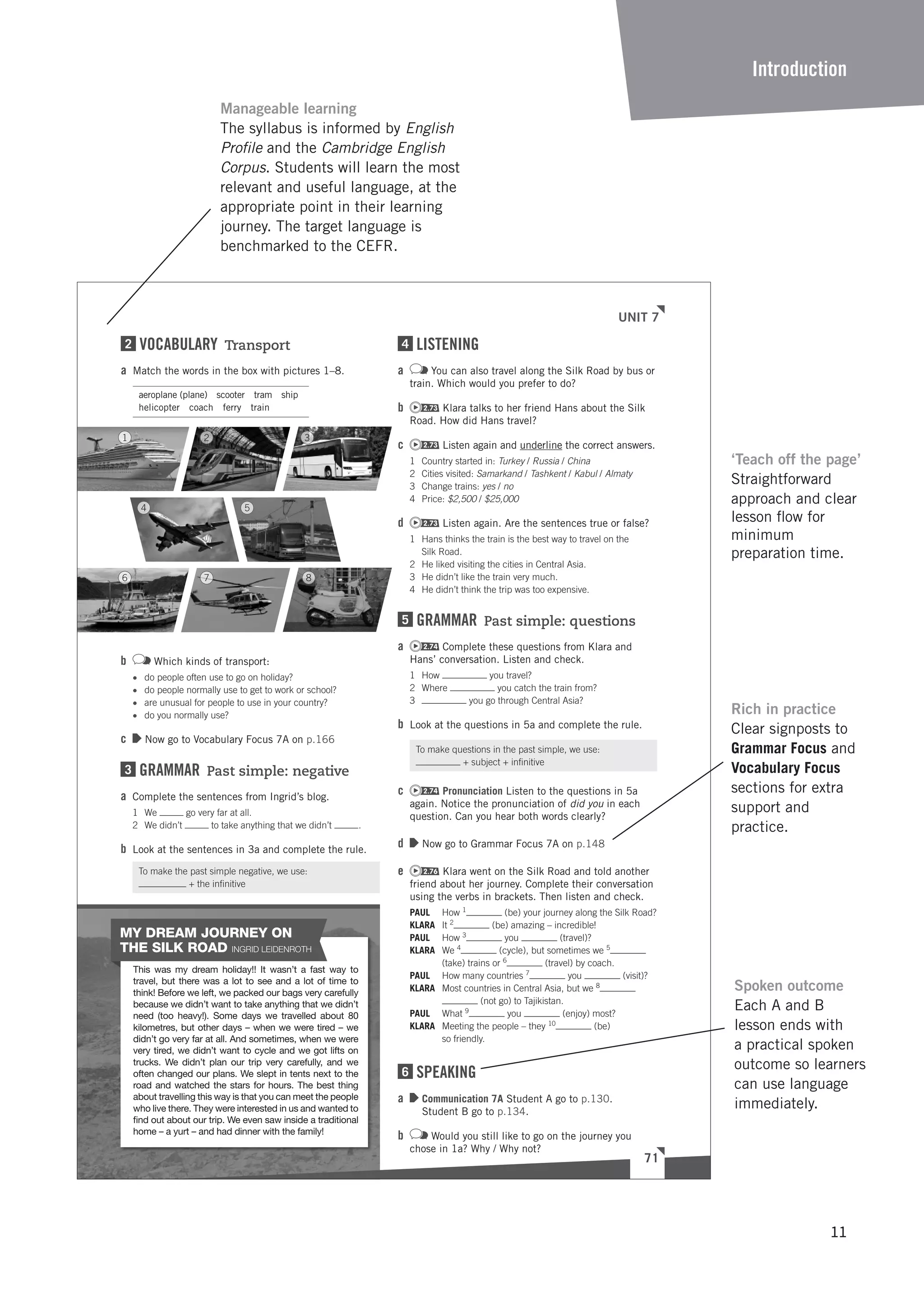
Manageable learning
The syllabus is informed by English
Profile and the Cambridge English
Corpus. Students will learn the most
relevant and useful language, at the
appropriate point in their learning
journey. The target language is
benchmarked to the CEFR.
Rich in practice
Clear signposts to
Grammar Focus and
Vocabulary Focus
sections for extra
support and
practice.
Spoken outcome
Each A and B
lesson ends with
a practical spoken
outcome so learners
can use language
immediately.
Introduction
‘Teach off the page’
Straightforward
approach and clear
lesson flow for
minimum
preparation time.
11
e 2.83 Watch or listen to Part 2 and
check your answers in 1d.
f 2.83 Watch or listen to Part 2 again.
Underline the correct answers.
1 Annie / Leo booked a seat.
2 Annie / Leo didn’t check the seat numbers.
3 Annie / Leo takes a different seat.
Everyday English
Excuse me, please7C
Learn to say excuse me and sorry
S Showing interest
P Emphasising what we say
1 LISTENING
a Ask and answer the questions.
1 Do you like going away for the weekend?
2 Where do you like going?
3 What do you like doing there?
4 Do you like going alone or with family and
friends?
b Answer the questions about
picture a.
1 Where’s Annie?
2 What do you think happened with Annie
and the woman?
3 What do you think:
a Annie says?
b the woman says?
c 2.82 Watch or listen to Part 1 and
check your answers in 1b.
d Answer the questions about
picture b.
1 Where are Annie and Leo?
2 How do you think Annie and Leo feel? Why?
3 What do you think happens next?
a Leo gets off the train.
b Leo gives Annie his seat.
c Leo helps Annie put her bag on the shelf.
74
a
b
2 USEFUL LANGUAGE
Saying excuse me and sorry
a Match 1–2 with meanings a–b.
1 Excuse me, please. a She wants to say there’s a problem.
2 Excuse me, but … b She wants to ask someone to move.
b 2.84 Pronunciation Listen to 1 and 2 in 2a. Notice how the
tone goes down in 1 but goes down and then up in 2.
c Look at 1 and 2 in 2a. What do you say when … ?
a you want to tell your teacher you don’t understand something
b you want to leave the room but another student is in front of the door
d Very, really and so can all be added to the
expression I’m sorry. Do you say the
words before or after sorry?
e 2.85 Match 1–5 with a–e. Listen and check.
1 I’m so sorry I walked into you.
2 I’m really sorry I’m late.
3 I’m sorry I didn’t answer your call.
4 I’m sorry I didn’t come.
5 I’m very sorry I broke your cup.
a I didn’t feel well.
b I was in a meeting.
c I missed my bus.
d My hands were wet.
e I didn’t see you.
f Tick (✓) the correct replies when people say they’re sorry.
1 That’s all right.
2 That’s OK.
3 No problem.
4 Excuse me, please.
5 It doesn’t matter.
6 Don’t worry.
g 2.86 Put sentences a–f in order to make two short
conversations. Listen and check.
a A No problem. They all look the same.
b 1 A Excuse me, but I think that’s my coat.
c B Is it? I’m so sorry. I took the wrong one.
d A Don’t worry. The seat numbers are hard to read.
e B Oh dear. I’m very sorry. I thought this was number 35.
f 1 A Excuse me, but I think this is my seat.
h In pairs, practise the two conversations in 2g.
I’m sorry I took
your seat.
Lesson C
Prepares learners for effective real-world spoken communication
Everyday English
Thorough coverage of functional language
for common everyday situations, helping
learners to communicate effectively in
the real world.
Real-world video
Language is show-
cased through
high-quality video
filmed in the real
world, which shows
language clearly and
in context.
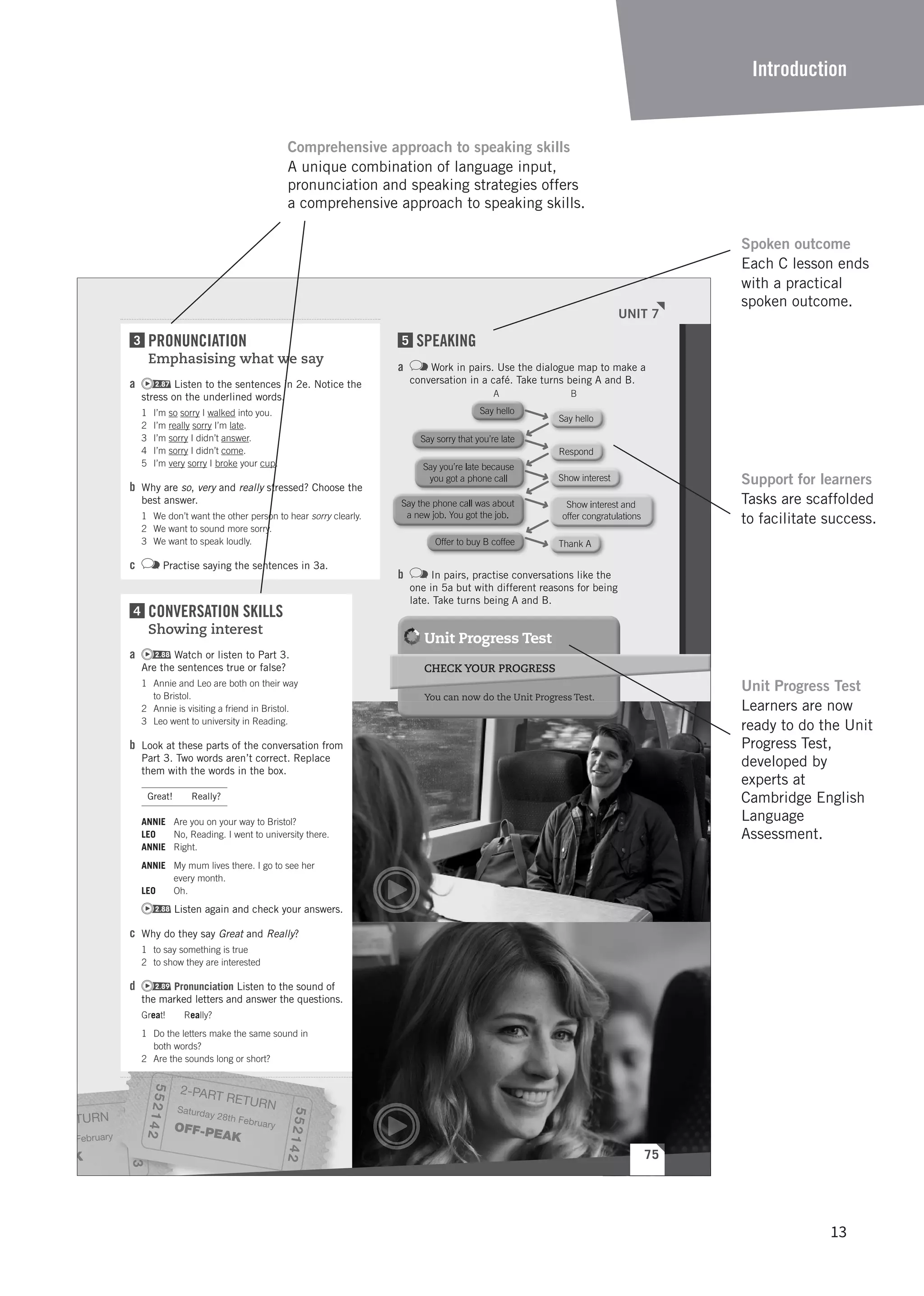
Comprehensive approach to speaking skills
A unique combination of language input,
pronunciation and speaking strategies offers
a comprehensive approach to speaking
skills.
12
UNIT 7
5 SPEAKING
a Work in pairs. Use the dialogue map to make a
conversation in a café. Take turns being A and B.
b In pairs, practise conversations like the
one in 5a but with different reasons for being
late. Take turns being A and B.
A B
4 CONVERSATION SKILLS
Showing interest
a 2.88 Watch or listen to Part 3.
Are the sentences true or false?
1 Annie and Leo are both on their way
to Bristol.
2 Annie is visiting a friend in Bristol.
3 Leo went to university in Reading.
b Look at these parts of the conversation from
Part 3. Two words aren’t correct. Replace
them with the words in the box.
Great! Really?
ANNIE Are you on your way to Bristol?
LEO No, Reading. I went to university there.
ANNIE Right.
ANNIE My mum lives there. I go to see her
every month.
LEO Oh.
2.88 Listen again and check your answers.
c Why do they say Great and Really?
1 to say something is true
2 to show they are interested
d 2.89 Pronunciation Listen to the sound of
the marked letters and answer the questions.
Great! Really?
1 Do the letters make the same sound in
both words?
2 Are the sounds long or short?
3 PRONUNCIATION
Emphasising what we say
a 2.87 Listen to the sentences in 2e. Notice the
stress on the underlined words.
1 I’m so sorry I walked into you.
2 I’m really sorry I’m late.
3 I’m sorry I didn’t answer.
4 I’m sorry I didn’t come.
5 I’m very sorry I broke your cup.
b Why are so, very and really stressed? Choose the
best answer.
1 We don’t want the other person to hear sorry clearly.
2 We want to sound more sorry.
3 We want to speak loudly.
c Practise saying the sentences in 3a.
Unit Progress Test
CHECK YOUR PROGRESS
You can now do the Unit Progress Test.
75
Comprehensive approach to speaking skills
A unique combination of language input,
pronunciation and speaking strategies offers
a comprehensive approach to speaking skills.
Unit Progress Test
Learners are now
ready to do the Unit
Progress Test,
developed by
experts at
Cambridge English
Language
Assessment.
Support for learners
Tasks are scaffolded
to facilitate success.
Spoken outcome
Each C lesson ends
with a practical
spoken outcome.
Introduction
13
76
1 SPEAKING AND LISTENING
a You want to stay with a homestay
family. What kind of family would you
like to stay with? Tick (✓) three ideas
and tell a partner.
1 quiet and friendly
2 friendly and fun
3 with young children
4 with no children
5 lives near a bus/train station
6 lives in the city centre
7 has wi-fi
8 has no TV
b Read the profiles of two Sydney
homestay families. Which family
would you like to stay with? Why?
c 2.90 Ahmed talks to an Australian
friend, Finn, about which family to
stay with in Sydney. Does Finn tell
Ahmed which family
to choose?
d 2.90 Listen again. Tick (✓) the
activities that are true for Ahmed.
1 enjoys gardening
2 likes watching sport
3 likes listening to music
4 wants to play rugby
5 loves going to the beach
6 wants to study hard
7 likes playing football
8 wants to have fun
e Which family is good
for Ahmed? Why?
I think the
Philips family are good
because they like doing
sports.
H O M E S T A Y F A M I L Y P R O F I L E
NAME Joe and Annie Philips
CHILDREN Kate (6) and Jacob (4)
PETS no pets
LIKES swimming, surfing, going to
the cinema, listening to music
LOCATION near a train station
NAME Peter and Sharon Conway
CHILDREN away from home
PETS Sam, our old cat
LIKES gardening, going for walks,
watching all sports
LOCATION near city centre – you can
walk to school
Skills for Writing
It really is hard to choose7D
76
Learn to write an email about yourself
W Linking ideas with after, when and while
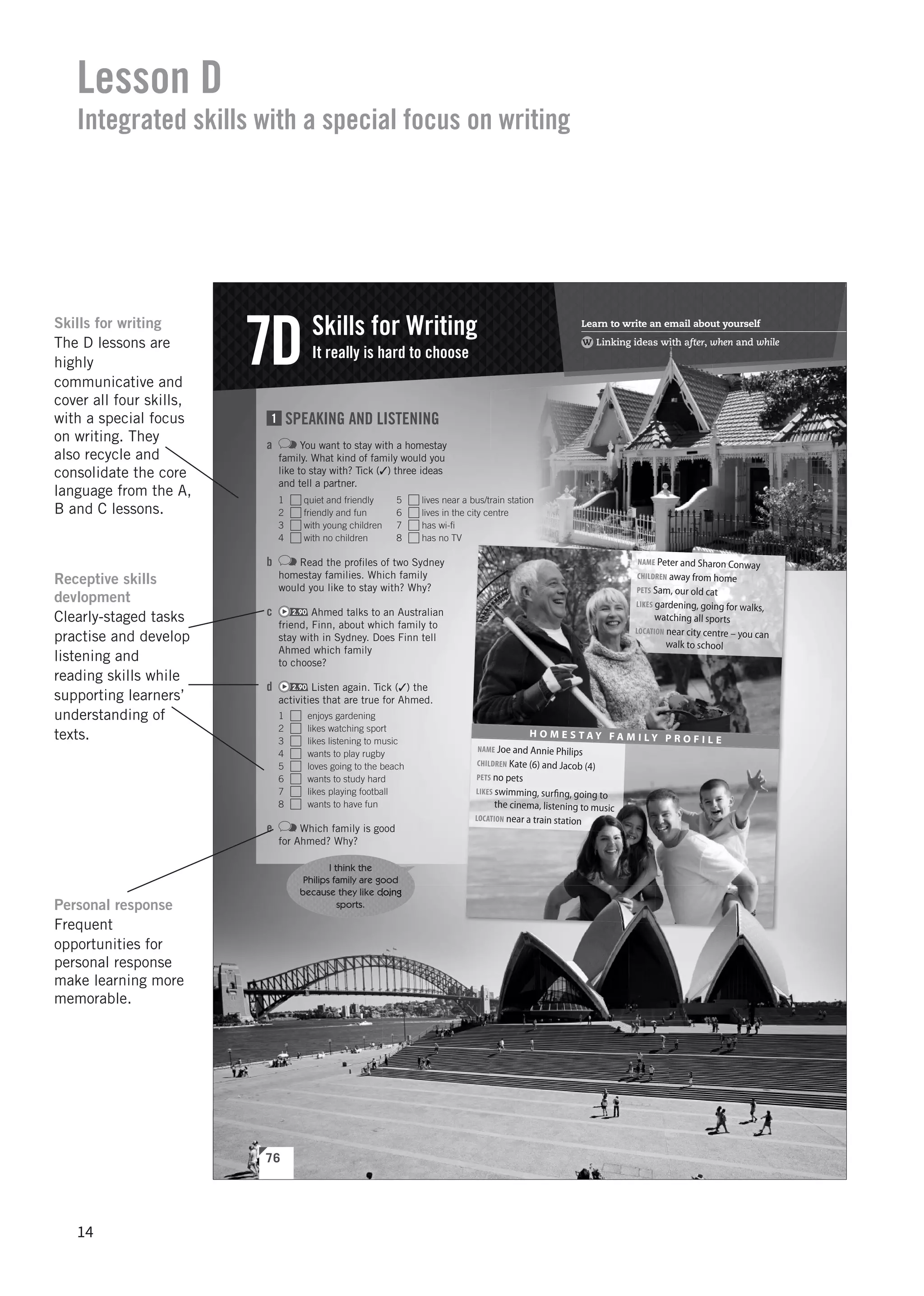
Lesson D
Integrated skills with a special focus on writing
Skills for writing
The D lessons are
highly
communicative and
cover all four skills,
with a special focus
on writing. They
also recycle and
consolidate the core
language from the A,
B and C lessons.
Personal response
Frequent
opportunities for
personal response
make learning more
memorable.
Receptive skills
devlopment
Clearly-staged tasks
practise and develop
listening and
reading skills while
supporting learners’
understanding of
texts.
14
I’d like to
go to …
I like warm
places.
They say the
people are
friendly.
2 READING
a Ahmed decided to stay with the Conways.
Read his email to them. Tick (✓) the main
reason he writes to them.
1 to ask about their house
2 to tell them about all the sports he likes
3 to tell them about himself
4 to explain how much he wants to study
b Read the email again. Number the
information in the order you find it.
his future plans his hobbies
his family’s jobs his hometown
Dubai
Dear Mr and Mrs Conway
My name is Ahmed Al Mansouri and
I come from Dubai in the United Arab
Emirates. Thank you for offering to
be my homestay family when I’m
in Sydney.
I am 23 years old and study biology at
university. I live with my family in Dubai.
My father is a businessman and my
mother is a doctor. I’ve got one brother
and one sister. They’re university
students too.
In my free time, I like playing football
(I think you say ‘soccer’ in Australia!)
and meeting my friends. I like
watching different kinds of sports
with them.
While I’m in Sydney, I really want to
study hard and improve my English
because I want to become a marine
biologist after I finish university.
I’d really like to work in a country
like Australia.
I’m looking forward to meeting you
when I arrive.
Best wishes
Ahmed
Dubai
c Plan an email about yourself to a homestay
family in that country. Make notes about:
• your age
• study / job
• free-time interests
• family
• what you’d like to do in that country
d Write your email. Tick (✓) each box.
Start the letter with Dear
Say thank you
Say who you are
Talk about study / work / free time
Talk about your family
Say what you want to do in the country
Include I’m looking forward …
Finish the letter with Best wishes
Use after, when and while to link your ideas
e Swap emails with another student and
check the ideas in 4d.
UNIT 7
77
3 WRITING SKILLS
Linking ideas with after, when and while
a Underline the word in each sentence that’s different from
Ahmed’s email.
1 Thank you for offering to be my homestay family while I’m in Sydney.
2 I want to become a marine biologist when I finish university.
3 I’m looking forward to meeting you after I arrive.
4 When I’m in Sydney, I really want to study hard.
b Look at the sentences in 3a and complete the rules with the
words in the box.
after beginning while
1 We use when and to join two activities that happen at
the same time.
2 We use when and to join two activities that happen at
different times.
3 If the linking word is at the of the sentence, we use a
comma ( , ) between the two parts.
c Underline the correct words. There is more than one
possible answer.
1 After / When / While I finish my English course, I’d like to go to
Canada for a holiday.
2 I’d like to go skiing in the mountains after / when / while I’m on
holiday.
3 I often play basketball with my colleagues after / when / while I
finish work.
4 After / When / While I watch a game of football, I usually want to
play a game myself.
5 My English improved after / when / while I was in Sydney.
4 SPEAKING AND WRITING
a Make a list of English-speaking countries you know.
b Which country in 4a would you like to visit? Why?
Written outcome
Each D lesson ends
with a practical
written outcome, so
learners can put new
language into
practice straight
away.
Staged for success
Careful staging and
scaffolding
generates successful
outcomes.
Introduction
Also in every unit:
• Review and
Extension page
• Grammar Focus
• Vocabulary Focus
• Communication Plus
Comprehensive approach to writing skills
Clear focus on key aspects of writing helps
develop effective real-world writing skills.
Clear models for writing
Clear model texts are provided, on which
students can base their own writing.
15
16
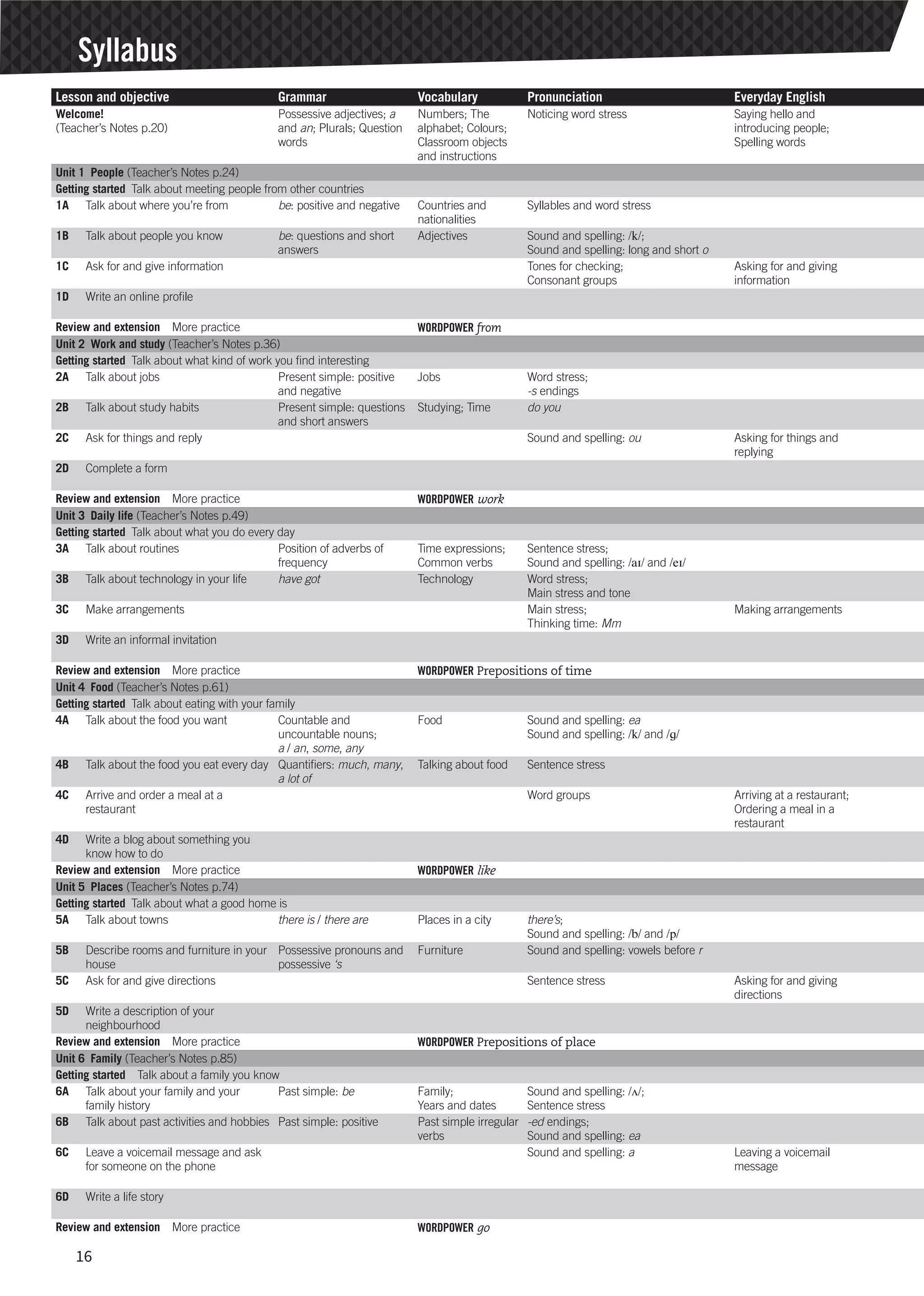
Syllabus
Lesson and objective Grammar Vocabulary Pronunciation Everyday English
Welcome!
(Teacher’s Notes p.20)
Possessive adjectives; a
and an; Plurals; Question
words
Numbers; The
alphabet; Colours;
Classroom objects
and instructions
Noticing word stress Saying hello and
introducing people;
Spelling words
Unit 1 People (Teacher’s Notes p.24)
Getting started Talk about meeting people from other countries
1A Talk about where you’re from be: positive and negative Countries and
nationalities
Syllables and word stress
1B Talk about people you know be: questions and short
answers
Adjectives Sound and spelling: /k/;
Sound and spelling: long and short o
1C Ask for and give information Tones for checking;
Consonant groups
Asking for and giving
information
1D Write an online profile
Review and extension More practice WORDPOWER from
Unit 2 Work and study (Teacher’s Notes p.36)
Getting started Talk about what kind of work you find interesting
2A Talk about jobs Present simple: positive
and negative
Jobs Word stress;
-s endings
2B Talk about study habits Present simple: questions
and short answers
Studying; Time do you
2C Ask for things and reply Sound and spelling: ou Asking for things and
replying
2D Complete a form
Review and extension More practice WORDPOWER work
Unit 3 Daily life (Teacher’s Notes p.49)
Getting started Talk about what you do every day
3A Talk about routines Position of adverbs of
frequency
Time expressions;
Common verbs
Sentence stress;
Sound and spelling: /aɪ/ and /eɪ/
3B Talk about technology in your life have got Technology Word stress;
Main stress and tone
3C Make arrangements Main stress;
Thinking time: Mm
Making arrangements
3D Write an informal invitation
Review and extension More practice WORDPOWER Prepositions of time
Unit 4 Food (Teacher’s Notes p.61)
Getting started Talk about eating with your family
4A Talk about the food you want Countable and
uncountable nouns;
a / an, some, any
Food Sound and spelling: ea
Sound and spelling: /k/ and /g/
4B Talk about the food you eat every day Quantifiers: much, many,
a lot of
Talking about food Sentence stress
4C Arrive and order a meal at a
restaurant
Word groups Arriving at a restaurant;
Ordering a meal in a
restaurant
4D Write a blog about something you
know how to do
Review and extension More practice WORDPOWER like
Unit 5 Places (Teacher’s Notes p.74)
Getting started Talk about what a good home is
5A Talk about towns there is / there are Places in a city there’s;
Sound and spelling: /b/ and /p/
5B Describe rooms and furniture in your
house
Possessive pronouns and
possessive ‘s
Furniture Sound and spelling: vowels before r
5C Ask for and give directions Sentence stress Asking for and giving
directions
5D Write a description of your
neighbourhood
Review and extension More practice WORDPOWER Prepositions of place
Unit 6 Family (Teacher’s Notes p.85)
Getting started Talk about a family you know
6A Talk about your family and your
family history
Past simple: be Family;
Years and dates
Sound and spelling: /ʌ/;
Sentence stress
6B Talk about past activities and hobbies Past simple: positive Past simple irregular
verbs
-ed endings;
Sound and spelling: ea
6C Leave a voicemail message and ask
for someone on the phone
Sound and spelling: a Leaving a voicemail
message
6D Write a life story
Review and extension More practice WORDPOWER go
Contents
17
Listening and Video Reading Speaking Writing
Five conversations Saying hello and introducing people Names and addresses
A conversation about where you’re from Where you’re from Sentences about you
A conversation about people you
know
Facebook entries about people
you know
People you know Notes about people you know
At the gym reception Asking for and giving information;
Checking understanding
Unit Progress Test
First day of an English course Online profiles Using social networking sites An online profile;
Capital letters and punctuation
A conversation about a TV programme An article about Ice Road
Truckers
Jobs Sentences about jobs
A survey about study habits An online forum about study
habits
Studying;
Study habits
Questions about study habits
Ordering in a café;
Asking for help
Asking for things and replying;
Reacting to news
Unit Progress Test
Three monologues about studying
English; A teacher addressing her class
A competition entry form Studying English A form;
Spelling
A conversation about family routines An article about an Indian family Daily routines; Spending time with your
family; Routines you share with others
A dialogue; Notes about routines you
share with other people
Three conversations about gadgets An interview about using the
Internet
Using the Internet;
Technology in your life
Sentences about gadgets you’ve got;
Questions about gadgets you’ve got
Making arrangements to go out Making arrangements;
Thinking about what you want to say
Unit Progress Test
A monologue about someone’s family Two informal emails Your family An informal email invitation;
Inviting and replying
A conversation about buying food An article about World markets Buying food;
The food you like and don’t like
A conversation about cooking A factfile about Heston
Blumenthal; Two personal emails
Cooking programmes; Cooking;
The food you eat
Questions about food
At a restaurant Arriving at a restaurant; Ordering a meal
in a restaurant;
Changing what you say
Unit Progress Test
Four monologues about cooking A cooking blog Cooking; A good cook you know;
Cooking for others
A blog about something you know how
to do; Making the order clear
An article about an unusual town Places you like; Describing a picture of
a town; What there is in a town
Questions and sentences about what
there is in a town
A conversation about a new home A newspaper advertisement Your home and furniture Sentences about your home
On the street Giving and following directions;
Checking what other people say
Unit Progress Test
Three monologues about
neighbourhoods
A website about neighbourhoods
around the world
What makes a good neighbourhood;
Your neighbourhood
A description of your neighbourhood;
Linking ideas with and, but and so
A conversation about a family tree Your family Notes about your family
A conversation about childhood
hobbies
An article about Steve Jobs Steve Jobs; What you did at different
times; A childhood hobby
Notes about a childhood hobby
On the phone Leaving a voicemail message; Asking for
someone on the phone;
Asking someone to wait
Unit Progress Test
A monologue about someone’s
life story
A life story Important years in your life A life story about someone in your family;
Linking ideas in the past
18
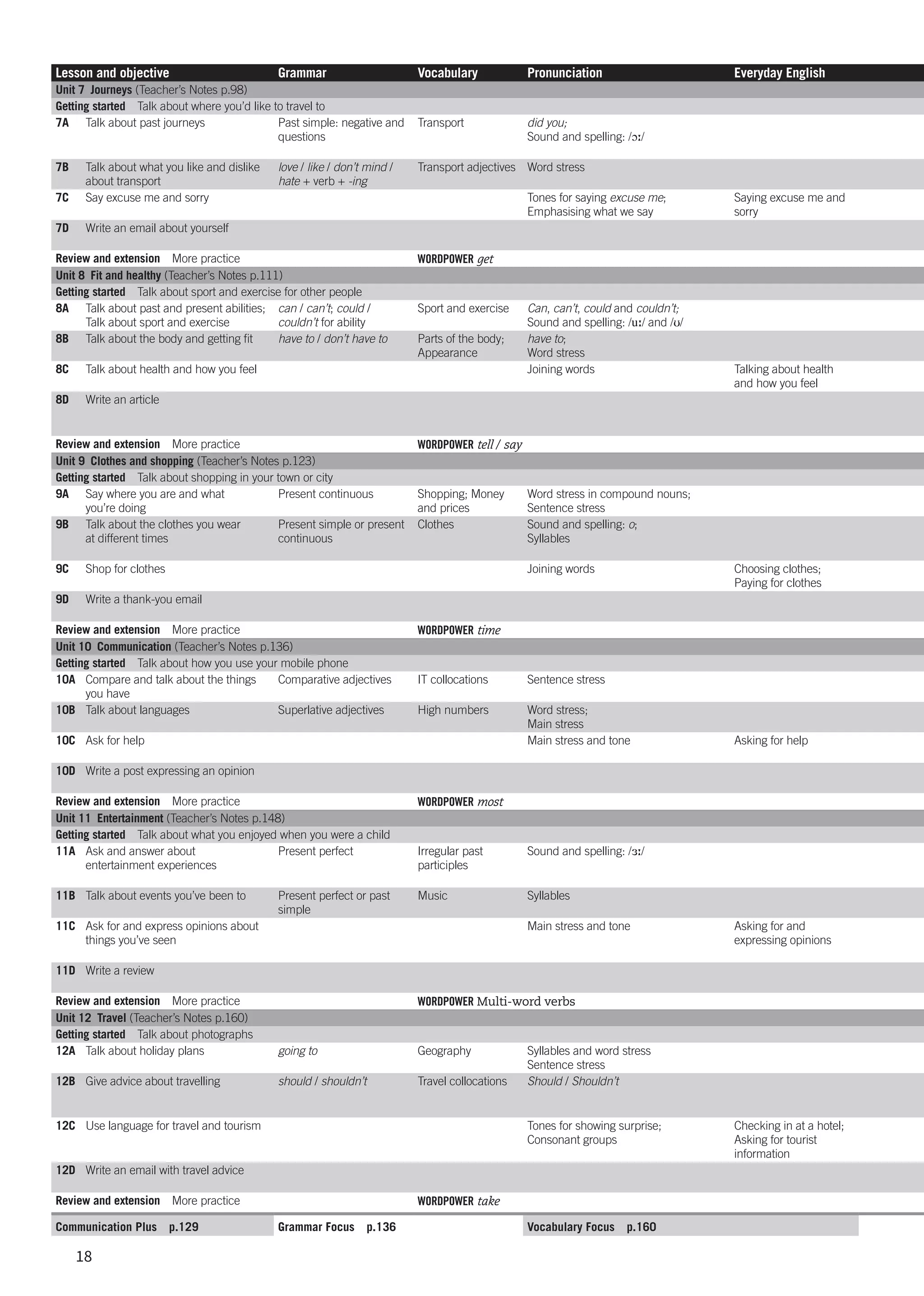
Lesson and objective Grammar Vocabulary Pronunciation Everyday English
Unit 7 Journeys (Teacher’s Notes p.98)
Getting started Talk about where you’d like to travel to
7A Talk about past journeys Past simple: negative and
questions
Transport did you;
Sound and spelling: /ɔː/
7B Talk about what you like and dislike
about transport
love / like / don’t mind /
hate + verb + -ing
Transport adjectives Word stress
7C Say excuse me and sorry Tones for saying excuse me;
Emphasising what we say
Saying excuse me and
sorry
7D Write an email about yourself
Review and extension More practice WORDPOWER get
Unit 8 Fit and healthy (Teacher’s Notes p.111)
Getting started Talk about sport and exercise for other people
8A Talk about past and present abilities;
Talk about sport and exercise
can / can’t; could /
couldn’t for ability
Sport and exercise Can, can’t, could and couldn’t;
Sound and spelling: /uː/ and /ʊ/
8B Talk about the body and getting fit have to / don’t have to Parts of the body;
Appearance
have to;
Word stress
8C Talk about health and how you feel Joining words Talking about health
and how you feel
8D Write an article
Review and extension More practice WORDPOWER tell / say
Unit 9 Clothes and shopping (Teacher’s Notes p.123)
Getting started Talk about shopping in your town or city
9A Say where you are and what
you’re doing
Present continuous Shopping; Money
and prices
Word stress in compound nouns;
Sentence stress
9B Talk about the clothes you wear
at different times
Present simple or present
continuous
Clothes Sound and spelling: o;
Syllables
9C Shop for clothes Joining words Choosing clothes;
Paying for clothes
9D Write a thank-you email
Review and extension More practice WORDPOWER time
Unit 10 Communication (Teacher’s Notes p.136)
Getting started Talk about how you use your mobile phone
10A Compare and talk about the things
you have
Comparative adjectives IT collocations Sentence stress
10B Talk about languages Superlative adjectives High numbers Word stress;
Main stress
10C Ask for help Main stress and tone Asking for help
10D Write a post expressing an opinion
Review and extension More practice WORDPOWER most
Unit 11 Entertainment (Teacher’s Notes p.148)
Getting started Talk about what you enjoyed when you were a child
11A Ask and answer about
entertainment experiences
Present perfect Irregular past
participles
Sound and spelling: /ɜː/
11B Talk about events you’ve been to Present perfect or past
simple
Music Syllables
11C Ask for and express opinions about
things you’ve seen
Main stress and tone Asking for and
expressing opinions
11D Write a review
Review and extension More practice WORDPOWER Multi-word verbs
Unit 12 Travel (Teacher’s Notes p.160)
Getting started Talk about photographs
12A Talk about holiday plans going to Geography Syllables and word stress
Sentence stress
12B Give advice about travelling should / shouldn’t Travel collocations Should / Shouldn’t
12C Use language for travel and tourism Tones for showing surprise;
Consonant groups
Checking in at a hotel;
Asking for tourist
information
12D Write an email with travel advice
Review and extension More practice WORDPOWER take
Communication Plus p.129 Grammar Focus p.136 Vocabulary Focus p.160
Contents
19
Listening and Video Reading Speaking Writing
A conversation about travelling on the
Silk Road
An article about the Silk Road;
Two blogs about travelling on the
Silk Road
Transport people use;
Past journeys
A conversation about transport in
Moscow
A webpage about metros around
the world; Four reviews of metros
Metros you know; Disagreeing about
transport; Transport you use
On the train Saying excuse me and sorry;
Showing interest
Unit Progress Test
A conversation about choosing a
homestay family
Two online profiles; An email
about Ahmed
Homestay families; English-speaking
countries you’d like to visit
An email about yourself;
Linking ideas with after, when, and while
A podcast about how the Olympics can
change a city
An article about Paralympian
Jonnie Peacock
Famous sport events and people;
The Olympics; Present and past abilities
Two monologues about exercise An article about High Intensity
Training
Getting fit; The things people have to do;
Yoga; Parts of the body
Sentences and notes about what people
have to do
At the gym Health and how you feel;
Expressing sympathy
Unit Progress Test
A conversation about a free-time
activity
An email about a company blog;
A blog article about a free-time
activity
Free-time activities in your country;
Your free-time activities
An article; Linking ideas with however;
Adverbs of manner
Four phone conversations about
meeting
Meeting friends in town; Saying where
you are and what you’re doing
Sentences about what you are doing
Two phone conversations about what
people are wearing
Two blogs about living abroad;
Text messages about what people
are doing
Shopping; Festivals in your country;
The clothes you wear
Notes about what someone you know is
wearing
Shopping for clothes Choosing clothes; Paying for clothes;
Saying something nice
Unit Progress Test
Four monologues about giving presents Two thank-you emails The presents you’d like; Giving presents
and thanking people for them
A thank-you email;
Writing formal and informal emails
A podcast about smartphones and
tablets
A webpage about smartphones
and tablets
Smartphones and tablets; Using the
Web; Comparing two similar things
Notes about two similar things
A radio programme about languages A blog about languages Languages; Blogs and language
websites
Asking for help Asking for help;
Checking instructions
Unit Progress Test
Three monologues about text messages Four text messages; Six posts on
an online discussion board
Sending messages A post expressing an opinion;
Linking ideas with also, too and as well
A conversation about a magazine quiz Three fact files about actresses;
A magazine quiz about actresses;
An article about actresses
Famous Australians
A conversation about music in Buenos
Aires
An article about Buenos Aires Buenos Aires; Kinds of music;
Entertainment events in your town or city
Notes about entertainment events in your
town or city
A night out Going out in the evening;
Asking for and expressing opinions;
Responding to an opinion
Unit Progress Test
A conversation about a film Two online film reviews Films A film review;
Cohesion in paragraphs
Two conversations about holidays A webpage about holidays Natural places; Important things when
on holiday; Holiday plans
Two monologues about things people
like when travelling
An article about living in a
different country
Living in a different country;
Travelling and holidays;
Giving advice about travelling
Unit Progress Test
A prize holiday Checking in at a hotel; Asking for tourist
information; Showing surprise
Notes about surprising things
A conversation about a planned holiday An email with travel advice;
An email asking for travel advice
Planning holidays; Sweden An email with travel advice;
Paragraph writing
Audioscripts p.168 Phonemic symbols and Irregular verbs p.176
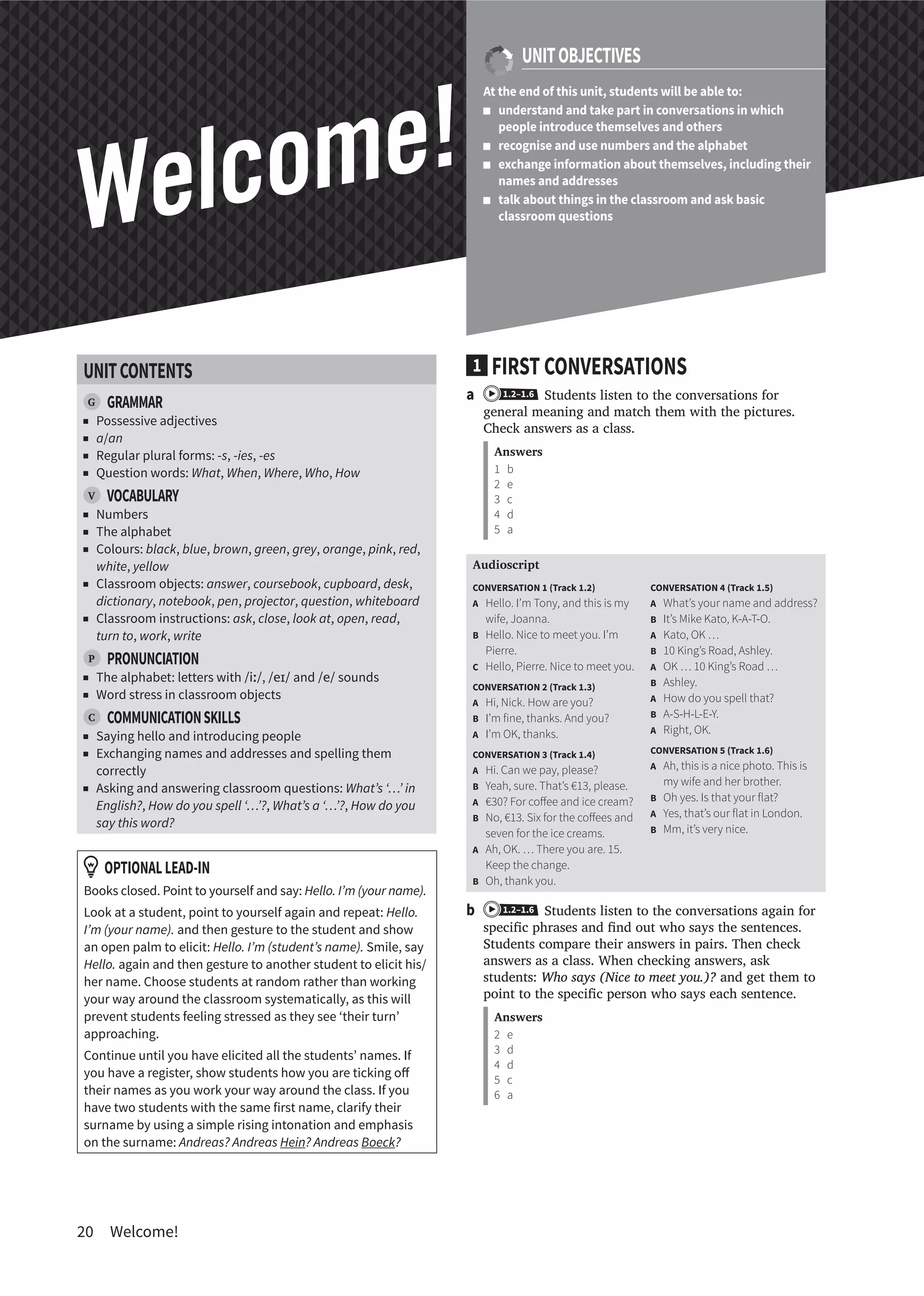
UNITOBJECTIVES
20 Welcome!
At the end of this unit, students will be able to:
understand and take part in conversations in which
people introduce themselves and others
recognise and use numbers and the alphabet
exchange information about themselves, including their
names and addresses
talk about things in the classroom and ask basic
classroom questions
Welcome!
UNITCONTENTS
G  GRAMMAR
Possessive adjectives
a/an
Regular plural forms: -s, -ies, -es
Question words: What, When, Where, Who, How
V  VOCABULARY
Numbers
The alphabet
Colours: black, blue, brown, green, grey, orange, pink, red,
white, yellow
Classroom objects: answer, coursebook, cupboard, desk,
dictionary, notebook, pen, projector, question, whiteboard
Classroom instructions: ask, close, look at, open, read,
turn to, work, write
P  PRONUNCIATION
The alphabet: letters with /iː/, /eɪ/ and /e/ sounds
Word stress in classroom objects
C  COMMUNICATIONSKILLS
Saying hello and introducing people
Exchanging names and addresses and spelling them
correctly
Asking and answering classroom questions: What’s ‘…’ in
English?, How do you spell ‘…’?, What’s a ‘…’?, How do you
say this word?
OPTIONALLEAD-IN
Books closed. Point to yourself and say: Hello. I’m (your name).
Look at a student, point to yourself again and repeat: Hello.
I’m (your name). and then gesture to the student and show
an open palm to elicit: Hello. I’m (student’s name). Smile, say
Hello. again and then gesture to another student to elicit his/
her name. Choose students at random rather than working
your way around the classroom systematically, as this will
prevent students feeling stressed as they see ‘their turn’
approaching.
Continue until you have elicited all the students’ names. If
you have a register, show students how you are ticking of
their names as you work your way around the class. If you
have two students with the same first name, clarify their
surname by using a simple rising intonation and emphasis
on the surname: Andreas? Andreas Hein? Andreas Boeck?
1 FIRST CONVERSATIONS
a 1.2–1.6 Students listen to the conversations for
general meaning and match them with the pictures.
Check answers as a class.
Answers
1 b
2 e
3 c
4 d
5 a
Audioscript
CONVERSATION 1 (Track 1.2)
A Hello. I’m Tony, and this is my
wife, Joanna.
B Hello. Nice to meet you. I’m
Pierre.
C Hello, Pierre. Nice to meet you.
CONVERSATION 2 (Track 1.3)
A Hi, Nick. How are you?
B I’m fine, thanks. And you?
A I’m OK, thanks.
CONVERSATION 3 (Track 1.4)
A Hi. Can we pay, please?
B Yeah, sure. That’s €13, please.
A €30? For cofee and ice cream?
B No, €13. Six for the cofees and
seven for the ice creams.
A Ah, OK. … There you are. 15.
Keep the change.
B Oh, thank you.
CONVERSATION 4 (Track 1.5)
A What’s your name and address?
B It’s Mike Kato, K-A-T-O.
A Kato, OK …
B 10 King’s Road, Ashley.
A OK … 10 King’s Road …
B Ashley.
A How do you spell that?
B A-S-H-L-E-Y.
A Right, OK.
CONVERSATION 5 (Track 1.6)
A Ah, this is a nice photo. This is
my wife and her brother.
B Oh yes. Is that your flat?
A Yes, that’s our flat in London.
B Mm, it’s very nice.
b 1.2–1.6 Students listen to the conversations again for
speciic phrases and ind out who says the sentences.
Students compare their answers in pairs. Then check
answers as a class. When checking answers, ask
students: Who says (Nice to meet you.)? and get them to
point to the speciic person who says each sentence.
Answers
2 e
3 d
4 d
5 c
6 a
Welcome! 21
3 NUMBERS
a 1.4 Students may need some extra work on numbers
before they continue. Be prepared to teach/review
numbers 1−100. Be careful if you model the ‘teen’
numbers in sequence that you don’t inadvertently move
the stress to the irst syllable, i.e. thirteen, fourteen,
ifteen, etc. NOT thirteen, fourteen, ifteen, etc. Point to
picture c and say: Conversation 3 and hold up three
ingers. Say: Numbers. Point to the bill and play the
recording for students to complete it. Students compare
their answers in pairs. Then check answers as a class.
When checking answers, write the numbers on the
board to make sure students have understood them.
Answers (For audioscript, see Conversation 3 p.20)
2 cofees €6
2 ice creams €7
TOTAL €13
They pay €15.
b 1.7 Play the recording for students to listen and circle
the numbers. They then check in pairs. Check answers
as a class.
Answers
30
15
60
70
12
LOA TIP DRILLING
• Check students can hear the diference between the pairs of
numbers (thirteen/thirty, fourteen/forty, etc.) by beating the
rhythm with your hand and showing where the stress falls.
c In pairs, students look at the options and choose the
correct answers. After checking answers as a class, write
some more numbers in numerals on the board and elicit
from the class how to say and write them.
Answers
25 = twenty-five
61 = sixty-one
110 = a hundred and ten
d Students read the irst sequence and continue it as a
class. They then work in pairs, continuing the sequences.
Answers
5, 6, 7
40, 50, 60
45, 55, 65
37, 39, 41
200, 250, 300
FASTFINISHERS
Ask fast finishers to invent new sequences like those in 3d to
test their partner.
2 SAYING HELLO
a 1.2 Point to yourself and say your name, then point
to two or three more students at random and elicit their
names. Next point to the man in the blue T-shirt in
picture b and say: Tony. Then point to the woman and
elicit: Joanna. Finally, point to the man in the green
T-shirt and elicit: Pierre. Say: Conversation 1 and hold
up one inger. Individually, students put the sentences
in the correct order. Play the recording for students to
listen and check. Check answers as a class.
Answers
1 Hello. I’m Tony, and this is my wife, Joanna.
2 Hello. Nice to meet you. I’m Pierre.
3 Hello, Pierre. Nice to meet you.
b If you have real beginners, they may need some
extra support to complete 2b and 2c. If so, consider
writing model conversations on the board to guide
students. As they are practising, you can remove random
words from the board so that ultimately they are relying
on their memories.
Model the conversation by addressing a student: Hello.
I’m (your name). and elicit the response: Hello. I’m
(student’s name). Elicit Hello. I’m (student’s name). from
another student and respond yourself with: Hello. Nice to
meet you. I’m (your name). Drill the phrase: Nice to meet
you. Address another student Hello. I’m (your name).,
elicit Hello. Nice to meet you. I’m (student’s name). and
respond yourself with: Nice to meet you, (student’s name).
Repeat the whole conversation with one or two more
students until the class seems conident. If space allows,
then gesture for students to stand up and mill around
and say hello to their classmates. If there isn’t enough
space, students work in pairs.
c Demonstrate the activity with three students. Say:
Hello. I’m (your name), and this is (student A’s name).
Elicit a response from one of the other students: Hello.
Nice to meet you. I’m (student B’s name), and this is
(student C’s name). In groups, students practise saying
their names and introducing their partners. Monitor and
praise students with a smile or a nod when they use the
language for saying hello correctly.
d 1.3 Point to picture e and say: Conversation 2 and
hold up two ingers. In pairs, students complete the
conversation. Play the recording for students to listen
and check. Drill the conversation.
Answers
1 How
2 fine
3 thanks
e If space allows, gesture for students to stand up and
have conversations in small groups. If there isn’t enough
space, students work sitting down in groups of three or
four. Monitor, but don’t interrupt luency unless students
make mistakes with the phrases for saying hello.
22 Welcome!
g Elicit the question: How do you spell your irst name?
by writing: M-I-K-E on the board and writing a question
mark above it. In pairs, students say their names and
addresses and ask each other to spell them. Students
can, if they prefer, invent an address. Monitor, but don’t
interrupt luency unless students make mistakes with
the alphabet.
5 POSSESSIVE ADJECTIVES
a 1.6 Tell students to close their books. Write I’m Tony,
and this is … wife, Joanna. on the board. Point to the
gap. Elicit the missing word (my) and write it in the
sentence. Leave the sentence on the board. Students
open their books. Point to picture a, say: Conversation 5
and hold up ive ingers. Play the recording for students
to read and listen and underline the correct answers.
Check answers as a class.
Answers
A ... This is my wife and her brother.
B Oh yes. Is that your flat?
A Yes, that’s our flat in London...
b In the sentence on the board I’m Tony, and this is my
wife, Joanna. circle the words I and my. Draw a line to
link the two words and repeat them clearly for students.
Point to the table and read through the example
sentences with I/my and you/your. Individually, students
complete the table. Check answers as a class.
Answers
He lives here. This is his flat.
She lives here. This is her flat.
We live here. This is our flat.
They live here. This is their flat.
c Individually, students complete the sentences. They then
check in pairs. Check answers as a class.
Answers
1 His 2 their 3 your 4 our 5 her
LOA TIP REVIEW AND REFLECT
• Draw a thumbs up symbol in a box on the let of the board
and a thumbs down symbol in a box on the right of the
board. Then stand in the centre, point to the thumbs up
and nod and look confident. Point to the thumbs down and
shake your head and look worried. Ask students: Possessive
adjectives? and elicit an indication of their confidence level.
EXTRAACTIVITY
Students are usually very interested to learn something
about their new teacher. Show students some photos of your
family and/or friends and tell them something about the
people, recycling simple language from the Welcome! unit
and possessive adjectives, e.g. This is my wife. Her name’s
Sarah. Mark is an old friend and that’s his daughter., etc.
If students have mobile phones, allow them to show each
other some photos of their family and/or friends and make
simple sentences.
4 THE ALPHABET
a 1.8 Books closed. Say: I’m (your name). Write your
name on the board slowly, spelling the letters out as you
go. Spell it again clearly, pointing to the letters. Then
say: The alphabet. Students open their books. Play the
recording or model the alphabet yourself for students to
listen and repeat.
b Pronunciation Read through the questions with the
students. Model clearly the long ‘ee’ sound, the word
see and the letter B. Elicit another letter with the same
sound by modelling A and shaking your head. Model
C, nod your head and indicate students should write it.
Individually, students complete the three groups. When
checking answers, write the groups of letters on the
board and drill them.
Answers
1 C, D, E, G, P, T, V
2 A, J, K
3 L, M, N, S, X, Z
c Demonstrate the activity by pointing at two or
three letters and eliciting them from the class. In pairs,
students test each other on the letters. Monitor and
correct students’ pronunciation as appropriate.
EXTRAACTIVITY
In pairs, students practise spelling their own names. They tell
their partner their name – I’m (student’s name). – and then
spell it out, pointing to the letters in 4a. Monitor and correct
students’ pronunciation as appropriate.
d The question How do you spell ‘…’? isn’t formally
practised until 7c on SB (Student’s Book) p.8. In 4d and
4e don’t distract students by using this question form,
but elicit spelling ‘silently’ by showing an open palm,
pointing at letters or standing with your pen poised to
write on the board as students call out the letters to you.
Point to the red blot and elicit the word: red. Write it on
the board slowly, spelling the letters out as you go. Then
say: Colours. Give students one minute to look at the
colours and write down the ones they think they know.
In pairs, students then practise saying and spelling the
words. When checking answers, elicit the spelling from
the class and write the colours on the board.
Answers
(from let to right) top: red, grey, blue, green, black
bottom: pink, brown, orange, yellow, white
e Demonstrate the activity by saying two words
to the class, e.g. answer and number, and eliciting the
spelling. Students then write down another two words.
Monitor and check their spelling or allow them to
check the words in their dictionaries. In pairs, students
practise spelling their partner’s words.
f 1.5 Point to picture d and say: Conversation 4 and hold
up four ingers. Point to the man in picture d and elicit:
Mike. Show students Mike’s details in the Student’s Book,
pointing to the irst line and saying: name and the second
and third lines and saying: address. Play the recording
for students to complete the name and address. Check
answers as a class.
Answers
Mike Kato
10 King’s Road
Ashley
7 CLASSROOM INSTRUCTIONS
a 1.10 Play the recording, pausing after each item for
students to follow the instructions. Elicit the actions
for instructions 1 and 2. Repeat the recording, again
pausing after each item, for students to identify which
verbs they hear.
Answers
1 open, turn to, read (The first word of the text on SB p.83 is so.)
2 turn to, look at (The place in the picture on SB p.77 is Dubai.)
3 close, look at
4 write
5 work, ask
Audioscript
1 Open your books and turn to page 83. Read the first word of the text.
What is it?
2 Turn to page 77 and look at the picture. What place is it?
3 Close your books and look at the board.
4 Write a question on a piece of paper.
5 Work in pairs. Ask your question to your partner.
b 1.11 Individually, students underline the correct
question words. Play the recording for students to listen
and check. Check answers as a class.
Answers
1 What’s
2 Where’s
3 How
4 Who’s
5 When’s
LOA TIP CONCEPT CHECKING
Check students understand the meaning of each question:
for Question 1 point to the picture of the apple in 6d, ask the
question and elicit the answer: It’s an apple.; for Question 2,
ask the question and elicit the answer: Japan.; for Question 3,
point to the word dictionary in 6a and elicit the pronunciation;
for Question 4 ask the question and elicit the name of the
president in the country where you are teaching or another
country that has a president; for Question 5 ask the question
and elicit the day(s) of your English lessons with the class.
c Students read the questions and match them with the
answers. Check answers as a class. Drill the questions,
substituting other words for amigo, night and ferry.
Answers
1 c 2 d 3 a 4 b
d Give students a few minutes to prepare their questions.
Monitor and help as necessary. Students then work
in small groups, asking and answering each other’s
questions.
EXTRAACTIVITY
Students prepare an end-of-section test for a partner. They
write ten questions about the content of the unit using
the question words in 7b and 7c, e.g. How do you spell
‘whiteboard’?, How do you say ‘gelato’ in English? Monitor and
help as necessary. Point out errors for students to self-correct.
In pairs, students ask and answer each other’s questions.
They then give their partner a score out of ten. Monitor the
tests and give feedback to the class.
Photocopiable activities: Pronunciation p.195
6 CLASSROOM OBJECTS
a Books closed. Pre-teach some of the vocabulary by
pointing to the classroom objects which you have in
your classroom. Don’t allow students to write anything
down. Repeat the words several times and then ‘test’
individual students by saying their name and pointing
to an object. When you’re conident that students can
remember most of the vocabulary, elicit: dictionary from
a student and ask: How do you spell that? Students then
open their books, look at the spelling of the vocabulary
and match objects 1–10 with a–j in the picture. Check
answers as a class.
Answers
a a projector b a whiteboard c a question d a cupboard
e an answer f a pen g a notebook h a dictionary
i a coursebook j a desk
b 1.9 Pronunciation Play the recording and highlight
the pronunciation for students. Individually or in pairs,
students practise saying the words.
c Draw a large question mark on the board. Read through
the words in 6a quickly, placing extra emphasis on
the article a. When you reach an answer, place an
extra emphasis on the article an and then point to the
question mark on the board. Repeat if necessary, and
then read the question in the Student’s Book and elicit
the answer as a class.
Answer
a before a, e, i, o, u
d Individually, students write a or an next to the words.
They then check in pairs. Check answers as a class.
Answers
1 a book
2 an apple
3 a camera
4 a glass
5 an egg
6 a baby
7 an ice cream
8 a box
FASTFINISHERS
Ask fast finishers to write a list of any ‘international English’
words that they know, e.g. orchestra, pizza, taxi, and decide if
they use a or an.
e Demonstrate the activity by thinking of one of the words
yourself and eliciting questions from the class. Students
then work in small groups and ask questions to guess
each other’s words. Monitor and help with vocabulary if
necessary.
f Books closed. Pick up a pen, show the class and say:
One pen. Pick up another pen, and say: Two … . to elicit
the plural: pens. Point to three desks and say: Three … .
to elicit: desks. Students open their books and complete
the rules. Check answers as a class. Elicit an indication
of their conidence level for the indeinite article and
regular plural forms.
Answers
Most words add -s in the plural.
Change a final -y to -i and add -es.
If a word ends in -s, -x, -sh or -ch, we add -es.
Welcome! 23
24 UNIT 1 People
UNITOBJECTIVES
At the end of this unit, students will be able to:
understand information, texts and conversations
about people and places, countries and
nationalities, and people’s personalities
ask for and give information about themselves
and other people, including their nationality and
personality
use simple phrases to check understanding
introduce themselves in an online profile with
correct capital letters and punctuation
People
UNIT1
UNITCONTENTS
G  GRAMMAR
be: positive and negative
be: questions and short answers
V  VOCABULARY
Countries: Brazil, France, Germany, Japan, Russia, Spain, etc.
Nationalities: Brazilian, French, German, Japanese,
Russian, Spanish, etc.
Personality adjectives: brilliant, cool, fantastic, friendly,
great, kind, lovely, pleasant, popular, quiet, warm,
well-known
Adjectives: amazing, horrible, modern, old, poor, rich,
terrible, wonderful
Wordpower: from to talk about times, a starting place,
our country or city, how far away something is
P  PRONUNCIATION
Word stress in nationalities
Sound and spelling: /k/
Sound and spelling: long and short o (/ɔː/ and /ɒ/)
Rising and falling intonation
Consonant groups
C  COMMUNICATIONSKILLS
Talking about where you are from
Using adjectives for description
Asking for and giving information
Checking understanding using So that’s … and Sorry?
Discussing social networking and online profiles
Writing an online profile about yourself
GETTING STARTED
OPTIONALLEAD-IN
Books closed. Revise the alphabet by writing it on the board
one letter at a time, saying each letter clearly and asking
the class to chorus it ater you. When you have the complete
alphabet on the board, point to letters at random to elicit
them from the class. Repeat any letters which are problematic.
Say the word: alphabet and then gesture for students to write
it down as you spell it out: A-L-P-H-A-B-E-T. Check spelling by
writing the word on the board. Repeat with: question, pink,
coursebook, address and camera, or choose words covered in
the Welcome! unit containing letters which your students find
dificult. Finish by asking students to spell the word: people.
Check meaning by gesturing to several students and saying:
people.
a Give students one minute to think about their
answers to the questions and check students understand
the vocabulary in questions 2 and 3. Discuss the answers
as a class.
Suggested answers
1 Australia, Austria, Belgium, the Czech Republic, Finland, Germany,
Greece, the Netherlands, Norway, Spain, Turkey, Uruguay, the USA
EXTRAACTIVITY
Write the country names of the flags in the picture on the
board. Tell students to put the names of the countries in
alphabetical order. They then compare their answers with a
partner. Check answers as a class. (See Suggested answers
above for the correct alphabetical order.)
b Read through the question and the ideas with the
students and check they understand the vocabulary.
Discuss when they meet people from other countries and
ask students to share any other ideas they have. Help
with vocabulary and pronunciation, but don’t interrupt
luency.
EXTRAACTIVITY
Write a music concert on the board, point to yourself and say:
I feel excited. Write watch sport on the board, point to yourself
and say: I feel bored. Students then work in pairs and use
the adjectives in Exercise a to say how they feel about the
activities in Exercise b. Monitor and help as necessary.
UNIT 1 People 25
d 1.13 Students listen to the recording again for speciic
words and complete the conversation. They compare in
pairs. Check answers as a class. When checking answers,
ask students: How do you spell (word)? and write the
correct answers on the board.
Answers
1 name
2 from
3 where
4 France
5 great
e Play the recording again, or allow students to read the
conversation in their own time, and decide if the
sentences are true or false. Check answers as a class.
Answers
1 F Thomas and Lena meet at the World Cup.
2 T
3 T
4 F Lena says the French team’s really good.
FASTFINISHERS
Ask fast finishers to look at the pictures and identify all the
colours, using the vocabulary from the Welcome! unit.
f Individually, students underline the two nationalities in
the conversation. Check answers as a class.
Answers
Russian, French
2 VOCABULARY Countries and nationalities
a 1.14 Read Thomas’s sentence with the class. Read
through the countries and nationalities in the box and
elicit another example of a country/nationality pair.
Students work in pairs, matching the words. Play the
recording for students to listen and check. Check answers
as a class.
Answers and audioscript
She’s from Russia. She’s Russian.
They’re from Brazil. They’re Brazilian.
They’re from Spain. They’re Spanish.
They’re from Germany. They’re German.
They’re from Japan. They’re Japanese.
b 1.14 Pronunciation Show students, by counting on your
ingers and breaking the words into chunks, how Russia
has two syllables, but Brazilian has four. Point out the
dividing line between syllables in the Student’s Book.
Students read the other words in the box and count how
many syllables there are in each. Play the recording again
for students to underline the stressed syllable in each
word. Check answers as a class.
Answers
Russia, Brazilian, Spanish, Japan, Russian, Germany, Japanese,
German, Brazil, Spain
At the end of this lesson, students will be able to:
• understand a conversation about people’s countries and
nationalities
• use a lexical set of countries and nationalities correctly
• use present simple positive and negative forms of be
• ask for and give simple personal information about
other people
I’m from France
1A
OPTIONALLEAD-IN
Books closed. Draw a rough world map on the board and elicit
the name in English of the country where you are teaching by
pointing to it and writing the first letter on the board. When
you have elicited the name of the country, ask: How do you
spell that? and elicit the spelling from the class, writing it up
on the board as the class calls out the letters to you.
If you’re from a diferent country, point to it and say the
name of the country in English. Elicit the question: How do
you spell that? from the class before spelling the country
for them. With multi-nationality classes, you could also ask
some students to point to their country and see if they know
how to say it in English. Don’t worry if students don’t know
the names of the countries or how to spell them correctly at
this point.
Leave the map on the board for 1a and 1b.
1 LISTENING AND READING
a Give students one minute to think about their
answers to the questions before talking about the
pictures as a class. Don’t check answers at this point.
b 1.12 Play the recording for students to listen and
check. Check answers as a class. Play the recording
again or model the countries yourself for students to
listen and repeat.
Answers
1 football
2 1 a 2 e 3 c 4 d 5 f 6 b
EXTRAACTIVITY
Quickly revise the question: Where’s (city)? from the
Welcome! unit by asking students about a city in the country
you are teaching in. Then ask them about six other cities,
one from each country in 1a, e.g. Where’s St Petersburg?
(Russia), Where’s Mainz? (Germany). If you used the Optional
lead-in, use the rough world map on the board again and
ask students to locate the cities using the question: Where’s
(city)?
c 1.13 Ask students: What’s the World Cup? and elicit
possible answers, e.g. It’s a football game for the world.
Remember students will have very limited language at
this point, so praise students who are able to express the
basic idea, however simply. You may wish to pre-teach
the word team (a group of people who play a sport or
game together). Students listen to the conversation for
general meaning and tick the things Thomas and Lena
talk about. Check answers as a class.
Answers
1 football ✓
2 countries ✓
4 a city ✓
26 UNIT 1 People
b 1.17 Students underline the correct answers. Play the
recording again for students to listen and check. Check
answers as a class.
Answers
1 isn’t
2 are
3 aren’t
4 It isn’t
c Read through the sentences with the students and give
them one minute to think about how to complete the
rules before they work in pairs. Check answers as a
class.
Answers
1 n’t
2 not
CAREFUL!
There are various common student mistakes with be positive
and negative. Common errors include: missing be out
altogether, particularly before adjectives, e.g. Russia very
big. (Correct form = Russia is very big.) and also in the second
clause of a sentence, e.g. This is a small town and the people
very friendly. (Correct form = This is a small town and the
people are very friendly.); confusing the forms am/are/is, e.g.
Here is the answers … (Correct form = Here are the answers to
the homework.); confusion with colours as students oten try
to include the word colour and may miss out be, e.g. It a blue
colour. (Correct form = It’s blue.). Students may also have
problems with word order, e.g. They all are from Germany.
(Correct form = They are all from Germany.), use of capitals
and apostrophes in the contracted forms, e.g. Hes Spanish
and i’m Brazilian. (Correct form = He’s Spanish and I’m
Brazilian.) and may also use have instead of be, e.g. She has
20 … (Correct form = She is 20 years old.).
d Individually, students complete the table. They then
check in pairs. Check answers as a class. Show students
three ingers, point to the irst and say: I, the second and
say: am and the third and say: not. Then close up the
gap between the irst and second inger to show how I
and am are contracted as: I’m. Repeat the process with
He isn’t, but closing up the second and third ingers to
show how is and not are contracted as: isn’t. Say: She
is not and point to your three ingers and gesture to
indicate for the class to show you which ingers should
be closed up to represent the contraction: She isn’t (i.e.
second and third ingers). Repeat with: They are not.
Answers
Positive (+) Negative (–)
I’m from St Petersburg.
He’s a really good player.
They say they’re tired.
I’m not French.
She isn’t from Moscow.
They aren’t at the match.
c 1.14 Play the recording again for students to listen
and repeat.
LOA TIP DRILLING
• Check students are aware that the stress shits from the
second syllable in Ja | pan to the third syllable in
Jap | an | ese.
• Highlight the changing vowel sound in Spain /speɪn/ and
Spanish /ˈspænɪʃ/.
d Complete the irst sentence as a class and elicit another
example using picture a. Students work individually,
writing sentences about the people in the pictures. They
then check in pairs. Check answers as a class.
Answers
1 Russia
2 a Brazilian, Brazil b French, France
c German, Germany d Japanese, Japan
e Spanish, Spain f Russian, Russia
e Individually, students complete the question.
Before they work in pairs, quickly check they have
completed the question correctly (Where). Monitor
and give students other nationalities if they are from
countries other than those in 2a. If your students are
from various diferent countries, take feedback as a class
and ask each student: Where are you from?
f 1.15–1.16 Students complete the exercises in
Vocabulary Focus 1A on SB p.160. Play the recordings
as necessary, monitor Exercises b and h, and check other
answers as a class. Tell students to go back to SB p.11.
Answers (Vocabulary Focus 1A SB p.160)
a 1 the USA 2 Mexico 3 Turkey 4 the UK / Britain
5 China 6 Poland 7 Saudi Arabia
8 Argentina 9 Australia 10 Iran 11 Colombia
12 South Africa 13 Canada 14 New Zealand
15 Nigeria 16 Ireland 17 Italy 18 Pakistan
c 1 a 2 c 3 d 4 e 5 b 6 f
d 1 China − in Asia 2 Brazil − in South America
3 Russia − speak Russian 4 Spain − in Europe
e 1 A 2 C 3 B 4 F 5 D 6 F
f British, Chinese, Turkish, Mexican, Japanese, Australian,
Pakistani, Italian
g 1 A Chinese, C Pakistani 2 diferent (Mexican, Japanese)
3 GRAMMAR be: positive and negative
a 1.17 Play the next part of the conversation for
students to answer the question. You may wish to pre-
teach the word match (a game between two groups or
players). Check the answer as a class.
Answer
b the town where Thomas is from
Audioscript
LENA So where are you from?
From Paris?
THOMAS No, I’m not from Paris. I’m
from a town called Rouen.
L Hmm … Where’s that?
T Oh, it’s a town near Paris. It isn’t
very big.
L Oh, right.
T So are you here with friends?
L Yes, we’re a big group. We’re all
from St Petersburg.
T But they aren’t here.
L No, they’re all in the hotel. They
say they’re tired!
T Oh, right. … Well, look, it’s only
8:00, the match isn’t on yet. So
how about a cofee?
L Hmm, yeah OK. Good idea … !
UNIT 1 People 27
4 SPEAKING
a Divide the class into As and Bs. Student As read
about Roberto on SB p.129 and Student Bs read about
Lora on SB p.132. Monitor for any problems and clarify
these before students start on the pairwork stage. Put
students into A/B pairs for them to ask and answer the
questions about Roberto and Lora. As you monitor, don’t
interrupt luency, but note any mistakes with be. After
the activity, write these on the board and ask students
to correct them. Tell students to go back to SB p.11.
b Put students into small groups to tell each other
their name, country and nationality and their home
town.
FASTFINISHERS
Ask fast finishers to show each other pictures of their friends
and family on their mobile phones if they have them. They
tell the group their names, countries and nationalities and
their home towns using the third person. Alternatively, ask
fast finishers to continue talking about the other people in
their group and practise giving information about each other
using the third person.
ADDITIONAL MATERIAL
Workbook 1A
Photocopiable activities: Grammar p.178, Vocabulary p.185,
Pronunciation p.196
e 1.18 Students read the information in the Grammar
Focus 1A on SB p.136. Play the recording where
indicated and ask students to listen and repeat. Students
then complete the exercises. Check answers as a class,
making sure students are using contractions correctly.
Tell students to go back to SB p.11.
Answers (Grammar Focus 1A SB p.137)
a 2 is 3 are 4 are 5 am 6 is 7 is 8 are
b 2 It’s a beautiful city.; It isn’t a beautiful city.
3 We’re from Berlin.; We aren’t from Berlin.
4 They’re at a party.; They aren’t at a party.
5 I’m tired.; I’m not tired.
6 You’re right.; You aren’t right.
c 3 ’m 4 isn’t 5 ’s 6 aren’t 7 is 8 ’s 9 aren’t 10 ’re
d 2 He isn’t a doctor. He’s a student.
3 They aren’t my brothers. They’re my friends.
4 We aren’t from London. We’re from Rome.
5 I’m not a good cook. I’m a very bad cook.
f Complete the irst sentence as an example with the
class. Students work individually, adding the correct
form of be to the sentences. Point out errors for students
to self-correct. Check answers as a class.
Answers
1 My brother is at university in Madrid.
2 My mother and father aren’t here.
3 Russia isn’t very hot in April.
4 My friends are really interesting and fun.
EXTRAACTIVITY
Demonstrate 3g and 3h before students start to write their
own sentences, two positive and two negative. Write True
or false? on the board and then tell students four sentences
about you, using the verb be, e.g. My mother and father are
from Poland., I’m from Toronto., etc. Two of these should be
true and two false. Students listen and try to identify the false
sentences. Check answers as a class and correct the false
sentences, e.g. I’m not from Toronto. I’m from Ottawa., etc.
g Individually, students write four sentences about
themselves. Monitor and help with vocabulary and give
students ideas if necessary.
h In pairs, students decide if their partner’s sentences
are true or false. If you wish, each student can then read
one or two of their sentences for the class to guess if
they’re true or false.
28 UNIT 1 People
c Read the irst sentence with the class and elicit who
students think says it. Read out the sentence: We’re
teachers and we work together in a school. to justify the
answer. Individually, students decide who said the other
sentences. They then check in pairs. When checking
answers, elicit which words or sentences in the texts
helped students decide.
Suggested answers
1 Saddah 3 Andrey
2 Altan 4 Suzi
d In pairs, students talk about who they would like to
meet and why. Take feedback as a class to ind out who
the most popular person to meet is.
2 VOCABULARY Personality adjectives
a Point to picture c and read the sentence with the class.
Read the adjectives again and elicit that the sentence is
about Claudia.
Answer
Claudia
b Students work individually to ind the other adjectives.
If you wish, you can tell them that there are three
adjectives in each text. Check that students have found
the correct words before they start to put them into
the correct gaps. Students check in pairs. Then check
answers as a class.
Answers
1 brilliant, fantastic, cool, great
2 pleasant, friendly
3 well-known
4 quiet
5 popular
c Pronunciation Model the pronunciation of the three words
from the text and highlight the /k/ sounds for students.
Look at one or two words together as a class before
students work individually, underlining the /k/ sounds
and identifying the two words which don’t have /k/.
When checking answers, model and drill all the words
for students to listen and repeat.
Answers
cold, car, kitchen, like, cofee, quick, back, key, come, make, school, cat
Cheap and know don’t have /k/.
FASTFINISHERS
Ask fast finishers to look at the countries in Vocabulary Focus
1A on SB p.160 and identify the seven countries which have
the /k/ sound (Canada, Colombia, Mexico, Pakistan, South
Africa, Turkey, the UK).
OPTIONALLEAD-IN
Books closed. Draw the following puzzle on the board:
1
C
2
O
3
U
4
N
5
T
6
R
7
I
8
E
9
S
Point to the first line of the puzzle and say: 1 She’s Mexican.
She’s from … . Elicit: Mexico as an example. Ask students
to spell out the answer and fill it in. Students then work
individually as you read clues 2–9 to the class:
2 He’s Colombian. He’s from Bogotá in … . (Colombia);
3 They aren’t British. They’re Australian. They’re from … .
(Australia);
4 He’s Polish. He’s from … . (Poland);
5 They’re Italian. They’re from Rome in … . (Italy);
6 She isn’t French. She’s Turkish. She’s from … . (Turkey);
7 They’re Chinese. They’re from … . (China);
8 She’s Irish. She’s from Dublin in … . (Ireland);
9 He isn’t Pakistani. He’s Russian. He’s from … . (Russia).
Students check in pairs. Then check answers as a class. When
checking answers, ask students to spell the countries out to
you as you write them in the puzzle.
1 READING
a Discuss the question as a class and write students’
ideas on the board.
b Students read the texts quickly and match them with
the pictures. Check answers as a class and ind out if
students’ guesses in 1a were correct. You may wish to
help students with words in the Vocabulary support box.
Answers
Suzi c (She’s in Rio.)
Andrey d (He’s in St Petersburg.)
Altan a
Saddah b
VOCABULARYSUPPORT
colleague (A2) − a person you work with in your job
cousin (A2) − the son/daughter of your father’s/mother’s
brother/sister
She’s a lovely
person1B
At the end of this lesson, students will be able to:
• read and understand short texts about pictures
• use a lexical set of personality adjectives correctly
• understand a conversation about people’s nationalities
and personalities
• use the present simple question form of be
• talk about people they know from other countries
UNIT 1 People 29
4 GRAMMAR 
be: questions and short answers
a 1.24 Look at picture c and text 1 on SB p.12 again.
Books closed. Write: Claudia / Spanish (+) on the board
and elicit the positive sentence: Claudia is Spanish. Then
write: Claudia / French (–) on the board and elicit the
negative sentence: Claudia isn’t French. Finally, write:
Claudia / Spanish (?) on the board and see if students
can form the question: Is Claudia Spanish? Students open
their books. Then read the questions in 4a with the
class. Individually, students complete the short answers.
Play the recording for students to listen and check.
Check answers as a class.
Answers
1 isn’t 2 is 3 are 4 aren’t
b Individually, students complete the table. They then
check in pairs. Check answers by copying the table onto
the board and asking individual students to come up
and complete the gaps.
Answers
Questions (?) Short answers
Are you Australian?
Are you Spanish?
Is he/she Turkish?
Are they Russian?
Yes, I am.
Yes, we are.
Yes, he/she is.
Yes, they are.
No, I’m not.
No, we aren’t.
No, he/she isn’t.
No, they aren’t.
LOA TIP CONCEPT CHECKING
• Write example questions on the board to check students
are assimilating correct word order. Point to each in turn
and ask students: Is this correct? Ask them to correct the
questions as necessary, e.g. She is Italian? (No), He French
is? (No), From America is he? (No), Are they Pakistani? (Yes),
They’re Canadian? (No).
• Check students understand that they also need to think
about the verb forms. Write example questions with
correct word order, but with incorrect verb forms and ask
students to correct them, e.g. Is they from Japan? (Are they
from Japan?), Am Laura Spanish? (Is Laura Spanish?), Be
you Chinese? (Are you Chinese?).
CAREFUL!
The most common student mistake with be questions and
short answers is for students to use it rather than that in Yes/No
questions which ask if something is OK, e.g. Is it ok? (Correct
form = Is that OK?), or Is it good for you? (Correct form = Six
o’clock at the cinema. Is that good for you?). Students may also
have problems with the inversion required to form questions,
possibly because there is no change in the word order for
questions in their own language, e.g. Claudia is Spanish?
(Correct form = Is Claudia Spanish?).
d Read the examples with the class. Students work in
pairs or small groups, talking about people they know. If
they wish, they can show pictures of the people they are
talking about on their mobile phones if they have them.
Monitor, but don’t interrupt luency unless students
make mistakes with the personality adjectives.
e 1.19–1.22 Students complete the exercises in
Vocabulary Focus 1B on SB p.161. Play the recordings
as necessary and monitor students as they speak.
Check answers as a class, making sure students are
pronouncing the words correctly. Tell students to go
back to SB p.13.
Answers (Vocabulary Focus 1B SB p.161)
a 1 not very good 2 very good 3 very good 4 not very good
b old − modern; poor − rich
c 1 short /ɒ/ 2 long /ɔː/ 3 short /ɒ/
d 1 short /ɒ/ 2 short /ɒ/ 3 long /ɔː/ 4 long /ɔː/
5 short /ɒ/ 6 long /ɔː/
EXTRAACTIVITY
Write these words on the board with the letters underlined
as shown: board, bored, cofee, concert, daughter, four, not,
orange, sport, your. Ask students to classify them into two
groups, those which have /ɒ/ like modern (cofee, concert,
not, orange) and those which have /ɔː/, like poor (board,
bored, daughter, four, sport, your).
3 LISTENING
a 1.23 Point to the man in the irst picture and say:
This is Roman. Then say: What’s his nationality? and
play the irst part of the recording for students to listen
and complete the nationality on the proile. Check the
answer as a class. Then repeat the process with Diego
and Mia, and Laura. Make sure students understand that
they should give the nationality, not the country, in
each case. You may wish to pre-teach the word married
(when you have a husband/wife).
Answers
1 Polish 2 Mexican 3 Spanish
Audioscript
1
A This is my good friend Roman.
He’s really friendly.
B Is he from Poland?
A Yes, he is.
2
A These are my friends Mia and
Diego. They’re really great.
B Are they married?
A Yes, they are.
B Are they Spanish?
A No, they aren’t. They’re from
Mexico.
3
A This is my friend, Laura. She’s
really cool.
B Is she Italian?
A No, she isn’t. She’s from Spain.
b 1.23 Play the recording again without stopping for
students to listen for the speciic personality adjectives
and complete the proiles. They compare in pairs. Then
check answers as a class. When checking answers, ask
students: How do you spell (word)? and write the correct
answers on the board.
Answers
4 friendly 5 great 6 cool
30 UNIT 1 People
EXTRAACTIVITY
Drill the questions: Is he from London? and Are they married?
and then tell students about some of your friends, using the
conversations in 4d as a model. If possible, show students
pictures of the people as you’re talking about them. Elicit
questions about your friends from individual students, e.g.:
Teacher: My friend Fiona’s Australian. She’s very friendly.
Student: Is she from Sydney?
Teacher: No, she isn’t. She’s from Melbourne.
5 SPEAKING
a Give students a few minutes to prepare and write down
notes about the people they know. Monitor and help as
necessary.
b Students work in small groups, telling each other
about the people they know and asking and answering
each other’s questions. Monitor and listen for correct
usage of the target language from this lesson. If you
wish, allow time for class feedback and ask each student
to tell the class about one of the people they know and,
if possible, show a picture.
ADDITIONAL MATERIAL
Workbook 1B
Photocopiable activities: Grammar p.178, Vocabulary p.185,
Pronunciation p.196
c 1.25 Students read the information in Grammar
Focus 1B on SB p.136. Play the recording where
indicated and ask students to listen and repeat. Students
then complete the exercises. Check answers as a class,
making sure students are using correct word order and
contractions where possible. Tell students to go back to
SB p.13.
Answers (Grammar Focus 1B SB p.137)
a 2 Where are you from? 3 Are you American? 4 Is she popular?
5 What are your names? 6 Are you friends? 7 Is it very cold?
8 Is he from France?
b 2 f 3 b 4 g 5 c 6 a 7 e
c 1 are; ’m 2 ’s; ’s; ’s; ’s 3 are; ’re; ’re
4 ’s; is; Are; aren’t; ’re; ’re; are
FASTFINISHERS
Ask fast finishers to write simple conversations of their own,
using the conversations in Grammar Focus Exercise c as a
model.
d 1.26 Individually, students complete the
conversations. They then check in pairs. Play the
recording for students to listen and check. Check
answers as a class. Then elicit an indication of their
conidence level for be: positive, negative, questions and
short answers.
Answers
2 ’s 6 ’re
3 Is 7 Are
4 is 8 aren’t
5 are 9 ’re
At the end of this lesson, students will be able to:
• understand an informal conversation about
registering
for an exercise class
• use appropriate phrases for asking for and giving
information
• use appropriate phrases for checking understanding
• identify how many sounds groups of letters have
and pronounce them correctly
• maintain a conversation in which they register for
a course
Everyday English
What’s your surname?1C
FASTFINISHERS
Ask fast finishers to look at the pictures of the people on
earlier pages of the Student’s Book and describe the people
with personality adjectives.
b 1.27 Play Part 1 of the video or the audio recording
for students to choose the correct answers. Check
answers as a class.
Answers
1 a
2 a
3 b
OPTIONALLEAD-IN
Write the adjectives from Lesson 1B on the board in random
order: amazing, brilliant, cool, fantastic, friendly, great,
horrible, kind, lovely, modern, old, rich, pleasant, poor,
popular, quiet, terrible, warm, well-known, wonderful.
Say a variety of people/places/things which your students
will know about and elicit adjectives to describe them, e.g.
One Direction, New York, the weather in England. As this is
very subjective, students will very probably disagree on
which adjectives are appropriate, but accept all suggestions
and clarify meaning as you go along.
1 LISTENING
a Point to the pictures of Leo and Dan at the top
of the page. Students then work in pairs to choose
personality adjectives to describe them. If you didn’t use
the Optional lead-in, students refer back to SB p.12 as
necessary. Monitor and allow time for class feedback.
UNIT 1 People 31
2 USEFUL LANGUAGE 
Asking for and giving information
a Individually, students decide who they think says each
sentence. They then compare their ideas in pairs. Don’t
check answers at this point.
b 1.29 Students match the pairs of sentences. Play
the recording for students to listen and check. Check
answers as a class. Drill the key phrases from the
conversation for correct intonation.
Answers
1 (V) d (R)
2 (R) g (V)
3 (R) f (V)
4 (V) b (R)
5 (R) c (V)
6 (V) e (R)
7 (R) a (V)
Video/Audioscript (Part 2)
RECEPTIONIST How can I help?
LEO I’d like to do a fitness class.
R What’s your surname?
L Seymour.
R Can you spell that, please?
L S-E-Y-M-O-U-R.
R Seymour – yes, here you are.
And what’s your address?
L 18 New Street. What time’s the
next class?
R It’s at twenty past seven.
L And where’s the class?
R It’s in Studio 1.
L Thanks for your help.
R You’re welcome.
c Students underline the correct answers. Check answers
as a class and point out that we use: in with a place and
at with a time.
Answers
1 Room 6
2 eight o’clock
d 1.30 Individually, students complete the conversation.
They then check in pairs. Play the recording for students
to listen and check. Check answers as a class.
Answers
1 help
2 like
3 where’s
4 What’s
5 spell
e Practise the conversation in 2d as a choral drill,
with you taking the role of the receptionist and the
class the role of the person who wants information.
When students are conident of the role of the person
who wants information, change roles so that they also
practise the role of receptionist. In pairs, students
practise the conversation, using their own surname.
Monitor and correct students’ pronunciation as
appropriate.
FASTFINISHERS
Ask fast finishers to change the additional information, e.g.
an (art) course, it’s on (Friday) at (six) o’clock, in Room (3), and
practise the conversation again.
Video/Audioscript (Part 1)
LEO OK, all finished. Time to go.
DAN I want to finish this. You go.
See you tomorrow.
L All this sitting. I need to do
some exercise.
D Of to the gym?
L Yeah.
D Say hello to Martina when you
see her.
L Sure! … Bye!
D Bye, Leo.
c 1.28 Point to the picture at the bottom of the page
and ask students: Where is Leo now? (at the gym). Play
Part 2 of the video or the audio recording for students
to listen to the conversation for general meaning and
answer the question. Check the answer as a class.
Answer
b book a fitness class
Video/Audioscript (Part 2)
RECEPTIONIST Hi. How can I help?
LEO I’d like to do a fitness class.
R Your card, please?
L Sorry – it’s at home.
R OK. No problem. … What’s your
name?
L Leo.
R Sorry, what’s your surname?
L Seymour.
R Can you spell that, please?
L S-E-Y-M-O-U-R.
R Seymour – yes, here you are.
And what’s your address?
L 18 New Street.
R 18 New Street.
L Yes, that’s right.
R So a fitness class?
L Yes, what time’s the next one?
R It’s at twenty past seven.
L Sorry?
R 7:20.
L Is it a big group?
R No, only ten people.
L Great. Can I book a place?
R Of course. … There you go.
L And where’s the class?
R It’s in Studio 1.
L So that’s 7:20 in Studio 1?
R That’s right.
L Thanks for your help.
R You’re welcome.
d 1.28 Students watch or listen again for speciic
details. Play Part 2 of the video or the audio recording
again for students to decide if the sentences are true or
false and correct the false sentences. To help students
who may still need some extra support with telling the
time, the receptionist uses two ways of telling the time:
twenty past seven and seven twenty. Times using past/to
and quarter/half, etc. are covered in detail in Lesson 2B,
so avoid spending time in class teaching/revising telling
the time at this point.
Answers
1 T
2 T
3 F (The class is in Studio 1.)
EXTRAACTIVITY
Ask students the following questions about Part 2 of the
video: 1 Where’s Leo’s card? 2 How do you spell his surname?
3 What’s his address?
Play Part 2 of the video or the audio recording again, repeating
the relevant sections as necessary. Check answers as a class
(1 at home 2 S-E-Y-M-O-U-R 3 18 New Street).
32 UNIT 1 People
5 PRONUNCIATION Consonant groups
a 1.33 Play the recording or model the example yourself
and highlight the consonant groups for students.
CAREFUL!
Many students have problems with the complex consonant
groups found in English because they are very diferent to the
sound combinations that exist in their own language. These
‘consonant clusters’ can have up to four consonant sounds
grouped together, but to start of simply, the examples in
this section all contain just one or two sounds. When drilling,
it may help students if you break consonant groups down
into their individual parts before putting them together for
students, e.g. /k/ /l/ /kl/ and /θ/ /r/ /θr/. You may also
wish to point out that, in English, the number of letters in a
written word frequently doesn’t match the number of sounds.
b 1.34 Individually, students listen to the words and
count how many consonant sounds the marked letters
have. They check in pairs. Then check answers as a class.
Model the pronunciation for students to listen and repeat.
Answers
three – thr = two sounds: /θr/
six – x = two sounds: /ks/
eighty – ght = one sound: /t/
c 1.35 Play the recording or model the times yourself
for students to listen and repeat. Test students by
writing further times on the board in numerals and
eliciting the times from the class.
6 SPEAKING
a Divide the class into pairs and assign A and B roles.
Student As read the irst card on SB p.129 and Student
Bs read the irst card on SB p.132. Students then role
play the conversation. Monitor, but don’t interrupt
luency unless students make mistakes with the content
of this lesson. Students then read the second card and
role play the second situation.
LOA TIP MONITORING
• Listen to see if students are using the expressions for
checking understanding at appropriate points. Praise
students with a smile or a nod when they use this language
correctly.
• Monitor and identify students who use the language for
asking for and giving information well. Ask these pairs to
perform their conversations for the class.
ADDITIONAL MATERIAL
Workbook 1C
Unit Progress Test
Personalised online practice
3 LISTENING
a 1.31 Students watch or listen to Part 3 for speciic
details. Play the video or the audio recording for students
to answer the questions. Check answers as a class.
Answers
1 She’s Dan’s wife.
2 b He’s a bit lazy.
Video/Audioscript (Part 3)
MARTINA Leo!
LEO Martina – hi!
M Good to see you here.
L All day at the computer – I need
to do something.
M Yes, well, tell my husband that.
L Dan’s very busy.
M And a bit lazy! See you later.
L See you later.
b Discuss the question as a class. Encourage students
to justify their ideas as far as possible, e.g. before work –
it is quiet before work or never – I’m lazy!
4 CONVERSATION SKILLS 
Checking understanding
a In pairs, students look at the mini-conversations and try
to complete them. Check answers as a class.
Answers
1 Sorry
2 So that’s
b Give students a moment to think about the meaning of
each expression individually before discussing them as a
class.
Answers
1 So that’s
2 Sorry
c 1.32 Pronunciation Play the recording or model the
sentences yourself and highlight the intonation for
students. Drill the sentences, making sure students are
using a rising intonation.
Answer
The tone goes up.
d Read through the dialogue map with students before
they start. Remind students to make sure the tone goes up
on the expressions for checking understanding. In pairs,
students practise conversations using their surnames.
UNIT 1 People 33
Audioscript
KATE Welcome to the course, very
nice to see you all. I’m Kate,
as you know, and this is Mike,
we’re your two teachers on the
course and we’re both from
London. So, first, can we all say
our names and where we’re
from? OK? Carla, you start …
CARLA Yes, of course. Hello, I’m
Carla and I’m from Italy. I’m a
student in Milan. It’s my first
time in London, so it’s great to
be here.
MASATO OK. Well, I’m Masato and
I live in Kyoto in Japan. I work
in a hotel in Kyoto, so English is
really important for me.
CARMEN Yes, I’m Carmen. I’m from
Barcelona in Spain. I’m also a
student, I study IT. It’s not my
first time in England, I know
London quite well, but it’s nice
to be here again.
ORHAN I’m Orhan and I’m from
Turkey. I live in London now
with my family and I work for a
bank here.
MARISA I’m Marisa and I’m a
student in Recife in Brazil. It’s
my first time in London too, but
I have a brother here, so I can
stay with his family.
K OK great, thank you, well er …
to start of then, I think I’ll just
explain what the course is all
about…
EXTRAACTIVITY
Before students listen again, give them one minute to work
in pairs and see what, if anything, they remember from the
first listening. Ask them to look at the picture in the Student’s
Book, or project the picture on the board and ask students to
close their books. Students say what they remember about the
people, e.g. Kate and Mike − teachers, from London; Carmen −
Spanish, from Barcelona. Students share ideas as a class. Don’t
check answers at this point. This extra ‘scafolding’ will help
students complete the task in 1d better.
d 1.36 Students listen to the recording again for speciic
details and complete the table. Make sure students
understand that they should give the country, not the
nationality, in each case. They compare in pairs. Then
check answers as a class.
Answers
Name Country One other thing we know
Kate and Mike UK They’re teachers.
Carla Italy She’s a student (in Milan).
Masato Japan English is important for his work.
Carmen Spain She’s a student of IT.
Orhan Turkey His family is in London.
Marisa Brazil Her brother is in London.
e Put students into small groups, nominating the
strongest student in each group, Student A, to be the
‘teacher’. Students then work together, introducing
themselves to their group. Monitor, but don’t interrupt
luency.
OPTIONALLEAD-IN
Write social networking site on the board. Ask students:
What’s a social networking site? and elicit possible
answers, e.g. a group of people or friends on the Internet. In
monolingual classes, you may wish to ask students: What’s a
‘social networking site’ in (students’ L1)?
Draw a line running out from the words social networking
site on the board and start writing the name of a social
networking site which will be familiar to your students,
e.g. Facebook, Twitter. Elicit the name of the site and then
continue to draw lines from the words and elicit other social
networking sites your students know. If you wish, give
students information from the Culture notes below.
CULTURENOTES
Social networking sites change dramatically in popularity
and can go in and out of fashion at great speed. At time of
publication, some of the most important social networks
around the world include the following:
Facebook (the first social network to have over a billion
users around the world), Instagram (a picture-based social
network, designed for use on smartphones and other mobile
devices), LinkedIn (a business networking tool) and Twitter
(a social network where users write short, public messages,
called Tweets, of up to 140 characters).
1 SPEAKING AND LISTENING
a Read through the questions with the students and
then give them one minute to think about their answers.
Discuss the questions as a class and ind out which
social networking sites are most popular with your
students.
b Check students know the diference between Lives in
(the place where they live now) and From (the place
where they were born or grew up) in Kate and Carla’s
proiles. Tell students to complete the table, using
the information in the two proiles. Check answers by
copying the table onto the board, and asking students
to complete the missing information. After students
complete each item in the table, point to it and ask the
class: Is it correct? and elicit the general opinion before
conirming if it’s the correct answer or not.
Answers
She’s … 20 years
old
from
London
Italian a teacher a
student
Kate DK DK ✗ ✓ ✗
Carla ✓ ✗ ✓ ✗ ✓
c 1.36 Play the recording for students to listen for
general meaning and answer the questions. Check
answers as a class.
Answers
1 the first day
2 London
At the end of this lesson, students will be able to:
• understand a conversation in which people introduce
themselves
• understand written personal proiles
• use capital letters and punctuation correctly
• write a short personal proile introducing themselves
Skills for Writing
I’m Carla and I’m from Italy1D
34 UNIT 1 People
FASTFINISHERS
Ask fast finishers to look back through the Welcome! unit and
Unit 1 and find more examples of all the areas in 3a, e.g.
1 Pierre − SB p.6; 5 football, 6 St Petersburg − SB p.10.
b Students write the full forms of the words. Check
answers by asking individual students to come up and
write them on the board.
Answers
1 it is
2 she is
3 you are
4 is not
5 are not
c Circle the words: it is on the board from the previous
exercise. Next to it write it’s and circle the apostrophe.
Students then add apostrophes to the words in the book.
Check answers as a class.
Answers
1 I’m 4 he’s
2 aren’t 5 we’re
3 isn’t 6 they’re
d Discuss the questions as a class and ask students to ind
examples of both commas and full stops in Kate and
Carla’s online proiles.
Answers
a full stops
b commas
e Students read the sentences and rewrite them with
capital letters and the correct punctuation. They
compare their answers in pairs. Check answers as a class
by asking individual students to come up and write the
sentences on the board.
Answers
1 I’m from Shanghai. It’s a big city in China.
2 I like basketball, old cars and jazz.
3 I’m a French teacher in Australia.
4 This isn’t my first time in London.
5 Are the teachers all from Britain?
4 WRITING
a Individually, students write their proile. Remind
students to be careful with the use of capital letters and
punctuation. Monitor and help with vocabulary and
give students ideas if necessary. If you’re short of time,
this exercise can be completed for homework. Students
could then bring their proile to the next class.
b In pairs, students swap proiles and check their
partner’s work. They then give each other feedback. If
they’ve made any mistakes with capital letters and/or
punctuation, they prepare a second draft of their proile
and correct their mistakes. Finally, elicit an indication
of students’ conidence level for using capital letters and
punctuation correctly.
ADDITIONAL MATERIAL
Workbook 1D
LOA TIP ELICITING
• Elicit some example sentences from the class before
students work in groups in 1e. Say: I’m … and then point
to a person in the picture to elicit the person’s name, e.g.
Marisa. Then say: I’m from … to elicit: I’m from Recife / Brazil /
Recife in Brazil. Continue with: I’m a … to elicit: student.
• Bear in mind that although the language in the recording
is A2 level, it does include items which have not yet been
studied on this course. How much of this language you
choose to use at this point will depend on the confidence
level of your students.
EXTRAACTIVITY
Do the task in 1e ‘for real’, i.e. with you introducing yourself
to the class as if it was the first day of class and then asking
each student to say who they are and say one more thing
about themselves. Explain the task clearly first and give
students one minute to prepare what they are going to say.
Monitor and help with vocabulary and give students ideas
if necessary. Then work as a class, with you welcoming the
students and then inviting them to introduce themselves in
turn. Choose students at random rather than working your
way around the classroom systematically, as this will prevent
students feeling stressed as they see ‘their turn’ approaching.
2 READING
a Write New information? on the board and point to the
text about Kate. Start reading and pause at her surname,
then point to the question on the board and ask: Is it new
information? (No). Continue reading and pause after:
Wigan. Again point to the question on the board and
ask: Is it new information? (Yes). Indicate students should
underline this. Individually, students continue reading
the two texts and underline the new information. Check
answers as a class.
Answers
Kate − It’s a small town near Manchester in England; I’m married
and I have two small children, a boy and a girl; I like languages,
music and films.
Carla − I study marketing; I like running, swimming and yoga.
3 WRITING SKILLS 
Capital letters and punctuation
a Write capital letters on the board then rub it out and
write CAPITAL LETTERS. Ask students: What are
capital letters? and elicit possible answers, e.g. Big
letters. Complete the irst one or two items in the list as
examples before students work individually, ticking the
words that have capital letters. Check answers as a class.
Answers
1 ✓
2 ✓
3 ✓
4 ✓
6 ✓
8 ✓
9 ✓
UNIT 1 People 35
UNIT 1
Review and extension
1 VOCABULARY
a Individually, students complete the sentences. Check
answers and spelling as a class by asking students to
write the correct answers on the board.
Answers
1 Brazilian 2 Spanish 3 German
4 Russian 5 French 6 Japanese
b Students complete the text, working individually. They
check in pairs. Check answers as a class.
Answers
1 nice 2 warm 3 kind 4 pleasant
5 brilliant 6 quiet 7 friendly
FASTFINISHERS
Ask fast finishers to write sentences, or a complete paragraph,
about their family, using the text in 1b as a model.
2 GRAMMAR
a Students complete the text with the correct form of the
verb be. They check in pairs. Check answers as a class.
Answers
1 ’m 2 ’m 3 ’m 4 ’m 5 ’s 6 ’s 7 ’s 8 ’re
9 are 10 ’re
b Complete the irst question as an example with the class.
Individually, students write the questions. Monitor and
help as necessary. Point out errors for students to self-
correct.
Answers
1 Are you (French/Portuguese/Spanish, etc.)?
2 Is she kind?
3 Are they from (France/Portugal/Spain, etc.)?
4 What’s your name?
5 Where are you from?
c Students write the questions and short answers. Check
answers as a class and drill the questions and short
answers.
Answers
1 Are you Russian? Yes, I am.
2 Is she your sister? No, she isn’t.
3 Are they friendly? Yes, they are.
4 Are you both from the USA? No, we aren’t.
5 Is he well-known? No, he isn’t.
d Check students understand that contractions count
as one word. Individually, students complete the
conversation. Check answers as a class.
Answers
1 your 2 Are 3 I’m 4 she
5 isn’t 6 where’s 7 She’s
e In pairs, students practise the conversation, using
their own personal information. As you monitor, don’t
interrupt luency, but note down mistakes with the verb
be. After the activity, write these on the board and ask
students to correct them.
3 WORDPOWER from
a Tell students to close their books. Write the four sentences
from 3a on the board, leaving a gap in place of from. Point
to the four gaps and ask students: What’s this word? Elicit
from and write it in a circle above the sentences. Students
open their books, look at the sentences with from and
match them with the pictures. Check answers as a class.
Answers
1 c 2 a 3 d 4 b
b Students read the rules and match them with the
sentences with from in 3a. They then check in pairs.
Check answers as a class.
Answers
a 3 b 1 c 2 d 4
c Students read the sentences and match them with the
rules in 3b. Check answers as a class.
Answers
1 a 2 d 3 b 4 c
d Write I’m the UK. on the board and ask students: Is this
correct? (No). Elicit the correct answer (I’m from the UK.).
Students then work individually, adding from to the
sentences. Check answers by asking individual students to
come up and write the sentences on the board.
Answers
1 This postcard’s from New Zealand.
2 Breakfast is from seven o’clock every morning.
3 The bank’s only 200 metres from here.
e Write the plane / this is / from Rome on the board and
use arrows to show how the phrases need to be put in
order to make a sentence (This is the plane from Rome.).
Students order the phrases to make sentences. Check
answers as a class.
Answers
1 I’m from Denmark.
2 The supermarket’s open from 7:30 am.
3 My place’s two kilometres from school.
f As an example, make the sentences in 3e true for you,
e.g. I’m from the UK. Students then change the sentences
to make them true for them. Monitor and point out
errors for students to self-correct.
EXTRAACTIVITY
Tell students four sentences about yourself, each including
an example of from, e.g. I’m from South Africa.; My place is
five kilometres from the school.; The shops are only 100 metres
from my house.; My day at school is from nine o’clock to seven
thirty. Make some true and some false and ask students to
identify which are true and which are false.
Photocopiable activities: Wordpower p.192
LOA REVIEW YOUR PROGRESS
Students look back through the unit, think about what they’ve
studied and decide how well they did. Students work on weak
areas by using the appropriate sections of the Workbook, the
Photocopiable activities and the Personalised online practice.
36 UNIT 2 Work and study
At the end of this unit, students will be able to:
understand information, texts and conversations
about work, jobs and studying
ask for and give information about themselves and
other people, including their jobs and study habits
tell the time
use simple phrases to react to news
identify and correct spelling mistakes in their
written work
complete a form explaining why English is
important for them and why they want to
improve their English
UNITOBJECTIVES
UNITCONTENTS
G  GRAMMAR
Present simple: positive and negative
Present simple: questions and short answers
V  VOCABULARY
Jobs: businessman, businesswoman, actor, chef, cleaner,
dentist, engineer, farmer, manager, mechanic, nurse,
photographer, pilot, police oficer, receptionist, secretary,
shop assistant, taxi driver, tour guide
Studying: break, exam, get good/bad marks, make notes,
pass/fail an exam, pass/fail a test, studies, term, timetable
Time: o’clock, five past, ten past, (a) quarter past, half past,
(a) quarter to, etc.
Wordpower: work as a verb with in + place, for + company,
as + job; work as a noun: be at work, be out of work, go to
work, leave work, start work, etc.
P  PRONUNCIATION
Word stress in jobs
Third person -s
Present simple questions: Do you
Sounds and spelling: ou
C  COMMUNICATIONSKILLS
Talking about jobs
Talking about study habits
Asking for things and replying
Reacting to news using That’s a pity and No problem
Writing a competition entry about learning English
GETTING STARTED
OPTIONALLEAD-IN
Books closed. Write animals on the board. Elicit the names of
animals students know and write them on the board, e.g. dog,
horse, cat, cow, bird, sheep. If necessary, ask students: How do
you spell that? and in monolingual classes ask: What’s ‘(dog)’
in (students’ L1)? Students then listen to you give four simple
clues using be, e.g. It’s a friendly animal. / It isn’t very big. / It’s
a pet. / It’s man’s best friend. and try to identify the animal
(a dog). Unless students thought of the word penguin in the
initial brainstorm, delete all the animals from the board before
reading out the following four clues: It’s a popular animal at
the zoo. / It’s black and white. / It’s a bird. / It isn’t happy in hot
weather. Elicit the answer from the class or ask students to open
their books and look at the photo. Write penguin on the board.
a Give students one minute to think about their
answers to the questions before talking about the picture
as a class. If you wish, give students information from
the Culture notes below and ind out if any students have
visited the California Academy of Sciences.
CULTURENOTES
This photo shows penguins being fed at the California
Academy of Sciences in Golden Gate Park, San Francisco. The
Academy has two purposes, both to research and to teach,
and aims to make science accessible to the general public.
It was set up in 1853 and rapidly became popular. Both its
original building and collection were destroyed in the 1906
earthquake, but the Academy moved to new premises and
continued growing. In 1989 another earthquake struck, and
the organisation was forced to make new plans for the future
when its buildings were damaged. In 2008, the Academy
moved into a new, purpose-built building, which claims to
be the most environmentally-friendly building in the world.
It currently houses various exhibition spaces including an
aquarium, a natural history museum and a planetarium.
b Read through the ideas with the students and check
they understand machines. Discuss which kinds of work
they think are interesting and ask students to share any
other ideas they have.
EXTRAACTIVITY
If your students work, ask them to write down one good
thing and one bad thing about their job, e.g. It’s an easy
job, but it’s very boring. Ask students to say their sentences
to the class, and ask the rest of the class: Is it the same for
you? Don’t let students tell each other exactly what their
jobs are at this point and tell them that they’ll find out this
information at the end of Lesson 2A. If some or all of your
class are students, ask them to write down one good thing
and one bad thing about being a student and to share their
sentences with the class.
Work and studyUNIT2
UNIT 2 Work and study 37
At the end of this lesson, students will be able to:
• read and understand a text about a dangerous job
• use a lexical set of jobs correctly
• use the positive and negative forms of the present simple
• talk about their jobs or the jobs of people they know
She doesn’t stop
for hours!2A
e 1.37 Play the recording for students to listen for
general meaning and answer the question. Check the
answer as a class.
Answer
Peter likes it, but Karen doesn’t.
Audioscript
PETER Ice Road Truckers is on
this week. It’s a really great
programme.
KAREN Oh, I don’t like Ice Road
Truckers at all. I think it’s a
terrible programme. The
truckers only drive their trucks
for money. And people watch
them because they want to see
an accident, it’s really bad.
P Oh no, I think it’s really good. I
really like Ice Road Truckers and
I always watch it. You know, a
lot of people think it’s a man’s
job to drive a truck, but there’s
also a really interesting woman
in the programme – her name’s
Lisa Kelly.
K What, is she a trucker?
P Yes, she has a big truck and she
drives it really well too. I like her
– she’s always happy. You can
see she loves her job.
f 1.37 Students listen to the recording again for speciic
details and identify who thinks each thing. They
compare in pairs. Check answers as a class.
Answers
1 P and K 2 K 3 K 4 P
EXTRAACTIVITY
Play the recording again for students to note down all the
adjectives Karen and Peter use. Check answers as a class and
revise and reinforce the alphabet by asking students: How do
you spell that? for each adjective (great, terrible, bad, good,
interesting, big, happy).
g Students talk about the questions in pairs, small
groups or as a class. Encourage students to justify their
ideas as far as possible, e.g. I think Lisa Kelly’s job is
horrible. It’s very dangerous!
2 VOCABULARY Jobs
a Ask students to cover the words and see how many of
the jobs in the pictures they already know. Individually,
students then match the words with the pictures.
Monitor for any problems and clarify these as you check
answers as a class.
Answers
1 i 4 f 7 g
2 d 5 e 8 h
3 c 6 b 9 a
FASTFINISHERS
Ask fast finishers to write down all the other jobs they can
think of. Ater they complete the exercises in Vocabulary
Focus 2A in 2d, they see how many jobs from their list were
included there.
OPTIONALLEAD-IN
Books closed. Ask students: What’s an ice road trucker?
Tell them: It’s a job! Then look at each word separately. In
monolingual classes, you could ask: What’s ‘ice’ in (students’
L1)? Alternatively, draw a simple picture of each word directly
above it. Point to the pictures in turn and say: This is ice / a
road / a truck / a trucker. and make sure students understand
the diference between truck (the vehicle) and trucker (the job).
1 READING AND LISTENING
a Individually, students look at the pictures and
answer the questions. Pre-teach the word passenger (a
person who travels in a car/bus/train, etc. but isn’t the
driver). Ask some students to tell the class their ideas,
but don’t check answers at this point.
b Students read the text quickly and check their answers
to 1a. Check answers as a class. You may wish to help
students with words in the Vocabulary support box.
Answers
1 a truck driver
2 Canada
3 dificult
VOCABULARYSUPPORT
handle (B2) − the part of a door you use to open it
journey (A2) − when a person goes from one place to another
place
lake (A2) − a big area of water, not part of the sea
c Tell students to read the text again in detail.
Individually, students complete the sentences.
Encourage students to guess the meaning of any new
words from the context. Check answers as a class.
Answers
1 freezes
2 dangerous
3 accidents
d Make sure students understand that the information
could be anywhere in the text, not necessarily in the
section about Lisa. They check in pairs. Check answers
as a class.
Answers
1 The weather is bad.
2 There are lots of accidents and sometimes the ice breaks.
3 They don’t stop driving for hours.
FASTFINISHERS
Ask fast finishers to look at the text again, find words which
are new for them and write them down in their notebooks,
either with a definition, an example or a translation.
38 UNIT 2 Work and study
CAREFUL!
When using the present simple, students oten make
mistakes with the negative forms, either using haven’t
instead of don’t have before an infinitive, e.g. I haven’t a
dangerous job. (Correct form = I don’t have a dangerous
job.), or didn’t instead of don’t. This second type of error may
sometimes cause misunderstandings, e.g. I didn’t watch
‘Ice Road Truckers’. (Correct form = I don’t watch ‘Ice Road
Truckers’. Present simple = it’s not a usual action)
Another problem area is subject/verb agreement. Students
may either omit the -s on the third person singular, e.g. Lisa
work in a … (Correct form = Lisa works in a hospital.), or use it
where they shouldn’t, e.g. Our English classes finishes in June.
(Correct form = Our English classes finish in June.).
c 1.41 Students read the information in Grammar
Focus 2A SB p.138. Play the recording where indicated
and ask students to listen and repeat. Students then
complete the exercises. Check answers as a class,
making sure students are spelling the -s forms correctly
and using don’t/doesn’t to form the negatives correctly.
After students complete the Grammar Focus activities,
ask them: Is the present simple easy? Is it diicult? and
elicit an indication of their conidence level. Tell
students to go back to SB p.21.
Answers (Grammar Focus 2A SB p.139)
a 2 finishes 3 relaxes 4 buys 5 wants 6 misses
7 says 8 teaches 9 worries 10 watches
b 1 start 2 finishes; does 3 goes; leaves 4 watches; tries
5 get; makes 6 has; loves 7 study; enjoy
c 2 don’t drive 3 don’t cook 4 doesn’t have 5 don’t worry
6 doesn’t go 7 don’t do
d 2 don’t doesn’t 3 gos goes 4 haves has
5 no like don’t like 6 I am love I love
d Write the sentences on the board and ask the class to
tell you which words to underline.
Answers
1 makes
2 freezes
e 1.42 Pronunciation Play the recording for students to
identify which verb has an extra syllable. Check answers
as a class. If necessary, show students, by counting on
your ingers, how make/makes both have one syllable,
how freeze has one syllable, but the third person
singular form freezes has two.
Answer
Freezes has an extra syllable.
f Give students one minute to read through the rules and
choose the correct answers. Check answers as a class.
Answers
1 add
2 don’t add
b 1.38 Pronunciation Look at the example with the class
and make sure students understand how the underlining
relates to word stress by over-stressing the underlined
syllable, i.e. poLICE oicer. Play the recording for
students to underline the stressed syllable. Check
answers as a class.
Answers
engineer
photographer
dentist
c Read through the sentences with the students and
then give them one minute to think about their answers.
Check students understand that there are no correct
answers in this case. They then compare their ideas in
pairs. Take feedback as a class.
Answers
Students’ own answers
d 1.39 Students complete the exercises in Vocabulary
Focus 2A on SB p.161. Play the recording for students
to check their answers to Exercise a, monitor Exercise c,
and check other answers as a class. Tell students to go
back to SB p.21.
Answers (Vocabulary Focus 2A SB p.161)
a 1 farmer 2 chef 3 businesswoman 4 receptionist
5 manager 6 actor 7 secretary 8 mechanic 9 tour guide
b a nurse b tour guide c actor d taxi driver e chef
f dentist g mechanic h pilot i receptionist j farmer
3 GRAMMAR 
Present simple: positive and negative
a 1.40 Write the following three jumbled sentences from
the text on SB p.20 on the board and ask students to put
them in order: 1 diferent / are / ice road truckers (Ice
road truckers are diferent.) 2 a long journey / it’s (It’s a
long journey.) 3 she / a long holiday / has (She has a long
holiday.). Say: Sentence 3 is diferent. and ask: Why? Elicit
that it doesn’t use the verb be. Students then look at the
table and complete it with the present simple verbs. Play
the recording for students to listen and check. Check
answers as a class.
Answers
I / we / you / they he / she / it
+ I really like Ice Road Truckers.
They drive trucks in the north of Canada.
Lisa Kelly drives
a big truck.
– I don’t like Ice Road Truckers at all.
They don’t drive on roads because there
are no roads in the north.
Lisa doesn’t
drive in summer.
b Elicit the irst two or three examples with the class.
Students then underline the present simple verbs and
classify them as positive or negative. Check answers
by drawing two columns on the board and asking
individual students to come up and write their examples
on the board.
Answers
Positive forms: see, are, drive, are, freezes, go, take, drives, ’s, ’s, is,
’s, makes, has, is, have, talks, does, drive, breaks, get out, goes, lose
Negative forms: don’t drive, doesn’t stop, doesn’t drive, doesn’t work
UNIT 2 Work and study 39
4 SPEAKING
a If you wish, give students some example sentences about
your own job, e.g. I work in a really great place. Make
sure students understand that if they choose to write
about someone they know, they will need to use the -s
form of the verb. Monitor and help with vocabulary and
feed in ideas if necessary.
b Put students into pairs to tell their partner their
sentences and try to guess the jobs.
c Students work in new pairs, or small groups, and tell
each other what their partner told them. Point out that
in this stage of the activity all students will need to use
the -s form of the verb. As you monitor, don’t interrupt
luency, but note any mistakes with the pronunciation
of the -s forms of the verbs. After the activity, write any
verbs which have caused pronunciation problems on the
board and drill them.
EXTRAACTIVITY
Write Who am I? on the board. Think of a famous person, real
or fictional, who your students will know and tell them four
sentences about the person, but using I, as if you were the
person, e.g. 1 I work on my own. 2 I go to interesting places.
3 I stop bad people. 4 I drive an Aston Martin. (Answer: You’re
James Bond!)
Students could then prepare their own Who am I? sentences
about famous people to share in small groups.
ADDITIONAL MATERIAL
Workbook 2A
Photocopiable activities: Grammar p.178, Vocabulary p.186,
Pronunciation p.196
g 1.43 You may wish to ask students to apply the
rule from 3f to the verbs before they listen. Play the
recording for students to tick the verbs that have an
extra syllable. Check answers as a class. Drill each
pair of words, e.g. work (one syllable) − works (one
syllable); inish (two syllables) − inishes (three
syllables) to help students get a feel for when we add an
extra syllable and when we don’t.
Answers
finishes ✓ uses ✓ teaches ✓ watches ✓
h Divide the class into As and Bs. Student As read
the sentences about a shop assistant on SB p.129 and
Student Bs read the sentences about a nurse on SB
p.132. They complete the sentences. Monitor for any
problems and clarify these before the pairwork stage.
Put students into A/B pairs for them to read out their
sentences to each other and guess the jobs. Tell students
to go back to SB p.21.
LOA TIP MONITORING
• Monitor the two stages of the pairwork activity closely. In
the first step, check carefully that students are writing the
verb forms with -s correctly and point out any errors in
spelling for students to self-correct.
• During the speaking stage, listen carefully to check that
students are pronouncing the verb forms correctly. When
students make a mistake with the pronunciation, try to catch
their eye discreetly so that they can correct their mistake.
• If students continue to pronounce the verb forms incorrectly,
you may wish to check this again or ask them to do the
activity in Workbook 2A.
FASTFINISHERS
Ask fast finishers to choose another job from SB p.21.
They make their own sentences about it and read them out
to their partner who tries to guess the job.
40 UNIT 2 Work and study
2 VOCABULARY Studying
a Individually, students read through the sentences and
match them with the pictures. They then check in
pairs. Check answers as a class. Check pronunciation
by pointing to each word, asking students: How do you
say this word? and eliciting the correct pronunciation.
Ask the class: Is that correct? before modelling the
pronunciation yourself if necessary.
Answers
1 g 5 f
2 c 6 a
3 d 7 b
4 e
b Complete the irst item as an example with the class.
Students work individually, matching the words to make
phrases. Check answers as a class.
Answers
1 pass/fail an exam
2 get good/bad marks
3 make notes
4 pass/fail a test
FASTFINISHERS
Ask fast finishers to look back at the reading text and see
how many of the words and phrases from 2a and 2b they can
find there.
c Before students start asking and answering the
questions in 2a, drill them for correct pronunciation.
Monitor, but don’t interrupt luency unless students
make mistakes with the vocabulary for studying.
3 LISTENING
a 1.44 Play the recording for students to listen for
general meaning and tick the things Jack and Tania talk
about. Check answers as a class.
Answers
1 ✓
2 ✓
4 ✓
OPTIONALLEAD-IN
Books closed. Walk into class and give students a surprise
test revising five items from the course so far to elicit the
answers in brackets, e.g. 1 Where are you from? (I’m from
(students’ country/city)./I’m (students’ nationality).)
2 How do you spell ‘wonderful’? (W-O-N-D-E-R-F-U-L)
3 A cofee is €2 and an ice cream is €3. Two cofees and one ice
cream is … ? (€7)
4 What’s a cupboard? (a thing with doors to put things in)
5 What’s the next number? 1, 2, 4, 7, 11, 16, … (22).
Ater checking answers, ask students: How do you feel? and
elicit their feelings, e.g. Great!, Fantastic!, Stressed!, Worried!
and then look at the questions in 1a.
1 READING
a Give students one minute to think about their
answers to the questions before talking about exams
and tests as a class. You may wish to pre-teach the word
worry (v.) (to think a lot about bad things).
b Students read the comments quickly and match them
with the pictures. You may wish to pre-teach the words
in the Vocabulary support box. Check answers as a class.
Answers
1 c
2 b
3 a
VOCABULARYSUPPORT
habit (B1) − a thing you do regularly
relax (B1) − to stop worrying about something and feel happy
routine (B1) − things you do regularly at the same time every
day
stress (B1) − a feeling of worry at a dificult time
c Tell students to read the comments again in detail.
Students answer the questions in pairs. Then check their
ideas as a class. Check students understand that there
are no correct answers in this case.
EXTRAACTIVITY
Divide the class into small groups. Ask half of the groups to
complete the sentence: Before exams, it’s a good idea to …
in as many ways as possible, and the other half to complete
the sentence: Before exams, it’s a bad idea to … , e.g. … it’s a
good idea to have lots of short breaks and relax.; … it’s a bad
idea to worry. Monitor and help with vocabulary and give
students ideas if necessary. Regroup students and put them
into pairs so that in each pair one student has It’s a good idea
… sentences and the other has It’s a bad idea … sentences.
Students compare their ideas.
Do you worry
about exams?2B
At the end of this lesson, students will be able to:
• read and understand a text about exam stress
• use vocabulary for talking about studying correctly
• understand an interview about study routines
• tell the time using o’clock, (a) quarter past, half past, etc.
• use the question form of the present simple
• ask and answer questions about studying
UNIT 2 Work and study 41
c 1.45 Students complete the exercises in Vocabulary
Focus 2B on SB p.162. Play the recording for students to
check their answers to Exercise a and monitor Exercise b.
Tell students to go back to SB p.23.
Answers (Vocabulary Focus 2B SB p.162)
a 1 c 2 e 3 g 4 d 5 h 6 a 7 f 8 i 9 b
5 GRAMMAR Present simple: questions
a 1.46 Write the following three jumbled questions
about Tania and Jack on the board and ask students
to put them in order: 1 Tania / busy / is ? (1 Is Tania
busy?) 2 a nurse / is / Jack ? (2 Is Jack a nurse?)
3 students / they / are ? (3 Are they students?). Ask
students the questions and elicit the answers (1 Yes,
she is. 2 No, he isn’t. He’s a student. 3 Yes, they are.)
Point to the questions on the board and say: Questions
with ‘be’. Then point students to the Student’s Book and
say: Present simple questions. Students then look at the
questions and decide which one is correct. Play the
recording for students to listen and check. Check the
answer as a class.
Answer
Question 2 is correct.
b Read the two questions as a class and elicit the word.
Answer
Do
c 1.47 Tell students to listen to the next part of Jack
and Tania’s conversation for speciic details about Ellie
(Tania’s daughter) and complete the information. They
compare in pairs. Check answers as a class. You may
then wish to teach the word library (a place with lots of
books that you can use to read or study).
Answers
• about 40 hours a week
• at about nine o’clock
• mostly at the university library and sometimes at home
Audioscript
JACK Are you the only student at
home?
TANIA No, my daughter Ellie is a
student too.
J Can I ask about her …?
T All right, but look, I really have
to …
J Thank you so much. So, Ellie is
it?
T Yes.
J How many hours a week does
she study?
T She’s a full-time student, so she
studies about 40 hours a week.
J What time does she start each
day?
T I’m not sure. At about nine
o’clock.
J Where does she study?
T Mostly at the university library
and sometimes at home.
J Does she study more before an
exam?
T Yes, I think so. Look, I really
have no idea. I’m in a hurry …
I must go. Goodbye!
J Please just one more question.
Maybe not.
d Read the question as a class and refer students back to
the questions in 5b. Elicit the diference.
Answers
Jack’s question uses Does not Do. It’s a third person singular
question form.
Audioscript
JACK Umm excuse me. Hi. Look,
can I ask you a few questions
about your study routine?
TANIA Sorry?
J Your study routine.
T Umm … OK … but I’ve got to …
J Great! So, first question, do you
study full-time or part-time?
T Part-time. I have a job – I’m a
nurse – and I have a family. I’m
really busy.
J OK… and how many hours a
week do you study?
T Well, at the university … about
five hours.
J And at home?
T I don’t know – maybe about ten
hours.
J Do you study in the morning or
aternoon?
T I usually study early in the
morning or late at night.
J When do you start studying
each day?
T Usually at half past eight or nine
o’clock.
J Do you finish studying very late?
T Well, it changes every day.
J Well, last night, for example.
T Hmm … last night … at quarter
past eleven.
J Wow, that’s quite late! And
where do you study?
T Everywhere! On the bus, at
work, at lunchtime, in the
kitchen, in the bedroom –
everywhere!
J And in your free time?
T Free time?!
J What do you do in your free
time?
T I don’t have any free time!
b 1.44 Pre-teach the words full-time and part-time in the
Vocabulary support box. Students listen to the recording
again for speciic details and complete the information.
They compare in pairs. Check answers as a class.
Answers
• part-time
• 15 hours a week
• early in the morning or late at night
• everywhere – on the bus, at work, at lunchtime, in the kitchen,
in the bedroom
VOCABULARYSUPPORT
full-time (B1) − all the time, you don’t have time for other
things, e.g. a full-time job (= 40 hours a week)
part-time (B1) − only some of the time, you have time for
other things, e.g. a part-time student (= not all day every day)
4 VOCABULARY Time
a Draw a question mark on the board and point to your
watch to elicit the question: What’s the time? or What
time is it? Tell students what the time is using the
simpler form they used in Lesson 1C, e.g. It’s ten twenty.,
It’s three twenty-ive., etc. Look at the two clocks in
the Student’s Book and say the time using this same
system, i.e. It’s eleven ifteen. and It’s eight thirty. Then
read through the examples with the class for students to
match them with what Tania said.
Answers
1 b
2 a
b Individually, students complete the sentences. Check
answers as a class.
Answers
1 o’clock
2 half
3 past
4 to
42 UNIT 2 Work and study
g 1.49 Pronunciation Play the recording again and
highlight the pronunciation of Do you for students.
Check the answer as a class.
Answer
No, you can’t.
EXTRAACTIVITY
Ask students questions about specific times, and ask them
to write down short answers in numerals in their notebooks,
e.g. 1 What time does your English class start (on Tuesdays)?
2 What time do you go to bed on Mondays? 3 What time do
you have dinner? 4 What time does your English class finish
today? 5 What’s your favourite TV programme? What time
does it start? In pairs, students compare the times they wrote
down and try to make sentences using the information, e.g.
My English class starts at 10:00 on Tuesdays.; I go to bed at
10:30 on Mondays. Ask some students to tell the class their
sentences.
Ask students in pairs or small groups to reconstruct the
questions you originally asked them. Write the questions on
the board for students to check their own answers, paying
particular attention to the use of Does in the third person
question forms.
6 SPEAKING
a Give students one minute to write another question
about study. Point out errors for students to self-correct.
b Students work in small groups, asking and
answering the questions they wrote in 6a. Monitor, but
don’t interrupt luency unless students make mistakes
with the present simple forms.
FASTFINISHERS
Ask fast finishers to write sentences to summarise their
discussion, e.g. Sonia studies English because she loves it!
c Discuss the question as a class. Praise students who
are able to express their ideas, even if their English isn’t
perfect, and avoid correcting errors in front of the whole
class.
ADDITIONAL MATERIAL
Workbook 2B
Photocopiable activities: Grammar p.179, Vocabulary p.186
LOA TIP CONCEPT CHECKING
• Check students understand the connection between
the use of the auxiliary verb in present simple negative
sentences and questions by writing: You study early in the
morning. (+) on the board. Directly underneath the (+) write
(−) and elicit a negative sentence, e.g. You don’t study in
the aternoon. Under the (+) and the (−) write a question
mark (?) and elicit a question, e.g. Do you study early in the
morning? Circle the verb study in each sentence, and the
auxiliaries don’t and Do.
• Repeat the process with a third person singular form,
e.g. Ellie studies full-time. (+); Ellie doesn’t study part-time. (−);
Does Ellie study full-time? (?). Circle the -s ending of the
verb in the positive sentence and show students how
this transfers to the auxiliary verb in the negative and the
question.
CAREFUL!
Students may have problems with the word order in present
simple questions, particularly with the position of the
auxiliary verb in relation to the subject and the main verb,
e.g. You do study at university? (Correct form = Do you study at
university?), or they may omit the auxiliary verb completely,
e.g. Where you live? (Correct form = Where do you live?).
Another common error is to use a full stop at the end
of a question instead of a question mark or to omit the
punctuation altogether, e.g. What do you study (Correct
form = What do you study?). As students work through the
Grammar Focus, make sure they are using correct word order
and punctuation.
e 1.48 Students read the information in Grammar
Focus 2B on SB p.138. Play the recording where
indicated and ask students to listen and repeat. Students
then complete the exercises. Check answers as a class,
making sure students are using does/doesn’t for third
person singular forms correctly. Tell students to go back
to SB p.23.
Answers (Grammar Focus 2B SB p.139)
a 2 Do you go 3 Does he want 4 Where do you play
5 What do they wear 6 What time do they have lunch
b 2 Does 3 does 4 Do 5 don’t 6 do 7 Does 8 doesn’t
c 2 does she study 3 does the shop open 4 do you want
5 does the bus go 6 do you go to the gym 7 do they work
f 1.49 Students order the phrases to make questions.
Play the recording for students to listen and check.
Check answers as a class.
Answers
1 How many hours a week do you study?
2 Do you study grammar or vocabulary?
3 When do you study?
4 Where do you study?
UNIT 2 Work and study 43
Everyday English
I’d like a latte2C
Video/Audioscript (Part 2)
ANNIE Hi, Dan. Sorry to call you
at work.
DAN That’s OK. Don’t worry.
A But you see, I need … Well, I’d
like some help.
D Sure, no problem.
A It’s about this online course I
want to do. I’m not sure which
one … I mean, I can’t decide.
D So you want your big brother to
help you …?
A Yes, I do. Could I come to your
place tonight?
D Sorry, we’re not at home tonight.
A Oh, that’s a pity.
D But, look, come on Friday – for
dinner.
A Friday?
D Yes.
A For dinner?
D Yes!
A Lovely!
D OK. See you then. Bye!
A Bye!
D My sister! Always asking me to
do things for her. … Eugh! Too
much sugar!
f 1.51 Students watch or listen again for speciic details.
Play Part 2 of the video or the audio recording again for
students to decide if the sentences are true or false and
correct the false sentences.
Answers
1 T
2 F (Dan and Martina aren’t at home tonight.)
3 F (Annie’s free on Friday.)
4 T
EXTRAACTIVITY
Write the following four jumbled sentences on the board
(two from Part 1 and two from Part 2) and ask students to put
them in order:
1 need / we / the meeting on Wednesday / to talk about
(We need to talk about the meeting on Wednesday.)
2 is / at their ofice / it / here or ? (Is it here or at their ofice?)
3 I want to do / it’s / online course / about this (It’s about this
online course I want to do.)
4 to help you / so you / your big brother / want (So you want
your big brother to help you.).
Check answers by playing both parts of the video or audio
recording again and pausing when the characters say the
sentences for students to check their answers.
g In pairs, students discuss where they usually meet
friends. Ask any students who think of diferent places to
share their ideas with the class.
FASTFINISHERS
Ask fast finishers to talk about what they usually do when
they meet their friends, e.g. play computer games, chat, do
sport, etc.
OPTIONALLEAD-IN
Point to picture c on SB p.24 or project it on the board. Ask:
Who are they? and elicit Leo and Dan. Read sentences 1–5 to
the students and ask them to decide if they are true or false.
They could do this in pairs. Check answers as a class.
1 Martina is Leo’s wife. (F – Martina is Dan’s wife.)
2 Leo and Dan work together. (T)
3 Dan doesn’t go to the gym. (T)
4 Leo works at a computer all day. (T)
5 Martina and Dan live at 18 New Street. (F – Leo lives at 18
New Street.)
1 LISTENING
a If you didn’t use the Optional lead-in, ask students
what they can remember about Leo and Dan from
Lesson 1C. Look at picture a with the class and read
through the question. Elicit students’ ideas, but don’t
check the answer at this point.
b 1.50 Play Part 1 of the video or the audio recording
for students to check their answer to 1a. Check the
answer as a class. Ask students: Who do you think Annie
is?, but don’t tell them at this point.
Answer
2 at work
Video/Audioscript (Part 1)
DAN What do you want?
LEO Oh, thanks. I’d like a latte.
D Can I have a tea and a latte,
please?
SERVER Certainly. Small or large?
D A small tea and … ?
L Large for me, please.
S So, a large latte and a small tea?
D Yes. And could I have a croissant
as well, please? … So, we need
to talk about the meeting on
Wednesday.
L Oh yes. Is it here or at their
ofice?
D At their ofice. Could we chat
about it now?
L Sorry, I have another meeting in
five minutes.
D OK, no problem. We can do it
later. … How much is that?
S £3.60.
D Here you go.
S Thanks.
L So, this meeting on Wednesday …
D Yeah. Oh! Could you pass the
milk? Thanks. Annie!
ANNIE Hi, Dan. Sorry to call you at
work.
D That’s OK. Don’t worry.
c In pairs, students read the sentences and see if they
remember the answers from the irst listening. Don’t
check answers at this point.
d 1.50 Students watch or listen again for speciic details.
Play Part 1 of the video or the audio recording again for
students to check their answers to 1c.
Answers
1 small (tea), large (latte), one croissant
2 £3.60
3 milk
e 1.51 Point to picture b and tell students that it’s
Annie. Play Part 2 of the video or the audio recording
for students to ind out what her problem is. Check the
answer as a class and then ask students: Who’s Annie?
(Dan’s sister) and ind out if they guessed correctly in 1b.
Answer
a which course to do
At the end of this lesson, students will be able to:
• understand informal conversations in which people
make requests and respond
• use appropriate phrases for asking for things and
replying
• use appropriate phrases for reacting to news
• relate the letters ou to the sounds /ə/, /ɔː/ and /aʊ/
• maintain informal conversations in which they
make requests and respond
44 UNIT 2 Work and study
FASTFINISHERS
Ask fast finishers to improvise more conversations of the
same type, e.g. borrowing notes from the last English class,
ordering a meal in a restaurant, etc.
3 CONVERSATION SKILLS 
Reacting to news
a 1.53 In pairs, students look at the mini-conversations
and try to complete them. Play the recording for
students to listen and check. Check answers as a class.
Answers
1 problem
2 pity
b Read the mini-conversations as a class and check what
the phrases mean.
Answers
1 OK, no problem.
2 Oh, that’s a pity.
c Individually, students match the four phrases to the
phrases in 3b with a similar meaning. Check answers as
a class.
Answers
a 1
b 2
c 1
d 2
LOA TIP DRILLING
• Drill OK, no problem., Oh, that’s a pity and the four phrases
in 3c before continuing. Try drilling the phrases backwards
to add variety to the class, i.e. problem − no problem − OK,
no problem.
• Pay particular attention to the intonation in these phrases.
Exaggerate the ‘musicality’ as you drill them as many
students tend to shy away from this. If the intonation on
these phrases is too flat, then the listener could easily
think there’s a lack of sincerity on the speaker’s part.
4 PRONUNCIATION 
Sound and spelling: ou
a 1.54 Play the recording and highlight the three
possible sounds for the letters ou for students. Check the
answer as a class.
Answer
Yes, they do.
LANGUAGENOTES
Sound and spelling relationships can cause native English
speakers problems. This section introduces the three most
frequent sounds which correspond to the letters ou: /ə/, /ɔː/
and /aʊ/ (whether or not you wish to introduce students to
the phonemic symbols themselves at this point will depend
on the level of your class). Don’t ask students to look for
other examples of words with ou themselves, as they may
well find words which contain the letters ou, but are not
pronounced with the three sounds being worked on.
2 USEFUL LANGUAGE 
Asking for things and replying
a Individually, students decide who says each sentence.
They then compare their ideas in pairs. Don’t check
answers at this point.
b 1.50–1.51 Check answers by playing both parts of the
video or audio recording again and pausing each time
Dan and Annie ask for something. Elicit from the class
which reply (a–d) they expect to hear before continuing
to play the recording to ind out if they were correct.
Answers
1 D 2 A 3 D 4 A
a 1 b 3 c 4 d 2
c Demonstrate the activity by asking one student:
Hello. Can I have a cofee, please? and eliciting an
appropriate response, e.g. Certainly. Small or large?
Encourage students to play around with the phrases and
use their own ideas. Monitor and praise students with
a smile or a nod when they use the language from this
section correctly.
d 1.52 Point to each of the three photos on SB p.25 in
turn and ask: Where is this? Elicit a a café, b a hospital, c an
oice. Play the recording for students to listen and match
the conversations with the pictures. Check answers as a
class.
Answers
1 b 2 a 3 c
Audioscript
CONVERSATION 1
A Nurse!
B Yes.
A Could I have some water, please?
B Sure, no problem. Here you are.
A Thank you.
CONVERSATION 2
A Yes?
B I’d like a chicken sandwich,
please.
A Sorry, we don’t have chicken.
We have cheese or egg.
B Oh, OK. Hmm … a cheese
sandwich, then.
CONVERSATION 3
A Can I phone you this aternoon?
I’m very busy just now.
B Sure, no problem. Call me at
about two?
A Yes, that’s fine. Speak to you
later.
B OK, bye.
e 1.52 Individually, students complete the sentences
from the conversations. Play the recording again for
students to listen and check. Check answers as a class.
Answers
1 Could I have 2 I’d like 3 Can I phone
f Brainstorm phrases for each of the situations as a class
and write these on the board for students to refer to in the
next exercise, e.g. Dimitri, can I have some water, please? −
Sure, no problem.; Could I have a small espresso, please? −
Certainly.
g In pairs, students role play the four situations.
Monitor and check that students are using appropriate
ways to ask for things and, equally importantly, using
appropriate ways to respond.
UNIT 2 Work and study 45
b 1.55 Students classify the words into three groups.
Play the recording for students to listen and check.
Check answers as a class. Then ask students to
repeat the words after the recording and practise the
pronunciation.
Answers
four 2 neighbour 1 about 3 sound 3
5 SPEAKING
a Divide the class into pairs and assign A and B roles.
Student As read the irst card on SB p.129 and Student
Bs read the irst card on SB p.132. Students then role
play the conversation. Monitor, but don’t interrupt
luency unless students make mistakes with the content
of this lesson. Students then read the second card and
role play the second situation.
Audioscript
DANIELA My name is Daniela and I’m a police oficer in Mexico City –
but just trafic police. I need to speak English because sometimes
tourists ask me questions in English, for example, they ask me for
directions or some tourist information. I like studying at this college.
The timetable works well – we have a two-hour break in the middle
of the day. I want to improve my listening. I find listening quite hard
and it’s dificult to listen to something and make notes at the same
time. So I need to do some extra listening practice.
SAID Hi. My name is Said and I’m a dentist in Riyadh in Saudi Arabia.
Sometimes English-speaking people come to my work, so I need to
speak good English. This college is very good – the lessons are very
interesting and we do lots of diferent things in class. I want to stay
here for a term – until December. Listening and speaking is OK for
me, but I need to work hard at reading and writing. I’d like to read
books in English – maybe even some books about my work.
JUSTYNA Hello, my name’s Justyna and I’m a photographer for a
newspaper in Warsaw in Poland. In the future, I’d like to study at a
university in the UK, so I need better English to do that. Our teacher,
Kate, is great. She is very friendly and she helps us a lot in class.
Only one thing worries me a bit: the marks I get in tests. I think my
progress is OK and I can speak better, but I’m not very good at tests
and exams. But maybe I need to study grammar a bit more too!
At the end of this lesson, students will be able to:
• understand a conversation in which students talk about
where they’re from and why they’re learning English
• understand personal information on a written form
• identify and correct spelling mistakes
• complete a form with their own personal information
Skills for Writing
I need English for my job2D
OPTIONALLEAD-IN
Books closed. Tell students you have a list of common reasons
for learning English (the reasons in 1a on SB p.26). Give them
a few minutes in pairs to try to guess the reasons on the list.
Take feedback as a class, writing their ideas on the board.
When a pair gives a reason which is in 1a, say: Well done! That
one is on the list. If students have the same basic idea as one
on the list, but express it in diferent words, congratulate them
too, e.g. to go to university in the UK (= to study something in
English). Write all their ideas on the board. Then ask them to
open their books and look at the ideas in 1a.
1 SPEAKING AND LISTENING
a Discuss the question as a class and ind out why
each of your students wants to study English. If you
didn’t use the Optional lead-in, be prepared to help with
vocabulary where necessary.
b 1.56 Point to each of the three photos on SB p.26 in
turn and say: This is Daniela / Said / Justyna. Play the
recording for students to listen for general meaning and
underline the correct answers. Check answers as a class.
Answers
1 Mexico City; job
2 Riyadh; job
3 Warsaw; studies
EXTRAACTIVITY
Students write a dialogue based on one of the conversations
from 5a. They should use phrases for asking for things and
replying from the lesson and pay particular attention to
spelling the phrases correctly.
ADDITIONAL MATERIAL
Workbook 2C
Photocopiable activities: Pronunciation p.197
Unit Progress Test
Personalised online practice
46 UNIT 2 Work and study
2 READING
a Individually, students read through the information
about Daniela and complete the form. Check answers by
copying Part 1 of the form onto the board, and asking
students to complete the information.
Answers
First name: Daniela
Family name: Romero
Gender: female
Nationality: Mexican
Mobile (UK): 074822 294576
Email address: Danielar@supermexmail.com
Your class now: P1
Course start date: 6 July
b In pairs, students discuss what words complete Part 2 of
the form. Don’t check answers at this point.
c 1.58 Play the recording for students to listen to
Daniela and check their answers. Check spelling by
writing the words on the board.
Answers
1 police oficer
2 tourists
3 job
4 listening
3 WRITING SKILLS Spelling
a Write Englesh speling on the board. Students should
realise that it is spelt incorrectly, so rub it out and ask
them: How do you spell it? and write the correct spelling
on the board. Tell students to cover SB p.26 and look at
the irst copy of Daniela’s entry form on SB p.27. Look
at the example together and explain that there are eight
more spelling problems. Ask students: How many spelling
problems are there in total? and elicit the answer: nine
(the example plus eight more problems). Individually,
students ind and correct the spelling mistakes. Check
answers as a class.
Answers
ofiser oficer
toorists tourists
informashion information
dificult dificult
anser answer
becos because
listning listening
scool school
FASTFINISHERS
Ask fast finishers to make a list of words they know they
oten have problems spelling. They write the incorrect form
of each word, strike it through and put a cross ater it, and
then write the correct spelling next to it with a tick ater it,
e.g. riting ✗ writing ✓.
b As a class, discuss when it is important to have correct
spelling.
Answers
2 ✓
3 ✓
c 1.56 Students listen to the recording again for speciic
details and complete the table. They compare in pairs.
Check answers as a class.
Answers
Likes at the college Needs to improve
Daniela the timetable listening
Said the lessons reading and writing
Justyna the teacher grammar
d Put students into small groups to talk about the
questions together. Monitor, but don’t interrupt luency.
FASTFINISHERS
Ask fast finishers to also talk about what they think is dificult
to improve in English and why it is dificult, e.g. It’s dificult to
improve pronunciation because it’s really irregular!
e 1.57 Play the recording for students to ind out what
you can win in the competition. Check the answer as a
class.
Answer
an extra month of English lessons for free
Audioscript
KATE Hi, everyone. Before we
begin the lesson, I just want to
tell you about this competition
we’re having here at school. It’s
really good because you can
win an extra month of English
lessons for free. That’s right – an
extra month for nothing. So all
you need is … Well, you need
to be a student at this school –
and you all are – and you need
to complete this entry form by
hand – you know, you can’t
use a computer. But you also
need to make sure that what
you write on the entry form is
correct – no mistakes! So if you
want to enter, you can get an
entry form from me or you can
also get them from reception.
It’s a really good competition
– one more month of study. So
are there any questions?
f 1.57 Before students listen again, give them one
minute to work in pairs and see what, if anything, they
remember from the irst listening. Play the recording
again for students to answer the questions. Check
answers as a class.
Answers
1 No, they can’t.
2 No, it isn’t.
3 from Kate or from reception
UNIT 2 Work and study 47
4 WRITING
a Individually, students complete the form with their
information. If you’re short of time, this exercise and 4b
can be completed for homework. Students could then
bring their forms to the next class.
b Students write their answers to the two questions for the
competition. Remind them to use their ideas from the
discussion in 1d. If you used the Fast inishers activity
after 1d, make sure you have corrected any errors you
heard students make in their speaking before they start
writing in order for them not to repeat them in written
form here.
LOA TIP ELICITING
• Before students start writing, consider eliciting orally
a further example about yourself. Use the texts about
Daniela in 2a as a guide. Students close their books. Point
to yourself and say: I work as … (elicit: an English teacher)
in … (elicit: the city). I love my job, but not the … (elicit
suggestions). Continue eliciting ideas for what you might
say about yourself in answer to the first question.
• Ater building up a paragraph about why the students’
language is important to you, repeat the process with a
second paragraph about what you want to improve in the
students’ language. This will also be valuable as it will
help students understand that the problems they may be
experiencing in learning English are relatively common
and apply to people learning other languages too.
c In pairs, students swap their forms and see if their ideas
are the same. They can also check their partner’s work
for spelling mistakes. If students have made any spelling
mistakes, or if their partner can ofer any other ideas for
improving their answers, they prepare a second draft of
their answers before giving it to you for correction.
ADDITIONAL MATERIAL
Workbook 2D
c Individually, students ind and correct the spelling
mistake in each sentence. Check answers by writing the
sentences on the board and asking students to tell you
where the mistake is. Strike the incorrect word through
and ask them to spell the correct word to you as a
chorus as you write it on the board.
Answers
1 see sea
2 right write
3 no know
4 here hear
5 bye buy
d Discuss as a class how the incorrect and correct words
in 3c are the same. Then elicit an indication of students’
conidence level for English spelling.
Answer
They’re pronounced the same.
LANGUAGENOTES
Homophones (words which have diferent spellings and
meanings, but are pronounced the same) may not exist in
your students’ own languages and so the idea may seem very
strange indeed to them. Many problems with English spelling
stem from homophones, like those in 3c. Some native
speakers have real problems with even basic diferences,
such as your and you’re; there, they’re and their. These
problems have become even more noticeable in recent years
with the advance of social networking, where people take
perhaps less care with their grammar and spelling.
EXTRAACTIVITY
Give students a spelling test with ten items from the course so
far, e.g. 1 grey, 2 horrible, 3 Australian, 4 amazing, 5 secretary,
6 Germany, 7 businesswoman, 8 brilliant, 9 photographer,
10 timetable. Ideally, personalise the test for your group by
choosing words which you know your students oten have
problems spelling. Check answers by getting students to
write the words on the board, spelling them aloud as they go.
Students award themselves one point for each word they spelt
correctly.
48 UNIT 2 Work and study
1 GRAMMAR
a Individually, students complete the text. Check answers
as a class by asking individual students to write the
correct answers on the board.
Answers
1 work 5 works
2 start 6 doesn’t like
3 don’t start 7 work
4 doesn’t have
b Students write possible questions for the answers.
Monitor for any problems and clarify these before
students start on the pairwork stage in 1c.
Suggested answers
1 What do you do?
2 Do you work in an ofice?
3 Do you like your job?
4 When do you start work?
5 Does your husband work?
6 Where does he work?
7 Does he like his job?
c In pairs, students ask and answer the questions,
making any changes necessary, e.g. husband − wife,
he − she.
2 VOCABULARY
a Students put the letters in order. Check answers by
writing the words on the board one letter at a time,
saying each letter clearly and asking the class to chorus
it after you.
Answers
1 nurse 4 engineer
2 dentist 5 cleaner
3 pilot 6 photographer
b Students write the times in words. Check answers as a
class.
Answers
1 half past eleven or eleven thirty
2 (a) quarter to one or twelve forty-five
3 six o’clock
4 (a) quarter past eight or eight fiteen
5 twenty to three or two forty
6 twenty past five or five twenty
c Individually, students match the parts of the sentences.
Check answers as a class.
Answers
1 c 2 e 3 a 4 b 5 d
FASTFINISHERS
Ask fast finishers to write sentences using some of the other
words from the Vocabulary, Studying section on SB p.22, e.g.
timetable, studies, pass a test.
3 WORDPOWER work
a Tell students to close their books. Write the bold phrases
from the three sentences in 3a on the board, i.e. work in,
work for and work as. Point to yourself and say: I work in
(a (language) school/university)., then: I work for (name
of your school/university). and inally: I work as a teacher.
Students open their books, look at the sentences and
match them with the pictures. Check answers as a class.
Answers
1 c 2 a 3 b
b Match the meanings with the marked phrases in 3a as a
class.
Answers
1 work as 2 work in 3 work for
EXTRAACTIVITY
If your students work, ask them to write sentences about
themselves using the phrases in 3a. Ask each student in turn
to tell the class their three sentences and check they’re using
the words in, for and as correctly.
c Give students one minute to think about the sentences
individually before discussing them as a class.
Answer
It’s a noun in all five sentences.
d Elicit the work phrases which match the meanings as a
class. Check students understand that these are normally
used with the verb be.
Answer
a (be) out of work
b (be) at work
e Individually, students put the words in brackets in the
correct place in the sentences. They then check in pairs.
Check answers as a class.
Answers
1 He works as a nurse at night.
2 We all start work at 6:00 pm.
3 She’d like a job because now she’s out of work.
4 She’s a photographer and works for The Times.
5 When I’m at work, I have no free time.
6 We both work in a large ofice in the centre of town.
f Give students one or two examples for someone you
know using work as a verb and as a noun, e.g. My best
friend works as a doctor in a big hospital. She starts work
at seven o’clock in the morning. Monitor and listen for
correct use of work as a verb and a noun. Point out
errors for students to self-correct. If you wish, allow
time for class feedback and ask each student to tell the
class about the person they wrote about.
Photocopiable activities: Wordpower p.192
LOA REVIEW YOUR PROGRESS
Students look back through the unit, think about what
they’ve studied and decide how well they did. Students
work on weak areas by using the appropriate sections of the
Workbook, the Photocopiable activities and the Personalised
online practice.
Review and extension
UNIT 2
UNIT 3 Daily life 49
UNITCONTENTS
G  GRAMMAR
Position of adverbs of frequency: always, usually, oten,
sometimes, never
have got
V  VOCABULARY
Time expressions: every week/month/year, once a week/
month/year, twice a week/month/year, three times a week/
month/year, etc.
Common verbs: buy, cost, decide, find, help, meet, prefer,
sell, stay, try
Technology: camera, computer, e-reader, headphones,
keyboard, laptop, printer, satnav, smartphone, tablet
Wordpower: Prepositions of time: at + times / the weekend /
night, in + months / parts of day / seasons, on + days
P  PRONUNCIATION
Sentence stress on important words
Sound and spelling: /aɪ/ and /eɪ/
Word stress in technology words
Main stress in sentences and tone
Pronunciation of Mm when hesitating
C  COMMUNICATIONSKILLS
Talking about your daily routine and the routines of people
you know well
Talking about the Internet and technology in your life
Talking about your own and other people’s possessions
Making arrangements and responding appropriately
Using appropriate phrases while thinking about what you
want to say
Writing an informal invitation to an event and writing a
reply to an invitation you receive
GETTING STARTED
OPTIONALLEAD-IN
Divide the class into small groups. Ask half of the groups to
brainstorm jobs and the other half to brainstorm countries.
Give groups two minutes to do this. Put students into pairs so
that one has a list of jobs and the other has a list of countries.
Students take turns thinking of jobs/countries which aren’t on
their partner’s list. When they say a new job/country, their
partner asks them: How do you spell that? Students are
allowed to look in the Student’s Book or a dictionary to check
their partner’s spelling. Students win one point for every job/
country not on their partner’s list and an extra point for
spelling it correctly. The student with the most points wins.
a Give students one minute to think about their
answers before talking about the picture as a class. If
you didn’t use the Optional lead-in, you could elicit
lots of possible countries and jobs for Questions 1 and
4 to give students some extra revision. If you wish, give
students information from the Culture notes below and
ind out if any students have heard of Rapid T. Rabbit.
CULTURENOTES
This photo shows Richard Concepcion, the creator of the
children’s television programme Rapid T. Rabbit and friends,
travelling on the New York subway dressed as Rapid T. Rabbit.
The TV show, which actually uses hand puppets rather than
actors dressed in costumes, has been running on several
American cable channels since 1986 and is now also available
over the Internet. The character has made dozens of public
appearances in parades all over the USA since he first
appeared, and also regularly posts on his Facebook page. The
‘T’ in the rabbit’s name stands for ‘Transit’, because Concepcion
is a regular user of the subway.
b Read through the questions and the ideas with the
students and check they understand the vocabulary. In
pairs, they ask and answer the questions. Take feedback
as a class and ask students additional questions using
the present simple, e.g. Filippo − you buy a newspaper.
What newspaper do you buy?; Max − you listen to music
on the bus. What kind of music?
EXTRAACTIVITY
In pairs or small groups, students brainstorm other things
they do every day. A1-level items which students will
probably know include: clean your teeth, drink cofee/tea,
have a bath/shower, have breakfast/lunch/dinner, get up, go
to work/school/university, watch TV. Ask students to share
their ideas with the class and collate them on the board.
UNITOBJECTIVES
At the end of this unit, students will be able to:
understand information, texts and conversations and
exchange information about daily life and routines, and
the role of the Internet and technology in people’s lives
talk about and give simple descriptions of their own
and other people’s possessions
understand conversations in which people make
arrangements, and make arrangements themselves
use simple phrases to hesitate while thinking about
what they want to say
write an informal invitation to an event
and an appropriate reply
Daily life
UNIT3
50 UNIT 3 Daily life
At the end of this lesson, students will be able to:
• read and understand a text about the daily life and
routine of a family in India
• use adverbs of frequency correctly with be and other
common verbs
• understand a conversation in which people give
information about the routines of themselves and others
• use time expressions to talk about how often
things happen
• talk about what they do with people they know well
and how often
The family never
eats together3A
OPTIONALLEAD-IN
Write ten common ‘daily routine’ items on the board, e.g.
cook, get up, go home, go to bed, go to work/university, have
breakfast, have dinner, have lunch, watch TV, work/study. If
you used the Extra activity at the end of the Getting started
section, recycle some of the vocabulary students thought of
then. In pairs, students decide what the usual ‘daily routine
order’ is for people in their country and if there is anything
important missing from the list on the board. Add to the
list if necessary and then ask pairs to decide at what time
people in their country do these things, e.g. People have
lunch at about two o’clock. Take feedback as a class, checking
students are saying the times correctly. Notice if students are
using adverbs of frequency. Don’t correct any mistakes with
these, but see if students are having problems positioning
them in the sentences.
1 READING
a Give students one minute to look at the pictures
and think about their answers. Don’t check answers at
this point.
b Students read the text quickly and check their ideas in
1a. Check answers as a class.
Answers
1 in the countryside 2 They are farmers. 3 It’s hard.
c Tell students to read the text again in detail.
Individually, students decide if the sentences are true or
false. When checking answers, ask students to correct
the false sentences. You may wish to help students with
words in the Vocabulary support box.
Answers
1 F (They get up early at 4:00 am and have breakfast at 9:00 am.)
2 T
3 F (They stop work for breakfast at 9:00 am and have a rest at
midday.)
4 F (They help them in the aternoon.)
5 T
VOCABULARYSUPPORT
continue (B1) − to go on and not stop
culture (B1) − the things that are usual or typical in a place
field (A2) − a place in the country where a farmer keeps
animals or grows plants
series (B2) − diferent things that happen one ater another,
but are connected
FASTFINISHERS
Ask fast finishers to use the information in the text and write
more true sentences about the Chopra family’s daily routine.
d In pairs, students talk about the good things in the
life of the Chopra family. Take feedback as a class.
2 GRAMMAR 
Position of adverbs of frequency
a Books closed. Write: At 9:00 am they … stop work
for breakfast. on the board. Point to the gap and ask
students if they can remember what the word was
(always). Underneath, write: In the evening, the family
… eats together. and elicit the missing word (never).
Individually, students look at the text in the book and
underline more adverbs of frequency. Check answers as
a class.
Answers
… in their culture men and women don’t usually eat together.
In the aternoon, their grandchildren usually help them.
In the evening, the family never eats together.
They oten go to bed at around 9:00 pm …
b Point to the two sentences on the board and show
students that never is on the far right of the timeline.
Elicit the correct position of always on the far left before
students work individually and put the other adverbs
of frequency in the correct place. Check answers by
drawing the timeline on the board and asking individual
students to come up and write in the adverbs of
frequency.
Answers
neveralways usually oten sometimes
100% 0%
CAREFUL!
The most common student mistakes with adverbs of
frequency involve word order. Students may place the
adverbs before the subject, e.g. Always I get up … (Correct
form = I always get up at 7 am.), or ater verbs other than
be, e.g. I have usually cofee … (Correct form = I usually have
cofee for breakfast.). They may also place the adverbs before
the verb be instead of ater it, e.g. I oten am tired … (Correct
form = I am oten tired ater work.).
At this level, other errors are usually connected with spelling,
e.g. She’s allways … / She’s alway … (Correct form = She’s
always busy.); He usualy has … (Correct form = He usually has
a rest ater lunch.); They sometime eat … (Correct form = They
sometimes eat together.).
c 1.59 Students complete the exercises in Grammar
Focus 3A on SB p.140. Play the recording where
indicated and ask students to listen and repeat. Students
then complete the exercises. Check answers as a class,
making sure students position the adverbs of frequency
correctly and use a positive verb with never. Tell
students to go back to SB p.30.
UNIT 3 Daily life 51
Audioscript
MARTIN Hey Kath, I’ve got an idea.
KATHERINE Oh yeah, what’s that?
M I’d like us to have a family
dinner together once a week.
K Oh really? … Why?
M Well, our lives are so busy and
we’re always in a hurry. You,
me and the kids, we never have
dinner together these days.
Spending some time together
– just one night – it feels like a
nice idea.
K OK, why not? When do you
want to do it?
M When are you free?
K Most nights, but I go to my
Spanish lesson once a week. It’s
usually on Wednesday, so that’s
no good.
M OK, so not Wednesday. What
about Liz and Pete?
K Well, Liz goes to volleyball
training.
M Of course. How oten does she
go?
K Twice a week – on Monday and
Thursday.
M And Pete goes to band practice
a lot.
K Yes, three times a week – on
Monday, Thursday and Friday.
M OK. So that means … Tuesday!
Yes, Tuesday night we can
all have dinner together.
Everyone’s free then.
K No, they’re not.
M What do you mean?
K I work late every Tuesday.
M Oh. But you said ‘most nights
are free’.
K Yeah, most nights – not all
nights. You know I work late on
Tuesday. I don’t need to tell you
that!
M Sorry. Well, this is impossible!
c 1.60 Students listen to the recording again for speciic
details and complete the table. They compare in pairs.
Check answers as a class.
Answers
Katherine − Tuesday: work late; Wednesday: Spanish lesson
Liz − Monday and Thursday: volleyball training
Pete − Monday, Thursday and Friday: band practice
d Students work in pairs or small groups, answering
the questions. Check the answer to Question 1 as a class.
Answers
1 They don’t have dinner together.
2 Students’ own answers
EXTRAACTIVITY
Give students time for a ‘long turn’ (a chance for the students
to prepare what they’re going to say on a topic and then
talk to the whole class) at this point. This allows students to
practise speaking under a bit more pressure than normal and
have the teacher’s total attention for a few moments, both
of which can be very beneficial. Ask students to think about
their family’s routine in more detail and to make notes, but
not write complete sentences. Give students an example
yourself before they start, e.g. In my family we are always
in a hurry! On Monday my son goes to football practice and
my daughter … Monitor and help as necessary as students
make notes. Then tell students not to look at their notes and
to work with a partner, taking turns to practise what they
are going to say. Discreetly point out errors for students to
self-correct. Finally, ask students to speak to the class in turn
about their family’s routine. Remind students not to look at
their notes while they’re speaking and choose students at
random. Ater each long turn, allow two or three students to
ask the speaker questions based on their talk.
Answers (Grammar Focus 3A SB p.141)
a 1 I always go and see them.
2 I’m sometimes late for work, but my boss never gets angry.
3 He usually comes here for cofee at 10 o’clock − he’s never late.
4 We oten have lunch together and talk. It’s always good to
see him.
5 They’re never away on holiday − they’re always at home.
b 2 My parents sometimes eat in a restaurant.
3 I oten play tennis.
4 Natasha’s never late for work.
5 We always watch TV in the evening.
c 2 Do you usually walk to work?
3 Why are you always tired?
4 Where do you usually go at weekends?
5 How oten do they play football?
6 Is he oten late for work?
7 Why do you never write to me?
LOA TIP CONCEPT CHECKING
• Ater looking at the rules in Grammar Focus 3A on SB p.140,
write example positive and negative sentences and
questions on the board to check students are assimilating
correct word order. Point to each in turn and ask students:
Is this correct? Ask them to correct them as necessary, e.g.
I get up usually at seven o’clock. (I usually get up …);
She oten doesn’t get up late. (She doesn’t oten get up …);
Do sometimes you watch TV in the evening? (Do you
sometimes watch TV …?).
• Also check students understand that although never is
negative in meaning, it is used with a positive verb. Write
three sentences with never on the board and ask students:
Which is correct?, e.g. 1 He doesn’t never eat with his family.
2 He never eats with his family. 3 He doesn’t eat never with
his family. (Sentence 2 is correct.)
d Students work in pairs or small groups, talking
about the things they do. Monitor, but don’t interrupt
luency unless students make mistakes with the position
of the adverbs of frequency.
EXTRAACTIVITY
Play a guessing game with students. Tell students five
sentences about something you do and ask them to guess
what it is, e.g. 1 I oten do this in the morning and in the
evening. 2 I sometimes do this at midday or ater lunch.
3 I usually do this in the bathroom. 4 I never do this in class.
5 I always do this before I go to the dentist. (clean my teeth).
Students then think of an activity themselves and write five
clues using adverbs of frequency. In pairs or small groups,
they then tell each other their sentences and try to guess the
activity.
3 LISTENING
a Discuss the questions as a class.
b 1.60 Play the recording for students to listen for
general meaning and answer the questions. You may
wish to pre-teach the phrase in a hurry (doing things
more quickly than usual). Check answers as a class.
Answers
1 They talk about their free time.
2 Martin wants the family to have dinner together once a week.
52 UNIT 3 Daily life
FASTFINISHERS
Ask fast finishers to continue asking and answering questions
with their partner ater they have completed Exercise c,
inventing their own questions using present simple verbs.
5 SPEAKING
a Give students a few minutes to prepare and write down
notes about the people they know well. Monitor and
help as necessary.
b Students work in pairs or small groups, telling
each other about the people they know well and asking
and answering each other’s questions. As you monitor,
don’t interrupt luency, but note any mistakes with the
position of adverbs of frequency and time expressions.
After the activity, write these on the board and ask
students to correct them.
ADDITIONAL MATERIAL
Workbook 3A
Photocopiable activities: Grammar p.179, Vocabulary p.186,
Pronunciation p.197
4 VOCABULARY Time expressions
a 1.61 Read through the sentences with the students.
Ask: Who gives this information in the recording?
(Katherine). Individually, students complete the
sentences with the words in the box. Play the recording
for students to listen and check. Check answers as a
class.
Answers
1 once
2 twice
3 a
4 every
b Elicit the rule as a class.
Answer
at the end of a sentence
LANGUAGENOTES
Time expressions like these can also be placed at the
beginning of sentences when the speaker wishes to put
more emphasis on the expression, e.g. Once a week, we have
a vocabulary test. This diference is too subtle for students
at A2 level, so, as with adverbs of frequency, students are
taught only a limited part of a more complex rule at this
point.
c 1.62 Pronunciation Play the recording. Highlight the
stressed words for students by beating the rhythm with
your hand to show where the stresses fall.
d Answer the question as a class. Drill the sentences in 4c.
Answer
a Important words like time expressions and verbs
e 1.63 Check students understand that the lines of
the conversation are in the correct order, it is only the
words within each line which are jumbled. Individually,
students put the words in the correct order. Play the
recording for students to listen and check.
Answers and audioscript
A How oten do you and your
family do things together?
B About once a week.
A What do you do?
B We usually go for a picnic or to
a restaurant.
A Do you do that at the weekend?
B Yes, every Sunday, but we
sometimes go to the cinema.
A Do you do anything else?
B Well, about twice a year we go
away for a weekend.
A It sounds like you have a nice
time with your family.
f 1.64–1.65 Students complete the exercises in
Vocabulary Focus 3A on SB p.163. Play the recording
for students to check their answers to Exercise a, and
complete Exercise b as a class. Monitor Exercise c. Tell
students to go back to SB p.31.
Answers (Vocabulary Focus 3A SB p.163)
a 1 b 2 f 3 e 4 g 5 a 6 d 7 c
b 1 stay 2 long
c Students’ own answers
UNIT 3 Daily life 53
e Put students into small groups to talk about the
questions together, if possible, mixing older and younger
students together. Monitor, but don’t interrupt luency.
FASTFINISHERS
Ask fast finishers to also talk about how much time they
spend on the things in 1a every week and which websites
they use to do each of the things.
2 VOCABULARY Technology
LOA TIP ELICITING
• Consider eliciting some of the vocabulary in 2a by
bringing in as many of the objects shown in the pictures as
possible to show to the class. Ask students to close their
books, explain technology (electronic objects for science
or personal use) and elicit the words for each object. Drill
each word for correct pronunciation.
a Individually, students match the words with the
pictures. Check answers as a class.
Answers
1 e-reader 6 computer
2 printer 7 headphones
3 laptop 8 tablet
4 smartphone 9 keyboard
5 camera 10 satnav
b 1.66 Pronunciation Play the recording for students
to underline the stressed syllable. Check answers by
writing the words on the board and asking individual
students to come up and underline the stressed syllables
on the board (see the underlining in the answers to 2a).
c Elicit possible answers to the irst sentence from the
class. Check students understand that more than one
answer may be possible for each sentence. Students
decide what they think the people are talking about.
Check answers as a class.
Suggested answers
1 computer, laptop, smartphone, tablet
2 computer, laptop, smartphone, tablet
3 headphones
4 printer
5 satnav, smartphone, tablet
EXTRAACTIVITY
Students write their own sentences about the technology
items in 2a, using the sentences in 2c as a model. Monitor
and help with vocabulary as necessary. In pairs or small
groups, students read each other their sentences and try to
guess what they are about.
OPTIONALLEAD-IN
Before students arrive, write the gapped text below on the
board. If possible, show students a photo of yourself or
other people in the 1980s to give context to the activity. Put
students into pairs. If you have a class with a variety of ages,
try and mix older and younger students together, as it will
give them more to talk about. Students look at the sentences
and choose a word to complete each gap. Check students
understand that they need to use the present simple form of
the verb.
It’s the 1980s! We:
1 usually … to the library to find information.
2 oten … our friends at a café to talk.
3 sometimes … letters to family and friends.
4 oten … games like Monopoly and Scrabble at home.
5 always … music from shops.
Check answers (1 go 2 meet 3 write 4 play 5 buy).
Then ask: Life is very diferent today. Why? and elicit the
answer (Because we have the Internet.). Students might be
surprised to know that the Internet only became available to
the general public in the early 1990s.
1 READING
a Individually, students think about how they use the
Internet and tick the things in the list.
b Students compare their ideas in small groups. Take
feedback as a class and ask them if there’s anything they
think is missing from the list in 1a.
c Tell students they should only read the irst part of
the text, This month on Tech Blog. They then work
individually, answering the questions. Check answers as
a class.
Answers
1 b
2 They are ofline / without the Internet.
d Tell students to read the second part of the text, The
Interview, and answer the questions. Pre-teach the words
contact and the news in the Vocabulary support box.
Students compare their answers in pairs. Check answers
as a class.
Answers
1 a, b, f
2 c, d, e
VOCABULARYSUPPORT
contact (v.) (A2) − communicate with a person who is not near
you
imagine (B1) − to think about something that isn’t real
neighbours (A2) − people who live near to you
the news (B1) − information about important events in your
country or the world
whole (A2) − all of something
At the end of this lesson, students will be able to:
• read and understand a text about using the Internet
• use a lexical set of technology words correctly
• understand conversations in which people talk about
the technology they have and how they use it
• use the positive, negative and question forms of
have got to talk about possessions
• talk about and give simple descriptions of their
own and other people’s possessions
Imagine you haven’t
got the Internet3B
54 UNIT 3 Daily life
4 GRAMMAR have got
a Write I’ve got my daughter’s phone. and We’ve got friends
in Japan and in the USA. on the board. Point to the irst
sentence and ask: Is this information in the Reading text
or the Listening? and elicit Listening. Point to the second
sentence, ask the same question and elicit Reading.
Individually, students do the exercise, then check
answers in pairs. Check answers as a class.
Answers
1 L 2 R 3 L 4 R 5 R 6 L
b Individually, students underline the forms of have got
in 4a and then decide what I’ve got means. Check the
answer as a class.
Answer
b I have
c Students complete the table, working individually.
They then check in pairs. Check answers as a class.
Show students three ingers, point to the irst and say:
I, the second and say: have and the third and say: got.
Then close up the gap between the irst and second
inger to show how I and have are contracted as: I’ve.
Repeat the process with I haven’t got, but using four
ingers and closing up the second and third ingers to
show how have and not are contracted as: haven’t. Show
students the three ingers for: I have got again and then
use a gesture to show how we swap around the irst
two words to make the question: Have I got. Repeat the
process with the positive, negative and question third
person forms, but indicate that the class should tell you
which ingers should be closed up or swapped around.
Answers
I / We / You / They He / She
+ ’ve ’s
– haven’t hasn’t
? Have Has
d 1.69 Pronunciation Play the recording for students to
listen for the main stress.
e 1.70 Students listen to the sentences and underline the
main stress in each sentence. Check answers as a class.
Answers
1 They’ve got a computer.
2 He’s got a smartphone.
3 She’s got a new laptop.
f 1.70 Play the recording again for students to listen for
the tone movement. Check the answer as a class.
Answer
The tone goes down on the main stress.
CAREFUL!
When using have got, students oten have problems with
subject/verb agreement and so may use have instead of
has, e.g. He have got a … (Correct form = He has got a new
smartphone.). They may also omit have altogether, e.g. Filippo
and Max got friends … (Correct form = Filippo and Max have
got friends in Australia.).
Another very common error is to confuse have got and got,
particularly when talking about being given presents, e.g. I have
got a satnav … (Correct form = I got a satnav for my birthday.).
3 LISTENING
a 1.67 Play the recording for students to listen to the
answers and match the people with the questions.
Check students understand that this isn’t the complete
recording, just a short sentence to identify the topic
each person talks about. Check answers as a class.
Answers
1 Bella 2 Don 3 Chris
Audioscript
DON Yes, I’ve got my daughter’s
phone. She’s got a new phone,
so I’ve got her old one.
BELLA Yes of course, in fact I’ve got
two, a PC and a laptop.
CHRIS Yes, I have. It takes really
good photos, but I don’t use
it very oten – just for special
photos.
b 1.68 Play the complete recording for students to
listen for speciic details and complete the table. Check
answers as a class.
Answers
What gadgets have they got? Do they oten use them?
Don smartphone no: sometimes, but not
very oten
Bella a PC, a laptop yes: all the time
Chris digital camera
smartphone
no: not very oten
yes, usually
VOCABULARYSUPPORT
gadget (C1) − a small piece of technology that does a specific
job
Audioscript
CONVERSATION 1
INTERVIEWER So tell me, Don, have
you got a smartphone?
DON Yes, I’ve got my daughter’s
phone. She’s got a new phone,
so I’ve got her old one.
I Do you use it a lot?
D No, never. Well, sometimes, but
not very oten.
I Why not?
D I don’t know really. If I’m at
home, I use the house phone.
Umm … If I go out, I don’t want
to chat to people or send texts.
I just want to be quiet. So, no. In
fact, I usually leave my phone at
home. I don’t want to lose it!
CONVERSATION 2
I So, Bella, have you got a
computer?
BELLA Yes of course, in fact I’ve got
two, a PC and a laptop.
I Do you use them both?
B Oh, yes, all the time. I use the PC
for studying mainly and also for
downloading films. And I use the
laptop when I go to university or
when I study in the library.
CONVERSATION 3
I Have you got a digital camera?
CHRIS Yes, I have. It takes really
good photos, but I don’t use it
very oten, just for special photos.
I’ve also got a smartphone of
course, and usually I take photos
on that, like holiday photos or
photos of friends – the photos
are OK, but they’re not fantastic.
c 1.68 Students listen again for speciic details about
exactly how Bella and Chris use each gadget. Check
answers as a class. Ask students: Which person is like
you? and discuss who they are most similar to.
Answers
Bella − the PC for studying and downloading films; the laptop
when she goes to university or when she studies in the library
Chris − the digital camera for special photos; the smartphone for
holiday photos or photos of friends
UNIT 3 Daily life 55
5 SPEAKING
a Students put the words in the correct order to make
questions. Check answers by asking individual students
to come up and write them on the board.
Answers
1 How oten do you use it? 4 How old is it?
2 Do you like it? 5 Where do they live?
3 What kind is it? 6 Would you like one?
b Demonstrate the activity by asking one student:
Have you got a smartphone? and then asking one or two
follow-up questions from 5a, e.g. What kind is it?, How old
is it? Students work in pairs, asking and answering their
questions and asking additional questions from 5a. Monitor
and listen for correct use of have got with I and you.
c Regroup students and put them into new pairs.
Read the example with the class and ask them: What is
this exercise practising? (third person form of have got).
Students work in pairs, telling each other what they
learned about the other students in 5b.
EXTRAACTIVITY
Invite students to ask questions with Have you got … ? about
what you’ve got in your bag. They can ask about things
from the Student’s Book, e.g. Have you got a notebook/pen/
dictionary/timetable/smartphone? or use any other words
they know. At A2 level, students may know a key for your
house, a purse/wallet, an identity card, a sandwich. Answer
clearly with Yes, I have. or No, I haven’t. to reinforce the
short answers. Concentrate on the correct use of have got.
Don’t worry if students try to use some/any and use them
incorrectly as these will be covered in detail in Lesson 4A.
ADDITIONAL MATERIAL
Workbook 3B
Photocopiable activities: Grammar p.179, Vocabulary p.187
g 1.71 Students read the information in Grammar
Focus 3B on SB p.140. Play the recording where
indicated and ask students to listen and repeat. Students
then complete the exercises. Check answers as a class,
making sure students are using the correct form for the
third person and are not using additional auxiliaries in
their answers. After students complete the Grammar
Focus activities, ask them: Is ‘have got’ easy? Is it
diicult? What is it important to remember with ‘have got’?
(i.e. not to use the auxiliaries do/does/doesn’t). Tell
students to go back to SB p.33.
Answers (Grammar Focus 3B SB p.141)
a 2 Do you have Have you got the Internet …
3 We not haven’t got a …
4 They’ve got a TV …
5 My brother haven’t hasn’t got a …
6 My parents haven’t got a …
b 2 Have your grandparents got a digital camera? Yes, they have.
3 Has your mum got a tablet computer? No, she hasn’t.
4 Has your teacher got blue eyes? No, he hasn’t.
5 Has your dad got a satnav? Yes, he has.
6 Have you got a lot of homework? No, I haven’t.
c 2 haven’t 3 ’ve got 4 haven’t got 5 ’s got
6 Have you got 7 have 8 ’s got 9 have your parents got
10 haven’t got 11 ’s got 12 Has he got 13 hasn’t
h Individually, students write sentences that are true for
them. Monitor and point out errors for students to self-
correct.
Answers
Students’ own answers
FASTFINISHERS
Ask fast finishers to write more sentences using the words
and phrases in the box, but about their friends and family.
Remind them to use the third person forms correctly.
i Students write three questions with have got and the
words and phrases in 4h. Monitor and point out any
errors for students to self-correct before students start
on the pairwork stage in the next section.
56 UNIT 3 Daily life
At the end of this lesson, students will be able to:
• understand informal conversations in which people
make arrangements
• use appropriate phrases for making arrangements
and responding appropriately
• identify the main stress in sentences
• use appropriate phrases to hesitate while thinking
about what they want to say
• maintain informal conversations in which they make
arrangements
3CEveryday English
How about next Wednesday?
Video/Audioscript (Part 2)
ANNIE Hey! I know this new
restaurant – near my ofice.
Why don’t we try it?
MARTINA Yeah! That’d be great.
For dinner?
A Yeah.
DAN That’s a good idea.
A How about next Wednesday?
M Mm, maybe. Let me see. I’m
sorry I can’t. I need to work late
next Wednesday.
A Are you free next Friday?
M Mm, possibly. Friday’s fine. Dan?
D Friday? Sure, I’d love to.
A Great!
D Mm, can I bring Leo? You know,
the guy I work with.
A Leo? Yeah, great idea. Look! My
programme!
e 1.73 Students watch or listen again for speciic details.
Play Part 2 of the video or the audio recording again for
students to answer the questions. Check answers as a class.
Answers
1 Martina works late on Wednesday.
2 They decide to go out on Friday.
3 Dan wants to ask Leo to dinner.
4 Annie thinks it’s a great idea.
EXTRAACTIVITY
Ask students to answer questions 1–5 as a class. Play both
parts of the video or the audio recording again.
1 Who makes Annie and Martina’s drinks? (Dan)
2 What do they drink? (cofee)
3 When does ‘Top Cook’ start? (in five minutes)
4 Where is the new restaurant Annie talks about? (near her
ofice)
5 Why do you think Dan wants to ask Leo to dinner?
(Students’ own answers)
2 USEFULLANGUAGE Making arrangements
a Individually, students match the beginnings with the endings
of the sentences. They then check in pairs. Check answers
as a class.
Answers
1 c 2 e 3 b 4 a 5 f 6 d
b Students classify the questions and sentences in 2a. Check
answers as a class.
Answers
Make suggestions − Why don’t we try it?; How about next
Wednesday?; Are you free next Friday?
Say yes to suggestions − That’d be great.; That’s a good idea.;
I’d love to.
OPTIONALLEAD-IN
Point to the pictures on SB p.34, or project them on the board.
Ask: Who are they? and elicit Martina, Annie and Dan. Write
sentences 1–5 on the board for students to complete with the
correct names. Allow students to refer back to Lessons 1C and
2C if necessary. Check answers as a class.
1 Dan is …’s husband. (Martina)
2 Annie is …’s little sister. (Dan)
3 Dan works with his friend … . (Leo)
4 … doesn’t do exercise, but … goes to the gym. (Dan, Leo)
5 … likes tea − with sugar! (Dan).
1 LISTENING
a Read through the questions with the students and
give them one minute to think about their answers
before they work in pairs. Monitor and allow time for
class feedback.
b 1.72 Tell students to look at the top picture and ask
them what kind of magazine Annie and Martina have
got (a TV guide). Play Part 1 of the video or the audio
recording for students to answer the question. Check the
answer as a class.
Answer
Yes, they do.
Video/Audioscript (Part 1)
DAN Here’s your cofee, Annie …
ANNIE Thanks, Dan!
D Martina …
MARTINA Thank you.
A My favourite programme’s on in
five minutes.
M The cooking one?
A Yeah, I love it.
D Top Cook?
A That’s it – Top Cook. Can we
watch it?
M Sure! We always watch it too.
A Fantastic! Cooking, food,
restaurants. I love all that.
M So do we.
c 1.72 Students watch or listen again for speciic details.
Play Part 1 of the video or the audio recording again
for students to decide if the sentences are true or false.
When checking answers, ask students to correct the false
sentences.
Answers
1 F (The programme Annie wants to watch is Top Cook.)
2 F (They always watch it.)
3 T
d 1.73 Play Part 2 of the video or the audio recording
for students to ind out what they plan to do. Check the
answer as a class.
Answer
They plan to go to a new restaurant for dinner.
UNIT 3 Daily life 57
LOA TIP DRILLING
• Drill Martina’s responses in the conversation in 4a before
continuing. Drill her first response, building it up word by
word until the class can chorus it together with correct
pronunciation. Then ask Annie’s first question: How about
next Wednesday? and elicit the response from the class as a
chorus. Repeat with Martina’s second response and then put
the whole conversation together with you taking the parts of
Annie and Dan and the class taking the part of Martina.
• Pay particular attention to the intonation of the phrases
for hesitation. Exaggerate the ‘musicality’ as you drill them
and show students the up and down movements using
hand gestures to give them a visual reference.
c Read through the questions with the students.
Remind students to use the underlined phrases in 4a and
give themselves time to think before they reply. Monitor
and correct students’ pronunciation if they make
mistakes with the phrases for hesitation.
FASTFINISHERS
Ask fast finishers to extend their conversations. If their
partner says no, ofer an alternative, just as Annie does in the
conversation in 4a.
5 SPEAKING
a−b Divide the class into pairs and assign A and B
roles. Student As read the irst card on SB p.35 and
Student Bs read the irst card on SB p.133. Students then
role play the conversation. Monitor, but don’t interrupt
luency unless students make mistakes with the content
of this lesson. Students then read the second card and
role play the second situation. Tell Student Bs to go
back to 5c on SB p.35.
c Students work in new pairs, or small groups, and
tell each other about the arrangements they made in the
two role plays.
EXTRAACTIVITY
Students work in small groups to plan a class party,
using phrases from the Useful language section to make
suggestions and say yes and no, and phrases from the
Conversation skills section to give themselves time to think
as necessary. Write the following ideas on the board to help
students keep the conversation going: When? (in the evening? /
at the weekend? / a diferent time?) Where? (at the school? /
in the park? / a diferent place?) Fun? (games? / music? / more
ideas?) Food? (party food? / drinks? / other things?). Monitor
and praise students who are able to express their ideas, even
if their English isn’t perfect.
ADDITIONAL MATERIAL
Workbook 3C
Photocopiable activities: Pronunciation p.197
Unit Progress Test
Personalised online practice
c Read Martina’s sentence to the class. Ask students which
phrase means no (I’m sorry, I can’t.). Tell students that
in English, it’s considered rude to say just no or I can’t,
so people usually use a phrase like I’m sorry, I can’t,
which includes an apology and then also give an excuse
(I need to …).
Answer
I’m sorry, I can’t. I need to work late next Wednesday.
d 1.74 Tell students to work individually and order the
sentences to make a conversation. Play the recording for
students to listen and check. Check answers as a class.
Answers and audioscript
A Why don’t we go to the cinema?
B The cinema? That’s a good idea.
A How about this Saturday?
B I’m sorry, I can’t. I’m away this
weekend.
A Are you free on Monday?
B Yes, Monday’s fine.
e In pairs, students practise the conversation and then
make similar conversations using their own ideas. Monitor
and correct the phrases for making arrangements as
appropriate.
FASTFINISHERS
Ask fast finishers to close their books and practise the
conversation and make similar conversations without
looking at 2d to help them.
3 PRONUNCIATION Main stress
a 1.75 Play the recording and highlight the main stress
for students.
b Individually, students choose the correct answer.
Check the answer as a class.
Answer
a short and loud
c 1.76 Play the recording for students to underline the
main stress. Check answers by writing the sentences on
the board and asking individual students to come up
and underline the main stress in each sentence.
Answers
1 We’d love to. 3 That’s a lovely idea.
2 That’d be good. 4 That’d be fantastic.
d Drill the sentences in 3c. Students then work in
pairs, practising saying the examples. Monitor and
correct students’ pronunciation as appropriate.
4 CONVERSATION SKILLS 
Thinking about what you want to say
a Ask students to read the conversation and think about
why Martina uses the underlined phrases. Check the
answer as a class.
Answer
b give her time to think
b 1.77 Pronunciation Play the recording for students to
listen and notice the pronunciation of Mm for hesitation.
Ask students: What do you say in your language when you
don’t know what to say?
58 UNIT 3 Daily life
EXTRAACTIVITY
Play the recording again for students to answer questions
1–5 about what Emrah says.
1 Where does Emrah live? Who does he live with? (He lives in
England with his parents.)
2 What is his sister’s name and where does she live? (Her
name’s Ayda and she lives in Munich in Germany.)
3 Where does his uncle live in France? (He lives in Lyon.)
4 Where in Italy does he have family? (In Milan.)
5 Why is the family party always in Turkey? (Because his
grandmother is there. She’s over 80 and can’t travel.)
2 READING
a Individually, students read the emails quickly and
decide why Emrah emails his brother and sister. Check
the answer as a class.
Answer
To invite them to the family party.
b Tell students to read the emails again in detail and
complete the information about the family party. They
then check in pairs. Check answers as a class.
Answers
Place: Izmir (in Turkey)
Date: Friday 14 to Sunday 16 September
How many days: three days
Where to stay: Ayda with Melis, Mustafa with Mert (Melis and Mert
are Emrah’s friends from school)
FASTFINISHERS
Ask students to read the two emails again and find out what
new information they contain about Ayda and Mustafa. (Ayda
has got a new job; Mustafa has got a family.)
3 WRITING SKILLS Inviting and replying
a Look at the email to Ayda with the class and check
students understand they need to use the numbers 1–6
to complete this exercise. Elicit the answer to b as a
class. Students then work individually, identifying the
sentences. Check answers as a class.
Answers
b 1
c 6
d 2
e 5
f 3
OPTIONALLEAD-IN
Ask students how many letters there are in the English
alphabet and elicit them from the class. If necessary,
students refer back to SB p.7. Put students into small groups
and tell them they have three minutes to try to think of one
country for each of the 26 letters. They aren’t allowed to look
at their books or their notes. When the three minutes are
up, feed back as a class. Ask students to spell the countries
they’ve seen on the course so far, but don’t test them on
any other countries they have thought of (the countries
in brackets). Possible answers: Argentina, Britain, Canada,
Denmark, (Egypt), France, Germany, (Hungary), Iran, Japan,
(Kenya), (Libya), Mexico, Nigeria, (Oman), Pakistan, (Qatar),
Russia, Spain, Turkey, the USA, (Vietnam), (Wales), (X − there
isn’t a country beginning with X), (Yemen), (Zambia).
1 SPEAKING AND LISTENING
a Read through the questions with the students and
then give them one minute to think about their answers.
Discuss the questions as a class and ind out who’s got
family or friends in the most unusual places.
b 1.78 Play the recording for students to listen for
general meaning and put the countries in order. Check
answers as a class.
Answers
1 England 4 France
2 Germany 5 Sweden
3 Turkey 6 Italy
Audioscript
EMRAH I’ve got a large family and
we all live in many diferent
countries. I come from Izmir
in Turkey, but I live in England
now with my parents. I’ve got a
brother and sister in Germany.
My sister Ayda lives in Munich
and my brother Mustafa lives
in Berlin. Some of our family is
still in Turkey, but I’ve also got
an uncle in France – he lives
in Lyon with his family – and
another uncle in Sweden. And
I’ve also got family in Italy, they
live in Milan, but I don’t know
them very well.
We all stay in contact by Skype
and email, but we don’t oten
see each other, unfortunately.
But we always get together
every five years and we spend a
long weekend together, and it’s
always in Turkey because my
grandmother is there and she’s
very old, she’s over 80 and she
can’t travel. We stay with family
and we have a big party. It’s a
great family occasion, but we
also invite friends, so there are
usually about 50 people there.
It’s a very nice way to keep in
contact, and we’ve always got
lots to talk about!
c 1.78 Students listen to the recording again for speciic
details and correct the mistakes in the summary text.
They compare in pairs. Check answers as a class.
Answers
2 He’s got a brother and a sister.
3 … every five years …
4 … in Turkey.
5 They stay with family and …
6 … have a big party.
7 This isn’t only for people in the family …
8 … they also invite friends.
At the end of this lesson, students will be able to:
• understand a person talking about his family and
how they stay in contact
• understand emails inviting people to a family party
• use expressions for inviting and replying correctly
• write an invitation to an event and a reply to an
invitation they receive
3DSkills for Writing
Can you join us?
UNIT 3 Daily life 59
4 WRITING AND SPEAKING
a Students work individually to plan a party or other
event. Monitor and help with vocabulary and give
students ideas if necessary.
b Tell students that this activity is about
communication – it’s not about perfect English. In small
groups, students talk about their plans and see if their
classmates have got any additional ideas for the event.
LOA TIP MONITORING
• Although students won’t be using the phrases for inviting
and replying in this discussion stage, they’ll be using other
vocabulary and grammar structures which they’ll probably
need to use in their written invitation. Monitor and try to
pre-empt any problems students may have, for example
if you hear them using words which they’re incorrectly
transferring from their L1, or if they’re making common
mistakes, like confusing fun and funny.
• Note down problems individual students have so that you
can correct those on a one-to-one basis before students
work on their written invitations in 4c.
c Individually, students write an invitation to their event
to another student. You could tell them who to write
to so that everyone gets an invitation. If you’re short
of time, this exercise can be completed for homework.
Students could then bring their invitations to the next
class.
d Students swap invitations and check their partner has
included the information in 4a.
e Students write a reply to the invitation they received,
explaining why they can or can’t go. Remind students
that if they can’t go, they mustn’t just say no, but should
use one of the phrases in Lessons 3C and 3D and give
an excuse. Students give their reply back to the student
who invited them. Take feedback as a class and ind out
how many replies accept the invitation and how many
of them say no.
EXTRAACTIVITY
Write a short checklist on the board to help students when
they check their invitations and replies in pairs: Spelling:
check dificult words in the Student’s Book, in a dictionary
or on your phone. be: negatives use ’m not / aren’t / isn’t;
questions use Am/Are/Is + subject. Present simple: negatives
use don’t/doesn’t; questions use Do/Does + subject + verb.
have got: negatives use haven’t/hasn’t got; questions use
Have/Has + subject + got + noun. Word order: check adverbs
of frequency / time expressions are in the right position.
Phrases: include phrases for making arrangements / inviting
and replying. If students have made mistakes in any of these
areas, they prepare a second drat of their invitation and/or
reply before you collect in the pairs of invitations and replies
to give feedback on them both.
ADDITIONAL MATERIAL
Workbook 3D
b Make sure students are clear about the task before
they start. Check answers as a class.
Answers
Email to Mustafa Email to Ayda
1 How are you? How are things?
2 same same
3 same same
4 Would you like to come? Can you join us?
5 Mert / he / his Melis / she / her
6 Please let me know if you
would like to join us.
Please let me know if you can
come.
c Individually, students read the questions and decide
which ones are used to invite people. When checking
answers, make sure students understand that Questions
2, 4 and 5 aren’t possible because they’re grammatically
incorrect.
Answers
1 ✓
3 ✓
6 ✓
7 ✓
d Students order the words to make sentences and
questions. Check answers as a class by asking individual
students to write the correct answers on the board.
Answers
1 How are things?
2 It would be great to see you.
3 Hope you can make it.
4 I’d love to see you.
5 How are you?
6 I hope you can come.
e Students read the sentences and questions in 3d again
and decide which mean the same. Check answers as a
class.
Answers
1 and 5; 2 and 4; 3 and 6
f Students read the emails from Mustafa and Ayda for
general meaning to ind out if they can come. Check the
answer as a class.
Answer
Ayda can’t come, but Mustafa can.
g Individually, students look at the emails in 3f again
and ind sentences that match the meanings. They then
check in pairs. Check answers as a class.
Answers
1 I’d love to come
2 I’m afraid I can’t
3 Hope you all have a great time
FASTFINISHERS
Ask fast finishers to circle other useful phrases in the emails
that they could use in their own emails, e.g. I’m really looking
forward to it, See you soon, Great to hear from you, Keep in
touch.
60 UNIT 3 Daily life
3 WORDPOWER Prepositions of time
a Tell students to close their books. Write the following three
gapped sentences on the board: I work … the morning.,
I start work … 9 am., I never work … Sunday. Point to the
three gaps and ask students about each missing word
in turn. Write in, at, on on the board in each sentence.
Students open their books, look at the sentences and match
them with the pictures. Check answers as a class.
Answers
1 c 2 b 3 a 4 e 5 d
b Individually, students answer the questions and ind
examples in 3a. Check answers as a class.
Answers
1 a at b on c in d in e in f at
2 a 3 (6 am, 1 pm) b 4 (weekdays, Sunday)
c 5 (January) d 2 (the evening) e 1 (the winter)
f 2 (the weekend, night)
c Students work individually, adding prepositions of time
to the sentences. When checking answers, make sure
students understand that this exercise is testing both the
prepositions and their position. If students have used
the wrong preposition, but put it in the correct position,
then their answer can be considered partly correct.
Answers
1 I always get up at 6:30 in the morning on weekdays.
2 It’s always cold here in the winter and it oten snows in January.
3 Are you free at the weekend? I’ve got tickets for a concert on
Saturday. It starts at 7:30 pm.
d As an example, make a sentence using get up which is
true for you, e.g. I get up at 7 am. Students then write
sentences that are true for them. Monitor and point out
errors for students to self-correct.
Answers
Students’ own answers
e Give students one or two example questions, using
the things in 3d, e.g. What time do you usually get up at
weekends? What about on weekdays?, etc. In pairs, students
ask and answer questions. Monitor and listen for correct
question formation and for correct use of the prepositions
of time. Praise students with a smile or a nod when they
use the language from this section correctly.
EXTRAACTIVITY
Write jumbled questions a–d on the board. Ask students to
put them in order and decide which things in 3d they are
connected to: a prefer / you / do / which ? (Which do you prefer?
6); b go / usually / where / you / do ? (Where do you usually
go? 4); c what / have / you / do / usually ? (What do you usually
have? 3); d things / kind / of / you / do / what / buy ? (What kind
of things do you buy? 5). Check answers as a class. Students
can then use the questions to extend their conversations in 3d.
Photocopiable activities: Wordpower p.193
LOA REVIEW YOUR PROGRESS
Students look back through the unit, think about what
they’ve studied and decide how well they did. Students
work on weak areas by using the appropriate sections of the
Workbook, the Photocopiable activities and the Personalised
online practice.
1 GRAMMAR
a Students work individually, moving the adverb of
frequency to the correct place in each sentence.
Check answers as a class.
Answers
1 He oten gets up at about 10 or 11.
2 He never goes to bed before 2:00 am.
3 He sometimes studies all night.
4 He usually has black cofee and toast for breakfast.
5 He is oten away for a week or more.
6 His windows are always closed, even in summer.
b Individually, students complete the text. They then check
in pairs. Check answers as a class.
Answers
1 have got 5 haven’t got
2 ’ve got 6 ’ve got
3 has got 7 ’ve got
4 haven’t got
c Students write the questions and write short answers
about themselves. Monitor and check students are forming
both the questions and the short answers correctly.
Answers
2 Have your neighbours got children?
3 Has your flat or house got a garden?
4 Have you got a TV in your bedroom?
5 Has someone in your family got a laptop?
6 Have you got a lot of free time?
Short answers: Students’ own answers
d In pairs, students ask and answer the questions in
1c. As you monitor, note down mistakes with have got.
After the activity, write them on the board for students
to correct.
FASTFINISHERS
Ask fast finishers to extend their conversations by asking
additional questions.
2 VOCABULARY
a Students rewrite the sentences with time expressions in
the correct position. Check answers as a class.
Answers
2 three times a year
3 twice a year
4 three times a week
5 every morning and evening / twice a day
6 four times a week
b Individually, students look at the pictures and write the
names of the objects. Check answers and spelling as a class.
Answers
1 printer 6 camera
2 computer 7 smartphone
3 tablet 8 e-reader
4 satnav 9 keyboard
5 headphones 10 laptop
Review and extension
UNIT 3
UNIT 4 Food 61
UNITOBJECTIVES
At the end of this unit, students will be able to:
understand information, texts and conversations
and exchange information about places to buy food,
cooking and TV cookery programmes, and diferent
recipes and dishes
ask for and give information about the food they eat
use appropriate phrases when arriving at a
restaurant and ordering a meal
write about something they know how to do and
explain how to do it better
UNITCONTENTS
G  GRAMMAR
Countable and uncountable nouns
a/an, some, any
Quantifiers: much, many, a lot (of)
V  VOCABULARY
Food: beans, burger, carrots, cereal, chicken, cola,
crisps, curry, garlic, grapes, jam, lamb, lemons, melon,
mushrooms, onions, pears, salad, steak, yoghurt
Cooking verbs: bake, boil, fry, grill, roast
Cooking adjectives: baked, boiled, fried, grilled, roast
Containers: bag, bar, bottle, can, jar, packet
Sequencing words: first, then, next, ater that, finally
Wordpower: like to talk about wants (I’d like …),
make invitations (Would you like … ?), express general likes
(I like …), ask ‘how is it’ (What’s it like … ?), say ‘the same
as’ (He’s like me.), give examples (… fruit, like apples.) and
say ‘in that way’ (… live like that.).
P  PRONUNCIATION
Sound and spelling: ea (/iː/, /eə/ and /eɪ/)
Sound and spelling: /k/ and /ɡ/
Stress in phrases for containers
Word groups, e.g. For my starter || I’d like raw fish.
C  COMMUNICATIONSKILLS
Talking about shopping for food, eating habits, markets,
and food likes and dislikes
Discussing healthy and unhealthy food and describing
ways of cooking
Arriving at a restaurant and ordering a meal
Changing what you say
Asking and answering questions about cooking
Writing a blog
GETTING STARTED
OPTIONALLEAD-IN
Books closed. Draw three digital clocks on the board, one
with 7:30, one with 13:15 and one with 19:45, or other
appropriate times for mealtimes. Say: I usually have this at
half past seven in the morning. and elicit breakfast. Draw a
line from the 7:30 clock to breakfast. Repeat the process with
lunch and dinner. Then ask some students: What time do you
usually have breakfast/lunch/dinner? and elicit the times.
a If you didn’t use the Optional lead-in, check
students understand breakfast, lunch and dinner. Give
students one minute to think about their answers to the
questions before talking about the picture as a class. If
you wish, give students information from the Culture
notes below.
CULTURENOTES
This picture shows a Romanian family living in France.
They’re in the middle of eating their lunch and listening to
Cotros, who’s in the centre of the picture covering his eye.
Despite living in France for over 15 years, Cotros doesn’t
speak any French. He’s telling his family about the time he
accidentally drank eye drops. He’d been to the doctor, who
had given him eye drops for a simple eye infection, but
Cotros, who hadn’t understood anything the doctor had said,
drank them by mistake.
b Read through the questions with the students
before they ask and answer them. Take feedback as
a class and ask students to share vocabulary for what
they usually have for breakfast, lunch and dinner and
what they talk about when they eat as a family. Help
with vocabulary and pronunciation, but don’t interrupt
luency. Monitor to see what food vocabulary students
already know.
EXTRAACTIVITY
Revise and consolidate A1-level food vocabulary by writing
jumbled words on the board, e.g. toatpo (potato), hicwands
(sandwich), etc. Use either A1-level items which students
will probably know (biscuit, bread, cake, cheese, cofee, egg,
fish, meat, milk, orange juice, potato, sandwich, tea, tomato,
vegetables), or consolidate the spelling of items you heard
students use in Exercise b, or use a combination of both.
Be careful, however, not to pre-empt the lexical set of food
vocabulary in Lesson 4A.
Food
UNIT4
62 UNIT 4 Food
VOCABULARYSUPPORT
by hand (B1) − made in a traditional way without using a
machine
customer (A2) − a person who buys something in a shop or
market
dish (A2) − food which is prepared and cooked for people to eat
historic (B1) − interesting because it is old
d Students talk about the questions in pairs, small
groups or as a class. Take feedback as a class.
2 GRAMMAR 
Countable and uncountable nouns
a Write the four nouns on the board and ask students
which two words have plural endings. Circle the -s of
vegetables, then cover the -s with your hand and say one
vegetable. Next, uncover the -s and say two vegetables.
Point to tomatoes and hold your pen up to the board
for students to tell you to circle the -es. Again cover the
plural ending, say one tomato, then uncover it and say
two tomatoes.
Answer
Vegetables and tomatoes have plural endings.
b Elicit the rule as a class.
Answer
never
LANGUAGENOTES
Note that in 2c the words cheese, chocolate and fish are treated
as uncountable. They can, however, be countable in certain
circumstances, e.g. Go to the shop and buy me a cheese. (= a
complete cheese, not only a part), Do you want a chocolate?
(= referring to a chocolate from a box of chocolates), I’ve got a
pet fish called Nemo! (= referring to the living creature).
Unless students ask about this, don’t mention it at this point,
but be prepared to explain if necessary. Ater students have
studied some/any later in this lesson and the containers in
Lesson 4B, you may like to give further explanation.
c Individually, students complete the table. Check answers
by copying the table onto the board and asking students
to add the words.
Answers
Countable nouns: potatoes, carrots, mushrooms, pizza
Uncountable nouns: pasta, meat, bread, chocolate, fish
FASTFINISHERS
Ask fast finishers to add the food words that they thought of
in Exercise b of the Getting started section to the table.
At the end of this lesson, students will be able to:
• read and understand a text about places to buy food
• identify countable and uncountable nouns
• use a lexical set of foods correctly
• understand a conversation about planning what to cook
• use a/an, some and any correctly
• ask for food they need to cook dinner
Try some
interesting food4A
OPTIONALLEAD-IN
Write on the board: Where do you buy food? and under it write
the following prompts: in small shops? at a supermarket?
online? at a market? Check students understand market. Tell
the class where you usually buy food, e.g. I usually buy food
online. Ask each student to tell the class where they buy food.
Tell students to listen to what their classmates say and elicit
from the class where most people usually go shopping.
1 READING
a Give students one minute to think about their
answers to the questions before talking about the
pictures as a class. Encourage students to justify their
ideas as far as possible.
b Students read the texts quickly and match them with
the pictures. Check answers as a class. If you wish, give
students information from the Culture notes below.
Answers
1 b
2 a
3 c
CULTURENOTES
Union Square Greenmarket started in 1976 and has become
more and more successful over the years. The market takes
place all year round. At peak times of the year, there can
be over 100 farmers selling their products in the heart of
Manhattan, giving New Yorkers the opportunity to buy fresh,
locally produced ingredients.
Mercato Albinelli opened in Modena in 1931, replacing an
open-air market which had been held in the main square and
the city streets since the Middle Ages. The local authorities
wanted to clean up the city centre and end trading on the
streets, so the area was redeveloped and the beautiful
market building built.
Yeliseyevsky’s Food Hall began over two centuries ago, when
the Yeliseyev brothers began selling oranges in St Petersburg.
In the early 20th century the family business had grown so
much that it was moved to a spectacular building in central
Moscow, where it still operates today.
c Read the irst sentence with the class and elicit where
students think Ron is. Read out the end of the inal
sentence of text 2: … and, of course, fantastic cheese
and bread. to justify the answer. Individually, students
decide where Maggie and Sarah are. They then check
in pairs. When checking answers, elicit which words or
sentences in the texts helped students decide. You may
wish to help students with words in the Vocabulary
support box.
Answers
Ron is at the Mercato Albinelli in Modena.
Maggie is at Yeliseyevsky’s Food Hall in Moscow.
Sarah is at the Union Square Greenmarket in New York.
UNIT 4 Food 63
Answers (Vocabulary Focus 4A SB p.164)
a 1 e 2 d 3 c 4 b 5 j 6 f 7 g 8 i 9 h 10 a
c 1 b 2 a 3 a 4 a
e 1 chicken; steak; lamb
2 salad; onions; carrots; beans; mushrooms
3 cereal; yoghurt; jam 4 pears; grapes; melon 5 crisps; cola
4 LISTENING
a Discuss the questions as a class. Find out how many
students like cooking.
b 2.7 Play the recording for students to listen for
speciic details and answer the questions. They compare
in pairs. Check answers as a class.
Answers
1 No, she doesn’t. 2 Milly
3 at the farmers’ market 4 Tom
Audioscript
TOM We’ve got almost nothing to
eat for dinner.
MILLY OK. We can order some food
then.
T Not again.
M Well, it’s the weekend – I don’t
really want to cook.
T All right, fine. I can cook.
M OK. If you want to.
T But you can come to the shops
with me.
M Like I said – it’s the weekend. I
don’t cook and I don’t go to the
supermarket.
T We can go to the farmers’
market then. It’s open today.
M OK, fine. What do we need?
T Well, we’ve got some potatoes,
so we can have roast potatoes
maybe. But we haven’t got any
meat.
M Do you want to make that
chicken and mushroom dish –
you know, the one you like to
make?
T Yeah – good idea. Have we got
any mushrooms?
M No, I don’t think so.
T OK, we can get some. And I
need an onion and a chicken, of
course.
M So, let’s put that on the
shopping list – a chicken, some
mushrooms and an onion. Is
that all?
T Yeah, I think so.
M Oh and Tom … I haven’t got any
money at the moment, so … .
T All right, Milly. I can pay.
c 2.7 Students listen to the recording again and tick the
food that Tom and Milly need. Check answers as a class.
If students have ticked potatoes, clarify that Tom says
they’ve got potatoes, so they don’t need to buy more.
Answers
✓ chicken ✓ an onion ✓ mushrooms
5 GRAMMAR a/an, some, any
a 2.8 Pick up two pens and say to the class: I’ve got
two pens. Then add another two pens, and elicit from
the class how many pens you’ve got: I’ve got four pens.
Finally, add various other pens, so that students can’t
see the exact number, say: I’ve got [silence] pens. and
elicit/teach the word some. Look at the irst sentence
in the Student’s Book and complete it as a class.
Individually, students complete the other sentences.
Check answers as a class.
Answers
1 some 2 any 3 an 4 any
3 VOCABULARY Food
a Ask students to cover the words and see how many
words for the food in the pictures they already know.
Individually, students then match the words with the
pictures. Monitor for any problems and clarify these as
you check answers as a class.
Answers
1 chicken 2 mushrooms 3 pears 4 beans
5 steak 6 carrots 7 lemons 8 lamb
9 grapes 10 onions
b Complete the irst item as an example with the class.
Students work individually, identifying the diferent
word in the other groups. They then check in pairs.
Check answers as a class.
Answers
1 carrot − It’s not fruit. It’s a vegetable.
2 lamb − It’s not a vegetable. It’s meat.
3 grape − It’s not meat. It’s fruit.
EXTRAACTIVITY
Students classify the vocabulary from 3a as countable or
uncountable and add it to the table in 2c. Check answers as a
class. If you drew the table on the board in 2c, check answers
by asking students to add the words to the table (Countable
nouns − beans, lemons, mushrooms, onions, pears, carrots,
grapes; Uncountable nouns* − chicken, steak, lamb).
*See Language notes on the previous page. Both chicken
and lamb, like fish, can be countable when referring to the
living creature. Note we also use a chicken when buying
the complete animal in a butcher’s shop and a steak when
buying or ordering an individual steak.
c 2.2 Pronunciation Answer the irst question as a class.
Individually, students then match the pairs of words.
Play the recording for students to listen and check.
Answers
1 All the words have ea in them.
2 green − bean; hair − pear; make − steak
d 2.3 Read the examples and check students understand
that the three phonemic symbols in red are the same
as the ones in 3c. Students add the words to the sound
groups. Play the recording for students to listen and
check. Drill each word.
Answers and audioscript
Sound 1 /eɪ/ Sound 2 /iː/ Sound 3 /ə/
steak
eight
rain
day
bean
eat
these
green
pear
where
wear
fair
e In pairs, students talk about the food they like and
don’t like. Monitor, but don’t interrupt luency unless
students add -s to uncountable nouns.
f 2.4–2.6 Students complete the exercises in
Vocabulary Focus 4A on SB p.164. Play the recording
for students to check their answers to Exercise a and
complete the Pronunciation activities. Monitor Exercises
d and f and check other answers as a class. Tell students
to go back to SB p.41.
64 UNIT 4 Food
c 2.9 Students read the information in Grammar
Focus 4A on SB p.142. Play the recording where
indicated and ask students to listen and repeat. Students
then complete the exercises. Check answers as a class,
making sure students are clear on the diferences
between countable and uncountable nouns. Tell students
to go back to SB p.41.
Answers (Grammar Focus 4A SB p.143)
a 2 C 3 U 4 U 5 U 6 U 7 C 8 U 9 C 10 U
b 2 a 3 some 4 any 5 an 6 a
7 any 8 some 9 any 10 any
c 2 furnitures any furniture 3 any moneys money
4 a an onion 5 a some cheese 6 some any meat
7 long hairs hair 8 any an apple
FASTFINISHERS
Ask fast finishers to rewrite the conversation in Grammar
Focus Exercise b using vegetables rather than fruit.
d 2.10 Individually, students complete the conversation.
They then check in pairs. Play the recording for students
to listen and check. Then elicit an indication of their
conidence level for countable and uncountable nouns
with a/an, some and any.
Answers
1 a
2 an
3 some
4 any
5 any
6 some
6 SPEAKING
a Divide the class into pairs and assign A and B roles.
Student As read the instructions and look at the picture
on SB p.129 and Student Bs read the instructions and
look at the words on SB p.132. Students then role play
the conversation. Monitor, but don’t interrupt luency
unless students make mistakes with the content of this
lesson. Students then role play the second conversation.
EXTRAACTIVITY
Play a ‘listing game’ (see p.173) with students. Mime having
a bag of shopping and say: This is my shopping. I’ve got two
melons. Pass the ‘bag of shopping’ to a student who has
to repeat your sentence and add an item, e.g. This is my
shopping. I’ve got two melons and some chicken. They pass it
on to the next student, who repeats the sentence and adds
an item, and so on until the list is too long to remember.
Students can then play in small groups. Monitor and check
students are using a/an and some correctly.
ADDITIONAL MATERIAL
Workbook 4A
Photocopiable activities: Grammar p.180, Vocabulary p.187,
Pronunciation p.197
b Show the students all the pens again and say: I’ve
got some pens. Ask: Positive or negative? (positive),
Countable or uncountable? (countable), Singular or plural?
(plural). Then look at Sentence 1 in 5a and ask the
same questions. Show students how to complete the
irst space in the table with some. Students complete
the table. Check answers by copying the table onto the
board and asking individual students to come up and
complete the gaps.
Answers
Countable Uncountable
+ some potatoes some fruit
– / ? an onion
any onions
any cheese
LOA TIP CONCEPT CHECKING
• Check students have fully understood when we use a/an,
some and any by asking them further questions, e.g. Which
word do we use with an uncountable noun in a question?
(‘any’), Which word do we use with a singular countable
noun in a positive sentence? (‘a’), etc.
• Write sentences 1−3 on the board:
1 We need to buy … vegetables from the market.
2 I’m hungry. Have you got … food?
3 I don’t want … burger, thank you.
Point to sentence 1 and ask students: What’s the noun?
(vegetables), Is it countable or uncountable? (countable),
Is it singular or plural? (plural), Is the sentence positive or
negative, or is it a question? (positive). Once students have
answered all four questions correctly, ask them what word
goes in the gap. Repeat with sentences 2 and 3 (Answers
1 some, 2 any, 3 a).
CAREFUL!
The most common student mistake with countable and
uncountable nouns is to add a final -s to uncountable words
like fruit, furniture, hair, homework and money.
Students may also have problems with the indefinite article
and include it where it isn’t needed, e.g. I travel to school by a
bus. (Correct form = I travel to school by bus.), or don’t include
it where it is needed, e.g. There’s the big market … (Correct
form = This smartphone has got a very good camera.). They
may also confuse the and a, e.g. There’s the big market …
(Correct form = There’s a big market in my town.).
When using the determiners some and any, students may
miss them out, e.g. I want new shoes. (Correct form = I want
some new shoes.) or Have you got money? (Correct form =
Have you got any money?). In some cases, students may use a
instead of some, e.g. I need a bread … (Correct form = I need
some bread to make a sandwich.)
UNIT 4 Food 65
Answers
1 diferent
2 normal
3 expensive for Josh
EXTRAACTIVITY
Ask students to read both emails again and also look at the
information about Heston Blumenthal in 1a. Ask students to
decide if the following sentences are true or false.
1 Heston Blumenthal is famous because he’s got two
restaurants. (F − He is famous because he makes strange
and unusual food.)
2 Josh’s dad wants to take Josh for dinner. (F − Josh wants to
take his dad for dinner.)
3 Josh loves the brown bread ice cream at ‘Dinner’. (F −
Josh’s friend’s mother loves the brown bread ice cream at
‘Dinner’.)
4 Josh’s dad likes his wife’s cooking. (T)
5 Josh’s dad wants him to cook roast chicken and boiled
potatoes. (F − He wants to go to a normal restaurant or
have a can of soup at Josh’s place.)
e Discuss the questions as a class. Encourage students
to justify their answers as far as possible.
2 VOCABULARY Cooking
a Individually, students read the cooking instructions and
match them with the pictures. Check answers as a class.
Drill each word.
Answers
1 c
2 e
3 a
4 d
5 b
b 2.11 Individually, students complete the table. Play
the recording for students to listen and check. Check
answers as a class.
Answers
Verb Adjective
boil boiled
fry fried
grill grilled
bake baked
roast roast
At the end of this lesson, students will be able to:
• read and understand short friendly emails
• use a lexical set of verbs and adjectives about
cooking correctly
• understand a conversation about recipes
• use the quantiiers much, many and a lot (of) correctly
• ask and answer questions about the food they eat
How much
chocolate?4B
OPTIONALLEAD-IN
Write My favourite menu is … on the board. Tell the students
what your favourite menu is using vocabulary from the
previous lesson, e.g. My favourite menu is soup − either French
onion soup or mushroom soup − then meat (I love lamb!) with
some vegetables − carrots, beans, and potatoes. To finish, I
love ice cream − banana and chocolate ice cream. Yummy!
Students then think about their own favourite menu and
share it with a small group or the class.
1 READING
a Give students a few minutes to think about their
answers to the questions and read the text about Heston
Blumenthal before they discuss the questions in small
groups. Take feedback as a class. If you wish, give
students information from the Culture notes below. You
may also wish to teach the phrase brown bread ice cream
(ice cream with a brown bread lavour).
CULTURENOTES
Heston Blumenthal (b. 1966) is one of the most famous
celebrity chefs in the UK and is entirely self-taught. He was
inspired to become a chef at the age of 16 when he was
on holiday in Provence with his family. Over the following
decade he taught himself the techniques of French cooking.
He then became interested in the scientific aspects of
cooking and started to experiment with the unusual food
preparation methods and the ‘multi-sensory’ dishes,
including snail porridge, meat fruit, and bacon and egg ice
cream, he is now famous for. His first restaurant, The Fat
Duck, opened in 1995 and in 2011, Blumenthal opened Dinner
at the Mandarin Oriental Hyde Park Hotel in London.
b Tell students they should only read the irst email. They
then work individually, answering the questions. Check
answers as a class.
Answers
1 Josh lives in London.
2 He wants to go to Dinner.
3 Because his friend Pete goes there every time his parents are in
town.
c Tell students to read the second email for general
meaning and ind out if Josh’s dad wants to go to Dinner.
Check the answer as a class.
Answer
No, he doesn’t.
d Students read Josh’s dad’s email again in detail.
Individually, students underline the correct answers.
Encourage students to guess the meaning of any new
words from the context. Check answers as a class.
66 UNIT 4 Food
3 LISTENING
a 2.13 Pre-teach the word recipe (written information
about how to make a dish). Students listen to the
conversation for general meaning and tick the two recipes
Olivia and Harry talk about. Check answers as a class.
Answers
✓ Ultimate mashed potato
✓ Cofee and chocolate sauce
Audioscript
OLIVIA I want to try this recipe.
HARRY Which one?
O Ultimate mashed potato.
H Mashed potato? That’s a bit
boring.
O But it says ‘ultimate’ – you
know, the best.
H What’s so special about it?
O Well, it says to use 300 grams of
butter.
H 300 grams? That’s a lot of
butter.
O I know – that’s why I want to
try it. And then you boil the
potatoes once, let them get
cold and then boil them again.
H Twice?
O Yeah. I don’t know why. But I’m
going to make it today. Anyway,
you look at Heston’s book.
Which recipe do you want to
try?
H Something sweet. Let’s see …
oh yes, this one, cofee and
chocolate sauce. Sounds really
good! I can put it on ice cream.
O What’s in it?
H Well, some cofee beans, of
course.
O How many do you need?
H It says you need 40.
O Woah! That’s a lot! And how
much chocolate?
H Only a little – 60 grams. But I
need dark chocolate, not milk
chocolate.
O How many grams of butter?
H None – no butter at all, just
water and sugar. It looks
really easy to make. I just boil
everything together.
O Once or twice?
H Only once with this recipe! Now,
no more talking. I’m hungry!
Let’s get cooking.
b 2.13 Play the recording again for students to
underline the speciic food words. They compare in
pairs. Then check answers as a class.
Answers
1 potatoes, butter
2 boil
3 sugar, cofee beans, dark chocolate
4 boil
c Discuss the question as a class. If students are
interested to learn more about Heston Blumenthal’s
recipes, more information and pictures are readily
available by searching the Internet.
EXTRAACTIVITY
Give the class some additional listening practice through a
‘live listening’. Tell the group about a typical dish from your
country, e.g. a Sunday roast, and explain how to make it using
the food vocabulary from Lesson 4A and the cooking verbs
and adjectives from this lesson, e.g. This is my recipe for roast
chicken with onions, lemon and garlic. Fry the onions and the
garlic in a little oil. Put two lemons inside the chicken with the
onion and garlic and roast it in the oven for about two hours.
Students write down the ingredients and the main steps of
the recipe. They then check in pairs and ask you to clarify any
steps they are not sure of, e.g. Where do you put the lemons?
c Look at the example together and check students
understand that the ininitive is boil and so -ed has been
added to form the adjective. Students complete the
examples, working individually. They then check in
pairs. Check answers as a class.
Answers
• add -ed grilled
• add -d baked
• changes -y to -ied fried
• the same as the verb roast
• ends with the sound /t/ baked, roast
LANGUAGENOTES
Students may confuse the words roast and bake or be unsure
about the distinction, as they are both used for cooking in
the oven. To help them understand, explain that roast is
used for things which are cooked with oil, e.g. beef, chicken,
potatoes, etc. while bake is used for things which are cooked
without oil, e.g. biscuits, bread and cakes.
d Put students into pairs or small groups to talk
about the questions. Pre-teach the words healthy (good
for your body) and unhealthy (bad for your body).
Monitor, but don’t interrupt luency unless students
make mistakes with the vocabulary for cooking.
e 2.12 Students complete the exercises in Vocabulary
Focus 4B on SB p.164. Play the recording as necessary
and monitor students as they speak. Check answers as
a class, making sure students pronounce and stress the
phrases correctly. Tell students to go back to SB p.43.
Answers (Vocabulary Focus 4B SB p.164)
a a a bag of potatoes b a bottle of water c a bar of chocolate
d a jar of honey e a can/tin of tomatoes f a packet of biscuits
b 1 the nouns
c 2 a jar of jam 3 a can/tin/packet of spaghetti
4 a bar of chocolate 5 a can/tin of tuna 6 a bag of apples
FASTFINISHERS
Ask fast finishers to think of other things which can collocate
with the containers, e.g. a bottle of cola, a packet of cereal, etc.
UNIT 4 Food 67
d 2.17 Individually, students complete the conversation
and put it in order. Play the recording for students to
listen and check. Check answers as a class.
Answers
1 lot
2 quite
3 many
4 much
Audioscript
A How much fruit do you eat a
day?
B A lot – about five or six pieces.
A And what about drinks? How
many cups of cofee do you
have a day?
B About four or five.
A Really? That’s quite a lot.
LOA TIP REVIEW AND REFLECT
• Draw a smiley face on the let of the board, a neutral
face in the centre of the board and a sad face on the
right of the board.
• Point to the smiley face and give a thumbs up, the neutral
face and give a ‘so-so’ shakey-hand gesture, and the sad
face and give a thumbs down. Ask students: Countable
and uncountable nouns? and elicit an indication of their
confidence level. Repeat with Some and any? and, finally,
Much, many and a lot of?
e Discuss the question as a class. Encourage students
to justify their answers as far as possible.
5 SPEAKING
a Students work individually, writing questions to ask
their partner about the food they eat. Monitor and point
out errors for students to self-correct.
b Put students into pairs to ask and answer their
questions. Tell them to make a note of their partner’s
answers.
c Students read the information on SB p.135 and
then look at their notes from 5b. Take class feedback to
ind out who eats in a healthy way.
ADDITIONAL MATERIAL
Workbook 4B
Photocopiable activities: Grammar p.180, Vocabulary p.187
4 GRAMMAR 
Quantiiers: much, many, a lot (of)
a 2.14 Look at the irst sentence in the Student’s
Book and complete it as a class. Individually, students
complete the other sentences. Check answers as a class.
Answers
1 a lot
2 much; a little
3 many
b Read through the irst mini-conversation as a class
and make sure students understand that it’s possible
to use all four phrases. Ask them: Is butter countable or
uncountable? (uncountable). Repeat the process with
the second mini-conversation: Are beans countable or
uncountable? (countable) and with the inal sentence:
Are potatoes countable or uncountable? (countable),
What about chocolate? (uncountable). Check students
understand that (quite) a lot (of) can be used with both
countable and uncountable nouns. Also point out that of
is only used when followed by a noun.
Answers
1 uncountable nouns
2 countable nouns
3 both
CAREFUL!
At this level, students will probably use How much correctly,
but will possibly still make mistakes with How many,
sometimes using it in place of How much, e.g. How many
cheese do … (Correct form = How much cheese do we need?).
Another common error is using much/many in contexts
where a lot of would sound more natural, e.g. There are
many people … (Correct form = There are a lot of people
at the restaurant.) or We always have much fun … (Correct
form = We always have a lot of fun in class.). Students also
oten use much instead of many, e.g. Heston hasn’t got
much restaurants. (Correct form = Heston hasn’t got many
restaurants.), and may occasionally use many instead of
much. They also sometimes spell a lot as one word or include
of when a lot appears at the end of a sentence, e.g. I like this
fish dish alot / a lot of. (Correct form = I like this fish dish a lot.).
c 2.15–2.16 Students read the information in
Grammar Focus 4B on SB p.142. Play the recording
where indicated and ask students to listen and repeat.
Students then complete the exercises. Check answers
as a class, making sure students are clear about which
quantiiers are used with countable nouns and which are
used with uncountable nouns. For activity a, tell students
that they should choose from the quantiiers in the table
on page 142. Tell students to go back to SB p.43.
Answers (Grammar Focus 4B SB p.143)
a 2 few 3 little 4 much 5 a lot of 6 a lot of
b 2 much 3 much 4 many 5 much 6 many
7 much 8 much
c 1 much 2 much 3 many 4 a little 5 much
6 a lot of 7 much 8 a few
FASTFINISHERS
Ask fast finishers to look at the picture of the market stall on
SB p.129 and write sentences about it using the quantifiers.
68 UNIT 4 Food
2 USEFUL LANGUAGE 
Arriving at a restaurant
a Check students understand that the lines of the
conversation aren’t in the correct order, but that they
don’t have to put them in the order yet. They read for
general meaning to identify which speaker is the waiter.
Check the answer as a class.
Answer
The waiter is A.
b 2.19 Students read the sentences again in detail.
Individually, students put them in order to make a
conversation. Play the recording for students to listen
and check. Check answers as a class.
Answers and audioscript
A Good evening. Do you have a
reservation?
B No, we don’t. We’d like a table
for four.
A No problem.
B Can we have a table by the
window?
A Yes, of course. This way, please.
c Drill the conversation before students work in
pairs. Monitor and correct students’ pronunciation as
appropriate.
d Read through the sentences with the students and,
if possible, put them into pairs with a new partner to
practise the conversation with the new information.
FASTFINISHERS
Ask fast finishers to invent their own conversations with
diferent information, e.g. Can we have a table in the corner?,
We have a reservation for three people at 8:30 pm. I’m sorry
we’re late. The name’s Wilson.
3 LISTENING
a Look at the menu with the students. Ask: What do you
eat irst? A starter or a main course? (a starter) and check
the meaning of smoked, mixed, fresh and pie if necessary.
Then look at picture b and read what the friends say.
Individually, students predict what they choose for their
main course. Don’t check answers at this point.
b 2.20 Play Part 2 of the video or the audio recording
for students to check their answers to 3a and ind out
who can’t decide what to have. They check in pairs.
Check answers as a class.
Answers
1 Martina − lamb with roast potatoes; Annie − lamb with roast
potatoes; Dan − lamb with roast potatoes; Leo − Thai chicken curry
2 Annie can’t decide what she wants to have.
At the end of this lesson, students will be able to:
• understand conversations in a restaurant in which
people ask for a table and order food
• use appropriate phrases when arriving at a restaurant
and ordering a meal
• identify word groups in sentences and the main stress
in each group
• use appropriate phrases for changing what they want
to say
• order food in a restaurant
Everyday English
Do we need a reservation?4C
OPTIONALLEAD-IN
Ask a student to write American on the board. Point to the
board and ask the rest of the class: Is that correct? to confirm
the student has spelt it correctly. Repeat the process with:
British, Chinese, French, Greek, Indian, Italian, Japanese,
Mexican, Russian. Ask students: What kind of restaurants are
popular in your country? and elicit their ideas. Finally, ask
students: What kind of restaurants do you think are popular in
the UK? (Food from many diferent countries is popular in the
UK, but Chinese, Indian and Italian restaurants are especially
popular.).
1 LISTENING
a Pre-teach the phrase eat out (have a meal in a
restaurant, not at home). Give students one minute to
think about their answers to the questions before talking
about restaurants and eating out as a class.
b Look at picture a as a class and ask students what
they can remember about Annie, Leo, Martina and
Dan from Units 1–3. In pairs, students decide why the
restaurant is empty. Elicit students’ ideas, but don’t
check the answer at this point.
c 2.18 Play Part 1 of the video or the audio recording
for students to check their answer to 1b. Check the
answer as a class.
Answer
3 It’s very early.
Video/Audioscript (Part 1)
DAN Is this it?
ANNIE This is it.
LEO Great.
A It’s empty.
MARTINA Maybe it isn’t open.
WAITER Good evening, good
evening.
A Hello. Are you open?
W Yes, of course. Do you have a
reservation?
A No, we don’t. Do we need a
reservation?
W Erm, not really. It’s very early …
A OK, then, we’d like a table for
four.
W Certainly.
A Can we have a table by the
window?
W Yes. These two over here are
both free.
D What do you think? The one on
the let?
M Fine.
L Sure.
A What about the one on the
right?
D If you prefer …
A Maybe not. The one on the let
is fine …
W Of course. This way, please.
d 2.18 Students watch or listen again for speciic details.
Play Part 1 of the video or the audio recording again for
students to decide if the sentences are true or false and
correct the false sentences. Check answers as a class.
Answers
1 F (They don’t have a reservation.)
2 F (They want a table by the window.)
3 T
UNIT 4 Food 69
5 PRONUNCIATION Word groups
a 2.22 Play the irst sentence and highlight the break
between the word groups for students. Then play the
rest of the recording for students to listen and mark
where the new word groups start. They check in pairs.
Check answers as a class. You may wish to teach the
word raw (not cooked).
Answers
2 And I’ll have vegetable pie || for my main course.
3 I’d like chicken salad || for my starter.
b 2.22 Point out the underlined words in the sentences
in 5a. Play the recording again. Highlight the main
stresses for students by beating the rhythm with your
hand to show where the stresses fall.
c 2.23 Play the recording for students to listen and
mark where the new word groups start. Check answers
by copying the text onto the board, and asking students
to mark the word groups. Drill the text before students
work in pairs in 5d.
Answers
For my starter || I’ll have mushroom soup. || And then I’d like
chicken curry || for my main course. || And I’ll have some rice || with
my curry.
d In pairs, students practise saying the text in 5c.
Monitor and help as necessary.
6 CONVERSATION SKILLS 
Changing what you say
a Ask students to read the sentences from the conversation
and underline the phrases Annie uses to change what
she wants to say. Check answers as a class.
Answers
1 Maybe not.
2 No, wait.
b 2.24 Individually, students complete the sentences.
Play the recording for students to listen and check.
Check answers as a class.
Answers
1 not
2 wait
7 SPEAKING
a Put students into small groups and tell them to
decide together on one more starter and one more
main course for the menu. Students may well add the
word steak to the menu. If so, be prepared to feed in
the question: How would you like your steak? and the
answers: rare, medium and well done.
Video/Audioscript (Part 2)
WAITER Are you ready to order?
DAN Yes?
MARTINA I’m ready.
LEO Fine.
ANNIE I think so …
W What would you like for your
starter?
M I’d like the mushroom soup,
please.
W And for your main course?
M I’ll have the lamb with roast
potatoes.
W And for you, madam? What
would you like to eat?
A Oh dear. It’s hard to decide. OK,
for a starter I’ll have the fish.
No, wait! I’ll have chicken salad
and then … yes … I’d like the
spaghetti for my main course.
W Very good. And for your starter,
sir?
D I’ll have chicken salad.
W Chicken salad.
D Then lamb with roast potatoes.
A Oh, lamb – that sounds nice.
Can I change my order?
W Of course.
A I’ll have the same – lamb for my
main.
W Certainly. And finally?
L I’d like the chicken curry.
W Would you like rice with that?
L Yes, please. And for my starter
I’d like the fish.
A Fish. My first idea. Sorry, sorry
… I’ll have the same as Leo.
W So, that’s the fish?
A Yes.
L Are you sure about that, Annie?
A What? I think so. Yes.
W And what would you like to
drink?
A To drink? Umm …
W Would you like a moment to
think about that?
EXTRAACTIVITY
Play both parts of the video or the audio recording again and
ask students to answer questions 1 and 2: 1 What time of day
is it? (evening) 2 What do the friends choose for their starters?
(Martina − fresh mushroom soup; Annie − fried fish in lemon
sauce; Dan − smoked chicken salad; Leo − fried fish in lemon
sauce).
c Discuss the questions as a class. Encourage students
to justify their answers as far as possible.
4 USEFUL LANGUAGE 
Ordering a meal in a restaurant
a Individually, students complete the conversations.
They then check in pairs. Check answers as a class.
Answers
1 like
2 I’ll
3 have
4 Then
5 with
FASTFINISHERS
Ask fast finishers to invent more short conversations by
changing words and phrases in the conversations in 4a.
b Refer students to the conversations in 4a and, as a class,
elicit which two phrases we use to order food.
Answers
2 ✓ I’d like
4 ✓ I’ll have
c 2.21 Individually, students put the words in the
correct order. Play the recording for students to listen
and check. Check answers as a class. Drill the sentences.
Answers
1 I’d like bean salad for my starter.
2 I’ll have spaghetti for my main course.
3 I’d like chicken curry with rice.
70 UNIT 4 Food
b Read through the instructions with the students.
Remind students to use the phrases in 6a when they
change what they say. Monitor, but don’t interrupt
luency unless students make mistakes with the content
of this lesson.
ADDITIONAL MATERIAL
Workbook 4C
Photocopiable activities: Pronunciation p.198
Unit Progress Test
Personalised online practice
LOA TIP DRILLING
• Drill some of the key phrases students will need to
complete the task in 7b before they start. Try focusing on
the main stress in each phrase first, before filling in the
other words, e.g. table − Can we have a − Can we have a
table − window − by the − by the window / Can we have a
table by the window?
• Once students are confident with the phrases, ask them
to chorus them to you. Then give them a new word so that
they have to repeat each phrase immediately with a slight
change, e.g. Students: Can we have a table by the window?
Teacher: door. Students: Can we have a table by the door?
Other phrases that work well with this type of substitution
drill include: I’d like the fried fish, please. (Teacher: chicken
salad), And I’ll have the vegetable pie for my main course.
(Teacher: spaghetti with tomato sauce), Would you like rice
with that? (Teacher: potatoes).
OPTIONALLEAD-IN
Ask students to look at pictures a−d. Write on the board:
bean salad, cheese, chocolate, fish, lemon, mushrooms, pasta,
pears, salad, sauce, tomatoes, vegetables. Put students
into pairs or small groups to decide what the ingredients of
each of the four dishes are. Take feedback as a class before
students talk about the questions in 1a (dish a: chocolate,
pears, sauce; dish b: mushrooms, pasta, sauce, tomatoes;
dish c: cheese, sauce, vegetables; dish d: bean salad, fish,
lemon, sauce).
1 SPEAKING AND LISTENING
a Read through the questions with the students, then
put them into pairs or small groups to ask and answer
the questions together. Monitor and allow time for class
feedback.
b 2.25 Play the recording for students to listen for
general meaning and underline the correct answers.
Students check in pairs. Check answers as a class. If
you wish, elicit the names of the four dishes and write
them on the board (dish a: pear cake with chocolate sauce;
dish b: spaghetti with tomato and mushroom sauce; dish c:
vegetable moussaka; dish d: grilled ish with lemon sauce
and bean salad). You may wish to point out to students
that Toby uses the word cookies, not biscuits, because
he’s American.
Answers
Name Talks about
Jake himself a bad cook picture b
Rosie her husband a good cook picture c
Johanna herself a good cook picture d
Toby his mother a good cook picture a
Audioscript
JAKE I’m really bad at cooking. I
eat a lot of fast food and ready
meals. I’m OK at making pasta
– usually spaghetti with sauce.
The one sauce I make is tomato
and mushroom. It’s not very
good, but I like it! So I eat a lot of
pasta because it’s easy to make.
ROSIE My husband’s a great cook
and he does all the cooking at
home. He can look in our fridge
and find some vegetables and
cheese and then make a dish
from it that’s wonderful to eat,
like vegetable moussaka. I don’t
know how he does it. But I’m
lucky to have a husband like
that!
JOHANNA My friends say I’m a
good cook. I’m not sure, but I
enjoy cooking and if you enjoy
something, you’re oten good
at it. I think it’s fun to try new
dishes and I certainly like eating
the things I make! Tonight I want
to try a new fish dish. First, you
grill the fish, then you make a
lemon sauce. I think it’ll go well
with a bean salad I oten make.
TOBY My mother is a fantastic
cook. But isn’t everyone’s
mother a fantastic cook?! I eat
everything she makes and I
always want more. I really, really
like the cakes and cookies she
makes. My favourite is her pear
cake – I love eating it warm with
chocolate sauce.
Skills for Writing
Next, decide on your menu4D
At the end of this lesson, students will be able to:
• understand people talking about cooking
• understand information on a blog about learning how
to cook
• make the order of items in a written text clear
• write a blog about something they know how to do
and explain how to do it better
UNIT 4 Food 71
c Students read My food − shared! again in detail.
Individually, students decide if the sentences are true or
false. When checking answers, ask students to correct
the false sentences.
Answers
1 T
2 T
3 F (It’s too hard to try new dishes.)
4 F (Ring or email to invite your friends and all agree on a night
that’s good for everyone.)
5 T
EXTRAACTIVITY
Ask students to read both texts again and answer questions 1−5:
1 Is Jake a good cook? (No, he isn’t.)
2 Who sometimes helps Jake? (his family and friends)
3 How many people does Jake usually invite? (four)
4 Does Jake always phone his friends to invite them to dinner?
(No, he rings or emails them.)
5 Why does Jake prefer Saturday or Sunday for cooking
dinner? (Because he has all day to prepare.)
d Discuss the questions as a class. Encourage students
to justify their answers as far as possible.
3 WRITING SKILLS 
Making the order clear
a Books closed. Write … , think about how many people you
want to invite. and … , ring or email to invite your friends.
on the board. Point to the gap in the irst sentence and
ask: Do you remember this word? Write First on the board
in the sentence. Repeat the process with the second
sentence and write Next on the board in the sentence.
Ask students: What kind of words are these? and elicit
words to make the order clear. If you wish, introduce the
term sequencing words.
Answers
Ater that; Finally
b Answer the questions as a class. Check students
understand that after that, next and then mean the same
in this context.
Answers
We can change next and ater that with then.
We use a comma ater these phrases.
LANGUAGENOTES
There are many ways to indicate sequence in a written text
(e.g. the past simple and the past perfect; connectors like
when/while), but at this level students need some words
to use as ‘flags’ in their writing. For this reason, basic
sequencing words are presented in the simplest possible
way. First is used for the first item, ater that, next and then
are presented as synonyms for the next items, and finally is
used for the last item. Most of the verbs in the model texts
are imperatives, which also helps to keep the text as simple
as possible grammatically and will allow students to focus
their attention on the sequencing words.
c 2.25 Students listen to the recording again for speciic
details and answer the questions. They then compare in
pairs. Check answers as a class.
Answers
1 Toby
2 Jake
3 Rosie
4 Johanna
d Individually, students think of someone they know
who’s a good cook and make notes. Monitor and help
with vocabulary if necessary.
LOA TIP ELICITING
• Students close their books. In order to elicit similar
questions to those in the speech bubbles in 1e and other
questions which students might find useful in 1e, write
sentences on the board about a person you know who’s a
good cook, e.g. My brother is a good cook. He makes great
roast chicken. He’s a good cook because he always finds new
and unusual recipes. He watches Heston Blumenthal on TV
every week.
• Point to the sentences on the board and elicit possible
questions from the class, e.g. Who do you know who’s a
good cook? What does he/she make? Why is he/she a good
cook? Does he/she watch cooking programmes? Write these
questions on the board. Students then open their books
and refer to the questions on the board during 1e.
e In pairs, students ask and answer questions about
the good cook they know. Monitor, but don’t interrupt
luency. Ask some students to tell the class about the
person their partner talked about and make sure they
are using the third person -s form correctly.
FASTFINISHERS
Ask fast finishers to write sentences about the person their
partner told them about, e.g. Ahmed’s sister is a great cook.
She makes fantastic cakes and biscuits.
2 READING
a Point to the picture on SB p.46 and say: This is Jake.
Tell students they should only read the text Jake cooks!.
They then work individually, answering the question.
Check the answer as a class.
Answer
b People who want to learn how to cook
b Tell students to read the second part of the text, My food
− shared!, and answer the question. Check the answer
as a class. Ask students: What kind of text is this? (a blog)
and then: Do you write a blog? to ind out if anyone in
the class has their own blog.
Answer
b planning a dinner
72 UNIT 4 Food
4 WRITING
a Read the questions with the class. Students work
individually to plan their blog. Monitor and help with
vocabulary and give students ideas if necessary.
b Students write their blog, working individually. Remind
students to use sequencing words to make the order
clear. If you’re short of time, this exercise can be
completed for homework. Students could then bring
their blogs to the next class.
c In pairs, students swap blogs and check their partner’s
work. Tell them to check their partner has used the
sequencing words correctly. They then give each
other feedback. If they’ve made any mistakes with the
sequencing words, or mistakes in other areas, they
prepare a second draft of their blog before giving it to
you for correction.
ADDITIONAL MATERIAL
Workbook 4D
c Individually, students read the sentences and put them
in the correct order. Students then check in pairs. Check
answers as a class.
Answers
2 Leave the beans ...
3 Put lemon and oil ...
4 Add salt and pepper ...
d Read through the example sentence with the students.
Check they understand that more than one answer may
be possible for each sentence. Students then add the
words to the sentences in 3c. Check answers as a class
and clarify that in sentences 2–4 the words can be used
in any order.
Answers
1 First, cook the beans in hot water with a little salt.
2 Ater that / Next / Then, leave the beans until they are warm.
3 Ater that / Next / Then, put lemon and oil on the warm beans −
not too much.
4 Ater that / Next / Then, add salt and pepper and mix everything
together.
5 Finally, place the bean salad in a nice bowl and serve your guests.
FASTFINISHERS
Ask fast finishers to write simple instructions for another
recipe using the five sequencing words.
UNIT 4 Food 73
1 GRAMMAR
a Individually, students read the text and correct the
words that are wrong. Check answers and spelling as a
class by asking students to write the correct answers on
the board.
Answers
1 ✓ 6 butters butter
2 vegetables 7 ✓
3 fruits fruit 8 eggs
4 potatoes 9 fishes fish
5 ✓ 10 ✓
b Students underline the correct words to complete the
questions. Check answers as a class and drill the questions.
Answers
1 any 4 some
2 much 5 any
3 many 6 much
c Check students understand that only one of the three
options is possible. They then choose the correct
answers, working individually. Check answers as a class.
Answers
1 c 2 b 3 b 4 a
2 VOCABULARY
a Students match the words with the categories, then add
one more word to each group. They compare in pairs.
Check answers and students’ suggested words as a class.
Answers
1 chicken, lamb
2 potato, carrot
3 pear, grape
4 cheese, yoghurt
5 grilled, boiled
b Individually, students read the list and decide if the
items are normal or unusual (or impossible). Check
answers by drawing a tick and a cross on the board and
asking individual students to come up and write the
word on the board under the correct heading.
Answers
3 ✓ 7 ✓
4 ✗ 8 ✓
5 ✓ 9 ✓
6 ✗
FASTFINISHERS
Ask fast finishers to write down all the other normal
combinations they can think of with baked, boiled, fried,
grilled and roast.
3 WORDPOWER like
a Books closed. Ask stronger students the following
questions: Do you like cooking?; I’ve got a tablet in my
bag. Would you like to see it?; Have you got a favourite
café? What’s it like? Don’t worry if they have problems
answering, but notice if students can understand the
questions. Then write the three questions with like on
the board, leaving a gap in place of like. Point to the
gaps and ask: What’s this word? Elicit like and write it in
a circle above the questions. Students open their books,
and match the conversation with the picture. Check the
answer as a class.
Answer
Conversation 2
b Students read the questions and match them with the
questions in 3a. Check answers as a class.
Answers
1 What vegetables would you like? 2 Would you like to join us?
3 What fruit do you like?
c Students read the sentences and match them with the
questions in 3b. Check answers as a class.
Answers
a 3 b 2 c 1
d Individually, students match the marked words with the
meanings. Check answers as a class.
Answers
1 c 2 d 3 b 4 a
e As an example, elicit a question with like for the irst
situation from the class. Students work individually for
the other situations. Monitor and point out errors for
students to self-correct. They then compare ideas in pairs.
Elicit possible questions and write them on the board.
Suggested answers
1 Would you like to come to the cinema on Friday?
2 I’d like some apples, please.
3 Would you like black or white cofee?
4 What would you like for lunch/dinner?
5 What’s New York like?
f Put students into pairs to ask and answer the
questions from 3e. As you monitor, don’t interrupt
luency, but note down mistakes with like and the
auxiliaries would and do. After the activity, write these on
the board and ask students to correct them.
EXTRAACTIVITY
Ask students questions with like and talk about them as a class,
e.g. Would you like to try Japanese/Russian/Mexican food? Why/
Why not?; What food from your country do you like? What food
from your country don’t you like? Why?; Are you like your parents?
Are your children like you? In what ways?; What’s it like to study in
this class?
Photocopiable activities: Wordpower p.193
LOA REVIEW YOUR PROGRESS
Students look back through the unit, think about what they’ve
studied and decide how well they did. Students work on weak
areas by using the appropriate sections of the Workbook, the
Photocopiable activities and the Personalised online practice.
UNIT 4
Review and extension
74 UNIT 5 Places
UNITOBJECTIVES
At the end of this unit, students will be able to:
understand information, texts and conversations
about towns and cities, homes and furniture, and
neighbourhoods
ask for and give information about places in a town
or city
describe their home and talk about their furniture
understand conversations in which people give
directions, and ask for and give directions themselves
use simple phrases to check what other people say
write a description of their neighbourhood
UNITCONTENTS
G  GRAMMAR
there is / there are
Possessive pronouns and possessive ’s
V  VOCABULARY
Places in a city: apartment, bridge, building, café, centre,
concert hall, metro station, park, police station, post ofice,
restaurant, river, sports centre, square, stadium, street,
theatre, windmill
Furniture: armchair, bookcase, chest of drawers, cooker,
cupboard, curtains, lamp, mirror, sink, sofa, wardrobe,
washing machine
Linking ideas with: and, but and so
Wordpower: Prepositions of place: at the end of, behind,
between, in, in front of, next to, on, on the corner of, opposite
P  PRONUNCIATION
there’s in sentences
Sound and spelling: /b/ and /p/
Sound and spelling: vowels before r
Sentence stress
C  COMMUNICATIONSKILLS
Talking about where you live and the things you like in
your town or city
Asking and answering questions about what there is in a
town or city
Describing the furniture in the diferent rooms in your home
Using appropriate phrases to check what other people say
Asking for and giving directions
Asking and answering questions about your neighbourhood
Writing a description of your neighbourhood
GETTING STARTED
OPTIONALLEAD-IN
Books closed. Write these questions on the board: What’s
your home like? Is it big or small? Who do you live with?
Where’s your home? Do you like it? Why / Why not? Would you
like to live somewhere else? Where? Put students into pairs
or small groups to discuss the questions. Monitor and praise
students who are able to express their ideas, even if their
English isn’t perfect.
If students wish, they can show each other pictures of their
homes on their mobile phones if they have them. Ask students
to open their books and look at the picture. Ask: Would you like
to live here? and elicit a short reaction from the class.
a Give students one minute to read through the ideas
and decide which they think are true before talking
about the picture as a class. If you wish, give students
information from the Culture notes below.
CULTURENOTES
This picture was taken from the banks of the Drina River on
the border between Serbia and Bosnia and Herzegovina. The
Drina River House has stood balanced on a rock in the river
for nearly 50 years. However, it was only when a picture of
it was published in National Geographic in August 2012 that
it became well known around the world and a destination
for tourists visiting the area. The house was originally built
by local children as a place to sunbathe, swim and relax in
summer. It has been destroyed on various occasions due to
floods, but each time it has been rebuilt under the watchful
eye of one of the original builders, now in his sixties.
b Individually, students answer the questions. Help
with vocabulary as necessary. Students share their ideas
in pairs, small groups or as a class.
c Read through the questions and the ideas with the
students and check they understand the vocabulary.
Put students into pairs to discuss reasons why this
is a good or bad place for a home. Ask students for
their ideas about what a ‘good home’ is and to share
any other ideas they have. Help with vocabulary and
pronunciation, but don’t interrupt luency.
EXTRAACTIVITY
Ask students to discuss the good and bad aspects of some
specific homes in the area where you’re teaching. Give them
three contrasting real locations, giving the names of a place
or street if possible, e.g. a big house in a small village up in
the mountains, a small apartment in the town/city near your
school, a beach house on the coast. Put students into pairs or
small groups to discuss their ideas. Take feedback as a class.
Places
UNIT5
UNIT 5 Places 75
EXTRAACTIVITY
Ask students to read the text again and answer questions 1−5:
1 Do any English people live in Thames Town? (No, they don’t.)
2 Is Thames Town very old? (No, it isn’t. They finished it in
2006.) 3 Where exactly is Thames Town? (It’s in Songjiang,
30 km from Shanghai.) 4 Do lots of people live in Thames Town?
Why / Why not? (No, they don’t. It’s very expensive.) 5 Is it a
long way from Shanghai to Thames Town? (No, it isn’t. You can
travel from Shanghai to Thames Town in less than an hour.)
d In pairs, students talk about if they would like to
visit or live in Thames Town. Take feedback as a class.
Encourage students to justify their answers as far as
possible.
2 VOCABULARY Places in a city
a Elicit the irst two or three examples with the class.
Students then underline the places in the text and
identify the ones they can see in the pictures. Check
answers as a class. Drill each word.
Answers
(items in bold are in the pictures) square, building, restaurant,
street, café, park, river, centre, apartment, bridge, windmill,
metro station
b 2.26–2.27 Students complete the exercises in
Vocabulary Focus 5A on SB p.165. Play the recording
for students to check their answers to Exercise a and
complete the Pronunciation activity. Monitor Exercise d
and check other answers as a class. Tell students to go
back to SB p.51.
Answers (Vocabulary Focus 5A SB p.165)
a 1 concert hall 2 stadium 3 post ofice 4 sports centre
5 police station 6 theatre
b a stadium b park c post ofice d bridge e theatre
f police station g square h concert hall i sports centre
c building and bridge are strong; park and post ofice are weak.
c Students work in small groups, brainstorming more
places in a city. Check answers by drawing three columns
on the board and asking individual students to come up
and write their words on the board. Drill each word.
Answers
Students’ own answers
d In pairs, students tell each other about three
places they like in their town or city. Monitor, but don’t
interrupt luency unless students make mistakes with
the vocabulary for places in a city. Ask some students to
tell the class about the places they chose.
FASTFINISHERS
Ask fast finishers to talk about places that they don’t like in
their town or city and to justify their answers as far as possible.
OPTIONALLEAD-IN
Give students the chance to learn something more about
you. Put students into pairs or small groups to brainstorm
things they would like to ask you about where you come
from, e.g. Where do you come from? Is it a good place for a
home? Why / Why not? Has your town/city got lots of cafés / a
sports centre / a theatre? What are the bad things about where
you live?, etc. Monitor and point out errors for students to
self-correct.
Students take turns to ask you their questions. Encourage
them to ask additional questions if they wish.
1 READING
a Discuss the question as a class and write students’
ideas on the board. If you used the Optional lead-in, you
might like to ask students which picture they think is
most like the place where you come from. Don’t check
answers at this point.
b Students read the text quickly and check their answers
to 1a. Check the answer as a class. If you wish, give
students information from the Culture notes below.
Answer
China
CULTURENOTES
Thames Town stands on the banks of the Yangtze River
in China, and is one of nine ‘international’ developments
originally planned for the suburbs of Shanghai. Opened in
2006, Thames Town has cobbled streets, statues of Winston
Churchill and Princess Diana and a local pub. The project
planned to make each new commuter town distinctive, with
each one being from a diferent ‘country’. The other towns
that have been built include the Dutch, Spanish, Italian and
American towns. However, the project was cancelled before
completion as the towns failed to encourage people to move
out to the suburbs.
c Tell students to read the text again in detail.
Individually, students answer the questions. Encourage
students to guess the meaning of any new words from
the context. Check answers as a class.
Answers
1 It’s an English town in China.
2 Yes, a German town and a Spanish town.
3 Young Chinese people oten go there to take photos when they
get married and lots of tourists visit because they can see so
many diferent places in one day.
4 Take the Shanghai Metro Line 9 from the centre of Shanghai to
Songjiang New City metro station and then take a taxi or bus.
At the end of this lesson, students will be able to:
• read and understand a text about a town
• use a lexical set of places in a city correctly
• use positive, negative, question and short answer
forms of there is / there are
• ask for and give information about places in a town
or city
There are some
nice restaurants5A
76 UNIT 5 Places
e 2.28 Students read the information in Grammar
Focus 5A on SB p.144. Play the recording where
indicated and ask students to listen and repeat.
Students then complete the exercises. Check answers
as a class, making sure students are using contractions
where appropriate, ordering the words correctly and
distinguishing between singular and plural. Tell students
to go back to SB p.51.
Answers (Grammar Focus 5A SB p.145)
a 2 There are six cafés. 3 There isn’t a stadium.
4 There are a lot of shops. 5 There are four parks.
6 There aren’t many schools. 7 There’s a river.
8 There are two bridges.
b 2 How many cafés are there in the town? There are six cafés.
3 Is there a stadium in the town? No, there isn’t.
4 Are there any shops in the town? Yes, there are a lot of shops.
5 How many parks are there in the town? There are four parks.
6 Is there a school in the town? Yes, there is (but there aren’t
many).
7 Is there a river in the town? Yes, there is.
8 How many bridges are there in the town? There are two bridges.
c Students’ own answers
FASTFINISHERS
Ask fast finishers to write additional sentences about other
things in their town using there is/isn’t/are/aren’t.
f 2.29 Pronunciation Play the recording for students to
answer the questions. Check they understand that the
contracted form there’s is only used in positive sentences.
Answers
1 a in sentences 2 a a long vowel sound
g Divide the class into pairs and assign A and B roles.
Student As read the instructions and look at the picture
on SB p.130 and Student Bs read the instructions and look
at the picture on SB p.134. Students then ask and answer
questions to ind the six diferences. Monitor, but don’t
interrupt luency unless students make mistakes with the
content of this lesson. Tell students to go back to SB p.51.
4 SPEAKING
a 2.30 Point to the picture and ask students: Is Venice
a good place to visit? Why / Why not? Individually,
students complete the conversation. Play the recording
for students to listen and check. Check answers as a
class.
Answers
1 There are 4 there are 7 Is there
2 there are 5 Are there 8 there isn’t
3 Are there 6 there are 9 There are
LOA TIP DRILLING
• Practise the conversation in 4a as a split-class choral drill.
Divide the class in half down the centre and tell the group on
your let that they are ‘Tom’ and the group on your right that
they are ‘Paola’. Drill Tom’s first question with the let-hand
group and Paola’s response with the right-hand group. Then
put the two pieces together with the groups asking and
answering the first question as a chorus. Repeat the process
until students can perform the whole conversation without
you having to model the lines for them.
• Pay particular attention to the pronunciation of there is /
there are and the vocabulary for places in a town.
3 GRAMMAR there is / there are
a Books closed. Write on the board: Positive or negative?
Singular or plural? Read the complete irst sentence to
the class (There isn’t a metro station in the town.) and
point to the two questions on the board to elicit that
it’s negative and singular. Students open their books.
Individually, they complete the sentences in the book.
Check answers as a class.
Answers
1 There isn’t
2 There are
3 There aren’t
4 There’s
b Point to the irst column in the table and say positive,
then point to the second column and elicit negative. Point
to the irst row and say singular, then point to the second
row and elicit plural. Students complete the table. They
then compare answers in pairs. Check answers as a class.
Answers
+ –
There’s a good hotel in the
town centre.
There isn’t a cinema in the town.
There are some nice cafés. There aren’t any parks.
c Students match the questions with the answers.
They compare in pairs. Check answers as a class.
Answers
1 b
2 d
3 c
4 a
d Individually, students complete the table. They compare
answers in pairs. Check answers as a class. Ask students:
When do we use ‘there is’? (positive, singular) and When
do we use ‘there are’? (positive, plural). Repeat with
the negative forms. Then ask: How is the word order of
questions with ‘there is’ and ‘there are’ diferent from the
word order of positive or negative sentences with ‘there is’
and ‘there are’? (We put ‘is’ or ‘are’ irst.).
Answers
Yes/No questions Short answers
Is there a good hotel in
the town?
Yes, there is. No, there isn’t.
Are there any good
restaurants?
Yes, there are. No, there aren’t.
CAREFUL!
There are various common student mistakes with there is /
there are. As students work through the Grammar Focus,
make sure they understand that the verb and the noun must
always agree, e.g. There isn’t many buildings. (Correct form
= There aren’t many buildings.). Mistakes with agreement
are particularly common before uncountable nouns like
information, e.g. There are more informations … (Correct
form = There’s more information about Thames Town here.),
and with lists. Point out that we use a singular verb before
a list if the first item is singular, e.g. There are a river, a town
square … (Correct form = There is a river, a town square and
lots of cafés.).
UNIT 5 Places 77
b Put students into pairs and then put pairs together
to make groups of four. Assign Pair A and Pair B roles.
Ask each group to choose a town or city and to follow
the instructions. Monitor and help as necessary.
c In their groups of four, students role play the
conversation. Monitor, but don’t interrupt luency unless
students make mistakes with the content of this lesson.
If you wish, students can change roles and repeat the
activity with a diferent town or city.
OPTIONALLEAD-IN
Books closed. Draw a simple floor plan of your home on the
board, or of a fictional house/apartment if you prefer. Draw
a bed in the bedroom(s), a television in the living room, a
shower in the bathroom, and a cooker in the kitchen, leaving
room to draw other items of furniture in each room in 1c
below. Point to the diferent rooms on the floor plan and ask
students: What room is this? Elicit and label the rooms. If you
wish, tell students a bit more about your home as you elicit
the name of each room, e.g. I cook our meals here. It’s really
nice because there’s a park outside and I can hear the birds.
1 VOCABULARY Furniture
a Students discuss the questions in pairs or small
groups. Take feedback as a class. You may wish
to teach the word lat (n.) as an alternative to the
word apartment. In British English the two words are
interchangeable.
b Students read the advertisement quickly and ind out
who the store is for. Note that the words shop and store
are interchangeable, with the irst being more common
in British English and the second in American English.
You may wish to pre-teach the words in the Vocabulary
support box. Check the answer as a class and ask
students: Do you know any stores like this?
Answer
b People who don’t want to spend too much money on furniture
VOCABULARYSUPPORT
classic (B2) − something that people like and which doesn’t
change over time
crazy (A2) − different, strange or unusual, in this context in a
positive way
quality (B1) − the way something is made, it can be ‘good’ or
‘bad’
c Individually, students match the words with the
pictures. Check answers as a class. Drill each word. If
you used the Optional lead-in, you could now go back
and add the furniture in your home to the loor plan
on the board, with labels. Use there is / there are and
tell students what you’re drawing as you go along, e.g.
In the living room, there’s a sofa here and there are two
armchairs there. In the kitchen, there’s a sink here, etc.
Answers
a armchair g wardrobe
b cooker h washing machine
c bookcase i sink
d curtains j lamp
e cupboard k chest of drawers
f mirror l sofa
Whose wardrobe
is that?5B
At the end of this lesson, students will be able to:
• use a lexical set of furniture correctly
• understand a conversation in which people talk
about the furniture in their home
• use possessive pronouns and possessive ’s
• describe their home and talk about their furniture
EXTRAACTIVITY
To consolidate work on places in a city and there is / there
are, ask students to produce a written conversation between
two people about a famous tourist city in their country using
the conversation in 4a as a model. They can use their ideas
from 4b and 4c, or choose a different town or city.
If you and your students have the technology available,
students could work in pairs and record their conversations.
Then, rather than giving you a written script, they can give
you an audio recording to correct.
ADDITIONAL MATERIAL
Workbook 5A
Photocopiable activities: Grammar p.180, Vocabulary p.187,
Pronunciation p.198
78 UNIT 5 Places
Audioscript
JIM So, what do you think of this
room?
RUTH Mmm … Nice and big. I love
that armchair.
J Yes, it’s quite … interesting.
R Is it yours?
J No, it’s David’s. He’s my
flatmate.
R I love it. That mirror over there.
Is that Mum and Dad’s?
J Well, yes, but really it’s mine
now.
R Well, no it isn’t. It comes from
my old room. It’s really mine.
J Are you sure? I don’t remember
it in your room. Well, it’s Mum
and Dad’s, not ours.
R But it comes from my old room
at their place.
J Yes, well, anyway – let’s have
a look at another room. … So
this is my favourite room, of
course.
R Lovely – it’s nice and light and
clean.
J And it’s a good size.
R Whose wardrobe is that? Is it
Mum and Dad’s?
J Yeah, it’s theirs. It’s from home.
They said I can use it.
R But that’s from their bedroom.
J They’ve got a new one.
R So it’s all our parents’ furniture
in here?
J Well … I guess … some of it.
The bed’s mine.
R Are you sure?
c 2.32 Students listen to the recording again for speciic
details and write down the furniture they talk about in
each room. Students compare in pairs. Check answers as
a class.
Answers
Room 1: armchair, mirror
Room 2: wardrobe, bed
d Elicit the answer to the question as a class.
Answer
She thinks most of it isn’t Jim’s.
3 GRAMMAR 
Possessive pronouns and possessive ’s
a 2.33 Books closed. Show the students your book
and say: This is my book. Borrow a pen from a student,
point to him/her and say to the class: This is his/her pen.
Finally, point to a bag and ask the student nearest to it:
Is this your bag? Write the three sentences on the board
and circle the possessive adjectives. Ask students: What
are the other possessive adjectives? and elicit its, our, their.
Students open their books. Explain that this section is
about other ways to talk about possession. Students then
look at the conversation and complete it with words
from the box. Play the recording for students to listen
and check. Check answers as a class.
Answers
1 yours
2 David’s
3 Mum and Dad’s
4 mine
b Individually, students decide which sentences are
correct. Check answers as a class.
Answers
3 ✓ It’s Jim’s flat.
6 ✓ It’s my parents’ flat.
FASTFINISHERS
Ask fast finishers to brainstorm other things that you
typically find in a house, e.g. bath, carpet, dishwasher, etc.
d 2.31 Pronunciation Play the recording for students to
listen and decide if the marked letters have long or short
sounds. Check answers as a class.
Answers
1 short 4 long
2 long 5 short
3 long 6 short
e Answer the questions as a class. Drill the words in 1d
and far, her and door.
Answers
1 the letter r
2 no
3 far − armchair; her − curtains; door − wardrobe
EXTRAACTIVITY
Write these words on the board: apartment, Argentina, bar,
burger, farmer, jar, more, park, poor, short, sports centre, Turkey.
Ask students to classify them into three groups, those which
have /ɑː/ like far and armchair (apartment, Argentina, bar,
farmer, jar, park), those which have /ɜː/ like her and curtains
(burger, Turkey) and those which have /ɔː/ like door and
wardrobe (more, poor, short, sports centre).
f Give students a few minutes to prepare and write notes
about the furniture in the room they’re in now. Monitor
and help as necessary.
g In pairs, students compare their lists. Monitor
and check they’re using there is / there are and the
vocabulary from this lesson correctly.
2 LISTENING
a Discuss the questions as a class. Encourage students
to justify their ideas as far as possible, e.g. My favourite
room is my living room because there’s a comfortable sofa
and I’ve got a big TV there.
b 2.32 Play the recording for students to listen for
general meaning and identify which rooms Jim shows
Ruth. Check answers as a class.
Answers
b the living room
d the bedroom
UNIT 5 Places 79
FASTFINISHERS
Ask fast finishers to look around the classroom at other
objects and write sentences about them similar to the
sentences in Exercise a, e.g. It’s that man’s bag., They’re her
boots., etc.
f 2.37 Individually, students complete the text about
Jean Paul’s lat with the words in the box. Play the
recording for students to listen and check. Check
answers as a class.
Answers
1 mine 5 mine
2 parents’ 6 mother’s
3 sister’s 7 yours
4 hers 8 mine
EXTRAACTIVITY
Play a memory game (see p.173) with students. Ask each
student to choose one personal object from their bag that
they don’t mind sharing with the class and lending you for a
few minutes. They then take turns to give you their objects.
Say clearly what each person is giving you, e.g. This is Sara’s
pencil., This is Pavel’s notebook. and show it to the class
before putting each object out of sight, either in a bag or
a box or simply behind your desk. Don’t allow students to
make notes at this point.
When you have collected one object from each student,
put students into pairs and give them three minutes to
write down the objects you’ve got, e.g. Sara’s pencil, Pavel’s
notebook. Take feedback by asking students: What objects
have I got? or What objects are in the bag/box? and eliciting
answers with You’ve got … or There’s … . As you take each
object out and return it to its owner, confirm whose it is by
asking: Is this yours? and, if there are any objects students are
unsure about, ask the class questions like: Is it his or is it hers?
or Whose is this? Pairs win one point for every object they
remembered correctly. The pair with the most points wins.
4 SPEAKING
a Give students a few minutes to write their sentences,
using Jean Paul’s words in 3f to help them. Point out
errors for students to self-correct.
b Students work in pairs, reading their sentences to
each other and trying to remember the information.
Don’t allow students to make notes.
c Students try and remember what their partner
said about their home. Monitor, but don’t interrupt
luency unless students make mistakes with possessive
adjectives, possessive pronouns or ’s.
ADDITIONAL MATERIAL
Workbook 5B
Photocopiable activities: Grammar p.181, Vocabulary
p.188
LOA TIP CONCEPT CHECKING
• Ater looking at the sentences in 3b, check students fully
understand the various different uses of ’s in English.
Write sentences 1−4 on the board: 1 It’s a very old cooker.
2 She’s got an enormous sofa. 3 That is my dad’s armchair.
4 His parents’ flat is in the centre of town. Then write uses
a−d on the board and ask students to match them to the
sentences: a possessive ’s with a singular noun; b possessive
s’ with a plural noun; c contraction of ‘is’; d contraction
of ‘has’ (Answers: 1 c, 2 d, 3 a, 4 b). Ask students: Which
sentences have got a possessive ’s? (sentences 3 and 4).
c Students look at the question and the example answers.
Then answer the questions as a class.
Answers
1 No, we don’t.
2 b is better.
d Elicit the irst answer from the class. Students then
complete the sentences with the words in the box.
Check answers as a class. Ask students: Which possessive
adjective in sentences 1–5 (‘my’, ‘your’, etc.) is the same as
the possessive pronoun in the answers? (his).
Answers
1 mine
2 yours
3 hers
4 theirs
5 his
CAREFUL!
Emphasise for students the importance of using possessive
adjectives (especially my, your) and possessive pronouns
(especially mine, yours) correctly, e.g. This is mine house.
(Correct form = This is my house.); Is this yours bedroom?
(Correct form = Is this your bedroom?); It’s my! (Correct form =
Don’t take that book. It’s mine!).
Highlight that possessive ’s can cause problems even for
native speakers when writing. Make sure students avoid
using the possessive ’s where it shouldn’t be used, e.g. I
always go to the sport’s centre … (Correct form = I always go
to the sports centre on Saturdays.) and don’t use it instead
of plurals, e.g. There are lots of café’s and restaurant’s …
(Correct form = There are lots of cafés and restaurants here.).
e 2.34–2.36 Students read the information in
Grammar Focus 5B on SB p.144. Play the recording
where indicated and ask students to listen and repeat.
Students then complete the exercises. Check answers
as a class, making sure students put apostrophes in the
correct position and distinguish between possessive
adjectives and possessive pronouns. After students
complete the Grammar Focus activities, ask them: Is
talking about possession easy or diicult? and elicit an
indication of their conidence level. Tell students to go
back to SB p.53.
Answers (Grammar Focus 5B SB p.145)
a 2 hers 3 theirs 4 his 5 ours 6 yours
b 2 It’s 3 Our 4 parents’ 5 mine 6 Whose
7 Anita’s 8 your
c What’s (C – is) your brother’s name (P); he’s in my class (C − is);
you’re Paul’s sister (P); That’s right. (C − is); Paul’s got (C − has);
My name’s Nadia. (C − is); What’s your name? (C − is); It’s nice
(C − is)
80 UNIT 5 Places
3 LISTENING
a Individually, students read the ideas and choose
what they usually do when they are lost. Don’t check
answers at this point.
b 2.40 Play Part 2 of the video or the audio recording
for students to check their answer to 3a. Check the
answer as a class.
Answer
Students’ own answers (Dan and Leo ask someone for help to find
the correct street.)
Video/Audioscript (Part 2)
DAN This map shows there’s a
bank on the corner of Park Road
and South Street. … Excuse me,
sorry. Is there a bank near here?
MAN A bank? Yes. There’s a bank
down there. It’s about 50 metres
away.
D Thanks very much. Let’s go.
c 2.40 Students watch or listen again for speciic
details. Play Part 2 of the video or the audio recording
again for students to decide if the sentences are true or
false. When checking answers, ask students to correct
the false sentence.
Answers
1 T
2 F (The man on the street says there’s a bank about 50 metres away.)
d In pairs, students look at picture c and guess what
the problem is. Elicit ideas from students and check they
understand that Dan and Leo still can’t ind the bank.
e 2.41 Play Part 3 of the video or the audio recording
for students to answer the questions. Check answers as a
class.
Answers
1 No, they don’t.
2 Yes, she does.
Video/Audioscript (Part 3)
LEO Are you sure this is the right
bank?
DAN I don’t know … this is
Henrietta Street, not South
Street.
L So, where’s South Street?
D Sometimes these maps aren’t
very clear.
L Excuse me.
WOMAN Yes?
L Can you tell us how to get to
South Street?
W South Street. Yes, sure. Go
straight on, turn right at the
corner.
L Into King Street?
W That’s right. Then go along King
Street until you come to Park
Road.
L Ah! So Park Road is further
along?
W That’s right, about 100 metres.
Turn right into Park Road, go
straight on and South Street is
on your let.
D So, we turn right and then right
again and it’s on the let?
W That’s it.
D Great, thanks. Let’s run!
At the end of this lesson, students will be able to:
• understand conversations in which people talk about
where things are and give directions
• use appropriate phrases to check what other people say
• use appropriate phrases to ask for and give directions
• identify the stressed words when we give directions
• maintain a conversation in which they ask for and
give a friend directions
Everyday English
Is there a bank near here?5C
OPTIONALLEAD-IN
Look at the pictures of Dan and Leo with the class. Write: Leo
never goes to the gym ater work. and Dan likes sugar in his tea.
on the board. Ask students: Which sentence is false? (The first
sentence is false. Leo sometimes goes to the gym ater work.)
Divide the class in half. Tell one half to write True/False
statements about Leo and the other half to write True/False
statements about Dan. Students can work in pairs or small
groups to write their sentences. Monitor and point out errors
for students to self-correct.
Put students into pairs, so that one student has sentences
about Leo and one has sentences about Dan. They read their
sentences to each other and decide if they are true or false.
1 LISTENING
a Read through the questions and look at pictures a
and b with the class. Elicit ideas from students and write
them on the board.
b 2.38 Play Part 1 of the video or the audio recording
for students to check their answers to 1a. Check answers
as a class.
Answers
1 c a meeting
2 The map on Leo’s phone shows a diferent street from the one
they are on.
Video/Audioscript (Part 1)
DAN Come on, Leo. This meeting’s
really important. We can’t be
late.
LEO OK. I don’t understand.
D What?
L This says ‘Bedford Street’, but
on my phone it says ‘Park Road’.
D Are you sure it’s here?
L I think so.
D What street do we want?
L Park Road.
D Are you certain?
L Yes, South Street is of Park
Road.
D I don’t want to be late for this
meeting. Can I have a look at
your phone?
c 2.38 Students watch or listen again for speciic
details. Play Part 1 of the video or the audio recording
again for students to choose the correct answers. Check
answers as a class.
Answers
1 b 2 a 3 b
2 CONVERSATION SKILLS 
Checking what other people say
2.39 Individually, students read the sentences and
answer the questions. They check in pairs. Check
answers as a class. Drill the questions as they appear in
the Student’s Book and then drill them again reversing
sure and certain.
Answers
a Yes, they are.
b b He wants to check something with Leo.
UNIT 5 Places 81
5 PRONUNCIATION Sentence stress
a 2.43 Play the recording and highlight the stressed
words for students.
b Answer the question as a class.
Answer
2 the words for direction and place
EXTRAACTIVITY
Give students some additional practice in identifying
stressed words in directions. Write sentences 1–5 on the
board (without the underlining) and ask students to decide
which words are stressed: 1 Go right at the metro station.
2 Then turn let into Park Road. 3 Go straight on until you
come to the supermarket. 4 The centre of the town is about a
hundred metres away. 5 Go along South Street and the café is
on your right.
Check answers by asking individual students to come up and
underline the stressed words on the board.
c In pairs, students ask for and give directions using
the conversation in 4d as a model, the phrases from 4
and the map in 3f.
LOA TIP MONITORING
• Monitor 5c and note down mistakes students make with
the phrases for asking for and giving directions. Also note
down any pronunciation problems students are having.
Ater the activity, write the mistakes on the board for
students to correct, and provide additional help with
difficult pronunciation. Remind students that they should
avoid repeating the same mistakes in the next exercise.
• In 6a, monitor, but don’t interrupt fluency. However, if
students repeat mistakes that you drew their attention to
ater 5c, try to catch their eye discreetly so that they can
correct their mistake.
6 SPEAKING
a Divide the class into pairs and assign A and B roles.
Student As read the irst card on SB p.131 and Student
Bs read the irst card on SB p.133. Students then role
play the conversation. Students then read the second
card and role play the second situation.
FASTFINISHERS
Ask fast finishers to use the map on SB p.55, invent
additional situations like those on the cards and practise
them together.
ADDITIONAL MATERIAL
Workbook 5C
Photocopiable activities: Pronunciation p.199
Unit Progress Test
Personalised online practice
f 2.41 Students watch or listen again for speciic details.
Play Part 3 of the video or the audio recording again
for students to follow the woman’s directions and write
South Street on the map. Check the answer as a class.
Answer
4 USEFUL LANGUAGE 
Asking for and giving directions
a Individually, students complete the questions with the
words in the box. They then compare in pairs.
Check answers as a class.
Answers
1 there 3 How
2 tell 4 Where
b Students change the marked words. Check they
understand that the meaning may change when they
change the words in bold for words in the box that it
the sentences. Check answers as a class. Ask students:
Which sentence has the same meaning when you change the
word? (sentence 1).
Answers
1 Go straight on.
2 The bank is on your let.
3 Go straight on until you come to a supermarket.
c Complete the exercise as a class. Ask students: When do
we use ‘at’? (with a speciic place) and When do we use
‘into’? (with the name of a road or street).
Answers
1 b 2 a
d 2.42 Individually, students complete the conversation.
They then check in pairs. Play the recording for students
to listen and check. Check answers as a class.
Answers
1 can 5 go
2 get 6 come
3 go 7 turn
4 turn 8 go
e In pairs, students practise the conversation, taking
turns being A and B. Monitor and correct students’
pronunciation as appropriate.
FASTFINISHERS
Ask fast finishers to change the place, the street names and
the distance in the conversation and practise it again.
82 UNIT 5 Places
Answers
a Antonella − cafés, restaurants, museum
b Keith − clubs, restaurants, houses, shops, cinema
c Jia − houses, shops, shopping mall, park
Antonella likes her neighbourhood. Keith and Jia don’t like their
neighbourhoods.
e In pairs, students ask and answer questions about
their neighbourhoods. Monitor, but don’t interrupt
luency.
FASTFINISHERS
Ask fast finishers to talk about the best neighbourhoods
in their town/city and discuss anything that those
neighbourhoods have that their own doesn’t.
2 READING
a Tell students they should only read Around the world
online. They then work individually, answering the
questions. Check answers as a class.
Answers
1 You can read about diferent neighbourhoods from around the
world.
2 It wants you to write about your neighbourhood.
b Tell students to read In my neighbourhood on SB p.57.
Check the answer as a class.
Answer
No, they don’t.
c Individually, students decide if the sentences are about
Anita or Irena. They compare in pairs. Check answers as
a class. When checking answers, elicit which words or
sentences in the texts helped students decide.
Answers
1 Anita
2 Irena
3 Irena
4 Anita
5 Irena
EXTRAACTIVITY
Ask students to read the complete text again and decide if
sentences 1−5 are true or false:
1 The places on the website are all popular with tourists. (F −
They are places tourists never go to.)
2 It’s very dificult for Irena to get to the city centre. (F − It’s
easy because there’s a metro station near her house.)
3 Irena is happy in her neighbourhood. (T)
4 Anita oten goes into the centre of the city. (F − She doesn’t
go into the centre of the city very oten.)
5 Anita lives in a modern part of the city. (F − There are some
beautiful old buildings there.).
Skills for Writing
It isn’t very exciting, but it’s a nice place to live5D
OPTIONALLEAD-IN
Books closed. Write In this neighbourhood … on the board
and explain that neighbourhood means the area of a town
or city that people live or work in. Draw two columns
underneath, headed there is/are and there isn’t/aren’t. Put
students into pairs or small groups to think of as many
complete sentences beginning with there is/are or there
isn’t/aren’t as possible, e.g. There’s a very big sports centre.,
There aren’t any cafés or restaurants., etc. Monitor and
point out any errors in spelling for students to self-correct.
Check students are only giving facts in their sentences and
aren’t giving opinions about what makes a good or bad
neighbourhood. In feedback, ask students to share their
ideas with the class and collate them on the board.
1 SPEAKING AND LISTENING
a Individually, students tick four things they think make a
good neighbourhood.
b In pairs or small groups, students compare their
ideas in 1a. If you used the Optional lead-in, students
could also discuss if they think any of the things on
the board are essential to a good neighbourhood. Take
feedback as a class and ask students to share any other
ideas they have for what makes a good neighbourhood.
c 2.44 Play the recording for students to listen for
general meaning and answer the questions. Check
answers as a class.
Answers
1 a Jia b Antonella c Keith
2 Students’ own answers
Audioscript
ANTONELLA For me it’s very
important for a neighbourhood
to have lots of cafés and
restaurants. I like an exciting
neighbourhood. I like going
out and meeting my friends
a lot. I like a neighbourhood
with lots of people in it. My
neighbourhood is quite
exciting. There’s also a museum
near my house, so I’m really
lucky.
KEITH I think a good
neighbourhood is a quiet one.
So, for example, no clubs or
restaurants – nothing like that –
only houses. My neighbourhood
isn’t like that – there are lots
of shops and restaurants. And
there’s a cinema close to my
house – I really don’t like that.
JIA I think a good neighbourhood
is a new one – new houses
and shops. I also like a
neighbourhood that is close
to a shopping mall. It’s good
to have lots of new shops near
you – it’s interesting. In my
neighbourhood, there aren’t
any shops – there’s only a park.
It’s a little bit boring.
d 2.44 Students listen to the recording again for speciic
details and write the places in the box next to the
people. They compare in pairs. Check answers as a class.
At the end of this lesson, students will
be able to:
• understand people talking about
what makes a good neighbourhood
• understand a website in which
people describe their neighbourhood
• link their ideas with and, but and so
• write a description of their
neighbourhood
UNIT 5 Places 83
4 WRITING
a Students work individually to plan their description.
Monitor and help with vocabulary and give students
ideas if necessary.
LOA TIP ELICITING
• If students need more support or ideas, collate words and
phrases for the four categories in 4a on the board ater
students have had a few minutes to start making notes.
They will then be able to borrow ideas from each other
and use a wider range of vocabulary in their writing. As you
monitor 4a, notice if students think of interesting words
or phrases. Then, during a class brainstorming stage,
say things like: Jo has a very good word meaning ‘very
big’ − can you guess what it is? Elicit ideas from the class
before asking the student to share the word they originally
thought of.
• Take some of the ideas from the brainstorming stage and
ask students to connect them with and, but and so. For
example, point to city centre and expensive on the board
and ask students to connect them, e.g. Tina lives in the city
centre so it’s expensive.
b Students write about their neighbourhood, working
individually. Remind students to use and, but and so to
link their ideas. If you’re short of time, this exercise can
be completed for homework. Students could then bring
their description to the next class.
c In pairs, students swap descriptions and check their
partner’s work. Tell them to check their partner has
used linking words correctly. They then give each other
feedback. If they’ve made any mistakes with the linking
words, or mistakes in other areas, they prepare a second
draft of their description before giving it to you for
correction.
d After correcting students’ work, ask them to make a
inal version to share with other students. Display the
descriptions around the classroom for other students
to read and decide which neighbourhood is the most
diferent from their own. Alternatively, if you and your
students have the technology available, set up a class
blog where students can post their written work and
comment on each other’s texts.
ADDITIONAL MATERIAL
Workbook 5D
3 WRITING SKILLS 
Linking ideas with and, but and so
a Books closed. Write sentences 1–3 on the board and
give students one minute to decide which word in each
sentence connects two ideas. Check answers as a class.
Ask students: What kind of words are these? and elicit
words to connect ideas. Introduce the term linking words.
Answers
1 and
2 but
3 so
b Complete the rules as a class. Show students how and
adds an extra idea by pointing to the irst part of the
irst sentence on the board and saying One idea. and
then pointing to the second part and saying An extra
idea. Repeat the process with but (irst part: One idea.;
second part: A diferent idea.) and so (irst part: One
idea.; second part: The result of the idea.).
Answers
1 and
2 but
3 so
LANGUAGENOTES
Linking words don’t generally cause students any serious
problems. However, some students might not be clear about
the difference between so and because.
So is used to introduce a result, whereas because is used to
introduce a cause. Most sentences with so can be rewritten
with because and vice versa, e.g. There aren’t any restaurants
or bars in the area so it’s nice and quiet. / It’s nice and quiet
because there aren’t any restaurants or bars in the area.
c Students read In my neighbourhood again and underline
examples of and, but and so. They then compare answers
in pairs. Check answers by eliciting the number of
examples of each word in the text (and 4, but 3, so 5).
EXTRAACTIVITY
Write gapped sentences 1–6 on the board and ask students
to complete them with and, but and so: 1 There’s a café … a
restaurant in our street. (and) 2 It’s very expensive here … a lot
of houses are empty. (so) 3 There’s a river in my town, … there
is only one bridge. (but) 4 My ofice is close to my apartment …
I can walk to work. (so) 5 There are two cinemas here, … there
isn’t a concert hall. (but) 6 We’ve got everything here − a post
ofice, a supermarket … a sports centre. (and).
d Students work individually, putting the linking words in
the correct place in each sentence. They then check in
pairs. Check answers as a class.
Answers
1 … centre of town and there are lots …
2 … near the university so there are lots …
3 … during the day, but it’s nice and quiet …
4 … near a park and there’s a small river …
5 … very friendly so it’s a nice place to live, but sometimes it’s …
6 … in my neighbourhood, but I don’t like cofee so I never …
FASTFINISHERS
Ask fast finishers to look for sentences that contain the
linking words in the conversation in 4a on SB p.51.
84 UNIT 5 Places
1 GRAMMAR
a Individually, students complete the conversation.
Check answers as a class and check students are using
contractions where appropriate. Drill the conversation.
Answers
1 There’s 5 is there
2 Is there 6 there’s
3 there isn’t 7 are there
4 there’s 8 There are
b Highlight the example and complete the second item with
the class. Check students understand that they can use
possessive pronouns or possessive ’s. Monitor and help
as necessary. Point out errors for students to self-correct.
Check answers as a class.
Answers
2 mine 3 ours 4 hers 5 my brother’s
6 his 7 mine 8 yours
2 VOCABULARY
a Students underline the correct words in each sentence.
Check answers as a class.
Answers
1 flat 4 park
2 hotel 5 bridge
3 restaurants; square 6 station
b Students complete the sentences, working individually.
Check answers and spelling as a class by asking students
to write the correct answers on the board.
Answers
1 mirror 5 washing machine
2 sink 6 cooker
3 wardrobe 7 cupboard
4 sofa
FASTFINISHERS
Ask fast finishers to write similar sentences about things you
find in a room with the other vocabulary from Lesson 5B, i.e.
armchair, bookcase, chest of drawers, curtains and lamp.
3 WORDPOWER Prepositions of place
a Tell students to close their books. Ask a student to come
to the front of the class and help you. Stand immediately
behind your student and ask the class: Where am I? and
elicit: You’re behind (student’s name). Then change places
with the student and ask: Now where am I? to elicit in front
of. Stay in the same position and ask: Where’s (student’s
name)? to elicit behind again. Stand alongside the student
and ask: Where am I now? to elicit next to. Thank the
student and ask him/her to sit down. Say behind, in front
of and next to and ask: What kind of words are these? and
elicit prepositions of place. Students then look at the map in
their book and ind the cafés. Check answers as a class.
Answers
1 d 2 f 3 a 4 e 5 b 6 c
b Highlight the underlined examples in 3a. Then point
behind you and ask: What was this preposition? to elicit
behind. Repeat the process with in front of and next to.
Students underline the other prepositions of place in 3a.
Check answers as a class.
Answers
2 On the corner of Newton Street and Green Street.
3 … just in front of the station.
4 … on Green Street, between the market and the library.
5 At the end of Newton Street, opposite the station.
6 It’s in a small street behind the Rex Cinema.
c Individually, students add one word to each sentence
to make them correct. They then check in pairs. Check
answers as a class.
Answers
1 … next to the supermarket.
2 … cash machine at the end of …
3 … in front of the bank …
4 … bookshop on the corner of …
CAREFUL!
Students oten confuse the prepositions of place in and on
with the prepositions of movement into and onto. Check
students understand that when we use a preposition with a
verb indicating movement, we usually use a preposition of
movement, e.g. Turn right into King Street. However, when the
verb doesn’t indicate movement, we usually use a preposition
of place, e.g. The café is in Park Road. In 3d students are not
being asked to describe movement, only position, and should
therefore only be using prepositions of place.
d Describe one of the places yourself as an example
before students work in pairs to describe and guess a place.
Monitor and listen for correct use of the prepositions of
place. Point out errors for students to self-correct.
EXTRAACTIVITY
Ask students to work in pairs and assign A and B roles.
Student A is a tourist in the city centre. Student B lives in the
city and knows it well. Ask them to decide exactly where the
conversation takes place before they start. Student A
stops Student B and asks for directions to a common
tourist destination, e.g. a museum. Student B then gives
directions. Students then change roles and role play a second
conversation.
Photocopiable activities: Wordpower p.193
LOA REVIEW YOUR PROGRESS
Students look back through the unit, think about what
they’ve studied and decide how well they did. Students
work on weak areas by using the appropriate sections of the
Workbook, the Photocopiable activities and the Personalised
online practice.
Review and extension
UNIT 5
UNIT 6 Family 85
UNITOBJECTIVES
At the end of this unit, students will be able to:
understand information, texts and conversations,
and exchange information about family, family
relationships, life events and childhood hobbies
talk about their family tree
leave a voicemail message
make a phone call and use appropriate phrases to
ask for someone and ask someone to wait
write the life story of someone in their family
UNITCONTENTS
G  GRAMMAR
Past simple: be
Past simple: positive
V  VOCABULARY
Family: aunt, brother, cousin, grandchildren,
granddaughter, grandfather, grandmother, grandparents,
grandson, parents, sister, uncle
Years and dates
Past simple irregular verbs: ate, became, bought, brought,
came, cost, cut, did, found, gave, got, lost, made, read, sold,
spent, thought, told, went, won
Linking ideas in the past: in, when, later
Wordpower: go − go by (bus/train), go for a (swim/walk),
go home, go out, go shopping, go to (a party / the cinema)
P  PRONUNCIATION
/ʌ/ in family words: cousin, grandmother, grandson, uncle
was and were in sentences, questions and short answers
Past simple -ed endings
Sounds and spelling: a (/æ/, /ɔː/, /ɪ/, /eɪ/)
C  COMMUNICATIONSKILLS
Talking about families and asking and answering questions
about a family tree
Talking about your hobbies when you were young
Leaving a voicemail message and making a phone call
Using appropriate phrases when asking someone to wait
Writing the life story of someone in your family
GETTING STARTED
OPTIONALLEAD-IN
Use a ‘live listening’ to revise the basic family words that
students will need in Getting started, i.e. mother, father,
parents, brother, sister, son, daughter and children. Be careful
not to include other family words as these will be introduced
in Lesson 6A. Tell students about your immediate family,
e.g. My family all live in the same neighbourhood in Cape
Town. My mother is a dentist and my father is a photographer,
and they live in a small house in the city centre. I’ve got one
brother and one sister. My sister lives in an apartment near my
parents and my brother lives with Mum and Dad. They haven’t
got any children, but I have. I’ve got two sons and a daughter.
Students listen and note down any information about you
that they didn’t know before. They then open their books
and compare your family with the family in the picture.
a Give students one minute to think about their
answers to the questions before talking about the
picture as a class. If you wish, give students information
from the Culture notes below and ask students if any of
them come from big families.
CULTURENOTES
This picture shows part of the Bates family from Tennessee
in the USA. Parents Gil (on the far right) and Kelly (standing
next to him) are evangelical Christians, and, at the time
of publication, have a total of 19 children. The first, Zach,
was born in 1988 and the most recent arrival to the family
is Jeb Colton, born in 2012. Gil is a tree surgeon, and some
of the older children now also work. The family live in the
house behind them, where there are five bedrooms, eight
bathrooms, five washing machines, three tumble dryers
and an attic full of clothes. As the Bates believe in home
education, there is even a schoolroom.
There is not, however, a TV, as they believe television to be
a waste of time. Curiously though, the family have appeared
on TV on several occasions. In 2012 they were the subject
of their own nine-episode reality TV show called United
Bates of America. The family has also appeared on 19 Kids &
Counting with their friends the Duggar family, who also have
19 children.
b Read through the questions and check students
understand that they should talk about a family they
know well, but not their own family. In pairs, they ask
and answer the questions. Take feedback as a class and,
if you wish, tell the class about a family you know.
EXTRAACTIVITY
Put students into pairs or small groups to prepare a
description of a famous family, e.g. the Jolie-Pitts, the
Beckhams, the Simpsons. Check each pair/group writes
about a different family and monitor and help with
vocabulary if necessary. Finally, ask pairs/groups to read
their descriptions to the class, but saying beep instead of
the parents’ names. Their classmates listen and identify the
missing names.
Family
UNIT6
86 UNIT 6 Family
c Individually, students choose words from 1b to complete
the family tree. They compare in pairs. Don’t check
answers at this point.
d 2.45 Students listen to the recording again for speciic
details. They check their answers to 1c and identify
which people in the family were born in India. Check
answers as a class.
Answers
1c Nathan: grandfather; Sally: grandmother; Alice: aunt;
Ravi: uncle; Michael: uncle; Karl: cousin; Kavita: cousin;
Ella: sister; Rick: brother
1d Ravi and Sanjit’s parents were born in India.
e 2.46 Pronunciation Play the recording for students to
tick the family words that have the same sound as but
/ʌ/. Check answers as a class and drill each word.
Answers
cousin ✓, uncle ✓, grandmother ✓, grandson ✓
f Look at the example as a class and check students
understand that Greg, Ella and Rick could all say the
sentence. Individually, students identify who can say
the other sentences. They then check in pairs. Check
answers as a class.
Answers
2 Greg, Ella, Rick
3 Sally, Nathan
4 Karl, Kavita
5 Greg, Ella, Rick
6 Sally, Nathan
EXTRAACTIVITY
Tell the class about your extended family, using the
vocabulary from this section. If you used the Optional lead-in
on the Getting started page, elicit information about your
immediate family that students already know. Draw that
part of your family tree on the board and write each person’s
name. Then continue talking about your extended family. If
you didn’t use the Optional lead-in, start by describing your
immediate family before talking about your more extended
family. Name the people and talk about their relationships
to you and/or to other people in your family, e.g. My mum’s
name’s Jennifer and she’s Barbara and Frank’s daughter so
they are my grandparents. Complete your family tree on
the board, write the names of the people and elicit their
relationships to you and/or to other people from the class as
you go along.
g Individually, students draw their family tree.
Monitor and help with any other vocabulary students
might need to talk about their families, e.g. stepmother/
father/brother/sister, half brother/sister, only child, etc.
Then put students into pairs to show each other their
family trees and talk about their families. Monitor and
point out errors for students to self-correct.
They were
married in 19626A
OPTIONALLEAD-IN
Revise possessive ’s by writing your father’s mother on
the board. If students are still having problems with the
possessive ’s, write the mother of your father in brackets
ater it. Ask: Who is your father’s mother? and elicit your
grandmother. Dictate phrases 1–6 and ask students to write
them down, paying particular attention to the possessive ’s.
Point out that they don’t need to write down the answers,
only the phrase itself: 1 your mother’s sister 2 your daughter’s
son 3 your sister’s mother and father 4 your parents’ parents
5 your father’s brother 6 your mother’s brother’s son.
Check the phrases by writing them on the board. Don’t elicit
the answers to phrases 1–6 until 1b below (1 aunt 2 grandson
3 parents 4 grandparents 5 uncle 6 cousin).
1 VOCABULARY Family
a Give students a few minutes to prepare and write
down notes about their parents, brothers and sisters.
Put students into pairs or small groups to talk about the
people in their families.
b 2.45 If you used the Optional lead-in, ask students
to match the deinitions on the board with the family
words before you start this exercise. Point to the
illustration and ask students: What’s this in English?
Elicit/Teach family tree. Ask: Where’s Greg? for students
to ind him on the family tree. You may also wish to
pre-teach the phrase be born (come out of a mother’s
body and start to live). Play the recording for students
to listen for general meaning and tick the people Greg
talks about. Check answers as a class.
Answers
Greg mentions all of the people except granddaughter and grandson.
Audioscript
FRIEND What’s this, Greg?
GREG Oh, it’s my family tree.
You can download a special
program to make it.
F That’s really good. So are these
your grandparents?
G That’s right. Sally, she’s my
grandmother and that’s my
grandfather, Nathan. They’re
my mother’s parents. They’ve
got two children – a son and a
daughter. Michael’s their son,
he’s my uncle, and they’ve got
a daughter, Mary – that’s my
mother.
F And so, Sanjit’s your father?
G That’s right, yeah. They’ve got
three children – there’s me,
there’s my brother Rick and my
sister Ella – that’s her there.
F Sanjit’s an Indian name, right?
G Yeah, it is, yeah. His parents,
Arjun and Priya, are from
India, but he was born here in
London. And his brother Ravi
was born here too – so Ravi’s
my other uncle.
F Right. So, he’s married too.
G Yes, you can see here – he’s
married to my aunt Alice. And
they’ve got two children, Karl
and Kavita. They’re my cousins.
F So your grandparents in India
have got five grandchildren?
G Yes, they’re very happy about it!
At the end of this lesson, students will be able to:
• use a lexical set of family words correctly
• understand a conversation in which people talk about
family and life events
• use the positive and negative past simple forms of be
• talk about years and dates correctly
• ask and answer questions about their family tree
UNIT 6 Family 87
b Complete the rules as a class. Then ask students to
circle all the examples of n’t in 3a and tell them that the
position of the apostrophe is important.
Answers
1 b the past
2 b n’t
c Individually, students complete the table. Check
answers by copying the table onto the board and asking
individual students to come up and complete the gaps.
Answers
Positive (+) Negative (–)
She was a beautiful woman. He wasn’t a teacher. He was a
doctor.
We were at school together.
They were friends at university.
No, we weren’t in the same class.
In 1960 they weren’t married.
LOA TIP CONCEPT CHECKING
• Write the pronouns I, you, he, she, it, we and they on
the board and ask students: With the present simple of
‘be’ which forms are the same? (the you, we and they
forms − they are all are). Ask: What are the ‘I’ and the
‘he/she/it’ forms? (am and is). Remind students of the
positive contracted forms by showing them two fingers
representing I and am and closing them up to illustrate I’m.
Repeat the process with the other present simple forms.
• Repeat the process with the past simple by asking: With
the past simple of ‘be’ which forms are the same? (the you,
we and they forms − they are all were). Elicit that the I and
the he/she/it forms are also the same and are all was. Ask
students: Do we contract the positive past simple of the verb
‘be’? (no) What about negatives? (yes) Show students three
fingers representing I, was and not and close up the second
and third finger to illustrate I wasn’t. Repeat the process
with the other negative past simple forms.
d 2.48 Play the recording for students to complete
the conversation. Check answers as a class. Make sure
students understand that the verb is repeated in the
question and the answer although positive turns to
negative in a negative answer.
Answers
1 Was 4 weren’t
2 was 5 was
3 Were 6 was
CAREFUL!
As be has more forms than other verbs and uses different
grammar, students are quite likely to make mistakes.
Highlight the following typical errors: tense − this type of
error may be obvious, e.g. I am … (Correct form = I was there
yesterday.), but may sometimes cause misunderstandings,
e.g. My grandmother is … (Correct form = My grandmother
was very friendly. Past simple = the grandmother is no longer
alive,); word order in questions, e.g. All your family were …
(Correct form = Were all your family at the party?); subject/
verb agreement, e.g. My parents wasn’t … (Correct form = My
parents weren’t at home last night.); auxiliary verbs − students
may incorrectly use didn’t to form negatives, e.g. It didn’t
expensive. (Correct form = It wasn’t expensive).
2 LISTENING
a 2.47 Play the recording for students to listen for
general meaning and tick the people Greg talks about in
Part 2. Check answers as a class.
Answers
✓ his grandmother, ✓ his grandfather
(Greg also mentions his grandparents in India, but he doesn’t talk
about them in detail.)
VOCABULARYSUPPORT
alive (B1) − something that is living and not dead
romantic (B1) − something that shows love and affection
Audioscript
FRIEND So, your grandparents are
all still alive?
GREG Yes, they are. But we don’t
see my grandparents in India
very much.
F Your grandmother, Sally – she
looks nice and friendly.
G She’s lovely, yes, but she’s
very old now of course. Look –
here’s a photo of her with my
grandfather. I think this is from
about 1963, yeah, you can see
that she was a very beautiful
woman.
F Oh, yes. She really was. So,
when was she born?
G Um, she was born in 1939, I
think, I’m not sure. But I know
her birthday’s the 16th of July.
And my grandfather was born
two years before her.
F Mmm … interesting.
G Yes, my grandmother’s a really
interesting woman. She was
a doctor at the University
Hospital in London, for about
40 years, I think, until she was
65. So, until 2004.
F Wow, that’s a long time. What
about your grandfather? Was he
a doctor too?
G Yes, he was. And they were at
the same school together.
F Really? Were they in the same
class?
G No, they weren’t. They weren’t
even friends at school. But
then when they were university
students, they met again and of
course then things were quite
diferent … .
F Ah, right.
G Yes, in fact they were married in
1962. They were still students.
F Oh, so in this photo she was …
24 and just married?
G Yes, that’s right.
F Ah, that’s so romantic.
b 2.47 Look at the timeline with students and show
them how it runs from left to right. Students listen to
the recording again for speciic details and complete the
timeline. Check answers as a class.
Answers
1937 2 (grandfather was born)
1939 6 (grandmother was born)
1958 5 (went to university)
1962 1 (got married)
1963 4 (photographer took the picture)
2004 3 (grandmother finished work)
3 GRAMMAR Past simple: be
a Books closed. Write on the board: Greg’s grandfather …
born in 1937 and his grandmother … born in 1939. Point
to the gaps and ask students: What’s this word? Elicit was
and say: This is called the past simple. What’s the verb? and
elicit be. Students then open their books and underline the
correct word in each sentence. Check answers as a class.
Answers
1 are 2 isn’t 3 was 4 were 5 weren’t
88 UNIT 6 Family
b 2.52 Play the recording for students to listen and tick
the years they hear. Check answers as a class.
Answers
✓ 2012 ✓ 1930 ✓ 1989 ✓ 2001
EXTRAACTIVITY
Play ‘bingo’ (see p.172) with the class. Write 25 different years
on the board in numerals. Ask students to draw a bingo grid
with four columns and two rows. Tell them to complete it
with eight years from the board. Read out the years on the
board in random order, making a note of the ones you read
out. The first student to complete their card calls out ‘Bingo!’
and, ater you have checked their card is correct, is the
winner.
c 2.53–2.54 Students complete the exercises in
Vocabulary Focus 6A on SB p.162. Play the recording
for students to check their answers to Exercises a and b
and to repeat the months in Exercise a. Monitor Exercise
e and check other answers as a class. Tell students to go
back to SB p.61.
Answers (Vocabulary Focus 6A SB p.162)
a January, February, March, April, May, June, July, August,
September, October, November, December
b 1 in 2 on 3 in
c 2 the twenty-first of February (21 February)
3 two thousand and seven (2007)
4 the seventh of July (7 July)
5 nineteen ninety-eight (1998)
6 the second of December (2 December)
5 SPEAKING
a Students make more detailed notes about the people in
their family tree from 1g. Give students any jobs which
they don’t know how to say in English.
b In pairs, students ask and answer questions about
their family trees. Monitor and listen for correct use of
family vocabulary, years, dates and be.
FASTFINISHERS
Ask fast finishers to cover their family trees. They work in
pairs and take turns to try and draw each other’s family tree
as their partner says each person’s name and what their
relationship to each person is.
ADDITIONAL MATERIAL
Workbook 6A
Photocopiable activities: Grammar p.181, Vocabulary p.188,
Pronunciation p.199
e 2.49 Students read the information in Grammar
Focus 6A on SB p.146. Play the recording where
indicated and ask students to listen and repeat. Students
then complete the exercises. Check answers as a class.
After students complete the Grammar Focus activities,
ask them: Is the past simple with ‘be’ easy or diicult?
and elicit an indication of their conidence level. Tell
students to go back to SB p.61.
Answers (Grammar Focus 6A SB p.147)
a 2 were 3 Weren’t 4 wasn’t 5 were
6 were 7 Was 8 were
b 2 They weren’t friends.
3 A Was your grandfather rich? B No, he wasn’t.
4 We were at school together.
5 It was a beautiful day.
6 My teacher’s name was Miss Smith.
7 She wasn’t at home.
8 There were 20 people in my class.
9 I wasn’t tired.
10 A Were you happy? B Yes, I was.
c 2 Was the film good?
3 Were there a lot of people at the party?
4 What was your grandmother’s name?
5 Were you at school yesterday?
6 Was there a pool at your hotel?
FASTFINISHERS
Ask fast finishers to look at audioscript 2.47 on SB p.171 and
underline all the examples of was/were that they can find.
f 2.50 Pronunciation Play the recording for students
to underline was/were when they are stressed. Check
answers as a class.
Answers
4 Was she a doctor? Yes, she was.
g Complete the rules as a class. Drill the sentences in 3f.
Answers
aren’t; are
h Individually, students complete the questions. Check
answers as a class. Drill the questions before students
ask and answer them in 3i.
Answers
1 were 2 was 3 was 4 Was
i In pairs, students ask and answer the questions.
Monitor and correct students’ pronunciation as
appropriate.
4 VOCABULARY Years and dates
a 2.51 Play the recording for students to listen and
answer the questions about years and dates. Check
answers as a class. Ask students: What’s the date today?
and elicit the date, including the year, in the correct
format.
Answers
1 b nineteen thirty-nine
2 a two thousand and four
3 the 16th of July; We add -th to 16.
UNIT 6 Family 89
VOCABULARYSUPPORT
be adopted (B2) − be legally taken as a child by people who
are not your biological parents, but who make you part of
their family
be worth (B1) − have a specific value in money
close (adj) (A2) − with a very good relationship and who know
each other well
electronics (B2) − small pieces of technological equipment
used inside things like computers, phones, etc.
d Students read the text again in detail. Individually,
students put the events in the correct order. Encourage
students to guess the meaning of any new words from
the context. Check answers as a class.
Answers
1 d (Steve’s real parents couldn’t keep him.)
2 f (Clara and Paul Jobs became Steve’s parents.)
3 b (His sister Mona was born.)
4 a (Steve started a new hobby: electronics.)
5 c (Steve became friends with Steve Wozniak.)
6 h (Apple Computers began.)
7 g (The two Steves became very rich.)
8 e (Steve met his sister.)
EXTRAACTIVITY
Ask students to read the text again and decide if sentences
1−5 are true or false: 1 Most people don’t know who Steve
Jobs is. (F − We all think we know Steve Jobs’ story.) 2 Steve
Jobs’ real parents were born in 1955. (F − Steve Jobs was born
in 1955. His parents were university students at that time.)
3 There are lots of big technology companies near Mountain
View in California. (T) 4 In 1980, Apple Computers was worth
$1.2 billion. (T) 5 Steve’s real mother Mona is now a famous
writer. (F − His sister Mona is now a famous writer.).
2 GRAMMAR Past simple: positive
a Tell students to close their books. Write gapped
sentences 1–5 on the board (not the verbs in brackets):
1 Steve’s real parents … not to keep their son. (decided)
2 The Jobs family … in California. (lived) 3 The two
Steves both … electronics. (loved) 4 In 1976, they …
Apple Computers. (started) 5 They … hard. (worked).
Ask students: Are the sentences about the past, present or
future? (past). Then ask: Can you remember the verbs?
and put them into pairs or small groups to try and
remember. Elicit the answers (in brackets) from the
class, making sure you pronounce the words correctly.
Don’t write the past simple forms on the board. Students
open their books, look at the verbs and ind the past
simple forms in the text. Check answers as a class.
Answers
1 worked 4 decided
2 started 5 loved
3 lived
OPTIONALLEAD-IN
Books closed. Put students into pairs. Say: What’s the first
thing you think of when you see this … ? and point to the
board as you walk to it and draw a simple complete outline
of an apple with a short stem sticking out the top. Ask pairs
to discuss their ideas. Don’t take class feedback at this point.
Write these years on the board: 1666, 1968, 2007. Ask students:
How are these years connected with apples? Students discuss
the question in their pairs. Take feedback as a class. (1666 − an
apple falls on Isaac Newton’s head and he understands gravity;
1968 − The Beatles start Apple Records; 2007 − Apple Inc. sells
the first iPhone.) Find out how many students in the class first
thought of the fruit when they saw the apple and ask students
if any of them thought of anything else, e.g. Adam and Eve,
Snow White, William Tell, etc.
1 READING
a Look at the pictures and discuss the answers to
the questions as a class. If you wish, give students
information from the Culture notes below. Ask students:
Have you got any Apple products?
CULTURENOTES
Steve Jobs (1955−2011) is remembered as one of the great
visionaries of the digital age. It was, in fact, his friend Steve
Wozniak who designed the first Apple computers, but it was
Jobs who had an innate ability to know what people wanted
to buy before they even knew it themselves, and he was one
of the first people to see the enormous potential of home
computing.
Jobs was sacked from Apple in 1985 and used his fortune to
take over Pixar Animation Studios, where he helped produce
Toy Story. In his absence, Apple went from bad to worse, and
in 1997 he returned to the company. In the following years,
he is credited with creating some of the most innovative
products in the history of personal computing, including
the iMac, iPod, iPhone and iPad. He was diagnosed with
pancreatic cancer in 2003 and died in 2011. On his death, his
personal fortune was estimated at over $7 billion.
b Pre-teach the word secret (not known to many
people, very private). In pairs, students talk about the
ideas and choose one. Don’t check the answer at this
point.
c Pre-teach the phrase be adopted in the Vocabulary
support box (you may wish to wait until Exercise 1d
to pre-teach the other words). Students read the text
quickly and check their answer to 1b. Check the answer
as a class.
Answer
2 He had a secret sister.
I played anything
and everything6B
At the end of this lesson, students will be able to:
• read and understand a text about the life of Steve Jobs
• use the past simple positive form of regular verbs
• understand people talking about childhood hobbies
• use a lexical set of past simple irregular verbs correctly
• talk about a childhood hobby in some detail
90 UNIT 6 Family
FASTFINISHERS
Ask fast finishers to test themselves on the irregular past
simple verbs by covering the past simple columns in the
verbs list on SB p.176 and trying to remember the past
simple forms and the correct spelling.
3 LISTENING
a Individually, students tick the hobbies they did as
children. Take feedback as a class. Elicit other common
hobbies and write them on the board. You may then
wish to teach the word childhood (the part of your life
when you’re a child, not an adult).
b 2.58 Play the recording for students to listen for
general meaning and identify what Hannah and Charlie’s
childhood hobbies were. Check answers as a class.
Answers
Hannah: sports
Charlie: baking
Audioscript
HANNAH My childhood hobby
was sports. I loved it. I played
anything and everything:
basketball, tennis, swimming,
football. But I think my favourite
was tennis – I played every
summer. Every day of the week
I went to some kind of sports
activity or game. My parents,
poor things, spent all the time
driving me to diferent activities
and games and things like that.
I never got a train or bus. I think
it was really dificult for them!
I don’t play sports very much
now – I don’t have the time.
CHARLIE My hobby when I was a
child was a bit unusual I think.
I really loved sweet things –
cakes, biscuits – food like that.
So, my hobby was baking. Ater
school and at the weekend I
made cakes and biscuits and
my friends came to my place
and ate them. My parents
bought all the things I needed.
They told me it cost a lot, but
they were always happy to eat
the things I made. I still bake
biscuits and cakes now. My
wife loves it because she never
needs to bake anything.
c 2.58 Students listen to the recording again and
complete the notes. They compare in pairs. Check
answers as a class.
Answers
Hannah Charlie
hobby
details
tennis, swimming,
football
biscuits
parents’
problem
spent all the time
driving her to
activities and games
it was expensive because
they bought all the things he
needed
now she doesn’t have time
to play sports
he still bakes and his wife
loves it because she doesn’t
have to bake
b Ask students to look at the past simple forms of the
verbs in 2a. Complete the rule as a class.
Answer
-ed or -d
c 2.55 Pronunciation Play the recording for students
to listen and identify which two verbs have an extra
syllable in the past. Check answers as a class.
Answers
started; decided
d Say the two verbs from 2c which have an extra syllable,
i.e. start − started, decide − decided, and complete the
rule as a class.
Answer
/t/, /d/
e 2.56 Students work individually or in pairs and identify
the past simple forms which have an extra syllable. Play
the recording for students to listen and check. Check
answers as a class. Drill the ininitive and past simple form
of each of the verbs.
Answers
hated; waited; wanted; needed
f Students look at the verbs and ind the past simple
forms in the text. Check answers as a class. Ask students:
Where can you ind a list of irregular verbs in this book?
(on SB p.176).
Answers
1 had 2 found 3 made 4 became
These verbs are irregular.
CAREFUL!
When using the past simple of verbs other than be, students
oten use the infinitive where they should use the past
simple, e.g. Steve Jobs love … (Correct form = Steve Jobs
loved his sister Mona.), and may also use the past simple
where they should use the present, e.g. We can watched …
(Correct form = We can watch the film tomorrow.). They also
oten confuse specific verbs, particularly had and got, e.g. I
had … (Correct form = I got my first job in 2001.), and did and
had, e.g. I did … (Correct form = I had a great time.). Students
may also make mistakes with word order in more complex
sentences, e.g. They started in 1976 Apple Computers. (Correct
form = They started Apple computers in 1976.), or To live with
the Jobs family went Steve. (Correct form = Steve went to live
with the Jobs family.).
g 2.57 Students read the information in Grammar
Focus 6B on SB p.146. Play the recording where indicated
and ask students to listen and repeat. Students then
complete the exercises. Check answers as a class, making
sure students refer to the Irregular verbs list on SB p.176
if necessary. Tell students to go back to SB p.63.
Answers (Grammar Focus 6B SB p.147)
a 1 R 2 I 3 I 4 I 5 R 6 R 7 R 8 I 9 R 10 I 11 I
12 R 13 R 14 R 15 I 16 I 17 R 18 I 19 R 20 I
b 2 cooked 3 decided 4 enjoyed 5 finished 6 liked
7 planned 8 played 9 tried 10 worked
c 2 became 3 found 4 told 5 won 6 wrote 7 bought
8 went 9 got
d 2 buyed bought 3 liket liked 4 eated ate 5 gotten got
6 dicide decided
UNIT 6 Family 91
5 SPEAKING
a 2.62 Individually, students complete the text. They
then compare in pairs. Play the recording for students to
listen and check. Check answers as a class.
Answers
1 liked
2 bought
3 started
4 had
5 listened
6 played
b Students make notes about a hobby they had when they
were a child.
LOA TIP MONITORING
• Effective preparation in 5b is essential for effective
task completion in 5c, so monitor the note-taking
stage intensively. Make sure students aren’t writing full
sentences and check they know how to pronounce any
difficult words. Students may also need specific words
to talk about their hobby, so be prepared to give them
these and to model the correct pronunciation before the
speaking stage.
• During the speaking stage, monitor for correct usage of any
specific language you gave students during 5b. If students
make mistakes with this, try to catch their eye discreetly
so that they can correct their mistake. Also, note down
any mistakes with the past simple. Ater the activity, write
these on the board and ask students to correct them.
c In pairs, students talk about their hobbies.
Encourage them to ask each other questions to keep the
conversation going.
FASTFINISHERS
Ask fast finishers to talk about the hobbies of other people
in their family, or any other people they know who have
particularly unusual hobbies.
ADDITIONAL MATERIAL
Workbook 6B
Photocopiable activities: Grammar p.181, Vocabulary p.188,
Pronunciation p.199
4 VOCABULARY 
Past simple irregular verbs
a Individually, students match the past simple forms in
the box with the ininitives. They check their answers by
looking at the Irregular verbs list on SB p.176.
Answers
1 bought
2 ate
3 told
4 went
5 cost
6 spent
7 made
8 got
9 came
b 2.59–2.61 Students complete the exercises in
Vocabulary Focus 6B on SB p.163. Play the recording for
students to check their answers to Exercises a and c and
complete the Pronunciation activity. Monitor Exercise d.
Tell students to go back to SB p.63.
Answers (Vocabulary Focus 6B SB p.163)
a 1 did 2 read 3 gave 4 thought 5 brought 6 won
7 lost 8 found 9 became 10 cut 11 sold
b They sound diferent. The present read is pronounced /riːd/.
The past read is pronounced /red/.
c 1 won 2 did 3 bought 4 sold 5 gave 6 read
7 found out 8 became 9 thought 10 cut
EXTRAACTIVITY
Reinforce past simple regular and irregular forms by playing
a game of ‘tennis’ (see p.173). Demonstrate the activity by
asking a stronger student to help you. Say the infinitive form
of a verb from this lesson, e.g. spend, and ask the student to
respond with the past simple form, i.e. spent. The student
continues with a different infinitive form and you respond
with the past simple. For example: A spend; B spent − become;
A became − remember; B remembered, etc. Check students
understand the game before playing in pairs. Tell them they
should continue for as long as possible. If they make a mistake
or pause for more than three seconds, they lose the game and
start again.
c Put students into pairs or small groups to talk about
the topics. Monitor, but don’t interrupt luency unless
students make mistakes with the past simple forms.
92 UNIT 6 Family
6CEveryday English
Can you call me back?
2 USEFUL LANGUAGE 
Leaving a voicemail message
a Complete the irst item as an example with the class.
Individually, students read the sentences and decide
who says them. Don’t check answers at this point.
b 2.63 Play Part 1 of the video or the audio recording
again for students to check their answers to 2a. Check
answers as a class.
Answers
1 V
2 A
3 D
4 A
5 V
6 A
c 2.64 Individually, students complete the messages.
Play the recording for students to listen and check.
Check answers as a class.
Answers
1 this
2 here
3 message
4 it’s
5 back
6 call
LANGUAGENOTES
When answering the phone, some students may use I’m
(name)., because using This is or It’s to introduce themselves
may seem very unnatural. In English, until a caller has been
clearly identified, we tend to speak in the third person on the
phone, e.g. Who’s calling? not Who are you? If students have
problems understanding this, tell them that what we are really
saying when we start a phone call is This (voice that you can hear
now) is Lisa(’s voice). or It’s Lisa(’s voice that you can hear now).
LOA TIP DRILLING
• Drill the voicemail message and the caller’s message
before students work in pairs in 2d. Work on the messages
in small chunks, e.g. Hello, this is Alex. | Sorry, | I’m not here
just now. | Please leave a message | and I’ll call you later.
Repeat the chunks as many times as necessary and make
sure students can repeat each chunk correctly before
putting them together.
• Pay particular attention to the intonation in the messages.
To make them sound friendly, students should use a wide
pitch range and be careful not to sound too flat. As you
drill the messages, consider showing students the up and
down movements, using hand gestures to give them a
visual reference.
OPTIONALLEAD-IN
When all students are in the classroom, glance quickly at
your mobile phone and say: Oh sorry! I’ve got a message.
Gesture for students to wait with an apologetic expression
as you listen to the ‘message’. As you listen, look bewildered
and then when you hang up say: Sorry. It was my mum. I need
to phone her − one minute.
Simulate making a phone call, gesture to students that they
should listen and pause at each ‘…’ as if your mother was
saying something to you, e.g. Hi, Mum − it’s me. … No, I’m at
work. … Well, yes, but I’m a bit busy at the moment. … OK,
quickly. … What? … A penguin? … There’s a penguin in your
kitchen? … It’s in the sink? [roll your eyes as if your mother was
completely insane] … Well, I don’t know how it got there. …
No, Mum, I don’t know what penguins eat! … Have you got any
fish? … Look, I need to go. I’ve got class now. … Speak later!
Check students understood the gist of the conversation by
asking: Who was the message from? (your mother) and What
is the problem at home? (There’s a penguin in the sink in the
kitchen!).
1 LISTENING
a Individually, students read the ideas and choose
what they usually do when there’s no answer.
They then compare in pairs.
b 2.63 Play Part 1 of the video or the audio recording
for students to ind out which two people leave
messages. Check the answer as a class.
Answer
Annie and Dan leave messages.
Video/Audioscript (Part 1)
MESSAGE 1
DAN Hello, this is Dan Morton.
I can’t answer your call at
the moment. Please leave a
message ater the tone.
ANNIE Hi, Dan – it’s Annie. Can
you call me back? You can call
me on my work number or my
mobile. Thanks.
MESSAGE 2
A Hi! It’s Annie. I’m not here right
now. You know what to do ater
the tone. Have a nice day!
D Hi, Annie. I got your message.
I’m here at my desk now. Could
you call me back? Bye.
c 2.63 Students watch or listen again for speciic
details. Play Part 1 of the video or the audio recording
again for students to decide if the sentences are true or
false. When checking answers, ask students to correct
the false sentence.
Answers
1 F (She tells Dan to call her on her work number or her mobile.)
2 T
At the end of this lesson, students will be able to:
• understand voicemail messages and phone calls
• use appropriate phrases when leaving a voicemail
message and asking for someone on the phone
• use appropriate phrases for asking someone to wait
• relate the letter a to the sounds /æ/, /ɔː/, /ɪ/ and /eɪ/.
• make an informal phone call
UNIT 6 Family 93
b Check students understand the dialogue map
before they start. Put them into pairs to practise making
phone calls, each time asking for someone and then
asking him/her to call them back. Monitor and correct
students’ pronunciation as appropriate.
5 CONVERSATION SKILLS 
Asking someone to wait
a Individually, students complete the conversation.
They then check in pairs. Check answers as a class.
Answers
1 wait
2 minute
3 Just
4 minute
b Answer the question as a class.
Answer
b ‘a short time’
c If possible, put students into new pairs, so they
aren’t working with the same partner as in 4b. Students
practise making phone calls again, but this time asking
the person to wait a short time until the other person is
available.
FASTFINISHERS
Ask fast finishers to invent different contexts for the call, e.g.
She went to get tea., He’s on the phone / his mobile., etc. Also
tell them to make polite conversation with the other caller
while they wait, e.g. by talking about the weather.
6 PRONUNCIATION 
Sound and spelling: a
a 2.66 Play the recording and highlight the four
possible sounds for the letter a.
LANGUAGENOTES
This section introduces some of the most frequent sounds
which correspond to the letter a: /æ/, /ɔː/, /ɪ/ and /eɪ/. Don’t
ask students to look for other examples of words with a,
as they may well find words which contain the letter a, but
aren’t pronounced with the four sounds being worked on.
b 2.67 Students classify the words into four groups. Play
the recording for students to listen and check. Check
answers as a class. Ask students to repeat the words
after the recording and practise the pronunciation.
Answers
Sound 1 (/æ/) Sound 2 (/ɔː/) Sound 3 (/ɪ/) Sound 4 (/eɪ/)
back
black
talk
tall
small
village
luggage
wait
voicemail
same
table
d Tell students that they can now practise leaving
a voicemail message. Check students understand the
dialogue map before they start. In pairs, students take
turns to give their voicemail message and leave a
message for their partner. Monitor and praise students
with a smile or a nod when they use the language from
this section correctly.
EXTRAACTIVITY
If you and your students have the technology available,
ask them to make an audio recording of their voicemail
messages to give to you to evaluate their pronunciation.
Students could use their smartphones to do this, or any other
recording device they have available, and then email you an
MP3 file of the recording.
3 LISTENING
a 2.65 Read through the events with the class. Students
then work individually and put them in a logical order.
Play Part 2 of the video or the audio recording for
students to listen and check. Check answers as a class.
Answers
2 c (Leo answers the phone.)
3 a (Annie chats to Leo.)
4 d (Dan brings some cofee.)
5 e (Dan talks to Annie.)
Video/Audioscript (Part 2)
DAN Would you like a cofee?
LEO Yeah, that’d be great. Thanks,
Dan. … Hello. Dan’s phone.
ANNIE Oh. Hello. Is Dan there?
L Sorry, he’s not here just now. He
went to get cofee.
A Oh. It’s his sister, Annie. Can he
call me back?
L Hi, Annie. It’s Leo.
A Leo? Oh … Leo. Hi!
L Can you wait a minute? He’ll be
back soon.
A Sure … So … Leo. How are you?
L I’m … I’m really well. What
about you?
A Oh, great – just great.
L Oh, good. That’s, erm … great.
A Yeah.
L He’s back. … It’s Annie.
D Oh, good. Just a minute.
L He’s got cofee for us.
A Lucky you!
D There you are.
L Bye, Annie.
A Bye.
D Thanks. Hi, Annie. It’s me.
A Dan – finally!
D You let a message.
A Yes, that’s right. I need your
help with something …
b Individually, students answer the questions. If necessary,
play Part 2 of the video or the audio recording again.
Check answers as a class and elicit students’ ideas for
question 2.
Answers
1 a how they are
2 Suggested answers: shy, nervous, embarrassed
4 USEFUL LANGUAGE 
Asking for someone on the phone
a 2.65 Students look at Annie’s questions and Leo’s
answers and underline the correct words. Check answers
by playing the beginning of Part 2 again and pausing
each time Annie and Leo say one of the sentences.
Drill the questions and answers.
Answers
1 there
2 here
3 back
4 back
94 UNIT 6 Family
b Divide the class into groups of three and assign A, B
and C roles. Student As read the irst card on SB p.130,
Student Bs read the irst card on SB p.134 and Student
Cs read the irst card on SB p.135. Students then role
play the conversation. Monitor, but don’t interrupt
luency unless students make mistakes with the content
of this lesson. Students then read the second card and
role play the second situation, and then inally the third.
ADDITIONAL MATERIAL
Workbook 6C
Unit Progress Test
Personalised online practice
c In pairs, students test each other on words which
have the same sound. Monitor and correct students’
pronunciation as appropriate.
EXTRAACTIVITY
Write these words with the underlining on the board: actor,
amazing, April, became, Canada, had, hall, manager, packet,
stadium, wall. Ask students to classify the sound of the
underlined letter a into four groups: /æ/ like thanks (actor,
Canada, had, packet); /ɔː/ like call (hall, wall); /ɪ/ like message
(manager); /eɪ/ like later (amazing, April, became, stadium).
7 SPEAKING
a 2.68 Play the recording for students to listen and
complete the phone conversation. Check answers as
a class. Ask students: Is this a formal or an informal
conversation? (informal, particularly the second part).
Answers
1 It’s 5 call
2 here 6 minute
3 message 7 It’s
4 back 8 phoned
OPTIONALLEAD-IN
Books closed. Model the activity in 1a and 1b to give students
a clear idea of what is expected. Write two important years
in your life on the board. Point to them in turn and ask
students: How do you say this year? Tell the class the two
years are both important in your life and explain briefly what
happened in each. As you talk about the years, try to limit
your language to the past simple of be and positive past
simple verbs. Avoid using the negative of verbs other than be
at this point and aim to recycle, as far as possible, some of
the language of this unit.
1 LISTENING AND SPEAKING
a Individually, students write down two important years
in their lives and make notes about what happened
in each. Monitor and help with vocabulary and give
students ideas if necessary. Point out that, as students
are going to tell a partner what happened in those years,
they should choose something they are happy to share.
b In pairs, students talk about their two important
years. If you wish, allow time for class feedback and ask
each student to tell the class about one of the important
years in their life.
c 2.69 Point to the picture of Eva on SB p.66 and say:
This is Eva. She’s from Colombia. Then point to the list
of events and the years and tell students to match the
phrases with the years in a logical order for Eva. Play
the recording for students to listen for general meaning
and check. Check answers as a class.
Answers
1982 d (was born)
1995 b (went to live in the USA)
2000 a (got a job as a teacher)
2007 e (met her husband)
2010 c (moved to Germany)
Audioscript
EVA OK, well 1982 was a very important year for me. I was born in that
year! I was born in a small town in the north of Colombia. My whole
family lived there – my parents, my grandparents, uncles, aunts, cousins,
everyone. It’s a very nice place, very hot, tropical. I really loved it.
And then 1995 was a very important year. Everything changed. My
parents moved to the USA, my father got a job in Minnesota, so we
went to live in the USA and I went to school there. I learned English
quite quickly.
In 2000, I got my first job. I was a school teacher, I taught small kids, six
to ten years old. It was great.
Then in 2007, I met Niko – he’s my husband. He’s German, but we met
in the USA, and then in 2010 I moved to Germany to be near him, and
we got married last year. And then I found a job, I teach English to
business people, so here I am today.
Skills for Writing
Five months later, we got married6D
At the end of this lesson, students will be able to:
• understand someone talking about important events
in their life
• understand a series of life events and put them in a
logical order
• link ideas in the past using in, when and later
• write the life story of a person in their family
UNIT 6 Family 95
LOA TIP ELICITING
• Before students complete 3c, write possible endings to
the seven sentences in random order on the board, but
without including in or when, e.g. 1981, I was 19, I was
a student, etc. Include three distractors, which don’t
correspond to any of the sentences, to make a total of ten
endings. Read the first sentence I started school … and
point to the board. Elicit a sentence from the class using
the ending and in or when.
• As students complete each sentence orally, ask them to
change the linking word, so that they transform sentences
with in to sentences with when and vice versa.
c As an example, complete the irst sentence so that
it’s true for you. Students then work individually,
completing the sentences. Monitor and check students
are completing the sentences with in or when and point
out errors for students to self-correct. Ask each student
to tell the class one or two of their sentences.
Answers
Students’ own answers
d Read sentence 1 and then elicit ideas from students to
complete sentence 2 as a class.
Answer
2 later
e Write the sentences from 3d on the board and circle
the phrases In 2004 and A year later to highlight how
students should change the sentences. Students work
individually, rewriting the underlined expressions with
a time expression and later. Check answers as a class.
Answers
1 Two years later
2 Five months later
3 Three years later
f Check students understand that they should write two
sentences, one with in and one with later. Monitor and
point out errors for students to self-correct.
g In pairs, students take turns to read out their
sentence with later, stopping after later to see if their
partner can guess how the sentence ends.
EXTRAACTIVITY
Consolidate the work on linking words from Units 5 and 6 by
writing and, but, so, in, when and later on the board. Read
out sentences 1–6, saying beep where indicated:
1 My parents were both born [beep] 1973. (in)
2 I’ve got two aunts [beep] four uncles. (and)
3 [beep] he was 25, Steve Jobs became a billionaire. (When)
4 He wasn’t in the ofice [beep] I let a message. (so)
5 She hasn’t got any brothers, [beep] she’s got ten sisters. (but)
6 My parents met when they were 15 and three years [beep],
they got married. (later).
Students listen and write down the linking word that they
think completes each sentence correctly. Check answers as
a class.
d 2.69 Students listen to the recording again for speciic
details and underline the correct answers. They compare
in pairs. If necessary, play the recording again.
Check answers as a class.
Answers
1 small
2 with her parents
3 young children
4 to be near Niko
e Students work individually and write two more
important years. Put students into pairs and tell them
to try to guess what happened in the years their partner
chose.
FASTFINISHERS
Ask fast finishers to close their books. They write down
everything they can remember about Eva from 1c and 1d
before referring back to the Student’s Book to check.
2 READING
Point to the picture of George on SB p.67 and explain
that the timeline across the top of the page represents
his life. Tell students to cover sentences a–f. In pairs,
they look at the timeline, say the years and talk about
what they can see in the pictures. They then look at
the sentences and put them in the correct order. Check
answers as a class.
Answers
2 a
3 f
4 c
5 e
6 b
FASTFINISHERS
Ask fast finishers to circle the verbs in sentences a–f, decide
if they are regular or irregular and then write the infinitive of
each verb.
3 WRITING SKILLS 
Linking ideas in the past
a Books closed. Write the irst sentence on the board,
leaving a gap in place of and. Point to the gap and ask
students: What’s this word? Elicit and and ask: What other
words can we use to link ideas? and elicit but and so from
the previous unit. Students then open their books and
complete the second sentence. Check the answer as a
class.
Answer
2 When
b Individually, students complete the three sentences.
They then compare in pairs. Check answers and answer
the inal question as a class.
Answers
1 when
2 In
3 When
a in
b when
96 UNIT 6 Family
c In pairs, students swap their life stories and try to
guess who the people are.
d Ask students to read each other’s life stories again and
check their partner has used linking words correctly.
They then give each other feedback. If they’ve made
any mistakes with the linking words, or mistakes in any
other areas, they prepare a second draft of the life story
before giving it to you for correction.
ADDITIONAL MATERIAL
Workbook 6D
4 WRITING AND SPEAKING
a Students work individually to draw a timeline about
someone in their family and add notes. Monitor
and help with vocabulary and give students ideas if
necessary.
b Individually, students write the life story of their person
using their notes. Check students understand that they
shouldn’t include their relationship to the person or
the person’s name in the life story. Remind them to use
linking words to connect their ideas. If you’re short of
time, this exercise can be completed for homework.
Students could then bring their life stories to the next
class.
VOCABULARYSUPPORT
relationship (B2) − how two people are connected, e.g.
brother, sister, cousin, friends, colleagues
UNIT 6 Family 97
Reviewandextension
UNIT6
1 GRAMMAR
a Individually, students complete the conversation.
Check answers as a class and check students are using
contractions where appropriate. Drill the conversation.
Answers
1 are 6 Was
2 ’m 7 wasn’t
3 Were 8 was
4 was 9 Is
5 wasn’t 10 ’s
b Individually, students complete the text. They then
check in pairs. Check answers as a class.
Answers
1 was 5 was
2 wanted 6 decided
3 loved 7 studied
4 had 8 found
c Complete the irst gap as an example with the class.
Check students understand that they can use the present
simple or the past simple and so need to think carefully
about the meaning. Check answers as a class.
Answers
1 stayed; cooked
2 went; had
3 plays; gets; got
4 spent; were; see
2 VOCABULARY
a Students complete the text with the correct family
words. Check answers as a class and then ask students
to draw the family tree for the text to check they have
understood the meaning.
Answers
1 grandparents 4 aunt
2 grandmother 5 uncle
3 grandfather 6 cousins
b Read through the example with the students. They
then write the dates in words. Check answers by asking
individual students to come up and write them on the
board.
Answers
1 the nineteenth of October two thousand and fourteen
2 the twelth of June nineteen eighty-five
3 the third of September nineteen ninety
4 the twenty-second of April two thousand and eight
5 the thirty-first of August two thousand and nine
6 the ninth of January two thousand and twelve
FASTFINISHERS
Ask fast finishers to write down dates, first in numbers and
then in words, when important things happened to them. Next
to the dates they write a short note of why they’re important.
3 WORDPOWER go
a Books closed. In a column on the board, write: home,
by bus, shopping, for a swim, out to a restaurant. Ask
students: What word can I write before all of these?
and elicit go. Students open their books, look at the
conversation and answer the questions. Check answers
as a class.
Answers
1 Viv
2 to go for a swim and to go out to a restaurant
b Students match the phrases with go with the meanings.
Students check in pairs. Check answers as a class.
Answers
a 2 go by d 3 go shopping
b 4 go for e 5 go out
c 1 go home
c Individually, students match the verbs and the nouns
to make more phrases with go. Check answers as a class
and elicit alternative nouns for each phrase from the
class, e.g. go to a café / friend’s house, go by car/taxi, etc.
Answers
1 c 2 a 3 d 4 b
d Students read the sentences and, working individually,
ind and correct the mistakes. Check answers as a class.
Answers
1 They want to go to home now.
2 I need to go for shopping in town this aternoon.
3 I’d like to go to the cinema this evening.
4 Would you like to go for a cofee?
5 He usually goes to work by bus.
e As a further example, change the example sentence
so that it’s true for you. Students then write sentences
about their lives using the prompts. Monitor and point
out errors for students to self-correct.
Answers
Students’ own answers
f In pairs, students tell each other their sentences
and decide how similar they are. Take class feedback,
and ask pairs to justify why they think they are similar
or diferent, e.g. Antoni goes home at 6:00 pm every day,
but I go home two and a half hours later at 20:30.
EXTRAACTIVITY
Play a drawing game with students. Choose one of the
phrases with go and start drawing a simple picture on the
board. When students think they know what it is, they put
up their hand. Continue the game either as a whole class,
with the first student who guesses correctly being the next to
draw on the board, or in pairs or small groups. The student
who guesses the most phrases correctly wins.
Photocopiable activities: Wordpower p.194
LOA REVIEW YOUR PROGRESS
Students look back through the unit, think about what
they’ve studied and decide how well they did. Students
work on weak areas by using the appropriate sections of the
Workbook, the Photocopiable activities and the Personalised
online practice.
98 UNIT 7 Journeys
UNITOBJECTIVES
At the end of this unit, students will be able to:
understand information, texts and conversations
about travel and transport
exchange information and express opinions about
travel and transport
get someone’s attention, apologise and show
interest in the other participants in a conversation
introduce themselves using personal emails
UNITCONTENTS
G  GRAMMAR
Past simple: negative and questions
love / like / don’t mind / hate + verb + -ing
V  VOCABULARY
Transport: aeroplane (plane), bike, coach, ferry, helicopter,
motorbike, scooter, ship, train, tram
Transport collocations: catch (the train), change (trains),
get of (the train), get on (the train), miss (the train), take
(the train)
Transport adjectives: cheap − expensive, clean − dirty,
comfortable − uncomfortable, empty − crowded/full, fast −
slow, safe − dangerous
Linking ideas with ater, when and while
Wordpower: get meaning arrive, become, bring, receive,
take, travel on
P  PRONUNCIATION
Sound and spelling: /ɔː/
Past simple questions: did you /ˈdɪdʒə/
Stress in adjectives
Tones for saying excuse me
Emphasising what we say
Sound and spelling: ea (/eɪ/ and /ɪə/)
C  COMMUNICATIONSKILLS
Talking about different journeys
Evaluating different forms of transport
Saying excuse me and sorry
Showing interest
Discussing English-speaking countries you’d like to visit
Writing an email about yourself
GETTING STARTED
OPTIONALLEAD-IN
Books closed. Write the following wordsnake on the board:
jbusotaxiurboatnecarys
Tell students to find four kinds of transport in the wordsnake.
Tell them that there are seven extra letters, which form a word
connected with transport. Students work individually, finding
the kinds of transport and the word connected with transport.
They compare in pairs. Check answers by asking individual
students to circle the kinds of transport in the wordsnake on the
board and to open their books and look at the title of the unit.
(Answers: bus, taxi, boat, car. The other letters spell ‘journeys’.)
a Give students one minute to think about their
answers to the questions before talking about the picture
as a class. If you wish, give students information from
the Culture notes below and ind out if any students
have visited Vietnam.
CULTURENOTES
This picture was taken in Sa Pa in northwest Vietnam. The
women wear clothes typical of the Hmong people, an Asian
ethnic group who have been living in the mountain areas of
Vietnam, China, Laos and Thailand for over 2,000 years. They
have largely managed to keep their language, culture and
customs, and traditionally wear brightly embroidered clothes.
However, as can be seen from the green and white striped top
of the woman on the right in the picture, due to the influence
of the west, they oten now combine their traditional
patterned clothing with modern, ready-to-wear clothes.
b Read through the questions with students and then
put them into pairs to discuss their imaginary travel
plans. Help with vocabulary and pronunciation, but
don’t interrupt luency.
EXTRAACTIVITY
Individually, students draw the route they want to take on
the journey they discussed in Exercise b and then check in
their pairs. Tell them to mark the places they would like to
visit and the sights they would like to see. Make sure they
know how to say the names of these places in English.
Divide up the pairs students worked in for Exercise b and
put students into new small groups – if possible so that each
student in the group has a different country. Students take
turns talking about their trip. Students in each group then
decide which trip they think is best and why.
Journeys
UNIT7
UNIT 7 Journeys 99
c Students read the blog quickly and match the texts with
the pictures. Check answers as a class and ask students:
Which words helped you ind the answer?
Answers
a Ingrid’s text
b Murat’s text
d Before telling students to read the blogs again in detail,
you may wish to pre-teach the words in the Vocabulary
support box. Individually, students decide who said the
sentences. Students compare in pairs. Check answers as
a class. When checking answers, ask students to read the
sections of the text which helped them ind the answer.
Answers
1 M
2 I
3 I
4 M
5 M
6 I
VOCABULARYSUPPORT
border (B1) − the geographical line that divides one country
from another
competition (A2) − an event where people try to win a prize by
being the best
luxury (B1) – something beautiful and/or expensive
two-star, three-star, etc. (C1) − a system for rating hotels,
more stars mean a better hotel
yurt − a traditional round ‘portable’ house, like the one in the
picture illustrating the Silk Road text, typically used in Asia
by nomadic people
FASTFINISHERS
Ask fast finishers to write more sentences that they think
Ingrid or Murat might say about their trips.
EXTRAACTIVITY
Ask students to read all three texts again and answer
questions 1−5:
1 How long does it take to walk along the Old Silk Road? (six
months)
2 Who travelled long distances each day? (Murat)
3 Who met some local people? (Ingrid)
4 Who do you think went to the most countries? (probably
Murat)
5 Whose holiday do you think was more expensive? (probably
Murat’s)
e Tell students that in this activity the emphasis is
on communication and not on perfect English. In pairs,
students talk about the questions.
OPTIONALLEAD-IN
Draw a rough world map on the board and elicit the names
of the different parts of the world from Vocabulary Focus 1A
by pointing to the different geographical areas and asking:
What part of the world is this? (Africa, Asia, Central and South
America, Europe, North America, Oceania).
Drill the pronunciation of each part of the world and ask
students: Where’s the stress? Underline the stressed syllable
in each.
Tell students you’re going to read out three famous tourist
attractions for each part of the world. They listen and write
down the part of the world. 1 the Leaning Tower of Pisa, the
Eifel Tower, Big Ben (Europe) 2 Victoria Falls, the Pyramids,
Serengeti National Park (Africa) 3 Machu Picchu, Sugarloaf
Mountain, Panama Canal (Central and South America)
4 Uluru / Ayers Rock, Botany Bay National Park, Milford Sound
(Oceania) 5 the Golden Gate Bridge, the Rockies, Yellowstone
National Park (North America) 6 Mount Everest, the Taj Mahal,
the Forbidden City (Asia). Students compare in pairs. Check
answers as a class.
1 READING
a If you used the Optional lead-in, before students
open their books, mark the three journeys on the map
on the board and elicit the countries by asking students:
Where does this journey start/inish? In pairs, students
open their books, look at the journeys and discuss
which one they would like to go on and why. Ask some
students to tell the class their ideas and justify their
decisions as far as possible.
b Pre-teach the word silk, if possible by showing students
something made of silk, e.g. a scarf, and asking: What
material is this? You may also wish to pre-teach the word
route using the maps on SB p.70. Students then work
individually, answering the questions. Check answers as
a class. Ask students if they know any more information
about the Silk Road. If you wish, give students
information from the Culture notes below.
Answers
1 The text describes the journey in map 1.
2 No, it wasn’t always a tourist route.
CULTURENOTES
The original Silk Road was over 6,000 kilometres long from
Xi’an in China to the Mediterranean. Travelling from east
to west, the road ran along the Great Wall of China, past
the Taklamakan Desert and the Pamir Mountains before
continuing through Afghanistan to the Mediterranean. Silk
traders didn’t usually travel the whole route, but passed their
goods along from one trader to the next, with each trader
completing a short stretch.
As well as silk brought from east to west, wool, gold and silver
were also taken from west to east. When the Roman Empire
fell in the 5th century, the route became too dangerous and it
wasn’t used again until the 13th century.
We didn’t plan
our trip7A
At the end of this lesson, students will be able to:
• read and understand blog posts about travel
• use a lexical set of transport words and transport
collocations correctly
• use the negative and question forms of the past simple
• understand a conversation about a long journey
• ask and answer questions about journeys
100 UNIT 7 Journeys
3 GRAMMAR Past simple: negative
a Read the two sentences and complete them as a class.
Answers
1 didn’t
2 want; need
b Students check in pairs. Elicit the rule and concept-
check the position of the auxiliary verb in relation to
the ininitive by asking students: Which comes irst in
negative sentences, ‘didn’t’ or the main verb?
Answer
didn’t
4 LISTENING
a Discuss the question briely as a class. Encourage
students to justify their decisions as far as possible.
b 2.73 Students listen to the conversation for general
meaning and answer the question. Check the answer as
a class.
Answer
Hans travelled by train.
VOCABULARYSUPPORT
wheel (A2) − a circular object connected to a car/bus/train,
etc. so that it can move
Audioscript
KLARA My mum said you went on
a Silk Road trip.
HANS Yes, it was a wonderful trip
– really fantastic.
K How did you travel?
H By train of course. The only way
to go.
K Well, not the only way … I went
there last year and I travelled
by train, and by coach, and by
bike!
H By bike? Wow!
K Yes, it was great. So where
did you catch the train from –
Turkey?
H No, no, from Russia – Moscow.
K Russia?
H Yes, it’s the best place to catch
the train.
K But did you go through Central
Asia?
H Oh yes – all those wonderful
cities: Samarkand, Tashkent,
Almaty.
K And did you change trains?
H No – the same train all the way.
K Was it comfortable?
H Very. Just like a hotel on wheels
– it had everything I needed.
K Great! And how much did it
cost?
H I don’t remember exactly. Not
too much for a trip like that.
About $25,000.
K $25,000?
H Well … that was for everything.
The train, the food, everything!
It was a great trip. And no bikes!
c 2.73 Students listen to the conversation again for
speciic details and underline the correct answers. Tell
them that for some items they may need to underline
more than one word. Students compare in pairs. Check
answers as a class.
Answers
1 Russia
2 Samarkand, Tashkent, Almaty
3 no
4 $25,000
LOA TIP MONITORING
• Asking students who perform well in a task to share
what they said with the class can provide a realistic
and achievable model for students. If you use yourself
as a model, this can sometimes set up an unrealistic
expectation and a sense of ‘Of course I can’t do it as well as
the teacher.’
• Monitor 1e intensively and identify students who give
good, clear arguments for why they think Murat’s or
Ingrid’s trip was best. Allow time for class feedback, during
which these students share their ideas with the class. Ask
the other students: Who do you agree with most? Why?
2 VOCABULARY Transport
a Ask students to cover the words in the box and see
how many of the kinds of transport in the pictures they
already know. Individually, students then match the
words with the pictures. Monitor for any problems and
clarify these as you check answers as a class. Check
students understand that aeroplane is the more formal
word, but plane is more common in everyday English.
Explain that a coach is similar to a bus, but more
comfortable and used for longer journeys. Drill the
vocabulary.
Answers
1 ship 5 tram
2 train 6 ferry
3 coach 7 helicopter
4 aeroplane (plane) 8 scooter
b Read through the questions with the students and
check they understand the task. Give them one minute
to think about answers for the questions before they
work in pairs. Monitor, but don’t interrupt luency.
Check ideas with the class.
Suggested answers
• do people oten use to go on holiday? − aeroplane, coach, ferry,
ship, train
• do people normally use to get to work or school? − scooter,
train, tram
• are unusual for people to use in your country? / do you normally
use? − Students’ own answers
FASTFINISHERS
Ask fast finishers to brainstorm other kinds of transport.
c 2.70–2.72 Students complete the exercises in the
Vocabulary Focus 7A on SB p.166. Play the recordings
as necessary and monitor students as they speak. Check
other answers as a class. Tell students to go back to SB
p.71.
Answers (Vocabulary Focus 7A SB p.166)
a 1 d 2 e 3 f 4 a 5 b 6 c
b 1 take 2 miss 3 get of 4 caught 5 took 6 on
c 1 bought, saw 2 a long sound
UNIT 7 Journeys 101
e 2.76 Tell students that this is a friendly, informal
conversation. Individually, students complete the
conversation. They then check in pairs. Play the
recording for students to listen and check. Check
answers as a class.
Answers
1 was
2 was
3 did (you) travel
4 cycled
5 took
6 travelled
7 did (you) visit
8 didn’t go
9 did (you) enjoy
10 were
6 SPEAKING
a Tell students that now they can practise using all the
language from the lesson with a partner. Divide the class
into pairs and assign A and B roles. Students read the
information about their journey (Student As on SB p.130
and Student Bs on SB p.134). They then work in pairs,
asking each other about their journeys. Monitor, but
don’t interrupt luency unless students make mistakes
with the past simple.
b In pairs, students answer the question. Take
feedback as a class. Ask any students who have changed
their minds to explain why.
ADDITIONAL MATERIAL
Workbook 7A
Photocopiable activities: Grammar p.182, Vocabulary p.188,
Pronunciation p.200
d 2.73 Tell students that now they need to listen for
the main ideas expressed by the speakers. Play the
recording again for students to decide if the sentences
are true or false. When checking answers, ask students
to correct the false sentence and, if possible, to justify
their answers.
Answers
1 T
2 T
3 F (He says the train was very comfortable: Just like a hotel on
wheels – it had everything I needed.)
4 T
5 GRAMMAR Past simple: questions
a 2.74 Write the positive sentence: Hans travelled by
train. (+) on the board. Then write Hans / travel / boat
(–) on the board and elicit the negative sentence: Hans
didn’t travel by boat. Finally, write Hans / travel / train (?)
on the board and see if students can form the question:
Did Hans travel by train? Tell the class that now they
are going to look at past simple questions. Individually,
students complete the questions in the book. Play the
recording for students to listen and check. Check answers
as a class.
Answers
1 did 2 did 3 Did
b Students check in pairs. Write the following jumbled
question on the board: you / visit / Turkey / did ?
Ask students: What’s the correct order? (Did you visit
Turkey?) and elicit the rule (did + subject + ininitive).
Answer
did
c 2.74 Pronunciation Play the recording and ask students
to listen to the pronunciation of did you. Elicit that
you can’t hear both words clearly and that did you is
pronounced as one word /ˈdɪdʒə/. Play the recording
again for students to listen and repeat. Then drill the
questions. Ask students to give themselves a mark for
their pronunciation: 3 Good, people can understand me −
no problem!, 2 OK, but I need to practise this more!, 1 This
is very diicult for me!
d 2.75 Students read the information in Grammar
Focus 7A on SB p.148. Play the recording where
indicated and ask students to listen and repeat. Students
then complete the exercises. Check answers as a class,
making sure students are using the auxiliary verb
correctly. Tell students to go back to SB p.71.
Answers (Grammar Focus 7A SB p.149)
a 2 didn’t take 3 didn’t want 4 didn’t answer
5 didn’t like 6 didn’t see 7 didn’t get
b 2 They didn’t travel along the Silk Road.
3 We didn’t have a good time.
4 The tickets didn’t cost a lot of money.
5 She didn’t visit China.
6 They didn’t stay in hotels.
7 The people didn’t speak English, so I didn’t understand them.
c 2 Did (you) start; didn’t
3 Did (he) enjoy; didn’t
4 Did (they) travel; did
d 2 How much did the journey cost?
3 How many countries did you visit?
4 Where did you stay?
5 When did you arrive home?
102 UNIT 7 Journeys
Answers
1 London is old. (It opened in 1863.)
2 Dubai is new. (The Dubai Metro opened in 2009.)
3 Dubai has good views. (… you can see the city really well.)
4 Moscow is famous for its stations. (Many tourists go to see these
wonderful stations.)
5 Dubai has trains with no drivers. (… there are no drivers.)
6 Students’ own answers
d Individually, students look at the text again and
underline two things that surprise them. They then
compare their ideas in pairs. Take feedback as a class to
ind out what surprised students most.
e Ask students: What do you think people say about the metro
in Dubai/Moscow/London? and elicit ideas, e.g. It’s new/
expensive/slow. If students have visited any of the cities, ask
about their experiences. Tell students to read the opinions
of people that use the diferent metros in Our reviews and
answer the questions. Check answers as a class.
Answers
‘Amazing’: Moscow − stations, fantastic
‘Loved it!’: Dubai − air conditioning, cool, hot
‘Good but expensive’: London − not cheap, crowded
‘Dificult to find your way’: Moscow − Russian, roubles
f Show students the ive stars for the irst review.
Ask them to read the review again and ask: Why did the
reviewer give the Moscow Metro ive stars? (e.g. stations
are fantastic, trains are good, it’s fast and comfortable).
Ask students: Is there a ‘correct’ answer? (No). Tell them
to work in pairs, read the reviews again and give them
between one and ive stars. Take feedback as a class and
encourage students to justify their answers.
Suggested answers
‘Loved it!’: Dubai *****
‘Good but expensive’: London **
‘Dificult to find your way’: Moscow ***
EXTRAACTIVITY
Write sentences 1–5 on the board for students to decide if
they are true or false. When checking answers, ask students to
correct the false sentences.
1 The London Underground isn’t a popular way to travel.
(F – The trains are oten full and sometimes you can’t get
on the train.)
2 It’s very hot on the Dubai Metro. (F – It has air conditioning.)
3 The Moscow Metro is very dangerous at night. (F – There are
police at the stations, so it’s very safe.)
4 In Dubai, the metro is a great way to travel. (T)
5 The Moscow Metro is very ‘tourist-friendly’. (F – Everything at
the stations is in Russian.)
I love going on
the metro7B
OPTIONALLEAD-IN
Books closed. Tell students not to look at their books or their
notes. Ask students: What were the eight kinds of transport
we learned last lesson? Elicit the eight words from Lesson 7A
orally, but don’t let students write anything down. Drill the
kinds of transport, but don’t check the spelling.
Then draw this puzzle on the board:
1
2
3
4
5
In pairs, students complete the puzzle with five kinds of
transport from Lesson 7A. Explain that the vertical box is
another word for a kind of transport. Check answers as a class
by asking students to complete the puzzle on the board or
spell the answers out to you. (Answers: 1 tram 2 ferry 3 scooter
4 aeroplane 5 helicopter. The vertical word is ‘metro’.)
1 READING
a In pairs, students talk about the question.
Brainstorm as a class cities that have metros.
b Students read the text quickly and match the cities with
the pictures. Tell students they should only read the text
Metros around the world. You may wish to pre-teach the
words in the Vocabulary support box. Check answers as a
class.
Answers
a Moscow
b London
c Dubai
VOCABULARYSUPPORT
air conditioning (B1) − an automatic system that cools the air
in hot weather
deep (A2) − a long way down into the earth
ground (B1) − the level of the streets and roads
statue (B1) − a model usually made of stone and oten of a
person
steps (B1) − the individual blocks which, when joined
together, form ‘stairs’
c Tell students to read the text again in detail.
Individually, students answer the questions. Students
compare in pairs. Check answers as a class and ask
students to read the sections of the text which helped
them answer the questions.
At the end of this lesson, students will be able to:
• read and understand a webpage with information
and reviews
• use a lexical set of transport adjectives correctly
• understand a conversation in which people talk
about journeys and give their opinions
• use love / like / don’t mind / hate + -ing
• talk about the types of transport they use
UNIT 7 Journeys 103
3 GRAMMAR AND LISTENING 
love / like / don’t mind / hate + -ing
a Tell the class how you usually travel when you
go to meet a friend, e.g. I always use public transport
because it’s fast and cheap. Discuss the question as a
class. Encourage students to justify their decisions using
transport adjectives from the previous section.
b 2.79 Students listen to the conversation for general
meaning and complete the table. Check answers as a class.
You may wish to pre-teach the word traic (n.) (lots of
cars, buses, etc. on the road at the same time).
Answers
She came by … The journey took …
Svetlana metro 30 minutes
Alex car one hour
Audioscript
ALEX Hi, Svetlana. Sorry I’m late. It
was the trafic. So how did you
get here?
SVETLANA On the metro, of course.
A Really? Do you use the metro?
S Yes, I love going on the metro,
it’s so quick. It only took half an
hour. Don’t you use the metro?
A No, I don’t like using the
metro, it’s so crowded. And it
isn’t always very clean in the
trains. And the stations, they’re
terrible. So many people.
S Oh, I love the stations. I think
they’re beautiful. So did you
come by car?
A Yes, of course, I go everywhere
by car. I like driving in Moscow.
S You like it? But it’s always so
slow. How long did it take you
to get here?
A About an hour, maybe. The
trafic was bad.
S But it’s always bad. I hate sitting
in trafic, it’s so boring.
A Oh, I don’t mind it, it’s not too
bad. You can listen to the radio,
you can chat to people.
S Well, you must have a very nice
car.
A It is quite a nice car, yes, it’s very
comfortable and big inside.
S Ah.
c 2.79 Tell students that now they need to listen for
Svetlana and Alex’s speciic opinions on the diferent
kinds of transport. Play the recording again for students
to complete the table. Students compare in pairs. Check
answers as a class.
Answers
Svetlana thinks Alex thinks
the metro is … quick crowded
the stations are … beautiful terrible
driving is … slow not too bad
Alex’s / Her car
is …
– quite nice, very
comfortable and big inside
2 VOCABULARY Transport adjectives
a Ask students to cover the texts and see if they know
any of the words to complete the table. Individually,
students then look at the texts and ind the opposite
adjectives. Don’t check answers at this point.
b 2.77 Pronunciation Play the recording for students
to check their answers. Play the recording again for
students to listen and repeat.
Answers
safe – dangerous
empty – crowded / full
comfortable – uncomfortable
cheap – expensive
clean – dirty
c Tell students to classify the adjectives in the table
as positive or negative. Complete the irst two
items (positive: fast; negative: slow) as an example.
Individually, students decide if the other words are
positive or negative. Check answers as a class by asking
students to write the correct answers in two groups on
the board.
Answers
Positive: fast, safe, empty, comfortable, cheap, clean
Negative: slow, dangerous, crowded, uncomfortable, expensive, dirty
d 2.78 Play the recording for students to underline
the stressed syllable in each word. Check answers as a
class. Model the pronunciation for students to listen and
repeat.
Answers
comfortable
dangerous
expensive
e Divide the class into pairs and ask one pair to read
the example. Write: I don’t agree. in a speech bubble on
the board. Ask: What other expressions do you know to
say ‘I don’t agree’? and elicit ideas, e.g. I disagree., I’m
not sure., and write them on the board. Students work
in pairs, making sentences and responding, and taking
turns to be A and B. Monitor, but don’t interrupt luency
unless students make mistakes with the transport
adjectives.
EXTRAACTIVITY
Work as a class to build up a paragraph on the board for the
website citytripper.com about the metro/transport system
in the students’ own area. Tell students to look for phrases
and sentences in the texts on SB p.72 that they can use and
adapt for their own city. Tell students that when they do
their written work, it is fine to use and adapt phrases from
the model texts and elicit sentences from the class, e.g. The
Rome Metro is unusual because it’s in a capital city, but it only
has two underground lines. There are very old buildings above
and below the ground everywhere in Rome so it’s very dificult
to build metro lines in the centre.
104 UNIT 7 Journeys
f 2.81 Students read the information in Grammar
Focus 7B on SB p.148. Play the recording where
indicated and ask students to listen and repeat. Students
then complete the exercises. Check answers as a class,
making sure students are using -ing forms after the
verbs where necessary and spelling them correctly. Tell
students to go back to SB p.73.
Answers (Grammar Focus 7B SB p.149)
a 2 driving 3 walking 4 getting 5 flying 6 relaxing
7 being 8 having 9 speaking 10 sitting 11 standing
12 staying 13 running 14 trying 15 using 16 agreeing
b 1 He doesn’t mind cooking. He doesn’t mind getting pizza. He
loves trying new food.
2 Lisa likes eating in restaurants. She hates cooking. She
doesn’t like getting pizza. She loves trying new food.
c Students’ own answers
4 SPEAKING
a Individually, students choose three kinds of transport
from the list.
b Read through the instructions with the students and
check they understand the task. Give them one minute
to make notes and help with vocabulary if necessary.
c In pairs, students tell each other their ideas
and ind out how similar they are. As you monitor,
don’t interrupt luency, but note any problems with
pronunciation and write down any mistakes with love /
like / don’t mind / hate + -ing. After the activity, write
these on the board and ask students to correct them.
FASTFINISHERS
Ask fast finishers to work together in their pairs and complete
the sentence: I …, but (my partner) … . in as many ways as
possible using information they learned about their partner
in 4c, e.g. I don’t like taking the plane, but Sophia loves it!
ADDITIONAL MATERIAL
Workbook 7B
Photocopiable activities: Grammar p.182, Vocabulary p.189,
Pronunciation p.200
d 2.80 Tell students to close their books. Write: I …
going on the metro. on the board and ask students:
Can you remember what Svetlana said? (love) Then
ask students: What’s the opposite of ‘love’? (hate).
Tell students that they are going to look at verbs of
preference in detail. Students look at the sentences in
their books and try to complete them. Play the recording
for students to listen and check. Check answers as a
class.
Answers
1 love
2 don’t like
3 love
4 like
5 hate
6 don’t mind
e Students then match the verbs in 3d with the meanings.
Check answers as a class.
Answers
1 love
2 hate
3 don’t mind
LOA TIP CONCEPT CHECKING
• Draw emoticons on the board and ask students to write the
five answers to 3d next to them to check they understand
the meaning:
(love)
(like)
(don’t mind)
(don’t like)
(hate)
• Ask students: What kinds of word can come ater ‘love’, ‘like’,
‘don’t mind’ and ‘hate’? Students look at the examples in 3d
and elicit the possibilities: the ‘-ing’ form or a noun/pronoun.
CAREFUL!
When verbs of preference are followed by a verb, students
are likely to use the wrong form for the second verb. They
may use the infinitive without to, e.g. I hate use … (Correct
form = I hate using public transport.), or they may use the
infinitive with to, e.g. I love to go … (Correct form = I love
going by car.). Note that the second form is in fact acceptable
and used by native speakers in certain circumstances.
However, at this level students should always use the -ing
form as the difference in meaning between the verb followed
by the -ing form or by the infinitive with to is complicated.
Some students may add the -ing form to the verb of
preference when it isn’t followed by another verb, e.g. I loving
cars. (Correct form = I love cars.)
Students may also start to overuse like and use it instead of
would like, e.g. I like travelling … (Correct form = I would like
to travel on the Silk Road.).
UNIT 7 Journeys 105
e 2.83 Play Part 2 of the video or the audio recording
for students to listen and check their answers to 1d.
Check answers as a class.
Answers
1 They are on a train.
2 Students’ own answers
3 b
Video/Audioscript (Part 2)
LEO Excuse me. Excuse me,
please. … Excuse me, but I
think this is my seat. I booked
it online.
ANNIE Oh. I’m very sorry.
L Annie!
A Leo! I’m sorry I took your seat. I
just sat down. I didn’t check. I’m
really sorry.
L No problem!
A Um. Your seat.
L No, no, you have the seat.
A But you booked it.
L It doesn’t matter. It’s yours now.
A Thank you.
L I can sit here.
f 2.83 Students watch or listen again for speciic
details. Play Part 2 of the video or the audio recording
again for students to underline the correct answers.
Check answers as a class.
Answers
1 Leo
2 Annie
3 Leo
2 USEFUL LANGUAGE 
Saying excuse me and sorry
EXTRAACTIVITY
Write Excuse me, please. and I’m sorry! in two speech bubbles
on the board. Walk around the class and mime accidentally
bumping into a student with your elbow. Look horrified,
point to your mouth and to the two phrases on the board to
elicit which you should use (I’m sorry!). Then try to reach a
part of the classroom that you can’t get to because a student
is in the way. Look frustrated, gesture for the student to move
and point to the phrases again to elicit which one you should
use (Excuse me, please.). Tell students that now they’re going
to look at how to say excuse me and sorry.
a Individually, students match the phrases with the
meanings. Check answers as a class.
Answers
1 b
2 a
b 2.84 Pronunciation Play the recording and highlight the
intonation for students.
OPTIONALLEAD-IN
Books closed. Write going away for the weekend in the centre
of the board. Ask students: What does ‘going away’ mean?
(go and stay in a place away from your home). Create a word
map on the board by drawing a circle around going away for
the weekend and adding three lines. At the end of the lines
write: places, activities and people. Elicit places to go, e.g. the
beach, a spa, a big city; typical activities, e.g. swimming in the
sea, visiting museums, sleeping late; people to go with, e.g.
friends, family, partner, and add them to the word map.
partner the beach
a big city
swimming in
the sea
visiting
museums
a spa
family
friends
people places
activities
going away for
the weekend
sleeping
late
In pairs, students add more vocabulary to the word map.
Take feedback as a class and add their ideas to the word map
on the board. Leave the word map on the board for students
to refer to in 1a.
1 LISTENING
a Discuss the questions as a class. If you used the
Optional lead-in, remind students that they can use the
vocabulary on the board.
b Tell students to look at picture a and ask them
what they can see. They then work in pairs, answering
the questions. Ask some students to tell the class their
ideas, but don’t tell them if they are right or wrong.
c 2.82 Play Part 1 of the video or the audio recording
for students to listen and check their answers to 1b.
Check answers as a class.
Answers
1 Annie is at the train station.
2 She runs into the woman.
3 a Annie says ‘I’m so sorry!’
b The woman says ‘Watch out!’
Video/Audioscript (Part 1)
ANNOUNCEMENT The train at
platform 3 is the 11.50 for
Bristol.
ANNIE Oh no!
PASSENGER Watch out!
A I’m so sorry.
P That’s all right.
d Tell students to look at picture b and read through
the questions as a class. They then work in pairs,
answering the questions. Ask some students to tell the
class their ideas, but don’t tell them if they are right or
wrong.
Everyday English
Excuse me, please7C
At the end of this lesson, students will be able to:
• understand informal conversations in which people
say excuse me and sorry and talk about where they
are travelling to
• use appropriate phrases to say excuse me and sorry
• emphasise what they say appropriately
• use appropriate phrases to show interest during a
conversation
• maintain an informal conversation in which they
apologise about something and show interest
106 UNIT 7 Journeys
LOA TIP DRILLING
• Before students work together in 3c, drill the sentences in
3a to check they are emphasising very/really/so and sorry
and giving the other underlined words enough stress.
• Model the very weak pronunciation of I’m /əm/ in isolation
and make sure students don’t start to over-emphasise
it once they start to practise at sentence level. This is
particularly important for students whose L1 is a ‘syllable-
timed’ language (e.g. French, Chinese, Spanish), as they
are more likely to try and give each syllable equal weight.
In contrast, students whose L1 is a ‘stress-timed’ language
(e.g. Portuguese, Russian, Arabic) will probably have fewer
problems with the pronunciation.
4 CONVERSATION SKILLS 
Showing interest
a 2.88 Read through the sentences as a class. Then play
Part 3 of the video or the audio recording for students to
decide if they are true or false. When checking answers,
ask students to correct the false sentences.
Answers
1 F (Annie is on her way to Bristol and Leo is on his way to Reading.)
2 F (Annie is visiting her mum in Bristol.)
3 T
Video/Audioscript (Part 3)
ANNIE Are you on your way to
Bristol?
LEO No, Reading. I went to
university there.
A Really?
L You?
A Bristol. For the weekend.
L To see … a friend?
A A friend? No, no, my mum lives
there. I go to see her every
month.
L Great!
b 2.88 In pairs, students look at the two extracts and try
to remember which two words aren’t correct. Check all
students have the correct answers by playing the video
or the audio recording again and asking students to
shout Stop! when they hear the diferent words.
Answers
ANNIE Right. Really?
LEO Oh. Great!
c Discuss the question as a class. Remind students that an
important part of communication is showing that we are
interested in what other people are saying.
Answer
2 to show they are interested
LANGUAGENOTES
Some students may feel uncomfortable using what seems to
them to be exaggerated intonation patterns for interjections
such as Great! and Really?.
To help students understand the importance of showing
interest, drill the conversations in 4b with flat, bored
intonation and use Oh., rather than Great! and Really?. Ask
students how they would feel if someone talked to them in
that way. Then drill the conversation again, this time with
Great! and Really? and the intonation patterns in 2b. Ask
students which conversation they would prefer to be part of.
c Discuss the questions as a class and check students are
clear about the two diferent uses of Excuse me. Drill
the phrases, completing the irst one appropriately, e.g.
Excuse me, but I don’t understand.
Answers
a Excuse me, but … b Excuse me, please.
d Elicit the rule as a class. Make sure students understand
the position of very, really and so in the expression by
writing: I’m very/really/so sorry. on the board with very/
really/so underlined, circled or in a diferent colour.
Answer
You put very, really and so before sorry.
e 2.85 Students match the pairs of sentences. Play the
recording for students to listen and check. Check answers
as a class. Ask students to underline very, really and so in
the sentences to help them remember the position.
Answers
1 e 2 c 3 b 4 a 5 d
f If you used the Extra activity earlier, once again mime
accidentally bumping into a student with your elbow.
Say I’m sorry! and gesture to elicit a response from the
student. Students then think about which replies are
correct to use when someone apologises. Check answers
as a class.
Answers
1 ✓ That’s all right. 5 ✓ It doesn’t matter.
2 ✓ That’s OK. 6 ✓ Don’t worry.
3 ✓ No problem.
g 2.86 Tell students to work individually and order the
sentences to make two short, separate conversations.
Play the recording for students to listen and check.
Check answers as a class.
Answers and audioscript
Conversation 1
b A Excuse me, but I think that’s my coat.
c B Is it? I’m so sorry. I took the wrong one.
a A No problem. They all look the same.
Conversation 2
f A Excuse me, but I think this is my seat.
e B Oh dear. I’m very sorry. I thought this was number 35.
d A Don’t worry. The seat numbers are hard to read.
h In pairs, students practise the conversations.
Monitor and correct students’ pronunciation as
appropriate. Then elicit an indication of students’
conidence level for saying excuse me and sorry.
3 PRONUNCIATION 
Emphasising what we say
a 2.87 Play the recording and highlight the stress for
students.
b Individually, students choose the best answer. Check the
answer as a class.
Answer
2 We want to sound more sorry.
c Students work in pairs, practising saying the
sentences in 3a. Monitor and correct students’
pronunciation as appropriate.
UNIT 7 Journeys 107
FASTFINISHERS
Ask fast finishers to practise additional conversations based
on their own ideas, e.g. someone waiting at an airport to meet
a friend, a work colleague apologising for arriving late at a
meeting.
ADDITIONAL MATERIAL
Workbook 7C
Unit Progress Test
Personalised online practice
d 2.89 Pronunciation Play the recording and highlight the
vowel sounds for students. Check answers as a class.
Answers
1 No, they don’t.
2 The sounds are short: Great! /eɪ/, Really? /ɪə/.
5 SPEAKING
a Tell students that they can now practise using all
the language from the lesson with a partner. Check
students understand the dialogue map before they start.
In pairs, students take turns to be A and B. Monitor and
correct students’ pronunciation as appropriate and listen
for correct usage of the target language from this lesson.
b In pairs, students practise new conversations using
diferent reasons for being late. Remind students to be
careful to use the correct intonation, and to use the
phrases for emphasising and showing interest. Nominate
a few pairs to perform their conversations for the class.
OPTIONALLEAD-IN
Books closed. Write the following question on the board:
What makes a house a home? Give students a few ideas,
e.g. a cat or a dog; a comfortable sofa and a big TV; a nice
garden. Students work in small groups to think of ideas. Take
feedback as a class and write their ideas on the board.
Ask students: Do you stay in other people’s houses? When?
Why? and elicit some answers, e.g. at a friend’s ater a night
out, etc. Pre-teach: stay with a homestay family (be with a
family in their house while a person does a course) and find
out if any students are staying or have ever stayed with a
homestay family. If they are/have, ask them to tell the class
about their experiences.
Tell students that they can use the ideas and useful language
from this activity to help them with their writing later in
the lesson. Give them time to note down any new words
or expressions. Alternatively, if you have an interactive
whiteboard, save the vocabulary brainstorm for students to
refer back to later in the lesson.
1 SPEAKING AND LISTENING
a Individually, students choose three ideas from the
list. They then compare their ideas in pairs.
b Students work in pairs, read the proiles and
answer the questions. Monitor, but don’t interrupt
luency. Take feedback as a class and ind out which
family is more popular and why.
EXTRAACTIVITY
Students work individually using the profiles in 1b to create a
‘Homestay family profile’ for their own family. When students
have completed their profiles, collect them in. Divide the
class into small groups and give each group an equal number
of profiles. Students discuss which of the profiles would be
the most attractive for a foreign student coming to their
country to study. If students are not comfortable talking
about their own family situation in class, tell them to invent
the information in their profile.
c 2.90 Students listen to the conversation for general
meaning and answer the question. Play the recording
and check the answer as a class.
Answer
No, he doesn’t.
Skills for Writing
It really is hard to choose7D
At the end of this lesson, students will be able to:
• understand a person discussing with a friend which
homestay family he would prefer to stay with
• understand an email in which someone introduces
him/herself
• link ideas using after, when and while
• write an email introducing themselves to a
homestay family
108 UNIT 7 Journeys
3 WRITING SKILLS 
Linking ideas with after, when and while
a Ask students to identify the word in each sentence
which is diferent from Ahmed’s email. They then check
their own answers by looking back at the email. Check
answers as a class.
Answers
1 while (when in the email)
2 when (ater in the email)
3 ater (when in the email)
4 When (While in the email)
b Individually, students complete the rules. Check answers
as a class.
Answers
1 while
2 ater
3 beginning
CAREFUL!
A common learner error is to use will ater ater/when/while.
Although students have not yet studied the future form on
this course, it is something they may well have learned in the
past and may transfer to this structure, e.g. When I will be …
(Correct form = When I’m in Sydney, I want to …), I want to be a
teacher ater I will finish … (Correct form = I want to be a teacher
ater I finish university.). When students are writing their email,
monitor to make sure they don’t make this mistake.
c Students read the sentences and underline the correct
words. Students compare in pairs. Check answers as a
class.
Answers
1 Ater/When
2 when/while
3 ater/when
4 Ater/When
5 when/while
4 SPEAKING AND WRITING
LOA TIP ELICITING
• Elicit some English-speaking countries as a class, e.g.
Australia, Canada, New Zealand, the UK, the USA, etc. by
projecting the countries’ flags in turn onto the board.
• Alternatively, draw a rough world map on the board. Point
to the different countries and ask: What country is this? and
How do you spell that?
a Use the LOA Tip – Eliciting above to elicit some
English-speaking countries as a class. Alternatively,
ask students to work in pairs and brainstorm English-
speaking countries. Take feedback as a class and collate
students’ ideas on the board. If you wish, give students
information from the Culture notes on the next page.
Suggested answers
Australia, Canada, New Zealand, the UK, the USA
Audioscript
AHMED So here are the photos and
the profiles of the families I can
choose from.
FINN Hmm, OK. So two very
diferent kinds of families.
A Yes, it’s dificult to decide.
F Well, both families look very
friendly.
A Yeah, they do.
F And the Conways look very
kind.
A But maybe a bit quiet?
F Mm, maybe. Look, the Philips
like doing sport – swimming,
surfing – that kind of thing.
A Yeah, but I don’t like going to
the beach much. I prefer playing
football.
F You mean soccer. In Australia
we say soccer, not football.
A Oh, of course, I forgot.
F And, I have to say, in Australia
soccer isn’t so popular.
Everyone loves rugby.
A But the Conways like watching
any sport so maybe I can watch
soccer with them. That’d be
nice.
F Yeah, that’s true. But you like
listening to music, don’t you?
A Yes, I do.
F And the Philips like listening to
music too.
A I’m not sure about children.
F Children are fun.
A Yes, but maybe not so quiet …
F No, not if you want to study.
A And I really want to study a lot.
F You also need to think about
transport. It’s quite expensive in
Sydney.
A So I can save money if I stay at
the Conways?
F Yeah, you probably can. You can
walk everywhere.
A It really is hard to choose.
F It sure is. But you’re the only
person who can decide!
d 2.90 Students listen to the recording again for speciic
details and tick the true phrases. They compare in pairs.
Check answers as a class.
Answers
2 ✓ likes watching sport
3 ✓ likes listening to music
6 ✓ wants to study hard
7 ✓ likes playing football
e Students work in pairs, talking about which
family is good for Ahmed and why. Monitor, but don’t
interrupt luency. Ask some students to share their
ideas with the class. Encourage students to justify their
decisions as far as possible.
FASTFINISHERS
Ask fast finishers to list all the personal information they
know about Ahmed, e.g. Ahmed likes playing football /
listening to music. When they finish 2b, they check what extra
information in the email isn’t on their lists.
2 READING
a Tell students that Ahmed thinks it would be a good idea
to send an email to the Conways. Students read the email
quickly and tick the main reason he writes to them.
Check the answer.
Answer
3 ✓ to tell them about himself
b Tell students to read the email again in detail.
Individually, students number the information in the
order they ind it. Encourage students to guess the
meaning of any new words from the context. Check
answers as a class.
Answers
1 his hometown 3 his hobbies
2 his family’s jobs 4 his future plans
UNIT 7 Journeys 109
d Read through the checklist with students before they
start writing their email. Tell them to make sure they
tick each box in the checklist. Students write a irst draft
of their email.
e Remind students of the importance of checking their
work carefully before handing it in. In pairs, students
swap emails and check that their partner has included
all the ideas in 4d. They then give each other feedback.
If they have missed any of the points, they prepare a
second draft of their email and make sure all areas are
covered.
ADDITIONAL MATERIAL
Workbook 7D
CULTURENOTES
In answer to 4a, students may suggest countries which might
not exactly be considered ‘English-speaking’ but which,
nevertheless, have English either as an official language or
which have a very large number of English speakers. The
USA has more people who speak English as a first language
than any other country. India is the second country, although
the majority of people speak English as a second language.
Other countries with a significant number of English speakers
include Pakistan, Nigeria and the Philippines. English is now
an official language in nearly 100 countries.
b Give students one minute to think about which
country they would like to visit and why. In pairs,
students discuss the countries in 4a. Ask some students
to share their ideas with the class. Encourage them to
justify their decisions as far as possible.
c Students plan their email, working individually. Tell
them to use the ideas from the lesson and the linking
words after, when and while. Monitor and help with
vocabulary and feed in more ideas if necessary. If you’re
short of time, 4c–d can be completed for homework.
Students could then bring their email to the next class.
110 UNIT 7 Journeys
1 GRAMMAR
a Individually, students complete the text. They then
check in pairs. Check answers and spelling as a class by
asking individual students to write the correct answers
on the board.
Answers
1 called 6 was
2 didn’t come 7 landed
3 took 8 arrived
4 was 9 asked
5 waited 10 didn’t have
b Students look at the example and then complete the
questions. Check answers as a class and drill the
questions.
Answers
2 How did you travel? 5 How long did you stay?
3 Did you have a good time? 6 Was it hot?
4 Where did you stay?
c Give students one minute to choose a place they’ve
visited and think about the answers to the questions in
1b. In pairs, students take turns to ask and answer the
questions.
d Students complete the sentences, working individually.
Check answers as a class.
Answers
2 Clare/She hates listening to Mozart.
3 Clare/She doesn’t mind taking the metro.
4 Clare/She doesn’t like watching football.
5 Clare/She likes speaking French.
EXTRAACTIVITY
Give students a spelling test using regular and irregular past
simple forms and -ing forms. Test students on words which
you’ve noticed they oten have problems with. Alternatively,
give each student a small slip of paper and ask them to write
down one past simple or -ing form that they find difficult to
spell. Collect the papers in and use these words for the test.
Check answers by asking individual students to write the
words on the board.
2 VOCABULARY
a Individually, students complete the words. They then
compare in pairs. Check answers as a class.
Answers
2 train 5 coach
3 ship 6 scooter
4 helicopter
b Students correct the sentences. Check answers and
spelling as a class by asking individual students to write
the correct answers on the board.
Answers
2 dirty 5 dangerous
3 uncomfortable 6 expensive
4 fast
3 WORDPOWER get
a Tell students to close their books. On the left of the
board, in a vertical column, write: arrive, become, bring,
receive, take and travel on. Draw an = sign in the centre
of the board and ask students: Which word can mean all
of these? and elicit get. Write get in a circle on the right
of the board. Students open their books and match the
questions and answers. Check answers as a class.
Answers
1 d 2 e 3 a 4 b 5 c
b Students read the verbs and match them with the
answers with get in 3a. They then check in pairs. Check
answers as a class.
Answers
1 d 2 c 3 e 4 a 5 b
c Individually, students read the story and think about
what happened next. Ask some students to share their
ideas with the class. They then identify the meanings of
get in the story. Check answers as a class.
Answers
1 Students’ own answers
2 a 2 receive b 5 take or bring c 3 travel on d 4 arrive
e 1 become
d Tell students to classify the phrases in the box according
to the meaning of get. Complete the irst two items as
an example. Ask: What does ‘get’ mean in ‘get angry’?
and elicit become. Then ask: Which two phrases in the
box can we use with ‘become’? and elicit old and better.
Individually, students match the phrases with 1–5.
Check answers as a class and elicit the meanings of get.
Answers
1 get old, get better (= become)
2 get a phone call, get an email (= receive)
3 get a taxi, get the train (= travel on)
4 get to the airport, get to school (= arrive)
5 get a glass of water (= take or bring)
e Give students one or two examples about yourself using
get and the phrases in 3d, e.g. I never get angry with my
students!, I got an email from my cousin in New Zealand
yesterday., before students write sentences about their
life. Monitor and help as necessary. Point out errors for
students to self-correct.
Answers
Students’ own answers
f In pairs, students tell each other their sentences
and ind out how similar they are.
FASTFINISHERS
Ask fast finishers to complete the sentence: We both … in as
many ways as possible using information they learned in 3f,
e.g. We both get the train home in the evening.
Photocopiable activities: Wordpower p.194
LOA REVIEW YOUR PROGRESS
Students look back through the unit, think about what
they’ve studied and decide how well they did. Students
work on weak areas by using the appropriate sections of the
Workbook, the Photocopiable activities and the Personalised
online practice.
Review and extension
UNIT 7
UNIT 8 Fit and healthy 111
UNITCONTENTS
G  GRAMMAR
can / can’t, could / couldn’t for ability
have to / don’t have to
V  VOCABULARY
Sport and exercise: dance, do yoga, play badminton, ride a
bike, skate, ski
Sport and exercise collocations: do exercises/judo;
go fishing/running/sailing/snowboarding; play football/
golf/hockey/rugby/volleyball
Parts of the body: arm, back, finger, foot, hand, head, leg,
neck, stomach, toe
Appearance: attractive, curly/dark/fair/long/short/straight
hair, fat, fit, good-looking, pretty, thin
Linking ideas with however
Adverbs of manner
Wordpower: tell / say
P  PRONUNCIATION
can, can’t, could and couldn’t
Sound and spelling: /uː/ and /ʊ/
have to
Stress in adjectives
Joining words
C  COMMUNICATIONSKILLS
Talking about which free-time activities you could/couldn’t
do well as a child and which you can/can’t do now
Talking about what you have to do and have to have for
different activities
Talking about health and how you feel
Expressing sympathy
Writing an article about a free-time activity
GETTING STARTED
OPTIONALLEAD-IN
Write Last week … on the board and under it write the following
jumbled sentences and ask students to put them in order: 1 I /
to the sports centre / five times / went; 2 every morning / walked /
to work / I; 3 a lot of / and vegetables / I / salad, fruit / ate;
4 two litres / I / every day / drank / of water (1 I went to the
sports centre five times. 2 I walked to work every morning.
3 I ate a lot of salad, fruit and vegetables. 4 I drank two litres of
water every day.)
Write I’m and ! on the board and ask for
suggestions to complete it. Tell students to look at the title of
Unit 8. Elicit the sentence: I’m fit and healthy!
a Give students one minute to think about their
answers to the questions before talking about the
picture as a class. If you wish, give students information
from the Culture notes below.
CULTURENOTES
This picture was taken in Bolivia and shows a group of
indigenous women playing football near the village of
Huarina on the east coast of Lake Titicaca, nearly 4,000
metres above sea level. This is a common Sunday activity for
these women, who usually play for fun, but also occasionally
participate in local competitions.
Typically, Bolivian indigenous women have long hair plaited
at the back and wear heavily pleated skirts and flat pump
shoes. Like the women in the picture on SB p.69, the western
influences on their traditional clothing can be clearly seen as
the woman on the right is wearing jeans and a tracksuit top.
b Individually, students make a list of other sports and
exercise the women in the picture would like. Help with
vocabulary, as necessary.
c Put students into pairs to share their lists and see
if they thought of the same things. Take feedback as a
class and ind out how many diferent ideas the class
had in total.
EXTRAACTIVITY
Extend the discussion and get students to talk more about
the sports and exercise they thought of in Exercise b. Write
the following questions on the board and put students into
small groups to discuss them: Which sports and exercise
from Exercise b do you like? How oten do you do them? Who
do you do them with? Are you good at them? Which do you
like watching? Do you watch them on TV, at a stadium or
somewhere else? Which don’t you like watching? Why?
UNITOBJECTIVES
At the end of this unit, students will be able to:
understand information, texts and conversations and
exchange information about sports, sports personalities
and events, free-time activities, doing exercise and
getting fit
ask for and give information about abilities
talk about what is necessary and what isn’t necessary
when doing sports and free-time activities
understand conversations in which people talk about
health and how they feel
use appropriate phrases to express sympathy
write an article about a
free-time activity
Fit and healthy
UNIT8
112 UNIT 8 Fit and healthy
VOCABULARYSUPPORT
artificial (B2) − something made by people, not a natural thing
athlete (B1) − a person who is good at physical activities like
running, jumping, etc. and who is oten in competitions
disabled (B1) − someone who has trouble doing things
because of a physical or mental problem
meningitis − a very dangerous infection usually caused by
bacteria, viruses or fungi in the brain and spine
surprised (A2) − the feeling when something happens that
you didn’t expect
EXTRAACTIVITY
Ask students to read the text again and decide if sentences
1−5 are true or false: 1 Jonnie nearly died because his parents
didn’t take him to hospital. (F − His parents took him to
hospital and he nearly died there.) 2 Running was always
Jonnie’s favourite sport. (F − Football was his favourite sport
when he was a child.) 3 Jonnie’s parents gave him his artificial
leg. (F − The doctors gave him his artificial leg.) 4 One of
the first activities Jonnie did with his new artificial leg was
dancing. (T) 5 Jonnie started to practise a lot a year before the
London 2012 Paralympic Games. (F − He started to practise a
lot two years before the London 2012 Paralympic Games.)
d Individually, students underline the parts of the text that
surprise them. They then tell a partner.
e Discuss the question as a class.
2 GRAMMAR 
can / can’t, could / couldn’t for ability
a Books closed. Write I … speak English really well. on the
board. Point to yourself, show students a ‘conident face’
and then point to the gap. Elicit the missing word (can)
and write it in the sentence. Write I … speak Chinese at
all. on the board, changing Chinese to a language you
can’t speak if necessary. Again, point to yourself, but
this time show students an ‘it’s diicult’ face. Elicit
the missing word (can’t) and write it on the board. Ask
students: Do we use ‘can’ to talk about something that’s
possible or something that’s necessary? and elicit something
that’s possible. Students open their books and complete
the exercise. Check answers as a class.
Answers
1 couldn’t
2 could
3 can’t
4 can; can’t
5 Can
They can do things
most people can’t8A
OPTIONALLEAD-IN
Draw the Olympic rings on the board and ask students what
they represent. Write sentences 1–5 under the rings and put
students into pairs or small groups to try and complete them
with a place or a person: 1 The first modern Olympic Games were
in … (Athens); 2 The person with the most Olympic medals is …
(Michael Phelps (at time of publication)); 3 The first Paralympic
Games were in … (Rome); 4 The Olympic torch always comes
from … (Olympia); 5 The first Olympic Games shown on television
were in … (Berlin). If students don’t understand medal and/or
torch, draw pictures on the board to clarify the meaning. Check
answers as a class.
1 READING
a Read through the questions with the students and
check they understand that questions 3a–d refer to the
picture of Jonnie Peacock (the man on the left on SB p.80).
Put students into pairs to ask and answer the questions.
Don’t check answers at this point.
b Students read the text quickly and check their answers to
1a. Ask students what other things they wanted to know
about Jonnie Peacock and see if the questions they wrote
in 1a were answered in the text. If you wish, give students
information from the Culture notes below.
Answers
3 a He runs / does athletics.
b He’s from Cambridge.
c He’s at the London 2012 Paralympic Games.
d Students’ own questions
CULTURENOTES
Jonnie Peacock (b. 1993) started competing in athletics
competitions in 2009, but didn’t become a household
name until the final of the 100 metres at the London 2012
Paralympic Games. At the age of 19, only 14 years ater
spending four days in a coma and losing his right leg, he
set a new Paralympic record with his winning time of 10.90
seconds. He was the youngest athlete competing in the final
and his win was watched by over six million people. Peacock
also won gold for the 100 metres at the IPC Athletics World
Championships in Lyon, France in 2013. He was awarded an
MBE in 2013 for his services to athletics.
c Tell students to read the text again in detail. Individually,
students answer the questions. Check answers as a
class. You may wish to help students with words in the
Vocabulary support box.
Answers
1 He was like most small boys.
2 He became very sick with meningitis. The doctors saved his life,
but they couldn’t save his right leg.
3 They were surprised because he could do so much only 18
months ater he lost his leg.
4 Some of the Paralympic athletes can’t walk and some can’t see
at all or very well. But in their sports, they can do things that
most people can’t.
5 Jonnie is famous because he won gold in the 100 metres at the
London 2012 Paralympic Games.
At the end of this lesson, students will be able to:
• read and understand a text about a sports personality
• use can / can’t, could / couldn’t correctly to talk
about ability
• understand a podcast in which people talk about the
inluence of the Olympics
• use a lexical set of sport and exercise words correctly
• ask for and give information about their abilities
UNIT 8 Fit and healthy 113
3 LISTENING
a Put students into pairs to read the sentences and
discuss which they think are true. Take feedback as a
class and encourage students to justify their answers as
far as possible.
b 3.4 Play the recording for students to listen for
general meaning and answer the questions. Check
answers as a class.
Answers
1 Liv talks about 2, 3, 4.
2 Beijing, Sochi and London
Audioscript
INTERVIEWER Welcome to Focus
on Sport. Today Liv Oldman is
with us to talk about how the
Olympics can change the host
city. Hi, Liv.
LIV Hi, thanks for having me.
I No problem. So, do you think
the Olympics can change a city
even ater the Games finish?
L Oh, yes. It can really change a
city and it can also help the
people who live there. We see
this happen again and again.
I Can you give us some examples?
L Of course. A great example is the
Beijing Olympics in 2008. They
built a fantastic new swimming
centre called the Water Cube,
and now families from all over
Beijing can use it. And not only
for swimming – it’s a popular
place to spend the day. So it’s
really made life better in the city.
That’s just one small example.
I A great example. But many
people say the Olympics cost
a lot of money, but can it also
make money for a city?
L Yes, it can. The Winter Olympics
were in Sochi, in the south
of Russia, in 2014. Before,
tourists always went to Sochi
in the summer, because there
are some nice beaches there
and you can swim in the sea.
But ater 2014 people knew
that you could also ski and do
other winter sports there, so
now it has tourists all year. And
tourists make money for a city.
You can ski and skate in the
winter and go swimming and
cycling in the summer.
I What about children? How can
the Olympics change a city for
them?
L The Olympics can really help
children and young people. Ater
the London Olympics in 2012, a
lot of school children in Britain
started a new sport. They saw
all these sports on TV, sports like
badminton and basketball, and
they thought yeah, I can do that
too. Before the Olympics many
of these children preferred to
play video games and watch TV.
So it’s a big change.
I Thank you, Liv. So, next time
someone tells you the Olympics
cost too much and can’t
improve the life of a city, tell
them to think again. Next up
on Focus on Sport, we talk to
Olympic athlete Martin Fisher …
c 3.4 Students listen to the recording again for speciic
details and answer the questions. They compare in pairs.
Check answers as a class.
Answers
1 The Water Cube is a swimming centre. You can swim and spend
the day there.
2 Sochi is good for a holiday all year round because you can do
diferent sports at diferent times of the year.
3 Because they saw people on TV at the Olympics and thought
that they could do the sports too.
d Students work in pairs or small groups, discussing
the questions. Take feedback as a class.
b Give students one minute to read through the rules and
complete them. Check answers as a class.
Answers
present; past
question
c Elicit the two correct answers as a class.
Answers
b and c
d 3.2 Pronunciation Play the recording for students to
listen and answer the questions. Check answers as a
class. Drill the sentences, making sure students are using
a long sound only in can’t and not pronouncing /l/ in
could /couldn’t.
Answers
1 b
2 no
CAREFUL!
There are various common student mistakes with can / can’t,
could / couldn’t for ability. Highlight the following typical errors:
• using the present in place of the past and vice versa − this
type of error may be obvious, e.g. … and can’t believe
it. (Correct form = His parents were very surprised and
couldn’t believe it.).
• not using the infinitive without to ater can/can’t/could/
couldn’t, e.g. I couldn’t to swim … (Correct form = I couldn’t
swim when I was a child.), or using -ing, e.g. Later, we
can playing football … (Correct form = Later, we can play
football in the park.).
e 3.3 Students read the information in Grammar
Focus 8A on SB p.150. Play the recording where
indicated and ask students to listen and repeat. Students
then complete the exercises. Check answers as a class,
making sure students are not confusing past and present
and are using the ininitive after can / can’t, could /
couldn’t. Tell students to go back to SB p.81.
Answers (Grammar Focus 8A SB p.151)
a 2 couldn’t 3 can 4 can’t
5 couldn’t 6 can 7 could
b 2 Rob couldn’t cook a meal when he was a boy. He can cook a
meal now.
3 Rob could ride a bike when he was a boy. He can’t ride a
bike now.
4 Rob couldn’t run 25 km when he was a boy. He can run
25 km now.
5 Rob couldn’t speak Spanish when he was a boy. He can speak
Spanish now.
c 2 She cans can speak … 3 … you can swim can you swim?
4 I could ran run … 5 I didn’t could couldn’t understand …
6 Does he can Can he cook? 7 Yes, he did could.
FASTFINISHERS
Ask fast finishers to write sentences like those in Grammar
Focus, Exercise b about themselves, e.g. I couldn’t speak
English when I was a girl. I can speak English now.
114 UNIT 8 Fit and healthy
5 SPEAKING
a Give students a few minutes to prepare and write
sentences for the four categories. Monitor and help as
necessary.
EXTRAACTIVITY
Before students work together in 5b, drill some example
sentences and questions to check students are stressing
them correctly. Check students understand that in positive
sentences and questions can/can’t/could/couldn’t isn’t
stressed, e.g. I can dance the samba., Can you dance the
samba?. However, in negative sentences both can’t/couldn’t
and the main verb are stressed, e.g. I can’t dance the samba.
This is why can’t was described as having a long sound in 2d.
The rhythm is very important as native speakers differentiate
positive from negative primarily by the stress of the sentence,
not by the /t/ on the end of can’t, which, as in the example
above (I can’t dance … /aɪ ˈkɑːn dɑːns/), is oten omitted.
Students may also benefit from hearing you clap out the
rhythm for them so that they can then apply the rhythm to
the sentence, e.g. I can dance the samba. would be ‘clap clap
CLAP clap CLAP clap’.
b Students work in small groups, asking and
answering each other’s questions to ind out if they
can or could do the same things. As you monitor,
don’t interrupt luency, but note any mistakes with the
content of this lesson. After 5c, write the mistakes on
the board and ask students to correct them.
c Read through the examples with the class.
Then take feedback and ask students to share the things
they have in common.
LOA TIP REVIEW AND REFLECT
• Draw a scale on the board from 1 to 5. Under 1 write This is
dificult for me. and under 5 write This is easy for me.
• Students put their hands behind their backs. Tell them that
you will count down (3, 2, 1 …) and then you want them to
show you between one and five fingers, depending on how
confident they feel about different topics. Ask students
first about can / can’t and then could / couldn’t. Finally, ask
them specifically about the pronunciation of can / can’t.
ADDITIONAL MATERIAL
Workbook 8A
Photocopiable activities: Grammar p.182, Vocabulary p.189,
Pronunciation p.200
4 VOCABULARY Sport and exercise
a Individually, students match the words with the
pictures. Check answers as a class. Drill each word.
Answers
a play badminton d skate
b do yoga e ride a bike
c dance f ski
b 3.5–3.6 Students complete the exercises in
Vocabulary Focus 8A on SB p.166. Play the recording
for students to complete the Pronunciation activities.
Monitor Exercise f and check other answers as a class.
Tell students to go back to SB p.81.
Answers (Vocabulary Focus SB p.166)
a 1 judo 2 fishing 3 golf 4 hockey 5 rugby
6 volleyball 7 running 8 sailing 9 snowboarding
10 football 11 exercises
b
go play do
sailing
snowboarding
fishing
football
volleyball
rugby
hockey
exercises
c 1 play 2 go 3 do
d football − short; judo − long
e 1 short 2 short 3 long 4 short 5 long 6 long
f Students’ own answers
FASTFINISHERS
Ask fast finishers to add more activities to the columns in
Vocabulary Focus, Exercise b, e.g. go climbing/surfing, play
tennis/basketball, do karate/aerobics, etc.
c Individually, students read the sentences and put them in
order. They then check in pairs. Check answers as a class.
Ask students which of the sentences is true for them.
Answers
1 c (I can play baseball really well.)
2 b (I can play baseball very well.)
3 a (I can play baseball quite well.)
4 d (I can’t play baseball at all.)
d In pairs, students ask and answer questions about
the activities. Monitor, but don’t interrupt luency unless
students make mistakes with can/can’t.
UNIT 8 Fit and healthy 115
VOCABULARYSUPPORT
diabetes − a problem where the body can’t control the
quantity of sugar in the blood correctly
heart disease − a serious problem with the heart, oten
caused by bad diet and/or insufficient exercise
muscle (B2) − the parts of your body that are connected to
bones and make them move
scientist (B1) − a person that works in science
e Discuss the questions as a class and ind out if any
students have tried an exercise system like HIT.
2 GRAMMAR have to / don’t have to
a Books closed. Write the gapped sentences on the
board and ask students to complete them orally as a
class. Don’t complete the gaps on the board. Drill the
sentences. Students open their books and complete the
sentences. Check answers by completing the sentences
on the board.
Answers
1 have to
2 don’t have to
3 have to
b Individually, students choose the correct answers. They
compare in pairs. Check answers as a class.
Answers
a need to
b don’t need to
c need to
LOA TIP CONCEPT CHECKING
• Check students have fully understood the meaning of have
to / don’t have to. Write sentences 1−3 and meanings a−c
on the board. Ask students to match 1−3 with a−c: 1 You
don’t have to bring a dictionary to class. 2 You have to be
quiet in the exam. 3 You have to spend more time studying.
a This is a rule. b This is something that is necessary. c This is
something that isn’t necessary. (Answers: 1 c, 2 a, 3 b)
• Focus students’ attention on the negative (You don’t have to
bring a dictionary to class.) and ask: Is it necessary to bring
a dictionary to class? (no), Is there a problem if you bring a
dictionary to class? (no), Can you do it if you want? (yes).
c 3.7 Pronunciation Play the recording for students to
answer the questions. Check answers as a class. Drill the
sentences.
Answers
a /f/
b unstressed
OPTIONALLEAD-IN
Before students arrive, write a mini-questionnaire on the
board.
Are you fit and healthy?
Can you …
− swim for 30 minutes?
− ride a bike 10 kilometres?
− run a half-marathon?
− do a lot of exercises and not feel tired?
Do you …
− eat good food?
− drink two litres of water every day?
− sleep eight hours every night?
− go to the sports centre every week?
As students arrive, put them into pairs or small groups to
talk about the questions. Monitor and check they are using
the correct auxiliary verbs in the short answers. Take class
feedback and find out if any students can answer yes to all
the questions.
1 READING
a Pre-teach the phrase get it (to become healthy and
strong after lots of exercise). Give students one minute
to think about their answers to the questions. They then
talk about getting it and doing exercise in pairs or small
groups. If you used the Optional lead-in, students can
also discuss which of the things in the mini-questionnaire
they think are important for getting it.
b Tell students they should only read the irst paragraph
of the text (‘How easy is it to get it?’). They then work
individually, answering the questions in that paragraph.
c Elicit from the class what students think the new
type of exercise is. They then read the rest of the text for
general meaning to ind out if they were correct. You
may then wish to teach the word intensity (the level you
do something, usually high, medium or low).
Answer
The new type of exercise is High Intensity Training (HIT).
d Students read the text again in detail. Individually, they
complete the fact sheet. Check answers as a class.
You may wish to help students with words in the
Vocabulary support box.
Answers
warm up ➔ 20 to 30 seconds of hard exercise ➔ rest
(repeat 2 times)
How oten? Time: a few minutes a day
Good for: Getting fit, stopping diabetes and heart disease
How easy is it
to get fit?8B
At the end of this lesson, students will be able to:
• read and understand a text about a new type of exercise
• use have to / don’t have to correctly to talk about
rules and things they need and don’t need to do
• understand people talking about doing exercise
• use a lexical set of parts of the body correctly
• talk about what they have to do and have to have
for diferent activities
116 UNIT 8 Fit and healthy
Audioscript
STELLA Yoga is a great way to be
fit, strong and healthy and
anyone can do it. My friends
and I go to yoga classes every
week. My favourite yoga
position is quite dificult, but it
looks really good. You put your
arms on the floor, then you put
your legs in the air and try to
touch your head with your toes.
It’s not easy, but I love it. But,
please, don’t try it at home! I
needed years of practice to do
that!
MARIANA I only started yoga three
weeks ago. I’m very lazy, so I
wanted to do some exercise
that’s easy. But, you know, it’s
not so simple! You need to think
about how you move diferent
parts of your body: your
stomach, arms and legs … And
sometimes you don’t move at
all – you just stand in one place
for two or three minutes. But
my favourite part is the end of
the class. We all lie on the floor
and relax for five minutes. Can I
tell you something? Last class I
was so tired that I went to sleep
on the floor in the middle of the
studio!
c 3.9 Students listen to the recording again for speciic
details and decide if the sentences are true or false.
They then check in pairs. When checking answers, ask
students to correct the false sentences and, if possible, to
justify their answers.
Answers
1 T
2 F (Her favourite yoga exercise is quite dificult to do.)
3 T
4 F (Mariana doesn’t think beginner yoga is easy.)
5 T
6 F (The end of each yoga lesson is her favourite part of the class.)
d Discuss the questions as a class.
4 VOCABULARY Parts of the body
a Books closed. Pre-teach the vocabulary and correct
pronunciation by pointing to parts of your body and
eliciting the word if students know it, or saying it
yourself if they don’t. Drill each word. Don’t allow
students to write anything down. As you introduce new
items, keep going back to revise items you’ve already
taught by pointing at that part of your body again.
Increase the pace as you go on, to increase the challenge
for students. When you’ve taught all the words, students
open their books and match the words in the box with
the picture. Check answers as a class.
Answers
1 head
2 back
3 neck
4 stomach
5 arm
6 hand
7 finger
8 leg
9 foot
10 toe
b In pairs or small groups, students talk about the
questions. Check answers as a class.
Suggested answers
1 arm, back, finger, foot, hand, leg, neck, toe
2 back, head, neck, stomach
CAREFUL!
At this level, students will probably use have to correctly.
However, when they are not working on it in controlled
exercises, they may inadvertently substitute must in contexts
where it isn’t appropriate, e.g. Why do I must practise?
(Correct form = Why do I have to practise?). The most common
error with the negative is the formation. Students may make
the negative with nothing, e.g. You have to pay nothing!
(Correct form = You don’t have to pay anything!), or may omit
the auxiliary don’t, e.g. I have not to take the bus … (Correct
form = I don’t have to take the bus to work, I can walk.).
d 3.8 Students read the information in Grammar Focus
8B on SB p.150. Play the recording where indicated and ask
students to listen and repeat. Students then complete the
exercises. Check answers as a class, making sure students
are forming the negative sentences with the auxiliary don’t
correctly. Tell students to go back to SB p.83.
Answers (Grammar Focus 8B SB p.151)
a 2 f 3 g 4 h 5 c 6 b 7 a 8 e
b 2 A Do you have to buy; I do 3 I don’t have to pay
4 I have to wear 5 do we have to do
6 I have to take; you don’t 7 does he have to be
8 you have to walk
c Students’ own answers
FASTFINISHERS
Ask fast finishers to write sentences about things they have
to / don’t have to do in class, e.g. We have to speak only in
English., We don’t have to do homework every night., etc.
e Students work individually and write their sentences.
Monitor and point out errors for students to self-correct.
f Read through the example with the students. Then
put them into pairs to tell each other about things they
have to do and ask each other follow-up questions. Monitor
and listen for correct use of have to / don’t have to and
check students are forming the questions correctly.
EXTRAACTIVITY
Read out the following to students: I’m a(n) … . I have to
answer the phone, write emails and take messages. I usually
have to make people cofee too! I don’t have to work at
weekends, but sometimes I have to work late in the evening. Ask
students to write down what job they think you’re describing.
When all students have decided, tell them to chorus the job all
together to find out if they are correct. Count down 3, 2, 1 …
and elicit the answer from the class. (secretary)
Individually, students then prepare their own clues for a job.
Monitor and help as necessary. Then put students into small
groups to read their sentences and try to guess the jobs they
are describing.
3 LISTENING
a Tell students to look at pictures a and b. In pairs,
students answer the questions. Check the answer to
question 1 (yoga) as a class.
b 3.9 Play the recording for students to listen for general
meaning and match the speakers and the pictures. Check
answers as a class.
Answers
Stella − picture a; Mariana − picture b
UNIT 8 Fit and healthy 117
5 SPEAKING
a Give students a few minutes to choose one of the
activities and make notes. Monitor and help as
necessary.
b Put students into pairs. Students then tell each
other about what people have to do to get ready for the
activity they have chosen and what they have to have.
They try to guess each other’s activity.
ADDITIONAL MATERIAL
Workbook 8B
Photocopiable activities: Grammar p.183, Vocabulary p.189
c 3.10–3.11 Students complete the exercises in
Vocabulary Focus 8B on SB p.167. Play the recording
for students to check their answers to Exercise c and
complete the Pronunciation activity. Monitor Exercises
e and h and check other answers as a class. Tell students
to go back to SB p.83.
Answers (Vocabulary Focus 8B SB p.167)
a 1 f 2 h 3 d 4 a
b short/long
c b She’s got short curly dark hair.
c He’s got short curly fair hair.
e He’s got long straight dark hair.
g She’s got long curly fair hair.
d and e Students’ own answers
f 1 e 2 a 3 d 4 f 5 b 6 c
g prett | y a | ttrac | tive good-look | ing
FASTFINISHERS
Ask fast finishers to write sentences to describe people in
their family using the vocabulary for appearance.
OPTIONALLEAD-IN
Tell students you’re going to give them four clues to guess
a sport or free-time activity. Read the following clues: 1 You
have to play this game in a team. 2 You can watch this game
at a stadium. 3 You can’t touch the ball with your hands. 4 You
don’t have to wear special clothes or shoes to play it. (football)
Repeat the process with: 1 You have to do this activity with
a partner. 2 You can do it at a sports centre. 3 You can’t wear
shoes to do this activity. 4 You have to wear special white
clothes. (judo)
Put students into pairs to choose another sport or free-time
activity and write four clues. If students use can/could and have
to / don’t have to, check they are using them correctly. However,
don’t insist that they use them in every sentence. Pairs then
read their clues to the class for other students to guess.
1 LISTENING
a Ask students: Is Dan it and healthy? (no) What
about Leo? (yes). Then check students remember where
the characters work. Ask: Where do Dan and Leo work?
(in an oice) What about Martina? (at the gym). In
pairs, students then look at the pictures and answer the
questions. Elicit students’ ideas, but don’t check answers
at this point.
b 3.12 Play Part 1 of the video or the audio recording
for students to check their answers in 1a and ind out
what Martina tells Dan to do. Check answers as a class.
Answers
1 at the gym
2 tired and ill
3 picture b
4 See Video/Audioscript (Part 1) below: Martina tells Dan to sit
down and drink some water.
Video/Audioscript (Part 1)
LEO Right, the running machine
next!
MARTINA Hey, are you OK? … Are
you all right?
DAN Um … , I think so.
M Are you sure? You don’t look well.
D Yes, I feel a bit tired. Actually, I
feel awful …
M Oh dear. Come and sit down. I’ll
get you some water. … Here’s
some water.
c 3.13 Read through the questions with the class. Play
Part 2 of the video or the audio recording for students to
choose the correct answers. Check answers as a class.
Answers
1 c
2 b
Everyday English
I feel a bit tired8C
At the end of this lesson, students will be able to:
• understand informal conversations in which people
talk about health and how they feel
• use appropriate phrases to talk about health and
how they feel
• use appropriate phrases to express sympathy
• join words ending in /t/ and /d/ to the next word in
a sentence
• talk about health and how they feel
118 UNIT 8 Fit and healthy
3 CONVERSATION SKILLS 
Expressing sympathy
a Suddenly hold your hand up to your head and groan
loudly. Elicit an appropriate question from the class, e.g.
Are you all right? or What’s the matter? Say: I’m not sure. I
don’t feel well. I’ve got a headache and I feel sick. Gesture
to elicit a response and see if students can remember
an appropriate phrase from the video or audio, e.g.
Oh dear., You poor thing. or Poor you. Students look at
the extracts from the video/audio and complete what
Martina says. Check answers as a class.
Answers
1 dear
2 thing
3 Poor
b Answer the question as a class.
Answer
1 I feel sorry for you.
c 3.14 Play the recording for students to answer the
questions. Check answers as a class. Drill the sentences.
Answers
1 b the last word
2 The tone goes down at the end.
d In pairs, students take turns saying the sentences
and giving sympathy with appropriate phrases.
LOA TIP MONITORING
• As students practise telling each other the problems,
monitor and check they are using correct sentence stress
and falling intonation in the phrases for expressing
sympathy. If necessary, clap out the rhythm of the
sentences and phrases for them so that they can then
apply the rhythm to the sentence, e.g. You poor thing.
would be ‘clap clap CLAP’. You could also show students
the downward movement at the end of the phrases using
hand gestures to give them a visual reference.
4 PRONUNCIATION Joining words
a 3.15 Play the recording for students to listen to
sentences 1–4 and underline the correct words in the
sentence. They then check in pairs. Check answers as a
class.
Answers
joins; no
LANGUAGENOTES
Joining words can cause serious problems for students trying
to understand English spoken by native speakers. The most
common example of this is covered in 4a, when, in connected
speech, a word which ends in /t/ and /d/ transfers this sound
to the beginning of the following word, or even loses it
completely. This type of exercise helps students understand
that what they hear in spoken English may not correspond
with breaks between words when the words are written down.
b Students work in pairs, practising saying the
sentences and giving replies. Monitor and correct
students’ pronunciation as appropriate.
Video/Audioscript (Part 2)
MARTINA Here’s some water.
DAN Thanks.
M You poor thing. What’s the
matter?
D I’m not sure. I don’t feel well.
M Have you got a headache?
D No, I haven’t.
M Does your back hurt?
D No, nothing like that.
M Your face looks red, but that’s
probably from the exercise.
… I don’t think you’ve got a
temperature.
D No, I’m sure I haven’t. I don’t
feel well, that’s all.
LEO Are you OK, Dan?
D Yes, fine.
L Is he OK?
M Yeah, I’m sure he’s fine. … Did
you have lunch?
D No … I didn’t have time for
lunch. I had too much work to
do.
M What about breakfast?
D Just a cofee – I was late for
work, remember?
M Oh, yes. So nothing to eat all
day?
D I … well … um … no. It was a
busy day.
M Poor you. Well, I’m not
surprised you don’t feel well.
You have to work so hard you
don’t have time to eat!
L That’s right. Poor Dan. Are you
OK?
D Yes, yes, I’m fine.
L Are you sure you’re OK?
D Yes, really!
L Great! There’s an aerobics class
now. Let’s go.
M Come on. I’ll take you home.
2 USEFUL LANGUAGE 
Talking about health and how you feel
a Individually, students complete the mini-conversations.
b 3.12–3.13 Play Parts 1 and 2 of the video or the audio
recording again for students to check their answers in 2a.
Check answers as a class.
Answers
1 all right 2 look well 3 feel a bit tired
4 the matter 5 feel well
c Read through the words in the box and check students
understand the meaning by asking them: What’s
‘toothache’? In monolingual classes, you could ask:
What’s ‘toothache’ in (students’ L1)? Individually,
students decide which words in the box they can use
instead of the words in bold in the sentences. They then
check in pairs. Check answers as a class.
Answers
I feel sick/hungry/ill.
I’ve got stomach ache / a cold / toothache / a temperature.
My arm/foot hurts.
d In pairs, students take turns to invent health
problems and ask each other about how they feel.
Monitor and check students are using feel, have got and
hurts for the correct problems.
EXTRAACTIVITY
Play a ‘listing game’ (see p.173) with students. Mime having
a sudden pain from your tooth and say I’ve got … to elicit
toothache. Then mime a pain in your back and say My back
… to elicit hurts. Point to your tooth and then at your back
to elicit I’ve got toothache and my back hurts. Clutch your
stomach and look ill to elicit I feel sick. and then point to
all three things to elicit I’ve got toothache, my back hurts
and I feel sick. Gesture for another student to continue and
add another problem and elicit it from the class. They then
nominate another student to continue and so on until the
list is too long to remember. Students can then play in small
groups.
UNIT 8 Fit and healthy 119
FASTFINISHERS
Ask fast finishers to close their books and invent a similar
conversation without looking at the phrases in 2a or 3a to
help them.
ADDITIONAL MATERIAL
Workbook 8C
Photocopiable activities: Pronunciation p.200
Unit Progress Test
Personalised online practice
5 SPEAKING
a−b Divide the class into pairs and assign A and B
roles. Student As read the irst card on SB p.85 and
Student Bs read the irst card on SB p.133. Students then
role play the conversation. Monitor, but don’t interrupt
luency unless students make mistakes with the content
of this lesson. Students then read the second card and
role play the second situation.
OPTIONALLEAD-IN
Write the following free-time activities on the board: listening
to music, reading, shopping, spending time with friends/
family, watching TV. Tell students that these are five of the
most popular free-time activities in the UK. Put students into
pairs or small groups and ask them to put them in order from
1 to 5 (with 1 the favourite activity). Take feedback as a class
and tell students the correct order. (1 watching TV, 2 spending
time with friends/family, 3 listening to music, 4 shopping,
5 reading) Ask students if they think the order would be
similar or different in their country and ask them if they are
surprised by any of the things that are on, or not on, the list.
1 SPEAKING AND LISTENING
a Read through the questions with the students
and, if necessary, check the meaning of the six items in
1 by referring students to the pictures. Students then
work in pairs or small groups asking and answering the
questions. If you used the Optional lead-in, students can
also discuss the ive extra activities on the board. Take
feedback as a class and ask students what their favourite
free-time activity is.
b Point to the picture of Gina and Andy and ask students:
Where do they work? (in an oice) and What do you
think they do? (businessman/businesswoman/manager/
secretary, etc.). Students then read the email and answer
the questions. Check answers as a class.
Answers
1 b
2 a
c 3.16 Play the recording for students to listen for
general meaning and answer the questions. Check
answers as a class. If your students work, ask them:
Would you write an article for your company blog? Why /
Why not?
Answers
1 cycling
2 No, he doesn’t.
Audioscript
GINA Did you see the email
about writing an article for the
company blog?
ANDY Yes, I did.
G I suppose it’s true. We don’t
know each other very well. I
mean, I’ve got no idea if you
have a hobby or not. You seem
fit so … I don’t know … maybe
you do some kind of sport?
A Yeah, you’re right. About a year
ago, a friend of mine asked
me to go cycling with him. I
laughed and said ‘I can’t do
that – I don’t have a bike’. ‘No
problem,’ he said. ‘I can lend
you one.’ Well, I went and it was
amazing. About two weeks later
I bought my own bike.
G That’s great!
A Yeah, I go cycling all the time
– almost every day ater work.
I love it because it’s a way of
keeping fit and being outdoors
at the same time. I could never
go to a gym!
G No, I hate gyms too.
A Cycling can be a bit dangerous
in the city, and you always have
to be careful in the traffic. A
couple of months ago a car sort
of hit me.
G Oh dear!
A I wasn’t hurt badly – I just hurt
my arm and my foot a bit. But I
try to get out of the city into the
countryside. For example, last
weekend I went for a two-day
ride in the hills. There was
almost no one on the road.
It was amazing – I couldn’t
believe it.
G Well, look, there’s something I
didn’t know about. You could
write an article about that.
A Me? Write an article? No, I
couldn’t do that. I haven’t got
time.
Skills for Writing
However, I improved quickly8D
At the end of this lesson, students will be able to:
• understand an informal conversation in which
people talk about a free-time activity
• ask and answer questions about something they do
in their free time
• understand an article about a free-time activity
• link ideas with however
• use adverbs of manner correctly
• write an article about a free-time activity
120 UNIT 8 Fit and healthy
b Tell students to read the text again in detail and decide
if the sentences are true or false and correct the false
sentences. They compare in pairs. Check answers as a
class.
Answers
1 T
2 F (He didn’t like the idea of hiking immediately because it didn’t
sound very interesting.)
3 T
4 T
5 F (It’s easy to learn how to go hiking because you only have to
know how to walk.)
3 WRITING SKILLS 
Linking ideas with however; adverbs
of manner
a Books closed. Write the example sentences on the board,
leaving a gap in place of However. Point to the gap and
ask students: What’s this word? If students suggest but,
point clearly at the full stop and tell them that we don’t
usually start a new sentence with but. Elicit however.
Students then open their books and answer the question.
Check the answer as a class.
Answer
Yes, it is.
b Students read Dylan’s article again and underline three
more examples of however. Check answers as a class.
Answers
However, I felt really unfit.
However, I improved quickly …
However, you have to buy special boots …
We use a comma ater however.
c Students work individually, linking the sentences with
however. Monitor and check students are writing them
as two sentences and putting a comma after however.
Check answers as a class.
Answers
1 c I can only do very simple exercises. However, I feel really fit.
2 b I started doing yoga about six years ago. However, I can’t do
the dificult positions.
3 a I fell of my bike and hurt my leg. However, I didn’t stop riding.
d Read the example sentence and answer the question as a
class.
Answer
It tells us how he did it.
e Individually, students look at the article in 2a again and
ind the adverbs that go with the verbs. Check answers
as a class.
Answers
1 walk slowly; walk quite fast
2 improve quickly
f Read the rule with the class and elicit which adverb
from the article is diferent.
Answer
Fast is diferent because it is irregular.
d 3.16 Students listen to the recording again for speciic
details and match the beginnings with the endings of the
sentences. They then check in pairs. Check answers as a
class.
Answers
1 f
2 a
3 b
4 d
5 c
6 e
EXTRAACTIVITY
Ask students to listen again and decide if sentences 1−5 are
true or false: 1 Andy and Gina are good friends. (F − They don’t
know each other very well.) 2 Gina thinks Andy looks healthy.
(T) 3 Andy’s friend lent him a bike the first time he went cycling.
(T) 4 Gina and Andy both love the gym. (F − They both hate
gyms.) 5 Andy hurt his hand and his leg badly. (F − Andy hurt
his arm and his foot a bit.)
e Students work individually. They think about an activity
and answer the questions. Tell students to make notes,
but not write complete sentences. Monitor and help as
necessary.
LOA TIP ELICITING
• When students have finished making their notes in 1e,
give them an opportunity to review question words and
brainstorm useful questions before continuing. Write a
large W on the board and say: Tell me question words! to
elicit what, where, when, who, which, whose, etc. Point out
that some common questions start with H and elicit how,
how oten, how much/many, etc.
• Ask students to look at their notes from 1e and try to
predict questions that their partner could ask them, e.g.
Why did you start doing it?, How much does it cost to do it?,
etc. As students share their questions with the class, write
them up on the board for students to refer to in 1f.
If students need more support, consider giving them
prompts to help them formulate useful questions, e.g.
Why / start?, How much / cost / do?, etc.
f Tell students that in this activity the emphasis is
on communication, not on perfect English. In pairs,
students ask and answer questions about their activities.
FASTFINISHERS
Ask fast finishers to write a short paragraph to summarise
the information their partner told them.
2 READING
a Point to the picture of Dylan and the article and say:
This is Dylan. He works for the same company as Andy and
Gina. He wrote this article for the company blog. What’s
his favourite free-time activity? and elicit hiking. Students
then read the article quickly and tick the things that are
the same. Check answers as a class.
Answers
1 ✓ they do their free-time activities outdoors
3 ✓ they get fit doing their free-time activities
UNIT 8 Fit and healthy 121
EXTRAACTIVITY
If you normally use a ‘correction code’ when correcting
students’ written work, e.g. GR for a grammar mistake,
WW for a wrong word, SP for spelling, remind students of the
system in place and ask them, in pencil, to find mistakes in
their partner’s work. If you don’t normally use a correction
code, ask students to circle things in pencil which they think
their partner should check. Monitor and help as necessary. If
students have not included the items in 4c, or have made any
other mistakes, they prepare a second drat of the article.
ADDITIONAL MATERIAL
Workbook 8D
4 WRITING
a Students work individually to plan an article about a
free-time activity. Suggest they write about the activity
they talked about in 1f, but allow them to choose a
diferent activity if they prefer. Monitor and help with
vocabulary and feed in ideas if necessary.
b Remind students to use adverbs of manner when writing
their article. If you’re short of time, this exercise can
be completed for homework. Students could then bring
their articles to the next class.
c In pairs, students swap articles and check their partner’s
work. They then give each other feedback.
122 UNIT 8 Fit and healthy
1 VOCABULARY
a Complete the irst sentence as an example with the
class. Students then complete the other sentences with
the words in the box. Check answers as a class.
Answers
1 baseball 2 ski 3 bike 4 badminton 5 dance 6 yoga
b Students look at pictures 1–3 and then complete the
words for the body. Check answers and spelling by
asking individual students to write the correct answers
on the board.
Answers
1 head, neck 2 arm, hand, finger 3 leg, foot, toe
2 GRAMMAR
a Individually, students complete the text. They then
check in pairs. Check answers as a class.
Answers
1 can 4 can’t
2 can 5 can
3 could 6 couldn’t
b Students complete the sentences with the correct form
of have to. Check answers as a class.
Answers
1 have to 4 have to
2 don’t have to 5 has to
3 Do (I) have to
3 WORDPOWER tell / say
a Books closed. Dictate sentences 1–3, saying beep instead
of told and say. Students listen and write down the
sentences. They then check in pairs and try to decide
together the word they think can complete each sentence.
Check they understand that they don’t have to use the
same word in all three sentences. Students open their
books, look at the sentences and check their answers.
Finally, they match the sentences with the pictures.
Check answers as a class.
Answers
1 c 2 a 3 b
b Point to the bold words in 3a and elicit which word, tell
or say, matches each group of phrases as a class.
Answers
1 say 2 tell
CAREFUL!
Students oten have problems with the constructions which
follow tell and say. Most mistakes are usually connected with
the indirect object and word order. Students may use to ater
tell, e.g. I told to my little sister a story. (Correct form = I told
my little sister a story.), or they may not use to ater say, e.g.
He said me hello quickly. (Correct form = He said hello to me
quickly.).
Other problems relate to the specific collocations, e.g. tell a
story / the truth, say hello/sorry, etc. If students ask, tell them
that they have to memorise these as there is no clear rule
governing when to use tell and when to use say.
c Individually, students complete the sentences with to
if possible. Check answers as a class and ask students:
Which verb do we use to with? ‘Say’ or ‘tell’? (say).
Answers
1 −
2 to
3 −
4 to
5 −
d Students complete the sentences, working individually.
They then check in pairs. Check answers as a class.
Answers
1 story
2 me
3 truth
4 thanks
5 sorry
6 you
e As an example, complete one or two of the sentences so
that they are true for you. Students then complete the
sentences with their own ideas. Monitor and point out
errors for students to self-correct.
f In pairs, students tell each other their sentences.
Encourage students to ask follow-up questions if
possible.
EXTRAACTIVITY
Write the following jumbled sentences on the board and ask
students to put them in order:
1 never / she / to her brother / sorry / says;
2 tell / can / a really funny joke / me | you ?;
3 thank you / I / to them / for lunch / didn’t say;
4 a really strange story / me / told / my friend / yesterday;
5 I / the truth / don’t think / told / me / he
(Answers: 1 She never says sorry to her brother.
2 Can you tell me a really funny joke?
3 I didn’t say thank you to them for lunch.
4 My friend told me a really strange story yesterday.
5 I don’t think he told me the truth.)
Photocopiable activities: Wordpower p.194
LOA REVIEW YOUR PROGRESS
Students look back through the unit, think about what they’ve
studied and decide how well they did. Students work on weak
areas by using the appropriate sections of the Workbook, the
Photocopiable activities and the Personalised online practice.
Review and extension
UNIT 8
UNIT 9 Clothes and shopping 123
UNITCONTENTS
G  GRAMMAR
Present continuous
Present simple or present continuous
V  VOCABULARY
Shopping: bookshop, bus stop, café, car park, cash machine
(ATM), chemist, clothes shop, department store, entrance,
fast food restaurant, information desk, stairs
Money and prices
Clothes: boots, dress, earrings, gloves, jeans, jewellery,
jumper, necklace, raincoat, ring, scarf, shirt, shoes, shorts,
skirt, socks, T-shirt, trainers, trousers, watch
Wordpower: time
P  PRONUNCIATION
Word stress in compound nouns
Sentence stress with the present continuous
Sound and spelling: o (/ɒ/, /uː/, /ʌ/ and /əʊ/)
Silent letters
Joining words
C  COMMUNICATIONSKILLS
Asking and answering questions about what people are doing
Talking about festivals in your country and which festival
you would like to go to
Describing what a person is wearing
Choosing clothes in a shop and paying for them
Using appropriate phrases to say something is nice
Talking about who you give presents to and how you say
thank you
Writing formal and informal emails to say thank you for a
present
GETTING STARTED
OPTIONALLEAD-IN
Books closed. Write these sentences on the board: I love going
to the shopping mall − it’s my favourite place. I hate buying
clothes − I can never find what I want. I prefer shopping in small,
local shops, not big shops in the centre of town. I never shop in
markets − everything they sell is cheap and bad quality. I’d like
to work in a shop or a market − it’s an easy job. Put students into
pairs or small groups to discuss the sentences and say if they
agree or disagree and why. Monitor and praise students who are
able to express their ideas even if their English isn’t perfect. Take
feedback as a class. Encourage students to justify their ideas as
far as possible. Ask students to open their books and look at the
picture. Ask: Did you like shopping when you were a child? and
elicit a short reaction from the class.
a Give students one minute to think about their
answers to the questions before talking about the
picture as a class. If you wish, give students information
from the Culture notes below.
CULTURENOTES
This picture was taken at The Grove shopping mall in Los
Angeles on Black Friday, an important date in the American
retail calendar, when shops offer discounts and promotions.
It takes place the day ater the Thanksgiving holiday, which
Americans celebrate every year on the fourth Thursday
in November. On Black Friday shops open their doors at
midnight and around 140 million Americans rush to the malls
to get the best deals. In recent years Black Friday has spread
to other countries where retailers want to take advantage of
the pre-Christmas crowds. Discounts and promotions have
also been introduced by big online retailers with popular
products selling out in minutes.
b Read through the question with students and then
put them into pairs to discuss where the best places to
shop are. Help with vocabulary and pronunciation, but
don’t interrupt luency. Students share their ideas as a
class.
EXTRAACTIVITY
Individually, students write down two sentences about their
shopping habits, e.g. I go to the shopping mall every Saturday,
but I never spend any money., I bought this watch for €10
at a market near my house. One sentence should be true
and one false. Monitor and point out errors for students to
self-correct. In pairs, they then read their sentences to each
other and decide if they are true or false. Each student then
chooses one of their sentences to read to the class for the
other students to decide if it is true or false.
At the end of this unit, students will be able to:
understand information, texts and conversations about
shopping and shopping malls, what people shop for, and
buying clothes and presents
ask for and give information about where people are,
what they are doing and what clothes they are wearing
shop and pay for clothes
use appropriate phrases when choosing and paying for
clothes, and when saying something nice
distinguish between formal and informal emails
write formal and informal thank-you emails
UNITOBJECTIVES
ClothesandshoppingUNIT9
124 UNIT 9 Clothes and shopping
FASTFINISHERS
Ask fast finishers to write sentences about some of the places
not included in 1d (bus stop, entrance, information desk,
stairs).
e 3.18 Students complete the exercises in Vocabulary
Focus 9A on p.162. Play the recording for students to
check their answers to Exercise a and repeat the prices.
Monitor Exercise b and drill the prices. Tell students to
go back to SB p.90.
Answers (Vocabulary Focus 9A SB p.162)
a 1 a 2 b 3 b 4 b 5 a 6 b 7 b 8 a
EXTRAACTIVITY
Play ‘bingo’ (see p.172) with the class. Write 25 different
prices on the board in numerals. Repeat some of the same
numbers with different currencies, e.g. £39.99 and $39.99.
Also include some pairs of numbers that you know oten
cause students problems, e.g. €19 and €90, or £76.99 and
£67.99, etc. Students draw a bingo grid and complete it with
eight prices from the board. Play the game as a class.
2 LISTENING
a Students discuss the question in pairs or small
groups. Take feedback as a class.
b Look at the plan of the shopping mall and elicit
suggestions for a good place for the group to meet from
the class.
Answer
Students’ own answers
c 3.19 Play the recording for students to listen and
answer the questions. Check answers as a class.
Answers
Simon wants to meet Susie at the shopping mall. They might have
problems finding each other.
Audioscript
CONVERSATION 1
SUSIE Hello?
SIMON Hey, Susie. It’s Simon. Do
you want to go and see a film
tonight with Amy and Sandeep?
SU Yeah, great idea, I’d love to.
SI Let’s meet at the shopping
mall at around seven. OK?
SU Where? The mall’s really big!
SI Oh, I don’t know. I’ll call you
when we get there and we can
find each other.
SU OK …
d 3.20 Tell students that they are going to listen to two
more phone conversations. Play the recording for students
to listen and underline the correct answers. Check answers
as a class and ask students to show you where the four
people are on the map of the shopping mall.
We aren’t buying
anything9A
OPTIONALLEAD-IN
Books closed. Write the following questions on the board:
Where do you usually go to …
get a new book or magazine?
sit down and relax with a cofee?
have a burger, chips and cola?
choose some new clothes for a party?
look for the perfect present for someone?
buy something when you’ve got a headache?
Give students one or two examples, e.g. When I go to London,
I always go to my favourite bookshop – ‘Foyles’. They sell
thousands of books., My favourite place to sit down and relax
with a cofee is ‘Hot Numbers’ in Cambridge., etc. to make it
clear that you want them to discuss specific places in their
area. Put students into pairs or small groups to talk about the
questions. Take feedback as a class and find out which places
are particularly popular.
1 VOCABULARY Shopping
a Individually, students look at pictures 1–6 and match
them with the words in the box. They compare in pairs.
Check answers as a class. If you used the Optional lead-
in, students can match the places they talked about with
the words in the box, e.g. ‘Foyles’ is a bookshop., ‘Hot
Numbers’ is a café., etc.
Answers
1 a café 4 a clothes shop
2 a bookshop 5 a chemist
3 a fast food restaurant 6 a department store
b Point to the plan of the shopping mall and ask students
to match the words in the box with the letters on the
plan. Check answers as a class.
Answers
a bus stop d information desk
b entrance e cash machine (or ATM)
c stairs f car park
c 3.17 Pronunciation Play the recording for students to
identify which word is stressed in each case. Check the
answer as a class. Drill each word.
Answer
the first word
d Complete the irst item as an example with the class.
You may wish to pre-teach the word aspirin (medicine
to stop a part of your body hurting). Students work
individually, deciding where the people can go in the
shopping mall. They then check in pairs. Check answers
as a class.
Answers
1 clothes shop / 4 chemist
department store 5 car park
2 department store 6 café / fast food restaurant
3 bookshop 7 cash machine (ATM)
At the end of this lesson, students will be able to:
• use a lexical set of shopping words correctly
• understand conversations in which people arrange
to meet in a shopping mall
• use the positive, negative and question forms of the
present continuous
• ask and answer questions about what people
are doing
UNIT 9 Clothes and shopping 125
b Complete the rule as a class.
Answer
a now
c Individually, students complete the tables. Check
answers by copying the tables onto the board, and asking
individual students to come up and complete the gaps.
Answers
Positive (+) Negative (–)
I’m
We’re
He’s/She’s
reading a
magazine.
talking on the
phone.
I’m not
We aren’t
He/She isn’t
drinking cofee.
waiting at the
entrance.
Yes/No questions (?)
Are you
Is he/she
parking the car?
d 3.23 Pronunciation Play the recording for students to
listen and notice the stress. Answer the question as a
class and check they understand that we only stress the
verb be in negative sentences. Drill the sentences.
Answer
b in negative sentences
CAREFUL!
One of the most common student mistakes with the present
continuous is with the spelling of the -ing forms. The spelling
rules for -ing forms are highlighted in Grammar Focus 7B on
SB p.148. Highlight the correct spelling and the top five errors
at this level: writing (NOT writting), coming (NOT comeing or
comming), studying (NOT studing), travelling (NOT traveling*)
and swimming (NOT swiming).
*This form is acceptable in US English, but isn’t used in this
course.
e 3.24 Students read the information in Grammar
Focus 9A on SB p.152. Play the recording where
indicated and ask students to listen and repeat. Students
then complete the exercises. Check answers as a
class, making sure students are spelling the -ing forms
correctly. Tell students to go back to SB p.91.
Answers (Grammar Focus 9A SB p.153)
a 2 They’re talking. 3 He isn’t riding a horse.
4 I’m doing a grammar exercise. 5 She isn’t wearing shoes.
6 They’re playing tennis.
b 2 is (she) smiling; ’s feeling 3 Are (you) sleeping; ’m not
4 are (they) standing; aren’t standing
5 Is (your brother) playing; isn’t; ’s playing
c 2 I’m shopping 3 We’re looking 4 We’re driving
5 I’m standing 6 are you wearing 7 I’m wearing
8 we aren’t stopping
FASTFINISHERS
Ask fast finishers to choose other pictures of people in the
Student’s Book and write sentences like those in Exercise a
about what they are doing.
f Give students a few minutes to prepare and write three
sentences. Monitor and check they are spelling the -ing
forms correctly and point out errors for them to self-
correct.
Answers
1 in the bookshop 3 in the department store
2 at the bus stop 4 at the cash machine
Audioscript
CONVERSATION 2
SIMON Hello?
SUSIE Simon! Hi! Where are you?
Are you having a cofee?
SI No, I’m just buying that new
book I told you about. What are
you doing?
SU I’m just getting of the bus. So
where do you want to meet?
It’s nearly seven.
SI Let’s meet at the entrance in
five minutes.
SU All right.
SI And can you call Amy and
Sandeep to tell them where to
meet?
SU Yeah, sure, no problem. Hurry up!
CONVERSATION 3
SANDEEP Hello?
SUSIE Sandeep, it’s Susie.
Where are you?
SA Oh! Hi, Susie. I’m just getting
some cash. Amy’s looking at
furniture.
SU Furniture? Are you buying
furniture?
SA No, we aren’t buying anything.
She’s just looking.
SU OK, well, can you meet Simon
and me at the entrance to the
cinema in five minutes?
SA Yeah, sure. See you there!
e Point to the pictures of Simon running and Susie on
the phone. Put students into pairs to answer the questions.
f 3.21 Play the recording for students to listen and check.
Check answers as a class.
Answers
1 Simon is running because he was by the main entrance, not the
cinema entrance.
2 Susie feels annoyed because Simon isn’t at the cinema entrance
on time.
Audioscript
CONVERSATION 4
SUSIE Hi, Amy!
AMY Hi!
SU Hi, Sandeep!
SANDEEP Hi!
SU Great to see you!
SA Good to see you too!
Where’s Simon?
SU I don’t know. He told me to meet
him here. Let me just call him.
SIMON Hello?
SU Simon, where are you waiting
for us?
SI I’m standing by the entrance –
you aren’t here!
SU Yes, we are! We’re waiting for
you. I just bought our tickets.
SI What? … Oh, no! I’m at the
main entrance, not the cinema
entrance.
SU What? Quick, run! The film is
about to start!
3 GRAMMAR Present continuous
a 3.22 Books closed. Write the following four jumbled
sentences on the board. Tell students they are about the
information in 2d and ask them to put them in order:
1 a book / Simon / buying / is (Simon is buying a book.);
2 getting of / Susie / is / the bus (Susie is getting of the
bus.); 3 is / Amy / at furniture / looking (Amy is looking at
furniture.); 4 Sandeep / some cash / is / getting (Sandeep
is getting some cash.). Ask: What’s similar about all four
sentences? and elicit that they all have the verb be and the
-ing form of the verb. Tell students that this is called the
present continuous. Students then match the questions and
answers in the book. Play the recording for students to
listen and check. Check answers as a class.
Answers
1 b 2 d 3 a 4 c
126 UNIT 9 Clothes and shopping
4 SPEAKING
a Divide the class into pairs and assign A and B roles.
Student As read the instructions and look at the picture
on SB p.130. Student Bs read the instructions and look at
the picture on SB p.134. Students then ask and answer
questions to ind the ive diferences.
LOA TIP MONITORING
• Make sure students take full advantage of the two-minute
note-making stage in Exercise a. The idea is that they
should be thinking about what words and phrases they
will need to complete the task and the best way to express
themselves before they start working in pairs in Exercise b.
Check students are making notes and answer any
questions they have about vocabulary.
• As students ask and answer their questions, monitor and
check they are only stressing the auxiliary verb in the
negative form of the present continuous. When students
make a mistake with the pronunciation, try to catch their
eye discreetly so that they can correct their mistake.
ADDITIONAL MATERIAL
Workbook 9A
Photocopiable activities: Grammar p.183, Vocabulary p.190,
Pronunciation p.201
g Read through the example with the students. Put
students into pairs to tell their partner their sentences
and try to guess where they are. Monitor, but don’t
interrupt luency unless students make mistakes with
the present continuous forms.
EXTRAACTIVITY
Ask a student to come to the front of the class and stand
looking at the other students with his/her back to the board.
Tell the rest of the class that you’re going to write an action
on the board, e.g. playing the piano. The students mustn’t
say anything, but when you count down: 3, 2, 1 … they all
mime doing that action. The student at the front of the
class has to guess what they are doing and ask a present
continuous question, e.g. Are you playing the piano? and
the class reply: Yes, we are. or No, we aren’t. Other possible
actions include: dancing, drinking a cofee, listening to music,
painting a picture, playing golf, reading a book, sleeping,
swimming, writing a letter.
If you wish, students can also play the game in small groups
(see ‘Backs to the board’ on p.173), choosing the actions
themselves and using vocabulary from the course so far.
UNIT 9 Clothes and shopping 127
CULTURENOTES
Chinese New Year is usually celebrated in late January /
early February, but the exact date changes each year. The
celebrations last for two weeks and there are many different
traditions associated with each day and these vary from
region to region. On the first day, fireworks are very common.
It is also traditional for married couples to give the younger
members of the family red envelopes with money to give
them luck for the year ahead. The most famous images are
perhaps the huge street parties with lion and dragon dances,
like the one in the picture on SB p.92.
Carnevale in Venice is believed to have started around 1,000
years ago, although its exact origins are unclear. It usually
takes place in late February / early March and ends on Shrove
Tuesday, 40 days before Easter. Carnevale finally became
an official festival during the Renaissance. At the end of the
18th century it was prohibited, although it continued to be
celebrated quietly in private houses. It was revived in the
early 1980s with the aim of increasing tourism in the winter
months. The festival is famous for its elaborate costumes and
its masks. The masks are oten beautifully decorated, like the
traditional ‘volto’ (or ‘larva’) mask in the picture on SB p.92.
d Individually, students read the messages and decide
which is Lucas’ and which is Diana’s. Check answers as
a class. You may wish to teach the word dragon using
the picture on SB p.92.
Answers
orange message − Lucas
green message − Diana
e Students discuss the questions in pairs or small
groups. Take feedback as a class.
OPTIONALLEAD-IN
Tell students you’re going to describe a picture from Units
1–8 in the Student’s Book. Tell students to close their books
and listen. Read the following sentence twice: He’s riding
a motorbike and he’s talking to three local women. Say: OK.
Open your books. Find the picture! (SB p.69) Repeat the
process with: She’s sitting in her ofice and she’s talking on the
phone. (centre let, SB p.64) They’re sitting at their desks in a
big room. They’re doing an exam. (bottom let, SB p.22) He’s
standing in the door of a clothes shop and he’s carrying three
bags. (centre let, SB p.56) They’re in a restaurant and they’re
looking at the menu and talking. (bottom, SB pp.44–45)
Put students into pairs and ask them to write two or three
similar sentences about pictures in the Student’s Book using
the present continuous. Monitor and point out errors for
students to self-correct. Put students into larger groups.
Separate students from their original partner. Students read
their sentences and find the pictures.
1 READING
a Give students one minute to think about their
answers to the questions before talking as a class about
when they go shopping.
b Point to the two texts and ask students: What kind of
website is this? (a social networking site). You may want
to pre-teach the word mask using the picture on SB p.92.
Students read the texts quickly and match the people
with the things they write about. Check answers as a
class.
Answers
a B
b D
c L
d L
c Tell students to read the texts again in detail.
Individually, students decide if the sentences are true
or false. When checking answers, ask students to
correct the false sentences. If you wish, give students
information from the Culture notes.
Answers
1 F (He speaks English at work because his colleagues all speak
English.)
2 T
3 T
4 F (She loves Venice in the winter.)
5 T
6 F (It’s Carnevale and the whole city is like one big party.)
EXTRAACTIVITY
Ask students to read the texts again and answer questions
1–6: 1 Is Lucas happy in Shanghai? (Yes, he is.) 2 Does he like
his colleagues? (Yes, he does.) 3 Where is the New Year party?
(It’s in the street.) 4 Does Diana have a lot of time to relax? (No,
she doesn’t.) 5 What does she do at weekends? (She walks
around and looks at the old buildings or goes to museums.)
6 Where is the Carnevale party? (It’s in a piazza/town square.)
At the end of this lesson, students will be able to:
• read and understand a text about people’s shopping
habits and local festivals
• talk about festivals in their country
• distinguish between the present simple for things
we usually do and the present continuous for things
happening at the time of speaking
• understand conversations in which people talk
about what they are wearing
• describe what a person is wearing
Everyone’s dancing
in the streets9B
128 UNIT 9 Clothes and shopping
d Students read the information in Grammar Focus 9B
on SB p.152. Students then complete the exercises. Check
answers as a class, making sure students understand why
the present simple or present continuous is correct in
each case. Tell students to go back to SB p.93.
Answers (Grammar Focus 9B SB p.153)
a 2 today 3 never 4 this morning
5 ’s dancing 6 ’m enjoying 7 at weekends 8 oten
b 1 We’re getting; I’m watching
2 He’s singing; he sings; They oten play
3 Are you playing; I’m not; I’m trying; are you doing
c Students’ own answers
FASTFINISHERS
Ask fast finishers to write more sentences like the ones in
Exercise c using their own ideas.
e 3.25 Students work individually, completing the
conversation. Play the recording for students to listen
and check. Check answers as a class.
Answers
1 ’m getting 2 don’t go 3 are arriving
3 LISTENING AND VOCABULARY Clothes
a 3.26 Play the recording for students to listen for
general meaning and answer the questions. Check
answers as a class.
Answers
1 b 2 c
Audioscript
Conversation 1
LUCAS Hello?
TINA Hi Lucas, it’s Tina.
L Oh, Tina – hi!
T I just read your message.
Sounds like you’re having fun.
L Yeah, it’s great here – I love it.
T I can’t believe you’re wearing red.
L I know, I know.
T You hate red.
L Yes, but it’s Chinese New Year
– everyone’s wearing red – I’m
even wearing red socks and
a red belt. And someone also
gave me a red scarf.
T I hope you’re not wearing red
shoes.
L No, no – I’m wearing black boots.
Conversation 2
DIANA Hello?
PETE Hi, Diana. It’s Pete.
D Oh hi, Pete! Thanks for calling!
P Thanks for the message and the
photo.
D No problem. I’m having such a
brilliant time here.
P That doesn’t look like you in the
photo.
D Yeah, that’s me.
P But you’re wearing a dress. You
never wear dresses! And gloves
too. You look so cool.
D Thanks. I wear dresses
sometimes you know.
P Yeah, but I normally see you in
jumpers and jeans. And you’re
wearing jewellery too – those
are lovely earrings.
D Well, this is special – it’s
Carnevale. I’m having so
much fun.
b 3.26 Students listen to the recording again for speciic
details and tick the clothes words they hear. They
compare in pairs. Check answers as a class.
Answers
Lucas: socks ✓, scarf ✓, shoes ✓, boots ✓ (They don’t talk about
trousers or a shirt.)
Diana: gloves ✓, dress ✓, earrings ✓, jeans ✓, jumper ✓ (They
don’t talk about a raincoat.)
2 GRAMMAR 
Present simple or present continuous
a Books closed. Write prompts 1 and 2 on the board and
ask students to write the complete sentences that appear
in Lucas’ online post and message:
1 weekend / I / meet / friends / shopping mall (At the
weekend I usually meet friends at a shopping mall.),
2 We / watch / dragon (We’re watching a big, beautiful
dragon go by.). Students check answers by looking at
the complete sentences in the book. Students match the
sentences with the correct meaning. Then ask students
to look at Lucas’ online post and message and ind
more examples of his normal routine, e.g. In my free
time I sometimes study Mandarin and relax., and things
happening now, e.g. Everyone’s wearing red.
Answers
1 a
2 b
b Complete the rule as a class.
Answers
present simple; present continuous
LOA TIP CONCEPT CHECKING
• Check students have fully understood the difference in
meaning between the present simple and the present
continuous by asking: Is Lucas’ online post about his normal
routine? (Yes, it is.) What about his message? (No, it’s about
what’s happening now.). Then ask: What tense are most
of the verbs in Lucas’ online post? (present simple) and
What tense are most of the verbs in his message? (present
continuous).
• Write the following words and phrases on the board:
always, at the moment, every week, never, now, oten,
right now. Ask students which ones we usually use with
the present simple (always, every week, never, oten) and
which ones we usually use with the present continuous (at
the moment, now, right now).
c Students read Diana’s online post and message again
and underline more examples of the present simple and
present continuous.
CAREFUL!
Students will oten confuse the two verb forms and use
the present continuous where they should use the present
simple, e.g. All the masks are being really beautiful. (Correct
form = All the masks are really beautiful. – the masks are not
only beautiful at the moment of speaking, they are always
beautiful), and vice versa, e.g. I stand in the centre … (Correct
form = I’m standing in the centre of the piazza.– the person
is only standing in the centre of the piazza at the moment of
speaking and isn’t always standing there).
UNIT 9 Clothes and shopping 129
4 SPEAKING
a Individually, students think of someone that they saw
before the class and make notes about what that person
is wearing. Monitor and help with any other vocabulary
students might need to talk about the people, e.g. high
heels, leggings, suit, tie, etc.
b In pairs, students talk about the people they chose.
Monitor and listen for correct use of clothes vocabulary
and the present continuous.
FASTFINISHERS
Ask fast finishers to close their eyes and, from memory, describe
what their partner is wearing in as much detail as possible.
ADDITIONAL MATERIAL
Workbook 9B
Photocopiable activities: Grammar p.183, Vocabulary p.190,
Pronunciation p.201
EXTRAACTIVITY
Play the recording again and ask students to write down
what Lucas and Diana are wearing. Point out that they both
use some clothes words, but say that they are not wearing
these items. Check answers as a class and check students
understand the meaning of belt by showing them your belt if
you’re wearing one or drawing a picture on the board. (Lucas
is wearing red socks, a red belt, a red scarf and black boots.
Diana is wearing a dress, gloves and earrings.)
c Pronunciation Model the four words and the four vowel
sounds in the table. Elicit from students which column
shoe should go in.
Answer
Sound 2 /uː/ – shoe
LANGUAGENOTES
3c and 3d introduce some of the most frequent sounds which
correspond to the letter o: /ɒ/, /uː/, /ʌ/ and /əʊ/. Don’t ask
students to look for other examples of words with o, as they
may well find words which contain the letter o, but are not
pronounced with the four sounds being worked on.
d 3.27 Students match the words with the sounds. Play
the recording for students to listen and check. Check
answers as a class. Then drill each word.
Answers and audioscript
sock /ɒ/ boot /uː/ glove /ʌ/ coat /əʊ/
cofee
box
shoe
group
two
come
mother
know
phone
e 3.28–3.30 Students complete the exercises in
Vocabulary Focus 9B on SB p.167. Play the recording
for students to check their answers to Exercise a and
complete the Pronunciation activities. Monitor Exercise
d and correct students’ pronunciation as appropriate.
Tell students to go back to SB p.93.
Answers (Vocabulary Focus 9B SB p.167)
a 1 d (skirt) 2 g (necklace) 3 a (T-shirt) 4 e (shorts)
5 h (trainers) 6 c (jewellery) 7 b (watch) 8 f (ring)
b jewellery
c 1 vegetable 2 interesting 3 chocolate 4 camera
5 comfortable
130 UNIT 9 Clothes and shopping
Everyday English
It looks really good on you9C
Video/Audioscript (Part 2)
ANNIE So what are you looking
for?
DAN I don’t know really. A shirt
and trousers. Just something
casual.
A OK. What size are you?
D In trousers? 32. … OK, 34.
A Or 36? And probably a large for
the shirt?
D Yeah, I think so.
A What colour would you like?
D Oh, I don’t know. Something
dark?
A What about this? … Why don’t
you try them on?
D OK. Excuse me, where are the
fitting rooms?
SHOP ASSISTANT The fitting rooms
are just over there, sir.
D Thanks.
SA Thank you.
e Students ask and answer the questions in pairs or
small groups. Take feedback as a class.
2 USEFUL LANGUAGE Choosing clothes
a Individually, students match the questions with the
answers. Don’t check answers at this point.
b 3.32 Play Part 2 of the video or the audio recording
again for students to check their answers in 2a. Check
answers as a class.
Answers
1 c
2 a
3 b
4 d
c Drill the questions and answers before students
work in pairs. Monitor, and correct students’
pronunciation as appropriate.
d In pairs, students practise helping each other
choose clothes. Monitor, but don’t interrupt luency
unless students make mistakes with the questions.
FASTFINISHERS
Ask fast finishers to close their books and ask and answer the
questions in 2a from memory, using their own ideas for the
answers and changing the clothes, colour and size.
OPTIONALLEAD-IN
Play ‘Guess who?’ (see p.173) with students. Tell them that
you’re thinking of a person in the class and that they have
to guess who it is by asking questions about what they are
wearing. They are allowed to ask you five Yes/No questions
with the present continuous to find out who it is, e.g. Is this
person wearing jeans?, Is this person wearing earrings? Make
sure you reply only with yes or no (NOT Yes, he/she is.) in
order not to give away if it is a man or a woman. Once you’re
sure students have understood what they have to do, they
can continue playing the game in small groups. Monitor and
check students form the present continuous correctly and
pronounce the clothes words from Lesson 9B correctly.
1 LISTENING
a Put students into pairs to ask and answer the
questions. Take feedback as a class.
b 3.31 Tell students to look at the picture at the bottom
of the page and ask them where Dan and Annie are.
Play Part 1 of the video or the audio recording for
students to answer the question. Check the answer as a
class.
Answer
Dan
Video/Audioscript (Part 1)
ANNIE Dan! Hi!
DAN Hi, Annie, how are things?
A Fine.
D Um, look. Are you free at
lunchtime?
A Yes.
D Great. Could we meet? I need
help to buy some clothes for
this evening.
A Yeah, sure. But what about
Martina? Can’t she help?
D Well, I’m meeting her this
evening for dinner. She
always says I wear the same
old clothes, so I want to get
something new. I want to
surprise her.
A OK, sure. I’m free at 12:30.
c 3.31 Students watch or listen again for speciic
details. Play Part 1 of the video or the audio recording
again for students to identify the incorrect information
in the text. When checking answers, ask students to
correct the information.
Answers
… to go to a concert for dinner
… meet Dan at 5 pm 12:30.
She isn’t is happy …
d 3.32 Play Part 2 of the video or the audio recording
for students to answer the questions. They then check in
pairs. Check answers as a class.
Answers
1 a shirt and trousers
2 trousers: probably 36; shirt: large
3 No, he probably doesn’t enjoy shopping.
At the end of this lesson, students will be able to:
• understand conversations in which people choose
clothes in a shop and pay for them
• use appropriate phrases for shopping in a clothes shop
• use appropriate phrases to say something is nice
• join words to the next word in the sentence by
moving the inal consonant sound
• ask for something in a clothes shop, ask to try it on
and pay for it
UNIT 9 Clothes and shopping 131
4 USEFUL LANGUAGE Paying for clothes
a 3.34 Individually, students look at the sentences and
try to ind the mistakes. Play the recording for students
to check their ideas. Check answers as a class.
Answers
1 I’ll take them.
2 How much they are are they?
3 Can I pay with by card?
b Students complete the conversation, working individually.
They then check in pairs. Check answers as a class.
Answers
1 help 2 much 3 take 4 card
LOA TIP DRILLING
• Drill the conversation in Exercise 4b before continuing. Try
drilling the conversation chorally with you being the shop
assistant (A) and the class being the customer (B). Work
on the customer’s sentences, building them up word by
word, starting at the end of each sentence, e.g. sunglasses
− these sunglasses − are these sunglasses − much are these
sunglasses − How much are these sunglasses?, until the
class can chorus it together with correct pronunciation.
Then ask them the shop assistant’s first question: Can
I help you? and elicit the response from the class as a
chorus. Repeat with the customer’s second line and
continue until you’ve built up the whole conversation.
• Provide appropriate models of joining words, but don’t
actively draw students’ attention to them at this point as
they will study these in detail in the Pronunciation section.
c Write on the board: B Yes, how much are these
(sunglasses)? A They’re (£29.99). B OK, I’ll take them. Ask
students: Is ‘sunglasses’ singular or plural? What happens
to the underlined words if we change ‘sunglasses’ for ‘shirt’?
Check students understand that these words will change
to is this / It’s / it when they use a singular noun. In
pairs, students practise the conversations. Monitor and
point out errors for students to self-correct.
5 CONVERSATION SKILLS 
Saying something nice
a Read the sentences together and elicit suggestions for
how to complete the sentences from the class.
Answers
1 looks
2 looks
b Answer the questions as a class. Ask students: Which
words make it clear that the sentence is about something
someone’s wearing? (on you).
Answers
a Sentence 1
b Sentence 2
c Demonstrate the activity by paying two or three
students compliments using the language from this
unit, e.g. Silvi, I love your ring. It looks really good on
you. Marc, I really like your trainers. They look fantastic!
Students then work in pairs, saying nice things about
something their partner is wearing. Monitor and help
with any vocabulary students need.
3 LISTENING
a 3.33 Play Part 3 of the video or the audio recording
for students to answer the questions. Check answers as a
class.
Answers
1 No, she doesn’t.
2 She thinks they look great.
Video/Audioscript (Part 3)
DAN What do you think?
ANNIE No …
D This one?
A Ugh …
D And this?
A No. Try the next one.
D How about this one?
A No, Dan … That’s it! That looks
great.
D These are mine! This is what I
came in!
A Well, it looks really good on
you …
SHOP ASSISTANT Can I help you,
sir?
D Hi. There’s no price on these
shoes. How much are they?
SA They’re 49.99.
D Great. I’ll take them.
A And these trousers and this
shirt, please.
SA Altogether that’s £115.97,
please.
D Can I pay by card?
SA Yes, of course. Just enter your
PIN, please. … Shall I put the
receipt in the bag?
D Yes – thanks.
SA There you go, sir.
D Thank you.
SA Thank you. Take care now.
A Bye.
[VIDEO only]
MARTINA Wow! You look great!
D Thank you very much.
b 3.33 Play Part 3 of the video or the audio recording
again for students to complete the receipt. Check
students understand that the price for the trousers isn’t
included in the recording and they will only be able
to work out the correct answer if they write down the
other numbers correctly. Check answers by copying the
receipt onto the board, and asking individual students to
come up and complete the gaps.
Answers
Shoes £49.99
Shirt £25.99
Trousers £39.99
Total £115.97
EXTRAACTIVITY
Set students a mathematical challenge. Tell students: I went
to the clothes shop yesterday and I bought a shirt for £19.99,
a pair of trousers for £24.49 and some boots for £66.75. How
much was the total? Allow students to use their mobile
phones to work out the answer if they have them (£111.23).
Repeat with: I bought a lot of new clothes yesterday. I got
some socks, they cost $6.99, two T-shirts, they were $4.99 each,
and a pair of shorts for my holiday. I paid $29.46. How much
were the shorts? ($12.49)
Students then work individually to prepare their own
mathematical challenge. Monitor and check students know
the answer themselves. Put students into small groups to
test each other.
132 UNIT 9 Clothes and shopping
6 PRONUNCIATION Joining words
a 3.35 Play the recording for students to listen to
sentences 1–5 and see if there is a pause between the
marked words. Check the answer as a class.
Answer
No, there isn’t.
b Read through the explanations as a class. Drill each
example.
LANGUAGENOTES
This section develops the work on joining words started
in Unit 8 and gives examples of two features common in
connected speech. In sentences 1−4 students see how the
consonant sound moves to the beginning of the second word
when one word finishes with a consonant sound and the
next word begins with a vowel sound. Sentence 5 gives an
example of a linking /r/: when one word ends with a vowel
sound and the next word begins with a vowel sound, we
add an extra sound, which isn’t written, to make it easier
to join the two words smoothly. Other common linking
sounds between vowels are: /j/ as in I am (individually /aɪ/
and /æm/, but together /aɪjæm/), and /w/ as in go away
(individually /gəʊ/ and /əˈweɪ/, but together /gəʊwəˈweɪ/).
One of the reasons students oten have problems
understanding spoken English is because they hear these
sounds at the beginning of words and are therefore unable
to recognise words in speech which they would normally
recognise in writing.
c Students work in pairs, practising saying the
sentences and giving replies. Monitor and correct
students’ pronunciation as appropriate.
7 SPEAKING
a Tell students that they can now practise choosing
and paying for clothes. Check students understand
the dialogue map before they start. Give them a few
minutes to make notes about what they want to say.
b In pairs, students take turns to be the shop assistant
and the customer. Monitor and praise students when
they use the language from this lesson correctly.
c Students work with a diferent partner and practise
more conversations, but using diferent clothes.
ADDITIONAL MATERIAL
Workbook 9C
Unit Progress Test
Personalised online practice
UNIT 9 Clothes and shopping 133
Audioscript
AXEL I always give my girlfriend
an expensive birthday present.
I don’t give her flowers or
chocolates. I oten give her
jewellery, maybe a necklace or
earrings. Or maybe a beautiful
dress. She loves expensive
clothes. But clothes are dificult
because I don’t know what she
likes. So, she usually chooses
them and then we buy them
together.
BOB We don’t buy presents. We
give the children some cash and
then they always buy their own
presents. I think that’s better
because they know what they
want. And then we do something
nice together, maybe go out for a
meal or go to the cinema.
FERNANDA We buy small birthday
presents for the children
– usually toys or clothes,
something small, like a toy
car or a T-shirt maybe. Some
people buy things like a laptop
or a bike, but I don’t like giving
expensive presents, I prefer to
give small presents.
LEILA My husband doesn’t think
clothes and computers are
important. He doesn’t need
many things, he doesn’t like
spending money on himself.
But he reads lots of books
and he likes films – so for his
birthday I usually buy him a
book or a DVD. He’s very easy!
c 3.36 Students listen to the recording again for speciic
details and decide who the sentences are about. They
compare in pairs. Check answers as a class.
Answers
2 Leila’s husband
3 Fernanda’s children
4 Axel’s girlfriend
5 Bob and his family
d Students talk about the questions in pairs or small
groups. Monitor, but don’t interrupt luency.
FASTFINISHERS
Ask fast finishers to talk about situations where it is typical
to give presents in their country, e.g. birthdays, Mother’s/
Father’s Day, Valentine’s Day, when people get married, etc.
and whether any specific presents are typical on those days.
2 READING
a Tell students it was Axel’s 30th birthday last week and
Molly gave him a present. Individually, students then
complete the thank-you email. Check answers as a class.
Answers
a 4
b 1
c 3
d 5
e 2
OPTIONALLEAD-IN
Books closed. Draw a present with a ribbon round it on the
board and write underneath it: The perfect present for me is …
Tell students: The perfect present for me is something I can
eat, with lots of sugar and it certainly isn’t healthy! and elicit
suggestions, e.g. a box of chocolates, a really big cake, etc.
Then give students another example, e.g. The perfect present
for my sister is expensive jewellery! and again elicit ideas,
e.g. earrings, a ring, a necklace, etc. Ask students to work
individually and write two sentences like yours about perfect
presents, one for themselves and one for someone else.
In pairs or small groups, they then read each other their
sentences and suggest appropriate presents.
1 LISTENING AND SPEAKING
LOA TIP ELICITING
• Consider eliciting some of the vocabulary in 1a using mime
rather than the picture in the book. Books closed. Mime
opening a present and showing a ‘delighted face’. Take the
‘present’, e.g. some earrings, out of the ‘box’ and ‘put them
on’. Point to them and ask students: What are these?
• As you elicit each word, drill it for correct pronunciation.
Then ask students How do you spell ‘(word)’? and gesture
for them to write the word down. Ater eliciting all the
vocabulary, check students have spelt the words correctly
by writing them on the board for them to check.
a Read through the questions with students and then
give them one minute to think about their answers.
Discuss the questions as a class and ind out which
presents are popular and which aren’t popular and why.
If you used the Optional lead-in, ask students if they
think any of the presents in the picture are ‘perfect’
presents.
b 3.36 In pairs, students look at the people and discuss
which presents they think the people give. Play the
recording for them to listen for general meaning and
check their ideas. Check answers as a class.
Answers
1 jewellery, a necklace, earrings, a dress
2 cash
3 a toy car, a T-shirt
4 a book, a DVD
At the end of this lesson, students will be able to:
• understand people talking about who they give
presents to and what they give
• talk about who they give presents to and how they
say thank you
• understand emails saying thank you for a present
• distinguish between formal and informal emails
• write formal and informal emails to say thank you
for a present
Skills for Writing
Thank you for the lovely present9D
134 UNIT 9 Clothes and shopping
EXTRAACTIVITY
Write sentences 1–5 on the board. Tell students they all come
from a friendly email from Sara to her friend Sven. Students
have to decide if they are appropriate for a friendly email and
change the phrases that are too formal for more informal
ones. 1 Dear Mr Väth, (Hi there! / Hi Sven,) 2 I just want to say
thank you very much for the earrings. (Thank you for … / Many
thanks for …) 3 They’re really beautiful! (✓) 4 There’s a party
tomorrow night so I can wear them then. (✓) 5 Regards, Sara
Lopez (Love, Sara / Thanks, Sara / See you, Sara).
Students compare in pairs. Then check answers as a class.
4 WRITING
a To make sure all students receive a ‘present’, tell
each student who they should choose a present for.
Students then write their ‘presents’ on pieces of paper
and exchange them. Encourage them to say thank you
briely, e.g. Oh thank you, it’s just what I always wanted!
If you used the Optional lead-in, ask students to try to
remember their partner’s perfect present.
b Students work individually to plan their email.
Monitor and help with vocabulary and give them ideas
if necessary.
c Students write their thank-you email, working
individually. Remind students to use the informal
phrases in 3c for beginning and ending their email. If
you’re short of time, this exercise can be completed for
homework. Students could then bring their thank-you
emails to the next class.
d In pairs, students swap emails and check their partner’s
work. Tell them to check their partner has used
appropriate informal phrases in their email. They
then give each other feedback. If they have made any
mistakes with the informal phrases, or mistakes in other
areas, they prepare a second draft of their email before
giving it to you for correction.
e Tell students to imagine that the present was from
someone they don’t know well. Ask them to write a
second version of their thank-you email. Elicit from
the class that they need to use more formal phrases for
the beginning, the sentence saying thank you and the
ending.
ADDITIONAL MATERIAL
Workbook 9D
b Students read the email in 2a again and answer the
questions. Check they understand that the answer to
question 2 isn’t included directly in the email, so they
have to understand it from the context. Check answers
as a class.
Answers
1 a
2 He says ‘Love’ at the end of the email, which you use for
someone you know very well.
c Students read Molly’s email to Mr Lewis and answer the
questions. Check answers as a class.
Answers
1 a
2 b
d Discuss the question as a class and check students
understand the diferences between the two emails.
Ask them: Which email is formal and which is informal?
and check they are clear that Axel’s email is informal
while Molly’s email is formal. Ask students: Do you
usually write formal or informal emails or both?
Answers
1 Molly’s email is more formal than Axel’s in 2a. She says ‘Dear Mr
Lewis’ not ‘Hi’, ‘I just want to say thank you’ not ‘Thanks very
much’, and finishes with ‘Regards’ not ‘Love’.
2 It’s diferent because they have a formal relationship – they
aren’t friends.
3 WRITING SKILLS 
Writing formal and informal emails
a Read through the example with the class. Students work
individually, adding one word to each sentence. They
then check in pairs. Check answers as a class.
Answers
2 … to say thank you very much for the …
3 Many thanks for the …
4 Thank you for the …
b Answer the question as a class. Ask students which
phrase makes the sentence sound more formal (I’d just
like to say …) and ask students to ind a similar phrase
in Molly’s email in 2c (I just want to say …).
Answer
Sentence 2 is more formal.
c Individually, students classify the phrases as informal
(1) or formal (2). Check answers as a class.
Answers
Beginning Ending
2 Hello, Mrs Finch 1 Love
1 Hi there! 1 Thanks
1 Hi, Marie 2 Best wishes
2 Dear Mr Parker, 2 Regards
1 See you
UNIT 9 Clothes and shopping 135
Reviewandextension
1 GRAMMAR
a Highlight the example question and answer. Students
then write questions and answers for the people in the
picture. Monitor and help as necessary. Point out errors
for students to self-correct. Check answers as a class.
Answers
2 What’s she doing? She’s running.
3 What are they doing? They’re doing yoga.
4 What’s she doing? She’s reading a newspaper.
5 What are they doing? They’re playing football.
6 What’s he doing? He’s playing a guitar.
b Individually, students complete the conversation. Check
answers as a class by asking individual students to write
the correct answers on the board.
Answers
1 are you doing
2 ’m cooking
3 cook
4 ’m making
5 make
6 put
7 ’m adding
8 ’m trying
2 VOCABULARY
a Read the irst sentence and elicit the answer as an
example. Students then read the sentences and identify
the places. Check answers as a class.
Answers
1 a chemist
2 a clothes shop / a department store
3 a fast food restaurant / a café
4 a bookshop
5 a café
6 a department store
b Individually, students look at the pictures and write the
correct clothes words. Check answers and spelling as a
class.
Answers
1 scarf
2 shoes
3 gloves
4 boots
5 dress
6 raincoat
FASTFINISHERS
Ask fast finishers to write down all the other clothes words
they remember from the unit, making sure they spell them
correctly.
3 WORDPOWER time
a Tell students to close their books. Write the ive verbs
ind, save, spend, take, waste on the board and draw a
large clock face next to the verbs. Ask students: What
word can go after all of these? and elicit time. Students
open their books, look at the sentences and match the
phrases with the meanings. Check answers as a class.
Answers
1 b
2 d
3 a
4 e
5 c
EXTRAACTIVITY
Books closed. Write sentences 1–5 on the board underneath
the five verbs from 3a. Ask students to complete the
sentences with the correct form of the verbs: 1 She a
lot of time with her brothers and sisters. (spends) 2 It
time to check the prices online first. (takes) 3 I can’t always
time to do my homework. (find) 4 Don’t time
− your exams are next week. (waste) 5 You can time by
taking the bus and not walking. (save).
b Individually, students read the mini-conversations and
answer the questions. They then compare in pairs.
Check answers as a class. Ask students to think of other
adjectives that can be used with time as well as nice,
good, e.g. fantastic, brilliant, and also to think of negative
adjectives, e.g. awful, terrible.
Answers
Have a nice (good) time.
… like doing in your free (spare) time?
c As an example, complete one or two of the sentences so
that they are true for you. Students then complete the
sentences with their own ideas. Monitor and point out
errors for students to self-correct.
d In pairs, students tell each other their sentences
and ind out how similar they are.
Photocopiable activities: Wordpower p.194
LOA REVIEW YOUR PROGRESS
Students look back through the unit, think about what
they’ve studied and decide how well they did. Students
work on weak areas by using the appropriate sections of the
Workbook, the Photocopiable activities and the Personalised
online practice.
UNIT 9
136 UNIT 10 Communication
UNITOBJECTIVES
At the end of this unit, students will be able to:
understand information, texts and conversations about
technology, languages and communication habits
talk about and compare diferent kinds of technology
ask and answer questions about their own and other
languages, and about their communication habits
understand conversations in which people ask for help
ask for help and check instructions
write a post on an Internet discussion board about
something that annoys them and an appropriate reply
to another student’s post
UNITCONTENTS
G  GRAMMAR
Comparative adjectives
Superlative adjectives
V  VOCABULARY
IT collocations: check emails, click on a link, download a
document/file, log on to a computer/website, make calls,
save a document/file, surf the Web, visit a website
High numbers
Linking ideas with also, too and as well
Wordpower: most
P  PRONUNCIATION
than with comparative adjectives
Word stress in superlative adjectives
Main stress and tone
C  COMMUNICATIONSKILLS
Talking about different sorts of technology
Comparing two pieces of similar technology
Asking and answering questions about languages and
language learning
Asking for help and responding appropriately
Using appropriate phrases to check instructions
Writing an Internet post about something that annoys you
and writing a reply to someone else’s post
GETTING STARTED
OPTIONALLEAD-IN
Books closed. Write these beginnings of sentences and
questions on the let of the board: 1 Can you call; 2 He’ll; 3 You
can call me; 4 Just; 5 Can you wait; 6 Is; 7 I’m not here; 8 He’s not
9 Can he; 10 Please leave a. Write these endings on the right of
the board, leaving the centre area clear: a right now. b a minute?
c message ater the tone. d Dan there? e me back? f be back soon.
g here just now. h on my mobile. i a minute. j call me back?
Ask students to match the sentence halves. Then they
compare in pairs. Check answers by asking individual
students to draw lines joining the two sentence halves on the
board (1 e, 2 f, 3 h, 4 i, 5 b, 6 d, 7 a, 8 g, 9 j, 10 c).
Ask students: Where do we use all these phrases? (on the
phone). Tell students that some of the phrases are from
voicemail messages and some are from phone calls. Put
students into pairs and ask them to classify the phrases.
Check answers as a class (voicemail messages: 3, 7, 10; phone
calls: 1, 2, 4, 5, 6, 8, 9).
a Give students one minute to think about their
answers to the questions before talking about the picture
as a class. If you wish, give students information from
the Culture notes below and ind out if any students
have ever played the ‘phone stacking game’.
CULTURENOTES
The image of someone looking bored while his/her friends
use their smartphones is becoming increasingly common.
This problem has become known as ‘phubbing’ (from ‘phone’
and ‘snubbing’, meaning to ignore the person or people
you’re with and focus your attention on your mobile phone).
A ‘phone stacking’ game was devised a few years ago in
response to the problem and has since spread around
the world. In this game, when a group of friends meet for
dinner, they stack their phones in the centre of the table,
face down. If they can get to the end of the meal without
anyone touching their phone, they each pay for themselves.
However, if anyone touches their phone before the bill
comes, they then have to buy dinner for everyone else.
b Individually, students decide which sentences
are true for them. They then compare in pairs. Take
feedback as a class and ask students if they think mobile
phones are a good thing or not.
EXTRAACTIVITY
Write other common kinds of communication on the board,
e.g. face-to-face, letters, emails, social networking sites,
instant messaging, blogs, video calling, etc. Ask students to
write three sentences about how they use some of these
kinds of communication. Some of the sentences should
be true and some false, e.g. I sometimes write letters to my
grandparents because they don’t use the Internet., I usually
talk to my friends using instant messaging., etc. Monitor and
point out errors for students to self-correct. In pairs or small
groups, they then read out their sentences to each other and
decide if they are true or false.
CommunicationUNIT10
UNIT 10 Communication 137
OPTIONALLEAD-IN
Books closed. Tell students they are going to have a test on
technology words from the course. Explain that you’re going
to read a definition for each word and they have to write down
the word with the correct spelling. Read definitions 1–10:
1 You use this in the car. It tells you the route from one place
to another. (satnav) 2 You use these to listen to music. You
put them on your ears. (headphones) 3 You use this to read
e-books. (e-reader) 4 You can make phone calls, send messages
and emails, and use the Internet with this small object.
(smartphone) 5 Families usually have one of these at home to
work on or play games. It’s quite big. (computer) 6 This object
has numbers, symbols and all the letters of the alphabet on it.
You use it to write an email on the computer. (keyboard) 7 When
you travel a lot on business, you need this kind of computer so
that you can work easily on the plane or train. (laptop) 8 This
is what photographers use to take pictures. They’re sometimes
very expensive. (camera) 9 This is very useful when you need a
copy of a document on paper. (printer) 10 This is great for using
the Internet or watching films. It’s got a big screen and you touch
it to control it. (tablet)
Check answers as a class and give one point for the correct
word and an additional point for spelling it correctly. The
student with the highest score is the winner.
1 READING
a In pairs, students ask and answer the questions.
Take feedback as a class.
b Pre-teach the word forum (an online message board
where people can ask and answer questions). Students
read the posts on the forum quickly and ind out what
they talk about. Check the answer as a class.
Answer
b diferences between them
c Tell students to read the posts again in detail.
Individually, students ind the people. They then check in
pairs. When checking answers, ask students to read the
sections of the text which helped them ind the answer.
Answers
1 Susanna 2 Sabine 3 Sabine and Hussein 4 Sabine
EXTRAACTIVITY
Ask students to read the posts again and answer questions
1−5: 1 Has Noelle got a computer at the moment? (Yes, she
has. She’s got a laptop.) 2 How much did Susanna pay for her
smartphone? (Nothing, it was free.) 3 Why doesn’t Sabine like
smartphone screens? (Because they’re too small.) 4 What does
Hussein think is one of the problems with tablets? (You can’t
make calls easily on a tablet.) 5 Who prefers a smartphone?
(Hussein) 6 Who prefers a tablet? (Sabine)
d Discuss the question as a class. Encourage students
to justify their answers as far as possible.
2 GRAMMAR Comparative adjectives
a Books closed. Write Size is everything! Which is … ? on
the board. Point to the gap and ask students if they can
remember what the word in the text was (bigger). Repeat
the process with the other four questions in orange from
the text, and leave out the inal adjective in each case.
Say each adjective / comparative adjective pair, e.g.
big − bigger, cheap − cheaper, etc. and say These are
comparative adjectives. Wipe the board before students
work individually, looking at the bar charts in the book
and completing the sentences. Check answers as a class.
Answers
1 tablet; smartphone
2 tablet; smartphone
3 tablet; smartphone
4 tablet; smartphone
5 smartphone; tablet
b Individually, students underline the comparative
adjectives and complete the rule. Check answers as a
class.
Answers
adjectives: heavier, better, bigger, more expensive, lighter
rule: diferent
c Give students a few minutes to complete the rules and
the examples. They then check in pairs. Check answers
as a class.
Answers
1 -er; harder
2 more; more
3 better
LOA TIP CONCEPT CHECKING
• Check students have fully understood why we use
comparative adjectives by asking them: When we use
comparative adjectives, how many things are we usually
talking about? (two) Are the things exactly the same? (no).
• Ater checking students have understood the use of
comparative adjectives, double-check they are clear
about the form by asking: Can I say ‘my tablet is more big
than my smartphone’? (no) Why not? (Because ‘big’ is a
short adjective − the comparative is ‘bigger’.); Can I say
‘my laptop was expensiver than my tablet’? (no) Why not?
(Because ‘expensive’ is a long adjective − the comparative
is ‘more expensive’.); Can I say ‘my smartphone is gooder
than my computer’? (no) Why not? (Because good is an
irregular adjective − the comparative is better.)
10A A smartphone is
better than a tablet
At the end of this lesson, students will be able to:
• read and understand a text comparing
smartphones with tablets
• use comparative adjectives correctly
• understand a podcast with information to help
choose a smartphone or tablet
• use a lexical set of IT collocations correctly
• compare two pieces of similar technology
138 UNIT 10 Communication
EXTRAACTIVITY
Draw two simple cars on the board, one a ‘high-end’ expensive
car, e.g. a Ferrari, and one a smaller, cheaper car, e.g. a Fiat.
Label them with the makes. Put students into pairs and give
them one minute to compare the two cars in as many ways as
possible. If you wish, write some adjectives as prompts down
the side of the board, e.g. comfortable, big/small, expensive/
cheap, fast/slow, etc. Ask some pairs to share their sentences
with the class. Then nominate a student to choose two things
and to draw and label two simple pictures of them on the board,
e.g. two stick people to represent two famous actors, two
skylines to represent two cities, etc. Students work in pairs to
compare the two things. In pairs or small groups, students can
then choose two things to compare and continue the activity.
g Divide the class into pairs and assign A and B roles.
Student As read the instructions and look at the picture on
SB p.131. Student Bs read the instructions and look at the
picture on SB p.135. Check they understand that irst they
should ask and answer questions about the smartphones
and then they should compare them. Monitor, but don’t
interrupt luency unless students make mistakes with
comparative adjectives. Tell students to go back to
SB p.101.
FASTFINISHERS
Ask fast finishers to write sentences to compare a piece of
technology they have or use at home with a similar piece of
technology in the classroom/school.
3 LISTENING
a 3.39 Play the recording for students to listen for
general meaning and answer the question. Check the
answer as a class.
Answer
The podcast talks about diferent ideas from the reading text:
pocketability and eatability.
Audioscript
All the time people ask me ‘What’s
the best thing to buy – a phone or
a tablet?’ There’s no easy answer
to that question because diferent
people need diferent things.
And they can more or less do the
same things – surf the Web, check
emails, make calls. However, there
are some diferent ways of helping
you decide. And you can be sure
these things are not talked about
in advertisements and online
information. To start with, there’s
‘pocketability’. ‘Pocket-a-what?’ I
hear you ask. ‘Pocketability’. Let
me explain. ‘Pocket … ability’.
This means how easy it is to get
the phone or tablet into diferent
pockets in your jacket, your
jeans – that kind of thing. And
another really important thing
to think about: ‘eatability’. No, it
doesn’t mean you eat your phone.
‘Eatability’ is all about how easy it
is to use the phone or tablet and
eat at the same time. You know,
sometimes you want to have
lunch and read something. So you
see? Two new and very important
ways of thinking about phones
and tablets: pocketability and
eatability. You decide!
b 3.39 Students listen to the recording again for speciic
details and answer the questions. Check answers as a class.
Answers
1 a 2 b
c Discuss the irst question as a class. Ask students to
guess whether Noelle bought a smartphone or a tablet.
They then check their answer on SB p.135.
d 3.37 Students complete the sentences, working
individually. Play the recording for students to listen
and check. Check answers as a class.
Answers
1 than
2 than
e 3.37 Pronunciation Play the recording again for students
to listen to the pronunciation of than. Check the answer
as a class. Drill the sentences.
Answer
not stressed
CAREFUL!
One of the most common mistakes with comparative adjectives
is with the spelling. The spelling rules for comparative
adjectives are highlighted in Grammar Focus 7A on SB p.154.
At this level the most common mistakes are with double
letters. Students may either not double the final consonant
in comparative adjectives, e.g. biger (Correct form: bigger),
or double the final consonant where it isn’t necessary, e.g.
cheapper (Correct form = cheaper). Students may also use
more with one-syllable adjectives, which should form the
comparative with -er, e.g. more hard (Correct form = harder)
and more light (Correct form = lighter). They may also use both
more and -er at the same time, e.g. more heavier (Correct form =
heavier) and more smaller (Correct form = smaller).
Ater studying more for comparatives, students may then start
to overuse this in sentences which require very, e.g. … they are
more expensive. (Correct form = I haven’t got a tablet because
they are very expensive.).
f 3.38 Students read the information in Grammar
Focus 10A on SB p.154. Play the recording where
indicated and ask students to listen and repeat. Students
then complete the exercises. Check answers as a class,
making sure students are forming and spelling the
comparative adjectives correctly. Tell students to go
back to SB p.101.
Answers (Grammar Focus 10A SB p.155)
a 2 worse 3 cleaner 4 colder 5 more comfortable
6 more crowded 7 faster 8 fatter 9 better
10 more interesting 11 more modern 12 noisier
13 older 14 more popular 15 sadder 16 stranger
17 stronger 18 thinner 19 wetter 20 wider
b 2 The film is more interesting than the book.
3 Her children are noisier than my children.
4 She is a better cook than my dad.
5 Dubai is more modern than Dublin.
6 This hotel is more comfortable than the last hotel.
7 My friends are fitter than me.
c 1 She’s/is quicker 2 good better 3 worser worse
4 prettyer prettier 5 weter wetter 6 more big bigger
7 most more interesting 8 faster than mine
UNIT 10 Communication 139
5 SPEAKING
a Individually, students decide if they want to talk about
idea 1 (something new versus something old) or idea 2
(two similar things that they use).
b Give students a few minutes to prepare and write
down notes about the two things. Monitor and help as
necessary.
c Students work in pairs, telling each other about the
two things they chose and asking and answering each
other’s questions. As you monitor, don’t interrupt luency,
but note any mistakes with comparative adjectives or the
IT collocations. After the activity, write the mistakes on
the board and ask students to correct them.
FASTFINISHERS
Ask fast finishers to talk about two objects from the category
in 5a which they didn’t make notes about.
ADDITIONAL MATERIAL
Workbook 10A
Photocopiable activities: Grammar p.183, Vocabulary p.190,
Pronunciation p.201
4 VOCABULARY IT collocations
a 3.40 Individually, students complete the phrases.
Check they understand that the number of lines
indicates the number of missing letters. Play the
recording for students to listen and check. Check
answers as a class.
Answers
1 surf
2 check
3 make
b Students match the verbs with the nouns, working
individually. Make sure students understand that there
are two possibilities for some of the verbs. They then
check in pairs. Check answers as a class and point out
the verbs which have two possibilities (download, log on
to and save). Drill all the possible collocations.
Answers
1 b; c
2 d
3 a
4 a; e
5 b; c
c Students work in pairs or small groups, asking and
answering questions using IT collocations. Monitor and
check they are using the vocabulary from this section
correctly.
140 UNIT 10 Communication
What’s the most beautiful
language in the world?10B
Audioscript
RADIO PRESENTER Good
evening and welcome to
the programme. Today,
we’re talking to Professor
Ryan Hunter. The professor
is well known for his love of
languages and has a new
book in the shops tomorrow.
Professor, welcome!
PROFESSOR Thank you. It’s great to
be here!
RP So let’s start with my first
question. Professor, in your
opinion, what’s the most
beautiful language in the
world?
P That’s a very good question.
Of course, there is no right or
wrong answer here. I’m sure
we all have our favourites.
But for me the answer is easy:
Italian. It was the first language
I learned. I still remember my
teacher, Signora Monti. Signora
Monti was the best teacher at
my school and she started my
love of languages. Now I can
speak more than 20 languages
well, but Italian is the most
musical language I know. It’s
the language of opera and
love.
RP OK, next question. What’s the
most dificult language in the
world?
P Hmm. That’s an interesting
question too. It partly depends
on your first language. For
example, for a speaker of
English, Japanese is very
dificult, but for a speaker of
Mandarin Chinese it’s much
easier. However, a few years
ago, we did a project at my
university and decided that
the hardest language to learn
is Basque, a language from
parts of Spain and France. Last
year we did another project on
the Internet to find the easiest
language to learn. More than
3,000 people answered the
question and the most popular
answer was Spanish. So
perhaps Spanish is the easiest
language to learn. That’s
probably because it’s not very
diferent from many other
European languages.
RP And one final question, what’s
the most useful language to
speak?
P That’s easy – the language of
the country where you live.
But if you want to learn the
most popular language in the
world, then take lessons in
Mandarin Chinese. More than
900 million people speak it.
That’s not a surprise as China
has the biggest population in
the world. So with Mandarin
Chinese you can speak to
about 14% of all the people in
the world. That’s pretty useful.
RP That’s very useful, indeed! Well,
Professor Hunter, thanks for
talking with us today. I’m sure
our listeners enjoyed hearing
your thoughts on language!
c 3.41 Individually, students match the sentences with
the languages. Play the recording for students to listen
and check. Check answers as a class.
Answers
1 Italian
2 Japanese
3 Spanish
4 Mandarin Chinese
OPTIONALLEAD-IN
Books closed. Organise a quiz to revise some of the countries
which students have seen on the course. Consider including
some of the countries which students will need to complete
question 3 in 1a and any additional countries which you know
your students have problems spelling. To elicit the countries,
either tell students the capital city (e.g. Australia − Canberra,
Canada − Ottawa, China − Beijing, France − Paris, Greece −
Athens, Italy − Rome, Japan − Tokyo, Russia − Moscow, Saudi
Arabia − Riyadh, Spain − Madrid, Switzerland − Bern) or select a
typical tourist picture for each country (e.g. the Sydney Opera
House for Australia, the CN Tower for Canada) and show
these to students. Students work in teams, writing down the
names of each country without referring back to their books
or their notes. Check answers as a class. Elicit the names of
the countries and write them on the board for students to
check their spelling. Give one point for identifying the country
correctly and a bonus point for correct spelling. The team
with the highest score is the winner.
1 LISTENING
a Students ask and answer the questions in pairs
or small groups. If you used the Optional lead-in, tell
students that they can use the countries on the board to
help them with question 3. Take feedback as a class and
give students some of the suggested answers below to
question 3 if you wish.
Suggested answers for 3
Greek − Greece, Cyprus; Italian − Italy, southern
Switzerland; English − the UK, the USA, Canada, Australia,
New Zealand, South Africa and former British territories;
French − France, Belgium, Canada, Switzerland and
former French or Belgian territories in Africa; Arabic −
North Africa and the Middle East; Basque − the Basque
Country (northeast Spain and southwest France);
Japanese − Japan; Mandarin Chinese − northern and
southwestern China; Russian − Russia and former Soviet
republics; Spanish − Spain and former Spanish territories
in South America
b 3.41 Play the recording for students to listen for
general meaning and tick the languages that Professor
Hunter talks about. You may wish to pre-teach the word
population (the total number of people who live in a city,
country, etc.). Check answers as a class.
Answers
Italian ✓, English ✓, Japanese ✓, Mandarin Chinese ✓,
Basque ✓, Spanish ✓
At the end of this lesson, students will
be able to:
• understand a radio programme in which
an expert talks about languages
• use superlative adjectives correctly
• read and understand a text with unusual
facts and igures about languages
• use high numbers correctly
• ask and answer questions about their
own and other languages
UNIT 10 Communication 141
CAREFUL!
Student errors with superlative adjectives are generally
similar to those with the comparative form. They may have
problems with double letters, e.g. bigest (Correct form =
biggest) and cheappest (Correct form = cheapest), or use
most with one-syllable adjectives, e.g. Basque is the most
hard language … (Correct form = Basque is the hardest
language to learn.).
Ater studying both the comparative and superlative forms,
students may then start to confuse the two forms, e.g. This is
the cheaper dictionary … (Correct form = This is the cheapest
dictionary in the shop.) and He’s the more intelligent person …
(Correct form = He’s the most intelligent person I know.).
They may also have problems with word order when
using most, e.g. This is the laptop most practical when …
(Correct form = This is the most practical laptop when you’re
travelling.). Sometimes students may have problems with
word order and also confuse more and most, e.g. … I like
more my smartphone. (Correct form = I like my smartphone,
my laptop and my tablet. But I like my smartphone most.).
e 3.43 Students read the information in Grammar
Focus 10B on SB p.154. Play the recording where indicated
and ask students to listen and repeat. Students then
complete the exercises. Check answers as a class, making
sure students are forming and spelling the superlative
adjectives correctly. Tell students to go back to SB p.102.
Answers (Grammar Focus 10B SB p.155)
a 2 the fittest 3 the funniest 4 the driest 5 the prettiest
6 the worst 7 the friendliest 8 the best 9 the biggest
10 the nicest 11 the safest 12 the most exciting
13 the most tiring 14 the hottest
b 2 The shortest 3 the most popular; the most interesting
4 The most useful 5 The fastest 6 the most important
7 the best 8 the worst
FASTFINISHERS
Ask fast finishers to brainstorm other adjectives they know
and write down the comparative and superlative forms of
each one, e.g. angry − angrier − the angriest, intelligent −
more intelligent − the most intelligent, etc.
f 3.44 Pronunciation Play the recording for students to
listen to how the words are stressed.
g 3.45 Students listen to the questions and identify the
main stress. Drill each word in 2f and the questions in 2g.
Answer
on the adjective
h In pairs or small groups, students ask and answer
the questions in 2g. Monitor, but don’t interrupt
luency unless students make mistakes with the form or
pronunciation of the superlative adjectives.
3 READING
a Students ask and answer the questions in pairs or
small groups. Take feedback as a class, but don’t check
the answer to question 3 at this point.
b Students read the text quickly and ind out if their
guesses in 3a were correct. Check the answer as a class.
Answer
It has interesting facts about languages and learning languages.
d 3.41 Students listen to the recording again for speciic
details and answer the questions. They compare in pairs.
Check answers as a class.
Answers
1 Italian
2 more than 20
3 in parts of Spain and France
4 14%
e Individually, students choose one thing they found
interesting and one thing they found surprising. They
then compare in small groups or as a class.
2 GRAMMAR Superlative adjectives
a 3.42 Books closed. Copy the following table onto the
board:
adjectives adjectives adjectives
big
easy
good
hard
musical
bigger
easier
better
harder
more musical
Point to the irst column. Say adjectives. Point to the
second column. Elicit and write the heading comparative
(adjectives). Then point to the last column. Elicit and
write the heading superlative (adjectives). If necessary,
say the biggest as an example. Elicit the superlative
adjectives, write them in the third column and drill
them (the biggest, the easiest, the best, the hardest, the
most musical). Students then open their books, look at
the spelling of the superlative adjectives in the box and
complete the sentences. Play the recording for students
to listen and check. Check answers as a class.
Answers
1 best
2 musical
3 hardest
4 easiest
5 biggest
b Individually, students read the sentences and order the
languages from very easy to very diicult. They then
check in pairs. Check answers as a class.
Answers
1 Spanish
2 French
3 Japanese
4 Basque
c Discuss the question as a class. If you wish, extend
the discussion by saying nationalities, e.g. Japanese,
German, Argentinian, etc., and asking students if
they think their language is easy or diicult for those
particular nationalities to learn.
d Give students a few minutes to complete the rules and
the examples. They then check in pairs. Check answers
as a class.
Answers
1 -est; smallest
2 most; most
3 best
142 UNIT 10 Communication
EXTRAACTIVITY
Choose ten high numbers to say to the class for students
to write down in numerals. Practise a variety of numbers,
including examples with hundred, thousand and million, and
focus particularly on any which students have problems
with. Read each number twice, making sure you say and in
the correct position. Students then compare in pairs. Check
answers by asking individual students to come up and write
the numbers in numerals on the board as you say them. Drill
the numbers.
c Students take turns to write down a high number
for their partner to say. Monitor and check that students
are using and in the correct position.
5 SPEAKING
a Individually, students complete the questions. Check
answers and spelling by asking students to write the
correct answers on the board. Drill the questions.
Answers
1 the nicest
2 the most beautiful
3 the best
4 the ugliest
5 the longest
6 the hardest
7 the most dificult
8 the most interesting
b In pairs or small groups, students ask and answer
the questions. Monitor, but don’t interrupt luency unless
students make mistakes with the content of this lesson.
LOA TIP REVIEW AND REFLECT
• Give students a few minutes to think about their work in
Lesson 10A on comparative adjectives and their work in
Lesson 10B on superlative adjectives. Tell them to look
back at the exercises and see where they made mistakes
and where they did well. Ask them to identify one thing
they were good at and one thing they need to improve.
• Students take turns to share the things they were good
at and the things they need to improve with the class.
Encourage them to explain why things were difficult for
them, e.g. It’s dificult to remember when to use ‘more’ and
when to use ‘most’. It’s the same word in my language., etc.
ADDITIONAL MATERIAL
Workbook 10B
Photocopiable activities: Grammar p.184, Vocabulary p.190
c Individually, students complete the text with the
superlative forms of the adjectives in the box. Check
answers and spelling by asking students to write the
correct answers on the board.
Answers
1 the best 6 the heaviest
2 the fastest 7 the shortest
3 the oldest 8 the longest
4 most expensive 9 the most dificult
5 the biggest 10 the most dificult
d Tell students to read the text again in detail.
Individually, students identify who or what the people
are talking about. They then check in pairs. Check
answers as a class.
Answers
1 Harold Williams
2 Tamil
3 Khmer
4 the Oxford English Dictionary
5 Fran Capo
6 English
e Discuss the questions as a class. Encourage students
to justify their answers to question 1 as far as possible.
4 VOCABULARY High numbers
EXTRAACTIVITY
Review numbers 1−100. Put students into small groups and
tell them to stand in a circle and try to count from 1−100
round the circle. Tell them that if they make a mistake or
pause for more than three seconds, they have to start again.
If you want to give your students an additional challenge,
ask them to repeat the activity counting down from 100, or
to add the word beep ater every two numbers, i.e. one, two,
beep, three, four, beep, etc.
a Individually, students ind the numbers and write down
what they refer to. Check answers by copying the table
onto the board and asking individual students to come
up and complete the gaps.
Answers
three thousand people who answered a question
online about the easiest language
to learn
nine hundred million people who speak Mandarin Chinese
six hundred and three words Fran Capo can say in 54
seconds
six hundred thousand words in the Oxford English Dictionary
b 3.46 Students complete the exercises in Vocabulary
Focus 10B on p.162. Check the answers to Exercise a as
a class, play the recording for students to check their
answers to Exercise b, and monitor Exercises c and d.
Tell students to go back to SB p.103.
Answers (Vocabulary Focus 10B SB p.162)
a 1 d 2 g 3 a 4 f 5 c 6 e 7 j 8 i 9 h 10 b
b 2 two thousand and two 3 −
4 three hundred and eighty-one thousand two hundred and
forty-five
5 two million six hundred and seventy
6 fiteen million six hundred and eighty thousand four hundred
and thirty
UNIT 10 Communication 143
2 USEFUL LANGUAGE Asking for help
a 3.48 Individually, students look at the diferent ways
to ask for help and try to remember which ones Annie
uses. Play the recording for students to listen and check.
Check answers as a class.
Answers
1 Could you help me?
4 Do you mind showing me?
b 3.49 Tell students that some of the sentences have
mistakes. They work individually to identify and correct
the wrong sentences. Play the recording for students to
listen and check. Check answers as a class.
Answers
1 ✓
2 Would you mind tell telling me?
3 ✓
4 Could you showing show me?
5 ✓
c Check students understand that one answer matches
both questions. Individually, students match the
questions with the answers. Check answers as a class.
Answers
1 a; b
2 a; c
3 PRONUNCIATION Main stress and tone
a 3.48 Play the recording and highlight the main stress
in question 4 for students.
b Answer the question as a class.
Answer
the main verb
c 3.48 Play the recording again for students to decide if
the tone goes up or down. Highlight the tone movement
by writing the questions on the board and drawing a
falling arrow over the end of each.
Answer
The tone goes down.
OPTIONALLEAD-IN
Books closed. Write sentences 1–5 on the board: 1 I get a new
mobile phone every year. 2 I regularly use three or more social
networking sites. 3 When I buy a new gadget, I never read the
instructions. 4 I’ve got a computer, a laptop, a tablet and a
smartphone. 5 My friends always phone me when they have
problems with their gadgets.
Put students into pairs or small groups to discuss how
many of the sentences are true for them. Take feedback as a
class and find out if all the sentences are true for any of the
students. Tell students that these sentences are for people
who use gadgets and technology a lot. Ask them to work in
their pairs or small groups again and write five sentences
for people who don’t use gadgets and technology a lot, e.g.
I never check my email. In fact, I can’t remember my email
address., I always get the simplest kind of mobile phone I can
find., etc. Monitor and point out errors for students to self-
correct. Ask students to share their sentences for people who
hate technology with the class.
1 LISTENING
a Read through the questions with the class and give
students one minute to think about their answers before
they work in pairs. Monitor and allow time for class
feedback.
b 3.47 Point to the picture of Annie and ask: Do you
think Annie knows how to use her tablet? Why / Why not?
Then play Part 1 of the video or the audio recording for
students to answer the questions. Check answers as a
class.
Answers
1 Dan
2 Leo
Video/Audioscript (Part 1)
ANNIE Hi, Leo.
LEO Hi, Annie.
A Where is he?
L Sorry, Annie. I mean, Dan
says sorry. He had to go to a
meeting.
A What about our lunch?!
L He didn’t know about the
meeting. Someone called him
about ten minutes ago.
A I wanted help with this.
L Oh? Right.
A Leo, could you help me?
L Erm …
A There’s something I don’t
know how to do. Do you mind
showing me?
L No, not at all – if I can.
A Great, thanks.
L Well, it is lunchtime. Would you
like to have some lunch and …?
A … and you could help me with
my tablet.
L Yes.
A That would be lovely.
c 3.47 Play Part 1 of the video or the audio recording
again for students to answer the questions. They then
check in pairs. Check answers as a class.
Answers
1 He’s in a meeting.
2 They decide to have lunch and Leo can help her with her tablet.
At the end of this lesson, students
will be able to:
• understand informal conversations in
which people ask for help, respond
appropriately and check instructions
• use appropriate phrases for asking
for help
• identify the main stress and tone in
questions asking for help
• use appropriate phrases to check
they have understood instructions
• ask each other for help with a piece
of new technology, respond
appropriately and check they have
understood the instructions
Everyday English
There’s something I don’t know how to do10C
144 UNIT 10 Communication
Answers
Annie says all three sentences.
b Answer the question as a class. Ask students: What would
you say to ask someone to repeat instructions? and elicit
some ideas for option b, e.g. Sorry, I didn’t understand.
Could you repeat that, please? or Sorry, I don’t understand
you. Can you say that again?
Answer
a She wants to be sure she understands the instructions.
c Elicit the correct answer from the class.
Answer
Like this?
d Read through the instructions with the class. Students
then work individually and put them in a logical order.
Check answers as a class.
Answers
1 c
2 a
3 b
e Put students into pairs to practise giving the
instructions in 5d and checking they understand them.
EXTRAACTIVITY
Ask students to work in pairs and use a piece of technology
they have with them, e.g. a smartphone, a tablet, etc., and
write a script for a conversation similar to the one with Annie
and Leo in the video/audio. They should choose just one
area they have a problem with for their conversation, and
include appropriate phrases for asking for help and checking
instructions. Monitor and help as necessary. When students
have prepared their script, give them time to rehearse and
check they are using correct stress and intonation. Correct
students’ pronunciation as appropriate. Pairs then take turns
to perform their conversations for the class, using the piece
of technology as a prop.
6 SPEAKING
a−b Divide the class into pairs and assign A and B roles.
Student As read the irst card on SB p.105 and Student Bs
read the irst card on SB p.133. Students then role play
the conversation. Monitor, but don’t interrupt luency
unless students make mistakes with the content of this
lesson. Students then read the second card and role play
the second situation.
FASTFINISHERS
Ask fast finishers to choose another object which they don’t
know how to use and invent a similar conversation.
ADDITIONAL MATERIAL
Workbook 10C
Photocopiable activities: Pronunciation p.201
Unit Progress Test
Personalised online practice
LOA TIP DRILLING
• Drill the four questions in 2a before students work in pairs
in 3d. Try focusing on the main stress in each phrase first,
before filling in the other words, e.g. help − help me − Could
− Could you − Could you help − help me − Could you help me?
If necessary, clap out the rhythm of the questions for them
so that they can then apply the rhythm to the sentence,
e.g. Could you help me? would be ‘clap clap CLAP clap’.
• Show students the downward tone movement at the end
of the phrase using hand gestures to give them a visual
reference.
d Drill the questions in 2b and 3a. Students then
work in pairs, practising saying the sentences. Monitor
and correct students’ pronunciation as appropriate.
e Individually, students think of a question to ask their
partner for help with their studying, e.g. Can you help
me with the pronunciation of this word? Monitor and point
out errors for students to self-correct.
f Remind students to stress the main verb in their
questions and to make sure the tone goes down. In pairs,
they practise asking for help and agreeing to help each
other. Monitor and praise students with a smile or a nod
when they pronounce the questions correctly.
4 LISTENING
a 3.50 Play Part 2 of the video or the audio recording
for students to answer the questions. They then check in
pairs. Check answers as a class.
Answers
1 She can’t get into her email. 2 Yes, he does.
Video/Audioscript (Part 2)
LEO So … you wanted some help.
ANNIE Oh yes – I almost forgot. …
Everything is fine – it’s great.
But I don’t know how to get into
my email. Can you have a look?
L Sure. OK – that’s easy. You just
need to change one small thing.
… OK. So what you do is …
touch this button here.
A OK.
L And a new screen opens.
A Oh yes.
L And now you just touch here
where it says ‘Yes’.
A Oh, that’s easy. OK. So first I
touch this button?
L That’s right.
A And it takes me to a new screen
– like this?
L Correct.
A And I touch ‘Yes’. Is that right?
L Yeah. Now you can check your
email.
A Great. Thanks, Leo. Thank you
so much.
L You’re welcome.
A Well, now I have to buy you
another cofee.
L Mm, I think I have to get back
to work. I’ve got a meeting with
Dan in ten minutes.
A Dan? Oh, don’t worry about
him. Let’s have another cofee!
L Well … OK!
b 3.50 Students watch or listen again for speciic
details. Play Part 2 of the video or the audio recording
again for students to put the things in order. Check
answers as a class.
Answers
1 b 2 a 3 d 4 c
5 CONVERSATION SKILLS 
Checking instructions
a Individually, students read the sentences and decide
who says them. Check answers as a class.
UNIT 10 Communication 145
d 3.51 Students listen to the recording again for speciic
details and complete the table. They then compare in
pairs. Check answers by copying the table onto the
board and asking individual students to come up and
complete the gaps.
Answers
Sends texts to Prefers to Why?
Speaker 1 parents chat online easier and cheaper
Speaker 2 family talk on the
phone
easier and you can
say more on the
phone
Speaker 3 friends talk on the
phone
friendlier
e Students talk about the questions in pairs, small
groups or as a class. Take feedback as a class.
2 READING
a Individually, students read the posts on the discussion
board quickly and tick the people who sometimes get
annoyed. You may wish to pre-teach the word laugh (n.)
(the noise we make when something is funny). Check
answers as a class.
Answers
Genji ✓, Meepe ✓, MadMax ✓, AdamB ✓, Lars2 ✓
b Tell students to read the posts again in detail. Students
identify who thinks the things. After checking answers,
ask students: Which person are you like?
Answers
1 Lars2
2 Rainbows
3 AdamB/Lars2
4 Genji/Meepe
5 Meepe/MadMax
c Students read the posts again and underline the
adjectives. They then check in pairs. Check answers as
a class.
Answers
clear, important, useful, funny, good
Negative: worst, annoying, rude, awful, boring
OPTIONALLEAD-IN
Write on the board: thnx for the pic − I was LOL! pls send me +
when u can xxx.
Ask students: Where do you sometimes see messages like
these? and elicit that they are used in text messages and
instant messaging. Circle the abbreviations in the message,
i.e. thnx, pic, LOL, pls, +, u, xxx, then put students into pairs to
try and work out what the message means. Check answers
as a class. (Thanks for the picture − I was laughing out loud!
Please send me more when you can. Kisses.) Ask students if
they know any other similar abbreviations, e.g. PLZ (please),
GR8 (great), NP (no problem), ?4U (I’ve got a question for
you), etc.
1 SPEAKING AND LISTENING
a Read through the questions with the students. Then
put them into pairs or small groups to ask and answer
the questions together. Monitor and allow time for class
feedback.
b Individually, students match the messages with the
pictures. They then compare in pairs and discuss where
the people are and what they are doing. Check answers
as a class. If you used the Optional lead-in, ask students
if the messages they send look more like the ones on the
board or the ones in the Student’s Book.
Answers
a 3 (She is at the airport and is texting her family to say she is going
to be late.)
b 2 (He is in Italy and is taking a picture of his meal.)
c 4 (He is on a train and is texting his mother/girlfriend to ask what is
for dinner.)
d 1 (She is waiting for someone and is texting them.)
c 3.51 Play the recording for students to listen for
general meaning and identify the texts. Check answers
as a class.
Answers
Speaker 1 c
Speaker 2 a
Speaker 3 d
Audioscript
1 I sometimes send text messages, usually to my parents to say when
I’m coming home, but I usually chat on social networking sites. It’s
easier if you’re online anyway – and it’s cheaper! I always have my
phone with me, so I can see what my friends are doing. It’s really
good to know what people are doing. I chat to everybody all the time
and we send each other pictures.
2 I only really send text messages when I’m travelling. I text my family
to tell them when I arrive somewhere new or tell them when I’ll
be back. It’s useful because I’m oten away on business trips and
of course it’s cheaper than phoning. But usually I don’t send text
messages. I prefer to talk to people on the phone. It’s easier and you
can say more.
3 I don’t really like texting much. I think it’s better to talk on the phone.
It’s friendlier. I sometimes send a text if I’m meeting a friend, but
that’s about all.
Skills for Writing
Also, my friends send really funny texts10D
At the end of this lesson, students will
be able to:
• understand text messages and people
talking about what they use text
messages for
• understand a post on an Internet
discussion board and a series of
responses agreeing and disagreeing
• link ideas using also, too and as well
• write an Internet post about something
that annoys them and an appropriate
reply to another student’s post
146 UNIT 10 Communication
4 WRITING AND SPEAKING
LOA TIP MONITORING
• Monitor the Writing and Speaking section closely making
sure at all stages that students are completing the task
correctly and are clear about what they have to do.
• In 4a, monitor and help with vocabulary, and give students
ideas if necessary. If students complete 4b and 4c in
class, then monitor and note the kind of mistakes they
are making to see how well they have understood and
can use the content of the unit. However, don’t point out
students’ mistakes at this point as other students will do
this in 4d. In the final speaking stage, listen for correct
use of comparative and superlative adjectives, but don’t
interrupt fluency.
a Students work individually to plan a post about
something that annoys them.
b If you’re short of time, this exercise can be completed
for homework. Students could then bring their posts to
the next class.
c Students swap posts and write a comment agreeing or
disagreeing with the original post and using also, too
or as well if possible. Again, if you’re short of time, this
exercise can be completed for homework. They then
pass the original post and their comment on to a third
student.
FASTFINISHERS
Ask fast finishers to pass the original post and their comment
on to another fast finisher, who can then write an additional
response both to the post and the comment.
d Students read both the original post and the comment
and check the other students’ work. Tell them to
check the other students have used also, too or as well
correctly. If there are any mistakes with the linking
words, or mistakes in other areas, students prepare a
second draft of their original post/comments before
giving it to you for correction.
e Put students into small groups to compare
their posts and discuss which they think is the most
interesting. After correcting students’ work, ask them
to make a inal version to share with other students.
Display the posts and comments around the classroom
for other students to read and comment on further if
they wish. Alternatively, if you and your students have
the technology available, set up a class discussion board
where students can display their posts and comment on
each other’s texts.
ADDITIONAL MATERIAL
Workbook 10D
d Tell students that they need to ind short phrases/
sentences, not just individual words. Check answers as
a class.
Answers
1 Yes, I agree; Yes, you’re right; Yes, I feel the same way.
2 I don’t agree.
FASTFINISHERS
Ask fast finishers to write their own short response to Genji’s
original post.
3 WRITING SKILLS 
Linking ideas with also, too and as well
a Tell students to close their books. Write the irst
sentence from 3a on the board, leaving a gap in place of
also. Point to the gap and ask students: What’s this word?
Elicit also and write it in the sentence. Ask students:
What kind of word is this? and elicit a word to link ideas
(an adverb). Students open their books, look at the
sentences with also and underline the correct answers.
Check answers as a class.
Answers
1 before
2 ater
3 beginning
b Individually, students identify the words and phrases
that mean the same as also. They then compare in pairs.
Check answers as a class.
Answers
1 too
2 as well
They come at the end.
EXTRAACTIVITY
Write sentences 1−5 on the board and ask students to decide
if they are correct or not. Tell them to correct the wrong
sentences. Tell them that there is more than one correct
option to make correct sentences. 1 I can speak French and I
can too speak German. (✗ … I can (also) speak German (too
/ as well).) 2 Texting is really boring. Also, texts can be quite
expensive. (✓) 3 I think Italian is the most beautiful language
in the world too. (✓) 4 I’ve got a laptop and a tablet also.
(✗ … and (also) a tablet (too / as well).) 5 He’s from the
Basque country so he speaks Basque and Spanish, but he can
as well speak French. (✗ … he can (also) speak French (too /
as well).) Check answers as a class.
c Check students understand that they can link the ideas
in the sentences with also, too or as well, but tell them
that they should use each linking word at least once.
Students work individually, adding also, too or as well to
the sentences. Monitor and check students are putting
the linking words in the correct position.
Answers
1 … and I’ve (also) got a new laptop (too / as well).
2 … and we (also) took a street map (too / as well).
3 … and she (also) knows a lot about computers (too / as well).
4 (Also,) they have a large screen so they are easy to read (too /
as well).
UNIT 10 Communication 147
1 GRAMMAR
a Individually, students complete the conversation. Check
answers as a class and check students are spelling the
comparative adjectives correctly.
Answers
2 more powerful
3 bigger
4 more expensive
5 heavier
6 lighter
7 thinner
8 more practical
9 faster
b Check students understand that they have to use one
word from each box to complete the questions. Monitor
and help as necessary. Point out errors for students to
self-correct. Check answers as a class.
Answers
a the hottest place
b the longest river
c the most expensive hotel room
d the best footballer
e the biggest country
2 VOCABULARY
a Students underline the correct words in each sentence.
Check answers as a class.
Answers
1 save
2 surfs; website
3 log into; check
4 Click on; file
b Students write the numbers as words, working
individually. Check answers and use of and as a class
by asking students to write the correct answers on the
board.
Answers
1 fity million
2 two thousand and three
3 two hundred and fity-six
4 one thousand five hundred
5 two hundred thousand
6 two thousand six hundred and fity-five
3 WORDPOWER most
a Books closed. Ask students the following questions and
discuss them as a class: What language do most of the people
in your country speak? Do most of them understand English?
In your opinion, what’s the most beautiful language in the
world? After discussing the questions, ask them: What
word is in all three questions? Elicit most and write it in a
circle on the board. Students open their books, read the
text and answer the questions. Check answers as a class.
Answers
1 Spanish, German, English and Italian
2 writer − English − because she was at school in London and
also because it’s an international language and most people
speak it; her mother − Spanish − she says it’s the most beautiful
language in the world
b Read through the meanings with the students and
discuss the irst phrase (Most of the people we know … −
meaning b) as an example. Students work individually,
matching the phrases with most with the meanings.
They then check in pairs. Check answers as a class.
Answers
a 4, 6 b 2, 3, 5
c Check students understand that this question is referring
to items 1 and 5 from the text in 3a. Answer the
questions as a class.
Answers
a most people b most of the people
d Individually, students complete the sentences with the
words in the box. Check answers as a class.
Answers
1 of the evening 2 people 3 of the way 4 of my friends
EXTRAACTIVITY
Write sentence beginnings 1–4 and endings a–d on the board
and ask students to match the sentence halves: 1 I do my
homework most of; 2 I get up early most; 3 I think most of;
4 I love all my gadgets but most of; a my friends speak English
better than me.; b all, I love my smartphone.; c the time, but
sometimes I forget.; d days, but not at the weekend.
Check answers as a class (1 c, 2 d, 3 a, 4 b). Tell students to
use these as examples of the kind of sentences they should
write in 3e.
e As an example, make sentences about your life using
two of the phrases, e.g. Most days I get up very early, but
at weekends I stay in bed until very late. Students then
write sentences about their lives. Monitor and point out
errors for students to self-correct.
f In pairs, students tell each other their sentences
and ind out how similar they are. Encourage students
to ask follow-up questions if possible.
Photocopiable activities: Wordpower p.195
LOA REVIEW YOUR PROGRESS
Students look back through the unit, think about what
they’ve studied and decide how well they did. Students
work on weak areas by using the appropriate sections of the
Workbook, the Photocopiable activities and the Personalised
online practice.
UNIT 10
Review and extension
148 UNIT 11 Entertainment
UNITOBJECTIVESUNITOBUNITOBUNITOBUNITOBUNITOBJECUNITOBUNITOBJECTIVESJECTIVESJECTIVESUNITOBJECUNITOBJECUNITOBJECTIVESTIVESTIVESJECTIVESTIVESUNITOBUNITOBUNITOBUNITOBUNITOBUNITOBJECUNITOBJECUNITOBUNITOBUNITOBUNITOBJECUNITOBJEC
At the end of this unit, students will be able to:
understand information, texts and conversations about
actors, actresses, music and films
ask for and give information about films, TV
programmes, books and music
discuss things they’ve seen and places they’ve been to in
their town or city
understand conversations in which people express their
opinions and agree or disagree
use appropriate phrases to ask for, express and respond
to opinions
write a review of a film they’ve seen and
structure it correctly
UNITOBJECTIVES
UNITCONTENTS
G  GRAMMAR
Present perfect: positive
Present perfect: negative and questions
Present perfect or past simple
V  VOCABULARY
Irregular past participles: been, bought, broken, caught,
eaten, fallen, flown, forgotten, grown, had, heard,
read /red/, seen, written
Music: a band, classical, dance, a dancer, a DJ, folk, jazz,
a musician, opera, an orchestra, pop, rock, a singer, tango
Wordpower: Multi-word verbs: call back, come round, fill in,
grow up, lie down, try on
P  PRONUNCIATION
Sound and spelling: /ɜː/
Main stress in the present perfect
Word stress in music words
Main stress and tone
C  COMMUNICATIONSKILLS
Talking about actors, actresses, films, TV programmes,
books and music
Talking about things you have and haven’t seen, and
places you have and haven’t been to in your town and city
Using appropriate phrases to ask for and express opinions
Responding to opinions with short phrases and questions
Discussing films that you’ve seen and enjoyed, and films
you would like to see
Writing a review of a film you’ve seen
GETTING STARTED
OPTIONALLEAD-IN
Books closed. Write these jumbled phrases on the board and
tell students they are all kinds of entertainment: achwngti a
iflm (watching a film), inogg ot a cerntco (going to a concert),
gnsiee a yapl ta het heatert (seeing a play at the theatre). In
pairs, students work out what the phrases are. Give students
one minute to continue working in pairs and think of other
common forms of entertainment, e.g. watching a dance
show, seeing a musical, going to the opera, etc. Take feedback
as a class and add their ideas to the board. Ask students:
Which of these are most popular in your country? Choose
the top three. Students work individually and answer the
question. Then take feedback as a class.
a Give students one minute to think about their
answers to the questions before talking about the picture
as a class. If you wish, ask students additional questions,
e.g. How old do you think the children are? When and
where do you think the photo was taken? and give them
some information from the Culture notes below.
CULTURENOTES
This picture was taken in Paris in 1963. The children are
watching a traditional puppet show in the Parc Montsouris in
the southern outskirts of the city. They are all watching the
moment when a dragon is killed and, as can be seen from
their facial expressions, they are reacting to it with a wide
range of emotions. The photographer was Alfred Eisenstaedt,
who was born in Prussia in 1898 and immigrated to the USA
in 1935. He was a highly successful photographer. He took
pictures of Sophia Loren, Marilyn Monroe, the Clintons and,
undoubtedly one of the most famous photos of the 20th
century, a sailor kissing a young woman in Times Square,
New York on V-J Day, at the end of World War II.
b In pairs or small groups, students talk about what
they enjoyed when they were children. If you have
a class with a variety of ages, try and mix older and
younger students together, as it will give them more to
talk about. Help with vocabulary and pronunciation, but
don’t interrupt luency. Take feedback as a class and ask
students to share the thing they enjoyed most.
EXTRAACTIVITY
Extend the discussion and get students to talk more about
what they enjoyed playing as children. Write the following
questions on the board and put students into small groups to
discuss them: What games did you and your friends play when
you were children? What was your favourite indoor game? And
outdoors? What was your favourite toy when you were a child?
Were there any toys that your friends had that you wanted?
Do you think your parents enjoyed the same things when they
were children? Why / Why not? What about your grandparents?
Entertainment
UNIT11
UNIT 11 Entertainment 149
VOCABULARYSUPPORT
act (B1) − to perform in a film or a play
award (B2) − a prize someone is given for something special
they have done
novel (B1) − a book that tells a story that isn’t real
soap opera (B1) – a TV programme with a story that
continues for a very long time and is always about the same
group of people
UNICEF − the United Nations Children’s Fund, a charity that
helps children in difficult situations around the world
CULTURENOTES
Isla Fisher (b. 1976) starred in the 2013 film version of The
Great Gatsby and has appeared in many other films including
Wedding Crashers, Confessions of a Shopaholic and Now You
See Me. She is a familiar face on TV, having appeared in over
300 episodes of the Australian soap opera Home and Away
from 1994 to 1997.
Rose Byrne (b. 1979) started making films at the age of 15
when she appeared in Dallas Doll. Since then she has made
many films including Troy, Insidious, Bridesmaids, X-Men: First
Class and The Internship. She also co-starred alongside Glenn
Close in all 59 episodes of the television series Damages from
2007 to 2012.
Mia Wasikowska (b. 1989) acted in the television drama All
Saints in 2004 when she was 14. She became famous when
she starred in Tim Burton’s Alice in Wonderland in 2010. She
has also starred in The Kids Are All Right, Albert Nobbs, Stoker,
the 2011 film version of Jane Eyre and the 2014 film version
of Madame Bovary.
EXTRAACTIVITY
Ask students to read the fact files and the article again and
decide if sentences 1−4 are true or false: 1 Mia has never acted
in the USA. (F − All three actresses work in Hollywood in the
USA.) 2 Isla is a lot younger than Mia. (F − Mia is the youngest
of the three.) 3 Rose has acted on television. (T) 4 Mia has won
prizes for both acting and photography. (T)
e Students talk about the questions in pairs or small
groups.
OPTIONALLEAD-IN
Write sentence beginnings 1–4 on the board: 1 Hugh Jackman
and Nicole Kidman both lived …; 2 Robert Downey Jr and Sean
Penn both went …; 3 Ashton Kutcher and Charlize Theron were
both …; 4 Frances McDormand and Milla Jovovich are both … .
Put students into pairs or small groups and ask them to
discuss possible ways to complete the sentences. Then ask
students to match sentence endings a–d to the actors:
a models before they became actors.; b in Australia.; c married
to film directors.; d to the same school. Check answers as a
class (1b Jackman was born in Australia. Kidman was born
in Hawaii to Australian parents, but the family returned to
Australia when Kidman was four years old. 2d They both
went to Santa Monica High School in California though at
different times. 3a Kutcher modelled for Calvin Klein and
Abercrombie & Fitch, and Theron was a model in Milan.
4c McDormand is married to Joel Coen and Jovovich is
married to Paul W S Anderson.)
1 READING
a Look at the pictures as a class. In pairs, students
then decide what they think the three actresses have in
common.
VOCABULARYSUPPORT
film director (B1) − the person who tells the actors what to do
in a film
have something in common (B1) − to be the same for two or
more people or things
b Tell students they should only read the fact iles directly
underneath each picture. Check the answer to 1a as a
class.
Answer
b They all lived in Australia.
c Put students into pairs to guess the answers to the
questions. You may wish to pre-teach the word train (v.)
(learn to do something, usually physical, by repeating it
lots of times).
d Tell students to read the main part of the article, Film
International, and check their answers to the questions
in the quiz. Check answers as a class. Ask students: Do
you know any other ilms that these actresses are in? If you
wish, give students information from the Culture notes
in the next column. You may wish to help students with
words in the Vocabulary support box.
Answers
1 Rose Byrne
2 Mia Wasikowska
3 Mia Wasikowska
4 Isla Fisher
5 Rose Byrne
6 Isla Fisher
11A I’ve heard she’s
really funny
At the end of this lesson, students will be able to:
• read and understand a text about three actresses
• use the present perfect to talk about experience
• understand a conversation about actresses and the
ilms they are in
• use a lexical set of irregular past participles correctly
• ask for and give information about popular ilms,
TV programmes and books
150 UNIT 11 Entertainment
c Students try to remember what Maggie and Stephen
thought about the actresses. Play the recording again if
necessary. Check answers as a class.
Answers
Isla Fisher in The Great Gatsby – really good
Rose Byrne in Bridesmaids – a real laugh
Mia Wasikowska in Jane Eyre – fantastic
4 VOCABULARY Irregular past participles
a 3.53 Individually, students complete the sentences
with the words in the box. Play the recording for
students to listen and check. Check answers as a class.
Ask students: How are these past participles diferent from
the examples in 2c? (They are irregular so they don’t end
in -ed.)
Answers
1 written; read
2 seen
3 heard
No, the verbs don’t end in -ed.
b 3.54–3.55 Students complete the exercises in
Vocabulary Focus 11A on SB p.163. Play the recording
for students to check their answers to Exercise a and
complete the Pronunciation activity. Check answers
to Exercise b as a class and monitor Exercise d. Tell
students to go back to SB p.111.
Answers (Vocabulary Focus 11A SB p.163)
a broken – break; read (/red/) – read (/riːd/); been – be;
caught – catch; written – write; seen – see; had – have;
eaten – eat; bought – buy; heard – hear; flown – fly;
forgotten – forget; fallen – fall; grown – grow
b 1 caught 2 written 3 eaten 4 flown 5 been 6 bought
7 forgotten 8 read 9 seen 10 heard 11 broken
12 had 13 fallen 14 grown
c 2 girl, learn, nurse, German, work
FASTFINISHERS
Ask fast finishers to use the Irregular verbs list on SB p.176
and take turns to test each other on the past participle forms.
5 GRAMMAR 
Present perfect: negative and questions
a 3.56 Students complete the sentences with the words
in the box. Play the recording for students to listen and
check. Check answers as a class.
Answers
1 seen 2 never 3 ever
b Ask students to look at the position of not, ever and never
in the examples in 5a. Complete the rules as a class.
Answers
1 ater 2 before
c 3.56 Play the recording for students to listen again
to the sentences in 5a. Check the answer by writing
the sentences on the board and underlining the three
past participles to indicate the main stress. Drill the
sentences.
Answer
the past participle
2 GRAMMAR Present perfect: positive
a Books closed. Write on the board: Marilyn Monroe …
(make) her irst ilm in 1947. Ask students to complete
the sentence (made). Then write on the board: Soia
Coppola … (make) a new ilm at the moment. Again ask
students to complete the sentence (is making). Finally,
write: Meryl Streep … (make) lots of fantastic ilms. and
ask students to try to complete the sentence. They may
suggest using makes (present simple), but tell them that
a native speaker here would use has made. Then point
to each verb in turn and ask: What tense is this? to elicit
the three tenses (past simple, present continuous and
present perfect). Students then open their books and
complete the sentences. Check answers as a class.
Answers
1 ’ve acted 2 ’s written 3 has won
b Discuss the question as a class.
Answer
No, we don’t.
c Individually, students complete the rule. Check answers
as a class. Ask students: How do we form the past participle
of regular verbs? (by adding -ed to the base form).
Answers
I / you / we / they + have (’ve)
he / she / it + has (’s)
3 LISTENING
a 3.52 Students listen to the conversation for general
meaning and tick the ilms Maggie and Stephen talk
about. You may wish to pre-teach the phrase be a laugh
(be a person or thing that makes people laugh). Check
answers as a class.
Answers
1 No, they didn’t. (Maggie got 1 and 5 wrong and Stephen got 2
and 6 wrong.)
2 b ✓ The Great Gatsby c ✓ Bridesmaids f ✓ Jane Eyre
Audioscript
STEPHEN How many quiz answers
did you get right?
MAGGIE All of them except for
numbers one and five.
S I got question two and six
wrong. How did you know Isla
Fisher has written novels? Have
you read them?
M No, I haven’t – it was a guess. In
fact, I haven’t seen any of her
films. What about you?
S I’ve seen The Great Gatsby. She’s
really good in it. I’ve never seen
a film with Mia Wasikowska.
M Really? Try Jane Eyre – she’s
fantastic in that.
S What about Rose Byrne? Have
you ever seen any of her films?
M No, I haven’t, but I’ve heard she’s
really funny in Bridesmaids.
S Yes, I’ve seen that. She’s a real
laugh.
b 3.52 Students listen to the recording again for speciic
details and complete the table. They then check in pairs.
Check answers as a class.
Answers
Isla Fisher Rose Byrne Mia Wasikowska
Maggie ✓ f
Stephen ✓ b ✓ c
UNIT 11 Entertainment 151
CULTURENOTES
The Hobbit and The Lord of the Rings are among the most
famous books in the history of English literature. The Hobbit
has sold over 100 million copies and The Lord of the Rings
has sold over 150 million copies. The books were written by
J R R Tolkien, a professor of English at Oxford University. The
Hobbit was first published in 1937 and the three volumes of
The Lord of the Rings from 1954 to 1955.
New Zealand filmmaker Peter Jackson adapted The Lord of
the Rings for the cinema, releasing the three parts from 2001
to 2003. He subsequently adapted The Hobbit as three films,
The Hobbit – An Unexpected Journey (2012), The Desolation
of Smaug (2013) and The Battle of the Five Armies (2014). His
adaptations were popular with both critics and the public,
including fans of the novels.
6 SPEAKING
a Individually, students think of some popular ilms, TV
programmes and books and write six questions about
them. Monitor and help with any vocabulary students
might need and the titles in English if necessary. Point
out any errors in the students’ questions for them to self-
correct before they start on the groupwork stage in 6b.
b Put students into small groups to ask and answer each
other’s questions. As you monitor, don’t interrupt
luency, but note any mistakes with the present perfect.
After the activity, write these on the board and ask
students to correct them.
EXTRAACTIVITY
Ask each student to note down the other students’ answers
as they ask and answer the questions in 6b. They then
summarise what they found out for the class. Demonstrate
the activity by asking five students an example question,
e.g. Have you seen all eight of the Harry Potter films?, and
pretending to note down their answers. Then give the class
a summary of what you learned, e.g. There are five people
in my group. Two of them have seen all of the Harry Potter
films. Students then work individually and write summary
statements for each of the six questions they asked in 6a.
Monitor and point out errors for students to self-correct.
Ask each student to read two or three of their summary
statements to the class.
ADDITIONAL MATERIAL
Workbook 11A
Photocopiable activities: Grammar p.184, Vocabulary p.191,
Pronunciation p.202
CAREFUL!
There are various common student mistakes with the present
perfect. Students may simply avoid using the present perfect
altogether and use the present simple instead, e.g. I see all
of … (Correct form = I’ve seen all of John Wayne’s films.), or
they may use the incorrect auxiliary verb, using has/hasn’t
instead of have/haven’t or vice versa, e.g. I hasn’t been …
(Correct form = I haven’t been to the USA.).
When using ever and never, students are also likely to make
mistakes. They may try and use both words in the same
sentence, e.g. … I never ever see. (Correct form = It is the best
film I have ever seen.), or they may omit the auxiliary verb,
e.g. I never see a film … (Correct form = I’ve never seen a film
with Rose Byrne.). When forming a negative with never, they
oten include a negative auxiliary verb, e.g. I never don’t see a
city … (Correct form = I’ve never seen a city like it.).
d 3.57 Students read the information in Grammar
Focus 11A on SB p.156. Play the recording where
indicated and ask students to listen and repeat. Students
then complete the exercises. Check answers as a class,
making sure students are forming the present perfect
and positioning ever and never correctly. Tell students to
go back to SB p.111.
Answers (Grammar Focus 11A SB p.157)
a 2 written 3 swum 4 had 5 brought 6 done
7 driven 8 ridden 9 run 10 been
b 2 ’ve visited 3 hasn’t borrowed 4 ’ve never eaten
5 ’ve walked 6 ’s played 7 haven’t done 8 has had
c 1 I have; I’ve seen; I’ve never seen
2 Have you ever met; I’ve met; Has he visited; has; He’s been
LOA TIP DRILLING
• Drill the two conversations in Exercise c in Grammar Focus
11A on SB p.157 before continuing. Divide the class in half
down the centre and tell the group on your let that they
are A and the group on your right that they are B. Drill A’s
first question with the let-hand group and B’s response
with the right-hand group. Then put the two lines together
with the let-hand group asking and the right-hand group
answering the first question as a chorus. Repeat the
process until students can perform the first conversation
without you having to model the lines for them. Tell the
groups to swap A and B roles before you work on the
second conversation.
e 3.58 Students work individually, completing the
conversation. Play the recording for students to listen
and check. Check answers as a class. If you wish, give
students information from the Culture notes in the next
column.
Answers
1 Have you seen
2 ’ve seen
3 haven’t seen
4 Have you read
5 haven’t read
6 ’ve read
152 UNIT 11 Entertainment
I bet you’ve never
been to the opera11B
At the end of this lesson, students will be able to:
• read and understand a text about music in Buenos Aires
• use a lexical set of music words correctly
• understand a conversation in which people talk
about places they’ve been to
• distinguish between the past simple to say when
something happened and the present perfect to
talk about past experiences
• talk about things they have and haven’t seen and
places they have and haven’t been to in their town
and city
OPTIONALLEAD-IN
Write the names of a number of famous sights in the city/
country where you’re teaching on the board, e.g. in Prague −
the Old Jewish Cemetery, the Estates Theatre, Charles Bridge,
Wallenstein Palace, etc. Try to include two or three places
connected with music and the performing arts in the list.
Write Have you ever … ? on the board and put students into
pairs to think of questions they would like to ask you about
the places, e.g. Have you ever visited the Old Jewish Cemetery?
Have you ever seen an opera at the Estates Theatre?, etc.
Monitor and point out errors for students to self-correct.
As a class, students take turns asking you their questions.
Reply with Yes, I have. / No, I haven’t. and then, if appropriate,
give students a little bit of extra information using the past
simple, e.g. Have you ever visited the Old Jewish Cemetery?
Yes, I have. I went a few years ago. It’s beautiful. Don’t draw
students’ attention to the use of the past simple or allow
them to ask you additional follow-up questions at this point
as they are likely to make mistakes with the tenses.
1 READING
a Discuss the question as a class and elicit that the
people are dancing the tango. Ask the students: Which
city is this? to elicit Buenos Aires. Then ask students: Have
you ever been to Buenos Aires? If any students answer
yes, then ask them one or two follow-up questions using
the past simple, e.g. When did you go? Did you see people
dancing in the street like this? and monitor to see if they
use the correct tenses in their answers. Don’t, however,
correct any grammatical mistakes at this point.
b Individually, students guess what they think the text is
about. They then read the text quickly and ind out if
they were correct. Check the answer as a class.
Answer
2 places to hear music
c Tell students to read the text again in detail and answer
the questions. They compare in pairs. Check answers as
a class. You may wish to help students with words in the
Vocabulary support box.
Answers
1 a San Telmo b the Konex Cultural Centre
c the Teatro Colón d Jazz y Pop
2 Teatro Colón 3 Jazz y Pop, the Roxy
4 about 2 am 5 Students’ own answers
VOCABULARYSUPPORT
basement (B2) − part of a house or a building that is under
the level of the street
district (B1) − a specific area of a town, city or country
live /laɪv/ (B1) − not recorded in advance, something you
watch or listen to while it is happening
season (B1) − a series of concerts, plays, etc. that all happen
in the same place in a specific period of time
top (B1) − the best, most popular and most respected
EXTRAACTIVITY
Write gapped sentences 1–5 on the board. Ask students to
read the text again and complete them with the names of the
marked places.
1 In … you can have a cofee, listen to music and go shopping.
(San Telmo)
2 … is very, very small and they don’t always need to pay the
musicians. (Jazz y Pop)
3 At … there are two diferent areas for diferent kinds of music.
(The Roxy)
4 You can see the best classical singers and musicians from
around the world at the … . (Teatro Colón)
5 The … is a good place to go at the beginning of the week.
(Konex Cultural Centre)
d Discuss the places students would and wouldn’t
like to go to as a class. Encourage students to justify
their answers as far as possible.
2 VOCABULARY Music
a 3.59 Students read the text again and underline
more examples of kinds of music and people. Play
the recording for students to listen and check. Check
answers as a class.
Answers
1 kinds of music: classical, opera, jazz, rock, pop, folk, dance
2 people who play music, sing or dance: a musician, a band, a DJ,
a singer, a dancer
b 3.60 Pronunciation Look at the example with the class
and then play the recording for students to circle the
number of syllables and underline the stressed syllable.
Check answers as a class. Drill each word.
Answers
musician (3)
classical (3)
orchestra (3)
opera (2)
c 3.61 Play the recording for students to listen to the
pieces of music and match them with words from 2a.
Check answers as a class.
Answers
1 classical
2 rock
3 jazz
4 pop
5 opera
d In pairs or small groups, students discuss the
questions. Take feedback as a class. Find out which
kinds of music are the most/least popular.
UNIT 11 Entertainment 153
3 LISTENING
a 3.62 Play the recording for students to listen for
general meaning and tick the places Kurt and Bea talk
about. Check answers as a class.
Answers
✓ Teatro Colón ✓ Jazz y Pop ✓ The Roxy ✓ San Telmo
Kurt hasn’t been to any of the places, but Bea has been to all of them.
Audioscript
KURT Look, have you seen this
article? It says Buenos Aires is
one of the world’s top cities for
music. I didn’t know that.
BEA Well, there is a lot of good
music.
K I haven’t been to any of these
places and I’ve lived here for
years. Like Jazz y Pop, it says
it’s a famous jazz club, but I’ve
never heard of it. Have you
been to Jazz y Pop?
B Yes, I went there two weeks ago.
They had really good music.
K Oh, right. And what about The
Roxy? Where’s The Roxy? Have
you been there?
B Yes, of course I have. We
all went there for Antonia’s
birthday. We had a fantastic
time, we didn’t leave till five in
the morning. Didn’t you come?
K Antonia’s birthday … ? Oh,
I remember. I had exams, I
couldn’t go. OK, well I bet
you’ve never been to the Teatro
Colón.
B Yes, I have actually. I went there
last year. It was my dad’s 50th
birthday, we went to the opera.
K Oh, yeah. What did you see?
B I don’t remember, something by
Mozart. I didn’t like it much.
K You’ve been everywhere.
B Yeah, well you should go out
more, you spend too much
time studying. Look, it’s a nice
evening, why don’t we go down
to San Telmo and sit in a café,
and watch the dancers?
K Mm … Well, I’d love to, actually
I’ve never been there. But I’ve
got this essay to write …
b 3.62 Students listen to the recording again for speciic
details and complete the table. Check answers by
copying the table onto the board and asking individual
students to come up and complete the gaps.
Answers
Where? When? Did she like it?
1 Jazz y Pop two weeks ago Yes, they had really good
music.
2 The Roxy Antonia’s birthday Yes, she had a fantastic
time.
3 Teatro Colón her dad’s 50th
birthday
No, she didn’t like it
much.
4 GRAMMAR 
Present perfect or past simple
a 3.63 Individually, students match the questions with
the answers. Play the recording for students to listen
and check. Check answers as a class.
Answers
1 c
2 b
3 a
b Give students a few minutes to answer the questions.
Check answers as a class.
Answers
1 b, d
2 a present perfect b past simple
3 a present perfect b past simple
LOA TIP CONCEPT CHECKING
• Check students fully understand when we use the present
perfect and when we use the past simple by asking them:
When we use the present perfect, which is more important
− when the action happened or the experience? (the
experience) Which words do we oten use with the present
perfect to mean ‘at any time in my life’ and ‘not at any time
in my life’? (ever and never) Which tense do we use when
we want to ask for more details about an experience? (past
simple).
• Ater checking students have understood the uses of the
present perfect and past simple, double-check they are
clear about the form by asking them: Which auxiliary do we
use in past simple negatives, questions and short answers?
(did/didn’t) What about with the present perfect? (have/
haven’t).
CAREFUL!
As well as the common student mistakes with the present
perfect outlined in Lesson 11A, students are also likely to
confuse the present perfect and past simple forms. They
may use the past simple instead of the present perfect, e.g.
I bought new clothes … (Correct form = I’ve bought new
clothes for my holiday in Argentina!), or the present perfect
instead of the past simple, e.g. Last year I’ve been to …
(Correct form = Last year I went to The Roxy for my birthday.).
c 3.64 Students read the information in Grammar
Focus 11B on SB p.156. Play the recording where
indicated and ask students to listen and repeat. Students
then complete the exercises. Check answers as a class,
making sure students are not confusing the present
perfect or past simple forms and are using the correct
auxiliary verbs. Tell students to go back to SB p.113.
Answers (Grammar Focus 11B SB p.157)
a 2 I’ve never seen 3 We went 4 Have you ever danced
5 she’s never won 6 We visited 7 ’ve never eaten
8 Did he win
b 2 c 3 e 4 h 5 a 6 d 7 f 8 b
c 2 have 3 I’ve been 4 I’ve been 5 I’ve been 6 I went
7 Did you like 8 did 9 It was 10 was 11 was
12 I’ve seen 13 she played 14 Did you go 15 didn’t
16 I wanted 17 I finished
FASTFINISHERS
Ask fast finishers to look at all the verbs in Exercises a−c
and check they know the infinitive, past simple and past
participle forms of each one. They can use the Irregular verbs
list on SB p.176 to check their answers.
d 3.65 Tell students to work individually and order the
sentences to make a conversation. Play the recording for
students to listen and check. Check answers as a class.
Answers and audioscript
A Have you ever been to a music
festival?
B Yes, I have. I went to one last
summer.
A Where was it?
B It was in Novi Sad, in Serbia –
the EXIT festival.
A Who did you go with?
B I went with a group of friends
from university.
A Did you enjoy it?
B Yes, we all had a great time.
154 UNIT 11 Entertainment
VOCABULARYSUPPORT
festival (B1) − a special event that happens in one place,
usually lasts for a weekend or a few days and has lots of
different concerts and performances
e In pairs, students practise the conversation in 4d.
Monitor and correct students’ pronunciation as appropriate.
5 SPEAKING
a Individually, students think of two things they’ve seen or
places they’ve been to in their town or city. Give them a
few minutes to make notes. Monitor and help as necessary.
b Students think of two things they haven’t seen or places
they haven’t been and make notes.
c Students work in pairs or small groups talking
about the things and places they made notes about.
Listen carefully to check that students are using the
present perfect and the past simple forms correctly. When
students make a mistake with the forms, try to catch their
eye discreetly so that they can correct their mistake.
FASTFINISHERS
Ask fast finishers to talk about things from the categories in
5a which they didn’t prepare, i.e. if they made notes about
a concert and a play, they could talk about a music event, a
film, a club, etc.
ADDITIONAL MATERIAL
Workbook 11B
Photocopiable activities: Grammar p.184, Vocabulary p.191
OPTIONALLEAD-IN
Books closed. Write these questions on the board: When was
the last time you went out in the evening? Where did you go?
What did you do? Who did you go with? Did you have a good
time? Why / Why not? How did you get home? How did you feel
when you got home? Was it a typical night out for you? What
is your idea of a perfect night out? Put students into pairs or
small groups to discuss the questions. Monitor and praise
students who are able to express what they want to say,
even if their English isn’t perfect. Take feedback as a class
and discuss the last question to find out what students think
would be a perfect night out.
1 LISTENING
a Students talk about the questions in pairs. Take
feedback as a class and ind out what the most popular
kind of transport is.
b Tell students to look at pictures a and b and ask
them to write down what they think Dan is saying.
c 3.66 Play Part 1 of the video or the audio recording
for students to check their answers in 1b. Students then
choose the correct answers. Check answers as a class.
Answers
In picture a, Dan is saying ‘Taxi!’.
In picture b, Dan is saying their address, ‘Windsor Road – number
15, please.’
1 on their way home
2 15 Windsor Road
Video/Audioscript (Part 1)
DAN Taxi! … Windsor Road –
number 15, please.
DRIVER 15 Windsor Road.
MARTINA That’s better.
D Tired?
M Yeah, a bit. It’s nearly 12. Work
tomorrow.
d 3.67 Tell students that Dan and Martina are now in
the taxi. Play Part 2 of the video or the audio recording
for students to answer the questions. Check answers as a
class.
Answers
1 to a concert
2 No, they don’t.
Everyday English
I thought they were quite good11C
At the end of this lesson, students will be able to:
• understand informal conversations in which
people ask for and express opinions and agree
or disagree with one another
• use appropriate phrases to ask for and express
opinions
• respond to opinions with short phrases and questions
• identify the main stress and tone in short phrases
and questions used to respond to opinions
• ask for, express and respond to opinions about
a concert and a restaurant
UNIT 11 Entertainment 155
3 LISTENING
a 3.69 Point to picture c and elicit ideas from the class
about what is happening. Play Part 3 of the video or the
audio recording for students to listen and check. Check
the answer as a class.
Answer
Martina is listening to some music on Dan’s phone. She doesn’t
like it.
Video/Audioscript (Part 3)
DAN I’ve got some of their music
on my phone. Here, listen. This
is one of their tracks. … What
do you think?
MARTINA No, thanks. I’ve heard
enough of them already.
4 CONVERSATION SKILLS 
Responding to an opinion
a Ask students: Do you think Martina and Dan like the same
kind of music? and encourage students to justify their
ideas as far as possible. Point to the mini-conversations
and ask students to decide if the replies mean the other
person agrees or doesn’t really agree. Check answers as
a class.
Answers
1 a
2 a
3 b
4 b
5 b
b Complete the table as a class. Check students have fully
understood the use of the auxiliary verbs by writing these
questions on the board and asking students to choose the
correct answers: Which auxiliary verbs do we use to respond
to an opinion: ‘do/did’ or ‘have/had’? (‘do/did’) Do we use
the same tense as the original sentence or a diferent one?
(the same tense).
Answers
1 Did
2 Do
c Drill the mini-conversations in 4a. Students then
work in pairs, practising saying them. Monitor and
correct students’ pronunciation as appropriate.
FASTFINISHERS
Ask fast finishers to close their books and invent similar mini-
conversations without looking at the mini-conversations in
4a or the table in 4b to help them.
Video/Audioscript (Part 2)
DAN So, what did you think of it?
Did you enjoy it?
MARTINA Yeah, it was a good
concert. I really liked it.
How about you?
D Yeah, me too.
M But I didn’t like all the bands.
D No, me neither. I didn’t like the
first band very much.
M Really? Oh, I thought they were
quite good.
D Did you? But all their songs
were the same. They really only
had one song.
M Yeah, but the singer was so good.
She’s got an amazing voice.
D Yeah, maybe. But I just thought
they were a bit boring. And I
don’t really like that kind of pop
music.
M Well, they aren’t really pop,
they’re sort of folk rock. Anyway,
I really liked them.
D But the last band – Atlantis – I
thought they were really good.
Really great music.
M Do you think so? I didn’t really
like them. They were too loud.
D Yeah, maybe.
e 3.67 Individually, students read the sentences and
decide who they correspond to. They then watch or listen
again for speciic details. Play Part 2 of the video or the
audio recording again for students to listen and check.
Check answers as a class.
Answers
1 B 2 B 3 M 4 D 5 M
2 USEFUL LANGUAGE 
Asking for and expressing opinions
a 3.68 Students put the conversation in the correct order.
Play the recording for students to listen and check. Check
answers as a class.
Answers
1 d So, what did you think of it?
2 a Did you enjoy it?
3 e Yeah, it was a good concert.
4 c I really liked it.
5 b How about you?
6 f Yeah, me too.
b In pairs, students practise the mini-conversation
in 2a. Monitor and correct students’ pronunciation as
appropriate.
c Students match the opinions with the reasons, working
individually. Check answers as a class.
Answers
1 b 2 c 3 a
EXTRAACTIVITY
Books closed. Write these prompts on the board:
A What / you / think / it?
B I / really / like. / you?
A I / really / like / first band.
B Yeah / I / think / singer / great.
Ask students to work in pairs and write the complete
conversation. Remind them to think carefully about which
tenses to use. Students then open their books, look at the
Useful language section and check for any mistakes in their
conversation. Check answers by eliciting a full version of
the conversation and writing it on the board. Make sure
students understand that more than one answer is possible.
(Suggested answer: A What did you think of it? B I really liked
it. How about you? A I really liked the first band. B Yeah, me
too. I thought the singer was great.)
156 UNIT 11 Entertainment
LOA TIP MONITORING
• Monitor both the preparation stage and the speaking stage
of the Speaking section closely. During the preparation
stage, encourage students to think carefully about what
they want to say before they start speaking so that they
don’t have to pause and ask you for vocabulary once they
have started.
• During the speaking stage, monitor and check students are
forming the short phrases and questions for responding to
an opinion correctly and using the correct stress and tone.
When students make a mistake with the phrases or the
pronunciation, try to catch their eye discreetly so that they
can correct their mistake.
• If students continue to form the phrases and questions
incorrectly, and aren’t using correct stress and tone, you
may wish to check this again or ask them to do the activity
in Workbook 11C.
EXTRAACTIVITY
Ask students to work in pairs and give them one minute
to think of as many things as they can that they have
both seen and done, e.g. seen the opera Tosca, been to a
comedy club, etc. Check they understand that they should
just make a list at this point, not discuss the things in any
detail. When students have finished preparing their list,
tell them that now they should discuss each item in turn
using the useful language for asking for, expressing and
responding to opinions, e.g. A We’ve both seen the opera
‘Tosca’. What did you think of it? B I didn’t like it very much.
A Me neither. I thought the singers were great, but I didn’t
like the story., etc. Monitor and praise students with a smile
or a nod when they use the language from this lesson
correctly and use appropriate stress and tone in their
replies.
ADDITIONAL MATERIAL
Workbook 11C
Photocopiable activities: Pronunciation p.202
Unit Progress Test
Personalised online practice1
5 PRONUNCIATION Main stress and tone
a 3.70 Play the recording and highlight that both words
are stressed in each reply.
b 3.70 Play the recording again for students to answer
the questions. They then check in pairs. Check answers
as a class.
Answers
1 up: 1, 2; down: 3, 4
2 b surprised
c 3.70 Play the recording again for students to listen
and repeat. Drill each reply.
d Put students into pairs to practise responding to
the opinions. Monitor and check students are using the
correct stress and tone.
6 LISTENING
a In pairs, students look at picture d and answer the
questions.
b 3.71 Play Part 4 of the video or the audio recording
for students to check their answers in 6a. Check answers
as a class.
Answers
1 They are at home.
2 ‘How about some music?’
Video/Audioscript (Part 4)
MARTINA Home at last. I’m tired.
DAN How about some music?
M OK, but not Atlantis.
D OK, not Atlantis. Promise! …
7 SPEAKING
a Divide the class into pairs and assign A and B roles.
Student As read the irst card on SB p.131 and Student
Bs read the irst card on SB p.133. Students then role
play the conversation. Students then read the second
card and role play the second situation.
UNIT 11 Entertainment 157
b 3.72 Tell students that they are going to listen to
Robin and Melissa talking, but that they are not talking
about any of the ilms on SB pp.116–117. Play the
recording for students to listen for general meaning and
answer the questions. Check answers as a class.
Answers
1 the new James Bond film
2 Robin liked it, but Melissa didn’t.
Audioscript
MELISSA Have you seen the new
James Bond film?
ROBIN Yes, have you?
M Yes, I’ve seen it, yeah. Not very
good, is it?
R Oh, I don’t agree. I really
enjoyed it.
M Well, I thought it was boring.
James Bond films are always
the same. James Bond is cool,
he goes to some beautiful
country and he meets a
beautiful girl. The bad guys all
die at the end. You always know
what’s going to happen. Of
course the special efects were
great, but that’s about all.
R Well, it’s not meant to be too
serious, you know. I thought it
was fun, I liked it.
M Did you really?
R Yes, I did. I thought it was
exciting. It was great to watch,
the actors were great and
James Bond was fantastic.
I’m going to see it again this
weekend. Do you want to
come?
M What, again? No thanks, once
was enough. I’m going to see
the new Tarantino film.
c 3.72 Students listen to the recording again for speciic
details and decide who the sentences correspond to.
They then check in pairs. Check answers as a class.
Answers
1 M 2 R 3 M 4 R
d Individually, students choose two ilms, one they’ve
seen and one they haven’t seen, and make notes.
Monitor and help with vocabulary if necessary.
EXTRAACTIVITY
Write jumbled questions/responses 1–6 on the board. Ask
students to put them in order:
1 you / so / do / think ? (Do you think so?)
2 enjoy / it / you / did ? (Did you enjoy it?)
3 agree / really / don’t / I (I don’t really agree.)
4 very much / like / it / I / didn’t (I didn’t like it very much.)
5 a / director / fantastic / he’s / think / I (I think he’s a fantastic
director.)
6 story / thought the / I / good, / was quite / actors were / awful
/ but the (I thought the story was quite good, but the actors
were awful.)
Check answers as a class. Remind students to use appropriate
phrases for asking for, expressing and responding to opinions
in their discussion in the next exercise.
e In small groups, students discuss the questions.
Monitor and check students are using the language for
expressing opinions correctly.
OPTIONALLEAD-IN
Before students arrive, write these questions on the board:
Which film do you think …
− is a cartoon?
− tells an amazing story about a journey?
− is best for families?
− looks most exciting?
− is about people on a strange planet?
− teenagers would enjoy?
− is about the world in the future?
− has a lot of special efects?
As students arrive, put them into pairs or small groups
to look at the film posters in Lesson 11D and answer the
questions with the title of one or more of the films. Tell them
it doesn’t matter if they haven’t seen the films because they
can base their answers on what they can see in the posters.
Take feedback as a class and give students information from
the Culture notes below if you wish.
1 SPEAKING AND LISTENING
a Discuss the questions as a class and ind out if they
have ever watched a ilm more than once. If you didn’t
use the Optional lead-in, give students information from
the Culture notes below if you wish.
CULTURENOTES
Avatar (2009) is a science-fiction film directed by James
Cameron. It is set on the fictional planet of Pandora, which is
inhabited by a race of people called the Na’vi. It was the first
film to make more than $2 billion at the box office.
The Hobbit − An Unexpected Journey (2012) (see Culture notes
on p.151).
Inception (2010) is a science-fiction thriller in which a group
of thieves enter the dreams of their victims in order to
commit sophisticated crimes. It was written and directed by
Christopher Nolan, the director of the Batman trilogy.
Life of Pi (2012) is an adaptation of the novel of the same
name by Yann Martel. Directed by Ang Lee, it is the fantastical
story of a teenage boy, ‘Pi’, who loses his entire family in a
shipwreck and is let stranded on a lifeboat with a Bengal
tiger, a hyena, a zebra and an orangutan.
Matrix Revolutions (2003) stars Keanu Reeves and was the
final instalment of the Matrix trilogy, which began with The
Matrix in 1999. The characters live their lives within a virtual
world, ‘the matrix’, from which the films take their title. The
three films are well known for their ‘cutting edge’ use of
special effects at the time of their release.
Up (2009) is a Pixar/Disney animated film in which an elderly
man ties thousands of helium-filled balloons to his house
and flies off to South America, accidentally taking with him a
boy called Russell. Once there, they make friends with Kevin,
an exotic bird, and Dug, a talking dog.
11DSkills for Writing
It was an interesting film
At the end of this lesson, students will be able to:
• understand a conversation in which people discuss
a ilm they’ve both seen
• understand positive and negative reviews of a ilm
• structure a review correctly and avoid repetition
• write a review of a ilm they’ve seen and structure
it correctly
158 UNIT 11 Entertainment
Answers
1 They write the name of the film only once.
2 They use it, this film and the film.
FASTFINISHERS
Ask fast finishers to read the two reviews again and find
good and its comparative and superlative forms. They then
underline all the other adjectives in the reviews and list their
comparative and superlative forms.
4 WRITING AND SPEAKING
LOA TIP ELICITING
• If students need more support, demonstrate 4a and 4b
(making notes, writing the review) by eliciting notes onto
the board for questions a–e in 3a. Then work as a class to
build the notes into a model review so that students fully
understand the process.
• Use questions a–e in 3a to make short notes down the let-
hand side of the board. For example, choose a film together
and ask the class: When did you see the film? Suggest that you
saw it together as a class last week (note down: last week,
as a class). Then ask: Did you like it? (e.g. teacher − brilliant,
student − terrible!). Continue with the other questions.
• Elicit full sentences from the class, helping the students
by using the notes on the board, the comments in 3b and
Melissa and Robin’s reviews in 2a and 2c. Write the review
on the right-hand side of the board, e.g. I went to see ‘The
Hobbit’ last week with my class. The teacher told us it was
brilliant, but I thought it was terrible! … . Tell students to
use exactly the same process to prepare their review.
a Students work individually to plan a review of a ilm
they’ve seen. Monitor and help with vocabulary and
give students ideas if necessary. Check students know
the English title of the ilm they have chosen.
b If you’re short of time, this exercise can be completed
for homework. Students could then bring their reviews
to the next class.
c In pairs, students swap reviews and check their partner’s
work. Tell them to check their partner has answered all
ive questions in 3a and has not repeated the name of the
ilm or the names of the actors too often. They then give
each other feedback. If they have made any mistakes with
the structure, or mistakes in other areas, they prepare a
second draft of their review before giving it to you for
correction.
d Put students into small groups to read each other’s
reviews and discuss which ilms they would like to see. If
you wish, if you and your students have the technology
available, set up a class blog where students can post
their reviews and respond to each other’s opinions.
ADDITIONAL MATERIAL
Workbook 11D
2 READING
a Point to the photo of Melissa on SB p.116 and tell students
that they are going to read her review of Inception.
Individually, students read the review quickly and ind
out if it’s positive or negative. Check the answer as a class.
Answer
positive
b Tell students to read the review again in detail and
answer the questions. They then check in pairs. Check
answers as a class.
Answers
1 three
2 on a big screen
c Point to the photo of Robin on SB p.117 and his review.
Students read it quickly to ind out if it’s positive or
negative. Check the answer as a class.
Answer
negative
d Students read Robin’s review again in detail and answer
the questions. After checking answers, ask any students
who have seen Inception if they agree with Melissa or
Robin’s opinions.
Answers
1 His friend Charlie told him it was good so he went to see it.
2 Joseph Gordon-Levitt was excellent as Arthur, but the story was
dificult to understand and the film was too long.
3 No, he doesn’t.
3 WRITING SKILLS Structuring a review
a Look at the two reviews with the class and check
students understand that the numbers 1–5 appear
in both Melissa’s and Robin’s reviews. Read through
the example and show students how this question is
answered in sentence 4 of both reviews. Students then
work individually, identifying the sentences. Check
answers as a class.
Answers
b 1 c 2 d 5 e 3
b Read the irst comment and elicit the answer as an
example. Individually, students match the other
comments with the questions in 3a. They then check in
pairs. Check answers as a class.
Answers
1 c 5 e
2 b 6 d
3 c 7 c
4 a
c Individually, students read the sentences and compare
them with the ones in the reviews. Check answers as a
class.
Answer
They repeat the title and the names of actors, but the ones in the
reviews don’t.
d In pairs, students discuss the questions. Take
feedback as a class and ask students: Why do the reviews
use ‘it’, ‘this ilm’ and ‘the ilm’? and check that students
understand that it isn’t good style to keep repeating
words and names in English.
UNIT 11 Entertainment 159
1 VOCABULARY
a Students underline the correct word in each sentence.
Check answers as a class.
Answers
1 classical 4 pop
2 rock 5 musician
3 orchestra 6 opera
b Students write the past participle of each verb. They
check their answers by looking at the Irregular verbs list
on SB p.176.
Answers
1 been 5 read (/red/)
2 done 6 seen
3 gone 7 won
4 heard 8 written
FASTFINISHERS
Ask fast finishers to look at the verbs in 1b again and tick the
ones that have the same form for the past simple and the
past participle. For the ones which are different, students
write down the past simple form too.
2 GRAMMAR
a Students write the sentences and questions. Check
answers as a class by asking individual students to write
the correct answers on the board.
Answers
1 I’ve been to South Africa twice.
2 She’s met a lot of famous actors.
3 Have you seen the latest James Bond film?
4 He hasn’t worked in an ofice before.
5 We’ve never won Lotto.
6 Have they read all the Harry Potter books?
7 I haven’t heard a lot of jazz music.
b Individually, students read the sentences and correct the
verb form in the ones that are wrong. Check answers as
a class.
Answers
1 ✓ 5 ✓
2 He read 6 ✓
3 I’ve never seen 7 I haven’t read
4 They won
c Complete the irst gap as an example with the class.
Check students understand that they can use the present
perfect or the past simple and so need to think carefully
about the meaning. Check answers as a class. Drill the
conversation.
Answers
1 Have you been 4 went 7 did
2 ’ve been 5 did you stay 8 was
3 ’ve never been 6 wasn’t 9 Have you ever tried
3 WORDPOWER Multi-word verbs
a Tell students to close their books. Write gapped
sentences 1–3 on the board: 1 I come … Turkey. 2 She
sometimes wakes … very late. 3 We went … to a restaurant
for dinner last night. Point to the three gaps and ask
students about each missing word in turn. Write from, up
and out on the board in each sentence. Then circle the
multi-word verb in each sentence (come from, wake up,
go out) and ask students: What kind of words are these?
Elicit/Teach multi-word verbs. (You could also point out
the alternative term, phrasal verbs, which students may
already know.) Students open their books, look at the
sentences and match them to make conversations. Check
answers as a class.
Answers
1 c 2 e 3 b 4 f 5 a 6 d
b Individually, students match the multi-word verbs with
the meanings. They then check in pairs. Check answers
as a class.
Answers
1 call back
2 try on
3 fill in
4 lie down
5 come round
6 grow up
c Students complete the sentences with the correct form
of a multi-word verb from 3a. Check answers as a class.
Answers
1 try (things) on
2 fill in
3 grew up
4 called (me) back
5 lie down
6 came round
EXTRAACTIVITY
Write example answers a–f below to questions 1–6 in 3d
on the board. Ask students to match them to the questions
and complete the answers before they ask and answer the
questions in pairs: a No. I always people when
they leave a message. (2 call … back) b Yes, I oten
ater lunch and have a short sleep. (6 lie down)
c I a form last week because I need a new
passport. (5 filled in) d They never − they live
a long way away! (1 come round) e No, I can’t them
because I buy everything on the Internet. (4 try … on)
f I in a little village in the mountains in Wales.
(3 grew up)
d In pairs, students ask and answer the questions.
Monitor, but don’t interrupt luency unless students
make mistakes with the phrasal verbs.
Photocopiable activities: Wordpower p.195
LOA REVIEW YOUR PROGRESS
Students look back through the unit, think about what
they’ve studied and decide how well they did. Students
work on weak areas by using the appropriate sections of the
Workbook, the Photocopiable activities and the Personalised
online practice.
UNIT 11
Review and extension
160 UNIT 12 Travel
UNITOBJECTIVES
At the end of this unit, students will be able to:
understand information, texts and conversations about
travel and holiday plans
ask for and give information about holidays
give each other advice about what to do on holiday
use appropriate phrases to show surprise
check into a hotel and ask for tourist information
write an informal email giving information and advice
about their home town, and use appropriate paragraphs
UNITCONTENTS
G  GRAMMAR
going to
should / shouldn’t
V  VOCABULARY
Geography: beach, coast, countryside, desert, field, forest,
glacier, hill, island, jungle, lake, mountain, rainforest, river,
waterfall, wood
Travel collocations: book a hotel, change plans, go back
home, have a holiday, live abroad, make plans, pack a bag,
plan a holiday, stay at home, stay in a hotel, travel abroad,
unpack a bag
Linking words: first, secondly, finally
Wordpower: take
P  PRONUNCIATION
Word stress in geography words
Main stress in going to
should / shouldn’t
Rising tone to show surprise
Consonant groups with /t/: t’s, st, ghts, xt, t, etc.
C  COMMUNICATIONSKILLS
Talking about places you’ve been to and places you would
like to go to on holiday
Asking and answering questions about a working holiday
Giving advice about what to do on holiday
Using appropriate phrases to show surprise
Checking in at a hotel
Asking for tourist information
Writing an informal email giving information and advice
about your home town
GETTING STARTED
OPTIONALLEAD-IN
Use a ‘live listening’ to introduce the topic of travel. Choose
a picture with friends or family on holiday to show the class.
Find out about the people and holiday in the picture, or
make up your own ideas, e.g. These are my friends Sarah and
Russell. They are in Iceland., etc. Alternatively, use a picture
of yourself on holiday. Write questions 1–3 on the board:
1 Where are the people? 2 Who are they? 3 What did they do
while they were on holiday? Project your picture on the board,
or print it off to show the class, and tell students about it.
Students listen, answer the questions on the board and note
any other information you give. They then check in pairs and
ask you to confirm any information they are not sure about.
a Give students one minute to think about their
answers to the questions before talking about the
picture as a class. If you wish, give students information
from the Culture notes below and ask students if they
would like to go on holiday to Dubai.
CULTURENOTES
This picture shows three Japanese tourists taking pictures on
Umm Suqeim beach in Dubai in the United Arab Emirates. In
the background, stands the famous Burj Al Arab (the Tower
of the Arabs), which is a luxury hotel standing on an artificial
island. The hotel opened in 1999 and claims to be the world’s
most luxurious hotel. It has over 200 suites, eight restaurants
and bars, four swimming pools, a private beach and a spa.
The hotel also offers transfers from the airport via helicopter.
Dubai is one of the world’s top tourist destinations and
top attractions in the UAE include the tallest tower in the
world (the Burj Khalifa), the largest fountains in the world
(in the Burj Khalifa lake), a global village with international
food, shopping and entertainment, an indoor ski resort and
numerous theme parks.
b Read through the questions with students before
they ask and answer them. If they wish, they can show
each other pictures of friends and family, holidays,
etc. on their mobile phones if they have them. Take
feedback as a class and ind out what students do with
their photographs after they’ve taken them, e.g. make
albums, upload them to social networking sites, etc.
EXTRAACTIVITY
Give students time for a ‘long turn’ at this point (see the Extra
activity ater 3d on p.51). Ask students to choose a picture
they have taken, which is special for them, and which they
are happy to share with the class. If you used the Optional
lead-in, tell students that you want them to talk about their
picture in the same way. If students don’t have a suitable
picture on their phone, ask them to prepare their notes
for homework and bring the picture to the next class. Tell
students to make notes about it, but not write complete
sentences. Monitor and help students make their notes if
necessary. Ask students to speak to the class in turn about
their picture and show it to the class. Remind students not
to look at their notes too much while they are speaking.
Ater each long turn, allow two or three students to ask the
speaker questions based on their talk.
Travel
UNIT12
UNIT 12 Travel 161
d 3.74 Students complete the exercises in Vocabulary
Focus 12A on SB p.165. Play the recording for students
to complete the Pronunciation activity. Monitor Exercise
d and check other answers as a class. Tell students to go
back to SB p.120.
Answers (Vocabulary Focus 12A SB p.165)
a a coast b jungle c hill d countryside e wood f fields
b countryside; jungle
c 1 field (It’s not water.) 2 hill (It’s not trees.)
3 mountain (It’s not connected to the sea.)
FASTFINISHERS
Ask fast finishers to write sentences about the geography
of the place where they live, using the emails in Vocabulary
Focus 12A, Exercise a as model.
2 READING
a Read through the question and the ideas with
students and check they understand the vocabulary.
In pairs, they discuss what’s important for them when
they’re on holiday. Take feedback as a class.
b Students read the website quickly and ind out which
ideas from 2a it mentions. Check answers as a class.
Answers
• meet new people • try a new sport
• do lots of sightseeing • eat local food
• understand a new culture
c Tell students to read the website again in detail.
Individually, students identify which jobs would be
appropriate for the diferent proiles. Encourage students
to guess the meaning of any new words from the context.
However, you may wish to help students with words in
the Vocabulary support box. Check answers as a class.
Answers
• swimming and dancing − job 2
• drawing − job 3
• outdoor sports − job 1
VOCABULARYSUPPORT
accommodation (B1) − the place where you live or sleep
kayaking − an activity using a small, narrow boat usually for
only one person
local (B1) − from or in the area near you
scenery (B1) − beautiful, natural views out in the countryside
d In pairs, students talk about whether they would
like to do any of these jobs and decide which would be
the most and least hard work. Take feedback as a class.
Encourage students to justify their answers as far as
possible.
OPTIONALLEAD-IN
Write Holidays on the board and underneath write question
beginnings 1–4 and endings a–d: 1 Where do you like 2 What time
of year 3 Where do you 4 Who do you usually; a do you like going
away? b go on holiday with? c going on holiday? d like staying?
Leave a small space, then write question beginnings 5–8 and
endings e–h: 5 Where and when 6 How long did 7 What did 8 Was
it a typical; e you stay? f holiday for you? g you do? h was your last
holiday?
Check students understand that 1−4 match with a−d, and 5−8
match with e−h. Individually, they match the beginnings and
endings. Check answers as a class (1c, 2a, 3d, 4b, 5h, 6e, 7g, 8f).
Put students into pairs to ask and answer the questions. Finally,
point to questions 1−4 and ask: Are these questions about the
past, present or future? Elicit that they use the present simple to
talk about general preferences. Then point to questions 5−8 and
repeat the question. Elicit that they use the past simple to ask
about a specific holiday in the past. Tell students that Lesson
12A is about the future.
1 VOCABULARY Geography
a Ask students to cover the words and see how many
of the things in the pictures they know. Individually,
students then match the words with the pictures.
b 3.73 Pronunciation Play the recording for students
to listen and check their answers to 1a. Then read the
questions with the class and, if necessary, play the
recording again. Check answers as a class. Drill each
word.
Answers
a 1 d 2 g 3 b 4 j 5 f 6 a 7 e 8 h 9 i 10 c
b 1 lake; beach 2 the first syllable
EXTRAACTIVITY
Put students into pairs. Explain that you’re going to say
ten places in the world and students have to write down
which part of the world they are in. Teach/Elicit Antarctica, if
necessary. Allow students to refer to SB p.160 if necessary.
1 Mount Everest − the world’s tallest mountain (Asia)
2 the River Nile − the world’s longest river (Africa) 3 the Amazon
Rainforest − the world’s biggest rainforest (South America)
4 the Sahara Desert − the world’s biggest sand desert (Africa)
5 Lake Superior − the world’s biggest lake (North America)
6 Praia do Cassino Beach − the world’s longest beach (South
America) 7 the Lambert Glacier −the world’s biggest glacier
(Antarctica) 8 Angel Falls − the world’s tallest waterfall
(South America) 9 Greenland − the world’s biggest island
(geographically North America, politically Europe)
10 the Taiga forest − the world’s biggest forest (North America,
Europe and Asia).
Check answers as a class and award one point for each
correct answer. The pair with the highest score is the winner.
c In pairs, students ask and answer the questions.
Monitor, but don’t interrupt luency unless students make
mistakes with the pronunciation of the geography words.
At the end of this lesson, students will be able to:
• use a lexical set of geography words correctly
• read and understand a text about working holidays
• understand a conversation in which people talk about
their holiday plans
• use going to to describe future plans
• ask for and give information about a working holiday
12A What are you
going to do?
162 UNIT 12 Travel
EXTRAACTIVITY
Play the recording again for students to decide if sentences
1−6 are true or false: 1 Emily isn’t sure if she wants to go
on a ‘Work Around the World’ holiday. (F − She decided
yesterday.) 2 She’s got a lot of money to take with her. (F −
She’s saved a bit of money, but she doesn’t need a lot.) 3
Zoe thinks you have to do a lot of work on these holidays. (T)
4 Chloe only wants to go away for a couple of weeks. (F − She
wants a very long holiday.) 5 She’s sure she wants to go to
Mexico. (F − She wants to find out more about it.) 6 Frank
doesn’t like the idea that there isn’t any pay. (T)
c Students work in pairs or small groups, answering
the questions. Take feedback as a class.
4 GRAMMAR going to
a 3.76 Books closed. Write the gapped sentences on
the board and ask students to complete them as a
class. Students open their books. Play the recording for
students to listen and check. Check answers as a class.
Drill the sentences.
Answers
1 going
2 going
b Ask students to look at the examples of going to in 4a.
Check the answer as a class.
Answer
a future plan
c 3.77 Individually, students complete the sentences
with the positive, negative and question forms of going
to. Play the recording for students to listen and check.
Check answers as a class by asking individual students
to write the correct answers on the board.
Answers
+ ’m going to find out
− ’m not going to go
? are you going to do
d 3.77 Pronunciation Play the recording for students to
answer the question. Check the answer as a class. Drill
the sentences.
Answer
the main verb
CAREFUL!
There are various common student mistakes with going to.
They may omit part of the construction, possibly going, e.g.
How are you to get to the airport? (Correct form = How are you
going to get to the airport?), or possibly the auxiliary is/are,
e.g. We going to go to the beach. (Correct form = We are going
to go to the beach on the train.).
Students may also make mistakes with the infinitive form
and use the verb form to + -ing, e.g. I’m going to wearing my ...
(Correct form = I’m going to wear my new shorts tomorrow.).
Sometimes students will use go to instead of going to, e.g.
I’m happy that I go to Finland. (Correct form = I’m happy that
I’m going to Finland.), or use will go in places where going
to is required, e.g. I bought new boots because I will go hiking
on holiday. (Correct form = ... I bought new boots because I’m
going to go hiking on holiday.).
3 LISTENING
a 3.75 Play the recording for students to listen for
general meaning and answer the question. Check the
answers as a class.
Answer
Emily − holiday 3
Chloe − holiday 2
Audioscript
CONVERSATION 1
ZOE So, about next year – what
are you going to do?
EMILY I finally decided yesterday.
Z And?
E Well, I don’t really want to
continue studying. I’d like to
do some travelling. So, I’m not
going to go to university next
year.
Z Go travelling? Nice idea – but
that costs a lot of money.
E I’ve saved a bit of money. But
you don’t need a lot. Look. I
found this website: Work Around
the World.
Z OK …
E Well, you can go places and get
free food and accommodation
– you just have to do a bit of
work.
Z I don’t know … I heard you
work really hard on those
things.
E But look at this one. I’m going
to email and ask about it. It
looks so beautiful there close
to the mountains and I love
drawing and things, so it’s
perfect.
Z But what about … what
about all our friends? I mean,
university starts next year.
E I know. Sorry. It starts for
everyone, but not for me.
CONVERSATION 2
CHLOE I want to do something
diferent for a while. I’m going
to leave this job.
FRANK Get a new one?
C No, I want to go away and have
some fun.
F Ah, so a holiday.
C Yes, a very long holiday. Look at
this website …
F Work Around the World holidays
…
C There are some interesting
things on it.
F … free accommodation and
food … But no pay.
C No, but it doesn’t matter. Look
at this job I read about. I’m
going to find out more about it.
It’s in such an amazing place. I
can go to the beach every day.
F It says you have to spend a lot
of time with children. Do you
even like children?
C Yeah – I love them.
F And do you know how to teach?
C I’m sure I can learn.
b 3.75 Students listen to the recording again for speciic
details and answer the questions. They then compare in
pairs. Check answers as a class.
Answers
CONVERSATION 1
1 Because she doesn’t really want to continue studying and she’d
like to do some travelling.
2 She likes the free food and accommodation, it’s close to the
mountains and she can draw.
3 Because she wants Emily to go to university at the same time as
her and their friends.
CONVERSATION 2
1 Because she wants to do something diferent for a while.
2 It’s in an amazing place and she can go to the beach every day.
3 He doesn’t think it’s a good job for Chloe because she doesn’t
know how to teach.
UNIT 12 Travel 163
a Tell students that they can now practise using all the
language from the lesson with a partner. Divide the class
into pairs and assign A and B roles (Student As go to
SB p.131 and Student Bs go to SB p.135). Students read
the information about their working holiday and write
questions they can ask their partner. Monitor and point
out errors in the questions for students to self-correct
before they work in pairs, asking each other about their
holidays. Monitor, but don’t interrupt luency unless
students make mistakes with the content of this lesson.
Tell students to go back to SB p.121.
b In pairs, students answer the question. Take
feedback as a class and ind out which of the two
holidays is more popular.
ADDITIONAL MATERIAL
Workbook 12A
Photocopiable activities: Grammar p.185, Vocabulary p.191
e 3.78 Students read the information in Grammar
Focus 12A on SB p.158. Play the recording where
indicated and ask students to listen and repeat. Students
then complete the exercises. Check answers as a class,
making sure students are forming the sentences with
going to correctly. Tell students to go back to SB p.121.
Answers (Grammar Focus 12A SB p.159)
a 2 h 3 g 4 b 5 c 6 d 7 a 8 f
b 2 is going to get 3 ’re going to do 4 aren’t going to stay
5 are going to buy 6 ’m going to go 7 isn’t going to go
8 aren’t going to visit 9 ’re going to stay
FASTFINISHERS
Ask fast finishers to rewrite the positive sentences in
Grammar Focus 12A, Exercise b in the negative and vice
versa, e.g. 1 I’m not going to travel to South America.
f 3.79 Students work individually, completing the
conversation. Play the recording for students to listen
and check. Check answers as a class.
Answers
1 ’m going to spend
2 going to go
3 ’m going to travel
4 are you going to do
5 ’m not going to do
6 ’m going to look
5 SPEAKING
LOA TIP ELICITING
• If you think students need more support before completing
the Communication activity, elicit a second model
conversation from the class like the one in 4f. Write the
following notes on the board in the same style as the ones
on SB pp.131 and 135.
Notes
Where: Africa
Why: see the desert and the River Nile
How long: seven weeks
Possible jobs: teaching in a local school, building
basic houses
Before trip: buy a new camera
Ater trip: write a blog and share pictures
Before trip: buy a new camera
Ater trip: write a blog and share pictures
• Tell students: I’m going to spend seven weeks travelling and
working this summer. Point to the word Where in the notes
and elicit the question: Where are you going to go? Answer
the question and then point to Why to elicit the next
question and so on until you’ve elicited all the questions
that students will need to complete the task.
164 UNIT 12 Travel
2 VOCABULARY Travel collocations
a Books closed. Write play f and c
on a link on the board. Point to the irst missing word
and mime kicking a football. Ask students what the
word is (football). Repeat the process by miming looking
at a computer screen and clicking the mouse to elicit
click. Remind students that play football is from the set
of Sport and exercise collocations in Lesson 8A and
click on a link is from the set of IT collocations in Lesson
10A. Explain to students that a collocation is two or
more words which we often use together. Tell them that
now they are going to see a set of travel collocations.
Individually, students match the pairs of verbs with
the words/phrases in the box, using the texts for help.
Check answers as a class.
Answers
1 plans 4 a holiday
2 abroad 5 a hotel
3 home 6 a bag
b 3.80 Students complete the sentences, working
individually. Play the recording for students to listen
and check. Check answers as a class.
Answers
1 plan 4 pack
2 travel 5 go back
3 book 6 make
c In pairs or small groups, students talk about which
speakers they agree with. Encourage them to change
the sentences that they don’t agree with so that they are
true for them, e.g. I never plan my holidays carefully. I like
to ind things out when I’m there.
3 GRAMMAR should / shouldn’t
a Books closed. Write You should try to make friends with
people from the country. on the board and ask students:
Who said this? (Kirsten). Then draw ≠ on the board
and write You shouldn’t try to make friends with people
from the country. Next ask students which sentence
they agree with. Ask: Are these sentences giving advice or
giving information? (giving advice). Which words tell us
that this is advice? (‘should’ / ‘shouldn’t’). Circle should
/ shouldn’t on the board and tell students to underline
the correct words in the sentences in the Student’s Book.
Check answers as a class.
Answers
1 should 2 shouldn’t 3 should
b Complete the rules as a class.
Answers
b it’s a good idea
b infinitive without to
At the end of this lesson, students will be able to:
• read and understand a text about living in a
diferent country
• use a lexical set of travel collocations correctly
• use should / shouldn’t to give advice
• understand people talking about where and how
they like spending time
• give people advice about what to do on holidayOPTIONALLEAD-IN
Organise a ‘grammar auction’ (see p.172) to revise areas
of grammar which you know students find problematic.
Prepare 15 sentences containing items of grammar and/or
vocabulary from the course. Some of them should be correct,
e.g. That was the best holiday I have ever had!, and some of
them incorrect, e.g. I haven’t never been to Egypt, but I really
want to. Write the sentences on the board. Put students into
small groups, tell them they have £100 and explain that they
need to buy the correct sentences. Students work in their
groups, discussing which sentences they want to buy. Don’t
help and don’t allow students to look at their notes or the
Student’s Book.
Run the auction, selling each sentence to the group that
offers the most money. Ater all the sentences have been
sold, reveal which are correct and which are incorrect, and
ask students to correct the mistakes. The winning group is
the one with the most correct sentences.
1 READING
a In pairs, students ask and answer the questions.
Take feedback as a class and ind out some of the places
where students would like to live.
b Students read the texts quickly and match the people
with the pictures. Check answers as a class.
Answers
a Troy
b Kirsten
c Liona
d Cerys
c Tell students to read the texts again in detail. Students
identify who wrote each sentence. When checking
answers, ask students to read the section of the text
which helped them to ind the answer.
Answers
1 C 2 OK 3 T 4 C 5 OK
EXTRAACTIVITY
Ask students to read the texts again and answer questions
1–6: 1 How old was Troy when he moved to Portugal? (He was
39.) 2 How many jobs does Troy have? (Two – He’s an English
teacher and a DJ.) 3 How many diferent countries did Oliver
and Kirsten visit before they arrived in Egypt? (They visited
seven countries.) 4 Which other countries do they want to live
in? (They want to live in Ecuador and South Africa.) 5 When
did Cerys start her very long holiday? (She started ater she
finished university.) 6 When did she decide to do a course to
become a diving teacher? (When she was in Australia.)
d Discuss the question as a class. Encourage students
to justify their answers as far as possible.
12BYou should live like
the local people
UNIT 12 Travel 165
4 LISTENING AND SPEAKING
a Give students one minute to read the comments
and think what the people mean. They then discuss in
pairs or small groups whether they are the same. Discuss
the questions as a class and ind out what sort of people
your students are.
b Individually, students read the texts again quickly
and decide which things they think Troy and Cerys like.
They then compare in pairs.
c 3.83 Play the recording for students to listen and
check their answers in 4b. Then check answers as a class.
Answers
T = big cities, cafés, shopping, noise, dancing, music
C = sport, the countryside, the sea, beaches
Audioscript
TROY I grew up in Melbourne in
Australia and I’ve always lived
in big cities. I love cities – I
like going to cafés and I love
shopping. Every city’s diferent.
I’ve been to London, Paris,
Tokyo, Buenos Aires, Lisbon …
and I love them all. I’m never
very happy in the countryside.
There’s nothing to do there. I
like people and noise.
In my free time I listen to music
a lot – mainly dance music, but
I like rock music too. I don’t do
much sport, I’ve never really
liked sport … well I like dancing,
but that’s not really a sport, is it?
CERYS I think I’ve always been a
sporty person, I loved sport at
school. And I love water sports
of all kinds. I go swimming,
surfing, I love being in the
water. I spend a lot of time on
beaches, it’s great to be by the
sea. I’m not really a ‘city person’,
I don’t really like big cities and
I’m not interested in shopping,
I only go shopping if I need to
buy something, not for fun.
And I never go to museums or
concerts. I feel happier in the
countryside … or on a beach
by the sea somewhere. I live
in Swansea now and that’s
fine because it’s got beautiful
beaches.
EXTRAACTIVITY
Use one of the monologues in 4c as the basis of a dictation
activity. Ask students which person they found easier to
understand and then tell them that they are going to write
down exactly what that person said. Remind them that
Troy/Cerys speak quite quickly, so they aren’t going to have
time to write down everything the first time, but should
listen carefully and write down the most important words
they hear, e.g. with Troy they might write down: grew up,
Melbourne, always lived, cities for the first line. Play the
recording twice without stopping. Then put students into
small groups and ask them to compare the words they wrote
down and put them together to make the full text. Play the
recording as many times as necessary, but don’t break it
down into sentences. Each time, students compare their
ideas in their groups and try to put together a bit more of
the text. Remind them to use the vocabulary and grammar
they already know to help them. Check answers by asking
students to come up and write the text on the board one
sentence at a time. Play the recording ater students write
each sentence to correct any mistakes on the board.
d In pairs or small groups, students talk about where
Troy and Cerys should and shouldn’t go and what they
should and shouldn’t do and give reasons, e.g. Troy
should spend some time in Madrid. It’s a really exciting city.
c 3.81 Pronunciation Play the recording for students to
listen and answer the questions. Check they understand
that the letter l is an example of a silent letter, like the
ones they saw in Lesson 9B. Drill the sentences.
Answers
1 no 2 short
CAREFUL!
Students oten make mistakes with should and may use do,
can, may or shall instead, e.g. What do I pack to go on holiday?
(Correct form = What should I pack to go on holiday?), or You
shall do a course to learn to dive. (Correct form = You should
do a course to learn to dive.). They may also use should in
contexts where it isn’t correct, most commonly confusing it
with would, e.g. It should be nice to travel abroad. (Correct
form = It would be nice to travel abroad.).
There are also various mistakes that students make with
the negative form, shouldn’t. Students oten confuse the
meaning of don’t have to (= you don’t need to do it, but you
can do it if you want) with shouldn’t (= I think it’s a bad idea),
e.g. You don’t have to stay in that hotel, it’s horrible. (Correct
form = You shouldn’t stay in that hotel, it’s horrible.), or You
shouldn’t know how to dive… . (Correct form = You don’t have
to know how to dive, it’s a beginners’ course.). Students may
also forget that shouldn’t is negative and may make mistakes
with some/any/no and similar words, e.g. You shouldn’t tell no
one about the party. (Correct form = You shouldn’t tell anyone
about the party.).
d 3.82 Students read the information in Grammar
Focus 12B on SB p.158. Play the recording where
indicated and ask students to listen and repeat. Students
then complete the exercises. Check answers as a class,
making sure students are using the ininitive without
to after should / shouldn’t. After students complete the
Grammar Focus activities, ask them: Is ‘should/shouldn’t’
easy or diicult? and elicit an indication of their
conidence level. Tell students to go back to SB p.123.
Answers (Grammar Focus 12B SB p.159)
a 2 should drink 3 shouldn’t bring 4 shouldn’t drive
5 should take 6 should come 7 shouldn’t pay 8 should say
b 2 Should we go to a museum? 3 What clothes should I wear?
4 Should I come back later? 5 Should we eat the local food?
6 What time should we arrive? 7 Where should we stay?
8 Who should we ask for advice?
c/d You don’t should shouldn’t book before you go.
I should go Should I go to Bangkok?
You should to go to Bangkok for a few days.
What do I should do should I do on an island?
You should not to shouldn’t worry about money on holiday!
e Students work individually, adding should or shouldn’t
and changing the verbs in blue as necessary. They then
check in pairs. Check answers as a class.
Answers
1 You should go out and meet people.
2 You should try to visit a new place every weekend. You shouldn’t
wait until the last few weeks of your stay.
3 You should read about the country before you go there.
4 You shouldn’t get angry when things go wrong.
5 You should remember that things work diferently in other
countries.
FASTFINISHERS
Ask fast finishers to invent more sentences with should or
shouldn’t to add to the advice about living abroad in 3e.
166 UNIT 12 Travel
e Regroup students and put them into pairs,
preferably with a student they don’t know very well.
They then ind out what their partner likes and doesn’t
like doing on holiday.
f Students use the information they learned in 4e to
give their partner advice about what they should and
shouldn’t do in a city they know.
ADDITIONAL MATERIAL
Workbook 12B
Photocopiable activities: Grammar p.185, Vocabulary p.192
LOA TIP MONITORING
• Monitor both the controlled practice in 4d and the freer
practice in 4e and 4f closely, but adjust the way you give
feedback in the two stages. During the more controlled
practice in 4d, you could choose not to interrupt fluency,
but write down any mistakes with should / shouldn’t and
then, ater the activity, write these on the board and ask
students to correct them. This method of monitoring
and correction is best suited to hesitant speakers, who
may become even more hesitant if they are constantly
interrupted. Alternatively, if your students are more
confident speakers, you may prefer to gently interrupt
them as they are speaking so that they can self-correct.
• During 4e and 4f, allow students to focus more on fluency,
so don’t interrupt them or note down mistakes for later
correction. However, monitor the activity closely and be
available to help students if necessary. When students
make a mistake with the content of this lesson, i.e. should /
shouldn’t, try to catch their eye discreetly so that they can
correct their mistake.
OPTIONALLEAD-IN
Ask students to look at picture a of Annie, Leo, Martina and
Dan on SB p.44, or project the picture on the board. Put
students into pairs and give them three minutes to make a
note of everything they can remember about the people.
Don’t allow them to refer to the Student’s Book.
Test how much students can remember by asking them some
specific questions, e.g. What’s Leo’s surname? (Seymour)
What TV programme do Martina, Annie and Dan all like? (‘Top
Cook’) Where does Annie’s mum live? (Bristol).
Tell pairs to look at their notes and write one question to
test the rest of the class. They should make the question as
difficult as possible. Monitor and point out errors for students
to self-correct. Students then take turns asking the class their
questions and seeing if the other students know the answer.
1 LISTENING
a Students talk about the questions in pairs. Take
feedback as a class and ind out where most students
prefer to stay. Encourage students to justify their
answers as far as possible.
b 3.84 Play Part 1 of the video or the audio recording
for students to answer the questions. Check answers as a
class.
Answers
1 Martina
2 No, they can’t.
Video/Audioscript (Part 1)
MARTINA Wow!
DAN What?
M I’ve won a competition!
D Have you? Fantastic! What’s the
prize?
M A weekend for two in Bath.
Train travel, hotel, museum
tickets …
D Really? That’s great.
M But we have to use it the
weekend ater next.
D So, that’s Saturday the 20th?
M Yeah.
D We have to go to John
and Charlotte’s wedding –
remember?
M Oh, no! I forgot about that.
Oh what a pity.
D OK, so who do we know who
could use the prize?
c 3.84 Students watch or listen again for speciic
details. Play Part 1 of the video or the audio recording
again for students to complete the email. Check answers
as a class.
Answers
1 Martina
2 two
3 Bath
4 Saturday
5 20
Everyday English
Is breakfast included?12C
At the end of this lesson, students will be able to:
• understand informal conversations in which people
show surprise, and use appropriate phrases for
showing surprise themselves
• understand conversations in which people check
in at a hotel and ask for tourist information
• pronounce consonant groups with /t/ correctly
• use appropriate phrases for checking in at a hotel
and asking for tourist information
• maintain a polite conversation with a hotel
receptionist
UNIT 12 Travel 167
Video/Audioscript (Part 2)
RECEPTIONIST OK. So here’s your
keycard. That’s room 312 – a
single room on the third floor.
Turn let as you come out of
the lit.
ANNIE Is breakfast included?
R Yes, it’s from 7:00 am until 10:00
am in the dining room – just
over there.
A Great – thank you. And what
time is check out?
R Check out is at 11:00 am.
A Thanks.
b 3.86 Students watch or listen again for speciic
details. Play Part 2 of the video or the audio recording
again for students to complete the guest information
card. Check answers as a class by asking individual
students to write the correct answers on the board.
Answers
1 312
2 7:00 am
3 10:00 am
4 11:00 am
4 USEFUL LANGUAGE 
Checking in at a hotel
a Individually, students read the useful expressions and
try to remember which two expressions Annie used.
If necessary, play Part 2 of the video or the audio
recording again. Check answers as a class.
Answers
3 Is breakfast included?
5 What time is check out?
b Answer the question as a class.
Answers
2 Is there a car park?
3 Is breakfast included?
4 Is there wi-fi in the room?
6 Is there a safe in the room?
c 3.87 Individually, students complete the conversation.
They then check in pairs. Play the recording for students
to listen and check. Check answers as a class.
Answers
1 ’ve got a reservation for a double room for two nights
2 breakfast included
3 there wi-fi in the room
4 time is check out
LOA TIP DRILLING
• Drill the conversation in 4c before continuing. Try drilling
the conversation chorally with you taking the part of the
receptionist and the class taking the part of the guest.
Work on the guest’s sentences, building them up using any
of the techniques you’ve previously used, e.g. backward
drilling (see notes to Lesson 2C, p.44), drilling in small
chunks (see notes to Lesson 6C, p.92), focusing on the
main stress (see notes to Lesson 10C, p.144).
• Remind students of the importance of both stress and
tone. If necessary, clap out the rhythm of the guest’s
sentences so that they can then copy it themselves.
You can also show students the tone movement in the
conversation using hand gestures to give them a visual
reference.
2 CONVERSATION SKILLS 
Showing surprise
a Ask students to read the conversation and underline the
two ways that Dan shows surprise. Check answers as a
class.
Answers
Have you?
Really?
b Answer the question as a class. Check students
understand that Really? can be used to reply to any news.
Answer
Really?
c 3.85 Write: A I love studying English. B Do you? on the
board. Ask students: What’s the subject in the sentence?
(I) and What’s the subject in the question? (you). Then
ask: How do we form the short question to show surprise?
Elicit that we change I to you and use the same auxiliary
we would use to form a normal question. Individually,
students match the sentences with the questions. Play
the recording for students to listen and check. Check
answers as a class.
Answers
1 c
2 a
3 d
4 b
d 3.85 Pronunciation Repeat the recording for students to
listen to the tone movement in the questions. Check the
answer as a class.
Answer
The tone goes up a lot.
e Individually, students think of two surprising things
to tell a partner. Check they understand that they can
invent things if they wish.
f Students work in pairs, taking turns to tell each
other their surprising things and respond appropriately.
Monitor and make sure students are not only using
Really?, but are also using the more complex short
question forms.
FASTFINISHERS
Ask fast finishers to make sentences about other people and
change the short questions in 2c as necessary, e.g. A Our
teacher is going to leave his job next month and travel around
the world. B Is he?
3 LISTENING
a 3.86 Point to the picture at the bottom of the page
and ask students: Where is this? (a hotel reception). Elicit
ideas for who they think Dan and Martina gave the prize
to. Play Part 2 of the video or the audio recording for
students to listen to the conversation for general meaning
and check their ideas. Check the answer as a class.
Answer
Annie
168 UNIT 12 Travel
7 USEFUL LANGUAGE 
Asking for tourist information
a 3.92 Individually, students match the beginnings
with the endings of the questions. Play the recording for
students to listen and check. Check answers as a class.
Drill the questions.
Answers
1 c (Can you help me?)
2 d (Is there a city bus tour I can go on?)
3 a (How much is it for a ticket?)
4 e (Can I buy tickets here?)
5 b (I’ll have a ticket, please.)
b Students answer the questions, working individually.
Check answers as a class and elicit possible alternative
questions for 2d.
Answers
1 no
2 You have to change 2d.
3 Is there a museum tour I can go on? / Is there a museum I can visit?
EXTRAACTIVITY
Before students practise the conversation in 7c, put them
into pairs to brainstorm other questions that could be useful
at a Tourist Information Office, e.g. Have you got a map of the
city centre, please? Can you recommend a good restaurant
near here? What time does the museum open/close? Are there
any other interesting things to see and do here? Point out
errors for students to self-correct. Take feedback as a class
and write students’ questions on the board.
c In pairs, students practise conversations at a
Tourist Information Oice. Monitor and check students
are using the questions in 7a correctly.
8 SPEAKING
a Divide the class into pairs and assign A and B roles.
Student As read the irst card on SB p.131 and Student
Bs read the irst card on SB p.135. Students then role
play the conversation. Students then read the second
card and role play the second conversation. Monitor, but
don’t interrupt luency unless students make mistakes
with the content of this lesson.
ADDITIONAL MATERIAL
Workbook 12C
Photocopiable activities: Pronunciation (x2) p.202
Unit Progress Test
Personalised online practice
5 PRONUNCIATION Consonant groups
a 3.88 Play the recording and highlight the consonant
groups with /t/ for students.
b 3.89 Students listen to the sentences and underline
the consonant groups with /t/. They check in pairs. Then
check answers as a class. Drill the consonant groups.
Answers
1 next
2 tourist
3 let
4 tickets
c In pairs, students practise conversations at a hotel
reception. Monitor and correct students’ pronunciation
as appropriate.
6 LISTENING
a 3.90 Tell students that Annie wants to go on a bus
tour. Students watch or listen to Part 3 for speciic
details. Play the video or the audio recording for
students to complete the information. Check answers as
a class.
Answers
1 outside the hotel
2 £15
3 (the hotel) reception
4 (by credit) card
Video/Audioscript (Part 3)
RECEPTIONIST Good morning.
ANNIE Good morning. Can you
help me? Is there a city bus tour
I can go on?
R Yes, there is. It leaves from just
outside the hotel.
A Great. And how much is it for a
ticket?
R It’s £15.
A Can I buy a ticket here?
R Yes, you can.
A And can I pay by card?
R No problem.
A OK. I’ll have a ticket then,
please.
b Discuss the question as a class.
c 3.91 Play Part 4 of the video or the audio recording
for students to check their answer to 6b and answer the
questions. Check answers as a class. Ask students: Do
you think Annie and Leo are happy to be in Bath together?
Answers
1 No, they didn’t.
2 Students’ own answers
Video/Audioscript (Part 4)
LEO Annie?
ANNIE Leo?! I don’t believe it!
L What are you doing here?
A Well, Martina won this prize –
two nights in a hotel. She gave
it to me.
L Oh, really? That’s interesting.
Dan won a prize – a return train
ticket. He gave it to me.
A And she also gave me a ticket to
the museum tour at ten o’clock.
L Hmm, Dan also gave me a free
ticket for the museum tour at
ten o’clock.
A Right. So … here we are.
L Yes … here we are. Shall we go
in then?
A Why not?
UNIT 12 Travel 169
Audioscript
ELLIOT Hi, Louise! Here’s your
cofee.
LOUISE Thanks, Elliot. When’s our
next meeting?
E In half an hour.
L Good. You look happy today.
E Well, yes, I feel happy.
L Oh – good news?
E Yeah. I’ve decided to go on
holiday!
L Really? Where are you going to
go?
E Stockholm. Yeah – a week’s
holiday in Sweden.
L Very nice.
E Yes, our local travel agent
was selling tickets and
accommodation to Stockholm
at a very good price.
L Lucky you!
E Yes, we’re going to stay in
a 4-star hotel with a fitness
centre, free wi-fi, indoor
swimming pool – it’s got
everything.
L So, when are you going to go?
E At the end of next month.
L End of May? OK, I think the
weather is warmer then.
E Oh, really?
L Yeah. Look, I’ve got a friend,
Karin, who lives in Stockholm.
You should email her for
information, so you can plan
your holiday. She won’t mind
helping you. I can give you her
email address.
E That’d be great. Thanks, Louise!
L No problem.
d Put students into pairs to brainstorm questions to
ask Karin. Take feedback as a class and write students’
questions on the board.
2 READING
a Students read the email quickly and identify the topic
that Karin doesn’t talk about. Check the answer as a
class. Ask students to look at their questions from 1d
again and ask: Which of your questions did Karin answer?
Answer
b the hotel
b Tell students to read the email again in detail.
Individually, students complete the table. Check
answers by copying the table onto the board and asking
individual students to come up and complete the gaps.
Answers
Place to visit Reason to visit
Gamla Stan historic, beautiful, excellent cafés
Royal Palace the home of the king and queen, rooms with
amazing things
Skansen outdoor museum and zoo, close to a lovely park
FASTFINISHERS
Ask fast finishers to read Karin’s email again and try to work
out exactly what Elliot said to her in his email, e.g. I’m going
to spend some time in your home town. Can you help me plan
my holiday? What are the top three tourist things to do in
Stockholm?
OPTIONALLEAD-IN
Books closed. Write: Visiting [city]? Take our advice! on the
board, using the name of the city where you’re teaching.
Give students some examples of things people should do
and things they shouldn’t do when visiting the city, e.g.
You should go and have cofee at the Hotel Villa Magna − it’s
beautiful inside. You shouldn’t walk down streets late at night
because it can be dangerous. Put students into pairs and
give them a few minutes to write as many sentences with
should/shouldn’t as possible. Monitor and point out errors
for students to self-correct, and make sure they are using the
infinitive without to ater should/shouldn’t. Put pairs together
to make groups of four and ask students to share their ideas.
Ask students: When you travel to a city, how do you usually
get information about the place? and elicit ideas, e.g. from a
guidebook, on the Internet, by talking to friends, by going to
a Tourist Information Office, etc.
1 SPEAKING AND LISTENING
a Individually, students choose an answer to the
question. They then discuss in pairs and explain why.
Take feedback as a class.
b Discuss the questions as a class and ind out if
any students have visited Sweden. Elicit students’ ideas
about what they can see in the pictures, but don’t tell
them if they are correct.
EXTRAACTIVITY
3.93 Books closed. Before students listen for specific
details in 1c write questions 1–3 on the board: 1 What’s
the relationship between the two speakers? (They are work
colleagues.) 2 Why is the man happy? (Because he’s decided
to go on holiday.) 3 Where’s he going to go? (He’s going to go
to Stockholm in Sweden.) Play the recording for students to
listen for general meaning and answer the gist questions.
Check answers as a class.
c 3.93 Play the recording for students to listen for
speciic details and choose the correct answers.
They compare in pairs. Check answers as a class.
Answers
1 at a travel agency
2 week
3 4-star
4 May
5 Louise
12DSkills for Writing
You should go to the Royal Palace
At the end of this lesson, students will be able to:
• understand people talking about their holiday
plans
• understand an informal email about places to
visit while on holiday
• use appropriate paragraphs and linking words
to organise an email
• write a friendly email giving information
and advice
170 UNIT 12 Travel
LOA TIP REVIEW AND REFLECT
• Before students start on the writing task, ask them to look
back through the eleven pieces of writing they’ve done and
note down any mistakes they have made more than once.
These might be grammar, vocabulary or spelling errors.
Monitor and take the opportunity to point out to students
any mistakes you know that they oten make in their writing.
• Ask: How many emails have you written in the D lessons in
the Student’s Book? (three − an email invitation in Lesson
3D; an email to a homestay family in Lesson 7D; an email
to say thank you in Lesson 9D). Then ask: How well did you
do them? Do you feel confident writing friendly, informal
emails? and elicit an indication of their confidence level.
• Remind students that this is the last piece of writing
they are going to do on the course, so it is an excellent
opportunity to show how much they have learned. When
correcting students’ emails in 4c, you might like to write a
comment on them to highlight how much students have
progressed and improved during the course, e.g. In Lesson
3D you could only use the present tense in your email, but
now you can use the past and the future. Good progress!
4 WRITING
a Students plan their email, working individually. Monitor
and help with vocabulary and give students ideas if
necessary. Read through the checklist with students
before they start writing their email.
b Individually, students write their email. If you’re short
of time, this exercise can be completed for homework.
Students could then bring their emails to the next class.
c Remind students of the importance of checking their
work carefully before handing it in. In pairs, students
swap emails and check their partner can answer yes to
all three questions. They then give each other feedback.
If they have made any mistakes with the paragraphs or
the linking words, or mistakes in any other areas, they
prepare a second draft of their email before giving it to
you for correction.
ADDITIONAL MATERIAL
Workbook 12D
3 WRITING SKILLS Paragraph writing
a Look at the email from Karin again and check students
understand they need to use the numbers 1–17 to
indicate which sentences go in each paragraph. Students
then work individually, dividing the email into four
paragraphs. Check answers as a class.
Answers
Paragraph 1: sentences 1 to 3
Paragraph 2: sentences 4 to 12
Paragraph 3: sentences 13 to 15
Paragraph 4: sentences 16 to 17
b Individually, students look at Paragraph 2 and underline
the linking words. They then check in pairs. Check
answers as a class. Point out that Firstly is often used as
an alternative to First.
Answers
First, Secondly, Finally
EXTRAACTIVITY
Write jumbled sentences 1–3 on the board. Ask students to
put them in order and identify the city (Rome):
1 visit / Piazza Navona / should / you / first (First, you should
visit Piazza Navona.)
2 the Vatican Museums / to / should / secondly / go / you
(Secondly, you should go to the Vatican Museums.)
3 should / see / you / the Colosseum / finally (Finally, you
should see the Colosseum.)
Individually, students then choose another city and write
three similar sentences about that city using first, secondly
and finally. Monitor and point out errors for students to self-
correct. Put students into pairs or small groups to read each
other their sentences and guess the cities.
c Students read Alice’s email for general meaning and
answer the questions. Check answers as a class.
Answers
1 She’s going to visit your home town.
2 She wants to know some interesting things to see and some
interesting sports activities to do.
d Students look at the email again and divide it into three
paragraphs. When checking answers, ask students what
each paragraph is about (Paragraph 1: Alice introduces
herself and explains why she is writing; Paragraph 2: Alice
asks about things to see and do; Paragraph 3: Alice inishes
her email).
Answers
Paragraph 1: sentences 1 and 2
Paragraph 2: sentences 3 to 6
Paragraph 3: sentence 7
UNIT 12 Travel 171
1 GRAMMAR
a Students complete the sentences with the correct form
of going to. Check answers as a class.
Answers
1 ’s going to have 3 ’m going to wear
2 ’re going to move 4 ’s going to travel
b Highlight the example question. Students then complete
the conversation. Check answers as a class.
Answers
2 I’m going to go to New York.
3 What are you going to do there?
4 are you going to stay with him?
5 he’s going to find me a job.
6 How long are you going to stay?
7 I’m not going to book my flight back.
c Individually, students complete the text. They then
check in pairs. Check answers as a class.
Answers
1 you shouldn’t 2 you should 3 You should
4 you shouldn’t 5 you should
2 VOCABULARY
a Students underline the correct word in each sentence.
Check answers as a class.
Answers
1 island; beach 4 waterfalls
2 Desert 5 mountains; glacier
3 rainforest
b Individually, students put the words in the correct order
to make questions. Check answers as a class. Drill the
questions.
Answers
1 Have you ever lived abroad?
2 Have you planned your next holiday?
3 When did you last stay in a hotel?
4 Do you always pack your own bags for a holiday?
5 Are you staying at home this weekend?
c Students ask and answer the questions in 2b in
pairs or small groups.
3 WORDPOWER take
a Tell students to close their books. Create a blank word
map on the board by drawing a small circle in the
centre and adding six lines. At the end of the lines
write: the number 23, care, ive minutes, the irst left, your
suitcase for you and one three times a day before meals.
Ask students: What word can go before all of these? Elicit
take and write it in the circle. Students open their books,
look at the phrases in context and match them with the
pictures. Check answers as a class and elicit what the
people are talking about.
Answers
1 d 2 a 3 f 4 c 5 b 6 e
b 3.94 Individually, students match the sentences with
the uses of take. Play the recording for students to listen
and check. Check answers as a class.
Answers
a 4 b 3 c 2 d 1 e 6 f 5
Audioscript
CONVERSATION 1
MAN 1 Excuse me. How can I get
to the railway station?
MAN 2 The best way is by bus. You
can take the number 23. It’s just
over there.
M1 Oh OK, thank you.
CONVERSATION 2
BOY OK, I’m of on my bike. See
you in a bit.
WOMAN OK. Don’t go on the main
road. And please take care!
B Don’t worry. … Look, Mum. No
hands!
CONVERSATION 3
WOMAN Excuse me, could I ask
you a few questions? It will only
take five minutes.
MAN Um, I haven’t really got time.
W Just five minutes.
M Well, OK, if it’s really just a few
questions …
CONVERSATION 4
MAN Excuse me, is there a cash
machine near here?
WOMAN Er, yes. Go down this
road. Then you take the first
let. There’s a bank on the next
corner.
M So down here, then let.
W That’s right.
M Thanks.
CONVERSATION 5
MAN Mrs Green?
WOMAN Yes, hello.
M Hello. I’m Mark Thompson. Very
nice to meet you. Let me take
your suitcase for you.
W Oh, thank you.
M The car’s just over there. I hope
you had a good flight.
W Yes, thank you, it was fine …
CONVERSATION 6
WOMAN 1 Right, here you are, this
is for the tablets. Take one three
times a day before meals.
WOMAN 2 Thank you.
W1 And if you aren’t better in a
week, come and see me again.
c Students complete the sentences, working individually.
Check answers as a class.
Answers
1 take hours 4 take the first let
2 take a taxi 5 take my laptop
3 take care 6 take my medicine
EXTRAACTIVITY
Ask students to copy and extend the word map on the board,
adding in the new expressions in 3c, i.e. hours (next to five
minutes), a taxi (next to the number 23), my laptop (next to
suitcase for you) and my medicine (next to one three times
a day). Then ask them to add to the word map any other
expressions with take they can think of, e.g. take a moment,
take an aspirin, take the train, etc.
d Put students into pairs to choose two of the uses of take
and write a conversation. Monitor and point out errors
for students to self-correct.
e In pairs, students practise their conversations.
Monitor and correct students’ pronunciation as
appropriate. Pairs then take turns to perform their
conversations for the class.
Photocopiable activities: Wordpower p.195
LOA REVIEW YOUR PROGRESS
Students look back through the unit, think about what
they’ve studied and decide how well they did. Students
work on weak areas by using the appropriate sections of the
Workbook, the Photocopiable activities and the Personalised
online practice.
UNIT 12
Review and extension
172 Teaching plus
Teaching plus
Ideas for pre-teaching vocabulary
Before reading and listening tasks, it’s often necessary to
make sure students understand a few key words. This is
called ‘pre-teaching’. There are a number of ways to do
this. Here are some ideas:
Give a deinition: Use a short sentence to explain the
meaning of a word. If you wish, use the deinitions given
in the Vocabulary support boxes throughout the Teacher’s
Notes. You could also use a learner dictionary to ind on-
level deinitions, e.g. dive – to swim under water, usually
with breathing equipment. (from Cambridge Essential English
Dictionary, Second Edition).
Draw/Show a picture or object: One of the easiest ways
to teach students new words is to draw a picture on the
board, or show a picture on an interactive whiteboard or
a computer or tablet. Using (or drawing) funny and/or
interesting pictures is a good way to ensure students
remember the new words, e.g. to teach the word dive you
could ind a picture of a diver with a big shark behind him.
Act it out: With lower-level students it can be useful
to show the word by acting it out, rather than giving
deinitions which may use above-level vocabulary.
Elicit it: Elicitation allows you to check which words
students may already know. Don’t tell them the word you
want to teach. Elicit it by asking questions or saying open-
ended sentences, e.g. What is the activity when we swim
under the sea and look at ish? or When we swim under water
and look at ish, we … ? (dive).
Gapped sentences: It’s useful for students to see the word
in a sentence to understand the context. Write a gapped
sentence(s) on the board (this can be one from the text),
e.g. Cristina in the Mediterranean Sea every
summer. She loves to see the beautiful ish under the water.
(dives) Allow students to guess what word goes in the gap,
but don’t conirm if they’re right or wrong. After they read
the text, they can guess again. Then conirm their answer.
Discussion questions: With stronger students you can write
discussion questions containing the new words on the board.
Then give students one or two example answers to these
questions. Students try to guess the meaning. Give more
example answers, if necessary. You may then wish to allow
students to ask and answer these questions for themselves.
Pre-teaching for listening: You can use any of the
above ideas, or others you may have, to teach new words
before students listen. It may also be useful to model the
pronunciation of the words so students are used to hearing
how it sounds. This is particularly useful when a word has
an unfamiliar spelling rule. If you don’t want to model
the word, it can be useful to write the word in IPA on the
board (you can ind this in all dictionaries).
Extra activities – how to …
Bingo
Use: to revise numbers, times, prices, years, etc.
Dynamic: whole class
Procedure:
• Decide what kind of numbers you want to revise, e.g.
times, and write 25 of these numbers on the board in
numerals, e.g. 10:20, 11:30, 16:55, etc.
• Ask students to draw a bingo grid with four columns and
two rows. Tell them to complete it with eight times from
the board.
• Play the game as a class. Read out the numbers on the
board in random order, making a note of the ones you read
out.
• Students cross out the numbers on their grid as they hear
them. The irst student to cross out all their numbers
calls out ‘Bingo!’. Check that the numbers they crossed
out were ones you actually read out, then announce that
they’re the winner.
• Depending on the kind of numbers you have chosen
to revise, you may wish to adjust the diiculty of the
activity. For example, if you are working with numbers
1–100, include some pairs of numbers that you know
often cause students problems, e.g. 14 and 40, or 16 and
17, etc. With times, you can use the 24-hour clock, e.g.
ten twenty, eleven thirty, or with o’clock, e.g. twenty past
ten, half past eleven, ive to ive, etc.
Spelling competition
Use: to revise general vocabulary and reinforce the alphabet
Dynamic: whole class
Procedure:
• Nominate a student and give them a simple word to spell
aloud by asking: How do you spell ‘(word)’? Nominate
students in turn and ask each one to spell a word, e.g. Hello,
book, open. Choose students at random to prevent students
feeling stressed as they see ‘their turn’ approaching.
• When a student makes a mistake, they are eliminated and
have to sit down. Move on to the next student with the
same word until someone spells it correctly.
• Gradually increase the length and diiculty of the words,
e.g. yellow, question, police oicer, leaving words which
you know students often have problems spelling until
later in the activity.
• Eliminated students listen to the words and try and write
them down before the nominated student completes the
word. They then check their own spelling by listening to
the student. The winner of the game is the last student
standing.
Grammar auction
Use: to revise a speciic grammar area or general grammar
Dynamic: whole class (in teams)
Procedure:
• Prepare ten to ifteen sentences containing either items
of grammar from the unit you’re currently working
on or areas of grammar which you know students ind
problematic. Some of them should be correct and some
incorrect.
• Write the sentences on the board and explain what an
auction is (when you sell something to the person who
ofers the most money).
• Put students into small groups, tell them they have £100
and they need to buy the correct sentences. In their
groups, students discuss which sentences they think are
correct and decide which to buy and how much they are
prepared to pay for each. Don’t help or allow students to
look at their notes or the Student’s Book.
• Take the role of auctioneer and sell each sentence to the
group which ofers the most money. Keep track of how
much each group has spent. Remind students that once
they have spent all their money they can’t buy any more
sentences, so they shouldn’t spend too much too soon.
173
• Demonstrate the activity with the lead-in sentence
and then the irst item, e.g. In my bag I’ve got a pen.
Gesture to a student to repeat your sentence and add an
item, e.g. In my bag I’ve got a pen and a notebook. They
nominate the next student who repeats the sentence and
adds another item, and so on until the list is too long to
remember.
• Put students into groups of three to ive to play together.
Depending on your students, you may wish to adjust
the diiculty of the activity. For example, ask students
to include the number of each item, e.g. … three
coursebooks, a notebook and ive pens. Or if students have
studied quantiiers, you can suggest they use these in
their answers, e.g. … some coursebooks, a notebook and a
lot of pens.
Backs to the board
Use: to revise a speciic lexical set or general vocabulary
Dynamic: whole class (in teams)
Procedure:
• Put students into small groups of four to ive. If possible,
mix stronger and weaker students so no group is
noticeably stronger or weaker than another.
• Tell students in each group to sit close together, leaving
space between the groups so they can’t easily hear one
another. Tell one student in each group to sit with their
back to the board and the others to sit so that they can
see the board.
• Explain that you’re going to write a word or phrase on
the board and that the students who can see the board
have to communicate the meaning to the student who
can’t. They can use any method to do this, drawing
pictures, mime, synonyms, simple explanations, etc.
However, use of their own language will mean they are
disqualiied.
• When the student(s) with their back to the board think
they know the word, they put their hand up. Ask the
word from the irst student to put their hand up and, if
they’re correct, award their group a point. If they aren’t,
the other teams continue. Any student who shouts out
the answer is also disqualiied.
• The winning group is the one who has the most points at
the end of the game.
Tennis
Use: to revise speciic word pairs, e.g. opposite adjectives,
past simple / past participle forms, collocations
Dynamic: pairs
Procedure:
• Explain which lexical set you’re going to work on, e.g.
travel collocations. Demonstrate the activity by asking
a stronger student to help you. Say the irst word of
the pair, e.g. pack, and ask the student to respond with
the second, i.e. a bag. The student continues with a
diferent irst word and you respond with the second. For
example, A pack B a bag − stay at A home − stay in
B a hotel −, etc.
• Tell students that, just like in a real game of tennis, it’s
important not to pause for a long time. If one of the
students pauses too long between items, they lose that
round, e.g. in A travel B abroad − make A plans −
plan B ummm ahhh … a holiday, B would lose.
• Put students into pairs to play together. Tell them they
should continue for as long as possible. If one student
loses the round, they start again.
• After all the sentences have been sold, go through them
one at a time, revealing which are correct and which are
incorrect. Ask students to correct the mistakes.
• The winning group is the one who has bought the most
correct sentences. If it’s a draw, then the group with the
most money left wins.
Guess who?
Use: to practise question forms: present simple, present
continuous, past simple, etc.
Dynamic: whole class (with optional group/pair extension)
Procedure:
• Tell students that you are thinking of a person and that
they have to guess who it is by asking Yes/No questions.
• If you wish to practise a speciic grammar area, you
might tell students that this person is living (for present
tenses), dead (for past tenses), etc. Alternatively, you can
use this activity to practise question forms in general by
not specifying anything about the person.
• Put students into pairs or small groups to brainstorm
possible questions. Specify a total number of questions,
between ive and ten, for the class to try and guess who
you’re thinking of. Students then take turns to ask you
some of the questions they thought of. Make sure you
reply only with yes or no (NOT Yes, he/she is.) in order
not to give away if the person is a man or a woman.
• Students win if they guess the person within the speciied
number of questions. The teacher wins if students can’t
guess the person.
• Continue the game either as a class, by asking a student
to choose a person and take over from you at the front
of the class, or by putting students into pairs or small
groups to play.
Memory game
Use: to revise a speciic lexical set, e.g. classroom objects,
clothes, food
Dynamic: whole class
Procedure:
• Before the class, decide which lexical set you want to test
students on and collect a selection of ten objects to take
into class, e.g. for clothes, some earrings, a raincoat, a
scarf, etc. Alternatively, source pictures of these items if
you do not have the objects themselves readily available.
• Show each object to the class and elicit the word for it
before putting it out of sight, either in a bag or a box or
simply behind your desk. Don’t allow students to make
notes at this point.
• When you’ve shown students all the objects, put them into
pairs and give them three minutes to write down as many
of the ten objects as they can remember. Ask them to do
so by using the grammar you’d like students to use in their
replies, e.g. What objects have I got? (to elicit answers with
have got), What objects are there in the box? (there is / there
are), What objects did I show you? (past simple), etc.
• Take feedback as a class. Pairs win one point for every
object they remember correctly. The pair with the most
points wins.
Listing game
Use: to revise a speciic lexical set, e.g. food, personal
possessions, etc.
Dynamic: groups
Procedure:
• Before the class, decide which lexical set you’re going to
test students on and decide the best sentence to lead in to
this. If, for example, you want to revise food, you can say:
I went to the shops and I bought … . However, if students
haven’t seen the past simple yet, you could adapt the game
to revise personal possessions: In my bag I’ve got …, etc.
174
GRAMMAR
Target language Activity type Dynamic Teacher’s notes
1A be: positive and negative Card game Pairs / groups of three 178
1B be: questions and short answers Who am I? guessing game Pairs 178
2A Present simple: positive and negative Find the differences Pairs 178
2B Present simple: questions and short
answers
Find someone who … Mingle 179
3A Position of adverbs of frequency Memory game Pairs / groups of three 179
3B have got Battleships Pairs 179
4A Countable and uncountable nouns;
some, any, a/an
Memory game Pairs 180
4B Quantifiers: much, many, a lot of Noughts and crosses Groups of three 180
5A there is / there are Find the differences Pairs 180
5B Possessive pronouns and
possessive ’s
Memory game Pairs 181
6A Past simple: be Memory game Groups of three or four 181
6B Past simple: positive Word search and board
game
Pairs 181
7A Past simple: negative and questions Talking about pictures Pairs 182
7B love / like / don’t mind /
hate + verb + -ing
Board game Groups of three or four 182
8A can / can’t, could / couldn’t for ability Ordering sentences Pairs 182
8B have to / don’t have to Talking about pictures Pairs 183
9A Present continuous Charades Groups of three or four 183
9B Present simple or present continuous Card game Pairs / groups of three 183
10A Comparative adjectives Card game Groups of three or four 183
10B Superlative adjectives Card game Pairs 184
11A Present perfect Jigsaw Groups of four 184
11B Present perfect or past simple Spot the lie Groups of six 184
12A going to Find someone who … Mingle 185
12B should / shouldn’t Board game Groups of three or four 185
Photocopiable activities overview
VOCABULARY
Target language Activity type Dynamic Teacher’s notes
1A Countries and nationalities Bingo! Whole class 185
1B Adjectives Guessing game Pairs 185
2A Jobs Missing vowels, word
search and miming
Groups of five 186
2B Studying and Time Word snake, gapfill and
reading clocks
Individually / pairs 186
3A Time expressions Survey Groups of four to eight 186
3B Technology Matching exercise,
personalisation and
discussion
Individually / small
groups
187
4A Food Crossword Pairs 187
4B Talking about food Labelling pictures,
categorising and error
correction
Pairs 187
5A Places in a city Missing vowels and
personal map
Individually / pairs 187
5B Furniture Labelling pictures and
giving definitions
Individually / pairs 188
6A Years and dates Quiz Pairs 188
6B Past simple irregular verbs Board game Pairs 188
7A Transport Crossword and
collocations
Individually / pairs 188
7B Transport adjectives Discussion and dialogues Individually / pairs 189
8A Sport and exercise Miming, categorising and
discussion
Groups of three or four 189
8B Parts of the body and Appearance Memory game Pairs 189
9A Shopping; Money and prices Matching, quiz and
dictation
Individually / pairs 190
9B Clothes Quiz and discussion Individually / pairs 190
10A IT collocations Word search,
collocations and
personalisation
Individually / pairs /
mingle
190
10B High numbers Board game Pairs 190
11A Irregular past participles Word snake and Find
someone who …
Individually / small
groups / mingle
191
11B Music Gapfill and questionnaire Individually / small
groups
191
12A Geography Missing vowels,
categorising and
personalisation
Individually / pairs 191
12B Travel collocations Crossword and
personalisation
Pairs / small groups 192
175
176
WORDPOWER
Target language Activity type Dynamic Teacher’s notes
Unit 1 from Matching beginning and
ends of sentences
Pairs 192
Unit 2 work Information gap Pairs 192
Unit 3 Prepositions of time Dominoes Groups of three or four 193
Unit 4 like Find someone who … Mingle 193
Unit 5 Prepositions of place Logical puzzle Groups of three 193
Unit 6 go Questionnaire Mingle 194
Unit 7 get Board game Groups of three or four 194
Unit 8 say / tell Card game Pairs / groups of three 194
Unit 9 time Sentence rephrasing Pairs 194
Unit 10 most Agreeing and disagreeing Mingle 195
Unit 11 Multi-word verbs Memory game Groups of three or four 195
Unit 12 take Giving advice Mingle / groups of three
or four
195
PRONUNCIATION
Target language Activity type Dynamic Teacher’s notes
Welcome! Phonemic symbols Card game Small groups 195
1A Syllables and word stress Find the ‘odd word out’ Groups of three 196
1B Sound and spelling: /k/ Sound maze and peer
testing
Individually 196
2A -s endings Questions and answers
games
Groups of three 196
2C Sound and spelling: ou Missing vowels, quiz and
personalisation
Individually / pairs 197
3A Sound and spelling:
/aɪ/ and /eɪ/
Battleplanes Individually / pairs 197
3C Main stress Identifying main stress
and personalisation
Individually / pairs 197
4A Sound and spelling: eɑ Bingo! Small groups 197
4C Word groups Identifying word groups
in jokes and roleplaying a
restaurant dialogue
Pairs 198
5A Sound and spelling:
/b/ and /p/;
there is and there are
Find the differences Pairs 198
5C Sentence stress Giving directions Groups of four 199
6A was / were Logical puzzle Groups of four to six 199
6B -ed endings; Sound and
spelling: /ʌ/ and /ʊ/
Identifying syllables and
talking about pictures
Pairs 199
7A did you Dictation and discussion Pairs / mingle 200
7B Word stress Snap Pairs / groups of four 200
8A can / can’t, could / couldn’t Discussion board game Pairs 200
8C Joining words Identifying connected
speech and dictation
Pairs 200
9A Stress in compound nouns Card game Groups of three or four 201
9B Sound and spelling: o Board game Groups of four to six 201
10A Revision of phonemic symbols Word search Individually / pairs 201
10C Main stress in requests Flowchart conversation Pairs 201
11A Sound and spelling: /ɜː/ Sound mazes Individually / pairs 202
11C Main stress and tone Responding to
statements
Pairs 202
12C1 Tones for showing surprise Responding to
statements
Individually / pairs 202
12C2 Consonant groups Crossword Pairs 202
177
178
They can do this in small groups.
Divide the class into pairs to play the game. Monitor and
provide help as necessary.
To practise the 3rd
person singular be, ask the students to
swap pairs when they inish. This time they ask questions
about each other’s previous partner, e.g. Is he/she famous?
Yes, he/she is. or No, he/she isn’t.
Get feedback from the class and ind out who asked
the most questions and who asked the least. Encourage
students to share the extra questions they thought of
themselves.
EXTRAACTIVITIES
1 In pairs, students think of a famous, historical, fictional
couple, e.g. Brad Pitt and Angelina Jolie, Antony and
Cleopatra, Aladdin and Jasmine. Put two pairs together to
play the guessing game using the plural forms of be, e.g.
Are you young? Yes, we are. / No, we aren’t.
2 Students write down a description of a famous person
using the questions, without giving the name. They can
exchange descriptions with other students and guess the
person. Alternatively, invite students to read them out or
display them in class for students to guess.
2A Present simple: positive and negative
Photocopiable activity on p.206
You will need one sheet for each pair of students, cut in half.
Divide the class into pairs and give each student a set
of pictures. Tell the students not to look at each other’s
pictures.
Explain that one student has pictures of the Brown family’s
day and that the other student has pictures of the Green
family’s day. Their activities are almost the same every
day. The students must ind the diferences between the
two families’ activities. Student A starts by saying, e.g.
The mother and father wake up at seven. Student B inds the
equivalent picture and says, e.g. The mother and father don’t
wake up at seven. They wake up at eight.
Students do the activity and note down the diferences.
Check answers with the class.
Answers
1 In the Brown family, the mother and father wake up at seven. In the
Green family, they wake up at eight.
2 In the Brown family, the son has tea and bread for breakfast while
using his tablet. In the Green family, he has tea and fruit.
3 In the Brown family, the daughter walks to school. In the Green
family, she cycles to school.
4 In the Brown family, the father is a photographer. In the Green
family, he’s a taxi driver.
5 In the Brown family, the mother is a dentist. In the Green family,
she’s a teacher.
6 The Brown family eat dinner in the kitchen and talk to each other.
The Green family eat dinner in the living room and watch television.
7 In the Brown family, the son and daughter play video games in the
evening. In the Green family, they watch films on a laptop.
8 In the Brown family, the mother and father watch TV in the evenings.
In the Green family, they read books.
GRAMMAR
1A be: positive and negative
Photocopiable activity on p.204
You will need one sheet for each pair or group of three
students, cut up and the sets of cards kept separate.
Divide the class into pairs or groups of three and give each
group a set of cards. Ask them to place the cards in three
separate piles: people, cities, countries. Tell them to shule
the three sets separately and arrange them face down.
Alternatively, do this before the class.
Students take it in turns to choose a card from each set
and make sentences about them. They must say where the
person is from and what their nationality is or isn’t. They
keep the cards until they have used them all.
Give two examples before they start the game. 1 (the city
and country match): Write the words Jack, Sydney and
Australia on the board and elicit Jack is from Sydney. He’s
Australian. 2 (the city and country don’t match): Rub out
Australia and write Canada. Elicit Jack is from Sydney. He
isn’t Canadian. He’s Australian.
Play the game. Monitor and help as necessary.
NO-CUTVARIATION
You will need one sheet for each group of three students.
Divide the class into groups of three and give each group a
sheet. Ask students to number the cells in each section from
1 to 10 in different orders. Students take it in turns to make
sentences using the three cards numbered 1, etc.
FASTFINISHERS
Ask fast finishers to separate and shuffle the city and country
cards again and place them face down. They should place the
people cards face up. They take turns to turn over a city and
a country card. If they match, they make a sentence with any
people card they want and keep the cards, winning one point.
If they don’t match, they replace the cards face down for others
to match. The winner is the student with the most points.
EXTRAACTIVITY
Ask students in pairs or groups to make their own cards of
people, cities, countries for another group to play the same
game.
1B be: questions and short answers
Photocopiable activity on p.205
You will need one sheet for each pair of students, cut in half.
Give each student a Who am I? questionnaire and explain
the guessing game. Each student must imagine they are
a diferent person, e.g. someone famous, someone in the
school. It’s important that everyone knows this person.
They take it in turns to guess who their partner is by
asking and answering yes/no questions with be.
Before students play, read through the suggested questions
1–10 and ask them to write their own questions 11–20.
Give a few examples, e.g. from the USA, short, rich, clever.
Teacher’s notes for photocopiable activities
match, the cards are returned face down. If they match, the
student keeps the cards. The game continues until all the
matches are made. The student with the most pairs wins
the game. Check answers with the class.
Note: If necessary, the game can be made easier by
keeping the questions and answers in separate groups.
Answers
How oten do you go to the cinema? Every week. I love films.
Do you eat everything? No, I never eat tomatoes.
Are you always on time for lessons? No, I’m sometimes late.
Where do you usually go on holiday? I sometimes go to the mountains.
How oten do you check your email? About five times a day.
Do you cook at home? Yes, but I sometimes order pizza for dinner.
Are you usually busy in the evenings? No, I watch television.
Where do you usually do your shopping? Online, or sometimes in the
town centre.
Do you oten practise English outside the classroom? I sometimes talk
to an English friend on the phone.
How do you get to school? I always walk because it’s healthy.
NO-CUTVARIATION
You will need one sheet for each student or pair of students.
Ask them to work individually or together to match the
questions to the correct answers. Check answers with the class.
VARIATIONS
1 This game can also be played orally as a whole class or in
big groups. Each student is given one card. Two students
are the ‘players’ and they stand in front of the class
without any cards. They take turns to choose two students
to read out their cards. The ‘players’ decide whether they
match or not.
2 With big classes, give each student a card. They have to
walk round and find their (matching) partner. You can
make this into a race.
EXTRAACTIVITY
Give each student a copy of the sheet. In pairs, they write
one more answer for each of the questions. Encourage fast
finishers to practise asking and answering the questions.
3B havegot
Photocopiable activity on p.209
You will need one sheet for each student.
Divide the class into pairs and give each student a sheet.
Remind students of the form have/has got by indicating
something that a student has or hasn’t got. Ask: Has
(Janine) got a blue bag? Elicit: Yes, she has. / No, she hasn’t.
Tell the students that they are going to play Battleships with
words. They may already know that the aim of the game is
to ind and eliminate all your partner’s ships.
Draw part of a grid on the board and demonstrate. Before
they start, explain that each student has a number of
diferent size ships: 1 large (six squares), 2 big (four
squares), 2 medium (three squares) and 4 small (two
squares). Write this on the board.
Ask students to draw their ships onto their grids using
circles. The ships must not overlap or be right next to
another ship. Their partner mustn’t see their positions.
Then they take turns to try to ‘hit’ each other’s ships. They
do this by asking a question from the grid, e.g. Has Hanna
EXTRAACTIVITY
In pairs, students talk about their own families and their
daily routines. Encourage them to note any similarities and
differences.
2B Present simple: questions and short answers
Photocopiable activity on p.207
You will need one sheet for each student.
Give each student in the class a sheet. Read through the
list to check understanding. Pre-teach 1960s and drill the
pronunciation. If necessary, elicit any famous bands or
musicians from that time.
Point out questions 13 and 14. If there’s time, give students
a few minutes to complete them with their own ideas,
individually or in pairs. Monitor and help if necessary.
Spend a few minutes showing students how to form the
questions from the prompts as often students read them of
the page, e.g. Does sport at the weekend? rather than Do you
do sport at the weekend?
Explain that students need to mingle, ask each other
questions and write names of other students on the lines.
They must write one name per question and only if that
person’s answer is yes. For example, Pablo, do you read
newspapers? If he answers Yes, I do., then the student can
write Pablo on the line. However, if he answers No, I don’t.,
the students must continue looking for someone who says
yes to that question.
Lastly, point out the negative doesn’t in questions 3, 5 and
11. They form these questions as the rest, but they must
ind someone whose answer is no. For example, Cristina, do
you eat breakfast? The student can write Cristina only if she
answers No, I don’t.
Allow enough time for the majority of students to
mingle and complete their lists. They can ask a student a
maximum of two questions at a time so that they talk to
as many students as they can. If you wish, you can also
participate and monitor as you do.
Note: Encourage stronger students to ask follow-up
questions and make note of the extra information. For
example, A: Do you do sport at the weekend? B: Yes, I do.
A: What type of sport? B: I play tennis or basketball.
Put students in small groups to compare their indings. Get
feedback from the class and discuss anything that surprised
them about the results.
3A Position of adverbs of frequency
Photocopiable activity on p.208
You will need one sheet for each pair or group of three
students, cut up.
Pre-teach on time (by eliciting early, on time, late) and order
(by giving an example, e.g. I went to the restaurant and I
ordered a burger.)
Divide the class into pairs or groups of three and give each
group a set of cards. Ask them to shule the cards and then
put them face down on the desk.
Explain that the cards consist of ten questions and ten
answers. Students take turns to pick up two cards and try
to ind a matching question and sentence. If they don’t
179
180
The students draw a grid in a notebook and the ‘teacher’
reads out the irst sentence to Player 1. Explain that to put
a nought / cross on the grid, Player 1 must decide whether
a sentence is correct or not. If there’s a mistake, they must
correct it. If Player 1 answers incorrectly, they lose their
chance to put a nought / cross and the turn moves to
Player 2. They must try to solve the sentence before they
move on to the next one.
When Game A is inished, another student takes over the
‘teacher’ role and the group plays Game B. Check answers
with the class.
FASTFINISHERS
Students go through the list of questions again covering up
the answers and correct any mistakes they find.
VARIATIONS
1 Play the game with the whole class. Divide the class into
two teams and draw the grid on the board. The students
can discuss the sentences as a team.
2 Use the sentences (without the answers) to play Grammar
casino. Each student has a sheet and starts with 100
points. They place a bet on whether the first sentence is
correct or not. When the teacher gives them the answer,
they either add their bet to their total (for a correct choice)
or take it away (for a wrong choice). They must correct
the mistake before they win the point. The winner is the
student with the most points at the end of the game.
5A thereis/thereare
Photocopiable activity on p.212
You will need one sheet for each pair of students, cut in half.
Divide the class into pairs and give each student Picture A or
B. Tell them they must not show their partner their picture.
Explain that they have similar pictures but there are ten
diferences between them. They must ind the diferences
by asking questions, not by looking at their partner’s
picture. When they have found ten diferences, they can
compare their pictures to check.
Demonstrate by asking a student, e.g. How many cars are
there in your picture? Elicit: There are two cars. Say: There
are two cars in my picture too. That’s not a diference.
Monitor and help as necessary. Check answers with the class.
Answers
1 In Picture A, there are three people at the right-hand table. In
Picture B, there are two.
2 In Picture A, the waiter is carrying two cups of cofee. In Picture B,
he’s carrying two bottles and two glasses.
3 In Picture A, there’s a newspaper on the let-hand table. In Picture B,
there’s a book.
4 In Picture A, there’s a dog. In Picture B, there’s a cat.
5 In Picture A, there’s a fruit and vegetable shop in the background.
In Picture B, there’s a café.
6 In Picture A, there are two windows above the let-hand shop in the
background. In Picture B, there are three.
7 In Picture A, there’s a male bus driver. In Picture B, there’s a female
bus driver.
8 In Picture A, there’s a young child getting of the bus. In Picture B,
there’s a teenager.
9 In Picture A, there’s a clock showing it’s one o’clock. In Picture B, it’s
twelve o’clock.
10 In Picture A, there’s a sign on the bus saying ‘Town Centre’. In
Picture B, it says ‘Chiseldon’.
got an e-book? If the answer is yes (Hit!), it means that they
have found one of the squares for a ship, so they mark it
with a tick. If it’s no (Miss!), they mark an X in the square.
The game continues until all ships have been found by one
student in the pair.
Note: To make the game harder, students can use diferent
shapes instead of linear ships.
Monitor to check students are using correct question and
answer forms of have got.
4A Countable and uncountable nouns;
some, any, a/an
Photocopiable activity on p.210
You will need one sheet for each pair of students, cut up.
Divide the class into pairs and give each pair a set of
shuled cards.
Explain that the aim of the game is to see how many items
each student can remember accurately. In each pair, one
student turns over a number of picture cards slowly on
top of each other (so that they only see the last card each
time). They must say what’s in the picture, e.g. some milk,
a mushroom. The other student must watch and listen
carefully and repeat the sequence when all the cards have
been turned over.
Ask the students to start the game with ive cards turned.
They should keep swapping roles and using more cards
each time. The cards can be reshuled and used as many
times as necessary. Monitor and make sure the students are
using a, an and some correctly.
Get feedback from the class and ind out who could
remember the most cards. Encourage students to try to
remember every card in the pack as a class.
FASTFINISHERS
Students can make sentences using three items from the set,
e.g. For breakfast my brother has an egg, some cheese and a
burger. Their partner has to guess if it’s true or false.
EXTRAACTIVITY
You can make more copies so that each pair has two sets
of cards. They use them to play Snap. Students turn over
cards, saying what they see, until they turn over a matching
card and say Snap! thereby winning the pile. They continue
playing until one player has all the cards.
4B Quantifiers: much,many,alotof
Photocopiable activity on p.211
You will need one sheet for each group of three students,
cut in half.
Divide the class into groups of three and give one person in
the group, the ‘teacher’, Game A.
Explain that they are going to play Noughts and crosses.
Draw a 3x3 grid on the board and if necessary show how
the game works. Choose two students and say that one is
‘noughts’, the other ‘crosses’. Ask them in turns where to
put their nought / cross and show how the winner is the
one with a line of three.
Explain that on the sheet there are pictures of diferent
things. The students turn over the sheet so that they can
all see it at the same time. They look at the pictures for ten
seconds. After ten seconds, say Turn back! and the sheets
are turned over.
Then, students have to write down as many items as they
can remember. When they inish, a ‘teacher’ in each group
looks at the pictures and the other students ask questions
about the objects, e.g. Was there a ... ? / Were there any ... ?
The ‘teacher’ answers Yes, there was / were or No, there
wasn’t / weren’t.
Get feedback from the class and ind out who could
remember the most.
VARIATIONS
Students have to remember more detail and ask and answer
questions about position, e.g. Was the cup next to the bridge?
Was the elephant on the second line, above the chicken?
EXTRAACTIVITY
Students can make their own memory games by drawing or
writing words for items to create another page for another
group to use in the activity.
6B Past simple: positive
Photocopiable activity on p.215
You will need one sheet and a dice for each pair of
students.
Divide the class into pairs and give each pair a sheet and a
dice.
Explain that in Activity A they need to ind 14
irregular past forms in the word search. Words can
go across or down. Give them some time and then
check answers with the class.
Answers
ate, became, bought, came, cost, found, had, got, made, spent, told,
was, went, were.
In Activity B, students take turns to roll the dice. They
must make a sentence using a word from the word search
and the word they have landed on, e.g. My sister spent lots
of money last weekend. The next time they roll, they start
from the last word they landed on. Monitor and help as
necessary.
Get feedback from the class and ask for examples of fun or
interesting sentences.
EXTRAACTIVITY
Ask pairs to work in groups of four. One student in the group
makes a sentence in the past beginning with the words
Last night Tom ... and a verb from the word search. The next
student has to repeat this sentence and add one of his own.
The next student repeats all the previous sentences and so
on. If a student forgets part of the sequence, the game starts
again.
Get feedback from the class and find out the longest
sequence the students managed to remember.
EXTRAACTIVITY
Students can draw in some extra things in the pictures to
give additional differences. Then, they swap their picture sets
with another pair and repeat the activity.
5B Possessive pronouns and possessive’s
Photocopiable activity on p.213
You will need one sheet for each pair of students, cut up.
Divide the class into pairs and give each pair a picture and
a set of cards. Tell them that in the picture there is a man
(Pete), a woman (Sophie), a boy (Tom) and a girl (Anna).
They must place the picture face down at the top and place
the cards face down below it.
Explain that the students can turn over and look at the
picture for ten seconds. Then they must turn it face down
again.
Then, they take turns to turn over a card. They ask their
partner about it, e.g. Whose is the car? Their partner tries to
remember, e.g. The car is Tom’s., takes the card and notes
down his answer (car = Tom’s). When all the cards have
been taken, students turn over the picture to check their
answers. The winner is the student with the most correct
answers. Check answers with the class.
Answers
The book is Pete’s.
The cup of cofee is Pete’s.
The tablet is Pete’s.
The magazine is Sophie’s.
The watch is Sophie’s.
The bag is Sophie’s.
The purse is Sophie’s.
The laptop is Tom’s.
The hat (cap) is Tom’s.
The dictionary is Tom’s.
The smartphone is Anna’s.
The T-shirt is Anna’s.
The pen is Anna’s.
The pair of glasses is Anna’s.
The birthday cake is Tom’s.
NO-CUTVARIATION
You will need one sheet for each student or pair of students.
Ask them to work individually or together to make sentences
about the picture. Check answers with the class.
EXTRAACTIVITIES
1 Students turn all cards and the picture face down and try
to remember who has what without any prompts.
2 To practise the possessive pronouns: the cards are
reshuffled and placed in a pack face up. In groups of three,
the students take turns to take a card, show it to their
partners and place it face down in front of them. Then,
they try to remember who has taken which card by saying,
e.g. The magazine is mine. The book is yours. The glasses
are his / hers. They can write down their thoughts and
check them by turning over their cards at the end.
6A Past simple: be
Photocopiable activity on p.214
You will need one sheet for each group of three or four
students.
Divide the class into groups of three or four and give each
group a sheet face down.
181
182
Students play the game in their pairs or groups. Monitor
and help as necessary. Get feedback from the class and
correct any mistakes.
FASTFINISHERS
Students can play the game again but they must not repeat
the same sentences as they (or their partners) made in the
previous game.
8A can/can’t, could/couldn’t for ability
Photocopiable activity on p.218
You will need one sheet for each pair of students, cut up.
Divide the class into pairs and give each pair the sets of
sentence strips. Do not give out the Talk about it! section
yet. Ask students to put the strips face down on the desk.
Explain that there’s a diferent sentence on each strip but
the words aren’t in order. Students turn over one sentence
strip and try to reorder the sentence in their heads. The
irst student to reorder the sentence shouts Sentence! and
turns the sentence face down again. Then, the student has
to say the sentence correctly. If the student does this, they
keep the sentence. If they get it wrong, the sentence is
turned face up again and that student misses the next turn.
Students continue in the same way with the other
sentences. The winner is the student with the most
sentences at the end of the game. Check answers with the
class.
Answers
1 My sister couldn’t use her computer for two weeks.
2 We can do our homework in the library ater school.
3 Rosie could speak well when she was ten. / When Rosie was ten, she
could speak well.
4 I can’t text very quickly on this new phone.
5 Can you cook dinner for 12 people?
NO-CUTVARIATION
You will need one sheet for each student or pair of students.
Ask them to work individually or together to reorder the
sentences in Activity A. Check answers as a class.
Next, ask students to answer the questions in Activity B. Get
feedback from the class.
EXTRAACTIVITY
Students can make up their own sentences to give another
group to solve.
FASTFINISHERS
Give each pair the Talk about it! section and ask them to think
of as many answers as possible for each question.
Get feedback from the class and find out which pair came up
with the most items for each question. Elicit which idea was
the funniest, most original, etc. for each question.
7A Past simple: negative and questions
Photocopiable activity on p.216
You will need one sheet for each pair of students, cut in half.
Divide the class into pairs and give each student a picture.
Tell the students that they are going to talk about a holiday
they each went on recently. They have a ‘photograph’ that
was taken on this holiday and they must show it to their
partner.
Give them some time to think about what they’re going to
say about their holiday and the questions they’re going to
ask about their partners’ photographs. Brainstorm some
information they can talk and ask about, e.g. location,
time, activities, people they went with, food. Give a few
examples, e.g. A: Who did you go with? B: I went with
my friends. Encourage students to be as imaginative as
possible. They have their conversation asking questions
about their holidays. Monitor and help as necessary,
and note any grammar mistakes to correct with the class
afterwards.
Get feedback from the class and ind out some interesting
things about the holidays.
EXTRAACTIVITY
This activity can be extended into a rotating role play. Half the
class / a group are the ‘holidaymakers’. The other half are the
‘friends’ who are going to ask about the holidays. They prepare
in the same way as above but the ‘holidaymakers’ can make
up a different holiday or talk about a real one they’ve had.
The ‘friends’ sit opposite the ‘holidaymakers’ and ask the
questions. Give them a time limit, e.g. two minutes. Then say All
change! The ‘friends’ move one chair to the let/right and ask
questions to the next ‘holidaymaker’. Continue like this for a
few more minutes depending on the size of your class.
Get feedback from the class and find out which holiday
sounded the most interesting, tiring, expensive, etc.
7B love / like / don’tmind / hate + verb + -ing
Photocopiable activity on p.217
You will need one sheet and a dice for each pair or group
of three or four students.
Write on the board BIKE or draw a picture of a bike.
Encourage students to make up sentences, e.g. I hate riding
a bike because there are lots of cars. Encourage them to come
up with more challenging sentences, e.g. I don’t like driving
near bikes. They are sometimes dangerous on the roads.
Divide the class into pairs or groups of three or four
students and give each pair or group a sheet and a dice.
Students take it in turns to throw the dice. When they land
on a square they have to make a sentence related to that
topic using like / love / hate / don’t mind + -ing. Elicit that
they must use another verb, e.g. I like driving my new car (I
like my new car.) and encourage them to give a reason, e.g.
I like driving my new car because it’s fast. If a student can’t
make a sentence, they should go back one square. Students
should note down any mistakes they hear and check with
the class during feedback. The winner is the person to get
to the Finish square irst.
guess the title together. If they can’t guess the title, the
‘actor’ can give a clue by saying I’m ...-ing as long as it
doesn’t give the exact word.
Get feedback from the class and ind out which title was
the easiest, most diicult, funniest, etc. to guess. Also ask
for the most creative / ingenious charade.
VARIATION
Students can exchange titles with another team to act out.
9B Present simple or present continuous
Photocopiable activity on p.221
You will need one sheet for each pair or group of three
students, cut up.
Divide the class into pairs or groups of three and give them
a set of cards each. They should place the pack face down
on the desk.
Tell the students that they should turn over the top card
and place it face up on the desk. They take turns to make a
sentence that uses the information on the card and also the
present simple and present continuous.
Write My sister on the board. Make a sentence with today
and one with now, e.g. I usually go to the cinema with my
sister, but today I’m going to the cinema with my best friend.
My sister usually eats lunch at this time, but now she’s sleeping.
Explain that students can be inventive with the sentences
and the prompts on the cards are open to interpretation.
They can also choose to use today or now with the present
continuous.
Students play the game and decide which of their sentences
is the most inventive – using the prompt and both tenses.
Monitor and note any grammar mistakes to correct with
the class afterwards.
NO-CUTVARIATION
You will need one sheet for each student or pair of students.
Ask them to work individually or together to make sentences
about each picture using the present simple and present
continuous. Get feedback from the class.
EXTRAACTIVITY
Students can create their own cards and exchange with other
groups to play the game again.
10A Comparative adjectives
Photocopiable activity on p.222
You will need one sheet for each group of three or four
students, cut up.
Divide the class into groups and give each group a set of
cards.
Explain that they will take turns to pick a card and make
a sentence using the comparative form of the adjective.
However, instead of the adjective, the student will say
beep!, e.g. Taxis are beep! than buses., for the group to
guess the adjective. They can make as many sentences as
necessary for the group to guess the adjective.
Get feedback from the class and elicit example sentences
from the activity.
8B haveto / don’thaveto
Photocopiable activity on p.219
You will need one sheet for each pair of students, cut in half.
Divide the class into pairs and give them a picture each.
Explain that they both have pictures of restaurants but they
are diferent. Pre-teach: queue, rubbish, smart and fork.
Students work individually to make sentences about what
they have to or don’t have to do in their restaurant using
the words in the box. Do an example with the class: write
carry your own food on the board. Elicit: You have to carry
your own food. from Student As and You don’t have to carry
your own food. from Student Bs.
Monitor and provide help as necessary. After students
have written their sentences, ask them to work together to
check their answers. Explain that if Student A has written
a sentence with have to, Student B should have written a
sentence with don’t have to, and vice versa. Check answers
with the class.
Answers
Student A
You have to queue for your food.
You have to pay before you sit down.
You have to put your rubbish in the bin.
You don’t have to make a reservation.
You don’t have to wear smart clothes.
You don’t have to use forks and knives.
You don’t have to wait for your food.
Student B
You don’t have to queue for your food.
You don’t have to pay before you sit down.
You don’t have to put your rubbish in the bin.
You have to make a reservation.
You have to wear smart clothes.
You have to use forks and knives.
You have to wait for your food.
FASTFINISHERS
Students can think of new places to talk about. They can
then share their ideas with the class and ask them to guess
the place they are talking about by giving clues containing
have to / don’t have to.
9A Present continuous
Photocopiable activity on p.220
You will need one sheet for each group of three or four
students, cut up.
Divide the class into groups of three or four and give each
group a set of cards. Explain that they are going to play
Charades. One student must act out the title of a ilm, TV
show, book or song for the rest of the group to guess.
Students divide the cards equally in the group and write
a title on each of the cards they have to be acted out.
Emphasise that the titles must be things their fellow
students are likely to know. The cards are then put
together and shuled or put into a container.
The students take turns to pick a card and act out the title
on the card. While they are acting out the title, the other
students must comment on the actions using the present
continuous. For example, She’s washing something. … No,
she isn’t. She’s putting something in a cup. Point out that the
students aren’t competing with each other, but trying to
183
184
11A Present perfect
Photocopiable activity on p.224
You will need one sheet for each group of four students, cut
up.
Write the past participle read on the board. Elicit a
sentence with the present perfect containing the word read,
e.g. I’ve read my favourite book six times.
Divide the class into groups of four and give each group a
grid and a set of jigsaw pieces. The jigsaw pieces should be
kept as a pack so that the students cannot see or guess the
whole picture.
Explain that the students take turns to choose a square and
to make a sentence using the present perfect form of the
verb. It can be positive, negative or question form. If the
group agrees that the sentence is correct, they can ind the
piece of jigsaw in the pack with the same number to place
over that square. The aim is to complete the jigsaw and
ind the big sentence more quickly than the other groups.
Monitor and note any grammar mistakes to correct with
the class afterwards.
Answers
We’ve really enjoyed our English class.
EXTRAACTIVITY
The board with verbs can be used for a guessing game.
Students shuffle the jigsaw cards or lay the pieces face down.
They take turns to choose a card. They must then use the
matching verb on the grid to make a guess about someone
in the group. For example, Jacky has studied French. The
person in question must answer That’s right. I have. or Sorry,
I haven’t. truthfully. A correct guess means the student keeps
the card and the winner is the student with the most cards.
An incorrect guess means that the card is returned to the
desk or the pack.
11B Present perfect or past simple
Photocopiable activity on p.225
You will need one sheet for each group of six students, cut
up.
Divide the class into groups of six. Each group should
divide itself into two teams of three. Give each group a set
of cards. If your class is small or doesn’t divide into groups
of six, the teams can be smaller, e.g. two students. You can
even have a simple paired activity.
Explain the idea of the game. Each member of Team A
takes a card. This may be something they have done or
haven’t done, but each student in Team A tells Team B
that they have had this experience and gives some details
– again these may be true or made up. Remind students
that they should use the present perfect to introduce the
experience and then the past simple to give details, e.g.
I’ve won a competition. It was a crossword and I won a trip to
Dubai. I went last year.
Team B can ask questions about the experience to see if
they can ind out whether the student is lying or telling the
truth. Again, remind students that the questions should be
in the past simple. After questioning the three people on
Team A, Team B must decide together whether one, two
or all three students on Team A are lying. Team A then
question Team B in the same way.
NO-CUTVARIATION
You will need one sheet for each student or pair of students.
Ask them to work individually or together to make sentences
using the comparative forms of each of the adjectives. Get
feedback from the class.
EXTRAACTIVITIES
1 Divide the class into groups of four with the cards face
down on the desk. In pairs, they take turns to pick up a
card and try to make as many sentences as they can with
the adjective in its comparative form. The other pair listens
and awards a point for each correct sentence.
2 In small groups and with cards face down, each student
picks two cards. They write a question for each one using
the comparative form, e.g. Is it more dificult to learn
English than Spanish? The group discuss the different
questions.
10B Superlative adjectives
Photocopiable activity on p.223
You will need one sheet for each pair of students, cut up
and the sets of cards kept separate. You could also reuse
the adjectives from Grammar Photocopiable activity 10A
on page 222.
Divide the class into pairs and give them a set of adjective
and a set of noun cards each. Ask the students to place
each card face down on the desk in two distinct groups.
Explain that they will take turns to turn over a card from
each group. They have to make a sentence using the
superlative form of the adjective and the noun. Give an
example: DIFFICULT + SUBJECT → The most diicult
subject for me is Biology because I don’t understand science
very well. Warn the students that some pairings may require
imagination! If necessary, pre-teach gadget and toy.
Students play the game and gain a point for each correct
sentence they make. If they turn over the same cards as
someone else, they must think of a diferent example. If a
student can’t think of a sentence, they turn the cards face
down and lose a point. The winner is the student with the
most points when you stop the activity.
Set a time limit, e.g. ive to ten minutes, and then end
the game. Get feedback from the class and ind out the
funniest, most original, unusual and boring sentences.
NO-CUTVARIATION
You will need one sheet for each student or pair of students.
Ask them to work individually or together to make sentences
using the superlative form of the adjective and the noun. Get
feedback from the class.
FASTFINISHERS
Students play the game again. This time, when they pick the
two cards, they say one or two words, e.g. Imagine by John
Lennon for ‘the most beautiful song’. The other students in
the group must guess the adjective and noun.
FASTFINISHERS
Students can create new problems / situations and write
them on strips of paper. They play the game again picking a
strip with a new problem / situation whenever they land on
an appropriate square.
VOCABULARY
1A Countries and nationalities
Photocopiable activity on p.228
You will need one sheet for every six students, cut up.
If your students are not familiar with either the word Bingo
or the game itself, explain it by drawing a small grid on the
board with nine words or numbers. Call out random words /
numbers, crossing out the ones on the board. Shout Bingo!
when you have crossed out all the words on the board.
Give each student a copy of a bingo card. Tell them to
complete the three gaps on their cards with the names of
diferent countries and / or nationalities that they studied
in Unit 1 – but not words already on their card. Refer them
to Vocabulary Bank 1A on page 160 of the Student’s Book.
Start calling out countries and nationalities at random,
speaking clearly and using the list on page 160 of the
Student’s Book. Tick of each word as you call it out. When a
student hears a word from their card, they should put a small
X in the top left-hand corner of the cell with the word in it.
(If they do this, they can re-use the cards and play the game
several times.) The irst student to have an X by all their
words shouts Bingo! Ask them to say the words on their card
so you can check they are words you have called out. If so,
that student is the winner, but you can still continue playing
the game until several more students have called out Bingo!
You can repeat the game by collecting the cards and giving
each student a diferent one. Alternatively, ask them to
exchange cards with the student next to them. Give them a
few minutes to change any of the three extra words if they
wish. This time, students could write O instead of X.
Call out countries and nationalities again or invite a
student to take your role. With bigger classes, divide the
students into groups of six or eight. In each group, there’s a
‘teacher’ who calls out the words.
EXTRAACTIVITY
Ask students to draw two columns in their notebook, one for
Countries and one for Nationalities. Hand out the used cards
and ask students to copy the words from the card in the correct
column. As they do so, they should also write the corresponding
country or nationality. Check answers with the class.
Put the students in pairs to test each other. They take turns
calling out a country or nationality from their notebook for
their partner to say the corresponding nationality or country.
1B Adjectives
Photocopiable activity on p.229
You will need one sheet for each student or pair of students.
Write the name of a famous artist on the board that your
students will be familiar with, e.g. Van Gogh. Elicit who
he is and encourage students to ind adjectives to describe
him, e.g. well-known, fantastic, great, amazing, brilliant.
Students play the game. If possible, it’s good to have the
teams facing each other.
Get feedback from the class and ask for examples of clever
lying.
EXTRAACTIVITY
Students can think of their own true / made up experiences
to use in another game.
12A goingto
Photocopiable activity on p.226
You will need one sheet for each student.
Give each student in the class a sheet.
Explain that students need to mingle and ask each other
questions to write a name on the irst line (see Teacher’s
notes for Grammar Photocopiable activity 2B on page 178).
They need to ask a follow-up question and write extra
details on the second line. Remind them to move on to ask
another student a question when they get an answer and
not spend the whole time talking to one person.
Before they start, do an example to check students
remember how to form questions from the prompts. Invite
a student to ask you a question on the list, e.g. Are you
going to phone anyone after class? Point out that something /
someone change to anything / anyone in the question form.
Allow enough time for the majority of students to mingle
and complete their sheets. If you wish, you can also
participate and monitor as you do. Note any grammar
mistakes to correct with the class afterwards.
Get feedback from the class and ind out if there were
multiple names for some of the answers. Focus on the
students using the correct forms. Find and discuss what, if
anything, surprised them about the results.
12B should/shouldn’t
Photocopiable activity on p.227
You will need one sheet and a dice for each pair or group
of three or four students.
Divide the class into pairs or groups of three or four and
give each pair or group a sheet and a dice. Pre-teach any
new vocabulary, e.g. on my own.
Students take it in turns to throw the dice. When they land
on a square, they have to read the problem and give a
piece of advice, saying one thing the person should do and
one thing they shouldn’t do.
Demonstrate by saying: My computer is very slow. What
should I do? Elicit ideas from the class, e.g. You should call
someone who knows about computers. You shouldn’t try to
ix it yourself. You should phone your computer server. You
shouldn’t worry.
Students play the game. If a student can’t think of
anything to say or if the group doesn’t think the advice is
appropriate, they must move back one square and miss a
turn. The winner is the person to get to the Finish square
irst. Monitor and note any grammar mistakes to correct
with the class afterwards.
185
186
Activity B focuses on the meaning of the items. Students
can work individually and then compare with a partner
before checking answers with the class.
Before they do Activity C, draw a few blank circles on the
board and ill in a time in each one. Include items with
o’clock, ten / quarter / half past, twenty-ive / quarter to, etc.
Students do the same using the irst row of clock faces on the
sheet. Check that they are drawing a variety of times.
Divide the class into pairs and make sure they can’t see
each other’s sheets. Student A dictates their times and
Student B completes the second row of clocks. Then, they
change roles. Monitor and make note of any problems or
mistakes to correct with the class. Don’t let them correct
each other or look at each other’s sheets until they’ve
inished the task.
Get feedback from the class and deal with any diiculties.
You can repeat this activity as a warmer in another class by
asking them to draw their own circles on a sheet of paper.
Answers
A term, pass, mark, timetable, exam, notes, break, studies, fail, test
B 1 timetable 2 notes 3 mark 4 pass 5 exam
6 term 7 break 8 studies 9 fail 10 test
3A Time expressions
Photocopiable activity on p.232
You will need one sheet for each student.
Write the example How often do you text your friends? on
the board and pre-teach text (to send messages on a mobile
phone). Elicit other possible questions, e.g. text your family,
text in class, text when you’re on holiday. Point out that there
is no single correct question to ask. Move round the class
and monitor while the students write the questions and
help as necessary. If any students inish early, ask them to
think of a few extra questions.
Divide the class into groups of four to eight. Before they
do the task, draw their attention to the time expressions at
the bottom of the box. Drill a few of them with the class.
Point out that they should answer I don’t! when they never
do the activity. Encourage them to explain why when they
give that answer, e.g. A: How often do you wash your car? B:
I don’t because I haven’t got a car!
Students mingle and interview at least three other partners.
They should write their answers in the table. Monitor and
help as necessary, and make sure they aren’t writing whole
sentences.
Next, divide the class into pairs from diferent groups.
Students exchange information, e.g. Javier texts his girlfriend
every day. Encourage them to respond to their partner’s
information rather than give all their answers without
interruption.
Get feedback from the class and ind out which student
does each activity more often or who never does some of
the activities and why.
Answers
Suggested questions
text your friends, your family, in class, on holiday; write emails, letters,
postcards; watch films, the news, (name of a soap opera or series) on
TV; drive to school, work, college, another city; meet friends for a drink,
lunch, dinner; buy milk, a newspaper, clothes; wash your hair, face,
car; go to an English, tennis, piano, yoga lesson; listen to music, the
radio.
Divide the class into pairs and give them a copy of the
sheet. Ask them to talk about and agree on one example for
ten of the diferent people, places and things in the boxes.
They write their examples randomly in the circles 1–10.
It is very important they write the examples in a diferent
order. Monitor and help as necessary.
When they have inished, match each pair of students with a
diferent pair so they’re now working in groups of four. They
exchange sheets. Give the pairs a few minutes to look at the
names, places and things the other pair wrote down. They
guess which clue in the table each name refers to. Then,
they tell each other their ideas, e.g. The Taj Mahal – we think
it’s a famous, old building. If one pair doesn’t agree with the
other pair’s choice, encourage them to talk about it.
Get feedback from the class and elicit some of the examples
from individual students. Ask the class to shout out which
ideas from the boxes they refer to.
FASTFINISHERS
Ask fast finishers to discuss people, places and things that
are the opposite of the clues in the table, e.g. a terrible
sportsperson, a horrible song, an awful film, the best place to
live, a disgusting food / drink.
2A Jobs
Photocopiable activity on p.230
You will need one sheet for each student.
Ask students to do Activities A and B individually. They
can compare their answers in pairs before you check
answers with the class. Make sure the students are
pronouncing the jobs accurately.
You could do Activity C in small groups of ive. If students
don’t know the word mime, demonstrate the next activity
by miming a job and asking them to tell you which one it
is. In their groups, students take turns to mime a job from
Activities A or B. The irst person in the group to identify
the job gets a point. When they have mimed all of the jobs,
the student with the most points is the winner.
Answers
A 1 engineer 2 businessman 3 tour guide 4 cleaner
5 nurse 6 receptionist 7 actor 8 photographer
B m n a p s e t c o g s u t
e h l i p t i h e t e r a
c e d l b a k e i m c l x
h k r o n d p f o g r s i
a e a t h m a n a g e r d
n v u r s u o d x n t a r
i d e n t i s t a u a c i
c n c s p h i g e u r f v
f i f a r m e r o g y z e
w v o a y f a l t e m r r
s h o p a s s i s t a n t
p o l i c e o f f i c e r
2B Studying; Time
Photocopiable activity on p.231
You will need one sheet for each student.
Students do Activity A as a race individually or in pairs.
The irst student(s) to inish should shout Finished! Check
answers with the class. Explain that an exam is more formal,
longer and more important than a test.
4B Talking about food
Photocopiable activity on p.235
You will need one sheet for each student.
Students do Activity A to revise the diferent ways of
cooking. Check answers with the class.
Then, divide the class into pairs to think about how the
foods can be cooked and complete the table in Activity B.
When they have inished, they can compare with another
pair. With a monolingual group, most answers will be
similar, but they may be quite diferent in a multilingual
group. If so, encourage students to talk about their answers
and give examples of dishes in which, for instance, rice is
fried. Get feedback from the class.
Students can do Activity C individually. Then, they work
in pairs and take it in turns to read out their corrected
sentences. Again, there may be some variation in the answers
with a multilingual class. Check answers with the class.
Answers
A 1 baked 2 fried 3 boiled 4 roast 5 grilled
B Suggested answers
tomatoes
rice
potatoes
chicken
eggs
steak
onion
pasta
bread
fried
boiled
baked
grilled
roast
C Suggested answers
1 Could you get me a jar of jam / honey? OR a bottle / can of cola?
2 Do you want a bar of chocolate? OR a bottle / can of oil?
3 Correct
4 I need to buy a tin of tomatoes / tuna. OR a packet / bag of rice.
5 Correct
6 Correct
7 Is that a bottle of milk / water? OR a packet / box of cereal?
8 I’ve got a bottle of water in the car. OR a bag of apples in the car.
5A Places in a city
Photocopiable activity on p.236
You will need one sheet for each student.
Give students a time limit to complete the words in
Activity A. They can do this individually or in pairs. Check
answers with the class and drill words that might be hard
for students to pronounce, e.g. theatre, restaurant, bridge.
Draw the diagram in Activity B on the board and point out
the zones. Write a few places on the diagram, e.g. river,
police station, relative to where you live. Then, ask students
to label any ten places on their diagram, appropriate to
where they live. Monitor to check that they are doing the
activity correctly.
Divide the class into pairs or small groups to talk about their
diagrams, e.g. A: I live near a post oice. B: Me too! Monitor
and note any mistakes to correct with the class afterwards.
Answers
A 1 concert hall 2 post ofice 3 sports centre 4 theatre
5 river 6 beautiful park 7 restaurant 8 metro station
9 square 10 apartments 11 old buildings 12 bridge
13 stadium 14 police station 15 windmill 16 café
3B Technology
Photocopiable activity on p.233
You will need one sheet for each student.
Students complete Activity A individually and then
compare their answers with a partner. Check answers with
the class and drill pronunciation before moving on.
Pre-teach any new vocabulary, e.g. annoy, type in Activity B.
Give the students a few minutes to complete the statements
with the words from Activity A. Check answers with the
class. Then ask them to tick the sentences they agree with
and think about why they disagree with others.
Put the students in small groups, and give them several
minutes to compare their answers and discuss. Monitor
and help as necessary. Students might not have enough
language at this stage to explain their reasons fully, but
encourage them to say as much as they can with the
language at their disposal.
Get feedback from the class and correct any mistakes you
noted.
Answers
A 1 c 2 d 3 e 4 f 5 b 6 a
B 1 headphones 2 e-reader 3 laptop 4 keyboard 5 satnav
6 smartphone
4A Food
Photocopiable activity on p.234
You will need one sheet for each student.
Students complete the crossword individually or in pairs.
Monitor and note any grammar mistakes or pronunciation
problems to correct and drill with the class afterwards.
Check answers with the class.
In the same pairs, have them choose ive words and
practise deining them. They can do this in writing, but it’s
preferable if they practise orally.
When they are ready, put them in new pairs to test each
other for further oral practice. They take turns to say a
deinition for their partner to say the correct word without
looking in the crossword. Monitor and encourage them to
repeat the deinition if necessary.
Answers
m c
s p e a r
g a r l i c l i c
l o o s t e a k
b e a n l e m o n p r
d a u s r y
s o n i o n
c h i c k e n t g
r e s h
o r u
o e g r a p e s
j a m a t
l a m b
u
c u r r y
g
e
r
1 2
3
5 6 7
8
9 10 11
4
12
13
14 15
16
17
18
20
19
187
188
Divide the class into pairs and give them the cut-up sheets.
Read the example and point out that there are other ways
of saying the date, e.g. the third of November, November
the third. Give them time to read the questions and write
their answers. Monitor and encourage students to write an
answer even if they’re not sure.
When they have completed their answers, students take turns
reading their questions and answers in pairs. When they are
listening, they should check if their partner’s answers are
correct by looking at the answers on their sheet. Monitor and
note any mistakes to correct with the class afterwards.
6B Past simple irregular verbs
Photocopiable activity on p.239
You will need a sheet cut up, the board game on page 203
and a dice for each pair of students.
Divide the class into pairs and give them the cut-up sheet,
the board game and the dice. Don’t let students look at
each other’s sheets at this stage. Tell them to look at the
irst sentence only and think about the verb for a few
seconds. Point out that all the missing verbs are irregular
and in the past simple form. Then, they turn their paper
over. Explain to them the rules of the game:
During the game, they can’t look at all their questions at
once. They turn their paper over when it is their turn to play.
Students take turns to throw the dice and move to the
relevant square. They read out a completed sentence to their
partner who checks if it’s correct by looking at the right-hand
side of their own sheet. If it’s correct, they move forward two
squares. If it’s wrong, they move back two squares.
If they land on Go on four squares or Go back four squares,
they obey the instruction. The winner is the person to get
to the Finish square irst.
Monitor and note any mistakes to correct with the class
afterwards.
7A Transport
Photocopiable activity on p.240
You will need one sheet for each student, cut in half or folded.
Give each student a sheet and allow some time for the
students to do the crossword. They can do this individually
or in pairs. Check the answers with the class.
In the same pairs, students do Activity B. You can read the
irst sentence with the whole class and talk about it as an
example. Check answers with the class.
Answers
A c o a c h
h e
t a k e l
n i
m g s c o o t e r
b i k e o
s p
s h i p t t
l f e r r y
a r a
g e t o n i
r e n
a
m o t o r b i k e
B 1 true 2 true 3 false 4 true 5 true 6 false 7 true 8 false
EXTRAACTIVITY
Ask students to draw a new diagram similar to the one in the
sheet. Tell them to repeat the activity. This time they add
places they would like to have near their house. For example,
they might want to live near a park to go jogging in the
morning before work. For further practice, ask them to work in
pairs and agree on five or more places they would like to add
in their diagram. They can compare answers in small groups.
Note: Make sure you provide them with the necessary
language, e.g. I would like to live near / far from a ... because ...
5B Furniture
Photocopiable activity on p.237
You will need one sheet for each pair of students, cut in
half.
Divide the class into pairs and give each student a sheet, A
or B. Ask them to label the pictures individually. Monitor
and check the students’ spelling.
Next, give a simple description of curtains. Say: They’re
usually long and we put them in front of the window. They’re
useful when it’s sunny. Encourage students to guess the
word. Students work in pairs taking turns to deine their
pictures for their partner to draw in the squares in Your
partner’s furniture. They must not look at each other’s
pictures until the end of the game. Each time the students
draw an item, they must also write it below. Check and
drill answers with the class.
Answers
Student A
1 curtains 2 cupboard 3 wardrobe
4 sink 5 chest of drawers 6 sofa
Student B
1 mirror 2 bookcase 3 cooker
4 armchair 5 washing machine 6 lamp
EXTRAACTIVITY
Write these questions and draw the arrows on the board.
A: Have you got (a lamp) in your house?
B: Yes, I have. B: No, I haven’t.
A: How many have you got?
Where is it / are they?
Divide the class into different pairs. Students ask either the
questions on the let or the questions on the right depending
on their partner’s first answer. Point out that one is used for
singular nouns and some for plural in the second question
on the right. Elicit a question with some, e.g. Would you like
to buy some (curtains)? Monitor and note any mistakes to
correct with the class aterwards.
6A Years and dates
Photocopiable activity on p.238
You will need one sheet for each pair of students, cut in half.
Revise dates by writing a few on the board, e.g. 07/09/1960,
13/12/2016, and asking students to say them.
1
3
4 5
6
7 8 9
10
11 12
13
2
A: Would you like to buy
one / some?
Where would you put it / them?
Divide the class into groups of three or four and give each
group a set of cards face down.
Students take turns to mime a sport / exercise for their
group to guess. The irst student to guess the phrase keeps
the card. At the end, the winner is the person with the
most cards.
Give out the table or draw it on the board for students to
copy. In their groups, students look at the cards they used
for the game and write each sport / exercise in one of the
two categories. Students must discuss why it is better to do
each activity alone / with one person or in groups. Read
the example with the class. When they inish, they should
have a table completed by consensus. Monitor and help as
necessary.
Tell the students to ind a partner from a diferent group to
compare answers. Get feedback from the class.
NO-CUTVARIATION
You will need one sheet for each group of students. Ask them
to take turns simply choosing a sport / exercise from the
table to mime for their group. They write the name of the
student who guesses the phrase first in the cell. At the end,
the winner is the student whose name is in the most cells.
8B Parts of the body; Appearance
Photocopiable activity on p.243
You will need one sheet for each pair, cut in half or folded.
Elicit parts of the body vocabulary by pointing to a part of
your body for students to shout out the word. Students can
then play the same game in pairs.
Divide the class into pairs and give them Activity A.
Explain that they have two minutes to remember as much
as possible about the people. Explain that they are all
wearing similar clothes and they mustn’t focus on them.
They should think of words in English about body and
appearance but they can’t write anything down.
When time is up, tell the students to turn the picture
over and give them Activity B. They have ive minutes
to complete the table with as many words as possible.
Monitor and make sure they aren’t writing full sentences.
When they inish, ask students to call out the answers
as you write them on the board. Correct pronunciation
mistakes where necessary. Pairs win a point for each
correct item, e.g. curly, dark and straight can count as
diferent points. The winners are the ones with the highest
number of items / points.
Answers
James: thin; long legs; short, straight, dark hair; good-looking
Vanessa: fit; attractive / pretty; thin; short, fair, straight hair; a long neck
George: fat / a big stomach; short, curly, fair hair; a broken leg
Liz: pretty / attractive; short legs; long, dark, curly hair.
EXTRAACTIVITY
Ask the students to hide the pictures again. Describe one of
the people in the picture in detail. Tell the students to listen
carefully because you might make a mistake. Include a wrong
description at random to try to catch them out, e.g. Vanessa’s
got short, curly hair. It’s fair and ... With more confident
students, do an example and have them practise in pairs or
small groups.
EXTRAACTIVITY
Divide the class into small groups. Ask students to decide on
the best form of transport for the journeys below. If you wish,
you can adapt them to suit the students’ context so that the
prompts don’t require geographical knowledge. You could
write the prompts on the board.
You want to …
- take some passports across a big city very quickly.
- see New York from the sky.
- go from Paris to Warsaw with five friends and you haven’t got
much money.
- go from Budapest to Tokyo.
- go from Italy to Sicily and take your car.
- go into the countryside and get some exercise.
- go across the Atlantic but you don’t like flying.
- get to a town which is 150km away and work on the journey.
Suggested answers
1 motorbike 2 helicopter 3 coach 4 plane
5 ferry 6 bike 7 ship 8 train
7B Transport adjectives
Photocopiable activity on p.241
You will need one sheet for each pair of students, cut up.
Read out the statements in Activity A with the class and
check students understand them. Point out the example
and explain that students need to think about whether
they agree or not with the statement. If they disagree,
they should correct it. They do this task individually, then
compare in pairs. Encourage them to explain their opinion if
there’s disagreement. Get feedback from the class.
For Activity B, divide the class into pairs and give them
the cut-up dialogue. Monitor and help while students
are completing their dialogues individually. Don’t check
answers at this point.
Demonstrate by asking a Student 1 to read their irst
question. Student 2s check whether they wrote the correct
adjective in their dialogues. Ask a Student 2 to respond
for Student 1s to check their adjective. Explain that they
should correct their partner if they have made a mistake.
Monitor and note any pronunciation problems to drill with
the class afterwards, e.g. dangerous, (un)comfortable, quite,
theatre.
FASTFINISHERS
With fast finishers, ask Student 2 to turn over their sheet.
Student 1 should then read questions 1–3 in a different order.
Student 2 has to answer appropriately. They change roles for
dialogues 4–6.
8A Sport and exercise
Photocopiable activity on p.242
You will need one sheet for each group of three or four
students, cut up.
Demonstrate the miming game with go snowboarding (not
in the set). Mime the action yourself for the students
to guess. Explain that their answer can be a verb,
e.g. snowboard or a verb and noun / -ing form, e.g. go
snowboarding.
189
190
10A IT collocations
Photocopiable activity on p.246
You will need one sheet for each student.
Give each student a sheet and ask them to work in pairs for
Activity A. You can make it into a race or set a time limit
to introduce an element of competition. Fast inishers can
help other students by showing the irst letter of a word.
Check the answers with the class.
Students do Activity B individually or in pairs. Check
answers with the class.
So that students can practise the collocations in a more
personalised way, divide students into groups and ask
them to discuss how often they do the actions in Activity
B, e.g. I never check my emails on my phone because I haven’t
got Internet on it. Point out that students can use any time
expression, e.g. once / twice / three times a day / week,
always, every ten minutes.
The task could be done as a mingling activity with the
whole class if you prefer. Monitor and encourage students
to give further details or explanations. Get feedback from
the class.
Answers
A F W N C L E M A I L S
W Q D C R J O E O M A
E D O W N L O A D B V
B J C R S U R F P B E
S L U C H M O I H O U
I D M M P Q C L I C K
T H E W E B R E E S E
E K N E G A H G Y O M
E E T D L O G O N W A
B 1 log on 2 make 3 check 4 surf 5 save 6 visit
7 download 8 click on 9 save
10B High numbers
Photocopiable activity on p.247
You will need one sheet cut up, the board game on page
203 and a dice for each pair of students.
If necessary, spend a couple of minutes at the beginning
revising high numbers with the class. Call out numbers and
invite students to write them on the board and / or write
numbers on the board for students to say.
Divide the class into pairs and give them the cut-up sheet,
the board game and the dice. Don’t let students look at
each other’s sheets at this stage. Explain the rules of the
game:
Students take turns to throw the dice and move to the
relevant square. They look at their paper and say their irst
number to their partner who checks if it’s correct by looking
at the right-hand side of their own sheet. If it is correct, they
move forward two squares. If it’s wrong, they move back
two squares. Explain that the answer must be completely
accurate, e.g. two thousands or one hundred and forty.
If they land on Go on four squares or Go back four squares,
they obey the instruction. The winner is the person to get
to the Finish square irst.
Monitor and help as necessary, e.g. incorrect pronunciation
or examples where students miss their partner’s errors.
9A Shopping; Money and prices
Photocopiable activity on p.244
You will need one sheet for each student.
Students work individually to do Activities A and B. They
compare answers with a partner as they inish each task.
Check answers with the class, paying particular attention
to pronunciation.
Divide the class into new pairs. This time they test their
partner against the clock. Student 1 asks ive of the
questions in Activity B, but in a diferent order. Student 2
must answer each question within ive seconds and without
looking at their sheet. If they can’t, their partner must say
Too slow … and go on to the next question. Then, they
change roles and repeat with the remaining ive questions.
Continue the game until you can’t hear anyone shouting
Too slow ...
Activity D is a peer dictation. Revise the money symbols:
£ = pound, p = pence, $ = dollar and c = cent. If
necessary, dictate a few prices for students to write down
and check with the class. Tell students to complete the
Your prices box with diferent igures. Point out that
they must use a variety of currency. Monitor and help as
necessary.
When they have inished, divide the class into pairs. They
dictate their prices to each other and then compare prices
to see if there were any mistakes. Monitor and note any
problems to correct with the class afterwards.
Answers
A 1 shopping mall 2 information desk 3 bus stop
4 car park 5 department store 6 clothes shop
7 cash machine 8 fast food restaurant
B 1 car park 2 bus stop 3 cash machine
4 stairs / lit 5 information desk 6 entrance
7 clothes shop / department store 8 fast food restaurant
9 café / fast food restaurant 10 chemist
9B Clothes
Photocopiable activity on p.245
You will need one sheet for each student.
Give out the sheets face down. Explain that students have
to ill every gap in Activity A as quickly as possible. They
can do this individually or in pairs. The irst person or pair
to inish should shout Finished! Wait for two or three to
inish. Then, stop the race and check the answers with the
class. The winner is the student or pair to inish irst with
the most correct answers.
Next, students work in pairs to test each other. Encourage
students to read out the sentences in Activity A in a
random order for their partners to respond to. Monitor and
note any mistakes to correct with the class afterwards.
Activity B is an opportunity to recycle the vocabulary in
a more personalised way. Divide the class into groups.
Students ask and answer the questions. Monitor and help
as necessary. At the end, ask some students to give their
answers to the class.
Answers
A 1 socks, boots, trainers 2 gloves 3 trousers, jeans 4 earrings
5 scarf 6 shorts 7 jumper 8 T-shirt 9 ring 10 necklace
11 raincoat 12 watch
When they have inished, divide the class into small groups
to ask and answer their questions including question
10. Encourage them to ask follow-up questions and give
extra information, e.g. they could talk about the musical
instrument the person plays in question 3, the type of
dance they’re good at in question 7, their favourite rock
bands in question 10. Monitor and note any mistakes to
correct with the class afterwards.
Answers
A 1 pop 2 singer 3 orchestra 4 jazz 5 bands
6 folk, folk 7 dancer 8 opera 9 classical 10 rock
12A Geography
Photocopiable activity on p.250
You will need one sheet for each student, cut up or folded.
Give each student a sheet. They can work individually or
in pairs to complete the words in Activity A. Check and
drill answers with the class as island, beach, jungle, ield,
mountain and coast can be particularly problematic for A2
students.
Ask students to write the words from Activity A in the
correct column in the table in B. Students can do this
in pairs. Explain that some items might it into both
categories. Any basic discussion on this is useful in terms
of meaning. Monitor and help as necessary. Check answers
with the class.
In Activity C, students can work individually at irst to
write their own ideas. They can be world-famous places or
local ones that students are familiar with. Monitor and help
as necessary.
Finally, divide the class into pairs. They take turns to
say their answers in Activity C in random order for their
partner to say the correct geography word, e.g. A: Ibiza! B:
It’s an island. A: That’s right. Get feedback from the class.
Answers
A 1 island 2 wood 3 forest 4 waterfall 5 beach 6 jungle
7 field 8 mountain 9 lake 10 river 11 hill 12 coast
B Suggested answers
Water Trees
island
waterfall
beach
lake
river
coast
island
wood
forest
beach
jungle
field
mountain
hill
C Suggested answers
2 a lake: Victoria, Tanganyika 3 a river: Nile, Amazon, Mississippi
4 a mountain: Mont Blanc, Mount Fuji 5 a rainforest / jungle: Amazon
6 a waterfall: Iguazú, Victoria, Niagara 7 a beach: Copacabana
8 a desert: Sahara, Kalahari, Arizona
EXTRAACTIVITY
Play Whispering lines with two or three teams. Ask the teams
to stand in a line facing the board. Whisper a long number
to each student at the end of the line. The team whispers
the number down the line until it reaches the last student
who runs to write it on the board. The first team to write the
number correctly wins a point.
The student that wrote the number goes to the back of
the line. Continue like this with different numbers until all
students have had a turn to write a number.
11A Irregular past participles
Photocopiable activity on p.248
You will need one sheet for each student.
In Activity A, some verbs have the same form for the past
simple and past participle (and even the base form in
the case of read). Tell students that they must be careful
not to circle the base or past simple forms. To make the
activity more challenging and fun, you could treat this as
a race. When students inish, they compare answers with a
partner. Check and drill answers with the class.
Activity B tests the meaning of these verbs. Students work
individually to ill the gaps and compare answers with a
partner. Check answers with the class.
Next, explain that they have to make questions using the
sentences. Do an example with the class and elicit the
correct question form, e.g. Have you broken your arm or a
tooth? If you wish, elicit a few more example questions to
make sure students are conident. Tell them to write the
names of people who have had these experiences in the
right-hand column.
Initially, students can work in small groups for this
activity. When they have asked all their questions,
they may not have a name for some of the items. If so,
encourage them to mingle with other groups and continue
to ask questions to ind positive answers. Monitor and help
as necessary. Get feedback from the class.
Answers
A fellhadeatenreadwroteboughtflewbeen fallflownbrokensaw
heardwriteforgottenbuy writtenfallenateseenflybroken
B 1 broken 2 flown 3 seen 4 read 5 been 6 bought
7 forgotten 8 fallen 9 written 10 eaten 11 had 12 heard
11B Music
Photocopiable activity on p.249
You will need one sheet for each student.
Give each student a sheet. Explain that the irst letter
of each missing word is provided to help students. They
complete Activity A individually. Then, they compare their
answers with a partner. Check answers with the class.
Ask students to write their answers to questions 1–8 in
Activity B. They ask you for the answer to question 9. They
will ask question 10 in their groups later. Monitor and help
as necessary.
191
192
WORDPOWER
Unit 1 from
Photocopiable activity on p.252
You will need one sheet for each pair of students, cut up.
Write the word from on the board and elicit sentences
containing it.
Divide the class into pairs and give each pair a diagram and
a set of cards face down. Ask students to work together to
complete the sentences in the diagram using the words and
phrases on the cards. They take it in turns to turn a card over
and read it out, and with their partner they match it to a
sentence beginning on the diagram. Their partner writes the
ending of the sentence on the line with the same number.
Explain that there is only one combination which is
completely correct. Some of the options (e.g. Africa,
Argentina) might seem viable, but at the end of the task,
only one combination is possible.
Check answers with the class.
Answers
1 The school cofee bar is open from 9 am to 4 pm every day.
2 The sun is about 150 million km from the Earth.
3 Kim walked 2,500 km from Paris to Moscow.
4 Sally was a university student from 2006 until 2009.
5 Lions come from Africa.
6 Wine comes from grapes.
7 The flight from JFK airport is here.
8 Milk comes from cows.
9 My ofice is 250 m from my house.
10 In Japan, it oten rains from early June to late July.
11 It is 70 km from London to Brighton.
12 Pedro is Brazilian, but his cousin is from Argentina.
NO-CUTVARIATION
You will need one sheet for each pair of students. Ask them to
match the sentence halves. Check answers with the class.
FASTFINISHERS
In pairs or groups of four, ask fast finishers to take a sentence
and change the information so that it’s true for them or
includes other general information, e.g. Eggs come from
chickens. I was a university student from 2009 to 2013.
Unit 2 work
Photocopiable activity on p.253
You will need one sheet for each pair of students, cut in half.
Divide the class into pairs and give each student a text,
Student A or Student B. Explain that they have the same
text, but they each have diferent information missing.
Give them time to read their text and think of questions for
the missing information.
If necessary, do an example with the whole class to give
help with the question formation. Write the irst sentence on
the board: John works as . Elicit the question needed
to ill the gap, e.g. What does John do? or What’s John’s job?
Elicit the answer from Student Bs (an English teacher).
Ask the students to take it in turns to ask each other
questions. They complete their missing information
without looking at each other’s text. Monitor and help as
necessary. They can compare texts at the end of the task.
Check answers with the class.
12B Travelcollocations
Photocopiable activity on p.251
You will need one sheet for each student.
Give each student a sheet. Students work in pairs or small
groups to complete the crossword. If necessary, pre-teach
right after and at the last minute. Explain that the clues
have no numbers, so they must complete the crossword by
counting the letters in the words and the squares. Some
answers it in more than one place. Do the example with
the class, counting the letters and noticing where the word
its on the crossword. Monitor and help as necessary.
Check answers with the class.
Divide the class into diferent pairs or groups. They discuss
the questions in the crossword clues e.g. A: Where did you
go on holiday last year? B: I went to Scotland. Get feedback
from the class by asking who had the same or similar
answers.
Suggested answers
p a c k
m a k e
s t a y
h a v e
h o l i d a y
a b r o a d
b a c k
c h a n g e
u n p a c k
t r a v e l
motorbike? Make sure that students are aware that for the
items Find someone who doesn’t … , they ask the question
in the positive as normal, e.g. Do you like hot weather?, but
look for the answer No. Monitor and help as necessary.
When a student inds someone who ... , they write that
student’s name in the Name column. They should then
ask a further question for further information, e.g. when,
where, who with, why. They add the extra information in
the Details column.
Set a time limit and then divide the class into A/B/C
groups. The students give feedback in their groups, e.g.
Maria thinks she is like her father because they are both
intelligent. Kim likes tea. She likes black tea with milk.
Get feedback from the class and ind out some interesting
information about your students.
EXTRAACTIVITY
Write question prompts on the board: Would you like to …
with me? Do you know what it’s like to … ? Are you like … ? Do
you like … ? Each student writes questions using the prompts
on the board. They then work in pairs and interview each
other. Encourage them to ask further questions.
Unit 5 Prepositions of place
Photocopiable activity on p.256
You will need one sheet for each group of three students,
cut up.
Elicit prepositions of place from the class, e.g. between,
opposite, in front of.
Divide the class into groups of three and give each student
an A, B or C streetplan. Each student has three pieces of
information to help ind where the characters live and
what they do.
Explain that between them they have enough information
to complete the streetplan, but they need to share this
information. They take turns to read out a sentence
without showing it to the other students.
Monitor and help as necessary. Encourage them to read
out their sentences as many times as necessary to complete
the streetplan. You could make this into a race with groups
racing against each other. Check answers with the class.
Note: If the class does not easily divide into threes, a
fourth student can be added to a group as a secretary to
take notes and write down the conclusions.
Answers
House 1: Sally, doctor; House 2: Peter, dentist;
House 3: Edward, teacher; House 4: Rosie, teacher;
House 5: Joan, pilot; House 8: Tony, cleaner.
EXTRAACTIVITY
In their groups, they all have one minute to memorise the
streetplan. Then, one of the students asks questions to see
how much the others remember, e.g. Who lives next to Peter?
Who lives between the doctor and the pilot? Alternatively, you
ask questions and the groups of students write down the
answers as a memory test. Award points to the groups for
each correct answer.
Answers
Student A
1 an English teacher 2 at 8.30 am 3 has two cups of cofee
4 at 2.00 pm 5 in a bookshop 6 a hotel 7 a newspaper
Student B
1 English Now 2 at 4.30 pm 3 at 7.30 am
4 a café 5 a cleaner 6 a photographer 7 out of work
EXTRAACTIVITY
Tell the students that Simon and Sally’s life changed recently.
Simon is now a photographer and Sally is a doctor. In pairs,
students talk about their new daily routines – where they
work, what time they start, etc. Then they write a short
summary (50–70 words) and exchange with another pair to
find differences and similarities.
Unit 3 Prepositions of time
Photocopiable activity on p.254
You will need one sheet for each group of three or four
students, cut up.
Write at, in and on on the board and elicit some time
words / phrases that correspond to them. If necessary, pre-
teach midnight and New Year’s Eve.
Divide the class into groups of three (or four) and give each
group a set of cards. Students each take six (or ive) cards.
They use one card as the opener. They take it in turns to add
a card to an existing card matching the prepositions to the
time words / phrases. When students add a card, they use
the phrase they have made in a sentence, e.g. I get up at half
past six. The other students in the group must agree whether
it is correct or not.
Monitor and help as necessary. If a student places an
incorrect card, they have one more chance to place it
correctly. Students who cannot add a card knock on the
table and miss their turn. The winner is the irst student
who uses all their cards. Check answers with the class.
Note: Groups of three will have two cards spare. Students
work together to construct sentences using the two cards.
Answers
at: four o’clock, half past six, lunchtime, night, the weekend, 9.15, five
past four
in: the morning, April, the autumn, the aternoon, December, the
summer, the evening
on: Sunday, New Year’s Eve, weekdays, 19th March, Wednesday, 14th
November, 17th December
EXTRAACTIVITY
In their groups, students turn the cards face down. They take
it in turns to turn over a card and say something true about
themselves using the time word / phrase, e.g. I always have a
party on New Year’s Eve.
Unit 4 like
Photocopiable activity on p.255
You will need one sheet for every three students, cut up.
Give each student an A, B or C questionnaire. Ask them
to look at their sentences. Students mingle as a class and
ask appropriate questions to complete their questionnaire,
e.g. Do you like tea? Do you know what it’s like to ride a
193
194
Divide the class into groups of two or three and give each
group the sets of cards. Each group places the cards face
down on the table. Students take it in turns to pick up a
sentence card and a verb card. If they match, they keep the
cards. If they don’t, the cards are placed face down again.
The winner is the student with the most cards. Check
answers with the class.
Answers
Can you tell me the time?
My cousin sometimes tells really good jokes.
The teacher told us to do our homework yesterday.
They didn’t tell me anything about the party.
Sean always tells very scary stories.
I don’t think she told me the truth yesterday.
Did Brian say goodbye when he let?
Make sure your brother says thank you for the party.
He said sorry when he was late for class today.
Matt said to Elaine he wanted to go home.
Did you say something to me?
Kirsty says hello to her teacher every morning.
EXTRAACTIVITY
Students take the verb cards one by one and construct a
sentence around them. They can use the original gapped
sentences as models, e.g. I say goodbye to my mother /
father / partner when I go to work every day., Simon told me a
funny story yesterday. Explain that they can’t repeat the same
idea.
Unit 9 time
Photocopiable activity on p.260
You will need one sheet for each pair of students, cut in half.
Write the word time on the board and elicit words that
collocate with it, e.g. spend, waste.
Divide the class into pairs and give each pair the cut-up
sheet. Student A reads a sentence for Student B to rephrase
using the correct expression with time. If Student B inds
it diicult, Student A can help by giving the expression
in brackets after the sentence or by saying which words
need to be changed (those that are underlined). When
happy with the new sentence, Student A writes it under
the original sentence. Explain that they will check the new
sentences later as a class.
Student B then reads a sentence to Student A, repeating
the procedure. The students continue in this way until all
the sentences have been rewritten using a time expression.
Have pairs compare sentences when they inish. Check
answers with the class.
Answers
Student A
1 It takes time to play the violin well.
2 Did you have a good time at the party?
3 This weekend, I want to spend time with my family.
4 Alison should study, but she is wasting time.
5 It is dificult to find time to study when you work eight hours every day.
6 To save time, take a taxi.
Student B
1 Anne has a big family so it’s dificult for her to find time to relax.
2 To save time, have lunch in your ofice.
3 Jim is really busy, but he’s wasting time!
4 Bob let work early to spend time with his girlfriend.
5 I hope you have a good time on your holiday.
6 It takes time to be a very good dancer.
Unit 6 go
Photocopiable activity on p.257
You will need one sheet for every four students, cut up.
Elicit phrases with go, e.g. go by bus, go to a museum.
Give each student an A, B, C or D questionnaire. Students
mingle as a class and ask appropriate questions to complete
their questionnaire, e.g. Do you go to class by bus?, Did
you go to the cinema last week?, noting down the number
of positive responses to each question. (Remind them to
include themselves in each total.) Monitor and help as
necessary.
When the students have completed the questionnaires,
divide them into A, B, C and D groups. They check that
they have the same answers. Get feedback from the class.
EXTRAACTIVITY
Divide the class into pairs with different questionnaires, e.g.
a student with card A and a student with card C pair up. They
then interview each other asking the same questions as
before, but asking for further information. Monitor and elicit
feedback from the class.
Unit 7 get
Photocopiable activity on p.258
You will need one sheet, a dice and counters for each
group of three or four students.
Elicit phrases with get from the class, e.g. get a taxi, get a
present.
Divide the class into groups of three or four and give each
group a sheet, a dice and counters.
Each student throws the dice once. The highest number
goes irst. They take it in turns to throw the dice and move
their counter along the board. They follow any instructions
on the squares they land on. If a student lands on a speech
bubble, they have to give details about the imaginary
situation, e.g. I got to the cinema too late because I missed
the bus. My friend got very angry. When I got there, he wasn’t
there. Point out that they will need to use the past simple.
The winner is the irst student to reach square number 30
with an exact throw of the dice.
Monitor and note any mistakes to correct with the class
afterwards.
EXTRAACTIVITY
Students pick one of the squares they spoke about and write
a short story based on the situation (50 words maximum).
They can do this individually or in pairs.
Then, students take turns to read out their stories to the
class (or to big groups) and a vote is taken on the most
interesting one.
Unit 8 tell/say
Photocopiable activity on p.259
You will need one sheet for each group of two or three
students, cut up and the sets of cards kept separate.
Write the words say and tell on the board and elicit their
past simple forms (said and told).
Unit 12 take
Photocopiable activity on p.263
You will need one sheet for each student.
Give each student a sheet and ask them to complete the
four sentences individually, e.g. I’m going to Iceland and I
don’t know what to take.; It takes me too long to get to school.;
I don’t know how to get to a bookshop / café / restaurant from
here.; I don’t feel well. I have a headache and I don’t know
what to take.
Students then mingle as a class or in big groups. They tell
their problems to three other students who tell them what
to do, e.g. Take warm clothes to Iceland. Take a taxi to school.
Encourage them to use take where possible. Explain that
they can’t write down the same piece of advice twice. They
must ask for diferent ideas if they are repeated. Monitor
and help as necessary.
Set a time limit. Then divide the class into groups of three
or four. Ask students to go through the advice they have
written down and decide on the best solution to each
problem. Get feedback from the class.
PRONUNCIATION
Welcome! Phonemic symbols
Photocopiable activity on p.264
You will need one sheet for each group of three or four
students, cut up and the cards mixed together.
The aim of this sheet is to help the students recognise
phonetic script. Write heləʊ on the board and ask who can
read it. (hello)
Show the students the phonemic chart on page 176 of
the Student’s Book. Ask them to ind symbols that look
like alphabet letters, e.g. /w/ and /e/. Then have them
point out symbols they haven’t seen before, e.g. /θ/ and
/æ/. You could refer the students to the many mobile
applications which have versions of the chart.
Divide the class into groups of three or four and give each
group a set of cards. Each student should take seven cards,
three should be placed in the middle of the table (none
matching) and the rest should be kept in a pile face down.
Explain that students need to match the words with their
phonetic transcription. First, students look at their own
hand and see if they have any pairs. If they do, they say the
word and put them aside. The irst player then looks at the
three cards on the table to see if he / she can make a pair
with one of his / her cards. If the player can make a pair,
he / she says the word, puts the pair aside and takes a card
from the pile to place on the table. There should always be
three cards in the middle of the table. If the player can’t
make a pair using cards from his / her hand and the three
on the table, play passes to the next player. The winner is
the player with the most pairs when there are no more cards
to take.
Monitor and help as necessary. Check and drill answers with
the class.
Answers
breakfast, window, picnic, cheap, job, now, walk, very, man, boy, who,
television, shirt, near, happy, shut, face, think, time, me, tour, book,
part, the, cold, dog, zoo, sing, eight, put, hair, women
VARIATION
With weaker classes, Student A reads out a sentence and
Student B works out the correct key phrase, e.g. 1 take time.
Students then work together to rewrite the sentence. They
continue like this, taking turns to read out a sentence, find
the phrase with time and rewrite the sentence together.
Unit 10 most
Photocopiable activity on p.261
You will need one sheet for every three students, cut up.
Elicit sentences with the word most.
Give each student an A, B or C card and ask them to
complete the sentences with their ideas. Monitor and help
as necessary.
Then, ask the students to mingle as a class or in big groups.
They pair up and tell each other a few of their sentences.
Explain that they need to respond to other students’
opinions. If necessary, write appropriate responses on the
board and drill them, e.g. I agree with that / you. You’re
right. That’s a good point. or I don’t think so. Sorry, but I think
you’re wrong. Ask students to add ticks (✓) or crosses (✗)
next to their sentences depending on whether the other
students agree or disagree.
Monitor and help as necessary, and encourage students to
explain why they disagree.
Get feedback from the class to ind out what the most
common answers were.
VARIATION
This can be done in groups of three with students working on
three different sets of sentences: A, B and C.
Unit 11 Multi-word verbs
Photocopiable activity on p.262
You will need one sheet for each group of three or four
students, cut up.
Elicit some multi-word verbs, e.g. lie down, try on.
Divide the class into groups of three or four and give each
group a set of cards. The students place the cards face
down on the table. They take it in turns to pick up two
cards. If the cards make a multi-word verb, the student
uses it in a sentence to show the meaning is understood,
e.g. I lie down for ten minutes after dinner every evening.,
and keeps the cards. If the cards do not match, they are
replaced face down. The student in each group with the
most cards is the winner.
Monitor and help as necessary. When they have inished,
elicit an example for each multi-word verb from the class.
VARIATIONS
1 For weaker groups, use only the set of cards showing the
verbs in the infinitive. They can use any tense to make a
sentence.
2 Alternatively, put the verbs and the particles in separate
groups. Students take turns to pick one card from each
group.
195
196
1B Sound and spelling: /k/
Photocopiable activity on p.266
You will need one sheet for each student.
Write the words back and each on the board. Elicit which
word has the sound /k/ (back). Remind the students of
the basic spelling rules: the letter k is usually pronounced
/k/ (key) but in kn the /k/ is usually silent; other common
spellings are c (carpet), ch (stomach), ck (chicken) and cc
(account).
Give each student a sheet and explain that they have to
ind their way from back to school moving across or down
through squares where there is a /k/ sound. Demonstrate
by saying, After back would the next word be car or city?
(car). They could do this in pairs, taking it in turns to
choose and pronounce the word with /k/. Monitor and
help as necessary. Check and drill answers with the class.
Answers
back, car, sock, cool, keep, kind, bike, OK, quiet, school
In Activity B, the students work in pairs and make a test
with the words from Activity A. Give an example of a pair
with two /k/ words (e.g. back–car), with one /k/ word
(e.g. keep–city) and without a /k/ word (e.g. cheese–watch).
They can also use the words from the Student’s Book, page
13, Exercise 3c. Explain that they must write the pairs of
words in random order. Monitor and help as necessary.
When the students have completed the tables, they
exchange sheets with another pair. They go through each
other’s lists and write the number of /k/ words in the
Answers column. They check answers together and practise
saying the words. Monitor and help as necessary, and note
problematic words to drill with the class afterwards.
EXTRAACTIVITY
In pairs, the students take it in turns to spell one of the words from
Activity A. The student listening must say the word.
2A -s endings
Photocopiable activity on p.267
You will need one sheet for each group of three students,
cut up.
Write likes, goes and teaches on the board. Elicit which verb
has an extra syllable (teaches). Point out that if a verb ends
with the sounds /z/, /s/, /ʃ/ and /tʃ/, we add an extra
syllable to the verb with the -s ending.
Divide the class into groups of three and give each student
a diferent Answers card. They take it in turns to take the
Questions card and ask a question. Then they each read the
corresponding answer. As a group, they choose the answer
where there is an extra syllable.
Do an example with the class:
Student A: How does she go to work?
Student A: She gets the bus.
Student B: She catches the train.
Student C: She walks there.
Student B’s answer is the one with the extra syllable.
Monitor and help as necessary. Check and drill answers
with the class.
NO-CUTVARIATION
You will need one sheet for each student or pair of students.
Ask them to work individually or together to match the words
to the phonetic script by drawing lines. Check answers with
the class.
FASTFINISHERS
Ask fast finishers to find the one word in the cards which is
not on page 176 of the Student’s Book. (women)
EXTRAACTIVITY
Choose a smaller number of cards (e.g. ten from each set) for
pairs of students to play a memory game (see page 173).
1A Syllables and word stress
Photocopiable activity on p.265
You will need one sheet for each group of three students,
cut in three.
Write British, Spanish and Brazilian on the board. Elicit the
number of syllables and their stressed syllables. (British (2),
Spanish (2), Brazilian (3).) Point out that Brazilian is the
‘odd word out’ as it has three syllables, and the stress is on
the second. British and Spanish both have two syllables and
the stress is on the irst.
Divide the class into groups of three and give each student
a card. (If there is a group of four, two students could share
a card.) Make sure students don’t look at each other’s cards.
Explain that there are twelve rounds. In each round, each
student says their word. They have to ind out the ‘odd
word out’. The odd word could have a diferent number of
syllables or a diferent stress pattern. They can repeat their
words as many times as necessary and they must agree on
their answer. The student with the odd word circles it on
his/her card. Monitor and help as necessary. Check and
drill answers with the class.
Answers
The odd words out are:
1 C – again 2 B – grandmother 3 A – station 4 A – table
5 B – asleep 6 C – computer 7 A – away 8 B – believe
9 C – hotel 10 B – magazine 11 A – Japanese
12 C – pronunciation
EXTRAACTIVITY
The students could extend the game by making new cards for
other groups to play.
Next, each student draws three planes in their own grid.
Each plane should cover four squares. The planes can be
horizontal or vertical.
Students play in pairs. They try to ind their partner’s
planes by reading out coordinates, e.g. ind – plane (this is
square 1–10). If they ind part of a plane, they draw an X
in the ‘Your partner’ grid. If there is no plane there, they
draw an O in that square. The game inishes when one
student inds all of their partner’s three planes.
Demonstrate the game with a stronger student. Look at
the example and point out that Miss! means no plane
was found and Hit! means the player has found a plane.
Monitor and help as necessary.
3C Main stress
Photocopiable activity on p.270
You will need one sheet per student.
Elicit that one word in each sentence has the main stress,
usually the last content word in a group of words. This
word is said louder and there is a change in tone (usually
a fall in statements). Give some examples, e.g. He went to
London. The pizza is here.
Give each student a sheet and ask them to underline the
main stress in the replies in Activity A. Check answers
with the class and ask them to practise the questions and
answers in pairs. Monitor to check pronunciation.
Answers
2 I’m a manager in a small company.
3 I do.
4 I’ve got a sister.
5 Tea, probably.
6 I like pizza a lot.
7 My boss wants me to.
8 I know Spanish quite well.
9 Swimming is my favourite type of exercise.
10 Maybe twice a month.
11 About seven o’clock.
12 I walk there.
13 A bicycle would be nice.
14 I play the guitar.
15 I like beach holidays.
16 To have my own business.
In Activity B, the students ask and answer questions giving
their own answers and thinking about main stress. Monitor
and help as necessary. Get feedback from the class and ind
out some interesting information about your students.
4A Sounds and spelling: ea
Photocopiable activity on p.271
You will need one sheet for each group of three or four
students, cut up.
Write on the board Eight of us have got green hair. Ask the
students to say the vowel sounds in the underlined words
(eight /eɪ/, green /iː/, hair /eə/). Elicit as many words as
you can with these three sounds.
Divide the class into groups of three or four and give
each group a set of cards. Give them one minute to make
a sentence including as many of the words as possible.
Elicit sentences and award points for the number of words
pronounced correctly. The winner is the group with the most
number of words in a grammatical and meaningful sentence.
Repeat the activity with students making new sentences.
Answers
1 B – catches 2 A – teaches 3 C – watches 4 A – promises
5 B – misses 6 A – closes 7 A – changes 8 C – finishes
9 A – passes 10 B – dances 11 B – uses 12 C – loses
2C Sound and spelling: ou
Photocopiable activity on p.268
You will need one sheet per student, cut in half or folded
to make sure students don’t look at Activity C until after
Activity B.
Elicit the three diferent sounds for ou: /ǝ/, /ɔː/ and /aʊ/.
Give each student a sheet. Drill the words in the table:
colour, course and house. Ask them to add ou to the words
and write them in the table according to the ou sound.
Check and drill answers with the class.
Answers
colour /ə/ course /ɔː/ house /aʊ/
neighbour
famous
favourite
dangerous
course
your
four
fourteen
sound
about
out
round
hour
loud
In Activity B, the students work in pairs. They take turns to
read a clue for their partner to say the word from Activity
A. Monitor to check pronunciation.
Answers
2 colour 3 house 4 four 5 course 6 round 7 sound
8 favourite 9 neighbour 10 loud
Give each student Activity C or ask students to unfold
their sheets. Drill the questions to make sure the students
pronounce the ou words correctly.
Divide the class into new pairs to ask each other the
questions. You could also do this as a mingling activity
with a time limit. Students have to ask as many people in
the class as possible.
Get feedback from the class and ind out some interesting
information about your students.
3A Sound and spelling: /aɪ/ and /eɪ/
Photocopiable activity on p.269
You will need one sheet for each student.
Write on the board: I like to play in the rain at night.
Ask How many /aɪ/ and /eɪ/ sounds are there? (/aɪ/ – 3: I,
like, night; /eɪ/ – 2: play, rain). Elicit more words with /aɪ/
and /eɪ/ sounds and drill them.
Give each student a sheet and explain that they are going
to play Battleplanes (similar to Battleships). Before they play,
ask them to copy the words from the box in the two grids.
Explain that they must write the /aɪ/ words in 1–6 and the
/eɪ/ words in 7–12. Monitor and make sure they copy the
words in order. They must have the same order of words in
both grids or the Battleships game won’t work. Check and
drill answers with the class before the next stage.
Answers
2 July 3 night 4 time 5 try 6 why;
8 day 9 eight 10 plane 11 rain 12 table
197
198
They need to think of the last line of the dialogue, i.e. why
the customer only wants soup. Elicit ideas from the class
and then provide them with the suggested answer.
Ask the students to act out the dialogue and then swap
roles to repeat. After they have practised, they could try
again without looking at their sheets.
Answers
Waiter / Waitress
• And to start with, | what would you like?
• Sorry, | what soup?
• I see | and what about your main course?
• Mushroom soup, | are you sure? That’s tomato soup | and then
mushroom soup?
• What about dessert, | soup as well?
• So, | let me get this right. Three soups, | first tomato | and then
mushroom | and vegetable for dessert.
• Why, | don’t you have much time?
Customer
• For my starter, | I’ll have tomato soup.
• Tomato soup, | I said tomato.
• Well, | let me look at the menu. The mushroom soup looks good, |
very good.
• That’s right, | Waiter / Waitress.
• I think so, | maybe the vegetable.
• Perfect | but don’t take too long.
• No, | I don’t, | because I need to get my new teeth from the dentist.
5A Sound and spelling: /b/ and /p/; thereisand
thereare
Photocopiable activity on p.273
You will need one sheet for each pair of students, cut in
half.
Write the words bridge and park on the board and model
the sounds /b/ and /p/. Elicit more words with these
sounds and drill them.
Divide the class into pairs and give each student a picture.
Ask them to label their picture with the words in the box
and practise saying the words. They can’t look at each
other’s pictures.
Tell the students that their pictures are similar but there
are eight diferences. Explain that they need to talk about
their pictures to ind the diferences. Tell them to use there
is / there are to make complete sentences, e.g. There are
three people at a picnic.
Monitor and help as necessary. Check answers with the
class, eliciting complete sentences as above. Drill these
sentences, paying attention to the /b/ and /p/ sounds and
the unstressed there is / there are.
Answers
1 three people / four people
2 pizza / burgers
3 bottles / no bottles
4 big blanket / small blanket
5 no plates / plates
6 painting / reading books
7 two boats / one boat
8 girl with a ball / boy on a bike
9 small birds / big bird
Next, tell the students they’re going to play Bingo. Each
student draws a 2x3 grid in their notebook. They choose
words from the cards and ill out their Bingo grid, e.g.
read bear feet
grape please share
Read out words from the cards randomly. Students cross
out the words on their grid as they hear them. The irst
student to cross out all the words, shouts Bingo! When they
do, ask them to say the words and drill the pronunciation
with the class.
Students play again in small groups with one student
taking your role. Monitor and help as necessary, and note
problematic words to drill with the class afterwards.
NO-CUTVARIATION
You will need one sheet for each student or pair of students.
Ask them to work individually or together to make sentences
using as many words as possible on their sheets. Elicit
sentences from the class and check pronunciation.
VARIATIONS
1 You will need one sheet for each pair or group of students,
cut up and shuffled. Ask students to say the words and
make three groups of cards, one for each of the three
sounds.
2 You will need one sheet per 28 students. Cut up the cards
and give one to each student. Ask students to mingle and
say their words to each other, ultimately making three
groups, one for each of the three sounds.
4C Word groups
Photocopiable activity on p.272
You will need one sheet for each student.
Give each student a sheet and read out the irst joke, pausing
where indicated. Explain that the pauses are often where
the commas are. Ask them to mark the word groups in the
other jokes. Check answers with the class by asking pairs of
students to read out a joke. Find out the most popular joke in
class. Do they know any other jokes about restaurants?
Answers
2 For my starter, | I’ll have a pizza. | Will it be long?
Sorry, | but we only have round ones.
3 Stop, | your finger is | in the cofee!
Don’t worry, | it’s not hot.
4 For my main course, | I’d like chicken.
What with, | Madam?
A knife and fork.
5 There are no tomatoes, | not one, | in this tomato soup!
Sure, | and there are no Greeks, | none at all, | in the Greek salad.
6 Young man, | there’s a fly | in my drink!
Don’t worry, | it’s free.
7 This fish is not fresh!
Well, | it was last week.
8 I don’t like this soup, | I really don’t.
No, | but the fly does.
9 This steak tastes funny, | very funny.
Funny? | Why aren’t you laughing?
In Activity B, divide the class into pairs. The students
mark the word groups in their half of the dialogue. Tell
them that the commas have been removed. Check and drill
answers with the class.
Answers
Tom and
Sarah
Swit
Dr Cooper Kylie
Smith
Zac Peters Ben and
Lucy
Rowland
Relationship
with Sir Alex
business
partners
personal
doctor
Sir Alex
was her
ex-husband
friend neighbours
Where were
they?
in the
library
in the
kitchen
in the
dining
room
in the living
room
in the
garden
What time
were they
there?
8 – 10 pm 9 – 10 pm didn’t
remember
about 9 pm all evening
Who was
with them?
some
other
guests
the cook nobody a lot of
people
Dr Cooper
Other
information
unhappy
with Sir
Alex
there was
$20,000
with him
collected
art
remembered
the cook
was ill
nervous
in the
interview
Dr Cooper stole the painting. He lied that he was with the
cook and in the kitchen (he was in the garden). He took the
picture, hid it in the garden and gave it to Kylie Smith. She
was an art collector and she gave him $20,000.
NO-CUTVARIATION
You will need one sheet for each group of students. The
students take it in turns to read out the sentences using the
correct forms of was and were, complete the table and find
who stole the painting.
6B -ed endings; Sound and spelling: /ʌ/ and /ʊ/
Photocopiable activity on p.276
You will need one sheet for each student, cut in half or folded.
Write BIRTHDAY vertically on the board and see if the
students can give a regular verb for each letter, e.g. B – bake,
I – invite. Elicit which verbs have an extra syllable with the
-ed ending, e.g. invited. Remind them that if the word ends in
/d/ or /t/, -ed is an extra syllable /ɪd/.
In Activity A, the students tick the words in the box with an
extra syllable and practise saying them in pairs. Check and
drill answers with the class.
Answers
chatted, decided, hated, invited, needed, shouted, waited, wanted
Tell the students that all the verbs they ticked in Activity A
come from a story about a birthday party. Encourage them
to predict the story. In Activity B, the students complete the
story with the verbs from A. Check answers with the class
and then ask them to read the story aloud in pairs.
Answers
2 decided 3 wanted 4 chatted 5 hated 6 waited 7 shouted 8 needed
Ask the students to guess what happened to Jane. Give out
the second half of the sheet (or ask students to unfold it).
In Activity C, the students work in pairs. They have one
minute to study the picture and remember as many of the
details as they can. Get feedback from the class to ind out
which pair remembered the most.
Write the words much and put on the board and drill them.
In Activity D, the students categorise words in the picture
according to the sounds /ʌ/ and /ʊ/. Check and drill the
answers, and then ask students to practise saying the words
in pairs.
5C Sentence stress
Photocopiable activity on p.274
You will need one sheet for each group of four students,
cut up.
Ask the students to give you directions to nearby places
using the language in the Student’s book page 55. Take one
of the directions, write it on the board and ask the students
to underline the sentence stress, e.g. Take the second road
on the left.
Divide the class into groups of four. Give each student
a map and tell them not to show it to the other students
in the group. Explain that they need to give and listen to
instructions to label all the places on their maps. Student
A begins by giving directions from ‘Start here’ to one of the
places marked on his / her map, e.g. the bus station. Then
Student B gives directions to one of the places on his / her
map. Monitor to check sentence stress. Check answers with
the class.
Answers
1 bus station 5 restaurant 9 library
2 park 6 bank 10 hotel
3 computer shop 7 bookshop 11 café
4 chemist 8 supermarket 12 gym
6A was / were
Photocopiable activity on p.275
You will need one sheet for each group of four to six
students, cut up.
Write Was she a doctor?, Yes she was. and They were at
school together. on the board and elicit that was and were
are stressed in short answers, but in questions and positive
sentences they are unstressed. Drill the sentences.
Divide the class into groups of four to six students.
Give each group the irst half of the sheet. Read out the
situation and explain that they are going to solve the
crime. Go through the questions with the class.
Give each group a set of cards. Ask them to spread them
out face down and assign a secretary. They take turns to
pick up a card and read the information. The secretary
makes notes in the table.
Tell the students that they can’t show each other their
information, they must say it. Remind them to unstress was
and were when they give their information or ask questions
to get information and stress them in short answers.
Monitor and help as necessary.
Get feedback from the class to ind out who stole the
painting.
MainRoad
CrossStreet
B ridg e S t re et
C ro mw e ll S tre et
H ig h S treet
P ark S treet
C ana l S t ree t
Start here
To
w
n
Street
2
4
6
7
10
12
11
1
9
8
5
3
Liverpool
Road
199
200
players then take it in turns to place a card face up, one on
top of the other. As they do so, they say the word on the
card. If the stress pattern is the same as the previous card,
e.g. expensive–decided, the irst person to shout Snap! takes
all the cards on the table. If they are wrong, they miss a
turn. The winner is the person who collects all the cards.
Monitor and help as necessary, and note problematic words
to drill with the class afterwards.
NO-CUTVARIATION
You will need one sheet for each group of students. The
students take it in turns to read out the words in a row in
the table. As a group, they find the words with the matching
stress pattern. For example, in the first row Japan and
describe match. Check answers with the class.
Answers
listen Japan describe expensive television
opposite decided electronics photograph women
reservation message surprising invitation customer
became projector breakfast prefer telephone
fantastic bicycle directions mobile Chinese
ferry Argentina exam comfortable conversation
information tourist hotel picture important
dictionary dangerous beginning July Pakistani
8A can/can’t,could/couldn’t
Photocopiable activity on p.279
You will need one sheet for each pair of students.
Drill the long /a:/ sound in can’t. Elicit that in sentences
with can the main verb is stressed, e.g. You can swim.
Set the scene for the students: they are on a boat, there is
a storm, the boat sinks and they swim to a strange island.
They have to ind their way home.
Divide the class into pairs. The students start reading at
square 1. They must discuss the options, make decisions
and continue their journey through the squares until they
ind one of the happy endings.
Monitor to check that they are taking it in turns to read out
a situation and pronounce can / can’t correctly.
Afterwards, students can retell their stories in groups, using
the past tense and could / couldn’t. Get feedback from the
class.
8C Joining words
Photocopiable activity on p.280
You will need one sheet for each pair of students, cut in half.
Explain that when one word ends in /t/ or /d/ and the
next begins with a consonant, the words often join together
in connected speech, e.g. didn’t  ͜  plan, cold  ͜  day, not  ͜  me.
Divide the class into pairs and give each student a sheet,
A or B, but don’t let them look at each other’s. Pre-teach
toothpaste and envelope using the pictures, and also million
and thousand. They read their text and join the consonant
sounds between two words as in the example. Monitor and
help as necessary.
Answers
much /ʌ/ put /ʊ/
oven
cup
cupboard
gloves
mug
nuts
onions
butter
cook
cookies
book
sugar
7A didyou
Photocopiable activity on p.277
You will need one sheet for each pair of students, cut in half.
Draw a 3x3 grid on the board and in each square write a
question word as shown below:
Did How When
What Where Which
Why How much / many Who
Divide the class into two teams: O (noughts) and X (crosses).
O begin. Ask them to choose a square. They must make a
correct past simple question using that question word for
the other team to answer, e.g. Did you meet any friends at the
weekend? If the question is correct, put O in their square. If
there’s a mistake with grammar, the square stays free and
the X team continue. Someone on the X team also needs to
answer the question with correct grammar, e.g. Yes, I met
some. If they can’t answer, they lose their turn to make a
question. Continue until one team has three squares in a row.
Model some past simple questions with did you, e.g. Did
you like it? What did you do? Remind students that the
words did you aren’t always spoken clearly.
Divide the class into pairs and give each student a sheet,
A or B. Each student chooses three questions to dictate to
their partner. Encourage them to say the words did you
quickly throughout the whole activity.
Next, they ask each other the questions. The students
should also ask follow-up questions, e.g. Why (not)? If
necessary, pre-teach that When did you last … means When
was the last time you …
In pairs, the students choose ive questions to ask another
pair. This could also be a mingling activity with the
students having a time limit to ask as many questions to
as many students as possible. They should report back
the results in groups. Monitor and help as necessary. Get
feedback from the class and ind out some interesting
information about your students.
7B Word stress
Photocopiable activity on p.278
You will need one sheet for each pair or group of four
students, cut up.
Divide the class into pairs or groups of four and give each
pair or group a set of cards. Explain the rules of Snap. The
aim is to collect all the cards from the other player(s) by
inding words with the same stress pattern.
The players deal out the cards. They should have the same
amount. They hold their cards so they can’t see the words.
One player begins by putting a card on the table. The
9B Sound and spelling: o
Photocopiable activity on p.282
You will need one sheet for each group of four to six
students, cut up, a dice and counters, and one board game
from page 203.
Write cofee /ɒ/, phone /əʊ/, too /uː/, son /ʌ/ on the board.
Drill the sounds and ask students to match them to the words.
Divide the class into groups of four and give each group a
set of cards, a dice and counters and a board game. Explain
that they take it in turns to roll the dice. When they land on
a question square, one of the other students takes a card and
reads the deinition. Each answer is a word with one of the
four sounds and it is written at the bottom of the card.
The students must say the answer and pronounce it correctly.
If they do, they move forward two squares. If they don’t, they
move back two squares. If they land on Go on four squares, or
Go back four squares, they obey the instruction.
Monitor and help as necessary, and note problematic words
to drill with the class afterwards.
10A Revision of phonemic symbols
Photocopiable activity on p.283
You will need one sheet for each student.
The aim of this sheet is to revise phonetic script. Revise the
symbols by writing some simple transcriptions on the board
for students to say the word, e.g. /triː/ (tree),
/maʊs/ (mouse), /'wɪndəʊ/ (window).
Give each student a sheet and drill the ten words. They
work in pairs to ind the transcriptions in the word search.
Explain that words can go across or down. Check answers
with the class.
Answers
s z ʌ n t f i s aɪ d
æ θ i ə t ɪ ʒ i e r
n b ə n ɑ: n ə n l ɪ
w æ m p uː ɪ tʃ ʌ i n
ɪ g əʊ ɪ tʃ ʃ uː m w k
ʤ ə t e n ɪ s b ʊ d
h z m j uː z iː ə m b
p iː w ɔː t ə n aɪ ə ə
p l eɪ t iː ŋ tʃ k n h
g l ɑ: s p ei ʃ ə n v
10C Main stress in requests
Photocopiable activity on p.284
You will need one sheet for each student.
Drill the requests Could you help me?, Can you help me?,
Would you mind showing me? and Do you mind showing me?.
Make sure that the students put the main stress on the
lexical verbs and that there is a rising tone for politeness.
Give each student a sheet. Explain that a student has phoned
a school and is speaking to the receptionist. Demonstrate
by going through the lowchart with a student, taking it in
turns to start the conversation, putting the main stress on the
lexical verb and having a rising tone. Then divide the class
Next, students dictate their text to each other until they both
have a complete text. Monitor to check they are joining the
words. Students then compare texts to check answers.
Ask the students to guess what the words on the paper
were (make the hole bigger). Elicit how this would make
the company more money (people would use more).
Answers
An old  ͜ man went into a toothpaste  ͜ factory and asked  ͜ to see the
boss. The receptionist  ͜ told  ͜ the man to wait, and ater a
short  ͜ time, the boss came out of his office. He asked  ͜ politely
what  ͜ the man wanted, and the man said  ͜ to him he had a really
simple idea to make the company millions of pounds starting the very
next  ͜ day. He asked  ͜ for eight  ͜ thousand  ͜ pounds.
The boss was very surprised  ͜ when he heard  ͜ this. He didn’t  ͜ know
what to do so he emailed  ͜ the factory manager and talked  ͜ to his
wife, and asked  ͜ them for advice. He still couldn’t  ͜ decide. The
next  ͜ day, ater a night  ͜ with no sleep, he invited  ͜ the old  ͜ man to
come back to the office. He gave him eight  ͜ thousand  ͜ pounds,
and  ͜ the man gave him an envelope. Inside  ͜ the envelope was a
piece of white  ͜ paper with the words ‘make the hole bigger’.
9A Stress in compound nouns
Photocopiable activity on p.281
You will need one sheet for each group of three or four
students, cut up.
Elicit some compound nouns, e.g. credit card, and that the
main stress is on the irst word.
Divide the class into groups of three or four and give each
group a set of cards. Each student should take seven cards,
three should be placed in the middle of the table (none
matching) and the rest should be kept in a pile face down.
Explain that students need to match the words to make
compound nouns. First, students look at their own hand and
see if they have any pairs. If they do, they say the compound
noun, stressing the irst word, and put the cards aside. The
irst player then looks at the three cards on the table to see
if he / she can make a pair with one of his / her cards. If the
player can make a pair, he / she says the compound noun,
puts the pair aside and takes a card from the pile to place on
the table. There should always be three cards in the middle
of the table. If the player can’t make a pair using cards from
his / her hand and the three on the table, play passes to the
next player. The winner is the player with the most pairs
when there are no more cards to take.
Monitor and help as necessary. Check and drill answers with
the class.
All the compound nouns are A2 level, but it is possible
for the students to ind other combinations, e.g. school
week. They should check with the teacher about these.
Note that some compounds are spelled as separate words,
e.g. department store, and others are written together,
e.g. guidebook. This is a pronunciation activity so tell the
students not to worry about this.
NO-CUTVARIATION
You will need one sheet for each pair of students. They take
it in turns to make new compound nouns from the words on
the sheet, e.g. playstation, bus station. Set a time limit and
have students race to find as many new compound nouns as
possible.
201
202
Monitor stress and tone. Check and drill answers with the
class.
Answers
1 Do you? E; 2 Did she? N; 3 Do we? T; 4 Me too! E; 5 Have they? R;
6 Is it? T; 7 Do I? A; 8 Did you? I; 9 Me neither. N; 10 Has she? M;
11 Will he? E; 12 Do they? N; 13 Has it? T
Word: entertainment
12C1 Tones for showing surprise
Photocopiable activity on p.287
You will need one sheet for each student.
Give each student a sheet. They choose eight ideas to write
a sentence about, e.g. I often get up in the middle of the night
and have a snack (bad habit). Explain that the sentences
don’t have to be true. (Note: They can do this in pairs but
they will have to change pairs for the next stage.)
Model the rise-fall intonation on short answers, e.g. Did
you?, Really? Divide the class into pairs. They say what
they wrote in pairs and their partner responds in surprise.
If the information is false, students can be encouraged to
reply No, not really …
As the students do the task, go round the class and collect
information. You can then test the whole class with true /
false statements, e.g. Ana has done a triathlon. The class
respond Has she?! Jose once found $5000 on a train. The
class respond Did he?!
12C2 Consonant groups
Photocopiable activity on p.288
You will need one sheet for each pair of students, cut in half.
Divide the class into groups. Give them two minutes to
write down as many words ending in -st and -ts as they
can, e.g. just, biggest, cuts, lots. Explain that -st and -ts
are consonant groups and the students are going to do a
crossword with these and other consonant groups.
Divide the class into pairs. Give each student a sheet, A or
B. They complete it by reading their clues to each other.
Pre-teach What is (1) across / down? so they can use it when
asking for clues. Check and drill answers with the class.
Answers
s t e a k
i
c
p k j
o b r e a k f a s t
s g t c t
t o u r i s t s k o e
o e h e u p s t a i r s
f s o t t t
f t c r i s p s
i s t i
c f o r e s t s d
e t e
r
u n d e r s t a n d
i
g
s h o p a s s i s t a n t
t
1 2
3 4
5
6 7
8 9 10
11
12
13 14
15
16
into pairs to go through the conversation. There are diferent
ways the conversation can go so make sure they go through
all the possible routes. Monitor main stress and tone.
When the students have practised several times with
diferent partners, see if they can do the conversation
without looking, by remembering and improvising.
11A Sound and spelling: /ɜː/
Photocopiable activity on p.285
You will need one sheet for each student.
Write the words girl and nurse on the board and drill them
with the class. Explain that both words contain the target
sound /ɜː/.
Give each student a sheet and explain that they need to get
from girl to nurse by following those words with the
/ɜː/ sound. Demonstrate by saying, After girl would the next
word be heard or best? (heard). The students can only move
across or down. They could do this in pairs, taking it in
turns to choose and pronounce the word with
/ɜː/. Monitor and help as necessary. Check and drill
answers with the class.
Answers
girl, heard, birthday, university, were, journalist, bird, turn, circle, work,
Germany, learn, early, shirt, nurse
In Activity B, the students circle words with the /ɜː/ sound.
Check and drill answers with the class.
Answers
church, first, journey, prefer, purse, reserve, third, thirteen, Thursday,
verb, worse
In Activity C, the students make their own maze using the
/ɜː/ words from Activities A and B. They then exchange
mazes with another student and go through theirs. Monitor
and help as necessary.
EXTRAACTIVITY
Students make an ‘odd word out’ task. They write a list of
groups of words and their partner needs to find the word in
each group which is different because it either has or doesn’t
have the /ɜː/ sound, e.g.
fear journalist prefer work
bear more won’t worse
11C Main stress and tone
Photocopiable activity on p.286
You will need one sheet for each pair of students, cut in half.
Write Do I?, Does he?, Are you? and Was it? on the board.
Drill the questions making sure the students have the right
stress and tone. The auxiliary and pronoun are stressed in
short forms. There is often a falling tone in agreement, a
rise for a question and a fall-rise for surprise, e.g. I want
to go home. / Me too. (↘), I’ve got a cat. / Do you? (↗) We
went to the moon. / Did you? (↘↗).
Divide the class into pairs and give each student a sheet, A or
B. They take it in turns to read out and respond to statements.
When they respond, they circle the letter next to the correct
response in boxes 1-13. Tell students that the letters are in
order (1-13) and they will know whether they chose the
correct options if they can form a word at the end. If some
letters in the word are wrong, they must do the task again.
Board game
Vocabulary 6B Past Simple irregular verbs (Teacher’s Notes on page 188); Vocabulary 10B High numbers
(Teacher’s notes on page 190) and Pronunciation 9B Sound and spelling: o (Teacher’s notes on page 201).
START
19
FINISH
9
3
15
GO BACK
FOUR
SQUARES
GO ON
FOUR
SQUARES
GO ON
FOUR
SQUARES GO BACK
FOUR
SQUARES
1
2
4 6
7
8
10
11
12
13
14
16
17
18
20
21
22
5
203
204 Cambridge English Empower A2 Teacher’s Book © Cambridge University Press 2015 PHOTOCOPIABLE
Grammar
be: positive and negative1A
People
I you he she we
Sally and
Ben
my friend
the
students
the
football
team
the food
Cities
Madrid New York Tokyo Paris Beijing
London Moscow Berlin Rome Ankara
Countries
Russia Germany Japan Spain England
Turkey Italy France America China
✂
✂
✂
Cambridge English Empower A2 Teacher’s Book © Cambridge University Press 2015 PHOTOCOPIABLE 205
Grammar
be: questions and short answers1B
WHO AM I?
WHO AM I?
???
?
??
?
?
???
?
??
?
?
Are you ...
1 a man / a woman? 11 ?
2 famous? 12 ?
3 married? 13 ?
4 young? 14 ?
5 pleasant? 15 ?
6 French? 16 ?
7 a student / teacher at this school? 17 ?
8 in this room? 18 ?
9 on TV? 19 ?
10 pretty? 20 ?
Are you ...
1 a man / a woman? 11 ?
2 famous? 12 ?
3 married? 13 ?
4 young? 14 ?
5 pleasant? 15 ?
6 French? 16 ?
7 a student / teacher at this school? 17 ?
8 in this room? 18 ?
9 on TV? 19 ?
10 pretty? 20 ?
Imagine you are a different person. Ask and answer questions, and guess who your partner is.
✂
206 Cambridge English Empower A2 Teacher’s Book © Cambridge University Press 2015 PHOTOCOPIABLE
Grammar
Present simple: positive and negative2A
The Brown Family
The Green Family
the mother and father
the daughter
the daughter
the son
the son
Student A
Find the differences between what this family and your partner’s family do every day.
Student B
Find the differences between what this family and your partner’s family do every day.
✂
1
1
5
5
2
2
6
6
3
3
7
7
4
4
8
8
Cambridge English Empower A2 Teacher’s Book © Cambridge University Press 2015 PHOTOCOPIABLE 207
Grammar
Present simple: questions and short answers2B
1 listens to music from the 1960s.
3 doesn’t eat breakfast.
9 does homework on the bus.
5 doesn’t watch TV.
11 doesn’t live near here.
7 reads newspapers.
13
2 does sport at the weekend.
4 finishes work/school/college early.
10 knows someone famous.
6 speaks three languages.
12 buys things online.
8 writes a lot of emails every day.
14
Name
208 Cambridge English Empower A2 Teacher’s Book © Cambridge University Press 2015 PHOTOCOPIABLE
Grammar
Position of adverbs of frequency3A
How oten do you go to
the cinema?
No, I’m sometimes late.
Do you eat everything? No, I watch television.
Are you always on time
for lessons?
I always walk because
it’s healthy.
Where do you usually go
on holiday?
Every week. I love films.
How oten do you check
your email?
I sometimes talk to an English
friend on the phone.
Do you cook at home?
Online or sometimes in the
town centre.
Are you usually busy in
the evenings?
I sometimes go to the
mountains.
Where do you usually do
your shopping?
No, I never eat tomatoes.
Do you oten practise English
outside the classroom?
Yes, but I sometimes order
pizza for dinner.
How do you get to school? About five times a day.
✂
Cambridge English Empower A2 Teacher’s Book © Cambridge University Press 2015 PHOTOCOPIABLE 209
Grammar
have got3B
a laptop
a smartphone
a camera
a car
an English
friend
an e-book
a pet
a big house
a lot of money
a tablet
you your
mum
your
dad
Hanna Bob
and Jim
Lucy
and Katy
I my
brother
Ask questions with have got to hit your partner’s ships.
210 Cambridge English Empower A2 Teacher’s Book © Cambridge University Press 2015 PHOTOCOPIABLE
4A Grammar
Countable and uncountable nouns; some, any, a / an
✂
Cambridge English Empower A2 Teacher’s Book © Cambridge University Press 2015 PHOTOCOPIABLE 211
Grammar
Quantifiers: much, many, a lot of4B
Game A
Test each other and play Noughts and crosses.
1 We’ve got any potatoes. We’ve got some potatoes.
2 How much milk do we need? Correct
3 There aren’t much students in the classroom. There aren’t many students in the classroom.
4 There isn’t any chocolate in my bag. Correct
5 I like quite a lot milk in my cofee. I like quite a lot of milk in my cofee.
6 I’ve got a little money. Correct
7 Can I have much beans, please? Can I have a lot of beans, please?
8 How many eggs would you like? Correct
9 I usually eat some biscuits at break. Correct
10 Mum always gives me an sandwich for lunch. Mum always gives me a sandwich for lunch.
11 Any people want to talk to you. Some people want to talk to you.
12 Can I have little water, please? Can I have a little water, please?
13 How many eggs do you need for some cake? How many eggs do you need for a cake?
14 I haven’t got much pasta. Correct
15 I need a little time, please. Correct
Game B
Test each other and play Noughts and crosses.
1 There aren’t any chicken in this meal. There isn’t any chicken in this meal.
2 Can you buy some bread later? Correct
3 Are there any carrots in the carrot cake? Correct
4 A few chocolate is good for you. A little chocolate is good for you.
5 There is a lot of people in England. There are a lot of people in England.
6 A doctor does many work every day. A doctor does a lot of work every day.
7 There’s a little cheese but not much. Correct
8 I usually eat quite much bread at breakfast. I usually eat quite a lot of bread at breakfast.
9 We don’t have some breaks in the morning. We don’t have any breaks in the morning.
10 My sister doesn’t eat many fruit. My sister doesn’t eat much fruit.
11 Visitors oten bring some flowers when people are ill. Correct
12 My dad hasn’t got some printer in his ofice. My dad hasn’t got a printer in his ofice.
13 You can’t have a pizza without any cheese. Correct
14 How many rice do I need for three people? How much rice do I need for three people?
15 Cut up some mushrooms and an onion. Correct
✂
212 Cambridge English Empower A2 Teacher’s Book © Cambridge University Press 2015 PHOTOCOPIABLE
Grammar
there is / there are5A
✂
Picture A
Ask and answer questions to find ten differences between this picture and your partner’s.
Picture B
Ask and answer questions to find ten differences between this picture and your partner’s.
Cambridge English Empower A2 Teacher’s Book © Cambridge University Press 2015 PHOTOCOPIABLE 213
Grammar
Possessive pronouns and possessive’s5B
the dictionary the bag the T-shirt the car
the watch the smartphone
the birthday
cake
the purse
the tablet the magazine
the pair of
glasses
the cup
of cofee
the hat (cap) the laptop the pen the book
✂
✂
214 Cambridge English Empower A2 Teacher’s Book © Cambridge University Press 2015 PHOTOCOPIABLE
MUM
6A Grammar
Past simple: be
Look at these pictures for ten seconds. Another student will ask you what there was and were.
Cambridge English Empower A2 Teacher’s Book © Cambridge University Press 2015 PHOTOCOPIABLE 215
6BGrammar
Past simple: positive
Activity A
Find 14 irregular past forms in the word search, across or down .
w b n r l w z e n w g t x h
r o i s c f k w b f o u n d
j u z t o l d e r s t y s k
p g d u s t f n d c a m e t
b h o m t u i t a b r d i c
a t e g v m p s p e n t a y
r b m f d z r g f c u q h f
q g a t t f a l w a s o a m
y a d r w e r e o m t r d x
c l e x e w c j r e p y v u
Activity B
Roll the dice and make sentences with the words you land on and a verb from the word search.
START
FINISH
1
dog
2
sister
3
sad
4
bus
5
laptop
6
park
7
camera
8
bridge9
uncle
10
happy
11
boy
12
pilot
13
angry
14
beach
15
dictionary
16
money
17
grandfather
18
phone
19
market
20
pizza
216 Cambridge English Empower A2 Teacher’s Book © Cambridge University Press 2015 PHOTOCOPIABLE
Grammar
Past simple: negative and questions7A
✂
Picture A
Ask and answer questions about the holidays you and your partner had.
Picture B
Ask and answer questions about the holidays you and your partner had.
Cambridge English Empower A2 Teacher’s Book © Cambridge University Press 2015 PHOTOCOPIABLE 217
Grammar
love / like / don’t mind / hate + verb + -ing7B
2
fish
4
homework
7
smartphone
11
books
12
music
13
computer
17
dogs
19
holidays
21
newspapers
22
reality tv
1
car GO FORWARD
3 SPACES
MISS A TURN
MISS A TURN
GO BACK
2 SPACES
GO BACK
3 SPACES
HAVE ANOTHER
TURN
FINISH
START
6
money
8
bed
10
football
14
maths
16
countryside
Make sentences about what you like, love, don’t mind, and hate doing.
218 Cambridge English Empower A2 Teacher’s Book © Cambridge University Press 2015 PHOTOCOPIABLE
Grammar
can / can’t, could / couldn’t for ability8A
Activity A
1 two sister for use weeks computer couldn’t her my
2 in can do school library our ater homework the we our
3 was well speak when ten could she rosie
4 this very new I phone quickly text on can’t
5 for you cook can dinner people 12 ?
Talk about it!
What can you do with a smartphone that you couldn’t do with an old mobile phone?
1
What could you do well when you were a child that you can’t do now?2
What can you do in a town that you can’t do in the countryside?3
What can you do when you have your own flat that you can’t do when youlive with your parents?
4
What can you do in a hot country that you can’t do in a cold one?
5
What can you buy in shops today that your parents couldn’t buy whenthey were your age?
6
✂
Activity B
✂
Cambridge English Empower A2 Teacher’s Book © Cambridge University Press 2015 PHOTOCOPIABLE 219
Student A
Write sentences with the words in the box and have to / don’t have to. Check them with your partner.
carry your own food make a reservation queue
pay before you sit down wait for your food wear smart clothes
use forks and knives put your rubbish in the bin
Student B
Write sentences with the words in the box and have to / don’t have to. Check them with your partner.
carry your own food make a reservation queue
pay before you sit down wait for your food wear smart clothes
use forks and knives put your rubbish in the bin
8BGrammar
have to / don’t have to
✂
220 Cambridge English Empower A2 Teacher’s Book © Cambridge University Press 2015 PHOTOCOPIABLE
Grammar
Present continuous9A
✂
Cambridge English Empower A2 Teacher’s Book © Cambridge University Press 2015 PHOTOCOPIABLE 221
in the café at 10.30 watch the TV cup of cofee
fish and chips clean the living room by bus jeans
newspaper a sandwich email at night
with my friends flowers on Monday play football
Grammar
Present simple or present continuous9B
✂
222 Cambridge English Empower A2 Teacher’s Book © Cambridge University Press 2015 PHOTOCOPIABLE
expensive comfortable kind
easy boring pretty
happy good hot
bad heavy fast
long healthy small
clever friendly funny
dificult pleasant big
popular dangerous exciting
✂
Grammar
Comparative adjectives10A
Cambridge English Empower A2 Teacher’s Book © Cambridge University Press 2015 PHOTOCOPIABLE 223
Adjectives
interesting fit beautiful short
cheap important unusual slow
Nouns
book month TV show job
person animal actor song
film
free-time
activity
gadget food
car clothes drink sport
holiday journey toy photograph
✂
✂
Grammar
Superlative adjectives10B
224 Cambridge English Empower A2 Teacher’s Book © Cambridge University Press 2015 PHOTOCOPIABLE
Grammar
Present perfect11A
✂
Make sentences using the present perfect to win pieces of the puzzle.
1
read
2
hear
3
write
4
watch
5
see
6
wait
7
take
8
be
9
go
10
walk
11
have
12
do
13
make
14
buy
15
eat
16
drink
17
understand
18
run
19
spend
20
find
21
begin
22
choose
23
think
24
speak
25
swim
26
sell
27
study
28
jump
29
paint
30
teach
31
know
32
cook
33
listen
34
put
35
climb
36
travel
37
break
38
leave
39
meet
40
wear
41
catch
42
sing
1 2 3 4 5 6 7
8 9 10 11 12 13 14
15 16 17 18 19 20 21
22 23 24 25 26 27 28
29 30 31 32 33 34 35
36 37 38 39 40 41 42
W e ’ v e
r e a l l y
e n j o y e d
o u r
E n g l i s h
c l a s s .
✂
Cambridge English Empower A2 Teacher’s Book © Cambridge University Press 2015 PHOTOCOPIABLE 225
Grammar
Present perfect or past simple11B
win a competition
eat
something
unusual
sing in
public
do a dangerous
sport
meet
someone famous
read a
novel in English
be on TV swim with dolphins
cook a meal
for more than
four people
fly in a helicopter
sleep in
an unusual place
pass a very
dificult
exam
be on a
plane for more
than eight hours
experience terrible
weather
have an
argument
with someone
✂
226 Cambridge English Empower A2 Teacher’s Book © Cambridge University Press 2015 PHOTOCOPIABLE
Grammar
going to12A
enter a competition.13
buy something expensive.1
phone someone ater class.4
go to a music concert/festival.7
start a new sport or hobby.10
have dinner with someone special soon.14
learn another language soon.2
learn to drive soon.5
celebrate a birthday soon.8
find a (new) job soon.11
go on a train soon.15
do homework all evening.16
go to bed early tonight.3
travel to another country soon.6
go to the dentist soon.9
buy a present for someone.12
Name Details
Cambridge English Empower A2 Teacher’s Book © Cambridge University Press 2015 PHOTOCOPIABLE 227
START
1
“I need some
money.”
22
“I’d like to find
an English friend.”
2
“I can’t sleep
at night.”
21
“I need a new
smartphone.”
13
“I want to improve
my English.”
10
“I want to get
a pet.”
12
“I want to have a
big party.”
8
“I want to make
some new friends.”
14
“I’ve got a bad
headache.”
19
“I want to
be famous.”
7
“I’ve got a job
interview.”
4
“I don’t understand
some grammar
points.”
16
“I want to live
on my own.”
5
MISS A TURN
11
“It’s my wife’s / husband’s
birthday tomorrow.”
17
MISS A TURN
FINISH
18
“I’m always
late.”
9
GO BACK
2 SPACES
3
GO FORWARD
3 SPACES
15
HAVE
ANOTHER
TURN
20
GO FORWARD
ONE SPACE
Grammar
should / shouldn’t12B
Tell these people what they should and shouldn’t do.
6
“I’ve got an
important
exam soon.”
228 Cambridge English Empower A2 Teacher’s Book © Cambridge University Press 2015 PHOTOCOPIABLE
Card 1
Brazil Spain
Mexican Chinese
Iran Saudi
Card 2
Australian New Zealand the USA
Nigeria Argentinian
Turkish
Card 3
American Canada
Polish Iranian
Germany Colombia
Card 4
China Britain
France Russian
Brazilian Pakistan
Card 5
Poland Italy Australia
Argentina Japanese
French
Card 6
South African
Japan Turkey
German British Russia
Vocabulary
Countries and nationalities1A
✂
✂
✂
✂
✂
Cambridge English Empower A2 Teacher’s Book © Cambridge University Press 2015 PHOTOCOPIABLE 229
Think of an example for ten of the people, things and places in the squares. Write the examples in
circles 1–10. Exchange sheets and match other students’ examples with the ideas in the squares.
1BVocabulary
Adjectives
1 2
4
8 9
5 6 7
3
10
a popular
food / drink in
your country
an
amazing
song
a well-
known
person on TV
a great
film
a terrible
place to
live
a brilliant
sportsperson
a famous,
modern
building
a friendly
student in the
class
a famous,
oldbuilding
something
horribleto
eat or drink
a fantastic
book
a wonderful
place for a
holiday
a quietplace
to study
230 Cambridge English Empower A2 Teacher’s Book © Cambridge University Press 2015 PHOTOCOPIABLE
2A Vocabulary
Jobs
Activity A
Add vowels to make eight jobs. Write them on the lines.
1 ngnr
2 bsnssmn
3 trgd
4 clnr
5 nrs
6 rcptnst
7 ctr
8 phtgrphr
Activity B
Find ten more jobs in the word search, across or down .
m n a p s e t c o g s u t
e h l i p t i h e t e r a
c e d l b a k e i m c l x
h k r o n d p f o g r s i
a e a t h m a n a g e r d
n v u r s u o d x n t a r
i d e n t i s t a u a c i
c n c s p h i g e u r f v
f i f a r m e r o g y z e
w v o a y f a l t e m r r
s h o p a s s i s t a n t
p o l i c e o f f i c e r
Activity C
Mime jobs from A and B for other students to guess.
Cambridge English Empower A2 Teacher’s Book © Cambridge University Press 2015 PHOTOCOPIABLE 231
Vocabulary
Studying; Time2B
Activity A
Circle ten words in the word snake.
Activity B
Complete the sentences with the words from A.
1 Have you got a for our English classes? I need to look at the days.
2 I have a notebook to make during the lesson.
3 I don’t want a low – I need 60% or more.
4 I really want to the exam; it’s very important for me.
5 My brother studies a lot for the maths at the end of the year.
6 I think the is 12 weeks.
7 Do you have a study in the aternoon? Do you go for a walk?
8 I’d like to continue my English next year.
9 If you an exam, you can do it again in the summer.
10 We have a ten-minute in class every two weeks.
Activity C
Draw different times in the first six clocks.
YOUR CLOCKS
1 2 3 4 5 6
YOUR PARTNER’S CLOCKS
1 2 3 4 5 6
Activity D
Take turns to say the times on your clocks. Draw your partner’s times in the clocks.
term
passmarktimetableexamnotesbreakstudiesfailtest
232 Cambridge English Empower A2 Teacher’s Book © Cambridge University Press 2015 PHOTOCOPIABLE
Student 1 Student 2 Student 3
text ?
write ?
go on holiday?
watch on TV?
drive to ?
meet friends for ?
buy ?
wash your ?
drink tea or coffee?
cook?
go to a(n) lesson?
listen to ?
Vocabulary
Time expressions3A
}
every ...
once a ...
twice a ...
three/four/five times a ...
I don’t!
day
week
month
year
How oten do you…
Cambridge English Empower A2 Teacher’s Book © Cambridge University Press 2015 PHOTOCOPIABLE 233
Vocabulary
Technology3B
Activity A
Match 1–6 with a–f to make six technology words.
1 head a board
2 sat b reader
3 smart c phones
4 lap d nav
5 e- e phone
6 key f top
Activity C
Put a tick (✓) next to the sentences in B that you agree with.
Compare your answers in small groups and explain.
Activity B
Complete the statements with the words in A.
That’s me!1 I always listen to music with
. I don’t want to annoy
other people.
2 I never want to buy an .
Real books for me, please.
3 Now that I have a tablet, I never turn on my
.
4 I use only two fingers to type on the
. I’m really slow.
5 Travelling with a in the car
is really dangerous!
6 I’ve got a , so I don’t need a
camera.
234 Cambridge English Empower A2 Teacher’s Book © Cambridge University Press 2015 PHOTOCOPIABLE
Activity A
Complete the crossword.
1 2
3 4
5 6 7
8
9 10 11
12
13
14 15
16
17
18 19
20
Vocabulary
Food4A
Down
1
2
3
6
7
11
12
15
19
Across
4
5
8
9
10
13
14
16
17
18
20
Activity B
Think of definitions for five of the words in A. Test other students.
Cambridge English Empower A2 Teacher’s Book © Cambridge University Press 2015 PHOTOCOPIABLE 235
Vocabulary
Talking about food4B
Activity A
Label the pictures with the words in the box.
fried boiled baked grilled roast
1 2
4
3
5
Activity B
How can you eat these different types of food? Add ticks (✓) and crosses (✗) in the table.
tomatoes rice potatoes chicken eggs steak onion pasta bread
fried
boiled
baked
grilled
roast
Activity C
Tick (✓) the correct sentences. Correct the mistakes.
1 Could you get me a jar of cola?
2 Do you want a bar of oil?
3 I’d like a packet of crisps.
4 I need to buy a tin of rice.
5 We can get a bottle of milk.
6 There’s a jar of strawberry jam in the cupboard.
7 Is that a bottle of cereal?
8 I’ve got a bottle of apples in the car.
236 Cambridge English Empower A2 Teacher’s Book © Cambridge University Press 2015 PHOTOCOPIABLE
Vocabulary
Places in a city5A
Activity A
Add vowels to make places in a city.
Activity B
Write ten places on the diagram.
Share your diagram with other students.
I live here
1 kilometre
5 kilometres
river
1 c nc_rt h ll
2 p st f c
4 th tr
7 r st r nt
3 sp rts c ntr
5 r v r
6 beautiful p rk
8 m tr st t n
9 sq r
12 br dg
15 w ndm ll
10 p rtm nts
11 old b ld ngs
13 st d m
16 c f
14 p l c st t n
Cambridge English Empower A2 Teacher’s Book © Cambridge University Press 2015 PHOTOCOPIABLE 237
Vocabulary
Furniture5B
Student A
Label your own furniture and then describe it to your partner. Draw and label your partner’s furniture.
Student B
Label your own furniture and then describe it to your partner. Draw and label your partner’s furniture.
Your furniture
Your furniture
Your partner’s furniture
1
1
2
2
3
3
4
4
5
5
6
6
✂
1
1 2 3 4 5 6
2 3 4 5 6
238 Cambridge English Empower A2 Teacher’s Book © Cambridge University Press 2015 PHOTOCOPIABLE
Vocabulary
Years and dates6A
Student A
Student B
Student B’s answers
1 the first of
February
2 April
3 (in) 2022 (two
thousand and
twenty-two)
4 the twenty-fith
of June
5 the first of May
6 (in) 2012 (two
thousand and
twelve)
7 the eleventh of
October
8 July
9 the thirteenth of
November
10 the twenty-third
of September
Student A’s answers
1 October
2 March
3 the first of January
4 the fiteenth of
July
5 (in) June
6 August
7 the thirtieth of
November
8 (in) 2014 (two
thousand and
fourteen)
9 the twenty-first
of February
10 the third of May
YEARS AND
DATES QUIZ
YEARS AND
DATES QUIZ
Example Today is 2/11. What’s tomorrow’s date? the third of November
1 What is the tenth month of the year?
2 What month comes between February and April?
3 When is New Year’s Day?
4 Today is 14/7. What’s tomorrow’s date?
5 What month does Wimbledon start?
6 What month comes before September?
7 Today is 1/12. What was yesterday’s date?
8 When was the World Cup in Brazil?
9 Yesterday was 20/2. What’s today’s date?
10 Today is Monday, 30/4. What’s the date on Thursday?
Example Today is 2/11. What’s tomorrow’s date? the third of November
1 What date comes ater 31/1?
2 What month comes ater March?
3 When is the World Cup in Qatar?
4 Today is 26/6. What was yesterday’s date?
5 When is May Day?
6 When were the London Olympics?
7 Today is Friday, 9/10. What’s the date on Sunday?
8 What month comes before August?
9 Yesterday was 12/11. What’s today’s date?
10 Today is 22/9. What’s the date tomorrow?
✂
Cambridge English Empower A2 Teacher’s Book © Cambridge University Press 2015 PHOTOCOPIABLE 239
Vocabulary
Past simple irregular verbs6B
Student A
Play the board game on page 203 by completing these sentences
with the correct past simple irregular verb.
1 Last week I some new shoes.
2 I last Saturday at home watching films.
3 Last night I my sister about my new girlfriend.
4 I to the theatre last Saturday.
5 I a very good book last night.
6 Gigi’s from Argentina, but I she was Spanish.
7 I’m happy because my team the match.
8 My brother went to university and a doctor.
9 I my car to a friend for €1,000.
10 I my shopping at the supermarket yesterday evening.
11 Last week I out that my grandmother was Russian.
12 My father me €100 for my birthday this morning.
Student B
Play the board game on page 203 by completing these sentences
with the correct past simple irregular verb.
1 Yesterday my friend to my house for dinner.
2 I lunch for my family last Sunday.
3 The train ticket was very expensive; it me $85.
4 The burger was horrible but I it.
5 I that book to a friend; he really liked it.
6 I my homework on the bus this morning.
7 I my dictionary with me to class today.
8 I my phone yesterday. I think it’s probably in my ofice.
9 I was late, so I a bus to the station.
10 I a week in Greece last summer.
11 I my brother’s hair. It looks terrible!
12 I about the new school in the newspaper yesterday.
Student B’s answers
1 came
2 made
3 cost
4 ate
5 gave
6 did
7 brought
8 lost
9 got/took
10 spent/had
11 cut
12 read
Student A’s answers
1 bought
2 spent
3 told
4 went
5 read
6 thought
7 won
8 became
9 sold
10 did
11 found
12 gave
✂
240 Cambridge English Empower A2 Teacher’s Book © Cambridge University Press 2015 PHOTOCOPIABLE
7A Vocabulary
Transport
Activity A
Complete the crossword.
Across
1
3 Do you want to the train?
5
6
7
10
11 Let’s the bus now.
13
Activity B
Are the sentences true or false?
1 When you miss a plane, you have to take a diferent one.
2 When you change trains, you get of one train and get on a
diferent one.
3 When you catch a train, you have to wait for the next one.
4 When you miss a train, you can get a taxi.
5 When a bus arrives, you can get on it.
6 When a bus arrives, you can get of it.
7 You can take a train, a bus, a plane or a taxi.
8 You can miss a bus, a train, a plane or a taxi.
1 2
3
4 5
6
7 8 9
10
11 12
13
Down
1 We have to trains in Paris.
2
4 Hurry! I don’t want to the bus.
8
9
12
✂
Cambridge English Empower A2 Teacher’s Book © Cambridge University Press 2015 PHOTOCOPIABLE 241
7BVocabulary
Transport adjectives
Activity A
Do you agree or disagree with sentences 1–8? If you disagree, change them to make them true for you.
fast
Example: Travelling by plane is usually very slow.
Activity B: Student 1
Complete the dialogue with adjectives
and then check with your partner. Practise the
questions and answers together.
1 Is your computer quite ?
No, it’s very slow.
2 Was that dress ?
No, it was quite cheap.
3 Was the room ?
No, it was very clean.
4 Are those shoes ?
No, actually they’re very comfortable.
5 Is this bike ?
No, it’s quite safe.
6 Was the theatre ?
No, it was empty.
Activity B: Student 2
Complete the dialogue with adjectives
and then check with your partner. Practise the
questions and answers together.
1 Is your computer quite fast?
No, it’s very .
2 Was that dress expensive?
No, it was quite .
3 Was the room dirty?
No, it was very .
4 Are those shoes uncomfortable?
No, actually they’re very .
5 Is this bike dangerous?
No, it’s quite .
6 Was the theatre full?
No, it was .
Motorbikes are quite comfortable.
Motorbikes are a fast way to travel.
Stadiums are usually clean ater a football match.
Buses are expensive in my country.
Metro stations are crowded in the mornings.
In my city, many streets are empty at night.
Trains with air conditioning are uncomfortable.
Trams are a very safe form of transport.
1
2
3
4
5
6
7
8
✂
✂
242 Cambridge English Empower A2 Teacher’s Book © Cambridge University Press 2015 PHOTOCOPIABLE
Vocabulary
Sport and exercise8A
do yoga play badminton dance / go dancing play rugby
ride a bike do exercise play golf skate / go skating
ski / go skiing go fishing run / go running play volleyball
play hockey go sailing play football do judo
✂
Complete the table with sports and exercise.
Better on your own or with one other person Better with a lot of people
✂
Cambridge English Empower A2 Teacher’s Book © Cambridge University Press 2015 PHOTOCOPIABLE 243
Vocabulary
Parts of the body; Appearance8B
Activity B
Complete the table with words to describe what the people in A look like.
James Vanessa George Liz
thin
Activity A
Look at the picture for two minutes. Remember what the people look like.
✂
James Vanessa George Liz
244 Cambridge English Empower A2 Teacher’s Book © Cambridge University Press 2015 PHOTOCOPIABLE
Vocabulary
Shopping; Money and prices9A
Activity A
Match 1–8 with a–h to make eight places.
1 shopping
2 information
3 bus
4 car
5 department
6 clothes
7 cash
8 fast food
a park
b machine
c mall
d stop
e restaurant
f desk
g store
h shop
Activity B
Write the answers to these questions.
1 Where do you leave a car?
2 Where do you wait for a bus?
3 What’s another word for an ATM?
4 How do you go up or down in a building?
5 Where can you go to ask questions in a shopping mall?
6 Where do you go in a shop or building?
7 Where can you buy trousers?
8 Where can you buy a hamburger?
9 Where can you get a cup of cofee?
10 What’s another word for pharmacy?
Activity C
Ask and answer the questions in B.
Activity D
Write six prices in ‘Your prices’ using £, p, $, and c. Tell your partner your prices and write down your
partner’s prices.
Your prices Your partner’s prices
1 14 4
2 25 5
3 36 6
Cambridge English Empower A2 Teacher’s Book © Cambridge University Press 2015 PHOTOCOPIABLE 245
Vocabulary
Clothes9B
Activity A
Write the answers and then test your partner.
Activity B
Ask and answer the questions.
1 Do men and women wear everything in 1–12 in A?
2 Do you prefer jeans or trousers?
3 Women – do you prefer skirts and dresses, or trousers?
4 Men – do you prefer shirts or T-shirts?
5 Men and women – do you like wearing jewellery? If so, what do you wear?
6 What did you wear yesterday?
1 You wear these on your feet.
2 You wear these on your hands when it’s cold.
3 You wear these over your legs.
4 You wear these on your ears.
5 You wear this round your neck when it’s cold.
6 You wear these on your legs when it’s hot (not trousers).
7 You can wear this over a shirt.
8 You can wear this under a shirt, or when it’s hot.
9 You wear this on a finger.
10 You wear this round your neck, especially women.
11 You wear this when it rains.
12 You wear this and it tells you the time.
shoes
CLOTHES RACE
246 Cambridge English Empower A2 Teacher’s Book © Cambridge University Press 2015 PHOTOCOPIABLE
Vocabulary
IT collocations10A
Activity A
Find ten IT words in the word search. Words can go across or down .
F W N C L E M A I L S
W Q D C R J O E O M A
E D O W N L O A D B V
B J C R S U R F P B E
S L U C H M O I H O U
I D M M P Q C L I C K
T H E W E B R E E S E
E K N E G A H G Y O M
E E T D L O G O N W A
Activity B
Complete the collocations with the words from the box and then talk about how oten you do them.
check visit surf click on download save (x2) make log on
1 to a computer
2 a call on Skype
3 emails on your phone
4 the Web to find information
5 a file on your computer
6 a website which is in English
7 a music file from the Internet
8 a link to watch a video
9 a document on your smartphone
Cambridge English Empower A2 Teacher’s Book © Cambridge University Press 2015 PHOTOCOPIABLE 247
Vocabulary
High numbers10B
Student A
Play the board game on page 203 by saying these numbers correctly.
Your numbers
Student B
Play the board game on page 203 by saying these numbers correctly.
Your numbers
Student B’s answers
1 nine hundred and forty
2 five million
3 five thousand four hundred
4 six hundred thousand
5 two thousand and ten
6 seven thousand six hundred and twenty
7 two hundred thousand seven hundred
8 eight hundred and seventy-five
9 four thousand eight hundred and fity
10 nine thousand
11 seventeen thousand three hundred
12 six hundred and eighty-two
Student A’s answers
1 two thousand
2 three hundred thousand
3 one thousand five hundred
4 four million
5 one thousand two hundred and fity
6 five thousand and fity-five
7 four hundred thousand two hundred
8 two thousand and sixty
9 seven hundred and ninety-two
10 eight thousand five hundred and seventy-seven
11 four hundred and ninety-one
12 three million five hundred thousand
940
5,400
600,000
2,010
7,620
200,700
875
4,850
9,000
17,300
682
5,000,000
1
2
3
4
5
6
7
8
9
10
11
2,000
1,500
4,000,000
1,250
5,055
400,200
2,060
792
8,577
491
3,500, 000
300,000
1
2
3
4
5
6
7
8
9
10
11
12
12
✂
248 Cambridge English Empower A2 Teacher’s Book © Cambridge University Press 2015 PHOTOCOPIABLE
Activity A
Circle 13 past participles in the word snake.
Vocabulary
Irregular past participles11A
fellh
adeate
nreadw
rotebou
ghtflewb
eenfallflo
wnbro
kensawheardw
rite
forgottenbuyw
rittenfalle
natese
en
flybroke
n
Activity B
Complete the sentences with the correct past participle from A.
Then ask questions to complete the names
has their arm or a tooth.1
has a Harry Potter book.4
has to do their English homework.7
has a curry.10
has across the Atlantic.2
has to Africa.5
has when skiing.8
has dinner in an expensive restaurant.11
has a famous person in the street.3
has a present for their teacher.6
has a short story.9
has their teacher sing.12
Find someone who ... Name
Cambridge English Empower A2 Teacher’s Book © Cambridge University Press 2015 PHOTOCOPIABLE 249
Activity A
Complete the questions with the correct music word.
Vocabulary
Music11B
Activity B
Write your answers to questions 1–8 in A and ask your teacher question 9.
Then ask and answer questions 1–10 with other students.
1
2
3
4
5
6
7
8
9
10
LETTHEMUSICPLAYON!
1 When and where do you usually listen to p music?
2 Who is your favourite s at the moment?
3 Do you know anyone who plays in an o ? If so, who?
4 Do you think j is interesting or boring?
5 Do you like any girl b ? If so, who?
6 Is f music popular in your country? Can you name a famous f song?
7 Are you a good d ?
8 Can you name an o by Mozart?
9 Does your teacher like c music, e.g. Vivaldi, Beethoven?
10 How many people in your group like r music?
250 Cambridge English Empower A2 Teacher’s Book © Cambridge University Press 2015 PHOTOCOPIABLE
Activity A
Add vowels to complete the geography words.
Vocabulary
Geography12A
1 sl nd 4 w t rf ll 7 f ld 10 r v r
2 w d 5 b ch 8 m nt n 11 h ll
3 f r st 6 j ngl 9 l k 12 c st
Activity B
Complete the table with the words from A. Which places have water? Which have trees?
Water Trees
Activity C
Write an example for each word and then test your partner.
1 an island Ibiza 5 a rainforest/jungle
2 a lake 6 a waterfall
3 a river 7 a beach
4 a mountain 8 a desert
✂
Cambridge English Empower A2 Teacher’s Book © Cambridge University Press 2015 PHOTOCOPIABLE 251
Complete the crossword and then ask and answer the questions.
p a c k
a
a
a
a
a
a
a
a
a
Where did you go on last year?
Have you ever lived ? If not, which country would you choose to live in?
What do you put in first when you your bag for a trip? ✓
What plans do you before you go on a trip?
Do you right ater you get home?
How oten do you to other countries? Where have you been this year?
Do you usually at a hotel or with friends?
What do you do when you go home ater a long trip?
Are you going to a holiday this year?
Do you ever your plans at the last minute?
pack
Vocabulary
Travel collocations12B
252 Cambridge English Empower A2 Teacher’s Book © Cambridge University Press 2015 PHOTOCOPIABLE
Complete the sentences with from.
early June to
late July.
Argentina.
JFK airport
is here.
cows.
London to
Brighton.
2006 until 2009. my house. grapes.
Paris to Moscow. the Earth. Africa.
9 am to 4 pm
every day.
Unit1 Wordpower
from
✂
✂
1 The school cofee bar is open
2 The sun is about 150 million km
3 Kim walked 2,500 km
4 Sally was a university student
5 Lions come
6 Wine comes
7 The flight
8 Milk comes
9 My ofice is 250 m
10 In Japan, it oten rains
11 It is 70 km
12 Pedro is Brazilian, but his cousin is
1
2
3
4
5
6
7
8
9
10
11
12
from
Cambridge English Empower A2 Teacher’s Book © Cambridge University Press 2015 PHOTOCOPIABLE 253
Wordpower
work
Student A
Ask and answer questions to complete your text.
John works as 1
. He works for ‘English Now’, a small school
in Sydney. From Monday to Thursday, he starts work 2
and
he leaves work at 4.30 pm. When he’s at work, he 3
. On
Fridays, he goes to work at 7.30 and he leaves work 4
.
Student B
Ask and answer questions to complete your text.
John works as an English teacher. He works for 1
, a small
school in Sydney. From Monday to Thursday, he starts work at 8.30 am and he leaves
work 2
. When he’s at work, he has two cups of cofee. On
Fridays, he goes to work 3
and he leaves work at 2.00 pm.
John’s brother Simon has three jobs. He works in a café every morning, and he works
5
every aternoon. He also works as a cleaner in
6
on Saturdays. He doesn’t like his jobs. He’d like to work
as a photographer and work for 7
. Simon has three jobs
because his wife Sally is out of work at the moment.
John’s brother Simon has three jobs. He works in 4
every
morning, and he works in a bookshop every aternoon. He also works as
5
in a hotel on Saturdays. He doesn’t like his jobs. He’d like
to work as 6
and work for a newspaper. Simon has three
jobs because his wife Sally is 7
at the moment.
Unit2
✂
254 Cambridge English Empower A2 Teacher’s Book © Cambridge University Press 2015 PHOTOCOPIABLE
Sunday
Wednesday
night
four o’clock
the aternoon
the evening
the summer
the autumn
9.15
19th March
14th November
New Year’s Eve
lunchtime
five past four
half past six
December
the morning
April
the weekend
weekdays
17th December
at
in
in
in
at
on
on
at
at
in
in
on
in
on
in
at
on
on
on
at
at
✂
Unit3 Wordpower
Prepositions of time
Cambridge English Empower A2 Teacher’s Book © Cambridge University Press 2015 PHOTOCOPIABLE 255
Student A
Student B
Student C
✂
✂
Wordpower
likeUnit4
likes tea.
likes chocolate.
likes coffee.
would like to go to the USA.
would like to go to Japan.
would like to go to Thailand.
knows what it’s like to ride a horse.
knows what it’s like to drive a fast car.
knows what it’s like to ride a motorbike.
doesn’t like hot weather.
doesn’t like football.
doesn’t like shopping.
would like to join you for dinner tonight.
would like to go to a café ater class
with you.
would like to play football on Saturday
with you.
thinks he / she is like his / her father.
thinks he / she is like his / her mother.
thinks he / she is like his / her best friend.
eats a lot of meat, like lamb and chicken.
eats a lot of fruit, like apples and bananas.
eats a lot of sweet food, like cakes and
ice cream.
Name
Name
Name
Find someone who …
Find someone who …
Find someone who …
Details
Details
Details
256 Cambridge English Empower A2 Teacher’s Book © Cambridge University Press 2015 PHOTOCOPIABLE
1
Name: ___________
Job: _____________
3
Name: ___________
Job: _____________
5
Name: ___________
Job: _____________
7
CAFÉ
2
Name: ___________
Job: _____________
4
Name: ___________
Job: _____________
8
Name: ___________
Job: _____________
6
SHOP
1
Name: ___________
Job: _____________
3
Name: ___________
Job: _____________
5
Name: ___________
Job: _____________
7
CAFÉ
2
Name: ___________
Job: _____________
4
Name: ___________
Job: _____________
8
Name: ___________
Job: _____________
6
SHOP
1
Name: ___________
Job: _____________
3
Name: ___________
Job: _____________
5
Name: ___________
Job: _____________
7
CAFÉ
2
Name: ___________
Job: _____________
4
Name: ___________
Job: _____________
8
Name: ___________
Job: _____________
6
SHOP
✂
✂
Your information
• Tony lives at the end of the
Street.
• A teacher lives between Sally
and the pilot.
• The doctor lives opposite the
dentist.
Your information
• There is a bus stop in front of
Edward’s house.
• The pilot lives next to the
café.
• The teachers live opposite
each other.
Your information
• Peter is a dentist.
• There is a tree behind the
cleaner’s house.
• Joan lives next to a teacher.
Student A
In groups, share your information. Write the name and the job of the person who lives in each house.
People Edward Joan Peter
Rosie Sally Tony
Jobs teacher (x2) pilot
cleaner doctor dentist
Student B
In groups, share your information. Write the name and the job of the person who lives in each house.
People Edward Joan Peter
Rosie Sally Tony
Jobs teacher (x2) pilot
cleaner doctor dentist
Student C
In groups, share your information. Write the name and the job of the person who lives in each house.
People Edward Joan Peter
Rosie Sally Tony
Jobs teacher (x2) pilot
cleaner doctor dentist
Unit5 Wordpower
Prepositions of place
Cambridge English Empower A2 Teacher’s Book © Cambridge University Press 2015 PHOTOCOPIABLE 257
Student A
How many people in the class …
• go to class by bus?
• go out to the cinema
every week?
• went running last week?
• went to a party last month?
• go for a cup of cofee
ater class every day?
• would like to go to the
theatre on Saturday?
Student B
How many people in the class …
• go to class by car?
• went to the cinema
last week?
• go for a walk at the weekend?
• go to a café at lunchtime
every day?
• would like to go shopping
ater class today?
• went to a football match
last month?
Student C
How many people in the class …
• go to class on foot?
• went to a concert last month?
• went shopping last
weekend?
• go to the gym every week?
• would like to go for a swim
tomorrow?
• would like to go for a cup
of cofee this evening?
Student D
How many people in the class …
• go to class by bike?
• go shopping every day?
• would like to go home
early today?
• would like to go to a
restaurant this evening?
• went for a walk last week?
• went to a museum
last month?
✂
Wordpower
goUnit6
258 Cambridge English Empower A2 Teacher’s Book © Cambridge University Press 2015 PHOTOCOPIABLE
Unit7 Wordpower
get
START
1
10
22 24
262830
18
13
16
4
8
5
11
20
2
12
9
3
27
15
You get to
school early –
go forward 3
squares
You get the
wrong bus
to school –
miss a turn
You forgot to
get bread– go
back 4 squares
You get a phone
call from a
friend and talk
for an hour –
miss a turn
It’s hot, so you
stop to get a
bottle of water –
miss a turn
You miss the
bus, so you
get a taxi –
go forward 2
squares
You get the
wrong address to
the party – miss
a turn
You get better
ater a cold –
go forward 2
squares
6
You get some
good news –
go forward 2
squares
7
You get to the
cinema too
late – go back
3 squares
You get a new
job – throw
again
14
17
You get home
late ater a
night out – go
back 4 squares
Your boss gets
angry when you
make a mistake
– go back 3
squares
19
21
You get an
invitation to
a party – go
forward 3
squares
23
You get to the
airport to meet
a friend – throw
again
29
The party isn’t
fun. You get
your coat and go
home – go back
four squares
25
You get a present
from your aunt
– go forward 3
spaces
FINISH
Cambridge English Empower A2 Teacher’s Book © Cambridge University Press 2015 PHOTOCOPIABLE 259
tell tells told tell
tells told say says
said said say says
Can you
me the time?
My cousin
sometimes
really
good jokes.
The teacher
us to do
our homework
yesterday.
They didn’t
me
anything about
the party.
Sean always
very
scary stories.
I don’t think she
me the
truth yesterday.
Did Brian
goodbye when
he let?
Make sure your
brother
thank you for
the party.
He
sorry when he
was late for class
today.
Matt
to Elaine he
wanted to go
home.
Did you
something to
me?
Kirsty
hello to her
teacher every
morning.
✂
✂
Wordpower
tell / sayUnit8
260 Cambridge English Empower A2 Teacher’s Book © Cambridge University Press 2015 PHOTOCOPIABLE
Student A
Read these sentences aloud for your partner to rephrase with the words in brackets.
1 You need to practise for many years to play the violin well. (It takes time)
2 Did you enjoy the party? (have a good time at)
3 This weekend, I want to see my family. (spend time with)
4 Alison should study, but she is chatting on her computer. (wasting time)
5 It is dificult to know when to study when you work eight hours every day. (find time)
6 To get there faster, take a taxi. (save time)
Student B
Read these sentences aloud for your partner to rephrase with the words in brackets.
1 Anne has a big family so it’s dificult for her to know when to relax. (find time)
2 To finish your work early, have lunch in your ofice. (save time)
3 Jim is really busy, but he’s watching television! (wasting time)
4 Bob let work early to see his girlfriend. (spend time with)
5 I hope you have fun on your holiday. (a good time)
6 I’ll need to practise for years to be a very good dancer. (It takes time)
✂
Unit9 Wordpower
time
Cambridge English Empower A2 Teacher’s Book © Cambridge University Press 2015 PHOTOCOPIABLE 261
✂
Student A
Complete the sentences with your ideas and then find other students who agree with you.
I think …
• the most hard-working person in the class is .
• most teachers in this school are .
• that, most of all, young people like .
• the most beautiful place in this country is .
• people in this town spend most of their free time .
• most people in the class will tonight.
• the most popular place in this town is .
• students in this class find the most dificult
thing to do.
• that, most of all, tourists enjoy in this country.
• the most popular food in my country is .
Student B
Complete the sentences with your ideas and then find other students who agree with you.
I think …
Student C
Complete the sentences with your ideas and then find other students who agree with you.
I think …
• that, most days, people in this country feel .
• the most interesting country to travel to is .
• that, most of all, young people today want to become
.
• children like most of the time.
• most of us enjoy in class.
✂
Wordpower
mostUnit10
262 Cambridge English Empower A2 Teacher’s Book © Cambridge University Press 2015 PHOTOCOPIABLE
lie down lay down
grow up grew up
call back called back
come round came round
fill in filled in
try on tried on
✂
Unit11 Wordpower
Multi-word verbs
Cambridge English Empower A2 Teacher’s Book © Cambridge University Press 2015 PHOTOCOPIABLE 263
1 .
2 .
3 .
1 .
2 .
3 .
1 .
2 .
3 .
1 .
2 .
3 .
I’m going to and I don’t know what to take.
It takes me too long to get to .
I don’t know how to get to from here.
I don’t feeI well. I have a and I don’t know what to take.
Complete the sentences with your own ideas and then get advice from other students.
Wordpower
takeUnit12
264 Cambridge English Empower A2 Teacher’s Book © Cambridge University Press 2015 PHOTOCOPIABLE
zoo who women very walk window television think
time tour shirt shut sing picnic part put
near me man now job the cold happy
face here eight chip dog breakfast boy book
brekfəst wɪndəʊ pɪknɪk tʃiːp dʒɒb naʊ wɔːk verɪ
mæn bɔɪ huː telɪvɪʒən ʃɜːt nɪə hæpi ʃʌt
feɪs θɪnk taɪm miː tʊə bʊk pɑːt ðə
kəʊld dɒg zuː sɪŋ eɪt pʊt heə wɪmɪn
Welcome! Pronunciation
Phonemic symbols
✂
✂
Cambridge English Empower A2 Teacher’s Book © Cambridge University Press 2015 PHOTOCOPIABLE 265
Pronunciation
Syllables and word stress1A
✂
Student A
Find the ‘odd word out’.
Student B
Find the ‘odd word out’.
Student C
Find the ‘odd word out’.
country
again
orange
away
plays
strange
football
doctor
believe
people
hotel
teacher
beautiful
elephant
magazine
Japanese
remember
important
university
pronunciation
international
December
banana
grandmother
station
machine
address
table
door
chair
green
place
asleep
magic
computer
kitchen
1
1
1
7
7
7
8
8
8
9
9
9
10
10
10
11
11
11
12
12
12
2
2
2
3
3
3
4
4
4
5
5
5
6
6
6
✂
266 Cambridge English Empower A2 Teacher’s Book © Cambridge University Press 2015 PHOTOCOPIABLE
Pronunciation
Sound and spelling: /k/1B
Activity A
Find your way from back to school. You can move across or down through squares where there is a /k/
sound. Say the words.
Activity B
1 Complete the table with words from A to make a test for other students. Write:
• two pairs with two /k/ words
• two pairs with one /k/ word
• two pairs without a /k/ word
Word 1 Word 2 Answer
1 back city 1
2
3
4
5
6
7
2 Swap tests with other students and write the number of /k/ words in the table: 2, 1 or 0?
back car sock each
city chance cool ice
cheese kind keep catch
cinema bike match watch
church OK quiet school
Cambridge English Empower A2 Teacher’s Book © Cambridge University Press 2015 PHOTOCOPIABLE 267
Questions Card
Find the correct answers to these questions. Their –s endings have an extra syllable.
1 How does she go to work? 2 What’s his job? 3 Does he have a hobby?
4 Will she do it? 5 Why is he so sad? 6 Is the shop open?
7 Is it the same? 8 Is the game over? 9 Where does the train go?
10 What’s her hobby? 11 How does it work? 12 Is it a good business?
Answers Card A
1 She gets the bus. 2 He teaches French. 3 He takes dancing lessons.
4 She promises to. 5 He needs a holiday. 6 No, it closes at seven.
7 No, it changes every day. 8 It looks that way. 9 It passes Oxford.
10 She plays tennis. 11 It has a battery.
12 No, it needs a new
manager.
Answers Card B
1 She catches the train. 2 He works in a factory. 3 He plays computer games.
4 She says she will. 5 He misses his wife. 6 No, but it opens again soon.
7 Yes, it always looks like that. 8 John says it is. 9 It goes past Oxford.
10 She dances the tango. 11 It uses electricity. 12 Yes, it makes a lot of money.
Answers Card C
1 She walks there. 2 He makes computers. 3 He watches a lot of TV.
4 She really wants to. 5 He lives alone. 6 Yes, it works 24 hours.
7 It seems to be. 8 It finishes soon. 9 The driver knows.
10 She goes swimming. 11 It needs two batteries. 12 No, it loses a lot of money.
Pronunciation
-s endings2A
✂
✂
✂
268 Cambridge English Empower A2 Teacher’s Book © Cambridge University Press 2015 PHOTOCOPIABLE
Activity A
Add ou to the words below and write them in the table.
snd abt fr neighbr t fams yr
rnd frteen favrite dangers hr ld
colour /ə/ course /ɔː/ house /aʊ/
sound
Activity B
Read the clues. For each one, say a word from A.
1 Not in. out
2 Red, blue, green.
3 You live here.
4 3 + 1 = ?
5 You play golf on this.
6 The moon, an orange and a face are this.
7 Music makes this.
8 What you like very much.
9 The person next to you.
10 Not quiet.
Pronunciation
Sound and spelling: ou2C
✂Activity C
Ask and answer the questions.
1 What is your favourite colour?
2 Do you like your neighbours?
3 Do you want to be famous?
4 Do you live in a house or a flat?
5 What course would you like to do?
6 Where do you like to go out?
7 Do you do a dangerous sport?
8 Tell me one thing about your town / city.
Cambridge English Empower A2 Teacher’s Book © Cambridge University Press 2015 PHOTOCOPIABLE 269
1 Write the words in the grid. 1–6 are /aɪ/ words and 7–12 are /eɪ/ words.
break day eight find July night plane rain table time try why
You
6
5
4
3
2
1 find
/aɪ/ /eɪ/ 7 break 8 9 10 11 12
Your partner
6
5
4
3
2
1 find
/aɪ/ /eɪ/ 7 break 8 9 10 11 12
2 Draw three planes in your grid:
one plane ➔four squares
3 Play Battleplanes in pairs.
Pronunciation
Sound and spelling: /aɪ/and /eɪ/3A
find – break
July – eight
Hit!
Miss!
270 Cambridge English Empower A2 Teacher’s Book © Cambridge University Press 2015 PHOTOCOPIABLE
I’m from
Manchester.
I’ve got a
sister.
I like pizza
a lot.
I’m a manager in a
small company.
I do.
Tea, probably.
My boss wants
me to.
I know Spanish
quite well.
Maybe twice a
month.
A bicycle would
be nice.
About seven
o’clock.
I walk there.
I play the guitar.
I like beach
holidays.
To have my own
business.
Swimming is my favourite
type of exercise.
Where do you
come from?
Have you got
any brothers or
sisters?
And what
about food?
What do you
do?
And do you
like it?
What is your
favourite drink?
Why are you
studying English?
Can you speak
any other
languages?
Do you oten go
to the cinema?
What present do
you want for your
next birthday?
What time do
you usually
get up?
How do you get
to college / work?
What do you do in
your free time?
Where do you like
to go on holiday? Do you have any
plans for the future?
What sports do
you do?
Activity A
Underline the main stress in the replies. Then practise the questions and answers with a partner.
Pronunciation
Main stress3C
Activity B
Ask and answer the questions with your own answers.
1
4
6
2
3
5
7
8
10
13
12
11
14
15
16
9
Cambridge English Empower A2 Teacher’s Book © Cambridge University Press 2015 PHOTOCOPIABLE 271
Pronunciation
Sound and spelling: eɑ4A
chair lake feet pair
sheep grape museum these
today where beans bear
eighteen take eat pear
sea read fair wake
tea air feel share
please cake hair east
✂
272 Cambridge English Empower A2 Teacher’s Book © Cambridge University Press 2015 PHOTOCOPIABLE
4CPronunciation
Word groups
Activity A
Mark the word groups in these jokes. Then tell the jokes in class.
Activity B
1 Student A, you are the waiter / waitress. Student B, you are the customer.
Mark the word groups in your part of the dialogue with | .
Waiter / Waitress
• And to start with what would you like?
• Sorry what soup?
• I see and what about your main course?
• Mushroom soup are you sure? That’s tomato soup
and then mushroom soup?
• What about dessert soup as well?
• So let me get this right. Three soups first tomato
and then mushroom and
vegetable for dessert.
• Why don’t you have much time?
Customer
• For my starter I’ll have tomato soup.
• Tomato soup I said tomato.
• Well let me look at the menu. The mushroom
soup looks good very good.
• That’s right Waiter / Waitress.
• I think so maybe the vegetable.
• Perfect but don’t take too long.
• No I don’t because
.
2 Finish the customer’s last sentence. Then act out the dialogue.
“Waiter, | there’s a dead fly | in my soup!”
“Yes, Sir, | the hot water kills them.”
“Stop, your finger is in the cofee!”
“Don’t worry, it’s not hot.”
“For my starter, I’ll have a pizza. Will it be long?”
“Sorry, but we only have round ones.”
“Young man, there’s a fly in my drink!”
“Don’t worry, it’s free.”
“This fish is not fresh!”
“Well, it was last week.”
“There are no tomatoes, not one, in this tomato soup!”
“Sure, and there are no Greeks, none at all, in the
Greek salad.”
“For my main course, I’d like chicken.”
“What with, Madam?”
“A knife and fork.”
“I don’t like this soup, I really don’t.”
“No, but the fly does.”
“This steak tastes funny, very funny.”
“Funny? Why aren’t you laughing?”
1
2
3
5
4
6
7 8
9
Cambridge English Empower A2 Teacher’s Book © Cambridge University Press 2015 PHOTOCOPIABLE 273
Pronunciation
Sound and spelling: /b/ and /p/; there is and there are5A
Student A
1 Label the picture with the words in the box and practise saying them.
park people picnic painting pizza bottles
blanket boy boat bridge ball bird
2 Find eight differences between your
picture and Student B’s picture.
✂Student B
1 Label the picture with the words in the box and practise saying them.
park people picnic plates book burgers
blanket boy boat bridge bike bird
2 Find eight differences between your
picture and Student A’s picture.
In my picture,
there’s a bridge.
In my picture,
there’s a bridge.
274CambridgeEnglishEmpowerA2Teacher’sBook©CambridgeUniversityPress2015PHOTOCOPIABLE
5CPronunciation
Sentencestress
bus
station
MainRoad
CrossStreet
Bridge Street
Cromwell Street
High Street
Park Street
Canal Street
hotel
bookshop
Start here
To
w
n
Street
2
4
6
7
10
12
11
1
9
8
5
3
Liverpool
Road
MainRoad
CrossStreet
Bridge Street
Cromwell Street
High Street
Park Street
Canal Street
Start here
To
w
n
Street
2
4
6
7
10
12
11
1
9
8
5
3
Liverpool
Road
cafe
chemist
library
MainRoad
CrossStreet
Bridge Street
Cromwell Street
High Street
Park Street
Canal Street
Start here
To
w
n
Street
2
4
6
7
10
12
11
1
9
8
5
3
Liverpool
Road
bank
computer shop
supermarket
MainRoad
CrossStreet
Bridge Street
Cromwell Street
High Street
Park Street
Canal Street
Start here
To
w
n
Street
2
4
6
7
10
12
11
1
9
8
5
3
Liverpool
Road
park
gym
restaurant
✂
Student AStudent C
Student BStudent D
Cambridge English Empower A2 Teacher’s Book © Cambridge University Press 2015 PHOTOCOPIABLE 275
Pronunciation
was / were6A
There was a very expensive painting at the home of Sir Alex Lohan. There was a party at his house
last night and one of the guests stole it at about 9:30 pm. Who was it? The police interviewed the guests.
You all have diferent pieces of information. Tell each other what you know, fill in the table and find out
who took the painting.
Tom and
Sarah Swit
Dr Cooper Kylie Smith Zac Peters Ben and Lucy
Rowland
Relationship
with Sir Alex
Where were
they?
What time
were they
there?
Who was
with them?
Other
information
Tom and Sarah
Swit were
business partners
of Sir Alex.
Dr Cooper was Sir
Alex’s personal
doctor.
Kylie Smith was
Sir Alex’s ex-wife.
Zac Peters was Sir
Alex’s friend.
The other two
people were Sir
Alex’s neighbours.
Tom and Sarah
were in the
library.
Dr Cooper was in
the kitchen.
His ex-wife was in
the dining room.
Zac was in the
living room.
Ben and Lucy
were in the
garden.
Tom and Sarah
were there from
8 – 10 pm.
Dr Cooper was
there from
9 – 10 pm.
Kylie didn’t
remember when
she was there.
Zac was there at
about 9 pm.
Ben and Lucy
were there all
evening.
His business
partners were
with some other
guests.
Dr Cooper was
with the cook.
Kylie was alone.
Zac Peters was
with a lot of
people.
Ben and Lucy
were with Dr
Cooper.
Tom and Sarah
were unhappy
with their
business partner.
There was $20,000
in the doctor’s
medicine bag.
Sir Alex’s
ex-wife was an
art collector.
Zac remembered
the cook was ill.
The two
neighbours were
nervous in the
interview.
✂
✂
276 Cambridge English Empower A2 Teacher’s Book © Cambridge University Press 2015 PHOTOCOPIABLE
Pronunciation
-ed endings; Sound and spelling: /ʌ/ and /ʊ/6B
Activity A
Tick ✓ eight -ed words that have an extra syllable. Practise saying them.
answered arrived asked chatted closed decided hated
invited laughed liked looked needed opened phoned
remembered hurried shouted waited wanted
Activity B
Complete the story with the verbs you ticked in A. Then read it aloud.
Activity C
Look at the picture of Jane’s kitchen for one minute. Remember as many things as you can.
Activity D
Write the /ʌ/ and /ʊ/ words in the picture in C in the table. Practise saying them.
much /ʌ/ put /ʊ/
oven cook
✂
Last Saturday, my friend Jane 1 invited me to her birthday party. I 2
to buy her a
present, but I didn’t know what she 3
. So, I phoned our friend Simon.
We 4
for a bit and I asked him about Jane’s present. Simon remembered that Jane
5
fast food and she really loved cooking. ‘How about a cookery book?’ I asked him.
Simon answered, ‘Nice idea, she’ll like that.’
We arrived at Jane’s house on Saturday night and 6
for her to come to the door. Jane
opened the door and closed it again quickly. Simon and I looked at each other. There was
a strange smell ... Jane 7
, ‘Help!’ We hurried inside. ‘Oh dear. She 8
your
present before the party!’ laughed Simon.
Cambridge English Empower A2 Teacher’s Book © Cambridge University Press 2015 PHOTOCOPIABLE 277
7A Pronunciation
did you
Student A
1 Choose three questions to dictate to your partner.
2 Write down the questions they dictate to you.
3 Ask and answer the questions.
4 Together, choose five questions to ask other students.
Student B
1 Choose three questions to dictate to your partner.
2 Write down the questions they dictate to you.
3 Ask and answer the questions.
4 Together, choose five questions to ask other students.
✂
?
?
?
?
?
?
Did you really want to come to class today?
Did you watch anything interesting on
TV yesterday?
Which job did you want to do when
you were young?
Did you have a favourite teacher when
you were a child?
When did you last feel angry / annoyed?
What did you have for breakfast today?
Where did you get those shoes?
How did you feel on your first day in
this class?
Who did you talk to on the phone
yesterday?
How many pets did you have when you
were a child?
Where did you last go on holiday?
When did you last go to the cinema?
When did you get your first mobile
phone?
How did you celebrate your last birthday?
278 Cambridge English Empower A2 Teacher’s Book © Cambridge University Press 2015 PHOTOCOPIABLE
Pronunciation
Word stress7B
listen Japan describe expensive television
opposite decided electronics photograph women
reservation message surprising invitation customer
became projector breakfast prefer telephone
fantastic bicycle directions mobile Chinese
ferry Argentina exam comfortable conversation
information tourist hotel picture important
dictionary dangerous beginning July Pakistani
✂
Cambridge English Empower A2 Teacher’s Book © Cambridge University Press 2015 PHOTOCOPIABLE 279
8A Pronunciation
can / can’t, could / couldn’t
Work with a partner to find your way home.
1
You are travelling by sea
when there is a storm.
Your boat goes down but
you can swim well so you
swim to an island. Do
you walk down the beach
(10) or do you go through
the forest (15)?
3
The woman takes you
to her village. They are
making some food. You
can smell something
strange. You don’t
have to eat but you are
hungry. Go to 11 to have
food and 9 to say no.
13
You don’t have to walk all
the way because you can
see a horse by the side
of the lake. Do you get
on the horse (14) or just
walk (8)?
18
You can’t break the egg
and a big angry bird
flies up and takes you
away. You have to start
your adventure again.
Go to 1.
8
You walk for hours and
hours, but you can’t get
anywhere. You can’t get
of the island and you
have to start again. Go
to 1.
6
Can you really swim 5 km
in cold water?
No, you can’t. Nobody
can. You have
to start your
adventure
again. Go to 1.
7
You can’t go very far
because soon there is a
really big egg in front of
you. Do you break it (18)
or run into the forest (5)?
15
It is very dark and you
can’t see anything in the
forest. Do you go back to
the beach (10) or go on
through the forest (5)?
2
The man wakes up.
He is very sleepy.
You can still steal the
map (20) or you have
to wait and see what
he says (12).
9
The people are angry! In
their culture, you can’t
say no to their food. Go
to 11 to eat with them or
you can run away to 17.
12
The man can help you.
He gives you the map
and you can see how
to get of the island.
You can go home now.
Well done!
4
The horse can go
really fast and soon
you can see a village.
These people can
help you. You can
finally go home! Well
done!
14
Can you ride? If you
can, go to 4 and if
you can’t, go to 21.
20
That was a bad idea. The
man can hear you. He
wakes up and throws you
out of his tree. You can’t
walk for now so you have
to rest and start your
adventure again. Go to 1.
19
Come on! You can’t
stay here all day! You
can choose between
swimming (6) or
walking (13). You
have to choose now!
17
You run and run. There
are now three paths and
you can’t go back! You
can go straight ahead
(19), you can turn let (7)
or you can turn right (16).
16
There is a lake here. You
can’t see the other side,
but remember you can
swim well. You can swim
across (6), you can stay
where you are (19) or you
can walk on (13).
5
You walk on and then you can see a light in a tree.
There is a tree house and a man is asleep there.
He has a map! You have to take it! Do you wake
him up (2) or just steal the map (20)?
10
A woman comes to you.
You can’t understand her
very well but she says
you have to go with her.
Do you go with her (3) or
run away (7)?
11
Great food! You eat all
you can and then go back
to the beach. Turn let (7)
or right (16).
21
You fall of the horse
and break your leg.
You can’t walk now.
You have to start
your adventure
again. Go to 1.
280 Cambridge English Empower A2 Teacher’s Book © Cambridge University Press 2015 PHOTOCOPIABLE
Pronunciation
Joining words
Student A
1 Read the story. Mark the /t/ and /d/ sounds that join onto the next words with this symbol .
An old man went into and
asked to see the boss. ,
and ater a short time, the boss came out of his ofice. He
, and the man said to him he
had a really simple idea to make the company millions of pounds
. He asked for eight thousand
pounds.
The boss was . He didn’t know
what to do so and talked to his
wife, and . He still couldn’t decide.
, ater a night with no sleep, he
. He gave him eight thousand pounds, .
Inside the envelope was with the words …
2 Read your story with a partner and write down the missing words.
What words were on the paper?
Student B
1 Read the story. Mark the /t/ and /d/ sounds that join onto the next words with this symbol .
An old man went into a toothpaste factory and
. The receptionist told the
man to wait, , the boss came
out of his ofice. He asked politely what the man wanted, and
to make the company millions of
pounds starting the very next day. .
The boss was very surprised when he heard this. He
so he emailed the factory
manager and , and asked them
for advice. He . The next day,
ater , he invited the old man
to come back to the ofice. He , and the man gave him an envelope.
was a piece of white paper with the words ...
2 Read your story with a partner and write down the missing words.
What words were on the paper?
8C
✂
Cambridge English Empower A2 Teacher’s Book © Cambridge University Press 2015 PHOTOCOPIABLE 281
course book credit card book shop
bus stop clothes shop police station
dining room table tennis trafic light
play ground computer games news paper
country side week end department store
tooth ache motor bike key board
digital camera mobile phone car park
information desk cash machine main course
arm chair guide book hand bag
beach ball pencil case pen friend
Pronunciation
Stress in compound nouns9A
✂
282 Cambridge English Empower A2 Teacher’s Book © Cambridge University Press 2015 PHOTOCOPIABLE
Pronunciation
Sound and spelling: o9B
The Beatles were
a pop .
Put on your
shoes and
.
One of your
parents.
Not hot.
A =
many.
A big shoe. The opposite of
go.
The past tense
of drive.
The first day of
the week.
1 + 1 = … Where you live. You wear these
on your hands.
Between May
and July.
You eat
ice cream with
this.
You go here if
you are sick.
This says the
time.
With a camera,
take a ...
The opposite of
hate.
For example,
two weeks
in summer by
the sea.
Apples, bananas,
pears, etc.
(group /uː/)
(lot /ɒ/)
(Monday /ʌ/)
(June /uː/)
(photo /əʊ/)
(socks /ɒ/)
(boot /uː/)
(two /uː/)
(spoon /uː/)
(love /ʌ/)
(mother /ʌ/)
(come /ʌ/)
(home /əʊ/)
(hospital /ɒ/)
(holiday /ɒ/)
(cold /əʊ/)
(drove /əʊ/)
(gloves /ʌ/)
(clock /ɒ/)
(fruit /uː/)
✂
Cambridge English Empower A2 Teacher’s Book © Cambridge University Press 2015 PHOTOCOPIABLE 283
Pronunciation
Revision of phonemic symbols10A
Find the transcriptions of these words in the word search, across or down .
banana drink finish glass museum
number plate sandwich tennis woman
s z ʌ n t f i s aɪ d
æ θ i ə t ɪ ʒ i e r
n b ə n ɑ: n ə n l ɪ
w æ m p uː ɪ tʃ ʌ i n
ɪ g əʊ ɪ tʃ ʃ uː m w k
ʤ ə t e n ɪ s b ʊ d
h z m j uː z iː ə m b
p iː w ɔː t ə n aɪ ə ə
p l eɪ t iː ŋ tʃ k n h
g l ɑ: s p ei ʃ ə n v
284 Cambridge English Empower A2 Teacher’s Book © Cambridge University Press 2015 PHOTOCOPIABLE
Pronunciation
Main stress in requests10C
Receptionist:
Good morning.
The Lake School
of English.
Student:
Hello, can
you help
me?
Certainly.
Could you
tell me your
name?
Paul / Paula
Mancini.
Could you
repeat that
please?
Sure, Paul /
Paula Mancini.
Sorry, but
could you
spell your
last name?
M-A-N-C-I-N-I
Thanks,
got it.
Thank you and
goodbye.
How can we
help you,
Paul / Paula?
Do you have
any general
English classes?
Yes, they start
every week.
That’s fine with me.
Do you have
any exam
groups?
No, not at the
moment. Would
you like to do a
general English
course?
Would you mind
telling me your
level of English?
Sorry, do
you mind
repeating that?
Can you tell
me your level
of English?
I don’t know really.
Could you
come to the
school and do
a test then?
I’ll come tomorrow.
Would you mind
telling me when
you’re open?
That’s great.
We’re open from ten,
so come in and we’ll
talk more about it.
I’m A2.
No, not really.
Thanks anyway.
See you
tomorrow then.
Cambridge English Empower A2 Teacher’s Book © Cambridge University Press 2015 PHOTOCOPIABLE 285
Activity A
Find your way from girl to nurse. You can move across or down through squares where there is an
/3ː/ sound. Say the words.
Activity B
Circle the words in the box with the /ɜː/ sound and practise saying them.
bear cheese church fear first journey more prefer present purse
reserve there think third thirteen Thursday verb won’t worse
Activity C
Make your own maze with words from A and B. Exchange it with another student’s
and find your way through theirs.
Pronunciation
Sound and spelling: /ɜː/11A
girl heard wear turn circle work
best birthday beard bird leave Germany
real university were journalist ear learn
feel bread cream walk dream early
least hear sea read here shirt
short easy leave better worst nurse
286 Cambridge English Empower A2 Teacher’s Book © Cambridge University Press 2015 PHOTOCOPIABLE
Student A
1 Read statements 1–6 to Student B. Student B responds.
1 I really like tennis.
2 Laura went to Spain on holiday.
3 We need a new car.
4 I hope it’ll be alright.
5 They’ve finished everything.
6 It’s very easy to do.
2 Listen to Student B’s statements 7–13. Choose the correct response and say it.
Circle the letter that goes with it.
Pronunciation
Main stress and tone11C
✂Student B
1 Listen to Student A’s statements 1–6. Choose the correct response and say it. Circle the letter that
goes with it.
Do I? A
Am I? D
Have I? O
7
Are you? C
Do you? E
Did you? T
1
Have you? L
Were you?H
Did you? I
8
Did she? N
Has she? I
Was she? P
2
Me too. B
Me neither.N
I don’t. U
9
Have we? R
Did we? O
Do we? T
3
Did she? G
Does she? I
Has she? M
10
Me neither! U
Me too! E
I do! A
4
Will he? E
Has she? C
Does she? A
11
Have they? R
Do they? S
Did they? N
5
Do they? N
Are they? A
Have they?O
12
Does it? C
Is it? T
Has it? E
6
Was it? E
It too. S
Has it? T
13
3 Put your 13 letters together. If they’re correct, they make a word.
2 Read statements 7–13 to Student A. Student A responds.
7 You know the whole story.
8 We found some money outside.
9 I just don’t know.
10 My wife has started a new job.
11 He’ll do it one day.
12 They speak English there.
13 It’s got a strange name.
3 Put your 13 letters together. If they’re correct, they make a word.
Cambridge English Empower A2 Teacher’s Book © Cambridge University Press 2015 PHOTOCOPIABLE 287
Make eight sentences about the ideas below. Tell your partner,
and respond to your partner’s with surprise.
Pronunciation
Tones for showing surprise12C1
an extreme sport
you’ve tried
a bad habit
you have
strange food you’ve
eaten or want to try
a dangerous situation
you’ve been in
an unusual job
you’ve done
a competition or
game you’ve won
a strange present
you’ve had
some news you’ve
heard or read
something / someone
that makes you angry
a problem
you have
something you’ve
found or lost
a plan for the future
you have
a famous person
you’ve seen in real life
an unusual place you’ve
been to or want to visit
something unusual that
happened when you were
going somewhere
288 Cambridge English Empower A2 Teacher’s Book © Cambridge University Press 2015 PHOTOCOPIABLE
Student A
Do the crossword. Student B will give you clues for your missing words.
1 2
e a k
i
c
3
k
4
5
e a
6
t c
7
8
o u r i s t
9
k
10
e
e
11
s
t t t
12
r i s p s
i
13 14
d
e
15
n d e r s t a n d
16
Student B
Do the crossword. Student A will give you clues for your missing words.
1 2
3 4
o
5
r e a k f a s t
s
6 7
8
u
9 10
o e h
11
p s t a i r s
f s o
f t
12
r
i s t
c
13
o r e s t
14
e t
r
15
a
i
g
16
h o p a s s i s t a n t
t
Pronunciation
Consonant groups12C2
✂
Across
1 a thick, flat piece of meat, oten
from a cow
8 people on holiday
12 a potato snack in a bag
15 Please repeat that, I don’t
.
Down
2 I bought two for the
theatre.
4 People wear them when they go
out.
7 a set of questions to find out what
you know
10 Let’s go to the
garden.
Across
5 You eat this when you wake up.
11 the opposite of downstairs
13 places with a lot of trees
16 He / She works in a shop. (2 words)
Down
3 You send letters from here.
(2 words)
6 They stay in hotels.
9 You wear these on your legs on a
hot day.
14 Not curly, but hair.
s
t
t
j
c
s
u
o
u
t
p
b
g
f s
s
s
u
t

Empower a2 elementary_teachers_book

  • 1.
    Tim Foster with RuthGairns, Stuart Redman, Wayne Rimmer A2 ELEMENTARY TEACHER’S BOOK
  • 3.
    ELEMENTARY TEACHER’S BOOK Tim Foster withRuth Gairns, Stuart Redman, Wayne Rimmer, Lynda Edwards and Julian Oakley A2
  • 4.
    Class Audio CDs Class DVDPresentation Plus Welcome to Cambridge English Empower Teacher’s Book contents Introduction Teaching notes Photocopiable activities Page 2 Page 4 Page 7 Page 9 Page 16 Page 20 Page 24 Page 36 Page 49 Page 61 Page 74 Page 85 Page 98 Page 111 Page 123 Page 136 Page 148 Page 160 Page 172 Page 174 Page 178 Page 204 Page 228 Page 252 Page 264 Welcome Course methodology Learning Oriented Assessment Unit overview Syllabus Welcome unit Unit 1 Unit 2 Unit 3 Unit 4 Unit 5 Unit 6 Unit 7 Unit 8 Unit 9 Unit 10 Unit 11 Unit 12 Teaching plus Overview Teacher’s notes Grammar Vocabulary Wordpower Pronunciation A unique mix of learning and assessment Cambridge English Empower is a new general English adult course that combines course content from Cambridge University Press with validated assessment from Cambridge English Language Assessment. This unique mix of engaging classroom material and reliable assessment, with personalised online practice, enables learners to make consistent and measurable progress. What could your students achieve with Cambridge English Empower? For Students Online Assessment Online Practice Online Workbook Teacher’s Book with photocopiable activities and online access Student’s Book with online access Also available • Student’s Book (or eBook) without online access • Print Workbook (with and without answers), with downloadable audio and video Student’s Book also available as Interactive eBook For Students For Teachers 2
  • 5.
    Introduction Student’s Book withonline access • Comes complete with access to Online Assessment, Online Practice, and Online Workbook – delivered via the Cambridge Learning Management System (CLMS) • Syllabus informed by English Profile, the Cambridge English Corpus, and benchmarked to the CEFR Interactive eBook • With the Interactive eBook, you can do the Student’s Book activities in interactive form (specially designed for tablets), play all Class Audio and Video, check and display answers, control audio speed, create text and voice notes, and more. • The Interactive eBook can be accessed with the Cambridge Bookshelf iPad app, or using the Cambridge Bookshelf Web Reader on a desktop or laptop computer, and can be used offline (after initial download). Online Assessment • Validated and reliable assessment throughout the course – developed by experts at Cambridge English Language Assessment • A learning-oriented approach –assessment that regularly informs teaching and learning • A Unit Progress Test for every unit(automatically marked) – covering grammar, vocabulary, and functional language – plus a Unit Speaking Test • Mid-course and end-of-course competency tests that cover all four skills and generate a CEFR report which reliably benchmarks learners to the target level For more details about the Cambridge English Empower assessment package, and Learning Oriented Assessment, please see pages 7–8. Online Practice • Personalised practice – automatically assigned according to each student’s score in the Unit Progress Test, so their time is spent on what they need most • Language presentations, practice activities, and skills-based extension activities for every unit • Automatically marked Online Workbook • Extra practice of all the grammar, vocabulary and functional language, plus extra writing • Automatically marked For more information and extra resources, go to: cambridge.org/empower Teacher’s Book • Detailed teacher’s notes for every lesson, including extra tips, ideas and support, and answer keys • Photocopiable activities – a range of communicative extra practice activities for every unit, including grammar, vocabulary, pronunciation, and Wordpower Online access for teachers • To access Cambridge English Empower’s unique online assessment and practice package, please go to cambridgelms.org/empower, select ‘Register’ and follow the instructions. Presentation Plus • With Presentation Plus, you can display all Student’s Book material, play all Class Audio and Video, show answer keys, and more. • Presentation Plus can be used with all types of interactive whiteboards, or with a computer and projector. Class DVD • All the video material for the Student’s Book, plus Video Extra Class Audio CDs • All the listening material for the Student’s Book Print tests • Downloadable from cambridge.org/empower 3
  • 6.
    Course methodology A learner-centredapproach Cambridge English Empower, with its unique mix of learning and assessment, places the learner at the centre of the learning process. This learner-centred approach also applies to the course methodology – the Student’s Book and additional resources provide a range of classroom materials that motivate learners, address their language needs, and facilitate the development of their skills. Supporting the teacher Cambridge English Empower also supports the teacher through classroom methodology that is familiar and easy to use, and at the same time is flexible and creative. A number of key methodological principles underpin the course, enhancing the interface between learners and their learning, and between learners and teachers. Cambridge English Empower: 1 encourages learner engagement 2 delivers manageable learning 3 is rich in practice 4 provides a comprehensive approach to productive skills Measurable progress This leads to motivated learners, successful lessons, and measurable progress. This progress is then measured by a uniquely reliable assessment package, developed by test experts at Cambridge English Language Assessment. Key methodological principles 1 Learner engagement Getting Started Each unit begins with a ‘Getting Started’ page, designed to engage learners from the very start of the unit – leading to greater motivation and more successful learning. It does this in three ways: • Clear learning goals – ‘can do’ statements immediately focus learners on their objectives. • Striking images that take an unusual perspective on the unit theme – this raises curiosity, prompts ideas and questions in the mind of the learner, and stimulates them to want to communicate. • Short speaking activities that prompt a personal response – leading to longer-lasting learning and a sense of ownership from the start. These activities also offer a diagnostic opportunity to the teacher. Remarkable texts and images Throughout the course, learners encounter texts and images that inform, amuse, surprise, entertain, raise questions, arouse curiosity and empathy, provoke an emotional response, and prompt new insights and perspectives – this means that learners are consistently motivated to engage, read, listen, and communicate. The texts have been carefully selected to appeal to a wide range of learners from a variety of cultural backgrounds. They have an international focus and flavour, and each text has a story to tell or a point of view to offer that will be of interest to learners. All texts are accompanied by receptive tasks that support the development of reading and listening skills. Frequent opportunities for personal response There are frequent opportunities to practise speaking throughout every lesson. These include personalisation tasks which make the target language in every unit meaningful to the individual learner. But not only that – there are also regular activities that encourage learners to respond personally to the content of texts and images. These personal response activities foster successful learning because they: • make learning more memorable – so it lasts longer • are inclusive – there is no ‘correct’ answer, so all learners can participate successfully • promote spontaneous spoken interaction – this further enhances the learner’s sense of freedom and ownership, enhances motivation, and makes learning more relevant and enjoyable 4
  • 7.
    Introduction 2 Manageable learning Asecond core principle that informs Cambridge English Empower is recognition of the importance of manageable learning. This offers learners (and their teachers) reassurance that they will not be overwhelmed at any point in their learning journey, leading to more successful learning outcomes and sustained motivation. The Cambridge English Empower classroom material reflects the concept of manageable learning in three main ways: • Syllabus planning and the selection of language • Lesson flow • Task design Syllabus planning and the selection of language A key element in making learning material manageable concerns the selection of target language. In Cambridge English Empower, two powerful Cambridge English resources – the Cambridge Corpus and English Profile – have been used to inform the development of the course syllabus and the writing of the material. These resources provide reliable information as to which language items learners are likely to be able to learn successfully at each level of the CEFR (Common European Framework of Reference). This means learners using Cambridge English Empower are presented with target language that they are able to incorporate and use at that point in their learning journey, and they won’t encounter too much above- level language in reading and listening texts. It also means that learners are not overwhelmed with unrealistic amounts of language because the Cambridge Corpus and English Profile are also able to give an indication of what constitutes a manageable quantity of language at each level. Lesson flow Learning is also made more manageable through the careful staging and sequencing of activities. Every lesson starts with a clear ‘Learn to …’ objective and ends with a substantial output task. Each lesson is comprised of several manageable sections, each with a clear focus on language and/or skills. Each section builds towards the next, and activities within sections do likewise. The final activity of each spread involves a productive learning outcome that brings together the language and the topic of the lesson, allowing learners to put what they have learnt into immediate use. Task and activity design Tasks and activities have been designed to give learners an appropriate balance between freedom and support. Grammar and vocabulary presentations take a straightforward approach to dealing with the meaning and form of new language, and practice is carefully staged, with additional support in the ‘Grammar Focus’ and ‘Vocabulary Focus’ sections at the back of the book. Reading and listening activities allow learners to process information in texts in a gradual, supportive way. Speaking and writing activities are made manageable by means of clear models, appropriate scaffolding, and a focus on relevant sub-skills associated with a specific spoken or written outcome. As an overall principle, the methodology throughout Cambridge English Empower anticipates and mitigates potential problems that learners might encounter with language and tasks. While this clearly supports learners, it also supports teachers because there are likely to be fewer unexpected challenges during the course of a lesson – this also means that necessary preparation time is reduced to a minimum. 3 Rich in practice It is essential that learners are offered frequent and manageable opportunities to practise the language they have been focusing on – they need to activate the language they have studied in a meaningful way in order to gain confidence in using it, and of course meaningful practice also makes new language more memorable. Cambridge English Empower is rich in practice activities and provides learners and teachers with a wide variety of tasks that help learners to become confident users of new language. Student’s Book Throughout each Cambridge English Empower Student’s Book, learners are offered a wide variety of practice activities, appropriate to the stage of the lesson or unit: • Ample opportunities are provided for controlled practice of target language. • Many of the practice activities provide learners with an opportunity to personalise language. • There are frequent opportunities for communicative spoken practice. Communicative practice activities are clearly contextualised and carefully staged and scaffolded, in line with the principle of manageable learning. • Further spoken practice is provided in the final speaking activity in each of the A, B, and C lessons, providing the principal communicative learning outcome in each of these lessons. • In the ‘Grammar Focus’ and ‘Vocabulary Focus’ pages at the back the Student’s Book, there are more opportunities for practice of grammar and vocabulary, helping to consolidate learning. 5
  • 8.
    • In the‘Review and Extension’ page at the end of each unit, there are more opportunities for both written and spoken practice of target language. Teacher’s Book • Many learners find practice activities that involve an element of fun to be particularly motivating. Many such activities – six per unit – are provided in the photocopiable activities in the Teacher’s Book, providing fun, communicative practice of grammar, vocabulary and pronunciation. • The main teacher’s notes also provide ideas for extra activities at various stages of the lesson. Other components Through the Cambridge LMS, Cambridge English Empower provides an extensive range of practice activities that learners can use to review and consolidate their learning outside the classroom: • The Online Practice component offers interactive language presentations followed by practice and extension activities. Learners are automatically directed to the appropriate point in this practice cycle, according to their score in the Unit Progress Test (at the end of Student’s Book lesson C). • The Workbook (Online or Print) provides practice of the target language after each A, B, and C lesson. 4 A comprehensive approach to productive skills Most learners study English because they want to use the language in some way. This means that speaking and writing – the productive skills – are more often than not a priority for learners. Cambridge English Empower is systematic and comprehensive in its approach to developing both speaking and writing skills. Speaking The C lesson in each unit – ‘Everyday English’ – takes a comprehensive approach to speaking skills, and particularly in helping learners to become effective users of high-frequency functional/situational language. The target language is clearly contextualised by means of engaging video (also available as audio-only via the Class CDs), filmed in the real world in contexts that will be relevant and familiar to adult learners. These ‘Everyday English’ lessons focus on three key elements of spoken language: • Useful language – focusing on the functional and situational language that is most relevant to learners’ needs, and manageable within the target level • Pronunciation – focusing on intelligibility and covering many aspects of phonology and the characteristics of natural speech, from individual sounds to extended utterances • Conversation skills – speaking strategies and sub-skills, the ‘polish’ that helps learners to become more effective communicators The final speaking task in each ‘Everyday English’ lesson provides learners with an opportunity to activate all three of these elements. This comprehensive approach ensures that speaking skills are actively developed, not just practised. Writing Across each level of Cambridge English Empower, learners receive guidance and practice in writing a wide range of text types. The D lesson in each unit – ‘Skills for Writing’ – builds to a learning outcome in which learners produce a written text that is relevant to their real-life needs, appropriate to the level, and related to the topic of the unit. However, these are not ‘heads-down’ writing lessons – instead, and in keeping with the overall course methodology, they are highly communicative mixed-skills lessons, with a special focus on writing. This means that writing is fully integrated with listening, reading and speaking – as it is in real life – and is not practised in isolation. Each ‘Skills for Writing’ lesson follows a tried and tested formula: 1 Learners engage with the topic through activities that focus on speaking and listening skills. 2 They read a text which also provides a model for the later writing output task. 3 They then do a series of activities which develop aspects of a specific writing sub-skill that has been encountered in the model text. 4 They then go on to write their own text, in collaboration with other learners. 5 Process writing skills are embedded in the instructions for writing activities and encourage learners to self-correct and seek peer feedback. Also, while the A and B lessons provide the main input and practice of the core language syllabus, they also provide frequent opportunities for learners to develop their receptive and productive skills. In line with other elements of Cambridge English Empower, the texts used for skills development engage learners and provide them with opportunities to personalise language. Likewise, the tasks are designed in such a way as to make the learning manageable. The extension activities in the Online Practice component (via the Cambridge LMS) also offer further practice in reading and listening skills. 6
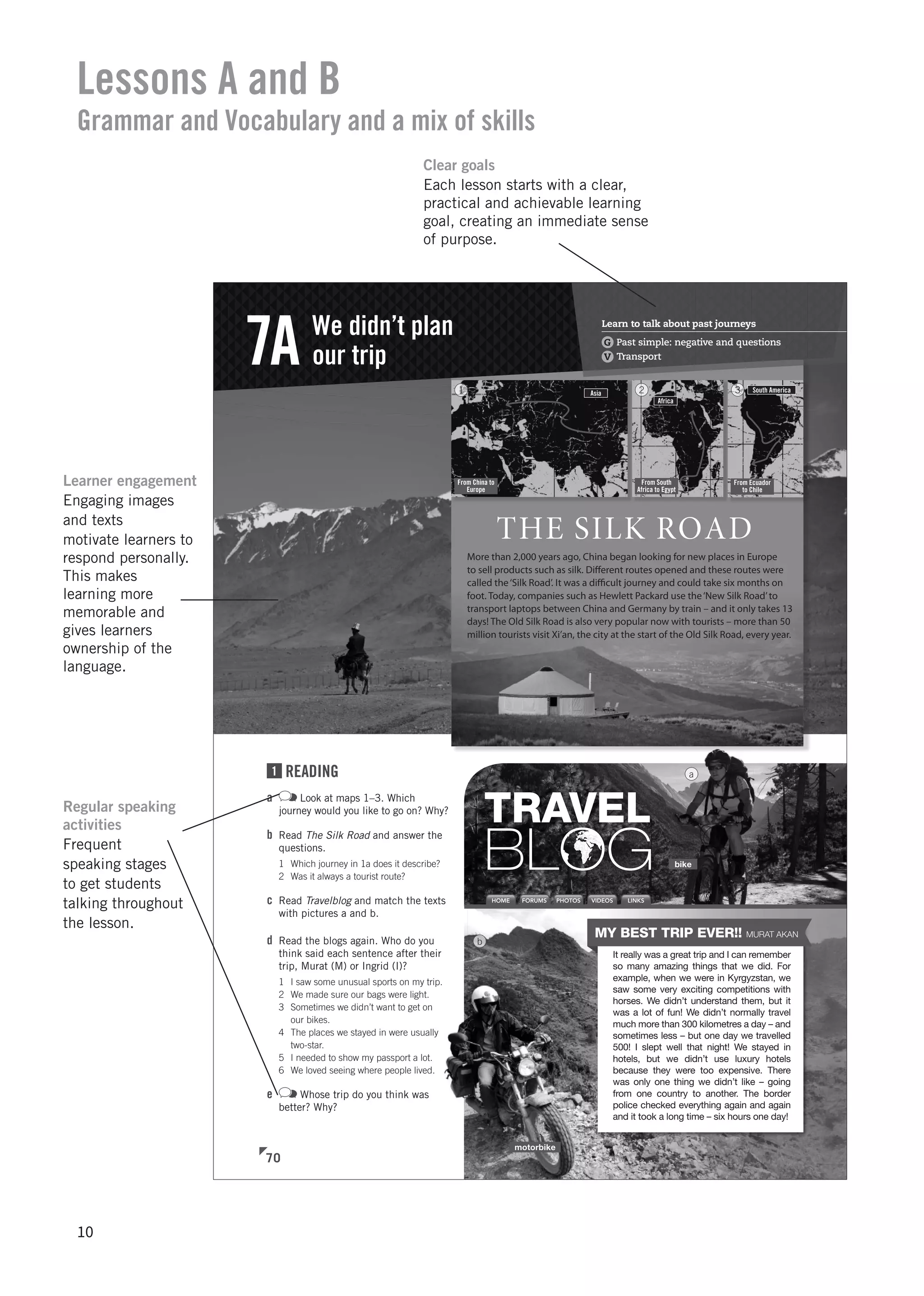
  • 9.
    Introduction Learning Oriented Assessment Whatis Learning Oriented Assessment (LOA)? As a teacher, you’ll naturally be interested in your learners’ progress. Every time they step into your classroom, you’ll note if a learner is struggling with a language concept, is unable to read at a natural rate, or can understand a new grammar point but still can’t produce it in a practice activity. This is often an intuitive and spontaneous process. By the end of a course or a cycle of learning, you’ll know far more about a learner’s ability than an end-of-course test alone can show. An LOA approach to teaching and learning brings together this ongoing informal evaluation with more formal or structured assessment such as end-of-unit or end-of-course tests. Ideally supported by a learner management system (LMS), LOA is an approach that allows you to pull together all this information and knowledge in order to understand learners’ achievements and progress and to identify and address their needs in a targeted and informed way. A range of insights into learners and their progress feeds into total assessment of the learner. It also allows you to use all of this information not just to produce a report on a learner’s level of competence but also to plan and inform future learning. For more information about LOA, go to cambridgeenglish.org/loa How does Cambridge English Empower support LOA? Cambridge English Empower supports LOA both informally and formally, and both inside and outside the classroom: 1 Assessment that informs teaching and learning • Reliable tests for both formative and summative assessment (Unit Progress Tests, Unit Speaking Tests, and skills-based Competency Tests) • Targeted extra practice online via the Cambridge Learning Management System (CLMS) to address areas in which the tests show that learners need more support • Opportunities to do the test again and improve performance • Clear record of learner performance through the CLMS 2 LOA classroom support • Clear learning objectives – and activities that clearly build towards those objectives • Activities that offer opportunities for learner reflection and peer feedback • A range of tips for teachers on how to incorporate LOA techniques, including informal assessment, into your lessons as part of normal classroom practice 1 Assessment that informs teaching and learning Cambridge English Empower offers three types of tests written and developed by teams of Cambridge English exam writers. All tests in the course have been trialled on thousands of candidates to ensure that test items are appropriate to the level. Cambridge English tests are underpinned by research and evaluation and by continuous monitoring and statistical analysis of performance of test questions. Cambridge English Empower tests are designed around the following essential principles: Validity – tests are authentic tests of real-life English and test the language covered in the coursebook Reliability – tasks selected are consistent and fair Impact – tests have a positive effect on teaching and learning in and outside the classroom Practicality – tests are user-friendly and practical for teachers and students Unit Progress Tests The course provides an online Unit Progress Test at the end of every unit, testing the target grammar, vocabulary and functional language from the unit. The teacher and learner are provided with a score for each language area that has been tested, identifying the areas where the learner has either encountered difficulties and needs more support, or has mastered well. According to their score in each section of the test, the learner is directed either to extension activities or to a sequence of practice activities appropriate to their level, focusing on the language points where they need most support. This means that learners can focus their time and effort on activities that will really benefit them. They then have the opportunity to retake the Unit Progress Test – questions they got right first time will still be filled in, meaning that they can focus on those with which they had difficulty first-time round. Unit Speaking Tests Cambridge English Empower provides a comprehensive approach to speaking skills. For every unit, there is an online Unit Speaking Test which offers learners the opportunity to test and practise a range of aspects of pronunciation and fluency. These tests use innovative voice-recognition software and allow the learner to listen to model utterances, record themselves, and re-record if they wish before submitting. Competency Tests Cambridge English Empower offers mid-course and end-of- course Competency Tests. These skills-based tests cover Reading, Writing, Listening and Speaking, and are calibrated to the Common European Framework of Reference (CEFR). They provide teachers and learners with a reliable indication of level, as well as a record of their progress – a CEFR report is 7
  • 10.
    generated for eachlearner, showing their performance within the relevant CEFR level (both overall and for each of the skills). The Cambridge Learning Management System (CLMS) provides teachers and learners with a clear and comprehensive record of each learner’s progress during the course, including all test results and also their scores relating to the online practice activities that follow the tests – helping teachers and learners to recognise achievement and identify further learning needs. Within the CLMS, a number of different web tools, including message boards, forums and e-portfolios, provide opportunities for teachers and learners to communicate outside of class, and for learners to do additional practice. These tools can also be used by teachers to give more specific feedback based on the teacher’s informal evaluation during lessons. The CLMS helps teachers to systematically collect and record evidence of learning and performance and in doing so demonstrates to teachers and learners how much progress has been made over time. 2 LOA classroom support Clear objectives An LOA approach encourages learners to reflect and self- assess. In order to do this, learning objectives must be clear. In Cambridge English Empower, each unit begins with a clear set of ‘can do’ objectives so that learners feel an immediate sense of purpose. Each lesson starts with a clear ‘Learn to …’ goal, and the activities all contribute towards this goal, leading to a significant practical outcome at the end of the lesson. At the end of each unit, there is a ‘Review your progress’ feature that encourages learners to reflect on their success, relative to the ‘can do’ objectives at the start of the unit. Within the lessons, there are also opportunities for reflection, collaborative learning, and peer feedback. Teaching techniques monitoring eliciting concept checking drilling providing feedback Core aims • checking learners are on task • checking learners’ progress • making yourself available to learners who are having problems • checking what learners know about a topic in order to generate interest • checking that learners understand the use and meaning of new language • providing highly controlled practice of new language • finding out what ideas learners generated when working on a task • praising learners’ performance of a task • indicating where improvement can be made LOA aims • listening to learners’ oral language, and checking learners’ written language, in order to: » diagnose potential needs » check if they can use new language correctly in context • finding out if learners already know a vocabulary or grammar item • adapting the lesson to take into account students’ individual starting points and interests • checking what could be a potential problem with the use and meaning of new language for your learners • anticipating and preparing for challenges in understanding new language, both for the whole class and for individuals • checking that learners have consolidated the form of new language • checking intelligible pronunciation of new language • asking learners how well they feel they performed a task • giving feedback to learners on specific language strengths and needs • fostering ‘learning how to learn’ skills LOA classroom tips for teachers In a typical lesson you’re likely to use some or perhaps all of the following teaching techniques: • monitor learners during learner-centred stages of the lesson • elicit information and language • concept check new language • drill new vocabulary or grammar • provide feedback after learners have worked on a task The table below summarises core and LOA-specific aims for each of the above techniques. All these familiar teaching techniques are a natural fit for the kind of methodology that informally supports LOA. An LOA approach will emphasise those parts of your thinking that involve forming evaluations or judgments about learners’ performance (and therefore what to do next to better assist the learner). The ‘LOA teacher’ is constantly thinking things like: • Have they understood that word? • How well are they pronouncing that phrase? • Were they able to use that language in a freer activity? • How many answers did they get right? • How well did they understand that listening text? • How many errors did I hear? • And what does that mean for the next step in the learning process? The Cambridge English Empower Teacher’s Book provides tips on how to use a number of these techniques within each lesson. This will help teachers to consider their learners with more of an evaluative eye. Of course it also helps learners if teachers share their assessment with them and ensure they get plenty of feedback. It’s important that teachers make sure feedback is well-balanced, so it helps learners to know what they are doing well in addition to what needs a little more work. 8
  • 11.
    Unit overview Journeys UNIT 7 GETTINGSTARTED a Look at the picture and answer the questions. 1 This man is on a journey. What country do you think he’s in? Why? 2 What do you think the man and women talk about? • directions • the weather • personal information • shopping • their families • something else 3 Think of their questions and answers. b In pairs, ask and answer the questions. 1 Where would you like to travel to? 2 Would you like to travel by …? • car • boat • plane • something else 3 What would you like to see and do there? ■ Talk about past journeys ■ Talk about what you like and dislike about transport ■ Say excuse me and sorry ■ Write an email about yourself 69 CAN DO OBJECTIVES Next morning, Richard a got another email from the woman called Blanca. It said, b Get $3,000 from your bank, put it in a black bag, and then c get the bus to Morton Street. When you d get there walk towards the church and leave the bag on the steps. Do as I say or things could e get very bad for you.’ Richard knew this wasn’t a joke – in fact, it was very serious. 1 GRAMMAR a Complete the text with the past simple positive or negative form of the verbs in brackets. Paul 1 (call) a taxi, but it 2 (come) so he 3 (take) a bus to the airport. The plane 4 (be) late, so he 5 (wait) for three hours at the airport. The weather 6 (be) bad so the plane 7 (land) in a different city. He 8 (arrive) at his hotel at 10 pm. The receptionist 9 (ask) him, ‘Good journey?’ ‘No, I 10 (have) a good journey. It was terrible.’ b Write questions about a trip to Mumbai to match the answers. 1 When? I went there last November. When did you go there? 2 How? I travelled by Air India from London. 3 a good time? Yes, I had a very nice time. 4 Where? I stayed in a hotel by the sea. 5 How long? I only stayed a week. Then I went to Delhi. 6 hot? Yes, it was about 35°. c Work in pairs. Choose a place you’ve visited and ask and answer the questions in 1b. Ask more questions. d Write sentences about what Clare likes doing. Use the words in the box and a verb + -ing. loves likes doesn’t mind doesn’t like hates 1 ‘Chinese food is fantastic!’ Clare loves eating Chinese food. 2 ‘I never listen to Mozart.’ 3 ‘I sometimes take the metro. It’s OK but it’s not great.’ 4 ‘I don’t want to watch the football – it’s boring.’ 5 ‘I speak good French – it’s a nice language.’ 2 VOCABULARY a Complete the transport words. 1 t r a m 2 tr i 3 sh 4 h i ter 5 c ch 6 sc ter b Change the adjectives into their opposites so that the sentences are correct. 1 The tram was almost full. There were only three people on it. empty 2 I don’t like the metro because the stations are so clean. 3 I couldn’t sleep on the train. It was so comfortable. 4 The new train to the airport is very slow – only 15 minutes. 5 He’s a very safe driver. He never looks in the mirror. 6 $100 for a ten-minute journey! That’s very cheap! 1 What do you think happened next? 2 Match the word get in the story (a–e) to meanings 1–5 in 3b. d Match the phrases in the box with a similar phrase in 1–5 below. get a phone call get a taxi get an email get old get better get to the airport get a glass of water get the train get to school 1 get angry 2 get a letter 3 get the bus 4 get to work 5 get your coat e Write four sentences about your life. Use phrases from 3d. I never get a taxi to the airport. f Tell a partner your sentences in 3e. How similar are you? Review and extension a Match questions 1–5 with answers a–e. 1 Is Bella still single? 2 What’s the best way to go to the city centre? 3 Have a good journey. 4 Do you want milk in your coffee? 5 How’s Susie? a Thanks. I’ll phone you when I get home. b Yes, please. Could you get some from the fridge? c She’s fine. I got an email from her last night. d No. She got married last year. e You can get the bus. b Match the word get in a–e in 3a with meanings 1–5 below. 1 become 2 receive 3 travel on 4 arrive 5 take or bring c Read the story and answer the questions. 3 WORDPOWER get UNIT 7 I CAN … Talk about past travel journeys Talk about what you like and dislike about transport Say excuse me and sorry Write an email about yourself. How well did you do in this unit? Write 3, 2, or 1 for each objective. 3 = very well 2 = well 1 = not so well REVIEW YOUR PROGRESS Getting Started page • clear learning objectives to give an immediate sense of purpose • striking and unusual images to arouse curiosity • activities that promote emotional engagement and a personal response Lesson C • functional language in common everyday situations • language is presented through video filmed in the real world For extra input and practice, every unit includes illustrated Grammar Focus and Vocabulary Focus sections at the back of the book. Introduction Review and Extension • extra practice of grammar and vocabulary • Wordpower vocabulary extension • ‘Review your progress’ to reflect on success Lesson A and Lesson B • input and practice of core grammar and vocabulary, plus a mix of skills Lesson D • highly communicative integrated skills lesson • special focus on writing skills • recycling of core language from the A, B and C lessons Unit Progress Test • covering grammar, vocabulary and functional language Also available: • Speaking Test for every unit • mid-course and end-of-course competency tests 9
  • 12.
    THE SILK ROAD Morethan 2,000 years ago, China began looking for new places in Europe to sell products such as silk. Different routes opened and these routes were called the‘Silk Road’. It was a difficult journey and could take six months on foot. Today, companies such as Hewlett Packard use the‘New Silk Road’to transport laptops between China and Germany by train – and it only takes 13 days! The Old Silk Road is also very popular now with tourists – more than 50 million tourists visit Xi’an, the city at the start of the Old Silk Road, every year. b bike motorbike Asia From China to Europe 1 Africa From South Africa to Egypt 2 South America From Ecuador to Chile 3 HOME FORUMS LINKSPHOTOS VIDEOS TRAVEL BLOG It really was a great trip and I can remember so many amazing things that we did. For example, when we were in Kyrgyzstan, we saw some very exciting competitions with horses. We didn’t understand them, but it was a lot of fun! We didn’t normally travel much more than 300 kilometres a day – and sometimes less – but one day we travelled 500! I slept well that night! We stayed in hotels, but we didn’t use luxury hotels because they were too expensive. There was only one thing we didn’t like – going from one country to another. The border police checked everything again and again and it took a long time – six hours one day! MY BEST TRIP EVER!! MURAT AKAN Learn to talk about past journeys G Past simple: negative and questions V Transport We didn’t plan our trip7A 1 READING a Look at maps 1–3. Which journey would you like to go on? Why? b Read The Silk Road and answer the questions. 1 Which journey in 1a does it describe? 2 Was it always a tourist route? c Read Travelblog and match the texts with pictures a and b. d Read the blogs again. Who do you think said each sentence after their trip, Murat (M) or Ingrid (I)? 1 I saw some unusual sports on my trip. 2 We made sure our bags were light. 3 Sometimes we didn’t want to get on our bikes. 4 The places we stayed in were usually two-star. 5 I needed to show my passport a lot. 6 We loved seeing where people lived. e Whose trip do you think was better? Why? 70 a Lessons A and B Grammar and Vocabulary and a mix of skills Clear goals Each lesson starts with a clear, practical and achievable learning goal, creating an immediate sense of purpose. Learner engagement Engaging images and texts motivate learners to respond personally. This makes learning more memorable and gives learners ownership of the language. Regular speaking activities Frequent speaking stages to get students talking throughout the lesson. 10
  • 13.
    UNIT 7 6 78 4 5 1 32 This was my dream holiday!! It wasn’t a fast way to travel, but there was a lot to see and a lot of time to think! Before we left, we packed our bags very carefully because we didn’t want to take anything that we didn’t need (too heavy!). Some days we travelled about 80 kilometres, but other days – when we were tired – we didn’t go very far at all. And sometimes, when we were very tired, we didn’t want to cycle and we got lifts on trucks. We didn’t plan our trip very carefully, and we often changed our plans. We slept in tents next to the road and watched the stars for hours. The best thing about travelling this way is that you can meet the people who live there. They were interested in us and wanted to find out about our trip. We even saw inside a traditional home – a yurt – and had dinner with the family! MY DREAM JOURNEY ON THE SILK ROAD INGRID LEIDENROTH 71 4 LISTENING a You can also travel along the Silk Road by bus or train. Which would you prefer to do? b 2.73 Klara talks to her friend Hans about the Silk Road. How did Hans travel? c 2.73 Listen again and underline the correct answers. 1 Country started in: Turkey / Russia / China 2 Cities visited: Samarkand / Tashkent / Kabul / Almaty 3 Change trains: yes / no 4 Price: $2,500 / $25,000 d 2.73 Listen again. Are the sentences true or false? 1 Hans thinks the train is the best way to travel on the Silk Road. 2 He liked visiting the cities in Central Asia. 3 He didn’t like the train very much. 4 He didn’t think the trip was too expensive. 5 GRAMMAR Past simple: questions a 2.74 Complete these questions from Klara and Hans’ conversation. Listen and check. 1 How you travel? 2 Where you catch the train from? 3 you go through Central Asia? b Look at the questions in 5a and complete the rule. To make questions in the past simple, we use: + subject + infinitive c 2.74 Pronunciation Listen to the questions in 5a again. Notice the pronunciation of did you in each question. Can you hear both words clearly? d Now go to Grammar Focus 7A on p.148 e 2.76 Klara went on the Silk Road and told another friend about her journey. Complete their conversation using the verbs in brackets. Then listen and check. PAUL How 1 (be) your journey along the Silk Road? KLARA It 2 (be) amazing – incredible! PAUL How 3 you (travel)? KLARA We 4 (cycle), but sometimes we 5 (take) trains or 6 (travel) by coach. PAUL How many countries 7 you (visit)? KLARA Most countries in Central Asia, but we 8 (not go) to Tajikistan. PAUL What 9 you (enjoy) most? KLARA Meeting the people – they 10 (be) so friendly. 6 SPEAKING a Communication 7A Student A go to p.130. Student B go to p.134. b Would you still like to go on the journey you chose in 1a? Why / Why not? 2 VOCABULARY Transport a Match the words in the box with pictures 1–8. aeroplane (plane) scooter tram ship helicopter coach ferry train b Which kinds of transport: • do people often use to go on holiday? • do people normally use to get to work or school? • are unusual for people to use in your country? • do you normally use? c Now go to Vocabulary Focus 7A on p.166 3 GRAMMAR Past simple: negative a Complete the sentences from Ingrid’s blog. 1 We go very far at all. 2 We didn’t to take anything that we didn’t . b Look at the sentences in 3a and complete the rule. To make the past simple negative, we use: + the infinitive Manageable learning The syllabus is informed by English Profile and the Cambridge English Corpus. Students will learn the most relevant and useful language, at the appropriate point in their learning journey. The target language is benchmarked to the CEFR. Rich in practice Clear signposts to Grammar Focus and Vocabulary Focus sections for extra support and practice. Spoken outcome Each A and B lesson ends with a practical spoken outcome so learners can use language immediately. Introduction ‘Teach off the page’ Straightforward approach and clear lesson flow for minimum preparation time. 11
  • 14.
    e 2.83 Watchor listen to Part 2 and check your answers in 1d. f 2.83 Watch or listen to Part 2 again. Underline the correct answers. 1 Annie / Leo booked a seat. 2 Annie / Leo didn’t check the seat numbers. 3 Annie / Leo takes a different seat. Everyday English Excuse me, please7C Learn to say excuse me and sorry S Showing interest P Emphasising what we say 1 LISTENING a Ask and answer the questions. 1 Do you like going away for the weekend? 2 Where do you like going? 3 What do you like doing there? 4 Do you like going alone or with family and friends? b Answer the questions about picture a. 1 Where’s Annie? 2 What do you think happened with Annie and the woman? 3 What do you think: a Annie says? b the woman says? c 2.82 Watch or listen to Part 1 and check your answers in 1b. d Answer the questions about picture b. 1 Where are Annie and Leo? 2 How do you think Annie and Leo feel? Why? 3 What do you think happens next? a Leo gets off the train. b Leo gives Annie his seat. c Leo helps Annie put her bag on the shelf. 74 a b 2 USEFUL LANGUAGE Saying excuse me and sorry a Match 1–2 with meanings a–b. 1 Excuse me, please. a She wants to say there’s a problem. 2 Excuse me, but … b She wants to ask someone to move. b 2.84 Pronunciation Listen to 1 and 2 in 2a. Notice how the tone goes down in 1 but goes down and then up in 2. c Look at 1 and 2 in 2a. What do you say when … ? a you want to tell your teacher you don’t understand something b you want to leave the room but another student is in front of the door d Very, really and so can all be added to the expression I’m sorry. Do you say the words before or after sorry? e 2.85 Match 1–5 with a–e. Listen and check. 1 I’m so sorry I walked into you. 2 I’m really sorry I’m late. 3 I’m sorry I didn’t answer your call. 4 I’m sorry I didn’t come. 5 I’m very sorry I broke your cup. a I didn’t feel well. b I was in a meeting. c I missed my bus. d My hands were wet. e I didn’t see you. f Tick (✓) the correct replies when people say they’re sorry. 1 That’s all right. 2 That’s OK. 3 No problem. 4 Excuse me, please. 5 It doesn’t matter. 6 Don’t worry. g 2.86 Put sentences a–f in order to make two short conversations. Listen and check. a A No problem. They all look the same. b 1 A Excuse me, but I think that’s my coat. c B Is it? I’m so sorry. I took the wrong one. d A Don’t worry. The seat numbers are hard to read. e B Oh dear. I’m very sorry. I thought this was number 35. f 1 A Excuse me, but I think this is my seat. h In pairs, practise the two conversations in 2g. I’m sorry I took your seat. Lesson C Prepares learners for effective real-world spoken communication Everyday English Thorough coverage of functional language for common everyday situations, helping learners to communicate effectively in the real world. Real-world video Language is show- cased through high-quality video filmed in the real world, which shows language clearly and in context. Comprehensive approach to speaking skills A unique combination of language input, pronunciation and speaking strategies offers a comprehensive approach to speaking skills. 12
  • 15.
    UNIT 7 5 SPEAKING aWork in pairs. Use the dialogue map to make a conversation in a café. Take turns being A and B. b In pairs, practise conversations like the one in 5a but with different reasons for being late. Take turns being A and B. A B 4 CONVERSATION SKILLS Showing interest a 2.88 Watch or listen to Part 3. Are the sentences true or false? 1 Annie and Leo are both on their way to Bristol. 2 Annie is visiting a friend in Bristol. 3 Leo went to university in Reading. b Look at these parts of the conversation from Part 3. Two words aren’t correct. Replace them with the words in the box. Great! Really? ANNIE Are you on your way to Bristol? LEO No, Reading. I went to university there. ANNIE Right. ANNIE My mum lives there. I go to see her every month. LEO Oh. 2.88 Listen again and check your answers. c Why do they say Great and Really? 1 to say something is true 2 to show they are interested d 2.89 Pronunciation Listen to the sound of the marked letters and answer the questions. Great! Really? 1 Do the letters make the same sound in both words? 2 Are the sounds long or short? 3 PRONUNCIATION Emphasising what we say a 2.87 Listen to the sentences in 2e. Notice the stress on the underlined words. 1 I’m so sorry I walked into you. 2 I’m really sorry I’m late. 3 I’m sorry I didn’t answer. 4 I’m sorry I didn’t come. 5 I’m very sorry I broke your cup. b Why are so, very and really stressed? Choose the best answer. 1 We don’t want the other person to hear sorry clearly. 2 We want to sound more sorry. 3 We want to speak loudly. c Practise saying the sentences in 3a. Unit Progress Test CHECK YOUR PROGRESS You can now do the Unit Progress Test. 75 Comprehensive approach to speaking skills A unique combination of language input, pronunciation and speaking strategies offers a comprehensive approach to speaking skills. Unit Progress Test Learners are now ready to do the Unit Progress Test, developed by experts at Cambridge English Language Assessment. Support for learners Tasks are scaffolded to facilitate success. Spoken outcome Each C lesson ends with a practical spoken outcome. Introduction 13
  • 16.
    76 1 SPEAKING ANDLISTENING a You want to stay with a homestay family. What kind of family would you like to stay with? Tick (✓) three ideas and tell a partner. 1 quiet and friendly 2 friendly and fun 3 with young children 4 with no children 5 lives near a bus/train station 6 lives in the city centre 7 has wi-fi 8 has no TV b Read the profiles of two Sydney homestay families. Which family would you like to stay with? Why? c 2.90 Ahmed talks to an Australian friend, Finn, about which family to stay with in Sydney. Does Finn tell Ahmed which family to choose? d 2.90 Listen again. Tick (✓) the activities that are true for Ahmed. 1 enjoys gardening 2 likes watching sport 3 likes listening to music 4 wants to play rugby 5 loves going to the beach 6 wants to study hard 7 likes playing football 8 wants to have fun e Which family is good for Ahmed? Why? I think the Philips family are good because they like doing sports. H O M E S T A Y F A M I L Y P R O F I L E NAME Joe and Annie Philips CHILDREN Kate (6) and Jacob (4) PETS no pets LIKES swimming, surfing, going to the cinema, listening to music LOCATION near a train station NAME Peter and Sharon Conway CHILDREN away from home PETS Sam, our old cat LIKES gardening, going for walks, watching all sports LOCATION near city centre – you can walk to school Skills for Writing It really is hard to choose7D 76 Learn to write an email about yourself W Linking ideas with after, when and while Lesson D Integrated skills with a special focus on writing Skills for writing The D lessons are highly communicative and cover all four skills, with a special focus on writing. They also recycle and consolidate the core language from the A, B and C lessons. Personal response Frequent opportunities for personal response make learning more memorable. Receptive skills devlopment Clearly-staged tasks practise and develop listening and reading skills while supporting learners’ understanding of texts. 14
  • 17.
    I’d like to goto … I like warm places. They say the people are friendly. 2 READING a Ahmed decided to stay with the Conways. Read his email to them. Tick (✓) the main reason he writes to them. 1 to ask about their house 2 to tell them about all the sports he likes 3 to tell them about himself 4 to explain how much he wants to study b Read the email again. Number the information in the order you find it. his future plans his hobbies his family’s jobs his hometown Dubai Dear Mr and Mrs Conway My name is Ahmed Al Mansouri and I come from Dubai in the United Arab Emirates. Thank you for offering to be my homestay family when I’m in Sydney. I am 23 years old and study biology at university. I live with my family in Dubai. My father is a businessman and my mother is a doctor. I’ve got one brother and one sister. They’re university students too. In my free time, I like playing football (I think you say ‘soccer’ in Australia!) and meeting my friends. I like watching different kinds of sports with them. While I’m in Sydney, I really want to study hard and improve my English because I want to become a marine biologist after I finish university. I’d really like to work in a country like Australia. I’m looking forward to meeting you when I arrive. Best wishes Ahmed Dubai c Plan an email about yourself to a homestay family in that country. Make notes about: • your age • study / job • free-time interests • family • what you’d like to do in that country d Write your email. Tick (✓) each box. Start the letter with Dear Say thank you Say who you are Talk about study / work / free time Talk about your family Say what you want to do in the country Include I’m looking forward … Finish the letter with Best wishes Use after, when and while to link your ideas e Swap emails with another student and check the ideas in 4d. UNIT 7 77 3 WRITING SKILLS Linking ideas with after, when and while a Underline the word in each sentence that’s different from Ahmed’s email. 1 Thank you for offering to be my homestay family while I’m in Sydney. 2 I want to become a marine biologist when I finish university. 3 I’m looking forward to meeting you after I arrive. 4 When I’m in Sydney, I really want to study hard. b Look at the sentences in 3a and complete the rules with the words in the box. after beginning while 1 We use when and to join two activities that happen at the same time. 2 We use when and to join two activities that happen at different times. 3 If the linking word is at the of the sentence, we use a comma ( , ) between the two parts. c Underline the correct words. There is more than one possible answer. 1 After / When / While I finish my English course, I’d like to go to Canada for a holiday. 2 I’d like to go skiing in the mountains after / when / while I’m on holiday. 3 I often play basketball with my colleagues after / when / while I finish work. 4 After / When / While I watch a game of football, I usually want to play a game myself. 5 My English improved after / when / while I was in Sydney. 4 SPEAKING AND WRITING a Make a list of English-speaking countries you know. b Which country in 4a would you like to visit? Why? Written outcome Each D lesson ends with a practical written outcome, so learners can put new language into practice straight away. Staged for success Careful staging and scaffolding generates successful outcomes. Introduction Also in every unit: • Review and Extension page • Grammar Focus • Vocabulary Focus • Communication Plus Comprehensive approach to writing skills Clear focus on key aspects of writing helps develop effective real-world writing skills. Clear models for writing Clear model texts are provided, on which students can base their own writing. 15
  • 18.
    16 Syllabus Lesson and objectiveGrammar Vocabulary Pronunciation Everyday English Welcome! (Teacher’s Notes p.20) Possessive adjectives; a and an; Plurals; Question words Numbers; The alphabet; Colours; Classroom objects and instructions Noticing word stress Saying hello and introducing people; Spelling words Unit 1 People (Teacher’s Notes p.24) Getting started Talk about meeting people from other countries 1A Talk about where you’re from be: positive and negative Countries and nationalities Syllables and word stress 1B Talk about people you know be: questions and short answers Adjectives Sound and spelling: /k/; Sound and spelling: long and short o 1C Ask for and give information Tones for checking; Consonant groups Asking for and giving information 1D Write an online profile Review and extension More practice WORDPOWER from Unit 2 Work and study (Teacher’s Notes p.36) Getting started Talk about what kind of work you find interesting 2A Talk about jobs Present simple: positive and negative Jobs Word stress; -s endings 2B Talk about study habits Present simple: questions and short answers Studying; Time do you 2C Ask for things and reply Sound and spelling: ou Asking for things and replying 2D Complete a form Review and extension More practice WORDPOWER work Unit 3 Daily life (Teacher’s Notes p.49) Getting started Talk about what you do every day 3A Talk about routines Position of adverbs of frequency Time expressions; Common verbs Sentence stress; Sound and spelling: /aɪ/ and /eɪ/ 3B Talk about technology in your life have got Technology Word stress; Main stress and tone 3C Make arrangements Main stress; Thinking time: Mm Making arrangements 3D Write an informal invitation Review and extension More practice WORDPOWER Prepositions of time Unit 4 Food (Teacher’s Notes p.61) Getting started Talk about eating with your family 4A Talk about the food you want Countable and uncountable nouns; a / an, some, any Food Sound and spelling: ea Sound and spelling: /k/ and /g/ 4B Talk about the food you eat every day Quantifiers: much, many, a lot of Talking about food Sentence stress 4C Arrive and order a meal at a restaurant Word groups Arriving at a restaurant; Ordering a meal in a restaurant 4D Write a blog about something you know how to do Review and extension More practice WORDPOWER like Unit 5 Places (Teacher’s Notes p.74) Getting started Talk about what a good home is 5A Talk about towns there is / there are Places in a city there’s; Sound and spelling: /b/ and /p/ 5B Describe rooms and furniture in your house Possessive pronouns and possessive ‘s Furniture Sound and spelling: vowels before r 5C Ask for and give directions Sentence stress Asking for and giving directions 5D Write a description of your neighbourhood Review and extension More practice WORDPOWER Prepositions of place Unit 6 Family (Teacher’s Notes p.85) Getting started Talk about a family you know 6A Talk about your family and your family history Past simple: be Family; Years and dates Sound and spelling: /ʌ/; Sentence stress 6B Talk about past activities and hobbies Past simple: positive Past simple irregular verbs -ed endings; Sound and spelling: ea 6C Leave a voicemail message and ask for someone on the phone Sound and spelling: a Leaving a voicemail message 6D Write a life story Review and extension More practice WORDPOWER go
  • 19.
    Contents 17 Listening and VideoReading Speaking Writing Five conversations Saying hello and introducing people Names and addresses A conversation about where you’re from Where you’re from Sentences about you A conversation about people you know Facebook entries about people you know People you know Notes about people you know At the gym reception Asking for and giving information; Checking understanding Unit Progress Test First day of an English course Online profiles Using social networking sites An online profile; Capital letters and punctuation A conversation about a TV programme An article about Ice Road Truckers Jobs Sentences about jobs A survey about study habits An online forum about study habits Studying; Study habits Questions about study habits Ordering in a café; Asking for help Asking for things and replying; Reacting to news Unit Progress Test Three monologues about studying English; A teacher addressing her class A competition entry form Studying English A form; Spelling A conversation about family routines An article about an Indian family Daily routines; Spending time with your family; Routines you share with others A dialogue; Notes about routines you share with other people Three conversations about gadgets An interview about using the Internet Using the Internet; Technology in your life Sentences about gadgets you’ve got; Questions about gadgets you’ve got Making arrangements to go out Making arrangements; Thinking about what you want to say Unit Progress Test A monologue about someone’s family Two informal emails Your family An informal email invitation; Inviting and replying A conversation about buying food An article about World markets Buying food; The food you like and don’t like A conversation about cooking A factfile about Heston Blumenthal; Two personal emails Cooking programmes; Cooking; The food you eat Questions about food At a restaurant Arriving at a restaurant; Ordering a meal in a restaurant; Changing what you say Unit Progress Test Four monologues about cooking A cooking blog Cooking; A good cook you know; Cooking for others A blog about something you know how to do; Making the order clear An article about an unusual town Places you like; Describing a picture of a town; What there is in a town Questions and sentences about what there is in a town A conversation about a new home A newspaper advertisement Your home and furniture Sentences about your home On the street Giving and following directions; Checking what other people say Unit Progress Test Three monologues about neighbourhoods A website about neighbourhoods around the world What makes a good neighbourhood; Your neighbourhood A description of your neighbourhood; Linking ideas with and, but and so A conversation about a family tree Your family Notes about your family A conversation about childhood hobbies An article about Steve Jobs Steve Jobs; What you did at different times; A childhood hobby Notes about a childhood hobby On the phone Leaving a voicemail message; Asking for someone on the phone; Asking someone to wait Unit Progress Test A monologue about someone’s life story A life story Important years in your life A life story about someone in your family; Linking ideas in the past
  • 20.
    18 Lesson and objectiveGrammar Vocabulary Pronunciation Everyday English Unit 7 Journeys (Teacher’s Notes p.98) Getting started Talk about where you’d like to travel to 7A Talk about past journeys Past simple: negative and questions Transport did you; Sound and spelling: /ɔː/ 7B Talk about what you like and dislike about transport love / like / don’t mind / hate + verb + -ing Transport adjectives Word stress 7C Say excuse me and sorry Tones for saying excuse me; Emphasising what we say Saying excuse me and sorry 7D Write an email about yourself Review and extension More practice WORDPOWER get Unit 8 Fit and healthy (Teacher’s Notes p.111) Getting started Talk about sport and exercise for other people 8A Talk about past and present abilities; Talk about sport and exercise can / can’t; could / couldn’t for ability Sport and exercise Can, can’t, could and couldn’t; Sound and spelling: /uː/ and /ʊ/ 8B Talk about the body and getting fit have to / don’t have to Parts of the body; Appearance have to; Word stress 8C Talk about health and how you feel Joining words Talking about health and how you feel 8D Write an article Review and extension More practice WORDPOWER tell / say Unit 9 Clothes and shopping (Teacher’s Notes p.123) Getting started Talk about shopping in your town or city 9A Say where you are and what you’re doing Present continuous Shopping; Money and prices Word stress in compound nouns; Sentence stress 9B Talk about the clothes you wear at different times Present simple or present continuous Clothes Sound and spelling: o; Syllables 9C Shop for clothes Joining words Choosing clothes; Paying for clothes 9D Write a thank-you email Review and extension More practice WORDPOWER time Unit 10 Communication (Teacher’s Notes p.136) Getting started Talk about how you use your mobile phone 10A Compare and talk about the things you have Comparative adjectives IT collocations Sentence stress 10B Talk about languages Superlative adjectives High numbers Word stress; Main stress 10C Ask for help Main stress and tone Asking for help 10D Write a post expressing an opinion Review and extension More practice WORDPOWER most Unit 11 Entertainment (Teacher’s Notes p.148) Getting started Talk about what you enjoyed when you were a child 11A Ask and answer about entertainment experiences Present perfect Irregular past participles Sound and spelling: /ɜː/ 11B Talk about events you’ve been to Present perfect or past simple Music Syllables 11C Ask for and express opinions about things you’ve seen Main stress and tone Asking for and expressing opinions 11D Write a review Review and extension More practice WORDPOWER Multi-word verbs Unit 12 Travel (Teacher’s Notes p.160) Getting started Talk about photographs 12A Talk about holiday plans going to Geography Syllables and word stress Sentence stress 12B Give advice about travelling should / shouldn’t Travel collocations Should / Shouldn’t 12C Use language for travel and tourism Tones for showing surprise; Consonant groups Checking in at a hotel; Asking for tourist information 12D Write an email with travel advice Review and extension More practice WORDPOWER take Communication Plus p.129 Grammar Focus p.136 Vocabulary Focus p.160
  • 21.
    Contents 19 Listening and VideoReading Speaking Writing A conversation about travelling on the Silk Road An article about the Silk Road; Two blogs about travelling on the Silk Road Transport people use; Past journeys A conversation about transport in Moscow A webpage about metros around the world; Four reviews of metros Metros you know; Disagreeing about transport; Transport you use On the train Saying excuse me and sorry; Showing interest Unit Progress Test A conversation about choosing a homestay family Two online profiles; An email about Ahmed Homestay families; English-speaking countries you’d like to visit An email about yourself; Linking ideas with after, when, and while A podcast about how the Olympics can change a city An article about Paralympian Jonnie Peacock Famous sport events and people; The Olympics; Present and past abilities Two monologues about exercise An article about High Intensity Training Getting fit; The things people have to do; Yoga; Parts of the body Sentences and notes about what people have to do At the gym Health and how you feel; Expressing sympathy Unit Progress Test A conversation about a free-time activity An email about a company blog; A blog article about a free-time activity Free-time activities in your country; Your free-time activities An article; Linking ideas with however; Adverbs of manner Four phone conversations about meeting Meeting friends in town; Saying where you are and what you’re doing Sentences about what you are doing Two phone conversations about what people are wearing Two blogs about living abroad; Text messages about what people are doing Shopping; Festivals in your country; The clothes you wear Notes about what someone you know is wearing Shopping for clothes Choosing clothes; Paying for clothes; Saying something nice Unit Progress Test Four monologues about giving presents Two thank-you emails The presents you’d like; Giving presents and thanking people for them A thank-you email; Writing formal and informal emails A podcast about smartphones and tablets A webpage about smartphones and tablets Smartphones and tablets; Using the Web; Comparing two similar things Notes about two similar things A radio programme about languages A blog about languages Languages; Blogs and language websites Asking for help Asking for help; Checking instructions Unit Progress Test Three monologues about text messages Four text messages; Six posts on an online discussion board Sending messages A post expressing an opinion; Linking ideas with also, too and as well A conversation about a magazine quiz Three fact files about actresses; A magazine quiz about actresses; An article about actresses Famous Australians A conversation about music in Buenos Aires An article about Buenos Aires Buenos Aires; Kinds of music; Entertainment events in your town or city Notes about entertainment events in your town or city A night out Going out in the evening; Asking for and expressing opinions; Responding to an opinion Unit Progress Test A conversation about a film Two online film reviews Films A film review; Cohesion in paragraphs Two conversations about holidays A webpage about holidays Natural places; Important things when on holiday; Holiday plans Two monologues about things people like when travelling An article about living in a different country Living in a different country; Travelling and holidays; Giving advice about travelling Unit Progress Test A prize holiday Checking in at a hotel; Asking for tourist information; Showing surprise Notes about surprising things A conversation about a planned holiday An email with travel advice; An email asking for travel advice Planning holidays; Sweden An email with travel advice; Paragraph writing Audioscripts p.168 Phonemic symbols and Irregular verbs p.176
  • 22.
    UNITOBJECTIVES 20 Welcome! At theend of this unit, students will be able to: understand and take part in conversations in which people introduce themselves and others recognise and use numbers and the alphabet exchange information about themselves, including their names and addresses talk about things in the classroom and ask basic classroom questions Welcome! UNITCONTENTS G  GRAMMAR Possessive adjectives a/an Regular plural forms: -s, -ies, -es Question words: What, When, Where, Who, How V  VOCABULARY Numbers The alphabet Colours: black, blue, brown, green, grey, orange, pink, red, white, yellow Classroom objects: answer, coursebook, cupboard, desk, dictionary, notebook, pen, projector, question, whiteboard Classroom instructions: ask, close, look at, open, read, turn to, work, write P  PRONUNCIATION The alphabet: letters with /iː/, /eɪ/ and /e/ sounds Word stress in classroom objects C  COMMUNICATIONSKILLS Saying hello and introducing people Exchanging names and addresses and spelling them correctly Asking and answering classroom questions: What’s ‘…’ in English?, How do you spell ‘…’?, What’s a ‘…’?, How do you say this word? OPTIONALLEAD-IN Books closed. Point to yourself and say: Hello. I’m (your name). Look at a student, point to yourself again and repeat: Hello. I’m (your name). and then gesture to the student and show an open palm to elicit: Hello. I’m (student’s name). Smile, say Hello. again and then gesture to another student to elicit his/ her name. Choose students at random rather than working your way around the classroom systematically, as this will prevent students feeling stressed as they see ‘their turn’ approaching. Continue until you have elicited all the students’ names. If you have a register, show students how you are ticking of their names as you work your way around the class. If you have two students with the same first name, clarify their surname by using a simple rising intonation and emphasis on the surname: Andreas? Andreas Hein? Andreas Boeck? 1 FIRST CONVERSATIONS a 1.2–1.6 Students listen to the conversations for general meaning and match them with the pictures. Check answers as a class. Answers 1 b 2 e 3 c 4 d 5 a Audioscript CONVERSATION 1 (Track 1.2) A Hello. I’m Tony, and this is my wife, Joanna. B Hello. Nice to meet you. I’m Pierre. C Hello, Pierre. Nice to meet you. CONVERSATION 2 (Track 1.3) A Hi, Nick. How are you? B I’m fine, thanks. And you? A I’m OK, thanks. CONVERSATION 3 (Track 1.4) A Hi. Can we pay, please? B Yeah, sure. That’s €13, please. A €30? For cofee and ice cream? B No, €13. Six for the cofees and seven for the ice creams. A Ah, OK. … There you are. 15. Keep the change. B Oh, thank you. CONVERSATION 4 (Track 1.5) A What’s your name and address? B It’s Mike Kato, K-A-T-O. A Kato, OK … B 10 King’s Road, Ashley. A OK … 10 King’s Road … B Ashley. A How do you spell that? B A-S-H-L-E-Y. A Right, OK. CONVERSATION 5 (Track 1.6) A Ah, this is a nice photo. This is my wife and her brother. B Oh yes. Is that your flat? A Yes, that’s our flat in London. B Mm, it’s very nice. b 1.2–1.6 Students listen to the conversations again for speciic phrases and ind out who says the sentences. Students compare their answers in pairs. Then check answers as a class. When checking answers, ask students: Who says (Nice to meet you.)? and get them to point to the speciic person who says each sentence. Answers 2 e 3 d 4 d 5 c 6 a
  • 23.
    Welcome! 21 3 NUMBERS a1.4 Students may need some extra work on numbers before they continue. Be prepared to teach/review numbers 1−100. Be careful if you model the ‘teen’ numbers in sequence that you don’t inadvertently move the stress to the irst syllable, i.e. thirteen, fourteen, ifteen, etc. NOT thirteen, fourteen, ifteen, etc. Point to picture c and say: Conversation 3 and hold up three ingers. Say: Numbers. Point to the bill and play the recording for students to complete it. Students compare their answers in pairs. Then check answers as a class. When checking answers, write the numbers on the board to make sure students have understood them. Answers (For audioscript, see Conversation 3 p.20) 2 cofees €6 2 ice creams €7 TOTAL €13 They pay €15. b 1.7 Play the recording for students to listen and circle the numbers. They then check in pairs. Check answers as a class. Answers 30 15 60 70 12 LOA TIP DRILLING • Check students can hear the diference between the pairs of numbers (thirteen/thirty, fourteen/forty, etc.) by beating the rhythm with your hand and showing where the stress falls. c In pairs, students look at the options and choose the correct answers. After checking answers as a class, write some more numbers in numerals on the board and elicit from the class how to say and write them. Answers 25 = twenty-five 61 = sixty-one 110 = a hundred and ten d Students read the irst sequence and continue it as a class. They then work in pairs, continuing the sequences. Answers 5, 6, 7 40, 50, 60 45, 55, 65 37, 39, 41 200, 250, 300 FASTFINISHERS Ask fast finishers to invent new sequences like those in 3d to test their partner. 2 SAYING HELLO a 1.2 Point to yourself and say your name, then point to two or three more students at random and elicit their names. Next point to the man in the blue T-shirt in picture b and say: Tony. Then point to the woman and elicit: Joanna. Finally, point to the man in the green T-shirt and elicit: Pierre. Say: Conversation 1 and hold up one inger. Individually, students put the sentences in the correct order. Play the recording for students to listen and check. Check answers as a class. Answers 1 Hello. I’m Tony, and this is my wife, Joanna. 2 Hello. Nice to meet you. I’m Pierre. 3 Hello, Pierre. Nice to meet you. b If you have real beginners, they may need some extra support to complete 2b and 2c. If so, consider writing model conversations on the board to guide students. As they are practising, you can remove random words from the board so that ultimately they are relying on their memories. Model the conversation by addressing a student: Hello. I’m (your name). and elicit the response: Hello. I’m (student’s name). Elicit Hello. I’m (student’s name). from another student and respond yourself with: Hello. Nice to meet you. I’m (your name). Drill the phrase: Nice to meet you. Address another student Hello. I’m (your name)., elicit Hello. Nice to meet you. I’m (student’s name). and respond yourself with: Nice to meet you, (student’s name). Repeat the whole conversation with one or two more students until the class seems conident. If space allows, then gesture for students to stand up and mill around and say hello to their classmates. If there isn’t enough space, students work in pairs. c Demonstrate the activity with three students. Say: Hello. I’m (your name), and this is (student A’s name). Elicit a response from one of the other students: Hello. Nice to meet you. I’m (student B’s name), and this is (student C’s name). In groups, students practise saying their names and introducing their partners. Monitor and praise students with a smile or a nod when they use the language for saying hello correctly. d 1.3 Point to picture e and say: Conversation 2 and hold up two ingers. In pairs, students complete the conversation. Play the recording for students to listen and check. Drill the conversation. Answers 1 How 2 fine 3 thanks e If space allows, gesture for students to stand up and have conversations in small groups. If there isn’t enough space, students work sitting down in groups of three or four. Monitor, but don’t interrupt luency unless students make mistakes with the phrases for saying hello.
  • 24.
    22 Welcome! g Elicitthe question: How do you spell your irst name? by writing: M-I-K-E on the board and writing a question mark above it. In pairs, students say their names and addresses and ask each other to spell them. Students can, if they prefer, invent an address. Monitor, but don’t interrupt luency unless students make mistakes with the alphabet. 5 POSSESSIVE ADJECTIVES a 1.6 Tell students to close their books. Write I’m Tony, and this is … wife, Joanna. on the board. Point to the gap. Elicit the missing word (my) and write it in the sentence. Leave the sentence on the board. Students open their books. Point to picture a, say: Conversation 5 and hold up ive ingers. Play the recording for students to read and listen and underline the correct answers. Check answers as a class. Answers A ... This is my wife and her brother. B Oh yes. Is that your flat? A Yes, that’s our flat in London... b In the sentence on the board I’m Tony, and this is my wife, Joanna. circle the words I and my. Draw a line to link the two words and repeat them clearly for students. Point to the table and read through the example sentences with I/my and you/your. Individually, students complete the table. Check answers as a class. Answers He lives here. This is his flat. She lives here. This is her flat. We live here. This is our flat. They live here. This is their flat. c Individually, students complete the sentences. They then check in pairs. Check answers as a class. Answers 1 His 2 their 3 your 4 our 5 her LOA TIP REVIEW AND REFLECT • Draw a thumbs up symbol in a box on the let of the board and a thumbs down symbol in a box on the right of the board. Then stand in the centre, point to the thumbs up and nod and look confident. Point to the thumbs down and shake your head and look worried. Ask students: Possessive adjectives? and elicit an indication of their confidence level. EXTRAACTIVITY Students are usually very interested to learn something about their new teacher. Show students some photos of your family and/or friends and tell them something about the people, recycling simple language from the Welcome! unit and possessive adjectives, e.g. This is my wife. Her name’s Sarah. Mark is an old friend and that’s his daughter., etc. If students have mobile phones, allow them to show each other some photos of their family and/or friends and make simple sentences. 4 THE ALPHABET a 1.8 Books closed. Say: I’m (your name). Write your name on the board slowly, spelling the letters out as you go. Spell it again clearly, pointing to the letters. Then say: The alphabet. Students open their books. Play the recording or model the alphabet yourself for students to listen and repeat. b Pronunciation Read through the questions with the students. Model clearly the long ‘ee’ sound, the word see and the letter B. Elicit another letter with the same sound by modelling A and shaking your head. Model C, nod your head and indicate students should write it. Individually, students complete the three groups. When checking answers, write the groups of letters on the board and drill them. Answers 1 C, D, E, G, P, T, V 2 A, J, K 3 L, M, N, S, X, Z c Demonstrate the activity by pointing at two or three letters and eliciting them from the class. In pairs, students test each other on the letters. Monitor and correct students’ pronunciation as appropriate. EXTRAACTIVITY In pairs, students practise spelling their own names. They tell their partner their name – I’m (student’s name). – and then spell it out, pointing to the letters in 4a. Monitor and correct students’ pronunciation as appropriate. d The question How do you spell ‘…’? isn’t formally practised until 7c on SB (Student’s Book) p.8. In 4d and 4e don’t distract students by using this question form, but elicit spelling ‘silently’ by showing an open palm, pointing at letters or standing with your pen poised to write on the board as students call out the letters to you. Point to the red blot and elicit the word: red. Write it on the board slowly, spelling the letters out as you go. Then say: Colours. Give students one minute to look at the colours and write down the ones they think they know. In pairs, students then practise saying and spelling the words. When checking answers, elicit the spelling from the class and write the colours on the board. Answers (from let to right) top: red, grey, blue, green, black bottom: pink, brown, orange, yellow, white e Demonstrate the activity by saying two words to the class, e.g. answer and number, and eliciting the spelling. Students then write down another two words. Monitor and check their spelling or allow them to check the words in their dictionaries. In pairs, students practise spelling their partner’s words. f 1.5 Point to picture d and say: Conversation 4 and hold up four ingers. Point to the man in picture d and elicit: Mike. Show students Mike’s details in the Student’s Book, pointing to the irst line and saying: name and the second and third lines and saying: address. Play the recording for students to complete the name and address. Check answers as a class. Answers Mike Kato 10 King’s Road Ashley
  • 25.
    7 CLASSROOM INSTRUCTIONS a1.10 Play the recording, pausing after each item for students to follow the instructions. Elicit the actions for instructions 1 and 2. Repeat the recording, again pausing after each item, for students to identify which verbs they hear. Answers 1 open, turn to, read (The first word of the text on SB p.83 is so.) 2 turn to, look at (The place in the picture on SB p.77 is Dubai.) 3 close, look at 4 write 5 work, ask Audioscript 1 Open your books and turn to page 83. Read the first word of the text. What is it? 2 Turn to page 77 and look at the picture. What place is it? 3 Close your books and look at the board. 4 Write a question on a piece of paper. 5 Work in pairs. Ask your question to your partner. b 1.11 Individually, students underline the correct question words. Play the recording for students to listen and check. Check answers as a class. Answers 1 What’s 2 Where’s 3 How 4 Who’s 5 When’s LOA TIP CONCEPT CHECKING Check students understand the meaning of each question: for Question 1 point to the picture of the apple in 6d, ask the question and elicit the answer: It’s an apple.; for Question 2, ask the question and elicit the answer: Japan.; for Question 3, point to the word dictionary in 6a and elicit the pronunciation; for Question 4 ask the question and elicit the name of the president in the country where you are teaching or another country that has a president; for Question 5 ask the question and elicit the day(s) of your English lessons with the class. c Students read the questions and match them with the answers. Check answers as a class. Drill the questions, substituting other words for amigo, night and ferry. Answers 1 c 2 d 3 a 4 b d Give students a few minutes to prepare their questions. Monitor and help as necessary. Students then work in small groups, asking and answering each other’s questions. EXTRAACTIVITY Students prepare an end-of-section test for a partner. They write ten questions about the content of the unit using the question words in 7b and 7c, e.g. How do you spell ‘whiteboard’?, How do you say ‘gelato’ in English? Monitor and help as necessary. Point out errors for students to self-correct. In pairs, students ask and answer each other’s questions. They then give their partner a score out of ten. Monitor the tests and give feedback to the class. Photocopiable activities: Pronunciation p.195 6 CLASSROOM OBJECTS a Books closed. Pre-teach some of the vocabulary by pointing to the classroom objects which you have in your classroom. Don’t allow students to write anything down. Repeat the words several times and then ‘test’ individual students by saying their name and pointing to an object. When you’re conident that students can remember most of the vocabulary, elicit: dictionary from a student and ask: How do you spell that? Students then open their books, look at the spelling of the vocabulary and match objects 1–10 with a–j in the picture. Check answers as a class. Answers a a projector b a whiteboard c a question d a cupboard e an answer f a pen g a notebook h a dictionary i a coursebook j a desk b 1.9 Pronunciation Play the recording and highlight the pronunciation for students. Individually or in pairs, students practise saying the words. c Draw a large question mark on the board. Read through the words in 6a quickly, placing extra emphasis on the article a. When you reach an answer, place an extra emphasis on the article an and then point to the question mark on the board. Repeat if necessary, and then read the question in the Student’s Book and elicit the answer as a class. Answer a before a, e, i, o, u d Individually, students write a or an next to the words. They then check in pairs. Check answers as a class. Answers 1 a book 2 an apple 3 a camera 4 a glass 5 an egg 6 a baby 7 an ice cream 8 a box FASTFINISHERS Ask fast finishers to write a list of any ‘international English’ words that they know, e.g. orchestra, pizza, taxi, and decide if they use a or an. e Demonstrate the activity by thinking of one of the words yourself and eliciting questions from the class. Students then work in small groups and ask questions to guess each other’s words. Monitor and help with vocabulary if necessary. f Books closed. Pick up a pen, show the class and say: One pen. Pick up another pen, and say: Two … . to elicit the plural: pens. Point to three desks and say: Three … . to elicit: desks. Students open their books and complete the rules. Check answers as a class. Elicit an indication of their conidence level for the indeinite article and regular plural forms. Answers Most words add -s in the plural. Change a final -y to -i and add -es. If a word ends in -s, -x, -sh or -ch, we add -es. Welcome! 23
  • 26.
    24 UNIT 1People UNITOBJECTIVES At the end of this unit, students will be able to: understand information, texts and conversations about people and places, countries and nationalities, and people’s personalities ask for and give information about themselves and other people, including their nationality and personality use simple phrases to check understanding introduce themselves in an online profile with correct capital letters and punctuation People UNIT1 UNITCONTENTS G  GRAMMAR be: positive and negative be: questions and short answers V  VOCABULARY Countries: Brazil, France, Germany, Japan, Russia, Spain, etc. Nationalities: Brazilian, French, German, Japanese, Russian, Spanish, etc. Personality adjectives: brilliant, cool, fantastic, friendly, great, kind, lovely, pleasant, popular, quiet, warm, well-known Adjectives: amazing, horrible, modern, old, poor, rich, terrible, wonderful Wordpower: from to talk about times, a starting place, our country or city, how far away something is P  PRONUNCIATION Word stress in nationalities Sound and spelling: /k/ Sound and spelling: long and short o (/ɔː/ and /ɒ/) Rising and falling intonation Consonant groups C  COMMUNICATIONSKILLS Talking about where you are from Using adjectives for description Asking for and giving information Checking understanding using So that’s … and Sorry? Discussing social networking and online profiles Writing an online profile about yourself GETTING STARTED OPTIONALLEAD-IN Books closed. Revise the alphabet by writing it on the board one letter at a time, saying each letter clearly and asking the class to chorus it ater you. When you have the complete alphabet on the board, point to letters at random to elicit them from the class. Repeat any letters which are problematic. Say the word: alphabet and then gesture for students to write it down as you spell it out: A-L-P-H-A-B-E-T. Check spelling by writing the word on the board. Repeat with: question, pink, coursebook, address and camera, or choose words covered in the Welcome! unit containing letters which your students find dificult. Finish by asking students to spell the word: people. Check meaning by gesturing to several students and saying: people. a Give students one minute to think about their answers to the questions and check students understand the vocabulary in questions 2 and 3. Discuss the answers as a class. Suggested answers 1 Australia, Austria, Belgium, the Czech Republic, Finland, Germany, Greece, the Netherlands, Norway, Spain, Turkey, Uruguay, the USA EXTRAACTIVITY Write the country names of the flags in the picture on the board. Tell students to put the names of the countries in alphabetical order. They then compare their answers with a partner. Check answers as a class. (See Suggested answers above for the correct alphabetical order.) b Read through the question and the ideas with the students and check they understand the vocabulary. Discuss when they meet people from other countries and ask students to share any other ideas they have. Help with vocabulary and pronunciation, but don’t interrupt luency. EXTRAACTIVITY Write a music concert on the board, point to yourself and say: I feel excited. Write watch sport on the board, point to yourself and say: I feel bored. Students then work in pairs and use the adjectives in Exercise a to say how they feel about the activities in Exercise b. Monitor and help as necessary.
  • 27.
    UNIT 1 People25 d 1.13 Students listen to the recording again for speciic words and complete the conversation. They compare in pairs. Check answers as a class. When checking answers, ask students: How do you spell (word)? and write the correct answers on the board. Answers 1 name 2 from 3 where 4 France 5 great e Play the recording again, or allow students to read the conversation in their own time, and decide if the sentences are true or false. Check answers as a class. Answers 1 F Thomas and Lena meet at the World Cup. 2 T 3 T 4 F Lena says the French team’s really good. FASTFINISHERS Ask fast finishers to look at the pictures and identify all the colours, using the vocabulary from the Welcome! unit. f Individually, students underline the two nationalities in the conversation. Check answers as a class. Answers Russian, French 2 VOCABULARY Countries and nationalities a 1.14 Read Thomas’s sentence with the class. Read through the countries and nationalities in the box and elicit another example of a country/nationality pair. Students work in pairs, matching the words. Play the recording for students to listen and check. Check answers as a class. Answers and audioscript She’s from Russia. She’s Russian. They’re from Brazil. They’re Brazilian. They’re from Spain. They’re Spanish. They’re from Germany. They’re German. They’re from Japan. They’re Japanese. b 1.14 Pronunciation Show students, by counting on your ingers and breaking the words into chunks, how Russia has two syllables, but Brazilian has four. Point out the dividing line between syllables in the Student’s Book. Students read the other words in the box and count how many syllables there are in each. Play the recording again for students to underline the stressed syllable in each word. Check answers as a class. Answers Russia, Brazilian, Spanish, Japan, Russian, Germany, Japanese, German, Brazil, Spain At the end of this lesson, students will be able to: • understand a conversation about people’s countries and nationalities • use a lexical set of countries and nationalities correctly • use present simple positive and negative forms of be • ask for and give simple personal information about other people I’m from France 1A OPTIONALLEAD-IN Books closed. Draw a rough world map on the board and elicit the name in English of the country where you are teaching by pointing to it and writing the first letter on the board. When you have elicited the name of the country, ask: How do you spell that? and elicit the spelling from the class, writing it up on the board as the class calls out the letters to you. If you’re from a diferent country, point to it and say the name of the country in English. Elicit the question: How do you spell that? from the class before spelling the country for them. With multi-nationality classes, you could also ask some students to point to their country and see if they know how to say it in English. Don’t worry if students don’t know the names of the countries or how to spell them correctly at this point. Leave the map on the board for 1a and 1b. 1 LISTENING AND READING a Give students one minute to think about their answers to the questions before talking about the pictures as a class. Don’t check answers at this point. b 1.12 Play the recording for students to listen and check. Check answers as a class. Play the recording again or model the countries yourself for students to listen and repeat. Answers 1 football 2 1 a 2 e 3 c 4 d 5 f 6 b EXTRAACTIVITY Quickly revise the question: Where’s (city)? from the Welcome! unit by asking students about a city in the country you are teaching in. Then ask them about six other cities, one from each country in 1a, e.g. Where’s St Petersburg? (Russia), Where’s Mainz? (Germany). If you used the Optional lead-in, use the rough world map on the board again and ask students to locate the cities using the question: Where’s (city)? c 1.13 Ask students: What’s the World Cup? and elicit possible answers, e.g. It’s a football game for the world. Remember students will have very limited language at this point, so praise students who are able to express the basic idea, however simply. You may wish to pre-teach the word team (a group of people who play a sport or game together). Students listen to the conversation for general meaning and tick the things Thomas and Lena talk about. Check answers as a class. Answers 1 football ✓ 2 countries ✓ 4 a city ✓
  • 28.
    26 UNIT 1People b 1.17 Students underline the correct answers. Play the recording again for students to listen and check. Check answers as a class. Answers 1 isn’t 2 are 3 aren’t 4 It isn’t c Read through the sentences with the students and give them one minute to think about how to complete the rules before they work in pairs. Check answers as a class. Answers 1 n’t 2 not CAREFUL! There are various common student mistakes with be positive and negative. Common errors include: missing be out altogether, particularly before adjectives, e.g. Russia very big. (Correct form = Russia is very big.) and also in the second clause of a sentence, e.g. This is a small town and the people very friendly. (Correct form = This is a small town and the people are very friendly.); confusing the forms am/are/is, e.g. Here is the answers … (Correct form = Here are the answers to the homework.); confusion with colours as students oten try to include the word colour and may miss out be, e.g. It a blue colour. (Correct form = It’s blue.). Students may also have problems with word order, e.g. They all are from Germany. (Correct form = They are all from Germany.), use of capitals and apostrophes in the contracted forms, e.g. Hes Spanish and i’m Brazilian. (Correct form = He’s Spanish and I’m Brazilian.) and may also use have instead of be, e.g. She has 20 … (Correct form = She is 20 years old.). d Individually, students complete the table. They then check in pairs. Check answers as a class. Show students three ingers, point to the irst and say: I, the second and say: am and the third and say: not. Then close up the gap between the irst and second inger to show how I and am are contracted as: I’m. Repeat the process with He isn’t, but closing up the second and third ingers to show how is and not are contracted as: isn’t. Say: She is not and point to your three ingers and gesture to indicate for the class to show you which ingers should be closed up to represent the contraction: She isn’t (i.e. second and third ingers). Repeat with: They are not. Answers Positive (+) Negative (–) I’m from St Petersburg. He’s a really good player. They say they’re tired. I’m not French. She isn’t from Moscow. They aren’t at the match. c 1.14 Play the recording again for students to listen and repeat. LOA TIP DRILLING • Check students are aware that the stress shits from the second syllable in Ja | pan to the third syllable in Jap | an | ese. • Highlight the changing vowel sound in Spain /speɪn/ and Spanish /ˈspænɪʃ/. d Complete the irst sentence as a class and elicit another example using picture a. Students work individually, writing sentences about the people in the pictures. They then check in pairs. Check answers as a class. Answers 1 Russia 2 a Brazilian, Brazil b French, France c German, Germany d Japanese, Japan e Spanish, Spain f Russian, Russia e Individually, students complete the question. Before they work in pairs, quickly check they have completed the question correctly (Where). Monitor and give students other nationalities if they are from countries other than those in 2a. If your students are from various diferent countries, take feedback as a class and ask each student: Where are you from? f 1.15–1.16 Students complete the exercises in Vocabulary Focus 1A on SB p.160. Play the recordings as necessary, monitor Exercises b and h, and check other answers as a class. Tell students to go back to SB p.11. Answers (Vocabulary Focus 1A SB p.160) a 1 the USA 2 Mexico 3 Turkey 4 the UK / Britain 5 China 6 Poland 7 Saudi Arabia 8 Argentina 9 Australia 10 Iran 11 Colombia 12 South Africa 13 Canada 14 New Zealand 15 Nigeria 16 Ireland 17 Italy 18 Pakistan c 1 a 2 c 3 d 4 e 5 b 6 f d 1 China − in Asia 2 Brazil − in South America 3 Russia − speak Russian 4 Spain − in Europe e 1 A 2 C 3 B 4 F 5 D 6 F f British, Chinese, Turkish, Mexican, Japanese, Australian, Pakistani, Italian g 1 A Chinese, C Pakistani 2 diferent (Mexican, Japanese) 3 GRAMMAR be: positive and negative a 1.17 Play the next part of the conversation for students to answer the question. You may wish to pre- teach the word match (a game between two groups or players). Check the answer as a class. Answer b the town where Thomas is from Audioscript LENA So where are you from? From Paris? THOMAS No, I’m not from Paris. I’m from a town called Rouen. L Hmm … Where’s that? T Oh, it’s a town near Paris. It isn’t very big. L Oh, right. T So are you here with friends? L Yes, we’re a big group. We’re all from St Petersburg. T But they aren’t here. L No, they’re all in the hotel. They say they’re tired! T Oh, right. … Well, look, it’s only 8:00, the match isn’t on yet. So how about a cofee? L Hmm, yeah OK. Good idea … !
  • 29.
    UNIT 1 People27 4 SPEAKING a Divide the class into As and Bs. Student As read about Roberto on SB p.129 and Student Bs read about Lora on SB p.132. Monitor for any problems and clarify these before students start on the pairwork stage. Put students into A/B pairs for them to ask and answer the questions about Roberto and Lora. As you monitor, don’t interrupt luency, but note any mistakes with be. After the activity, write these on the board and ask students to correct them. Tell students to go back to SB p.11. b Put students into small groups to tell each other their name, country and nationality and their home town. FASTFINISHERS Ask fast finishers to show each other pictures of their friends and family on their mobile phones if they have them. They tell the group their names, countries and nationalities and their home towns using the third person. Alternatively, ask fast finishers to continue talking about the other people in their group and practise giving information about each other using the third person. ADDITIONAL MATERIAL Workbook 1A Photocopiable activities: Grammar p.178, Vocabulary p.185, Pronunciation p.196 e 1.18 Students read the information in the Grammar Focus 1A on SB p.136. Play the recording where indicated and ask students to listen and repeat. Students then complete the exercises. Check answers as a class, making sure students are using contractions correctly. Tell students to go back to SB p.11. Answers (Grammar Focus 1A SB p.137) a 2 is 3 are 4 are 5 am 6 is 7 is 8 are b 2 It’s a beautiful city.; It isn’t a beautiful city. 3 We’re from Berlin.; We aren’t from Berlin. 4 They’re at a party.; They aren’t at a party. 5 I’m tired.; I’m not tired. 6 You’re right.; You aren’t right. c 3 ’m 4 isn’t 5 ’s 6 aren’t 7 is 8 ’s 9 aren’t 10 ’re d 2 He isn’t a doctor. He’s a student. 3 They aren’t my brothers. They’re my friends. 4 We aren’t from London. We’re from Rome. 5 I’m not a good cook. I’m a very bad cook. f Complete the irst sentence as an example with the class. Students work individually, adding the correct form of be to the sentences. Point out errors for students to self-correct. Check answers as a class. Answers 1 My brother is at university in Madrid. 2 My mother and father aren’t here. 3 Russia isn’t very hot in April. 4 My friends are really interesting and fun. EXTRAACTIVITY Demonstrate 3g and 3h before students start to write their own sentences, two positive and two negative. Write True or false? on the board and then tell students four sentences about you, using the verb be, e.g. My mother and father are from Poland., I’m from Toronto., etc. Two of these should be true and two false. Students listen and try to identify the false sentences. Check answers as a class and correct the false sentences, e.g. I’m not from Toronto. I’m from Ottawa., etc. g Individually, students write four sentences about themselves. Monitor and help with vocabulary and give students ideas if necessary. h In pairs, students decide if their partner’s sentences are true or false. If you wish, each student can then read one or two of their sentences for the class to guess if they’re true or false.
  • 30.
    28 UNIT 1People c Read the irst sentence with the class and elicit who students think says it. Read out the sentence: We’re teachers and we work together in a school. to justify the answer. Individually, students decide who said the other sentences. They then check in pairs. When checking answers, elicit which words or sentences in the texts helped students decide. Suggested answers 1 Saddah 3 Andrey 2 Altan 4 Suzi d In pairs, students talk about who they would like to meet and why. Take feedback as a class to ind out who the most popular person to meet is. 2 VOCABULARY Personality adjectives a Point to picture c and read the sentence with the class. Read the adjectives again and elicit that the sentence is about Claudia. Answer Claudia b Students work individually to ind the other adjectives. If you wish, you can tell them that there are three adjectives in each text. Check that students have found the correct words before they start to put them into the correct gaps. Students check in pairs. Then check answers as a class. Answers 1 brilliant, fantastic, cool, great 2 pleasant, friendly 3 well-known 4 quiet 5 popular c Pronunciation Model the pronunciation of the three words from the text and highlight the /k/ sounds for students. Look at one or two words together as a class before students work individually, underlining the /k/ sounds and identifying the two words which don’t have /k/. When checking answers, model and drill all the words for students to listen and repeat. Answers cold, car, kitchen, like, cofee, quick, back, key, come, make, school, cat Cheap and know don’t have /k/. FASTFINISHERS Ask fast finishers to look at the countries in Vocabulary Focus 1A on SB p.160 and identify the seven countries which have the /k/ sound (Canada, Colombia, Mexico, Pakistan, South Africa, Turkey, the UK). OPTIONALLEAD-IN Books closed. Draw the following puzzle on the board: 1 C 2 O 3 U 4 N 5 T 6 R 7 I 8 E 9 S Point to the first line of the puzzle and say: 1 She’s Mexican. She’s from … . Elicit: Mexico as an example. Ask students to spell out the answer and fill it in. Students then work individually as you read clues 2–9 to the class: 2 He’s Colombian. He’s from Bogotá in … . (Colombia); 3 They aren’t British. They’re Australian. They’re from … . (Australia); 4 He’s Polish. He’s from … . (Poland); 5 They’re Italian. They’re from Rome in … . (Italy); 6 She isn’t French. She’s Turkish. She’s from … . (Turkey); 7 They’re Chinese. They’re from … . (China); 8 She’s Irish. She’s from Dublin in … . (Ireland); 9 He isn’t Pakistani. He’s Russian. He’s from … . (Russia). Students check in pairs. Then check answers as a class. When checking answers, ask students to spell the countries out to you as you write them in the puzzle. 1 READING a Discuss the question as a class and write students’ ideas on the board. b Students read the texts quickly and match them with the pictures. Check answers as a class and ind out if students’ guesses in 1a were correct. You may wish to help students with words in the Vocabulary support box. Answers Suzi c (She’s in Rio.) Andrey d (He’s in St Petersburg.) Altan a Saddah b VOCABULARYSUPPORT colleague (A2) − a person you work with in your job cousin (A2) − the son/daughter of your father’s/mother’s brother/sister She’s a lovely person1B At the end of this lesson, students will be able to: • read and understand short texts about pictures • use a lexical set of personality adjectives correctly • understand a conversation about people’s nationalities and personalities • use the present simple question form of be • talk about people they know from other countries
  • 31.
    UNIT 1 People29 4 GRAMMAR  be: questions and short answers a 1.24 Look at picture c and text 1 on SB p.12 again. Books closed. Write: Claudia / Spanish (+) on the board and elicit the positive sentence: Claudia is Spanish. Then write: Claudia / French (–) on the board and elicit the negative sentence: Claudia isn’t French. Finally, write: Claudia / Spanish (?) on the board and see if students can form the question: Is Claudia Spanish? Students open their books. Then read the questions in 4a with the class. Individually, students complete the short answers. Play the recording for students to listen and check. Check answers as a class. Answers 1 isn’t 2 is 3 are 4 aren’t b Individually, students complete the table. They then check in pairs. Check answers by copying the table onto the board and asking individual students to come up and complete the gaps. Answers Questions (?) Short answers Are you Australian? Are you Spanish? Is he/she Turkish? Are they Russian? Yes, I am. Yes, we are. Yes, he/she is. Yes, they are. No, I’m not. No, we aren’t. No, he/she isn’t. No, they aren’t. LOA TIP CONCEPT CHECKING • Write example questions on the board to check students are assimilating correct word order. Point to each in turn and ask students: Is this correct? Ask them to correct the questions as necessary, e.g. She is Italian? (No), He French is? (No), From America is he? (No), Are they Pakistani? (Yes), They’re Canadian? (No). • Check students understand that they also need to think about the verb forms. Write example questions with correct word order, but with incorrect verb forms and ask students to correct them, e.g. Is they from Japan? (Are they from Japan?), Am Laura Spanish? (Is Laura Spanish?), Be you Chinese? (Are you Chinese?). CAREFUL! The most common student mistake with be questions and short answers is for students to use it rather than that in Yes/No questions which ask if something is OK, e.g. Is it ok? (Correct form = Is that OK?), or Is it good for you? (Correct form = Six o’clock at the cinema. Is that good for you?). Students may also have problems with the inversion required to form questions, possibly because there is no change in the word order for questions in their own language, e.g. Claudia is Spanish? (Correct form = Is Claudia Spanish?). d Read the examples with the class. Students work in pairs or small groups, talking about people they know. If they wish, they can show pictures of the people they are talking about on their mobile phones if they have them. Monitor, but don’t interrupt luency unless students make mistakes with the personality adjectives. e 1.19–1.22 Students complete the exercises in Vocabulary Focus 1B on SB p.161. Play the recordings as necessary and monitor students as they speak. Check answers as a class, making sure students are pronouncing the words correctly. Tell students to go back to SB p.13. Answers (Vocabulary Focus 1B SB p.161) a 1 not very good 2 very good 3 very good 4 not very good b old − modern; poor − rich c 1 short /ɒ/ 2 long /ɔː/ 3 short /ɒ/ d 1 short /ɒ/ 2 short /ɒ/ 3 long /ɔː/ 4 long /ɔː/ 5 short /ɒ/ 6 long /ɔː/ EXTRAACTIVITY Write these words on the board with the letters underlined as shown: board, bored, cofee, concert, daughter, four, not, orange, sport, your. Ask students to classify them into two groups, those which have /ɒ/ like modern (cofee, concert, not, orange) and those which have /ɔː/, like poor (board, bored, daughter, four, sport, your). 3 LISTENING a 1.23 Point to the man in the irst picture and say: This is Roman. Then say: What’s his nationality? and play the irst part of the recording for students to listen and complete the nationality on the proile. Check the answer as a class. Then repeat the process with Diego and Mia, and Laura. Make sure students understand that they should give the nationality, not the country, in each case. You may wish to pre-teach the word married (when you have a husband/wife). Answers 1 Polish 2 Mexican 3 Spanish Audioscript 1 A This is my good friend Roman. He’s really friendly. B Is he from Poland? A Yes, he is. 2 A These are my friends Mia and Diego. They’re really great. B Are they married? A Yes, they are. B Are they Spanish? A No, they aren’t. They’re from Mexico. 3 A This is my friend, Laura. She’s really cool. B Is she Italian? A No, she isn’t. She’s from Spain. b 1.23 Play the recording again without stopping for students to listen for the speciic personality adjectives and complete the proiles. They compare in pairs. Then check answers as a class. When checking answers, ask students: How do you spell (word)? and write the correct answers on the board. Answers 4 friendly 5 great 6 cool
  • 32.
    30 UNIT 1People EXTRAACTIVITY Drill the questions: Is he from London? and Are they married? and then tell students about some of your friends, using the conversations in 4d as a model. If possible, show students pictures of the people as you’re talking about them. Elicit questions about your friends from individual students, e.g.: Teacher: My friend Fiona’s Australian. She’s very friendly. Student: Is she from Sydney? Teacher: No, she isn’t. She’s from Melbourne. 5 SPEAKING a Give students a few minutes to prepare and write down notes about the people they know. Monitor and help as necessary. b Students work in small groups, telling each other about the people they know and asking and answering each other’s questions. Monitor and listen for correct usage of the target language from this lesson. If you wish, allow time for class feedback and ask each student to tell the class about one of the people they know and, if possible, show a picture. ADDITIONAL MATERIAL Workbook 1B Photocopiable activities: Grammar p.178, Vocabulary p.185, Pronunciation p.196 c 1.25 Students read the information in Grammar Focus 1B on SB p.136. Play the recording where indicated and ask students to listen and repeat. Students then complete the exercises. Check answers as a class, making sure students are using correct word order and contractions where possible. Tell students to go back to SB p.13. Answers (Grammar Focus 1B SB p.137) a 2 Where are you from? 3 Are you American? 4 Is she popular? 5 What are your names? 6 Are you friends? 7 Is it very cold? 8 Is he from France? b 2 f 3 b 4 g 5 c 6 a 7 e c 1 are; ’m 2 ’s; ’s; ’s; ’s 3 are; ’re; ’re 4 ’s; is; Are; aren’t; ’re; ’re; are FASTFINISHERS Ask fast finishers to write simple conversations of their own, using the conversations in Grammar Focus Exercise c as a model. d 1.26 Individually, students complete the conversations. They then check in pairs. Play the recording for students to listen and check. Check answers as a class. Then elicit an indication of their conidence level for be: positive, negative, questions and short answers. Answers 2 ’s 6 ’re 3 Is 7 Are 4 is 8 aren’t 5 are 9 ’re At the end of this lesson, students will be able to: • understand an informal conversation about registering for an exercise class • use appropriate phrases for asking for and giving information • use appropriate phrases for checking understanding • identify how many sounds groups of letters have and pronounce them correctly • maintain a conversation in which they register for a course Everyday English What’s your surname?1C FASTFINISHERS Ask fast finishers to look at the pictures of the people on earlier pages of the Student’s Book and describe the people with personality adjectives. b 1.27 Play Part 1 of the video or the audio recording for students to choose the correct answers. Check answers as a class. Answers 1 a 2 a 3 b OPTIONALLEAD-IN Write the adjectives from Lesson 1B on the board in random order: amazing, brilliant, cool, fantastic, friendly, great, horrible, kind, lovely, modern, old, rich, pleasant, poor, popular, quiet, terrible, warm, well-known, wonderful. Say a variety of people/places/things which your students will know about and elicit adjectives to describe them, e.g. One Direction, New York, the weather in England. As this is very subjective, students will very probably disagree on which adjectives are appropriate, but accept all suggestions and clarify meaning as you go along. 1 LISTENING a Point to the pictures of Leo and Dan at the top of the page. Students then work in pairs to choose personality adjectives to describe them. If you didn’t use the Optional lead-in, students refer back to SB p.12 as necessary. Monitor and allow time for class feedback.
  • 33.
    UNIT 1 People31 2 USEFUL LANGUAGE  Asking for and giving information a Individually, students decide who they think says each sentence. They then compare their ideas in pairs. Don’t check answers at this point. b 1.29 Students match the pairs of sentences. Play the recording for students to listen and check. Check answers as a class. Drill the key phrases from the conversation for correct intonation. Answers 1 (V) d (R) 2 (R) g (V) 3 (R) f (V) 4 (V) b (R) 5 (R) c (V) 6 (V) e (R) 7 (R) a (V) Video/Audioscript (Part 2) RECEPTIONIST How can I help? LEO I’d like to do a fitness class. R What’s your surname? L Seymour. R Can you spell that, please? L S-E-Y-M-O-U-R. R Seymour – yes, here you are. And what’s your address? L 18 New Street. What time’s the next class? R It’s at twenty past seven. L And where’s the class? R It’s in Studio 1. L Thanks for your help. R You’re welcome. c Students underline the correct answers. Check answers as a class and point out that we use: in with a place and at with a time. Answers 1 Room 6 2 eight o’clock d 1.30 Individually, students complete the conversation. They then check in pairs. Play the recording for students to listen and check. Check answers as a class. Answers 1 help 2 like 3 where’s 4 What’s 5 spell e Practise the conversation in 2d as a choral drill, with you taking the role of the receptionist and the class the role of the person who wants information. When students are conident of the role of the person who wants information, change roles so that they also practise the role of receptionist. In pairs, students practise the conversation, using their own surname. Monitor and correct students’ pronunciation as appropriate. FASTFINISHERS Ask fast finishers to change the additional information, e.g. an (art) course, it’s on (Friday) at (six) o’clock, in Room (3), and practise the conversation again. Video/Audioscript (Part 1) LEO OK, all finished. Time to go. DAN I want to finish this. You go. See you tomorrow. L All this sitting. I need to do some exercise. D Of to the gym? L Yeah. D Say hello to Martina when you see her. L Sure! … Bye! D Bye, Leo. c 1.28 Point to the picture at the bottom of the page and ask students: Where is Leo now? (at the gym). Play Part 2 of the video or the audio recording for students to listen to the conversation for general meaning and answer the question. Check the answer as a class. Answer b book a fitness class Video/Audioscript (Part 2) RECEPTIONIST Hi. How can I help? LEO I’d like to do a fitness class. R Your card, please? L Sorry – it’s at home. R OK. No problem. … What’s your name? L Leo. R Sorry, what’s your surname? L Seymour. R Can you spell that, please? L S-E-Y-M-O-U-R. R Seymour – yes, here you are. And what’s your address? L 18 New Street. R 18 New Street. L Yes, that’s right. R So a fitness class? L Yes, what time’s the next one? R It’s at twenty past seven. L Sorry? R 7:20. L Is it a big group? R No, only ten people. L Great. Can I book a place? R Of course. … There you go. L And where’s the class? R It’s in Studio 1. L So that’s 7:20 in Studio 1? R That’s right. L Thanks for your help. R You’re welcome. d 1.28 Students watch or listen again for speciic details. Play Part 2 of the video or the audio recording again for students to decide if the sentences are true or false and correct the false sentences. To help students who may still need some extra support with telling the time, the receptionist uses two ways of telling the time: twenty past seven and seven twenty. Times using past/to and quarter/half, etc. are covered in detail in Lesson 2B, so avoid spending time in class teaching/revising telling the time at this point. Answers 1 T 2 T 3 F (The class is in Studio 1.) EXTRAACTIVITY Ask students the following questions about Part 2 of the video: 1 Where’s Leo’s card? 2 How do you spell his surname? 3 What’s his address? Play Part 2 of the video or the audio recording again, repeating the relevant sections as necessary. Check answers as a class (1 at home 2 S-E-Y-M-O-U-R 3 18 New Street).
  • 34.
    32 UNIT 1People 5 PRONUNCIATION Consonant groups a 1.33 Play the recording or model the example yourself and highlight the consonant groups for students. CAREFUL! Many students have problems with the complex consonant groups found in English because they are very diferent to the sound combinations that exist in their own language. These ‘consonant clusters’ can have up to four consonant sounds grouped together, but to start of simply, the examples in this section all contain just one or two sounds. When drilling, it may help students if you break consonant groups down into their individual parts before putting them together for students, e.g. /k/ /l/ /kl/ and /θ/ /r/ /θr/. You may also wish to point out that, in English, the number of letters in a written word frequently doesn’t match the number of sounds. b 1.34 Individually, students listen to the words and count how many consonant sounds the marked letters have. They check in pairs. Then check answers as a class. Model the pronunciation for students to listen and repeat. Answers three – thr = two sounds: /θr/ six – x = two sounds: /ks/ eighty – ght = one sound: /t/ c 1.35 Play the recording or model the times yourself for students to listen and repeat. Test students by writing further times on the board in numerals and eliciting the times from the class. 6 SPEAKING a Divide the class into pairs and assign A and B roles. Student As read the irst card on SB p.129 and Student Bs read the irst card on SB p.132. Students then role play the conversation. Monitor, but don’t interrupt luency unless students make mistakes with the content of this lesson. Students then read the second card and role play the second situation. LOA TIP MONITORING • Listen to see if students are using the expressions for checking understanding at appropriate points. Praise students with a smile or a nod when they use this language correctly. • Monitor and identify students who use the language for asking for and giving information well. Ask these pairs to perform their conversations for the class. ADDITIONAL MATERIAL Workbook 1C Unit Progress Test Personalised online practice 3 LISTENING a 1.31 Students watch or listen to Part 3 for speciic details. Play the video or the audio recording for students to answer the questions. Check answers as a class. Answers 1 She’s Dan’s wife. 2 b He’s a bit lazy. Video/Audioscript (Part 3) MARTINA Leo! LEO Martina – hi! M Good to see you here. L All day at the computer – I need to do something. M Yes, well, tell my husband that. L Dan’s very busy. M And a bit lazy! See you later. L See you later. b Discuss the question as a class. Encourage students to justify their ideas as far as possible, e.g. before work – it is quiet before work or never – I’m lazy! 4 CONVERSATION SKILLS  Checking understanding a In pairs, students look at the mini-conversations and try to complete them. Check answers as a class. Answers 1 Sorry 2 So that’s b Give students a moment to think about the meaning of each expression individually before discussing them as a class. Answers 1 So that’s 2 Sorry c 1.32 Pronunciation Play the recording or model the sentences yourself and highlight the intonation for students. Drill the sentences, making sure students are using a rising intonation. Answer The tone goes up. d Read through the dialogue map with students before they start. Remind students to make sure the tone goes up on the expressions for checking understanding. In pairs, students practise conversations using their surnames.
  • 35.
    UNIT 1 People33 Audioscript KATE Welcome to the course, very nice to see you all. I’m Kate, as you know, and this is Mike, we’re your two teachers on the course and we’re both from London. So, first, can we all say our names and where we’re from? OK? Carla, you start … CARLA Yes, of course. Hello, I’m Carla and I’m from Italy. I’m a student in Milan. It’s my first time in London, so it’s great to be here. MASATO OK. Well, I’m Masato and I live in Kyoto in Japan. I work in a hotel in Kyoto, so English is really important for me. CARMEN Yes, I’m Carmen. I’m from Barcelona in Spain. I’m also a student, I study IT. It’s not my first time in England, I know London quite well, but it’s nice to be here again. ORHAN I’m Orhan and I’m from Turkey. I live in London now with my family and I work for a bank here. MARISA I’m Marisa and I’m a student in Recife in Brazil. It’s my first time in London too, but I have a brother here, so I can stay with his family. K OK great, thank you, well er … to start of then, I think I’ll just explain what the course is all about… EXTRAACTIVITY Before students listen again, give them one minute to work in pairs and see what, if anything, they remember from the first listening. Ask them to look at the picture in the Student’s Book, or project the picture on the board and ask students to close their books. Students say what they remember about the people, e.g. Kate and Mike − teachers, from London; Carmen − Spanish, from Barcelona. Students share ideas as a class. Don’t check answers at this point. This extra ‘scafolding’ will help students complete the task in 1d better. d 1.36 Students listen to the recording again for speciic details and complete the table. Make sure students understand that they should give the country, not the nationality, in each case. They compare in pairs. Then check answers as a class. Answers Name Country One other thing we know Kate and Mike UK They’re teachers. Carla Italy She’s a student (in Milan). Masato Japan English is important for his work. Carmen Spain She’s a student of IT. Orhan Turkey His family is in London. Marisa Brazil Her brother is in London. e Put students into small groups, nominating the strongest student in each group, Student A, to be the ‘teacher’. Students then work together, introducing themselves to their group. Monitor, but don’t interrupt luency. OPTIONALLEAD-IN Write social networking site on the board. Ask students: What’s a social networking site? and elicit possible answers, e.g. a group of people or friends on the Internet. In monolingual classes, you may wish to ask students: What’s a ‘social networking site’ in (students’ L1)? Draw a line running out from the words social networking site on the board and start writing the name of a social networking site which will be familiar to your students, e.g. Facebook, Twitter. Elicit the name of the site and then continue to draw lines from the words and elicit other social networking sites your students know. If you wish, give students information from the Culture notes below. CULTURENOTES Social networking sites change dramatically in popularity and can go in and out of fashion at great speed. At time of publication, some of the most important social networks around the world include the following: Facebook (the first social network to have over a billion users around the world), Instagram (a picture-based social network, designed for use on smartphones and other mobile devices), LinkedIn (a business networking tool) and Twitter (a social network where users write short, public messages, called Tweets, of up to 140 characters). 1 SPEAKING AND LISTENING a Read through the questions with the students and then give them one minute to think about their answers. Discuss the questions as a class and ind out which social networking sites are most popular with your students. b Check students know the diference between Lives in (the place where they live now) and From (the place where they were born or grew up) in Kate and Carla’s proiles. Tell students to complete the table, using the information in the two proiles. Check answers by copying the table onto the board, and asking students to complete the missing information. After students complete each item in the table, point to it and ask the class: Is it correct? and elicit the general opinion before conirming if it’s the correct answer or not. Answers She’s … 20 years old from London Italian a teacher a student Kate DK DK ✗ ✓ ✗ Carla ✓ ✗ ✓ ✗ ✓ c 1.36 Play the recording for students to listen for general meaning and answer the questions. Check answers as a class. Answers 1 the first day 2 London At the end of this lesson, students will be able to: • understand a conversation in which people introduce themselves • understand written personal proiles • use capital letters and punctuation correctly • write a short personal proile introducing themselves Skills for Writing I’m Carla and I’m from Italy1D
  • 36.
    34 UNIT 1People FASTFINISHERS Ask fast finishers to look back through the Welcome! unit and Unit 1 and find more examples of all the areas in 3a, e.g. 1 Pierre − SB p.6; 5 football, 6 St Petersburg − SB p.10. b Students write the full forms of the words. Check answers by asking individual students to come up and write them on the board. Answers 1 it is 2 she is 3 you are 4 is not 5 are not c Circle the words: it is on the board from the previous exercise. Next to it write it’s and circle the apostrophe. Students then add apostrophes to the words in the book. Check answers as a class. Answers 1 I’m 4 he’s 2 aren’t 5 we’re 3 isn’t 6 they’re d Discuss the questions as a class and ask students to ind examples of both commas and full stops in Kate and Carla’s online proiles. Answers a full stops b commas e Students read the sentences and rewrite them with capital letters and the correct punctuation. They compare their answers in pairs. Check answers as a class by asking individual students to come up and write the sentences on the board. Answers 1 I’m from Shanghai. It’s a big city in China. 2 I like basketball, old cars and jazz. 3 I’m a French teacher in Australia. 4 This isn’t my first time in London. 5 Are the teachers all from Britain? 4 WRITING a Individually, students write their proile. Remind students to be careful with the use of capital letters and punctuation. Monitor and help with vocabulary and give students ideas if necessary. If you’re short of time, this exercise can be completed for homework. Students could then bring their proile to the next class. b In pairs, students swap proiles and check their partner’s work. They then give each other feedback. If they’ve made any mistakes with capital letters and/or punctuation, they prepare a second draft of their proile and correct their mistakes. Finally, elicit an indication of students’ conidence level for using capital letters and punctuation correctly. ADDITIONAL MATERIAL Workbook 1D LOA TIP ELICITING • Elicit some example sentences from the class before students work in groups in 1e. Say: I’m … and then point to a person in the picture to elicit the person’s name, e.g. Marisa. Then say: I’m from … to elicit: I’m from Recife / Brazil / Recife in Brazil. Continue with: I’m a … to elicit: student. • Bear in mind that although the language in the recording is A2 level, it does include items which have not yet been studied on this course. How much of this language you choose to use at this point will depend on the confidence level of your students. EXTRAACTIVITY Do the task in 1e ‘for real’, i.e. with you introducing yourself to the class as if it was the first day of class and then asking each student to say who they are and say one more thing about themselves. Explain the task clearly first and give students one minute to prepare what they are going to say. Monitor and help with vocabulary and give students ideas if necessary. Then work as a class, with you welcoming the students and then inviting them to introduce themselves in turn. Choose students at random rather than working your way around the classroom systematically, as this will prevent students feeling stressed as they see ‘their turn’ approaching. 2 READING a Write New information? on the board and point to the text about Kate. Start reading and pause at her surname, then point to the question on the board and ask: Is it new information? (No). Continue reading and pause after: Wigan. Again point to the question on the board and ask: Is it new information? (Yes). Indicate students should underline this. Individually, students continue reading the two texts and underline the new information. Check answers as a class. Answers Kate − It’s a small town near Manchester in England; I’m married and I have two small children, a boy and a girl; I like languages, music and films. Carla − I study marketing; I like running, swimming and yoga. 3 WRITING SKILLS  Capital letters and punctuation a Write capital letters on the board then rub it out and write CAPITAL LETTERS. Ask students: What are capital letters? and elicit possible answers, e.g. Big letters. Complete the irst one or two items in the list as examples before students work individually, ticking the words that have capital letters. Check answers as a class. Answers 1 ✓ 2 ✓ 3 ✓ 4 ✓ 6 ✓ 8 ✓ 9 ✓
  • 37.
    UNIT 1 People35 UNIT 1 Review and extension 1 VOCABULARY a Individually, students complete the sentences. Check answers and spelling as a class by asking students to write the correct answers on the board. Answers 1 Brazilian 2 Spanish 3 German 4 Russian 5 French 6 Japanese b Students complete the text, working individually. They check in pairs. Check answers as a class. Answers 1 nice 2 warm 3 kind 4 pleasant 5 brilliant 6 quiet 7 friendly FASTFINISHERS Ask fast finishers to write sentences, or a complete paragraph, about their family, using the text in 1b as a model. 2 GRAMMAR a Students complete the text with the correct form of the verb be. They check in pairs. Check answers as a class. Answers 1 ’m 2 ’m 3 ’m 4 ’m 5 ’s 6 ’s 7 ’s 8 ’re 9 are 10 ’re b Complete the irst question as an example with the class. Individually, students write the questions. Monitor and help as necessary. Point out errors for students to self- correct. Answers 1 Are you (French/Portuguese/Spanish, etc.)? 2 Is she kind? 3 Are they from (France/Portugal/Spain, etc.)? 4 What’s your name? 5 Where are you from? c Students write the questions and short answers. Check answers as a class and drill the questions and short answers. Answers 1 Are you Russian? Yes, I am. 2 Is she your sister? No, she isn’t. 3 Are they friendly? Yes, they are. 4 Are you both from the USA? No, we aren’t. 5 Is he well-known? No, he isn’t. d Check students understand that contractions count as one word. Individually, students complete the conversation. Check answers as a class. Answers 1 your 2 Are 3 I’m 4 she 5 isn’t 6 where’s 7 She’s e In pairs, students practise the conversation, using their own personal information. As you monitor, don’t interrupt luency, but note down mistakes with the verb be. After the activity, write these on the board and ask students to correct them. 3 WORDPOWER from a Tell students to close their books. Write the four sentences from 3a on the board, leaving a gap in place of from. Point to the four gaps and ask students: What’s this word? Elicit from and write it in a circle above the sentences. Students open their books, look at the sentences with from and match them with the pictures. Check answers as a class. Answers 1 c 2 a 3 d 4 b b Students read the rules and match them with the sentences with from in 3a. They then check in pairs. Check answers as a class. Answers a 3 b 1 c 2 d 4 c Students read the sentences and match them with the rules in 3b. Check answers as a class. Answers 1 a 2 d 3 b 4 c d Write I’m the UK. on the board and ask students: Is this correct? (No). Elicit the correct answer (I’m from the UK.). Students then work individually, adding from to the sentences. Check answers by asking individual students to come up and write the sentences on the board. Answers 1 This postcard’s from New Zealand. 2 Breakfast is from seven o’clock every morning. 3 The bank’s only 200 metres from here. e Write the plane / this is / from Rome on the board and use arrows to show how the phrases need to be put in order to make a sentence (This is the plane from Rome.). Students order the phrases to make sentences. Check answers as a class. Answers 1 I’m from Denmark. 2 The supermarket’s open from 7:30 am. 3 My place’s two kilometres from school. f As an example, make the sentences in 3e true for you, e.g. I’m from the UK. Students then change the sentences to make them true for them. Monitor and point out errors for students to self-correct. EXTRAACTIVITY Tell students four sentences about yourself, each including an example of from, e.g. I’m from South Africa.; My place is five kilometres from the school.; The shops are only 100 metres from my house.; My day at school is from nine o’clock to seven thirty. Make some true and some false and ask students to identify which are true and which are false. Photocopiable activities: Wordpower p.192 LOA REVIEW YOUR PROGRESS Students look back through the unit, think about what they’ve studied and decide how well they did. Students work on weak areas by using the appropriate sections of the Workbook, the Photocopiable activities and the Personalised online practice.
  • 38.
    36 UNIT 2Work and study At the end of this unit, students will be able to: understand information, texts and conversations about work, jobs and studying ask for and give information about themselves and other people, including their jobs and study habits tell the time use simple phrases to react to news identify and correct spelling mistakes in their written work complete a form explaining why English is important for them and why they want to improve their English UNITOBJECTIVES UNITCONTENTS G  GRAMMAR Present simple: positive and negative Present simple: questions and short answers V  VOCABULARY Jobs: businessman, businesswoman, actor, chef, cleaner, dentist, engineer, farmer, manager, mechanic, nurse, photographer, pilot, police oficer, receptionist, secretary, shop assistant, taxi driver, tour guide Studying: break, exam, get good/bad marks, make notes, pass/fail an exam, pass/fail a test, studies, term, timetable Time: o’clock, five past, ten past, (a) quarter past, half past, (a) quarter to, etc. Wordpower: work as a verb with in + place, for + company, as + job; work as a noun: be at work, be out of work, go to work, leave work, start work, etc. P  PRONUNCIATION Word stress in jobs Third person -s Present simple questions: Do you Sounds and spelling: ou C  COMMUNICATIONSKILLS Talking about jobs Talking about study habits Asking for things and replying Reacting to news using That’s a pity and No problem Writing a competition entry about learning English GETTING STARTED OPTIONALLEAD-IN Books closed. Write animals on the board. Elicit the names of animals students know and write them on the board, e.g. dog, horse, cat, cow, bird, sheep. If necessary, ask students: How do you spell that? and in monolingual classes ask: What’s ‘(dog)’ in (students’ L1)? Students then listen to you give four simple clues using be, e.g. It’s a friendly animal. / It isn’t very big. / It’s a pet. / It’s man’s best friend. and try to identify the animal (a dog). Unless students thought of the word penguin in the initial brainstorm, delete all the animals from the board before reading out the following four clues: It’s a popular animal at the zoo. / It’s black and white. / It’s a bird. / It isn’t happy in hot weather. Elicit the answer from the class or ask students to open their books and look at the photo. Write penguin on the board. a Give students one minute to think about their answers to the questions before talking about the picture as a class. If you wish, give students information from the Culture notes below and ind out if any students have visited the California Academy of Sciences. CULTURENOTES This photo shows penguins being fed at the California Academy of Sciences in Golden Gate Park, San Francisco. The Academy has two purposes, both to research and to teach, and aims to make science accessible to the general public. It was set up in 1853 and rapidly became popular. Both its original building and collection were destroyed in the 1906 earthquake, but the Academy moved to new premises and continued growing. In 1989 another earthquake struck, and the organisation was forced to make new plans for the future when its buildings were damaged. In 2008, the Academy moved into a new, purpose-built building, which claims to be the most environmentally-friendly building in the world. It currently houses various exhibition spaces including an aquarium, a natural history museum and a planetarium. b Read through the ideas with the students and check they understand machines. Discuss which kinds of work they think are interesting and ask students to share any other ideas they have. EXTRAACTIVITY If your students work, ask them to write down one good thing and one bad thing about their job, e.g. It’s an easy job, but it’s very boring. Ask students to say their sentences to the class, and ask the rest of the class: Is it the same for you? Don’t let students tell each other exactly what their jobs are at this point and tell them that they’ll find out this information at the end of Lesson 2A. If some or all of your class are students, ask them to write down one good thing and one bad thing about being a student and to share their sentences with the class. Work and studyUNIT2
  • 39.
    UNIT 2 Workand study 37 At the end of this lesson, students will be able to: • read and understand a text about a dangerous job • use a lexical set of jobs correctly • use the positive and negative forms of the present simple • talk about their jobs or the jobs of people they know She doesn’t stop for hours!2A e 1.37 Play the recording for students to listen for general meaning and answer the question. Check the answer as a class. Answer Peter likes it, but Karen doesn’t. Audioscript PETER Ice Road Truckers is on this week. It’s a really great programme. KAREN Oh, I don’t like Ice Road Truckers at all. I think it’s a terrible programme. The truckers only drive their trucks for money. And people watch them because they want to see an accident, it’s really bad. P Oh no, I think it’s really good. I really like Ice Road Truckers and I always watch it. You know, a lot of people think it’s a man’s job to drive a truck, but there’s also a really interesting woman in the programme – her name’s Lisa Kelly. K What, is she a trucker? P Yes, she has a big truck and she drives it really well too. I like her – she’s always happy. You can see she loves her job. f 1.37 Students listen to the recording again for speciic details and identify who thinks each thing. They compare in pairs. Check answers as a class. Answers 1 P and K 2 K 3 K 4 P EXTRAACTIVITY Play the recording again for students to note down all the adjectives Karen and Peter use. Check answers as a class and revise and reinforce the alphabet by asking students: How do you spell that? for each adjective (great, terrible, bad, good, interesting, big, happy). g Students talk about the questions in pairs, small groups or as a class. Encourage students to justify their ideas as far as possible, e.g. I think Lisa Kelly’s job is horrible. It’s very dangerous! 2 VOCABULARY Jobs a Ask students to cover the words and see how many of the jobs in the pictures they already know. Individually, students then match the words with the pictures. Monitor for any problems and clarify these as you check answers as a class. Answers 1 i 4 f 7 g 2 d 5 e 8 h 3 c 6 b 9 a FASTFINISHERS Ask fast finishers to write down all the other jobs they can think of. Ater they complete the exercises in Vocabulary Focus 2A in 2d, they see how many jobs from their list were included there. OPTIONALLEAD-IN Books closed. Ask students: What’s an ice road trucker? Tell them: It’s a job! Then look at each word separately. In monolingual classes, you could ask: What’s ‘ice’ in (students’ L1)? Alternatively, draw a simple picture of each word directly above it. Point to the pictures in turn and say: This is ice / a road / a truck / a trucker. and make sure students understand the diference between truck (the vehicle) and trucker (the job). 1 READING AND LISTENING a Individually, students look at the pictures and answer the questions. Pre-teach the word passenger (a person who travels in a car/bus/train, etc. but isn’t the driver). Ask some students to tell the class their ideas, but don’t check answers at this point. b Students read the text quickly and check their answers to 1a. Check answers as a class. You may wish to help students with words in the Vocabulary support box. Answers 1 a truck driver 2 Canada 3 dificult VOCABULARYSUPPORT handle (B2) − the part of a door you use to open it journey (A2) − when a person goes from one place to another place lake (A2) − a big area of water, not part of the sea c Tell students to read the text again in detail. Individually, students complete the sentences. Encourage students to guess the meaning of any new words from the context. Check answers as a class. Answers 1 freezes 2 dangerous 3 accidents d Make sure students understand that the information could be anywhere in the text, not necessarily in the section about Lisa. They check in pairs. Check answers as a class. Answers 1 The weather is bad. 2 There are lots of accidents and sometimes the ice breaks. 3 They don’t stop driving for hours. FASTFINISHERS Ask fast finishers to look at the text again, find words which are new for them and write them down in their notebooks, either with a definition, an example or a translation.
  • 40.
    38 UNIT 2Work and study CAREFUL! When using the present simple, students oten make mistakes with the negative forms, either using haven’t instead of don’t have before an infinitive, e.g. I haven’t a dangerous job. (Correct form = I don’t have a dangerous job.), or didn’t instead of don’t. This second type of error may sometimes cause misunderstandings, e.g. I didn’t watch ‘Ice Road Truckers’. (Correct form = I don’t watch ‘Ice Road Truckers’. Present simple = it’s not a usual action) Another problem area is subject/verb agreement. Students may either omit the -s on the third person singular, e.g. Lisa work in a … (Correct form = Lisa works in a hospital.), or use it where they shouldn’t, e.g. Our English classes finishes in June. (Correct form = Our English classes finish in June.). c 1.41 Students read the information in Grammar Focus 2A SB p.138. Play the recording where indicated and ask students to listen and repeat. Students then complete the exercises. Check answers as a class, making sure students are spelling the -s forms correctly and using don’t/doesn’t to form the negatives correctly. After students complete the Grammar Focus activities, ask them: Is the present simple easy? Is it diicult? and elicit an indication of their conidence level. Tell students to go back to SB p.21. Answers (Grammar Focus 2A SB p.139) a 2 finishes 3 relaxes 4 buys 5 wants 6 misses 7 says 8 teaches 9 worries 10 watches b 1 start 2 finishes; does 3 goes; leaves 4 watches; tries 5 get; makes 6 has; loves 7 study; enjoy c 2 don’t drive 3 don’t cook 4 doesn’t have 5 don’t worry 6 doesn’t go 7 don’t do d 2 don’t doesn’t 3 gos goes 4 haves has 5 no like don’t like 6 I am love I love d Write the sentences on the board and ask the class to tell you which words to underline. Answers 1 makes 2 freezes e 1.42 Pronunciation Play the recording for students to identify which verb has an extra syllable. Check answers as a class. If necessary, show students, by counting on your ingers, how make/makes both have one syllable, how freeze has one syllable, but the third person singular form freezes has two. Answer Freezes has an extra syllable. f Give students one minute to read through the rules and choose the correct answers. Check answers as a class. Answers 1 add 2 don’t add b 1.38 Pronunciation Look at the example with the class and make sure students understand how the underlining relates to word stress by over-stressing the underlined syllable, i.e. poLICE oicer. Play the recording for students to underline the stressed syllable. Check answers as a class. Answers engineer photographer dentist c Read through the sentences with the students and then give them one minute to think about their answers. Check students understand that there are no correct answers in this case. They then compare their ideas in pairs. Take feedback as a class. Answers Students’ own answers d 1.39 Students complete the exercises in Vocabulary Focus 2A on SB p.161. Play the recording for students to check their answers to Exercise a, monitor Exercise c, and check other answers as a class. Tell students to go back to SB p.21. Answers (Vocabulary Focus 2A SB p.161) a 1 farmer 2 chef 3 businesswoman 4 receptionist 5 manager 6 actor 7 secretary 8 mechanic 9 tour guide b a nurse b tour guide c actor d taxi driver e chef f dentist g mechanic h pilot i receptionist j farmer 3 GRAMMAR  Present simple: positive and negative a 1.40 Write the following three jumbled sentences from the text on SB p.20 on the board and ask students to put them in order: 1 diferent / are / ice road truckers (Ice road truckers are diferent.) 2 a long journey / it’s (It’s a long journey.) 3 she / a long holiday / has (She has a long holiday.). Say: Sentence 3 is diferent. and ask: Why? Elicit that it doesn’t use the verb be. Students then look at the table and complete it with the present simple verbs. Play the recording for students to listen and check. Check answers as a class. Answers I / we / you / they he / she / it + I really like Ice Road Truckers. They drive trucks in the north of Canada. Lisa Kelly drives a big truck. – I don’t like Ice Road Truckers at all. They don’t drive on roads because there are no roads in the north. Lisa doesn’t drive in summer. b Elicit the irst two or three examples with the class. Students then underline the present simple verbs and classify them as positive or negative. Check answers by drawing two columns on the board and asking individual students to come up and write their examples on the board. Answers Positive forms: see, are, drive, are, freezes, go, take, drives, ’s, ’s, is, ’s, makes, has, is, have, talks, does, drive, breaks, get out, goes, lose Negative forms: don’t drive, doesn’t stop, doesn’t drive, doesn’t work
  • 41.
    UNIT 2 Workand study 39 4 SPEAKING a If you wish, give students some example sentences about your own job, e.g. I work in a really great place. Make sure students understand that if they choose to write about someone they know, they will need to use the -s form of the verb. Monitor and help with vocabulary and feed in ideas if necessary. b Put students into pairs to tell their partner their sentences and try to guess the jobs. c Students work in new pairs, or small groups, and tell each other what their partner told them. Point out that in this stage of the activity all students will need to use the -s form of the verb. As you monitor, don’t interrupt luency, but note any mistakes with the pronunciation of the -s forms of the verbs. After the activity, write any verbs which have caused pronunciation problems on the board and drill them. EXTRAACTIVITY Write Who am I? on the board. Think of a famous person, real or fictional, who your students will know and tell them four sentences about the person, but using I, as if you were the person, e.g. 1 I work on my own. 2 I go to interesting places. 3 I stop bad people. 4 I drive an Aston Martin. (Answer: You’re James Bond!) Students could then prepare their own Who am I? sentences about famous people to share in small groups. ADDITIONAL MATERIAL Workbook 2A Photocopiable activities: Grammar p.178, Vocabulary p.186, Pronunciation p.196 g 1.43 You may wish to ask students to apply the rule from 3f to the verbs before they listen. Play the recording for students to tick the verbs that have an extra syllable. Check answers as a class. Drill each pair of words, e.g. work (one syllable) − works (one syllable); inish (two syllables) − inishes (three syllables) to help students get a feel for when we add an extra syllable and when we don’t. Answers finishes ✓ uses ✓ teaches ✓ watches ✓ h Divide the class into As and Bs. Student As read the sentences about a shop assistant on SB p.129 and Student Bs read the sentences about a nurse on SB p.132. They complete the sentences. Monitor for any problems and clarify these before the pairwork stage. Put students into A/B pairs for them to read out their sentences to each other and guess the jobs. Tell students to go back to SB p.21. LOA TIP MONITORING • Monitor the two stages of the pairwork activity closely. In the first step, check carefully that students are writing the verb forms with -s correctly and point out any errors in spelling for students to self-correct. • During the speaking stage, listen carefully to check that students are pronouncing the verb forms correctly. When students make a mistake with the pronunciation, try to catch their eye discreetly so that they can correct their mistake. • If students continue to pronounce the verb forms incorrectly, you may wish to check this again or ask them to do the activity in Workbook 2A. FASTFINISHERS Ask fast finishers to choose another job from SB p.21. They make their own sentences about it and read them out to their partner who tries to guess the job.
  • 42.
    40 UNIT 2Work and study 2 VOCABULARY Studying a Individually, students read through the sentences and match them with the pictures. They then check in pairs. Check answers as a class. Check pronunciation by pointing to each word, asking students: How do you say this word? and eliciting the correct pronunciation. Ask the class: Is that correct? before modelling the pronunciation yourself if necessary. Answers 1 g 5 f 2 c 6 a 3 d 7 b 4 e b Complete the irst item as an example with the class. Students work individually, matching the words to make phrases. Check answers as a class. Answers 1 pass/fail an exam 2 get good/bad marks 3 make notes 4 pass/fail a test FASTFINISHERS Ask fast finishers to look back at the reading text and see how many of the words and phrases from 2a and 2b they can find there. c Before students start asking and answering the questions in 2a, drill them for correct pronunciation. Monitor, but don’t interrupt luency unless students make mistakes with the vocabulary for studying. 3 LISTENING a 1.44 Play the recording for students to listen for general meaning and tick the things Jack and Tania talk about. Check answers as a class. Answers 1 ✓ 2 ✓ 4 ✓ OPTIONALLEAD-IN Books closed. Walk into class and give students a surprise test revising five items from the course so far to elicit the answers in brackets, e.g. 1 Where are you from? (I’m from (students’ country/city)./I’m (students’ nationality).) 2 How do you spell ‘wonderful’? (W-O-N-D-E-R-F-U-L) 3 A cofee is €2 and an ice cream is €3. Two cofees and one ice cream is … ? (€7) 4 What’s a cupboard? (a thing with doors to put things in) 5 What’s the next number? 1, 2, 4, 7, 11, 16, … (22). Ater checking answers, ask students: How do you feel? and elicit their feelings, e.g. Great!, Fantastic!, Stressed!, Worried! and then look at the questions in 1a. 1 READING a Give students one minute to think about their answers to the questions before talking about exams and tests as a class. You may wish to pre-teach the word worry (v.) (to think a lot about bad things). b Students read the comments quickly and match them with the pictures. You may wish to pre-teach the words in the Vocabulary support box. Check answers as a class. Answers 1 c 2 b 3 a VOCABULARYSUPPORT habit (B1) − a thing you do regularly relax (B1) − to stop worrying about something and feel happy routine (B1) − things you do regularly at the same time every day stress (B1) − a feeling of worry at a dificult time c Tell students to read the comments again in detail. Students answer the questions in pairs. Then check their ideas as a class. Check students understand that there are no correct answers in this case. EXTRAACTIVITY Divide the class into small groups. Ask half of the groups to complete the sentence: Before exams, it’s a good idea to … in as many ways as possible, and the other half to complete the sentence: Before exams, it’s a bad idea to … , e.g. … it’s a good idea to have lots of short breaks and relax.; … it’s a bad idea to worry. Monitor and help with vocabulary and give students ideas if necessary. Regroup students and put them into pairs so that in each pair one student has It’s a good idea … sentences and the other has It’s a bad idea … sentences. Students compare their ideas. Do you worry about exams?2B At the end of this lesson, students will be able to: • read and understand a text about exam stress • use vocabulary for talking about studying correctly • understand an interview about study routines • tell the time using o’clock, (a) quarter past, half past, etc. • use the question form of the present simple • ask and answer questions about studying
  • 43.
    UNIT 2 Workand study 41 c 1.45 Students complete the exercises in Vocabulary Focus 2B on SB p.162. Play the recording for students to check their answers to Exercise a and monitor Exercise b. Tell students to go back to SB p.23. Answers (Vocabulary Focus 2B SB p.162) a 1 c 2 e 3 g 4 d 5 h 6 a 7 f 8 i 9 b 5 GRAMMAR Present simple: questions a 1.46 Write the following three jumbled questions about Tania and Jack on the board and ask students to put them in order: 1 Tania / busy / is ? (1 Is Tania busy?) 2 a nurse / is / Jack ? (2 Is Jack a nurse?) 3 students / they / are ? (3 Are they students?). Ask students the questions and elicit the answers (1 Yes, she is. 2 No, he isn’t. He’s a student. 3 Yes, they are.) Point to the questions on the board and say: Questions with ‘be’. Then point students to the Student’s Book and say: Present simple questions. Students then look at the questions and decide which one is correct. Play the recording for students to listen and check. Check the answer as a class. Answer Question 2 is correct. b Read the two questions as a class and elicit the word. Answer Do c 1.47 Tell students to listen to the next part of Jack and Tania’s conversation for speciic details about Ellie (Tania’s daughter) and complete the information. They compare in pairs. Check answers as a class. You may then wish to teach the word library (a place with lots of books that you can use to read or study). Answers • about 40 hours a week • at about nine o’clock • mostly at the university library and sometimes at home Audioscript JACK Are you the only student at home? TANIA No, my daughter Ellie is a student too. J Can I ask about her …? T All right, but look, I really have to … J Thank you so much. So, Ellie is it? T Yes. J How many hours a week does she study? T She’s a full-time student, so she studies about 40 hours a week. J What time does she start each day? T I’m not sure. At about nine o’clock. J Where does she study? T Mostly at the university library and sometimes at home. J Does she study more before an exam? T Yes, I think so. Look, I really have no idea. I’m in a hurry … I must go. Goodbye! J Please just one more question. Maybe not. d Read the question as a class and refer students back to the questions in 5b. Elicit the diference. Answers Jack’s question uses Does not Do. It’s a third person singular question form. Audioscript JACK Umm excuse me. Hi. Look, can I ask you a few questions about your study routine? TANIA Sorry? J Your study routine. T Umm … OK … but I’ve got to … J Great! So, first question, do you study full-time or part-time? T Part-time. I have a job – I’m a nurse – and I have a family. I’m really busy. J OK… and how many hours a week do you study? T Well, at the university … about five hours. J And at home? T I don’t know – maybe about ten hours. J Do you study in the morning or aternoon? T I usually study early in the morning or late at night. J When do you start studying each day? T Usually at half past eight or nine o’clock. J Do you finish studying very late? T Well, it changes every day. J Well, last night, for example. T Hmm … last night … at quarter past eleven. J Wow, that’s quite late! And where do you study? T Everywhere! On the bus, at work, at lunchtime, in the kitchen, in the bedroom – everywhere! J And in your free time? T Free time?! J What do you do in your free time? T I don’t have any free time! b 1.44 Pre-teach the words full-time and part-time in the Vocabulary support box. Students listen to the recording again for speciic details and complete the information. They compare in pairs. Check answers as a class. Answers • part-time • 15 hours a week • early in the morning or late at night • everywhere – on the bus, at work, at lunchtime, in the kitchen, in the bedroom VOCABULARYSUPPORT full-time (B1) − all the time, you don’t have time for other things, e.g. a full-time job (= 40 hours a week) part-time (B1) − only some of the time, you have time for other things, e.g. a part-time student (= not all day every day) 4 VOCABULARY Time a Draw a question mark on the board and point to your watch to elicit the question: What’s the time? or What time is it? Tell students what the time is using the simpler form they used in Lesson 1C, e.g. It’s ten twenty., It’s three twenty-ive., etc. Look at the two clocks in the Student’s Book and say the time using this same system, i.e. It’s eleven ifteen. and It’s eight thirty. Then read through the examples with the class for students to match them with what Tania said. Answers 1 b 2 a b Individually, students complete the sentences. Check answers as a class. Answers 1 o’clock 2 half 3 past 4 to
  • 44.
    42 UNIT 2Work and study g 1.49 Pronunciation Play the recording again and highlight the pronunciation of Do you for students. Check the answer as a class. Answer No, you can’t. EXTRAACTIVITY Ask students questions about specific times, and ask them to write down short answers in numerals in their notebooks, e.g. 1 What time does your English class start (on Tuesdays)? 2 What time do you go to bed on Mondays? 3 What time do you have dinner? 4 What time does your English class finish today? 5 What’s your favourite TV programme? What time does it start? In pairs, students compare the times they wrote down and try to make sentences using the information, e.g. My English class starts at 10:00 on Tuesdays.; I go to bed at 10:30 on Mondays. Ask some students to tell the class their sentences. Ask students in pairs or small groups to reconstruct the questions you originally asked them. Write the questions on the board for students to check their own answers, paying particular attention to the use of Does in the third person question forms. 6 SPEAKING a Give students one minute to write another question about study. Point out errors for students to self-correct. b Students work in small groups, asking and answering the questions they wrote in 6a. Monitor, but don’t interrupt luency unless students make mistakes with the present simple forms. FASTFINISHERS Ask fast finishers to write sentences to summarise their discussion, e.g. Sonia studies English because she loves it! c Discuss the question as a class. Praise students who are able to express their ideas, even if their English isn’t perfect, and avoid correcting errors in front of the whole class. ADDITIONAL MATERIAL Workbook 2B Photocopiable activities: Grammar p.179, Vocabulary p.186 LOA TIP CONCEPT CHECKING • Check students understand the connection between the use of the auxiliary verb in present simple negative sentences and questions by writing: You study early in the morning. (+) on the board. Directly underneath the (+) write (−) and elicit a negative sentence, e.g. You don’t study in the aternoon. Under the (+) and the (−) write a question mark (?) and elicit a question, e.g. Do you study early in the morning? Circle the verb study in each sentence, and the auxiliaries don’t and Do. • Repeat the process with a third person singular form, e.g. Ellie studies full-time. (+); Ellie doesn’t study part-time. (−); Does Ellie study full-time? (?). Circle the -s ending of the verb in the positive sentence and show students how this transfers to the auxiliary verb in the negative and the question. CAREFUL! Students may have problems with the word order in present simple questions, particularly with the position of the auxiliary verb in relation to the subject and the main verb, e.g. You do study at university? (Correct form = Do you study at university?), or they may omit the auxiliary verb completely, e.g. Where you live? (Correct form = Where do you live?). Another common error is to use a full stop at the end of a question instead of a question mark or to omit the punctuation altogether, e.g. What do you study (Correct form = What do you study?). As students work through the Grammar Focus, make sure they are using correct word order and punctuation. e 1.48 Students read the information in Grammar Focus 2B on SB p.138. Play the recording where indicated and ask students to listen and repeat. Students then complete the exercises. Check answers as a class, making sure students are using does/doesn’t for third person singular forms correctly. Tell students to go back to SB p.23. Answers (Grammar Focus 2B SB p.139) a 2 Do you go 3 Does he want 4 Where do you play 5 What do they wear 6 What time do they have lunch b 2 Does 3 does 4 Do 5 don’t 6 do 7 Does 8 doesn’t c 2 does she study 3 does the shop open 4 do you want 5 does the bus go 6 do you go to the gym 7 do they work f 1.49 Students order the phrases to make questions. Play the recording for students to listen and check. Check answers as a class. Answers 1 How many hours a week do you study? 2 Do you study grammar or vocabulary? 3 When do you study? 4 Where do you study?
  • 45.
    UNIT 2 Workand study 43 Everyday English I’d like a latte2C Video/Audioscript (Part 2) ANNIE Hi, Dan. Sorry to call you at work. DAN That’s OK. Don’t worry. A But you see, I need … Well, I’d like some help. D Sure, no problem. A It’s about this online course I want to do. I’m not sure which one … I mean, I can’t decide. D So you want your big brother to help you …? A Yes, I do. Could I come to your place tonight? D Sorry, we’re not at home tonight. A Oh, that’s a pity. D But, look, come on Friday – for dinner. A Friday? D Yes. A For dinner? D Yes! A Lovely! D OK. See you then. Bye! A Bye! D My sister! Always asking me to do things for her. … Eugh! Too much sugar! f 1.51 Students watch or listen again for speciic details. Play Part 2 of the video or the audio recording again for students to decide if the sentences are true or false and correct the false sentences. Answers 1 T 2 F (Dan and Martina aren’t at home tonight.) 3 F (Annie’s free on Friday.) 4 T EXTRAACTIVITY Write the following four jumbled sentences on the board (two from Part 1 and two from Part 2) and ask students to put them in order: 1 need / we / the meeting on Wednesday / to talk about (We need to talk about the meeting on Wednesday.) 2 is / at their ofice / it / here or ? (Is it here or at their ofice?) 3 I want to do / it’s / online course / about this (It’s about this online course I want to do.) 4 to help you / so you / your big brother / want (So you want your big brother to help you.). Check answers by playing both parts of the video or audio recording again and pausing when the characters say the sentences for students to check their answers. g In pairs, students discuss where they usually meet friends. Ask any students who think of diferent places to share their ideas with the class. FASTFINISHERS Ask fast finishers to talk about what they usually do when they meet their friends, e.g. play computer games, chat, do sport, etc. OPTIONALLEAD-IN Point to picture c on SB p.24 or project it on the board. Ask: Who are they? and elicit Leo and Dan. Read sentences 1–5 to the students and ask them to decide if they are true or false. They could do this in pairs. Check answers as a class. 1 Martina is Leo’s wife. (F – Martina is Dan’s wife.) 2 Leo and Dan work together. (T) 3 Dan doesn’t go to the gym. (T) 4 Leo works at a computer all day. (T) 5 Martina and Dan live at 18 New Street. (F – Leo lives at 18 New Street.) 1 LISTENING a If you didn’t use the Optional lead-in, ask students what they can remember about Leo and Dan from Lesson 1C. Look at picture a with the class and read through the question. Elicit students’ ideas, but don’t check the answer at this point. b 1.50 Play Part 1 of the video or the audio recording for students to check their answer to 1a. Check the answer as a class. Ask students: Who do you think Annie is?, but don’t tell them at this point. Answer 2 at work Video/Audioscript (Part 1) DAN What do you want? LEO Oh, thanks. I’d like a latte. D Can I have a tea and a latte, please? SERVER Certainly. Small or large? D A small tea and … ? L Large for me, please. S So, a large latte and a small tea? D Yes. And could I have a croissant as well, please? … So, we need to talk about the meeting on Wednesday. L Oh yes. Is it here or at their ofice? D At their ofice. Could we chat about it now? L Sorry, I have another meeting in five minutes. D OK, no problem. We can do it later. … How much is that? S £3.60. D Here you go. S Thanks. L So, this meeting on Wednesday … D Yeah. Oh! Could you pass the milk? Thanks. Annie! ANNIE Hi, Dan. Sorry to call you at work. D That’s OK. Don’t worry. c In pairs, students read the sentences and see if they remember the answers from the irst listening. Don’t check answers at this point. d 1.50 Students watch or listen again for speciic details. Play Part 1 of the video or the audio recording again for students to check their answers to 1c. Answers 1 small (tea), large (latte), one croissant 2 £3.60 3 milk e 1.51 Point to picture b and tell students that it’s Annie. Play Part 2 of the video or the audio recording for students to ind out what her problem is. Check the answer as a class and then ask students: Who’s Annie? (Dan’s sister) and ind out if they guessed correctly in 1b. Answer a which course to do At the end of this lesson, students will be able to: • understand informal conversations in which people make requests and respond • use appropriate phrases for asking for things and replying • use appropriate phrases for reacting to news • relate the letters ou to the sounds /ə/, /ɔː/ and /aʊ/ • maintain informal conversations in which they make requests and respond
  • 46.
    44 UNIT 2Work and study FASTFINISHERS Ask fast finishers to improvise more conversations of the same type, e.g. borrowing notes from the last English class, ordering a meal in a restaurant, etc. 3 CONVERSATION SKILLS  Reacting to news a 1.53 In pairs, students look at the mini-conversations and try to complete them. Play the recording for students to listen and check. Check answers as a class. Answers 1 problem 2 pity b Read the mini-conversations as a class and check what the phrases mean. Answers 1 OK, no problem. 2 Oh, that’s a pity. c Individually, students match the four phrases to the phrases in 3b with a similar meaning. Check answers as a class. Answers a 1 b 2 c 1 d 2 LOA TIP DRILLING • Drill OK, no problem., Oh, that’s a pity and the four phrases in 3c before continuing. Try drilling the phrases backwards to add variety to the class, i.e. problem − no problem − OK, no problem. • Pay particular attention to the intonation in these phrases. Exaggerate the ‘musicality’ as you drill them as many students tend to shy away from this. If the intonation on these phrases is too flat, then the listener could easily think there’s a lack of sincerity on the speaker’s part. 4 PRONUNCIATION  Sound and spelling: ou a 1.54 Play the recording and highlight the three possible sounds for the letters ou for students. Check the answer as a class. Answer Yes, they do. LANGUAGENOTES Sound and spelling relationships can cause native English speakers problems. This section introduces the three most frequent sounds which correspond to the letters ou: /ə/, /ɔː/ and /aʊ/ (whether or not you wish to introduce students to the phonemic symbols themselves at this point will depend on the level of your class). Don’t ask students to look for other examples of words with ou themselves, as they may well find words which contain the letters ou, but are not pronounced with the three sounds being worked on. 2 USEFUL LANGUAGE  Asking for things and replying a Individually, students decide who says each sentence. They then compare their ideas in pairs. Don’t check answers at this point. b 1.50–1.51 Check answers by playing both parts of the video or audio recording again and pausing each time Dan and Annie ask for something. Elicit from the class which reply (a–d) they expect to hear before continuing to play the recording to ind out if they were correct. Answers 1 D 2 A 3 D 4 A a 1 b 3 c 4 d 2 c Demonstrate the activity by asking one student: Hello. Can I have a cofee, please? and eliciting an appropriate response, e.g. Certainly. Small or large? Encourage students to play around with the phrases and use their own ideas. Monitor and praise students with a smile or a nod when they use the language from this section correctly. d 1.52 Point to each of the three photos on SB p.25 in turn and ask: Where is this? Elicit a a café, b a hospital, c an oice. Play the recording for students to listen and match the conversations with the pictures. Check answers as a class. Answers 1 b 2 a 3 c Audioscript CONVERSATION 1 A Nurse! B Yes. A Could I have some water, please? B Sure, no problem. Here you are. A Thank you. CONVERSATION 2 A Yes? B I’d like a chicken sandwich, please. A Sorry, we don’t have chicken. We have cheese or egg. B Oh, OK. Hmm … a cheese sandwich, then. CONVERSATION 3 A Can I phone you this aternoon? I’m very busy just now. B Sure, no problem. Call me at about two? A Yes, that’s fine. Speak to you later. B OK, bye. e 1.52 Individually, students complete the sentences from the conversations. Play the recording again for students to listen and check. Check answers as a class. Answers 1 Could I have 2 I’d like 3 Can I phone f Brainstorm phrases for each of the situations as a class and write these on the board for students to refer to in the next exercise, e.g. Dimitri, can I have some water, please? − Sure, no problem.; Could I have a small espresso, please? − Certainly. g In pairs, students role play the four situations. Monitor and check that students are using appropriate ways to ask for things and, equally importantly, using appropriate ways to respond.
  • 47.
    UNIT 2 Workand study 45 b 1.55 Students classify the words into three groups. Play the recording for students to listen and check. Check answers as a class. Then ask students to repeat the words after the recording and practise the pronunciation. Answers four 2 neighbour 1 about 3 sound 3 5 SPEAKING a Divide the class into pairs and assign A and B roles. Student As read the irst card on SB p.129 and Student Bs read the irst card on SB p.132. Students then role play the conversation. Monitor, but don’t interrupt luency unless students make mistakes with the content of this lesson. Students then read the second card and role play the second situation. Audioscript DANIELA My name is Daniela and I’m a police oficer in Mexico City – but just trafic police. I need to speak English because sometimes tourists ask me questions in English, for example, they ask me for directions or some tourist information. I like studying at this college. The timetable works well – we have a two-hour break in the middle of the day. I want to improve my listening. I find listening quite hard and it’s dificult to listen to something and make notes at the same time. So I need to do some extra listening practice. SAID Hi. My name is Said and I’m a dentist in Riyadh in Saudi Arabia. Sometimes English-speaking people come to my work, so I need to speak good English. This college is very good – the lessons are very interesting and we do lots of diferent things in class. I want to stay here for a term – until December. Listening and speaking is OK for me, but I need to work hard at reading and writing. I’d like to read books in English – maybe even some books about my work. JUSTYNA Hello, my name’s Justyna and I’m a photographer for a newspaper in Warsaw in Poland. In the future, I’d like to study at a university in the UK, so I need better English to do that. Our teacher, Kate, is great. She is very friendly and she helps us a lot in class. Only one thing worries me a bit: the marks I get in tests. I think my progress is OK and I can speak better, but I’m not very good at tests and exams. But maybe I need to study grammar a bit more too! At the end of this lesson, students will be able to: • understand a conversation in which students talk about where they’re from and why they’re learning English • understand personal information on a written form • identify and correct spelling mistakes • complete a form with their own personal information Skills for Writing I need English for my job2D OPTIONALLEAD-IN Books closed. Tell students you have a list of common reasons for learning English (the reasons in 1a on SB p.26). Give them a few minutes in pairs to try to guess the reasons on the list. Take feedback as a class, writing their ideas on the board. When a pair gives a reason which is in 1a, say: Well done! That one is on the list. If students have the same basic idea as one on the list, but express it in diferent words, congratulate them too, e.g. to go to university in the UK (= to study something in English). Write all their ideas on the board. Then ask them to open their books and look at the ideas in 1a. 1 SPEAKING AND LISTENING a Discuss the question as a class and ind out why each of your students wants to study English. If you didn’t use the Optional lead-in, be prepared to help with vocabulary where necessary. b 1.56 Point to each of the three photos on SB p.26 in turn and say: This is Daniela / Said / Justyna. Play the recording for students to listen for general meaning and underline the correct answers. Check answers as a class. Answers 1 Mexico City; job 2 Riyadh; job 3 Warsaw; studies EXTRAACTIVITY Students write a dialogue based on one of the conversations from 5a. They should use phrases for asking for things and replying from the lesson and pay particular attention to spelling the phrases correctly. ADDITIONAL MATERIAL Workbook 2C Photocopiable activities: Pronunciation p.197 Unit Progress Test Personalised online practice
  • 48.
    46 UNIT 2Work and study 2 READING a Individually, students read through the information about Daniela and complete the form. Check answers by copying Part 1 of the form onto the board, and asking students to complete the information. Answers First name: Daniela Family name: Romero Gender: female Nationality: Mexican Mobile (UK): 074822 294576 Email address: Danielar@supermexmail.com Your class now: P1 Course start date: 6 July b In pairs, students discuss what words complete Part 2 of the form. Don’t check answers at this point. c 1.58 Play the recording for students to listen to Daniela and check their answers. Check spelling by writing the words on the board. Answers 1 police oficer 2 tourists 3 job 4 listening 3 WRITING SKILLS Spelling a Write Englesh speling on the board. Students should realise that it is spelt incorrectly, so rub it out and ask them: How do you spell it? and write the correct spelling on the board. Tell students to cover SB p.26 and look at the irst copy of Daniela’s entry form on SB p.27. Look at the example together and explain that there are eight more spelling problems. Ask students: How many spelling problems are there in total? and elicit the answer: nine (the example plus eight more problems). Individually, students ind and correct the spelling mistakes. Check answers as a class. Answers ofiser oficer toorists tourists informashion information dificult dificult anser answer becos because listning listening scool school FASTFINISHERS Ask fast finishers to make a list of words they know they oten have problems spelling. They write the incorrect form of each word, strike it through and put a cross ater it, and then write the correct spelling next to it with a tick ater it, e.g. riting ✗ writing ✓. b As a class, discuss when it is important to have correct spelling. Answers 2 ✓ 3 ✓ c 1.56 Students listen to the recording again for speciic details and complete the table. They compare in pairs. Check answers as a class. Answers Likes at the college Needs to improve Daniela the timetable listening Said the lessons reading and writing Justyna the teacher grammar d Put students into small groups to talk about the questions together. Monitor, but don’t interrupt luency. FASTFINISHERS Ask fast finishers to also talk about what they think is dificult to improve in English and why it is dificult, e.g. It’s dificult to improve pronunciation because it’s really irregular! e 1.57 Play the recording for students to ind out what you can win in the competition. Check the answer as a class. Answer an extra month of English lessons for free Audioscript KATE Hi, everyone. Before we begin the lesson, I just want to tell you about this competition we’re having here at school. It’s really good because you can win an extra month of English lessons for free. That’s right – an extra month for nothing. So all you need is … Well, you need to be a student at this school – and you all are – and you need to complete this entry form by hand – you know, you can’t use a computer. But you also need to make sure that what you write on the entry form is correct – no mistakes! So if you want to enter, you can get an entry form from me or you can also get them from reception. It’s a really good competition – one more month of study. So are there any questions? f 1.57 Before students listen again, give them one minute to work in pairs and see what, if anything, they remember from the irst listening. Play the recording again for students to answer the questions. Check answers as a class. Answers 1 No, they can’t. 2 No, it isn’t. 3 from Kate or from reception
  • 49.
    UNIT 2 Workand study 47 4 WRITING a Individually, students complete the form with their information. If you’re short of time, this exercise and 4b can be completed for homework. Students could then bring their forms to the next class. b Students write their answers to the two questions for the competition. Remind them to use their ideas from the discussion in 1d. If you used the Fast inishers activity after 1d, make sure you have corrected any errors you heard students make in their speaking before they start writing in order for them not to repeat them in written form here. LOA TIP ELICITING • Before students start writing, consider eliciting orally a further example about yourself. Use the texts about Daniela in 2a as a guide. Students close their books. Point to yourself and say: I work as … (elicit: an English teacher) in … (elicit: the city). I love my job, but not the … (elicit suggestions). Continue eliciting ideas for what you might say about yourself in answer to the first question. • Ater building up a paragraph about why the students’ language is important to you, repeat the process with a second paragraph about what you want to improve in the students’ language. This will also be valuable as it will help students understand that the problems they may be experiencing in learning English are relatively common and apply to people learning other languages too. c In pairs, students swap their forms and see if their ideas are the same. They can also check their partner’s work for spelling mistakes. If students have made any spelling mistakes, or if their partner can ofer any other ideas for improving their answers, they prepare a second draft of their answers before giving it to you for correction. ADDITIONAL MATERIAL Workbook 2D c Individually, students ind and correct the spelling mistake in each sentence. Check answers by writing the sentences on the board and asking students to tell you where the mistake is. Strike the incorrect word through and ask them to spell the correct word to you as a chorus as you write it on the board. Answers 1 see sea 2 right write 3 no know 4 here hear 5 bye buy d Discuss as a class how the incorrect and correct words in 3c are the same. Then elicit an indication of students’ conidence level for English spelling. Answer They’re pronounced the same. LANGUAGENOTES Homophones (words which have diferent spellings and meanings, but are pronounced the same) may not exist in your students’ own languages and so the idea may seem very strange indeed to them. Many problems with English spelling stem from homophones, like those in 3c. Some native speakers have real problems with even basic diferences, such as your and you’re; there, they’re and their. These problems have become even more noticeable in recent years with the advance of social networking, where people take perhaps less care with their grammar and spelling. EXTRAACTIVITY Give students a spelling test with ten items from the course so far, e.g. 1 grey, 2 horrible, 3 Australian, 4 amazing, 5 secretary, 6 Germany, 7 businesswoman, 8 brilliant, 9 photographer, 10 timetable. Ideally, personalise the test for your group by choosing words which you know your students oten have problems spelling. Check answers by getting students to write the words on the board, spelling them aloud as they go. Students award themselves one point for each word they spelt correctly.
  • 50.
    48 UNIT 2Work and study 1 GRAMMAR a Individually, students complete the text. Check answers as a class by asking individual students to write the correct answers on the board. Answers 1 work 5 works 2 start 6 doesn’t like 3 don’t start 7 work 4 doesn’t have b Students write possible questions for the answers. Monitor for any problems and clarify these before students start on the pairwork stage in 1c. Suggested answers 1 What do you do? 2 Do you work in an ofice? 3 Do you like your job? 4 When do you start work? 5 Does your husband work? 6 Where does he work? 7 Does he like his job? c In pairs, students ask and answer the questions, making any changes necessary, e.g. husband − wife, he − she. 2 VOCABULARY a Students put the letters in order. Check answers by writing the words on the board one letter at a time, saying each letter clearly and asking the class to chorus it after you. Answers 1 nurse 4 engineer 2 dentist 5 cleaner 3 pilot 6 photographer b Students write the times in words. Check answers as a class. Answers 1 half past eleven or eleven thirty 2 (a) quarter to one or twelve forty-five 3 six o’clock 4 (a) quarter past eight or eight fiteen 5 twenty to three or two forty 6 twenty past five or five twenty c Individually, students match the parts of the sentences. Check answers as a class. Answers 1 c 2 e 3 a 4 b 5 d FASTFINISHERS Ask fast finishers to write sentences using some of the other words from the Vocabulary, Studying section on SB p.22, e.g. timetable, studies, pass a test. 3 WORDPOWER work a Tell students to close their books. Write the bold phrases from the three sentences in 3a on the board, i.e. work in, work for and work as. Point to yourself and say: I work in (a (language) school/university)., then: I work for (name of your school/university). and inally: I work as a teacher. Students open their books, look at the sentences and match them with the pictures. Check answers as a class. Answers 1 c 2 a 3 b b Match the meanings with the marked phrases in 3a as a class. Answers 1 work as 2 work in 3 work for EXTRAACTIVITY If your students work, ask them to write sentences about themselves using the phrases in 3a. Ask each student in turn to tell the class their three sentences and check they’re using the words in, for and as correctly. c Give students one minute to think about the sentences individually before discussing them as a class. Answer It’s a noun in all five sentences. d Elicit the work phrases which match the meanings as a class. Check students understand that these are normally used with the verb be. Answer a (be) out of work b (be) at work e Individually, students put the words in brackets in the correct place in the sentences. They then check in pairs. Check answers as a class. Answers 1 He works as a nurse at night. 2 We all start work at 6:00 pm. 3 She’d like a job because now she’s out of work. 4 She’s a photographer and works for The Times. 5 When I’m at work, I have no free time. 6 We both work in a large ofice in the centre of town. f Give students one or two examples for someone you know using work as a verb and as a noun, e.g. My best friend works as a doctor in a big hospital. She starts work at seven o’clock in the morning. Monitor and listen for correct use of work as a verb and a noun. Point out errors for students to self-correct. If you wish, allow time for class feedback and ask each student to tell the class about the person they wrote about. Photocopiable activities: Wordpower p.192 LOA REVIEW YOUR PROGRESS Students look back through the unit, think about what they’ve studied and decide how well they did. Students work on weak areas by using the appropriate sections of the Workbook, the Photocopiable activities and the Personalised online practice. Review and extension UNIT 2
  • 51.
    UNIT 3 Dailylife 49 UNITCONTENTS G  GRAMMAR Position of adverbs of frequency: always, usually, oten, sometimes, never have got V  VOCABULARY Time expressions: every week/month/year, once a week/ month/year, twice a week/month/year, three times a week/ month/year, etc. Common verbs: buy, cost, decide, find, help, meet, prefer, sell, stay, try Technology: camera, computer, e-reader, headphones, keyboard, laptop, printer, satnav, smartphone, tablet Wordpower: Prepositions of time: at + times / the weekend / night, in + months / parts of day / seasons, on + days P  PRONUNCIATION Sentence stress on important words Sound and spelling: /aɪ/ and /eɪ/ Word stress in technology words Main stress in sentences and tone Pronunciation of Mm when hesitating C  COMMUNICATIONSKILLS Talking about your daily routine and the routines of people you know well Talking about the Internet and technology in your life Talking about your own and other people’s possessions Making arrangements and responding appropriately Using appropriate phrases while thinking about what you want to say Writing an informal invitation to an event and writing a reply to an invitation you receive GETTING STARTED OPTIONALLEAD-IN Divide the class into small groups. Ask half of the groups to brainstorm jobs and the other half to brainstorm countries. Give groups two minutes to do this. Put students into pairs so that one has a list of jobs and the other has a list of countries. Students take turns thinking of jobs/countries which aren’t on their partner’s list. When they say a new job/country, their partner asks them: How do you spell that? Students are allowed to look in the Student’s Book or a dictionary to check their partner’s spelling. Students win one point for every job/ country not on their partner’s list and an extra point for spelling it correctly. The student with the most points wins. a Give students one minute to think about their answers before talking about the picture as a class. If you didn’t use the Optional lead-in, you could elicit lots of possible countries and jobs for Questions 1 and 4 to give students some extra revision. If you wish, give students information from the Culture notes below and ind out if any students have heard of Rapid T. Rabbit. CULTURENOTES This photo shows Richard Concepcion, the creator of the children’s television programme Rapid T. Rabbit and friends, travelling on the New York subway dressed as Rapid T. Rabbit. The TV show, which actually uses hand puppets rather than actors dressed in costumes, has been running on several American cable channels since 1986 and is now also available over the Internet. The character has made dozens of public appearances in parades all over the USA since he first appeared, and also regularly posts on his Facebook page. The ‘T’ in the rabbit’s name stands for ‘Transit’, because Concepcion is a regular user of the subway. b Read through the questions and the ideas with the students and check they understand the vocabulary. In pairs, they ask and answer the questions. Take feedback as a class and ask students additional questions using the present simple, e.g. Filippo − you buy a newspaper. What newspaper do you buy?; Max − you listen to music on the bus. What kind of music? EXTRAACTIVITY In pairs or small groups, students brainstorm other things they do every day. A1-level items which students will probably know include: clean your teeth, drink cofee/tea, have a bath/shower, have breakfast/lunch/dinner, get up, go to work/school/university, watch TV. Ask students to share their ideas with the class and collate them on the board. UNITOBJECTIVES At the end of this unit, students will be able to: understand information, texts and conversations and exchange information about daily life and routines, and the role of the Internet and technology in people’s lives talk about and give simple descriptions of their own and other people’s possessions understand conversations in which people make arrangements, and make arrangements themselves use simple phrases to hesitate while thinking about what they want to say write an informal invitation to an event and an appropriate reply Daily life UNIT3
  • 52.
    50 UNIT 3Daily life At the end of this lesson, students will be able to: • read and understand a text about the daily life and routine of a family in India • use adverbs of frequency correctly with be and other common verbs • understand a conversation in which people give information about the routines of themselves and others • use time expressions to talk about how often things happen • talk about what they do with people they know well and how often The family never eats together3A OPTIONALLEAD-IN Write ten common ‘daily routine’ items on the board, e.g. cook, get up, go home, go to bed, go to work/university, have breakfast, have dinner, have lunch, watch TV, work/study. If you used the Extra activity at the end of the Getting started section, recycle some of the vocabulary students thought of then. In pairs, students decide what the usual ‘daily routine order’ is for people in their country and if there is anything important missing from the list on the board. Add to the list if necessary and then ask pairs to decide at what time people in their country do these things, e.g. People have lunch at about two o’clock. Take feedback as a class, checking students are saying the times correctly. Notice if students are using adverbs of frequency. Don’t correct any mistakes with these, but see if students are having problems positioning them in the sentences. 1 READING a Give students one minute to look at the pictures and think about their answers. Don’t check answers at this point. b Students read the text quickly and check their ideas in 1a. Check answers as a class. Answers 1 in the countryside 2 They are farmers. 3 It’s hard. c Tell students to read the text again in detail. Individually, students decide if the sentences are true or false. When checking answers, ask students to correct the false sentences. You may wish to help students with words in the Vocabulary support box. Answers 1 F (They get up early at 4:00 am and have breakfast at 9:00 am.) 2 T 3 F (They stop work for breakfast at 9:00 am and have a rest at midday.) 4 F (They help them in the aternoon.) 5 T VOCABULARYSUPPORT continue (B1) − to go on and not stop culture (B1) − the things that are usual or typical in a place field (A2) − a place in the country where a farmer keeps animals or grows plants series (B2) − diferent things that happen one ater another, but are connected FASTFINISHERS Ask fast finishers to use the information in the text and write more true sentences about the Chopra family’s daily routine. d In pairs, students talk about the good things in the life of the Chopra family. Take feedback as a class. 2 GRAMMAR  Position of adverbs of frequency a Books closed. Write: At 9:00 am they … stop work for breakfast. on the board. Point to the gap and ask students if they can remember what the word was (always). Underneath, write: In the evening, the family … eats together. and elicit the missing word (never). Individually, students look at the text in the book and underline more adverbs of frequency. Check answers as a class. Answers … in their culture men and women don’t usually eat together. In the aternoon, their grandchildren usually help them. In the evening, the family never eats together. They oten go to bed at around 9:00 pm … b Point to the two sentences on the board and show students that never is on the far right of the timeline. Elicit the correct position of always on the far left before students work individually and put the other adverbs of frequency in the correct place. Check answers by drawing the timeline on the board and asking individual students to come up and write in the adverbs of frequency. Answers neveralways usually oten sometimes 100% 0% CAREFUL! The most common student mistakes with adverbs of frequency involve word order. Students may place the adverbs before the subject, e.g. Always I get up … (Correct form = I always get up at 7 am.), or ater verbs other than be, e.g. I have usually cofee … (Correct form = I usually have cofee for breakfast.). They may also place the adverbs before the verb be instead of ater it, e.g. I oten am tired … (Correct form = I am oten tired ater work.). At this level, other errors are usually connected with spelling, e.g. She’s allways … / She’s alway … (Correct form = She’s always busy.); He usualy has … (Correct form = He usually has a rest ater lunch.); They sometime eat … (Correct form = They sometimes eat together.). c 1.59 Students complete the exercises in Grammar Focus 3A on SB p.140. Play the recording where indicated and ask students to listen and repeat. Students then complete the exercises. Check answers as a class, making sure students position the adverbs of frequency correctly and use a positive verb with never. Tell students to go back to SB p.30.
  • 53.
    UNIT 3 Dailylife 51 Audioscript MARTIN Hey Kath, I’ve got an idea. KATHERINE Oh yeah, what’s that? M I’d like us to have a family dinner together once a week. K Oh really? … Why? M Well, our lives are so busy and we’re always in a hurry. You, me and the kids, we never have dinner together these days. Spending some time together – just one night – it feels like a nice idea. K OK, why not? When do you want to do it? M When are you free? K Most nights, but I go to my Spanish lesson once a week. It’s usually on Wednesday, so that’s no good. M OK, so not Wednesday. What about Liz and Pete? K Well, Liz goes to volleyball training. M Of course. How oten does she go? K Twice a week – on Monday and Thursday. M And Pete goes to band practice a lot. K Yes, three times a week – on Monday, Thursday and Friday. M OK. So that means … Tuesday! Yes, Tuesday night we can all have dinner together. Everyone’s free then. K No, they’re not. M What do you mean? K I work late every Tuesday. M Oh. But you said ‘most nights are free’. K Yeah, most nights – not all nights. You know I work late on Tuesday. I don’t need to tell you that! M Sorry. Well, this is impossible! c 1.60 Students listen to the recording again for speciic details and complete the table. They compare in pairs. Check answers as a class. Answers Katherine − Tuesday: work late; Wednesday: Spanish lesson Liz − Monday and Thursday: volleyball training Pete − Monday, Thursday and Friday: band practice d Students work in pairs or small groups, answering the questions. Check the answer to Question 1 as a class. Answers 1 They don’t have dinner together. 2 Students’ own answers EXTRAACTIVITY Give students time for a ‘long turn’ (a chance for the students to prepare what they’re going to say on a topic and then talk to the whole class) at this point. This allows students to practise speaking under a bit more pressure than normal and have the teacher’s total attention for a few moments, both of which can be very beneficial. Ask students to think about their family’s routine in more detail and to make notes, but not write complete sentences. Give students an example yourself before they start, e.g. In my family we are always in a hurry! On Monday my son goes to football practice and my daughter … Monitor and help as necessary as students make notes. Then tell students not to look at their notes and to work with a partner, taking turns to practise what they are going to say. Discreetly point out errors for students to self-correct. Finally, ask students to speak to the class in turn about their family’s routine. Remind students not to look at their notes while they’re speaking and choose students at random. Ater each long turn, allow two or three students to ask the speaker questions based on their talk. Answers (Grammar Focus 3A SB p.141) a 1 I always go and see them. 2 I’m sometimes late for work, but my boss never gets angry. 3 He usually comes here for cofee at 10 o’clock − he’s never late. 4 We oten have lunch together and talk. It’s always good to see him. 5 They’re never away on holiday − they’re always at home. b 2 My parents sometimes eat in a restaurant. 3 I oten play tennis. 4 Natasha’s never late for work. 5 We always watch TV in the evening. c 2 Do you usually walk to work? 3 Why are you always tired? 4 Where do you usually go at weekends? 5 How oten do they play football? 6 Is he oten late for work? 7 Why do you never write to me? LOA TIP CONCEPT CHECKING • Ater looking at the rules in Grammar Focus 3A on SB p.140, write example positive and negative sentences and questions on the board to check students are assimilating correct word order. Point to each in turn and ask students: Is this correct? Ask them to correct them as necessary, e.g. I get up usually at seven o’clock. (I usually get up …); She oten doesn’t get up late. (She doesn’t oten get up …); Do sometimes you watch TV in the evening? (Do you sometimes watch TV …?). • Also check students understand that although never is negative in meaning, it is used with a positive verb. Write three sentences with never on the board and ask students: Which is correct?, e.g. 1 He doesn’t never eat with his family. 2 He never eats with his family. 3 He doesn’t eat never with his family. (Sentence 2 is correct.) d Students work in pairs or small groups, talking about the things they do. Monitor, but don’t interrupt luency unless students make mistakes with the position of the adverbs of frequency. EXTRAACTIVITY Play a guessing game with students. Tell students five sentences about something you do and ask them to guess what it is, e.g. 1 I oten do this in the morning and in the evening. 2 I sometimes do this at midday or ater lunch. 3 I usually do this in the bathroom. 4 I never do this in class. 5 I always do this before I go to the dentist. (clean my teeth). Students then think of an activity themselves and write five clues using adverbs of frequency. In pairs or small groups, they then tell each other their sentences and try to guess the activity. 3 LISTENING a Discuss the questions as a class. b 1.60 Play the recording for students to listen for general meaning and answer the questions. You may wish to pre-teach the phrase in a hurry (doing things more quickly than usual). Check answers as a class. Answers 1 They talk about their free time. 2 Martin wants the family to have dinner together once a week.
  • 54.
    52 UNIT 3Daily life FASTFINISHERS Ask fast finishers to continue asking and answering questions with their partner ater they have completed Exercise c, inventing their own questions using present simple verbs. 5 SPEAKING a Give students a few minutes to prepare and write down notes about the people they know well. Monitor and help as necessary. b Students work in pairs or small groups, telling each other about the people they know well and asking and answering each other’s questions. As you monitor, don’t interrupt luency, but note any mistakes with the position of adverbs of frequency and time expressions. After the activity, write these on the board and ask students to correct them. ADDITIONAL MATERIAL Workbook 3A Photocopiable activities: Grammar p.179, Vocabulary p.186, Pronunciation p.197 4 VOCABULARY Time expressions a 1.61 Read through the sentences with the students. Ask: Who gives this information in the recording? (Katherine). Individually, students complete the sentences with the words in the box. Play the recording for students to listen and check. Check answers as a class. Answers 1 once 2 twice 3 a 4 every b Elicit the rule as a class. Answer at the end of a sentence LANGUAGENOTES Time expressions like these can also be placed at the beginning of sentences when the speaker wishes to put more emphasis on the expression, e.g. Once a week, we have a vocabulary test. This diference is too subtle for students at A2 level, so, as with adverbs of frequency, students are taught only a limited part of a more complex rule at this point. c 1.62 Pronunciation Play the recording. Highlight the stressed words for students by beating the rhythm with your hand to show where the stresses fall. d Answer the question as a class. Drill the sentences in 4c. Answer a Important words like time expressions and verbs e 1.63 Check students understand that the lines of the conversation are in the correct order, it is only the words within each line which are jumbled. Individually, students put the words in the correct order. Play the recording for students to listen and check. Answers and audioscript A How oten do you and your family do things together? B About once a week. A What do you do? B We usually go for a picnic or to a restaurant. A Do you do that at the weekend? B Yes, every Sunday, but we sometimes go to the cinema. A Do you do anything else? B Well, about twice a year we go away for a weekend. A It sounds like you have a nice time with your family. f 1.64–1.65 Students complete the exercises in Vocabulary Focus 3A on SB p.163. Play the recording for students to check their answers to Exercise a, and complete Exercise b as a class. Monitor Exercise c. Tell students to go back to SB p.31. Answers (Vocabulary Focus 3A SB p.163) a 1 b 2 f 3 e 4 g 5 a 6 d 7 c b 1 stay 2 long c Students’ own answers
  • 55.
    UNIT 3 Dailylife 53 e Put students into small groups to talk about the questions together, if possible, mixing older and younger students together. Monitor, but don’t interrupt luency. FASTFINISHERS Ask fast finishers to also talk about how much time they spend on the things in 1a every week and which websites they use to do each of the things. 2 VOCABULARY Technology LOA TIP ELICITING • Consider eliciting some of the vocabulary in 2a by bringing in as many of the objects shown in the pictures as possible to show to the class. Ask students to close their books, explain technology (electronic objects for science or personal use) and elicit the words for each object. Drill each word for correct pronunciation. a Individually, students match the words with the pictures. Check answers as a class. Answers 1 e-reader 6 computer 2 printer 7 headphones 3 laptop 8 tablet 4 smartphone 9 keyboard 5 camera 10 satnav b 1.66 Pronunciation Play the recording for students to underline the stressed syllable. Check answers by writing the words on the board and asking individual students to come up and underline the stressed syllables on the board (see the underlining in the answers to 2a). c Elicit possible answers to the irst sentence from the class. Check students understand that more than one answer may be possible for each sentence. Students decide what they think the people are talking about. Check answers as a class. Suggested answers 1 computer, laptop, smartphone, tablet 2 computer, laptop, smartphone, tablet 3 headphones 4 printer 5 satnav, smartphone, tablet EXTRAACTIVITY Students write their own sentences about the technology items in 2a, using the sentences in 2c as a model. Monitor and help with vocabulary as necessary. In pairs or small groups, students read each other their sentences and try to guess what they are about. OPTIONALLEAD-IN Before students arrive, write the gapped text below on the board. If possible, show students a photo of yourself or other people in the 1980s to give context to the activity. Put students into pairs. If you have a class with a variety of ages, try and mix older and younger students together, as it will give them more to talk about. Students look at the sentences and choose a word to complete each gap. Check students understand that they need to use the present simple form of the verb. It’s the 1980s! We: 1 usually … to the library to find information. 2 oten … our friends at a café to talk. 3 sometimes … letters to family and friends. 4 oten … games like Monopoly and Scrabble at home. 5 always … music from shops. Check answers (1 go 2 meet 3 write 4 play 5 buy). Then ask: Life is very diferent today. Why? and elicit the answer (Because we have the Internet.). Students might be surprised to know that the Internet only became available to the general public in the early 1990s. 1 READING a Individually, students think about how they use the Internet and tick the things in the list. b Students compare their ideas in small groups. Take feedback as a class and ask them if there’s anything they think is missing from the list in 1a. c Tell students they should only read the irst part of the text, This month on Tech Blog. They then work individually, answering the questions. Check answers as a class. Answers 1 b 2 They are ofline / without the Internet. d Tell students to read the second part of the text, The Interview, and answer the questions. Pre-teach the words contact and the news in the Vocabulary support box. Students compare their answers in pairs. Check answers as a class. Answers 1 a, b, f 2 c, d, e VOCABULARYSUPPORT contact (v.) (A2) − communicate with a person who is not near you imagine (B1) − to think about something that isn’t real neighbours (A2) − people who live near to you the news (B1) − information about important events in your country or the world whole (A2) − all of something At the end of this lesson, students will be able to: • read and understand a text about using the Internet • use a lexical set of technology words correctly • understand conversations in which people talk about the technology they have and how they use it • use the positive, negative and question forms of have got to talk about possessions • talk about and give simple descriptions of their own and other people’s possessions Imagine you haven’t got the Internet3B
  • 56.
    54 UNIT 3Daily life 4 GRAMMAR have got a Write I’ve got my daughter’s phone. and We’ve got friends in Japan and in the USA. on the board. Point to the irst sentence and ask: Is this information in the Reading text or the Listening? and elicit Listening. Point to the second sentence, ask the same question and elicit Reading. Individually, students do the exercise, then check answers in pairs. Check answers as a class. Answers 1 L 2 R 3 L 4 R 5 R 6 L b Individually, students underline the forms of have got in 4a and then decide what I’ve got means. Check the answer as a class. Answer b I have c Students complete the table, working individually. They then check in pairs. Check answers as a class. Show students three ingers, point to the irst and say: I, the second and say: have and the third and say: got. Then close up the gap between the irst and second inger to show how I and have are contracted as: I’ve. Repeat the process with I haven’t got, but using four ingers and closing up the second and third ingers to show how have and not are contracted as: haven’t. Show students the three ingers for: I have got again and then use a gesture to show how we swap around the irst two words to make the question: Have I got. Repeat the process with the positive, negative and question third person forms, but indicate that the class should tell you which ingers should be closed up or swapped around. Answers I / We / You / They He / She + ’ve ’s – haven’t hasn’t ? Have Has d 1.69 Pronunciation Play the recording for students to listen for the main stress. e 1.70 Students listen to the sentences and underline the main stress in each sentence. Check answers as a class. Answers 1 They’ve got a computer. 2 He’s got a smartphone. 3 She’s got a new laptop. f 1.70 Play the recording again for students to listen for the tone movement. Check the answer as a class. Answer The tone goes down on the main stress. CAREFUL! When using have got, students oten have problems with subject/verb agreement and so may use have instead of has, e.g. He have got a … (Correct form = He has got a new smartphone.). They may also omit have altogether, e.g. Filippo and Max got friends … (Correct form = Filippo and Max have got friends in Australia.). Another very common error is to confuse have got and got, particularly when talking about being given presents, e.g. I have got a satnav … (Correct form = I got a satnav for my birthday.). 3 LISTENING a 1.67 Play the recording for students to listen to the answers and match the people with the questions. Check students understand that this isn’t the complete recording, just a short sentence to identify the topic each person talks about. Check answers as a class. Answers 1 Bella 2 Don 3 Chris Audioscript DON Yes, I’ve got my daughter’s phone. She’s got a new phone, so I’ve got her old one. BELLA Yes of course, in fact I’ve got two, a PC and a laptop. CHRIS Yes, I have. It takes really good photos, but I don’t use it very oten – just for special photos. b 1.68 Play the complete recording for students to listen for speciic details and complete the table. Check answers as a class. Answers What gadgets have they got? Do they oten use them? Don smartphone no: sometimes, but not very oten Bella a PC, a laptop yes: all the time Chris digital camera smartphone no: not very oten yes, usually VOCABULARYSUPPORT gadget (C1) − a small piece of technology that does a specific job Audioscript CONVERSATION 1 INTERVIEWER So tell me, Don, have you got a smartphone? DON Yes, I’ve got my daughter’s phone. She’s got a new phone, so I’ve got her old one. I Do you use it a lot? D No, never. Well, sometimes, but not very oten. I Why not? D I don’t know really. If I’m at home, I use the house phone. Umm … If I go out, I don’t want to chat to people or send texts. I just want to be quiet. So, no. In fact, I usually leave my phone at home. I don’t want to lose it! CONVERSATION 2 I So, Bella, have you got a computer? BELLA Yes of course, in fact I’ve got two, a PC and a laptop. I Do you use them both? B Oh, yes, all the time. I use the PC for studying mainly and also for downloading films. And I use the laptop when I go to university or when I study in the library. CONVERSATION 3 I Have you got a digital camera? CHRIS Yes, I have. It takes really good photos, but I don’t use it very oten, just for special photos. I’ve also got a smartphone of course, and usually I take photos on that, like holiday photos or photos of friends – the photos are OK, but they’re not fantastic. c 1.68 Students listen again for speciic details about exactly how Bella and Chris use each gadget. Check answers as a class. Ask students: Which person is like you? and discuss who they are most similar to. Answers Bella − the PC for studying and downloading films; the laptop when she goes to university or when she studies in the library Chris − the digital camera for special photos; the smartphone for holiday photos or photos of friends
  • 57.
    UNIT 3 Dailylife 55 5 SPEAKING a Students put the words in the correct order to make questions. Check answers by asking individual students to come up and write them on the board. Answers 1 How oten do you use it? 4 How old is it? 2 Do you like it? 5 Where do they live? 3 What kind is it? 6 Would you like one? b Demonstrate the activity by asking one student: Have you got a smartphone? and then asking one or two follow-up questions from 5a, e.g. What kind is it?, How old is it? Students work in pairs, asking and answering their questions and asking additional questions from 5a. Monitor and listen for correct use of have got with I and you. c Regroup students and put them into new pairs. Read the example with the class and ask them: What is this exercise practising? (third person form of have got). Students work in pairs, telling each other what they learned about the other students in 5b. EXTRAACTIVITY Invite students to ask questions with Have you got … ? about what you’ve got in your bag. They can ask about things from the Student’s Book, e.g. Have you got a notebook/pen/ dictionary/timetable/smartphone? or use any other words they know. At A2 level, students may know a key for your house, a purse/wallet, an identity card, a sandwich. Answer clearly with Yes, I have. or No, I haven’t. to reinforce the short answers. Concentrate on the correct use of have got. Don’t worry if students try to use some/any and use them incorrectly as these will be covered in detail in Lesson 4A. ADDITIONAL MATERIAL Workbook 3B Photocopiable activities: Grammar p.179, Vocabulary p.187 g 1.71 Students read the information in Grammar Focus 3B on SB p.140. Play the recording where indicated and ask students to listen and repeat. Students then complete the exercises. Check answers as a class, making sure students are using the correct form for the third person and are not using additional auxiliaries in their answers. After students complete the Grammar Focus activities, ask them: Is ‘have got’ easy? Is it diicult? What is it important to remember with ‘have got’? (i.e. not to use the auxiliaries do/does/doesn’t). Tell students to go back to SB p.33. Answers (Grammar Focus 3B SB p.141) a 2 Do you have Have you got the Internet … 3 We not haven’t got a … 4 They’ve got a TV … 5 My brother haven’t hasn’t got a … 6 My parents haven’t got a … b 2 Have your grandparents got a digital camera? Yes, they have. 3 Has your mum got a tablet computer? No, she hasn’t. 4 Has your teacher got blue eyes? No, he hasn’t. 5 Has your dad got a satnav? Yes, he has. 6 Have you got a lot of homework? No, I haven’t. c 2 haven’t 3 ’ve got 4 haven’t got 5 ’s got 6 Have you got 7 have 8 ’s got 9 have your parents got 10 haven’t got 11 ’s got 12 Has he got 13 hasn’t h Individually, students write sentences that are true for them. Monitor and point out errors for students to self- correct. Answers Students’ own answers FASTFINISHERS Ask fast finishers to write more sentences using the words and phrases in the box, but about their friends and family. Remind them to use the third person forms correctly. i Students write three questions with have got and the words and phrases in 4h. Monitor and point out any errors for students to self-correct before students start on the pairwork stage in the next section.
  • 58.
    56 UNIT 3Daily life At the end of this lesson, students will be able to: • understand informal conversations in which people make arrangements • use appropriate phrases for making arrangements and responding appropriately • identify the main stress in sentences • use appropriate phrases to hesitate while thinking about what they want to say • maintain informal conversations in which they make arrangements 3CEveryday English How about next Wednesday? Video/Audioscript (Part 2) ANNIE Hey! I know this new restaurant – near my ofice. Why don’t we try it? MARTINA Yeah! That’d be great. For dinner? A Yeah. DAN That’s a good idea. A How about next Wednesday? M Mm, maybe. Let me see. I’m sorry I can’t. I need to work late next Wednesday. A Are you free next Friday? M Mm, possibly. Friday’s fine. Dan? D Friday? Sure, I’d love to. A Great! D Mm, can I bring Leo? You know, the guy I work with. A Leo? Yeah, great idea. Look! My programme! e 1.73 Students watch or listen again for speciic details. Play Part 2 of the video or the audio recording again for students to answer the questions. Check answers as a class. Answers 1 Martina works late on Wednesday. 2 They decide to go out on Friday. 3 Dan wants to ask Leo to dinner. 4 Annie thinks it’s a great idea. EXTRAACTIVITY Ask students to answer questions 1–5 as a class. Play both parts of the video or the audio recording again. 1 Who makes Annie and Martina’s drinks? (Dan) 2 What do they drink? (cofee) 3 When does ‘Top Cook’ start? (in five minutes) 4 Where is the new restaurant Annie talks about? (near her ofice) 5 Why do you think Dan wants to ask Leo to dinner? (Students’ own answers) 2 USEFULLANGUAGE Making arrangements a Individually, students match the beginnings with the endings of the sentences. They then check in pairs. Check answers as a class. Answers 1 c 2 e 3 b 4 a 5 f 6 d b Students classify the questions and sentences in 2a. Check answers as a class. Answers Make suggestions − Why don’t we try it?; How about next Wednesday?; Are you free next Friday? Say yes to suggestions − That’d be great.; That’s a good idea.; I’d love to. OPTIONALLEAD-IN Point to the pictures on SB p.34, or project them on the board. Ask: Who are they? and elicit Martina, Annie and Dan. Write sentences 1–5 on the board for students to complete with the correct names. Allow students to refer back to Lessons 1C and 2C if necessary. Check answers as a class. 1 Dan is …’s husband. (Martina) 2 Annie is …’s little sister. (Dan) 3 Dan works with his friend … . (Leo) 4 … doesn’t do exercise, but … goes to the gym. (Dan, Leo) 5 … likes tea − with sugar! (Dan). 1 LISTENING a Read through the questions with the students and give them one minute to think about their answers before they work in pairs. Monitor and allow time for class feedback. b 1.72 Tell students to look at the top picture and ask them what kind of magazine Annie and Martina have got (a TV guide). Play Part 1 of the video or the audio recording for students to answer the question. Check the answer as a class. Answer Yes, they do. Video/Audioscript (Part 1) DAN Here’s your cofee, Annie … ANNIE Thanks, Dan! D Martina … MARTINA Thank you. A My favourite programme’s on in five minutes. M The cooking one? A Yeah, I love it. D Top Cook? A That’s it – Top Cook. Can we watch it? M Sure! We always watch it too. A Fantastic! Cooking, food, restaurants. I love all that. M So do we. c 1.72 Students watch or listen again for speciic details. Play Part 1 of the video or the audio recording again for students to decide if the sentences are true or false. When checking answers, ask students to correct the false sentences. Answers 1 F (The programme Annie wants to watch is Top Cook.) 2 F (They always watch it.) 3 T d 1.73 Play Part 2 of the video or the audio recording for students to ind out what they plan to do. Check the answer as a class. Answer They plan to go to a new restaurant for dinner.
  • 59.
    UNIT 3 Dailylife 57 LOA TIP DRILLING • Drill Martina’s responses in the conversation in 4a before continuing. Drill her first response, building it up word by word until the class can chorus it together with correct pronunciation. Then ask Annie’s first question: How about next Wednesday? and elicit the response from the class as a chorus. Repeat with Martina’s second response and then put the whole conversation together with you taking the parts of Annie and Dan and the class taking the part of Martina. • Pay particular attention to the intonation of the phrases for hesitation. Exaggerate the ‘musicality’ as you drill them and show students the up and down movements using hand gestures to give them a visual reference. c Read through the questions with the students. Remind students to use the underlined phrases in 4a and give themselves time to think before they reply. Monitor and correct students’ pronunciation if they make mistakes with the phrases for hesitation. FASTFINISHERS Ask fast finishers to extend their conversations. If their partner says no, ofer an alternative, just as Annie does in the conversation in 4a. 5 SPEAKING a−b Divide the class into pairs and assign A and B roles. Student As read the irst card on SB p.35 and Student Bs read the irst card on SB p.133. Students then role play the conversation. Monitor, but don’t interrupt luency unless students make mistakes with the content of this lesson. Students then read the second card and role play the second situation. Tell Student Bs to go back to 5c on SB p.35. c Students work in new pairs, or small groups, and tell each other about the arrangements they made in the two role plays. EXTRAACTIVITY Students work in small groups to plan a class party, using phrases from the Useful language section to make suggestions and say yes and no, and phrases from the Conversation skills section to give themselves time to think as necessary. Write the following ideas on the board to help students keep the conversation going: When? (in the evening? / at the weekend? / a diferent time?) Where? (at the school? / in the park? / a diferent place?) Fun? (games? / music? / more ideas?) Food? (party food? / drinks? / other things?). Monitor and praise students who are able to express their ideas, even if their English isn’t perfect. ADDITIONAL MATERIAL Workbook 3C Photocopiable activities: Pronunciation p.197 Unit Progress Test Personalised online practice c Read Martina’s sentence to the class. Ask students which phrase means no (I’m sorry, I can’t.). Tell students that in English, it’s considered rude to say just no or I can’t, so people usually use a phrase like I’m sorry, I can’t, which includes an apology and then also give an excuse (I need to …). Answer I’m sorry, I can’t. I need to work late next Wednesday. d 1.74 Tell students to work individually and order the sentences to make a conversation. Play the recording for students to listen and check. Check answers as a class. Answers and audioscript A Why don’t we go to the cinema? B The cinema? That’s a good idea. A How about this Saturday? B I’m sorry, I can’t. I’m away this weekend. A Are you free on Monday? B Yes, Monday’s fine. e In pairs, students practise the conversation and then make similar conversations using their own ideas. Monitor and correct the phrases for making arrangements as appropriate. FASTFINISHERS Ask fast finishers to close their books and practise the conversation and make similar conversations without looking at 2d to help them. 3 PRONUNCIATION Main stress a 1.75 Play the recording and highlight the main stress for students. b Individually, students choose the correct answer. Check the answer as a class. Answer a short and loud c 1.76 Play the recording for students to underline the main stress. Check answers by writing the sentences on the board and asking individual students to come up and underline the main stress in each sentence. Answers 1 We’d love to. 3 That’s a lovely idea. 2 That’d be good. 4 That’d be fantastic. d Drill the sentences in 3c. Students then work in pairs, practising saying the examples. Monitor and correct students’ pronunciation as appropriate. 4 CONVERSATION SKILLS  Thinking about what you want to say a Ask students to read the conversation and think about why Martina uses the underlined phrases. Check the answer as a class. Answer b give her time to think b 1.77 Pronunciation Play the recording for students to listen and notice the pronunciation of Mm for hesitation. Ask students: What do you say in your language when you don’t know what to say?
  • 60.
    58 UNIT 3Daily life EXTRAACTIVITY Play the recording again for students to answer questions 1–5 about what Emrah says. 1 Where does Emrah live? Who does he live with? (He lives in England with his parents.) 2 What is his sister’s name and where does she live? (Her name’s Ayda and she lives in Munich in Germany.) 3 Where does his uncle live in France? (He lives in Lyon.) 4 Where in Italy does he have family? (In Milan.) 5 Why is the family party always in Turkey? (Because his grandmother is there. She’s over 80 and can’t travel.) 2 READING a Individually, students read the emails quickly and decide why Emrah emails his brother and sister. Check the answer as a class. Answer To invite them to the family party. b Tell students to read the emails again in detail and complete the information about the family party. They then check in pairs. Check answers as a class. Answers Place: Izmir (in Turkey) Date: Friday 14 to Sunday 16 September How many days: three days Where to stay: Ayda with Melis, Mustafa with Mert (Melis and Mert are Emrah’s friends from school) FASTFINISHERS Ask students to read the two emails again and find out what new information they contain about Ayda and Mustafa. (Ayda has got a new job; Mustafa has got a family.) 3 WRITING SKILLS Inviting and replying a Look at the email to Ayda with the class and check students understand they need to use the numbers 1–6 to complete this exercise. Elicit the answer to b as a class. Students then work individually, identifying the sentences. Check answers as a class. Answers b 1 c 6 d 2 e 5 f 3 OPTIONALLEAD-IN Ask students how many letters there are in the English alphabet and elicit them from the class. If necessary, students refer back to SB p.7. Put students into small groups and tell them they have three minutes to try to think of one country for each of the 26 letters. They aren’t allowed to look at their books or their notes. When the three minutes are up, feed back as a class. Ask students to spell the countries they’ve seen on the course so far, but don’t test them on any other countries they have thought of (the countries in brackets). Possible answers: Argentina, Britain, Canada, Denmark, (Egypt), France, Germany, (Hungary), Iran, Japan, (Kenya), (Libya), Mexico, Nigeria, (Oman), Pakistan, (Qatar), Russia, Spain, Turkey, the USA, (Vietnam), (Wales), (X − there isn’t a country beginning with X), (Yemen), (Zambia). 1 SPEAKING AND LISTENING a Read through the questions with the students and then give them one minute to think about their answers. Discuss the questions as a class and ind out who’s got family or friends in the most unusual places. b 1.78 Play the recording for students to listen for general meaning and put the countries in order. Check answers as a class. Answers 1 England 4 France 2 Germany 5 Sweden 3 Turkey 6 Italy Audioscript EMRAH I’ve got a large family and we all live in many diferent countries. I come from Izmir in Turkey, but I live in England now with my parents. I’ve got a brother and sister in Germany. My sister Ayda lives in Munich and my brother Mustafa lives in Berlin. Some of our family is still in Turkey, but I’ve also got an uncle in France – he lives in Lyon with his family – and another uncle in Sweden. And I’ve also got family in Italy, they live in Milan, but I don’t know them very well. We all stay in contact by Skype and email, but we don’t oten see each other, unfortunately. But we always get together every five years and we spend a long weekend together, and it’s always in Turkey because my grandmother is there and she’s very old, she’s over 80 and she can’t travel. We stay with family and we have a big party. It’s a great family occasion, but we also invite friends, so there are usually about 50 people there. It’s a very nice way to keep in contact, and we’ve always got lots to talk about! c 1.78 Students listen to the recording again for speciic details and correct the mistakes in the summary text. They compare in pairs. Check answers as a class. Answers 2 He’s got a brother and a sister. 3 … every five years … 4 … in Turkey. 5 They stay with family and … 6 … have a big party. 7 This isn’t only for people in the family … 8 … they also invite friends. At the end of this lesson, students will be able to: • understand a person talking about his family and how they stay in contact • understand emails inviting people to a family party • use expressions for inviting and replying correctly • write an invitation to an event and a reply to an invitation they receive 3DSkills for Writing Can you join us?
  • 61.
    UNIT 3 Dailylife 59 4 WRITING AND SPEAKING a Students work individually to plan a party or other event. Monitor and help with vocabulary and give students ideas if necessary. b Tell students that this activity is about communication – it’s not about perfect English. In small groups, students talk about their plans and see if their classmates have got any additional ideas for the event. LOA TIP MONITORING • Although students won’t be using the phrases for inviting and replying in this discussion stage, they’ll be using other vocabulary and grammar structures which they’ll probably need to use in their written invitation. Monitor and try to pre-empt any problems students may have, for example if you hear them using words which they’re incorrectly transferring from their L1, or if they’re making common mistakes, like confusing fun and funny. • Note down problems individual students have so that you can correct those on a one-to-one basis before students work on their written invitations in 4c. c Individually, students write an invitation to their event to another student. You could tell them who to write to so that everyone gets an invitation. If you’re short of time, this exercise can be completed for homework. Students could then bring their invitations to the next class. d Students swap invitations and check their partner has included the information in 4a. e Students write a reply to the invitation they received, explaining why they can or can’t go. Remind students that if they can’t go, they mustn’t just say no, but should use one of the phrases in Lessons 3C and 3D and give an excuse. Students give their reply back to the student who invited them. Take feedback as a class and ind out how many replies accept the invitation and how many of them say no. EXTRAACTIVITY Write a short checklist on the board to help students when they check their invitations and replies in pairs: Spelling: check dificult words in the Student’s Book, in a dictionary or on your phone. be: negatives use ’m not / aren’t / isn’t; questions use Am/Are/Is + subject. Present simple: negatives use don’t/doesn’t; questions use Do/Does + subject + verb. have got: negatives use haven’t/hasn’t got; questions use Have/Has + subject + got + noun. Word order: check adverbs of frequency / time expressions are in the right position. Phrases: include phrases for making arrangements / inviting and replying. If students have made mistakes in any of these areas, they prepare a second drat of their invitation and/or reply before you collect in the pairs of invitations and replies to give feedback on them both. ADDITIONAL MATERIAL Workbook 3D b Make sure students are clear about the task before they start. Check answers as a class. Answers Email to Mustafa Email to Ayda 1 How are you? How are things? 2 same same 3 same same 4 Would you like to come? Can you join us? 5 Mert / he / his Melis / she / her 6 Please let me know if you would like to join us. Please let me know if you can come. c Individually, students read the questions and decide which ones are used to invite people. When checking answers, make sure students understand that Questions 2, 4 and 5 aren’t possible because they’re grammatically incorrect. Answers 1 ✓ 3 ✓ 6 ✓ 7 ✓ d Students order the words to make sentences and questions. Check answers as a class by asking individual students to write the correct answers on the board. Answers 1 How are things? 2 It would be great to see you. 3 Hope you can make it. 4 I’d love to see you. 5 How are you? 6 I hope you can come. e Students read the sentences and questions in 3d again and decide which mean the same. Check answers as a class. Answers 1 and 5; 2 and 4; 3 and 6 f Students read the emails from Mustafa and Ayda for general meaning to ind out if they can come. Check the answer as a class. Answer Ayda can’t come, but Mustafa can. g Individually, students look at the emails in 3f again and ind sentences that match the meanings. They then check in pairs. Check answers as a class. Answers 1 I’d love to come 2 I’m afraid I can’t 3 Hope you all have a great time FASTFINISHERS Ask fast finishers to circle other useful phrases in the emails that they could use in their own emails, e.g. I’m really looking forward to it, See you soon, Great to hear from you, Keep in touch.
  • 62.
    60 UNIT 3Daily life 3 WORDPOWER Prepositions of time a Tell students to close their books. Write the following three gapped sentences on the board: I work … the morning., I start work … 9 am., I never work … Sunday. Point to the three gaps and ask students about each missing word in turn. Write in, at, on on the board in each sentence. Students open their books, look at the sentences and match them with the pictures. Check answers as a class. Answers 1 c 2 b 3 a 4 e 5 d b Individually, students answer the questions and ind examples in 3a. Check answers as a class. Answers 1 a at b on c in d in e in f at 2 a 3 (6 am, 1 pm) b 4 (weekdays, Sunday) c 5 (January) d 2 (the evening) e 1 (the winter) f 2 (the weekend, night) c Students work individually, adding prepositions of time to the sentences. When checking answers, make sure students understand that this exercise is testing both the prepositions and their position. If students have used the wrong preposition, but put it in the correct position, then their answer can be considered partly correct. Answers 1 I always get up at 6:30 in the morning on weekdays. 2 It’s always cold here in the winter and it oten snows in January. 3 Are you free at the weekend? I’ve got tickets for a concert on Saturday. It starts at 7:30 pm. d As an example, make a sentence using get up which is true for you, e.g. I get up at 7 am. Students then write sentences that are true for them. Monitor and point out errors for students to self-correct. Answers Students’ own answers e Give students one or two example questions, using the things in 3d, e.g. What time do you usually get up at weekends? What about on weekdays?, etc. In pairs, students ask and answer questions. Monitor and listen for correct question formation and for correct use of the prepositions of time. Praise students with a smile or a nod when they use the language from this section correctly. EXTRAACTIVITY Write jumbled questions a–d on the board. Ask students to put them in order and decide which things in 3d they are connected to: a prefer / you / do / which ? (Which do you prefer? 6); b go / usually / where / you / do ? (Where do you usually go? 4); c what / have / you / do / usually ? (What do you usually have? 3); d things / kind / of / you / do / what / buy ? (What kind of things do you buy? 5). Check answers as a class. Students can then use the questions to extend their conversations in 3d. Photocopiable activities: Wordpower p.193 LOA REVIEW YOUR PROGRESS Students look back through the unit, think about what they’ve studied and decide how well they did. Students work on weak areas by using the appropriate sections of the Workbook, the Photocopiable activities and the Personalised online practice. 1 GRAMMAR a Students work individually, moving the adverb of frequency to the correct place in each sentence. Check answers as a class. Answers 1 He oten gets up at about 10 or 11. 2 He never goes to bed before 2:00 am. 3 He sometimes studies all night. 4 He usually has black cofee and toast for breakfast. 5 He is oten away for a week or more. 6 His windows are always closed, even in summer. b Individually, students complete the text. They then check in pairs. Check answers as a class. Answers 1 have got 5 haven’t got 2 ’ve got 6 ’ve got 3 has got 7 ’ve got 4 haven’t got c Students write the questions and write short answers about themselves. Monitor and check students are forming both the questions and the short answers correctly. Answers 2 Have your neighbours got children? 3 Has your flat or house got a garden? 4 Have you got a TV in your bedroom? 5 Has someone in your family got a laptop? 6 Have you got a lot of free time? Short answers: Students’ own answers d In pairs, students ask and answer the questions in 1c. As you monitor, note down mistakes with have got. After the activity, write them on the board for students to correct. FASTFINISHERS Ask fast finishers to extend their conversations by asking additional questions. 2 VOCABULARY a Students rewrite the sentences with time expressions in the correct position. Check answers as a class. Answers 2 three times a year 3 twice a year 4 three times a week 5 every morning and evening / twice a day 6 four times a week b Individually, students look at the pictures and write the names of the objects. Check answers and spelling as a class. Answers 1 printer 6 camera 2 computer 7 smartphone 3 tablet 8 e-reader 4 satnav 9 keyboard 5 headphones 10 laptop Review and extension UNIT 3
  • 63.
    UNIT 4 Food61 UNITOBJECTIVES At the end of this unit, students will be able to: understand information, texts and conversations and exchange information about places to buy food, cooking and TV cookery programmes, and diferent recipes and dishes ask for and give information about the food they eat use appropriate phrases when arriving at a restaurant and ordering a meal write about something they know how to do and explain how to do it better UNITCONTENTS G  GRAMMAR Countable and uncountable nouns a/an, some, any Quantifiers: much, many, a lot (of) V  VOCABULARY Food: beans, burger, carrots, cereal, chicken, cola, crisps, curry, garlic, grapes, jam, lamb, lemons, melon, mushrooms, onions, pears, salad, steak, yoghurt Cooking verbs: bake, boil, fry, grill, roast Cooking adjectives: baked, boiled, fried, grilled, roast Containers: bag, bar, bottle, can, jar, packet Sequencing words: first, then, next, ater that, finally Wordpower: like to talk about wants (I’d like …), make invitations (Would you like … ?), express general likes (I like …), ask ‘how is it’ (What’s it like … ?), say ‘the same as’ (He’s like me.), give examples (… fruit, like apples.) and say ‘in that way’ (… live like that.). P  PRONUNCIATION Sound and spelling: ea (/iː/, /eə/ and /eɪ/) Sound and spelling: /k/ and /ɡ/ Stress in phrases for containers Word groups, e.g. For my starter || I’d like raw fish. C  COMMUNICATIONSKILLS Talking about shopping for food, eating habits, markets, and food likes and dislikes Discussing healthy and unhealthy food and describing ways of cooking Arriving at a restaurant and ordering a meal Changing what you say Asking and answering questions about cooking Writing a blog GETTING STARTED OPTIONALLEAD-IN Books closed. Draw three digital clocks on the board, one with 7:30, one with 13:15 and one with 19:45, or other appropriate times for mealtimes. Say: I usually have this at half past seven in the morning. and elicit breakfast. Draw a line from the 7:30 clock to breakfast. Repeat the process with lunch and dinner. Then ask some students: What time do you usually have breakfast/lunch/dinner? and elicit the times. a If you didn’t use the Optional lead-in, check students understand breakfast, lunch and dinner. Give students one minute to think about their answers to the questions before talking about the picture as a class. If you wish, give students information from the Culture notes below. CULTURENOTES This picture shows a Romanian family living in France. They’re in the middle of eating their lunch and listening to Cotros, who’s in the centre of the picture covering his eye. Despite living in France for over 15 years, Cotros doesn’t speak any French. He’s telling his family about the time he accidentally drank eye drops. He’d been to the doctor, who had given him eye drops for a simple eye infection, but Cotros, who hadn’t understood anything the doctor had said, drank them by mistake. b Read through the questions with the students before they ask and answer them. Take feedback as a class and ask students to share vocabulary for what they usually have for breakfast, lunch and dinner and what they talk about when they eat as a family. Help with vocabulary and pronunciation, but don’t interrupt luency. Monitor to see what food vocabulary students already know. EXTRAACTIVITY Revise and consolidate A1-level food vocabulary by writing jumbled words on the board, e.g. toatpo (potato), hicwands (sandwich), etc. Use either A1-level items which students will probably know (biscuit, bread, cake, cheese, cofee, egg, fish, meat, milk, orange juice, potato, sandwich, tea, tomato, vegetables), or consolidate the spelling of items you heard students use in Exercise b, or use a combination of both. Be careful, however, not to pre-empt the lexical set of food vocabulary in Lesson 4A. Food UNIT4
  • 64.
    62 UNIT 4Food VOCABULARYSUPPORT by hand (B1) − made in a traditional way without using a machine customer (A2) − a person who buys something in a shop or market dish (A2) − food which is prepared and cooked for people to eat historic (B1) − interesting because it is old d Students talk about the questions in pairs, small groups or as a class. Take feedback as a class. 2 GRAMMAR  Countable and uncountable nouns a Write the four nouns on the board and ask students which two words have plural endings. Circle the -s of vegetables, then cover the -s with your hand and say one vegetable. Next, uncover the -s and say two vegetables. Point to tomatoes and hold your pen up to the board for students to tell you to circle the -es. Again cover the plural ending, say one tomato, then uncover it and say two tomatoes. Answer Vegetables and tomatoes have plural endings. b Elicit the rule as a class. Answer never LANGUAGENOTES Note that in 2c the words cheese, chocolate and fish are treated as uncountable. They can, however, be countable in certain circumstances, e.g. Go to the shop and buy me a cheese. (= a complete cheese, not only a part), Do you want a chocolate? (= referring to a chocolate from a box of chocolates), I’ve got a pet fish called Nemo! (= referring to the living creature). Unless students ask about this, don’t mention it at this point, but be prepared to explain if necessary. Ater students have studied some/any later in this lesson and the containers in Lesson 4B, you may like to give further explanation. c Individually, students complete the table. Check answers by copying the table onto the board and asking students to add the words. Answers Countable nouns: potatoes, carrots, mushrooms, pizza Uncountable nouns: pasta, meat, bread, chocolate, fish FASTFINISHERS Ask fast finishers to add the food words that they thought of in Exercise b of the Getting started section to the table. At the end of this lesson, students will be able to: • read and understand a text about places to buy food • identify countable and uncountable nouns • use a lexical set of foods correctly • understand a conversation about planning what to cook • use a/an, some and any correctly • ask for food they need to cook dinner Try some interesting food4A OPTIONALLEAD-IN Write on the board: Where do you buy food? and under it write the following prompts: in small shops? at a supermarket? online? at a market? Check students understand market. Tell the class where you usually buy food, e.g. I usually buy food online. Ask each student to tell the class where they buy food. Tell students to listen to what their classmates say and elicit from the class where most people usually go shopping. 1 READING a Give students one minute to think about their answers to the questions before talking about the pictures as a class. Encourage students to justify their ideas as far as possible. b Students read the texts quickly and match them with the pictures. Check answers as a class. If you wish, give students information from the Culture notes below. Answers 1 b 2 a 3 c CULTURENOTES Union Square Greenmarket started in 1976 and has become more and more successful over the years. The market takes place all year round. At peak times of the year, there can be over 100 farmers selling their products in the heart of Manhattan, giving New Yorkers the opportunity to buy fresh, locally produced ingredients. Mercato Albinelli opened in Modena in 1931, replacing an open-air market which had been held in the main square and the city streets since the Middle Ages. The local authorities wanted to clean up the city centre and end trading on the streets, so the area was redeveloped and the beautiful market building built. Yeliseyevsky’s Food Hall began over two centuries ago, when the Yeliseyev brothers began selling oranges in St Petersburg. In the early 20th century the family business had grown so much that it was moved to a spectacular building in central Moscow, where it still operates today. c Read the irst sentence with the class and elicit where students think Ron is. Read out the end of the inal sentence of text 2: … and, of course, fantastic cheese and bread. to justify the answer. Individually, students decide where Maggie and Sarah are. They then check in pairs. When checking answers, elicit which words or sentences in the texts helped students decide. You may wish to help students with words in the Vocabulary support box. Answers Ron is at the Mercato Albinelli in Modena. Maggie is at Yeliseyevsky’s Food Hall in Moscow. Sarah is at the Union Square Greenmarket in New York.
  • 65.
    UNIT 4 Food63 Answers (Vocabulary Focus 4A SB p.164) a 1 e 2 d 3 c 4 b 5 j 6 f 7 g 8 i 9 h 10 a c 1 b 2 a 3 a 4 a e 1 chicken; steak; lamb 2 salad; onions; carrots; beans; mushrooms 3 cereal; yoghurt; jam 4 pears; grapes; melon 5 crisps; cola 4 LISTENING a Discuss the questions as a class. Find out how many students like cooking. b 2.7 Play the recording for students to listen for speciic details and answer the questions. They compare in pairs. Check answers as a class. Answers 1 No, she doesn’t. 2 Milly 3 at the farmers’ market 4 Tom Audioscript TOM We’ve got almost nothing to eat for dinner. MILLY OK. We can order some food then. T Not again. M Well, it’s the weekend – I don’t really want to cook. T All right, fine. I can cook. M OK. If you want to. T But you can come to the shops with me. M Like I said – it’s the weekend. I don’t cook and I don’t go to the supermarket. T We can go to the farmers’ market then. It’s open today. M OK, fine. What do we need? T Well, we’ve got some potatoes, so we can have roast potatoes maybe. But we haven’t got any meat. M Do you want to make that chicken and mushroom dish – you know, the one you like to make? T Yeah – good idea. Have we got any mushrooms? M No, I don’t think so. T OK, we can get some. And I need an onion and a chicken, of course. M So, let’s put that on the shopping list – a chicken, some mushrooms and an onion. Is that all? T Yeah, I think so. M Oh and Tom … I haven’t got any money at the moment, so … . T All right, Milly. I can pay. c 2.7 Students listen to the recording again and tick the food that Tom and Milly need. Check answers as a class. If students have ticked potatoes, clarify that Tom says they’ve got potatoes, so they don’t need to buy more. Answers ✓ chicken ✓ an onion ✓ mushrooms 5 GRAMMAR a/an, some, any a 2.8 Pick up two pens and say to the class: I’ve got two pens. Then add another two pens, and elicit from the class how many pens you’ve got: I’ve got four pens. Finally, add various other pens, so that students can’t see the exact number, say: I’ve got [silence] pens. and elicit/teach the word some. Look at the irst sentence in the Student’s Book and complete it as a class. Individually, students complete the other sentences. Check answers as a class. Answers 1 some 2 any 3 an 4 any 3 VOCABULARY Food a Ask students to cover the words and see how many words for the food in the pictures they already know. Individually, students then match the words with the pictures. Monitor for any problems and clarify these as you check answers as a class. Answers 1 chicken 2 mushrooms 3 pears 4 beans 5 steak 6 carrots 7 lemons 8 lamb 9 grapes 10 onions b Complete the irst item as an example with the class. Students work individually, identifying the diferent word in the other groups. They then check in pairs. Check answers as a class. Answers 1 carrot − It’s not fruit. It’s a vegetable. 2 lamb − It’s not a vegetable. It’s meat. 3 grape − It’s not meat. It’s fruit. EXTRAACTIVITY Students classify the vocabulary from 3a as countable or uncountable and add it to the table in 2c. Check answers as a class. If you drew the table on the board in 2c, check answers by asking students to add the words to the table (Countable nouns − beans, lemons, mushrooms, onions, pears, carrots, grapes; Uncountable nouns* − chicken, steak, lamb). *See Language notes on the previous page. Both chicken and lamb, like fish, can be countable when referring to the living creature. Note we also use a chicken when buying the complete animal in a butcher’s shop and a steak when buying or ordering an individual steak. c 2.2 Pronunciation Answer the irst question as a class. Individually, students then match the pairs of words. Play the recording for students to listen and check. Answers 1 All the words have ea in them. 2 green − bean; hair − pear; make − steak d 2.3 Read the examples and check students understand that the three phonemic symbols in red are the same as the ones in 3c. Students add the words to the sound groups. Play the recording for students to listen and check. Drill each word. Answers and audioscript Sound 1 /eɪ/ Sound 2 /iː/ Sound 3 /ə/ steak eight rain day bean eat these green pear where wear fair e In pairs, students talk about the food they like and don’t like. Monitor, but don’t interrupt luency unless students add -s to uncountable nouns. f 2.4–2.6 Students complete the exercises in Vocabulary Focus 4A on SB p.164. Play the recording for students to check their answers to Exercise a and complete the Pronunciation activities. Monitor Exercises d and f and check other answers as a class. Tell students to go back to SB p.41.
  • 66.
    64 UNIT 4Food c 2.9 Students read the information in Grammar Focus 4A on SB p.142. Play the recording where indicated and ask students to listen and repeat. Students then complete the exercises. Check answers as a class, making sure students are clear on the diferences between countable and uncountable nouns. Tell students to go back to SB p.41. Answers (Grammar Focus 4A SB p.143) a 2 C 3 U 4 U 5 U 6 U 7 C 8 U 9 C 10 U b 2 a 3 some 4 any 5 an 6 a 7 any 8 some 9 any 10 any c 2 furnitures any furniture 3 any moneys money 4 a an onion 5 a some cheese 6 some any meat 7 long hairs hair 8 any an apple FASTFINISHERS Ask fast finishers to rewrite the conversation in Grammar Focus Exercise b using vegetables rather than fruit. d 2.10 Individually, students complete the conversation. They then check in pairs. Play the recording for students to listen and check. Then elicit an indication of their conidence level for countable and uncountable nouns with a/an, some and any. Answers 1 a 2 an 3 some 4 any 5 any 6 some 6 SPEAKING a Divide the class into pairs and assign A and B roles. Student As read the instructions and look at the picture on SB p.129 and Student Bs read the instructions and look at the words on SB p.132. Students then role play the conversation. Monitor, but don’t interrupt luency unless students make mistakes with the content of this lesson. Students then role play the second conversation. EXTRAACTIVITY Play a ‘listing game’ (see p.173) with students. Mime having a bag of shopping and say: This is my shopping. I’ve got two melons. Pass the ‘bag of shopping’ to a student who has to repeat your sentence and add an item, e.g. This is my shopping. I’ve got two melons and some chicken. They pass it on to the next student, who repeats the sentence and adds an item, and so on until the list is too long to remember. Students can then play in small groups. Monitor and check students are using a/an and some correctly. ADDITIONAL MATERIAL Workbook 4A Photocopiable activities: Grammar p.180, Vocabulary p.187, Pronunciation p.197 b Show the students all the pens again and say: I’ve got some pens. Ask: Positive or negative? (positive), Countable or uncountable? (countable), Singular or plural? (plural). Then look at Sentence 1 in 5a and ask the same questions. Show students how to complete the irst space in the table with some. Students complete the table. Check answers by copying the table onto the board and asking individual students to come up and complete the gaps. Answers Countable Uncountable + some potatoes some fruit – / ? an onion any onions any cheese LOA TIP CONCEPT CHECKING • Check students have fully understood when we use a/an, some and any by asking them further questions, e.g. Which word do we use with an uncountable noun in a question? (‘any’), Which word do we use with a singular countable noun in a positive sentence? (‘a’), etc. • Write sentences 1−3 on the board: 1 We need to buy … vegetables from the market. 2 I’m hungry. Have you got … food? 3 I don’t want … burger, thank you. Point to sentence 1 and ask students: What’s the noun? (vegetables), Is it countable or uncountable? (countable), Is it singular or plural? (plural), Is the sentence positive or negative, or is it a question? (positive). Once students have answered all four questions correctly, ask them what word goes in the gap. Repeat with sentences 2 and 3 (Answers 1 some, 2 any, 3 a). CAREFUL! The most common student mistake with countable and uncountable nouns is to add a final -s to uncountable words like fruit, furniture, hair, homework and money. Students may also have problems with the indefinite article and include it where it isn’t needed, e.g. I travel to school by a bus. (Correct form = I travel to school by bus.), or don’t include it where it is needed, e.g. There’s the big market … (Correct form = This smartphone has got a very good camera.). They may also confuse the and a, e.g. There’s the big market … (Correct form = There’s a big market in my town.). When using the determiners some and any, students may miss them out, e.g. I want new shoes. (Correct form = I want some new shoes.) or Have you got money? (Correct form = Have you got any money?). In some cases, students may use a instead of some, e.g. I need a bread … (Correct form = I need some bread to make a sandwich.)
  • 67.
    UNIT 4 Food65 Answers 1 diferent 2 normal 3 expensive for Josh EXTRAACTIVITY Ask students to read both emails again and also look at the information about Heston Blumenthal in 1a. Ask students to decide if the following sentences are true or false. 1 Heston Blumenthal is famous because he’s got two restaurants. (F − He is famous because he makes strange and unusual food.) 2 Josh’s dad wants to take Josh for dinner. (F − Josh wants to take his dad for dinner.) 3 Josh loves the brown bread ice cream at ‘Dinner’. (F − Josh’s friend’s mother loves the brown bread ice cream at ‘Dinner’.) 4 Josh’s dad likes his wife’s cooking. (T) 5 Josh’s dad wants him to cook roast chicken and boiled potatoes. (F − He wants to go to a normal restaurant or have a can of soup at Josh’s place.) e Discuss the questions as a class. Encourage students to justify their answers as far as possible. 2 VOCABULARY Cooking a Individually, students read the cooking instructions and match them with the pictures. Check answers as a class. Drill each word. Answers 1 c 2 e 3 a 4 d 5 b b 2.11 Individually, students complete the table. Play the recording for students to listen and check. Check answers as a class. Answers Verb Adjective boil boiled fry fried grill grilled bake baked roast roast At the end of this lesson, students will be able to: • read and understand short friendly emails • use a lexical set of verbs and adjectives about cooking correctly • understand a conversation about recipes • use the quantiiers much, many and a lot (of) correctly • ask and answer questions about the food they eat How much chocolate?4B OPTIONALLEAD-IN Write My favourite menu is … on the board. Tell the students what your favourite menu is using vocabulary from the previous lesson, e.g. My favourite menu is soup − either French onion soup or mushroom soup − then meat (I love lamb!) with some vegetables − carrots, beans, and potatoes. To finish, I love ice cream − banana and chocolate ice cream. Yummy! Students then think about their own favourite menu and share it with a small group or the class. 1 READING a Give students a few minutes to think about their answers to the questions and read the text about Heston Blumenthal before they discuss the questions in small groups. Take feedback as a class. If you wish, give students information from the Culture notes below. You may also wish to teach the phrase brown bread ice cream (ice cream with a brown bread lavour). CULTURENOTES Heston Blumenthal (b. 1966) is one of the most famous celebrity chefs in the UK and is entirely self-taught. He was inspired to become a chef at the age of 16 when he was on holiday in Provence with his family. Over the following decade he taught himself the techniques of French cooking. He then became interested in the scientific aspects of cooking and started to experiment with the unusual food preparation methods and the ‘multi-sensory’ dishes, including snail porridge, meat fruit, and bacon and egg ice cream, he is now famous for. His first restaurant, The Fat Duck, opened in 1995 and in 2011, Blumenthal opened Dinner at the Mandarin Oriental Hyde Park Hotel in London. b Tell students they should only read the irst email. They then work individually, answering the questions. Check answers as a class. Answers 1 Josh lives in London. 2 He wants to go to Dinner. 3 Because his friend Pete goes there every time his parents are in town. c Tell students to read the second email for general meaning and ind out if Josh’s dad wants to go to Dinner. Check the answer as a class. Answer No, he doesn’t. d Students read Josh’s dad’s email again in detail. Individually, students underline the correct answers. Encourage students to guess the meaning of any new words from the context. Check answers as a class.
  • 68.
    66 UNIT 4Food 3 LISTENING a 2.13 Pre-teach the word recipe (written information about how to make a dish). Students listen to the conversation for general meaning and tick the two recipes Olivia and Harry talk about. Check answers as a class. Answers ✓ Ultimate mashed potato ✓ Cofee and chocolate sauce Audioscript OLIVIA I want to try this recipe. HARRY Which one? O Ultimate mashed potato. H Mashed potato? That’s a bit boring. O But it says ‘ultimate’ – you know, the best. H What’s so special about it? O Well, it says to use 300 grams of butter. H 300 grams? That’s a lot of butter. O I know – that’s why I want to try it. And then you boil the potatoes once, let them get cold and then boil them again. H Twice? O Yeah. I don’t know why. But I’m going to make it today. Anyway, you look at Heston’s book. Which recipe do you want to try? H Something sweet. Let’s see … oh yes, this one, cofee and chocolate sauce. Sounds really good! I can put it on ice cream. O What’s in it? H Well, some cofee beans, of course. O How many do you need? H It says you need 40. O Woah! That’s a lot! And how much chocolate? H Only a little – 60 grams. But I need dark chocolate, not milk chocolate. O How many grams of butter? H None – no butter at all, just water and sugar. It looks really easy to make. I just boil everything together. O Once or twice? H Only once with this recipe! Now, no more talking. I’m hungry! Let’s get cooking. b 2.13 Play the recording again for students to underline the speciic food words. They compare in pairs. Then check answers as a class. Answers 1 potatoes, butter 2 boil 3 sugar, cofee beans, dark chocolate 4 boil c Discuss the question as a class. If students are interested to learn more about Heston Blumenthal’s recipes, more information and pictures are readily available by searching the Internet. EXTRAACTIVITY Give the class some additional listening practice through a ‘live listening’. Tell the group about a typical dish from your country, e.g. a Sunday roast, and explain how to make it using the food vocabulary from Lesson 4A and the cooking verbs and adjectives from this lesson, e.g. This is my recipe for roast chicken with onions, lemon and garlic. Fry the onions and the garlic in a little oil. Put two lemons inside the chicken with the onion and garlic and roast it in the oven for about two hours. Students write down the ingredients and the main steps of the recipe. They then check in pairs and ask you to clarify any steps they are not sure of, e.g. Where do you put the lemons? c Look at the example together and check students understand that the ininitive is boil and so -ed has been added to form the adjective. Students complete the examples, working individually. They then check in pairs. Check answers as a class. Answers • add -ed grilled • add -d baked • changes -y to -ied fried • the same as the verb roast • ends with the sound /t/ baked, roast LANGUAGENOTES Students may confuse the words roast and bake or be unsure about the distinction, as they are both used for cooking in the oven. To help them understand, explain that roast is used for things which are cooked with oil, e.g. beef, chicken, potatoes, etc. while bake is used for things which are cooked without oil, e.g. biscuits, bread and cakes. d Put students into pairs or small groups to talk about the questions. Pre-teach the words healthy (good for your body) and unhealthy (bad for your body). Monitor, but don’t interrupt luency unless students make mistakes with the vocabulary for cooking. e 2.12 Students complete the exercises in Vocabulary Focus 4B on SB p.164. Play the recording as necessary and monitor students as they speak. Check answers as a class, making sure students pronounce and stress the phrases correctly. Tell students to go back to SB p.43. Answers (Vocabulary Focus 4B SB p.164) a a a bag of potatoes b a bottle of water c a bar of chocolate d a jar of honey e a can/tin of tomatoes f a packet of biscuits b 1 the nouns c 2 a jar of jam 3 a can/tin/packet of spaghetti 4 a bar of chocolate 5 a can/tin of tuna 6 a bag of apples FASTFINISHERS Ask fast finishers to think of other things which can collocate with the containers, e.g. a bottle of cola, a packet of cereal, etc.
  • 69.
    UNIT 4 Food67 d 2.17 Individually, students complete the conversation and put it in order. Play the recording for students to listen and check. Check answers as a class. Answers 1 lot 2 quite 3 many 4 much Audioscript A How much fruit do you eat a day? B A lot – about five or six pieces. A And what about drinks? How many cups of cofee do you have a day? B About four or five. A Really? That’s quite a lot. LOA TIP REVIEW AND REFLECT • Draw a smiley face on the let of the board, a neutral face in the centre of the board and a sad face on the right of the board. • Point to the smiley face and give a thumbs up, the neutral face and give a ‘so-so’ shakey-hand gesture, and the sad face and give a thumbs down. Ask students: Countable and uncountable nouns? and elicit an indication of their confidence level. Repeat with Some and any? and, finally, Much, many and a lot of? e Discuss the question as a class. Encourage students to justify their answers as far as possible. 5 SPEAKING a Students work individually, writing questions to ask their partner about the food they eat. Monitor and point out errors for students to self-correct. b Put students into pairs to ask and answer their questions. Tell them to make a note of their partner’s answers. c Students read the information on SB p.135 and then look at their notes from 5b. Take class feedback to ind out who eats in a healthy way. ADDITIONAL MATERIAL Workbook 4B Photocopiable activities: Grammar p.180, Vocabulary p.187 4 GRAMMAR  Quantiiers: much, many, a lot (of) a 2.14 Look at the irst sentence in the Student’s Book and complete it as a class. Individually, students complete the other sentences. Check answers as a class. Answers 1 a lot 2 much; a little 3 many b Read through the irst mini-conversation as a class and make sure students understand that it’s possible to use all four phrases. Ask them: Is butter countable or uncountable? (uncountable). Repeat the process with the second mini-conversation: Are beans countable or uncountable? (countable) and with the inal sentence: Are potatoes countable or uncountable? (countable), What about chocolate? (uncountable). Check students understand that (quite) a lot (of) can be used with both countable and uncountable nouns. Also point out that of is only used when followed by a noun. Answers 1 uncountable nouns 2 countable nouns 3 both CAREFUL! At this level, students will probably use How much correctly, but will possibly still make mistakes with How many, sometimes using it in place of How much, e.g. How many cheese do … (Correct form = How much cheese do we need?). Another common error is using much/many in contexts where a lot of would sound more natural, e.g. There are many people … (Correct form = There are a lot of people at the restaurant.) or We always have much fun … (Correct form = We always have a lot of fun in class.). Students also oten use much instead of many, e.g. Heston hasn’t got much restaurants. (Correct form = Heston hasn’t got many restaurants.), and may occasionally use many instead of much. They also sometimes spell a lot as one word or include of when a lot appears at the end of a sentence, e.g. I like this fish dish alot / a lot of. (Correct form = I like this fish dish a lot.). c 2.15–2.16 Students read the information in Grammar Focus 4B on SB p.142. Play the recording where indicated and ask students to listen and repeat. Students then complete the exercises. Check answers as a class, making sure students are clear about which quantiiers are used with countable nouns and which are used with uncountable nouns. For activity a, tell students that they should choose from the quantiiers in the table on page 142. Tell students to go back to SB p.43. Answers (Grammar Focus 4B SB p.143) a 2 few 3 little 4 much 5 a lot of 6 a lot of b 2 much 3 much 4 many 5 much 6 many 7 much 8 much c 1 much 2 much 3 many 4 a little 5 much 6 a lot of 7 much 8 a few FASTFINISHERS Ask fast finishers to look at the picture of the market stall on SB p.129 and write sentences about it using the quantifiers.
  • 70.
    68 UNIT 4Food 2 USEFUL LANGUAGE  Arriving at a restaurant a Check students understand that the lines of the conversation aren’t in the correct order, but that they don’t have to put them in the order yet. They read for general meaning to identify which speaker is the waiter. Check the answer as a class. Answer The waiter is A. b 2.19 Students read the sentences again in detail. Individually, students put them in order to make a conversation. Play the recording for students to listen and check. Check answers as a class. Answers and audioscript A Good evening. Do you have a reservation? B No, we don’t. We’d like a table for four. A No problem. B Can we have a table by the window? A Yes, of course. This way, please. c Drill the conversation before students work in pairs. Monitor and correct students’ pronunciation as appropriate. d Read through the sentences with the students and, if possible, put them into pairs with a new partner to practise the conversation with the new information. FASTFINISHERS Ask fast finishers to invent their own conversations with diferent information, e.g. Can we have a table in the corner?, We have a reservation for three people at 8:30 pm. I’m sorry we’re late. The name’s Wilson. 3 LISTENING a Look at the menu with the students. Ask: What do you eat irst? A starter or a main course? (a starter) and check the meaning of smoked, mixed, fresh and pie if necessary. Then look at picture b and read what the friends say. Individually, students predict what they choose for their main course. Don’t check answers at this point. b 2.20 Play Part 2 of the video or the audio recording for students to check their answers to 3a and ind out who can’t decide what to have. They check in pairs. Check answers as a class. Answers 1 Martina − lamb with roast potatoes; Annie − lamb with roast potatoes; Dan − lamb with roast potatoes; Leo − Thai chicken curry 2 Annie can’t decide what she wants to have. At the end of this lesson, students will be able to: • understand conversations in a restaurant in which people ask for a table and order food • use appropriate phrases when arriving at a restaurant and ordering a meal • identify word groups in sentences and the main stress in each group • use appropriate phrases for changing what they want to say • order food in a restaurant Everyday English Do we need a reservation?4C OPTIONALLEAD-IN Ask a student to write American on the board. Point to the board and ask the rest of the class: Is that correct? to confirm the student has spelt it correctly. Repeat the process with: British, Chinese, French, Greek, Indian, Italian, Japanese, Mexican, Russian. Ask students: What kind of restaurants are popular in your country? and elicit their ideas. Finally, ask students: What kind of restaurants do you think are popular in the UK? (Food from many diferent countries is popular in the UK, but Chinese, Indian and Italian restaurants are especially popular.). 1 LISTENING a Pre-teach the phrase eat out (have a meal in a restaurant, not at home). Give students one minute to think about their answers to the questions before talking about restaurants and eating out as a class. b Look at picture a as a class and ask students what they can remember about Annie, Leo, Martina and Dan from Units 1–3. In pairs, students decide why the restaurant is empty. Elicit students’ ideas, but don’t check the answer at this point. c 2.18 Play Part 1 of the video or the audio recording for students to check their answer to 1b. Check the answer as a class. Answer 3 It’s very early. Video/Audioscript (Part 1) DAN Is this it? ANNIE This is it. LEO Great. A It’s empty. MARTINA Maybe it isn’t open. WAITER Good evening, good evening. A Hello. Are you open? W Yes, of course. Do you have a reservation? A No, we don’t. Do we need a reservation? W Erm, not really. It’s very early … A OK, then, we’d like a table for four. W Certainly. A Can we have a table by the window? W Yes. These two over here are both free. D What do you think? The one on the let? M Fine. L Sure. A What about the one on the right? D If you prefer … A Maybe not. The one on the let is fine … W Of course. This way, please. d 2.18 Students watch or listen again for speciic details. Play Part 1 of the video or the audio recording again for students to decide if the sentences are true or false and correct the false sentences. Check answers as a class. Answers 1 F (They don’t have a reservation.) 2 F (They want a table by the window.) 3 T
  • 71.
    UNIT 4 Food69 5 PRONUNCIATION Word groups a 2.22 Play the irst sentence and highlight the break between the word groups for students. Then play the rest of the recording for students to listen and mark where the new word groups start. They check in pairs. Check answers as a class. You may wish to teach the word raw (not cooked). Answers 2 And I’ll have vegetable pie || for my main course. 3 I’d like chicken salad || for my starter. b 2.22 Point out the underlined words in the sentences in 5a. Play the recording again. Highlight the main stresses for students by beating the rhythm with your hand to show where the stresses fall. c 2.23 Play the recording for students to listen and mark where the new word groups start. Check answers by copying the text onto the board, and asking students to mark the word groups. Drill the text before students work in pairs in 5d. Answers For my starter || I’ll have mushroom soup. || And then I’d like chicken curry || for my main course. || And I’ll have some rice || with my curry. d In pairs, students practise saying the text in 5c. Monitor and help as necessary. 6 CONVERSATION SKILLS  Changing what you say a Ask students to read the sentences from the conversation and underline the phrases Annie uses to change what she wants to say. Check answers as a class. Answers 1 Maybe not. 2 No, wait. b 2.24 Individually, students complete the sentences. Play the recording for students to listen and check. Check answers as a class. Answers 1 not 2 wait 7 SPEAKING a Put students into small groups and tell them to decide together on one more starter and one more main course for the menu. Students may well add the word steak to the menu. If so, be prepared to feed in the question: How would you like your steak? and the answers: rare, medium and well done. Video/Audioscript (Part 2) WAITER Are you ready to order? DAN Yes? MARTINA I’m ready. LEO Fine. ANNIE I think so … W What would you like for your starter? M I’d like the mushroom soup, please. W And for your main course? M I’ll have the lamb with roast potatoes. W And for you, madam? What would you like to eat? A Oh dear. It’s hard to decide. OK, for a starter I’ll have the fish. No, wait! I’ll have chicken salad and then … yes … I’d like the spaghetti for my main course. W Very good. And for your starter, sir? D I’ll have chicken salad. W Chicken salad. D Then lamb with roast potatoes. A Oh, lamb – that sounds nice. Can I change my order? W Of course. A I’ll have the same – lamb for my main. W Certainly. And finally? L I’d like the chicken curry. W Would you like rice with that? L Yes, please. And for my starter I’d like the fish. A Fish. My first idea. Sorry, sorry … I’ll have the same as Leo. W So, that’s the fish? A Yes. L Are you sure about that, Annie? A What? I think so. Yes. W And what would you like to drink? A To drink? Umm … W Would you like a moment to think about that? EXTRAACTIVITY Play both parts of the video or the audio recording again and ask students to answer questions 1 and 2: 1 What time of day is it? (evening) 2 What do the friends choose for their starters? (Martina − fresh mushroom soup; Annie − fried fish in lemon sauce; Dan − smoked chicken salad; Leo − fried fish in lemon sauce). c Discuss the questions as a class. Encourage students to justify their answers as far as possible. 4 USEFUL LANGUAGE  Ordering a meal in a restaurant a Individually, students complete the conversations. They then check in pairs. Check answers as a class. Answers 1 like 2 I’ll 3 have 4 Then 5 with FASTFINISHERS Ask fast finishers to invent more short conversations by changing words and phrases in the conversations in 4a. b Refer students to the conversations in 4a and, as a class, elicit which two phrases we use to order food. Answers 2 ✓ I’d like 4 ✓ I’ll have c 2.21 Individually, students put the words in the correct order. Play the recording for students to listen and check. Check answers as a class. Drill the sentences. Answers 1 I’d like bean salad for my starter. 2 I’ll have spaghetti for my main course. 3 I’d like chicken curry with rice.
  • 72.
    70 UNIT 4Food b Read through the instructions with the students. Remind students to use the phrases in 6a when they change what they say. Monitor, but don’t interrupt luency unless students make mistakes with the content of this lesson. ADDITIONAL MATERIAL Workbook 4C Photocopiable activities: Pronunciation p.198 Unit Progress Test Personalised online practice LOA TIP DRILLING • Drill some of the key phrases students will need to complete the task in 7b before they start. Try focusing on the main stress in each phrase first, before filling in the other words, e.g. table − Can we have a − Can we have a table − window − by the − by the window / Can we have a table by the window? • Once students are confident with the phrases, ask them to chorus them to you. Then give them a new word so that they have to repeat each phrase immediately with a slight change, e.g. Students: Can we have a table by the window? Teacher: door. Students: Can we have a table by the door? Other phrases that work well with this type of substitution drill include: I’d like the fried fish, please. (Teacher: chicken salad), And I’ll have the vegetable pie for my main course. (Teacher: spaghetti with tomato sauce), Would you like rice with that? (Teacher: potatoes). OPTIONALLEAD-IN Ask students to look at pictures a−d. Write on the board: bean salad, cheese, chocolate, fish, lemon, mushrooms, pasta, pears, salad, sauce, tomatoes, vegetables. Put students into pairs or small groups to decide what the ingredients of each of the four dishes are. Take feedback as a class before students talk about the questions in 1a (dish a: chocolate, pears, sauce; dish b: mushrooms, pasta, sauce, tomatoes; dish c: cheese, sauce, vegetables; dish d: bean salad, fish, lemon, sauce). 1 SPEAKING AND LISTENING a Read through the questions with the students, then put them into pairs or small groups to ask and answer the questions together. Monitor and allow time for class feedback. b 2.25 Play the recording for students to listen for general meaning and underline the correct answers. Students check in pairs. Check answers as a class. If you wish, elicit the names of the four dishes and write them on the board (dish a: pear cake with chocolate sauce; dish b: spaghetti with tomato and mushroom sauce; dish c: vegetable moussaka; dish d: grilled ish with lemon sauce and bean salad). You may wish to point out to students that Toby uses the word cookies, not biscuits, because he’s American. Answers Name Talks about Jake himself a bad cook picture b Rosie her husband a good cook picture c Johanna herself a good cook picture d Toby his mother a good cook picture a Audioscript JAKE I’m really bad at cooking. I eat a lot of fast food and ready meals. I’m OK at making pasta – usually spaghetti with sauce. The one sauce I make is tomato and mushroom. It’s not very good, but I like it! So I eat a lot of pasta because it’s easy to make. ROSIE My husband’s a great cook and he does all the cooking at home. He can look in our fridge and find some vegetables and cheese and then make a dish from it that’s wonderful to eat, like vegetable moussaka. I don’t know how he does it. But I’m lucky to have a husband like that! JOHANNA My friends say I’m a good cook. I’m not sure, but I enjoy cooking and if you enjoy something, you’re oten good at it. I think it’s fun to try new dishes and I certainly like eating the things I make! Tonight I want to try a new fish dish. First, you grill the fish, then you make a lemon sauce. I think it’ll go well with a bean salad I oten make. TOBY My mother is a fantastic cook. But isn’t everyone’s mother a fantastic cook?! I eat everything she makes and I always want more. I really, really like the cakes and cookies she makes. My favourite is her pear cake – I love eating it warm with chocolate sauce. Skills for Writing Next, decide on your menu4D At the end of this lesson, students will be able to: • understand people talking about cooking • understand information on a blog about learning how to cook • make the order of items in a written text clear • write a blog about something they know how to do and explain how to do it better
  • 73.
    UNIT 4 Food71 c Students read My food − shared! again in detail. Individually, students decide if the sentences are true or false. When checking answers, ask students to correct the false sentences. Answers 1 T 2 T 3 F (It’s too hard to try new dishes.) 4 F (Ring or email to invite your friends and all agree on a night that’s good for everyone.) 5 T EXTRAACTIVITY Ask students to read both texts again and answer questions 1−5: 1 Is Jake a good cook? (No, he isn’t.) 2 Who sometimes helps Jake? (his family and friends) 3 How many people does Jake usually invite? (four) 4 Does Jake always phone his friends to invite them to dinner? (No, he rings or emails them.) 5 Why does Jake prefer Saturday or Sunday for cooking dinner? (Because he has all day to prepare.) d Discuss the questions as a class. Encourage students to justify their answers as far as possible. 3 WRITING SKILLS  Making the order clear a Books closed. Write … , think about how many people you want to invite. and … , ring or email to invite your friends. on the board. Point to the gap in the irst sentence and ask: Do you remember this word? Write First on the board in the sentence. Repeat the process with the second sentence and write Next on the board in the sentence. Ask students: What kind of words are these? and elicit words to make the order clear. If you wish, introduce the term sequencing words. Answers Ater that; Finally b Answer the questions as a class. Check students understand that after that, next and then mean the same in this context. Answers We can change next and ater that with then. We use a comma ater these phrases. LANGUAGENOTES There are many ways to indicate sequence in a written text (e.g. the past simple and the past perfect; connectors like when/while), but at this level students need some words to use as ‘flags’ in their writing. For this reason, basic sequencing words are presented in the simplest possible way. First is used for the first item, ater that, next and then are presented as synonyms for the next items, and finally is used for the last item. Most of the verbs in the model texts are imperatives, which also helps to keep the text as simple as possible grammatically and will allow students to focus their attention on the sequencing words. c 2.25 Students listen to the recording again for speciic details and answer the questions. They then compare in pairs. Check answers as a class. Answers 1 Toby 2 Jake 3 Rosie 4 Johanna d Individually, students think of someone they know who’s a good cook and make notes. Monitor and help with vocabulary if necessary. LOA TIP ELICITING • Students close their books. In order to elicit similar questions to those in the speech bubbles in 1e and other questions which students might find useful in 1e, write sentences on the board about a person you know who’s a good cook, e.g. My brother is a good cook. He makes great roast chicken. He’s a good cook because he always finds new and unusual recipes. He watches Heston Blumenthal on TV every week. • Point to the sentences on the board and elicit possible questions from the class, e.g. Who do you know who’s a good cook? What does he/she make? Why is he/she a good cook? Does he/she watch cooking programmes? Write these questions on the board. Students then open their books and refer to the questions on the board during 1e. e In pairs, students ask and answer questions about the good cook they know. Monitor, but don’t interrupt luency. Ask some students to tell the class about the person their partner talked about and make sure they are using the third person -s form correctly. FASTFINISHERS Ask fast finishers to write sentences about the person their partner told them about, e.g. Ahmed’s sister is a great cook. She makes fantastic cakes and biscuits. 2 READING a Point to the picture on SB p.46 and say: This is Jake. Tell students they should only read the text Jake cooks!. They then work individually, answering the question. Check the answer as a class. Answer b People who want to learn how to cook b Tell students to read the second part of the text, My food − shared!, and answer the question. Check the answer as a class. Ask students: What kind of text is this? (a blog) and then: Do you write a blog? to ind out if anyone in the class has their own blog. Answer b planning a dinner
  • 74.
    72 UNIT 4Food 4 WRITING a Read the questions with the class. Students work individually to plan their blog. Monitor and help with vocabulary and give students ideas if necessary. b Students write their blog, working individually. Remind students to use sequencing words to make the order clear. If you’re short of time, this exercise can be completed for homework. Students could then bring their blogs to the next class. c In pairs, students swap blogs and check their partner’s work. Tell them to check their partner has used the sequencing words correctly. They then give each other feedback. If they’ve made any mistakes with the sequencing words, or mistakes in other areas, they prepare a second draft of their blog before giving it to you for correction. ADDITIONAL MATERIAL Workbook 4D c Individually, students read the sentences and put them in the correct order. Students then check in pairs. Check answers as a class. Answers 2 Leave the beans ... 3 Put lemon and oil ... 4 Add salt and pepper ... d Read through the example sentence with the students. Check they understand that more than one answer may be possible for each sentence. Students then add the words to the sentences in 3c. Check answers as a class and clarify that in sentences 2–4 the words can be used in any order. Answers 1 First, cook the beans in hot water with a little salt. 2 Ater that / Next / Then, leave the beans until they are warm. 3 Ater that / Next / Then, put lemon and oil on the warm beans − not too much. 4 Ater that / Next / Then, add salt and pepper and mix everything together. 5 Finally, place the bean salad in a nice bowl and serve your guests. FASTFINISHERS Ask fast finishers to write simple instructions for another recipe using the five sequencing words.
  • 75.
    UNIT 4 Food73 1 GRAMMAR a Individually, students read the text and correct the words that are wrong. Check answers and spelling as a class by asking students to write the correct answers on the board. Answers 1 ✓ 6 butters butter 2 vegetables 7 ✓ 3 fruits fruit 8 eggs 4 potatoes 9 fishes fish 5 ✓ 10 ✓ b Students underline the correct words to complete the questions. Check answers as a class and drill the questions. Answers 1 any 4 some 2 much 5 any 3 many 6 much c Check students understand that only one of the three options is possible. They then choose the correct answers, working individually. Check answers as a class. Answers 1 c 2 b 3 b 4 a 2 VOCABULARY a Students match the words with the categories, then add one more word to each group. They compare in pairs. Check answers and students’ suggested words as a class. Answers 1 chicken, lamb 2 potato, carrot 3 pear, grape 4 cheese, yoghurt 5 grilled, boiled b Individually, students read the list and decide if the items are normal or unusual (or impossible). Check answers by drawing a tick and a cross on the board and asking individual students to come up and write the word on the board under the correct heading. Answers 3 ✓ 7 ✓ 4 ✗ 8 ✓ 5 ✓ 9 ✓ 6 ✗ FASTFINISHERS Ask fast finishers to write down all the other normal combinations they can think of with baked, boiled, fried, grilled and roast. 3 WORDPOWER like a Books closed. Ask stronger students the following questions: Do you like cooking?; I’ve got a tablet in my bag. Would you like to see it?; Have you got a favourite café? What’s it like? Don’t worry if they have problems answering, but notice if students can understand the questions. Then write the three questions with like on the board, leaving a gap in place of like. Point to the gaps and ask: What’s this word? Elicit like and write it in a circle above the questions. Students open their books, and match the conversation with the picture. Check the answer as a class. Answer Conversation 2 b Students read the questions and match them with the questions in 3a. Check answers as a class. Answers 1 What vegetables would you like? 2 Would you like to join us? 3 What fruit do you like? c Students read the sentences and match them with the questions in 3b. Check answers as a class. Answers a 3 b 2 c 1 d Individually, students match the marked words with the meanings. Check answers as a class. Answers 1 c 2 d 3 b 4 a e As an example, elicit a question with like for the irst situation from the class. Students work individually for the other situations. Monitor and point out errors for students to self-correct. They then compare ideas in pairs. Elicit possible questions and write them on the board. Suggested answers 1 Would you like to come to the cinema on Friday? 2 I’d like some apples, please. 3 Would you like black or white cofee? 4 What would you like for lunch/dinner? 5 What’s New York like? f Put students into pairs to ask and answer the questions from 3e. As you monitor, don’t interrupt luency, but note down mistakes with like and the auxiliaries would and do. After the activity, write these on the board and ask students to correct them. EXTRAACTIVITY Ask students questions with like and talk about them as a class, e.g. Would you like to try Japanese/Russian/Mexican food? Why/ Why not?; What food from your country do you like? What food from your country don’t you like? Why?; Are you like your parents? Are your children like you? In what ways?; What’s it like to study in this class? Photocopiable activities: Wordpower p.193 LOA REVIEW YOUR PROGRESS Students look back through the unit, think about what they’ve studied and decide how well they did. Students work on weak areas by using the appropriate sections of the Workbook, the Photocopiable activities and the Personalised online practice. UNIT 4 Review and extension
  • 76.
    74 UNIT 5Places UNITOBJECTIVES At the end of this unit, students will be able to: understand information, texts and conversations about towns and cities, homes and furniture, and neighbourhoods ask for and give information about places in a town or city describe their home and talk about their furniture understand conversations in which people give directions, and ask for and give directions themselves use simple phrases to check what other people say write a description of their neighbourhood UNITCONTENTS G  GRAMMAR there is / there are Possessive pronouns and possessive ’s V  VOCABULARY Places in a city: apartment, bridge, building, café, centre, concert hall, metro station, park, police station, post ofice, restaurant, river, sports centre, square, stadium, street, theatre, windmill Furniture: armchair, bookcase, chest of drawers, cooker, cupboard, curtains, lamp, mirror, sink, sofa, wardrobe, washing machine Linking ideas with: and, but and so Wordpower: Prepositions of place: at the end of, behind, between, in, in front of, next to, on, on the corner of, opposite P  PRONUNCIATION there’s in sentences Sound and spelling: /b/ and /p/ Sound and spelling: vowels before r Sentence stress C  COMMUNICATIONSKILLS Talking about where you live and the things you like in your town or city Asking and answering questions about what there is in a town or city Describing the furniture in the diferent rooms in your home Using appropriate phrases to check what other people say Asking for and giving directions Asking and answering questions about your neighbourhood Writing a description of your neighbourhood GETTING STARTED OPTIONALLEAD-IN Books closed. Write these questions on the board: What’s your home like? Is it big or small? Who do you live with? Where’s your home? Do you like it? Why / Why not? Would you like to live somewhere else? Where? Put students into pairs or small groups to discuss the questions. Monitor and praise students who are able to express their ideas, even if their English isn’t perfect. If students wish, they can show each other pictures of their homes on their mobile phones if they have them. Ask students to open their books and look at the picture. Ask: Would you like to live here? and elicit a short reaction from the class. a Give students one minute to read through the ideas and decide which they think are true before talking about the picture as a class. If you wish, give students information from the Culture notes below. CULTURENOTES This picture was taken from the banks of the Drina River on the border between Serbia and Bosnia and Herzegovina. The Drina River House has stood balanced on a rock in the river for nearly 50 years. However, it was only when a picture of it was published in National Geographic in August 2012 that it became well known around the world and a destination for tourists visiting the area. The house was originally built by local children as a place to sunbathe, swim and relax in summer. It has been destroyed on various occasions due to floods, but each time it has been rebuilt under the watchful eye of one of the original builders, now in his sixties. b Individually, students answer the questions. Help with vocabulary as necessary. Students share their ideas in pairs, small groups or as a class. c Read through the questions and the ideas with the students and check they understand the vocabulary. Put students into pairs to discuss reasons why this is a good or bad place for a home. Ask students for their ideas about what a ‘good home’ is and to share any other ideas they have. Help with vocabulary and pronunciation, but don’t interrupt luency. EXTRAACTIVITY Ask students to discuss the good and bad aspects of some specific homes in the area where you’re teaching. Give them three contrasting real locations, giving the names of a place or street if possible, e.g. a big house in a small village up in the mountains, a small apartment in the town/city near your school, a beach house on the coast. Put students into pairs or small groups to discuss their ideas. Take feedback as a class. Places UNIT5
  • 77.
    UNIT 5 Places75 EXTRAACTIVITY Ask students to read the text again and answer questions 1−5: 1 Do any English people live in Thames Town? (No, they don’t.) 2 Is Thames Town very old? (No, it isn’t. They finished it in 2006.) 3 Where exactly is Thames Town? (It’s in Songjiang, 30 km from Shanghai.) 4 Do lots of people live in Thames Town? Why / Why not? (No, they don’t. It’s very expensive.) 5 Is it a long way from Shanghai to Thames Town? (No, it isn’t. You can travel from Shanghai to Thames Town in less than an hour.) d In pairs, students talk about if they would like to visit or live in Thames Town. Take feedback as a class. Encourage students to justify their answers as far as possible. 2 VOCABULARY Places in a city a Elicit the irst two or three examples with the class. Students then underline the places in the text and identify the ones they can see in the pictures. Check answers as a class. Drill each word. Answers (items in bold are in the pictures) square, building, restaurant, street, café, park, river, centre, apartment, bridge, windmill, metro station b 2.26–2.27 Students complete the exercises in Vocabulary Focus 5A on SB p.165. Play the recording for students to check their answers to Exercise a and complete the Pronunciation activity. Monitor Exercise d and check other answers as a class. Tell students to go back to SB p.51. Answers (Vocabulary Focus 5A SB p.165) a 1 concert hall 2 stadium 3 post ofice 4 sports centre 5 police station 6 theatre b a stadium b park c post ofice d bridge e theatre f police station g square h concert hall i sports centre c building and bridge are strong; park and post ofice are weak. c Students work in small groups, brainstorming more places in a city. Check answers by drawing three columns on the board and asking individual students to come up and write their words on the board. Drill each word. Answers Students’ own answers d In pairs, students tell each other about three places they like in their town or city. Monitor, but don’t interrupt luency unless students make mistakes with the vocabulary for places in a city. Ask some students to tell the class about the places they chose. FASTFINISHERS Ask fast finishers to talk about places that they don’t like in their town or city and to justify their answers as far as possible. OPTIONALLEAD-IN Give students the chance to learn something more about you. Put students into pairs or small groups to brainstorm things they would like to ask you about where you come from, e.g. Where do you come from? Is it a good place for a home? Why / Why not? Has your town/city got lots of cafés / a sports centre / a theatre? What are the bad things about where you live?, etc. Monitor and point out errors for students to self-correct. Students take turns to ask you their questions. Encourage them to ask additional questions if they wish. 1 READING a Discuss the question as a class and write students’ ideas on the board. If you used the Optional lead-in, you might like to ask students which picture they think is most like the place where you come from. Don’t check answers at this point. b Students read the text quickly and check their answers to 1a. Check the answer as a class. If you wish, give students information from the Culture notes below. Answer China CULTURENOTES Thames Town stands on the banks of the Yangtze River in China, and is one of nine ‘international’ developments originally planned for the suburbs of Shanghai. Opened in 2006, Thames Town has cobbled streets, statues of Winston Churchill and Princess Diana and a local pub. The project planned to make each new commuter town distinctive, with each one being from a diferent ‘country’. The other towns that have been built include the Dutch, Spanish, Italian and American towns. However, the project was cancelled before completion as the towns failed to encourage people to move out to the suburbs. c Tell students to read the text again in detail. Individually, students answer the questions. Encourage students to guess the meaning of any new words from the context. Check answers as a class. Answers 1 It’s an English town in China. 2 Yes, a German town and a Spanish town. 3 Young Chinese people oten go there to take photos when they get married and lots of tourists visit because they can see so many diferent places in one day. 4 Take the Shanghai Metro Line 9 from the centre of Shanghai to Songjiang New City metro station and then take a taxi or bus. At the end of this lesson, students will be able to: • read and understand a text about a town • use a lexical set of places in a city correctly • use positive, negative, question and short answer forms of there is / there are • ask for and give information about places in a town or city There are some nice restaurants5A
  • 78.
    76 UNIT 5Places e 2.28 Students read the information in Grammar Focus 5A on SB p.144. Play the recording where indicated and ask students to listen and repeat. Students then complete the exercises. Check answers as a class, making sure students are using contractions where appropriate, ordering the words correctly and distinguishing between singular and plural. Tell students to go back to SB p.51. Answers (Grammar Focus 5A SB p.145) a 2 There are six cafés. 3 There isn’t a stadium. 4 There are a lot of shops. 5 There are four parks. 6 There aren’t many schools. 7 There’s a river. 8 There are two bridges. b 2 How many cafés are there in the town? There are six cafés. 3 Is there a stadium in the town? No, there isn’t. 4 Are there any shops in the town? Yes, there are a lot of shops. 5 How many parks are there in the town? There are four parks. 6 Is there a school in the town? Yes, there is (but there aren’t many). 7 Is there a river in the town? Yes, there is. 8 How many bridges are there in the town? There are two bridges. c Students’ own answers FASTFINISHERS Ask fast finishers to write additional sentences about other things in their town using there is/isn’t/are/aren’t. f 2.29 Pronunciation Play the recording for students to answer the questions. Check they understand that the contracted form there’s is only used in positive sentences. Answers 1 a in sentences 2 a a long vowel sound g Divide the class into pairs and assign A and B roles. Student As read the instructions and look at the picture on SB p.130 and Student Bs read the instructions and look at the picture on SB p.134. Students then ask and answer questions to ind the six diferences. Monitor, but don’t interrupt luency unless students make mistakes with the content of this lesson. Tell students to go back to SB p.51. 4 SPEAKING a 2.30 Point to the picture and ask students: Is Venice a good place to visit? Why / Why not? Individually, students complete the conversation. Play the recording for students to listen and check. Check answers as a class. Answers 1 There are 4 there are 7 Is there 2 there are 5 Are there 8 there isn’t 3 Are there 6 there are 9 There are LOA TIP DRILLING • Practise the conversation in 4a as a split-class choral drill. Divide the class in half down the centre and tell the group on your let that they are ‘Tom’ and the group on your right that they are ‘Paola’. Drill Tom’s first question with the let-hand group and Paola’s response with the right-hand group. Then put the two pieces together with the groups asking and answering the first question as a chorus. Repeat the process until students can perform the whole conversation without you having to model the lines for them. • Pay particular attention to the pronunciation of there is / there are and the vocabulary for places in a town. 3 GRAMMAR there is / there are a Books closed. Write on the board: Positive or negative? Singular or plural? Read the complete irst sentence to the class (There isn’t a metro station in the town.) and point to the two questions on the board to elicit that it’s negative and singular. Students open their books. Individually, they complete the sentences in the book. Check answers as a class. Answers 1 There isn’t 2 There are 3 There aren’t 4 There’s b Point to the irst column in the table and say positive, then point to the second column and elicit negative. Point to the irst row and say singular, then point to the second row and elicit plural. Students complete the table. They then compare answers in pairs. Check answers as a class. Answers + – There’s a good hotel in the town centre. There isn’t a cinema in the town. There are some nice cafés. There aren’t any parks. c Students match the questions with the answers. They compare in pairs. Check answers as a class. Answers 1 b 2 d 3 c 4 a d Individually, students complete the table. They compare answers in pairs. Check answers as a class. Ask students: When do we use ‘there is’? (positive, singular) and When do we use ‘there are’? (positive, plural). Repeat with the negative forms. Then ask: How is the word order of questions with ‘there is’ and ‘there are’ diferent from the word order of positive or negative sentences with ‘there is’ and ‘there are’? (We put ‘is’ or ‘are’ irst.). Answers Yes/No questions Short answers Is there a good hotel in the town? Yes, there is. No, there isn’t. Are there any good restaurants? Yes, there are. No, there aren’t. CAREFUL! There are various common student mistakes with there is / there are. As students work through the Grammar Focus, make sure they understand that the verb and the noun must always agree, e.g. There isn’t many buildings. (Correct form = There aren’t many buildings.). Mistakes with agreement are particularly common before uncountable nouns like information, e.g. There are more informations … (Correct form = There’s more information about Thames Town here.), and with lists. Point out that we use a singular verb before a list if the first item is singular, e.g. There are a river, a town square … (Correct form = There is a river, a town square and lots of cafés.).
  • 79.
    UNIT 5 Places77 b Put students into pairs and then put pairs together to make groups of four. Assign Pair A and Pair B roles. Ask each group to choose a town or city and to follow the instructions. Monitor and help as necessary. c In their groups of four, students role play the conversation. Monitor, but don’t interrupt luency unless students make mistakes with the content of this lesson. If you wish, students can change roles and repeat the activity with a diferent town or city. OPTIONALLEAD-IN Books closed. Draw a simple floor plan of your home on the board, or of a fictional house/apartment if you prefer. Draw a bed in the bedroom(s), a television in the living room, a shower in the bathroom, and a cooker in the kitchen, leaving room to draw other items of furniture in each room in 1c below. Point to the diferent rooms on the floor plan and ask students: What room is this? Elicit and label the rooms. If you wish, tell students a bit more about your home as you elicit the name of each room, e.g. I cook our meals here. It’s really nice because there’s a park outside and I can hear the birds. 1 VOCABULARY Furniture a Students discuss the questions in pairs or small groups. Take feedback as a class. You may wish to teach the word lat (n.) as an alternative to the word apartment. In British English the two words are interchangeable. b Students read the advertisement quickly and ind out who the store is for. Note that the words shop and store are interchangeable, with the irst being more common in British English and the second in American English. You may wish to pre-teach the words in the Vocabulary support box. Check the answer as a class and ask students: Do you know any stores like this? Answer b People who don’t want to spend too much money on furniture VOCABULARYSUPPORT classic (B2) − something that people like and which doesn’t change over time crazy (A2) − different, strange or unusual, in this context in a positive way quality (B1) − the way something is made, it can be ‘good’ or ‘bad’ c Individually, students match the words with the pictures. Check answers as a class. Drill each word. If you used the Optional lead-in, you could now go back and add the furniture in your home to the loor plan on the board, with labels. Use there is / there are and tell students what you’re drawing as you go along, e.g. In the living room, there’s a sofa here and there are two armchairs there. In the kitchen, there’s a sink here, etc. Answers a armchair g wardrobe b cooker h washing machine c bookcase i sink d curtains j lamp e cupboard k chest of drawers f mirror l sofa Whose wardrobe is that?5B At the end of this lesson, students will be able to: • use a lexical set of furniture correctly • understand a conversation in which people talk about the furniture in their home • use possessive pronouns and possessive ’s • describe their home and talk about their furniture EXTRAACTIVITY To consolidate work on places in a city and there is / there are, ask students to produce a written conversation between two people about a famous tourist city in their country using the conversation in 4a as a model. They can use their ideas from 4b and 4c, or choose a different town or city. If you and your students have the technology available, students could work in pairs and record their conversations. Then, rather than giving you a written script, they can give you an audio recording to correct. ADDITIONAL MATERIAL Workbook 5A Photocopiable activities: Grammar p.180, Vocabulary p.187, Pronunciation p.198
  • 80.
    78 UNIT 5Places Audioscript JIM So, what do you think of this room? RUTH Mmm … Nice and big. I love that armchair. J Yes, it’s quite … interesting. R Is it yours? J No, it’s David’s. He’s my flatmate. R I love it. That mirror over there. Is that Mum and Dad’s? J Well, yes, but really it’s mine now. R Well, no it isn’t. It comes from my old room. It’s really mine. J Are you sure? I don’t remember it in your room. Well, it’s Mum and Dad’s, not ours. R But it comes from my old room at their place. J Yes, well, anyway – let’s have a look at another room. … So this is my favourite room, of course. R Lovely – it’s nice and light and clean. J And it’s a good size. R Whose wardrobe is that? Is it Mum and Dad’s? J Yeah, it’s theirs. It’s from home. They said I can use it. R But that’s from their bedroom. J They’ve got a new one. R So it’s all our parents’ furniture in here? J Well … I guess … some of it. The bed’s mine. R Are you sure? c 2.32 Students listen to the recording again for speciic details and write down the furniture they talk about in each room. Students compare in pairs. Check answers as a class. Answers Room 1: armchair, mirror Room 2: wardrobe, bed d Elicit the answer to the question as a class. Answer She thinks most of it isn’t Jim’s. 3 GRAMMAR  Possessive pronouns and possessive ’s a 2.33 Books closed. Show the students your book and say: This is my book. Borrow a pen from a student, point to him/her and say to the class: This is his/her pen. Finally, point to a bag and ask the student nearest to it: Is this your bag? Write the three sentences on the board and circle the possessive adjectives. Ask students: What are the other possessive adjectives? and elicit its, our, their. Students open their books. Explain that this section is about other ways to talk about possession. Students then look at the conversation and complete it with words from the box. Play the recording for students to listen and check. Check answers as a class. Answers 1 yours 2 David’s 3 Mum and Dad’s 4 mine b Individually, students decide which sentences are correct. Check answers as a class. Answers 3 ✓ It’s Jim’s flat. 6 ✓ It’s my parents’ flat. FASTFINISHERS Ask fast finishers to brainstorm other things that you typically find in a house, e.g. bath, carpet, dishwasher, etc. d 2.31 Pronunciation Play the recording for students to listen and decide if the marked letters have long or short sounds. Check answers as a class. Answers 1 short 4 long 2 long 5 short 3 long 6 short e Answer the questions as a class. Drill the words in 1d and far, her and door. Answers 1 the letter r 2 no 3 far − armchair; her − curtains; door − wardrobe EXTRAACTIVITY Write these words on the board: apartment, Argentina, bar, burger, farmer, jar, more, park, poor, short, sports centre, Turkey. Ask students to classify them into three groups, those which have /ɑː/ like far and armchair (apartment, Argentina, bar, farmer, jar, park), those which have /ɜː/ like her and curtains (burger, Turkey) and those which have /ɔː/ like door and wardrobe (more, poor, short, sports centre). f Give students a few minutes to prepare and write notes about the furniture in the room they’re in now. Monitor and help as necessary. g In pairs, students compare their lists. Monitor and check they’re using there is / there are and the vocabulary from this lesson correctly. 2 LISTENING a Discuss the questions as a class. Encourage students to justify their ideas as far as possible, e.g. My favourite room is my living room because there’s a comfortable sofa and I’ve got a big TV there. b 2.32 Play the recording for students to listen for general meaning and identify which rooms Jim shows Ruth. Check answers as a class. Answers b the living room d the bedroom
  • 81.
    UNIT 5 Places79 FASTFINISHERS Ask fast finishers to look around the classroom at other objects and write sentences about them similar to the sentences in Exercise a, e.g. It’s that man’s bag., They’re her boots., etc. f 2.37 Individually, students complete the text about Jean Paul’s lat with the words in the box. Play the recording for students to listen and check. Check answers as a class. Answers 1 mine 5 mine 2 parents’ 6 mother’s 3 sister’s 7 yours 4 hers 8 mine EXTRAACTIVITY Play a memory game (see p.173) with students. Ask each student to choose one personal object from their bag that they don’t mind sharing with the class and lending you for a few minutes. They then take turns to give you their objects. Say clearly what each person is giving you, e.g. This is Sara’s pencil., This is Pavel’s notebook. and show it to the class before putting each object out of sight, either in a bag or a box or simply behind your desk. Don’t allow students to make notes at this point. When you have collected one object from each student, put students into pairs and give them three minutes to write down the objects you’ve got, e.g. Sara’s pencil, Pavel’s notebook. Take feedback by asking students: What objects have I got? or What objects are in the bag/box? and eliciting answers with You’ve got … or There’s … . As you take each object out and return it to its owner, confirm whose it is by asking: Is this yours? and, if there are any objects students are unsure about, ask the class questions like: Is it his or is it hers? or Whose is this? Pairs win one point for every object they remembered correctly. The pair with the most points wins. 4 SPEAKING a Give students a few minutes to write their sentences, using Jean Paul’s words in 3f to help them. Point out errors for students to self-correct. b Students work in pairs, reading their sentences to each other and trying to remember the information. Don’t allow students to make notes. c Students try and remember what their partner said about their home. Monitor, but don’t interrupt luency unless students make mistakes with possessive adjectives, possessive pronouns or ’s. ADDITIONAL MATERIAL Workbook 5B Photocopiable activities: Grammar p.181, Vocabulary p.188 LOA TIP CONCEPT CHECKING • Ater looking at the sentences in 3b, check students fully understand the various different uses of ’s in English. Write sentences 1−4 on the board: 1 It’s a very old cooker. 2 She’s got an enormous sofa. 3 That is my dad’s armchair. 4 His parents’ flat is in the centre of town. Then write uses a−d on the board and ask students to match them to the sentences: a possessive ’s with a singular noun; b possessive s’ with a plural noun; c contraction of ‘is’; d contraction of ‘has’ (Answers: 1 c, 2 d, 3 a, 4 b). Ask students: Which sentences have got a possessive ’s? (sentences 3 and 4). c Students look at the question and the example answers. Then answer the questions as a class. Answers 1 No, we don’t. 2 b is better. d Elicit the irst answer from the class. Students then complete the sentences with the words in the box. Check answers as a class. Ask students: Which possessive adjective in sentences 1–5 (‘my’, ‘your’, etc.) is the same as the possessive pronoun in the answers? (his). Answers 1 mine 2 yours 3 hers 4 theirs 5 his CAREFUL! Emphasise for students the importance of using possessive adjectives (especially my, your) and possessive pronouns (especially mine, yours) correctly, e.g. This is mine house. (Correct form = This is my house.); Is this yours bedroom? (Correct form = Is this your bedroom?); It’s my! (Correct form = Don’t take that book. It’s mine!). Highlight that possessive ’s can cause problems even for native speakers when writing. Make sure students avoid using the possessive ’s where it shouldn’t be used, e.g. I always go to the sport’s centre … (Correct form = I always go to the sports centre on Saturdays.) and don’t use it instead of plurals, e.g. There are lots of café’s and restaurant’s … (Correct form = There are lots of cafés and restaurants here.). e 2.34–2.36 Students read the information in Grammar Focus 5B on SB p.144. Play the recording where indicated and ask students to listen and repeat. Students then complete the exercises. Check answers as a class, making sure students put apostrophes in the correct position and distinguish between possessive adjectives and possessive pronouns. After students complete the Grammar Focus activities, ask them: Is talking about possession easy or diicult? and elicit an indication of their conidence level. Tell students to go back to SB p.53. Answers (Grammar Focus 5B SB p.145) a 2 hers 3 theirs 4 his 5 ours 6 yours b 2 It’s 3 Our 4 parents’ 5 mine 6 Whose 7 Anita’s 8 your c What’s (C – is) your brother’s name (P); he’s in my class (C − is); you’re Paul’s sister (P); That’s right. (C − is); Paul’s got (C − has); My name’s Nadia. (C − is); What’s your name? (C − is); It’s nice (C − is)
  • 82.
    80 UNIT 5Places 3 LISTENING a Individually, students read the ideas and choose what they usually do when they are lost. Don’t check answers at this point. b 2.40 Play Part 2 of the video or the audio recording for students to check their answer to 3a. Check the answer as a class. Answer Students’ own answers (Dan and Leo ask someone for help to find the correct street.) Video/Audioscript (Part 2) DAN This map shows there’s a bank on the corner of Park Road and South Street. … Excuse me, sorry. Is there a bank near here? MAN A bank? Yes. There’s a bank down there. It’s about 50 metres away. D Thanks very much. Let’s go. c 2.40 Students watch or listen again for speciic details. Play Part 2 of the video or the audio recording again for students to decide if the sentences are true or false. When checking answers, ask students to correct the false sentence. Answers 1 T 2 F (The man on the street says there’s a bank about 50 metres away.) d In pairs, students look at picture c and guess what the problem is. Elicit ideas from students and check they understand that Dan and Leo still can’t ind the bank. e 2.41 Play Part 3 of the video or the audio recording for students to answer the questions. Check answers as a class. Answers 1 No, they don’t. 2 Yes, she does. Video/Audioscript (Part 3) LEO Are you sure this is the right bank? DAN I don’t know … this is Henrietta Street, not South Street. L So, where’s South Street? D Sometimes these maps aren’t very clear. L Excuse me. WOMAN Yes? L Can you tell us how to get to South Street? W South Street. Yes, sure. Go straight on, turn right at the corner. L Into King Street? W That’s right. Then go along King Street until you come to Park Road. L Ah! So Park Road is further along? W That’s right, about 100 metres. Turn right into Park Road, go straight on and South Street is on your let. D So, we turn right and then right again and it’s on the let? W That’s it. D Great, thanks. Let’s run! At the end of this lesson, students will be able to: • understand conversations in which people talk about where things are and give directions • use appropriate phrases to check what other people say • use appropriate phrases to ask for and give directions • identify the stressed words when we give directions • maintain a conversation in which they ask for and give a friend directions Everyday English Is there a bank near here?5C OPTIONALLEAD-IN Look at the pictures of Dan and Leo with the class. Write: Leo never goes to the gym ater work. and Dan likes sugar in his tea. on the board. Ask students: Which sentence is false? (The first sentence is false. Leo sometimes goes to the gym ater work.) Divide the class in half. Tell one half to write True/False statements about Leo and the other half to write True/False statements about Dan. Students can work in pairs or small groups to write their sentences. Monitor and point out errors for students to self-correct. Put students into pairs, so that one student has sentences about Leo and one has sentences about Dan. They read their sentences to each other and decide if they are true or false. 1 LISTENING a Read through the questions and look at pictures a and b with the class. Elicit ideas from students and write them on the board. b 2.38 Play Part 1 of the video or the audio recording for students to check their answers to 1a. Check answers as a class. Answers 1 c a meeting 2 The map on Leo’s phone shows a diferent street from the one they are on. Video/Audioscript (Part 1) DAN Come on, Leo. This meeting’s really important. We can’t be late. LEO OK. I don’t understand. D What? L This says ‘Bedford Street’, but on my phone it says ‘Park Road’. D Are you sure it’s here? L I think so. D What street do we want? L Park Road. D Are you certain? L Yes, South Street is of Park Road. D I don’t want to be late for this meeting. Can I have a look at your phone? c 2.38 Students watch or listen again for speciic details. Play Part 1 of the video or the audio recording again for students to choose the correct answers. Check answers as a class. Answers 1 b 2 a 3 b 2 CONVERSATION SKILLS  Checking what other people say 2.39 Individually, students read the sentences and answer the questions. They check in pairs. Check answers as a class. Drill the questions as they appear in the Student’s Book and then drill them again reversing sure and certain. Answers a Yes, they are. b b He wants to check something with Leo.
  • 83.
    UNIT 5 Places81 5 PRONUNCIATION Sentence stress a 2.43 Play the recording and highlight the stressed words for students. b Answer the question as a class. Answer 2 the words for direction and place EXTRAACTIVITY Give students some additional practice in identifying stressed words in directions. Write sentences 1–5 on the board (without the underlining) and ask students to decide which words are stressed: 1 Go right at the metro station. 2 Then turn let into Park Road. 3 Go straight on until you come to the supermarket. 4 The centre of the town is about a hundred metres away. 5 Go along South Street and the café is on your right. Check answers by asking individual students to come up and underline the stressed words on the board. c In pairs, students ask for and give directions using the conversation in 4d as a model, the phrases from 4 and the map in 3f. LOA TIP MONITORING • Monitor 5c and note down mistakes students make with the phrases for asking for and giving directions. Also note down any pronunciation problems students are having. Ater the activity, write the mistakes on the board for students to correct, and provide additional help with difficult pronunciation. Remind students that they should avoid repeating the same mistakes in the next exercise. • In 6a, monitor, but don’t interrupt fluency. However, if students repeat mistakes that you drew their attention to ater 5c, try to catch their eye discreetly so that they can correct their mistake. 6 SPEAKING a Divide the class into pairs and assign A and B roles. Student As read the irst card on SB p.131 and Student Bs read the irst card on SB p.133. Students then role play the conversation. Students then read the second card and role play the second situation. FASTFINISHERS Ask fast finishers to use the map on SB p.55, invent additional situations like those on the cards and practise them together. ADDITIONAL MATERIAL Workbook 5C Photocopiable activities: Pronunciation p.199 Unit Progress Test Personalised online practice f 2.41 Students watch or listen again for speciic details. Play Part 3 of the video or the audio recording again for students to follow the woman’s directions and write South Street on the map. Check the answer as a class. Answer 4 USEFUL LANGUAGE  Asking for and giving directions a Individually, students complete the questions with the words in the box. They then compare in pairs. Check answers as a class. Answers 1 there 3 How 2 tell 4 Where b Students change the marked words. Check they understand that the meaning may change when they change the words in bold for words in the box that it the sentences. Check answers as a class. Ask students: Which sentence has the same meaning when you change the word? (sentence 1). Answers 1 Go straight on. 2 The bank is on your let. 3 Go straight on until you come to a supermarket. c Complete the exercise as a class. Ask students: When do we use ‘at’? (with a speciic place) and When do we use ‘into’? (with the name of a road or street). Answers 1 b 2 a d 2.42 Individually, students complete the conversation. They then check in pairs. Play the recording for students to listen and check. Check answers as a class. Answers 1 can 5 go 2 get 6 come 3 go 7 turn 4 turn 8 go e In pairs, students practise the conversation, taking turns being A and B. Monitor and correct students’ pronunciation as appropriate. FASTFINISHERS Ask fast finishers to change the place, the street names and the distance in the conversation and practise it again.
  • 84.
    82 UNIT 5Places Answers a Antonella − cafés, restaurants, museum b Keith − clubs, restaurants, houses, shops, cinema c Jia − houses, shops, shopping mall, park Antonella likes her neighbourhood. Keith and Jia don’t like their neighbourhoods. e In pairs, students ask and answer questions about their neighbourhoods. Monitor, but don’t interrupt luency. FASTFINISHERS Ask fast finishers to talk about the best neighbourhoods in their town/city and discuss anything that those neighbourhoods have that their own doesn’t. 2 READING a Tell students they should only read Around the world online. They then work individually, answering the questions. Check answers as a class. Answers 1 You can read about diferent neighbourhoods from around the world. 2 It wants you to write about your neighbourhood. b Tell students to read In my neighbourhood on SB p.57. Check the answer as a class. Answer No, they don’t. c Individually, students decide if the sentences are about Anita or Irena. They compare in pairs. Check answers as a class. When checking answers, elicit which words or sentences in the texts helped students decide. Answers 1 Anita 2 Irena 3 Irena 4 Anita 5 Irena EXTRAACTIVITY Ask students to read the complete text again and decide if sentences 1−5 are true or false: 1 The places on the website are all popular with tourists. (F − They are places tourists never go to.) 2 It’s very dificult for Irena to get to the city centre. (F − It’s easy because there’s a metro station near her house.) 3 Irena is happy in her neighbourhood. (T) 4 Anita oten goes into the centre of the city. (F − She doesn’t go into the centre of the city very oten.) 5 Anita lives in a modern part of the city. (F − There are some beautiful old buildings there.). Skills for Writing It isn’t very exciting, but it’s a nice place to live5D OPTIONALLEAD-IN Books closed. Write In this neighbourhood … on the board and explain that neighbourhood means the area of a town or city that people live or work in. Draw two columns underneath, headed there is/are and there isn’t/aren’t. Put students into pairs or small groups to think of as many complete sentences beginning with there is/are or there isn’t/aren’t as possible, e.g. There’s a very big sports centre., There aren’t any cafés or restaurants., etc. Monitor and point out any errors in spelling for students to self-correct. Check students are only giving facts in their sentences and aren’t giving opinions about what makes a good or bad neighbourhood. In feedback, ask students to share their ideas with the class and collate them on the board. 1 SPEAKING AND LISTENING a Individually, students tick four things they think make a good neighbourhood. b In pairs or small groups, students compare their ideas in 1a. If you used the Optional lead-in, students could also discuss if they think any of the things on the board are essential to a good neighbourhood. Take feedback as a class and ask students to share any other ideas they have for what makes a good neighbourhood. c 2.44 Play the recording for students to listen for general meaning and answer the questions. Check answers as a class. Answers 1 a Jia b Antonella c Keith 2 Students’ own answers Audioscript ANTONELLA For me it’s very important for a neighbourhood to have lots of cafés and restaurants. I like an exciting neighbourhood. I like going out and meeting my friends a lot. I like a neighbourhood with lots of people in it. My neighbourhood is quite exciting. There’s also a museum near my house, so I’m really lucky. KEITH I think a good neighbourhood is a quiet one. So, for example, no clubs or restaurants – nothing like that – only houses. My neighbourhood isn’t like that – there are lots of shops and restaurants. And there’s a cinema close to my house – I really don’t like that. JIA I think a good neighbourhood is a new one – new houses and shops. I also like a neighbourhood that is close to a shopping mall. It’s good to have lots of new shops near you – it’s interesting. In my neighbourhood, there aren’t any shops – there’s only a park. It’s a little bit boring. d 2.44 Students listen to the recording again for speciic details and write the places in the box next to the people. They compare in pairs. Check answers as a class. At the end of this lesson, students will be able to: • understand people talking about what makes a good neighbourhood • understand a website in which people describe their neighbourhood • link their ideas with and, but and so • write a description of their neighbourhood
  • 85.
    UNIT 5 Places83 4 WRITING a Students work individually to plan their description. Monitor and help with vocabulary and give students ideas if necessary. LOA TIP ELICITING • If students need more support or ideas, collate words and phrases for the four categories in 4a on the board ater students have had a few minutes to start making notes. They will then be able to borrow ideas from each other and use a wider range of vocabulary in their writing. As you monitor 4a, notice if students think of interesting words or phrases. Then, during a class brainstorming stage, say things like: Jo has a very good word meaning ‘very big’ − can you guess what it is? Elicit ideas from the class before asking the student to share the word they originally thought of. • Take some of the ideas from the brainstorming stage and ask students to connect them with and, but and so. For example, point to city centre and expensive on the board and ask students to connect them, e.g. Tina lives in the city centre so it’s expensive. b Students write about their neighbourhood, working individually. Remind students to use and, but and so to link their ideas. If you’re short of time, this exercise can be completed for homework. Students could then bring their description to the next class. c In pairs, students swap descriptions and check their partner’s work. Tell them to check their partner has used linking words correctly. They then give each other feedback. If they’ve made any mistakes with the linking words, or mistakes in other areas, they prepare a second draft of their description before giving it to you for correction. d After correcting students’ work, ask them to make a inal version to share with other students. Display the descriptions around the classroom for other students to read and decide which neighbourhood is the most diferent from their own. Alternatively, if you and your students have the technology available, set up a class blog where students can post their written work and comment on each other’s texts. ADDITIONAL MATERIAL Workbook 5D 3 WRITING SKILLS  Linking ideas with and, but and so a Books closed. Write sentences 1–3 on the board and give students one minute to decide which word in each sentence connects two ideas. Check answers as a class. Ask students: What kind of words are these? and elicit words to connect ideas. Introduce the term linking words. Answers 1 and 2 but 3 so b Complete the rules as a class. Show students how and adds an extra idea by pointing to the irst part of the irst sentence on the board and saying One idea. and then pointing to the second part and saying An extra idea. Repeat the process with but (irst part: One idea.; second part: A diferent idea.) and so (irst part: One idea.; second part: The result of the idea.). Answers 1 and 2 but 3 so LANGUAGENOTES Linking words don’t generally cause students any serious problems. However, some students might not be clear about the difference between so and because. So is used to introduce a result, whereas because is used to introduce a cause. Most sentences with so can be rewritten with because and vice versa, e.g. There aren’t any restaurants or bars in the area so it’s nice and quiet. / It’s nice and quiet because there aren’t any restaurants or bars in the area. c Students read In my neighbourhood again and underline examples of and, but and so. They then compare answers in pairs. Check answers by eliciting the number of examples of each word in the text (and 4, but 3, so 5). EXTRAACTIVITY Write gapped sentences 1–6 on the board and ask students to complete them with and, but and so: 1 There’s a café … a restaurant in our street. (and) 2 It’s very expensive here … a lot of houses are empty. (so) 3 There’s a river in my town, … there is only one bridge. (but) 4 My ofice is close to my apartment … I can walk to work. (so) 5 There are two cinemas here, … there isn’t a concert hall. (but) 6 We’ve got everything here − a post ofice, a supermarket … a sports centre. (and). d Students work individually, putting the linking words in the correct place in each sentence. They then check in pairs. Check answers as a class. Answers 1 … centre of town and there are lots … 2 … near the university so there are lots … 3 … during the day, but it’s nice and quiet … 4 … near a park and there’s a small river … 5 … very friendly so it’s a nice place to live, but sometimes it’s … 6 … in my neighbourhood, but I don’t like cofee so I never … FASTFINISHERS Ask fast finishers to look for sentences that contain the linking words in the conversation in 4a on SB p.51.
  • 86.
    84 UNIT 5Places 1 GRAMMAR a Individually, students complete the conversation. Check answers as a class and check students are using contractions where appropriate. Drill the conversation. Answers 1 There’s 5 is there 2 Is there 6 there’s 3 there isn’t 7 are there 4 there’s 8 There are b Highlight the example and complete the second item with the class. Check students understand that they can use possessive pronouns or possessive ’s. Monitor and help as necessary. Point out errors for students to self-correct. Check answers as a class. Answers 2 mine 3 ours 4 hers 5 my brother’s 6 his 7 mine 8 yours 2 VOCABULARY a Students underline the correct words in each sentence. Check answers as a class. Answers 1 flat 4 park 2 hotel 5 bridge 3 restaurants; square 6 station b Students complete the sentences, working individually. Check answers and spelling as a class by asking students to write the correct answers on the board. Answers 1 mirror 5 washing machine 2 sink 6 cooker 3 wardrobe 7 cupboard 4 sofa FASTFINISHERS Ask fast finishers to write similar sentences about things you find in a room with the other vocabulary from Lesson 5B, i.e. armchair, bookcase, chest of drawers, curtains and lamp. 3 WORDPOWER Prepositions of place a Tell students to close their books. Ask a student to come to the front of the class and help you. Stand immediately behind your student and ask the class: Where am I? and elicit: You’re behind (student’s name). Then change places with the student and ask: Now where am I? to elicit in front of. Stay in the same position and ask: Where’s (student’s name)? to elicit behind again. Stand alongside the student and ask: Where am I now? to elicit next to. Thank the student and ask him/her to sit down. Say behind, in front of and next to and ask: What kind of words are these? and elicit prepositions of place. Students then look at the map in their book and ind the cafés. Check answers as a class. Answers 1 d 2 f 3 a 4 e 5 b 6 c b Highlight the underlined examples in 3a. Then point behind you and ask: What was this preposition? to elicit behind. Repeat the process with in front of and next to. Students underline the other prepositions of place in 3a. Check answers as a class. Answers 2 On the corner of Newton Street and Green Street. 3 … just in front of the station. 4 … on Green Street, between the market and the library. 5 At the end of Newton Street, opposite the station. 6 It’s in a small street behind the Rex Cinema. c Individually, students add one word to each sentence to make them correct. They then check in pairs. Check answers as a class. Answers 1 … next to the supermarket. 2 … cash machine at the end of … 3 … in front of the bank … 4 … bookshop on the corner of … CAREFUL! Students oten confuse the prepositions of place in and on with the prepositions of movement into and onto. Check students understand that when we use a preposition with a verb indicating movement, we usually use a preposition of movement, e.g. Turn right into King Street. However, when the verb doesn’t indicate movement, we usually use a preposition of place, e.g. The café is in Park Road. In 3d students are not being asked to describe movement, only position, and should therefore only be using prepositions of place. d Describe one of the places yourself as an example before students work in pairs to describe and guess a place. Monitor and listen for correct use of the prepositions of place. Point out errors for students to self-correct. EXTRAACTIVITY Ask students to work in pairs and assign A and B roles. Student A is a tourist in the city centre. Student B lives in the city and knows it well. Ask them to decide exactly where the conversation takes place before they start. Student A stops Student B and asks for directions to a common tourist destination, e.g. a museum. Student B then gives directions. Students then change roles and role play a second conversation. Photocopiable activities: Wordpower p.193 LOA REVIEW YOUR PROGRESS Students look back through the unit, think about what they’ve studied and decide how well they did. Students work on weak areas by using the appropriate sections of the Workbook, the Photocopiable activities and the Personalised online practice. Review and extension UNIT 5
  • 87.
    UNIT 6 Family85 UNITOBJECTIVES At the end of this unit, students will be able to: understand information, texts and conversations, and exchange information about family, family relationships, life events and childhood hobbies talk about their family tree leave a voicemail message make a phone call and use appropriate phrases to ask for someone and ask someone to wait write the life story of someone in their family UNITCONTENTS G  GRAMMAR Past simple: be Past simple: positive V  VOCABULARY Family: aunt, brother, cousin, grandchildren, granddaughter, grandfather, grandmother, grandparents, grandson, parents, sister, uncle Years and dates Past simple irregular verbs: ate, became, bought, brought, came, cost, cut, did, found, gave, got, lost, made, read, sold, spent, thought, told, went, won Linking ideas in the past: in, when, later Wordpower: go − go by (bus/train), go for a (swim/walk), go home, go out, go shopping, go to (a party / the cinema) P  PRONUNCIATION /ʌ/ in family words: cousin, grandmother, grandson, uncle was and were in sentences, questions and short answers Past simple -ed endings Sounds and spelling: a (/æ/, /ɔː/, /ɪ/, /eɪ/) C  COMMUNICATIONSKILLS Talking about families and asking and answering questions about a family tree Talking about your hobbies when you were young Leaving a voicemail message and making a phone call Using appropriate phrases when asking someone to wait Writing the life story of someone in your family GETTING STARTED OPTIONALLEAD-IN Use a ‘live listening’ to revise the basic family words that students will need in Getting started, i.e. mother, father, parents, brother, sister, son, daughter and children. Be careful not to include other family words as these will be introduced in Lesson 6A. Tell students about your immediate family, e.g. My family all live in the same neighbourhood in Cape Town. My mother is a dentist and my father is a photographer, and they live in a small house in the city centre. I’ve got one brother and one sister. My sister lives in an apartment near my parents and my brother lives with Mum and Dad. They haven’t got any children, but I have. I’ve got two sons and a daughter. Students listen and note down any information about you that they didn’t know before. They then open their books and compare your family with the family in the picture. a Give students one minute to think about their answers to the questions before talking about the picture as a class. If you wish, give students information from the Culture notes below and ask students if any of them come from big families. CULTURENOTES This picture shows part of the Bates family from Tennessee in the USA. Parents Gil (on the far right) and Kelly (standing next to him) are evangelical Christians, and, at the time of publication, have a total of 19 children. The first, Zach, was born in 1988 and the most recent arrival to the family is Jeb Colton, born in 2012. Gil is a tree surgeon, and some of the older children now also work. The family live in the house behind them, where there are five bedrooms, eight bathrooms, five washing machines, three tumble dryers and an attic full of clothes. As the Bates believe in home education, there is even a schoolroom. There is not, however, a TV, as they believe television to be a waste of time. Curiously though, the family have appeared on TV on several occasions. In 2012 they were the subject of their own nine-episode reality TV show called United Bates of America. The family has also appeared on 19 Kids & Counting with their friends the Duggar family, who also have 19 children. b Read through the questions and check students understand that they should talk about a family they know well, but not their own family. In pairs, they ask and answer the questions. Take feedback as a class and, if you wish, tell the class about a family you know. EXTRAACTIVITY Put students into pairs or small groups to prepare a description of a famous family, e.g. the Jolie-Pitts, the Beckhams, the Simpsons. Check each pair/group writes about a different family and monitor and help with vocabulary if necessary. Finally, ask pairs/groups to read their descriptions to the class, but saying beep instead of the parents’ names. Their classmates listen and identify the missing names. Family UNIT6
  • 88.
    86 UNIT 6Family c Individually, students choose words from 1b to complete the family tree. They compare in pairs. Don’t check answers at this point. d 2.45 Students listen to the recording again for speciic details. They check their answers to 1c and identify which people in the family were born in India. Check answers as a class. Answers 1c Nathan: grandfather; Sally: grandmother; Alice: aunt; Ravi: uncle; Michael: uncle; Karl: cousin; Kavita: cousin; Ella: sister; Rick: brother 1d Ravi and Sanjit’s parents were born in India. e 2.46 Pronunciation Play the recording for students to tick the family words that have the same sound as but /ʌ/. Check answers as a class and drill each word. Answers cousin ✓, uncle ✓, grandmother ✓, grandson ✓ f Look at the example as a class and check students understand that Greg, Ella and Rick could all say the sentence. Individually, students identify who can say the other sentences. They then check in pairs. Check answers as a class. Answers 2 Greg, Ella, Rick 3 Sally, Nathan 4 Karl, Kavita 5 Greg, Ella, Rick 6 Sally, Nathan EXTRAACTIVITY Tell the class about your extended family, using the vocabulary from this section. If you used the Optional lead-in on the Getting started page, elicit information about your immediate family that students already know. Draw that part of your family tree on the board and write each person’s name. Then continue talking about your extended family. If you didn’t use the Optional lead-in, start by describing your immediate family before talking about your more extended family. Name the people and talk about their relationships to you and/or to other people in your family, e.g. My mum’s name’s Jennifer and she’s Barbara and Frank’s daughter so they are my grandparents. Complete your family tree on the board, write the names of the people and elicit their relationships to you and/or to other people from the class as you go along. g Individually, students draw their family tree. Monitor and help with any other vocabulary students might need to talk about their families, e.g. stepmother/ father/brother/sister, half brother/sister, only child, etc. Then put students into pairs to show each other their family trees and talk about their families. Monitor and point out errors for students to self-correct. They were married in 19626A OPTIONALLEAD-IN Revise possessive ’s by writing your father’s mother on the board. If students are still having problems with the possessive ’s, write the mother of your father in brackets ater it. Ask: Who is your father’s mother? and elicit your grandmother. Dictate phrases 1–6 and ask students to write them down, paying particular attention to the possessive ’s. Point out that they don’t need to write down the answers, only the phrase itself: 1 your mother’s sister 2 your daughter’s son 3 your sister’s mother and father 4 your parents’ parents 5 your father’s brother 6 your mother’s brother’s son. Check the phrases by writing them on the board. Don’t elicit the answers to phrases 1–6 until 1b below (1 aunt 2 grandson 3 parents 4 grandparents 5 uncle 6 cousin). 1 VOCABULARY Family a Give students a few minutes to prepare and write down notes about their parents, brothers and sisters. Put students into pairs or small groups to talk about the people in their families. b 2.45 If you used the Optional lead-in, ask students to match the deinitions on the board with the family words before you start this exercise. Point to the illustration and ask students: What’s this in English? Elicit/Teach family tree. Ask: Where’s Greg? for students to ind him on the family tree. You may also wish to pre-teach the phrase be born (come out of a mother’s body and start to live). Play the recording for students to listen for general meaning and tick the people Greg talks about. Check answers as a class. Answers Greg mentions all of the people except granddaughter and grandson. Audioscript FRIEND What’s this, Greg? GREG Oh, it’s my family tree. You can download a special program to make it. F That’s really good. So are these your grandparents? G That’s right. Sally, she’s my grandmother and that’s my grandfather, Nathan. They’re my mother’s parents. They’ve got two children – a son and a daughter. Michael’s their son, he’s my uncle, and they’ve got a daughter, Mary – that’s my mother. F And so, Sanjit’s your father? G That’s right, yeah. They’ve got three children – there’s me, there’s my brother Rick and my sister Ella – that’s her there. F Sanjit’s an Indian name, right? G Yeah, it is, yeah. His parents, Arjun and Priya, are from India, but he was born here in London. And his brother Ravi was born here too – so Ravi’s my other uncle. F Right. So, he’s married too. G Yes, you can see here – he’s married to my aunt Alice. And they’ve got two children, Karl and Kavita. They’re my cousins. F So your grandparents in India have got five grandchildren? G Yes, they’re very happy about it! At the end of this lesson, students will be able to: • use a lexical set of family words correctly • understand a conversation in which people talk about family and life events • use the positive and negative past simple forms of be • talk about years and dates correctly • ask and answer questions about their family tree
  • 89.
    UNIT 6 Family87 b Complete the rules as a class. Then ask students to circle all the examples of n’t in 3a and tell them that the position of the apostrophe is important. Answers 1 b the past 2 b n’t c Individually, students complete the table. Check answers by copying the table onto the board and asking individual students to come up and complete the gaps. Answers Positive (+) Negative (–) She was a beautiful woman. He wasn’t a teacher. He was a doctor. We were at school together. They were friends at university. No, we weren’t in the same class. In 1960 they weren’t married. LOA TIP CONCEPT CHECKING • Write the pronouns I, you, he, she, it, we and they on the board and ask students: With the present simple of ‘be’ which forms are the same? (the you, we and they forms − they are all are). Ask: What are the ‘I’ and the ‘he/she/it’ forms? (am and is). Remind students of the positive contracted forms by showing them two fingers representing I and am and closing them up to illustrate I’m. Repeat the process with the other present simple forms. • Repeat the process with the past simple by asking: With the past simple of ‘be’ which forms are the same? (the you, we and they forms − they are all were). Elicit that the I and the he/she/it forms are also the same and are all was. Ask students: Do we contract the positive past simple of the verb ‘be’? (no) What about negatives? (yes) Show students three fingers representing I, was and not and close up the second and third finger to illustrate I wasn’t. Repeat the process with the other negative past simple forms. d 2.48 Play the recording for students to complete the conversation. Check answers as a class. Make sure students understand that the verb is repeated in the question and the answer although positive turns to negative in a negative answer. Answers 1 Was 4 weren’t 2 was 5 was 3 Were 6 was CAREFUL! As be has more forms than other verbs and uses different grammar, students are quite likely to make mistakes. Highlight the following typical errors: tense − this type of error may be obvious, e.g. I am … (Correct form = I was there yesterday.), but may sometimes cause misunderstandings, e.g. My grandmother is … (Correct form = My grandmother was very friendly. Past simple = the grandmother is no longer alive,); word order in questions, e.g. All your family were … (Correct form = Were all your family at the party?); subject/ verb agreement, e.g. My parents wasn’t … (Correct form = My parents weren’t at home last night.); auxiliary verbs − students may incorrectly use didn’t to form negatives, e.g. It didn’t expensive. (Correct form = It wasn’t expensive). 2 LISTENING a 2.47 Play the recording for students to listen for general meaning and tick the people Greg talks about in Part 2. Check answers as a class. Answers ✓ his grandmother, ✓ his grandfather (Greg also mentions his grandparents in India, but he doesn’t talk about them in detail.) VOCABULARYSUPPORT alive (B1) − something that is living and not dead romantic (B1) − something that shows love and affection Audioscript FRIEND So, your grandparents are all still alive? GREG Yes, they are. But we don’t see my grandparents in India very much. F Your grandmother, Sally – she looks nice and friendly. G She’s lovely, yes, but she’s very old now of course. Look – here’s a photo of her with my grandfather. I think this is from about 1963, yeah, you can see that she was a very beautiful woman. F Oh, yes. She really was. So, when was she born? G Um, she was born in 1939, I think, I’m not sure. But I know her birthday’s the 16th of July. And my grandfather was born two years before her. F Mmm … interesting. G Yes, my grandmother’s a really interesting woman. She was a doctor at the University Hospital in London, for about 40 years, I think, until she was 65. So, until 2004. F Wow, that’s a long time. What about your grandfather? Was he a doctor too? G Yes, he was. And they were at the same school together. F Really? Were they in the same class? G No, they weren’t. They weren’t even friends at school. But then when they were university students, they met again and of course then things were quite diferent … . F Ah, right. G Yes, in fact they were married in 1962. They were still students. F Oh, so in this photo she was … 24 and just married? G Yes, that’s right. F Ah, that’s so romantic. b 2.47 Look at the timeline with students and show them how it runs from left to right. Students listen to the recording again for speciic details and complete the timeline. Check answers as a class. Answers 1937 2 (grandfather was born) 1939 6 (grandmother was born) 1958 5 (went to university) 1962 1 (got married) 1963 4 (photographer took the picture) 2004 3 (grandmother finished work) 3 GRAMMAR Past simple: be a Books closed. Write on the board: Greg’s grandfather … born in 1937 and his grandmother … born in 1939. Point to the gaps and ask students: What’s this word? Elicit was and say: This is called the past simple. What’s the verb? and elicit be. Students then open their books and underline the correct word in each sentence. Check answers as a class. Answers 1 are 2 isn’t 3 was 4 were 5 weren’t
  • 90.
    88 UNIT 6Family b 2.52 Play the recording for students to listen and tick the years they hear. Check answers as a class. Answers ✓ 2012 ✓ 1930 ✓ 1989 ✓ 2001 EXTRAACTIVITY Play ‘bingo’ (see p.172) with the class. Write 25 different years on the board in numerals. Ask students to draw a bingo grid with four columns and two rows. Tell them to complete it with eight years from the board. Read out the years on the board in random order, making a note of the ones you read out. The first student to complete their card calls out ‘Bingo!’ and, ater you have checked their card is correct, is the winner. c 2.53–2.54 Students complete the exercises in Vocabulary Focus 6A on SB p.162. Play the recording for students to check their answers to Exercises a and b and to repeat the months in Exercise a. Monitor Exercise e and check other answers as a class. Tell students to go back to SB p.61. Answers (Vocabulary Focus 6A SB p.162) a January, February, March, April, May, June, July, August, September, October, November, December b 1 in 2 on 3 in c 2 the twenty-first of February (21 February) 3 two thousand and seven (2007) 4 the seventh of July (7 July) 5 nineteen ninety-eight (1998) 6 the second of December (2 December) 5 SPEAKING a Students make more detailed notes about the people in their family tree from 1g. Give students any jobs which they don’t know how to say in English. b In pairs, students ask and answer questions about their family trees. Monitor and listen for correct use of family vocabulary, years, dates and be. FASTFINISHERS Ask fast finishers to cover their family trees. They work in pairs and take turns to try and draw each other’s family tree as their partner says each person’s name and what their relationship to each person is. ADDITIONAL MATERIAL Workbook 6A Photocopiable activities: Grammar p.181, Vocabulary p.188, Pronunciation p.199 e 2.49 Students read the information in Grammar Focus 6A on SB p.146. Play the recording where indicated and ask students to listen and repeat. Students then complete the exercises. Check answers as a class. After students complete the Grammar Focus activities, ask them: Is the past simple with ‘be’ easy or diicult? and elicit an indication of their conidence level. Tell students to go back to SB p.61. Answers (Grammar Focus 6A SB p.147) a 2 were 3 Weren’t 4 wasn’t 5 were 6 were 7 Was 8 were b 2 They weren’t friends. 3 A Was your grandfather rich? B No, he wasn’t. 4 We were at school together. 5 It was a beautiful day. 6 My teacher’s name was Miss Smith. 7 She wasn’t at home. 8 There were 20 people in my class. 9 I wasn’t tired. 10 A Were you happy? B Yes, I was. c 2 Was the film good? 3 Were there a lot of people at the party? 4 What was your grandmother’s name? 5 Were you at school yesterday? 6 Was there a pool at your hotel? FASTFINISHERS Ask fast finishers to look at audioscript 2.47 on SB p.171 and underline all the examples of was/were that they can find. f 2.50 Pronunciation Play the recording for students to underline was/were when they are stressed. Check answers as a class. Answers 4 Was she a doctor? Yes, she was. g Complete the rules as a class. Drill the sentences in 3f. Answers aren’t; are h Individually, students complete the questions. Check answers as a class. Drill the questions before students ask and answer them in 3i. Answers 1 were 2 was 3 was 4 Was i In pairs, students ask and answer the questions. Monitor and correct students’ pronunciation as appropriate. 4 VOCABULARY Years and dates a 2.51 Play the recording for students to listen and answer the questions about years and dates. Check answers as a class. Ask students: What’s the date today? and elicit the date, including the year, in the correct format. Answers 1 b nineteen thirty-nine 2 a two thousand and four 3 the 16th of July; We add -th to 16.
  • 91.
    UNIT 6 Family89 VOCABULARYSUPPORT be adopted (B2) − be legally taken as a child by people who are not your biological parents, but who make you part of their family be worth (B1) − have a specific value in money close (adj) (A2) − with a very good relationship and who know each other well electronics (B2) − small pieces of technological equipment used inside things like computers, phones, etc. d Students read the text again in detail. Individually, students put the events in the correct order. Encourage students to guess the meaning of any new words from the context. Check answers as a class. Answers 1 d (Steve’s real parents couldn’t keep him.) 2 f (Clara and Paul Jobs became Steve’s parents.) 3 b (His sister Mona was born.) 4 a (Steve started a new hobby: electronics.) 5 c (Steve became friends with Steve Wozniak.) 6 h (Apple Computers began.) 7 g (The two Steves became very rich.) 8 e (Steve met his sister.) EXTRAACTIVITY Ask students to read the text again and decide if sentences 1−5 are true or false: 1 Most people don’t know who Steve Jobs is. (F − We all think we know Steve Jobs’ story.) 2 Steve Jobs’ real parents were born in 1955. (F − Steve Jobs was born in 1955. His parents were university students at that time.) 3 There are lots of big technology companies near Mountain View in California. (T) 4 In 1980, Apple Computers was worth $1.2 billion. (T) 5 Steve’s real mother Mona is now a famous writer. (F − His sister Mona is now a famous writer.). 2 GRAMMAR Past simple: positive a Tell students to close their books. Write gapped sentences 1–5 on the board (not the verbs in brackets): 1 Steve’s real parents … not to keep their son. (decided) 2 The Jobs family … in California. (lived) 3 The two Steves both … electronics. (loved) 4 In 1976, they … Apple Computers. (started) 5 They … hard. (worked). Ask students: Are the sentences about the past, present or future? (past). Then ask: Can you remember the verbs? and put them into pairs or small groups to try and remember. Elicit the answers (in brackets) from the class, making sure you pronounce the words correctly. Don’t write the past simple forms on the board. Students open their books, look at the verbs and ind the past simple forms in the text. Check answers as a class. Answers 1 worked 4 decided 2 started 5 loved 3 lived OPTIONALLEAD-IN Books closed. Put students into pairs. Say: What’s the first thing you think of when you see this … ? and point to the board as you walk to it and draw a simple complete outline of an apple with a short stem sticking out the top. Ask pairs to discuss their ideas. Don’t take class feedback at this point. Write these years on the board: 1666, 1968, 2007. Ask students: How are these years connected with apples? Students discuss the question in their pairs. Take feedback as a class. (1666 − an apple falls on Isaac Newton’s head and he understands gravity; 1968 − The Beatles start Apple Records; 2007 − Apple Inc. sells the first iPhone.) Find out how many students in the class first thought of the fruit when they saw the apple and ask students if any of them thought of anything else, e.g. Adam and Eve, Snow White, William Tell, etc. 1 READING a Look at the pictures and discuss the answers to the questions as a class. If you wish, give students information from the Culture notes below. Ask students: Have you got any Apple products? CULTURENOTES Steve Jobs (1955−2011) is remembered as one of the great visionaries of the digital age. It was, in fact, his friend Steve Wozniak who designed the first Apple computers, but it was Jobs who had an innate ability to know what people wanted to buy before they even knew it themselves, and he was one of the first people to see the enormous potential of home computing. Jobs was sacked from Apple in 1985 and used his fortune to take over Pixar Animation Studios, where he helped produce Toy Story. In his absence, Apple went from bad to worse, and in 1997 he returned to the company. In the following years, he is credited with creating some of the most innovative products in the history of personal computing, including the iMac, iPod, iPhone and iPad. He was diagnosed with pancreatic cancer in 2003 and died in 2011. On his death, his personal fortune was estimated at over $7 billion. b Pre-teach the word secret (not known to many people, very private). In pairs, students talk about the ideas and choose one. Don’t check the answer at this point. c Pre-teach the phrase be adopted in the Vocabulary support box (you may wish to wait until Exercise 1d to pre-teach the other words). Students read the text quickly and check their answer to 1b. Check the answer as a class. Answer 2 He had a secret sister. I played anything and everything6B At the end of this lesson, students will be able to: • read and understand a text about the life of Steve Jobs • use the past simple positive form of regular verbs • understand people talking about childhood hobbies • use a lexical set of past simple irregular verbs correctly • talk about a childhood hobby in some detail
  • 92.
    90 UNIT 6Family FASTFINISHERS Ask fast finishers to test themselves on the irregular past simple verbs by covering the past simple columns in the verbs list on SB p.176 and trying to remember the past simple forms and the correct spelling. 3 LISTENING a Individually, students tick the hobbies they did as children. Take feedback as a class. Elicit other common hobbies and write them on the board. You may then wish to teach the word childhood (the part of your life when you’re a child, not an adult). b 2.58 Play the recording for students to listen for general meaning and identify what Hannah and Charlie’s childhood hobbies were. Check answers as a class. Answers Hannah: sports Charlie: baking Audioscript HANNAH My childhood hobby was sports. I loved it. I played anything and everything: basketball, tennis, swimming, football. But I think my favourite was tennis – I played every summer. Every day of the week I went to some kind of sports activity or game. My parents, poor things, spent all the time driving me to diferent activities and games and things like that. I never got a train or bus. I think it was really dificult for them! I don’t play sports very much now – I don’t have the time. CHARLIE My hobby when I was a child was a bit unusual I think. I really loved sweet things – cakes, biscuits – food like that. So, my hobby was baking. Ater school and at the weekend I made cakes and biscuits and my friends came to my place and ate them. My parents bought all the things I needed. They told me it cost a lot, but they were always happy to eat the things I made. I still bake biscuits and cakes now. My wife loves it because she never needs to bake anything. c 2.58 Students listen to the recording again and complete the notes. They compare in pairs. Check answers as a class. Answers Hannah Charlie hobby details tennis, swimming, football biscuits parents’ problem spent all the time driving her to activities and games it was expensive because they bought all the things he needed now she doesn’t have time to play sports he still bakes and his wife loves it because she doesn’t have to bake b Ask students to look at the past simple forms of the verbs in 2a. Complete the rule as a class. Answer -ed or -d c 2.55 Pronunciation Play the recording for students to listen and identify which two verbs have an extra syllable in the past. Check answers as a class. Answers started; decided d Say the two verbs from 2c which have an extra syllable, i.e. start − started, decide − decided, and complete the rule as a class. Answer /t/, /d/ e 2.56 Students work individually or in pairs and identify the past simple forms which have an extra syllable. Play the recording for students to listen and check. Check answers as a class. Drill the ininitive and past simple form of each of the verbs. Answers hated; waited; wanted; needed f Students look at the verbs and ind the past simple forms in the text. Check answers as a class. Ask students: Where can you ind a list of irregular verbs in this book? (on SB p.176). Answers 1 had 2 found 3 made 4 became These verbs are irregular. CAREFUL! When using the past simple of verbs other than be, students oten use the infinitive where they should use the past simple, e.g. Steve Jobs love … (Correct form = Steve Jobs loved his sister Mona.), and may also use the past simple where they should use the present, e.g. We can watched … (Correct form = We can watch the film tomorrow.). They also oten confuse specific verbs, particularly had and got, e.g. I had … (Correct form = I got my first job in 2001.), and did and had, e.g. I did … (Correct form = I had a great time.). Students may also make mistakes with word order in more complex sentences, e.g. They started in 1976 Apple Computers. (Correct form = They started Apple computers in 1976.), or To live with the Jobs family went Steve. (Correct form = Steve went to live with the Jobs family.). g 2.57 Students read the information in Grammar Focus 6B on SB p.146. Play the recording where indicated and ask students to listen and repeat. Students then complete the exercises. Check answers as a class, making sure students refer to the Irregular verbs list on SB p.176 if necessary. Tell students to go back to SB p.63. Answers (Grammar Focus 6B SB p.147) a 1 R 2 I 3 I 4 I 5 R 6 R 7 R 8 I 9 R 10 I 11 I 12 R 13 R 14 R 15 I 16 I 17 R 18 I 19 R 20 I b 2 cooked 3 decided 4 enjoyed 5 finished 6 liked 7 planned 8 played 9 tried 10 worked c 2 became 3 found 4 told 5 won 6 wrote 7 bought 8 went 9 got d 2 buyed bought 3 liket liked 4 eated ate 5 gotten got 6 dicide decided
  • 93.
    UNIT 6 Family91 5 SPEAKING a 2.62 Individually, students complete the text. They then compare in pairs. Play the recording for students to listen and check. Check answers as a class. Answers 1 liked 2 bought 3 started 4 had 5 listened 6 played b Students make notes about a hobby they had when they were a child. LOA TIP MONITORING • Effective preparation in 5b is essential for effective task completion in 5c, so monitor the note-taking stage intensively. Make sure students aren’t writing full sentences and check they know how to pronounce any difficult words. Students may also need specific words to talk about their hobby, so be prepared to give them these and to model the correct pronunciation before the speaking stage. • During the speaking stage, monitor for correct usage of any specific language you gave students during 5b. If students make mistakes with this, try to catch their eye discreetly so that they can correct their mistake. Also, note down any mistakes with the past simple. Ater the activity, write these on the board and ask students to correct them. c In pairs, students talk about their hobbies. Encourage them to ask each other questions to keep the conversation going. FASTFINISHERS Ask fast finishers to talk about the hobbies of other people in their family, or any other people they know who have particularly unusual hobbies. ADDITIONAL MATERIAL Workbook 6B Photocopiable activities: Grammar p.181, Vocabulary p.188, Pronunciation p.199 4 VOCABULARY  Past simple irregular verbs a Individually, students match the past simple forms in the box with the ininitives. They check their answers by looking at the Irregular verbs list on SB p.176. Answers 1 bought 2 ate 3 told 4 went 5 cost 6 spent 7 made 8 got 9 came b 2.59–2.61 Students complete the exercises in Vocabulary Focus 6B on SB p.163. Play the recording for students to check their answers to Exercises a and c and complete the Pronunciation activity. Monitor Exercise d. Tell students to go back to SB p.63. Answers (Vocabulary Focus 6B SB p.163) a 1 did 2 read 3 gave 4 thought 5 brought 6 won 7 lost 8 found 9 became 10 cut 11 sold b They sound diferent. The present read is pronounced /riːd/. The past read is pronounced /red/. c 1 won 2 did 3 bought 4 sold 5 gave 6 read 7 found out 8 became 9 thought 10 cut EXTRAACTIVITY Reinforce past simple regular and irregular forms by playing a game of ‘tennis’ (see p.173). Demonstrate the activity by asking a stronger student to help you. Say the infinitive form of a verb from this lesson, e.g. spend, and ask the student to respond with the past simple form, i.e. spent. The student continues with a different infinitive form and you respond with the past simple. For example: A spend; B spent − become; A became − remember; B remembered, etc. Check students understand the game before playing in pairs. Tell them they should continue for as long as possible. If they make a mistake or pause for more than three seconds, they lose the game and start again. c Put students into pairs or small groups to talk about the topics. Monitor, but don’t interrupt luency unless students make mistakes with the past simple forms.
  • 94.
    92 UNIT 6Family 6CEveryday English Can you call me back? 2 USEFUL LANGUAGE  Leaving a voicemail message a Complete the irst item as an example with the class. Individually, students read the sentences and decide who says them. Don’t check answers at this point. b 2.63 Play Part 1 of the video or the audio recording again for students to check their answers to 2a. Check answers as a class. Answers 1 V 2 A 3 D 4 A 5 V 6 A c 2.64 Individually, students complete the messages. Play the recording for students to listen and check. Check answers as a class. Answers 1 this 2 here 3 message 4 it’s 5 back 6 call LANGUAGENOTES When answering the phone, some students may use I’m (name)., because using This is or It’s to introduce themselves may seem very unnatural. In English, until a caller has been clearly identified, we tend to speak in the third person on the phone, e.g. Who’s calling? not Who are you? If students have problems understanding this, tell them that what we are really saying when we start a phone call is This (voice that you can hear now) is Lisa(’s voice). or It’s Lisa(’s voice that you can hear now). LOA TIP DRILLING • Drill the voicemail message and the caller’s message before students work in pairs in 2d. Work on the messages in small chunks, e.g. Hello, this is Alex. | Sorry, | I’m not here just now. | Please leave a message | and I’ll call you later. Repeat the chunks as many times as necessary and make sure students can repeat each chunk correctly before putting them together. • Pay particular attention to the intonation in the messages. To make them sound friendly, students should use a wide pitch range and be careful not to sound too flat. As you drill the messages, consider showing students the up and down movements, using hand gestures to give them a visual reference. OPTIONALLEAD-IN When all students are in the classroom, glance quickly at your mobile phone and say: Oh sorry! I’ve got a message. Gesture for students to wait with an apologetic expression as you listen to the ‘message’. As you listen, look bewildered and then when you hang up say: Sorry. It was my mum. I need to phone her − one minute. Simulate making a phone call, gesture to students that they should listen and pause at each ‘…’ as if your mother was saying something to you, e.g. Hi, Mum − it’s me. … No, I’m at work. … Well, yes, but I’m a bit busy at the moment. … OK, quickly. … What? … A penguin? … There’s a penguin in your kitchen? … It’s in the sink? [roll your eyes as if your mother was completely insane] … Well, I don’t know how it got there. … No, Mum, I don’t know what penguins eat! … Have you got any fish? … Look, I need to go. I’ve got class now. … Speak later! Check students understood the gist of the conversation by asking: Who was the message from? (your mother) and What is the problem at home? (There’s a penguin in the sink in the kitchen!). 1 LISTENING a Individually, students read the ideas and choose what they usually do when there’s no answer. They then compare in pairs. b 2.63 Play Part 1 of the video or the audio recording for students to ind out which two people leave messages. Check the answer as a class. Answer Annie and Dan leave messages. Video/Audioscript (Part 1) MESSAGE 1 DAN Hello, this is Dan Morton. I can’t answer your call at the moment. Please leave a message ater the tone. ANNIE Hi, Dan – it’s Annie. Can you call me back? You can call me on my work number or my mobile. Thanks. MESSAGE 2 A Hi! It’s Annie. I’m not here right now. You know what to do ater the tone. Have a nice day! D Hi, Annie. I got your message. I’m here at my desk now. Could you call me back? Bye. c 2.63 Students watch or listen again for speciic details. Play Part 1 of the video or the audio recording again for students to decide if the sentences are true or false. When checking answers, ask students to correct the false sentence. Answers 1 F (She tells Dan to call her on her work number or her mobile.) 2 T At the end of this lesson, students will be able to: • understand voicemail messages and phone calls • use appropriate phrases when leaving a voicemail message and asking for someone on the phone • use appropriate phrases for asking someone to wait • relate the letter a to the sounds /æ/, /ɔː/, /ɪ/ and /eɪ/. • make an informal phone call
  • 95.
    UNIT 6 Family93 b Check students understand the dialogue map before they start. Put them into pairs to practise making phone calls, each time asking for someone and then asking him/her to call them back. Monitor and correct students’ pronunciation as appropriate. 5 CONVERSATION SKILLS  Asking someone to wait a Individually, students complete the conversation. They then check in pairs. Check answers as a class. Answers 1 wait 2 minute 3 Just 4 minute b Answer the question as a class. Answer b ‘a short time’ c If possible, put students into new pairs, so they aren’t working with the same partner as in 4b. Students practise making phone calls again, but this time asking the person to wait a short time until the other person is available. FASTFINISHERS Ask fast finishers to invent different contexts for the call, e.g. She went to get tea., He’s on the phone / his mobile., etc. Also tell them to make polite conversation with the other caller while they wait, e.g. by talking about the weather. 6 PRONUNCIATION  Sound and spelling: a a 2.66 Play the recording and highlight the four possible sounds for the letter a. LANGUAGENOTES This section introduces some of the most frequent sounds which correspond to the letter a: /æ/, /ɔː/, /ɪ/ and /eɪ/. Don’t ask students to look for other examples of words with a, as they may well find words which contain the letter a, but aren’t pronounced with the four sounds being worked on. b 2.67 Students classify the words into four groups. Play the recording for students to listen and check. Check answers as a class. Ask students to repeat the words after the recording and practise the pronunciation. Answers Sound 1 (/æ/) Sound 2 (/ɔː/) Sound 3 (/ɪ/) Sound 4 (/eɪ/) back black talk tall small village luggage wait voicemail same table d Tell students that they can now practise leaving a voicemail message. Check students understand the dialogue map before they start. In pairs, students take turns to give their voicemail message and leave a message for their partner. Monitor and praise students with a smile or a nod when they use the language from this section correctly. EXTRAACTIVITY If you and your students have the technology available, ask them to make an audio recording of their voicemail messages to give to you to evaluate their pronunciation. Students could use their smartphones to do this, or any other recording device they have available, and then email you an MP3 file of the recording. 3 LISTENING a 2.65 Read through the events with the class. Students then work individually and put them in a logical order. Play Part 2 of the video or the audio recording for students to listen and check. Check answers as a class. Answers 2 c (Leo answers the phone.) 3 a (Annie chats to Leo.) 4 d (Dan brings some cofee.) 5 e (Dan talks to Annie.) Video/Audioscript (Part 2) DAN Would you like a cofee? LEO Yeah, that’d be great. Thanks, Dan. … Hello. Dan’s phone. ANNIE Oh. Hello. Is Dan there? L Sorry, he’s not here just now. He went to get cofee. A Oh. It’s his sister, Annie. Can he call me back? L Hi, Annie. It’s Leo. A Leo? Oh … Leo. Hi! L Can you wait a minute? He’ll be back soon. A Sure … So … Leo. How are you? L I’m … I’m really well. What about you? A Oh, great – just great. L Oh, good. That’s, erm … great. A Yeah. L He’s back. … It’s Annie. D Oh, good. Just a minute. L He’s got cofee for us. A Lucky you! D There you are. L Bye, Annie. A Bye. D Thanks. Hi, Annie. It’s me. A Dan – finally! D You let a message. A Yes, that’s right. I need your help with something … b Individually, students answer the questions. If necessary, play Part 2 of the video or the audio recording again. Check answers as a class and elicit students’ ideas for question 2. Answers 1 a how they are 2 Suggested answers: shy, nervous, embarrassed 4 USEFUL LANGUAGE  Asking for someone on the phone a 2.65 Students look at Annie’s questions and Leo’s answers and underline the correct words. Check answers by playing the beginning of Part 2 again and pausing each time Annie and Leo say one of the sentences. Drill the questions and answers. Answers 1 there 2 here 3 back 4 back
  • 96.
    94 UNIT 6Family b Divide the class into groups of three and assign A, B and C roles. Student As read the irst card on SB p.130, Student Bs read the irst card on SB p.134 and Student Cs read the irst card on SB p.135. Students then role play the conversation. Monitor, but don’t interrupt luency unless students make mistakes with the content of this lesson. Students then read the second card and role play the second situation, and then inally the third. ADDITIONAL MATERIAL Workbook 6C Unit Progress Test Personalised online practice c In pairs, students test each other on words which have the same sound. Monitor and correct students’ pronunciation as appropriate. EXTRAACTIVITY Write these words with the underlining on the board: actor, amazing, April, became, Canada, had, hall, manager, packet, stadium, wall. Ask students to classify the sound of the underlined letter a into four groups: /æ/ like thanks (actor, Canada, had, packet); /ɔː/ like call (hall, wall); /ɪ/ like message (manager); /eɪ/ like later (amazing, April, became, stadium). 7 SPEAKING a 2.68 Play the recording for students to listen and complete the phone conversation. Check answers as a class. Ask students: Is this a formal or an informal conversation? (informal, particularly the second part). Answers 1 It’s 5 call 2 here 6 minute 3 message 7 It’s 4 back 8 phoned OPTIONALLEAD-IN Books closed. Model the activity in 1a and 1b to give students a clear idea of what is expected. Write two important years in your life on the board. Point to them in turn and ask students: How do you say this year? Tell the class the two years are both important in your life and explain briefly what happened in each. As you talk about the years, try to limit your language to the past simple of be and positive past simple verbs. Avoid using the negative of verbs other than be at this point and aim to recycle, as far as possible, some of the language of this unit. 1 LISTENING AND SPEAKING a Individually, students write down two important years in their lives and make notes about what happened in each. Monitor and help with vocabulary and give students ideas if necessary. Point out that, as students are going to tell a partner what happened in those years, they should choose something they are happy to share. b In pairs, students talk about their two important years. If you wish, allow time for class feedback and ask each student to tell the class about one of the important years in their life. c 2.69 Point to the picture of Eva on SB p.66 and say: This is Eva. She’s from Colombia. Then point to the list of events and the years and tell students to match the phrases with the years in a logical order for Eva. Play the recording for students to listen for general meaning and check. Check answers as a class. Answers 1982 d (was born) 1995 b (went to live in the USA) 2000 a (got a job as a teacher) 2007 e (met her husband) 2010 c (moved to Germany) Audioscript EVA OK, well 1982 was a very important year for me. I was born in that year! I was born in a small town in the north of Colombia. My whole family lived there – my parents, my grandparents, uncles, aunts, cousins, everyone. It’s a very nice place, very hot, tropical. I really loved it. And then 1995 was a very important year. Everything changed. My parents moved to the USA, my father got a job in Minnesota, so we went to live in the USA and I went to school there. I learned English quite quickly. In 2000, I got my first job. I was a school teacher, I taught small kids, six to ten years old. It was great. Then in 2007, I met Niko – he’s my husband. He’s German, but we met in the USA, and then in 2010 I moved to Germany to be near him, and we got married last year. And then I found a job, I teach English to business people, so here I am today. Skills for Writing Five months later, we got married6D At the end of this lesson, students will be able to: • understand someone talking about important events in their life • understand a series of life events and put them in a logical order • link ideas in the past using in, when and later • write the life story of a person in their family
  • 97.
    UNIT 6 Family95 LOA TIP ELICITING • Before students complete 3c, write possible endings to the seven sentences in random order on the board, but without including in or when, e.g. 1981, I was 19, I was a student, etc. Include three distractors, which don’t correspond to any of the sentences, to make a total of ten endings. Read the first sentence I started school … and point to the board. Elicit a sentence from the class using the ending and in or when. • As students complete each sentence orally, ask them to change the linking word, so that they transform sentences with in to sentences with when and vice versa. c As an example, complete the irst sentence so that it’s true for you. Students then work individually, completing the sentences. Monitor and check students are completing the sentences with in or when and point out errors for students to self-correct. Ask each student to tell the class one or two of their sentences. Answers Students’ own answers d Read sentence 1 and then elicit ideas from students to complete sentence 2 as a class. Answer 2 later e Write the sentences from 3d on the board and circle the phrases In 2004 and A year later to highlight how students should change the sentences. Students work individually, rewriting the underlined expressions with a time expression and later. Check answers as a class. Answers 1 Two years later 2 Five months later 3 Three years later f Check students understand that they should write two sentences, one with in and one with later. Monitor and point out errors for students to self-correct. g In pairs, students take turns to read out their sentence with later, stopping after later to see if their partner can guess how the sentence ends. EXTRAACTIVITY Consolidate the work on linking words from Units 5 and 6 by writing and, but, so, in, when and later on the board. Read out sentences 1–6, saying beep where indicated: 1 My parents were both born [beep] 1973. (in) 2 I’ve got two aunts [beep] four uncles. (and) 3 [beep] he was 25, Steve Jobs became a billionaire. (When) 4 He wasn’t in the ofice [beep] I let a message. (so) 5 She hasn’t got any brothers, [beep] she’s got ten sisters. (but) 6 My parents met when they were 15 and three years [beep], they got married. (later). Students listen and write down the linking word that they think completes each sentence correctly. Check answers as a class. d 2.69 Students listen to the recording again for speciic details and underline the correct answers. They compare in pairs. If necessary, play the recording again. Check answers as a class. Answers 1 small 2 with her parents 3 young children 4 to be near Niko e Students work individually and write two more important years. Put students into pairs and tell them to try to guess what happened in the years their partner chose. FASTFINISHERS Ask fast finishers to close their books. They write down everything they can remember about Eva from 1c and 1d before referring back to the Student’s Book to check. 2 READING Point to the picture of George on SB p.67 and explain that the timeline across the top of the page represents his life. Tell students to cover sentences a–f. In pairs, they look at the timeline, say the years and talk about what they can see in the pictures. They then look at the sentences and put them in the correct order. Check answers as a class. Answers 2 a 3 f 4 c 5 e 6 b FASTFINISHERS Ask fast finishers to circle the verbs in sentences a–f, decide if they are regular or irregular and then write the infinitive of each verb. 3 WRITING SKILLS  Linking ideas in the past a Books closed. Write the irst sentence on the board, leaving a gap in place of and. Point to the gap and ask students: What’s this word? Elicit and and ask: What other words can we use to link ideas? and elicit but and so from the previous unit. Students then open their books and complete the second sentence. Check the answer as a class. Answer 2 When b Individually, students complete the three sentences. They then compare in pairs. Check answers and answer the inal question as a class. Answers 1 when 2 In 3 When a in b when
  • 98.
    96 UNIT 6Family c In pairs, students swap their life stories and try to guess who the people are. d Ask students to read each other’s life stories again and check their partner has used linking words correctly. They then give each other feedback. If they’ve made any mistakes with the linking words, or mistakes in any other areas, they prepare a second draft of the life story before giving it to you for correction. ADDITIONAL MATERIAL Workbook 6D 4 WRITING AND SPEAKING a Students work individually to draw a timeline about someone in their family and add notes. Monitor and help with vocabulary and give students ideas if necessary. b Individually, students write the life story of their person using their notes. Check students understand that they shouldn’t include their relationship to the person or the person’s name in the life story. Remind them to use linking words to connect their ideas. If you’re short of time, this exercise can be completed for homework. Students could then bring their life stories to the next class. VOCABULARYSUPPORT relationship (B2) − how two people are connected, e.g. brother, sister, cousin, friends, colleagues
  • 99.
    UNIT 6 Family97 Reviewandextension UNIT6 1 GRAMMAR a Individually, students complete the conversation. Check answers as a class and check students are using contractions where appropriate. Drill the conversation. Answers 1 are 6 Was 2 ’m 7 wasn’t 3 Were 8 was 4 was 9 Is 5 wasn’t 10 ’s b Individually, students complete the text. They then check in pairs. Check answers as a class. Answers 1 was 5 was 2 wanted 6 decided 3 loved 7 studied 4 had 8 found c Complete the irst gap as an example with the class. Check students understand that they can use the present simple or the past simple and so need to think carefully about the meaning. Check answers as a class. Answers 1 stayed; cooked 2 went; had 3 plays; gets; got 4 spent; were; see 2 VOCABULARY a Students complete the text with the correct family words. Check answers as a class and then ask students to draw the family tree for the text to check they have understood the meaning. Answers 1 grandparents 4 aunt 2 grandmother 5 uncle 3 grandfather 6 cousins b Read through the example with the students. They then write the dates in words. Check answers by asking individual students to come up and write them on the board. Answers 1 the nineteenth of October two thousand and fourteen 2 the twelth of June nineteen eighty-five 3 the third of September nineteen ninety 4 the twenty-second of April two thousand and eight 5 the thirty-first of August two thousand and nine 6 the ninth of January two thousand and twelve FASTFINISHERS Ask fast finishers to write down dates, first in numbers and then in words, when important things happened to them. Next to the dates they write a short note of why they’re important. 3 WORDPOWER go a Books closed. In a column on the board, write: home, by bus, shopping, for a swim, out to a restaurant. Ask students: What word can I write before all of these? and elicit go. Students open their books, look at the conversation and answer the questions. Check answers as a class. Answers 1 Viv 2 to go for a swim and to go out to a restaurant b Students match the phrases with go with the meanings. Students check in pairs. Check answers as a class. Answers a 2 go by d 3 go shopping b 4 go for e 5 go out c 1 go home c Individually, students match the verbs and the nouns to make more phrases with go. Check answers as a class and elicit alternative nouns for each phrase from the class, e.g. go to a café / friend’s house, go by car/taxi, etc. Answers 1 c 2 a 3 d 4 b d Students read the sentences and, working individually, ind and correct the mistakes. Check answers as a class. Answers 1 They want to go to home now. 2 I need to go for shopping in town this aternoon. 3 I’d like to go to the cinema this evening. 4 Would you like to go for a cofee? 5 He usually goes to work by bus. e As a further example, change the example sentence so that it’s true for you. Students then write sentences about their lives using the prompts. Monitor and point out errors for students to self-correct. Answers Students’ own answers f In pairs, students tell each other their sentences and decide how similar they are. Take class feedback, and ask pairs to justify why they think they are similar or diferent, e.g. Antoni goes home at 6:00 pm every day, but I go home two and a half hours later at 20:30. EXTRAACTIVITY Play a drawing game with students. Choose one of the phrases with go and start drawing a simple picture on the board. When students think they know what it is, they put up their hand. Continue the game either as a whole class, with the first student who guesses correctly being the next to draw on the board, or in pairs or small groups. The student who guesses the most phrases correctly wins. Photocopiable activities: Wordpower p.194 LOA REVIEW YOUR PROGRESS Students look back through the unit, think about what they’ve studied and decide how well they did. Students work on weak areas by using the appropriate sections of the Workbook, the Photocopiable activities and the Personalised online practice.
  • 100.
    98 UNIT 7Journeys UNITOBJECTIVES At the end of this unit, students will be able to: understand information, texts and conversations about travel and transport exchange information and express opinions about travel and transport get someone’s attention, apologise and show interest in the other participants in a conversation introduce themselves using personal emails UNITCONTENTS G  GRAMMAR Past simple: negative and questions love / like / don’t mind / hate + verb + -ing V  VOCABULARY Transport: aeroplane (plane), bike, coach, ferry, helicopter, motorbike, scooter, ship, train, tram Transport collocations: catch (the train), change (trains), get of (the train), get on (the train), miss (the train), take (the train) Transport adjectives: cheap − expensive, clean − dirty, comfortable − uncomfortable, empty − crowded/full, fast − slow, safe − dangerous Linking ideas with ater, when and while Wordpower: get meaning arrive, become, bring, receive, take, travel on P  PRONUNCIATION Sound and spelling: /ɔː/ Past simple questions: did you /ˈdɪdʒə/ Stress in adjectives Tones for saying excuse me Emphasising what we say Sound and spelling: ea (/eɪ/ and /ɪə/) C  COMMUNICATIONSKILLS Talking about different journeys Evaluating different forms of transport Saying excuse me and sorry Showing interest Discussing English-speaking countries you’d like to visit Writing an email about yourself GETTING STARTED OPTIONALLEAD-IN Books closed. Write the following wordsnake on the board: jbusotaxiurboatnecarys Tell students to find four kinds of transport in the wordsnake. Tell them that there are seven extra letters, which form a word connected with transport. Students work individually, finding the kinds of transport and the word connected with transport. They compare in pairs. Check answers by asking individual students to circle the kinds of transport in the wordsnake on the board and to open their books and look at the title of the unit. (Answers: bus, taxi, boat, car. The other letters spell ‘journeys’.) a Give students one minute to think about their answers to the questions before talking about the picture as a class. If you wish, give students information from the Culture notes below and ind out if any students have visited Vietnam. CULTURENOTES This picture was taken in Sa Pa in northwest Vietnam. The women wear clothes typical of the Hmong people, an Asian ethnic group who have been living in the mountain areas of Vietnam, China, Laos and Thailand for over 2,000 years. They have largely managed to keep their language, culture and customs, and traditionally wear brightly embroidered clothes. However, as can be seen from the green and white striped top of the woman on the right in the picture, due to the influence of the west, they oten now combine their traditional patterned clothing with modern, ready-to-wear clothes. b Read through the questions with students and then put them into pairs to discuss their imaginary travel plans. Help with vocabulary and pronunciation, but don’t interrupt luency. EXTRAACTIVITY Individually, students draw the route they want to take on the journey they discussed in Exercise b and then check in their pairs. Tell them to mark the places they would like to visit and the sights they would like to see. Make sure they know how to say the names of these places in English. Divide up the pairs students worked in for Exercise b and put students into new small groups – if possible so that each student in the group has a different country. Students take turns talking about their trip. Students in each group then decide which trip they think is best and why. Journeys UNIT7
  • 101.
    UNIT 7 Journeys99 c Students read the blog quickly and match the texts with the pictures. Check answers as a class and ask students: Which words helped you ind the answer? Answers a Ingrid’s text b Murat’s text d Before telling students to read the blogs again in detail, you may wish to pre-teach the words in the Vocabulary support box. Individually, students decide who said the sentences. Students compare in pairs. Check answers as a class. When checking answers, ask students to read the sections of the text which helped them ind the answer. Answers 1 M 2 I 3 I 4 M 5 M 6 I VOCABULARYSUPPORT border (B1) − the geographical line that divides one country from another competition (A2) − an event where people try to win a prize by being the best luxury (B1) – something beautiful and/or expensive two-star, three-star, etc. (C1) − a system for rating hotels, more stars mean a better hotel yurt − a traditional round ‘portable’ house, like the one in the picture illustrating the Silk Road text, typically used in Asia by nomadic people FASTFINISHERS Ask fast finishers to write more sentences that they think Ingrid or Murat might say about their trips. EXTRAACTIVITY Ask students to read all three texts again and answer questions 1−5: 1 How long does it take to walk along the Old Silk Road? (six months) 2 Who travelled long distances each day? (Murat) 3 Who met some local people? (Ingrid) 4 Who do you think went to the most countries? (probably Murat) 5 Whose holiday do you think was more expensive? (probably Murat’s) e Tell students that in this activity the emphasis is on communication and not on perfect English. In pairs, students talk about the questions. OPTIONALLEAD-IN Draw a rough world map on the board and elicit the names of the different parts of the world from Vocabulary Focus 1A by pointing to the different geographical areas and asking: What part of the world is this? (Africa, Asia, Central and South America, Europe, North America, Oceania). Drill the pronunciation of each part of the world and ask students: Where’s the stress? Underline the stressed syllable in each. Tell students you’re going to read out three famous tourist attractions for each part of the world. They listen and write down the part of the world. 1 the Leaning Tower of Pisa, the Eifel Tower, Big Ben (Europe) 2 Victoria Falls, the Pyramids, Serengeti National Park (Africa) 3 Machu Picchu, Sugarloaf Mountain, Panama Canal (Central and South America) 4 Uluru / Ayers Rock, Botany Bay National Park, Milford Sound (Oceania) 5 the Golden Gate Bridge, the Rockies, Yellowstone National Park (North America) 6 Mount Everest, the Taj Mahal, the Forbidden City (Asia). Students compare in pairs. Check answers as a class. 1 READING a If you used the Optional lead-in, before students open their books, mark the three journeys on the map on the board and elicit the countries by asking students: Where does this journey start/inish? In pairs, students open their books, look at the journeys and discuss which one they would like to go on and why. Ask some students to tell the class their ideas and justify their decisions as far as possible. b Pre-teach the word silk, if possible by showing students something made of silk, e.g. a scarf, and asking: What material is this? You may also wish to pre-teach the word route using the maps on SB p.70. Students then work individually, answering the questions. Check answers as a class. Ask students if they know any more information about the Silk Road. If you wish, give students information from the Culture notes below. Answers 1 The text describes the journey in map 1. 2 No, it wasn’t always a tourist route. CULTURENOTES The original Silk Road was over 6,000 kilometres long from Xi’an in China to the Mediterranean. Travelling from east to west, the road ran along the Great Wall of China, past the Taklamakan Desert and the Pamir Mountains before continuing through Afghanistan to the Mediterranean. Silk traders didn’t usually travel the whole route, but passed their goods along from one trader to the next, with each trader completing a short stretch. As well as silk brought from east to west, wool, gold and silver were also taken from west to east. When the Roman Empire fell in the 5th century, the route became too dangerous and it wasn’t used again until the 13th century. We didn’t plan our trip7A At the end of this lesson, students will be able to: • read and understand blog posts about travel • use a lexical set of transport words and transport collocations correctly • use the negative and question forms of the past simple • understand a conversation about a long journey • ask and answer questions about journeys
  • 102.
    100 UNIT 7Journeys 3 GRAMMAR Past simple: negative a Read the two sentences and complete them as a class. Answers 1 didn’t 2 want; need b Students check in pairs. Elicit the rule and concept- check the position of the auxiliary verb in relation to the ininitive by asking students: Which comes irst in negative sentences, ‘didn’t’ or the main verb? Answer didn’t 4 LISTENING a Discuss the question briely as a class. Encourage students to justify their decisions as far as possible. b 2.73 Students listen to the conversation for general meaning and answer the question. Check the answer as a class. Answer Hans travelled by train. VOCABULARYSUPPORT wheel (A2) − a circular object connected to a car/bus/train, etc. so that it can move Audioscript KLARA My mum said you went on a Silk Road trip. HANS Yes, it was a wonderful trip – really fantastic. K How did you travel? H By train of course. The only way to go. K Well, not the only way … I went there last year and I travelled by train, and by coach, and by bike! H By bike? Wow! K Yes, it was great. So where did you catch the train from – Turkey? H No, no, from Russia – Moscow. K Russia? H Yes, it’s the best place to catch the train. K But did you go through Central Asia? H Oh yes – all those wonderful cities: Samarkand, Tashkent, Almaty. K And did you change trains? H No – the same train all the way. K Was it comfortable? H Very. Just like a hotel on wheels – it had everything I needed. K Great! And how much did it cost? H I don’t remember exactly. Not too much for a trip like that. About $25,000. K $25,000? H Well … that was for everything. The train, the food, everything! It was a great trip. And no bikes! c 2.73 Students listen to the conversation again for speciic details and underline the correct answers. Tell them that for some items they may need to underline more than one word. Students compare in pairs. Check answers as a class. Answers 1 Russia 2 Samarkand, Tashkent, Almaty 3 no 4 $25,000 LOA TIP MONITORING • Asking students who perform well in a task to share what they said with the class can provide a realistic and achievable model for students. If you use yourself as a model, this can sometimes set up an unrealistic expectation and a sense of ‘Of course I can’t do it as well as the teacher.’ • Monitor 1e intensively and identify students who give good, clear arguments for why they think Murat’s or Ingrid’s trip was best. Allow time for class feedback, during which these students share their ideas with the class. Ask the other students: Who do you agree with most? Why? 2 VOCABULARY Transport a Ask students to cover the words in the box and see how many of the kinds of transport in the pictures they already know. Individually, students then match the words with the pictures. Monitor for any problems and clarify these as you check answers as a class. Check students understand that aeroplane is the more formal word, but plane is more common in everyday English. Explain that a coach is similar to a bus, but more comfortable and used for longer journeys. Drill the vocabulary. Answers 1 ship 5 tram 2 train 6 ferry 3 coach 7 helicopter 4 aeroplane (plane) 8 scooter b Read through the questions with the students and check they understand the task. Give them one minute to think about answers for the questions before they work in pairs. Monitor, but don’t interrupt luency. Check ideas with the class. Suggested answers • do people oten use to go on holiday? − aeroplane, coach, ferry, ship, train • do people normally use to get to work or school? − scooter, train, tram • are unusual for people to use in your country? / do you normally use? − Students’ own answers FASTFINISHERS Ask fast finishers to brainstorm other kinds of transport. c 2.70–2.72 Students complete the exercises in the Vocabulary Focus 7A on SB p.166. Play the recordings as necessary and monitor students as they speak. Check other answers as a class. Tell students to go back to SB p.71. Answers (Vocabulary Focus 7A SB p.166) a 1 d 2 e 3 f 4 a 5 b 6 c b 1 take 2 miss 3 get of 4 caught 5 took 6 on c 1 bought, saw 2 a long sound
  • 103.
    UNIT 7 Journeys101 e 2.76 Tell students that this is a friendly, informal conversation. Individually, students complete the conversation. They then check in pairs. Play the recording for students to listen and check. Check answers as a class. Answers 1 was 2 was 3 did (you) travel 4 cycled 5 took 6 travelled 7 did (you) visit 8 didn’t go 9 did (you) enjoy 10 were 6 SPEAKING a Tell students that now they can practise using all the language from the lesson with a partner. Divide the class into pairs and assign A and B roles. Students read the information about their journey (Student As on SB p.130 and Student Bs on SB p.134). They then work in pairs, asking each other about their journeys. Monitor, but don’t interrupt luency unless students make mistakes with the past simple. b In pairs, students answer the question. Take feedback as a class. Ask any students who have changed their minds to explain why. ADDITIONAL MATERIAL Workbook 7A Photocopiable activities: Grammar p.182, Vocabulary p.188, Pronunciation p.200 d 2.73 Tell students that now they need to listen for the main ideas expressed by the speakers. Play the recording again for students to decide if the sentences are true or false. When checking answers, ask students to correct the false sentence and, if possible, to justify their answers. Answers 1 T 2 T 3 F (He says the train was very comfortable: Just like a hotel on wheels – it had everything I needed.) 4 T 5 GRAMMAR Past simple: questions a 2.74 Write the positive sentence: Hans travelled by train. (+) on the board. Then write Hans / travel / boat (–) on the board and elicit the negative sentence: Hans didn’t travel by boat. Finally, write Hans / travel / train (?) on the board and see if students can form the question: Did Hans travel by train? Tell the class that now they are going to look at past simple questions. Individually, students complete the questions in the book. Play the recording for students to listen and check. Check answers as a class. Answers 1 did 2 did 3 Did b Students check in pairs. Write the following jumbled question on the board: you / visit / Turkey / did ? Ask students: What’s the correct order? (Did you visit Turkey?) and elicit the rule (did + subject + ininitive). Answer did c 2.74 Pronunciation Play the recording and ask students to listen to the pronunciation of did you. Elicit that you can’t hear both words clearly and that did you is pronounced as one word /ˈdɪdʒə/. Play the recording again for students to listen and repeat. Then drill the questions. Ask students to give themselves a mark for their pronunciation: 3 Good, people can understand me − no problem!, 2 OK, but I need to practise this more!, 1 This is very diicult for me! d 2.75 Students read the information in Grammar Focus 7A on SB p.148. Play the recording where indicated and ask students to listen and repeat. Students then complete the exercises. Check answers as a class, making sure students are using the auxiliary verb correctly. Tell students to go back to SB p.71. Answers (Grammar Focus 7A SB p.149) a 2 didn’t take 3 didn’t want 4 didn’t answer 5 didn’t like 6 didn’t see 7 didn’t get b 2 They didn’t travel along the Silk Road. 3 We didn’t have a good time. 4 The tickets didn’t cost a lot of money. 5 She didn’t visit China. 6 They didn’t stay in hotels. 7 The people didn’t speak English, so I didn’t understand them. c 2 Did (you) start; didn’t 3 Did (he) enjoy; didn’t 4 Did (they) travel; did d 2 How much did the journey cost? 3 How many countries did you visit? 4 Where did you stay? 5 When did you arrive home?
  • 104.
    102 UNIT 7Journeys Answers 1 London is old. (It opened in 1863.) 2 Dubai is new. (The Dubai Metro opened in 2009.) 3 Dubai has good views. (… you can see the city really well.) 4 Moscow is famous for its stations. (Many tourists go to see these wonderful stations.) 5 Dubai has trains with no drivers. (… there are no drivers.) 6 Students’ own answers d Individually, students look at the text again and underline two things that surprise them. They then compare their ideas in pairs. Take feedback as a class to ind out what surprised students most. e Ask students: What do you think people say about the metro in Dubai/Moscow/London? and elicit ideas, e.g. It’s new/ expensive/slow. If students have visited any of the cities, ask about their experiences. Tell students to read the opinions of people that use the diferent metros in Our reviews and answer the questions. Check answers as a class. Answers ‘Amazing’: Moscow − stations, fantastic ‘Loved it!’: Dubai − air conditioning, cool, hot ‘Good but expensive’: London − not cheap, crowded ‘Dificult to find your way’: Moscow − Russian, roubles f Show students the ive stars for the irst review. Ask them to read the review again and ask: Why did the reviewer give the Moscow Metro ive stars? (e.g. stations are fantastic, trains are good, it’s fast and comfortable). Ask students: Is there a ‘correct’ answer? (No). Tell them to work in pairs, read the reviews again and give them between one and ive stars. Take feedback as a class and encourage students to justify their answers. Suggested answers ‘Loved it!’: Dubai ***** ‘Good but expensive’: London ** ‘Dificult to find your way’: Moscow *** EXTRAACTIVITY Write sentences 1–5 on the board for students to decide if they are true or false. When checking answers, ask students to correct the false sentences. 1 The London Underground isn’t a popular way to travel. (F – The trains are oten full and sometimes you can’t get on the train.) 2 It’s very hot on the Dubai Metro. (F – It has air conditioning.) 3 The Moscow Metro is very dangerous at night. (F – There are police at the stations, so it’s very safe.) 4 In Dubai, the metro is a great way to travel. (T) 5 The Moscow Metro is very ‘tourist-friendly’. (F – Everything at the stations is in Russian.) I love going on the metro7B OPTIONALLEAD-IN Books closed. Tell students not to look at their books or their notes. Ask students: What were the eight kinds of transport we learned last lesson? Elicit the eight words from Lesson 7A orally, but don’t let students write anything down. Drill the kinds of transport, but don’t check the spelling. Then draw this puzzle on the board: 1 2 3 4 5 In pairs, students complete the puzzle with five kinds of transport from Lesson 7A. Explain that the vertical box is another word for a kind of transport. Check answers as a class by asking students to complete the puzzle on the board or spell the answers out to you. (Answers: 1 tram 2 ferry 3 scooter 4 aeroplane 5 helicopter. The vertical word is ‘metro’.) 1 READING a In pairs, students talk about the question. Brainstorm as a class cities that have metros. b Students read the text quickly and match the cities with the pictures. Tell students they should only read the text Metros around the world. You may wish to pre-teach the words in the Vocabulary support box. Check answers as a class. Answers a Moscow b London c Dubai VOCABULARYSUPPORT air conditioning (B1) − an automatic system that cools the air in hot weather deep (A2) − a long way down into the earth ground (B1) − the level of the streets and roads statue (B1) − a model usually made of stone and oten of a person steps (B1) − the individual blocks which, when joined together, form ‘stairs’ c Tell students to read the text again in detail. Individually, students answer the questions. Students compare in pairs. Check answers as a class and ask students to read the sections of the text which helped them answer the questions. At the end of this lesson, students will be able to: • read and understand a webpage with information and reviews • use a lexical set of transport adjectives correctly • understand a conversation in which people talk about journeys and give their opinions • use love / like / don’t mind / hate + -ing • talk about the types of transport they use
  • 105.
    UNIT 7 Journeys103 3 GRAMMAR AND LISTENING  love / like / don’t mind / hate + -ing a Tell the class how you usually travel when you go to meet a friend, e.g. I always use public transport because it’s fast and cheap. Discuss the question as a class. Encourage students to justify their decisions using transport adjectives from the previous section. b 2.79 Students listen to the conversation for general meaning and complete the table. Check answers as a class. You may wish to pre-teach the word traic (n.) (lots of cars, buses, etc. on the road at the same time). Answers She came by … The journey took … Svetlana metro 30 minutes Alex car one hour Audioscript ALEX Hi, Svetlana. Sorry I’m late. It was the trafic. So how did you get here? SVETLANA On the metro, of course. A Really? Do you use the metro? S Yes, I love going on the metro, it’s so quick. It only took half an hour. Don’t you use the metro? A No, I don’t like using the metro, it’s so crowded. And it isn’t always very clean in the trains. And the stations, they’re terrible. So many people. S Oh, I love the stations. I think they’re beautiful. So did you come by car? A Yes, of course, I go everywhere by car. I like driving in Moscow. S You like it? But it’s always so slow. How long did it take you to get here? A About an hour, maybe. The trafic was bad. S But it’s always bad. I hate sitting in trafic, it’s so boring. A Oh, I don’t mind it, it’s not too bad. You can listen to the radio, you can chat to people. S Well, you must have a very nice car. A It is quite a nice car, yes, it’s very comfortable and big inside. S Ah. c 2.79 Tell students that now they need to listen for Svetlana and Alex’s speciic opinions on the diferent kinds of transport. Play the recording again for students to complete the table. Students compare in pairs. Check answers as a class. Answers Svetlana thinks Alex thinks the metro is … quick crowded the stations are … beautiful terrible driving is … slow not too bad Alex’s / Her car is … – quite nice, very comfortable and big inside 2 VOCABULARY Transport adjectives a Ask students to cover the texts and see if they know any of the words to complete the table. Individually, students then look at the texts and ind the opposite adjectives. Don’t check answers at this point. b 2.77 Pronunciation Play the recording for students to check their answers. Play the recording again for students to listen and repeat. Answers safe – dangerous empty – crowded / full comfortable – uncomfortable cheap – expensive clean – dirty c Tell students to classify the adjectives in the table as positive or negative. Complete the irst two items (positive: fast; negative: slow) as an example. Individually, students decide if the other words are positive or negative. Check answers as a class by asking students to write the correct answers in two groups on the board. Answers Positive: fast, safe, empty, comfortable, cheap, clean Negative: slow, dangerous, crowded, uncomfortable, expensive, dirty d 2.78 Play the recording for students to underline the stressed syllable in each word. Check answers as a class. Model the pronunciation for students to listen and repeat. Answers comfortable dangerous expensive e Divide the class into pairs and ask one pair to read the example. Write: I don’t agree. in a speech bubble on the board. Ask: What other expressions do you know to say ‘I don’t agree’? and elicit ideas, e.g. I disagree., I’m not sure., and write them on the board. Students work in pairs, making sentences and responding, and taking turns to be A and B. Monitor, but don’t interrupt luency unless students make mistakes with the transport adjectives. EXTRAACTIVITY Work as a class to build up a paragraph on the board for the website citytripper.com about the metro/transport system in the students’ own area. Tell students to look for phrases and sentences in the texts on SB p.72 that they can use and adapt for their own city. Tell students that when they do their written work, it is fine to use and adapt phrases from the model texts and elicit sentences from the class, e.g. The Rome Metro is unusual because it’s in a capital city, but it only has two underground lines. There are very old buildings above and below the ground everywhere in Rome so it’s very dificult to build metro lines in the centre.
  • 106.
    104 UNIT 7Journeys f 2.81 Students read the information in Grammar Focus 7B on SB p.148. Play the recording where indicated and ask students to listen and repeat. Students then complete the exercises. Check answers as a class, making sure students are using -ing forms after the verbs where necessary and spelling them correctly. Tell students to go back to SB p.73. Answers (Grammar Focus 7B SB p.149) a 2 driving 3 walking 4 getting 5 flying 6 relaxing 7 being 8 having 9 speaking 10 sitting 11 standing 12 staying 13 running 14 trying 15 using 16 agreeing b 1 He doesn’t mind cooking. He doesn’t mind getting pizza. He loves trying new food. 2 Lisa likes eating in restaurants. She hates cooking. She doesn’t like getting pizza. She loves trying new food. c Students’ own answers 4 SPEAKING a Individually, students choose three kinds of transport from the list. b Read through the instructions with the students and check they understand the task. Give them one minute to make notes and help with vocabulary if necessary. c In pairs, students tell each other their ideas and ind out how similar they are. As you monitor, don’t interrupt luency, but note any problems with pronunciation and write down any mistakes with love / like / don’t mind / hate + -ing. After the activity, write these on the board and ask students to correct them. FASTFINISHERS Ask fast finishers to work together in their pairs and complete the sentence: I …, but (my partner) … . in as many ways as possible using information they learned about their partner in 4c, e.g. I don’t like taking the plane, but Sophia loves it! ADDITIONAL MATERIAL Workbook 7B Photocopiable activities: Grammar p.182, Vocabulary p.189, Pronunciation p.200 d 2.80 Tell students to close their books. Write: I … going on the metro. on the board and ask students: Can you remember what Svetlana said? (love) Then ask students: What’s the opposite of ‘love’? (hate). Tell students that they are going to look at verbs of preference in detail. Students look at the sentences in their books and try to complete them. Play the recording for students to listen and check. Check answers as a class. Answers 1 love 2 don’t like 3 love 4 like 5 hate 6 don’t mind e Students then match the verbs in 3d with the meanings. Check answers as a class. Answers 1 love 2 hate 3 don’t mind LOA TIP CONCEPT CHECKING • Draw emoticons on the board and ask students to write the five answers to 3d next to them to check they understand the meaning: (love) (like) (don’t mind) (don’t like) (hate) • Ask students: What kinds of word can come ater ‘love’, ‘like’, ‘don’t mind’ and ‘hate’? Students look at the examples in 3d and elicit the possibilities: the ‘-ing’ form or a noun/pronoun. CAREFUL! When verbs of preference are followed by a verb, students are likely to use the wrong form for the second verb. They may use the infinitive without to, e.g. I hate use … (Correct form = I hate using public transport.), or they may use the infinitive with to, e.g. I love to go … (Correct form = I love going by car.). Note that the second form is in fact acceptable and used by native speakers in certain circumstances. However, at this level students should always use the -ing form as the difference in meaning between the verb followed by the -ing form or by the infinitive with to is complicated. Some students may add the -ing form to the verb of preference when it isn’t followed by another verb, e.g. I loving cars. (Correct form = I love cars.) Students may also start to overuse like and use it instead of would like, e.g. I like travelling … (Correct form = I would like to travel on the Silk Road.).
  • 107.
    UNIT 7 Journeys105 e 2.83 Play Part 2 of the video or the audio recording for students to listen and check their answers to 1d. Check answers as a class. Answers 1 They are on a train. 2 Students’ own answers 3 b Video/Audioscript (Part 2) LEO Excuse me. Excuse me, please. … Excuse me, but I think this is my seat. I booked it online. ANNIE Oh. I’m very sorry. L Annie! A Leo! I’m sorry I took your seat. I just sat down. I didn’t check. I’m really sorry. L No problem! A Um. Your seat. L No, no, you have the seat. A But you booked it. L It doesn’t matter. It’s yours now. A Thank you. L I can sit here. f 2.83 Students watch or listen again for speciic details. Play Part 2 of the video or the audio recording again for students to underline the correct answers. Check answers as a class. Answers 1 Leo 2 Annie 3 Leo 2 USEFUL LANGUAGE  Saying excuse me and sorry EXTRAACTIVITY Write Excuse me, please. and I’m sorry! in two speech bubbles on the board. Walk around the class and mime accidentally bumping into a student with your elbow. Look horrified, point to your mouth and to the two phrases on the board to elicit which you should use (I’m sorry!). Then try to reach a part of the classroom that you can’t get to because a student is in the way. Look frustrated, gesture for the student to move and point to the phrases again to elicit which one you should use (Excuse me, please.). Tell students that now they’re going to look at how to say excuse me and sorry. a Individually, students match the phrases with the meanings. Check answers as a class. Answers 1 b 2 a b 2.84 Pronunciation Play the recording and highlight the intonation for students. OPTIONALLEAD-IN Books closed. Write going away for the weekend in the centre of the board. Ask students: What does ‘going away’ mean? (go and stay in a place away from your home). Create a word map on the board by drawing a circle around going away for the weekend and adding three lines. At the end of the lines write: places, activities and people. Elicit places to go, e.g. the beach, a spa, a big city; typical activities, e.g. swimming in the sea, visiting museums, sleeping late; people to go with, e.g. friends, family, partner, and add them to the word map. partner the beach a big city swimming in the sea visiting museums a spa family friends people places activities going away for the weekend sleeping late In pairs, students add more vocabulary to the word map. Take feedback as a class and add their ideas to the word map on the board. Leave the word map on the board for students to refer to in 1a. 1 LISTENING a Discuss the questions as a class. If you used the Optional lead-in, remind students that they can use the vocabulary on the board. b Tell students to look at picture a and ask them what they can see. They then work in pairs, answering the questions. Ask some students to tell the class their ideas, but don’t tell them if they are right or wrong. c 2.82 Play Part 1 of the video or the audio recording for students to listen and check their answers to 1b. Check answers as a class. Answers 1 Annie is at the train station. 2 She runs into the woman. 3 a Annie says ‘I’m so sorry!’ b The woman says ‘Watch out!’ Video/Audioscript (Part 1) ANNOUNCEMENT The train at platform 3 is the 11.50 for Bristol. ANNIE Oh no! PASSENGER Watch out! A I’m so sorry. P That’s all right. d Tell students to look at picture b and read through the questions as a class. They then work in pairs, answering the questions. Ask some students to tell the class their ideas, but don’t tell them if they are right or wrong. Everyday English Excuse me, please7C At the end of this lesson, students will be able to: • understand informal conversations in which people say excuse me and sorry and talk about where they are travelling to • use appropriate phrases to say excuse me and sorry • emphasise what they say appropriately • use appropriate phrases to show interest during a conversation • maintain an informal conversation in which they apologise about something and show interest
  • 108.
    106 UNIT 7Journeys LOA TIP DRILLING • Before students work together in 3c, drill the sentences in 3a to check they are emphasising very/really/so and sorry and giving the other underlined words enough stress. • Model the very weak pronunciation of I’m /əm/ in isolation and make sure students don’t start to over-emphasise it once they start to practise at sentence level. This is particularly important for students whose L1 is a ‘syllable- timed’ language (e.g. French, Chinese, Spanish), as they are more likely to try and give each syllable equal weight. In contrast, students whose L1 is a ‘stress-timed’ language (e.g. Portuguese, Russian, Arabic) will probably have fewer problems with the pronunciation. 4 CONVERSATION SKILLS  Showing interest a 2.88 Read through the sentences as a class. Then play Part 3 of the video or the audio recording for students to decide if they are true or false. When checking answers, ask students to correct the false sentences. Answers 1 F (Annie is on her way to Bristol and Leo is on his way to Reading.) 2 F (Annie is visiting her mum in Bristol.) 3 T Video/Audioscript (Part 3) ANNIE Are you on your way to Bristol? LEO No, Reading. I went to university there. A Really? L You? A Bristol. For the weekend. L To see … a friend? A A friend? No, no, my mum lives there. I go to see her every month. L Great! b 2.88 In pairs, students look at the two extracts and try to remember which two words aren’t correct. Check all students have the correct answers by playing the video or the audio recording again and asking students to shout Stop! when they hear the diferent words. Answers ANNIE Right. Really? LEO Oh. Great! c Discuss the question as a class. Remind students that an important part of communication is showing that we are interested in what other people are saying. Answer 2 to show they are interested LANGUAGENOTES Some students may feel uncomfortable using what seems to them to be exaggerated intonation patterns for interjections such as Great! and Really?. To help students understand the importance of showing interest, drill the conversations in 4b with flat, bored intonation and use Oh., rather than Great! and Really?. Ask students how they would feel if someone talked to them in that way. Then drill the conversation again, this time with Great! and Really? and the intonation patterns in 2b. Ask students which conversation they would prefer to be part of. c Discuss the questions as a class and check students are clear about the two diferent uses of Excuse me. Drill the phrases, completing the irst one appropriately, e.g. Excuse me, but I don’t understand. Answers a Excuse me, but … b Excuse me, please. d Elicit the rule as a class. Make sure students understand the position of very, really and so in the expression by writing: I’m very/really/so sorry. on the board with very/ really/so underlined, circled or in a diferent colour. Answer You put very, really and so before sorry. e 2.85 Students match the pairs of sentences. Play the recording for students to listen and check. Check answers as a class. Ask students to underline very, really and so in the sentences to help them remember the position. Answers 1 e 2 c 3 b 4 a 5 d f If you used the Extra activity earlier, once again mime accidentally bumping into a student with your elbow. Say I’m sorry! and gesture to elicit a response from the student. Students then think about which replies are correct to use when someone apologises. Check answers as a class. Answers 1 ✓ That’s all right. 5 ✓ It doesn’t matter. 2 ✓ That’s OK. 6 ✓ Don’t worry. 3 ✓ No problem. g 2.86 Tell students to work individually and order the sentences to make two short, separate conversations. Play the recording for students to listen and check. Check answers as a class. Answers and audioscript Conversation 1 b A Excuse me, but I think that’s my coat. c B Is it? I’m so sorry. I took the wrong one. a A No problem. They all look the same. Conversation 2 f A Excuse me, but I think this is my seat. e B Oh dear. I’m very sorry. I thought this was number 35. d A Don’t worry. The seat numbers are hard to read. h In pairs, students practise the conversations. Monitor and correct students’ pronunciation as appropriate. Then elicit an indication of students’ conidence level for saying excuse me and sorry. 3 PRONUNCIATION  Emphasising what we say a 2.87 Play the recording and highlight the stress for students. b Individually, students choose the best answer. Check the answer as a class. Answer 2 We want to sound more sorry. c Students work in pairs, practising saying the sentences in 3a. Monitor and correct students’ pronunciation as appropriate.
  • 109.
    UNIT 7 Journeys107 FASTFINISHERS Ask fast finishers to practise additional conversations based on their own ideas, e.g. someone waiting at an airport to meet a friend, a work colleague apologising for arriving late at a meeting. ADDITIONAL MATERIAL Workbook 7C Unit Progress Test Personalised online practice d 2.89 Pronunciation Play the recording and highlight the vowel sounds for students. Check answers as a class. Answers 1 No, they don’t. 2 The sounds are short: Great! /eɪ/, Really? /ɪə/. 5 SPEAKING a Tell students that they can now practise using all the language from the lesson with a partner. Check students understand the dialogue map before they start. In pairs, students take turns to be A and B. Monitor and correct students’ pronunciation as appropriate and listen for correct usage of the target language from this lesson. b In pairs, students practise new conversations using diferent reasons for being late. Remind students to be careful to use the correct intonation, and to use the phrases for emphasising and showing interest. Nominate a few pairs to perform their conversations for the class. OPTIONALLEAD-IN Books closed. Write the following question on the board: What makes a house a home? Give students a few ideas, e.g. a cat or a dog; a comfortable sofa and a big TV; a nice garden. Students work in small groups to think of ideas. Take feedback as a class and write their ideas on the board. Ask students: Do you stay in other people’s houses? When? Why? and elicit some answers, e.g. at a friend’s ater a night out, etc. Pre-teach: stay with a homestay family (be with a family in their house while a person does a course) and find out if any students are staying or have ever stayed with a homestay family. If they are/have, ask them to tell the class about their experiences. Tell students that they can use the ideas and useful language from this activity to help them with their writing later in the lesson. Give them time to note down any new words or expressions. Alternatively, if you have an interactive whiteboard, save the vocabulary brainstorm for students to refer back to later in the lesson. 1 SPEAKING AND LISTENING a Individually, students choose three ideas from the list. They then compare their ideas in pairs. b Students work in pairs, read the proiles and answer the questions. Monitor, but don’t interrupt luency. Take feedback as a class and ind out which family is more popular and why. EXTRAACTIVITY Students work individually using the profiles in 1b to create a ‘Homestay family profile’ for their own family. When students have completed their profiles, collect them in. Divide the class into small groups and give each group an equal number of profiles. Students discuss which of the profiles would be the most attractive for a foreign student coming to their country to study. If students are not comfortable talking about their own family situation in class, tell them to invent the information in their profile. c 2.90 Students listen to the conversation for general meaning and answer the question. Play the recording and check the answer as a class. Answer No, he doesn’t. Skills for Writing It really is hard to choose7D At the end of this lesson, students will be able to: • understand a person discussing with a friend which homestay family he would prefer to stay with • understand an email in which someone introduces him/herself • link ideas using after, when and while • write an email introducing themselves to a homestay family
  • 110.
    108 UNIT 7Journeys 3 WRITING SKILLS  Linking ideas with after, when and while a Ask students to identify the word in each sentence which is diferent from Ahmed’s email. They then check their own answers by looking back at the email. Check answers as a class. Answers 1 while (when in the email) 2 when (ater in the email) 3 ater (when in the email) 4 When (While in the email) b Individually, students complete the rules. Check answers as a class. Answers 1 while 2 ater 3 beginning CAREFUL! A common learner error is to use will ater ater/when/while. Although students have not yet studied the future form on this course, it is something they may well have learned in the past and may transfer to this structure, e.g. When I will be … (Correct form = When I’m in Sydney, I want to …), I want to be a teacher ater I will finish … (Correct form = I want to be a teacher ater I finish university.). When students are writing their email, monitor to make sure they don’t make this mistake. c Students read the sentences and underline the correct words. Students compare in pairs. Check answers as a class. Answers 1 Ater/When 2 when/while 3 ater/when 4 Ater/When 5 when/while 4 SPEAKING AND WRITING LOA TIP ELICITING • Elicit some English-speaking countries as a class, e.g. Australia, Canada, New Zealand, the UK, the USA, etc. by projecting the countries’ flags in turn onto the board. • Alternatively, draw a rough world map on the board. Point to the different countries and ask: What country is this? and How do you spell that? a Use the LOA Tip – Eliciting above to elicit some English-speaking countries as a class. Alternatively, ask students to work in pairs and brainstorm English- speaking countries. Take feedback as a class and collate students’ ideas on the board. If you wish, give students information from the Culture notes on the next page. Suggested answers Australia, Canada, New Zealand, the UK, the USA Audioscript AHMED So here are the photos and the profiles of the families I can choose from. FINN Hmm, OK. So two very diferent kinds of families. A Yes, it’s dificult to decide. F Well, both families look very friendly. A Yeah, they do. F And the Conways look very kind. A But maybe a bit quiet? F Mm, maybe. Look, the Philips like doing sport – swimming, surfing – that kind of thing. A Yeah, but I don’t like going to the beach much. I prefer playing football. F You mean soccer. In Australia we say soccer, not football. A Oh, of course, I forgot. F And, I have to say, in Australia soccer isn’t so popular. Everyone loves rugby. A But the Conways like watching any sport so maybe I can watch soccer with them. That’d be nice. F Yeah, that’s true. But you like listening to music, don’t you? A Yes, I do. F And the Philips like listening to music too. A I’m not sure about children. F Children are fun. A Yes, but maybe not so quiet … F No, not if you want to study. A And I really want to study a lot. F You also need to think about transport. It’s quite expensive in Sydney. A So I can save money if I stay at the Conways? F Yeah, you probably can. You can walk everywhere. A It really is hard to choose. F It sure is. But you’re the only person who can decide! d 2.90 Students listen to the recording again for speciic details and tick the true phrases. They compare in pairs. Check answers as a class. Answers 2 ✓ likes watching sport 3 ✓ likes listening to music 6 ✓ wants to study hard 7 ✓ likes playing football e Students work in pairs, talking about which family is good for Ahmed and why. Monitor, but don’t interrupt luency. Ask some students to share their ideas with the class. Encourage students to justify their decisions as far as possible. FASTFINISHERS Ask fast finishers to list all the personal information they know about Ahmed, e.g. Ahmed likes playing football / listening to music. When they finish 2b, they check what extra information in the email isn’t on their lists. 2 READING a Tell students that Ahmed thinks it would be a good idea to send an email to the Conways. Students read the email quickly and tick the main reason he writes to them. Check the answer. Answer 3 ✓ to tell them about himself b Tell students to read the email again in detail. Individually, students number the information in the order they ind it. Encourage students to guess the meaning of any new words from the context. Check answers as a class. Answers 1 his hometown 3 his hobbies 2 his family’s jobs 4 his future plans
  • 111.
    UNIT 7 Journeys109 d Read through the checklist with students before they start writing their email. Tell them to make sure they tick each box in the checklist. Students write a irst draft of their email. e Remind students of the importance of checking their work carefully before handing it in. In pairs, students swap emails and check that their partner has included all the ideas in 4d. They then give each other feedback. If they have missed any of the points, they prepare a second draft of their email and make sure all areas are covered. ADDITIONAL MATERIAL Workbook 7D CULTURENOTES In answer to 4a, students may suggest countries which might not exactly be considered ‘English-speaking’ but which, nevertheless, have English either as an official language or which have a very large number of English speakers. The USA has more people who speak English as a first language than any other country. India is the second country, although the majority of people speak English as a second language. Other countries with a significant number of English speakers include Pakistan, Nigeria and the Philippines. English is now an official language in nearly 100 countries. b Give students one minute to think about which country they would like to visit and why. In pairs, students discuss the countries in 4a. Ask some students to share their ideas with the class. Encourage them to justify their decisions as far as possible. c Students plan their email, working individually. Tell them to use the ideas from the lesson and the linking words after, when and while. Monitor and help with vocabulary and feed in more ideas if necessary. If you’re short of time, 4c–d can be completed for homework. Students could then bring their email to the next class.
  • 112.
    110 UNIT 7Journeys 1 GRAMMAR a Individually, students complete the text. They then check in pairs. Check answers and spelling as a class by asking individual students to write the correct answers on the board. Answers 1 called 6 was 2 didn’t come 7 landed 3 took 8 arrived 4 was 9 asked 5 waited 10 didn’t have b Students look at the example and then complete the questions. Check answers as a class and drill the questions. Answers 2 How did you travel? 5 How long did you stay? 3 Did you have a good time? 6 Was it hot? 4 Where did you stay? c Give students one minute to choose a place they’ve visited and think about the answers to the questions in 1b. In pairs, students take turns to ask and answer the questions. d Students complete the sentences, working individually. Check answers as a class. Answers 2 Clare/She hates listening to Mozart. 3 Clare/She doesn’t mind taking the metro. 4 Clare/She doesn’t like watching football. 5 Clare/She likes speaking French. EXTRAACTIVITY Give students a spelling test using regular and irregular past simple forms and -ing forms. Test students on words which you’ve noticed they oten have problems with. Alternatively, give each student a small slip of paper and ask them to write down one past simple or -ing form that they find difficult to spell. Collect the papers in and use these words for the test. Check answers by asking individual students to write the words on the board. 2 VOCABULARY a Individually, students complete the words. They then compare in pairs. Check answers as a class. Answers 2 train 5 coach 3 ship 6 scooter 4 helicopter b Students correct the sentences. Check answers and spelling as a class by asking individual students to write the correct answers on the board. Answers 2 dirty 5 dangerous 3 uncomfortable 6 expensive 4 fast 3 WORDPOWER get a Tell students to close their books. On the left of the board, in a vertical column, write: arrive, become, bring, receive, take and travel on. Draw an = sign in the centre of the board and ask students: Which word can mean all of these? and elicit get. Write get in a circle on the right of the board. Students open their books and match the questions and answers. Check answers as a class. Answers 1 d 2 e 3 a 4 b 5 c b Students read the verbs and match them with the answers with get in 3a. They then check in pairs. Check answers as a class. Answers 1 d 2 c 3 e 4 a 5 b c Individually, students read the story and think about what happened next. Ask some students to share their ideas with the class. They then identify the meanings of get in the story. Check answers as a class. Answers 1 Students’ own answers 2 a 2 receive b 5 take or bring c 3 travel on d 4 arrive e 1 become d Tell students to classify the phrases in the box according to the meaning of get. Complete the irst two items as an example. Ask: What does ‘get’ mean in ‘get angry’? and elicit become. Then ask: Which two phrases in the box can we use with ‘become’? and elicit old and better. Individually, students match the phrases with 1–5. Check answers as a class and elicit the meanings of get. Answers 1 get old, get better (= become) 2 get a phone call, get an email (= receive) 3 get a taxi, get the train (= travel on) 4 get to the airport, get to school (= arrive) 5 get a glass of water (= take or bring) e Give students one or two examples about yourself using get and the phrases in 3d, e.g. I never get angry with my students!, I got an email from my cousin in New Zealand yesterday., before students write sentences about their life. Monitor and help as necessary. Point out errors for students to self-correct. Answers Students’ own answers f In pairs, students tell each other their sentences and ind out how similar they are. FASTFINISHERS Ask fast finishers to complete the sentence: We both … in as many ways as possible using information they learned in 3f, e.g. We both get the train home in the evening. Photocopiable activities: Wordpower p.194 LOA REVIEW YOUR PROGRESS Students look back through the unit, think about what they’ve studied and decide how well they did. Students work on weak areas by using the appropriate sections of the Workbook, the Photocopiable activities and the Personalised online practice. Review and extension UNIT 7
  • 113.
    UNIT 8 Fitand healthy 111 UNITCONTENTS G  GRAMMAR can / can’t, could / couldn’t for ability have to / don’t have to V  VOCABULARY Sport and exercise: dance, do yoga, play badminton, ride a bike, skate, ski Sport and exercise collocations: do exercises/judo; go fishing/running/sailing/snowboarding; play football/ golf/hockey/rugby/volleyball Parts of the body: arm, back, finger, foot, hand, head, leg, neck, stomach, toe Appearance: attractive, curly/dark/fair/long/short/straight hair, fat, fit, good-looking, pretty, thin Linking ideas with however Adverbs of manner Wordpower: tell / say P  PRONUNCIATION can, can’t, could and couldn’t Sound and spelling: /uː/ and /ʊ/ have to Stress in adjectives Joining words C  COMMUNICATIONSKILLS Talking about which free-time activities you could/couldn’t do well as a child and which you can/can’t do now Talking about what you have to do and have to have for different activities Talking about health and how you feel Expressing sympathy Writing an article about a free-time activity GETTING STARTED OPTIONALLEAD-IN Write Last week … on the board and under it write the following jumbled sentences and ask students to put them in order: 1 I / to the sports centre / five times / went; 2 every morning / walked / to work / I; 3 a lot of / and vegetables / I / salad, fruit / ate; 4 two litres / I / every day / drank / of water (1 I went to the sports centre five times. 2 I walked to work every morning. 3 I ate a lot of salad, fruit and vegetables. 4 I drank two litres of water every day.) Write I’m and ! on the board and ask for suggestions to complete it. Tell students to look at the title of Unit 8. Elicit the sentence: I’m fit and healthy! a Give students one minute to think about their answers to the questions before talking about the picture as a class. If you wish, give students information from the Culture notes below. CULTURENOTES This picture was taken in Bolivia and shows a group of indigenous women playing football near the village of Huarina on the east coast of Lake Titicaca, nearly 4,000 metres above sea level. This is a common Sunday activity for these women, who usually play for fun, but also occasionally participate in local competitions. Typically, Bolivian indigenous women have long hair plaited at the back and wear heavily pleated skirts and flat pump shoes. Like the women in the picture on SB p.69, the western influences on their traditional clothing can be clearly seen as the woman on the right is wearing jeans and a tracksuit top. b Individually, students make a list of other sports and exercise the women in the picture would like. Help with vocabulary, as necessary. c Put students into pairs to share their lists and see if they thought of the same things. Take feedback as a class and ind out how many diferent ideas the class had in total. EXTRAACTIVITY Extend the discussion and get students to talk more about the sports and exercise they thought of in Exercise b. Write the following questions on the board and put students into small groups to discuss them: Which sports and exercise from Exercise b do you like? How oten do you do them? Who do you do them with? Are you good at them? Which do you like watching? Do you watch them on TV, at a stadium or somewhere else? Which don’t you like watching? Why? UNITOBJECTIVES At the end of this unit, students will be able to: understand information, texts and conversations and exchange information about sports, sports personalities and events, free-time activities, doing exercise and getting fit ask for and give information about abilities talk about what is necessary and what isn’t necessary when doing sports and free-time activities understand conversations in which people talk about health and how they feel use appropriate phrases to express sympathy write an article about a free-time activity Fit and healthy UNIT8
  • 114.
    112 UNIT 8Fit and healthy VOCABULARYSUPPORT artificial (B2) − something made by people, not a natural thing athlete (B1) − a person who is good at physical activities like running, jumping, etc. and who is oten in competitions disabled (B1) − someone who has trouble doing things because of a physical or mental problem meningitis − a very dangerous infection usually caused by bacteria, viruses or fungi in the brain and spine surprised (A2) − the feeling when something happens that you didn’t expect EXTRAACTIVITY Ask students to read the text again and decide if sentences 1−5 are true or false: 1 Jonnie nearly died because his parents didn’t take him to hospital. (F − His parents took him to hospital and he nearly died there.) 2 Running was always Jonnie’s favourite sport. (F − Football was his favourite sport when he was a child.) 3 Jonnie’s parents gave him his artificial leg. (F − The doctors gave him his artificial leg.) 4 One of the first activities Jonnie did with his new artificial leg was dancing. (T) 5 Jonnie started to practise a lot a year before the London 2012 Paralympic Games. (F − He started to practise a lot two years before the London 2012 Paralympic Games.) d Individually, students underline the parts of the text that surprise them. They then tell a partner. e Discuss the question as a class. 2 GRAMMAR  can / can’t, could / couldn’t for ability a Books closed. Write I … speak English really well. on the board. Point to yourself, show students a ‘conident face’ and then point to the gap. Elicit the missing word (can) and write it in the sentence. Write I … speak Chinese at all. on the board, changing Chinese to a language you can’t speak if necessary. Again, point to yourself, but this time show students an ‘it’s diicult’ face. Elicit the missing word (can’t) and write it on the board. Ask students: Do we use ‘can’ to talk about something that’s possible or something that’s necessary? and elicit something that’s possible. Students open their books and complete the exercise. Check answers as a class. Answers 1 couldn’t 2 could 3 can’t 4 can; can’t 5 Can They can do things most people can’t8A OPTIONALLEAD-IN Draw the Olympic rings on the board and ask students what they represent. Write sentences 1–5 under the rings and put students into pairs or small groups to try and complete them with a place or a person: 1 The first modern Olympic Games were in … (Athens); 2 The person with the most Olympic medals is … (Michael Phelps (at time of publication)); 3 The first Paralympic Games were in … (Rome); 4 The Olympic torch always comes from … (Olympia); 5 The first Olympic Games shown on television were in … (Berlin). If students don’t understand medal and/or torch, draw pictures on the board to clarify the meaning. Check answers as a class. 1 READING a Read through the questions with the students and check they understand that questions 3a–d refer to the picture of Jonnie Peacock (the man on the left on SB p.80). Put students into pairs to ask and answer the questions. Don’t check answers at this point. b Students read the text quickly and check their answers to 1a. Ask students what other things they wanted to know about Jonnie Peacock and see if the questions they wrote in 1a were answered in the text. If you wish, give students information from the Culture notes below. Answers 3 a He runs / does athletics. b He’s from Cambridge. c He’s at the London 2012 Paralympic Games. d Students’ own questions CULTURENOTES Jonnie Peacock (b. 1993) started competing in athletics competitions in 2009, but didn’t become a household name until the final of the 100 metres at the London 2012 Paralympic Games. At the age of 19, only 14 years ater spending four days in a coma and losing his right leg, he set a new Paralympic record with his winning time of 10.90 seconds. He was the youngest athlete competing in the final and his win was watched by over six million people. Peacock also won gold for the 100 metres at the IPC Athletics World Championships in Lyon, France in 2013. He was awarded an MBE in 2013 for his services to athletics. c Tell students to read the text again in detail. Individually, students answer the questions. Check answers as a class. You may wish to help students with words in the Vocabulary support box. Answers 1 He was like most small boys. 2 He became very sick with meningitis. The doctors saved his life, but they couldn’t save his right leg. 3 They were surprised because he could do so much only 18 months ater he lost his leg. 4 Some of the Paralympic athletes can’t walk and some can’t see at all or very well. But in their sports, they can do things that most people can’t. 5 Jonnie is famous because he won gold in the 100 metres at the London 2012 Paralympic Games. At the end of this lesson, students will be able to: • read and understand a text about a sports personality • use can / can’t, could / couldn’t correctly to talk about ability • understand a podcast in which people talk about the inluence of the Olympics • use a lexical set of sport and exercise words correctly • ask for and give information about their abilities
  • 115.
    UNIT 8 Fitand healthy 113 3 LISTENING a Put students into pairs to read the sentences and discuss which they think are true. Take feedback as a class and encourage students to justify their answers as far as possible. b 3.4 Play the recording for students to listen for general meaning and answer the questions. Check answers as a class. Answers 1 Liv talks about 2, 3, 4. 2 Beijing, Sochi and London Audioscript INTERVIEWER Welcome to Focus on Sport. Today Liv Oldman is with us to talk about how the Olympics can change the host city. Hi, Liv. LIV Hi, thanks for having me. I No problem. So, do you think the Olympics can change a city even ater the Games finish? L Oh, yes. It can really change a city and it can also help the people who live there. We see this happen again and again. I Can you give us some examples? L Of course. A great example is the Beijing Olympics in 2008. They built a fantastic new swimming centre called the Water Cube, and now families from all over Beijing can use it. And not only for swimming – it’s a popular place to spend the day. So it’s really made life better in the city. That’s just one small example. I A great example. But many people say the Olympics cost a lot of money, but can it also make money for a city? L Yes, it can. The Winter Olympics were in Sochi, in the south of Russia, in 2014. Before, tourists always went to Sochi in the summer, because there are some nice beaches there and you can swim in the sea. But ater 2014 people knew that you could also ski and do other winter sports there, so now it has tourists all year. And tourists make money for a city. You can ski and skate in the winter and go swimming and cycling in the summer. I What about children? How can the Olympics change a city for them? L The Olympics can really help children and young people. Ater the London Olympics in 2012, a lot of school children in Britain started a new sport. They saw all these sports on TV, sports like badminton and basketball, and they thought yeah, I can do that too. Before the Olympics many of these children preferred to play video games and watch TV. So it’s a big change. I Thank you, Liv. So, next time someone tells you the Olympics cost too much and can’t improve the life of a city, tell them to think again. Next up on Focus on Sport, we talk to Olympic athlete Martin Fisher … c 3.4 Students listen to the recording again for speciic details and answer the questions. They compare in pairs. Check answers as a class. Answers 1 The Water Cube is a swimming centre. You can swim and spend the day there. 2 Sochi is good for a holiday all year round because you can do diferent sports at diferent times of the year. 3 Because they saw people on TV at the Olympics and thought that they could do the sports too. d Students work in pairs or small groups, discussing the questions. Take feedback as a class. b Give students one minute to read through the rules and complete them. Check answers as a class. Answers present; past question c Elicit the two correct answers as a class. Answers b and c d 3.2 Pronunciation Play the recording for students to listen and answer the questions. Check answers as a class. Drill the sentences, making sure students are using a long sound only in can’t and not pronouncing /l/ in could /couldn’t. Answers 1 b 2 no CAREFUL! There are various common student mistakes with can / can’t, could / couldn’t for ability. Highlight the following typical errors: • using the present in place of the past and vice versa − this type of error may be obvious, e.g. … and can’t believe it. (Correct form = His parents were very surprised and couldn’t believe it.). • not using the infinitive without to ater can/can’t/could/ couldn’t, e.g. I couldn’t to swim … (Correct form = I couldn’t swim when I was a child.), or using -ing, e.g. Later, we can playing football … (Correct form = Later, we can play football in the park.). e 3.3 Students read the information in Grammar Focus 8A on SB p.150. Play the recording where indicated and ask students to listen and repeat. Students then complete the exercises. Check answers as a class, making sure students are not confusing past and present and are using the ininitive after can / can’t, could / couldn’t. Tell students to go back to SB p.81. Answers (Grammar Focus 8A SB p.151) a 2 couldn’t 3 can 4 can’t 5 couldn’t 6 can 7 could b 2 Rob couldn’t cook a meal when he was a boy. He can cook a meal now. 3 Rob could ride a bike when he was a boy. He can’t ride a bike now. 4 Rob couldn’t run 25 km when he was a boy. He can run 25 km now. 5 Rob couldn’t speak Spanish when he was a boy. He can speak Spanish now. c 2 She cans can speak … 3 … you can swim can you swim? 4 I could ran run … 5 I didn’t could couldn’t understand … 6 Does he can Can he cook? 7 Yes, he did could. FASTFINISHERS Ask fast finishers to write sentences like those in Grammar Focus, Exercise b about themselves, e.g. I couldn’t speak English when I was a girl. I can speak English now.
  • 116.
    114 UNIT 8Fit and healthy 5 SPEAKING a Give students a few minutes to prepare and write sentences for the four categories. Monitor and help as necessary. EXTRAACTIVITY Before students work together in 5b, drill some example sentences and questions to check students are stressing them correctly. Check students understand that in positive sentences and questions can/can’t/could/couldn’t isn’t stressed, e.g. I can dance the samba., Can you dance the samba?. However, in negative sentences both can’t/couldn’t and the main verb are stressed, e.g. I can’t dance the samba. This is why can’t was described as having a long sound in 2d. The rhythm is very important as native speakers differentiate positive from negative primarily by the stress of the sentence, not by the /t/ on the end of can’t, which, as in the example above (I can’t dance … /aɪ ˈkɑːn dɑːns/), is oten omitted. Students may also benefit from hearing you clap out the rhythm for them so that they can then apply the rhythm to the sentence, e.g. I can dance the samba. would be ‘clap clap CLAP clap CLAP clap’. b Students work in small groups, asking and answering each other’s questions to ind out if they can or could do the same things. As you monitor, don’t interrupt luency, but note any mistakes with the content of this lesson. After 5c, write the mistakes on the board and ask students to correct them. c Read through the examples with the class. Then take feedback and ask students to share the things they have in common. LOA TIP REVIEW AND REFLECT • Draw a scale on the board from 1 to 5. Under 1 write This is dificult for me. and under 5 write This is easy for me. • Students put their hands behind their backs. Tell them that you will count down (3, 2, 1 …) and then you want them to show you between one and five fingers, depending on how confident they feel about different topics. Ask students first about can / can’t and then could / couldn’t. Finally, ask them specifically about the pronunciation of can / can’t. ADDITIONAL MATERIAL Workbook 8A Photocopiable activities: Grammar p.182, Vocabulary p.189, Pronunciation p.200 4 VOCABULARY Sport and exercise a Individually, students match the words with the pictures. Check answers as a class. Drill each word. Answers a play badminton d skate b do yoga e ride a bike c dance f ski b 3.5–3.6 Students complete the exercises in Vocabulary Focus 8A on SB p.166. Play the recording for students to complete the Pronunciation activities. Monitor Exercise f and check other answers as a class. Tell students to go back to SB p.81. Answers (Vocabulary Focus SB p.166) a 1 judo 2 fishing 3 golf 4 hockey 5 rugby 6 volleyball 7 running 8 sailing 9 snowboarding 10 football 11 exercises b go play do sailing snowboarding fishing football volleyball rugby hockey exercises c 1 play 2 go 3 do d football − short; judo − long e 1 short 2 short 3 long 4 short 5 long 6 long f Students’ own answers FASTFINISHERS Ask fast finishers to add more activities to the columns in Vocabulary Focus, Exercise b, e.g. go climbing/surfing, play tennis/basketball, do karate/aerobics, etc. c Individually, students read the sentences and put them in order. They then check in pairs. Check answers as a class. Ask students which of the sentences is true for them. Answers 1 c (I can play baseball really well.) 2 b (I can play baseball very well.) 3 a (I can play baseball quite well.) 4 d (I can’t play baseball at all.) d In pairs, students ask and answer questions about the activities. Monitor, but don’t interrupt luency unless students make mistakes with can/can’t.
  • 117.
    UNIT 8 Fitand healthy 115 VOCABULARYSUPPORT diabetes − a problem where the body can’t control the quantity of sugar in the blood correctly heart disease − a serious problem with the heart, oten caused by bad diet and/or insufficient exercise muscle (B2) − the parts of your body that are connected to bones and make them move scientist (B1) − a person that works in science e Discuss the questions as a class and ind out if any students have tried an exercise system like HIT. 2 GRAMMAR have to / don’t have to a Books closed. Write the gapped sentences on the board and ask students to complete them orally as a class. Don’t complete the gaps on the board. Drill the sentences. Students open their books and complete the sentences. Check answers by completing the sentences on the board. Answers 1 have to 2 don’t have to 3 have to b Individually, students choose the correct answers. They compare in pairs. Check answers as a class. Answers a need to b don’t need to c need to LOA TIP CONCEPT CHECKING • Check students have fully understood the meaning of have to / don’t have to. Write sentences 1−3 and meanings a−c on the board. Ask students to match 1−3 with a−c: 1 You don’t have to bring a dictionary to class. 2 You have to be quiet in the exam. 3 You have to spend more time studying. a This is a rule. b This is something that is necessary. c This is something that isn’t necessary. (Answers: 1 c, 2 a, 3 b) • Focus students’ attention on the negative (You don’t have to bring a dictionary to class.) and ask: Is it necessary to bring a dictionary to class? (no), Is there a problem if you bring a dictionary to class? (no), Can you do it if you want? (yes). c 3.7 Pronunciation Play the recording for students to answer the questions. Check answers as a class. Drill the sentences. Answers a /f/ b unstressed OPTIONALLEAD-IN Before students arrive, write a mini-questionnaire on the board. Are you fit and healthy? Can you … − swim for 30 minutes? − ride a bike 10 kilometres? − run a half-marathon? − do a lot of exercises and not feel tired? Do you … − eat good food? − drink two litres of water every day? − sleep eight hours every night? − go to the sports centre every week? As students arrive, put them into pairs or small groups to talk about the questions. Monitor and check they are using the correct auxiliary verbs in the short answers. Take class feedback and find out if any students can answer yes to all the questions. 1 READING a Pre-teach the phrase get it (to become healthy and strong after lots of exercise). Give students one minute to think about their answers to the questions. They then talk about getting it and doing exercise in pairs or small groups. If you used the Optional lead-in, students can also discuss which of the things in the mini-questionnaire they think are important for getting it. b Tell students they should only read the irst paragraph of the text (‘How easy is it to get it?’). They then work individually, answering the questions in that paragraph. c Elicit from the class what students think the new type of exercise is. They then read the rest of the text for general meaning to ind out if they were correct. You may then wish to teach the word intensity (the level you do something, usually high, medium or low). Answer The new type of exercise is High Intensity Training (HIT). d Students read the text again in detail. Individually, they complete the fact sheet. Check answers as a class. You may wish to help students with words in the Vocabulary support box. Answers warm up ➔ 20 to 30 seconds of hard exercise ➔ rest (repeat 2 times) How oten? Time: a few minutes a day Good for: Getting fit, stopping diabetes and heart disease How easy is it to get fit?8B At the end of this lesson, students will be able to: • read and understand a text about a new type of exercise • use have to / don’t have to correctly to talk about rules and things they need and don’t need to do • understand people talking about doing exercise • use a lexical set of parts of the body correctly • talk about what they have to do and have to have for diferent activities
  • 118.
    116 UNIT 8Fit and healthy Audioscript STELLA Yoga is a great way to be fit, strong and healthy and anyone can do it. My friends and I go to yoga classes every week. My favourite yoga position is quite dificult, but it looks really good. You put your arms on the floor, then you put your legs in the air and try to touch your head with your toes. It’s not easy, but I love it. But, please, don’t try it at home! I needed years of practice to do that! MARIANA I only started yoga three weeks ago. I’m very lazy, so I wanted to do some exercise that’s easy. But, you know, it’s not so simple! You need to think about how you move diferent parts of your body: your stomach, arms and legs … And sometimes you don’t move at all – you just stand in one place for two or three minutes. But my favourite part is the end of the class. We all lie on the floor and relax for five minutes. Can I tell you something? Last class I was so tired that I went to sleep on the floor in the middle of the studio! c 3.9 Students listen to the recording again for speciic details and decide if the sentences are true or false. They then check in pairs. When checking answers, ask students to correct the false sentences and, if possible, to justify their answers. Answers 1 T 2 F (Her favourite yoga exercise is quite dificult to do.) 3 T 4 F (Mariana doesn’t think beginner yoga is easy.) 5 T 6 F (The end of each yoga lesson is her favourite part of the class.) d Discuss the questions as a class. 4 VOCABULARY Parts of the body a Books closed. Pre-teach the vocabulary and correct pronunciation by pointing to parts of your body and eliciting the word if students know it, or saying it yourself if they don’t. Drill each word. Don’t allow students to write anything down. As you introduce new items, keep going back to revise items you’ve already taught by pointing at that part of your body again. Increase the pace as you go on, to increase the challenge for students. When you’ve taught all the words, students open their books and match the words in the box with the picture. Check answers as a class. Answers 1 head 2 back 3 neck 4 stomach 5 arm 6 hand 7 finger 8 leg 9 foot 10 toe b In pairs or small groups, students talk about the questions. Check answers as a class. Suggested answers 1 arm, back, finger, foot, hand, leg, neck, toe 2 back, head, neck, stomach CAREFUL! At this level, students will probably use have to correctly. However, when they are not working on it in controlled exercises, they may inadvertently substitute must in contexts where it isn’t appropriate, e.g. Why do I must practise? (Correct form = Why do I have to practise?). The most common error with the negative is the formation. Students may make the negative with nothing, e.g. You have to pay nothing! (Correct form = You don’t have to pay anything!), or may omit the auxiliary don’t, e.g. I have not to take the bus … (Correct form = I don’t have to take the bus to work, I can walk.). d 3.8 Students read the information in Grammar Focus 8B on SB p.150. Play the recording where indicated and ask students to listen and repeat. Students then complete the exercises. Check answers as a class, making sure students are forming the negative sentences with the auxiliary don’t correctly. Tell students to go back to SB p.83. Answers (Grammar Focus 8B SB p.151) a 2 f 3 g 4 h 5 c 6 b 7 a 8 e b 2 A Do you have to buy; I do 3 I don’t have to pay 4 I have to wear 5 do we have to do 6 I have to take; you don’t 7 does he have to be 8 you have to walk c Students’ own answers FASTFINISHERS Ask fast finishers to write sentences about things they have to / don’t have to do in class, e.g. We have to speak only in English., We don’t have to do homework every night., etc. e Students work individually and write their sentences. Monitor and point out errors for students to self-correct. f Read through the example with the students. Then put them into pairs to tell each other about things they have to do and ask each other follow-up questions. Monitor and listen for correct use of have to / don’t have to and check students are forming the questions correctly. EXTRAACTIVITY Read out the following to students: I’m a(n) … . I have to answer the phone, write emails and take messages. I usually have to make people cofee too! I don’t have to work at weekends, but sometimes I have to work late in the evening. Ask students to write down what job they think you’re describing. When all students have decided, tell them to chorus the job all together to find out if they are correct. Count down 3, 2, 1 … and elicit the answer from the class. (secretary) Individually, students then prepare their own clues for a job. Monitor and help as necessary. Then put students into small groups to read their sentences and try to guess the jobs they are describing. 3 LISTENING a Tell students to look at pictures a and b. In pairs, students answer the questions. Check the answer to question 1 (yoga) as a class. b 3.9 Play the recording for students to listen for general meaning and match the speakers and the pictures. Check answers as a class. Answers Stella − picture a; Mariana − picture b
  • 119.
    UNIT 8 Fitand healthy 117 5 SPEAKING a Give students a few minutes to choose one of the activities and make notes. Monitor and help as necessary. b Put students into pairs. Students then tell each other about what people have to do to get ready for the activity they have chosen and what they have to have. They try to guess each other’s activity. ADDITIONAL MATERIAL Workbook 8B Photocopiable activities: Grammar p.183, Vocabulary p.189 c 3.10–3.11 Students complete the exercises in Vocabulary Focus 8B on SB p.167. Play the recording for students to check their answers to Exercise c and complete the Pronunciation activity. Monitor Exercises e and h and check other answers as a class. Tell students to go back to SB p.83. Answers (Vocabulary Focus 8B SB p.167) a 1 f 2 h 3 d 4 a b short/long c b She’s got short curly dark hair. c He’s got short curly fair hair. e He’s got long straight dark hair. g She’s got long curly fair hair. d and e Students’ own answers f 1 e 2 a 3 d 4 f 5 b 6 c g prett | y a | ttrac | tive good-look | ing FASTFINISHERS Ask fast finishers to write sentences to describe people in their family using the vocabulary for appearance. OPTIONALLEAD-IN Tell students you’re going to give them four clues to guess a sport or free-time activity. Read the following clues: 1 You have to play this game in a team. 2 You can watch this game at a stadium. 3 You can’t touch the ball with your hands. 4 You don’t have to wear special clothes or shoes to play it. (football) Repeat the process with: 1 You have to do this activity with a partner. 2 You can do it at a sports centre. 3 You can’t wear shoes to do this activity. 4 You have to wear special white clothes. (judo) Put students into pairs to choose another sport or free-time activity and write four clues. If students use can/could and have to / don’t have to, check they are using them correctly. However, don’t insist that they use them in every sentence. Pairs then read their clues to the class for other students to guess. 1 LISTENING a Ask students: Is Dan it and healthy? (no) What about Leo? (yes). Then check students remember where the characters work. Ask: Where do Dan and Leo work? (in an oice) What about Martina? (at the gym). In pairs, students then look at the pictures and answer the questions. Elicit students’ ideas, but don’t check answers at this point. b 3.12 Play Part 1 of the video or the audio recording for students to check their answers in 1a and ind out what Martina tells Dan to do. Check answers as a class. Answers 1 at the gym 2 tired and ill 3 picture b 4 See Video/Audioscript (Part 1) below: Martina tells Dan to sit down and drink some water. Video/Audioscript (Part 1) LEO Right, the running machine next! MARTINA Hey, are you OK? … Are you all right? DAN Um … , I think so. M Are you sure? You don’t look well. D Yes, I feel a bit tired. Actually, I feel awful … M Oh dear. Come and sit down. I’ll get you some water. … Here’s some water. c 3.13 Read through the questions with the class. Play Part 2 of the video or the audio recording for students to choose the correct answers. Check answers as a class. Answers 1 c 2 b Everyday English I feel a bit tired8C At the end of this lesson, students will be able to: • understand informal conversations in which people talk about health and how they feel • use appropriate phrases to talk about health and how they feel • use appropriate phrases to express sympathy • join words ending in /t/ and /d/ to the next word in a sentence • talk about health and how they feel
  • 120.
    118 UNIT 8Fit and healthy 3 CONVERSATION SKILLS  Expressing sympathy a Suddenly hold your hand up to your head and groan loudly. Elicit an appropriate question from the class, e.g. Are you all right? or What’s the matter? Say: I’m not sure. I don’t feel well. I’ve got a headache and I feel sick. Gesture to elicit a response and see if students can remember an appropriate phrase from the video or audio, e.g. Oh dear., You poor thing. or Poor you. Students look at the extracts from the video/audio and complete what Martina says. Check answers as a class. Answers 1 dear 2 thing 3 Poor b Answer the question as a class. Answer 1 I feel sorry for you. c 3.14 Play the recording for students to answer the questions. Check answers as a class. Drill the sentences. Answers 1 b the last word 2 The tone goes down at the end. d In pairs, students take turns saying the sentences and giving sympathy with appropriate phrases. LOA TIP MONITORING • As students practise telling each other the problems, monitor and check they are using correct sentence stress and falling intonation in the phrases for expressing sympathy. If necessary, clap out the rhythm of the sentences and phrases for them so that they can then apply the rhythm to the sentence, e.g. You poor thing. would be ‘clap clap CLAP’. You could also show students the downward movement at the end of the phrases using hand gestures to give them a visual reference. 4 PRONUNCIATION Joining words a 3.15 Play the recording for students to listen to sentences 1–4 and underline the correct words in the sentence. They then check in pairs. Check answers as a class. Answers joins; no LANGUAGENOTES Joining words can cause serious problems for students trying to understand English spoken by native speakers. The most common example of this is covered in 4a, when, in connected speech, a word which ends in /t/ and /d/ transfers this sound to the beginning of the following word, or even loses it completely. This type of exercise helps students understand that what they hear in spoken English may not correspond with breaks between words when the words are written down. b Students work in pairs, practising saying the sentences and giving replies. Monitor and correct students’ pronunciation as appropriate. Video/Audioscript (Part 2) MARTINA Here’s some water. DAN Thanks. M You poor thing. What’s the matter? D I’m not sure. I don’t feel well. M Have you got a headache? D No, I haven’t. M Does your back hurt? D No, nothing like that. M Your face looks red, but that’s probably from the exercise. … I don’t think you’ve got a temperature. D No, I’m sure I haven’t. I don’t feel well, that’s all. LEO Are you OK, Dan? D Yes, fine. L Is he OK? M Yeah, I’m sure he’s fine. … Did you have lunch? D No … I didn’t have time for lunch. I had too much work to do. M What about breakfast? D Just a cofee – I was late for work, remember? M Oh, yes. So nothing to eat all day? D I … well … um … no. It was a busy day. M Poor you. Well, I’m not surprised you don’t feel well. You have to work so hard you don’t have time to eat! L That’s right. Poor Dan. Are you OK? D Yes, yes, I’m fine. L Are you sure you’re OK? D Yes, really! L Great! There’s an aerobics class now. Let’s go. M Come on. I’ll take you home. 2 USEFUL LANGUAGE  Talking about health and how you feel a Individually, students complete the mini-conversations. b 3.12–3.13 Play Parts 1 and 2 of the video or the audio recording again for students to check their answers in 2a. Check answers as a class. Answers 1 all right 2 look well 3 feel a bit tired 4 the matter 5 feel well c Read through the words in the box and check students understand the meaning by asking them: What’s ‘toothache’? In monolingual classes, you could ask: What’s ‘toothache’ in (students’ L1)? Individually, students decide which words in the box they can use instead of the words in bold in the sentences. They then check in pairs. Check answers as a class. Answers I feel sick/hungry/ill. I’ve got stomach ache / a cold / toothache / a temperature. My arm/foot hurts. d In pairs, students take turns to invent health problems and ask each other about how they feel. Monitor and check students are using feel, have got and hurts for the correct problems. EXTRAACTIVITY Play a ‘listing game’ (see p.173) with students. Mime having a sudden pain from your tooth and say I’ve got … to elicit toothache. Then mime a pain in your back and say My back … to elicit hurts. Point to your tooth and then at your back to elicit I’ve got toothache and my back hurts. Clutch your stomach and look ill to elicit I feel sick. and then point to all three things to elicit I’ve got toothache, my back hurts and I feel sick. Gesture for another student to continue and add another problem and elicit it from the class. They then nominate another student to continue and so on until the list is too long to remember. Students can then play in small groups.
  • 121.
    UNIT 8 Fitand healthy 119 FASTFINISHERS Ask fast finishers to close their books and invent a similar conversation without looking at the phrases in 2a or 3a to help them. ADDITIONAL MATERIAL Workbook 8C Photocopiable activities: Pronunciation p.200 Unit Progress Test Personalised online practice 5 SPEAKING a−b Divide the class into pairs and assign A and B roles. Student As read the irst card on SB p.85 and Student Bs read the irst card on SB p.133. Students then role play the conversation. Monitor, but don’t interrupt luency unless students make mistakes with the content of this lesson. Students then read the second card and role play the second situation. OPTIONALLEAD-IN Write the following free-time activities on the board: listening to music, reading, shopping, spending time with friends/ family, watching TV. Tell students that these are five of the most popular free-time activities in the UK. Put students into pairs or small groups and ask them to put them in order from 1 to 5 (with 1 the favourite activity). Take feedback as a class and tell students the correct order. (1 watching TV, 2 spending time with friends/family, 3 listening to music, 4 shopping, 5 reading) Ask students if they think the order would be similar or different in their country and ask them if they are surprised by any of the things that are on, or not on, the list. 1 SPEAKING AND LISTENING a Read through the questions with the students and, if necessary, check the meaning of the six items in 1 by referring students to the pictures. Students then work in pairs or small groups asking and answering the questions. If you used the Optional lead-in, students can also discuss the ive extra activities on the board. Take feedback as a class and ask students what their favourite free-time activity is. b Point to the picture of Gina and Andy and ask students: Where do they work? (in an oice) and What do you think they do? (businessman/businesswoman/manager/ secretary, etc.). Students then read the email and answer the questions. Check answers as a class. Answers 1 b 2 a c 3.16 Play the recording for students to listen for general meaning and answer the questions. Check answers as a class. If your students work, ask them: Would you write an article for your company blog? Why / Why not? Answers 1 cycling 2 No, he doesn’t. Audioscript GINA Did you see the email about writing an article for the company blog? ANDY Yes, I did. G I suppose it’s true. We don’t know each other very well. I mean, I’ve got no idea if you have a hobby or not. You seem fit so … I don’t know … maybe you do some kind of sport? A Yeah, you’re right. About a year ago, a friend of mine asked me to go cycling with him. I laughed and said ‘I can’t do that – I don’t have a bike’. ‘No problem,’ he said. ‘I can lend you one.’ Well, I went and it was amazing. About two weeks later I bought my own bike. G That’s great! A Yeah, I go cycling all the time – almost every day ater work. I love it because it’s a way of keeping fit and being outdoors at the same time. I could never go to a gym! G No, I hate gyms too. A Cycling can be a bit dangerous in the city, and you always have to be careful in the traffic. A couple of months ago a car sort of hit me. G Oh dear! A I wasn’t hurt badly – I just hurt my arm and my foot a bit. But I try to get out of the city into the countryside. For example, last weekend I went for a two-day ride in the hills. There was almost no one on the road. It was amazing – I couldn’t believe it. G Well, look, there’s something I didn’t know about. You could write an article about that. A Me? Write an article? No, I couldn’t do that. I haven’t got time. Skills for Writing However, I improved quickly8D At the end of this lesson, students will be able to: • understand an informal conversation in which people talk about a free-time activity • ask and answer questions about something they do in their free time • understand an article about a free-time activity • link ideas with however • use adverbs of manner correctly • write an article about a free-time activity
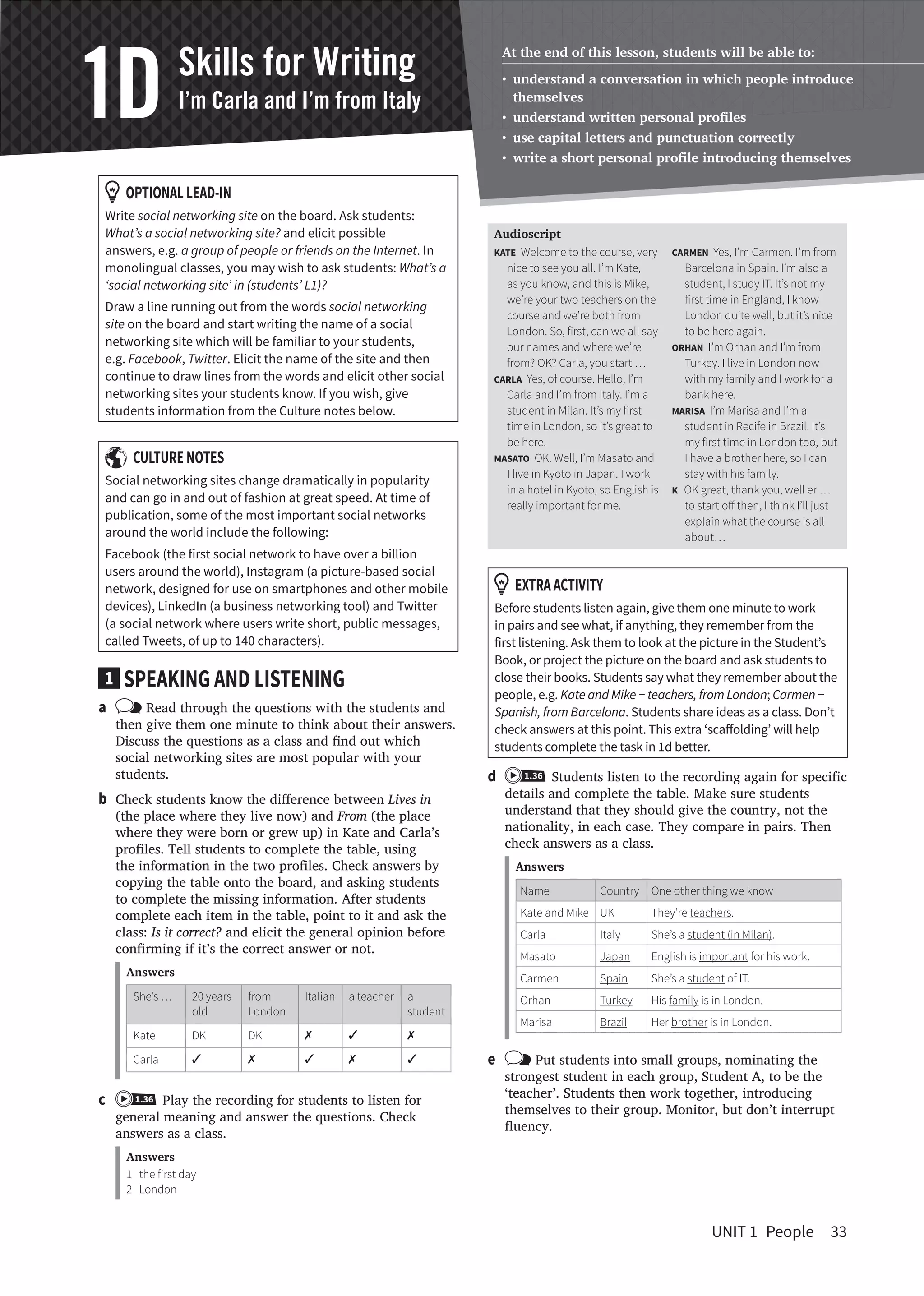
  • 122.
    120 UNIT 8Fit and healthy b Tell students to read the text again in detail and decide if the sentences are true or false and correct the false sentences. They compare in pairs. Check answers as a class. Answers 1 T 2 F (He didn’t like the idea of hiking immediately because it didn’t sound very interesting.) 3 T 4 T 5 F (It’s easy to learn how to go hiking because you only have to know how to walk.) 3 WRITING SKILLS  Linking ideas with however; adverbs of manner a Books closed. Write the example sentences on the board, leaving a gap in place of However. Point to the gap and ask students: What’s this word? If students suggest but, point clearly at the full stop and tell them that we don’t usually start a new sentence with but. Elicit however. Students then open their books and answer the question. Check the answer as a class. Answer Yes, it is. b Students read Dylan’s article again and underline three more examples of however. Check answers as a class. Answers However, I felt really unfit. However, I improved quickly … However, you have to buy special boots … We use a comma ater however. c Students work individually, linking the sentences with however. Monitor and check students are writing them as two sentences and putting a comma after however. Check answers as a class. Answers 1 c I can only do very simple exercises. However, I feel really fit. 2 b I started doing yoga about six years ago. However, I can’t do the dificult positions. 3 a I fell of my bike and hurt my leg. However, I didn’t stop riding. d Read the example sentence and answer the question as a class. Answer It tells us how he did it. e Individually, students look at the article in 2a again and ind the adverbs that go with the verbs. Check answers as a class. Answers 1 walk slowly; walk quite fast 2 improve quickly f Read the rule with the class and elicit which adverb from the article is diferent. Answer Fast is diferent because it is irregular. d 3.16 Students listen to the recording again for speciic details and match the beginnings with the endings of the sentences. They then check in pairs. Check answers as a class. Answers 1 f 2 a 3 b 4 d 5 c 6 e EXTRAACTIVITY Ask students to listen again and decide if sentences 1−5 are true or false: 1 Andy and Gina are good friends. (F − They don’t know each other very well.) 2 Gina thinks Andy looks healthy. (T) 3 Andy’s friend lent him a bike the first time he went cycling. (T) 4 Gina and Andy both love the gym. (F − They both hate gyms.) 5 Andy hurt his hand and his leg badly. (F − Andy hurt his arm and his foot a bit.) e Students work individually. They think about an activity and answer the questions. Tell students to make notes, but not write complete sentences. Monitor and help as necessary. LOA TIP ELICITING • When students have finished making their notes in 1e, give them an opportunity to review question words and brainstorm useful questions before continuing. Write a large W on the board and say: Tell me question words! to elicit what, where, when, who, which, whose, etc. Point out that some common questions start with H and elicit how, how oten, how much/many, etc. • Ask students to look at their notes from 1e and try to predict questions that their partner could ask them, e.g. Why did you start doing it?, How much does it cost to do it?, etc. As students share their questions with the class, write them up on the board for students to refer to in 1f. If students need more support, consider giving them prompts to help them formulate useful questions, e.g. Why / start?, How much / cost / do?, etc. f Tell students that in this activity the emphasis is on communication, not on perfect English. In pairs, students ask and answer questions about their activities. FASTFINISHERS Ask fast finishers to write a short paragraph to summarise the information their partner told them. 2 READING a Point to the picture of Dylan and the article and say: This is Dylan. He works for the same company as Andy and Gina. He wrote this article for the company blog. What’s his favourite free-time activity? and elicit hiking. Students then read the article quickly and tick the things that are the same. Check answers as a class. Answers 1 ✓ they do their free-time activities outdoors 3 ✓ they get fit doing their free-time activities
  • 123.
    UNIT 8 Fitand healthy 121 EXTRAACTIVITY If you normally use a ‘correction code’ when correcting students’ written work, e.g. GR for a grammar mistake, WW for a wrong word, SP for spelling, remind students of the system in place and ask them, in pencil, to find mistakes in their partner’s work. If you don’t normally use a correction code, ask students to circle things in pencil which they think their partner should check. Monitor and help as necessary. If students have not included the items in 4c, or have made any other mistakes, they prepare a second drat of the article. ADDITIONAL MATERIAL Workbook 8D 4 WRITING a Students work individually to plan an article about a free-time activity. Suggest they write about the activity they talked about in 1f, but allow them to choose a diferent activity if they prefer. Monitor and help with vocabulary and feed in ideas if necessary. b Remind students to use adverbs of manner when writing their article. If you’re short of time, this exercise can be completed for homework. Students could then bring their articles to the next class. c In pairs, students swap articles and check their partner’s work. They then give each other feedback.
  • 124.
    122 UNIT 8Fit and healthy 1 VOCABULARY a Complete the irst sentence as an example with the class. Students then complete the other sentences with the words in the box. Check answers as a class. Answers 1 baseball 2 ski 3 bike 4 badminton 5 dance 6 yoga b Students look at pictures 1–3 and then complete the words for the body. Check answers and spelling by asking individual students to write the correct answers on the board. Answers 1 head, neck 2 arm, hand, finger 3 leg, foot, toe 2 GRAMMAR a Individually, students complete the text. They then check in pairs. Check answers as a class. Answers 1 can 4 can’t 2 can 5 can 3 could 6 couldn’t b Students complete the sentences with the correct form of have to. Check answers as a class. Answers 1 have to 4 have to 2 don’t have to 5 has to 3 Do (I) have to 3 WORDPOWER tell / say a Books closed. Dictate sentences 1–3, saying beep instead of told and say. Students listen and write down the sentences. They then check in pairs and try to decide together the word they think can complete each sentence. Check they understand that they don’t have to use the same word in all three sentences. Students open their books, look at the sentences and check their answers. Finally, they match the sentences with the pictures. Check answers as a class. Answers 1 c 2 a 3 b b Point to the bold words in 3a and elicit which word, tell or say, matches each group of phrases as a class. Answers 1 say 2 tell CAREFUL! Students oten have problems with the constructions which follow tell and say. Most mistakes are usually connected with the indirect object and word order. Students may use to ater tell, e.g. I told to my little sister a story. (Correct form = I told my little sister a story.), or they may not use to ater say, e.g. He said me hello quickly. (Correct form = He said hello to me quickly.). Other problems relate to the specific collocations, e.g. tell a story / the truth, say hello/sorry, etc. If students ask, tell them that they have to memorise these as there is no clear rule governing when to use tell and when to use say. c Individually, students complete the sentences with to if possible. Check answers as a class and ask students: Which verb do we use to with? ‘Say’ or ‘tell’? (say). Answers 1 − 2 to 3 − 4 to 5 − d Students complete the sentences, working individually. They then check in pairs. Check answers as a class. Answers 1 story 2 me 3 truth 4 thanks 5 sorry 6 you e As an example, complete one or two of the sentences so that they are true for you. Students then complete the sentences with their own ideas. Monitor and point out errors for students to self-correct. f In pairs, students tell each other their sentences. Encourage students to ask follow-up questions if possible. EXTRAACTIVITY Write the following jumbled sentences on the board and ask students to put them in order: 1 never / she / to her brother / sorry / says; 2 tell / can / a really funny joke / me | you ?; 3 thank you / I / to them / for lunch / didn’t say; 4 a really strange story / me / told / my friend / yesterday; 5 I / the truth / don’t think / told / me / he (Answers: 1 She never says sorry to her brother. 2 Can you tell me a really funny joke? 3 I didn’t say thank you to them for lunch. 4 My friend told me a really strange story yesterday. 5 I don’t think he told me the truth.) Photocopiable activities: Wordpower p.194 LOA REVIEW YOUR PROGRESS Students look back through the unit, think about what they’ve studied and decide how well they did. Students work on weak areas by using the appropriate sections of the Workbook, the Photocopiable activities and the Personalised online practice. Review and extension UNIT 8
  • 125.
    UNIT 9 Clothesand shopping 123 UNITCONTENTS G  GRAMMAR Present continuous Present simple or present continuous V  VOCABULARY Shopping: bookshop, bus stop, café, car park, cash machine (ATM), chemist, clothes shop, department store, entrance, fast food restaurant, information desk, stairs Money and prices Clothes: boots, dress, earrings, gloves, jeans, jewellery, jumper, necklace, raincoat, ring, scarf, shirt, shoes, shorts, skirt, socks, T-shirt, trainers, trousers, watch Wordpower: time P  PRONUNCIATION Word stress in compound nouns Sentence stress with the present continuous Sound and spelling: o (/ɒ/, /uː/, /ʌ/ and /əʊ/) Silent letters Joining words C  COMMUNICATIONSKILLS Asking and answering questions about what people are doing Talking about festivals in your country and which festival you would like to go to Describing what a person is wearing Choosing clothes in a shop and paying for them Using appropriate phrases to say something is nice Talking about who you give presents to and how you say thank you Writing formal and informal emails to say thank you for a present GETTING STARTED OPTIONALLEAD-IN Books closed. Write these sentences on the board: I love going to the shopping mall − it’s my favourite place. I hate buying clothes − I can never find what I want. I prefer shopping in small, local shops, not big shops in the centre of town. I never shop in markets − everything they sell is cheap and bad quality. I’d like to work in a shop or a market − it’s an easy job. Put students into pairs or small groups to discuss the sentences and say if they agree or disagree and why. Monitor and praise students who are able to express their ideas even if their English isn’t perfect. Take feedback as a class. Encourage students to justify their ideas as far as possible. Ask students to open their books and look at the picture. Ask: Did you like shopping when you were a child? and elicit a short reaction from the class. a Give students one minute to think about their answers to the questions before talking about the picture as a class. If you wish, give students information from the Culture notes below. CULTURENOTES This picture was taken at The Grove shopping mall in Los Angeles on Black Friday, an important date in the American retail calendar, when shops offer discounts and promotions. It takes place the day ater the Thanksgiving holiday, which Americans celebrate every year on the fourth Thursday in November. On Black Friday shops open their doors at midnight and around 140 million Americans rush to the malls to get the best deals. In recent years Black Friday has spread to other countries where retailers want to take advantage of the pre-Christmas crowds. Discounts and promotions have also been introduced by big online retailers with popular products selling out in minutes. b Read through the question with students and then put them into pairs to discuss where the best places to shop are. Help with vocabulary and pronunciation, but don’t interrupt luency. Students share their ideas as a class. EXTRAACTIVITY Individually, students write down two sentences about their shopping habits, e.g. I go to the shopping mall every Saturday, but I never spend any money., I bought this watch for €10 at a market near my house. One sentence should be true and one false. Monitor and point out errors for students to self-correct. In pairs, they then read their sentences to each other and decide if they are true or false. Each student then chooses one of their sentences to read to the class for the other students to decide if it is true or false. At the end of this unit, students will be able to: understand information, texts and conversations about shopping and shopping malls, what people shop for, and buying clothes and presents ask for and give information about where people are, what they are doing and what clothes they are wearing shop and pay for clothes use appropriate phrases when choosing and paying for clothes, and when saying something nice distinguish between formal and informal emails write formal and informal thank-you emails UNITOBJECTIVES ClothesandshoppingUNIT9
  • 126.
    124 UNIT 9Clothes and shopping FASTFINISHERS Ask fast finishers to write sentences about some of the places not included in 1d (bus stop, entrance, information desk, stairs). e 3.18 Students complete the exercises in Vocabulary Focus 9A on p.162. Play the recording for students to check their answers to Exercise a and repeat the prices. Monitor Exercise b and drill the prices. Tell students to go back to SB p.90. Answers (Vocabulary Focus 9A SB p.162) a 1 a 2 b 3 b 4 b 5 a 6 b 7 b 8 a EXTRAACTIVITY Play ‘bingo’ (see p.172) with the class. Write 25 different prices on the board in numerals. Repeat some of the same numbers with different currencies, e.g. £39.99 and $39.99. Also include some pairs of numbers that you know oten cause students problems, e.g. €19 and €90, or £76.99 and £67.99, etc. Students draw a bingo grid and complete it with eight prices from the board. Play the game as a class. 2 LISTENING a Students discuss the question in pairs or small groups. Take feedback as a class. b Look at the plan of the shopping mall and elicit suggestions for a good place for the group to meet from the class. Answer Students’ own answers c 3.19 Play the recording for students to listen and answer the questions. Check answers as a class. Answers Simon wants to meet Susie at the shopping mall. They might have problems finding each other. Audioscript CONVERSATION 1 SUSIE Hello? SIMON Hey, Susie. It’s Simon. Do you want to go and see a film tonight with Amy and Sandeep? SU Yeah, great idea, I’d love to. SI Let’s meet at the shopping mall at around seven. OK? SU Where? The mall’s really big! SI Oh, I don’t know. I’ll call you when we get there and we can find each other. SU OK … d 3.20 Tell students that they are going to listen to two more phone conversations. Play the recording for students to listen and underline the correct answers. Check answers as a class and ask students to show you where the four people are on the map of the shopping mall. We aren’t buying anything9A OPTIONALLEAD-IN Books closed. Write the following questions on the board: Where do you usually go to … get a new book or magazine? sit down and relax with a cofee? have a burger, chips and cola? choose some new clothes for a party? look for the perfect present for someone? buy something when you’ve got a headache? Give students one or two examples, e.g. When I go to London, I always go to my favourite bookshop – ‘Foyles’. They sell thousands of books., My favourite place to sit down and relax with a cofee is ‘Hot Numbers’ in Cambridge., etc. to make it clear that you want them to discuss specific places in their area. Put students into pairs or small groups to talk about the questions. Take feedback as a class and find out which places are particularly popular. 1 VOCABULARY Shopping a Individually, students look at pictures 1–6 and match them with the words in the box. They compare in pairs. Check answers as a class. If you used the Optional lead- in, students can match the places they talked about with the words in the box, e.g. ‘Foyles’ is a bookshop., ‘Hot Numbers’ is a café., etc. Answers 1 a café 4 a clothes shop 2 a bookshop 5 a chemist 3 a fast food restaurant 6 a department store b Point to the plan of the shopping mall and ask students to match the words in the box with the letters on the plan. Check answers as a class. Answers a bus stop d information desk b entrance e cash machine (or ATM) c stairs f car park c 3.17 Pronunciation Play the recording for students to identify which word is stressed in each case. Check the answer as a class. Drill each word. Answer the first word d Complete the irst item as an example with the class. You may wish to pre-teach the word aspirin (medicine to stop a part of your body hurting). Students work individually, deciding where the people can go in the shopping mall. They then check in pairs. Check answers as a class. Answers 1 clothes shop / 4 chemist department store 5 car park 2 department store 6 café / fast food restaurant 3 bookshop 7 cash machine (ATM) At the end of this lesson, students will be able to: • use a lexical set of shopping words correctly • understand conversations in which people arrange to meet in a shopping mall • use the positive, negative and question forms of the present continuous • ask and answer questions about what people are doing
  • 127.
    UNIT 9 Clothesand shopping 125 b Complete the rule as a class. Answer a now c Individually, students complete the tables. Check answers by copying the tables onto the board, and asking individual students to come up and complete the gaps. Answers Positive (+) Negative (–) I’m We’re He’s/She’s reading a magazine. talking on the phone. I’m not We aren’t He/She isn’t drinking cofee. waiting at the entrance. Yes/No questions (?) Are you Is he/she parking the car? d 3.23 Pronunciation Play the recording for students to listen and notice the stress. Answer the question as a class and check they understand that we only stress the verb be in negative sentences. Drill the sentences. Answer b in negative sentences CAREFUL! One of the most common student mistakes with the present continuous is with the spelling of the -ing forms. The spelling rules for -ing forms are highlighted in Grammar Focus 7B on SB p.148. Highlight the correct spelling and the top five errors at this level: writing (NOT writting), coming (NOT comeing or comming), studying (NOT studing), travelling (NOT traveling*) and swimming (NOT swiming). *This form is acceptable in US English, but isn’t used in this course. e 3.24 Students read the information in Grammar Focus 9A on SB p.152. Play the recording where indicated and ask students to listen and repeat. Students then complete the exercises. Check answers as a class, making sure students are spelling the -ing forms correctly. Tell students to go back to SB p.91. Answers (Grammar Focus 9A SB p.153) a 2 They’re talking. 3 He isn’t riding a horse. 4 I’m doing a grammar exercise. 5 She isn’t wearing shoes. 6 They’re playing tennis. b 2 is (she) smiling; ’s feeling 3 Are (you) sleeping; ’m not 4 are (they) standing; aren’t standing 5 Is (your brother) playing; isn’t; ’s playing c 2 I’m shopping 3 We’re looking 4 We’re driving 5 I’m standing 6 are you wearing 7 I’m wearing 8 we aren’t stopping FASTFINISHERS Ask fast finishers to choose other pictures of people in the Student’s Book and write sentences like those in Exercise a about what they are doing. f Give students a few minutes to prepare and write three sentences. Monitor and check they are spelling the -ing forms correctly and point out errors for them to self- correct. Answers 1 in the bookshop 3 in the department store 2 at the bus stop 4 at the cash machine Audioscript CONVERSATION 2 SIMON Hello? SUSIE Simon! Hi! Where are you? Are you having a cofee? SI No, I’m just buying that new book I told you about. What are you doing? SU I’m just getting of the bus. So where do you want to meet? It’s nearly seven. SI Let’s meet at the entrance in five minutes. SU All right. SI And can you call Amy and Sandeep to tell them where to meet? SU Yeah, sure, no problem. Hurry up! CONVERSATION 3 SANDEEP Hello? SUSIE Sandeep, it’s Susie. Where are you? SA Oh! Hi, Susie. I’m just getting some cash. Amy’s looking at furniture. SU Furniture? Are you buying furniture? SA No, we aren’t buying anything. She’s just looking. SU OK, well, can you meet Simon and me at the entrance to the cinema in five minutes? SA Yeah, sure. See you there! e Point to the pictures of Simon running and Susie on the phone. Put students into pairs to answer the questions. f 3.21 Play the recording for students to listen and check. Check answers as a class. Answers 1 Simon is running because he was by the main entrance, not the cinema entrance. 2 Susie feels annoyed because Simon isn’t at the cinema entrance on time. Audioscript CONVERSATION 4 SUSIE Hi, Amy! AMY Hi! SU Hi, Sandeep! SANDEEP Hi! SU Great to see you! SA Good to see you too! Where’s Simon? SU I don’t know. He told me to meet him here. Let me just call him. SIMON Hello? SU Simon, where are you waiting for us? SI I’m standing by the entrance – you aren’t here! SU Yes, we are! We’re waiting for you. I just bought our tickets. SI What? … Oh, no! I’m at the main entrance, not the cinema entrance. SU What? Quick, run! The film is about to start! 3 GRAMMAR Present continuous a 3.22 Books closed. Write the following four jumbled sentences on the board. Tell students they are about the information in 2d and ask them to put them in order: 1 a book / Simon / buying / is (Simon is buying a book.); 2 getting of / Susie / is / the bus (Susie is getting of the bus.); 3 is / Amy / at furniture / looking (Amy is looking at furniture.); 4 Sandeep / some cash / is / getting (Sandeep is getting some cash.). Ask: What’s similar about all four sentences? and elicit that they all have the verb be and the -ing form of the verb. Tell students that this is called the present continuous. Students then match the questions and answers in the book. Play the recording for students to listen and check. Check answers as a class. Answers 1 b 2 d 3 a 4 c
  • 128.
    126 UNIT 9Clothes and shopping 4 SPEAKING a Divide the class into pairs and assign A and B roles. Student As read the instructions and look at the picture on SB p.130. Student Bs read the instructions and look at the picture on SB p.134. Students then ask and answer questions to ind the ive diferences. LOA TIP MONITORING • Make sure students take full advantage of the two-minute note-making stage in Exercise a. The idea is that they should be thinking about what words and phrases they will need to complete the task and the best way to express themselves before they start working in pairs in Exercise b. Check students are making notes and answer any questions they have about vocabulary. • As students ask and answer their questions, monitor and check they are only stressing the auxiliary verb in the negative form of the present continuous. When students make a mistake with the pronunciation, try to catch their eye discreetly so that they can correct their mistake. ADDITIONAL MATERIAL Workbook 9A Photocopiable activities: Grammar p.183, Vocabulary p.190, Pronunciation p.201 g Read through the example with the students. Put students into pairs to tell their partner their sentences and try to guess where they are. Monitor, but don’t interrupt luency unless students make mistakes with the present continuous forms. EXTRAACTIVITY Ask a student to come to the front of the class and stand looking at the other students with his/her back to the board. Tell the rest of the class that you’re going to write an action on the board, e.g. playing the piano. The students mustn’t say anything, but when you count down: 3, 2, 1 … they all mime doing that action. The student at the front of the class has to guess what they are doing and ask a present continuous question, e.g. Are you playing the piano? and the class reply: Yes, we are. or No, we aren’t. Other possible actions include: dancing, drinking a cofee, listening to music, painting a picture, playing golf, reading a book, sleeping, swimming, writing a letter. If you wish, students can also play the game in small groups (see ‘Backs to the board’ on p.173), choosing the actions themselves and using vocabulary from the course so far.
  • 129.
    UNIT 9 Clothesand shopping 127 CULTURENOTES Chinese New Year is usually celebrated in late January / early February, but the exact date changes each year. The celebrations last for two weeks and there are many different traditions associated with each day and these vary from region to region. On the first day, fireworks are very common. It is also traditional for married couples to give the younger members of the family red envelopes with money to give them luck for the year ahead. The most famous images are perhaps the huge street parties with lion and dragon dances, like the one in the picture on SB p.92. Carnevale in Venice is believed to have started around 1,000 years ago, although its exact origins are unclear. It usually takes place in late February / early March and ends on Shrove Tuesday, 40 days before Easter. Carnevale finally became an official festival during the Renaissance. At the end of the 18th century it was prohibited, although it continued to be celebrated quietly in private houses. It was revived in the early 1980s with the aim of increasing tourism in the winter months. The festival is famous for its elaborate costumes and its masks. The masks are oten beautifully decorated, like the traditional ‘volto’ (or ‘larva’) mask in the picture on SB p.92. d Individually, students read the messages and decide which is Lucas’ and which is Diana’s. Check answers as a class. You may wish to teach the word dragon using the picture on SB p.92. Answers orange message − Lucas green message − Diana e Students discuss the questions in pairs or small groups. Take feedback as a class. OPTIONALLEAD-IN Tell students you’re going to describe a picture from Units 1–8 in the Student’s Book. Tell students to close their books and listen. Read the following sentence twice: He’s riding a motorbike and he’s talking to three local women. Say: OK. Open your books. Find the picture! (SB p.69) Repeat the process with: She’s sitting in her ofice and she’s talking on the phone. (centre let, SB p.64) They’re sitting at their desks in a big room. They’re doing an exam. (bottom let, SB p.22) He’s standing in the door of a clothes shop and he’s carrying three bags. (centre let, SB p.56) They’re in a restaurant and they’re looking at the menu and talking. (bottom, SB pp.44–45) Put students into pairs and ask them to write two or three similar sentences about pictures in the Student’s Book using the present continuous. Monitor and point out errors for students to self-correct. Put students into larger groups. Separate students from their original partner. Students read their sentences and find the pictures. 1 READING a Give students one minute to think about their answers to the questions before talking as a class about when they go shopping. b Point to the two texts and ask students: What kind of website is this? (a social networking site). You may want to pre-teach the word mask using the picture on SB p.92. Students read the texts quickly and match the people with the things they write about. Check answers as a class. Answers a B b D c L d L c Tell students to read the texts again in detail. Individually, students decide if the sentences are true or false. When checking answers, ask students to correct the false sentences. If you wish, give students information from the Culture notes. Answers 1 F (He speaks English at work because his colleagues all speak English.) 2 T 3 T 4 F (She loves Venice in the winter.) 5 T 6 F (It’s Carnevale and the whole city is like one big party.) EXTRAACTIVITY Ask students to read the texts again and answer questions 1–6: 1 Is Lucas happy in Shanghai? (Yes, he is.) 2 Does he like his colleagues? (Yes, he does.) 3 Where is the New Year party? (It’s in the street.) 4 Does Diana have a lot of time to relax? (No, she doesn’t.) 5 What does she do at weekends? (She walks around and looks at the old buildings or goes to museums.) 6 Where is the Carnevale party? (It’s in a piazza/town square.) At the end of this lesson, students will be able to: • read and understand a text about people’s shopping habits and local festivals • talk about festivals in their country • distinguish between the present simple for things we usually do and the present continuous for things happening at the time of speaking • understand conversations in which people talk about what they are wearing • describe what a person is wearing Everyone’s dancing in the streets9B
  • 130.
    128 UNIT 9Clothes and shopping d Students read the information in Grammar Focus 9B on SB p.152. Students then complete the exercises. Check answers as a class, making sure students understand why the present simple or present continuous is correct in each case. Tell students to go back to SB p.93. Answers (Grammar Focus 9B SB p.153) a 2 today 3 never 4 this morning 5 ’s dancing 6 ’m enjoying 7 at weekends 8 oten b 1 We’re getting; I’m watching 2 He’s singing; he sings; They oten play 3 Are you playing; I’m not; I’m trying; are you doing c Students’ own answers FASTFINISHERS Ask fast finishers to write more sentences like the ones in Exercise c using their own ideas. e 3.25 Students work individually, completing the conversation. Play the recording for students to listen and check. Check answers as a class. Answers 1 ’m getting 2 don’t go 3 are arriving 3 LISTENING AND VOCABULARY Clothes a 3.26 Play the recording for students to listen for general meaning and answer the questions. Check answers as a class. Answers 1 b 2 c Audioscript Conversation 1 LUCAS Hello? TINA Hi Lucas, it’s Tina. L Oh, Tina – hi! T I just read your message. Sounds like you’re having fun. L Yeah, it’s great here – I love it. T I can’t believe you’re wearing red. L I know, I know. T You hate red. L Yes, but it’s Chinese New Year – everyone’s wearing red – I’m even wearing red socks and a red belt. And someone also gave me a red scarf. T I hope you’re not wearing red shoes. L No, no – I’m wearing black boots. Conversation 2 DIANA Hello? PETE Hi, Diana. It’s Pete. D Oh hi, Pete! Thanks for calling! P Thanks for the message and the photo. D No problem. I’m having such a brilliant time here. P That doesn’t look like you in the photo. D Yeah, that’s me. P But you’re wearing a dress. You never wear dresses! And gloves too. You look so cool. D Thanks. I wear dresses sometimes you know. P Yeah, but I normally see you in jumpers and jeans. And you’re wearing jewellery too – those are lovely earrings. D Well, this is special – it’s Carnevale. I’m having so much fun. b 3.26 Students listen to the recording again for speciic details and tick the clothes words they hear. They compare in pairs. Check answers as a class. Answers Lucas: socks ✓, scarf ✓, shoes ✓, boots ✓ (They don’t talk about trousers or a shirt.) Diana: gloves ✓, dress ✓, earrings ✓, jeans ✓, jumper ✓ (They don’t talk about a raincoat.) 2 GRAMMAR  Present simple or present continuous a Books closed. Write prompts 1 and 2 on the board and ask students to write the complete sentences that appear in Lucas’ online post and message: 1 weekend / I / meet / friends / shopping mall (At the weekend I usually meet friends at a shopping mall.), 2 We / watch / dragon (We’re watching a big, beautiful dragon go by.). Students check answers by looking at the complete sentences in the book. Students match the sentences with the correct meaning. Then ask students to look at Lucas’ online post and message and ind more examples of his normal routine, e.g. In my free time I sometimes study Mandarin and relax., and things happening now, e.g. Everyone’s wearing red. Answers 1 a 2 b b Complete the rule as a class. Answers present simple; present continuous LOA TIP CONCEPT CHECKING • Check students have fully understood the difference in meaning between the present simple and the present continuous by asking: Is Lucas’ online post about his normal routine? (Yes, it is.) What about his message? (No, it’s about what’s happening now.). Then ask: What tense are most of the verbs in Lucas’ online post? (present simple) and What tense are most of the verbs in his message? (present continuous). • Write the following words and phrases on the board: always, at the moment, every week, never, now, oten, right now. Ask students which ones we usually use with the present simple (always, every week, never, oten) and which ones we usually use with the present continuous (at the moment, now, right now). c Students read Diana’s online post and message again and underline more examples of the present simple and present continuous. CAREFUL! Students will oten confuse the two verb forms and use the present continuous where they should use the present simple, e.g. All the masks are being really beautiful. (Correct form = All the masks are really beautiful. – the masks are not only beautiful at the moment of speaking, they are always beautiful), and vice versa, e.g. I stand in the centre … (Correct form = I’m standing in the centre of the piazza.– the person is only standing in the centre of the piazza at the moment of speaking and isn’t always standing there).
  • 131.
    UNIT 9 Clothesand shopping 129 4 SPEAKING a Individually, students think of someone that they saw before the class and make notes about what that person is wearing. Monitor and help with any other vocabulary students might need to talk about the people, e.g. high heels, leggings, suit, tie, etc. b In pairs, students talk about the people they chose. Monitor and listen for correct use of clothes vocabulary and the present continuous. FASTFINISHERS Ask fast finishers to close their eyes and, from memory, describe what their partner is wearing in as much detail as possible. ADDITIONAL MATERIAL Workbook 9B Photocopiable activities: Grammar p.183, Vocabulary p.190, Pronunciation p.201 EXTRAACTIVITY Play the recording again and ask students to write down what Lucas and Diana are wearing. Point out that they both use some clothes words, but say that they are not wearing these items. Check answers as a class and check students understand the meaning of belt by showing them your belt if you’re wearing one or drawing a picture on the board. (Lucas is wearing red socks, a red belt, a red scarf and black boots. Diana is wearing a dress, gloves and earrings.) c Pronunciation Model the four words and the four vowel sounds in the table. Elicit from students which column shoe should go in. Answer Sound 2 /uː/ – shoe LANGUAGENOTES 3c and 3d introduce some of the most frequent sounds which correspond to the letter o: /ɒ/, /uː/, /ʌ/ and /əʊ/. Don’t ask students to look for other examples of words with o, as they may well find words which contain the letter o, but are not pronounced with the four sounds being worked on. d 3.27 Students match the words with the sounds. Play the recording for students to listen and check. Check answers as a class. Then drill each word. Answers and audioscript sock /ɒ/ boot /uː/ glove /ʌ/ coat /əʊ/ cofee box shoe group two come mother know phone e 3.28–3.30 Students complete the exercises in Vocabulary Focus 9B on SB p.167. Play the recording for students to check their answers to Exercise a and complete the Pronunciation activities. Monitor Exercise d and correct students’ pronunciation as appropriate. Tell students to go back to SB p.93. Answers (Vocabulary Focus 9B SB p.167) a 1 d (skirt) 2 g (necklace) 3 a (T-shirt) 4 e (shorts) 5 h (trainers) 6 c (jewellery) 7 b (watch) 8 f (ring) b jewellery c 1 vegetable 2 interesting 3 chocolate 4 camera 5 comfortable
  • 132.
    130 UNIT 9Clothes and shopping Everyday English It looks really good on you9C Video/Audioscript (Part 2) ANNIE So what are you looking for? DAN I don’t know really. A shirt and trousers. Just something casual. A OK. What size are you? D In trousers? 32. … OK, 34. A Or 36? And probably a large for the shirt? D Yeah, I think so. A What colour would you like? D Oh, I don’t know. Something dark? A What about this? … Why don’t you try them on? D OK. Excuse me, where are the fitting rooms? SHOP ASSISTANT The fitting rooms are just over there, sir. D Thanks. SA Thank you. e Students ask and answer the questions in pairs or small groups. Take feedback as a class. 2 USEFUL LANGUAGE Choosing clothes a Individually, students match the questions with the answers. Don’t check answers at this point. b 3.32 Play Part 2 of the video or the audio recording again for students to check their answers in 2a. Check answers as a class. Answers 1 c 2 a 3 b 4 d c Drill the questions and answers before students work in pairs. Monitor, and correct students’ pronunciation as appropriate. d In pairs, students practise helping each other choose clothes. Monitor, but don’t interrupt luency unless students make mistakes with the questions. FASTFINISHERS Ask fast finishers to close their books and ask and answer the questions in 2a from memory, using their own ideas for the answers and changing the clothes, colour and size. OPTIONALLEAD-IN Play ‘Guess who?’ (see p.173) with students. Tell them that you’re thinking of a person in the class and that they have to guess who it is by asking questions about what they are wearing. They are allowed to ask you five Yes/No questions with the present continuous to find out who it is, e.g. Is this person wearing jeans?, Is this person wearing earrings? Make sure you reply only with yes or no (NOT Yes, he/she is.) in order not to give away if it is a man or a woman. Once you’re sure students have understood what they have to do, they can continue playing the game in small groups. Monitor and check students form the present continuous correctly and pronounce the clothes words from Lesson 9B correctly. 1 LISTENING a Put students into pairs to ask and answer the questions. Take feedback as a class. b 3.31 Tell students to look at the picture at the bottom of the page and ask them where Dan and Annie are. Play Part 1 of the video or the audio recording for students to answer the question. Check the answer as a class. Answer Dan Video/Audioscript (Part 1) ANNIE Dan! Hi! DAN Hi, Annie, how are things? A Fine. D Um, look. Are you free at lunchtime? A Yes. D Great. Could we meet? I need help to buy some clothes for this evening. A Yeah, sure. But what about Martina? Can’t she help? D Well, I’m meeting her this evening for dinner. She always says I wear the same old clothes, so I want to get something new. I want to surprise her. A OK, sure. I’m free at 12:30. c 3.31 Students watch or listen again for speciic details. Play Part 1 of the video or the audio recording again for students to identify the incorrect information in the text. When checking answers, ask students to correct the information. Answers … to go to a concert for dinner … meet Dan at 5 pm 12:30. She isn’t is happy … d 3.32 Play Part 2 of the video or the audio recording for students to answer the questions. They then check in pairs. Check answers as a class. Answers 1 a shirt and trousers 2 trousers: probably 36; shirt: large 3 No, he probably doesn’t enjoy shopping. At the end of this lesson, students will be able to: • understand conversations in which people choose clothes in a shop and pay for them • use appropriate phrases for shopping in a clothes shop • use appropriate phrases to say something is nice • join words to the next word in the sentence by moving the inal consonant sound • ask for something in a clothes shop, ask to try it on and pay for it
  • 133.
    UNIT 9 Clothesand shopping 131 4 USEFUL LANGUAGE Paying for clothes a 3.34 Individually, students look at the sentences and try to ind the mistakes. Play the recording for students to check their ideas. Check answers as a class. Answers 1 I’ll take them. 2 How much they are are they? 3 Can I pay with by card? b Students complete the conversation, working individually. They then check in pairs. Check answers as a class. Answers 1 help 2 much 3 take 4 card LOA TIP DRILLING • Drill the conversation in Exercise 4b before continuing. Try drilling the conversation chorally with you being the shop assistant (A) and the class being the customer (B). Work on the customer’s sentences, building them up word by word, starting at the end of each sentence, e.g. sunglasses − these sunglasses − are these sunglasses − much are these sunglasses − How much are these sunglasses?, until the class can chorus it together with correct pronunciation. Then ask them the shop assistant’s first question: Can I help you? and elicit the response from the class as a chorus. Repeat with the customer’s second line and continue until you’ve built up the whole conversation. • Provide appropriate models of joining words, but don’t actively draw students’ attention to them at this point as they will study these in detail in the Pronunciation section. c Write on the board: B Yes, how much are these (sunglasses)? A They’re (£29.99). B OK, I’ll take them. Ask students: Is ‘sunglasses’ singular or plural? What happens to the underlined words if we change ‘sunglasses’ for ‘shirt’? Check students understand that these words will change to is this / It’s / it when they use a singular noun. In pairs, students practise the conversations. Monitor and point out errors for students to self-correct. 5 CONVERSATION SKILLS  Saying something nice a Read the sentences together and elicit suggestions for how to complete the sentences from the class. Answers 1 looks 2 looks b Answer the questions as a class. Ask students: Which words make it clear that the sentence is about something someone’s wearing? (on you). Answers a Sentence 1 b Sentence 2 c Demonstrate the activity by paying two or three students compliments using the language from this unit, e.g. Silvi, I love your ring. It looks really good on you. Marc, I really like your trainers. They look fantastic! Students then work in pairs, saying nice things about something their partner is wearing. Monitor and help with any vocabulary students need. 3 LISTENING a 3.33 Play Part 3 of the video or the audio recording for students to answer the questions. Check answers as a class. Answers 1 No, she doesn’t. 2 She thinks they look great. Video/Audioscript (Part 3) DAN What do you think? ANNIE No … D This one? A Ugh … D And this? A No. Try the next one. D How about this one? A No, Dan … That’s it! That looks great. D These are mine! This is what I came in! A Well, it looks really good on you … SHOP ASSISTANT Can I help you, sir? D Hi. There’s no price on these shoes. How much are they? SA They’re 49.99. D Great. I’ll take them. A And these trousers and this shirt, please. SA Altogether that’s £115.97, please. D Can I pay by card? SA Yes, of course. Just enter your PIN, please. … Shall I put the receipt in the bag? D Yes – thanks. SA There you go, sir. D Thank you. SA Thank you. Take care now. A Bye. [VIDEO only] MARTINA Wow! You look great! D Thank you very much. b 3.33 Play Part 3 of the video or the audio recording again for students to complete the receipt. Check students understand that the price for the trousers isn’t included in the recording and they will only be able to work out the correct answer if they write down the other numbers correctly. Check answers by copying the receipt onto the board, and asking individual students to come up and complete the gaps. Answers Shoes £49.99 Shirt £25.99 Trousers £39.99 Total £115.97 EXTRAACTIVITY Set students a mathematical challenge. Tell students: I went to the clothes shop yesterday and I bought a shirt for £19.99, a pair of trousers for £24.49 and some boots for £66.75. How much was the total? Allow students to use their mobile phones to work out the answer if they have them (£111.23). Repeat with: I bought a lot of new clothes yesterday. I got some socks, they cost $6.99, two T-shirts, they were $4.99 each, and a pair of shorts for my holiday. I paid $29.46. How much were the shorts? ($12.49) Students then work individually to prepare their own mathematical challenge. Monitor and check students know the answer themselves. Put students into small groups to test each other.
  • 134.
    132 UNIT 9Clothes and shopping 6 PRONUNCIATION Joining words a 3.35 Play the recording for students to listen to sentences 1–5 and see if there is a pause between the marked words. Check the answer as a class. Answer No, there isn’t. b Read through the explanations as a class. Drill each example. LANGUAGENOTES This section develops the work on joining words started in Unit 8 and gives examples of two features common in connected speech. In sentences 1−4 students see how the consonant sound moves to the beginning of the second word when one word finishes with a consonant sound and the next word begins with a vowel sound. Sentence 5 gives an example of a linking /r/: when one word ends with a vowel sound and the next word begins with a vowel sound, we add an extra sound, which isn’t written, to make it easier to join the two words smoothly. Other common linking sounds between vowels are: /j/ as in I am (individually /aɪ/ and /æm/, but together /aɪjæm/), and /w/ as in go away (individually /gəʊ/ and /əˈweɪ/, but together /gəʊwəˈweɪ/). One of the reasons students oten have problems understanding spoken English is because they hear these sounds at the beginning of words and are therefore unable to recognise words in speech which they would normally recognise in writing. c Students work in pairs, practising saying the sentences and giving replies. Monitor and correct students’ pronunciation as appropriate. 7 SPEAKING a Tell students that they can now practise choosing and paying for clothes. Check students understand the dialogue map before they start. Give them a few minutes to make notes about what they want to say. b In pairs, students take turns to be the shop assistant and the customer. Monitor and praise students when they use the language from this lesson correctly. c Students work with a diferent partner and practise more conversations, but using diferent clothes. ADDITIONAL MATERIAL Workbook 9C Unit Progress Test Personalised online practice
  • 135.
    UNIT 9 Clothesand shopping 133 Audioscript AXEL I always give my girlfriend an expensive birthday present. I don’t give her flowers or chocolates. I oten give her jewellery, maybe a necklace or earrings. Or maybe a beautiful dress. She loves expensive clothes. But clothes are dificult because I don’t know what she likes. So, she usually chooses them and then we buy them together. BOB We don’t buy presents. We give the children some cash and then they always buy their own presents. I think that’s better because they know what they want. And then we do something nice together, maybe go out for a meal or go to the cinema. FERNANDA We buy small birthday presents for the children – usually toys or clothes, something small, like a toy car or a T-shirt maybe. Some people buy things like a laptop or a bike, but I don’t like giving expensive presents, I prefer to give small presents. LEILA My husband doesn’t think clothes and computers are important. He doesn’t need many things, he doesn’t like spending money on himself. But he reads lots of books and he likes films – so for his birthday I usually buy him a book or a DVD. He’s very easy! c 3.36 Students listen to the recording again for speciic details and decide who the sentences are about. They compare in pairs. Check answers as a class. Answers 2 Leila’s husband 3 Fernanda’s children 4 Axel’s girlfriend 5 Bob and his family d Students talk about the questions in pairs or small groups. Monitor, but don’t interrupt luency. FASTFINISHERS Ask fast finishers to talk about situations where it is typical to give presents in their country, e.g. birthdays, Mother’s/ Father’s Day, Valentine’s Day, when people get married, etc. and whether any specific presents are typical on those days. 2 READING a Tell students it was Axel’s 30th birthday last week and Molly gave him a present. Individually, students then complete the thank-you email. Check answers as a class. Answers a 4 b 1 c 3 d 5 e 2 OPTIONALLEAD-IN Books closed. Draw a present with a ribbon round it on the board and write underneath it: The perfect present for me is … Tell students: The perfect present for me is something I can eat, with lots of sugar and it certainly isn’t healthy! and elicit suggestions, e.g. a box of chocolates, a really big cake, etc. Then give students another example, e.g. The perfect present for my sister is expensive jewellery! and again elicit ideas, e.g. earrings, a ring, a necklace, etc. Ask students to work individually and write two sentences like yours about perfect presents, one for themselves and one for someone else. In pairs or small groups, they then read each other their sentences and suggest appropriate presents. 1 LISTENING AND SPEAKING LOA TIP ELICITING • Consider eliciting some of the vocabulary in 1a using mime rather than the picture in the book. Books closed. Mime opening a present and showing a ‘delighted face’. Take the ‘present’, e.g. some earrings, out of the ‘box’ and ‘put them on’. Point to them and ask students: What are these? • As you elicit each word, drill it for correct pronunciation. Then ask students How do you spell ‘(word)’? and gesture for them to write the word down. Ater eliciting all the vocabulary, check students have spelt the words correctly by writing them on the board for them to check. a Read through the questions with students and then give them one minute to think about their answers. Discuss the questions as a class and ind out which presents are popular and which aren’t popular and why. If you used the Optional lead-in, ask students if they think any of the presents in the picture are ‘perfect’ presents. b 3.36 In pairs, students look at the people and discuss which presents they think the people give. Play the recording for them to listen for general meaning and check their ideas. Check answers as a class. Answers 1 jewellery, a necklace, earrings, a dress 2 cash 3 a toy car, a T-shirt 4 a book, a DVD At the end of this lesson, students will be able to: • understand people talking about who they give presents to and what they give • talk about who they give presents to and how they say thank you • understand emails saying thank you for a present • distinguish between formal and informal emails • write formal and informal emails to say thank you for a present Skills for Writing Thank you for the lovely present9D
  • 136.
    134 UNIT 9Clothes and shopping EXTRAACTIVITY Write sentences 1–5 on the board. Tell students they all come from a friendly email from Sara to her friend Sven. Students have to decide if they are appropriate for a friendly email and change the phrases that are too formal for more informal ones. 1 Dear Mr Väth, (Hi there! / Hi Sven,) 2 I just want to say thank you very much for the earrings. (Thank you for … / Many thanks for …) 3 They’re really beautiful! (✓) 4 There’s a party tomorrow night so I can wear them then. (✓) 5 Regards, Sara Lopez (Love, Sara / Thanks, Sara / See you, Sara). Students compare in pairs. Then check answers as a class. 4 WRITING a To make sure all students receive a ‘present’, tell each student who they should choose a present for. Students then write their ‘presents’ on pieces of paper and exchange them. Encourage them to say thank you briely, e.g. Oh thank you, it’s just what I always wanted! If you used the Optional lead-in, ask students to try to remember their partner’s perfect present. b Students work individually to plan their email. Monitor and help with vocabulary and give them ideas if necessary. c Students write their thank-you email, working individually. Remind students to use the informal phrases in 3c for beginning and ending their email. If you’re short of time, this exercise can be completed for homework. Students could then bring their thank-you emails to the next class. d In pairs, students swap emails and check their partner’s work. Tell them to check their partner has used appropriate informal phrases in their email. They then give each other feedback. If they have made any mistakes with the informal phrases, or mistakes in other areas, they prepare a second draft of their email before giving it to you for correction. e Tell students to imagine that the present was from someone they don’t know well. Ask them to write a second version of their thank-you email. Elicit from the class that they need to use more formal phrases for the beginning, the sentence saying thank you and the ending. ADDITIONAL MATERIAL Workbook 9D b Students read the email in 2a again and answer the questions. Check they understand that the answer to question 2 isn’t included directly in the email, so they have to understand it from the context. Check answers as a class. Answers 1 a 2 He says ‘Love’ at the end of the email, which you use for someone you know very well. c Students read Molly’s email to Mr Lewis and answer the questions. Check answers as a class. Answers 1 a 2 b d Discuss the question as a class and check students understand the diferences between the two emails. Ask them: Which email is formal and which is informal? and check they are clear that Axel’s email is informal while Molly’s email is formal. Ask students: Do you usually write formal or informal emails or both? Answers 1 Molly’s email is more formal than Axel’s in 2a. She says ‘Dear Mr Lewis’ not ‘Hi’, ‘I just want to say thank you’ not ‘Thanks very much’, and finishes with ‘Regards’ not ‘Love’. 2 It’s diferent because they have a formal relationship – they aren’t friends. 3 WRITING SKILLS  Writing formal and informal emails a Read through the example with the class. Students work individually, adding one word to each sentence. They then check in pairs. Check answers as a class. Answers 2 … to say thank you very much for the … 3 Many thanks for the … 4 Thank you for the … b Answer the question as a class. Ask students which phrase makes the sentence sound more formal (I’d just like to say …) and ask students to ind a similar phrase in Molly’s email in 2c (I just want to say …). Answer Sentence 2 is more formal. c Individually, students classify the phrases as informal (1) or formal (2). Check answers as a class. Answers Beginning Ending 2 Hello, Mrs Finch 1 Love 1 Hi there! 1 Thanks 1 Hi, Marie 2 Best wishes 2 Dear Mr Parker, 2 Regards 1 See you
  • 137.
    UNIT 9 Clothesand shopping 135 Reviewandextension 1 GRAMMAR a Highlight the example question and answer. Students then write questions and answers for the people in the picture. Monitor and help as necessary. Point out errors for students to self-correct. Check answers as a class. Answers 2 What’s she doing? She’s running. 3 What are they doing? They’re doing yoga. 4 What’s she doing? She’s reading a newspaper. 5 What are they doing? They’re playing football. 6 What’s he doing? He’s playing a guitar. b Individually, students complete the conversation. Check answers as a class by asking individual students to write the correct answers on the board. Answers 1 are you doing 2 ’m cooking 3 cook 4 ’m making 5 make 6 put 7 ’m adding 8 ’m trying 2 VOCABULARY a Read the irst sentence and elicit the answer as an example. Students then read the sentences and identify the places. Check answers as a class. Answers 1 a chemist 2 a clothes shop / a department store 3 a fast food restaurant / a café 4 a bookshop 5 a café 6 a department store b Individually, students look at the pictures and write the correct clothes words. Check answers and spelling as a class. Answers 1 scarf 2 shoes 3 gloves 4 boots 5 dress 6 raincoat FASTFINISHERS Ask fast finishers to write down all the other clothes words they remember from the unit, making sure they spell them correctly. 3 WORDPOWER time a Tell students to close their books. Write the ive verbs ind, save, spend, take, waste on the board and draw a large clock face next to the verbs. Ask students: What word can go after all of these? and elicit time. Students open their books, look at the sentences and match the phrases with the meanings. Check answers as a class. Answers 1 b 2 d 3 a 4 e 5 c EXTRAACTIVITY Books closed. Write sentences 1–5 on the board underneath the five verbs from 3a. Ask students to complete the sentences with the correct form of the verbs: 1 She a lot of time with her brothers and sisters. (spends) 2 It time to check the prices online first. (takes) 3 I can’t always time to do my homework. (find) 4 Don’t time − your exams are next week. (waste) 5 You can time by taking the bus and not walking. (save). b Individually, students read the mini-conversations and answer the questions. They then compare in pairs. Check answers as a class. Ask students to think of other adjectives that can be used with time as well as nice, good, e.g. fantastic, brilliant, and also to think of negative adjectives, e.g. awful, terrible. Answers Have a nice (good) time. … like doing in your free (spare) time? c As an example, complete one or two of the sentences so that they are true for you. Students then complete the sentences with their own ideas. Monitor and point out errors for students to self-correct. d In pairs, students tell each other their sentences and ind out how similar they are. Photocopiable activities: Wordpower p.194 LOA REVIEW YOUR PROGRESS Students look back through the unit, think about what they’ve studied and decide how well they did. Students work on weak areas by using the appropriate sections of the Workbook, the Photocopiable activities and the Personalised online practice. UNIT 9
  • 138.
    136 UNIT 10Communication UNITOBJECTIVES At the end of this unit, students will be able to: understand information, texts and conversations about technology, languages and communication habits talk about and compare diferent kinds of technology ask and answer questions about their own and other languages, and about their communication habits understand conversations in which people ask for help ask for help and check instructions write a post on an Internet discussion board about something that annoys them and an appropriate reply to another student’s post UNITCONTENTS G  GRAMMAR Comparative adjectives Superlative adjectives V  VOCABULARY IT collocations: check emails, click on a link, download a document/file, log on to a computer/website, make calls, save a document/file, surf the Web, visit a website High numbers Linking ideas with also, too and as well Wordpower: most P  PRONUNCIATION than with comparative adjectives Word stress in superlative adjectives Main stress and tone C  COMMUNICATIONSKILLS Talking about different sorts of technology Comparing two pieces of similar technology Asking and answering questions about languages and language learning Asking for help and responding appropriately Using appropriate phrases to check instructions Writing an Internet post about something that annoys you and writing a reply to someone else’s post GETTING STARTED OPTIONALLEAD-IN Books closed. Write these beginnings of sentences and questions on the let of the board: 1 Can you call; 2 He’ll; 3 You can call me; 4 Just; 5 Can you wait; 6 Is; 7 I’m not here; 8 He’s not 9 Can he; 10 Please leave a. Write these endings on the right of the board, leaving the centre area clear: a right now. b a minute? c message ater the tone. d Dan there? e me back? f be back soon. g here just now. h on my mobile. i a minute. j call me back? Ask students to match the sentence halves. Then they compare in pairs. Check answers by asking individual students to draw lines joining the two sentence halves on the board (1 e, 2 f, 3 h, 4 i, 5 b, 6 d, 7 a, 8 g, 9 j, 10 c). Ask students: Where do we use all these phrases? (on the phone). Tell students that some of the phrases are from voicemail messages and some are from phone calls. Put students into pairs and ask them to classify the phrases. Check answers as a class (voicemail messages: 3, 7, 10; phone calls: 1, 2, 4, 5, 6, 8, 9). a Give students one minute to think about their answers to the questions before talking about the picture as a class. If you wish, give students information from the Culture notes below and ind out if any students have ever played the ‘phone stacking game’. CULTURENOTES The image of someone looking bored while his/her friends use their smartphones is becoming increasingly common. This problem has become known as ‘phubbing’ (from ‘phone’ and ‘snubbing’, meaning to ignore the person or people you’re with and focus your attention on your mobile phone). A ‘phone stacking’ game was devised a few years ago in response to the problem and has since spread around the world. In this game, when a group of friends meet for dinner, they stack their phones in the centre of the table, face down. If they can get to the end of the meal without anyone touching their phone, they each pay for themselves. However, if anyone touches their phone before the bill comes, they then have to buy dinner for everyone else. b Individually, students decide which sentences are true for them. They then compare in pairs. Take feedback as a class and ask students if they think mobile phones are a good thing or not. EXTRAACTIVITY Write other common kinds of communication on the board, e.g. face-to-face, letters, emails, social networking sites, instant messaging, blogs, video calling, etc. Ask students to write three sentences about how they use some of these kinds of communication. Some of the sentences should be true and some false, e.g. I sometimes write letters to my grandparents because they don’t use the Internet., I usually talk to my friends using instant messaging., etc. Monitor and point out errors for students to self-correct. In pairs or small groups, they then read out their sentences to each other and decide if they are true or false. CommunicationUNIT10
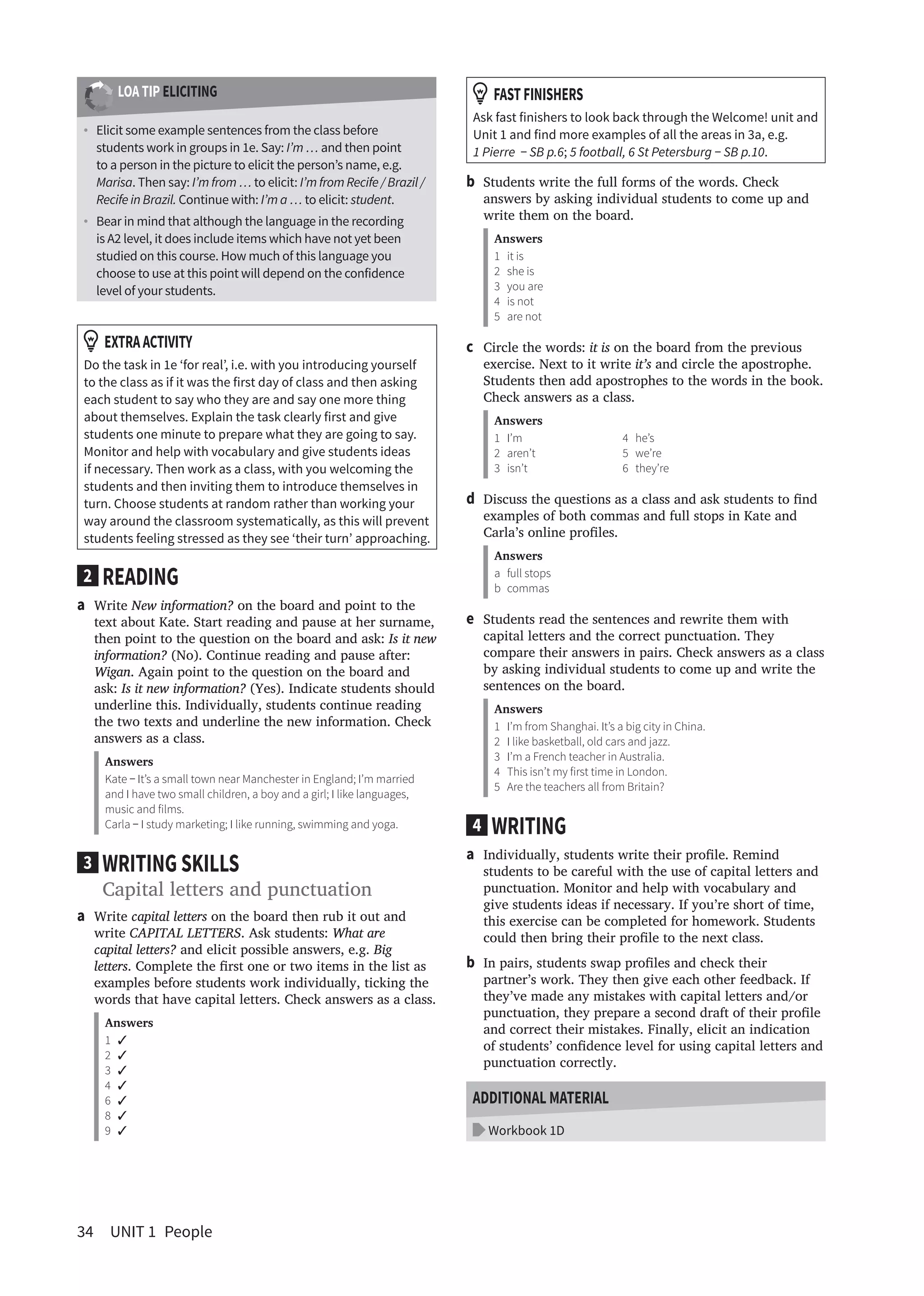
  • 139.
    UNIT 10 Communication137 OPTIONALLEAD-IN Books closed. Tell students they are going to have a test on technology words from the course. Explain that you’re going to read a definition for each word and they have to write down the word with the correct spelling. Read definitions 1–10: 1 You use this in the car. It tells you the route from one place to another. (satnav) 2 You use these to listen to music. You put them on your ears. (headphones) 3 You use this to read e-books. (e-reader) 4 You can make phone calls, send messages and emails, and use the Internet with this small object. (smartphone) 5 Families usually have one of these at home to work on or play games. It’s quite big. (computer) 6 This object has numbers, symbols and all the letters of the alphabet on it. You use it to write an email on the computer. (keyboard) 7 When you travel a lot on business, you need this kind of computer so that you can work easily on the plane or train. (laptop) 8 This is what photographers use to take pictures. They’re sometimes very expensive. (camera) 9 This is very useful when you need a copy of a document on paper. (printer) 10 This is great for using the Internet or watching films. It’s got a big screen and you touch it to control it. (tablet) Check answers as a class and give one point for the correct word and an additional point for spelling it correctly. The student with the highest score is the winner. 1 READING a In pairs, students ask and answer the questions. Take feedback as a class. b Pre-teach the word forum (an online message board where people can ask and answer questions). Students read the posts on the forum quickly and ind out what they talk about. Check the answer as a class. Answer b diferences between them c Tell students to read the posts again in detail. Individually, students ind the people. They then check in pairs. When checking answers, ask students to read the sections of the text which helped them ind the answer. Answers 1 Susanna 2 Sabine 3 Sabine and Hussein 4 Sabine EXTRAACTIVITY Ask students to read the posts again and answer questions 1−5: 1 Has Noelle got a computer at the moment? (Yes, she has. She’s got a laptop.) 2 How much did Susanna pay for her smartphone? (Nothing, it was free.) 3 Why doesn’t Sabine like smartphone screens? (Because they’re too small.) 4 What does Hussein think is one of the problems with tablets? (You can’t make calls easily on a tablet.) 5 Who prefers a smartphone? (Hussein) 6 Who prefers a tablet? (Sabine) d Discuss the question as a class. Encourage students to justify their answers as far as possible. 2 GRAMMAR Comparative adjectives a Books closed. Write Size is everything! Which is … ? on the board. Point to the gap and ask students if they can remember what the word in the text was (bigger). Repeat the process with the other four questions in orange from the text, and leave out the inal adjective in each case. Say each adjective / comparative adjective pair, e.g. big − bigger, cheap − cheaper, etc. and say These are comparative adjectives. Wipe the board before students work individually, looking at the bar charts in the book and completing the sentences. Check answers as a class. Answers 1 tablet; smartphone 2 tablet; smartphone 3 tablet; smartphone 4 tablet; smartphone 5 smartphone; tablet b Individually, students underline the comparative adjectives and complete the rule. Check answers as a class. Answers adjectives: heavier, better, bigger, more expensive, lighter rule: diferent c Give students a few minutes to complete the rules and the examples. They then check in pairs. Check answers as a class. Answers 1 -er; harder 2 more; more 3 better LOA TIP CONCEPT CHECKING • Check students have fully understood why we use comparative adjectives by asking them: When we use comparative adjectives, how many things are we usually talking about? (two) Are the things exactly the same? (no). • Ater checking students have understood the use of comparative adjectives, double-check they are clear about the form by asking: Can I say ‘my tablet is more big than my smartphone’? (no) Why not? (Because ‘big’ is a short adjective − the comparative is ‘bigger’.); Can I say ‘my laptop was expensiver than my tablet’? (no) Why not? (Because ‘expensive’ is a long adjective − the comparative is ‘more expensive’.); Can I say ‘my smartphone is gooder than my computer’? (no) Why not? (Because good is an irregular adjective − the comparative is better.) 10A A smartphone is better than a tablet At the end of this lesson, students will be able to: • read and understand a text comparing smartphones with tablets • use comparative adjectives correctly • understand a podcast with information to help choose a smartphone or tablet • use a lexical set of IT collocations correctly • compare two pieces of similar technology
  • 140.
    138 UNIT 10Communication EXTRAACTIVITY Draw two simple cars on the board, one a ‘high-end’ expensive car, e.g. a Ferrari, and one a smaller, cheaper car, e.g. a Fiat. Label them with the makes. Put students into pairs and give them one minute to compare the two cars in as many ways as possible. If you wish, write some adjectives as prompts down the side of the board, e.g. comfortable, big/small, expensive/ cheap, fast/slow, etc. Ask some pairs to share their sentences with the class. Then nominate a student to choose two things and to draw and label two simple pictures of them on the board, e.g. two stick people to represent two famous actors, two skylines to represent two cities, etc. Students work in pairs to compare the two things. In pairs or small groups, students can then choose two things to compare and continue the activity. g Divide the class into pairs and assign A and B roles. Student As read the instructions and look at the picture on SB p.131. Student Bs read the instructions and look at the picture on SB p.135. Check they understand that irst they should ask and answer questions about the smartphones and then they should compare them. Monitor, but don’t interrupt luency unless students make mistakes with comparative adjectives. Tell students to go back to SB p.101. FASTFINISHERS Ask fast finishers to write sentences to compare a piece of technology they have or use at home with a similar piece of technology in the classroom/school. 3 LISTENING a 3.39 Play the recording for students to listen for general meaning and answer the question. Check the answer as a class. Answer The podcast talks about diferent ideas from the reading text: pocketability and eatability. Audioscript All the time people ask me ‘What’s the best thing to buy – a phone or a tablet?’ There’s no easy answer to that question because diferent people need diferent things. And they can more or less do the same things – surf the Web, check emails, make calls. However, there are some diferent ways of helping you decide. And you can be sure these things are not talked about in advertisements and online information. To start with, there’s ‘pocketability’. ‘Pocket-a-what?’ I hear you ask. ‘Pocketability’. Let me explain. ‘Pocket … ability’. This means how easy it is to get the phone or tablet into diferent pockets in your jacket, your jeans – that kind of thing. And another really important thing to think about: ‘eatability’. No, it doesn’t mean you eat your phone. ‘Eatability’ is all about how easy it is to use the phone or tablet and eat at the same time. You know, sometimes you want to have lunch and read something. So you see? Two new and very important ways of thinking about phones and tablets: pocketability and eatability. You decide! b 3.39 Students listen to the recording again for speciic details and answer the questions. Check answers as a class. Answers 1 a 2 b c Discuss the irst question as a class. Ask students to guess whether Noelle bought a smartphone or a tablet. They then check their answer on SB p.135. d 3.37 Students complete the sentences, working individually. Play the recording for students to listen and check. Check answers as a class. Answers 1 than 2 than e 3.37 Pronunciation Play the recording again for students to listen to the pronunciation of than. Check the answer as a class. Drill the sentences. Answer not stressed CAREFUL! One of the most common mistakes with comparative adjectives is with the spelling. The spelling rules for comparative adjectives are highlighted in Grammar Focus 7A on SB p.154. At this level the most common mistakes are with double letters. Students may either not double the final consonant in comparative adjectives, e.g. biger (Correct form: bigger), or double the final consonant where it isn’t necessary, e.g. cheapper (Correct form = cheaper). Students may also use more with one-syllable adjectives, which should form the comparative with -er, e.g. more hard (Correct form = harder) and more light (Correct form = lighter). They may also use both more and -er at the same time, e.g. more heavier (Correct form = heavier) and more smaller (Correct form = smaller). Ater studying more for comparatives, students may then start to overuse this in sentences which require very, e.g. … they are more expensive. (Correct form = I haven’t got a tablet because they are very expensive.). f 3.38 Students read the information in Grammar Focus 10A on SB p.154. Play the recording where indicated and ask students to listen and repeat. Students then complete the exercises. Check answers as a class, making sure students are forming and spelling the comparative adjectives correctly. Tell students to go back to SB p.101. Answers (Grammar Focus 10A SB p.155) a 2 worse 3 cleaner 4 colder 5 more comfortable 6 more crowded 7 faster 8 fatter 9 better 10 more interesting 11 more modern 12 noisier 13 older 14 more popular 15 sadder 16 stranger 17 stronger 18 thinner 19 wetter 20 wider b 2 The film is more interesting than the book. 3 Her children are noisier than my children. 4 She is a better cook than my dad. 5 Dubai is more modern than Dublin. 6 This hotel is more comfortable than the last hotel. 7 My friends are fitter than me. c 1 She’s/is quicker 2 good better 3 worser worse 4 prettyer prettier 5 weter wetter 6 more big bigger 7 most more interesting 8 faster than mine
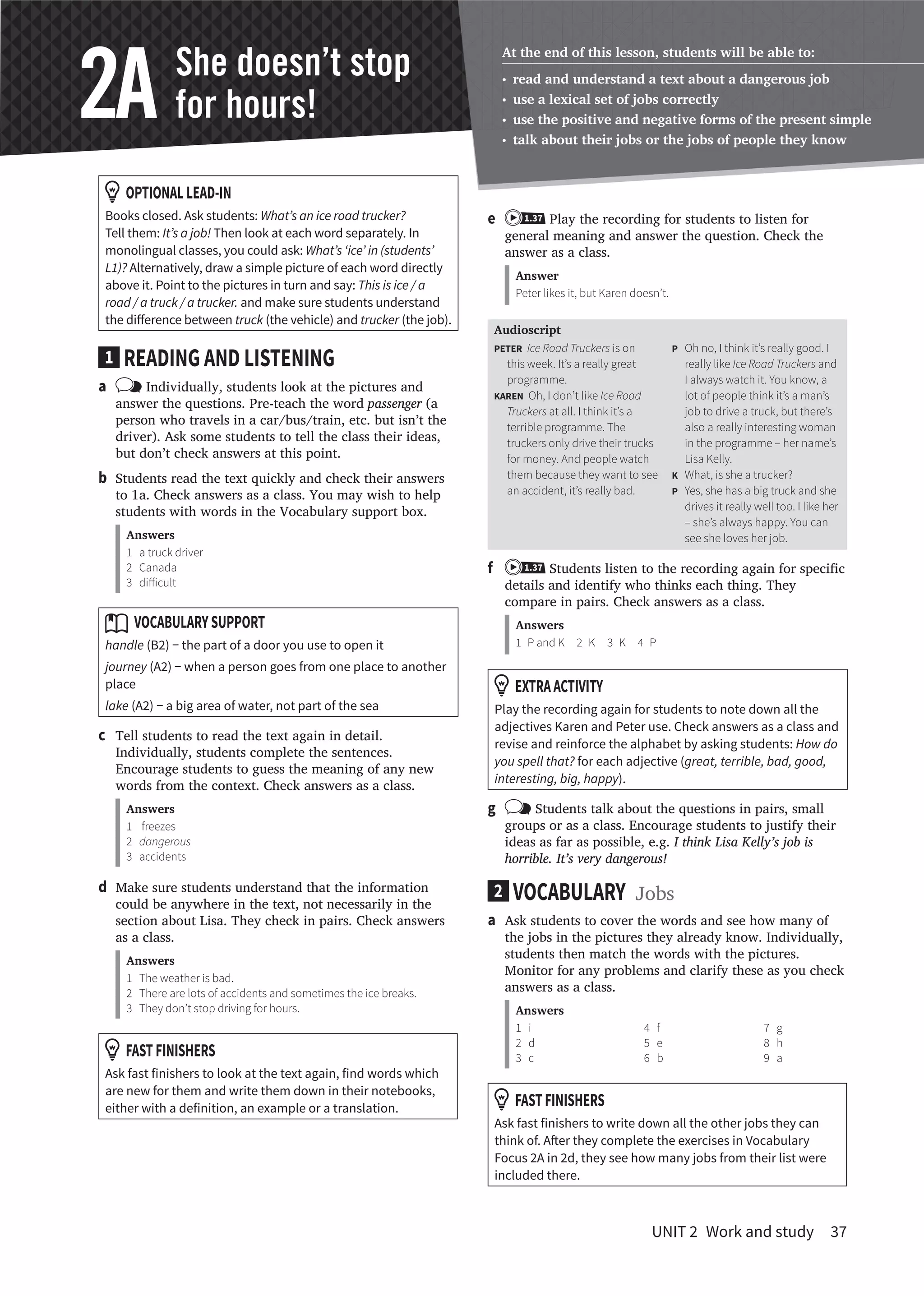
  • 141.
    UNIT 10 Communication139 5 SPEAKING a Individually, students decide if they want to talk about idea 1 (something new versus something old) or idea 2 (two similar things that they use). b Give students a few minutes to prepare and write down notes about the two things. Monitor and help as necessary. c Students work in pairs, telling each other about the two things they chose and asking and answering each other’s questions. As you monitor, don’t interrupt luency, but note any mistakes with comparative adjectives or the IT collocations. After the activity, write the mistakes on the board and ask students to correct them. FASTFINISHERS Ask fast finishers to talk about two objects from the category in 5a which they didn’t make notes about. ADDITIONAL MATERIAL Workbook 10A Photocopiable activities: Grammar p.183, Vocabulary p.190, Pronunciation p.201 4 VOCABULARY IT collocations a 3.40 Individually, students complete the phrases. Check they understand that the number of lines indicates the number of missing letters. Play the recording for students to listen and check. Check answers as a class. Answers 1 surf 2 check 3 make b Students match the verbs with the nouns, working individually. Make sure students understand that there are two possibilities for some of the verbs. They then check in pairs. Check answers as a class and point out the verbs which have two possibilities (download, log on to and save). Drill all the possible collocations. Answers 1 b; c 2 d 3 a 4 a; e 5 b; c c Students work in pairs or small groups, asking and answering questions using IT collocations. Monitor and check they are using the vocabulary from this section correctly.
  • 142.
    140 UNIT 10Communication What’s the most beautiful language in the world?10B Audioscript RADIO PRESENTER Good evening and welcome to the programme. Today, we’re talking to Professor Ryan Hunter. The professor is well known for his love of languages and has a new book in the shops tomorrow. Professor, welcome! PROFESSOR Thank you. It’s great to be here! RP So let’s start with my first question. Professor, in your opinion, what’s the most beautiful language in the world? P That’s a very good question. Of course, there is no right or wrong answer here. I’m sure we all have our favourites. But for me the answer is easy: Italian. It was the first language I learned. I still remember my teacher, Signora Monti. Signora Monti was the best teacher at my school and she started my love of languages. Now I can speak more than 20 languages well, but Italian is the most musical language I know. It’s the language of opera and love. RP OK, next question. What’s the most dificult language in the world? P Hmm. That’s an interesting question too. It partly depends on your first language. For example, for a speaker of English, Japanese is very dificult, but for a speaker of Mandarin Chinese it’s much easier. However, a few years ago, we did a project at my university and decided that the hardest language to learn is Basque, a language from parts of Spain and France. Last year we did another project on the Internet to find the easiest language to learn. More than 3,000 people answered the question and the most popular answer was Spanish. So perhaps Spanish is the easiest language to learn. That’s probably because it’s not very diferent from many other European languages. RP And one final question, what’s the most useful language to speak? P That’s easy – the language of the country where you live. But if you want to learn the most popular language in the world, then take lessons in Mandarin Chinese. More than 900 million people speak it. That’s not a surprise as China has the biggest population in the world. So with Mandarin Chinese you can speak to about 14% of all the people in the world. That’s pretty useful. RP That’s very useful, indeed! Well, Professor Hunter, thanks for talking with us today. I’m sure our listeners enjoyed hearing your thoughts on language! c 3.41 Individually, students match the sentences with the languages. Play the recording for students to listen and check. Check answers as a class. Answers 1 Italian 2 Japanese 3 Spanish 4 Mandarin Chinese OPTIONALLEAD-IN Books closed. Organise a quiz to revise some of the countries which students have seen on the course. Consider including some of the countries which students will need to complete question 3 in 1a and any additional countries which you know your students have problems spelling. To elicit the countries, either tell students the capital city (e.g. Australia − Canberra, Canada − Ottawa, China − Beijing, France − Paris, Greece − Athens, Italy − Rome, Japan − Tokyo, Russia − Moscow, Saudi Arabia − Riyadh, Spain − Madrid, Switzerland − Bern) or select a typical tourist picture for each country (e.g. the Sydney Opera House for Australia, the CN Tower for Canada) and show these to students. Students work in teams, writing down the names of each country without referring back to their books or their notes. Check answers as a class. Elicit the names of the countries and write them on the board for students to check their spelling. Give one point for identifying the country correctly and a bonus point for correct spelling. The team with the highest score is the winner. 1 LISTENING a Students ask and answer the questions in pairs or small groups. If you used the Optional lead-in, tell students that they can use the countries on the board to help them with question 3. Take feedback as a class and give students some of the suggested answers below to question 3 if you wish. Suggested answers for 3 Greek − Greece, Cyprus; Italian − Italy, southern Switzerland; English − the UK, the USA, Canada, Australia, New Zealand, South Africa and former British territories; French − France, Belgium, Canada, Switzerland and former French or Belgian territories in Africa; Arabic − North Africa and the Middle East; Basque − the Basque Country (northeast Spain and southwest France); Japanese − Japan; Mandarin Chinese − northern and southwestern China; Russian − Russia and former Soviet republics; Spanish − Spain and former Spanish territories in South America b 3.41 Play the recording for students to listen for general meaning and tick the languages that Professor Hunter talks about. You may wish to pre-teach the word population (the total number of people who live in a city, country, etc.). Check answers as a class. Answers Italian ✓, English ✓, Japanese ✓, Mandarin Chinese ✓, Basque ✓, Spanish ✓ At the end of this lesson, students will be able to: • understand a radio programme in which an expert talks about languages • use superlative adjectives correctly • read and understand a text with unusual facts and igures about languages • use high numbers correctly • ask and answer questions about their own and other languages
  • 143.
    UNIT 10 Communication141 CAREFUL! Student errors with superlative adjectives are generally similar to those with the comparative form. They may have problems with double letters, e.g. bigest (Correct form = biggest) and cheappest (Correct form = cheapest), or use most with one-syllable adjectives, e.g. Basque is the most hard language … (Correct form = Basque is the hardest language to learn.). Ater studying both the comparative and superlative forms, students may then start to confuse the two forms, e.g. This is the cheaper dictionary … (Correct form = This is the cheapest dictionary in the shop.) and He’s the more intelligent person … (Correct form = He’s the most intelligent person I know.). They may also have problems with word order when using most, e.g. This is the laptop most practical when … (Correct form = This is the most practical laptop when you’re travelling.). Sometimes students may have problems with word order and also confuse more and most, e.g. … I like more my smartphone. (Correct form = I like my smartphone, my laptop and my tablet. But I like my smartphone most.). e 3.43 Students read the information in Grammar Focus 10B on SB p.154. Play the recording where indicated and ask students to listen and repeat. Students then complete the exercises. Check answers as a class, making sure students are forming and spelling the superlative adjectives correctly. Tell students to go back to SB p.102. Answers (Grammar Focus 10B SB p.155) a 2 the fittest 3 the funniest 4 the driest 5 the prettiest 6 the worst 7 the friendliest 8 the best 9 the biggest 10 the nicest 11 the safest 12 the most exciting 13 the most tiring 14 the hottest b 2 The shortest 3 the most popular; the most interesting 4 The most useful 5 The fastest 6 the most important 7 the best 8 the worst FASTFINISHERS Ask fast finishers to brainstorm other adjectives they know and write down the comparative and superlative forms of each one, e.g. angry − angrier − the angriest, intelligent − more intelligent − the most intelligent, etc. f 3.44 Pronunciation Play the recording for students to listen to how the words are stressed. g 3.45 Students listen to the questions and identify the main stress. Drill each word in 2f and the questions in 2g. Answer on the adjective h In pairs or small groups, students ask and answer the questions in 2g. Monitor, but don’t interrupt luency unless students make mistakes with the form or pronunciation of the superlative adjectives. 3 READING a Students ask and answer the questions in pairs or small groups. Take feedback as a class, but don’t check the answer to question 3 at this point. b Students read the text quickly and ind out if their guesses in 3a were correct. Check the answer as a class. Answer It has interesting facts about languages and learning languages. d 3.41 Students listen to the recording again for speciic details and answer the questions. They compare in pairs. Check answers as a class. Answers 1 Italian 2 more than 20 3 in parts of Spain and France 4 14% e Individually, students choose one thing they found interesting and one thing they found surprising. They then compare in small groups or as a class. 2 GRAMMAR Superlative adjectives a 3.42 Books closed. Copy the following table onto the board: adjectives adjectives adjectives big easy good hard musical bigger easier better harder more musical Point to the irst column. Say adjectives. Point to the second column. Elicit and write the heading comparative (adjectives). Then point to the last column. Elicit and write the heading superlative (adjectives). If necessary, say the biggest as an example. Elicit the superlative adjectives, write them in the third column and drill them (the biggest, the easiest, the best, the hardest, the most musical). Students then open their books, look at the spelling of the superlative adjectives in the box and complete the sentences. Play the recording for students to listen and check. Check answers as a class. Answers 1 best 2 musical 3 hardest 4 easiest 5 biggest b Individually, students read the sentences and order the languages from very easy to very diicult. They then check in pairs. Check answers as a class. Answers 1 Spanish 2 French 3 Japanese 4 Basque c Discuss the question as a class. If you wish, extend the discussion by saying nationalities, e.g. Japanese, German, Argentinian, etc., and asking students if they think their language is easy or diicult for those particular nationalities to learn. d Give students a few minutes to complete the rules and the examples. They then check in pairs. Check answers as a class. Answers 1 -est; smallest 2 most; most 3 best
  • 144.
    142 UNIT 10Communication EXTRAACTIVITY Choose ten high numbers to say to the class for students to write down in numerals. Practise a variety of numbers, including examples with hundred, thousand and million, and focus particularly on any which students have problems with. Read each number twice, making sure you say and in the correct position. Students then compare in pairs. Check answers by asking individual students to come up and write the numbers in numerals on the board as you say them. Drill the numbers. c Students take turns to write down a high number for their partner to say. Monitor and check that students are using and in the correct position. 5 SPEAKING a Individually, students complete the questions. Check answers and spelling by asking students to write the correct answers on the board. Drill the questions. Answers 1 the nicest 2 the most beautiful 3 the best 4 the ugliest 5 the longest 6 the hardest 7 the most dificult 8 the most interesting b In pairs or small groups, students ask and answer the questions. Monitor, but don’t interrupt luency unless students make mistakes with the content of this lesson. LOA TIP REVIEW AND REFLECT • Give students a few minutes to think about their work in Lesson 10A on comparative adjectives and their work in Lesson 10B on superlative adjectives. Tell them to look back at the exercises and see where they made mistakes and where they did well. Ask them to identify one thing they were good at and one thing they need to improve. • Students take turns to share the things they were good at and the things they need to improve with the class. Encourage them to explain why things were difficult for them, e.g. It’s dificult to remember when to use ‘more’ and when to use ‘most’. It’s the same word in my language., etc. ADDITIONAL MATERIAL Workbook 10B Photocopiable activities: Grammar p.184, Vocabulary p.190 c Individually, students complete the text with the superlative forms of the adjectives in the box. Check answers and spelling by asking students to write the correct answers on the board. Answers 1 the best 6 the heaviest 2 the fastest 7 the shortest 3 the oldest 8 the longest 4 most expensive 9 the most dificult 5 the biggest 10 the most dificult d Tell students to read the text again in detail. Individually, students identify who or what the people are talking about. They then check in pairs. Check answers as a class. Answers 1 Harold Williams 2 Tamil 3 Khmer 4 the Oxford English Dictionary 5 Fran Capo 6 English e Discuss the questions as a class. Encourage students to justify their answers to question 1 as far as possible. 4 VOCABULARY High numbers EXTRAACTIVITY Review numbers 1−100. Put students into small groups and tell them to stand in a circle and try to count from 1−100 round the circle. Tell them that if they make a mistake or pause for more than three seconds, they have to start again. If you want to give your students an additional challenge, ask them to repeat the activity counting down from 100, or to add the word beep ater every two numbers, i.e. one, two, beep, three, four, beep, etc. a Individually, students ind the numbers and write down what they refer to. Check answers by copying the table onto the board and asking individual students to come up and complete the gaps. Answers three thousand people who answered a question online about the easiest language to learn nine hundred million people who speak Mandarin Chinese six hundred and three words Fran Capo can say in 54 seconds six hundred thousand words in the Oxford English Dictionary b 3.46 Students complete the exercises in Vocabulary Focus 10B on p.162. Check the answers to Exercise a as a class, play the recording for students to check their answers to Exercise b, and monitor Exercises c and d. Tell students to go back to SB p.103. Answers (Vocabulary Focus 10B SB p.162) a 1 d 2 g 3 a 4 f 5 c 6 e 7 j 8 i 9 h 10 b b 2 two thousand and two 3 − 4 three hundred and eighty-one thousand two hundred and forty-five 5 two million six hundred and seventy 6 fiteen million six hundred and eighty thousand four hundred and thirty
  • 145.
    UNIT 10 Communication143 2 USEFUL LANGUAGE Asking for help a 3.48 Individually, students look at the diferent ways to ask for help and try to remember which ones Annie uses. Play the recording for students to listen and check. Check answers as a class. Answers 1 Could you help me? 4 Do you mind showing me? b 3.49 Tell students that some of the sentences have mistakes. They work individually to identify and correct the wrong sentences. Play the recording for students to listen and check. Check answers as a class. Answers 1 ✓ 2 Would you mind tell telling me? 3 ✓ 4 Could you showing show me? 5 ✓ c Check students understand that one answer matches both questions. Individually, students match the questions with the answers. Check answers as a class. Answers 1 a; b 2 a; c 3 PRONUNCIATION Main stress and tone a 3.48 Play the recording and highlight the main stress in question 4 for students. b Answer the question as a class. Answer the main verb c 3.48 Play the recording again for students to decide if the tone goes up or down. Highlight the tone movement by writing the questions on the board and drawing a falling arrow over the end of each. Answer The tone goes down. OPTIONALLEAD-IN Books closed. Write sentences 1–5 on the board: 1 I get a new mobile phone every year. 2 I regularly use three or more social networking sites. 3 When I buy a new gadget, I never read the instructions. 4 I’ve got a computer, a laptop, a tablet and a smartphone. 5 My friends always phone me when they have problems with their gadgets. Put students into pairs or small groups to discuss how many of the sentences are true for them. Take feedback as a class and find out if all the sentences are true for any of the students. Tell students that these sentences are for people who use gadgets and technology a lot. Ask them to work in their pairs or small groups again and write five sentences for people who don’t use gadgets and technology a lot, e.g. I never check my email. In fact, I can’t remember my email address., I always get the simplest kind of mobile phone I can find., etc. Monitor and point out errors for students to self- correct. Ask students to share their sentences for people who hate technology with the class. 1 LISTENING a Read through the questions with the class and give students one minute to think about their answers before they work in pairs. Monitor and allow time for class feedback. b 3.47 Point to the picture of Annie and ask: Do you think Annie knows how to use her tablet? Why / Why not? Then play Part 1 of the video or the audio recording for students to answer the questions. Check answers as a class. Answers 1 Dan 2 Leo Video/Audioscript (Part 1) ANNIE Hi, Leo. LEO Hi, Annie. A Where is he? L Sorry, Annie. I mean, Dan says sorry. He had to go to a meeting. A What about our lunch?! L He didn’t know about the meeting. Someone called him about ten minutes ago. A I wanted help with this. L Oh? Right. A Leo, could you help me? L Erm … A There’s something I don’t know how to do. Do you mind showing me? L No, not at all – if I can. A Great, thanks. L Well, it is lunchtime. Would you like to have some lunch and …? A … and you could help me with my tablet. L Yes. A That would be lovely. c 3.47 Play Part 1 of the video or the audio recording again for students to answer the questions. They then check in pairs. Check answers as a class. Answers 1 He’s in a meeting. 2 They decide to have lunch and Leo can help her with her tablet. At the end of this lesson, students will be able to: • understand informal conversations in which people ask for help, respond appropriately and check instructions • use appropriate phrases for asking for help • identify the main stress and tone in questions asking for help • use appropriate phrases to check they have understood instructions • ask each other for help with a piece of new technology, respond appropriately and check they have understood the instructions Everyday English There’s something I don’t know how to do10C
  • 146.
    144 UNIT 10Communication Answers Annie says all three sentences. b Answer the question as a class. Ask students: What would you say to ask someone to repeat instructions? and elicit some ideas for option b, e.g. Sorry, I didn’t understand. Could you repeat that, please? or Sorry, I don’t understand you. Can you say that again? Answer a She wants to be sure she understands the instructions. c Elicit the correct answer from the class. Answer Like this? d Read through the instructions with the class. Students then work individually and put them in a logical order. Check answers as a class. Answers 1 c 2 a 3 b e Put students into pairs to practise giving the instructions in 5d and checking they understand them. EXTRAACTIVITY Ask students to work in pairs and use a piece of technology they have with them, e.g. a smartphone, a tablet, etc., and write a script for a conversation similar to the one with Annie and Leo in the video/audio. They should choose just one area they have a problem with for their conversation, and include appropriate phrases for asking for help and checking instructions. Monitor and help as necessary. When students have prepared their script, give them time to rehearse and check they are using correct stress and intonation. Correct students’ pronunciation as appropriate. Pairs then take turns to perform their conversations for the class, using the piece of technology as a prop. 6 SPEAKING a−b Divide the class into pairs and assign A and B roles. Student As read the irst card on SB p.105 and Student Bs read the irst card on SB p.133. Students then role play the conversation. Monitor, but don’t interrupt luency unless students make mistakes with the content of this lesson. Students then read the second card and role play the second situation. FASTFINISHERS Ask fast finishers to choose another object which they don’t know how to use and invent a similar conversation. ADDITIONAL MATERIAL Workbook 10C Photocopiable activities: Pronunciation p.201 Unit Progress Test Personalised online practice LOA TIP DRILLING • Drill the four questions in 2a before students work in pairs in 3d. Try focusing on the main stress in each phrase first, before filling in the other words, e.g. help − help me − Could − Could you − Could you help − help me − Could you help me? If necessary, clap out the rhythm of the questions for them so that they can then apply the rhythm to the sentence, e.g. Could you help me? would be ‘clap clap CLAP clap’. • Show students the downward tone movement at the end of the phrase using hand gestures to give them a visual reference. d Drill the questions in 2b and 3a. Students then work in pairs, practising saying the sentences. Monitor and correct students’ pronunciation as appropriate. e Individually, students think of a question to ask their partner for help with their studying, e.g. Can you help me with the pronunciation of this word? Monitor and point out errors for students to self-correct. f Remind students to stress the main verb in their questions and to make sure the tone goes down. In pairs, they practise asking for help and agreeing to help each other. Monitor and praise students with a smile or a nod when they pronounce the questions correctly. 4 LISTENING a 3.50 Play Part 2 of the video or the audio recording for students to answer the questions. They then check in pairs. Check answers as a class. Answers 1 She can’t get into her email. 2 Yes, he does. Video/Audioscript (Part 2) LEO So … you wanted some help. ANNIE Oh yes – I almost forgot. … Everything is fine – it’s great. But I don’t know how to get into my email. Can you have a look? L Sure. OK – that’s easy. You just need to change one small thing. … OK. So what you do is … touch this button here. A OK. L And a new screen opens. A Oh yes. L And now you just touch here where it says ‘Yes’. A Oh, that’s easy. OK. So first I touch this button? L That’s right. A And it takes me to a new screen – like this? L Correct. A And I touch ‘Yes’. Is that right? L Yeah. Now you can check your email. A Great. Thanks, Leo. Thank you so much. L You’re welcome. A Well, now I have to buy you another cofee. L Mm, I think I have to get back to work. I’ve got a meeting with Dan in ten minutes. A Dan? Oh, don’t worry about him. Let’s have another cofee! L Well … OK! b 3.50 Students watch or listen again for speciic details. Play Part 2 of the video or the audio recording again for students to put the things in order. Check answers as a class. Answers 1 b 2 a 3 d 4 c 5 CONVERSATION SKILLS  Checking instructions a Individually, students read the sentences and decide who says them. Check answers as a class.
  • 147.
    UNIT 10 Communication145 d 3.51 Students listen to the recording again for speciic details and complete the table. They then compare in pairs. Check answers by copying the table onto the board and asking individual students to come up and complete the gaps. Answers Sends texts to Prefers to Why? Speaker 1 parents chat online easier and cheaper Speaker 2 family talk on the phone easier and you can say more on the phone Speaker 3 friends talk on the phone friendlier e Students talk about the questions in pairs, small groups or as a class. Take feedback as a class. 2 READING a Individually, students read the posts on the discussion board quickly and tick the people who sometimes get annoyed. You may wish to pre-teach the word laugh (n.) (the noise we make when something is funny). Check answers as a class. Answers Genji ✓, Meepe ✓, MadMax ✓, AdamB ✓, Lars2 ✓ b Tell students to read the posts again in detail. Students identify who thinks the things. After checking answers, ask students: Which person are you like? Answers 1 Lars2 2 Rainbows 3 AdamB/Lars2 4 Genji/Meepe 5 Meepe/MadMax c Students read the posts again and underline the adjectives. They then check in pairs. Check answers as a class. Answers clear, important, useful, funny, good Negative: worst, annoying, rude, awful, boring OPTIONALLEAD-IN Write on the board: thnx for the pic − I was LOL! pls send me + when u can xxx. Ask students: Where do you sometimes see messages like these? and elicit that they are used in text messages and instant messaging. Circle the abbreviations in the message, i.e. thnx, pic, LOL, pls, +, u, xxx, then put students into pairs to try and work out what the message means. Check answers as a class. (Thanks for the picture − I was laughing out loud! Please send me more when you can. Kisses.) Ask students if they know any other similar abbreviations, e.g. PLZ (please), GR8 (great), NP (no problem), ?4U (I’ve got a question for you), etc. 1 SPEAKING AND LISTENING a Read through the questions with the students. Then put them into pairs or small groups to ask and answer the questions together. Monitor and allow time for class feedback. b Individually, students match the messages with the pictures. They then compare in pairs and discuss where the people are and what they are doing. Check answers as a class. If you used the Optional lead-in, ask students if the messages they send look more like the ones on the board or the ones in the Student’s Book. Answers a 3 (She is at the airport and is texting her family to say she is going to be late.) b 2 (He is in Italy and is taking a picture of his meal.) c 4 (He is on a train and is texting his mother/girlfriend to ask what is for dinner.) d 1 (She is waiting for someone and is texting them.) c 3.51 Play the recording for students to listen for general meaning and identify the texts. Check answers as a class. Answers Speaker 1 c Speaker 2 a Speaker 3 d Audioscript 1 I sometimes send text messages, usually to my parents to say when I’m coming home, but I usually chat on social networking sites. It’s easier if you’re online anyway – and it’s cheaper! I always have my phone with me, so I can see what my friends are doing. It’s really good to know what people are doing. I chat to everybody all the time and we send each other pictures. 2 I only really send text messages when I’m travelling. I text my family to tell them when I arrive somewhere new or tell them when I’ll be back. It’s useful because I’m oten away on business trips and of course it’s cheaper than phoning. But usually I don’t send text messages. I prefer to talk to people on the phone. It’s easier and you can say more. 3 I don’t really like texting much. I think it’s better to talk on the phone. It’s friendlier. I sometimes send a text if I’m meeting a friend, but that’s about all. Skills for Writing Also, my friends send really funny texts10D At the end of this lesson, students will be able to: • understand text messages and people talking about what they use text messages for • understand a post on an Internet discussion board and a series of responses agreeing and disagreeing • link ideas using also, too and as well • write an Internet post about something that annoys them and an appropriate reply to another student’s post
  • 148.
    146 UNIT 10Communication 4 WRITING AND SPEAKING LOA TIP MONITORING • Monitor the Writing and Speaking section closely making sure at all stages that students are completing the task correctly and are clear about what they have to do. • In 4a, monitor and help with vocabulary, and give students ideas if necessary. If students complete 4b and 4c in class, then monitor and note the kind of mistakes they are making to see how well they have understood and can use the content of the unit. However, don’t point out students’ mistakes at this point as other students will do this in 4d. In the final speaking stage, listen for correct use of comparative and superlative adjectives, but don’t interrupt fluency. a Students work individually to plan a post about something that annoys them. b If you’re short of time, this exercise can be completed for homework. Students could then bring their posts to the next class. c Students swap posts and write a comment agreeing or disagreeing with the original post and using also, too or as well if possible. Again, if you’re short of time, this exercise can be completed for homework. They then pass the original post and their comment on to a third student. FASTFINISHERS Ask fast finishers to pass the original post and their comment on to another fast finisher, who can then write an additional response both to the post and the comment. d Students read both the original post and the comment and check the other students’ work. Tell them to check the other students have used also, too or as well correctly. If there are any mistakes with the linking words, or mistakes in other areas, students prepare a second draft of their original post/comments before giving it to you for correction. e Put students into small groups to compare their posts and discuss which they think is the most interesting. After correcting students’ work, ask them to make a inal version to share with other students. Display the posts and comments around the classroom for other students to read and comment on further if they wish. Alternatively, if you and your students have the technology available, set up a class discussion board where students can display their posts and comment on each other’s texts. ADDITIONAL MATERIAL Workbook 10D d Tell students that they need to ind short phrases/ sentences, not just individual words. Check answers as a class. Answers 1 Yes, I agree; Yes, you’re right; Yes, I feel the same way. 2 I don’t agree. FASTFINISHERS Ask fast finishers to write their own short response to Genji’s original post. 3 WRITING SKILLS  Linking ideas with also, too and as well a Tell students to close their books. Write the irst sentence from 3a on the board, leaving a gap in place of also. Point to the gap and ask students: What’s this word? Elicit also and write it in the sentence. Ask students: What kind of word is this? and elicit a word to link ideas (an adverb). Students open their books, look at the sentences with also and underline the correct answers. Check answers as a class. Answers 1 before 2 ater 3 beginning b Individually, students identify the words and phrases that mean the same as also. They then compare in pairs. Check answers as a class. Answers 1 too 2 as well They come at the end. EXTRAACTIVITY Write sentences 1−5 on the board and ask students to decide if they are correct or not. Tell them to correct the wrong sentences. Tell them that there is more than one correct option to make correct sentences. 1 I can speak French and I can too speak German. (✗ … I can (also) speak German (too / as well).) 2 Texting is really boring. Also, texts can be quite expensive. (✓) 3 I think Italian is the most beautiful language in the world too. (✓) 4 I’ve got a laptop and a tablet also. (✗ … and (also) a tablet (too / as well).) 5 He’s from the Basque country so he speaks Basque and Spanish, but he can as well speak French. (✗ … he can (also) speak French (too / as well).) Check answers as a class. c Check students understand that they can link the ideas in the sentences with also, too or as well, but tell them that they should use each linking word at least once. Students work individually, adding also, too or as well to the sentences. Monitor and check students are putting the linking words in the correct position. Answers 1 … and I’ve (also) got a new laptop (too / as well). 2 … and we (also) took a street map (too / as well). 3 … and she (also) knows a lot about computers (too / as well). 4 (Also,) they have a large screen so they are easy to read (too / as well).
  • 149.
    UNIT 10 Communication147 1 GRAMMAR a Individually, students complete the conversation. Check answers as a class and check students are spelling the comparative adjectives correctly. Answers 2 more powerful 3 bigger 4 more expensive 5 heavier 6 lighter 7 thinner 8 more practical 9 faster b Check students understand that they have to use one word from each box to complete the questions. Monitor and help as necessary. Point out errors for students to self-correct. Check answers as a class. Answers a the hottest place b the longest river c the most expensive hotel room d the best footballer e the biggest country 2 VOCABULARY a Students underline the correct words in each sentence. Check answers as a class. Answers 1 save 2 surfs; website 3 log into; check 4 Click on; file b Students write the numbers as words, working individually. Check answers and use of and as a class by asking students to write the correct answers on the board. Answers 1 fity million 2 two thousand and three 3 two hundred and fity-six 4 one thousand five hundred 5 two hundred thousand 6 two thousand six hundred and fity-five 3 WORDPOWER most a Books closed. Ask students the following questions and discuss them as a class: What language do most of the people in your country speak? Do most of them understand English? In your opinion, what’s the most beautiful language in the world? After discussing the questions, ask them: What word is in all three questions? Elicit most and write it in a circle on the board. Students open their books, read the text and answer the questions. Check answers as a class. Answers 1 Spanish, German, English and Italian 2 writer − English − because she was at school in London and also because it’s an international language and most people speak it; her mother − Spanish − she says it’s the most beautiful language in the world b Read through the meanings with the students and discuss the irst phrase (Most of the people we know … − meaning b) as an example. Students work individually, matching the phrases with most with the meanings. They then check in pairs. Check answers as a class. Answers a 4, 6 b 2, 3, 5 c Check students understand that this question is referring to items 1 and 5 from the text in 3a. Answer the questions as a class. Answers a most people b most of the people d Individually, students complete the sentences with the words in the box. Check answers as a class. Answers 1 of the evening 2 people 3 of the way 4 of my friends EXTRAACTIVITY Write sentence beginnings 1–4 and endings a–d on the board and ask students to match the sentence halves: 1 I do my homework most of; 2 I get up early most; 3 I think most of; 4 I love all my gadgets but most of; a my friends speak English better than me.; b all, I love my smartphone.; c the time, but sometimes I forget.; d days, but not at the weekend. Check answers as a class (1 c, 2 d, 3 a, 4 b). Tell students to use these as examples of the kind of sentences they should write in 3e. e As an example, make sentences about your life using two of the phrases, e.g. Most days I get up very early, but at weekends I stay in bed until very late. Students then write sentences about their lives. Monitor and point out errors for students to self-correct. f In pairs, students tell each other their sentences and ind out how similar they are. Encourage students to ask follow-up questions if possible. Photocopiable activities: Wordpower p.195 LOA REVIEW YOUR PROGRESS Students look back through the unit, think about what they’ve studied and decide how well they did. Students work on weak areas by using the appropriate sections of the Workbook, the Photocopiable activities and the Personalised online practice. UNIT 10 Review and extension
  • 150.
    148 UNIT 11Entertainment UNITOBJECTIVESUNITOBUNITOBUNITOBUNITOBUNITOBJECUNITOBUNITOBJECTIVESJECTIVESJECTIVESUNITOBJECUNITOBJECUNITOBJECTIVESTIVESTIVESJECTIVESTIVESUNITOBUNITOBUNITOBUNITOBUNITOBUNITOBJECUNITOBJECUNITOBUNITOBUNITOBUNITOBJECUNITOBJEC At the end of this unit, students will be able to: understand information, texts and conversations about actors, actresses, music and films ask for and give information about films, TV programmes, books and music discuss things they’ve seen and places they’ve been to in their town or city understand conversations in which people express their opinions and agree or disagree use appropriate phrases to ask for, express and respond to opinions write a review of a film they’ve seen and structure it correctly UNITOBJECTIVES UNITCONTENTS G  GRAMMAR Present perfect: positive Present perfect: negative and questions Present perfect or past simple V  VOCABULARY Irregular past participles: been, bought, broken, caught, eaten, fallen, flown, forgotten, grown, had, heard, read /red/, seen, written Music: a band, classical, dance, a dancer, a DJ, folk, jazz, a musician, opera, an orchestra, pop, rock, a singer, tango Wordpower: Multi-word verbs: call back, come round, fill in, grow up, lie down, try on P  PRONUNCIATION Sound and spelling: /ɜː/ Main stress in the present perfect Word stress in music words Main stress and tone C  COMMUNICATIONSKILLS Talking about actors, actresses, films, TV programmes, books and music Talking about things you have and haven’t seen, and places you have and haven’t been to in your town and city Using appropriate phrases to ask for and express opinions Responding to opinions with short phrases and questions Discussing films that you’ve seen and enjoyed, and films you would like to see Writing a review of a film you’ve seen GETTING STARTED OPTIONALLEAD-IN Books closed. Write these jumbled phrases on the board and tell students they are all kinds of entertainment: achwngti a iflm (watching a film), inogg ot a cerntco (going to a concert), gnsiee a yapl ta het heatert (seeing a play at the theatre). In pairs, students work out what the phrases are. Give students one minute to continue working in pairs and think of other common forms of entertainment, e.g. watching a dance show, seeing a musical, going to the opera, etc. Take feedback as a class and add their ideas to the board. Ask students: Which of these are most popular in your country? Choose the top three. Students work individually and answer the question. Then take feedback as a class. a Give students one minute to think about their answers to the questions before talking about the picture as a class. If you wish, ask students additional questions, e.g. How old do you think the children are? When and where do you think the photo was taken? and give them some information from the Culture notes below. CULTURENOTES This picture was taken in Paris in 1963. The children are watching a traditional puppet show in the Parc Montsouris in the southern outskirts of the city. They are all watching the moment when a dragon is killed and, as can be seen from their facial expressions, they are reacting to it with a wide range of emotions. The photographer was Alfred Eisenstaedt, who was born in Prussia in 1898 and immigrated to the USA in 1935. He was a highly successful photographer. He took pictures of Sophia Loren, Marilyn Monroe, the Clintons and, undoubtedly one of the most famous photos of the 20th century, a sailor kissing a young woman in Times Square, New York on V-J Day, at the end of World War II. b In pairs or small groups, students talk about what they enjoyed when they were children. If you have a class with a variety of ages, try and mix older and younger students together, as it will give them more to talk about. Help with vocabulary and pronunciation, but don’t interrupt luency. Take feedback as a class and ask students to share the thing they enjoyed most. EXTRAACTIVITY Extend the discussion and get students to talk more about what they enjoyed playing as children. Write the following questions on the board and put students into small groups to discuss them: What games did you and your friends play when you were children? What was your favourite indoor game? And outdoors? What was your favourite toy when you were a child? Were there any toys that your friends had that you wanted? Do you think your parents enjoyed the same things when they were children? Why / Why not? What about your grandparents? Entertainment UNIT11
  • 151.
    UNIT 11 Entertainment149 VOCABULARYSUPPORT act (B1) − to perform in a film or a play award (B2) − a prize someone is given for something special they have done novel (B1) − a book that tells a story that isn’t real soap opera (B1) – a TV programme with a story that continues for a very long time and is always about the same group of people UNICEF − the United Nations Children’s Fund, a charity that helps children in difficult situations around the world CULTURENOTES Isla Fisher (b. 1976) starred in the 2013 film version of The Great Gatsby and has appeared in many other films including Wedding Crashers, Confessions of a Shopaholic and Now You See Me. She is a familiar face on TV, having appeared in over 300 episodes of the Australian soap opera Home and Away from 1994 to 1997. Rose Byrne (b. 1979) started making films at the age of 15 when she appeared in Dallas Doll. Since then she has made many films including Troy, Insidious, Bridesmaids, X-Men: First Class and The Internship. She also co-starred alongside Glenn Close in all 59 episodes of the television series Damages from 2007 to 2012. Mia Wasikowska (b. 1989) acted in the television drama All Saints in 2004 when she was 14. She became famous when she starred in Tim Burton’s Alice in Wonderland in 2010. She has also starred in The Kids Are All Right, Albert Nobbs, Stoker, the 2011 film version of Jane Eyre and the 2014 film version of Madame Bovary. EXTRAACTIVITY Ask students to read the fact files and the article again and decide if sentences 1−4 are true or false: 1 Mia has never acted in the USA. (F − All three actresses work in Hollywood in the USA.) 2 Isla is a lot younger than Mia. (F − Mia is the youngest of the three.) 3 Rose has acted on television. (T) 4 Mia has won prizes for both acting and photography. (T) e Students talk about the questions in pairs or small groups. OPTIONALLEAD-IN Write sentence beginnings 1–4 on the board: 1 Hugh Jackman and Nicole Kidman both lived …; 2 Robert Downey Jr and Sean Penn both went …; 3 Ashton Kutcher and Charlize Theron were both …; 4 Frances McDormand and Milla Jovovich are both … . Put students into pairs or small groups and ask them to discuss possible ways to complete the sentences. Then ask students to match sentence endings a–d to the actors: a models before they became actors.; b in Australia.; c married to film directors.; d to the same school. Check answers as a class (1b Jackman was born in Australia. Kidman was born in Hawaii to Australian parents, but the family returned to Australia when Kidman was four years old. 2d They both went to Santa Monica High School in California though at different times. 3a Kutcher modelled for Calvin Klein and Abercrombie & Fitch, and Theron was a model in Milan. 4c McDormand is married to Joel Coen and Jovovich is married to Paul W S Anderson.) 1 READING a Look at the pictures as a class. In pairs, students then decide what they think the three actresses have in common. VOCABULARYSUPPORT film director (B1) − the person who tells the actors what to do in a film have something in common (B1) − to be the same for two or more people or things b Tell students they should only read the fact iles directly underneath each picture. Check the answer to 1a as a class. Answer b They all lived in Australia. c Put students into pairs to guess the answers to the questions. You may wish to pre-teach the word train (v.) (learn to do something, usually physical, by repeating it lots of times). d Tell students to read the main part of the article, Film International, and check their answers to the questions in the quiz. Check answers as a class. Ask students: Do you know any other ilms that these actresses are in? If you wish, give students information from the Culture notes in the next column. You may wish to help students with words in the Vocabulary support box. Answers 1 Rose Byrne 2 Mia Wasikowska 3 Mia Wasikowska 4 Isla Fisher 5 Rose Byrne 6 Isla Fisher 11A I’ve heard she’s really funny At the end of this lesson, students will be able to: • read and understand a text about three actresses • use the present perfect to talk about experience • understand a conversation about actresses and the ilms they are in • use a lexical set of irregular past participles correctly • ask for and give information about popular ilms, TV programmes and books
  • 152.
    150 UNIT 11Entertainment c Students try to remember what Maggie and Stephen thought about the actresses. Play the recording again if necessary. Check answers as a class. Answers Isla Fisher in The Great Gatsby – really good Rose Byrne in Bridesmaids – a real laugh Mia Wasikowska in Jane Eyre – fantastic 4 VOCABULARY Irregular past participles a 3.53 Individually, students complete the sentences with the words in the box. Play the recording for students to listen and check. Check answers as a class. Ask students: How are these past participles diferent from the examples in 2c? (They are irregular so they don’t end in -ed.) Answers 1 written; read 2 seen 3 heard No, the verbs don’t end in -ed. b 3.54–3.55 Students complete the exercises in Vocabulary Focus 11A on SB p.163. Play the recording for students to check their answers to Exercise a and complete the Pronunciation activity. Check answers to Exercise b as a class and monitor Exercise d. Tell students to go back to SB p.111. Answers (Vocabulary Focus 11A SB p.163) a broken – break; read (/red/) – read (/riːd/); been – be; caught – catch; written – write; seen – see; had – have; eaten – eat; bought – buy; heard – hear; flown – fly; forgotten – forget; fallen – fall; grown – grow b 1 caught 2 written 3 eaten 4 flown 5 been 6 bought 7 forgotten 8 read 9 seen 10 heard 11 broken 12 had 13 fallen 14 grown c 2 girl, learn, nurse, German, work FASTFINISHERS Ask fast finishers to use the Irregular verbs list on SB p.176 and take turns to test each other on the past participle forms. 5 GRAMMAR  Present perfect: negative and questions a 3.56 Students complete the sentences with the words in the box. Play the recording for students to listen and check. Check answers as a class. Answers 1 seen 2 never 3 ever b Ask students to look at the position of not, ever and never in the examples in 5a. Complete the rules as a class. Answers 1 ater 2 before c 3.56 Play the recording for students to listen again to the sentences in 5a. Check the answer by writing the sentences on the board and underlining the three past participles to indicate the main stress. Drill the sentences. Answer the past participle 2 GRAMMAR Present perfect: positive a Books closed. Write on the board: Marilyn Monroe … (make) her irst ilm in 1947. Ask students to complete the sentence (made). Then write on the board: Soia Coppola … (make) a new ilm at the moment. Again ask students to complete the sentence (is making). Finally, write: Meryl Streep … (make) lots of fantastic ilms. and ask students to try to complete the sentence. They may suggest using makes (present simple), but tell them that a native speaker here would use has made. Then point to each verb in turn and ask: What tense is this? to elicit the three tenses (past simple, present continuous and present perfect). Students then open their books and complete the sentences. Check answers as a class. Answers 1 ’ve acted 2 ’s written 3 has won b Discuss the question as a class. Answer No, we don’t. c Individually, students complete the rule. Check answers as a class. Ask students: How do we form the past participle of regular verbs? (by adding -ed to the base form). Answers I / you / we / they + have (’ve) he / she / it + has (’s) 3 LISTENING a 3.52 Students listen to the conversation for general meaning and tick the ilms Maggie and Stephen talk about. You may wish to pre-teach the phrase be a laugh (be a person or thing that makes people laugh). Check answers as a class. Answers 1 No, they didn’t. (Maggie got 1 and 5 wrong and Stephen got 2 and 6 wrong.) 2 b ✓ The Great Gatsby c ✓ Bridesmaids f ✓ Jane Eyre Audioscript STEPHEN How many quiz answers did you get right? MAGGIE All of them except for numbers one and five. S I got question two and six wrong. How did you know Isla Fisher has written novels? Have you read them? M No, I haven’t – it was a guess. In fact, I haven’t seen any of her films. What about you? S I’ve seen The Great Gatsby. She’s really good in it. I’ve never seen a film with Mia Wasikowska. M Really? Try Jane Eyre – she’s fantastic in that. S What about Rose Byrne? Have you ever seen any of her films? M No, I haven’t, but I’ve heard she’s really funny in Bridesmaids. S Yes, I’ve seen that. She’s a real laugh. b 3.52 Students listen to the recording again for speciic details and complete the table. They then check in pairs. Check answers as a class. Answers Isla Fisher Rose Byrne Mia Wasikowska Maggie ✓ f Stephen ✓ b ✓ c
  • 153.
    UNIT 11 Entertainment151 CULTURENOTES The Hobbit and The Lord of the Rings are among the most famous books in the history of English literature. The Hobbit has sold over 100 million copies and The Lord of the Rings has sold over 150 million copies. The books were written by J R R Tolkien, a professor of English at Oxford University. The Hobbit was first published in 1937 and the three volumes of The Lord of the Rings from 1954 to 1955. New Zealand filmmaker Peter Jackson adapted The Lord of the Rings for the cinema, releasing the three parts from 2001 to 2003. He subsequently adapted The Hobbit as three films, The Hobbit – An Unexpected Journey (2012), The Desolation of Smaug (2013) and The Battle of the Five Armies (2014). His adaptations were popular with both critics and the public, including fans of the novels. 6 SPEAKING a Individually, students think of some popular ilms, TV programmes and books and write six questions about them. Monitor and help with any vocabulary students might need and the titles in English if necessary. Point out any errors in the students’ questions for them to self- correct before they start on the groupwork stage in 6b. b Put students into small groups to ask and answer each other’s questions. As you monitor, don’t interrupt luency, but note any mistakes with the present perfect. After the activity, write these on the board and ask students to correct them. EXTRAACTIVITY Ask each student to note down the other students’ answers as they ask and answer the questions in 6b. They then summarise what they found out for the class. Demonstrate the activity by asking five students an example question, e.g. Have you seen all eight of the Harry Potter films?, and pretending to note down their answers. Then give the class a summary of what you learned, e.g. There are five people in my group. Two of them have seen all of the Harry Potter films. Students then work individually and write summary statements for each of the six questions they asked in 6a. Monitor and point out errors for students to self-correct. Ask each student to read two or three of their summary statements to the class. ADDITIONAL MATERIAL Workbook 11A Photocopiable activities: Grammar p.184, Vocabulary p.191, Pronunciation p.202 CAREFUL! There are various common student mistakes with the present perfect. Students may simply avoid using the present perfect altogether and use the present simple instead, e.g. I see all of … (Correct form = I’ve seen all of John Wayne’s films.), or they may use the incorrect auxiliary verb, using has/hasn’t instead of have/haven’t or vice versa, e.g. I hasn’t been … (Correct form = I haven’t been to the USA.). When using ever and never, students are also likely to make mistakes. They may try and use both words in the same sentence, e.g. … I never ever see. (Correct form = It is the best film I have ever seen.), or they may omit the auxiliary verb, e.g. I never see a film … (Correct form = I’ve never seen a film with Rose Byrne.). When forming a negative with never, they oten include a negative auxiliary verb, e.g. I never don’t see a city … (Correct form = I’ve never seen a city like it.). d 3.57 Students read the information in Grammar Focus 11A on SB p.156. Play the recording where indicated and ask students to listen and repeat. Students then complete the exercises. Check answers as a class, making sure students are forming the present perfect and positioning ever and never correctly. Tell students to go back to SB p.111. Answers (Grammar Focus 11A SB p.157) a 2 written 3 swum 4 had 5 brought 6 done 7 driven 8 ridden 9 run 10 been b 2 ’ve visited 3 hasn’t borrowed 4 ’ve never eaten 5 ’ve walked 6 ’s played 7 haven’t done 8 has had c 1 I have; I’ve seen; I’ve never seen 2 Have you ever met; I’ve met; Has he visited; has; He’s been LOA TIP DRILLING • Drill the two conversations in Exercise c in Grammar Focus 11A on SB p.157 before continuing. Divide the class in half down the centre and tell the group on your let that they are A and the group on your right that they are B. Drill A’s first question with the let-hand group and B’s response with the right-hand group. Then put the two lines together with the let-hand group asking and the right-hand group answering the first question as a chorus. Repeat the process until students can perform the first conversation without you having to model the lines for them. Tell the groups to swap A and B roles before you work on the second conversation. e 3.58 Students work individually, completing the conversation. Play the recording for students to listen and check. Check answers as a class. If you wish, give students information from the Culture notes in the next column. Answers 1 Have you seen 2 ’ve seen 3 haven’t seen 4 Have you read 5 haven’t read 6 ’ve read
  • 154.
    152 UNIT 11Entertainment I bet you’ve never been to the opera11B At the end of this lesson, students will be able to: • read and understand a text about music in Buenos Aires • use a lexical set of music words correctly • understand a conversation in which people talk about places they’ve been to • distinguish between the past simple to say when something happened and the present perfect to talk about past experiences • talk about things they have and haven’t seen and places they have and haven’t been to in their town and city OPTIONALLEAD-IN Write the names of a number of famous sights in the city/ country where you’re teaching on the board, e.g. in Prague − the Old Jewish Cemetery, the Estates Theatre, Charles Bridge, Wallenstein Palace, etc. Try to include two or three places connected with music and the performing arts in the list. Write Have you ever … ? on the board and put students into pairs to think of questions they would like to ask you about the places, e.g. Have you ever visited the Old Jewish Cemetery? Have you ever seen an opera at the Estates Theatre?, etc. Monitor and point out errors for students to self-correct. As a class, students take turns asking you their questions. Reply with Yes, I have. / No, I haven’t. and then, if appropriate, give students a little bit of extra information using the past simple, e.g. Have you ever visited the Old Jewish Cemetery? Yes, I have. I went a few years ago. It’s beautiful. Don’t draw students’ attention to the use of the past simple or allow them to ask you additional follow-up questions at this point as they are likely to make mistakes with the tenses. 1 READING a Discuss the question as a class and elicit that the people are dancing the tango. Ask the students: Which city is this? to elicit Buenos Aires. Then ask students: Have you ever been to Buenos Aires? If any students answer yes, then ask them one or two follow-up questions using the past simple, e.g. When did you go? Did you see people dancing in the street like this? and monitor to see if they use the correct tenses in their answers. Don’t, however, correct any grammatical mistakes at this point. b Individually, students guess what they think the text is about. They then read the text quickly and ind out if they were correct. Check the answer as a class. Answer 2 places to hear music c Tell students to read the text again in detail and answer the questions. They compare in pairs. Check answers as a class. You may wish to help students with words in the Vocabulary support box. Answers 1 a San Telmo b the Konex Cultural Centre c the Teatro Colón d Jazz y Pop 2 Teatro Colón 3 Jazz y Pop, the Roxy 4 about 2 am 5 Students’ own answers VOCABULARYSUPPORT basement (B2) − part of a house or a building that is under the level of the street district (B1) − a specific area of a town, city or country live /laɪv/ (B1) − not recorded in advance, something you watch or listen to while it is happening season (B1) − a series of concerts, plays, etc. that all happen in the same place in a specific period of time top (B1) − the best, most popular and most respected EXTRAACTIVITY Write gapped sentences 1–5 on the board. Ask students to read the text again and complete them with the names of the marked places. 1 In … you can have a cofee, listen to music and go shopping. (San Telmo) 2 … is very, very small and they don’t always need to pay the musicians. (Jazz y Pop) 3 At … there are two diferent areas for diferent kinds of music. (The Roxy) 4 You can see the best classical singers and musicians from around the world at the … . (Teatro Colón) 5 The … is a good place to go at the beginning of the week. (Konex Cultural Centre) d Discuss the places students would and wouldn’t like to go to as a class. Encourage students to justify their answers as far as possible. 2 VOCABULARY Music a 3.59 Students read the text again and underline more examples of kinds of music and people. Play the recording for students to listen and check. Check answers as a class. Answers 1 kinds of music: classical, opera, jazz, rock, pop, folk, dance 2 people who play music, sing or dance: a musician, a band, a DJ, a singer, a dancer b 3.60 Pronunciation Look at the example with the class and then play the recording for students to circle the number of syllables and underline the stressed syllable. Check answers as a class. Drill each word. Answers musician (3) classical (3) orchestra (3) opera (2) c 3.61 Play the recording for students to listen to the pieces of music and match them with words from 2a. Check answers as a class. Answers 1 classical 2 rock 3 jazz 4 pop 5 opera d In pairs or small groups, students discuss the questions. Take feedback as a class. Find out which kinds of music are the most/least popular.
  • 155.
    UNIT 11 Entertainment153 3 LISTENING a 3.62 Play the recording for students to listen for general meaning and tick the places Kurt and Bea talk about. Check answers as a class. Answers ✓ Teatro Colón ✓ Jazz y Pop ✓ The Roxy ✓ San Telmo Kurt hasn’t been to any of the places, but Bea has been to all of them. Audioscript KURT Look, have you seen this article? It says Buenos Aires is one of the world’s top cities for music. I didn’t know that. BEA Well, there is a lot of good music. K I haven’t been to any of these places and I’ve lived here for years. Like Jazz y Pop, it says it’s a famous jazz club, but I’ve never heard of it. Have you been to Jazz y Pop? B Yes, I went there two weeks ago. They had really good music. K Oh, right. And what about The Roxy? Where’s The Roxy? Have you been there? B Yes, of course I have. We all went there for Antonia’s birthday. We had a fantastic time, we didn’t leave till five in the morning. Didn’t you come? K Antonia’s birthday … ? Oh, I remember. I had exams, I couldn’t go. OK, well I bet you’ve never been to the Teatro Colón. B Yes, I have actually. I went there last year. It was my dad’s 50th birthday, we went to the opera. K Oh, yeah. What did you see? B I don’t remember, something by Mozart. I didn’t like it much. K You’ve been everywhere. B Yeah, well you should go out more, you spend too much time studying. Look, it’s a nice evening, why don’t we go down to San Telmo and sit in a café, and watch the dancers? K Mm … Well, I’d love to, actually I’ve never been there. But I’ve got this essay to write … b 3.62 Students listen to the recording again for speciic details and complete the table. Check answers by copying the table onto the board and asking individual students to come up and complete the gaps. Answers Where? When? Did she like it? 1 Jazz y Pop two weeks ago Yes, they had really good music. 2 The Roxy Antonia’s birthday Yes, she had a fantastic time. 3 Teatro Colón her dad’s 50th birthday No, she didn’t like it much. 4 GRAMMAR  Present perfect or past simple a 3.63 Individually, students match the questions with the answers. Play the recording for students to listen and check. Check answers as a class. Answers 1 c 2 b 3 a b Give students a few minutes to answer the questions. Check answers as a class. Answers 1 b, d 2 a present perfect b past simple 3 a present perfect b past simple LOA TIP CONCEPT CHECKING • Check students fully understand when we use the present perfect and when we use the past simple by asking them: When we use the present perfect, which is more important − when the action happened or the experience? (the experience) Which words do we oten use with the present perfect to mean ‘at any time in my life’ and ‘not at any time in my life’? (ever and never) Which tense do we use when we want to ask for more details about an experience? (past simple). • Ater checking students have understood the uses of the present perfect and past simple, double-check they are clear about the form by asking them: Which auxiliary do we use in past simple negatives, questions and short answers? (did/didn’t) What about with the present perfect? (have/ haven’t). CAREFUL! As well as the common student mistakes with the present perfect outlined in Lesson 11A, students are also likely to confuse the present perfect and past simple forms. They may use the past simple instead of the present perfect, e.g. I bought new clothes … (Correct form = I’ve bought new clothes for my holiday in Argentina!), or the present perfect instead of the past simple, e.g. Last year I’ve been to … (Correct form = Last year I went to The Roxy for my birthday.). c 3.64 Students read the information in Grammar Focus 11B on SB p.156. Play the recording where indicated and ask students to listen and repeat. Students then complete the exercises. Check answers as a class, making sure students are not confusing the present perfect or past simple forms and are using the correct auxiliary verbs. Tell students to go back to SB p.113. Answers (Grammar Focus 11B SB p.157) a 2 I’ve never seen 3 We went 4 Have you ever danced 5 she’s never won 6 We visited 7 ’ve never eaten 8 Did he win b 2 c 3 e 4 h 5 a 6 d 7 f 8 b c 2 have 3 I’ve been 4 I’ve been 5 I’ve been 6 I went 7 Did you like 8 did 9 It was 10 was 11 was 12 I’ve seen 13 she played 14 Did you go 15 didn’t 16 I wanted 17 I finished FASTFINISHERS Ask fast finishers to look at all the verbs in Exercises a−c and check they know the infinitive, past simple and past participle forms of each one. They can use the Irregular verbs list on SB p.176 to check their answers. d 3.65 Tell students to work individually and order the sentences to make a conversation. Play the recording for students to listen and check. Check answers as a class. Answers and audioscript A Have you ever been to a music festival? B Yes, I have. I went to one last summer. A Where was it? B It was in Novi Sad, in Serbia – the EXIT festival. A Who did you go with? B I went with a group of friends from university. A Did you enjoy it? B Yes, we all had a great time.
  • 156.
    154 UNIT 11Entertainment VOCABULARYSUPPORT festival (B1) − a special event that happens in one place, usually lasts for a weekend or a few days and has lots of different concerts and performances e In pairs, students practise the conversation in 4d. Monitor and correct students’ pronunciation as appropriate. 5 SPEAKING a Individually, students think of two things they’ve seen or places they’ve been to in their town or city. Give them a few minutes to make notes. Monitor and help as necessary. b Students think of two things they haven’t seen or places they haven’t been and make notes. c Students work in pairs or small groups talking about the things and places they made notes about. Listen carefully to check that students are using the present perfect and the past simple forms correctly. When students make a mistake with the forms, try to catch their eye discreetly so that they can correct their mistake. FASTFINISHERS Ask fast finishers to talk about things from the categories in 5a which they didn’t prepare, i.e. if they made notes about a concert and a play, they could talk about a music event, a film, a club, etc. ADDITIONAL MATERIAL Workbook 11B Photocopiable activities: Grammar p.184, Vocabulary p.191 OPTIONALLEAD-IN Books closed. Write these questions on the board: When was the last time you went out in the evening? Where did you go? What did you do? Who did you go with? Did you have a good time? Why / Why not? How did you get home? How did you feel when you got home? Was it a typical night out for you? What is your idea of a perfect night out? Put students into pairs or small groups to discuss the questions. Monitor and praise students who are able to express what they want to say, even if their English isn’t perfect. Take feedback as a class and discuss the last question to find out what students think would be a perfect night out. 1 LISTENING a Students talk about the questions in pairs. Take feedback as a class and ind out what the most popular kind of transport is. b Tell students to look at pictures a and b and ask them to write down what they think Dan is saying. c 3.66 Play Part 1 of the video or the audio recording for students to check their answers in 1b. Students then choose the correct answers. Check answers as a class. Answers In picture a, Dan is saying ‘Taxi!’. In picture b, Dan is saying their address, ‘Windsor Road – number 15, please.’ 1 on their way home 2 15 Windsor Road Video/Audioscript (Part 1) DAN Taxi! … Windsor Road – number 15, please. DRIVER 15 Windsor Road. MARTINA That’s better. D Tired? M Yeah, a bit. It’s nearly 12. Work tomorrow. d 3.67 Tell students that Dan and Martina are now in the taxi. Play Part 2 of the video or the audio recording for students to answer the questions. Check answers as a class. Answers 1 to a concert 2 No, they don’t. Everyday English I thought they were quite good11C At the end of this lesson, students will be able to: • understand informal conversations in which people ask for and express opinions and agree or disagree with one another • use appropriate phrases to ask for and express opinions • respond to opinions with short phrases and questions • identify the main stress and tone in short phrases and questions used to respond to opinions • ask for, express and respond to opinions about a concert and a restaurant
  • 157.
    UNIT 11 Entertainment155 3 LISTENING a 3.69 Point to picture c and elicit ideas from the class about what is happening. Play Part 3 of the video or the audio recording for students to listen and check. Check the answer as a class. Answer Martina is listening to some music on Dan’s phone. She doesn’t like it. Video/Audioscript (Part 3) DAN I’ve got some of their music on my phone. Here, listen. This is one of their tracks. … What do you think? MARTINA No, thanks. I’ve heard enough of them already. 4 CONVERSATION SKILLS  Responding to an opinion a Ask students: Do you think Martina and Dan like the same kind of music? and encourage students to justify their ideas as far as possible. Point to the mini-conversations and ask students to decide if the replies mean the other person agrees or doesn’t really agree. Check answers as a class. Answers 1 a 2 a 3 b 4 b 5 b b Complete the table as a class. Check students have fully understood the use of the auxiliary verbs by writing these questions on the board and asking students to choose the correct answers: Which auxiliary verbs do we use to respond to an opinion: ‘do/did’ or ‘have/had’? (‘do/did’) Do we use the same tense as the original sentence or a diferent one? (the same tense). Answers 1 Did 2 Do c Drill the mini-conversations in 4a. Students then work in pairs, practising saying them. Monitor and correct students’ pronunciation as appropriate. FASTFINISHERS Ask fast finishers to close their books and invent similar mini- conversations without looking at the mini-conversations in 4a or the table in 4b to help them. Video/Audioscript (Part 2) DAN So, what did you think of it? Did you enjoy it? MARTINA Yeah, it was a good concert. I really liked it. How about you? D Yeah, me too. M But I didn’t like all the bands. D No, me neither. I didn’t like the first band very much. M Really? Oh, I thought they were quite good. D Did you? But all their songs were the same. They really only had one song. M Yeah, but the singer was so good. She’s got an amazing voice. D Yeah, maybe. But I just thought they were a bit boring. And I don’t really like that kind of pop music. M Well, they aren’t really pop, they’re sort of folk rock. Anyway, I really liked them. D But the last band – Atlantis – I thought they were really good. Really great music. M Do you think so? I didn’t really like them. They were too loud. D Yeah, maybe. e 3.67 Individually, students read the sentences and decide who they correspond to. They then watch or listen again for speciic details. Play Part 2 of the video or the audio recording again for students to listen and check. Check answers as a class. Answers 1 B 2 B 3 M 4 D 5 M 2 USEFUL LANGUAGE  Asking for and expressing opinions a 3.68 Students put the conversation in the correct order. Play the recording for students to listen and check. Check answers as a class. Answers 1 d So, what did you think of it? 2 a Did you enjoy it? 3 e Yeah, it was a good concert. 4 c I really liked it. 5 b How about you? 6 f Yeah, me too. b In pairs, students practise the mini-conversation in 2a. Monitor and correct students’ pronunciation as appropriate. c Students match the opinions with the reasons, working individually. Check answers as a class. Answers 1 b 2 c 3 a EXTRAACTIVITY Books closed. Write these prompts on the board: A What / you / think / it? B I / really / like. / you? A I / really / like / first band. B Yeah / I / think / singer / great. Ask students to work in pairs and write the complete conversation. Remind them to think carefully about which tenses to use. Students then open their books, look at the Useful language section and check for any mistakes in their conversation. Check answers by eliciting a full version of the conversation and writing it on the board. Make sure students understand that more than one answer is possible. (Suggested answer: A What did you think of it? B I really liked it. How about you? A I really liked the first band. B Yeah, me too. I thought the singer was great.)
  • 158.
    156 UNIT 11Entertainment LOA TIP MONITORING • Monitor both the preparation stage and the speaking stage of the Speaking section closely. During the preparation stage, encourage students to think carefully about what they want to say before they start speaking so that they don’t have to pause and ask you for vocabulary once they have started. • During the speaking stage, monitor and check students are forming the short phrases and questions for responding to an opinion correctly and using the correct stress and tone. When students make a mistake with the phrases or the pronunciation, try to catch their eye discreetly so that they can correct their mistake. • If students continue to form the phrases and questions incorrectly, and aren’t using correct stress and tone, you may wish to check this again or ask them to do the activity in Workbook 11C. EXTRAACTIVITY Ask students to work in pairs and give them one minute to think of as many things as they can that they have both seen and done, e.g. seen the opera Tosca, been to a comedy club, etc. Check they understand that they should just make a list at this point, not discuss the things in any detail. When students have finished preparing their list, tell them that now they should discuss each item in turn using the useful language for asking for, expressing and responding to opinions, e.g. A We’ve both seen the opera ‘Tosca’. What did you think of it? B I didn’t like it very much. A Me neither. I thought the singers were great, but I didn’t like the story., etc. Monitor and praise students with a smile or a nod when they use the language from this lesson correctly and use appropriate stress and tone in their replies. ADDITIONAL MATERIAL Workbook 11C Photocopiable activities: Pronunciation p.202 Unit Progress Test Personalised online practice1 5 PRONUNCIATION Main stress and tone a 3.70 Play the recording and highlight that both words are stressed in each reply. b 3.70 Play the recording again for students to answer the questions. They then check in pairs. Check answers as a class. Answers 1 up: 1, 2; down: 3, 4 2 b surprised c 3.70 Play the recording again for students to listen and repeat. Drill each reply. d Put students into pairs to practise responding to the opinions. Monitor and check students are using the correct stress and tone. 6 LISTENING a In pairs, students look at picture d and answer the questions. b 3.71 Play Part 4 of the video or the audio recording for students to check their answers in 6a. Check answers as a class. Answers 1 They are at home. 2 ‘How about some music?’ Video/Audioscript (Part 4) MARTINA Home at last. I’m tired. DAN How about some music? M OK, but not Atlantis. D OK, not Atlantis. Promise! … 7 SPEAKING a Divide the class into pairs and assign A and B roles. Student As read the irst card on SB p.131 and Student Bs read the irst card on SB p.133. Students then role play the conversation. Students then read the second card and role play the second situation.
  • 159.
    UNIT 11 Entertainment157 b 3.72 Tell students that they are going to listen to Robin and Melissa talking, but that they are not talking about any of the ilms on SB pp.116–117. Play the recording for students to listen for general meaning and answer the questions. Check answers as a class. Answers 1 the new James Bond film 2 Robin liked it, but Melissa didn’t. Audioscript MELISSA Have you seen the new James Bond film? ROBIN Yes, have you? M Yes, I’ve seen it, yeah. Not very good, is it? R Oh, I don’t agree. I really enjoyed it. M Well, I thought it was boring. James Bond films are always the same. James Bond is cool, he goes to some beautiful country and he meets a beautiful girl. The bad guys all die at the end. You always know what’s going to happen. Of course the special efects were great, but that’s about all. R Well, it’s not meant to be too serious, you know. I thought it was fun, I liked it. M Did you really? R Yes, I did. I thought it was exciting. It was great to watch, the actors were great and James Bond was fantastic. I’m going to see it again this weekend. Do you want to come? M What, again? No thanks, once was enough. I’m going to see the new Tarantino film. c 3.72 Students listen to the recording again for speciic details and decide who the sentences correspond to. They then check in pairs. Check answers as a class. Answers 1 M 2 R 3 M 4 R d Individually, students choose two ilms, one they’ve seen and one they haven’t seen, and make notes. Monitor and help with vocabulary if necessary. EXTRAACTIVITY Write jumbled questions/responses 1–6 on the board. Ask students to put them in order: 1 you / so / do / think ? (Do you think so?) 2 enjoy / it / you / did ? (Did you enjoy it?) 3 agree / really / don’t / I (I don’t really agree.) 4 very much / like / it / I / didn’t (I didn’t like it very much.) 5 a / director / fantastic / he’s / think / I (I think he’s a fantastic director.) 6 story / thought the / I / good, / was quite / actors were / awful / but the (I thought the story was quite good, but the actors were awful.) Check answers as a class. Remind students to use appropriate phrases for asking for, expressing and responding to opinions in their discussion in the next exercise. e In small groups, students discuss the questions. Monitor and check students are using the language for expressing opinions correctly. OPTIONALLEAD-IN Before students arrive, write these questions on the board: Which film do you think … − is a cartoon? − tells an amazing story about a journey? − is best for families? − looks most exciting? − is about people on a strange planet? − teenagers would enjoy? − is about the world in the future? − has a lot of special efects? As students arrive, put them into pairs or small groups to look at the film posters in Lesson 11D and answer the questions with the title of one or more of the films. Tell them it doesn’t matter if they haven’t seen the films because they can base their answers on what they can see in the posters. Take feedback as a class and give students information from the Culture notes below if you wish. 1 SPEAKING AND LISTENING a Discuss the questions as a class and ind out if they have ever watched a ilm more than once. If you didn’t use the Optional lead-in, give students information from the Culture notes below if you wish. CULTURENOTES Avatar (2009) is a science-fiction film directed by James Cameron. It is set on the fictional planet of Pandora, which is inhabited by a race of people called the Na’vi. It was the first film to make more than $2 billion at the box office. The Hobbit − An Unexpected Journey (2012) (see Culture notes on p.151). Inception (2010) is a science-fiction thriller in which a group of thieves enter the dreams of their victims in order to commit sophisticated crimes. It was written and directed by Christopher Nolan, the director of the Batman trilogy. Life of Pi (2012) is an adaptation of the novel of the same name by Yann Martel. Directed by Ang Lee, it is the fantastical story of a teenage boy, ‘Pi’, who loses his entire family in a shipwreck and is let stranded on a lifeboat with a Bengal tiger, a hyena, a zebra and an orangutan. Matrix Revolutions (2003) stars Keanu Reeves and was the final instalment of the Matrix trilogy, which began with The Matrix in 1999. The characters live their lives within a virtual world, ‘the matrix’, from which the films take their title. The three films are well known for their ‘cutting edge’ use of special effects at the time of their release. Up (2009) is a Pixar/Disney animated film in which an elderly man ties thousands of helium-filled balloons to his house and flies off to South America, accidentally taking with him a boy called Russell. Once there, they make friends with Kevin, an exotic bird, and Dug, a talking dog. 11DSkills for Writing It was an interesting film At the end of this lesson, students will be able to: • understand a conversation in which people discuss a ilm they’ve both seen • understand positive and negative reviews of a ilm • structure a review correctly and avoid repetition • write a review of a ilm they’ve seen and structure it correctly
  • 160.
    158 UNIT 11Entertainment Answers 1 They write the name of the film only once. 2 They use it, this film and the film. FASTFINISHERS Ask fast finishers to read the two reviews again and find good and its comparative and superlative forms. They then underline all the other adjectives in the reviews and list their comparative and superlative forms. 4 WRITING AND SPEAKING LOA TIP ELICITING • If students need more support, demonstrate 4a and 4b (making notes, writing the review) by eliciting notes onto the board for questions a–e in 3a. Then work as a class to build the notes into a model review so that students fully understand the process. • Use questions a–e in 3a to make short notes down the let- hand side of the board. For example, choose a film together and ask the class: When did you see the film? Suggest that you saw it together as a class last week (note down: last week, as a class). Then ask: Did you like it? (e.g. teacher − brilliant, student − terrible!). Continue with the other questions. • Elicit full sentences from the class, helping the students by using the notes on the board, the comments in 3b and Melissa and Robin’s reviews in 2a and 2c. Write the review on the right-hand side of the board, e.g. I went to see ‘The Hobbit’ last week with my class. The teacher told us it was brilliant, but I thought it was terrible! … . Tell students to use exactly the same process to prepare their review. a Students work individually to plan a review of a ilm they’ve seen. Monitor and help with vocabulary and give students ideas if necessary. Check students know the English title of the ilm they have chosen. b If you’re short of time, this exercise can be completed for homework. Students could then bring their reviews to the next class. c In pairs, students swap reviews and check their partner’s work. Tell them to check their partner has answered all ive questions in 3a and has not repeated the name of the ilm or the names of the actors too often. They then give each other feedback. If they have made any mistakes with the structure, or mistakes in other areas, they prepare a second draft of their review before giving it to you for correction. d Put students into small groups to read each other’s reviews and discuss which ilms they would like to see. If you wish, if you and your students have the technology available, set up a class blog where students can post their reviews and respond to each other’s opinions. ADDITIONAL MATERIAL Workbook 11D 2 READING a Point to the photo of Melissa on SB p.116 and tell students that they are going to read her review of Inception. Individually, students read the review quickly and ind out if it’s positive or negative. Check the answer as a class. Answer positive b Tell students to read the review again in detail and answer the questions. They then check in pairs. Check answers as a class. Answers 1 three 2 on a big screen c Point to the photo of Robin on SB p.117 and his review. Students read it quickly to ind out if it’s positive or negative. Check the answer as a class. Answer negative d Students read Robin’s review again in detail and answer the questions. After checking answers, ask any students who have seen Inception if they agree with Melissa or Robin’s opinions. Answers 1 His friend Charlie told him it was good so he went to see it. 2 Joseph Gordon-Levitt was excellent as Arthur, but the story was dificult to understand and the film was too long. 3 No, he doesn’t. 3 WRITING SKILLS Structuring a review a Look at the two reviews with the class and check students understand that the numbers 1–5 appear in both Melissa’s and Robin’s reviews. Read through the example and show students how this question is answered in sentence 4 of both reviews. Students then work individually, identifying the sentences. Check answers as a class. Answers b 1 c 2 d 5 e 3 b Read the irst comment and elicit the answer as an example. Individually, students match the other comments with the questions in 3a. They then check in pairs. Check answers as a class. Answers 1 c 5 e 2 b 6 d 3 c 7 c 4 a c Individually, students read the sentences and compare them with the ones in the reviews. Check answers as a class. Answer They repeat the title and the names of actors, but the ones in the reviews don’t. d In pairs, students discuss the questions. Take feedback as a class and ask students: Why do the reviews use ‘it’, ‘this ilm’ and ‘the ilm’? and check that students understand that it isn’t good style to keep repeating words and names in English.
  • 161.
    UNIT 11 Entertainment159 1 VOCABULARY a Students underline the correct word in each sentence. Check answers as a class. Answers 1 classical 4 pop 2 rock 5 musician 3 orchestra 6 opera b Students write the past participle of each verb. They check their answers by looking at the Irregular verbs list on SB p.176. Answers 1 been 5 read (/red/) 2 done 6 seen 3 gone 7 won 4 heard 8 written FASTFINISHERS Ask fast finishers to look at the verbs in 1b again and tick the ones that have the same form for the past simple and the past participle. For the ones which are different, students write down the past simple form too. 2 GRAMMAR a Students write the sentences and questions. Check answers as a class by asking individual students to write the correct answers on the board. Answers 1 I’ve been to South Africa twice. 2 She’s met a lot of famous actors. 3 Have you seen the latest James Bond film? 4 He hasn’t worked in an ofice before. 5 We’ve never won Lotto. 6 Have they read all the Harry Potter books? 7 I haven’t heard a lot of jazz music. b Individually, students read the sentences and correct the verb form in the ones that are wrong. Check answers as a class. Answers 1 ✓ 5 ✓ 2 He read 6 ✓ 3 I’ve never seen 7 I haven’t read 4 They won c Complete the irst gap as an example with the class. Check students understand that they can use the present perfect or the past simple and so need to think carefully about the meaning. Check answers as a class. Drill the conversation. Answers 1 Have you been 4 went 7 did 2 ’ve been 5 did you stay 8 was 3 ’ve never been 6 wasn’t 9 Have you ever tried 3 WORDPOWER Multi-word verbs a Tell students to close their books. Write gapped sentences 1–3 on the board: 1 I come … Turkey. 2 She sometimes wakes … very late. 3 We went … to a restaurant for dinner last night. Point to the three gaps and ask students about each missing word in turn. Write from, up and out on the board in each sentence. Then circle the multi-word verb in each sentence (come from, wake up, go out) and ask students: What kind of words are these? Elicit/Teach multi-word verbs. (You could also point out the alternative term, phrasal verbs, which students may already know.) Students open their books, look at the sentences and match them to make conversations. Check answers as a class. Answers 1 c 2 e 3 b 4 f 5 a 6 d b Individually, students match the multi-word verbs with the meanings. They then check in pairs. Check answers as a class. Answers 1 call back 2 try on 3 fill in 4 lie down 5 come round 6 grow up c Students complete the sentences with the correct form of a multi-word verb from 3a. Check answers as a class. Answers 1 try (things) on 2 fill in 3 grew up 4 called (me) back 5 lie down 6 came round EXTRAACTIVITY Write example answers a–f below to questions 1–6 in 3d on the board. Ask students to match them to the questions and complete the answers before they ask and answer the questions in pairs: a No. I always people when they leave a message. (2 call … back) b Yes, I oten ater lunch and have a short sleep. (6 lie down) c I a form last week because I need a new passport. (5 filled in) d They never − they live a long way away! (1 come round) e No, I can’t them because I buy everything on the Internet. (4 try … on) f I in a little village in the mountains in Wales. (3 grew up) d In pairs, students ask and answer the questions. Monitor, but don’t interrupt luency unless students make mistakes with the phrasal verbs. Photocopiable activities: Wordpower p.195 LOA REVIEW YOUR PROGRESS Students look back through the unit, think about what they’ve studied and decide how well they did. Students work on weak areas by using the appropriate sections of the Workbook, the Photocopiable activities and the Personalised online practice. UNIT 11 Review and extension
  • 162.
    160 UNIT 12Travel UNITOBJECTIVES At the end of this unit, students will be able to: understand information, texts and conversations about travel and holiday plans ask for and give information about holidays give each other advice about what to do on holiday use appropriate phrases to show surprise check into a hotel and ask for tourist information write an informal email giving information and advice about their home town, and use appropriate paragraphs UNITCONTENTS G  GRAMMAR going to should / shouldn’t V  VOCABULARY Geography: beach, coast, countryside, desert, field, forest, glacier, hill, island, jungle, lake, mountain, rainforest, river, waterfall, wood Travel collocations: book a hotel, change plans, go back home, have a holiday, live abroad, make plans, pack a bag, plan a holiday, stay at home, stay in a hotel, travel abroad, unpack a bag Linking words: first, secondly, finally Wordpower: take P  PRONUNCIATION Word stress in geography words Main stress in going to should / shouldn’t Rising tone to show surprise Consonant groups with /t/: t’s, st, ghts, xt, t, etc. C  COMMUNICATIONSKILLS Talking about places you’ve been to and places you would like to go to on holiday Asking and answering questions about a working holiday Giving advice about what to do on holiday Using appropriate phrases to show surprise Checking in at a hotel Asking for tourist information Writing an informal email giving information and advice about your home town GETTING STARTED OPTIONALLEAD-IN Use a ‘live listening’ to introduce the topic of travel. Choose a picture with friends or family on holiday to show the class. Find out about the people and holiday in the picture, or make up your own ideas, e.g. These are my friends Sarah and Russell. They are in Iceland., etc. Alternatively, use a picture of yourself on holiday. Write questions 1–3 on the board: 1 Where are the people? 2 Who are they? 3 What did they do while they were on holiday? Project your picture on the board, or print it off to show the class, and tell students about it. Students listen, answer the questions on the board and note any other information you give. They then check in pairs and ask you to confirm any information they are not sure about. a Give students one minute to think about their answers to the questions before talking about the picture as a class. If you wish, give students information from the Culture notes below and ask students if they would like to go on holiday to Dubai. CULTURENOTES This picture shows three Japanese tourists taking pictures on Umm Suqeim beach in Dubai in the United Arab Emirates. In the background, stands the famous Burj Al Arab (the Tower of the Arabs), which is a luxury hotel standing on an artificial island. The hotel opened in 1999 and claims to be the world’s most luxurious hotel. It has over 200 suites, eight restaurants and bars, four swimming pools, a private beach and a spa. The hotel also offers transfers from the airport via helicopter. Dubai is one of the world’s top tourist destinations and top attractions in the UAE include the tallest tower in the world (the Burj Khalifa), the largest fountains in the world (in the Burj Khalifa lake), a global village with international food, shopping and entertainment, an indoor ski resort and numerous theme parks. b Read through the questions with students before they ask and answer them. If they wish, they can show each other pictures of friends and family, holidays, etc. on their mobile phones if they have them. Take feedback as a class and ind out what students do with their photographs after they’ve taken them, e.g. make albums, upload them to social networking sites, etc. EXTRAACTIVITY Give students time for a ‘long turn’ at this point (see the Extra activity ater 3d on p.51). Ask students to choose a picture they have taken, which is special for them, and which they are happy to share with the class. If you used the Optional lead-in, tell students that you want them to talk about their picture in the same way. If students don’t have a suitable picture on their phone, ask them to prepare their notes for homework and bring the picture to the next class. Tell students to make notes about it, but not write complete sentences. Monitor and help students make their notes if necessary. Ask students to speak to the class in turn about their picture and show it to the class. Remind students not to look at their notes too much while they are speaking. Ater each long turn, allow two or three students to ask the speaker questions based on their talk. Travel UNIT12
  • 163.
    UNIT 12 Travel161 d 3.74 Students complete the exercises in Vocabulary Focus 12A on SB p.165. Play the recording for students to complete the Pronunciation activity. Monitor Exercise d and check other answers as a class. Tell students to go back to SB p.120. Answers (Vocabulary Focus 12A SB p.165) a a coast b jungle c hill d countryside e wood f fields b countryside; jungle c 1 field (It’s not water.) 2 hill (It’s not trees.) 3 mountain (It’s not connected to the sea.) FASTFINISHERS Ask fast finishers to write sentences about the geography of the place where they live, using the emails in Vocabulary Focus 12A, Exercise a as model. 2 READING a Read through the question and the ideas with students and check they understand the vocabulary. In pairs, they discuss what’s important for them when they’re on holiday. Take feedback as a class. b Students read the website quickly and ind out which ideas from 2a it mentions. Check answers as a class. Answers • meet new people • try a new sport • do lots of sightseeing • eat local food • understand a new culture c Tell students to read the website again in detail. Individually, students identify which jobs would be appropriate for the diferent proiles. Encourage students to guess the meaning of any new words from the context. However, you may wish to help students with words in the Vocabulary support box. Check answers as a class. Answers • swimming and dancing − job 2 • drawing − job 3 • outdoor sports − job 1 VOCABULARYSUPPORT accommodation (B1) − the place where you live or sleep kayaking − an activity using a small, narrow boat usually for only one person local (B1) − from or in the area near you scenery (B1) − beautiful, natural views out in the countryside d In pairs, students talk about whether they would like to do any of these jobs and decide which would be the most and least hard work. Take feedback as a class. Encourage students to justify their answers as far as possible. OPTIONALLEAD-IN Write Holidays on the board and underneath write question beginnings 1–4 and endings a–d: 1 Where do you like 2 What time of year 3 Where do you 4 Who do you usually; a do you like going away? b go on holiday with? c going on holiday? d like staying? Leave a small space, then write question beginnings 5–8 and endings e–h: 5 Where and when 6 How long did 7 What did 8 Was it a typical; e you stay? f holiday for you? g you do? h was your last holiday? Check students understand that 1−4 match with a−d, and 5−8 match with e−h. Individually, they match the beginnings and endings. Check answers as a class (1c, 2a, 3d, 4b, 5h, 6e, 7g, 8f). Put students into pairs to ask and answer the questions. Finally, point to questions 1−4 and ask: Are these questions about the past, present or future? Elicit that they use the present simple to talk about general preferences. Then point to questions 5−8 and repeat the question. Elicit that they use the past simple to ask about a specific holiday in the past. Tell students that Lesson 12A is about the future. 1 VOCABULARY Geography a Ask students to cover the words and see how many of the things in the pictures they know. Individually, students then match the words with the pictures. b 3.73 Pronunciation Play the recording for students to listen and check their answers to 1a. Then read the questions with the class and, if necessary, play the recording again. Check answers as a class. Drill each word. Answers a 1 d 2 g 3 b 4 j 5 f 6 a 7 e 8 h 9 i 10 c b 1 lake; beach 2 the first syllable EXTRAACTIVITY Put students into pairs. Explain that you’re going to say ten places in the world and students have to write down which part of the world they are in. Teach/Elicit Antarctica, if necessary. Allow students to refer to SB p.160 if necessary. 1 Mount Everest − the world’s tallest mountain (Asia) 2 the River Nile − the world’s longest river (Africa) 3 the Amazon Rainforest − the world’s biggest rainforest (South America) 4 the Sahara Desert − the world’s biggest sand desert (Africa) 5 Lake Superior − the world’s biggest lake (North America) 6 Praia do Cassino Beach − the world’s longest beach (South America) 7 the Lambert Glacier −the world’s biggest glacier (Antarctica) 8 Angel Falls − the world’s tallest waterfall (South America) 9 Greenland − the world’s biggest island (geographically North America, politically Europe) 10 the Taiga forest − the world’s biggest forest (North America, Europe and Asia). Check answers as a class and award one point for each correct answer. The pair with the highest score is the winner. c In pairs, students ask and answer the questions. Monitor, but don’t interrupt luency unless students make mistakes with the pronunciation of the geography words. At the end of this lesson, students will be able to: • use a lexical set of geography words correctly • read and understand a text about working holidays • understand a conversation in which people talk about their holiday plans • use going to to describe future plans • ask for and give information about a working holiday 12A What are you going to do?
  • 164.
    162 UNIT 12Travel EXTRAACTIVITY Play the recording again for students to decide if sentences 1−6 are true or false: 1 Emily isn’t sure if she wants to go on a ‘Work Around the World’ holiday. (F − She decided yesterday.) 2 She’s got a lot of money to take with her. (F − She’s saved a bit of money, but she doesn’t need a lot.) 3 Zoe thinks you have to do a lot of work on these holidays. (T) 4 Chloe only wants to go away for a couple of weeks. (F − She wants a very long holiday.) 5 She’s sure she wants to go to Mexico. (F − She wants to find out more about it.) 6 Frank doesn’t like the idea that there isn’t any pay. (T) c Students work in pairs or small groups, answering the questions. Take feedback as a class. 4 GRAMMAR going to a 3.76 Books closed. Write the gapped sentences on the board and ask students to complete them as a class. Students open their books. Play the recording for students to listen and check. Check answers as a class. Drill the sentences. Answers 1 going 2 going b Ask students to look at the examples of going to in 4a. Check the answer as a class. Answer a future plan c 3.77 Individually, students complete the sentences with the positive, negative and question forms of going to. Play the recording for students to listen and check. Check answers as a class by asking individual students to write the correct answers on the board. Answers + ’m going to find out − ’m not going to go ? are you going to do d 3.77 Pronunciation Play the recording for students to answer the question. Check the answer as a class. Drill the sentences. Answer the main verb CAREFUL! There are various common student mistakes with going to. They may omit part of the construction, possibly going, e.g. How are you to get to the airport? (Correct form = How are you going to get to the airport?), or possibly the auxiliary is/are, e.g. We going to go to the beach. (Correct form = We are going to go to the beach on the train.). Students may also make mistakes with the infinitive form and use the verb form to + -ing, e.g. I’m going to wearing my ... (Correct form = I’m going to wear my new shorts tomorrow.). Sometimes students will use go to instead of going to, e.g. I’m happy that I go to Finland. (Correct form = I’m happy that I’m going to Finland.), or use will go in places where going to is required, e.g. I bought new boots because I will go hiking on holiday. (Correct form = ... I bought new boots because I’m going to go hiking on holiday.). 3 LISTENING a 3.75 Play the recording for students to listen for general meaning and answer the question. Check the answers as a class. Answer Emily − holiday 3 Chloe − holiday 2 Audioscript CONVERSATION 1 ZOE So, about next year – what are you going to do? EMILY I finally decided yesterday. Z And? E Well, I don’t really want to continue studying. I’d like to do some travelling. So, I’m not going to go to university next year. Z Go travelling? Nice idea – but that costs a lot of money. E I’ve saved a bit of money. But you don’t need a lot. Look. I found this website: Work Around the World. Z OK … E Well, you can go places and get free food and accommodation – you just have to do a bit of work. Z I don’t know … I heard you work really hard on those things. E But look at this one. I’m going to email and ask about it. It looks so beautiful there close to the mountains and I love drawing and things, so it’s perfect. Z But what about … what about all our friends? I mean, university starts next year. E I know. Sorry. It starts for everyone, but not for me. CONVERSATION 2 CHLOE I want to do something diferent for a while. I’m going to leave this job. FRANK Get a new one? C No, I want to go away and have some fun. F Ah, so a holiday. C Yes, a very long holiday. Look at this website … F Work Around the World holidays … C There are some interesting things on it. F … free accommodation and food … But no pay. C No, but it doesn’t matter. Look at this job I read about. I’m going to find out more about it. It’s in such an amazing place. I can go to the beach every day. F It says you have to spend a lot of time with children. Do you even like children? C Yeah – I love them. F And do you know how to teach? C I’m sure I can learn. b 3.75 Students listen to the recording again for speciic details and answer the questions. They then compare in pairs. Check answers as a class. Answers CONVERSATION 1 1 Because she doesn’t really want to continue studying and she’d like to do some travelling. 2 She likes the free food and accommodation, it’s close to the mountains and she can draw. 3 Because she wants Emily to go to university at the same time as her and their friends. CONVERSATION 2 1 Because she wants to do something diferent for a while. 2 It’s in an amazing place and she can go to the beach every day. 3 He doesn’t think it’s a good job for Chloe because she doesn’t know how to teach.
  • 165.
    UNIT 12 Travel163 a Tell students that they can now practise using all the language from the lesson with a partner. Divide the class into pairs and assign A and B roles (Student As go to SB p.131 and Student Bs go to SB p.135). Students read the information about their working holiday and write questions they can ask their partner. Monitor and point out errors in the questions for students to self-correct before they work in pairs, asking each other about their holidays. Monitor, but don’t interrupt luency unless students make mistakes with the content of this lesson. Tell students to go back to SB p.121. b In pairs, students answer the question. Take feedback as a class and ind out which of the two holidays is more popular. ADDITIONAL MATERIAL Workbook 12A Photocopiable activities: Grammar p.185, Vocabulary p.191 e 3.78 Students read the information in Grammar Focus 12A on SB p.158. Play the recording where indicated and ask students to listen and repeat. Students then complete the exercises. Check answers as a class, making sure students are forming the sentences with going to correctly. Tell students to go back to SB p.121. Answers (Grammar Focus 12A SB p.159) a 2 h 3 g 4 b 5 c 6 d 7 a 8 f b 2 is going to get 3 ’re going to do 4 aren’t going to stay 5 are going to buy 6 ’m going to go 7 isn’t going to go 8 aren’t going to visit 9 ’re going to stay FASTFINISHERS Ask fast finishers to rewrite the positive sentences in Grammar Focus 12A, Exercise b in the negative and vice versa, e.g. 1 I’m not going to travel to South America. f 3.79 Students work individually, completing the conversation. Play the recording for students to listen and check. Check answers as a class. Answers 1 ’m going to spend 2 going to go 3 ’m going to travel 4 are you going to do 5 ’m not going to do 6 ’m going to look 5 SPEAKING LOA TIP ELICITING • If you think students need more support before completing the Communication activity, elicit a second model conversation from the class like the one in 4f. Write the following notes on the board in the same style as the ones on SB pp.131 and 135. Notes Where: Africa Why: see the desert and the River Nile How long: seven weeks Possible jobs: teaching in a local school, building basic houses Before trip: buy a new camera Ater trip: write a blog and share pictures Before trip: buy a new camera Ater trip: write a blog and share pictures • Tell students: I’m going to spend seven weeks travelling and working this summer. Point to the word Where in the notes and elicit the question: Where are you going to go? Answer the question and then point to Why to elicit the next question and so on until you’ve elicited all the questions that students will need to complete the task.
  • 166.
    164 UNIT 12Travel 2 VOCABULARY Travel collocations a Books closed. Write play f and c on a link on the board. Point to the irst missing word and mime kicking a football. Ask students what the word is (football). Repeat the process by miming looking at a computer screen and clicking the mouse to elicit click. Remind students that play football is from the set of Sport and exercise collocations in Lesson 8A and click on a link is from the set of IT collocations in Lesson 10A. Explain to students that a collocation is two or more words which we often use together. Tell them that now they are going to see a set of travel collocations. Individually, students match the pairs of verbs with the words/phrases in the box, using the texts for help. Check answers as a class. Answers 1 plans 4 a holiday 2 abroad 5 a hotel 3 home 6 a bag b 3.80 Students complete the sentences, working individually. Play the recording for students to listen and check. Check answers as a class. Answers 1 plan 4 pack 2 travel 5 go back 3 book 6 make c In pairs or small groups, students talk about which speakers they agree with. Encourage them to change the sentences that they don’t agree with so that they are true for them, e.g. I never plan my holidays carefully. I like to ind things out when I’m there. 3 GRAMMAR should / shouldn’t a Books closed. Write You should try to make friends with people from the country. on the board and ask students: Who said this? (Kirsten). Then draw ≠ on the board and write You shouldn’t try to make friends with people from the country. Next ask students which sentence they agree with. Ask: Are these sentences giving advice or giving information? (giving advice). Which words tell us that this is advice? (‘should’ / ‘shouldn’t’). Circle should / shouldn’t on the board and tell students to underline the correct words in the sentences in the Student’s Book. Check answers as a class. Answers 1 should 2 shouldn’t 3 should b Complete the rules as a class. Answers b it’s a good idea b infinitive without to At the end of this lesson, students will be able to: • read and understand a text about living in a diferent country • use a lexical set of travel collocations correctly • use should / shouldn’t to give advice • understand people talking about where and how they like spending time • give people advice about what to do on holidayOPTIONALLEAD-IN Organise a ‘grammar auction’ (see p.172) to revise areas of grammar which you know students find problematic. Prepare 15 sentences containing items of grammar and/or vocabulary from the course. Some of them should be correct, e.g. That was the best holiday I have ever had!, and some of them incorrect, e.g. I haven’t never been to Egypt, but I really want to. Write the sentences on the board. Put students into small groups, tell them they have £100 and explain that they need to buy the correct sentences. Students work in their groups, discussing which sentences they want to buy. Don’t help and don’t allow students to look at their notes or the Student’s Book. Run the auction, selling each sentence to the group that offers the most money. Ater all the sentences have been sold, reveal which are correct and which are incorrect, and ask students to correct the mistakes. The winning group is the one with the most correct sentences. 1 READING a In pairs, students ask and answer the questions. Take feedback as a class and ind out some of the places where students would like to live. b Students read the texts quickly and match the people with the pictures. Check answers as a class. Answers a Troy b Kirsten c Liona d Cerys c Tell students to read the texts again in detail. Students identify who wrote each sentence. When checking answers, ask students to read the section of the text which helped them to ind the answer. Answers 1 C 2 OK 3 T 4 C 5 OK EXTRAACTIVITY Ask students to read the texts again and answer questions 1–6: 1 How old was Troy when he moved to Portugal? (He was 39.) 2 How many jobs does Troy have? (Two – He’s an English teacher and a DJ.) 3 How many diferent countries did Oliver and Kirsten visit before they arrived in Egypt? (They visited seven countries.) 4 Which other countries do they want to live in? (They want to live in Ecuador and South Africa.) 5 When did Cerys start her very long holiday? (She started ater she finished university.) 6 When did she decide to do a course to become a diving teacher? (When she was in Australia.) d Discuss the question as a class. Encourage students to justify their answers as far as possible. 12BYou should live like the local people
  • 167.
    UNIT 12 Travel165 4 LISTENING AND SPEAKING a Give students one minute to read the comments and think what the people mean. They then discuss in pairs or small groups whether they are the same. Discuss the questions as a class and ind out what sort of people your students are. b Individually, students read the texts again quickly and decide which things they think Troy and Cerys like. They then compare in pairs. c 3.83 Play the recording for students to listen and check their answers in 4b. Then check answers as a class. Answers T = big cities, cafés, shopping, noise, dancing, music C = sport, the countryside, the sea, beaches Audioscript TROY I grew up in Melbourne in Australia and I’ve always lived in big cities. I love cities – I like going to cafés and I love shopping. Every city’s diferent. I’ve been to London, Paris, Tokyo, Buenos Aires, Lisbon … and I love them all. I’m never very happy in the countryside. There’s nothing to do there. I like people and noise. In my free time I listen to music a lot – mainly dance music, but I like rock music too. I don’t do much sport, I’ve never really liked sport … well I like dancing, but that’s not really a sport, is it? CERYS I think I’ve always been a sporty person, I loved sport at school. And I love water sports of all kinds. I go swimming, surfing, I love being in the water. I spend a lot of time on beaches, it’s great to be by the sea. I’m not really a ‘city person’, I don’t really like big cities and I’m not interested in shopping, I only go shopping if I need to buy something, not for fun. And I never go to museums or concerts. I feel happier in the countryside … or on a beach by the sea somewhere. I live in Swansea now and that’s fine because it’s got beautiful beaches. EXTRAACTIVITY Use one of the monologues in 4c as the basis of a dictation activity. Ask students which person they found easier to understand and then tell them that they are going to write down exactly what that person said. Remind them that Troy/Cerys speak quite quickly, so they aren’t going to have time to write down everything the first time, but should listen carefully and write down the most important words they hear, e.g. with Troy they might write down: grew up, Melbourne, always lived, cities for the first line. Play the recording twice without stopping. Then put students into small groups and ask them to compare the words they wrote down and put them together to make the full text. Play the recording as many times as necessary, but don’t break it down into sentences. Each time, students compare their ideas in their groups and try to put together a bit more of the text. Remind them to use the vocabulary and grammar they already know to help them. Check answers by asking students to come up and write the text on the board one sentence at a time. Play the recording ater students write each sentence to correct any mistakes on the board. d In pairs or small groups, students talk about where Troy and Cerys should and shouldn’t go and what they should and shouldn’t do and give reasons, e.g. Troy should spend some time in Madrid. It’s a really exciting city. c 3.81 Pronunciation Play the recording for students to listen and answer the questions. Check they understand that the letter l is an example of a silent letter, like the ones they saw in Lesson 9B. Drill the sentences. Answers 1 no 2 short CAREFUL! Students oten make mistakes with should and may use do, can, may or shall instead, e.g. What do I pack to go on holiday? (Correct form = What should I pack to go on holiday?), or You shall do a course to learn to dive. (Correct form = You should do a course to learn to dive.). They may also use should in contexts where it isn’t correct, most commonly confusing it with would, e.g. It should be nice to travel abroad. (Correct form = It would be nice to travel abroad.). There are also various mistakes that students make with the negative form, shouldn’t. Students oten confuse the meaning of don’t have to (= you don’t need to do it, but you can do it if you want) with shouldn’t (= I think it’s a bad idea), e.g. You don’t have to stay in that hotel, it’s horrible. (Correct form = You shouldn’t stay in that hotel, it’s horrible.), or You shouldn’t know how to dive… . (Correct form = You don’t have to know how to dive, it’s a beginners’ course.). Students may also forget that shouldn’t is negative and may make mistakes with some/any/no and similar words, e.g. You shouldn’t tell no one about the party. (Correct form = You shouldn’t tell anyone about the party.). d 3.82 Students read the information in Grammar Focus 12B on SB p.158. Play the recording where indicated and ask students to listen and repeat. Students then complete the exercises. Check answers as a class, making sure students are using the ininitive without to after should / shouldn’t. After students complete the Grammar Focus activities, ask them: Is ‘should/shouldn’t’ easy or diicult? and elicit an indication of their conidence level. Tell students to go back to SB p.123. Answers (Grammar Focus 12B SB p.159) a 2 should drink 3 shouldn’t bring 4 shouldn’t drive 5 should take 6 should come 7 shouldn’t pay 8 should say b 2 Should we go to a museum? 3 What clothes should I wear? 4 Should I come back later? 5 Should we eat the local food? 6 What time should we arrive? 7 Where should we stay? 8 Who should we ask for advice? c/d You don’t should shouldn’t book before you go. I should go Should I go to Bangkok? You should to go to Bangkok for a few days. What do I should do should I do on an island? You should not to shouldn’t worry about money on holiday! e Students work individually, adding should or shouldn’t and changing the verbs in blue as necessary. They then check in pairs. Check answers as a class. Answers 1 You should go out and meet people. 2 You should try to visit a new place every weekend. You shouldn’t wait until the last few weeks of your stay. 3 You should read about the country before you go there. 4 You shouldn’t get angry when things go wrong. 5 You should remember that things work diferently in other countries. FASTFINISHERS Ask fast finishers to invent more sentences with should or shouldn’t to add to the advice about living abroad in 3e.
  • 168.
    166 UNIT 12Travel e Regroup students and put them into pairs, preferably with a student they don’t know very well. They then ind out what their partner likes and doesn’t like doing on holiday. f Students use the information they learned in 4e to give their partner advice about what they should and shouldn’t do in a city they know. ADDITIONAL MATERIAL Workbook 12B Photocopiable activities: Grammar p.185, Vocabulary p.192 LOA TIP MONITORING • Monitor both the controlled practice in 4d and the freer practice in 4e and 4f closely, but adjust the way you give feedback in the two stages. During the more controlled practice in 4d, you could choose not to interrupt fluency, but write down any mistakes with should / shouldn’t and then, ater the activity, write these on the board and ask students to correct them. This method of monitoring and correction is best suited to hesitant speakers, who may become even more hesitant if they are constantly interrupted. Alternatively, if your students are more confident speakers, you may prefer to gently interrupt them as they are speaking so that they can self-correct. • During 4e and 4f, allow students to focus more on fluency, so don’t interrupt them or note down mistakes for later correction. However, monitor the activity closely and be available to help students if necessary. When students make a mistake with the content of this lesson, i.e. should / shouldn’t, try to catch their eye discreetly so that they can correct their mistake. OPTIONALLEAD-IN Ask students to look at picture a of Annie, Leo, Martina and Dan on SB p.44, or project the picture on the board. Put students into pairs and give them three minutes to make a note of everything they can remember about the people. Don’t allow them to refer to the Student’s Book. Test how much students can remember by asking them some specific questions, e.g. What’s Leo’s surname? (Seymour) What TV programme do Martina, Annie and Dan all like? (‘Top Cook’) Where does Annie’s mum live? (Bristol). Tell pairs to look at their notes and write one question to test the rest of the class. They should make the question as difficult as possible. Monitor and point out errors for students to self-correct. Students then take turns asking the class their questions and seeing if the other students know the answer. 1 LISTENING a Students talk about the questions in pairs. Take feedback as a class and ind out where most students prefer to stay. Encourage students to justify their answers as far as possible. b 3.84 Play Part 1 of the video or the audio recording for students to answer the questions. Check answers as a class. Answers 1 Martina 2 No, they can’t. Video/Audioscript (Part 1) MARTINA Wow! DAN What? M I’ve won a competition! D Have you? Fantastic! What’s the prize? M A weekend for two in Bath. Train travel, hotel, museum tickets … D Really? That’s great. M But we have to use it the weekend ater next. D So, that’s Saturday the 20th? M Yeah. D We have to go to John and Charlotte’s wedding – remember? M Oh, no! I forgot about that. Oh what a pity. D OK, so who do we know who could use the prize? c 3.84 Students watch or listen again for speciic details. Play Part 1 of the video or the audio recording again for students to complete the email. Check answers as a class. Answers 1 Martina 2 two 3 Bath 4 Saturday 5 20 Everyday English Is breakfast included?12C At the end of this lesson, students will be able to: • understand informal conversations in which people show surprise, and use appropriate phrases for showing surprise themselves • understand conversations in which people check in at a hotel and ask for tourist information • pronounce consonant groups with /t/ correctly • use appropriate phrases for checking in at a hotel and asking for tourist information • maintain a polite conversation with a hotel receptionist
  • 169.
    UNIT 12 Travel167 Video/Audioscript (Part 2) RECEPTIONIST OK. So here’s your keycard. That’s room 312 – a single room on the third floor. Turn let as you come out of the lit. ANNIE Is breakfast included? R Yes, it’s from 7:00 am until 10:00 am in the dining room – just over there. A Great – thank you. And what time is check out? R Check out is at 11:00 am. A Thanks. b 3.86 Students watch or listen again for speciic details. Play Part 2 of the video or the audio recording again for students to complete the guest information card. Check answers as a class by asking individual students to write the correct answers on the board. Answers 1 312 2 7:00 am 3 10:00 am 4 11:00 am 4 USEFUL LANGUAGE  Checking in at a hotel a Individually, students read the useful expressions and try to remember which two expressions Annie used. If necessary, play Part 2 of the video or the audio recording again. Check answers as a class. Answers 3 Is breakfast included? 5 What time is check out? b Answer the question as a class. Answers 2 Is there a car park? 3 Is breakfast included? 4 Is there wi-fi in the room? 6 Is there a safe in the room? c 3.87 Individually, students complete the conversation. They then check in pairs. Play the recording for students to listen and check. Check answers as a class. Answers 1 ’ve got a reservation for a double room for two nights 2 breakfast included 3 there wi-fi in the room 4 time is check out LOA TIP DRILLING • Drill the conversation in 4c before continuing. Try drilling the conversation chorally with you taking the part of the receptionist and the class taking the part of the guest. Work on the guest’s sentences, building them up using any of the techniques you’ve previously used, e.g. backward drilling (see notes to Lesson 2C, p.44), drilling in small chunks (see notes to Lesson 6C, p.92), focusing on the main stress (see notes to Lesson 10C, p.144). • Remind students of the importance of both stress and tone. If necessary, clap out the rhythm of the guest’s sentences so that they can then copy it themselves. You can also show students the tone movement in the conversation using hand gestures to give them a visual reference. 2 CONVERSATION SKILLS  Showing surprise a Ask students to read the conversation and underline the two ways that Dan shows surprise. Check answers as a class. Answers Have you? Really? b Answer the question as a class. Check students understand that Really? can be used to reply to any news. Answer Really? c 3.85 Write: A I love studying English. B Do you? on the board. Ask students: What’s the subject in the sentence? (I) and What’s the subject in the question? (you). Then ask: How do we form the short question to show surprise? Elicit that we change I to you and use the same auxiliary we would use to form a normal question. Individually, students match the sentences with the questions. Play the recording for students to listen and check. Check answers as a class. Answers 1 c 2 a 3 d 4 b d 3.85 Pronunciation Repeat the recording for students to listen to the tone movement in the questions. Check the answer as a class. Answer The tone goes up a lot. e Individually, students think of two surprising things to tell a partner. Check they understand that they can invent things if they wish. f Students work in pairs, taking turns to tell each other their surprising things and respond appropriately. Monitor and make sure students are not only using Really?, but are also using the more complex short question forms. FASTFINISHERS Ask fast finishers to make sentences about other people and change the short questions in 2c as necessary, e.g. A Our teacher is going to leave his job next month and travel around the world. B Is he? 3 LISTENING a 3.86 Point to the picture at the bottom of the page and ask students: Where is this? (a hotel reception). Elicit ideas for who they think Dan and Martina gave the prize to. Play Part 2 of the video or the audio recording for students to listen to the conversation for general meaning and check their ideas. Check the answer as a class. Answer Annie
  • 170.
    168 UNIT 12Travel 7 USEFUL LANGUAGE  Asking for tourist information a 3.92 Individually, students match the beginnings with the endings of the questions. Play the recording for students to listen and check. Check answers as a class. Drill the questions. Answers 1 c (Can you help me?) 2 d (Is there a city bus tour I can go on?) 3 a (How much is it for a ticket?) 4 e (Can I buy tickets here?) 5 b (I’ll have a ticket, please.) b Students answer the questions, working individually. Check answers as a class and elicit possible alternative questions for 2d. Answers 1 no 2 You have to change 2d. 3 Is there a museum tour I can go on? / Is there a museum I can visit? EXTRAACTIVITY Before students practise the conversation in 7c, put them into pairs to brainstorm other questions that could be useful at a Tourist Information Office, e.g. Have you got a map of the city centre, please? Can you recommend a good restaurant near here? What time does the museum open/close? Are there any other interesting things to see and do here? Point out errors for students to self-correct. Take feedback as a class and write students’ questions on the board. c In pairs, students practise conversations at a Tourist Information Oice. Monitor and check students are using the questions in 7a correctly. 8 SPEAKING a Divide the class into pairs and assign A and B roles. Student As read the irst card on SB p.131 and Student Bs read the irst card on SB p.135. Students then role play the conversation. Students then read the second card and role play the second conversation. Monitor, but don’t interrupt luency unless students make mistakes with the content of this lesson. ADDITIONAL MATERIAL Workbook 12C Photocopiable activities: Pronunciation (x2) p.202 Unit Progress Test Personalised online practice 5 PRONUNCIATION Consonant groups a 3.88 Play the recording and highlight the consonant groups with /t/ for students. b 3.89 Students listen to the sentences and underline the consonant groups with /t/. They check in pairs. Then check answers as a class. Drill the consonant groups. Answers 1 next 2 tourist 3 let 4 tickets c In pairs, students practise conversations at a hotel reception. Monitor and correct students’ pronunciation as appropriate. 6 LISTENING a 3.90 Tell students that Annie wants to go on a bus tour. Students watch or listen to Part 3 for speciic details. Play the video or the audio recording for students to complete the information. Check answers as a class. Answers 1 outside the hotel 2 £15 3 (the hotel) reception 4 (by credit) card Video/Audioscript (Part 3) RECEPTIONIST Good morning. ANNIE Good morning. Can you help me? Is there a city bus tour I can go on? R Yes, there is. It leaves from just outside the hotel. A Great. And how much is it for a ticket? R It’s £15. A Can I buy a ticket here? R Yes, you can. A And can I pay by card? R No problem. A OK. I’ll have a ticket then, please. b Discuss the question as a class. c 3.91 Play Part 4 of the video or the audio recording for students to check their answer to 6b and answer the questions. Check answers as a class. Ask students: Do you think Annie and Leo are happy to be in Bath together? Answers 1 No, they didn’t. 2 Students’ own answers Video/Audioscript (Part 4) LEO Annie? ANNIE Leo?! I don’t believe it! L What are you doing here? A Well, Martina won this prize – two nights in a hotel. She gave it to me. L Oh, really? That’s interesting. Dan won a prize – a return train ticket. He gave it to me. A And she also gave me a ticket to the museum tour at ten o’clock. L Hmm, Dan also gave me a free ticket for the museum tour at ten o’clock. A Right. So … here we are. L Yes … here we are. Shall we go in then? A Why not?
  • 171.
    UNIT 12 Travel169 Audioscript ELLIOT Hi, Louise! Here’s your cofee. LOUISE Thanks, Elliot. When’s our next meeting? E In half an hour. L Good. You look happy today. E Well, yes, I feel happy. L Oh – good news? E Yeah. I’ve decided to go on holiday! L Really? Where are you going to go? E Stockholm. Yeah – a week’s holiday in Sweden. L Very nice. E Yes, our local travel agent was selling tickets and accommodation to Stockholm at a very good price. L Lucky you! E Yes, we’re going to stay in a 4-star hotel with a fitness centre, free wi-fi, indoor swimming pool – it’s got everything. L So, when are you going to go? E At the end of next month. L End of May? OK, I think the weather is warmer then. E Oh, really? L Yeah. Look, I’ve got a friend, Karin, who lives in Stockholm. You should email her for information, so you can plan your holiday. She won’t mind helping you. I can give you her email address. E That’d be great. Thanks, Louise! L No problem. d Put students into pairs to brainstorm questions to ask Karin. Take feedback as a class and write students’ questions on the board. 2 READING a Students read the email quickly and identify the topic that Karin doesn’t talk about. Check the answer as a class. Ask students to look at their questions from 1d again and ask: Which of your questions did Karin answer? Answer b the hotel b Tell students to read the email again in detail. Individually, students complete the table. Check answers by copying the table onto the board and asking individual students to come up and complete the gaps. Answers Place to visit Reason to visit Gamla Stan historic, beautiful, excellent cafés Royal Palace the home of the king and queen, rooms with amazing things Skansen outdoor museum and zoo, close to a lovely park FASTFINISHERS Ask fast finishers to read Karin’s email again and try to work out exactly what Elliot said to her in his email, e.g. I’m going to spend some time in your home town. Can you help me plan my holiday? What are the top three tourist things to do in Stockholm? OPTIONALLEAD-IN Books closed. Write: Visiting [city]? Take our advice! on the board, using the name of the city where you’re teaching. Give students some examples of things people should do and things they shouldn’t do when visiting the city, e.g. You should go and have cofee at the Hotel Villa Magna − it’s beautiful inside. You shouldn’t walk down streets late at night because it can be dangerous. Put students into pairs and give them a few minutes to write as many sentences with should/shouldn’t as possible. Monitor and point out errors for students to self-correct, and make sure they are using the infinitive without to ater should/shouldn’t. Put pairs together to make groups of four and ask students to share their ideas. Ask students: When you travel to a city, how do you usually get information about the place? and elicit ideas, e.g. from a guidebook, on the Internet, by talking to friends, by going to a Tourist Information Office, etc. 1 SPEAKING AND LISTENING a Individually, students choose an answer to the question. They then discuss in pairs and explain why. Take feedback as a class. b Discuss the questions as a class and ind out if any students have visited Sweden. Elicit students’ ideas about what they can see in the pictures, but don’t tell them if they are correct. EXTRAACTIVITY 3.93 Books closed. Before students listen for specific details in 1c write questions 1–3 on the board: 1 What’s the relationship between the two speakers? (They are work colleagues.) 2 Why is the man happy? (Because he’s decided to go on holiday.) 3 Where’s he going to go? (He’s going to go to Stockholm in Sweden.) Play the recording for students to listen for general meaning and answer the gist questions. Check answers as a class. c 3.93 Play the recording for students to listen for speciic details and choose the correct answers. They compare in pairs. Check answers as a class. Answers 1 at a travel agency 2 week 3 4-star 4 May 5 Louise 12DSkills for Writing You should go to the Royal Palace At the end of this lesson, students will be able to: • understand people talking about their holiday plans • understand an informal email about places to visit while on holiday • use appropriate paragraphs and linking words to organise an email • write a friendly email giving information and advice
  • 172.
    170 UNIT 12Travel LOA TIP REVIEW AND REFLECT • Before students start on the writing task, ask them to look back through the eleven pieces of writing they’ve done and note down any mistakes they have made more than once. These might be grammar, vocabulary or spelling errors. Monitor and take the opportunity to point out to students any mistakes you know that they oten make in their writing. • Ask: How many emails have you written in the D lessons in the Student’s Book? (three − an email invitation in Lesson 3D; an email to a homestay family in Lesson 7D; an email to say thank you in Lesson 9D). Then ask: How well did you do them? Do you feel confident writing friendly, informal emails? and elicit an indication of their confidence level. • Remind students that this is the last piece of writing they are going to do on the course, so it is an excellent opportunity to show how much they have learned. When correcting students’ emails in 4c, you might like to write a comment on them to highlight how much students have progressed and improved during the course, e.g. In Lesson 3D you could only use the present tense in your email, but now you can use the past and the future. Good progress! 4 WRITING a Students plan their email, working individually. Monitor and help with vocabulary and give students ideas if necessary. Read through the checklist with students before they start writing their email. b Individually, students write their email. If you’re short of time, this exercise can be completed for homework. Students could then bring their emails to the next class. c Remind students of the importance of checking their work carefully before handing it in. In pairs, students swap emails and check their partner can answer yes to all three questions. They then give each other feedback. If they have made any mistakes with the paragraphs or the linking words, or mistakes in any other areas, they prepare a second draft of their email before giving it to you for correction. ADDITIONAL MATERIAL Workbook 12D 3 WRITING SKILLS Paragraph writing a Look at the email from Karin again and check students understand they need to use the numbers 1–17 to indicate which sentences go in each paragraph. Students then work individually, dividing the email into four paragraphs. Check answers as a class. Answers Paragraph 1: sentences 1 to 3 Paragraph 2: sentences 4 to 12 Paragraph 3: sentences 13 to 15 Paragraph 4: sentences 16 to 17 b Individually, students look at Paragraph 2 and underline the linking words. They then check in pairs. Check answers as a class. Point out that Firstly is often used as an alternative to First. Answers First, Secondly, Finally EXTRAACTIVITY Write jumbled sentences 1–3 on the board. Ask students to put them in order and identify the city (Rome): 1 visit / Piazza Navona / should / you / first (First, you should visit Piazza Navona.) 2 the Vatican Museums / to / should / secondly / go / you (Secondly, you should go to the Vatican Museums.) 3 should / see / you / the Colosseum / finally (Finally, you should see the Colosseum.) Individually, students then choose another city and write three similar sentences about that city using first, secondly and finally. Monitor and point out errors for students to self- correct. Put students into pairs or small groups to read each other their sentences and guess the cities. c Students read Alice’s email for general meaning and answer the questions. Check answers as a class. Answers 1 She’s going to visit your home town. 2 She wants to know some interesting things to see and some interesting sports activities to do. d Students look at the email again and divide it into three paragraphs. When checking answers, ask students what each paragraph is about (Paragraph 1: Alice introduces herself and explains why she is writing; Paragraph 2: Alice asks about things to see and do; Paragraph 3: Alice inishes her email). Answers Paragraph 1: sentences 1 and 2 Paragraph 2: sentences 3 to 6 Paragraph 3: sentence 7
  • 173.
    UNIT 12 Travel171 1 GRAMMAR a Students complete the sentences with the correct form of going to. Check answers as a class. Answers 1 ’s going to have 3 ’m going to wear 2 ’re going to move 4 ’s going to travel b Highlight the example question. Students then complete the conversation. Check answers as a class. Answers 2 I’m going to go to New York. 3 What are you going to do there? 4 are you going to stay with him? 5 he’s going to find me a job. 6 How long are you going to stay? 7 I’m not going to book my flight back. c Individually, students complete the text. They then check in pairs. Check answers as a class. Answers 1 you shouldn’t 2 you should 3 You should 4 you shouldn’t 5 you should 2 VOCABULARY a Students underline the correct word in each sentence. Check answers as a class. Answers 1 island; beach 4 waterfalls 2 Desert 5 mountains; glacier 3 rainforest b Individually, students put the words in the correct order to make questions. Check answers as a class. Drill the questions. Answers 1 Have you ever lived abroad? 2 Have you planned your next holiday? 3 When did you last stay in a hotel? 4 Do you always pack your own bags for a holiday? 5 Are you staying at home this weekend? c Students ask and answer the questions in 2b in pairs or small groups. 3 WORDPOWER take a Tell students to close their books. Create a blank word map on the board by drawing a small circle in the centre and adding six lines. At the end of the lines write: the number 23, care, ive minutes, the irst left, your suitcase for you and one three times a day before meals. Ask students: What word can go before all of these? Elicit take and write it in the circle. Students open their books, look at the phrases in context and match them with the pictures. Check answers as a class and elicit what the people are talking about. Answers 1 d 2 a 3 f 4 c 5 b 6 e b 3.94 Individually, students match the sentences with the uses of take. Play the recording for students to listen and check. Check answers as a class. Answers a 4 b 3 c 2 d 1 e 6 f 5 Audioscript CONVERSATION 1 MAN 1 Excuse me. How can I get to the railway station? MAN 2 The best way is by bus. You can take the number 23. It’s just over there. M1 Oh OK, thank you. CONVERSATION 2 BOY OK, I’m of on my bike. See you in a bit. WOMAN OK. Don’t go on the main road. And please take care! B Don’t worry. … Look, Mum. No hands! CONVERSATION 3 WOMAN Excuse me, could I ask you a few questions? It will only take five minutes. MAN Um, I haven’t really got time. W Just five minutes. M Well, OK, if it’s really just a few questions … CONVERSATION 4 MAN Excuse me, is there a cash machine near here? WOMAN Er, yes. Go down this road. Then you take the first let. There’s a bank on the next corner. M So down here, then let. W That’s right. M Thanks. CONVERSATION 5 MAN Mrs Green? WOMAN Yes, hello. M Hello. I’m Mark Thompson. Very nice to meet you. Let me take your suitcase for you. W Oh, thank you. M The car’s just over there. I hope you had a good flight. W Yes, thank you, it was fine … CONVERSATION 6 WOMAN 1 Right, here you are, this is for the tablets. Take one three times a day before meals. WOMAN 2 Thank you. W1 And if you aren’t better in a week, come and see me again. c Students complete the sentences, working individually. Check answers as a class. Answers 1 take hours 4 take the first let 2 take a taxi 5 take my laptop 3 take care 6 take my medicine EXTRAACTIVITY Ask students to copy and extend the word map on the board, adding in the new expressions in 3c, i.e. hours (next to five minutes), a taxi (next to the number 23), my laptop (next to suitcase for you) and my medicine (next to one three times a day). Then ask them to add to the word map any other expressions with take they can think of, e.g. take a moment, take an aspirin, take the train, etc. d Put students into pairs to choose two of the uses of take and write a conversation. Monitor and point out errors for students to self-correct. e In pairs, students practise their conversations. Monitor and correct students’ pronunciation as appropriate. Pairs then take turns to perform their conversations for the class. Photocopiable activities: Wordpower p.195 LOA REVIEW YOUR PROGRESS Students look back through the unit, think about what they’ve studied and decide how well they did. Students work on weak areas by using the appropriate sections of the Workbook, the Photocopiable activities and the Personalised online practice. UNIT 12 Review and extension
  • 174.
    172 Teaching plus Teachingplus Ideas for pre-teaching vocabulary Before reading and listening tasks, it’s often necessary to make sure students understand a few key words. This is called ‘pre-teaching’. There are a number of ways to do this. Here are some ideas: Give a deinition: Use a short sentence to explain the meaning of a word. If you wish, use the deinitions given in the Vocabulary support boxes throughout the Teacher’s Notes. You could also use a learner dictionary to ind on- level deinitions, e.g. dive – to swim under water, usually with breathing equipment. (from Cambridge Essential English Dictionary, Second Edition). Draw/Show a picture or object: One of the easiest ways to teach students new words is to draw a picture on the board, or show a picture on an interactive whiteboard or a computer or tablet. Using (or drawing) funny and/or interesting pictures is a good way to ensure students remember the new words, e.g. to teach the word dive you could ind a picture of a diver with a big shark behind him. Act it out: With lower-level students it can be useful to show the word by acting it out, rather than giving deinitions which may use above-level vocabulary. Elicit it: Elicitation allows you to check which words students may already know. Don’t tell them the word you want to teach. Elicit it by asking questions or saying open- ended sentences, e.g. What is the activity when we swim under the sea and look at ish? or When we swim under water and look at ish, we … ? (dive). Gapped sentences: It’s useful for students to see the word in a sentence to understand the context. Write a gapped sentence(s) on the board (this can be one from the text), e.g. Cristina in the Mediterranean Sea every summer. She loves to see the beautiful ish under the water. (dives) Allow students to guess what word goes in the gap, but don’t conirm if they’re right or wrong. After they read the text, they can guess again. Then conirm their answer. Discussion questions: With stronger students you can write discussion questions containing the new words on the board. Then give students one or two example answers to these questions. Students try to guess the meaning. Give more example answers, if necessary. You may then wish to allow students to ask and answer these questions for themselves. Pre-teaching for listening: You can use any of the above ideas, or others you may have, to teach new words before students listen. It may also be useful to model the pronunciation of the words so students are used to hearing how it sounds. This is particularly useful when a word has an unfamiliar spelling rule. If you don’t want to model the word, it can be useful to write the word in IPA on the board (you can ind this in all dictionaries). Extra activities – how to … Bingo Use: to revise numbers, times, prices, years, etc. Dynamic: whole class Procedure: • Decide what kind of numbers you want to revise, e.g. times, and write 25 of these numbers on the board in numerals, e.g. 10:20, 11:30, 16:55, etc. • Ask students to draw a bingo grid with four columns and two rows. Tell them to complete it with eight times from the board. • Play the game as a class. Read out the numbers on the board in random order, making a note of the ones you read out. • Students cross out the numbers on their grid as they hear them. The irst student to cross out all their numbers calls out ‘Bingo!’. Check that the numbers they crossed out were ones you actually read out, then announce that they’re the winner. • Depending on the kind of numbers you have chosen to revise, you may wish to adjust the diiculty of the activity. For example, if you are working with numbers 1–100, include some pairs of numbers that you know often cause students problems, e.g. 14 and 40, or 16 and 17, etc. With times, you can use the 24-hour clock, e.g. ten twenty, eleven thirty, or with o’clock, e.g. twenty past ten, half past eleven, ive to ive, etc. Spelling competition Use: to revise general vocabulary and reinforce the alphabet Dynamic: whole class Procedure: • Nominate a student and give them a simple word to spell aloud by asking: How do you spell ‘(word)’? Nominate students in turn and ask each one to spell a word, e.g. Hello, book, open. Choose students at random to prevent students feeling stressed as they see ‘their turn’ approaching. • When a student makes a mistake, they are eliminated and have to sit down. Move on to the next student with the same word until someone spells it correctly. • Gradually increase the length and diiculty of the words, e.g. yellow, question, police oicer, leaving words which you know students often have problems spelling until later in the activity. • Eliminated students listen to the words and try and write them down before the nominated student completes the word. They then check their own spelling by listening to the student. The winner of the game is the last student standing. Grammar auction Use: to revise a speciic grammar area or general grammar Dynamic: whole class (in teams) Procedure: • Prepare ten to ifteen sentences containing either items of grammar from the unit you’re currently working on or areas of grammar which you know students ind problematic. Some of them should be correct and some incorrect. • Write the sentences on the board and explain what an auction is (when you sell something to the person who ofers the most money). • Put students into small groups, tell them they have £100 and they need to buy the correct sentences. In their groups, students discuss which sentences they think are correct and decide which to buy and how much they are prepared to pay for each. Don’t help or allow students to look at their notes or the Student’s Book. • Take the role of auctioneer and sell each sentence to the group which ofers the most money. Keep track of how much each group has spent. Remind students that once they have spent all their money they can’t buy any more sentences, so they shouldn’t spend too much too soon.
  • 175.
    173 • Demonstrate theactivity with the lead-in sentence and then the irst item, e.g. In my bag I’ve got a pen. Gesture to a student to repeat your sentence and add an item, e.g. In my bag I’ve got a pen and a notebook. They nominate the next student who repeats the sentence and adds another item, and so on until the list is too long to remember. • Put students into groups of three to ive to play together. Depending on your students, you may wish to adjust the diiculty of the activity. For example, ask students to include the number of each item, e.g. … three coursebooks, a notebook and ive pens. Or if students have studied quantiiers, you can suggest they use these in their answers, e.g. … some coursebooks, a notebook and a lot of pens. Backs to the board Use: to revise a speciic lexical set or general vocabulary Dynamic: whole class (in teams) Procedure: • Put students into small groups of four to ive. If possible, mix stronger and weaker students so no group is noticeably stronger or weaker than another. • Tell students in each group to sit close together, leaving space between the groups so they can’t easily hear one another. Tell one student in each group to sit with their back to the board and the others to sit so that they can see the board. • Explain that you’re going to write a word or phrase on the board and that the students who can see the board have to communicate the meaning to the student who can’t. They can use any method to do this, drawing pictures, mime, synonyms, simple explanations, etc. However, use of their own language will mean they are disqualiied. • When the student(s) with their back to the board think they know the word, they put their hand up. Ask the word from the irst student to put their hand up and, if they’re correct, award their group a point. If they aren’t, the other teams continue. Any student who shouts out the answer is also disqualiied. • The winning group is the one who has the most points at the end of the game. Tennis Use: to revise speciic word pairs, e.g. opposite adjectives, past simple / past participle forms, collocations Dynamic: pairs Procedure: • Explain which lexical set you’re going to work on, e.g. travel collocations. Demonstrate the activity by asking a stronger student to help you. Say the irst word of the pair, e.g. pack, and ask the student to respond with the second, i.e. a bag. The student continues with a diferent irst word and you respond with the second. For example, A pack B a bag − stay at A home − stay in B a hotel −, etc. • Tell students that, just like in a real game of tennis, it’s important not to pause for a long time. If one of the students pauses too long between items, they lose that round, e.g. in A travel B abroad − make A plans − plan B ummm ahhh … a holiday, B would lose. • Put students into pairs to play together. Tell them they should continue for as long as possible. If one student loses the round, they start again. • After all the sentences have been sold, go through them one at a time, revealing which are correct and which are incorrect. Ask students to correct the mistakes. • The winning group is the one who has bought the most correct sentences. If it’s a draw, then the group with the most money left wins. Guess who? Use: to practise question forms: present simple, present continuous, past simple, etc. Dynamic: whole class (with optional group/pair extension) Procedure: • Tell students that you are thinking of a person and that they have to guess who it is by asking Yes/No questions. • If you wish to practise a speciic grammar area, you might tell students that this person is living (for present tenses), dead (for past tenses), etc. Alternatively, you can use this activity to practise question forms in general by not specifying anything about the person. • Put students into pairs or small groups to brainstorm possible questions. Specify a total number of questions, between ive and ten, for the class to try and guess who you’re thinking of. Students then take turns to ask you some of the questions they thought of. Make sure you reply only with yes or no (NOT Yes, he/she is.) in order not to give away if the person is a man or a woman. • Students win if they guess the person within the speciied number of questions. The teacher wins if students can’t guess the person. • Continue the game either as a class, by asking a student to choose a person and take over from you at the front of the class, or by putting students into pairs or small groups to play. Memory game Use: to revise a speciic lexical set, e.g. classroom objects, clothes, food Dynamic: whole class Procedure: • Before the class, decide which lexical set you want to test students on and collect a selection of ten objects to take into class, e.g. for clothes, some earrings, a raincoat, a scarf, etc. Alternatively, source pictures of these items if you do not have the objects themselves readily available. • Show each object to the class and elicit the word for it before putting it out of sight, either in a bag or a box or simply behind your desk. Don’t allow students to make notes at this point. • When you’ve shown students all the objects, put them into pairs and give them three minutes to write down as many of the ten objects as they can remember. Ask them to do so by using the grammar you’d like students to use in their replies, e.g. What objects have I got? (to elicit answers with have got), What objects are there in the box? (there is / there are), What objects did I show you? (past simple), etc. • Take feedback as a class. Pairs win one point for every object they remember correctly. The pair with the most points wins. Listing game Use: to revise a speciic lexical set, e.g. food, personal possessions, etc. Dynamic: groups Procedure: • Before the class, decide which lexical set you’re going to test students on and decide the best sentence to lead in to this. If, for example, you want to revise food, you can say: I went to the shops and I bought … . However, if students haven’t seen the past simple yet, you could adapt the game to revise personal possessions: In my bag I’ve got …, etc.
  • 176.
    174 GRAMMAR Target language Activitytype Dynamic Teacher’s notes 1A be: positive and negative Card game Pairs / groups of three 178 1B be: questions and short answers Who am I? guessing game Pairs 178 2A Present simple: positive and negative Find the differences Pairs 178 2B Present simple: questions and short answers Find someone who … Mingle 179 3A Position of adverbs of frequency Memory game Pairs / groups of three 179 3B have got Battleships Pairs 179 4A Countable and uncountable nouns; some, any, a/an Memory game Pairs 180 4B Quantifiers: much, many, a lot of Noughts and crosses Groups of three 180 5A there is / there are Find the differences Pairs 180 5B Possessive pronouns and possessive ’s Memory game Pairs 181 6A Past simple: be Memory game Groups of three or four 181 6B Past simple: positive Word search and board game Pairs 181 7A Past simple: negative and questions Talking about pictures Pairs 182 7B love / like / don’t mind / hate + verb + -ing Board game Groups of three or four 182 8A can / can’t, could / couldn’t for ability Ordering sentences Pairs 182 8B have to / don’t have to Talking about pictures Pairs 183 9A Present continuous Charades Groups of three or four 183 9B Present simple or present continuous Card game Pairs / groups of three 183 10A Comparative adjectives Card game Groups of three or four 183 10B Superlative adjectives Card game Pairs 184 11A Present perfect Jigsaw Groups of four 184 11B Present perfect or past simple Spot the lie Groups of six 184 12A going to Find someone who … Mingle 185 12B should / shouldn’t Board game Groups of three or four 185 Photocopiable activities overview
  • 177.
    VOCABULARY Target language Activitytype Dynamic Teacher’s notes 1A Countries and nationalities Bingo! Whole class 185 1B Adjectives Guessing game Pairs 185 2A Jobs Missing vowels, word search and miming Groups of five 186 2B Studying and Time Word snake, gapfill and reading clocks Individually / pairs 186 3A Time expressions Survey Groups of four to eight 186 3B Technology Matching exercise, personalisation and discussion Individually / small groups 187 4A Food Crossword Pairs 187 4B Talking about food Labelling pictures, categorising and error correction Pairs 187 5A Places in a city Missing vowels and personal map Individually / pairs 187 5B Furniture Labelling pictures and giving definitions Individually / pairs 188 6A Years and dates Quiz Pairs 188 6B Past simple irregular verbs Board game Pairs 188 7A Transport Crossword and collocations Individually / pairs 188 7B Transport adjectives Discussion and dialogues Individually / pairs 189 8A Sport and exercise Miming, categorising and discussion Groups of three or four 189 8B Parts of the body and Appearance Memory game Pairs 189 9A Shopping; Money and prices Matching, quiz and dictation Individually / pairs 190 9B Clothes Quiz and discussion Individually / pairs 190 10A IT collocations Word search, collocations and personalisation Individually / pairs / mingle 190 10B High numbers Board game Pairs 190 11A Irregular past participles Word snake and Find someone who … Individually / small groups / mingle 191 11B Music Gapfill and questionnaire Individually / small groups 191 12A Geography Missing vowels, categorising and personalisation Individually / pairs 191 12B Travel collocations Crossword and personalisation Pairs / small groups 192 175
  • 178.
    176 WORDPOWER Target language Activitytype Dynamic Teacher’s notes Unit 1 from Matching beginning and ends of sentences Pairs 192 Unit 2 work Information gap Pairs 192 Unit 3 Prepositions of time Dominoes Groups of three or four 193 Unit 4 like Find someone who … Mingle 193 Unit 5 Prepositions of place Logical puzzle Groups of three 193 Unit 6 go Questionnaire Mingle 194 Unit 7 get Board game Groups of three or four 194 Unit 8 say / tell Card game Pairs / groups of three 194 Unit 9 time Sentence rephrasing Pairs 194 Unit 10 most Agreeing and disagreeing Mingle 195 Unit 11 Multi-word verbs Memory game Groups of three or four 195 Unit 12 take Giving advice Mingle / groups of three or four 195
  • 179.
    PRONUNCIATION Target language Activitytype Dynamic Teacher’s notes Welcome! Phonemic symbols Card game Small groups 195 1A Syllables and word stress Find the ‘odd word out’ Groups of three 196 1B Sound and spelling: /k/ Sound maze and peer testing Individually 196 2A -s endings Questions and answers games Groups of three 196 2C Sound and spelling: ou Missing vowels, quiz and personalisation Individually / pairs 197 3A Sound and spelling: /aɪ/ and /eɪ/ Battleplanes Individually / pairs 197 3C Main stress Identifying main stress and personalisation Individually / pairs 197 4A Sound and spelling: eɑ Bingo! Small groups 197 4C Word groups Identifying word groups in jokes and roleplaying a restaurant dialogue Pairs 198 5A Sound and spelling: /b/ and /p/; there is and there are Find the differences Pairs 198 5C Sentence stress Giving directions Groups of four 199 6A was / were Logical puzzle Groups of four to six 199 6B -ed endings; Sound and spelling: /ʌ/ and /ʊ/ Identifying syllables and talking about pictures Pairs 199 7A did you Dictation and discussion Pairs / mingle 200 7B Word stress Snap Pairs / groups of four 200 8A can / can’t, could / couldn’t Discussion board game Pairs 200 8C Joining words Identifying connected speech and dictation Pairs 200 9A Stress in compound nouns Card game Groups of three or four 201 9B Sound and spelling: o Board game Groups of four to six 201 10A Revision of phonemic symbols Word search Individually / pairs 201 10C Main stress in requests Flowchart conversation Pairs 201 11A Sound and spelling: /ɜː/ Sound mazes Individually / pairs 202 11C Main stress and tone Responding to statements Pairs 202 12C1 Tones for showing surprise Responding to statements Individually / pairs 202 12C2 Consonant groups Crossword Pairs 202 177
  • 180.
    178 They can dothis in small groups. Divide the class into pairs to play the game. Monitor and provide help as necessary. To practise the 3rd person singular be, ask the students to swap pairs when they inish. This time they ask questions about each other’s previous partner, e.g. Is he/she famous? Yes, he/she is. or No, he/she isn’t. Get feedback from the class and ind out who asked the most questions and who asked the least. Encourage students to share the extra questions they thought of themselves. EXTRAACTIVITIES 1 In pairs, students think of a famous, historical, fictional couple, e.g. Brad Pitt and Angelina Jolie, Antony and Cleopatra, Aladdin and Jasmine. Put two pairs together to play the guessing game using the plural forms of be, e.g. Are you young? Yes, we are. / No, we aren’t. 2 Students write down a description of a famous person using the questions, without giving the name. They can exchange descriptions with other students and guess the person. Alternatively, invite students to read them out or display them in class for students to guess. 2A Present simple: positive and negative Photocopiable activity on p.206 You will need one sheet for each pair of students, cut in half. Divide the class into pairs and give each student a set of pictures. Tell the students not to look at each other’s pictures. Explain that one student has pictures of the Brown family’s day and that the other student has pictures of the Green family’s day. Their activities are almost the same every day. The students must ind the diferences between the two families’ activities. Student A starts by saying, e.g. The mother and father wake up at seven. Student B inds the equivalent picture and says, e.g. The mother and father don’t wake up at seven. They wake up at eight. Students do the activity and note down the diferences. Check answers with the class. Answers 1 In the Brown family, the mother and father wake up at seven. In the Green family, they wake up at eight. 2 In the Brown family, the son has tea and bread for breakfast while using his tablet. In the Green family, he has tea and fruit. 3 In the Brown family, the daughter walks to school. In the Green family, she cycles to school. 4 In the Brown family, the father is a photographer. In the Green family, he’s a taxi driver. 5 In the Brown family, the mother is a dentist. In the Green family, she’s a teacher. 6 The Brown family eat dinner in the kitchen and talk to each other. The Green family eat dinner in the living room and watch television. 7 In the Brown family, the son and daughter play video games in the evening. In the Green family, they watch films on a laptop. 8 In the Brown family, the mother and father watch TV in the evenings. In the Green family, they read books. GRAMMAR 1A be: positive and negative Photocopiable activity on p.204 You will need one sheet for each pair or group of three students, cut up and the sets of cards kept separate. Divide the class into pairs or groups of three and give each group a set of cards. Ask them to place the cards in three separate piles: people, cities, countries. Tell them to shule the three sets separately and arrange them face down. Alternatively, do this before the class. Students take it in turns to choose a card from each set and make sentences about them. They must say where the person is from and what their nationality is or isn’t. They keep the cards until they have used them all. Give two examples before they start the game. 1 (the city and country match): Write the words Jack, Sydney and Australia on the board and elicit Jack is from Sydney. He’s Australian. 2 (the city and country don’t match): Rub out Australia and write Canada. Elicit Jack is from Sydney. He isn’t Canadian. He’s Australian. Play the game. Monitor and help as necessary. NO-CUTVARIATION You will need one sheet for each group of three students. Divide the class into groups of three and give each group a sheet. Ask students to number the cells in each section from 1 to 10 in different orders. Students take it in turns to make sentences using the three cards numbered 1, etc. FASTFINISHERS Ask fast finishers to separate and shuffle the city and country cards again and place them face down. They should place the people cards face up. They take turns to turn over a city and a country card. If they match, they make a sentence with any people card they want and keep the cards, winning one point. If they don’t match, they replace the cards face down for others to match. The winner is the student with the most points. EXTRAACTIVITY Ask students in pairs or groups to make their own cards of people, cities, countries for another group to play the same game. 1B be: questions and short answers Photocopiable activity on p.205 You will need one sheet for each pair of students, cut in half. Give each student a Who am I? questionnaire and explain the guessing game. Each student must imagine they are a diferent person, e.g. someone famous, someone in the school. It’s important that everyone knows this person. They take it in turns to guess who their partner is by asking and answering yes/no questions with be. Before students play, read through the suggested questions 1–10 and ask them to write their own questions 11–20. Give a few examples, e.g. from the USA, short, rich, clever. Teacher’s notes for photocopiable activities
  • 181.
    match, the cardsare returned face down. If they match, the student keeps the cards. The game continues until all the matches are made. The student with the most pairs wins the game. Check answers with the class. Note: If necessary, the game can be made easier by keeping the questions and answers in separate groups. Answers How oten do you go to the cinema? Every week. I love films. Do you eat everything? No, I never eat tomatoes. Are you always on time for lessons? No, I’m sometimes late. Where do you usually go on holiday? I sometimes go to the mountains. How oten do you check your email? About five times a day. Do you cook at home? Yes, but I sometimes order pizza for dinner. Are you usually busy in the evenings? No, I watch television. Where do you usually do your shopping? Online, or sometimes in the town centre. Do you oten practise English outside the classroom? I sometimes talk to an English friend on the phone. How do you get to school? I always walk because it’s healthy. NO-CUTVARIATION You will need one sheet for each student or pair of students. Ask them to work individually or together to match the questions to the correct answers. Check answers with the class. VARIATIONS 1 This game can also be played orally as a whole class or in big groups. Each student is given one card. Two students are the ‘players’ and they stand in front of the class without any cards. They take turns to choose two students to read out their cards. The ‘players’ decide whether they match or not. 2 With big classes, give each student a card. They have to walk round and find their (matching) partner. You can make this into a race. EXTRAACTIVITY Give each student a copy of the sheet. In pairs, they write one more answer for each of the questions. Encourage fast finishers to practise asking and answering the questions. 3B havegot Photocopiable activity on p.209 You will need one sheet for each student. Divide the class into pairs and give each student a sheet. Remind students of the form have/has got by indicating something that a student has or hasn’t got. Ask: Has (Janine) got a blue bag? Elicit: Yes, she has. / No, she hasn’t. Tell the students that they are going to play Battleships with words. They may already know that the aim of the game is to ind and eliminate all your partner’s ships. Draw part of a grid on the board and demonstrate. Before they start, explain that each student has a number of diferent size ships: 1 large (six squares), 2 big (four squares), 2 medium (three squares) and 4 small (two squares). Write this on the board. Ask students to draw their ships onto their grids using circles. The ships must not overlap or be right next to another ship. Their partner mustn’t see their positions. Then they take turns to try to ‘hit’ each other’s ships. They do this by asking a question from the grid, e.g. Has Hanna EXTRAACTIVITY In pairs, students talk about their own families and their daily routines. Encourage them to note any similarities and differences. 2B Present simple: questions and short answers Photocopiable activity on p.207 You will need one sheet for each student. Give each student in the class a sheet. Read through the list to check understanding. Pre-teach 1960s and drill the pronunciation. If necessary, elicit any famous bands or musicians from that time. Point out questions 13 and 14. If there’s time, give students a few minutes to complete them with their own ideas, individually or in pairs. Monitor and help if necessary. Spend a few minutes showing students how to form the questions from the prompts as often students read them of the page, e.g. Does sport at the weekend? rather than Do you do sport at the weekend? Explain that students need to mingle, ask each other questions and write names of other students on the lines. They must write one name per question and only if that person’s answer is yes. For example, Pablo, do you read newspapers? If he answers Yes, I do., then the student can write Pablo on the line. However, if he answers No, I don’t., the students must continue looking for someone who says yes to that question. Lastly, point out the negative doesn’t in questions 3, 5 and 11. They form these questions as the rest, but they must ind someone whose answer is no. For example, Cristina, do you eat breakfast? The student can write Cristina only if she answers No, I don’t. Allow enough time for the majority of students to mingle and complete their lists. They can ask a student a maximum of two questions at a time so that they talk to as many students as they can. If you wish, you can also participate and monitor as you do. Note: Encourage stronger students to ask follow-up questions and make note of the extra information. For example, A: Do you do sport at the weekend? B: Yes, I do. A: What type of sport? B: I play tennis or basketball. Put students in small groups to compare their indings. Get feedback from the class and discuss anything that surprised them about the results. 3A Position of adverbs of frequency Photocopiable activity on p.208 You will need one sheet for each pair or group of three students, cut up. Pre-teach on time (by eliciting early, on time, late) and order (by giving an example, e.g. I went to the restaurant and I ordered a burger.) Divide the class into pairs or groups of three and give each group a set of cards. Ask them to shule the cards and then put them face down on the desk. Explain that the cards consist of ten questions and ten answers. Students take turns to pick up two cards and try to ind a matching question and sentence. If they don’t 179
  • 182.
    180 The students drawa grid in a notebook and the ‘teacher’ reads out the irst sentence to Player 1. Explain that to put a nought / cross on the grid, Player 1 must decide whether a sentence is correct or not. If there’s a mistake, they must correct it. If Player 1 answers incorrectly, they lose their chance to put a nought / cross and the turn moves to Player 2. They must try to solve the sentence before they move on to the next one. When Game A is inished, another student takes over the ‘teacher’ role and the group plays Game B. Check answers with the class. FASTFINISHERS Students go through the list of questions again covering up the answers and correct any mistakes they find. VARIATIONS 1 Play the game with the whole class. Divide the class into two teams and draw the grid on the board. The students can discuss the sentences as a team. 2 Use the sentences (without the answers) to play Grammar casino. Each student has a sheet and starts with 100 points. They place a bet on whether the first sentence is correct or not. When the teacher gives them the answer, they either add their bet to their total (for a correct choice) or take it away (for a wrong choice). They must correct the mistake before they win the point. The winner is the student with the most points at the end of the game. 5A thereis/thereare Photocopiable activity on p.212 You will need one sheet for each pair of students, cut in half. Divide the class into pairs and give each student Picture A or B. Tell them they must not show their partner their picture. Explain that they have similar pictures but there are ten diferences between them. They must ind the diferences by asking questions, not by looking at their partner’s picture. When they have found ten diferences, they can compare their pictures to check. Demonstrate by asking a student, e.g. How many cars are there in your picture? Elicit: There are two cars. Say: There are two cars in my picture too. That’s not a diference. Monitor and help as necessary. Check answers with the class. Answers 1 In Picture A, there are three people at the right-hand table. In Picture B, there are two. 2 In Picture A, the waiter is carrying two cups of cofee. In Picture B, he’s carrying two bottles and two glasses. 3 In Picture A, there’s a newspaper on the let-hand table. In Picture B, there’s a book. 4 In Picture A, there’s a dog. In Picture B, there’s a cat. 5 In Picture A, there’s a fruit and vegetable shop in the background. In Picture B, there’s a café. 6 In Picture A, there are two windows above the let-hand shop in the background. In Picture B, there are three. 7 In Picture A, there’s a male bus driver. In Picture B, there’s a female bus driver. 8 In Picture A, there’s a young child getting of the bus. In Picture B, there’s a teenager. 9 In Picture A, there’s a clock showing it’s one o’clock. In Picture B, it’s twelve o’clock. 10 In Picture A, there’s a sign on the bus saying ‘Town Centre’. In Picture B, it says ‘Chiseldon’. got an e-book? If the answer is yes (Hit!), it means that they have found one of the squares for a ship, so they mark it with a tick. If it’s no (Miss!), they mark an X in the square. The game continues until all ships have been found by one student in the pair. Note: To make the game harder, students can use diferent shapes instead of linear ships. Monitor to check students are using correct question and answer forms of have got. 4A Countable and uncountable nouns; some, any, a/an Photocopiable activity on p.210 You will need one sheet for each pair of students, cut up. Divide the class into pairs and give each pair a set of shuled cards. Explain that the aim of the game is to see how many items each student can remember accurately. In each pair, one student turns over a number of picture cards slowly on top of each other (so that they only see the last card each time). They must say what’s in the picture, e.g. some milk, a mushroom. The other student must watch and listen carefully and repeat the sequence when all the cards have been turned over. Ask the students to start the game with ive cards turned. They should keep swapping roles and using more cards each time. The cards can be reshuled and used as many times as necessary. Monitor and make sure the students are using a, an and some correctly. Get feedback from the class and ind out who could remember the most cards. Encourage students to try to remember every card in the pack as a class. FASTFINISHERS Students can make sentences using three items from the set, e.g. For breakfast my brother has an egg, some cheese and a burger. Their partner has to guess if it’s true or false. EXTRAACTIVITY You can make more copies so that each pair has two sets of cards. They use them to play Snap. Students turn over cards, saying what they see, until they turn over a matching card and say Snap! thereby winning the pile. They continue playing until one player has all the cards. 4B Quantifiers: much,many,alotof Photocopiable activity on p.211 You will need one sheet for each group of three students, cut in half. Divide the class into groups of three and give one person in the group, the ‘teacher’, Game A. Explain that they are going to play Noughts and crosses. Draw a 3x3 grid on the board and if necessary show how the game works. Choose two students and say that one is ‘noughts’, the other ‘crosses’. Ask them in turns where to put their nought / cross and show how the winner is the one with a line of three.
  • 183.
    Explain that onthe sheet there are pictures of diferent things. The students turn over the sheet so that they can all see it at the same time. They look at the pictures for ten seconds. After ten seconds, say Turn back! and the sheets are turned over. Then, students have to write down as many items as they can remember. When they inish, a ‘teacher’ in each group looks at the pictures and the other students ask questions about the objects, e.g. Was there a ... ? / Were there any ... ? The ‘teacher’ answers Yes, there was / were or No, there wasn’t / weren’t. Get feedback from the class and ind out who could remember the most. VARIATIONS Students have to remember more detail and ask and answer questions about position, e.g. Was the cup next to the bridge? Was the elephant on the second line, above the chicken? EXTRAACTIVITY Students can make their own memory games by drawing or writing words for items to create another page for another group to use in the activity. 6B Past simple: positive Photocopiable activity on p.215 You will need one sheet and a dice for each pair of students. Divide the class into pairs and give each pair a sheet and a dice. Explain that in Activity A they need to ind 14 irregular past forms in the word search. Words can go across or down. Give them some time and then check answers with the class. Answers ate, became, bought, came, cost, found, had, got, made, spent, told, was, went, were. In Activity B, students take turns to roll the dice. They must make a sentence using a word from the word search and the word they have landed on, e.g. My sister spent lots of money last weekend. The next time they roll, they start from the last word they landed on. Monitor and help as necessary. Get feedback from the class and ask for examples of fun or interesting sentences. EXTRAACTIVITY Ask pairs to work in groups of four. One student in the group makes a sentence in the past beginning with the words Last night Tom ... and a verb from the word search. The next student has to repeat this sentence and add one of his own. The next student repeats all the previous sentences and so on. If a student forgets part of the sequence, the game starts again. Get feedback from the class and find out the longest sequence the students managed to remember. EXTRAACTIVITY Students can draw in some extra things in the pictures to give additional differences. Then, they swap their picture sets with another pair and repeat the activity. 5B Possessive pronouns and possessive’s Photocopiable activity on p.213 You will need one sheet for each pair of students, cut up. Divide the class into pairs and give each pair a picture and a set of cards. Tell them that in the picture there is a man (Pete), a woman (Sophie), a boy (Tom) and a girl (Anna). They must place the picture face down at the top and place the cards face down below it. Explain that the students can turn over and look at the picture for ten seconds. Then they must turn it face down again. Then, they take turns to turn over a card. They ask their partner about it, e.g. Whose is the car? Their partner tries to remember, e.g. The car is Tom’s., takes the card and notes down his answer (car = Tom’s). When all the cards have been taken, students turn over the picture to check their answers. The winner is the student with the most correct answers. Check answers with the class. Answers The book is Pete’s. The cup of cofee is Pete’s. The tablet is Pete’s. The magazine is Sophie’s. The watch is Sophie’s. The bag is Sophie’s. The purse is Sophie’s. The laptop is Tom’s. The hat (cap) is Tom’s. The dictionary is Tom’s. The smartphone is Anna’s. The T-shirt is Anna’s. The pen is Anna’s. The pair of glasses is Anna’s. The birthday cake is Tom’s. NO-CUTVARIATION You will need one sheet for each student or pair of students. Ask them to work individually or together to make sentences about the picture. Check answers with the class. EXTRAACTIVITIES 1 Students turn all cards and the picture face down and try to remember who has what without any prompts. 2 To practise the possessive pronouns: the cards are reshuffled and placed in a pack face up. In groups of three, the students take turns to take a card, show it to their partners and place it face down in front of them. Then, they try to remember who has taken which card by saying, e.g. The magazine is mine. The book is yours. The glasses are his / hers. They can write down their thoughts and check them by turning over their cards at the end. 6A Past simple: be Photocopiable activity on p.214 You will need one sheet for each group of three or four students. Divide the class into groups of three or four and give each group a sheet face down. 181
  • 184.
    182 Students play thegame in their pairs or groups. Monitor and help as necessary. Get feedback from the class and correct any mistakes. FASTFINISHERS Students can play the game again but they must not repeat the same sentences as they (or their partners) made in the previous game. 8A can/can’t, could/couldn’t for ability Photocopiable activity on p.218 You will need one sheet for each pair of students, cut up. Divide the class into pairs and give each pair the sets of sentence strips. Do not give out the Talk about it! section yet. Ask students to put the strips face down on the desk. Explain that there’s a diferent sentence on each strip but the words aren’t in order. Students turn over one sentence strip and try to reorder the sentence in their heads. The irst student to reorder the sentence shouts Sentence! and turns the sentence face down again. Then, the student has to say the sentence correctly. If the student does this, they keep the sentence. If they get it wrong, the sentence is turned face up again and that student misses the next turn. Students continue in the same way with the other sentences. The winner is the student with the most sentences at the end of the game. Check answers with the class. Answers 1 My sister couldn’t use her computer for two weeks. 2 We can do our homework in the library ater school. 3 Rosie could speak well when she was ten. / When Rosie was ten, she could speak well. 4 I can’t text very quickly on this new phone. 5 Can you cook dinner for 12 people? NO-CUTVARIATION You will need one sheet for each student or pair of students. Ask them to work individually or together to reorder the sentences in Activity A. Check answers as a class. Next, ask students to answer the questions in Activity B. Get feedback from the class. EXTRAACTIVITY Students can make up their own sentences to give another group to solve. FASTFINISHERS Give each pair the Talk about it! section and ask them to think of as many answers as possible for each question. Get feedback from the class and find out which pair came up with the most items for each question. Elicit which idea was the funniest, most original, etc. for each question. 7A Past simple: negative and questions Photocopiable activity on p.216 You will need one sheet for each pair of students, cut in half. Divide the class into pairs and give each student a picture. Tell the students that they are going to talk about a holiday they each went on recently. They have a ‘photograph’ that was taken on this holiday and they must show it to their partner. Give them some time to think about what they’re going to say about their holiday and the questions they’re going to ask about their partners’ photographs. Brainstorm some information they can talk and ask about, e.g. location, time, activities, people they went with, food. Give a few examples, e.g. A: Who did you go with? B: I went with my friends. Encourage students to be as imaginative as possible. They have their conversation asking questions about their holidays. Monitor and help as necessary, and note any grammar mistakes to correct with the class afterwards. Get feedback from the class and ind out some interesting things about the holidays. EXTRAACTIVITY This activity can be extended into a rotating role play. Half the class / a group are the ‘holidaymakers’. The other half are the ‘friends’ who are going to ask about the holidays. They prepare in the same way as above but the ‘holidaymakers’ can make up a different holiday or talk about a real one they’ve had. The ‘friends’ sit opposite the ‘holidaymakers’ and ask the questions. Give them a time limit, e.g. two minutes. Then say All change! The ‘friends’ move one chair to the let/right and ask questions to the next ‘holidaymaker’. Continue like this for a few more minutes depending on the size of your class. Get feedback from the class and find out which holiday sounded the most interesting, tiring, expensive, etc. 7B love / like / don’tmind / hate + verb + -ing Photocopiable activity on p.217 You will need one sheet and a dice for each pair or group of three or four students. Write on the board BIKE or draw a picture of a bike. Encourage students to make up sentences, e.g. I hate riding a bike because there are lots of cars. Encourage them to come up with more challenging sentences, e.g. I don’t like driving near bikes. They are sometimes dangerous on the roads. Divide the class into pairs or groups of three or four students and give each pair or group a sheet and a dice. Students take it in turns to throw the dice. When they land on a square they have to make a sentence related to that topic using like / love / hate / don’t mind + -ing. Elicit that they must use another verb, e.g. I like driving my new car (I like my new car.) and encourage them to give a reason, e.g. I like driving my new car because it’s fast. If a student can’t make a sentence, they should go back one square. Students should note down any mistakes they hear and check with the class during feedback. The winner is the person to get to the Finish square irst.
  • 185.
    guess the titletogether. If they can’t guess the title, the ‘actor’ can give a clue by saying I’m ...-ing as long as it doesn’t give the exact word. Get feedback from the class and ind out which title was the easiest, most diicult, funniest, etc. to guess. Also ask for the most creative / ingenious charade. VARIATION Students can exchange titles with another team to act out. 9B Present simple or present continuous Photocopiable activity on p.221 You will need one sheet for each pair or group of three students, cut up. Divide the class into pairs or groups of three and give them a set of cards each. They should place the pack face down on the desk. Tell the students that they should turn over the top card and place it face up on the desk. They take turns to make a sentence that uses the information on the card and also the present simple and present continuous. Write My sister on the board. Make a sentence with today and one with now, e.g. I usually go to the cinema with my sister, but today I’m going to the cinema with my best friend. My sister usually eats lunch at this time, but now she’s sleeping. Explain that students can be inventive with the sentences and the prompts on the cards are open to interpretation. They can also choose to use today or now with the present continuous. Students play the game and decide which of their sentences is the most inventive – using the prompt and both tenses. Monitor and note any grammar mistakes to correct with the class afterwards. NO-CUTVARIATION You will need one sheet for each student or pair of students. Ask them to work individually or together to make sentences about each picture using the present simple and present continuous. Get feedback from the class. EXTRAACTIVITY Students can create their own cards and exchange with other groups to play the game again. 10A Comparative adjectives Photocopiable activity on p.222 You will need one sheet for each group of three or four students, cut up. Divide the class into groups and give each group a set of cards. Explain that they will take turns to pick a card and make a sentence using the comparative form of the adjective. However, instead of the adjective, the student will say beep!, e.g. Taxis are beep! than buses., for the group to guess the adjective. They can make as many sentences as necessary for the group to guess the adjective. Get feedback from the class and elicit example sentences from the activity. 8B haveto / don’thaveto Photocopiable activity on p.219 You will need one sheet for each pair of students, cut in half. Divide the class into pairs and give them a picture each. Explain that they both have pictures of restaurants but they are diferent. Pre-teach: queue, rubbish, smart and fork. Students work individually to make sentences about what they have to or don’t have to do in their restaurant using the words in the box. Do an example with the class: write carry your own food on the board. Elicit: You have to carry your own food. from Student As and You don’t have to carry your own food. from Student Bs. Monitor and provide help as necessary. After students have written their sentences, ask them to work together to check their answers. Explain that if Student A has written a sentence with have to, Student B should have written a sentence with don’t have to, and vice versa. Check answers with the class. Answers Student A You have to queue for your food. You have to pay before you sit down. You have to put your rubbish in the bin. You don’t have to make a reservation. You don’t have to wear smart clothes. You don’t have to use forks and knives. You don’t have to wait for your food. Student B You don’t have to queue for your food. You don’t have to pay before you sit down. You don’t have to put your rubbish in the bin. You have to make a reservation. You have to wear smart clothes. You have to use forks and knives. You have to wait for your food. FASTFINISHERS Students can think of new places to talk about. They can then share their ideas with the class and ask them to guess the place they are talking about by giving clues containing have to / don’t have to. 9A Present continuous Photocopiable activity on p.220 You will need one sheet for each group of three or four students, cut up. Divide the class into groups of three or four and give each group a set of cards. Explain that they are going to play Charades. One student must act out the title of a ilm, TV show, book or song for the rest of the group to guess. Students divide the cards equally in the group and write a title on each of the cards they have to be acted out. Emphasise that the titles must be things their fellow students are likely to know. The cards are then put together and shuled or put into a container. The students take turns to pick a card and act out the title on the card. While they are acting out the title, the other students must comment on the actions using the present continuous. For example, She’s washing something. … No, she isn’t. She’s putting something in a cup. Point out that the students aren’t competing with each other, but trying to 183
  • 186.
    184 11A Present perfect Photocopiableactivity on p.224 You will need one sheet for each group of four students, cut up. Write the past participle read on the board. Elicit a sentence with the present perfect containing the word read, e.g. I’ve read my favourite book six times. Divide the class into groups of four and give each group a grid and a set of jigsaw pieces. The jigsaw pieces should be kept as a pack so that the students cannot see or guess the whole picture. Explain that the students take turns to choose a square and to make a sentence using the present perfect form of the verb. It can be positive, negative or question form. If the group agrees that the sentence is correct, they can ind the piece of jigsaw in the pack with the same number to place over that square. The aim is to complete the jigsaw and ind the big sentence more quickly than the other groups. Monitor and note any grammar mistakes to correct with the class afterwards. Answers We’ve really enjoyed our English class. EXTRAACTIVITY The board with verbs can be used for a guessing game. Students shuffle the jigsaw cards or lay the pieces face down. They take turns to choose a card. They must then use the matching verb on the grid to make a guess about someone in the group. For example, Jacky has studied French. The person in question must answer That’s right. I have. or Sorry, I haven’t. truthfully. A correct guess means the student keeps the card and the winner is the student with the most cards. An incorrect guess means that the card is returned to the desk or the pack. 11B Present perfect or past simple Photocopiable activity on p.225 You will need one sheet for each group of six students, cut up. Divide the class into groups of six. Each group should divide itself into two teams of three. Give each group a set of cards. If your class is small or doesn’t divide into groups of six, the teams can be smaller, e.g. two students. You can even have a simple paired activity. Explain the idea of the game. Each member of Team A takes a card. This may be something they have done or haven’t done, but each student in Team A tells Team B that they have had this experience and gives some details – again these may be true or made up. Remind students that they should use the present perfect to introduce the experience and then the past simple to give details, e.g. I’ve won a competition. It was a crossword and I won a trip to Dubai. I went last year. Team B can ask questions about the experience to see if they can ind out whether the student is lying or telling the truth. Again, remind students that the questions should be in the past simple. After questioning the three people on Team A, Team B must decide together whether one, two or all three students on Team A are lying. Team A then question Team B in the same way. NO-CUTVARIATION You will need one sheet for each student or pair of students. Ask them to work individually or together to make sentences using the comparative forms of each of the adjectives. Get feedback from the class. EXTRAACTIVITIES 1 Divide the class into groups of four with the cards face down on the desk. In pairs, they take turns to pick up a card and try to make as many sentences as they can with the adjective in its comparative form. The other pair listens and awards a point for each correct sentence. 2 In small groups and with cards face down, each student picks two cards. They write a question for each one using the comparative form, e.g. Is it more dificult to learn English than Spanish? The group discuss the different questions. 10B Superlative adjectives Photocopiable activity on p.223 You will need one sheet for each pair of students, cut up and the sets of cards kept separate. You could also reuse the adjectives from Grammar Photocopiable activity 10A on page 222. Divide the class into pairs and give them a set of adjective and a set of noun cards each. Ask the students to place each card face down on the desk in two distinct groups. Explain that they will take turns to turn over a card from each group. They have to make a sentence using the superlative form of the adjective and the noun. Give an example: DIFFICULT + SUBJECT → The most diicult subject for me is Biology because I don’t understand science very well. Warn the students that some pairings may require imagination! If necessary, pre-teach gadget and toy. Students play the game and gain a point for each correct sentence they make. If they turn over the same cards as someone else, they must think of a diferent example. If a student can’t think of a sentence, they turn the cards face down and lose a point. The winner is the student with the most points when you stop the activity. Set a time limit, e.g. ive to ten minutes, and then end the game. Get feedback from the class and ind out the funniest, most original, unusual and boring sentences. NO-CUTVARIATION You will need one sheet for each student or pair of students. Ask them to work individually or together to make sentences using the superlative form of the adjective and the noun. Get feedback from the class. FASTFINISHERS Students play the game again. This time, when they pick the two cards, they say one or two words, e.g. Imagine by John Lennon for ‘the most beautiful song’. The other students in the group must guess the adjective and noun.
  • 187.
    FASTFINISHERS Students can createnew problems / situations and write them on strips of paper. They play the game again picking a strip with a new problem / situation whenever they land on an appropriate square. VOCABULARY 1A Countries and nationalities Photocopiable activity on p.228 You will need one sheet for every six students, cut up. If your students are not familiar with either the word Bingo or the game itself, explain it by drawing a small grid on the board with nine words or numbers. Call out random words / numbers, crossing out the ones on the board. Shout Bingo! when you have crossed out all the words on the board. Give each student a copy of a bingo card. Tell them to complete the three gaps on their cards with the names of diferent countries and / or nationalities that they studied in Unit 1 – but not words already on their card. Refer them to Vocabulary Bank 1A on page 160 of the Student’s Book. Start calling out countries and nationalities at random, speaking clearly and using the list on page 160 of the Student’s Book. Tick of each word as you call it out. When a student hears a word from their card, they should put a small X in the top left-hand corner of the cell with the word in it. (If they do this, they can re-use the cards and play the game several times.) The irst student to have an X by all their words shouts Bingo! Ask them to say the words on their card so you can check they are words you have called out. If so, that student is the winner, but you can still continue playing the game until several more students have called out Bingo! You can repeat the game by collecting the cards and giving each student a diferent one. Alternatively, ask them to exchange cards with the student next to them. Give them a few minutes to change any of the three extra words if they wish. This time, students could write O instead of X. Call out countries and nationalities again or invite a student to take your role. With bigger classes, divide the students into groups of six or eight. In each group, there’s a ‘teacher’ who calls out the words. EXTRAACTIVITY Ask students to draw two columns in their notebook, one for Countries and one for Nationalities. Hand out the used cards and ask students to copy the words from the card in the correct column. As they do so, they should also write the corresponding country or nationality. Check answers with the class. Put the students in pairs to test each other. They take turns calling out a country or nationality from their notebook for their partner to say the corresponding nationality or country. 1B Adjectives Photocopiable activity on p.229 You will need one sheet for each student or pair of students. Write the name of a famous artist on the board that your students will be familiar with, e.g. Van Gogh. Elicit who he is and encourage students to ind adjectives to describe him, e.g. well-known, fantastic, great, amazing, brilliant. Students play the game. If possible, it’s good to have the teams facing each other. Get feedback from the class and ask for examples of clever lying. EXTRAACTIVITY Students can think of their own true / made up experiences to use in another game. 12A goingto Photocopiable activity on p.226 You will need one sheet for each student. Give each student in the class a sheet. Explain that students need to mingle and ask each other questions to write a name on the irst line (see Teacher’s notes for Grammar Photocopiable activity 2B on page 178). They need to ask a follow-up question and write extra details on the second line. Remind them to move on to ask another student a question when they get an answer and not spend the whole time talking to one person. Before they start, do an example to check students remember how to form questions from the prompts. Invite a student to ask you a question on the list, e.g. Are you going to phone anyone after class? Point out that something / someone change to anything / anyone in the question form. Allow enough time for the majority of students to mingle and complete their sheets. If you wish, you can also participate and monitor as you do. Note any grammar mistakes to correct with the class afterwards. Get feedback from the class and ind out if there were multiple names for some of the answers. Focus on the students using the correct forms. Find and discuss what, if anything, surprised them about the results. 12B should/shouldn’t Photocopiable activity on p.227 You will need one sheet and a dice for each pair or group of three or four students. Divide the class into pairs or groups of three or four and give each pair or group a sheet and a dice. Pre-teach any new vocabulary, e.g. on my own. Students take it in turns to throw the dice. When they land on a square, they have to read the problem and give a piece of advice, saying one thing the person should do and one thing they shouldn’t do. Demonstrate by saying: My computer is very slow. What should I do? Elicit ideas from the class, e.g. You should call someone who knows about computers. You shouldn’t try to ix it yourself. You should phone your computer server. You shouldn’t worry. Students play the game. If a student can’t think of anything to say or if the group doesn’t think the advice is appropriate, they must move back one square and miss a turn. The winner is the person to get to the Finish square irst. Monitor and note any grammar mistakes to correct with the class afterwards. 185
  • 188.
    186 Activity B focuseson the meaning of the items. Students can work individually and then compare with a partner before checking answers with the class. Before they do Activity C, draw a few blank circles on the board and ill in a time in each one. Include items with o’clock, ten / quarter / half past, twenty-ive / quarter to, etc. Students do the same using the irst row of clock faces on the sheet. Check that they are drawing a variety of times. Divide the class into pairs and make sure they can’t see each other’s sheets. Student A dictates their times and Student B completes the second row of clocks. Then, they change roles. Monitor and make note of any problems or mistakes to correct with the class. Don’t let them correct each other or look at each other’s sheets until they’ve inished the task. Get feedback from the class and deal with any diiculties. You can repeat this activity as a warmer in another class by asking them to draw their own circles on a sheet of paper. Answers A term, pass, mark, timetable, exam, notes, break, studies, fail, test B 1 timetable 2 notes 3 mark 4 pass 5 exam 6 term 7 break 8 studies 9 fail 10 test 3A Time expressions Photocopiable activity on p.232 You will need one sheet for each student. Write the example How often do you text your friends? on the board and pre-teach text (to send messages on a mobile phone). Elicit other possible questions, e.g. text your family, text in class, text when you’re on holiday. Point out that there is no single correct question to ask. Move round the class and monitor while the students write the questions and help as necessary. If any students inish early, ask them to think of a few extra questions. Divide the class into groups of four to eight. Before they do the task, draw their attention to the time expressions at the bottom of the box. Drill a few of them with the class. Point out that they should answer I don’t! when they never do the activity. Encourage them to explain why when they give that answer, e.g. A: How often do you wash your car? B: I don’t because I haven’t got a car! Students mingle and interview at least three other partners. They should write their answers in the table. Monitor and help as necessary, and make sure they aren’t writing whole sentences. Next, divide the class into pairs from diferent groups. Students exchange information, e.g. Javier texts his girlfriend every day. Encourage them to respond to their partner’s information rather than give all their answers without interruption. Get feedback from the class and ind out which student does each activity more often or who never does some of the activities and why. Answers Suggested questions text your friends, your family, in class, on holiday; write emails, letters, postcards; watch films, the news, (name of a soap opera or series) on TV; drive to school, work, college, another city; meet friends for a drink, lunch, dinner; buy milk, a newspaper, clothes; wash your hair, face, car; go to an English, tennis, piano, yoga lesson; listen to music, the radio. Divide the class into pairs and give them a copy of the sheet. Ask them to talk about and agree on one example for ten of the diferent people, places and things in the boxes. They write their examples randomly in the circles 1–10. It is very important they write the examples in a diferent order. Monitor and help as necessary. When they have inished, match each pair of students with a diferent pair so they’re now working in groups of four. They exchange sheets. Give the pairs a few minutes to look at the names, places and things the other pair wrote down. They guess which clue in the table each name refers to. Then, they tell each other their ideas, e.g. The Taj Mahal – we think it’s a famous, old building. If one pair doesn’t agree with the other pair’s choice, encourage them to talk about it. Get feedback from the class and elicit some of the examples from individual students. Ask the class to shout out which ideas from the boxes they refer to. FASTFINISHERS Ask fast finishers to discuss people, places and things that are the opposite of the clues in the table, e.g. a terrible sportsperson, a horrible song, an awful film, the best place to live, a disgusting food / drink. 2A Jobs Photocopiable activity on p.230 You will need one sheet for each student. Ask students to do Activities A and B individually. They can compare their answers in pairs before you check answers with the class. Make sure the students are pronouncing the jobs accurately. You could do Activity C in small groups of ive. If students don’t know the word mime, demonstrate the next activity by miming a job and asking them to tell you which one it is. In their groups, students take turns to mime a job from Activities A or B. The irst person in the group to identify the job gets a point. When they have mimed all of the jobs, the student with the most points is the winner. Answers A 1 engineer 2 businessman 3 tour guide 4 cleaner 5 nurse 6 receptionist 7 actor 8 photographer B m n a p s e t c o g s u t e h l i p t i h e t e r a c e d l b a k e i m c l x h k r o n d p f o g r s i a e a t h m a n a g e r d n v u r s u o d x n t a r i d e n t i s t a u a c i c n c s p h i g e u r f v f i f a r m e r o g y z e w v o a y f a l t e m r r s h o p a s s i s t a n t p o l i c e o f f i c e r 2B Studying; Time Photocopiable activity on p.231 You will need one sheet for each student. Students do Activity A as a race individually or in pairs. The irst student(s) to inish should shout Finished! Check answers with the class. Explain that an exam is more formal, longer and more important than a test.
  • 189.
    4B Talking aboutfood Photocopiable activity on p.235 You will need one sheet for each student. Students do Activity A to revise the diferent ways of cooking. Check answers with the class. Then, divide the class into pairs to think about how the foods can be cooked and complete the table in Activity B. When they have inished, they can compare with another pair. With a monolingual group, most answers will be similar, but they may be quite diferent in a multilingual group. If so, encourage students to talk about their answers and give examples of dishes in which, for instance, rice is fried. Get feedback from the class. Students can do Activity C individually. Then, they work in pairs and take it in turns to read out their corrected sentences. Again, there may be some variation in the answers with a multilingual class. Check answers with the class. Answers A 1 baked 2 fried 3 boiled 4 roast 5 grilled B Suggested answers tomatoes rice potatoes chicken eggs steak onion pasta bread fried boiled baked grilled roast C Suggested answers 1 Could you get me a jar of jam / honey? OR a bottle / can of cola? 2 Do you want a bar of chocolate? OR a bottle / can of oil? 3 Correct 4 I need to buy a tin of tomatoes / tuna. OR a packet / bag of rice. 5 Correct 6 Correct 7 Is that a bottle of milk / water? OR a packet / box of cereal? 8 I’ve got a bottle of water in the car. OR a bag of apples in the car. 5A Places in a city Photocopiable activity on p.236 You will need one sheet for each student. Give students a time limit to complete the words in Activity A. They can do this individually or in pairs. Check answers with the class and drill words that might be hard for students to pronounce, e.g. theatre, restaurant, bridge. Draw the diagram in Activity B on the board and point out the zones. Write a few places on the diagram, e.g. river, police station, relative to where you live. Then, ask students to label any ten places on their diagram, appropriate to where they live. Monitor to check that they are doing the activity correctly. Divide the class into pairs or small groups to talk about their diagrams, e.g. A: I live near a post oice. B: Me too! Monitor and note any mistakes to correct with the class afterwards. Answers A 1 concert hall 2 post ofice 3 sports centre 4 theatre 5 river 6 beautiful park 7 restaurant 8 metro station 9 square 10 apartments 11 old buildings 12 bridge 13 stadium 14 police station 15 windmill 16 café 3B Technology Photocopiable activity on p.233 You will need one sheet for each student. Students complete Activity A individually and then compare their answers with a partner. Check answers with the class and drill pronunciation before moving on. Pre-teach any new vocabulary, e.g. annoy, type in Activity B. Give the students a few minutes to complete the statements with the words from Activity A. Check answers with the class. Then ask them to tick the sentences they agree with and think about why they disagree with others. Put the students in small groups, and give them several minutes to compare their answers and discuss. Monitor and help as necessary. Students might not have enough language at this stage to explain their reasons fully, but encourage them to say as much as they can with the language at their disposal. Get feedback from the class and correct any mistakes you noted. Answers A 1 c 2 d 3 e 4 f 5 b 6 a B 1 headphones 2 e-reader 3 laptop 4 keyboard 5 satnav 6 smartphone 4A Food Photocopiable activity on p.234 You will need one sheet for each student. Students complete the crossword individually or in pairs. Monitor and note any grammar mistakes or pronunciation problems to correct and drill with the class afterwards. Check answers with the class. In the same pairs, have them choose ive words and practise deining them. They can do this in writing, but it’s preferable if they practise orally. When they are ready, put them in new pairs to test each other for further oral practice. They take turns to say a deinition for their partner to say the correct word without looking in the crossword. Monitor and encourage them to repeat the deinition if necessary. Answers m c s p e a r g a r l i c l i c l o o s t e a k b e a n l e m o n p r d a u s r y s o n i o n c h i c k e n t g r e s h o r u o e g r a p e s j a m a t l a m b u c u r r y g e r 1 2 3 5 6 7 8 9 10 11 4 12 13 14 15 16 17 18 20 19 187
  • 190.
    188 Divide the classinto pairs and give them the cut-up sheets. Read the example and point out that there are other ways of saying the date, e.g. the third of November, November the third. Give them time to read the questions and write their answers. Monitor and encourage students to write an answer even if they’re not sure. When they have completed their answers, students take turns reading their questions and answers in pairs. When they are listening, they should check if their partner’s answers are correct by looking at the answers on their sheet. Monitor and note any mistakes to correct with the class afterwards. 6B Past simple irregular verbs Photocopiable activity on p.239 You will need a sheet cut up, the board game on page 203 and a dice for each pair of students. Divide the class into pairs and give them the cut-up sheet, the board game and the dice. Don’t let students look at each other’s sheets at this stage. Tell them to look at the irst sentence only and think about the verb for a few seconds. Point out that all the missing verbs are irregular and in the past simple form. Then, they turn their paper over. Explain to them the rules of the game: During the game, they can’t look at all their questions at once. They turn their paper over when it is their turn to play. Students take turns to throw the dice and move to the relevant square. They read out a completed sentence to their partner who checks if it’s correct by looking at the right-hand side of their own sheet. If it’s correct, they move forward two squares. If it’s wrong, they move back two squares. If they land on Go on four squares or Go back four squares, they obey the instruction. The winner is the person to get to the Finish square irst. Monitor and note any mistakes to correct with the class afterwards. 7A Transport Photocopiable activity on p.240 You will need one sheet for each student, cut in half or folded. Give each student a sheet and allow some time for the students to do the crossword. They can do this individually or in pairs. Check the answers with the class. In the same pairs, students do Activity B. You can read the irst sentence with the whole class and talk about it as an example. Check answers with the class. Answers A c o a c h h e t a k e l n i m g s c o o t e r b i k e o s p s h i p t t l f e r r y a r a g e t o n i r e n a m o t o r b i k e B 1 true 2 true 3 false 4 true 5 true 6 false 7 true 8 false EXTRAACTIVITY Ask students to draw a new diagram similar to the one in the sheet. Tell them to repeat the activity. This time they add places they would like to have near their house. For example, they might want to live near a park to go jogging in the morning before work. For further practice, ask them to work in pairs and agree on five or more places they would like to add in their diagram. They can compare answers in small groups. Note: Make sure you provide them with the necessary language, e.g. I would like to live near / far from a ... because ... 5B Furniture Photocopiable activity on p.237 You will need one sheet for each pair of students, cut in half. Divide the class into pairs and give each student a sheet, A or B. Ask them to label the pictures individually. Monitor and check the students’ spelling. Next, give a simple description of curtains. Say: They’re usually long and we put them in front of the window. They’re useful when it’s sunny. Encourage students to guess the word. Students work in pairs taking turns to deine their pictures for their partner to draw in the squares in Your partner’s furniture. They must not look at each other’s pictures until the end of the game. Each time the students draw an item, they must also write it below. Check and drill answers with the class. Answers Student A 1 curtains 2 cupboard 3 wardrobe 4 sink 5 chest of drawers 6 sofa Student B 1 mirror 2 bookcase 3 cooker 4 armchair 5 washing machine 6 lamp EXTRAACTIVITY Write these questions and draw the arrows on the board. A: Have you got (a lamp) in your house? B: Yes, I have. B: No, I haven’t. A: How many have you got? Where is it / are they? Divide the class into different pairs. Students ask either the questions on the let or the questions on the right depending on their partner’s first answer. Point out that one is used for singular nouns and some for plural in the second question on the right. Elicit a question with some, e.g. Would you like to buy some (curtains)? Monitor and note any mistakes to correct with the class aterwards. 6A Years and dates Photocopiable activity on p.238 You will need one sheet for each pair of students, cut in half. Revise dates by writing a few on the board, e.g. 07/09/1960, 13/12/2016, and asking students to say them. 1 3 4 5 6 7 8 9 10 11 12 13 2 A: Would you like to buy one / some? Where would you put it / them?
  • 191.
    Divide the classinto groups of three or four and give each group a set of cards face down. Students take turns to mime a sport / exercise for their group to guess. The irst student to guess the phrase keeps the card. At the end, the winner is the person with the most cards. Give out the table or draw it on the board for students to copy. In their groups, students look at the cards they used for the game and write each sport / exercise in one of the two categories. Students must discuss why it is better to do each activity alone / with one person or in groups. Read the example with the class. When they inish, they should have a table completed by consensus. Monitor and help as necessary. Tell the students to ind a partner from a diferent group to compare answers. Get feedback from the class. NO-CUTVARIATION You will need one sheet for each group of students. Ask them to take turns simply choosing a sport / exercise from the table to mime for their group. They write the name of the student who guesses the phrase first in the cell. At the end, the winner is the student whose name is in the most cells. 8B Parts of the body; Appearance Photocopiable activity on p.243 You will need one sheet for each pair, cut in half or folded. Elicit parts of the body vocabulary by pointing to a part of your body for students to shout out the word. Students can then play the same game in pairs. Divide the class into pairs and give them Activity A. Explain that they have two minutes to remember as much as possible about the people. Explain that they are all wearing similar clothes and they mustn’t focus on them. They should think of words in English about body and appearance but they can’t write anything down. When time is up, tell the students to turn the picture over and give them Activity B. They have ive minutes to complete the table with as many words as possible. Monitor and make sure they aren’t writing full sentences. When they inish, ask students to call out the answers as you write them on the board. Correct pronunciation mistakes where necessary. Pairs win a point for each correct item, e.g. curly, dark and straight can count as diferent points. The winners are the ones with the highest number of items / points. Answers James: thin; long legs; short, straight, dark hair; good-looking Vanessa: fit; attractive / pretty; thin; short, fair, straight hair; a long neck George: fat / a big stomach; short, curly, fair hair; a broken leg Liz: pretty / attractive; short legs; long, dark, curly hair. EXTRAACTIVITY Ask the students to hide the pictures again. Describe one of the people in the picture in detail. Tell the students to listen carefully because you might make a mistake. Include a wrong description at random to try to catch them out, e.g. Vanessa’s got short, curly hair. It’s fair and ... With more confident students, do an example and have them practise in pairs or small groups. EXTRAACTIVITY Divide the class into small groups. Ask students to decide on the best form of transport for the journeys below. If you wish, you can adapt them to suit the students’ context so that the prompts don’t require geographical knowledge. You could write the prompts on the board. You want to … - take some passports across a big city very quickly. - see New York from the sky. - go from Paris to Warsaw with five friends and you haven’t got much money. - go from Budapest to Tokyo. - go from Italy to Sicily and take your car. - go into the countryside and get some exercise. - go across the Atlantic but you don’t like flying. - get to a town which is 150km away and work on the journey. Suggested answers 1 motorbike 2 helicopter 3 coach 4 plane 5 ferry 6 bike 7 ship 8 train 7B Transport adjectives Photocopiable activity on p.241 You will need one sheet for each pair of students, cut up. Read out the statements in Activity A with the class and check students understand them. Point out the example and explain that students need to think about whether they agree or not with the statement. If they disagree, they should correct it. They do this task individually, then compare in pairs. Encourage them to explain their opinion if there’s disagreement. Get feedback from the class. For Activity B, divide the class into pairs and give them the cut-up dialogue. Monitor and help while students are completing their dialogues individually. Don’t check answers at this point. Demonstrate by asking a Student 1 to read their irst question. Student 2s check whether they wrote the correct adjective in their dialogues. Ask a Student 2 to respond for Student 1s to check their adjective. Explain that they should correct their partner if they have made a mistake. Monitor and note any pronunciation problems to drill with the class afterwards, e.g. dangerous, (un)comfortable, quite, theatre. FASTFINISHERS With fast finishers, ask Student 2 to turn over their sheet. Student 1 should then read questions 1–3 in a different order. Student 2 has to answer appropriately. They change roles for dialogues 4–6. 8A Sport and exercise Photocopiable activity on p.242 You will need one sheet for each group of three or four students, cut up. Demonstrate the miming game with go snowboarding (not in the set). Mime the action yourself for the students to guess. Explain that their answer can be a verb, e.g. snowboard or a verb and noun / -ing form, e.g. go snowboarding. 189
  • 192.
    190 10A IT collocations Photocopiableactivity on p.246 You will need one sheet for each student. Give each student a sheet and ask them to work in pairs for Activity A. You can make it into a race or set a time limit to introduce an element of competition. Fast inishers can help other students by showing the irst letter of a word. Check the answers with the class. Students do Activity B individually or in pairs. Check answers with the class. So that students can practise the collocations in a more personalised way, divide students into groups and ask them to discuss how often they do the actions in Activity B, e.g. I never check my emails on my phone because I haven’t got Internet on it. Point out that students can use any time expression, e.g. once / twice / three times a day / week, always, every ten minutes. The task could be done as a mingling activity with the whole class if you prefer. Monitor and encourage students to give further details or explanations. Get feedback from the class. Answers A F W N C L E M A I L S W Q D C R J O E O M A E D O W N L O A D B V B J C R S U R F P B E S L U C H M O I H O U I D M M P Q C L I C K T H E W E B R E E S E E K N E G A H G Y O M E E T D L O G O N W A B 1 log on 2 make 3 check 4 surf 5 save 6 visit 7 download 8 click on 9 save 10B High numbers Photocopiable activity on p.247 You will need one sheet cut up, the board game on page 203 and a dice for each pair of students. If necessary, spend a couple of minutes at the beginning revising high numbers with the class. Call out numbers and invite students to write them on the board and / or write numbers on the board for students to say. Divide the class into pairs and give them the cut-up sheet, the board game and the dice. Don’t let students look at each other’s sheets at this stage. Explain the rules of the game: Students take turns to throw the dice and move to the relevant square. They look at their paper and say their irst number to their partner who checks if it’s correct by looking at the right-hand side of their own sheet. If it is correct, they move forward two squares. If it’s wrong, they move back two squares. Explain that the answer must be completely accurate, e.g. two thousands or one hundred and forty. If they land on Go on four squares or Go back four squares, they obey the instruction. The winner is the person to get to the Finish square irst. Monitor and help as necessary, e.g. incorrect pronunciation or examples where students miss their partner’s errors. 9A Shopping; Money and prices Photocopiable activity on p.244 You will need one sheet for each student. Students work individually to do Activities A and B. They compare answers with a partner as they inish each task. Check answers with the class, paying particular attention to pronunciation. Divide the class into new pairs. This time they test their partner against the clock. Student 1 asks ive of the questions in Activity B, but in a diferent order. Student 2 must answer each question within ive seconds and without looking at their sheet. If they can’t, their partner must say Too slow … and go on to the next question. Then, they change roles and repeat with the remaining ive questions. Continue the game until you can’t hear anyone shouting Too slow ... Activity D is a peer dictation. Revise the money symbols: £ = pound, p = pence, $ = dollar and c = cent. If necessary, dictate a few prices for students to write down and check with the class. Tell students to complete the Your prices box with diferent igures. Point out that they must use a variety of currency. Monitor and help as necessary. When they have inished, divide the class into pairs. They dictate their prices to each other and then compare prices to see if there were any mistakes. Monitor and note any problems to correct with the class afterwards. Answers A 1 shopping mall 2 information desk 3 bus stop 4 car park 5 department store 6 clothes shop 7 cash machine 8 fast food restaurant B 1 car park 2 bus stop 3 cash machine 4 stairs / lit 5 information desk 6 entrance 7 clothes shop / department store 8 fast food restaurant 9 café / fast food restaurant 10 chemist 9B Clothes Photocopiable activity on p.245 You will need one sheet for each student. Give out the sheets face down. Explain that students have to ill every gap in Activity A as quickly as possible. They can do this individually or in pairs. The irst person or pair to inish should shout Finished! Wait for two or three to inish. Then, stop the race and check the answers with the class. The winner is the student or pair to inish irst with the most correct answers. Next, students work in pairs to test each other. Encourage students to read out the sentences in Activity A in a random order for their partners to respond to. Monitor and note any mistakes to correct with the class afterwards. Activity B is an opportunity to recycle the vocabulary in a more personalised way. Divide the class into groups. Students ask and answer the questions. Monitor and help as necessary. At the end, ask some students to give their answers to the class. Answers A 1 socks, boots, trainers 2 gloves 3 trousers, jeans 4 earrings 5 scarf 6 shorts 7 jumper 8 T-shirt 9 ring 10 necklace 11 raincoat 12 watch
  • 193.
    When they haveinished, divide the class into small groups to ask and answer their questions including question 10. Encourage them to ask follow-up questions and give extra information, e.g. they could talk about the musical instrument the person plays in question 3, the type of dance they’re good at in question 7, their favourite rock bands in question 10. Monitor and note any mistakes to correct with the class afterwards. Answers A 1 pop 2 singer 3 orchestra 4 jazz 5 bands 6 folk, folk 7 dancer 8 opera 9 classical 10 rock 12A Geography Photocopiable activity on p.250 You will need one sheet for each student, cut up or folded. Give each student a sheet. They can work individually or in pairs to complete the words in Activity A. Check and drill answers with the class as island, beach, jungle, ield, mountain and coast can be particularly problematic for A2 students. Ask students to write the words from Activity A in the correct column in the table in B. Students can do this in pairs. Explain that some items might it into both categories. Any basic discussion on this is useful in terms of meaning. Monitor and help as necessary. Check answers with the class. In Activity C, students can work individually at irst to write their own ideas. They can be world-famous places or local ones that students are familiar with. Monitor and help as necessary. Finally, divide the class into pairs. They take turns to say their answers in Activity C in random order for their partner to say the correct geography word, e.g. A: Ibiza! B: It’s an island. A: That’s right. Get feedback from the class. Answers A 1 island 2 wood 3 forest 4 waterfall 5 beach 6 jungle 7 field 8 mountain 9 lake 10 river 11 hill 12 coast B Suggested answers Water Trees island waterfall beach lake river coast island wood forest beach jungle field mountain hill C Suggested answers 2 a lake: Victoria, Tanganyika 3 a river: Nile, Amazon, Mississippi 4 a mountain: Mont Blanc, Mount Fuji 5 a rainforest / jungle: Amazon 6 a waterfall: Iguazú, Victoria, Niagara 7 a beach: Copacabana 8 a desert: Sahara, Kalahari, Arizona EXTRAACTIVITY Play Whispering lines with two or three teams. Ask the teams to stand in a line facing the board. Whisper a long number to each student at the end of the line. The team whispers the number down the line until it reaches the last student who runs to write it on the board. The first team to write the number correctly wins a point. The student that wrote the number goes to the back of the line. Continue like this with different numbers until all students have had a turn to write a number. 11A Irregular past participles Photocopiable activity on p.248 You will need one sheet for each student. In Activity A, some verbs have the same form for the past simple and past participle (and even the base form in the case of read). Tell students that they must be careful not to circle the base or past simple forms. To make the activity more challenging and fun, you could treat this as a race. When students inish, they compare answers with a partner. Check and drill answers with the class. Activity B tests the meaning of these verbs. Students work individually to ill the gaps and compare answers with a partner. Check answers with the class. Next, explain that they have to make questions using the sentences. Do an example with the class and elicit the correct question form, e.g. Have you broken your arm or a tooth? If you wish, elicit a few more example questions to make sure students are conident. Tell them to write the names of people who have had these experiences in the right-hand column. Initially, students can work in small groups for this activity. When they have asked all their questions, they may not have a name for some of the items. If so, encourage them to mingle with other groups and continue to ask questions to ind positive answers. Monitor and help as necessary. Get feedback from the class. Answers A fellhadeatenreadwroteboughtflewbeen fallflownbrokensaw heardwriteforgottenbuy writtenfallenateseenflybroken B 1 broken 2 flown 3 seen 4 read 5 been 6 bought 7 forgotten 8 fallen 9 written 10 eaten 11 had 12 heard 11B Music Photocopiable activity on p.249 You will need one sheet for each student. Give each student a sheet. Explain that the irst letter of each missing word is provided to help students. They complete Activity A individually. Then, they compare their answers with a partner. Check answers with the class. Ask students to write their answers to questions 1–8 in Activity B. They ask you for the answer to question 9. They will ask question 10 in their groups later. Monitor and help as necessary. 191
  • 194.
    192 WORDPOWER Unit 1 from Photocopiableactivity on p.252 You will need one sheet for each pair of students, cut up. Write the word from on the board and elicit sentences containing it. Divide the class into pairs and give each pair a diagram and a set of cards face down. Ask students to work together to complete the sentences in the diagram using the words and phrases on the cards. They take it in turns to turn a card over and read it out, and with their partner they match it to a sentence beginning on the diagram. Their partner writes the ending of the sentence on the line with the same number. Explain that there is only one combination which is completely correct. Some of the options (e.g. Africa, Argentina) might seem viable, but at the end of the task, only one combination is possible. Check answers with the class. Answers 1 The school cofee bar is open from 9 am to 4 pm every day. 2 The sun is about 150 million km from the Earth. 3 Kim walked 2,500 km from Paris to Moscow. 4 Sally was a university student from 2006 until 2009. 5 Lions come from Africa. 6 Wine comes from grapes. 7 The flight from JFK airport is here. 8 Milk comes from cows. 9 My ofice is 250 m from my house. 10 In Japan, it oten rains from early June to late July. 11 It is 70 km from London to Brighton. 12 Pedro is Brazilian, but his cousin is from Argentina. NO-CUTVARIATION You will need one sheet for each pair of students. Ask them to match the sentence halves. Check answers with the class. FASTFINISHERS In pairs or groups of four, ask fast finishers to take a sentence and change the information so that it’s true for them or includes other general information, e.g. Eggs come from chickens. I was a university student from 2009 to 2013. Unit 2 work Photocopiable activity on p.253 You will need one sheet for each pair of students, cut in half. Divide the class into pairs and give each student a text, Student A or Student B. Explain that they have the same text, but they each have diferent information missing. Give them time to read their text and think of questions for the missing information. If necessary, do an example with the whole class to give help with the question formation. Write the irst sentence on the board: John works as . Elicit the question needed to ill the gap, e.g. What does John do? or What’s John’s job? Elicit the answer from Student Bs (an English teacher). Ask the students to take it in turns to ask each other questions. They complete their missing information without looking at each other’s text. Monitor and help as necessary. They can compare texts at the end of the task. Check answers with the class. 12B Travelcollocations Photocopiable activity on p.251 You will need one sheet for each student. Give each student a sheet. Students work in pairs or small groups to complete the crossword. If necessary, pre-teach right after and at the last minute. Explain that the clues have no numbers, so they must complete the crossword by counting the letters in the words and the squares. Some answers it in more than one place. Do the example with the class, counting the letters and noticing where the word its on the crossword. Monitor and help as necessary. Check answers with the class. Divide the class into diferent pairs or groups. They discuss the questions in the crossword clues e.g. A: Where did you go on holiday last year? B: I went to Scotland. Get feedback from the class by asking who had the same or similar answers. Suggested answers p a c k m a k e s t a y h a v e h o l i d a y a b r o a d b a c k c h a n g e u n p a c k t r a v e l
  • 195.
    motorbike? Make surethat students are aware that for the items Find someone who doesn’t … , they ask the question in the positive as normal, e.g. Do you like hot weather?, but look for the answer No. Monitor and help as necessary. When a student inds someone who ... , they write that student’s name in the Name column. They should then ask a further question for further information, e.g. when, where, who with, why. They add the extra information in the Details column. Set a time limit and then divide the class into A/B/C groups. The students give feedback in their groups, e.g. Maria thinks she is like her father because they are both intelligent. Kim likes tea. She likes black tea with milk. Get feedback from the class and ind out some interesting information about your students. EXTRAACTIVITY Write question prompts on the board: Would you like to … with me? Do you know what it’s like to … ? Are you like … ? Do you like … ? Each student writes questions using the prompts on the board. They then work in pairs and interview each other. Encourage them to ask further questions. Unit 5 Prepositions of place Photocopiable activity on p.256 You will need one sheet for each group of three students, cut up. Elicit prepositions of place from the class, e.g. between, opposite, in front of. Divide the class into groups of three and give each student an A, B or C streetplan. Each student has three pieces of information to help ind where the characters live and what they do. Explain that between them they have enough information to complete the streetplan, but they need to share this information. They take turns to read out a sentence without showing it to the other students. Monitor and help as necessary. Encourage them to read out their sentences as many times as necessary to complete the streetplan. You could make this into a race with groups racing against each other. Check answers with the class. Note: If the class does not easily divide into threes, a fourth student can be added to a group as a secretary to take notes and write down the conclusions. Answers House 1: Sally, doctor; House 2: Peter, dentist; House 3: Edward, teacher; House 4: Rosie, teacher; House 5: Joan, pilot; House 8: Tony, cleaner. EXTRAACTIVITY In their groups, they all have one minute to memorise the streetplan. Then, one of the students asks questions to see how much the others remember, e.g. Who lives next to Peter? Who lives between the doctor and the pilot? Alternatively, you ask questions and the groups of students write down the answers as a memory test. Award points to the groups for each correct answer. Answers Student A 1 an English teacher 2 at 8.30 am 3 has two cups of cofee 4 at 2.00 pm 5 in a bookshop 6 a hotel 7 a newspaper Student B 1 English Now 2 at 4.30 pm 3 at 7.30 am 4 a café 5 a cleaner 6 a photographer 7 out of work EXTRAACTIVITY Tell the students that Simon and Sally’s life changed recently. Simon is now a photographer and Sally is a doctor. In pairs, students talk about their new daily routines – where they work, what time they start, etc. Then they write a short summary (50–70 words) and exchange with another pair to find differences and similarities. Unit 3 Prepositions of time Photocopiable activity on p.254 You will need one sheet for each group of three or four students, cut up. Write at, in and on on the board and elicit some time words / phrases that correspond to them. If necessary, pre- teach midnight and New Year’s Eve. Divide the class into groups of three (or four) and give each group a set of cards. Students each take six (or ive) cards. They use one card as the opener. They take it in turns to add a card to an existing card matching the prepositions to the time words / phrases. When students add a card, they use the phrase they have made in a sentence, e.g. I get up at half past six. The other students in the group must agree whether it is correct or not. Monitor and help as necessary. If a student places an incorrect card, they have one more chance to place it correctly. Students who cannot add a card knock on the table and miss their turn. The winner is the irst student who uses all their cards. Check answers with the class. Note: Groups of three will have two cards spare. Students work together to construct sentences using the two cards. Answers at: four o’clock, half past six, lunchtime, night, the weekend, 9.15, five past four in: the morning, April, the autumn, the aternoon, December, the summer, the evening on: Sunday, New Year’s Eve, weekdays, 19th March, Wednesday, 14th November, 17th December EXTRAACTIVITY In their groups, students turn the cards face down. They take it in turns to turn over a card and say something true about themselves using the time word / phrase, e.g. I always have a party on New Year’s Eve. Unit 4 like Photocopiable activity on p.255 You will need one sheet for every three students, cut up. Give each student an A, B or C questionnaire. Ask them to look at their sentences. Students mingle as a class and ask appropriate questions to complete their questionnaire, e.g. Do you like tea? Do you know what it’s like to ride a 193
  • 196.
    194 Divide the classinto groups of two or three and give each group the sets of cards. Each group places the cards face down on the table. Students take it in turns to pick up a sentence card and a verb card. If they match, they keep the cards. If they don’t, the cards are placed face down again. The winner is the student with the most cards. Check answers with the class. Answers Can you tell me the time? My cousin sometimes tells really good jokes. The teacher told us to do our homework yesterday. They didn’t tell me anything about the party. Sean always tells very scary stories. I don’t think she told me the truth yesterday. Did Brian say goodbye when he let? Make sure your brother says thank you for the party. He said sorry when he was late for class today. Matt said to Elaine he wanted to go home. Did you say something to me? Kirsty says hello to her teacher every morning. EXTRAACTIVITY Students take the verb cards one by one and construct a sentence around them. They can use the original gapped sentences as models, e.g. I say goodbye to my mother / father / partner when I go to work every day., Simon told me a funny story yesterday. Explain that they can’t repeat the same idea. Unit 9 time Photocopiable activity on p.260 You will need one sheet for each pair of students, cut in half. Write the word time on the board and elicit words that collocate with it, e.g. spend, waste. Divide the class into pairs and give each pair the cut-up sheet. Student A reads a sentence for Student B to rephrase using the correct expression with time. If Student B inds it diicult, Student A can help by giving the expression in brackets after the sentence or by saying which words need to be changed (those that are underlined). When happy with the new sentence, Student A writes it under the original sentence. Explain that they will check the new sentences later as a class. Student B then reads a sentence to Student A, repeating the procedure. The students continue in this way until all the sentences have been rewritten using a time expression. Have pairs compare sentences when they inish. Check answers with the class. Answers Student A 1 It takes time to play the violin well. 2 Did you have a good time at the party? 3 This weekend, I want to spend time with my family. 4 Alison should study, but she is wasting time. 5 It is dificult to find time to study when you work eight hours every day. 6 To save time, take a taxi. Student B 1 Anne has a big family so it’s dificult for her to find time to relax. 2 To save time, have lunch in your ofice. 3 Jim is really busy, but he’s wasting time! 4 Bob let work early to spend time with his girlfriend. 5 I hope you have a good time on your holiday. 6 It takes time to be a very good dancer. Unit 6 go Photocopiable activity on p.257 You will need one sheet for every four students, cut up. Elicit phrases with go, e.g. go by bus, go to a museum. Give each student an A, B, C or D questionnaire. Students mingle as a class and ask appropriate questions to complete their questionnaire, e.g. Do you go to class by bus?, Did you go to the cinema last week?, noting down the number of positive responses to each question. (Remind them to include themselves in each total.) Monitor and help as necessary. When the students have completed the questionnaires, divide them into A, B, C and D groups. They check that they have the same answers. Get feedback from the class. EXTRAACTIVITY Divide the class into pairs with different questionnaires, e.g. a student with card A and a student with card C pair up. They then interview each other asking the same questions as before, but asking for further information. Monitor and elicit feedback from the class. Unit 7 get Photocopiable activity on p.258 You will need one sheet, a dice and counters for each group of three or four students. Elicit phrases with get from the class, e.g. get a taxi, get a present. Divide the class into groups of three or four and give each group a sheet, a dice and counters. Each student throws the dice once. The highest number goes irst. They take it in turns to throw the dice and move their counter along the board. They follow any instructions on the squares they land on. If a student lands on a speech bubble, they have to give details about the imaginary situation, e.g. I got to the cinema too late because I missed the bus. My friend got very angry. When I got there, he wasn’t there. Point out that they will need to use the past simple. The winner is the irst student to reach square number 30 with an exact throw of the dice. Monitor and note any mistakes to correct with the class afterwards. EXTRAACTIVITY Students pick one of the squares they spoke about and write a short story based on the situation (50 words maximum). They can do this individually or in pairs. Then, students take turns to read out their stories to the class (or to big groups) and a vote is taken on the most interesting one. Unit 8 tell/say Photocopiable activity on p.259 You will need one sheet for each group of two or three students, cut up and the sets of cards kept separate. Write the words say and tell on the board and elicit their past simple forms (said and told).
  • 197.
    Unit 12 take Photocopiableactivity on p.263 You will need one sheet for each student. Give each student a sheet and ask them to complete the four sentences individually, e.g. I’m going to Iceland and I don’t know what to take.; It takes me too long to get to school.; I don’t know how to get to a bookshop / café / restaurant from here.; I don’t feel well. I have a headache and I don’t know what to take. Students then mingle as a class or in big groups. They tell their problems to three other students who tell them what to do, e.g. Take warm clothes to Iceland. Take a taxi to school. Encourage them to use take where possible. Explain that they can’t write down the same piece of advice twice. They must ask for diferent ideas if they are repeated. Monitor and help as necessary. Set a time limit. Then divide the class into groups of three or four. Ask students to go through the advice they have written down and decide on the best solution to each problem. Get feedback from the class. PRONUNCIATION Welcome! Phonemic symbols Photocopiable activity on p.264 You will need one sheet for each group of three or four students, cut up and the cards mixed together. The aim of this sheet is to help the students recognise phonetic script. Write heləʊ on the board and ask who can read it. (hello) Show the students the phonemic chart on page 176 of the Student’s Book. Ask them to ind symbols that look like alphabet letters, e.g. /w/ and /e/. Then have them point out symbols they haven’t seen before, e.g. /θ/ and /æ/. You could refer the students to the many mobile applications which have versions of the chart. Divide the class into groups of three or four and give each group a set of cards. Each student should take seven cards, three should be placed in the middle of the table (none matching) and the rest should be kept in a pile face down. Explain that students need to match the words with their phonetic transcription. First, students look at their own hand and see if they have any pairs. If they do, they say the word and put them aside. The irst player then looks at the three cards on the table to see if he / she can make a pair with one of his / her cards. If the player can make a pair, he / she says the word, puts the pair aside and takes a card from the pile to place on the table. There should always be three cards in the middle of the table. If the player can’t make a pair using cards from his / her hand and the three on the table, play passes to the next player. The winner is the player with the most pairs when there are no more cards to take. Monitor and help as necessary. Check and drill answers with the class. Answers breakfast, window, picnic, cheap, job, now, walk, very, man, boy, who, television, shirt, near, happy, shut, face, think, time, me, tour, book, part, the, cold, dog, zoo, sing, eight, put, hair, women VARIATION With weaker classes, Student A reads out a sentence and Student B works out the correct key phrase, e.g. 1 take time. Students then work together to rewrite the sentence. They continue like this, taking turns to read out a sentence, find the phrase with time and rewrite the sentence together. Unit 10 most Photocopiable activity on p.261 You will need one sheet for every three students, cut up. Elicit sentences with the word most. Give each student an A, B or C card and ask them to complete the sentences with their ideas. Monitor and help as necessary. Then, ask the students to mingle as a class or in big groups. They pair up and tell each other a few of their sentences. Explain that they need to respond to other students’ opinions. If necessary, write appropriate responses on the board and drill them, e.g. I agree with that / you. You’re right. That’s a good point. or I don’t think so. Sorry, but I think you’re wrong. Ask students to add ticks (✓) or crosses (✗) next to their sentences depending on whether the other students agree or disagree. Monitor and help as necessary, and encourage students to explain why they disagree. Get feedback from the class to ind out what the most common answers were. VARIATION This can be done in groups of three with students working on three different sets of sentences: A, B and C. Unit 11 Multi-word verbs Photocopiable activity on p.262 You will need one sheet for each group of three or four students, cut up. Elicit some multi-word verbs, e.g. lie down, try on. Divide the class into groups of three or four and give each group a set of cards. The students place the cards face down on the table. They take it in turns to pick up two cards. If the cards make a multi-word verb, the student uses it in a sentence to show the meaning is understood, e.g. I lie down for ten minutes after dinner every evening., and keeps the cards. If the cards do not match, they are replaced face down. The student in each group with the most cards is the winner. Monitor and help as necessary. When they have inished, elicit an example for each multi-word verb from the class. VARIATIONS 1 For weaker groups, use only the set of cards showing the verbs in the infinitive. They can use any tense to make a sentence. 2 Alternatively, put the verbs and the particles in separate groups. Students take turns to pick one card from each group. 195
  • 198.
    196 1B Sound andspelling: /k/ Photocopiable activity on p.266 You will need one sheet for each student. Write the words back and each on the board. Elicit which word has the sound /k/ (back). Remind the students of the basic spelling rules: the letter k is usually pronounced /k/ (key) but in kn the /k/ is usually silent; other common spellings are c (carpet), ch (stomach), ck (chicken) and cc (account). Give each student a sheet and explain that they have to ind their way from back to school moving across or down through squares where there is a /k/ sound. Demonstrate by saying, After back would the next word be car or city? (car). They could do this in pairs, taking it in turns to choose and pronounce the word with /k/. Monitor and help as necessary. Check and drill answers with the class. Answers back, car, sock, cool, keep, kind, bike, OK, quiet, school In Activity B, the students work in pairs and make a test with the words from Activity A. Give an example of a pair with two /k/ words (e.g. back–car), with one /k/ word (e.g. keep–city) and without a /k/ word (e.g. cheese–watch). They can also use the words from the Student’s Book, page 13, Exercise 3c. Explain that they must write the pairs of words in random order. Monitor and help as necessary. When the students have completed the tables, they exchange sheets with another pair. They go through each other’s lists and write the number of /k/ words in the Answers column. They check answers together and practise saying the words. Monitor and help as necessary, and note problematic words to drill with the class afterwards. EXTRAACTIVITY In pairs, the students take it in turns to spell one of the words from Activity A. The student listening must say the word. 2A -s endings Photocopiable activity on p.267 You will need one sheet for each group of three students, cut up. Write likes, goes and teaches on the board. Elicit which verb has an extra syllable (teaches). Point out that if a verb ends with the sounds /z/, /s/, /ʃ/ and /tʃ/, we add an extra syllable to the verb with the -s ending. Divide the class into groups of three and give each student a diferent Answers card. They take it in turns to take the Questions card and ask a question. Then they each read the corresponding answer. As a group, they choose the answer where there is an extra syllable. Do an example with the class: Student A: How does she go to work? Student A: She gets the bus. Student B: She catches the train. Student C: She walks there. Student B’s answer is the one with the extra syllable. Monitor and help as necessary. Check and drill answers with the class. NO-CUTVARIATION You will need one sheet for each student or pair of students. Ask them to work individually or together to match the words to the phonetic script by drawing lines. Check answers with the class. FASTFINISHERS Ask fast finishers to find the one word in the cards which is not on page 176 of the Student’s Book. (women) EXTRAACTIVITY Choose a smaller number of cards (e.g. ten from each set) for pairs of students to play a memory game (see page 173). 1A Syllables and word stress Photocopiable activity on p.265 You will need one sheet for each group of three students, cut in three. Write British, Spanish and Brazilian on the board. Elicit the number of syllables and their stressed syllables. (British (2), Spanish (2), Brazilian (3).) Point out that Brazilian is the ‘odd word out’ as it has three syllables, and the stress is on the second. British and Spanish both have two syllables and the stress is on the irst. Divide the class into groups of three and give each student a card. (If there is a group of four, two students could share a card.) Make sure students don’t look at each other’s cards. Explain that there are twelve rounds. In each round, each student says their word. They have to ind out the ‘odd word out’. The odd word could have a diferent number of syllables or a diferent stress pattern. They can repeat their words as many times as necessary and they must agree on their answer. The student with the odd word circles it on his/her card. Monitor and help as necessary. Check and drill answers with the class. Answers The odd words out are: 1 C – again 2 B – grandmother 3 A – station 4 A – table 5 B – asleep 6 C – computer 7 A – away 8 B – believe 9 C – hotel 10 B – magazine 11 A – Japanese 12 C – pronunciation EXTRAACTIVITY The students could extend the game by making new cards for other groups to play.
  • 199.
    Next, each studentdraws three planes in their own grid. Each plane should cover four squares. The planes can be horizontal or vertical. Students play in pairs. They try to ind their partner’s planes by reading out coordinates, e.g. ind – plane (this is square 1–10). If they ind part of a plane, they draw an X in the ‘Your partner’ grid. If there is no plane there, they draw an O in that square. The game inishes when one student inds all of their partner’s three planes. Demonstrate the game with a stronger student. Look at the example and point out that Miss! means no plane was found and Hit! means the player has found a plane. Monitor and help as necessary. 3C Main stress Photocopiable activity on p.270 You will need one sheet per student. Elicit that one word in each sentence has the main stress, usually the last content word in a group of words. This word is said louder and there is a change in tone (usually a fall in statements). Give some examples, e.g. He went to London. The pizza is here. Give each student a sheet and ask them to underline the main stress in the replies in Activity A. Check answers with the class and ask them to practise the questions and answers in pairs. Monitor to check pronunciation. Answers 2 I’m a manager in a small company. 3 I do. 4 I’ve got a sister. 5 Tea, probably. 6 I like pizza a lot. 7 My boss wants me to. 8 I know Spanish quite well. 9 Swimming is my favourite type of exercise. 10 Maybe twice a month. 11 About seven o’clock. 12 I walk there. 13 A bicycle would be nice. 14 I play the guitar. 15 I like beach holidays. 16 To have my own business. In Activity B, the students ask and answer questions giving their own answers and thinking about main stress. Monitor and help as necessary. Get feedback from the class and ind out some interesting information about your students. 4A Sounds and spelling: ea Photocopiable activity on p.271 You will need one sheet for each group of three or four students, cut up. Write on the board Eight of us have got green hair. Ask the students to say the vowel sounds in the underlined words (eight /eɪ/, green /iː/, hair /eə/). Elicit as many words as you can with these three sounds. Divide the class into groups of three or four and give each group a set of cards. Give them one minute to make a sentence including as many of the words as possible. Elicit sentences and award points for the number of words pronounced correctly. The winner is the group with the most number of words in a grammatical and meaningful sentence. Repeat the activity with students making new sentences. Answers 1 B – catches 2 A – teaches 3 C – watches 4 A – promises 5 B – misses 6 A – closes 7 A – changes 8 C – finishes 9 A – passes 10 B – dances 11 B – uses 12 C – loses 2C Sound and spelling: ou Photocopiable activity on p.268 You will need one sheet per student, cut in half or folded to make sure students don’t look at Activity C until after Activity B. Elicit the three diferent sounds for ou: /ǝ/, /ɔː/ and /aʊ/. Give each student a sheet. Drill the words in the table: colour, course and house. Ask them to add ou to the words and write them in the table according to the ou sound. Check and drill answers with the class. Answers colour /ə/ course /ɔː/ house /aʊ/ neighbour famous favourite dangerous course your four fourteen sound about out round hour loud In Activity B, the students work in pairs. They take turns to read a clue for their partner to say the word from Activity A. Monitor to check pronunciation. Answers 2 colour 3 house 4 four 5 course 6 round 7 sound 8 favourite 9 neighbour 10 loud Give each student Activity C or ask students to unfold their sheets. Drill the questions to make sure the students pronounce the ou words correctly. Divide the class into new pairs to ask each other the questions. You could also do this as a mingling activity with a time limit. Students have to ask as many people in the class as possible. Get feedback from the class and ind out some interesting information about your students. 3A Sound and spelling: /aɪ/ and /eɪ/ Photocopiable activity on p.269 You will need one sheet for each student. Write on the board: I like to play in the rain at night. Ask How many /aɪ/ and /eɪ/ sounds are there? (/aɪ/ – 3: I, like, night; /eɪ/ – 2: play, rain). Elicit more words with /aɪ/ and /eɪ/ sounds and drill them. Give each student a sheet and explain that they are going to play Battleplanes (similar to Battleships). Before they play, ask them to copy the words from the box in the two grids. Explain that they must write the /aɪ/ words in 1–6 and the /eɪ/ words in 7–12. Monitor and make sure they copy the words in order. They must have the same order of words in both grids or the Battleships game won’t work. Check and drill answers with the class before the next stage. Answers 2 July 3 night 4 time 5 try 6 why; 8 day 9 eight 10 plane 11 rain 12 table 197
  • 200.
    198 They need tothink of the last line of the dialogue, i.e. why the customer only wants soup. Elicit ideas from the class and then provide them with the suggested answer. Ask the students to act out the dialogue and then swap roles to repeat. After they have practised, they could try again without looking at their sheets. Answers Waiter / Waitress • And to start with, | what would you like? • Sorry, | what soup? • I see | and what about your main course? • Mushroom soup, | are you sure? That’s tomato soup | and then mushroom soup? • What about dessert, | soup as well? • So, | let me get this right. Three soups, | first tomato | and then mushroom | and vegetable for dessert. • Why, | don’t you have much time? Customer • For my starter, | I’ll have tomato soup. • Tomato soup, | I said tomato. • Well, | let me look at the menu. The mushroom soup looks good, | very good. • That’s right, | Waiter / Waitress. • I think so, | maybe the vegetable. • Perfect | but don’t take too long. • No, | I don’t, | because I need to get my new teeth from the dentist. 5A Sound and spelling: /b/ and /p/; thereisand thereare Photocopiable activity on p.273 You will need one sheet for each pair of students, cut in half. Write the words bridge and park on the board and model the sounds /b/ and /p/. Elicit more words with these sounds and drill them. Divide the class into pairs and give each student a picture. Ask them to label their picture with the words in the box and practise saying the words. They can’t look at each other’s pictures. Tell the students that their pictures are similar but there are eight diferences. Explain that they need to talk about their pictures to ind the diferences. Tell them to use there is / there are to make complete sentences, e.g. There are three people at a picnic. Monitor and help as necessary. Check answers with the class, eliciting complete sentences as above. Drill these sentences, paying attention to the /b/ and /p/ sounds and the unstressed there is / there are. Answers 1 three people / four people 2 pizza / burgers 3 bottles / no bottles 4 big blanket / small blanket 5 no plates / plates 6 painting / reading books 7 two boats / one boat 8 girl with a ball / boy on a bike 9 small birds / big bird Next, tell the students they’re going to play Bingo. Each student draws a 2x3 grid in their notebook. They choose words from the cards and ill out their Bingo grid, e.g. read bear feet grape please share Read out words from the cards randomly. Students cross out the words on their grid as they hear them. The irst student to cross out all the words, shouts Bingo! When they do, ask them to say the words and drill the pronunciation with the class. Students play again in small groups with one student taking your role. Monitor and help as necessary, and note problematic words to drill with the class afterwards. NO-CUTVARIATION You will need one sheet for each student or pair of students. Ask them to work individually or together to make sentences using as many words as possible on their sheets. Elicit sentences from the class and check pronunciation. VARIATIONS 1 You will need one sheet for each pair or group of students, cut up and shuffled. Ask students to say the words and make three groups of cards, one for each of the three sounds. 2 You will need one sheet per 28 students. Cut up the cards and give one to each student. Ask students to mingle and say their words to each other, ultimately making three groups, one for each of the three sounds. 4C Word groups Photocopiable activity on p.272 You will need one sheet for each student. Give each student a sheet and read out the irst joke, pausing where indicated. Explain that the pauses are often where the commas are. Ask them to mark the word groups in the other jokes. Check answers with the class by asking pairs of students to read out a joke. Find out the most popular joke in class. Do they know any other jokes about restaurants? Answers 2 For my starter, | I’ll have a pizza. | Will it be long? Sorry, | but we only have round ones. 3 Stop, | your finger is | in the cofee! Don’t worry, | it’s not hot. 4 For my main course, | I’d like chicken. What with, | Madam? A knife and fork. 5 There are no tomatoes, | not one, | in this tomato soup! Sure, | and there are no Greeks, | none at all, | in the Greek salad. 6 Young man, | there’s a fly | in my drink! Don’t worry, | it’s free. 7 This fish is not fresh! Well, | it was last week. 8 I don’t like this soup, | I really don’t. No, | but the fly does. 9 This steak tastes funny, | very funny. Funny? | Why aren’t you laughing? In Activity B, divide the class into pairs. The students mark the word groups in their half of the dialogue. Tell them that the commas have been removed. Check and drill answers with the class.
  • 201.
    Answers Tom and Sarah Swit Dr CooperKylie Smith Zac Peters Ben and Lucy Rowland Relationship with Sir Alex business partners personal doctor Sir Alex was her ex-husband friend neighbours Where were they? in the library in the kitchen in the dining room in the living room in the garden What time were they there? 8 – 10 pm 9 – 10 pm didn’t remember about 9 pm all evening Who was with them? some other guests the cook nobody a lot of people Dr Cooper Other information unhappy with Sir Alex there was $20,000 with him collected art remembered the cook was ill nervous in the interview Dr Cooper stole the painting. He lied that he was with the cook and in the kitchen (he was in the garden). He took the picture, hid it in the garden and gave it to Kylie Smith. She was an art collector and she gave him $20,000. NO-CUTVARIATION You will need one sheet for each group of students. The students take it in turns to read out the sentences using the correct forms of was and were, complete the table and find who stole the painting. 6B -ed endings; Sound and spelling: /ʌ/ and /ʊ/ Photocopiable activity on p.276 You will need one sheet for each student, cut in half or folded. Write BIRTHDAY vertically on the board and see if the students can give a regular verb for each letter, e.g. B – bake, I – invite. Elicit which verbs have an extra syllable with the -ed ending, e.g. invited. Remind them that if the word ends in /d/ or /t/, -ed is an extra syllable /ɪd/. In Activity A, the students tick the words in the box with an extra syllable and practise saying them in pairs. Check and drill answers with the class. Answers chatted, decided, hated, invited, needed, shouted, waited, wanted Tell the students that all the verbs they ticked in Activity A come from a story about a birthday party. Encourage them to predict the story. In Activity B, the students complete the story with the verbs from A. Check answers with the class and then ask them to read the story aloud in pairs. Answers 2 decided 3 wanted 4 chatted 5 hated 6 waited 7 shouted 8 needed Ask the students to guess what happened to Jane. Give out the second half of the sheet (or ask students to unfold it). In Activity C, the students work in pairs. They have one minute to study the picture and remember as many of the details as they can. Get feedback from the class to ind out which pair remembered the most. Write the words much and put on the board and drill them. In Activity D, the students categorise words in the picture according to the sounds /ʌ/ and /ʊ/. Check and drill the answers, and then ask students to practise saying the words in pairs. 5C Sentence stress Photocopiable activity on p.274 You will need one sheet for each group of four students, cut up. Ask the students to give you directions to nearby places using the language in the Student’s book page 55. Take one of the directions, write it on the board and ask the students to underline the sentence stress, e.g. Take the second road on the left. Divide the class into groups of four. Give each student a map and tell them not to show it to the other students in the group. Explain that they need to give and listen to instructions to label all the places on their maps. Student A begins by giving directions from ‘Start here’ to one of the places marked on his / her map, e.g. the bus station. Then Student B gives directions to one of the places on his / her map. Monitor to check sentence stress. Check answers with the class. Answers 1 bus station 5 restaurant 9 library 2 park 6 bank 10 hotel 3 computer shop 7 bookshop 11 café 4 chemist 8 supermarket 12 gym 6A was / were Photocopiable activity on p.275 You will need one sheet for each group of four to six students, cut up. Write Was she a doctor?, Yes she was. and They were at school together. on the board and elicit that was and were are stressed in short answers, but in questions and positive sentences they are unstressed. Drill the sentences. Divide the class into groups of four to six students. Give each group the irst half of the sheet. Read out the situation and explain that they are going to solve the crime. Go through the questions with the class. Give each group a set of cards. Ask them to spread them out face down and assign a secretary. They take turns to pick up a card and read the information. The secretary makes notes in the table. Tell the students that they can’t show each other their information, they must say it. Remind them to unstress was and were when they give their information or ask questions to get information and stress them in short answers. Monitor and help as necessary. Get feedback from the class to ind out who stole the painting. MainRoad CrossStreet B ridg e S t re et C ro mw e ll S tre et H ig h S treet P ark S treet C ana l S t ree t Start here To w n Street 2 4 6 7 10 12 11 1 9 8 5 3 Liverpool Road 199
  • 202.
    200 players then takeit in turns to place a card face up, one on top of the other. As they do so, they say the word on the card. If the stress pattern is the same as the previous card, e.g. expensive–decided, the irst person to shout Snap! takes all the cards on the table. If they are wrong, they miss a turn. The winner is the person who collects all the cards. Monitor and help as necessary, and note problematic words to drill with the class afterwards. NO-CUTVARIATION You will need one sheet for each group of students. The students take it in turns to read out the words in a row in the table. As a group, they find the words with the matching stress pattern. For example, in the first row Japan and describe match. Check answers with the class. Answers listen Japan describe expensive television opposite decided electronics photograph women reservation message surprising invitation customer became projector breakfast prefer telephone fantastic bicycle directions mobile Chinese ferry Argentina exam comfortable conversation information tourist hotel picture important dictionary dangerous beginning July Pakistani 8A can/can’t,could/couldn’t Photocopiable activity on p.279 You will need one sheet for each pair of students. Drill the long /a:/ sound in can’t. Elicit that in sentences with can the main verb is stressed, e.g. You can swim. Set the scene for the students: they are on a boat, there is a storm, the boat sinks and they swim to a strange island. They have to ind their way home. Divide the class into pairs. The students start reading at square 1. They must discuss the options, make decisions and continue their journey through the squares until they ind one of the happy endings. Monitor to check that they are taking it in turns to read out a situation and pronounce can / can’t correctly. Afterwards, students can retell their stories in groups, using the past tense and could / couldn’t. Get feedback from the class. 8C Joining words Photocopiable activity on p.280 You will need one sheet for each pair of students, cut in half. Explain that when one word ends in /t/ or /d/ and the next begins with a consonant, the words often join together in connected speech, e.g. didn’t  ͜  plan, cold  ͜  day, not  ͜  me. Divide the class into pairs and give each student a sheet, A or B, but don’t let them look at each other’s. Pre-teach toothpaste and envelope using the pictures, and also million and thousand. They read their text and join the consonant sounds between two words as in the example. Monitor and help as necessary. Answers much /ʌ/ put /ʊ/ oven cup cupboard gloves mug nuts onions butter cook cookies book sugar 7A didyou Photocopiable activity on p.277 You will need one sheet for each pair of students, cut in half. Draw a 3x3 grid on the board and in each square write a question word as shown below: Did How When What Where Which Why How much / many Who Divide the class into two teams: O (noughts) and X (crosses). O begin. Ask them to choose a square. They must make a correct past simple question using that question word for the other team to answer, e.g. Did you meet any friends at the weekend? If the question is correct, put O in their square. If there’s a mistake with grammar, the square stays free and the X team continue. Someone on the X team also needs to answer the question with correct grammar, e.g. Yes, I met some. If they can’t answer, they lose their turn to make a question. Continue until one team has three squares in a row. Model some past simple questions with did you, e.g. Did you like it? What did you do? Remind students that the words did you aren’t always spoken clearly. Divide the class into pairs and give each student a sheet, A or B. Each student chooses three questions to dictate to their partner. Encourage them to say the words did you quickly throughout the whole activity. Next, they ask each other the questions. The students should also ask follow-up questions, e.g. Why (not)? If necessary, pre-teach that When did you last … means When was the last time you … In pairs, the students choose ive questions to ask another pair. This could also be a mingling activity with the students having a time limit to ask as many questions to as many students as possible. They should report back the results in groups. Monitor and help as necessary. Get feedback from the class and ind out some interesting information about your students. 7B Word stress Photocopiable activity on p.278 You will need one sheet for each pair or group of four students, cut up. Divide the class into pairs or groups of four and give each pair or group a set of cards. Explain the rules of Snap. The aim is to collect all the cards from the other player(s) by inding words with the same stress pattern. The players deal out the cards. They should have the same amount. They hold their cards so they can’t see the words. One player begins by putting a card on the table. The
  • 203.
    9B Sound andspelling: o Photocopiable activity on p.282 You will need one sheet for each group of four to six students, cut up, a dice and counters, and one board game from page 203. Write cofee /ɒ/, phone /əʊ/, too /uː/, son /ʌ/ on the board. Drill the sounds and ask students to match them to the words. Divide the class into groups of four and give each group a set of cards, a dice and counters and a board game. Explain that they take it in turns to roll the dice. When they land on a question square, one of the other students takes a card and reads the deinition. Each answer is a word with one of the four sounds and it is written at the bottom of the card. The students must say the answer and pronounce it correctly. If they do, they move forward two squares. If they don’t, they move back two squares. If they land on Go on four squares, or Go back four squares, they obey the instruction. Monitor and help as necessary, and note problematic words to drill with the class afterwards. 10A Revision of phonemic symbols Photocopiable activity on p.283 You will need one sheet for each student. The aim of this sheet is to revise phonetic script. Revise the symbols by writing some simple transcriptions on the board for students to say the word, e.g. /triː/ (tree), /maʊs/ (mouse), /'wɪndəʊ/ (window). Give each student a sheet and drill the ten words. They work in pairs to ind the transcriptions in the word search. Explain that words can go across or down. Check answers with the class. Answers s z ʌ n t f i s aɪ d æ θ i ə t ɪ ʒ i e r n b ə n ɑ: n ə n l ɪ w æ m p uː ɪ tʃ ʌ i n ɪ g əʊ ɪ tʃ ʃ uː m w k ʤ ə t e n ɪ s b ʊ d h z m j uː z iː ə m b p iː w ɔː t ə n aɪ ə ə p l eɪ t iː ŋ tʃ k n h g l ɑ: s p ei ʃ ə n v 10C Main stress in requests Photocopiable activity on p.284 You will need one sheet for each student. Drill the requests Could you help me?, Can you help me?, Would you mind showing me? and Do you mind showing me?. Make sure that the students put the main stress on the lexical verbs and that there is a rising tone for politeness. Give each student a sheet. Explain that a student has phoned a school and is speaking to the receptionist. Demonstrate by going through the lowchart with a student, taking it in turns to start the conversation, putting the main stress on the lexical verb and having a rising tone. Then divide the class Next, students dictate their text to each other until they both have a complete text. Monitor to check they are joining the words. Students then compare texts to check answers. Ask the students to guess what the words on the paper were (make the hole bigger). Elicit how this would make the company more money (people would use more). Answers An old  ͜ man went into a toothpaste  ͜ factory and asked  ͜ to see the boss. The receptionist  ͜ told  ͜ the man to wait, and ater a short  ͜ time, the boss came out of his office. He asked  ͜ politely what  ͜ the man wanted, and the man said  ͜ to him he had a really simple idea to make the company millions of pounds starting the very next  ͜ day. He asked  ͜ for eight  ͜ thousand  ͜ pounds. The boss was very surprised  ͜ when he heard  ͜ this. He didn’t  ͜ know what to do so he emailed  ͜ the factory manager and talked  ͜ to his wife, and asked  ͜ them for advice. He still couldn’t  ͜ decide. The next  ͜ day, ater a night  ͜ with no sleep, he invited  ͜ the old  ͜ man to come back to the office. He gave him eight  ͜ thousand  ͜ pounds, and  ͜ the man gave him an envelope. Inside  ͜ the envelope was a piece of white  ͜ paper with the words ‘make the hole bigger’. 9A Stress in compound nouns Photocopiable activity on p.281 You will need one sheet for each group of three or four students, cut up. Elicit some compound nouns, e.g. credit card, and that the main stress is on the irst word. Divide the class into groups of three or four and give each group a set of cards. Each student should take seven cards, three should be placed in the middle of the table (none matching) and the rest should be kept in a pile face down. Explain that students need to match the words to make compound nouns. First, students look at their own hand and see if they have any pairs. If they do, they say the compound noun, stressing the irst word, and put the cards aside. The irst player then looks at the three cards on the table to see if he / she can make a pair with one of his / her cards. If the player can make a pair, he / she says the compound noun, puts the pair aside and takes a card from the pile to place on the table. There should always be three cards in the middle of the table. If the player can’t make a pair using cards from his / her hand and the three on the table, play passes to the next player. The winner is the player with the most pairs when there are no more cards to take. Monitor and help as necessary. Check and drill answers with the class. All the compound nouns are A2 level, but it is possible for the students to ind other combinations, e.g. school week. They should check with the teacher about these. Note that some compounds are spelled as separate words, e.g. department store, and others are written together, e.g. guidebook. This is a pronunciation activity so tell the students not to worry about this. NO-CUTVARIATION You will need one sheet for each pair of students. They take it in turns to make new compound nouns from the words on the sheet, e.g. playstation, bus station. Set a time limit and have students race to find as many new compound nouns as possible. 201
  • 204.
    202 Monitor stress andtone. Check and drill answers with the class. Answers 1 Do you? E; 2 Did she? N; 3 Do we? T; 4 Me too! E; 5 Have they? R; 6 Is it? T; 7 Do I? A; 8 Did you? I; 9 Me neither. N; 10 Has she? M; 11 Will he? E; 12 Do they? N; 13 Has it? T Word: entertainment 12C1 Tones for showing surprise Photocopiable activity on p.287 You will need one sheet for each student. Give each student a sheet. They choose eight ideas to write a sentence about, e.g. I often get up in the middle of the night and have a snack (bad habit). Explain that the sentences don’t have to be true. (Note: They can do this in pairs but they will have to change pairs for the next stage.) Model the rise-fall intonation on short answers, e.g. Did you?, Really? Divide the class into pairs. They say what they wrote in pairs and their partner responds in surprise. If the information is false, students can be encouraged to reply No, not really … As the students do the task, go round the class and collect information. You can then test the whole class with true / false statements, e.g. Ana has done a triathlon. The class respond Has she?! Jose once found $5000 on a train. The class respond Did he?! 12C2 Consonant groups Photocopiable activity on p.288 You will need one sheet for each pair of students, cut in half. Divide the class into groups. Give them two minutes to write down as many words ending in -st and -ts as they can, e.g. just, biggest, cuts, lots. Explain that -st and -ts are consonant groups and the students are going to do a crossword with these and other consonant groups. Divide the class into pairs. Give each student a sheet, A or B. They complete it by reading their clues to each other. Pre-teach What is (1) across / down? so they can use it when asking for clues. Check and drill answers with the class. Answers s t e a k i c p k j o b r e a k f a s t s g t c t t o u r i s t s k o e o e h e u p s t a i r s f s o t t t f t c r i s p s i s t i c f o r e s t s d e t e r u n d e r s t a n d i g s h o p a s s i s t a n t t 1 2 3 4 5 6 7 8 9 10 11 12 13 14 15 16 into pairs to go through the conversation. There are diferent ways the conversation can go so make sure they go through all the possible routes. Monitor main stress and tone. When the students have practised several times with diferent partners, see if they can do the conversation without looking, by remembering and improvising. 11A Sound and spelling: /ɜː/ Photocopiable activity on p.285 You will need one sheet for each student. Write the words girl and nurse on the board and drill them with the class. Explain that both words contain the target sound /ɜː/. Give each student a sheet and explain that they need to get from girl to nurse by following those words with the /ɜː/ sound. Demonstrate by saying, After girl would the next word be heard or best? (heard). The students can only move across or down. They could do this in pairs, taking it in turns to choose and pronounce the word with /ɜː/. Monitor and help as necessary. Check and drill answers with the class. Answers girl, heard, birthday, university, were, journalist, bird, turn, circle, work, Germany, learn, early, shirt, nurse In Activity B, the students circle words with the /ɜː/ sound. Check and drill answers with the class. Answers church, first, journey, prefer, purse, reserve, third, thirteen, Thursday, verb, worse In Activity C, the students make their own maze using the /ɜː/ words from Activities A and B. They then exchange mazes with another student and go through theirs. Monitor and help as necessary. EXTRAACTIVITY Students make an ‘odd word out’ task. They write a list of groups of words and their partner needs to find the word in each group which is different because it either has or doesn’t have the /ɜː/ sound, e.g. fear journalist prefer work bear more won’t worse 11C Main stress and tone Photocopiable activity on p.286 You will need one sheet for each pair of students, cut in half. Write Do I?, Does he?, Are you? and Was it? on the board. Drill the questions making sure the students have the right stress and tone. The auxiliary and pronoun are stressed in short forms. There is often a falling tone in agreement, a rise for a question and a fall-rise for surprise, e.g. I want to go home. / Me too. (↘), I’ve got a cat. / Do you? (↗) We went to the moon. / Did you? (↘↗). Divide the class into pairs and give each student a sheet, A or B. They take it in turns to read out and respond to statements. When they respond, they circle the letter next to the correct response in boxes 1-13. Tell students that the letters are in order (1-13) and they will know whether they chose the correct options if they can form a word at the end. If some letters in the word are wrong, they must do the task again.
  • 205.
    Board game Vocabulary 6BPast Simple irregular verbs (Teacher’s Notes on page 188); Vocabulary 10B High numbers (Teacher’s notes on page 190) and Pronunciation 9B Sound and spelling: o (Teacher’s notes on page 201). START 19 FINISH 9 3 15 GO BACK FOUR SQUARES GO ON FOUR SQUARES GO ON FOUR SQUARES GO BACK FOUR SQUARES 1 2 4 6 7 8 10 11 12 13 14 16 17 18 20 21 22 5 203
  • 206.
    204 Cambridge EnglishEmpower A2 Teacher’s Book © Cambridge University Press 2015 PHOTOCOPIABLE Grammar be: positive and negative1A People I you he she we Sally and Ben my friend the students the football team the food Cities Madrid New York Tokyo Paris Beijing London Moscow Berlin Rome Ankara Countries Russia Germany Japan Spain England Turkey Italy France America China ✂ ✂ ✂
  • 207.
    Cambridge English EmpowerA2 Teacher’s Book © Cambridge University Press 2015 PHOTOCOPIABLE 205 Grammar be: questions and short answers1B WHO AM I? WHO AM I? ??? ? ?? ? ? ??? ? ?? ? ? Are you ... 1 a man / a woman? 11 ? 2 famous? 12 ? 3 married? 13 ? 4 young? 14 ? 5 pleasant? 15 ? 6 French? 16 ? 7 a student / teacher at this school? 17 ? 8 in this room? 18 ? 9 on TV? 19 ? 10 pretty? 20 ? Are you ... 1 a man / a woman? 11 ? 2 famous? 12 ? 3 married? 13 ? 4 young? 14 ? 5 pleasant? 15 ? 6 French? 16 ? 7 a student / teacher at this school? 17 ? 8 in this room? 18 ? 9 on TV? 19 ? 10 pretty? 20 ? Imagine you are a different person. Ask and answer questions, and guess who your partner is. Imagine you are a different person. Ask and answer questions, and guess who your partner is. ✂
  • 208.
    206 Cambridge EnglishEmpower A2 Teacher’s Book © Cambridge University Press 2015 PHOTOCOPIABLE Grammar Present simple: positive and negative2A The Brown Family The Green Family the mother and father the mother and father the daughter the daughter the son the son Student A Find the differences between what this family and your partner’s family do every day. Student B Find the differences between what this family and your partner’s family do every day. ✂ 1 1 5 5 2 2 6 6 3 3 7 7 4 4 8 8
  • 209.
    Cambridge English EmpowerA2 Teacher’s Book © Cambridge University Press 2015 PHOTOCOPIABLE 207 Grammar Present simple: questions and short answers2B 1 listens to music from the 1960s. 3 doesn’t eat breakfast. 9 does homework on the bus. 5 doesn’t watch TV. 11 doesn’t live near here. 7 reads newspapers. 13 2 does sport at the weekend. 4 finishes work/school/college early. 10 knows someone famous. 6 speaks three languages. 12 buys things online. 8 writes a lot of emails every day. 14 Name
  • 210.
    208 Cambridge EnglishEmpower A2 Teacher’s Book © Cambridge University Press 2015 PHOTOCOPIABLE Grammar Position of adverbs of frequency3A How oten do you go to the cinema? No, I’m sometimes late. Do you eat everything? No, I watch television. Are you always on time for lessons? I always walk because it’s healthy. Where do you usually go on holiday? Every week. I love films. How oten do you check your email? I sometimes talk to an English friend on the phone. Do you cook at home? Online or sometimes in the town centre. Are you usually busy in the evenings? I sometimes go to the mountains. Where do you usually do your shopping? No, I never eat tomatoes. Do you oten practise English outside the classroom? Yes, but I sometimes order pizza for dinner. How do you get to school? About five times a day. ✂
  • 211.
    Cambridge English EmpowerA2 Teacher’s Book © Cambridge University Press 2015 PHOTOCOPIABLE 209 Grammar have got3B a laptop a smartphone a camera a car an English friend an e-book a pet a big house a lot of money a tablet you your mum your dad Hanna Bob and Jim Lucy and Katy I my brother Ask questions with have got to hit your partner’s ships.
  • 212.
    210 Cambridge EnglishEmpower A2 Teacher’s Book © Cambridge University Press 2015 PHOTOCOPIABLE 4A Grammar Countable and uncountable nouns; some, any, a / an ✂
  • 213.
    Cambridge English EmpowerA2 Teacher’s Book © Cambridge University Press 2015 PHOTOCOPIABLE 211 Grammar Quantifiers: much, many, a lot of4B Game A Test each other and play Noughts and crosses. 1 We’ve got any potatoes. We’ve got some potatoes. 2 How much milk do we need? Correct 3 There aren’t much students in the classroom. There aren’t many students in the classroom. 4 There isn’t any chocolate in my bag. Correct 5 I like quite a lot milk in my cofee. I like quite a lot of milk in my cofee. 6 I’ve got a little money. Correct 7 Can I have much beans, please? Can I have a lot of beans, please? 8 How many eggs would you like? Correct 9 I usually eat some biscuits at break. Correct 10 Mum always gives me an sandwich for lunch. Mum always gives me a sandwich for lunch. 11 Any people want to talk to you. Some people want to talk to you. 12 Can I have little water, please? Can I have a little water, please? 13 How many eggs do you need for some cake? How many eggs do you need for a cake? 14 I haven’t got much pasta. Correct 15 I need a little time, please. Correct Game B Test each other and play Noughts and crosses. 1 There aren’t any chicken in this meal. There isn’t any chicken in this meal. 2 Can you buy some bread later? Correct 3 Are there any carrots in the carrot cake? Correct 4 A few chocolate is good for you. A little chocolate is good for you. 5 There is a lot of people in England. There are a lot of people in England. 6 A doctor does many work every day. A doctor does a lot of work every day. 7 There’s a little cheese but not much. Correct 8 I usually eat quite much bread at breakfast. I usually eat quite a lot of bread at breakfast. 9 We don’t have some breaks in the morning. We don’t have any breaks in the morning. 10 My sister doesn’t eat many fruit. My sister doesn’t eat much fruit. 11 Visitors oten bring some flowers when people are ill. Correct 12 My dad hasn’t got some printer in his ofice. My dad hasn’t got a printer in his ofice. 13 You can’t have a pizza without any cheese. Correct 14 How many rice do I need for three people? How much rice do I need for three people? 15 Cut up some mushrooms and an onion. Correct ✂
  • 214.
    212 Cambridge EnglishEmpower A2 Teacher’s Book © Cambridge University Press 2015 PHOTOCOPIABLE Grammar there is / there are5A ✂ Picture A Ask and answer questions to find ten differences between this picture and your partner’s. Picture B Ask and answer questions to find ten differences between this picture and your partner’s.
  • 215.
    Cambridge English EmpowerA2 Teacher’s Book © Cambridge University Press 2015 PHOTOCOPIABLE 213 Grammar Possessive pronouns and possessive’s5B the dictionary the bag the T-shirt the car the watch the smartphone the birthday cake the purse the tablet the magazine the pair of glasses the cup of cofee the hat (cap) the laptop the pen the book ✂ ✂
  • 216.
    214 Cambridge EnglishEmpower A2 Teacher’s Book © Cambridge University Press 2015 PHOTOCOPIABLE MUM 6A Grammar Past simple: be Look at these pictures for ten seconds. Another student will ask you what there was and were.
  • 217.
    Cambridge English EmpowerA2 Teacher’s Book © Cambridge University Press 2015 PHOTOCOPIABLE 215 6BGrammar Past simple: positive Activity A Find 14 irregular past forms in the word search, across or down . w b n r l w z e n w g t x h r o i s c f k w b f o u n d j u z t o l d e r s t y s k p g d u s t f n d c a m e t b h o m t u i t a b r d i c a t e g v m p s p e n t a y r b m f d z r g f c u q h f q g a t t f a l w a s o a m y a d r w e r e o m t r d x c l e x e w c j r e p y v u Activity B Roll the dice and make sentences with the words you land on and a verb from the word search. START FINISH 1 dog 2 sister 3 sad 4 bus 5 laptop 6 park 7 camera 8 bridge9 uncle 10 happy 11 boy 12 pilot 13 angry 14 beach 15 dictionary 16 money 17 grandfather 18 phone 19 market 20 pizza
  • 218.
    216 Cambridge EnglishEmpower A2 Teacher’s Book © Cambridge University Press 2015 PHOTOCOPIABLE Grammar Past simple: negative and questions7A ✂ Picture A Ask and answer questions about the holidays you and your partner had. Picture B Ask and answer questions about the holidays you and your partner had.
  • 219.
    Cambridge English EmpowerA2 Teacher’s Book © Cambridge University Press 2015 PHOTOCOPIABLE 217 Grammar love / like / don’t mind / hate + verb + -ing7B 2 fish 4 homework 7 smartphone 11 books 12 music 13 computer 17 dogs 19 holidays 21 newspapers 22 reality tv 1 car GO FORWARD 3 SPACES MISS A TURN MISS A TURN GO BACK 2 SPACES GO BACK 3 SPACES HAVE ANOTHER TURN FINISH START 6 money 8 bed 10 football 14 maths 16 countryside Make sentences about what you like, love, don’t mind, and hate doing.
  • 220.
    218 Cambridge EnglishEmpower A2 Teacher’s Book © Cambridge University Press 2015 PHOTOCOPIABLE Grammar can / can’t, could / couldn’t for ability8A Activity A 1 two sister for use weeks computer couldn’t her my 2 in can do school library our ater homework the we our 3 was well speak when ten could she rosie 4 this very new I phone quickly text on can’t 5 for you cook can dinner people 12 ? Talk about it! What can you do with a smartphone that you couldn’t do with an old mobile phone? 1 What could you do well when you were a child that you can’t do now?2 What can you do in a town that you can’t do in the countryside?3 What can you do when you have your own flat that you can’t do when youlive with your parents? 4 What can you do in a hot country that you can’t do in a cold one? 5 What can you buy in shops today that your parents couldn’t buy whenthey were your age? 6 ✂ Activity B ✂
  • 221.
    Cambridge English EmpowerA2 Teacher’s Book © Cambridge University Press 2015 PHOTOCOPIABLE 219 Student A Write sentences with the words in the box and have to / don’t have to. Check them with your partner. carry your own food make a reservation queue pay before you sit down wait for your food wear smart clothes use forks and knives put your rubbish in the bin Student B Write sentences with the words in the box and have to / don’t have to. Check them with your partner. carry your own food make a reservation queue pay before you sit down wait for your food wear smart clothes use forks and knives put your rubbish in the bin 8BGrammar have to / don’t have to ✂
  • 222.
    220 Cambridge EnglishEmpower A2 Teacher’s Book © Cambridge University Press 2015 PHOTOCOPIABLE Grammar Present continuous9A ✂
  • 223.
    Cambridge English EmpowerA2 Teacher’s Book © Cambridge University Press 2015 PHOTOCOPIABLE 221 in the café at 10.30 watch the TV cup of cofee fish and chips clean the living room by bus jeans newspaper a sandwich email at night with my friends flowers on Monday play football Grammar Present simple or present continuous9B ✂
  • 224.
    222 Cambridge EnglishEmpower A2 Teacher’s Book © Cambridge University Press 2015 PHOTOCOPIABLE expensive comfortable kind easy boring pretty happy good hot bad heavy fast long healthy small clever friendly funny dificult pleasant big popular dangerous exciting ✂ Grammar Comparative adjectives10A
  • 225.
    Cambridge English EmpowerA2 Teacher’s Book © Cambridge University Press 2015 PHOTOCOPIABLE 223 Adjectives interesting fit beautiful short cheap important unusual slow Nouns book month TV show job person animal actor song film free-time activity gadget food car clothes drink sport holiday journey toy photograph ✂ ✂ Grammar Superlative adjectives10B
  • 226.
    224 Cambridge EnglishEmpower A2 Teacher’s Book © Cambridge University Press 2015 PHOTOCOPIABLE Grammar Present perfect11A ✂ Make sentences using the present perfect to win pieces of the puzzle. 1 read 2 hear 3 write 4 watch 5 see 6 wait 7 take 8 be 9 go 10 walk 11 have 12 do 13 make 14 buy 15 eat 16 drink 17 understand 18 run 19 spend 20 find 21 begin 22 choose 23 think 24 speak 25 swim 26 sell 27 study 28 jump 29 paint 30 teach 31 know 32 cook 33 listen 34 put 35 climb 36 travel 37 break 38 leave 39 meet 40 wear 41 catch 42 sing 1 2 3 4 5 6 7 8 9 10 11 12 13 14 15 16 17 18 19 20 21 22 23 24 25 26 27 28 29 30 31 32 33 34 35 36 37 38 39 40 41 42 W e ’ v e r e a l l y e n j o y e d o u r E n g l i s h c l a s s . ✂
  • 227.
    Cambridge English EmpowerA2 Teacher’s Book © Cambridge University Press 2015 PHOTOCOPIABLE 225 Grammar Present perfect or past simple11B win a competition eat something unusual sing in public do a dangerous sport meet someone famous read a novel in English be on TV swim with dolphins cook a meal for more than four people fly in a helicopter sleep in an unusual place pass a very dificult exam be on a plane for more than eight hours experience terrible weather have an argument with someone ✂
  • 228.
    226 Cambridge EnglishEmpower A2 Teacher’s Book © Cambridge University Press 2015 PHOTOCOPIABLE Grammar going to12A enter a competition.13 buy something expensive.1 phone someone ater class.4 go to a music concert/festival.7 start a new sport or hobby.10 have dinner with someone special soon.14 learn another language soon.2 learn to drive soon.5 celebrate a birthday soon.8 find a (new) job soon.11 go on a train soon.15 do homework all evening.16 go to bed early tonight.3 travel to another country soon.6 go to the dentist soon.9 buy a present for someone.12 Name Details
  • 229.
    Cambridge English EmpowerA2 Teacher’s Book © Cambridge University Press 2015 PHOTOCOPIABLE 227 START 1 “I need some money.” 22 “I’d like to find an English friend.” 2 “I can’t sleep at night.” 21 “I need a new smartphone.” 13 “I want to improve my English.” 10 “I want to get a pet.” 12 “I want to have a big party.” 8 “I want to make some new friends.” 14 “I’ve got a bad headache.” 19 “I want to be famous.” 7 “I’ve got a job interview.” 4 “I don’t understand some grammar points.” 16 “I want to live on my own.” 5 MISS A TURN 11 “It’s my wife’s / husband’s birthday tomorrow.” 17 MISS A TURN FINISH 18 “I’m always late.” 9 GO BACK 2 SPACES 3 GO FORWARD 3 SPACES 15 HAVE ANOTHER TURN 20 GO FORWARD ONE SPACE Grammar should / shouldn’t12B Tell these people what they should and shouldn’t do. 6 “I’ve got an important exam soon.”
  • 230.
    228 Cambridge EnglishEmpower A2 Teacher’s Book © Cambridge University Press 2015 PHOTOCOPIABLE Card 1 Brazil Spain Mexican Chinese Iran Saudi Card 2 Australian New Zealand the USA Nigeria Argentinian Turkish Card 3 American Canada Polish Iranian Germany Colombia Card 4 China Britain France Russian Brazilian Pakistan Card 5 Poland Italy Australia Argentina Japanese French Card 6 South African Japan Turkey German British Russia Vocabulary Countries and nationalities1A ✂ ✂ ✂ ✂ ✂
  • 231.
    Cambridge English EmpowerA2 Teacher’s Book © Cambridge University Press 2015 PHOTOCOPIABLE 229 Think of an example for ten of the people, things and places in the squares. Write the examples in circles 1–10. Exchange sheets and match other students’ examples with the ideas in the squares. 1BVocabulary Adjectives 1 2 4 8 9 5 6 7 3 10 a popular food / drink in your country an amazing song a well- known person on TV a great film a terrible place to live a brilliant sportsperson a famous, modern building a friendly student in the class a famous, oldbuilding something horribleto eat or drink a fantastic book a wonderful place for a holiday a quietplace to study
  • 232.
    230 Cambridge EnglishEmpower A2 Teacher’s Book © Cambridge University Press 2015 PHOTOCOPIABLE 2A Vocabulary Jobs Activity A Add vowels to make eight jobs. Write them on the lines. 1 ngnr 2 bsnssmn 3 trgd 4 clnr 5 nrs 6 rcptnst 7 ctr 8 phtgrphr Activity B Find ten more jobs in the word search, across or down . m n a p s e t c o g s u t e h l i p t i h e t e r a c e d l b a k e i m c l x h k r o n d p f o g r s i a e a t h m a n a g e r d n v u r s u o d x n t a r i d e n t i s t a u a c i c n c s p h i g e u r f v f i f a r m e r o g y z e w v o a y f a l t e m r r s h o p a s s i s t a n t p o l i c e o f f i c e r Activity C Mime jobs from A and B for other students to guess.
  • 233.
    Cambridge English EmpowerA2 Teacher’s Book © Cambridge University Press 2015 PHOTOCOPIABLE 231 Vocabulary Studying; Time2B Activity A Circle ten words in the word snake. Activity B Complete the sentences with the words from A. 1 Have you got a for our English classes? I need to look at the days. 2 I have a notebook to make during the lesson. 3 I don’t want a low – I need 60% or more. 4 I really want to the exam; it’s very important for me. 5 My brother studies a lot for the maths at the end of the year. 6 I think the is 12 weeks. 7 Do you have a study in the aternoon? Do you go for a walk? 8 I’d like to continue my English next year. 9 If you an exam, you can do it again in the summer. 10 We have a ten-minute in class every two weeks. Activity C Draw different times in the first six clocks. YOUR CLOCKS 1 2 3 4 5 6 YOUR PARTNER’S CLOCKS 1 2 3 4 5 6 Activity D Take turns to say the times on your clocks. Draw your partner’s times in the clocks. term passmarktimetableexamnotesbreakstudiesfailtest
  • 234.
    232 Cambridge EnglishEmpower A2 Teacher’s Book © Cambridge University Press 2015 PHOTOCOPIABLE Student 1 Student 2 Student 3 text ? write ? go on holiday? watch on TV? drive to ? meet friends for ? buy ? wash your ? drink tea or coffee? cook? go to a(n) lesson? listen to ? Vocabulary Time expressions3A } every ... once a ... twice a ... three/four/five times a ... I don’t! day week month year How oten do you…
  • 235.
    Cambridge English EmpowerA2 Teacher’s Book © Cambridge University Press 2015 PHOTOCOPIABLE 233 Vocabulary Technology3B Activity A Match 1–6 with a–f to make six technology words. 1 head a board 2 sat b reader 3 smart c phones 4 lap d nav 5 e- e phone 6 key f top Activity C Put a tick (✓) next to the sentences in B that you agree with. Compare your answers in small groups and explain. Activity B Complete the statements with the words in A. That’s me!1 I always listen to music with . I don’t want to annoy other people. 2 I never want to buy an . Real books for me, please. 3 Now that I have a tablet, I never turn on my . 4 I use only two fingers to type on the . I’m really slow. 5 Travelling with a in the car is really dangerous! 6 I’ve got a , so I don’t need a camera.
  • 236.
    234 Cambridge EnglishEmpower A2 Teacher’s Book © Cambridge University Press 2015 PHOTOCOPIABLE Activity A Complete the crossword. 1 2 3 4 5 6 7 8 9 10 11 12 13 14 15 16 17 18 19 20 Vocabulary Food4A Down 1 2 3 6 7 11 12 15 19 Across 4 5 8 9 10 13 14 16 17 18 20 Activity B Think of definitions for five of the words in A. Test other students.
  • 237.
    Cambridge English EmpowerA2 Teacher’s Book © Cambridge University Press 2015 PHOTOCOPIABLE 235 Vocabulary Talking about food4B Activity A Label the pictures with the words in the box. fried boiled baked grilled roast 1 2 4 3 5 Activity B How can you eat these different types of food? Add ticks (✓) and crosses (✗) in the table. tomatoes rice potatoes chicken eggs steak onion pasta bread fried boiled baked grilled roast Activity C Tick (✓) the correct sentences. Correct the mistakes. 1 Could you get me a jar of cola? 2 Do you want a bar of oil? 3 I’d like a packet of crisps. 4 I need to buy a tin of rice. 5 We can get a bottle of milk. 6 There’s a jar of strawberry jam in the cupboard. 7 Is that a bottle of cereal? 8 I’ve got a bottle of apples in the car.
  • 238.
    236 Cambridge EnglishEmpower A2 Teacher’s Book © Cambridge University Press 2015 PHOTOCOPIABLE Vocabulary Places in a city5A Activity A Add vowels to make places in a city. Activity B Write ten places on the diagram. Share your diagram with other students. I live here 1 kilometre 5 kilometres river 1 c nc_rt h ll 2 p st f c 4 th tr 7 r st r nt 3 sp rts c ntr 5 r v r 6 beautiful p rk 8 m tr st t n 9 sq r 12 br dg 15 w ndm ll 10 p rtm nts 11 old b ld ngs 13 st d m 16 c f 14 p l c st t n
  • 239.
    Cambridge English EmpowerA2 Teacher’s Book © Cambridge University Press 2015 PHOTOCOPIABLE 237 Vocabulary Furniture5B Student A Label your own furniture and then describe it to your partner. Draw and label your partner’s furniture. Student B Label your own furniture and then describe it to your partner. Draw and label your partner’s furniture. Your furniture Your furniture Your partner’s furniture Your partner’s furniture 1 1 2 2 3 3 4 4 5 5 6 6 ✂ 1 1 2 3 4 5 6 2 3 4 5 6
  • 240.
    238 Cambridge EnglishEmpower A2 Teacher’s Book © Cambridge University Press 2015 PHOTOCOPIABLE Vocabulary Years and dates6A Student A Student B Student B’s answers 1 the first of February 2 April 3 (in) 2022 (two thousand and twenty-two) 4 the twenty-fith of June 5 the first of May 6 (in) 2012 (two thousand and twelve) 7 the eleventh of October 8 July 9 the thirteenth of November 10 the twenty-third of September Student A’s answers 1 October 2 March 3 the first of January 4 the fiteenth of July 5 (in) June 6 August 7 the thirtieth of November 8 (in) 2014 (two thousand and fourteen) 9 the twenty-first of February 10 the third of May YEARS AND DATES QUIZ YEARS AND DATES QUIZ Example Today is 2/11. What’s tomorrow’s date? the third of November 1 What is the tenth month of the year? 2 What month comes between February and April? 3 When is New Year’s Day? 4 Today is 14/7. What’s tomorrow’s date? 5 What month does Wimbledon start? 6 What month comes before September? 7 Today is 1/12. What was yesterday’s date? 8 When was the World Cup in Brazil? 9 Yesterday was 20/2. What’s today’s date? 10 Today is Monday, 30/4. What’s the date on Thursday? Example Today is 2/11. What’s tomorrow’s date? the third of November 1 What date comes ater 31/1? 2 What month comes ater March? 3 When is the World Cup in Qatar? 4 Today is 26/6. What was yesterday’s date? 5 When is May Day? 6 When were the London Olympics? 7 Today is Friday, 9/10. What’s the date on Sunday? 8 What month comes before August? 9 Yesterday was 12/11. What’s today’s date? 10 Today is 22/9. What’s the date tomorrow? ✂
  • 241.
    Cambridge English EmpowerA2 Teacher’s Book © Cambridge University Press 2015 PHOTOCOPIABLE 239 Vocabulary Past simple irregular verbs6B Student A Play the board game on page 203 by completing these sentences with the correct past simple irregular verb. 1 Last week I some new shoes. 2 I last Saturday at home watching films. 3 Last night I my sister about my new girlfriend. 4 I to the theatre last Saturday. 5 I a very good book last night. 6 Gigi’s from Argentina, but I she was Spanish. 7 I’m happy because my team the match. 8 My brother went to university and a doctor. 9 I my car to a friend for €1,000. 10 I my shopping at the supermarket yesterday evening. 11 Last week I out that my grandmother was Russian. 12 My father me €100 for my birthday this morning. Student B Play the board game on page 203 by completing these sentences with the correct past simple irregular verb. 1 Yesterday my friend to my house for dinner. 2 I lunch for my family last Sunday. 3 The train ticket was very expensive; it me $85. 4 The burger was horrible but I it. 5 I that book to a friend; he really liked it. 6 I my homework on the bus this morning. 7 I my dictionary with me to class today. 8 I my phone yesterday. I think it’s probably in my ofice. 9 I was late, so I a bus to the station. 10 I a week in Greece last summer. 11 I my brother’s hair. It looks terrible! 12 I about the new school in the newspaper yesterday. Student B’s answers 1 came 2 made 3 cost 4 ate 5 gave 6 did 7 brought 8 lost 9 got/took 10 spent/had 11 cut 12 read Student A’s answers 1 bought 2 spent 3 told 4 went 5 read 6 thought 7 won 8 became 9 sold 10 did 11 found 12 gave ✂
  • 242.
    240 Cambridge EnglishEmpower A2 Teacher’s Book © Cambridge University Press 2015 PHOTOCOPIABLE 7A Vocabulary Transport Activity A Complete the crossword. Across 1 3 Do you want to the train? 5 6 7 10 11 Let’s the bus now. 13 Activity B Are the sentences true or false? 1 When you miss a plane, you have to take a diferent one. 2 When you change trains, you get of one train and get on a diferent one. 3 When you catch a train, you have to wait for the next one. 4 When you miss a train, you can get a taxi. 5 When a bus arrives, you can get on it. 6 When a bus arrives, you can get of it. 7 You can take a train, a bus, a plane or a taxi. 8 You can miss a bus, a train, a plane or a taxi. 1 2 3 4 5 6 7 8 9 10 11 12 13 Down 1 We have to trains in Paris. 2 4 Hurry! I don’t want to the bus. 8 9 12 ✂
  • 243.
    Cambridge English EmpowerA2 Teacher’s Book © Cambridge University Press 2015 PHOTOCOPIABLE 241 7BVocabulary Transport adjectives Activity A Do you agree or disagree with sentences 1–8? If you disagree, change them to make them true for you. fast Example: Travelling by plane is usually very slow. Activity B: Student 1 Complete the dialogue with adjectives and then check with your partner. Practise the questions and answers together. 1 Is your computer quite ? No, it’s very slow. 2 Was that dress ? No, it was quite cheap. 3 Was the room ? No, it was very clean. 4 Are those shoes ? No, actually they’re very comfortable. 5 Is this bike ? No, it’s quite safe. 6 Was the theatre ? No, it was empty. Activity B: Student 2 Complete the dialogue with adjectives and then check with your partner. Practise the questions and answers together. 1 Is your computer quite fast? No, it’s very . 2 Was that dress expensive? No, it was quite . 3 Was the room dirty? No, it was very . 4 Are those shoes uncomfortable? No, actually they’re very . 5 Is this bike dangerous? No, it’s quite . 6 Was the theatre full? No, it was . Motorbikes are quite comfortable. Motorbikes are a fast way to travel. Stadiums are usually clean ater a football match. Buses are expensive in my country. Metro stations are crowded in the mornings. In my city, many streets are empty at night. Trains with air conditioning are uncomfortable. Trams are a very safe form of transport. 1 2 3 4 5 6 7 8 ✂ ✂
  • 244.
    242 Cambridge EnglishEmpower A2 Teacher’s Book © Cambridge University Press 2015 PHOTOCOPIABLE Vocabulary Sport and exercise8A do yoga play badminton dance / go dancing play rugby ride a bike do exercise play golf skate / go skating ski / go skiing go fishing run / go running play volleyball play hockey go sailing play football do judo ✂ Complete the table with sports and exercise. Better on your own or with one other person Better with a lot of people ✂
  • 245.
    Cambridge English EmpowerA2 Teacher’s Book © Cambridge University Press 2015 PHOTOCOPIABLE 243 Vocabulary Parts of the body; Appearance8B Activity B Complete the table with words to describe what the people in A look like. James Vanessa George Liz thin Activity A Look at the picture for two minutes. Remember what the people look like. ✂ James Vanessa George Liz
  • 246.
    244 Cambridge EnglishEmpower A2 Teacher’s Book © Cambridge University Press 2015 PHOTOCOPIABLE Vocabulary Shopping; Money and prices9A Activity A Match 1–8 with a–h to make eight places. 1 shopping 2 information 3 bus 4 car 5 department 6 clothes 7 cash 8 fast food a park b machine c mall d stop e restaurant f desk g store h shop Activity B Write the answers to these questions. 1 Where do you leave a car? 2 Where do you wait for a bus? 3 What’s another word for an ATM? 4 How do you go up or down in a building? 5 Where can you go to ask questions in a shopping mall? 6 Where do you go in a shop or building? 7 Where can you buy trousers? 8 Where can you buy a hamburger? 9 Where can you get a cup of cofee? 10 What’s another word for pharmacy? Activity C Ask and answer the questions in B. Activity D Write six prices in ‘Your prices’ using £, p, $, and c. Tell your partner your prices and write down your partner’s prices. Your prices Your partner’s prices 1 14 4 2 25 5 3 36 6
  • 247.
    Cambridge English EmpowerA2 Teacher’s Book © Cambridge University Press 2015 PHOTOCOPIABLE 245 Vocabulary Clothes9B Activity A Write the answers and then test your partner. Activity B Ask and answer the questions. 1 Do men and women wear everything in 1–12 in A? 2 Do you prefer jeans or trousers? 3 Women – do you prefer skirts and dresses, or trousers? 4 Men – do you prefer shirts or T-shirts? 5 Men and women – do you like wearing jewellery? If so, what do you wear? 6 What did you wear yesterday? 1 You wear these on your feet. 2 You wear these on your hands when it’s cold. 3 You wear these over your legs. 4 You wear these on your ears. 5 You wear this round your neck when it’s cold. 6 You wear these on your legs when it’s hot (not trousers). 7 You can wear this over a shirt. 8 You can wear this under a shirt, or when it’s hot. 9 You wear this on a finger. 10 You wear this round your neck, especially women. 11 You wear this when it rains. 12 You wear this and it tells you the time. shoes CLOTHES RACE
  • 248.
    246 Cambridge EnglishEmpower A2 Teacher’s Book © Cambridge University Press 2015 PHOTOCOPIABLE Vocabulary IT collocations10A Activity A Find ten IT words in the word search. Words can go across or down . F W N C L E M A I L S W Q D C R J O E O M A E D O W N L O A D B V B J C R S U R F P B E S L U C H M O I H O U I D M M P Q C L I C K T H E W E B R E E S E E K N E G A H G Y O M E E T D L O G O N W A Activity B Complete the collocations with the words from the box and then talk about how oten you do them. check visit surf click on download save (x2) make log on 1 to a computer 2 a call on Skype 3 emails on your phone 4 the Web to find information 5 a file on your computer 6 a website which is in English 7 a music file from the Internet 8 a link to watch a video 9 a document on your smartphone
  • 249.
    Cambridge English EmpowerA2 Teacher’s Book © Cambridge University Press 2015 PHOTOCOPIABLE 247 Vocabulary High numbers10B Student A Play the board game on page 203 by saying these numbers correctly. Your numbers Student B Play the board game on page 203 by saying these numbers correctly. Your numbers Student B’s answers 1 nine hundred and forty 2 five million 3 five thousand four hundred 4 six hundred thousand 5 two thousand and ten 6 seven thousand six hundred and twenty 7 two hundred thousand seven hundred 8 eight hundred and seventy-five 9 four thousand eight hundred and fity 10 nine thousand 11 seventeen thousand three hundred 12 six hundred and eighty-two Student A’s answers 1 two thousand 2 three hundred thousand 3 one thousand five hundred 4 four million 5 one thousand two hundred and fity 6 five thousand and fity-five 7 four hundred thousand two hundred 8 two thousand and sixty 9 seven hundred and ninety-two 10 eight thousand five hundred and seventy-seven 11 four hundred and ninety-one 12 three million five hundred thousand 940 5,400 600,000 2,010 7,620 200,700 875 4,850 9,000 17,300 682 5,000,000 1 2 3 4 5 6 7 8 9 10 11 2,000 1,500 4,000,000 1,250 5,055 400,200 2,060 792 8,577 491 3,500, 000 300,000 1 2 3 4 5 6 7 8 9 10 11 12 12 ✂
  • 250.
    248 Cambridge EnglishEmpower A2 Teacher’s Book © Cambridge University Press 2015 PHOTOCOPIABLE Activity A Circle 13 past participles in the word snake. Vocabulary Irregular past participles11A fellh adeate nreadw rotebou ghtflewb eenfallflo wnbro kensawheardw rite forgottenbuyw rittenfalle natese en flybroke n Activity B Complete the sentences with the correct past participle from A. Then ask questions to complete the names has their arm or a tooth.1 has a Harry Potter book.4 has to do their English homework.7 has a curry.10 has across the Atlantic.2 has to Africa.5 has when skiing.8 has dinner in an expensive restaurant.11 has a famous person in the street.3 has a present for their teacher.6 has a short story.9 has their teacher sing.12 Find someone who ... Name
  • 251.
    Cambridge English EmpowerA2 Teacher’s Book © Cambridge University Press 2015 PHOTOCOPIABLE 249 Activity A Complete the questions with the correct music word. Vocabulary Music11B Activity B Write your answers to questions 1–8 in A and ask your teacher question 9. Then ask and answer questions 1–10 with other students. 1 2 3 4 5 6 7 8 9 10 LETTHEMUSICPLAYON! 1 When and where do you usually listen to p music? 2 Who is your favourite s at the moment? 3 Do you know anyone who plays in an o ? If so, who? 4 Do you think j is interesting or boring? 5 Do you like any girl b ? If so, who? 6 Is f music popular in your country? Can you name a famous f song? 7 Are you a good d ? 8 Can you name an o by Mozart? 9 Does your teacher like c music, e.g. Vivaldi, Beethoven? 10 How many people in your group like r music?
  • 252.
    250 Cambridge EnglishEmpower A2 Teacher’s Book © Cambridge University Press 2015 PHOTOCOPIABLE Activity A Add vowels to complete the geography words. Vocabulary Geography12A 1 sl nd 4 w t rf ll 7 f ld 10 r v r 2 w d 5 b ch 8 m nt n 11 h ll 3 f r st 6 j ngl 9 l k 12 c st Activity B Complete the table with the words from A. Which places have water? Which have trees? Water Trees Activity C Write an example for each word and then test your partner. 1 an island Ibiza 5 a rainforest/jungle 2 a lake 6 a waterfall 3 a river 7 a beach 4 a mountain 8 a desert ✂
  • 253.
    Cambridge English EmpowerA2 Teacher’s Book © Cambridge University Press 2015 PHOTOCOPIABLE 251 Complete the crossword and then ask and answer the questions. p a c k a a a a a a a a a Where did you go on last year? Have you ever lived ? If not, which country would you choose to live in? What do you put in first when you your bag for a trip? ✓ What plans do you before you go on a trip? Do you right ater you get home? How oten do you to other countries? Where have you been this year? Do you usually at a hotel or with friends? What do you do when you go home ater a long trip? Are you going to a holiday this year? Do you ever your plans at the last minute? pack Vocabulary Travel collocations12B
  • 254.
    252 Cambridge EnglishEmpower A2 Teacher’s Book © Cambridge University Press 2015 PHOTOCOPIABLE Complete the sentences with from. early June to late July. Argentina. JFK airport is here. cows. London to Brighton. 2006 until 2009. my house. grapes. Paris to Moscow. the Earth. Africa. 9 am to 4 pm every day. Unit1 Wordpower from ✂ ✂ 1 The school cofee bar is open 2 The sun is about 150 million km 3 Kim walked 2,500 km 4 Sally was a university student 5 Lions come 6 Wine comes 7 The flight 8 Milk comes 9 My ofice is 250 m 10 In Japan, it oten rains 11 It is 70 km 12 Pedro is Brazilian, but his cousin is 1 2 3 4 5 6 7 8 9 10 11 12 from
  • 255.
    Cambridge English EmpowerA2 Teacher’s Book © Cambridge University Press 2015 PHOTOCOPIABLE 253 Wordpower work Student A Ask and answer questions to complete your text. John works as 1 . He works for ‘English Now’, a small school in Sydney. From Monday to Thursday, he starts work 2 and he leaves work at 4.30 pm. When he’s at work, he 3 . On Fridays, he goes to work at 7.30 and he leaves work 4 . Student B Ask and answer questions to complete your text. John works as an English teacher. He works for 1 , a small school in Sydney. From Monday to Thursday, he starts work at 8.30 am and he leaves work 2 . When he’s at work, he has two cups of cofee. On Fridays, he goes to work 3 and he leaves work at 2.00 pm. John’s brother Simon has three jobs. He works in a café every morning, and he works 5 every aternoon. He also works as a cleaner in 6 on Saturdays. He doesn’t like his jobs. He’d like to work as a photographer and work for 7 . Simon has three jobs because his wife Sally is out of work at the moment. John’s brother Simon has three jobs. He works in 4 every morning, and he works in a bookshop every aternoon. He also works as 5 in a hotel on Saturdays. He doesn’t like his jobs. He’d like to work as 6 and work for a newspaper. Simon has three jobs because his wife Sally is 7 at the moment. Unit2 ✂
  • 256.
    254 Cambridge EnglishEmpower A2 Teacher’s Book © Cambridge University Press 2015 PHOTOCOPIABLE Sunday Wednesday night four o’clock the aternoon the evening the summer the autumn 9.15 19th March 14th November New Year’s Eve lunchtime five past four half past six December the morning April the weekend weekdays 17th December at in in in at on on at at in in on in on in at on on on at at ✂ Unit3 Wordpower Prepositions of time
  • 257.
    Cambridge English EmpowerA2 Teacher’s Book © Cambridge University Press 2015 PHOTOCOPIABLE 255 Student A Student B Student C ✂ ✂ Wordpower likeUnit4 likes tea. likes chocolate. likes coffee. would like to go to the USA. would like to go to Japan. would like to go to Thailand. knows what it’s like to ride a horse. knows what it’s like to drive a fast car. knows what it’s like to ride a motorbike. doesn’t like hot weather. doesn’t like football. doesn’t like shopping. would like to join you for dinner tonight. would like to go to a café ater class with you. would like to play football on Saturday with you. thinks he / she is like his / her father. thinks he / she is like his / her mother. thinks he / she is like his / her best friend. eats a lot of meat, like lamb and chicken. eats a lot of fruit, like apples and bananas. eats a lot of sweet food, like cakes and ice cream. Name Name Name Find someone who … Find someone who … Find someone who … Details Details Details
  • 258.
    256 Cambridge EnglishEmpower A2 Teacher’s Book © Cambridge University Press 2015 PHOTOCOPIABLE 1 Name: ___________ Job: _____________ 3 Name: ___________ Job: _____________ 5 Name: ___________ Job: _____________ 7 CAFÉ 2 Name: ___________ Job: _____________ 4 Name: ___________ Job: _____________ 8 Name: ___________ Job: _____________ 6 SHOP 1 Name: ___________ Job: _____________ 3 Name: ___________ Job: _____________ 5 Name: ___________ Job: _____________ 7 CAFÉ 2 Name: ___________ Job: _____________ 4 Name: ___________ Job: _____________ 8 Name: ___________ Job: _____________ 6 SHOP 1 Name: ___________ Job: _____________ 3 Name: ___________ Job: _____________ 5 Name: ___________ Job: _____________ 7 CAFÉ 2 Name: ___________ Job: _____________ 4 Name: ___________ Job: _____________ 8 Name: ___________ Job: _____________ 6 SHOP ✂ ✂ Your information • Tony lives at the end of the Street. • A teacher lives between Sally and the pilot. • The doctor lives opposite the dentist. Your information • There is a bus stop in front of Edward’s house. • The pilot lives next to the café. • The teachers live opposite each other. Your information • Peter is a dentist. • There is a tree behind the cleaner’s house. • Joan lives next to a teacher. Student A In groups, share your information. Write the name and the job of the person who lives in each house. People Edward Joan Peter Rosie Sally Tony Jobs teacher (x2) pilot cleaner doctor dentist Student B In groups, share your information. Write the name and the job of the person who lives in each house. People Edward Joan Peter Rosie Sally Tony Jobs teacher (x2) pilot cleaner doctor dentist Student C In groups, share your information. Write the name and the job of the person who lives in each house. People Edward Joan Peter Rosie Sally Tony Jobs teacher (x2) pilot cleaner doctor dentist Unit5 Wordpower Prepositions of place
  • 259.
    Cambridge English EmpowerA2 Teacher’s Book © Cambridge University Press 2015 PHOTOCOPIABLE 257 Student A How many people in the class … • go to class by bus? • go out to the cinema every week? • went running last week? • went to a party last month? • go for a cup of cofee ater class every day? • would like to go to the theatre on Saturday? Student B How many people in the class … • go to class by car? • went to the cinema last week? • go for a walk at the weekend? • go to a café at lunchtime every day? • would like to go shopping ater class today? • went to a football match last month? Student C How many people in the class … • go to class on foot? • went to a concert last month? • went shopping last weekend? • go to the gym every week? • would like to go for a swim tomorrow? • would like to go for a cup of cofee this evening? Student D How many people in the class … • go to class by bike? • go shopping every day? • would like to go home early today? • would like to go to a restaurant this evening? • went for a walk last week? • went to a museum last month? ✂ Wordpower goUnit6
  • 260.
    258 Cambridge EnglishEmpower A2 Teacher’s Book © Cambridge University Press 2015 PHOTOCOPIABLE Unit7 Wordpower get START 1 10 22 24 262830 18 13 16 4 8 5 11 20 2 12 9 3 27 15 You get to school early – go forward 3 squares You get the wrong bus to school – miss a turn You forgot to get bread– go back 4 squares You get a phone call from a friend and talk for an hour – miss a turn It’s hot, so you stop to get a bottle of water – miss a turn You miss the bus, so you get a taxi – go forward 2 squares You get the wrong address to the party – miss a turn You get better ater a cold – go forward 2 squares 6 You get some good news – go forward 2 squares 7 You get to the cinema too late – go back 3 squares You get a new job – throw again 14 17 You get home late ater a night out – go back 4 squares Your boss gets angry when you make a mistake – go back 3 squares 19 21 You get an invitation to a party – go forward 3 squares 23 You get to the airport to meet a friend – throw again 29 The party isn’t fun. You get your coat and go home – go back four squares 25 You get a present from your aunt – go forward 3 spaces FINISH
  • 261.
    Cambridge English EmpowerA2 Teacher’s Book © Cambridge University Press 2015 PHOTOCOPIABLE 259 tell tells told tell tells told say says said said say says Can you me the time? My cousin sometimes really good jokes. The teacher us to do our homework yesterday. They didn’t me anything about the party. Sean always very scary stories. I don’t think she me the truth yesterday. Did Brian goodbye when he let? Make sure your brother thank you for the party. He sorry when he was late for class today. Matt to Elaine he wanted to go home. Did you something to me? Kirsty hello to her teacher every morning. ✂ ✂ Wordpower tell / sayUnit8
  • 262.
    260 Cambridge EnglishEmpower A2 Teacher’s Book © Cambridge University Press 2015 PHOTOCOPIABLE Student A Read these sentences aloud for your partner to rephrase with the words in brackets. 1 You need to practise for many years to play the violin well. (It takes time) 2 Did you enjoy the party? (have a good time at) 3 This weekend, I want to see my family. (spend time with) 4 Alison should study, but she is chatting on her computer. (wasting time) 5 It is dificult to know when to study when you work eight hours every day. (find time) 6 To get there faster, take a taxi. (save time) Student B Read these sentences aloud for your partner to rephrase with the words in brackets. 1 Anne has a big family so it’s dificult for her to know when to relax. (find time) 2 To finish your work early, have lunch in your ofice. (save time) 3 Jim is really busy, but he’s watching television! (wasting time) 4 Bob let work early to see his girlfriend. (spend time with) 5 I hope you have fun on your holiday. (a good time) 6 I’ll need to practise for years to be a very good dancer. (It takes time) ✂ Unit9 Wordpower time
  • 263.
    Cambridge English EmpowerA2 Teacher’s Book © Cambridge University Press 2015 PHOTOCOPIABLE 261 ✂ Student A Complete the sentences with your ideas and then find other students who agree with you. I think … • the most hard-working person in the class is . • most teachers in this school are . • that, most of all, young people like . • the most beautiful place in this country is . • people in this town spend most of their free time . • most people in the class will tonight. • the most popular place in this town is . • students in this class find the most dificult thing to do. • that, most of all, tourists enjoy in this country. • the most popular food in my country is . Student B Complete the sentences with your ideas and then find other students who agree with you. I think … Student C Complete the sentences with your ideas and then find other students who agree with you. I think … • that, most days, people in this country feel . • the most interesting country to travel to is . • that, most of all, young people today want to become . • children like most of the time. • most of us enjoy in class. ✂ Wordpower mostUnit10
  • 264.
    262 Cambridge EnglishEmpower A2 Teacher’s Book © Cambridge University Press 2015 PHOTOCOPIABLE lie down lay down grow up grew up call back called back come round came round fill in filled in try on tried on ✂ Unit11 Wordpower Multi-word verbs
  • 265.
    Cambridge English EmpowerA2 Teacher’s Book © Cambridge University Press 2015 PHOTOCOPIABLE 263 1 . 2 . 3 . 1 . 2 . 3 . 1 . 2 . 3 . 1 . 2 . 3 . I’m going to and I don’t know what to take. It takes me too long to get to . I don’t know how to get to from here. I don’t feeI well. I have a and I don’t know what to take. Complete the sentences with your own ideas and then get advice from other students. Wordpower takeUnit12
  • 266.
    264 Cambridge EnglishEmpower A2 Teacher’s Book © Cambridge University Press 2015 PHOTOCOPIABLE zoo who women very walk window television think time tour shirt shut sing picnic part put near me man now job the cold happy face here eight chip dog breakfast boy book brekfəst wɪndəʊ pɪknɪk tʃiːp dʒɒb naʊ wɔːk verɪ mæn bɔɪ huː telɪvɪʒən ʃɜːt nɪə hæpi ʃʌt feɪs θɪnk taɪm miː tʊə bʊk pɑːt ðə kəʊld dɒg zuː sɪŋ eɪt pʊt heə wɪmɪn Welcome! Pronunciation Phonemic symbols ✂ ✂
  • 267.
    Cambridge English EmpowerA2 Teacher’s Book © Cambridge University Press 2015 PHOTOCOPIABLE 265 Pronunciation Syllables and word stress1A ✂ Student A Find the ‘odd word out’. Student B Find the ‘odd word out’. Student C Find the ‘odd word out’. country again orange away plays strange football doctor believe people hotel teacher beautiful elephant magazine Japanese remember important university pronunciation international December banana grandmother station machine address table door chair green place asleep magic computer kitchen 1 1 1 7 7 7 8 8 8 9 9 9 10 10 10 11 11 11 12 12 12 2 2 2 3 3 3 4 4 4 5 5 5 6 6 6 ✂
  • 268.
    266 Cambridge EnglishEmpower A2 Teacher’s Book © Cambridge University Press 2015 PHOTOCOPIABLE Pronunciation Sound and spelling: /k/1B Activity A Find your way from back to school. You can move across or down through squares where there is a /k/ sound. Say the words. Activity B 1 Complete the table with words from A to make a test for other students. Write: • two pairs with two /k/ words • two pairs with one /k/ word • two pairs without a /k/ word Word 1 Word 2 Answer 1 back city 1 2 3 4 5 6 7 2 Swap tests with other students and write the number of /k/ words in the table: 2, 1 or 0? back car sock each city chance cool ice cheese kind keep catch cinema bike match watch church OK quiet school
  • 269.
    Cambridge English EmpowerA2 Teacher’s Book © Cambridge University Press 2015 PHOTOCOPIABLE 267 Questions Card Find the correct answers to these questions. Their –s endings have an extra syllable. 1 How does she go to work? 2 What’s his job? 3 Does he have a hobby? 4 Will she do it? 5 Why is he so sad? 6 Is the shop open? 7 Is it the same? 8 Is the game over? 9 Where does the train go? 10 What’s her hobby? 11 How does it work? 12 Is it a good business? Answers Card A 1 She gets the bus. 2 He teaches French. 3 He takes dancing lessons. 4 She promises to. 5 He needs a holiday. 6 No, it closes at seven. 7 No, it changes every day. 8 It looks that way. 9 It passes Oxford. 10 She plays tennis. 11 It has a battery. 12 No, it needs a new manager. Answers Card B 1 She catches the train. 2 He works in a factory. 3 He plays computer games. 4 She says she will. 5 He misses his wife. 6 No, but it opens again soon. 7 Yes, it always looks like that. 8 John says it is. 9 It goes past Oxford. 10 She dances the tango. 11 It uses electricity. 12 Yes, it makes a lot of money. Answers Card C 1 She walks there. 2 He makes computers. 3 He watches a lot of TV. 4 She really wants to. 5 He lives alone. 6 Yes, it works 24 hours. 7 It seems to be. 8 It finishes soon. 9 The driver knows. 10 She goes swimming. 11 It needs two batteries. 12 No, it loses a lot of money. Pronunciation -s endings2A ✂ ✂ ✂
  • 270.
    268 Cambridge EnglishEmpower A2 Teacher’s Book © Cambridge University Press 2015 PHOTOCOPIABLE Activity A Add ou to the words below and write them in the table. snd abt fr neighbr t fams yr rnd frteen favrite dangers hr ld colour /ə/ course /ɔː/ house /aʊ/ sound Activity B Read the clues. For each one, say a word from A. 1 Not in. out 2 Red, blue, green. 3 You live here. 4 3 + 1 = ? 5 You play golf on this. 6 The moon, an orange and a face are this. 7 Music makes this. 8 What you like very much. 9 The person next to you. 10 Not quiet. Pronunciation Sound and spelling: ou2C ✂Activity C Ask and answer the questions. 1 What is your favourite colour? 2 Do you like your neighbours? 3 Do you want to be famous? 4 Do you live in a house or a flat? 5 What course would you like to do? 6 Where do you like to go out? 7 Do you do a dangerous sport? 8 Tell me one thing about your town / city.
  • 271.
    Cambridge English EmpowerA2 Teacher’s Book © Cambridge University Press 2015 PHOTOCOPIABLE 269 1 Write the words in the grid. 1–6 are /aɪ/ words and 7–12 are /eɪ/ words. break day eight find July night plane rain table time try why You 6 5 4 3 2 1 find /aɪ/ /eɪ/ 7 break 8 9 10 11 12 Your partner 6 5 4 3 2 1 find /aɪ/ /eɪ/ 7 break 8 9 10 11 12 2 Draw three planes in your grid: one plane ➔four squares 3 Play Battleplanes in pairs. Pronunciation Sound and spelling: /aɪ/and /eɪ/3A find – break July – eight Hit! Miss!
  • 272.
    270 Cambridge EnglishEmpower A2 Teacher’s Book © Cambridge University Press 2015 PHOTOCOPIABLE I’m from Manchester. I’ve got a sister. I like pizza a lot. I’m a manager in a small company. I do. Tea, probably. My boss wants me to. I know Spanish quite well. Maybe twice a month. A bicycle would be nice. About seven o’clock. I walk there. I play the guitar. I like beach holidays. To have my own business. Swimming is my favourite type of exercise. Where do you come from? Have you got any brothers or sisters? And what about food? What do you do? And do you like it? What is your favourite drink? Why are you studying English? Can you speak any other languages? Do you oten go to the cinema? What present do you want for your next birthday? What time do you usually get up? How do you get to college / work? What do you do in your free time? Where do you like to go on holiday? Do you have any plans for the future? What sports do you do? Activity A Underline the main stress in the replies. Then practise the questions and answers with a partner. Pronunciation Main stress3C Activity B Ask and answer the questions with your own answers. 1 4 6 2 3 5 7 8 10 13 12 11 14 15 16 9
  • 273.
    Cambridge English EmpowerA2 Teacher’s Book © Cambridge University Press 2015 PHOTOCOPIABLE 271 Pronunciation Sound and spelling: eɑ4A chair lake feet pair sheep grape museum these today where beans bear eighteen take eat pear sea read fair wake tea air feel share please cake hair east ✂
  • 274.
    272 Cambridge EnglishEmpower A2 Teacher’s Book © Cambridge University Press 2015 PHOTOCOPIABLE 4CPronunciation Word groups Activity A Mark the word groups in these jokes. Then tell the jokes in class. Activity B 1 Student A, you are the waiter / waitress. Student B, you are the customer. Mark the word groups in your part of the dialogue with | . Waiter / Waitress • And to start with what would you like? • Sorry what soup? • I see and what about your main course? • Mushroom soup are you sure? That’s tomato soup and then mushroom soup? • What about dessert soup as well? • So let me get this right. Three soups first tomato and then mushroom and vegetable for dessert. • Why don’t you have much time? Customer • For my starter I’ll have tomato soup. • Tomato soup I said tomato. • Well let me look at the menu. The mushroom soup looks good very good. • That’s right Waiter / Waitress. • I think so maybe the vegetable. • Perfect but don’t take too long. • No I don’t because . 2 Finish the customer’s last sentence. Then act out the dialogue. “Waiter, | there’s a dead fly | in my soup!” “Yes, Sir, | the hot water kills them.” “Stop, your finger is in the cofee!” “Don’t worry, it’s not hot.” “For my starter, I’ll have a pizza. Will it be long?” “Sorry, but we only have round ones.” “Young man, there’s a fly in my drink!” “Don’t worry, it’s free.” “This fish is not fresh!” “Well, it was last week.” “There are no tomatoes, not one, in this tomato soup!” “Sure, and there are no Greeks, none at all, in the Greek salad.” “For my main course, I’d like chicken.” “What with, Madam?” “A knife and fork.” “I don’t like this soup, I really don’t.” “No, but the fly does.” “This steak tastes funny, very funny.” “Funny? Why aren’t you laughing?” 1 2 3 5 4 6 7 8 9
  • 275.
    Cambridge English EmpowerA2 Teacher’s Book © Cambridge University Press 2015 PHOTOCOPIABLE 273 Pronunciation Sound and spelling: /b/ and /p/; there is and there are5A Student A 1 Label the picture with the words in the box and practise saying them. park people picnic painting pizza bottles blanket boy boat bridge ball bird 2 Find eight differences between your picture and Student B’s picture. ✂Student B 1 Label the picture with the words in the box and practise saying them. park people picnic plates book burgers blanket boy boat bridge bike bird 2 Find eight differences between your picture and Student A’s picture. In my picture, there’s a bridge. In my picture, there’s a bridge.
  • 276.
    274CambridgeEnglishEmpowerA2Teacher’sBook©CambridgeUniversityPress2015PHOTOCOPIABLE 5CPronunciation Sentencestress bus station MainRoad CrossStreet Bridge Street Cromwell Street HighStreet Park Street Canal Street hotel bookshop Start here To w n Street 2 4 6 7 10 12 11 1 9 8 5 3 Liverpool Road MainRoad CrossStreet Bridge Street Cromwell Street High Street Park Street Canal Street Start here To w n Street 2 4 6 7 10 12 11 1 9 8 5 3 Liverpool Road cafe chemist library MainRoad CrossStreet Bridge Street Cromwell Street High Street Park Street Canal Street Start here To w n Street 2 4 6 7 10 12 11 1 9 8 5 3 Liverpool Road bank computer shop supermarket MainRoad CrossStreet Bridge Street Cromwell Street High Street Park Street Canal Street Start here To w n Street 2 4 6 7 10 12 11 1 9 8 5 3 Liverpool Road park gym restaurant ✂ Student AStudent C Student BStudent D
  • 277.
    Cambridge English EmpowerA2 Teacher’s Book © Cambridge University Press 2015 PHOTOCOPIABLE 275 Pronunciation was / were6A There was a very expensive painting at the home of Sir Alex Lohan. There was a party at his house last night and one of the guests stole it at about 9:30 pm. Who was it? The police interviewed the guests. You all have diferent pieces of information. Tell each other what you know, fill in the table and find out who took the painting. Tom and Sarah Swit Dr Cooper Kylie Smith Zac Peters Ben and Lucy Rowland Relationship with Sir Alex Where were they? What time were they there? Who was with them? Other information Tom and Sarah Swit were business partners of Sir Alex. Dr Cooper was Sir Alex’s personal doctor. Kylie Smith was Sir Alex’s ex-wife. Zac Peters was Sir Alex’s friend. The other two people were Sir Alex’s neighbours. Tom and Sarah were in the library. Dr Cooper was in the kitchen. His ex-wife was in the dining room. Zac was in the living room. Ben and Lucy were in the garden. Tom and Sarah were there from 8 – 10 pm. Dr Cooper was there from 9 – 10 pm. Kylie didn’t remember when she was there. Zac was there at about 9 pm. Ben and Lucy were there all evening. His business partners were with some other guests. Dr Cooper was with the cook. Kylie was alone. Zac Peters was with a lot of people. Ben and Lucy were with Dr Cooper. Tom and Sarah were unhappy with their business partner. There was $20,000 in the doctor’s medicine bag. Sir Alex’s ex-wife was an art collector. Zac remembered the cook was ill. The two neighbours were nervous in the interview. ✂ ✂
  • 278.
    276 Cambridge EnglishEmpower A2 Teacher’s Book © Cambridge University Press 2015 PHOTOCOPIABLE Pronunciation -ed endings; Sound and spelling: /ʌ/ and /ʊ/6B Activity A Tick ✓ eight -ed words that have an extra syllable. Practise saying them. answered arrived asked chatted closed decided hated invited laughed liked looked needed opened phoned remembered hurried shouted waited wanted Activity B Complete the story with the verbs you ticked in A. Then read it aloud. Activity C Look at the picture of Jane’s kitchen for one minute. Remember as many things as you can. Activity D Write the /ʌ/ and /ʊ/ words in the picture in C in the table. Practise saying them. much /ʌ/ put /ʊ/ oven cook ✂ Last Saturday, my friend Jane 1 invited me to her birthday party. I 2 to buy her a present, but I didn’t know what she 3 . So, I phoned our friend Simon. We 4 for a bit and I asked him about Jane’s present. Simon remembered that Jane 5 fast food and she really loved cooking. ‘How about a cookery book?’ I asked him. Simon answered, ‘Nice idea, she’ll like that.’ We arrived at Jane’s house on Saturday night and 6 for her to come to the door. Jane opened the door and closed it again quickly. Simon and I looked at each other. There was a strange smell ... Jane 7 , ‘Help!’ We hurried inside. ‘Oh dear. She 8 your present before the party!’ laughed Simon.
  • 279.
    Cambridge English EmpowerA2 Teacher’s Book © Cambridge University Press 2015 PHOTOCOPIABLE 277 7A Pronunciation did you Student A 1 Choose three questions to dictate to your partner. 2 Write down the questions they dictate to you. 3 Ask and answer the questions. 4 Together, choose five questions to ask other students. Student B 1 Choose three questions to dictate to your partner. 2 Write down the questions they dictate to you. 3 Ask and answer the questions. 4 Together, choose five questions to ask other students. ✂ ? ? ? ? ? ? Did you really want to come to class today? Did you watch anything interesting on TV yesterday? Which job did you want to do when you were young? Did you have a favourite teacher when you were a child? When did you last feel angry / annoyed? What did you have for breakfast today? Where did you get those shoes? How did you feel on your first day in this class? Who did you talk to on the phone yesterday? How many pets did you have when you were a child? Where did you last go on holiday? When did you last go to the cinema? When did you get your first mobile phone? How did you celebrate your last birthday?
  • 280.
    278 Cambridge EnglishEmpower A2 Teacher’s Book © Cambridge University Press 2015 PHOTOCOPIABLE Pronunciation Word stress7B listen Japan describe expensive television opposite decided electronics photograph women reservation message surprising invitation customer became projector breakfast prefer telephone fantastic bicycle directions mobile Chinese ferry Argentina exam comfortable conversation information tourist hotel picture important dictionary dangerous beginning July Pakistani ✂
  • 281.
    Cambridge English EmpowerA2 Teacher’s Book © Cambridge University Press 2015 PHOTOCOPIABLE 279 8A Pronunciation can / can’t, could / couldn’t Work with a partner to find your way home. 1 You are travelling by sea when there is a storm. Your boat goes down but you can swim well so you swim to an island. Do you walk down the beach (10) or do you go through the forest (15)? 3 The woman takes you to her village. They are making some food. You can smell something strange. You don’t have to eat but you are hungry. Go to 11 to have food and 9 to say no. 13 You don’t have to walk all the way because you can see a horse by the side of the lake. Do you get on the horse (14) or just walk (8)? 18 You can’t break the egg and a big angry bird flies up and takes you away. You have to start your adventure again. Go to 1. 8 You walk for hours and hours, but you can’t get anywhere. You can’t get of the island and you have to start again. Go to 1. 6 Can you really swim 5 km in cold water? No, you can’t. Nobody can. You have to start your adventure again. Go to 1. 7 You can’t go very far because soon there is a really big egg in front of you. Do you break it (18) or run into the forest (5)? 15 It is very dark and you can’t see anything in the forest. Do you go back to the beach (10) or go on through the forest (5)? 2 The man wakes up. He is very sleepy. You can still steal the map (20) or you have to wait and see what he says (12). 9 The people are angry! In their culture, you can’t say no to their food. Go to 11 to eat with them or you can run away to 17. 12 The man can help you. He gives you the map and you can see how to get of the island. You can go home now. Well done! 4 The horse can go really fast and soon you can see a village. These people can help you. You can finally go home! Well done! 14 Can you ride? If you can, go to 4 and if you can’t, go to 21. 20 That was a bad idea. The man can hear you. He wakes up and throws you out of his tree. You can’t walk for now so you have to rest and start your adventure again. Go to 1. 19 Come on! You can’t stay here all day! You can choose between swimming (6) or walking (13). You have to choose now! 17 You run and run. There are now three paths and you can’t go back! You can go straight ahead (19), you can turn let (7) or you can turn right (16). 16 There is a lake here. You can’t see the other side, but remember you can swim well. You can swim across (6), you can stay where you are (19) or you can walk on (13). 5 You walk on and then you can see a light in a tree. There is a tree house and a man is asleep there. He has a map! You have to take it! Do you wake him up (2) or just steal the map (20)? 10 A woman comes to you. You can’t understand her very well but she says you have to go with her. Do you go with her (3) or run away (7)? 11 Great food! You eat all you can and then go back to the beach. Turn let (7) or right (16). 21 You fall of the horse and break your leg. You can’t walk now. You have to start your adventure again. Go to 1.
  • 282.
    280 Cambridge EnglishEmpower A2 Teacher’s Book © Cambridge University Press 2015 PHOTOCOPIABLE Pronunciation Joining words Student A 1 Read the story. Mark the /t/ and /d/ sounds that join onto the next words with this symbol . An old man went into and asked to see the boss. , and ater a short time, the boss came out of his ofice. He , and the man said to him he had a really simple idea to make the company millions of pounds . He asked for eight thousand pounds. The boss was . He didn’t know what to do so and talked to his wife, and . He still couldn’t decide. , ater a night with no sleep, he . He gave him eight thousand pounds, . Inside the envelope was with the words … 2 Read your story with a partner and write down the missing words. What words were on the paper? Student B 1 Read the story. Mark the /t/ and /d/ sounds that join onto the next words with this symbol . An old man went into a toothpaste factory and . The receptionist told the man to wait, , the boss came out of his ofice. He asked politely what the man wanted, and to make the company millions of pounds starting the very next day. . The boss was very surprised when he heard this. He so he emailed the factory manager and , and asked them for advice. He . The next day, ater , he invited the old man to come back to the ofice. He , and the man gave him an envelope. was a piece of white paper with the words ... 2 Read your story with a partner and write down the missing words. What words were on the paper? 8C ✂
  • 283.
    Cambridge English EmpowerA2 Teacher’s Book © Cambridge University Press 2015 PHOTOCOPIABLE 281 course book credit card book shop bus stop clothes shop police station dining room table tennis trafic light play ground computer games news paper country side week end department store tooth ache motor bike key board digital camera mobile phone car park information desk cash machine main course arm chair guide book hand bag beach ball pencil case pen friend Pronunciation Stress in compound nouns9A ✂
  • 284.
    282 Cambridge EnglishEmpower A2 Teacher’s Book © Cambridge University Press 2015 PHOTOCOPIABLE Pronunciation Sound and spelling: o9B The Beatles were a pop . Put on your shoes and . One of your parents. Not hot. A = many. A big shoe. The opposite of go. The past tense of drive. The first day of the week. 1 + 1 = … Where you live. You wear these on your hands. Between May and July. You eat ice cream with this. You go here if you are sick. This says the time. With a camera, take a ... The opposite of hate. For example, two weeks in summer by the sea. Apples, bananas, pears, etc. (group /uː/) (lot /ɒ/) (Monday /ʌ/) (June /uː/) (photo /əʊ/) (socks /ɒ/) (boot /uː/) (two /uː/) (spoon /uː/) (love /ʌ/) (mother /ʌ/) (come /ʌ/) (home /əʊ/) (hospital /ɒ/) (holiday /ɒ/) (cold /əʊ/) (drove /əʊ/) (gloves /ʌ/) (clock /ɒ/) (fruit /uː/) ✂
  • 285.
    Cambridge English EmpowerA2 Teacher’s Book © Cambridge University Press 2015 PHOTOCOPIABLE 283 Pronunciation Revision of phonemic symbols10A Find the transcriptions of these words in the word search, across or down . banana drink finish glass museum number plate sandwich tennis woman s z ʌ n t f i s aɪ d æ θ i ə t ɪ ʒ i e r n b ə n ɑ: n ə n l ɪ w æ m p uː ɪ tʃ ʌ i n ɪ g əʊ ɪ tʃ ʃ uː m w k ʤ ə t e n ɪ s b ʊ d h z m j uː z iː ə m b p iː w ɔː t ə n aɪ ə ə p l eɪ t iː ŋ tʃ k n h g l ɑ: s p ei ʃ ə n v
  • 286.
    284 Cambridge EnglishEmpower A2 Teacher’s Book © Cambridge University Press 2015 PHOTOCOPIABLE Pronunciation Main stress in requests10C Receptionist: Good morning. The Lake School of English. Student: Hello, can you help me? Certainly. Could you tell me your name? Paul / Paula Mancini. Could you repeat that please? Sure, Paul / Paula Mancini. Sorry, but could you spell your last name? M-A-N-C-I-N-I Thanks, got it. Thank you and goodbye. How can we help you, Paul / Paula? Do you have any general English classes? Yes, they start every week. That’s fine with me. Do you have any exam groups? No, not at the moment. Would you like to do a general English course? Would you mind telling me your level of English? Sorry, do you mind repeating that? Can you tell me your level of English? I don’t know really. Could you come to the school and do a test then? I’ll come tomorrow. Would you mind telling me when you’re open? That’s great. We’re open from ten, so come in and we’ll talk more about it. I’m A2. No, not really. Thanks anyway. See you tomorrow then.
  • 287.
    Cambridge English EmpowerA2 Teacher’s Book © Cambridge University Press 2015 PHOTOCOPIABLE 285 Activity A Find your way from girl to nurse. You can move across or down through squares where there is an /3ː/ sound. Say the words. Activity B Circle the words in the box with the /ɜː/ sound and practise saying them. bear cheese church fear first journey more prefer present purse reserve there think third thirteen Thursday verb won’t worse Activity C Make your own maze with words from A and B. Exchange it with another student’s and find your way through theirs. Pronunciation Sound and spelling: /ɜː/11A girl heard wear turn circle work best birthday beard bird leave Germany real university were journalist ear learn feel bread cream walk dream early least hear sea read here shirt short easy leave better worst nurse
  • 288.
    286 Cambridge EnglishEmpower A2 Teacher’s Book © Cambridge University Press 2015 PHOTOCOPIABLE Student A 1 Read statements 1–6 to Student B. Student B responds. 1 I really like tennis. 2 Laura went to Spain on holiday. 3 We need a new car. 4 I hope it’ll be alright. 5 They’ve finished everything. 6 It’s very easy to do. 2 Listen to Student B’s statements 7–13. Choose the correct response and say it. Circle the letter that goes with it. Pronunciation Main stress and tone11C ✂Student B 1 Listen to Student A’s statements 1–6. Choose the correct response and say it. Circle the letter that goes with it. Do I? A Am I? D Have I? O 7 Are you? C Do you? E Did you? T 1 Have you? L Were you?H Did you? I 8 Did she? N Has she? I Was she? P 2 Me too. B Me neither.N I don’t. U 9 Have we? R Did we? O Do we? T 3 Did she? G Does she? I Has she? M 10 Me neither! U Me too! E I do! A 4 Will he? E Has she? C Does she? A 11 Have they? R Do they? S Did they? N 5 Do they? N Are they? A Have they?O 12 Does it? C Is it? T Has it? E 6 Was it? E It too. S Has it? T 13 3 Put your 13 letters together. If they’re correct, they make a word. 2 Read statements 7–13 to Student A. Student A responds. 7 You know the whole story. 8 We found some money outside. 9 I just don’t know. 10 My wife has started a new job. 11 He’ll do it one day. 12 They speak English there. 13 It’s got a strange name. 3 Put your 13 letters together. If they’re correct, they make a word.
  • 289.
    Cambridge English EmpowerA2 Teacher’s Book © Cambridge University Press 2015 PHOTOCOPIABLE 287 Make eight sentences about the ideas below. Tell your partner, and respond to your partner’s with surprise. Pronunciation Tones for showing surprise12C1 an extreme sport you’ve tried a bad habit you have strange food you’ve eaten or want to try a dangerous situation you’ve been in an unusual job you’ve done a competition or game you’ve won a strange present you’ve had some news you’ve heard or read something / someone that makes you angry a problem you have something you’ve found or lost a plan for the future you have a famous person you’ve seen in real life an unusual place you’ve been to or want to visit something unusual that happened when you were going somewhere
  • 290.
    288 Cambridge EnglishEmpower A2 Teacher’s Book © Cambridge University Press 2015 PHOTOCOPIABLE Student A Do the crossword. Student B will give you clues for your missing words. 1 2 e a k i c 3 k 4 5 e a 6 t c 7 8 o u r i s t 9 k 10 e e 11 s t t t 12 r i s p s i 13 14 d e 15 n d e r s t a n d 16 Student B Do the crossword. Student A will give you clues for your missing words. 1 2 3 4 o 5 r e a k f a s t s 6 7 8 u 9 10 o e h 11 p s t a i r s f s o f t 12 r i s t c 13 o r e s t 14 e t r 15 a i g 16 h o p a s s i s t a n t t Pronunciation Consonant groups12C2 ✂ Across 1 a thick, flat piece of meat, oten from a cow 8 people on holiday 12 a potato snack in a bag 15 Please repeat that, I don’t . Down 2 I bought two for the theatre. 4 People wear them when they go out. 7 a set of questions to find out what you know 10 Let’s go to the garden. Across 5 You eat this when you wake up. 11 the opposite of downstairs 13 places with a lot of trees 16 He / She works in a shop. (2 words) Down 3 You send letters from here. (2 words) 6 They stay in hotels. 9 You wear these on your legs on a hot day. 14 Not curly, but hair. s t t j c s u o u t p b g f s s s u t