Employer branding
Theory, methodology, example
Agenda
1. Employer branding
a. Befinitions
b. Target group
c. Core principles
d. 3 steps of employer branding
2. Methodology
a. Typical employer branding project
b. Strategies
c. Universum’s Brand Positioning Model
3. Example
a.E&Y
What is employer branding?
Employer branding is an activity where principles of marketing,
in particular the “science of branding”, are applied to HR activities
in relation to current and potential employees.
«IT IS A LOGICAL PROCESS THROUGHT WHICH EMPLOYERS STRIVE
ON OF THE MEAN GOAL : TO HAVE A STRONG APPEAL ON THEIR
FUTURE AND CURRENT IDEAL EMPLOYEES»
Employer branding definitions
1. Employer brand consists of “the package of functional, economic and psychological benefits
provided by employment, and identified with the employing company”.
Ambler and Barrow (1996)
2. Employer branding “suggests differentiation of a firm’s characteristics as an employer from
those of its competitors, the employment brand highlights the unique aspects of the firm’s
employment offerings or environment”. Backhaus and Tikoo (2004)
3. Employer branding is “sum of a company’s efforts to communicate to existing and prospective
staff that it is a desirable place to work”. Lloyd (2002)
4. Employer brand as «the image of your organisation as a « great place to work». Minchington
(2005)
Employer branding
positive, meaningful, differentiated presence in the employment market that will attract,
motivate and retain employees.
WHO IS IT FOR…..
1.Potential employees
persuade more and better applicants to apply and accept offers
2.Current employees
to reduce turnover, increase employee motivation, a sense of belonging and
align behaviour to the organisation’s needs
3.Consistency of messages
across both groups is vital as the organisation has to deliver what it promises
4.Projecting an unrealistic image
may improve recruitment but can increase attrition
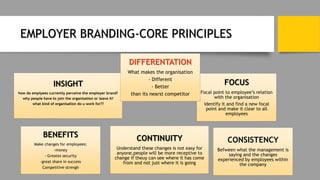
EMPLOYER BRANDING-CORE PRINCIPLES
INSIGHT
how do emplyees currently perceive the employer brand?
why people have to join the organisation or leave it?
what kind of organisation do u work for??
FOCUS
Focal point to employee’s relation
with the organisation
Identify it and find a new focal
point and make it clear to all
employees
DIFFERENTATION
What makes the organisation
- Different
- Better
than its nearst competitor
BENEFITS
Make changes for employees:
-money
- Greates security
-great share in success
Competitive strengh
CONTINUITY
Understand these changes is not easy for
anyone,people will be more receptive to
change if theuy can see where it has come
from and not just where it is going
CONSISTENCY
Befween what the management is
saying and the changes
experienced by employees within
the company
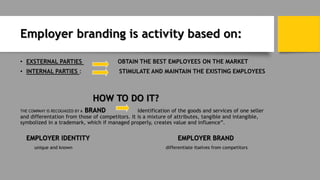
Employer branding is activity based on:
• EXSTERNAL PARTIES OBTAIN THE BEST EMPLOYEES ON THE MARKET
• INTERNAL PARTIES : STIMULATE AND MAINTAIN THE EXISTING EMPLOYEES
HOW TO DO IT?
THE COMPANY IS RECOGNIZED BY A BRAND Identification of the goods and services of one seller
and differentation from those of competitors. It is a mixture of attributes, tangible and intangible,
symbolized in a trademark, which if managed properly, creates value and influence”.
EMPLOYER IDENTITY EMPLOYER BRAND
unique and known differentiate itselves from competitors
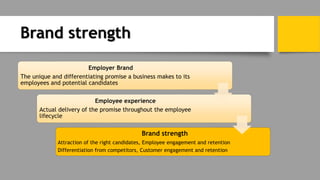
Brand strength
Employer Brand
The unique and differentiating promise a business makes to its
employees and potential candidates
Employee experience
Actual delivery of the promise throughout the employee
lifecycle
Brand strength
Attraction of the right candidates, Employee engagement and retention
Differentiation from competitors, Customer engagement and retention
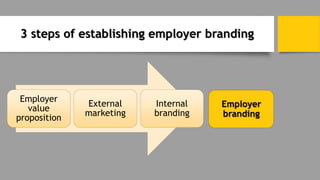
3 steps of establishing employer branding
Employer
value
proposition
External
marketing
Internal
branding
Employer
branding
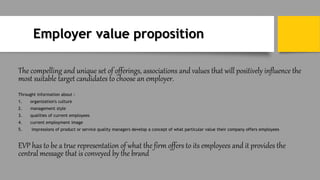
Employer value proposition
The compelling and unique set of offerings, associations and values that will positively influence the
most suitable target candidates to choose an employer.
Throught information about :
1. organization's culture
2. management style
3. qualities of current employees
4. current employment image
5. impressions of product or service quality managers develop a concept of what particular value their company offers employees
EVP has to be a true representation of what the firm offers to its employees and it provides the
central message that is conveyed by the brand
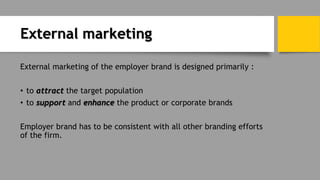
External marketing
External marketing of the employer brand is designed primarily :
• to attract the target population
• to support and enhance the product or corporate brands
Employer brand has to be consistent with all other branding efforts
of the firm.
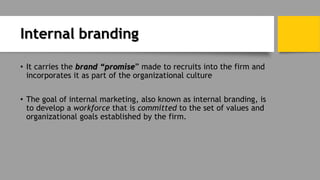
Internal branding
• It carries the brand “promise” made to recruits into the firm and
incorporates it as part of the organizational culture
• The goal of internal marketing, also known as internal branding, is
to develop a workforce that is committed to the set of values and
organizational goals established by the firm.
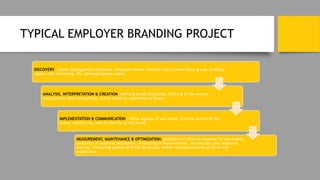
TYPICAL EMPLOYER BRANDING PROJECT
DISCOVERY : senior management workshop, employee survey, internal and external focus group, building
report with marketing, PR, communications teams
ANALYSIS, INTERPRETATION & CREATION: defining brand attributes, defining of the overall
employment value proposition, initial creative, expression of brand
IMPLEMENTATION & COMMUNICATION : initial aspects of our brand, internal launch of the
brand, reinforcing, start of the life of the brand
MEASUREMENT, MAINTENANCE & OPTIMIZATION: probation of internal response to new brand,
probation of external perception, measuring of improvements recruitment and retention
metrics, measuring uptake of living the brand, review and optimization of the brand
experience
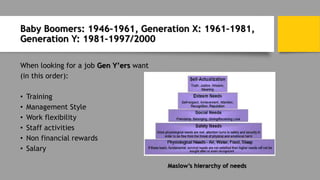
Baby Boomers: 1946–1961, Generation X: 1961–1981,
Generation Y: 1981–1997/2000
When looking for a job Gen Y’ers want
(in this order):
• Training
• Management Style
• Work flexibility
• Staff activities
• Non financial rewards
• Salary
Maslow’s hierarchy of needs
Psychological contract
The unwritten understandings and informal obligations between
an employer and its employees regarding their mutual expectations
of how each will perform their respective roles.
The psychological contract might include such things as:
• levels of employee commitment
• job satisfaction
• quality of working conditions.
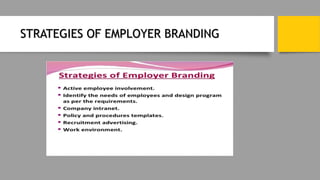
STRATEGIES OF EMPLOYER BRANDING
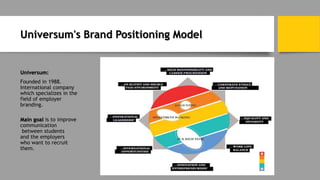
Universum's Brand Positioning Model
Universum:
Founded in 1988.
International company
which specializes in the
field of employer
branding.
Main goal is to improve
communication
between students
and the employers
who want to recruit
them.
EY company profile:
• Ernst & Young (trading as EY)
• multinational professional services firm headquartered
in London, United Kingdom.
• one of the "Big Four" accounting firms
• 175,000 employees
• more than 700 offices in over 150 countries
• It provides assurance (including financial
audit), tax, consulting and advisory services to companies.
• Official website: http://www.ey.com/
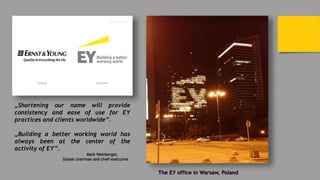
The EY office in Warsaw, Poland
„Shortening our name will provide
consistency and ease of use for EY
practices and clients worldwide”.
„Building a better working world has
always been at the center of the
activity of EY”.
Mark Weinberger,
Global chairman and chief executive
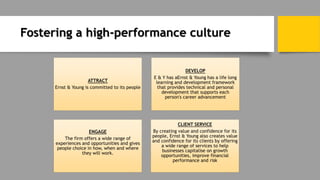
Fostering a high-performance culture
ATTRACT
Ernst & Young is committed to its people
DEVELOP
E & Y has aErnst & Young has a life long
learning and development framework
that provides technical and personal
development that supports each
person's career advancement
ENGAGE
The firm offers a wide range of
experiences and opportunities and gives
people choice in how, when and where
they will work.
CLIENT SERVICE
By creating value and confidence for its
people, Ernst & Young also creates value
and confidence for its clients by offering
a wide range of services to help
businesses capitalise on growth
opportunities, improve financial
performance and risk
Ernst & Young's Values Statement
• People who demonstrate integrity, respect
and teaming
• People with energy, enthusiasm and the courage
to lead
• People who build relationships based on doing
the right thing
Benefits
• 35 Average Age of Employees
• 21% Women in Executive/Senior Management
• The world’s most attractive professional services employer — and second
most attractive employer overall — in Universum’s annual World’s Most
Attractive Employer ranking (year 2013).
• Graduate Development Program (based on learning, experiences
and coaching) http://www.ey.com/EM/en/Careers/Students/Your-
development
• child care, flexibility, advancement and paid family leave, coaching
initiative, sport package.
BENEFITS OF EMPLOYER BRANDING
• Significant decreases in cost per hire
• Reduced cost of recruitment - efficiencies maximised throughout the
recruitment process
• Reduction in recruitment marketing costs over time
• Greater numbers of higher quality applicants
• Higher performing employees
• Increased retention rates
• Stronger reputation in the marketplace
• Increased ability to attract specialist talents from difficult markets
Maria's story: the exceptional EY experience
http://www.youtube.com/watch?v=Fr_j4MHhwXo
Thank you
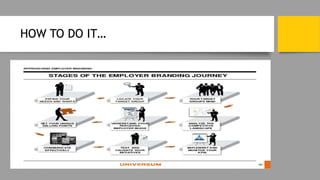
HOW TO DO IT…

Employer_branding_final_presentation.pptx

  • 1.
  • 2.
    Agenda 1. Employer branding a.Befinitions b. Target group c. Core principles d. 3 steps of employer branding 2. Methodology a. Typical employer branding project b. Strategies c. Universum’s Brand Positioning Model 3. Example a.E&Y
  • 3.
    What is employerbranding? Employer branding is an activity where principles of marketing, in particular the “science of branding”, are applied to HR activities in relation to current and potential employees. «IT IS A LOGICAL PROCESS THROUGHT WHICH EMPLOYERS STRIVE ON OF THE MEAN GOAL : TO HAVE A STRONG APPEAL ON THEIR FUTURE AND CURRENT IDEAL EMPLOYEES»
  • 4.
    Employer branding definitions 1.Employer brand consists of “the package of functional, economic and psychological benefits provided by employment, and identified with the employing company”. Ambler and Barrow (1996) 2. Employer branding “suggests differentiation of a firm’s characteristics as an employer from those of its competitors, the employment brand highlights the unique aspects of the firm’s employment offerings or environment”. Backhaus and Tikoo (2004) 3. Employer branding is “sum of a company’s efforts to communicate to existing and prospective staff that it is a desirable place to work”. Lloyd (2002) 4. Employer brand as «the image of your organisation as a « great place to work». Minchington (2005)
  • 5.
    Employer branding positive, meaningful,differentiated presence in the employment market that will attract, motivate and retain employees.
  • 6.
    WHO IS ITFOR….. 1.Potential employees persuade more and better applicants to apply and accept offers 2.Current employees to reduce turnover, increase employee motivation, a sense of belonging and align behaviour to the organisation’s needs 3.Consistency of messages across both groups is vital as the organisation has to deliver what it promises 4.Projecting an unrealistic image may improve recruitment but can increase attrition
  • 7.
    EMPLOYER BRANDING-CORE PRINCIPLES INSIGHT howdo emplyees currently perceive the employer brand? why people have to join the organisation or leave it? what kind of organisation do u work for?? FOCUS Focal point to employee’s relation with the organisation Identify it and find a new focal point and make it clear to all employees DIFFERENTATION What makes the organisation - Different - Better than its nearst competitor BENEFITS Make changes for employees: -money - Greates security -great share in success Competitive strengh CONTINUITY Understand these changes is not easy for anyone,people will be more receptive to change if theuy can see where it has come from and not just where it is going CONSISTENCY Befween what the management is saying and the changes experienced by employees within the company
  • 8.
    Employer branding isactivity based on: • EXSTERNAL PARTIES OBTAIN THE BEST EMPLOYEES ON THE MARKET • INTERNAL PARTIES : STIMULATE AND MAINTAIN THE EXISTING EMPLOYEES HOW TO DO IT? THE COMPANY IS RECOGNIZED BY A BRAND Identification of the goods and services of one seller and differentation from those of competitors. It is a mixture of attributes, tangible and intangible, symbolized in a trademark, which if managed properly, creates value and influence”. EMPLOYER IDENTITY EMPLOYER BRAND unique and known differentiate itselves from competitors
  • 9.
    Brand strength Employer Brand Theunique and differentiating promise a business makes to its employees and potential candidates Employee experience Actual delivery of the promise throughout the employee lifecycle Brand strength Attraction of the right candidates, Employee engagement and retention Differentiation from competitors, Customer engagement and retention
  • 10.
    3 steps ofestablishing employer branding Employer value proposition External marketing Internal branding Employer branding
  • 11.
    Employer value proposition Thecompelling and unique set of offerings, associations and values that will positively influence the most suitable target candidates to choose an employer. Throught information about : 1. organization's culture 2. management style 3. qualities of current employees 4. current employment image 5. impressions of product or service quality managers develop a concept of what particular value their company offers employees EVP has to be a true representation of what the firm offers to its employees and it provides the central message that is conveyed by the brand
  • 12.
    External marketing External marketingof the employer brand is designed primarily : • to attract the target population • to support and enhance the product or corporate brands Employer brand has to be consistent with all other branding efforts of the firm.
  • 13.
    Internal branding • Itcarries the brand “promise” made to recruits into the firm and incorporates it as part of the organizational culture • The goal of internal marketing, also known as internal branding, is to develop a workforce that is committed to the set of values and organizational goals established by the firm.
  • 14.
    TYPICAL EMPLOYER BRANDINGPROJECT DISCOVERY : senior management workshop, employee survey, internal and external focus group, building report with marketing, PR, communications teams ANALYSIS, INTERPRETATION & CREATION: defining brand attributes, defining of the overall employment value proposition, initial creative, expression of brand IMPLEMENTATION & COMMUNICATION : initial aspects of our brand, internal launch of the brand, reinforcing, start of the life of the brand MEASUREMENT, MAINTENANCE & OPTIMIZATION: probation of internal response to new brand, probation of external perception, measuring of improvements recruitment and retention metrics, measuring uptake of living the brand, review and optimization of the brand experience
  • 15.
    Baby Boomers: 1946–1961,Generation X: 1961–1981, Generation Y: 1981–1997/2000 When looking for a job Gen Y’ers want (in this order): • Training • Management Style • Work flexibility • Staff activities • Non financial rewards • Salary Maslow’s hierarchy of needs
  • 16.
    Psychological contract The unwrittenunderstandings and informal obligations between an employer and its employees regarding their mutual expectations of how each will perform their respective roles. The psychological contract might include such things as: • levels of employee commitment • job satisfaction • quality of working conditions.
  • 17.
  • 18.
    Universum's Brand PositioningModel Universum: Founded in 1988. International company which specializes in the field of employer branding. Main goal is to improve communication between students and the employers who want to recruit them.
  • 19.
    EY company profile: •Ernst & Young (trading as EY) • multinational professional services firm headquartered in London, United Kingdom. • one of the "Big Four" accounting firms • 175,000 employees • more than 700 offices in over 150 countries • It provides assurance (including financial audit), tax, consulting and advisory services to companies. • Official website: http://www.ey.com/
  • 20.
    The EY officein Warsaw, Poland „Shortening our name will provide consistency and ease of use for EY practices and clients worldwide”. „Building a better working world has always been at the center of the activity of EY”. Mark Weinberger, Global chairman and chief executive
  • 21.
    Fostering a high-performanceculture ATTRACT Ernst & Young is committed to its people DEVELOP E & Y has aErnst & Young has a life long learning and development framework that provides technical and personal development that supports each person's career advancement ENGAGE The firm offers a wide range of experiences and opportunities and gives people choice in how, when and where they will work. CLIENT SERVICE By creating value and confidence for its people, Ernst & Young also creates value and confidence for its clients by offering a wide range of services to help businesses capitalise on growth opportunities, improve financial performance and risk
  • 22.
    Ernst & Young'sValues Statement • People who demonstrate integrity, respect and teaming • People with energy, enthusiasm and the courage to lead • People who build relationships based on doing the right thing
  • 23.
    Benefits • 35 AverageAge of Employees • 21% Women in Executive/Senior Management • The world’s most attractive professional services employer — and second most attractive employer overall — in Universum’s annual World’s Most Attractive Employer ranking (year 2013). • Graduate Development Program (based on learning, experiences and coaching) http://www.ey.com/EM/en/Careers/Students/Your- development • child care, flexibility, advancement and paid family leave, coaching initiative, sport package.
  • 24.
    BENEFITS OF EMPLOYERBRANDING • Significant decreases in cost per hire • Reduced cost of recruitment - efficiencies maximised throughout the recruitment process • Reduction in recruitment marketing costs over time • Greater numbers of higher quality applicants • Higher performing employees • Increased retention rates • Stronger reputation in the marketplace • Increased ability to attract specialist talents from difficult markets
  • 25.
    Maria's story: theexceptional EY experience http://www.youtube.com/watch?v=Fr_j4MHhwXo
  • 26.
  • 27.
    HOW TO DOIT…

Editor's Notes

  • #8 http://www.slideshare.net/mbusokhoza/employer-branding-11477088
  • #11 VALUE PREPOSITION INCLUDES ON THE BRAND EXTERNAL MARKETING TO ATTRAC T THE TARGET POPULATION INTERNAL MARKETING TO SUPPORT THE BRAND
  • #12 The next step in our framework, once the employer brand identity has been considered and developed, is the employer brand value proposition (EVP). The EVP should include the most important aspects of the employer brand identity and the elements of differentiation. The EVP can be considered the first promise made by organisations about employment and therefore, the psychological contract must be regarded. As it is the point-of-departure for both the internal and the external marketing of the employer brand, most importantly, the EVP must be honest and truthful. Otherwise it can be considered a breach of the psychological contract affecting the rest of the process negatively. Similar to the way in which we have transformed Aaker’s (1996) general elements of a brand identity into employer branding specific terms, we transform his three benefits of a value proposition in general into three benefits that should be present when designing the employer brand value proposition. The functional benefits of the EVP are similar to the employer ‘brand as product’ explained above. Again, we do not believe these are the benefits from which the organisation should try to differentiate itself, unless of course it does offer functional benefits very different from its competitors. The emotional benefits are the benefits concerning employment which address the applicant’s or the employee’s emotions. The attributes which should be considered are a combination of the attributes of the employer ‘brand as person’ and the employer ‘brand as organisation’ as previously explained. Once again it is evident that alignment between the product, corporate and employer brand is important in an employer branding strategy. The final benefit is the self-expressive benefit which is also a combination of the corporate brand, the employer ‘brand as person’ attributes and the employer ‘brand as symbol’. If the organisation has a well-known logo, it will be evident in this benefit. The values and the opinions of the organisation are those which should be evident to the applicant or the employee in order for him/her to be able to identify with these and feel he/she will be able to express himself/herself through employment in the organisation. When comparing the three benefits we believe that the emotional and self-expressive benefits are the most important, both when it comes to attracting new employees through external marketing, when retaining current employees, and when increasing commitment and loyalty among employees through internal communication. Once the employer branding value proposition has been designed, we believe an organisation has the foundation for implementation. Furthermore, there are some factors prior to the brand identity development which have to be in place. However, this is a discussion to which we will return. At this point, in order to keep our explanation of our framework as simple as possible, we assume that all factors are fulfilled in order to reach an employer value proposition acting as the foundation of the following implementation of the strategy.