#1 Where are We Now … Part 5 of the book – Enrichment Topics in Human Resources Management
Chapter 14 Building Positive Employee Relations
Therefore we turn to look at ethics, employee fairness, safety, and union relations.
The main purpose of this chapter is to explain the building blocks of positive employee relations. Our topics include what is employee relations, managing employee relations, using human resource management tools to promote ethics and fair treatment, managing employee discipline, and developing employee engagement and great places to work for.
#2 After studying this chapter, you will be able to:
14-1. Define employee relations.
14-2. Discuss at least four methods for managing employee relations.
14-3. Explain what is meant by ethical behavior.
#3 After studying this chapter, you will also be able to:
14-4. Explain what is meant by fair disciplinary practices.
14-5. Answer the question, “How do companies become “Best Companies to Work for?”
#4 Let’ begin by examining what employee relations actually is….
#5 Employee relations – Is the managerial activity that involves establishing and maintaining the positive employee–employer relationships that contribute to satisfactory productivity, motivation, morale, and discipline, and to maintaining a positive, productive, and cohesive work environment.
Employers can do many things to build positive employee relations. Some examples include providing good training, fair appraisals, and competitive pay and benefits (all of which we discussed in previous chapters). However, most employers also institute special “employee relations programs” to maintain positive employee relations. These include employee fair treatment programs, improving employee relations through improved communications, developing employee recognition/relations programs, and having fair and predictable disciplinary procedures.
#6 We’ll begin with how to ensure fair treatment.
Ensuring Fair Treatment – Anyone who has suffered unfair treatment at work knows it is demoralizing. Unfair treatment reduces morale, poisons trust, and negatively impacts employee relations and performance. Employees of abusive supervisors are more likely to quit, and to report lower job and life satisfaction and higher stress. The effects on employees of such abusiveness are particularly pronounced where the abusive supervisors seem to have support from higher-ups.
At work, fair treatment reflects concrete actions such as “employees are treated with respect,” and “employees are treated fairly.”
There are many reasons why managers should be fair. The golden rule is one obvious reason. What may not be so obvious is that unfairness can backfire on the company. For example, victims of unfairness exhibit more workplace deviance, such as theft and sabotage. Victims of unfairness also suffer a range of ill effects including poor health, strain, and psychological conditions. Unfairness leads to increased tensions between the employee and his or her family or partner. Abusive supervisors undermine their subordinates’ effectiveness and may prompt them to act destructively. In terms of employee relations, employees’ perceptions of fairness relate positively to enhanced employee commitment; enhanced satisfaction with the company, job, and leader; and enhanced organizational citizenship behaviors. The employer and the manager are responsible for ensuring that the employee is treated fairly and with respect (and that its employees treat each other respectfully).
Research Insight – A study illustrates the effects of unfairness. College instructors first completed surveys concerning the extent to which they saw their colleges as treating them with procedural and distributive justice. (Procedural justice refers to justice in the allocation of rewards or discipline, in terms of the procedures being evenhanded and fair; distributive justice refers to a system for distributing rewards and discipline in which the actual results or outcomes are evenhanded and fair.) Procedural justice items included, for example, “In general, the department/college’s procedures allow for requests for clarification or for additional information about a decision.” Distributive justice items included, “I am fairly rewarded considering the responsibilities I have.”
#7 Improving Performance: The Strategic Context
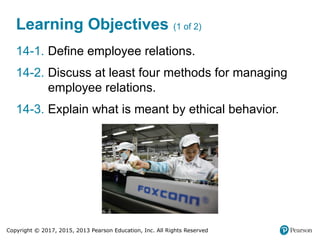
A New HR Strategy at the Foxconn Plant in Shenzhen, China
The phrase social responsibility tends to trigger images of charitable contributions and helping the homeless, but it actually refers to much more. For example, it refers to the honesty of the company’s ads; to the quality of the parts it builds into its products; and to the honesty, ethics, fairness, and “rightness” of its dealings with customers, suppliers, and, of course, employees. The basic question is always whether the company is serving all its constituencies (or “stakeholders”) fairly and honestly. Corporate social responsibility thus refers to the extent to which companies should and do channel resources toward improving one or more segments of society other than the firm’s owners or stockholders.
A worker uprising at Apple’s Foxconn iPhone assembly plant in Shenzhen, China, shows that workers around the globe want their employers to treat them in a fair and socially responsible manner. Producing quality products as efficiently as possible was long the strategy at this plant. However, after the uprising over pay and work rules at the Foxconn plant, Apple asked the plant’s owner to have the Fair Labor Association (FLA) survey the plant’s workers. The FLA found “tons of issues.” For example, employees faced “overly strict” product-quality demands without adequate training: “Every job is tagged to time, there are targets on how many things must be completed within an hour,” said Xie Xiaogang, 22, who worked at Foxconn’s Shenzhen plant. “In this environment, many people cannot take it.” Heavy overtime work requirements and having to work through a holiday week were other examples. To foster the improved behaviors that the plant’s performance required, Hon Hai, the Foxconn plant’s owner, tweaked its efficiency-first strategy and changed its plant human resource strategy and practices, for instance, by raising salaries and cutting mandatory overtime. Those changes were among 284 made at Foxconn after the audits uncovered violations of Chinese regulations. The changes show that fair treatment is a global obligation.
Talk About it (Discussion): How would you explain the fact that workers in such diverse cultures as America and China seem to crave fair treatment?
Source: Based on Daniel Denison, Corporate Culture and Organizational Effectiveness, New York: Wiley, 1990, p. 155; “When the Jobs Inspector Calls,” Economist, March 31, 2012, p. 73; Alexandra Ho and Tim Culpan, with assistance from Jun Yang in Seoul, Andrea Wong in Taipei, Tian Ying in Beijing, and Jasmine Wang in Hong Kong. “Foxconn Labor Disputes Disrupt IPhone Output for 2nd Time,” Bloomberg News, October 8, 2012, www.bloomberg.com/news/ 2012-10-07/foxconn-labor-disputes-disrupt-iphone-output-for-2nd-time.html.
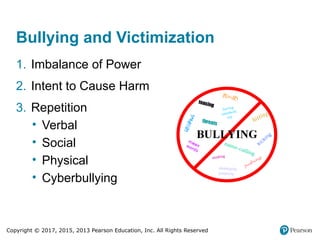
#8 Some workplace unfairness, such as bullying, is blatant. Bullying and victimization—singling out someone to harass and mistreat—is a serious problem.
The U.S. government (www.stopbullying.gov) says most would agree that bullying involves three things:
● Imbalance of power. People who bully use their power to control or harm, and the people being bullied may have a hard time defending themselves.
● Intent to cause harm. Actions done by accident are not bullying; the person bullying has a goal to cause harm.
● Repetition. Incidents of bullying happen to the same person over and over by the same person or group, and that bullying can take many forms, such as:
• Verbal: name-calling, teasing
• Social: spreading rumors, leaving people out on purpose, breaking up friendships
• Physical: hitting, punching, shoving
• Cyberbullying: using the Internet, mobile phones, or other digital technologies to harm others
#9 Many employers use communications programs to bolster their employee relations efforts, on the reasonable assumption that employees feel better about their employers when they’re “kept in the loop.”
This employer uses an open-door policy to encourage communication between employees and managers, an employee handbook covering basic employment information, and “the opportunity to keep abreast of University events and other information of interest through the website, e-mail, and hard copy memoranda.
Two-way communication also helps management know what’s bothering employees. Approaches may include hosting employee focus groups, making available ombudsman and suggestion boxes, and implementing telephone, messaging, and Web-based hotlines. (Some employers use hotline providers to manage their hotlines. A vendor sets up the hotlines for the employer; it also receives the employees’ comments, and provides ongoing feedback to the employer about employees’ concerns, as well as periodic summaries of comments and trends.) Exit interviews, discussed in an earlier chapter, provide another opportunity to sample the quality of one’s employee relations.
Using Organizational Climate Surveys – Similarly, employers use attitude, morale, or climate surveys to support employee relations efforts. They use the surveys to “take the pulse” of their employees’ attitudes toward a variety of organizational issues including leadership, safety, role clarity, fairness, and pay, and to thereby get a sense of whether their employee relations need improvement.
#10 Opportunities for two-way communications like these improve employee relations, but there are other employee relations programs. Most notable here are the employee recognition and award programs.
Instituting recognition and service award programs requires planning.
For example, instituting a service award program requires reviewing the tenure of existing employees and establishing meaningful award periods (1 year, 5 years, etc.). It also requires establishing a budget, selecting awards, having a procedure for monitoring what awards to actually award, having a process for giving awards (such as special dinners or staff meetings), and periodically assessing program success. Similarly, instituting a recognition program requires developing criteria for recognition (such as customer service, cost savings, etc.), creating forms and procedures for submitting and reviewing nominations, selecting meaningful recognition awards, and establishing a process for actually awarding the recognition awards.
#11 Employee relations also tend to improve when employees become involved with the company in positive ways, and so employee involvement is another useful employee relations strategy.
Employers encourage employee involvement in various ways. Some organize focus groups. A focus group is a small sample of employees who are presented with a specific question or issue and who interactively express their opinions and attitudes on that issue with the group’s assigned facilitator.
#12 Trends Shaping HR: Digital and Social Media
Many employers use social media, such as the pinboard-style photo-sharing Web site Pinterest, to encourage involvement. One survey found that just over half of employers use social media tools to communicate with employees and to help develop a sense of community. For example, Red Door Interactive used a Pinterest-based project it called “San Diego Office Inspiration.” This encouraged employees to contribute interior design and decor ideas for its new offices.
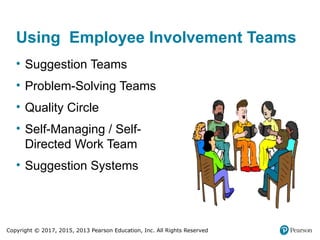
#13 Employers also use special teams to gain employees’ involvement. Suggestion teams are temporary teams whose members work on specific analytical assignments, such as how to cut costs or raise productivity.
Some employers formalize this process by appointing semi-permanent problem-solving teams. These identify and research work processes and develop solutions to work-related problems.
A quality circle is a type of formal problem-solving team, usually composed of 6 to 12 specially trained employees who meet weekly to solve problems affecting their work area. The team gets training in problem-analysis techniques (including basic statistics). Then it applies these techniques to solve problems in its work area.
In many facilities, specially trained teams of self-managing employees do their jobs with little or no oversight from supervisory personnel. A self-managing/self-directed work team is a small (usually 8 to 10 members) group of carefully selected, trained, and empowered employees who basically run themselves with little or no outside supervision, usually for the purpose of accomplishing a specific task or mission.
Using Suggestion Systems – Most employers understand that employee suggestions can produce significant savings (and, through involvement and rewards, improved employee relations). For example, one study several years ago of 47 companies concluded that the firms had saved more than $624 million in one year from their suggestion programs; more than 250,000 suggestions were submitted, of which employers adopted over 93,000 ideas. Furthermore, employees like these programs. In one survey, 54% of the 497 employees surveyed said they made more than 20 suggestions per year, while another 24% said they made between 10 and 20 suggestions per year.
The accompanying HR as a Profit Center feature on the next slide provides an example.
#14 Improving Performance: HR As A Profit Center
The Cost-Effective Suggestion System
A Lockheed Martin unit in Oswego, New York, developed its “Cost-Effectiveness Plus” suggestion program to encourage and recognize employees for streamlining processes. With the Cost-Effectiveness Plus program, employees electronically submit their ideas. These are then evaluated and approved by the local manager and the program’s coordinator (and by higher management when necessary). This program reportedly saves this facility about $77,000 per implemented idea, or more than $100 million each year.
Today’s suggestion systems are more sophisticated than the “suggestion boxes” of years ago. The main improvements are in how the manager formalizes and communicates the suggestion process. The head of one company that designs and installs suggestion systems for employers lists the essential elements of an effective employee suggestion system as follows:
✓ Senior staff support
✓ A simple, easy process for submitting suggestions
✓ A strong process for evaluating and implementing suggestions
✓ An effective program for publicizing and communicating the program
✓ A program focus on key organizational goals
Source: Based on Wells, “From Ideas to Results”, HR Magazine
Talk About it (Discussion) Based on this, write a one-page outline describing an employee suggestion system for a small department store.
#15 Next we will learn to explain what is meant by ethical behavior.
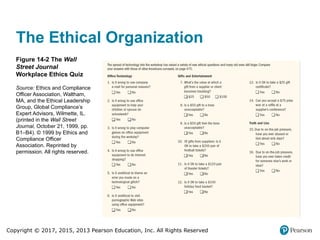
#16 People face ethical choices every day. Is it wrong to use a company credit card for personal purchases? Is a $50 gift to a client unacceptable? Compare your answers by doing the quiz in Figure 14-2 above.
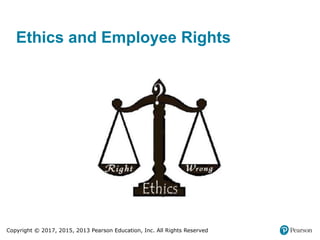
Ethics are “the principles of conduct governing an individual or a group”—the principles people use to decide what their conduct should be. Of course, not all conduct involves ethics.
Most everyone reading this text rightfully views themselves as ethical people, so why include ethics in a human resource management book? For three reasons:
First, ethics is not theoretical.
Second, it is hard to even imagine an unethical company with good employee relations.
Third, ethical dilemmas are part of human resource management.
#17 Societies don’t rely on employers’ ethics or sense of fairness or morality to ensure that they do what’s right. Societies also institute various laws and procedures for enforcing these laws.
Protecting employee rights is thus part and parcel of all the employment laws we discuss in this book. Although ethics, fairness, and morality help govern how employers treat their employees, the enforceable rights embedded in employment law also govern what employers and employees can do.
#18 Why do people do bad things? It’s complicated. However, one review of over 30 years of ethics research concluded that three factors combine to determine the ethical choices we make.
The authors titled their paper “Bad Apples, Bad Cases, and Bad Barrels.” This title highlighted their conclusion that when
“Bad apples” (people who are inclined to make unethical choices), must deal with
“Bad cases” (ethical situations that are ripe for unethical choices), while working in
“Bad barrels” (company environments that foster or condone unethical choices), … then people tend to act unethically.
Here’s a closer look at what they found:
The Person (What Makes Bad Apples?) First, because people bring to their jobs their own ideas of what is morally right and wrong, each person must shoulder much of the credit (or blame) for his or her ethical choices.
Which Ethical Situations Make for Ethically Dangerous Situations (Bad Cases)? But, it’s not just the person but the situation that’s important. Basically, how much harm can befall victims of the choice, or the number of people potentially affected. People seemed more likely to “do the wrong thing” in “less serious” situations, in other words, the problem is that one thing leads to another; people start by doing small bad things and then “graduate” to larger ones.
What Are the “Bad Barrels”?—The Outside Factors That Mold Ethical Choices? Finally, the study found that some companies produce more poisonous social environments (outside factors or “barrels”) than do others; these bad environments in turn foster unethical choices. Those that encouraged employees to consider the well-being of everyone had more ethical choices. Most importantly, companies whose managers put in place “a strong ethical culture that clearly communicates the range of acceptable and unacceptable behavior” suffered fewer unethical decisions.
#19 Reduce Job-Related Pressures – If people did unethical things at work solely for personal gain or because they were “bad people,” it perhaps would be understandable (though inexcusable). The scary thing is that it’s often not personal interests but the pressures of the job.
One study illustrates this. It asked employees to list their reasons for taking unethical actions at work. For most of these employees, “meeting schedule pressures,” “meeting overly aggressive financial or business objectives,” and “helping the company survive” were the three top causes. “Advancing my own career or financial interests” ranked about last. In any case, reducing such “outside” pressures helps head off ethical lapses.
#20 There are also steps the HR group can take.
Institute Ethics Policies And Codes – Employers use ethics policies and codes to signal that their companies are serious about ethics.
Enforce The Rules – Codifying such rules without enforcing them is futile. To paraphrase one study, managers’ statements can reduce unethical behavior on the part of employees, but knowing that behavior is actually being monitored and enforced has the biggest impact.
Encourage Whistleblowers – Some companies encourage employees to use hotlines and other means to “blow the whistle” on the company when they discover fraud. In complying with the Dodd-Frank Act, the SEC established a whistleblower reward for people who report unethical corporate behavior to it. It is also tracking possible incidents of retaliation against whistleblowers.
Foster The Right Culture – Organizational culture is the “characteristic values, traditions, and behaviors a company’s employees share. Managers therefore have to think through how to send the right signals to their employees—in other words, create the right culture. Doing so includes:
● Clarifying expectations. First, make clear what values you want subordinates to follow. For example, the IBM ethics statement shows the company takes ethics seriously.
● Using signs and symbols. Symbolism—what the manager actually does—ultimately does the most to create and sustain the company’s culture. As we said earlier, managers need to “walk the talk.” They can’t say “don’t falsify the financials” and then do so themselves.
● Providing physical support. The physical signs of the employer’s values—its incentive plan, appraisal system, and disciplinary procedures, for instance—send strong signals regarding what employees should and should not do. For example, do the promotions employees get reward ethical behavior or penalize it?
The accompanying HR Tools feature on the next slide illustrates ethics management in small businesses.
#21 Improving Performance: HR Tools For Line Managers And Small Businesses
Small Business Ethics
When people think of unethical corporate behavior, big companies come to mind, because they’re usually in the headlines. Yet studies show that small and midsize enterprises are prone to the same unethical corporate behavior as big firms. For example, one study of 20 small to midsize firms found that bribery, corrupt dealings, payoffs to local gangsters, and a general tone of dishonesty were all “business as usual” at many of these firms. Some were clever about their corrupt dealings. When doing business abroad, one U.S. business tried to keep its hands clean by forming a “strategic alliance” with a local firm. The latter then did the dirty work, for example, handling the local bribes, while the U.S. firm’s managers looked the other way.
There are several reasons why smaller firms should be particularly alert to unethical behavior. Small firms don’t have the resources for ethics officers, ethics hotlines, or the ethics training that big firms have. Furthermore, having an unethical accountant in a billion-dollar firm embezzle $10 million is a nuisance. Having the sales manager of a $10 million firm walk off with $1 million cash could be the end.
Small business owners can take several steps to establish a useful ethics program. First, size up your company’s current ethics-related activities. Even a self-audit based on guidelines like those in this chapter (the availability of an ethics code, ethics training, internal controls to monitor ethical behavior, and so on) can be worthwhile. Second, create a code of conduct (Googling “code of conduct” will reveal thousands of examples), and make it clear that you take it seriously. Third, train your people. Training needn’t be complicated. For example, one expert suggests having your managers develop scenarios, relevant to your business, illustrating which behaviors are ethical and which are not; then meet to discuss these. Fourth, make it easier to solicit feedback from your employees, so that they can more easily report suspicions of unethical behavior. (“Open door” polices and anonymous suggestion boxes are examples.) And, perhaps most importantly, walk the talk. In a small business, the owner is so visible that employees will take their ethical signals from him or her.
Talk About it (Discussion): Create a 50-word ethics code for a small business. Then, explain how the owner might use an ethics code to help avoid mistreatment of employees.
#22 There are additional steps the HR group can take.
Hire Right – As one writer says, “The simplest way to tune up an organization, ethically speaking, is to hire more ethical people.” Start by using recruitment materials that emphasize your firm’s commitment to honest dealings and ethics. Then use screening tools like honesty tests, background checks, and interview questions (such as “Have you ever observed someone stretching the rules at work? What did you do about it?”) to screen out problematical people.
Use Ethics Training – Ethics training usually involves showing employees how to recognize ethical dilemmas, how to apply codes of conduct to resolve problems, and how to use personnel activities like disciplinary practices in ethical ways. The training should emphasize the moral underpinnings of the ethical choice and the company’s deep commitment to integrity and ethics. Include participation by top managers in the program to emphasize that commitment.
Use Rewards And Discipline – Employees expect you to punish unethical conduct and to reward ethical conduct. The employer should discipline executives, not just underlings, who misbehave.
Institute Employee Privacy Policies – Most employees probably view invasions of their privacy by their employers as unethical. At work, employee privacy violations include intrusion (such as locker room and e-mail surveillance), publication of private matters, disclosure of medical records, and appropriation of an employee’s name or likeness for commercial purposes. In practice, background checks, monitoring off-duty conduct and lifestyle, drug testing, workplace searches, and workplace monitoring trigger most privacy violations.
#23 Know Your Employment Law
Electronic Monitoring
What can the employer do to balance privacy concerns with its need to protect itself ? There are two main restrictions on workplace monitoring: the Electronic Communications Privacy Act (ECPA), and common-law protections against invasion of privacy (protections that have evolved from court decisions, for instance, decisions against defaming employees by publicizing highly personal matters about them without their permission). The ECPA is a federal law intended to help restrict interception and monitoring of oral and wire communications. It contains two exceptions. The “business purpose exception” permits employers to monitor communications if they can show a legitimate business reason for doing so. The second, “consent exception,” lets employers monitor communications if they have their employees’ consent to do so. Electronic eavesdropping is thus legal—up to a point. For example, federal law and most state laws allow employers to monitor employees’ phone calls in the ordinary course of business. However, they must stop listening when it becomes clear the conversation is personal. You can also intercept e-mail to protect the property rights of the e-mail provider. However, court cases suggest employers may have fewer rights to monitor e-mail than previously assumed.
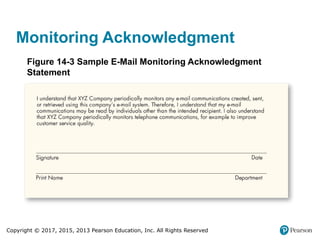
To be safe, employers issue e-mail and online service usage policies, which warn employees that those systems should be used for business only. Employers also have employees sign e-mail and telephone monitoring acknowledgment statements like that in Figure 14-3. Many employees probably assume that their communications using the corporate e-mail system are open to review, but that e-mails they send via the employer’s system but using personal e-mail accounts such as Gmail aren’t. However, that’s not necessarily true. An attorney should review the company’s e-mail policy, but, at a minimum, make it clear that employees should have no expectation of privacy in their e-mail and Internet usage. Also emphasize that all messages sent and received on the employer’s e-mail system are company property and not confidential. Videotaped workplace monitoring requires more caution. Continuous video surveillance of employees in an office setting may not be a problem. But a Boston employer had to pay over $200,000 to five workers it secretly videotaped in an employee locker room, after they sued.
#24 Know Your Employment Law
Electronic Monitoring
Figure 14-3 – monitoring acknowledgment statements like the one above.
#25 Trends Shaping HR: Digital and Social Media
Monitoring reflects in part a proliferation of online and smart devices and social media tools. For example, a New Jersey court found one employer liable when one of its employees used his company computer at work to distribute child pornography.
Security is another problem: One “4-gigabyte MP3 player, such as the first generation of iPod Mini … can take home a lot of corporate data,” said one employer (a process some graphically describe as “podslurping”). And, increasingly, disgruntled employees are using their companies’ cloud services to hack into and undermine their employers’ computer systems.
Monitoring today therefore goes far beyond listening in on phone lines. New York’s Bronx Lebanon Hospital uses biometric scanners to ensure that employees who clock in really are who they say they are. Iris scanning tends to be the most accurate authorization device. Some organizations like the Federal Aviation Administration use it to control employees’ access to their network information systems. UPS uses GPS to monitor their drivers’ whereabouts—and therefore productivity.
One restaurant in Dallas digitally monitors most everything waiters do, for instance, tracking every ticket, dish, and drink that they process. This not only makes it easier to track employee theft, but also helps identify exceptionally conscientious waiters. To keep productivity up, the British grocery chain Tesco has some distribution center employees wear “Motorola arm-mounted terminals” (armbands) that keep track of how quickly employees are unloading and scanning goods.
Such monitoring, as we said, raises privacy issues. The dilemma is that it can also boost profits. For example, employers routinely use software to monitor (usually secretly) what their employees are doing online. When one employer noticed high employee overtime claims, they installed new software, and discovered many employees spent hours each day shopping online instead of working. Physicians often say that “every medicine contains a little poison,” since anything,
even aspirin, becomes dangerous if misused. For employers, the dilemma is to obtain the profit advantages of monitoring, while minimizing the ethical and privacy issues that it raises.
Talk About it (Discussion): How would you feel if your employer told you to wear an armband monitor? Why? How would you react?
#26 Now we will look at what is meant by fair disciplinary practices.
#27 The purpose of discipline is to encourage employees to behave sensibly at work (where sensible means adhering to rules and regulations). Discipline is necessary when an employee violates a rule. Proper disciplinary procedures are important for several reasons. For one thing, positive employee relations requires trust, and few personnel actions will undermine trust as will arbitrary discipline. Legal concerns are another reason. One study surveyed 45 published arbitration awards in which tardiness had triggered discipline and/or discharge. When arbitrators overturned employers’ decisions, it was usually because of inadequate disciplinary procedures—for example, the employer had failed to clarify what “tardy” meant. Unfair disciplinary procedures can backfire in other ways. For example, unfair discipline can trigger retaliatory employee misbehavior. And, of course, it is hard to be seen as ethical when disciplinary actions are unfair.
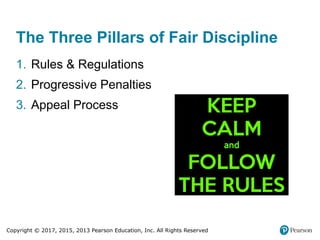
#28 Disciplining employees is often unavoidable, but any such discipline should be rooted in the need to be fair. The manager builds a fair discipline process on three pillars: rules and regulations, a system of progressive penalties, and an appeals process.
Rules And Regulations – An acceptable disciplinary process begins with a set of clear disciplinary rules and regulations. The rules should cover problems such as theft, destruction of company property, drinking on the job, and insubordination.
Penalties – A system of progressive penalties is the second pillar of effective discipline. The severity of the penalty usually depends on the offense and the number of times it has occurred.
Appeals Process – Third, an appeals process should be part of the disciplinary process. The aim here is to ensure that supervisors mete out discipline fairly. An appeals process is essential but is no panacea. The employer can sometimes mitigate the effects of unfair discipline by catching it during an appeal. However, some supervisory behavior may be impossible to overcome. For example, behaviors that attack the employee’s personal and/or social identity are difficult to remedy.
#29 Diversity Counts
Comparing Males And Females In A Discipline Situation
What several researchers sadly call the “Evil Woman Thesis” argues that when a woman doesn’t act the way other men and women expect she should act, they tend to treat her more harshly than they might if a man acted unexpectedly.
While such a thesis might seem preposterous, the research seems to support it. In one study, 360 graduate and undergraduate business school students reviewed a labor arbitration case. The case involved two employees, one male and one female, with similar work records and tenure with their employers. Both were discharged for violation of company rules related to alcohol and drugs. The case portrays one worker’s behavior as a more serious breach of company rules: The more culpable worker (a male in half the study and a female in the other half) had brought the intoxicant to work. The students had to express their agreement with two alternative approaches (tough or not-so-tough) to settling the dispute that arose after the discharge. The researchers found bias against the female “employee” by both the male and female students. Both the male and female students recommended harsher treatment for the “culpable” female employee in the case than they did for the “culpable” man. As the researchers conclude, “women, as decision makers, appear to be as willing as men to impose harsher discipline on women than upon men.”
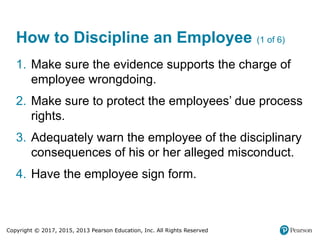
#30 Even if you’re a manager in a Fortune 500 company, you may find yourself without company guidelines when you have to discipline an employee for violating company rules. An error could trigger a costly appeal, or even litigation. To help head off errors, fair discipline guidelines would include:
● Make sure the evidence supports the charge of employee wrongdoing.
● Make sure to protect the employees’ due process rights. For example, did the person have a chance to defend himself or herself?
● Adequately warn the employee of the disciplinary consequences of his or her alleged misconduct.
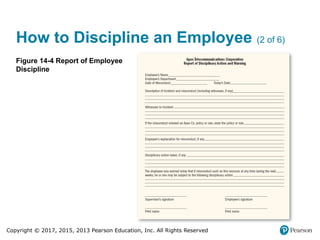
● Have the employee sign a form, as in Figure 14-4 on the next slide.
#32 ● The rule that allegedly was violated should be “reasonably related” to the efficient and safe operation of the particular work environment.
● Objectively investigate the matter before administering discipline.
#33 ● The investigation should produce substantial evidence of misconduct.
● Apply applicable rules, orders, or penalties without discrimination.
● Maintain the employee’s right to counsel. For example, all union employees generally have the right to bring a representative to an interview that they reasonably believe might lead to disciplinary action.
#34 Don’t rob your subordinate of his or her dignity, for instance by disciplining the person in public.
● Listen to what the person has to say.
● Remember that the burden of proof is on you. In U.S. society, a person is considered innocent until proven guilty.
#35 ● Get the facts. Don’t base your decision on hearsay evidence or on your general impression.
● Don’t act while angry.
● Adhere to your company’s disciplinary appeals process.
#36 Traditional discipline processes have two main drawbacks:
First, no one likes being punished.
Second, punishment tends to gain short-term compliance, but not long-term cooperation.
Discipline without punishment (or alternative or non punitive discipline) aims to avoid these drawbacks by reducing the punitive nature of the discipline. Steps include the following:
1. Issue an oral reminder for a first infraction.
2. Should another incident arise within 6 weeks, issue a formal written reminder, and place a copy in the employee’s personnel file. Also, hold a second private discussion with the employee.
3. Give a paid, one-day “decision-making leave.” If another incident occurs in the next 6 weeks or so, tell the employee to take a 1-day leave with pay, and to consider whether he or she wants to abide by the company’s rules. When the employee returns to work, he or she meets with you and gives you a decision.
4. If no further incidents occur in the next year or so, purge the 1-day paid suspension from the person’s file. If the behavior is repeated, the next step is dismissal.
The process would not apply to exceptional circumstances. Criminal behavior or in-plant fighting might be grounds for immediate dismissal, for instance.
#37 Now we will look at what it takes for a company to become a “Best Company to Work For”.
#38 Employee Engagement Guide For Managers
How Companies Become “Best Companies to Work For”
We began this chapter by noting that some companies are better to work for than others, and we therefore focused on programs managers use to cultivate the positive employee relations that contribute to being a best place to work. This final section zeroes in on three companies that are known in part for actually being best places to work.
The “Best Companies to Work For” – Each year, several organizations publish “Best Companies to Work For” lists, the most notable of which is probably “Fortune Magazine’s 100 Best Companies to Work For®.” Based on an extensive multinational survey of employees by the Great Place to Work® Institute (www.greatplacetowork.com), the survey seeks to identify the best companies to work for based on how the employees working in them actually feel about working there.
The Great Place to Work Institute defines a great workplace “as one where employees trust the people they work for, have pride in the work they do, and enjoy the people they work with.” They say that the companies on their great companies list “have the highest levels of trust, strongest evidence of employee engagement and demonstrate the best applied management practices and programs” as defined by the institute’s proprietary models.
We’ll look at three recent “Fortune Magazine’s 100 Best Companies to Work For”—SAS, Google, and FedEx.
#39 SAS, headquartered in Cary, North Carolina, is a leader in providing business analytics software and services to companies that include 90 of the top 100 companies on the Fortune global 500 list. Founded in the 1970s, the company is privately owned and has long been known for the quality of its benefits and for the support it provides for its employees’ work-life balance. It has annual revenues of over $2.3 billion, and a worldwide workforce of over 13,000 people, about half of whom work at the company’s North Carolina campus.
They have reportedly never laid off an employee. SAS goes to great lengths to foster its employees’ trust in other ways, for instance by giving them abundant freedom in the hours they work. They also have the Great Place to Work Institute independently survey SAS workers on important characteristics of trust including open communication, respect, career paths, and being treated as a human being.
What does all this do for SAS? As one long-term employee put it, “I just can’t imagine leaving SAS, and I felt that way for a very long time … if somebody offered to double my salary, I wouldn’t even think about it.” Employee turnover, about 20% in software companies, is about 3% at SAS, which highlights another important facet of the SAS benefits programs. One person who has studied SAS, estimates that the lower turnover alone saves SAS $60 million to $80 million a year. As another example, letting employees visit on-campus health professionals (as SAS does) can cut hours out of the average employee’s time away from work for doctors’ visits. And, of course, the effect on engagement, morale, and productivity may be priceless.
#40 When Google founders Larry Page and Sergey Brin began building Google, they wanted to make it a great place to work, and in doing so, they turned to SAS. They met with SAS executives and sent a team there to better understand what made SAS consistently a “Best Company to Work For.”
It’s therefore not surprising that Google is one of the few employers whose employee benefits equal or exceed those at SAS. In addition to things like health-care benefits and flexible work hours (and the possibility of making millions on stock options), its benefits include on-site dry cleaners, bowling alleys, cafés, transportation to and from campus, and nap pods. As Google puts it, “It’s all about removing barriers so Googlers can focus on the things they love, both inside and outside of
work. We’re constantly searching for unique ways to improve the health and happiness of our Googlers.”
#41 FedEx has been one of the “Fortune Magazine’s 100 Best Companies to Work For” for 12 of the past 15 years. Several things—excellent benefits, competitive salaries, and (as we discussed in Chapter 5) a focus on promoting from within (as embodied by its Job Change Applicant Tracking System [JCATS]) help to explain this; however, it may be FedEx’s emphasis on building trust through communications that most sets it apart.
Survey Feedback Action (SFA) – The FedEx survey feedback action (SFA) program is one example. SFA includes an anonymous survey that allows employees to express feelings about the company and their managers, and to some extent about service, pay, and benefits. Each manager then has an opportunity to use the results to help design a blueprint for improving workgroup engagement and commitment.
SFA has three phases. First, the survey itself is a standard, anonymous questionnaire given each year to every employee. The questions are designed to gather information about what helps and hinders employees in their work environment. Sample items include: “I can tell my manager what I think” and “My manager tells me what was expected.” A workgroup’s survey results are compiled and sent anonymously to the manager.
The second phase is a feedback session between the manager and his or her workgroup. The goal here is to identify specific concerns or problems, examine causes for these problems, and devise action plans to correct the problems.
The feedback meeting should lead to a third, “action plan” phase. This produces a list of actions that the manager will take to address employees concerns and boost results. It includes: What is the concern? What’s your analysis? What’s the cause? And What should be done?
The FedEx Guaranteed Fair Treatment Process – FedEx’s Guaranteed Fair Treatment Process (GFTP) is a sort of turbocharged grievance process. It goes beyond most grievance procedures in several ways, perhaps most notably in that an appeal can go all the way to FedEx’s top executives.
#42 There are several things that any manager intent on building positive employee relations can learn from studying any of these Best Companies To Work For….
The human resource philosophy on which they built their human resource management practices. In Chapter 1, we said that people’s actions are always based in part on the basic assumptions they make, and that this is especially true in regard to human resource management. The basic assumptions you make about people—Can they be trusted? Do they dislike work? Why do they act as they do? How should they be treated?—together comprise your philosophy of human resource management. And every personnel decision you make—the people you hire, the training you provide, your leadership style, and the like—reflects (for better or worse) this basic philosophy.
One of the things molding your own philosophy is that of your organization’s top management. While it may or may not be stated, it is usually communicated by their actions and permeates every level and department.
#43 In review of Chapter 14, you should now be able to:
14-1. Define employee relations.
14-2. Discuss at least four methods for managing employee relations.
14-3. Explain what is meant by ethical behavior.
14-4. Explain what is meant by fair disciplinary practices.
14-5. Answer the question, “How do companies become “Best Companies to Work for?”




![Ethics ,Justice and Fair treatment in workplace [HR]](https://cdn.slidesharecdn.com/ss_thumbnails/hrm-updated-200130130355-thumbnail.jpg?width=640&height=640&fit=bounds)


