Overview
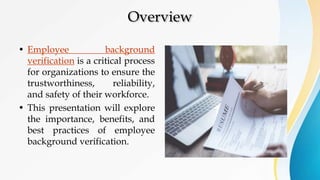
• Employee background
verification is a critical process
for organizations to ensure the
trustworthiness, reliability,
and safety of their workforce.
• This presentation will explore
the importance, benefits, and
best practices of employee
background verification.
Importance of Employee Background Verification
• Ensuring workplace safety:
Background checks help identify any
criminal history, ensuring a safe
environment for employees and
clients.
• Protecting company reputation:
Verification processes help safeguard
the company's reputation by hiring
individuals with proven integrity and
professionalism.
• Minimizing liability: Thorough
background checks mitigate the risk of
negligent hiring and potential legal
issues.
Key Components of Employee Background Verification
• Criminal record checks: Verifying the
absence of criminal convictions through
local, national, and international
databases.
• Employment verification: Confirming the
candidate's employment history, positions
held, and dates of employment.
• Education verification: Validating
educational qualifications, degrees, and
certifications claimed by the candidate.
• Reference checks: Contacting professional
references to gain insights into the
candidate's work ethic, skills, and
character.
Benefits of Employee Background Verification
• Enhanced safety and security:
Background verification reduces
the risk of workplace incidents,
theft, and potential harm to
employees and clients.
• Quality hires: Thorough
screening ensures that
organizations hire candidates
with the right qualifications,
experience, and ethical
standards.
• Mitigating legal risks:
Background checks minimize the
potential for negligent hiring
claims and legal liabilities.
Best Practices for Employee Background Verification
• Compliance with local laws: Ensure
that background checks comply with
relevant local, state, and federal laws
governing employee privacy and data
protection.
• Consistent screening procedures:
Establish standardized processes and
criteria for conducting background
checks on all candidates.
• Verified sources: Utilize reputable
sources and third-party agencies to
conduct comprehensive background
checks.
Communication and Transparency
Clearly communicate the
background verification
process to candidates,
including the types of checks
conducted and the
importance of the process.
Ensure transparency
regarding the use and storage
of personal information
obtained during the
verification process.
Conclusion
• Recap the importance,
benefits, and best practices
of employee background
verification.
• Emphasize the
significance of this process
in ensuring trust, safety,
and integrity within the
organization.
CONTACT US
•
Get In Touch
• HEAD OFFICE:8th Floor, Magnum
• Towers,Sector 58,
• Gurugram 122011
• Phone Number: +919873843343
• Email: support@protildo.com
• Website: https://web.protildo.com/

employee background verification.pptx

  • 2.
    Overview • Employee background verificationis a critical process for organizations to ensure the trustworthiness, reliability, and safety of their workforce. • This presentation will explore the importance, benefits, and best practices of employee background verification.
  • 3.
    Importance of EmployeeBackground Verification • Ensuring workplace safety: Background checks help identify any criminal history, ensuring a safe environment for employees and clients. • Protecting company reputation: Verification processes help safeguard the company's reputation by hiring individuals with proven integrity and professionalism. • Minimizing liability: Thorough background checks mitigate the risk of negligent hiring and potential legal issues.
  • 4.
    Key Components ofEmployee Background Verification • Criminal record checks: Verifying the absence of criminal convictions through local, national, and international databases. • Employment verification: Confirming the candidate's employment history, positions held, and dates of employment. • Education verification: Validating educational qualifications, degrees, and certifications claimed by the candidate. • Reference checks: Contacting professional references to gain insights into the candidate's work ethic, skills, and character.
  • 5.
    Benefits of EmployeeBackground Verification • Enhanced safety and security: Background verification reduces the risk of workplace incidents, theft, and potential harm to employees and clients. • Quality hires: Thorough screening ensures that organizations hire candidates with the right qualifications, experience, and ethical standards. • Mitigating legal risks: Background checks minimize the potential for negligent hiring claims and legal liabilities.
  • 6.
    Best Practices forEmployee Background Verification • Compliance with local laws: Ensure that background checks comply with relevant local, state, and federal laws governing employee privacy and data protection. • Consistent screening procedures: Establish standardized processes and criteria for conducting background checks on all candidates. • Verified sources: Utilize reputable sources and third-party agencies to conduct comprehensive background checks.
  • 7.
    Communication and Transparency Clearlycommunicate the background verification process to candidates, including the types of checks conducted and the importance of the process. Ensure transparency regarding the use and storage of personal information obtained during the verification process.
  • 8.
    Conclusion • Recap theimportance, benefits, and best practices of employee background verification. • Emphasize the significance of this process in ensuring trust, safety, and integrity within the organization.
  • 9.
    CONTACT US • Get InTouch • HEAD OFFICE:8th Floor, Magnum • Towers,Sector 58, • Gurugram 122011 • Phone Number: +919873843343 • Email: support@protildo.com • Website: https://web.protildo.com/