EmotionSense: Real-Time
Emotion Detection
System
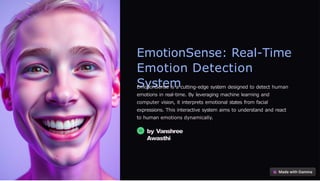
EmotionSenseis a cutting-edge system designed to detect human
emotions in real-time. By leveraging machine learning and
computer vision, it interprets emotional states from facial
expressions. This interactive system aims to understand and react
to human emotions dynamically.
by Vanshree
Awasthi
VA
2.
Core Technologies
Behind EmotionSense
Python
Theprimary programming language for
development.
OpenCV
Handles image and video processing tasks.
TensorFlow/Keras
Powers the CNN model for emotion recognition.
FER-2013 Dataset
Used for training the emotion detection model.
3.
EmotionSense Key Features
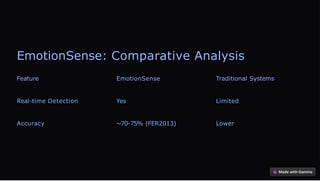
Real-TimeDetection
Processes webcam feed
in real time.
Seven Emotion
Classes
Trained on FER2013
dataset.
Lightweight Model
Ensures fast inference
and efficient processing.
Craphical Interface
Provides user-friendly
interaction.
4.
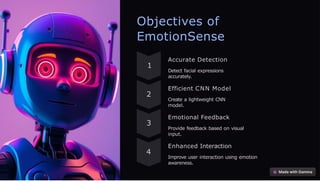
Objectives of
EmotionSense
1
Accurate Detection
Detectfacial expressions
accurately.
2
Efficient CNN Model
Create a lightweight CNN
model.
3
Emotional Feedback
Provide feedback based on visual
input.
4
Enhanced Interaction
Improve user interaction using emotion
awareness.
5.
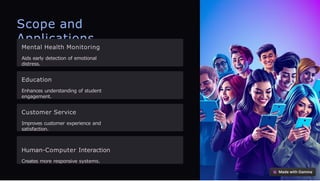
Scope and
Applications
Mental HealthMonitoring
Aids early detection of emotional
distress.
Education
Enhances understanding of student
engagement.
Customer Service
Improves customer experience and
satisfaction.
Human-Computer Interaction
Creates more responsive systems.
6.
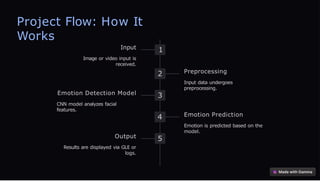
Project Flow: HowIt
Works
1
Input
Image or video input is
received.
2 Preprocessing
Input data undergoes
preprocessing.
3
Emotion Detection Model
CNN model analyzes facial
features.
4 Emotion Prediction
Emotion is predicted based on the
model.
5
Output
Results are displayed via GUI or
logs.
7.
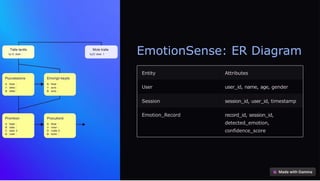
EmotionSense: ER Diagram
EntityAttributes
User user_id, name, age, gender
Session session_id, user_id, timestamp
Emotion_Record record_id, session_id,
detected_emotion,
confidence_score
8.
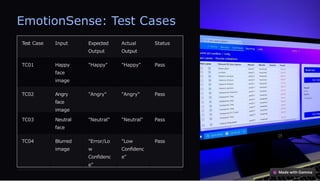
EmotionSense: Test Cases
TestCase Input Expected
Output
Actual
Output
Status
TC01 Happy
face
image
"Happy" "Happy" Pass
TC02 Angry
face
image
"Angry" "Angry" Pass
TC03 Neutral
face
"Neutral" "Neutral" Pass
TC04 Blurred
image
"Error/Lo
w
Confidenc
e"
"Low
Confidenc
e"
Pass
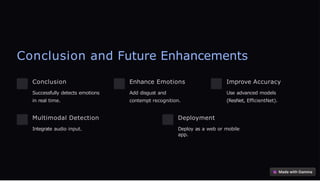
Conclusion and FutureEnhancements
Conclusion
Successfully detects emotions
in real time.
Enhance Emotions
Add disgust and
contempt recognition.
Improve Accuracy
Use advanced models
(ResNet, EfficientNet).
Multimodal Detection
Integrate audio input.
Deployment
Deploy as a web or mobile
app.


![[Paper Presentation] EMOTIONAL STRESS DETECTION USING DEEP LEARNING](https://cdn.slidesharecdn.com/ss_thumbnails/emotnetmlds2020-200205075816-thumbnail.jpg?width=640&height=640&fit=bounds)


