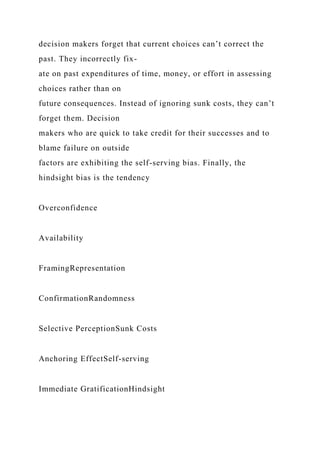
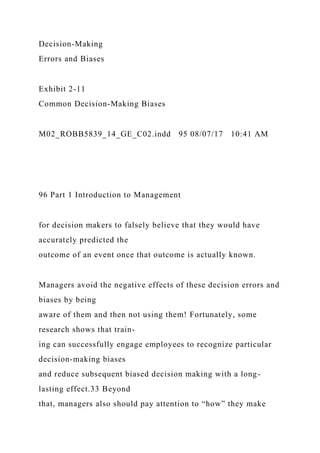
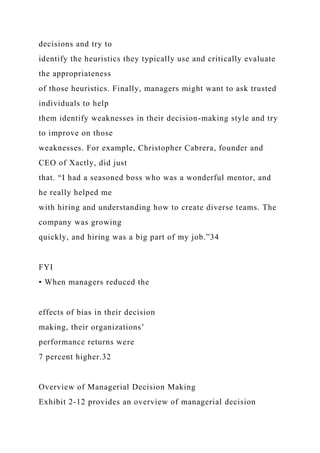
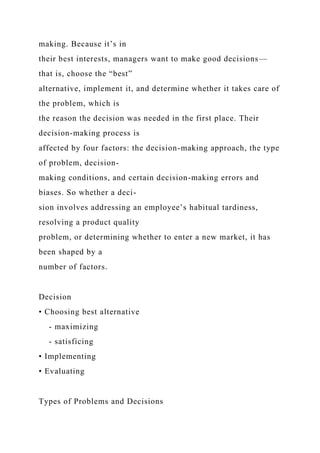
EMOTIONAL INTELLIGENCE TEST 1
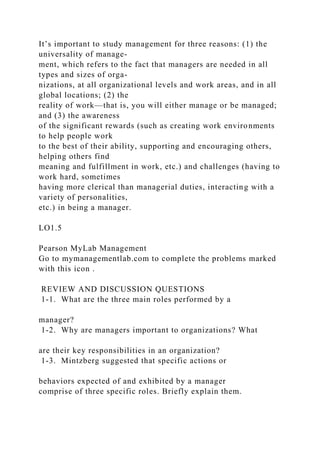
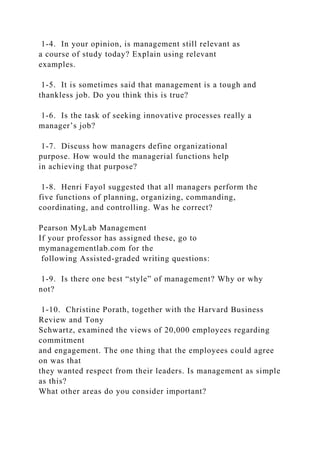
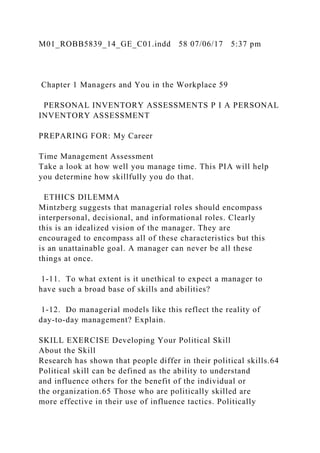
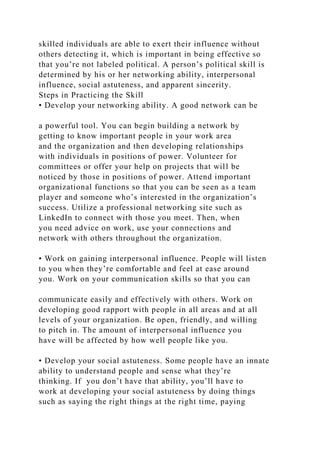
EMOTIONAL INTELLIGENCE TEST4
(BUSN 331-0, Fall2019)
Presented to: Yvette Esounga
Submitted by: Sultan Ibrahim
College of Business
Tuskegee University
Date:11/18/19
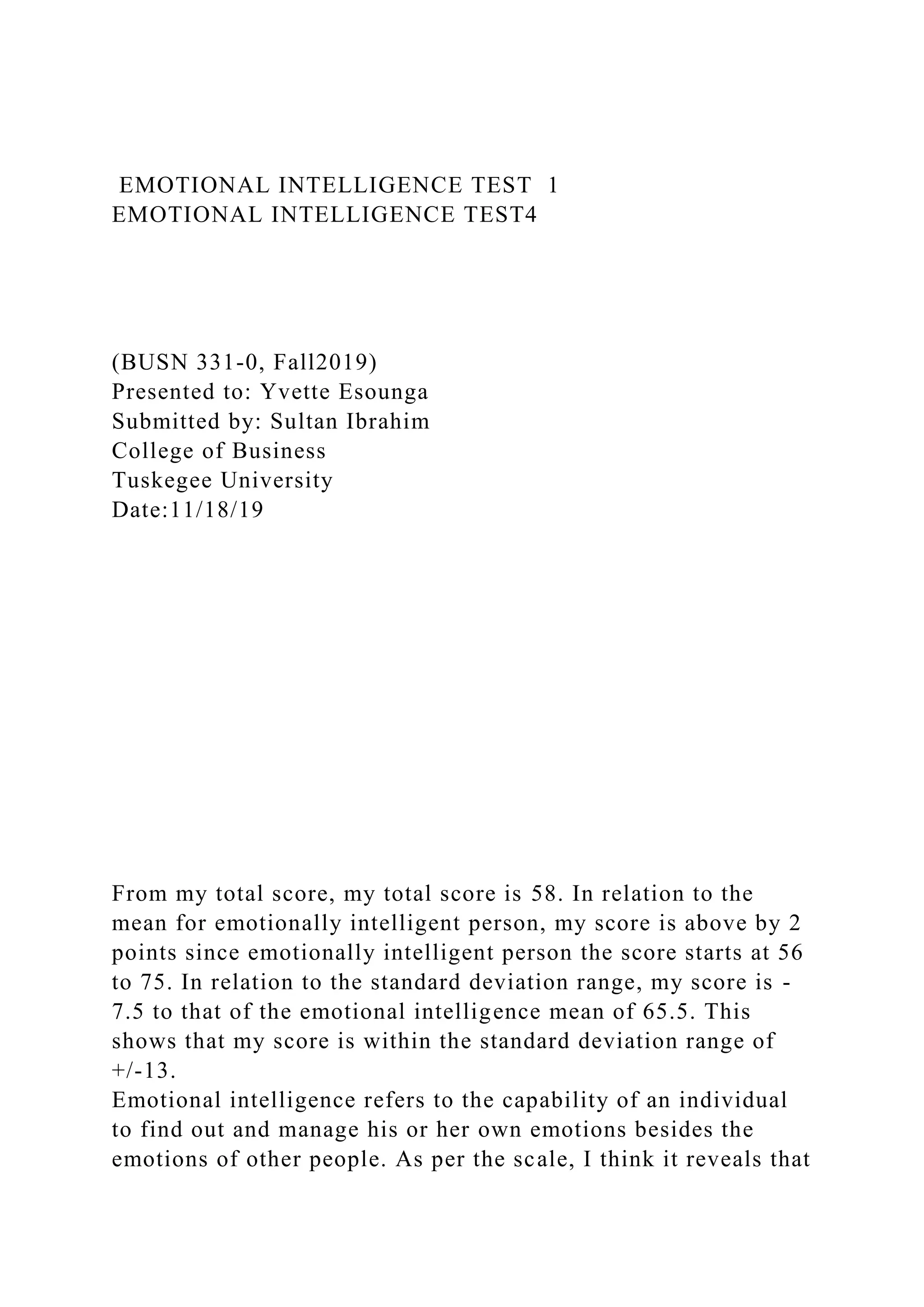
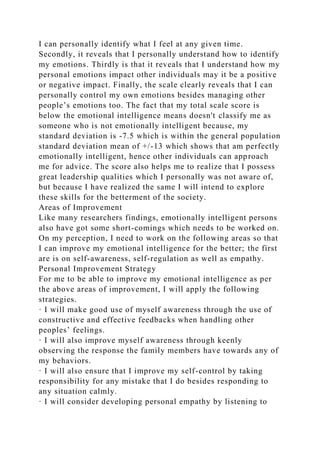
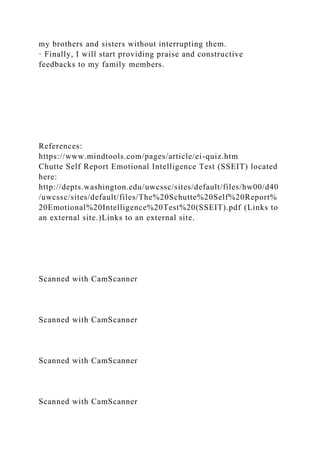
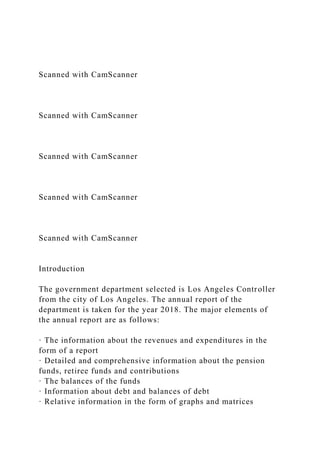
From my total score, my total score is 58. In relation to the
mean for emotionally intelligent person, my score is above by 2
points since emotionally intelligent person the score starts at 56
to 75. In relation to the standard deviation range, my score is -
7.5 to that of the emotional intelligence mean of 65.5. This
shows that my score is within the standard deviation range of
+/-13.
Emotional intelligence refers to the capability of an individual
to find out and manage his or her own emotions besides the
emotions of other people. As per the scale, I think it reveals that
I can personally identify what I feel at any given time.
Secondly, it reveals that I personally understand how to identify
my emotions. Thirdly is that it reveals that I understand how my
personal emotions impact other individuals may it be a positive
or negative impact. Finally, the scale clearly reveals that I can
personally control my own emotions besides managing other
people’s emotions too. The fact that my total scale score is
below the emotional intelligence means doesn't classify me as
someone who is not emotionally intelligent because, my
standard deviation is -7.5 which is within the general population
standard deviation mean of +/-13 which shows that am perfectly
emotionally intelligent, hence other individuals can approach
me for advice. The score also helps me to realize that I possess
great leadership qualities which I personally was not aware of,
but because I have realized the same I will intend to explore
these skills for the betterment of the society.
Areas of Improvement
Like many researchers findings, emotionally intelligent persons
also have got some short-comings which needs to be worked on.
On my perception, I need to work on the following areas so that
I can improve my emotional intelligence for the better; the first
are is on self-awareness, self-regulation as well as empathy.
Personal Improvement Strategy
For me to be able to improve my emotional intelligence as per
the above areas of improvement, I will apply the following
strategies.
· I will make good use of myself awareness through the use of
constructive and effective feedbacks when handling other
peoples’ feelings.
· I will also improve myself awareness through keenly
observing the response the family members have towards any of
my behaviors.
· I will also ensure that I improve my self-control by taking
responsibility for any mistake that I do besides responding to
any situation calmly.
· I will consider developing personal empathy by listening to
my brothers and sisters without interrupting them.
· Finally, I will start providing praise and constructive
feedbacks to my family members.
References:
https://www.mindtools.com/pages/article/ei-quiz.htm
Chutte Self Report Emotional Intelligence Test (SSEIT) located
here:
http://depts.washington.edu/uwcssc/sites/default/files/hw00/d40
/uwcssc/sites/default/files/The%20Schutte%20Self%20Report%
20Emotional%20Intelligence%20Test%20(SSEIT).pdf (Links to
an external site.)Links to an external site.
Scanned with CamScanner
Introduction
The government department selected is Los Angeles Controller
from the city of Los Angeles. The annual report of the
department is taken for the year 2018. The major elements of
the annual report are as follows:
· The information about the revenues and expenditures in the
form of a report
· Detailed and comprehensive information about the pension
funds, retiree funds and contributions
· The balances of the funds
· Information about debt and balances of debt
· Relative information in the form of graphs and matrices
· The information about tax as directed by the Accounting
standards
The controller is eligible for all types of affairs of a county.
These affairs include collection of taxes, implementing the
amount of taxes, public health, maintenance of jails and all the
other affairs relevant to public welfare and law enforcement. It
is an institution that is eligible for providing its services in
these respects that are mentioned above. In Los Angeles the
department is also providing some other valuable services like
providing the facility of libraries, parks, recreational activities,
entertainment facilities and provision of other social and
recreational activities. The department is providing its valuable
services all around the county efficiently.
The said financial statement is for the year ended 2018. It
comprises the dates that start from 1st January 2018 and ends
with 31st December 2018. The date that is mentioned on the
financial statement is January 1st, 2019. The independent
auditor for the auditing purpose of the government is selected
Macias and Gini and O’ Connell LLP. The complete address for
the auditor is Macias and Gini O’ Connell LLP, 700 South
Flower St. Suite 800, Los Angeles, CA 90017. The report is
qualified because it includes all the necessary information that
is required to carry out the auditing process. All the accounting
standards are followed and all the rules, regulations, process
and procedures are also followed. The Generally Accepted
Accounting Principles that are followed in America are
followed by the auditor during the audit work.
The major units of the activities of the government are as
follows:
Airports
Water
Power
The major funds of the government are as under:
Pensions
LACERS
DWP Funds
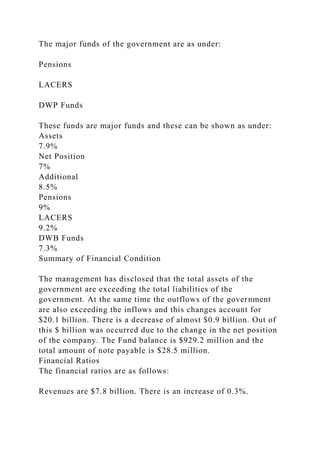
These funds are major funds and these can be shown as under:
Assets
7.9%
Net Position
7%
Additional
8.5%
Pensions
9%
LACERS
9.2%
DWB Funds
7.3%
Summary of Financial Condition
The management has disclosed that the total assets of the
government are exceeding the total liabilities of the
government. At the same time the outflows of the government
are also exceeding the inflows and this changes account for
$20.1 billion. There is a decrease of almost $0.9 billion. Out of
this $ billion was occurred due to the change in the net position
of the company. The Fund balance is $929.2 million and the
total amount of note payable is $28.5 million.
Financial Ratios
The financial ratios are as follows:
Revenues are $7.8 billion. There is an increase of 0.3%.
Expenses are $ 7.1 billion. There is a decrease of 0.7%.
Analysis of Reserves
General funds are increased by 27.5% and Public works have an
increase of 3.8%
References
Annual Report 2018,
https://lacontroller.org/wpcontent/uploads/2019/02/FY18_CAFR
_Final_1.31.19_v3.pdf
MANAGEMENT
14E
GE
A01_ROBB5839_14_GE_FM.indd 1 26/07/17 10:48 AM
This page intentionally left blank
MANAGEMENT
Stephen P. Robbins
San Diego State University
Mary Coulter
Missouri State University
With contributions by
Joseph J. Martocchio
University of Illinois
Lori K. Long
Baldwin Wallace University
14E
GE
Harlow, England • London • New York • Boston • San Francisco
• Toronto • Sydney • Dubai • Singapore • Hong Kong
Tokyo • Seoul • Taipei • New Delhi • Cape Town • Sao Paulo •
Mexico City • Madrid • Amsterdam • Munich • Paris • Milan
A01_ROBB5839_14_GE_FM.indd 3 26/07/17 10:49 AM
Vice President, Business Publishing: Donna Battista
Director of Portfolio Management: Stephanie Wall
Portfolio Manager: Kris Ellis-Levy
Associate Acquisitions Editor, Global Edition: Ishita Sinha
Associate Project Editor, Global Edition: Paromita Banerjee
Assistant Editor, Global Edition: Tahnee Wager
Editorial Assistant: Hannah Lamarre
Vice President, Product Marketing: Roxanne McCarley
Director of Strategic Marketing: Brad Parkins
Strategic Marketing Manager: Deborah Strickland
Product Marketer: Becky Brown
Field Marketing Manager: Lenny Ann Kucenski
Product Marketing Assistant: Jessica Quazza
Vice President, Production and Digital Studio, Arts and
Business:
Etain O’Dea
Director of Production, Business: Jeff Holcomb
Managing Producer, Business: Ashley Santora
Senior Manufacturing Controller, Global Edition: Trudy Kimber
Content Producer, Global Edition: Purnima Narayanan
Content Producer: Claudia Fernandes
Operations Specialist: Carol Melville
Creative Director: Blair Brown
Manager, Learning Tools: Brian Surette
Content Developer, Learning Tools: Lindsey Sloan
Managing Producer, Digital Studio, Art and Business: Diane
Lombardo
Digital Studio Producer: Monique Lawrence
Digital Studio Producer: Alana Coles
Media Production Manager, Global Edition: Vikram Kumar
Full-Service Project Management and Composition:
Cenveo® Publisher Services
Interior Designer: Cenveo® Publisher Services
Cover Image: Comaniciu Dan/Shutterstock
Acknowledgments of third-party content appear on the
appropriate page within the text.
Pearson Education Limited
KAO Two
KAO Park
Harlow
CM17 9NA
United Kingdom
and Associated Companies throughout the world
Visit us on the World Wide Web at:
www.pearsonglobaleditions.com
© Pearson Education Limited 2018
The rights of Stephen P. Robbins and Mary A. Coulter to be
identified as the authors of this work have been asserted
by them in accordance with the Copyright, Designs and Patents
Act 1988.
Authorized adaptation from the United States edition, entitled
Management, 14th Edition, ISBN 978-0-13-452760-4
by Stephen P. Robbins and Mary Coulter, published by Pearson
Education © 2018.
All rights reserved. No part of this publication may be
reproduced, stored in a retrieval system, or transmitted in any
form or by any means, electronic, mechanical, photocopying,
recording or otherwise, without either the prior written
permission of the publisher or a license permitting restricted
copying in the United Kingdom issued by the Copyright
Licensing Agency Ltd, Saffron House, 6–10 Kirby Street,
London EC1N 8TS.
All trademarks used herein are the property of their respective
owners. The use of any trademark in this text does not
vest in the author or publisher any trademark ownership rights
in such trademarks, nor does the use of such trademarks
imply any affiliation with or endorsement of this book by such
owners.
ISBN 10: 1-292-21583-6
ISBN 13: 978-1-292-21583-9
British Library Cataloguing-in-Publication Data
A catalogue record for this book is available from the British
Library
10 9 8 7 6 5 4 3 2 1
Typeset in Times NR MT Pro by Cenveo® Publisher Services
Printed and bound by Vivar in Malaysia
A01_ROBB5839_14_GE_FM.indd 4 11/07/17 9:33 AM
http://www.pearsonglobaleditions.com
To my wife, Laura
Steve
To my husband, Ron
Mary
A01_ROBB5839_14_GE_FM.indd 5 11/07/17 9:33 AM
This page intentionally left blank
STEPHEN P. ROBBINS received his Ph.D. from the University
of
Arizona. He previously worked for the Shell Oil Company and
Reynolds
Metals Company and has taught at the University of Nebraska at
Omaha,
Concordia University in Montreal, the University of Baltimore,
Southern
Illinois University at Edwardsville, and San Diego State
University. He is
currently professor emeritus in management at San Diego State.
Dr. Robbins’s research interests have focused on conflict,
power,
and politics in organizations, behavioral decision making, and
the
development of effective interpersonal skills. His articles on
these and
other topics have appeared in such journals as Business
Horizons, the
California Management Review, Business and Economic
Perspectives,
International Management, Management Review, Canadian
Personnel
and Industrial Relations, and The Journal of Management
Education.
Dr. Robbins is the world’s best-selling textbook author in the
areas
of management and organizational behavior. His books have
sold
more than 7 million copies and have been translated into 20
languages.
His books are currently used at more than 1,500 U.S. colleges
and
universities, as well as hundreds of schools throughout Canada,
Latin
America, Australia, New Zealand, Asia, Europe, and the Arab
World.
Dr. Robbins also participates in masters track competition.
Since
turning 50 in 1993, he’s won 23 national championships and 14
world titles.
He was inducted into the U.S. Masters Track & Field Hall of
Fame in 2005.
MARY COULTER received her Ph.D. from the University of
Arkansas.
She held different jobs including high school teacher, legal
assistant, and
city government program planner before completing her
graduate work.
She has taught at Drury University, the University of Arkansas,
Trinity
University, and Missouri State University. She is currently
professor
emeritus of management at Missouri State University. In
addition to
Management, Dr. Coulter has published other books with
Pearson
including Fundamentals of Management (with Stephen P.
Robbins),
Strategic Management in Action, and Entrepreneurship in
Action.
When she’s not busy writing, Dr. Coulter enjoys puttering
around
in her flower gardens, trying new recipes, reading all different
types
of books, and enjoying many different activities with husband
Ron,
daughters and sons-in-law Sarah and James, and Katie and Matt,
and
most especially with her two grandkids, Brooklynn and Blake,
who are
the delights of her life!
About the Authors
A01_ROBB5839_14_GE_FM.indd 7 11/07/17 9:33 AM
This page intentionally left blank
Preface 29
Acknowledgments 37
Brief Contents
Part 1 Introduction to Management
Chapter 1: Managers and You in the
Workplace 38
Management History Module 66
Chapter 2: Decision Making 80
Part 1 Management Practice 110
Chapter 3: Global Management 114
Chapter 4: Valuing a Diverse
Workforce 144
Chapter 5: Socially-Conscious
Management 178
Chapter 6: Managing Change 212
Chapter 7: Constraints on
Managers 252
Part 2 Management Practice 282
Part 2 Basics of Managing in Today’s Workplace
Part 3 Planning
Chapter 8: Planning and
Goal-Setting 288
Chapter 9: Strategic Planning 312
Chapter 10: Fostering
Entrepreneurship 342
Part 3 Management Practice 378
Part 4 Organizing
Chapter 11: Organization
Design 382
Chapter 12: Organizing Around
Teams 414
Chapter 13: Human Resource
Management 444
Part 4 Management Practice 482
Part 5 Leading
Chapter 14: Interpersonal and
Organizational Communication 486
Chapter 15: Organizational
Behavior 518
Chapter 16: Leadership 554
Chapter 17: Motivation 588
Part 5 Management Practice 624
Part 6 Controlling
Chapter 18: Controlling Activities
and Operations 630
Planning and Control Techniques
Module 664
Managing Operations
Module 682
Part 6 Management Practice 698
Glossary 703 • Name Index 715 • Organization Index 735 •
Subject Index 741
A01_ROBB5839_14_GE_FM.indd 9 11/07/17 4:36 PM
This page intentionally left blank
Preface 29
Acknowledgments 37
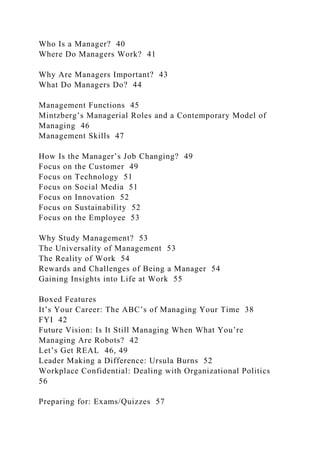
Part 1 Introduction to Management 38
Chapter 1: Managers and You in the Workplace 38
Who Are Managers and Where Do They Work? 40
Who Is a Manager? 40
Where Do Managers Work? 41
Why Are Managers Important? 43
What Do Managers Do? 44
Management Functions 45
Mintzberg’s Managerial Roles and a Contemporary Model of
Managing 46
Management Skills 47
How Is the Manager’s Job Changing? 49
Focus on the Customer 49
Focus on Technology 51
Focus on Social Media 51
Focus on Innovation 52
Focus on Sustainability 52
Focus on the Employee 53
Why Study Management? 53
The Universality of Management 53
The Reality of Work 54
Rewards and Challenges of Being a Manager 54
Gaining Insights into Life at Work 55
Boxed Features
It’s Your Career: The ABC’s of Managing Your Time 38
FYI 42
Future Vision: Is It Still Managing When What You’re
Managing Are Robots? 42
Let’s Get REAL 46, 49
Leader Making a Difference: Ursula Burns 52
Workplace Confidential: Dealing with Organizational Politics
56
Preparing for: Exams/Quizzes 57
Chapter Summary by Learning Objectives 57
Review and Discussion Questions 58
Preparing for: My Career 59
Personal Inventory Assessments: Time Management Assessment
59
Ethics Dilemma 59
Skill Exercise: Developing Your Political Skill 59
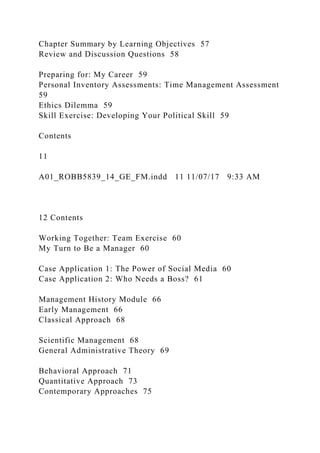
Contents
11
A01_ROBB5839_14_GE_FM.indd 11 11/07/17 9:33 AM
12 Contents
Working Together: Team Exercise 60
My Turn to Be a Manager 60
Case Application 1: The Power of Social Media 60
Case Application 2: Who Needs a Boss? 61
Management History Module 66
Early Management 66
Classical Approach 68
Scientific Management 68
General Administrative Theory 69
Behavioral Approach 71
Quantitative Approach 73
Contemporary Approaches 75
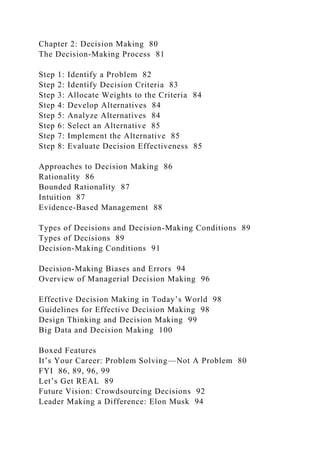
Chapter 2: Decision Making 80
The Decision-Making Process 81
Step 1: Identify a Problem 82
Step 2: Identify Decision Criteria 83
Step 3: Allocate Weights to the Criteria 84
Step 4: Develop Alternatives 84
Step 5: Analyze Alternatives 84
Step 6: Select an Alternative 85
Step 7: Implement the Alternative 85
Step 8: Evaluate Decision Effectiveness 85
Approaches to Decision Making 86
Rationality 86
Bounded Rationality 87
Intuition 87
Evidence-Based Management 88
Types of Decisions and Decision-Making Conditions 89
Types of Decisions 89
Decision-Making Conditions 91
Decision-Making Biases and Errors 94
Overview of Managerial Decision Making 96
Effective Decision Making in Today’s World 98
Guidelines for Effective Decision Making 98
Design Thinking and Decision Making 99
Big Data and Decision Making 100
Boxed Features
It’s Your Career: Problem Solving—Not A Problem 80
FYI 86, 89, 96, 99
Let’s Get REAL 89
Future Vision: Crowdsourcing Decisions 92
Leader Making a Difference: Elon Musk 94
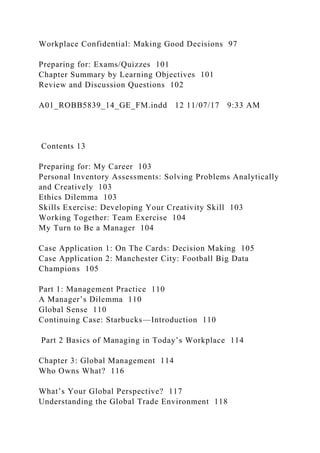
Workplace Confidential: Making Good Decisions 97
Preparing for: Exams/Quizzes 101
Chapter Summary by Learning Objectives 101
Review and Discussion Questions 102
A01_ROBB5839_14_GE_FM.indd 12 11/07/17 9:33 AM
Contents 13
Preparing for: My Career 103
Personal Inventory Assessments: Solving Problems Analytically
and Creatively 103
Ethics Dilemma 103
Skills Exercise: Developing Your Creativity Skill 103
Working Together: Team Exercise 104
My Turn to Be a Manager 104
Case Application 1: On The Cards: Decision Making 105
Case Application 2: Manchester City: Football Big Data
Champions 105
Part 1: Management Practice 110
A Manager’s Dilemma 110
Global Sense 110
Continuing Case: Starbucks—Introduction 110
Part 2 Basics of Managing in Today’s Workplace 114
Chapter 3: Global Management 114
Who Owns What? 116
What’s Your Global Perspective? 117
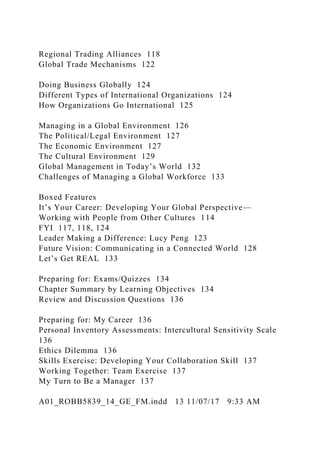
Understanding the Global Trade Environment 118
Regional Trading Alliances 118
Global Trade Mechanisms 122
Doing Business Globally 124
Different Types of International Organizations 124
How Organizations Go International 125
Managing in a Global Environment 126
The Political/Legal Environment 127
The Economic Environment 127
The Cultural Environment 129
Global Management in Today’s World 132
Challenges of Managing a Global Workforce 133
Boxed Features
It’s Your Career: Developing Your Global Perspective—
Working with People from Other Cultures 114
FYI 117, 118, 124
Leader Making a Difference: Lucy Peng 123
Future Vision: Communicating in a Connected World 128
Let’s Get REAL 133
Preparing for: Exams/Quizzes 134
Chapter Summary by Learning Objectives 134
Review and Discussion Questions 136
Preparing for: My Career 136
Personal Inventory Assessments: Intercultural Sensitivity Scale
136
Ethics Dilemma 136
Skills Exercise: Developing Your Collaboration Skill 137
Working Together: Team Exercise 137
My Turn to Be a Manager 137
A01_ROBB5839_14_GE_FM.indd 13 11/07/17 9:33 AM
14 Contents
Case Application 1: Dirty Little Secret 138
Case Application 2: The Power of Presence 139
Answers to “Who Owns What” Quiz 140
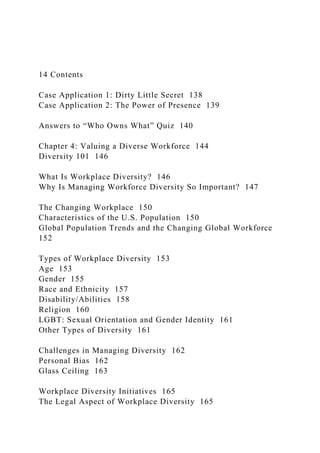
Chapter 4: Valuing a Diverse Workforce 144
Diversity 101 146
What Is Workplace Diversity? 146
Why Is Managing Workforce Diversity So Important? 147
The Changing Workplace 150
Characteristics of the U.S. Population 150
Global Population Trends and the Changing Global Workforce
152
Types of Workplace Diversity 153
Age 153
Gender 155
Race and Ethnicity 157
Disability/Abilities 158
Religion 160
LGBT: Sexual Orientation and Gender Identity 161
Other Types of Diversity 161
Challenges in Managing Diversity 162
Personal Bias 162
Glass Ceiling 163
Workplace Diversity Initiatives 165
The Legal Aspect of Workplace Diversity 165
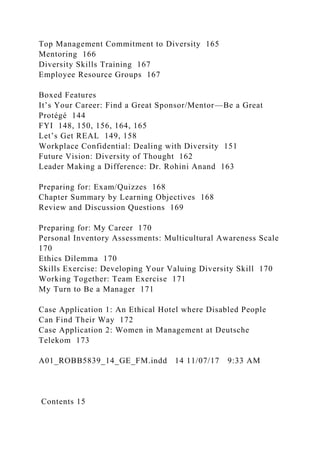
Top Management Commitment to Diversity 165
Mentoring 166
Diversity Skills Training 167
Employee Resource Groups 167
Boxed Features
It’s Your Career: Find a Great Sponsor/Mentor—Be a Great
Protégé 144
FYI 148, 150, 156, 164, 165
Let’s Get REAL 149, 158
Workplace Confidential: Dealing with Diversity 151
Future Vision: Diversity of Thought 162
Leader Making a Difference: Dr. Rohini Anand 163
Preparing for: Exam/Quizzes 168
Chapter Summary by Learning Objectives 168
Review and Discussion Questions 169
Preparing for: My Career 170
Personal Inventory Assessments: Multicultural Awareness Scale
170
Ethics Dilemma 170
Skills Exercise: Developing Your Valuing Diversity Skill 170
Working Together: Team Exercise 171
My Turn to Be a Manager 171
Case Application 1: An Ethical Hotel where Disabled People
Can Find Their Way 172
Case Application 2: Women in Management at Deutsche
Telekom 173
A01_ROBB5839_14_GE_FM.indd 14 11/07/17 9:33 AM
Contents 15
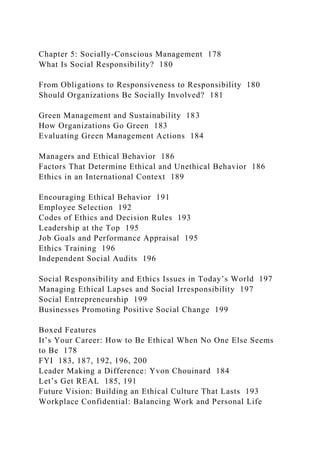
Chapter 5: Socially-Conscious Management 178
What Is Social Responsibility? 180
From Obligations to Responsiveness to Responsibility 180
Should Organizations Be Socially Involved? 181
Green Management and Sustainability 183
How Organizations Go Green 183
Evaluating Green Management Actions 184
Managers and Ethical Behavior 186
Factors That Determine Ethical and Unethical Behavior 186
Ethics in an International Context 189
Encouraging Ethical Behavior 191
Employee Selection 192
Codes of Ethics and Decision Rules 193
Leadership at the Top 195
Job Goals and Performance Appraisal 195
Ethics Training 196
Independent Social Audits 196
Social Responsibility and Ethics Issues in Today’s World 197
Managing Ethical Lapses and Social Irresponsibility 197
Social Entrepreneurship 199
Businesses Promoting Positive Social Change 199
Boxed Features
It’s Your Career: How to Be Ethical When No One Else Seems
to Be 178
FYI 183, 187, 192, 196, 200
Leader Making a Difference: Yvon Chouinard 184
Let’s Get REAL 185, 191
Future Vision: Building an Ethical Culture That Lasts 193
Workplace Confidential: Balancing Work and Personal Life
201
Preparing for: Exams/Quizzes 202
Chapter Summary by Learning Objective 202
Review and Discussion Questions 203
Preparing for: My Career 204
Personal Inventory Assessments: Ethical Leadership Assessment
204
Ethics Dilemma 204
Skills Exercise: Developing Your Building Trust Skill 204
Working Together: Team Exercise 205
My Turn to Be a Manager 205
Case Application 1: A Novel Wellness Culture 205
Case Application 2: Defeating the System: Ethics at
Volkswagen 206
Chapter 6: Managing Change 212
The Case for Change 214
External Factors 215
Internal Factors 215
The Change Process 216
Calm Waters Versus White-Water Rapids Metaphors 217
Reactive Versus Proactive Change Processes 218
A01_ROBB5839_14_GE_FM.indd 15 11/07/17 9:33 AM
16 Contents
Areas of Change 219
Strategy 220
Structure 220
Technology 220
People 221
Managing Change 222
Why Do People Resist Change? 222
Techniques for Reducing Resistance to Change 223
Contemporary Issues in Managing Change 225
Leading Change 225
Creating a Culture for Change 226
Employee Stress 227
Stimulating Innovation 232
Creativity Versus Innovation 232
Stimulating and Nurturing Innovation 232
Innovation and Design Thinking 236
Disruptive Innovation 237
Definition 237
Why Disruptive Innovation Is Important 238
Who’s Vulnerable? 238
Implications 239
Boxed Features
It’s Your Career: Learning to Manage Your Stress 212
FYI 215, 225, 228, 232, 234
Let’s Get REAL 223, 235
Leader Making a Difference: Satya Nadella 227
Workplace Confidential: Coping with Job Stress 231
Future Vision: The Internet of Things 233
Preparing for: Exams/Quizzes 241
Chapter Summary by Learning Objectives 241
Review and Discussion Questions 242
Preparing for: My Career 243
Personal Inventory Assessments: Are You a Type A
Personality? 243
Ethics Dilemma 243
Skills Exercise: Developing Your Change Management Skill
243
Working Together: Team Exercise 244
My Turn to Be a Manager 244
Case Application 1: A. S. Watson Group 245
Case Application 2: The iPhone: A Technology Disruptor 246
Chapter 7: Constraints on Managers 252
The Manager: Omnipotent or Symbolic? 254
The Omnipotent View 254
The Symbolic View 254
The External Environment: Constraints and Challenges 255
The Economic Environment 256
The Demographic Environment 256
How the External Environment Affects Managers 258
A01_ROBB5839_14_GE_FM.indd 16 11/07/17 9:33 AM
Contents 17
Organizational Culture: Constraints and Challenges 261
What Is Organizational Culture? 261
Strong Cultures 264
Where Culture Comes From and How It Continues 265
How Employees Learn Culture 266
How Culture Affects Managers 268
Current Issues in Organizational Culture 271
Creating an Innovative Culture 271
Creating a Customer-Responsive Culture 271
Creating a Sustainability Culture 272
Boxed Features
It’s Your Career: Reading an Organization’s Culture: Find One
Where You’ll Be Happy 252
Future Vision: Tomorrow’s Workplace: Sustainability and You
257
Let’s Get REAL 258, 266
Leader Making a Difference: Indra Nooyi 260
FYI 261
Workplace Confidential: Adjusting to a New Job or Work Team
269
Preparing for: Exams/Quizzes 273
Chapter Summary by Learning Objectives 273
Review and Discussion Questions 274
Preparing for: My Career 274
Personal Inventory Assessments: What’s My Comfort with
Change? 274
Ethics Dilemma 274
Skills Exercise: Developing Your Environmental Scanning Skill
275
Working Together: Team Exercise 275
My Turn to Be a Manager 275
Case Application 1: Tesco: Time to Refocus 276
Case Application 2: The Sky is the Limit 277
Part 2: Management Practice 282
A Manager’s Dilemma 282
Global Sense 282
Continuing Case: Starbucks—Basics of Managing in Today’s
Workplace 282
Part 3 Planning 288
Chapter 8: Planning and Goal-Setting 288
The What and Why of Planning 290
What Is Planning? 290
Why Do Managers Plan? 290
Planning and Performance 290
Goals and Plans 291
Types of Goals 291
Types of Plans 292
Setting Goals and Developing Plans 294
Approaches to Setting Goals 294
A01_ROBB5839_14_GE_FM.indd 17 26/07/17 10:58 AM
18 Contents
Developing Plans 298
Approaches to Planning 299
Contemporary Issues in Planning 300
How Can Managers Plan Effectively in Dynamic Environments?
300
How Can Managers Use Environmental Scanning? 301
Digital Tools 302
Boxed Features
It’s Your Career: You Gotta Have Goals 288
FYI 291, 298, 300
Let’s Get REAL 292, 297
Leader Making a Difference: Jeff Bezos 294
Workplace Confidential: When You Face a Lack of Clear
Directions 295
Future Vision: Using Social Media for Environmental Scanning
303
Preparing for: Exams/Quizzes 304
Chapter Summary by Learning Objectives 304
Review and Discussion Questions 305
Preparing for: My Career 306
Personal Inventory Assessments: Tolerance of Ambiguity Scale
306
Ethics Dilemma 306
Skills Exercise: Making a To-Do List that Works and Using It
306
Working Together: Team Exercise 307
My Turn to Be a Manager 307
Case Application 1: Hermès: Delivering Change 308
Case Application 2: Shifting Direction 309
Chapter 9: Strategic Planning 312
Strategic Management 314
What Is Strategic Management? 314
Why Is Strategic Management Important? 314
The Strategic Management Process 316
Step 1: Identifying the Organization’s Current Mission, Goals,
and Strategies 316
Step 2: Doing an External Analysis 317
Step 3: Doing an Internal Analysis 317
Step 4: Formulating Strategies 319
Step 5: Implementing Strategies 319
Step 6: Evaluating Results 319
Corporate Strategies 319
What Is Corporate Strategy? 321
What Are the Types of Corporate Strategy? 321
How Are Corporate Strategies Managed? 322
Competitive Strategies 323
The Role of Competitive Advantage 323
Choosing a Competitive Strategy 326
Current Strategic Management Issues 327
The Need for Strategic Leadership 327
The Need for Strategic Flexibility 329
Important Organizational Strategies for Today’s Environment
330
A01_ROBB5839_14_GE_FM.indd 18 11/07/17 9:33 AM
Contents 19
Boxed Features
It’s Your Career: Learning Your Strengths and Weaknesses:
Accentuate the Positive 312
FYI 317, 325, 329
Let’s Get REAL 318, 328
Workplace Confidential: Developing a Career Strategy 320
Leader Making a Difference: Mary Barra 321
Future Vision: Big Data as a Strategic Weapon 324
Preparing for: Exams/Quizzes 332
Chapter Summary by Learning Objectives 332
Review and Discussion Questions 333
Preparing for: My Career 334
Personal Inventory Assessments: Creative Style Indicator 334
Ethics Dilemma 334
Skills Exercise: Developing Your Business Planning Skill 334
Working Together: Team Exercise 336
My Turn to Be a Manager 336
Case Application 1: Fast Fashion 336
Case Application 2: A Simple Strategy at Costco 337
Chapter 10: Fostering Entrepreneurship 342
The Context of Entrepreneurship 343
What Is Entrepreneurship? 343
Entrepreneurship Versus Self-Employment 344
Why Is Entrepreneurship Important? 344
The Entrepreneurial Process 345
What Do Entrepreneurs Do? 345
Social Responsibility and Ethical Issues Facing Entrepreneurs
346
Start-Up and Planning Issues 348
Identifying Environmental Opportunities and Competitive
Advantage 349
Researching the Venture’s Feasibility—Ideas 351
Researching the Venture’s Feasibility—Competitors 354
Researching the Venture’s Feasibility—Financing 354
Developing a Business Plan 355
The Sharing Economy 356
Organizing Issues 357
Legal Forms of Organization 357
Organizational Design and Structure 359
Human Resource Management 360
Initiating Change 361
The Importance of Continuing Innovation 362
Leading Issues 362
Personality Characteristics of Entrepreneurs 362
Motivating Employees Through Empowerment 363
The Entrepreneur as Leader 364
Control Issues 365
Managing Growth 365
Managing Downturns 367
Exiting the Venture 368
A01_ROBB5839_14_GE_FM.indd 19 11/07/17 9:33 AM
20 Contents
Boxed Features
It’s Your Career: Being Entrepreneurial Even If You Don’t
Want to Be an Entrepreneur 342
FYI 346, 349, 351
Workplace Confidential: Dealing with Risks 347
Future Vision: The Growth of Social Businesses 348
Let’s Get REAL 352, 356
Leader Making a Difference: Mark Zuckerberg 364
Preparing for: Exams/Quizzes 369
Chapter Summary by Learning Objectives 369
Review and Discussion Questions 370
Preparing for: My Career 371
Personal Inventory Assessments: Innovative Attitude Scale 371
Ethics Dilemma 371
Skills Exercise: Developing Grit 371
Working Together: Team Exercise 372
My Turn to Be a Manager 372
Case Application 1: The Fear of Failure 373
Case Application 2: The Right Recipe for Entrepreneurs: Fifteen
374
Part 3: Management Practice 378
A Manager’s Dilemma 378
Global Sense 378
Continuing Case: Starbucks—Planning 378
Part 4 Organizing 382
Chapter 11: Organization Design 382
Six Elements of Organizational Design 383
Work Specialization 384
Departmentalization 385
Chain of Command 387
Span of Control 390
Centralization and Decentralization 391
Formalization 392
Mechanistic and Organic Structures 392
Contingency Factors Affecting Structural Choice 393
Strategy and Structure 393
Size and Structure 394
Technology and Structure 394
Environmental Uncertainty and Structure 394
Traditional Organizational Design Options 395
Simple Structure 395
Functional Structure 395
Divisional Structure 395
Organizing for Flexibility in the Twenty-First Century 396
Team Structures 396
Matrix and Project Structures 397
A01_ROBB5839_14_GE_FM.indd 20 11/07/17 9:33 AM
Contents 21
The Boundaryless Organization 398
Telecommuting 400
Compressed Workweeks, Flextime, and Job Sharing 402
The Contingent Workforce 402
Boxed Features
It’s Your Career: Staying Connected 382
Let’s Get REAL 388, 401
Workplace Confidential: Coping with Multiple Bosses 389
FYI 390, 391, 398, 401, 402
Leader Making a Difference: Zhang Ruimin 393
Future Vision: Flexible Organizations 399
Preparing for: Exams/Quizzes 404
Chapter Summary by Learning Objectives 404
Review and Discussion Questions 405
Preparing for: My Career 406
Personal Inventory Assessments: Organizational Structure
Assessment 406
Ethics Dilemma 406
Skills Exercise: Developing Your Acquiring Power Skill 406
Working Together: Team Exercise 407
My Turn to Be a Manager 407
Case Application 1: A New Kind of Structure 408
Case Application 2: Organizational Volunteers 409
Chapter 12: Organizing Around Teams 414
Groups and Group Development 416
What Is a Group? 416
Stages of Group Development 416
Work Group Performance and Satisfaction 418
External Conditions Imposed on the Group 418
Group Member Resources 418
Group Structure 418
Group Processes 422
Group Tasks 425
Turning Groups into Effective Teams 426
The Difference Between Groups and Teams 426
Types of Work Teams 427
Creating Effective Work Teams 428
Contemporary Challenges in Managing Teams 432
Managing Global Teams 432
Building Team Skills 433
Understanding Social Networks 434
Boxed Features
It’s Your Career: Developing Your Coaching Skills 414
FYI 422, 426, 428, 429
Let’s Get REAL 425, 430
Future Vision: Conflict 2.0 425
Workplace Confidential: Handling Difficult Coworkers 431
Leader Making a Difference: Dr. Dara Richardson-Heron 433
A01_ROBB5839_14_GE_FM.indd 21 11/07/17 9:33 AM
22 Contents
Preparing for: Exams/Quizzes 435
Chapter Summary by Learning Objectives 435
Review and Discussion Questions 436
Preparing for: My Career 437
Personal Inventory Assessments: Diagnosing the Need for Team
Building 437
Ethics Dilemma 437
Skills Exercise: Developing Your Coaching Skills 437
Working Together: Team Exercise 438
My Turn to Be a Manager 438
Case Application 1: Who Needs a Manager? 438
Case Application 2: 737 Teaming Up for Takeoff 439
Chapter 13: Human Resource Management 444
Why Human Resource Management Is Important and the Human
Resource Management Process 446
External Factors that Affect the Human Resource Management
Process 448
The Economy 448
Labor Unions 448
Laws and Rulings 449
Demography 451
Identifying and Selecting Competent Employees 452
Human Resource Planning 453
Recruitment and Decruitment 454
Selection 456
Providing Employees with Needed Skills and Knowledge 459
Orientation 460
Employee Training 460
Retaining Competent, High-Performing Employees 462
Employee Performance Management 462
Compensation and Benefits 463
Contemporary Issues in Managing Human Resources 466
Managing Downsizing 466
Managing Sexual Harassment 467
Controlling HR Costs 467
Boxed Features
It’s Your Career: Negotiating Your Salary 444
Leader Making a Difference: Laszlo Bock 451
Workplace Confidential: Job Search 455
FYI 456, 461, 467
Let’s Get REAL 459, 464
Future Vision: Gamification of HR 468
Preparing for: Exams/Quizzes 469
Chapter Summary by Learning Objectives 469
Review and Discussion Questions 471
Preparing for: My Career 471
Personal Inventory Assessments: Work Performance Assessment
471
Ethics Dilemma 472
Skills Exercise: Developing Your Interviewing Skills 472
Working Together: Team Exercise 473
My Turn to Be a Manager 473
A01_ROBB5839_14_GE_FM.indd 22 19/07/17 9:41 AM
Contents 23
Case Application 1: Maersk and HR Management Challenges in
China 474
Case Application 2: Measuring Output, Not Hours Worked 475
Part 4: Management Practice 482
A Manager’s Dilemma 482
Global Sense 482
Continuing Case: Starbucks—Organizing 482
Part 5 Leading 486
Chapter 14: Interpersonal and Organizational Communication
486
The Nature and Function of Communication 487
What Is Communication? 488
Functions of Communication 488
Methods and Challenges of Interpersonal Communication 489
Methods 489
Barriers 492
Overcoming the Barriers 494
Effective Organizational Communication 497
Formal Versus Informal 497
Direction of Flow 497
Networks 498
Workplace Design and Communication 500
Communication in the Internet and Social Media Age 501
The 24/7 Work Environment 502
Working from Anywhere 502
Social Media 502
Balancing the Pluses and Minuses 503
Choosing the Right Media 503
Communication Issues in Today’s Organizations 504
Managing Communication in a Digitally Connected World 504
Managing the Organization’s Knowledge Resources 505
The Role of Communication in Customer Service 505
Getting Employee Input 506
Communicating Ethically 507
Becoming a Better Communicator 508
Sharpening Your Persuasion Skills 508
Sharpening Your Speaking Skills 508
Sharpening Your Writing Skills 508
Sharpening Your Reading Skills 509
Boxed Features
It’s Your Career: I’m Listening! 486
Leader Making a Difference: Angela Ahrendts 492
FYI 494, 497, 500
Let’s Get REAL 495, 499
Workplace Confidential: An Uncommunicative Boss 496
Future Vision: No Longer Lost in Translation 503
A01_ROBB5839_14_GE_FM.indd 23 11/07/17 9:33 AM
24 Contents
Preparing for: Exams/Quizzes 509
Chapter Summary by Learning Objectives 509
Review and Discussion Questions 511
Preparing for: My Career 511
Personal Inventory Assessments: Communication Styles 511
Ethics Dilemma 511
Skills Exercise: Developing Your Presentation Skills 512
Working Together: Team Exercise 512
My Turn to Be a Manager 512
Case Application 1: Is Anytime Feedback Too Much? 513
Case Application 2: Neutralizing the Concordia Effect! 514
Chapter 15: Organizational Behavior 518
Focus and Goals of Organizational Behavior 520
Focus of Organizational Behavior 520
Goals of Organizational Behavior 521
Attitudes and Job Performance 521
Job Satisfaction 522
Job Involvement and Organizational Commitment 524
Employee Engagement 524
Attitudes and Consistency 525
Cognitive Dissonance Theory 525
Attitude Surveys 526
Implications for Managers 527
Personality 527
MBTI® 528
The Big Five Model 530
Additional Personality Insights 530
Personality Types in Different Cultures 532
Emotions and Emotional Intelligence 533
Implications for Managers 536
Perception 537
Factors That Influence Perception 537
Attribution Theory 538
Shortcuts Used in Judging Others 539
Implications for Managers 540
Learning 540
Operant Conditioning 540
Social Learning 541
Shaping: A Managerial Tool 541
Implications for Managers 542
Boxed Features
It’s Your Career: Self Awareness: You Need to Know Yourself
Before You Can Know Others 518
FYI 522, 525, 538
Leader Making a Difference: Carolyn McCall 527
Let’s Get REAL 529, 533
Workplace Confidential: An Abusive Boss 534
Future Vision: Increased Reliance on Emotional Intelligence
535
A01_ROBB5839_14_GE_FM.indd 24 11/07/17 9:33 AM
Contents 25
Preparing for: Exams/Quizzes 542
Chapter Summary by Learning Objectives 542
Review and Discussion Questions 544
Preparing for: My Career 544
Personal Inventory Assessments: Emotional Intelligence
Assessment 544
Ethics Dilemma 544
Skills Exercise: Developing Your Shaping Behavior Skill 545
Working Together: Team Exercise 545
My Turn to Be a Manager 545
Case Application 1: A Great Place to Work 546
Case Application 2: Employees First 547
Chapter 16: Leadership 554
Who Are Leaders and What Is Leadership? 555
Early Leadership Theories 556
Leadership Traits 556
Leadership Behaviors 556
Contingency Theories of Leadership 559
The Fiedler Model 559
Hersey and Blanchard’s Situational Leadership Theory 561
Path-Goal Model 562
Contemporary Views of Leadership 564
Leader–Member Exchange (LMX) Theory 564
Transformational-Transactional Leadership 564
Charismatic-Visionary Leadership 565
Authentic Leadership 566
Ethical Leadership 567
Team Leadership 567
Leadership Issues in the Twenty-First Century 569
Managing Power 569
Developing Trust 571
Empowering Employees 572
Leading Across Cultures 573
Becoming an Effective Leader 574
Boxed Features
It’s Your Career: Being a More Charismatic Leader 554
FYI 556, 562, 564, 566, 571, 575
Leader Making a Difference: Dr. Delos “Toby” Cosgrove 565
Let’s Get REAL 568, 571
Workplace Confidential: A Micromanaging Boss 570
Future Vision: Flexible Leadership 574
Preparing for: Exams/Quizzes 576
Chapter Summary by Learning Objectives 576
Review and Discussion Questions 577
Preparing for: My Career 578
Personal Inventory Assessments: Leadership Style Inventory
578
Ethics Dilemma 578
Skills Exercise: Developing Your Choosing an Effective
Leadership Style Skill 578
A01_ROBB5839_14_GE_FM.indd 25 11/07/17 9:33 AM
26 Contents
Working Together: Team Exercise 579
My Turn to Be a Manager 579
Case Application 1: Indra Nooyi: An Inspiring Leader 580
Case Application 2: Leadership Development at L’Oréal 581
Chapter 17: Motivation 588
What Is Motivation? 589
Early Theories of Motivation 590
Maslow’s Hierarchy of Needs Theory 590
McGregor’s Theory X and Theory Y 591
Herzberg’s Two-Factor Theory 592
Three-Needs Theory 593
Contemporary Theories of Motivation 594
Goal-Setting Theory 594
Reinforcement Theory 596
Designing Motivating Jobs 596
Equity Theory 599
Expectancy Theory 602
Integrating Contemporary Theories of Motivation 603
Current Issues in Motivation 605
Managing Cross-Cultural Motivational Challenges 605
Motivating Unique Groups of Workers 606
Designing Appropriate Rewards Programs 609
Boxed Features
It’s Your Career: What Motivates You? 588
FYI 592, 596, 600, 610
Leader Making a Difference: Susan Wojcicki 595
Workplace Confidential: Feelings of Unfair Pay 601
Let’s Get REAL 604, 611
Future Vision: Individualized Rewards 607
Preparing for: Exams/Quizzes 612
Chapter Summary by Learning Objectives 612
Review and Discussion Questions 613
Preparing for: My Career 614
Personal Inventory Assessments: Work Motivation Indicator
614
Ethics Dilemma 614
Skills Exercise: Developing Your Motivating Employees Skill
614
Working Together: Team Exercise 615
My Turn to Be a Manager 615
Case Application 1: Hong Kong Disneyland: HR Programs to
Motivate Employees 616
Case Application 2: Balancing Success and Happiness 617
Part 5: Management Practice 624
A Manager’s Dilemma 624
Global Sense 625
Continuing Case: Starbucks—Leading 626
A01_ROBB5839_14_GE_FM.indd 26 11/07/17 9:33 AM
Contents 27
Part 6 Controlling 630
Chapter 18: Controlling Activities and Operations 630
What Is Controlling and Why Is It Important? 632
The Control Process 633
Step 1: Measuring Actual Performance 634
Step 2: Comparing Actual Performance Against the Standard
635
Step 3: Taking Managerial Action 636
Managerial Decisions in Controlling 636
Controlling for Organizational and Employee Performance 637
What Is Organizational Performance? 637
Measures of Organizational Performance 638
Controlling for Employee Performance 639
Tools for Measuring Organizational Performance 642
Feedforward/Concurrent/Feedback Controls 642
Financial Controls 643
Information Controls 645
Balanced Scorecard 646
Benchmarking of Best Practices 646
Contemporary Issues in Control 647
Adjusting Controls for Cross-Cultural Differences and Global
Turmoil 648
Workplace Privacy 649
Employee Theft 650
Workplace Violence 651
Controlling Customer Interactions 652
Corporate Governance 654
Boxed Features
It’s Your Career: How to Be a Pro at Giving Feedback 630
FYI 639, 651, 654
Let’s Get REAL 640, 644
Workplace Confidential: Responding to an Unfair Performance
Review 641
Leader Making a Difference: Bob Iger 647
Future Vision: Real-time Feedback 650
Preparing for: Exams/Quizzes 655
Chapter Summary by Learning Objectives 655
Review and Discussion Questions 656
Preparing for: My Career 657
Personal Inventory Assessments: Workplace Discipline
Indicator 657
Ethics Dilemma 657
Skills Exercise: Managing Challenging Employees 657
Working Together: Team Exercise 658
My Turn to Be a Manager 658
Case Application 1: The Challenge of “Healthy” Fast-Food 658
Case Application 2: Bring Your Own Device 659
Planning and Control Techniques Module 664
Techniques for Assessing the Environment 664
Environmental Scanning 664
A01_ROBB5839_14_GE_FM.indd 27 11/07/17 9:33 AM
28 Contents
Forecasting 666
Benchmarking 668
Techniques for Allocating Resources 669
Budgeting 669
Scheduling 671
Breakeven Analysis 674
Linear Programming 674
Contemporary Planning and Control Techniques 676
Project Management 676
Scenario Planning 678
Managing Operations Module 682
The Role of Operations Management 683
Services and Manufacturing 683
Managing Productivity 684
Strategic Role of Operations Management 685
What Is Value Chain Management and Why Is It Important?
685
What Is Value Chain Management? 686
Goal of Value Chain Management 686
Benefits of Value Chain Management 687
Managing Operations Using Value Chain Management 687
Value Chain Strategy 687
Obstacles to Value Chain Management 690
Current Issues in Managing Operations 691
Technology’s Role in Operations Management 692
Quality Initiatives 692
Quality Goals 694
Mass Customization and Lean Organization 695
Part 6: Management Practice 698
A Manager’s Dilemma 698
Global Sense 698
Continuing Case: Starbucks—Controlling 699
Glossary 703
Name Index 715
Organization Index 735
Subject Index 741
A01_ROBB5839_14_GE_FM.indd 28 11/07/17 9:33 AM
The book you have before you is one of the world’s most
popular introductory management
textbooks. It’s used by several hundred U.S. colleges and
universities; it’s translated into
Spanish, French, Russian, Dutch, Bahasa, Korean, and Chinese;
and there are adapted edi-
tions for Australia, Canada, India, and the Arab World.
For a textbook first published in 1984—in a crowded market
where there are currently
several dozen choices, why has Robbins/Coulter Management
been so popular and enduring?
We believe there are three characteristics that set us apart:
contemporary topic coverage, read-
ability, and relevance.
Contemporary Topic Coverage
We have always prided ourselves on bringing the latest
management issues and research to
this book. In preparing each edition, we carefully comb the
academic journals and business
periodicals to identify topics that students need to be current
on. For instance, prior editions
of this book were the first to discuss self-managed teams,
emotional intelligence, open-book
management, sustainability, social entrepreneurship, stretch
goals, the contingent workforce,
self-managed careers, wearable technology, big data, and design
thinking.
This current edition continues the tradition by including a new
section on disruptive inno-
vation. No topic appears to be more current or important to
students today than dealing with
major structural changes taking place in industries as varied as
automobiles, hotels, banking,
TV networks, or book publishing. In fact, there are few
industries that aren’t being threat-
ened by disruptive innovation. In Chapter 6, we define
disruptive innovation; explain why it’s
important; describe who is vulnerable; and discuss implications
for entrepreneurs, corporate
managers, and your career planning.
Key Changes to the 14th Edition
• Chapter 6 on managing change has been expanded to include a
discussion of disruptive in-
novation as an important driver of change.
• The Part 2 module on creating and leading entrepreneurial
ventures has become a separate
chapter (Chapter 10). We’ve expanded our discussion, added
end-of-chapter applications,
and acknowledged the importance of entrepreneurship by giving
it its own chapter.
• The two chapters on organizational design have been merged
into one chapter (Chapter 11)
in response to comments by users and reviewers. But we’ve
retained the key concepts that
students need to know.
• The addition of “Workplace Confidential” pages throughout
the book which address com-
mon frustrations and challenges that employees face in the
workplace.
• Current and timely topics—including the Internet of things,
real-time feedback, and choos-
ing appropriate communication media, among others—have
been added.
• Dozens of current examples illustrating management practices
and challenges in start-up
and established organizations, small and large organizations,
and manufacturing, service
and technology organizations have been added.
Readability
Every author claims his or her books are highly readable. The
reality is that few actually
are. From the first edition of this book, we were determined to
make the field of manage-
ment interesting and engaging for the reader. How did we do it?
First, we committed to a
Preface
29
A01_ROBB5839_14_GE_FM.indd 29 11/07/17 9:33 AM
30 Preface
conversational writing style. We wanted the book to read like
normal people talk.
Second, we relied on an extensive use of examples. As your
senior author learned
early in his teaching career, students don’t remember theories
but they do remember
stories. So you’ll find a wealth of current examples in this
book.
A well-written book should be able to be used successfully at
all levels of higher
education, from community colleges to graduate programs. And
over its 30+ years of
life, this book has done just that. You’ll find this book is used
in community colleges,
at for-profit colleges, by undergraduate students at both
regional and land-grant uni-
versities, and in numerous graduate programs.
Relevance
Students are unlikely to be motivated if they think a course and
its textbooks aren’t
relevant to their career goals. We’ve responded to this challenge
in a number of ways.
Our latest inclusion is an important new feature—the Workplace
Confidential pages—
that’s designed to make this book more meaningful to non-
management majors. We
also want to highlight four additional features that have helped
build this book’s repu-
tation for practicality.
Providing value to non-management students. New to this
edition are in-chapter
pages entitled Workplace Confidential. This unique feature
marks a distinct break
from what typically has been included in the traditional
introductory management
text.
Your authors have long heard a common complaint about the
introductory manage-
ment course from students in majors such as accounting,
finance, and marketing. As
summed up by one accounting student: “Why do I need to take a
management course?
I have no interest in pursuing a career in management!” Even
though that accounting
student might some day lead an audit team or manage an office
of a major CPA firm, we
understand those non-management majors who question the
relevance of this course to
their career goals. We’ve listened and responded.
We’ve made the contents of this 14th edition relevant to any
student who plans to
work in an organization. Regardless of whether an organization
employs three people
or 300,000, there are common challenges that every employee
encounters. We’ve
researched those challenges and identified the nearly dozen-
and-a-half most frequent.
Then we looked at providing students with guidance for dealing
with these challenges.
The result is the Workplace Confidential features that you’ll
find throughout this
book. For instance, you’ll find suggestions for dealing with
organizational politics,
job stress, coping with an uncommunicative or abusive boss,
and responding to an
unfair performance review.
Insights from real managers. One feature that has differentiated
Robbins/Coulter
for more than 15 years is our “real” managers. Student feedback
tells us that they
appreciate learning from real managers in their everyday jobs.
In Let’s Get Real boxes,
actual managers respond to problem scenarios. In Leader
Making a Difference boxes,
you’ll meet a variety of global executives whose knowledge and
skills significantly
influenced organizational outcomes.
Focus on skills. Today’s students need both knowledge
(knowing) and skills
(doing). Students want to leave class knowing what management
is all about but also
with the skills necessary to help them succeed in today’s
workplaces. In response,
you’ll find several features in this book that are designed to
build skill expertise. It’s
Your Career chapter openers cover skills ranging from
managing time and being self
aware to being a pro at giving feedback and being change ready.
These chapter open-
ers include information about the skill and are reinforced with a
Pearson MyLab
Management component that tests students’ comprehension of
the skill. Also, at the
end of each chapter, you’ll find more skill exercises, where we
provide a thorough
discussion of additional skills and give students opportunities to
practice these skills.
Looking ahead. Students are going to spend most of their future
work life in a
setting that’s likely to look very different from today. To help
students prepare for that
future, we have included Future Vision boxes throughout the
book that look at how
A01_ROBB5839_14_GE_FM.indd 30 11/07/17 9:33 AM
Preface 31
management and organizations might change over the next 15 to
20 years. Although
no one has a perfectly accurate view into the future, certain
trends in place today
offer insights into what tomorrow’s work world might look like.
We draw from recent
research and forecasts to consider this future.
Pearson MyLab Management Suggested Activities
Making assessment activities available online for students to
complete before coming
to class will allow you, the instructor, more discussion time
during the class to review
areas that students are having difficulty in comprehending. The
activities below are
available in Pearson MyLab Management and are integrated into
the textbook.
Watch It
Recommends a video clip that can be assigned to students for
outside classroom viewing
or that can be watched in the classroom. The video corresponds
to the chapter material
and is accompanied by multiple-choice questions that reinforce
students’ comprehen-
sion of the chapter content.
Try It
Recommends a mini simulation that can be assigned to students
as an outside class-
room activity or be done in the classroom. As the students
watch the simulation they
will be asked to make choices based on the scenario presented
in the simulation. At the
end of the simulation the student will receive immediate
feedback based on the answers
they gave. These simulations reinforce the concepts of the
chapter and the students’
comprehension of those concepts.
Talk About It
These are discussion-type questions that can be assigned as an
activity within the
classroom.
Write It
Students can be assigned these broad-based, critical-thinking
discussion questions
that will challenge them to assimilate information that they’ve
read in the chapter.
Personal Inventory Assessments (PIA)
Students learn better when they can connect what they are
learning to their personal
experience. PIA (Personal Inventory Assessments) is a
collection of online exercises de-
signed to promote self-reflection and engagement in students,
enhancing their ability to
connect with concepts taught in principles of management,
organizational behavior, and
human resource management classes. Assessments are
assignable by instructors who can
then track students’ completions. Student results include a
written explanation along
with a graphic display that shows how their results compare to
the class as a whole.
Instructors will also have access to this graphic representation
of results to promote
classroom discussion.
Assisted Graded Writing Questions
These are short essay questions that the students can complete
as an assignment and
submit to you, the professor, for grading.
Chapter-by-Chapter Changes
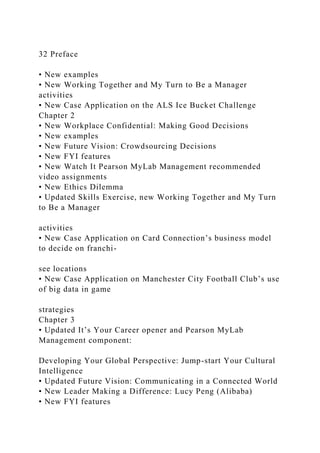
Chapter 1
• New FYI features
• New Workplace Confidential: Dealing with Organizational
Politics
• New Watch It Pearson MyLab Management recommended
video assignments
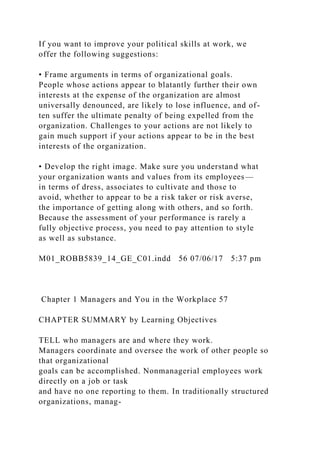
• New Let’s Get Real
• New Ethics Dilemma
A01_ROBB5839_14_GE_FM.indd 31 11/07/17 9:33 AM
32 Preface
• New examples
• New Working Together and My Turn to Be a Manager
activities
• New Case Application on the ALS Ice Bucket Challenge
Chapter 2
• New Workplace Confidential: Making Good Decisions
• New examples
• New Future Vision: Crowdsourcing Decisions
• New FYI features
• New Watch It Pearson MyLab Management recommended
video assignments
• New Ethics Dilemma
• Updated Skills Exercise, new Working Together and My Turn
to Be a Manager
activities
• New Case Application on Card Connection’s business model
to decide on franchi-
see locations
• New Case Application on Manchester City Football Club’s use
of big data in game
strategies
Chapter 3
• Updated It’s Your Career opener and Pearson MyLab
Management component:
Developing Your Global Perspective: Jump-start Your Cultural
Intelligence
• Updated Future Vision: Communicating in a Connected World
• New Leader Making a Difference: Lucy Peng (Alibaba)
• New FYI features
• New Watch It Pearson MyLab Management recommended
video assignments
• New examples
• New Ethics Dilemma
• Updated Skills Exercise, new Working Together and My Turn
to Be a Manager activities
• New Case Application on expanding internationally at
Tableau, a technology company
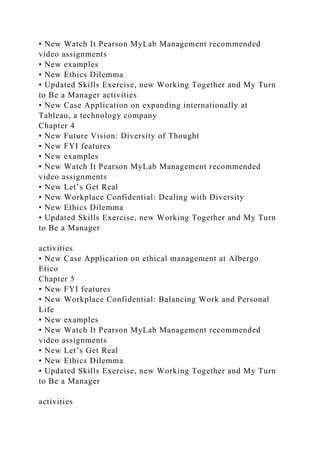
Chapter 4
• New Future Vision: Diversity of Thought
• New FYI features
• New examples
• New Watch It Pearson MyLab Management recommended
video assignments
• New Let’s Get Real
• New Workplace Confidential: Dealing with Diversity
• New Ethics Dilemma
• Updated Skills Exercise, new Working Together and My Turn
to Be a Manager
activities
• New Case Application on ethical management at Albergo
Etico
Chapter 5
• New FYI features
• New Workplace Confidential: Balancing Work and Personal
Life
• New examples
• New Watch It Pearson MyLab Management recommended
video assignments
• New Let’s Get Real
• New Ethics Dilemma
• Updated Skills Exercise, new Working Together and My Turn
to Be a Manager
activities
• New Case Application on ethical problems at Volkswagen
Chapter 6
• New It’s Your Career opener and Pearson MyLab Management
component:
Learning to Manage Your Stress
• New Future Vision: The Internet of Things
• New FYI features
• New Workplace Confidential: Coping with Job Stress
A01_ROBB5839_14_GE_FM.indd 32 19/07/17 9:42 AM
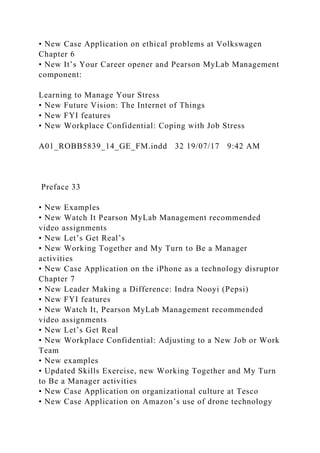
Preface 33
• New Examples
• New Watch It Pearson MyLab Management recommended
video assignments
• New Let’s Get Real’s
• New Working Together and My Turn to Be a Manager
activities
• New Case Application on the iPhone as a technology disruptor
Chapter 7
• New Leader Making a Difference: Indra Nooyi (Pepsi)
• New FYI features
• New Watch It, Pearson MyLab Management recommended
video assignments
• New Let’s Get Real
• New Workplace Confidential: Adjusting to a New Job or Work
Team
• New examples
• Updated Skills Exercise, new Working Together and My Turn
to Be a Manager activities
• New Case Application on organizational culture at Tesco
• New Case Application on Amazon’s use of drone technology
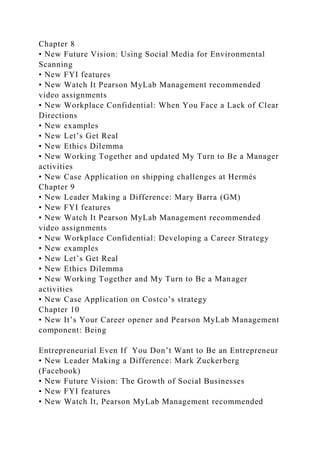
Chapter 8
• New Future Vision: Using Social Media for Environmental
Scanning
• New FYI features
• New Watch It Pearson MyLab Management recommended
video assignments
• New Workplace Confidential: When You Face a Lack of Clear
Directions
• New examples
• New Let’s Get Real
• New Ethics Dilemma
• New Working Together and updated My Turn to Be a Manager
activities
• New Case Application on shipping challenges at Hermès
Chapter 9
• New Leader Making a Difference: Mary Barra (GM)
• New FYI features
• New Watch It Pearson MyLab Management recommended
video assignments
• New Workplace Confidential: Developing a Career Strategy
• New examples
• New Let’s Get Real
• New Ethics Dilemma
• New Working Together and My Turn to Be a Manager
activities
• New Case Application on Costco’s strategy
Chapter 10
• New It’s Your Career opener and Pearson MyLab Management
component: Being
Entrepreneurial Even If You Don’t Want to Be an Entrepreneur
• New Leader Making a Difference: Mark Zuckerberg
(Facebook)
• New Future Vision: The Growth of Social Businesses
• New FYI features
• New Watch It, Pearson MyLab Management recommended
video assignments
• New Let’s Get Real’s
• New Workplace Confidential: Dealing with Risks
• New examples
• New Ethics Dilemma
• New Personal Inventory Assessment
• New Working Together and My Turn to Be a Manager
activities
• New Skills Exercise: Developing Grit
• New Case Applications on Jamie Oliver’s unique social
business at Fifteen
Chapter 11
• New FYI features
• New Workplace Confidential: Coping with Multiple Bosses
A01_ROBB5839_14_GE_FM.indd 33 19/07/17 9:43 AM
34 Preface
• New examples
• New Working Together activity
Chapter 12
• New Leader Making a Difference: Dr. Dara Richardson-Heron
(YWCA USA)
• New FYI features
• New Watch It Pearson MyLab Management recommended
video assignments
• New Let’s Get Real
• New Workplace Confidential: Handling Difficult Coworkers
• New examples
• Updated Ethics Dilemma
• Updated Skills Exercise, new Working Together and My Turn
to Be a Manager activities
• New Case Application on self-directed teams at W.L. Gore and
Associates
Chapter 13
• New It’s Your Career opener and Pearson MyLab Management
component:
Negotiating Your Salary
• New Future Vision: Gamification of HR
• New FYI features
• New Watch It Pearson MyLab Management recommended
video assignments
• New Let’s Get Real
• New Workplace Confidential: Job Search
• New examples
• Updated statistics
• Updated Skills Exercise, new Working Together and My Turn
to Be a Manager
activities
• New Case Application on Maersk and the HR management
challenges in China
• New Case Application on BAE Systems making use of
schedule based working
Chapter 14
• New It’s Your Career opener and Pearson MyLab Management
component: I’m
Listening
• New Future Vision: No Longer Lost in Translation
• New Leader Making a Difference: Angela Ahrendts (Apple)
• New FYI features
• New Workplace Confidential: An Uncommunicative Boss
• New examples
• New Let’s Get Real
• New Skills Exercise: Developing Your Presentation Skills
• New Working Together and My Turn to Be a Manager
activities
• New Case Application on performance feedback at Amazon
Chapter 15
• New Leader Making a Difference: Carolyn McCall (easyJet)
• New FYI features
• New Watch It Pearson MyLab Management recommended
video assignments
• New Let’s Get Real
• New Workplace Confidential: An Abusive Boss
• New examples
• New Ethics Dilemma
• New Working Together and My Turn to Be a Manager
activities
• New Case Application on the Tencent Holdings, China
Chapter 16
• New Leader Making a Difference: Dr. Delos “Toby” Cosgrove
(Cleveland Clinic)
• New FYI features
• New Watch It Pearson MyLab Management recommended
video assignments
• New Workplace Confidential: A Micromanaging Boss
A01_ROBB5839_14_GE_FM.indd 34 19/07/17 9:44 AM
Preface 35
• New examples
• New Let’s Get Real
• New Working Together and My Turn to Be a Manager
activities
• New Case Application on PepsiCo’s Indra Nooyi imbibing
qualities of an
inspirational leader
Chapter 17
• New Leader Making a Difference: Susan Wojcicki (YouTube)
• New FYI features
• New Workplace Confidential: Feelings of Unfair Pay
• New examples
• New Watch It Pearson MyLab Management recommended
video assignments
• New Let’s Get Real
• Updated Skills Exercise, new Working Together and My Turn
to Be a Manager
activities
• New Case Application on Hong Kong Disneyland’s HR
programs to motivate
employees
• New Case Application on John Lewis Partnership balancing
success and happiness
Chapter 18
• New Future Vision: Real-time Feedback
• New FYI features
• New Watch It Pearson MyLab Management recommended
video assignments
• New Let’s Get Real
• New Workplace Confidential: Responding to an Unfair
Performance Review
• New examples
• New Ethics Dilemma
• Updated Skills Exercise, new Working Together and My Turn
to Be a Manager
activities
• New Case Applications on Chipotle’s food contamination
problems and Bring
Your Own Device programs
For Students Taking a Management Course:
What This Course Is About and Why It’s Important
This course and this book are about management and managers.
Managers are one
thing that all organizations—no matter the size, kind, or
location—need. And there’s
no doubt that the world managers face has changed, is changing,
and will continue to
change. The dynamic nature of today’s organizations means
both rewards and chal-
lenges for the individuals who will be managing those
organizations. Management
is a dynamic subject, and a textbook on it should reflect those
changes to help pre-
pare you to manage under the current conditions. We’ve written
this 14th edition of
Management to provide you with the best possible
understanding of what it means to
be a manager confronting change and to best prepare you for
that reality.
But not every student aspires to a career in management. And
even if you do,
you may be five or ten years away from reaching a managerial
position. So you might
rightly feel that taking a course in management now may be
getting ahead of the game.
We hear you. In response to these concerns, we’ve added new
material to this book
that is important and relevant to everyone working in an
organization—manager
and non-manager alike. Our “Workplace Confidential” pages
identify, analyze, and
offer suggestions for dealing with the major challenges that
surveys indicate frustrate
employees the most. You should find these pages valuable for
helping you survive and
thrive in your workplace. Surprisingly, this topic has rarely
been addressed in business
programs. Inclusion in an introductory management course
appeared to us to be a
logical place to introduce these challenges and to provide
guidance in handling them.
A01_ROBB5839_14_GE_FM.indd 35 19/07/17 9:45 AM
36 Preface
Instructor Resources
At the Pearson’s catalog,
https://www.pearsonglobaleditions.com/Robbins, instructors
can easily register to gain access to a variety of instructor
resources available with
this text in downloadable format. If assistance is needed, our
dedicated technical sup-
port team is ready to help with the media supplements that
accompany this text. Visit
https://support.pearson.com/getsupport for answers to
frequently asked questions
and toll-free user support phone numbers.
The following supplements are available with this text:
• Instructor’s Resource Manual
• Test Bank
• TestGen® Computerized Test Bank
• PowerPoint Presentation
This title is available as an eBook and can be purchased at most
eBook retailers.
A01_ROBB5839_14_GE_FM.indd 36 11/07/17 9:33 AM
https://www.pearsonglobaleditions.com/Robbins
https://support.pearson.com/getsupport
Every author relies on the comments of reviewers, and ours
have been very helpful.
We want to thank the following people for their insightful
comments and suggestions:
Michael Alleruzzo, St. Joseph University, PA
Matthias Bollmus, Carroll University, WI
Brione Burrows, Central Georgia Tech, GA
M. Suzanne Clinton, University of Central Oklahoma, OK
Dana J. Frederick, Missouri State University, MO
Julia M. Fullick, Quinnipiac University, CT
Karl Giulian, Atlantic Cape Community College, NJ
Dan Morrell, Middle Tennessee State University, TN
L. Renee Rogers, Forsyth Technical Community College, NC
Acknowledgments
Our team at Pearson has been amazing to work with, as always!
This team of
editors, production experts, technology gurus, designers,
marketing specialists, sales
representatives, and warehouse employees works hard to turn
our files into a bound
textbook and a digital textbook and sees that it gets to faculty
and students. We
couldn’t do this without all of you! Our sincere thanks to the
people who made this
book “ready to go,” including Stephanie Wall, Kris Ellis-Levy,
Claudia Fernandes,
Hannah Lamarre, and Nancy Moudry, as well as Kathy Smith
and the team at
Cenveo. All of you are consummate professionals who truly are
committed to pub-
lishing the best textbooks! We’re glad to have you on our team!
Finally, Steve and Mary would like to thank Joe Martocchio at
the University of
Illinois and Lori Long at Baldwin Wallace University for
helping with this revision.
They were instrumental in updating the research, examples,
boxes, skill exercises, and
cases. This revision could never have been done without your
assistance. We thank
you so much!
Global Edition Acknowledgments
We want to thank the following people for their
contributions:
John Opute, London South Bank University
Andrew Richardson, University of Leeds
Marcello Russo, University of Bologna
Jon and Diane Sutherland, Freelance Writers
Ken Wong, Hong Kong Polytechnic University
Yong Wooi Keong, Sunway University
Marian B. Wood, Freelance Writer
We would also like to thank the following people for re-
viewing the Global Edition and sharing their insightful
comments and suggestions:
Caroline Akhras, Notre Dame University–Louaize
Azim Khan Aminuddin, United Arab Emirates University
Lindos Daou, Holy Spirit University of Kaslik
Evangelos Dedousis, American University of Dubai
Suresh George, Coventry University
Richard Jefferies, The University of the West of Scotland
J. C. Santora, International School of Management, Paris
Vimala Venugopal, Taylor’s University Malaysia
A01_ROBB5839_14_GE_FM.indd 37 11/07/17 9:33 AM
It’s Your Career
Part 1 Introduction to Management
Chapter 1 Managers and You in the Workplace
The ABC’s of Managing Your Time
Are you BUSY? Do you always seem to have a lot to do
and never seem to get it done, or done on time, or are
things done at the last minute under a lot of pressure
and stress? If you’re like most people, the answer to
these questions is YES! Well, maybe in a management
textbook we need to do something about that by focusing
on one aspect of management that can be tremendously
useful to you . . . TIME MANAGEMENT! Time is a unique
resource and one of your most valuable resources. Time
is also a limited resource. First, if it’s wasted, it can never
be replaced. People talk about saving time, but time can
never actually be saved. Second, unlike resources such
as money or talent, which are distributed unequally in the
world, time is an equal-opportunity resource. Each one of us
gets exactly the same amount of time: 24 hours per day or 168
hours each week. But as you have undoubtedly observed, some
people are a
lot more efficient in using their allotment. It is not uncommon
to hear others
say that they need additional hours to get everything done, but
that is simply
wishful thinking. Commit to improving your ability to manage
those 168 hours
so you can be more efficient and effective—in your career and
in your personal
life! Here are some suggestions to help you better use your
time:
1. Make and keep a list of all your current, upcoming, and
routine
goals. Know what needs to be done daily, weekly, and monthly.
2. Rank your goals according to importance. Not all goals are of
equal importance. Given the limitations on your time, you want
to make
sure you give highest priority to the most important goals.
3. List the activities/tasks necessary to achieve your goals.
What
specific actions do you need to take to achieve your goals?
4. Divide these activities/tasks into categories using an A, B,
and C
classification. The A’s are important and urgent. B’s are either
important
or urgent, but not both. C’s are routine—not important nor
urgent, but still
need to be done.
A key to success in
management and in your
career is having good time
management skills.
Source: valentint/Fotolia
M01_ROBB5839_14_GE_C01.indd 38 07/06/17 5:37 pm
39
Learning Objectives
5. Schedule your activities/tasks according to
the priorities you’ve set. Prepare a daily plan. Every
morning, or at the end of the previous workday,
make a list of the five or so most important things
you want to do for the day. Then set priorities for
the activities listed on the basis of importance and
urgency.
6. Plan your to-do list each day so that it
includes a mixture of A, B, and C activities/tasks.
And it’s best to spread the three types of tasks
throughout your day so you’re not lumping together
all your demanding tasks. Also, be realistic about
what you can achieve in a given time period.
7. Recognize that technology makes it too
easy to stay connected. Just think for a moment
how many phone calls, e-mails, texts, postings
on social media, and unscheduled visitors you
receive on a typical day. Some are essential to the
tasks at hand, while others are distractions that
do not require immediate attention. Prioritize the
importance of this information.
8. Realize that priorities may change as your
day or week proceeds. New information may
change a task’s importance or urgency. As you get
new information, reassess your list of priorities
and respond accordingly.
9. Remember that your goal is to manage
getting your work done as efficiently and
effectively as you can. It’s not to become an expert
at creating to-do lists. Find what works best for
you and use it!
Like many students, you’ve probably had a job (or two) at some
time or another
while working on your degree. And your work experiences,
regardless of where you’ve
worked, are likely to have been influenced by the skills and
abilities of your manager.
What are today’s successful managers like and what skills do
they need in dealing with
the problems and challenges of managing in the twenty-first
century? This text is about
the important work that managers do. The reality facing today’s
managers—and that
might include you in the near future—is that the world is
changing. In workplaces of
Pearson MyLab Management®
Improve Your Grade!
When you see this icon, visit
www.mymanagementlab.com for activities that are
applied, personalized, and offer immediate feedback.
● SKILL OUTCOMES
1.1 Tell who managers are and where they work.
● Know how to manage your time.
1.2 Explain why managers are important to organizations.
1.3 Describe the functions, roles, and skills of managers.
● Develop your skill at being politically aware.
1.4 Describe the factors that are reshaping and redefining the
manager’s job.
1.5 Explain the value of studying management.
M01_ROBB5839_14_GE_C01.indd 39 26/07/17 11:07 AM
http://www.mymanagementlab.com
40 Part 1 Introduction to Management
all types—offices, stores, labs, restaurants, factories, and the
like—managers deal with
changing expectations and new ways of managing employees
and organizing work.
In this chapter, we introduce you to managers and management
by looking at (1) who
managers are and where they work, (2) why managers are
important, and (3) what man-
agers do. Finally, we wrap up the chapter by (4) looking at the
factors reshaping and re-
defining the manager’s job and (5) discussing why it’s
important to study management.
WHO are managers and where do they work?
Managers may not be who or what you might expect! Managers
can
range in age from 18 to 80+. They run large corporations,
medium-sized
businesses, and entrepreneurial start-ups. They’re also found in
government departments,
hospitals, not-for-profit agencies, museums, schools, and even
nontraditional organizations such as political campaigns and
music tours. Managers can also be found doing managerial
work in every country on the globe. In addition, some manag-
ers are top-level managers while others are first-line managers.
And today, managers are just as likely to be women as they
are men; however, the number of women in top-level manager
positions remains low—only 24 (4%) women were CEOs of
Fortune 500 companies in 2014.1 Similarly, only 20 (4%) were
minorities. Even in government leadership roles, women are far
outnumbered by men in the U.S. Senate and House of Repre-
sentatives, representing approximately 20 percent of these total
elected officials.2 But no matter where managers are found or
what gender or race they are, managers have exciting and chal-
lenging jobs!
Who Is a Manager?
It used to be fairly simple to define who managers were: They
were the organizational
members who told others what to do and how to do it. It was
easy to differentiate man-
agers from nonmanagerial employees. Now, it isn’t quite that
simple. In many organiza-
tions, the changing nature of work has blurred the distinction
between managers and
nonmanagerial employees. Many traditional nonmanagerial jobs
now include mana-
gerial activities.3 For example, the gaming company Valve does
not award job titles,
and there is little formal supervision. Virtually any employee is
free to start a project as
long as the employee obtains funding and assembles a project
team.4 Or consider an
organization like Morning Star Company, the world’s largest
tomato processor, where
no employees are called managers—just 400 full-time
employees who do what needs
to be done and who together “manage” issues such as job
responsibilities, compensa-
tion decisions, and budget decisions.5 Sounds crazy, doesn’t it?
But it works—for this
organization. (See Case Application 2 at the end of the chapter
to see how another
business—Zappos—has gone bossless!)
So, how do we define who managers are? A manager is someone
who coor-
dinates and oversees the work of other people so organizational
goals can be ac-
complished. A manager’s job is not about personal
achievement—it’s about helping
others do their work. That may mean coordinating the work of
a departmental
group, or it might mean supervising a single person. It could
involve coordinating
the work activities of a team with people from different
departments or even people
outside the organization such as temporary employees or
individuals who work for
the organization’s suppliers. Keep in mind that managers may
also have work duties
not related to coordinating and overseeing others’ work. For
example, an insurance
claims supervisor might process claims in addition to
coordinating the work activi-
ties of other claims clerks.
How can managers be classified in organizations? In
traditionally structured
organizations (often pictured as a pyramid because more
employees are at lower
LO1.1
manager
Someone who coordinates and
oversees the work of other people
so organizational goals can be
accomplished
Carnival Corporation’s CEO Arnold Donald
is the top manager of the world’s largest
cruise line, with over 100,000 employees from
different cultures and countries, 10 cruise
line brands, and 100 ships. His challenging
job involves making decisions and developing
plans that help Carnival achieve its goal “to
show our guests the kind of fun that memories
are made of.”
Source: Jason DeCrow/AP Images for Carnival
Corporation
M01_ROBB5839_14_GE_C01.indd 40 07/06/17 5:37 pm
Chapter 1 Managers and You in the Workplace 41
organizational levels than at upper organizational levels),
managers can be classi-
fied as first-line, middle, or top. (See Exhibit 1-1.) At the
lowest level of manage-
ment, first-line (or frontline) managers manage the work of
nonmanagerial
employees who typically are involved with producing the
organization’s products
or servicing the organization’s customers. These managers often
have titles such
as supervisors or even shift managers, district managers,
department managers, or
office managers. Middle managers manage the work of first-
line managers and
can be found between the lowest and top levels of the
organization. They may
have titles such as regional manager, project leader, store
manager, or division man-
ager. Middle managers are mainly responsible for turning
company strategy into
action. At the upper levels of the organization are the top
managers, who are
responsible for making organization-wide decisions and
establishing the plans and
goals that affect the entire organization. These individuals
typically have titles such
as executive vice president, president, managing director, chief
operating officer, or
chief executive officer.
Not all organizations are structured to get work done using a
traditional pyra-
midal form, however. Some organizations, for example, are
more loosely configured,
with work done by ever-changing teams of employees who move
from one project to
another as work demands arise. For instance, Atlassian, a global
software company
based in Australia, forms employee teams with the skills and
experience needed for
each work project. When a project is complete, the team
disbands and its members
join new teams. Because team members may be in separate
buildings or even in sepa-
rate countries, Atlassian emphasizes clear and constant
communication.6 Although
it’s not as easy to tell who the managers are in these
organizations, we do know that
someone must fulfill that role—that is, someone must
coordinate and oversee the work
of others, even if that “someone” changes as work tasks or
projects change or that
“someone” doesn’t necessarily have the title of manager.
Where Do Managers Work?
It’s obvious that managers work in organizations. But what is an
organization? It’s a
deliberate arrangement of people to accomplish some specific
purpose. Your college
or university is an organization; so are fraternities and
sororities, government depart-
ments, churches, Google, your neighborhood grocery store, the
United Way, the St.
Louis Cardinals baseball team, and the Mayo Clinic. All are
considered organizations
and have three common characteristics. (See Exhibit 1-2.)
first-line (frontline) managers
Managers at the lowest level of
management who manage the work of
nonmanagerial employees
middle managers
Managers between the lowest level
and top levels of the organization who
manage the work of first-line managers
top managers
Managers at or near the upper levels
of the organization structure who are
responsible for making organization-wide
decisions and establishing the goals and
plans that affect the entire organization
organization
A deliberate arrangement of people to
accomplish some specific purpose
Top
Managers
Middle Managers
First-Line Managers
Nonmanagerial Employees
Exhibit 1-1
Levels of Management
Deliberate
Structure
Distinct
Purpose
People
Exhibit 1-2
Characteristics of Organizations
M01_ROBB5839_14_GE_C01.indd 41 07/06/17 5:37 pm
42 Part 1 Introduction to Management
First, an organization has a distinct purpose typically expressed
through goals
the organization hopes to accomplish. Second, each
organization is composed of
people. It takes people to perform the work that’s necessary for
the organization
to achieve its goals. Third, all organizations develop a
deliberate structure within
which members do their work. That structure may be open and
flexible, with no
specific job duties or strict adherence to explicit job
arrangements. For instance,
most big projects at Google (at any one time, hundreds of
projects are in process
simultaneously) are tackled by small, focused employee teams
that set up in an
instant and complete work just as quickly.8 Or the structure
may be more tradi-
tional—like that of Procter & Gamble or General Electric or
any large corpora-
tion—with clearly defined rules, regulations, job descriptions,
and some members
identified as “bosses” who have authority over other members.
In the military, there
is a well-defined hierarchy. In the U.S. Air Force, the General
of the Air Force is the
highest ranking officer and Second Lieutenant is the lowest
ranking officer. Between
the two are nine officer ranks.
Many of today’s organizations are structured more like Google,
with flexible
work arrangements, employee work teams, open communication
systems, and sup-
plier alliances. In these organizations, work is defined in terms
of tasks to be done.
And workdays have no time boundaries since work can be—and
is—done any-
where, anytime. However, no matter what type of approach an
organization uses,
some deliberate structure is needed so work can get done, with
managers overseeing
and coordinating that work.
FYI
• Frontline managers directly
supervise some 93 percent of all
nonsupervisory employees.
• 9.3 million managers and
executives were in the U.S.
workforce in 2014.
• 6.9 million middle managers
were in the U.S. workforce
• 2.4 million top executives were
in the U.S. workforce.7
While this text presents a fairly accurate description of
today’s workplace, you’re going to spend most of your
work life in the future. What will that work life look like?
How will it be different from today? The workplace of
tomorrow is likely to include workers that are faster,
smarter, more responsible—and who just happen to
be robots.9 Are you at all surprised by this statement?
Although robots have been used in factory and indus-
trial settings for a long time, it’s becoming more com-
mon to find robots in the office, and it’s bringing about
new ways of looking at how work is done and at what
and how managers manage. So what would the man-
ager’s job be like managing robots? And even more
intriguing is how these “workers” might affect how
human coworkers interact with them.
As machines have become smarter, researchers
have been looking at human-machine interaction and
how people interact with the smart devices that are
now such an integral part of our professional and per-
sonal lives. One conclusion is that people find it easy to
bond with a robot, even one that doesn’t look or sound
anything like a real person. In a workplace setting, if a
robot moves around in a “purposeful way,” people tend
to view it, in some ways, as a coworker. People name
their robots and can even describe the robot’s moods
and tendencies. As telepresence robots become more
common, the humanness becomes even more evident.
Is It Still Managing When What You’re Managing Are Robots?F
U T U R E V I S I O N
For example, when Erwin Deininger, the electrical engi-
neer at Reimers Electra Steam, a small company in Clear
Brook, Virginia, moved to the Dominican Republic when
his wife’s job transferred her there, he was able to still
be “present” at the company via his VGo robot. Now
“robot” Deininger moves easily around the office and
the shop floor, allowing the “real” Deininger to do his job
just as if he were there in person. The company’s presi-
dent, satisfied with how the robot solution has worked
out, has been surprised at how he acts around it, feeling
at times that he’s interacting with Deininger himself.
There’s no doubt that robot technology will con-
tinue to be incorporated into organizational settings.
The manager’s job will become even more exciting and
challenging as humans and machines work together to
accomplish an organization’s goals.
If your professor has chosen to assign this, go to
www.mymanagementlab.com to discuss the follow-
ing questions.
TALK ABOUT IT 1: What’s your response to the
title of this box: Is it still managing when what you’re
managing are robots? Discuss.
TALK ABOUT IT 2: If you had to “manage” peo-
ple and robots, how do you think your job as manager
might be different than what the chapter describes?
M01_ROBB5839_14_GE_C01.indd 42 07/06/17 5:37 pm
http://www.mymanagementlab.com
Chapter 1 Managers and You in the Workplace 43
WHY are managers important?
What can a great boss do?
• Inspire you professionally and personally
• Energize you and your coworkers to accomplish things
together that you couldn’t
get done by yourself
• Provide coaching and guidance with problems
• Provide you feedback on how you’re doing
• Help you to improve your performance
• Keep you informed of organizational changes
• Change your life10
If you’ve worked with a manager like this, consider yourself
lucky. Such a manager
can make going to work a lot more enjoyable and productive.
However, even managers
who don’t live up to such lofty ideals and expectations are
important to organizations.
Why? Let’s look at three reasons.
The first reason why managers are important is because
organizations need their mana-
gerial skills and abilities more than ever in uncertain, complex,
and chaotic times. As orga-
nizations deal with today’s challenges—changing workforce
dynamics, the worldwide eco-
nomic climate, changing technology, ever-increasing
globalization, and so forth—managers
play an important role in identifying critical issues and crafting
responses. For example,
BlackBerry Limited introduced software for autonomous cars.
The company’s vehicle-to-
vehicle software will enable cars to communicate with each
other to prevent collisions and
improve traffic flow.11 Teams of talented scientists and
engineers create the hardware and
software to make this possible. But it takes more than that to be
successful. There has to be a
focus on commercial potential. For example, Virgin Galactic
and Xcor Aerospace are work-
ing toward creating a new industry—space tourism for civilians.
These companies possess
the technological and scientific know-how and resources to
make this a reality; however, the
fare for a suborbital flight around Earth is expected to be about
$100,000 per passenger.12
Most people will not have the discretionary funds to take these
flights. That’s why, behind
the scenes, you’d also find a team of managers who scrutinize
ideas and focus on the ques-
tion: Is there a sustainable market? These managers realize what
is critical to success. The
opposite “types” have worked together and created a successful
business.13
Another reason why managers are important to organizations is
because they’re
critical to getting things done. For instance, Philips has
thousands of general managers
who supervise the work of 113,000 employees worldwide.14
These managers deal with all
kinds of issues as the company’s myriad tasks are carried out.
They create and coordinate
the workplace environment and work systems so that others can
perform those tasks. Or,
if work isn’t getting done or isn’t getting done as it should be,
they’re the ones who find out
why and get things back on track. And these managers are key
players in leading the com-
pany into the future.
Finally, managers do matter to organizations! How do we know
that? The Gallup Or-
ganization, which has polled millions of employees and tens of
thousands of managers, has
found that the single most important variable in employee
productivity and loyalty isn’t pay
or benefits or workplace environment—it’s the quality of the
relationship between employ-
ees and their direct supervisors.15 In addition, global consulting
firm Towers Watson found
that the way a company manages and engages its people can
significantly affect its financial
performance.16 Companies that hire managers based on talent
realize a 48 percent increase
in profitability, a 22 percent increase in productivity, a 30
percent increase in employee en-
gagement scores, a 17 percent increase in customer engagement
scores, and a 19 percent
decrease in turnover.17 That’s scary considering another study
by the Gallup Organization
found that leadership is the single largest influence on employee
engagement.18 In yet anoth-
er study by different researchers, 44 percent of the respondents
said their supervisors strong-
ly increased engagement.19 However, in this same study, 41
percent of respondents also said
their supervisors strongly decreased engagement. And, a
different study of organizational
performance found that managerial ability was important in
creating organizational value.20
So, as you can see, managers can and do have an impact—
positive and negative. What can
we conclude from such reports? Managers are important—and
they do matter!
LO1.2
M01_ROBB5839_14_GE_C01.indd 43 07/06/17 5:37 pm
44 Part 1 Introduction to Management
WHAT do managers do?
Simply speaking, management is what managers do. But that
simple
statement doesn’t tell us much, does it? Let’s look first at what
manage-
ment is before discussing more specifically what managers do.
Management involves coordinating and overseeing the work
activities of others
so their activities are completed efficiently and effectively. We
already know that
coordinating and overseeing the work of others is what
distinguishes a managerial
position from a nonmanagerial one. However, this doesn’t mean
that managers or their
employees can do what they want anytime, anywhere, or in any
way. Instead, manage-
ment involves ensuring that work activities are completed
efficiently and effectively by
the people responsible for doing them, or at least that’s what
managers should be doing.
Efficiency refers to getting the most output from the least
amount of inputs or
resources. Managers deal with scarce resources—including
people, money, and equip-
ment—and want to use those resources efficiently. Efficiency is
often referred to as
“doing things right,” that is, not wasting resources. For
instance, Southwest Airlines has
achieved operating efficiency through a variety of practices,
which include using one
aircraft model (Boeing 737) throughout its fleet. Using one
model simplifies scheduling,
operations, and flight maintenance, and the training costs for
pilots, ground crew, and
mechanics are lower because there’s only a single aircraft to
learn.21 These efficient work
practices paid off, as Southwest has made a profit for 42
consecutive years!22
It’s not enough, however, just to be efficient. Management is
also concerned with
employee effectiveness. Effectiveness is often described as
“doing the right things,”
that is, doing those work activities that will result in achieving
goals. Besides being
efficient, Southwest Airlines’ mission is “dedication to the
highest quality of Customer
Service delivered with a sense of warmth, friendliness,
individual pride, and Company
Spirit.”23 Two of the many reasons cited for the airlines’
effectiveness are permitting
two checked bags for free and permitting a change in itinerary
without incurring a pen-
alty.24 Whereas efficiency is concerned with the means of
getting things done, effective-
ness is concerned with the ends, or attainment of organizational
goals (see Exhibit 1-3).
In successful organizations, high efficiency and high
effectiveness typically go hand
in hand. Poor management (which leads to poor performance)
usually involves being
inefficient and ineffective or being effective but inefficient.
LO1.3
management
Coordinating and overseeing the work
activities of others so their activities are
completed efficiently and effectively
efficiency
Doing things right, or getting the most
output from the least amount of inputs
effectiveness
Doing the right things, or doing those
work activities that will result in achieving
goals
Goal
Attainment
Effectiveness (Ends)
Resource
Usage
Management Strives for:
Low Resource Waste (high efficiency)
High Goal Attainment (high effectiveness)
Efficiency (Means)
Low Waste High Attainment
Exhibit 1-3
Efficiency and Effectiveness in
Management
Time Management—If your instructor is using Pearson MyLab
Management, log
onto www.mymanagementlab.com and test your time
management knowledge. Be sure
to refer back to the chapter opener!
Now let’s take a more detailed look at what managers do.
Describing what manag-
ers do isn’t easy. Just as no two organizations are alike, no two
managers’ jobs are alike.
In spite of this, management researchers have developed three
approaches to describe
what managers do: functions, roles, and skills.
It’s Your Career
M01_ROBB5839_14_GE_C01.indd 44 07/06/17 5:37 pm
http://www.mymanagementlab.com
Chapter 1 Managers and You in the Workplace 45
Management Functions
According to the functions approach, managers perform
certain activities or functions as they efficiently and effec-
tively coordinate the work of others. What are these func-
tions? Henri Fayol, a French businessman in the early part
of the twentieth century, suggested that all managers per-
form five functions: planning, organizing, commanding,
coordinating, and controlling.25 (See Management History
Module for more information.) Today, we use four functions
to describe a manager’s work: planning, organizing, leading,
and controlling (see Exhibit 1-4). Let’s briefly look at each.
If you have no particular destination in mind, then any
road will do. However, if you have someplace in particular
you want to go, you’ve got to plan the best way to get there.
Because organizations exist to achieve some particular pur-
pose, someone must define that purpose and the means for its
achievement. Managers
are that someone. As managers engage in planning, they set
goals, establish strategies
for achieving those goals, and develop plans to integrate and
coordinate activities.
Managers are also responsible for arranging and structuring
work that employees
do to accomplish the organization’s goals. We call this function
organizing. When
managers organize, they determine what tasks are to be done,
who is to do them, how
the tasks are to be grouped, who reports to whom, and where
decisions are to be made.
Every organization has people, and a manager’s job is to work
with and through people to
accomplish goals. This is the leading function. When managers
motivate subordinates, help
resolve work group conflicts, influence individuals or teams as
they work, select the most effec-
tive communication channel, or deal in any way with employee
behavior issues, they’re leading.
The final management function is controlling. After goals and
plans are set (plan-
ning), tasks and structural arrangements are put in place
(organizing), and people are
hired, trained, and motivated (leading), there has to be an
evaluation of whether things
are going as planned. To ensure goals are met and work is done
as it should be, managers
monitor and evaluate performance. Actual performance is
compared with the set goals.
If those goals aren’t achieved, it’s the manager’s job to get
work back on track. This pro-
cess of monitoring, comparing, and correcting is the controlling
function.
Just how well does the functions approach describe what
managers do? Do manag-
ers always plan, organize, lead, and then control? Not
necessarily. What a manager does
may not always happen in this sequence. However, regardless of
the order in which these
functions are performed, managers do plan, organize, lead, and
control as they manage.
planning
Management function that involves
setting goals, establishing strategies for
achieving those goals, and developing
plans to integrate and coordinate activities
organizing
Management function that involves
arranging and structuring work to
accomplish the organization’s goals
leading
Management function that involves
working with and through people to
accomplish organizational goals
controlling
Management function that involves
monitoring, comparing, and correcting
work performance
Leading is an important function of The
Container Store manager Jaimie Moeller (left).
She influences the behavior of employees by
leading them in a team huddle before they begin
their work day. Coaching employees to succeed
in the store’s team-selling environment helps
Moeller achieve the store’s sales performance
and customer service goals.
Source: ZUMA Press Inc/Alamy
Planning
Setting goals,
establishing
strategies, and
developing
plans to
coordinate
activities
Organizing
Determining
what needs
to be done,
how it will
be done, and
who is to do it
Leading
Motivating,
leading, and
any other
actions involved
in dealing with
people
Controlling
Monitoring
activities
to ensure
that they are
accomplished
as planned
Achieving the
organization’s
stated
purposes
Planning
Setting goals,
establishing
strategies, and
developing
plans to
coordinate
activities
Organizing
Determining
what needs
to be done,
how it will
be done, and
who is to do it
Leading
Motivating,
leading, and
any other
actions involved
in dealing with
people
Controlling
Monitoring
activities
to ensure
that they are
accomplished
as planned
Achieving the
organization’s
stated
purposes
Exhibit 1-4
Four Functions of Management
Although the functions approach is a popular way to describe
what managers do,
some have argued that it isn’t relevant.26 So let’s look at
another perspective.
If your professor has assigned this, go to
www.mymanagementlab.com to complete the
Simulation: What Is Management? and see how well you can
apply the ideas of plan-
ning, organizing, leading, and controlling.
Try It 1!
M01_ROBB5839_14_GE_C01.indd 45 07/06/17 5:37 pm
http://www.mymanagementlab.com
46 Part 1 Introduction to Management
REALlet’s get
The Scenario:
Micah, one of your best employees, was just promoted to a
managerial position. You
invited him to lunch to celebrate and to see what was on his
mind about his new
position. Waiting for your food to arrive, you asked him if he
had any concerns or
questions about being a manager. Looking straight at you,
Micah said, “How is being a
manager going to be different? What will I do as a manager?”
How would you respond?
Being a manager means that you have a greater responsibility to
consider, and
keep in mind big-picture organizational goals and
how your work and that of your staff contribute
to those goals. As a manager you also have
a responsibility to think about development
opportunities for any team members who may
now report to you. How will you help to put
them on a path toward growth and suc-
cess? Maribel Lara
Director, Account Management So
ur
ce
: M
ar
ib
el
L
ar
a
Mintzberg’s Managerial Roles and a Contemporary
Model of Managing
Henry Mintzberg, a well-known management researcher, studied
actual managers at
work. In his first comprehensive study, Mintzberg concluded
that what managers do
can best be described by looking at the managerial roles they
engage in at work.27 The
term managerial roles refers to specific actions or behaviors
expected of and exhib-
ited by a manager. (Think of the different roles you play—
student, employee, student
organization member, volunteer, sibling, and so forth—and the
different things you’re
expected to do in these roles.) When describing what managers
do from a roles per-
spective, we’re not looking at a specific person per se, but at
the expectations and
responsibilities associated with the person in that role—the role
of a manager.28 As
shown in Exhibit 1-5, these 10 roles are grouped around
interpersonal relationships,
the transfer of information, and decision making.
The interpersonal roles involve people (subordinates and
persons out-
side the organization) and other ceremonial and symbolic
duties. The three in-
terpersonal roles include figurehead, leader, and liaison. The
informational
roles involve collecting, receiving, and disseminating
information. The three in-
formational roles include monitor, disseminator, and
spokesperson. Finally, the
decisional roles entail making decisions or choices and include
entrepreneur,
disturbance handler, resource allocator, and negotiator. As
managers perform
these roles, Mintzberg proposed that their activities included
both reflection
(thinking) and action (doing).29
A number of follow-up studies have tested the validity of
Mintzberg’s role catego-
ries, and the evidence generally supports the idea that
managers—regardless of the
type of organization or level in the organization—perform
similar roles.30 However,
the emphasis that managers give to the various roles seems to
change with organiza-
tional level.31 At higher levels of the organization, the roles of
disseminator, figure-
head, negotiator, liaison, and spokesperson are more important;
while the leader role
(as Mintzberg defined it) is more important for lower-level
managers than it is for
either middle or top-level managers.
managerial roles
Specific actions or behaviors expected
of and exhibited by a manager
interpersonal roles
Managerial roles that involve people and
other duties that are ceremonial and
symbolic in nature
informational roles
Managerial roles that involve collecting,
receiving, and disseminating information
decisional roles
Managerial roles that revolve around
making choices
M01_ROBB5839_14_GE_C01.indd 46 07/06/17 5:37 pm
Chapter 1 Managers and You in the Workplace 47
So which approach is better, managerial functions or
Mintzberg’s propositions?
Although each does a good job of depicting what managers do,
the functions ap-
proach still seems to be the generally accepted way of
describing the manager’s
job. “The classical functions provide clear and discrete methods
of classifying the
thousands of activities managers carry out and the techniques
they use in terms of
the functions they perform for the achievement of goals.”32
However, Mintzberg’s
role approach and additional model of managing do offer us
other insights into
managers’ work.
Management Skills
UPS is a company that understands the importance of
management skills.33 The com-
pany’s new on-road supervisors are immersed in a new manager
orientation where
they learn people and time management skills. The company
started an intensive
eight-day offsite skills training program for first-line managers
as a way to improve
its operations. What have supervisors learned from the skills
training? Some things
they mentioned learning were how to communicate more
effectively and important
information about safety compliance and labor practices.
What types of skills do managers need? Robert L. Katz
proposed that
managers need three critical skills in managing: technical,
human, and conceptual.34
(Exhibit 1-6 shows the relationships of these skills to
managerial levels.) Technical
skills are the job-specific knowledge and techniques needed to
proficiently per-
form work tasks. These skills tend to be more important for
first-line managers
technical skills
Job-specific knowledge and techniques
needed to proficiently perform work
tasks
IN
FO
RM
AT
IO
N
A
L
R
O
LE
S
D
E
C
IS
IO
N
A
L ROL ES
IN
TER
PERSONAL ROL ES
IN
FO
RM
ATAA
IO
N
A
S
N
A
L
ROL ES
INT
ER
ROL ES
Figurehead
Leader
Liaison
Disseminator
SpokespersonNegotiator
Resource
Allocator
Disturbance
Handler
Entrepreneur Monitor
Mintzberg’s
Managerial
Roles
Exhibit 1-5
Mintzberg’s Managerial Roles
Source: Based on H. Mintzberg, The
Nature of Managerial Work (New York:
Prentice Hall, 1983).
Top
Managers Conceptual Human Technical
Middle
Managers Conceptual Human Technical
Lower-Level
Managers TechnicalHumanConceptual
Exhibit 1-6
Skills Needed at Different
Managerial Levels
M01_ROBB5839_14_GE_C01.indd 47 19/07/17 9:51 AM
48 Part 1 Introduction to Management
because they typically manage employees who use tools and
techniques to pro-
duce the organization’s products or service the organization’s
customers. Often,
employees with excellent technical skills get promoted to first-
line manager. For
example, Dean White, a production supervisor at Springfield
Remanufacturing,
started as a parts cleaner. Now, White manages 25 people in six
departments. He
noted that at first it was difficult to get people to listen,
especially his former peers.
“I learned I had to gain respect before I could lead,” White said.
He credits men-
tors—other supervisors whose examples he followed—with
helping him become
the type of manager he is today.35 Dean is a manager who has
technical skills,
but also recognizes the importance of interpersonal skills,
which involve the
ability to work well with other people both individually and in a
group. Because
all managers deal with people, these skills are equally important
to all levels of
management. Managers with good human skills get the best out
of their people.
They know how to communicate, motivate, lead, and inspire
enthusiasm and trust.
Finally, conceptual skills are the skills managers use to think
and to conceptu-
alize about abstract and complex situations. Using these skills,
managers see the
organization as a whole, understand the relationships among
various subunits,
and visualize how the organization fits into its broader
environment. Managers
then can effectively direct employees’ work. For example, Ian
McAllister, general
manager at Amazon, indicates that a successful general manager
understands the
whole business. With this understanding, managers can get
everyone on the same
page. In turn, employees will make a substantial number of
decisions in support of
the company’s vision.36 These skills are most important to top
managers.
Other important managerial skills that have been identified are
listed in Exhibit 1-7.
In today’s demanding and dynamic workplace, employees who
want to be valuable
assets must constantly upgrade their skills, and developing
management skills can be
particularly beneficial. We feel that understanding and
developing management skills
is so important that we’ve included a skills activity component
for each chapter’s It’s
Your Career opener. You’ll find that activity at
www.mymanagementlab.com. In addi-
tion, we’ve included a career skills feature at the end of each
chapter. (The one in this
chapter looks at developing your political skills.) Although
completing skill-building
exercises won’t make you an instant expert, they can provide
you an introductory un-
derstanding of some of the skills you’ll need to master to be a
valuable employee and
an effective manager.
interpersonal skills
The ability to work well with other people
individually and in a group
conceptual skills
The ability to think and to conceptualize
about abstract and complex situations
If your professor has assigned this, go to
mymanagementlab.com and complete the
Writing Assignment MGMT 1: Management Skills.
Managing
human
capital
Inspiring
commitment
Managing
change
Structuring work
and getting
things done
Facilitating the
psychological and
social contexts of work
Using
purposeful
networking
Managing
decision-making
processes
Managing
strategy and
innovation
Managing
logistics and
technology
Exhibit 1-7
Important Managerial Skills
Source: Based on Workforce Online; J. R.
Ryan, Bloomberg BusinessWeek Online;
In-Sue Oh and C. M. Berry; and R. S.
Rubin and E. C. Dierdorff.
Write It!
M01_ROBB5839_14_GE_C01.indd 48 07/06/17 5:37 pm
http://www.mymanagementlab.com
Chapter 1 Managers and You in the Workplace 49
HOW is the manager’s job changing?
In today’s world, managers are dealing with global economic
and politi-
cal uncertainties, changing workplaces, ethical issues, security
threats, and
changing technology. For example, as annual sales surge past
500,000 vehicles, a major
challenge for Jaguar Land Rover is staffing its UK assembly
plants to meet demand. The
Halewood plant near Liverpool has tripled its workforce during
the past six years and is
always seeking qualified employees. To attract a large and
diverse pool of job candidates,
managers created apprenticeships for recent graduates. They
also launched “Young
Women in the Know,” a program in which Jaguar Land Rover’s
women engineers and
managers conducted factory tours to get girls and women
interested in manufacturing.
At the same time, these managers are facing decisions in an
uncertain environment now
that the United Kingdom has voted to exit the European
Union.37 It’s likely that more
managers will have to manage under such demanding
circumstances, and the fact is
that how managers manage is changing. Exhibit 1-8 shows some
of the most important
changes facing managers. Throughout the rest of this text, we’ll
discuss these and other
changes and how they affect the way managers plan, organize,
lead, and control. We
want to focus on six of these changes: customers, technology,
social media, innovation,
sustainability, and the employee.
Focus on the Customer
John Legere, CEO of T-Mobile, likes to listen to customers.
“My business philosophy
is listen to your employees, listen to your customers. Shut up
and do what they tell you.
And each of our Un-carrier moves and the way I run my
company is completely aligned
with that.”38 This manager understands the importance of
customers and clearly be-
lieves that focusing on customers is essential to success.
Without them, most organiza-
tions would cease to exist. Yet, focusing on the customer has
long been thought to be
the responsibility of marketing types. “Let the marketers worry
about the customers” is
LO1.4
REALlet’s get
The Scenario:
After three years as a lead customer service
representative for an Internet-based clothing
company, Jane is eager to apply for a team
supervisor position. She has good relationships
with the employees in her department, but
she is not sure what skills she needs to have
to be considered for the promotion. At her
performance appraisal meeting with her
manager, she asks, “What can I do to build my
skills to prepare me to become a supervisor?”
What advice can you give Jane on developing her skills?
As you advance in your career, the biggest shift in your skill set
will be going
from the “doer” to the “delegator.” Instead of getting all the
work done, you’ll
become air traffic control and act as more of a guide for your
employees. You
can hone these leadership skills before ever actually getting the
role. Try to
approach each new project as if you were leading the team
responsible for it.
Think more strategically and consider the broader business
objectives versus
just the details of the tasks at hand. Your manager will start to
notice this shift
in your mindset and it will become clear that you’re ready to
seamlessly take
on the new responsibilities.
Whitney Portman
Senior Marketing Communications
Manager
So
ur
ce
: W
hi
tn
ey
P
or
tm
an
M01_ROBB5839_14_GE_C01.indd 49 07/06/17 5:37 pm
50 Part 1 Introduction to Management
how many managers felt. That sentiment is out of date. At
Banana Republic, the cus-
tomer experience manager position is responsible for ensuring
that customers enjoy a
high-quality in-store experience. This manager is also
responsible for staffing and train-
ing as well as supporting the implementation of product
placement,
marketing, and promotional strategies.39 We’re discovering,
however,
that employee attitudes and behaviors play a big role in
customer
satisfaction and a return on investment. The J.D. Power 2015
North
American Airline Satisfaction Study supports this idea.
According
to J.D. Power’s global travel and hospitality practice leader,
Rich
Garelick, building customer satisfaction creates “better
customer ad-
vocates for the airline.”40 Successful airlines such as Alaska
Airlines
and Jet Blue Airways treat passengers well by putting forward
friend-
ly announcements to inform them on the ground or in the air
about
flight status and offering amenities such as in-flight
entertainment.
Today, the majority of employees in developed countries work
in service jobs. For instance, almost 80 percent of the U.S.
labor
force is employed in service industries.41 In Australia, 75
percent
work in service industries, and in Canada, 76 percent do. In the
United Kingdom, Germany, and Japan, the percentages are 83,
74, and 71, respec-
tively. Even in developing countries such as Colombia,
Dominican Republic, Viet-
nam, and Bangladesh, we find 62 percent, 65 percent, 31
percent, and 40 percent of
the labor force employed in service jobs.42 Examples of service
jobs include technical
support representatives, food servers or fast-food counter
workers, sales clerks, cus-
todians and housekeepers, teachers, nurses, computer repair
technicians, front-desk
clerks, consultants, purchasing agents, credit representatives,
financial planners, and
Impact of Change
Changing Technology (Digitization)
Changing Security Threats
Increased Emphasis on Organizational
and Managerial Ethics
Increased Competitiv eness
Customer service
Innovation
Globalization
Efficiency/productivity
Redefined values
Rebuilding trust
Increased accountability
Sustainability
Risk management
Uncertainty over future energy sources/prices
Restructured workplace
Discrimination concerns
Globalization concerns
Employee assistance
Uncertainty over economic climate
Shifting organizational boundaries
Virtual workplaces
More mobile workforce
Flexible work arrangements
Empowered employees
Work life–personal life balance
Social media challenges
Change
Exhibit 1-8
Changes Facing Managers
With the growing popularity of tourism in the
Dominican Republic, a large percentage of the
labor force works in service jobs for resorts,
attractions, and tourist-related activities such
as the aerobics instructor shown here leading
a class on the beach for tourists. To succeed in
the service industry, managers must create a
customer-responsive organization.
Source: Ellen McKnight/Alamy
M01_ROBB5839_14_GE_C01.indd 50 07/06/17 5:37 pm
Chapter 1 Managers and You in the Workplace 51
bank tellers. The odds are pretty good that when you graduate,
you’ll go to work for a
company that’s in a service industry, not in manufacturing or
agriculture.
Managers are recognizing that delivering consistent, high-
quality customer service
is essential for survival and success in today’s competitive
environment. Good cus-
tomer care pays off. A recent study found that nearly all
customers (92%) whose issue
was resolved during first contact with customer service would
likely continue using the
company.43 That number drops to about half (51%) for
customers whose issue was not
resolved during first contact. Employees are an important part
of that equation.44 The
implication is clear: managers must create a customer-
responsive organization where
employees are friendly and courteous, accessible,
knowledgeable, prompt in respond-
ing to customer needs, and willing to do what’s necessary to
please the customer.45
We’ll look at customer service management in other chapters.
Focus on Technology
Managers increasingly face challenges in their work because
technology has been
changing how things get done. Cloud computing, social media,
and robotics are ex-
amples of technology. Getting employees on board presents a
challenge to many man-
agers. Managers must work with employees to understand why
new technology is an
improvement over present ways of conducting business.
According to Didier Bonnet,
coauthor of Leading Challenge, “The job of a manager is to help
people cross the
bridge—to get them comfortable with the technology, to get
them using it, and to help
them understand how it makes their lives better.”46
It is a myth that social skills have become less important
because there is more tech-
nology in the workplace. Take robotic technology. Software
programming can systemize
human decision making and physical tasks, which can be carried
out by machinery. How-
ever, technological advances have fallen short of replicating
human interactions and tech-
nology falls short of substituting human judgment. Particularly
in team settings, workers
rely on each other’s expertise, and they are able to adapt to
changing circumstances than
is made possible by software.47 As a result, managers are
continually challenged to over-
see team building and problem solving. Management expert
Henry Mintzberg, however,
warns that “wonderful as they are in enhancing communication,
[technological devices]
can have a negative effect on collaboration unless they are
carefully managed. An elec-
tronic device puts us in touch with a keyboard, that’s all.”48
Therein lies a significant chal-
lenge for managers. Social media technology adds further
challenges to the mix.
Focus on Social Media
You probably can’t imagine a time when employees did their
work without smart de-
vices, e-mail, or Internet access. Yet, some 25 years ago, as
these tools were becoming
more common in workplaces, managers struggled with the
challenges of providing
guidelines for using the Internet and e-mail in their
organizations. Today, the new fron-
tier is social media, forms of electronic communication through
which users create
online communities to share ideas, information, personal
messages, and other content.
And employees don’t just use these on their personal time, but
also for work purposes.
That’s why managers need to understand and manage the power
and peril of social media.
For instance, all 143,000 workers in the Singapore Civil Service
are being encouraged
to use a workplace chat function provided by Facebook for
internal conversations. The
idea is to reduce reliance on email and instead enable real-time
collaboration among
employees.49 More businesses are turning to social media as a
way to connect with
customers. Increasingly, many companies encourage employees
to use social media to
become employee activists. For this purpose, employee activists
draw visibility to their
workplace, defend their employers from criticism, and serve as
advocates, both online
and off.50
social media
Forms of electronic communication
through which users create online
communities to share ideas, information,
personal messages, and other content
If your professor has assigned this, go to
www.mymanagementlab.com to watch a video
titled Zane’s Cycles: The Management Environment and to
respond to questions. Watch It 1!
M01_ROBB5839_14_GE_C01.indd 51 30/06/17 11:41 am
http://www.mymanagementlab.com
52 Part 1 Introduction to Management
But the potential peril is in how it’s used. CEO of Berkshire
Hathaway, Warren Buf-
fet, has said that, “It takes 20 years to build a reputation and
five minutes to ruin it.”51
Internally, social media also becomes problematic when it
becomes a way for boastful em-
ployees to brag about their accomplishments, for managers to
publish one-way messages
to employees, or for employees to argue or gripe about
something or someone they don’t
like at work—then it has lost its usefulness. To avoid this,
managers need to remember
that social media is a tool that needs to be managed to be
beneficial. At SuperValu, about
9,000 store managers and assistant managers use the social
media system. Although
sources say it’s too early to draw any conclusions, it appears
that managers who actively
make use of the system are having better store sales revenues
than those who don’t.
In the remainder of the book, we’ll look at how social media is
impacting how
managers manage, especially in the areas of human resource
management, commu-
nication, teams, and strategy. For example, a particular question
is whether human
resource managers should use social media to screen potential
employees.
Ursula Burns is the first African American woman to
lead a company the size of Xerox.52 Appointed to the
CEO position in 2009, Burns is known for her cour-
age to “tell the truth in ugly times.” Having grown
up in the projects on the Lower East Side of New
York, Burns understands what it takes to get through
those uncertainties. With her aptitude for math, Burns went on
to earn
a mechanical engineering degree from Polytechnic Institute of
New
York. After a summer engineering internship at Xerox, she was
hooked.
At Xerox, Burns was mentored by individuals who saw her
potential.
Throughout her more than 30-year career at Xerox, Burns had a
reputa-
tion for being bold. As a mechanical engineer, she got noticed
because
she wasn’t afraid to speak up bluntly in a culture that’s known
more
for being polite, courteous, and discreet than for being
outspoken. Al-
though Burns is still radically honest and direct, she has become
more
of a listener, calling herself a “listener-in-chief.” What can you
learn
from this leader making a difference?
LEADER making a
DIFFERENCE
So
ur
ce
: J
em
al
C
ou
nt
es
s/
Ge
tty
Im
ag
es
En
te
rta
in
m
en
t/G
et
ty
im
ag
es
.c
om
If your professor has assigned this, go to
www.mymanagementlab.com to watch a video
titled CH2M Hill: Emotions and Moods and to respond to
questions.
Focus on Innovation
Success in business today demands innovation. Innovation
means exploring new terri-
tory, taking risks, and doing things differently. And innovation
isn’t just for high-tech or
other technologically sophisticated organizations. Innovative
efforts can be found in all
types of organizations. For instance, the manager of the Best
Buy store in Manchester,
Connecticut, clearly understood the importance of being
innovative, a task made par-
ticularly challenging because the average Best Buy store is
often staffed by young adults
in their first or second jobs who aren’t always committed long
term to a retail career. Yet,
the increasingly sophisticated products carried by the store
required a high level of em-
ployee training. The store manager tackled this challenge by
getting employees to sug-
gest new ideas. One idea—a “team close,” in which employees
scheduled to work at the
store’s closing time closed the store together and walked out
together as a team—had a
remarkable impact on employee attitudes and commitment.53
As you’ll see throughout
the book, innovation is critical throughout all levels and parts
of an organization. It’s so
critical to today’s organizations and managers that
we also address this topic in other chapters.
Focus on Sustainability
Microsoft Corporation generated $93.6 bil-
lion in software sales and $12.1 billion in
profits, and it had a workforce of 118,000 in
2015. We all know Microsoft for its develop-
ment and sales of software such as Windows,
Skype, and Xbox Live. And Microsoft is
probably the last company that you’d think
about in a section describing sustainability.
However, Microsoft invests in a variety of
sustainability projects. Management funds
these projects through taxes levied on its
business units’ energy consumption that
contributes to environmentally unfriendly
carbon emissions. The responsibility for sav-
ings falls on division managers. Microsoft’s
efforts have paid off. In a recent three-year
period, the company has reduced its emis-
sions by 7.5 metric tons of carbon dioxide.54
According to the U.S. Environmental
Watch It 2!
M01_ROBB5839_14_GE_C01.indd 52 07/06/17 5:37 pm
http://www.mymanagementlab.com
Chapter 1 Managers and You in the Workplace 53
Protection Agency, this level of emissions is the equivalent of
removing more than 1.5
million cars from the road for a year.”55 This corporate action
affirms that sustainability
and green management have become mainstream issues for
managers.
What’s emerging in the twenty-first century is the concept of
managing in a sustainable
way, which has had the effect of widening corporate
responsibility not only to managing in
an efficient and effective way, but also to responding
strategically to a wide range of environ-
mental and societal challenges.56 Although “sustainability”
means different things to differ-
ent people, the World Business Council for Sustainable
Development describes a situation
where all the earth’s inhabitants can live well with adequate
resources.57 From a business
perspective, sustainability has been described as a company’s
ability to achieve its business
goals and increase long-term shareholder value by integrating
economic, environmental,
and social opportunities into its business strategies.58
Sustainability issues are now moving
up the agenda of business leaders and the boards of thousands
of companies. We’ll exam-
ine sustainability and its importance to managers in other places
throughout the book.
Focus on the Employee
In 2015, more than 75 percent of organizations worldwide
indicated that they would
follow a strategy of building talent from within their
organizations rather than recruit-
ing talent from the external labor force.59 Also, progressive
companies recognize the
importance of treating employees well not only because it’s
simply the right thing to
do, but also because it is good business. Well-treated employees
are more likely to go
the extra mile when performing their jobs. Every year, Fortune
magazine publishes the
list titled Great Places to Work. In 2015, outdoor retailer L.L.
Bean was among the
top 10 retail companies, and it ranked first for an outdoor
retailer. L.L. Bean president
and CEO Chris McCormick maintains that L.L. Bean’s strong
leadership makes it an
employer of choice. According to McCormick, “It reflects the
work our leadership has
done to develop a culture that helps ensure employees feel
trusted to do a good job,
take pride in their work, and feel that their contributions are
truly valued.”60
Successful managers regularly provide performance feedback
that serves as an
evaluation of an employee’s performance and provides the
foundation for discuss-
ing developmental opportunities. Effective performance
appraisal outcomes depend
on clearly communicating performance expectations and the
resources available to
help employees perform well and providing feedback on how
well expectations were
met. Also, conversations about an employee’s career aspirations
in the context of past
performance serve a developmental role that will motivate
workers to strive for excel-
lence. When performance appraisal works in these ways, the
company stands to build
a strong talent base. Developmental practices also can support a
structure on which
to base rewards. Effective managers strive to reward employees
with competitive base
wages or salary and pay raises that recognize past performance
and future potential.
Successful managers often embrace work-life practices and
provide encouragement
to employees who wish to use them. Such behavior expresses
the value the manager and
company leadership place on the well-being of employees. The
company stands to benefit
through higher employee satisfaction, talent retention, and
higher employee engagement.61
WHY study management?
You may be wondering why you need to study management. If
you’re ma-
joring in accounting or marketing or any field other than
management,
you may not understand how studying management is going to
help your career. We can
explain the value of studying management by looking at three
things: the universality of
management, the reality of work, and the rewards and
challenges of being a manager.
The Universality of Management
Just how universal is the need for management in organizations?
We can say with
absolute certainty that management is needed in all types and
sizes of organizations, at
all organizational levels and in all organizational work areas,
and in all organizations,
no matter where they’re located. This is known as the
universality of management.
sustainability
A company’s ability to achieve its
business goals and increase long-
term shareholder value by integrating
economic, environmental, and social
opportunities into its business strategies
LO1.5
universality of management
The reality that management is
needed in all types and sizes of
organizations, at all organizational
levels, in all organizational areas, and in
organizations no matter where located
M01_ROBB5839_14_GE_C01.indd 53 07/06/17 5:37 pm
54 Part 1 Introduction to Management
(See Exhibit 1-9.) In all these organizations, managers must
plan, organize, lead, and
control. However, that’s not to say that management is done the
same way. What a su-
pervisor in an applications testing group at Twitter does versus
what the CEO of Twitter
does is a matter of degree and emphasis, not function. Because
both are managers, both
will plan, organize, lead, and control. How much and how they
do so will differ, however.
Management is universally needed in all organizations, so we
want to find ways to
improve the way organizations are managed. Why? Because we
interact with organi-
zations every single day. Organizations that are well managed—
and we’ll share many
examples of these throughout the text—develop a loyal
customer base, grow, and pros-
per, even during challenging times. Those that are poorly
managed find themselves los-
ing customers and revenues. By studying management, you’ll be
able to recognize poor
management and work to get it corrected. In addition, you’ll be
able to recognize and
support good management, whether it’s in an organization with
which you’re simply
interacting or whether it’s in an organization in which you’re
employed.
All Sizes of Organizations
Small Large
All Types of Organizations
Profit Not-for-Profit
All Organization Levels
Bottom Top
All Organizational Areas
Manufacturing—Marketing
Human Resources—Accounting
Information Systems—etc.
Management
Is Needed
in...
Exhibit 1-9
Universal Need for Management
If your professor has assigned this, go to
www.mymanagementlab.com to complete
Simulation: Managing Your Career and get a feel for your
career goals.
The Reality of Work
Another reason for studying management is the reality that for
most of you, once
you graduate from college and begin your career, you will either
manage or be man-
aged. For those who plan to be managers, an understanding of
management forms the
foundation upon which to build your management knowledge
and skills. For those of
you who don’t see yourself managing, you’re still likely to
have to work with managers.
Also, assuming that you’ll have to work for a living and
recognizing that you’re very
likely to work in an organization, you’ll probably have some
managerial responsibili-
ties even if you’re not a manager. Our experience tells us that
you can gain a great deal
of insight into the way your boss (and fellow employees) behave
and how organiza-
tions function by studying management. Our point is that you
don’t have to aspire to
be a manager to gain something valuable from a course in
management.
Rewards and Challenges of Being a Manager
We can’t leave our discussion here without looking at the
rewards and challenges of being
a manager. (See Exhibit 1-10.) What does it mean to be a
manager in today’s workplace?
First, there are many challenges. It can be a tough and often
thankless job. In addi-
tion, a portion of a manager’s job (especially at lower
organizational levels) may entail
duties that are often more clerical (compiling and filing reports,
dealing with bureau-
cratic procedures, or doing paperwork) than managerial.62
Managers also spend signif-
icant amounts of time in meetings and dealing with
interruptions, which can be time
Try It 2!
M01_ROBB5839_14_GE_C01.indd 54 07/06/17 5:37 pm
http://www.mymanagementlab.com
Chapter 1 Managers and You in the Workplace 55
consuming and sometimes unproductive.63 Managers often have
to deal with a variety of
personalities and have to make do with limited resources. It can
be a challenge to motivate
workers in the face of uncertainty and chaos. And managers
may find it difficult to suc-
cessfully blend the knowledge, skills, ambitions, and
experiences of a diverse work group.
Finally, as a manager, you’re not in full control of your destiny.
Your success typically is
dependent on others’ work performance.
Despite these challenges, being a manager can be rewarding.
You’re responsible for
creating a work environment in which organizational members
can do their work to the
best of their ability and thus help the organization achieve its
goals. You help others
find meaning and fulfillment in their work. You get to support,
coach, and nurture oth-
ers and help them make good decisions. In addition, as a
manager, you often have the
opportunity to think creatively and use your imagination. You’ll
get to meet and work
with a variety of people—both inside and outside the
organization. Other rewards may
include receiving recognition and status in your organization
and in the community,
playing a role in influencing organizational outcomes, and
receiving attractive compen-
sation in the form of salaries, bonuses, and stock options.
Finally, as we said earlier in
the chapter, organizations need good managers. It’s through the
combined efforts of
motivated and passionate people working together that
organizations accomplish their
goals. As a manager, you can be assured that your efforts,
skills, and abilities are needed.
Gaining Insights into Life at Work
A good number of students regularly remind your authors that
they are not planning
a career in management. These students’ career goals are to be
accountants or financial
analysts or marketing researchers or computer programmers.
They ask us: Why do I
need to take a management course? Our answer is: Because
understanding management
concepts and how managers think will help you get better
results at work and enhance
your career. And who knows, you may become a manager
someday. Oftentimes, suc-
cessful employees are promoted to managerial roles. For
example, you may begin your
career as an auditor with a major accounting firm and find, a
few years later, you’re
overseeing an audit team or you’re a partner thrust into
managing a regional office.
For instance, throughout this book you’ll encounter pages that
we call “Work-
place Confidential.” This feature will introduce you to
challenges you’re likely to face
at work—like organizational politics, an uncommunicative boss,
or an unfair perfor-
mance review—and offer you specific suggestions on how to
deal with these challenges.
If you expect to work with others—whether it’s in a Fortune
100 corporation or
in a three-person start-up—studying Management can pay
demonstrable dividends.
Exhibit 1-10
Rewards and Challenges of Being
a Manager
Rewards Challenges
• Create a work environment in which
organizational members can work to
the best of their ability
• Have opportunities to think creatively
and use imagination
• Help others find meaning and
fulfillment in work
• Support, coach, and nurture others
• Work with a variety of people
• Receive recognition and status in
organization and community
• Play a role in influencing
organizational outcomes
• Receive appropriate compensation
in the form of salaries, bonuses, and
stock options
• Good managers are needed by
organizations
• Do hard work
• May have duties that are more clerical
than managerial
• Have to deal with a variety of
personalities
• Often have to make do with limited
resources
• Motivate workers in chaotic and
uncertain situations
• Blend knowledge, skills, ambitions,
and experiences of a diverse work
group
• Success depends on others’ work
performance
M01_ROBB5839_14_GE_C01.indd 55 07/06/17 5:37 pm
56 Part 1 Introduction to Management
• Gain control of organizational resources. The control of
organizational resources that are scarce and important is a
source of influence. Knowledge and expertise are particu-
larly effective resources to control. These resources make
you more valuable to the organization and, therefore, more
likely to gain security, advancement, and a receptive audi-
ence for your ideas.
• Make yourself appear indispensable. You don’t have to
be indispensable as long as key people in your organization
believe that you are. If the organization’s prime decision
makers believe there is no ready substitute for what you
bring to the organization, your job is likely safe and you’re
likely to be treated well.
• Be visible. If you have a job that brings your accomplish-
ments to the attention of others, that’s great. However, if
not—without creating the image of a braggart—you’ll want
to let others know what you’re doing by giving progress
reports to your boss and others, having satisfied custom-
ers relay their appreciation to higher-ups, being seen at
social functions, being active in your professional associa-
tions, and developing powerful allies who can speak posi-
tively about your accomplishments.
• Develop powerful allies. It is often beneficial to have
friends in high places. Network by cultivating contacts with
potentially influential people above you, at your own level,
and in the lower ranks. These allies often can provide you
with information that’s otherwise not readily available and
provide you with support if and when you need it. Having a
mentor in the organization who is well respected is often
a valuable asset.
• Avoid “tainted” members. In almost every organization,
there are fringe members whose status is questionable.
Their performance and/or loyalty are suspect. Or they have
strange personalities. Keep your distance from such indi-
viduals. Given the reality that effectiveness has a large
subjective component, your own effectiveness might be
called into question if you’re perceived as being too closely
associated with tainted members.
• Support your boss. Your immediate future is in the hands
of your current boss. Because that person evaluates your
performance, you’ll typically want to do whatever is neces-
sary to have your boss on your side. You should make every
effort to help your boss succeed, make her look good, sup-
port her if she is under siege, and spend the time to find
out the criteria she will use to assess your effectiveness.
Don’t undermine your boss. And don’t speak negatively of
her to others.
Based on D. Krackhardt, “Assessing the Political Landscape:
Structure, Cog-
nition, and Power in Organizations,” Administrative Science
Quarterly, June
1990, pp. 342–369; G. R. Ferris, S. L. Davidson, and P.L.
Perrewé, Political
Skill at Work: Impact on Work Effectiveness (Mountain View,
CA: Davies-
Black Publishing, 2005); and J. Bolander, “How to Deal with
Organizational
Politics,” The Daily MBA, February 28, 2011.
Dealing with Organizational PoliticsWORKPLACE
CONFIDENTIAL
In an ideal world, the good guys always win, everyone tells
the truth, and job promotions and generous pay raises go to
the most deserving candidate. Unfortunately, we don’t live
in such an ideal world. The world we live in is a political one.
Politics is a fact of life in organizations. People who
ignore this fact do so at their own peril. But why, you may
wonder, must politics exist? Isn’t it possible for an organiza-
tion to be politics free? It’s possible, but most unlikely.
Organizations are made up of individuals and groups with
different values, goals, and interests. This sets up the poten-
tial for conflict over resources. Departmental budgets, office
allocations, project responsibilities, promotion choices, and
salary adjustments are just a few examples of the resources
about whose allocation organizational members will disagree.
Resources in organizations are also limited, which turns
potential conflict into real conflict. If resources were abun-
dant, then all the various constituencies within the organiza-
tion could satisfy their goals. But because they are limited,
not everyone’s interests can be provided for. Furthermore,
whether true or not, gains by one individual or group are
often perceived as being at the expense of others within
the organization. These forces create a competition among
members for the organization’s limited resources.
Maybe the most important factor leading to politics
within organizations is the realization that most of the facts
that are used to allocate the limited resources are open to
interpretation. What, for instance, is good performance?
What’s an adequate improvement? What constitutes an
unsatisfactory job? One person’s team player is another’s
“yes man.” So it is the large and ambiguous middle ground
of organizational life—where the facts don’t speak for them-
selves—that politics flourish.
The above explains why some people in the workplace
lie, misrepresent, conceal, backstab, play favorites, scheme,
pass the buck, deny responsibility, form alliances, or engage
in similar political actions.
If you want to improve your political skills at work, we
offer the following suggestions:
• Frame arguments in terms of organizational goals.
People whose actions appear to blatantly further their own
interests at the expense of the organization are almost
universally denounced, are likely to lose influence, and of-
ten suffer the ultimate penalty of being expelled from the
organization. Challenges to your actions are not likely to
gain much support if your actions appear to be in the best
interests of the organization.
• Develop the right image. Make sure you understand what
your organization wants and values from its employees—
in terms of dress, associates to cultivate and those to
avoid, whether to appear to be a risk taker or risk averse,
the importance of getting along with others, and so forth.
Because the assessment of your performance is rarely a
fully objective process, you need to pay attention to style
as well as substance.
M01_ROBB5839_14_GE_C01.indd 56 07/06/17 5:37 pm
Chapter 1 Managers and You in the Workplace 57
CHAPTER SUMMARY by Learning Objectives
TELL who managers are and where they work.
Managers coordinate and oversee the work of other people so
that organizational
goals can be accomplished. Nonmanagerial employees work
directly on a job or task
and have no one reporting to them. In traditionally structured
organizations, manag-
ers can be first-line, middle, or top. In other more loosely
configured organizations, the
managers may not be as readily identifiable, although someone
must fulfill that role.
Managers work in an organization, which is a deliberate
arrangement of people
to accomplish some specific purpose. Organizations have three
characteristics: They
have a distinctive purpose, they are composed of people, and
they have a deliberate
structure. Many of today’s organizations are structured to be
more open, flexible, and
responsive to changes.
EXPLAIN why managers are important to organizations.
Managers are important to organizations for three reasons. First,
organizations need
their managerial skills and abilities in uncertain, complex, and
chaotic times. Second,
managers are critical to getting things done in organizations.
Finally, managers con-
tribute to employee productivity and loyalty; the way employees
are managed can af-
fect the organization’s financial performance, and managerial
ability has been shown
to be important in creating organizational value.
DESCRIBE the functions, roles, and skills of managers.
Broadly speaking, management is what managers do and
involves coordinating and
overseeing the efficient and effective completion of others’
work activities. Efficiency
means doing things right; effectiveness means doing the right
things.
The four functions of management include planning (defining
goals, establishing
strategies, and developing plans), organizing (arranging and
structuring work), lead-
ing (working with and through people), and controlling
(monitoring, comparing, and
correcting work performance).
Mintzberg’s managerial roles include interpersonal, which
involve people and oth-
er ceremonial/symbolic duties (figurehead, leader, and liaison);
informational, which
involve collecting, receiving, and disseminating information
(monitor, disseminator,
and spokesperson); and decisional, which involve making
choices (entrepreneur, dis-
turbance handler, resource allocator, and negotiator).
Katz’s managerial skills include technical (job-specific
knowledge and techniques),
interpersonal (ability to work well with people), and conceptual
(ability to think and
express ideas). Technical skills are most important for lower-
level managers, while con-
ceptual skills are most important for top managers.
Interpersonal skills are equally
important for all managers. Some other managerial skills
identified include managing
human capital, inspiring commitment, managing change, using
purposeful network-
ing, and so forth.
DESCRIBE the factors that are reshaping and redefining
the manager’s job.
The changes impacting managers’ jobs include global economic
and political
uncertainties, changing workplaces, ethical issues, security
threats, and changing tech-
nology. Managers must focus on customer service because
employee attitudes and
behaviors play a big role in customer satisfaction. Managers
must focus on technology
LO1.1
LO1.2
LO1.3
LO1.4
Chapter 1 PREPARING FOR: Exams/Quizzes
M01_ROBB5839_14_GE_C01.indd 57 07/06/17 5:37 pm
58 Part 1 Introduction to Management
as it impacts how things get done in organizations. Managers
must focus on social me-
dia because these forms of communication are important and
valuable tools in man-
aging. Managers must focus on innovation because it is
important for organizations
to be competitive. Managers must also focus on sustainability as
business goals are
developed. And finally, managers must focus on employees in
order for them to be
more productive.
EXPLAIN the value of studying management.
It’s important to study management for three reasons: (1) the
universality of manage-
ment, which refers to the fact that managers are needed in all
types and sizes of orga-
nizations, at all organizational levels and work areas, and in all
global locations; (2) the
reality of work—that is, you will either manage or be managed;
and (3) the awareness
of the significant rewards (such as creating work environments
to help people work
to the best of their ability, supporting and encouraging others,
helping others find
meaning and fulfillment in work, etc.) and challenges (having to
work hard, sometimes
having more clerical than managerial duties, interacting with a
variety of personalities,
etc.) in being a manager.
LO1.5
Pearson MyLab Management
Go to mymanagementlab.com to complete the problems marked
with this icon .
REVIEW AND DISCUSSION QUESTIONS
1-1. What are the three main roles performed by a
manager?
1-2. Why are managers important to organizations? What
are their key responsibilities in an organization?
1-3. Mintzberg suggested that specific actions or
behaviors expected of and exhibited by a manager
comprise of three specific roles. Briefly explain them.
1-4. In your opinion, is management still relevant as
a course of study today? Explain using relevant
examples.
1-5. It is sometimes said that management is a tough and
thankless job. Do you think this is true?
1-6. Is the task of seeking innovative processes really a
manager’s job?
1-7. Discuss how managers define organizational
purpose. How would the managerial functions help
in achieving that purpose?
1-8. Henri Fayol suggested that all managers perform the
five functions of planning, organizing, commanding,
coordinating, and controlling. Was he correct?
Pearson MyLab Management
If your professor has assigned these, go to
mymanagementlab.com for the
following Assisted-graded writing questions:
1-9. Is there one best “style” of management? Why or why
not?
1-10. Christine Porath, together with the Harvard Business
Review and Tony
Schwartz, examined the views of 20,000 employees regarding
commitment
and engagement. The one thing that the employees could agree
on was that
they wanted respect from their leaders. Is management as simple
as this?
What other areas do you consider important?
M01_ROBB5839_14_GE_C01.indd 58 07/06/17 5:37 pm
Chapter 1 Managers and You in the Workplace 59
PERSONAL INVENTORY ASSESSMENTS P I A PERSONAL
INVENTORY ASSESSMENT
PREPARING FOR: My Career
Time Management Assessment
Take a look at how well you manage time. This PIA will help
you determine how skillfully you do that.
ETHICS DILEMMA
Mintzberg suggests that managerial roles should encompass
interpersonal, decisional, and informational roles. Clearly
this is an idealized vision of the manager. They are
encouraged to encompass all of these characteristics but this
is an unattainable goal. A manager can never be all these
things at once.
1-11. To what extent is it unethical to expect a manager to
have such a broad base of skills and abilities?
1-12. Do managerial models like this reflect the reality of
day-to-day management? Explain.
SKILL EXERCISE Developing Your Political Skill
About the Skill
Research has shown that people differ in their political skills.64
Political skill can be defined as the ability to understand
and influence others for the benefit of the individual or
the organization.65 Those who are politically skilled are
more effective in their use of influence tactics. Politically
skilled individuals are able to exert their influence without
others detecting it, which is important in being effective so
that you’re not labeled political. A person’s political skill is
determined by his or her networking ability, interpersonal
influence, social astuteness, and apparent sincerity.
Steps in Practicing the Skill
• Develop your networking ability. A good network can be
a powerful tool. You can begin building a network by
getting to know important people in your work area
and the organization and then developing relationships
with individuals in positions of power. Volunteer for
committees or offer your help on projects that will be
noticed by those in positions of power. Attend important
organizational functions so that you can be seen as a team
player and someone who’s interested in the organization’s
success. Utilize a professional networking site such as
LinkedIn to connect with those you meet. Then, when
you need advice on work, use your connections and
network with others throughout the organization.
• Work on gaining interpersonal influence. People will listen
to you when they’re comfortable and feel at ease around
you. Work on your communication skills so that you can
communicate easily and effectively with others. Work on
developing good rapport with people in all areas and at all
levels of your organization. Be open, friendly, and willing
to pitch in. The amount of interpersonal influence you
have will be affected by how well people like you.
• Develop your social astuteness. Some people have an innate
ability to understand people and sense what they’re
thinking. If you don’t have that ability, you’ll have to
work at developing your social astuteness by doing things
such as saying the right things at the right time, paying
close attention to people’s facial expressions, and trying to
determine whether others have hidden agendas.
• Be sincere. Sincerity is important to getting people to want
to associate with you. Be genuine in what you say and do.
And show a genuine interest in others and their situations.
Practicing the Skill
Select each of the components of political skill and
spend one week working on it. Write a brief set of notes
describing your experiences—good and bad. Were you
able to begin developing a network of people throughout
the organization or did you work at developing your
social astuteness, maybe by starting to recognize and
interpret people’s facial expressions and the meaning
behind those expressions? What could you have done
differently to be more politically skilled? Once you begin
to recognize what’s involved with political skills, you
should find yourself becoming more connected and
politically adept.
M01_ROBB5839_14_GE_C01.indd 59 07/06/17 5:37 pm
60 Part 1 Introduction to Management
WORKING TOGETHER Team Exercise
All of us have an idealized view of the skills and
characteristics that a manager should possess. Often
managers excel in certain areas, but fail in others. They may
be quick-witted and decisive; however, they may lack the
communication skills to disseminate their decisions and
ideas. The fact is that managers who have a good grasp of
the full range of skills are rare. In some cases this will cause
problems, either internally or externally, in an organization.
Do you think managers should be fully rounded individuals?
What skills might be less critical than others? Form small
groups with 3–4 other class members and be prepared to
share your lists with the rest of the class. Can you agree on a
list of critical and non-critical skills?
MY TURN TO BE A MANAGER
• Use the most current Occupational Outlook Handbook
(U.S. Department of Labor, Bureau of Labor Statistics)
to research three different categories of managers. For
each, prepare a bulleted list that describes the following:
the nature of the work, training and other qualifications
needed, earnings, and job outlook and projections data.
• Get in the habit of reading at least one current business
periodical (Wall Street Journal, Bloomberg BusinessWeek,
Fortune, Fast Company, Forbes, etc.). Sign up to follow a
few of these publications on Twitter.
• Explore the social media presence of your favorite
company. Like their Facebook page and follow them on
Twitter, Instagram, and/or any other social media outlet
the company uses.
• Interview two different managers and ask them the
following questions: What are the best and worst parts
about being a manager? What’s the best management
advice you ever received? Type up the questions and their
answers to turn in to your professor.
• Accountants and other professionals have certification
programs to verify their skills, knowledge, and
professionalism. What about managers? Two certification
programs for managers include the Certified Manager
(Institute of Certified Professional Managers) and the
Certified Business Manager (Association of Professionals
in Business Management). Research each of these
programs. Prepare a bulleted list of what each involves.
• If you have work experience, consider managers who
you have encountered. Did you work with any good
managers? Did you work with any bad managers? Based
on your experience, create a list of traits or skills that
good managers possess.
The Power of Social MediaCASE APPLICATION 1
In the summer of 2014, the ALS Association (ALSA) learned
first-hand about the
power of social media.66 In just a little over a month, more than
17 million people
dumped buckets of ice water over their heads, raising more than
$115 million for the
ALSA in what became known as the Ice Bucket Challenge. To
put that number in per-
spective, the organization raised just $23 million in the entire
previous year.
The ALSA is a nonprofit organization that supports the fight
against amyo-
trophic lateral sclerosis (ALS), a disease that affects nerve cells
in the brain and spinal
cord. Often referred to as Lou Gehrig’s disease, ALS affects
about 20,000 people in
the United States. As this number is far lower than other
diseases such as cancer, ALS
researchers do not receive as much federal funding, making
ALSA’s fundraising piv-
otal for the fight against the disease. In addition to supporting
scientific research, the
ALSA works to provide compassionate care for ALS patients
and advocates for public
policies that benefit people living with the disease.
How did the ALSA convince so many people to get involved in
this fundraising suc-
cess? Surprisingly, the organization had very little to do with it.
The Ice Bucket Challenge
was initiated by Chris Kennedy, a professional golfer whose
brother-in-law has ALS. The
challenge took off after reaching Pete Frates, a former Boston
College baseball player,
and his friend Pat Quinn, who both suffer from ALS. From
there, the challenge became
a worldwide sensation and attracted millions of participants
including influential people
such as Bill Gates, Mark Zuckerberg, and even President Barack
Obama.
M01_ROBB5839_14_GE_C01.indd 60 07/06/17 5:37 pm
Chapter 1 Managers and You in the Workplace 61
The Ice Bucket Challenge spread quickly due to the power of
viral videos. Once
challenged, individuals recorded themselves getting a bucket of
ice water dumped on
them and then challenged some friends to do the same. Videos
were posted on Face-
book and friends were tagged do the challenge. If challenged,
you could donate to the
ALSA, or get dumped on. However, many people ended up
doing the challenge and
still donating. Why were people so willing to engage in this
unpleasant experience?
Carrie Munk, an ALS spokesperson, asked this question of
many participants and
reported that most people said they did it because they were
asked.
Interestingly, many of those friends who were asking knew little
about ALS. The
movement went well beyond those who already were impacted
by the disease. Barbara
Newhouse, the CEO of ALSA, did admit the organization helped
catalyze the move-
ment with one e-mail to 60,000 on their mailing list, but
otherwise it took off on its
own. And thus the organization not only had its most successful
fundraiser in history,
but it also built international awareness of the disease.
Can the Ice Bucket Challenge become a sustainable source of
funding for the ALSA?
The organization is hoping that it can, initiating a campaign in
2015 to make it an an-
nual event. However, the attempt to repeat the challenge the
following year did not see
the same results, raising only about 500,000 dollars in the same
time frame. This was not
a big surprise for the organization. ALSA leadership knew that
because of the nature of
the giving, the funding would not be sustainable at the same
level. Many gave with little
awareness, and that does not usually lead to repeat donations.
Brian Frederick, ALSA’s
chief of staff, acknowledged they can’t recreate the
phenomenon but suggested they can
build on the momentum of the 2014 events by making it an
annual event.
DISCUSSION QUESTIONS
1-13. Why is it important for the ALSA management team to
understand the
importance of social media in their work?
1-14. Do you think the ALSA can continue to rely on the Ice
Bucket Challenge to
support the organization’s fundraising efforts? Why or why not?
1-15. Do you think the Ice Bucket Challenge would have had
the same success if
the management at ALSA initiated the challenge?
1-16. What can the ALSA learn from this experience to help
the organization take
advantage of the power of social media in the future?
Who Needs a Boss?CASE APPLICATION 2
“Holacracy.”67 That’s the word of the day at Zappos, the
Nevada-based online shoe
and apparel retailer. During a four-hour, year-end employee
meeting in 2013, CEO
Tony Hsieh announced that he was eliminating the company’s
traditional managerial
and structural hierarchy to implement a holacracy. What is a
holacracy, you ask? In a
nutshell, it’s an organizational system with no job titles, no
managers, and no top-down
hierarchy with upper, middle, or lower levels where decisions
can get hung up. The idea
behind this new type of arrangement is to focus on the work that
needs to be done and
not on some hierarchical structure where great ideas and
suggestions can get lost in the
channels of reporting. The holacracy concept was dreamed up
by Brian Robertson,
the founder of a Pennsylvania software start-up. Its name comes
from the Greek word
holos, a single, autonomous, self-sufficient unit that’s also
dependent on a larger unit.68
A simple explanation of Robertson’s vision of a holacracy is
workers as partners, job
descriptions as roles, and partners organized into circles.69 (It
might help in grasping
M01_ROBB5839_14_GE_C01.indd 61 07/06/17 5:37 pm
62 Part 1 Introduction to Management
this idea by thinking of these employee circles as types of
overlapping employee groups
but with more fluid membership and individual roles and
responsibilities.)
In these circles, employees can take on any number of roles, and
the expectation is
that each employee will help out wherever he or she can.
Without titles or a hierarchy,
anyone can initiate a project and implement innovative ideas.
The hope is that circle
members will pool ideas and watch out for each other. The goal
is radical transparency
and getting more people to take charge. Yet, trusting individuals
who probably know
the details of the job better than any manager to work
conscientiously, creatively, and
efficiently is good as long as there is a way to keep standards
high. The last thing Zap-
pos wants is for a slacker mentality to take hold.
Hsieh has always approached leading his business in unique and
radical ways. He
strongly believes in the power of the individual and has created
a highly successful
organization (which is now part of Amazon) that’s known for its
zany culture, where
corporate values are matched with personal values and where
“weirdness and humil-
ity” are celebrated.70 However, as the company moves away
from the traditional work
model to this new system, it may face some challenges. Both
Zappos and Robertson
caution that while a holacracy might eliminate the traditional
manager’s job, there is
still structure and accountability. Poor performers will be
obvious because they won’t
have enough “roles” to fill their time, or a circle charged with
monitoring the compa-
ny’s culture may decide they’re not a good fit. Also, just
because there are no traditional
managers doesn’t mean that leaders won’t emerge. But it will be
important to watch for
dominant personalities emerging as authority figures, which
could potentially cause
other employees to be resentful or to rebel. Zappos says that it
will not be leader-
less. Some individuals will have a bigger role and scope of
purpose, but leadership is
also distributed and expected in each role. “Everybody is
expected to lead and be an
entrepreneur in their own roles, and holacracy empowers them
to do so.”71 Also, there
will be some structure arrangement where “the broadest circles
can to some extent tell
subgroups what they’re accountable for doing.”72 But
accountability, rather than flow-
ing only up, will flow throughout the organization in different
paths. Other challenges
they’re still trying to figure out include who has the ultimate
authority to hire, fire,
and decide pay. The hope is that eventually the authority for
each of these roles will be
done within the holacratic framework as well. So, if no one has
a title and there are no
bosses, is Tony Hsieh still the CEO? So far, he hasn’t publicly
commented about how
his own role is impacted.
DISCUSSION QUESTIONS
1-17. What is a holacracy?
1-18. What benefits do you see to an organization where there
are no job titles, no
managers, and no hierarchy?
1-19. What challenges does a holacratic approach have?
1-20. Discuss why you would or would not like to work in an
organization like this.
ENDNOTES
1. A. Swanson, “The Number of Fortune 500 Companies
Led by Women Is at an All-Time High: 5 Percent,” The
Washington Post online, washingtonpost.com, June 4, 2015.
2. Pew Research Center, “Women and Leadership,” www.
pewsocialtrends.org/2015/01/14/women-and-leadership/,
January 14, 2015.
3. D. J. Campbell, “The Proactive Employee: Managing
Workplace Initiative,” Academy of Management Executive,
August 2000, pp. 52–66.
4. J. Morgan, “The 5 Types of Organizational Structures: Part
3, Flat
Organizations,” Forbes online, www.forbes.com, July 13, 2015.
5. “Interaction: First, Let’s Fire All the Managers,” Harvard
Business Review, March 2012, pp. 20–21; and G. Hamel,
“First, Let’s Fire All the Managers,” Harvard Business Review,
December 2011, pp. 48–60.
6. Simon Thomsen, “The Atlassian CEOs Have a Detailed,
Philosophical View on the Role of Teams in Humanity’s
Progress,” Business Insider Australia, November 11, 2016,
http://www.businessinsider.com.au/the-atlassian-ceos-have-
a-detailed-philosophical-view-on-the-role-of-teams-in-
humanitys-progress-2016-11; Adam Lashinsky, “What’s
Atlassian’s Secret Sauce? Teamwork,” Fortune, December 11,
2015, http://fortune.com/2015/12/11/atlassians-secret-sauce/.
M01_ROBB5839_14_GE_C01.indd 62 07/06/17 5:37 pm
http://www.pewsocialtrends.org/2015/01/14/women-and-
leadership/
http://www.pewsocialtrends.org/2015/01/14/women-and-
leadership/
http://www.forbes.com
http://www.businessinsider.com.au/the-atlassian-ceos-have-a-
detailed-philosophical-view-on-the-role-of-teams-in-humanitys-
progress-2016-11
http://www.businessinsider.com.au/the-atlassian-ceos-have-a-
detailed-philosophical-view-on-the-role-of-teams-in-humanitys-
progress-2016-11
http://www.businessinsider.com.au/the-atlassian-ceos-have-a-
detailed-philosophical-view-on-the-role-of-teams-in-humanitys-
progress-2016-11
http://fortune.com/2015/12/11/atlassians-secret-sauce/
7. U.S. Bureau of Labor Statistics, “Occupational Employment
and
Wage Estimates–May 2015,” (USDL-16-0661), March 30, 2016.
8. Q. Hardy, “Google Thinks Small,” Forbes, November 14,
2005, pp. 198–202.
9. Future Vision box based on M. Saltsman, “The Employee of
the Month Has a Battery,” Wall Street Journal, January 30,
2014, p. A13; L. Weber, “Robots Need Supervisors Too,” Wall
Street Journal, August 8, 2013, p. B5; S. Grobart, “Robot
Workers: Coexistence Is Possible,” Bloomberg BusinessWeek
Online, December 13, 2012; and D. Bennett, “I’ll Have My
Robots Talk to Your Robots,” Bloomberg BusinessWeek,
February 21–27, 2011, pp. 52–62.
10. J. Welch and S. Welch, “An Employee Bill of Rights,”
Bloomberg BusinessWeek, March 16, 2009, p. 72.
11. B. Dummett, “BlackBerry Launches New Software for
Driverless Cars,” Wall Street Journal online January 6, 2016.
12. T. Dinerman, “2016 Could Be the Year Space Tourism
Takes
Off,” Observer online, September 22, 2015.
13. R. Goffee and G. Jones, “Creating the Best Workplace on
Earth,” Harvard Business Review, May 2013.
14. “Five-Year Overview 2015,” Philips Group Annual
Report,
https://www.annualreport.philips.com/#!/five-year-overview,
November 21, 2016.
15. R. Beck and J. Harter, “Why Great Managers Are So
Rare,”
Gallup Business Journal, businessjournal.gallup.com, March
25, 2014; E. Frauenheim, “Managers Don’t Matter,” Workforce
Management Online, April 2010; and K. A. Tucker and V.
Allman, “Don’t Be a Cat-and-Mouse Manager,” The Gallup
Organization, www.brain.gallup.com, September 9, 2004.
16. “Work USA 2008/2009 Report: Driving Business Results
through Continuous Engagement,” Watson Wyatt Worldwide,
Washington, DC.
17. A. Adkins, “Report: What Separates Great Managers from
the Rest,” The Gallup Organization, May 12, 2015.
18. “The New Employment Deal: How Far, How Fast and How
Enduring? Insights from the 2010 Global Workforce Study,”
Towers Watson, Washington, DC.
19. R. R. Hastings, “Study: Supervisors Drive Employee
Engagement,” HR Magazine, August 2011, p. 22.
20. T. R. Holcomb, R. M. Holmes, Jr., and B. L. Connelly,
“Making the Most of What You Have: Managerial Ability as
a Source of Resource Value Creation,” Strategic Management
Journal, May 2009, pp. 457–485.
21. M. Srinivasan, “Southwest Airlines Operations—A
Strategic
Perspective,” Airline Industry Articles, http://airline-industry.
malq.net/, September 11, 2014.
22. Southwest, “Southwest Corporate Fact Sheet,” http://
www.swamedia.com/channels/Corporate-Fact-Sheet/pages/
corporate-fact-sheet, January 10, 2016.
23. From “The Mission of Southwest Airlines,” January 5,
2016.
https://www.southwest.com/html/about-southwest/index
.html?clk=GFOOTER-ABOUT-ABOUT. Copyright (c) 2016
Southwest Airlines.
24. D. Landsel, “11 Reasons Why Southwest Is the Best
Airline
You’re Probably Not Flying,” Airfarewatchdog (website),
www.airfarewatchdog.com, April 20, 2015.
25. H. Fayol, Industrial and General Administration (Paris:
Dunod, 1916).
26. For a comprehensive review of this question, see C. P.
Hales,
“What Do Managers Do? A Critical Review of the Evidence,”
Journal of Management, January 1986, pp. 88–115.
27. J. T. Straub, “Put on Your Manager’s Hat,” USA Today
Online, www.usatoday.com, October 29, 2002; and
H. Mintzberg, The Nature of Managerial Work (New York:
Harper & Row, 1973).
28. E. C. Dierdorff, R. S. Rubin, and F. P. Morgeson, “The
Milieu
of Managerial Work: An Integrative Framework Linking
Work Context to Role Requirements,” Journal of Applied
Psychology, June 2009, pp. 972–988.
29. H. Mintzberg and J. Gosling, “Educating Managers Beyond
Borders,” Academy of Management Learning and Education,
September 2002, pp. 64–76.
30. See, for example, M. J. Martinko and W. L. Gardner,
“Structured Observation of Managerial Work: A Replication
and Synthesis,” Journal of Management Studies, May 1990,
pp. 330–357; A. I. Kraut, P. R. Pedigo, D. D. McKenna, and
M. D. Dunnette, “The Role of the Manager: What’s Really
Important in Different Management Jobs,” Academy of
Management Executive, November 1989, pp. 286–293; and
C. M. Pavett and A. W. Lau, “Managerial Work: The Influence
of Hierarchical Level and Functional Specialty,” Academy of
Management Journal, March 1983, pp. 170–177.
31. Pavett and Lau, “Managerial Work.”
32. S. J. Carroll and D. J. Gillen, “Are the Classical
Management
Functions Useful in Describing Managerial Work?” Academy
of Management Review, January 1987, p. 48.
33. K. Tyler, “Train Your Front Line,” HR Magazine,
December
2013, pp. 43–45.
34. See, for example, J. G. Harris, D. W. DeLong, and
A. Donnellon, “Do You Have What It Takes to Be an
E-Manager?” Strategy and Leadership, August 2001, pp.
10–14; C. Fletcher and C. Baldry, “A Study of Individual
Differences and Self-Awareness in the Context of Multi-
Source Feedback,” Journal of Occupational and Organizational
Psychology, September 2000, pp. 303–319; and R. L. Katz,
“Skills of an Effective Administrator,” Harvard Business
Review, September/October 1974, pp. 90–102.
35. K. Fivecoat-Campbell, “Up the Corporate Ladder,”
Springfield, Missouri, Business Journal, March 12–18, 2012,
pp. 9+.
36. I. McAllister, “What Does It Take to Be a Great General
Manager for a Web Company?” Forbes online, www.forbes
.com, October 22, 2013.
37. Francesca Fitzsimmons, “Jaguar Land Rover Warns
Potential
New Brexit Taxes Could Be ‘Huge Challenge’,” Liverpool
Echo,
November 18, 2016, http://www.liverpoolecho.co.uk/news/
business/jaguar-land-rover-warns-potential-12194456; Tom
Belger, “Look Inside Jaguar Land Rover’s Halewood Factory,
Where a Car Is Rolled Out Every 80 Seconds,” Liverpool Echo,
January 1, 2016,
http://www.liverpoolecho.co.uk/news/liverpool-
news/look-inside-jaguar-land-rovers-10673386; Tom Belger,
“Fancy Working for Jaguar Land Rover? The Halewood Plant
Is Looking for Apprentices,” Liverpool Echo, November 6,
2016,
http://www.liverpoolecho.co.uk/news/liverpool-news/jlr-jaguar-
halewood-work-jobs-12134930.
38. A. Stevenson, “T-Mobile CEO to Cramer: ‘Shut Up and
Listen’,” CNBC.Com, April 28, 2015.
39. “Customer Experience Manager – Banana Republic
Rockefeller Center,” https://www.linkedin.com/jobs/
view/161542983, accessed August 1, 2016.
40. J.D. Power and Associates, “Airlines: A Transportation or
Hospitality Business?” jdpower.com, May 13, 2015.
Chapter 1 Managers and You in the Workplace 63
M01_ROBB5839_14_GE_C01.indd 63 10/06/17 1:33 PM
https://www.annualreport.philips.com/#!/five-year-overview
http://www.brain.gallup.com
http://www.airfarewatchdog.com
http://www.usatoday.com
http://www.liverpoolecho.co.uk/news/liverpool-news/jlr-jaguar-
halewood-work-jobs-12134930
http://www.liverpoolecho.co.uk/news/liverpool-news/jlr-jaguar-
halewood-work-jobs-12134930
http://airline-industry.malq.net/
http://www.swamedia.com/channels/Corporate-Fact-
Sheet/pages/corporate-fact-sheet
http://www.swamedia.com/channels/Corporate-Fact-
Sheet/pages/corporate-fact-sheet
http://www.swamedia.com/channels/Corporate-Fact-
Sheet/pages/corporate-fact-sheet
https://www.southwest.com/html/about-
southwest/index.html?clk=GFOOTER-ABOUT-ABOUT
https://www.southwest.com/html/about-
southwest/index.html?clk=GFOOTER-ABOUT-ABOUT
http://www.forbes.com
http://www.liverpoolecho.co.uk/news/business/jaguar-land-
rover-warns-potential-12194456
http://www.liverpoolecho.co.uk/news/business/jaguar-land-
rover-warns-potential-12194456
http://www.liverpoolecho.co.uk/news/liverpoolnews/look-
inside-jaguar-land-rovers-10673386
http://www.liverpoolecho.co.uk/news/liverpoolnews/look-
inside-jaguar-land-rovers-10673386
https://www.linkedin.com/jobs/view/161542983
64 Part 1 Introduction to Management
41. U.S. Bureau of Labor Statistics, “The Employment
Situation—
December 2015,” (USDL-16-0001), January 8, 2016.
42. Data from The World Factbook 2015, https://www.cia.gov/
library/publications/resources/the-world-factbook/.
43. C. J. Grimm, “Good Customer Care Pays Off,” CX Act
2014
Touch Point Study, https://hbr.org/visual-library/2015/05/
good-customer-care-pays-off, May 19, 2015.
44. C. B. Blocker, D. J. Flint, M. B. Myers, and S. F. Slater,
“Proactive Customer Orientation and Its Role for Creating
Customer Value in Global Markets,” Journal of the Academy
of Marketing Science, April 2011, pp. 216–233; D. Dougherty
and A. Murthy, “What Service Customers Really Want,”
Harvard Business Review, September 2009, p. 22; and K. A.
Eddleston, D. L. Kidder, and B. E. Litzky, “Who’s the Boss?
Contending with Competing Expectations from Customers
and Management,” Academy of Management Executive,
November 2002, pp. 85–95.
45. See, for instance, D. Meinert, “Aim to Serve,” HR
Magazine,
December 2011, p. 18; D. M. Mayer, M. G. Ehrhart, and
B. Schneider, “Service Attribute Boundary Conditions of
the Service Climate-Customer Satisfaction Link,” Academy
of Management Journal, October 2009, pp. 1034–1050;
M. Groth, T. Hennig-Thurau, and G. Walsh, “Customer
Reactions to Emotional Labor: The Roles of Employee
Acting Strategies and Customer Detection Accuracy,”
Academy of Management Journal, October 2009, pp. 958–974;
J. W. Grizzle, A. R. Zablah, T. J. Brown, J. C. Mowen, and
J. M. Lee, “Employee Customer Orientation in Context:
How the Environment Moderates the Influence of Customer
Orientation on Performance Outcomes,” Journal of Applied
Psychology, September 2009, pp. 1227–1242;
B. A. Gutek, M. Groth, and B. Cherry, “Achieving Service
Success through Relationships and Enhanced Encounters,”
Academy of Management Executive, November 2002, pp.
132–144; Eddleston, Kidder, and Litzky, “Who’s the Boss?
Contending with Competing Expectations from Customers
and Management”; S. D. Pugh, J. Dietz, J. W. Wiley, and
S. M. Brooks, “Driving Service Effectiveness through
Employee-Customer Linkages,” Academy of Management
Executives, November 2002, pp. 73–84; S. D. Pugh, “Service
with a Smile: Emotional Contagion in the Service Encounter,”
Academy of Management Journal, October 2001, pp.
1018–1027; W. C. Tsai, “Determinants and Consequences
of Employee Displayed Positive Emotions,” Journal of
Management, vol. 27, no. 4, 2001, pp. 497–512; Naumann
and Jackson, Jr., “One More Time: How Do You Satisfy
Customers?”; and M. D. Hartline and O. C. Ferrell, “The
Management of Customer-Contact Service Employees: An
Empirical Investigation,” Journal of Marketing, October 1996,
pp. 52–70.
46. R. Knight, “Convincing Skeptical Employees to Adopt
New
Technology,” Harvard Business Review, online https://hbr.org,
March 19, 2015.
47. I. Wladawsky-Berger, “The Growing Value of Social Skills
in the Age of Automation,” (blog) The Wall Street Journal
online, wsj.com, November 27, 2015.
48. H. Mintzberg, “We Need Both Networks and
Communities,”
Harvard Business Review online, https://hbr.org, October 5,
2015.
49. Eileen Yu, “Singapore civil servants to be on Facebook
Workplace by March 2017,” ZDNet, November 10, 2016,
http://www.zdnet.com/article/singapore-civil-servants-to-be-
on-facebook-workplace-by-march-2017/.
50. K. Higginbottom, “Social Media Ignites Employee
Activism,”
Forbes online, www.forbes.com, April 14, 2014.
51. A. Goodman, “To 40 Buffet-isms: Inspiration to Become a
Better Investor,” Forbes online, www.forbes.com, September
25, 2015.
52. Leader Making a Difference box based on C. Hymowitz,
“Ursula Burns,” Bloomberg BusinessWeek, August 12–25,
2013, pp. 56–58; “What Do CEOs Admire?” Fortune, March
19, 2012, p. 143; N. Kolakowski, “Ursula Burns: Focused on
the Core,” eWeek, February 13, 2012, pp. 10–13; E. McGert,
“Fresh Copy,” Fast Company, December 2011/January 2012,
pp. 132–138; and D. Mattioli, “Xerox Chief Looks Beyond
Photocopiers Toward Services,” Wall Street Journal, June 13,
2011, p. B9.
53. R. Wagner, “One Store, One Team at Best Buy,” Gallup
Brain,
http://brain.gallup.com/content/, August 12, 2004.
54. D. Gelles, “Microsoft Leads Movement to Offset
Emissions
with Internal Carbon Tax,” The New York Times online, www
.nyt.com, September 26, 2015.
55. U.S. Environmental Protection Agency, “Greenhouse Gas
Emissions from a Typical Passenger Vehicle,” EPA-420-F-14-
040a, May 2014.
56. KPMG Global Sustainability Services, Sustainability
Insights,
October 2007, www.kpmg.com.
57. WBCSD, Vision 2050 Report, Overview, www.wbcsd.org/
vision2050.aspx.
58. Symposium on Sustainability—Profiles in Leadership, New
York, October 2001.
59. WorldatWork, “Companies Look to ‘Build From Within’
for
Success,” Newsline online, December 28, 2015.
60. “L.L. Bean Named to the 2015 Fortune 100 Best
Companies
to Work for List,” Globe Newswire, March 5, 2015, http://
www.prweb.com/releases/2015/03/prweb12563945.htm.
61. WorldatWork Alliance for Work-Life Progress,
“Flexibility in
the Workplace Remains Flat, Managers Continue to Get on
Board,” Newsline, October 6, 2015.
62. R. E. Silverman, “Where’s the Boss? Trapped in a
Meeting,” Wall
Street Journal, February 14, 2012, pp. B1+; and J. Sandberg,
“Down over Moving Up: Some New Bosses Find They Hate
Their Jobs,” Wall Street Journal, July 27, 2005, p. B1.
63. Silverman, “Where’s the Boss? Trapped in a Meeting.”
64. S. Y. Todd, K. J. Harris, R. B. Harris, and A. R. Wheeler,
“Career Success Implications of Political Skill,” Journal of
Social Psychology, June 2009, pp. 179–204; G. R. Ferris,
D. C. Treadway, P. L. Perrewé, R. L. Brouer, C. Douglas,
and S. Lux, “Political Skill in Organizations,” Journal of
Management, June 2007, pp. 290–329; K. J. Harris,
K. M. Kacmar, S. Zivnuska, and J. D. Shaw, “The Impact
of Political Skill on Impression Management Effectiveness,”
Journal of Applied Psychology, January 2007, pp. 278–285;
and G. R. Ferris, D. C. Treadway, R. W. Kolodinsky, W. A.
Hochwarter, C. J. Kacmar, C. Douglas, and D. D. Frink,
“Development and Validation of the Political Skill Inventory,”
Journal of Management, February 2005, pp. 126–152.
65. J. Leslie, “Why You Have to Be a Politician at Your Job,”
Forbes online, www.forbes.com, May 26, 2010.
66. C. Zillman, “A Different #icebucketchallenge: How Will
the
ALS Association Spend All That Money?” Fortune online,
www.fortune.com, August 22, 2014; M. Tirrell, “Ice Bucket
M01_ROBB5839_14_GE_C01.indd 64 07/06/17 5:37 pm
https://hbr.org/visual-library/2015/05/
https://hbr.org
https://hbr.org
http://www.zdnet.com/article/singapore-civil-servants-to-be-on-
facebook-workplace-by-march-2017/
http://www.zdnet.com/article/singapore-civil-servants-to-be-on-
facebook-workplace-by-march-2017/
http://www.forbes.com
http://brain.gallup.com/content/
http://www.kpmg.com
http://www.wbcsd.org/
http://www.prweb.com/releases/2015/03/prweb12563945.htm
http://www.forbes.com
http://www.fortune.com
https://www.cia.gov/library/publications/resources/the-world-
factbook/
https://www.cia.gov/library/publications/resources/the-world-
factbook/
Chapter 1 Managers and You in the Workplace 65
Challenge: 6 Months Later,” www.cnbc.com, February 15,
2015; “How Will ALS Ice Bucket Challenge Money Be
Spent,” PBS NewsHour interview by Judy Woodruff, www
.pbs.org, August 22, 2014; Diamond, D., “OK, the ALS Ice
Bucket Challenge Worked. Now Where Will the Dollars
Go?,” Forbes online, www.forbes.com, August 18, 2014; E.
Wolff-Mann, “Remember the Ice Bucket Challenge? Here’s
What Happened to the Money,” Time Magazine—Money
online, www.time.com/money, August 21, 2015; A. Nordrum,
“Ice Bucket Challenge 2015: Can the ALS Association Turn
Last Year’s Viral Phenomenon into an Annual Fundraiser?,”
International Business Times online, www.ibtimes.com, August
26, 2015; www.alsa.org.
67. E. Kampf, “Can You Really Manage Engagement Without
Managers?,” Gallup Business Journal, businessjournal.gallup.
com, April 24, 2014; “Holacracy,” T&D, March 2014, p.
17; S. Helgesen, “An Extreme Take on Restructuring: No
Job Titles, No Managers, No Politics,” Strategy + Business,
www.strategy-business.com, February 11, 2014; R. Trikha,
“Zappos Says Bye to Managers—What If You Had No
Boss?,” www.cybercoders.com/insights/, January 7, 2014;
G. Anders, “No More Bosses for Zappos (A Cautionary
Tale),” jobs.aol.com/articles/, January 7, 2014; M. Wohlsen,
“The Next Big Thing You Missed: Companies That Work
Better without Bosses,” www.wired.com/business/, January
7, 2014; C. Sweeney and J. Gosfield, “No Managers
Required: How Zappos Ditched the Old Corporate
Structure for Something New,” www.fastcompany.com,
January 6, 2014; J. McGregor, “Zappos Says Goodbye
to Bosses,” (blog), www.washingtonpost.com/blogs/on-
leadership/, January 3, 2014; J. Edwards, “Zappos Is Getting
Rid of All Job Titles and Managers, But Some Bosses Will
Still Decide Who Gets Paid What,” www.businessinsider.
com/, January 2, 2014; A. Groth, “Zappos Is Going
Holacratic: No Job Titles, No Managers, No Hierarchy,”
qz.com/, December 30, 2013; R. E. Silverman, “Managers?
Who Needs Those?” Wall Street Journal, August 7, 2013,
pp. B1+; M. Shaer, “The Boss Stops Here,” nymag.com/
news/features/, June 16, 2013; S. Wagreich, “A Billion Dollar
Company with No Bosses? Yes, It Exists,” www.inc.com/,
March 14, 2013; R. E. Silverman, “Who’s the Boss? There
Isn’t One,” Wall Street Journal, June 20, 2012, pp. B1+;
G. Hamel, “First, Let’s Fire All the Managers”; and J.
Badal, “Can a Company Be Run as a Democracy?,” Wall
Street Journal, April 23, 2007, p. B1.
68. C. Sweeney and J. Gosfield, “No Managers Required: How
Zappos Ditched the Old Corporate Structure for Something
New.”
69. Ibid.
70. D. Richards, “At Zappos, Culture Pays,” www.strategy-
business.com/article, August 24, 2010.
71. A. Groth, “Zappos is Going Holacratic: No Job Titles, No
Managers, No Hierarchy,” qz.com, December 30, 2013.
72. G. Anders, “No More Bosses for Zappos (A Cautionary
Tale),” jobs.aol.com/articles, January 7, 2014.
M01_ROBB5839_14_GE_C01.indd 65 07/06/17 5:37 pm
http://www.cnbc.com
http://www.forbes.com
http://www.time.com/money
http://www.ibtimes.com
http://www.alsa.org
http://www.strategy-business.com
http://www.cybercoders.com/insights/
http://www.wired.com/business/
http://www.fastcompany.com
http://www.inc.com/
http://www.strategy-business.com/article
https://www.washingtonpost.com/blogs/onleadership/
https://www.businessinsider.com/
MH1.1 Describe some early management examples.
MH1.2 Explain the various theories in the classical approach.
MH1.3 Discuss the development and uses of the behavioral
approach.
MH1.4 Describe the quantitative approach.
MH1.5 Explain various theories in the contemporary approach.
Learning Objectives
Henry Ford once said, “History is more or less bunk.” Well, he
was wrong! History
is important because it can put current activities in perspective.
In this module, we’re
going to take a trip back in time to see how the field of study
called management has
evolved. What you’re going to see is that today’s managers still
use many elements
of the historical approaches to management. Only through
reflection can we fully
appreciate the effects of the past on present thought and action.
Use this knowledge
to become effective managers by learning from past mistakes
and successes. For now,
focus on the following learning objectives as you read and study
this module.
EARLY Management
Management has been practiced a long time. Organized
endeavors directed by people
responsible for planning, organizing, leading, and controlling
activities have existed
for thousands of years. Let’s look at some of the most
interesting examples.
The Egyptian pyramids and the Great Wall of China are proof
that projects of
tremendous scope, employing tens of thousands of people, were
completed in
ancient times.1 It took more than 100,000 workers some 20
years to construct
a single pyramid. Who told each worker what to do? Who
ensured there would
be enough stones at the site to keep workers busy? The answer
is managers.
Someone had to plan what was to be done, organize people and
materials to
do it, make sure those workers got the work done, and impose
some controls to
ensure that everything was done as planned.
Management History Module
MH1.1
Source: Stephen Studd/The Image Bank/Getty Images
3000 BC – 1776 1911 – 1947 Late 1700s – 1950s 1940s – 1950s
1960s – present
Early Management Classical Approach Behavioral Approach
Quantitative Approach Contemporary Approaches
M01A_ROBB5839_14_GE_C01A.indd 66 07/06/17 5:37 pm
In 1776, Adam Smith published The Wealth of Nations, in
which he argued the eco-
nomic advantages that organizations and society would gain
from the division of
labor (or job specialization)—that is, breaking down jobs into
narrow and repetitive
tasks. Using the pin industry as an example, Smith claimed that
10 individuals, each
doing a specialized task, could produce about 48,000 pins a day
among them. How-
ever, if each person worked alone performing each task
separately, it would be quite an
accomplishment to produce even 10 pins a day! Smith
concluded that division of labor
increased productivity by increasing each worker’s skill and
dexterity, saving time lost
in changing tasks and creating labor-saving inventions and
machinery. Job specializa-
tion continues to be popular. For example, think of the
specialized tasks performed
by members of a hospital surgery team, meal preparation tasks
done by workers in
restaurant kitchens, or positions played by players on a football
team.
Starting in the late eighteenth century when machine power was
substituted for human
power, a point in history known as the industrial revolution, it
became more eco-
nomical to manufacture goods in factories rather than at home.
These large, efficient
factories needed someone to forecast demand, ensure that
enough material was on
hand to make products, assign tasks to people, direct daily
activities, and so forth.
That “someone” was a manager. These managers would need
formal theories to guide
them in running these large organizations. It wasn’t until the
early 1900s, however, that
the first steps toward developing such theories were taken.
In this module, we’ll look at four major approaches to
management theory: classical,
behavioral, quantitative, and contemporary. (See Exhibit MH-
1.) Keep in mind that
each approach is concerned with trying to explain management
from the perspective
of what was important at that time in history and the
backgrounds and interests of
the researchers. Each of the four approaches contributes to our
overall understand-
ing of management, but each is also a limited view of what it
is and how to best
practice it.
Source: Fotosearch/Archive Photos/Getty Images
Classical
Approaches
Behavioral
Approach
Quantitative
Approach
Contemporary
Approaches
Historical
Background
Scientific
Management
Early Examples
of Management
General
AdministrativeAdam Smith
Industrial
Revolution
Systems
Approach
Early
Advocates
Contingency
Approach
Hawthorne
Studies
Organizational
Behavior
Exhibit MH-1
Major Approaches to Management
Source: Transcendental Graphics/Archive
Photos/Getty Images
division of labor (job specialization)
The breakdown of jobs into narrow and
repetitive tasks
industrial revolution
A period during the late eighteenth
century when machine power was
substituted for human power, making it
more economical to manufacture goods
in factories than at home
Management History Module 67
M01A_ROBB5839_14_GE_C01A.indd 67 07/06/17 5:37 pm
68 Part 1 Introduction to Management
CLASSICAL Approach
Although we’ve seen how management has been used in
organized efforts since early
history, the formal study of management didn’t begin until early
in the twentieth cen-
tury. These first studies of management, often called the
classical approach, empha-
sized rationality and making organizations and workers as
efficient as possible. Two
major theories compose the classical approach: scientific
management and general
administrative theory. The two most important contributors to
scientific management
theory were Frederick W. Taylor and the husband-wife team of
Frank and Lillian
Gilbreth. The two most important contributors to general
administrative theory were
Henri Fayol and Max Weber. Let’s take a look at each of these
important figures in
management history.
Scientific Management
If you had to pinpoint when modern management theory was
born, 1911 might be a
good choice. That was when Frederick Winslow Taylor’s
Principles of Scientific Man-
agement was published. Its contents were widely embraced by
managers around the
world. Taylor’s book described the theory of scientific
management: the use of
scientific methods to define the “one best way” for a job to be
done.
Taylor worked at the Midvale and Bethlehem Steel Companies
in Pennsylvania.
As a mechanical engineer with a Quaker and Puritan
background, he was continually
appalled by workers’ inefficiencies. Employees used vastly
different techniques to do
the same job. They often “took it easy” on the job, and Taylor
believed that worker
output was only about one-third of what was possible. Virtually
no work standards
existed, and workers were placed in jobs with little or no
concern for matching their
abilities and aptitudes with the tasks they were required to do.
Taylor set out to rem-
edy that by applying the scientific method to shop-floor jobs.
He spent more than two
decades passionately pursuing the “one best way” for such jobs
to be done.
Taylor’s experiences at Midvale led him to define clear
guidelines for improving
production efficiency. He argued that these four principles of
management (see
Exhibit MH-2) would result in prosperity for both workers and
managers.2 How did
these scientific principles really work? Let’s look at an
example.
Probably the best known example of Taylor’s scientific
management efforts was
the pig iron experiment. Workers loaded “pigs” of iron (each
weighing 92 lb.) onto
rail cars. Their daily average output was 12.5 tons. However,
Taylor believed that by
scientifically analyzing the job to determine the “one best way”
to load pig iron, out-
put could be increased to 47 or 48 tons per day. After
scientifically applying different
combinations of procedures, techniques, and tools, Taylor
succeeded in getting that
level of productivity. How? By putting the right person on the
job with the correct
tools and equipment, having the worker follow his instructions
exactly, and motivating
MH1.2
3000 BC – 1776 1911 – 1947 Late 1700s – 1950s 1940s – 1950s
1960s – present
Early Management Classical Approach Behavioral Approach
Quantitative Approach Contemporary Approaches
classical approach
First studies of management, which
emphasized rationality and making
organizations and workers as efficient as
possible
scientific management
An approach that involves using the
scientific method to find the “one best
way” for a job to be done
Source: Jacques Boyer/The Image Works
Exhibit MH-2
Taylor’s Scientific Management
Principles
1. Develop a science for each element of an individual’s work
to replace the old
rule-of-thumb method.
2. Scientifically select and then train, teach, and develop the
worker.
3. Heartily cooperate with the workers to ensure that all work is
done in
accordance with the principles of the science that has been
developed.
4. Divide work and responsibility almost equally between
management and
workers. Management does all work for which it is better suited
than the
workers.
Source: F. W. Taylor, Principles of Scientific Management
(New York: Harper, 1911).
M01A_ROBB5839_14_GE_C01A.indd 68 07/06/17 5:37 pm
the worker with an economic incentive of a significantly higher
daily wage. Using simi-
lar approaches for other jobs, Taylor was able to define the “one
best way” for doing
each job. Overall, Taylor achieved consistent productivity
improvements in the range
of 200 percent or more. Based on his groundbreaking studies of
manual work using
scientific principles, Taylor became known as the “father” of
scientific management.
His ideas spread in the United States and to other countries and
inspired others to
study and develop methods of scientific management. His most
prominent followers
were Frank and Lillian Gilbreth.
A construction contractor by trade, Frank Gilbreth gave up
that career to study scientific management after hearing Taylor
speak at a professional meeting. Frank and his wife Lillian, a
psychologist, studied work to eliminate inefficient hand-and-
body motions. The Gilbreths also experimented with the design
and use of the proper tools and equipment for optimizing work
performance.3 Also, as parents of 12 children, the Gilbreths ran
their household using scientific management principles and
tech-
niques. In fact, two of their children wrote a book, Cheaper by
the Dozen, which described life with the two masters of
efficiency.
Frank is probably best known for his bricklaying experiments.
By carefully analyzing the bricklayer’s job, he reduced the
number
of motions in laying exterior brick from 18 to about 5, and in
laying
interior brick from 18 to 2. Using Gilbreth’s techniques, a
bricklayer
was more productive and less fatigued at the end of the day.
The Gilbreths invented a device called a microchronometer that
recorded a worker’s
hand-and-body motions and the amount of time spent doing
each motion. Wasted motions
missed by the naked eye could be identified and eliminated. The
Gilbreths also devised a
classification scheme to label 17 basic hand motions (such as
search, grasp, hold), which
they called therbligs (Gilbreth spelled backward with the th
transposed). This scheme gave
the Gilbreths a more precise way of analyzing a worker’s exact
hand movements.
HOW TODAY’S MANAGERS USE SCIENTIFIC
MANAGEMENT Many of the
guidelines and techniques Taylor and the Gilbreths devised for
improving produc-
tion efficiency are still used in organizations today. When
managers analyze the basic
work tasks that must be performed, use time-and-motion study
to eliminate wasted
motions, hire the best-qualified workers for a job, or design
incentive systems based
on output, they’re using the principles of scientific
management. Nowadays, adaptive
robotics can help boost worker efficiency. By freeing workers
from repetitive tasks, one
study revealed that workers could complete essential tasks
requiring manual dexterity
25 percent faster.4 At ABB, a Swiss energy and automation
company, the use of adap-
tive robots reduced workers’ idle time by 85 percent.5
General Administrative Theory
General administrative theory focused more on what managers
do and what con-
stituted good management practice. We introduced Henri Fayol
in Chapter 1 because
he first identified five functions that managers perform:
planning, organizing, com-
manding, coordinating, and controlling.6
Fayol wrote during the same time period as Taylor. While
Taylor was concerned with
first-line managers and the scientific method, Fayol’s attention
was directed at the
activities of all managers. He wrote from his personal
experience as the managing
director of a large French coal-mining firm.
Fayol described the practice of management as something
distinct from account-
ing, finance, production, distribution, and other typical business
functions. His belief
that management was an activity common to all business
endeavors, government, and
therbligs
A classification scheme for labeling basic
hand motions
general administrative theory
An approach to management that
focuses on describing what managers
do and what constitutes good
management practice
Source: Bettmann/Getty Images
Source: Jacques Boyer/The Image Works
Management History Module 69
M01A_ROBB5839_14_GE_C01A.indd 69 07/06/17 5:37 pm
70 Part 1 Introduction to Management
even the home led him to develop 14 principles of
management—fundamental
rules of management that could be applied to all organizational
situations and taught
in schools. These principles are shown in Exhibit MH-3.
Max Weber (pronounced VAY-ber) was a German sociologist
who studied organiza-
tions.7 Writing in the early 1900s, he developed a theory of
authority structures and
relations based on an ideal type of organization he called a
bureaucracy—a form of
organization characterized by division of labor, a clearly
defined hierarchy, detailed
rules and regulations, and impersonal relationships. (See
Exhibit MH-4.) Weber
recognized that this “ideal bureaucracy” didn’t exist in reality.
Instead, he intended
it as a basis for theorizing about how work could be done in
large groups. His theory
became the structural design for many of today’s large
organizations.
Bureaucracy, as described by Weber, is a lot like scientific
management in its ideol-
ogy. Both emphasized rationality, predictability, impersonality,
technical competence, and
authoritarianism. Although Weber’s ideas were less practical
than Taylor’s, the fact that his
“ideal type” still describes many contemporary organizations
attests to their importance.
HOW TODAY’S MANAGERS USE GENERAL
ADMINISTRATIVE THEORY Several of
our current management ideas and practices can be directly
traced to the contributions
of general administrative theory. For instance, the functional
view of the manager’s
job can be attributed to Fayol. In addition, his 14 principles
serve as a frame of refer-
ence from which many current management concepts—such as
managerial authority,
centralized decision making, reporting to only one boss, and so
forth—have evolved.
principles of management
Fundamental rules of management that
could be applied in all organizational
situations and taught in schools
bureaucracy
A form of organization characterized
by division of labor, a clearly defined
hierarchy, detailed rules and regulations,
and impersonal relationships
Exhibit MH-3
Fayol’s 14 Principles of
Management
1. Division of work. Specialization increases output by making
employees more
efficient.
2. Authority. Managers must be able to give orders, and
authority gives them this
right.
3. Discipline. Employees must obey and respect the rules that
govern the
organization.
4. Unity of command. Every employee should receive orders
from only one
superior.
5. Unity of direction. The organization should have a single
plan of action to guide
managers and workers.
6. Subordination of individual interests to the general interest.
The interests of any
one employee or group of employees should not take precedence
over the interests
of the organization as a whole.
7. Remuneration. Workers must be paid a fair wage for their
services.
8. Centralization. This term refers to the degree to which
subordinates are
involved in decision making.
9. Scalar chain. The line of authority from top management to
the lowest ranks is
the scalar chain.
10. Order. People and materials should be in the right place at
the right time.
11. Equity. Managers should be kind and fair to their
subordinates.
12. Stability of tenure of personnel. Management should provide
orderly personnel
planning and ensure that replacements are available to fill
vacancies.
13. Initiative. Employees allowed to originate and carry out
plans will exert high
levels of effort.
14. Esprit de corps. Promoting team spirit will build harmony
and unity within the
organization.
Source: Based on Henri Fayol’s 1916 Principles of
Management, “Administration Industrielle et Générale,”
translated by C. Storrs, General and Industrial Management
(London: Sir Isaac Pitman & Sons, London, 1949).
Source: Hulton Archive/Getty Images
M01A_ROBB5839_14_GE_C01A.indd 70 07/06/17 5:37 pm
Weber’s bureaucracy was an attempt to formulate an ideal
prototype for organizations.
Although many characteristics of Weber’s bureaucracy are still
evident in large organiza-
tions, his model isn’t as popular today as it was in the twentieth
century. Many manag-
ers feel that a bureaucratic structure hinders individual
employees’ creativity and limits an
organization’s ability to respond quickly to an increasingly
dynamic environment. However,
even in flexible organizations of creative professionals—such as
Google, Samsung, General
Electric, or Cisco Systems—bureaucratic mechanisms are
necessary to ensure that resources
are used efficiently and effectively. In some organizations, such
as the U.S. Food and Drug
Administration, bureaucracy has been a double-edged sword.
Back in the 1960s, the FDA
carefully scrutinized thalidomide, which was marketed to
women in Europe for morning
sickness. Thalidomide was not approved for this purpose
because much evidence showed
that it was causing profound birth defects. At times, the FDA’s
bureaucracy may not serve
the public interest. The FDA’s bureaucracy delayed the release
of a vaccine for meningitis
B for several months without explanation after a serious
outbreak across college campuses.
Source: Based on Essays in Sociology by Max Weber,
translated, edited, and introduced by H. H. Gerth and C. Wright
Mills (New York: Oxford University Press, 1946).
A bureaucracy
should have
Division
of Labor
Formal Rules
and Regulations
Impersonality
Career
Orientation
Formal
Selection
Authority
Hierarchy
Managers are career
professionals, not
owners of units they
manage
Uniform application
of rules and controls,
not according to
personalities
Positions organized
in a hierarchy with
a clear chain
of command
People selected for
jobs based on
technical qualifications
Jobs broken down
into simple, routine,
and well-defined tasks
System of written
rules and standard
operating procedures
Exhibit MH-4
Characteristics of Weber’s Bureaucracy
BEHAVIORAL Approach
As we know, managers get things done by working with people.
This explains why
some writers have chosen to look at management by focusing on
the organization’s
people. The field of study that researches the actions (behavior)
of people at work is
called organizational behavior (OB). Much of what managers do
today when man-
aging people—motivating, leading, building trust, working with
a team, managing
conflict, and so forth—has come out of OB research.
MH1.3
3000 BC – 1776 1911 – 1947 Late 1700s – 1950s 1940s – 1950s
1960s – present
Early Management Classical Approach Behavioral Approach
Quantitative Approach Contemporary Approaches
organizational behavior (OB)
The study of the actions of people at
work
Management History Module 71
M01A_ROBB5839_14_GE_C01A.indd 71 07/06/17 5:37 pm
72 Part 1 Introduction to Management
Early Adv ocates
of OB
Robert Owen
Late 1700s
Mary Parker Follett
Early 1900s
Hugo Munsterberg
Early 1900s
Chester Barnard
1930s
•
•
Pioneer in field of industrial
psychology—scientific study of
people at work
Suggested using psychological
tests for employee selection,
learning theory concepts for
employee training, and study
of human behavior for
employee motivation
•
•
•
Actual manager who thought
organizations were social
systems that required
cooperation
Believed manager’s job was to
communicate and stimulate
employees’ high levels of effort
First to argue that organizations
were open systems
Concerned about deplorable
working conditions
Proposed idealistic workplace
Argued that money spent
improving labor was smart
investment
•
•
•
One of the first to recognize that
organizations could be viewed
from perspective of individual
and group behavior
Proposed more people-oriented
ideas than scientific manage-
ment followers
Thought organizations should
be based on group ethic
•
•
•
Exhibit MH-5
Early OB Advocates
Although a number of individuals in the early twentieth century
recognized
the importance of people to an organization’s success, four
stand out as early advo-
cates of the OB approach: Robert Owen, Hugo Munsterberg,
Mary Parker Fol-
lett, and Chester Barnard. Their contributions were varied and
distinct, yet all
believed that people were the most important asset of the
organization and should
be managed accordingly. Their ideas provided the foundation
for such management
practices as employee selection procedures, motivation
programs, and work teams.
Exhibit MH-5 summarizes each individual’s most important
ideas.
Without question, the most important contribution to the OB
field came out
of the Hawthorne Studies, a series of studies conducted at the
Western Elec-
tric Company Works in Cicero, Illinois. These studies, which
started in 1924,
were initially designed by Western Electric industrial engineers
as a scientific
management experiment. They wanted to examine the effect of
various light-
ing levels on worker productivity. Like any good scientific
experiment, control
and experimental groups were set up, with the experimental
group exposed to
various lighting intensities, and the control group working
under a constant
intensity. If you were the industrial engineers in charge of this
experiment, what
would you have expected to happen? It’s logical to think that
individual output
in the experimental group would be directly related to the
intensity of the light.
However, they found that as the level of light was increased in
the experimental
group, output for both groups increased. Then, much to the
surprise of the engineers,
as the light level was decreased in the experimental group,
productivity continued to
increase in both groups. In fact, a productivity decrease was
observed in the experi-
mental group only when the level of light was reduced to that of
a moonlit night. What
would explain these unexpected results? The engineers weren’t
sure, but concluded
that lighting intensity was not directly related to group
productivity and that some-
thing else must have contributed to the results. They weren’t
able to pinpoint what that
“something else” was, though.
Hawthorne Studies
A series of studies during the 1920s and
1930s that provided new insights into
individual and group behavior
Source: Hawthorne Works Museum of
Morton College
M01A_ROBB5839_14_GE_C01A.indd 72 07/06/17 5:37 pm
In 1927, the Western Electric engineers asked Harvard professor
Elton Mayo and
his associates to join the study as consultants. Thus began a
relationship that would
last through 1932 and encompass numerous experiments in the
redesign of jobs,
changes in workday and workweek length, introduction of rest
periods, and individual
versus group wage plans.8 For example, one experiment was
designed to evaluate the
effect of a group piecework incentive pay system on group
productivity. The results
indicated that the incentive plan had less effect on a worker’s
output than group pres-
sure, acceptance, and security. The researchers concluded that
social norms or group
standards were the key determinants of individual work
behavior.
Scholars generally agree that the Hawthorne Studies had a
game-changing impact
on management beliefs about the role of people in
organizations. Mayo concluded
that people’s behavior and attitudes are closely related, that
group factors significantly
affect individual behavior, that group standards establish
individual worker output,
and that money is less a factor in determining output than group
standards, group
attitudes, and security. These conclusions led to a new emphasis
on the human behav-
ior factor in the management of organizations.
HOW TODAY’S MANAGERS USE THE BEHAVIORAL
APPROACH The behavioral
approach has largely shaped how today’s organizations are
managed. From the way
managers design jobs to the way they work with employee
teams to the way they com-
municate, we see elements of the behavioral approach. Much of
what the early OB
advocates proposed and the conclusions from the Hawthorne
Studies have provided
the foundation for our current theories of motivation,
leadership, group behavior and
development, and numerous other behavioral approaches. It is
important that man-
agers embrace the lessons from the behavioral approach. The
Gallup Organization’s
survey on employee engagement revealed an alarming
statistic—87 percent of global
employees are disengaged.9 According to one CEO, “It’s no
wonder most employees
are disengaged. We isolate people and put them in standardized,
uniform work settings
that reinforce the idea that your unique wants and needs are not
of importance to us.”10
QUANTITATIVE Approach
Although passengers bumping into each other when trying to
find their seats on an
airplane can be a mild annoyance for them, it’s a bigger
problem for airlines because
lines get backed up, slowing down how quickly the plane can
get back in the air. Based
on research in space-time geometry, one airline innovated a
unique boarding process
called “reverse pyramid” that has saved at least two minutes in
boarding time.11 This is
an example of the quantitative approach, which is the use of
quantitative techniques
to improve decision making. This approach also is known as
management science.
The quantitative approach evolved from mathematical and
statistical solutions devel-
oped for military problems during World War II. After the war
was over, many of these
techniques used for military problems were applied to
businesses. For example, one
group of military officers, nicknamed the Whiz Kids, joined
Ford Motor Company
in the mid-1940s and immediately began using statistical
methods and quantitative
models to improve decision making.
What exactly does the quantitative approach do? It involves
applying statistics, opti-
mization models, information models, computer simulations,
and other quantitative tech-
niques to management activities. Linear programming, for
instance, is a technique that
managers use to improve resource allocation decisions. Work
scheduling can be more effi-
cient as a result of critical-path scheduling analysis. The
economic order quantity model
3000 BC – 1776 1911 – 1947 Late 1700s – 1950s 1940s – 1950s
1960s – present
Early Management Classical Approach Behavioral Approach
Quantitative Approach Contemporary Approaches
MH1.4
quantitative approach
The use of quantitative techniques to
improve decision making
Source: Bert Hardy/Hulton Archive/Getty
Images
Management History Module 73
M01A_ROBB5839_14_GE_C01A.indd 73 07/06/17 5:37 pm
74 Part 1 Introduction to Management
helps managers determine optimum inventory levels. Each of
these is an example of
quantitative techniques being applied to improve managerial
decision making. Another
area where quantitative techniques are used frequently is in
total quality management.
A quality revolution swept through both the business and public
sectors in the 1980s
and 1990s.12 It was inspired by a small group of quality
experts, the most famous being
W. Edwards Deming (pictured at left) and Joseph M. Juran. The
ideas and techniques
they advocated in the 1950s had few supporters in the United
States but were enthusi-
astically embraced by Japanese organizations. As Japanese
manufacturers began beat-
ing U.S. competitors in quality comparisons, however, Western
managers soon took a
more serious look at Deming’s and Juran’s ideas, which became
the basis for today’s
quality management programs.
Total quality management, or TQM, is a management
philosophy devoted
to continual improvement and responding to customer needs and
expectations. (See
Exhibit MH-6.) The term customer includes anyone who
interacts with the organiza-
tion’s product or services, internally or externally. It
encompasses employees and suppli-
ers, as well as the people who purchase the organization’s goods
or services. Continual
improvement isn’t possible without accurate measurements,
which require statistical
techniques that measure every critical variable in the
organization’s work processes.
These measurements are compared against standards to identify
and correct problems.
HOW TODAY’S MANAGERS USE THE QUANTITATIVE
APPROACH No one likes
long lines, especially residents of New York City. If they see a
long checkout line, they
often go somewhere else. However, at Whole Foods’ first
gourmet supermarkets in Man-
hattan, customers found something different—that is, the longer
the line, the shorter the
wait. When ready to check out, customers are guided into
serpentine single lines that feed
into numerous checkout lanes. Whole Foods, widely known for
its organic food selec-
tions, can charge premium prices, which allow it the luxury of
staffing all those checkout
lanes. And customers are finding that their wait times are
shorter than expected.13 The
science of keeping lines moving is known as queue
management. And for Whole Foods,
this quantitative technique has translated into strong sales at its
Manhattan stores.
The quantitative approach contributes directly to management
decision making
in the areas of planning and control. For instance, when
managers make budgeting,
queuing, scheduling, quality control, and similar decisions, they
typically rely on
quantitative techniques. Specialized software has made the use
of these techniques less
intimidating for managers, although many still feel anxious
about using them.
total quality management (TQM)
A philosophy of management that is
driven by continuous improvement and
responsiveness to customer needs and
expectations
Source: Richard Drew/AP Images
Exhibit MH-6
What Is Quality Management? 1. Intense focus on the
customer. The customer includes outsiders who buy the
organization’s products or services and internal customers who
interact with
and serve others in the organization.
2. Concern for continual improvement. Quality management is a
commitment to
never being satisfied. “Very good” is not good enough. Quality
can always be
improved.
3. Process focused. Quality management focuses on work
processes as the quality
of goods and services is continually improved.
4. Improvement in the quality of everything the organization
does. This relates
to the final product, how the organization handles deliveries,
how rapidly it
responds to complaints, how politely the phones are answered,
and the like.
5. Accurate measurement. Quality management uses statistical
techniques to
measure every critical variable in the organization’s operations.
These are
compared against standards to identify problems, trace them to
their roots, and
eliminate their causes.
6. Empowerment of employees. Quality management involves
the people on the
line in the improvement process. Teams are widely used in
quality management
programs as empowerment vehicles for finding and solving
problems.
M01A_ROBB5839_14_GE_C01A.indd 74 07/06/17 5:37 pm
Source: Frederic J. Brown/AFP/Getty Images/Newscom
CONTEMPORARY Approaches
As we’ve seen, many elements of the earlier approaches to
management theory con-
tinue to influence how managers manage. Most of these earlier
approaches focused
on managers’ concerns inside the organization. Starting in the
1960s, management
researchers began to look at what was happening in the external
environment outside
the boundaries of the organization. Two contemporary
management perspectives—
systems and contingency—are part of this approach. Systems
theory is a basic theory
in the physical sciences, but had never been applied to
organized human efforts. In
1938, Chester Barnard, a telephone company executive, first
wrote in his book, The
Functions of an Executive, that an organization functioned as a
cooperative system.
However, it wasn’t until the 1960s that management researchers
began to look more
carefully at systems theory and how it related to organizations.
A system is a set of interrelated and interdependent parts
arranged in a man-
ner that produces a unified whole. The two basic types of
systems are closed
and open. Closed systems are not influenced by and do not
interact with
their environment. In contrast, open systems are influenced by
and do inter-
act with their environment. Today, when we describe
organizations as systems,
we mean open systems. Exhibit MH-7 shows a diagram of an
organization
from an open systems perspective. As you can see, an
organization takes in
inputs (resources) from the environment and transforms or
processes these
resources into outputs that are distributed into the environment.
The organiza-
tion is “open” to and interacts with its environment.
How does the systems approach contribute to our understanding
of management?
Researchers imagined organizations as complex systems
comprised of many compo-
nents, including individuals, groups, structure, goals, status,
and authority. What this
means is that as managers coordinate work activities in the
various parts of the orga-
nization, they ensure that all these parts are working together so
the organization’s
goals can be achieved. For example, the systems approach
recognizes that, no matter
how efficient the production department, the marketing
department must anticipate
changes in customer tastes and work with the product
development department in cre-
ating products customers want—or the organization’s overall
performance will suffer.
In addition, the systems approach implies that decisions and
actions in one
organizational area will affect other areas. For example, if the
purchasing department
MH1.5
3000 BC – 1776 1911 – 1947 Late 1700s – 1950s 1940s – 1950s
1960s – present
Early Management Classical Approach Behavioral Approach
Quantitative Approach Contemporary Approaches
system
A set of interrelated and interdependent
parts arranged in a manner that
produces a unified whole
closed systems
Systems that are not influenced by and
do not interact with their environment
open systems
Systems that interact with their
environment
Employees’ Work
Activities
Management Activities
Technology and
Operations Methods
Transformation
Process
Organization
Raw Materials
Human Resources
Capital
Technology
Information
Inputs
Products and Services
Financial Results
Information
Human Results
Outputs
Environment
Environment
Feedback
Exhibit MH-7
Organization as an Open System
Management History Module 75
M01A_ROBB5839_14_GE_C01A.indd 75 07/06/17 5:37 pm
76 Part 1 Introduction to Management
doesn’t acquire the right quantity and quality of inputs, the
production department
won’t be able to do its job.
Finally, the systems approach recognizes that organizations are
not self-contained.
They rely on their environment for essential inputs and as
outlets to absorb their
outputs. No organization can survive for long if it ignores
government regulations,
supplier relations, or the varied external constituencies on
which it depends.
How relevant is the systems approach to management? Quite
relevant. Consider,
for example, a shift manager at a Starbucks restaurant who must
coordinate the
work of employees filling customer orders at the front counter
and the drive-through
windows, direct the delivery and unloading of food supplies,
and address any cus-
tomer concerns that come up. This manager “manages” all parts
of the “system” so
that the restaurant meets its daily sales goals.
The early management theorists came up with management
principles
they generally assumed to be universally applicable. Later
research found
exceptions to many of these principles. For example, division of
labor is
valuable and widely used, but jobs can become too specialized.
Bureau-
cracy is desirable in many situations, but in other
circumstances, other
structural designs are more effective. Management is not (and
cannot be)
based on simplistic principles to be applied in all situations.
Different and
changing situations require managers to use different
approaches and
techniques. The contingency approach (sometimes called the
situational approach)
says that organizations are different, face different situations
(contingencies), and
require different ways of managing.
A good way to describe contingency is “if, then.” If this is the
way my situation
is, then this is the best way for me to manage in this situation.
It’s intuitively logi-
cal because organizations and even units within the same
organization differ—in size,
goals, work activities, and the like. It would be surprising to
find universally applicable
management rules that would work in all situations. But, of
course, it’s one thing to
say that the way to manage “depends on the situation” and
another to say what the sit-
uation is. Management researchers continue working to identify
these situational vari-
ables. Exhibit MH-8 describes four popular contingency
variables. Although the list is
by no means comprehensive—more than 100 different variables
have been identified—
it represents those most widely used and gives you an idea of
what we mean by the
term contingency variable. The primary value of the
contingency approach is that it
stresses there are no simplistic or universal rules for managers
to follow.
So what do managers face today when managing? Although the
dawn of the informa-
tion age is said to have begun with Samuel Morse’s telegraph in
1837, dramatic changes
in information technology that occurred in the latter part of the
twentieth century and
contingency approach
A management approach that
recognizes organizations as different,
which means they face different
situations (contingencies) and require
different ways of managing
Exhibit MH-8
Popular Contingency Variables Organization Size. As size
increases, so do the problems of coordination. For in-
stance, the type of organization structure appropriate for an
organization of 50,000
employees is likely to be inefficient for an organization of 50
employees.
Routineness of Task Technology. To achieve its purpose, an
organization uses technol-
ogy. Routine technologies require organizational structures,
leadership styles, and con-
trol systems that differ from those required by customized or
nonroutine technologies.
Environmental Uncertainty. The degree of uncertainty caused by
environmental
changes influences the management process. What works best in
a stable and pre-
dictable environment may be totally inappropriate in a rapidly
changing and unpre-
dictable environment.
Individual Differences. Individuals differ in terms of their
desire for growth, autono-
my, tolerance of ambiguity, and expectations. These and other
individual differences
are particularly important when managers select motivation
techniques, leadership
styles, and job designs.
M01A_ROBB5839_14_GE_C01A.indd 76 07/06/17 5:37 pm
continue through today directly affect the manager’s job.
Managers now may
manage employees who are working from home or working
halfway around
the world. An organization’s computing resources used to be
mainframe com-
puters locked away in temperature-controlled rooms and only
accessed by the
experts. Now, practically everyone in an organization is
connected—wired or
wireless—with devices no larger than the palm of the hand. Just
like the impact
of the industrial revolution in the 1700s on the emergence of
management, the
information age has brought dramatic changes that continue to
influence the
way organizations are managed.
Source: Image Source/Getty Images
Management History Module PREPARING FOR:
Exams/Quizzes
CHAPTER SUMMARY by Learning Objectives
DESCRIBE some early management examples.
Studying history is important because it helps us see the origins
of today’s management
practices and recognize what has and has not worked. We can
see early examples of
management practice in the construction of the Egyptian
pyramids and the Great Wall
of China. One important historical event was the publication of
Adam Smith’s Wealth
of Nations, in which he argued the benefits of division of labor
(job specialization).
Another was the industrial revolution, where it became more
economical to
manufacture in factories than at home. Managers were needed to
manage these
factories, and these managers needed formal management
theories to guide them.
EXPLAIN the various theories in the classical approach.
Frederick W. Taylor, known as the “father” of scientific
management, studied
manual work using scientific principles—that is, guidelines for
improving production
efficiency—to find the one best way to do those jobs. The
Gilbreths’ primary
contribution was finding efficient hand-and-body motions and
designing proper
tools and equipment for optimizing work performance. Fayol
believed the functions
of management were common to all business endeavors but also
were distinct from
other business functions. He developed 14 principles of
management from which
many current management concepts have evolved. Weber
described an ideal type
of organization he called a bureaucracy—characteristics that
many of today’s large
organizations still have. Today’s managers use the concepts of
scientific management
when they analyze basic work tasks to be performed, use time-
and-motion study
to eliminate wasted motions, hire the best qualified workers for
a job, use adaptive
robotics to boost worker efficiency, and design incentive
systems based on output. They
use general administrative theory when they perform the
functions of management and
structure their organizations so that resources are used
efficiently and effectively.
DISCUSS the development and uses of the behavioral approach.
The early OB advocates (Robert Owen, Hugo Munsterberg,
Mary Parker Follett,
and Chester Barnard) contributed various ideas, but all believed
that people were
the most important asset of the organization and should be
managed accordingly.
The Hawthorne Studies dramatically affected management
beliefs about the role of
people in organizations, leading to a new emphasis on the
human behavior factor in
managing. The behavioral approach has largely shaped how
today’s organizations
are managed. Many current theories of motivation, leadership,
group behavior and
development, and other behavioral issues can be traced to the
early OB advocates
and the conclusions from the Hawthorne Studies.
MH1.1
MH1.2
MH1.3
Management History Module 77
M01A_ROBB5839_14_GE_C01A.indd 77 07/06/17 5:37 pm
78 Part 1 Introduction to Management
DESCRIBE the quantitative approach.
The quantitative approach involves applications of statistics,
optimization models,
information models, and computer simulations to management
activities. Today’s
managers use the quantitative approach, especially when making
decisions, as they plan
and control work activities such as allocating resources,
improving quality, scheduling
work, or determining optimum inventory levels. Total quality
management—a
management philosophy devoted to continual improvement and
responding to customer
needs and expectations—also makes use of quantitative methods
to meet its goals.
EXPLAIN the various theories in the contemporary approach.
The systems approach says that an organization takes in inputs
(resources) from the
environment and transforms or processes these resources into
outputs that are distributed
into the environment. This approach provides a framework to
help managers understand
how all the interdependent units work together to achieve the
organization’s goals and
that decisions and actions taken in one organizational area will
affect others. In this way,
managers can recognize that organizations are not self-
contained, but instead rely on
their environment for essential inputs and as outlets to absorb
their outputs.
The contingency approach says that organizations are different,
face different situ-
ations, and require different ways of managing. It helps us
understand management
because it stresses there are no simplistic or universal rules for
managers to follow.
Instead, managers must look at their situation and determine
that if this is the way my
situation is, then this is the best way for me to manage.
MH1.4
MH1.5
Pearson MyLab Management
Go to mymanagementlab.com to complete the problems marked
with this icon .
REVIEW AND DISCUSSION QUESTIONS
MH-1. Explain why studying management history is
important.
MH-2. What is the significance of the industrial
revolution?
MH-3. What is a bureaucracy? Do bureaucracies still exist
today?
MH-4. What did the early advocates of OB contribute to
our understanding of management?
MH-5. Why were the Hawthorne Studies so critical to
management history?
MH-6. Explain what the quantitative approach has
contributed to the field of management.
MH-7. Describe total quality management.
MH-8. How has technology impacted how managers use
the quantitative approach in today’s workplace?
MH-9. How do systems theory and the contingency
approach make managers better at what they do?
MH-10. How do societal trends influence the practice
of management? What are the implications for
someone studying management?
PREPARING FOR: My Career
MY TURN TO BE A MANAGER
• Conduct research and identify a new or emerging
management theory. Do you think the new theory
will have an impact on future management practices?
• Can scientific management principles help you be more
efficient? Choose a task you do regularly (such as laundry,
fixing dinner, grocery shopping, studying for exams, etc.).
M01A_ROBB5839_14_GE_C01A.indd 78 07/06/17 5:37 pm
Analyze it by writing down the steps involved in completing
that task. See if any activities could be combined or
eliminated. Find the “one best way” to do this task. And
the next time you have to do the task, try the scientifically
managed way! See if you become more efficient (keeping in
mind that changing habits isn’t easy to do).
• How do business organizations survive for 100+ years?
Obviously, they’ve seen a lot of historical events come and
go. Choose one of these companies and research their
history: Coca-Cola, Procter & Gamble, Avon, or General
Electric. How has it changed over the years? From your
research on this company, what did you learn that could
help you be a better manager?
• Pick one historical event from this century and do some
research on it. Write a paper describing the impact this event
might be having or has had on how workplaces are managed.
• Come on, admit it, you multitask, don’t you? And if not,
you probably know people who do. Multitasking is also
common in the workplace. But does it make employees
more efficient and effective? Pretend you’re the manager
in charge of a loan-processing department. Describe
how you would research this issue using each of the
following management approaches or theories: scientific
management, general administrative theory, quantitative
approach, behavioral approach, systems theory, and
contingency theory.
9. S. Crabtree, “Worldwide, 13% of Employees Are Engaged at
Work,” Gallup online, http://www.gallup.com, October 8, 2013.
10. J. Keane, “Meaningful Work Should Be Every CEO’s Top
Priority,” Harvard Business Review online, https://hbr.org,
November 5, 2015.
11. N. Zamiska, “Plane Geometry: Scientists Help Speed
Boarding
of Aircraft,” Wall Street Journal, November 2, 2005, p. A1+.
12. See, for example, J. Jusko, “Tried and True,” IW,
December 6,
1999, pp. 78–84; T. A. Stewart, “A Conversation with
Joseph Juran,” Fortune, January 11, 1999, pp. 168–170; J. R.
Hackman and R. Wageman, “Total Quality Management:
Empirical, Conceptual, and Practical Issues,” Administrative
Science Quarterly, June 1995, pp. 309–342; T. C. Powell,
“Total Quality Management as Competitive Advantage: A
Review and Empirical Study,” Strategic Management Journal,
January 1995, pp. 15–37; R. K. Reger, L. T. Gustafson, S. M.
Demarie, and J. V. Mullane, “Reframing the Organization:
Why Implementing Total Quality Is Easier Said Than Done,”
Academy of Management Review, July 1994, pp. 565–584; C.
A. Reeves and D. A. Bednar, “Defining Quality: Alternatives
and Implications,” Academy of Management Review, July 1994,
pp. 419–445; J. W. Dean, Jr. and D. E. Bowen, “Management
Theory and Total Quality: Improving Research and Practice
through Theory Development,” Academy of Management
Review, July 1994, pp. 392–418; B. Krone, “Total Quality
Management: An American Odyssey,” The Bureaucrat, Fall
1990, pp. 35–38; and A. Gabor, The Man Who Discovered
Quality (New York: Random House, 1990).
13. M. Barbaro, “A Long Line for a Shorter Wait at the
Supermarket,” New York Times online, www.nyt.com, June
23, 2007.
1. C. S. George, Jr., The History of Management Thought, 2d
ed.
(Upper Saddle River, NJ: Prentice Hall, 1972), p. 4.
2. F. W. Taylor, Principles of Scientific Management (New
York: Harper, 1911), p. 44. For other information on Taylor,
see S. Wagner-Tsukamoto, “An Institutional Economic
Reconstruction of Scientific Management: On the Lost
Theoretical Logic of Taylorism,” Academy of Management
Review, January 2007, pp. 105–117; R. Kanigel, The One Best
Way: Frederick Winslow Taylor and the Enigma of Efficiency
(New York: Viking, 1997); and M. Banta, Taylored Lives:
Narrative Productions in the Age of Taylor, Veblen, and Ford
(Chicago: University of Chicago Press, 1993).
3. See, for example, F. B. Gilbreth, Motion Study (New York:
Van Nostrand, 1911); and F. B. Gilbreth and L. M. Gilbreth,
Fatigue Study (New York: Sturgis and Walton, 1916).
4. “Smarter, Smaller, Safer Robots,” Harvard Business Review
online, https://hbr.org, November 2015.
5. W. Knight, “How Human-Robot Teamwork Will Upend
Manufacturing,” MIT Technology Review online, http://www.
technologyreview.com, September 16, 2015.
6. H. Fayol, Industrial and General Administration (Paris:
Dunod, 1916).
7. M. Weber, The Theory of Social and Economic
Organizations,
ed. T. Parsons, trans. A. M. Henderson and T. Parsons
(New York: Free Press, 1947); and M. Lounsbury and E. J.
Carberry, “From King to Court Jester? Weber’s Fall from
Grace in Organizational Theory,” Organization Studies, vol.
26, no. 4, 2005, pp. 501–525.
8. E. Mayo, The Human Problems of an Industrial Civilization
(New York: Macmillan, 1933); and F. J. Roethlisberger and
W. J. Dickson, Management and the Worker (Cambridge, MA:
Harvard University Press, 1939).
ENDNOTES
Management History Module 79
M01A_ROBB5839_14_GE_C01A.indd 79 07/06/17 5:37 pm
http://www.gallup.com
https://hbr.org
http://www.nyt.com
https://hbr.org
http://www.technologyreview.com
It’s Your Career
Chapter 2 Decision Making
Problem Solving—Not A Problem
Every day you’re faced with problems to solve—
what class assignment should I focus on first?
What am I going to eat for dinner? What’s the
quickest way for me to get to work (or school)
today since I’m running behind schedule? And
when you’re done with school and employed by an
organization, you are going to be expected to show
that you’re a good problem solver.
And having good problem-solving skills is
important if you’re going to be successful in
your career. What can you do to develop and
improve your problem-solving skills? Let’s look
at some suggestions.
1. Define the problem. This might seem self-
evident but you’d be surprised at how many people
try to jump in with a quick and easy solution without
having spent time to first understand and then define the
problem. When
you do that, you might come up with a solution . . . to the wrong
problem!
Instead, spend some time in asking questions. Lots of questions!
But
don’t get so caught up in defining the problem that you ignore
solving
the problem. Another precautionary note when defining the
problem is,
as we describe in the chapter, making sure you don’t confuse
problems
with symptoms of problems. For instance, supposed you’ve
applied for
several jobs, but have not received any interview invites. The
problem isn’t
the lack of interview invites . . . that’s only a symptom of a
problem. There’s
some reason you’re not getting asked in for an interview. Before
you can
“solve” this situation, you need to define the problem. So, ask
questions.
Is it your résumé? Is it your cover letter? Are you applying for
jobs you’re
not suited for?
2. Look at the problem from different perspectives and generate
multiple solutions. A good problem-solver (and a good
decision-maker)
Source: Zudy and Kysa/Shutterstock
A key to success in
management and in your
career is knowing how to
be an effective problem-
solver.
M02_ROBB5839_14_GE_C02.indd 80 08/07/17 10:41 AM
81
● SKILL OUTCOMES
2.1 Describe the eight steps in the decision-making process.
● Develop your skill at being creative.
2.2 Explain the four ways managers make decisions.
2.3 Classify decisions and decision-making conditions.
2.4 Describe how biases affect decision making.
● Know how to recognize when you’re using decision-making
errors and biases
and what to do about it.
2.5 Identify effective decision-making techniques.
Learning Objectives
has an open mind and attempts to be as creative
as possible in coming up with solutions to a
problem.
3. Evaluate the ideas or possible solutions.
Evaluate your ideas carefully and thoroughly
by how they would impact the problem. But it’s
also critical to look at the constraints of time and
money. Can your solutions lead to successful
results in the time frame and the budget
constraints you face?
4. Implement your solution. A problem
doesn’t get solved without implementing your
solution. Think through the “how’s” of your
solution. If you don’t execute this step well, the
problem is likely to still be there or even get worse.
5. Re-examine your solution. Has the problem
been resolved or at least gotten better? If not,
you’ll have to determine if it is still the right
solution or what additional actions might be
needed.
Decision making is the essence of management. It’s what
managers do (or try to avoid). And
all managers would like to make good decisions because they’re
judged on the outcomes of
those decisions. In this chapter, we examine the concept of
decision making and how managers
make decisions.
THE decision-making process
In 2016, actor Will Smith, director Spike Lee, and others
publicly announced
that they would boycott the Academy Awards ceremony. Their
protest came on
the heels of the announcement of the Oscar nominations, which
did not include any African
LO2.1
Pearson MyLab Management®
Improve Your Grade!
When you see this icon, visit
www.mymanagementlab.com for activities that are
applied, personalized, and offer immediate feedback.
M02_ROBB5839_14_GE_C02.indd 81 08/07/17 10:41 AM
http://www.mymanagementlab.com
82 Part 1 Introduction to Management
American filmmakers or actors. Such protest would tarnish the
reputation of the
award’s sponsor, the Academy of Motion Picture Arts and
Sciences. Management
promptly analyzed the root cause of the nomination process,
which they determined
to be a homogenous membership base, consisting primarily of
older, white males. In
response, the Academy’s management board decided to change
the racial composition
of the Academy by radically altering the Academy’s rules for
membership—something
that had not been done in the 90-year history of the
organization.
Although most decisions managers make don’t require radical
changes, you can
see that decisions—choices, judgments—play an important role
in what an organiza-
tion has to do or is able to do.
Managers at all levels and in all areas of organizations make
decisions. That is,
they make choices. For instance, top-level managers make
decisions about their orga-
nization’s goals, where to locate manufacturing facilities, or
what new markets to move
into. Middle- and lower-level managers make decisions about
production schedules,
product quality problems, pay raises, and employee discipline.
Our focus in this chap-
ter is on how managers make decisions, but making decisions
isn’t something that just
managers do. All organizational members make decisions that
affect their jobs and the
organization they work for.
Although decision making is typically described as choosing
among alternatives,
there’s more to it than that! Why? Because decision making is
(and should be) a
process, not just a simple act of choosing among alternatives.1
Even for something
as straightforward as deciding where to go for lunch, you do
more than just choose
burgers or pizza or hot dogs. Granted, you may not spend a lot
of time contem-
plating your lunch decision, but you still go through the process
when making that
decision. Exhibit 2-1 shows the eight steps in the decision-
making process. This pro-
cess is as relevant to personal decisions as it is to corporate
decisions. Let’s use an
example—a manager deciding what laptop computers to
purchase—to illustrate the
steps in the process.
Step 1: Identify a Problem
Your team is dysfunctional, your customers are leaving, or your
plans are no longer
relevant.2 Every decision starts with a problem, a discrepancy
between an existing and
a desired condition.3 Let’s work through an example. Amanda
is a sales manager whose
reps need new laptops because their old ones are outdated and
inadequate for doing
their job. To make it simple, assume it’s not economical to add
memory to the old com-
puters and it’s the company’s policy to purchase, not lease.
Now we have a problem—a
disparity between the sales reps’ current computers (existing
condition) and their need to
have more efficient ones (desired condition). Amanda has a
decision to make.
How do managers identify problems? In the real world, most
problems don’t
come with neon signs flashing “problem.” When her reps started
complaining about
their computers, it was pretty clear to Amanda that something
needed to be done,
but few problems are that obvious. Managers also have to be
cautious not to confuse
problems with symptoms of the problem. Is a 5 percent drop in
sales a problem? Or
are declining sales merely a symptom of the real problem, such
as poor-quality prod-
ucts, high prices, bad advertising, or shifting consumer
preferences?4 For example,
McDonald’s Corporation has fallen on hard times in recent
years as its sales have
declined substantially.5 Also, keep in mind that problem
identification is subjective.
One possibility for McDonald’s sales decline is the different
preferences of younger
generations compared to the older generations who “grew up”
eating McDonald’s
hamburgers and french fries. One manager might consider this
to be the problem,
but another manager might not. In addition, a manager who
resolves the wrong
problem perfectly is likely to perform just as poorly as the
manager who doesn’t even
recognize a problem and does nothing. For instance, what if
McDonald’s manage-
ment were to attribute sales declines exclusively to its
advertising campaign rather
than to changing consumer preferences? As you can see,
effectively identifying prob-
lems is important, but not easy.6
decision
A choice among two or more
alternatives
problem
An obstacle that makes it difficult to
achieve a desired goal or purpose
M02_ROBB5839_14_GE_C02.indd 82 08/07/17 10:41 AM
Chapter 2 Decision Making 83
Step 2: Identify Decision Criteria
Once a manager has identified a problem, he or she must
identify the decision criteria
important or relevant to resolving the problem. Every decision
maker has criteria guid-
ing his or her decisions even if they’re not explicitly stated. In
our example, Amanda
decides after careful consideration that memory and storage
capabilities, display quality,
battery life, warranty, and carrying weight are the relevant
criteria in her decision.
Sometimes, decision criteria change. For instance, considering
the demographics,
interests, and preferences of consumers were essential criteria
in making advertising
decisions. Nowadays, many companies realize that those criteria
in making advertis-
ing choices are not sufficient because consumers are more
multifaceted.7 We work, read
books for pleasure, take vacations, enjoy eating out, and so
forth. Understanding the
psychology of consumers at different moments is shown to be
more effective than rely-
ing exclusively on demographics and interests.8 Mobile
technology enables consumers to
be influenced by companies with ease and when consumers need
it most. For example,
restaurants that want to attract travelers and locals who seek
new eating experiences
are signing up with mobile apps like RoundMenu. Based in the
United Arab Emirates,
RoundMenu understands that consumers routinely rely on apps
for everyday needs like
finding a restaurant. Therefore, the RoundMenu app makes it
easy for users to browse
restaurant listings and menus, reserve a table, or order meals for
home delivery.9
decision criteria
Criteria that define what’s important or
relevant to resolving a problem
Identifying a
Problem "My sales reps need new computers!"
Identifying
Decision
Criteria
• Memory and storage
• Display quality
• Battery life
• Warranty
• Carrying weight
Allocating
Weights to
the Criteria
Memory and storage
Battery life....................................................
Carrying weight...........................................
Warranty.......................................................
Display quality.............................................
.................................10
8
6
4
3
Developing
Alternatives
HP ProBook
Sony VAIO
Lenovo IdeaPad
Apple MacBook
Toshiba Satellite
Apple MacBook Air
Dell Inspiron
HP Pavilion
Analyzing
Alternatives
Selecting
an
Alternative
Implementing
the Alternative Dell Inspiron
Evaluating
Decision Effectiveness
HP ProBook
Sony VAIO
Lenovo IdeaPad
Apple MacBook
HP ProBook
Sony VAIO
Lenovo IdeaPad
Apple MacBook
Toshiba Satellite
Apple MacBook Air
Dell Inspiron
HP Pavilion
Toshiba Satellite
Apple MacBook Air
Dell Inspiron
HP Pavilion
Exhibit 2-1
Decision-Making Process
M02_ROBB5839_14_GE_C02.indd 83 08/07/17 10:41 AM
84 Part 1 Introduction to Management
Step 3: Allocate Weights to the Criteria
If the relevant criteria aren’t equally important, the decision
maker must weight the items in order to give them the correct
priority in the decision. How? A simple way is to give the most
important criterion a weight of 10 and then assign weights to
the rest using that standard. Of course, you could use any num-
ber as the highest weight. The weighted criteria for our example
are shown in Exhibit 2-2.
Step 4: Develop Alternatives
The fourth step in the decision-making process requires the
decision maker to list viable alternatives that could resolve the
problem. In this step, a decision maker needs to be creative, and
the alternatives are only listed—not evaluated just yet. Our
sales manager, Amanda,
identifies seven laptops as possible choices. (See Exhibit 2-3.)
Step 5: Analyze Alternatives
Once alternatives have been identified, a decision maker must
evaluate each one. How?
By using the criteria established in Step 2. Exhibit 2-3 shows
the assessed values that
Amanda gave each alternative after doing some research on
them. Keep in mind that
these data represent an assessment of the eight alternatives
using the decision criteria,
but not the weighting. When you multiply each alternative by
the assigned weight, you
get the weighted alternatives as shown in Exhibit 2-4. The total
score for each alterna-
tive, then, is the sum of its weighted criteria.
Sometimes a decision maker might be able to skip this step. If
one alternative
scores highest on every criterion, you wouldn’t need to consider
the weights because
that alternative would already be the top choice. Or if the
weights were all equal, you
could evaluate an alternative merely by summing up the
assessed values for each one.
(Look again at Exhibit 2-3.) For example, the score for the HP
ProBook would be 36,
and the score for the Apple MacBook Air would be 35.
The eight-step decision-making process
begins with identifying a problem and ends
with evaluating the result of the decision.
After identifying the need to buy new laptop
computers for her sales reps, the manager
must identify relevant criteria such as price,
display quality, and memory that will help
guide her final decision.
Source: Alex Segre/Alamy Stock Photo
Exhibit 2-2
Important Decision Criteria
Memory and storage 10
Battery life 8
Carrying weight 6
Warranty 4
Display quality 3
Exhibit 2-3
Possible Alternatives
Memory and
Storage
Battery
Life
Carrying
Weight Warranty
Display
Quality
HP ProBook 10 3 10 8 5
Lenovo IdeaPad 8 5 7 10 10
Apple MacBook 8 7 7 8 7
Toshiba Satellite 7 8 7 8 7
Apple MacBook Air 8 3 6 10 8
Dell Inspiron 10 7 8 6 7
HP Pavilion 4 10 4 8 10
M02_ROBB5839_14_GE_C02.indd 84 08/07/17 10:41 AM
Chapter 2 Decision Making 85
Step 6: Select an Alternative
The sixth step in the decision-making process is choosing the
best alternative or the
one that generated the highest total in Step 5. In our example
(Exhibit 2-4), Amanda
would choose the Dell Inspiron because it scored higher than all
other alternatives
(249 total).
Step 7: Implement the Alternative
In Step 7 in the decision-making process, you put the decision
into action by convey-
ing it to those affected and getting their commitment to it. We
know that if the people
who must implement a decision participate in the process,
they’re more likely to sup-
port it than if you just tell them what to do. Another thing
managers may need to do
during implementation is reassess the environment for any
changes, especially if it’s
a long-term decision. Are the criteria, alternatives, and choices
still the best ones, or
has the environment changed in such a way that we need to
reevaluate? For instance,
businesses that offer goods and services with an online
component must secure private
customer data, such as passwords and payment details.
However, even companies that
have taken steps to protect customer data are rethinking their
criteria and alterna-
tives because of a dramatic increase in cybercrime. VTech
Holdings, a Hong Kong
company that makes tech-enabled toys, is a case in point. After
a VTech website for
children was hacked, the company was criticized for being slow
to confirm the breach
and notify parents to change passwords. After investigating,
VTech’s executives hired
a cybersecurity consulting firm to strengthen online defenses.
Later, they relaunched
the website with updated terms of use disclosing the potential
problems, saying no
company can offer a 100 percent guarantee that it won’t be
hacked.10
Step 8: Evaluate Decision Effectiveness
The last step in the decision-making process involves evaluating
the outcome or result
of the decision to see whether the problem was resolved. If the
evaluation shows that
the problem still exists, then the manager needs to assess what
went wrong. Was the
problem incorrectly defined? Were errors made when evaluating
alternatives? Was the
right alternative selected but poorly implemented? For example,
following BP’s cata-
strophic Deepwater Horizon oil spill in the Gulf of Mexico,
CEO Tony Hayward (now
former) issued an apology to the public that was poorly
conceived and executed. In re-
sponse to the spill, Hayward said: “We are sorry for the massive
disruption it’s caused
their lives. There’s no one who wants this thing over more than
I do. I’d like my life
back.”11 Indeed, it was the right decision to issue an apology to
the victims. But Hay-
ward’s decision to include himself as a victim was poorly
conceived. The answers to the
questions asked as a result of evaluating the outcome might lead
you to redo an earlier
step or might even require starting the whole process over. In
this particular case, Hay-
ward did not have this opportunity because he resigned in the
wake of public outcry.
Exhibit 2-4
Evaluation of Alternatives
Memory and
Storage
Battery
Life
Carrying
Weight Warranty
Display
Quality Total
HP ProBook 100 24 60 32 15 231
Lenovo IdeaPad 80 40 42 40 30 232
Apple MacBook 80 56 42 32 21 231
Toshiba Satellite 70 64 42 32 21 229
Apple MacBook Air 80 24 36 40 24 204
Dell Inspiron 100 56 48 24 21 249
HP Pavilion 40 80 24 32 30 206
M02_ROBB5839_14_GE_C02.indd 85 08/07/17 10:41 AM
86 Part 1 Introduction to Management
APPROACHES to decision making
Although everyone in an organization makes decisions, decision
making
is particularly important to managers. As Exhibit 2-5 shows, it’s
part of
all four managerial functions. That’s why managers—when they
plan, organize, lead,
and control—are called decision makers.
The fact that almost everything a manager does involves making
decisions doesn’t
mean that decisions are always time-consuming, complex, or
evident to an outside
observer. Most decision making is routine. For instance, every
day of the year you
make a decision about what to eat for dinner. It’s no big deal.
You’ve made the deci-
sion thousands of times before. It’s a pretty simple decision and
can usually be handled
quickly. It’s the type of decision you almost forget is a
decision. And managers also
make dozens of these routine decisions every day; for example,
which employee will
work what shift next week, what information should be included
in a report, or how to
resolve a customer’s complaint. Keep in mind that even though
a decision seems easy
or has been faced by a manager a number of times before, it still
is a decision. Let’s
look at four perspectives on how managers make decisions.
Rationality
We assume that managers will use rational decision making;
that is, they’ll make
logical and consistent choices to maximize value.13 After all,
managers have all sorts of
tools and techniques to help them be rational decision makers.
What does it mean to
be a “rational” decision maker?
ASSUMPTIONS OF RATIONALITY A rational decision maker
would be fully objec-
tive and logical. The problem faced would be clear and
unambiguous, and the deci-
sion maker would have a clear and specific goal and know all
possible alternatives and
consequences. Finally, making decisions rationally would
consistently lead to selecting
LO2.2
rational decision making
Describes choices that are logical and
consistent and maximize value
FYI
• Decision making is the essence
of management.12
Planning
Organizing
Leading
Controlling
What are the organization’s long-term objectives?
What strategies will best achieve those objectives?
What should the organization’s short-term objectives be?
How difficult should individual goals be?
How many employees should I have report directly to me?
How much centralization should there be in an organization?
How should jobs be designed?
When should the organization implement a different structure?
How do I handle employees who appear to be unmotivated?
What is the most effective leadership style in a given situation?
How will a specific change affect worker productivity?
When is the right time to stimulate conflict?
What activities in the organization need to be controlled?
How should those activities be controlled?
When is a performance deviation significant?
What type of management information system should the
organization have?
Exhibit 2-5
Decisions Managers May Make
M02_ROBB5839_14_GE_C02.indd 86 08/07/17 10:41 AM
Chapter 2 Decision Making 87
the alternative that maximizes the likelihood of achieving that
goal. These assump-
tions apply to any decision—personal or managerial. However,
for managerial decision
making, we need to add one additional assumption—decisions
are made in the best
interests of the organization. These assumptions of rationality
aren’t very realistic and
managers don’t always act rationally, but the next concept can
help explain how most
decisions get made in organizations.
Bounded Rationality
Despite the unrealistic assumptions, managers are expected to
be rational when mak-
ing decisions.14 They understand that “good” decision makers
are supposed to do
certain things and exhibit good decision-making behaviors as
they identify problems,
consider alternatives, gather information, and act decisively but
prudently. When they
do so, they show others that they’re competent and that their
decisions are the result of
intelligent deliberation. However, a more realistic approach to
describing how manag-
ers make decisions is the concept of bounded rationality, which
says that managers
make decisions rationally, but are limited (bounded) by their
ability to process infor-
mation.15 Because they can’t possibly analyze all information
on all alternatives, man-
agers satisfice, rather than maximize. That is, they accept
solutions that are “good
enough.” They’re being rational within the limits (bounds) of
their ability to process
information. Let’s look at an example.
Suppose you’re a finance major and upon graduation you want a
job, preferably
as a personal financial planner with a minimum salary of
$55,000 and within 100 miles
of your hometown. You accept a job offer as a business credit
analyst—not exactly a
personal financial planner but still in the finance field—at a
bank 50 miles from home
at a starting salary of $47,500. If you had done a more
comprehensive job search, you
would have discovered a job in personal financial planning at a
trust company only
25 miles from your hometown and starting at a salary of
$55,000. You weren’t a per-
fectly rational decision maker because you didn’t maximize
your decision by searching
all possible alternatives and then choosing the best. But because
the first job offer was
satisfactory (or “good enough”), you behaved in a bounded-
rationality manner by
accepting it.
Most decisions that managers make don’t fit the assumptions of
perfect rational-
ity, so they satisfice. However, keep in mind that their decision
making is also likely
influenced by the organization’s culture, internal politics, power
considerations, and
by a phenomenon called escalation of commitment, an increased
commitment to
a previous decision despite evidence that it may have been
wrong.16 The Challenger space shuttle disaster is often used
as an example of escalation of commitment. Decision mak-
ers chose to launch the shuttle that day even though the de-
cision was questioned by several individuals who believed it
was a bad one. Why would decision makers escalate commit-
ment to a bad decision? Because they don’t want to admit
that their initial decision may have been flawed. Rather than
search for new alternatives, they simply increase their com-
mitment to the original solution.
Intuition
When managers at stapler-maker Swingline saw the com-
pany’s market share declining, they used a logical scientific
approach to address the issue. For three years, they exhaus-
tively researched stapler users before deciding what new
products to develop. However,
at Accentra, Inc., founder Todd Moses used a more intuitive
decision approach to
come up with his line of unique PaperPro staplers.17
bounded rationality
Decision making that’s rational, but
limited (bounded) by an individual’s
ability to process information
satisfice
Accept solutions that are “good enough”
escalation of commitment
An increased commitment to a previous
decision despite evidence it may have
been wrong
Netflix CEO Reed Hastings relies on what he
calls “informed intuition” in the development
of original programming, which plays a major
role in the company’s international growth.
Although Netflix invests heavily in data
analytics, Hastings says that intuition is as
important as data in making final decisions.
Source: Tobias Hase/picture alliance / dpa/
Newscom
M02_ROBB5839_14_GE_C02.indd 87 08/07/17 10:41 AM
88 Part 1 Introduction to Management
Like Todd Moses, managers often use their intuition to help
their decision mak-
ing. What is intuitive decision making? It’s making decisions on
the basis of expe-
rience, feelings, and accumulated judgment. Researchers
studying managers’ use of
intuitive decision making have identified five different aspects
of intuition, which are
described in Exhibit 2-6.18 How common is intuitive decision
making? One survey
found that almost half of the executives surveyed “used
intuition more often than
formal analysis to run their companies.”19
Intuitive decision making can complement both rational and
bounded rational
decision making.20 First of all, a manager who has had
experience with a similar type
of problem or situation often can act quickly with what appears
to be limited infor-
mation because of that past experience. In addition, a recent
study found that indi-
viduals who experienced intense feelings and emotions when
making decisions actually
achieved higher decision-making performance, especially when
they understood their
feelings as they were making decisions. The old belief that
managers should ignore
emotions when making decisions may not be the best advice.21
intuitive decision making
Making decisions on the basis of
experience, feelings, and accumulated
judgment
Intuition
Experience-based
decisions
Subconscious
mental processing
Values or ethics-
based decisions
Cognitive-based
decisions
Affect-initiated
decisions
Managers make
decisions based on
ethical values or culture
Managers use data from
subconscious mind to
help them make decisions
Managers make
decisions based on
feelings or emotions
Managers make
decisions based on skills,
knowledge, and training
Managers make
decisions based on
their past experiences
Exhibit 2-6
What Is Intuition?
Source: Based on L. A. Burke and M. K. Miller, “Taking the
Mystery Out of Intuitive Decision Making,” Academy of
Management
Executive, October 1999, pp. 91–99.
Evidence-Based Management
Sales associates at the cosmetics counter at department store
Bon-Ton Stores, Inc. had
the highest turnover of any store sales group. Using a data-
driven decision approach,
managers devised a more precise pre-employment assessment
test. Now, not only do
they have lower turnover, they actually have better hires.22
Suppose you were exhibiting some strange, puzzling physical
symptoms. In
order to make the best decisions about proper diagnosis and
treatment, wouldn’t you
want your doctor to base her decisions on the best available
evidence? Now suppose
you’re a manager faced with putting together an employee
recognition program.
Wouldn’t you want those decisions also to be based on the best
available evidence?
If your professor has assigned this, go to
www.mymanagementlab.com to watch a video
titled CH2MHill Decision Making and to respond to
questions.Watch It 1!
M02_ROBB5839_14_GE_C02.indd 88 08/07/17 10:41 AM
http://www.mymanagementlab.com
Chapter 2 Decision Making 89
“Any decision-making process is likely to be enhanced through
the use of relevant
and reliable evidence, whether it’s buying someone a birthday
present or wondering
which new washing machine to buy.”23 That’s the premise
behind evidence-based
management (EBMgt), the “systematic use of the best available
evidence to improve
management practice.”24
EBMgt is quite relevant to managerial decision making. The
four essential elements
of EBMgt are (1) the decision maker’s expertise and judgment;
(2) external evidence
that’s been evaluated by the decision maker; (3) opinions,
preferences, and values
of those who have a stake in the decision; and (4) relevant
organizational (internal)
factors such as context, circumstances, and organizational
members. The strength or
influence of each of these elements on a decision will vary with
each decision. Some-
times, the decision maker’s intuition (judgment) might be given
greater emphasis in
the decision; other times it might be the opinions of
stakeholders; and at other times,
it might be ethical considerations (organizational context). The
key for managers is to
recognize and understand the mindful, conscious choice as to
which elements are most
important and should be emphasized in making a decision.
TYPES of decisions and decision-making
conditions
Restaurant managers in Portland make routine decisions weekly
about
purchasing food supplies and scheduling employee work shifts.
It’s
something they’ve done numerous times. But now they’re facing
a different kind of
decision—one they’ve never encountered: how to adapt to a new
law requiring that
nutritional information be posted.
Types of Decisions
Such situations aren’t all that unusual. Managers in all kinds of
organizations face dif-
ferent types of problems and decisions as they do their jobs.
Depending on the nature
of the problem, a manager can use one of two different types of
decisions.
evidence-based management
(EBMgt)
The systematic use of the best available
evidence to improve management
practice
LO2.3
REALlet’s get
The Scenario:
Juan Hernandez is a successful business owner. His landscaping
business is
growing, and a few months ago he decided to bring in somebody
to manage
his office operations since he had little time to keep on top of
that activity.
However, this individual can’t seem to make a decision without
agonizing
about it over and over and on and on.
What could Juan do to help this person become
a better decision maker?
Juan could give his office assistant a more
complete picture of the tasks at hand for
the day/week/month as well as timelines for
each. It would force his decision to be made
within a certain timeframe as well as give
him a bigger-picture view of the workload.
It would make him realize that there are many
more tasks to accomplish.
Prudence Rufus
Business Owner/Photographer
So
ur
ce
: P
ru
de
nc
e
Ru
fu
s
FYI
• The more trust employees have
in their managers, the more
likely the employees are to
expect organizational outcomes
to be favorable and the more
likely they are to expect that the
procedures used by authorities
to plan and implement decisions
will be fair.25
M02_ROBB5839_14_GE_C02.indd 89 08/07/17 10:41 AM
90 Part 1 Introduction to Management
STRUCTURED PROBLEMS AND PROGRAMMED
DECISIONS Some problems
are straightforward. The decision maker’s goal is clear, the
problem is familiar, and
information about the problem is easily defined and complete.
Examples might
include when a customer returns a purchase to a store, when a
supplier is late with
an important delivery, a news team’s response to a fast-breaking
event, or a college’s
handling of a student wanting to drop a class. Such situations
are called structured
problems because they’re straightforward, familiar, and easily
defined. For instance,
a server spills a drink on a customer’s coat. The customer is
upset and the manager
needs to do something. Because it’s not an unusual occurrence,
there’s probably
some standardized routine for handling it. For example, the
manager offers to have
the coat cleaned at the restaurant’s expense. This is what we
call a programmed
decision, a repetitive decision that can be handled by a routine
approach. Because
the problem is structured, the manager doesn’t have to go to the
trouble and expense
of going through an involved decision process. The “develop-
the-alternatives” stage
of the decision-making process either doesn’t exist or is given
little attention. Why?
Because once the structured problem is defined, the solution is
usually self-evident
or at least reduced to a few alternatives that are familiar and
have proved successful
in the past. The spilled drink on the customer’s coat doesn’t
require the restaurant
manager to identify and weight decision criteria or to develop a
long list of possible
solutions. Instead, the manager relies on one of three types of
programmed deci-
sions: procedure, rule, or policy.
A procedure is a series of sequential steps a manager uses to
respond to a struc-
tured problem. The only difficulty is identifying the problem.
Once it’s clear, so is the
procedure. For instance, a purchasing manager receives a
request from a warehouse
manager for 15 tablets for the inventory clerks. The purchasing
manager knows how to
make this decision by following the established purchasing
procedure.
A rule is an explicit statement that tells a manager what can or
cannot be done.
Rules are frequently used because they’re simple to follow and
ensure consistency. For
example, rules about lateness and absenteeism permit
supervisors to make disciplinary
decisions rapidly and fairly.
The third type of programmed decisions is a policy, a guideline
for making a
decision. In contrast to a rule, a policy establishes general
parameters for the decision
maker rather than specifically stating what should or should not
be done. Policies typi-
cally contain an ambiguous term that leaves interpretation up to
the decision maker.
Here are some sample policy statements:
• The customer always comes first and should always be
satisfied.
• We promote from within, whenever possible.
• Employee wages shall be competitive within community
standards.
Notice that the terms satisfied, whenever possible, and
competitive require interpreta-
tion. For instance, the policy of paying competitive wages
doesn’t tell a company’s
human resources manager the exact amount he or she should
pay, but it does guide the
manager in making the decision.
structured problems
Straightforward, familiar, and easily
defined problems
programmed decision
A repetitive decision that can be handled
by a routine approach
procedure
A series of sequential steps used to
respond to a well-structured problem
rule
An explicit statement that tells managers
what can or cannot be done
policy
A guideline for making decisions
It’s Your Career
Decision Making, Part 1—If your instructor is using Pearson
MyLab Management,
log onto mymanagementlab.com and test your decision-making
knowledge. Be sure to
refer back to the chapter opener!
UNSTRUCTURED PROBLEMS AND NONPROGRAMMED
DECISIONS Not all
the problems managers face can be solved using programmed
decisions. Many
organizational situations involve unstructured problems, new or
unusual prob-
lems for which information is ambiguous or incomplete. After
more than 50
years of separation between the United States and Cuba, how
the United States
unstructured problems
Problems that are new or unusual and
for which information is ambiguous or
incomplete
M02_ROBB5839_14_GE_C02.indd 90 08/07/17 10:41 AM
Chapter 2 Decision Making 91
government builds economic ties with Cuba is an example of an
unstructured
problem. So, too, is the problem facing American HR
professionals who must
decide how to modify their health insurance plans to comply
with the Patient Pro-
tection and Affordable Care Act. When problems are
unstructured, managers must
rely on nonprogrammed decision making in order to develop
unique solutions.
Nonprogrammed decisions are unique and nonrecurring and
involve custom-
made solutions.
Exhibit 2-7 describes the differences between programmed and
nonpro-
grammed decisions. Lower-level managers mostly rely on
programmed decisions
(procedures, rules, and policies) because they confront familiar
and repetitive
problems. As managers move up the organizational hierarchy,
the problems they
confront become more unstructured. Why? Because lower-level
managers handle
the routine decisions and let upper-level managers deal with the
unusual or difficult
decisions. Also, upper-level managers delegate routine
decisions to their subordi-
nates so they can deal with more difficult issues.26 Thus, few
managerial decisions
in the real world are either fully programmed or
nonprogrammed. Most fall some-
where in between.
nonprogrammed decisions
Unique and nonrecurring decisions that
require a custom-made solution
Exhibit 2-7
Programmed Versus
Nonprogrammed Decisions
Characteristic Programmed Decisions
Nonprogrammed
Decisions
Type of problem Structured Unstructured
Managerial level Lower levels Upper levels
Frequency Repetitive, routine New, unusual
Information Readily available Ambiguous or incomplete
Goals Clear, specific Vague
Time frame for solution Short Relatively long
Solution
relies on . . . Procedures, rules, policies Judgment and
creativity
Decision-Making Conditions
When making decisions, managers may face three different
conditions: certainty, risk,
and uncertainty. Let’s look at the characteristics of each.
CERTAINTY The ideal situation for making decisions is one of
certainty, a situation
where a manager can make accurate decisions because the
outcome of every alterna-
tive is known. For example, entrepreneurs and business
managers in Sweden can be
certain they will receive prompt payment for goods and services
when they decide to
allow customers to make purchases through financial services
apps like iZettle and
Trustly. As you might expect, the outcomes of most managerial
decisions are not as
certain.27
RISK A far more common situation is one of risk, conditions in
which the decision
maker is able to estimate the likelihood of certain outcomes.
Under risk, managers have
historical data from past personal experiences or secondary
information that lets them
assign probabilities to different alternatives. Let’s do an
example.
Suppose you manage a Colorado ski resort, and you’re thinking
about adding
another lift. Obviously, your decision will be influenced by the
additional revenue
certainty
A situation in which a manager can
make accurate decisions because all
outcomes are known
risk
A situation in which the decision maker
is able to estimate the likelihood of
certain outcomes
If your professor has assigned this, go to
www.mymanagementlab.com to complete the
Writing Assignment MGMT 8: Decision Making.
Write It!
M02_ROBB5839_14_GE_C02.indd 91 08/07/17 10:41 AM
http://www.mymanagementlab.com
92 Part 1 Introduction to Management
that the new lift would generate, which depends on snowfall.
You have fairly reli-
able weather data from the last 10 years on snowfall levels in
your area—three
years of heavy snowfall, five years of normal snowfall, and
two years of light snow.
And you have good information on the amount of revenues
generated during each
level of snow. You can use this information to help you make
your decision by
calculating expected value—the expected return from each
possible outcome—by
multiplying expected revenues by snowfall probabilities. The
result is the average
revenue you can expect over time if the given probabilities
hold. As Exhibit 2-8
shows, the expected revenue from adding a new ski lift is
$687,500. Of course,
whether that’s enough to justify a decision to build depends on
the costs involved
in generating that revenue.
UNCERTAINTY The general manager and employees of the
Fukushima Daini
nuclear power plant in Japan faced a crisis because of the
damage that resulted
from an earthquake and tsunami. A strong possibility existed for
a catastrophic
nuclear meltdown and explosion at the power plant. Many
possible factors could
The Hershey Co. needs to find a way to keep their
chocolates cool when shipping during the summer
months or in warmer climates.28 To meet this chal-
lenge, Hershey is turning to the crowd. Instead of look-
ing for a solution within the company, management is
using a crowdsourcing innovation competition to solve
this supply chain management problem. Anyone can
submit an idea, and the contest winner gets $25,000 in
development funds and the opportunity to collaborate
with Hershey to develop the proposed solution.
Finding innovative solutions to problems is one of
several uses of crowdsourcing in organizations. Crowd-
sourcing can help managers gather insights from cus-
tomers, employees, or other groups to help make deci-
sions such as what products to develop, where they
should invest, or even who to promote. Powered by the
collective experiences and ideas of many, crowdsourc-
ing can help managers make better informed decisions
by getting input from the front line and beyond.
Crowdsourcing is not new in the business world.
One of the first examples of a business using crowd-
sourcing occurred in 1916 when Planters Peanuts held
a contest to create its logo. However, today’s Internet
connectivity provides businesses quick and easy ac-
cess to insights from customers and employees, ef-
fectively tapping into their cumulative wisdom. This
connectivity, coupled with new software applications
that facilitate crowdsourcing, gives it the potential to
significantly impact the future of organizational deci-
sion making.
Crowdsourcing DecisionsF U T U R E V I S I O N
The ability of crowdsourcing to help organizations
make decisions and solve problems will depend on
management’s ability to effectively harness the power
of the crowd. Harvard Business School Professor Karim
Lakhani suggests that organizations must find the right
people and create appropriate incentives to motivate
them to contribute. Effective crowdsourcing must
draw a diversity of opinions that are independent of one
another. Organizations must also have a mechanism to
aggregate individual responses into a collective opinion
in order to support the use of crowdsourcing in deci-
sion making.
Crowdsourcing could be a game changer for
making decisions in organizations if used strategi-
cally. We could see a shift from the traditional model
of decision making led from the top of the hierar-
chy to more effective decisions driven by custom-
ers, employees, or others. This revolution in the
decision-making process could challenge conven-
tional management practices, requiring new skills
from managers.
If your professor has chosen to assign this, go to
www.mymanagementlab.com to discuss the follow-
ing questions.
TALK ABOUT IT 1: How can crowdsourcing help
managers make better decisions?
TALK ABOUT IT 2: What are some risks in using
crowdsourcing to make decisions?
M02_ROBB5839_14_GE_C02.indd 92 08/07/17 10:41 AM
http://www.mymanagementlab.com
Chapter 2 Decision Making 93
have led to these outcomes, including whether vital systems
damaged in the quake
could be repaired and whether aftershocks would further
destabilize the nuclear
reactors. What happens if you face a decision where you’re not
certain about the
outcomes and can’t even make reasonable probability estimates?
We call this condi-
tion uncertainty. Managers face decision-making situations of
uncertainty. Under
these conditions, the choice of alternatives is influenced by the
limited amount of
available information and by the psychological orientation of
the decision maker.
An optimistic manager will follow a maximax choice
(maximizing the maximum
possible payoff); a pessimist will follow a maximin choice
(maximizing the mini-
mum possible payoff); and a manager who desires to minimize
his maximum “re-
gret” will opt for a minimax choice. Let’s look at these different
choice approaches
using an example.
A marketing manager at Visa has determined four possible
strategies (S1, S2, S3,
and S4) for promoting the Visa card throughout the West Coast
region of the United
States. The marketing manager also knows that major
competitor MasterCard has
three competitive actions (CA1, CA2, and CA3) it’s using to
promote its card in the
same region. For this example, we’ll assume that the Visa
manager had no previous
knowledge that would allow her to determine probabilities of
success of any of the
four strategies. She formulates the matrix shown in Exhibit 2-9
to show the various
Visa strategies and the resulting profit, depending on the
competitive action used by
MasterCard.
In this example, if our Visa manager is an optimist, she’ll
choose strategy 4 (S4)
because that could produce the largest possible gain: $28
million. Note that this choice
maximizes the maximum possible gain (maximax choice).
If our manager is a pessimist, she’ll assume that only the worst
can occur. The
worst outcome for each strategy is as follows: S1 = $11 million;
S2 = $9 million;
S3 = $15 million; S4 = $14 million. These are the most
pessimistic outcomes from
each strategy. Following the maximin choice, she would
maximize the minimum
payoff; in other words, she’d select S3 ($15 million is the
largest of the minimum
payoffs).
In the third approach, managers recognize that once a decision
is made, it
will not necessarily result in the most profitable payoff. There
may be a “regret”
of profits given up—regret referring to the amount of money
that could have
uncertainty
A situation in which a decision maker
has neither certainty nor reasonable
probability estimates available
Exhibit 2-8
Expected ValueEvent
Expected
Revenues × Probability =
Expected Value of
Each Alternative
Heavy snowfall $850,000 0.3 $255,000
Normal snowfall 725,000 0.5 362,500
Light snowfall 350,000 0.2 70,000
$687,500
Exhibit 2-9
Payoff MatrixVisa Marketing Strategy (in
millions of dollars)
MasterCard’s
Competitive Action
CA1 CA2 CA3
S1 13 14 11
S2 9 15 18
S3 24 21 15
S4 18 14 28
M02_ROBB5839_14_GE_C02.indd 93 08/07/17 10:41 AM
94 Part 1 Introduction to Management
been made had a different strategy been
used. Managers calculate regret by sub-
tracting all possible payoffs in each cat-
egory from the maximum possible payoff
for each given event, in this case for each
competitive action. For our Visa manager,
the highest payoff—given that MasterCard
engages in CA1, CA2, or CA3—is $24 mil-
lion, $21 million, or $28 million, respec-
tively (the highest number in each column).
Subtracting the payoffs in Exhibit 2-9
from those figures produces the results
shown in Exhibit 2-10.
The maximum regrets are S1 = $17 mil-
lion; S2 = $15 million; S3 = $13 million; and
S4 = $7 million. The minimax choice mini-
mizes the maximum regret, so our Visa man-
ager would choose S4. By making this choice,
she’ll never have a regret of profits given up
of more than $7 million. This result con-
trasts, for example, with a regret of $15 mil-
lion had she chosen S2 and MasterCard had
taken CA1.
Although managers try to quantify a
decision when possible by using payoff and
regret matrices, uncertainty often forces them
to rely more on intuition, creativity, hunches,
and “gut feel.”
He’s not your typical CEO. In fact, some might
call him a little crazy, except for the fact that his
track record at turning crazy ideas into profita-
ble ventures is pretty good. We’re talking about
Elon Musk.29 In 2002, he sold his second Inter-
net startup, PayPal, to eBay for $1.5 billion. (His
first company, a Web software firm, was acquired by Compaq.)
Cur-
rently, Musk is CEO of Space Exploration Technologies
(SpaceX) and
Tesla Motors, and chairman and largest shareholder of
SolarCity, an
energy technology company. SpaceX, which builds rockets for
com-
panies and countries to put satellites in space, was the first
private
company to deliver cargo to the International Space Station. It’s
reig-
niting interest in space exploration. Tesla Motors is the world’s
most
prominent maker of electric cars and is proving that electric
cars can
be green, sexy, and profitable. SolarCity is now the leading
provider of
domestic solar panels in the United States. Each of these
ventures has
transformed (or is transforming) an industry: PayPal—Internet
pay-
ments; Tesla—automobiles; SpaceX—aeronautics; and
SolarCity—
energy. As a decision maker, Musk deals mostly with
unstructured
problems in risky conditions. However, like other business
innovators,
Musk is comfortable with that and in pursuing what many might
con-
sider “crazy” idea territory. His genius has been compared to
that of
the late Steve Jobs. And Fortune magazine named him the 2013
Busi-
nessperson of the Year. What can you learn from this leader
making
a difference?
LEADER making a
DIFFERENCE
So
ur
ce
: K
ris
to
ffe
r T
rip
pl
aa
r/
Si
pa
U
SA
(S
ip
a
vi
a
AP
Im
ag
es
)
Exhibit 2-10
Regret Matrix
Visa Marketing Strategy (in
millions of dollars)
MasterCard’s
Competitive Action
CA1 CA2 CA3
S1 11 7 17
S2 15 6 10
S3 0 0 13
S4 6 7 0
DECISION-MAKING biases and errors
When managers make decisions, they may use “rules of thumb,”
or
heuristics, to simplify their decision making. Rules of thumb
can be
useful because they help make sense of complex, uncertain, and
ambiguous infor-
mation.30 Even though managers may use rules of thumb, that
doesn’t mean those
rules are reliable. Why? Because they may lead to errors and
biases in processing and
LO2.4
heuristics
Rules of thumb that managers use to
simplify decision making
If your professor has assigned this, go to
www.mymanagementlab.com to watch a video
titled Gaviña Gourmet Coffee: Organizational Behavior and to
respond to questions.Watch It 2!
M02_ROBB5839_14_GE_C02.indd 94 08/07/17 10:41 AM
http://www.mymanagementlab.com
Chapter 2 Decision Making 95
evaluating information. Exhibit 2-11 identifies 12 common
decision errors of manag-
ers and biases they may have. Let’s look at each.31
When decision makers tend to think they know more than they
do or hold unre-
alistically positive views of themselves and their performance,
they’re exhibiting the
overconfidence bias. The immediate gratification bias describes
decision makers who
tend to want immediate rewards and to avoid immediate costs.
For these individuals,
decision choices that provide quick payoffs are more appealing
than those with payoffs
in the future. The anchoring effect describes how decision
makers fixate on initial infor-
mation as a starting point and then, once set, fail to adequately
adjust for subsequent
information. First impressions, ideas, prices, and estimates
carry unwarranted weight
relative to information received later. When decision makers
selectively organize and
interpret events based on their biased perceptions, they’re using
the selective perception
bias. This influences the information they pay attention to, the
problems they iden-
tify, and the alternatives they develop. Decision makers who
seek out information that
reaffirms their past choices and discounts information that
contradicts past judgments
exhibit the confirmation bias. These people tend to accept at
face value information
that confirms their preconceived views and are critical and
skeptical of information
that challenges these views. The framing bias occurs when
decision makers select and
highlight certain aspects of a situation while excluding others.
By drawing attention to
specific aspects of a situation and highlighting them, while at
the same time downplay-
ing or omitting other aspects, they distort what they see and
create incorrect reference
points. The availability bias happens when decision makers tend
to remember events
that are the most recent and vivid in their memory. The result?
It distorts their ability
to recall events in an objective manner and results in distorted
judgments and prob-
ability estimates. When decision makers assess the likelihood of
an event based on
how closely it resembles other events or sets of events, that’s
the representation bias.
Managers exhibiting this bias draw analogies and see identical
situations where they
don’t exist. The randomness bias describes the actions of
decision makers who try to
create meaning out of random events. They do this because most
decision makers
have difficulty dealing with chance even though random events
happen to everyone,
and there’s nothing that can be done to predict them. The sunk
costs error occurs when
decision makers forget that current choices can’t correct the
past. They incorrectly fix-
ate on past expenditures of time, money, or effort in assessing
choices rather than on
future consequences. Instead of ignoring sunk costs, they can’t
forget them. Decision
makers who are quick to take credit for their successes and to
blame failure on outside
factors are exhibiting the self-serving bias. Finally, the
hindsight bias is the tendency
Overconfidence
Availability
FramingRepresentation
ConfirmationRandomness
Selective PerceptionSunk Costs
Anchoring EffectSelf-serving
Immediate GratificationHindsight
Decision-Making
Errors and Biases
Exhibit 2-11
Common Decision-Making Biases
M02_ROBB5839_14_GE_C02.indd 95 08/07/17 10:41 AM
96 Part 1 Introduction to Management
for decision makers to falsely believe that they would have
accurately predicted the
outcome of an event once that outcome is actually known.
Managers avoid the negative effects of these decision errors and
biases by being
aware of them and then not using them! Fortunately, some
research shows that train-
ing can successfully engage employees to recognize particular
decision-making biases
and reduce subsequent biased decision making with a long-
lasting effect.33 Beyond
that, managers also should pay attention to “how” they make
decisions and try to
identify the heuristics they typically use and critically evaluate
the appropriateness
of those heuristics. Finally, managers might want to ask trusted
individuals to help
them identify weaknesses in their decision-making style and try
to improve on those
weaknesses. For example, Christopher Cabrera, founder and
CEO of Xactly, did just
that. “I had a seasoned boss who was a wonderful mentor, and
he really helped me
with hiring and understanding how to create diverse teams. The
company was growing
quickly, and hiring was a big part of my job.”34
FYI
• When managers reduced the
effects of bias in their decision
making, their organizations’
performance returns were
7 percent higher.32
Overview of Managerial Decision Making
Exhibit 2-12 provides an overview of managerial decision
making. Because it’s in
their best interests, managers want to make good decisions—
that is, choose the “best”
alternative, implement it, and determine whether it takes care of
the problem, which is
the reason the decision was needed in the first place. Their
decision-making process is
affected by four factors: the decision-making approach, the type
of problem, decision-
making conditions, and certain decision-making errors and
biases. So whether a deci-
sion involves addressing an employee’s habitual tardiness,
resolving a product quality
problem, or determining whether to enter a new market, it has
been shaped by a
number of factors.
Decision
• Choosing best alternative
- maximizing
- satisficing
• Implementing
• Evaluating
Types of Problems and Decisions
• Well structured—programmed
• Unstructured—nonprogrammed
Decision-Making Conditions
• Certainty
• Risk
• Uncertainty
Decision-Making Approach
• Rationality
• Bounded rationality
• Intuition
Decision Maker’s Style
• Linear thinking style
• Nonlinear thinking style
Decision-Making
Process
Decision-Making
Errors and Biases
Exhibit 2-12
Overview of Managerial Decision Making
Decision Making, Part 2—If your instructor is using Pearson
MyLab Management,
log onto mymanagementlab.com and test your decision-making
knowledge. Be sure to
refer back to the chapter opener!
It’s Your Career
M02_ROBB5839_14_GE_C02.indd 96 08/07/17 10:42 AM
Making Good Decisions
actually correct only about 50 percent of the time. And when
they say they’re 100 percent sure, they tend to be only
70 percent to 85 percent correct.
To reduce overconfidence, begin by recognizing this ten-
dency, and expect it to most likely surface when your con-
fidence is extremely high or when accurate judgments are
difficult to make. Next, adjust your confidence awareness to
reflect your level of expertise on an issue. You’re most likely
to be overconfident when you’re considering issues outside
your expertise. Finally, directly address this bias by chal-
lenging yourself to look for reasons why your predictions or
answers might be wrong.
A lot of us suffer from the tendency to want to grab for
immediate rewards and avoid immediate costs. If it feels
good, we want to do it now; if it implies pain, we want to
postpone it. This immediate gratification bias explains why
it’s so hard to diet, quit smoking, avoid credit card debt, or
save for retirement. Each comes with an immediate reward—
tasty food, an enjoyable cigarette, an immediate purchase, or
extra disposable money to spend. And each delays its costs
to some nebulous future.
If you see yourself as vulnerable to the immediate grati-
fication bias, what can you do? First, set long-term goals and
review them regularly. This can help you focus on the longer
term and help you to justify making decisions whose payoff
may be far into the future. If you don’t know where you want
to be in 10 or 20 years, it’s easier to discount your future and
live for the moment. Second, pay attention to both rewards
and costs. Our natural tendency is to inflate immediate
rewards and underplay future costs. For instance, think about
what it would be like to be retired, having no savings and try-
ing to live on a $1200-a-month Social Security check. Or look
around for examples of people who didn’t plan for their future
and now are suffering the consequences.
Finally, the rational decision-making process assumes
that we objectively gather information. But we don’t. We
selectively gather information so it confirms our current
beliefs, and we dismiss evidence that challenges those
beliefs. We also tend to accept at face value information that
confirms our preconceived views, while being critical and
skeptical of information that challenges these views.
Overcoming this confirmation bias begins by being hon-
est about your motives. Are you seriously trying to get infor-
mation to make an informed decision, or are you just looking
for evidence to confirm what you’d like to do? If you’re seri-
ous about this, then you need to purposely seek out contrary
or disconfirming information. That means you have to be pre-
pared to hear what you don’t want to hear. You’ll also need
to practice skepticism until it becomes habitual. In the same
way that a defense attorney seeks contradictory evidence to
disprove a plaintiff’s case, you have to think of reasons why
your beliefs might be wrong and then aggressively seek out
evidence that might prove them to be so.
Based on S. P Robbins, Decide & Conquer: The Ultimate Guide
for
Improving Your Decision Making, 2nd ed. (Upper Saddle River,
NJ: Pearson
Education, 2015).
WORKPLACE CONFIDENTIAL
Life comes with tough decisions. And so do jobs. The tough
decisions start with choosing whether to accept an initial job
offer. They often continue with deciding who to befriend and
trust at work, whether or not to join a new work team or ac-
cept a promotion to a new city, how to respond to a situation
that might compromise your ethics, or how to relay bad news
to your boss.
Let’s begin with the basic tenet that you can’t avoid
tough decisions by ignoring them. The decision to do nothing
is still a decision. It’s a decision to maintain the status quo.
You can maintain the status quo by following either
of two paths—one active and the other passive. You can
rationally assess your current situation, identify your
options, carefully review the strengths and weaknesses
of these options, and conclude that no new alternative
is superior to the path you’re currently taking. This active
approach is fully consistent with rational decision making.
Our concern here, however, is with the passive approach—
where the current path is followed only because you fail to
consider your other options. You don’t, for instance, want
to find yourself regretting having spent 20 years in a go-
nowhere job that you disliked because you avoided looking
for other opportunities.
How do you counter the nondecision decision? The first
step is awareness. You can’t opt out of decisions by ignor-
ing them. To do so is merely choosing to continue along the
path you’re on. That path may be the one you want, but the
astute decision maker recognizes that there are costs associ-
ated with maintaining the status quo as well as with change.
You also need to directly challenge the status quo. It’s not
merely enough to know that doing nothing is a decision. You
also need to occasionally justify why you shouldn’t pursue
another path that’s different from the one you’re currently
following. Why aren’t you looking for other job opportunities?
Are the stocks, bonds, and mutual funds in your retirement
plan properly aligned to recent changes in the economy?
Finally, consider the costs of inaction. Too often we focus
only on the risks associated with change. You’re less likely
to get caught up in decision inaction if you also address the
risks related to doing nothing.
We should also take a look at arguably the three most
critical errors you’re likely to make in your decision making:
overconfidence, a short-term focus, and the confirmation
bias. While each is briefly mentioned in this chapter, let’s take
a closer look at them. Conquer these three and you’ll go a
long way toward improving the quality of your decisions.
It has been said that no problem in judgment and
decision making is more prevalent and more potentially
catastrophic than overconfidence. Almost all of us suffer
from it. When we’re given factual questions and asked to
judge the probability that our answers are correct, we tend
to be far too optimistic. In general, we overestimate our
knowledge, undervalue risk, and overestimate our ability to
control events.
Studies have found that when people say they’re
65 percent to 70 percent confident that they’re right, they’re
Chapter 2 Decision Making 97
M02_ROBB5839_14_GE_C02.indd 97 08/07/17 10:42 AM
98 Part 1 Introduction to Management
EFFECTIVE decision making in
today’s world
Per Carlsson, a product development manager
at IKEA, “spends his days creating Volvo-
style kitchens at Yugo prices.” His job is to take the “prob-
lems” identified by the company’s product-strategy council
(a group of globe-trotting senior managers that monitors
consumer trends and establishes product priorities) and turn
them into furniture that customers around the world want to
buy. One “problem” identified by the council: the kitchen has
replaced the living room as the social and entertaining center
in the home. Customers are looking for kitchens that convey
comfort and cleanliness while still allowing them to pursue
their gourmet aspirations. Carlsson must take this information
and make things hap-
pen. There are a lot of decisions to make—programmed and
nonprogrammed—and
the fact that IKEA is a global company makes it even more
challenging. Comfort in
Asia means small, cozy appliances and spaces, while North
American customers want
oversized glassware and giant refrigerators. His ability to make
good decisions quickly
has significant implications for IKEA’s success.35 Similarly,
hotel giant Hilton World-
wide Holdings plans to diversify its portfolio by establishing a
newly branded hotel.
The brand, Tru by Hilton, is being established to meet the
preferences of a millennial
mind-set, regardless of age. CEO Christopher Nassetta is
positioning the new brand
to people who “are united by a millennial mind-set—a youthful
energy, a zest for life
and a desire for human connection.”36
Today’s business world revolves around making decisions, often
risky ones, usually
with incomplete or inadequate information and under intense
time pressure. Making
good business decisions in today’s rapid-paced and messy world
isn’t easy. Things hap-
pen too fast. Customers come and go in the click of a mouse or
the swipe of a screen.
Market landscapes can shift dramatically overnight along
several dimensions. Com-
petitors can enter a market and exit it just as quickly as they
entered. Thriving and
prospering under such conditions means managerial decision
making must adapt to
these realities. Most managers make one decision after another;
and as if that weren’t
challenging enough, more is at stake than ever before. Bad
decisions can cost mil-
lions. What do managers need to do to make effective decisions
in today’s fast-moving
world? First, let’s look at some suggested guidelines. Then,
we’ll discuss an interesting
new line of thinking that has implications for making effective
decisions—especially
for business types—called design thinking.
LO2.5
Korean carmaker Hyundai decided to take
the design thinking approach in testing the
durability and quality of its i30 hatchback
family car by letting a group of 40 safari park
baboons examine it for 10 hours. Hyundai
hopes that the lessons learned from the
excessive wear-and-tear test of the car’s parts
and interior can be applied to the research and
development of future cars.
Source: REX Features/AP Images
Guidelines for Effective Decision Making
Decision making is serious business. Your abilities and track
record as an effective
decision maker will determine how your organizational work
performance is evaluated
and whether you’ll be promoted to higher and higher positions
of responsibility. Here
are some additional guidelines to help you be a better decision
maker.
• Understand cultural differences. Managers everywhere want to
make good
decisions. However, is there only one “best” way worldwide to
make decisions? Or
does the “best way depend on the values, beliefs, attitudes, and
behavioral patterns
of the people involved?”37 Getting work done is less likely
when individuals from
one culture are tone deaf to cultural norms elsewhere. For
example, L’Oréal’s
decision-making culture encourages open debate, which
management maintains
If your professor has assigned this, go to
www.mymanagementlab.com to complete
the Simulation: Decision Making and see how well you can
apply the ideas behind the
decision-making process.
Try It!
M02_ROBB5839_14_GE_C02.indd 98 08/07/17 10:42 AM
http://www.mymanagementlab.com
Chapter 2 Decision Making 99
generates creativity.38 However, that style probably does not fit
well with cultural
differences in other countries. For example, the company’s
confrontational
approach is inconsistent with the cultural values in Southeast
Asia, a region in
which they conduct business. An Indonesian employee said, “To
an Indonesian
person, confrontation in a group setting is extremely negative
because it makes the
other person lose face. So it’s something that we try strongly to
avoid in any open
manner.”39
• Create standards for good decision making. Good decisions
are forward-looking,
use available information, consider all available and viable
options, and do
not create conflicts of interest.40 The Bill & Melinda Gates
Foundation expect
employees not to engage in decision making that could create a
conflict of interest.
“Foundation employees are obligated to avoid and disclose
ethical, legal, financial,
or other conflicts of interest involving the foundation, and
remove themselves
from a position of decision-making authority with respect to any
conflict situation
involving the foundation.”41
• Know when it’s time to call it quits. When it’s evident that a
decision isn’t working,
don’t be afraid to pull the plug. For instance, only months after
Steve Rowe
became CEO of UK-based Marks & Spencer, he decided to close
dozens of stores
domestically and abroad in a major move to boost the retailer’s
profitability.
Although the previous CEO had reestablished large stores in
and around Paris
after a decade of not operating in France, Rowe reversed that
decision as a way
to significantly reduce costs.42 However, as we said earlier,
many decision makers
block or distort negative information because they don’t want to
believe their
decision was bad. They become so attached to a decision that
they refuse to
recognize when it’s time to move on. In today’s dynamic
environment, this type of
thinking simply won’t work.
• Use an effective decision-making process. Experts say an
effective decision-
making process has these six characteristics: (1) it focuses on
what’s important;
(2) it’s logical and consistent; (3) it acknowledges both
subjective and objective
thinking and blends analytical with intuitive thinking; (4) it
requires only as
much information and analysis as is necessary to resolve a
particular dilemma;
(5) it encourages and guides the gathering of relevant
information and informed
opinion; and (6) it’s straightforward, reliable, easy to use, and
flexible.43
• Develop your ability to think clearly so you can make better
choices at work and in
your life.44 Making good decisions doesn’t come naturally. You
have to work at it.
Read and study about decision making. Keep a journal of
decisions in which you
evaluate your decision-making successes and failures by
looking at the process you
used and the outcomes you got.
Design Thinking and Decision Making
The way managers approach decision making—using a rational
and analytical mind-
set in identifying problems, coming up with alternatives,
evaluating alternatives, and
choosing one of those alternatives—may not be the best, and is
certainly not the
only, choice in today’s environment. That’s where design
thinking comes in. Design
thinking has been described as “approaching management
problems as designers
approach design problems.”46 More organizations are beginning
to recognize how
design thinking can benefit them.47 PepsiCo embraces the
importance of design think-
ing. For example, the company designers created the Pepsi
Spire, which is a high-tech
beverage dispensing machine with a futuristic design. PepsiCo
CEO Indra Nooyi had
this to say about the company’s design approach: “Other
companies with dispensing
machines have focused on adding a few more buttons and
combinations of flavors.
Our design guys essentially said that we’re talking about a
fundamentally different
interaction between consumer and machine.”48
While many managers don’t deal specifically with product or
process design deci-
sions, they still make decisions about work issues that arise, and
design thinking can
help them be better decision makers. What can the design
thinking approach teach
design thinking
Approaching management problems as
designers approach design problems
FYI
• 77 percent of managers say
the number of decisions they
make during a typical day has
increased.45
M02_ROBB5839_14_GE_C02.indd 99 08/07/17 10:42 AM
100 Part 1 Introduction to Management
managers about making better decisions? Well, it begins with
the first step of identify-
ing problems. Design thinking says that managers should look at
problem identifica-
tion collaboratively and integratively, with the goal of gaining a
deep understanding
of the situation. They should look not only at the rational
aspects, but also at the
emotional elements. Then invariably, of course, design thinking
would influence how
managers identify and evaluate alternatives. “A traditional
manager (educated in a
business school, of course) would take the options that have
been presented and ana-
lyze them based on deductive reasoning and then select the one
with the highest net
present value. However, using design thinking, a manager
would say, ‘What is some-
thing completely new that would be lovely if it existed but
doesn’t now?’ ”49 Design
thinking means opening up your perspective and gaining
insights by using observation
and inquiry skills and not relying simply on rational analysis.
We’re not saying that
rational analysis isn’t needed; we are saying that there’s more
needed in making effec-
tive decisions, especially in today’s world. Just a heads up:
Design thinking also has
broad implications for managers in other areas, and we’ll be
looking in future chapters
at its impact on innovation and strategies.
Big Data and Decision Making
• China’s Alibaba, the world’s largest online retailer, profits
from its technology to
personalize customer offers and handle 175,000 purchases per
second.50
• At Etihad Airways, based in Abu Dhabi, managers rely on
extensive data analysis
for a variety of business decisions. They considered the
financial services and
technological resources of 14 different banks before choosing
two banks capable of
providing the necessary data, in the necessary detail and
software format, for key
decisions about managing the airline’s money.51
• It’s not just businesses that are exploiting big data. Thanks to
improved data
collection and analysis techniques, including new software for
modeling supply and
demand, managers at the National Blood Authority in Australia
can make better
decisions about distributing blood products to medical
facilities—saving a lot of
lives and a lot of money.52
Yes, there’s a ton of information out there—100 petabytes here
in the decade of the
2010s, according to experts. (In bytes, that translates to 1 plus
17 zeroes, in case you were
wondering!)53 And businesses—and other organizations—are
finally figuring out how to
use it. So what is big data? It’s the vast amount of quantifiable
information that can be
analyzed by highly sophisticated data processing. One IT expert
described big data with
“3V’s: high volume, high velocity, and/or high variety
information assets.”54
What does big data have to do with decision making? A lot, as
you can imagine.
With this type of data at hand, decision makers have very
powerful tools to help them
make decisions. However, experts caution that collecting and
analyzing data for data’s
sake is wasted effort. Goals are needed when collecting and
using this type of information.
As one individual said, “Big data is a descendant of Taylor’s
‘scientific management’
of more than a century ago.”55 While Taylor used a stopwatch
to time and monitor a
worker’s every movement, big data is using math modeling,
predictive algorithms, and
artificial intelligence software to measure and monitor people
and machines like never
before. But managers need to really examine and evaluate how
big data might contrib-
ute to their decision making before jumping in with both feet.
Why? Because big data,
no matter how comprehensive or well analyzed, needs to be
tempered by good judg-
ment. For instance, a recent government report states:
“Companies should remember
that while big data is very good at detecting correlations, it does
not explain which
correlations are meaningful.”56 Credit companies have
generally established a corre-
lation between credit score and repayment history (lower scores
are associated with
lower payment histories). However, it is certainly not the case
that every person with a
low credit score will fail to pay credit cards. When making
decisions, it is important to
remember that correlation does not equate with cause and
effect.
big data
The vast amount of quantifiable
information that can be analyzed by
highly sophisticated data processing
M02_ROBB5839_14_GE_C02.indd 100 08/07/17 10:42 AM
Chapter 2 Decision Making 101
CHAPTER SUMMARY by Learning Objectives
DESCRIBE the eight steps in the decision-making process.
A decision is a choice. The decision-making process consists of
eight steps: (1) identify
the problem; (2) identify decision criteria; (3) weight the
criteria; (4) develop alter-
natives; (5) analyze alternatives; (6) select alternative; (7)
implement alternative; and
(8) evaluate decision effectiveness.
EXPLAIN the four ways managers make decisions.
The assumptions of rationality are as follows: the problem is
clear and unambigu-
ous; a single, well-defined goal is to be achieved; all
alternatives and consequences are
known; and the final choice will maximize the payoff. Bounded
rationality says that
managers make rational decisions but are bounded (limited) by
their ability to process
information. Satisficing happens when decision makers accept
solutions that are good
enough. With escalation of commitment, managers increase
commitment to a decision
even when they have evidence it may have been a wrong
decision. Intuitive decision
making means making decisions on the basis of experience,
feelings, and accumulated
judgment. Using evidence-based management, a manager makes
decisions based on
the best available evidence.
CLASSIFY decisions and decision-making conditions.
Programmed decisions are repetitive decisions that can be
handled by a routine
approach and are used when the problem being resolved is
straightforward, familiar,
and easily defined (structured). Nonprogrammed decisions are
unique decisions that
require a custom-made solution and are used when the problems
are new or unusual
(unstructured) and for which information is ambiguous or
incomplete. Certainty is a
situation in which a manager can make accurate decisions
because all outcomes are
known. Risk is a situation in which a manager can estimate the
likelihood of certain
outcomes. Uncertainty is a situation in which a manager is not
certain about the out-
comes and can’t even make reasonable probability estimates.
When decision makers
face uncertainty, their psychological orientation will determine
whether they follow a
maximax choice (maximizing the maximum possible payoff); a
maximin choice (maxi-
mizing the minimum possible payoff); or a minimax choice
(minimizing the maximum
regret—amount of money that could have been made if a
different decision had been
made).
DESCRIBE how biases affect decision making.
The 12 common decision-making errors and biases include
overconfidence, immediate
gratification, anchoring, selective perception, confirmation,
framing, availabil-
ity, representation, randomness, sunk costs, self-serving bias,
and hindsight. The
managerial decision-making model helps explain how the
decision-making process is
used to choose the best alternative(s), either through
maximizing or satisficing and
then implementing and evaluating the alternative. It also helps
explain what factors
affect the decision-making process, including the decision-
making approach
(rationality, bounded rationality, intuition), the types of
problems and decisions (well
structured and programmed or unstructured and
nonprogrammed), and the decision-
making conditions (certainty, risk, uncertainty).
LO2.1
LO2.2
LO2.3
LO2.4
Chapter 2 PREPARING FOR: Exams/Quizzes
M02_ROBB5839_14_GE_C02.indd 101 08/07/17 10:42 AM
102 Part 1 Introduction to Management
IDENTIFY effective decision-making techniques.
Managers can make effective decisions by understanding
cultural differences in deci-
sion making, creating standards for good decision making,
knowing when it’s time to
call it quits, using an effective decision-making process, and
developing their ability to
think clearly. An effective decision-making process (1) focuses
on what’s important;
(2) is logical and consistent; (3) acknowledges both subjective
and objective think-
ing and blends both analytical and intuitive approaches; (4)
requires only “enough”
information as is necessary to resolve a problem; (5) encourages
and guides gathering
relevant information and informed opinions; and (6) is
straightforward, reliable, easy
to use, and flexible.
Design thinking is “approaching management problems as
designers approach
design problems.” It can be useful when identifying problems
and when identifying
and evaluating alternatives. Using big data, decision makers
have power tools to help
them make decisions. However, no matter how comprehensive
or well analyzed the big
data, it needs to be tempered by good judgment.
LO2.5
Pearson MyLab Management
Go to mymanagementlab.com to complete the problems marked
with this icon .
REVIEW AND DISCUSSION QUESTIONS
2-1. Explain how good decision making is a skill that can
be learned and improved.
2-2. Where in the eight-step decision-making process are
the likely problem areas for managers?
2-3. What role does intuition play in decision making?
Discuss.
2-4. Is satisficing a desirable way of making managerial
decisions?
2-5. Most managers adopt particular styles to simplify
their decision making. This helps them make sense
of information. Why do you think these styles are
unreliable?
2-6. What should a good manager do if it becomes
apparent that a decision that has already been made
is clearly not working or solving the situation?
2-7. What do you understand by personalization
technologies? How does big data fit into decision-
making processes?
Pearson MyLab Management
If your professor has assigned these, go to
www.mymanagementlab.com for the
following Assisted-graded writing questions:
2-8. How might an organization’s culture influence the way
managers make
decisions?
2-9. Efe has looked at last year’s sales figures and
incorporated a 20 percent
growth for his year. He figures that his business can cut costs
by at least
15 percent with little effort. Identify his biases and the mistakes
he might be
making.
M02_ROBB5839_14_GE_C02.indd 102 08/07/17 10:42 AM
http://www.mymanagementlab.com
Chapter 2 Decision Making 103
PERSONAL INVENTORY ASSESSMENTS P I A
PERSONAL
INVENTORY
ASSESSMENT
PREPARING FOR: My Career
Solving Problems Analytically and Creatively
Making decisions is all about solving problems. Do this PIA and
find out about your level of creativity and
innovation in problem solving.
ETHICS DILEMMA
In the United Kingdom, the National Health Service
employs 1.7 million people.57 It is the world’s largest publicly
funded health service. There are cases when employees
have found themselves “victimized” by management for
one reason or another. A prime example is that of a senior
consultant, around 50 years old, working for a London
hospital. She was suspended on full pay for three years
after raising concerns over staffing levels in her clinic.
Shortly before her suspension, a major case of child abuse
implicating the hospital hit the headlines. As the hospital
had failed to pick up on these problems, the consultant
became a whistle-blower and exposed staffing concerns.
Deeply concerned, the hospital promptly offered her money
with a gagging clause as part of the agreement. She turned
it down. It took the support of hundreds of colleagues for
her to eventually return to work. Petitions that received
great support from former patients had added to the call.
However, she would never work for that hospital again.
Since the incident, the consultant has been instrumental in
trying to bring about changes to the support and protection
of whistle-blowers in service.
2-10. Was the hospital’s decision to suspend the consultant
correct? Explain why or why not.
2-11. If you were the consultant’s line manager, how would
you have dealt with the situation?
SKILLS EXERCISE Developing Your Creativity Skill
About the Skill
Creativity is a frame of mind. You need to open your mind
to new ideas. Every individual has the ability to be creative,
but many people simply don’t try to develop that ability.
Developing your creative skills can help you become a better
problem-solver and contributor in the workplace. Dynamic
environments and managerial chaos require that managers
look for new and innovative ways to attain their goals as
well as those of the organization.58
Steps in Practicing the Skill
• Think of yourself as creative. Although it’s a simple
suggestion, research shows that if you think you can’t be
creative, you won’t be. Believing in yourself is the first step
in becoming more creative.
• Pay attention to your intuition. Every individual’s
subconscious mind works well. Sometimes answers come
to you when least expected. For example, when you
are about to go to sleep, your relaxed mind sometimes
whispers a solution to a problem you’re facing. Listen to
that voice. In fact, most creative people keep a notepad
near their bed and write down those great ideas when they
occur. That way, they don’t forget them.
• Move away from your comfort zone. Every individual has a
comfort zone in which certainty exists. But creativity and
the known often do not mix. To be creative, you need to
move away from the status quo and focus your mind on
something new.
• Engage in activities that put you outside your comfort zone.
You not only must think differently; you need to do things
differently and thus challenge yourself. Learning to play
a musical instrument or learning a foreign language, for
example, opens your mind to a new challenge.
M02_ROBB5839_14_GE_C02.indd 103 08/07/17 10:42 AM
104 Part 1 Introduction to Management
• Seek a change of scenery. People are often creatures of
habit. Creative people force themselves out of their habits by
changing their scenery, which may mean going into a quiet
and serene area where you can be alone with your thoughts.
• Find several right answers. In the discussion of bounded
rationality, we said that people seek solutions that are good
enough. Being creative means continuing to look for other
solutions even when you think you have solved the problem.
A better, more creative solution just might be found.
• Play your own devil’s advocate. Challenging yourself to
defend your solutions helps you to develop confidence in
your creative efforts. Second-guessing yourself may also
help you find more creative solutions.
• Believe in finding a workable solution. Like believing in
yourself, you also need to believe in your ideas. If you
don’t think you can find a solution, you probably won’t.
• Brainstorm with others. Being creative is not a solitary
activity. Bouncing ideas off others creates a synergistic
effect.
• Turn creative ideas into action. Coming up with ideas is
only half the process. Once the ideas are generated, they
must be implemented. Keeping great ideas in your mind
or on paper that no one will read does little to expand
your creative abilities.
Practicing the Skill
Developing your creative skills is similar to building your
muscles through exercise; it requires effort over time. Every
week pick a new activity to develop your creative skills. Try
something new, take an art class, practice brainstorming,
or spend some time with a new group of people. Keep a
journal of creative ideas or insights.
WORKING TOGETHER Team Exercise
Just how do you make decisions? Researchers suggest
that the way we make decisions greatly depends on our
individual thinking style. It is all about the sources of
information we use and how we process that information.
The researchers have categorized the numerous ways of
thinking into two distinct styles: linear and nonlinear.
Create a group of three or four and discuss how you source
and process information. Which of you are linear and which
are nonlinear? Share your findings with the rest of the class.
Can you arrive at an agreement as to whether one method is
better, faster, or more accurate than the other? Is it possible
to change from linear to nonlinear or vice versa?
MY TURN TO BE A MANAGER
• Consider a big decision that you have made. Write
a description of the decision using the steps in the
decision-making process as your guide. What could you
have done differently in the process to improve your
decision?
• Write a procedure, a rule, and a policy for your
instructor to use in your class. Be sure that each one is
clear and understandable. And be sure to explain how
it fits the characteristics of a procedure, a rule, or a
policy.
• Find three examples of managerial decisions described
in any of the popular business periodicals (Wall Street
Journal, BusinessWeek, Fortune, etc.). Write a paper
describing each decision and any other information, such
as what led to the decision, what happened as a result
of the decision, etc. What did you learn about decision
making from these examples?
• Interview two managers and ask them for suggestions on
what it takes to be a good decision maker. Write down
their suggestions and be prepared to present them in
class.
• Do a Web search on the phrase “101 dumbest moments
in business.” Get the most current version of this end-of-
year list. Pick three of the examples and describe what
happened. What’s your reaction to the examples? How
could the managers have made better decisions?
• Visit the Mindtools website (www.mindtools.com) and
find the decision-making toolkit. Explore the decision-
making tools suggested and select one tool to use the next
time you need to make a decision.
M02_ROBB5839_14_GE_C02.indd 104 08/07/17 10:42 AM
http://www.mindtools.com
Card Connection is one of the United Kingdom’s largest card
publishers and a market
leader in the franchise distribution of greeting cards in the
United Kingdom and the
Republic of Ireland (ROI). Established in 1992, it is regarded as
one of the Britain’s
best-run franchise operations and has been a member of the
British Franchise Asso-
ciation since 1995.
Its franchisees don’t operate under a standard retail format and,
instead, act as in-
termediaries in supplying cards to a range of retail outlets in
allocated franchise areas.
Typically, its franchise holders supply products to post offices,
convenience stores, gas
stations, and other retailers. Given this customer base, Card
Connection’s manage-
ment takes advantage of a business model that requires it to
place its products in the
outlets on a “consignment” basis—customers don’t buy the
stock and only pay for
what they sell. This proved to be a success. At the beginning of
2017, there were 63
franchises across Britain and around 12,000 retail outlets using
its services in ROI. At
any given time, the management of Card Connection looks for
potential franchisees—
a mix of new and unexplored territories and replacement
franchisees.
To decide which areas to allocate to which franchise holder,
Card Connection
analyzes several data sources. The primary data drivers are
demographic, a combina-
tion of raw population figures and number of households. The
decision makers must
also analyze the number of potential stockists, competitors in
the area, the average
income of the population, and other elements. While the initial
process of dividing the
United Kingdom and the ROI into equal portions is simple, as
the franchises develop
and with changes in demographics, regional and local
economics, and other criteria,
the value of each area changes.
Each franchise holder has a discrete and exclusive territory that
only they can sup-
ply to. It is because of this that Card Connection’s decision-
making process regarding
territories often revolves around geography. In most cases, this
is how franchise areas
are determined and how territories derived. A major problem
arises when a franchisee
attracts business from a customer outside of its franchise area.
The franchisor needs
to be clear about these instances. Some franchise agreements
allow the franchisor to
change the territory, should the circumstance arise. This is an
indicator of changes in
the demographics within a territory, a development in
technology, or a rise in the de-
mand for the product or service being offered within the
franchise system.59
DISCUSSION QUESTIONS
2-12. What ongoing decisions are necessary about the size of
franchise areas?
2-13. What factors should you consider when deciding to
acquire a franchise?
2-14. How might globalization impact the decision-making
process for Card Connection?
On The Cards: Decision MakingCASE APPLICATION 1
Manchester City: Football
Big Data Champions2 CASE APPLICATION
In most football teams, the minutes before the match are spent
in the locker room
where the coach provides last minute tips and delivers a
motivational speech to the
players. However, for Manchester City Football Club the ritual
is a bit different. The
team spends 15 minutes before each match meeting the club’s
performance analyst
team, discussing things they had done well or wrong in previous
matches. For instance,
Chapter 2 Decision Making 105
M02_ROBB5839_14_GE_C02.indd 105 08/07/17 10:42 AM
106 Part 1 Introduction to Management
the defense examines several factors—the number of crosses,
effective or ineffective
tackles, balls lost or recovered, the relationship with midfield,
and movements in pro-
tecting their penalty area.
The day after the match, the analysis team, headed by Gavin
Fleig, gives each
player a detailed and personalized report of all their movements
during the match,
thus, enabling each player to get an accurate feedback on
improvements required. In
a 2012 interview released to Forbes, Fleig declared that the goal
of the performance
analysis unit is both to help the club make smarter decisions by
relying on objective
and more informative data, and to enhance players’ performance
by helping them to
become more reflective and aware of their unique features,
actions, and movements
on the pitch.
To illustrate how the performance analysis team helps better the
team’s perfor-
mance, let’s look at Manchester City’s performance and the set-
piece goals scored in
the 2010–11 season.
According to the analyst team, City was underperforming more
than any other
club in Premier League with only one set-piece goal scored over
21 matches. To under-
stand what led to the goals scored across several European
leagues, the analyst team
studied more than 500 corner kicks. The players were then
presented with videos il-
lustrating the best tactics and movements applied by other
teams. This helped City to
score 9 goals in the first 15 matches of the next season from
corners, which represents
a tremendous improvement in their performance.
Data analysis is a critical decision-making support tool for
Manchester City’s
managers at all levels, including for youth teams. For example,
future young play-
ers are helped in understanding their strengths and weaknesses
within the different
formation plays and what aspects they need to focus on to
develop their talent. It is
important to note that big data is just a means to facilitate the
achievement of Man-
chester City’s strategic goals concerning youth team
development, which is to integrate
young homegrown-talents into the first team’s formation. The
performance analysts
have helped the team to become very successful—Manchester
City got the best defen-
sive records for two consecutive years since 2012, and it won
the title in the seasons
2011–12 and 2013–14 after more than four decades of no wins.
Of course, big data is
not the only factor behind these successes, but it was very
important.
To continue being a leader in football big data, in 2016,
Manchester City orga-
nized a global Hackathon, with more than 400 applications
received from all over the
world, where data and football experts created algorithms and
simulations using data
from real players that have never before been available to
external actors. The challenge
was to create algorithms that could help identify new
movements, passes, runs and
pressure to be more effective on the pitch. The winning team,
who received a cash prize
of £7000 and the promise to collaborate with the performance
analysis team, created a
learning machine algorithm that tracks decision-making during
games.60
DISCUSSION QUESTIONS
2-15. What types of decisions are made by football managers?
Would you
characterize these decisions as structured or unstructured
problems? Explain.
2-16. Describe how big data can help football managers to
make better decisions
and how this has an effect on the decision-making process.
2-17. What type(s) of conditions are more likely to influence
the performance
analyst team’s work: certainty, uncertainty, or risks? Explain.
2-18. Do you think it is appropriate for football managers to
use only quantitative
information to evaluate their players’ performance during a
season? Why or
why not?
2-19. How can big data transform football decisions in the
future?
M02_ROBB5839_14_GE_C02.indd 106 08/07/17 10:42 AM
Chapter 2 Decision Making 107
1. S. Minter, “The Season of Snap Judgments,” Industry Week,
May 2010, p. 6; and D. A. Garvin and M. A. Roberto, “What
You Don’t Know About Making Decisions,” Harvard Business
Review, September 2001, pp. 108–116.
2. “A Bold Alternative to the Worst ‘Best’ Practices,”
BusinessWeek Online, www.businessweek.com, September 15,
2009.
3. W. Pounds, “The Process of Problem Finding,” Industrial
Management Review, Fall 1969, pp. 1–19.
4. J. Jargon, “McDonald’s Faces ‘Millennial’ Challenge,” The
Wall Street Journal, www.wsj.com, August 24, 2014.
5. C. Dulaney, “McDonald’s January Sales Fall 1.8%,” The
Wall
Street Journal, www.wsj.com, February 9, 2015.
6. R. J. Volkema, “Problem Formulation: Its Portrayal in the
Texts,” Organizational Behavior Teaching Review, 11, No. 3
(1986–1987), pp. 113–126.
7. S. Gupta, “In Mobile Advertising, Timing is Everything,”
Harvard Business Review online, https://hbr.org, November 4,
2015.
8. Ibid.
9. Jessica Holland, “Big Appetite for UAE Restaurant Locator
Start-ups,” The National (UAE), March 15, 2016, http://
www.thenational.ae/business/the-life/big-appetite-for-uae-
restaurant-locator-start-ups (accessed December 2, 2016).
10. James Titcomb, “VTech Says It Is Not Responsible for
Security after Hack Exposed Children’s Details,” The
Telegraph (UK), February 10, 2016, http://www.telegraph
.co.uk/technology/2016/02/10/vtech-says-it-is-not-responsible-
for-security-after-hack-exposed/ (accessed December 7,
2016); Anjie Zheng, “Regulators to Tighten Cyberdefenses
as Attacks in Asia Increase,” Wall Street Journal, June 14,
2016, http://www.wsj.com/articles/regulators-to-tighten-
cyberdefenses-as-attacks-in-asia-increase-1465899792
(accessed December 7, 2016).
11. E. Shogren, “BP: A Textbook Example of How Not to
Handle PR,” NPR, online, May 13, 2011.
12. T. A. Stewart, “Did You Ever Have to Make Up Your
Mind?”
Harvard Business Review, January 2006, p. 12; and
E. Pooley, “Editor’s Desk,” Fortune, June 27, 2005, p. 16.
13. See A. Langley, “In Search of Rationality: The Purposes
Behind the Use of Formal Analysis in Organizations,”
Administrative Science Quarterly, December 1989, pp.
598–631; and H. A. Simon, “Rationality in Psychology and
Economics,” Journal of Business, October 1986, pp. 209–224.
14. J. G. March, “Decision-Making Perspective: Decisions in
Organizations and Theories of Choice,” in Perspectives on
Organization Design and Behavior, ed. A. H. Van de Ven and
W. F. Joyce (New York: Wiley-Interscience, 1981), pp. 232–
233.
15. See P. Hemp, “Death by Information Overload,” Harvard
Business Review, September 2009, pp. 82–89; D. Heath and C.
Heath, “The Gripping Statistic,” Fast Company, September
2009, pp. 59–60; D. R. A. Skidd, “Revisiting Bounded
Rationality,” Journal of Management Inquiry, December 1992,
pp. 343–347; B. E. Kaufman, “A New Theory of Satisficing,”
Journal of Behavioral Economics, Spring 1990, pp. 35–51; and
N. M. Agnew and J. L. Brown, “Bounded Rationality: Fallible
Decisions in Unbounded Decision Space,” Behavioral Science,
July 1986, pp. 148–161.
ENDNOTES
16. See, for example, G. McNamara, H. Moon, and P.
Bromiley,
“Banking on Commitment: Intended and Unintended
Consequences of an Organization’s Attempt to Attenuate
Escalation of Commitment,” Academy of Management
Journal, April 2002, pp. 443–452; V. S. Rao and A. Monk,
“The Effects of Individual Differences and Anonymity on
Commitment to Decisions,” Journal of Social Psychology,
August 1999, pp. 496–515; C. F. Camerer and R. A. Weber,
“The Econometrics and Behavioral Economics of Escalation
of Commitment: A Re-examination of Staw’s Theory,”
Journal of Economic Behavior and Organization, May 1999,
pp. 59–82; D. R. Bobocel and J. P. Meyer, “Escalating
Commitment to a Failing Course of Action: Separating
the Roles of Choice and Justification,” Journal of Applied
Psychology, June 1994, pp. 360–363; and B. M. Staw,
“The Escalation of Commitment to a Course of Action,”
Academy of Management Review, October 1981,
pp. 577–587.
17. W. Cole, “The Stapler Wars,” Time Inside Business, April
2005, p. A5.
18. See E. Dane and M. G. Pratt, “Exploring Intuition and
Its Role in Managerial Decision Making,” Academy of
Management Review, January 2007, pp. 33–54; M. H.
Bazerman and D. Chugh, “Decisions Without Blinders,”
Harvard Business Review, January 2006, pp. 88–97; C. C.
Miller and R. D. Ireland, “Intuition in Strategic Decision
Making: Friend or Foe in the Fast-Paced 21st Century,”
Academy of Management Executive, February 2005, pp. 19–
30; E. Sadler-Smith and E. Shefy, “The Intuitive Executive:
Understanding and Applying ‘Gut Feel’ in Decision Making,”
Academy of Management Executive, November 2004, pp. 76–
91; and L. A. Burke and M. K. Miller, “Taking the Mystery
Out of Intuitive Decision Making,” Academy of Management
Executive, October 1999, pp. 91–99.
19. C. C. Miller and R. D. Ireland, “Intuition in Strategic
Decision
Making: Friend or Foe,” vol. 19 no. 1, February 1, 2005, p.20.
20. J. L. Risen and D. Nussbaum, “Believing What You Don’t
Believe,” The New York Times online, www.nytimes.com,
October 30, 2015; T. Chamorro-Premuzic, “The Intuitive
Manager: A Threatened Species?,” Forbes online, www.forbes.
com, April 24, 2014; and E. Sadler-Smith and E. Shefy,
“Developing Intuitive Awareness in Management Education,”
Academy of Management Learning & Education, June 2007,
pp. 186–205.
21. M. G. Seo and L. Feldman Barrett, “Being Emotional
During Decision Making—Good or Bad? An Empirical
Investigation,” Academy of Management Journal, August
2007, pp. 923–940.
22. B. Roberts, “Hire Intelligence,” HR Magazine, May 2011,
p. 63.
23. R. B. Briner, D. Denyer, and D. M. Rousseau, “Evidence-
Based Management: Concept Cleanup Time?” Academy of
Management Perspective, November 2009, p. 22.
24. J. Pfeffer and R. Sutton, “Trust the Evidence, Not Your
Instincts,” New York Times online, www.nytimes.com,
September 3, 2011; and T. Reay, W. Berta, and M. K. Kohn,
“What’s the Evidence on Evidence-Based Management?”
Academy of Management Perspectives, November 2009, p. 5.
M02_ROBB5839_14_GE_C02.indd 107 08/07/17 10:42 AM
http://www.businessweek.com
http://www.wsj.com
http://www.wsj.com
https://hbr.org
http://www.thenational.ae/business/the-life/big-appetite-for-
uae-restaurant-locator-start-ups
http://www.thenational.ae/business/the-life/big-appetite-for-
uae-restaurant-locator-start-ups
http://www.thenational.ae/business/the-life/big-appetite-for-
uae-restaurant-locator-start-ups
http://www.wsj.com/articles/regulators-to-tighten-
cyberdefenses-as-attacks-in-asia-increase-1465899792
http://www.wsj.com/articles/regulators-to-tighten-
cyberdefenses-as-attacks-in-asia-increase-1465899792
http://www.nytimes.com
http://www.telegraph.co.uk/technology/2016/02/10/vtech-says-
it-is-not-responsiblefor-security-after-hack-exposed/
http://www.telegraph.co.uk/technology/2016/02/10/vtech-says-
it-is-not-responsiblefor-security-after-hack-exposed/
http://www.telegraph.co.uk/technology/2016/02/10/vtech-says-
it-is-not-responsiblefor-security-after-hack-exposed/
http://www.forbes.com
108 Part 1 Introduction to Management
Behavior & Human Decision Processes, vol. 77, no. 2 (1999),
pp. 147–170.
38. E. Meyer, “When Culture Doesn’t Translate,” Harvard
Business Review, October 2015, p. 6.
39. Ibid.
40. D. Ariely, “Good Decisions. Bad Outcomes,” Harvard
Business Review, December 2010, p. 40.
41. Bill & Melinda Gates Foundation, “Conflict of Interest
Policy,” Revised April 8, 2015, http://www.gatesfoundation.
org/Jobs/Conflict-of-Interest.
42. Harry Yorke, “The Full List of Marks & Spencer Stores
Potentially Facing Closure,” The Telegraph (UK), November
14, 2016, http://www.telegraph.co.uk/business/2016/11/14/
the-full-list-of-marks--spencer-stores-potentially-facing-closur/
(accessed December 2, 2016); Zoe Wood, “M&S to Close
30 UK Stores and Cut Back on Clothing,” The Guardian
(UK), November 8, 2016, https://www.theguardian.com/
business/2016/nov/08/m-and-s-marks-spencer-close-80-stores-
major-overhaul (accessed December 2, 2016).
43. J. S. Hammond, R. L. Keeney, and H. Raiffa, Smart
Choices:
A Practical Guide to Making Better Decisions (Boston, MA:
Harvard Business School Press, 1999), p. 4.
44. R. Dobelli, The Art of Thinking Clearly (New York:
HarperCollins), 2013; and Decisive: How to Make Better
Choices in Life and Work (New York: Random House/Crown
Business, 2013).
45. J. MacIntyre, “Bosses and Bureaucracy,” Springfield
Business
Journal, August 1–7, 2005, p. 29.
46. D. Dunne and R. Martin, “Design Thinking and How It
Will Change Management Education: An Interview and
Discussion,” Academy of Management Learning & Education,
December 2006, p. 512.
47. M. Korn and R. E. Silverman, “Forget B-School,
D-School Is Hot,” Wall Street Journal, June 7, 2012,
pp. B1+; R. Martin and J. Euchner, “Design Thinking,”
Research Technology Management, May/June 2012, pp. 10–
14; T. Larsen and T. Fisher, “Design Thinking: A

EMOTIONAL INTELLIGENCE TEST 1EMOTIONAL INTELLIGENCE TEST.docx

  • 1.
    EMOTIONAL INTELLIGENCE TEST1 EMOTIONAL INTELLIGENCE TEST4 (BUSN 331-0, Fall2019) Presented to: Yvette Esounga Submitted by: Sultan Ibrahim College of Business Tuskegee University Date:11/18/19 From my total score, my total score is 58. In relation to the mean for emotionally intelligent person, my score is above by 2 points since emotionally intelligent person the score starts at 56 to 75. In relation to the standard deviation range, my score is - 7.5 to that of the emotional intelligence mean of 65.5. This shows that my score is within the standard deviation range of +/-13. Emotional intelligence refers to the capability of an individual to find out and manage his or her own emotions besides the emotions of other people. As per the scale, I think it reveals that
  • 2.
    I can personallyidentify what I feel at any given time. Secondly, it reveals that I personally understand how to identify my emotions. Thirdly is that it reveals that I understand how my personal emotions impact other individuals may it be a positive or negative impact. Finally, the scale clearly reveals that I can personally control my own emotions besides managing other people’s emotions too. The fact that my total scale score is below the emotional intelligence means doesn't classify me as someone who is not emotionally intelligent because, my standard deviation is -7.5 which is within the general population standard deviation mean of +/-13 which shows that am perfectly emotionally intelligent, hence other individuals can approach me for advice. The score also helps me to realize that I possess great leadership qualities which I personally was not aware of, but because I have realized the same I will intend to explore these skills for the betterment of the society. Areas of Improvement Like many researchers findings, emotionally intelligent persons also have got some short-comings which needs to be worked on. On my perception, I need to work on the following areas so that I can improve my emotional intelligence for the better; the first are is on self-awareness, self-regulation as well as empathy. Personal Improvement Strategy For me to be able to improve my emotional intelligence as per the above areas of improvement, I will apply the following strategies. · I will make good use of myself awareness through the use of constructive and effective feedbacks when handling other peoples’ feelings. · I will also improve myself awareness through keenly observing the response the family members have towards any of my behaviors. · I will also ensure that I improve my self-control by taking responsibility for any mistake that I do besides responding to any situation calmly. · I will consider developing personal empathy by listening to
  • 3.
    my brothers andsisters without interrupting them. · Finally, I will start providing praise and constructive feedbacks to my family members. References: https://www.mindtools.com/pages/article/ei-quiz.htm Chutte Self Report Emotional Intelligence Test (SSEIT) located here: http://depts.washington.edu/uwcssc/sites/default/files/hw00/d40 /uwcssc/sites/default/files/The%20Schutte%20Self%20Report% 20Emotional%20Intelligence%20Test%20(SSEIT).pdf (Links to an external site.)Links to an external site. Scanned with CamScanner Scanned with CamScanner Scanned with CamScanner Scanned with CamScanner
  • 4.
    Scanned with CamScanner Scannedwith CamScanner Scanned with CamScanner Scanned with CamScanner Scanned with CamScanner Introduction The government department selected is Los Angeles Controller from the city of Los Angeles. The annual report of the department is taken for the year 2018. The major elements of the annual report are as follows: · The information about the revenues and expenditures in the form of a report · Detailed and comprehensive information about the pension funds, retiree funds and contributions · The balances of the funds · Information about debt and balances of debt · Relative information in the form of graphs and matrices
  • 5.
    · The informationabout tax as directed by the Accounting standards The controller is eligible for all types of affairs of a county. These affairs include collection of taxes, implementing the amount of taxes, public health, maintenance of jails and all the other affairs relevant to public welfare and law enforcement. It is an institution that is eligible for providing its services in these respects that are mentioned above. In Los Angeles the department is also providing some other valuable services like providing the facility of libraries, parks, recreational activities, entertainment facilities and provision of other social and recreational activities. The department is providing its valuable services all around the county efficiently. The said financial statement is for the year ended 2018. It comprises the dates that start from 1st January 2018 and ends with 31st December 2018. The date that is mentioned on the financial statement is January 1st, 2019. The independent auditor for the auditing purpose of the government is selected Macias and Gini and O’ Connell LLP. The complete address for the auditor is Macias and Gini O’ Connell LLP, 700 South Flower St. Suite 800, Los Angeles, CA 90017. The report is qualified because it includes all the necessary information that is required to carry out the auditing process. All the accounting standards are followed and all the rules, regulations, process and procedures are also followed. The Generally Accepted Accounting Principles that are followed in America are followed by the auditor during the audit work. The major units of the activities of the government are as follows: Airports Water Power
  • 6.
    The major fundsof the government are as under: Pensions LACERS DWP Funds These funds are major funds and these can be shown as under: Assets 7.9% Net Position 7% Additional 8.5% Pensions 9% LACERS 9.2% DWB Funds 7.3% Summary of Financial Condition The management has disclosed that the total assets of the government are exceeding the total liabilities of the government. At the same time the outflows of the government are also exceeding the inflows and this changes account for $20.1 billion. There is a decrease of almost $0.9 billion. Out of this $ billion was occurred due to the change in the net position of the company. The Fund balance is $929.2 million and the total amount of note payable is $28.5 million. Financial Ratios The financial ratios are as follows: Revenues are $7.8 billion. There is an increase of 0.3%.
  • 7.
    Expenses are $7.1 billion. There is a decrease of 0.7%. Analysis of Reserves General funds are increased by 27.5% and Public works have an increase of 3.8% References Annual Report 2018, https://lacontroller.org/wpcontent/uploads/2019/02/FY18_CAFR _Final_1.31.19_v3.pdf MANAGEMENT 14E GE A01_ROBB5839_14_GE_FM.indd 1 26/07/17 10:48 AM This page intentionally left blank MANAGEMENT Stephen P. Robbins San Diego State University Mary Coulter Missouri State University
  • 8.
    With contributions by JosephJ. Martocchio University of Illinois Lori K. Long Baldwin Wallace University 14E GE Harlow, England • London • New York • Boston • San Francisco • Toronto • Sydney • Dubai • Singapore • Hong Kong Tokyo • Seoul • Taipei • New Delhi • Cape Town • Sao Paulo • Mexico City • Madrid • Amsterdam • Munich • Paris • Milan A01_ROBB5839_14_GE_FM.indd 3 26/07/17 10:49 AM Vice President, Business Publishing: Donna Battista Director of Portfolio Management: Stephanie Wall Portfolio Manager: Kris Ellis-Levy Associate Acquisitions Editor, Global Edition: Ishita Sinha Associate Project Editor, Global Edition: Paromita Banerjee Assistant Editor, Global Edition: Tahnee Wager Editorial Assistant: Hannah Lamarre Vice President, Product Marketing: Roxanne McCarley Director of Strategic Marketing: Brad Parkins Strategic Marketing Manager: Deborah Strickland Product Marketer: Becky Brown Field Marketing Manager: Lenny Ann Kucenski Product Marketing Assistant: Jessica Quazza Vice President, Production and Digital Studio, Arts and Business:
  • 9.
    Etain O’Dea Director ofProduction, Business: Jeff Holcomb Managing Producer, Business: Ashley Santora Senior Manufacturing Controller, Global Edition: Trudy Kimber Content Producer, Global Edition: Purnima Narayanan Content Producer: Claudia Fernandes Operations Specialist: Carol Melville Creative Director: Blair Brown Manager, Learning Tools: Brian Surette Content Developer, Learning Tools: Lindsey Sloan Managing Producer, Digital Studio, Art and Business: Diane Lombardo Digital Studio Producer: Monique Lawrence Digital Studio Producer: Alana Coles Media Production Manager, Global Edition: Vikram Kumar Full-Service Project Management and Composition: Cenveo® Publisher Services Interior Designer: Cenveo® Publisher Services Cover Image: Comaniciu Dan/Shutterstock Acknowledgments of third-party content appear on the appropriate page within the text. Pearson Education Limited KAO Two KAO Park Harlow CM17 9NA United Kingdom and Associated Companies throughout the world Visit us on the World Wide Web at: www.pearsonglobaleditions.com
  • 10.
    © Pearson EducationLimited 2018 The rights of Stephen P. Robbins and Mary A. Coulter to be identified as the authors of this work have been asserted by them in accordance with the Copyright, Designs and Patents Act 1988. Authorized adaptation from the United States edition, entitled Management, 14th Edition, ISBN 978-0-13-452760-4 by Stephen P. Robbins and Mary Coulter, published by Pearson Education © 2018. All rights reserved. No part of this publication may be reproduced, stored in a retrieval system, or transmitted in any form or by any means, electronic, mechanical, photocopying, recording or otherwise, without either the prior written permission of the publisher or a license permitting restricted copying in the United Kingdom issued by the Copyright Licensing Agency Ltd, Saffron House, 6–10 Kirby Street, London EC1N 8TS. All trademarks used herein are the property of their respective owners. The use of any trademark in this text does not vest in the author or publisher any trademark ownership rights in such trademarks, nor does the use of such trademarks imply any affiliation with or endorsement of this book by such owners. ISBN 10: 1-292-21583-6 ISBN 13: 978-1-292-21583-9 British Library Cataloguing-in-Publication Data A catalogue record for this book is available from the British Library 10 9 8 7 6 5 4 3 2 1
  • 11.
    Typeset in TimesNR MT Pro by Cenveo® Publisher Services Printed and bound by Vivar in Malaysia A01_ROBB5839_14_GE_FM.indd 4 11/07/17 9:33 AM http://www.pearsonglobaleditions.com To my wife, Laura Steve To my husband, Ron Mary A01_ROBB5839_14_GE_FM.indd 5 11/07/17 9:33 AM This page intentionally left blank STEPHEN P. ROBBINS received his Ph.D. from the University of Arizona. He previously worked for the Shell Oil Company and Reynolds Metals Company and has taught at the University of Nebraska at Omaha, Concordia University in Montreal, the University of Baltimore, Southern Illinois University at Edwardsville, and San Diego State University. He is currently professor emeritus in management at San Diego State. Dr. Robbins’s research interests have focused on conflict,
  • 12.
    power, and politics inorganizations, behavioral decision making, and the development of effective interpersonal skills. His articles on these and other topics have appeared in such journals as Business Horizons, the California Management Review, Business and Economic Perspectives, International Management, Management Review, Canadian Personnel and Industrial Relations, and The Journal of Management Education. Dr. Robbins is the world’s best-selling textbook author in the areas of management and organizational behavior. His books have sold more than 7 million copies and have been translated into 20 languages. His books are currently used at more than 1,500 U.S. colleges and universities, as well as hundreds of schools throughout Canada, Latin America, Australia, New Zealand, Asia, Europe, and the Arab World. Dr. Robbins also participates in masters track competition. Since turning 50 in 1993, he’s won 23 national championships and 14 world titles. He was inducted into the U.S. Masters Track & Field Hall of Fame in 2005. MARY COULTER received her Ph.D. from the University of Arkansas.
  • 13.
    She held differentjobs including high school teacher, legal assistant, and city government program planner before completing her graduate work. She has taught at Drury University, the University of Arkansas, Trinity University, and Missouri State University. She is currently professor emeritus of management at Missouri State University. In addition to Management, Dr. Coulter has published other books with Pearson including Fundamentals of Management (with Stephen P. Robbins), Strategic Management in Action, and Entrepreneurship in Action. When she’s not busy writing, Dr. Coulter enjoys puttering around in her flower gardens, trying new recipes, reading all different types of books, and enjoying many different activities with husband Ron, daughters and sons-in-law Sarah and James, and Katie and Matt, and most especially with her two grandkids, Brooklynn and Blake, who are the delights of her life! About the Authors A01_ROBB5839_14_GE_FM.indd 7 11/07/17 9:33 AM This page intentionally left blank
  • 14.
    Preface 29 Acknowledgments 37 BriefContents Part 1 Introduction to Management Chapter 1: Managers and You in the Workplace 38 Management History Module 66 Chapter 2: Decision Making 80 Part 1 Management Practice 110 Chapter 3: Global Management 114 Chapter 4: Valuing a Diverse Workforce 144 Chapter 5: Socially-Conscious Management 178 Chapter 6: Managing Change 212 Chapter 7: Constraints on Managers 252 Part 2 Management Practice 282 Part 2 Basics of Managing in Today’s Workplace
  • 15.
    Part 3 Planning Chapter8: Planning and Goal-Setting 288 Chapter 9: Strategic Planning 312 Chapter 10: Fostering Entrepreneurship 342 Part 3 Management Practice 378 Part 4 Organizing Chapter 11: Organization Design 382 Chapter 12: Organizing Around Teams 414 Chapter 13: Human Resource Management 444 Part 4 Management Practice 482 Part 5 Leading Chapter 14: Interpersonal and Organizational Communication 486 Chapter 15: Organizational Behavior 518 Chapter 16: Leadership 554
  • 16.
    Chapter 17: Motivation588 Part 5 Management Practice 624 Part 6 Controlling Chapter 18: Controlling Activities and Operations 630 Planning and Control Techniques Module 664 Managing Operations Module 682 Part 6 Management Practice 698 Glossary 703 • Name Index 715 • Organization Index 735 • Subject Index 741 A01_ROBB5839_14_GE_FM.indd 9 11/07/17 4:36 PM This page intentionally left blank Preface 29 Acknowledgments 37 Part 1 Introduction to Management 38 Chapter 1: Managers and You in the Workplace 38 Who Are Managers and Where Do They Work? 40
  • 17.
    Who Is aManager? 40 Where Do Managers Work? 41 Why Are Managers Important? 43 What Do Managers Do? 44 Management Functions 45 Mintzberg’s Managerial Roles and a Contemporary Model of Managing 46 Management Skills 47 How Is the Manager’s Job Changing? 49 Focus on the Customer 49 Focus on Technology 51 Focus on Social Media 51 Focus on Innovation 52 Focus on Sustainability 52 Focus on the Employee 53 Why Study Management? 53 The Universality of Management 53 The Reality of Work 54 Rewards and Challenges of Being a Manager 54 Gaining Insights into Life at Work 55 Boxed Features It’s Your Career: The ABC’s of Managing Your Time 38 FYI 42 Future Vision: Is It Still Managing When What You’re Managing Are Robots? 42 Let’s Get REAL 46, 49 Leader Making a Difference: Ursula Burns 52 Workplace Confidential: Dealing with Organizational Politics 56 Preparing for: Exams/Quizzes 57
  • 18.
    Chapter Summary byLearning Objectives 57 Review and Discussion Questions 58 Preparing for: My Career 59 Personal Inventory Assessments: Time Management Assessment 59 Ethics Dilemma 59 Skill Exercise: Developing Your Political Skill 59 Contents 11 A01_ROBB5839_14_GE_FM.indd 11 11/07/17 9:33 AM 12 Contents Working Together: Team Exercise 60 My Turn to Be a Manager 60 Case Application 1: The Power of Social Media 60 Case Application 2: Who Needs a Boss? 61 Management History Module 66 Early Management 66 Classical Approach 68 Scientific Management 68 General Administrative Theory 69 Behavioral Approach 71 Quantitative Approach 73 Contemporary Approaches 75
  • 19.
    Chapter 2: DecisionMaking 80 The Decision-Making Process 81 Step 1: Identify a Problem 82 Step 2: Identify Decision Criteria 83 Step 3: Allocate Weights to the Criteria 84 Step 4: Develop Alternatives 84 Step 5: Analyze Alternatives 84 Step 6: Select an Alternative 85 Step 7: Implement the Alternative 85 Step 8: Evaluate Decision Effectiveness 85 Approaches to Decision Making 86 Rationality 86 Bounded Rationality 87 Intuition 87 Evidence-Based Management 88 Types of Decisions and Decision-Making Conditions 89 Types of Decisions 89 Decision-Making Conditions 91 Decision-Making Biases and Errors 94 Overview of Managerial Decision Making 96 Effective Decision Making in Today’s World 98 Guidelines for Effective Decision Making 98 Design Thinking and Decision Making 99 Big Data and Decision Making 100 Boxed Features It’s Your Career: Problem Solving—Not A Problem 80 FYI 86, 89, 96, 99 Let’s Get REAL 89 Future Vision: Crowdsourcing Decisions 92 Leader Making a Difference: Elon Musk 94
  • 20.
    Workplace Confidential: MakingGood Decisions 97 Preparing for: Exams/Quizzes 101 Chapter Summary by Learning Objectives 101 Review and Discussion Questions 102 A01_ROBB5839_14_GE_FM.indd 12 11/07/17 9:33 AM Contents 13 Preparing for: My Career 103 Personal Inventory Assessments: Solving Problems Analytically and Creatively 103 Ethics Dilemma 103 Skills Exercise: Developing Your Creativity Skill 103 Working Together: Team Exercise 104 My Turn to Be a Manager 104 Case Application 1: On The Cards: Decision Making 105 Case Application 2: Manchester City: Football Big Data Champions 105 Part 1: Management Practice 110 A Manager’s Dilemma 110 Global Sense 110 Continuing Case: Starbucks—Introduction 110 Part 2 Basics of Managing in Today’s Workplace 114 Chapter 3: Global Management 114 Who Owns What? 116 What’s Your Global Perspective? 117 Understanding the Global Trade Environment 118
  • 21.
    Regional Trading Alliances118 Global Trade Mechanisms 122 Doing Business Globally 124 Different Types of International Organizations 124 How Organizations Go International 125 Managing in a Global Environment 126 The Political/Legal Environment 127 The Economic Environment 127 The Cultural Environment 129 Global Management in Today’s World 132 Challenges of Managing a Global Workforce 133 Boxed Features It’s Your Career: Developing Your Global Perspective— Working with People from Other Cultures 114 FYI 117, 118, 124 Leader Making a Difference: Lucy Peng 123 Future Vision: Communicating in a Connected World 128 Let’s Get REAL 133 Preparing for: Exams/Quizzes 134 Chapter Summary by Learning Objectives 134 Review and Discussion Questions 136 Preparing for: My Career 136 Personal Inventory Assessments: Intercultural Sensitivity Scale 136 Ethics Dilemma 136 Skills Exercise: Developing Your Collaboration Skill 137 Working Together: Team Exercise 137 My Turn to Be a Manager 137 A01_ROBB5839_14_GE_FM.indd 13 11/07/17 9:33 AM
  • 22.
    14 Contents Case Application1: Dirty Little Secret 138 Case Application 2: The Power of Presence 139 Answers to “Who Owns What” Quiz 140 Chapter 4: Valuing a Diverse Workforce 144 Diversity 101 146 What Is Workplace Diversity? 146 Why Is Managing Workforce Diversity So Important? 147 The Changing Workplace 150 Characteristics of the U.S. Population 150 Global Population Trends and the Changing Global Workforce 152 Types of Workplace Diversity 153 Age 153 Gender 155 Race and Ethnicity 157 Disability/Abilities 158 Religion 160 LGBT: Sexual Orientation and Gender Identity 161 Other Types of Diversity 161 Challenges in Managing Diversity 162 Personal Bias 162 Glass Ceiling 163 Workplace Diversity Initiatives 165 The Legal Aspect of Workplace Diversity 165
  • 23.
    Top Management Commitmentto Diversity 165 Mentoring 166 Diversity Skills Training 167 Employee Resource Groups 167 Boxed Features It’s Your Career: Find a Great Sponsor/Mentor—Be a Great Protégé 144 FYI 148, 150, 156, 164, 165 Let’s Get REAL 149, 158 Workplace Confidential: Dealing with Diversity 151 Future Vision: Diversity of Thought 162 Leader Making a Difference: Dr. Rohini Anand 163 Preparing for: Exam/Quizzes 168 Chapter Summary by Learning Objectives 168 Review and Discussion Questions 169 Preparing for: My Career 170 Personal Inventory Assessments: Multicultural Awareness Scale 170 Ethics Dilemma 170 Skills Exercise: Developing Your Valuing Diversity Skill 170 Working Together: Team Exercise 171 My Turn to Be a Manager 171 Case Application 1: An Ethical Hotel where Disabled People Can Find Their Way 172 Case Application 2: Women in Management at Deutsche Telekom 173 A01_ROBB5839_14_GE_FM.indd 14 11/07/17 9:33 AM Contents 15
  • 24.
    Chapter 5: Socially-ConsciousManagement 178 What Is Social Responsibility? 180 From Obligations to Responsiveness to Responsibility 180 Should Organizations Be Socially Involved? 181 Green Management and Sustainability 183 How Organizations Go Green 183 Evaluating Green Management Actions 184 Managers and Ethical Behavior 186 Factors That Determine Ethical and Unethical Behavior 186 Ethics in an International Context 189 Encouraging Ethical Behavior 191 Employee Selection 192 Codes of Ethics and Decision Rules 193 Leadership at the Top 195 Job Goals and Performance Appraisal 195 Ethics Training 196 Independent Social Audits 196 Social Responsibility and Ethics Issues in Today’s World 197 Managing Ethical Lapses and Social Irresponsibility 197 Social Entrepreneurship 199 Businesses Promoting Positive Social Change 199 Boxed Features It’s Your Career: How to Be Ethical When No One Else Seems to Be 178 FYI 183, 187, 192, 196, 200 Leader Making a Difference: Yvon Chouinard 184 Let’s Get REAL 185, 191 Future Vision: Building an Ethical Culture That Lasts 193 Workplace Confidential: Balancing Work and Personal Life
  • 25.
    201 Preparing for: Exams/Quizzes202 Chapter Summary by Learning Objective 202 Review and Discussion Questions 203 Preparing for: My Career 204 Personal Inventory Assessments: Ethical Leadership Assessment 204 Ethics Dilemma 204 Skills Exercise: Developing Your Building Trust Skill 204 Working Together: Team Exercise 205 My Turn to Be a Manager 205 Case Application 1: A Novel Wellness Culture 205 Case Application 2: Defeating the System: Ethics at Volkswagen 206 Chapter 6: Managing Change 212 The Case for Change 214 External Factors 215 Internal Factors 215 The Change Process 216 Calm Waters Versus White-Water Rapids Metaphors 217 Reactive Versus Proactive Change Processes 218 A01_ROBB5839_14_GE_FM.indd 15 11/07/17 9:33 AM 16 Contents Areas of Change 219 Strategy 220
  • 26.
    Structure 220 Technology 220 People221 Managing Change 222 Why Do People Resist Change? 222 Techniques for Reducing Resistance to Change 223 Contemporary Issues in Managing Change 225 Leading Change 225 Creating a Culture for Change 226 Employee Stress 227 Stimulating Innovation 232 Creativity Versus Innovation 232 Stimulating and Nurturing Innovation 232 Innovation and Design Thinking 236 Disruptive Innovation 237 Definition 237 Why Disruptive Innovation Is Important 238 Who’s Vulnerable? 238 Implications 239 Boxed Features It’s Your Career: Learning to Manage Your Stress 212 FYI 215, 225, 228, 232, 234 Let’s Get REAL 223, 235 Leader Making a Difference: Satya Nadella 227 Workplace Confidential: Coping with Job Stress 231 Future Vision: The Internet of Things 233 Preparing for: Exams/Quizzes 241 Chapter Summary by Learning Objectives 241 Review and Discussion Questions 242
  • 27.
    Preparing for: MyCareer 243 Personal Inventory Assessments: Are You a Type A Personality? 243 Ethics Dilemma 243 Skills Exercise: Developing Your Change Management Skill 243 Working Together: Team Exercise 244 My Turn to Be a Manager 244 Case Application 1: A. S. Watson Group 245 Case Application 2: The iPhone: A Technology Disruptor 246 Chapter 7: Constraints on Managers 252 The Manager: Omnipotent or Symbolic? 254 The Omnipotent View 254 The Symbolic View 254 The External Environment: Constraints and Challenges 255 The Economic Environment 256 The Demographic Environment 256 How the External Environment Affects Managers 258 A01_ROBB5839_14_GE_FM.indd 16 11/07/17 9:33 AM Contents 17 Organizational Culture: Constraints and Challenges 261 What Is Organizational Culture? 261 Strong Cultures 264 Where Culture Comes From and How It Continues 265 How Employees Learn Culture 266 How Culture Affects Managers 268
  • 28.
    Current Issues inOrganizational Culture 271 Creating an Innovative Culture 271 Creating a Customer-Responsive Culture 271 Creating a Sustainability Culture 272 Boxed Features It’s Your Career: Reading an Organization’s Culture: Find One Where You’ll Be Happy 252 Future Vision: Tomorrow’s Workplace: Sustainability and You 257 Let’s Get REAL 258, 266 Leader Making a Difference: Indra Nooyi 260 FYI 261 Workplace Confidential: Adjusting to a New Job or Work Team 269 Preparing for: Exams/Quizzes 273 Chapter Summary by Learning Objectives 273 Review and Discussion Questions 274 Preparing for: My Career 274 Personal Inventory Assessments: What’s My Comfort with Change? 274 Ethics Dilemma 274 Skills Exercise: Developing Your Environmental Scanning Skill 275 Working Together: Team Exercise 275 My Turn to Be a Manager 275 Case Application 1: Tesco: Time to Refocus 276 Case Application 2: The Sky is the Limit 277 Part 2: Management Practice 282 A Manager’s Dilemma 282 Global Sense 282 Continuing Case: Starbucks—Basics of Managing in Today’s
  • 29.
    Workplace 282 Part 3Planning 288 Chapter 8: Planning and Goal-Setting 288 The What and Why of Planning 290 What Is Planning? 290 Why Do Managers Plan? 290 Planning and Performance 290 Goals and Plans 291 Types of Goals 291 Types of Plans 292 Setting Goals and Developing Plans 294 Approaches to Setting Goals 294 A01_ROBB5839_14_GE_FM.indd 17 26/07/17 10:58 AM 18 Contents Developing Plans 298 Approaches to Planning 299 Contemporary Issues in Planning 300 How Can Managers Plan Effectively in Dynamic Environments? 300 How Can Managers Use Environmental Scanning? 301 Digital Tools 302 Boxed Features It’s Your Career: You Gotta Have Goals 288 FYI 291, 298, 300
  • 30.
    Let’s Get REAL292, 297 Leader Making a Difference: Jeff Bezos 294 Workplace Confidential: When You Face a Lack of Clear Directions 295 Future Vision: Using Social Media for Environmental Scanning 303 Preparing for: Exams/Quizzes 304 Chapter Summary by Learning Objectives 304 Review and Discussion Questions 305 Preparing for: My Career 306 Personal Inventory Assessments: Tolerance of Ambiguity Scale 306 Ethics Dilemma 306 Skills Exercise: Making a To-Do List that Works and Using It 306 Working Together: Team Exercise 307 My Turn to Be a Manager 307 Case Application 1: Hermès: Delivering Change 308 Case Application 2: Shifting Direction 309 Chapter 9: Strategic Planning 312 Strategic Management 314 What Is Strategic Management? 314 Why Is Strategic Management Important? 314 The Strategic Management Process 316 Step 1: Identifying the Organization’s Current Mission, Goals, and Strategies 316 Step 2: Doing an External Analysis 317 Step 3: Doing an Internal Analysis 317 Step 4: Formulating Strategies 319 Step 5: Implementing Strategies 319
  • 31.
    Step 6: EvaluatingResults 319 Corporate Strategies 319 What Is Corporate Strategy? 321 What Are the Types of Corporate Strategy? 321 How Are Corporate Strategies Managed? 322 Competitive Strategies 323 The Role of Competitive Advantage 323 Choosing a Competitive Strategy 326 Current Strategic Management Issues 327 The Need for Strategic Leadership 327 The Need for Strategic Flexibility 329 Important Organizational Strategies for Today’s Environment 330 A01_ROBB5839_14_GE_FM.indd 18 11/07/17 9:33 AM Contents 19 Boxed Features It’s Your Career: Learning Your Strengths and Weaknesses: Accentuate the Positive 312 FYI 317, 325, 329 Let’s Get REAL 318, 328 Workplace Confidential: Developing a Career Strategy 320 Leader Making a Difference: Mary Barra 321 Future Vision: Big Data as a Strategic Weapon 324 Preparing for: Exams/Quizzes 332 Chapter Summary by Learning Objectives 332 Review and Discussion Questions 333
  • 32.
    Preparing for: MyCareer 334 Personal Inventory Assessments: Creative Style Indicator 334 Ethics Dilemma 334 Skills Exercise: Developing Your Business Planning Skill 334 Working Together: Team Exercise 336 My Turn to Be a Manager 336 Case Application 1: Fast Fashion 336 Case Application 2: A Simple Strategy at Costco 337 Chapter 10: Fostering Entrepreneurship 342 The Context of Entrepreneurship 343 What Is Entrepreneurship? 343 Entrepreneurship Versus Self-Employment 344 Why Is Entrepreneurship Important? 344 The Entrepreneurial Process 345 What Do Entrepreneurs Do? 345 Social Responsibility and Ethical Issues Facing Entrepreneurs 346 Start-Up and Planning Issues 348 Identifying Environmental Opportunities and Competitive Advantage 349 Researching the Venture’s Feasibility—Ideas 351 Researching the Venture’s Feasibility—Competitors 354 Researching the Venture’s Feasibility—Financing 354 Developing a Business Plan 355 The Sharing Economy 356 Organizing Issues 357 Legal Forms of Organization 357 Organizational Design and Structure 359 Human Resource Management 360 Initiating Change 361 The Importance of Continuing Innovation 362
  • 33.
    Leading Issues 362 PersonalityCharacteristics of Entrepreneurs 362 Motivating Employees Through Empowerment 363 The Entrepreneur as Leader 364 Control Issues 365 Managing Growth 365 Managing Downturns 367 Exiting the Venture 368 A01_ROBB5839_14_GE_FM.indd 19 11/07/17 9:33 AM 20 Contents Boxed Features It’s Your Career: Being Entrepreneurial Even If You Don’t Want to Be an Entrepreneur 342 FYI 346, 349, 351 Workplace Confidential: Dealing with Risks 347 Future Vision: The Growth of Social Businesses 348 Let’s Get REAL 352, 356 Leader Making a Difference: Mark Zuckerberg 364 Preparing for: Exams/Quizzes 369 Chapter Summary by Learning Objectives 369 Review and Discussion Questions 370 Preparing for: My Career 371 Personal Inventory Assessments: Innovative Attitude Scale 371 Ethics Dilemma 371 Skills Exercise: Developing Grit 371 Working Together: Team Exercise 372 My Turn to Be a Manager 372
  • 34.
    Case Application 1:The Fear of Failure 373 Case Application 2: The Right Recipe for Entrepreneurs: Fifteen 374 Part 3: Management Practice 378 A Manager’s Dilemma 378 Global Sense 378 Continuing Case: Starbucks—Planning 378 Part 4 Organizing 382 Chapter 11: Organization Design 382 Six Elements of Organizational Design 383 Work Specialization 384 Departmentalization 385 Chain of Command 387 Span of Control 390 Centralization and Decentralization 391 Formalization 392 Mechanistic and Organic Structures 392 Contingency Factors Affecting Structural Choice 393 Strategy and Structure 393 Size and Structure 394 Technology and Structure 394 Environmental Uncertainty and Structure 394 Traditional Organizational Design Options 395 Simple Structure 395 Functional Structure 395 Divisional Structure 395 Organizing for Flexibility in the Twenty-First Century 396
  • 35.
    Team Structures 396 Matrixand Project Structures 397 A01_ROBB5839_14_GE_FM.indd 20 11/07/17 9:33 AM Contents 21 The Boundaryless Organization 398 Telecommuting 400 Compressed Workweeks, Flextime, and Job Sharing 402 The Contingent Workforce 402 Boxed Features It’s Your Career: Staying Connected 382 Let’s Get REAL 388, 401 Workplace Confidential: Coping with Multiple Bosses 389 FYI 390, 391, 398, 401, 402 Leader Making a Difference: Zhang Ruimin 393 Future Vision: Flexible Organizations 399 Preparing for: Exams/Quizzes 404 Chapter Summary by Learning Objectives 404 Review and Discussion Questions 405 Preparing for: My Career 406 Personal Inventory Assessments: Organizational Structure Assessment 406 Ethics Dilemma 406 Skills Exercise: Developing Your Acquiring Power Skill 406 Working Together: Team Exercise 407 My Turn to Be a Manager 407 Case Application 1: A New Kind of Structure 408 Case Application 2: Organizational Volunteers 409
  • 36.
    Chapter 12: OrganizingAround Teams 414 Groups and Group Development 416 What Is a Group? 416 Stages of Group Development 416 Work Group Performance and Satisfaction 418 External Conditions Imposed on the Group 418 Group Member Resources 418 Group Structure 418 Group Processes 422 Group Tasks 425 Turning Groups into Effective Teams 426 The Difference Between Groups and Teams 426 Types of Work Teams 427 Creating Effective Work Teams 428 Contemporary Challenges in Managing Teams 432 Managing Global Teams 432 Building Team Skills 433 Understanding Social Networks 434 Boxed Features It’s Your Career: Developing Your Coaching Skills 414 FYI 422, 426, 428, 429 Let’s Get REAL 425, 430 Future Vision: Conflict 2.0 425 Workplace Confidential: Handling Difficult Coworkers 431 Leader Making a Difference: Dr. Dara Richardson-Heron 433 A01_ROBB5839_14_GE_FM.indd 21 11/07/17 9:33 AM
  • 37.
    22 Contents Preparing for:Exams/Quizzes 435 Chapter Summary by Learning Objectives 435 Review and Discussion Questions 436 Preparing for: My Career 437 Personal Inventory Assessments: Diagnosing the Need for Team Building 437 Ethics Dilemma 437 Skills Exercise: Developing Your Coaching Skills 437 Working Together: Team Exercise 438 My Turn to Be a Manager 438 Case Application 1: Who Needs a Manager? 438 Case Application 2: 737 Teaming Up for Takeoff 439 Chapter 13: Human Resource Management 444 Why Human Resource Management Is Important and the Human Resource Management Process 446 External Factors that Affect the Human Resource Management Process 448 The Economy 448 Labor Unions 448 Laws and Rulings 449 Demography 451 Identifying and Selecting Competent Employees 452 Human Resource Planning 453 Recruitment and Decruitment 454 Selection 456 Providing Employees with Needed Skills and Knowledge 459 Orientation 460 Employee Training 460
  • 38.
    Retaining Competent, High-PerformingEmployees 462 Employee Performance Management 462 Compensation and Benefits 463 Contemporary Issues in Managing Human Resources 466 Managing Downsizing 466 Managing Sexual Harassment 467 Controlling HR Costs 467 Boxed Features It’s Your Career: Negotiating Your Salary 444 Leader Making a Difference: Laszlo Bock 451 Workplace Confidential: Job Search 455 FYI 456, 461, 467 Let’s Get REAL 459, 464 Future Vision: Gamification of HR 468 Preparing for: Exams/Quizzes 469 Chapter Summary by Learning Objectives 469 Review and Discussion Questions 471 Preparing for: My Career 471 Personal Inventory Assessments: Work Performance Assessment 471 Ethics Dilemma 472 Skills Exercise: Developing Your Interviewing Skills 472 Working Together: Team Exercise 473 My Turn to Be a Manager 473 A01_ROBB5839_14_GE_FM.indd 22 19/07/17 9:41 AM Contents 23
  • 39.
    Case Application 1:Maersk and HR Management Challenges in China 474 Case Application 2: Measuring Output, Not Hours Worked 475 Part 4: Management Practice 482 A Manager’s Dilemma 482 Global Sense 482 Continuing Case: Starbucks—Organizing 482 Part 5 Leading 486 Chapter 14: Interpersonal and Organizational Communication 486 The Nature and Function of Communication 487 What Is Communication? 488 Functions of Communication 488 Methods and Challenges of Interpersonal Communication 489 Methods 489 Barriers 492 Overcoming the Barriers 494 Effective Organizational Communication 497 Formal Versus Informal 497 Direction of Flow 497 Networks 498 Workplace Design and Communication 500 Communication in the Internet and Social Media Age 501 The 24/7 Work Environment 502 Working from Anywhere 502 Social Media 502 Balancing the Pluses and Minuses 503 Choosing the Right Media 503
  • 40.
    Communication Issues inToday’s Organizations 504 Managing Communication in a Digitally Connected World 504 Managing the Organization’s Knowledge Resources 505 The Role of Communication in Customer Service 505 Getting Employee Input 506 Communicating Ethically 507 Becoming a Better Communicator 508 Sharpening Your Persuasion Skills 508 Sharpening Your Speaking Skills 508 Sharpening Your Writing Skills 508 Sharpening Your Reading Skills 509 Boxed Features It’s Your Career: I’m Listening! 486 Leader Making a Difference: Angela Ahrendts 492 FYI 494, 497, 500 Let’s Get REAL 495, 499 Workplace Confidential: An Uncommunicative Boss 496 Future Vision: No Longer Lost in Translation 503 A01_ROBB5839_14_GE_FM.indd 23 11/07/17 9:33 AM 24 Contents Preparing for: Exams/Quizzes 509 Chapter Summary by Learning Objectives 509 Review and Discussion Questions 511 Preparing for: My Career 511 Personal Inventory Assessments: Communication Styles 511 Ethics Dilemma 511 Skills Exercise: Developing Your Presentation Skills 512 Working Together: Team Exercise 512
  • 41.
    My Turn toBe a Manager 512 Case Application 1: Is Anytime Feedback Too Much? 513 Case Application 2: Neutralizing the Concordia Effect! 514 Chapter 15: Organizational Behavior 518 Focus and Goals of Organizational Behavior 520 Focus of Organizational Behavior 520 Goals of Organizational Behavior 521 Attitudes and Job Performance 521 Job Satisfaction 522 Job Involvement and Organizational Commitment 524 Employee Engagement 524 Attitudes and Consistency 525 Cognitive Dissonance Theory 525 Attitude Surveys 526 Implications for Managers 527 Personality 527 MBTI® 528 The Big Five Model 530 Additional Personality Insights 530 Personality Types in Different Cultures 532 Emotions and Emotional Intelligence 533 Implications for Managers 536 Perception 537 Factors That Influence Perception 537 Attribution Theory 538 Shortcuts Used in Judging Others 539 Implications for Managers 540 Learning 540 Operant Conditioning 540
  • 42.
    Social Learning 541 Shaping:A Managerial Tool 541 Implications for Managers 542 Boxed Features It’s Your Career: Self Awareness: You Need to Know Yourself Before You Can Know Others 518 FYI 522, 525, 538 Leader Making a Difference: Carolyn McCall 527 Let’s Get REAL 529, 533 Workplace Confidential: An Abusive Boss 534 Future Vision: Increased Reliance on Emotional Intelligence 535 A01_ROBB5839_14_GE_FM.indd 24 11/07/17 9:33 AM Contents 25 Preparing for: Exams/Quizzes 542 Chapter Summary by Learning Objectives 542 Review and Discussion Questions 544 Preparing for: My Career 544 Personal Inventory Assessments: Emotional Intelligence Assessment 544 Ethics Dilemma 544 Skills Exercise: Developing Your Shaping Behavior Skill 545 Working Together: Team Exercise 545 My Turn to Be a Manager 545 Case Application 1: A Great Place to Work 546 Case Application 2: Employees First 547 Chapter 16: Leadership 554
  • 43.
    Who Are Leadersand What Is Leadership? 555 Early Leadership Theories 556 Leadership Traits 556 Leadership Behaviors 556 Contingency Theories of Leadership 559 The Fiedler Model 559 Hersey and Blanchard’s Situational Leadership Theory 561 Path-Goal Model 562 Contemporary Views of Leadership 564 Leader–Member Exchange (LMX) Theory 564 Transformational-Transactional Leadership 564 Charismatic-Visionary Leadership 565 Authentic Leadership 566 Ethical Leadership 567 Team Leadership 567 Leadership Issues in the Twenty-First Century 569 Managing Power 569 Developing Trust 571 Empowering Employees 572 Leading Across Cultures 573 Becoming an Effective Leader 574 Boxed Features It’s Your Career: Being a More Charismatic Leader 554 FYI 556, 562, 564, 566, 571, 575 Leader Making a Difference: Dr. Delos “Toby” Cosgrove 565 Let’s Get REAL 568, 571 Workplace Confidential: A Micromanaging Boss 570 Future Vision: Flexible Leadership 574 Preparing for: Exams/Quizzes 576 Chapter Summary by Learning Objectives 576
  • 44.
    Review and DiscussionQuestions 577 Preparing for: My Career 578 Personal Inventory Assessments: Leadership Style Inventory 578 Ethics Dilemma 578 Skills Exercise: Developing Your Choosing an Effective Leadership Style Skill 578 A01_ROBB5839_14_GE_FM.indd 25 11/07/17 9:33 AM 26 Contents Working Together: Team Exercise 579 My Turn to Be a Manager 579 Case Application 1: Indra Nooyi: An Inspiring Leader 580 Case Application 2: Leadership Development at L’Oréal 581 Chapter 17: Motivation 588 What Is Motivation? 589 Early Theories of Motivation 590 Maslow’s Hierarchy of Needs Theory 590 McGregor’s Theory X and Theory Y 591 Herzberg’s Two-Factor Theory 592 Three-Needs Theory 593 Contemporary Theories of Motivation 594 Goal-Setting Theory 594 Reinforcement Theory 596 Designing Motivating Jobs 596 Equity Theory 599 Expectancy Theory 602
  • 45.
    Integrating Contemporary Theoriesof Motivation 603 Current Issues in Motivation 605 Managing Cross-Cultural Motivational Challenges 605 Motivating Unique Groups of Workers 606 Designing Appropriate Rewards Programs 609 Boxed Features It’s Your Career: What Motivates You? 588 FYI 592, 596, 600, 610 Leader Making a Difference: Susan Wojcicki 595 Workplace Confidential: Feelings of Unfair Pay 601 Let’s Get REAL 604, 611 Future Vision: Individualized Rewards 607 Preparing for: Exams/Quizzes 612 Chapter Summary by Learning Objectives 612 Review and Discussion Questions 613 Preparing for: My Career 614 Personal Inventory Assessments: Work Motivation Indicator 614 Ethics Dilemma 614 Skills Exercise: Developing Your Motivating Employees Skill 614 Working Together: Team Exercise 615 My Turn to Be a Manager 615 Case Application 1: Hong Kong Disneyland: HR Programs to Motivate Employees 616 Case Application 2: Balancing Success and Happiness 617 Part 5: Management Practice 624 A Manager’s Dilemma 624 Global Sense 625 Continuing Case: Starbucks—Leading 626
  • 46.
    A01_ROBB5839_14_GE_FM.indd 26 11/07/179:33 AM Contents 27 Part 6 Controlling 630 Chapter 18: Controlling Activities and Operations 630 What Is Controlling and Why Is It Important? 632 The Control Process 633 Step 1: Measuring Actual Performance 634 Step 2: Comparing Actual Performance Against the Standard 635 Step 3: Taking Managerial Action 636 Managerial Decisions in Controlling 636 Controlling for Organizational and Employee Performance 637 What Is Organizational Performance? 637 Measures of Organizational Performance 638 Controlling for Employee Performance 639 Tools for Measuring Organizational Performance 642 Feedforward/Concurrent/Feedback Controls 642 Financial Controls 643 Information Controls 645 Balanced Scorecard 646 Benchmarking of Best Practices 646 Contemporary Issues in Control 647 Adjusting Controls for Cross-Cultural Differences and Global Turmoil 648 Workplace Privacy 649 Employee Theft 650
  • 47.
    Workplace Violence 651 ControllingCustomer Interactions 652 Corporate Governance 654 Boxed Features It’s Your Career: How to Be a Pro at Giving Feedback 630 FYI 639, 651, 654 Let’s Get REAL 640, 644 Workplace Confidential: Responding to an Unfair Performance Review 641 Leader Making a Difference: Bob Iger 647 Future Vision: Real-time Feedback 650 Preparing for: Exams/Quizzes 655 Chapter Summary by Learning Objectives 655 Review and Discussion Questions 656 Preparing for: My Career 657 Personal Inventory Assessments: Workplace Discipline Indicator 657 Ethics Dilemma 657 Skills Exercise: Managing Challenging Employees 657 Working Together: Team Exercise 658 My Turn to Be a Manager 658 Case Application 1: The Challenge of “Healthy” Fast-Food 658 Case Application 2: Bring Your Own Device 659 Planning and Control Techniques Module 664 Techniques for Assessing the Environment 664 Environmental Scanning 664 A01_ROBB5839_14_GE_FM.indd 27 11/07/17 9:33 AM
  • 48.
    28 Contents Forecasting 666 Benchmarking668 Techniques for Allocating Resources 669 Budgeting 669 Scheduling 671 Breakeven Analysis 674 Linear Programming 674 Contemporary Planning and Control Techniques 676 Project Management 676 Scenario Planning 678 Managing Operations Module 682 The Role of Operations Management 683 Services and Manufacturing 683 Managing Productivity 684 Strategic Role of Operations Management 685 What Is Value Chain Management and Why Is It Important? 685 What Is Value Chain Management? 686 Goal of Value Chain Management 686 Benefits of Value Chain Management 687 Managing Operations Using Value Chain Management 687 Value Chain Strategy 687 Obstacles to Value Chain Management 690 Current Issues in Managing Operations 691 Technology’s Role in Operations Management 692
  • 49.
    Quality Initiatives 692 QualityGoals 694 Mass Customization and Lean Organization 695 Part 6: Management Practice 698 A Manager’s Dilemma 698 Global Sense 698 Continuing Case: Starbucks—Controlling 699 Glossary 703 Name Index 715 Organization Index 735 Subject Index 741 A01_ROBB5839_14_GE_FM.indd 28 11/07/17 9:33 AM The book you have before you is one of the world’s most popular introductory management textbooks. It’s used by several hundred U.S. colleges and universities; it’s translated into Spanish, French, Russian, Dutch, Bahasa, Korean, and Chinese; and there are adapted edi- tions for Australia, Canada, India, and the Arab World. For a textbook first published in 1984—in a crowded market where there are currently several dozen choices, why has Robbins/Coulter Management been so popular and enduring? We believe there are three characteristics that set us apart: contemporary topic coverage, read- ability, and relevance.
  • 50.
    Contemporary Topic Coverage Wehave always prided ourselves on bringing the latest management issues and research to this book. In preparing each edition, we carefully comb the academic journals and business periodicals to identify topics that students need to be current on. For instance, prior editions of this book were the first to discuss self-managed teams, emotional intelligence, open-book management, sustainability, social entrepreneurship, stretch goals, the contingent workforce, self-managed careers, wearable technology, big data, and design thinking. This current edition continues the tradition by including a new section on disruptive inno- vation. No topic appears to be more current or important to students today than dealing with major structural changes taking place in industries as varied as automobiles, hotels, banking, TV networks, or book publishing. In fact, there are few industries that aren’t being threat- ened by disruptive innovation. In Chapter 6, we define disruptive innovation; explain why it’s important; describe who is vulnerable; and discuss implications for entrepreneurs, corporate managers, and your career planning. Key Changes to the 14th Edition • Chapter 6 on managing change has been expanded to include a discussion of disruptive in- novation as an important driver of change. • The Part 2 module on creating and leading entrepreneurial ventures has become a separate
  • 51.
    chapter (Chapter 10).We’ve expanded our discussion, added end-of-chapter applications, and acknowledged the importance of entrepreneurship by giving it its own chapter. • The two chapters on organizational design have been merged into one chapter (Chapter 11) in response to comments by users and reviewers. But we’ve retained the key concepts that students need to know. • The addition of “Workplace Confidential” pages throughout the book which address com- mon frustrations and challenges that employees face in the workplace. • Current and timely topics—including the Internet of things, real-time feedback, and choos- ing appropriate communication media, among others—have been added. • Dozens of current examples illustrating management practices and challenges in start-up and established organizations, small and large organizations, and manufacturing, service and technology organizations have been added. Readability Every author claims his or her books are highly readable. The reality is that few actually are. From the first edition of this book, we were determined to make the field of manage- ment interesting and engaging for the reader. How did we do it? First, we committed to a
  • 52.
    Preface 29 A01_ROBB5839_14_GE_FM.indd 29 11/07/179:33 AM 30 Preface conversational writing style. We wanted the book to read like normal people talk. Second, we relied on an extensive use of examples. As your senior author learned early in his teaching career, students don’t remember theories but they do remember stories. So you’ll find a wealth of current examples in this book. A well-written book should be able to be used successfully at all levels of higher education, from community colleges to graduate programs. And over its 30+ years of life, this book has done just that. You’ll find this book is used in community colleges, at for-profit colleges, by undergraduate students at both regional and land-grant uni- versities, and in numerous graduate programs. Relevance Students are unlikely to be motivated if they think a course and its textbooks aren’t relevant to their career goals. We’ve responded to this challenge in a number of ways. Our latest inclusion is an important new feature—the Workplace Confidential pages—
  • 53.
    that’s designed tomake this book more meaningful to non- management majors. We also want to highlight four additional features that have helped build this book’s repu- tation for practicality. Providing value to non-management students. New to this edition are in-chapter pages entitled Workplace Confidential. This unique feature marks a distinct break from what typically has been included in the traditional introductory management text. Your authors have long heard a common complaint about the introductory manage- ment course from students in majors such as accounting, finance, and marketing. As summed up by one accounting student: “Why do I need to take a management course? I have no interest in pursuing a career in management!” Even though that accounting student might some day lead an audit team or manage an office of a major CPA firm, we understand those non-management majors who question the relevance of this course to their career goals. We’ve listened and responded. We’ve made the contents of this 14th edition relevant to any student who plans to work in an organization. Regardless of whether an organization employs three people or 300,000, there are common challenges that every employee encounters. We’ve researched those challenges and identified the nearly dozen- and-a-half most frequent.
  • 54.
    Then we lookedat providing students with guidance for dealing with these challenges. The result is the Workplace Confidential features that you’ll find throughout this book. For instance, you’ll find suggestions for dealing with organizational politics, job stress, coping with an uncommunicative or abusive boss, and responding to an unfair performance review. Insights from real managers. One feature that has differentiated Robbins/Coulter for more than 15 years is our “real” managers. Student feedback tells us that they appreciate learning from real managers in their everyday jobs. In Let’s Get Real boxes, actual managers respond to problem scenarios. In Leader Making a Difference boxes, you’ll meet a variety of global executives whose knowledge and skills significantly influenced organizational outcomes. Focus on skills. Today’s students need both knowledge (knowing) and skills (doing). Students want to leave class knowing what management is all about but also with the skills necessary to help them succeed in today’s workplaces. In response, you’ll find several features in this book that are designed to build skill expertise. It’s Your Career chapter openers cover skills ranging from managing time and being self aware to being a pro at giving feedback and being change ready. These chapter open- ers include information about the skill and are reinforced with a Pearson MyLab
  • 55.
    Management component thattests students’ comprehension of the skill. Also, at the end of each chapter, you’ll find more skill exercises, where we provide a thorough discussion of additional skills and give students opportunities to practice these skills. Looking ahead. Students are going to spend most of their future work life in a setting that’s likely to look very different from today. To help students prepare for that future, we have included Future Vision boxes throughout the book that look at how A01_ROBB5839_14_GE_FM.indd 30 11/07/17 9:33 AM Preface 31 management and organizations might change over the next 15 to 20 years. Although no one has a perfectly accurate view into the future, certain trends in place today offer insights into what tomorrow’s work world might look like. We draw from recent research and forecasts to consider this future. Pearson MyLab Management Suggested Activities Making assessment activities available online for students to complete before coming to class will allow you, the instructor, more discussion time during the class to review areas that students are having difficulty in comprehending. The activities below are available in Pearson MyLab Management and are integrated into
  • 56.
    the textbook. Watch It Recommendsa video clip that can be assigned to students for outside classroom viewing or that can be watched in the classroom. The video corresponds to the chapter material and is accompanied by multiple-choice questions that reinforce students’ comprehen- sion of the chapter content. Try It Recommends a mini simulation that can be assigned to students as an outside class- room activity or be done in the classroom. As the students watch the simulation they will be asked to make choices based on the scenario presented in the simulation. At the end of the simulation the student will receive immediate feedback based on the answers they gave. These simulations reinforce the concepts of the chapter and the students’ comprehension of those concepts. Talk About It These are discussion-type questions that can be assigned as an activity within the classroom. Write It Students can be assigned these broad-based, critical-thinking discussion questions that will challenge them to assimilate information that they’ve read in the chapter. Personal Inventory Assessments (PIA)
  • 57.
    Students learn betterwhen they can connect what they are learning to their personal experience. PIA (Personal Inventory Assessments) is a collection of online exercises de- signed to promote self-reflection and engagement in students, enhancing their ability to connect with concepts taught in principles of management, organizational behavior, and human resource management classes. Assessments are assignable by instructors who can then track students’ completions. Student results include a written explanation along with a graphic display that shows how their results compare to the class as a whole. Instructors will also have access to this graphic representation of results to promote classroom discussion. Assisted Graded Writing Questions These are short essay questions that the students can complete as an assignment and submit to you, the professor, for grading. Chapter-by-Chapter Changes Chapter 1 • New FYI features • New Workplace Confidential: Dealing with Organizational Politics • New Watch It Pearson MyLab Management recommended video assignments • New Let’s Get Real • New Ethics Dilemma A01_ROBB5839_14_GE_FM.indd 31 11/07/17 9:33 AM
  • 58.
    32 Preface • Newexamples • New Working Together and My Turn to Be a Manager activities • New Case Application on the ALS Ice Bucket Challenge Chapter 2 • New Workplace Confidential: Making Good Decisions • New examples • New Future Vision: Crowdsourcing Decisions • New FYI features • New Watch It Pearson MyLab Management recommended video assignments • New Ethics Dilemma • Updated Skills Exercise, new Working Together and My Turn to Be a Manager activities • New Case Application on Card Connection’s business model to decide on franchi- see locations • New Case Application on Manchester City Football Club’s use of big data in game strategies Chapter 3 • Updated It’s Your Career opener and Pearson MyLab Management component: Developing Your Global Perspective: Jump-start Your Cultural Intelligence • Updated Future Vision: Communicating in a Connected World • New Leader Making a Difference: Lucy Peng (Alibaba) • New FYI features
  • 59.
    • New WatchIt Pearson MyLab Management recommended video assignments • New examples • New Ethics Dilemma • Updated Skills Exercise, new Working Together and My Turn to Be a Manager activities • New Case Application on expanding internationally at Tableau, a technology company Chapter 4 • New Future Vision: Diversity of Thought • New FYI features • New examples • New Watch It Pearson MyLab Management recommended video assignments • New Let’s Get Real • New Workplace Confidential: Dealing with Diversity • New Ethics Dilemma • Updated Skills Exercise, new Working Together and My Turn to Be a Manager activities • New Case Application on ethical management at Albergo Etico Chapter 5 • New FYI features • New Workplace Confidential: Balancing Work and Personal Life • New examples • New Watch It Pearson MyLab Management recommended video assignments • New Let’s Get Real • New Ethics Dilemma • Updated Skills Exercise, new Working Together and My Turn to Be a Manager activities
  • 60.
    • New CaseApplication on ethical problems at Volkswagen Chapter 6 • New It’s Your Career opener and Pearson MyLab Management component: Learning to Manage Your Stress • New Future Vision: The Internet of Things • New FYI features • New Workplace Confidential: Coping with Job Stress A01_ROBB5839_14_GE_FM.indd 32 19/07/17 9:42 AM Preface 33 • New Examples • New Watch It Pearson MyLab Management recommended video assignments • New Let’s Get Real’s • New Working Together and My Turn to Be a Manager activities • New Case Application on the iPhone as a technology disruptor Chapter 7 • New Leader Making a Difference: Indra Nooyi (Pepsi) • New FYI features • New Watch It, Pearson MyLab Management recommended video assignments • New Let’s Get Real • New Workplace Confidential: Adjusting to a New Job or Work Team • New examples • Updated Skills Exercise, new Working Together and My Turn to Be a Manager activities • New Case Application on organizational culture at Tesco • New Case Application on Amazon’s use of drone technology
  • 61.
    Chapter 8 • NewFuture Vision: Using Social Media for Environmental Scanning • New FYI features • New Watch It Pearson MyLab Management recommended video assignments • New Workplace Confidential: When You Face a Lack of Clear Directions • New examples • New Let’s Get Real • New Ethics Dilemma • New Working Together and updated My Turn to Be a Manager activities • New Case Application on shipping challenges at Hermès Chapter 9 • New Leader Making a Difference: Mary Barra (GM) • New FYI features • New Watch It Pearson MyLab Management recommended video assignments • New Workplace Confidential: Developing a Career Strategy • New examples • New Let’s Get Real • New Ethics Dilemma • New Working Together and My Turn to Be a Manager activities • New Case Application on Costco’s strategy Chapter 10 • New It’s Your Career opener and Pearson MyLab Management component: Being Entrepreneurial Even If You Don’t Want to Be an Entrepreneur • New Leader Making a Difference: Mark Zuckerberg (Facebook) • New Future Vision: The Growth of Social Businesses • New FYI features • New Watch It, Pearson MyLab Management recommended
  • 62.
    video assignments • NewLet’s Get Real’s • New Workplace Confidential: Dealing with Risks • New examples • New Ethics Dilemma • New Personal Inventory Assessment • New Working Together and My Turn to Be a Manager activities • New Skills Exercise: Developing Grit • New Case Applications on Jamie Oliver’s unique social business at Fifteen Chapter 11 • New FYI features • New Workplace Confidential: Coping with Multiple Bosses A01_ROBB5839_14_GE_FM.indd 33 19/07/17 9:43 AM 34 Preface • New examples • New Working Together activity Chapter 12 • New Leader Making a Difference: Dr. Dara Richardson-Heron (YWCA USA) • New FYI features • New Watch It Pearson MyLab Management recommended video assignments • New Let’s Get Real • New Workplace Confidential: Handling Difficult Coworkers • New examples • Updated Ethics Dilemma • Updated Skills Exercise, new Working Together and My Turn to Be a Manager activities • New Case Application on self-directed teams at W.L. Gore and
  • 63.
    Associates Chapter 13 • NewIt’s Your Career opener and Pearson MyLab Management component: Negotiating Your Salary • New Future Vision: Gamification of HR • New FYI features • New Watch It Pearson MyLab Management recommended video assignments • New Let’s Get Real • New Workplace Confidential: Job Search • New examples • Updated statistics • Updated Skills Exercise, new Working Together and My Turn to Be a Manager activities • New Case Application on Maersk and the HR management challenges in China • New Case Application on BAE Systems making use of schedule based working Chapter 14 • New It’s Your Career opener and Pearson MyLab Management component: I’m Listening • New Future Vision: No Longer Lost in Translation • New Leader Making a Difference: Angela Ahrendts (Apple) • New FYI features • New Workplace Confidential: An Uncommunicative Boss • New examples • New Let’s Get Real • New Skills Exercise: Developing Your Presentation Skills • New Working Together and My Turn to Be a Manager activities
  • 64.
    • New CaseApplication on performance feedback at Amazon Chapter 15 • New Leader Making a Difference: Carolyn McCall (easyJet) • New FYI features • New Watch It Pearson MyLab Management recommended video assignments • New Let’s Get Real • New Workplace Confidential: An Abusive Boss • New examples • New Ethics Dilemma • New Working Together and My Turn to Be a Manager activities • New Case Application on the Tencent Holdings, China Chapter 16 • New Leader Making a Difference: Dr. Delos “Toby” Cosgrove (Cleveland Clinic) • New FYI features • New Watch It Pearson MyLab Management recommended video assignments • New Workplace Confidential: A Micromanaging Boss A01_ROBB5839_14_GE_FM.indd 34 19/07/17 9:44 AM Preface 35 • New examples • New Let’s Get Real • New Working Together and My Turn to Be a Manager activities • New Case Application on PepsiCo’s Indra Nooyi imbibing qualities of an inspirational leader
  • 65.
    Chapter 17 • NewLeader Making a Difference: Susan Wojcicki (YouTube) • New FYI features • New Workplace Confidential: Feelings of Unfair Pay • New examples • New Watch It Pearson MyLab Management recommended video assignments • New Let’s Get Real • Updated Skills Exercise, new Working Together and My Turn to Be a Manager activities • New Case Application on Hong Kong Disneyland’s HR programs to motivate employees • New Case Application on John Lewis Partnership balancing success and happiness Chapter 18 • New Future Vision: Real-time Feedback • New FYI features • New Watch It Pearson MyLab Management recommended video assignments • New Let’s Get Real • New Workplace Confidential: Responding to an Unfair Performance Review • New examples • New Ethics Dilemma • Updated Skills Exercise, new Working Together and My Turn to Be a Manager activities • New Case Applications on Chipotle’s food contamination problems and Bring Your Own Device programs
  • 66.
    For Students Takinga Management Course: What This Course Is About and Why It’s Important This course and this book are about management and managers. Managers are one thing that all organizations—no matter the size, kind, or location—need. And there’s no doubt that the world managers face has changed, is changing, and will continue to change. The dynamic nature of today’s organizations means both rewards and chal- lenges for the individuals who will be managing those organizations. Management is a dynamic subject, and a textbook on it should reflect those changes to help pre- pare you to manage under the current conditions. We’ve written this 14th edition of Management to provide you with the best possible understanding of what it means to be a manager confronting change and to best prepare you for that reality. But not every student aspires to a career in management. And even if you do, you may be five or ten years away from reaching a managerial position. So you might rightly feel that taking a course in management now may be getting ahead of the game. We hear you. In response to these concerns, we’ve added new material to this book that is important and relevant to everyone working in an organization—manager and non-manager alike. Our “Workplace Confidential” pages identify, analyze, and offer suggestions for dealing with the major challenges that
  • 67.
    surveys indicate frustrate employeesthe most. You should find these pages valuable for helping you survive and thrive in your workplace. Surprisingly, this topic has rarely been addressed in business programs. Inclusion in an introductory management course appeared to us to be a logical place to introduce these challenges and to provide guidance in handling them. A01_ROBB5839_14_GE_FM.indd 35 19/07/17 9:45 AM 36 Preface Instructor Resources At the Pearson’s catalog, https://www.pearsonglobaleditions.com/Robbins, instructors can easily register to gain access to a variety of instructor resources available with this text in downloadable format. If assistance is needed, our dedicated technical sup- port team is ready to help with the media supplements that accompany this text. Visit https://support.pearson.com/getsupport for answers to frequently asked questions and toll-free user support phone numbers. The following supplements are available with this text: • Instructor’s Resource Manual • Test Bank • TestGen® Computerized Test Bank • PowerPoint Presentation This title is available as an eBook and can be purchased at most
  • 68.
    eBook retailers. A01_ROBB5839_14_GE_FM.indd 3611/07/17 9:33 AM https://www.pearsonglobaleditions.com/Robbins https://support.pearson.com/getsupport Every author relies on the comments of reviewers, and ours have been very helpful. We want to thank the following people for their insightful comments and suggestions: Michael Alleruzzo, St. Joseph University, PA Matthias Bollmus, Carroll University, WI Brione Burrows, Central Georgia Tech, GA M. Suzanne Clinton, University of Central Oklahoma, OK Dana J. Frederick, Missouri State University, MO Julia M. Fullick, Quinnipiac University, CT Karl Giulian, Atlantic Cape Community College, NJ Dan Morrell, Middle Tennessee State University, TN L. Renee Rogers, Forsyth Technical Community College, NC Acknowledgments Our team at Pearson has been amazing to work with, as always! This team of editors, production experts, technology gurus, designers, marketing specialists, sales representatives, and warehouse employees works hard to turn our files into a bound textbook and a digital textbook and sees that it gets to faculty and students. We couldn’t do this without all of you! Our sincere thanks to the people who made this book “ready to go,” including Stephanie Wall, Kris Ellis-Levy,
  • 69.
    Claudia Fernandes, Hannah Lamarre,and Nancy Moudry, as well as Kathy Smith and the team at Cenveo. All of you are consummate professionals who truly are committed to pub- lishing the best textbooks! We’re glad to have you on our team! Finally, Steve and Mary would like to thank Joe Martocchio at the University of Illinois and Lori Long at Baldwin Wallace University for helping with this revision. They were instrumental in updating the research, examples, boxes, skill exercises, and cases. This revision could never have been done without your assistance. We thank you so much! Global Edition Acknowledgments We want to thank the following people for their contributions: John Opute, London South Bank University Andrew Richardson, University of Leeds Marcello Russo, University of Bologna Jon and Diane Sutherland, Freelance Writers Ken Wong, Hong Kong Polytechnic University Yong Wooi Keong, Sunway University Marian B. Wood, Freelance Writer We would also like to thank the following people for re- viewing the Global Edition and sharing their insightful comments and suggestions: Caroline Akhras, Notre Dame University–Louaize Azim Khan Aminuddin, United Arab Emirates University Lindos Daou, Holy Spirit University of Kaslik Evangelos Dedousis, American University of Dubai
  • 70.
    Suresh George, CoventryUniversity Richard Jefferies, The University of the West of Scotland J. C. Santora, International School of Management, Paris Vimala Venugopal, Taylor’s University Malaysia A01_ROBB5839_14_GE_FM.indd 37 11/07/17 9:33 AM It’s Your Career Part 1 Introduction to Management Chapter 1 Managers and You in the Workplace The ABC’s of Managing Your Time Are you BUSY? Do you always seem to have a lot to do and never seem to get it done, or done on time, or are things done at the last minute under a lot of pressure and stress? If you’re like most people, the answer to these questions is YES! Well, maybe in a management textbook we need to do something about that by focusing on one aspect of management that can be tremendously useful to you . . . TIME MANAGEMENT! Time is a unique resource and one of your most valuable resources. Time is also a limited resource. First, if it’s wasted, it can never be replaced. People talk about saving time, but time can never actually be saved. Second, unlike resources such as money or talent, which are distributed unequally in the world, time is an equal-opportunity resource. Each one of us gets exactly the same amount of time: 24 hours per day or 168 hours each week. But as you have undoubtedly observed, some people are a lot more efficient in using their allotment. It is not uncommon
  • 71.
    to hear others saythat they need additional hours to get everything done, but that is simply wishful thinking. Commit to improving your ability to manage those 168 hours so you can be more efficient and effective—in your career and in your personal life! Here are some suggestions to help you better use your time: 1. Make and keep a list of all your current, upcoming, and routine goals. Know what needs to be done daily, weekly, and monthly. 2. Rank your goals according to importance. Not all goals are of equal importance. Given the limitations on your time, you want to make sure you give highest priority to the most important goals. 3. List the activities/tasks necessary to achieve your goals. What specific actions do you need to take to achieve your goals? 4. Divide these activities/tasks into categories using an A, B, and C classification. The A’s are important and urgent. B’s are either important or urgent, but not both. C’s are routine—not important nor urgent, but still need to be done. A key to success in management and in your career is having good time management skills.
  • 72.
    Source: valentint/Fotolia M01_ROBB5839_14_GE_C01.indd 3807/06/17 5:37 pm 39 Learning Objectives 5. Schedule your activities/tasks according to the priorities you’ve set. Prepare a daily plan. Every morning, or at the end of the previous workday, make a list of the five or so most important things you want to do for the day. Then set priorities for the activities listed on the basis of importance and urgency. 6. Plan your to-do list each day so that it includes a mixture of A, B, and C activities/tasks. And it’s best to spread the three types of tasks throughout your day so you’re not lumping together all your demanding tasks. Also, be realistic about what you can achieve in a given time period. 7. Recognize that technology makes it too easy to stay connected. Just think for a moment how many phone calls, e-mails, texts, postings on social media, and unscheduled visitors you receive on a typical day. Some are essential to the tasks at hand, while others are distractions that do not require immediate attention. Prioritize the importance of this information. 8. Realize that priorities may change as your
  • 73.
    day or weekproceeds. New information may change a task’s importance or urgency. As you get new information, reassess your list of priorities and respond accordingly. 9. Remember that your goal is to manage getting your work done as efficiently and effectively as you can. It’s not to become an expert at creating to-do lists. Find what works best for you and use it! Like many students, you’ve probably had a job (or two) at some time or another while working on your degree. And your work experiences, regardless of where you’ve worked, are likely to have been influenced by the skills and abilities of your manager. What are today’s successful managers like and what skills do they need in dealing with the problems and challenges of managing in the twenty-first century? This text is about the important work that managers do. The reality facing today’s managers—and that might include you in the near future—is that the world is changing. In workplaces of Pearson MyLab Management® Improve Your Grade! When you see this icon, visit www.mymanagementlab.com for activities that are applied, personalized, and offer immediate feedback. ● SKILL OUTCOMES 1.1 Tell who managers are and where they work.
  • 74.
    ● Know howto manage your time. 1.2 Explain why managers are important to organizations. 1.3 Describe the functions, roles, and skills of managers. ● Develop your skill at being politically aware. 1.4 Describe the factors that are reshaping and redefining the manager’s job. 1.5 Explain the value of studying management. M01_ROBB5839_14_GE_C01.indd 39 26/07/17 11:07 AM http://www.mymanagementlab.com 40 Part 1 Introduction to Management all types—offices, stores, labs, restaurants, factories, and the like—managers deal with changing expectations and new ways of managing employees and organizing work. In this chapter, we introduce you to managers and management by looking at (1) who managers are and where they work, (2) why managers are important, and (3) what man- agers do. Finally, we wrap up the chapter by (4) looking at the factors reshaping and re- defining the manager’s job and (5) discussing why it’s important to study management. WHO are managers and where do they work? Managers may not be who or what you might expect! Managers can range in age from 18 to 80+. They run large corporations, medium-sized
  • 75.
    businesses, and entrepreneurialstart-ups. They’re also found in government departments, hospitals, not-for-profit agencies, museums, schools, and even nontraditional organizations such as political campaigns and music tours. Managers can also be found doing managerial work in every country on the globe. In addition, some manag- ers are top-level managers while others are first-line managers. And today, managers are just as likely to be women as they are men; however, the number of women in top-level manager positions remains low—only 24 (4%) women were CEOs of Fortune 500 companies in 2014.1 Similarly, only 20 (4%) were minorities. Even in government leadership roles, women are far outnumbered by men in the U.S. Senate and House of Repre- sentatives, representing approximately 20 percent of these total elected officials.2 But no matter where managers are found or what gender or race they are, managers have exciting and chal- lenging jobs! Who Is a Manager? It used to be fairly simple to define who managers were: They were the organizational members who told others what to do and how to do it. It was easy to differentiate man- agers from nonmanagerial employees. Now, it isn’t quite that simple. In many organiza- tions, the changing nature of work has blurred the distinction between managers and nonmanagerial employees. Many traditional nonmanagerial jobs now include mana- gerial activities.3 For example, the gaming company Valve does not award job titles, and there is little formal supervision. Virtually any employee is free to start a project as long as the employee obtains funding and assembles a project team.4 Or consider an organization like Morning Star Company, the world’s largest
  • 76.
    tomato processor, where noemployees are called managers—just 400 full-time employees who do what needs to be done and who together “manage” issues such as job responsibilities, compensa- tion decisions, and budget decisions.5 Sounds crazy, doesn’t it? But it works—for this organization. (See Case Application 2 at the end of the chapter to see how another business—Zappos—has gone bossless!) So, how do we define who managers are? A manager is someone who coor- dinates and oversees the work of other people so organizational goals can be ac- complished. A manager’s job is not about personal achievement—it’s about helping others do their work. That may mean coordinating the work of a departmental group, or it might mean supervising a single person. It could involve coordinating the work activities of a team with people from different departments or even people outside the organization such as temporary employees or individuals who work for the organization’s suppliers. Keep in mind that managers may also have work duties not related to coordinating and overseeing others’ work. For example, an insurance claims supervisor might process claims in addition to coordinating the work activi- ties of other claims clerks. How can managers be classified in organizations? In traditionally structured organizations (often pictured as a pyramid because more
  • 77.
    employees are atlower LO1.1 manager Someone who coordinates and oversees the work of other people so organizational goals can be accomplished Carnival Corporation’s CEO Arnold Donald is the top manager of the world’s largest cruise line, with over 100,000 employees from different cultures and countries, 10 cruise line brands, and 100 ships. His challenging job involves making decisions and developing plans that help Carnival achieve its goal “to show our guests the kind of fun that memories are made of.” Source: Jason DeCrow/AP Images for Carnival Corporation M01_ROBB5839_14_GE_C01.indd 40 07/06/17 5:37 pm Chapter 1 Managers and You in the Workplace 41 organizational levels than at upper organizational levels), managers can be classi- fied as first-line, middle, or top. (See Exhibit 1-1.) At the lowest level of manage- ment, first-line (or frontline) managers manage the work of nonmanagerial employees who typically are involved with producing the organization’s products
  • 78.
    or servicing theorganization’s customers. These managers often have titles such as supervisors or even shift managers, district managers, department managers, or office managers. Middle managers manage the work of first- line managers and can be found between the lowest and top levels of the organization. They may have titles such as regional manager, project leader, store manager, or division man- ager. Middle managers are mainly responsible for turning company strategy into action. At the upper levels of the organization are the top managers, who are responsible for making organization-wide decisions and establishing the plans and goals that affect the entire organization. These individuals typically have titles such as executive vice president, president, managing director, chief operating officer, or chief executive officer. Not all organizations are structured to get work done using a traditional pyra- midal form, however. Some organizations, for example, are more loosely configured, with work done by ever-changing teams of employees who move from one project to another as work demands arise. For instance, Atlassian, a global software company based in Australia, forms employee teams with the skills and experience needed for each work project. When a project is complete, the team disbands and its members join new teams. Because team members may be in separate buildings or even in sepa-
  • 79.
    rate countries, Atlassianemphasizes clear and constant communication.6 Although it’s not as easy to tell who the managers are in these organizations, we do know that someone must fulfill that role—that is, someone must coordinate and oversee the work of others, even if that “someone” changes as work tasks or projects change or that “someone” doesn’t necessarily have the title of manager. Where Do Managers Work? It’s obvious that managers work in organizations. But what is an organization? It’s a deliberate arrangement of people to accomplish some specific purpose. Your college or university is an organization; so are fraternities and sororities, government depart- ments, churches, Google, your neighborhood grocery store, the United Way, the St. Louis Cardinals baseball team, and the Mayo Clinic. All are considered organizations and have three common characteristics. (See Exhibit 1-2.) first-line (frontline) managers Managers at the lowest level of management who manage the work of nonmanagerial employees middle managers Managers between the lowest level and top levels of the organization who manage the work of first-line managers top managers Managers at or near the upper levels of the organization structure who are
  • 80.
    responsible for makingorganization-wide decisions and establishing the goals and plans that affect the entire organization organization A deliberate arrangement of people to accomplish some specific purpose Top Managers Middle Managers First-Line Managers Nonmanagerial Employees Exhibit 1-1 Levels of Management Deliberate Structure Distinct Purpose People Exhibit 1-2 Characteristics of Organizations M01_ROBB5839_14_GE_C01.indd 41 07/06/17 5:37 pm 42 Part 1 Introduction to Management
  • 81.
    First, an organizationhas a distinct purpose typically expressed through goals the organization hopes to accomplish. Second, each organization is composed of people. It takes people to perform the work that’s necessary for the organization to achieve its goals. Third, all organizations develop a deliberate structure within which members do their work. That structure may be open and flexible, with no specific job duties or strict adherence to explicit job arrangements. For instance, most big projects at Google (at any one time, hundreds of projects are in process simultaneously) are tackled by small, focused employee teams that set up in an instant and complete work just as quickly.8 Or the structure may be more tradi- tional—like that of Procter & Gamble or General Electric or any large corpora- tion—with clearly defined rules, regulations, job descriptions, and some members identified as “bosses” who have authority over other members. In the military, there is a well-defined hierarchy. In the U.S. Air Force, the General of the Air Force is the highest ranking officer and Second Lieutenant is the lowest ranking officer. Between the two are nine officer ranks. Many of today’s organizations are structured more like Google, with flexible work arrangements, employee work teams, open communication systems, and sup- plier alliances. In these organizations, work is defined in terms
  • 82.
    of tasks tobe done. And workdays have no time boundaries since work can be—and is—done any- where, anytime. However, no matter what type of approach an organization uses, some deliberate structure is needed so work can get done, with managers overseeing and coordinating that work. FYI • Frontline managers directly supervise some 93 percent of all nonsupervisory employees. • 9.3 million managers and executives were in the U.S. workforce in 2014. • 6.9 million middle managers were in the U.S. workforce • 2.4 million top executives were in the U.S. workforce.7 While this text presents a fairly accurate description of today’s workplace, you’re going to spend most of your work life in the future. What will that work life look like? How will it be different from today? The workplace of tomorrow is likely to include workers that are faster, smarter, more responsible—and who just happen to be robots.9 Are you at all surprised by this statement? Although robots have been used in factory and indus- trial settings for a long time, it’s becoming more com- mon to find robots in the office, and it’s bringing about new ways of looking at how work is done and at what
  • 83.
    and how managersmanage. So what would the man- ager’s job be like managing robots? And even more intriguing is how these “workers” might affect how human coworkers interact with them. As machines have become smarter, researchers have been looking at human-machine interaction and how people interact with the smart devices that are now such an integral part of our professional and per- sonal lives. One conclusion is that people find it easy to bond with a robot, even one that doesn’t look or sound anything like a real person. In a workplace setting, if a robot moves around in a “purposeful way,” people tend to view it, in some ways, as a coworker. People name their robots and can even describe the robot’s moods and tendencies. As telepresence robots become more common, the humanness becomes even more evident. Is It Still Managing When What You’re Managing Are Robots?F U T U R E V I S I O N For example, when Erwin Deininger, the electrical engi- neer at Reimers Electra Steam, a small company in Clear Brook, Virginia, moved to the Dominican Republic when his wife’s job transferred her there, he was able to still be “present” at the company via his VGo robot. Now “robot” Deininger moves easily around the office and the shop floor, allowing the “real” Deininger to do his job just as if he were there in person. The company’s presi- dent, satisfied with how the robot solution has worked out, has been surprised at how he acts around it, feeling at times that he’s interacting with Deininger himself. There’s no doubt that robot technology will con- tinue to be incorporated into organizational settings. The manager’s job will become even more exciting and challenging as humans and machines work together to
  • 84.
    accomplish an organization’sgoals. If your professor has chosen to assign this, go to www.mymanagementlab.com to discuss the follow- ing questions. TALK ABOUT IT 1: What’s your response to the title of this box: Is it still managing when what you’re managing are robots? Discuss. TALK ABOUT IT 2: If you had to “manage” peo- ple and robots, how do you think your job as manager might be different than what the chapter describes? M01_ROBB5839_14_GE_C01.indd 42 07/06/17 5:37 pm http://www.mymanagementlab.com Chapter 1 Managers and You in the Workplace 43 WHY are managers important? What can a great boss do? • Inspire you professionally and personally • Energize you and your coworkers to accomplish things together that you couldn’t get done by yourself • Provide coaching and guidance with problems • Provide you feedback on how you’re doing • Help you to improve your performance • Keep you informed of organizational changes • Change your life10 If you’ve worked with a manager like this, consider yourself
  • 85.
    lucky. Such amanager can make going to work a lot more enjoyable and productive. However, even managers who don’t live up to such lofty ideals and expectations are important to organizations. Why? Let’s look at three reasons. The first reason why managers are important is because organizations need their mana- gerial skills and abilities more than ever in uncertain, complex, and chaotic times. As orga- nizations deal with today’s challenges—changing workforce dynamics, the worldwide eco- nomic climate, changing technology, ever-increasing globalization, and so forth—managers play an important role in identifying critical issues and crafting responses. For example, BlackBerry Limited introduced software for autonomous cars. The company’s vehicle-to- vehicle software will enable cars to communicate with each other to prevent collisions and improve traffic flow.11 Teams of talented scientists and engineers create the hardware and software to make this possible. But it takes more than that to be successful. There has to be a focus on commercial potential. For example, Virgin Galactic and Xcor Aerospace are work- ing toward creating a new industry—space tourism for civilians. These companies possess the technological and scientific know-how and resources to make this a reality; however, the fare for a suborbital flight around Earth is expected to be about $100,000 per passenger.12 Most people will not have the discretionary funds to take these flights. That’s why, behind the scenes, you’d also find a team of managers who scrutinize
  • 86.
    ideas and focuson the ques- tion: Is there a sustainable market? These managers realize what is critical to success. The opposite “types” have worked together and created a successful business.13 Another reason why managers are important to organizations is because they’re critical to getting things done. For instance, Philips has thousands of general managers who supervise the work of 113,000 employees worldwide.14 These managers deal with all kinds of issues as the company’s myriad tasks are carried out. They create and coordinate the workplace environment and work systems so that others can perform those tasks. Or, if work isn’t getting done or isn’t getting done as it should be, they’re the ones who find out why and get things back on track. And these managers are key players in leading the com- pany into the future. Finally, managers do matter to organizations! How do we know that? The Gallup Or- ganization, which has polled millions of employees and tens of thousands of managers, has found that the single most important variable in employee productivity and loyalty isn’t pay or benefits or workplace environment—it’s the quality of the relationship between employ- ees and their direct supervisors.15 In addition, global consulting firm Towers Watson found that the way a company manages and engages its people can significantly affect its financial performance.16 Companies that hire managers based on talent realize a 48 percent increase
  • 87.
    in profitability, a22 percent increase in productivity, a 30 percent increase in employee en- gagement scores, a 17 percent increase in customer engagement scores, and a 19 percent decrease in turnover.17 That’s scary considering another study by the Gallup Organization found that leadership is the single largest influence on employee engagement.18 In yet anoth- er study by different researchers, 44 percent of the respondents said their supervisors strong- ly increased engagement.19 However, in this same study, 41 percent of respondents also said their supervisors strongly decreased engagement. And, a different study of organizational performance found that managerial ability was important in creating organizational value.20 So, as you can see, managers can and do have an impact— positive and negative. What can we conclude from such reports? Managers are important—and they do matter! LO1.2 M01_ROBB5839_14_GE_C01.indd 43 07/06/17 5:37 pm 44 Part 1 Introduction to Management WHAT do managers do? Simply speaking, management is what managers do. But that simple statement doesn’t tell us much, does it? Let’s look first at what manage- ment is before discussing more specifically what managers do.
  • 88.
    Management involves coordinatingand overseeing the work activities of others so their activities are completed efficiently and effectively. We already know that coordinating and overseeing the work of others is what distinguishes a managerial position from a nonmanagerial one. However, this doesn’t mean that managers or their employees can do what they want anytime, anywhere, or in any way. Instead, manage- ment involves ensuring that work activities are completed efficiently and effectively by the people responsible for doing them, or at least that’s what managers should be doing. Efficiency refers to getting the most output from the least amount of inputs or resources. Managers deal with scarce resources—including people, money, and equip- ment—and want to use those resources efficiently. Efficiency is often referred to as “doing things right,” that is, not wasting resources. For instance, Southwest Airlines has achieved operating efficiency through a variety of practices, which include using one aircraft model (Boeing 737) throughout its fleet. Using one model simplifies scheduling, operations, and flight maintenance, and the training costs for pilots, ground crew, and mechanics are lower because there’s only a single aircraft to learn.21 These efficient work practices paid off, as Southwest has made a profit for 42 consecutive years!22 It’s not enough, however, just to be efficient. Management is
  • 89.
    also concerned with employeeeffectiveness. Effectiveness is often described as “doing the right things,” that is, doing those work activities that will result in achieving goals. Besides being efficient, Southwest Airlines’ mission is “dedication to the highest quality of Customer Service delivered with a sense of warmth, friendliness, individual pride, and Company Spirit.”23 Two of the many reasons cited for the airlines’ effectiveness are permitting two checked bags for free and permitting a change in itinerary without incurring a pen- alty.24 Whereas efficiency is concerned with the means of getting things done, effective- ness is concerned with the ends, or attainment of organizational goals (see Exhibit 1-3). In successful organizations, high efficiency and high effectiveness typically go hand in hand. Poor management (which leads to poor performance) usually involves being inefficient and ineffective or being effective but inefficient. LO1.3 management Coordinating and overseeing the work activities of others so their activities are completed efficiently and effectively efficiency Doing things right, or getting the most output from the least amount of inputs effectiveness Doing the right things, or doing those
  • 90.
    work activities thatwill result in achieving goals Goal Attainment Effectiveness (Ends) Resource Usage Management Strives for: Low Resource Waste (high efficiency) High Goal Attainment (high effectiveness) Efficiency (Means) Low Waste High Attainment Exhibit 1-3 Efficiency and Effectiveness in Management Time Management—If your instructor is using Pearson MyLab Management, log onto www.mymanagementlab.com and test your time management knowledge. Be sure to refer back to the chapter opener! Now let’s take a more detailed look at what managers do. Describing what manag- ers do isn’t easy. Just as no two organizations are alike, no two managers’ jobs are alike. In spite of this, management researchers have developed three approaches to describe
  • 91.
    what managers do:functions, roles, and skills. It’s Your Career M01_ROBB5839_14_GE_C01.indd 44 07/06/17 5:37 pm http://www.mymanagementlab.com Chapter 1 Managers and You in the Workplace 45 Management Functions According to the functions approach, managers perform certain activities or functions as they efficiently and effec- tively coordinate the work of others. What are these func- tions? Henri Fayol, a French businessman in the early part of the twentieth century, suggested that all managers per- form five functions: planning, organizing, commanding, coordinating, and controlling.25 (See Management History Module for more information.) Today, we use four functions to describe a manager’s work: planning, organizing, leading, and controlling (see Exhibit 1-4). Let’s briefly look at each. If you have no particular destination in mind, then any road will do. However, if you have someplace in particular you want to go, you’ve got to plan the best way to get there. Because organizations exist to achieve some particular pur- pose, someone must define that purpose and the means for its achievement. Managers are that someone. As managers engage in planning, they set goals, establish strategies for achieving those goals, and develop plans to integrate and coordinate activities. Managers are also responsible for arranging and structuring work that employees
  • 92.
    do to accomplishthe organization’s goals. We call this function organizing. When managers organize, they determine what tasks are to be done, who is to do them, how the tasks are to be grouped, who reports to whom, and where decisions are to be made. Every organization has people, and a manager’s job is to work with and through people to accomplish goals. This is the leading function. When managers motivate subordinates, help resolve work group conflicts, influence individuals or teams as they work, select the most effec- tive communication channel, or deal in any way with employee behavior issues, they’re leading. The final management function is controlling. After goals and plans are set (plan- ning), tasks and structural arrangements are put in place (organizing), and people are hired, trained, and motivated (leading), there has to be an evaluation of whether things are going as planned. To ensure goals are met and work is done as it should be, managers monitor and evaluate performance. Actual performance is compared with the set goals. If those goals aren’t achieved, it’s the manager’s job to get work back on track. This pro- cess of monitoring, comparing, and correcting is the controlling function. Just how well does the functions approach describe what managers do? Do manag- ers always plan, organize, lead, and then control? Not necessarily. What a manager does may not always happen in this sequence. However, regardless of
  • 93.
    the order inwhich these functions are performed, managers do plan, organize, lead, and control as they manage. planning Management function that involves setting goals, establishing strategies for achieving those goals, and developing plans to integrate and coordinate activities organizing Management function that involves arranging and structuring work to accomplish the organization’s goals leading Management function that involves working with and through people to accomplish organizational goals controlling Management function that involves monitoring, comparing, and correcting work performance Leading is an important function of The Container Store manager Jaimie Moeller (left). She influences the behavior of employees by leading them in a team huddle before they begin their work day. Coaching employees to succeed in the store’s team-selling environment helps Moeller achieve the store’s sales performance and customer service goals. Source: ZUMA Press Inc/Alamy Planning
  • 94.
    Setting goals, establishing strategies, and developing plansto coordinate activities Organizing Determining what needs to be done, how it will be done, and who is to do it Leading Motivating, leading, and any other actions involved in dealing with people Controlling Monitoring activities to ensure that they are accomplished as planned Achieving the
  • 95.
    organization’s stated purposes Planning Setting goals, establishing strategies, and developing plansto coordinate activities Organizing Determining what needs to be done, how it will be done, and who is to do it Leading Motivating, leading, and any other actions involved in dealing with people Controlling Monitoring
  • 96.
    activities to ensure that theyare accomplished as planned Achieving the organization’s stated purposes Exhibit 1-4 Four Functions of Management Although the functions approach is a popular way to describe what managers do, some have argued that it isn’t relevant.26 So let’s look at another perspective. If your professor has assigned this, go to www.mymanagementlab.com to complete the Simulation: What Is Management? and see how well you can apply the ideas of plan- ning, organizing, leading, and controlling. Try It 1! M01_ROBB5839_14_GE_C01.indd 45 07/06/17 5:37 pm http://www.mymanagementlab.com 46 Part 1 Introduction to Management REALlet’s get
  • 97.
    The Scenario: Micah, oneof your best employees, was just promoted to a managerial position. You invited him to lunch to celebrate and to see what was on his mind about his new position. Waiting for your food to arrive, you asked him if he had any concerns or questions about being a manager. Looking straight at you, Micah said, “How is being a manager going to be different? What will I do as a manager?” How would you respond? Being a manager means that you have a greater responsibility to consider, and keep in mind big-picture organizational goals and how your work and that of your staff contribute to those goals. As a manager you also have a responsibility to think about development opportunities for any team members who may now report to you. How will you help to put them on a path toward growth and suc- cess? Maribel Lara Director, Account Management So ur ce : M ar ib el L ar a
  • 98.
    Mintzberg’s Managerial Rolesand a Contemporary Model of Managing Henry Mintzberg, a well-known management researcher, studied actual managers at work. In his first comprehensive study, Mintzberg concluded that what managers do can best be described by looking at the managerial roles they engage in at work.27 The term managerial roles refers to specific actions or behaviors expected of and exhib- ited by a manager. (Think of the different roles you play— student, employee, student organization member, volunteer, sibling, and so forth—and the different things you’re expected to do in these roles.) When describing what managers do from a roles per- spective, we’re not looking at a specific person per se, but at the expectations and responsibilities associated with the person in that role—the role of a manager.28 As shown in Exhibit 1-5, these 10 roles are grouped around interpersonal relationships, the transfer of information, and decision making. The interpersonal roles involve people (subordinates and persons out- side the organization) and other ceremonial and symbolic duties. The three in- terpersonal roles include figurehead, leader, and liaison. The informational roles involve collecting, receiving, and disseminating information. The three in- formational roles include monitor, disseminator, and spokesperson. Finally, the decisional roles entail making decisions or choices and include
  • 99.
    entrepreneur, disturbance handler, resourceallocator, and negotiator. As managers perform these roles, Mintzberg proposed that their activities included both reflection (thinking) and action (doing).29 A number of follow-up studies have tested the validity of Mintzberg’s role catego- ries, and the evidence generally supports the idea that managers—regardless of the type of organization or level in the organization—perform similar roles.30 However, the emphasis that managers give to the various roles seems to change with organiza- tional level.31 At higher levels of the organization, the roles of disseminator, figure- head, negotiator, liaison, and spokesperson are more important; while the leader role (as Mintzberg defined it) is more important for lower-level managers than it is for either middle or top-level managers. managerial roles Specific actions or behaviors expected of and exhibited by a manager interpersonal roles Managerial roles that involve people and other duties that are ceremonial and symbolic in nature informational roles Managerial roles that involve collecting, receiving, and disseminating information
  • 100.
    decisional roles Managerial rolesthat revolve around making choices M01_ROBB5839_14_GE_C01.indd 46 07/06/17 5:37 pm Chapter 1 Managers and You in the Workplace 47 So which approach is better, managerial functions or Mintzberg’s propositions? Although each does a good job of depicting what managers do, the functions ap- proach still seems to be the generally accepted way of describing the manager’s job. “The classical functions provide clear and discrete methods of classifying the thousands of activities managers carry out and the techniques they use in terms of the functions they perform for the achievement of goals.”32 However, Mintzberg’s role approach and additional model of managing do offer us other insights into managers’ work. Management Skills UPS is a company that understands the importance of management skills.33 The com- pany’s new on-road supervisors are immersed in a new manager orientation where they learn people and time management skills. The company started an intensive eight-day offsite skills training program for first-line managers as a way to improve its operations. What have supervisors learned from the skills
  • 101.
    training? Some things theymentioned learning were how to communicate more effectively and important information about safety compliance and labor practices. What types of skills do managers need? Robert L. Katz proposed that managers need three critical skills in managing: technical, human, and conceptual.34 (Exhibit 1-6 shows the relationships of these skills to managerial levels.) Technical skills are the job-specific knowledge and techniques needed to proficiently per- form work tasks. These skills tend to be more important for first-line managers technical skills Job-specific knowledge and techniques needed to proficiently perform work tasks IN FO RM AT IO N A L R O
  • 102.
    LE S D E C IS IO N A L ROL ES IN TER PERSONALROL ES IN FO RM ATAA IO N A S N A L
  • 103.
    ROL ES INT ER ROL ES Figurehead Leader Liaison Disseminator SpokespersonNegotiator Resource Allocator Disturbance Handler EntrepreneurMonitor Mintzberg’s Managerial Roles Exhibit 1-5 Mintzberg’s Managerial Roles Source: Based on H. Mintzberg, The Nature of Managerial Work (New York: Prentice Hall, 1983).
  • 104.
    Top Managers Conceptual HumanTechnical Middle Managers Conceptual Human Technical Lower-Level Managers TechnicalHumanConceptual Exhibit 1-6 Skills Needed at Different Managerial Levels M01_ROBB5839_14_GE_C01.indd 47 19/07/17 9:51 AM 48 Part 1 Introduction to Management because they typically manage employees who use tools and techniques to pro- duce the organization’s products or service the organization’s customers. Often, employees with excellent technical skills get promoted to first- line manager. For example, Dean White, a production supervisor at Springfield Remanufacturing, started as a parts cleaner. Now, White manages 25 people in six departments. He noted that at first it was difficult to get people to listen, especially his former peers. “I learned I had to gain respect before I could lead,” White said. He credits men- tors—other supervisors whose examples he followed—with helping him become the type of manager he is today.35 Dean is a manager who has
  • 105.
    technical skills, but alsorecognizes the importance of interpersonal skills, which involve the ability to work well with other people both individually and in a group. Because all managers deal with people, these skills are equally important to all levels of management. Managers with good human skills get the best out of their people. They know how to communicate, motivate, lead, and inspire enthusiasm and trust. Finally, conceptual skills are the skills managers use to think and to conceptu- alize about abstract and complex situations. Using these skills, managers see the organization as a whole, understand the relationships among various subunits, and visualize how the organization fits into its broader environment. Managers then can effectively direct employees’ work. For example, Ian McAllister, general manager at Amazon, indicates that a successful general manager understands the whole business. With this understanding, managers can get everyone on the same page. In turn, employees will make a substantial number of decisions in support of the company’s vision.36 These skills are most important to top managers. Other important managerial skills that have been identified are listed in Exhibit 1-7. In today’s demanding and dynamic workplace, employees who want to be valuable assets must constantly upgrade their skills, and developing management skills can be
  • 106.
    particularly beneficial. Wefeel that understanding and developing management skills is so important that we’ve included a skills activity component for each chapter’s It’s Your Career opener. You’ll find that activity at www.mymanagementlab.com. In addi- tion, we’ve included a career skills feature at the end of each chapter. (The one in this chapter looks at developing your political skills.) Although completing skill-building exercises won’t make you an instant expert, they can provide you an introductory un- derstanding of some of the skills you’ll need to master to be a valuable employee and an effective manager. interpersonal skills The ability to work well with other people individually and in a group conceptual skills The ability to think and to conceptualize about abstract and complex situations If your professor has assigned this, go to mymanagementlab.com and complete the Writing Assignment MGMT 1: Management Skills. Managing human capital Inspiring commitment Managing
  • 107.
    change Structuring work and getting thingsdone Facilitating the psychological and social contexts of work Using purposeful networking Managing decision-making processes Managing strategy and innovation Managing logistics and technology Exhibit 1-7 Important Managerial Skills Source: Based on Workforce Online; J. R. Ryan, Bloomberg BusinessWeek Online; In-Sue Oh and C. M. Berry; and R. S. Rubin and E. C. Dierdorff.
  • 108.
    Write It! M01_ROBB5839_14_GE_C01.indd 4807/06/17 5:37 pm http://www.mymanagementlab.com Chapter 1 Managers and You in the Workplace 49 HOW is the manager’s job changing? In today’s world, managers are dealing with global economic and politi- cal uncertainties, changing workplaces, ethical issues, security threats, and changing technology. For example, as annual sales surge past 500,000 vehicles, a major challenge for Jaguar Land Rover is staffing its UK assembly plants to meet demand. The Halewood plant near Liverpool has tripled its workforce during the past six years and is always seeking qualified employees. To attract a large and diverse pool of job candidates, managers created apprenticeships for recent graduates. They also launched “Young Women in the Know,” a program in which Jaguar Land Rover’s women engineers and managers conducted factory tours to get girls and women interested in manufacturing. At the same time, these managers are facing decisions in an uncertain environment now that the United Kingdom has voted to exit the European Union.37 It’s likely that more managers will have to manage under such demanding circumstances, and the fact is that how managers manage is changing. Exhibit 1-8 shows some
  • 109.
    of the mostimportant changes facing managers. Throughout the rest of this text, we’ll discuss these and other changes and how they affect the way managers plan, organize, lead, and control. We want to focus on six of these changes: customers, technology, social media, innovation, sustainability, and the employee. Focus on the Customer John Legere, CEO of T-Mobile, likes to listen to customers. “My business philosophy is listen to your employees, listen to your customers. Shut up and do what they tell you. And each of our Un-carrier moves and the way I run my company is completely aligned with that.”38 This manager understands the importance of customers and clearly be- lieves that focusing on customers is essential to success. Without them, most organiza- tions would cease to exist. Yet, focusing on the customer has long been thought to be the responsibility of marketing types. “Let the marketers worry about the customers” is LO1.4 REALlet’s get The Scenario: After three years as a lead customer service representative for an Internet-based clothing company, Jane is eager to apply for a team supervisor position. She has good relationships with the employees in her department, but she is not sure what skills she needs to have to be considered for the promotion. At her
  • 110.
    performance appraisal meetingwith her manager, she asks, “What can I do to build my skills to prepare me to become a supervisor?” What advice can you give Jane on developing her skills? As you advance in your career, the biggest shift in your skill set will be going from the “doer” to the “delegator.” Instead of getting all the work done, you’ll become air traffic control and act as more of a guide for your employees. You can hone these leadership skills before ever actually getting the role. Try to approach each new project as if you were leading the team responsible for it. Think more strategically and consider the broader business objectives versus just the details of the tasks at hand. Your manager will start to notice this shift in your mindset and it will become clear that you’re ready to seamlessly take on the new responsibilities. Whitney Portman Senior Marketing Communications Manager So ur ce : W hi tn ey
  • 111.
    P or tm an M01_ROBB5839_14_GE_C01.indd 49 07/06/175:37 pm 50 Part 1 Introduction to Management how many managers felt. That sentiment is out of date. At Banana Republic, the cus- tomer experience manager position is responsible for ensuring that customers enjoy a high-quality in-store experience. This manager is also responsible for staffing and train- ing as well as supporting the implementation of product placement, marketing, and promotional strategies.39 We’re discovering, however, that employee attitudes and behaviors play a big role in customer satisfaction and a return on investment. The J.D. Power 2015 North American Airline Satisfaction Study supports this idea. According to J.D. Power’s global travel and hospitality practice leader, Rich Garelick, building customer satisfaction creates “better customer ad- vocates for the airline.”40 Successful airlines such as Alaska Airlines
  • 112.
    and Jet BlueAirways treat passengers well by putting forward friend- ly announcements to inform them on the ground or in the air about flight status and offering amenities such as in-flight entertainment. Today, the majority of employees in developed countries work in service jobs. For instance, almost 80 percent of the U.S. labor force is employed in service industries.41 In Australia, 75 percent work in service industries, and in Canada, 76 percent do. In the United Kingdom, Germany, and Japan, the percentages are 83, 74, and 71, respec- tively. Even in developing countries such as Colombia, Dominican Republic, Viet- nam, and Bangladesh, we find 62 percent, 65 percent, 31 percent, and 40 percent of the labor force employed in service jobs.42 Examples of service jobs include technical support representatives, food servers or fast-food counter workers, sales clerks, cus- todians and housekeepers, teachers, nurses, computer repair technicians, front-desk clerks, consultants, purchasing agents, credit representatives, financial planners, and Impact of Change Changing Technology (Digitization) Changing Security Threats Increased Emphasis on Organizational
  • 113.
    and Managerial Ethics IncreasedCompetitiv eness Customer service Innovation Globalization Efficiency/productivity Redefined values Rebuilding trust Increased accountability Sustainability Risk management Uncertainty over future energy sources/prices Restructured workplace Discrimination concerns Globalization concerns Employee assistance Uncertainty over economic climate Shifting organizational boundaries Virtual workplaces More mobile workforce Flexible work arrangements Empowered employees Work life–personal life balance Social media challenges Change Exhibit 1-8 Changes Facing Managers With the growing popularity of tourism in the Dominican Republic, a large percentage of the
  • 114.
    labor force worksin service jobs for resorts, attractions, and tourist-related activities such as the aerobics instructor shown here leading a class on the beach for tourists. To succeed in the service industry, managers must create a customer-responsive organization. Source: Ellen McKnight/Alamy M01_ROBB5839_14_GE_C01.indd 50 07/06/17 5:37 pm Chapter 1 Managers and You in the Workplace 51 bank tellers. The odds are pretty good that when you graduate, you’ll go to work for a company that’s in a service industry, not in manufacturing or agriculture. Managers are recognizing that delivering consistent, high- quality customer service is essential for survival and success in today’s competitive environment. Good cus- tomer care pays off. A recent study found that nearly all customers (92%) whose issue was resolved during first contact with customer service would likely continue using the company.43 That number drops to about half (51%) for customers whose issue was not resolved during first contact. Employees are an important part of that equation.44 The implication is clear: managers must create a customer- responsive organization where employees are friendly and courteous, accessible, knowledgeable, prompt in respond- ing to customer needs, and willing to do what’s necessary to
  • 115.
    please the customer.45 We’lllook at customer service management in other chapters. Focus on Technology Managers increasingly face challenges in their work because technology has been changing how things get done. Cloud computing, social media, and robotics are ex- amples of technology. Getting employees on board presents a challenge to many man- agers. Managers must work with employees to understand why new technology is an improvement over present ways of conducting business. According to Didier Bonnet, coauthor of Leading Challenge, “The job of a manager is to help people cross the bridge—to get them comfortable with the technology, to get them using it, and to help them understand how it makes their lives better.”46 It is a myth that social skills have become less important because there is more tech- nology in the workplace. Take robotic technology. Software programming can systemize human decision making and physical tasks, which can be carried out by machinery. How- ever, technological advances have fallen short of replicating human interactions and tech- nology falls short of substituting human judgment. Particularly in team settings, workers rely on each other’s expertise, and they are able to adapt to changing circumstances than is made possible by software.47 As a result, managers are continually challenged to over- see team building and problem solving. Management expert Henry Mintzberg, however,
  • 116.
    warns that “wonderfulas they are in enhancing communication, [technological devices] can have a negative effect on collaboration unless they are carefully managed. An elec- tronic device puts us in touch with a keyboard, that’s all.”48 Therein lies a significant chal- lenge for managers. Social media technology adds further challenges to the mix. Focus on Social Media You probably can’t imagine a time when employees did their work without smart de- vices, e-mail, or Internet access. Yet, some 25 years ago, as these tools were becoming more common in workplaces, managers struggled with the challenges of providing guidelines for using the Internet and e-mail in their organizations. Today, the new fron- tier is social media, forms of electronic communication through which users create online communities to share ideas, information, personal messages, and other content. And employees don’t just use these on their personal time, but also for work purposes. That’s why managers need to understand and manage the power and peril of social media. For instance, all 143,000 workers in the Singapore Civil Service are being encouraged to use a workplace chat function provided by Facebook for internal conversations. The idea is to reduce reliance on email and instead enable real-time collaboration among employees.49 More businesses are turning to social media as a way to connect with customers. Increasingly, many companies encourage employees to use social media to
  • 117.
    become employee activists.For this purpose, employee activists draw visibility to their workplace, defend their employers from criticism, and serve as advocates, both online and off.50 social media Forms of electronic communication through which users create online communities to share ideas, information, personal messages, and other content If your professor has assigned this, go to www.mymanagementlab.com to watch a video titled Zane’s Cycles: The Management Environment and to respond to questions. Watch It 1! M01_ROBB5839_14_GE_C01.indd 51 30/06/17 11:41 am http://www.mymanagementlab.com 52 Part 1 Introduction to Management But the potential peril is in how it’s used. CEO of Berkshire Hathaway, Warren Buf- fet, has said that, “It takes 20 years to build a reputation and five minutes to ruin it.”51 Internally, social media also becomes problematic when it becomes a way for boastful em- ployees to brag about their accomplishments, for managers to publish one-way messages to employees, or for employees to argue or gripe about something or someone they don’t like at work—then it has lost its usefulness. To avoid this, managers need to remember
  • 118.
    that social mediais a tool that needs to be managed to be beneficial. At SuperValu, about 9,000 store managers and assistant managers use the social media system. Although sources say it’s too early to draw any conclusions, it appears that managers who actively make use of the system are having better store sales revenues than those who don’t. In the remainder of the book, we’ll look at how social media is impacting how managers manage, especially in the areas of human resource management, commu- nication, teams, and strategy. For example, a particular question is whether human resource managers should use social media to screen potential employees. Ursula Burns is the first African American woman to lead a company the size of Xerox.52 Appointed to the CEO position in 2009, Burns is known for her cour- age to “tell the truth in ugly times.” Having grown up in the projects on the Lower East Side of New York, Burns understands what it takes to get through those uncertainties. With her aptitude for math, Burns went on to earn a mechanical engineering degree from Polytechnic Institute of New York. After a summer engineering internship at Xerox, she was hooked. At Xerox, Burns was mentored by individuals who saw her potential. Throughout her more than 30-year career at Xerox, Burns had a reputa- tion for being bold. As a mechanical engineer, she got noticed
  • 119.
    because she wasn’t afraidto speak up bluntly in a culture that’s known more for being polite, courteous, and discreet than for being outspoken. Al- though Burns is still radically honest and direct, she has become more of a listener, calling herself a “listener-in-chief.” What can you learn from this leader making a difference? LEADER making a DIFFERENCE So ur ce : J em al C ou nt es s/ Ge tty Im ag
  • 120.
    es En te rta in m en t/G et ty im ag es .c om If your professorhas assigned this, go to www.mymanagementlab.com to watch a video titled CH2M Hill: Emotions and Moods and to respond to questions. Focus on Innovation Success in business today demands innovation. Innovation means exploring new terri- tory, taking risks, and doing things differently. And innovation isn’t just for high-tech or other technologically sophisticated organizations. Innovative
  • 121.
    efforts can befound in all types of organizations. For instance, the manager of the Best Buy store in Manchester, Connecticut, clearly understood the importance of being innovative, a task made par- ticularly challenging because the average Best Buy store is often staffed by young adults in their first or second jobs who aren’t always committed long term to a retail career. Yet, the increasingly sophisticated products carried by the store required a high level of em- ployee training. The store manager tackled this challenge by getting employees to sug- gest new ideas. One idea—a “team close,” in which employees scheduled to work at the store’s closing time closed the store together and walked out together as a team—had a remarkable impact on employee attitudes and commitment.53 As you’ll see throughout the book, innovation is critical throughout all levels and parts of an organization. It’s so critical to today’s organizations and managers that we also address this topic in other chapters. Focus on Sustainability Microsoft Corporation generated $93.6 bil- lion in software sales and $12.1 billion in profits, and it had a workforce of 118,000 in 2015. We all know Microsoft for its develop- ment and sales of software such as Windows, Skype, and Xbox Live. And Microsoft is probably the last company that you’d think about in a section describing sustainability. However, Microsoft invests in a variety of sustainability projects. Management funds
  • 122.
    these projects throughtaxes levied on its business units’ energy consumption that contributes to environmentally unfriendly carbon emissions. The responsibility for sav- ings falls on division managers. Microsoft’s efforts have paid off. In a recent three-year period, the company has reduced its emis- sions by 7.5 metric tons of carbon dioxide.54 According to the U.S. Environmental Watch It 2! M01_ROBB5839_14_GE_C01.indd 52 07/06/17 5:37 pm http://www.mymanagementlab.com Chapter 1 Managers and You in the Workplace 53 Protection Agency, this level of emissions is the equivalent of removing more than 1.5 million cars from the road for a year.”55 This corporate action affirms that sustainability and green management have become mainstream issues for managers. What’s emerging in the twenty-first century is the concept of managing in a sustainable way, which has had the effect of widening corporate responsibility not only to managing in an efficient and effective way, but also to responding strategically to a wide range of environ- mental and societal challenges.56 Although “sustainability” means different things to differ- ent people, the World Business Council for Sustainable Development describes a situation
  • 123.
    where all theearth’s inhabitants can live well with adequate resources.57 From a business perspective, sustainability has been described as a company’s ability to achieve its business goals and increase long-term shareholder value by integrating economic, environmental, and social opportunities into its business strategies.58 Sustainability issues are now moving up the agenda of business leaders and the boards of thousands of companies. We’ll exam- ine sustainability and its importance to managers in other places throughout the book. Focus on the Employee In 2015, more than 75 percent of organizations worldwide indicated that they would follow a strategy of building talent from within their organizations rather than recruit- ing talent from the external labor force.59 Also, progressive companies recognize the importance of treating employees well not only because it’s simply the right thing to do, but also because it is good business. Well-treated employees are more likely to go the extra mile when performing their jobs. Every year, Fortune magazine publishes the list titled Great Places to Work. In 2015, outdoor retailer L.L. Bean was among the top 10 retail companies, and it ranked first for an outdoor retailer. L.L. Bean president and CEO Chris McCormick maintains that L.L. Bean’s strong leadership makes it an employer of choice. According to McCormick, “It reflects the work our leadership has done to develop a culture that helps ensure employees feel trusted to do a good job,
  • 124.
    take pride intheir work, and feel that their contributions are truly valued.”60 Successful managers regularly provide performance feedback that serves as an evaluation of an employee’s performance and provides the foundation for discuss- ing developmental opportunities. Effective performance appraisal outcomes depend on clearly communicating performance expectations and the resources available to help employees perform well and providing feedback on how well expectations were met. Also, conversations about an employee’s career aspirations in the context of past performance serve a developmental role that will motivate workers to strive for excel- lence. When performance appraisal works in these ways, the company stands to build a strong talent base. Developmental practices also can support a structure on which to base rewards. Effective managers strive to reward employees with competitive base wages or salary and pay raises that recognize past performance and future potential. Successful managers often embrace work-life practices and provide encouragement to employees who wish to use them. Such behavior expresses the value the manager and company leadership place on the well-being of employees. The company stands to benefit through higher employee satisfaction, talent retention, and higher employee engagement.61 WHY study management?
  • 125.
    You may bewondering why you need to study management. If you’re ma- joring in accounting or marketing or any field other than management, you may not understand how studying management is going to help your career. We can explain the value of studying management by looking at three things: the universality of management, the reality of work, and the rewards and challenges of being a manager. The Universality of Management Just how universal is the need for management in organizations? We can say with absolute certainty that management is needed in all types and sizes of organizations, at all organizational levels and in all organizational work areas, and in all organizations, no matter where they’re located. This is known as the universality of management. sustainability A company’s ability to achieve its business goals and increase long- term shareholder value by integrating economic, environmental, and social opportunities into its business strategies LO1.5 universality of management The reality that management is needed in all types and sizes of organizations, at all organizational levels, in all organizational areas, and in
  • 126.
    organizations no matterwhere located M01_ROBB5839_14_GE_C01.indd 53 07/06/17 5:37 pm 54 Part 1 Introduction to Management (See Exhibit 1-9.) In all these organizations, managers must plan, organize, lead, and control. However, that’s not to say that management is done the same way. What a su- pervisor in an applications testing group at Twitter does versus what the CEO of Twitter does is a matter of degree and emphasis, not function. Because both are managers, both will plan, organize, lead, and control. How much and how they do so will differ, however. Management is universally needed in all organizations, so we want to find ways to improve the way organizations are managed. Why? Because we interact with organi- zations every single day. Organizations that are well managed— and we’ll share many examples of these throughout the text—develop a loyal customer base, grow, and pros- per, even during challenging times. Those that are poorly managed find themselves los- ing customers and revenues. By studying management, you’ll be able to recognize poor management and work to get it corrected. In addition, you’ll be able to recognize and support good management, whether it’s in an organization with which you’re simply interacting or whether it’s in an organization in which you’re
  • 127.
    employed. All Sizes ofOrganizations Small Large All Types of Organizations Profit Not-for-Profit All Organization Levels Bottom Top All Organizational Areas Manufacturing—Marketing Human Resources—Accounting Information Systems—etc. Management Is Needed in... Exhibit 1-9 Universal Need for Management If your professor has assigned this, go to www.mymanagementlab.com to complete Simulation: Managing Your Career and get a feel for your career goals. The Reality of Work Another reason for studying management is the reality that for most of you, once
  • 128.
    you graduate fromcollege and begin your career, you will either manage or be man- aged. For those who plan to be managers, an understanding of management forms the foundation upon which to build your management knowledge and skills. For those of you who don’t see yourself managing, you’re still likely to have to work with managers. Also, assuming that you’ll have to work for a living and recognizing that you’re very likely to work in an organization, you’ll probably have some managerial responsibili- ties even if you’re not a manager. Our experience tells us that you can gain a great deal of insight into the way your boss (and fellow employees) behave and how organiza- tions function by studying management. Our point is that you don’t have to aspire to be a manager to gain something valuable from a course in management. Rewards and Challenges of Being a Manager We can’t leave our discussion here without looking at the rewards and challenges of being a manager. (See Exhibit 1-10.) What does it mean to be a manager in today’s workplace? First, there are many challenges. It can be a tough and often thankless job. In addi- tion, a portion of a manager’s job (especially at lower organizational levels) may entail duties that are often more clerical (compiling and filing reports, dealing with bureau- cratic procedures, or doing paperwork) than managerial.62 Managers also spend signif- icant amounts of time in meetings and dealing with
  • 129.
    interruptions, which canbe time Try It 2! M01_ROBB5839_14_GE_C01.indd 54 07/06/17 5:37 pm http://www.mymanagementlab.com Chapter 1 Managers and You in the Workplace 55 consuming and sometimes unproductive.63 Managers often have to deal with a variety of personalities and have to make do with limited resources. It can be a challenge to motivate workers in the face of uncertainty and chaos. And managers may find it difficult to suc- cessfully blend the knowledge, skills, ambitions, and experiences of a diverse work group. Finally, as a manager, you’re not in full control of your destiny. Your success typically is dependent on others’ work performance. Despite these challenges, being a manager can be rewarding. You’re responsible for creating a work environment in which organizational members can do their work to the best of their ability and thus help the organization achieve its goals. You help others find meaning and fulfillment in their work. You get to support, coach, and nurture oth- ers and help them make good decisions. In addition, as a manager, you often have the opportunity to think creatively and use your imagination. You’ll get to meet and work with a variety of people—both inside and outside the
  • 130.
    organization. Other rewardsmay include receiving recognition and status in your organization and in the community, playing a role in influencing organizational outcomes, and receiving attractive compen- sation in the form of salaries, bonuses, and stock options. Finally, as we said earlier in the chapter, organizations need good managers. It’s through the combined efforts of motivated and passionate people working together that organizations accomplish their goals. As a manager, you can be assured that your efforts, skills, and abilities are needed. Gaining Insights into Life at Work A good number of students regularly remind your authors that they are not planning a career in management. These students’ career goals are to be accountants or financial analysts or marketing researchers or computer programmers. They ask us: Why do I need to take a management course? Our answer is: Because understanding management concepts and how managers think will help you get better results at work and enhance your career. And who knows, you may become a manager someday. Oftentimes, suc- cessful employees are promoted to managerial roles. For example, you may begin your career as an auditor with a major accounting firm and find, a few years later, you’re overseeing an audit team or you’re a partner thrust into managing a regional office. For instance, throughout this book you’ll encounter pages that we call “Work-
  • 131.
    place Confidential.” Thisfeature will introduce you to challenges you’re likely to face at work—like organizational politics, an uncommunicative boss, or an unfair perfor- mance review—and offer you specific suggestions on how to deal with these challenges. If you expect to work with others—whether it’s in a Fortune 100 corporation or in a three-person start-up—studying Management can pay demonstrable dividends. Exhibit 1-10 Rewards and Challenges of Being a Manager Rewards Challenges • Create a work environment in which organizational members can work to the best of their ability • Have opportunities to think creatively and use imagination • Help others find meaning and fulfillment in work • Support, coach, and nurture others • Work with a variety of people • Receive recognition and status in organization and community • Play a role in influencing organizational outcomes
  • 132.
    • Receive appropriatecompensation in the form of salaries, bonuses, and stock options • Good managers are needed by organizations • Do hard work • May have duties that are more clerical than managerial • Have to deal with a variety of personalities • Often have to make do with limited resources • Motivate workers in chaotic and uncertain situations • Blend knowledge, skills, ambitions, and experiences of a diverse work group • Success depends on others’ work performance M01_ROBB5839_14_GE_C01.indd 55 07/06/17 5:37 pm 56 Part 1 Introduction to Management • Gain control of organizational resources. The control of
  • 133.
    organizational resources thatare scarce and important is a source of influence. Knowledge and expertise are particu- larly effective resources to control. These resources make you more valuable to the organization and, therefore, more likely to gain security, advancement, and a receptive audi- ence for your ideas. • Make yourself appear indispensable. You don’t have to be indispensable as long as key people in your organization believe that you are. If the organization’s prime decision makers believe there is no ready substitute for what you bring to the organization, your job is likely safe and you’re likely to be treated well. • Be visible. If you have a job that brings your accomplish- ments to the attention of others, that’s great. However, if not—without creating the image of a braggart—you’ll want to let others know what you’re doing by giving progress reports to your boss and others, having satisfied custom- ers relay their appreciation to higher-ups, being seen at social functions, being active in your professional associa- tions, and developing powerful allies who can speak posi- tively about your accomplishments. • Develop powerful allies. It is often beneficial to have friends in high places. Network by cultivating contacts with potentially influential people above you, at your own level, and in the lower ranks. These allies often can provide you with information that’s otherwise not readily available and provide you with support if and when you need it. Having a mentor in the organization who is well respected is often a valuable asset. • Avoid “tainted” members. In almost every organization, there are fringe members whose status is questionable. Their performance and/or loyalty are suspect. Or they have
  • 134.
    strange personalities. Keepyour distance from such indi- viduals. Given the reality that effectiveness has a large subjective component, your own effectiveness might be called into question if you’re perceived as being too closely associated with tainted members. • Support your boss. Your immediate future is in the hands of your current boss. Because that person evaluates your performance, you’ll typically want to do whatever is neces- sary to have your boss on your side. You should make every effort to help your boss succeed, make her look good, sup- port her if she is under siege, and spend the time to find out the criteria she will use to assess your effectiveness. Don’t undermine your boss. And don’t speak negatively of her to others. Based on D. Krackhardt, “Assessing the Political Landscape: Structure, Cog- nition, and Power in Organizations,” Administrative Science Quarterly, June 1990, pp. 342–369; G. R. Ferris, S. L. Davidson, and P.L. Perrewé, Political Skill at Work: Impact on Work Effectiveness (Mountain View, CA: Davies- Black Publishing, 2005); and J. Bolander, “How to Deal with Organizational Politics,” The Daily MBA, February 28, 2011. Dealing with Organizational PoliticsWORKPLACE CONFIDENTIAL In an ideal world, the good guys always win, everyone tells the truth, and job promotions and generous pay raises go to the most deserving candidate. Unfortunately, we don’t live in such an ideal world. The world we live in is a political one. Politics is a fact of life in organizations. People who
  • 135.
    ignore this factdo so at their own peril. But why, you may wonder, must politics exist? Isn’t it possible for an organiza- tion to be politics free? It’s possible, but most unlikely. Organizations are made up of individuals and groups with different values, goals, and interests. This sets up the poten- tial for conflict over resources. Departmental budgets, office allocations, project responsibilities, promotion choices, and salary adjustments are just a few examples of the resources about whose allocation organizational members will disagree. Resources in organizations are also limited, which turns potential conflict into real conflict. If resources were abun- dant, then all the various constituencies within the organiza- tion could satisfy their goals. But because they are limited, not everyone’s interests can be provided for. Furthermore, whether true or not, gains by one individual or group are often perceived as being at the expense of others within the organization. These forces create a competition among members for the organization’s limited resources. Maybe the most important factor leading to politics within organizations is the realization that most of the facts that are used to allocate the limited resources are open to interpretation. What, for instance, is good performance? What’s an adequate improvement? What constitutes an unsatisfactory job? One person’s team player is another’s “yes man.” So it is the large and ambiguous middle ground of organizational life—where the facts don’t speak for them- selves—that politics flourish. The above explains why some people in the workplace lie, misrepresent, conceal, backstab, play favorites, scheme, pass the buck, deny responsibility, form alliances, or engage in similar political actions.
  • 136.
    If you wantto improve your political skills at work, we offer the following suggestions: • Frame arguments in terms of organizational goals. People whose actions appear to blatantly further their own interests at the expense of the organization are almost universally denounced, are likely to lose influence, and of- ten suffer the ultimate penalty of being expelled from the organization. Challenges to your actions are not likely to gain much support if your actions appear to be in the best interests of the organization. • Develop the right image. Make sure you understand what your organization wants and values from its employees— in terms of dress, associates to cultivate and those to avoid, whether to appear to be a risk taker or risk averse, the importance of getting along with others, and so forth. Because the assessment of your performance is rarely a fully objective process, you need to pay attention to style as well as substance. M01_ROBB5839_14_GE_C01.indd 56 07/06/17 5:37 pm Chapter 1 Managers and You in the Workplace 57 CHAPTER SUMMARY by Learning Objectives TELL who managers are and where they work. Managers coordinate and oversee the work of other people so that organizational goals can be accomplished. Nonmanagerial employees work directly on a job or task and have no one reporting to them. In traditionally structured organizations, manag-
  • 137.
    ers can befirst-line, middle, or top. In other more loosely configured organizations, the managers may not be as readily identifiable, although someone must fulfill that role. Managers work in an organization, which is a deliberate arrangement of people to accomplish some specific purpose. Organizations have three characteristics: They have a distinctive purpose, they are composed of people, and they have a deliberate structure. Many of today’s organizations are structured to be more open, flexible, and responsive to changes. EXPLAIN why managers are important to organizations. Managers are important to organizations for three reasons. First, organizations need their managerial skills and abilities in uncertain, complex, and chaotic times. Second, managers are critical to getting things done in organizations. Finally, managers con- tribute to employee productivity and loyalty; the way employees are managed can af- fect the organization’s financial performance, and managerial ability has been shown to be important in creating organizational value. DESCRIBE the functions, roles, and skills of managers. Broadly speaking, management is what managers do and involves coordinating and overseeing the efficient and effective completion of others’ work activities. Efficiency means doing things right; effectiveness means doing the right things.
  • 138.
    The four functionsof management include planning (defining goals, establishing strategies, and developing plans), organizing (arranging and structuring work), lead- ing (working with and through people), and controlling (monitoring, comparing, and correcting work performance). Mintzberg’s managerial roles include interpersonal, which involve people and oth- er ceremonial/symbolic duties (figurehead, leader, and liaison); informational, which involve collecting, receiving, and disseminating information (monitor, disseminator, and spokesperson); and decisional, which involve making choices (entrepreneur, dis- turbance handler, resource allocator, and negotiator). Katz’s managerial skills include technical (job-specific knowledge and techniques), interpersonal (ability to work well with people), and conceptual (ability to think and express ideas). Technical skills are most important for lower- level managers, while con- ceptual skills are most important for top managers. Interpersonal skills are equally important for all managers. Some other managerial skills identified include managing human capital, inspiring commitment, managing change, using purposeful network- ing, and so forth. DESCRIBE the factors that are reshaping and redefining the manager’s job. The changes impacting managers’ jobs include global economic and political
  • 139.
    uncertainties, changing workplaces,ethical issues, security threats, and changing tech- nology. Managers must focus on customer service because employee attitudes and behaviors play a big role in customer satisfaction. Managers must focus on technology LO1.1 LO1.2 LO1.3 LO1.4 Chapter 1 PREPARING FOR: Exams/Quizzes M01_ROBB5839_14_GE_C01.indd 57 07/06/17 5:37 pm 58 Part 1 Introduction to Management as it impacts how things get done in organizations. Managers must focus on social me- dia because these forms of communication are important and valuable tools in man- aging. Managers must focus on innovation because it is important for organizations to be competitive. Managers must also focus on sustainability as business goals are developed. And finally, managers must focus on employees in order for them to be more productive. EXPLAIN the value of studying management.
  • 140.
    It’s important tostudy management for three reasons: (1) the universality of manage- ment, which refers to the fact that managers are needed in all types and sizes of orga- nizations, at all organizational levels and work areas, and in all global locations; (2) the reality of work—that is, you will either manage or be managed; and (3) the awareness of the significant rewards (such as creating work environments to help people work to the best of their ability, supporting and encouraging others, helping others find meaning and fulfillment in work, etc.) and challenges (having to work hard, sometimes having more clerical than managerial duties, interacting with a variety of personalities, etc.) in being a manager. LO1.5 Pearson MyLab Management Go to mymanagementlab.com to complete the problems marked with this icon . REVIEW AND DISCUSSION QUESTIONS 1-1. What are the three main roles performed by a manager? 1-2. Why are managers important to organizations? What are their key responsibilities in an organization? 1-3. Mintzberg suggested that specific actions or behaviors expected of and exhibited by a manager comprise of three specific roles. Briefly explain them.
  • 141.
    1-4. In youropinion, is management still relevant as a course of study today? Explain using relevant examples. 1-5. It is sometimes said that management is a tough and thankless job. Do you think this is true? 1-6. Is the task of seeking innovative processes really a manager’s job? 1-7. Discuss how managers define organizational purpose. How would the managerial functions help in achieving that purpose? 1-8. Henri Fayol suggested that all managers perform the five functions of planning, organizing, commanding, coordinating, and controlling. Was he correct? Pearson MyLab Management If your professor has assigned these, go to mymanagementlab.com for the following Assisted-graded writing questions: 1-9. Is there one best “style” of management? Why or why not? 1-10. Christine Porath, together with the Harvard Business Review and Tony Schwartz, examined the views of 20,000 employees regarding commitment and engagement. The one thing that the employees could agree on was that they wanted respect from their leaders. Is management as simple as this? What other areas do you consider important?
  • 142.
    M01_ROBB5839_14_GE_C01.indd 58 07/06/175:37 pm Chapter 1 Managers and You in the Workplace 59 PERSONAL INVENTORY ASSESSMENTS P I A PERSONAL INVENTORY ASSESSMENT PREPARING FOR: My Career Time Management Assessment Take a look at how well you manage time. This PIA will help you determine how skillfully you do that. ETHICS DILEMMA Mintzberg suggests that managerial roles should encompass interpersonal, decisional, and informational roles. Clearly this is an idealized vision of the manager. They are encouraged to encompass all of these characteristics but this is an unattainable goal. A manager can never be all these things at once. 1-11. To what extent is it unethical to expect a manager to have such a broad base of skills and abilities? 1-12. Do managerial models like this reflect the reality of day-to-day management? Explain. SKILL EXERCISE Developing Your Political Skill About the Skill Research has shown that people differ in their political skills.64 Political skill can be defined as the ability to understand and influence others for the benefit of the individual or the organization.65 Those who are politically skilled are more effective in their use of influence tactics. Politically
  • 143.
    skilled individuals areable to exert their influence without others detecting it, which is important in being effective so that you’re not labeled political. A person’s political skill is determined by his or her networking ability, interpersonal influence, social astuteness, and apparent sincerity. Steps in Practicing the Skill • Develop your networking ability. A good network can be a powerful tool. You can begin building a network by getting to know important people in your work area and the organization and then developing relationships with individuals in positions of power. Volunteer for committees or offer your help on projects that will be noticed by those in positions of power. Attend important organizational functions so that you can be seen as a team player and someone who’s interested in the organization’s success. Utilize a professional networking site such as LinkedIn to connect with those you meet. Then, when you need advice on work, use your connections and network with others throughout the organization. • Work on gaining interpersonal influence. People will listen to you when they’re comfortable and feel at ease around you. Work on your communication skills so that you can communicate easily and effectively with others. Work on developing good rapport with people in all areas and at all levels of your organization. Be open, friendly, and willing to pitch in. The amount of interpersonal influence you have will be affected by how well people like you. • Develop your social astuteness. Some people have an innate ability to understand people and sense what they’re thinking. If you don’t have that ability, you’ll have to work at developing your social astuteness by doing things such as saying the right things at the right time, paying
  • 144.
    close attention topeople’s facial expressions, and trying to determine whether others have hidden agendas. • Be sincere. Sincerity is important to getting people to want to associate with you. Be genuine in what you say and do. And show a genuine interest in others and their situations. Practicing the Skill Select each of the components of political skill and spend one week working on it. Write a brief set of notes describing your experiences—good and bad. Were you able to begin developing a network of people throughout the organization or did you work at developing your social astuteness, maybe by starting to recognize and interpret people’s facial expressions and the meaning behind those expressions? What could you have done differently to be more politically skilled? Once you begin to recognize what’s involved with political skills, you should find yourself becoming more connected and politically adept. M01_ROBB5839_14_GE_C01.indd 59 07/06/17 5:37 pm 60 Part 1 Introduction to Management WORKING TOGETHER Team Exercise All of us have an idealized view of the skills and characteristics that a manager should possess. Often managers excel in certain areas, but fail in others. They may be quick-witted and decisive; however, they may lack the communication skills to disseminate their decisions and ideas. The fact is that managers who have a good grasp of the full range of skills are rare. In some cases this will cause
  • 145.
    problems, either internallyor externally, in an organization. Do you think managers should be fully rounded individuals? What skills might be less critical than others? Form small groups with 3–4 other class members and be prepared to share your lists with the rest of the class. Can you agree on a list of critical and non-critical skills? MY TURN TO BE A MANAGER • Use the most current Occupational Outlook Handbook (U.S. Department of Labor, Bureau of Labor Statistics) to research three different categories of managers. For each, prepare a bulleted list that describes the following: the nature of the work, training and other qualifications needed, earnings, and job outlook and projections data. • Get in the habit of reading at least one current business periodical (Wall Street Journal, Bloomberg BusinessWeek, Fortune, Fast Company, Forbes, etc.). Sign up to follow a few of these publications on Twitter. • Explore the social media presence of your favorite company. Like their Facebook page and follow them on Twitter, Instagram, and/or any other social media outlet the company uses. • Interview two different managers and ask them the following questions: What are the best and worst parts about being a manager? What’s the best management advice you ever received? Type up the questions and their answers to turn in to your professor. • Accountants and other professionals have certification programs to verify their skills, knowledge, and professionalism. What about managers? Two certification
  • 146.
    programs for managersinclude the Certified Manager (Institute of Certified Professional Managers) and the Certified Business Manager (Association of Professionals in Business Management). Research each of these programs. Prepare a bulleted list of what each involves. • If you have work experience, consider managers who you have encountered. Did you work with any good managers? Did you work with any bad managers? Based on your experience, create a list of traits or skills that good managers possess. The Power of Social MediaCASE APPLICATION 1 In the summer of 2014, the ALS Association (ALSA) learned first-hand about the power of social media.66 In just a little over a month, more than 17 million people dumped buckets of ice water over their heads, raising more than $115 million for the ALSA in what became known as the Ice Bucket Challenge. To put that number in per- spective, the organization raised just $23 million in the entire previous year. The ALSA is a nonprofit organization that supports the fight against amyo- trophic lateral sclerosis (ALS), a disease that affects nerve cells in the brain and spinal cord. Often referred to as Lou Gehrig’s disease, ALS affects about 20,000 people in the United States. As this number is far lower than other diseases such as cancer, ALS researchers do not receive as much federal funding, making ALSA’s fundraising piv- otal for the fight against the disease. In addition to supporting scientific research, the
  • 147.
    ALSA works toprovide compassionate care for ALS patients and advocates for public policies that benefit people living with the disease. How did the ALSA convince so many people to get involved in this fundraising suc- cess? Surprisingly, the organization had very little to do with it. The Ice Bucket Challenge was initiated by Chris Kennedy, a professional golfer whose brother-in-law has ALS. The challenge took off after reaching Pete Frates, a former Boston College baseball player, and his friend Pat Quinn, who both suffer from ALS. From there, the challenge became a worldwide sensation and attracted millions of participants including influential people such as Bill Gates, Mark Zuckerberg, and even President Barack Obama. M01_ROBB5839_14_GE_C01.indd 60 07/06/17 5:37 pm Chapter 1 Managers and You in the Workplace 61 The Ice Bucket Challenge spread quickly due to the power of viral videos. Once challenged, individuals recorded themselves getting a bucket of ice water dumped on them and then challenged some friends to do the same. Videos were posted on Face- book and friends were tagged do the challenge. If challenged, you could donate to the ALSA, or get dumped on. However, many people ended up doing the challenge and still donating. Why were people so willing to engage in this
  • 148.
    unpleasant experience? Carrie Munk,an ALS spokesperson, asked this question of many participants and reported that most people said they did it because they were asked. Interestingly, many of those friends who were asking knew little about ALS. The movement went well beyond those who already were impacted by the disease. Barbara Newhouse, the CEO of ALSA, did admit the organization helped catalyze the move- ment with one e-mail to 60,000 on their mailing list, but otherwise it took off on its own. And thus the organization not only had its most successful fundraiser in history, but it also built international awareness of the disease. Can the Ice Bucket Challenge become a sustainable source of funding for the ALSA? The organization is hoping that it can, initiating a campaign in 2015 to make it an an- nual event. However, the attempt to repeat the challenge the following year did not see the same results, raising only about 500,000 dollars in the same time frame. This was not a big surprise for the organization. ALSA leadership knew that because of the nature of the giving, the funding would not be sustainable at the same level. Many gave with little awareness, and that does not usually lead to repeat donations. Brian Frederick, ALSA’s chief of staff, acknowledged they can’t recreate the phenomenon but suggested they can build on the momentum of the 2014 events by making it an annual event.
  • 149.
    DISCUSSION QUESTIONS 1-13. Whyis it important for the ALSA management team to understand the importance of social media in their work? 1-14. Do you think the ALSA can continue to rely on the Ice Bucket Challenge to support the organization’s fundraising efforts? Why or why not? 1-15. Do you think the Ice Bucket Challenge would have had the same success if the management at ALSA initiated the challenge? 1-16. What can the ALSA learn from this experience to help the organization take advantage of the power of social media in the future? Who Needs a Boss?CASE APPLICATION 2 “Holacracy.”67 That’s the word of the day at Zappos, the Nevada-based online shoe and apparel retailer. During a four-hour, year-end employee meeting in 2013, CEO Tony Hsieh announced that he was eliminating the company’s traditional managerial and structural hierarchy to implement a holacracy. What is a holacracy, you ask? In a nutshell, it’s an organizational system with no job titles, no managers, and no top-down hierarchy with upper, middle, or lower levels where decisions can get hung up. The idea behind this new type of arrangement is to focus on the work that needs to be done and not on some hierarchical structure where great ideas and suggestions can get lost in the
  • 150.
    channels of reporting.The holacracy concept was dreamed up by Brian Robertson, the founder of a Pennsylvania software start-up. Its name comes from the Greek word holos, a single, autonomous, self-sufficient unit that’s also dependent on a larger unit.68 A simple explanation of Robertson’s vision of a holacracy is workers as partners, job descriptions as roles, and partners organized into circles.69 (It might help in grasping M01_ROBB5839_14_GE_C01.indd 61 07/06/17 5:37 pm 62 Part 1 Introduction to Management this idea by thinking of these employee circles as types of overlapping employee groups but with more fluid membership and individual roles and responsibilities.) In these circles, employees can take on any number of roles, and the expectation is that each employee will help out wherever he or she can. Without titles or a hierarchy, anyone can initiate a project and implement innovative ideas. The hope is that circle members will pool ideas and watch out for each other. The goal is radical transparency and getting more people to take charge. Yet, trusting individuals who probably know the details of the job better than any manager to work conscientiously, creatively, and efficiently is good as long as there is a way to keep standards high. The last thing Zap-
  • 151.
    pos wants isfor a slacker mentality to take hold. Hsieh has always approached leading his business in unique and radical ways. He strongly believes in the power of the individual and has created a highly successful organization (which is now part of Amazon) that’s known for its zany culture, where corporate values are matched with personal values and where “weirdness and humil- ity” are celebrated.70 However, as the company moves away from the traditional work model to this new system, it may face some challenges. Both Zappos and Robertson caution that while a holacracy might eliminate the traditional manager’s job, there is still structure and accountability. Poor performers will be obvious because they won’t have enough “roles” to fill their time, or a circle charged with monitoring the compa- ny’s culture may decide they’re not a good fit. Also, just because there are no traditional managers doesn’t mean that leaders won’t emerge. But it will be important to watch for dominant personalities emerging as authority figures, which could potentially cause other employees to be resentful or to rebel. Zappos says that it will not be leader- less. Some individuals will have a bigger role and scope of purpose, but leadership is also distributed and expected in each role. “Everybody is expected to lead and be an entrepreneur in their own roles, and holacracy empowers them to do so.”71 Also, there will be some structure arrangement where “the broadest circles can to some extent tell
  • 152.
    subgroups what they’reaccountable for doing.”72 But accountability, rather than flow- ing only up, will flow throughout the organization in different paths. Other challenges they’re still trying to figure out include who has the ultimate authority to hire, fire, and decide pay. The hope is that eventually the authority for each of these roles will be done within the holacratic framework as well. So, if no one has a title and there are no bosses, is Tony Hsieh still the CEO? So far, he hasn’t publicly commented about how his own role is impacted. DISCUSSION QUESTIONS 1-17. What is a holacracy? 1-18. What benefits do you see to an organization where there are no job titles, no managers, and no hierarchy? 1-19. What challenges does a holacratic approach have? 1-20. Discuss why you would or would not like to work in an organization like this. ENDNOTES 1. A. Swanson, “The Number of Fortune 500 Companies Led by Women Is at an All-Time High: 5 Percent,” The Washington Post online, washingtonpost.com, June 4, 2015. 2. Pew Research Center, “Women and Leadership,” www. pewsocialtrends.org/2015/01/14/women-and-leadership/, January 14, 2015. 3. D. J. Campbell, “The Proactive Employee: Managing Workplace Initiative,” Academy of Management Executive,
  • 153.
    August 2000, pp.52–66. 4. J. Morgan, “The 5 Types of Organizational Structures: Part 3, Flat Organizations,” Forbes online, www.forbes.com, July 13, 2015. 5. “Interaction: First, Let’s Fire All the Managers,” Harvard Business Review, March 2012, pp. 20–21; and G. Hamel, “First, Let’s Fire All the Managers,” Harvard Business Review, December 2011, pp. 48–60. 6. Simon Thomsen, “The Atlassian CEOs Have a Detailed, Philosophical View on the Role of Teams in Humanity’s Progress,” Business Insider Australia, November 11, 2016, http://www.businessinsider.com.au/the-atlassian-ceos-have- a-detailed-philosophical-view-on-the-role-of-teams-in- humanitys-progress-2016-11; Adam Lashinsky, “What’s Atlassian’s Secret Sauce? Teamwork,” Fortune, December 11, 2015, http://fortune.com/2015/12/11/atlassians-secret-sauce/. M01_ROBB5839_14_GE_C01.indd 62 07/06/17 5:37 pm http://www.pewsocialtrends.org/2015/01/14/women-and- leadership/ http://www.pewsocialtrends.org/2015/01/14/women-and- leadership/ http://www.forbes.com http://www.businessinsider.com.au/the-atlassian-ceos-have-a- detailed-philosophical-view-on-the-role-of-teams-in-humanitys- progress-2016-11 http://www.businessinsider.com.au/the-atlassian-ceos-have-a- detailed-philosophical-view-on-the-role-of-teams-in-humanitys- progress-2016-11 http://www.businessinsider.com.au/the-atlassian-ceos-have-a- detailed-philosophical-view-on-the-role-of-teams-in-humanitys- progress-2016-11
  • 154.
    http://fortune.com/2015/12/11/atlassians-secret-sauce/ 7. U.S. Bureauof Labor Statistics, “Occupational Employment and Wage Estimates–May 2015,” (USDL-16-0661), March 30, 2016. 8. Q. Hardy, “Google Thinks Small,” Forbes, November 14, 2005, pp. 198–202. 9. Future Vision box based on M. Saltsman, “The Employee of the Month Has a Battery,” Wall Street Journal, January 30, 2014, p. A13; L. Weber, “Robots Need Supervisors Too,” Wall Street Journal, August 8, 2013, p. B5; S. Grobart, “Robot Workers: Coexistence Is Possible,” Bloomberg BusinessWeek Online, December 13, 2012; and D. Bennett, “I’ll Have My Robots Talk to Your Robots,” Bloomberg BusinessWeek, February 21–27, 2011, pp. 52–62. 10. J. Welch and S. Welch, “An Employee Bill of Rights,” Bloomberg BusinessWeek, March 16, 2009, p. 72. 11. B. Dummett, “BlackBerry Launches New Software for Driverless Cars,” Wall Street Journal online January 6, 2016. 12. T. Dinerman, “2016 Could Be the Year Space Tourism Takes Off,” Observer online, September 22, 2015. 13. R. Goffee and G. Jones, “Creating the Best Workplace on Earth,” Harvard Business Review, May 2013. 14. “Five-Year Overview 2015,” Philips Group Annual Report, https://www.annualreport.philips.com/#!/five-year-overview, November 21, 2016.
  • 155.
    15. R. Beckand J. Harter, “Why Great Managers Are So Rare,” Gallup Business Journal, businessjournal.gallup.com, March 25, 2014; E. Frauenheim, “Managers Don’t Matter,” Workforce Management Online, April 2010; and K. A. Tucker and V. Allman, “Don’t Be a Cat-and-Mouse Manager,” The Gallup Organization, www.brain.gallup.com, September 9, 2004. 16. “Work USA 2008/2009 Report: Driving Business Results through Continuous Engagement,” Watson Wyatt Worldwide, Washington, DC. 17. A. Adkins, “Report: What Separates Great Managers from the Rest,” The Gallup Organization, May 12, 2015. 18. “The New Employment Deal: How Far, How Fast and How Enduring? Insights from the 2010 Global Workforce Study,” Towers Watson, Washington, DC. 19. R. R. Hastings, “Study: Supervisors Drive Employee Engagement,” HR Magazine, August 2011, p. 22. 20. T. R. Holcomb, R. M. Holmes, Jr., and B. L. Connelly, “Making the Most of What You Have: Managerial Ability as a Source of Resource Value Creation,” Strategic Management Journal, May 2009, pp. 457–485. 21. M. Srinivasan, “Southwest Airlines Operations—A Strategic Perspective,” Airline Industry Articles, http://airline-industry. malq.net/, September 11, 2014. 22. Southwest, “Southwest Corporate Fact Sheet,” http:// www.swamedia.com/channels/Corporate-Fact-Sheet/pages/ corporate-fact-sheet, January 10, 2016.
  • 156.
    23. From “TheMission of Southwest Airlines,” January 5, 2016. https://www.southwest.com/html/about-southwest/index .html?clk=GFOOTER-ABOUT-ABOUT. Copyright (c) 2016 Southwest Airlines. 24. D. Landsel, “11 Reasons Why Southwest Is the Best Airline You’re Probably Not Flying,” Airfarewatchdog (website), www.airfarewatchdog.com, April 20, 2015. 25. H. Fayol, Industrial and General Administration (Paris: Dunod, 1916). 26. For a comprehensive review of this question, see C. P. Hales, “What Do Managers Do? A Critical Review of the Evidence,” Journal of Management, January 1986, pp. 88–115. 27. J. T. Straub, “Put on Your Manager’s Hat,” USA Today Online, www.usatoday.com, October 29, 2002; and H. Mintzberg, The Nature of Managerial Work (New York: Harper & Row, 1973). 28. E. C. Dierdorff, R. S. Rubin, and F. P. Morgeson, “The Milieu of Managerial Work: An Integrative Framework Linking Work Context to Role Requirements,” Journal of Applied Psychology, June 2009, pp. 972–988. 29. H. Mintzberg and J. Gosling, “Educating Managers Beyond Borders,” Academy of Management Learning and Education, September 2002, pp. 64–76. 30. See, for example, M. J. Martinko and W. L. Gardner,
  • 157.
    “Structured Observation ofManagerial Work: A Replication and Synthesis,” Journal of Management Studies, May 1990, pp. 330–357; A. I. Kraut, P. R. Pedigo, D. D. McKenna, and M. D. Dunnette, “The Role of the Manager: What’s Really Important in Different Management Jobs,” Academy of Management Executive, November 1989, pp. 286–293; and C. M. Pavett and A. W. Lau, “Managerial Work: The Influence of Hierarchical Level and Functional Specialty,” Academy of Management Journal, March 1983, pp. 170–177. 31. Pavett and Lau, “Managerial Work.” 32. S. J. Carroll and D. J. Gillen, “Are the Classical Management Functions Useful in Describing Managerial Work?” Academy of Management Review, January 1987, p. 48. 33. K. Tyler, “Train Your Front Line,” HR Magazine, December 2013, pp. 43–45. 34. See, for example, J. G. Harris, D. W. DeLong, and A. Donnellon, “Do You Have What It Takes to Be an E-Manager?” Strategy and Leadership, August 2001, pp. 10–14; C. Fletcher and C. Baldry, “A Study of Individual Differences and Self-Awareness in the Context of Multi- Source Feedback,” Journal of Occupational and Organizational Psychology, September 2000, pp. 303–319; and R. L. Katz, “Skills of an Effective Administrator,” Harvard Business Review, September/October 1974, pp. 90–102. 35. K. Fivecoat-Campbell, “Up the Corporate Ladder,” Springfield, Missouri, Business Journal, March 12–18, 2012, pp. 9+. 36. I. McAllister, “What Does It Take to Be a Great General
  • 158.
    Manager for aWeb Company?” Forbes online, www.forbes .com, October 22, 2013. 37. Francesca Fitzsimmons, “Jaguar Land Rover Warns Potential New Brexit Taxes Could Be ‘Huge Challenge’,” Liverpool Echo, November 18, 2016, http://www.liverpoolecho.co.uk/news/ business/jaguar-land-rover-warns-potential-12194456; Tom Belger, “Look Inside Jaguar Land Rover’s Halewood Factory, Where a Car Is Rolled Out Every 80 Seconds,” Liverpool Echo, January 1, 2016, http://www.liverpoolecho.co.uk/news/liverpool- news/look-inside-jaguar-land-rovers-10673386; Tom Belger, “Fancy Working for Jaguar Land Rover? The Halewood Plant Is Looking for Apprentices,” Liverpool Echo, November 6, 2016, http://www.liverpoolecho.co.uk/news/liverpool-news/jlr-jaguar- halewood-work-jobs-12134930. 38. A. Stevenson, “T-Mobile CEO to Cramer: ‘Shut Up and Listen’,” CNBC.Com, April 28, 2015. 39. “Customer Experience Manager – Banana Republic Rockefeller Center,” https://www.linkedin.com/jobs/ view/161542983, accessed August 1, 2016. 40. J.D. Power and Associates, “Airlines: A Transportation or Hospitality Business?” jdpower.com, May 13, 2015. Chapter 1 Managers and You in the Workplace 63 M01_ROBB5839_14_GE_C01.indd 63 10/06/17 1:33 PM https://www.annualreport.philips.com/#!/five-year-overview http://www.brain.gallup.com
  • 159.
    http://www.airfarewatchdog.com http://www.usatoday.com http://www.liverpoolecho.co.uk/news/liverpool-news/jlr-jaguar- halewood-work-jobs-12134930 http://www.liverpoolecho.co.uk/news/liverpool-news/jlr-jaguar- halewood-work-jobs-12134930 http://airline-industry.malq.net/ http://airline-industry.malq.net/ http://www.swamedia.com/channels/Corporate-Fact- Sheet/pages/corporate-fact-sheet http://www.swamedia.com/channels/Corporate-Fact- Sheet/pages/corporate-fact-sheet http://www.swamedia.com/channels/Corporate-Fact- Sheet/pages/corporate-fact-sheet https://www.southwest.com/html/about- southwest/index.html?clk=GFOOTER-ABOUT-ABOUT https://www.southwest.com/html/about- southwest/index.html?clk=GFOOTER-ABOUT-ABOUT http://www.forbes.com http://www.forbes.com http://www.liverpoolecho.co.uk/news/business/jaguar-land- rover-warns-potential-12194456 http://www.liverpoolecho.co.uk/news/business/jaguar-land- rover-warns-potential-12194456 http://www.liverpoolecho.co.uk/news/liverpoolnews/look- inside-jaguar-land-rovers-10673386 http://www.liverpoolecho.co.uk/news/liverpoolnews/look- inside-jaguar-land-rovers-10673386 https://www.linkedin.com/jobs/view/161542983 https://www.linkedin.com/jobs/view/161542983 64 Part 1Introduction to Management 41. U.S. Bureau of Labor Statistics, “The Employment Situation—
  • 160.
    December 2015,” (USDL-16-0001),January 8, 2016. 42. Data from The World Factbook 2015, https://www.cia.gov/ library/publications/resources/the-world-factbook/. 43. C. J. Grimm, “Good Customer Care Pays Off,” CX Act 2014 Touch Point Study, https://hbr.org/visual-library/2015/05/ good-customer-care-pays-off, May 19, 2015. 44. C. B. Blocker, D. J. Flint, M. B. Myers, and S. F. Slater, “Proactive Customer Orientation and Its Role for Creating Customer Value in Global Markets,” Journal of the Academy of Marketing Science, April 2011, pp. 216–233; D. Dougherty and A. Murthy, “What Service Customers Really Want,” Harvard Business Review, September 2009, p. 22; and K. A. Eddleston, D. L. Kidder, and B. E. Litzky, “Who’s the Boss? Contending with Competing Expectations from Customers and Management,” Academy of Management Executive, November 2002, pp. 85–95. 45. See, for instance, D. Meinert, “Aim to Serve,” HR Magazine, December 2011, p. 18; D. M. Mayer, M. G. Ehrhart, and B. Schneider, “Service Attribute Boundary Conditions of the Service Climate-Customer Satisfaction Link,” Academy of Management Journal, October 2009, pp. 1034–1050; M. Groth, T. Hennig-Thurau, and G. Walsh, “Customer Reactions to Emotional Labor: The Roles of Employee Acting Strategies and Customer Detection Accuracy,” Academy of Management Journal, October 2009, pp. 958–974; J. W. Grizzle, A. R. Zablah, T. J. Brown, J. C. Mowen, and J. M. Lee, “Employee Customer Orientation in Context: How the Environment Moderates the Influence of Customer Orientation on Performance Outcomes,” Journal of Applied Psychology, September 2009, pp. 1227–1242;
  • 161.
    B. A. Gutek,M. Groth, and B. Cherry, “Achieving Service Success through Relationships and Enhanced Encounters,” Academy of Management Executive, November 2002, pp. 132–144; Eddleston, Kidder, and Litzky, “Who’s the Boss? Contending with Competing Expectations from Customers and Management”; S. D. Pugh, J. Dietz, J. W. Wiley, and S. M. Brooks, “Driving Service Effectiveness through Employee-Customer Linkages,” Academy of Management Executives, November 2002, pp. 73–84; S. D. Pugh, “Service with a Smile: Emotional Contagion in the Service Encounter,” Academy of Management Journal, October 2001, pp. 1018–1027; W. C. Tsai, “Determinants and Consequences of Employee Displayed Positive Emotions,” Journal of Management, vol. 27, no. 4, 2001, pp. 497–512; Naumann and Jackson, Jr., “One More Time: How Do You Satisfy Customers?”; and M. D. Hartline and O. C. Ferrell, “The Management of Customer-Contact Service Employees: An Empirical Investigation,” Journal of Marketing, October 1996, pp. 52–70. 46. R. Knight, “Convincing Skeptical Employees to Adopt New Technology,” Harvard Business Review, online https://hbr.org, March 19, 2015. 47. I. Wladawsky-Berger, “The Growing Value of Social Skills in the Age of Automation,” (blog) The Wall Street Journal online, wsj.com, November 27, 2015. 48. H. Mintzberg, “We Need Both Networks and Communities,” Harvard Business Review online, https://hbr.org, October 5, 2015. 49. Eileen Yu, “Singapore civil servants to be on Facebook Workplace by March 2017,” ZDNet, November 10, 2016,
  • 162.
    http://www.zdnet.com/article/singapore-civil-servants-to-be- on-facebook-workplace-by-march-2017/. 50. K. Higginbottom,“Social Media Ignites Employee Activism,” Forbes online, www.forbes.com, April 14, 2014. 51. A. Goodman, “To 40 Buffet-isms: Inspiration to Become a Better Investor,” Forbes online, www.forbes.com, September 25, 2015. 52. Leader Making a Difference box based on C. Hymowitz, “Ursula Burns,” Bloomberg BusinessWeek, August 12–25, 2013, pp. 56–58; “What Do CEOs Admire?” Fortune, March 19, 2012, p. 143; N. Kolakowski, “Ursula Burns: Focused on the Core,” eWeek, February 13, 2012, pp. 10–13; E. McGert, “Fresh Copy,” Fast Company, December 2011/January 2012, pp. 132–138; and D. Mattioli, “Xerox Chief Looks Beyond Photocopiers Toward Services,” Wall Street Journal, June 13, 2011, p. B9. 53. R. Wagner, “One Store, One Team at Best Buy,” Gallup Brain, http://brain.gallup.com/content/, August 12, 2004. 54. D. Gelles, “Microsoft Leads Movement to Offset Emissions with Internal Carbon Tax,” The New York Times online, www .nyt.com, September 26, 2015. 55. U.S. Environmental Protection Agency, “Greenhouse Gas Emissions from a Typical Passenger Vehicle,” EPA-420-F-14- 040a, May 2014. 56. KPMG Global Sustainability Services, Sustainability
  • 163.
    Insights, October 2007, www.kpmg.com. 57.WBCSD, Vision 2050 Report, Overview, www.wbcsd.org/ vision2050.aspx. 58. Symposium on Sustainability—Profiles in Leadership, New York, October 2001. 59. WorldatWork, “Companies Look to ‘Build From Within’ for Success,” Newsline online, December 28, 2015. 60. “L.L. Bean Named to the 2015 Fortune 100 Best Companies to Work for List,” Globe Newswire, March 5, 2015, http:// www.prweb.com/releases/2015/03/prweb12563945.htm. 61. WorldatWork Alliance for Work-Life Progress, “Flexibility in the Workplace Remains Flat, Managers Continue to Get on Board,” Newsline, October 6, 2015. 62. R. E. Silverman, “Where’s the Boss? Trapped in a Meeting,” Wall Street Journal, February 14, 2012, pp. B1+; and J. Sandberg, “Down over Moving Up: Some New Bosses Find They Hate Their Jobs,” Wall Street Journal, July 27, 2005, p. B1. 63. Silverman, “Where’s the Boss? Trapped in a Meeting.” 64. S. Y. Todd, K. J. Harris, R. B. Harris, and A. R. Wheeler, “Career Success Implications of Political Skill,” Journal of Social Psychology, June 2009, pp. 179–204; G. R. Ferris, D. C. Treadway, P. L. Perrewé, R. L. Brouer, C. Douglas, and S. Lux, “Political Skill in Organizations,” Journal of
  • 164.
    Management, June 2007,pp. 290–329; K. J. Harris, K. M. Kacmar, S. Zivnuska, and J. D. Shaw, “The Impact of Political Skill on Impression Management Effectiveness,” Journal of Applied Psychology, January 2007, pp. 278–285; and G. R. Ferris, D. C. Treadway, R. W. Kolodinsky, W. A. Hochwarter, C. J. Kacmar, C. Douglas, and D. D. Frink, “Development and Validation of the Political Skill Inventory,” Journal of Management, February 2005, pp. 126–152. 65. J. Leslie, “Why You Have to Be a Politician at Your Job,” Forbes online, www.forbes.com, May 26, 2010. 66. C. Zillman, “A Different #icebucketchallenge: How Will the ALS Association Spend All That Money?” Fortune online, www.fortune.com, August 22, 2014; M. Tirrell, “Ice Bucket M01_ROBB5839_14_GE_C01.indd 64 07/06/17 5:37 pm https://hbr.org/visual-library/2015/05/ https://hbr.org https://hbr.org http://www.zdnet.com/article/singapore-civil-servants-to-be-on- facebook-workplace-by-march-2017/ http://www.zdnet.com/article/singapore-civil-servants-to-be-on- facebook-workplace-by-march-2017/ http://www.forbes.com http://www.forbes.com http://brain.gallup.com/content/ http://www.kpmg.com http://www.wbcsd.org/ http://www.prweb.com/releases/2015/03/prweb12563945.htm http://www.prweb.com/releases/2015/03/prweb12563945.htm http://www.forbes.com http://www.fortune.com https://www.cia.gov/library/publications/resources/the-world-
  • 165.
    factbook/ https://www.cia.gov/library/publications/resources/the-world- factbook/ Chapter 1 Managersand You in the Workplace 65 Challenge: 6 Months Later,” www.cnbc.com, February 15, 2015; “How Will ALS Ice Bucket Challenge Money Be Spent,” PBS NewsHour interview by Judy Woodruff, www .pbs.org, August 22, 2014; Diamond, D., “OK, the ALS Ice Bucket Challenge Worked. Now Where Will the Dollars Go?,” Forbes online, www.forbes.com, August 18, 2014; E. Wolff-Mann, “Remember the Ice Bucket Challenge? Here’s What Happened to the Money,” Time Magazine—Money online, www.time.com/money, August 21, 2015; A. Nordrum, “Ice Bucket Challenge 2015: Can the ALS Association Turn Last Year’s Viral Phenomenon into an Annual Fundraiser?,” International Business Times online, www.ibtimes.com, August 26, 2015; www.alsa.org. 67. E. Kampf, “Can You Really Manage Engagement Without Managers?,” Gallup Business Journal, businessjournal.gallup. com, April 24, 2014; “Holacracy,” T&D, March 2014, p. 17; S. Helgesen, “An Extreme Take on Restructuring: No Job Titles, No Managers, No Politics,” Strategy + Business, www.strategy-business.com, February 11, 2014; R. Trikha, “Zappos Says Bye to Managers—What If You Had No Boss?,” www.cybercoders.com/insights/, January 7, 2014; G. Anders, “No More Bosses for Zappos (A Cautionary Tale),” jobs.aol.com/articles/, January 7, 2014; M. Wohlsen, “The Next Big Thing You Missed: Companies That Work Better without Bosses,” www.wired.com/business/, January 7, 2014; C. Sweeney and J. Gosfield, “No Managers Required: How Zappos Ditched the Old Corporate Structure for Something New,” www.fastcompany.com,
  • 166.
    January 6, 2014;J. McGregor, “Zappos Says Goodbye to Bosses,” (blog), www.washingtonpost.com/blogs/on- leadership/, January 3, 2014; J. Edwards, “Zappos Is Getting Rid of All Job Titles and Managers, But Some Bosses Will Still Decide Who Gets Paid What,” www.businessinsider. com/, January 2, 2014; A. Groth, “Zappos Is Going Holacratic: No Job Titles, No Managers, No Hierarchy,” qz.com/, December 30, 2013; R. E. Silverman, “Managers? Who Needs Those?” Wall Street Journal, August 7, 2013, pp. B1+; M. Shaer, “The Boss Stops Here,” nymag.com/ news/features/, June 16, 2013; S. Wagreich, “A Billion Dollar Company with No Bosses? Yes, It Exists,” www.inc.com/, March 14, 2013; R. E. Silverman, “Who’s the Boss? There Isn’t One,” Wall Street Journal, June 20, 2012, pp. B1+; G. Hamel, “First, Let’s Fire All the Managers”; and J. Badal, “Can a Company Be Run as a Democracy?,” Wall Street Journal, April 23, 2007, p. B1. 68. C. Sweeney and J. Gosfield, “No Managers Required: How Zappos Ditched the Old Corporate Structure for Something New.” 69. Ibid. 70. D. Richards, “At Zappos, Culture Pays,” www.strategy- business.com/article, August 24, 2010. 71. A. Groth, “Zappos is Going Holacratic: No Job Titles, No Managers, No Hierarchy,” qz.com, December 30, 2013. 72. G. Anders, “No More Bosses for Zappos (A Cautionary Tale),” jobs.aol.com/articles, January 7, 2014. M01_ROBB5839_14_GE_C01.indd 65 07/06/17 5:37 pm
  • 167.
    http://www.cnbc.com http://www.forbes.com http://www.time.com/money http://www.ibtimes.com http://www.alsa.org http://www.strategy-business.com http://www.cybercoders.com/insights/ http://www.wired.com/business/ http://www.fastcompany.com http://www.inc.com/ http://www.strategy-business.com/article http://www.strategy-business.com/article https://www.washingtonpost.com/blogs/onleadership/ https://www.washingtonpost.com/blogs/onleadership/ https://www.businessinsider.com/ https://www.businessinsider.com/ MH1.1 Describe someearly management examples. MH1.2 Explain the various theories in the classical approach. MH1.3 Discuss the development and uses of the behavioral approach. MH1.4 Describe the quantitative approach. MH1.5 Explain various theories in the contemporary approach. Learning Objectives Henry Ford once said, “History is more or less bunk.” Well, he was wrong! History is important because it can put current activities in perspective. In this module, we’re
  • 168.
    going to takea trip back in time to see how the field of study called management has evolved. What you’re going to see is that today’s managers still use many elements of the historical approaches to management. Only through reflection can we fully appreciate the effects of the past on present thought and action. Use this knowledge to become effective managers by learning from past mistakes and successes. For now, focus on the following learning objectives as you read and study this module. EARLY Management Management has been practiced a long time. Organized endeavors directed by people responsible for planning, organizing, leading, and controlling activities have existed for thousands of years. Let’s look at some of the most interesting examples. The Egyptian pyramids and the Great Wall of China are proof that projects of tremendous scope, employing tens of thousands of people, were completed in ancient times.1 It took more than 100,000 workers some 20 years to construct a single pyramid. Who told each worker what to do? Who ensured there would be enough stones at the site to keep workers busy? The answer is managers.
  • 169.
    Someone had toplan what was to be done, organize people and materials to do it, make sure those workers got the work done, and impose some controls to ensure that everything was done as planned. Management History Module MH1.1 Source: Stephen Studd/The Image Bank/Getty Images 3000 BC – 1776 1911 – 1947 Late 1700s – 1950s 1940s – 1950s 1960s – present Early Management Classical Approach Behavioral Approach Quantitative Approach Contemporary Approaches M01A_ROBB5839_14_GE_C01A.indd 66 07/06/17 5:37 pm In 1776, Adam Smith published The Wealth of Nations, in which he argued the eco- nomic advantages that organizations and society would gain from the division of labor (or job specialization)—that is, breaking down jobs into narrow and repetitive tasks. Using the pin industry as an example, Smith claimed that 10 individuals, each doing a specialized task, could produce about 48,000 pins a day among them. How- ever, if each person worked alone performing each task separately, it would be quite an accomplishment to produce even 10 pins a day! Smith concluded that division of labor
  • 170.
    increased productivity byincreasing each worker’s skill and dexterity, saving time lost in changing tasks and creating labor-saving inventions and machinery. Job specializa- tion continues to be popular. For example, think of the specialized tasks performed by members of a hospital surgery team, meal preparation tasks done by workers in restaurant kitchens, or positions played by players on a football team. Starting in the late eighteenth century when machine power was substituted for human power, a point in history known as the industrial revolution, it became more eco- nomical to manufacture goods in factories rather than at home. These large, efficient factories needed someone to forecast demand, ensure that enough material was on hand to make products, assign tasks to people, direct daily activities, and so forth. That “someone” was a manager. These managers would need formal theories to guide them in running these large organizations. It wasn’t until the early 1900s, however, that the first steps toward developing such theories were taken. In this module, we’ll look at four major approaches to management theory: classical, behavioral, quantitative, and contemporary. (See Exhibit MH- 1.) Keep in mind that each approach is concerned with trying to explain management from the perspective of what was important at that time in history and the backgrounds and interests of the researchers. Each of the four approaches contributes to our
  • 171.
    overall understand- ing ofmanagement, but each is also a limited view of what it is and how to best practice it. Source: Fotosearch/Archive Photos/Getty Images Classical Approaches Behavioral Approach Quantitative Approach Contemporary Approaches Historical Background Scientific Management Early Examples of Management General AdministrativeAdam Smith Industrial Revolution Systems Approach
  • 172.
    Early Advocates Contingency Approach Hawthorne Studies Organizational Behavior Exhibit MH-1 Major Approachesto Management Source: Transcendental Graphics/Archive Photos/Getty Images division of labor (job specialization) The breakdown of jobs into narrow and repetitive tasks industrial revolution A period during the late eighteenth century when machine power was substituted for human power, making it more economical to manufacture goods in factories than at home Management History Module 67 M01A_ROBB5839_14_GE_C01A.indd 67 07/06/17 5:37 pm
  • 173.
    68 Part 1Introduction to Management CLASSICAL Approach Although we’ve seen how management has been used in organized efforts since early history, the formal study of management didn’t begin until early in the twentieth cen- tury. These first studies of management, often called the classical approach, empha- sized rationality and making organizations and workers as efficient as possible. Two major theories compose the classical approach: scientific management and general administrative theory. The two most important contributors to scientific management theory were Frederick W. Taylor and the husband-wife team of Frank and Lillian Gilbreth. The two most important contributors to general administrative theory were Henri Fayol and Max Weber. Let’s take a look at each of these important figures in management history. Scientific Management If you had to pinpoint when modern management theory was born, 1911 might be a good choice. That was when Frederick Winslow Taylor’s Principles of Scientific Man- agement was published. Its contents were widely embraced by managers around the world. Taylor’s book described the theory of scientific management: the use of scientific methods to define the “one best way” for a job to be done. Taylor worked at the Midvale and Bethlehem Steel Companies
  • 174.
    in Pennsylvania. As amechanical engineer with a Quaker and Puritan background, he was continually appalled by workers’ inefficiencies. Employees used vastly different techniques to do the same job. They often “took it easy” on the job, and Taylor believed that worker output was only about one-third of what was possible. Virtually no work standards existed, and workers were placed in jobs with little or no concern for matching their abilities and aptitudes with the tasks they were required to do. Taylor set out to rem- edy that by applying the scientific method to shop-floor jobs. He spent more than two decades passionately pursuing the “one best way” for such jobs to be done. Taylor’s experiences at Midvale led him to define clear guidelines for improving production efficiency. He argued that these four principles of management (see Exhibit MH-2) would result in prosperity for both workers and managers.2 How did these scientific principles really work? Let’s look at an example. Probably the best known example of Taylor’s scientific management efforts was the pig iron experiment. Workers loaded “pigs” of iron (each weighing 92 lb.) onto rail cars. Their daily average output was 12.5 tons. However, Taylor believed that by scientifically analyzing the job to determine the “one best way” to load pig iron, out- put could be increased to 47 or 48 tons per day. After
  • 175.
    scientifically applying different combinationsof procedures, techniques, and tools, Taylor succeeded in getting that level of productivity. How? By putting the right person on the job with the correct tools and equipment, having the worker follow his instructions exactly, and motivating MH1.2 3000 BC – 1776 1911 – 1947 Late 1700s – 1950s 1940s – 1950s 1960s – present Early Management Classical Approach Behavioral Approach Quantitative Approach Contemporary Approaches classical approach First studies of management, which emphasized rationality and making organizations and workers as efficient as possible scientific management An approach that involves using the scientific method to find the “one best way” for a job to be done Source: Jacques Boyer/The Image Works Exhibit MH-2 Taylor’s Scientific Management Principles 1. Develop a science for each element of an individual’s work to replace the old rule-of-thumb method.
  • 176.
    2. Scientifically selectand then train, teach, and develop the worker. 3. Heartily cooperate with the workers to ensure that all work is done in accordance with the principles of the science that has been developed. 4. Divide work and responsibility almost equally between management and workers. Management does all work for which it is better suited than the workers. Source: F. W. Taylor, Principles of Scientific Management (New York: Harper, 1911). M01A_ROBB5839_14_GE_C01A.indd 68 07/06/17 5:37 pm the worker with an economic incentive of a significantly higher daily wage. Using simi- lar approaches for other jobs, Taylor was able to define the “one best way” for doing each job. Overall, Taylor achieved consistent productivity improvements in the range of 200 percent or more. Based on his groundbreaking studies of manual work using scientific principles, Taylor became known as the “father” of scientific management. His ideas spread in the United States and to other countries and inspired others to study and develop methods of scientific management. His most prominent followers
  • 177.
    were Frank andLillian Gilbreth. A construction contractor by trade, Frank Gilbreth gave up that career to study scientific management after hearing Taylor speak at a professional meeting. Frank and his wife Lillian, a psychologist, studied work to eliminate inefficient hand-and- body motions. The Gilbreths also experimented with the design and use of the proper tools and equipment for optimizing work performance.3 Also, as parents of 12 children, the Gilbreths ran their household using scientific management principles and tech- niques. In fact, two of their children wrote a book, Cheaper by the Dozen, which described life with the two masters of efficiency. Frank is probably best known for his bricklaying experiments. By carefully analyzing the bricklayer’s job, he reduced the number of motions in laying exterior brick from 18 to about 5, and in laying interior brick from 18 to 2. Using Gilbreth’s techniques, a bricklayer was more productive and less fatigued at the end of the day. The Gilbreths invented a device called a microchronometer that recorded a worker’s hand-and-body motions and the amount of time spent doing each motion. Wasted motions missed by the naked eye could be identified and eliminated. The Gilbreths also devised a classification scheme to label 17 basic hand motions (such as search, grasp, hold), which they called therbligs (Gilbreth spelled backward with the th transposed). This scheme gave the Gilbreths a more precise way of analyzing a worker’s exact hand movements.
  • 178.
    HOW TODAY’S MANAGERSUSE SCIENTIFIC MANAGEMENT Many of the guidelines and techniques Taylor and the Gilbreths devised for improving produc- tion efficiency are still used in organizations today. When managers analyze the basic work tasks that must be performed, use time-and-motion study to eliminate wasted motions, hire the best-qualified workers for a job, or design incentive systems based on output, they’re using the principles of scientific management. Nowadays, adaptive robotics can help boost worker efficiency. By freeing workers from repetitive tasks, one study revealed that workers could complete essential tasks requiring manual dexterity 25 percent faster.4 At ABB, a Swiss energy and automation company, the use of adap- tive robots reduced workers’ idle time by 85 percent.5 General Administrative Theory General administrative theory focused more on what managers do and what con- stituted good management practice. We introduced Henri Fayol in Chapter 1 because he first identified five functions that managers perform: planning, organizing, com- manding, coordinating, and controlling.6 Fayol wrote during the same time period as Taylor. While Taylor was concerned with first-line managers and the scientific method, Fayol’s attention was directed at the activities of all managers. He wrote from his personal experience as the managing
  • 179.
    director of alarge French coal-mining firm. Fayol described the practice of management as something distinct from account- ing, finance, production, distribution, and other typical business functions. His belief that management was an activity common to all business endeavors, government, and therbligs A classification scheme for labeling basic hand motions general administrative theory An approach to management that focuses on describing what managers do and what constitutes good management practice Source: Bettmann/Getty Images Source: Jacques Boyer/The Image Works Management History Module 69 M01A_ROBB5839_14_GE_C01A.indd 69 07/06/17 5:37 pm 70 Part 1 Introduction to Management even the home led him to develop 14 principles of management—fundamental rules of management that could be applied to all organizational situations and taught in schools. These principles are shown in Exhibit MH-3.
  • 180.
    Max Weber (pronouncedVAY-ber) was a German sociologist who studied organiza- tions.7 Writing in the early 1900s, he developed a theory of authority structures and relations based on an ideal type of organization he called a bureaucracy—a form of organization characterized by division of labor, a clearly defined hierarchy, detailed rules and regulations, and impersonal relationships. (See Exhibit MH-4.) Weber recognized that this “ideal bureaucracy” didn’t exist in reality. Instead, he intended it as a basis for theorizing about how work could be done in large groups. His theory became the structural design for many of today’s large organizations. Bureaucracy, as described by Weber, is a lot like scientific management in its ideol- ogy. Both emphasized rationality, predictability, impersonality, technical competence, and authoritarianism. Although Weber’s ideas were less practical than Taylor’s, the fact that his “ideal type” still describes many contemporary organizations attests to their importance. HOW TODAY’S MANAGERS USE GENERAL ADMINISTRATIVE THEORY Several of our current management ideas and practices can be directly traced to the contributions of general administrative theory. For instance, the functional view of the manager’s job can be attributed to Fayol. In addition, his 14 principles serve as a frame of refer- ence from which many current management concepts—such as
  • 181.
    managerial authority, centralized decisionmaking, reporting to only one boss, and so forth—have evolved. principles of management Fundamental rules of management that could be applied in all organizational situations and taught in schools bureaucracy A form of organization characterized by division of labor, a clearly defined hierarchy, detailed rules and regulations, and impersonal relationships Exhibit MH-3 Fayol’s 14 Principles of Management 1. Division of work. Specialization increases output by making employees more efficient. 2. Authority. Managers must be able to give orders, and authority gives them this right. 3. Discipline. Employees must obey and respect the rules that govern the organization. 4. Unity of command. Every employee should receive orders from only one superior. 5. Unity of direction. The organization should have a single
  • 182.
    plan of actionto guide managers and workers. 6. Subordination of individual interests to the general interest. The interests of any one employee or group of employees should not take precedence over the interests of the organization as a whole. 7. Remuneration. Workers must be paid a fair wage for their services. 8. Centralization. This term refers to the degree to which subordinates are involved in decision making. 9. Scalar chain. The line of authority from top management to the lowest ranks is the scalar chain. 10. Order. People and materials should be in the right place at the right time. 11. Equity. Managers should be kind and fair to their subordinates. 12. Stability of tenure of personnel. Management should provide orderly personnel planning and ensure that replacements are available to fill vacancies. 13. Initiative. Employees allowed to originate and carry out plans will exert high levels of effort. 14. Esprit de corps. Promoting team spirit will build harmony and unity within the organization.
  • 183.
    Source: Based onHenri Fayol’s 1916 Principles of Management, “Administration Industrielle et Générale,” translated by C. Storrs, General and Industrial Management (London: Sir Isaac Pitman & Sons, London, 1949). Source: Hulton Archive/Getty Images M01A_ROBB5839_14_GE_C01A.indd 70 07/06/17 5:37 pm Weber’s bureaucracy was an attempt to formulate an ideal prototype for organizations. Although many characteristics of Weber’s bureaucracy are still evident in large organiza- tions, his model isn’t as popular today as it was in the twentieth century. Many manag- ers feel that a bureaucratic structure hinders individual employees’ creativity and limits an organization’s ability to respond quickly to an increasingly dynamic environment. However, even in flexible organizations of creative professionals—such as Google, Samsung, General Electric, or Cisco Systems—bureaucratic mechanisms are necessary to ensure that resources are used efficiently and effectively. In some organizations, such as the U.S. Food and Drug Administration, bureaucracy has been a double-edged sword. Back in the 1960s, the FDA carefully scrutinized thalidomide, which was marketed to women in Europe for morning sickness. Thalidomide was not approved for this purpose because much evidence showed that it was causing profound birth defects. At times, the FDA’s bureaucracy may not serve
  • 184.
    the public interest.The FDA’s bureaucracy delayed the release of a vaccine for meningitis B for several months without explanation after a serious outbreak across college campuses. Source: Based on Essays in Sociology by Max Weber, translated, edited, and introduced by H. H. Gerth and C. Wright Mills (New York: Oxford University Press, 1946). A bureaucracy should have Division of Labor Formal Rules and Regulations Impersonality Career Orientation Formal Selection Authority Hierarchy Managers are career professionals, not owners of units they manage Uniform application
  • 185.
    of rules andcontrols, not according to personalities Positions organized in a hierarchy with a clear chain of command People selected for jobs based on technical qualifications Jobs broken down into simple, routine, and well-defined tasks System of written rules and standard operating procedures Exhibit MH-4 Characteristics of Weber’s Bureaucracy BEHAVIORAL Approach As we know, managers get things done by working with people. This explains why some writers have chosen to look at management by focusing on the organization’s people. The field of study that researches the actions (behavior) of people at work is
  • 186.
    called organizational behavior(OB). Much of what managers do today when man- aging people—motivating, leading, building trust, working with a team, managing conflict, and so forth—has come out of OB research. MH1.3 3000 BC – 1776 1911 – 1947 Late 1700s – 1950s 1940s – 1950s 1960s – present Early Management Classical Approach Behavioral Approach Quantitative Approach Contemporary Approaches organizational behavior (OB) The study of the actions of people at work Management History Module 71 M01A_ROBB5839_14_GE_C01A.indd 71 07/06/17 5:37 pm 72 Part 1 Introduction to Management Early Adv ocates of OB Robert Owen Late 1700s Mary Parker Follett Early 1900s Hugo Munsterberg
  • 187.
    Early 1900s Chester Barnard 1930s • • Pioneerin field of industrial psychology—scientific study of people at work Suggested using psychological tests for employee selection, learning theory concepts for employee training, and study of human behavior for employee motivation • • • Actual manager who thought organizations were social systems that required cooperation Believed manager’s job was to communicate and stimulate employees’ high levels of effort First to argue that organizations were open systems Concerned about deplorable
  • 188.
    working conditions Proposed idealisticworkplace Argued that money spent improving labor was smart investment • • • One of the first to recognize that organizations could be viewed from perspective of individual and group behavior Proposed more people-oriented ideas than scientific manage- ment followers Thought organizations should be based on group ethic • • • Exhibit MH-5 Early OB Advocates Although a number of individuals in the early twentieth century recognized the importance of people to an organization’s success, four stand out as early advo- cates of the OB approach: Robert Owen, Hugo Munsterberg, Mary Parker Fol-
  • 189.
    lett, and ChesterBarnard. Their contributions were varied and distinct, yet all believed that people were the most important asset of the organization and should be managed accordingly. Their ideas provided the foundation for such management practices as employee selection procedures, motivation programs, and work teams. Exhibit MH-5 summarizes each individual’s most important ideas. Without question, the most important contribution to the OB field came out of the Hawthorne Studies, a series of studies conducted at the Western Elec- tric Company Works in Cicero, Illinois. These studies, which started in 1924, were initially designed by Western Electric industrial engineers as a scientific management experiment. They wanted to examine the effect of various light- ing levels on worker productivity. Like any good scientific experiment, control and experimental groups were set up, with the experimental group exposed to various lighting intensities, and the control group working under a constant intensity. If you were the industrial engineers in charge of this experiment, what would you have expected to happen? It’s logical to think that individual output in the experimental group would be directly related to the intensity of the light. However, they found that as the level of light was increased in the experimental
  • 190.
    group, output forboth groups increased. Then, much to the surprise of the engineers, as the light level was decreased in the experimental group, productivity continued to increase in both groups. In fact, a productivity decrease was observed in the experi- mental group only when the level of light was reduced to that of a moonlit night. What would explain these unexpected results? The engineers weren’t sure, but concluded that lighting intensity was not directly related to group productivity and that some- thing else must have contributed to the results. They weren’t able to pinpoint what that “something else” was, though. Hawthorne Studies A series of studies during the 1920s and 1930s that provided new insights into individual and group behavior Source: Hawthorne Works Museum of Morton College M01A_ROBB5839_14_GE_C01A.indd 72 07/06/17 5:37 pm In 1927, the Western Electric engineers asked Harvard professor Elton Mayo and his associates to join the study as consultants. Thus began a relationship that would last through 1932 and encompass numerous experiments in the redesign of jobs, changes in workday and workweek length, introduction of rest periods, and individual
  • 191.
    versus group wageplans.8 For example, one experiment was designed to evaluate the effect of a group piecework incentive pay system on group productivity. The results indicated that the incentive plan had less effect on a worker’s output than group pres- sure, acceptance, and security. The researchers concluded that social norms or group standards were the key determinants of individual work behavior. Scholars generally agree that the Hawthorne Studies had a game-changing impact on management beliefs about the role of people in organizations. Mayo concluded that people’s behavior and attitudes are closely related, that group factors significantly affect individual behavior, that group standards establish individual worker output, and that money is less a factor in determining output than group standards, group attitudes, and security. These conclusions led to a new emphasis on the human behav- ior factor in the management of organizations. HOW TODAY’S MANAGERS USE THE BEHAVIORAL APPROACH The behavioral approach has largely shaped how today’s organizations are managed. From the way managers design jobs to the way they work with employee teams to the way they com- municate, we see elements of the behavioral approach. Much of what the early OB advocates proposed and the conclusions from the Hawthorne Studies have provided the foundation for our current theories of motivation,
  • 192.
    leadership, group behaviorand development, and numerous other behavioral approaches. It is important that man- agers embrace the lessons from the behavioral approach. The Gallup Organization’s survey on employee engagement revealed an alarming statistic—87 percent of global employees are disengaged.9 According to one CEO, “It’s no wonder most employees are disengaged. We isolate people and put them in standardized, uniform work settings that reinforce the idea that your unique wants and needs are not of importance to us.”10 QUANTITATIVE Approach Although passengers bumping into each other when trying to find their seats on an airplane can be a mild annoyance for them, it’s a bigger problem for airlines because lines get backed up, slowing down how quickly the plane can get back in the air. Based on research in space-time geometry, one airline innovated a unique boarding process called “reverse pyramid” that has saved at least two minutes in boarding time.11 This is an example of the quantitative approach, which is the use of quantitative techniques to improve decision making. This approach also is known as management science. The quantitative approach evolved from mathematical and statistical solutions devel- oped for military problems during World War II. After the war was over, many of these techniques used for military problems were applied to businesses. For example, one
  • 193.
    group of militaryofficers, nicknamed the Whiz Kids, joined Ford Motor Company in the mid-1940s and immediately began using statistical methods and quantitative models to improve decision making. What exactly does the quantitative approach do? It involves applying statistics, opti- mization models, information models, computer simulations, and other quantitative tech- niques to management activities. Linear programming, for instance, is a technique that managers use to improve resource allocation decisions. Work scheduling can be more effi- cient as a result of critical-path scheduling analysis. The economic order quantity model 3000 BC – 1776 1911 – 1947 Late 1700s – 1950s 1940s – 1950s 1960s – present Early Management Classical Approach Behavioral Approach Quantitative Approach Contemporary Approaches MH1.4 quantitative approach The use of quantitative techniques to improve decision making Source: Bert Hardy/Hulton Archive/Getty Images Management History Module 73 M01A_ROBB5839_14_GE_C01A.indd 73 07/06/17 5:37 pm
  • 194.
    74 Part 1Introduction to Management helps managers determine optimum inventory levels. Each of these is an example of quantitative techniques being applied to improve managerial decision making. Another area where quantitative techniques are used frequently is in total quality management. A quality revolution swept through both the business and public sectors in the 1980s and 1990s.12 It was inspired by a small group of quality experts, the most famous being W. Edwards Deming (pictured at left) and Joseph M. Juran. The ideas and techniques they advocated in the 1950s had few supporters in the United States but were enthusi- astically embraced by Japanese organizations. As Japanese manufacturers began beat- ing U.S. competitors in quality comparisons, however, Western managers soon took a more serious look at Deming’s and Juran’s ideas, which became the basis for today’s quality management programs. Total quality management, or TQM, is a management philosophy devoted to continual improvement and responding to customer needs and expectations. (See Exhibit MH-6.) The term customer includes anyone who interacts with the organiza- tion’s product or services, internally or externally. It encompasses employees and suppli- ers, as well as the people who purchase the organization’s goods
  • 195.
    or services. Continual improvementisn’t possible without accurate measurements, which require statistical techniques that measure every critical variable in the organization’s work processes. These measurements are compared against standards to identify and correct problems. HOW TODAY’S MANAGERS USE THE QUANTITATIVE APPROACH No one likes long lines, especially residents of New York City. If they see a long checkout line, they often go somewhere else. However, at Whole Foods’ first gourmet supermarkets in Man- hattan, customers found something different—that is, the longer the line, the shorter the wait. When ready to check out, customers are guided into serpentine single lines that feed into numerous checkout lanes. Whole Foods, widely known for its organic food selec- tions, can charge premium prices, which allow it the luxury of staffing all those checkout lanes. And customers are finding that their wait times are shorter than expected.13 The science of keeping lines moving is known as queue management. And for Whole Foods, this quantitative technique has translated into strong sales at its Manhattan stores. The quantitative approach contributes directly to management decision making in the areas of planning and control. For instance, when managers make budgeting, queuing, scheduling, quality control, and similar decisions, they typically rely on quantitative techniques. Specialized software has made the use
  • 196.
    of these techniquesless intimidating for managers, although many still feel anxious about using them. total quality management (TQM) A philosophy of management that is driven by continuous improvement and responsiveness to customer needs and expectations Source: Richard Drew/AP Images Exhibit MH-6 What Is Quality Management? 1. Intense focus on the customer. The customer includes outsiders who buy the organization’s products or services and internal customers who interact with and serve others in the organization. 2. Concern for continual improvement. Quality management is a commitment to never being satisfied. “Very good” is not good enough. Quality can always be improved. 3. Process focused. Quality management focuses on work processes as the quality of goods and services is continually improved. 4. Improvement in the quality of everything the organization does. This relates to the final product, how the organization handles deliveries, how rapidly it responds to complaints, how politely the phones are answered, and the like.
  • 197.
    5. Accurate measurement.Quality management uses statistical techniques to measure every critical variable in the organization’s operations. These are compared against standards to identify problems, trace them to their roots, and eliminate their causes. 6. Empowerment of employees. Quality management involves the people on the line in the improvement process. Teams are widely used in quality management programs as empowerment vehicles for finding and solving problems. M01A_ROBB5839_14_GE_C01A.indd 74 07/06/17 5:37 pm Source: Frederic J. Brown/AFP/Getty Images/Newscom CONTEMPORARY Approaches As we’ve seen, many elements of the earlier approaches to management theory con- tinue to influence how managers manage. Most of these earlier approaches focused on managers’ concerns inside the organization. Starting in the 1960s, management researchers began to look at what was happening in the external environment outside the boundaries of the organization. Two contemporary management perspectives— systems and contingency—are part of this approach. Systems theory is a basic theory in the physical sciences, but had never been applied to
  • 198.
    organized human efforts.In 1938, Chester Barnard, a telephone company executive, first wrote in his book, The Functions of an Executive, that an organization functioned as a cooperative system. However, it wasn’t until the 1960s that management researchers began to look more carefully at systems theory and how it related to organizations. A system is a set of interrelated and interdependent parts arranged in a man- ner that produces a unified whole. The two basic types of systems are closed and open. Closed systems are not influenced by and do not interact with their environment. In contrast, open systems are influenced by and do inter- act with their environment. Today, when we describe organizations as systems, we mean open systems. Exhibit MH-7 shows a diagram of an organization from an open systems perspective. As you can see, an organization takes in inputs (resources) from the environment and transforms or processes these resources into outputs that are distributed into the environment. The organiza- tion is “open” to and interacts with its environment. How does the systems approach contribute to our understanding of management? Researchers imagined organizations as complex systems comprised of many compo- nents, including individuals, groups, structure, goals, status, and authority. What this means is that as managers coordinate work activities in the
  • 199.
    various parts ofthe orga- nization, they ensure that all these parts are working together so the organization’s goals can be achieved. For example, the systems approach recognizes that, no matter how efficient the production department, the marketing department must anticipate changes in customer tastes and work with the product development department in cre- ating products customers want—or the organization’s overall performance will suffer. In addition, the systems approach implies that decisions and actions in one organizational area will affect other areas. For example, if the purchasing department MH1.5 3000 BC – 1776 1911 – 1947 Late 1700s – 1950s 1940s – 1950s 1960s – present Early Management Classical Approach Behavioral Approach Quantitative Approach Contemporary Approaches system A set of interrelated and interdependent parts arranged in a manner that produces a unified whole closed systems Systems that are not influenced by and do not interact with their environment open systems Systems that interact with their
  • 200.
    environment Employees’ Work Activities Management Activities Technologyand Operations Methods Transformation Process Organization Raw Materials Human Resources Capital Technology Information Inputs Products and Services Financial Results Information Human Results Outputs Environment Environment Feedback Exhibit MH-7 Organization as an Open System
  • 201.
    Management History Module75 M01A_ROBB5839_14_GE_C01A.indd 75 07/06/17 5:37 pm 76 Part 1 Introduction to Management doesn’t acquire the right quantity and quality of inputs, the production department won’t be able to do its job. Finally, the systems approach recognizes that organizations are not self-contained. They rely on their environment for essential inputs and as outlets to absorb their outputs. No organization can survive for long if it ignores government regulations, supplier relations, or the varied external constituencies on which it depends. How relevant is the systems approach to management? Quite relevant. Consider, for example, a shift manager at a Starbucks restaurant who must coordinate the work of employees filling customer orders at the front counter and the drive-through windows, direct the delivery and unloading of food supplies, and address any cus- tomer concerns that come up. This manager “manages” all parts of the “system” so that the restaurant meets its daily sales goals. The early management theorists came up with management principles
  • 202.
    they generally assumedto be universally applicable. Later research found exceptions to many of these principles. For example, division of labor is valuable and widely used, but jobs can become too specialized. Bureau- cracy is desirable in many situations, but in other circumstances, other structural designs are more effective. Management is not (and cannot be) based on simplistic principles to be applied in all situations. Different and changing situations require managers to use different approaches and techniques. The contingency approach (sometimes called the situational approach) says that organizations are different, face different situations (contingencies), and require different ways of managing. A good way to describe contingency is “if, then.” If this is the way my situation is, then this is the best way for me to manage in this situation. It’s intuitively logi- cal because organizations and even units within the same organization differ—in size, goals, work activities, and the like. It would be surprising to find universally applicable management rules that would work in all situations. But, of course, it’s one thing to say that the way to manage “depends on the situation” and another to say what the sit- uation is. Management researchers continue working to identify these situational vari- ables. Exhibit MH-8 describes four popular contingency
  • 203.
    variables. Although thelist is by no means comprehensive—more than 100 different variables have been identified— it represents those most widely used and gives you an idea of what we mean by the term contingency variable. The primary value of the contingency approach is that it stresses there are no simplistic or universal rules for managers to follow. So what do managers face today when managing? Although the dawn of the informa- tion age is said to have begun with Samuel Morse’s telegraph in 1837, dramatic changes in information technology that occurred in the latter part of the twentieth century and contingency approach A management approach that recognizes organizations as different, which means they face different situations (contingencies) and require different ways of managing Exhibit MH-8 Popular Contingency Variables Organization Size. As size increases, so do the problems of coordination. For in- stance, the type of organization structure appropriate for an organization of 50,000 employees is likely to be inefficient for an organization of 50 employees. Routineness of Task Technology. To achieve its purpose, an organization uses technol- ogy. Routine technologies require organizational structures, leadership styles, and con-
  • 204.
    trol systems thatdiffer from those required by customized or nonroutine technologies. Environmental Uncertainty. The degree of uncertainty caused by environmental changes influences the management process. What works best in a stable and pre- dictable environment may be totally inappropriate in a rapidly changing and unpre- dictable environment. Individual Differences. Individuals differ in terms of their desire for growth, autono- my, tolerance of ambiguity, and expectations. These and other individual differences are particularly important when managers select motivation techniques, leadership styles, and job designs. M01A_ROBB5839_14_GE_C01A.indd 76 07/06/17 5:37 pm continue through today directly affect the manager’s job. Managers now may manage employees who are working from home or working halfway around the world. An organization’s computing resources used to be mainframe com- puters locked away in temperature-controlled rooms and only accessed by the experts. Now, practically everyone in an organization is connected—wired or wireless—with devices no larger than the palm of the hand. Just like the impact of the industrial revolution in the 1700s on the emergence of management, the information age has brought dramatic changes that continue to
  • 205.
    influence the way organizationsare managed. Source: Image Source/Getty Images Management History Module PREPARING FOR: Exams/Quizzes CHAPTER SUMMARY by Learning Objectives DESCRIBE some early management examples. Studying history is important because it helps us see the origins of today’s management practices and recognize what has and has not worked. We can see early examples of management practice in the construction of the Egyptian pyramids and the Great Wall of China. One important historical event was the publication of Adam Smith’s Wealth of Nations, in which he argued the benefits of division of labor (job specialization). Another was the industrial revolution, where it became more economical to manufacture in factories than at home. Managers were needed to manage these factories, and these managers needed formal management theories to guide them. EXPLAIN the various theories in the classical approach. Frederick W. Taylor, known as the “father” of scientific management, studied manual work using scientific principles—that is, guidelines for improving production efficiency—to find the one best way to do those jobs. The Gilbreths’ primary contribution was finding efficient hand-and-body motions and designing proper
  • 206.
    tools and equipmentfor optimizing work performance. Fayol believed the functions of management were common to all business endeavors but also were distinct from other business functions. He developed 14 principles of management from which many current management concepts have evolved. Weber described an ideal type of organization he called a bureaucracy—characteristics that many of today’s large organizations still have. Today’s managers use the concepts of scientific management when they analyze basic work tasks to be performed, use time- and-motion study to eliminate wasted motions, hire the best qualified workers for a job, use adaptive robotics to boost worker efficiency, and design incentive systems based on output. They use general administrative theory when they perform the functions of management and structure their organizations so that resources are used efficiently and effectively. DISCUSS the development and uses of the behavioral approach. The early OB advocates (Robert Owen, Hugo Munsterberg, Mary Parker Follett, and Chester Barnard) contributed various ideas, but all believed that people were the most important asset of the organization and should be managed accordingly. The Hawthorne Studies dramatically affected management beliefs about the role of people in organizations, leading to a new emphasis on the human behavior factor in managing. The behavioral approach has largely shaped how today’s organizations
  • 207.
    are managed. Manycurrent theories of motivation, leadership, group behavior and development, and other behavioral issues can be traced to the early OB advocates and the conclusions from the Hawthorne Studies. MH1.1 MH1.2 MH1.3 Management History Module 77 M01A_ROBB5839_14_GE_C01A.indd 77 07/06/17 5:37 pm 78 Part 1 Introduction to Management DESCRIBE the quantitative approach. The quantitative approach involves applications of statistics, optimization models, information models, and computer simulations to management activities. Today’s managers use the quantitative approach, especially when making decisions, as they plan and control work activities such as allocating resources, improving quality, scheduling work, or determining optimum inventory levels. Total quality management—a management philosophy devoted to continual improvement and responding to customer needs and expectations—also makes use of quantitative methods to meet its goals.
  • 208.
    EXPLAIN the varioustheories in the contemporary approach. The systems approach says that an organization takes in inputs (resources) from the environment and transforms or processes these resources into outputs that are distributed into the environment. This approach provides a framework to help managers understand how all the interdependent units work together to achieve the organization’s goals and that decisions and actions taken in one organizational area will affect others. In this way, managers can recognize that organizations are not self- contained, but instead rely on their environment for essential inputs and as outlets to absorb their outputs. The contingency approach says that organizations are different, face different situ- ations, and require different ways of managing. It helps us understand management because it stresses there are no simplistic or universal rules for managers to follow. Instead, managers must look at their situation and determine that if this is the way my situation is, then this is the best way for me to manage. MH1.4 MH1.5 Pearson MyLab Management Go to mymanagementlab.com to complete the problems marked with this icon . REVIEW AND DISCUSSION QUESTIONS MH-1. Explain why studying management history is
  • 209.
    important. MH-2. What isthe significance of the industrial revolution? MH-3. What is a bureaucracy? Do bureaucracies still exist today? MH-4. What did the early advocates of OB contribute to our understanding of management? MH-5. Why were the Hawthorne Studies so critical to management history? MH-6. Explain what the quantitative approach has contributed to the field of management. MH-7. Describe total quality management. MH-8. How has technology impacted how managers use the quantitative approach in today’s workplace? MH-9. How do systems theory and the contingency approach make managers better at what they do? MH-10. How do societal trends influence the practice of management? What are the implications for someone studying management? PREPARING FOR: My Career MY TURN TO BE A MANAGER • Conduct research and identify a new or emerging management theory. Do you think the new theory
  • 210.
    will have animpact on future management practices? • Can scientific management principles help you be more efficient? Choose a task you do regularly (such as laundry, fixing dinner, grocery shopping, studying for exams, etc.). M01A_ROBB5839_14_GE_C01A.indd 78 07/06/17 5:37 pm Analyze it by writing down the steps involved in completing that task. See if any activities could be combined or eliminated. Find the “one best way” to do this task. And the next time you have to do the task, try the scientifically managed way! See if you become more efficient (keeping in mind that changing habits isn’t easy to do). • How do business organizations survive for 100+ years? Obviously, they’ve seen a lot of historical events come and go. Choose one of these companies and research their history: Coca-Cola, Procter & Gamble, Avon, or General Electric. How has it changed over the years? From your research on this company, what did you learn that could help you be a better manager? • Pick one historical event from this century and do some research on it. Write a paper describing the impact this event might be having or has had on how workplaces are managed. • Come on, admit it, you multitask, don’t you? And if not, you probably know people who do. Multitasking is also common in the workplace. But does it make employees more efficient and effective? Pretend you’re the manager in charge of a loan-processing department. Describe how you would research this issue using each of the following management approaches or theories: scientific
  • 211.
    management, general administrativetheory, quantitative approach, behavioral approach, systems theory, and contingency theory. 9. S. Crabtree, “Worldwide, 13% of Employees Are Engaged at Work,” Gallup online, http://www.gallup.com, October 8, 2013. 10. J. Keane, “Meaningful Work Should Be Every CEO’s Top Priority,” Harvard Business Review online, https://hbr.org, November 5, 2015. 11. N. Zamiska, “Plane Geometry: Scientists Help Speed Boarding of Aircraft,” Wall Street Journal, November 2, 2005, p. A1+. 12. See, for example, J. Jusko, “Tried and True,” IW, December 6, 1999, pp. 78–84; T. A. Stewart, “A Conversation with Joseph Juran,” Fortune, January 11, 1999, pp. 168–170; J. R. Hackman and R. Wageman, “Total Quality Management: Empirical, Conceptual, and Practical Issues,” Administrative Science Quarterly, June 1995, pp. 309–342; T. C. Powell, “Total Quality Management as Competitive Advantage: A Review and Empirical Study,” Strategic Management Journal, January 1995, pp. 15–37; R. K. Reger, L. T. Gustafson, S. M. Demarie, and J. V. Mullane, “Reframing the Organization: Why Implementing Total Quality Is Easier Said Than Done,” Academy of Management Review, July 1994, pp. 565–584; C. A. Reeves and D. A. Bednar, “Defining Quality: Alternatives and Implications,” Academy of Management Review, July 1994, pp. 419–445; J. W. Dean, Jr. and D. E. Bowen, “Management Theory and Total Quality: Improving Research and Practice through Theory Development,” Academy of Management Review, July 1994, pp. 392–418; B. Krone, “Total Quality Management: An American Odyssey,” The Bureaucrat, Fall 1990, pp. 35–38; and A. Gabor, The Man Who Discovered
  • 212.
    Quality (New York:Random House, 1990). 13. M. Barbaro, “A Long Line for a Shorter Wait at the Supermarket,” New York Times online, www.nyt.com, June 23, 2007. 1. C. S. George, Jr., The History of Management Thought, 2d ed. (Upper Saddle River, NJ: Prentice Hall, 1972), p. 4. 2. F. W. Taylor, Principles of Scientific Management (New York: Harper, 1911), p. 44. For other information on Taylor, see S. Wagner-Tsukamoto, “An Institutional Economic Reconstruction of Scientific Management: On the Lost Theoretical Logic of Taylorism,” Academy of Management Review, January 2007, pp. 105–117; R. Kanigel, The One Best Way: Frederick Winslow Taylor and the Enigma of Efficiency (New York: Viking, 1997); and M. Banta, Taylored Lives: Narrative Productions in the Age of Taylor, Veblen, and Ford (Chicago: University of Chicago Press, 1993). 3. See, for example, F. B. Gilbreth, Motion Study (New York: Van Nostrand, 1911); and F. B. Gilbreth and L. M. Gilbreth, Fatigue Study (New York: Sturgis and Walton, 1916). 4. “Smarter, Smaller, Safer Robots,” Harvard Business Review online, https://hbr.org, November 2015. 5. W. Knight, “How Human-Robot Teamwork Will Upend Manufacturing,” MIT Technology Review online, http://www. technologyreview.com, September 16, 2015. 6. H. Fayol, Industrial and General Administration (Paris: Dunod, 1916). 7. M. Weber, The Theory of Social and Economic
  • 213.
    Organizations, ed. T. Parsons,trans. A. M. Henderson and T. Parsons (New York: Free Press, 1947); and M. Lounsbury and E. J. Carberry, “From King to Court Jester? Weber’s Fall from Grace in Organizational Theory,” Organization Studies, vol. 26, no. 4, 2005, pp. 501–525. 8. E. Mayo, The Human Problems of an Industrial Civilization (New York: Macmillan, 1933); and F. J. Roethlisberger and W. J. Dickson, Management and the Worker (Cambridge, MA: Harvard University Press, 1939). ENDNOTES Management History Module 79 M01A_ROBB5839_14_GE_C01A.indd 79 07/06/17 5:37 pm http://www.gallup.com https://hbr.org http://www.nyt.com https://hbr.org http://www.technologyreview.com http://www.technologyreview.com It’s Your Career Chapter 2 Decision Making Problem Solving—Not A Problem Every day you’re faced with problems to solve— what class assignment should I focus on first? What am I going to eat for dinner? What’s the quickest way for me to get to work (or school) today since I’m running behind schedule? And
  • 214.
    when you’re donewith school and employed by an organization, you are going to be expected to show that you’re a good problem solver. And having good problem-solving skills is important if you’re going to be successful in your career. What can you do to develop and improve your problem-solving skills? Let’s look at some suggestions. 1. Define the problem. This might seem self- evident but you’d be surprised at how many people try to jump in with a quick and easy solution without having spent time to first understand and then define the problem. When you do that, you might come up with a solution . . . to the wrong problem! Instead, spend some time in asking questions. Lots of questions! But don’t get so caught up in defining the problem that you ignore solving the problem. Another precautionary note when defining the problem is, as we describe in the chapter, making sure you don’t confuse problems with symptoms of problems. For instance, supposed you’ve applied for several jobs, but have not received any interview invites. The problem isn’t the lack of interview invites . . . that’s only a symptom of a problem. There’s some reason you’re not getting asked in for an interview. Before you can “solve” this situation, you need to define the problem. So, ask questions.
  • 215.
    Is it yourrésumé? Is it your cover letter? Are you applying for jobs you’re not suited for? 2. Look at the problem from different perspectives and generate multiple solutions. A good problem-solver (and a good decision-maker) Source: Zudy and Kysa/Shutterstock A key to success in management and in your career is knowing how to be an effective problem- solver. M02_ROBB5839_14_GE_C02.indd 80 08/07/17 10:41 AM 81 ● SKILL OUTCOMES 2.1 Describe the eight steps in the decision-making process. ● Develop your skill at being creative. 2.2 Explain the four ways managers make decisions. 2.3 Classify decisions and decision-making conditions. 2.4 Describe how biases affect decision making. ● Know how to recognize when you’re using decision-making errors and biases and what to do about it. 2.5 Identify effective decision-making techniques.
  • 216.
    Learning Objectives has anopen mind and attempts to be as creative as possible in coming up with solutions to a problem. 3. Evaluate the ideas or possible solutions. Evaluate your ideas carefully and thoroughly by how they would impact the problem. But it’s also critical to look at the constraints of time and money. Can your solutions lead to successful results in the time frame and the budget constraints you face? 4. Implement your solution. A problem doesn’t get solved without implementing your solution. Think through the “how’s” of your solution. If you don’t execute this step well, the problem is likely to still be there or even get worse. 5. Re-examine your solution. Has the problem been resolved or at least gotten better? If not, you’ll have to determine if it is still the right solution or what additional actions might be needed. Decision making is the essence of management. It’s what managers do (or try to avoid). And all managers would like to make good decisions because they’re judged on the outcomes of those decisions. In this chapter, we examine the concept of decision making and how managers make decisions. THE decision-making process In 2016, actor Will Smith, director Spike Lee, and others
  • 217.
    publicly announced that theywould boycott the Academy Awards ceremony. Their protest came on the heels of the announcement of the Oscar nominations, which did not include any African LO2.1 Pearson MyLab Management® Improve Your Grade! When you see this icon, visit www.mymanagementlab.com for activities that are applied, personalized, and offer immediate feedback. M02_ROBB5839_14_GE_C02.indd 81 08/07/17 10:41 AM http://www.mymanagementlab.com 82 Part 1 Introduction to Management American filmmakers or actors. Such protest would tarnish the reputation of the award’s sponsor, the Academy of Motion Picture Arts and Sciences. Management promptly analyzed the root cause of the nomination process, which they determined to be a homogenous membership base, consisting primarily of older, white males. In response, the Academy’s management board decided to change the racial composition of the Academy by radically altering the Academy’s rules for membership—something
  • 218.
    that had notbeen done in the 90-year history of the organization. Although most decisions managers make don’t require radical changes, you can see that decisions—choices, judgments—play an important role in what an organiza- tion has to do or is able to do. Managers at all levels and in all areas of organizations make decisions. That is, they make choices. For instance, top-level managers make decisions about their orga- nization’s goals, where to locate manufacturing facilities, or what new markets to move into. Middle- and lower-level managers make decisions about production schedules, product quality problems, pay raises, and employee discipline. Our focus in this chap- ter is on how managers make decisions, but making decisions isn’t something that just managers do. All organizational members make decisions that affect their jobs and the organization they work for. Although decision making is typically described as choosing among alternatives, there’s more to it than that! Why? Because decision making is (and should be) a process, not just a simple act of choosing among alternatives.1 Even for something as straightforward as deciding where to go for lunch, you do more than just choose burgers or pizza or hot dogs. Granted, you may not spend a lot of time contem- plating your lunch decision, but you still go through the process
  • 219.
    when making that decision.Exhibit 2-1 shows the eight steps in the decision- making process. This pro- cess is as relevant to personal decisions as it is to corporate decisions. Let’s use an example—a manager deciding what laptop computers to purchase—to illustrate the steps in the process. Step 1: Identify a Problem Your team is dysfunctional, your customers are leaving, or your plans are no longer relevant.2 Every decision starts with a problem, a discrepancy between an existing and a desired condition.3 Let’s work through an example. Amanda is a sales manager whose reps need new laptops because their old ones are outdated and inadequate for doing their job. To make it simple, assume it’s not economical to add memory to the old com- puters and it’s the company’s policy to purchase, not lease. Now we have a problem—a disparity between the sales reps’ current computers (existing condition) and their need to have more efficient ones (desired condition). Amanda has a decision to make. How do managers identify problems? In the real world, most problems don’t come with neon signs flashing “problem.” When her reps started complaining about their computers, it was pretty clear to Amanda that something needed to be done, but few problems are that obvious. Managers also have to be cautious not to confuse problems with symptoms of the problem. Is a 5 percent drop in
  • 220.
    sales a problem?Or are declining sales merely a symptom of the real problem, such as poor-quality prod- ucts, high prices, bad advertising, or shifting consumer preferences?4 For example, McDonald’s Corporation has fallen on hard times in recent years as its sales have declined substantially.5 Also, keep in mind that problem identification is subjective. One possibility for McDonald’s sales decline is the different preferences of younger generations compared to the older generations who “grew up” eating McDonald’s hamburgers and french fries. One manager might consider this to be the problem, but another manager might not. In addition, a manager who resolves the wrong problem perfectly is likely to perform just as poorly as the manager who doesn’t even recognize a problem and does nothing. For instance, what if McDonald’s manage- ment were to attribute sales declines exclusively to its advertising campaign rather than to changing consumer preferences? As you can see, effectively identifying prob- lems is important, but not easy.6 decision A choice among two or more alternatives problem An obstacle that makes it difficult to achieve a desired goal or purpose M02_ROBB5839_14_GE_C02.indd 82 08/07/17 10:41 AM
  • 221.
    Chapter 2 DecisionMaking 83 Step 2: Identify Decision Criteria Once a manager has identified a problem, he or she must identify the decision criteria important or relevant to resolving the problem. Every decision maker has criteria guid- ing his or her decisions even if they’re not explicitly stated. In our example, Amanda decides after careful consideration that memory and storage capabilities, display quality, battery life, warranty, and carrying weight are the relevant criteria in her decision. Sometimes, decision criteria change. For instance, considering the demographics, interests, and preferences of consumers were essential criteria in making advertising decisions. Nowadays, many companies realize that those criteria in making advertis- ing choices are not sufficient because consumers are more multifaceted.7 We work, read books for pleasure, take vacations, enjoy eating out, and so forth. Understanding the psychology of consumers at different moments is shown to be more effective than rely- ing exclusively on demographics and interests.8 Mobile technology enables consumers to be influenced by companies with ease and when consumers need it most. For example, restaurants that want to attract travelers and locals who seek new eating experiences are signing up with mobile apps like RoundMenu. Based in the
  • 222.
    United Arab Emirates, RoundMenuunderstands that consumers routinely rely on apps for everyday needs like finding a restaurant. Therefore, the RoundMenu app makes it easy for users to browse restaurant listings and menus, reserve a table, or order meals for home delivery.9 decision criteria Criteria that define what’s important or relevant to resolving a problem Identifying a Problem "My sales reps need new computers!" Identifying Decision Criteria • Memory and storage • Display quality • Battery life • Warranty • Carrying weight Allocating Weights to the Criteria Memory and storage Battery life.................................................... Carrying weight........................................... Warranty....................................................... Display quality............................................. .................................10
  • 223.
    8 6 4 3 Developing Alternatives HP ProBook Sony VAIO LenovoIdeaPad Apple MacBook Toshiba Satellite Apple MacBook Air Dell Inspiron HP Pavilion Analyzing Alternatives Selecting an Alternative Implementing the Alternative Dell Inspiron Evaluating Decision Effectiveness HP ProBook Sony VAIO Lenovo IdeaPad Apple MacBook
  • 224.
    HP ProBook Sony VAIO LenovoIdeaPad Apple MacBook Toshiba Satellite Apple MacBook Air Dell Inspiron HP Pavilion Toshiba Satellite Apple MacBook Air Dell Inspiron HP Pavilion Exhibit 2-1 Decision-Making Process M02_ROBB5839_14_GE_C02.indd 83 08/07/17 10:41 AM 84 Part 1 Introduction to Management Step 3: Allocate Weights to the Criteria If the relevant criteria aren’t equally important, the decision maker must weight the items in order to give them the correct priority in the decision. How? A simple way is to give the most important criterion a weight of 10 and then assign weights to the rest using that standard. Of course, you could use any num- ber as the highest weight. The weighted criteria for our example are shown in Exhibit 2-2. Step 4: Develop Alternatives The fourth step in the decision-making process requires the
  • 225.
    decision maker tolist viable alternatives that could resolve the problem. In this step, a decision maker needs to be creative, and the alternatives are only listed—not evaluated just yet. Our sales manager, Amanda, identifies seven laptops as possible choices. (See Exhibit 2-3.) Step 5: Analyze Alternatives Once alternatives have been identified, a decision maker must evaluate each one. How? By using the criteria established in Step 2. Exhibit 2-3 shows the assessed values that Amanda gave each alternative after doing some research on them. Keep in mind that these data represent an assessment of the eight alternatives using the decision criteria, but not the weighting. When you multiply each alternative by the assigned weight, you get the weighted alternatives as shown in Exhibit 2-4. The total score for each alterna- tive, then, is the sum of its weighted criteria. Sometimes a decision maker might be able to skip this step. If one alternative scores highest on every criterion, you wouldn’t need to consider the weights because that alternative would already be the top choice. Or if the weights were all equal, you could evaluate an alternative merely by summing up the assessed values for each one. (Look again at Exhibit 2-3.) For example, the score for the HP ProBook would be 36, and the score for the Apple MacBook Air would be 35. The eight-step decision-making process begins with identifying a problem and ends
  • 226.
    with evaluating theresult of the decision. After identifying the need to buy new laptop computers for her sales reps, the manager must identify relevant criteria such as price, display quality, and memory that will help guide her final decision. Source: Alex Segre/Alamy Stock Photo Exhibit 2-2 Important Decision Criteria Memory and storage 10 Battery life 8 Carrying weight 6 Warranty 4 Display quality 3 Exhibit 2-3 Possible Alternatives Memory and Storage Battery Life Carrying Weight Warranty Display Quality HP ProBook 10 3 10 8 5 Lenovo IdeaPad 8 5 7 10 10
  • 227.
    Apple MacBook 87 7 8 7 Toshiba Satellite 7 8 7 8 7 Apple MacBook Air 8 3 6 10 8 Dell Inspiron 10 7 8 6 7 HP Pavilion 4 10 4 8 10 M02_ROBB5839_14_GE_C02.indd 84 08/07/17 10:41 AM Chapter 2 Decision Making 85 Step 6: Select an Alternative The sixth step in the decision-making process is choosing the best alternative or the one that generated the highest total in Step 5. In our example (Exhibit 2-4), Amanda would choose the Dell Inspiron because it scored higher than all other alternatives (249 total). Step 7: Implement the Alternative In Step 7 in the decision-making process, you put the decision into action by convey- ing it to those affected and getting their commitment to it. We know that if the people who must implement a decision participate in the process, they’re more likely to sup- port it than if you just tell them what to do. Another thing managers may need to do during implementation is reassess the environment for any changes, especially if it’s
  • 228.
    a long-term decision.Are the criteria, alternatives, and choices still the best ones, or has the environment changed in such a way that we need to reevaluate? For instance, businesses that offer goods and services with an online component must secure private customer data, such as passwords and payment details. However, even companies that have taken steps to protect customer data are rethinking their criteria and alterna- tives because of a dramatic increase in cybercrime. VTech Holdings, a Hong Kong company that makes tech-enabled toys, is a case in point. After a VTech website for children was hacked, the company was criticized for being slow to confirm the breach and notify parents to change passwords. After investigating, VTech’s executives hired a cybersecurity consulting firm to strengthen online defenses. Later, they relaunched the website with updated terms of use disclosing the potential problems, saying no company can offer a 100 percent guarantee that it won’t be hacked.10 Step 8: Evaluate Decision Effectiveness The last step in the decision-making process involves evaluating the outcome or result of the decision to see whether the problem was resolved. If the evaluation shows that the problem still exists, then the manager needs to assess what went wrong. Was the problem incorrectly defined? Were errors made when evaluating alternatives? Was the right alternative selected but poorly implemented? For example, following BP’s cata-
  • 229.
    strophic Deepwater Horizonoil spill in the Gulf of Mexico, CEO Tony Hayward (now former) issued an apology to the public that was poorly conceived and executed. In re- sponse to the spill, Hayward said: “We are sorry for the massive disruption it’s caused their lives. There’s no one who wants this thing over more than I do. I’d like my life back.”11 Indeed, it was the right decision to issue an apology to the victims. But Hay- ward’s decision to include himself as a victim was poorly conceived. The answers to the questions asked as a result of evaluating the outcome might lead you to redo an earlier step or might even require starting the whole process over. In this particular case, Hay- ward did not have this opportunity because he resigned in the wake of public outcry. Exhibit 2-4 Evaluation of Alternatives Memory and Storage Battery Life Carrying Weight Warranty Display Quality Total HP ProBook 100 24 60 32 15 231
  • 230.
    Lenovo IdeaPad 8040 42 40 30 232 Apple MacBook 80 56 42 32 21 231 Toshiba Satellite 70 64 42 32 21 229 Apple MacBook Air 80 24 36 40 24 204 Dell Inspiron 100 56 48 24 21 249 HP Pavilion 40 80 24 32 30 206 M02_ROBB5839_14_GE_C02.indd 85 08/07/17 10:41 AM 86 Part 1 Introduction to Management APPROACHES to decision making Although everyone in an organization makes decisions, decision making is particularly important to managers. As Exhibit 2-5 shows, it’s part of all four managerial functions. That’s why managers—when they plan, organize, lead, and control—are called decision makers. The fact that almost everything a manager does involves making decisions doesn’t mean that decisions are always time-consuming, complex, or evident to an outside observer. Most decision making is routine. For instance, every day of the year you make a decision about what to eat for dinner. It’s no big deal. You’ve made the deci-
  • 231.
    sion thousands oftimes before. It’s a pretty simple decision and can usually be handled quickly. It’s the type of decision you almost forget is a decision. And managers also make dozens of these routine decisions every day; for example, which employee will work what shift next week, what information should be included in a report, or how to resolve a customer’s complaint. Keep in mind that even though a decision seems easy or has been faced by a manager a number of times before, it still is a decision. Let’s look at four perspectives on how managers make decisions. Rationality We assume that managers will use rational decision making; that is, they’ll make logical and consistent choices to maximize value.13 After all, managers have all sorts of tools and techniques to help them be rational decision makers. What does it mean to be a “rational” decision maker? ASSUMPTIONS OF RATIONALITY A rational decision maker would be fully objec- tive and logical. The problem faced would be clear and unambiguous, and the deci- sion maker would have a clear and specific goal and know all possible alternatives and consequences. Finally, making decisions rationally would consistently lead to selecting LO2.2 rational decision making Describes choices that are logical and
  • 232.
    consistent and maximizevalue FYI • Decision making is the essence of management.12 Planning Organizing Leading Controlling What are the organization’s long-term objectives? What strategies will best achieve those objectives? What should the organization’s short-term objectives be? How difficult should individual goals be? How many employees should I have report directly to me? How much centralization should there be in an organization? How should jobs be designed? When should the organization implement a different structure? How do I handle employees who appear to be unmotivated? What is the most effective leadership style in a given situation? How will a specific change affect worker productivity?
  • 233.
    When is theright time to stimulate conflict? What activities in the organization need to be controlled? How should those activities be controlled? When is a performance deviation significant? What type of management information system should the organization have? Exhibit 2-5 Decisions Managers May Make M02_ROBB5839_14_GE_C02.indd 86 08/07/17 10:41 AM Chapter 2 Decision Making 87 the alternative that maximizes the likelihood of achieving that goal. These assump- tions apply to any decision—personal or managerial. However, for managerial decision making, we need to add one additional assumption—decisions are made in the best interests of the organization. These assumptions of rationality aren’t very realistic and managers don’t always act rationally, but the next concept can help explain how most decisions get made in organizations. Bounded Rationality Despite the unrealistic assumptions, managers are expected to
  • 234.
    be rational whenmak- ing decisions.14 They understand that “good” decision makers are supposed to do certain things and exhibit good decision-making behaviors as they identify problems, consider alternatives, gather information, and act decisively but prudently. When they do so, they show others that they’re competent and that their decisions are the result of intelligent deliberation. However, a more realistic approach to describing how manag- ers make decisions is the concept of bounded rationality, which says that managers make decisions rationally, but are limited (bounded) by their ability to process infor- mation.15 Because they can’t possibly analyze all information on all alternatives, man- agers satisfice, rather than maximize. That is, they accept solutions that are “good enough.” They’re being rational within the limits (bounds) of their ability to process information. Let’s look at an example. Suppose you’re a finance major and upon graduation you want a job, preferably as a personal financial planner with a minimum salary of $55,000 and within 100 miles of your hometown. You accept a job offer as a business credit analyst—not exactly a personal financial planner but still in the finance field—at a bank 50 miles from home at a starting salary of $47,500. If you had done a more comprehensive job search, you would have discovered a job in personal financial planning at a trust company only 25 miles from your hometown and starting at a salary of
  • 235.
    $55,000. You weren’ta per- fectly rational decision maker because you didn’t maximize your decision by searching all possible alternatives and then choosing the best. But because the first job offer was satisfactory (or “good enough”), you behaved in a bounded- rationality manner by accepting it. Most decisions that managers make don’t fit the assumptions of perfect rational- ity, so they satisfice. However, keep in mind that their decision making is also likely influenced by the organization’s culture, internal politics, power considerations, and by a phenomenon called escalation of commitment, an increased commitment to a previous decision despite evidence that it may have been wrong.16 The Challenger space shuttle disaster is often used as an example of escalation of commitment. Decision mak- ers chose to launch the shuttle that day even though the de- cision was questioned by several individuals who believed it was a bad one. Why would decision makers escalate commit- ment to a bad decision? Because they don’t want to admit that their initial decision may have been flawed. Rather than search for new alternatives, they simply increase their com- mitment to the original solution. Intuition When managers at stapler-maker Swingline saw the com- pany’s market share declining, they used a logical scientific approach to address the issue. For three years, they exhaus- tively researched stapler users before deciding what new products to develop. However, at Accentra, Inc., founder Todd Moses used a more intuitive decision approach to
  • 236.
    come up withhis line of unique PaperPro staplers.17 bounded rationality Decision making that’s rational, but limited (bounded) by an individual’s ability to process information satisfice Accept solutions that are “good enough” escalation of commitment An increased commitment to a previous decision despite evidence it may have been wrong Netflix CEO Reed Hastings relies on what he calls “informed intuition” in the development of original programming, which plays a major role in the company’s international growth. Although Netflix invests heavily in data analytics, Hastings says that intuition is as important as data in making final decisions. Source: Tobias Hase/picture alliance / dpa/ Newscom M02_ROBB5839_14_GE_C02.indd 87 08/07/17 10:41 AM 88 Part 1 Introduction to Management Like Todd Moses, managers often use their intuition to help their decision mak- ing. What is intuitive decision making? It’s making decisions on the basis of expe- rience, feelings, and accumulated judgment. Researchers
  • 237.
    studying managers’ useof intuitive decision making have identified five different aspects of intuition, which are described in Exhibit 2-6.18 How common is intuitive decision making? One survey found that almost half of the executives surveyed “used intuition more often than formal analysis to run their companies.”19 Intuitive decision making can complement both rational and bounded rational decision making.20 First of all, a manager who has had experience with a similar type of problem or situation often can act quickly with what appears to be limited infor- mation because of that past experience. In addition, a recent study found that indi- viduals who experienced intense feelings and emotions when making decisions actually achieved higher decision-making performance, especially when they understood their feelings as they were making decisions. The old belief that managers should ignore emotions when making decisions may not be the best advice.21 intuitive decision making Making decisions on the basis of experience, feelings, and accumulated judgment Intuition Experience-based decisions Subconscious
  • 238.
    mental processing Values orethics- based decisions Cognitive-based decisions Affect-initiated decisions Managers make decisions based on ethical values or culture Managers use data from subconscious mind to help them make decisions Managers make decisions based on feelings or emotions Managers make decisions based on skills, knowledge, and training Managers make decisions based on their past experiences Exhibit 2-6 What Is Intuition?
  • 239.
    Source: Based onL. A. Burke and M. K. Miller, “Taking the Mystery Out of Intuitive Decision Making,” Academy of Management Executive, October 1999, pp. 91–99. Evidence-Based Management Sales associates at the cosmetics counter at department store Bon-Ton Stores, Inc. had the highest turnover of any store sales group. Using a data- driven decision approach, managers devised a more precise pre-employment assessment test. Now, not only do they have lower turnover, they actually have better hires.22 Suppose you were exhibiting some strange, puzzling physical symptoms. In order to make the best decisions about proper diagnosis and treatment, wouldn’t you want your doctor to base her decisions on the best available evidence? Now suppose you’re a manager faced with putting together an employee recognition program. Wouldn’t you want those decisions also to be based on the best available evidence? If your professor has assigned this, go to www.mymanagementlab.com to watch a video titled CH2MHill Decision Making and to respond to questions.Watch It 1! M02_ROBB5839_14_GE_C02.indd 88 08/07/17 10:41 AM http://www.mymanagementlab.com
  • 240.
    Chapter 2 DecisionMaking 89 “Any decision-making process is likely to be enhanced through the use of relevant and reliable evidence, whether it’s buying someone a birthday present or wondering which new washing machine to buy.”23 That’s the premise behind evidence-based management (EBMgt), the “systematic use of the best available evidence to improve management practice.”24 EBMgt is quite relevant to managerial decision making. The four essential elements of EBMgt are (1) the decision maker’s expertise and judgment; (2) external evidence that’s been evaluated by the decision maker; (3) opinions, preferences, and values of those who have a stake in the decision; and (4) relevant organizational (internal) factors such as context, circumstances, and organizational members. The strength or influence of each of these elements on a decision will vary with each decision. Some- times, the decision maker’s intuition (judgment) might be given greater emphasis in the decision; other times it might be the opinions of stakeholders; and at other times, it might be ethical considerations (organizational context). The key for managers is to recognize and understand the mindful, conscious choice as to which elements are most important and should be emphasized in making a decision. TYPES of decisions and decision-making conditions
  • 241.
    Restaurant managers inPortland make routine decisions weekly about purchasing food supplies and scheduling employee work shifts. It’s something they’ve done numerous times. But now they’re facing a different kind of decision—one they’ve never encountered: how to adapt to a new law requiring that nutritional information be posted. Types of Decisions Such situations aren’t all that unusual. Managers in all kinds of organizations face dif- ferent types of problems and decisions as they do their jobs. Depending on the nature of the problem, a manager can use one of two different types of decisions. evidence-based management (EBMgt) The systematic use of the best available evidence to improve management practice LO2.3 REALlet’s get The Scenario: Juan Hernandez is a successful business owner. His landscaping business is growing, and a few months ago he decided to bring in somebody to manage his office operations since he had little time to keep on top of that activity.
  • 242.
    However, this individualcan’t seem to make a decision without agonizing about it over and over and on and on. What could Juan do to help this person become a better decision maker? Juan could give his office assistant a more complete picture of the tasks at hand for the day/week/month as well as timelines for each. It would force his decision to be made within a certain timeframe as well as give him a bigger-picture view of the workload. It would make him realize that there are many more tasks to accomplish. Prudence Rufus Business Owner/Photographer So ur ce : P ru de nc e Ru fu s FYI • The more trust employees have
  • 243.
    in their managers,the more likely the employees are to expect organizational outcomes to be favorable and the more likely they are to expect that the procedures used by authorities to plan and implement decisions will be fair.25 M02_ROBB5839_14_GE_C02.indd 89 08/07/17 10:41 AM 90 Part 1 Introduction to Management STRUCTURED PROBLEMS AND PROGRAMMED DECISIONS Some problems are straightforward. The decision maker’s goal is clear, the problem is familiar, and information about the problem is easily defined and complete. Examples might include when a customer returns a purchase to a store, when a supplier is late with an important delivery, a news team’s response to a fast-breaking event, or a college’s handling of a student wanting to drop a class. Such situations are called structured problems because they’re straightforward, familiar, and easily defined. For instance, a server spills a drink on a customer’s coat. The customer is upset and the manager needs to do something. Because it’s not an unusual occurrence, there’s probably some standardized routine for handling it. For example, the manager offers to have
  • 244.
    the coat cleanedat the restaurant’s expense. This is what we call a programmed decision, a repetitive decision that can be handled by a routine approach. Because the problem is structured, the manager doesn’t have to go to the trouble and expense of going through an involved decision process. The “develop- the-alternatives” stage of the decision-making process either doesn’t exist or is given little attention. Why? Because once the structured problem is defined, the solution is usually self-evident or at least reduced to a few alternatives that are familiar and have proved successful in the past. The spilled drink on the customer’s coat doesn’t require the restaurant manager to identify and weight decision criteria or to develop a long list of possible solutions. Instead, the manager relies on one of three types of programmed deci- sions: procedure, rule, or policy. A procedure is a series of sequential steps a manager uses to respond to a struc- tured problem. The only difficulty is identifying the problem. Once it’s clear, so is the procedure. For instance, a purchasing manager receives a request from a warehouse manager for 15 tablets for the inventory clerks. The purchasing manager knows how to make this decision by following the established purchasing procedure. A rule is an explicit statement that tells a manager what can or cannot be done. Rules are frequently used because they’re simple to follow and
  • 245.
    ensure consistency. For example,rules about lateness and absenteeism permit supervisors to make disciplinary decisions rapidly and fairly. The third type of programmed decisions is a policy, a guideline for making a decision. In contrast to a rule, a policy establishes general parameters for the decision maker rather than specifically stating what should or should not be done. Policies typi- cally contain an ambiguous term that leaves interpretation up to the decision maker. Here are some sample policy statements: • The customer always comes first and should always be satisfied. • We promote from within, whenever possible. • Employee wages shall be competitive within community standards. Notice that the terms satisfied, whenever possible, and competitive require interpreta- tion. For instance, the policy of paying competitive wages doesn’t tell a company’s human resources manager the exact amount he or she should pay, but it does guide the manager in making the decision. structured problems Straightforward, familiar, and easily defined problems programmed decision A repetitive decision that can be handled by a routine approach
  • 246.
    procedure A series ofsequential steps used to respond to a well-structured problem rule An explicit statement that tells managers what can or cannot be done policy A guideline for making decisions It’s Your Career Decision Making, Part 1—If your instructor is using Pearson MyLab Management, log onto mymanagementlab.com and test your decision-making knowledge. Be sure to refer back to the chapter opener! UNSTRUCTURED PROBLEMS AND NONPROGRAMMED DECISIONS Not all the problems managers face can be solved using programmed decisions. Many organizational situations involve unstructured problems, new or unusual prob- lems for which information is ambiguous or incomplete. After more than 50 years of separation between the United States and Cuba, how the United States unstructured problems Problems that are new or unusual and for which information is ambiguous or incomplete M02_ROBB5839_14_GE_C02.indd 90 08/07/17 10:41 AM
  • 247.
    Chapter 2 DecisionMaking 91 government builds economic ties with Cuba is an example of an unstructured problem. So, too, is the problem facing American HR professionals who must decide how to modify their health insurance plans to comply with the Patient Pro- tection and Affordable Care Act. When problems are unstructured, managers must rely on nonprogrammed decision making in order to develop unique solutions. Nonprogrammed decisions are unique and nonrecurring and involve custom- made solutions. Exhibit 2-7 describes the differences between programmed and nonpro- grammed decisions. Lower-level managers mostly rely on programmed decisions (procedures, rules, and policies) because they confront familiar and repetitive problems. As managers move up the organizational hierarchy, the problems they confront become more unstructured. Why? Because lower-level managers handle the routine decisions and let upper-level managers deal with the unusual or difficult decisions. Also, upper-level managers delegate routine decisions to their subordi- nates so they can deal with more difficult issues.26 Thus, few managerial decisions in the real world are either fully programmed or
  • 248.
    nonprogrammed. Most fallsome- where in between. nonprogrammed decisions Unique and nonrecurring decisions that require a custom-made solution Exhibit 2-7 Programmed Versus Nonprogrammed Decisions Characteristic Programmed Decisions Nonprogrammed Decisions Type of problem Structured Unstructured Managerial level Lower levels Upper levels Frequency Repetitive, routine New, unusual Information Readily available Ambiguous or incomplete Goals Clear, specific Vague Time frame for solution Short Relatively long Solution relies on . . . Procedures, rules, policies Judgment and creativity
  • 249.
    Decision-Making Conditions When makingdecisions, managers may face three different conditions: certainty, risk, and uncertainty. Let’s look at the characteristics of each. CERTAINTY The ideal situation for making decisions is one of certainty, a situation where a manager can make accurate decisions because the outcome of every alterna- tive is known. For example, entrepreneurs and business managers in Sweden can be certain they will receive prompt payment for goods and services when they decide to allow customers to make purchases through financial services apps like iZettle and Trustly. As you might expect, the outcomes of most managerial decisions are not as certain.27 RISK A far more common situation is one of risk, conditions in which the decision maker is able to estimate the likelihood of certain outcomes. Under risk, managers have historical data from past personal experiences or secondary
  • 250.
    information that letsthem assign probabilities to different alternatives. Let’s do an example. Suppose you manage a Colorado ski resort, and you’re thinking about adding another lift. Obviously, your decision will be influenced by the additional revenue certainty A situation in which a manager can make accurate decisions because all outcomes are known risk A situation in which the decision maker is able to estimate the likelihood of certain outcomes If your professor has assigned this, go to www.mymanagementlab.com to complete the Writing Assignment MGMT 8: Decision Making. Write It!
  • 251.
    M02_ROBB5839_14_GE_C02.indd 91 08/07/1710:41 AM http://www.mymanagementlab.com 92 Part 1 Introduction to Management that the new lift would generate, which depends on snowfall. You have fairly reli- able weather data from the last 10 years on snowfall levels in your area—three years of heavy snowfall, five years of normal snowfall, and two years of light snow. And you have good information on the amount of revenues generated during each level of snow. You can use this information to help you make your decision by calculating expected value—the expected return from each possible outcome—by multiplying expected revenues by snowfall probabilities. The result is the average revenue you can expect over time if the given probabilities hold. As Exhibit 2-8 shows, the expected revenue from adding a new ski lift is $687,500. Of course,
  • 252.
    whether that’s enoughto justify a decision to build depends on the costs involved in generating that revenue. UNCERTAINTY The general manager and employees of the Fukushima Daini nuclear power plant in Japan faced a crisis because of the damage that resulted from an earthquake and tsunami. A strong possibility existed for a catastrophic nuclear meltdown and explosion at the power plant. Many possible factors could The Hershey Co. needs to find a way to keep their chocolates cool when shipping during the summer months or in warmer climates.28 To meet this chal- lenge, Hershey is turning to the crowd. Instead of look- ing for a solution within the company, management is using a crowdsourcing innovation competition to solve this supply chain management problem. Anyone can submit an idea, and the contest winner gets $25,000 in development funds and the opportunity to collaborate with Hershey to develop the proposed solution. Finding innovative solutions to problems is one of
  • 253.
    several uses ofcrowdsourcing in organizations. Crowd- sourcing can help managers gather insights from cus- tomers, employees, or other groups to help make deci- sions such as what products to develop, where they should invest, or even who to promote. Powered by the collective experiences and ideas of many, crowdsourc- ing can help managers make better informed decisions by getting input from the front line and beyond. Crowdsourcing is not new in the business world. One of the first examples of a business using crowd- sourcing occurred in 1916 when Planters Peanuts held a contest to create its logo. However, today’s Internet connectivity provides businesses quick and easy ac- cess to insights from customers and employees, ef- fectively tapping into their cumulative wisdom. This connectivity, coupled with new software applications that facilitate crowdsourcing, gives it the potential to significantly impact the future of organizational deci- sion making. Crowdsourcing DecisionsF U T U R E V I S I O N The ability of crowdsourcing to help organizations make decisions and solve problems will depend on
  • 254.
    management’s ability toeffectively harness the power of the crowd. Harvard Business School Professor Karim Lakhani suggests that organizations must find the right people and create appropriate incentives to motivate them to contribute. Effective crowdsourcing must draw a diversity of opinions that are independent of one another. Organizations must also have a mechanism to aggregate individual responses into a collective opinion in order to support the use of crowdsourcing in deci- sion making. Crowdsourcing could be a game changer for making decisions in organizations if used strategi- cally. We could see a shift from the traditional model of decision making led from the top of the hierar- chy to more effective decisions driven by custom- ers, employees, or others. This revolution in the decision-making process could challenge conven- tional management practices, requiring new skills from managers. If your professor has chosen to assign this, go to www.mymanagementlab.com to discuss the follow- ing questions.
  • 255.
    TALK ABOUT IT1: How can crowdsourcing help managers make better decisions? TALK ABOUT IT 2: What are some risks in using crowdsourcing to make decisions? M02_ROBB5839_14_GE_C02.indd 92 08/07/17 10:41 AM http://www.mymanagementlab.com Chapter 2 Decision Making 93 have led to these outcomes, including whether vital systems damaged in the quake could be repaired and whether aftershocks would further destabilize the nuclear reactors. What happens if you face a decision where you’re not certain about the outcomes and can’t even make reasonable probability estimates? We call this condi- tion uncertainty. Managers face decision-making situations of uncertainty. Under these conditions, the choice of alternatives is influenced by the limited amount of
  • 256.
    available information andby the psychological orientation of the decision maker. An optimistic manager will follow a maximax choice (maximizing the maximum possible payoff); a pessimist will follow a maximin choice (maximizing the mini- mum possible payoff); and a manager who desires to minimize his maximum “re- gret” will opt for a minimax choice. Let’s look at these different choice approaches using an example. A marketing manager at Visa has determined four possible strategies (S1, S2, S3, and S4) for promoting the Visa card throughout the West Coast region of the United States. The marketing manager also knows that major competitor MasterCard has three competitive actions (CA1, CA2, and CA3) it’s using to promote its card in the same region. For this example, we’ll assume that the Visa manager had no previous knowledge that would allow her to determine probabilities of success of any of the four strategies. She formulates the matrix shown in Exhibit 2-9
  • 257.
    to show thevarious Visa strategies and the resulting profit, depending on the competitive action used by MasterCard. In this example, if our Visa manager is an optimist, she’ll choose strategy 4 (S4) because that could produce the largest possible gain: $28 million. Note that this choice maximizes the maximum possible gain (maximax choice). If our manager is a pessimist, she’ll assume that only the worst can occur. The worst outcome for each strategy is as follows: S1 = $11 million; S2 = $9 million; S3 = $15 million; S4 = $14 million. These are the most pessimistic outcomes from each strategy. Following the maximin choice, she would maximize the minimum payoff; in other words, she’d select S3 ($15 million is the largest of the minimum payoffs). In the third approach, managers recognize that once a decision is made, it
  • 258.
    will not necessarilyresult in the most profitable payoff. There may be a “regret” of profits given up—regret referring to the amount of money that could have uncertainty A situation in which a decision maker has neither certainty nor reasonable probability estimates available Exhibit 2-8 Expected ValueEvent Expected Revenues × Probability = Expected Value of Each Alternative Heavy snowfall $850,000 0.3 $255,000 Normal snowfall 725,000 0.5 362,500 Light snowfall 350,000 0.2 70,000 $687,500 Exhibit 2-9
  • 259.
    Payoff MatrixVisa MarketingStrategy (in millions of dollars) MasterCard’s Competitive Action CA1 CA2 CA3 S1 13 14 11 S2 9 15 18 S3 24 21 15 S4 18 14 28 M02_ROBB5839_14_GE_C02.indd 93 08/07/17 10:41 AM 94 Part 1 Introduction to Management been made had a different strategy been used. Managers calculate regret by sub- tracting all possible payoffs in each cat-
  • 260.
    egory from themaximum possible payoff for each given event, in this case for each competitive action. For our Visa manager, the highest payoff—given that MasterCard engages in CA1, CA2, or CA3—is $24 mil- lion, $21 million, or $28 million, respec- tively (the highest number in each column). Subtracting the payoffs in Exhibit 2-9 from those figures produces the results shown in Exhibit 2-10. The maximum regrets are S1 = $17 mil- lion; S2 = $15 million; S3 = $13 million; and S4 = $7 million. The minimax choice mini- mizes the maximum regret, so our Visa man- ager would choose S4. By making this choice, she’ll never have a regret of profits given up of more than $7 million. This result con- trasts, for example, with a regret of $15 mil- lion had she chosen S2 and MasterCard had taken CA1. Although managers try to quantify a decision when possible by using payoff and regret matrices, uncertainty often forces them
  • 261.
    to rely moreon intuition, creativity, hunches, and “gut feel.” He’s not your typical CEO. In fact, some might call him a little crazy, except for the fact that his track record at turning crazy ideas into profita- ble ventures is pretty good. We’re talking about Elon Musk.29 In 2002, he sold his second Inter- net startup, PayPal, to eBay for $1.5 billion. (His first company, a Web software firm, was acquired by Compaq.) Cur- rently, Musk is CEO of Space Exploration Technologies (SpaceX) and Tesla Motors, and chairman and largest shareholder of SolarCity, an energy technology company. SpaceX, which builds rockets for com- panies and countries to put satellites in space, was the first private company to deliver cargo to the International Space Station. It’s reig- niting interest in space exploration. Tesla Motors is the world’s most prominent maker of electric cars and is proving that electric
  • 262.
    cars can be green,sexy, and profitable. SolarCity is now the leading provider of domestic solar panels in the United States. Each of these ventures has transformed (or is transforming) an industry: PayPal—Internet pay- ments; Tesla—automobiles; SpaceX—aeronautics; and SolarCity— energy. As a decision maker, Musk deals mostly with unstructured problems in risky conditions. However, like other business innovators, Musk is comfortable with that and in pursuing what many might con- sider “crazy” idea territory. His genius has been compared to that of the late Steve Jobs. And Fortune magazine named him the 2013 Busi- nessperson of the Year. What can you learn from this leader making a difference? LEADER making a DIFFERENCE
  • 263.
  • 264.
    (S ip a vi a AP Im ag es ) Exhibit 2-10 Regret Matrix VisaMarketing Strategy (in millions of dollars) MasterCard’s Competitive Action CA1 CA2 CA3
  • 265.
    S1 11 717 S2 15 6 10 S3 0 0 13 S4 6 7 0 DECISION-MAKING biases and errors When managers make decisions, they may use “rules of thumb,” or heuristics, to simplify their decision making. Rules of thumb can be useful because they help make sense of complex, uncertain, and ambiguous infor- mation.30 Even though managers may use rules of thumb, that doesn’t mean those rules are reliable. Why? Because they may lead to errors and biases in processing and LO2.4 heuristics Rules of thumb that managers use to simplify decision making
  • 266.
    If your professorhas assigned this, go to www.mymanagementlab.com to watch a video titled Gaviña Gourmet Coffee: Organizational Behavior and to respond to questions.Watch It 2! M02_ROBB5839_14_GE_C02.indd 94 08/07/17 10:41 AM http://www.mymanagementlab.com Chapter 2 Decision Making 95 evaluating information. Exhibit 2-11 identifies 12 common decision errors of manag- ers and biases they may have. Let’s look at each.31 When decision makers tend to think they know more than they do or hold unre- alistically positive views of themselves and their performance, they’re exhibiting the overconfidence bias. The immediate gratification bias describes decision makers who tend to want immediate rewards and to avoid immediate costs. For these individuals,
  • 267.
    decision choices thatprovide quick payoffs are more appealing than those with payoffs in the future. The anchoring effect describes how decision makers fixate on initial infor- mation as a starting point and then, once set, fail to adequately adjust for subsequent information. First impressions, ideas, prices, and estimates carry unwarranted weight relative to information received later. When decision makers selectively organize and interpret events based on their biased perceptions, they’re using the selective perception bias. This influences the information they pay attention to, the problems they iden- tify, and the alternatives they develop. Decision makers who seek out information that reaffirms their past choices and discounts information that contradicts past judgments exhibit the confirmation bias. These people tend to accept at face value information that confirms their preconceived views and are critical and skeptical of information that challenges these views. The framing bias occurs when decision makers select and highlight certain aspects of a situation while excluding others.
  • 268.
    By drawing attentionto specific aspects of a situation and highlighting them, while at the same time downplay- ing or omitting other aspects, they distort what they see and create incorrect reference points. The availability bias happens when decision makers tend to remember events that are the most recent and vivid in their memory. The result? It distorts their ability to recall events in an objective manner and results in distorted judgments and prob- ability estimates. When decision makers assess the likelihood of an event based on how closely it resembles other events or sets of events, that’s the representation bias. Managers exhibiting this bias draw analogies and see identical situations where they don’t exist. The randomness bias describes the actions of decision makers who try to create meaning out of random events. They do this because most decision makers have difficulty dealing with chance even though random events happen to everyone, and there’s nothing that can be done to predict them. The sunk costs error occurs when
  • 269.
    decision makers forgetthat current choices can’t correct the past. They incorrectly fix- ate on past expenditures of time, money, or effort in assessing choices rather than on future consequences. Instead of ignoring sunk costs, they can’t forget them. Decision makers who are quick to take credit for their successes and to blame failure on outside factors are exhibiting the self-serving bias. Finally, the hindsight bias is the tendency Overconfidence Availability FramingRepresentation ConfirmationRandomness Selective PerceptionSunk Costs Anchoring EffectSelf-serving Immediate GratificationHindsight
  • 270.
    Decision-Making Errors and Biases Exhibit2-11 Common Decision-Making Biases M02_ROBB5839_14_GE_C02.indd 95 08/07/17 10:41 AM 96 Part 1 Introduction to Management for decision makers to falsely believe that they would have accurately predicted the outcome of an event once that outcome is actually known. Managers avoid the negative effects of these decision errors and biases by being aware of them and then not using them! Fortunately, some research shows that train- ing can successfully engage employees to recognize particular decision-making biases and reduce subsequent biased decision making with a long- lasting effect.33 Beyond that, managers also should pay attention to “how” they make
  • 271.
    decisions and tryto identify the heuristics they typically use and critically evaluate the appropriateness of those heuristics. Finally, managers might want to ask trusted individuals to help them identify weaknesses in their decision-making style and try to improve on those weaknesses. For example, Christopher Cabrera, founder and CEO of Xactly, did just that. “I had a seasoned boss who was a wonderful mentor, and he really helped me with hiring and understanding how to create diverse teams. The company was growing quickly, and hiring was a big part of my job.”34 FYI • When managers reduced the effects of bias in their decision making, their organizations’ performance returns were 7 percent higher.32 Overview of Managerial Decision Making Exhibit 2-12 provides an overview of managerial decision
  • 272.
    making. Because it’sin their best interests, managers want to make good decisions— that is, choose the “best” alternative, implement it, and determine whether it takes care of the problem, which is the reason the decision was needed in the first place. Their decision-making process is affected by four factors: the decision-making approach, the type of problem, decision- making conditions, and certain decision-making errors and biases. So whether a deci- sion involves addressing an employee’s habitual tardiness, resolving a product quality problem, or determining whether to enter a new market, it has been shaped by a number of factors. Decision • Choosing best alternative - maximizing - satisficing • Implementing • Evaluating Types of Problems and Decisions
  • 273.
    • Well structured—programmed •Unstructured—nonprogrammed Decision-Making Conditions • Certainty • Risk • Uncertainty Decision-Making Approach • Rationality • Bounded rationality • Intuition Decision Maker’s Style • Linear thinking style • Nonlinear thinking style Decision-Making Process Decision-Making Errors and Biases Exhibit 2-12 Overview of Managerial Decision Making
  • 274.
    Decision Making, Part2—If your instructor is using Pearson MyLab Management, log onto mymanagementlab.com and test your decision-making knowledge. Be sure to refer back to the chapter opener! It’s Your Career M02_ROBB5839_14_GE_C02.indd 96 08/07/17 10:42 AM Making Good Decisions actually correct only about 50 percent of the time. And when they say they’re 100 percent sure, they tend to be only 70 percent to 85 percent correct. To reduce overconfidence, begin by recognizing this ten- dency, and expect it to most likely surface when your con- fidence is extremely high or when accurate judgments are difficult to make. Next, adjust your confidence awareness to reflect your level of expertise on an issue. You’re most likely to be overconfident when you’re considering issues outside your expertise. Finally, directly address this bias by chal-
  • 275.
    lenging yourself tolook for reasons why your predictions or answers might be wrong. A lot of us suffer from the tendency to want to grab for immediate rewards and avoid immediate costs. If it feels good, we want to do it now; if it implies pain, we want to postpone it. This immediate gratification bias explains why it’s so hard to diet, quit smoking, avoid credit card debt, or save for retirement. Each comes with an immediate reward— tasty food, an enjoyable cigarette, an immediate purchase, or extra disposable money to spend. And each delays its costs to some nebulous future. If you see yourself as vulnerable to the immediate grati- fication bias, what can you do? First, set long-term goals and review them regularly. This can help you focus on the longer term and help you to justify making decisions whose payoff may be far into the future. If you don’t know where you want to be in 10 or 20 years, it’s easier to discount your future and live for the moment. Second, pay attention to both rewards and costs. Our natural tendency is to inflate immediate rewards and underplay future costs. For instance, think about what it would be like to be retired, having no savings and try- ing to live on a $1200-a-month Social Security check. Or look around for examples of people who didn’t plan for their future
  • 276.
    and now aresuffering the consequences. Finally, the rational decision-making process assumes that we objectively gather information. But we don’t. We selectively gather information so it confirms our current beliefs, and we dismiss evidence that challenges those beliefs. We also tend to accept at face value information that confirms our preconceived views, while being critical and skeptical of information that challenges these views. Overcoming this confirmation bias begins by being hon- est about your motives. Are you seriously trying to get infor- mation to make an informed decision, or are you just looking for evidence to confirm what you’d like to do? If you’re seri- ous about this, then you need to purposely seek out contrary or disconfirming information. That means you have to be pre- pared to hear what you don’t want to hear. You’ll also need to practice skepticism until it becomes habitual. In the same way that a defense attorney seeks contradictory evidence to disprove a plaintiff’s case, you have to think of reasons why your beliefs might be wrong and then aggressively seek out evidence that might prove them to be so. Based on S. P Robbins, Decide & Conquer: The Ultimate Guide for
  • 277.
    Improving Your DecisionMaking, 2nd ed. (Upper Saddle River, NJ: Pearson Education, 2015). WORKPLACE CONFIDENTIAL Life comes with tough decisions. And so do jobs. The tough decisions start with choosing whether to accept an initial job offer. They often continue with deciding who to befriend and trust at work, whether or not to join a new work team or ac- cept a promotion to a new city, how to respond to a situation that might compromise your ethics, or how to relay bad news to your boss. Let’s begin with the basic tenet that you can’t avoid tough decisions by ignoring them. The decision to do nothing is still a decision. It’s a decision to maintain the status quo. You can maintain the status quo by following either of two paths—one active and the other passive. You can rationally assess your current situation, identify your options, carefully review the strengths and weaknesses of these options, and conclude that no new alternative is superior to the path you’re currently taking. This active approach is fully consistent with rational decision making. Our concern here, however, is with the passive approach—
  • 278.
    where the currentpath is followed only because you fail to consider your other options. You don’t, for instance, want to find yourself regretting having spent 20 years in a go- nowhere job that you disliked because you avoided looking for other opportunities. How do you counter the nondecision decision? The first step is awareness. You can’t opt out of decisions by ignor- ing them. To do so is merely choosing to continue along the path you’re on. That path may be the one you want, but the astute decision maker recognizes that there are costs associ- ated with maintaining the status quo as well as with change. You also need to directly challenge the status quo. It’s not merely enough to know that doing nothing is a decision. You also need to occasionally justify why you shouldn’t pursue another path that’s different from the one you’re currently following. Why aren’t you looking for other job opportunities? Are the stocks, bonds, and mutual funds in your retirement plan properly aligned to recent changes in the economy? Finally, consider the costs of inaction. Too often we focus only on the risks associated with change. You’re less likely to get caught up in decision inaction if you also address the risks related to doing nothing. We should also take a look at arguably the three most
  • 279.
    critical errors you’relikely to make in your decision making: overconfidence, a short-term focus, and the confirmation bias. While each is briefly mentioned in this chapter, let’s take a closer look at them. Conquer these three and you’ll go a long way toward improving the quality of your decisions. It has been said that no problem in judgment and decision making is more prevalent and more potentially catastrophic than overconfidence. Almost all of us suffer from it. When we’re given factual questions and asked to judge the probability that our answers are correct, we tend to be far too optimistic. In general, we overestimate our knowledge, undervalue risk, and overestimate our ability to control events. Studies have found that when people say they’re 65 percent to 70 percent confident that they’re right, they’re Chapter 2 Decision Making 97 M02_ROBB5839_14_GE_C02.indd 97 08/07/17 10:42 AM 98 Part 1 Introduction to Management
  • 280.
    EFFECTIVE decision makingin today’s world Per Carlsson, a product development manager at IKEA, “spends his days creating Volvo- style kitchens at Yugo prices.” His job is to take the “prob- lems” identified by the company’s product-strategy council (a group of globe-trotting senior managers that monitors consumer trends and establishes product priorities) and turn them into furniture that customers around the world want to buy. One “problem” identified by the council: the kitchen has replaced the living room as the social and entertaining center in the home. Customers are looking for kitchens that convey comfort and cleanliness while still allowing them to pursue their gourmet aspirations. Carlsson must take this information and make things hap- pen. There are a lot of decisions to make—programmed and nonprogrammed—and the fact that IKEA is a global company makes it even more challenging. Comfort in Asia means small, cozy appliances and spaces, while North American customers want
  • 281.
    oversized glassware andgiant refrigerators. His ability to make good decisions quickly has significant implications for IKEA’s success.35 Similarly, hotel giant Hilton World- wide Holdings plans to diversify its portfolio by establishing a newly branded hotel. The brand, Tru by Hilton, is being established to meet the preferences of a millennial mind-set, regardless of age. CEO Christopher Nassetta is positioning the new brand to people who “are united by a millennial mind-set—a youthful energy, a zest for life and a desire for human connection.”36 Today’s business world revolves around making decisions, often risky ones, usually with incomplete or inadequate information and under intense time pressure. Making good business decisions in today’s rapid-paced and messy world isn’t easy. Things hap- pen too fast. Customers come and go in the click of a mouse or the swipe of a screen. Market landscapes can shift dramatically overnight along several dimensions. Com- petitors can enter a market and exit it just as quickly as they
  • 282.
    entered. Thriving and prosperingunder such conditions means managerial decision making must adapt to these realities. Most managers make one decision after another; and as if that weren’t challenging enough, more is at stake than ever before. Bad decisions can cost mil- lions. What do managers need to do to make effective decisions in today’s fast-moving world? First, let’s look at some suggested guidelines. Then, we’ll discuss an interesting new line of thinking that has implications for making effective decisions—especially for business types—called design thinking. LO2.5 Korean carmaker Hyundai decided to take the design thinking approach in testing the durability and quality of its i30 hatchback family car by letting a group of 40 safari park baboons examine it for 10 hours. Hyundai hopes that the lessons learned from the excessive wear-and-tear test of the car’s parts and interior can be applied to the research and
  • 283.
    development of futurecars. Source: REX Features/AP Images Guidelines for Effective Decision Making Decision making is serious business. Your abilities and track record as an effective decision maker will determine how your organizational work performance is evaluated and whether you’ll be promoted to higher and higher positions of responsibility. Here are some additional guidelines to help you be a better decision maker. • Understand cultural differences. Managers everywhere want to make good decisions. However, is there only one “best” way worldwide to make decisions? Or does the “best way depend on the values, beliefs, attitudes, and behavioral patterns of the people involved?”37 Getting work done is less likely when individuals from one culture are tone deaf to cultural norms elsewhere. For example, L’Oréal’s decision-making culture encourages open debate, which management maintains
  • 284.
    If your professorhas assigned this, go to www.mymanagementlab.com to complete the Simulation: Decision Making and see how well you can apply the ideas behind the decision-making process. Try It! M02_ROBB5839_14_GE_C02.indd 98 08/07/17 10:42 AM http://www.mymanagementlab.com Chapter 2 Decision Making 99 generates creativity.38 However, that style probably does not fit well with cultural differences in other countries. For example, the company’s confrontational approach is inconsistent with the cultural values in Southeast Asia, a region in which they conduct business. An Indonesian employee said, “To an Indonesian person, confrontation in a group setting is extremely negative
  • 285.
    because it makesthe other person lose face. So it’s something that we try strongly to avoid in any open manner.”39 • Create standards for good decision making. Good decisions are forward-looking, use available information, consider all available and viable options, and do not create conflicts of interest.40 The Bill & Melinda Gates Foundation expect employees not to engage in decision making that could create a conflict of interest. “Foundation employees are obligated to avoid and disclose ethical, legal, financial, or other conflicts of interest involving the foundation, and remove themselves from a position of decision-making authority with respect to any conflict situation involving the foundation.”41 • Know when it’s time to call it quits. When it’s evident that a decision isn’t working, don’t be afraid to pull the plug. For instance, only months after Steve Rowe
  • 286.
    became CEO ofUK-based Marks & Spencer, he decided to close dozens of stores domestically and abroad in a major move to boost the retailer’s profitability. Although the previous CEO had reestablished large stores in and around Paris after a decade of not operating in France, Rowe reversed that decision as a way to significantly reduce costs.42 However, as we said earlier, many decision makers block or distort negative information because they don’t want to believe their decision was bad. They become so attached to a decision that they refuse to recognize when it’s time to move on. In today’s dynamic environment, this type of thinking simply won’t work. • Use an effective decision-making process. Experts say an effective decision- making process has these six characteristics: (1) it focuses on what’s important; (2) it’s logical and consistent; (3) it acknowledges both subjective and objective thinking and blends analytical with intuitive thinking; (4) it
  • 287.
    requires only as muchinformation and analysis as is necessary to resolve a particular dilemma; (5) it encourages and guides the gathering of relevant information and informed opinion; and (6) it’s straightforward, reliable, easy to use, and flexible.43 • Develop your ability to think clearly so you can make better choices at work and in your life.44 Making good decisions doesn’t come naturally. You have to work at it. Read and study about decision making. Keep a journal of decisions in which you evaluate your decision-making successes and failures by looking at the process you used and the outcomes you got. Design Thinking and Decision Making The way managers approach decision making—using a rational and analytical mind- set in identifying problems, coming up with alternatives, evaluating alternatives, and choosing one of those alternatives—may not be the best, and is certainly not the
  • 288.
    only, choice intoday’s environment. That’s where design thinking comes in. Design thinking has been described as “approaching management problems as designers approach design problems.”46 More organizations are beginning to recognize how design thinking can benefit them.47 PepsiCo embraces the importance of design think- ing. For example, the company designers created the Pepsi Spire, which is a high-tech beverage dispensing machine with a futuristic design. PepsiCo CEO Indra Nooyi had this to say about the company’s design approach: “Other companies with dispensing machines have focused on adding a few more buttons and combinations of flavors. Our design guys essentially said that we’re talking about a fundamentally different interaction between consumer and machine.”48 While many managers don’t deal specifically with product or process design deci- sions, they still make decisions about work issues that arise, and design thinking can help them be better decision makers. What can the design
  • 289.
    thinking approach teach designthinking Approaching management problems as designers approach design problems FYI • 77 percent of managers say the number of decisions they make during a typical day has increased.45 M02_ROBB5839_14_GE_C02.indd 99 08/07/17 10:42 AM 100 Part 1 Introduction to Management managers about making better decisions? Well, it begins with the first step of identify- ing problems. Design thinking says that managers should look at problem identifica- tion collaboratively and integratively, with the goal of gaining a deep understanding
  • 290.
    of the situation.They should look not only at the rational aspects, but also at the emotional elements. Then invariably, of course, design thinking would influence how managers identify and evaluate alternatives. “A traditional manager (educated in a business school, of course) would take the options that have been presented and ana- lyze them based on deductive reasoning and then select the one with the highest net present value. However, using design thinking, a manager would say, ‘What is some- thing completely new that would be lovely if it existed but doesn’t now?’ ”49 Design thinking means opening up your perspective and gaining insights by using observation and inquiry skills and not relying simply on rational analysis. We’re not saying that rational analysis isn’t needed; we are saying that there’s more needed in making effec- tive decisions, especially in today’s world. Just a heads up: Design thinking also has broad implications for managers in other areas, and we’ll be looking in future chapters at its impact on innovation and strategies.
  • 291.
    Big Data andDecision Making • China’s Alibaba, the world’s largest online retailer, profits from its technology to personalize customer offers and handle 175,000 purchases per second.50 • At Etihad Airways, based in Abu Dhabi, managers rely on extensive data analysis for a variety of business decisions. They considered the financial services and technological resources of 14 different banks before choosing two banks capable of providing the necessary data, in the necessary detail and software format, for key decisions about managing the airline’s money.51 • It’s not just businesses that are exploiting big data. Thanks to improved data collection and analysis techniques, including new software for modeling supply and demand, managers at the National Blood Authority in Australia can make better decisions about distributing blood products to medical
  • 292.
    facilities—saving a lotof lives and a lot of money.52 Yes, there’s a ton of information out there—100 petabytes here in the decade of the 2010s, according to experts. (In bytes, that translates to 1 plus 17 zeroes, in case you were wondering!)53 And businesses—and other organizations—are finally figuring out how to use it. So what is big data? It’s the vast amount of quantifiable information that can be analyzed by highly sophisticated data processing. One IT expert described big data with “3V’s: high volume, high velocity, and/or high variety information assets.”54 What does big data have to do with decision making? A lot, as you can imagine. With this type of data at hand, decision makers have very powerful tools to help them make decisions. However, experts caution that collecting and analyzing data for data’s sake is wasted effort. Goals are needed when collecting and using this type of information. As one individual said, “Big data is a descendant of Taylor’s
  • 293.
    ‘scientific management’ of morethan a century ago.”55 While Taylor used a stopwatch to time and monitor a worker’s every movement, big data is using math modeling, predictive algorithms, and artificial intelligence software to measure and monitor people and machines like never before. But managers need to really examine and evaluate how big data might contrib- ute to their decision making before jumping in with both feet. Why? Because big data, no matter how comprehensive or well analyzed, needs to be tempered by good judg- ment. For instance, a recent government report states: “Companies should remember that while big data is very good at detecting correlations, it does not explain which correlations are meaningful.”56 Credit companies have generally established a corre- lation between credit score and repayment history (lower scores are associated with lower payment histories). However, it is certainly not the case that every person with a low credit score will fail to pay credit cards. When making decisions, it is important to
  • 294.
    remember that correlationdoes not equate with cause and effect. big data The vast amount of quantifiable information that can be analyzed by highly sophisticated data processing M02_ROBB5839_14_GE_C02.indd 100 08/07/17 10:42 AM Chapter 2 Decision Making 101 CHAPTER SUMMARY by Learning Objectives DESCRIBE the eight steps in the decision-making process. A decision is a choice. The decision-making process consists of eight steps: (1) identify the problem; (2) identify decision criteria; (3) weight the criteria; (4) develop alter- natives; (5) analyze alternatives; (6) select alternative; (7) implement alternative; and (8) evaluate decision effectiveness.
  • 295.
    EXPLAIN the fourways managers make decisions. The assumptions of rationality are as follows: the problem is clear and unambigu- ous; a single, well-defined goal is to be achieved; all alternatives and consequences are known; and the final choice will maximize the payoff. Bounded rationality says that managers make rational decisions but are bounded (limited) by their ability to process information. Satisficing happens when decision makers accept solutions that are good enough. With escalation of commitment, managers increase commitment to a decision even when they have evidence it may have been a wrong decision. Intuitive decision making means making decisions on the basis of experience, feelings, and accumulated judgment. Using evidence-based management, a manager makes decisions based on the best available evidence. CLASSIFY decisions and decision-making conditions. Programmed decisions are repetitive decisions that can be handled by a routine approach and are used when the problem being resolved is
  • 296.
    straightforward, familiar, and easilydefined (structured). Nonprogrammed decisions are unique decisions that require a custom-made solution and are used when the problems are new or unusual (unstructured) and for which information is ambiguous or incomplete. Certainty is a situation in which a manager can make accurate decisions because all outcomes are known. Risk is a situation in which a manager can estimate the likelihood of certain outcomes. Uncertainty is a situation in which a manager is not certain about the out- comes and can’t even make reasonable probability estimates. When decision makers face uncertainty, their psychological orientation will determine whether they follow a maximax choice (maximizing the maximum possible payoff); a maximin choice (maxi- mizing the minimum possible payoff); or a minimax choice (minimizing the maximum regret—amount of money that could have been made if a different decision had been made).
  • 297.
    DESCRIBE how biasesaffect decision making. The 12 common decision-making errors and biases include overconfidence, immediate gratification, anchoring, selective perception, confirmation, framing, availabil- ity, representation, randomness, sunk costs, self-serving bias, and hindsight. The managerial decision-making model helps explain how the decision-making process is used to choose the best alternative(s), either through maximizing or satisficing and then implementing and evaluating the alternative. It also helps explain what factors affect the decision-making process, including the decision- making approach (rationality, bounded rationality, intuition), the types of problems and decisions (well structured and programmed or unstructured and nonprogrammed), and the decision- making conditions (certainty, risk, uncertainty). LO2.1 LO2.2
  • 298.
    LO2.3 LO2.4 Chapter 2 PREPARINGFOR: Exams/Quizzes M02_ROBB5839_14_GE_C02.indd 101 08/07/17 10:42 AM 102 Part 1 Introduction to Management IDENTIFY effective decision-making techniques. Managers can make effective decisions by understanding cultural differences in deci- sion making, creating standards for good decision making, knowing when it’s time to call it quits, using an effective decision-making process, and developing their ability to think clearly. An effective decision-making process (1) focuses on what’s important; (2) is logical and consistent; (3) acknowledges both subjective and objective think- ing and blends both analytical and intuitive approaches; (4) requires only “enough”
  • 299.
    information as isnecessary to resolve a problem; (5) encourages and guides gathering relevant information and informed opinions; and (6) is straightforward, reliable, easy to use, and flexible. Design thinking is “approaching management problems as designers approach design problems.” It can be useful when identifying problems and when identifying and evaluating alternatives. Using big data, decision makers have power tools to help them make decisions. However, no matter how comprehensive or well analyzed the big data, it needs to be tempered by good judgment. LO2.5 Pearson MyLab Management Go to mymanagementlab.com to complete the problems marked with this icon . REVIEW AND DISCUSSION QUESTIONS 2-1. Explain how good decision making is a skill that can
  • 300.
    be learned andimproved. 2-2. Where in the eight-step decision-making process are the likely problem areas for managers? 2-3. What role does intuition play in decision making? Discuss. 2-4. Is satisficing a desirable way of making managerial decisions? 2-5. Most managers adopt particular styles to simplify their decision making. This helps them make sense of information. Why do you think these styles are unreliable? 2-6. What should a good manager do if it becomes apparent that a decision that has already been made is clearly not working or solving the situation? 2-7. What do you understand by personalization technologies? How does big data fit into decision- making processes?
  • 301.
    Pearson MyLab Management Ifyour professor has assigned these, go to www.mymanagementlab.com for the following Assisted-graded writing questions: 2-8. How might an organization’s culture influence the way managers make decisions? 2-9. Efe has looked at last year’s sales figures and incorporated a 20 percent growth for his year. He figures that his business can cut costs by at least 15 percent with little effort. Identify his biases and the mistakes he might be making. M02_ROBB5839_14_GE_C02.indd 102 08/07/17 10:42 AM http://www.mymanagementlab.com Chapter 2 Decision Making 103 PERSONAL INVENTORY ASSESSMENTS P I A
  • 302.
    PERSONAL INVENTORY ASSESSMENT PREPARING FOR: MyCareer Solving Problems Analytically and Creatively Making decisions is all about solving problems. Do this PIA and find out about your level of creativity and innovation in problem solving. ETHICS DILEMMA In the United Kingdom, the National Health Service employs 1.7 million people.57 It is the world’s largest publicly funded health service. There are cases when employees have found themselves “victimized” by management for one reason or another. A prime example is that of a senior consultant, around 50 years old, working for a London hospital. She was suspended on full pay for three years after raising concerns over staffing levels in her clinic. Shortly before her suspension, a major case of child abuse implicating the hospital hit the headlines. As the hospital had failed to pick up on these problems, the consultant became a whistle-blower and exposed staffing concerns. Deeply concerned, the hospital promptly offered her money
  • 303.
    with a gaggingclause as part of the agreement. She turned it down. It took the support of hundreds of colleagues for her to eventually return to work. Petitions that received great support from former patients had added to the call. However, she would never work for that hospital again. Since the incident, the consultant has been instrumental in trying to bring about changes to the support and protection of whistle-blowers in service. 2-10. Was the hospital’s decision to suspend the consultant correct? Explain why or why not. 2-11. If you were the consultant’s line manager, how would you have dealt with the situation? SKILLS EXERCISE Developing Your Creativity Skill About the Skill Creativity is a frame of mind. You need to open your mind to new ideas. Every individual has the ability to be creative, but many people simply don’t try to develop that ability. Developing your creative skills can help you become a better problem-solver and contributor in the workplace. Dynamic environments and managerial chaos require that managers look for new and innovative ways to attain their goals as
  • 304.
    well as thoseof the organization.58 Steps in Practicing the Skill • Think of yourself as creative. Although it’s a simple suggestion, research shows that if you think you can’t be creative, you won’t be. Believing in yourself is the first step in becoming more creative. • Pay attention to your intuition. Every individual’s subconscious mind works well. Sometimes answers come to you when least expected. For example, when you are about to go to sleep, your relaxed mind sometimes whispers a solution to a problem you’re facing. Listen to that voice. In fact, most creative people keep a notepad near their bed and write down those great ideas when they occur. That way, they don’t forget them. • Move away from your comfort zone. Every individual has a comfort zone in which certainty exists. But creativity and the known often do not mix. To be creative, you need to move away from the status quo and focus your mind on something new.
  • 305.
    • Engage inactivities that put you outside your comfort zone. You not only must think differently; you need to do things differently and thus challenge yourself. Learning to play a musical instrument or learning a foreign language, for example, opens your mind to a new challenge. M02_ROBB5839_14_GE_C02.indd 103 08/07/17 10:42 AM 104 Part 1 Introduction to Management • Seek a change of scenery. People are often creatures of habit. Creative people force themselves out of their habits by changing their scenery, which may mean going into a quiet and serene area where you can be alone with your thoughts. • Find several right answers. In the discussion of bounded rationality, we said that people seek solutions that are good enough. Being creative means continuing to look for other solutions even when you think you have solved the problem. A better, more creative solution just might be found. • Play your own devil’s advocate. Challenging yourself to defend your solutions helps you to develop confidence in
  • 306.
    your creative efforts.Second-guessing yourself may also help you find more creative solutions. • Believe in finding a workable solution. Like believing in yourself, you also need to believe in your ideas. If you don’t think you can find a solution, you probably won’t. • Brainstorm with others. Being creative is not a solitary activity. Bouncing ideas off others creates a synergistic effect. • Turn creative ideas into action. Coming up with ideas is only half the process. Once the ideas are generated, they must be implemented. Keeping great ideas in your mind or on paper that no one will read does little to expand your creative abilities. Practicing the Skill Developing your creative skills is similar to building your muscles through exercise; it requires effort over time. Every week pick a new activity to develop your creative skills. Try something new, take an art class, practice brainstorming, or spend some time with a new group of people. Keep a journal of creative ideas or insights.
  • 307.
    WORKING TOGETHER TeamExercise Just how do you make decisions? Researchers suggest that the way we make decisions greatly depends on our individual thinking style. It is all about the sources of information we use and how we process that information. The researchers have categorized the numerous ways of thinking into two distinct styles: linear and nonlinear. Create a group of three or four and discuss how you source and process information. Which of you are linear and which are nonlinear? Share your findings with the rest of the class. Can you arrive at an agreement as to whether one method is better, faster, or more accurate than the other? Is it possible to change from linear to nonlinear or vice versa? MY TURN TO BE A MANAGER • Consider a big decision that you have made. Write a description of the decision using the steps in the decision-making process as your guide. What could you have done differently in the process to improve your decision? • Write a procedure, a rule, and a policy for your instructor to use in your class. Be sure that each one is
  • 308.
    clear and understandable.And be sure to explain how it fits the characteristics of a procedure, a rule, or a policy. • Find three examples of managerial decisions described in any of the popular business periodicals (Wall Street Journal, BusinessWeek, Fortune, etc.). Write a paper describing each decision and any other information, such as what led to the decision, what happened as a result of the decision, etc. What did you learn about decision making from these examples? • Interview two managers and ask them for suggestions on what it takes to be a good decision maker. Write down their suggestions and be prepared to present them in class. • Do a Web search on the phrase “101 dumbest moments in business.” Get the most current version of this end-of- year list. Pick three of the examples and describe what happened. What’s your reaction to the examples? How could the managers have made better decisions? • Visit the Mindtools website (www.mindtools.com) and
  • 309.
    find the decision-makingtoolkit. Explore the decision- making tools suggested and select one tool to use the next time you need to make a decision. M02_ROBB5839_14_GE_C02.indd 104 08/07/17 10:42 AM http://www.mindtools.com Card Connection is one of the United Kingdom’s largest card publishers and a market leader in the franchise distribution of greeting cards in the United Kingdom and the Republic of Ireland (ROI). Established in 1992, it is regarded as one of the Britain’s best-run franchise operations and has been a member of the British Franchise Asso- ciation since 1995. Its franchisees don’t operate under a standard retail format and, instead, act as in- termediaries in supplying cards to a range of retail outlets in allocated franchise areas. Typically, its franchise holders supply products to post offices, convenience stores, gas
  • 310.
    stations, and otherretailers. Given this customer base, Card Connection’s manage- ment takes advantage of a business model that requires it to place its products in the outlets on a “consignment” basis—customers don’t buy the stock and only pay for what they sell. This proved to be a success. At the beginning of 2017, there were 63 franchises across Britain and around 12,000 retail outlets using its services in ROI. At any given time, the management of Card Connection looks for potential franchisees— a mix of new and unexplored territories and replacement franchisees. To decide which areas to allocate to which franchise holder, Card Connection analyzes several data sources. The primary data drivers are demographic, a combina- tion of raw population figures and number of households. The decision makers must also analyze the number of potential stockists, competitors in the area, the average income of the population, and other elements. While the initial process of dividing the
  • 311.
    United Kingdom andthe ROI into equal portions is simple, as the franchises develop and with changes in demographics, regional and local economics, and other criteria, the value of each area changes. Each franchise holder has a discrete and exclusive territory that only they can sup- ply to. It is because of this that Card Connection’s decision- making process regarding territories often revolves around geography. In most cases, this is how franchise areas are determined and how territories derived. A major problem arises when a franchisee attracts business from a customer outside of its franchise area. The franchisor needs to be clear about these instances. Some franchise agreements allow the franchisor to change the territory, should the circumstance arise. This is an indicator of changes in the demographics within a territory, a development in technology, or a rise in the de- mand for the product or service being offered within the franchise system.59
  • 312.
    DISCUSSION QUESTIONS 2-12. Whatongoing decisions are necessary about the size of franchise areas? 2-13. What factors should you consider when deciding to acquire a franchise? 2-14. How might globalization impact the decision-making process for Card Connection? On The Cards: Decision MakingCASE APPLICATION 1 Manchester City: Football Big Data Champions2 CASE APPLICATION In most football teams, the minutes before the match are spent in the locker room where the coach provides last minute tips and delivers a motivational speech to the players. However, for Manchester City Football Club the ritual is a bit different. The team spends 15 minutes before each match meeting the club’s performance analyst team, discussing things they had done well or wrong in previous matches. For instance, Chapter 2 Decision Making 105
  • 313.
    M02_ROBB5839_14_GE_C02.indd 105 08/07/1710:42 AM 106 Part 1 Introduction to Management the defense examines several factors—the number of crosses, effective or ineffective tackles, balls lost or recovered, the relationship with midfield, and movements in pro- tecting their penalty area. The day after the match, the analysis team, headed by Gavin Fleig, gives each player a detailed and personalized report of all their movements during the match, thus, enabling each player to get an accurate feedback on improvements required. In a 2012 interview released to Forbes, Fleig declared that the goal of the performance analysis unit is both to help the club make smarter decisions by relying on objective and more informative data, and to enhance players’ performance by helping them to
  • 314.
    become more reflectiveand aware of their unique features, actions, and movements on the pitch. To illustrate how the performance analysis team helps better the team’s perfor- mance, let’s look at Manchester City’s performance and the set- piece goals scored in the 2010–11 season. According to the analyst team, City was underperforming more than any other club in Premier League with only one set-piece goal scored over 21 matches. To under- stand what led to the goals scored across several European leagues, the analyst team studied more than 500 corner kicks. The players were then presented with videos il- lustrating the best tactics and movements applied by other teams. This helped City to score 9 goals in the first 15 matches of the next season from corners, which represents a tremendous improvement in their performance. Data analysis is a critical decision-making support tool for
  • 315.
    Manchester City’s managers atall levels, including for youth teams. For example, future young play- ers are helped in understanding their strengths and weaknesses within the different formation plays and what aspects they need to focus on to develop their talent. It is important to note that big data is just a means to facilitate the achievement of Man- chester City’s strategic goals concerning youth team development, which is to integrate young homegrown-talents into the first team’s formation. The performance analysts have helped the team to become very successful—Manchester City got the best defen- sive records for two consecutive years since 2012, and it won the title in the seasons 2011–12 and 2013–14 after more than four decades of no wins. Of course, big data is not the only factor behind these successes, but it was very important. To continue being a leader in football big data, in 2016, Manchester City orga- nized a global Hackathon, with more than 400 applications
  • 316.
    received from allover the world, where data and football experts created algorithms and simulations using data from real players that have never before been available to external actors. The challenge was to create algorithms that could help identify new movements, passes, runs and pressure to be more effective on the pitch. The winning team, who received a cash prize of £7000 and the promise to collaborate with the performance analysis team, created a learning machine algorithm that tracks decision-making during games.60 DISCUSSION QUESTIONS 2-15. What types of decisions are made by football managers? Would you characterize these decisions as structured or unstructured problems? Explain. 2-16. Describe how big data can help football managers to make better decisions and how this has an effect on the decision-making process. 2-17. What type(s) of conditions are more likely to influence
  • 317.
    the performance analyst team’swork: certainty, uncertainty, or risks? Explain. 2-18. Do you think it is appropriate for football managers to use only quantitative information to evaluate their players’ performance during a season? Why or why not? 2-19. How can big data transform football decisions in the future? M02_ROBB5839_14_GE_C02.indd 106 08/07/17 10:42 AM Chapter 2 Decision Making 107 1. S. Minter, “The Season of Snap Judgments,” Industry Week, May 2010, p. 6; and D. A. Garvin and M. A. Roberto, “What You Don’t Know About Making Decisions,” Harvard Business Review, September 2001, pp. 108–116. 2. “A Bold Alternative to the Worst ‘Best’ Practices,”
  • 318.
    BusinessWeek Online, www.businessweek.com,September 15, 2009. 3. W. Pounds, “The Process of Problem Finding,” Industrial Management Review, Fall 1969, pp. 1–19. 4. J. Jargon, “McDonald’s Faces ‘Millennial’ Challenge,” The Wall Street Journal, www.wsj.com, August 24, 2014. 5. C. Dulaney, “McDonald’s January Sales Fall 1.8%,” The Wall Street Journal, www.wsj.com, February 9, 2015. 6. R. J. Volkema, “Problem Formulation: Its Portrayal in the Texts,” Organizational Behavior Teaching Review, 11, No. 3 (1986–1987), pp. 113–126. 7. S. Gupta, “In Mobile Advertising, Timing is Everything,” Harvard Business Review online, https://hbr.org, November 4, 2015. 8. Ibid. 9. Jessica Holland, “Big Appetite for UAE Restaurant Locator Start-ups,” The National (UAE), March 15, 2016, http://
  • 319.
    www.thenational.ae/business/the-life/big-appetite-for-uae- restaurant-locator-start-ups (accessed December2, 2016). 10. James Titcomb, “VTech Says It Is Not Responsible for Security after Hack Exposed Children’s Details,” The Telegraph (UK), February 10, 2016, http://www.telegraph .co.uk/technology/2016/02/10/vtech-says-it-is-not-responsible- for-security-after-hack-exposed/ (accessed December 7, 2016); Anjie Zheng, “Regulators to Tighten Cyberdefenses as Attacks in Asia Increase,” Wall Street Journal, June 14, 2016, http://www.wsj.com/articles/regulators-to-tighten- cyberdefenses-as-attacks-in-asia-increase-1465899792 (accessed December 7, 2016). 11. E. Shogren, “BP: A Textbook Example of How Not to Handle PR,” NPR, online, May 13, 2011. 12. T. A. Stewart, “Did You Ever Have to Make Up Your Mind?” Harvard Business Review, January 2006, p. 12; and E. Pooley, “Editor’s Desk,” Fortune, June 27, 2005, p. 16. 13. See A. Langley, “In Search of Rationality: The Purposes Behind the Use of Formal Analysis in Organizations,” Administrative Science Quarterly, December 1989, pp.
  • 320.
    598–631; and H.A. Simon, “Rationality in Psychology and Economics,” Journal of Business, October 1986, pp. 209–224. 14. J. G. March, “Decision-Making Perspective: Decisions in Organizations and Theories of Choice,” in Perspectives on Organization Design and Behavior, ed. A. H. Van de Ven and W. F. Joyce (New York: Wiley-Interscience, 1981), pp. 232– 233. 15. See P. Hemp, “Death by Information Overload,” Harvard Business Review, September 2009, pp. 82–89; D. Heath and C. Heath, “The Gripping Statistic,” Fast Company, September 2009, pp. 59–60; D. R. A. Skidd, “Revisiting Bounded Rationality,” Journal of Management Inquiry, December 1992, pp. 343–347; B. E. Kaufman, “A New Theory of Satisficing,” Journal of Behavioral Economics, Spring 1990, pp. 35–51; and N. M. Agnew and J. L. Brown, “Bounded Rationality: Fallible Decisions in Unbounded Decision Space,” Behavioral Science, July 1986, pp. 148–161. ENDNOTES 16. See, for example, G. McNamara, H. Moon, and P. Bromiley, “Banking on Commitment: Intended and Unintended
  • 321.
    Consequences of anOrganization’s Attempt to Attenuate Escalation of Commitment,” Academy of Management Journal, April 2002, pp. 443–452; V. S. Rao and A. Monk, “The Effects of Individual Differences and Anonymity on Commitment to Decisions,” Journal of Social Psychology, August 1999, pp. 496–515; C. F. Camerer and R. A. Weber, “The Econometrics and Behavioral Economics of Escalation of Commitment: A Re-examination of Staw’s Theory,” Journal of Economic Behavior and Organization, May 1999, pp. 59–82; D. R. Bobocel and J. P. Meyer, “Escalating Commitment to a Failing Course of Action: Separating the Roles of Choice and Justification,” Journal of Applied Psychology, June 1994, pp. 360–363; and B. M. Staw, “The Escalation of Commitment to a Course of Action,” Academy of Management Review, October 1981, pp. 577–587. 17. W. Cole, “The Stapler Wars,” Time Inside Business, April 2005, p. A5. 18. See E. Dane and M. G. Pratt, “Exploring Intuition and Its Role in Managerial Decision Making,” Academy of Management Review, January 2007, pp. 33–54; M. H. Bazerman and D. Chugh, “Decisions Without Blinders,” Harvard Business Review, January 2006, pp. 88–97; C. C.
  • 322.
    Miller and R.D. Ireland, “Intuition in Strategic Decision Making: Friend or Foe in the Fast-Paced 21st Century,” Academy of Management Executive, February 2005, pp. 19– 30; E. Sadler-Smith and E. Shefy, “The Intuitive Executive: Understanding and Applying ‘Gut Feel’ in Decision Making,” Academy of Management Executive, November 2004, pp. 76– 91; and L. A. Burke and M. K. Miller, “Taking the Mystery Out of Intuitive Decision Making,” Academy of Management Executive, October 1999, pp. 91–99. 19. C. C. Miller and R. D. Ireland, “Intuition in Strategic Decision Making: Friend or Foe,” vol. 19 no. 1, February 1, 2005, p.20. 20. J. L. Risen and D. Nussbaum, “Believing What You Don’t Believe,” The New York Times online, www.nytimes.com, October 30, 2015; T. Chamorro-Premuzic, “The Intuitive Manager: A Threatened Species?,” Forbes online, www.forbes. com, April 24, 2014; and E. Sadler-Smith and E. Shefy, “Developing Intuitive Awareness in Management Education,” Academy of Management Learning & Education, June 2007, pp. 186–205. 21. M. G. Seo and L. Feldman Barrett, “Being Emotional During Decision Making—Good or Bad? An Empirical
  • 323.
    Investigation,” Academy ofManagement Journal, August 2007, pp. 923–940. 22. B. Roberts, “Hire Intelligence,” HR Magazine, May 2011, p. 63. 23. R. B. Briner, D. Denyer, and D. M. Rousseau, “Evidence- Based Management: Concept Cleanup Time?” Academy of Management Perspective, November 2009, p. 22. 24. J. Pfeffer and R. Sutton, “Trust the Evidence, Not Your Instincts,” New York Times online, www.nytimes.com, September 3, 2011; and T. Reay, W. Berta, and M. K. Kohn, “What’s the Evidence on Evidence-Based Management?” Academy of Management Perspectives, November 2009, p. 5. M02_ROBB5839_14_GE_C02.indd 107 08/07/17 10:42 AM http://www.businessweek.com http://www.wsj.com http://www.wsj.com https://hbr.org http://www.thenational.ae/business/the-life/big-appetite-for- uae-restaurant-locator-start-ups http://www.thenational.ae/business/the-life/big-appetite-for-
  • 324.
    uae-restaurant-locator-start-ups http://www.thenational.ae/business/the-life/big-appetite-for- uae-restaurant-locator-start-ups http://www.wsj.com/articles/regulators-to-tighten- cyberdefenses-as-attacks-in-asia-increase-1465899792 http://www.wsj.com/articles/regulators-to-tighten- cyberdefenses-as-attacks-in-asia-increase-1465899792 http://www.nytimes.com http://www.nytimes.com http://www.telegraph.co.uk/technology/2016/02/10/vtech-says- it-is-not-responsiblefor-security-after-hack-exposed/ http://www.telegraph.co.uk/technology/2016/02/10/vtech-says- it-is-not-responsiblefor-security-after-hack-exposed/ http://www.telegraph.co.uk/technology/2016/02/10/vtech-says- it-is-not-responsiblefor-security-after-hack-exposed/ http://www.forbes.com http://www.forbes.com 108 Part 1Introduction to Management Behavior & Human Decision Processes, vol. 77, no. 2 (1999), pp. 147–170. 38. E. Meyer, “When Culture Doesn’t Translate,” Harvard
  • 325.
    Business Review, October2015, p. 6. 39. Ibid. 40. D. Ariely, “Good Decisions. Bad Outcomes,” Harvard Business Review, December 2010, p. 40. 41. Bill & Melinda Gates Foundation, “Conflict of Interest Policy,” Revised April 8, 2015, http://www.gatesfoundation. org/Jobs/Conflict-of-Interest. 42. Harry Yorke, “The Full List of Marks & Spencer Stores Potentially Facing Closure,” The Telegraph (UK), November 14, 2016, http://www.telegraph.co.uk/business/2016/11/14/ the-full-list-of-marks--spencer-stores-potentially-facing-closur/ (accessed December 2, 2016); Zoe Wood, “M&S to Close 30 UK Stores and Cut Back on Clothing,” The Guardian (UK), November 8, 2016, https://www.theguardian.com/ business/2016/nov/08/m-and-s-marks-spencer-close-80-stores- major-overhaul (accessed December 2, 2016). 43. J. S. Hammond, R. L. Keeney, and H. Raiffa, Smart Choices: A Practical Guide to Making Better Decisions (Boston, MA: Harvard Business School Press, 1999), p. 4.
  • 326.
    44. R. Dobelli,The Art of Thinking Clearly (New York: HarperCollins), 2013; and Decisive: How to Make Better Choices in Life and Work (New York: Random House/Crown Business, 2013). 45. J. MacIntyre, “Bosses and Bureaucracy,” Springfield Business Journal, August 1–7, 2005, p. 29. 46. D. Dunne and R. Martin, “Design Thinking and How It Will Change Management Education: An Interview and Discussion,” Academy of Management Learning & Education, December 2006, p. 512. 47. M. Korn and R. E. Silverman, “Forget B-School, D-School Is Hot,” Wall Street Journal, June 7, 2012, pp. B1+; R. Martin and J. Euchner, “Design Thinking,” Research Technology Management, May/June 2012, pp. 10– 14; T. Larsen and T. Fisher, “Design Thinking: A