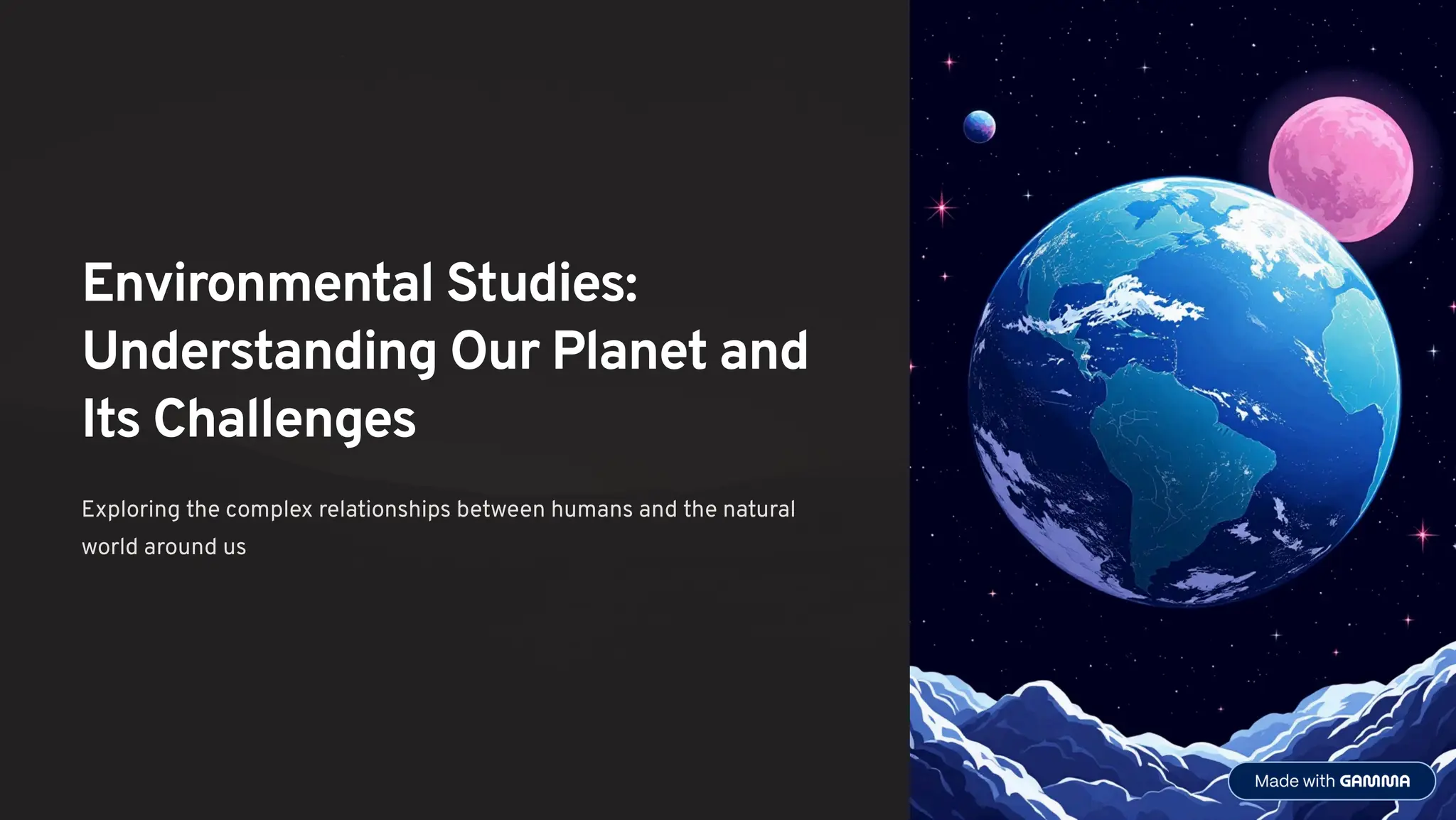
Environmental Studies:
Understanding Our Planet and
Its Challenges
Exploring the complex relationships between humans and the natural
world around us
What Is the Environment?
Etymology
Derived from French "environ" meaning surroundings -
everything that encircles us
Scope
Includes water, air, land, living organisms, and their
dynamic interactions
Legal Definition
Environmental Protection Act (1986): sum total of
water, air, land, and their interrelationships
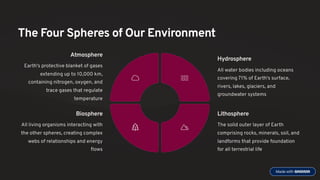
The Four Spheres of Our Environment
Atmosphere
Earth's protective blanket of gases
extending up to 10,000 km,
containing nitrogen, oxygen, and
trace gases that regulate
temperature
Hydrosphere
All water bodies including oceans
covering 71% of Earth's surface,
rivers, lakes, glaciers, and
groundwater systems
Lithosphere
The solid outer layer of Earth
comprising rocks, minerals, soil, and
landforms that provide foundation
for all terrestrial life
Biosphere
All living organisms interacting with
the other spheres, creating complex
webs of relationships and energy
flows
Components of the Environment
Physical Components
The foundation of our environment
Landforms: mountains, valleys,
plains
Soils: fertile layers supporting
agriculture
Water bodies: rivers, oceans,
lakes
Minerals: essential resources
beneath Earth's surface
Biological Components
The living elements that create
biodiversity
Plants: producers that convert
sunlight to energy
Animals: consumers in complex
food webs
Microorganisms: decomposers
and nutrient recyclers
Humans: dominant species with
greatest impact
Cultural Components
Human-created features shaping
our world
Economic systems: agriculture,
industry, commerce
Social structures: communities
and institutions
Political frameworks:
governance and policies
Built environment: cities,
infrastructure, technology
Why Study Environmental Science?
Create Awareness
Understanding environmental problems helps us recognize
the urgent challenges facing our planet and their root causes
Develop Concern
Knowledge breeds responsibility - motivating individuals and
communities to take protective action for future generations
Learn Sustainability
Discovering sustainable methods to use natural resources
ensures long-term availability while minimizing
environmental impact
Understand Connections
Recognizing intricate relationships among organisms and
their habitats reveals how ecosystems function and thrive
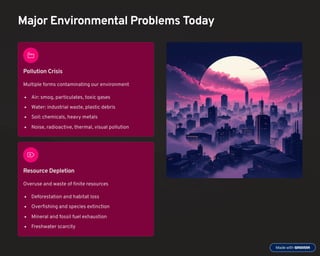
Major Environmental Problems Today
Pollution Crisis
Multiple forms contaminating our environment
Air: smog, particulates, toxic gases
Water: industrial waste, plastic debris
Soil: chemicals, heavy metals
Noise, radioactive, thermal, visual pollution
Resource Depletion
Overuse and waste of finite resources
Deforestation and habitat loss
Overfishing and species extinction
Mineral and fossil fuel exhaustion
Freshwater scarcity
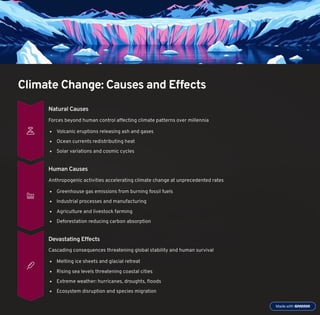
Climate Change: Causes and Effects
Natural Causes
Forces beyond human control affecting climate patterns over millennia
Volcanic eruptions releasing ash and gases
Ocean currents redistributing heat
Solar variations and cosmic cycles
Human Causes
Anthropogenic activities accelerating climate change at unprecedented rates
Greenhouse gas emissions from burning fossil fuels
Industrial processes and manufacturing
Agriculture and livestock farming
Deforestation reducing carbon absorption
Devastating Effects
Cascading consequences threatening global stability and human survival
Melting ice sheets and glacial retreat
Rising sea levels threatening coastal cities
Extreme weather: hurricanes, droughts, floods
Ecosystem disruption and species migration
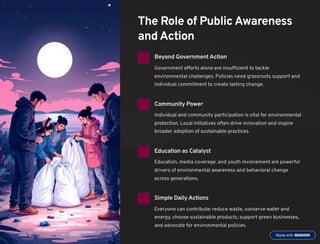
The Role of Public Awareness
and Action
Beyond GovernmentAction
Government efforts alone are insufficient to tackle
environmental challenges. Policies need grassroots support and
individual commitment to create lasting change.
Community Power
Individual and community participation is vital for environmental
protection. Local initiatives often drive innovation and inspire
broader adoption of sustainable practices.
Education as Catalyst
Education, media coverage, and youth involvement are powerful
drivers of environmental awareness and behavioral change
across generations.
Simple Daily Actions
Everyone can contribute: reduce waste, conserve water and
energy, choose sustainable products, support green businesses,
and advocate for environmental policies.
Sustainable Solutions for a Healthier Environment
Recycling & Waste Reduction
Implementing circular economy principles through
comprehensive recycling programs, reducing single-
use plastics, and promoting reusable alternatives to
minimize landfill waste.
Afforestation & Biodiversity
Protecting existing forests while planting new trees,
creating wildlife corridors, and establishing
protected areas to preserve endangered species and
ecosystem services.
Clean Energy Transition
Accelerating adoption of renewable energy sources
like solar, wind, and hydroelectric power while
reducing dependence on fossil fuels and cutting
carbon emissions.
Resource Management
Implementing responsible land use practices,
sustainable agriculture techniques, water
conservation methods, and integrated watershed
management for long-term sustainability.
Our Planet, Our Responsibility
Every Action
Counts
Environmental studies empower us to protect Earth's finite
resources and create a sustainable future for generations to
come.
Let's commit to continuous learning, raising awareness, and
taking positive action - because the health of our planet
depends on each of us.
Learn
Stay informed about
environmental issues and solutions
Act
Make sustainable choices in daily
life
Inspire
Share knowledge and motivate
others to join the movement

Environmental-Studies-Understanding-Our-Planet-and-Its-Challenges.pdf

  • 1.
    Environmental Studies: Understanding OurPlanet and Its Challenges Exploring the complex relationships between humans and the natural world around us
  • 2.
    What Is theEnvironment? Etymology Derived from French "environ" meaning surroundings - everything that encircles us Scope Includes water, air, land, living organisms, and their dynamic interactions Legal Definition Environmental Protection Act (1986): sum total of water, air, land, and their interrelationships
  • 3.
    The Four Spheresof Our Environment Atmosphere Earth's protective blanket of gases extending up to 10,000 km, containing nitrogen, oxygen, and trace gases that regulate temperature Hydrosphere All water bodies including oceans covering 71% of Earth's surface, rivers, lakes, glaciers, and groundwater systems Lithosphere The solid outer layer of Earth comprising rocks, minerals, soil, and landforms that provide foundation for all terrestrial life Biosphere All living organisms interacting with the other spheres, creating complex webs of relationships and energy flows
  • 4.
    Components of theEnvironment Physical Components The foundation of our environment Landforms: mountains, valleys, plains Soils: fertile layers supporting agriculture Water bodies: rivers, oceans, lakes Minerals: essential resources beneath Earth's surface Biological Components The living elements that create biodiversity Plants: producers that convert sunlight to energy Animals: consumers in complex food webs Microorganisms: decomposers and nutrient recyclers Humans: dominant species with greatest impact Cultural Components Human-created features shaping our world Economic systems: agriculture, industry, commerce Social structures: communities and institutions Political frameworks: governance and policies Built environment: cities, infrastructure, technology
  • 5.
    Why Study EnvironmentalScience? Create Awareness Understanding environmental problems helps us recognize the urgent challenges facing our planet and their root causes Develop Concern Knowledge breeds responsibility - motivating individuals and communities to take protective action for future generations Learn Sustainability Discovering sustainable methods to use natural resources ensures long-term availability while minimizing environmental impact Understand Connections Recognizing intricate relationships among organisms and their habitats reveals how ecosystems function and thrive
  • 6.
    Major Environmental ProblemsToday Pollution Crisis Multiple forms contaminating our environment Air: smog, particulates, toxic gases Water: industrial waste, plastic debris Soil: chemicals, heavy metals Noise, radioactive, thermal, visual pollution Resource Depletion Overuse and waste of finite resources Deforestation and habitat loss Overfishing and species extinction Mineral and fossil fuel exhaustion Freshwater scarcity
  • 7.
    Climate Change: Causesand Effects Natural Causes Forces beyond human control affecting climate patterns over millennia Volcanic eruptions releasing ash and gases Ocean currents redistributing heat Solar variations and cosmic cycles Human Causes Anthropogenic activities accelerating climate change at unprecedented rates Greenhouse gas emissions from burning fossil fuels Industrial processes and manufacturing Agriculture and livestock farming Deforestation reducing carbon absorption Devastating Effects Cascading consequences threatening global stability and human survival Melting ice sheets and glacial retreat Rising sea levels threatening coastal cities Extreme weather: hurricanes, droughts, floods Ecosystem disruption and species migration
  • 8.
    The Role ofPublic Awareness and Action Beyond GovernmentAction Government efforts alone are insufficient to tackle environmental challenges. Policies need grassroots support and individual commitment to create lasting change. Community Power Individual and community participation is vital for environmental protection. Local initiatives often drive innovation and inspire broader adoption of sustainable practices. Education as Catalyst Education, media coverage, and youth involvement are powerful drivers of environmental awareness and behavioral change across generations. Simple Daily Actions Everyone can contribute: reduce waste, conserve water and energy, choose sustainable products, support green businesses, and advocate for environmental policies.
  • 9.
    Sustainable Solutions fora Healthier Environment Recycling & Waste Reduction Implementing circular economy principles through comprehensive recycling programs, reducing single- use plastics, and promoting reusable alternatives to minimize landfill waste. Afforestation & Biodiversity Protecting existing forests while planting new trees, creating wildlife corridors, and establishing protected areas to preserve endangered species and ecosystem services. Clean Energy Transition Accelerating adoption of renewable energy sources like solar, wind, and hydroelectric power while reducing dependence on fossil fuels and cutting carbon emissions. Resource Management Implementing responsible land use practices, sustainable agriculture techniques, water conservation methods, and integrated watershed management for long-term sustainability.
  • 10.
    Our Planet, OurResponsibility Every Action Counts Environmental studies empower us to protect Earth's finite resources and create a sustainable future for generations to come. Let's commit to continuous learning, raising awareness, and taking positive action - because the health of our planet depends on each of us. Learn Stay informed about environmental issues and solutions Act Make sustainable choices in daily life Inspire Share knowledge and motivate others to join the movement