Project Portfolio
Management
Strategies for successful
implementation
Acknowledgment: The following content and artwork is from an eminence piece I developed for
Deloitte Consulting – Africa
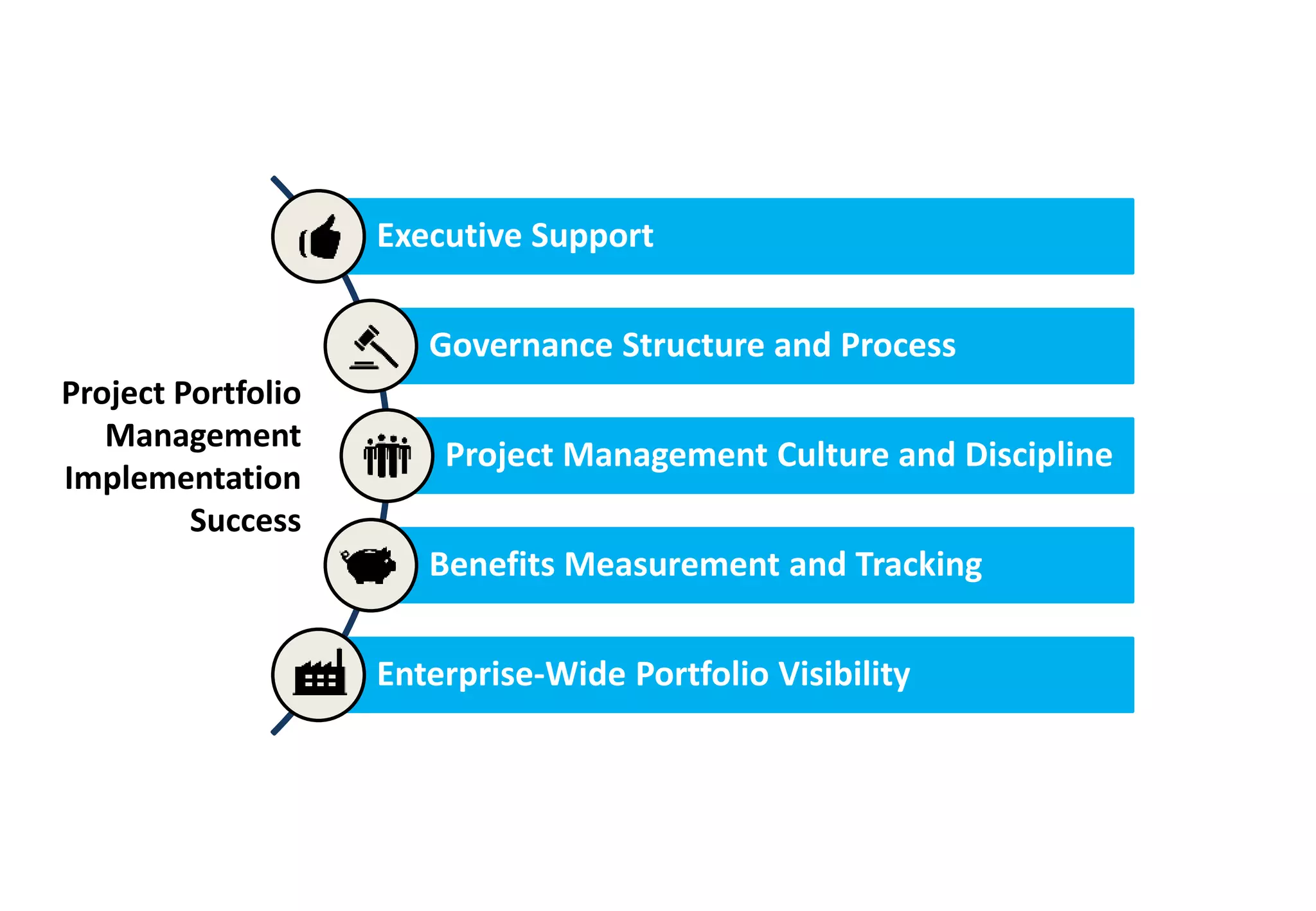
Executive Support
Governance Structure and Process
Project Management Culture and Discipline
Benefits Measurement and Tracking
Enterprise-Wide Portfolio Visibility
Project Portfolio
Management
Implementation
Success
Organisations continuously face the challenge of meeting the demand
of doing more with limited resources. Increasingly, organisations have
to get their products even quicker to market, and must be able to
adapt quickly to changing environmental and legislative needs and
requirements. Management by projects has been marketed in
industry as the key towards meeting these challenges, or at least help
in bringing about some structure in the way work is managed in an
organisation; however, projects themselves do not provide the
complete solution. While projects focus on delivering work in a
focused and disciplined manner, the ability for organisations to
choose the right projects in the first place will help them go a long
way in maximising their resources on investments that will bring the
most benefit.
he aftershock of the financial crisis requires
an increased focus on better decision-
making regarding investments. Project
Portfolio Management is a key for success.
T
Key
implementation
challenges
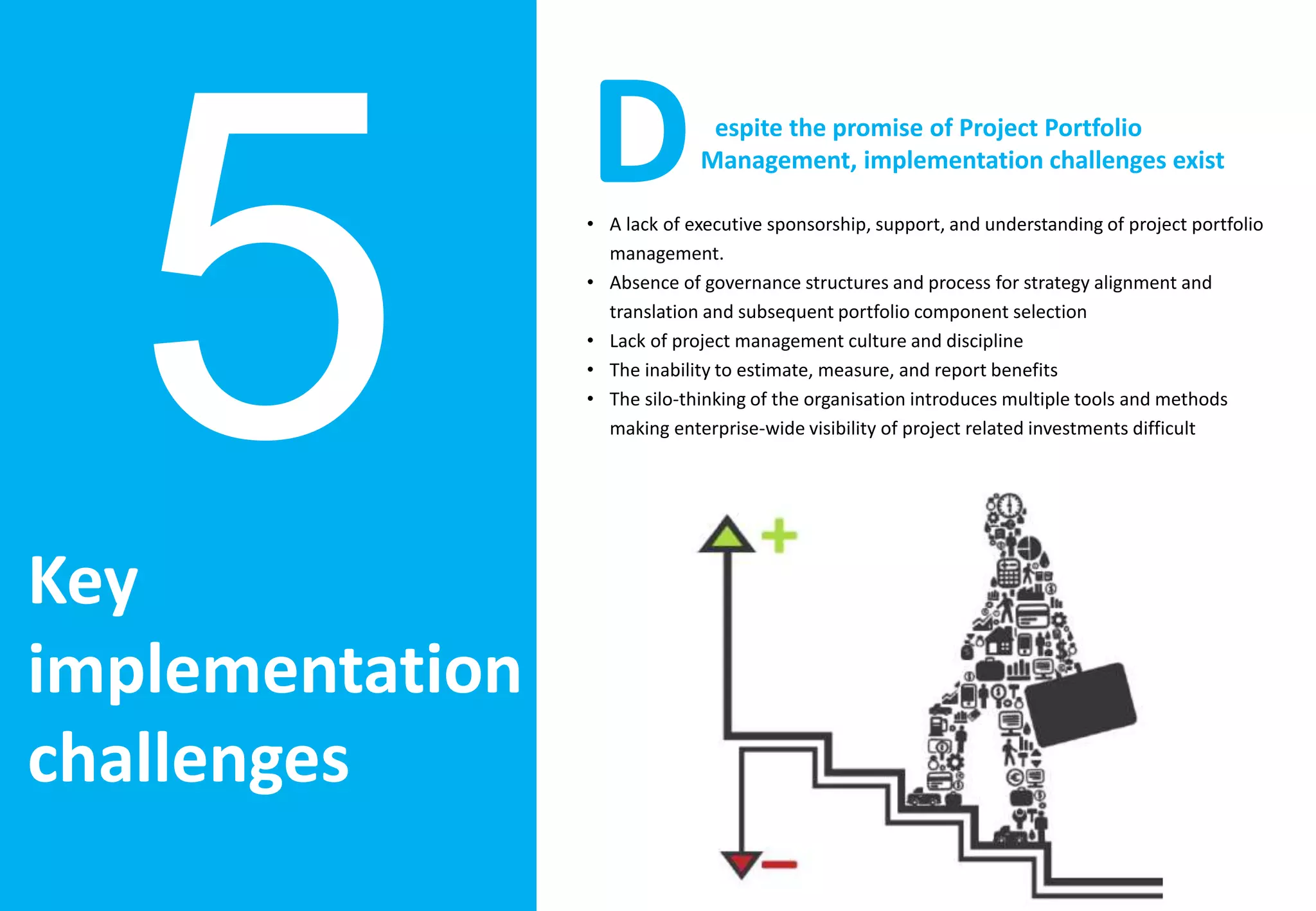
• A lack of executive sponsorship, support, and understanding of project portfolio
management.
• Absence of governance structures and process for strategy alignment and
translation and subsequent portfolio component selection
• Lack of project management culture and discipline
• The inability to estimate, measure, and report benefits
• The silo-thinking of the organisation introduces multiple tools and methods
making enterprise-wide visibility of project related investments difficult
despite the promise of Project Portfolio
Management, implementation challenges exist
D
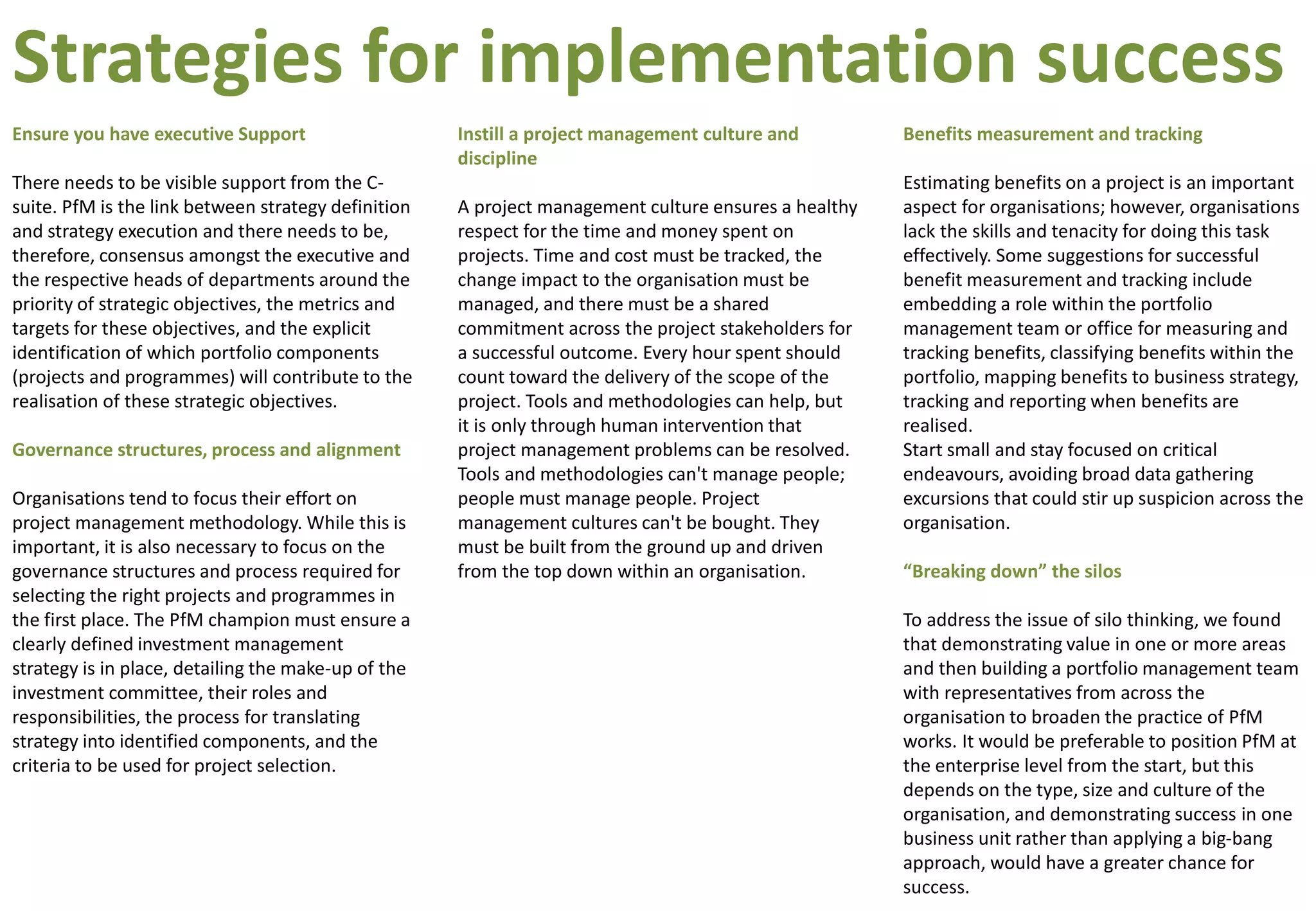
Ensure you have executive Support
There needs to be visible support from the C-
suite. PfM is the link between strategy definition
and strategy execution and there needs to be,
therefore, consensus amongst the executive and
the respective heads of departments around the
priority of strategic objectives, the metrics and
targets for these objectives, and the explicit
identification of which portfolio components
(projects and programmes) will contribute to the
realisation of these strategic objectives.
Governance structures, process and alignment
Organisations tend to focus their effort on
project management methodology. While this is
important, it is also necessary to focus on the
governance structures and process required for
selecting the right projects and programmes in
the first place. The PfM champion must ensure a
clearly defined investment management
strategy is in place, detailing the make-up of the
investment committee, their roles and
responsibilities, the process for translating
strategy into identified components, and the
criteria to be used for project selection.
Instill a project management culture and
discipline
A project management culture ensures a healthy
respect for the time and money spent on
projects. Time and cost must be tracked, the
change impact to the organisation must be
managed, and there must be a shared
commitment across the project stakeholders for
a successful outcome. Every hour spent should
count toward the delivery of the scope of the
project. Tools and methodologies can help, but
it is only through human intervention that
project management problems can be resolved.
Tools and methodologies can't manage people;
people must manage people. Project
management cultures can't be bought. They
must be built from the ground up and driven
from the top down within an organisation.
Benefits measurement and tracking
Estimating benefits on a project is an important
aspect for organisations; however, organisations
lack the skills and tenacity for doing this task
effectively. Some suggestions for successful
benefit measurement and tracking include
embedding a role within the portfolio
management team or office for measuring and
tracking benefits, classifying benefits within the
portfolio, mapping benefits to business strategy,
tracking and reporting when benefits are
realised.
Start small and stay focused on critical
endeavours, avoiding broad data gathering
excursions that could stir up suspicion across the
organisation.
“Breaking down” the silos
To address the issue of silo thinking, we found
that demonstrating value in one or more areas
and then building a portfolio management team
with representatives from across the
organisation to broaden the practice of PfM
works. It would be preferable to position PfM at
the enterprise level from the start, but this
depends on the type, size and culture of the
organisation, and demonstrating success in one
business unit rather than applying a big-bang
approach, would have a greater chance for
success.
Strategies for implementation success
CLIVE N. ENOCH
Ph.D, PMP®, PfMPProject Portfolio
Management Specialist
+27 83 4095021
clive.enoch@gmail.com
Johannesburg, South Africa
www.linkedin.com/in/cliveenoch
Contact

Eminence pf m_5_strategies for successful implementation

  • 1.
    Project Portfolio Management Strategies forsuccessful implementation Acknowledgment: The following content and artwork is from an eminence piece I developed for Deloitte Consulting – Africa
  • 2.
    Executive Support Governance Structureand Process Project Management Culture and Discipline Benefits Measurement and Tracking Enterprise-Wide Portfolio Visibility Project Portfolio Management Implementation Success
  • 3.
    Organisations continuously facethe challenge of meeting the demand of doing more with limited resources. Increasingly, organisations have to get their products even quicker to market, and must be able to adapt quickly to changing environmental and legislative needs and requirements. Management by projects has been marketed in industry as the key towards meeting these challenges, or at least help in bringing about some structure in the way work is managed in an organisation; however, projects themselves do not provide the complete solution. While projects focus on delivering work in a focused and disciplined manner, the ability for organisations to choose the right projects in the first place will help them go a long way in maximising their resources on investments that will bring the most benefit. he aftershock of the financial crisis requires an increased focus on better decision- making regarding investments. Project Portfolio Management is a key for success. T
  • 4.
    Key implementation challenges • A lackof executive sponsorship, support, and understanding of project portfolio management. • Absence of governance structures and process for strategy alignment and translation and subsequent portfolio component selection • Lack of project management culture and discipline • The inability to estimate, measure, and report benefits • The silo-thinking of the organisation introduces multiple tools and methods making enterprise-wide visibility of project related investments difficult despite the promise of Project Portfolio Management, implementation challenges exist D
  • 5.
    Ensure you haveexecutive Support There needs to be visible support from the C- suite. PfM is the link between strategy definition and strategy execution and there needs to be, therefore, consensus amongst the executive and the respective heads of departments around the priority of strategic objectives, the metrics and targets for these objectives, and the explicit identification of which portfolio components (projects and programmes) will contribute to the realisation of these strategic objectives. Governance structures, process and alignment Organisations tend to focus their effort on project management methodology. While this is important, it is also necessary to focus on the governance structures and process required for selecting the right projects and programmes in the first place. The PfM champion must ensure a clearly defined investment management strategy is in place, detailing the make-up of the investment committee, their roles and responsibilities, the process for translating strategy into identified components, and the criteria to be used for project selection. Instill a project management culture and discipline A project management culture ensures a healthy respect for the time and money spent on projects. Time and cost must be tracked, the change impact to the organisation must be managed, and there must be a shared commitment across the project stakeholders for a successful outcome. Every hour spent should count toward the delivery of the scope of the project. Tools and methodologies can help, but it is only through human intervention that project management problems can be resolved. Tools and methodologies can't manage people; people must manage people. Project management cultures can't be bought. They must be built from the ground up and driven from the top down within an organisation. Benefits measurement and tracking Estimating benefits on a project is an important aspect for organisations; however, organisations lack the skills and tenacity for doing this task effectively. Some suggestions for successful benefit measurement and tracking include embedding a role within the portfolio management team or office for measuring and tracking benefits, classifying benefits within the portfolio, mapping benefits to business strategy, tracking and reporting when benefits are realised. Start small and stay focused on critical endeavours, avoiding broad data gathering excursions that could stir up suspicion across the organisation. “Breaking down” the silos To address the issue of silo thinking, we found that demonstrating value in one or more areas and then building a portfolio management team with representatives from across the organisation to broaden the practice of PfM works. It would be preferable to position PfM at the enterprise level from the start, but this depends on the type, size and culture of the organisation, and demonstrating success in one business unit rather than applying a big-bang approach, would have a greater chance for success. Strategies for implementation success
  • 6.
    CLIVE N. ENOCH Ph.D,PMP®, PfMPProject Portfolio Management Specialist +27 83 4095021 clive.enoch@gmail.com Johannesburg, South Africa www.linkedin.com/in/cliveenoch Contact