APM: Portfolio
Management SIG
The case for doing things
differently
Karl Reilly
Global Lead for PPM Methods & Tools
April 2015
www.pwc.co.uk
PwC
4th Global PPM Survey
Do those who commission change
get what they want?
2
April 2015APM: Portfolio Management SIG
PwC
19
39
42
Other
Company Senior Manager
Company Manager or staff
18
42
14
8
14
5
Company porfolio or programme
manager
Company project manager
Company PMO manager or team
member
Consultant/Contractor portfolio or
programme manager
Consultant/Contractor project
manager
Consultant/Contractor PMO
manager or team member
What is your role?
General Employee roles
Portfolio & Programme Manager roles
Base: 3,025
Base: 1,775
Base: 1,051
Overall
7%
35%
59%
C-Suite
Portfolio &
Programme
Managers
General
Employees
Who took part in the research? The survey was targeted at
three main groups…
(%)
3
April 2015APM: Portfolio Management SIG
PwC
Global Survey
The results of the 4th Global PPM
Survey repeat some consistent
messages from our previous
surveys as well as opening up new
insights that can help organizations
deliver better results for their
sponsors of change.
4
April 2015APM: Portfolio Management SIG
PwC
The Global PPM
Survey shows that
familiar issues still
are not being
addressed
Why change how programs are
delivered?
5
April 2015APM: Portfolio Management SIG
PwC
How to do things differently?
Optimize your
portfolio to
maximize return
Be flexible,
change faster
Enable your
people to deliver
success
Connect the
Executive Team
to program
delivery teams to
get the change
you want
Measure and
address the harsh
facts to maintain
direction
6
April 2015APM: Portfolio Management SIG
PwC
Theme 1
Optimise your portfolio to maximize returns
Organizations should:
• Optimise the selection of programs within
the portfolio using quality data and objective
criteria to help the organization more
effectively achieve its change strategies.
• Take a look at the portfolio management
capability with a view to ensuring both
program selection and reviews clearly
support the organisation’s strategic goals –
being pragmatic enough to stop projects or
program that are not delivering.
• Create a portfolio management function
from a business architecture perspective,
ensuring the right people, process and tools
are in place to effectively manage the
portfolio of change program that
consistently align to business goals.
• Build a sustainable and effective ‘ideas
pipeline’ to continually enter new projects
and program into their portfolio.
7
April 2015APM: Portfolio Management SIG
PwC
Theme 2
Be flexible, change faster
Organizations should:
• Plan for change from the outset – not doing
so is unrealistic, and will take you longer to
react when it does happen.
• Create an environment where change can be
managed in a controlled manner for the
benefit of all. This moves beyond traditional
change (variation) control and impact
assessment processes, rather defining a new
operating rhythm for program delivery
where change is expected, embraced and
harnessed.
8
April 2015APM: Portfolio Management SIG
PwC
Theme 3
Enable your people to deliver success
Organisations should ensure that the PM
community is enabled to deliver change by
creating the right environment:
• Programs must be properly resourced with
highly skilled professionals – the right
capability and capacity.
• Training PMs effectively will improve
delivery success. PPM is a profession – too
few people are trained to deliver it.
• Organisations need to invest the time to
carefully examine their requirements for
software that enables program and portfolio
management, and ensure the tools they
select are fit for purpose and meet the needs
of both PMs who plan and manage at very
detailed levels, and the Executive Team for
summary reporting at the portfolio level.
9
April 2015APM: Portfolio Management SIG
PwC
Theme 4
Connect Executive Teams to delivery teams to get the
change you want
Executive Teams should:
• Show commitment to the importance of
program management and understand
delivery issues. When program outcomes are
clearly defined, measurable and understood
by all, results improve.
• Be encouraged to make better use of the
experience and value their professional PMs
can offer. Often PMs are seen as providers of
data, or worse still administrators – they
need to be adept at technical reporting but
can add far more value through working
closely with leaders to shape and drive
programs.
10
April 2015APM: Portfolio Management SIG
PwC
Theme 5
Measure and address the hard facts to maintain direction
Organizations should:
• Maintain a line of sight to the intended outcomes
and benefits. Decisions on further funding,
resourcing, direction and risk management
should all be made with outcomes and benefits in
mind.
• Invest in their program management resources –
ensure they are well trained and able to
consistently deliver the basic program
management elements so that progress is well
planned and tracked.
• ‘Stop and reflect’ – taking a pause can often
provide sufficient thinking time to regroup and
set a new baseline or refocus effort.
• Not be afraid of knowing when to stop programs.
Clear measuring of progress and decisive actions
can help to save wasted investment in the long
run, along with making sure the business case
and benefits are still valid and being realized.
11
April 2015APM: Portfolio Management SIG
PwC
The Global PPM
Survey illustrates
that there is often a
disconnect between
the Executive Team
and the PMs
Why change how programs are
delivered?
12
April 2015APM: Portfolio Management SIG
PwC
We asked: How is the success of change activities measured in your organisation?
C-Suite
General Employees
65% 57%
Financial metrics
Customer satisfaction
metrics
42% 40%
Time metrics
19% 24%
Delivery of documented
outcomes
26% 21%
Employee satisfaction
23% 17%
Successful embedding of
change
22% 15%
Don’t know
3% 9%
How do you measure success?, Or,
How do you know you’ve finished?
Base: C-Suite: 193; General Employees: 1,029
31% 33%
Quality metrics
13
April 2015APM: Portfolio Management SIG
PwC
39
10
51
13
9
82
Don't know
No
Yes
C-Suite General Employees
(%)
Reflecting on change activities completed in the last 5 years
and sustained visible benefits you can see today, have the
changes been worth the investment?
Base:
C-Suite: 191;
General Employees: 1,008
14
April 2015APM: Portfolio Management SIG
PwC
2
5
19
13
27
19
15
2
3
11
10
30
19
26
Don't know
Not clearly defined
Defined but not easily measurable or
understood by the business
Clearly defined and measurable but not widely
understood
Clearly defined, generally understood but
difficult to measure
Clearly defined, measurable and understood by
all staff
Clearly defined, measurable and understood by
all staff and customers
C-Suite General Employees
(%)
Base: C-Suite: 196; General Employees: 1,027
When you commission change, to what extent are business
outcomes clearly defined and measurable?
15
April 2015APM: Portfolio Management SIG
PwC
29
37
20
9
4
2
24
38
14
11
6
7
All change activities
are driven from the
strategy by
leadership
Most change
initiatives align to the
strategy via an
approvals process
The majority of
projects align with
our strategy but
there is no formal
approvals process
Projects receive
budget approval, but
do not necessarily
align to
organisational
strategy
Projects are
commissioned
locally within the
organisation to local
agendas/needs
Don't know
C-Suite General Employees
(%)
How well is your organisational strategy delivered through
change activities?
Base: C-Suite: 193; General Employees: 1,036
16
April 2015APM: Portfolio Management SIG
PwC
APM: Portfolio Management SIG
Approximately two thirds of PMs agree that there is a
coherent relationship between the programme objectives
and benefits and the organisational strategy and vision
23%
49%
14%
8%
4% 2%
Strongly agree
Agree
Neither agree nor disagree
Disgaree
Strongly disagree
Don't know
There is a coherent relationship between the programme’s objectives and benefits and the organisational strategy
and vision
Base: 1,774
17
April 2015
PwC
APM: Portfolio Management SIG
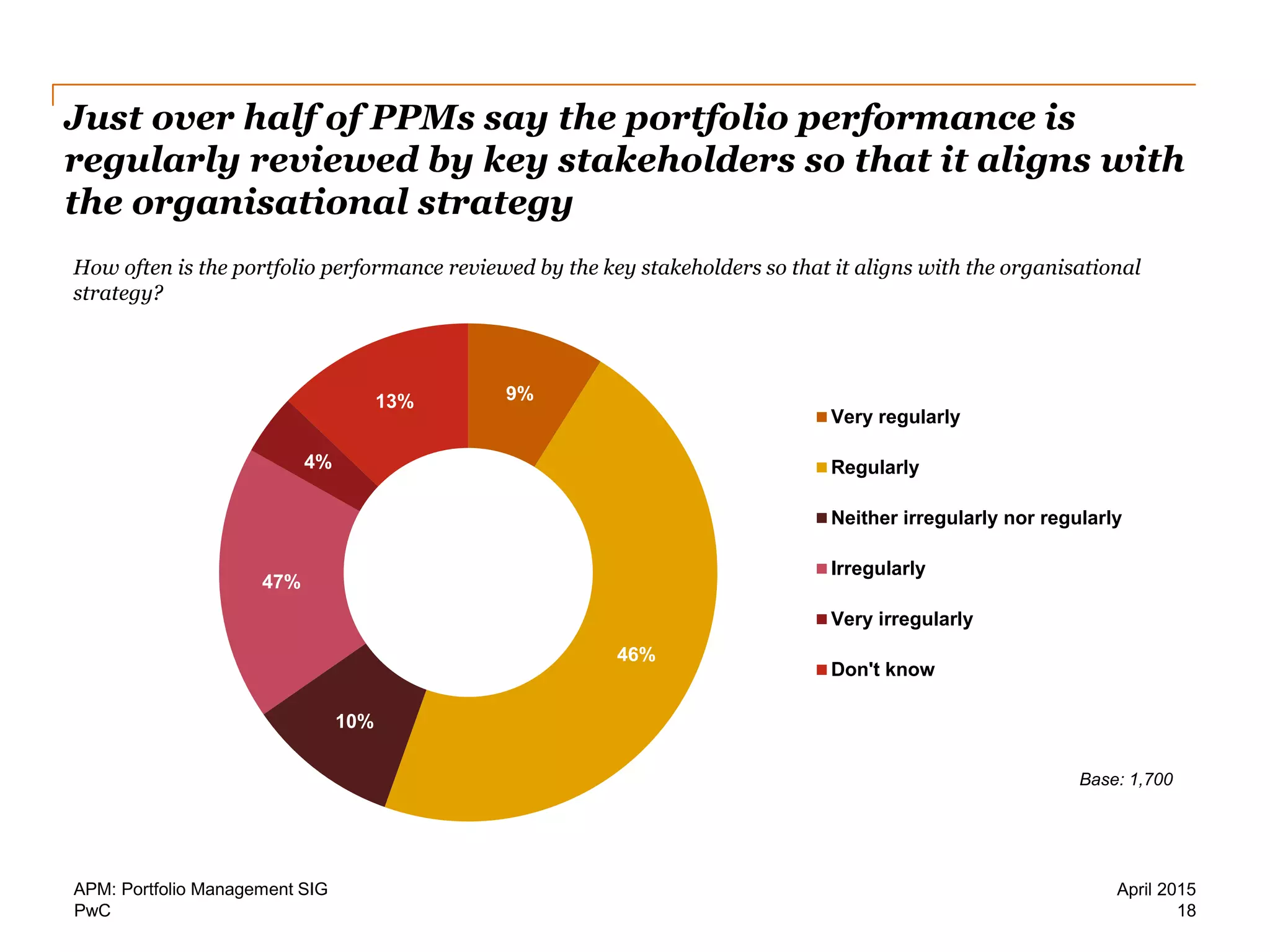
Base: 1,700
9%
46%
10%
47%
4%
13%
Very regularly
Regularly
Neither irregularly nor regularly
Irregularly
Very irregularly
Don't know
How often is the portfolio performance reviewed by the key stakeholders so that it aligns with the organisational
strategy?
Just over half of PPMs say the portfolio performance is
regularly reviewed by key stakeholders so that it aligns with
the organisational strategy
18
April 2015
PwC
APM: Portfolio Management SIG
17
3
10
1
33
16
21
35
15
45
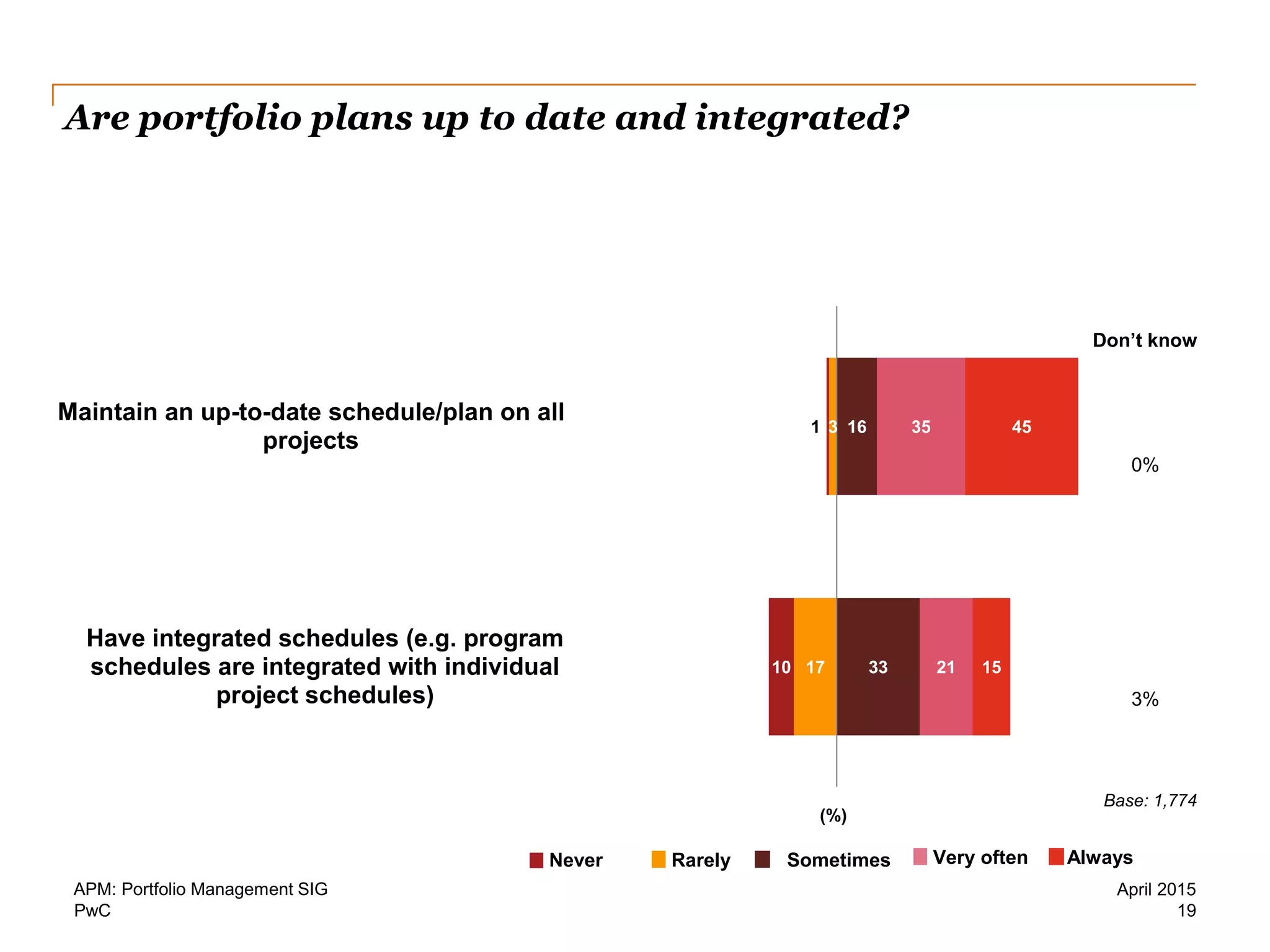
Have integrated schedules (e.g. program
schedules are integrated with individual
project schedules)
Maintain an up-to-date schedule/plan on all
projects
(%)
Don’t know
0%
3%
Base: 1,774
Are portfolio plans up to date and integrated?
RarelyNever AlwaysVery oftenSometimes
19
April 2015
PwC
APM: Portfolio Management SIG
Base: 1,747
11%
39%
21%
40%
5%
4%
Strongly agree
Agree
Neither agree nor disagree
Disagree
Strongly disagree
Don't know
50% of PMs agree that an appropriate baseline exists to
measure all benefits
20
April 2015
PwC
So what?
Our survey respondents tell us that there is a case for
changing the way we deliver.
• We need to understand the corporate strategy, and be flexible in how
we deliver to meet the strategy.
• We need to talk in the language of our clients and their industry.
• We need to use data to baseline and track performance to drive
decision making.
• We need to alert to the changing world around us, and adapt to
threats and opportunities
• We need to harness technology advances
21
April 2015APM: Portfolio Management SIG
The case for doing things differently
This publication has been prepared for general guidance on matters of interest only, and does not constitute professional advice. You should not act upon the
information contained in this publication without obtaining specific professional advice. No representation or warranty (express or implied) is given as to the
accuracy or completeness of the information contained in this publication, and, to the extent permitted by law, PricewaterhouseCoopers LLP, its members,
employees and agents do not accept or assume any liability, responsibility or duty of care for any consequences of you or anyone else acting, or refraining to act,
in reliance on the information contained in this publication or for any decision based on it.
© 2015 PricewaterhouseCoopers LLP. All rights reserved. In this document, "PwC" refers to the UK member firm, and may sometimes refer to the PwC network.
Each member firm is a separate legal entity. Please see www.pwc.com/structure for further details.
Questions…?
Download the survey report at
ww.pwc.com/ppmsurvey
Contact:
e-mail: Karl.b.reilly@uk.pwc.com
Twitter: @Karl_Reilly_PwC

Karl Riley PwC analysis from their 4th global PPM

  • 1.
    APM: Portfolio Management SIG Thecase for doing things differently Karl Reilly Global Lead for PPM Methods & Tools April 2015 www.pwc.co.uk
  • 2.
    PwC 4th Global PPMSurvey Do those who commission change get what they want? 2 April 2015APM: Portfolio Management SIG
  • 3.
    PwC 19 39 42 Other Company Senior Manager CompanyManager or staff 18 42 14 8 14 5 Company porfolio or programme manager Company project manager Company PMO manager or team member Consultant/Contractor portfolio or programme manager Consultant/Contractor project manager Consultant/Contractor PMO manager or team member What is your role? General Employee roles Portfolio & Programme Manager roles Base: 3,025 Base: 1,775 Base: 1,051 Overall 7% 35% 59% C-Suite Portfolio & Programme Managers General Employees Who took part in the research? The survey was targeted at three main groups… (%) 3 April 2015APM: Portfolio Management SIG
  • 4.
    PwC Global Survey The resultsof the 4th Global PPM Survey repeat some consistent messages from our previous surveys as well as opening up new insights that can help organizations deliver better results for their sponsors of change. 4 April 2015APM: Portfolio Management SIG
  • 5.
    PwC The Global PPM Surveyshows that familiar issues still are not being addressed Why change how programs are delivered? 5 April 2015APM: Portfolio Management SIG
  • 6.
    PwC How to dothings differently? Optimize your portfolio to maximize return Be flexible, change faster Enable your people to deliver success Connect the Executive Team to program delivery teams to get the change you want Measure and address the harsh facts to maintain direction 6 April 2015APM: Portfolio Management SIG
  • 7.
    PwC Theme 1 Optimise yourportfolio to maximize returns Organizations should: • Optimise the selection of programs within the portfolio using quality data and objective criteria to help the organization more effectively achieve its change strategies. • Take a look at the portfolio management capability with a view to ensuring both program selection and reviews clearly support the organisation’s strategic goals – being pragmatic enough to stop projects or program that are not delivering. • Create a portfolio management function from a business architecture perspective, ensuring the right people, process and tools are in place to effectively manage the portfolio of change program that consistently align to business goals. • Build a sustainable and effective ‘ideas pipeline’ to continually enter new projects and program into their portfolio. 7 April 2015APM: Portfolio Management SIG
  • 8.
    PwC Theme 2 Be flexible,change faster Organizations should: • Plan for change from the outset – not doing so is unrealistic, and will take you longer to react when it does happen. • Create an environment where change can be managed in a controlled manner for the benefit of all. This moves beyond traditional change (variation) control and impact assessment processes, rather defining a new operating rhythm for program delivery where change is expected, embraced and harnessed. 8 April 2015APM: Portfolio Management SIG
  • 9.
    PwC Theme 3 Enable yourpeople to deliver success Organisations should ensure that the PM community is enabled to deliver change by creating the right environment: • Programs must be properly resourced with highly skilled professionals – the right capability and capacity. • Training PMs effectively will improve delivery success. PPM is a profession – too few people are trained to deliver it. • Organisations need to invest the time to carefully examine their requirements for software that enables program and portfolio management, and ensure the tools they select are fit for purpose and meet the needs of both PMs who plan and manage at very detailed levels, and the Executive Team for summary reporting at the portfolio level. 9 April 2015APM: Portfolio Management SIG
  • 10.
    PwC Theme 4 Connect ExecutiveTeams to delivery teams to get the change you want Executive Teams should: • Show commitment to the importance of program management and understand delivery issues. When program outcomes are clearly defined, measurable and understood by all, results improve. • Be encouraged to make better use of the experience and value their professional PMs can offer. Often PMs are seen as providers of data, or worse still administrators – they need to be adept at technical reporting but can add far more value through working closely with leaders to shape and drive programs. 10 April 2015APM: Portfolio Management SIG
  • 11.
    PwC Theme 5 Measure andaddress the hard facts to maintain direction Organizations should: • Maintain a line of sight to the intended outcomes and benefits. Decisions on further funding, resourcing, direction and risk management should all be made with outcomes and benefits in mind. • Invest in their program management resources – ensure they are well trained and able to consistently deliver the basic program management elements so that progress is well planned and tracked. • ‘Stop and reflect’ – taking a pause can often provide sufficient thinking time to regroup and set a new baseline or refocus effort. • Not be afraid of knowing when to stop programs. Clear measuring of progress and decisive actions can help to save wasted investment in the long run, along with making sure the business case and benefits are still valid and being realized. 11 April 2015APM: Portfolio Management SIG
  • 12.
    PwC The Global PPM Surveyillustrates that there is often a disconnect between the Executive Team and the PMs Why change how programs are delivered? 12 April 2015APM: Portfolio Management SIG
  • 13.
    PwC We asked: Howis the success of change activities measured in your organisation? C-Suite General Employees 65% 57% Financial metrics Customer satisfaction metrics 42% 40% Time metrics 19% 24% Delivery of documented outcomes 26% 21% Employee satisfaction 23% 17% Successful embedding of change 22% 15% Don’t know 3% 9% How do you measure success?, Or, How do you know you’ve finished? Base: C-Suite: 193; General Employees: 1,029 31% 33% Quality metrics 13 April 2015APM: Portfolio Management SIG
  • 14.
    PwC 39 10 51 13 9 82 Don't know No Yes C-Suite GeneralEmployees (%) Reflecting on change activities completed in the last 5 years and sustained visible benefits you can see today, have the changes been worth the investment? Base: C-Suite: 191; General Employees: 1,008 14 April 2015APM: Portfolio Management SIG
  • 15.
    PwC 2 5 19 13 27 19 15 2 3 11 10 30 19 26 Don't know Not clearlydefined Defined but not easily measurable or understood by the business Clearly defined and measurable but not widely understood Clearly defined, generally understood but difficult to measure Clearly defined, measurable and understood by all staff Clearly defined, measurable and understood by all staff and customers C-Suite General Employees (%) Base: C-Suite: 196; General Employees: 1,027 When you commission change, to what extent are business outcomes clearly defined and measurable? 15 April 2015APM: Portfolio Management SIG
  • 16.
    PwC 29 37 20 9 4 2 24 38 14 11 6 7 All change activities aredriven from the strategy by leadership Most change initiatives align to the strategy via an approvals process The majority of projects align with our strategy but there is no formal approvals process Projects receive budget approval, but do not necessarily align to organisational strategy Projects are commissioned locally within the organisation to local agendas/needs Don't know C-Suite General Employees (%) How well is your organisational strategy delivered through change activities? Base: C-Suite: 193; General Employees: 1,036 16 April 2015APM: Portfolio Management SIG
  • 17.
    PwC APM: Portfolio ManagementSIG Approximately two thirds of PMs agree that there is a coherent relationship between the programme objectives and benefits and the organisational strategy and vision 23% 49% 14% 8% 4% 2% Strongly agree Agree Neither agree nor disagree Disgaree Strongly disagree Don't know There is a coherent relationship between the programme’s objectives and benefits and the organisational strategy and vision Base: 1,774 17 April 2015
  • 18.
    PwC APM: Portfolio ManagementSIG Base: 1,700 9% 46% 10% 47% 4% 13% Very regularly Regularly Neither irregularly nor regularly Irregularly Very irregularly Don't know How often is the portfolio performance reviewed by the key stakeholders so that it aligns with the organisational strategy? Just over half of PPMs say the portfolio performance is regularly reviewed by key stakeholders so that it aligns with the organisational strategy 18 April 2015
  • 19.
    PwC APM: Portfolio ManagementSIG 17 3 10 1 33 16 21 35 15 45 Have integrated schedules (e.g. program schedules are integrated with individual project schedules) Maintain an up-to-date schedule/plan on all projects (%) Don’t know 0% 3% Base: 1,774 Are portfolio plans up to date and integrated? RarelyNever AlwaysVery oftenSometimes 19 April 2015
  • 20.
    PwC APM: Portfolio ManagementSIG Base: 1,747 11% 39% 21% 40% 5% 4% Strongly agree Agree Neither agree nor disagree Disagree Strongly disagree Don't know 50% of PMs agree that an appropriate baseline exists to measure all benefits 20 April 2015
  • 21.
    PwC So what? Our surveyrespondents tell us that there is a case for changing the way we deliver. • We need to understand the corporate strategy, and be flexible in how we deliver to meet the strategy. • We need to talk in the language of our clients and their industry. • We need to use data to baseline and track performance to drive decision making. • We need to alert to the changing world around us, and adapt to threats and opportunities • We need to harness technology advances 21 April 2015APM: Portfolio Management SIG
  • 22.
    The case fordoing things differently This publication has been prepared for general guidance on matters of interest only, and does not constitute professional advice. You should not act upon the information contained in this publication without obtaining specific professional advice. No representation or warranty (express or implied) is given as to the accuracy or completeness of the information contained in this publication, and, to the extent permitted by law, PricewaterhouseCoopers LLP, its members, employees and agents do not accept or assume any liability, responsibility or duty of care for any consequences of you or anyone else acting, or refraining to act, in reliance on the information contained in this publication or for any decision based on it. © 2015 PricewaterhouseCoopers LLP. All rights reserved. In this document, "PwC" refers to the UK member firm, and may sometimes refer to the PwC network. Each member firm is a separate legal entity. Please see www.pwc.com/structure for further details. Questions…? Download the survey report at ww.pwc.com/ppmsurvey Contact: e-mail: Karl.b.reilly@uk.pwc.com Twitter: @Karl_Reilly_PwC