Moving Britain Ahead 06 November 15
EMERGING TECHNICAL REQUIREMENTS FOR A UK SPACEPORT 1
EMERGING TECHNICAL REQUIREMENTS
FOR A UK SPACEPORT
Moving Britain Ahead2
This presentation is based on the understanding of the
DFT and CAA as of 6 November 2015. It should be
noted that Government policy and our work are subject
to ongoing development in a fast-moving technological
environment. Technical and other requirements for a
UK Spaceport are therefore subject to a number of
factors and uncertainties that could cause them to
change. No reliance should therefore be placed on any
aspect of this presentation, and it should not be
assumed the final requirements for a UK Spaceport will
be as set out here.
November 15
EMERGING TECHNICAL REQUIREMENTS FOR A UK
SPACEPORT
Moving Britain Ahead
Outline
3
Emerging requirements
Background to phase 2 (post government review)
Spaceport considerations – James Eales
ATM and Airspace considerations – Andy Sinclair
Areas of further work
Based on our current knowledge – things will
change!
November 15
EMERGING TECHNICAL REQUIREMENTS FOR A UK
SPACEPORT
Moving Britain Ahead
Background to CAA’s Phase 2 work
4
Government (DfT) funded Section 16 task
Includes (but is not limited to):
Implement the recommendations in the Technical
Review
Development of a Technical Specification
Develop a Regulatory and operational framework for
horizontal launch sub-orbital spaceplane operations
Working in partnership with UKSA and MOD
November 15
EMERGING TECHNICAL REQUIREMENTS FOR A UK
SPACEPORT
Moving Britain Ahead
Scope
5
A to A, horizontal launch, sub-orbital flights
Space tourism /spaceflight experience
Micro gravity experimentation
Satellite launch
Vertical launch is not in scope of CAA’s work
November 15
EMERGING TECHNICAL REQUIREMENTS FOR A UK
SPACEPORT
Moving Britain Ahead
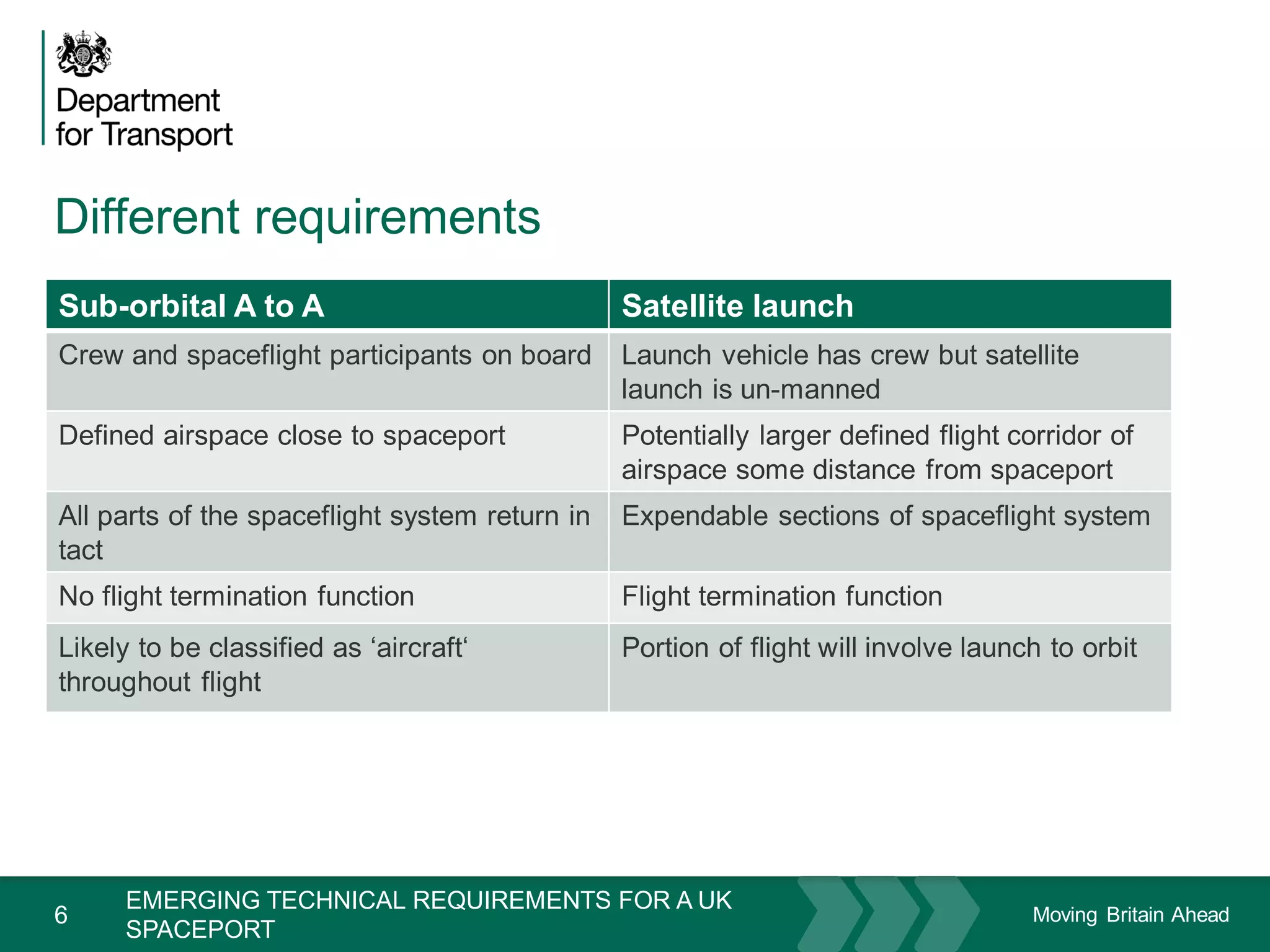
Different requirements
6
Sub-orbital A to A Satellite launch
Crew and spaceflight participants on board Launch vehicle has crew but satellite
launch is un-manned
Defined airspace close to spaceport Potentially larger defined flight corridor of
airspace some distance from spaceport
All parts of the spaceflight system return in
tact
Expendable sections of spaceflight system
No flight termination function Flight termination function
Likely to be classified as ‘aircraft‘
throughout flight
Portion of flight will involve launch to orbit
November 15
EMERGING TECHNICAL REQUIREMENTS FOR A UK
SPACEPORT
Moving Britain Ahead
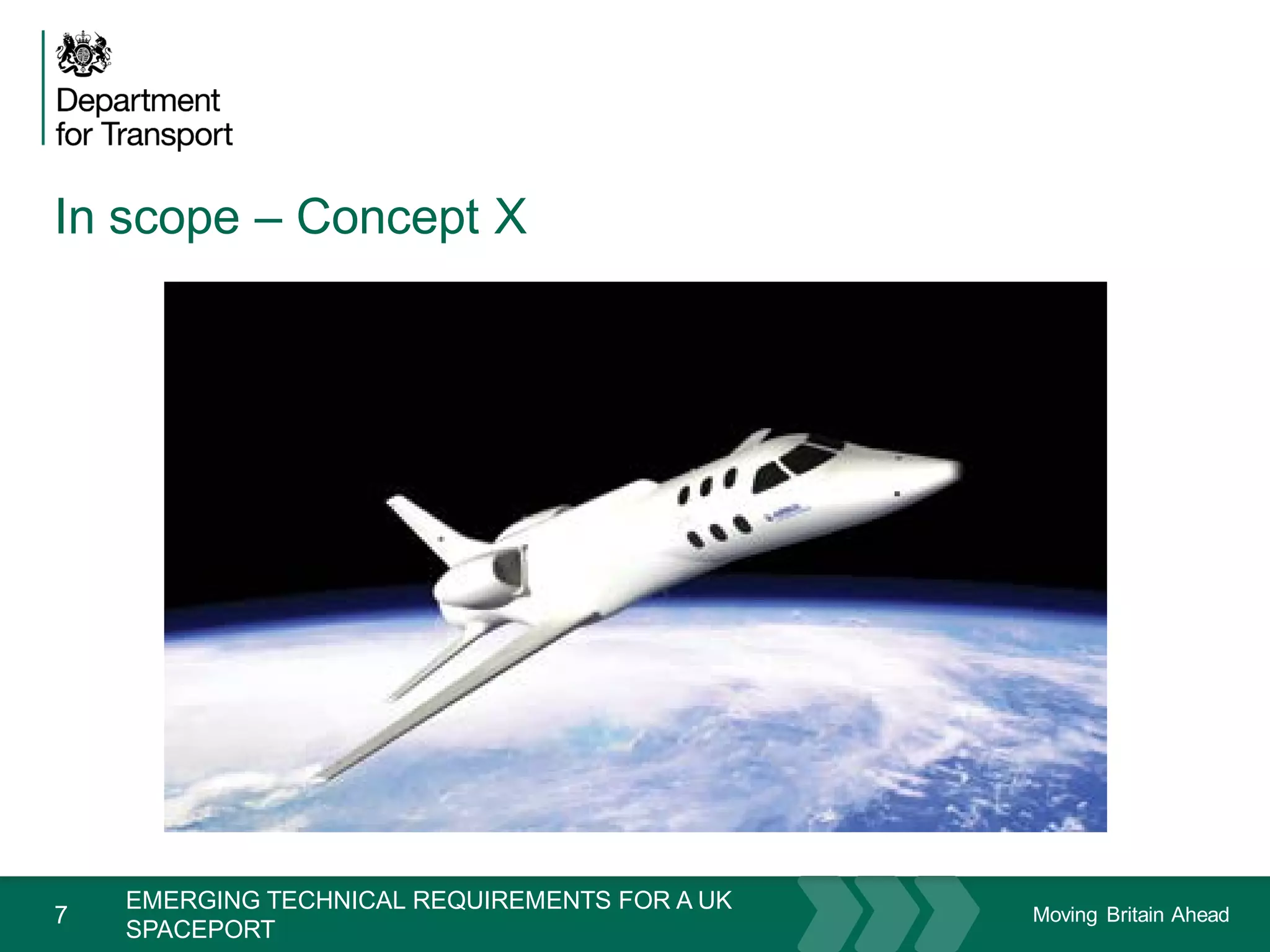
In scope – Concept X
7
November 15
EMERGING TECHNICAL REQUIREMENTS FOR A UK
SPACEPORT
Moving Britain Ahead
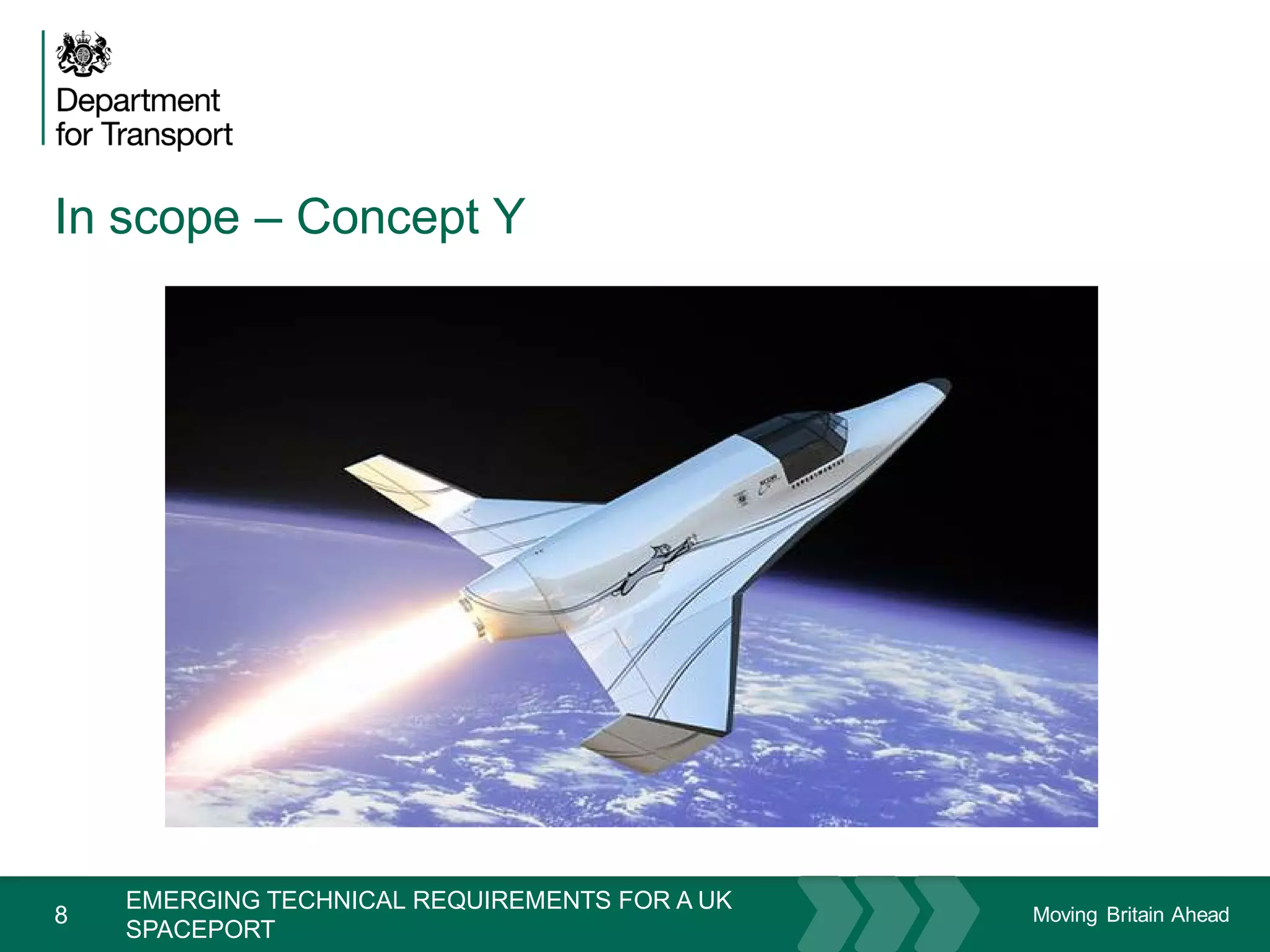
In scope – Concept Y
8
November 15
EMERGING TECHNICAL REQUIREMENTS FOR A UK
SPACEPORT
Moving Britain Ahead
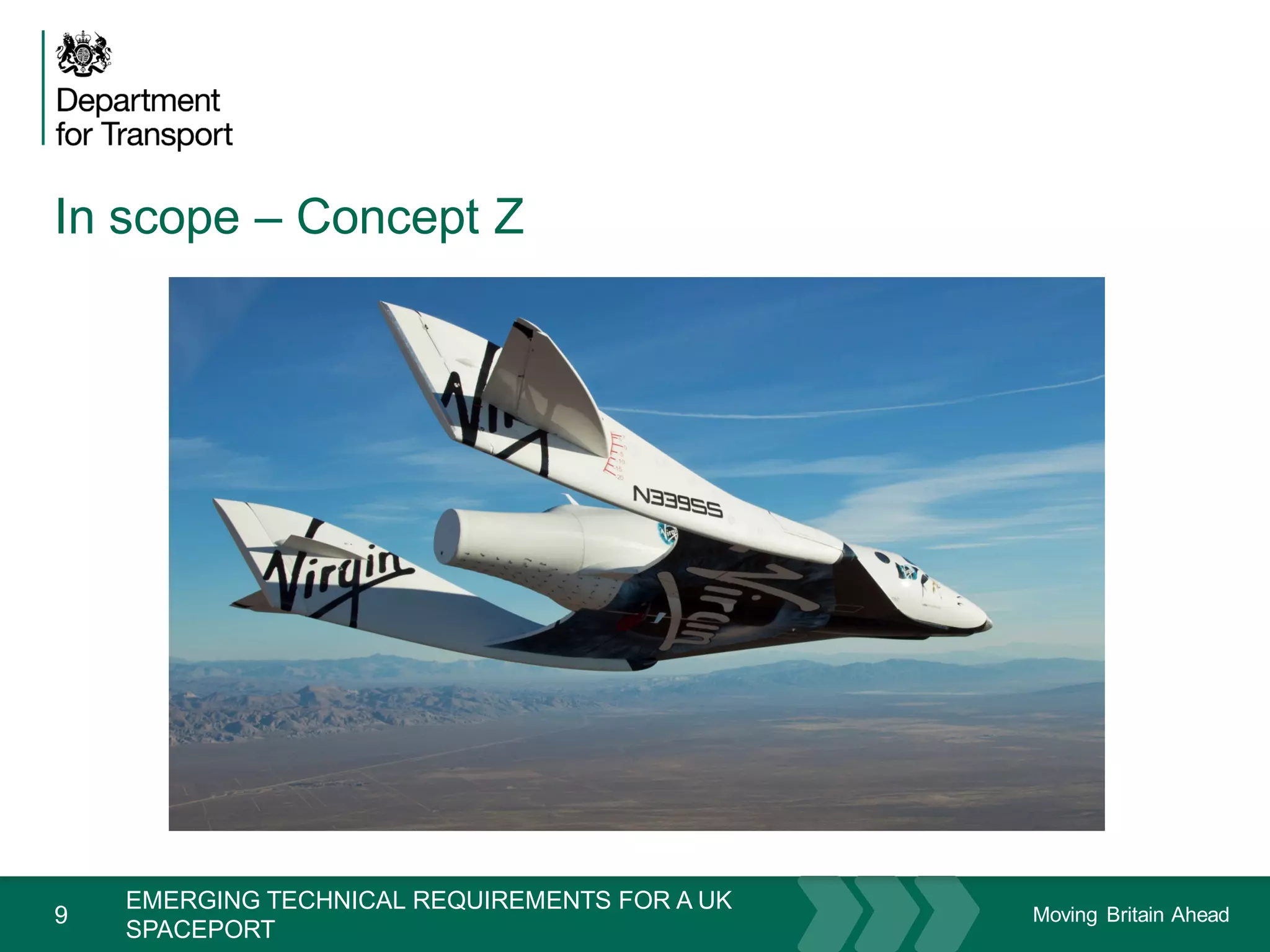
In scope – Concept Z
9
November 15
EMERGING TECHNICAL REQUIREMENTS FOR A UK
SPACEPORT
Moving Britain Ahead
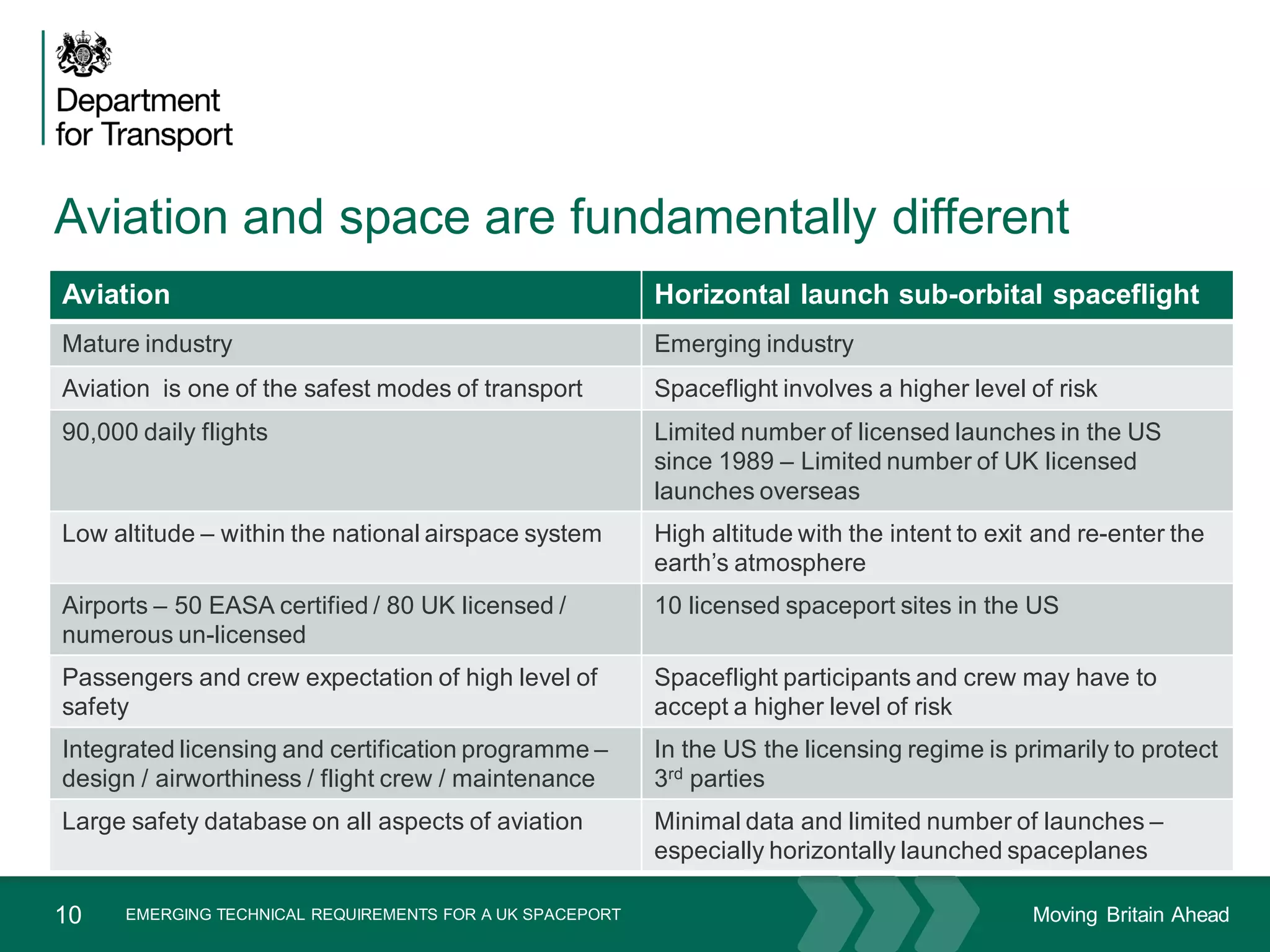
Aviation and space are fundamentally different
10
Aviation Horizontal launch sub-orbital spaceflight
Mature industry Emerging industry
Aviation is one of the safest modes of transport Spaceflight involves a higher level of risk
90,000 daily flights Limited number of licensed launches in the US
since 1989 – Limited number of UK licensed
launches overseas
Low altitude – within the national airspace system High altitude with the intent to exit and re-enter the
earth’s atmosphere
Airports – 50 EASA certified / 80 UK licensed /
numerous un-licensed
10 licensed spaceport sites in the US
Passengers and crew expectation of high level of
safety
Spaceflight participants and crew may have to
accept a higher level of risk
Integrated licensing and certification programme –
design / airworthiness / flight crew / maintenance
In the US the licensing regime is primarily to protect
3rd parties
Large safety database on all aspects of aviation Minimal data and limited number of launches –
especially horizontally launched spaceplanes
November 15
EMERGING TECHNICAL REQUIREMENTS FOR A UK SPACEPORT
Moving Britain Ahead
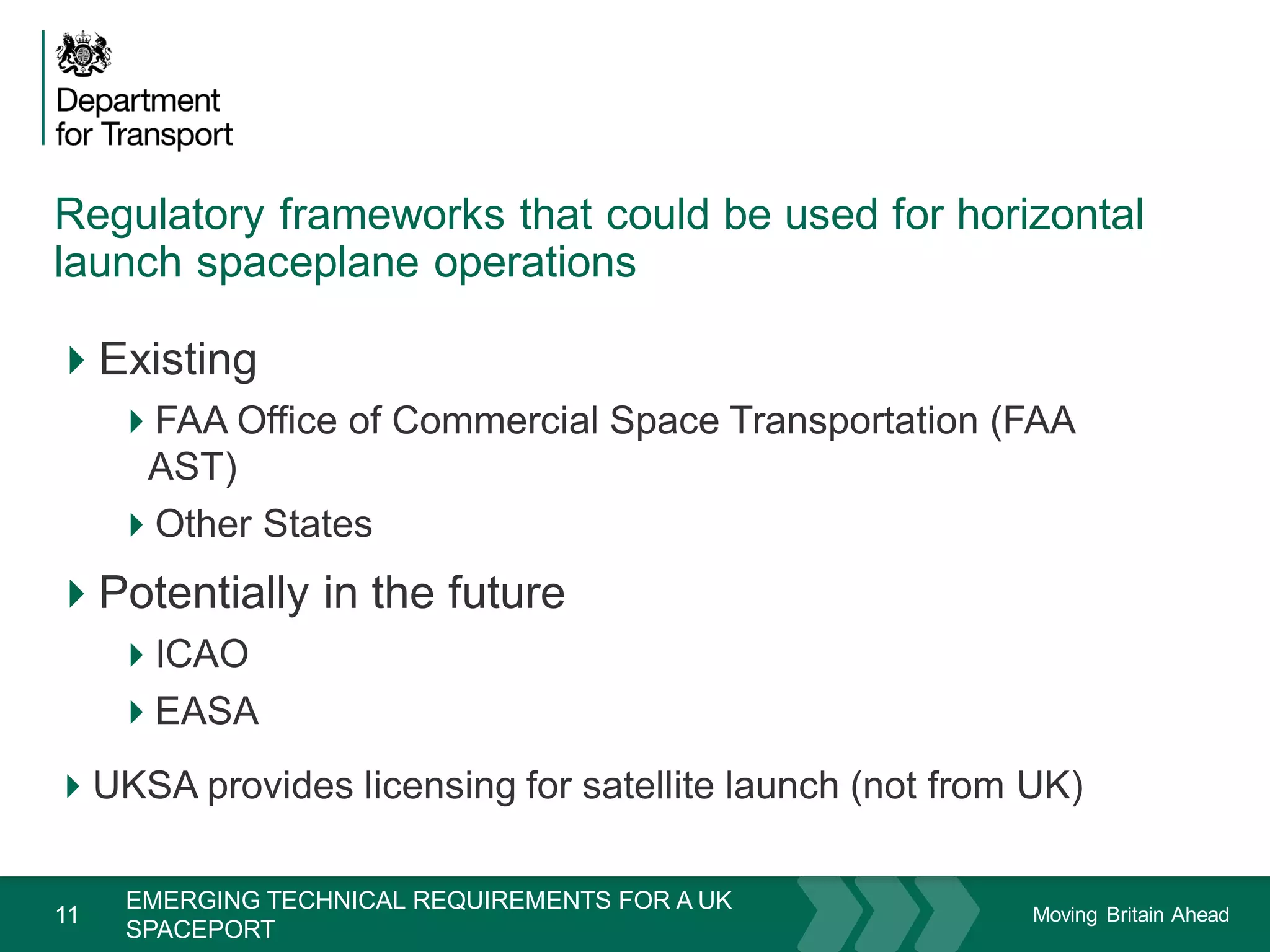
Regulatory frameworks that could be used for horizontal
launch spaceplane operations
11
Existing
FAA Office of Commercial Space Transportation (FAA
AST)
Other States
Potentially in the future
ICAO
EASA
UKSA provides licensing for satellite launch (not from UK)
November 15
EMERGING TECHNICAL REQUIREMENTS FOR A UK
SPACEPORT
Moving Britain Ahead
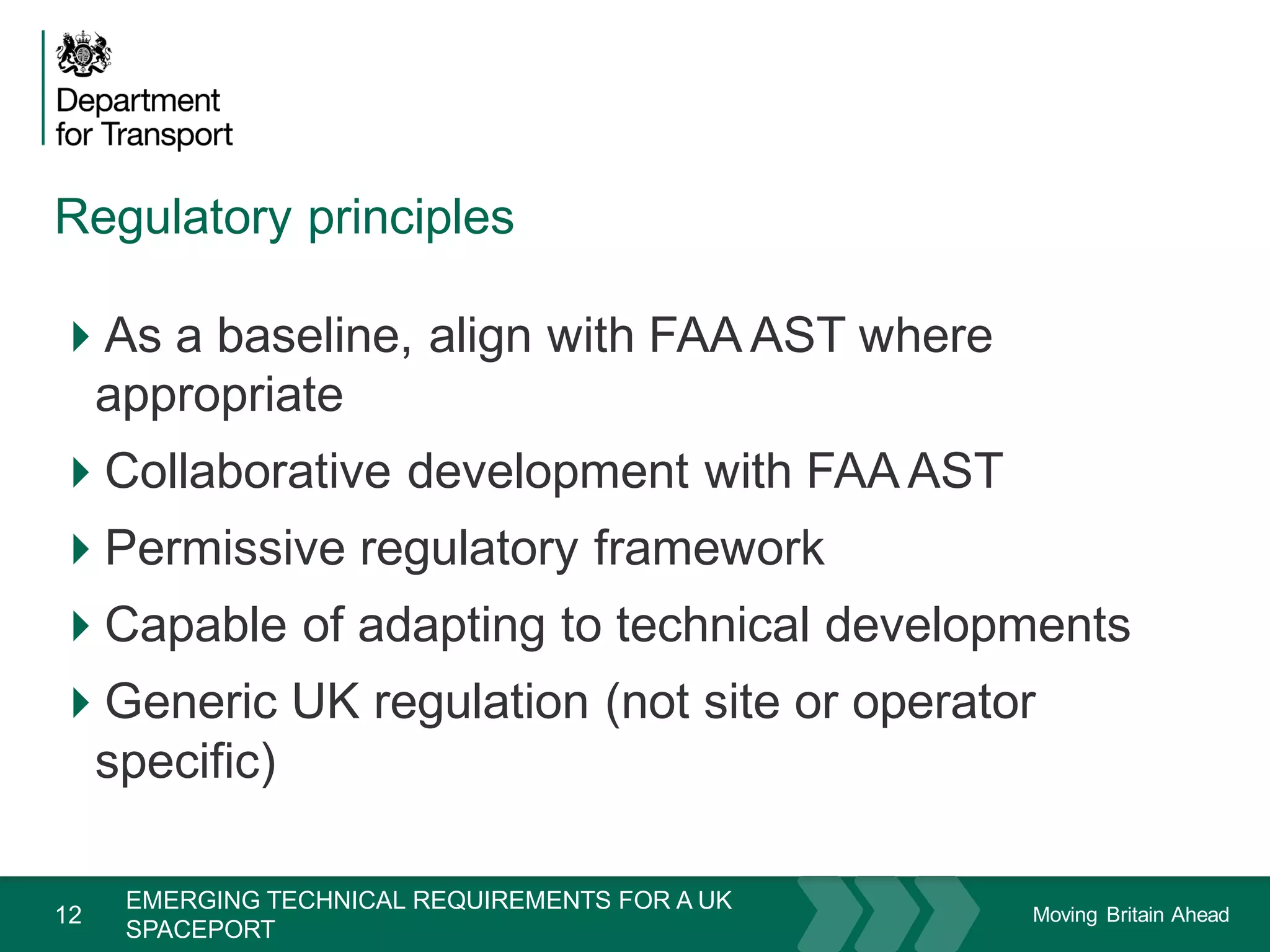
Regulatory principles
12
As a baseline, align with FAA AST where
appropriate
Collaborative development with FAA AST
Permissive regulatory framework
Capable of adapting to technical developments
Generic UK regulation (not site or operator
specific)
November 15
EMERGING TECHNICAL REQUIREMENTS FOR A UK
SPACEPORT
Moving Britain Ahead
FAA AST
13
Pros
Established framework
US Spaceplane operators familiar
Established a good working relationship with FAA AST
Cons
Initially developed for vertical launch
Different concept to commercial aviation regulatory
approach
Different legal system
November 15
EMERGING TECHNICAL REQUIREMENTS FOR A UK
SPACEPORT
Moving Britain Ahead
FAA AST – different approach
14
Spaceplane operations are licensed rather than
vehicle certification
Vehicles classified as suborbital launch vehicles
rather than aircraft
Primarily to protect uninvolved general public
Part 400 series
Part 420 – Licence to operate a launch site
Part 431 – Launch and reentry of a reusable launch vehicle
Part 433 – Licence to operate a reentry site
Part 437 – Experimental permits
November 15
EMERGING TECHNICAL REQUIREMENTS FOR A UK
SPACEPORT
Moving Britain Ahead
FAA AST – Who needs an FAAAST licence?
15
A citizen of the United States must obtain a
licence:
To launch a launch vehicle outside the United States
To re-enter a re-entry vehicle outside of the United
States
To operate a launch site outside of the United States
November 15
EMERGING TECHNICAL REQUIREMENTS FOR A UK
SPACEPORT
Moving Britain Ahead
Development of a technical specification for a spaceport
16
Current EASA certification or UK licensing
requirements
FAA AST requirements in Part 420 – Licence to
operate a launch site
Known facilities and operational requirements of
spaceplane operators
November 15
EMERGING TECHNICAL REQUIREMENTS FOR A UK
SPACEPORT
Moving Britain Ahead
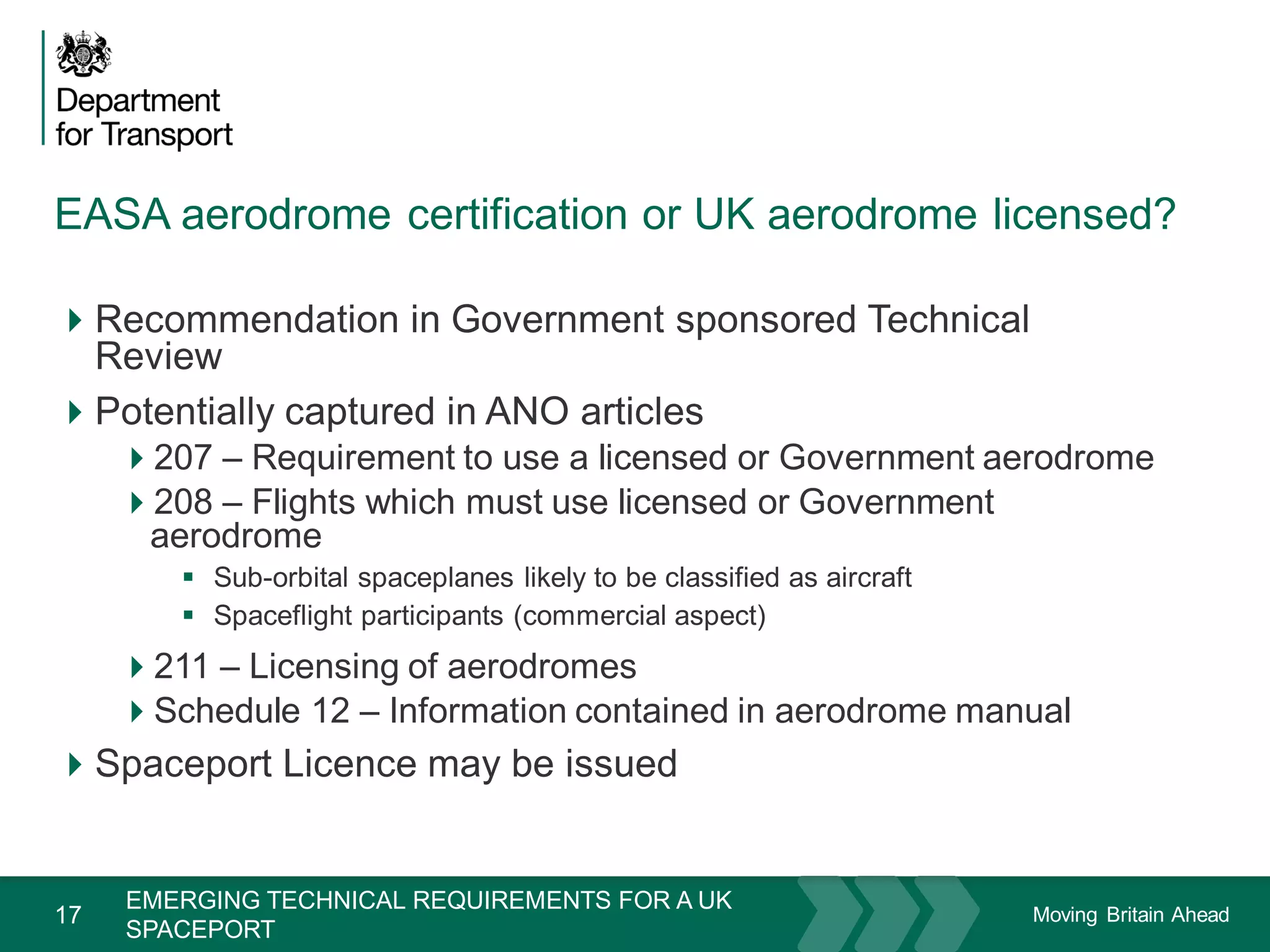
EASA aerodrome certification or UK aerodrome licensed?
17
Recommendation in Government sponsored Technical
Review
Potentially captured in ANO articles
207 – Requirement to use a licensed or Government aerodrome
208 – Flights which must use licensed or Government
aerodrome
 Sub-orbital spaceplanes likely to be classified as aircraft
 Spaceflight participants (commercial aspect)
211 – Licensing of aerodromes
Schedule 12 – Information contained in aerodrome manual
Spaceport Licence may be issued
November 15
EMERGING TECHNICAL REQUIREMENTS FOR A UK
SPACEPORT
Moving Britain Ahead
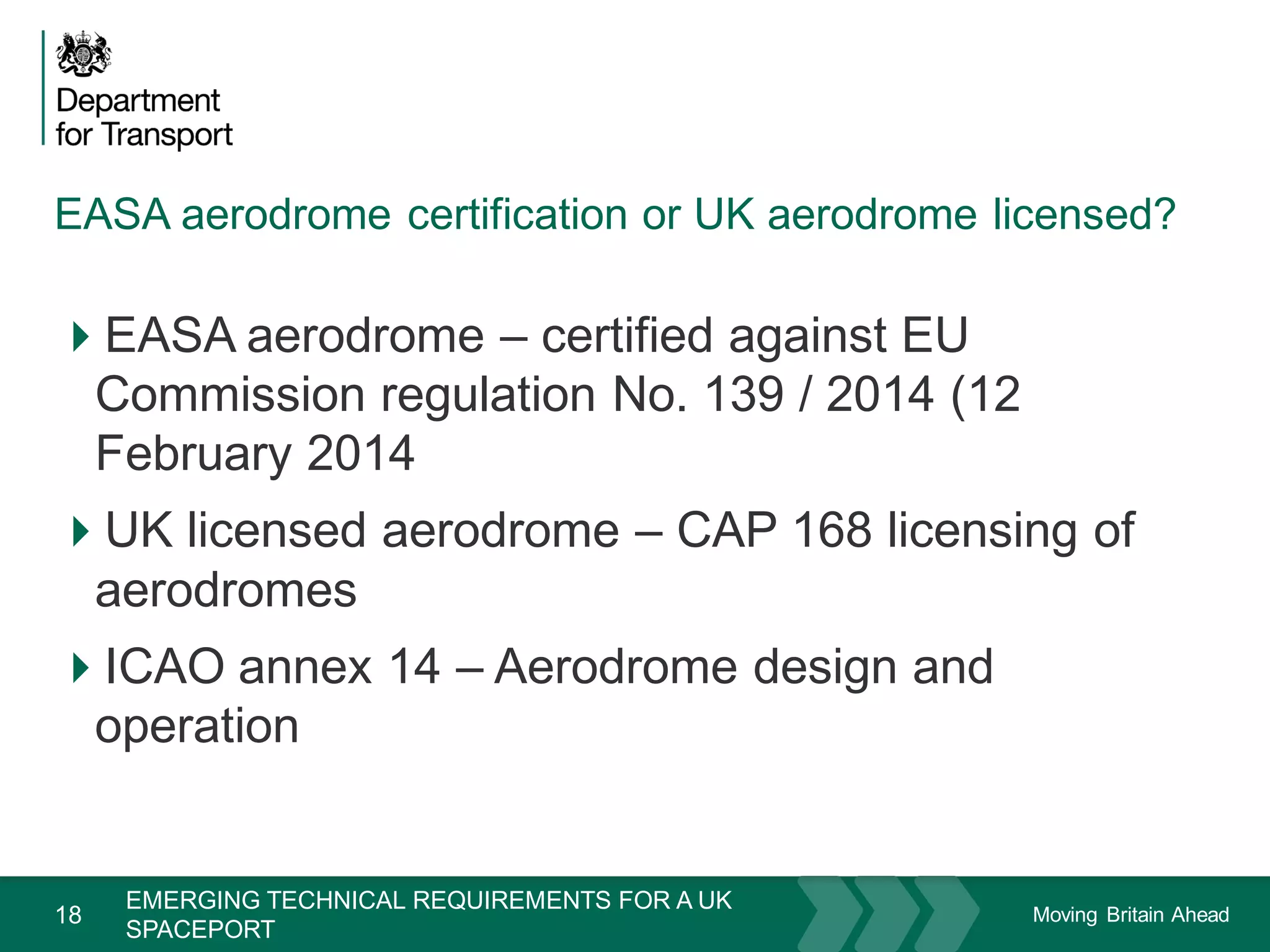
EASA aerodrome certification or UK aerodrome licensed?
18
EASA aerodrome – certified against EU
Commission regulation No. 139 / 2014 (12
February 2014
UK licensed aerodrome – CAP 168 licensing of
aerodromes
ICAO annex 14 – Aerodrome design and
operation
November 15
EMERGING TECHNICAL REQUIREMENTS FOR A UK
SPACEPORT
Moving Britain Ahead
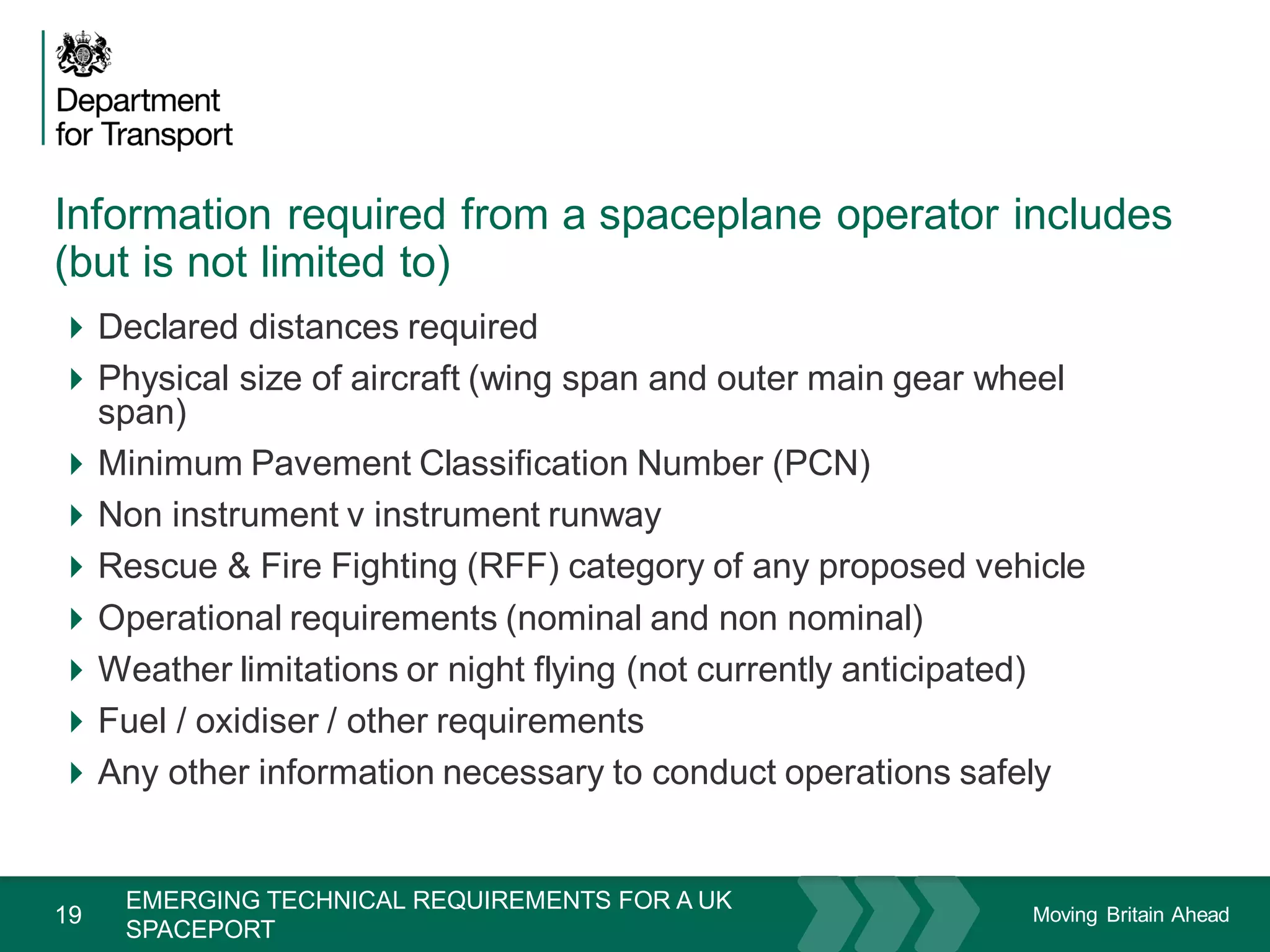
Information required from a spaceplane operator includes
(but is not limited to)
19
Declared distances required
Physical size of aircraft (wing span and outer main gear wheel
span)
Minimum Pavement Classification Number (PCN)
Non instrument v instrument runway
Rescue & Fire Fighting (RFF) category of any proposed vehicle
Operational requirements (nominal and non nominal)
Weather limitations or night flying (not currently anticipated)
Fuel / oxidiser / other requirements
Any other information necessary to conduct operations safely
November 15
EMERGING TECHNICAL REQUIREMENTS FOR A UK
SPACEPORT
Moving Britain Ahead
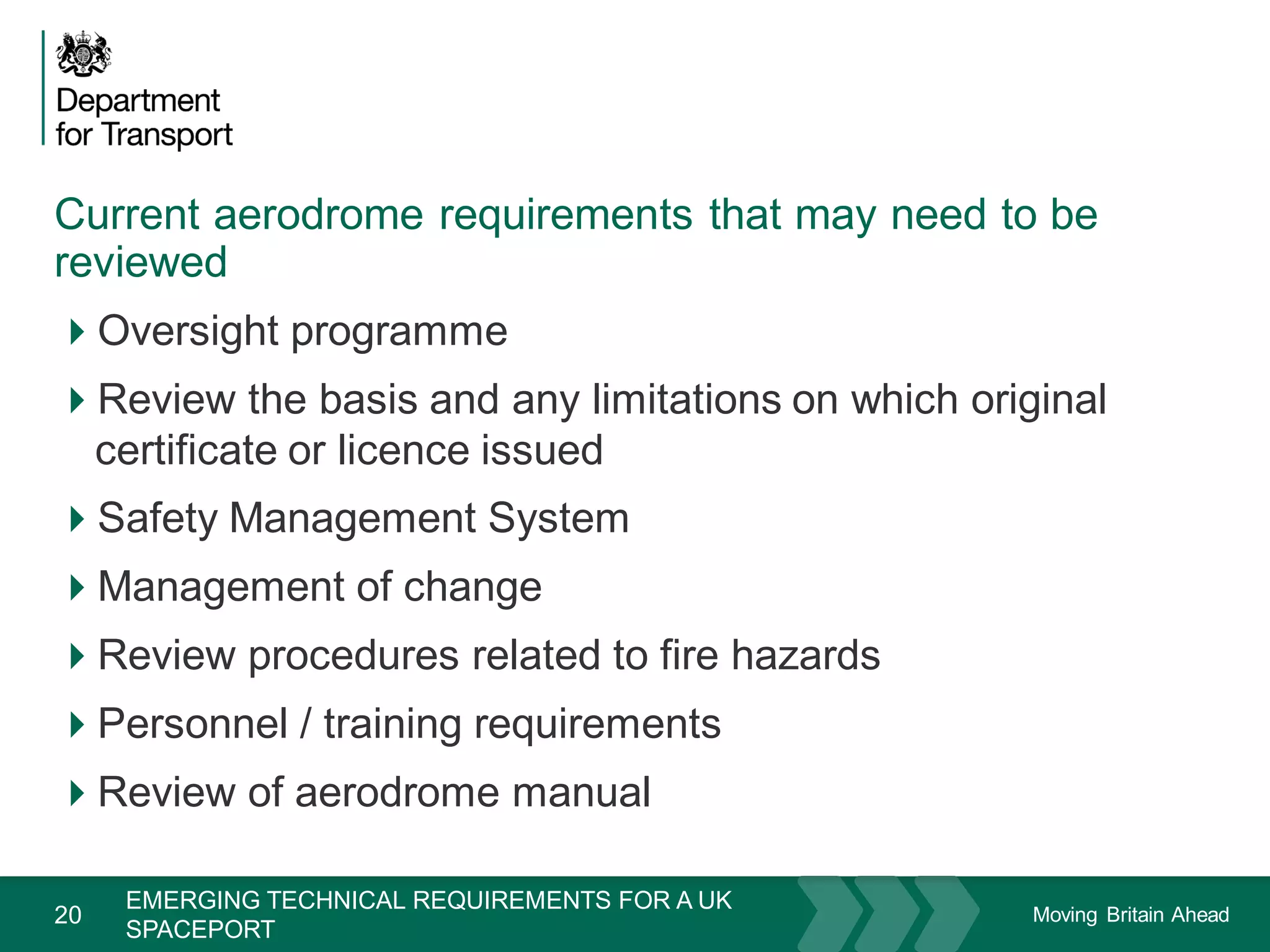
Current aerodrome requirements that may need to be
reviewed
20
Oversight programme
Review the basis and any limitations on which original
certificate or licence issued
Safety Management System
Management of change
Review procedures related to fire hazards
Personnel / training requirements
Review of aerodrome manual
November 15
EMERGING TECHNICAL REQUIREMENTS FOR A UK
SPACEPORT
Moving Britain Ahead
Current aerodrome requirements that may need to be
reviewed (continued)
21
Runway safety
Condition of the manoeuvring area
Wildlife programme
MOR and safety reporting
Security requirements
November 15
EMERGING TECHNICAL REQUIREMENTS FOR A UK
SPACEPORT
Moving Britain Ahead
Key considerations – runway physical characteristics
22
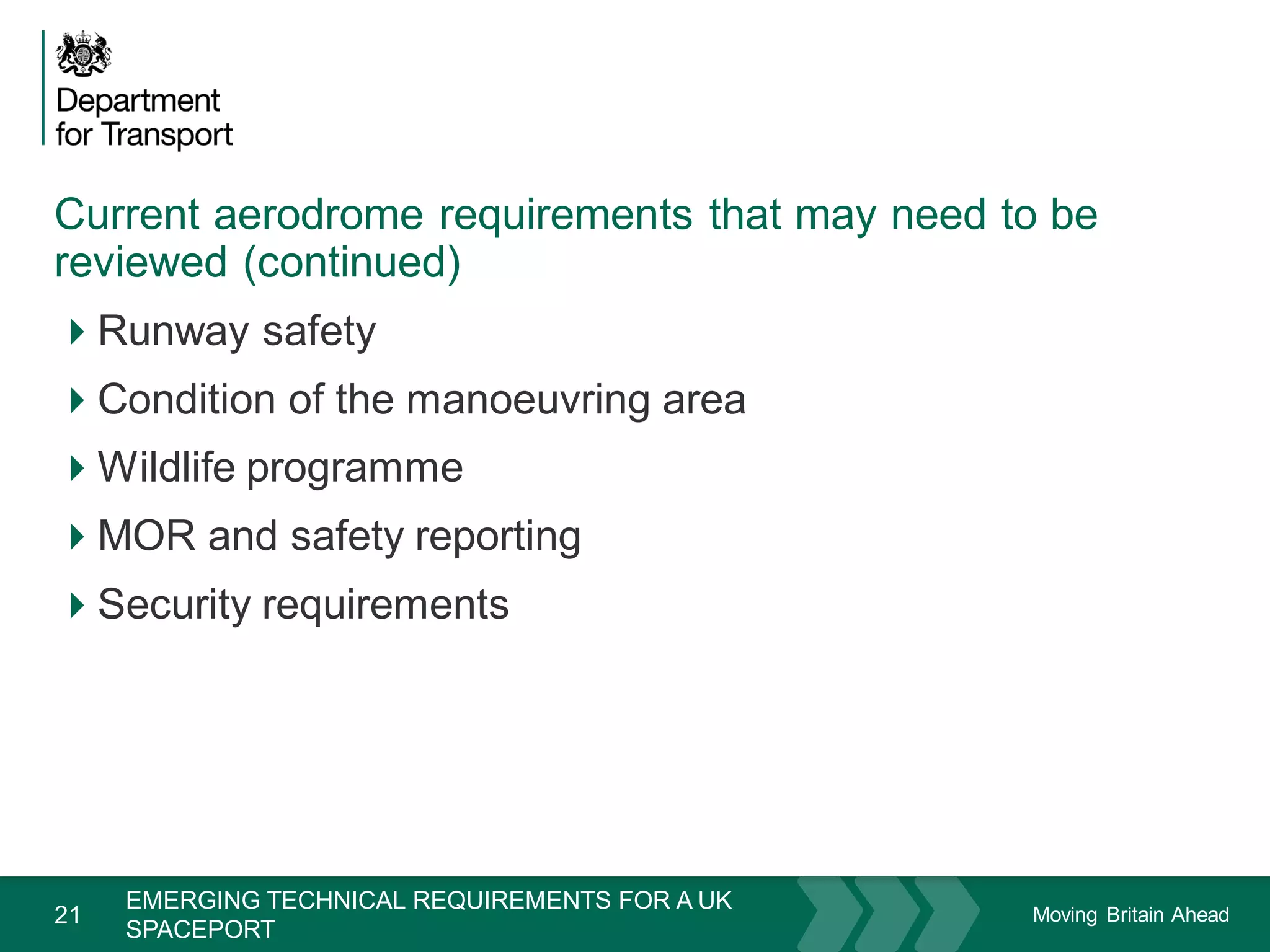
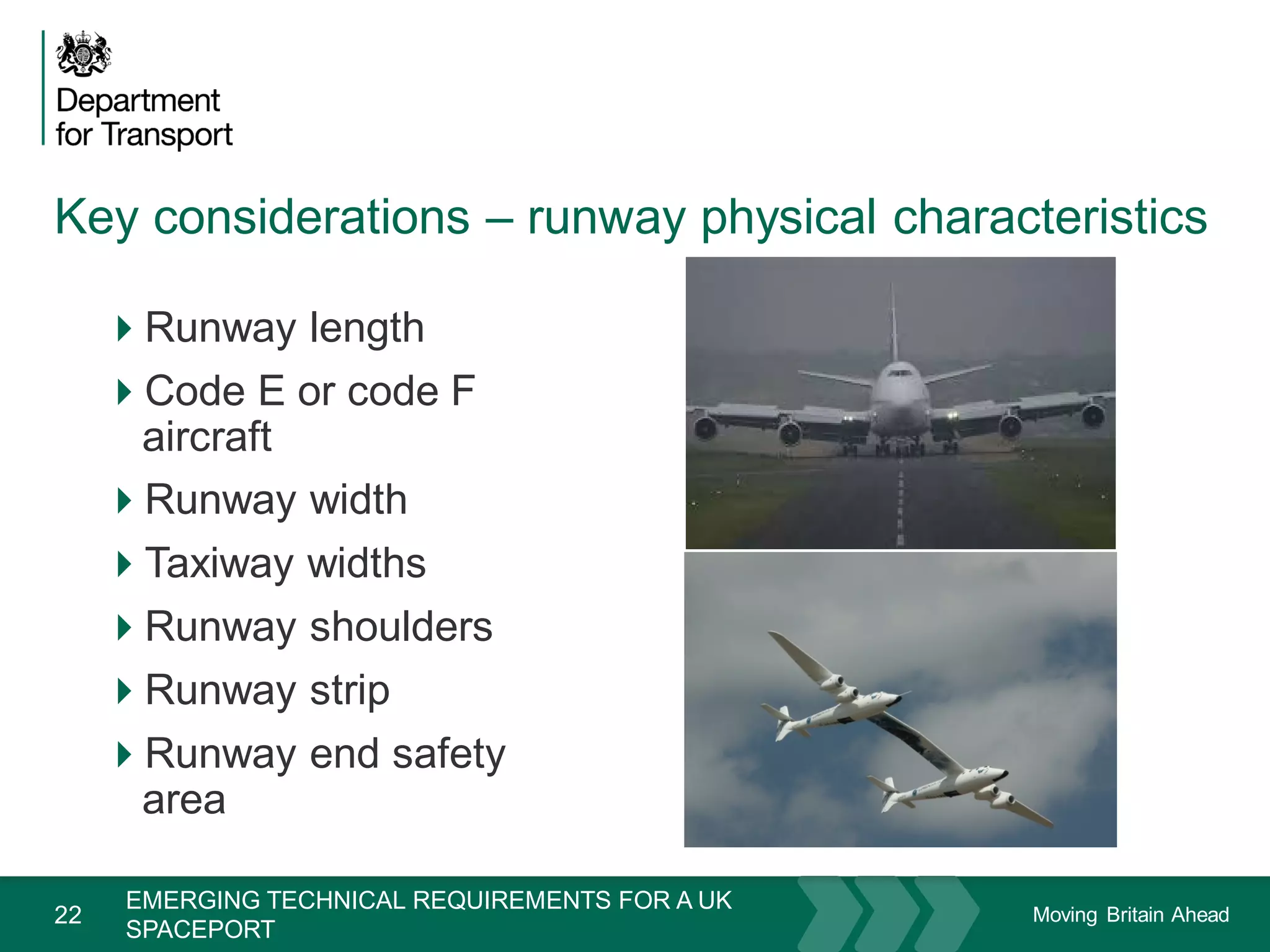
Runway length
Code E or code F
aircraft
Runway width
Taxiway widths
Runway shoulders
Runway strip
Runway end safety
area
November 15
EMERGING TECHNICAL REQUIREMENTS FOR A UK
SPACEPORT
Moving Britain Ahead
Key considerations – Runway and taxiway surfaces
23
November 15
EMERGING TECHNICAL REQUIREMENTS FOR A UK
SPACEPORT
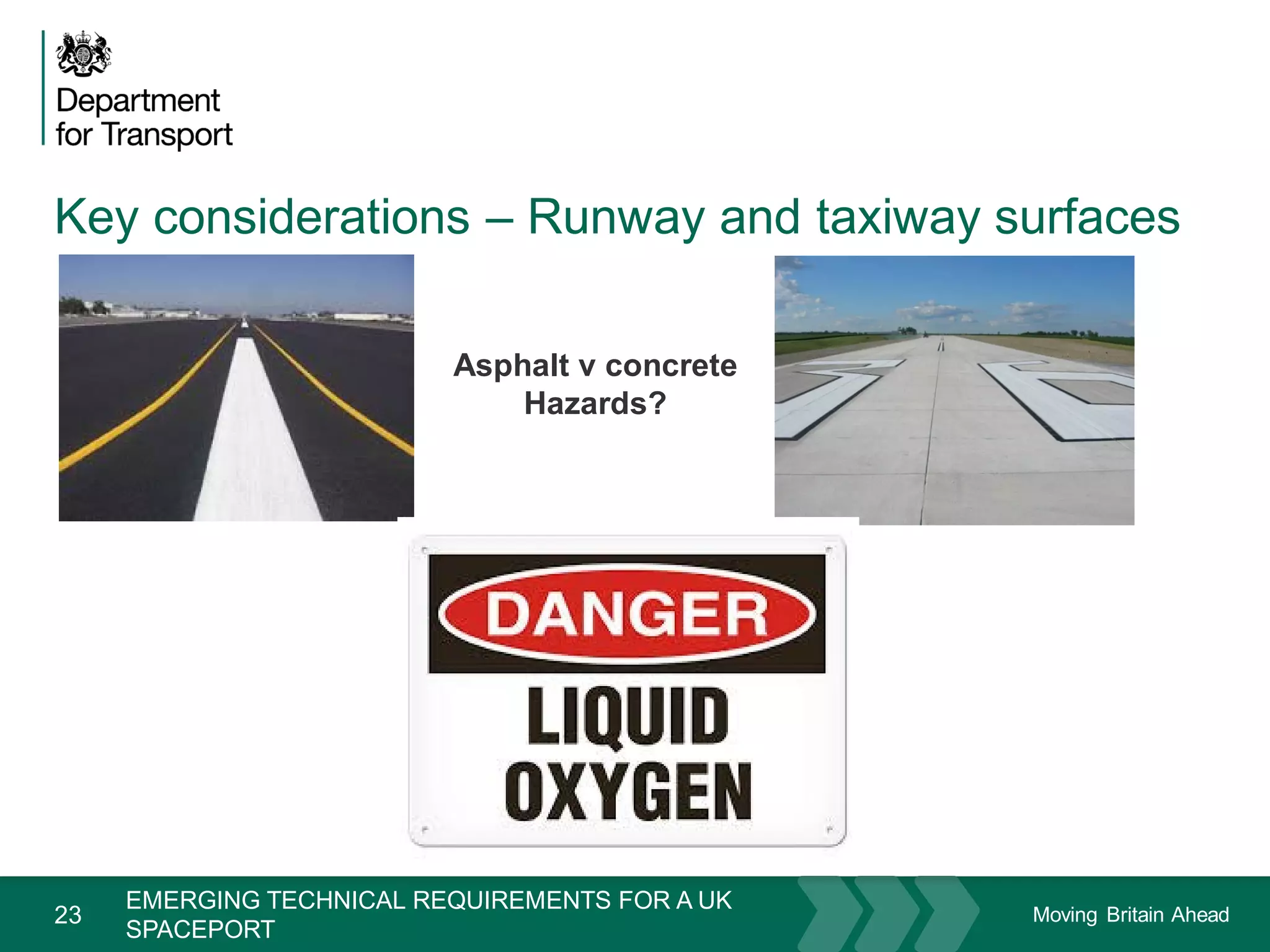
Asphalt v concrete
Hazards?
Moving Britain Ahead
Key considerations – Runway centreline lighting
24
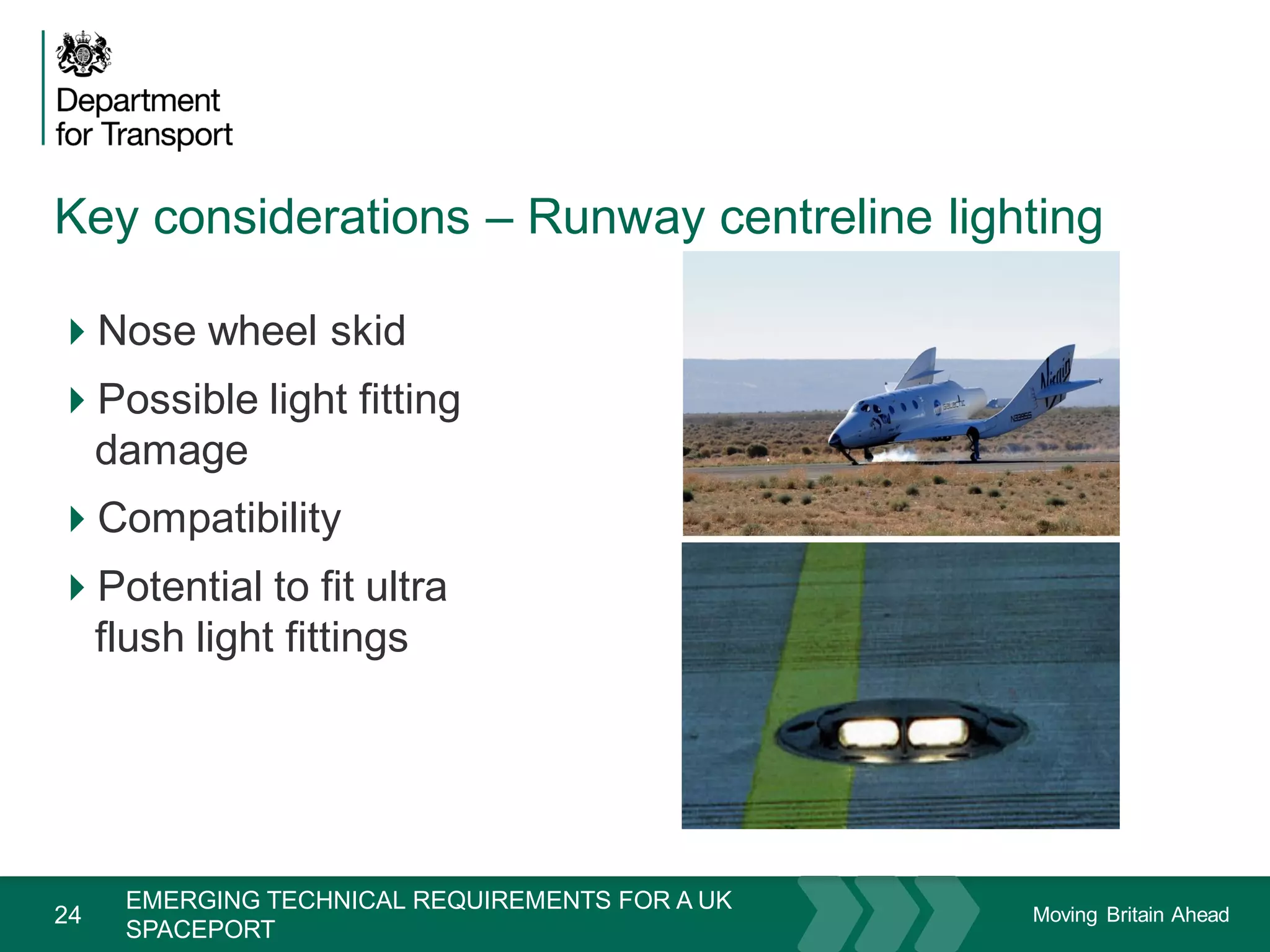
Nose wheel skid
Possible light fitting
damage
Compatibility
Potential to fit ultra
flush light fittings
November 15
EMERGING TECHNICAL REQUIREMENTS FOR A UK
SPACEPORT
Moving Britain Ahead
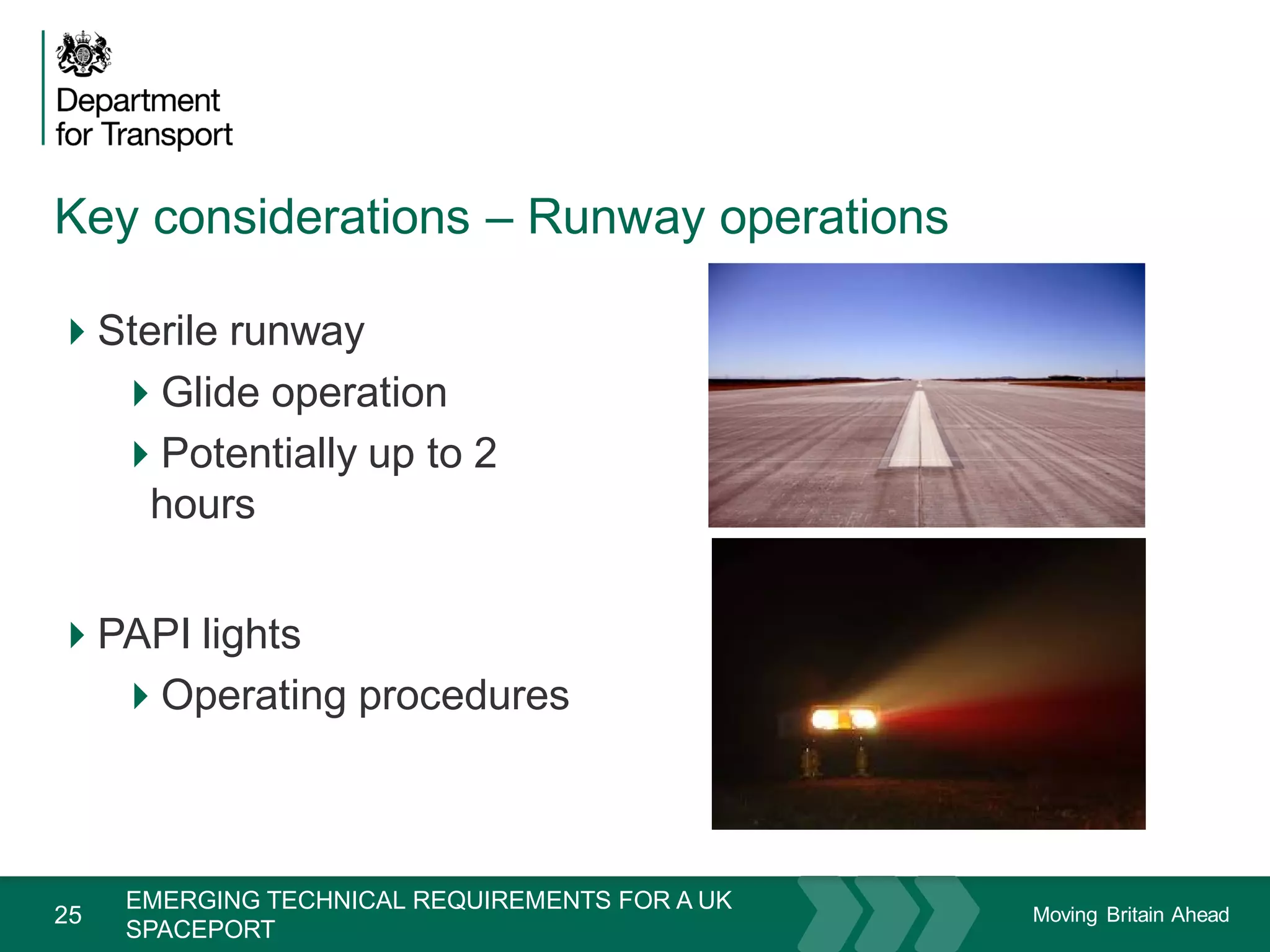
Key considerations – Runway operations
25
Sterile runway
Glide operation
Potentially up to 2
hours
PAPI lights
Operating procedures
November 15
EMERGING TECHNICAL REQUIREMENTS FOR A UK
SPACEPORT
Moving Britain Ahead
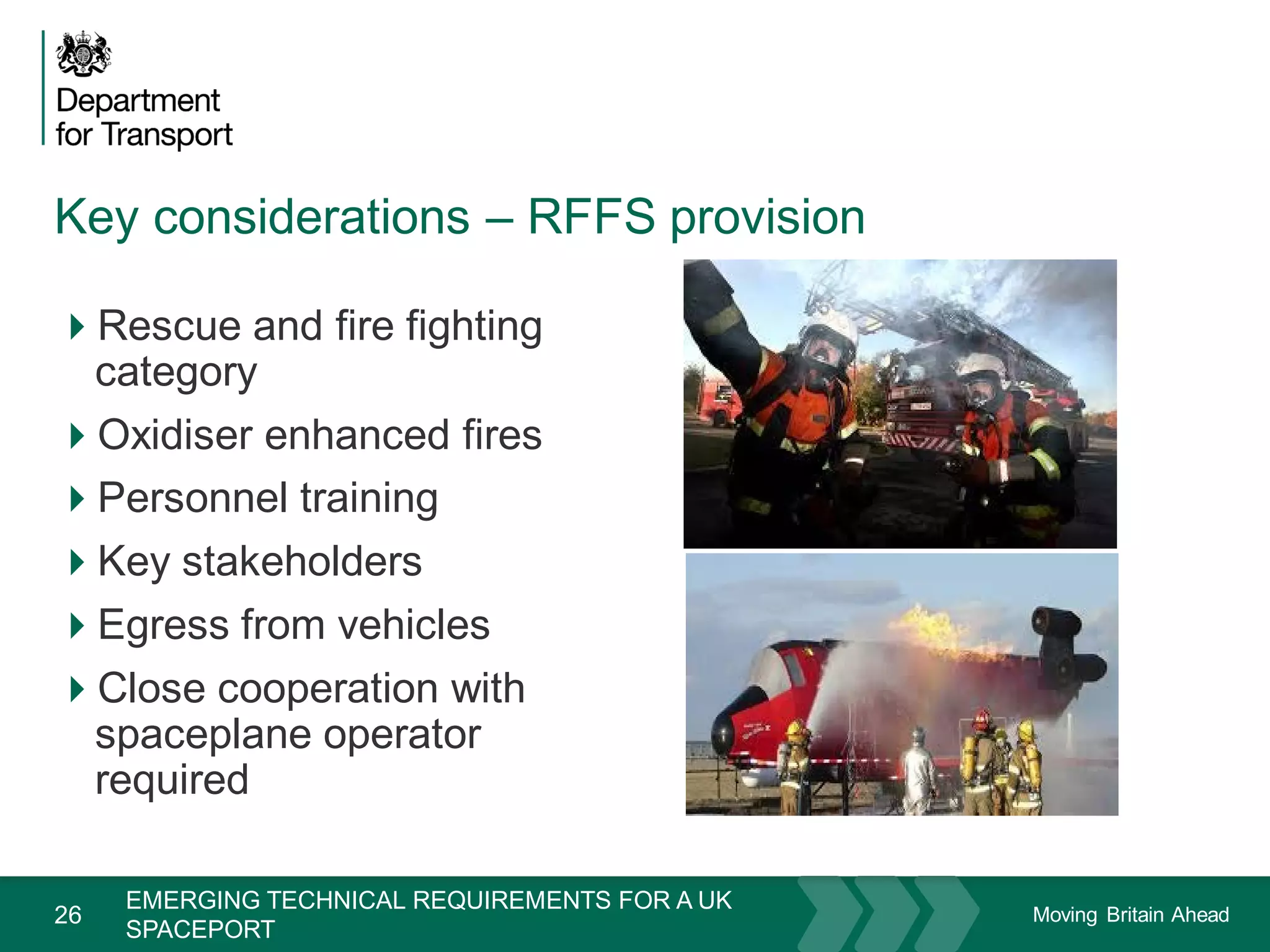
Key considerations – RFFS provision
26
Rescue and fire fighting
category
Oxidiser enhanced fires
Personnel training
Key stakeholders
Egress from vehicles
Close cooperation with
spaceplane operator
required
November 15
EMERGING TECHNICAL REQUIREMENTS FOR A UK
SPACEPORT
Moving Britain Ahead
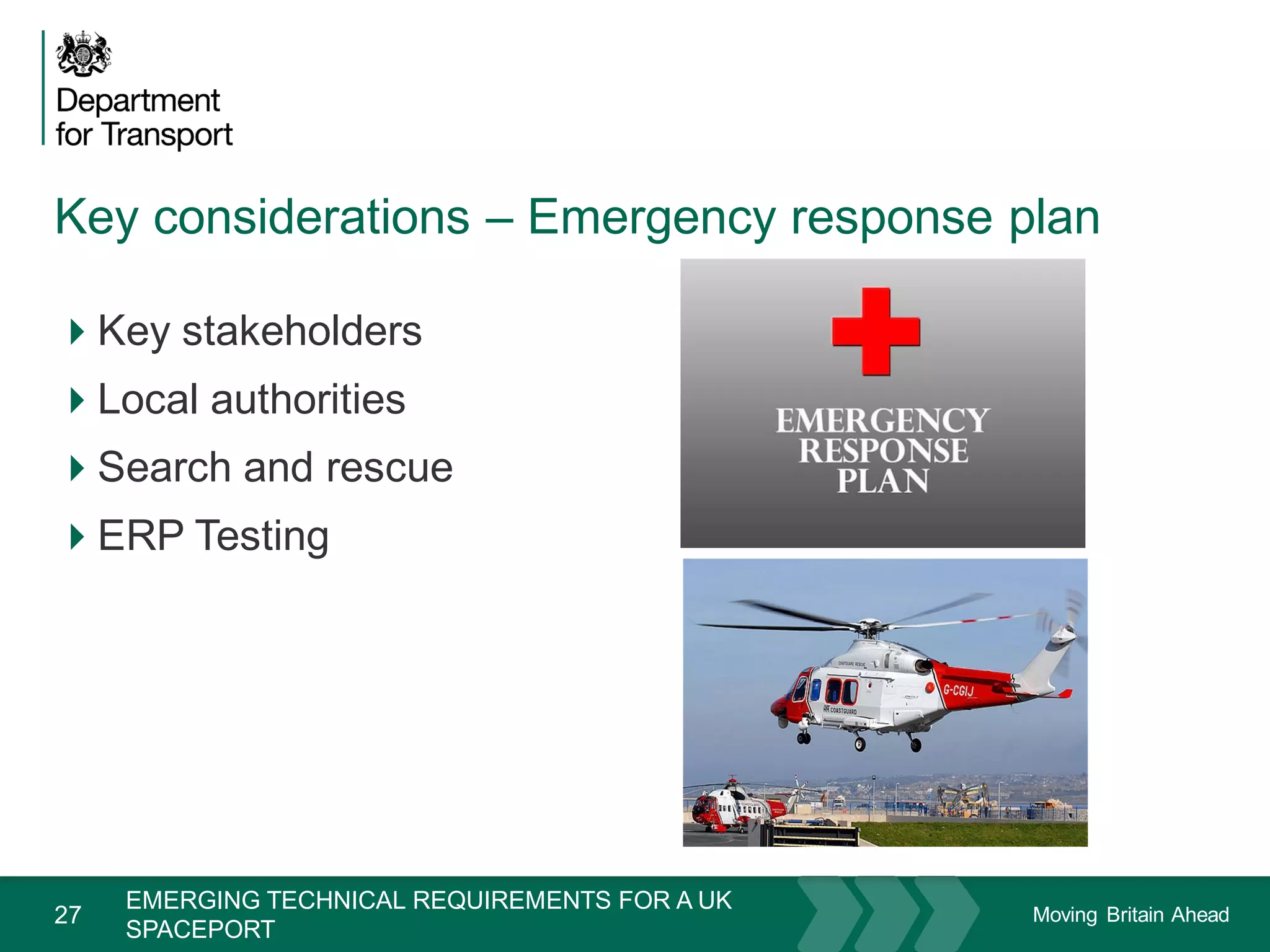
Key considerations – Emergency response plan
27
Key stakeholders
Local authorities
Search and rescue
ERP Testing
November 15
EMERGING TECHNICAL REQUIREMENTS FOR A UK
SPACEPORT
Moving Britain Ahead
Key considerations – Health and Safety Executive
28
Health & Safety
Executive
Health & Safety at Work
Act 1974
http://www.hse.gov.uk/
November 15
EMERGING TECHNICAL REQUIREMENTS FOR A UK
SPACEPORT
Moving Britain Ahead
Key considerations – weather limitations
29
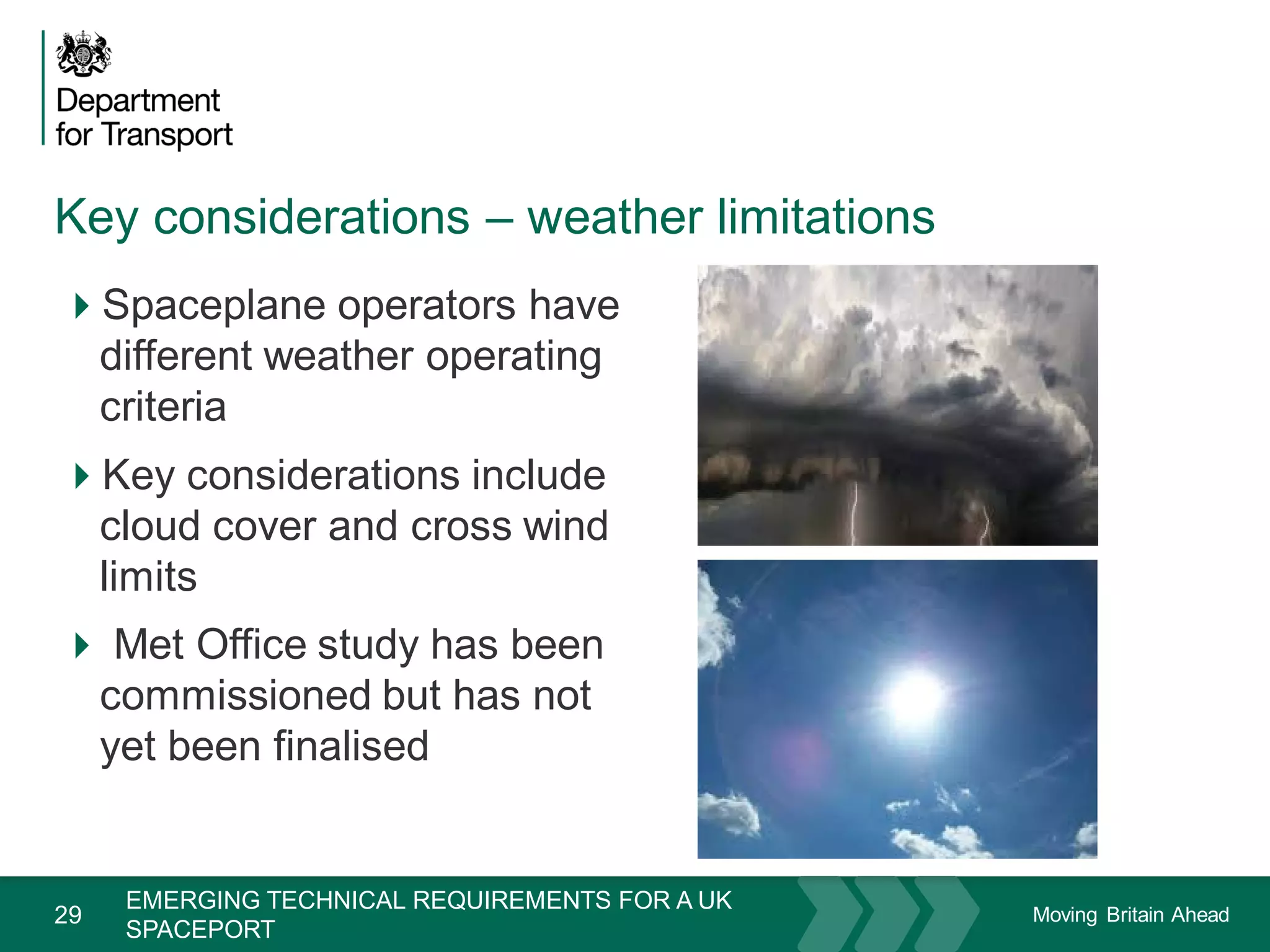
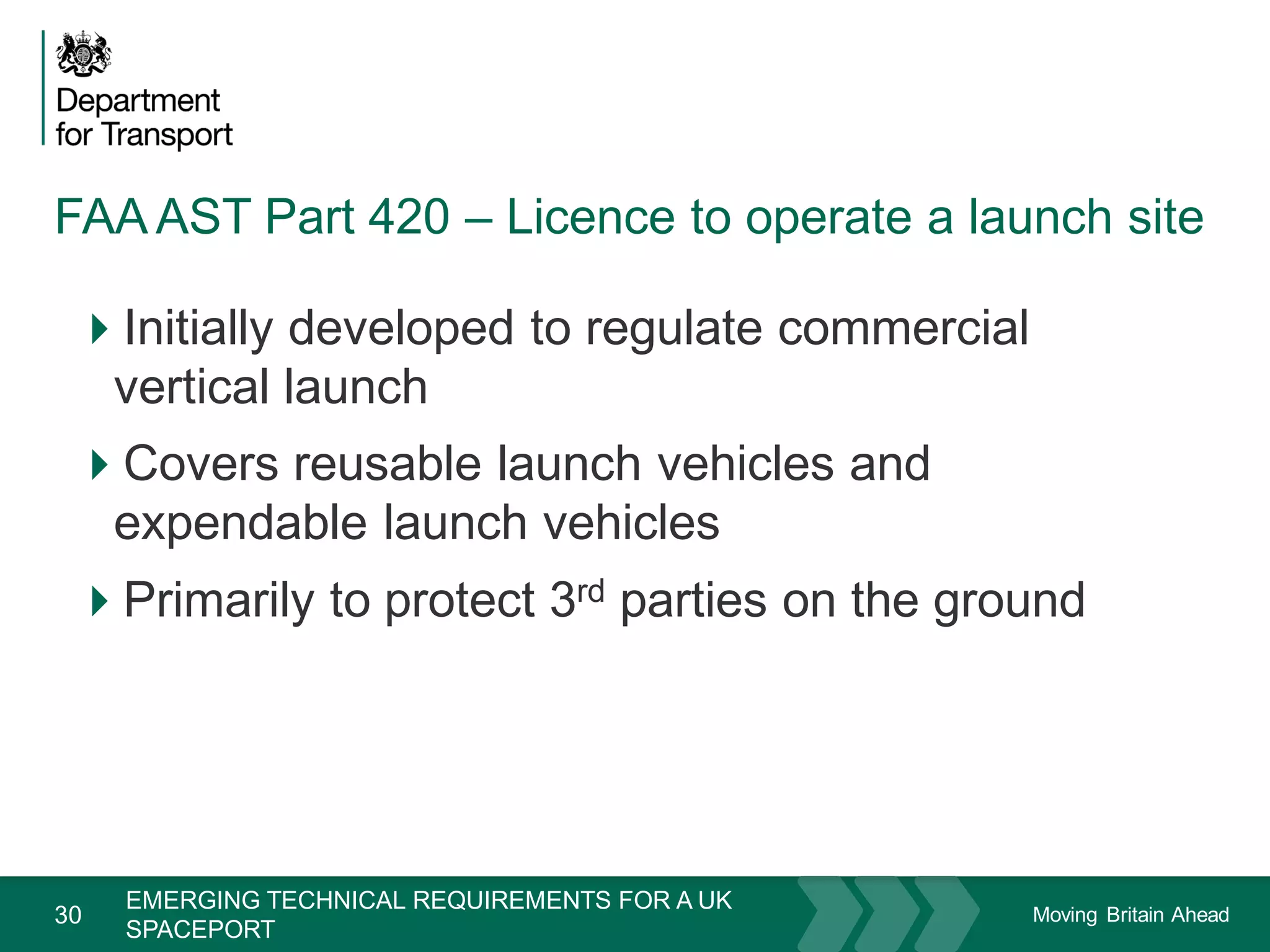
Spaceplane operators have
different weather operating
criteria
Key considerations include
cloud cover and cross wind
limits
 Met Office study has been
commissioned but has not
yet been finalised
November 15
EMERGING TECHNICAL REQUIREMENTS FOR A UK
SPACEPORT
Moving Britain Ahead
FAA AST Part 420 – Licence to operate a launch site
30
Initially developed to regulate commercial
vertical launch
Covers reusable launch vehicles and
expendable launch vehicles
Primarily to protect 3rd parties on the ground
EMERGING TECHNICAL REQUIREMENTS FOR A UK
SPACEPORT
November 15
Moving Britain Ahead
FAA AST Part 420 – Licence to operate a launch site
31
Part 420 includes:
Launch site location review
Site hazard analysis
Agreements with US Coast Guard and National Air Traffic
Licence terms and conditions
Control of public areas
Scheduling of launch operations
Notifications
Accident investigation plan
Records
Explosive siting
EMERGING TECHNICAL REQUIREMENTS FOR A UK
SPACEPORT
November 15
Moving Britain Ahead
FAA AST Part 420 – Launch site location review
32
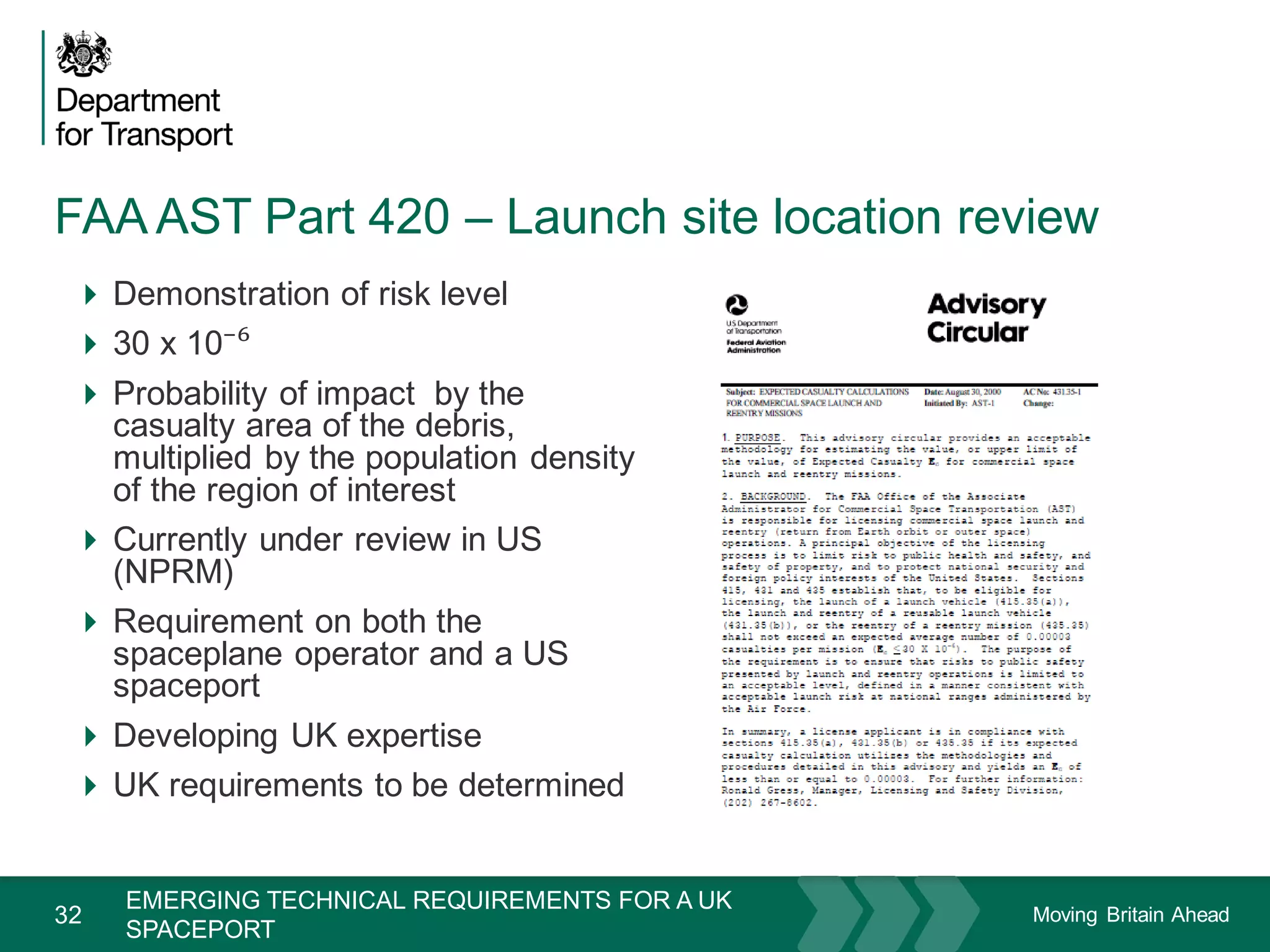
 Demonstration of risk level
 30 x 10⁻⁶
 Probability of impact by the
casualty area of the debris,
multiplied by the population density
of the region of interest
 Currently under review in US
(NPRM)
 Requirement on both the
spaceplane operator and a US
spaceport
 Developing UK expertise
 UK requirements to be determined November 15
EMERGING TECHNICAL REQUIREMENTS FOR A UK
SPACEPORT
Moving Britain Ahead
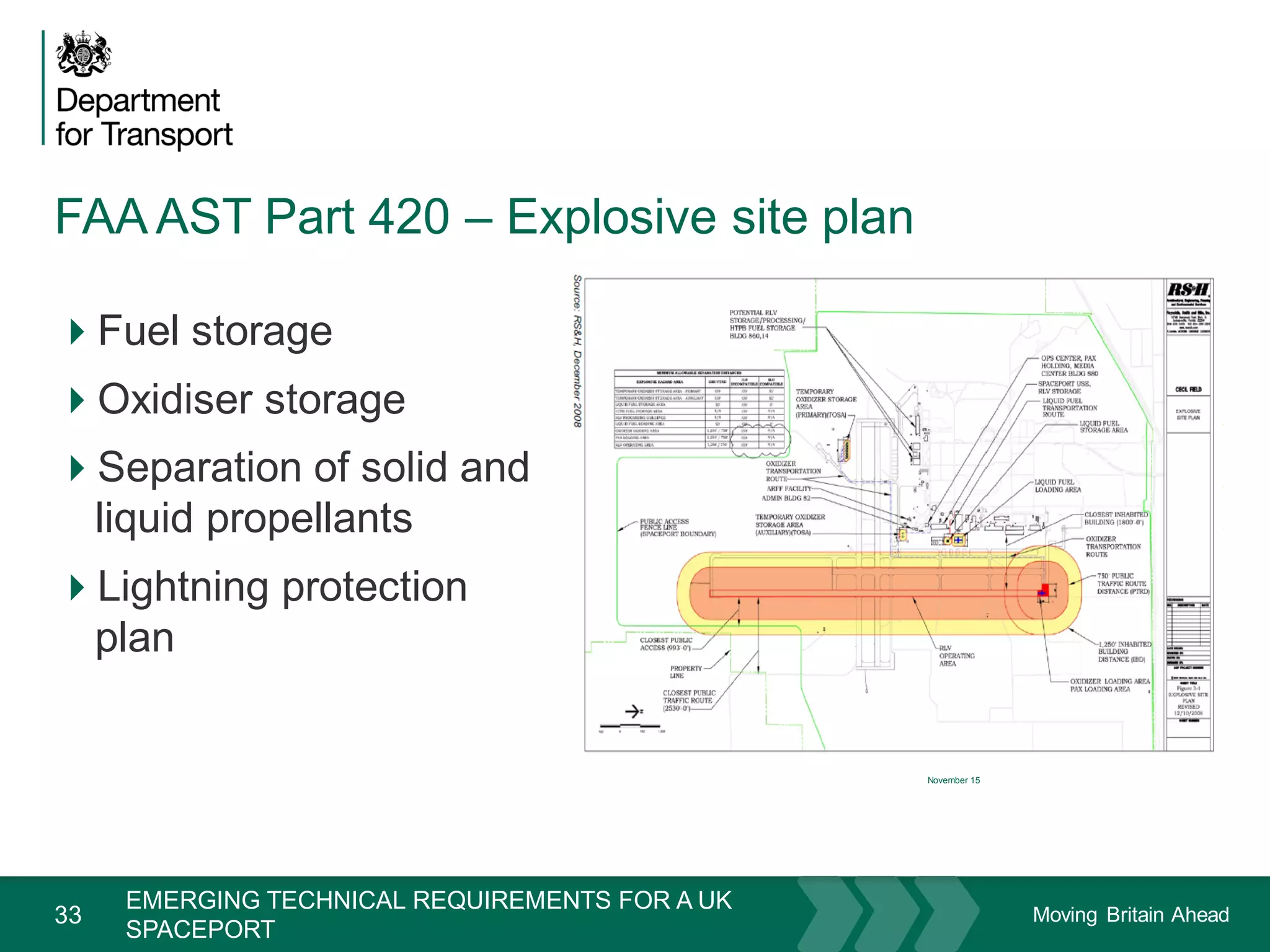
FAA AST Part 420 – Explosive site plan
33
Fuel storage
Oxidiser storage
Separation of solid and
liquid propellants
Lightning protection
plan
November 15
EMERGING TECHNICAL REQUIREMENTS FOR A UK
SPACEPORT
Moving Britain Ahead
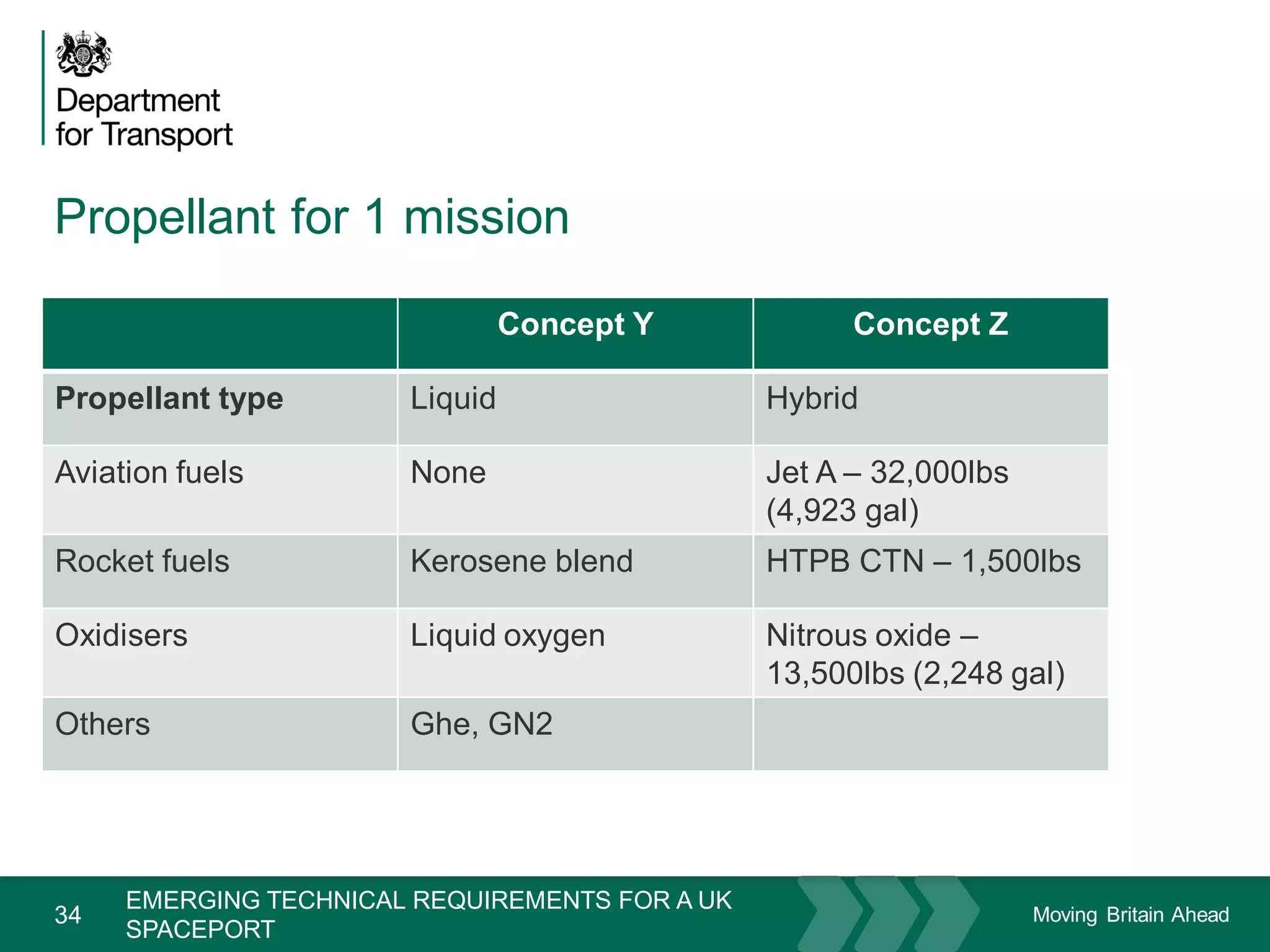
Propellant for 1 mission
34
Concept Y Concept Z
Propellant type Liquid Hybrid
Aviation fuels None Jet A – 32,000lbs
(4,923 gal)
Rocket fuels Kerosene blend HTPB CTN – 1,500lbs
Oxidisers Liquid oxygen Nitrous oxide –
13,500lbs (2,248 gal)
Others Ghe, GN2
EMERGING TECHNICAL REQUIREMENTS FOR A UK
SPACEPORT
Moving Britain Ahead
FAA AST Part 420 – Separation distances
35
Inhabited building distance – minimum distance
between a loaded vehicle and any inhabited building
Public traffic route distance – minimum distance
between a loaded vehicle and public road or railway
Intraline distance – minimum distance between two
explosive related buildings or sites
Consulting with HSE to review current UK
requirements
EMERGING TECHNICAL REQUIREMENTS FOR A UK
SPACEPORT
Moving Britain Ahead
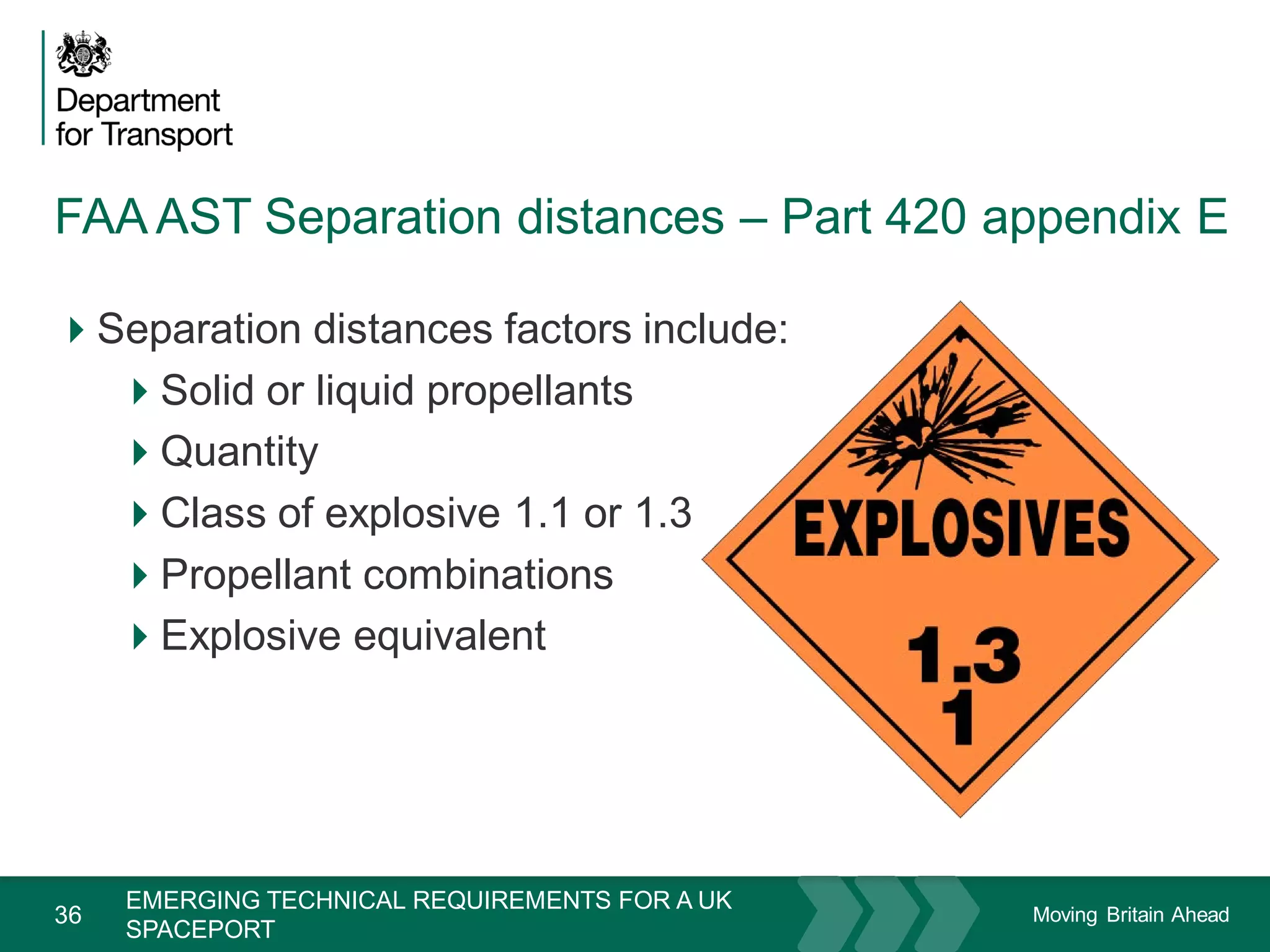
FAA AST Separation distances – Part 420 appendix E
36
November 15
EMERGING TECHNICAL REQUIREMENTS FOR A UK
SPACEPORT
Separation distances factors include:
Solid or liquid propellants
Quantity
Class of explosive 1.1 or 1.3
Propellant combinations
Explosive equivalent
Moving Britain Ahead
Spaceplane operator facilities (potential)
37
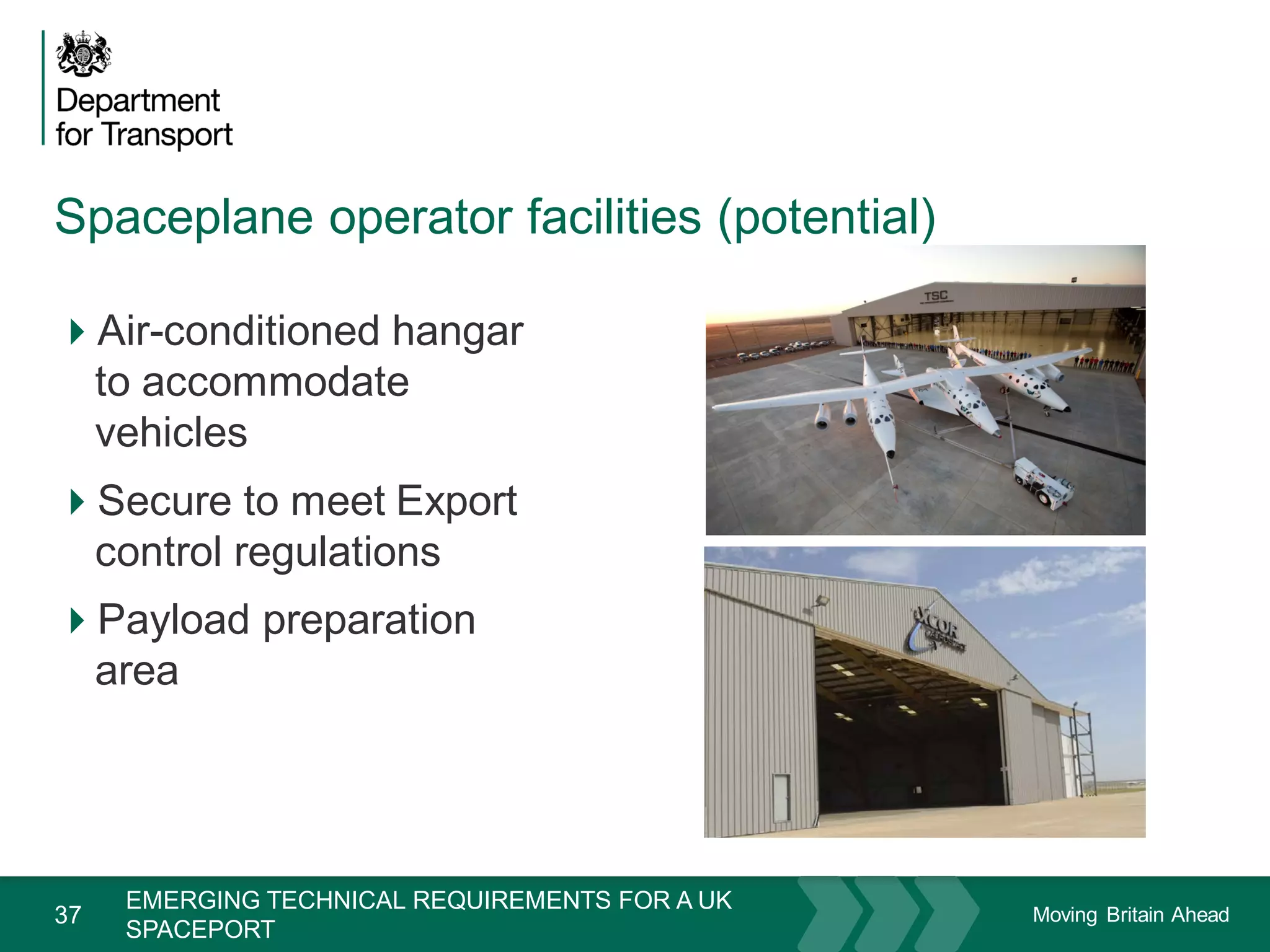
Air-conditioned hangar
to accommodate
vehicles
Secure to meet Export
control regulations
Payload preparation
area
November 15
EMERGING TECHNICAL REQUIREMENTS FOR A UK
SPACEPORT
Moving Britain Ahead
Spaceplane operator facilities (potential)
38
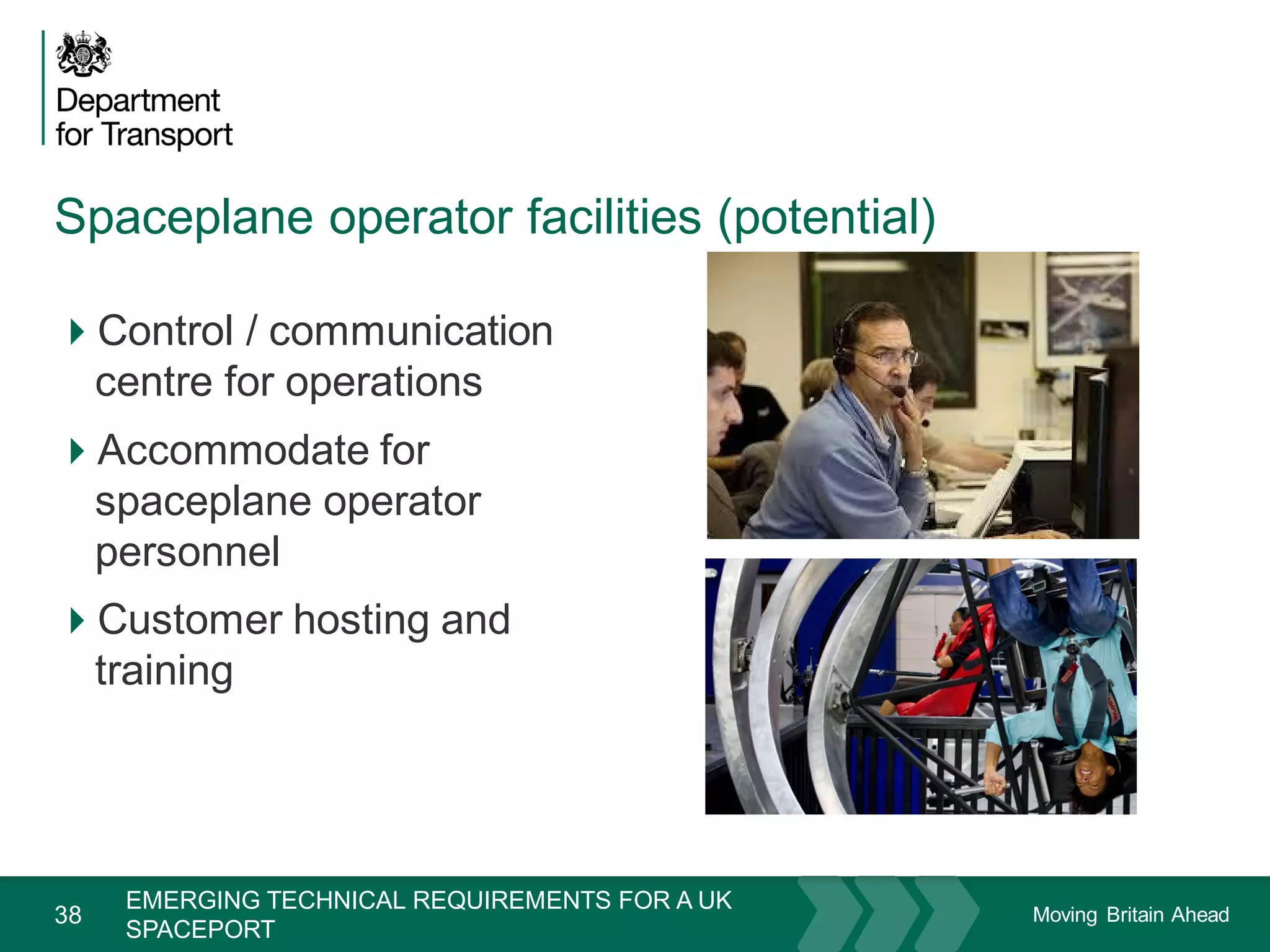
Control / communication
centre for operations
Accommodate for
spaceplane operator
personnel
Customer hosting and
training
November 15
EMERGING TECHNICAL REQUIREMENTS FOR A UK
SPACEPORT
Moving Britain Ahead
Airspace and Air Traffic Management
39
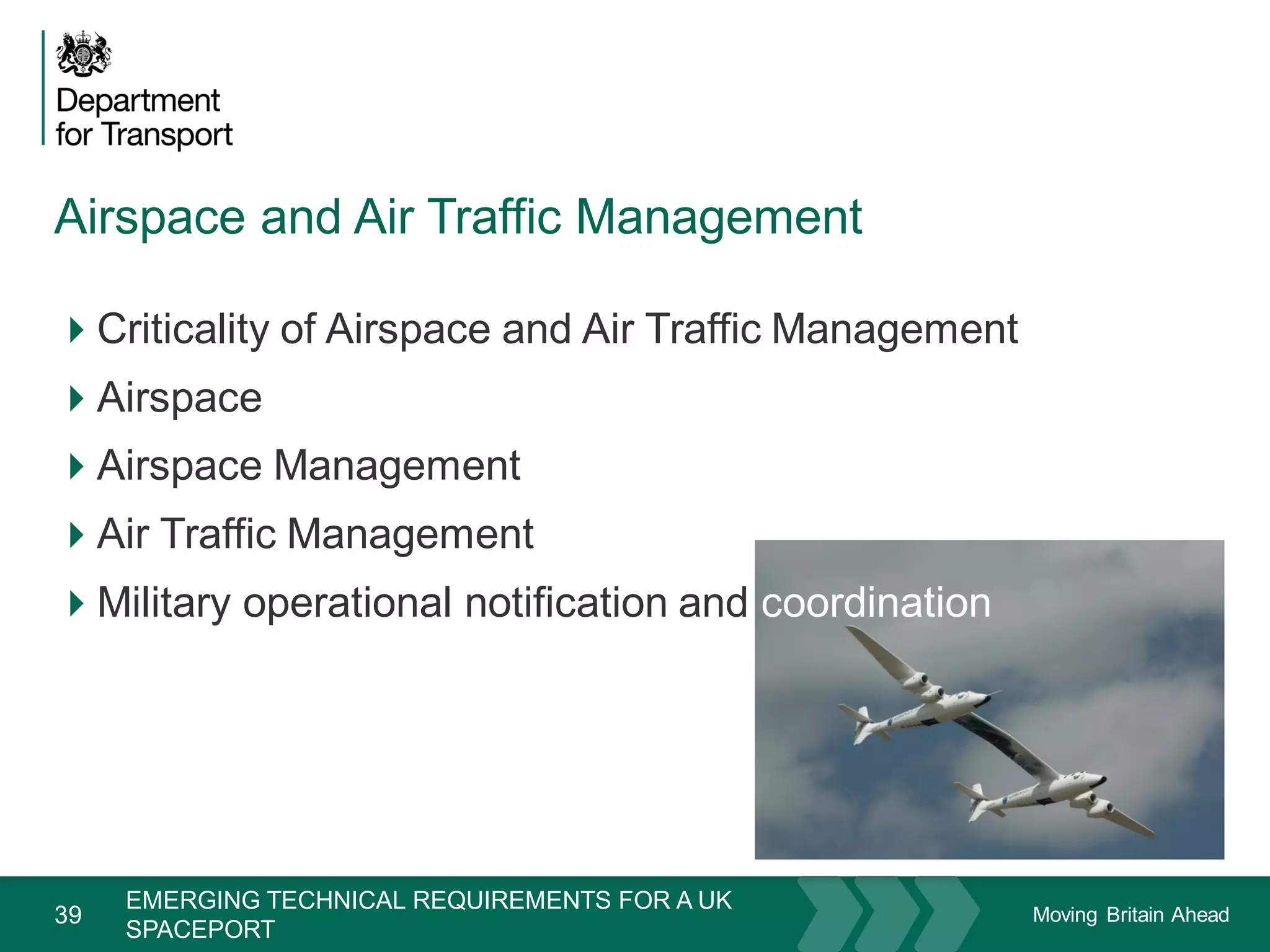
Criticality of Airspace and Air Traffic Management
Airspace
Airspace Management
Air Traffic Management
Military operational notification and coordination
November 15
EMERGING TECHNICAL REQUIREMENTS FOR A UK
SPACEPORT
Moving Britain Ahead
Criticality of Airspace and Air Traffic Management
40
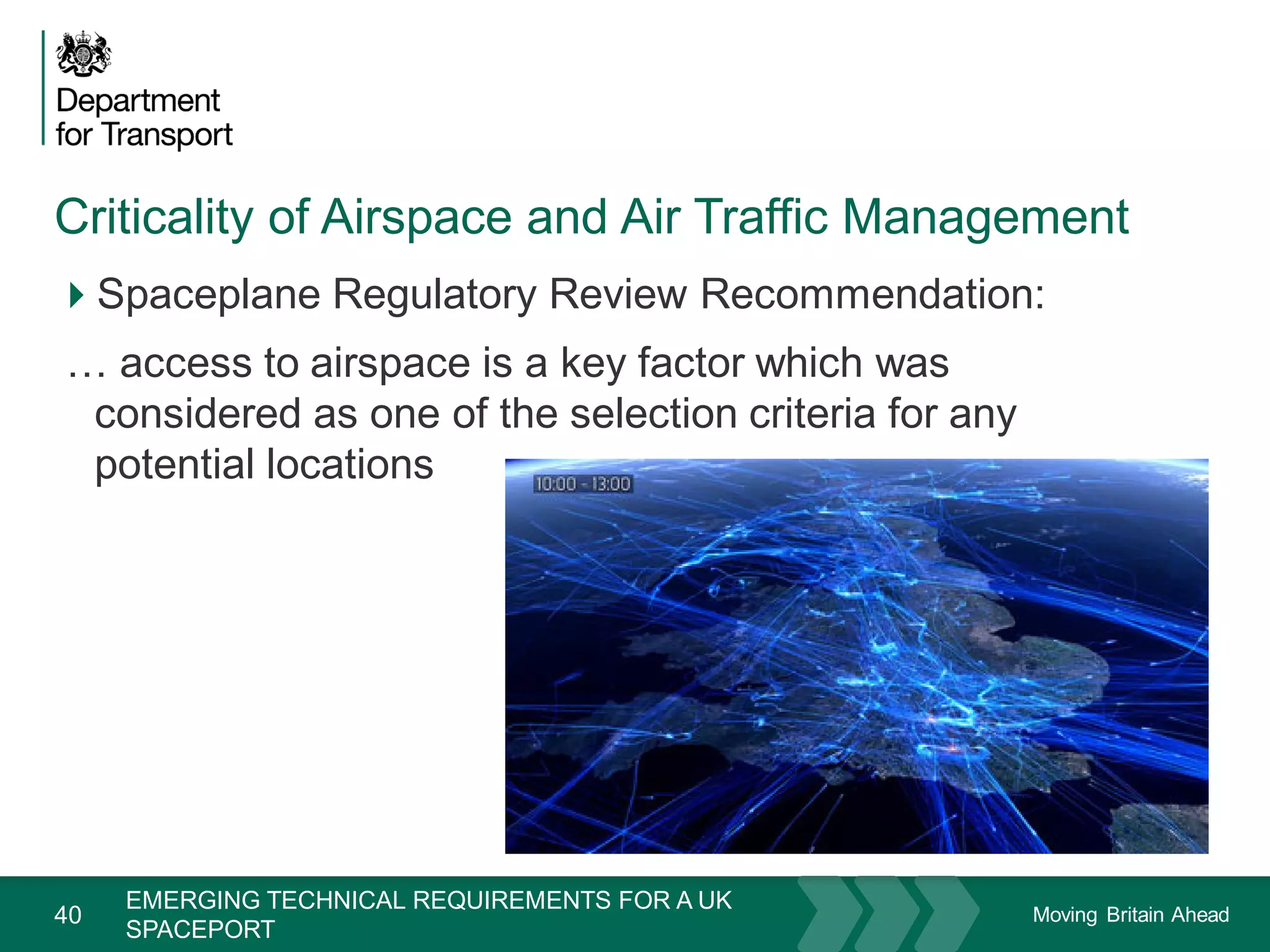
Spaceplane Regulatory Review Recommendation:
… access to airspace is a key factor which was
considered as one of the selection criteria for any
potential locations
November 15
EMERGING TECHNICAL REQUIREMENTS FOR A UK
SPACEPORT
Moving Britain Ahead
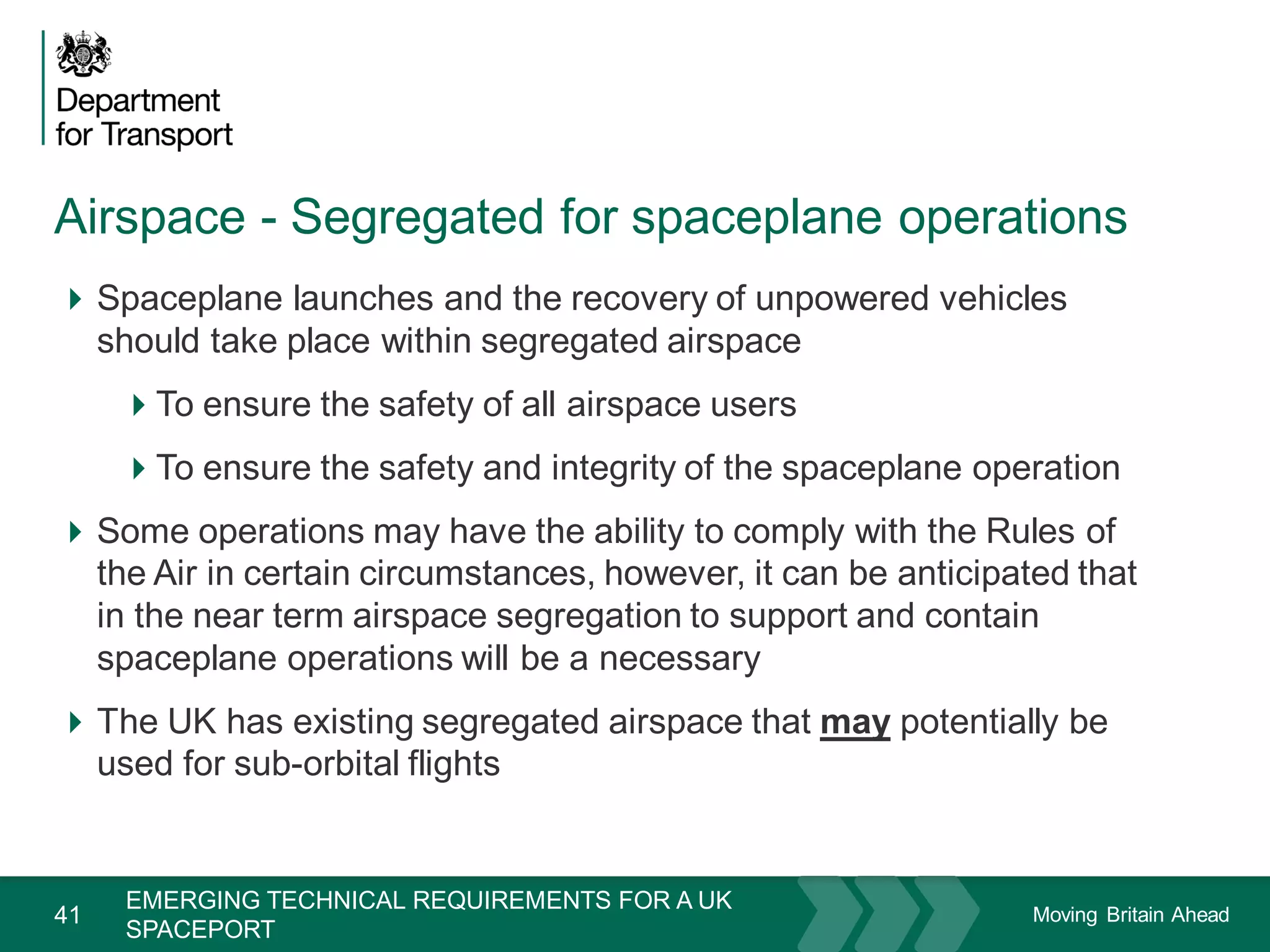
Airspace - Segregated for spaceplane operations
41
Spaceplane launches and the recovery of unpowered vehicles
should take place within segregated airspace
To ensure the safety of all airspace users
To ensure the safety and integrity of the spaceplane operation
Some operations may have the ability to comply with the Rules of
the Air in certain circumstances, however, it can be anticipated that
in the near term airspace segregation to support and contain
spaceplane operations will be a necessary
The UK has existing segregated airspace that may potentially be
used for sub-orbital flights
November 15
EMERGING TECHNICAL REQUIREMENTS FOR A UK
SPACEPORT
Moving Britain Ahead
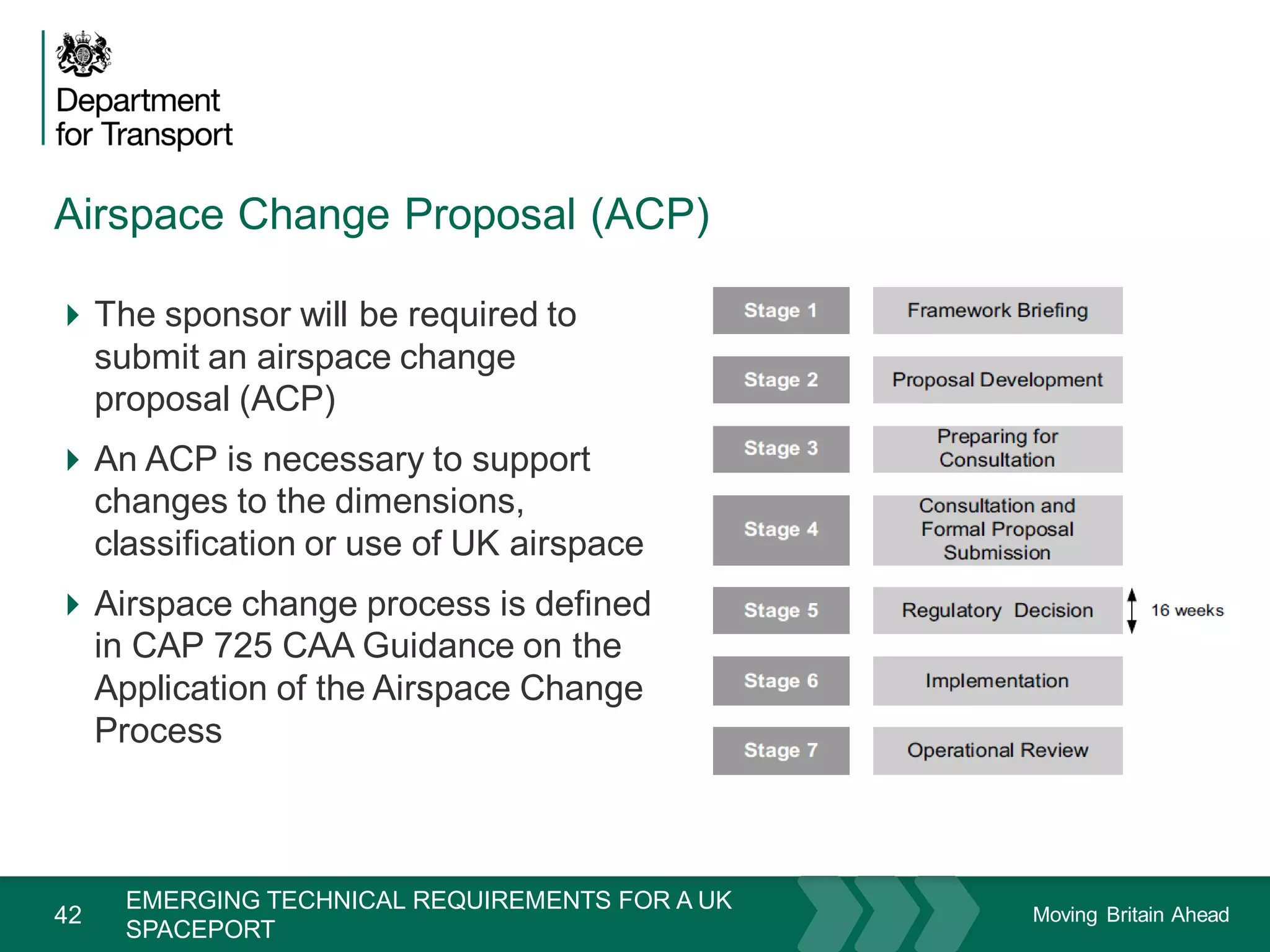
Airspace Change Proposal (ACP)
42
The sponsor will be required to
submit an airspace change
proposal (ACP)
An ACP is necessary to support
changes to the dimensions,
classification or use of UK airspace
Airspace change process is defined
in CAP 725 CAA Guidance on the
Application of the Airspace Change
Process
November 15
EMERGING TECHNICAL REQUIREMENTS FOR A UK
SPACEPORT
Moving Britain Ahead
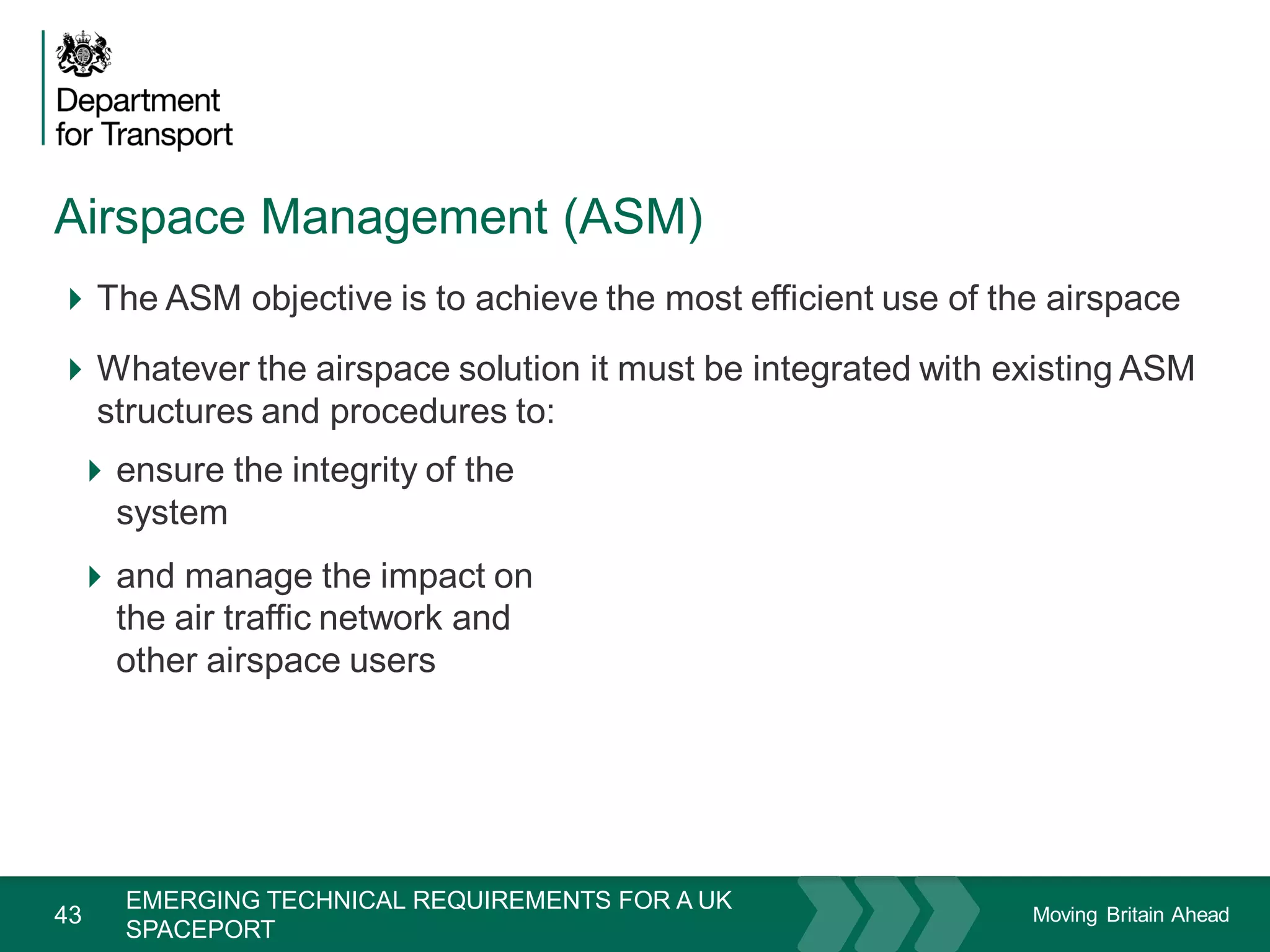
Airspace Management (ASM)
43
The ASM objective is to achieve the most efficient use of the airspace
Whatever the airspace solution it must be integrated with existing ASM
structures and procedures to:
November 15
EMERGING TECHNICAL REQUIREMENTS FOR A UK
SPACEPORT
ensure the integrity of the
system
and manage the impact on
the air traffic network and
other airspace users
Moving Britain Ahead
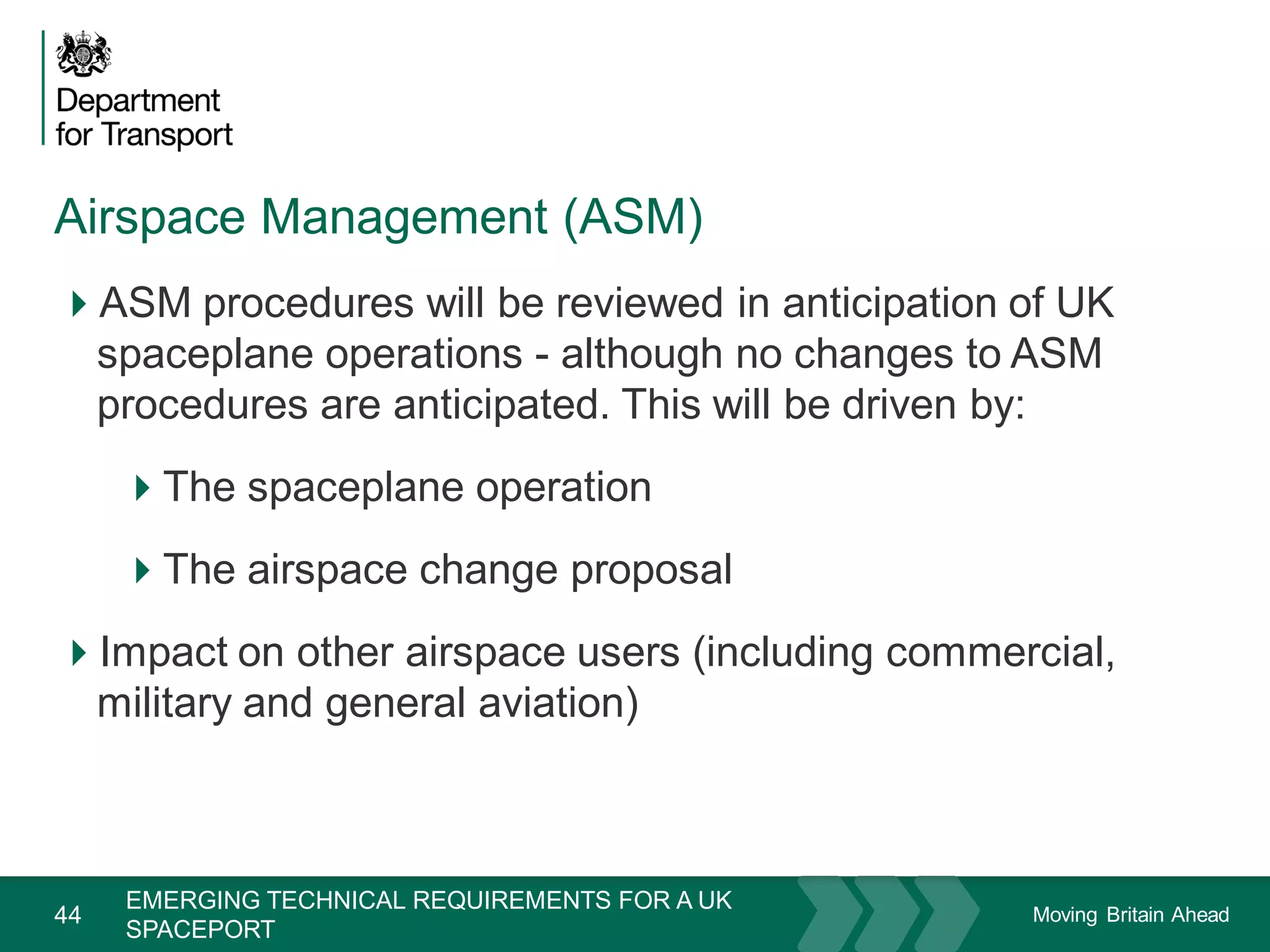
Airspace Management (ASM)
44
ASM procedures will be reviewed in anticipation of UK
spaceplane operations - although no changes to ASM
procedures are anticipated. This will be driven by:
The spaceplane operation
The airspace change proposal
Impact on other airspace users (including commercial,
military and general aviation)
November 15
EMERGING TECHNICAL REQUIREMENTS FOR A UK
SPACEPORT
Moving Britain Ahead
Air Traffic Management (ATM)
45
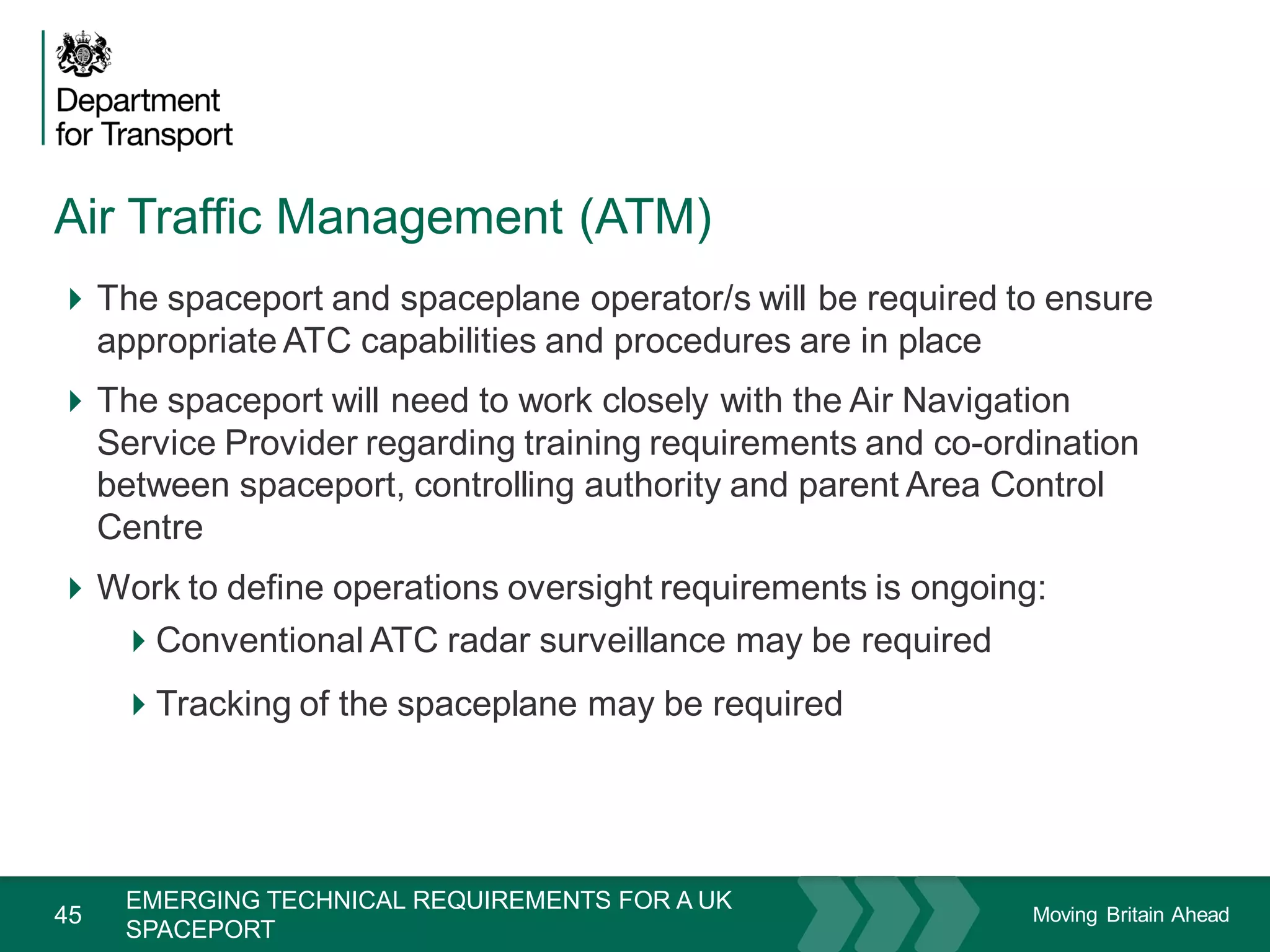
The spaceport and spaceplane operator/s will be required to ensure
appropriate ATC capabilities and procedures are in place
The spaceport will need to work closely with the Air Navigation
Service Provider regarding training requirements and co-ordination
between spaceport, controlling authority and parent Area Control
Centre
Work to define operations oversight requirements is ongoing:
Conventional ATC radar surveillance may be required
Tracking of the spaceplane may be required
November 15
EMERGING TECHNICAL REQUIREMENTS FOR A UK
SPACEPORT
Moving Britain Ahead
Military operational notification and co-ordination
46
Notification/agreement/coordination will be required with UK military
for sub-orbital launch activity but are still to be determined
November 15
EMERGING TECHNICAL REQUIREMENTS FOR A UK
SPACEPORT
Moving Britain Ahead
Areas of further work
47
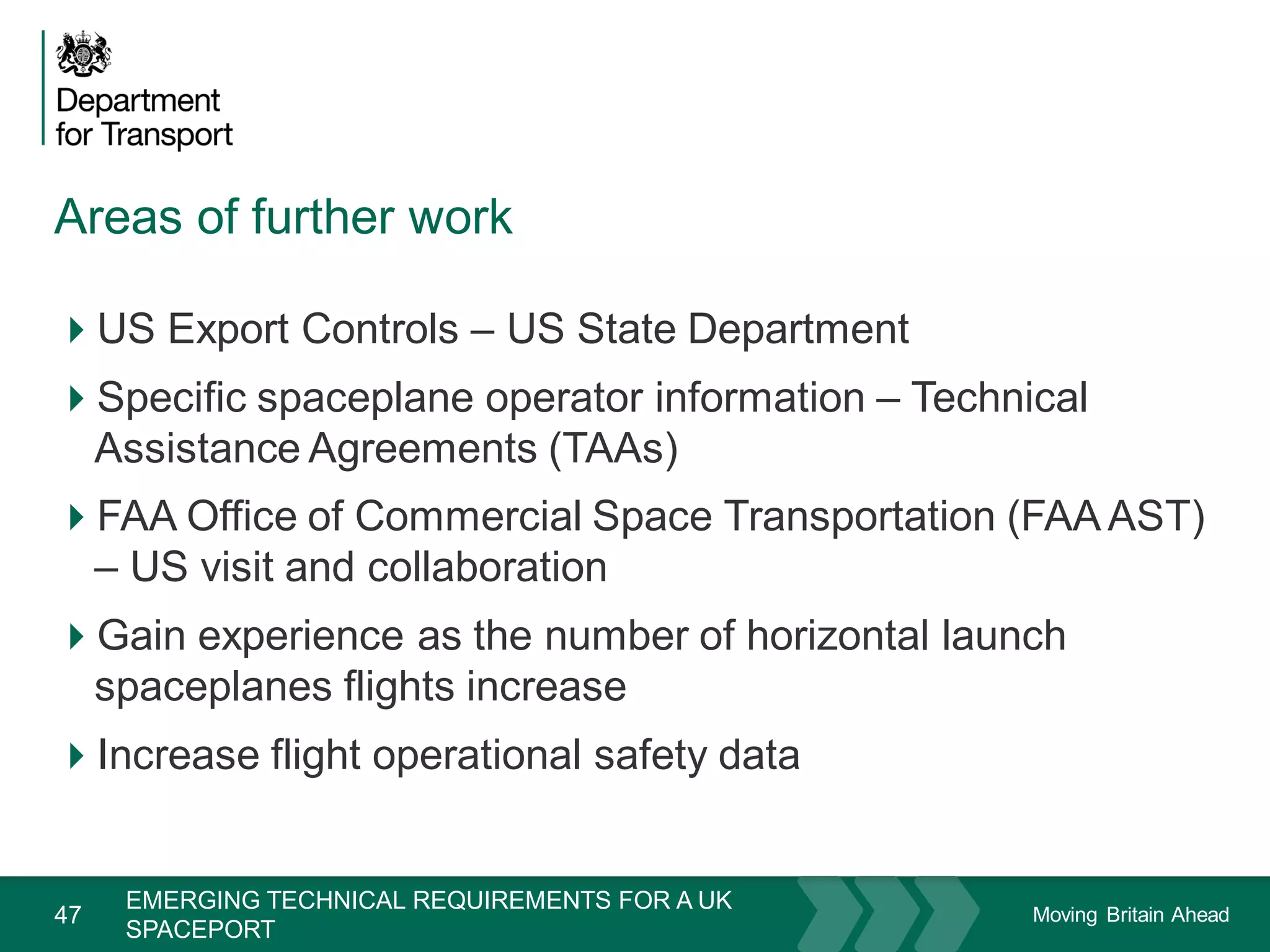
US Export Controls – US State Department
Specific spaceplane operator information – Technical
Assistance Agreements (TAAs)
FAA Office of Commercial Space Transportation (FAA AST)
– US visit and collaboration
Gain experience as the number of horizontal launch
spaceplanes flights increase
Increase flight operational safety data
November 15
EMERGING TECHNICAL REQUIREMENTS FOR A UK
SPACEPORT
Moving Britain Ahead
Thank you – Questions?
48
November 15
EMERGING TECHNICAL REQUIREMENTS FOR A UK
SPACEPORT

Emerging Technical Requirements For A UK Spaceport

  • 1.
    Moving Britain Ahead06 November 15 EMERGING TECHNICAL REQUIREMENTS FOR A UK SPACEPORT 1 EMERGING TECHNICAL REQUIREMENTS FOR A UK SPACEPORT
  • 2.
    Moving Britain Ahead2 Thispresentation is based on the understanding of the DFT and CAA as of 6 November 2015. It should be noted that Government policy and our work are subject to ongoing development in a fast-moving technological environment. Technical and other requirements for a UK Spaceport are therefore subject to a number of factors and uncertainties that could cause them to change. No reliance should therefore be placed on any aspect of this presentation, and it should not be assumed the final requirements for a UK Spaceport will be as set out here. November 15 EMERGING TECHNICAL REQUIREMENTS FOR A UK SPACEPORT
  • 3.
    Moving Britain Ahead Outline 3 Emergingrequirements Background to phase 2 (post government review) Spaceport considerations – James Eales ATM and Airspace considerations – Andy Sinclair Areas of further work Based on our current knowledge – things will change! November 15 EMERGING TECHNICAL REQUIREMENTS FOR A UK SPACEPORT
  • 4.
    Moving Britain Ahead Backgroundto CAA’s Phase 2 work 4 Government (DfT) funded Section 16 task Includes (but is not limited to): Implement the recommendations in the Technical Review Development of a Technical Specification Develop a Regulatory and operational framework for horizontal launch sub-orbital spaceplane operations Working in partnership with UKSA and MOD November 15 EMERGING TECHNICAL REQUIREMENTS FOR A UK SPACEPORT
  • 5.
    Moving Britain Ahead Scope 5 Ato A, horizontal launch, sub-orbital flights Space tourism /spaceflight experience Micro gravity experimentation Satellite launch Vertical launch is not in scope of CAA’s work November 15 EMERGING TECHNICAL REQUIREMENTS FOR A UK SPACEPORT
  • 6.
    Moving Britain Ahead Differentrequirements 6 Sub-orbital A to A Satellite launch Crew and spaceflight participants on board Launch vehicle has crew but satellite launch is un-manned Defined airspace close to spaceport Potentially larger defined flight corridor of airspace some distance from spaceport All parts of the spaceflight system return in tact Expendable sections of spaceflight system No flight termination function Flight termination function Likely to be classified as ‘aircraft‘ throughout flight Portion of flight will involve launch to orbit November 15 EMERGING TECHNICAL REQUIREMENTS FOR A UK SPACEPORT
  • 7.
    Moving Britain Ahead Inscope – Concept X 7 November 15 EMERGING TECHNICAL REQUIREMENTS FOR A UK SPACEPORT
  • 8.
    Moving Britain Ahead Inscope – Concept Y 8 November 15 EMERGING TECHNICAL REQUIREMENTS FOR A UK SPACEPORT
  • 9.
    Moving Britain Ahead Inscope – Concept Z 9 November 15 EMERGING TECHNICAL REQUIREMENTS FOR A UK SPACEPORT
  • 10.
    Moving Britain Ahead Aviationand space are fundamentally different 10 Aviation Horizontal launch sub-orbital spaceflight Mature industry Emerging industry Aviation is one of the safest modes of transport Spaceflight involves a higher level of risk 90,000 daily flights Limited number of licensed launches in the US since 1989 – Limited number of UK licensed launches overseas Low altitude – within the national airspace system High altitude with the intent to exit and re-enter the earth’s atmosphere Airports – 50 EASA certified / 80 UK licensed / numerous un-licensed 10 licensed spaceport sites in the US Passengers and crew expectation of high level of safety Spaceflight participants and crew may have to accept a higher level of risk Integrated licensing and certification programme – design / airworthiness / flight crew / maintenance In the US the licensing regime is primarily to protect 3rd parties Large safety database on all aspects of aviation Minimal data and limited number of launches – especially horizontally launched spaceplanes November 15 EMERGING TECHNICAL REQUIREMENTS FOR A UK SPACEPORT
  • 11.
    Moving Britain Ahead Regulatoryframeworks that could be used for horizontal launch spaceplane operations 11 Existing FAA Office of Commercial Space Transportation (FAA AST) Other States Potentially in the future ICAO EASA UKSA provides licensing for satellite launch (not from UK) November 15 EMERGING TECHNICAL REQUIREMENTS FOR A UK SPACEPORT
  • 12.
    Moving Britain Ahead Regulatoryprinciples 12 As a baseline, align with FAA AST where appropriate Collaborative development with FAA AST Permissive regulatory framework Capable of adapting to technical developments Generic UK regulation (not site or operator specific) November 15 EMERGING TECHNICAL REQUIREMENTS FOR A UK SPACEPORT
  • 13.
    Moving Britain Ahead FAAAST 13 Pros Established framework US Spaceplane operators familiar Established a good working relationship with FAA AST Cons Initially developed for vertical launch Different concept to commercial aviation regulatory approach Different legal system November 15 EMERGING TECHNICAL REQUIREMENTS FOR A UK SPACEPORT
  • 14.
    Moving Britain Ahead FAAAST – different approach 14 Spaceplane operations are licensed rather than vehicle certification Vehicles classified as suborbital launch vehicles rather than aircraft Primarily to protect uninvolved general public Part 400 series Part 420 – Licence to operate a launch site Part 431 – Launch and reentry of a reusable launch vehicle Part 433 – Licence to operate a reentry site Part 437 – Experimental permits November 15 EMERGING TECHNICAL REQUIREMENTS FOR A UK SPACEPORT
  • 15.
    Moving Britain Ahead FAAAST – Who needs an FAAAST licence? 15 A citizen of the United States must obtain a licence: To launch a launch vehicle outside the United States To re-enter a re-entry vehicle outside of the United States To operate a launch site outside of the United States November 15 EMERGING TECHNICAL REQUIREMENTS FOR A UK SPACEPORT
  • 16.
    Moving Britain Ahead Developmentof a technical specification for a spaceport 16 Current EASA certification or UK licensing requirements FAA AST requirements in Part 420 – Licence to operate a launch site Known facilities and operational requirements of spaceplane operators November 15 EMERGING TECHNICAL REQUIREMENTS FOR A UK SPACEPORT
  • 17.
    Moving Britain Ahead EASAaerodrome certification or UK aerodrome licensed? 17 Recommendation in Government sponsored Technical Review Potentially captured in ANO articles 207 – Requirement to use a licensed or Government aerodrome 208 – Flights which must use licensed or Government aerodrome  Sub-orbital spaceplanes likely to be classified as aircraft  Spaceflight participants (commercial aspect) 211 – Licensing of aerodromes Schedule 12 – Information contained in aerodrome manual Spaceport Licence may be issued November 15 EMERGING TECHNICAL REQUIREMENTS FOR A UK SPACEPORT
  • 18.
    Moving Britain Ahead EASAaerodrome certification or UK aerodrome licensed? 18 EASA aerodrome – certified against EU Commission regulation No. 139 / 2014 (12 February 2014 UK licensed aerodrome – CAP 168 licensing of aerodromes ICAO annex 14 – Aerodrome design and operation November 15 EMERGING TECHNICAL REQUIREMENTS FOR A UK SPACEPORT
  • 19.
    Moving Britain Ahead Informationrequired from a spaceplane operator includes (but is not limited to) 19 Declared distances required Physical size of aircraft (wing span and outer main gear wheel span) Minimum Pavement Classification Number (PCN) Non instrument v instrument runway Rescue & Fire Fighting (RFF) category of any proposed vehicle Operational requirements (nominal and non nominal) Weather limitations or night flying (not currently anticipated) Fuel / oxidiser / other requirements Any other information necessary to conduct operations safely November 15 EMERGING TECHNICAL REQUIREMENTS FOR A UK SPACEPORT
  • 20.
    Moving Britain Ahead Currentaerodrome requirements that may need to be reviewed 20 Oversight programme Review the basis and any limitations on which original certificate or licence issued Safety Management System Management of change Review procedures related to fire hazards Personnel / training requirements Review of aerodrome manual November 15 EMERGING TECHNICAL REQUIREMENTS FOR A UK SPACEPORT
  • 21.
    Moving Britain Ahead Currentaerodrome requirements that may need to be reviewed (continued) 21 Runway safety Condition of the manoeuvring area Wildlife programme MOR and safety reporting Security requirements November 15 EMERGING TECHNICAL REQUIREMENTS FOR A UK SPACEPORT
  • 22.
    Moving Britain Ahead Keyconsiderations – runway physical characteristics 22 Runway length Code E or code F aircraft Runway width Taxiway widths Runway shoulders Runway strip Runway end safety area November 15 EMERGING TECHNICAL REQUIREMENTS FOR A UK SPACEPORT
  • 23.
    Moving Britain Ahead Keyconsiderations – Runway and taxiway surfaces 23 November 15 EMERGING TECHNICAL REQUIREMENTS FOR A UK SPACEPORT Asphalt v concrete Hazards?
  • 24.
    Moving Britain Ahead Keyconsiderations – Runway centreline lighting 24 Nose wheel skid Possible light fitting damage Compatibility Potential to fit ultra flush light fittings November 15 EMERGING TECHNICAL REQUIREMENTS FOR A UK SPACEPORT
  • 25.
    Moving Britain Ahead Keyconsiderations – Runway operations 25 Sterile runway Glide operation Potentially up to 2 hours PAPI lights Operating procedures November 15 EMERGING TECHNICAL REQUIREMENTS FOR A UK SPACEPORT
  • 26.
    Moving Britain Ahead Keyconsiderations – RFFS provision 26 Rescue and fire fighting category Oxidiser enhanced fires Personnel training Key stakeholders Egress from vehicles Close cooperation with spaceplane operator required November 15 EMERGING TECHNICAL REQUIREMENTS FOR A UK SPACEPORT
  • 27.
    Moving Britain Ahead Keyconsiderations – Emergency response plan 27 Key stakeholders Local authorities Search and rescue ERP Testing November 15 EMERGING TECHNICAL REQUIREMENTS FOR A UK SPACEPORT
  • 28.
    Moving Britain Ahead Keyconsiderations – Health and Safety Executive 28 Health & Safety Executive Health & Safety at Work Act 1974 http://www.hse.gov.uk/ November 15 EMERGING TECHNICAL REQUIREMENTS FOR A UK SPACEPORT
  • 29.
    Moving Britain Ahead Keyconsiderations – weather limitations 29 Spaceplane operators have different weather operating criteria Key considerations include cloud cover and cross wind limits  Met Office study has been commissioned but has not yet been finalised November 15 EMERGING TECHNICAL REQUIREMENTS FOR A UK SPACEPORT
  • 30.
    Moving Britain Ahead FAAAST Part 420 – Licence to operate a launch site 30 Initially developed to regulate commercial vertical launch Covers reusable launch vehicles and expendable launch vehicles Primarily to protect 3rd parties on the ground EMERGING TECHNICAL REQUIREMENTS FOR A UK SPACEPORT November 15
  • 31.
    Moving Britain Ahead FAAAST Part 420 – Licence to operate a launch site 31 Part 420 includes: Launch site location review Site hazard analysis Agreements with US Coast Guard and National Air Traffic Licence terms and conditions Control of public areas Scheduling of launch operations Notifications Accident investigation plan Records Explosive siting EMERGING TECHNICAL REQUIREMENTS FOR A UK SPACEPORT November 15
  • 32.
    Moving Britain Ahead FAAAST Part 420 – Launch site location review 32  Demonstration of risk level  30 x 10⁻⁶  Probability of impact by the casualty area of the debris, multiplied by the population density of the region of interest  Currently under review in US (NPRM)  Requirement on both the spaceplane operator and a US spaceport  Developing UK expertise  UK requirements to be determined November 15 EMERGING TECHNICAL REQUIREMENTS FOR A UK SPACEPORT
  • 33.
    Moving Britain Ahead FAAAST Part 420 – Explosive site plan 33 Fuel storage Oxidiser storage Separation of solid and liquid propellants Lightning protection plan November 15 EMERGING TECHNICAL REQUIREMENTS FOR A UK SPACEPORT
  • 34.
    Moving Britain Ahead Propellantfor 1 mission 34 Concept Y Concept Z Propellant type Liquid Hybrid Aviation fuels None Jet A – 32,000lbs (4,923 gal) Rocket fuels Kerosene blend HTPB CTN – 1,500lbs Oxidisers Liquid oxygen Nitrous oxide – 13,500lbs (2,248 gal) Others Ghe, GN2 EMERGING TECHNICAL REQUIREMENTS FOR A UK SPACEPORT
  • 35.
    Moving Britain Ahead FAAAST Part 420 – Separation distances 35 Inhabited building distance – minimum distance between a loaded vehicle and any inhabited building Public traffic route distance – minimum distance between a loaded vehicle and public road or railway Intraline distance – minimum distance between two explosive related buildings or sites Consulting with HSE to review current UK requirements EMERGING TECHNICAL REQUIREMENTS FOR A UK SPACEPORT
  • 36.
    Moving Britain Ahead FAAAST Separation distances – Part 420 appendix E 36 November 15 EMERGING TECHNICAL REQUIREMENTS FOR A UK SPACEPORT Separation distances factors include: Solid or liquid propellants Quantity Class of explosive 1.1 or 1.3 Propellant combinations Explosive equivalent
  • 37.
    Moving Britain Ahead Spaceplaneoperator facilities (potential) 37 Air-conditioned hangar to accommodate vehicles Secure to meet Export control regulations Payload preparation area November 15 EMERGING TECHNICAL REQUIREMENTS FOR A UK SPACEPORT
  • 38.
    Moving Britain Ahead Spaceplaneoperator facilities (potential) 38 Control / communication centre for operations Accommodate for spaceplane operator personnel Customer hosting and training November 15 EMERGING TECHNICAL REQUIREMENTS FOR A UK SPACEPORT
  • 39.
    Moving Britain Ahead Airspaceand Air Traffic Management 39 Criticality of Airspace and Air Traffic Management Airspace Airspace Management Air Traffic Management Military operational notification and coordination November 15 EMERGING TECHNICAL REQUIREMENTS FOR A UK SPACEPORT
  • 40.
    Moving Britain Ahead Criticalityof Airspace and Air Traffic Management 40 Spaceplane Regulatory Review Recommendation: … access to airspace is a key factor which was considered as one of the selection criteria for any potential locations November 15 EMERGING TECHNICAL REQUIREMENTS FOR A UK SPACEPORT
  • 41.
    Moving Britain Ahead Airspace- Segregated for spaceplane operations 41 Spaceplane launches and the recovery of unpowered vehicles should take place within segregated airspace To ensure the safety of all airspace users To ensure the safety and integrity of the spaceplane operation Some operations may have the ability to comply with the Rules of the Air in certain circumstances, however, it can be anticipated that in the near term airspace segregation to support and contain spaceplane operations will be a necessary The UK has existing segregated airspace that may potentially be used for sub-orbital flights November 15 EMERGING TECHNICAL REQUIREMENTS FOR A UK SPACEPORT
  • 42.
    Moving Britain Ahead AirspaceChange Proposal (ACP) 42 The sponsor will be required to submit an airspace change proposal (ACP) An ACP is necessary to support changes to the dimensions, classification or use of UK airspace Airspace change process is defined in CAP 725 CAA Guidance on the Application of the Airspace Change Process November 15 EMERGING TECHNICAL REQUIREMENTS FOR A UK SPACEPORT
  • 43.
    Moving Britain Ahead AirspaceManagement (ASM) 43 The ASM objective is to achieve the most efficient use of the airspace Whatever the airspace solution it must be integrated with existing ASM structures and procedures to: November 15 EMERGING TECHNICAL REQUIREMENTS FOR A UK SPACEPORT ensure the integrity of the system and manage the impact on the air traffic network and other airspace users
  • 44.
    Moving Britain Ahead AirspaceManagement (ASM) 44 ASM procedures will be reviewed in anticipation of UK spaceplane operations - although no changes to ASM procedures are anticipated. This will be driven by: The spaceplane operation The airspace change proposal Impact on other airspace users (including commercial, military and general aviation) November 15 EMERGING TECHNICAL REQUIREMENTS FOR A UK SPACEPORT
  • 45.
    Moving Britain Ahead AirTraffic Management (ATM) 45 The spaceport and spaceplane operator/s will be required to ensure appropriate ATC capabilities and procedures are in place The spaceport will need to work closely with the Air Navigation Service Provider regarding training requirements and co-ordination between spaceport, controlling authority and parent Area Control Centre Work to define operations oversight requirements is ongoing: Conventional ATC radar surveillance may be required Tracking of the spaceplane may be required November 15 EMERGING TECHNICAL REQUIREMENTS FOR A UK SPACEPORT
  • 46.
    Moving Britain Ahead Militaryoperational notification and co-ordination 46 Notification/agreement/coordination will be required with UK military for sub-orbital launch activity but are still to be determined November 15 EMERGING TECHNICAL REQUIREMENTS FOR A UK SPACEPORT
  • 47.
    Moving Britain Ahead Areasof further work 47 US Export Controls – US State Department Specific spaceplane operator information – Technical Assistance Agreements (TAAs) FAA Office of Commercial Space Transportation (FAA AST) – US visit and collaboration Gain experience as the number of horizontal launch spaceplanes flights increase Increase flight operational safety data November 15 EMERGING TECHNICAL REQUIREMENTS FOR A UK SPACEPORT
  • 48.
    Moving Britain Ahead Thankyou – Questions? 48 November 15 EMERGING TECHNICAL REQUIREMENTS FOR A UK SPACEPORT