SharePoint: A Catalyst for Information GovernanceEMC SourceOne for Microsoft SharePointDave Martin, Principal Product Marketing Manager, EMC
The SourceOne PlatformPRACTICAL, ACTIONABLE INFORMATION GOVERNANCEGain VisibilityManage RiskSimplify eDiscoveryCut Costs
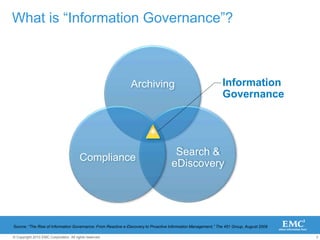
InformationGovernanceWhat is “Information Governance”?ArchivingSearch & eDiscoveryComplianceSource: “The Rise of Information Governance: From Reactive e-Discovery to Proactive Information Management,” The 451 Group, August 2009
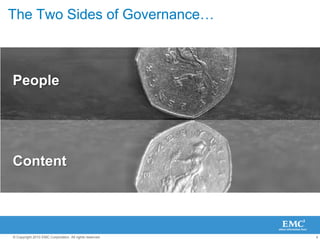
The Two Sides of Governance…PeopleContent
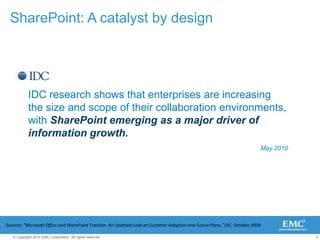
SharePoint: A catalyst by design62.2%Of organizations surveyedare using or planning to use SharePointIDC research shows that enterprises are increasing the size and scope of their collaboration environments, with SharePointemerging asa major driver of information growth.         May 2010More than half of organizations are running SharePoint todaySources: “Microsoft Office and SharePoint Traction: An Updated Look at Customer Adoption and Future Plans,” IDC, October 2009
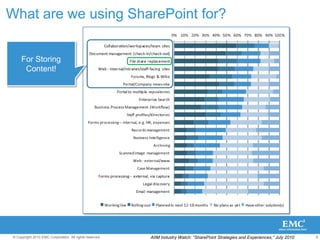
What are we using SharePoint for?For Storing Content!AIIM Industry Watch: “SharePoint Strategies and Experiences,” July 2010
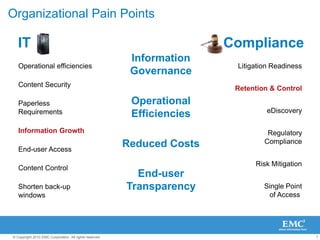
Organizational Pain PointsComplianceITInformationGovernanceLitigation ReadinessOperational efficiencies Content SecurityRetention & ControlOperationalEfficienciesPaperless RequirementseDiscoveryInformation GrowthRegulatoryComplianceReduced CostsEnd-user AccessRisk MitigationContent ControlEnd-userTransparencySingle Pointof Access Shorten back-upwindows
Thinking about Information Governance for SharePoint?What are your most immediate needs?
How much content are you planning to hold in SharePoint?
What type of content are you trying to capture?
What are your archival requirements?
What are your compliance requirements?
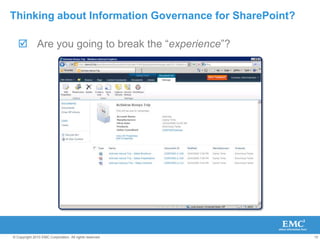
Are you going to break the “experience”?
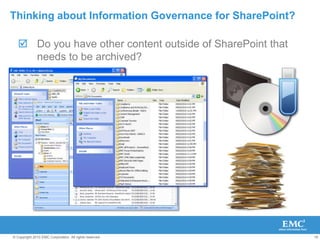
Do you have other content outside of SharePoint?Thinking about Information Governance for SharePoint?What are your most immediate needs?Immediate operational challenges with active SharePoint content?Or …Site/content retirement andcompliancerequirements? Or …Enablinglitigation readinessOr …ALL OF THE ABOVE!!!
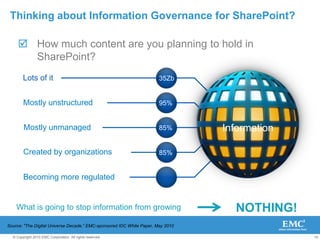
Lots of itMostly unstructuredMostly unmanagedCreated by organizationsBecoming more regulated NOTHING! What is going to stop information from growing Thinking about Information Governance for SharePoint?How much content are you planning to hold in SharePoint?35Zb95%Information85%85%▲Source: "The Digital Universe Decade,“ EMC-sponsored IDC White Paper, May 2010
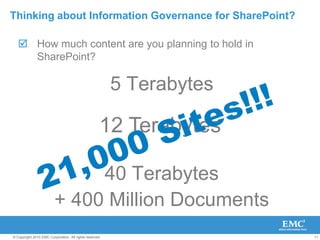
Thinking about Information Governance for SharePoint?How much content are you planning to hold in SharePoint?5 Terabytes12 Terabytes21,000 Sites!!!40 Terabytes + 400 Million Documents
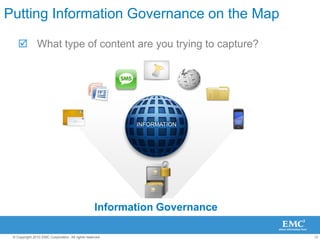
Putting Information Governance on the MapWhat type of content are you trying to capture?INFORMATIONInformation Governance
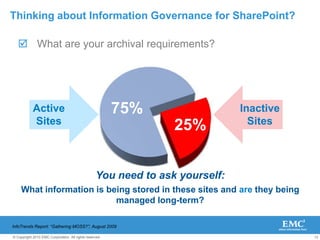
Thinking about Information Governance for SharePoint?What are your archival requirements?  ActiveSitesInactiveSites75%25%You need to ask yourself:What information is being stored in these sites and are they being managed long-term?InfoTrends Report: “Gathering MOSS?”; August 2009
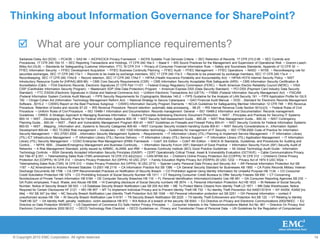
Thinking about Information Governance for SharePoint?What are your compliance requirements?Sarbanes-Oxley Act (SOX)  ~ PCAOB  ~ SAS 94  ~ AICPA/CICA Privacy Framework  ~ AICPA Suitable Trust Services Criteria  ~ SEC Retention of Records, 17 CFR 210.2-06  ~ SEC Controls and Procedures, 17 CFR 240.15d-15  ~ SEC Reporting Transactions and Holdings, 17 CFR 240.16a-3  ~ Basel II  ~ BIS Sound Practices for the Management and Supervision of Operational Risk  ~ Gramm-Leach-Bliley Act (GLB)  ~ Standards for Safeguarding Customer Information, FTC 16 CFR 314  ~ Privacy of Consumer Financial Information Rule  ~ Safety and Soundness Standards, Appendix of 12 CFR 30  ~ FFIEC Information Security  ~ FFIEC Development Acquisition  ~ FFIEC Business Continuity Planning  ~ FFIEC Audit  ~ FFIEC Management  ~ FFIEC Operations  ~ NASD  ~ NYSE  ~ Recordkeeping rule for securities exchanges, SEC 17 CFR 240.17a-1  ~ Records to be made by exchange members, SEC 17 CFR 240.17a-3  ~ Records to be preserved by exchange members, SEC 17 CFR 240.17a-4  ~ Recordkeeping, SEC 17 CFR 240.17Ad-6  ~ Record retention, SEC 17 CFR 240.17Ad-7  ~ HIPAA (Health Insurance Portability and Accountability Act)  ~ HIPAA HCFA Internet Security Policy  ~ NIST Introductory Resource Guide for [HIPAA] (800-66)  ~ CMS Core Security Requirements (CSR)  ~ CMS Information Security Acceptable Risk Safeguards (ARS)  ~ CMS Information Security Certification & Accreditation (C&A)  ~ FDA Electronic Records; Electronic Signatures 21 CFR Part 11+D1  ~ Federal Energy Regulatory Commission (FERC)  ~ North American Electric Reliability Council (NERC)  ~ VISA CISP (Cardholder Information Security Program)  ~ Mastercard SDP (Site Data Protection) Program  ~ American Express DSS (Data Security Standard)  ~ PCI DSS (Payment Card Industry Data Security Standard)  ~ FTC ESIGN (Electronic Signatures in Global and National Commerce Act)  ~ Uniform Electronic Transactions Act (UETA)  ~ FISMA (Federal Information Security Management Act)  ~ FISCAM (Federal Information System Controls Audit Manual)  ~ FIPS Security Requirements for Cryptographic Modules 140-2  ~ FIPS Guideline for the Analysis of LAN Security 191  ~ FIPS Application Profile for GILS 192  ~ Clinger-Cohen Act (Information Technology Management Reform Act)  ~ National Strategy to Secure Cyberspace  ~ GAO Financial Audit Manual  ~ DOD ...Standard for Electronic Records Management Software...5015-2  ~ CISWG Report on the Best Practices Subgroup  ~ CISWG Information Security Program Elements  ~ NCUA Guidelines for Safeguarding Member Information 12 CFR 748  ~ IRS Revenue Procedure: Retention of books and records 97-22  ~ IRS Revenue Procedure: Record retention: automatic data processing… 98-25  ~ IRS Internal Revenue Code Section 501(c)(3)  ~ Federal Rules of Civil Procedure  ~ Uniform Rules of Civil Procedure  ~ ISO 15489-1 Information and Documentation: Records management: General  ~ ISO 15489-2 Information and Documentation: Records management: Guidelines  ~ DIRKS: A Strategic Approach to Managing Business Information  ~ Sedona Principles Addressing Electronic Document Production  ~ NIST ...Principles and Practices for Securing IT Systems 800-14  ~ NIST ...Developing Security Plans for Federal Information Systems 800-18  ~ NIST Security Self-Assessment Guide... 800-26  ~ NIST Risk Management Guide... 800-30  ~ NIST Contingency Planning Guide... 800-34  ~ NIST ...Patch and Vulnerability Management Program 800-40  ~ NIST Guidelines on Firewalls and Firewall Policy 800-41  ~ NIST Security Controls for Federal Information Systems 800-53  ~ NIST ...Mapping...Information and...Systems to Security Categories 800-60  ~ NIST Computer Security Incident Handling Guide 800-61  ~ NIST Security Considerations in...Information System Development 800-64  ~ ISO 73:2002 Risk management -- Vocabulary  ~ ISO 1335 Information technology – Guidelines for management of IT Security  ~ ISO 17799:2000 Code of Practice for Information Security Management  ~ ISO 27001:2005 ...Information Security Management Systems -- Requirements  ~ IT Information Library (ITIL) Planning to Implement Service Management  ~ IT Information Library (ITIL) ICT Infrastructure Management  ~ IT Information Library (ITIL) Service Delivery  ~ IT Information Library (ITIL) Service Support  ~ IT Information Library (ITIL) Application Management  ~ IT Information Library (ITIL) Security Management  ~ COSO Enterprise Risk Management (ERM) Framework  ~ CobiT 3rd Edition  ~ CobiT 4th Edition  ~ ISACA IS Standards, Guidelines, and Procedures for Auditing and Control...  ~ NFPA 1600 ...Disaster/Emergency Management and Business Continuity...  ~ Information Security Forum (ISF) Standard of Good Practice  ~ Information Security Forum (ISF) Security Audit of Networks  ~ A Risk Management Standard, jointly issued by AIRMIC, ALARM, and IRM  ~ Business Continuity Institute (BCI) Good Practice Guidelines  ~ IIA Global Technology Audit Guide - Information Technology Controls  ~ ISSA Generally Accepted Information Security Principles (GAISP)  ~ CERT Operationally Critical Threat, Asset & Vulnerability Evaluation (OCTAVE)  ~ Cable Communications Privacy Act Title 47 § 551  ~ Telemarketing Sales Rule (TSR) amendment 16 CFR 310.4(b)(3)(iv)  ~ CAN SPAM Act  ~ Children's Online Privacy Protection Act (COPPA) 16 CFR 312  ~ Children's Online Privacy Protection Act (COPPA) 16 CFR 312  ~ Driver's Privacy Protection Act (DPPA) 18 USC 2721  ~ Family Education Rights Privacy Act (FERPA) 20 USC 1232  ~ Privacy Act of 1974 5 USC 552a  ~ Telemarketing Sales Rule (TSR) 16 CFR 310  ~ Video Privacy Protection Act (VPPA) 18 USC 2710  ~ Specter-Leahy Personal Data Privacy and Security Act  ~ AR Personal Information Protection Act SB 1167  ~ AZ Amendment to Arizona Revised Statutes 13-2001 HB 2116  ~ CA Information Practice Act SB 1386  ~ CA General Security Standard for Businesses AB 1950  ~ CA Public Records Military Veteran Discharge Documents AB 1798  ~ CA OPP Recommended Practices on Notification of Security Breach  ~ CO Prohibition against Using Identity Information for Unlawful Purpose HB 1134  ~ CO Consumer Credit Solicitation Protection HB 1274  ~ CO Prohibiting Inclusion of Social Security Number HB 1311  ~ CT Requiring Consumer Credit Bureaus to Offer Security Freezes SB 650  ~ CT Concerning Nondisclosure of Private Tenant Information HB 5184  ~ DE Computer Security Breaches HB 116  ~ FL Personal Identification Information/Unlawful Use HB 481  ~ GA Consumer Reporting Agencies SB 230  ~ GA Public employees; Fraud, Waste, and Abuse HB 656  ~ HI Exempting disclosure of Social Security numbers HB 2674  ~ IL Personal Information Protection Act HB 1633  ~ IN Release of Social Security Number, Notice of Security Breach SB 503  ~ LA Database Security Breach Notification Law SB 205 Act 499  ~ ME To Protect Maine Citizens from Identity Theft LD 1671  ~ MN Data Warehouses; Notice Required for Certain Disclosures HF 2121  ~ MO HB 957  ~ MT To Implement Individual Privacy and to Prevent Identity Theft HB 732  ~ NJ Identity Theft Prevention Act A4001/S1914  ~ NY A4254, A3492 [no title]  ~ NV SB 347 [no title]  ~ NC Security Breach Notification Law (Identity Theft Protection Act) SB 1048  ~ ND Personal information protection act SB 2251  ~ OH Personal information -- contact if unauthorized access HB 104  ~ RI Security Breach Notification Law H 6191  ~ TN Security Breach Notification SB 2220  ~ TX Identity Theft Enforcement and Protection Act SB 122  ~ VT Relating to Identity Theft HB 327  ~ VA Identity theft; penalty; restitution; victim assistance HB 872  ~ WA Notice of a breach of the security SB 6043  ~ EU Directive on Privacy and Electronic Communications 2002/58/EC  ~ EU Directive on Data Protection 95/46/EC  ~ US Department of Commerce EU Safe Harbor Privacy Principles  ~ ...Consumer Interests in the Telecommunications Market Act No. 661  ~ Directive On Privacy And Electronic Communications 2002.58.EC  ~ OECD Technology Risk Checklist  ~ OECD Guidelines on...Privacy and Transborder Flows of Personal Data  ~ UN Guidelines for the Regulation of Computerized
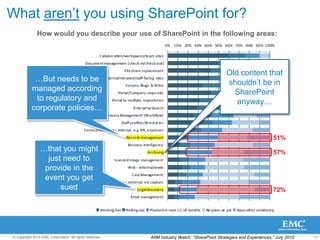
Thinking about Information Governance for SharePoint?Are you going to break the “experience”?Thinking about Information Governance for SharePoint?Do you have other content outside of SharePoint that needs to be archived?What aren’t you using SharePoint for?How would you describe your use of SharePoint in the following areas:Old content that shouldn’t be in SharePoint anyway……But needs to be managed according to regulatory and corporate policies…51%…that you might just need to provide in the event you get sued57%72%AIIM Industry Watch: “SharePoint Strategies and Experiences,” July 2010
The IdealProvideretention and control of archived business-relevant SharePoint contentHelp manage the growing number of outdated/orphaned SharePoint sites and contentShorten our backup windows and maintain performanceEnable centralized management & access for content from SharePoint
The Operational RequirementsTo scale to 100s of millions of documents customers need to distribute the data to several databases and sites – or “remove” / “move” dataEnsure scalabilityMaintain performanceMeet backup windows
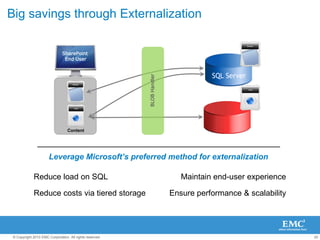
Big savings through ExternalizationSharePoint End UserSQL ServerBLOB HandlerMetadataMetadataContentLeverage Microsoft’s preferred method for externalizationReduce load on SQLReduce costs via tiered storageMaintain end-user experienceEnsure performance & scalabilityObjectObject
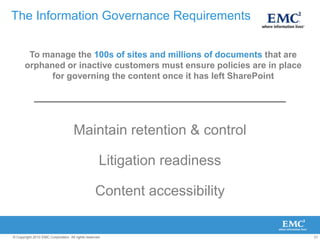
The Information Governance RequirementsTo manage the 100s of sites and millions of documents that are orphaned or inactive customers must ensure policies are in place for governing the content once it has left SharePointMaintain retention & controlLitigation readinessContent accessibility
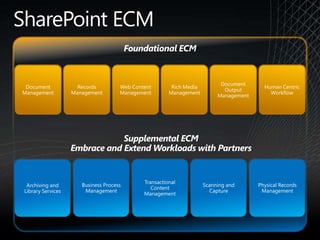
Supplemental ECMEmbrace and Extend Workloads with PartnersFoundational ECMPhysical Records ManagementScanning and CaptureTransactional Content ManagementBusiness Process ManagementArchiving and Library ServicesDocument Output ManagementRich Media ManagementWeb Content ManagementRecords ManagementDocument ManagementHuman Centric WorkflowSharePoint ECM
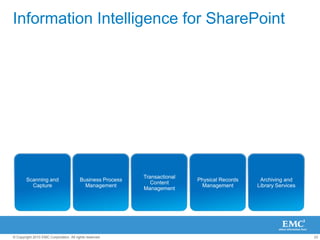
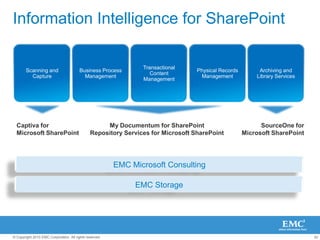
Information Intelligence for SharePointPhysical Records ManagementScanning and CaptureTransactional Content ManagementBusiness Process ManagementArchiving and Library Services
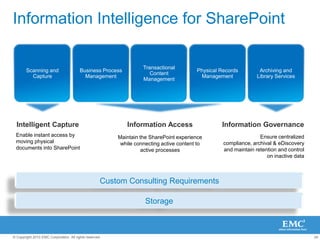
Information Intelligence for SharePointPhysical Records ManagementScanning and CaptureTransactional Content ManagementBusiness Process ManagementArchiving and Library ServicesInformation AccessInformation GovernanceIntelligent CaptureMaintain the SharePoint experience while connecting active content to active processes Enable instant access by moving physical documents into SharePointEnsure centralized compliance, archival & eDiscovery and maintain retention and control on inactive dataCustom Consulting RequirementsStorage
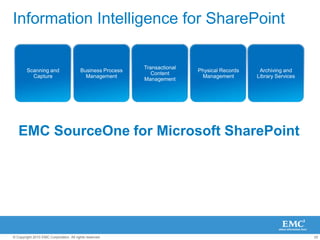
Information Intelligence for SharePointPhysical Records ManagementScanning and CaptureTransactional Content ManagementBusiness Process ManagementArchiving and Library ServicesEMC SourceOne for Microsoft SharePoint
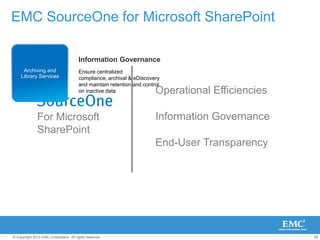
EMC SourceOne for Microsoft SharePointArchiving and Library ServicesOperational EfficienciesInformation GovernanceEnd-User TransparencyFor Microsoft SharePointInformation GovernanceEnsure centralized compliance, archival & eDiscovery and maintain retention and control on inactive data
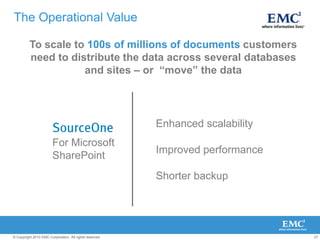
The Operational ValueTo scale to 100s of millions of documents customers need to distribute the data across several databases and sites – or  “move” the dataEnhanced scalabilityImproved performanceShorter backupFor Microsoft SharePoint
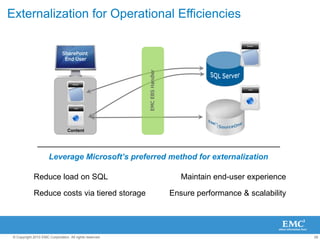
Externalization for Operational EfficienciesSharePoint End UserEMC EBS HandlerMetadataMetadataContentSQL ServerLeverage Microsoft’s preferred method for externalizationReduce load on SQLReduce costs via tiered storageMaintain end-user experienceEnsure performance & scalabilityObjectObject
The Information Governance ValueTo manage the 100s of sites and millions of documents that are orphaned or inactive customers must ensure policies are in place for governing the content once it has left SharePointMaintain retention & controlLitigation readinessContent accessibilityFor Microsoft SharePoint
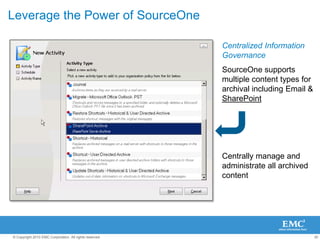
Leverage the Power of SourceOneCentralized Information GovernanceSourceOne supports multiple content types for archival including Email & SharePointCentrally manage and administrate all archived content
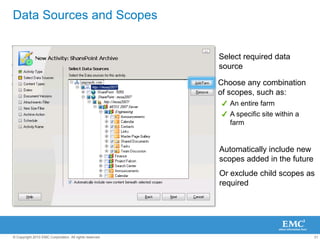
Data Sources and ScopesSelect required data sourceChoose any combination of scopes, such as: An entire farmA specific site within a farmhttp://moss2007Automatically include new scopes added in the futureOr exclude child scopes as required
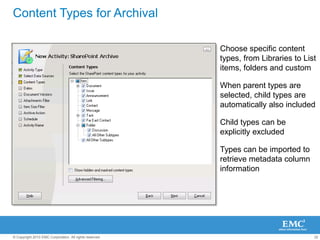
Content Types for ArchivalChoose specific content types, from Libraries to List items, folders and customWhen parent types are selected, child types are automatically also includedChild types can be explicitly excludedTypes can be imported to retrieve metadata column information
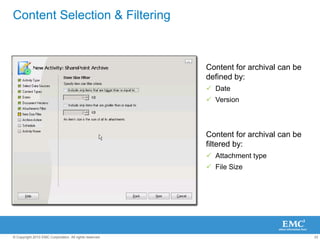
Content for archival can be defined by:Date
VersionContent for archival can be filtered by:Attachment type
File SizeContent Selection & Filtering
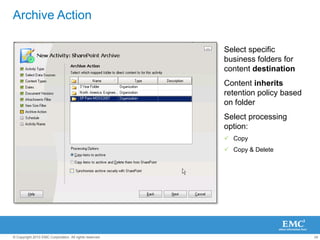
Select specific business folders for content destinationContent inherits retention policy based on folderSelect processing option:Copy
Copy & DeleteArchive Action
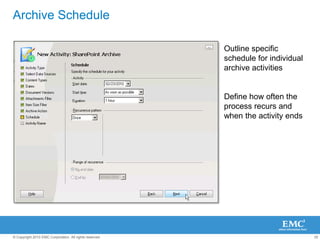
Outline specific schedule for individual archive activitiesDefine how often the process recurs and when the activity endsArchive Schedule
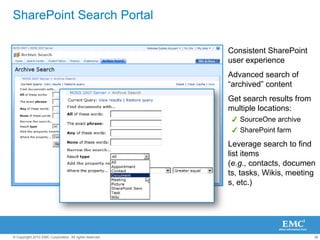
Consistent SharePoint user experience Advanced search of “archived” contentGet search results from multiple locations:SourceOne archive SharePoint farmLeverage search to find list items (e.g., contacts, documents, tasks, Wikis, meetings, etc.)SharePoint Search Portal
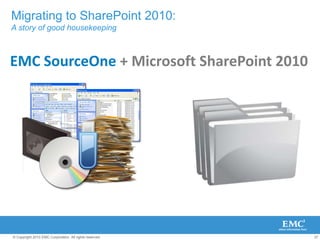
Migrating to SharePoint 2010:A story of good housekeepingEMC SourceOne + Microsoft SharePoint 2010
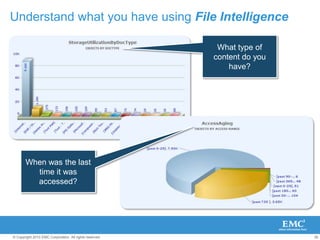
Understand what you have using File IntelligenceWhat type of content do you have?When was the last time it was accessed?
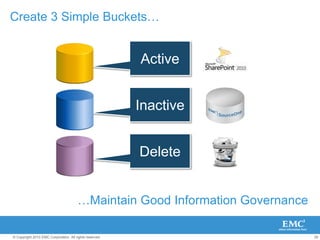
Create 3 Simple Buckets…ActiveInactiveDelete…Maintain Good Information Governance

EMC SourceOne for SharePoint

  • 1.
    SharePoint: A Catalystfor Information GovernanceEMC SourceOne for Microsoft SharePointDave Martin, Principal Product Marketing Manager, EMC
  • 2.
    The SourceOne PlatformPRACTICAL,ACTIONABLE INFORMATION GOVERNANCEGain VisibilityManage RiskSimplify eDiscoveryCut Costs
  • 3.
    InformationGovernanceWhat is “InformationGovernance”?ArchivingSearch & eDiscoveryComplianceSource: “The Rise of Information Governance: From Reactive e-Discovery to Proactive Information Management,” The 451 Group, August 2009
  • 4.
    The Two Sidesof Governance…PeopleContent
  • 5.
    SharePoint: A catalystby design62.2%Of organizations surveyedare using or planning to use SharePointIDC research shows that enterprises are increasing the size and scope of their collaboration environments, with SharePointemerging asa major driver of information growth. May 2010More than half of organizations are running SharePoint todaySources: “Microsoft Office and SharePoint Traction: An Updated Look at Customer Adoption and Future Plans,” IDC, October 2009
  • 6.
    What are weusing SharePoint for?For Storing Content!AIIM Industry Watch: “SharePoint Strategies and Experiences,” July 2010
  • 7.
    Organizational Pain PointsComplianceITInformationGovernanceLitigationReadinessOperational efficiencies Content SecurityRetention & ControlOperationalEfficienciesPaperless RequirementseDiscoveryInformation GrowthRegulatoryComplianceReduced CostsEnd-user AccessRisk MitigationContent ControlEnd-userTransparencySingle Pointof Access Shorten back-upwindows
  • 8.
    Thinking about InformationGovernance for SharePoint?What are your most immediate needs?
  • 9.
    How much contentare you planning to hold in SharePoint?
  • 10.
    What type ofcontent are you trying to capture?
  • 11.
    What are yourarchival requirements?
  • 12.
    What are yourcompliance requirements?
  • 13.
    Are you goingto break the “experience”?
  • 14.
    Do you haveother content outside of SharePoint?Thinking about Information Governance for SharePoint?What are your most immediate needs?Immediate operational challenges with active SharePoint content?Or …Site/content retirement andcompliancerequirements? Or …Enablinglitigation readinessOr …ALL OF THE ABOVE!!!
  • 15.
    Lots of itMostlyunstructuredMostly unmanagedCreated by organizationsBecoming more regulated NOTHING! What is going to stop information from growing Thinking about Information Governance for SharePoint?How much content are you planning to hold in SharePoint?35Zb95%Information85%85%▲Source: "The Digital Universe Decade,“ EMC-sponsored IDC White Paper, May 2010
  • 16.
    Thinking about InformationGovernance for SharePoint?How much content are you planning to hold in SharePoint?5 Terabytes12 Terabytes21,000 Sites!!!40 Terabytes + 400 Million Documents
  • 17.
    Putting Information Governanceon the MapWhat type of content are you trying to capture?INFORMATIONInformation Governance
  • 18.
    Thinking about InformationGovernance for SharePoint?What are your archival requirements? ActiveSitesInactiveSites75%25%You need to ask yourself:What information is being stored in these sites and are they being managed long-term?InfoTrends Report: “Gathering MOSS?”; August 2009
  • 19.
    Thinking about InformationGovernance for SharePoint?What are your compliance requirements?Sarbanes-Oxley Act (SOX) ~ PCAOB ~ SAS 94 ~ AICPA/CICA Privacy Framework ~ AICPA Suitable Trust Services Criteria ~ SEC Retention of Records, 17 CFR 210.2-06 ~ SEC Controls and Procedures, 17 CFR 240.15d-15 ~ SEC Reporting Transactions and Holdings, 17 CFR 240.16a-3 ~ Basel II ~ BIS Sound Practices for the Management and Supervision of Operational Risk ~ Gramm-Leach-Bliley Act (GLB) ~ Standards for Safeguarding Customer Information, FTC 16 CFR 314 ~ Privacy of Consumer Financial Information Rule ~ Safety and Soundness Standards, Appendix of 12 CFR 30 ~ FFIEC Information Security ~ FFIEC Development Acquisition ~ FFIEC Business Continuity Planning ~ FFIEC Audit ~ FFIEC Management ~ FFIEC Operations ~ NASD ~ NYSE ~ Recordkeeping rule for securities exchanges, SEC 17 CFR 240.17a-1 ~ Records to be made by exchange members, SEC 17 CFR 240.17a-3 ~ Records to be preserved by exchange members, SEC 17 CFR 240.17a-4 ~ Recordkeeping, SEC 17 CFR 240.17Ad-6 ~ Record retention, SEC 17 CFR 240.17Ad-7 ~ HIPAA (Health Insurance Portability and Accountability Act) ~ HIPAA HCFA Internet Security Policy ~ NIST Introductory Resource Guide for [HIPAA] (800-66) ~ CMS Core Security Requirements (CSR) ~ CMS Information Security Acceptable Risk Safeguards (ARS) ~ CMS Information Security Certification & Accreditation (C&A) ~ FDA Electronic Records; Electronic Signatures 21 CFR Part 11+D1 ~ Federal Energy Regulatory Commission (FERC) ~ North American Electric Reliability Council (NERC) ~ VISA CISP (Cardholder Information Security Program) ~ Mastercard SDP (Site Data Protection) Program ~ American Express DSS (Data Security Standard) ~ PCI DSS (Payment Card Industry Data Security Standard) ~ FTC ESIGN (Electronic Signatures in Global and National Commerce Act) ~ Uniform Electronic Transactions Act (UETA) ~ FISMA (Federal Information Security Management Act) ~ FISCAM (Federal Information System Controls Audit Manual) ~ FIPS Security Requirements for Cryptographic Modules 140-2 ~ FIPS Guideline for the Analysis of LAN Security 191 ~ FIPS Application Profile for GILS 192 ~ Clinger-Cohen Act (Information Technology Management Reform Act) ~ National Strategy to Secure Cyberspace ~ GAO Financial Audit Manual ~ DOD ...Standard for Electronic Records Management Software...5015-2 ~ CISWG Report on the Best Practices Subgroup ~ CISWG Information Security Program Elements ~ NCUA Guidelines for Safeguarding Member Information 12 CFR 748 ~ IRS Revenue Procedure: Retention of books and records 97-22 ~ IRS Revenue Procedure: Record retention: automatic data processing… 98-25 ~ IRS Internal Revenue Code Section 501(c)(3) ~ Federal Rules of Civil Procedure ~ Uniform Rules of Civil Procedure ~ ISO 15489-1 Information and Documentation: Records management: General ~ ISO 15489-2 Information and Documentation: Records management: Guidelines ~ DIRKS: A Strategic Approach to Managing Business Information ~ Sedona Principles Addressing Electronic Document Production ~ NIST ...Principles and Practices for Securing IT Systems 800-14 ~ NIST ...Developing Security Plans for Federal Information Systems 800-18 ~ NIST Security Self-Assessment Guide... 800-26 ~ NIST Risk Management Guide... 800-30 ~ NIST Contingency Planning Guide... 800-34 ~ NIST ...Patch and Vulnerability Management Program 800-40 ~ NIST Guidelines on Firewalls and Firewall Policy 800-41 ~ NIST Security Controls for Federal Information Systems 800-53 ~ NIST ...Mapping...Information and...Systems to Security Categories 800-60 ~ NIST Computer Security Incident Handling Guide 800-61 ~ NIST Security Considerations in...Information System Development 800-64 ~ ISO 73:2002 Risk management -- Vocabulary ~ ISO 1335 Information technology – Guidelines for management of IT Security ~ ISO 17799:2000 Code of Practice for Information Security Management ~ ISO 27001:2005 ...Information Security Management Systems -- Requirements ~ IT Information Library (ITIL) Planning to Implement Service Management ~ IT Information Library (ITIL) ICT Infrastructure Management ~ IT Information Library (ITIL) Service Delivery ~ IT Information Library (ITIL) Service Support ~ IT Information Library (ITIL) Application Management ~ IT Information Library (ITIL) Security Management ~ COSO Enterprise Risk Management (ERM) Framework ~ CobiT 3rd Edition ~ CobiT 4th Edition ~ ISACA IS Standards, Guidelines, and Procedures for Auditing and Control... ~ NFPA 1600 ...Disaster/Emergency Management and Business Continuity... ~ Information Security Forum (ISF) Standard of Good Practice ~ Information Security Forum (ISF) Security Audit of Networks ~ A Risk Management Standard, jointly issued by AIRMIC, ALARM, and IRM ~ Business Continuity Institute (BCI) Good Practice Guidelines ~ IIA Global Technology Audit Guide - Information Technology Controls ~ ISSA Generally Accepted Information Security Principles (GAISP) ~ CERT Operationally Critical Threat, Asset & Vulnerability Evaluation (OCTAVE) ~ Cable Communications Privacy Act Title 47 § 551 ~ Telemarketing Sales Rule (TSR) amendment 16 CFR 310.4(b)(3)(iv) ~ CAN SPAM Act ~ Children's Online Privacy Protection Act (COPPA) 16 CFR 312 ~ Children's Online Privacy Protection Act (COPPA) 16 CFR 312 ~ Driver's Privacy Protection Act (DPPA) 18 USC 2721 ~ Family Education Rights Privacy Act (FERPA) 20 USC 1232 ~ Privacy Act of 1974 5 USC 552a ~ Telemarketing Sales Rule (TSR) 16 CFR 310 ~ Video Privacy Protection Act (VPPA) 18 USC 2710 ~ Specter-Leahy Personal Data Privacy and Security Act ~ AR Personal Information Protection Act SB 1167 ~ AZ Amendment to Arizona Revised Statutes 13-2001 HB 2116 ~ CA Information Practice Act SB 1386 ~ CA General Security Standard for Businesses AB 1950 ~ CA Public Records Military Veteran Discharge Documents AB 1798 ~ CA OPP Recommended Practices on Notification of Security Breach ~ CO Prohibition against Using Identity Information for Unlawful Purpose HB 1134 ~ CO Consumer Credit Solicitation Protection HB 1274 ~ CO Prohibiting Inclusion of Social Security Number HB 1311 ~ CT Requiring Consumer Credit Bureaus to Offer Security Freezes SB 650 ~ CT Concerning Nondisclosure of Private Tenant Information HB 5184 ~ DE Computer Security Breaches HB 116 ~ FL Personal Identification Information/Unlawful Use HB 481 ~ GA Consumer Reporting Agencies SB 230 ~ GA Public employees; Fraud, Waste, and Abuse HB 656 ~ HI Exempting disclosure of Social Security numbers HB 2674 ~ IL Personal Information Protection Act HB 1633 ~ IN Release of Social Security Number, Notice of Security Breach SB 503 ~ LA Database Security Breach Notification Law SB 205 Act 499 ~ ME To Protect Maine Citizens from Identity Theft LD 1671 ~ MN Data Warehouses; Notice Required for Certain Disclosures HF 2121 ~ MO HB 957 ~ MT To Implement Individual Privacy and to Prevent Identity Theft HB 732 ~ NJ Identity Theft Prevention Act A4001/S1914 ~ NY A4254, A3492 [no title] ~ NV SB 347 [no title] ~ NC Security Breach Notification Law (Identity Theft Protection Act) SB 1048 ~ ND Personal information protection act SB 2251 ~ OH Personal information -- contact if unauthorized access HB 104 ~ RI Security Breach Notification Law H 6191 ~ TN Security Breach Notification SB 2220 ~ TX Identity Theft Enforcement and Protection Act SB 122 ~ VT Relating to Identity Theft HB 327 ~ VA Identity theft; penalty; restitution; victim assistance HB 872 ~ WA Notice of a breach of the security SB 6043 ~ EU Directive on Privacy and Electronic Communications 2002/58/EC ~ EU Directive on Data Protection 95/46/EC ~ US Department of Commerce EU Safe Harbor Privacy Principles ~ ...Consumer Interests in the Telecommunications Market Act No. 661 ~ Directive On Privacy And Electronic Communications 2002.58.EC ~ OECD Technology Risk Checklist ~ OECD Guidelines on...Privacy and Transborder Flows of Personal Data ~ UN Guidelines for the Regulation of Computerized
  • 20.
    Thinking about InformationGovernance for SharePoint?Are you going to break the “experience”?Thinking about Information Governance for SharePoint?Do you have other content outside of SharePoint that needs to be archived?What aren’t you using SharePoint for?How would you describe your use of SharePoint in the following areas:Old content that shouldn’t be in SharePoint anyway……But needs to be managed according to regulatory and corporate policies…51%…that you might just need to provide in the event you get sued57%72%AIIM Industry Watch: “SharePoint Strategies and Experiences,” July 2010
  • 21.
    The IdealProvideretention andcontrol of archived business-relevant SharePoint contentHelp manage the growing number of outdated/orphaned SharePoint sites and contentShorten our backup windows and maintain performanceEnable centralized management & access for content from SharePoint
  • 22.
    The Operational RequirementsToscale to 100s of millions of documents customers need to distribute the data to several databases and sites – or “remove” / “move” dataEnsure scalabilityMaintain performanceMeet backup windows
  • 23.
    Big savings throughExternalizationSharePoint End UserSQL ServerBLOB HandlerMetadataMetadataContentLeverage Microsoft’s preferred method for externalizationReduce load on SQLReduce costs via tiered storageMaintain end-user experienceEnsure performance & scalabilityObjectObject
  • 24.
    The Information GovernanceRequirementsTo manage the 100s of sites and millions of documents that are orphaned or inactive customers must ensure policies are in place for governing the content once it has left SharePointMaintain retention & controlLitigation readinessContent accessibility
  • 25.
    Supplemental ECMEmbrace andExtend Workloads with PartnersFoundational ECMPhysical Records ManagementScanning and CaptureTransactional Content ManagementBusiness Process ManagementArchiving and Library ServicesDocument Output ManagementRich Media ManagementWeb Content ManagementRecords ManagementDocument ManagementHuman Centric WorkflowSharePoint ECM
  • 26.
    Information Intelligence forSharePointPhysical Records ManagementScanning and CaptureTransactional Content ManagementBusiness Process ManagementArchiving and Library Services
  • 27.
    Information Intelligence forSharePointPhysical Records ManagementScanning and CaptureTransactional Content ManagementBusiness Process ManagementArchiving and Library ServicesInformation AccessInformation GovernanceIntelligent CaptureMaintain the SharePoint experience while connecting active content to active processes Enable instant access by moving physical documents into SharePointEnsure centralized compliance, archival & eDiscovery and maintain retention and control on inactive dataCustom Consulting RequirementsStorage
  • 28.
    Information Intelligence forSharePointPhysical Records ManagementScanning and CaptureTransactional Content ManagementBusiness Process ManagementArchiving and Library ServicesEMC SourceOne for Microsoft SharePoint
  • 29.
    EMC SourceOne forMicrosoft SharePointArchiving and Library ServicesOperational EfficienciesInformation GovernanceEnd-User TransparencyFor Microsoft SharePointInformation GovernanceEnsure centralized compliance, archival & eDiscovery and maintain retention and control on inactive data
  • 30.
    The Operational ValueToscale to 100s of millions of documents customers need to distribute the data across several databases and sites – or “move” the dataEnhanced scalabilityImproved performanceShorter backupFor Microsoft SharePoint
  • 31.
    Externalization for OperationalEfficienciesSharePoint End UserEMC EBS HandlerMetadataMetadataContentSQL ServerLeverage Microsoft’s preferred method for externalizationReduce load on SQLReduce costs via tiered storageMaintain end-user experienceEnsure performance & scalabilityObjectObject
  • 32.
    The Information GovernanceValueTo manage the 100s of sites and millions of documents that are orphaned or inactive customers must ensure policies are in place for governing the content once it has left SharePointMaintain retention & controlLitigation readinessContent accessibilityFor Microsoft SharePoint
  • 33.
    Leverage the Powerof SourceOneCentralized Information GovernanceSourceOne supports multiple content types for archival including Email & SharePointCentrally manage and administrate all archived content
  • 34.
    Data Sources andScopesSelect required data sourceChoose any combination of scopes, such as: An entire farmA specific site within a farmhttp://moss2007Automatically include new scopes added in the futureOr exclude child scopes as required
  • 35.
    Content Types forArchivalChoose specific content types, from Libraries to List items, folders and customWhen parent types are selected, child types are automatically also includedChild types can be explicitly excludedTypes can be imported to retrieve metadata column information
  • 36.
    Content for archivalcan be defined by:Date
  • 37.
    VersionContent for archivalcan be filtered by:Attachment type
  • 38.
  • 39.
    Select specific businessfolders for content destinationContent inherits retention policy based on folderSelect processing option:Copy
  • 40.
  • 41.
    Outline specific schedulefor individual archive activitiesDefine how often the process recurs and when the activity endsArchive Schedule
  • 42.
    Consistent SharePoint userexperience Advanced search of “archived” contentGet search results from multiple locations:SourceOne archive SharePoint farmLeverage search to find list items (e.g., contacts, documents, tasks, Wikis, meetings, etc.)SharePoint Search Portal
  • 43.
    Migrating to SharePoint2010:A story of good housekeepingEMC SourceOne + Microsoft SharePoint 2010
  • 44.
    Understand what youhave using File IntelligenceWhat type of content do you have?When was the last time it was accessed?
  • 45.
    Create 3 SimpleBuckets…ActiveInactiveDelete…Maintain Good Information Governance