https://microsites.bournemouth.ac.uk/cel/
Embedding the value of learning
by extending professional
boundaries
David Biggins, Anne Quinney, Carly Lamont & Debbie Holley
Wednesday 23 Mar 2016
https://microsites.bournemouth.ac.uk/cel/ 2
Agenda
• Introduction
• Centre for Excellence in Learning (CEL)
• Educational innovation
• Activity (10 minutes)
• Discussion (10 minutes)
• Conclusion
https://microsites.bournemouth.ac.uk/cel/ 3
Introductions
• Debbie Holley
• Deputy Head of CEL
• David Biggins
• TEL Theme Leader
https://microsites.bournemouth.ac.uk/cel/ 4
Introduction
• Changing landscape of HE
• Innovative approaches
• Inspire
• Engage
• Support
• Centre for Excellence in Learning (CEL)
https://microsites.bournemouth.ac.uk/cel/ 5
CEL
• Promote, support and co-ordinate pedagogic
initiatives
• Embed the learning into university life
• Established 2013
• Theme perspective
• Secondment of academics two days a week
• 3 PGR
https://microsites.bournemouth.ac.uk/cel/ 6
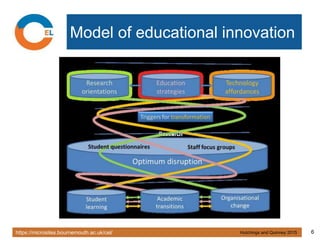
Model of educational innovation
Hutchings and Quinney 2015
https://microsites.bournemouth.ac.uk/cel/ 7
Activity
• Group A:
• Identify the triggers
for transformation
• Group B:
• Identify the optimal
level of disruption in
an organisation
In 5 minutes, then
Feedback to the group
https://microsites.bournemouth.ac.uk/cel/ 8
Discussion

Embedding the value of learning by extending professional boundaries

Editor's Notes

  • #7 The model of educational innovation we present is adapted from that proposed by Hutchings and Quinney (2015) which articulates the process as a triple helix, with research orientations, education strategies, and technology affordances as the three strands which have the potential to trigger transformation. These three strands share synergies with the BU Centre for Excellence priorities. Building on earlier work (Hutchings et al 2010 and 2013a and 2013b) Hutchings and Quinney (2015 p108) recognise and explore the challenges that change agents face when educational initiatives are “experienced as too uncomfortable, too difficult or simply too unwelcome and therefore resisted or rejected” or where academics may be “uncertain, unconvinced or indifferent” about educational initiatives (Hutchings et al 2010) and propose strategies for negotiating the complexity of the higher education environment with the aim of achieving optimum disruption (Hutchings et al 2010). Whilst this model was developed in the context of a health and social care curriculum the model is transferable to other disciplines and university-wide settings. Hutchings, M. and Quinney, A., 2015. The Flipped Classroom, Disruptive Pedagogies, Enabling Technologies and Wicked Problems: Responding to" The Bomb in the Basement". Electronic Journal of e-Learning, 13(2), pp.106-119. http://files.eric.ed.gov/fulltext/EJ1060159.pdf