phenikaa-uni.edu.vn
HỆ THỐNG NHÚNG
Dr. Thanh Nguyen
Email: thanh.nguyenngoc@phenikaa-uni.edu.vn
Office: Room 606 - Building A4
Chapter 6: Embedded System Design Process
phenikaa-uni.edu.vn
Content
▪ Design methodologies
▪ Embedded system design process
▪ Discuss the recent trends.
▪ Major application areas.
phenikaa-uni.edu.vn
Design Methodologies
▪ It is a procedure for designing a system.
▪ Keep a scorecard on a design to ensure that we have done everything
we need to do
▪ Develop computer-aided design tools
▪ Makes it much easier for members of a design team to communicate
phenikaa-uni.edu.vn
Design Methodologies
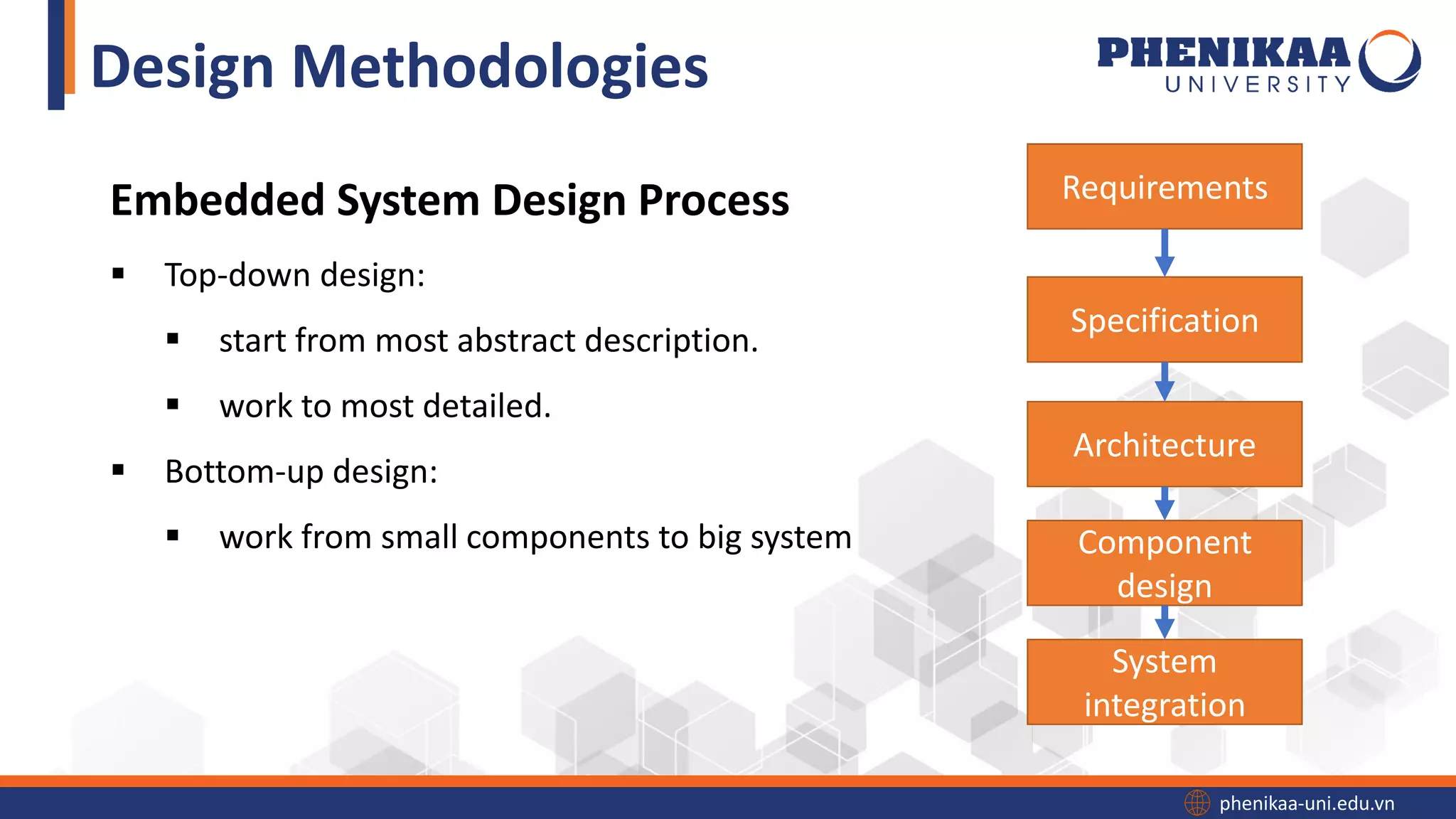
Embedded System Design Process
▪ Top-down design:
▪ start from most abstract description.
▪ work to most detailed.
▪ Bottom-up design:
▪ work from small components to big system
Requirements
Specification
Architecture
Component
design
System
integration
phenikaa-uni.edu.vn
Design Methodologies
Major Goals of the Design
✓ Manufacturing Cost.
✓ Performance Speed.
✓ Power Consumption.
At each Step in the design,
▪ Analyze, Refine, & Verify
Requirements
Specification
Architecture
Component
design
System
integration
phenikaa-uni.edu.vn
Design Methodologies
Design Process
Determine the
requirements
Design the system
architecture
Select the OS
Choose the
Processor and
peripherals
Choose the
Development
platform
Code the
application And
optimize
Verify the software
On the host system
Verify the software
On the target
system
phenikaa-uni.edu.vn
Design Methodologies
Requirements
▪ Before we design a system, we must know
what product we are designing.
▪ Plain language description of what the user
wants and expects to get.
▪ May be developed in several ways:
✓ Discuss directly to customers.
✓ Discuss to marketing representatives.
✓ Provide prototypes to users for comment.
phenikaa-uni.edu.vn
Design Methodologies
Requirements
▪ Functional requirements:
✓ output as a function of input.
▪ Non-functional requirements:
✓ Performance - time required
✓ size, weight, etc.
✓ power consumption
✓ reliability
✓ etc..
phenikaa-uni.edu.vn
Design Methodologies
Specification
▪ It serves as the contract between the customer and the architects. As such, the
specification must be carefully written so that it accurately reflects the
customer’s requirements and does so in a way that can be clearly followed during
design.
▪ The specification should be understandable enough so that someone can verify
that it meets system requirements and overall expectations of the customer.
phenikaa-uni.edu.vn
Design Methodologies
Architecture design
▪ Architecture is the plan for the overall structure of the system that will be used
later to design the components that make up the architecture.
▪ Architecture design must give an idea about
✓ What major components need for satisfying the specification?
✓ What hardware components need? like CPUs, peripherals, etc.
✓ What Software components need?
✓ Must take into account functional and non-functional specifications..
phenikaa-uni.edu.vn
Designing hardware and software
Architecture design
▪ The component design effort builds those components to satisfy architecture and
specification.
▪ The components will in general include both hardware - FPGAs, boards and
software modules.
▪ Some components are ready-made, some can be modified from existing designs,
others must be designed from scratch (that is new design).
phenikaa-uni.edu.vn
System Integration
▪ System integration is Putting together the components.
✓ Many bugs appear only at this stage.
▪ Bugs are typically found during system integration, and good planning can help us
find the bugs quickly.
▪ System integration is difficult because it usually uncovers problems. It is often
hard to observe in the system, to determine exactly what is wrong - the
debugging facilities for embedded systems are usually much more limited than
what you.
▪ Inserting appropriate debugging facilities during design can help ease system
integration problems would find on desktop systems.
phenikaa-uni.edu.vn
Recent Trends
▪ Due to the developments in Micro electronics availability of processors increased.
✓ Reduces cost
✓ Increased speed
✓ Reduce Size
✓ Reduce Power
phenikaa-uni.edu.vn
Recent Trends
✓ Pressure Sensors
✓ Flow Sensors
✓ Ultrasonic Sensors
✓ RF Tx / Rx
✓ Zigbee Modules
✓ EM Locks
✓ Vacuum sensors
✓ Digital Compass
✓ Fire Sensor
✓ Temperature Sensor
✓ Speed sensors
✓ Level sensors
✓ Industrial proximity sensor
✓ Vibration sensor
✓ Water Identifier Sensors
✓ Acceleration Sensor - 3 Axis
✓ Glass braking sensor
Modules & industrial standard sensors
phenikaa-uni.edu.vn
Recent Trends
✓ Accelerometer
✓ Liquid / Moisture Sensor
✓ GSM / GPRS Modems
✓ Sound Detecting Sensor
✓ PIR Sensor
✓ Gas Sensor
✓ CO2 Analyzer
✓ GPS Receiver
✓ Voice IC
✓ Digital Pressure Sensor
✓ Digital Temperature Sensor
✓ Bump Sensor (Touch Sensor)
✓ DC Motor
✓ AC Motor
✓ Servo Motor
✓ Stepper Motor
✓ Beam Sensor
✓ Color Mark Sensor
✓ Metal Sensor
Modules & industrial standard sensors
phenikaa-uni.edu.vn
Application Areas
Consumer electronics
phenikaa-uni.edu.vn
Application Areas
Industrial Automation
phenikaa-uni.edu.vn
Application Areas
Biomedical Systems
phenikaa-uni.edu.vn
Application Areas
Telecommunication Systems
phenikaa-uni.edu.vn
Summary
▪ Design methodologies
▪ Embedded system design process
▪ Discuss the recent trends.
▪ Major application areas.

Embedded systems - Chapter 6.pdf

  • 1.
    phenikaa-uni.edu.vn HỆ THỐNG NHÚNG Dr.Thanh Nguyen Email: thanh.nguyenngoc@phenikaa-uni.edu.vn Office: Room 606 - Building A4 Chapter 6: Embedded System Design Process
  • 2.
    phenikaa-uni.edu.vn Content ▪ Design methodologies ▪Embedded system design process ▪ Discuss the recent trends. ▪ Major application areas.
  • 3.
    phenikaa-uni.edu.vn Design Methodologies Design Methodologies ▪It is a procedure for designing a system. ▪ Keep a scorecard on a design to ensure that we have done everything we need to do ▪ Develop computer-aided design tools ▪ Makes it much easier for members of a design team to communicate
  • 4.
    phenikaa-uni.edu.vn Design Methodologies Embedded SystemDesign Process ▪ Top-down design: ▪ start from most abstract description. ▪ work to most detailed. ▪ Bottom-up design: ▪ work from small components to big system Requirements Specification Architecture Component design System integration
  • 5.
    phenikaa-uni.edu.vn Design Methodologies Major Goalsof the Design ✓ Manufacturing Cost. ✓ Performance Speed. ✓ Power Consumption. At each Step in the design, ▪ Analyze, Refine, & Verify Requirements Specification Architecture Component design System integration
  • 6.
    phenikaa-uni.edu.vn Design Methodologies Design Process Determinethe requirements Design the system architecture Select the OS Choose the Processor and peripherals Choose the Development platform Code the application And optimize Verify the software On the host system Verify the software On the target system
  • 7.
    phenikaa-uni.edu.vn Design Methodologies Requirements ▪ Beforewe design a system, we must know what product we are designing. ▪ Plain language description of what the user wants and expects to get. ▪ May be developed in several ways: ✓ Discuss directly to customers. ✓ Discuss to marketing representatives. ✓ Provide prototypes to users for comment.
  • 8.
    phenikaa-uni.edu.vn Design Methodologies Requirements ▪ Functionalrequirements: ✓ output as a function of input. ▪ Non-functional requirements: ✓ Performance - time required ✓ size, weight, etc. ✓ power consumption ✓ reliability ✓ etc..
  • 9.
    phenikaa-uni.edu.vn Design Methodologies Specification ▪ Itserves as the contract between the customer and the architects. As such, the specification must be carefully written so that it accurately reflects the customer’s requirements and does so in a way that can be clearly followed during design. ▪ The specification should be understandable enough so that someone can verify that it meets system requirements and overall expectations of the customer.
  • 10.
    phenikaa-uni.edu.vn Design Methodologies Architecture design ▪Architecture is the plan for the overall structure of the system that will be used later to design the components that make up the architecture. ▪ Architecture design must give an idea about ✓ What major components need for satisfying the specification? ✓ What hardware components need? like CPUs, peripherals, etc. ✓ What Software components need? ✓ Must take into account functional and non-functional specifications..
  • 11.
    phenikaa-uni.edu.vn Designing hardware andsoftware Architecture design ▪ The component design effort builds those components to satisfy architecture and specification. ▪ The components will in general include both hardware - FPGAs, boards and software modules. ▪ Some components are ready-made, some can be modified from existing designs, others must be designed from scratch (that is new design).
  • 12.
    phenikaa-uni.edu.vn System Integration ▪ Systemintegration is Putting together the components. ✓ Many bugs appear only at this stage. ▪ Bugs are typically found during system integration, and good planning can help us find the bugs quickly. ▪ System integration is difficult because it usually uncovers problems. It is often hard to observe in the system, to determine exactly what is wrong - the debugging facilities for embedded systems are usually much more limited than what you. ▪ Inserting appropriate debugging facilities during design can help ease system integration problems would find on desktop systems.
  • 13.
    phenikaa-uni.edu.vn Recent Trends ▪ Dueto the developments in Micro electronics availability of processors increased. ✓ Reduces cost ✓ Increased speed ✓ Reduce Size ✓ Reduce Power
  • 14.
    phenikaa-uni.edu.vn Recent Trends ✓ PressureSensors ✓ Flow Sensors ✓ Ultrasonic Sensors ✓ RF Tx / Rx ✓ Zigbee Modules ✓ EM Locks ✓ Vacuum sensors ✓ Digital Compass ✓ Fire Sensor ✓ Temperature Sensor ✓ Speed sensors ✓ Level sensors ✓ Industrial proximity sensor ✓ Vibration sensor ✓ Water Identifier Sensors ✓ Acceleration Sensor - 3 Axis ✓ Glass braking sensor Modules & industrial standard sensors
  • 15.
    phenikaa-uni.edu.vn Recent Trends ✓ Accelerometer ✓Liquid / Moisture Sensor ✓ GSM / GPRS Modems ✓ Sound Detecting Sensor ✓ PIR Sensor ✓ Gas Sensor ✓ CO2 Analyzer ✓ GPS Receiver ✓ Voice IC ✓ Digital Pressure Sensor ✓ Digital Temperature Sensor ✓ Bump Sensor (Touch Sensor) ✓ DC Motor ✓ AC Motor ✓ Servo Motor ✓ Stepper Motor ✓ Beam Sensor ✓ Color Mark Sensor ✓ Metal Sensor Modules & industrial standard sensors
  • 16.
  • 17.
  • 18.
  • 19.
  • 20.
    phenikaa-uni.edu.vn Summary ▪ Design methodologies ▪Embedded system design process ▪ Discuss the recent trends. ▪ Major application areas.