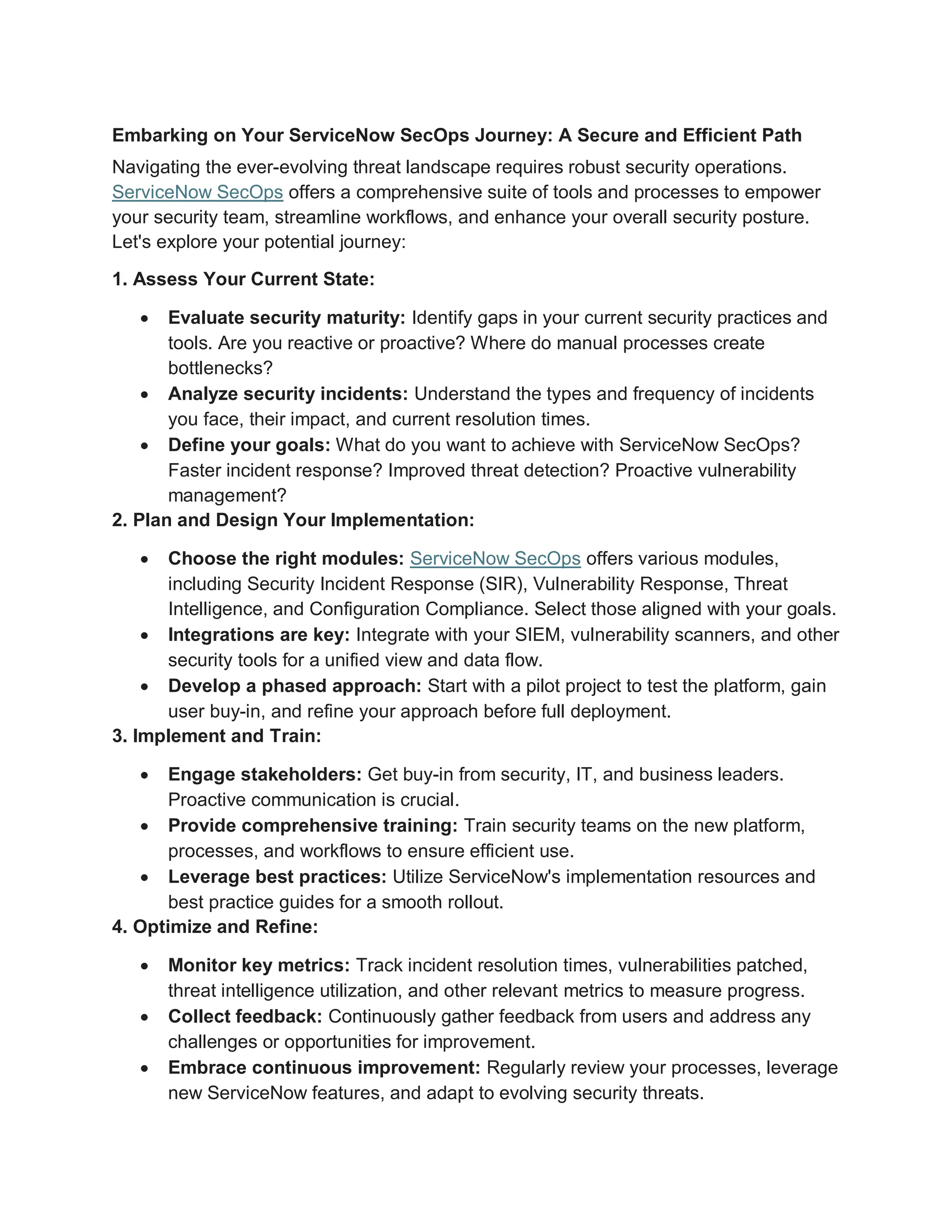
Embarking on Your ServiceNow SecOps Journey: A Secure and Efficient Path
Navigating the ever-evolving threat landscape requires robust security operations.
ServiceNow SecOps offers a comprehensive suite of tools and processes to empower
your security team, streamline workflows, and enhance your overall security posture.
Let's explore your potential journey:
1. Assess Your Current State:
 Evaluate security maturity: Identify gaps in your current security practices and
tools. Are you reactive or proactive? Where do manual processes create
bottlenecks?
 Analyze security incidents: Understand the types and frequency of incidents
you face, their impact, and current resolution times.
 Define your goals: What do you want to achieve with ServiceNow SecOps?
Faster incident response? Improved threat detection? Proactive vulnerability
management?
2. Plan and Design Your Implementation:
 Choose the right modules: ServiceNow SecOps offers various modules,
including Security Incident Response (SIR), Vulnerability Response, Threat
Intelligence, and Configuration Compliance. Select those aligned with your goals.
 Integrations are key: Integrate with your SIEM, vulnerability scanners, and other
security tools for a unified view and data flow.
 Develop a phased approach: Start with a pilot project to test the platform, gain
user buy-in, and refine your approach before full deployment.
3. Implement and Train:
 Engage stakeholders: Get buy-in from security, IT, and business leaders.
Proactive communication is crucial.
 Provide comprehensive training: Train security teams on the new platform,
processes, and workflows to ensure efficient use.
 Leverage best practices: Utilize ServiceNow's implementation resources and
best practice guides for a smooth rollout.
4. Optimize and Refine:
 Monitor key metrics: Track incident resolution times, vulnerabilities patched,
threat intelligence utilization, and other relevant metrics to measure progress.
 Collect feedback: Continuously gather feedback from users and address any
challenges or opportunities for improvement.
 Embrace continuous improvement: Regularly review your processes, leverage
new ServiceNow features, and adapt to evolving security threats.
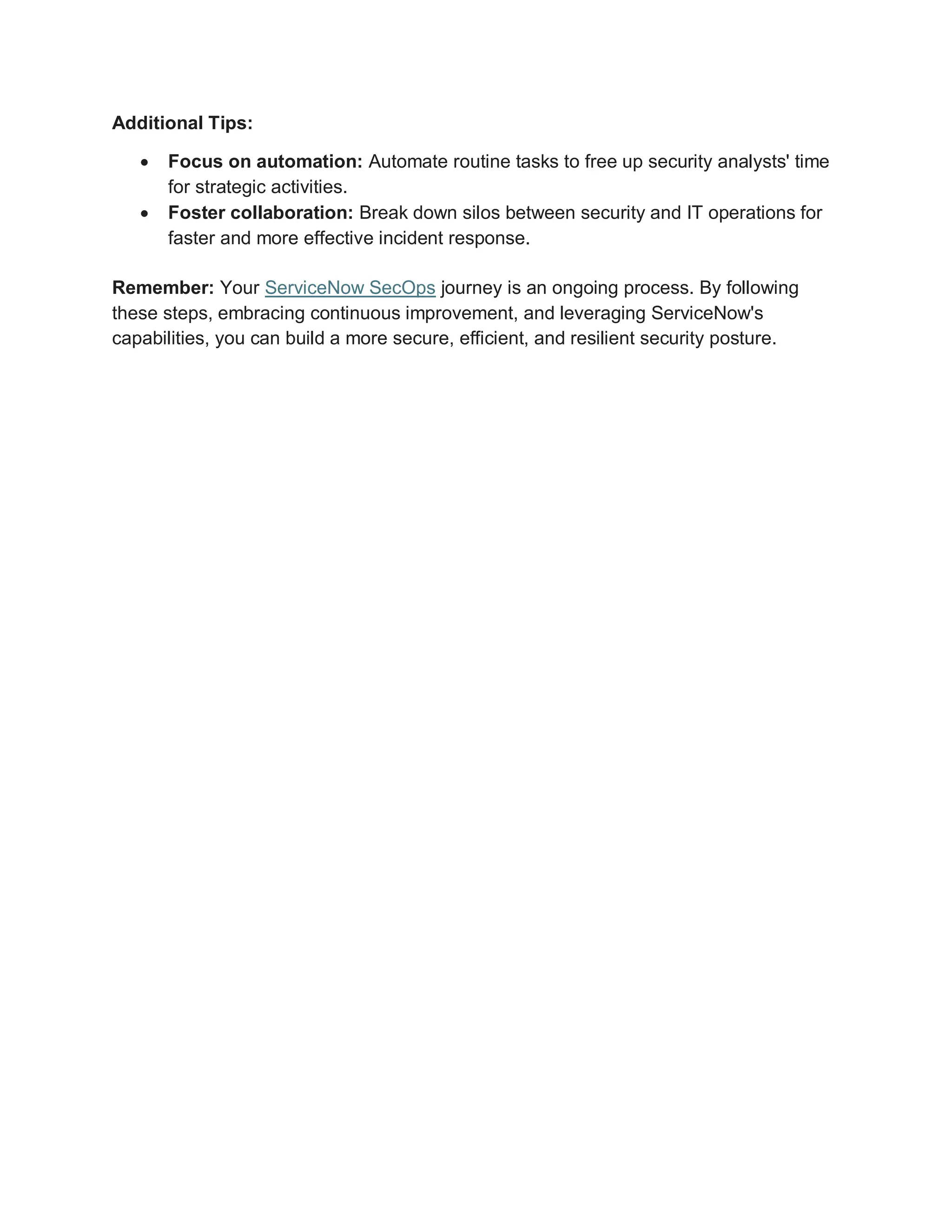
Additional Tips:
 Focus on automation: Automate routine tasks to free up security analysts' time
for strategic activities.
 Foster collaboration: Break down silos between security and IT operations for
faster and more effective incident response.
Remember: Your ServiceNow SecOps journey is an ongoing process. By following
these steps, embracing continuous improvement, and leveraging ServiceNow's
capabilities, you can build a more secure, efficient, and resilient security posture.

Embarking on Your ServiceNow SecOps Journey: A Secure and Efficient Path

  • 1.
    Embarking on YourServiceNow SecOps Journey: A Secure and Efficient Path Navigating the ever-evolving threat landscape requires robust security operations. ServiceNow SecOps offers a comprehensive suite of tools and processes to empower your security team, streamline workflows, and enhance your overall security posture. Let's explore your potential journey: 1. Assess Your Current State:  Evaluate security maturity: Identify gaps in your current security practices and tools. Are you reactive or proactive? Where do manual processes create bottlenecks?  Analyze security incidents: Understand the types and frequency of incidents you face, their impact, and current resolution times.  Define your goals: What do you want to achieve with ServiceNow SecOps? Faster incident response? Improved threat detection? Proactive vulnerability management? 2. Plan and Design Your Implementation:  Choose the right modules: ServiceNow SecOps offers various modules, including Security Incident Response (SIR), Vulnerability Response, Threat Intelligence, and Configuration Compliance. Select those aligned with your goals.  Integrations are key: Integrate with your SIEM, vulnerability scanners, and other security tools for a unified view and data flow.  Develop a phased approach: Start with a pilot project to test the platform, gain user buy-in, and refine your approach before full deployment. 3. Implement and Train:  Engage stakeholders: Get buy-in from security, IT, and business leaders. Proactive communication is crucial.  Provide comprehensive training: Train security teams on the new platform, processes, and workflows to ensure efficient use.  Leverage best practices: Utilize ServiceNow's implementation resources and best practice guides for a smooth rollout. 4. Optimize and Refine:  Monitor key metrics: Track incident resolution times, vulnerabilities patched, threat intelligence utilization, and other relevant metrics to measure progress.  Collect feedback: Continuously gather feedback from users and address any challenges or opportunities for improvement.  Embrace continuous improvement: Regularly review your processes, leverage new ServiceNow features, and adapt to evolving security threats.
  • 2.
    Additional Tips:  Focuson automation: Automate routine tasks to free up security analysts' time for strategic activities.  Foster collaboration: Break down silos between security and IT operations for faster and more effective incident response. Remember: Your ServiceNow SecOps journey is an ongoing process. By following these steps, embracing continuous improvement, and leveraging ServiceNow's capabilities, you can build a more secure, efficient, and resilient security posture.