European Life Sciences Infrastructure for Biological Information
www.elixir-europe.org
Rafael C Jimenez
ELIXIR Hub technical coordinator
ELIXIR
ELIXIR
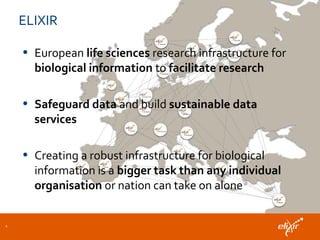
• European life sciences research infrastructure for
biological information to facilitate research
• Safeguard data and build sustainable data
services
• Creating a robust infrastructure for biological
information is a bigger task than any individual
organisation or nation can take on alone
2
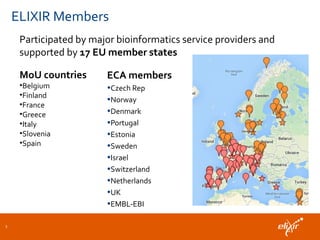
ELIXIR Members
3
ECA members
•Czech Rep
•Norway
•Denmark
•Portugal
•Estonia
•Sweden
•Israel
•Switzerland
•Netherlands
•UK
•EMBL-EBI
MoU countries
•Belgium
•Finland
•France
•Greece
•Italy
•Slovenia
•Spain
Participated by major bioinformatics service providers and
supported by 17 EU member states
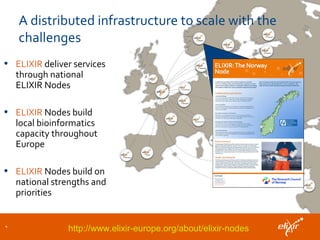
A distributed infrastructure to scale with the
challenges
• ELIXIR deliver services
through national
ELIXIR Nodes
• ELIXIR Nodes build
local bioinformatics
capacity throughout
Europe
• ELIXIR Nodes build on
national strengths and
priorities
4
http://www.elixir-europe.org/about/elixir-nodes
5
D e s c rip ti o n W e b -a d d r e ss
T h e $Isra e l$N o d e $
Contact
ELIXIR:The Norway
Node
ELIXIR'sNorwayNodewill provide competence and infra-
structure buildingon key areasfor Norway, in particular marine
resourcesand medical research. Challengesrelated to processing
and analysisof datafrom next-generation sequencing and other
high-throughput methodsare important both to basicresearchin
theseareas, and to thedevelopment of new enterprises. The
nodewill alsoprovidetrainingandsupport toward researchers.
Professor Inge Jonassen
ELIXIR Norway Node
Computational Biology Unit
Department of Informatics
University of Bergen, Norway
Inge.Jonassen@ii.uib.no
www.elixir-norway.org
University of Bergen
The coordinating partner of the Elixir Norway node.The main focus is on
marine genomics and e-infrastructure.An early deliverable is LiceBase
developed in tight collaboration withe the Sea Lice Research Centre.
University of Oslo
Emphasizes biomedical resource provision an analysis, leveraging public
resources in integrative statistical genomics, with secure management of
person sensitive data.
NorwegianUniversityof LifeSciences
comparative fish genomics. Provision of web-based solutions for services,
toolboxes, and computational access to these data.
NorwegianUniversityof ScienceandTechnology
Tools and resources for analysing genome data, with focus on gene
regulation, non-protein-coding RNAs and epigenetics, but also bacterial
genomics. Handling and analysis ofdata from human biobanks.
University ofTromsø
Tools and pipelines for analyzing metagenomic (and genomic) data, with a
particular focus on taxonomic classification and bioprospecting (functional
and metabolic potential).
TheNorwegianELIXIRNodewill provideservicesandresourcestowardmarine
genomicsincludingresearchers, government, andindustry. TheNorwegian
Node will off several integratedpackagesgearedtowardslarge-scaleanalysisof
marine genomicand metagenomicdata (e.g. fishgenomicsandmarine bio-
prospecting).Thisalsoincludesprovisionof web-basedsolutionsfor services,
toolboxes, andcomputational accesstoreferencedata provided by theELIXIR
infrastructure.
Health and biobanks
TheNorwayNode supportsinfrastructure for handlingandanalysisof data for
medical research, includinghuman biobanks. Suchdatamaybesensitive, and
must bestoredwithsecureaccess. Thenodeisdevelopinginfrastructurefor
sensitive data.Toolsfordataanalysisareintegrated into NeLS, theNorwegian
e-infrastructureforlifesciences.Thisprovidesuser-friendlysolutionsfor
exampleforhumanre-sequencingdataandother genome-scale analyses.
Marine research
Collaborating organisations
©Trym Ivar Bergsmo / Samfoto / NTBScanpix
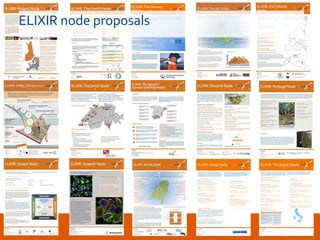
ELIXIR node proposals
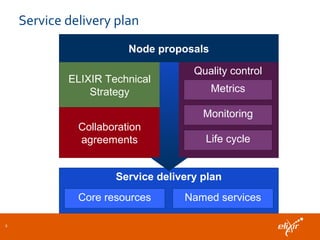
Quality control
Service delivery plan
6
ELIXIR Technical
Strategy Metrics
Monitoring
Service delivery plan
Core resources Named services
Life cycle
Collaboration
agreements
Node proposals
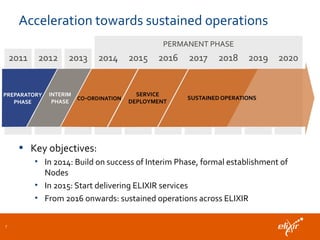
Acceleration towards sustained operations
• Key objectives:
• In 2014: Build on success of Interim Phase, formal establishment of
Nodes
• In 2015: Start delivering ELIXIR services
• From 2016 onwards: sustained operations across ELIXIR
7
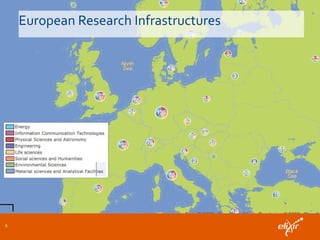
European Research Infrastructures
8
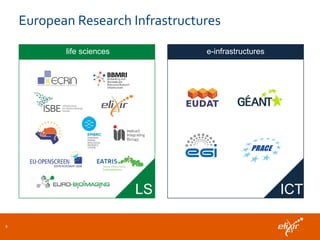
European Research Infrastructures
9
LS
e-infrastructureslife sciences
ICT
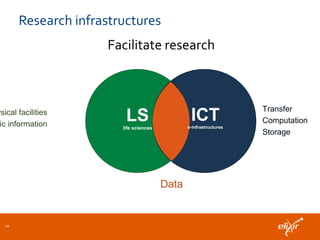
Research infrastructures
Facilitate research
10
Data
ICTe-infrastructures
LSlife sciences
ysical facilities
ic information
Transfer
Computation
Storage
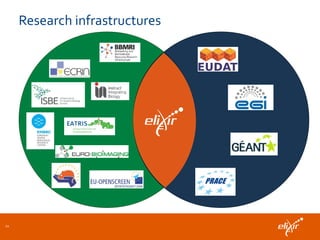
Research infrastructures
11
7 | 62
Figure 2 Together, the biomedical science research infrastructuresaddresssocietal challenges
By establishing interoperability between data and services in the biological,
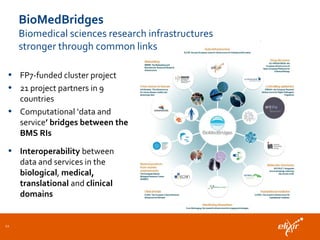
medical, translational and clinical domains, BioMedBridges links basic
BioMedBridges
Biomedical sciences research infrastructures
stronger through common links
• FP7-funded cluster project
• 21 project partners in 9
countries
• Computational ‘data and
service’ bridges between the
BMS RIs
• Interoperability between
data and services in the
biological, medical,
translational and clinical
domains
12
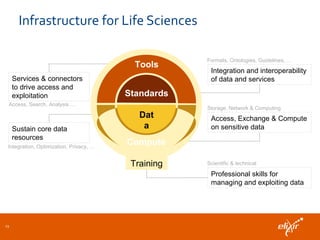
Infrastructure for Life Sciences
13
Services & connectors
to drive access and
exploitation
Integration and interoperability
of data and services
Sustain core data
resources
Access, Exchange & Compute
on sensitive data
Compute
Dat
a
Standards
Tools
Training
Professional skills for
managing and exploiting data
Access, Search, Analysis …
Integration, Optimization, Privacy, …
Storage, Network & Computing
Formats, Ontologies, Guidelines, …
Scientific & technical
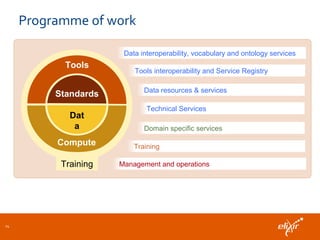
Programme of work
14
Domain specific services
Data interoperability, vocabulary and ontology services
Tools interoperability and Service Registry
Data resources & services
Technical Services
Management and operations
Training
Compute
Dat
a
Standards
Tools
Training
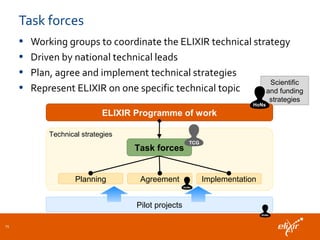
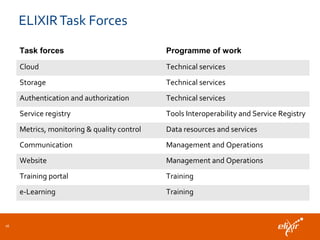
• Working groups to coordinate the ELIXIR technical strategy
• Driven by national technical leads
• Plan, agree and implement technical strategies
• Represent ELIXIR on one specific technical topic
Task forces
15
Scientific
and funding
strategies
ELIXIR Programme of work
Task forces
Planning Agreement Implementation
Technical strategies
Pilot projects
HoNs
HoNs
HoNs
TCG
ELIXIRTask Forces
16
Task forces Programme of work
Cloud Technical services
Storage Technical services
Authentication and authorization Technical services
Service registry Tools Interoperability and Service Registry
Metrics, monitoring & quality control Data resources and services
Communication Management and Operations
Website Management and Operations
Training portal Training
e-Learning Training
European Life Sciences Infrastructure for Biological Information
www.elixir-europe.org
Rafael C Jimenez
ELIXIR Hub technical coordinator
Standards
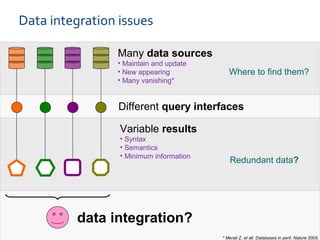
Data integration issues
Many data sources
• Maintain and update
• New appearing
• Many vanishing*
Different query interfaces
data integration?
Variable results
• Syntax
• Semantics
• Minimum information
* Merali Z. et all. Databases in peril. Nature 2005.
Where to find them?
Redundant data?
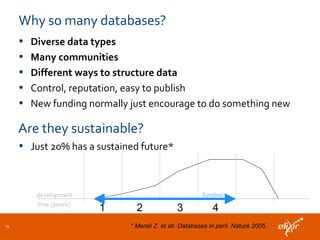
Why so many databases?
• Diverse data types
• Many communities
• Different ways to structure data
• Control, reputation, easy to publish
• New funding normally just encourage to do something new
19
1 2 3 4
funding
time (years)
development
Are they sustainable?
* Merali Z. et all. Databases in peril. Nature 2005.
• Just 20% has a sustained future*
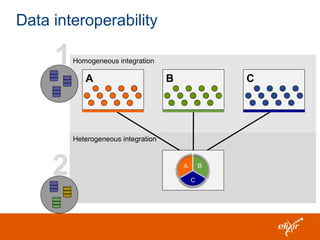
Heterogeneous integration
Homogeneous integration
Data interoperability
A B C
1
2
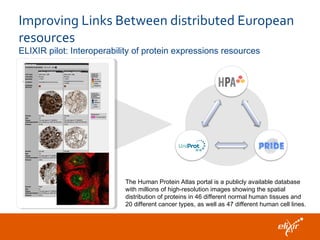
Improving Links Between distributed European
resources
ELIXIR pilot: Interoperability of protein expressions resources
The Human Protein Atlas portal is a publicly available database
with millions of high-resolution images showing the spatial
distribution of proteins in 46 different normal human tissues and
20 different cancer types, as well as 47 different human cell lines.
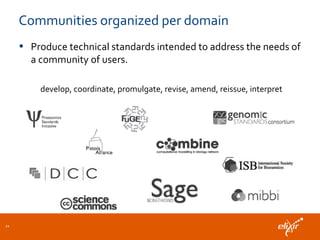
Communities organized per domain
• Produce technical standards intended to address the needs of
a community of users.
develop, coordinate, promulgate, revise, amend, reissue, interpret
22
ELIXIR role
• Support communities developing standards
• Establish links among communities and standards
• Promote the adoption of standards
• Help to find the gaps among standards
• Recommend standards best practices in data sharing
23
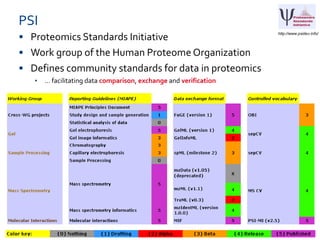
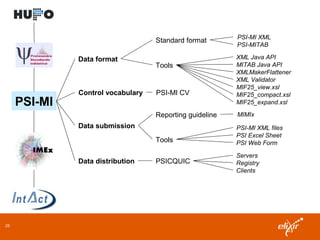
• Proteomics Standards Initiative
• Work group of the Human Proteome Organization
• Defines community standards for data in proteomics
• … facilitating data comparison, exchange and verification
PSI
24
http://www.psidev.info/
25
PSI-MI
Data format
Data distribution
Control vocabulary
Data submission
Standard format
Tools
PSICQUIC
PSI-MI CV
Reporting guideline MIMIx
Tools
PSI-MI XML
PSI-MITAB
XML Java API
MITAB Java API
XMLMakerFlattener
XML Validator
MIF25_view.xsl
MIF25_compact.xsl
MIF25_expand.xsl
PSI-MI XML files
PSI Excel Sheet
PSI Web Form
Servers
Registry
Clients
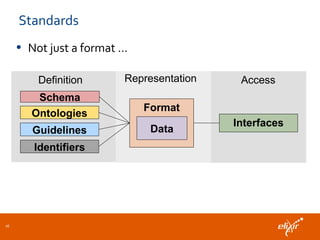
Standards
26
Schema
Interfaces
Guidelines
Ontologies
Format
Identifiers
Data
Definition Representation Access
• Not just a format …
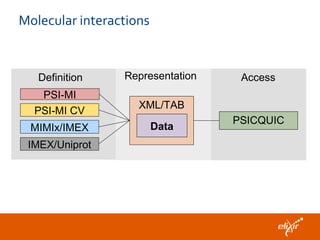
Molecular interactions
PSI-MI
PSICQUIC
MIMIx/IMEX
PSI-MI CV
XML/TAB
IMEX/Uniprot
Data
Definition Representation Access
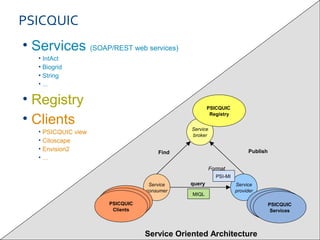
• Services (SOAP/REST web services)
• IntAct
• Biogrid
• String
• ...
• Registry
• Clients
• PSICQUIC view
• Citoscape
• Envision2
• …
18.12.1828
Service
broker
Service
consumer
Service
provider
query
PublishFind
Service Oriented Architecture
PSI-MI
PSICQUIC
Registry
DAS ClientsDAS ClientsPSICQUIC
Clients
Format
PSICQUIC
sources
PSICQUIC
sources
PSICQUIC
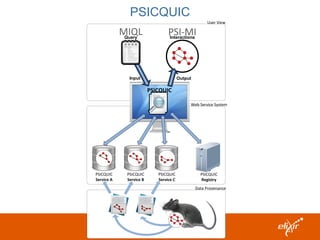
Services
PSICQUIC
MIQL
PSICQUIC
Query Interactions
PSICQUIC
Registry
PSI-MIMIQL
Input Output
PSICQUIC
Service A
PSICQUIC
Service B
PSICQUIC
Service C
User View
Web Service System
Data Provenance
PSICQUIC
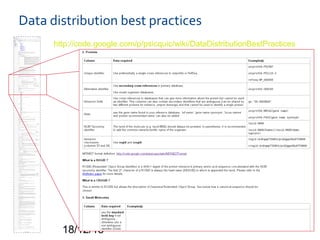
Data distribution best practices
18/12/18
30
http://code.google.com/p/psicquic/wiki/DataDistributionBestPractices
31
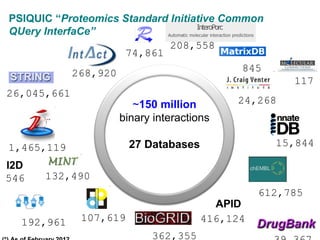
APID
416,124
612,785
362,355
268,920
1,465,119
845
132,490
24,268
74,861
15,844
107,619
26,045,661
~150 million
binary interactions
27 Databases
208,558
192,961
117
I2D
546
PSIQUIC “Proteomics Standard Initiative Common
QUery InterfaCe”
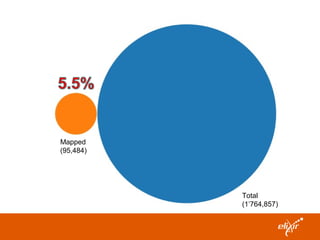
Mapped
(95,484)
Total
(1’764,857)
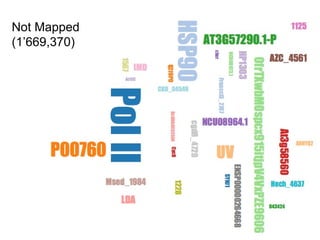
Not Mapped
(1’669,370)
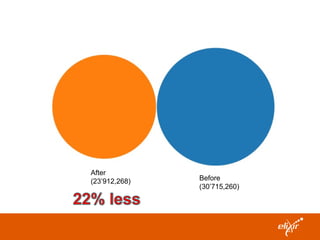
After
(23’912,268) Before
(30’715,260)
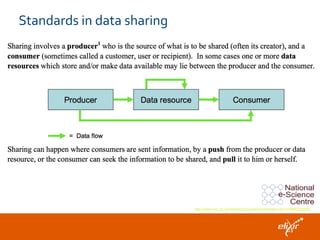
Standards in data sharing
http://www.mrc.ac.uk/Utilities/Documentrecord/index.htm?d=MRC002552
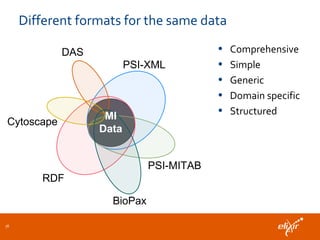
Different formats for the same data
36
MI
Data
PSI-XML
PSI-MITAB
BioPax
RDF
Cytoscape
DAS • Comprehensive
• Simple
• Generic
• Domain specific
• Structured
BioMedBridges Knowledge ExchangeWorkshop
Tuesday 24 - Wednesday 25 June 2014.VUMC, Amsterdam,The Netherlands
Workshop organised byWP3 - Standards Description and
Harmonisation, to bring together BMB partners, biomedical
standards experts and representatives of external projects.
Best practice for identifiers
•Gap analysis of current identifiers
Development of the BMB standards registry
•Gap analysis for usage of the registry
•Integration of the registry with other tools
37
Identifiers Best Practice - purpose
• Recommendations for identifiers best practice
• Designing (format, re-use)
• Managing (creation, versioning, provenance, deprecation etc.)
• Using (resolving, mapping etc.)
• Publish a paper
• Introduction to identifier concepts
• Case Studies illustrating identifier usage in real-world scenarios
• Recommendations on best practice
• Show not tell
• Descriptive not normative
• fornon-experts/newcomers
• Gap analysis
• list the biological entities and identifiers type used by BMB partners
38
Identifiers Best Practice – topics 1/2
• Identifier formats
• syntax of database IDs, URI patterns
• Identifier management
• creation, versioning, provenance, deprecation
• Identifier resolution
• how to use an ID to get useful information about the entity
• services for this, e.g. Identifiers.org
• what info. should be given ?
39
Identifiers Best Practice – topics 2/2
• Identifier mapping / aggregation
• how to map IDs on entries in one resource to those in another, to
assign equivalence / make useful links
• e.g. IDs for equivalent protein sequences in different organisms
• e.g. probe->gene->pathway->function (GO)
• Identifier cataloguing
• compilations of types of identifiers (e.g. EDAM ontology) or specific
identifiers (e.g. Cell Line Ontology)
• what info. should be given?
• Case Studies
• use of IDs in a particular domain
40
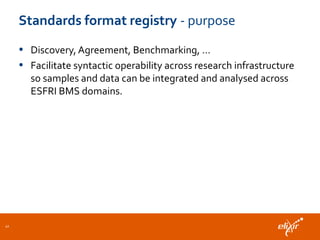
Standards format registry - purpose
• Discovery, Agreement, Benchmarking, …
• Facilitate syntactic operability across research infrastructure
so samples and data can be integrated and analysed across
ESFRI BMS domains.
41
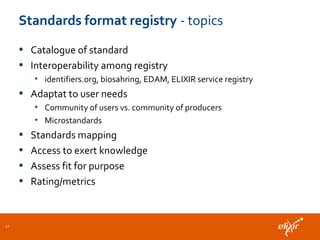
Standards format registry - topics
• Catalogue of standard
• Interoperability among registry
• identifiers.org, biosahring, EDAM, ELIXIR service registry
• Adaptat to user needs
• Community of users vs. community of producers
• Microstandards
• Standards mapping
• Access to exert knowledge
• Assess fit for purpose
• Rating/metrics
42
European Life Sciences Infrastructure for Biological Information
www.elixir-europe.org
Thank you
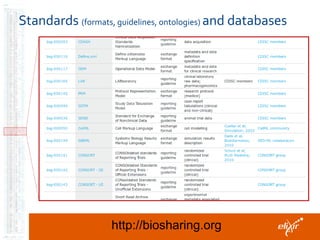
http://biosharing.org
Standards (formats, guidelines, ontologies) and databases
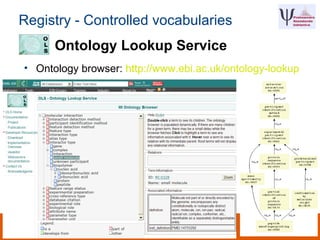
Registry - Controlled vocabularies
• Ontology browser: http://www.ebi.ac.uk/ontology-lookup
Ontology Lookup Service
46
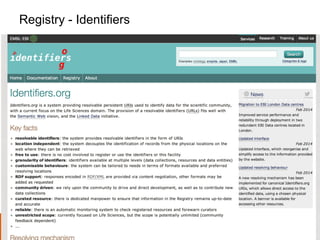
Registry - Identifiers
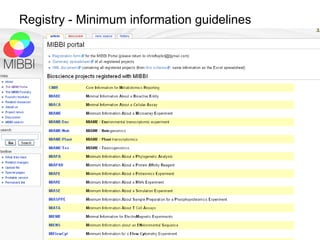
Registry - Minimum information guidelines

ELIXIR

  • 1.
    European Life SciencesInfrastructure for Biological Information www.elixir-europe.org Rafael C Jimenez ELIXIR Hub technical coordinator ELIXIR
  • 2.
    ELIXIR • European lifesciences research infrastructure for biological information to facilitate research • Safeguard data and build sustainable data services • Creating a robust infrastructure for biological information is a bigger task than any individual organisation or nation can take on alone 2
  • 3.
    ELIXIR Members 3 ECA members •CzechRep •Norway •Denmark •Portugal •Estonia •Sweden •Israel •Switzerland •Netherlands •UK •EMBL-EBI MoU countries •Belgium •Finland •France •Greece •Italy •Slovenia •Spain Participated by major bioinformatics service providers and supported by 17 EU member states
  • 4.
    A distributed infrastructureto scale with the challenges • ELIXIR deliver services through national ELIXIR Nodes • ELIXIR Nodes build local bioinformatics capacity throughout Europe • ELIXIR Nodes build on national strengths and priorities 4 http://www.elixir-europe.org/about/elixir-nodes
  • 5.
    5 D e sc rip ti o n W e b -a d d r e ss T h e $Isra e l$N o d e $ Contact ELIXIR:The Norway Node ELIXIR'sNorwayNodewill provide competence and infra- structure buildingon key areasfor Norway, in particular marine resourcesand medical research. Challengesrelated to processing and analysisof datafrom next-generation sequencing and other high-throughput methodsare important both to basicresearchin theseareas, and to thedevelopment of new enterprises. The nodewill alsoprovidetrainingandsupport toward researchers. Professor Inge Jonassen ELIXIR Norway Node Computational Biology Unit Department of Informatics University of Bergen, Norway Inge.Jonassen@ii.uib.no www.elixir-norway.org University of Bergen The coordinating partner of the Elixir Norway node.The main focus is on marine genomics and e-infrastructure.An early deliverable is LiceBase developed in tight collaboration withe the Sea Lice Research Centre. University of Oslo Emphasizes biomedical resource provision an analysis, leveraging public resources in integrative statistical genomics, with secure management of person sensitive data. NorwegianUniversityof LifeSciences comparative fish genomics. Provision of web-based solutions for services, toolboxes, and computational access to these data. NorwegianUniversityof ScienceandTechnology Tools and resources for analysing genome data, with focus on gene regulation, non-protein-coding RNAs and epigenetics, but also bacterial genomics. Handling and analysis ofdata from human biobanks. University ofTromsø Tools and pipelines for analyzing metagenomic (and genomic) data, with a particular focus on taxonomic classification and bioprospecting (functional and metabolic potential). TheNorwegianELIXIRNodewill provideservicesandresourcestowardmarine genomicsincludingresearchers, government, andindustry. TheNorwegian Node will off several integratedpackagesgearedtowardslarge-scaleanalysisof marine genomicand metagenomicdata (e.g. fishgenomicsandmarine bio- prospecting).Thisalsoincludesprovisionof web-basedsolutionsfor services, toolboxes, andcomputational accesstoreferencedata provided by theELIXIR infrastructure. Health and biobanks TheNorwayNode supportsinfrastructure for handlingandanalysisof data for medical research, includinghuman biobanks. Suchdatamaybesensitive, and must bestoredwithsecureaccess. Thenodeisdevelopinginfrastructurefor sensitive data.Toolsfordataanalysisareintegrated into NeLS, theNorwegian e-infrastructureforlifesciences.Thisprovidesuser-friendlysolutionsfor exampleforhumanre-sequencingdataandother genome-scale analyses. Marine research Collaborating organisations ©Trym Ivar Bergsmo / Samfoto / NTBScanpix ELIXIR node proposals
  • 6.
    Quality control Service deliveryplan 6 ELIXIR Technical Strategy Metrics Monitoring Service delivery plan Core resources Named services Life cycle Collaboration agreements Node proposals
  • 7.
    Acceleration towards sustainedoperations • Key objectives: • In 2014: Build on success of Interim Phase, formal establishment of Nodes • In 2015: Start delivering ELIXIR services • From 2016 onwards: sustained operations across ELIXIR 7
  • 8.
  • 9.
  • 10.
    Research infrastructures Facilitate research 10 Data ICTe-infrastructures LSlifesciences ysical facilities ic information Transfer Computation Storage
  • 11.
  • 12.
    7 | 62 Figure2 Together, the biomedical science research infrastructuresaddresssocietal challenges By establishing interoperability between data and services in the biological, medical, translational and clinical domains, BioMedBridges links basic BioMedBridges Biomedical sciences research infrastructures stronger through common links • FP7-funded cluster project • 21 project partners in 9 countries • Computational ‘data and service’ bridges between the BMS RIs • Interoperability between data and services in the biological, medical, translational and clinical domains 12
  • 13.
    Infrastructure for LifeSciences 13 Services & connectors to drive access and exploitation Integration and interoperability of data and services Sustain core data resources Access, Exchange & Compute on sensitive data Compute Dat a Standards Tools Training Professional skills for managing and exploiting data Access, Search, Analysis … Integration, Optimization, Privacy, … Storage, Network & Computing Formats, Ontologies, Guidelines, … Scientific & technical
  • 14.
    Programme of work 14 Domainspecific services Data interoperability, vocabulary and ontology services Tools interoperability and Service Registry Data resources & services Technical Services Management and operations Training Compute Dat a Standards Tools Training
  • 15.
    • Working groupsto coordinate the ELIXIR technical strategy • Driven by national technical leads • Plan, agree and implement technical strategies • Represent ELIXIR on one specific technical topic Task forces 15 Scientific and funding strategies ELIXIR Programme of work Task forces Planning Agreement Implementation Technical strategies Pilot projects HoNs HoNs HoNs TCG
  • 16.
    ELIXIRTask Forces 16 Task forcesProgramme of work Cloud Technical services Storage Technical services Authentication and authorization Technical services Service registry Tools Interoperability and Service Registry Metrics, monitoring & quality control Data resources and services Communication Management and Operations Website Management and Operations Training portal Training e-Learning Training
  • 17.
    European Life SciencesInfrastructure for Biological Information www.elixir-europe.org Rafael C Jimenez ELIXIR Hub technical coordinator Standards
  • 18.
    Data integration issues Manydata sources • Maintain and update • New appearing • Many vanishing* Different query interfaces data integration? Variable results • Syntax • Semantics • Minimum information * Merali Z. et all. Databases in peril. Nature 2005. Where to find them? Redundant data?
  • 19.
    Why so manydatabases? • Diverse data types • Many communities • Different ways to structure data • Control, reputation, easy to publish • New funding normally just encourage to do something new 19 1 2 3 4 funding time (years) development Are they sustainable? * Merali Z. et all. Databases in peril. Nature 2005. • Just 20% has a sustained future*
  • 20.
  • 21.
    Improving Links Betweendistributed European resources ELIXIR pilot: Interoperability of protein expressions resources The Human Protein Atlas portal is a publicly available database with millions of high-resolution images showing the spatial distribution of proteins in 46 different normal human tissues and 20 different cancer types, as well as 47 different human cell lines.
  • 22.
    Communities organized perdomain • Produce technical standards intended to address the needs of a community of users. develop, coordinate, promulgate, revise, amend, reissue, interpret 22
  • 23.
    ELIXIR role • Supportcommunities developing standards • Establish links among communities and standards • Promote the adoption of standards • Help to find the gaps among standards • Recommend standards best practices in data sharing 23
  • 24.
    • Proteomics StandardsInitiative • Work group of the Human Proteome Organization • Defines community standards for data in proteomics • … facilitating data comparison, exchange and verification PSI 24 http://www.psidev.info/
  • 25.
    25 PSI-MI Data format Data distribution Controlvocabulary Data submission Standard format Tools PSICQUIC PSI-MI CV Reporting guideline MIMIx Tools PSI-MI XML PSI-MITAB XML Java API MITAB Java API XMLMakerFlattener XML Validator MIF25_view.xsl MIF25_compact.xsl MIF25_expand.xsl PSI-MI XML files PSI Excel Sheet PSI Web Form Servers Registry Clients
  • 26.
  • 27.
  • 28.
    • Services (SOAP/RESTweb services) • IntAct • Biogrid • String • ... • Registry • Clients • PSICQUIC view • Citoscape • Envision2 • … 18.12.1828 Service broker Service consumer Service provider query PublishFind Service Oriented Architecture PSI-MI PSICQUIC Registry DAS ClientsDAS ClientsPSICQUIC Clients Format PSICQUIC sources PSICQUIC sources PSICQUIC Services PSICQUIC MIQL
  • 29.
    PSICQUIC Query Interactions PSICQUIC Registry PSI-MIMIQL Input Output PSICQUIC ServiceA PSICQUIC Service B PSICQUIC Service C User View Web Service System Data Provenance PSICQUIC
  • 30.
    Data distribution bestpractices 18/12/18 30 http://code.google.com/p/psicquic/wiki/DataDistributionBestPractices
  • 31.
    31 APID 416,124 612,785 362,355 268,920 1,465,119 845 132,490 24,268 74,861 15,844 107,619 26,045,661 ~150 million binary interactions 27Databases 208,558 192,961 117 I2D 546 PSIQUIC “Proteomics Standard Initiative Common QUery InterfaCe”
  • 32.
  • 33.
  • 34.
  • 35.
    Standards in datasharing http://www.mrc.ac.uk/Utilities/Documentrecord/index.htm?d=MRC002552
  • 36.
    Different formats forthe same data 36 MI Data PSI-XML PSI-MITAB BioPax RDF Cytoscape DAS • Comprehensive • Simple • Generic • Domain specific • Structured
  • 37.
    BioMedBridges Knowledge ExchangeWorkshop Tuesday24 - Wednesday 25 June 2014.VUMC, Amsterdam,The Netherlands Workshop organised byWP3 - Standards Description and Harmonisation, to bring together BMB partners, biomedical standards experts and representatives of external projects. Best practice for identifiers •Gap analysis of current identifiers Development of the BMB standards registry •Gap analysis for usage of the registry •Integration of the registry with other tools 37
  • 38.
    Identifiers Best Practice- purpose • Recommendations for identifiers best practice • Designing (format, re-use) • Managing (creation, versioning, provenance, deprecation etc.) • Using (resolving, mapping etc.) • Publish a paper • Introduction to identifier concepts • Case Studies illustrating identifier usage in real-world scenarios • Recommendations on best practice • Show not tell • Descriptive not normative • fornon-experts/newcomers • Gap analysis • list the biological entities and identifiers type used by BMB partners 38
  • 39.
    Identifiers Best Practice– topics 1/2 • Identifier formats • syntax of database IDs, URI patterns • Identifier management • creation, versioning, provenance, deprecation • Identifier resolution • how to use an ID to get useful information about the entity • services for this, e.g. Identifiers.org • what info. should be given ? 39
  • 40.
    Identifiers Best Practice– topics 2/2 • Identifier mapping / aggregation • how to map IDs on entries in one resource to those in another, to assign equivalence / make useful links • e.g. IDs for equivalent protein sequences in different organisms • e.g. probe->gene->pathway->function (GO) • Identifier cataloguing • compilations of types of identifiers (e.g. EDAM ontology) or specific identifiers (e.g. Cell Line Ontology) • what info. should be given? • Case Studies • use of IDs in a particular domain 40
  • 41.
    Standards format registry- purpose • Discovery, Agreement, Benchmarking, … • Facilitate syntactic operability across research infrastructure so samples and data can be integrated and analysed across ESFRI BMS domains. 41
  • 42.
    Standards format registry- topics • Catalogue of standard • Interoperability among registry • identifiers.org, biosahring, EDAM, ELIXIR service registry • Adaptat to user needs • Community of users vs. community of producers • Microstandards • Standards mapping • Access to exert knowledge • Assess fit for purpose • Rating/metrics 42
  • 43.
    European Life SciencesInfrastructure for Biological Information www.elixir-europe.org Thank you
  • 44.
  • 45.
    Registry - Controlledvocabularies • Ontology browser: http://www.ebi.ac.uk/ontology-lookup Ontology Lookup Service
  • 46.
  • 47.
    Registry - Minimuminformation guidelines

Editor's Notes

  • #4 Belgium has not submitted a Node application, and can’t attend today, but it will be coordinated out of VIB, so will include plant sciences resources Explain what ECA is
  • #5 Creating a robust infrastructure for biological information is a bigger task than any individual organisation or nation can take on alone These are issues of such complexity that no single institution or country can tackle alone Norwegian bioinformatics platform – bringing together 5 norwegian universities / institutes
  • #11 ‘research infrastructures’ refers to facilities, resources and related services used by the scientific community Physical facilities to conduct experiment or store samples Repositories of data and analysis tools
  • #12 ‘research infrastructures’ refers to facilities, resources and related services used by the scientific community Physical facilities to conduct experiment or store samples Repositories of data and analysis tools
  • #13 Previous example leads into BioMedBridges project that build bridges between the infrastructures and starting to develop data and service bridges to support research projects that of course will access and benefit from services involving several of these.
  • #16 Programme of work 5 years plan Work streams Strategy focused on generic topic Task forces Define technical implementation of specific tasks
  • #25 The HUPO Proteomics Standards Initiative (PSI) defines community standards for data representation in proteomics to facilitate data comparison, exchange and verification. The PSI was founded at the HUPO meeting in Washington, April 28-29, 2002 MIAPE: The Minimum Information About a Proteomics Experiment . Guidance document specifying the data and metadata that should be collected from proteomics experiments Where samples came from and how analyses were performed Data accompanied by context: 'metadata' ('data about the data')
  • #26 HUPO The Human Proteome Organisation (HUPO) is an international scientific organization representing and promoting proteomics through international cooperation and collaborations by fostering the development of new technologies, techniques and training. PSI The HUPO Proteomics Standards Initiative (PSI) defines community standards for data representation in proteomics to facilitate data comparison, exchange and verification. PSI-Molecular Interactions Work group of the Proteomics Standards Initiative focused on Molecular Interactions IMEx The IMEx consortium is a group of major public interaction data providers sharing curation effort. IntAct Open source database system and analysis tools for molecular interaction data including information derived from literature curation or direct user submissions.