g o o d F O R b u s i n e s s
‘It’s not
simple,
but it’s
effective’
Social media
for business
in four steps
Plus
Julie Meyer
Chris Brogan
Sahar Hashemi
Jonathan Hick
Nick Robertson
Jonathan Edwards
What next?
land the ideal
Non-executive
director’s job
Always
look on the
bright side
of property
crashes
Issue 3 | Summer 2010
Dan Heath has ways of making
you welcome that uncomfortable
new business plan
heavy
Mentalist
‘Often, simple
environmental
tweaks can alter
behaviour’
Coming
through
China’s middle
class goes
shopping
I s s u e 2 W I n t e r 2 0 0 9
Stephen Dubner, co-author of
Freakonomics, proves that just because
an idea is different it isn’t any less true
Freak
Philosophy
( )‘Other people were
just too clever to want
to get their hands dirty
on insane things.’
How fraudsters
discovered the
power of
marketing
‘Soon the word
“waste” won’t
even be used’
From rag and bone
to riches – meet the
leader of Scotland’s
recycling resurgence
India emerges
Chasing China
and the US
Plus:
George Davies,
Tom Peters,
Chris Anderson,
Tim Harford,
Giles Clarke,
Ray Anderson,
Gavin Wheeldon
Now the
banks have fled
Will Private equity
fund the revival?
Time to Get
Medievalthe next
world order
Selling your
business?act
before the
April tax
changes
www.grant-thornton.co.uk www.grant-thornton.co.uk
Thinking space: the next turn of the wheel
2
‘The present state of affairs
is a perversion of the proper
working of capitalism.
It is all wrong to have
millionaires before
you have ceased
to have slums.
Differences
of reward
must be
large enough
to induce
people to
do their
best, but
the present
differences
are far
too great.’
John Spedan Lewis, speaking in
1957 on his (1929) decision to hand
ownership of John Lewis to its
employees. Business is brisk at
the popular British retailer.
Thinking space:
feature starts P26
the
next turn
of the
wheel
‘It’sasifthereisabit
ofabadsmellwhenitcomestotheprivatesectorandthearts.’
‘Italktothesepeopleallthetimeandtheyarekeenbut
theydon’twanttobejustpassivegivers.Theyhavethe
experienceand
skillsto
m
akeam
oredynam
iccontribution.’
C
olin
Tw
eedy,C
E
ofA
rtsand
Business,on
w
hy
theart
w
orld
needs to
accept business patronage,
com
m
unicate w
ith
the influential ‘venture
philanthropists’ and get over the fear
of artistic compromise. ‘Culture is
worth £7.7 billion to the
UK economy.’
‘Do you
thinkyou canmake a car
without
copper?’
[business and social
responsibility]
[business and
environmental
responsibility]
‘I think
the firms
that’ll
do best
are the
ones that
have some
commitment to serve
shareholders as well as
employees. You have
to find a way to
balance the ownership
and the producers.’
John Gutfreund, President, Gutfreund & Co
‘The
tourists
have left.’
‘They spend eight
hours eating, eight
hours sleeping
and eight hours
ruminating.’
A cow farmer in France
confesses that the good solid
return of 4% a year on
private livestock investing
(cows reared on the
investor’s behalf) can
be short on thrills.
Jack Lifton, metals expert, worries about the
coming worldwide shortage of rare earth
metals. Many are derived from
newly mined
copper and they are crucial ingredients
for much modern technology, including
the Prius car battery.
‘The goal
there is very
much to take
risks that nobody
else will take.’
Vinod Khosla (founder of Sun
Microsystems). Khosla Ventures has
raised $1.1 billion in two funds that
will invest in green technology and
information technology start-ups.
This is the largest amount raised by
a venture capital firm since 2007.
‘We only build
companies that
address the world’s
most urgent
threats.’
Steve Newcomb, previously
of Powerset, now
founder of Virgance.
‘Virgance prepares social
enterprise startups for Tier 1
investments… We train the
leader, build a management
team and bring the company
to profitability before we
seek venture financing.’
One of his companies,
founded in 2008, is 1BOG
(One Block Off the Grid):
‘1BOG organises big
groups of people together
who want to get solar
energy, and gets them
a discount.’
Good-value solar power
has been installed in 13,800
homes in US cities and the
company now has $400 million
available in financing.
Mark Heesen, president of
the NVCA (National Venture
Capital Association, US),
discussing the new outlook
for venture capitalists.
‘Governments around the
world are very supportive
of creating a cleantech
industry with tax credits
and incentives,’ said Heesen.
‘In the US, it’s now seen
as an energy independence
issue, a security issue and
a jobs issue. And the public
is more supportive of
cleantech activities as more
people are cognizant of the
threat of global warming.’
Among US, UK and Israeli
investors, about half expect
to increase their investments
in cleantech.
12
Interview
swıtchanyone can flick
a
Several years ago, New Yorker
magazine ran a cartoon caption
competition, depicting a businessman
sitting down to eat in a sushi bar. It was
an ordinary scene, but for one detail.
Peering over the counter next to the chef,
wearing a large and misshapen kitchen
hat, was a giant, slightly uncomfortable-
looking squid.
The winning entry, printed underneath
the cartoon, puts the words in the mouth
of the sushi chef.
‘He feels he can do more good
working within the system,’ it says.
And they say America doesn’t do
understated humour.
Five years later, the writer of that
winning caption, Dan Heath – who
admits to feeling, on winning, ‘a rush
of pride mixed with a bit of shame that
I would be secretly entering cartoon
caption contests’ – has co-authored a
book which that conflicted squid, or its
boss, might well consider reading.
Switch: How to Change Things When
Change is Hard, by Chip and Dan
Heath, is a ‘thinking person’s how-to
book’ on changing behaviour – in the
toughest circumstances.
It’s all very well talking about our changing world, but moving a business in a new direction
is altogether a harder prospect. Chris Alden talks to Dan Heath, who believes the secret of
affecting change is about altering individual behaviour – not imposing diktats from on high
Words Chris Alden Photography Jonathan Saunders
GettyImages
www.grant-thornton.co.uk
14
It’s a book written mainly for people
who don’t have structural levers at their
fingertips – or the ends of their tentacles
– when it comes to creating change.
Given the flattish hierarchies in many
modern businesses, and the urgent
necessity to adapt to the demands of the
new economy, that makes it a book
suited to today’s environment. Yet Dan
Heath, co-author of the book, says that
when leaders do wield top-down
authority, they should pause before
reaching for the carrot or the stick.
‘Some of the most profound tools of
power come with a cost that makes them
dangerous,’ suggests Heath. ‘There’s no
question that incentives are powerful
– we don’t dispute that at all. But they’re
almost too powerful. We’ve just lived
through two years of the aftermath of an
incentives problem in America and the
rest of the world: Wall Street traders had
powerful incentives to do the things they
were doing, so they did them.
‘Often you’re bringing a gun to
a knife-fight by thinking about
incentives or structural remedies,’ he
adds. ‘Simple environmental tweaks
can alter behaviour.’
Switch sets out a practical blueprint
for behavioural change. The Heath
brothers focus on a psychological
conflict that they say happens in all
of us: a ‘mental struggle’ between
the rational and emotional parts of
our brains.
‘The starting place,’ says Heath, ‘is
what psychologists tell us about how
our brain works. We have these two
independent systems that sometimes
conflict. The rational side plans, thinks
ahead and analyses: that’s the part of
us that resolves to go on a diet. The
emotional side is more impulsive, and
that’s the part of us that wants to chow
down on a Mars bar.
‘What we’re trying to get across to
people in business is these tensions are in
the minds of your employees as you
announce your plan for change. They
may well disagree even in their own
mind as to whether change is necessary.’
To get across the point, the Heath
brothers draw on sources ancient and
modern, from David Allen to Kotter to
Plato. The main metaphor used in the
book is adapted from Jonathan Haidt,
the psychologist who took the Platonic
image of the mind as a charioteer trying
to rein in a horse – then reimagined that
unruly horse as something even more
powerful: an elephant.
‘What appealed to us about that
metaphor was it gives you a vivid sense
of scale,’ says Heath. ‘The rider is the
smart one, but the elephant is the
powerful one. In a disagreement, it’s
the elephant that’s going to win.’
You’d expect the bestselling authors
of Made to Stick, the Heath brothers’
earlier book on how to communicate
effectively, to have compelling stories to
illustrate their point, and they do. A
memorable story in Switch is that of
Jerry Sternin, a Save the Children
employee who, 20 years ago, tried to
battle malnutrition among children in
Vietnam with virtually no budget.
‘Sternin’s strategy,’ says Switch, ‘was
to search the community for bright spots
– successful efforts worth emulating. If
some kids were healthy despite their
disadvantages, that meant
malnourishment was not inevitable.’
Some mothers in one village, Sternin
found, successfully served children food
in a greater number of smaller servings.
Others collected prawn and crabs from
rice paddies, or used sweet-potato
greens. Sternin’s team invited local
mothers to meet and prepare food in
a way that emulated what ‘bright-spot’
mothers were doing.
‘A great feature of “bright spots” is
that it solves the “Not Invented Here”
problem,’ says Heath. And if you’re
trying to motivate people, Heath warns,
psychology teaches us that playing on
positive emotions works, because fear
leads to tunnel vision. In police work,
for example, victims of gun crime
sometimes get ‘weapon focus’, he says,
where they focus only on the firearm
and can’t, after the event, remember
details about the perpetrator. He says
that should be a warning for businesses
that use the ‘burning platform’ concept
of leadership – the idea that you should
create a crisis to stimulate change.
‘In most of the situations I encounter,
in this economy, it’s about needing a
new approach,’ says Heath. ‘It’s about –
how do we do things in a new way with
less money and more innovation? Those
kinds of problems require creativity,
problem-solving and an appetite for
failure. And all of those things are
precisely what would be shut down
with an approach of fear.’
Noting the vogue for design focus in
innovation, he adds: ‘So often, businesses
are encouraged to act like other
businesses. Right now Apple is the
sexiest company in the world. But other
companies aren’t like Apple. Trying to
be more like Apple is probably a fool’s
errand, but trying to be more like
yourself at your most successful
moments is not.’
Yet there’s a third element to the
Heath brothers’ blueprint for change:
the path that the rider and the elephant
will take.
‘To begin with we started only with
the rider and the elephant,’ says Heath.
‘It quickly became obvious to us that –
wait a minute – there are lots of
‘Trying to be more like Apple is
probably a fool’s errand, but trying
to be more like yourself at your
most successful moments is not’
Interview
In Switch, Chip and Dan Heath use the metaphor of the rider (the rational brain) riding
an elephant (the emotional brain) on a path (the road ahead). To create change, ‘direct
the rider’: following the ‘bright spots’ (working out what’s going well), then using that
information to help ‘script the critical moves’ which ‘point to the destination’.
You also need to ‘motivate the elephant’: ‘find the feeling’ by playing on people’s
emotions, ‘shrink the change’ by breaking it into manageable pieces, and ‘grow your
people’ by creating an identity around the change. Finally, ‘shape the path’: ‘tweak
the environment,’ they say, to encourage change; ‘build habits’ so that change
becomes embedded; and ‘rally the herd’ of elephants and riders – building on
the principle that when some move, the rest follow.
situations in life where change happens
regardless of what’s in people’s heads.’
Heath’s favourite example is the story
of a busy manager who, despite having
an open-door policy for her staff,
received low feedback scores about the
way she communicated. It turned out
the manager was getting distracted by
her computer screen even when people
were in the room. Solution? Tweak the
environment by moving the monitor to
a place where it couldn’t be seen when
people sat down. It’s a perfect illustration
that basic adjustments can solve
apparently intractable problems.
But there are limits to the application
of that idea, admits Heath. When dealing
with major change problems like the US
healthcare reform or global warming, he
says, clearly structural changes are as
important as behavioural ones.
‘The difference between an individual
change problem and a 10,000-person-
firm change problem is vast,’ says Heath.
‘But what comforts me ultimately is:
even the biggest change problems funnel
through individual behaviour change.’
Switch: How to Change Things When
Change is Hard, by Chip and Dan
Heath is published by Random House
Distilled wisdom
www.grant-thornton.co.uk
PROFILE
24
Tom Peters is going back to basics.
The American, who practically invented
the modern business book back in 1982
when he wrote In Search of Excellence
with his McKinsey co-author Robert H
Waterman Jr, says he has had it with
talk of ‘business models’ and ‘alignment
of staff priorities’ and polysyllabic
business jargon of the third kind.
As the world claws its way out of
recession, the father of all business
gurus is preaching a message he reckons
is most suited to today’s chastened,
post-bubble times: keep it simple.
Or rather, knowing Peters’s love of
repetition, line breaks and exclamation
marks, that might be
Keep it simple! Keep it
simple! Keep it simple!
But you get the point.
I am offered a 20-minute interview
with Peters, a man now famous as much
for his creative chaos, his shoot-from-
the-hip personal style and his ability to
deploy an analogy at 10 paces, as for the
landmark book he wrote 27 years ago.
It probably wouldn’t be enough with
most people but, after only a short time,
I see more clearly about business and
about life – at least for a while.
We start with a bit of a banter about
the movies. Peters has just seen the film
Julie & Julia, and has posted a tweet on
Twitter asking if there’s a better case
study out there about ‘the pursuit of
excellence’, the goal to which Peters
has devoted his life and work.
The film – about Julia Child, the
woman who brought the joys of
French cooking to America – charts the
success story of ‘a shocking enthusiast’,
says Peters, who crossed language and
cultural barriers and ‘changed the
natural approach to cooking’.
Peters, to borrow his own phrase,
is also ‘a shocking enthusiast’ – a herald
of change who has been increasingly
accused of populism as he aims
his nuggets of wisdom not only at
CEOs but at middle managers, the
self-employed and those at the bottom
of the corporate pyramid. And his
advice is often drawn as much from the
world of film or books or military
history as it is from business.
The thing about Child, says Peters,
is that, to quote Kenny Rogers, she
just didn’t ‘know when to fold ’em’.
‘Everything that changes the world
comes from people who are not
sane about when they stop doing
something,’ says Peters. ‘In the British
case, [those people include] idiots like
Churchill who thought the country
could stand up by itself, without even
the prospective help of the bloody
Americans,’ he adds, warming to one of
his classic themes, military history. ‘We
were about as interested in helping the
Brits in 1940 as flying to the moon.’
I’m enjoying the conversation, but
I feel I should bring it back to business.
So I float the idea that a wide range of
interests like Peters’ – be it film,
cooking, military history or whatever
– can only be a good thing in business.
‘I’m not trying to say anything about
myself, but it is said that the real essence
of creativity is not raw intelligence as
measured by IQ,’ says Peters, ‘but the
ability of people to go sideways and to
extract something from some arena and
apply it somewhere else.
‘And there’s evidence that this is true
even in the world of executive business.
I was reading a set of interviews in the
Wall Street Journal a couple of years
ago, and some guy was saying, “I owe
more success to my woodworking
hobby than any articles I’ve read in
the Harvard Business Review.”’
One of the problems that led to the
credit crunch, suggests Peters, was that
too many people didn’t have a diverse
enough view of the world – and were
so closely connected to a paradigm that
they couldn’t see where they were
going wrong.
‘Certainly, Wall Street’s obsession
with narrow mathematical models
didn’t model much of anything, as it
turned out,’ he says. ‘We can imagine
[America’s economists] drinking
extremely high-priced chardonnay
from California and deciding their
model really did encompass human
nature and the world as a whole –
when, in reality, they had about
0.00001% of reality encompassed.’
The ‘clever boy’ phenomenon, says
Peters, is part of the problem, not the
solution. So I pick the wrong time to
ask Peters which businesses with which
business models are likeliest to succeed,
or fail, in this changing world.
‘I happen to believe that whoever
invented the term “business model”
ought to be stuck inside a jail cell next
to Bernie Madoff,’ replies Peters. ‘I
hate the term. It’s like the bloody
mathematical models – why can’t we
say that you and I are Julia Child and
Simone Beck, and we have a passion for
cooking and we want to start a damned
restaurant – and we want to figure out
how to cook good food, attract money
into the restaurant, spend money on
what’s necessary, but not too much?
That’s called business! And we don’t
have to call it a business model!’
This conversation continues at
www.grant-thornton.co.uk/thinking/
elevate
Bestselling author Tom Peters has
had it with talk of ‘business models’.
To thrive in difficult times, he says,
you really need to get some hobbies…
Words CHRIS ALDEN
T
S
E
H
H
N
E
O C K I N G
T H U S I A S T
‘Everything that changes the world
comes from people who are not sane
about when they stop doing something’
corbisoutline
www.grant-thornton.co.ukwww.grant-thornton.co.uk
Thinking space: the next turn of the wheel
26
The new waveAs the economy picks up, private equity could be
the lifeline that reinvigorates the funding of companies.
Four experts provide a perspective on how it can be used
There is now a growing sense that the rapid contraction in the economy is nearing its end. But
with bank lending scarce there is clearly a need for an alternative source of financing to catalyse
recovery. Enter private equity. Though harangued by a sceptical media in recent years, much of
this is deserved animosity based on the actions of a small minority errantly misdirected at the
industry as a whole. In fact, private equity is a multifaceted asset class that is an important source
of funding for everything from fledgling start-ups to underperforming SMEs. More importantly,
many fund managers are sitting on war chests of capital raised during the years of plenty.
Words Ashley Wassall Illustration PADDY MILLS
a way out of difficulty
Jamie Constable is a partner at
RCapital, which invests in companies
in difficulty. A recession, says
Constable, is the cleaning point in
each economic cycle. Businesses that
do not have an effective proposition
fail and good businesses which may
have become inefficient are
consolidated and improved.
But, says Constable, ‘There are not
as many distressed assets coming to
market as had been anticipated.’ He
adds, ‘Interest rates are low and even
troubled businesses are therefore able
to keep up repayments on their loans.’
Constable asserts that turnaround
investing requires competency in a
range of disciplines, particularly an
understanding of legal issues. This is
emphasised by his own firm’s recent
investment in Helena Leisure Group,
which was structured as a Company
Voluntary Agreement (CVA).
A CVA is a complex setup whereby
the company agrees a schedule with
its lenders for partial repayment of
its debts and continues to exist in its
current form. ‘It is more transparent
than a pre-pack administration and
saves money. These situations are
all about how you use insolvency
procedures to preserve value.’
delivering leverage
For many small- or medium-sized
companies across the economy,
growth stagnated in the past two years
as funding disappeared. Andy Gray,
Senior Partner at mid-market private
equity house Graphite Capital, says
these businesses are the mainstay of
the private equity buyout market.
Despite the current squeeze on
credit, private equity provides a
combination of vital risk capital,
business experience and effective
incentivisation. ‘This is why private
equity became popular. Bank funding
alone does not create dynamic growth,
while stock markets are unattractive
from a competition perspective as
everything is carried out in public.’
It is also important to recognise the
significance of a functioning banking
sector to the buyout market itself.
Leverage is an important part of the
model in that it allows investors to
achieve superior returns. And, despite
recent bad press, in modest quantities
it can be a force for good in the
businesses themselves. ‘If a company
is capable of achieving rapid growth
then conservative use of leverage can
make this process quicker.’
With the buzz words of the market
at the moment being ‘value-add’, Gray
is refreshingly realistic about the role
of private equity and is bullish about
its efficacy. He says that debt should
not be demonised, and highlights the
ways in which private equity investors
support businesses operationally.
‘Private equity brings capital, but it
is not a commodity – it’s about getting
a partner you’re comfortable with. We
are hands on, involved in strategy and
bring a lot of experience.’
‘If a company is capable
of achieving rapid growth
then conservative use of
leverage can make this
process quicker’
Jamie
Constable
Partner
RCapital
Andy Gray
Senior Partner
Graphite Capital
18
{Ray Anderson}
CHIEF EXECUTIVE
Bango
[CAMBRIDGE]
The Opportunist
Computer scientist and entrepreneur
Ray Anderson co-founded Bango
in 1999, after realising that the
convergence of the internet with
mobile phones could open up huge
opportunities for content and service
providers. Today the mobile billing
and analytics company has some of
the best-known brands in the world
as its customers
‘Bango was floated on AIM in 2005, and we used the money
raised to start spending on penetrating international markets.
Progress was slower than expected and the US market was difficult
because of the economic climate. We reacted by changing our sales
model so that we sold using the web rather than with an expensive
sales team. The sales costs came down dramatically and as a result
we have been able to continue to grow the business, develop the
product and get new customers. We are now into a healthy
breakeven situation.
‘Something else we had to be careful of in the economic
downturn was that our customers, many of whom had grown
very quickly with venture capital, didn’t suddenly go bust leaving
us with bad debts. It helps that our service can be easily cut off, if
payments haven’t been made, so that there isn’t too much of an
impact and it is quickly dealt with. The other thing I noticed
because of the recession was that we lost a couple of our
development staff to the public sector, because they wanted
a feeling of greater security.
‘I’m feeling really optimistic – there is massive potential in
the Indian and Chinese markets, where there is already
high mobile phone usage and a real excitement about
being able to browse the internet and tap into emails
and networking sites on the move.’
‘We’ve changed our sales model
to use the web rather than an
expensive sales team’
first
personTHE NEXT TURN OF THE WHEEL
A new business world
requires a fresh approach
interviews Sophie Radice photography Joe McGorty
20
{Gavin Wheeldon}
CHIEF EXECUTIVE
Applied Language Solutions
[MANCHESTER]
The Internationalist
Gavin Wheeldon, 33, is founder and CEO of Applied Language Solutions.
Set up in his spare bedroom in 2003, it has expanded to become the world’s
fastest-growing translation service. Gavin has recently helped launch a
pre-packaged service that helps UK businesses wanting to trade internationally
‘I am passionate about wanting UK businesses to recognise the
very real opportunities there are in the export market. Now is such
a fantastic time to sell your products or services abroad because the
pound is so weak against the euro and the dollar. That’s why we have
launched Export Box. It provides really practical help and advice on
website translation, advertising, cross-border logistics and payment.
It’s estimated that just 75,000 businesses in Britain are exporting
outside the UK, which simply isn’t enough. The potential revenue
gained by successfully tapping into international markets could be
a vital lifeline for SMEs during the economic downturn.
‘I know how important export is, because one of the reasons we’ve
survived the downturn is that we work with 46 different countries.
Countries such as France, Germany and Japan are starting to show real
signs of moving out of the recession and so that softens the blow of the
recession at home. In India we found that businesses haven’t been hit
anywhere as badly as over here, so that we were able to manage the
20% or 30% drop from UK building and construction clients.
‘We also reduced costs in operations while concentrating more
on sales and getting new customers. We have managed to increase
sales, while not losing a single customer. It’s all about building
relationships. When we first went into India four years ago, there was
a real perception of price being more important than quality, but we
persevered and Indian companies began to see how much high-quality
translation could help their own global sales. We are also really proud
of our translators and are constantly on the look-out for the best
linguists to come and work for us!’
‘Just 75,000 businesses in
Britain are exporting outside the
UK. It simply isn’t enough’
firstpersonTHE NEXT TURN OF THE WHEEL
Interview
12
Radical thinkers tend to do things differently and in the case of Stephen Dubner 
the result is a pair of books that examine the everyday to reveal the extraordinary
economic and business truths that lie beneath
Words Glyn Brown Photography James Pfaff
As ‘Freakonomics’ – the ground-breaking
book on economic debate that made the subject
hip, added a word to our vocabulary and
changed the way we think – stood poised for
publication in May 2005, the authors were
deeply doubtful. ‘A famous academic within
economics, which counts for practically nothing
at the box office,’ explains journalist Stephen
Dubner, referring to partner Steven Levitt.
‘And a non-fiction writer who’d produced a
couple of books, one of which did quite well,
the other much less well; also not a slam dunk.
Furthermore, well, it’s economics. Our hopes
were modest.’
As readers may know, Freakonomics debuted
to vast acclaim and not a little controversy,
peaked at number two on the New York Times
bestseller list and has so far sold four million
copies worldwide. Not bad for a book no one
was going to read. Now, on the brink of an even
more audacious follow-up, Superfreakonomics,
it’s worth analysing what made that first book
so successful. Yes, it cold-shouldered the
dusty regular economic menu of inflation
and interest rates, instead scrutinising the real
world and including sections on how sumo
wrestlers cheat, why crack cocaine dealers
earn so little they have to live with their moms,
and most controversial of all, why legalised
abortion dramatically cut the crime rate. And
yes, it was written in vivid, inviting prose you
didn’t have to be an economist or academic to
grasp. But perhaps most important was the
fortuitous author combination and mindsets
that made the duo not just radical thinkers but,
as we saw at the start, self-doubters compelled
to go the extra mile.
Stephen Dubner, 46, is a respected journalist
who has taught English at Columbia University
and is a regular TV commentator. However, as
he explains at his New York office, he grew up
rurally, youngest of eight children, ‘with
parents who’d made very unusual religious and
lifestyle choices. No career track was initially
apparent’. He had started a band and was signed
to Arista before realising he wanted, and was
able, to do something far more analytical.
Levitt’s story isn’t dissimilar. With degrees from
Harvard and MIT, at the time he and Dubner
met he had just won the prestigious John Bates
Clark medal for most promising economist
under 40, often a Nobel precursor, and was a
chaired professor. But he also insisted he was
‘not great’ at maths or economic theory, and
www.grant-thornton.co.uk
Freakphilosophy
24
The
best
job
in the
world
Non-executive directors
www.grant-thornton.co.uk
The role of a non-executive director
offers satisfying and stimulating career
development for senior business individuals.
But how do you find and land the
best roles? Heather Farmbrough sets
out the steps you need to take
Concentrate on the day job
Most boards are looking for people who are outstanding in
their own field, so it is important to be recognised as such. Win
awards, be listed in the top three, broadcast and make speeches, write
articles and play a key role in industry groups. This is particularly
important if you are considering a move into a slightly different area.
Be realistic about
what you can contribute
Have a clear idea of your skills.
Companies want strong commercial
experience and evidence of success in
running operations, budgets and people and
relevant business experience. ‘Companies
want to see evidence of real-world, real-life
business experience at the coalface,’ says
Kit Bingham, Principal, Board Practice at
Odgers Berndtson. ‘Many CVs miss out the
commercial bits, or don’t let the stories
emphasise the achievements enough. If
you’ve turned around a division or your
budget has quadrupled, then say so. Mention
people who have seen you at work and who
can be approached to talk about you.’
Consider broadening your skills set
Finance skills are highly sought – finance is, after all, the language of the board. If
your experience and skills lie elsewhere, in marketing or HR, for instance, it may pay to
brush up any finance skills you have. ‘Consider opportunities where your experience may
be just as relevant, such as the boards of not for profit organisations and quangoes,’ counsels
Julia Budd, a partner with executive search consultants the Zygos Partnership. ‘Experience
on these will also help you learn how to handle situations around a board table.’
www.grant-thornton.co.uk
Narrow the search
Wading through potential roles is
time consuming. Mark Henderson, Deputy
Chairman of Gieves and Hawkes and
a non-executive director of luxury goods
organisation Walpole, the UK Fashion &
Textiles Association, and digital designers
Graphic Alliance, found hiring a
management coach invaluable because it
helped him to decide to concentrate on
becoming a chairman. ‘It’s a very interesting
role,’ he reflects, ‘because you can’t impose
your own opinions but you have to steer
meetings and ensure the right conclusions
are reached.’
26
Facts & Figures
Be proactive
Unless you are remarkably lucky, you need to think
strategically. The first step for many potential non-execs
is to start telling business colleagues that you would be
interested in such work; if it is a larger PLC you are
interested in, then approach the appropriate executive
search consultants. ‘Think about what kind of company
would interest you most and where your particular skills
and experience would be most relevant so that you can
target your efforts appropriately,’ says Lesley Stephenson,
editor of The Financial Times Non-Executive Directors’
Club. It can also be useful to develop a relationship with
a business mentor, particularly one connected with a useful
commercial network.
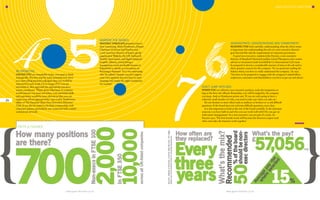
Non-execsinFTSE100
How many positions
are there?
InFTSE350
acrossallUK-listedcompanies
Non-executive directors
www.grant-thornton.co.uk
What’sthemix?
Recommended
	%oftheboard
	shouldbenon-
	execdirectors
Don’t jump into bed
When you are offered a non-executive position, resist the temptation to
leap at the first role offered. Remember, you will be judged by the company
you keep. And, as Henderson points out, ‘If you are only going to have a
relatively small number of roles, you need to take care what you take on.’
Do not hesitate to meet others such as auditors or brokers or to ask difficult
questions. If the board does not welcome difficult questions, steer clear.
It is also important to look at the rest of the board carefully. Is the chairman
someone you have faith in and who you can work well with? Do you get on
with senior management? As a non-executive you are part of a team. As
Paynter says, ‘The best boards work well because the directors respect each
other and make the business work together.’
Demonstrate understanding and commitment
Reading the brief carefully, understanding what the client wants
is important, but understanding the role of a non-executive director
goes beyond this and the requirements of corporate governance.
A good non-executive, explains John Paynter, a non-executive
director of Standard Chartered, Jardine Lloyd Thompson and a senior
adviser to investment bank Greenhill & Co International LLP, must
be prepared to devote a considerable amount of time to the job and to
show genuine concern for the company. ‘It’s no good just reading the
balance sheet; you have to really understand the company,’ he says.
‘You have to be prepared to engage with the company’s stakeholders,
employees, customers and shareholders; you have to get out and about.’
How often are
they replaced?
Every
three
years
What’s the pay?
£
avg
Average
payrise
where
awarded
%700
2,000
57,056
50
15
10,000
Sources:InstituteofDirectors, IncomesDataServices,TheHiggs
ReportandTheCombinedCodeonCorporateGovernance.

Elevate magazine

  • 1.
    g o od F O R b u s i n e s s ‘It’s not simple, but it’s effective’ Social media for business in four steps Plus Julie Meyer Chris Brogan Sahar Hashemi Jonathan Hick Nick Robertson Jonathan Edwards What next? land the ideal Non-executive director’s job Always look on the bright side of property crashes Issue 3 | Summer 2010 Dan Heath has ways of making you welcome that uncomfortable new business plan heavy Mentalist ‘Often, simple environmental tweaks can alter behaviour’ Coming through China’s middle class goes shopping
  • 2.
    I s su e 2 W I n t e r 2 0 0 9 Stephen Dubner, co-author of Freakonomics, proves that just because an idea is different it isn’t any less true Freak Philosophy ( )‘Other people were just too clever to want to get their hands dirty on insane things.’ How fraudsters discovered the power of marketing ‘Soon the word “waste” won’t even be used’ From rag and bone to riches – meet the leader of Scotland’s recycling resurgence India emerges Chasing China and the US Plus: George Davies, Tom Peters, Chris Anderson, Tim Harford, Giles Clarke, Ray Anderson, Gavin Wheeldon Now the banks have fled Will Private equity fund the revival? Time to Get Medievalthe next world order Selling your business?act before the April tax changes
  • 3.
    www.grant-thornton.co.uk www.grant-thornton.co.uk Thinking space:the next turn of the wheel 2 ‘The present state of affairs is a perversion of the proper working of capitalism. It is all wrong to have millionaires before you have ceased to have slums. Differences of reward must be large enough to induce people to do their best, but the present differences are far too great.’ John Spedan Lewis, speaking in 1957 on his (1929) decision to hand ownership of John Lewis to its employees. Business is brisk at the popular British retailer. Thinking space: feature starts P26 the next turn of the wheel ‘It’sasifthereisabit ofabadsmellwhenitcomestotheprivatesectorandthearts.’ ‘Italktothesepeopleallthetimeandtheyarekeenbut theydon’twanttobejustpassivegivers.Theyhavethe experienceand skillsto m akeam oredynam iccontribution.’ C olin Tw eedy,C E ofA rtsand Business,on w hy theart w orld needs to accept business patronage, com m unicate w ith the influential ‘venture philanthropists’ and get over the fear of artistic compromise. ‘Culture is worth £7.7 billion to the UK economy.’ ‘Do you thinkyou canmake a car without copper?’ [business and social responsibility] [business and environmental responsibility] ‘I think the firms that’ll do best are the ones that have some commitment to serve shareholders as well as employees. You have to find a way to balance the ownership and the producers.’ John Gutfreund, President, Gutfreund & Co ‘The tourists have left.’ ‘They spend eight hours eating, eight hours sleeping and eight hours ruminating.’ A cow farmer in France confesses that the good solid return of 4% a year on private livestock investing (cows reared on the investor’s behalf) can be short on thrills. Jack Lifton, metals expert, worries about the coming worldwide shortage of rare earth metals. Many are derived from newly mined copper and they are crucial ingredients for much modern technology, including the Prius car battery. ‘The goal there is very much to take risks that nobody else will take.’ Vinod Khosla (founder of Sun Microsystems). Khosla Ventures has raised $1.1 billion in two funds that will invest in green technology and information technology start-ups. This is the largest amount raised by a venture capital firm since 2007. ‘We only build companies that address the world’s most urgent threats.’ Steve Newcomb, previously of Powerset, now founder of Virgance. ‘Virgance prepares social enterprise startups for Tier 1 investments… We train the leader, build a management team and bring the company to profitability before we seek venture financing.’ One of his companies, founded in 2008, is 1BOG (One Block Off the Grid): ‘1BOG organises big groups of people together who want to get solar energy, and gets them a discount.’ Good-value solar power has been installed in 13,800 homes in US cities and the company now has $400 million available in financing. Mark Heesen, president of the NVCA (National Venture Capital Association, US), discussing the new outlook for venture capitalists. ‘Governments around the world are very supportive of creating a cleantech industry with tax credits and incentives,’ said Heesen. ‘In the US, it’s now seen as an energy independence issue, a security issue and a jobs issue. And the public is more supportive of cleantech activities as more people are cognizant of the threat of global warming.’ Among US, UK and Israeli investors, about half expect to increase their investments in cleantech.
  • 4.
    12 Interview swıtchanyone can flick a Severalyears ago, New Yorker magazine ran a cartoon caption competition, depicting a businessman sitting down to eat in a sushi bar. It was an ordinary scene, but for one detail. Peering over the counter next to the chef, wearing a large and misshapen kitchen hat, was a giant, slightly uncomfortable- looking squid. The winning entry, printed underneath the cartoon, puts the words in the mouth of the sushi chef. ‘He feels he can do more good working within the system,’ it says. And they say America doesn’t do understated humour. Five years later, the writer of that winning caption, Dan Heath – who admits to feeling, on winning, ‘a rush of pride mixed with a bit of shame that I would be secretly entering cartoon caption contests’ – has co-authored a book which that conflicted squid, or its boss, might well consider reading. Switch: How to Change Things When Change is Hard, by Chip and Dan Heath, is a ‘thinking person’s how-to book’ on changing behaviour – in the toughest circumstances. It’s all very well talking about our changing world, but moving a business in a new direction is altogether a harder prospect. Chris Alden talks to Dan Heath, who believes the secret of affecting change is about altering individual behaviour – not imposing diktats from on high Words Chris Alden Photography Jonathan Saunders GettyImages
  • 5.
    www.grant-thornton.co.uk 14 It’s a bookwritten mainly for people who don’t have structural levers at their fingertips – or the ends of their tentacles – when it comes to creating change. Given the flattish hierarchies in many modern businesses, and the urgent necessity to adapt to the demands of the new economy, that makes it a book suited to today’s environment. Yet Dan Heath, co-author of the book, says that when leaders do wield top-down authority, they should pause before reaching for the carrot or the stick. ‘Some of the most profound tools of power come with a cost that makes them dangerous,’ suggests Heath. ‘There’s no question that incentives are powerful – we don’t dispute that at all. But they’re almost too powerful. We’ve just lived through two years of the aftermath of an incentives problem in America and the rest of the world: Wall Street traders had powerful incentives to do the things they were doing, so they did them. ‘Often you’re bringing a gun to a knife-fight by thinking about incentives or structural remedies,’ he adds. ‘Simple environmental tweaks can alter behaviour.’ Switch sets out a practical blueprint for behavioural change. The Heath brothers focus on a psychological conflict that they say happens in all of us: a ‘mental struggle’ between the rational and emotional parts of our brains. ‘The starting place,’ says Heath, ‘is what psychologists tell us about how our brain works. We have these two independent systems that sometimes conflict. The rational side plans, thinks ahead and analyses: that’s the part of us that resolves to go on a diet. The emotional side is more impulsive, and that’s the part of us that wants to chow down on a Mars bar. ‘What we’re trying to get across to people in business is these tensions are in the minds of your employees as you announce your plan for change. They may well disagree even in their own mind as to whether change is necessary.’ To get across the point, the Heath brothers draw on sources ancient and modern, from David Allen to Kotter to Plato. The main metaphor used in the book is adapted from Jonathan Haidt, the psychologist who took the Platonic image of the mind as a charioteer trying to rein in a horse – then reimagined that unruly horse as something even more powerful: an elephant. ‘What appealed to us about that metaphor was it gives you a vivid sense of scale,’ says Heath. ‘The rider is the smart one, but the elephant is the powerful one. In a disagreement, it’s the elephant that’s going to win.’ You’d expect the bestselling authors of Made to Stick, the Heath brothers’ earlier book on how to communicate effectively, to have compelling stories to illustrate their point, and they do. A memorable story in Switch is that of Jerry Sternin, a Save the Children employee who, 20 years ago, tried to battle malnutrition among children in Vietnam with virtually no budget. ‘Sternin’s strategy,’ says Switch, ‘was to search the community for bright spots – successful efforts worth emulating. If some kids were healthy despite their disadvantages, that meant malnourishment was not inevitable.’ Some mothers in one village, Sternin found, successfully served children food in a greater number of smaller servings. Others collected prawn and crabs from rice paddies, or used sweet-potato greens. Sternin’s team invited local mothers to meet and prepare food in a way that emulated what ‘bright-spot’ mothers were doing. ‘A great feature of “bright spots” is that it solves the “Not Invented Here” problem,’ says Heath. And if you’re trying to motivate people, Heath warns, psychology teaches us that playing on positive emotions works, because fear leads to tunnel vision. In police work, for example, victims of gun crime sometimes get ‘weapon focus’, he says, where they focus only on the firearm and can’t, after the event, remember details about the perpetrator. He says that should be a warning for businesses that use the ‘burning platform’ concept of leadership – the idea that you should create a crisis to stimulate change. ‘In most of the situations I encounter, in this economy, it’s about needing a new approach,’ says Heath. ‘It’s about – how do we do things in a new way with less money and more innovation? Those kinds of problems require creativity, problem-solving and an appetite for failure. And all of those things are precisely what would be shut down with an approach of fear.’ Noting the vogue for design focus in innovation, he adds: ‘So often, businesses are encouraged to act like other businesses. Right now Apple is the sexiest company in the world. But other companies aren’t like Apple. Trying to be more like Apple is probably a fool’s errand, but trying to be more like yourself at your most successful moments is not.’ Yet there’s a third element to the Heath brothers’ blueprint for change: the path that the rider and the elephant will take. ‘To begin with we started only with the rider and the elephant,’ says Heath. ‘It quickly became obvious to us that – wait a minute – there are lots of ‘Trying to be more like Apple is probably a fool’s errand, but trying to be more like yourself at your most successful moments is not’ Interview In Switch, Chip and Dan Heath use the metaphor of the rider (the rational brain) riding an elephant (the emotional brain) on a path (the road ahead). To create change, ‘direct the rider’: following the ‘bright spots’ (working out what’s going well), then using that information to help ‘script the critical moves’ which ‘point to the destination’. You also need to ‘motivate the elephant’: ‘find the feeling’ by playing on people’s emotions, ‘shrink the change’ by breaking it into manageable pieces, and ‘grow your people’ by creating an identity around the change. Finally, ‘shape the path’: ‘tweak the environment,’ they say, to encourage change; ‘build habits’ so that change becomes embedded; and ‘rally the herd’ of elephants and riders – building on the principle that when some move, the rest follow. situations in life where change happens regardless of what’s in people’s heads.’ Heath’s favourite example is the story of a busy manager who, despite having an open-door policy for her staff, received low feedback scores about the way she communicated. It turned out the manager was getting distracted by her computer screen even when people were in the room. Solution? Tweak the environment by moving the monitor to a place where it couldn’t be seen when people sat down. It’s a perfect illustration that basic adjustments can solve apparently intractable problems. But there are limits to the application of that idea, admits Heath. When dealing with major change problems like the US healthcare reform or global warming, he says, clearly structural changes are as important as behavioural ones. ‘The difference between an individual change problem and a 10,000-person- firm change problem is vast,’ says Heath. ‘But what comforts me ultimately is: even the biggest change problems funnel through individual behaviour change.’ Switch: How to Change Things When Change is Hard, by Chip and Dan Heath is published by Random House Distilled wisdom
  • 6.
    www.grant-thornton.co.uk PROFILE 24 Tom Peters isgoing back to basics. The American, who practically invented the modern business book back in 1982 when he wrote In Search of Excellence with his McKinsey co-author Robert H Waterman Jr, says he has had it with talk of ‘business models’ and ‘alignment of staff priorities’ and polysyllabic business jargon of the third kind. As the world claws its way out of recession, the father of all business gurus is preaching a message he reckons is most suited to today’s chastened, post-bubble times: keep it simple. Or rather, knowing Peters’s love of repetition, line breaks and exclamation marks, that might be Keep it simple! Keep it simple! Keep it simple! But you get the point. I am offered a 20-minute interview with Peters, a man now famous as much for his creative chaos, his shoot-from- the-hip personal style and his ability to deploy an analogy at 10 paces, as for the landmark book he wrote 27 years ago. It probably wouldn’t be enough with most people but, after only a short time, I see more clearly about business and about life – at least for a while. We start with a bit of a banter about the movies. Peters has just seen the film Julie & Julia, and has posted a tweet on Twitter asking if there’s a better case study out there about ‘the pursuit of excellence’, the goal to which Peters has devoted his life and work. The film – about Julia Child, the woman who brought the joys of French cooking to America – charts the success story of ‘a shocking enthusiast’, says Peters, who crossed language and cultural barriers and ‘changed the natural approach to cooking’. Peters, to borrow his own phrase, is also ‘a shocking enthusiast’ – a herald of change who has been increasingly accused of populism as he aims his nuggets of wisdom not only at CEOs but at middle managers, the self-employed and those at the bottom of the corporate pyramid. And his advice is often drawn as much from the world of film or books or military history as it is from business. The thing about Child, says Peters, is that, to quote Kenny Rogers, she just didn’t ‘know when to fold ’em’. ‘Everything that changes the world comes from people who are not sane about when they stop doing something,’ says Peters. ‘In the British case, [those people include] idiots like Churchill who thought the country could stand up by itself, without even the prospective help of the bloody Americans,’ he adds, warming to one of his classic themes, military history. ‘We were about as interested in helping the Brits in 1940 as flying to the moon.’ I’m enjoying the conversation, but I feel I should bring it back to business. So I float the idea that a wide range of interests like Peters’ – be it film, cooking, military history or whatever – can only be a good thing in business. ‘I’m not trying to say anything about myself, but it is said that the real essence of creativity is not raw intelligence as measured by IQ,’ says Peters, ‘but the ability of people to go sideways and to extract something from some arena and apply it somewhere else. ‘And there’s evidence that this is true even in the world of executive business. I was reading a set of interviews in the Wall Street Journal a couple of years ago, and some guy was saying, “I owe more success to my woodworking hobby than any articles I’ve read in the Harvard Business Review.”’ One of the problems that led to the credit crunch, suggests Peters, was that too many people didn’t have a diverse enough view of the world – and were so closely connected to a paradigm that they couldn’t see where they were going wrong. ‘Certainly, Wall Street’s obsession with narrow mathematical models didn’t model much of anything, as it turned out,’ he says. ‘We can imagine [America’s economists] drinking extremely high-priced chardonnay from California and deciding their model really did encompass human nature and the world as a whole – when, in reality, they had about 0.00001% of reality encompassed.’ The ‘clever boy’ phenomenon, says Peters, is part of the problem, not the solution. So I pick the wrong time to ask Peters which businesses with which business models are likeliest to succeed, or fail, in this changing world. ‘I happen to believe that whoever invented the term “business model” ought to be stuck inside a jail cell next to Bernie Madoff,’ replies Peters. ‘I hate the term. It’s like the bloody mathematical models – why can’t we say that you and I are Julia Child and Simone Beck, and we have a passion for cooking and we want to start a damned restaurant – and we want to figure out how to cook good food, attract money into the restaurant, spend money on what’s necessary, but not too much? That’s called business! And we don’t have to call it a business model!’ This conversation continues at www.grant-thornton.co.uk/thinking/ elevate Bestselling author Tom Peters has had it with talk of ‘business models’. To thrive in difficult times, he says, you really need to get some hobbies… Words CHRIS ALDEN T S E H H N E O C K I N G T H U S I A S T ‘Everything that changes the world comes from people who are not sane about when they stop doing something’ corbisoutline
  • 7.
    www.grant-thornton.co.ukwww.grant-thornton.co.uk Thinking space: thenext turn of the wheel 26 The new waveAs the economy picks up, private equity could be the lifeline that reinvigorates the funding of companies. Four experts provide a perspective on how it can be used There is now a growing sense that the rapid contraction in the economy is nearing its end. But with bank lending scarce there is clearly a need for an alternative source of financing to catalyse recovery. Enter private equity. Though harangued by a sceptical media in recent years, much of this is deserved animosity based on the actions of a small minority errantly misdirected at the industry as a whole. In fact, private equity is a multifaceted asset class that is an important source of funding for everything from fledgling start-ups to underperforming SMEs. More importantly, many fund managers are sitting on war chests of capital raised during the years of plenty. Words Ashley Wassall Illustration PADDY MILLS a way out of difficulty Jamie Constable is a partner at RCapital, which invests in companies in difficulty. A recession, says Constable, is the cleaning point in each economic cycle. Businesses that do not have an effective proposition fail and good businesses which may have become inefficient are consolidated and improved. But, says Constable, ‘There are not as many distressed assets coming to market as had been anticipated.’ He adds, ‘Interest rates are low and even troubled businesses are therefore able to keep up repayments on their loans.’ Constable asserts that turnaround investing requires competency in a range of disciplines, particularly an understanding of legal issues. This is emphasised by his own firm’s recent investment in Helena Leisure Group, which was structured as a Company Voluntary Agreement (CVA). A CVA is a complex setup whereby the company agrees a schedule with its lenders for partial repayment of its debts and continues to exist in its current form. ‘It is more transparent than a pre-pack administration and saves money. These situations are all about how you use insolvency procedures to preserve value.’ delivering leverage For many small- or medium-sized companies across the economy, growth stagnated in the past two years as funding disappeared. Andy Gray, Senior Partner at mid-market private equity house Graphite Capital, says these businesses are the mainstay of the private equity buyout market. Despite the current squeeze on credit, private equity provides a combination of vital risk capital, business experience and effective incentivisation. ‘This is why private equity became popular. Bank funding alone does not create dynamic growth, while stock markets are unattractive from a competition perspective as everything is carried out in public.’ It is also important to recognise the significance of a functioning banking sector to the buyout market itself. Leverage is an important part of the model in that it allows investors to achieve superior returns. And, despite recent bad press, in modest quantities it can be a force for good in the businesses themselves. ‘If a company is capable of achieving rapid growth then conservative use of leverage can make this process quicker.’ With the buzz words of the market at the moment being ‘value-add’, Gray is refreshingly realistic about the role of private equity and is bullish about its efficacy. He says that debt should not be demonised, and highlights the ways in which private equity investors support businesses operationally. ‘Private equity brings capital, but it is not a commodity – it’s about getting a partner you’re comfortable with. We are hands on, involved in strategy and bring a lot of experience.’ ‘If a company is capable of achieving rapid growth then conservative use of leverage can make this process quicker’ Jamie Constable Partner RCapital Andy Gray Senior Partner Graphite Capital
  • 8.
    18 {Ray Anderson} CHIEF EXECUTIVE Bango [CAMBRIDGE] TheOpportunist Computer scientist and entrepreneur Ray Anderson co-founded Bango in 1999, after realising that the convergence of the internet with mobile phones could open up huge opportunities for content and service providers. Today the mobile billing and analytics company has some of the best-known brands in the world as its customers ‘Bango was floated on AIM in 2005, and we used the money raised to start spending on penetrating international markets. Progress was slower than expected and the US market was difficult because of the economic climate. We reacted by changing our sales model so that we sold using the web rather than with an expensive sales team. The sales costs came down dramatically and as a result we have been able to continue to grow the business, develop the product and get new customers. We are now into a healthy breakeven situation. ‘Something else we had to be careful of in the economic downturn was that our customers, many of whom had grown very quickly with venture capital, didn’t suddenly go bust leaving us with bad debts. It helps that our service can be easily cut off, if payments haven’t been made, so that there isn’t too much of an impact and it is quickly dealt with. The other thing I noticed because of the recession was that we lost a couple of our development staff to the public sector, because they wanted a feeling of greater security. ‘I’m feeling really optimistic – there is massive potential in the Indian and Chinese markets, where there is already high mobile phone usage and a real excitement about being able to browse the internet and tap into emails and networking sites on the move.’ ‘We’ve changed our sales model to use the web rather than an expensive sales team’ first personTHE NEXT TURN OF THE WHEEL A new business world requires a fresh approach interviews Sophie Radice photography Joe McGorty
  • 9.
    20 {Gavin Wheeldon} CHIEF EXECUTIVE AppliedLanguage Solutions [MANCHESTER] The Internationalist Gavin Wheeldon, 33, is founder and CEO of Applied Language Solutions. Set up in his spare bedroom in 2003, it has expanded to become the world’s fastest-growing translation service. Gavin has recently helped launch a pre-packaged service that helps UK businesses wanting to trade internationally ‘I am passionate about wanting UK businesses to recognise the very real opportunities there are in the export market. Now is such a fantastic time to sell your products or services abroad because the pound is so weak against the euro and the dollar. That’s why we have launched Export Box. It provides really practical help and advice on website translation, advertising, cross-border logistics and payment. It’s estimated that just 75,000 businesses in Britain are exporting outside the UK, which simply isn’t enough. The potential revenue gained by successfully tapping into international markets could be a vital lifeline for SMEs during the economic downturn. ‘I know how important export is, because one of the reasons we’ve survived the downturn is that we work with 46 different countries. Countries such as France, Germany and Japan are starting to show real signs of moving out of the recession and so that softens the blow of the recession at home. In India we found that businesses haven’t been hit anywhere as badly as over here, so that we were able to manage the 20% or 30% drop from UK building and construction clients. ‘We also reduced costs in operations while concentrating more on sales and getting new customers. We have managed to increase sales, while not losing a single customer. It’s all about building relationships. When we first went into India four years ago, there was a real perception of price being more important than quality, but we persevered and Indian companies began to see how much high-quality translation could help their own global sales. We are also really proud of our translators and are constantly on the look-out for the best linguists to come and work for us!’ ‘Just 75,000 businesses in Britain are exporting outside the UK. It simply isn’t enough’ firstpersonTHE NEXT TURN OF THE WHEEL
  • 10.
    Interview 12 Radical thinkers tendto do things differently and in the case of Stephen Dubner  the result is a pair of books that examine the everyday to reveal the extraordinary economic and business truths that lie beneath Words Glyn Brown Photography James Pfaff As ‘Freakonomics’ – the ground-breaking book on economic debate that made the subject hip, added a word to our vocabulary and changed the way we think – stood poised for publication in May 2005, the authors were deeply doubtful. ‘A famous academic within economics, which counts for practically nothing at the box office,’ explains journalist Stephen Dubner, referring to partner Steven Levitt. ‘And a non-fiction writer who’d produced a couple of books, one of which did quite well, the other much less well; also not a slam dunk. Furthermore, well, it’s economics. Our hopes were modest.’ As readers may know, Freakonomics debuted to vast acclaim and not a little controversy, peaked at number two on the New York Times bestseller list and has so far sold four million copies worldwide. Not bad for a book no one was going to read. Now, on the brink of an even more audacious follow-up, Superfreakonomics, it’s worth analysing what made that first book so successful. Yes, it cold-shouldered the dusty regular economic menu of inflation and interest rates, instead scrutinising the real world and including sections on how sumo wrestlers cheat, why crack cocaine dealers earn so little they have to live with their moms, and most controversial of all, why legalised abortion dramatically cut the crime rate. And yes, it was written in vivid, inviting prose you didn’t have to be an economist or academic to grasp. But perhaps most important was the fortuitous author combination and mindsets that made the duo not just radical thinkers but, as we saw at the start, self-doubters compelled to go the extra mile. Stephen Dubner, 46, is a respected journalist who has taught English at Columbia University and is a regular TV commentator. However, as he explains at his New York office, he grew up rurally, youngest of eight children, ‘with parents who’d made very unusual religious and lifestyle choices. No career track was initially apparent’. He had started a band and was signed to Arista before realising he wanted, and was able, to do something far more analytical. Levitt’s story isn’t dissimilar. With degrees from Harvard and MIT, at the time he and Dubner met he had just won the prestigious John Bates Clark medal for most promising economist under 40, often a Nobel precursor, and was a chaired professor. But he also insisted he was ‘not great’ at maths or economic theory, and www.grant-thornton.co.uk Freakphilosophy
  • 11.
    24 The best job in the world Non-executive directors www.grant-thornton.co.uk Therole of a non-executive director offers satisfying and stimulating career development for senior business individuals. But how do you find and land the best roles? Heather Farmbrough sets out the steps you need to take Concentrate on the day job Most boards are looking for people who are outstanding in their own field, so it is important to be recognised as such. Win awards, be listed in the top three, broadcast and make speeches, write articles and play a key role in industry groups. This is particularly important if you are considering a move into a slightly different area. Be realistic about what you can contribute Have a clear idea of your skills. Companies want strong commercial experience and evidence of success in running operations, budgets and people and relevant business experience. ‘Companies want to see evidence of real-world, real-life business experience at the coalface,’ says Kit Bingham, Principal, Board Practice at Odgers Berndtson. ‘Many CVs miss out the commercial bits, or don’t let the stories emphasise the achievements enough. If you’ve turned around a division or your budget has quadrupled, then say so. Mention people who have seen you at work and who can be approached to talk about you.’ Consider broadening your skills set Finance skills are highly sought – finance is, after all, the language of the board. If your experience and skills lie elsewhere, in marketing or HR, for instance, it may pay to brush up any finance skills you have. ‘Consider opportunities where your experience may be just as relevant, such as the boards of not for profit organisations and quangoes,’ counsels Julia Budd, a partner with executive search consultants the Zygos Partnership. ‘Experience on these will also help you learn how to handle situations around a board table.’
  • 12.
    www.grant-thornton.co.uk Narrow the search Wadingthrough potential roles is time consuming. Mark Henderson, Deputy Chairman of Gieves and Hawkes and a non-executive director of luxury goods organisation Walpole, the UK Fashion & Textiles Association, and digital designers Graphic Alliance, found hiring a management coach invaluable because it helped him to decide to concentrate on becoming a chairman. ‘It’s a very interesting role,’ he reflects, ‘because you can’t impose your own opinions but you have to steer meetings and ensure the right conclusions are reached.’ 26 Facts & Figures Be proactive Unless you are remarkably lucky, you need to think strategically. The first step for many potential non-execs is to start telling business colleagues that you would be interested in such work; if it is a larger PLC you are interested in, then approach the appropriate executive search consultants. ‘Think about what kind of company would interest you most and where your particular skills and experience would be most relevant so that you can target your efforts appropriately,’ says Lesley Stephenson, editor of The Financial Times Non-Executive Directors’ Club. It can also be useful to develop a relationship with a business mentor, particularly one connected with a useful commercial network. Non-execsinFTSE100 How many positions are there? InFTSE350 acrossallUK-listedcompanies Non-executive directors www.grant-thornton.co.uk What’sthemix? Recommended %oftheboard shouldbenon- execdirectors Don’t jump into bed When you are offered a non-executive position, resist the temptation to leap at the first role offered. Remember, you will be judged by the company you keep. And, as Henderson points out, ‘If you are only going to have a relatively small number of roles, you need to take care what you take on.’ Do not hesitate to meet others such as auditors or brokers or to ask difficult questions. If the board does not welcome difficult questions, steer clear. It is also important to look at the rest of the board carefully. Is the chairman someone you have faith in and who you can work well with? Do you get on with senior management? As a non-executive you are part of a team. As Paynter says, ‘The best boards work well because the directors respect each other and make the business work together.’ Demonstrate understanding and commitment Reading the brief carefully, understanding what the client wants is important, but understanding the role of a non-executive director goes beyond this and the requirements of corporate governance. A good non-executive, explains John Paynter, a non-executive director of Standard Chartered, Jardine Lloyd Thompson and a senior adviser to investment bank Greenhill & Co International LLP, must be prepared to devote a considerable amount of time to the job and to show genuine concern for the company. ‘It’s no good just reading the balance sheet; you have to really understand the company,’ he says. ‘You have to be prepared to engage with the company’s stakeholders, employees, customers and shareholders; you have to get out and about.’ How often are they replaced? Every three years What’s the pay? £ avg Average payrise where awarded %700 2,000 57,056 50 15 10,000 Sources:InstituteofDirectors, IncomesDataServices,TheHiggs ReportandTheCombinedCodeonCorporateGovernance.