FREE with your Waterstone’s Card or £2.95Issue 35/2010
BooksQuarterlyWbqonline.comIssue352010
Wbqonline.com9 7 8 1 9 0 2 6 0 3 6 6 7
3 5
9 7 8 1 9 0 2 6 0 3 6 6 7
3 5
Issue372010
BretEastonEllisinterviewedbyDonnaTartt/LaurenStJohn/MichaelPalin
AlexanderMcCallSmithexclusiveshortstory/GrahamGreene’sspyfamily
Gun-toting guys and no-good
gals tread the mean streets in
our bullet-riddled guide to
fiction’s greatest sleuths
FREE with your Waterstone’s Card or £2.95
books
reviewed in
this issue
26 Books Quarterly | Waterstones.com
fiction
Waterstones.com | Books Quarterly 27
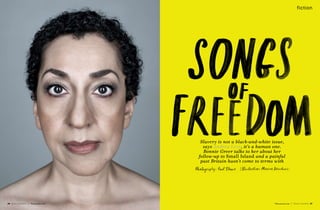
Slavery is not a black-and-white issue,
says Andrea Levy, it’s a human one.
Bonnie Greer talks to her about her
follow-up to Small Island and a painful
past Britain hasn’t come to terms with
Waterstones.com | Books Quarterly 2726 Books Quarterly | Waterstones.com
fiction
David Mitchell once more works his
world-creating magic on a Japanese
historical epic – Ed Wood asks him how
Photography: Paul Stuart Illustration: kaiandsunny.com
n old man teaches a young woman piano, while
between them lies an unexplained key; peasants celebrate
the new harvest while in the background a lone figure
watches from a hill; a couple embrace while a shadowy
figure watches from a doorway across the street. These are
not scenes from David Mitchell’s latest novel, but some of
his favourite Dutch paintings from the Wallace Collection in London,
which we take in after our interview. But his interests are clear: each
of these images carries a mystery, a subtext dictating larger events
offstage – they hold a sense of magic.
But let’s rewind by a few hours. I bump into Mitchell – wrapped up
against the cold; rangy, with a face happy with laughter lines – outside
the restaurant in which we’re due to meet ten minutes later. He, like
I, arrived early to make sure he would be on time and, when I mention
the cold, he toys with offering me his hat. This politeness shows how
grounded is the author who, in 2007, was named as one of Time
magazine’s most influential 100 people in the world. Time credited
Mitchell with the creation of the 21st-century novel, perhaps not
such an extraordinary claim when one considers the impact of his
time-jumping, country-hopping novels, most of all Cloud Atlas
(whose structure is a spin on an Italo Calvino story).
Mitchell shrugs off the accolade. ‘I can’t think of myself
in those terms,’ he says. ‘I love my job, and my vocation
pushes me into making those decisions.’
With The Thousand Autumns of Jacob de Zoet, his
vocation has ‘pushed him’ into a maturation of his
previous themes and techniques. Set over 1799
and 1800 in the Dutch trading post of Dejima –
a tiny man-made island perched on the great
mass of isolationist Japan in the Nagasaki
harbour – it’s one part historical comedy, two
parts epic romance. Its eponymous hero
Waterstones.com | Books Quarterly 79
fiction
78 Books Quarterly | Waterstones.com
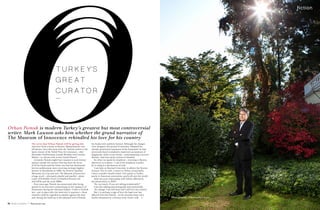
The news that Orhan Pamuk will be giving this
interview from a house in Boston, Massachusetts, sets
off alarms. Does this mean that the Turkish author is the
latest winner of the Nobel Prize for Literature – after
Alexander Solzhenitsyn, Joseph Brodsky and Czeslaw
Milosz – to choose exile in the United States?
Certainly, Pamuk might have reasons to seek literary
asylum outside the country that has been the focus
of all his books and the home city that has dominated
his two publications since receiving writing’s highest
honour in Stockholm in 2006: the memoir Istanbul:
Memories of a City and now The Museum of Innocence,
a huge novel – alternately playful and painful – about
a pair of forbidden lovers in Istanbul between the
mid-1970s and the early 1980s.
Four years ago, Pamuk was prosecuted after being
quoted in an interview commenting on the massacre of
Armenians during the Ottoman Empire. Under a Turkish
law – put in place after the interview in question – these
remarks could be regarded as slander against the state
and, during the build-up to the planned trial of Pamuk,
his books were publicly burned. Although the charges
were dropped, this period of notoriety inflamed his
already questioned reputation in his homeland: he had
previously faced (completely unproven) accusations of
plagiarism, while recent books – enthusiastically received
abroad – had seen picky notices in Istanbul.
So when we speak by telephone – morning in Boston,
afternoon in London – I ask if the telephone number
he is using is a declaration of exile.
‘I am here in Harvard University to deliver the Norton
lectures. Not in exile. I return to Turkey occasionally;
I don’t consider myself exiled. I live partly in Turkey,
partly in American universities, partly all over the world.’
And was your relationship with Turkey affected by
the prosecution in 2005?
‘No, not much. If you are talking residentially?’
I am also talking psychologically and emotionally.
‘No change. I am still busy and I still love my country.’
But it is perhaps a sign of how the legal case has
affected him that Pamuk – in his resonant bass voice,
further deepened by a throaty early winter cold
Orhan Pamuk is modern Turkey’s greatest but most controversial
writer. Mark Lawson asks him whether the grand narrative of
The Museum of Innocence rekindled his love for his country
Photography: Christopher Lane
T u r k e y’s
gr e a t
cu r a t o r
68 Books Quarterly | Waterstones.com Waterstones.com | Books Quarterly 69
history
W
hen a young lieutenant called Napoleon
Bonaparte returned to Paris in 1787, determined
to lose his virginity, he arrived in a city of 600,000
people that was still a collection of villages. More
than half those people had come from other parts
of France and never left their home quartier. There
were teetering tenements on the edge of the city that housed
the entire male population of an Alpine valley. As an English
visitor remarked, Paris was ‘full of foreigners’ – or as we would
now say, ‘immigrants’. Few of the 12,000 prostitutes of Paris
were Parisian by birth: the skilful young woman who satisfied
the lieutenant’s desire had come from Brittany to ply her trade
in the shoppers’ paradise of the Palais-Royal.
At the dawn of the French Revolution, there was still no
accurate street map of Paris. A map of ‘Paris As It Is Today’
carefully omitted the capital’s minor streets, ‘Because,’ the
mapmaker explained, ‘it would have looked like total chaos.’
A few years after Bonaparte’s visit, Marie Antoinette, fleeing
from the Tuileries Palace with a guard who knew the city as
well as anyone, turned right instead of left and got completely
lost in the stinking labyrinth of the Left Bank. The Left Bank
itself, I was amazed to discover, was built on an uncharted
warren of ancient limestone quarries.
The architect who descended into that Parisian underworld,
hoping to save the city from collapse, has vanished entirely
from official history. This seems quite appropriate: Paris
has always been a city of secrets. Even today, there are parts
of the Paris conglomeration that are unknown to most of
the city’s residents. The appalling suburbs where the riots
of 2005 began inspire more fear today than in times when
they were patrolled by highwaymen and wolves.
I wrote The Discovery of France after covering 14,000 miles
of that vast land of tribes and micro-civilisations on a bicycle.
The book was a geographical history of a country that historians
had often reduced to a picturesque hinterland of Paris. Paris
itself demanded a different approach. I had lived there as
a labourer, a student, a teacher and a tourist. I had read dozens
of histories of Paris, but somehow I could never retain all the
information. All those names, dates and glimpses of famous
lives were like anonymous faces in the Métro. What I remembered
most clearly were the stories attached to particular places, and
this, it seemed to me, was a way to write about the city without
becoming lost in statistics and dazed by digressions.
Following Balzac, I wanted to write a mini Human Comedy
of Paris, in which the history of the city would be illuminated
by the real experience of its inhabitants. Each tale is complete in
itself, and each one is true – even the incredible story that gave
Alexandre Dumas the idea for The Count of Monte Cristo. But
there are also correspondences and crossroads, both literal and
mysterious, that serve as landmarks in time and space: some
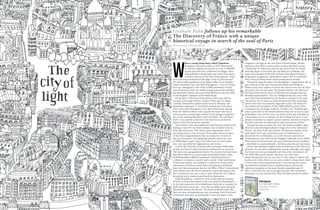
Graham Robb follows up his remarkable
The Discovery of France with a unique
historical voyage in search of the soul of Paris
Illustration: Claudia Boldt
enigmatic carvings on the west front of Notre Dame, certain
stations in the Métro, certain street corners and hotel rooms.
I found that, if I followed a thread, the story of the city would
naturally begin to tell itself: the real Mimì of La Bohème, the
trials and triumphs of the wife of Emile Zola, Marcel Proust’s
drug-tinted expeditions, Adolf Hitler’s dawn visit to a deserted
Paris, François Mitterrand’s faked assassination attempt...
Instead of using the same tone throughout, I wanted each tale to
give a flavour of the time. General de Gaulle and President
Sarkozy may have walked or driven the same streets, but the Paris
they knew was not the same. The Jewish children who hid from
the Nazis discovered a secret world that was stranger than any
fictional representation. The city changed from one year to the
next. Each tale demanded its own forms of courtesy to the past.
The history of two lovers in Saint-Germain-des-Prés presented
itself in the form of a nouvelle vague film script. The drama of
the student-led revolution of May 1968 called for some of the
techniques of a sociology textbook. Another tale, ‘Périphérique’,
owes a great deal to the bandes dessinées that are so much a part
of Parisians’ view of their own city. None of this was intended as
a prescription or as a comment on the writing of history. It was
simply an attempt to conjure up lost realities, and also to express
the sheer pleasure of exploring the past and present of Paris.
Perhaps because so much of a city’s life remains hidden, spies,
detectives and informants played a large role in this ‘adventure
history’: the files of the Paris Sûreté, the detective branch of the
early police force, are a priceless source of information on
the private lives of Parisians, as are the forensic activities of
Commissioner Clot, who ran the Brigade Criminelle in the 1950s.
With all its revolutions and civil wars, Paris has always oscillated
– cheerfully or catastrophically – between anarchy and repression.
In the end, Parisians needed as much research as The Discovery
of France. It took more walking than cycling, although, once again,
the bicycle proved an invaluable tool. Since the introduction of
the Vélib’ bike rental scheme, Parisians, too, have been
rediscovering their city. In any case, it is far easier to explore the
banlieue on a bike than in a car, and a cyclist is always more likely
to have some interesting adventures. It was during one recent,
two-wheeled expedition that I stumbled upon a previously
unknown mountain in the most densely populated part of
Paris. I used the story as an epilogue, because, like Lieutenant
Bonaparte, no one returns from Paris the same person as before.
Parisians
by Graham Robb
Hardback Picador
£18.99 April
68 Books Quarterly | Waterstones.com Waterstones.com | Books Quarterly 69
fiction
t its best, British
fiction is replete with all the
contradictions, terrors and joys
of the nation’s varied people and
history. This spring, five new authors
prove this with tales of a witch
in a 1930s Black Country town,
the City’s financial freefall,
an Arab guardian angel,
a Victorian Aboriginal cricketer
and an illegal Indian immigrant
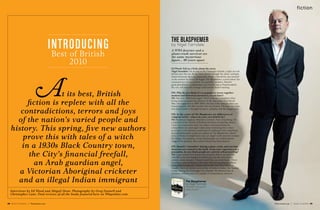
Introducing
Best of British
2010
Interviews by Ed Wood and Abigail Dean. Photography by Greg Funnell and
Christopher Lane. Find reviews of all the books featured here on Wbqonline.com
Ed Wood: Tell us a little about the story.
Nigel Farndale: On its way to the Galápagos Islands, a light aircraft
ditches into the sea. As the water floods through the cabin, zoologist
Daniel Kennedy faces an impossible choice – should he save himself
or the woman he loves? So begins The Blasphemer, a novel about the
consequences of your actions. In a parallel narrative, Daniel’s
great-grandfather is preparing to go over the top at Passchendaele.
He, too, will have his courage tested and be found wanting.
EW: Why do you think it’s so popular to weave together
modern and historical narratives, as you have?
NF: Not sure. Millennial angst? There is always a moment when
living memory passes into history. In the case of the First World
War, this happened in 2009. When the last of the veterans died, our
remaining link with that terrible war was broken. The only way back
into their minds is through literature, empathy and the imagination.
EW: At the centre of The Blasphemer are differences of
religious belief – where do your own beliefs lie?
NF: Raised an Anglican. Married a Catholic. Now, if anything, I’m
a member of the Church of Richard Dawkins of Latterday Saints.
I love his lyrical prose style, but when I interviewed him for
a broadsheet ten years ago I came away wondering how a man
so certain in his atheism would react if confronted with something
his cold philosophy could not explain. In The Blasphemer, Daniel
sees, or thinks he might have seen, an ‘angel’ (with inverted commas
for wings). He explains it away, dismissing it as a hallucination
triggered by epilepsy. But a seed of doubt has been planted.
EW: Daniel’s ‘cowardice’ during a plane crash, and wartime
desertion are central to the book. From your experience as a
journalist, do you think people are entirely self-preserving?
NF: I once asked Clive James if he would be able to sacrifice his
own life to save his daughters and he gave me the only honest
answer a man can give: ‘I hope I could. But you never know.’ There
have been cases of mothers who have left burning planes without
their children and only realised afterwards what they had done.
Equally, there are stories such as that of Andrew Parker, the ‘human
bridge’ during the Zeebrugge ferry disaster. He showed that, in
extremis, ordinary men are capable of extraordinary altruism.
The Blasphemer
by Nigel Farndale
Hardback Doubleday
£12.99 January
A WWI deserter and a
plane-crash survivor see
the same mysterious
figure... 90 years apart
The Blasphemer
by Nigel Farndale
2322
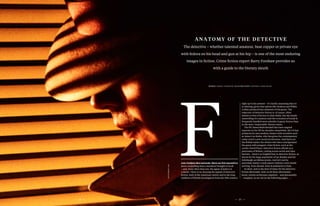
anatomy of the dete ctive
The detective – whether talented amateur, beat copper or private eye
with fedora on his head and gun at his hip – is one of the most enduring
images in fiction. Crime fiction expert Barry Forshaw provides us
with a guide to the literary sleuth
rom Oedipus Rex onwards, there are few narratives
more compelling than a murderer brought to book
– and, more often than not, the agent of justice is
a sleuth. There is no denying the appeal of detective
fiction, both of the American variety and in the long
tradition of British investigators from the 19th century
right up to the present – it’s hardly surprising they’re
so alluring, given that talents like Dickens and Wilkie
Collins produced key elements of the genre. The
trajectory of detective fiction is, of course, often
similar to that of fiction in other fields, but the steady
unravelling of a mystery and the evocation of locale is
frequently handled more adroitly in genre fiction than
in the more ‘respectable’ literary arena.
The PD James/Ruth Rendell duo have reigned
supreme in the UK for decades; meanwhile, the US has
produced its own modern classics with novelists such
as James Lee Burke, who has given the contemporary
crime novel a new social incisiveness. And there are
the British males: the writers who have reinvigorated
the genre with pungent crime fiction, such as the
caustic David Peace. Detective fiction affords us a
panorama of Britain, cutting across social and class
barriers – there’s no English bias in detective fiction, as
shown by the huge popularity of Ian Rankin and his
Edinburgh-set Rebus novels. And let’s not be
parochial: barely a week passes without a new sleuth
arriving from abroad, from Scandinavia to Italy.
In short, now is the best of times for the detective
fiction aficionado. And, as all these aficionados
know, certain archetypes regularly – and pleasurably
– reappear, as set out on the following pages…
words barr y forshaw illustration stephen che etham
photolibrary.com
Rodney Troubridge,
Managing Editor
I plan to read the book that has
just won the Lost Man Booker
Prize, Troubles by JG Farrell. It’s
a powerful, evocative story, set in
Ireland during its Civil War. And
I’ll no doubt read more Farrell.
Nick Rennison,
Consultant Editor
Few writers bring the past to life
like Jenny Uglow. Her biography
of Charles II, A Gambling Man, is
in paperback now, so I plan to
travel back in time to sample his
court’s pleasures and perils.
Susan Osborne,
Reviews Editor
I’ll be immersing myself in John
Irving’s Last Night in Twisted River.
Irving is master at spinning a
thoughtful yarn, but his last two
novels were disappointing. This
is reportedly a return to form.
Ed Wood, Editor
I’ll be getting in as much reading
as I can before baby number one
arrives. I’ve heard only good
things about David Nicholls’
year-hopping romance/drama
One Day: I’m hoping for smiles
and tears in equal measure.
4948
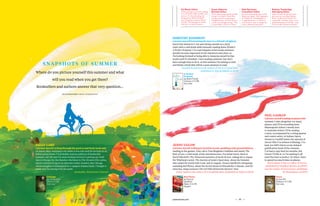
snapsho ts of summer
Where do you picture yourself this summer and what
will you read when you get there?
Booksellers and authors answer that very question…
illustration simon p emb er ton
sally lake
I picture myself cycling through the park to and from work and,
on sunny days, stopping to sit under a tree and read for an hour or so
before going home. I’ll probably read an awful lot of books this
summer, but the one I’m most looking forward to getting my teeth
into is Changes by Jim Butcher, the latest in The Dresden Files series,
about a wizard living in an alternate reality modern-day Chicago
whose daughter is kidnapped by a vampire femme fatale. I bought it
today and I’m saving it for the park!
Bookseller, Waterstone’s Harrow
jenny uglow
I picture myself walking in Kentish woods, paddling with grandchildren,
reading in the garden. First call is Tom Bingham’s brilliant and timely The
Rule of Law, a vital study of law and democracy. For mind-travel, there is
David Mitchell’s The Thousand Autumns of Jacob de Zoet, taking me to Japan;
Per Wästberg’s novel, The Journey of Anders Sparrman, about the botanist
who sailed the world with Cook, and in August, Francis Spufford’s intriguing-
sounding Red Plenty, about the Soviet dream in Khrushchev’s Russia. And for
extra fun, Stieg Larsson’s The Girl Who Kicked the Hornets’ Nest.
Jenny Uglow is the author of A Gambling Man, published by Faber at £9.99
dorothy koomson
I picture myself borrowing the keys to a friend’s Brighton
beach hut whenever I can and sitting outside on a deck
chair with a cold drink while leisurely reading Katie Fforde’s
A Perfect Proposal. I’ve read snippets of her books and have
quickly become engrossed in the characters and plots, so
I’m looking forward to being able to immerse myself in that
world until it’s finished. I love reading outdoors, but don’t
have enough time to do it, so this summer I’m aiming to start
and finish a book that will be a pure pleasure to read.
Dorothy Koomson is the author of The Ice Cream Girls,
published in July by Sphere at £6.99
Changes
by Jim Butcher
Orbit £12.99
Out now
Red Plenty
by Francis
Spufford
Faber £14.99
August
A Perfect
Proposal
by Katie Fforde
Century £14.99
Out now
Horns
by Joe Hill
Gollancz £14.99
Out now
neil gaiman
I picture myself reading on planes this
summer. I take altogether too many
planes, and I’ll be travelling from
Minneapolis (where I mostly live)
to Australia (where I’ll be reading
a story, accompanied by a string quartet
and comics artist, in Sydney Opera
House) to Cardiff (where the episode of
Doctor Who I’ve written is filming). I’ve
kept Joe Hill’s Horns as my delayed
gratification book of the summer:
I’ve had a copy here for months, but
I know I’ll like it, so I’m putting it off
until the time is perfect. Or when I have
to spend too much time on planes.
Neil Gaiman is the co-editor of Stories,
published by Headline Review at £18.99,
and the author of Instructions, published
by Bloomsbury at £9.99
and eerily young-seeming now. He used to live in New
York, but doesn’t leave Los Angeles much these days,
so we spoke on the telephone – the first time we’d
spoken in a long while, something we lamented in
the earlier, unrecorded part of the conversation.
DT: I’m sorry if this is awkward, I never interview
people…
BEE: I don’t either. Never do it.
DT: …so, in terms of journalistic skill, I’m a poor
choice, basically.
BEE: Well, it’s you, though. Honestly (conversation in
background) I’m not good at this. I have to force myself
to focus. Other people have to force me to focus.
DT: Focus on what?
BEE: Well, I don’t know, like right now, it’s internet
publicity stuff. Which I am forced to do. Because with
my audience… I have to do it. Because, basically, no
one over 22 buys my books.
DT: That’s not true.
BEE: No, you’re right, it’s not. The average age of
my reader is not 22. Maybe more like 25. (laughter)
Hang on – what?
Anonymous party in the background is heard loudly
explaining that Bret’s target reader is in fact a
39-year-old male who makes $200,000 a year.
BEE, returning: OK, so that’s right. That’s it. That’s
what it’s come down to. Thirty-nine years old.
Basically my target reader is middle-aged depressed
guys like me.
DT: Who is that guy doing all the talking? Your
pool boy? You need to hire him to do your
interviews for you.
BEE: Well, can I tell you this? I feel very disconnected.
All these web things – it’s a new world. Everyone
wants to interact with the text. People want to be
part of the experience.
DT: It doesn’t seem to me that Imperial Bedrooms
is a book people would especially care to experience
on any kind of personal basis.
BEE: That’s right! ‘Win a weekend in Palm Springs
with Clay! Party!’ (uproarious laughter)
DT: This is a much darker book than Less Than
Zero, a much more horrific book actually, but
I think people are going to like it because…
Imperial
Bedrooms
by Bret
Easton Ellis
Picador
£16.99
July
The book
What happens to morally
bankrupt bright young things
25 years on? Ellis revisits the
characters of 1985’s Less Than
Zero as his antihero Clay, now a
screenwriter, returns to a sad,
grimy version of his old milieu.
Ellis and Tartt
Contemporaries at Bennington,
a Vermont college distinguished
in the arts and misbehaviour,
the friends’ novels nod to each
other: Tartt’s The Secret History and
Ellis’ The Rules of Attraction refer to
the other’s characters.
Your next read
Ellis’ debut Less Than Zero was one
of the key novels of the 1980s.
Written when he was a teenager
but touched by a rueful sadness
that belies his age, it chronicles
the decadence of a generation
of monied college kids.
ret Ellis and I became friends when we were
teenagers, when we were both unpublished novelists;
we read each others’ work very early on, exchanging
and commenting upon drafts of The Secret History and
Less Than Zero (the main characters of which were
exactly the same age as we ourselves were). He was
– I snobbishly felt, as an 18-year-old – the only writer
my own age I’d met who was as good as I was. He
published Less Than Zero and became a star while we
were still at school, limousines rolling up to the college
guard booth for him and reporters calling for him on
the hall phones in the dormitory; the characters of my
first novel, The Secret History (then still unfinished)
showed up in his second, The Rules of Attraction;
when we left school, he threw our senior class one of
the great graduation parties of all time, in Manhattan,
at the Carlyle, with Andy Warhol and Jean-Michel
Basquiat in attendance, a party that I recall being shut
down only when the hotel threatened to phone the
police; when The Secret History was published, with
his help, I dedicated it in part to him; and our novels,
and our careers, have been connected ever since in
obvious and not-so-obvious ways. In Imperial
Bedrooms, his most recent novel, he returns to the
teenage world of Less Than Zero, Clay and Julian and
the bloody-nosed party boys of old, which is of course
in many ways a return to the beginnings of our
friendship, although blighted youth in this instance
hasn’t grown out of its foibles, and the shadows have
grown a good deal darker with middle age.
Of the people I know from school, Bret is one
of the most unchanged: eerily old-seeming at 18
(I thought he was a teacher the first time I saw him)
55
words donna tar tt pho tography jeff b ur ton
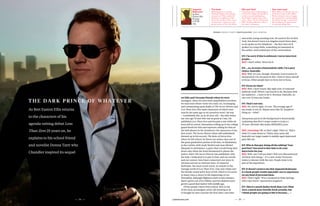
the dark prince of whatever
As Bret Easton Ellis returns
to the characters of his
agenda-setting debut Less
Than Zero 25 years on, he
explains to his school friend
and novelist Donna Tartt why
Chandler inspired its sequel
54
6362
Your next read
You Are Not a Stranger Here is the
obvious place to go: Haslett’s
stories have all the humane
depth of his novel, and he
handles the darkest of states
– grief, depression, madness –
with honesty and empathy.
A class apart
Haslett’s a graduate of the Iowa
Writers’ Workshop, America’s
leading creative writing
programme. Alumni include
Curtis Sittenfeld, Nathan
Englander, Steven Erikson
and Flannery O’Connor.
The book	
Union Atlantic tells of a feud
between retired history teacher
Charlotte Graves and banker
Doug Fanning, as a financial
crisis rumbles beneath them.
It’s a wide-ranging look at
modern American life.
Union
Atlantic
by Adam
Haslett
Tuskar Rock
£12.99 July
intro ducing adam haslett
A bold new claimant to the Great American Novel, Adam Haslett’s post-9/11,
pre-credit crunch first novel is an assured start, says bookseller Greg Eden
Adam Haslett burst on to the literary
scene in 2002 with his debut collection
of stories, You Are Not a Stranger Here,
which quickly captured the imagination
of critics and was shortlisted for both
the US’s National Book Award and the
highly prestigious Pulitzer Prize. It won
praise for its immaculate storytelling,
and its vivid, marginalised characters.
His first novel, Union Atlantic,
has already attracted comparisons
with the likes of Tom Wolfe and
Claire Messud, and is another
eloquent demonstration of Haslett’s
storytelling gifts. Also evident are his
obvious talent for producing a complex
and beautifully drawn range of
protagonists and a keen eye for the
social mores of small-town America.
Haslett’s main challenge in turning
his talent to a full-length work lay
in retaining an overview of the task
at hand, and he says, ‘Writing a [short]
story I can read all of what I’ve written
thus far each morning when I sit
down to work. That’s impossible with
a novel – the challenge is to retain
as much of the material of the novel
as I can, at my mental fingertips,
over a number of years.’
Written over the year before the
economic collapse of 2009, and set in
2002, this is essentially a book about the
state of America in the months following
9/11, which also serves as an incredibly,
yet unintentionally prescient prediction
of the current worldwide economic
predicament. Of this near-clairvoyant
aspect of the book, Haslett says: ‘I
did definitely want to explore the
psychology of power in finance. I just
had no idea it would end up being quite
so topical. That was never my intent.’
The key players in the novel are Doug
Fanning, an executive with the fictional
Union Atlantic conglomerate; Charlotte,
a retired school teacher and neighbour
to Doug’s huge status-supporting
mansion in rural New England; Henry,
Charlotte’s brother and a leader in a
federal regulatory agency; and Nate,
a high-school student who is Charlotte’s
tutee and eventually Doug’s lover.
The book skilfully weaves together the
narrative strands of a near-fatal financial
crisis for the eponymous Union Atlantic
and a legal bid by Charlotte to rid the
town of Finden of Doug’s newly built
mansion. These stories are also
bracketed by two shorter episodes,
one during the first Gulf War, and the
second playing out as the US begins the
invasion of Iraq. The main characters
and stories successfully capture the
sense of deterioration and despair
that slowly engulfed America in the
wake of 9/11, while the framing device
sets those stories in the context of an
America seeming to be constantly at
war: ‘Doug couldn’t sleep for watching
the stuff… Watching the endless
repetition of facts and speculation
and probable lies, the consumption
of which at least partially numbed
the helplessness of seeing it unfold
at such distance and so inexorably.’
The diametric opposition of Doug
Fanning, a quintessentially conservative
alpha-male and war veteran, driven by
a seemingly insatiable hunger for power
and money, and Charlotte Graves, the
nature-loving, left-wing dreamer, with
a passion for culture and nature, is
arguably the key driving force of the
novel, but should not be read as some
sort of social allegory, says Haslett:
‘I always begin and hopefully remain
concentrated on character in my
work, and thus while Charlotte may
indeed profess the liberal humanist
values and Doug profess the more
unfettered capitalist ones, they are
both people driven by their past and
present conditions as humans and
thus attached to their ideas with more
than rational conviction. I’m not so
much interested in pontificating on the
larger social stuff as I am in throwing
these people at each other.’
Indeed, the characters are perhaps
the most memorable aspect of Union
Atlantic, and they shine on every page,
along with a superb ear for natural
dialogue that contributes hugely to
the book’s overall sense of assurance
and veracity. Conversely, there are
one or two clunkier elements to the
book. Doug’s 20 years of self-imposed
exile from his mother, for example,
are never really fully explained,
and Charlotte’s brother happening
to be head of the New York Federal
Reserve might stretch the limits of
narrative credibility a touch.
That said, this is an undeniably
impressive debut, and there is more
to come, with a new novel already in
development, although details are
understandably sketchy: ‘It’s a long
process and it would be hard to say
with much accuracy at this point what
the book will look like. When you finish
a book, it’s a bit as if your larder is
bare and it has to be filled with new
ideas and fragments before you can
even think about preparing a meal.’
Whatever the recipe, I look forward to
tasting the finished dish. Adam Haslett
is undoubtedly a writer to watch. 
words greg e den pho tography frank w o ckenfels
corbisoutline

Books Quarterly magazine

  • 1.
    FREE with yourWaterstone’s Card or £2.95Issue 35/2010 BooksQuarterlyWbqonline.comIssue352010 Wbqonline.com9 7 8 1 9 0 2 6 0 3 6 6 7 3 5 9 7 8 1 9 0 2 6 0 3 6 6 7 3 5
  • 2.
    Issue372010 BretEastonEllisinterviewedbyDonnaTartt/LaurenStJohn/MichaelPalin AlexanderMcCallSmithexclusiveshortstory/GrahamGreene’sspyfamily Gun-toting guys andno-good gals tread the mean streets in our bullet-riddled guide to fiction’s greatest sleuths FREE with your Waterstone’s Card or £2.95 books reviewed in this issue
  • 3.
    26 Books Quarterly| Waterstones.com fiction Waterstones.com | Books Quarterly 27 Slavery is not a black-and-white issue, says Andrea Levy, it’s a human one. Bonnie Greer talks to her about her follow-up to Small Island and a painful past Britain hasn’t come to terms with
  • 4.
    Waterstones.com | BooksQuarterly 2726 Books Quarterly | Waterstones.com fiction David Mitchell once more works his world-creating magic on a Japanese historical epic – Ed Wood asks him how Photography: Paul Stuart Illustration: kaiandsunny.com n old man teaches a young woman piano, while between them lies an unexplained key; peasants celebrate the new harvest while in the background a lone figure watches from a hill; a couple embrace while a shadowy figure watches from a doorway across the street. These are not scenes from David Mitchell’s latest novel, but some of his favourite Dutch paintings from the Wallace Collection in London, which we take in after our interview. But his interests are clear: each of these images carries a mystery, a subtext dictating larger events offstage – they hold a sense of magic. But let’s rewind by a few hours. I bump into Mitchell – wrapped up against the cold; rangy, with a face happy with laughter lines – outside the restaurant in which we’re due to meet ten minutes later. He, like I, arrived early to make sure he would be on time and, when I mention the cold, he toys with offering me his hat. This politeness shows how grounded is the author who, in 2007, was named as one of Time magazine’s most influential 100 people in the world. Time credited Mitchell with the creation of the 21st-century novel, perhaps not such an extraordinary claim when one considers the impact of his time-jumping, country-hopping novels, most of all Cloud Atlas (whose structure is a spin on an Italo Calvino story). Mitchell shrugs off the accolade. ‘I can’t think of myself in those terms,’ he says. ‘I love my job, and my vocation pushes me into making those decisions.’ With The Thousand Autumns of Jacob de Zoet, his vocation has ‘pushed him’ into a maturation of his previous themes and techniques. Set over 1799 and 1800 in the Dutch trading post of Dejima – a tiny man-made island perched on the great mass of isolationist Japan in the Nagasaki harbour – it’s one part historical comedy, two parts epic romance. Its eponymous hero
  • 5.
    Waterstones.com | BooksQuarterly 79 fiction 78 Books Quarterly | Waterstones.com The news that Orhan Pamuk will be giving this interview from a house in Boston, Massachusetts, sets off alarms. Does this mean that the Turkish author is the latest winner of the Nobel Prize for Literature – after Alexander Solzhenitsyn, Joseph Brodsky and Czeslaw Milosz – to choose exile in the United States? Certainly, Pamuk might have reasons to seek literary asylum outside the country that has been the focus of all his books and the home city that has dominated his two publications since receiving writing’s highest honour in Stockholm in 2006: the memoir Istanbul: Memories of a City and now The Museum of Innocence, a huge novel – alternately playful and painful – about a pair of forbidden lovers in Istanbul between the mid-1970s and the early 1980s. Four years ago, Pamuk was prosecuted after being quoted in an interview commenting on the massacre of Armenians during the Ottoman Empire. Under a Turkish law – put in place after the interview in question – these remarks could be regarded as slander against the state and, during the build-up to the planned trial of Pamuk, his books were publicly burned. Although the charges were dropped, this period of notoriety inflamed his already questioned reputation in his homeland: he had previously faced (completely unproven) accusations of plagiarism, while recent books – enthusiastically received abroad – had seen picky notices in Istanbul. So when we speak by telephone – morning in Boston, afternoon in London – I ask if the telephone number he is using is a declaration of exile. ‘I am here in Harvard University to deliver the Norton lectures. Not in exile. I return to Turkey occasionally; I don’t consider myself exiled. I live partly in Turkey, partly in American universities, partly all over the world.’ And was your relationship with Turkey affected by the prosecution in 2005? ‘No, not much. If you are talking residentially?’ I am also talking psychologically and emotionally. ‘No change. I am still busy and I still love my country.’ But it is perhaps a sign of how the legal case has affected him that Pamuk – in his resonant bass voice, further deepened by a throaty early winter cold Orhan Pamuk is modern Turkey’s greatest but most controversial writer. Mark Lawson asks him whether the grand narrative of The Museum of Innocence rekindled his love for his country Photography: Christopher Lane T u r k e y’s gr e a t cu r a t o r
  • 6.
    68 Books Quarterly| Waterstones.com Waterstones.com | Books Quarterly 69 history W hen a young lieutenant called Napoleon Bonaparte returned to Paris in 1787, determined to lose his virginity, he arrived in a city of 600,000 people that was still a collection of villages. More than half those people had come from other parts of France and never left their home quartier. There were teetering tenements on the edge of the city that housed the entire male population of an Alpine valley. As an English visitor remarked, Paris was ‘full of foreigners’ – or as we would now say, ‘immigrants’. Few of the 12,000 prostitutes of Paris were Parisian by birth: the skilful young woman who satisfied the lieutenant’s desire had come from Brittany to ply her trade in the shoppers’ paradise of the Palais-Royal. At the dawn of the French Revolution, there was still no accurate street map of Paris. A map of ‘Paris As It Is Today’ carefully omitted the capital’s minor streets, ‘Because,’ the mapmaker explained, ‘it would have looked like total chaos.’ A few years after Bonaparte’s visit, Marie Antoinette, fleeing from the Tuileries Palace with a guard who knew the city as well as anyone, turned right instead of left and got completely lost in the stinking labyrinth of the Left Bank. The Left Bank itself, I was amazed to discover, was built on an uncharted warren of ancient limestone quarries. The architect who descended into that Parisian underworld, hoping to save the city from collapse, has vanished entirely from official history. This seems quite appropriate: Paris has always been a city of secrets. Even today, there are parts of the Paris conglomeration that are unknown to most of the city’s residents. The appalling suburbs where the riots of 2005 began inspire more fear today than in times when they were patrolled by highwaymen and wolves. I wrote The Discovery of France after covering 14,000 miles of that vast land of tribes and micro-civilisations on a bicycle. The book was a geographical history of a country that historians had often reduced to a picturesque hinterland of Paris. Paris itself demanded a different approach. I had lived there as a labourer, a student, a teacher and a tourist. I had read dozens of histories of Paris, but somehow I could never retain all the information. All those names, dates and glimpses of famous lives were like anonymous faces in the Métro. What I remembered most clearly were the stories attached to particular places, and this, it seemed to me, was a way to write about the city without becoming lost in statistics and dazed by digressions. Following Balzac, I wanted to write a mini Human Comedy of Paris, in which the history of the city would be illuminated by the real experience of its inhabitants. Each tale is complete in itself, and each one is true – even the incredible story that gave Alexandre Dumas the idea for The Count of Monte Cristo. But there are also correspondences and crossroads, both literal and mysterious, that serve as landmarks in time and space: some Graham Robb follows up his remarkable The Discovery of France with a unique historical voyage in search of the soul of Paris Illustration: Claudia Boldt enigmatic carvings on the west front of Notre Dame, certain stations in the Métro, certain street corners and hotel rooms. I found that, if I followed a thread, the story of the city would naturally begin to tell itself: the real Mimì of La Bohème, the trials and triumphs of the wife of Emile Zola, Marcel Proust’s drug-tinted expeditions, Adolf Hitler’s dawn visit to a deserted Paris, François Mitterrand’s faked assassination attempt... Instead of using the same tone throughout, I wanted each tale to give a flavour of the time. General de Gaulle and President Sarkozy may have walked or driven the same streets, but the Paris they knew was not the same. The Jewish children who hid from the Nazis discovered a secret world that was stranger than any fictional representation. The city changed from one year to the next. Each tale demanded its own forms of courtesy to the past. The history of two lovers in Saint-Germain-des-Prés presented itself in the form of a nouvelle vague film script. The drama of the student-led revolution of May 1968 called for some of the techniques of a sociology textbook. Another tale, ‘Périphérique’, owes a great deal to the bandes dessinées that are so much a part of Parisians’ view of their own city. None of this was intended as a prescription or as a comment on the writing of history. It was simply an attempt to conjure up lost realities, and also to express the sheer pleasure of exploring the past and present of Paris. Perhaps because so much of a city’s life remains hidden, spies, detectives and informants played a large role in this ‘adventure history’: the files of the Paris Sûreté, the detective branch of the early police force, are a priceless source of information on the private lives of Parisians, as are the forensic activities of Commissioner Clot, who ran the Brigade Criminelle in the 1950s. With all its revolutions and civil wars, Paris has always oscillated – cheerfully or catastrophically – between anarchy and repression. In the end, Parisians needed as much research as The Discovery of France. It took more walking than cycling, although, once again, the bicycle proved an invaluable tool. Since the introduction of the Vélib’ bike rental scheme, Parisians, too, have been rediscovering their city. In any case, it is far easier to explore the banlieue on a bike than in a car, and a cyclist is always more likely to have some interesting adventures. It was during one recent, two-wheeled expedition that I stumbled upon a previously unknown mountain in the most densely populated part of Paris. I used the story as an epilogue, because, like Lieutenant Bonaparte, no one returns from Paris the same person as before. Parisians by Graham Robb Hardback Picador £18.99 April
  • 7.
    68 Books Quarterly| Waterstones.com Waterstones.com | Books Quarterly 69 fiction t its best, British fiction is replete with all the contradictions, terrors and joys of the nation’s varied people and history. This spring, five new authors prove this with tales of a witch in a 1930s Black Country town, the City’s financial freefall, an Arab guardian angel, a Victorian Aboriginal cricketer and an illegal Indian immigrant Introducing Best of British 2010 Interviews by Ed Wood and Abigail Dean. Photography by Greg Funnell and Christopher Lane. Find reviews of all the books featured here on Wbqonline.com Ed Wood: Tell us a little about the story. Nigel Farndale: On its way to the Galápagos Islands, a light aircraft ditches into the sea. As the water floods through the cabin, zoologist Daniel Kennedy faces an impossible choice – should he save himself or the woman he loves? So begins The Blasphemer, a novel about the consequences of your actions. In a parallel narrative, Daniel’s great-grandfather is preparing to go over the top at Passchendaele. He, too, will have his courage tested and be found wanting. EW: Why do you think it’s so popular to weave together modern and historical narratives, as you have? NF: Not sure. Millennial angst? There is always a moment when living memory passes into history. In the case of the First World War, this happened in 2009. When the last of the veterans died, our remaining link with that terrible war was broken. The only way back into their minds is through literature, empathy and the imagination. EW: At the centre of The Blasphemer are differences of religious belief – where do your own beliefs lie? NF: Raised an Anglican. Married a Catholic. Now, if anything, I’m a member of the Church of Richard Dawkins of Latterday Saints. I love his lyrical prose style, but when I interviewed him for a broadsheet ten years ago I came away wondering how a man so certain in his atheism would react if confronted with something his cold philosophy could not explain. In The Blasphemer, Daniel sees, or thinks he might have seen, an ‘angel’ (with inverted commas for wings). He explains it away, dismissing it as a hallucination triggered by epilepsy. But a seed of doubt has been planted. EW: Daniel’s ‘cowardice’ during a plane crash, and wartime desertion are central to the book. From your experience as a journalist, do you think people are entirely self-preserving? NF: I once asked Clive James if he would be able to sacrifice his own life to save his daughters and he gave me the only honest answer a man can give: ‘I hope I could. But you never know.’ There have been cases of mothers who have left burning planes without their children and only realised afterwards what they had done. Equally, there are stories such as that of Andrew Parker, the ‘human bridge’ during the Zeebrugge ferry disaster. He showed that, in extremis, ordinary men are capable of extraordinary altruism. The Blasphemer by Nigel Farndale Hardback Doubleday £12.99 January A WWI deserter and a plane-crash survivor see the same mysterious figure... 90 years apart The Blasphemer by Nigel Farndale
  • 8.
    2322 anatomy of thedete ctive The detective – whether talented amateur, beat copper or private eye with fedora on his head and gun at his hip – is one of the most enduring images in fiction. Crime fiction expert Barry Forshaw provides us with a guide to the literary sleuth rom Oedipus Rex onwards, there are few narratives more compelling than a murderer brought to book – and, more often than not, the agent of justice is a sleuth. There is no denying the appeal of detective fiction, both of the American variety and in the long tradition of British investigators from the 19th century right up to the present – it’s hardly surprising they’re so alluring, given that talents like Dickens and Wilkie Collins produced key elements of the genre. The trajectory of detective fiction is, of course, often similar to that of fiction in other fields, but the steady unravelling of a mystery and the evocation of locale is frequently handled more adroitly in genre fiction than in the more ‘respectable’ literary arena. The PD James/Ruth Rendell duo have reigned supreme in the UK for decades; meanwhile, the US has produced its own modern classics with novelists such as James Lee Burke, who has given the contemporary crime novel a new social incisiveness. And there are the British males: the writers who have reinvigorated the genre with pungent crime fiction, such as the caustic David Peace. Detective fiction affords us a panorama of Britain, cutting across social and class barriers – there’s no English bias in detective fiction, as shown by the huge popularity of Ian Rankin and his Edinburgh-set Rebus novels. And let’s not be parochial: barely a week passes without a new sleuth arriving from abroad, from Scandinavia to Italy. In short, now is the best of times for the detective fiction aficionado. And, as all these aficionados know, certain archetypes regularly – and pleasurably – reappear, as set out on the following pages… words barr y forshaw illustration stephen che etham photolibrary.com
  • 9.
    Rodney Troubridge, Managing Editor Iplan to read the book that has just won the Lost Man Booker Prize, Troubles by JG Farrell. It’s a powerful, evocative story, set in Ireland during its Civil War. And I’ll no doubt read more Farrell. Nick Rennison, Consultant Editor Few writers bring the past to life like Jenny Uglow. Her biography of Charles II, A Gambling Man, is in paperback now, so I plan to travel back in time to sample his court’s pleasures and perils. Susan Osborne, Reviews Editor I’ll be immersing myself in John Irving’s Last Night in Twisted River. Irving is master at spinning a thoughtful yarn, but his last two novels were disappointing. This is reportedly a return to form. Ed Wood, Editor I’ll be getting in as much reading as I can before baby number one arrives. I’ve heard only good things about David Nicholls’ year-hopping romance/drama One Day: I’m hoping for smiles and tears in equal measure. 4948 snapsho ts of summer Where do you picture yourself this summer and what will you read when you get there? Booksellers and authors answer that very question… illustration simon p emb er ton sally lake I picture myself cycling through the park to and from work and, on sunny days, stopping to sit under a tree and read for an hour or so before going home. I’ll probably read an awful lot of books this summer, but the one I’m most looking forward to getting my teeth into is Changes by Jim Butcher, the latest in The Dresden Files series, about a wizard living in an alternate reality modern-day Chicago whose daughter is kidnapped by a vampire femme fatale. I bought it today and I’m saving it for the park! Bookseller, Waterstone’s Harrow jenny uglow I picture myself walking in Kentish woods, paddling with grandchildren, reading in the garden. First call is Tom Bingham’s brilliant and timely The Rule of Law, a vital study of law and democracy. For mind-travel, there is David Mitchell’s The Thousand Autumns of Jacob de Zoet, taking me to Japan; Per Wästberg’s novel, The Journey of Anders Sparrman, about the botanist who sailed the world with Cook, and in August, Francis Spufford’s intriguing- sounding Red Plenty, about the Soviet dream in Khrushchev’s Russia. And for extra fun, Stieg Larsson’s The Girl Who Kicked the Hornets’ Nest. Jenny Uglow is the author of A Gambling Man, published by Faber at £9.99 dorothy koomson I picture myself borrowing the keys to a friend’s Brighton beach hut whenever I can and sitting outside on a deck chair with a cold drink while leisurely reading Katie Fforde’s A Perfect Proposal. I’ve read snippets of her books and have quickly become engrossed in the characters and plots, so I’m looking forward to being able to immerse myself in that world until it’s finished. I love reading outdoors, but don’t have enough time to do it, so this summer I’m aiming to start and finish a book that will be a pure pleasure to read. Dorothy Koomson is the author of The Ice Cream Girls, published in July by Sphere at £6.99 Changes by Jim Butcher Orbit £12.99 Out now Red Plenty by Francis Spufford Faber £14.99 August A Perfect Proposal by Katie Fforde Century £14.99 Out now Horns by Joe Hill Gollancz £14.99 Out now neil gaiman I picture myself reading on planes this summer. I take altogether too many planes, and I’ll be travelling from Minneapolis (where I mostly live) to Australia (where I’ll be reading a story, accompanied by a string quartet and comics artist, in Sydney Opera House) to Cardiff (where the episode of Doctor Who I’ve written is filming). I’ve kept Joe Hill’s Horns as my delayed gratification book of the summer: I’ve had a copy here for months, but I know I’ll like it, so I’m putting it off until the time is perfect. Or when I have to spend too much time on planes. Neil Gaiman is the co-editor of Stories, published by Headline Review at £18.99, and the author of Instructions, published by Bloomsbury at £9.99
  • 10.
    and eerily young-seemingnow. He used to live in New York, but doesn’t leave Los Angeles much these days, so we spoke on the telephone – the first time we’d spoken in a long while, something we lamented in the earlier, unrecorded part of the conversation. DT: I’m sorry if this is awkward, I never interview people… BEE: I don’t either. Never do it. DT: …so, in terms of journalistic skill, I’m a poor choice, basically. BEE: Well, it’s you, though. Honestly (conversation in background) I’m not good at this. I have to force myself to focus. Other people have to force me to focus. DT: Focus on what? BEE: Well, I don’t know, like right now, it’s internet publicity stuff. Which I am forced to do. Because with my audience… I have to do it. Because, basically, no one over 22 buys my books. DT: That’s not true. BEE: No, you’re right, it’s not. The average age of my reader is not 22. Maybe more like 25. (laughter) Hang on – what? Anonymous party in the background is heard loudly explaining that Bret’s target reader is in fact a 39-year-old male who makes $200,000 a year. BEE, returning: OK, so that’s right. That’s it. That’s what it’s come down to. Thirty-nine years old. Basically my target reader is middle-aged depressed guys like me. DT: Who is that guy doing all the talking? Your pool boy? You need to hire him to do your interviews for you. BEE: Well, can I tell you this? I feel very disconnected. All these web things – it’s a new world. Everyone wants to interact with the text. People want to be part of the experience. DT: It doesn’t seem to me that Imperial Bedrooms is a book people would especially care to experience on any kind of personal basis. BEE: That’s right! ‘Win a weekend in Palm Springs with Clay! Party!’ (uproarious laughter) DT: This is a much darker book than Less Than Zero, a much more horrific book actually, but I think people are going to like it because… Imperial Bedrooms by Bret Easton Ellis Picador £16.99 July The book What happens to morally bankrupt bright young things 25 years on? Ellis revisits the characters of 1985’s Less Than Zero as his antihero Clay, now a screenwriter, returns to a sad, grimy version of his old milieu. Ellis and Tartt Contemporaries at Bennington, a Vermont college distinguished in the arts and misbehaviour, the friends’ novels nod to each other: Tartt’s The Secret History and Ellis’ The Rules of Attraction refer to the other’s characters. Your next read Ellis’ debut Less Than Zero was one of the key novels of the 1980s. Written when he was a teenager but touched by a rueful sadness that belies his age, it chronicles the decadence of a generation of monied college kids. ret Ellis and I became friends when we were teenagers, when we were both unpublished novelists; we read each others’ work very early on, exchanging and commenting upon drafts of The Secret History and Less Than Zero (the main characters of which were exactly the same age as we ourselves were). He was – I snobbishly felt, as an 18-year-old – the only writer my own age I’d met who was as good as I was. He published Less Than Zero and became a star while we were still at school, limousines rolling up to the college guard booth for him and reporters calling for him on the hall phones in the dormitory; the characters of my first novel, The Secret History (then still unfinished) showed up in his second, The Rules of Attraction; when we left school, he threw our senior class one of the great graduation parties of all time, in Manhattan, at the Carlyle, with Andy Warhol and Jean-Michel Basquiat in attendance, a party that I recall being shut down only when the hotel threatened to phone the police; when The Secret History was published, with his help, I dedicated it in part to him; and our novels, and our careers, have been connected ever since in obvious and not-so-obvious ways. In Imperial Bedrooms, his most recent novel, he returns to the teenage world of Less Than Zero, Clay and Julian and the bloody-nosed party boys of old, which is of course in many ways a return to the beginnings of our friendship, although blighted youth in this instance hasn’t grown out of its foibles, and the shadows have grown a good deal darker with middle age. Of the people I know from school, Bret is one of the most unchanged: eerily old-seeming at 18 (I thought he was a teacher the first time I saw him) 55 words donna tar tt pho tography jeff b ur ton the dark prince of whatever As Bret Easton Ellis returns to the characters of his agenda-setting debut Less Than Zero 25 years on, he explains to his school friend and novelist Donna Tartt why Chandler inspired its sequel 54
  • 11.
    6362 Your next read YouAre Not a Stranger Here is the obvious place to go: Haslett’s stories have all the humane depth of his novel, and he handles the darkest of states – grief, depression, madness – with honesty and empathy. A class apart Haslett’s a graduate of the Iowa Writers’ Workshop, America’s leading creative writing programme. Alumni include Curtis Sittenfeld, Nathan Englander, Steven Erikson and Flannery O’Connor. The book Union Atlantic tells of a feud between retired history teacher Charlotte Graves and banker Doug Fanning, as a financial crisis rumbles beneath them. It’s a wide-ranging look at modern American life. Union Atlantic by Adam Haslett Tuskar Rock £12.99 July intro ducing adam haslett A bold new claimant to the Great American Novel, Adam Haslett’s post-9/11, pre-credit crunch first novel is an assured start, says bookseller Greg Eden Adam Haslett burst on to the literary scene in 2002 with his debut collection of stories, You Are Not a Stranger Here, which quickly captured the imagination of critics and was shortlisted for both the US’s National Book Award and the highly prestigious Pulitzer Prize. It won praise for its immaculate storytelling, and its vivid, marginalised characters. His first novel, Union Atlantic, has already attracted comparisons with the likes of Tom Wolfe and Claire Messud, and is another eloquent demonstration of Haslett’s storytelling gifts. Also evident are his obvious talent for producing a complex and beautifully drawn range of protagonists and a keen eye for the social mores of small-town America. Haslett’s main challenge in turning his talent to a full-length work lay in retaining an overview of the task at hand, and he says, ‘Writing a [short] story I can read all of what I’ve written thus far each morning when I sit down to work. That’s impossible with a novel – the challenge is to retain as much of the material of the novel as I can, at my mental fingertips, over a number of years.’ Written over the year before the economic collapse of 2009, and set in 2002, this is essentially a book about the state of America in the months following 9/11, which also serves as an incredibly, yet unintentionally prescient prediction of the current worldwide economic predicament. Of this near-clairvoyant aspect of the book, Haslett says: ‘I did definitely want to explore the psychology of power in finance. I just had no idea it would end up being quite so topical. That was never my intent.’ The key players in the novel are Doug Fanning, an executive with the fictional Union Atlantic conglomerate; Charlotte, a retired school teacher and neighbour to Doug’s huge status-supporting mansion in rural New England; Henry, Charlotte’s brother and a leader in a federal regulatory agency; and Nate, a high-school student who is Charlotte’s tutee and eventually Doug’s lover. The book skilfully weaves together the narrative strands of a near-fatal financial crisis for the eponymous Union Atlantic and a legal bid by Charlotte to rid the town of Finden of Doug’s newly built mansion. These stories are also bracketed by two shorter episodes, one during the first Gulf War, and the second playing out as the US begins the invasion of Iraq. The main characters and stories successfully capture the sense of deterioration and despair that slowly engulfed America in the wake of 9/11, while the framing device sets those stories in the context of an America seeming to be constantly at war: ‘Doug couldn’t sleep for watching the stuff… Watching the endless repetition of facts and speculation and probable lies, the consumption of which at least partially numbed the helplessness of seeing it unfold at such distance and so inexorably.’ The diametric opposition of Doug Fanning, a quintessentially conservative alpha-male and war veteran, driven by a seemingly insatiable hunger for power and money, and Charlotte Graves, the nature-loving, left-wing dreamer, with a passion for culture and nature, is arguably the key driving force of the novel, but should not be read as some sort of social allegory, says Haslett: ‘I always begin and hopefully remain concentrated on character in my work, and thus while Charlotte may indeed profess the liberal humanist values and Doug profess the more unfettered capitalist ones, they are both people driven by their past and present conditions as humans and thus attached to their ideas with more than rational conviction. I’m not so much interested in pontificating on the larger social stuff as I am in throwing these people at each other.’ Indeed, the characters are perhaps the most memorable aspect of Union Atlantic, and they shine on every page, along with a superb ear for natural dialogue that contributes hugely to the book’s overall sense of assurance and veracity. Conversely, there are one or two clunkier elements to the book. Doug’s 20 years of self-imposed exile from his mother, for example, are never really fully explained, and Charlotte’s brother happening to be head of the New York Federal Reserve might stretch the limits of narrative credibility a touch. That said, this is an undeniably impressive debut, and there is more to come, with a new novel already in development, although details are understandably sketchy: ‘It’s a long process and it would be hard to say with much accuracy at this point what the book will look like. When you finish a book, it’s a bit as if your larder is bare and it has to be filled with new ideas and fragments before you can even think about preparing a meal.’ Whatever the recipe, I look forward to tasting the finished dish. Adam Haslett is undoubtedly a writer to watch. ¶ words greg e den pho tography frank w o ckenfels corbisoutline