Elements
of a
Short Story
Ms. Ghie D.Vidar
SALIS
Objectives
Elements of a Short Story
• Identify and define
elements of a short story
• Demonstrate mastery of
short story elements by
creating story grammar
Overview
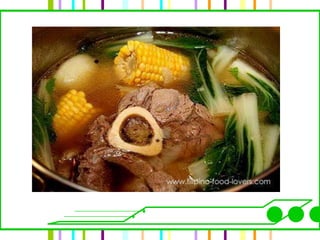
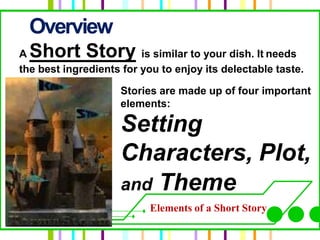
A Short Story is similar to your dish. It needs
the best ingredients for you to enjoy its delectable taste.
Stories are made up of four important
elements:
Setting
Characters, Plot,
and Theme
Elements of a Short Story
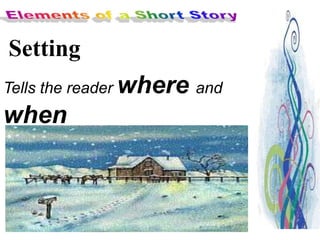
Setting
Tells the reader where and
when
the story takes place.
Characters and
Characterization
The people, and in some
stories, the animals that
take part in the story.
The description ofthe
personalities of the
characters in the story and
the way in which an author
reveals their personalities.
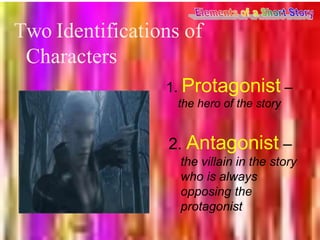
Two Identifications of
Characters
1. Protagonist –
the hero of the story
2. Antagonist –
the villain in the story
who is always
opposing the
protagonist
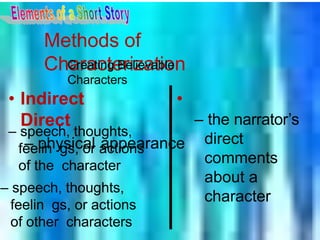
Methods of
Characterization
– speech, thoughts,
feelin gs, or actions
of the character
– speech, thoughts,
feelin gs, or actions
of other characters
Creating Believable
Characters
• Indirect •
Direct
– physical appearance
– the narrator’s
direct
comments
about a
character
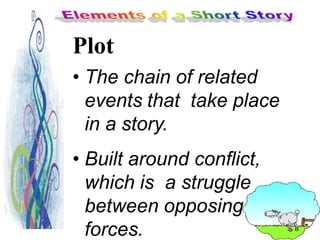
Plot
• The chain of related
events that take place
in a story.
• Built around conflict,
which is a struggle
between opposing
forces.
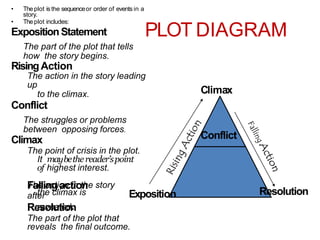
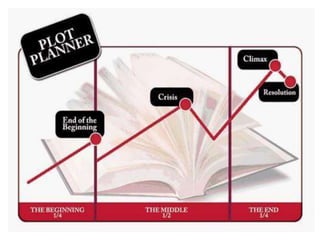
PLOT DIAGRAM
Resolution
Climax
Exposition
Conflict
• Theplot is the sequenceor order of events in a
story.
• Theplot includes:
ExpositionStatement
The part of the plot that tells
how the story begins.
RisingAction
The action in the story leading
up
to the climax.
Conflict
The struggles or problems
between opposing forces.
Climax
The point of crisis in the plot.
It maybethereader’spoint
of highest interest.
Falling action
The action in the story
after
the climax is
revealed.
Resolution
The part of the plot that
reveals the final outcome.
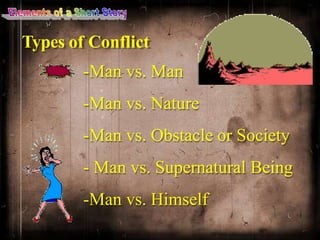
Types of Conflict
-Man vs. Man
-Man vs. Nature
-Man vs. Obstacle or Society
- Man vs. Supernatural Being
-Man vs. Himself
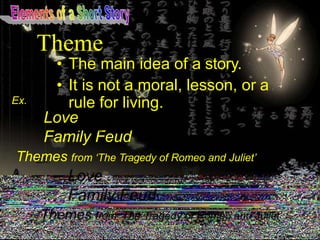
Theme
Ex.
Love
Family Feud
Themes from ‘The Tragedy of Romeo and Juliet’
• The main idea of a story.
• It is not a moral, lesson, or a
rule for living.
CONCLUSION
Now that we have identified
and defined the elements of a
short story, let us use the
elements to analyze a Short
Story.
You may use your notes from
the PowerPoint presentation.
Bibliography
Dinneen, K. Elements of the Short Story. Retrieved Jun.
19,2003, from Yale-New Haven TeachersInstitute:
http://www.yale.edu/ynhti/curriculum/units/1983/3/83.03.09.x.html
Five Elements of aStory. Retrieved Jun. 19,2003,
http://www.teachervision.com/lesson-plans/lesson-2277.html
Guevin, D. Short Story Elements. Retrieved Jun. 19, 2003,
http://www.uvm.edu/~dguevin/Elements.html

elementsss-121127213510-phpapp02.pptx

  • 1.
  • 2.
    Objectives Elements of aShort Story • Identify and define elements of a short story • Demonstrate mastery of short story elements by creating story grammar
  • 4.
    Overview A Short Storyis similar to your dish. It needs the best ingredients for you to enjoy its delectable taste. Stories are made up of four important elements: Setting Characters, Plot, and Theme Elements of a Short Story
  • 5.
    Setting Tells the readerwhere and when the story takes place.
  • 6.
    Characters and Characterization The people,and in some stories, the animals that take part in the story. The description ofthe personalities of the characters in the story and the way in which an author reveals their personalities.
  • 7.
    Two Identifications of Characters 1.Protagonist – the hero of the story 2. Antagonist – the villain in the story who is always opposing the protagonist
  • 8.
    Methods of Characterization – speech,thoughts, feelin gs, or actions of the character – speech, thoughts, feelin gs, or actions of other characters Creating Believable Characters • Indirect • Direct – physical appearance – the narrator’s direct comments about a character
  • 9.
    Plot • The chainof related events that take place in a story. • Built around conflict, which is a struggle between opposing forces.
  • 10.
    PLOT DIAGRAM Resolution Climax Exposition Conflict • Theplotis the sequenceor order of events in a story. • Theplot includes: ExpositionStatement The part of the plot that tells how the story begins. RisingAction The action in the story leading up to the climax. Conflict The struggles or problems between opposing forces. Climax The point of crisis in the plot. It maybethereader’spoint of highest interest. Falling action The action in the story after the climax is revealed. Resolution The part of the plot that reveals the final outcome.
  • 12.
    Types of Conflict -Manvs. Man -Man vs. Nature -Man vs. Obstacle or Society - Man vs. Supernatural Being -Man vs. Himself
  • 13.
    Theme Ex. Love Family Feud Themes from‘The Tragedy of Romeo and Juliet’ • The main idea of a story. • It is not a moral, lesson, or a rule for living.
  • 14.
    CONCLUSION Now that wehave identified and defined the elements of a short story, let us use the elements to analyze a Short Story. You may use your notes from the PowerPoint presentation.
  • 16.
    Bibliography Dinneen, K. Elementsof the Short Story. Retrieved Jun. 19,2003, from Yale-New Haven TeachersInstitute: http://www.yale.edu/ynhti/curriculum/units/1983/3/83.03.09.x.html Five Elements of aStory. Retrieved Jun. 19,2003, http://www.teachervision.com/lesson-plans/lesson-2277.html Guevin, D. Short Story Elements. Retrieved Jun. 19, 2003, http://www.uvm.edu/~dguevin/Elements.html