Brain Dumping Activity
1. Form a groups of 8 or 9 members.
2. Write down as many ideas as they can
remember about elements and compounds
within 3 minutes only.
3. After 3 minutes, eliminate the same ideas.
4. To determine the winner, count the unique and
correct concepts left after the elimination of
the same ideas for each group.
5. The group with the most unique and correct
ideas is declared as the winner.
Objectives:
1. Identify whether the given substance is
an element or compound;
2. Compare and contrast elements and
compounds using graphic organizers; and
3. Appreciate the importance of elements
and compounds around us.
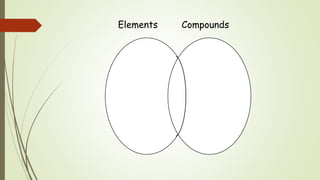
Elements Compounds
Elements Compounds
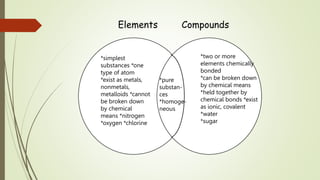
*simplest
substances *one
type of atom
*exist as metals,
nonmetals,
metalloids *cannot
be broken down
by chemical
means *nitrogen
*oxygen *chlorine
*two or more
elements chemically
bonded
*can be broken down
by chemical means
*held together by
chemical bonds *exist
as ionic, covalent
*water
*sugar
*pure
substan-
ces
*homoge-
neous
1.What are the similarities of
elements and compounds?
2. How do elements and
compounds differ from each
other?
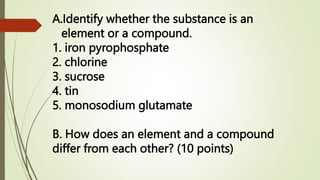
A.Identify whether the substance is an
element or a compound.
1. iron pyrophosphate
2. chlorine
3. sucrose
4. tin
5. monosodium glutamate
B. How does an element and a compound
differ from each other? (10 points)
Assignment:
Choose one of the following
activities that will show and
explain the differences of
elements and compounds
depending on your interests.
1. Poster/Collage making
2. Poem writing (3-5 stanza)
3. Song writing

ELEMENTS VS COMPOUNDS.pptx

  • 3.
    Brain Dumping Activity 1.Form a groups of 8 or 9 members. 2. Write down as many ideas as they can remember about elements and compounds within 3 minutes only. 3. After 3 minutes, eliminate the same ideas. 4. To determine the winner, count the unique and correct concepts left after the elimination of the same ideas for each group. 5. The group with the most unique and correct ideas is declared as the winner.
  • 4.
    Objectives: 1. Identify whetherthe given substance is an element or compound; 2. Compare and contrast elements and compounds using graphic organizers; and 3. Appreciate the importance of elements and compounds around us.
  • 5.
  • 6.
    Elements Compounds *simplest substances *one typeof atom *exist as metals, nonmetals, metalloids *cannot be broken down by chemical means *nitrogen *oxygen *chlorine *two or more elements chemically bonded *can be broken down by chemical means *held together by chemical bonds *exist as ionic, covalent *water *sugar *pure substan- ces *homoge- neous
  • 7.
    1.What are thesimilarities of elements and compounds? 2. How do elements and compounds differ from each other?
  • 11.
    A.Identify whether thesubstance is an element or a compound. 1. iron pyrophosphate 2. chlorine 3. sucrose 4. tin 5. monosodium glutamate B. How does an element and a compound differ from each other? (10 points)
  • 12.
    Assignment: Choose one ofthe following activities that will show and explain the differences of elements and compounds depending on your interests. 1. Poster/Collage making 2. Poem writing (3-5 stanza) 3. Song writing

Editor's Notes

  • #5 Today you will compare and contrast elements and
  • #6 Today you will compare and contrast elements and compounds using a graphic organizer. You may use the ideas that you’ve generated during the engage part or still add some concepts that will distinguish an element from a compound. Each group will be given sets of flashcards, manila paper, and marking pen. Each flashcard contains words/phrase that describes an element or a compound.
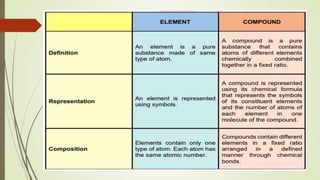
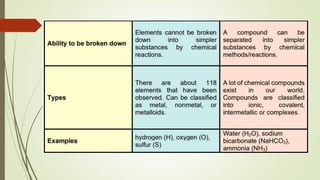
  • #8 In order for you to have a further understanding about elements and compounds, I will let you watch a video about the differences between elements and compounds. I will give you two questions that you need to answer after you have watched it.
  • #9 Who wants to share their answers? What are the similarities of elements and compounds? How do elements and compounds differ from each other?