CHAPTER 10
ELECROSTATICS
REPARED BY
MRS. SHITAL ONAWANE
MSC.BED
RAMBH MAHAVIDYLAY, NASHIK ROAD
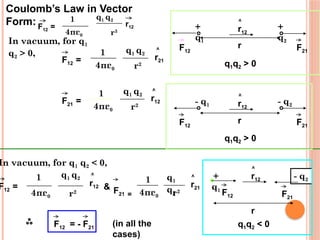
Coulomb’s Law in Vector
Form:
r
+
q1
+
q2
F21
F12
r12
q1q2 > 0
q1q2 < 0
r
+
q1
- q2
F21
F12
r12
In vacuum, for q1
q2 > 0, q1 q2
r2
1
4πε0
r21
F12 =
q1 q2
r2
1
4πε0
r12
F21 =
In vacuum, for q1 q2 < 0,
q1 q2
r2
1
4πε0
r12
F12 =
q1
q2
r2
1
4πε0
r21
F21 =
&
F12 = - F21
(in all the
cases)
r
- q1 - q2
F21
F12
r12
q1q2 > 0
q1 q2
r3
1
4πε0
r12
F12 =
q1 q2
r3
1
4πε0
r12
F12 =
q1 q2
r3
1
4πε0
r21
F21 =
&
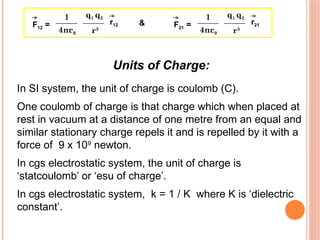
Units of Charge:
In SI system, the unit of charge is coulomb (C).
One coulomb of charge is that charge which when placed at
rest in vacuum at a distance of one metre from an equal and
similar stationary charge repels it and is repelled by it with a
force of 9 x 10⁹
newton.
In cgs electrostatic system, the unit of charge is
‘statcoulomb’ or ‘esu of charge’.
In cgs electrostatic system, k = 1 / K where K is ‘dielectric
constant’.
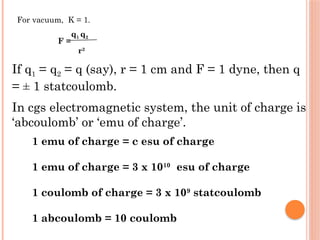
1 emu of charge = c esu of charge
1 emu of charge = 3 x 10¹⁰
esu of charge
1 coulomb of charge = 3 x 10⁹
statcoulomb
1 abcoulomb = 10 coulomb
F =
q1 q2
r2
If q1 = q2 = q (say), r = 1 cm and F = 1 dyne, then q
= ± 1 statcoulomb.
In cgs electromagnetic system, the unit of charge is
‘abcoulomb’ or ‘emu of charge’.
For vacuum, K = 1.
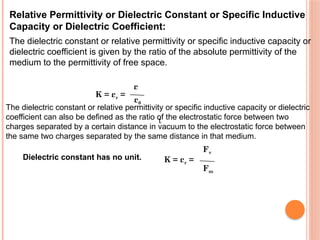
Relative Permittivity or Dielectric Constant or Specific Inductive
Capacity or Dielectric Coefficient:
The dielectric constant or relative permittivity or specific inductive capacity or
dielectric coefficient is given by the ratio of the absolute permittivity of the
medium to the permittivity of free space.
K = εr =
ε
ε0
The dielectric constant or relative permittivity or specific inductive capacity or dielectric
coefficient can also be defined as the ratio of the electrostatic force between two
charges separated by a certain distance in vacuum to the electrostatic force between
the same two charges separated by the same distance in that medium.
Dielectric constant has no unit. K = εr =
Fv
Fm
t
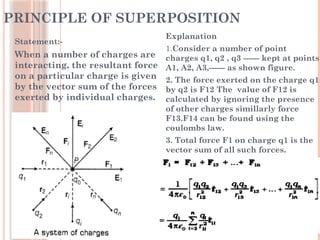
PRINCIPLE OF SUPERPOSITION
Explanation
1.Consider a number of point
charges q1, q2 , q3 ------ kept at points
A1, A2, A3,------ as shown figure.
2. The force exerted on the charge q1
by q2 is F12 The value of F12 is
calculated by ignoring the presence
of other charges simillarly force
F13.F14 can be found using the
coulombs law.
3. Total force F1 on charge q1 is the
vector sum of all such forces.
Statement:-
When a number of charges are
interacting, the resultant force
on a particular charge is given
by the vector sum of the forces
exerted by individual charges.
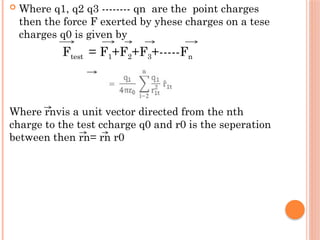
 Where q1, q2 q3 -------- qn are the point charges
then the force F exerted by yhese charges on a tese
charges q0 is given by
Where rnvis a unit vector directed from the nth
charge to the test ccharge q0 and r0 is the seperation
between then rn= rn r0
Ftest = F1+F2+F3+-----Fn
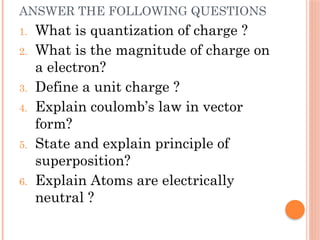
ANSWER THE FOLLOWING QUESTIONS
1. What is quantization of charge ?
2. What is the magnitude of charge on
a electron?
3. Define a unit charge ?
4. Explain coulomb’s law in vector
form?
5. State and explain principle of
superposition?
6. Explain Atoms are electrically
neutral ?
Thank you

Electrostatics ppt use for 12th science 2.pptx

  • 1.
    CHAPTER 10 ELECROSTATICS REPARED BY MRS.SHITAL ONAWANE MSC.BED RAMBH MAHAVIDYLAY, NASHIK ROAD
  • 2.
    Coulomb’s Law inVector Form: r + q1 + q2 F21 F12 r12 q1q2 > 0 q1q2 < 0 r + q1 - q2 F21 F12 r12 In vacuum, for q1 q2 > 0, q1 q2 r2 1 4πε0 r21 F12 = q1 q2 r2 1 4πε0 r12 F21 = In vacuum, for q1 q2 < 0, q1 q2 r2 1 4πε0 r12 F12 = q1 q2 r2 1 4πε0 r21 F21 = & F12 = - F21 (in all the cases) r - q1 - q2 F21 F12 r12 q1q2 > 0 q1 q2 r3 1 4πε0 r12 F12 =
  • 3.
    q1 q2 r3 1 4πε0 r12 F12 = q1q2 r3 1 4πε0 r21 F21 = & Units of Charge: In SI system, the unit of charge is coulomb (C). One coulomb of charge is that charge which when placed at rest in vacuum at a distance of one metre from an equal and similar stationary charge repels it and is repelled by it with a force of 9 x 10⁹ newton. In cgs electrostatic system, the unit of charge is ‘statcoulomb’ or ‘esu of charge’. In cgs electrostatic system, k = 1 / K where K is ‘dielectric constant’.
  • 4.
    1 emu ofcharge = c esu of charge 1 emu of charge = 3 x 10¹⁰ esu of charge 1 coulomb of charge = 3 x 10⁹ statcoulomb 1 abcoulomb = 10 coulomb F = q1 q2 r2 If q1 = q2 = q (say), r = 1 cm and F = 1 dyne, then q = ± 1 statcoulomb. In cgs electromagnetic system, the unit of charge is ‘abcoulomb’ or ‘emu of charge’. For vacuum, K = 1.
  • 5.
    Relative Permittivity orDielectric Constant or Specific Inductive Capacity or Dielectric Coefficient: The dielectric constant or relative permittivity or specific inductive capacity or dielectric coefficient is given by the ratio of the absolute permittivity of the medium to the permittivity of free space. K = εr = ε ε0 The dielectric constant or relative permittivity or specific inductive capacity or dielectric coefficient can also be defined as the ratio of the electrostatic force between two charges separated by a certain distance in vacuum to the electrostatic force between the same two charges separated by the same distance in that medium. Dielectric constant has no unit. K = εr = Fv Fm t
  • 6.
    PRINCIPLE OF SUPERPOSITION Explanation 1.Considera number of point charges q1, q2 , q3 ------ kept at points A1, A2, A3,------ as shown figure. 2. The force exerted on the charge q1 by q2 is F12 The value of F12 is calculated by ignoring the presence of other charges simillarly force F13.F14 can be found using the coulombs law. 3. Total force F1 on charge q1 is the vector sum of all such forces. Statement:- When a number of charges are interacting, the resultant force on a particular charge is given by the vector sum of the forces exerted by individual charges.
  • 7.
     Where q1,q2 q3 -------- qn are the point charges then the force F exerted by yhese charges on a tese charges q0 is given by Where rnvis a unit vector directed from the nth charge to the test ccharge q0 and r0 is the seperation between then rn= rn r0 Ftest = F1+F2+F3+-----Fn
  • 8.
    ANSWER THE FOLLOWINGQUESTIONS 1. What is quantization of charge ? 2. What is the magnitude of charge on a electron? 3. Define a unit charge ? 4. Explain coulomb’s law in vector form? 5. State and explain principle of superposition? 6. Explain Atoms are electrically neutral ?
  • 9.