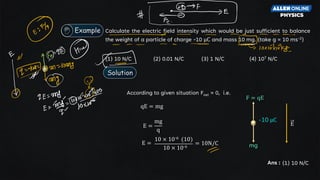
According to givensituation Fnet = 0, i.e.
mg
F = qE
qE = mg
-10 μC
E =
mg
q
E =
E
10 × 10
_6 (10)
10 × 10
_6
= 10N/C
Ans : (1) 10 N/C
Calculate the electric field intensity which would be just sufficient to balance
the weight of a particle of charge -10 μC and mass 10 mg. (take g = 10 ms-2)
(1) 10 N/C (2) 0.01 N/C (3) 1 N/C (4) 107 N/C
Example
Solution
4.
+q
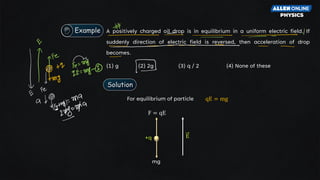
A positively chargedoil drop is in equilibrium in a uniform electric field. If
suddenly direction of electric field is reversed, then acceleration of drop
becomes.
(1) g (2) 2g (3) q / 2 (4) None of these
For equilibrium of particle qE = mg
mg
F = qE
E
Example
Solution
5.
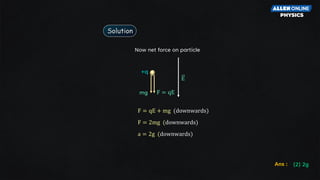
+q
mg F =qE
E
Now net force on particle
F = qE + mg (downwards)
F = 2mg (downwards)
a = 2g (downwards)
Ans : (2) 2g
Solution
6.
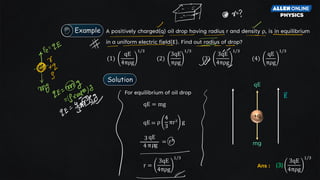
mg
+q
E
qE
For equilibrium ofoil drop
qE = mg
ρ
4
3
πr3 g
qE =
r =
3qE
4πρg
1/3
ρ
4 π g
3 qE
= r3
Ans : (3)
3qE
4πρg
1/3
A positively charged(q) oil drop having radius r and density ρ, is in equilibrium
in a uniform electric field(E). Find out radius of drop?
(1)
qE
4πρg
1/3
(2)
3qE
πρg
1/3
(3)
3qE
4πρg
1/3
(4)
qE
πρg
1/3
Example
Solution
7.
-
- -
+ ++
.
-e
.
+e
- -
-
+
+
+
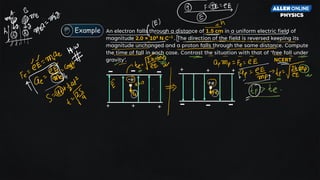
Example An electron falls through a distance of 1.5 cm in a uniform electric field of
magnitude 2.0 × 10⁴ N C–1 . The direction of the field is reversed keeping its
magnitude unchanged and a proton falls through the same distance. Compute
the time of fall in each case. Contrast the situation with that of ‘free fall under
gravity’. NCERT
8.
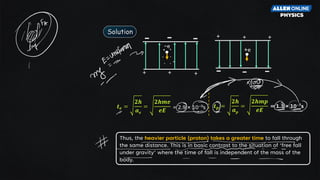
Thus, the heavierparticle (proton) takes a greater time to fall through
the same distance. This is in basic contrast to the situation of ‘free fall
under gravity’ where the time of fall is independent of the mass of the
body.
-
- -
+ + +
.
-e
.
+e
- -
-
+
+
+
𝒕𝒆 =
𝟐𝒉
𝒂𝒆
=
𝟐𝒉𝒎𝒆
𝒆𝑬
= 2.9 × 10⁻⁹s 𝒕𝒑 =
𝟐𝒉
𝒂𝒑
=
𝟐𝒉𝒎𝒑
𝒆𝑬
= 1.3 × 10⁻⁷s
Solution
9.
An electron fallsfrom rest through a vertical distance h in a uniform and
vertically upward directed electric field E. The direction of electrical field is
now reversed, keeping its magnitude the same. A proton is allowed to fall
from rest in through the same vertical distance h. The time of fall of the
electron, in comparison to the time of fall of the proton is :-
(1) smaller (2) 5 times greater
(3) 10 times greater (4) equal
[NEET 2018]
PYQ
-
- -
+ + +
.
-e
.
+e
- -
-
+
+
+
Example
10.
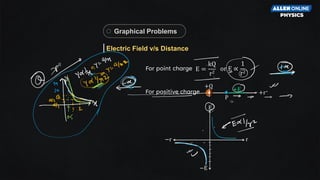
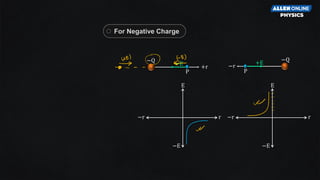
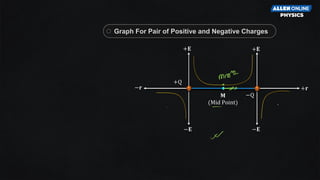
For point chargeE =
kQ
r2
or E ∝
1
r2
For positive charge
+Q
+r
+E
P
r
E
−E
−r
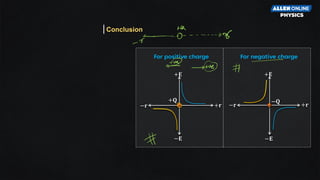
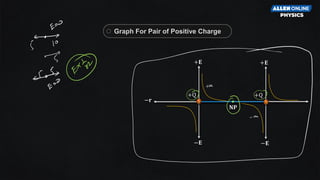
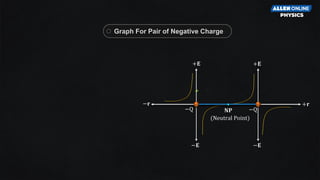
Graphical Problems
Electric Field v/s Distance
11.
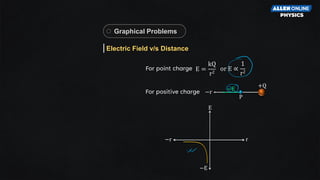
For point chargeE =
kQ
r2
or E ∝
1
r2
For positive charge
+Q
−r
−E
P
r
E
−E
−r
Graphical Problems
Electric Field v/s Distance
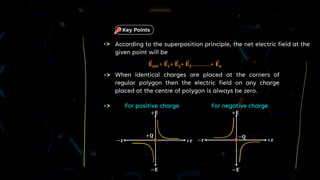
According to thesuperposition principle, the net electric field at the
given point will be
𝐄𝐧𝐞𝐭 = 𝐄𝟏+ 𝐄𝟐+ 𝐄𝟑…………+ 𝐄𝐧
When identical charges are placed at the corners of
regular polygon then the electric field on any charge
placed at the centre of polygon is always be zero.
For positive charge For negative charge
Key Points
18.
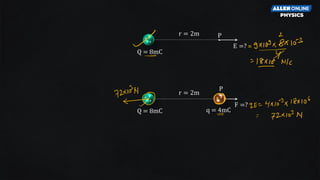
r = 2m
E=?
Q = 8mC
P
r = 2m
F =?
Q = 8mC
P
q = 4mC
19.
r = 2m
E=?
Q = 8mC
P
r = 2m
V =?
Q = 8mC
P
r = 2m
U =?
Q = 8mC
P
q = 4mC
r
Q Q
r → ∞
20.
r
Tsinθ
θ
Tcosθ
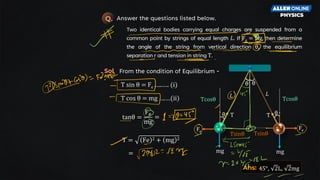
Answer the questionslisted below.
Q.
Two identical bodies carrying equal charges are suspended from a
common point by strings of equal length L. If Fe = Mg, then determine
the angle of the string from vertical direction θ, the equilibrium
separation r and tension in string T.
θ θ
L
Fe
mg mg
Fe
L
Tsinθ
θ
Tcosθ
T sin θ = Fe …..…. (i)
T cos θ = mg ….…(ii)
From the condition of Equilibrium -
Sol
.
tanθ =
Fe
mg
T = Fe 2 + mg 2
=
=
Ans: 45°, 2L, 2mg
21.
q, m
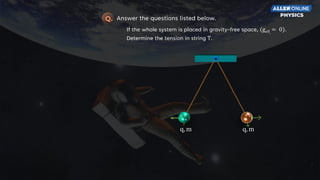
Answer thequestions listed below.
Q.
If the whole system is placed in gravity-free space, (geff.
= 0).
Determine the tension in string T.
q, m
22.
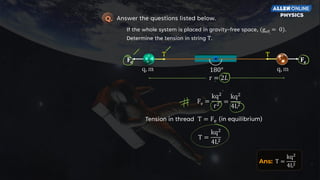
q, m
Answer thequestions listed below.
Q.
If the whole system is placed in gravity-free space, (geff.
= 0).
Determine the tension in string T.
q, m
180°
r = 2𝐿
Fe
Fe
Fe =
kq2
r2 =
kq2
4L2
Tension in thread T = Fe (in equilibrium)
T =
kq2
4L2
T T
Ans: T =
kq2
4L2
23.
r′
r
(1)
2𝑟
3
(2)
1
2
2
(3)
𝑟
3
2
(4)
2𝑟
3
(r is theinitial equilibrium separation)
Answer the questions listed below.
Q.
If the strings are rigidly clamped at half the height, the equilibrium
separation between the balls now becomes:
q, m q, m q, m q, m
y
y
2
[PYQ]
24.
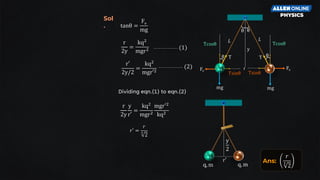
tanθ =
Fe
mg
Dividing eqn.(1)to eqn.(2)
r
2y
y
r′
=
kq2
mgr2
mgr′2
kq2
𝑟′ =
𝑟
3
2
r
2y
=
kq2
mgr2 (1)
r′
2y/2
=
kq2
mgr′2
(2)
Ans:
𝑟
3
2
Sol
.
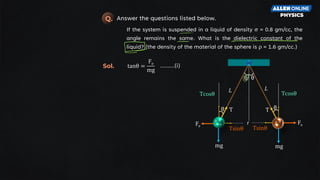
25.
tanθ =
Fe
mg
………(i)
Answer thequestions listed below.
Q.
If the system is suspended in a liquid of density σ = 0.8 gm/cc, the
angle remains the same. What is the dielectric constant of the
liquid? (the density of the material of the sphere is ρ = 1.6 gm/cc.)
r
Tsinθ
θ
Tcosθ
θ θ
L
Fe
mg mg
Fe
L
Tsinθ
θ
Tcosθ
Sol.
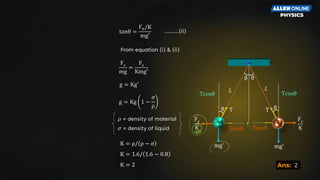
26.
Fe
K
mg' mg'
Fe
K
tanθ =
Fe/K
mg′
………(ii)
Fromequation (i) & (ii)
Fe
mg
=
Fe
Kmg′
g = Kg′
g = Kg 1 −
σ
ρ
K = 1.6/ 1.6 − 0.8
K = 2
K = ρ/ ρ − σ
𝜌 = density of material
𝜎 = density of liquid
r
Tsinθ
θ
Tcosθ
θ θ
L L
Tsinθ
θ
Tcosθ
Ans: 2
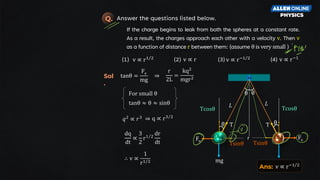
27.
v ∝ rΤ
1 2
(1) v ∝ r
(2) v ∝ r Τ
−1 2
(3) v ∝ r−1
(4)
Answer the questions listed below.
Q.
If the charge begins to leak from both the spheres at a constant rate.
As a result, the charges approach each other with a velocity v. Then v
as a function of distance r between them: (assume θ is very small )
r
Tsinθ
θ
Tcosθ
θ θ
L
Fe
mg mg
Fe
L
Tsinθ
θ
Tcosθ
tanθ =
Fe
mg
r
2L
=
kq2
mgr2
For small θ
tanθ ≈ θ ≈ sinθ
𝑞2
∝ 𝑟3 q ∝ r Τ
3 2
dq
dt
∝
3
2
r Τ
1 2
dr
dt
∴ v ∝
1
r Τ
1 2
Sol
.
⇒
⇒
Ans: v ∝ r Τ
−1 2
28.
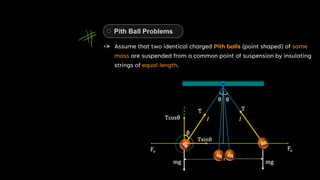
Assume that twoidentical charged Pith balls (point shaped) of same
mass are suspended from a common point of suspension by insulating
strings of equal length.
θ θ
θ
Tsinθ
Tcosθ l l
r
Fe
mg mg
Fe
Pith Ball Problems
29.
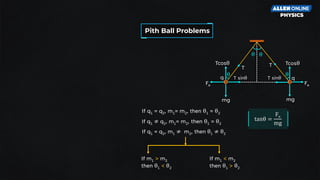
If m1 <m2
then θ1 > θ2
If q1 = q2, m1= m2, then θ1 = θ2
If q1 ≠ q2, m1= m2, then θ1 = θ2
If q1 = q2, m1 ≠ m2, then θ1 ≠ θ2
If m1 > m2
then θ1 < θ2
q q
θ θ
Fe Fe
mg mg
T T
Tcosθ
θ
T sinθ
Tcosθ
θ
T sinθ
tanθ =
Fe
mg
Pith Ball Problems
30.
q q
θ θ
FeFe
mg mg
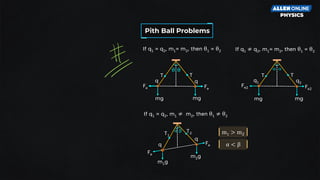
T T
If q1 = q2, m1= m2, then θ1 = θ2 If q1 ≠ q2, m1= m2, then θ1 = θ2
If q1 = q2, m1 ≠ m2, then θ1 ≠ θ2
q1 q2
Fe2 Fe2
mg mg
T T
Pith Ball Problems
β
α
T1
T2
q
Fe
Fe
m1g
m2g
q
m1 > m2
α < β
31.
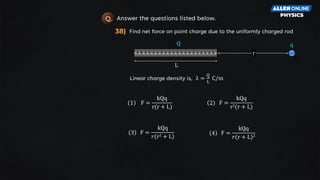
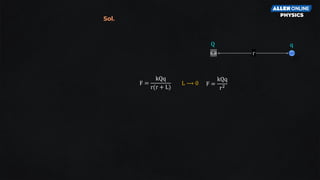
Find net forceon point charge due to the uniformly charged rod
Q
L
Linear charge density is, λ =
Q
L
C/m
q
r
Answer the questions listed below.
Q.
38)
F =
kQq
r(r + L)
1 F =
kQq
r2(r + L)
2
F =
kQq
𝑟(r2 + L)
3 F =
kQq
𝑟(r + L)2
4
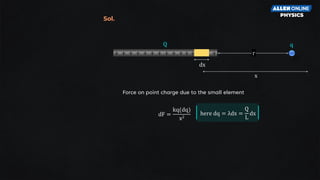
Force on pointcharge due to the small element
dF =
kq(dq)
x2
here dq = λdx =
Q
L
dx
+ + + + + + + + + + + + + + +
Q
x
q
r
dx
Sol.
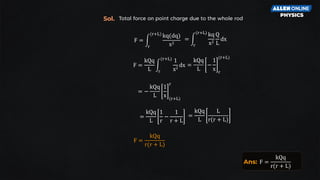
34.
F = න
r
(r+L)
kq(dq)
x2
=න
r
(r+L)
kq
x2
Q
L
dx
Total force on point charge due to the whole rod
F =
kQq
L
න
r
(r+L)
1
x2
dx =
kQq
L
−
1
x r
(r+L)
=
kQq
L
1
r
−
1
r + L
= −
kQq
L
1
x (r+L)
r
=
kQq
L
L
r(r + L)
F =
kQq
r(r + L)
Sol.
Ans: F =
kQq
r(r + L)
35.
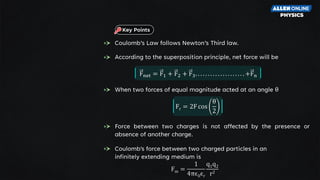
Coulomb’s Law followsNewton’s Third law.
According to the superposition principle, net force will be
Fr = 2F cos
θ
2
When two forces of equal magnitude acted at an angle θ
Force between two charges is not affected by the presence or
absence of another charge.
Coulomb's force between two charged particles in an
infinitely extending medium is
Fm =
1
4πϵ0ϵr
q1q2
r2
Fnet = F1 + F2 + F3. . . . . . . . . . . . . . . . . . . . +Fn
Key Points


![An electron falls from rest through a vertical distance h in a uniform and
vertically upward directed electric field E. The direction of electrical field is
now reversed, keeping its magnitude the same. A proton is allowed to fall
from rest in through the same vertical distance h. The time of fall of the
electron, in comparison to the time of fall of the proton is :-
(1) smaller (2) 5 times greater
(3) 10 times greater (4) equal
[NEET 2018]
PYQ
-
- -
+ + +
.
-e
.
+e
- -
-
+
+
+
Example](https://image.slidesharecdn.com/electrostatics-09-01-251209080436-c20f7be3/85/Electrostatics-09-01-pdf-for-class-12-physics-9-320.jpg)

![r′
r
(1)
2𝑟
3
(2)
1
2
2
(3)
𝑟
3
2
(4)
2𝑟
3
(r is the initial equilibrium separation)
Answer the questions listed below.
Q.
If the strings are rigidly clamped at half the height, the equilibrium
separation between the balls now becomes:
q, m q, m q, m q, m
y
y
2
[PYQ]](https://image.slidesharecdn.com/electrostatics-09-01-251209080436-c20f7be3/85/Electrostatics-09-01-pdf-for-class-12-physics-23-320.jpg)