ELECTRONIC PRINCIPLES EP02
UNIT ONE EP201
SEMESTER 3, 2020-21
OTHER TYPE OF DIODES
The Zener Diode
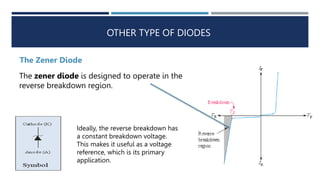
The zener diode is designed to operate in the
reverse breakdown region.
Ideally, the reverse breakdown has
a constant breakdown voltage.
This makes it useful as a voltage
reference, which is its primary
application.
ZENER DIODE
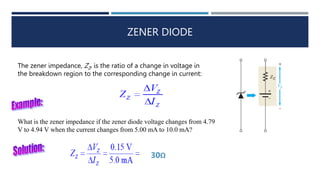
The zener impedance, ZZ, is the ratio of a change in voltage in
the breakdown region to the corresponding change in current:
What is the zener impedance if the zener diode voltage changes from 4.79
V to 4.94 V when the current changes from 5.00 mA to 10.0 mA?
30Ω
ZENER DIODE
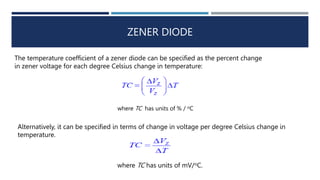
The temperature coefficient of a zener diode can be specified as the percent change
in zener voltage for each degree Celsius change in temperature:
Alternatively, it can be specified in terms of change in voltage per degree Celsius change in
temperature.
where TC has units of mV/oC.
where TC has units of % / oC
ZENER DIODE
The temperature coefficient can be positive or negative, depending on the zener voltage.
Above 5.6 V, zeners generally have a positive temperature coefficient; below about 5.6 V,
they have a negative temperature coefficient.
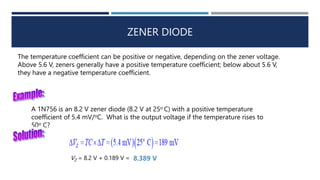
A 1N756 is an 8.2 V zener diode (8.2 V at 25o C) with a positive temperature
coefficient of 5.4 mV/oC. What is the output voltage if the temperature rises to
50o C?
VZ = 8.2 V + 0.189 V = 8.389 V
ZENER DIODE APPLICATIONS
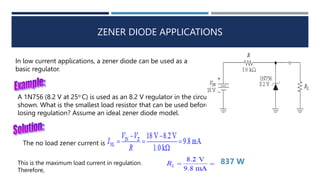
In low current applications, a zener diode can be used as a
basic regulator.
A 1N756 (8.2 V at 25o C) is used as an 8.2 V regulator in the circuit
shown. What is the smallest load resistor that can be used before
losing regulation? Assume an ideal zener diode model.
837 W
The no load zener current is
This is the maximum load current in regulation.
Therefore,
ZENER DIODE APPLICATIONS
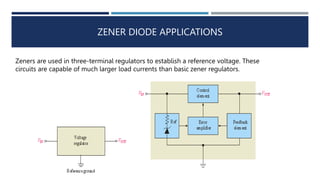
Zeners are used in three-terminal regulators to establish a reference voltage. These
circuits are capable of much larger load currents than basic zener regulators.
ZENER DIODE APPLICATIONS
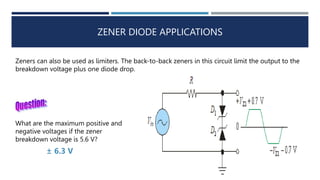
Zeners can also be used as limiters. The back-to-back zeners in this circuit limit the output to the
breakdown voltage plus one diode drop.
What are the maximum positive and
negative voltages if the zener
breakdown voltage is 5.6 V?
± 6.3 V
SCHOTTKY DIODE
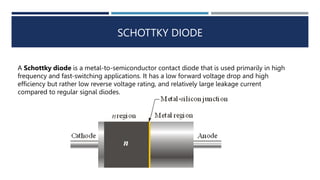
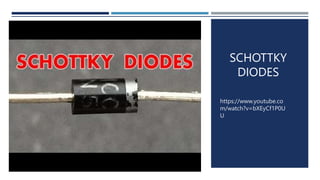
A Schottky diode is a metal-to-semiconductor contact diode that is used primarily in high
frequency and fast-switching applications. It has a low forward voltage drop and high
efficiency but rather low reverse voltage rating, and relatively large leakage current
compared to regular signal diodes.
TUNNEL DIODE
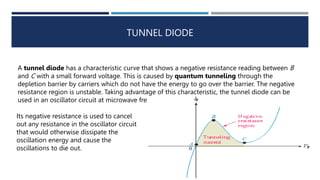
A tunnel diode has a characteristic curve that shows a negative resistance reading between B
and C with a small forward voltage. This is caused by quantum tunneling through the
depletion barrier by carriers which do not have the energy to go over the barrier. The negative
resistance region is unstable. Taking advantage of this characteristic, the tunnel diode can be
used in an oscillator circuit at microwave frequencies.
Its negative resistance is used to cancel
out any resistance in the oscillator circuit
that would otherwise dissipate the
oscillation energy and cause the
oscillations to die out.
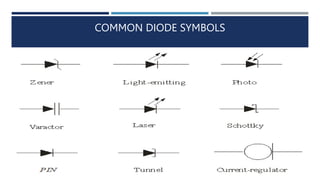
COMMON DIODE SYMBOLS
ZENER
DIODES
https://www.youtube.co
m/watch?v=XhQqtdTlRu
s
SCHOTTKY
DIODES
https://www.youtube.co
m/watch?v=bXEyCf1P0U
U
TUNNEL
DIODE
DIFFERENT
TYPES OF
DIODES
https://www.youtube.co
m/watch?v=HHet_Nr2e_
Y&t=15s
MOTIVATIONAL QUOTE
THANK YOU
ECOLE@FACULTY.CMU.EDU.JM
RTHOMAS@FACULTY.CMU.EDU.
JM
SSMYTHE@FACULTY.CMU.EDU.J
M

Electronic Principles: Different Types of Diodes

  • 1.
    ELECTRONIC PRINCIPLES EP02 UNITONE EP201 SEMESTER 3, 2020-21
  • 2.
    OTHER TYPE OFDIODES The Zener Diode The zener diode is designed to operate in the reverse breakdown region. Ideally, the reverse breakdown has a constant breakdown voltage. This makes it useful as a voltage reference, which is its primary application.
  • 3.
    ZENER DIODE The zenerimpedance, ZZ, is the ratio of a change in voltage in the breakdown region to the corresponding change in current: What is the zener impedance if the zener diode voltage changes from 4.79 V to 4.94 V when the current changes from 5.00 mA to 10.0 mA? 30Ω
  • 4.
    ZENER DIODE The temperaturecoefficient of a zener diode can be specified as the percent change in zener voltage for each degree Celsius change in temperature: Alternatively, it can be specified in terms of change in voltage per degree Celsius change in temperature. where TC has units of mV/oC. where TC has units of % / oC
  • 5.
    ZENER DIODE The temperaturecoefficient can be positive or negative, depending on the zener voltage. Above 5.6 V, zeners generally have a positive temperature coefficient; below about 5.6 V, they have a negative temperature coefficient. A 1N756 is an 8.2 V zener diode (8.2 V at 25o C) with a positive temperature coefficient of 5.4 mV/oC. What is the output voltage if the temperature rises to 50o C? VZ = 8.2 V + 0.189 V = 8.389 V
  • 6.
    ZENER DIODE APPLICATIONS Inlow current applications, a zener diode can be used as a basic regulator. A 1N756 (8.2 V at 25o C) is used as an 8.2 V regulator in the circuit shown. What is the smallest load resistor that can be used before losing regulation? Assume an ideal zener diode model. 837 W The no load zener current is This is the maximum load current in regulation. Therefore,
  • 7.
    ZENER DIODE APPLICATIONS Zenersare used in three-terminal regulators to establish a reference voltage. These circuits are capable of much larger load currents than basic zener regulators.
  • 8.
    ZENER DIODE APPLICATIONS Zenerscan also be used as limiters. The back-to-back zeners in this circuit limit the output to the breakdown voltage plus one diode drop. What are the maximum positive and negative voltages if the zener breakdown voltage is 5.6 V? ± 6.3 V
  • 9.
    SCHOTTKY DIODE A Schottkydiode is a metal-to-semiconductor contact diode that is used primarily in high frequency and fast-switching applications. It has a low forward voltage drop and high efficiency but rather low reverse voltage rating, and relatively large leakage current compared to regular signal diodes.
  • 10.
    TUNNEL DIODE A tunneldiode has a characteristic curve that shows a negative resistance reading between B and C with a small forward voltage. This is caused by quantum tunneling through the depletion barrier by carriers which do not have the energy to go over the barrier. The negative resistance region is unstable. Taking advantage of this characteristic, the tunnel diode can be used in an oscillator circuit at microwave frequencies. Its negative resistance is used to cancel out any resistance in the oscillator circuit that would otherwise dissipate the oscillation energy and cause the oscillations to die out.
  • 11.
  • 12.
  • 13.
  • 14.
  • 15.
  • 16.
  • 17.