Baba Saheb Dr.B. R. A. College of Agricultural Engineering & Technology,
Etawah – 206001
Faculty of
CHANDRA SHEKHAR AZAD UNIVERSITY OF AGRICULTURE & TECHNOLOGY
KANPUR- 208002
A
Project Presentation on
“Quality Control Methods and Testing of Beverages”
Presented By
Md. Shahaniyaz
Presented To
Department of Agricultural Engineering
Advisor: Dr. Deepali Mudgal (Teaching Associate, CAET Etawah)
INTRODUCTION
The Electrical systemis very important in the on-road as well as off-road
vehicles. Electricity flows through different components for cranking, ignition,
charging, lighting, etc. Following are the electrical systems which are used in
tractors:
Starting System: The system which help in cranking to the engine for
starting
Ignition System: To provide electric spark in combustion chamber to
ignite fuel-air mixture at specific time in petrol engine.
5.
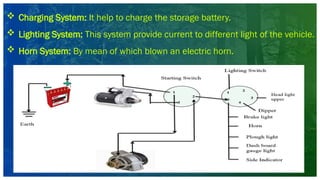
Charging System:It help to charge the storage battery.
Lighting System: This system provide current to different light of the vehicle.
Horn System: By mean of which blown an electric horn.
6.
A. Main Componentsof a Tractor’s Electrical System
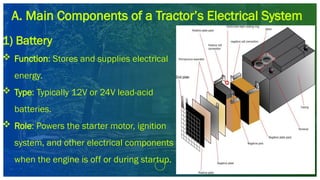
1) Battery
Function: Stores and supplies electrical
energy.
Type: Typically 12V or 24V lead-acid
batteries.
Role: Powers the starter motor, ignition
system, and other electrical components
when the engine is off or during startup.
7.
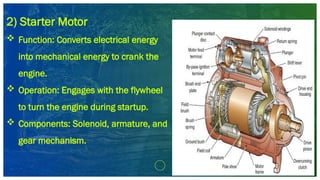
2) Starter Motor
Function: Converts electrical energy
into mechanical energy to crank the
engine.
Operation: Engages with the flywheel
to turn the engine during startup.
Components: Solenoid, armature, and
gear mechanism.
8.
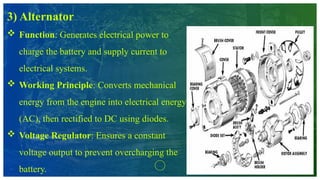
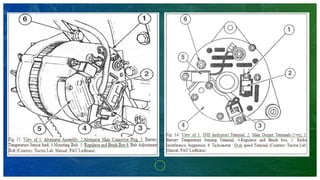
3) Alternator
Function:Generates electrical power to
charge the battery and supply current to
electrical systems.
Working Principle: Converts mechanical
energy from the engine into electrical energy
(AC), then rectified to DC using diodes.
Voltage Regulator: Ensures a constant
voltage output to prevent overcharging the
battery.
9.
4) Voltage Regulator
Function: Controls the voltage output from the alternator.
Role: Maintains stable voltage (usually around 13.8 to 14.5V) to prevent
battery damage.
B. Auxiliary Components
1) Wiring Harness
• Function: Connects all electrical components and ensures proper power
distribution.
• Types: Multi-core wires with varying gauges for different applications.
10.
2) Fuses andRelays
• Fuses: Protect circuits from overcurrent by breaking the circuit if current
exceeds a threshold.
• Relays: Electrically controlled switches used to handle high-current loads
like lights and horns.
3) Ignition Switch
• Function: Controls power delivery to the starter motor and electrical system.
• Positions: OFF, ON, START, and sometimes ACCESSORY
11.
4) Dashboard Indicatorsand Gauges
•Battery/Charging Indicator: Shows charging system status.
•Oil Pressure and Temperature Gauges: Monitors engine parameters.
•Fuel Gauge: Displays fuel level.
5) Lighting System
•Headlights and Taillights: For visibility and signaling.
•Work Lights: Illuminate the working area for nighttime operations.
•Turn Signals and Hazard Lights: Provide directional signaling.
13.
System In ElectricalSystem Of Tractor
1. Lighting and Auxiliary Systems
a) Lighting System
Tractors are equipped with various lights for operation in low-visibility
conditions:
Headlights: Provide forward illumination for night or poor weather operation.
Tail Lights: Indicate the tractor’s position to other vehicles.
Work Lights: Illuminate the working area around the tractor.
Turn Signals and Hazard Lights: Ensure safe operation on roads.
14.
b) Auxiliary Systems
Moderntractors often include additional electrical systems for comfort and
functionality:
•Cab Heating and Air Conditioning: Electrically controlled systems for
operator comfort.
•Radio and Communication Systems: Include AM/FM radios and GPS
communication systems.
•Control Interfaces: Digital dashboards display vital information such as
engine temperature, oil pressure, and speed.
15.
2. Starting System
Thestarting system includes the battery, starter motor, ignition switch,
and associated wiring. The sequence is as follows:
A. Ignition Activation: When the key is turned to the "Start" position, the
ignition switch closes the circuit.
B. Solenoid Engagement: The solenoid engages the starter motor,
allowing a high current to flow from the battery to the starter.
C. Engine Cranking: The starter motor turns the flywheel, initiating
engine rotation.
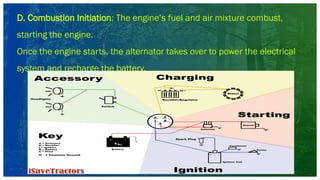
16.
D. Combustion Initiation:The engine’s fuel and air mixture combust,
starting the engine.
Once the engine starts, the alternator takes over to power the electrical
system and recharge the battery.
17.
3. Charging System
Thecharging system maintains the battery’s charge and powers electrical
components while the engine is running.
•Alternator Function: Converts mechanical energy from the engine into
electrical energy (AC), then rectifies it to DC for use.
•Voltage Regulation: The regulator ensures the voltage output remains within
safe limits to prevent overcharging the battery.
•Belt Drive: The alternator is driven by a belt connected to the engine’s
crankshaft.
18.
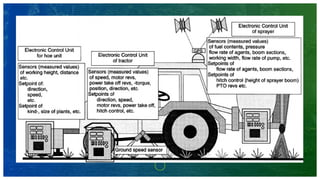
4. Control Systems
1)Electronic Control Unit (ECU) (if applicable)
• Found in modern tractors with advanced electronics.
• Manages engine performance, fuel injection, and other critical
functions.
2) Sensors
• Speed Sensors: Measure wheel or engine speed.
• Temperature Sensors: Monitor coolant and engine temperatures.
• Fuel Level Sensors: Detect fuel quantity.
20.
Common Electrical Issuesin Tractors
1.Battery Problems
Dead or weak battery due to sulfation or parasitic drain.
Solution: Regularly check and maintain battery charge.
2.Starter Motor Failure
Symptoms: Clicking sound or no response when starting.
Solution: Inspect and replace worn-out solenoids or brushes.
21.
3. Alternator Malfunction
Symptoms: Dim lights or battery not charging.
Solution: Test alternator output; replace if necessary.
4. Wiring Issues
Corroded or damaged wires leading to short circuits.
Solution: Inspect wiring harnesses and repair as needed.
5. Sensor Failures
Faulty sensors causing incorrect readings or engine misbehavior.
Solution: Use diagnostic tools to identify and replace faulty sensors.
22.
Maintenance and TroubleshootingTips
1.Battery Maintenance
Keep terminals clean and corrosion-free.
Check electrolyte levels in lead-acid batteries.
2.Alternator and Starter Checks
Test alternator output regularly.
Listen for unusual noises from the starter motor
23.
3. Fuse andRelay Inspection
Replace blown fuses and faulty relays promptly.
Use the correct rating for replacements.
4. Wiring Harness Inspection
Look for signs of wear, corrosion, or rodent damage.
Secure loose wires to prevent chafing.
5. Use Diagnostic Tools
Modern tractors often have onboard diagnostics accessible via an
OBD-II-like port.
25.
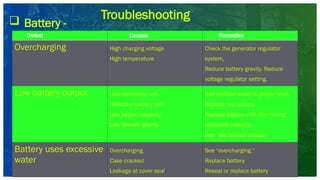
Troubleshooting
Defect Causes Remedies
OverchargingHigh charging voltage
High temperature
Check the generator regulator
system.
Reduce battery gravity. Reduce
voltage regulator setting.
Low battery output Low electrolyte cell.
Defective battery cell.
Low battery capacity
Low specific gravity.
Add distilled water to proper level.
Replace the battery.
Replace battery with one having
adequate capacity.
See “low battery charge.”
Battery uses excessive
water
Overcharging.
Case cracked
Leakage at cover seal.
See “overcharging.”
Replace battery
Reseal or replace battery
Battery -
26.
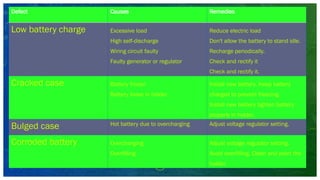
Defect Causes Remedies
Lowbattery charge Excessive load
High self-discharge
Wiring circuit faulty
Faulty generator or regulator
Reduce electric load
Don't allow the battery to stand idle.
Recharge periodically.
Check and rectify it
Check and rectify it.
Cracked case Battery frozen
Battery loose in holder
Install new battery. Keep battery
charged to prevent freezing.
Install new battery tighten battery
properly in holder.
Bulged case Hot battery due to overcharging Adjust voltage regulator setting.
Corroded battery Overcharging
Overfilling
Adjust voltage regulator setting.
Avoid overfilling. Clean and paint the
holder.
27.
Defect Causes Remedies
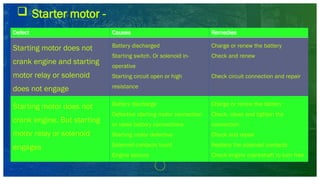
Startingmotor does not
crank engine and starting
motor relay or solenoid
does not engage
Battery discharged
Starting switch. Or solenoid in-
operative
Starting circuit open or high
resistance
Charge or renew the battery
Check and renew
Check circuit connection and repair
Starting motor does not
crank engine. But starting
motor relay or solenoid
engages
Battery discharge
Defective starting motor connection
or loose battery connections
Starting motor defective
Solenoid contacts burnt
Engine seizure
Charge or renew the battery
Check, clean and tighten the
connection
Check and repair
Replace the solenoid contacts
Check engine crankshaft to turn free
Starter motor -
28.
Defect Causes Remedies
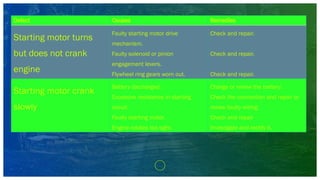
Startingmotor turns
but does not crank
engine
Faulty starting motor drive
mechanism.
Faulty solenoid or pinion
engagement levers.
Flywheel ring gears worn out.
Check and repair.
Check and repair.
Check and repair.
Starting motor crank
slowly
Battery discharged.
Excessive resistance in starting
circuit.
Faulty starting motor.
Engine rotates too tight.
Charge or renew the battery.
Check the connection and repair or
renew faulty wiring.
Check and repair
Investigate and rectify it.




![Service Manual for Chery [Electrical Circuit].pdf](https://cdn.slidesharecdn.com/ss_thumbnails/servicemanualforcheryelectricalcircuit-240708091605-4a1197f7-thumbnail.jpg?width=640&height=640&fit=bounds)


