Presentation on
ISLANDING DETECTION APPROACH WITH NEGLIGIBLE NON DETECTION ZONE
BASED ON FEATURE EXTRACTION DWT
Under the guidance of
Mrs. MAMUN MISHRA
Assistant Professor
Presented by:-
FLEVIE PATTANAIK(2002050086) ROXY RANJAN MALLCK(2002050101)
SUPRIYA SAHU(2002050115) BAKI TIRUPATHI(200204050001)
SUSMITA DASH(2002050134) SUBHAM S. PANDA(2002050124)
ANSHUMAN BEHERA(2004050015)
1
PRESENTATION OUTLINE
 INTRODUCTION
 OBJECTIVE
 CURRENT SCENARIO
 TYPES OF ISLANDING
 WHY WE HAVE CHOSEN PASSIVE ISLANDING OVER ACTIVE
 DISCRETE WAVELET TRANSFORM
 STRATEGIES FOR NEGLIGIBLE NON DETECTION ZONE
 WAVELET AND DIFFERENT SOFTWARE
 TESTING SYSTEM MODEL
 SIMULATION AND RESULT
 FUTURE SCOPE
 CONCLUSION
 REFERENCE
2
INTRODUCTION
 Islanding refers to the situation where a
portion of the power system becomes
electrically isolated from the main grid while
still generating and consuming power locally.
 This phenomenon can pose serious safety
risks to both the power system and
connected loads if not detected and
addressed promptly.
 The Discrete Wavelet Transform is a signal
processing technique that decomposes a
signal into its frequency components.
 DWT is particularly useful for analyzing
signals with time-varying characteristics,
making it suitable for power system
applications where conditions can change
rapidly. 3
 DWT can be employed to analyze the variations in the voltage and current waveforms of the power system.
By decomposing the signals into different frequency bands, DWT allows for the extraction of relevant
features associated with islanding events.
 Detecting islanding events is crucial for the safety and stability of the power grid.
 Rapid identification of islanding helps trigger protective measures to disconnect the distributed energy
resource (DER) from the isolated section, preventing potential damage and ensuring grid stability.
 Improved sensitivity and selectivity (DWT can enhance the ability to discriminate between normal grid
variations and islanding events.)
 Adaptability to dynamic conditions (DWT's capability to analyze signals across different scales makes it
well-suited for detecting transient and dynamic changes in the power system.)
 Islanding detection using Discrete Wavelet Transform offers a promising approach to enhance the reliability
and efficiency of protection systems in the presence of distributed energy resources.
4
Islanding prevention is crucial to ensure the safety of utility workers and the stability of
the overall power grid. If a distributed power source continues to operate during a grid
outage (islanding), it can pose risks to maintenance personnel who might mistakenly
believe the area is de-energized. Additionally, islanding can lead to grid instability and
damage equipment when power is eventually restored. Implementing measures to
detect and prevent islanding helps maintain the safety and reliability of the electrical
infrastructure.
OBJECTIVE
5
 Safety: Prevents risks to utility workers during grid maintenance.
 Grid Stability: Avoids instability caused by distributed generation during faults.
 Regulatory Compliance: Meets safety standards and regulatory requirements.
 Equipment Protection : Safeguards against damage due to voltage and frequency variations.
 Reliability: Enhances overall power supply reliability.
 Efficient Restoration: Facilitates controlled grid restoration after outages.
 Operational Control: Provides operators better control over the grid.
 Customer Satisfaction: Minimizes disruptions, improving customer satisfaction.
 Renewable Integration: Supports stable integration of renewable energy sources.
 Best Practices: Aligns with industry standards for grid management and reliability.
OBJECTIVE
6
CURRENT SCENARIO
 Continued Significance: Islanding detection
methods remain crucial for ensuring power
system safety and stability.
 Technology Advancements: Advances in
hybrid approaches, combining communication
and passive methods, are expected to
contribute to more effective islanding
prevention.
 Research and Development: Ongoing research
and development in power systems may lead
to further improvements and innovations in
islanding detection.
7
TYPES OF ISLANDING
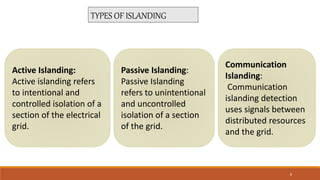
Active Islanding:
Active islanding refers
to intentional and
controlled isolation of a
section of the electrical
grid.
Passive Islanding:
Passive Islanding
refers to unintentional
and uncontrolled
isolation of a section
of the grid.
Communication
Islanding:
Communication
islanding detection
uses signals between
distributed resources
and the grid.
8
WHY WE HAVE CHOSEN hybrid islanding
 Enhanced Reliability: Combining communication and passive methods improves
overall reliability.-
 Comprehensive Detection: Passive methods add a layer of detection, contributing
to a more thorough system.-
 Swift Response: Active communication enables rapid identification and response
to islanding events.
 Robust System: The hybrid approach creates a robust detection system adaptable
to diverse scenarios.
 Adaptability: Hybrid methods can be tailored to specific grid configurations and
operational needs, ensuring flexibility and effectiveness.
9
DISCRETE WAVELET TRANSFORM
Efficient Signal Analysis: DWT is efficient in analyzing signals
in both time and frequency domains, aiding in the detection of
subtle changes.
Feature Extraction: DWT can extract relevant features from
the signal, providing valuable information about power system
characteristics associated with islanding events.
10
STRATEGIES FOR NEGLIGIBLE NON DETECTION ZONE
Discuss specific strategies to minimize non-detection zones:
Diverse Training Data: Include various islanding scenarios to ensure the system can
recognize a wide range of patterns.
Optimized Wavelet Selection: Carefully select wavelet basis functions to capture relevant
features without introducing non-detection zones.
Fine-tuned Feature Extraction Layers: Adjust feature extraction layers to enhance
sensitivity to subtle changes in the power signal.
Adaptive Learning: Implement adaptive learning strategies to continuously improve the
system's ability to adapt to evolving conditions.
11
WAVELETANDDIFFERENTSOFTWARE
ROLE OF WAVELETS : Utilized for signal processing in islanding detection.
Multi-Resolution Analysis: Wavelets provide a detailed examination of power signals
at varying resolutions.
Software Tools Used :
 MATLAB :
- Widely used for wavelet analysis in power system applications.
- Offers extensive signal processing and data visualization capabilities.
12
Advantages of Wavelet Analysis :
Frequency Localization: Enables pinpointing specific frequency components in
power signals.
Feature Extraction: Extracts relevant features for effective islanding detection.
Multi-Resolution Capability: Enhances adaptability to varying system dynamics.
WAVELETANDDIFFERENTSOFTWARE
13
TESTING SYSTEM model
14
SIMULATION AND RESULT :
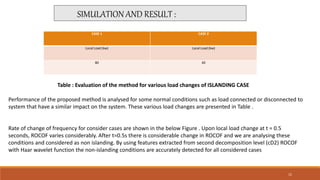
Performance of the proposed method is analysed for some normal conditions such as load connected or disconnected to
system that have a similar impact on the system. These various load changes are presented in Table .
Rate of change of frequency for consider cases are shown in the below Figure . Upon local load change at t = 0.5
seconds, ROCOF varies considerably. After t=0.5s there is considerable change in ROCOF and we are analysing these
conditions and considered as non islanding. By using features extracted from second decomposition level (cD2) ROCOF
with Haar wavelet function the non-islanding conditions are accurately detected for all considered cases
Table : Evaluation of the method for various load changes of ISLANDING CASE
CASE 1 CASE 2
Local Load (kw) Local Load (kw)
80 40
15
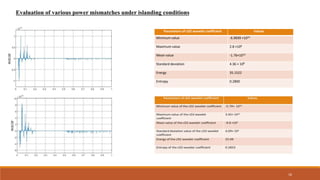
Parameters of cD2 wavelet coefficient Values
Minimum value -6.9699 ×10¹⁰
Maximum value 2.8 ×10⁸
Mean value -1.76×10¹⁰
Standard deviation 4.36 × 10⁸
Energy 35.1522
Entropy 0.2800
Evaluation of various power mismatches under islanding conditions
16
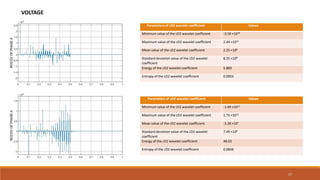
VOLTAGE
Parameters of cD2 wavelet coefficient Values
Minimum value of the cD2 wavelet coefficient -3.59 ×10¹⁰
Maximum value of the cD2 wavelet coefficient 2.44 ×10¹¹
Mean value of the cD2 wavelet coefficient 2.25 ×10⁶
Standard deviation value of the cD2 wavelet
coefficient
8.35 ×10⁸
Energy of the cD2 wavelet coefficient 5.883
Entropy of the cD2 wavelet coefficient 0.0903
Parameters of cD2 wavelet coefficient Values
Minimum value of the cD2 wavelet coefficient -1.69 ×10¹²
Maximum value of the cD2 wavelet coefficient 1.75 ×10¹¹
Mean value of the cD2 wavelet coefficient -3.28 ×10⁷
Standard deviation value of the cD2 wavelet
coefficient
7.49 ×10⁹
Energy of the cD2 wavelet coefficient 48.03
Entropy of the cD2 wavelet coefficient 0.0838
17
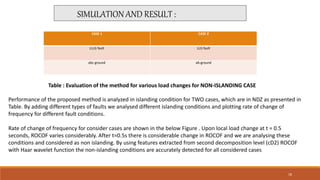
SIMULATION AND RESULT :
Performance of the proposed method is analyzed in islanding condition for TWO cases, which are in NDZ as presented in
Table. By adding different types of faults we analysed different islanding conditions and plotting rate of change of
frequency for different fault conditions.
Rate of change of frequency for consider cases are shown in the below Figure . Upon local load change at t = 0.5
seconds, ROCOF varies considerably. After t=0.5s there is considerable change in ROCOF and we are analysing these
conditions and considered as non islanding. By using features extracted from second decomposition level (cD2) ROCOF
with Haar wavelet function the non-islanding conditions are accurately detected for all considered cases
Table : Evaluation of the method for various load changes for NON-ISLANDING CASE
CASE 1 CASE 2
LLLG fault LLG fault
abc-ground ab-ground
18
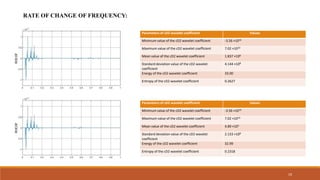
RATE OF CHANGE OF FREQUENCY:
Parameters of cD2 wavelet coefficient Values
Minimum value of the cD2 wavelet coefficient -3.56 ×10¹⁰
Maximum value of the cD2 wavelet coefficient 7.02 ×10¹⁰
Mean value of the cD2 wavelet coefficient 1.837 ×10⁶
Standard deviation value of the cD2 wavelet
coefficient
4.144 ×10⁸
Energy of the cD2 wavelet coefficient 33.00
Entropy of the cD2 wavelet coefficient 0.2627
Parameters of cD2 wavelet coefficient Values
Minimum value of the cD2 wavelet coefficient -3.56 ×10¹⁰
Maximum value of the cD2 wavelet coefficient 7.02 ×10¹⁰
Mean value of the cD2 wavelet coefficient 4.89 ×10⁵
Standard deviation value of the cD2 wavelet
coefficient
2.133 ×10⁸
Energy of the cD2 wavelet coefficient 32.99
Entropy of the cD2 wavelet coefficient 0.2318
19
The integration of Discrete Wavelet Transform (DWT) for feature extraction in
islanding detection demonstrates a commendable reduction in the non-detection
zone. The proposed approach not only enhances accuracy and reliability but also
showcases adaptability across diverse power system scenarios. With its
computational efficiency and seamless integration with existing systems, this method
proves to be a promising solution for real-time implementation. The positive
outcomes observed in case studies or simulations underscore the effectiveness of the
approach. Moving forward, continued exploration of potential enhancements and
optimizations will further solidify its role in advancing islanding detection capabilities
within power systems.
CONCLUSION
20
1. Advanced Signal Processing Techniques:
 Explore novel signal processing methods beyond wavelet analysis.
Investigate the effectiveness of machine learning approaches for feature extraction in
islanding detection.
2. Integration of IoT and Smart Grid Technologies:
Incorporate Internet of Things (IoT) devices for real-time data collection.
Explore how smart grid technologies can enhance communication-based islanding detection.
3. Resilience to Cybersecurity Threats:
Address cybersecurity challenges associated with communication-based detection methods.
Develop resilient algorithms to mitigate potential cyber threats in islanding detection systems.
4. Real-Time Implementation Challenges:
Investigate challenges related to implementing real-time islanding detection in dynamic power
systems.
Focus on minimizing computational delays for prompt response during islanding events.
FUTURE SCOPE
21
Reference
[1] Islanding detection approach with negligible non-detection zone based on feature extraction discrete wavelet transform and artificial
neural network Farid Hashemi and Mohammad Mohammadi (2016).
[2] Zeineldin HH, El-Saadany Ehab F, Salama MMA. Impact of DG interface control on islanding detection and non detection zones. IEEE
Transactions on Power Delivery 2006; 21(3):1515–23.
[3] ElNozahy MS, El-Saadany EF, Salama MMA. A robust wavelet-ANN based technique for islanding detection. In: IEEE power and energy
society general meeting; 2011.
[4] Kazemi Karegar H, Sobhani B. Wavelet transform method for islanding detection of wind turbines. Renewable Energy 2012; 38(1).
[5] Hernandez-Gonzalez G, Iravani R. Current injection for active islanding detection of electronically-interfaced distributed resources.
IEEE Transactions Power Deliver 2006; 21.
[6] Mahat P, Chen Z, Bak-jensen B. A hybrid islanding detection technique using average rate of voltage change and real power shift. IEEE
Transactions on Power Delivery 2009.
22
Thank you
23

Electrical _engineering_ minor_PPTx.pptx

  • 1.
    Presentation on ISLANDING DETECTIONAPPROACH WITH NEGLIGIBLE NON DETECTION ZONE BASED ON FEATURE EXTRACTION DWT Under the guidance of Mrs. MAMUN MISHRA Assistant Professor Presented by:- FLEVIE PATTANAIK(2002050086) ROXY RANJAN MALLCK(2002050101) SUPRIYA SAHU(2002050115) BAKI TIRUPATHI(200204050001) SUSMITA DASH(2002050134) SUBHAM S. PANDA(2002050124) ANSHUMAN BEHERA(2004050015) 1
  • 2.
    PRESENTATION OUTLINE  INTRODUCTION OBJECTIVE  CURRENT SCENARIO  TYPES OF ISLANDING  WHY WE HAVE CHOSEN PASSIVE ISLANDING OVER ACTIVE  DISCRETE WAVELET TRANSFORM  STRATEGIES FOR NEGLIGIBLE NON DETECTION ZONE  WAVELET AND DIFFERENT SOFTWARE  TESTING SYSTEM MODEL  SIMULATION AND RESULT  FUTURE SCOPE  CONCLUSION  REFERENCE 2
  • 3.
    INTRODUCTION  Islanding refersto the situation where a portion of the power system becomes electrically isolated from the main grid while still generating and consuming power locally.  This phenomenon can pose serious safety risks to both the power system and connected loads if not detected and addressed promptly.  The Discrete Wavelet Transform is a signal processing technique that decomposes a signal into its frequency components.  DWT is particularly useful for analyzing signals with time-varying characteristics, making it suitable for power system applications where conditions can change rapidly. 3
  • 4.
     DWT canbe employed to analyze the variations in the voltage and current waveforms of the power system. By decomposing the signals into different frequency bands, DWT allows for the extraction of relevant features associated with islanding events.  Detecting islanding events is crucial for the safety and stability of the power grid.  Rapid identification of islanding helps trigger protective measures to disconnect the distributed energy resource (DER) from the isolated section, preventing potential damage and ensuring grid stability.  Improved sensitivity and selectivity (DWT can enhance the ability to discriminate between normal grid variations and islanding events.)  Adaptability to dynamic conditions (DWT's capability to analyze signals across different scales makes it well-suited for detecting transient and dynamic changes in the power system.)  Islanding detection using Discrete Wavelet Transform offers a promising approach to enhance the reliability and efficiency of protection systems in the presence of distributed energy resources. 4
  • 5.
    Islanding prevention iscrucial to ensure the safety of utility workers and the stability of the overall power grid. If a distributed power source continues to operate during a grid outage (islanding), it can pose risks to maintenance personnel who might mistakenly believe the area is de-energized. Additionally, islanding can lead to grid instability and damage equipment when power is eventually restored. Implementing measures to detect and prevent islanding helps maintain the safety and reliability of the electrical infrastructure. OBJECTIVE 5
  • 6.
     Safety: Preventsrisks to utility workers during grid maintenance.  Grid Stability: Avoids instability caused by distributed generation during faults.  Regulatory Compliance: Meets safety standards and regulatory requirements.  Equipment Protection : Safeguards against damage due to voltage and frequency variations.  Reliability: Enhances overall power supply reliability.  Efficient Restoration: Facilitates controlled grid restoration after outages.  Operational Control: Provides operators better control over the grid.  Customer Satisfaction: Minimizes disruptions, improving customer satisfaction.  Renewable Integration: Supports stable integration of renewable energy sources.  Best Practices: Aligns with industry standards for grid management and reliability. OBJECTIVE 6
  • 7.
    CURRENT SCENARIO  ContinuedSignificance: Islanding detection methods remain crucial for ensuring power system safety and stability.  Technology Advancements: Advances in hybrid approaches, combining communication and passive methods, are expected to contribute to more effective islanding prevention.  Research and Development: Ongoing research and development in power systems may lead to further improvements and innovations in islanding detection. 7
  • 8.
    TYPES OF ISLANDING ActiveIslanding: Active islanding refers to intentional and controlled isolation of a section of the electrical grid. Passive Islanding: Passive Islanding refers to unintentional and uncontrolled isolation of a section of the grid. Communication Islanding: Communication islanding detection uses signals between distributed resources and the grid. 8
  • 9.
    WHY WE HAVECHOSEN hybrid islanding  Enhanced Reliability: Combining communication and passive methods improves overall reliability.-  Comprehensive Detection: Passive methods add a layer of detection, contributing to a more thorough system.-  Swift Response: Active communication enables rapid identification and response to islanding events.  Robust System: The hybrid approach creates a robust detection system adaptable to diverse scenarios.  Adaptability: Hybrid methods can be tailored to specific grid configurations and operational needs, ensuring flexibility and effectiveness. 9
  • 10.
    DISCRETE WAVELET TRANSFORM EfficientSignal Analysis: DWT is efficient in analyzing signals in both time and frequency domains, aiding in the detection of subtle changes. Feature Extraction: DWT can extract relevant features from the signal, providing valuable information about power system characteristics associated with islanding events. 10
  • 11.
    STRATEGIES FOR NEGLIGIBLENON DETECTION ZONE Discuss specific strategies to minimize non-detection zones: Diverse Training Data: Include various islanding scenarios to ensure the system can recognize a wide range of patterns. Optimized Wavelet Selection: Carefully select wavelet basis functions to capture relevant features without introducing non-detection zones. Fine-tuned Feature Extraction Layers: Adjust feature extraction layers to enhance sensitivity to subtle changes in the power signal. Adaptive Learning: Implement adaptive learning strategies to continuously improve the system's ability to adapt to evolving conditions. 11
  • 12.
    WAVELETANDDIFFERENTSOFTWARE ROLE OF WAVELETS: Utilized for signal processing in islanding detection. Multi-Resolution Analysis: Wavelets provide a detailed examination of power signals at varying resolutions. Software Tools Used :  MATLAB : - Widely used for wavelet analysis in power system applications. - Offers extensive signal processing and data visualization capabilities. 12
  • 13.
    Advantages of WaveletAnalysis : Frequency Localization: Enables pinpointing specific frequency components in power signals. Feature Extraction: Extracts relevant features for effective islanding detection. Multi-Resolution Capability: Enhances adaptability to varying system dynamics. WAVELETANDDIFFERENTSOFTWARE 13
  • 14.
  • 15.
    SIMULATION AND RESULT: Performance of the proposed method is analysed for some normal conditions such as load connected or disconnected to system that have a similar impact on the system. These various load changes are presented in Table . Rate of change of frequency for consider cases are shown in the below Figure . Upon local load change at t = 0.5 seconds, ROCOF varies considerably. After t=0.5s there is considerable change in ROCOF and we are analysing these conditions and considered as non islanding. By using features extracted from second decomposition level (cD2) ROCOF with Haar wavelet function the non-islanding conditions are accurately detected for all considered cases Table : Evaluation of the method for various load changes of ISLANDING CASE CASE 1 CASE 2 Local Load (kw) Local Load (kw) 80 40 15
  • 16.
    Parameters of cD2wavelet coefficient Values Minimum value -6.9699 ×10¹⁰ Maximum value 2.8 ×10⁸ Mean value -1.76×10¹⁰ Standard deviation 4.36 × 10⁸ Energy 35.1522 Entropy 0.2800 Evaluation of various power mismatches under islanding conditions 16
  • 17.
    VOLTAGE Parameters of cD2wavelet coefficient Values Minimum value of the cD2 wavelet coefficient -3.59 ×10¹⁰ Maximum value of the cD2 wavelet coefficient 2.44 ×10¹¹ Mean value of the cD2 wavelet coefficient 2.25 ×10⁶ Standard deviation value of the cD2 wavelet coefficient 8.35 ×10⁸ Energy of the cD2 wavelet coefficient 5.883 Entropy of the cD2 wavelet coefficient 0.0903 Parameters of cD2 wavelet coefficient Values Minimum value of the cD2 wavelet coefficient -1.69 ×10¹² Maximum value of the cD2 wavelet coefficient 1.75 ×10¹¹ Mean value of the cD2 wavelet coefficient -3.28 ×10⁷ Standard deviation value of the cD2 wavelet coefficient 7.49 ×10⁹ Energy of the cD2 wavelet coefficient 48.03 Entropy of the cD2 wavelet coefficient 0.0838 17
  • 18.
    SIMULATION AND RESULT: Performance of the proposed method is analyzed in islanding condition for TWO cases, which are in NDZ as presented in Table. By adding different types of faults we analysed different islanding conditions and plotting rate of change of frequency for different fault conditions. Rate of change of frequency for consider cases are shown in the below Figure . Upon local load change at t = 0.5 seconds, ROCOF varies considerably. After t=0.5s there is considerable change in ROCOF and we are analysing these conditions and considered as non islanding. By using features extracted from second decomposition level (cD2) ROCOF with Haar wavelet function the non-islanding conditions are accurately detected for all considered cases Table : Evaluation of the method for various load changes for NON-ISLANDING CASE CASE 1 CASE 2 LLLG fault LLG fault abc-ground ab-ground 18
  • 19.
    RATE OF CHANGEOF FREQUENCY: Parameters of cD2 wavelet coefficient Values Minimum value of the cD2 wavelet coefficient -3.56 ×10¹⁰ Maximum value of the cD2 wavelet coefficient 7.02 ×10¹⁰ Mean value of the cD2 wavelet coefficient 1.837 ×10⁶ Standard deviation value of the cD2 wavelet coefficient 4.144 ×10⁸ Energy of the cD2 wavelet coefficient 33.00 Entropy of the cD2 wavelet coefficient 0.2627 Parameters of cD2 wavelet coefficient Values Minimum value of the cD2 wavelet coefficient -3.56 ×10¹⁰ Maximum value of the cD2 wavelet coefficient 7.02 ×10¹⁰ Mean value of the cD2 wavelet coefficient 4.89 ×10⁵ Standard deviation value of the cD2 wavelet coefficient 2.133 ×10⁸ Energy of the cD2 wavelet coefficient 32.99 Entropy of the cD2 wavelet coefficient 0.2318 19
  • 20.
    The integration ofDiscrete Wavelet Transform (DWT) for feature extraction in islanding detection demonstrates a commendable reduction in the non-detection zone. The proposed approach not only enhances accuracy and reliability but also showcases adaptability across diverse power system scenarios. With its computational efficiency and seamless integration with existing systems, this method proves to be a promising solution for real-time implementation. The positive outcomes observed in case studies or simulations underscore the effectiveness of the approach. Moving forward, continued exploration of potential enhancements and optimizations will further solidify its role in advancing islanding detection capabilities within power systems. CONCLUSION 20
  • 21.
    1. Advanced SignalProcessing Techniques:  Explore novel signal processing methods beyond wavelet analysis. Investigate the effectiveness of machine learning approaches for feature extraction in islanding detection. 2. Integration of IoT and Smart Grid Technologies: Incorporate Internet of Things (IoT) devices for real-time data collection. Explore how smart grid technologies can enhance communication-based islanding detection. 3. Resilience to Cybersecurity Threats: Address cybersecurity challenges associated with communication-based detection methods. Develop resilient algorithms to mitigate potential cyber threats in islanding detection systems. 4. Real-Time Implementation Challenges: Investigate challenges related to implementing real-time islanding detection in dynamic power systems. Focus on minimizing computational delays for prompt response during islanding events. FUTURE SCOPE 21
  • 22.
    Reference [1] Islanding detectionapproach with negligible non-detection zone based on feature extraction discrete wavelet transform and artificial neural network Farid Hashemi and Mohammad Mohammadi (2016). [2] Zeineldin HH, El-Saadany Ehab F, Salama MMA. Impact of DG interface control on islanding detection and non detection zones. IEEE Transactions on Power Delivery 2006; 21(3):1515–23. [3] ElNozahy MS, El-Saadany EF, Salama MMA. A robust wavelet-ANN based technique for islanding detection. In: IEEE power and energy society general meeting; 2011. [4] Kazemi Karegar H, Sobhani B. Wavelet transform method for islanding detection of wind turbines. Renewable Energy 2012; 38(1). [5] Hernandez-Gonzalez G, Iravani R. Current injection for active islanding detection of electronically-interfaced distributed resources. IEEE Transactions Power Deliver 2006; 21. [6] Mahat P, Chen Z, Bak-jensen B. A hybrid islanding detection technique using average rate of voltage change and real power shift. IEEE Transactions on Power Delivery 2009. 22
  • 23.