E-Learning and
Design
Veronica Morris
EDU652
Professor Lao
March 2, 2015
E-Learning
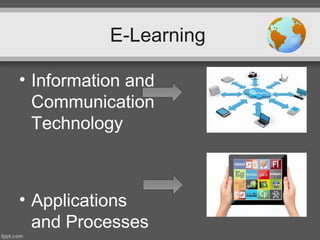
• Information and
Communication
Technology
• Applications
and Processes
Varieties of E-Learning
oSocial
Learning
o Online, community
based
• Mobile
Learning
o Learning on the
move with mobile
devices
oGames and
E-Learning Varieties as outlined by Horton (2012
E-Learning Varieties
Standalone
Courses
• Independent, self-
paced
Virtual
Classrooms
E-Learning Varieties as outlined by Horton (2012
Through Creation
E-Learning
The Creation of E-Learning is the development of
a successful
Design and Development
E-Learning Design
E-
Learning
Design
E-
Learning
Design
Instructional
Design
Instructional Design
• Analysis
• Design
• Develop
• Implementation
• Evaluation
Design Perspectives and
Influences
• Rapraprapawa
p
• Pack ‘em, Yak
‘em, Rak ‘em,
and Track’ em
• Warn and
Scorn
• Fill-in the
Blanks
Common methodologies of NON-DESIGN: to do or not to
do?
Learning and Goal Alignment
Organization
al goals
How learning
will contribute
to
organizational
goals
2 Steps to identify when2 Steps to identify when
developing goal alignmentdeveloping goal alignment
ional Design begins with identification of the Learnional Design begins with identification of the Learn
Learning Goal Alignment
“How am I helping achieve that goal?”
Defining Learning Objectives
What learningWhat learning
objectives areobjectives are::
• Influential
• Vital
• Imperative
• Crucial
Learning ObjectivesLearning Objectives
 ”Learning objectives are brief statements that 
describe what students will be expected to learn 
by the end of school year, course, unit, lesson, 
project, or class period.”
Defined by Hidden Curriculum 2014
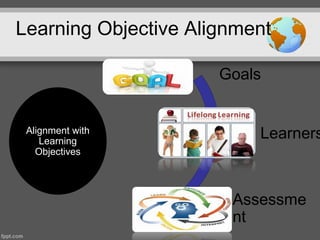
Learning Objective Alignment
Alignment with 
Learning 
Objectives
Goals
Learners
Assessme
nt
Teaching Sequences
Use the teaching
sequences as a
start when
designing
Planning Teaching Sequences
Learning Activities
Learning Activity Selection
Chat
Whiteboard
Annotation
Poll Breakout Rooms
Application Sharing
Web Browser Sharing
Audio Video Sharing
Notes
E-Learning
Activity
Selections
References
• Horton, W. (2012). E-Learning by design
(2nd
ed.). San Francisco, AC: Willey
• Hidden curriculum (2014, August 26). In S.
Abbott (Ed.), The glossary of education
reform. Retrieved from
http://edglossary.org/hidden-curriculum
• Sun and Giles. (2001). Sequence
Learning. Retrieved from

E-Learning Design

Editor's Notes

  • #3 E-learning can be defined as the educational environment taking place on an internet device. Horton defines e-learning as “…the use of electronic technologies to create learning experiences” (2012, p1). E-learning uses various types of technology to deliver and receive knowledge through various information and communication technologies. The technologies are programmed with various applications and processes to enhance the students’ learning success.
  • #4 Social learning refers to the learning that takes place through collaboration and communication with peers and instructors (Horton, 2012). The use of social networks such as Skype, Moodle, and Facebook are instances of what can and is used to increase student engagement and retention. Mobile learning is the learning that takes place on mobile devices. There are many educational applications and processes that allow a student to continue with daily activities while still receiving an education. The mobile device provides a myriad of e-learning experiences. Horton States, “learners participate in conventional classroom courses and standalone e-learning while out and about” (2012, p2). Learning games and simulations allow students to apply and perform skills and knowledge while providing fun and personal experience with the information.
  • #5 The standalone course is one in which the student has the ability to learn in a solitary environment that is not time controlled. “They are self-paced without interaction with a teacher or classmates” (Horton, 2012, p2). The virtual classroom is similar to a conventional classroom as there is a teacher or instructor, peers, various assignments and activities, and is not self-paced. A virtual classroom has “reading assignments, presentations, discussions via forums and other social media, and homework” (Horton, 2012, p2).
  • #6 E-Learning is based on design and development. The design is the evaluation, creation and resolution of decision making. The development is the transfer and conveying of those decisions.
  • #7 The e-Learning design is the learning with ad through the use of technology. The e-learning design is the instructional plan and implementation of the instructional decisions and actions taken.
  • #8 The instructional design is the core of any e-learning environment. The instructional design encompasses identifying the learner, identifying objectives, setting goals, creating and implanting activities and tests. Instructional design is an element of any learning environment that must be flexible and continue to adjust to meet the needs of learners.
  • #9 The learning from the rapraprapawap is the student is to read several papers and then take what they have learned from the papers to write their own paper. There is no real transfer of knowledge or skills; students learn directly from what is read, if any learning occurs at all. The Pack ‘em, yak ‘em, rak ‘em, track ‘em perspective is when school over enroll students into packed classrooms and teachers deliver lectures give assessments based soley on the lectures that are provided. The Warn and scorn theory relates to the student being forced through materials to attain required learning standards even when the student does not understand the concepts. Teachers typically will do this in order to be in state and federal compliance which in turn directly reflects on future successes for the student. The fill-in the blanks is when delivery of content is through endless worksheets. Wouldn’t it be cool if… is when a teacher implements various methods and materials because it is the new or “cool” thing to use instead of first ensuring what is being implemented is there to enhance learning. (Horton, 2012).
  • #10 All design begins with a goal; you must know what it is you intend to accomplish to be successful. When designing E-learning, the same as a traditional classroom, you must know what the organizational goals are. From that point, taking into account what you want to accomplish, the process of instructional design begins.
  • #11 The entire process of instructional design should include the questions in the forefront of your mind: What am I achieving by this design? What is the final outcome I am looking to accomplish? “How am I helping achieve that goal” (Horton, 2012, p.10)
  • #12 Learning objectives are paramount to the success and or the failure of e-learning environments. All elements of e-learning revolve around good, clear, and concise objectives. Once the learning goal is identified, recognition of the learning objectives are decided. Learning objectives are fixed progressions of the “what, how, and why” of content in order to promote required and essential skills and knowledge. The learning objectives are also vital to have a clear expectation from and for the instructor and the students.
  • #13 Make sure that learning objectives are aligned with goals, the learners, and assessment.
  • #14 Analysis The designer identifies the desired goals and objectives, the needs and capabilities of the learner, the learning environment, the various avenues of approaches and techniques to use, and a timeframe Design Developing the organization of objectives and content Development The creation of the content and materials Implementation The plan and action of training the learner, the delivery of the content and materials that were created Evaluation Formative and summative evaluations and finally revision
  • #17 When selecting activities be dure that the activities match the objectives previously planned, keep activities as easy as possible to ensure the focus is on the actual learning, and ensure the activities provide opportunitites for discovery, experience, and practice.